EP0693100B1 - Brominated diphenylalkane products and processes - Google Patents
Brominated diphenylalkane products and processes Download PDFInfo
- Publication number
- EP0693100B1 EP0693100B1 EP94912399A EP94912399A EP0693100B1 EP 0693100 B1 EP0693100 B1 EP 0693100B1 EP 94912399 A EP94912399 A EP 94912399A EP 94912399 A EP94912399 A EP 94912399A EP 0693100 B1 EP0693100 B1 EP 0693100B1
- Authority
- EP
- European Patent Office
- Prior art keywords
- product
- brominated
- diphenylalkane
- brominated diphenylalkane
- bromine
- Prior art date
- Legal status (The legal status is an assumption and is not a legal conclusion. Google has not performed a legal analysis and makes no representation as to the accuracy of the status listed.)
- Expired - Lifetime
Links
- 238000000034 method Methods 0.000 title claims abstract description 34
- 230000008569 process Effects 0.000 title claims abstract description 27
- 239000000203 mixture Substances 0.000 claims abstract description 43
- 238000009472 formulation Methods 0.000 claims abstract description 29
- 229910052794 bromium Inorganic materials 0.000 claims description 68
- WKBOTKDWSSQWDR-UHFFFAOYSA-N Bromine atom Chemical compound [Br] WKBOTKDWSSQWDR-UHFFFAOYSA-N 0.000 claims description 66
- GDTBXPJZTBHREO-UHFFFAOYSA-N bromine Substances BrBr GDTBXPJZTBHREO-UHFFFAOYSA-N 0.000 claims description 66
- 239000003063 flame retardant Substances 0.000 claims description 48
- XEEYBQQBJWHFJM-UHFFFAOYSA-N Iron Chemical group [Fe] XEEYBQQBJWHFJM-UHFFFAOYSA-N 0.000 claims description 45
- 238000005893 bromination reaction Methods 0.000 claims description 41
- 230000031709 bromination Effects 0.000 claims description 35
- RNFJDJUURJAICM-UHFFFAOYSA-N 2,2,4,4,6,6-hexaphenoxy-1,3,5-triaza-2$l^{5},4$l^{5},6$l^{5}-triphosphacyclohexa-1,3,5-triene Chemical compound N=1P(OC=2C=CC=CC=2)(OC=2C=CC=CC=2)=NP(OC=2C=CC=CC=2)(OC=2C=CC=CC=2)=NP=1(OC=1C=CC=CC=1)OC1=CC=CC=C1 RNFJDJUURJAICM-UHFFFAOYSA-N 0.000 claims description 33
- 239000003054 catalyst Substances 0.000 claims description 31
- XLYOFNOQVPJJNP-UHFFFAOYSA-N water Substances O XLYOFNOQVPJJNP-UHFFFAOYSA-N 0.000 claims description 31
- BZQKBFHEWDPQHD-UHFFFAOYSA-N 1,2,3,4,5-pentabromo-6-[2-(2,3,4,5,6-pentabromophenyl)ethyl]benzene Chemical compound BrC1=C(Br)C(Br)=C(Br)C(Br)=C1CCC1=C(Br)C(Br)=C(Br)C(Br)=C1Br BZQKBFHEWDPQHD-UHFFFAOYSA-N 0.000 claims description 24
- 239000006185 dispersion Substances 0.000 claims description 23
- 239000007787 solid Substances 0.000 claims description 23
- 239000003849 aromatic solvent Substances 0.000 claims description 20
- 229920000642 polymer Polymers 0.000 claims description 19
- 239000002002 slurry Substances 0.000 claims description 15
- BSZXAFXFTLXUFV-UHFFFAOYSA-N 1-phenylethylbenzene Chemical group C=1C=CC=CC=1C(C)C1=CC=CC=C1 BSZXAFXFTLXUFV-UHFFFAOYSA-N 0.000 claims description 10
- 230000001070 adhesive effect Effects 0.000 claims description 9
- 239000004816 latex Substances 0.000 claims description 9
- 239000000853 adhesive Substances 0.000 claims description 8
- 229920000126 latex Polymers 0.000 claims description 8
- 238000009835 boiling Methods 0.000 claims description 7
- USIUVYZYUHIAEV-UHFFFAOYSA-N diphenyl ether Chemical group C=1C=CC=CC=1OC1=CC=CC=C1 USIUVYZYUHIAEV-UHFFFAOYSA-N 0.000 claims description 7
- 239000000080 wetting agent Substances 0.000 claims description 6
- 125000004432 carbon atom Chemical group C* 0.000 claims description 5
- 239000008199 coating composition Substances 0.000 claims description 5
- 238000001816 cooling Methods 0.000 claims description 5
- 238000004090 dissolution Methods 0.000 claims description 5
- 238000010438 heat treatment Methods 0.000 claims description 5
- 229910021578 Iron(III) chloride Inorganic materials 0.000 claims description 3
- 239000000839 emulsion Substances 0.000 claims description 3
- RBTARNINKXHZNM-UHFFFAOYSA-K iron trichloride Chemical compound Cl[Fe](Cl)Cl RBTARNINKXHZNM-UHFFFAOYSA-K 0.000 claims description 3
- 229910021576 Iron(III) bromide Inorganic materials 0.000 claims description 2
- FEONEKOZSGPOFN-UHFFFAOYSA-K tribromoiron Chemical compound Br[Fe](Br)Br FEONEKOZSGPOFN-UHFFFAOYSA-K 0.000 claims description 2
- 150000001875 compounds Chemical class 0.000 claims 1
- 239000000047 product Substances 0.000 description 88
- QWUWMCYKGHVNAV-UHFFFAOYSA-N 1,2-dihydrostilbene Chemical compound C=1C=CC=CC=1CCC1=CC=CC=C1 QWUWMCYKGHVNAV-UHFFFAOYSA-N 0.000 description 27
- 238000006243 chemical reaction Methods 0.000 description 27
- 239000002904 solvent Substances 0.000 description 24
- 239000000463 material Substances 0.000 description 21
- CSCPPACGZOOCGX-UHFFFAOYSA-N Acetone Chemical compound CC(C)=O CSCPPACGZOOCGX-UHFFFAOYSA-N 0.000 description 18
- 238000004458 analytical method Methods 0.000 description 16
- 238000000576 coating method Methods 0.000 description 16
- 229910052742 iron Inorganic materials 0.000 description 16
- 238000011282 treatment Methods 0.000 description 16
- OKKJLVBELUTLKV-UHFFFAOYSA-N Methanol Chemical compound OC OKKJLVBELUTLKV-UHFFFAOYSA-N 0.000 description 15
- -1 alkylene radical Chemical group 0.000 description 15
- 238000010992 reflux Methods 0.000 description 14
- 229910052782 aluminium Inorganic materials 0.000 description 12
- 239000000243 solution Substances 0.000 description 12
- 238000005260 corrosion Methods 0.000 description 11
- 238000002411 thermogravimetry Methods 0.000 description 11
- IFPMZBBHBZQTOV-UHFFFAOYSA-N 1,3,5-trinitro-2-(2,4,6-trinitrophenyl)-4-[2,4,6-trinitro-3-(2,4,6-trinitrophenyl)phenyl]benzene Chemical compound [O-][N+](=O)C1=CC([N+](=O)[O-])=CC([N+]([O-])=O)=C1C1=C([N+]([O-])=O)C=C([N+]([O-])=O)C(C=2C(=C(C=3C(=CC(=CC=3[N+]([O-])=O)[N+]([O-])=O)[N+]([O-])=O)C(=CC=2[N+]([O-])=O)[N+]([O-])=O)[N+]([O-])=O)=C1[N+]([O-])=O IFPMZBBHBZQTOV-UHFFFAOYSA-N 0.000 description 10
- KAKZBPTYRLMSJV-UHFFFAOYSA-N Butadiene Chemical compound C=CC=C KAKZBPTYRLMSJV-UHFFFAOYSA-N 0.000 description 10
- XAGFODPZIPBFFR-UHFFFAOYSA-N aluminium Chemical compound [Al] XAGFODPZIPBFFR-UHFFFAOYSA-N 0.000 description 10
- 239000011248 coating agent Substances 0.000 description 10
- 230000007797 corrosion Effects 0.000 description 10
- 229910052751 metal Inorganic materials 0.000 description 10
- 239000002184 metal Substances 0.000 description 10
- 239000000758 substrate Substances 0.000 description 10
- 239000004411 aluminium Substances 0.000 description 9
- 229920005669 high impact polystyrene Polymers 0.000 description 8
- 239000004797 high-impact polystyrene Substances 0.000 description 8
- 239000002245 particle Substances 0.000 description 8
- PPBRXRYQALVLMV-UHFFFAOYSA-N Styrene Chemical compound C=CC1=CC=CC=C1 PPBRXRYQALVLMV-UHFFFAOYSA-N 0.000 description 7
- YXFVVABEGXRONW-UHFFFAOYSA-N Toluene Chemical compound CC1=CC=CC=C1 YXFVVABEGXRONW-UHFFFAOYSA-N 0.000 description 6
- 229920001577 copolymer Polymers 0.000 description 6
- 239000013078 crystal Substances 0.000 description 6
- 239000004744 fabric Substances 0.000 description 6
- 238000002844 melting Methods 0.000 description 6
- 230000008018 melting Effects 0.000 description 6
- 239000000376 reactant Substances 0.000 description 6
- 229920005989 resin Polymers 0.000 description 6
- 239000011347 resin Substances 0.000 description 6
- 238000013019 agitation Methods 0.000 description 5
- 229910000410 antimony oxide Inorganic materials 0.000 description 5
- 125000001246 bromo group Chemical class Br* 0.000 description 5
- 238000001914 filtration Methods 0.000 description 5
- VTRUBDSFZJNXHI-UHFFFAOYSA-N oxoantimony Chemical compound [Sb]=O VTRUBDSFZJNXHI-UHFFFAOYSA-N 0.000 description 5
- 239000000049 pigment Substances 0.000 description 5
- 239000002562 thickening agent Substances 0.000 description 5
- 230000004584 weight gain Effects 0.000 description 5
- 235000019786 weight gain Nutrition 0.000 description 5
- MHCVCKDNQYMGEX-UHFFFAOYSA-N 1,1'-biphenyl;phenoxybenzene Chemical compound C1=CC=CC=C1C1=CC=CC=C1.C=1C=CC=CC=1OC1=CC=CC=C1 MHCVCKDNQYMGEX-UHFFFAOYSA-N 0.000 description 4
- AEQDJSLRWYMAQI-UHFFFAOYSA-N 2,3,9,10-tetramethoxy-6,8,13,13a-tetrahydro-5H-isoquinolino[2,1-b]isoquinoline Chemical compound C1CN2CC(C(=C(OC)C=C3)OC)=C3CC2C2=C1C=C(OC)C(OC)=C2 AEQDJSLRWYMAQI-UHFFFAOYSA-N 0.000 description 4
- NIXOWILDQLNWCW-UHFFFAOYSA-N 2-Propenoic acid Natural products OC(=O)C=C NIXOWILDQLNWCW-UHFFFAOYSA-N 0.000 description 4
- AEMRFAOFKBGASW-UHFFFAOYSA-N Glycolic acid Chemical compound OCC(O)=O AEMRFAOFKBGASW-UHFFFAOYSA-N 0.000 description 4
- 229910000831 Steel Inorganic materials 0.000 description 4
- XLOMVQKBTHCTTD-UHFFFAOYSA-N Zinc monoxide Chemical compound [Zn]=O XLOMVQKBTHCTTD-UHFFFAOYSA-N 0.000 description 4
- VSCWAEJMTAWNJL-UHFFFAOYSA-K aluminium trichloride Chemical compound Cl[Al](Cl)Cl VSCWAEJMTAWNJL-UHFFFAOYSA-K 0.000 description 4
- GHPGOEFPKIHBNM-UHFFFAOYSA-N antimony(3+);oxygen(2-) Chemical compound [O-2].[O-2].[O-2].[Sb+3].[Sb+3] GHPGOEFPKIHBNM-UHFFFAOYSA-N 0.000 description 4
- ZUOUZKKEUPVFJK-UHFFFAOYSA-N diphenyl Chemical compound C1=CC=CC=C1C1=CC=CC=C1 ZUOUZKKEUPVFJK-UHFFFAOYSA-N 0.000 description 4
- 238000001035 drying Methods 0.000 description 4
- 150000002739 metals Chemical class 0.000 description 4
- 239000000178 monomer Substances 0.000 description 4
- 229920000728 polyester Polymers 0.000 description 4
- 238000002360 preparation method Methods 0.000 description 4
- 238000011084 recovery Methods 0.000 description 4
- 239000000176 sodium gluconate Substances 0.000 description 4
- 229940005574 sodium gluconate Drugs 0.000 description 4
- 235000012207 sodium gluconate Nutrition 0.000 description 4
- 239000010959 steel Substances 0.000 description 4
- 239000000126 substance Substances 0.000 description 4
- 239000004753 textile Substances 0.000 description 4
- 229920001169 thermoplastic Polymers 0.000 description 4
- 239000004416 thermosoftening plastic Substances 0.000 description 4
- UWSMKYBKUPAEJQ-UHFFFAOYSA-N 5-Chloro-2-(3,5-di-tert-butyl-2-hydroxyphenyl)-2H-benzotriazole Chemical compound CC(C)(C)C1=CC(C(C)(C)C)=CC(N2N=C3C=C(Cl)C=CC3=N2)=C1O UWSMKYBKUPAEJQ-UHFFFAOYSA-N 0.000 description 3
- 125000000217 alkyl group Chemical group 0.000 description 3
- 150000001491 aromatic compounds Chemical class 0.000 description 3
- 230000008901 benefit Effects 0.000 description 3
- 235000010290 biphenyl Nutrition 0.000 description 3
- 230000015556 catabolic process Effects 0.000 description 3
- 239000002738 chelating agent Substances 0.000 description 3
- 239000008139 complexing agent Substances 0.000 description 3
- 238000013329 compounding Methods 0.000 description 3
- WHHGLZMJPXIBIX-UHFFFAOYSA-N decabromodiphenyl ether Chemical compound BrC1=C(Br)C(Br)=C(Br)C(Br)=C1OC1=C(Br)C(Br)=C(Br)C(Br)=C1Br WHHGLZMJPXIBIX-UHFFFAOYSA-N 0.000 description 3
- 238000006731 degradation reaction Methods 0.000 description 3
- 238000004821 distillation Methods 0.000 description 3
- 239000012065 filter cake Substances 0.000 description 3
- 239000007788 liquid Substances 0.000 description 3
- 239000004033 plastic Substances 0.000 description 3
- 229920003023 plastic Polymers 0.000 description 3
- 239000000843 powder Substances 0.000 description 3
- 239000002244 precipitate Substances 0.000 description 3
- 238000001556 precipitation Methods 0.000 description 3
- 239000011541 reaction mixture Substances 0.000 description 3
- QIMMUPPBPVKWKM-UHFFFAOYSA-N 2-methylnaphthalene Chemical compound C1=CC=CC2=CC(C)=CC=C21 QIMMUPPBPVKWKM-UHFFFAOYSA-N 0.000 description 2
- NLHHRLWOUZZQLW-UHFFFAOYSA-N Acrylonitrile Chemical compound C=CC#N NLHHRLWOUZZQLW-UHFFFAOYSA-N 0.000 description 2
- QGZKDVFQNNGYKY-UHFFFAOYSA-N Ammonia Chemical compound N QGZKDVFQNNGYKY-UHFFFAOYSA-N 0.000 description 2
- VHUUQVKOLVNVRT-UHFFFAOYSA-N Ammonium hydroxide Chemical compound [NH4+].[OH-] VHUUQVKOLVNVRT-UHFFFAOYSA-N 0.000 description 2
- IJGRMHOSHXDMSA-UHFFFAOYSA-N Atomic nitrogen Chemical compound N#N IJGRMHOSHXDMSA-UHFFFAOYSA-N 0.000 description 2
- OKTJSMMVPCPJKN-UHFFFAOYSA-N Carbon Chemical compound [C] OKTJSMMVPCPJKN-UHFFFAOYSA-N 0.000 description 2
- HEDRZPFGACZZDS-UHFFFAOYSA-N Chloroform Chemical compound ClC(Cl)Cl HEDRZPFGACZZDS-UHFFFAOYSA-N 0.000 description 2
- YMWUJEATGCHHMB-UHFFFAOYSA-N Dichloromethane Chemical compound ClCCl YMWUJEATGCHHMB-UHFFFAOYSA-N 0.000 description 2
- KCXVZYZYPLLWCC-UHFFFAOYSA-N EDTA Chemical compound OC(=O)CN(CC(O)=O)CCN(CC(O)=O)CC(O)=O KCXVZYZYPLLWCC-UHFFFAOYSA-N 0.000 description 2
- OAKJQQAXSVQMHS-UHFFFAOYSA-N Hydrazine Chemical compound NN OAKJQQAXSVQMHS-UHFFFAOYSA-N 0.000 description 2
- UFWIBTONFRDIAS-UHFFFAOYSA-N Naphthalene Chemical compound C1=CC=CC2=CC=CC=C21 UFWIBTONFRDIAS-UHFFFAOYSA-N 0.000 description 2
- 239000004677 Nylon Substances 0.000 description 2
- OAICVXFJPJFONN-UHFFFAOYSA-N Phosphorus Chemical compound [P] OAICVXFJPJFONN-UHFFFAOYSA-N 0.000 description 2
- 239000004743 Polypropylene Substances 0.000 description 2
- QAOWNCQODCNURD-UHFFFAOYSA-N Sulfuric acid Chemical compound OS(O)(=O)=O QAOWNCQODCNURD-UHFFFAOYSA-N 0.000 description 2
- 229920006397 acrylic thermoplastic Polymers 0.000 description 2
- 239000000654 additive Substances 0.000 description 2
- 125000002947 alkylene group Chemical group 0.000 description 2
- 150000001412 amines Chemical class 0.000 description 2
- 239000000908 ammonium hydroxide Substances 0.000 description 2
- ADCOVFLJGNWWNZ-UHFFFAOYSA-N antimony trioxide Chemical compound O=[Sb]O[Sb]=O ADCOVFLJGNWWNZ-UHFFFAOYSA-N 0.000 description 2
- 229910052785 arsenic Inorganic materials 0.000 description 2
- RQNWIZPPADIBDY-UHFFFAOYSA-N arsenic atom Chemical compound [As] RQNWIZPPADIBDY-UHFFFAOYSA-N 0.000 description 2
- 239000004305 biphenyl Substances 0.000 description 2
- 229910052797 bismuth Inorganic materials 0.000 description 2
- JCXGWMGPZLAOME-UHFFFAOYSA-N bismuth atom Chemical compound [Bi] JCXGWMGPZLAOME-UHFFFAOYSA-N 0.000 description 2
- DIKBFYAXUHHXCS-UHFFFAOYSA-N bromoform Chemical compound BrC(Br)Br DIKBFYAXUHHXCS-UHFFFAOYSA-N 0.000 description 2
- CQEYYJKEWSMYFG-UHFFFAOYSA-N butyl acrylate Chemical compound CCCCOC(=O)C=C CQEYYJKEWSMYFG-UHFFFAOYSA-N 0.000 description 2
- 230000003197 catalytic effect Effects 0.000 description 2
- 230000008859 change Effects 0.000 description 2
- 238000000354 decomposition reaction Methods 0.000 description 2
- 239000008367 deionised water Substances 0.000 description 2
- 230000029087 digestion Effects 0.000 description 2
- 150000002148 esters Chemical class 0.000 description 2
- 238000001125 extrusion Methods 0.000 description 2
- 239000011521 glass Substances 0.000 description 2
- 229910021478 group 5 element Inorganic materials 0.000 description 2
- 239000012535 impurity Substances 0.000 description 2
- 239000007924 injection Substances 0.000 description 2
- 150000002484 inorganic compounds Chemical class 0.000 description 2
- 239000012796 inorganic flame retardant Substances 0.000 description 2
- 229910010272 inorganic material Inorganic materials 0.000 description 2
- UQSXHKLRYXJYBZ-UHFFFAOYSA-N iron oxide Inorganic materials [Fe]=O UQSXHKLRYXJYBZ-UHFFFAOYSA-N 0.000 description 2
- 238000004519 manufacturing process Methods 0.000 description 2
- 238000002156 mixing Methods 0.000 description 2
- 238000000465 moulding Methods 0.000 description 2
- 229920001778 nylon Polymers 0.000 description 2
- 239000003960 organic solvent Substances 0.000 description 2
- NDLPOXTZKUMGOV-UHFFFAOYSA-N oxo(oxoferriooxy)iron hydrate Chemical compound O.O=[Fe]O[Fe]=O NDLPOXTZKUMGOV-UHFFFAOYSA-N 0.000 description 2
- 229910052698 phosphorus Inorganic materials 0.000 description 2
- 239000011574 phosphorus Substances 0.000 description 2
- 239000004014 plasticizer Substances 0.000 description 2
- 229920003229 poly(methyl methacrylate) Polymers 0.000 description 2
- 229920001155 polypropylene Polymers 0.000 description 2
- 230000035484 reaction time Effects 0.000 description 2
- 238000001953 recrystallisation Methods 0.000 description 2
- 230000009467 reduction Effects 0.000 description 2
- 230000000979 retarding effect Effects 0.000 description 2
- 239000000344 soap Substances 0.000 description 2
- 238000003756 stirring Methods 0.000 description 2
- ISXSCDLOGDJUNJ-UHFFFAOYSA-N tert-butyl prop-2-enoate Chemical compound CC(C)(C)OC(=O)C=C ISXSCDLOGDJUNJ-UHFFFAOYSA-N 0.000 description 2
- BIKXLKXABVUSMH-UHFFFAOYSA-N trizinc;diborate Chemical compound [Zn+2].[Zn+2].[Zn+2].[O-]B([O-])[O-].[O-]B([O-])[O-] BIKXLKXABVUSMH-UHFFFAOYSA-N 0.000 description 2
- 238000005406 washing Methods 0.000 description 2
- 239000011787 zinc oxide Substances 0.000 description 2
- VEAFKIYNHVBNIP-UHFFFAOYSA-N 1,3-Diphenylpropane Chemical compound C=1C=CC=CC=1CCCC1=CC=CC=C1 VEAFKIYNHVBNIP-UHFFFAOYSA-N 0.000 description 1
- QPUYECUOLPXSFR-UHFFFAOYSA-N 1-methylnaphthalene Chemical class C1=CC=C2C(C)=CC=CC2=C1 QPUYECUOLPXSFR-UHFFFAOYSA-N 0.000 description 1
- SSSBYZTYRWXPNJ-UHFFFAOYSA-N 10-phenyldecylbenzene Chemical compound C=1C=CC=CC=1CCCCCCCCCCC1=CC=CC=C1 SSSBYZTYRWXPNJ-UHFFFAOYSA-N 0.000 description 1
- SMZOUWXMTYCWNB-UHFFFAOYSA-N 2-(2-methoxy-5-methylphenyl)ethanamine Chemical compound COC1=CC=C(C)C=C1CCN SMZOUWXMTYCWNB-UHFFFAOYSA-N 0.000 description 1
- OEPOKWHJYJXUGD-UHFFFAOYSA-N 2-(3-phenylmethoxyphenyl)-1,3-thiazole-4-carbaldehyde Chemical compound O=CC1=CSC(C=2C=C(OCC=3C=CC=CC=3)C=CC=2)=N1 OEPOKWHJYJXUGD-UHFFFAOYSA-N 0.000 description 1
- GLJFYGFBITUZOE-UHFFFAOYSA-N 4-phenylbutylbenzene Chemical compound C=1C=CC=CC=1CCCCC1=CC=CC=C1 GLJFYGFBITUZOE-UHFFFAOYSA-N 0.000 description 1
- AZZHCIXSZZXEAS-UHFFFAOYSA-N 5-phenylpentylbenzene Chemical compound C=1C=CC=CC=1CCCCCC1=CC=CC=C1 AZZHCIXSZZXEAS-UHFFFAOYSA-N 0.000 description 1
- DVGPMIRVCZNXMD-UHFFFAOYSA-N 6-phenylhexylbenzene Chemical compound C=1C=CC=CC=1CCCCCCC1=CC=CC=C1 DVGPMIRVCZNXMD-UHFFFAOYSA-N 0.000 description 1
- GQJMIKVSYWHDMK-UHFFFAOYSA-N 7-phenylheptylbenzene Chemical compound C=1C=CC=CC=1CCCCCCCC1=CC=CC=C1 GQJMIKVSYWHDMK-UHFFFAOYSA-N 0.000 description 1
- PVBAGVQDXYRYAO-UHFFFAOYSA-N 8-phenyloctylbenzene Chemical compound C=1C=CC=CC=1CCCCCCCCC1=CC=CC=C1 PVBAGVQDXYRYAO-UHFFFAOYSA-N 0.000 description 1
- WXQQXUQJVUAIDQ-UHFFFAOYSA-N 9-phenylnonylbenzene Chemical compound C=1C=CC=CC=1CCCCCCCCCC1=CC=CC=C1 WXQQXUQJVUAIDQ-UHFFFAOYSA-N 0.000 description 1
- HRPVXLWXLXDGHG-UHFFFAOYSA-N Acrylamide Chemical compound NC(=O)C=C HRPVXLWXLXDGHG-UHFFFAOYSA-N 0.000 description 1
- 229910000975 Carbon steel Inorganic materials 0.000 description 1
- 229920002134 Carboxymethyl cellulose Polymers 0.000 description 1
- RYGMFSIKBFXOCR-UHFFFAOYSA-N Copper Chemical compound [Cu] RYGMFSIKBFXOCR-UHFFFAOYSA-N 0.000 description 1
- 108700022182 D-Penicillamine (2,5)- Enkephalin Proteins 0.000 description 1
- MCMMCRYPQBNCPH-WMIMKTLMSA-N DPDPE Chemical compound C([C@H](N)C(=O)N[C@@H]1C(C)(C)SSC([C@@H](NC(=O)[C@H](CC=2C=CC=CC=2)NC(=O)CNC1=O)C(O)=O)(C)C)C1=CC=C(O)C=C1 MCMMCRYPQBNCPH-WMIMKTLMSA-N 0.000 description 1
- 239000004908 Emulsion polymer Substances 0.000 description 1
- 239000004593 Epoxy Substances 0.000 description 1
- IAYPIBMASNFSPL-UHFFFAOYSA-N Ethylene oxide Chemical compound C1CO1 IAYPIBMASNFSPL-UHFFFAOYSA-N 0.000 description 1
- 244000043261 Hevea brasiliensis Species 0.000 description 1
- 229920000663 Hydroxyethyl cellulose Polymers 0.000 description 1
- 239000004354 Hydroxyethyl cellulose Substances 0.000 description 1
- 229910001209 Low-carbon steel Inorganic materials 0.000 description 1
- CERQOIWHTDAKMF-UHFFFAOYSA-N Methacrylic acid Chemical compound CC(=C)C(O)=O CERQOIWHTDAKMF-UHFFFAOYSA-N 0.000 description 1
- 239000004952 Polyamide Substances 0.000 description 1
- 239000004642 Polyimide Substances 0.000 description 1
- 239000004793 Polystyrene Substances 0.000 description 1
- 239000012963 UV stabilizer Substances 0.000 description 1
- BZHJMEDXRYGGRV-UHFFFAOYSA-N Vinyl chloride Chemical compound ClC=C BZHJMEDXRYGGRV-UHFFFAOYSA-N 0.000 description 1
- QCWXUUIWCKQGHC-UHFFFAOYSA-N Zirconium Chemical compound [Zr] QCWXUUIWCKQGHC-UHFFFAOYSA-N 0.000 description 1
- 239000002253 acid Substances 0.000 description 1
- 230000002378 acidificating effect Effects 0.000 description 1
- 150000001335 aliphatic alkanes Chemical class 0.000 description 1
- PQLAYKMGZDUDLQ-UHFFFAOYSA-K aluminium bromide Chemical compound Br[Al](Br)Br PQLAYKMGZDUDLQ-UHFFFAOYSA-K 0.000 description 1
- 229910021529 ammonia Inorganic materials 0.000 description 1
- 229910052787 antimony Inorganic materials 0.000 description 1
- WATWJIUSRGPENY-UHFFFAOYSA-N antimony atom Chemical compound [Sb] WATWJIUSRGPENY-UHFFFAOYSA-N 0.000 description 1
- 239000003963 antioxidant agent Substances 0.000 description 1
- 239000008346 aqueous phase Substances 0.000 description 1
- 125000003118 aryl group Chemical group 0.000 description 1
- 239000012298 atmosphere Substances 0.000 description 1
- 239000003637 basic solution Substances 0.000 description 1
- 150000004074 biphenyls Chemical class 0.000 description 1
- XITRBUPOXXBIJN-UHFFFAOYSA-N bis(2,2,6,6-tetramethylpiperidin-4-yl) decanedioate Chemical compound C1C(C)(C)NC(C)(C)CC1OC(=O)CCCCCCCCC(=O)OC1CC(C)(C)NC(C)(C)C1 XITRBUPOXXBIJN-UHFFFAOYSA-N 0.000 description 1
- 229950005228 bromoform Drugs 0.000 description 1
- 229920005549 butyl rubber Polymers 0.000 description 1
- 239000010962 carbon steel Substances 0.000 description 1
- 125000002915 carbonyl group Chemical group [*:2]C([*:1])=O 0.000 description 1
- 239000001768 carboxy methyl cellulose Substances 0.000 description 1
- 235000010948 carboxy methyl cellulose Nutrition 0.000 description 1
- 239000008112 carboxymethyl-cellulose Substances 0.000 description 1
- 229940105329 carboxymethylcellulose Drugs 0.000 description 1
- 239000001913 cellulose Substances 0.000 description 1
- 229920002678 cellulose Polymers 0.000 description 1
- 238000012512 characterization method Methods 0.000 description 1
- 239000007795 chemical reaction product Substances 0.000 description 1
- 239000003638 chemical reducing agent Substances 0.000 description 1
- 239000003795 chemical substances by application Substances 0.000 description 1
- 239000000084 colloidal system Substances 0.000 description 1
- 239000003086 colorant Substances 0.000 description 1
- 230000000052 comparative effect Effects 0.000 description 1
- 238000000748 compression moulding Methods 0.000 description 1
- 229910052802 copper Inorganic materials 0.000 description 1
- 239000010949 copper Substances 0.000 description 1
- 229910021641 deionized water Inorganic materials 0.000 description 1
- 230000001419 dependent effect Effects 0.000 description 1
- FJBFPHVGVWTDIP-UHFFFAOYSA-N dibromomethane Chemical compound BrCBr FJBFPHVGVWTDIP-UHFFFAOYSA-N 0.000 description 1
- 238000010790 dilution Methods 0.000 description 1
- 239000012895 dilution Substances 0.000 description 1
- ROORDVPLFPIABK-UHFFFAOYSA-N diphenyl carbonate Chemical class C=1C=CC=CC=1OC(=O)OC1=CC=CC=C1 ROORDVPLFPIABK-UHFFFAOYSA-N 0.000 description 1
- KZTYYGOKRVBIMI-UHFFFAOYSA-N diphenyl sulfone Chemical class C=1C=CC=CC=1S(=O)(=O)C1=CC=CC=C1 KZTYYGOKRVBIMI-UHFFFAOYSA-N 0.000 description 1
- CZZYITDELCSZES-UHFFFAOYSA-N diphenylmethane Chemical compound C=1C=CC=CC=1CC1=CC=CC=C1 CZZYITDELCSZES-UHFFFAOYSA-N 0.000 description 1
- 239000002270 dispersing agent Substances 0.000 description 1
- 229920001971 elastomer Polymers 0.000 description 1
- 239000000806 elastomer Substances 0.000 description 1
- 239000003995 emulsifying agent Substances 0.000 description 1
- 125000003700 epoxy group Chemical group 0.000 description 1
- 125000001301 ethoxy group Chemical group [H]C([H])([H])C([H])([H])O* 0.000 description 1
- 239000000374 eutectic mixture Substances 0.000 description 1
- 239000000835 fiber Substances 0.000 description 1
- 239000000945 filler Substances 0.000 description 1
- 239000012530 fluid Substances 0.000 description 1
- 238000011010 flushing procedure Methods 0.000 description 1
- 235000011087 fumaric acid Nutrition 0.000 description 1
- 150000002238 fumaric acids Chemical class 0.000 description 1
- 125000000524 functional group Chemical group 0.000 description 1
- 239000004519 grease Substances 0.000 description 1
- 229910052736 halogen Inorganic materials 0.000 description 1
- 150000002367 halogens Chemical class 0.000 description 1
- 239000011551 heat transfer agent Substances 0.000 description 1
- 229920001519 homopolymer Polymers 0.000 description 1
- 229930195733 hydrocarbon Natural products 0.000 description 1
- 150000002430 hydrocarbons Chemical class 0.000 description 1
- 230000003301 hydrolyzing effect Effects 0.000 description 1
- 235000019447 hydroxyethyl cellulose Nutrition 0.000 description 1
- 229940071826 hydroxyethyl cellulose Drugs 0.000 description 1
- 230000006872 improvement Effects 0.000 description 1
- 238000002347 injection Methods 0.000 description 1
- 238000001746 injection moulding Methods 0.000 description 1
- 229910052500 inorganic mineral Inorganic materials 0.000 description 1
- 159000000014 iron salts Chemical class 0.000 description 1
- 150000002576 ketones Chemical class 0.000 description 1
- 239000003446 ligand Substances 0.000 description 1
- 239000004611 light stabiliser Substances 0.000 description 1
- 150000002689 maleic acids Chemical class 0.000 description 1
- 229910044991 metal oxide Inorganic materials 0.000 description 1
- 150000004706 metal oxides Chemical class 0.000 description 1
- FQPSGWSUVKBHSU-UHFFFAOYSA-N methacrylamide Chemical compound CC(=C)C(N)=O FQPSGWSUVKBHSU-UHFFFAOYSA-N 0.000 description 1
- 125000005395 methacrylic acid group Chemical class 0.000 description 1
- 125000000956 methoxy group Chemical group [H]C([H])([H])O* 0.000 description 1
- 238000003801 milling Methods 0.000 description 1
- 239000011707 mineral Substances 0.000 description 1
- 235000010755 mineral Nutrition 0.000 description 1
- 150000002790 naphthalenes Chemical class 0.000 description 1
- 229920003052 natural elastomer Polymers 0.000 description 1
- 229920001194 natural rubber Polymers 0.000 description 1
- 229910052757 nitrogen Inorganic materials 0.000 description 1
- 230000009972 noncorrosive effect Effects 0.000 description 1
- 229920000847 nonoxynol Polymers 0.000 description 1
- 239000004745 nonwoven fabric Substances 0.000 description 1
- SNQQPOLDUKLAAF-UHFFFAOYSA-N nonylphenol Chemical class CCCCCCCCCC1=CC=CC=C1O SNQQPOLDUKLAAF-UHFFFAOYSA-N 0.000 description 1
- 230000000737 periodic effect Effects 0.000 description 1
- 125000001997 phenyl group Chemical group [H]C1=C([H])C([H])=C(*)C([H])=C1[H] 0.000 description 1
- 230000000704 physical effect Effects 0.000 description 1
- 229920002647 polyamide Polymers 0.000 description 1
- 239000004417 polycarbonate Substances 0.000 description 1
- 229920000515 polycarbonate Polymers 0.000 description 1
- 229920000647 polyepoxide Polymers 0.000 description 1
- 229920000570 polyether Polymers 0.000 description 1
- 229920001721 polyimide Polymers 0.000 description 1
- 239000002861 polymer material Substances 0.000 description 1
- 230000000379 polymerizing effect Effects 0.000 description 1
- 235000013824 polyphenols Nutrition 0.000 description 1
- 229920005629 polypropylene homopolymer Polymers 0.000 description 1
- 229920001296 polysiloxane Polymers 0.000 description 1
- 229920002223 polystyrene Polymers 0.000 description 1
- 229920002635 polyurethane Polymers 0.000 description 1
- 239000004814 polyurethane Substances 0.000 description 1
- 230000001376 precipitating effect Effects 0.000 description 1
- 238000004321 preservation Methods 0.000 description 1
- 238000011027 product recovery Methods 0.000 description 1
- 230000035755 proliferation Effects 0.000 description 1
- 230000001737 promoting effect Effects 0.000 description 1
- 230000001681 protective effect Effects 0.000 description 1
- 238000005086 pumping Methods 0.000 description 1
- 230000002787 reinforcement Effects 0.000 description 1
- 239000013557 residual solvent Substances 0.000 description 1
- 238000005070 sampling Methods 0.000 description 1
- 229920006395 saturated elastomer Polymers 0.000 description 1
- 239000000565 sealant Substances 0.000 description 1
- 239000013049 sediment Substances 0.000 description 1
- 238000004062 sedimentation Methods 0.000 description 1
- 238000007086 side reaction Methods 0.000 description 1
- 239000008247 solid mixture Substances 0.000 description 1
- 238000007711 solidification Methods 0.000 description 1
- 230000008023 solidification Effects 0.000 description 1
- 241000894007 species Species 0.000 description 1
- 230000006641 stabilisation Effects 0.000 description 1
- 238000011105 stabilization Methods 0.000 description 1
- 239000007858 starting material Substances 0.000 description 1
- 239000004094 surface-active agent Substances 0.000 description 1
- 229920002994 synthetic fiber Polymers 0.000 description 1
- 239000004758 synthetic textile Substances 0.000 description 1
- 229920001897 terpolymer Polymers 0.000 description 1
- 238000009736 wetting Methods 0.000 description 1
- 239000002759 woven fabric Substances 0.000 description 1
- 229910052724 xenon Inorganic materials 0.000 description 1
- FHNFHKCVQCLJFQ-UHFFFAOYSA-N xenon atom Chemical compound [Xe] FHNFHKCVQCLJFQ-UHFFFAOYSA-N 0.000 description 1
- 229910052726 zirconium Inorganic materials 0.000 description 1
Classifications
-
- C—CHEMISTRY; METALLURGY
- C09—DYES; PAINTS; POLISHES; NATURAL RESINS; ADHESIVES; COMPOSITIONS NOT OTHERWISE PROVIDED FOR; APPLICATIONS OF MATERIALS NOT OTHERWISE PROVIDED FOR
- C09K—MATERIALS FOR MISCELLANEOUS APPLICATIONS, NOT PROVIDED FOR ELSEWHERE
- C09K21/00—Fireproofing materials
-
- C—CHEMISTRY; METALLURGY
- C07—ORGANIC CHEMISTRY
- C07C—ACYCLIC OR CARBOCYCLIC COMPOUNDS
- C07C17/00—Preparation of halogenated hydrocarbons
- C07C17/093—Preparation of halogenated hydrocarbons by replacement by halogens
- C07C17/10—Preparation of halogenated hydrocarbons by replacement by halogens of hydrogen atoms
- C07C17/12—Preparation of halogenated hydrocarbons by replacement by halogens of hydrogen atoms in the ring of aromatic compounds
-
- C—CHEMISTRY; METALLURGY
- C07—ORGANIC CHEMISTRY
- C07C—ACYCLIC OR CARBOCYCLIC COMPOUNDS
- C07C17/00—Preparation of halogenated hydrocarbons
- C07C17/38—Separation; Purification; Stabilisation; Use of additives
- C07C17/392—Separation; Purification; Stabilisation; Use of additives by crystallisation; Purification or separation of the crystals
-
- C—CHEMISTRY; METALLURGY
- C09—DYES; PAINTS; POLISHES; NATURAL RESINS; ADHESIVES; COMPOSITIONS NOT OTHERWISE PROVIDED FOR; APPLICATIONS OF MATERIALS NOT OTHERWISE PROVIDED FOR
- C09C—TREATMENT OF INORGANIC MATERIALS, OTHER THAN FIBROUS FILLERS, TO ENHANCE THEIR PIGMENTING OR FILLING PROPERTIES ; PREPARATION OF CARBON BLACK ; PREPARATION OF INORGANIC MATERIALS WHICH ARE NO SINGLE CHEMICAL COMPOUNDS AND WHICH ARE MAINLY USED AS PIGMENTS OR FILLERS
- C09C3/00—Treatment in general of inorganic materials, other than fibrous fillers, to enhance their pigmenting or filling properties
- C09C3/08—Treatment with low-molecular-weight non-polymer organic compounds
Definitions
- the present invention relates generally to brominated non-fused aromatic compounds and their use as flame retardants. More particularly, the present invention relates to brominated diphenylalkane products that are useful as flame retardants.
- Flame retardants are common additives to flammable materials such as polymers. For this reason, it is highly desirable that flame retardants be as white as possible. This enables the production of white polymer formulations. Additionally, even when preparing a colored polymer formulation, polymer formulators often desire that the flame retardant be white. This is so that the desired color can be reproducably obtained from batch to batch, and so that the color imparted to the formulation is due to the pigment selected rather than its combination with the color of the flame retardant.
- Brominated diphenylalkanes are known to have flame retardant properties when admixed with flammable macromolecular materials such as polymers.
- prior-reported highly brominated diphenylalkanes prepared using known techniques have not been very white, having Yellowness Indexes (ASTM D 1925-70) well above 10.
- EP-A-0 571 859 discloses a decabromodiphenylethane-predominant product having a Yellowness Index value in the range of 5 to ⁇ 11 as measured by ASTM D 1925.
- the product is produced by reacting diphenylethane with bromine at a rate such as to minimise colour-causing side reactions.
- An important aspect of one preferred embodiment of the invention is the discovery of a process that can be used to prepare highly brominated diphenylalkanc products that are far whiten (i.e. less yellow) than those obtainable by other know procedures. Accordingly, one aspect of the invention provides a process for improving the color of a solid, brominated dipehnylalkane product having 1 to 10 carbon atoms in its alkylene bridge and an average bromine number of 6 or more, comprising:
- Another aspect of the invention provides a solid, particulate flame retardant brominated diphenylalkane having 1 to 10 carbon atoms in its alkylene bridge and having an average bromine number of at least 6 and a Yellowness Index (ASTM D 1925-70) of about 0 to less than 5.
- Still other aspects provide aqueous dispersions including water, an emulsifying agent, and any one of the above-noted flame retardants, as well as latex compositions incorporating such dispersions and useful as coatings or adhesives.
- the present invention provides highly brominated diphenylalkane products having extraordinarily good color characteristics, as well as other physical and chemical attributes, which make them excellently suited for use as flame retardants for flammable macromolecular materials.
- the highly brominated diphenylalkanes of the invention have YID's dramatically superior to any previously known brominated diphenylalkanes.
- preferred highly brominated diphenylalkanes of the invention are essentially free from bromines on the alkylene bridge and are highly thermally stable.
- Preferred preparative processes of the invention involve the bromination of a diphenylalkane substrate in bromine.
- the bromine employed in the bromination process can be but is not necessarily purified to remove organic impurities such as grease, oil and carbonyl-containing hydrocarbons, by means such as distillation or treatment with a concentrated mineral acid such as sulfuric acid.
- organic impurities such as grease, oil and carbonyl-containing hydrocarbons
- a concentrated mineral acid such as sulfuric acid.
- bromine used will depend upon several factors including the level of bromination desired and whether any other solvents are present. In preferred brominations with bromine as the sole solvent, a stoichiometric excess of bromine of at least about 100% is employed (i.e. at least double the amount of bromine which is stoichiometrically required to achieve the desired level of an-bromination is employed).
- the diphenylalkane substrate employed in the bromination procedure can be completely unbrominated, or can be partially brominated albeit to an extent less than that desired.
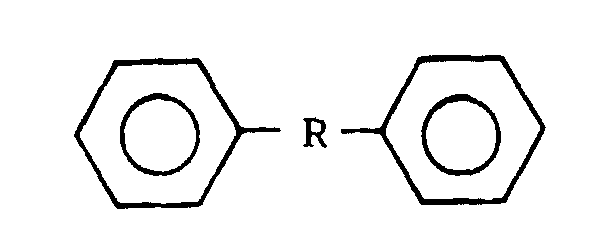
- the diphenylalkane will have the formula: wherein R is an alkylene radical having from 1 to about 10 carbon atoms.
- suitable diphenylalkane reactants include diphenylmethane, 1,2-diphenylethane, 1,3-diphenylpropane, 1,4-diphenylbutane, 1,5-diphenylpentane, 1,6-diphenylhexane, 1,7-diphenylheptane, 1,8-diphenyloctane, 1,9-diphenylnonane, and 1,10-diphenyldecane, 1,2-diphenylethane (referred to herein sometimes simply as "diphenylethane") is a preferred diphenylalkane reactant.
- the diphenylalkane substrate can be but is not necessarily highly purified: highly purified diphenylalkane substrates have been found to be unnecessary to produce the superior white products of the present invention.
- bromination catalyst Any suitable bromination catalyst can be employed which has sufficient catalytic activity to provide the level of bromination desired.
- Suitable bromination catalysts include aluminium catalyst such as aluminium powder and aluminium trihalides (e.g. AlCl 3 or AlBr 3 ), iron catalyst such as iron powder or iron trihalides (e.g. FeCl 3 or FeBr 3 ) antimony and zirconium.
- the bromination catalyst will be used in a catalytic amount. Usually 0.1 to 20 weight percent of catalyst is used relative to the weight of the diphenylalkane reactant, and more typically this value is 1 to 10 percent.
- Iron catalysts such as iron and iron salts, e.g. and iron trihalides, have been discovered to be highly advantageous catalysts for the bromination of diphenylalkanes. Particularly, it has been discovered that those iron bromination catalysts do not cause bromination of the alkylene bridge of the diphenylalkane reactant. This provides access to highly improved flame retardants, since brominated diphenylalkane products having bromine on the alkylene bridge are more likely to cause degradation in polymer formulations and excessive evolution of HBr.
- catalyst systems which include aluminium powder or aluminium trihalide catalysts do cause substantial bromination of the alkylene bridge of diphenylalkanes, particularly at the carbons alpha to the phenyl groups. This leads to products with significant levels of alkylene-bridge-brominated diphenylalkanes, for instance undeca- and dodecabromodiphenylalkanes, which cannot thereafter be completely removed.
- the diphenylalkane substrate, bromine and catalyst can be contacted and reacted in any suitable fashion to provide the brominated diphenylalkane product.
- the bromine and bromination catalyst are charged to a reaction vessel and the diphenylalkane substrate, while in a molten state, is slowly added to the bromine and catalyst. While the molten diphenylalkane reactant may be maintained under an inert atmosphere such as nitrogen prior to feeding it to the reaction vessel, it has been found that this is not needed to provide superior products using preferred processes of the invention.
- the bromine/catalyst mixture be maintained at a relatively low temperature, preferably below room temperature (i.e. about 25°C) and more preferably 15°C or below, e.g. 0°C to 15°C.
- the feed of the molten diphenylalkane can be either subsurface or above surface.
- the superior, white products of the invention can be obtained by feeding the diphenylalkane in either manner.
- the bromination reaction is preferably conducted at a temperature of 50°C up to the reflux temperature of the reaction mixture, typically about 60°C.
- the bromination reaction is conducted for a sufficient duration to achieve a brominated diphenylalkane product having an average bromine number of about 6 to 10, that is, having about 6 to 10 ar-bromines per molecule.
- Preferred such brominated diphenylalkane products will have the formula: wherein R is an alkylene radical, n and m are each a number from 1 to 5, and n + m, on average, is in the range of about 6 to about 10.
- the level of bromination can be monitored by periodic sampling of the reaction products or, where nearly complete ar-bromination is desired, the completion of the reaction can be monitored by the termination or substantial slowing of HBr evolution.
- the duration of the reaction will be dependent upon several factors such as the extent of bromination desired, the particular temperature and catalyst employed and the scale of the reaction. Typical reaction times will be in the range of 1 to 24 hours.
- the brominated diphenylalkane product will have an average bromine number of at least about 9 and will be predominantly (i.e. more than 50% by GC) comprised of decabromodiphenylalkane. More preferably, the product will be at least about 90% comprised of decabromodiphenylalkane; it is to be understood in this regard that higher levels of decabromodiphenylalkane, even those approaching 100% can be achieved, for instance by using longer reaction times. However, process economics often make it desirable to terminate the bromination reaction prior to achieving such high levels of the decabrominated product.
- lower brominated homologs can be present in the product in detectable amounts, usually mainly nonabromodiphenylalkane and octabromodiphenylalkane. Of these two lower brominated homologs, nonabromodiphenylalkane will usually be present in a greater amount.
- the brominated diphenylalkane product can be isolated from the reaction mixture in any conventional manner.
- the product is isolated by contacting the reaction mixture with hot water to distill off any excess bromine.
- this may be accomplished by pumping the reacted mixture from the reaction vessel and into hot water to distill off any remaining bromine and leave the product in an aqueous slurry.
- a stoichiometric excess of bromine that will provide a pumpable medium upon completion of the reaction, for example an excess of 300% or 400% or more can be used.
- a metal chelating or complexing agent can be included in the water to aid in the removal of catalyst residues.
- Chelating or complexing agents have been found to improve the color characteristics of brominated diphenylalkanes prepared using both iron- and aluminium-based catalysts; however in the case of iron and iron trihalide catalysts, the color improvement (e.g. the level of reduction of YID) is dramatically greater than in the case of aluminium or aluminium halide catalysts.
- Suitable chelating or complexing agents include for example sodium gluconate, glycolic acid, EDTA and similar bidentate ligands.
- the brominated diplienylalkane product can be recovered from the aqueous slurry by filtration and can be washed further with water or with organic solvents such as ketones, e.g. acetone, aromatics, e.g. toluene, halogenated alkanes, e.g. methylene dichloride, methylene dibromide, chloroform, bromoform and the like, which have also been found to improve the color characteristics of the product.
- organic solvents such as ketones, e.g. acetone, aromatics, e.g. toluene, halogenated alkanes, e.g. methylene dichloride, methylene dibromide, chloroform, bromoform and the like, which have also been found to improve the color characteristics of the product.
- Brominated diphenylalkane products can be digested with a substance that is effective to react off or otherwise remove the aliphatically-attached bromines.
- the product can be digested in a treatment solution containing a halogen reducing agent, e.g. an aqueous basic solution containing ammonia, hydrazine and organic amines.
- a halogen reducing agent e.g. an aqueous basic solution containing ammonia, hydrazine and organic amines.
- a feature of the present invention involves a high temperature aromatic solvent treatment of a brominated diphenylalkane to improve its color characteristics.
- Prior known methods for obtaining good color including using purified bromine and/or purified substrate, and roasting of the product, have provided brominated diphenylalkane products with YID's well above 10 which have been reported in the literature. These products having YID's above 10 are off-white in color and confer poor color to white plastics in which they are formulated.
- the treatment of the present invention provides brominated diphenylalkane products having YID's in the very low range of 1 to less than 5 being readily obtained even after a single treatment. Successive treatments may also be performed to further improve the purity and color of the product.
- the aromatic solvent used in the high temperature treatment of the present invention must not decompose at the temperatures at which the brominated diphenylalkane dissolves in the solvent. Typically, these temperatures will be in excess of 175°C and often in excess of 200°C, e.g. usually 200°C to 300°C.
- the brominated diphenylalkane is contacted with the aromatic solvent at a temperature sufficiently high that the brominated diphenylalkane is dissolved in the solvent, preferably forming a solution essentially free of solid diphenylalkane material. This contacting step can be achieved by any suitable manner.
- the brominated diphenylalkane is slurried in the solvent at a temperature below that which is necessary to dissolve the brominated diphenylalkane, and the slurry is heated to the temperature sufficiently high to form a clear solution.
- this may be accomplished by charging the brominated diphenylalkane to a vessel, and then charging the solvent to the vessel followed by the application of heat to the vessel.
- aromatic solvent materials useful in this aspect of the invention will be solids at ambient temperatures (i.e. about 20-25°C).
- the aromatic solvent material may be molten, and charged in the molten state to the vessel containing the brominated diphenylalkane.
- other modes of contacting the solvent and brominated product will be suitable, including for instance charging each to the reaction vessel prior to the application of heat or charging the brominated diphenylalkane material to a reaction vessel containing the molten solvent.
- the solvent may be at a temperature which is either insufficient or sufficient to dissolve the brominated diphenylalkane.
- Preferred aromatic solvents for use in this aspect of the invention are high-boiling aromatic compounds, so as to minimize or avoid the need to operate under pressure to achieve the high temperatures needed to effectively dissolve the brominated diphenylalkane.
- High-boiling aromatics with boiling points (at atmospheric pressure) above the highest treatment temperature utilized are preferred.
- non-fused aromatic compounds such as biphenyls, diphenylalkanes (e.g. with C 1 to C 10 alkylene bridges), diphenyloxides and diphenylsulfones and diphenylcarbonates, which are thermally stable at the high treatment temperatures employed, as well as fused aromatic solvents such as naphthalene or naphthalene derivatives, e.g.
- alkyl naphthalenes wherein the alkyl group or groups are typically C 1 to C 5 alkyls, e.g. methylnaphthalenes such as 2-methylnaphthalene. Mixtures of these materials are also suitable, such as may be found in certain Dowtherm heat transfer agents available from Dow Chemicals of Midland, MI, for example Dowtherm A (a eutectic mixture of biphenyl and diphenyloxide). Other Dowtherm products such as Dowtherm G (biphenyl phenyl ether) may also be used. Diphenylalkanes and diphenyloxide are preferred solvents, and in particular a diphenylalkane can be chosen to match the diphenylalkane substrate used to prepare the brominated diphenylalkane product.
- the dissolution of the brominated diphenylalkane product is preferably achieved with agitation or stirring of the solvent/product mixture.
- Suitable decolorizing agents such as activated carbon may also be contacted with the solvent/product mixture and separated prior to precipitating the product.
- the solution After complete dissolution of the brominated diphenylalkane, the solution is caused to be at a temperature at which the brominated diphenylalkane precipitates.
- the solution can be actively cooled to reduce temperature or may simply be allowed to cool on its own. It is preferable to apply cooling to the solution (as can be achieved in a heating/cooling jacketed vessel), as this results in smaller particle size upon precipitation of the brominated diphenylalkane.
- product recoveries are extraordinarily high, with recoveries of 75 wt% or more of the originallly-charged brominated diphenylalkane product being readily obtained and ranging even up to 90 to 95 wt% or more.
- the aromatic solvent employed is a solid at ambient temperature
- Preferred hot filtrations will be conducted in the range of 25°C to 100°C depending on the particular solvent material involved. A hot filtration is not necessary, however, even when the solvent material is a solid at ambient temperatures.
- the solvent material and brominated diphenylalkane may both be allowed to solidify.
- the solid mixture can then be treated with another liquid organic solvent in which the solid solvent material but not the brominated diphenylalkane product is soluble.
- the brominated diphenylalkane product can then be filtered from the resulting medium.
- the solid brominated diphenylalkane is dried, usually at a temperature above 100°C, to remove residual solvent. After drying, the solid brominated diphenylalkane product can be roasted or oven-aged at temperatures above 200°C, but it has been found that this step is unnecessary to achieve excellent product color and thermal stability.
- the brominated diphenylalkane product is preferably treated to reduce its particle size.
- the product can be mechanically ground or micronized, such as by air milling or similar known procedures.
- Processes of the invention can be used readily to obtain brominated diphenylalkane products with YID's (ASTM D 1925-70) below 5. These products have excellent thermal stability, for example as can be shown by thermogravimetric analysis (TGA). Products of the invention also have superior melting characteristics. Preferred decabromodiphenylethane products of the invention begin melting at temperatures above about 340°C, more preferably above about 345°C, and have DSC's above about 350°C and generally in the range of about 350-355°C. Preferred products of the invention undergo no substantial degradation upon melting, forming a clear, melted liquid as opposed to a brown liquid which is indicative of product decomposition.
- TGA thermogravimetric analysis
- Hydrolyzable bromine contents of preferred brominated diphenylalkane products are also very low, generally below 1000 ppm and typically in the range of about 100 ppm to about 250 ppm.
- preferred products of the invention do not excessively evolve HBr.
- preferred decabromodiphenylethane products show essentially no evolution of HBr at temperatures of about 330° and below, and only slight HBr evolution at a temperature of about 345°C. While the present invention is not limited by any theory, it is believed that these low levels of HBr evolution are due to the lack of bromination on the alkylene bridge of the brominated diphenylalkane.
- the brominated diphenylalkane products of the invention can be conventionally incorporated into flammable materials in flame retardant amounts.
- the flammable material will be a macromolecular material such as a polymer.
- Representative polymers in which products of the present invention may be used include polystyrene, including high impact polystyrene; copolymers of styrene; polycarbonates; polyurethanes; polyimides; polyamides; polyethers; acrylics; polyesters; epoxies; phenolics; elastomers such as butadiene/styrene copolymers and butadiene/acrylonitrile copolymers; terpolymers of acrylonitrile, butadiene and styrene (ABS); natural rubber; butyl rubber and polysiloxanes.
- ABS acrylonitrile, butadiene and styrene
- Additional representative polymers include those of olefinically saturated monomers such as ethylene, propylene and butadiene; copolymers of two or more such alkylene monomers and copolymers of one or more such alkylene monomers. Blends of polymers may also be used.
- brominated diphenylalkane product necessary for flame retardancy will depend upon the particular brominated diphenylalkane employed and polymer material involved, as well as other flame retardants which might be included. Those of ordinary skill in the art will be readily able to incorporate an amount of the brominated diphenylalkane which is necessary to achieve the desired level of flame retardancy. As is well known, it is preferred to incorporate the brominated flame retardant with another flame retardant material such as an inorganic compound, e.g. ferric oxide, zinc oxide, zinc borate, a group V element oxide such as a bismuth, arsenic, phosphorus or an antimony oxide.
- an inorganic compound e.g. ferric oxide, zinc oxide, zinc borate, a group V element oxide such as a bismuth, arsenic, phosphorus or an antimony oxide.
- antimony oxide has long been used on the commercial scale and thus it is a preferred additional flame retardant.
- an inorganic flame retardant is used in combination with the brominated diphenylalkane, the inorganic compound and brominated diphenylalkane will usually be present in a ratio of 1:1 to 1:10, more usually in the range of 1:2 to 1:4.
- polymer formulations contain up to about 40 wt% of the flame retardant system, whether it be the brominated diphenylalkane alone or its combination with another flame retardant. More typically, this range is about 10 to 30 wt%.
- Polymer formulations incorporating flame retardants of the invention can be conventionally processed to form thermoplastic articles, for example by molding (e.g. injection, extrusion or compression molding).
- the polymer formulation will contain further conventional additives such as pigments, fillers, UV stabilizers, plasticizers, and antioxidants.
- the invention provides high performance flame retardant resin systems with improved resistance to color shift on exposure to ultra violet light.
- brominated diphenyl alkanes of the invention are far whiten (less yellow) than those obtained by other known procedures, having a yellowness index (ASTM D 1925-70) of about 0 to less than 5.
- preferred flamed retardants of the invention are free from aliphatically-bound bromine. Bromines on the alkylene bridge of the diphenylalkane are far more susceptible to hydrolytic or thermal degradation than the bromine on the aromatic rings.
- HALS hindered amine light stabilizers
- formulations of high impact polystyrene and ABS incorporating decabromodiphenylethane exhibited dramatically low color shifts upon exposure to UV light (ASTM D4459, 300 hrs.), giving Delta E values of less than 6 and typically in the range of about 3 to 6.
- Thermoplastic formulations are thus provided which are much more suited for applications in which color shift upon exposure to UV light is problematic.
- the invention also provides high performance flame retardants and thermoplastic formulations with low corrosion properties.
- Formulated resin systems come in contact with metals throughout the formulation, compounding, molding and extrusion processes and in the case of wire and cable applications the formulated resin systems remain in intimate contact with various metals. These metals can include copper, mild steel and aluminum among others.
- the equipment used in processing the formulated systems is subject to corrosion from volatile bromine-containing species which may be present in the flame retardant at low levels or products due to decomposition of the flame retardant during processing.
- volatile bromine-containing species which may be present in the flame retardant at low levels or products due to decomposition of the flame retardant during processing.
- the wire and cable industry there is a potential for corrosion to lead to loss of signal as well as a loss of the metal to resin interface which permits entrainment of moisture leading to further corrosion.
- the achievement of low-corrosion flame retardants and formulations is highly important to the polymer and other industries.
- thermoplastic formulations of the invention incorporating brominated diphenylethanes essentially free of alkylene bridge bromination and subjected to high temperature solvent treatment as above lead to significantly less corrosion than corresponding brominated diphenylethanes containing alkylene bridge bromination and which are not subjected to the high temperature solvent treatment.
- a high temperature solvent-treated decabromodiphenyl ethane product free from alkylene bridge bromination, alone and in formulation exhibited substantially no tendancy to corrode metal by contact or vapor emission.
- a non-solvent-treated decabromodiphenylethane product containing alkylene bridge bromination tended to corrode metal alone or in formulation, which was evidenced by weight gain studies and visible pitting of metal samples.
- the invention also provides stable aqueous dispersions of flame retardants, and coating and adhesive compositions, e.g. textile coatings, adhesives, caulks, sealants, and similar materials, which incorporate the aqueous dispersions.
- coating and adhesive compositions e.g. textile coatings, adhesives, caulks, sealants, and similar materials, which incorporate the aqueous dispersions.
- the proliferation of water-based coatings and adhesives systems has led to the widespread use of a variety latex compositions incorporating dispersions of solid flame retardants.
- Aqueous dispersions of this inventive embodiment employ a wetting agent to compatibilize the non-soluble flame retardant solid with water, and a protective colloid formed by a thickening agent to significantly slow sedimentation and stabilize the dispersion.
- the flame retardant employed is a brominated diphenylalkane product such as those described herein, having an average bromine number of at least about 6, having a yellowness index of about 0 to less than 5 and preferably being free from alkylene bridge bromination.
- the brominated diphenylalkane is reduced to a submicron or micron particle size, preferably having an average particle size of 10 microns or less.
- An inorganic flame retardant synergist can be used along with the brominated diphenylalkane.
- the synergist may be, for example, a metal oxide such as ferric oxide, zinc oxide, zinc borate, a group V element oxide such as a bismuth, arsenic, phosphorus or an antimony oxide. Of these, antimony oxide has long been used commercially and thus is preferred.
- the weight ratio of synergist to brominated diphenylalkane will usually be 1:1 to 1:10, more usually in the range of 1:2 to 1:5.
- the wetting agent can be a nonionic wetting agent of the ethoxylated nonylphenol type
- the thickening agent can be hydroxy ethyl cellulose, carboxy methyl cellulose, methoxy or ethoxy cellulose. It will be understood however that a wide variety of wetting and thickening agents are known and their use in the present invention is well within the purview of one practiced in the area.
- the micropulverized brominated diphenylethane flame retardant can first be dispersed in water containing the wetting agent, for example by gradual addition to an aqueous phase with strong agitation (e.g. by a high speed, high shear mixer). Thereafter, the resulting dispersion can be stabilized by adding small quantities of the thickening agent.
- the above-described aqueous dispersion can be added to a polymer latex emulsion.
- Suitable polymers in the latex can be formed by polymerizing acrylic acid, methacrylic acid, acrylamide, methacrylamide, acrylonitrile, esters of acrylic and methacrylic acids, vinyl chloride, vinylidene chloride, styrene, butadiene, maleic or fumaric acids and esters of same.
- the polymer can be a homopolymer or copolymer of the above described monomers.
- Such emulsion polymers form films at room or elevated temperatures, alone or in the presence of plasticizers, and are commercially available or can be obtained by techniques well known to the art and literature.
- Latexes such as those described above possess extremely good adhesive properties, and can be used in both coating and adhesive or bonding applications.
- One particularly preferred aspect of the invention is the use of coating compositions to coat textile materials in various forms such as staple, tow, yarn, fiber, woven or non-woven fabrics, knits and carpets.
- Fabric substrates can be of natural or synthetic origin, with synthetic fabrics such as nylon, polyester, acrylics, and polypropylene, more typically being used.
- Textile materials will be coated with sufficient amounts of the coating compositions to provide the desired flame retardancy, and dried. These amounts will, of course, vary in accordance with the flammability characteristics of the textile materials themselves. Coatings formed in accordance with the invention have superior, white color, and resistance to color shift upon exposure to UV light, as demonstrated in the Examples below.
- stable aqueous dispersions and latex adhesive or coating compositions formed therefrom reference can be made to U.S. Patent No. 4,623,583.
- Yellowness and Whiteness Indexes were obtained in accordance with ASTM D 1925-70 as specified in the 1990 Annual Book of ASTM Standards - Plastics, Volume 08.02 using a Color Gard System Model 2000/5 from Pacific Scientific. Melting point (M.P.) data were obtained using a Buch ⁇ Model 510 melting point apparatus. In M.P. determinations, products were initially heated at a rate of 5°C/min. to 300°C and thereafter were heated at a rate of 1°C/min. To establish HBr evolution, a strip of pH paper was suspended above the sample during a melting point determination. A faint pink color on the pH paper indicated slight HBr evolution and a red color indicated heavy HBr evolution.
- the reaction was maintained at reflux for 9 hours. Heat was removed and the product (in bromine) was pumped into water at 99°C to remove the bromine (bromine collected in Dean and Stark trap).
- the water (2 L) contained 17.3 g (0.079 moles) of sodium gluconate (Aldrich) to complex the iron catalyst. The remaining slurry was filtered and washed with water (3 x 350 ml de-ionized water) and dried in an oven at 120°C for 14 hours.
- a decabromodiphenylethane flame retardant (FR) of the invention prepared as above and bearing no bromines on the alkylene bridge (DBDPE), was formulated in HIPS (high impact polystyrene) as detailed below (percents given as percent of overall formulation) and injection molded to form plaques which were exposed in a Xenon Arc Weatherometer for 300 hours according to ASTM D 4459 (light exposure of plastics for indoor applications). The formulations passed the UL94 V-0 ; flammability test at 1.5 mm (1/16"). The color change from the initial formulation color after exposure is conventionally given as Delta E, with more desirable systems giving lower Delta E values.
- HIPS high impact polystyrene
- a decabromodiphenyl ethane product having trace levels of alkylene bridge bromination (DBDPE-ABB) was similarly formulated and tested.
- the latter is sufficiently more yellow as to require additional color pigment to mask the yellow cast for color matching in the non-UV stable HIPS. This need for additional pigments adds to the cost and further adjustments in the overall formulation to achieve the optimum physical properties.
- DBDPE and DBDPE(ABB) were also compounded into ABS at load levels which gave V-0 flammability performance and tested for color stability according to the ASTM D 4459 for indoor applications.
- a Brabender prepcenter mixing bowl at 200°C was flushing polypropylene homopolymer (Himont 6524) with 20% decabromodiphenyl ethane (DBDPE or DBDPE(ABB)) and 3.2% antimony trioxide.
- the weighed and cleaned shim stock was suspended in the vapors over the fluxing flame retarded polymer for 15 minutes.
- the exposed shim steel was then suspended in boiling water vapors for 30 minutes and then allowed to air dry at room temperature for one hour.
- the resulting shim stock was then weighed and visually inspected.
- the formulation containing the DBDPE(ABB) gave a weight gain of 0.0009 for a 45.1366 gram steel shim and showed corrosion and pitting of the surface.
- the formulation containing the DPDPE no alkylene bridge bromination
- the DBDPE thus exhibits a dramatically reduced tendency to corrode metals which is important to the preservation of processing equipment commonly used in compounding operations.
- DBDPE(ABB) 1 gram was placed on a cleaned carbon steel coupon (washed with soap and water, rinsed with acetone and air dried). The coupon was heated to 100°C and held for one hour. The DBDPE was put through the same test protocol. At the end of one hour the flame retardant was shaken off the coupons and they were suspended over boiling water for one hour. Weights of the coupons were taken immediately after drying at room temperature and were again reweighed after one hour at room temperature.
- the sample contacted with the DBDPE(ABB) gave a weight gain of .0010 on a 10.3081 gram coupon and was visibly corroded and pitted.
- the coupon contacted with the DBDPE showed no weight gain and no visible corrosion, again demonstrating the superior, non-corrosive nature of preferred FR's of the invention.
- a stable aqueous dispersion of decabromodiphenylethane and antimiony oxide was prepared using a lightning mixer blade.
- a polypropylene beaker was charged with 23.7 parts by weight deionized water, 0.2 parts Rohm and Haas Tamol SN dispersant, and 0.8 parts surfactant (octylphenol capped with 30 moles of ethylene oxide). After mixing for 90 seconds at 1200 rpm, all components were fully solubilized.
- the mixture was neutralized with 3 drops of 28% ammonium hydroxide solution.
- One part of 28% acrylic emulsion containing acidic functional groups was added as a thickener under agitation.
- a total of 0.5 parts of the 28% ammonium hydroxide was then added slowly, again under agitation.
- the resultant dispersion was placed into a sealed glass bottle for observation. After standing for one month at room temperature, no sediment was visible at the bottom of container (when inverted for observation). Additionally, there was no water layer on the surface. The dispersion thus had at least one month of shelf stability.
- decabromodiphenylethane was compared to decabromodiphenyl oxide as a flame retardant in an automotive upholstery fabric backcoating.
- Two flame retardant dispersions were prepared as in Example 14, one containing decabromodiphenylethane and one containing decabromodiphenyl oxide substituted for decabromodiphenylethane.
- the particle size of the brominated diphenyl oxide averaged 3.5 ⁇ m and that of the brominated diphenylethane averaged 4.2 microns.
- the dispersions were added to an acrylic latex coating based predominantly upon butyl acrylate. Sufficient flame retardant dispersion was added to give 15% flame retardant (antimony oxide included) in the dry coating.
- DBDPE prepared generally as in Example 8 and having an average particle size of 2.7 ⁇ m, a yellowness index of 2.5, less than 100 ppm bromine, and 229 ppm hydrolyzable bromine was used to prepare a dispersion as in Example 15.
- a sufficient, flame retarding quantity of the dispersion was added to a butyl acrylate based latex coating (also including ATO).
- the resultant coating had excellent color.
- the coating was applied to 218 g m -2 (6.5 oz/yd 2 ) automotive polyester fabric at a coating level of 70.4 g m -2 (2.1 oz/yd 2 ).
- the flame retardant component (DBDPE and ATO) comprised 25% by weight of the dry film, which was white in appearance.
Landscapes
- Chemical & Material Sciences (AREA)
- Organic Chemistry (AREA)
- Analytical Chemistry (AREA)
- Crystallography & Structural Chemistry (AREA)
- Engineering & Computer Science (AREA)
- Materials Engineering (AREA)
- Organic Low-Molecular-Weight Compounds And Preparation Thereof (AREA)
- Fireproofing Substances (AREA)
- Compositions Of Macromolecular Compounds (AREA)
- Low-Molecular Organic Synthesis Reactions Using Catalysts (AREA)
- Catalysts (AREA)
Abstract
Description

| Analysis | Found |
| % Organic Br | 81.76% |
| Hydrolyzable Br | 1603 ppm |
| Fe ppm | 3282 ppm |
| TGA 5% Wt loss | 325°C |
| YID | 73.4 |
| Dodeca | ND |
| Deca | 85.1% |
| Nona | 13.5% |
| Octa | 1.4% |
| Ex. 2 | |
| Analysis | Found |
| % Organic Br | 81.9% |
| Hydrolyzable Br | 670 ppm |
| Fe ppm | 15 ppm |
| TGA 5% Wt loss | 335°C |
| YID | 14.8 |
| Dodeca | ND |
| Deca | 87.3% |
| Nona | 11.9% |
| Octa | 0.7% |
| Ex. 3 | |
| Analysis | Found |
| % Organic Br | 81.8% |
| Hydrolyzable Br | 579 ppm |
| Fe ppm | 15 ppm |
| TGA 5% Wt loss | 327°C |
| YID | 16.1 |
| Dodeca | ND |
| Deca | 87.7% |
| Nona | 11.5% |
| Octa | 0.7% |
| Ex. 4 | |
| Analysis | Found |
| % Organic Br | 81.8% |
| Hydrolyzable Br | 779 ppm |
| Fe ppm | 15 ppm |
| TGA 5% Wt loss | 337°C |
| YID | 16.1 |
| Dodeca | ND |
| Deca | 88.2% |
| Nona | 11.1% |
| Octa | 0.6% |
| Analysis | Found |
| % Organic Br | 81.2% |
| Hydrolyzable Br | 828 ppm |
| Fe ppm | <2 ppm |
| TGA 5% Wt loss | 325°C |
| USC | 350°C |
| YID | 45 |
| Dodeca | ND |
| Deca | 92.3 |
| Nona | 6.0% |
| Octa | 1.8% |
| Analysis | Found |
| % Organic Br | 83.2% |
| Hydrolyzable Br | 237 ppm |
| Fe ppm | <2 ppm |
| TGA 5% Wt loss | 351°C |
| DSC | 352.4°C |
| YID | 4.8 |
| WIE | 73.7 |
| Dodeca | ND |
| Deca | 93.4 |
| Nona | 5.2% |
| Octa | 1.3% |
| Analysis | Found |
| % Organic Br | 81.0% |
| Hydrolyzable Br | 164 ppm |
| Fe ppm | <2 ppm |
| TGA 5% Wt loss | 350°C |
| DSC | 354°C |
| M.P. | 349-354°C |
| YID | 4.7 |
| WIE | 75.5 |
| Dodeca | ND |
| Deca | 94.4 |
| Nona | 4.3% |
| Octa | 1.3% |
| Analysis | Found |
| % Organic Br | 83.6% |
| Hydrolyzable Br | 279 ppm |
| Fe ppm | <2 ppm |
| TGA 5% Wt loss | 351°C |
| DSC | 350°C |
| M.P. | 346-349°C |
| YID | 1.6 |
| WIE | 90.1 |
| Dodeca | ND |
| Deca | 89.4% |
| Nona | 8.5% |
| Octa | 2.2% |
| Analysis | Found |
| % Organic Br | 82.1% |
| Hydrolyzable Br | 9169 ppm |
| TGA 5% Wt loss | 340°C |
| DSC | 348°C |
| M.P. | 341-346 |
| YID | 10.0 |
| WIE | 61.7 |
| Dodeca | 1.1% |
| Deca | 94.6% |
| Nona | 4.9% |
| Octa | 0.4% |
| DBDPE | DBDPE-ABB | |
| %Br | 10.4 | 10.4 |
| %FR | 12.8 | 12.8 |
| %ATO | 3.2 | 3.2 |
| %Tinuvin 327 | 0.5 | 0.5 |
| %944FL | 0.5 | 0.5 |
| UL94, 1/16" | V-0 | V-0 |
| ASTMD4459 | 3.4 | 6.2 |
| DBDPE | DBDPE-ABB | |
| %Br | 12.0 | 12.0 |
| %FR | 14.8 | 14.8 |
| %ATO | 4.5 | 4.5 |
| %Tinuvin 327 | 0.5 | 0.5 |
| %944FL | 0.5 | 0.5 |
| UL94, 1/16" | V-0 | V-0 |
| ASTMD4459 | 5.3 | 7.2 |
| Coating (g m-2 (oz/yd2)) | DBDPE (cm (inches)) | DBDPO (cm (inches)) |
| 50.3 (1.5) | 3.75 (1.5) | 3.75 (1.5) |
| 67.0 (2.0) | 3.5 (1.4) | 3.25 (1.3) |
| 100.5 (3.0) | 2.75 (1.1) | 2.5 (1.0) |
| 117.3 (3.5) | 2.25 (0.9) | 2.0 (0.8) |
Claims (25)
- A process for improving the color of a solid. brominated diphenylalkane product having 1 to 10 carbon atoms in its alkylene bridge and an average bromine number of 6 or more, comprising:contacting the brominated diphenylalkane product with an aromatic solvent at a temperature above 175°C to achieve dissolution of the brominated diphenylalkane product in the aromatic solvent;cooling the resulting solution to precipitate the brominated diphenylalkane product having an improved color; andrecovering the brominated diphenylalkane product having a Yellowness Index (ASTM D 1925-70) of less than 5.
- The process of claim 1 which includes:slurrying the solid, brominated diphenylalkane product in an aromatic solvent having a boiling point of at least 200°C;heating the slurry to a temperature sufficiently high to achieve dissolution of the brominated diphenylalkane in the aromatic solvent;maintaining the slurry at said temperature until the brominated diphenylalkane is substantially dissolved in the aromatic solvent; andcooling the solution after said maintaining, to precipitate the brominated diphenylalkane product.
- The process of claim 2 comprising heating the slurry to a temperature of at least 200°C.
- The process of claim 3 wherein the brominated diphenylalkane is brominated diphenylethane.
- A process as claimed in claim 1 wherein the brominated diphenylalkane product to be contacted with the aromatic solvent is essentially free of bromine in the alkylene bridge.
- The process of claim 3 wherein the brominated diphenylalkane product has been prepared by bromination of a diphenylalkane in bromine, in the presence of a bromination catalyst.
- The process of claim 6 wherein the bromination catalyst is iron powder, FeCl3 or FeBr3.
- The process of claim 6 wherein the brominated diphenylethane product has an average bromine number of at least 9.
- The process of claim 8 wherein the brominated diphenylalkane is brominated diphenylethane.
- The process of claim 9 wherein the brominated diphenylethane has an average bromine number of at least 9.
- The process of claim 10 wherein the brominated diphenylethane product is at least 80% comprised of decabromodiphenylethane.
- The process of claim 11, wherein the aromatic solvent is a non-fused diaromatic compound having a boiling point of at least 200°C.
- The process of claim 12, wherein the aromatic solvent is diphenyloxide or diphenylalkane.
- A solid, particulate flame retardant brominated diphenylalkane product having 1 to about 10 carbon atoms in its alkylene bridge, having an average bromine number of at least about 6 and a Yellowness Index (ASTM D 1925-70) of about 0 to less than 5.
- The product of claim 14 wherein the brominated diphenylalkane product has a Yellowness Index (ASTM D 1925-70) in the range of about 1 to less than 5.
- The product of claim 15 wherein the brominated diphenylalkane product has an average bromine number of at least about 9.
- The product of claim 14 wherein the brominated diphenylalkane product is a brominated diphenylethane product.
- The product of claim 15 wherein the brominated diphenylalkane product is a brominated diphenylethane product.
- The product of claim 16 wherein the brominated diphenylalkane product is a brominated diphenylethane product.
- The product of claim 19 wherein the product is at least about 80% comprised of decabromodiphenylethane.
- The product of claim 20 wherein the product is at least about 90% comprised of decabromodiphenylethane.
- The product of claim 14 wherein the brominated diphenylalkane product is essentially free of bromine in its alkylene bridge.
- A molded article comprising a flame retardant macromolecular formulation of claim 22.
- A composition comprising an aqueous dispersion including water, a wetting agent, and a solid, particulate flame retardant of claim 14.
- An adhesive or coating composition comprising a polymer latex emulsion incorporating a stable aqueous dispersion of claim 24.
Applications Claiming Priority (3)
| Application Number | Priority Date | Filing Date | Title |
|---|---|---|---|
| US4426693A | 1993-04-07 | 1993-04-07 | |
| US44266 | 1993-04-07 | ||
| PCT/US1994/003841 WO1994022978A1 (en) | 1993-04-07 | 1994-04-07 | Brominated diphenylalkane products and processes |
Publications (3)
| Publication Number | Publication Date |
|---|---|
| EP0693100A1 EP0693100A1 (en) | 1996-01-24 |
| EP0693100A4 EP0693100A4 (en) | 1996-04-24 |
| EP0693100B1 true EP0693100B1 (en) | 1998-09-09 |
Family
ID=21931414
Family Applications (1)
| Application Number | Title | Priority Date | Filing Date |
|---|---|---|---|
| EP94912399A Expired - Lifetime EP0693100B1 (en) | 1993-04-07 | 1994-04-07 | Brominated diphenylalkane products and processes |
Country Status (9)
| Country | Link |
|---|---|
| US (1) | US5457248A (en) |
| EP (1) | EP0693100B1 (en) |
| JP (1) | JPH08510208A (en) |
| KR (1) | KR960701969A (en) |
| AU (1) | AU6498594A (en) |
| DE (1) | DE69413217T2 (en) |
| IL (1) | IL109251A (en) |
| TW (1) | TW343212B (en) |
| WO (1) | WO1994022978A1 (en) |
Families Citing this family (34)
| Publication number | Priority date | Publication date | Assignee | Title |
|---|---|---|---|---|
| JP3289503B2 (en) * | 1994-07-08 | 2002-06-10 | チッソ株式会社 | Flame retardant fiber and non-woven fabric |
| US6518468B1 (en) * | 1994-09-16 | 2003-02-11 | Albemarle Corporation | Bromination process |
| DE69535076T3 (en) * | 1994-10-05 | 2011-05-19 | Great Lakes Chemical Corp., West Lafayette | CONTINUOUS COMBUSTION PROCESS AND PRODUCTS MANUFACTURED THEREFROM |
| US6117371A (en) * | 1994-10-05 | 2000-09-12 | Great Lakes Chemical Corporation | Continuous bromination process and products thereof |
| US6743825B1 (en) | 2001-08-03 | 2004-06-01 | Albemarle Corporation | Poly(bromoaryl)alkane additives and methods for their preparation and use |
| WO2003048251A1 (en) * | 2001-12-05 | 2003-06-12 | Isola Laminate Systems Corp. | Prepreg and composition of epoxy resin(s), sma copolymers(s) and bis-maleimide triazine resin(s) |
| US7255927B2 (en) * | 2001-12-05 | 2007-08-14 | Isola Usa Corp. | Laminate composition |
| US7090924B2 (en) * | 2001-12-05 | 2006-08-15 | Isola Usa Corp. | Thermosetting resin composition for high performance laminates |
| AU2002361780A1 (en) * | 2001-12-21 | 2003-07-15 | Pabu Services, Inc. | Method and apparatus for producing decabromodiphenyl alkanes |
| WO2007057900A2 (en) | 2005-11-21 | 2007-05-24 | Bromine Compounds Ltd. | Flame retardant bromobenzyl systems |
| EP2057110A1 (en) * | 2006-08-29 | 2009-05-13 | Albermarle Corporation | Preparation of decahalodiphenyl ethane |
| CN101528654B (en) * | 2006-08-31 | 2012-12-26 | 溴化合物有限公司 | A process for preparing polybrominated compounds |
| WO2008057645A1 (en) * | 2006-11-08 | 2008-05-15 | Albemarle Corporation | Preparation of high assay decabromodiphenylalkane |
| US8034986B2 (en) * | 2006-11-09 | 2011-10-11 | Albemarle Corporation | Processing of solid brominated aromatic organic compounds containing occluded bromine |
| US20080132743A1 (en) * | 2006-12-01 | 2008-06-05 | Albemarle Corporation | Production of high purity decabromodiphenylalkanes |
| US7408088B1 (en) * | 2007-02-08 | 2008-08-05 | Albemarle Corporation | Process for separation of bromine from gaseous hydrogen bromide and use of such process in production of decabromodiphenylethane |
| MX2009009695A (en) | 2007-03-16 | 2009-09-24 | Albemarle Corp | Preparation and provision of high assay decabromodiphenylethane. |
| ES2445627T3 (en) * | 2007-03-16 | 2014-03-04 | Albemarle Corporation | Preparation and supply of high test value decabromodiphenylethane |
| JP2010529264A (en) * | 2007-06-07 | 2010-08-26 | アルベマール・コーポレーシヨン | Low molecular weight brominated polymers and their use in thermoplastic formulations |
| US20090043019A1 (en) * | 2007-08-06 | 2009-02-12 | Jing-Chung Chang | Flame retardant polytrimethylene terephthalate composition |
| US8993684B2 (en) * | 2008-06-06 | 2015-03-31 | Albemarle Corporation | Low molecular weight brominated polymers, processes for their manufacture and their use in thermoplastic formulations |
| MX2011005661A (en) * | 2008-12-02 | 2011-06-16 | Albemarle Corp | Bromination of telomer mixtures derived from toluene and styrene. |
| KR20110110096A (en) * | 2008-12-02 | 2011-10-06 | 알베마를 코포레이션 | Toluene and styrene derived telomer distributions and brominated flame retardants resulting therefrom |
| JO3423B1 (en) * | 2008-12-02 | 2019-10-20 | Albemarle Corp | Brominated Flame Retardants And Precursors Therefor |
| WO2010065467A1 (en) * | 2008-12-02 | 2010-06-10 | Albemarle Corporation | Branched and star-branched styrene polymers, telomers, and adducts, their synthesis, their bromination, and their uses |
| JO3059B1 (en) | 2009-05-01 | 2017-03-15 | Albemarle Corp | Bromination of low molecular weight aromatic polymer compositions |
| KR20120088535A (en) | 2009-05-01 | 2012-08-08 | 알베마를 코포레이션 | Pelletized low molecular weight brominated aromatic polymer compositions |
| ES2459944T3 (en) | 2009-07-27 | 2014-05-13 | Albemarle Corporation | Preparation of a high concentration decabromodiphenylalkane product with low occluded free bromine content |
| WO2011082207A2 (en) * | 2009-12-30 | 2011-07-07 | E. I. Du Pont De Nemours And Company | Flame retardant poly(trimethylene terephthalate) compositions |
| CN103384557A (en) * | 2010-12-29 | 2013-11-06 | 阿尔比马尔公司 | Removal of bromine from gaseous hydrogen bromide |
| JP6206177B2 (en) * | 2013-12-26 | 2017-10-04 | 東ソー株式会社 | Method for producing decabromodiphenylethane |
| JP6978288B2 (en) * | 2017-11-17 | 2021-12-08 | 明成化学工業株式会社 | Flame-retardant processing agent for polyester fibers |
| WO2019199403A1 (en) | 2018-04-09 | 2019-10-17 | Albemarle Corporation | Flame retardants for textile applications |
| CN117986633B (en) * | 2024-02-02 | 2025-01-21 | 华东理工大学 | Preparation method and application of brominated flame retardant masterbatch |
Family Cites Families (37)
| Publication number | Priority date | Publication date | Assignee | Title |
|---|---|---|---|---|
| DE1123823B (en) * | 1959-12-18 | 1962-02-15 | Huels Chemische Werke Ag | Flame-retardant molding compounds based on polyolefins |
| DE1135653B (en) * | 1960-07-25 | 1962-08-30 | Huels Chemische Werke Ag | Flame-retardant molding compounds made from polyolefins |
| US3146284A (en) * | 1960-09-16 | 1964-08-25 | Hercules Powder Co Ltd | Process for making polypropylene film |
| DE1127582B (en) * | 1960-09-30 | 1962-04-12 | Huels Chemische Werke Ag | Flame-retardant molding compounds made from polyolefins |
| DE1277831B (en) * | 1961-03-03 | 1968-09-19 | Huels Chemische Werke Ag | Process for the substitutional bromination of organic compounds |
| FR1383872A (en) * | 1962-12-05 | 1964-11-23 | Kalk Chemische Fabrik Gmbh | |
| US3331793A (en) * | 1964-05-25 | 1967-07-18 | Du Pont | Abrasion resistant vulcanizates comprising epd rubber, carbon black, and minor amounts of natural rubber or sbr |
| US3883481A (en) * | 1966-10-28 | 1975-05-13 | Huels Chemische Werke Ag | Fire-retardant polyolefin compositions |
| US3658634A (en) * | 1970-08-20 | 1972-04-25 | Toray Industries | Fire-retardant sheath and core type conjugate fiber |
| US3965197A (en) * | 1970-10-12 | 1976-06-22 | Michigan Chemical Corporation | Process for the complete bromination of non-fused ring aromatic compounds |
| US3763248A (en) * | 1971-03-02 | 1973-10-02 | Ethyl Corp | Process for production of poly brominated aromatics |
| US3875249A (en) * | 1971-03-10 | 1975-04-01 | Ethyl Corp | Preparation of haloalkyl aromatic hydrocarbons |
| US3787512A (en) * | 1971-03-10 | 1974-01-22 | Ethyl Corp | Preparation of aromatic hydrocarbons |
| US3833674A (en) * | 1972-08-24 | 1974-09-03 | Ethyl Corp | Recovery of brominated biphenyl |
| US4001375A (en) * | 1974-08-21 | 1977-01-04 | Exxon Research And Engineering Company | Process for the desulfurization of flue gas |
| US4214103A (en) * | 1978-11-30 | 1980-07-22 | Great Lakes Chemical Corporation | Purification of brominated organic products |
| US4623583A (en) * | 1979-04-18 | 1986-11-18 | White Chemical Corporation | Flame retardant textile fabrics |
| US4287373A (en) * | 1979-05-16 | 1981-09-01 | Great Lakes Chemical Corporation | Perbromination of phenol and diphenyl ether at elevated temperature using bromine as the reaction medium |
| US4327227A (en) * | 1980-02-20 | 1982-04-27 | Great Lakes Chemical Corporation | Process for producing purified brominated aromatic compounds |
| US4659021A (en) * | 1983-12-06 | 1987-04-21 | Ethyl Corporation | Process for producing purified brominated aromatic compounds |
| US4740629A (en) * | 1986-04-21 | 1988-04-26 | Ethyl Corporation | Bromination process |
| US4717776A (en) * | 1986-04-21 | 1988-01-05 | Ethyl Corporation | Bromination process |
| US5041687A (en) * | 1988-05-26 | 1991-08-20 | Ethyl Corporation | Bromination process |
| US5077334A (en) * | 1988-06-13 | 1991-12-31 | Ethyl Corporation | Flame-retarded formulations of thermoplastics and decabromodiphenylethane |
| US4929785A (en) * | 1989-03-20 | 1990-05-29 | Ethyl Corporation | Process for preparing diphenylalkane |
| US5003117A (en) * | 1989-08-03 | 1991-03-26 | Ethyl Corporation | Process for decabromodiphenyl methane |
| US5039729A (en) * | 1990-03-05 | 1991-08-13 | Ethyl Corporation | Novel mixtures of brominated diphenyl ethanes |
| US5008477A (en) * | 1990-03-14 | 1991-04-16 | Ethyl Corporation | Decabromodiphenyl alkane process |
| WO1991013915A1 (en) * | 1990-03-16 | 1991-09-19 | Great Lakes Chemical Corporation | Process for purifying brominated polystyrene |
| US5136107A (en) * | 1990-06-04 | 1992-08-04 | Ethyl Corporation | Process for halogenating aromatic compounds |
| US5030778A (en) * | 1990-06-04 | 1991-07-09 | Ethyl Corporation | Decabromodiphenyl alkane process |
| CA2047256C (en) * | 1990-07-30 | 2002-03-05 | Saadat Hussain | Process for decabromodiphenylalkane predominant product |
| US5124496A (en) * | 1990-11-01 | 1992-06-23 | Ethyl Corporation | Process for decabromodiphenylalkane predominant product |
| CA2055519A1 (en) * | 1990-12-03 | 1992-06-04 | Albemarle Corporation | Decabromodiphenylalkane process |
| US5055235A (en) * | 1990-12-12 | 1991-10-08 | Ethyl Corporation | Bromination process |
| CA2058126A1 (en) * | 1991-02-25 | 1992-08-26 | Albemarle Corporation | Bromination process |
| EP0571859A3 (en) * | 1992-05-26 | 1994-11-02 | Ethyl Corp | Product consisting predominantly of decabromodiphenylethane with increased whiteness. |
-
1994
- 1994-04-07 KR KR1019950704380A patent/KR960701969A/en not_active Ceased
- 1994-04-07 EP EP94912399A patent/EP0693100B1/en not_active Expired - Lifetime
- 1994-04-07 DE DE69413217T patent/DE69413217T2/en not_active Expired - Fee Related
- 1994-04-07 AU AU64985/94A patent/AU6498594A/en not_active Abandoned
- 1994-04-07 JP JP6522496A patent/JPH08510208A/en active Pending
- 1994-04-07 WO PCT/US1994/003841 patent/WO1994022978A1/en not_active Ceased
- 1994-04-07 US US08/224,345 patent/US5457248A/en not_active Expired - Lifetime
- 1994-04-07 IL IL10925194A patent/IL109251A/en not_active IP Right Cessation
- 1994-06-14 TW TW083105356A patent/TW343212B/en active
Also Published As
| Publication number | Publication date |
|---|---|
| AU6498594A (en) | 1994-10-24 |
| IL109251A0 (en) | 1994-07-31 |
| HK1009977A1 (en) | 1999-06-11 |
| EP0693100A1 (en) | 1996-01-24 |
| WO1994022978A1 (en) | 1994-10-13 |
| DE69413217T2 (en) | 1999-02-18 |
| TW343212B (en) | 1998-10-21 |
| US5457248A (en) | 1995-10-10 |
| KR960701969A (en) | 1996-03-28 |
| IL109251A (en) | 1999-05-09 |
| EP0693100A4 (en) | 1996-04-24 |
| JPH08510208A (en) | 1996-10-29 |
| DE69413217D1 (en) | 1998-10-15 |
Similar Documents
| Publication | Publication Date | Title |
|---|---|---|
| US5457248A (en) | Brominated diphenylalkane products and processes | |
| EP0784648B1 (en) | Continuous bromination process and products thereof | |
| US6117371A (en) | Continuous bromination process and products thereof | |
| US5302768A (en) | Process for decarbromodiphenylalkane predominant product | |
| KR100219894B1 (en) | Decabromodiphenyl alkanes product and preparation method thereof | |
| US4352909A (en) | Process for the bromination of polystyrenes | |
| EP0460922B1 (en) | Decabromodiphenyl alkane process | |
| KR101536032B1 (en) | Low molecular weight brominated polymers, processes for their manufacture and their use in thermoplastic formulations | |
| US6008283A (en) | Oligomeric flame retardant additive | |
| EP0335953B1 (en) | Process for producing polybrominated higher alkylbenzenes | |
| US5077334A (en) | Flame-retarded formulations of thermoplastics and decabromodiphenylethane | |
| EP0571859A2 (en) | A decabromodiphenylethane predominated product having enhanced whiteness | |
| HK1009977B (en) | Brominated diphenylalkane products and processes | |
| CA1158381A (en) | Thermally stable smoke suppressant additives to polymeric compositions | |
| JP3004113B2 (en) | Decabromodiphenylalkane method | |
| EP2137253B1 (en) | Heavy metal deactivator/inhibitor for use in olefinic polymers |
Legal Events
| Date | Code | Title | Description |
|---|---|---|---|
| PUAI | Public reference made under article 153(3) epc to a published international application that has entered the european phase |
Free format text: ORIGINAL CODE: 0009012 |
|
| 17P | Request for examination filed |
Effective date: 19951006 |
|
| AK | Designated contracting states |
Kind code of ref document: A1 Designated state(s): BE CH DE FR GB IT LI NL |
|
| A4 | Supplementary search report drawn up and despatched |
Effective date: 19960307 |
|
| AK | Designated contracting states |
Kind code of ref document: A4 Designated state(s): BE CH DE FR GB IT LI NL |
|
| 17Q | First examination report despatched |
Effective date: 19960708 |
|
| GRAG | Despatch of communication of intention to grant |
Free format text: ORIGINAL CODE: EPIDOS AGRA |
|
| GRAG | Despatch of communication of intention to grant |
Free format text: ORIGINAL CODE: EPIDOS AGRA |
|
| GRAH | Despatch of communication of intention to grant a patent |
Free format text: ORIGINAL CODE: EPIDOS IGRA |
|
| GRAH | Despatch of communication of intention to grant a patent |
Free format text: ORIGINAL CODE: EPIDOS IGRA |
|
| GRAA | (expected) grant |
Free format text: ORIGINAL CODE: 0009210 |
|
| AK | Designated contracting states |
Kind code of ref document: B1 Designated state(s): BE CH DE FR GB IT LI NL |
|
| PG25 | Lapsed in a contracting state [announced via postgrant information from national office to epo] |
Ref country code: IT Free format text: LAPSE BECAUSE OF FAILURE TO SUBMIT A TRANSLATION OF THE DESCRIPTION OR TO PAY THE FEE WITHIN THE PRE;WARNING: LAPSES OF ITALIAN PATENTS WITH EFFECTIVE DATE BEFORE 2007 MAY HAVE OCCURRED AT ANY TIME BEFORE 2007. THE CORRECT EFFECTIVE DATE MAY BE DIFFERENT FROM THE ONE RECORDED.SCRIBED TIME-LIMIT Effective date: 19980909 |
|
| REG | Reference to a national code |
Ref country code: CH Ref legal event code: EP |
|
| REF | Corresponds to: |
Ref document number: 69413217 Country of ref document: DE Date of ref document: 19981015 |
|
| ET | Fr: translation filed | ||
| REG | Reference to a national code |
Ref country code: CH Ref legal event code: NV Representative=s name: RITSCHER & SEIFERT |
|
| PG25 | Lapsed in a contracting state [announced via postgrant information from national office to epo] |
Ref country code: LI Free format text: LAPSE BECAUSE OF NON-PAYMENT OF DUE FEES Effective date: 19990430 Ref country code: CH Free format text: LAPSE BECAUSE OF NON-PAYMENT OF DUE FEES Effective date: 19990430 |
|
| PGFP | Annual fee paid to national office [announced via postgrant information from national office to epo] |
Ref country code: BE Payment date: 19990614 Year of fee payment: 6 |
|
| PLBE | No opposition filed within time limit |
Free format text: ORIGINAL CODE: 0009261 |
|
| STAA | Information on the status of an ep patent application or granted ep patent |
Free format text: STATUS: NO OPPOSITION FILED WITHIN TIME LIMIT |
|
| 26N | No opposition filed | ||
| REG | Reference to a national code |
Ref country code: CH Ref legal event code: PL |
|
| PGFP | Annual fee paid to national office [announced via postgrant information from national office to epo] |
Ref country code: GB Payment date: 20000412 Year of fee payment: 7 |
|
| PGFP | Annual fee paid to national office [announced via postgrant information from national office to epo] |
Ref country code: DE Payment date: 20000417 Year of fee payment: 7 |
|
| PGFP | Annual fee paid to national office [announced via postgrant information from national office to epo] |
Ref country code: FR Payment date: 20000426 Year of fee payment: 7 |
|
| PGFP | Annual fee paid to national office [announced via postgrant information from national office to epo] |
Ref country code: NL Payment date: 20000428 Year of fee payment: 7 |
|
| PG25 | Lapsed in a contracting state [announced via postgrant information from national office to epo] |
Ref country code: BE Free format text: LAPSE BECAUSE OF NON-PAYMENT OF DUE FEES Effective date: 20000430 |
|
| BERE | Be: lapsed |
Owner name: GREAT LAKES CHEMICAL CORP. Effective date: 20000430 |
|
| PG25 | Lapsed in a contracting state [announced via postgrant information from national office to epo] |
Ref country code: GB Free format text: LAPSE BECAUSE OF NON-PAYMENT OF DUE FEES Effective date: 20010407 |
|
| PG25 | Lapsed in a contracting state [announced via postgrant information from national office to epo] |
Ref country code: FR Free format text: THE PATENT HAS BEEN ANNULLED BY A DECISION OF A NATIONAL AUTHORITY Effective date: 20010430 |
|
| PG25 | Lapsed in a contracting state [announced via postgrant information from national office to epo] |
Ref country code: NL Free format text: LAPSE BECAUSE OF NON-PAYMENT OF DUE FEES Effective date: 20011101 |
|
| GBPC | Gb: european patent ceased through non-payment of renewal fee |
Effective date: 20010407 |
|
| NLV4 | Nl: lapsed or anulled due to non-payment of the annual fee |
Effective date: 20011101 |
|
| PG25 | Lapsed in a contracting state [announced via postgrant information from national office to epo] |
Ref country code: DE Free format text: LAPSE BECAUSE OF NON-PAYMENT OF DUE FEES Effective date: 20020201 |
|
| REG | Reference to a national code |
Ref country code: FR Ref legal event code: ST |