EP0692733B1 - Direct thermal recording process - Google Patents
Direct thermal recording process Download PDFInfo
- Publication number
- EP0692733B1 EP0692733B1 EP95201273A EP95201273A EP0692733B1 EP 0692733 B1 EP0692733 B1 EP 0692733B1 EP 95201273 A EP95201273 A EP 95201273A EP 95201273 A EP95201273 A EP 95201273A EP 0692733 B1 EP0692733 B1 EP 0692733B1
- Authority
- EP
- European Patent Office
- Prior art keywords
- recording process
- process according
- reducing agent
- silver
- silver salt
- Prior art date
- Legal status (The legal status is an assumption and is not a legal conclusion. Google has not performed a legal analysis and makes no representation as to the accuracy of the status listed.)
- Expired - Lifetime
Links
- 238000000034 method Methods 0.000 title claims description 22
- 239000010410 layer Substances 0.000 claims description 47
- 239000000463 material Substances 0.000 claims description 40
- 239000003638 chemical reducing agent Substances 0.000 claims description 23
- 238000003384 imaging method Methods 0.000 claims description 23
- -1 benzene compound Chemical class 0.000 claims description 22
- GGCZERPQGJTIQP-UHFFFAOYSA-N sodium;9,10-dioxoanthracene-2-sulfonic acid Chemical compound [Na+].C1=CC=C2C(=O)C3=CC(S(=O)(=O)O)=CC=C3C(=O)C2=C1 GGCZERPQGJTIQP-UHFFFAOYSA-N 0.000 claims description 18
- YQUVCSBJEUQKSH-UHFFFAOYSA-N 3,4-dihydroxybenzoic acid Chemical compound OC(=O)C1=CC=C(O)C(O)=C1 YQUVCSBJEUQKSH-UHFFFAOYSA-N 0.000 claims description 12
- 239000011230 binding agent Substances 0.000 claims description 11
- YCIMNLLNPGFGHC-UHFFFAOYSA-N catechol Chemical compound OC1=CC=CC=C1O YCIMNLLNPGFGHC-UHFFFAOYSA-N 0.000 claims description 8
- 239000003795 chemical substances by application Substances 0.000 claims description 8
- 239000000203 mixture Substances 0.000 claims description 7
- IBGBGRVKPALMCQ-UHFFFAOYSA-N 3,4-dihydroxybenzaldehyde Chemical compound OC1=CC=C(C=O)C=C1O IBGBGRVKPALMCQ-UHFFFAOYSA-N 0.000 claims description 6
- 125000000217 alkyl group Chemical group 0.000 claims description 6
- 125000004432 carbon atom Chemical group C* 0.000 claims description 6
- 235000014113 dietary fatty acids Nutrition 0.000 claims description 6
- 239000000194 fatty acid Substances 0.000 claims description 6
- 229930195729 fatty acid Natural products 0.000 claims description 6
- 229920002037 poly(vinyl butyral) polymer Polymers 0.000 claims description 6
- 125000003118 aryl group Chemical group 0.000 claims description 5
- 125000002915 carbonyl group Chemical group [*:2]C([*:1])=O 0.000 claims description 4
- 150000004665 fatty acids Chemical class 0.000 claims description 4
- 125000002887 hydroxy group Chemical group [H]O* 0.000 claims description 4
- UHOVQNZJYSORNB-UHFFFAOYSA-N monobenzene Natural products C1=CC=CC=C1 UHOVQNZJYSORNB-UHFFFAOYSA-N 0.000 claims description 4
- 150000003839 salts Chemical class 0.000 claims description 4
- 239000000758 substrate Substances 0.000 claims description 4
- PCYGLFXKCBFGPC-UHFFFAOYSA-N 3,4-Dihydroxy hydroxymethyl benzene Natural products OCC1=CC=C(O)C(O)=C1 PCYGLFXKCBFGPC-UHFFFAOYSA-N 0.000 claims description 3
- GNWREYFHYLIYJE-UHFFFAOYSA-N 3,4-dihydroxybenzamide Chemical compound NC(=O)C1=CC=C(O)C(O)=C1 GNWREYFHYLIYJE-UHFFFAOYSA-N 0.000 claims description 3
- 150000007933 aliphatic carboxylic acids Chemical class 0.000 claims description 3
- 125000000113 cyclohexyl group Chemical group [H]C1([H])C([H])([H])C([H])([H])C([H])(*)C([H])([H])C1([H])[H] 0.000 claims description 3
- AQRYNYUOKMNDDV-UHFFFAOYSA-M silver behenate Chemical compound [Ag+].CCCCCCCCCCCCCCCCCCCCCC([O-])=O AQRYNYUOKMNDDV-UHFFFAOYSA-M 0.000 claims description 3
- KZNICNPSHKQLFF-UHFFFAOYSA-N succinimide Chemical compound O=C1CCC(=O)N1 KZNICNPSHKQLFF-UHFFFAOYSA-N 0.000 claims description 3
- 125000003545 alkoxy group Chemical group 0.000 claims description 2
- 125000004414 alkyl thio group Chemical group 0.000 claims description 2
- 150000007860 aryl ester derivatives Chemical class 0.000 claims description 2
- 150000001555 benzenes Chemical class 0.000 claims description 2
- 125000000753 cycloalkyl group Chemical group 0.000 claims description 2
- 125000004663 dialkyl amino group Chemical group 0.000 claims description 2
- 229910052736 halogen Inorganic materials 0.000 claims description 2
- 150000002367 halogens Chemical class 0.000 claims description 2
- 239000001257 hydrogen Substances 0.000 claims description 2
- 229910052739 hydrogen Inorganic materials 0.000 claims description 2
- 125000004435 hydrogen atom Chemical class [H]* 0.000 claims description 2
- 239000011241 protective layer Substances 0.000 claims description 2
- LTYHQUJGIQUHMS-UHFFFAOYSA-M silver;hexadecanoate Chemical group [Ag+].CCCCCCCCCCCCCCCC([O-])=O LTYHQUJGIQUHMS-UHFFFAOYSA-M 0.000 claims description 2
- ORYURPRSXLUCSS-UHFFFAOYSA-M silver;octadecanoate Chemical compound [Ag+].CCCCCCCCCCCCCCCCCC([O-])=O ORYURPRSXLUCSS-UHFFFAOYSA-M 0.000 claims description 2
- 125000001424 substituent group Chemical group 0.000 claims description 2
- 150000002391 heterocyclic compounds Chemical class 0.000 claims 1
- IJAPPYDYQCXOEF-UHFFFAOYSA-N phthalazin-1(2H)-one Chemical compound C1=CC=C2C(=O)NN=CC2=C1 IJAPPYDYQCXOEF-UHFFFAOYSA-N 0.000 claims 1
- XKJCHHZQLQNZHY-UHFFFAOYSA-N phthalimide Chemical compound C1=CC=C2C(=O)NC(=O)C2=C1 XKJCHHZQLQNZHY-UHFFFAOYSA-N 0.000 claims 1
- 229960002317 succinimide Drugs 0.000 claims 1
- 238000001931 thermography Methods 0.000 description 13
- 229910052709 silver Inorganic materials 0.000 description 10
- 239000004332 silver Substances 0.000 description 10
- BQCADISMDOOEFD-UHFFFAOYSA-N Silver Chemical compound [Ag] BQCADISMDOOEFD-UHFFFAOYSA-N 0.000 description 9
- 239000000975 dye Substances 0.000 description 9
- 230000003287 optical effect Effects 0.000 description 9
- 238000010438 heat treatment Methods 0.000 description 8
- 150000003378 silver Chemical class 0.000 description 8
- 239000002904 solvent Substances 0.000 description 8
- 150000001875 compounds Chemical class 0.000 description 7
- 239000000126 substance Substances 0.000 description 7
- ZWEHNKRNPOVVGH-UHFFFAOYSA-N 2-Butanone Chemical compound CCC(C)=O ZWEHNKRNPOVVGH-UHFFFAOYSA-N 0.000 description 6
- 239000011248 coating agent Substances 0.000 description 6
- 238000000576 coating method Methods 0.000 description 6
- 238000007639 printing Methods 0.000 description 5
- QIGBRXMKCJKVMJ-UHFFFAOYSA-N Hydroquinone Chemical compound OC1=CC=C(O)C=C1 QIGBRXMKCJKVMJ-UHFFFAOYSA-N 0.000 description 4
- 238000006243 chemical reaction Methods 0.000 description 4
- 229920001577 copolymer Polymers 0.000 description 4
- PQNFLJBBNBOBRQ-UHFFFAOYSA-N indane Chemical compound C1=CC=C2CCCC2=C1 PQNFLJBBNBOBRQ-UHFFFAOYSA-N 0.000 description 4
- 239000000314 lubricant Substances 0.000 description 4
- 229920000515 polycarbonate Polymers 0.000 description 4
- 239000004417 polycarbonate Substances 0.000 description 4
- 229920005989 resin Polymers 0.000 description 4
- 239000011347 resin Substances 0.000 description 4
- 239000007787 solid Substances 0.000 description 4
- LYCAIKOWRPUZTN-UHFFFAOYSA-N Ethylene glycol Chemical compound OCCO LYCAIKOWRPUZTN-UHFFFAOYSA-N 0.000 description 3
- PEDCQBHIVMGVHV-UHFFFAOYSA-N Glycerine Chemical compound OCC(O)CO PEDCQBHIVMGVHV-UHFFFAOYSA-N 0.000 description 3
- 230000015572 biosynthetic process Effects 0.000 description 3
- 229920002678 cellulose Polymers 0.000 description 3
- 230000000052 comparative effect Effects 0.000 description 3
- 239000004615 ingredient Substances 0.000 description 3
- 230000001050 lubricating effect Effects 0.000 description 3
- 238000004519 manufacturing process Methods 0.000 description 3
- 229920000139 polyethylene terephthalate Polymers 0.000 description 3
- 239000005020 polyethylene terephthalate Substances 0.000 description 3
- 238000003860 storage Methods 0.000 description 3
- 125000004178 (C1-C4) alkyl group Chemical group 0.000 description 2
- GLDQAMYCGOIJDV-UHFFFAOYSA-N 2,3-dihydroxybenzoic acid Chemical compound OC(=O)C1=CC=CC(O)=C1O GLDQAMYCGOIJDV-UHFFFAOYSA-N 0.000 description 2
- CSCPPACGZOOCGX-UHFFFAOYSA-N Acetone Chemical compound CC(C)=O CSCPPACGZOOCGX-UHFFFAOYSA-N 0.000 description 2
- OKTJSMMVPCPJKN-UHFFFAOYSA-N Carbon Chemical compound [C] OKTJSMMVPCPJKN-UHFFFAOYSA-N 0.000 description 2
- IMROMDMJAWUWLK-UHFFFAOYSA-N Ethenol Chemical group OC=C IMROMDMJAWUWLK-UHFFFAOYSA-N 0.000 description 2
- KFZMGEQAYNKOFK-UHFFFAOYSA-N Isopropanol Chemical compound CC(C)O KFZMGEQAYNKOFK-UHFFFAOYSA-N 0.000 description 2
- 239000004698 Polyethylene Substances 0.000 description 2
- 239000002202 Polyethylene glycol Substances 0.000 description 2
- 239000004721 Polyphenylene oxide Substances 0.000 description 2
- KKEYFWRCBNTPAC-UHFFFAOYSA-N Terephthalic acid Chemical compound OC(=O)C1=CC=C(C(O)=O)C=C1 KKEYFWRCBNTPAC-UHFFFAOYSA-N 0.000 description 2
- BZHJMEDXRYGGRV-UHFFFAOYSA-N Vinyl chloride Chemical compound ClC=C BZHJMEDXRYGGRV-UHFFFAOYSA-N 0.000 description 2
- WNLRTRBMVRJNCN-UHFFFAOYSA-N adipic acid Chemical compound OC(=O)CCCCC(O)=O WNLRTRBMVRJNCN-UHFFFAOYSA-N 0.000 description 2
- 239000002216 antistatic agent Substances 0.000 description 2
- 229910052799 carbon Inorganic materials 0.000 description 2
- 229910003460 diamond Inorganic materials 0.000 description 2
- 239000010432 diamond Substances 0.000 description 2
- 238000001035 drying Methods 0.000 description 2
- 238000005516 engineering process Methods 0.000 description 2
- 150000002148 esters Chemical class 0.000 description 2
- VFPFQHQNJCMNBZ-UHFFFAOYSA-N ethyl gallate Chemical compound CCOC(=O)C1=CC(O)=C(O)C(O)=C1 VFPFQHQNJCMNBZ-UHFFFAOYSA-N 0.000 description 2
- 239000010408 film Substances 0.000 description 2
- 239000007789 gas Substances 0.000 description 2
- QQVIHTHCMHWDBS-UHFFFAOYSA-N isophthalic acid Chemical compound OC(=O)C1=CC=CC(C(O)=O)=C1 QQVIHTHCMHWDBS-UHFFFAOYSA-N 0.000 description 2
- 239000010687 lubricating oil Substances 0.000 description 2
- 229910052751 metal Inorganic materials 0.000 description 2
- 239000002184 metal Substances 0.000 description 2
- FBSFWRHWHYMIOG-UHFFFAOYSA-N methyl 3,4,5-trihydroxybenzoate Chemical compound COC(=O)C1=CC(O)=C(O)C(O)=C1 FBSFWRHWHYMIOG-UHFFFAOYSA-N 0.000 description 2
- 230000007935 neutral effect Effects 0.000 description 2
- GLDOVTGHNKAZLK-UHFFFAOYSA-N octadecan-1-ol Chemical compound CCCCCCCCCCCCCCCCCCO GLDOVTGHNKAZLK-UHFFFAOYSA-N 0.000 description 2
- 239000000049 pigment Substances 0.000 description 2
- 229920000728 polyester Polymers 0.000 description 2
- 229920000570 polyether Polymers 0.000 description 2
- 229920000573 polyethylene Polymers 0.000 description 2
- 229920001223 polyethylene glycol Polymers 0.000 description 2
- 229920000642 polymer Polymers 0.000 description 2
- 229920002689 polyvinyl acetate Polymers 0.000 description 2
- 239000011118 polyvinyl acetate Substances 0.000 description 2
- WQGWDDDVZFFDIG-UHFFFAOYSA-N pyrogallol Chemical compound OC1=CC=CC(O)=C1O WQGWDDDVZFFDIG-UHFFFAOYSA-N 0.000 description 2
- 230000005855 radiation Effects 0.000 description 2
- 238000011160 research Methods 0.000 description 2
- 239000004094 surface-active agent Substances 0.000 description 2
- 238000007651 thermal printing Methods 0.000 description 2
- 238000012546 transfer Methods 0.000 description 2
- 238000010023 transfer printing Methods 0.000 description 2
- ARWCZKJISXFBGI-UHFFFAOYSA-N (3,4-dihydroxyphenyl)-phenylmethanone Chemical compound C1=C(O)C(O)=CC=C1C(=O)C1=CC=CC=C1 ARWCZKJISXFBGI-UHFFFAOYSA-N 0.000 description 1
- 125000003837 (C1-C20) alkyl group Chemical group 0.000 description 1
- UXTZUUVTGMDXNG-UHFFFAOYSA-N 1,2-benzoxazine-3,4-dione Chemical compound C1=CC=C2C(=O)C(=O)NOC2=C1 UXTZUUVTGMDXNG-UHFFFAOYSA-N 0.000 description 1
- 150000005208 1,4-dihydroxybenzenes Chemical class 0.000 description 1
- 229940082044 2,3-dihydroxybenzoic acid Drugs 0.000 description 1
- OEPOKWHJYJXUGD-UHFFFAOYSA-N 2-(3-phenylmethoxyphenyl)-1,3-thiazole-4-carbaldehyde Chemical compound O=CC1=CSC(C=2C=C(OCC=3C=CC=CC=3)C=CC=2)=N1 OEPOKWHJYJXUGD-UHFFFAOYSA-N 0.000 description 1
- XOHUESSDMRKYEV-UHFFFAOYSA-N 2h-phthalazin-1-one;silver Chemical compound [Ag].C1=CC=C2C(=O)NN=CC2=C1 XOHUESSDMRKYEV-UHFFFAOYSA-N 0.000 description 1
- HRPVXLWXLXDGHG-UHFFFAOYSA-N Acrylamide Chemical class NC(=O)C=C HRPVXLWXLXDGHG-UHFFFAOYSA-N 0.000 description 1
- NLHHRLWOUZZQLW-UHFFFAOYSA-N Acrylonitrile Chemical class C=CC#N NLHHRLWOUZZQLW-UHFFFAOYSA-N 0.000 description 1
- WKBOTKDWSSQWDR-UHFFFAOYSA-N Bromine atom Chemical compound [Br] WKBOTKDWSSQWDR-UHFFFAOYSA-N 0.000 description 1
- 229920002284 Cellulose triacetate Polymers 0.000 description 1
- 239000004801 Chlorinated PVC Substances 0.000 description 1
- ZAMOUSCENKQFHK-UHFFFAOYSA-N Chlorine atom Chemical compound [Cl] ZAMOUSCENKQFHK-UHFFFAOYSA-N 0.000 description 1
- 229920001634 Copolyester Polymers 0.000 description 1
- 239000001856 Ethyl cellulose Substances 0.000 description 1
- ZZSNKZQZMQGXPY-UHFFFAOYSA-N Ethyl cellulose Chemical compound CCOCC1OC(OC)C(OCC)C(OCC)C1OC1C(O)C(O)C(OC)C(CO)O1 ZZSNKZQZMQGXPY-UHFFFAOYSA-N 0.000 description 1
- 239000004262 Ethyl gallate Substances 0.000 description 1
- KMTRUDSVKNLOMY-UHFFFAOYSA-N Ethylene carbonate Chemical compound O=C1OCCO1 KMTRUDSVKNLOMY-UHFFFAOYSA-N 0.000 description 1
- 239000000020 Nitrocellulose Substances 0.000 description 1
- 229910019142 PO4 Inorganic materials 0.000 description 1
- 229920003171 Poly (ethylene oxide) Polymers 0.000 description 1
- 229920002845 Poly(methacrylic acid) Chemical class 0.000 description 1
- 239000004743 Polypropylene Substances 0.000 description 1
- 239000004372 Polyvinyl alcohol Substances 0.000 description 1
- 229920002125 Sokalan® Chemical class 0.000 description 1
- HXJUTPCZVOIRIF-UHFFFAOYSA-N Tetrahydrothiophene-1,1-dioxide, Natural products O=S1(=O)CCCC1 HXJUTPCZVOIRIF-UHFFFAOYSA-N 0.000 description 1
- XSQUKJJJFZCRTK-UHFFFAOYSA-N Urea Chemical compound NC(N)=O XSQUKJJJFZCRTK-UHFFFAOYSA-N 0.000 description 1
- XTXRWKRVRITETP-UHFFFAOYSA-N Vinyl acetate Chemical compound CC(=O)OC=C XTXRWKRVRITETP-UHFFFAOYSA-N 0.000 description 1
- NNLVGZFZQQXQNW-ADJNRHBOSA-N [(2r,3r,4s,5r,6s)-4,5-diacetyloxy-3-[(2s,3r,4s,5r,6r)-3,4,5-triacetyloxy-6-(acetyloxymethyl)oxan-2-yl]oxy-6-[(2r,3r,4s,5r,6s)-4,5,6-triacetyloxy-2-(acetyloxymethyl)oxan-3-yl]oxyoxan-2-yl]methyl acetate Chemical compound O([C@@H]1O[C@@H]([C@H]([C@H](OC(C)=O)[C@H]1OC(C)=O)O[C@H]1[C@@H]([C@@H](OC(C)=O)[C@H](OC(C)=O)[C@@H](COC(C)=O)O1)OC(C)=O)COC(=O)C)[C@@H]1[C@@H](COC(C)=O)O[C@@H](OC(C)=O)[C@H](OC(C)=O)[C@H]1OC(C)=O NNLVGZFZQQXQNW-ADJNRHBOSA-N 0.000 description 1
- FJWGYAHXMCUOOM-QHOUIDNNSA-N [(2s,3r,4s,5r,6r)-2-[(2r,3r,4s,5r,6s)-4,5-dinitrooxy-2-(nitrooxymethyl)-6-[(2r,3r,4s,5r,6s)-4,5,6-trinitrooxy-2-(nitrooxymethyl)oxan-3-yl]oxyoxan-3-yl]oxy-3,5-dinitrooxy-6-(nitrooxymethyl)oxan-4-yl] nitrate Chemical compound O([C@@H]1O[C@@H]([C@H]([C@H](O[N+]([O-])=O)[C@H]1O[N+]([O-])=O)O[C@H]1[C@@H]([C@@H](O[N+]([O-])=O)[C@H](O[N+]([O-])=O)[C@@H](CO[N+]([O-])=O)O1)O[N+]([O-])=O)CO[N+](=O)[O-])[C@@H]1[C@@H](CO[N+]([O-])=O)O[C@@H](O[N+]([O-])=O)[C@H](O[N+]([O-])=O)[C@H]1O[N+]([O-])=O FJWGYAHXMCUOOM-QHOUIDNNSA-N 0.000 description 1
- 238000005299 abrasion Methods 0.000 description 1
- 238000010521 absorption reaction Methods 0.000 description 1
- 150000001241 acetals Chemical class 0.000 description 1
- 239000000654 additive Substances 0.000 description 1
- 239000001361 adipic acid Substances 0.000 description 1
- 235000011037 adipic acid Nutrition 0.000 description 1
- 150000001298 alcohols Chemical class 0.000 description 1
- 150000001299 aldehydes Chemical class 0.000 description 1
- 125000005907 alkyl ester group Chemical group 0.000 description 1
- 150000005215 alkyl ethers Chemical class 0.000 description 1
- 239000004411 aluminium Substances 0.000 description 1
- 229910052782 aluminium Inorganic materials 0.000 description 1
- XAGFODPZIPBFFR-UHFFFAOYSA-N aluminium Chemical compound [Al] XAGFODPZIPBFFR-UHFFFAOYSA-N 0.000 description 1
- 238000013459 approach Methods 0.000 description 1
- XKRFYHLGVUSROY-UHFFFAOYSA-N argon Substances [Ar] XKRFYHLGVUSROY-UHFFFAOYSA-N 0.000 description 1
- 229910052786 argon Inorganic materials 0.000 description 1
- CCGGDOVGIDSGQN-UHFFFAOYSA-N benzo[f][1,2]benzoxazine-1,2-dione Chemical compound C1=CC=CC2=C(C(C(=O)NO3)=O)C3=CC=C21 CCGGDOVGIDSGQN-UHFFFAOYSA-N 0.000 description 1
- 238000005282 brightening Methods 0.000 description 1
- GDTBXPJZTBHREO-UHFFFAOYSA-N bromine Substances BrBr GDTBXPJZTBHREO-UHFFFAOYSA-N 0.000 description 1
- 229910052794 bromium Inorganic materials 0.000 description 1
- 239000004202 carbamide Substances 0.000 description 1
- 150000007942 carboxylates Chemical class 0.000 description 1
- 239000001913 cellulose Substances 0.000 description 1
- 239000013522 chelant Substances 0.000 description 1
- 229920000457 chlorinated polyvinyl chloride Polymers 0.000 description 1
- 239000000460 chlorine Substances 0.000 description 1
- 229910052801 chlorine Inorganic materials 0.000 description 1
- 239000008199 coating composition Substances 0.000 description 1
- 238000009833 condensation Methods 0.000 description 1
- 230000005494 condensation Effects 0.000 description 1
- 125000001511 cyclopentyl group Chemical group [H]C1([H])C([H])([H])C([H])([H])C([H])(*)C1([H])[H] 0.000 description 1
- FOTKYAAJKYLFFN-UHFFFAOYSA-N decane-1,10-diol Chemical compound OCCCCCCCCCCO FOTKYAAJKYLFFN-UHFFFAOYSA-N 0.000 description 1
- 230000007812 deficiency Effects 0.000 description 1
- 238000011161 development Methods 0.000 description 1
- ZBCBWPMODOFKDW-UHFFFAOYSA-N diethanolamine Chemical class OCCNCCO ZBCBWPMODOFKDW-UHFFFAOYSA-N 0.000 description 1
- 238000009792 diffusion process Methods 0.000 description 1
- 239000004205 dimethyl polysiloxane Substances 0.000 description 1
- 230000000694 effects Effects 0.000 description 1
- 235000019441 ethanol Nutrition 0.000 description 1
- 125000001301 ethoxy group Chemical group [H]C([H])([H])C([H])([H])O* 0.000 description 1
- 229920001249 ethyl cellulose Polymers 0.000 description 1
- 235000019325 ethyl cellulose Nutrition 0.000 description 1
- 125000004494 ethyl ester group Chemical group 0.000 description 1
- 235000019277 ethyl gallate Nutrition 0.000 description 1
- 238000011156 evaluation Methods 0.000 description 1
- 125000003709 fluoroalkyl group Chemical group 0.000 description 1
- NBVXSUQYWXRMNV-UHFFFAOYSA-N fluoromethane Chemical group FC NBVXSUQYWXRMNV-UHFFFAOYSA-N 0.000 description 1
- 235000021588 free fatty acids Nutrition 0.000 description 1
- 150000002334 glycols Chemical class 0.000 description 1
- 125000000623 heterocyclic group Chemical group 0.000 description 1
- 238000007689 inspection Methods 0.000 description 1
- 239000011229 interlayer Substances 0.000 description 1
- 150000002500 ions Chemical class 0.000 description 1
- 230000002427 irreversible effect Effects 0.000 description 1
- 239000007788 liquid Substances 0.000 description 1
- HNQIVZYLYMDVSB-UHFFFAOYSA-N methanesulfonimidic acid Chemical compound CS(N)(=O)=O HNQIVZYLYMDVSB-UHFFFAOYSA-N 0.000 description 1
- 125000000956 methoxy group Chemical group [H]C([H])([H])O* 0.000 description 1
- IBKQQKPQRYUGBJ-UHFFFAOYSA-N methyl gallate Natural products CC(=O)C1=CC(O)=C(O)C(O)=C1 IBKQQKPQRYUGBJ-UHFFFAOYSA-N 0.000 description 1
- DDIZAANNODHTRB-UHFFFAOYSA-N methyl p-anisate Chemical compound COC(=O)C1=CC=C(OC)C=C1 DDIZAANNODHTRB-UHFFFAOYSA-N 0.000 description 1
- 125000004108 n-butyl group Chemical group [H]C([H])([H])C([H])([H])C([H])([H])C([H])([H])* 0.000 description 1
- GOQYKNQRPGWPLP-UHFFFAOYSA-N n-heptadecyl alcohol Natural products CCCCCCCCCCCCCCCCCO GOQYKNQRPGWPLP-UHFFFAOYSA-N 0.000 description 1
- SLCVBVWXLSEKPL-UHFFFAOYSA-N neopentyl glycol Chemical compound OCC(C)(C)CO SLCVBVWXLSEKPL-UHFFFAOYSA-N 0.000 description 1
- 229920001220 nitrocellulos Polymers 0.000 description 1
- 239000003921 oil Substances 0.000 description 1
- 229940049964 oleate Drugs 0.000 description 1
- 230000005693 optoelectronics Effects 0.000 description 1
- 239000011368 organic material Substances 0.000 description 1
- 239000003960 organic solvent Substances 0.000 description 1
- 239000002245 particle Substances 0.000 description 1
- 150000002989 phenols Chemical class 0.000 description 1
- 125000001997 phenyl group Chemical group [H]C1=C([H])C([H])=C(*)C([H])=C1[H] 0.000 description 1
- 235000021317 phosphate Nutrition 0.000 description 1
- 150000003013 phosphoric acid derivatives Chemical class 0.000 description 1
- 125000005543 phthalimide group Chemical class 0.000 description 1
- 239000004014 plasticizer Substances 0.000 description 1
- 229920000435 poly(dimethylsiloxane) Polymers 0.000 description 1
- 229920002285 poly(styrene-co-acrylonitrile) Polymers 0.000 description 1
- 239000004584 polyacrylic acid Chemical class 0.000 description 1
- 238000006068 polycondensation reaction Methods 0.000 description 1
- 229920001155 polypropylene Polymers 0.000 description 1
- 229920001343 polytetrafluoroethylene Polymers 0.000 description 1
- 239000004810 polytetrafluoroethylene Substances 0.000 description 1
- 229920002451 polyvinyl alcohol Polymers 0.000 description 1
- 239000004800 polyvinyl chloride Substances 0.000 description 1
- 229920000915 polyvinyl chloride Polymers 0.000 description 1
- 239000011253 protective coating Substances 0.000 description 1
- 229940079877 pyrogallol Drugs 0.000 description 1
- 239000000376 reactant Substances 0.000 description 1
- 230000036632 reaction speed Effects 0.000 description 1
- 238000006479 redox reaction Methods 0.000 description 1
- 230000001603 reducing effect Effects 0.000 description 1
- 238000011946 reduction process Methods 0.000 description 1
- 229930195734 saturated hydrocarbon Natural products 0.000 description 1
- 239000004065 semiconductor Substances 0.000 description 1
- 150000003377 silicon compounds Chemical class 0.000 description 1
- 229920002545 silicone oil Polymers 0.000 description 1
- CLDWGXZGFUNWKB-UHFFFAOYSA-M silver;benzoate Chemical compound [Ag+].[O-]C(=O)C1=CC=CC=C1 CLDWGXZGFUNWKB-UHFFFAOYSA-M 0.000 description 1
- MNMYRUHURLPFQW-UHFFFAOYSA-M silver;dodecanoate Chemical compound [Ag+].CCCCCCCCCCCC([O-])=O MNMYRUHURLPFQW-UHFFFAOYSA-M 0.000 description 1
- SUGXYMLKALUNIU-UHFFFAOYSA-N silver;imidazol-3-ide Chemical class [Ag+].C1=C[N-]C=N1 SUGXYMLKALUNIU-UHFFFAOYSA-N 0.000 description 1
- 239000000344 soap Substances 0.000 description 1
- 239000007858 starting material Substances 0.000 description 1
- 150000003871 sulfonates Chemical class 0.000 description 1
- 239000000454 talc Substances 0.000 description 1
- 229910052623 talc Inorganic materials 0.000 description 1
- 238000012360 testing method Methods 0.000 description 1
- 229920005992 thermoplastic resin Polymers 0.000 description 1
- 239000010409 thin film Substances 0.000 description 1
- 125000000101 thioether group Chemical group 0.000 description 1
- 229920002554 vinyl polymer Polymers 0.000 description 1
- 239000001993 wax Substances 0.000 description 1
Classifications
-
- G—PHYSICS
- G03—PHOTOGRAPHY; CINEMATOGRAPHY; ANALOGOUS TECHNIQUES USING WAVES OTHER THAN OPTICAL WAVES; ELECTROGRAPHY; HOLOGRAPHY
- G03C—PHOTOSENSITIVE MATERIALS FOR PHOTOGRAPHIC PURPOSES; PHOTOGRAPHIC PROCESSES, e.g. CINE, X-RAY, COLOUR, STEREO-PHOTOGRAPHIC PROCESSES; AUXILIARY PROCESSES IN PHOTOGRAPHY
- G03C1/00—Photosensitive materials
- G03C1/494—Silver salt compositions other than silver halide emulsions; Photothermographic systems ; Thermographic systems using noble metal compounds
- G03C1/498—Photothermographic systems, e.g. dry silver
- G03C1/4989—Photothermographic systems, e.g. dry silver characterised by a thermal imaging step, with or without exposure to light, e.g. with a thermal head, using a laser
-
- G—PHYSICS
- G03—PHOTOGRAPHY; CINEMATOGRAPHY; ANALOGOUS TECHNIQUES USING WAVES OTHER THAN OPTICAL WAVES; ELECTROGRAPHY; HOLOGRAPHY
- G03C—PHOTOSENSITIVE MATERIALS FOR PHOTOGRAPHIC PURPOSES; PHOTOGRAPHIC PROCESSES, e.g. CINE, X-RAY, COLOUR, STEREO-PHOTOGRAPHIC PROCESSES; AUXILIARY PROCESSES IN PHOTOGRAPHY
- G03C1/00—Photosensitive materials
- G03C1/494—Silver salt compositions other than silver halide emulsions; Photothermographic systems ; Thermographic systems using noble metal compounds
- G03C1/498—Photothermographic systems, e.g. dry silver
- G03C1/49827—Reducing agents
-
- G—PHYSICS
- G03—PHOTOGRAPHY; CINEMATOGRAPHY; ANALOGOUS TECHNIQUES USING WAVES OTHER THAN OPTICAL WAVES; ELECTROGRAPHY; HOLOGRAPHY
- G03C—PHOTOSENSITIVE MATERIALS FOR PHOTOGRAPHIC PURPOSES; PHOTOGRAPHIC PROCESSES, e.g. CINE, X-RAY, COLOUR, STEREO-PHOTOGRAPHIC PROCESSES; AUXILIARY PROCESSES IN PHOTOGRAPHY
- G03C1/00—Photosensitive materials
- G03C1/494—Silver salt compositions other than silver halide emulsions; Photothermographic systems ; Thermographic systems using noble metal compounds
- G03C1/498—Photothermographic systems, e.g. dry silver
- G03C1/49872—Aspects relating to non-photosensitive layers, e.g. intermediate protective layers
-
- G—PHYSICS
- G03—PHOTOGRAPHY; CINEMATOGRAPHY; ANALOGOUS TECHNIQUES USING WAVES OTHER THAN OPTICAL WAVES; ELECTROGRAPHY; HOLOGRAPHY
- G03C—PHOTOSENSITIVE MATERIALS FOR PHOTOGRAPHIC PURPOSES; PHOTOGRAPHIC PROCESSES, e.g. CINE, X-RAY, COLOUR, STEREO-PHOTOGRAPHIC PROCESSES; AUXILIARY PROCESSES IN PHOTOGRAPHY
- G03C1/00—Photosensitive materials
- G03C1/74—Applying photosensitive compositions to the base; Drying processes therefor
- G03C2001/7488—Sliding layers or means
Definitions
- the present invention relates to a direct thermal imaging process with improved neutral tone reproduction.
- Thermal imaging or thermography is a recording process wherein images are generated by the use of imagewise modulated thermal energy.
- thermography two approaches are known :
- Thermal dye transfer printing is a recording method wherein a dye-donor element is used that is provided with a dye layer wherefrom dyed portions or incorporated dyes are transferred onto a contacting receiver element by the application of heat in a pattern normally controlled by electronic information signals.
- Thermography is concerned with materials which are substantially not photosensitive, but are sensitive to heat or thermosensitive. Imagewise applied heat is sufficient to bring about a visible change in a thermosensitive imaging material.
- thermographic recording materials are of the chemical type. On heating to a certain conversion temperature, an irreversible chemical reaction takes place and a coloured image is produced.
- thermal printing image signals are converted into electric pulses and then through a driver circuit selectively transferred to a thermal printhead.
- the thermal printhead consists of microscopic heat resistor elements, which convert the electrical energy into heat via Joule effect.
- the electric pulses thus converted into thermal signals manifest themselves as heat transferred to the surface of the thermal paper wherein the chemical reaction resulting in colour development takes place.
- a heat-sensitive recording material is used in the form of an electrically resistive ribbon having a multilayered structure in which a carbon-loaded polycarbonate is coated with a thin aluminium film (ref. Progress in Basic Principles of Imaging Systems - Proceedings of the International Congress of Photographic Science GmbH (Cologne), 1986 ed. by Friedrich Granzer and Erik Moisar - Friedr. Vieweg & Sohn - Braunschweig/Wiesbaden Figure 6. p. 622).
- Current is injected into the resistive ribbon by electrically addressing a printhead electrode contacting the carbon-loaded substrate, thus resulting in highly localized heating of the ribbon beneath the energized electrode.
- the recording material is image-wise or pattern-wise heated by means of a modulated laser beam.
- image-wise modulated infra-red laser light is absorbed in the recording layer in infrared light absorbing substances converting infrared radiation into the necessary heat for the imaging reaction.
- the imagewise applied laser light has not necessarily to be infrared light since the power of a laser in the visible light range and even in the ultraviolet region can be thus high that sufficient heat is generated on absorption of the laser light in the recording material.
- laser which may be a gas laser, gas ion laser, e.g. argon ion laser, solid state laser, e.g. Nd:YAG laser, dye laser or semi-conductor laser.
- the image signals for modulating the laser beam or current in the micro-resistors of a thermal printhead are obtained directly e.g. from opto-electronic scanning devices or from an intermediary storage means, e.g. magnetic disc or tape or optical disc storage medium, optionally linked to a digital image work station wherein the image information can be processed to satisfy particular needs.
- an intermediary storage means e.g. magnetic disc or tape or optical disc storage medium
- thermography A wide variety of chemical systems has been suggested for use in thermography as described e.g. on page 138 of the above mentioned book of Kurt I. Jacobson et al.
- Thermal recording materials are known for the production of black-and-white images as well as for the production of color images.
- a thermal recording sheet suited for thermographic formation of organic dyes contains a leuco dye type chromogenic component consisting of a leuco dye, an organic color developer and a metal chelate type chromogenic component consisting of an electron acceptor and an electron donor, wherein the electron acceptor is a metal double salt of a fatty acid having 16 to 35 carbon atoms, and the electron donor is a polyhydric hydroxy aromatic compound, e.g. a 3,4-dihydroxy benzoic acid amide [see compound (2)].
- thermographic materials the image forming layers of which contain a substantially light-insensitive organic silver salt that at elevated temperature is reduced to silver by a selected organic reducing agent such as hydroquinone, substituted hydroquinones, hindered phenols, pyrogallol, methyl gallate, leuco dyes and the like (ref. US-P 5,275,932).
- Preferred reducing agents for use in combination with said silver salt yield silver images of high optical density, and maintain there reducing property on storage without giving rise to substantial fog.
- the obtaining of good colour neutrality is particularly problematic when using in thermal recording a thermal print head of which the heat supplied by each micro-resistor is very intensive during a very short heating time so that locally relatively high temperatures are reached that have a "browning" influence on the colour of the silver formed in the reduction process.
- a direct thermal recording process wherein a direct thermal recording material is heated dot-wise and said direct thermal recording material comprises on a substrate an imaging layer containing uniformly distributed in a film-forming polymeric binder (i) one or more substantially light-insensitive organic silver salts being no double salts, said silver salt(s) being in thermal working relationship with (ii) an organic reducing agent therefor, characterized in that said reducing agent is a benzene compound the benzene nucleus of which is substituted by no more than two hydroxy groups which are present in 3,4-position on said nucleus and have in the 1-position of said nucleus a substituent linked to said nucleus by means of a carbonyl group.
- thermo working relationship is meant here that said substantially light-insensitive silver salt and said organic reducing agent can react by means of heat, i.e. at elevated temperature, to form metallic silver.
- said ingredients (i) and (ii) may be present in the same binder-containing layer or in different layers wherefrom by heat they can come into reactive contact with each other, e.g. by diffusion in molten state.
- Preferred "carbonyl" substituted 3,4-dihydroxy-benzene reducing agents for use according to the present invention are less volatile than catechol and are selected from the group consisting of 3,4-dihydroxy-benzoic acid, an alkyl or aryl ester thereof, 3,4-dihydroxy-benzaldehyde, 3,4-dihydroxy-benzamide and aryl or alkyl (3,4-dihydroxyphenyl) ketones.
- the alkyl esters of 3,4-dihydroxybenzoic acid comprise e.g. from 1 to 18 carbon atoms, but are preferably C1-C4 alkyl esters.
- Substantially light-insensitive organic silver salts particularly suited for use in a direct thermal recording process according to the present invention are silver salts (no double salts) of aliphatic carboxylic acids known as fatty acids, wherein the aliphatic carbon chain has preferably at least 12 C-atoms, e.g. silver laurate, silver palmitate, silver stearate, silver hydroxystearate silver oleate and silver behenate, which silver salts are also called "silver soaps”.
- silver benzoate and silver phthalazinone may be used likewise to produce a thermally developable silver image.
- the silver image density depends on the coverage of said substantially light-insensitive silver salts in combination with the above mentioned reducing agent(s) and has to be preferably such that, on heating above 100 °C, an optical density of at least 2.5 can be obtained.
- the thickness of the imaging layer is preferably in the range of 5 to 50 ⁇ m.
- said substantially light-insensitive organic silver salt and said organic reducing agent(s) are present in different layers wherefrom by heat they can come into reactive contact with each other.
- the film-forming polymeric binder of the imaging layer of the direct thermal recording material used according to the present invention is preferably a water-insoluble thermoplastic resin or mixture of such resins, wherein the silver salt can be dispersed homogeneously.
- a water-insoluble thermoplastic resin or mixture of such resins wherein the silver salt can be dispersed homogeneously.
- all kinds of natural, modified natural or synthetic water-insoluble resins may be used, e.g. cellulose derivatives such as ethylcellulose cellulose esters, e.g.
- cellulose nitrate polymers derived from ⁇ , ⁇ -ethylenically unsaturated compounds such as polyvinyl chloride, after-chlorinated polyvinyl chloride, copolymers of vinyl chloride and vinylidene chloride, copolymers of vinyl chloride and vinyl acetate, polyvinyl acetate and partially hydrolyzed polyvinyl acetate, polyvinyl acetals that are made from polyvinyl alcohol as starting material in which only a part of the repeating vinyl alcohol units may have reacted with an aldehyde, preferably polyvinyl butyral, copolymers of acrylonitrile and acrylamide, polyacrylic acid esters, polymethacrylic acid esters and polyethylene or mixtures thereof.
- aldehyde preferably polyvinyl butyral
- copolymers of acrylonitrile and acrylamide polyacrylic acid esters, polymethacrylic acid esters and polyethylene or mixtures thereof.
- a particularly suitable polyvinyl butyral containing a minor amount of vinyl alcohol units is marketed under the tradename BUTVAR B79 of Monsanto USA and provides a good adherence to paper and properly subbed polyester supports.
- the layer containing the organic silver salt is commonly coated from an organic solvent containing the binder in dissolved form.
- the continuous tone reproduction capability of a heat-sensitive imaging material used according to the present invention is favoured by a relatively high binder to silver salt weight ratio in the imaging layer.
- a relatively high binder to silver salt weight ratio in the imaging layer Preferably said ratio is in the range of 1/2 to 6/1, and more preferably from 1/1 to 4/1.
- the binder of the imaging layer may be combined with waxes or "heat solvents” also called “thermal solvents” or “thermosolvents” improving the reaction speed of the redox-reaction at elevated temperature.
- heat solvent in this invention is meant a non-hydrolyzable organic material which is in solid state in the recording layer at temperatures below 50 °C but becomes a plasticizer for the recording layer in the heated region and/or liquid solvent for at least one of the redox-reactants, e.g. the reducing agent for the organic silver salt, at a temperature above 60 °C.
- redox-reactants e.g. the reducing agent for the organic silver salt
- the recording layer contains in admixture with said organic silver salt and reducing agents a so-called toning agent known from thermography or photo-thermography oprating with reducible silver salts.
- Suitable toning agents are phthalimides and phthalazinones within the scope of the general formulae described in US-P 4,082,901. Further reference is made to the toning agents described in US-P 3,074,809, 3,446,648 and 3,844,797.
- Other particularly useful toning agents are succinimides and the heterocyclic toner compounds of the benzoxazine dione or naphthoxazine dione type within the scope of following general formula : in which : X represents O or N-alkyl; each of R 1 , R 2 , R 3 and R 4 (same or different) represents hydrogen, alkyl, e.g.
- C1-C20 alkyl preferably C1-C4 alkyl, cycloalkyl. e.g. cyclopentyl or cyclohexyl, alkoxy, preferably methoxy or ethoxy, alkylthio with preferably up to 2 carbon atoms, hydroxy, dialkylamino of which the alkyl groups have preferably up to 2 carbon atoms or halogen, preferably chlorine or bromine; or R 1 and R 2 or R 2 and R 3 represent the ring members required to complete a fused aromatic ring, preferably a benzene ring, or R 3 and R 4 represent the ring members required to complete a fused aromatic or cyclohexane ring. Toners within the scope of said general formula are described in GB-P 1,439,478 and US-P 3,951,660.
- a toner compound particularly suited for use in combination with the above mentioned 3,4-dihydroxy benzene reducing agents is 3,4-dihydro-2,4-dioxo-1,3,2H-benzoxazine described in US-P 3,951,660.
- the imaging layer may contain other additives such as free fatty acids, antistatic agents, e.g. non-ionic antistatic agents including a fluorocarbon group as e.g. in F 3 C(CF 2 ) 6 CONH(CH 2 CH 2 O)-H.
- antistatic agents e.g. non-ionic antistatic agents including a fluorocarbon group as e.g. in F 3 C(CF 2 ) 6 CONH(CH 2 CH 2 O)-H.
- ultraviolet light absorbing compounds white light reflecting and/or ultraviolet radiation reflecting pigments, and/or optical brightening agents.
- the substrate also called support for the heat-sensitive imaging layer of the thermosensitive recording material used according to the present invention is preferably a thin flexible carrier made e.g. from paper, polyethylene coated paper or transparent resin film, e.g. made of a cellulose ester, e.g. cellulose triacetate, polypropylene, polycarbonate or polyester, e.g. polyethylene terephthalate.
- the support may be in sheet, ribbon or web form and subbed if need be to improve the adherence to the thereon coated heat-sensitive imaging layer.
- the coating of the imaging layer may proceed by any coating technique e.g. as described in Modern Coating and Drying Technology, edited by Edward D. Cohen and Edgar B. Gutoff, (1992) VCH Publishers Inc. 220 East 23rd Street, Suite 909 New York, NY 10010, U.S.A.
- Direct thermal imaging can be used for both the production of transparencies and reflection type prints.
- the support may be transparent or opaque, e.g. the support has a white light reflecting aspect.
- a paper base is used which may contain white light reflecting pigments, optionally also applied in an interlayer between the recording layer and said base.
- said base may be colourless or coloured, e.g. has a blue colour.
- thermographic recording techniques operating with thermal print-heads.
- Suitable thermal printing heads are e.g. a Fujitsu Thermal Head (FTP-040 MCS001), a TDK Thermal Head F415 HH7-1089, and a Rohm Thermal Head KE 2008-F3.
- the imagewise heating of the recording material with said printheads proceeds through a contacting but removable thin resin sheet or web wherefrom during said heating no transfer of imaging material can take place.
- the imaging layer is coated with a protective coating and/or contains substances having anti-sticking properties e.g. (a) lubricating agent(s).
- the outermost layer of the heat-sensitive recording material may comprise a dissolved lubricating material and/or a dispersed particulate lubricating material, e.g. talc particles, optionally protruding from the outermost layer.
- suitable lubricating materials are a surface active agent, a liquid lubricant, a solid lubricant or mixtures thereof.
- the surface active agents may be any agents known in the art such as carboxylates, sulfonates, phosphates, aliphatic amine salts, aliphatic quaternary ammonium salts, polyoxyethylene alkyl ethers, polyethylene glycol fatty acid esters and fluoroalkyl C 2 -C 20 aliphatic acids.
- Examples of liquid lubricants include silicone oils, synthetic oils, saturated hydrocarbons and glycols.
- solid organic lubricants include various higher alcohols such as stearyl alcohol, fatty acids and fatty acid esters.
- outermost layers acting as so-called slipping layers are mentioned layers made from a styrene-acrylonitrile copolymer or a styrene-acrylonitrile-butadiene copolymer or binder mixture hereof containing as lubricant in an amount of 0.1 to 10 % by weight with respect to said binder(s) a polysiloxane-polyether copolymer or polytetrafluoroethylene or a mixture hereof.
- Another suitable outermost slipping layer may be obtained by coating a solution of at least one silicon compound and a substance capable of forming during the coating procedure a polymer having an inorganic backbone which is an oxide of a group IVa or IVb element as described in published European patent application 0554576.
- a subbed polyethylene terephthalate support having a thickness of 100 ⁇ m was doctor blade-coated from a coating composition containing methyl ethyl ketone as a solvent and the following ingredients so as to obtain thereon after drying for 1 h at 50 °C an imaging layer containing : silver behenate 5.13 g/m 2 polyvinyl butyral (BUTVAR B79-tradename) 5.13 g/m 2 3,4-dihydro-2,4-dioxo-1,3,2H-benzoxazine 0.39 g/m 2 BAYSILON ⁇ l (tradename of Bayer AG - Germany) 12 mg/m 2 reducing agent A to I as in Table 1 applied in chemical equivalent weight (g/m 2 ) coverage Material Reducing agent Coverage g/m 2 A Indane I 0.98 B 3,4-Dihydroxybenzoic acid 0.88 C Ethyl ester of 3,4-dihydroxybenzoic acid 1.03 D n-Butyl ester of
- the materials B, C, D, E and F are invention materials, the other ones are comparative test materials.
- thermosensitive recording materials A to I are used in a thermal head printer.
- the printer was equipped with a thin film thermal head with a resolution of 300 dpi and was operated with a line time of 18 msec (the line time being the time needed for printing one line). During said line time the print head received constant power.
- the average printing power being the total amount of electrical input energy during one line time divided by the line time and by the surface area of the heat-generating resistors was 9.8 W/mm 2 being sufficient to obtain maximum optical density in each of said recording materials.
- the print head was separated from the imaging layer by a thin intermediate material and made contact with the slipping layer of a separatable intermediate 5 ⁇ m thick polyethylene terephthalate ribbon being coated in consecutive order with a subbing layer, heat-resistant layer and said slipping layer (anti-friction layer) giving the ribbon a total thickness of 6 ⁇ m.
- Said subbing layer also called primer layer, is a layer of a copolyester being a polycondensation product of ethylene glycol, adipic acid, neopentyl glycol, terephthalic acid, isophthalic acid and glycerol.
- TEGOGLIDE 410 polyether modified polydimethylsiloxane
- NCV D ortho A 0.16 3.4 B 0.68 3.7 C 0.57 3.4 D 0.62 3.5 E 0.72 3.4 F 0.63 3.9 G 0.39 4.1 H 0.12 2.6 I 0.33 3.6
Landscapes
- Physics & Mathematics (AREA)
- Optics & Photonics (AREA)
- Chemical & Material Sciences (AREA)
- Engineering & Computer Science (AREA)
- Materials Engineering (AREA)
- General Physics & Mathematics (AREA)
- Non-Silver Salt Photosensitive Materials And Non-Silver Salt Photography (AREA)
- Heat Sensitive Colour Forming Recording (AREA)
Description
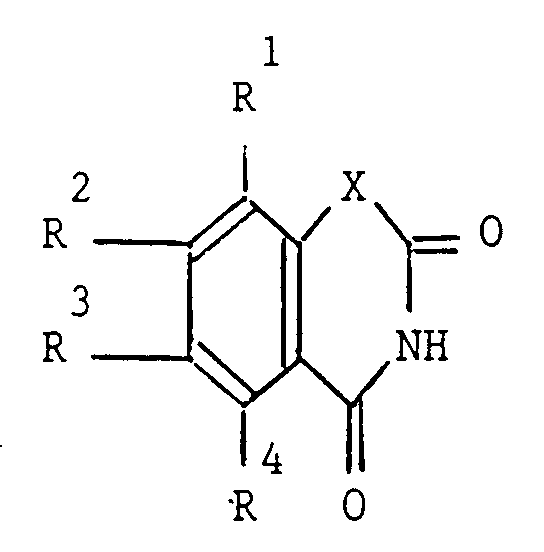
X represents O or N-alkyl;
each of R1, R2, R3 and R4 (same or different) represents hydrogen, alkyl, e.g. C1-C20 alkyl, preferably C1-C4 alkyl, cycloalkyl. e.g. cyclopentyl or cyclohexyl, alkoxy, preferably methoxy or ethoxy, alkylthio with preferably up to 2 carbon atoms, hydroxy, dialkylamino of which the alkyl groups have preferably up to 2 carbon atoms or halogen, preferably chlorine or bromine; or R1 and R2 or R2 and R3 represent the ring members required to complete a fused aromatic ring, preferably a benzene ring, or R3 and R4 represent the ring members required to complete a fused aromatic or cyclohexane ring. Toners within the scope of said general formula are described in GB-P 1,439,478 and US-P 3,951,660.
| silver behenate | 5.13 g/m2 |
| polyvinyl butyral (BUTVAR B79-tradename) | 5.13 g/m2 |
| 3,4-dihydro-2,4-dioxo-1,3,2H-benzoxazine | 0.39 g/m2 |
| BAYSILON Öl (tradename of Bayer AG - Germany) | 12 mg/m2 |
| Material | Reducing agent | Coverage g/m2 |
| A | Indane I | 0.98 |
| B | 3,4-Dihydroxybenzoic acid | 0.88 |
| C | Ethyl ester of 3,4-dihydroxybenzoic acid | 1.03 |
| D | n-Butyl ester of 3,4-dihydroxybenzoic acid | 1.21 |
| E | 3,4-Dihydroxybenzaldehyde | 0.80 |
| F | Phenyl (3,4-dihydroxyphenyl) ketone | 1.22 |
| G | Ethyl gallate | 1.14 |
| H | Hydroquinone | 0.63 |
| I | 2,3-Dihydroxybenzoic acid | 0.88 |
| Material | NCV | Dortho |
| A | 0.16 | 3.4 |
| B | 0.68 | 3.7 |
| C | 0.57 | 3.4 |
| D | 0.62 | 3.5 |
| E | 0.72 | 3.4 |
| F | 0.63 | 3.9 |
| G | 0.39 | 4.1 |
| H | 0.12 | 2.6 |
| I | 0.33 | 3.6 |
Claims (10)
- A direct thermal recording process wherein a direct thermal recording material is heated dot-wise and said direct thermal recording material comprises on a substrate an imaging layer containing uniformly distributed in a film-forming polymeric binder (i) one or more substantially light-insensitive organic silver salts being no double salts, said silver salt(s) being in thermal working relationship with (ii) an organic reducing agent therefor, characterized in that said reducing agent is a benzene compound the benzene nucleus of which is substituted by no more than two hydroxy groups which are present in 3,4-position on said nucleus and have in the 1-position of said nucleus a substituent linked to said nucleus by means of a carbonyl group.
- Recording process according to claim 1, wherein said 3,4-dihydroxybenzene reducing agent is a member selected from the group consisting of 3,4-dihydroxy-benzoic acid, an alkyl or aryl ester thereof, 3,4-dihydroxy-benzaldehyde, 3,4-dihydroxy-benzamide and an alkyl or aryl (3,4-dihydroxyphenyl) ketone.
- Recording process according to claim 1 or 2, wherein said reducing agent(s) being considered as primary or main reducing agent(s) is (are) present in conjunction with one or more auxiliary reducing agent(s).
- Recording process according to any of the preceding claims, wherein said substantially light-insensitive organic silver salt is a silver salt of an aliphatic carboxylic acid (fatty acid) having at least 12 C-atoms.
- Recording process according to claim 4, wherein said organic silver salt is silver palmitate, silver stearate or silver behenate or mixtures thereof.
- Recording process according to any of the preceding claims, wherein the binder to silver salt weight ratio in the imaging layer is in the range of 1/2 to 6/1.
- Recording process according to any of the preceding claims, wherein said binder is a polyvinylbutyral.
- Recording process according to any of the preceding claims, wherein said substantially light-insensitive organic silver salt and said organic reducing agent are present in different layers wherefrom by heat they can come into reactive contact with each other by heat.
- Recording process according to any of the preceding claims, wherein the imaging layer contains in admixture with said silver salt at least one toning agent being a phthalimide, phthalazinone, succinimide or heterocyclic compound corresponding to following general formula :in which :

X represents O or N-alkyl;
each of R1, R2, R3 and R4 (same or different) represents hydrogen, alkyl, cycloalkyl, alkoxy, alkylthio, hydroxy, dialkylamino or halogen; or R1 and R2 or R2 and R3 together represent the ring members required to complete a fused aromatic ring, or R3 and R4 together represent the ring members required to complete a fused aromatic or cyclohexane ring. - Recording process according to any of the preceding claims, wherein said recording material is provided with an outermost protective layer acting as slipping layer.
Priority Applications (1)
| Application Number | Priority Date | Filing Date | Title |
|---|---|---|---|
| EP95201273A EP0692733B1 (en) | 1994-07-07 | 1995-05-16 | Direct thermal recording process |
Applications Claiming Priority (3)
| Application Number | Priority Date | Filing Date | Title |
|---|---|---|---|
| EP94201954 | 1994-07-07 | ||
| EP94201954 | 1994-07-07 | ||
| EP95201273A EP0692733B1 (en) | 1994-07-07 | 1995-05-16 | Direct thermal recording process |
Publications (3)
| Publication Number | Publication Date |
|---|---|
| EP0692733A2 EP0692733A2 (en) | 1996-01-17 |
| EP0692733A3 EP0692733A3 (en) | 1996-03-20 |
| EP0692733B1 true EP0692733B1 (en) | 1998-02-04 |
Family
ID=26136405
Family Applications (1)
| Application Number | Title | Priority Date | Filing Date |
|---|---|---|---|
| EP95201273A Expired - Lifetime EP0692733B1 (en) | 1994-07-07 | 1995-05-16 | Direct thermal recording process |
Country Status (1)
| Country | Link |
|---|---|
| EP (1) | EP0692733B1 (en) |
Cited By (1)
| Publication number | Priority date | Publication date | Assignee | Title |
|---|---|---|---|---|
| US7282468B2 (en) | 2005-07-18 | 2007-10-16 | Carestream Health Inc. | Direct thermographic materials with catechol borate reducing agents |
Families Citing this family (16)
| Publication number | Priority date | Publication date | Assignee | Title |
|---|---|---|---|---|
| EP0779539B1 (en) | 1995-11-27 | 2002-07-17 | Agfa-Gevaert | Thermographic material with outermost organic antistatic layer |
| EP0775592B1 (en) | 1995-11-27 | 2002-09-11 | Agfa-Gevaert | Thermal image-forming process |
| EP0775595B1 (en) | 1995-11-27 | 1999-09-15 | Agfa-Gevaert N.V. | Thermographic recording material with phosphoric acid derivative as lubricant |
| EP0782043B1 (en) | 1995-12-27 | 2003-01-15 | Agfa-Gevaert | Thermographic recording material which improved tone reproduction |
| US6211115B1 (en) | 1998-08-07 | 2001-04-03 | Agfa-Gevaert | Reducing agents for use in thermographic recording materials |
| EP0978760B1 (en) * | 1998-08-07 | 2003-07-02 | Agfa-Gevaert | Thermographic recording materials |
| EP1245404A1 (en) * | 2001-03-29 | 2002-10-02 | Agfa-Gevaert | Thermographic recording material providing prints with good image density and tone having improved archivability |
| US6759367B2 (en) | 2001-03-29 | 2004-07-06 | Agfa-Gevaert | Thermographic recording material with improved print archivability without loss in printability |
| US6693062B2 (en) | 2001-06-29 | 2004-02-17 | Agfa-Gevaert | Thermographic recording material with improved image tone |
| EP1270255A1 (en) * | 2001-06-29 | 2003-01-02 | Agfa-Gevaert | Thermographic recording material with improved image tone |
| EP1300251B1 (en) | 2001-10-02 | 2006-12-27 | Agfa-Gevaert | Thermal recording by means of a flying spot |
| US7175977B2 (en) | 2003-12-18 | 2007-02-13 | Agfa-Gevaert | Stabilizers for use in thermographic recording materials |
| US7097961B2 (en) | 2004-05-17 | 2006-08-29 | Agfa Gevaert | Stabilizers for use in substantially light-insensitive thermographic recording materials |
| EP1637338B1 (en) | 2004-09-17 | 2007-04-04 | Agfa-Gevaert | Substantially light-insensitive thermographic recording material |
| US7179768B2 (en) | 2004-11-05 | 2007-02-20 | Agfa-Gevaert | Toning agents for use in thermographic recording materials |
| EP2199100A1 (en) | 2008-12-22 | 2010-06-23 | Agfa-Gevaert N.V. | Security laminates for security documents. |
Family Cites Families (4)
| Publication number | Priority date | Publication date | Assignee | Title |
|---|---|---|---|---|
| US3074809A (en) * | 1959-10-26 | 1963-01-22 | Minnesota Mining & Mfg | Heat-sensitive copying-paper |
| US3080254A (en) * | 1959-10-26 | 1963-03-05 | Minnesota Mining & Mfg | Heat-sensitive copying-paper |
| DE69310045T2 (en) * | 1992-08-03 | 1997-12-11 | Minnesota Mining & Mfg | Laser addressable heat sensitive recording material |
| JP2681907B2 (en) * | 1992-11-20 | 1997-11-26 | 日本製紙株式会社 | Thermal recording medium |
-
1995
- 1995-05-16 EP EP95201273A patent/EP0692733B1/en not_active Expired - Lifetime
Cited By (1)
| Publication number | Priority date | Publication date | Assignee | Title |
|---|---|---|---|---|
| US7282468B2 (en) | 2005-07-18 | 2007-10-16 | Carestream Health Inc. | Direct thermographic materials with catechol borate reducing agents |
Also Published As
| Publication number | Publication date |
|---|---|
| EP0692733A2 (en) | 1996-01-17 |
| EP0692733A3 (en) | 1996-03-20 |
Similar Documents
| Publication | Publication Date | Title |
|---|---|---|
| US5599647A (en) | New toning agents for thermographic and photothermographic materials and process | |
| US5527758A (en) | Direct thermal imaging process with improved tone reproduction | |
| US5863859A (en) | Heat-sensitive material suited for use in direct thermal recording | |
| EP0692733A2 (en) | Direct thermal recording process | |
| EP0687572B1 (en) | Thermosensitive recording method | |
| US5582953A (en) | Direct thermal recording process | |
| US5559075A (en) | Recording material for direct thermal imaging | |
| EP0903625B1 (en) | Thermographic recording materials | |
| EP0752616B1 (en) | New toning agents for thermographic and photothermographic materials and process | |
| US5652195A (en) | Heat-sensitive material suited for use in direct thermal imaging | |
| EP0599369B1 (en) | Thermosensitive recording material | |
| JP3746123B2 (en) | Thermal imaging method with improved slip performance | |
| US5637550A (en) | Heat-sensitive recording material having image-stabilization properties | |
| US5527757A (en) | Recording material for direct thermal imaging | |
| US5885765A (en) | Thermographic recording material with improved tone reproduction | |
| EP0678775B1 (en) | Thermal transfer process | |
| EP0677775B1 (en) | Thermal transfer imaging process | |
| EP0782043B1 (en) | Thermographic recording material which improved tone reproduction | |
| EP0730196B1 (en) | Heat-sensitive recording material having image-stabilization properties | |
| EP0685760B1 (en) | Thermosensitive recording material | |
| EP0677776A1 (en) | Thermal transfer printing process using a mixture of reducing agents for image-wise reducing a silver source | |
| US5627008A (en) | Thermal transfer printing process using a mixture of reducing agents for image-wise reducing a silver source | |
| EP0663301B1 (en) | Recording material for a direct thermal imaging process | |
| EP0775592A1 (en) | Thermal image-forming process | |
| US6326331B1 (en) | Substantially light-insensitive black and white thermographic recording material with improved stability to direct sunlight |
Legal Events
| Date | Code | Title | Description |
|---|---|---|---|
| PUAI | Public reference made under article 153(3) epc to a published international application that has entered the european phase |
Free format text: ORIGINAL CODE: 0009012 |
|
| AK | Designated contracting states |
Kind code of ref document: A2 Designated state(s): BE DE FR GB NL |
|
| PUAL | Search report despatched |
Free format text: ORIGINAL CODE: 0009013 |
|
| RHK1 | Main classification (correction) |
Ipc: B41M 5/32 |
|
| AK | Designated contracting states |
Kind code of ref document: A3 Designated state(s): BE DE FR GB NL |
|
| 17P | Request for examination filed |
Effective date: 19960920 |
|
| GRAG | Despatch of communication of intention to grant |
Free format text: ORIGINAL CODE: EPIDOS AGRA |
|
| GRAG | Despatch of communication of intention to grant |
Free format text: ORIGINAL CODE: EPIDOS AGRA |
|
| GRAH | Despatch of communication of intention to grant a patent |
Free format text: ORIGINAL CODE: EPIDOS IGRA |
|
| 17Q | First examination report despatched |
Effective date: 19970702 |
|
| GRAH | Despatch of communication of intention to grant a patent |
Free format text: ORIGINAL CODE: EPIDOS IGRA |
|
| GRAA | (expected) grant |
Free format text: ORIGINAL CODE: 0009210 |
|
| AK | Designated contracting states |
Kind code of ref document: B1 Designated state(s): BE DE FR GB NL |
|
| PG25 | Lapsed in a contracting state [announced via postgrant information from national office to epo] |
Ref country code: NL Free format text: LAPSE BECAUSE OF FAILURE TO SUBMIT A TRANSLATION OF THE DESCRIPTION OR TO PAY THE FEE WITHIN THE PRESCRIBED TIME-LIMIT Effective date: 19980204 |
|
| REF | Corresponds to: |
Ref document number: 69501572 Country of ref document: DE Date of ref document: 19980312 |
|
| ET | Fr: translation filed | ||
| NLV1 | Nl: lapsed or annulled due to failure to fulfill the requirements of art. 29p and 29m of the patents act | ||
| PLBE | No opposition filed within time limit |
Free format text: ORIGINAL CODE: 0009261 |
|
| STAA | Information on the status of an ep patent application or granted ep patent |
Free format text: STATUS: NO OPPOSITION FILED WITHIN TIME LIMIT |
|
| 26N | No opposition filed | ||
| PGFP | Annual fee paid to national office [announced via postgrant information from national office to epo] |
Ref country code: BE Payment date: 19990325 Year of fee payment: 5 |
|
| PG25 | Lapsed in a contracting state [announced via postgrant information from national office to epo] |
Ref country code: BE Free format text: LAPSE BECAUSE OF NON-PAYMENT OF DUE FEES Effective date: 20000531 |
|
| BERE | Be: lapsed |
Owner name: AGFA-GEVAERT N.V. Effective date: 20000531 |
|
| REG | Reference to a national code |
Ref country code: GB Ref legal event code: IF02 |
|
| REG | Reference to a national code |
Ref country code: GB Ref legal event code: 732E |
|
| REG | Reference to a national code |
Ref country code: FR Ref legal event code: TP |
|
| PGFP | Annual fee paid to national office [announced via postgrant information from national office to epo] |
Ref country code: GB Payment date: 20140408 Year of fee payment: 20 |
|
| PGFP | Annual fee paid to national office [announced via postgrant information from national office to epo] |
Ref country code: DE Payment date: 20140408 Year of fee payment: 20 |
|
| PGFP | Annual fee paid to national office [announced via postgrant information from national office to epo] |
Ref country code: FR Payment date: 20140513 Year of fee payment: 20 |
|
| REG | Reference to a national code |
Ref country code: DE Ref legal event code: R071 Ref document number: 69501572 Country of ref document: DE |
|
| REG | Reference to a national code |
Ref country code: DE Ref legal event code: R071 Ref document number: 69501572 Country of ref document: DE |
|
| REG | Reference to a national code |
Ref country code: GB Ref legal event code: PE20 Expiry date: 20150515 |
|
| PG25 | Lapsed in a contracting state [announced via postgrant information from national office to epo] |
Ref country code: GB Free format text: LAPSE BECAUSE OF EXPIRATION OF PROTECTION Effective date: 20150515 |