EP0687569B1 - Process for producing a protected heat-mode recording material - Google Patents
Process for producing a protected heat-mode recording material Download PDFInfo
- Publication number
- EP0687569B1 EP0687569B1 EP95201163A EP95201163A EP0687569B1 EP 0687569 B1 EP0687569 B1 EP 0687569B1 EP 95201163 A EP95201163 A EP 95201163A EP 95201163 A EP95201163 A EP 95201163A EP 0687569 B1 EP0687569 B1 EP 0687569B1
- Authority
- EP
- European Patent Office
- Prior art keywords
- layer
- heat
- process according
- adhesive layer
- assemblage
- Prior art date
- Legal status (The legal status is an assumption and is not a legal conclusion. Google has not performed a legal analysis and makes no representation as to the accuracy of the status listed.)
- Expired - Lifetime
Links
- 239000000463 material Substances 0.000 title claims description 47
- 238000000034 method Methods 0.000 title claims description 40
- 230000008569 process Effects 0.000 title claims description 25
- 239000010410 layer Substances 0.000 claims description 160
- 239000012790 adhesive layer Substances 0.000 claims description 61
- 238000000576 coating method Methods 0.000 claims description 36
- 229920000642 polymer Polymers 0.000 claims description 32
- 239000011248 coating agent Substances 0.000 claims description 30
- 229910052797 bismuth Inorganic materials 0.000 claims description 24
- JCXGWMGPZLAOME-UHFFFAOYSA-N bismuth atom Chemical group [Bi] JCXGWMGPZLAOME-UHFFFAOYSA-N 0.000 claims description 23
- 239000000203 mixture Substances 0.000 claims description 22
- 230000005855 radiation Effects 0.000 claims description 22
- 229920005989 resin Polymers 0.000 claims description 21
- 239000011347 resin Substances 0.000 claims description 21
- 239000011241 protective layer Substances 0.000 claims description 20
- 239000000178 monomer Substances 0.000 claims description 19
- 238000010894 electron beam technology Methods 0.000 claims description 18
- 238000004519 manufacturing process Methods 0.000 claims description 17
- 229920000728 polyester Polymers 0.000 claims description 16
- 230000001681 protective effect Effects 0.000 claims description 13
- 239000000126 substance Substances 0.000 claims description 11
- 238000012360 testing method Methods 0.000 claims description 11
- 239000002904 solvent Substances 0.000 claims description 9
- 239000003795 chemical substances by application Substances 0.000 claims description 7
- 238000001816 cooling Methods 0.000 claims description 7
- 239000004372 Polyvinyl alcohol Substances 0.000 claims description 6
- NIXOWILDQLNWCW-UHFFFAOYSA-N acrylic acid group Chemical group C(C=C)(=O)O NIXOWILDQLNWCW-UHFFFAOYSA-N 0.000 claims description 6
- 229920002451 polyvinyl alcohol Polymers 0.000 claims description 6
- 239000007787 solid Substances 0.000 claims description 6
- VYPSYNLAJGMNEJ-UHFFFAOYSA-N Silicium dioxide Chemical compound O=[Si]=O VYPSYNLAJGMNEJ-UHFFFAOYSA-N 0.000 claims description 5
- 229920001577 copolymer Polymers 0.000 claims description 5
- 239000002245 particle Substances 0.000 claims description 5
- 239000001993 wax Substances 0.000 claims description 5
- 238000009472 formulation Methods 0.000 claims description 4
- 230000009477 glass transition Effects 0.000 claims description 4
- 238000010030 laminating Methods 0.000 claims description 4
- 229910052594 sapphire Inorganic materials 0.000 claims description 4
- 239000010980 sapphire Substances 0.000 claims description 4
- 229920002545 silicone oil Polymers 0.000 claims description 4
- 239000004094 surface-active agent Substances 0.000 claims description 3
- 229920002284 Cellulose triacetate Polymers 0.000 claims description 2
- 239000004831 Hot glue Substances 0.000 claims description 2
- 229910019142 PO4 Inorganic materials 0.000 claims description 2
- NNLVGZFZQQXQNW-ADJNRHBOSA-N [(2r,3r,4s,5r,6s)-4,5-diacetyloxy-3-[(2s,3r,4s,5r,6r)-3,4,5-triacetyloxy-6-(acetyloxymethyl)oxan-2-yl]oxy-6-[(2r,3r,4s,5r,6s)-4,5,6-triacetyloxy-2-(acetyloxymethyl)oxan-3-yl]oxyoxan-2-yl]methyl acetate Chemical compound O([C@@H]1O[C@@H]([C@H]([C@H](OC(C)=O)[C@H]1OC(C)=O)O[C@H]1[C@@H]([C@@H](OC(C)=O)[C@H](OC(C)=O)[C@@H](COC(C)=O)O1)OC(C)=O)COC(=O)C)[C@@H]1[C@@H](COC(C)=O)O[C@@H](OC(C)=O)[C@H](OC(C)=O)[C@H]1OC(C)=O NNLVGZFZQQXQNW-ADJNRHBOSA-N 0.000 claims description 2
- 239000003831 antifriction material Substances 0.000 claims description 2
- 229910052799 carbon Inorganic materials 0.000 claims description 2
- 239000010452 phosphate Substances 0.000 claims description 2
- NBIIXXVUZAFLBC-UHFFFAOYSA-K phosphate Chemical compound [O-]P([O-])([O-])=O NBIIXXVUZAFLBC-UHFFFAOYSA-K 0.000 claims description 2
- 229920000515 polycarbonate Polymers 0.000 claims description 2
- 239000004417 polycarbonate Substances 0.000 claims description 2
- 229920000915 polyvinyl chloride Polymers 0.000 claims description 2
- 239000004800 polyvinyl chloride Substances 0.000 claims description 2
- 150000004760 silicates Chemical class 0.000 claims description 2
- 239000000377 silicon dioxide Substances 0.000 claims description 2
- 229920002050 silicone resin Polymers 0.000 claims description 2
- 238000012986 modification Methods 0.000 claims 1
- 230000004048 modification Effects 0.000 claims 1
- -1 silver halide Chemical class 0.000 description 31
- 239000010408 film Substances 0.000 description 19
- 229910052751 metal Inorganic materials 0.000 description 18
- 239000002184 metal Substances 0.000 description 18
- ZWEHNKRNPOVVGH-UHFFFAOYSA-N 2-Butanone Chemical compound CCC(C)=O ZWEHNKRNPOVVGH-UHFFFAOYSA-N 0.000 description 15
- PPBRXRYQALVLMV-UHFFFAOYSA-N Styrene Chemical compound C=CC1=CC=CC=C1 PPBRXRYQALVLMV-UHFFFAOYSA-N 0.000 description 14
- 230000003287 optical effect Effects 0.000 description 14
- SOGAXMICEFXMKE-UHFFFAOYSA-N Butylmethacrylate Chemical compound CCCCOC(=O)C(C)=C SOGAXMICEFXMKE-UHFFFAOYSA-N 0.000 description 12
- 229920001634 Copolyester Polymers 0.000 description 10
- 239000008199 coating composition Substances 0.000 description 10
- 239000005020 polyethylene terephthalate Substances 0.000 description 10
- 229920000139 polyethylene terephthalate Polymers 0.000 description 10
- 238000001723 curing Methods 0.000 description 9
- IISBACLAFKSPIT-UHFFFAOYSA-N bisphenol A Chemical class C=1C=C(O)C=CC=1C(C)(C)C1=CC=C(O)C=C1 IISBACLAFKSPIT-UHFFFAOYSA-N 0.000 description 8
- 150000001252 acrylic acid derivatives Chemical class 0.000 description 7
- 230000015572 biosynthetic process Effects 0.000 description 7
- 239000007788 liquid Substances 0.000 description 7
- 238000002360 preparation method Methods 0.000 description 7
- 238000001035 drying Methods 0.000 description 6
- QQVIHTHCMHWDBS-UHFFFAOYSA-N isophthalic acid Chemical compound OC(=O)C1=CC=CC(C(O)=O)=C1 QQVIHTHCMHWDBS-UHFFFAOYSA-N 0.000 description 6
- 239000002648 laminated material Substances 0.000 description 6
- 150000002739 metals Chemical class 0.000 description 6
- 241001422033 Thestylus Species 0.000 description 5
- 230000008018 melting Effects 0.000 description 5
- 238000002844 melting Methods 0.000 description 5
- 238000004804 winding Methods 0.000 description 5
- VVBLNCFGVYUYGU-UHFFFAOYSA-N 4,4'-Bis(dimethylamino)benzophenone Chemical compound C1=CC(N(C)C)=CC=C1C(=O)C1=CC=C(N(C)C)C=C1 VVBLNCFGVYUYGU-UHFFFAOYSA-N 0.000 description 4
- IJGRMHOSHXDMSA-UHFFFAOYSA-N Atomic nitrogen Chemical compound N#N IJGRMHOSHXDMSA-UHFFFAOYSA-N 0.000 description 4
- KKEYFWRCBNTPAC-UHFFFAOYSA-N Terephthalic acid Chemical compound OC(=O)C1=CC=C(C(O)=O)C=C1 KKEYFWRCBNTPAC-UHFFFAOYSA-N 0.000 description 4
- DAKWPKUUDNSNPN-UHFFFAOYSA-N Trimethylolpropane triacrylate Chemical compound C=CC(=O)OCC(CC)(COC(=O)C=C)COC(=O)C=C DAKWPKUUDNSNPN-UHFFFAOYSA-N 0.000 description 4
- 230000005540 biological transmission Effects 0.000 description 4
- 150000001875 compounds Chemical class 0.000 description 4
- 238000000151 deposition Methods 0.000 description 4
- 238000003475 lamination Methods 0.000 description 4
- 238000001771 vacuum deposition Methods 0.000 description 4
- NIXOWILDQLNWCW-UHFFFAOYSA-M Acrylate Chemical compound [O-]C(=O)C=C NIXOWILDQLNWCW-UHFFFAOYSA-M 0.000 description 3
- LYCAIKOWRPUZTN-UHFFFAOYSA-N Ethylene glycol Chemical compound OCCO LYCAIKOWRPUZTN-UHFFFAOYSA-N 0.000 description 3
- VVQNEPGJFQJSBK-UHFFFAOYSA-N Methyl methacrylate Chemical compound COC(=O)C(C)=C VVQNEPGJFQJSBK-UHFFFAOYSA-N 0.000 description 3
- XTXRWKRVRITETP-UHFFFAOYSA-N Vinyl acetate Chemical compound CC(=O)OC=C XTXRWKRVRITETP-UHFFFAOYSA-N 0.000 description 3
- 239000002253 acid Substances 0.000 description 3
- 125000001931 aliphatic group Chemical group 0.000 description 3
- 238000013459 approach Methods 0.000 description 3
- 125000003118 aryl group Chemical group 0.000 description 3
- 238000006243 chemical reaction Methods 0.000 description 3
- 230000008021 deposition Effects 0.000 description 3
- 239000006185 dispersion Substances 0.000 description 3
- 239000000975 dye Substances 0.000 description 3
- 229920001971 elastomer Polymers 0.000 description 3
- 238000005516 engineering process Methods 0.000 description 3
- 150000002148 esters Chemical class 0.000 description 3
- 229920000098 polyolefin Polymers 0.000 description 3
- 238000003847 radiation curing Methods 0.000 description 3
- 230000002829 reductive effect Effects 0.000 description 3
- 238000002310 reflectometry Methods 0.000 description 3
- 229910052714 tellurium Inorganic materials 0.000 description 3
- PORWMNRCUJJQNO-UHFFFAOYSA-N tellurium atom Chemical compound [Te] PORWMNRCUJJQNO-UHFFFAOYSA-N 0.000 description 3
- MYRTYDVEIRVNKP-UHFFFAOYSA-N 1,2-Divinylbenzene Chemical compound C=CC1=CC=CC=C1C=C MYRTYDVEIRVNKP-UHFFFAOYSA-N 0.000 description 2
- SMZOUWXMTYCWNB-UHFFFAOYSA-N 2-(2-methoxy-5-methylphenyl)ethanamine Chemical compound COC1=CC=C(C)C=C1CCN SMZOUWXMTYCWNB-UHFFFAOYSA-N 0.000 description 2
- XMLYCEVDHLAQEL-UHFFFAOYSA-N 2-hydroxy-2-methyl-1-phenylpropan-1-one Chemical compound CC(C)(O)C(=O)C1=CC=CC=C1 XMLYCEVDHLAQEL-UHFFFAOYSA-N 0.000 description 2
- OMIGHNLMNHATMP-UHFFFAOYSA-N 2-hydroxyethyl prop-2-enoate Chemical compound OCCOC(=O)C=C OMIGHNLMNHATMP-UHFFFAOYSA-N 0.000 description 2
- FLFWJIBUZQARMD-UHFFFAOYSA-N 2-mercapto-1,3-benzoxazole Chemical compound C1=CC=C2OC(S)=NC2=C1 FLFWJIBUZQARMD-UHFFFAOYSA-N 0.000 description 2
- SZNYYWIUQFZLLT-UHFFFAOYSA-N 2-methyl-1-(2-methylpropoxy)propane Chemical compound CC(C)COCC(C)C SZNYYWIUQFZLLT-UHFFFAOYSA-N 0.000 description 2
- KUDUQBURMYMBIJ-UHFFFAOYSA-N 2-prop-2-enoyloxyethyl prop-2-enoate Chemical compound C=CC(=O)OCCOC(=O)C=C KUDUQBURMYMBIJ-UHFFFAOYSA-N 0.000 description 2
- KWOLFJPFCHCOCG-UHFFFAOYSA-N Acetophenone Chemical compound CC(=O)C1=CC=CC=C1 KWOLFJPFCHCOCG-UHFFFAOYSA-N 0.000 description 2
- XKRFYHLGVUSROY-UHFFFAOYSA-N Argon Chemical compound [Ar] XKRFYHLGVUSROY-UHFFFAOYSA-N 0.000 description 2
- 229930185605 Bisphenol Natural products 0.000 description 2
- KAKZBPTYRLMSJV-UHFFFAOYSA-N Butadiene Chemical compound C=CC=C KAKZBPTYRLMSJV-UHFFFAOYSA-N 0.000 description 2
- XZMCDFZZKTWFGF-UHFFFAOYSA-N Cyanamide Chemical compound NC#N XZMCDFZZKTWFGF-UHFFFAOYSA-N 0.000 description 2
- JOYRKODLDBILNP-UHFFFAOYSA-N Ethyl urethane Chemical compound CCOC(N)=O JOYRKODLDBILNP-UHFFFAOYSA-N 0.000 description 2
- 239000004698 Polyethylene Substances 0.000 description 2
- LCXXNKZQVOXMEH-UHFFFAOYSA-N Tetrahydrofurfuryl methacrylate Chemical compound CC(=C)C(=O)OCC1CCCO1 LCXXNKZQVOXMEH-UHFFFAOYSA-N 0.000 description 2
- GWEVSGVZZGPLCZ-UHFFFAOYSA-N Titan oxide Chemical compound O=[Ti]=O GWEVSGVZZGPLCZ-UHFFFAOYSA-N 0.000 description 2
- 238000003848 UV Light-Curing Methods 0.000 description 2
- 238000010521 absorption reaction Methods 0.000 description 2
- 150000007513 acids Chemical class 0.000 description 2
- 239000000654 additive Substances 0.000 description 2
- 239000000853 adhesive Substances 0.000 description 2
- 230000001070 adhesive effect Effects 0.000 description 2
- 125000002947 alkylene group Chemical group 0.000 description 2
- 229910045601 alloy Inorganic materials 0.000 description 2
- 239000000956 alloy Substances 0.000 description 2
- 239000004411 aluminium Substances 0.000 description 2
- 229910052782 aluminium Inorganic materials 0.000 description 2
- XAGFODPZIPBFFR-UHFFFAOYSA-N aluminium Chemical compound [Al] XAGFODPZIPBFFR-UHFFFAOYSA-N 0.000 description 2
- 239000012736 aqueous medium Substances 0.000 description 2
- 239000011230 binding agent Substances 0.000 description 2
- WERYXYBDKMZEQL-UHFFFAOYSA-N butane-1,4-diol Chemical compound OCCCCO WERYXYBDKMZEQL-UHFFFAOYSA-N 0.000 description 2
- 125000004432 carbon atom Chemical group C* 0.000 description 2
- 235000014113 dietary fatty acids Nutrition 0.000 description 2
- 150000002009 diols Chemical class 0.000 description 2
- 239000000806 elastomer Substances 0.000 description 2
- 238000001227 electron beam curing Methods 0.000 description 2
- 239000000839 emulsion Substances 0.000 description 2
- 239000000194 fatty acid Substances 0.000 description 2
- 229930195729 fatty acid Natural products 0.000 description 2
- 150000004665 fatty acids Chemical class 0.000 description 2
- 238000005227 gel permeation chromatography Methods 0.000 description 2
- 238000010438 heat treatment Methods 0.000 description 2
- 238000011065 in-situ storage Methods 0.000 description 2
- 238000009434 installation Methods 0.000 description 2
- 239000011229 interlayer Substances 0.000 description 2
- 239000004816 latex Substances 0.000 description 2
- 229920000126 latex Polymers 0.000 description 2
- 239000002609 medium Substances 0.000 description 2
- 229910052757 nitrogen Inorganic materials 0.000 description 2
- 239000003960 organic solvent Substances 0.000 description 2
- 230000035515 penetration Effects 0.000 description 2
- WXZMFSXDPGVJKK-UHFFFAOYSA-N pentaerythritol Chemical compound OCC(CO)(CO)CO WXZMFSXDPGVJKK-UHFFFAOYSA-N 0.000 description 2
- 229920002120 photoresistant polymer Polymers 0.000 description 2
- 229920000570 polyether Polymers 0.000 description 2
- 229920000573 polyethylene Polymers 0.000 description 2
- 230000000379 polymerizing effect Effects 0.000 description 2
- 229920000193 polymethacrylate Polymers 0.000 description 2
- 229920005862 polyol Polymers 0.000 description 2
- 150000003077 polyols Chemical class 0.000 description 2
- 239000011253 protective coating Substances 0.000 description 2
- CXMXRPHRNRROMY-UHFFFAOYSA-N sebacic acid Chemical compound OC(=O)CCCCCCCCC(O)=O CXMXRPHRNRROMY-UHFFFAOYSA-N 0.000 description 2
- 230000035945 sensitivity Effects 0.000 description 2
- 238000005507 spraying Methods 0.000 description 2
- 238000004544 sputter deposition Methods 0.000 description 2
- 238000003860 storage Methods 0.000 description 2
- 238000003786 synthesis reaction Methods 0.000 description 2
- LFQCEHFDDXELDD-UHFFFAOYSA-N tetramethyl orthosilicate Chemical compound CO[Si](OC)(OC)OC LFQCEHFDDXELDD-UHFFFAOYSA-N 0.000 description 2
- 229920006305 unsaturated polyester Polymers 0.000 description 2
- 229940117958 vinyl acetate Drugs 0.000 description 2
- PUPZLCDOIYMWBV-UHFFFAOYSA-N (+/-)-1,3-Butanediol Chemical compound CC(O)CCO PUPZLCDOIYMWBV-UHFFFAOYSA-N 0.000 description 1
- 239000012956 1-hydroxycyclohexylphenyl-ketone Substances 0.000 description 1
- OAMHTTBNEJBIKA-UHFFFAOYSA-N 2,2,2-trichloro-1-phenylethanone Chemical compound ClC(Cl)(Cl)C(=O)C1=CC=CC=C1 OAMHTTBNEJBIKA-UHFFFAOYSA-N 0.000 description 1
- CERJZAHSUZVMCH-UHFFFAOYSA-N 2,2-dichloro-1-phenylethanone Chemical compound ClC(Cl)C(=O)C1=CC=CC=C1 CERJZAHSUZVMCH-UHFFFAOYSA-N 0.000 description 1
- PIZHFBODNLEQBL-UHFFFAOYSA-N 2,2-diethoxy-1-phenylethanone Chemical compound CCOC(OCC)C(=O)C1=CC=CC=C1 PIZHFBODNLEQBL-UHFFFAOYSA-N 0.000 description 1
- KWVGIHKZDCUPEU-UHFFFAOYSA-N 2,2-dimethoxy-2-phenylacetophenone Chemical compound C=1C=CC=CC=1C(OC)(OC)C(=O)C1=CC=CC=C1 KWVGIHKZDCUPEU-UHFFFAOYSA-N 0.000 description 1
- ZCDADJXRUCOCJE-UHFFFAOYSA-N 2-chlorothioxanthen-9-one Chemical compound C1=CC=C2C(=O)C3=CC(Cl)=CC=C3SC2=C1 ZCDADJXRUCOCJE-UHFFFAOYSA-N 0.000 description 1
- WDQMWEYDKDCEHT-UHFFFAOYSA-N 2-ethylhexyl 2-methylprop-2-enoate Chemical compound CCCCC(CC)COC(=O)C(C)=C WDQMWEYDKDCEHT-UHFFFAOYSA-N 0.000 description 1
- YJQMXVDKXSQCDI-UHFFFAOYSA-N 2-ethylthioxanthen-9-one Chemical compound C1=CC=C2C(=O)C3=CC(CC)=CC=C3SC2=C1 YJQMXVDKXSQCDI-UHFFFAOYSA-N 0.000 description 1
- QPXVRLXJHPTCPW-UHFFFAOYSA-N 2-hydroxy-2-methyl-1-(4-propan-2-ylphenyl)propan-1-one Chemical compound CC(C)C1=CC=C(C(=O)C(C)(C)O)C=C1 QPXVRLXJHPTCPW-UHFFFAOYSA-N 0.000 description 1
- RIWRBSMFKVOJMN-UHFFFAOYSA-N 2-methyl-1-phenylpropan-2-ol Chemical compound CC(C)(O)CC1=CC=CC=C1 RIWRBSMFKVOJMN-UHFFFAOYSA-N 0.000 description 1
- BNCADMBVWNPPIZ-UHFFFAOYSA-N 2-n,2-n,4-n,4-n,6-n,6-n-hexakis(methoxymethyl)-1,3,5-triazine-2,4,6-triamine Chemical compound COCN(COC)C1=NC(N(COC)COC)=NC(N(COC)COC)=N1 BNCADMBVWNPPIZ-UHFFFAOYSA-N 0.000 description 1
- MLCPCDOOBNXTFB-UHFFFAOYSA-N 2-phenacylbenzoic acid Chemical compound OC(=O)C1=CC=CC=C1CC(=O)C1=CC=CC=C1 MLCPCDOOBNXTFB-UHFFFAOYSA-N 0.000 description 1
- CMSGUKVDXXTJDQ-UHFFFAOYSA-N 4-(2-naphthalen-1-ylethylamino)-4-oxobutanoic acid Chemical compound C1=CC=C2C(CCNC(=O)CCC(=O)O)=CC=CC2=C1 CMSGUKVDXXTJDQ-UHFFFAOYSA-N 0.000 description 1
- JHWGFJBTMHEZME-UHFFFAOYSA-N 4-prop-2-enoyloxybutyl prop-2-enoate Chemical compound C=CC(=O)OCCCCOC(=O)C=C JHWGFJBTMHEZME-UHFFFAOYSA-N 0.000 description 1
- SAPGBCWOQLHKKZ-UHFFFAOYSA-N 6-(2-methylprop-2-enoyloxy)hexyl 2-methylprop-2-enoate Chemical compound CC(=C)C(=O)OCCCCCCOC(=O)C(C)=C SAPGBCWOQLHKKZ-UHFFFAOYSA-N 0.000 description 1
- FIHBHSQYSYVZQE-UHFFFAOYSA-N 6-prop-2-enoyloxyhexyl prop-2-enoate Chemical compound C=CC(=O)OCCCCCCOC(=O)C=C FIHBHSQYSYVZQE-UHFFFAOYSA-N 0.000 description 1
- HRPVXLWXLXDGHG-UHFFFAOYSA-N Acrylamide Chemical compound NC(=O)C=C HRPVXLWXLXDGHG-UHFFFAOYSA-N 0.000 description 1
- 239000005995 Aluminium silicate Substances 0.000 description 1
- RMPGGTJWHHELOJ-UHFFFAOYSA-N C(C=C)(=O)O.C(C=C)(=O)OCCCCCCOC(C=C)=O Chemical compound C(C=C)(=O)O.C(C=C)(=O)OCCCCCCOC(C=C)=O RMPGGTJWHHELOJ-UHFFFAOYSA-N 0.000 description 1
- OKTJSMMVPCPJKN-UHFFFAOYSA-N Carbon Chemical compound [C] OKTJSMMVPCPJKN-UHFFFAOYSA-N 0.000 description 1
- 229920003270 Cymel® Polymers 0.000 description 1
- 239000004593 Epoxy Substances 0.000 description 1
- JIGUQPWFLRLWPJ-UHFFFAOYSA-N Ethyl acrylate Chemical compound CCOC(=O)C=C JIGUQPWFLRLWPJ-UHFFFAOYSA-N 0.000 description 1
- PIICEJLVQHRZGT-UHFFFAOYSA-N Ethylenediamine Chemical compound NCCN PIICEJLVQHRZGT-UHFFFAOYSA-N 0.000 description 1
- 108010010803 Gelatin Proteins 0.000 description 1
- WOBHKFSMXKNTIM-UHFFFAOYSA-N Hydroxyethyl methacrylate Chemical compound CC(=C)C(=O)OCCO WOBHKFSMXKNTIM-UHFFFAOYSA-N 0.000 description 1
- ONIBWKKTOPOVIA-BYPYZUCNSA-N L-Proline Chemical compound OC(=O)[C@@H]1CCCN1 ONIBWKKTOPOVIA-BYPYZUCNSA-N 0.000 description 1
- 241001082241 Lythrum hyssopifolia Species 0.000 description 1
- 239000000020 Nitrocellulose Substances 0.000 description 1
- BPQQTUXANYXVAA-UHFFFAOYSA-N Orthosilicate Chemical compound [O-][Si]([O-])([O-])[O-] BPQQTUXANYXVAA-UHFFFAOYSA-N 0.000 description 1
- CBENFWSGALASAD-UHFFFAOYSA-N Ozone Chemical compound [O-][O+]=O CBENFWSGALASAD-UHFFFAOYSA-N 0.000 description 1
- 229920000562 Poly(ethylene adipate) Polymers 0.000 description 1
- 239000004952 Polyamide Substances 0.000 description 1
- 239000002202 Polyethylene glycol Substances 0.000 description 1
- 239000004721 Polyphenylene oxide Substances 0.000 description 1
- 239000004820 Pressure-sensitive adhesive Substances 0.000 description 1
- ONIBWKKTOPOVIA-UHFFFAOYSA-N Proline Natural products OC(=O)C1CCCN1 ONIBWKKTOPOVIA-UHFFFAOYSA-N 0.000 description 1
- OFOBLEOULBTSOW-UHFFFAOYSA-N Propanedioic acid Natural products OC(=O)CC(O)=O OFOBLEOULBTSOW-UHFFFAOYSA-N 0.000 description 1
- 244000028419 Styrax benzoin Species 0.000 description 1
- 235000000126 Styrax benzoin Nutrition 0.000 description 1
- 235000008411 Sumatra benzointree Nutrition 0.000 description 1
- 229910001215 Te alloy Inorganic materials 0.000 description 1
- 101710137710 Thioesterase 1/protease 1/lysophospholipase L1 Proteins 0.000 description 1
- OKKRPWIIYQTPQF-UHFFFAOYSA-N Trimethylolpropane trimethacrylate Chemical compound CC(=C)C(=O)OCC(CC)(COC(=O)C(C)=C)COC(=O)C(C)=C OKKRPWIIYQTPQF-UHFFFAOYSA-N 0.000 description 1
- 239000004904 UV filter Substances 0.000 description 1
- BZHJMEDXRYGGRV-UHFFFAOYSA-N Vinyl chloride Chemical compound ClC=C BZHJMEDXRYGGRV-UHFFFAOYSA-N 0.000 description 1
- 229920006387 Vinylite Polymers 0.000 description 1
- FJWGYAHXMCUOOM-QHOUIDNNSA-N [(2s,3r,4s,5r,6r)-2-[(2r,3r,4s,5r,6s)-4,5-dinitrooxy-2-(nitrooxymethyl)-6-[(2r,3r,4s,5r,6s)-4,5,6-trinitrooxy-2-(nitrooxymethyl)oxan-3-yl]oxyoxan-3-yl]oxy-3,5-dinitrooxy-6-(nitrooxymethyl)oxan-4-yl] nitrate Chemical compound O([C@@H]1O[C@@H]([C@H]([C@H](O[N+]([O-])=O)[C@H]1O[N+]([O-])=O)O[C@H]1[C@@H]([C@@H](O[N+]([O-])=O)[C@H](O[N+]([O-])=O)[C@@H](CO[N+]([O-])=O)O1)O[N+]([O-])=O)CO[N+](=O)[O-])[C@@H]1[C@@H](CO[N+]([O-])=O)O[C@@H](O[N+]([O-])=O)[C@H](O[N+]([O-])=O)[C@H]1O[N+]([O-])=O FJWGYAHXMCUOOM-QHOUIDNNSA-N 0.000 description 1
- CQHKDHVZYZUZMJ-UHFFFAOYSA-N [2,2-bis(hydroxymethyl)-3-prop-2-enoyloxypropyl] prop-2-enoate Chemical compound C=CC(=O)OCC(CO)(CO)COC(=O)C=C CQHKDHVZYZUZMJ-UHFFFAOYSA-N 0.000 description 1
- HVVWZTWDBSEWIH-UHFFFAOYSA-N [2-(hydroxymethyl)-3-prop-2-enoyloxy-2-(prop-2-enoyloxymethyl)propyl] prop-2-enoate Chemical compound C=CC(=O)OCC(CO)(COC(=O)C=C)COC(=O)C=C HVVWZTWDBSEWIH-UHFFFAOYSA-N 0.000 description 1
- MPIAGWXWVAHQBB-UHFFFAOYSA-N [3-prop-2-enoyloxy-2-[[3-prop-2-enoyloxy-2,2-bis(prop-2-enoyloxymethyl)propoxy]methyl]-2-(prop-2-enoyloxymethyl)propyl] prop-2-enoate Chemical compound C=CC(=O)OCC(COC(=O)C=C)(COC(=O)C=C)COCC(COC(=O)C=C)(COC(=O)C=C)COC(=O)C=C MPIAGWXWVAHQBB-UHFFFAOYSA-N 0.000 description 1
- YKTSYUJCYHOUJP-UHFFFAOYSA-N [O--].[Al+3].[Al+3].[O-][Si]([O-])([O-])[O-] Chemical compound [O--].[Al+3].[Al+3].[O-][Si]([O-])([O-])[O-] YKTSYUJCYHOUJP-UHFFFAOYSA-N 0.000 description 1
- 238000002679 ablation Methods 0.000 description 1
- 238000005299 abrasion Methods 0.000 description 1
- 238000012644 addition polymerization Methods 0.000 description 1
- 150000001298 alcohols Chemical class 0.000 description 1
- 150000005215 alkyl ethers Chemical class 0.000 description 1
- 125000001118 alkylidene group Chemical group 0.000 description 1
- 229910000323 aluminium silicate Inorganic materials 0.000 description 1
- 235000012211 aluminium silicate Nutrition 0.000 description 1
- 150000001408 amides Chemical class 0.000 description 1
- 239000002216 antistatic agent Substances 0.000 description 1
- 229910052786 argon Inorganic materials 0.000 description 1
- 159000000032 aromatic acids Chemical class 0.000 description 1
- 125000004429 atom Chemical group 0.000 description 1
- QVGXLLKOCUKJST-UHFFFAOYSA-N atomic oxygen Chemical compound [O] QVGXLLKOCUKJST-UHFFFAOYSA-N 0.000 description 1
- WURBFLDFSFBTLW-UHFFFAOYSA-N benzil Chemical compound C=1C=CC=CC=1C(=O)C(=O)C1=CC=CC=C1 WURBFLDFSFBTLW-UHFFFAOYSA-N 0.000 description 1
- 229960002130 benzoin Drugs 0.000 description 1
- RWCCWEUUXYIKHB-UHFFFAOYSA-N benzophenone Chemical compound C=1C=CC=CC=1C(=O)C1=CC=CC=C1 RWCCWEUUXYIKHB-UHFFFAOYSA-N 0.000 description 1
- 239000012965 benzophenone Substances 0.000 description 1
- MQDJYUACMFCOFT-UHFFFAOYSA-N bis[2-(1-hydroxycyclohexyl)phenyl]methanone Chemical compound C=1C=CC=C(C(=O)C=2C(=CC=CC=2)C2(O)CCCCC2)C=1C1(O)CCCCC1 MQDJYUACMFCOFT-UHFFFAOYSA-N 0.000 description 1
- 239000013590 bulk material Substances 0.000 description 1
- CQEYYJKEWSMYFG-UHFFFAOYSA-N butyl acrylate Chemical compound CCCCOC(=O)C=C CQEYYJKEWSMYFG-UHFFFAOYSA-N 0.000 description 1
- 239000000378 calcium silicate Substances 0.000 description 1
- 229910052918 calcium silicate Inorganic materials 0.000 description 1
- OYACROKNLOSFPA-UHFFFAOYSA-N calcium;dioxido(oxo)silane Chemical compound [Ca+2].[O-][Si]([O-])=O OYACROKNLOSFPA-UHFFFAOYSA-N 0.000 description 1
- 150000001728 carbonyl compounds Chemical class 0.000 description 1
- 150000001732 carboxylic acid derivatives Chemical class 0.000 description 1
- 239000003054 catalyst Substances 0.000 description 1
- 239000001913 cellulose Substances 0.000 description 1
- 229920002678 cellulose Polymers 0.000 description 1
- 239000002131 composite material Substances 0.000 description 1
- 238000004132 cross linking Methods 0.000 description 1
- 230000007547 defect Effects 0.000 description 1
- ISAOCJYIOMOJEB-UHFFFAOYSA-N desyl alcohol Natural products C=1C=CC=CC=1C(O)C(=O)C1=CC=CC=C1 ISAOCJYIOMOJEB-UHFFFAOYSA-N 0.000 description 1
- 125000004386 diacrylate group Chemical group 0.000 description 1
- 125000000664 diazo group Chemical group [N-]=[N+]=[*] 0.000 description 1
- 239000003085 diluting agent Substances 0.000 description 1
- 239000000428 dust Substances 0.000 description 1
- 230000005684 electric field Effects 0.000 description 1
- 238000009713 electroplating Methods 0.000 description 1
- 230000032050 esterification Effects 0.000 description 1
- 238000005886 esterification reaction Methods 0.000 description 1
- 229940093476 ethylene glycol Drugs 0.000 description 1
- 239000005038 ethylene vinyl acetate Substances 0.000 description 1
- 229920006226 ethylene-acrylic acid Polymers 0.000 description 1
- 238000001125 extrusion Methods 0.000 description 1
- 239000007789 gas Substances 0.000 description 1
- 229920000159 gelatin Polymers 0.000 description 1
- 239000008273 gelatin Substances 0.000 description 1
- 235000019322 gelatine Nutrition 0.000 description 1
- 235000011852 gelatine desserts Nutrition 0.000 description 1
- 239000011521 glass Substances 0.000 description 1
- VOZRXNHHFUQHIL-UHFFFAOYSA-N glycidyl methacrylate Chemical compound CC(=C)C(=O)OCC1CO1 VOZRXNHHFUQHIL-UHFFFAOYSA-N 0.000 description 1
- 229910002804 graphite Inorganic materials 0.000 description 1
- 239000010439 graphite Substances 0.000 description 1
- 230000005484 gravity Effects 0.000 description 1
- 235000019382 gum benzoic Nutrition 0.000 description 1
- RRAMGCGOFNQTLD-UHFFFAOYSA-N hexamethylene diisocyanate Chemical compound O=C=NCCCCCCN=C=O RRAMGCGOFNQTLD-UHFFFAOYSA-N 0.000 description 1
- XXMIOPMDWAUFGU-UHFFFAOYSA-N hexane-1,6-diol Chemical compound OCCCCCCO XXMIOPMDWAUFGU-UHFFFAOYSA-N 0.000 description 1
- LNMQRPPRQDGUDR-UHFFFAOYSA-N hexyl prop-2-enoate Chemical compound CCCCCCOC(=O)C=C LNMQRPPRQDGUDR-UHFFFAOYSA-N 0.000 description 1
- AMGQUBHHOARCQH-UHFFFAOYSA-N indium;oxotin Chemical compound [In].[Sn]=O AMGQUBHHOARCQH-UHFFFAOYSA-N 0.000 description 1
- 239000011261 inert gas Substances 0.000 description 1
- 230000000977 initiatory effect Effects 0.000 description 1
- 239000000976 ink Substances 0.000 description 1
- 230000005865 ionizing radiation Effects 0.000 description 1
- 239000012948 isocyanate Substances 0.000 description 1
- IQPQWNKOIGAROB-UHFFFAOYSA-N isocyanate group Chemical group [N-]=C=O IQPQWNKOIGAROB-UHFFFAOYSA-N 0.000 description 1
- 150000002513 isocyanates Chemical class 0.000 description 1
- QQVIHTHCMHWDBS-UHFFFAOYSA-L isophthalate(2-) Chemical compound [O-]C(=O)C1=CC=CC(C([O-])=O)=C1 QQVIHTHCMHWDBS-UHFFFAOYSA-L 0.000 description 1
- PBOSTUDLECTMNL-UHFFFAOYSA-N lauryl acrylate Chemical compound CCCCCCCCCCCCOC(=O)C=C PBOSTUDLECTMNL-UHFFFAOYSA-N 0.000 description 1
- 230000031700 light absorption Effects 0.000 description 1
- 230000000670 limiting effect Effects 0.000 description 1
- 231100000053 low toxicity Toxicity 0.000 description 1
- 239000000314 lubricant Substances 0.000 description 1
- HCWCAKKEBCNQJP-UHFFFAOYSA-N magnesium orthosilicate Chemical compound [Mg+2].[Mg+2].[O-][Si]([O-])([O-])[O-] HCWCAKKEBCNQJP-UHFFFAOYSA-N 0.000 description 1
- 239000000391 magnesium silicate Substances 0.000 description 1
- 229910052919 magnesium silicate Inorganic materials 0.000 description 1
- 235000019792 magnesium silicate Nutrition 0.000 description 1
- VZCYOOQTPOCHFL-UPHRSURJSA-N maleic acid Chemical compound OC(=O)\C=C/C(O)=O VZCYOOQTPOCHFL-UPHRSURJSA-N 0.000 description 1
- 239000011976 maleic acid Substances 0.000 description 1
- 230000005226 mechanical processes and functions Effects 0.000 description 1
- JDSHMPZPIAZGSV-UHFFFAOYSA-N melamine Chemical compound NC1=NC(N)=NC(N)=N1 JDSHMPZPIAZGSV-UHFFFAOYSA-N 0.000 description 1
- 239000000155 melt Substances 0.000 description 1
- 230000005499 meniscus Effects 0.000 description 1
- QSHDDOUJBYECFT-UHFFFAOYSA-N mercury Chemical compound [Hg] QSHDDOUJBYECFT-UHFFFAOYSA-N 0.000 description 1
- 229910052753 mercury Inorganic materials 0.000 description 1
- 229910001092 metal group alloy Inorganic materials 0.000 description 1
- 125000005397 methacrylic acid ester group Chemical group 0.000 description 1
- YDKNBNOOCSNPNS-UHFFFAOYSA-N methyl 1,3-benzoxazole-2-carboxylate Chemical compound C1=CC=C2OC(C(=O)OC)=NC2=C1 YDKNBNOOCSNPNS-UHFFFAOYSA-N 0.000 description 1
- 125000002496 methyl group Chemical group [H]C([H])([H])* 0.000 description 1
- 239000010445 mica Substances 0.000 description 1
- 229910052618 mica group Inorganic materials 0.000 description 1
- SLCVBVWXLSEKPL-UHFFFAOYSA-N neopentyl glycol Chemical compound OCC(C)(C)CO SLCVBVWXLSEKPL-UHFFFAOYSA-N 0.000 description 1
- 229940117969 neopentyl glycol Drugs 0.000 description 1
- 229920001220 nitrocellulos Polymers 0.000 description 1
- SYXUBXTYGFJFEH-UHFFFAOYSA-N oat triterpenoid saponin Chemical compound CNC1=CC=CC=C1C(=O)OC1C(C=O)(C)CC2C3(C(O3)CC3C4(CCC5C(C)(CO)C(OC6C(C(O)C(OC7C(C(O)C(O)C(CO)O7)O)CO6)OC6C(C(O)C(O)C(CO)O6)O)CCC53C)C)C4(C)CC(O)C2(C)C1 SYXUBXTYGFJFEH-UHFFFAOYSA-N 0.000 description 1
- 230000003647 oxidation Effects 0.000 description 1
- 238000007254 oxidation reaction Methods 0.000 description 1
- 125000005702 oxyalkylene group Chemical group 0.000 description 1
- 239000001301 oxygen Substances 0.000 description 1
- 229910052760 oxygen Inorganic materials 0.000 description 1
- 239000003973 paint Substances 0.000 description 1
- 230000036961 partial effect Effects 0.000 description 1
- PNJWIWWMYCMZRO-UHFFFAOYSA-N pent‐4‐en‐2‐one Natural products CC(=O)CC=C PNJWIWWMYCMZRO-UHFFFAOYSA-N 0.000 description 1
- 229920001568 phenolic resin Polymers 0.000 description 1
- 239000005011 phenolic resin Substances 0.000 description 1
- 229920001200 poly(ethylene-vinyl acetate) Polymers 0.000 description 1
- 229920002647 polyamide Polymers 0.000 description 1
- 229920001748 polybutylene Polymers 0.000 description 1
- 238000006068 polycondensation reaction Methods 0.000 description 1
- 229920001223 polyethylene glycol Polymers 0.000 description 1
- 229920001296 polysiloxane Polymers 0.000 description 1
- 239000011118 polyvinyl acetate Substances 0.000 description 1
- 229920002689 polyvinyl acetate Polymers 0.000 description 1
- 238000007639 printing Methods 0.000 description 1
- 229960002429 proline Drugs 0.000 description 1
- 235000013930 proline Nutrition 0.000 description 1
- 239000001294 propane Substances 0.000 description 1
- 229920013730 reactive polymer Polymers 0.000 description 1
- 238000007763 reverse roll coating Methods 0.000 description 1
- 239000005060 rubber Substances 0.000 description 1
- 150000003839 salts Chemical class 0.000 description 1
- 229920006395 saturated elastomer Polymers 0.000 description 1
- 230000003678 scratch resistant effect Effects 0.000 description 1
- 238000006748 scratching Methods 0.000 description 1
- 230000002393 scratching effect Effects 0.000 description 1
- 238000007650 screen-printing Methods 0.000 description 1
- 229910052709 silver Inorganic materials 0.000 description 1
- 239000004332 silver Substances 0.000 description 1
- 238000001228 spectrum Methods 0.000 description 1
- 229920003048 styrene butadiene rubber Polymers 0.000 description 1
- 229920001059 synthetic polymer Polymers 0.000 description 1
- 239000000454 talc Substances 0.000 description 1
- 229910052623 talc Inorganic materials 0.000 description 1
- 239000013077 target material Substances 0.000 description 1
- 238000010998 test method Methods 0.000 description 1
- 229920001187 thermosetting polymer Polymers 0.000 description 1
- 239000010409 thin film Substances 0.000 description 1
- 150000003568 thioethers Chemical class 0.000 description 1
- 229910052718 tin Inorganic materials 0.000 description 1
- 239000004408 titanium dioxide Substances 0.000 description 1
- DVKJHBMWWAPEIU-UHFFFAOYSA-N toluene 2,4-diisocyanate Chemical compound CC1=CC=C(N=C=O)C=C1N=C=O DVKJHBMWWAPEIU-UHFFFAOYSA-N 0.000 description 1
- 231100000331 toxic Toxicity 0.000 description 1
- 230000002588 toxic effect Effects 0.000 description 1
- 231100000419 toxicity Toxicity 0.000 description 1
- 230000001988 toxicity Effects 0.000 description 1
- VZCYOOQTPOCHFL-UHFFFAOYSA-N trans-butenedioic acid Natural products OC(=O)C=CC(O)=O VZCYOOQTPOCHFL-UHFFFAOYSA-N 0.000 description 1
- 238000002834 transmittance Methods 0.000 description 1
- 239000012780 transparent material Substances 0.000 description 1
- 238000009281 ultraviolet germicidal irradiation Methods 0.000 description 1
- 150000003673 urethanes Chemical class 0.000 description 1
- 238000007738 vacuum evaporation Methods 0.000 description 1
- 238000009834 vaporization Methods 0.000 description 1
- 230000008016 vaporization Effects 0.000 description 1
- 229920002554 vinyl polymer Polymers 0.000 description 1
- 238000011179 visual inspection Methods 0.000 description 1
- 239000000080 wetting agent Substances 0.000 description 1
- 239000012463 white pigment Substances 0.000 description 1
- 229910052724 xenon Inorganic materials 0.000 description 1
- FHNFHKCVQCLJFQ-UHFFFAOYSA-N xenon atom Chemical compound [Xe] FHNFHKCVQCLJFQ-UHFFFAOYSA-N 0.000 description 1
- XOOUIPVCVHRTMJ-UHFFFAOYSA-L zinc stearate Chemical compound [Zn+2].CCCCCCCCCCCCCCCCCC([O-])=O.CCCCCCCCCCCCCCCCCC([O-])=O XOOUIPVCVHRTMJ-UHFFFAOYSA-L 0.000 description 1
Images

Classifications
-
- B—PERFORMING OPERATIONS; TRANSPORTING
- B32—LAYERED PRODUCTS
- B32B—LAYERED PRODUCTS, i.e. PRODUCTS BUILT-UP OF STRATA OF FLAT OR NON-FLAT, e.g. CELLULAR OR HONEYCOMB, FORM
- B32B38/00—Ancillary operations in connection with laminating processes
- B32B38/10—Removing layers, or parts of layers, mechanically or chemically
-
- B—PERFORMING OPERATIONS; TRANSPORTING
- B32—LAYERED PRODUCTS
- B32B—LAYERED PRODUCTS, i.e. PRODUCTS BUILT-UP OF STRATA OF FLAT OR NON-FLAT, e.g. CELLULAR OR HONEYCOMB, FORM
- B32B38/00—Ancillary operations in connection with laminating processes
- B32B38/0008—Electrical discharge treatment, e.g. corona, plasma treatment; wave energy or particle radiation
-
- B—PERFORMING OPERATIONS; TRANSPORTING
- B41—PRINTING; LINING MACHINES; TYPEWRITERS; STAMPS
- B41M—PRINTING, DUPLICATING, MARKING, OR COPYING PROCESSES; COLOUR PRINTING
- B41M5/00—Duplicating or marking methods; Sheet materials for use therein
- B41M5/24—Ablative recording, e.g. by burning marks; Spark recording
-
- G—PHYSICS
- G11—INFORMATION STORAGE
- G11B—INFORMATION STORAGE BASED ON RELATIVE MOVEMENT BETWEEN RECORD CARRIER AND TRANSDUCER
- G11B7/00—Recording or reproducing by optical means, e.g. recording using a thermal beam of optical radiation by modifying optical properties or the physical structure, reproducing using an optical beam at lower power by sensing optical properties; Record carriers therefor
- G11B7/24—Record carriers characterised by shape, structure or physical properties, or by the selection of the material
- G11B7/241—Record carriers characterised by shape, structure or physical properties, or by the selection of the material characterised by the selection of the material
- G11B7/252—Record carriers characterised by shape, structure or physical properties, or by the selection of the material characterised by the selection of the material of layers other than recording layers
- G11B7/254—Record carriers characterised by shape, structure or physical properties, or by the selection of the material characterised by the selection of the material of layers other than recording layers of protective topcoat layers
- G11B7/2542—Record carriers characterised by shape, structure or physical properties, or by the selection of the material characterised by the selection of the material of layers other than recording layers of protective topcoat layers consisting essentially of organic resins
-
- G—PHYSICS
- G11—INFORMATION STORAGE
- G11B—INFORMATION STORAGE BASED ON RELATIVE MOVEMENT BETWEEN RECORD CARRIER AND TRANSDUCER
- G11B7/00—Recording or reproducing by optical means, e.g. recording using a thermal beam of optical radiation by modifying optical properties or the physical structure, reproducing using an optical beam at lower power by sensing optical properties; Record carriers therefor
- G11B7/24—Record carriers characterised by shape, structure or physical properties, or by the selection of the material
- G11B7/26—Apparatus or processes specially adapted for the manufacture of record carriers
-
- B—PERFORMING OPERATIONS; TRANSPORTING
- B32—LAYERED PRODUCTS
- B32B—LAYERED PRODUCTS, i.e. PRODUCTS BUILT-UP OF STRATA OF FLAT OR NON-FLAT, e.g. CELLULAR OR HONEYCOMB, FORM
- B32B2310/00—Treatment by energy or chemical effects
- B32B2310/08—Treatment by energy or chemical effects by wave energy or particle radiation
- B32B2310/0806—Treatment by energy or chemical effects by wave energy or particle radiation using electromagnetic radiation
- B32B2310/0843—Treatment by energy or chemical effects by wave energy or particle radiation using electromagnetic radiation using laser
-
- B—PERFORMING OPERATIONS; TRANSPORTING
- B41—PRINTING; LINING MACHINES; TYPEWRITERS; STAMPS
- B41M—PRINTING, DUPLICATING, MARKING, OR COPYING PROCESSES; COLOUR PRINTING
- B41M5/00—Duplicating or marking methods; Sheet materials for use therein
- B41M5/26—Thermography ; Marking by high energetic means, e.g. laser otherwise than by burning, and characterised by the material used
- B41M5/40—Thermography ; Marking by high energetic means, e.g. laser otherwise than by burning, and characterised by the material used characterised by the base backcoat, intermediate, or covering layers, e.g. for thermal transfer dye-donor or dye-receiver sheets; Heat, radiation filtering or absorbing means or layers; combined with other image registration layers or compositions; Special originals for reproduction by thermography
- B41M5/42—Intermediate, backcoat, or covering layers
- B41M5/44—Intermediate, backcoat, or covering layers characterised by the macromolecular compounds
-
- G—PHYSICS
- G11—INFORMATION STORAGE
- G11B—INFORMATION STORAGE BASED ON RELATIVE MOVEMENT BETWEEN RECORD CARRIER AND TRANSDUCER
- G11B7/00—Recording or reproducing by optical means, e.g. recording using a thermal beam of optical radiation by modifying optical properties or the physical structure, reproducing using an optical beam at lower power by sensing optical properties; Record carriers therefor
- G11B7/24—Record carriers characterised by shape, structure or physical properties, or by the selection of the material
- G11B7/241—Record carriers characterised by shape, structure or physical properties, or by the selection of the material characterised by the selection of the material
- G11B7/242—Record carriers characterised by shape, structure or physical properties, or by the selection of the material characterised by the selection of the material of recording layers
- G11B7/243—Record carriers characterised by shape, structure or physical properties, or by the selection of the material characterised by the selection of the material of recording layers comprising inorganic materials only, e.g. ablative layers
- G11B2007/24302—Metals or metalloids
- G11B2007/24314—Metals or metalloids group 15 elements (e.g. Sb, Bi)
-
- G—PHYSICS
- G11—INFORMATION STORAGE
- G11B—INFORMATION STORAGE BASED ON RELATIVE MOVEMENT BETWEEN RECORD CARRIER AND TRANSDUCER
- G11B7/00—Recording or reproducing by optical means, e.g. recording using a thermal beam of optical radiation by modifying optical properties or the physical structure, reproducing using an optical beam at lower power by sensing optical properties; Record carriers therefor
- G11B7/24—Record carriers characterised by shape, structure or physical properties, or by the selection of the material
- G11B7/241—Record carriers characterised by shape, structure or physical properties, or by the selection of the material characterised by the selection of the material
- G11B7/252—Record carriers characterised by shape, structure or physical properties, or by the selection of the material characterised by the selection of the material of layers other than recording layers
- G11B7/254—Record carriers characterised by shape, structure or physical properties, or by the selection of the material characterised by the selection of the material of layers other than recording layers of protective topcoat layers
- G11B7/2542—Record carriers characterised by shape, structure or physical properties, or by the selection of the material characterised by the selection of the material of layers other than recording layers of protective topcoat layers consisting essentially of organic resins
- G11B7/2545—Record carriers characterised by shape, structure or physical properties, or by the selection of the material characterised by the selection of the material of layers other than recording layers of protective topcoat layers consisting essentially of organic resins containing inorganic fillers, e.g. particles or fibres
Definitions
- the present invention relates to a processs for the production of a heat-mode recording material having "direct read after write” (DRAW) capability and to a material suited for DRAW.
- DRAW direct read after write
- DRAW recording materials are characterized by a heat-mode recording layer, i.e. a layer wherein the recording proceeds by absorption of light causing an intense heating which results in a human readable or machine readable mark.
- thermo-sensitive layer In common heat-mode DRAW recording materials a thin recording layer of relatively low melting metals, their alloys or dyes is present on a support. Such layers are strictly not light-sensitive but are responsive to the thermal energy set free by the absorption of a high-intensity, short duration pulse of laser light. The writing spot ablates or melts a small amount of the thermo-sensitive layer which in the heated area by surface tension contracts and shows a small crater or hole.
- DRAW recording materials can be used as a medium for recording an imagewise modulated laser beam to produce a human readable or machine readable record or optical mask serving as intermediate image, also called phototool, in contact-exposure of a photo-resist layer that may be applied in the production of printed circuits.
- Human readable records are e.g. micro-images that can be read on enlargement and projection.
- An example thereof is computer output microfilm (COM) on a transparent support.
- Computer output microfilm images can be read by optical enlargement in a reader on projecting light through the COM record.
- the enlarged micro-film image can be copied on a suitable recording element such as diazo film or a silver halide emulsion material. Hard copies of the enlarged images can be obtained in a reader-printer by techniques known e.g. from the electrophotographic art.
- An example of a machine readable DRAW recording material is the optical disk.
- tellurium and tellurium alloys have been used most widely to form highly reflective thin metal films wherein heating with laser beam locally reduces reflectivity by pit formation (ref. e.g. the periodical Physik in phy Zeit, 15. Jahrg. 1984/Nr. 5, 129-130 under the heading "Optische 8:00" by Jochen Fricke).
- Tellurium is toxic and has poor archival properties because of its sensitivity to oxygen and humidity. Therefore, the recording layers containing tellurium are airtightly protected to achieve an acceptable archival life.
- Metal layers have a relatively high reflectivity so that by their ablation in heat-mode recording spots of lower reflectivity are obtained.
- an increase in transmission is obtained in laser beam heated areas by using an initially poor reflective heat-mode recording layer on a transparent support which layer becomes ablated in the areas struck by laser beam.
- a transparent support which layer becomes ablated in the areas struck by laser beam.
- Such layer intended for COM-production and being made of co-deposited low melting point metals and sulphides such as GeS or SnS on a transparent support is described e.g. in Journal of Applied Photographic Engineering. Vol. 9, No. 1, Feb. 1983, p. 12.
- said poor reflective heat-mode recording layer is applied onto a relatively high melting reflective support or layer, e.g. aluminium or graphite layer, carried by a support.
- heat-mode recording is carried out with binderless organic dye layers as described e.g. in the periodical Philips Techn. T. 41, p. 338-346 by D. J. Gravesteijn and J. van der Veen.
- Thin (normally less than 0.1 ⁇ m (micron) thick) layers of metals, alloys or dyes suited for heat-mode recording are produced advantageously by vacuum-deposition. These thin vacuum-deposited layers are mechanically weak and require the application of a protective coating. Electroplating is another method suited for depositing a thin metal layer, but needs a conductive support or interlayer, e.g. a transparent indium-tin oxide coating (NESA coating) applied on polyester support or glass.
- NESA coating transparent indium-tin oxide coating
- the protective coating having a mechanical function in protecting the recording layer against direct abrasive contact with other materials has in optical disks also an optical function in that it keeps possible dirt out of focus in the optical playback of the information.
- the protection of the mechanically vulnerable recording layer has been done by two approaches.
- two recording layers on separate supports are assembled into a sandwich, with their supports facing out and having inbetween a space which can be filled with a chemically inert gas.
- the recording surface is coated with a transparent material acting as protective overcoat (see IEEE Spectrum August 1978, pages 22 and 23 and particularly Fig. 2A and 2B).
- styrene resins for obtaining a heat-mode recording material having increased sensitivity, durability and mechanical strength it is effective to use organic resins in the production of a protective layer.
- Various resins can be used to form a protective layer, such as styrene resins, vinyl acetate resins, methacrylic acid ester resins, amide resins, cellulosic resins, halogenated polyolefins, phenolic resins, soluble polyesters, etc.
- the thickness of the protective layer varies with the film strength, and required recording density. Normally the thickness is in the range of 0.01 to 5 ⁇ m (micron).
- the coating or spraying of a protective layer from a dissolved resin does not proceed inside the vacuum chamber used for the vacuum deposition of the heat-mode recording layer.
- a web-type support After a web-type support has been vacuum-coated with the heat-mode recording layer it is wound on a take-up roller in the vacuum chamber, whereupon it is taken therefrom to the coating station in atmospheric conditions for unwinding and coating of the web with dissolved resin or resin mixture.
- the combined total thickness of said protective organic resin layer and adhesive layer is for wrinkleless application not less than 20 ⁇ m which thickness in using the final DRAW print as a mask, i.e. phototool, in the contact-exposure of a photosensitive member, e.g. photoresist layer, gives rise to a certain loss in image resolution which will be due not only to the exposure distance created by said thickness but also by reflection and diffraction of light in the laminated layers.
- DRAW direct read after write
- DRAW direct read after write
- a process for the production of a heat-mode recording material having "direct read after write” (DRAW) capability and containing a heat-mode recording layer on a permanent support comprises in consecutive order the steps of (1) forming a laminated web by laminating with heat and pressure to said recording layer a single adhesive layer or multiple layer assemblage carried by a web-type temporary support which layer or layer assemblage has a thickness not larger than 20 ⁇ m, and (2) separating said temporary support from said adhesive layer leaving said single adhesive layer through hardening as a protective element on said recording layer, or (2') separating said temporary support from said adhesive layer assemblage leaving said layer assemblage as a protective element on said recording layer, and (3) chemically hardening at least the outermost layer of the transferred layer assemblage after said separating step (2) or (2') by means of heat and/or ultraviolet radiation or electron beam radiation, and said outermost protective layer has at 20 °C a scratch resistance value not lower than 6 g determined by ANSI test PH1.37-1977
- ANSI is the acronym for American National Standards Institute, Inc. and is a registered tradename).
- the ANSI test PH1.37-1977 Method A is a test in the group of - Methods for Determining the Scratch Resistance of Processed Photographic Film.
- the standard test is intended for evaluating the scratch resistance of dry, processed photographic film on either the emulsion or the base side.
- Method A operates with a scratch test apparatus described in said ANSI standard PH1.37-1977 in which a strip of the material to be tested held in a specimen holder is smoothly, linearly and horizontally travelled underneath a single spherical point sapphire stylus having in the applied test conditions a point diameter of 13 micron.
- the sapphire stylus is mounted at the end of a pivotable arm so that it can be lowered onto the specimen and thereby scribe a line on it when the specimen holder travels along under the stylus.
- the stylus should make perpendicular contact with the specimen.
- the stylus arm is counterbalanced so that it produces no load on the stylus.
- the weights forming the load for scratching are applied with their center of gravity directly over the stylus. These weights range from 1 to 100 grams. Following the applied test procedure parallel lines are formed with different load going upward pro line by 1g.
- the formation of a scratch at a certain load is assessed visually.
- the rating of the scratch resistance is taken as the load in grams that produces the first visible scratch.
- Figure 1 represents a cross-sectional view of a vacuum-deposition apparatus including a lamination unit for carrying out step (1) of the process according to the present invention.
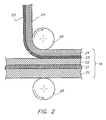
- Figure 2 represents schematically a peel-apart procedure for carrying out step (2) of the process according to the present invention.
- the production of a heat-mode recording material having DRAW capability includes the step of coating a heat-mode recording layer by "vacuum evaporation" which aptly applies to a process involving the vaporization of bulk material, e.g. molten metal, and redeposition thereof as a thin layer on a web-type support under substantially reduced pressure.
- vacuum-coating of a heat-mode recording layer of a DRAW recording material proceeds by "sputtering".
- Sputtering involves the production of energetic particles by ionization of a gas (usually argon at reduced pressure) and the bombardement with said particles of the target material in an electric field whereby the ejection of target atoms towards the web-type support takes place.
- the adhesive layer or multiple layer assemblage forming a protective element according to the present invention is preferably transparent in such a degree that it allows visual inspection therethrough of the image information contained in the heat mode-recording layer and is for application as a printing mask or phototool sufficiently transparent with respect to ultraviolet light to allow ultraviolet radiation to be used in contact-exposure towards an underlaying UV-sensitive recording material such as a polymeric photoresist material.
- the thickness of the applied single adhesive layer or total thickness of said multiple layer assemblage is preferably in the range of 0.1 to 15 ⁇ m, more preferably in the range of 1 to 10 ⁇ m.
- the invention is illustrated by means of Fig. 1 and 2.
- a cylindrical vacuum chamber 1 contains an electrically heated refractory tray or boat 2 in which a relatively low melting metal, e.g. bismuth, 3 is present as metal vapour source.
- a relatively low melting metal e.g. bismuth
- the obtained metal vapour is directed towards a web 4 made of polyethylene terephthalate and is deposited thereon at a thickness in the range of 5 nm to 300 nm.
- the optical density of the bismuth layer can be in the range of 1.5 to 4 according to the intended use of the lateron heat-mode formed bismuth image.
- the web 4 is supplied by an unwinding roll 5 and is conveyed over a guiding roller 7 against a cooled support roller 6.
- a baffle 8 restricts the vapour deposition on the web 4 to a small sector of the cooling roller 6. In that way unwanted deposition of metal e.g. on the wall of the vacuum chamber is prevented.
- the web 4 travels upwardly to meet a laminating web 9 (composite material of adhesive layer, release layer and temporary support) supplied by supply roller 12 in the nip formed between a pressure roller 10 that exerts pressure towards a backing roller 11 that is internally heated.
- a take-up roller 13 serves as storage roller for the laminated web material 14 having in this stage the temporary support as outermost layer.
- the temporary support together with its release layer is removed (peeled apart) and the bared adhesive layer now being the outermost layer is cured optionally by further applied heat, (i.e. thermally chemically cured) or by electron beam or ultraviolet radiation.
- the heat-mode recording web is cut into micro-film formats, e.g. micro-fiche format, optical floppy disks or sheets for contact-exposure purposes, e.g. for the production of a phototool.
- the peel apart step in which the temporary support is removed can be carried out under the vaccum conditions present during the coating of the heat-mode recording layer.
- Fig. 2 represents schematically a peel-apart procedure whereby an outermost single protective adhesive layer is left on a vacuum-coated metal recording layer of a head-mode DRAW recording material taken from the supply roller 13 of Figure 1. For clarity's sake some dimensions and proportions of the recording material layers have been exaggerated.
- Fig. 2 shows a laminated web 14 consisting of a permanent resin support 20 vacuum-coated with a heat-mode recording layer 21, e.g. bismuth layer, an adhesive layer 22, release layer 23 and temporary support 24. Said web 14 is led in the nip of pressure rollers 25 and 26 and the temporary support 20 together with its release layer 23 is peeled apart leaving the adhesive layer 22 as outermost layer on the permanently supported metal layer 21 of the heat-mode recording material.
- a laminated web 14 consisting of a permanent resin support 20 vacuum-coated with a heat-mode recording layer 21, e.g. bismuth layer, an adhesive layer 22, release layer 23 and temporary support 24. Said web 14 is led in the
- the recording layer is vacuum-deposited onto a transparent resin support.
- resin supports are made of hard polymers. e.g. polyesters such as polyethylene terephthalate, polycarbonates, cellulose triacetate, poly(meth)acrylic esters, polyvinyl chloride and copolymers. These supports have e.g. a thickness in the range of 50 to 200 ⁇ m and are optionally provided with one or more subbing layers improving the adherence of the recording layer, as described e.g.
- a thermally deformable layer having a low softening point e.g. a polyolefin layer such as polyethylene layer having preferably a thickness smaller than 10 ⁇ m.
- a soft deformable layer or elastomer layer in direct contact with the heat-mode recording layer is in favour of a more easy globule formation when an ablative metal or metal alloy, e.g. bismuth, forming the heat-mode recording layer is heated by laser beam.
- an ablative metal or metal alloy e.g. bismuth
- the present invention includes an embodiment wherein the adhesive layer makes part of a multiple layer assemblage, e.g. bilayer-assemblage in which the layer contacting the heat-mode recording layer is made of a soft non-hardenable (non-curable) hot melt adhesive polymer having preferably a glass transition temperature lower than 30 °C and at least the layer forming lateron the outermost layer on the recording material is hardenable by heat (thermohardenable) and/or hardenable (curable) by ultraviolet radiation or electron beam radiation.
- a multiple layer assemblage e.g. bilayer-assemblage in which the layer contacting the heat-mode recording layer is made of a soft non-hardenable (non-curable) hot melt adhesive polymer having preferably a glass transition temperature lower than 30 °C and at least the layer forming lateron the outermost layer on the recording material is hardenable by heat (thermohardenable) and/or hardenable (curable) by ultraviolet radiation or electron beam radiation.
- Polymers having a glass transition temperature (Tg) below 30 °C are known to those skilled in the art and some of them are described in Journal of Chemical Education, Vol. 61, Number 8, August 1984, p. 668 in the article "An Overview of the Glass Transition Temperature of Synthetic Polymers".
- Examples of such polymers are selected from the group consisting of a polyolefin, e.g. polyethylene or poly(1-butene), an ethylene-vinylacetate copolymer, an ethylene-acrylic acid(ester) copolymer, a styrene-butadiene copolymer, a polyamide or polyester having aliphatic carbon chains, e.g. poly(ethylene adipate).
- the temporary support of the heat-mode recording material according to the present invention may be made of the same material as the permanent support but is preferably coated with a release layer allowing the easy peel-off of the adhesive layer.
- the release layer may be made of e.g. of substances selected from the group consisting of solid waxes, polyvinyl alcohol, silicone resins and higly fluorinated resins, examples of which are described in US-P 4,059,768 or may contain said substances serving as release agent preferably in excess of 30 % by weight in a film forming polymer adhering to the temporary support.
- the release agent applied in a polymeric binding agent is a silicone oil that may be hardened to some extent as described e.g. in European patent specification 0 133 012. Some silicone oil of said release layer may remain as friction-lowering substance on the adhesive layer after its peel apart from the temporary support.
- the thickness of the release layer is preferably in the range of 0.3 to 5 ⁇ m.
- the release layer may contain a curable composition and curing thereof proceeds preferably before coating thereon the adhesive layer.
- a polyvinyl alcohol release layer applied on a temporary polyethylene terephthalate support is prehardened by crosslinking with tetramethoxysilane (TEMOS).
- TEMOS tetramethoxysilane
- the adhesive layer for use according to the present invention must adhere very well to the heat-mode recording layer, e.g. a bismuth layer.
- the adhesive layer must be sufficiently transparent in the sense as already defined and may not stick (after hardening e.g. by cooling) to the rear side of the permanent support when winding the finished recording material.
- Suitable single adhesive layers are made of e.g. a poly(meth)acrylate ester, e.g. butyl methacrylate and copolymers thereof with styrene, cellulose nitrate, and polymer compositions that are chemically hardenable by heat, i.e. are thermosetting, or are hardenable by ultraviolet radiation or electron beam radiation as described e.g. in published EP-A 0 522 609.
- a poly(meth)acrylate ester e.g. butyl methacrylate and copolymers thereof with styrene, cellulose nitrate, and polymer compositions that are chemically hardenable by heat, i.e. are thermosetting, or are hardenable by ultraviolet radiation or electron beam radiation as described e.g. in published EP-A 0 522 609.
- the hardening of the outermost single adhesive layer proceeds after the lamination step and before the peel apart step in order to avoid sticking of that layer to the rear side of the recording material on winding.
- the chemical hardening of the adhesive layer contacting the heat-mode recording layer may proceed before as well as after the peel apart step.
- an outermost protective element anti-friction agents are incorporated into the outermost layer composition in the form of waxes, fluorine-or phosphate-containing surfactants and slipping agents such as siloxanes (silicones in liquid or solid form), higher fatty acids or salts thereof, e.g. zinc stearate, or silica or silicates having an average particle size in the range of 1 to 10 ⁇ m.
- silica particles and colourless silicate particles e.g. mica, calcium silicate, aluminium silicate, talc (magnesium silicate) partially protruding from the outermost protective layer.
- the obtained outermost surface of the recording material may be post-coated with a supplementary covering layer improving scratch resistance.
- a supplementary covering layer improving scratch resistance.
- Such coating having preferably a thickness not larger than 10 ⁇ m may be applied by spraying.
- Said coating may consist of or comprise a slipping agent as described above, e.g. a silicone oil or a fatty acid.
- the coating composition of the adhesive layer or adhesive layer of the multiple layer assemblage may be applied by any thin-layer coating technique known in the art, e.g. by reverse roll coating or meniscus coating or slide hopper coating for the multiple layer assemblage using a proper vapourizable organic solvent for the applied polymer(s).
- the polymer(s) may be applied from aqueous medium in latex form, i.e. dispersed form, and coalesce on drying.
- the coating may proceed in multiple coating steps, in which the polymer layer having a low softening point may be applied by extrusion.
- the coating or coatings is (are) followed by stretching the coated structure in order to reduce the total layer thickness.
- photo-curable (UV-curable) or electron beam curable polymers are coated from aqueous medium as a solution or dispersion.
- Photo-curable and electron beam curable polymer compositions are advantageously applied in the form of a solution of polymers in monomers polymerizing in situ after coating.
- the adhesive layer is made from a radiation-curable composition containing as primary components :
- the reactive (pre)polymer or oligomer is a compound containing one or more ethylenically unsaturated groups.
- Reactive polymers containing ethylenically unsaturated groups are commercially available from BOMAR Specialities Company under the tradename of JAYLINK (modified cellulose polymers containing acrylamidomethyl groups).
- These reactive (pre)polymers or oligomers (1) are present in said composition preferably in a 10 to 100 % by weight ratio and said reactive solvent in a 0 to 10 % weight ratio.
- the photoinitiator having UV-absorptivity is used in a concentration as low as possible, e.g. in a concentration of 0.1 to 1 % by weight ratio with respect to the total coating composition.
- photo-bleachable photoinitiators are used.
- Suitable prepolymers for use in a radiation-curable composition of the adhesive layer applied according to the present invention are the following : unsaturated polyesters, e.g. polyester acrylates; urethane modified unsaturated polyesters, e.g. urethane-polyester acrylates.
- unsaturated polyesters e.g. polyester acrylates
- urethane modified unsaturated polyesters e.g. urethane-polyester acrylates.
- Liquid polyesters having an acrylic group as a terminal group e.g. saturated copolyesters which have been provided with acryltype end groups are described in published EP-A 0 207 257 and Radiat. Phys. Chem., Vol. 33, No. 5, 443-450 (1989).
- Copolyesters substantially free from low molecular weight, unsaturated monomers and other volatile substances are of very low toxicity (ref. the periodical Adphase 1990 Heft 12, page 12).
- the preparation of a large variety of radiation-curable acrylic polyesters is given in German Offenlegungsschrift No. 2838691. Mixtures of two or more of said prepolymers may be used.
- UV-curable compositions are selected from the group consisting of unsaturated urethane(meth)acrylates, epoxy(meth)acrylates, polyether(meth)acrylates and polyester(meth)acrylates as described e.g. in "Chemistry & Technology of UV and EB formulation for coatings, inks and paints” Vol.2 : Prepolymers and Reactive diluents for UV and EB curable formulations.” Ed. P.K.T. OLDRING - SITA Technology - London (1991). A survey of UV-curable coating compositions is given e.g. in the periodical “Coating” 9/88, p. 348-353.
- UV-curable adhesive layers can be obtained by the use of prepolymers also called oligomers of the class of aliphatic and aromatic polyester-urethane acrylates.
- prepolymers also called oligomers of the class of aliphatic and aromatic polyester-urethane acrylates.
- the structure of polyester-urethane acrylates is given in the booklet "Radiation Cured Coatings" by John R. Constanza, A.P. Silveri and Joseph A. Vona, published by Federation of Societies for Coatings Technology, 1315 Walnut St. Philadelphia, PA 19107 USA (June 1986) p. 9.
- first tolylene 2,4-diisocyanate is used in a polyaddition reaction with aliphatic diols and the polymerizable double bond end structures are introduced by reaction of terminal isocyanate groups with 2-hydroxyethyl acrylate.
- alkylene diisocyanate is used, e.g. 1,6-diisocyanatohexane.
- the introduction of a plurality of acrylic double bonds per polymer chain of the prepolymer proceeds by first effecting a partial esterification of a polyol, e.g. pentaerythritol, with acrylic acid and a subsequent reaction of the still free HO-group(s) of the polyol with a polyfunctional isocyanate.
- a polyol e.g. pentaerythritol
- UV cured pressure sensitive adhesives of the class of I. Acrylate Grafted Polyvinyl Alkyl Ethers and II. Monoacrylate Grafted Polyethers are described in Journal of Radiation Curing, Vol. 9/No. 2 April 1982.
- the UV or EB curable coating composition may contain inert polymers by which is meant polymers that do not crosslink but improve by their inherent hardness the scratch resistance of the protective layer and counteract sticking to the rearside of the recording material when winding up.
- inert polymers e.g. polyesters derived from aromatic acids, e.g. iso-, or terephhtalic acid, poly(meth)acrylate esters of C1-C4 alcohols, e.g. n-butyl methacrylate, and copolymers thereof with styrene and polyvinyl acetate.
- the adhesive layer is coated on its temporary support, preferably provided with release layer, from a coating composition essentially consisting of (an) addition polymerizable monomer or mixture of such monomers having dissolved therein at least one of the polymers (i) and/or (ii), wherein :
- the above resins (i) and (ii) have a softening point (ring & ball) not lower than 90 °C.
- the ring & ball method for determining the softening point is described in : Annual Book of ASTM Standards (1985), Vol. 06.03, p. 1031-1037.
- the polymers (i) and (ii) have preferably a tensile strength of at least 30 N/mm 2 . determined by (for the applied testing machine reference is made to G. A. Patfoort "Polymers” An Introduction to their Physical Mechanical and Rheological Behaviour - (1974) - E. Story-Scientia P.V.B.A. Scientific Publishers Gent/Belgium. p. 134-136.
- the weight-average molecular weight (Mw) determined by gel-permeation chromatography (GPC) of said polymers (i) and (ii) is preferably comprised between 10,000 and 30,000.
- Preferred copolyesters (i) have an isophthalate content of at least 30 % by weight.
- Preferred dibasic acids that are combined with isophthalic acid in the formation of copolyesters (i) are C4-C10 dibasic acids, e.g. terephthalic acid and sebacic acid.
- diols that may be used in the preparation of said copolyester (i) are : ethylene glycol, 1,4-butanediol, neopentyl glycol and 1,6-hexanediol, which diols may be used in combination.
- Copolyesters (i) can be easily prepared by well-known polycondensation processes and representatives of them are commercially available under the tradename VITEL, e.g. VITEL PE 200 of the firm The Goodyear Tire & Rubber Co , Ohio, U.S.A, and are likewise commercially available in the group of Dynamit Nobel Chemicals under the tradename DYNAPOL of Hüls Aktiengesellschaft, Postfach 1320 - D-4370 Marj, Germany. An example of the preparation of such copolyesters is described in US-P 4,078,108.
- alkoxylated bisphenol used in the preparation of said polyesters and copolyesters (ii) is preferably within the scope of the following general formula : wherein :
- Suitable propoxylated bisphenol A polyesters are on the market under the trade name ATLAC KTR 2300 and KTR 2959 of Atlas Chemical Industies N.V. (Everslaan 45, Everberg - Belgium).
- polyesters using an alkoxylated bisphenol is described e.g. in GB-P 1,373,220.
- Adhesive layers having particularly good adherence to a vacuum-coated bismuth layer are obtained by means of coating compositions wherein the above polymers (i) and/or (ii) are dissolved in the range of 30 to 70 % by weight at 20 °C in the addition polymerizable liquid monomer(s) acting as solvent(s).
- the addition polymerizable monomers may be monofunctional or plurifunctional by which is meant that they may contain one or more olefinically unsaturated groups.
- monofunctional addition polymerizable liquid monomers that may serve as solvent for the above defined polymers (i) and (ii) are the following : methyl (metha)acrylate, ethyl acrylate, butyl acrylate, 2-ethylhexyl methacrylate, 2-hydroxyethyl acrylate, 2-hydroxyethyl methacrylate, glycidyl methacrylate, n-hexyl acrylate, lauryl acrylate, and tetrahydrofurfuryl methacrylate.
- Preferred mono-functional monomers for use according to the present invention are methyl methacrylate and tetrahydrofurfuryl methacrylate.
- di-functional monomers examples include : 1,6-hexanediol diacrylate, 1,6-hexanediol dimethacrylate, neopentylglycol diacrylate, 1,4-butanediol diacrylate, ethyleneglycol diacrylate, polyethyleneglycol diacrylate, pentaerythritol diacrylate, divinylbenzene.
- Suitable tri- or more-functional monomers are trimethylolpropane triacrylate, trimethylolpropane trimethacrylate, pentaerythritol triacrylate, dipentaerythritol hexaacrylate, an acrylate of ethylenediamine, aliphatic and aromatic urethane acrylates and the monomers according to general formula (I) described in non-published European patent application No. 91200468.6 filed March 5, 1991, wherein reference is made for the preparation of said monomers to published German patent applications Nos. 3,522,005, 3,703,080, 3,643,216, 3,703,130, 3,703,080, 3,917,320 and 3,743,728.
- UV ultraviolet radiation
- a photoinitiator is present in the coating composition for forming the protective layer to serve as photo-radical former initiating the addition polymerization of the liquid monomers on UV-irradiation.
- Photoinitiators suitable for use in photo-radical production belong to the class of organic carbonyl compounds, for example, benzoin ether series compounds such as benzoin isopropyl, isobutylether; benzil ketal series compounds; ketoxime esters; benzophenone series compounds such as benzophenone, o-benzoylmethylbenzoate; acetophenone series compounds such as acetophenone, trichloroacetophenone, 1,1-dichloroacetophenone, 2,2-diethoxyacetophenone, 2,2-dimethoxy-2-phenylacetophenone; thioxanthone series compounds such as 2-chlorothioxanthone, 2-ethylthioxanthone; and compounds such as 2-hydroxy-2-methylpropiophenone. 2-hydroxy-4'-isopropyl-2-methylpropiophenone, 1-hydroxycyclohexylphenylketone; etc.
- a particularly preferred photoinitiator is 2-hydroxy-2-methyl-1-phenyl-propan-1-one which product is marketed by E. Merck, Darmstadt, Germany under the tradename DAROCUR 1173.
- the amount of the photoinitiator used is preferably within the range of 0.01 to 5 parts by weight relative to 100 parts by weight of the addition polymerizable monomer(s).
- the adhesive layer composition may contain additives playing a role in the coating stage or in the final layer.
- additives are surfactants, solid lubricants, e.g. waxes, defoamers and anti-static agents.
- Apparatus for radiation curing are known to those skilled in the art and are commercially available.
- the curing can proceed advantageously with ultraviolet radiation.
- the curing proceeds with medium pressure mercury arc lamps or pulsed xenon arcs.
- These ultraviolet sources usually are equipped with a cooling installation, an installation to remove the produced ozone and a nitrogen inflow to exclude air from the surface of the product to be cured during radiation processing.
- An intensity of 40 to 120 W/cm in the 200-400 nm region is usually employed.
- An example of a commercially available ultraviolet source is IST supplied by Strahlentechnik, Oberboihingen, W. Germany.
- High energy ionizing radiation such as X-rays, gamma rays, beta rays and accelerated electrons can also be used to accomplish curing of the coating.
- the radiation used should be of a sufficient intensity to penetrate substantially all the way through the coated layer.
- the total dosage employed should be sufficient to bring about curing of the radiation curable coating composition to form a solid layer.
- UV radiation is better suited for non-pigmented or slightly pigmented systems having relatively thin films to allow full penetration of the irradiation.
- the protective layer has to possess high UV transmittance it is advantageous to work without UV absorbing photoinitiator and to apply electron beam (EB) curing since therefor no photoinitiator is needed.
- EB electron beam
- the penetration power of electron beam radiation depends on the value of the electron accelerating voltage and on the absorption capacity of the coatings.
- Electron beam curing is described e.g. in the periodical Adphase 1990 - Heft 12, pages 39-40. Curing periods of about 1 second duration are possible, especially in thin (10-20 micron) coatings.
- Coating of the coating composition forming the protective layer proceeds advantageously by means of a coating technique known as silk screen printing.
- the liquid coating composition of said adhesive layer preferably has at the coating temperature a viscosity of at least 450 mPa.s, the viscosity being measured at that temperature with a Hoeppler viscometer.
- bismuth In the production of a heat-mode recording material having direct-read-after write capability bismuth has interesting properties. Vacuum-deposited bismuth yields a high optical density even in very thin (thickness smaller than 200 nm) layers. The optical density of such vapour-deposited bismuth layer can be reduced by flash light or laser beam exposure and bismuth adheres directly to an unsubbed polyethylene terephthalate support as has been mentioned already in GB-P 1,566,802.
- the storage layer i.e. the recording layer, described therein consists of a 60 nm bismuth layer and a Ge anti-reflex coating that prevents to a certain degree oxidation of the bismuth layer.
- the recording layer e.g. a black mat bismuth layer is applied on a reflective support or supported reflective interlayer, e.g. made of aluminium or containing a dispersion of white pigment, e.g. titanium dioxide in a polymeric binder, e.g. gelatin.
- a black mat bismuth layer is applied on a reflective support or supported reflective interlayer, e.g. made of aluminium or containing a dispersion of white pigment, e.g. titanium dioxide in a polymeric binder, e.g. gelatin.
- the thus obtained film material was laminated through its adhesive layer in contact with a freshly in vacuum deposited bismuth layer.
- Said bismuth layer was deposited at a thickness of 0.3 ⁇ m on a 175 ⁇ m thick permanent polyethylene terephthalate resin support using the apparatus schematically represented in Fig. 1
- the lamination proceeded at a temperature of 89 °C and lamination speed of 40 cm/min. Thereupon the laminated material was wound up on a collector roller that was removed from the vacuum chamber after restoring normal pressure.
- the temporary support of the laminated material was peeled apart under ambient temperature conditions (about 20 °C) out of the vacuum chamber as shown in Fig. 2 leaving said adhesive layer as outermost protective layer on said bismuth heat-mode recording layer.
- the scratch resistance of said outermost protective layer was measured as described hereinbefore and corresponded with a scratch resistance value of 6 g.
- the transmission optical density of the obtained heat-mode recording material measured through said outermost protective recording layer with Macbeth densitometer type 904TD (provided with UV filter) was 3.53.
- the transmission density obtained in a thus exposed large solid area was 0.24.
- Example 1 was repeated with the difference that the temporary support was pre-coated with a release layer in the form of a 2 ⁇ m thich polyvinyl alcohol layer applied from an aqueous 5 % polyvinyl alcohol solution of which the polyvinyl alcohol still contained 2 % of unsaponified vinylacetate groups.
- the coating solution contained 0.05 % of saponine as wetting agent.
- the in Example 1 described adhesive layer was coated onto said release layer.
- the release layer was easily removed together with the temorary support.
- Example 1 The same scratch resistance and adherence results as mentioned in Example 1 were obtained.
- the thus obtained film material was laminated through its adhesive layer in contact with a freshly in vacuum deposited bismuth layer as described in Example 1.
- the temporary support of the laminated material was peeled apart under ambient temperature conditions (about 20 °C) out of the vacuum chamber as shown in Fig. 2 and cured at 110 °C for 30 minutes.
- the scratch resistance of said outermost protective layer was measured as described hereinbefore and corresponded with a scratch resistance value of 8 g.
- the thus obtained film material was laminated through its adhesive layer in contact with a freshly in vacuum deposited bismuth layer as described in Example 1.
- UV-curing of the transferred UV-curable adhesive layer was carried out by means of a Labcure Unit (marketed by TECHNIGRAF GmbH, Grävenwiesbach, Germany) operating with air cooling, an energy supply of 80 W/cm at a throughput velocity of 2 m/min while maintaining the curable layer at a distance of 11 cm from the UV-radiation source.
- Labcure Unit marketed by TECHNIGRAF GmbH, Grävenwiesbach, Germany
- the scratch resistance of the UV-cured outermost protective layer was measured as described hereinbefore and corresponded with a scratch resistance value of 8 g.
- the thus obtained film material was laminated through its adhesive layer in contact with a freshly in vacuum deposited bismuth layer as described in Example 1.
- the temporary support of the laminated material was peeled apart under ambient temperature conditions (about 20 °C) out of the vacuum chamber as shown in Fig. 2.
- EB-curing of the transferred EB-curable adhesive layer was carried out by means of an electron beam producing apparatus operating at 150 kV and radiation energy corresponding with 4 mGy at a travelling speed of the irradiated material of about 3 m/min.
- the scratch resistance of said outermost protective layer was measured as described hereinbefore and corresponded with a scratch resistance value of 8 g.
- the thus obtained film material was laminated through its lastmentioned adhesive layer in contact with a freshly in vacuum deposited bismuth layer as shown in Fig 1.
- UV-curing of the UV-curable layer was carried out by means of a Labcure Unit (marketed by TECHNIGRAF GmbH, Grävenwiesbach, Germany) operating with air cooling, an energy supply of 80 W/cm at a throughput velocity of 2 m/min while maintaining the UV-curable layer at a distance of 11 cm from the UV-radiation source.
- Labcure Unit marketed by TECHNIGRAF GmbH, Grävenwiesbach, Germany
- the scratch resistance of the thus cured outermost protective layer was measured as described hereinbefore and corresponded with a scratch resistance value of 8 g.
Landscapes
- Engineering & Computer Science (AREA)
- Physics & Mathematics (AREA)
- Plasma & Fusion (AREA)
- Thermal Sciences (AREA)
- Mechanical Engineering (AREA)
- Manufacturing & Machinery (AREA)
- Laminated Bodies (AREA)
Description
A survey of UV-curable coating compositions is given e.g. in the periodical "Coating" 9/88, p. 348-353.

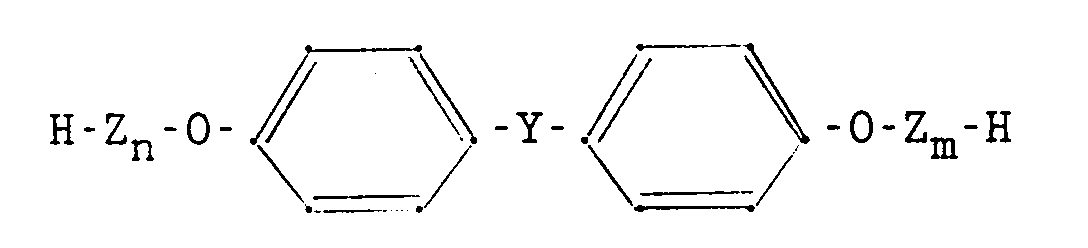
Claims (14)
- A process for the production of a heat-mode recording material having "direct read after write" (DRAW) capability and containing a heat-mode recording layer on a permanent support, wherein said process comprises in consecutive order the steps of (1) forming a laminated web by laminating with heat and pressure to said recording layer a single adhesive layer or multiple layer assemblage carried by a web-type temporary support which layer or layer assemblage has a thickness not larger than 20 µm, and (2) separating said temporary support from said adhesive layer leaving said single adhesive layer as a protective element on said recording layer, or (2') separating said temporary support from said adhesive layer assemblage leaving said layer assemblage as a protective element on said recording layer, and
(3) chemically hardening said single adhesive layer or said outermost layer of said multiple layer assemblage after said separating step (2) or (2') by means of heat and/or by ultra-violet radiation or electron beam radiation, said hardening providing an outermost protective layer having at 20 °C a scratch resistance value not lower than 6 g determined by ANSI test PH1.37-1977 Method A using in the scratch test a single spherical point sapphire stylus having a point diameter of 13 µm (micron). - Process according to claim 1, wherein said recording layer is coated on its permanent support under vacuum conditions, and said step (1) is carried out under the same vacuum conditions as wherein the coating of said recording layer on its permanent support took place.
- Process according to claim 1, with the modification that said single adhesive layer or said outermost layer of said multiple layer assemblage after transfer onto said heat-mode recording layer is hardened through cooling to ambient temperature (20 °C) before said separating (2), (2').
- Process according to claim 1, wherein said multiple layer assemblage has a layer contacting the heat-mode recording layer made of a soft non-hardenable (non-curable) hot melt adhesive polymer having a glass transition temperature lower than 30 °C and at least the layer forming said outermost layer on the recording material is chemically hardenable by means of heat and/or by ultraviolet radiation or electron beam radiation.
- Process according to claim 1, wherein the thickness of said single adhesive layer or the total thickness of said multiple layer assemblage is in the range of 1 to 10 µm.
- Process according to claim 1, wherein said step (2) is carried out under vacuum conditions.
- Process according to claim 1, wherein said steps (2), (2') are carried out under non-vacuum conditions and the laminated web obtained in step (1) is led in the nip of pressure rollers and the temporary support together with its optional release layer is peeled apart leaving the single adhesive layer or said multiple layer assemblage on top of said heat-mode recording layer.
- Process according to claim 1, wherein said permanent support is made of a polymer selected from the group consisting of polyesters, polycarbonates, cellulose triacetate, poly(meth)acrylic esters, polyvinyl chloride and copolymers.
- Process according to claim 1, wherein said permanent support has a thickness in the range of 50 to 200 µm and is optionally provided with one or more subbing layers improving the adherence of said recording layer.
- Process according to claim 1, wherein said temporary support is made of the same material as the permanent support.
- Process according to claim 1, wherein said temporary support before carrying out said step (1) has been coated with an intermediary release layer for said adhesive layer or multiple layer assemblage, and wherein in said steps (2), (2') said release layer together with said temporary support is separated from said adhesive layer or multiple layer assemblage, and wherein said release layer is made of substances selected from the group consisting of solid waxes, polyvinyl alcohol, silicone resins, higly fluorinated resins and silicone oil or contains said substances serving as release agent in excess of 30 % by weight in a film forming polymer adhering to the temporary support.
- Process according to claim 1, wherein said single adhesive layer or outermost layer of said layer assemblage is made from a radiation-curable composition containing as primary components :(1) at least one reactive (pre)polymer or oligomer,(2) optionally at least one reactive solvent monomer dissolving (1),(3) in the case of an UV curable formulation a photoinitiator.
- Process according to claim 1, wherein the scratch resistance of the obtained protective element is improved by the presence therein of anti-friction agents in the form of waxes, fluorine-or phosphate-containing surfactants and inorganic slipping agents being silica or silicates having an average particle size of 1 to 10 µm partially protruding from the adhesive layer.
- Process according to claim 1, wherein the heat-mode recording layer is a bismuth layer that has been coated onto said permanent support under vacuum conditions.
Priority Applications (1)
| Application Number | Priority Date | Filing Date | Title |
|---|---|---|---|
| EP95201163A EP0687569B1 (en) | 1994-06-15 | 1995-05-08 | Process for producing a protected heat-mode recording material |
Applications Claiming Priority (3)
| Application Number | Priority Date | Filing Date | Title |
|---|---|---|---|
| EP94201713 | 1994-06-15 | ||
| EP94201713 | 1994-06-15 | ||
| EP95201163A EP0687569B1 (en) | 1994-06-15 | 1995-05-08 | Process for producing a protected heat-mode recording material |
Publications (2)
| Publication Number | Publication Date |
|---|---|
| EP0687569A1 EP0687569A1 (en) | 1995-12-20 |
| EP0687569B1 true EP0687569B1 (en) | 1998-03-25 |
Family
ID=26136337
Family Applications (1)
| Application Number | Title | Priority Date | Filing Date |
|---|---|---|---|
| EP95201163A Expired - Lifetime EP0687569B1 (en) | 1994-06-15 | 1995-05-08 | Process for producing a protected heat-mode recording material |
Country Status (1)
| Country | Link |
|---|---|
| EP (1) | EP0687569B1 (en) |
Families Citing this family (7)
| Publication number | Priority date | Publication date | Assignee | Title |
|---|---|---|---|---|
| US5962181A (en) * | 1996-04-23 | 1999-10-05 | Agfa-Gevaert, N.V. | Process for the preparation of a metal heat mode recording element |
| EP0803376B1 (en) * | 1996-04-23 | 1999-12-15 | Agfa-Gevaert N.V. | Process for the preparation of a metal heat mode recording element |
| EP0977192A4 (en) * | 1997-04-14 | 2000-11-15 | Toray Industries | Optical recording device and optical recording medium |
| US5989777A (en) * | 1997-06-18 | 1999-11-23 | Agfa-Gevaert, N. V. | Heat mode recording element based on a thin metallic recording layer |
| DE69720700T2 (en) * | 1997-06-18 | 2004-04-08 | Agfa-Gevaert | Heat sensitive recording element with metallic thin film recording layer |
| DE69821611D1 (en) * | 1998-08-28 | 2004-03-18 | Agfa Gevaert Nv | Heat sensitive recording element with antistatic layers |
| DE10153243B4 (en) * | 2001-10-31 | 2008-11-06 | Volker Friedrich | Air Bag (Air Bag) |
Family Cites Families (5)
| Publication number | Priority date | Publication date | Assignee | Title |
|---|---|---|---|---|
| US4069487A (en) * | 1974-12-26 | 1978-01-17 | Canon Kabushiki Kaisha | Recording member and process for recording |
| JP2525647B2 (en) * | 1988-07-19 | 1996-08-21 | 富士写真フイルム株式会社 | Optical recording medium |
| DE68916530T2 (en) * | 1989-02-24 | 1994-11-24 | Agfa Gevaert Nv | Process for the production of a heat-sensitive recording material. |
| JPH0554432A (en) * | 1991-08-20 | 1993-03-05 | Pioneer Electron Corp | Optical recording medium |
| JP2953598B2 (en) * | 1992-08-31 | 1999-09-27 | ソニーケミカル株式会社 | UV curable resin composition and protective film for optical disc using the same |
-
1995
- 1995-05-08 EP EP95201163A patent/EP0687569B1/en not_active Expired - Lifetime
Also Published As
| Publication number | Publication date |
|---|---|
| EP0687569A1 (en) | 1995-12-20 |
Similar Documents
| Publication | Publication Date | Title |
|---|---|---|
| US5656410A (en) | Process for producing a protected heat-mode recording material | |
| EP0384041B1 (en) | Process for the production of a heat-mode recording material | |
| EP0652555B1 (en) | Optical recording medium | |
| US5616447A (en) | Optical disc having printable label layer | |
| US4340655A (en) | Thermal and mechanical barrier layers for optical recording elements | |
| KR100306352B1 (en) | Information recording carrier and its manufacturing method | |
| EP0687569A1 (en) | Process for producing a protected heat-mode recording material | |
| US5962181A (en) | Process for the preparation of a metal heat mode recording element | |
| JPH04337307A (en) | Resin composition for optical material, material for optical disc and cured product of the composition | |
| JPH01103493A (en) | Thermal recording medium | |
| EP0684145B1 (en) | Heat mode recording element | |
| JPS6330880B2 (en) | ||
| EP0803376B1 (en) | Process for the preparation of a metal heat mode recording element | |
| EP0923072B1 (en) | Heat mode recording material based on a thin metal layer | |
| EP0923071B1 (en) | Process for the preparation of a heat mode recording element | |
| US6162493A (en) | Process for the preparation of a heat mode recording element | |
| JP2879142B2 (en) | Method for producing metal heat mode recording material | |
| EP0137760B1 (en) | Improved overcoat for optical recording media | |
| EP0886268B1 (en) | Heat mode recording element based on a thin metallic recording layer | |
| US5989777A (en) | Heat mode recording element based on a thin metallic recording layer | |
| US6309808B1 (en) | Heat mode recording element | |
| JPH0744888A (en) | Optical information medium | |
| JP3316321B2 (en) | Thermal recording medium | |
| JP2940215B2 (en) | Magneto-optical recording medium | |
| JPH06231451A (en) | Magnetic recording medium |
Legal Events
| Date | Code | Title | Description |
|---|---|---|---|
| PUAI | Public reference made under article 153(3) epc to a published international application that has entered the european phase |
Free format text: ORIGINAL CODE: 0009012 |
|
| AK | Designated contracting states |
Kind code of ref document: A1 Designated state(s): BE DE FR GB NL |
|
| 17P | Request for examination filed |
Effective date: 19960620 |
|
| GRAG | Despatch of communication of intention to grant |
Free format text: ORIGINAL CODE: EPIDOS AGRA |
|
| 17Q | First examination report despatched |
Effective date: 19970121 |
|
| GRAG | Despatch of communication of intention to grant |
Free format text: ORIGINAL CODE: EPIDOS AGRA |
|
| GRAH | Despatch of communication of intention to grant a patent |
Free format text: ORIGINAL CODE: EPIDOS IGRA |
|
| GRAH | Despatch of communication of intention to grant a patent |
Free format text: ORIGINAL CODE: EPIDOS IGRA |
|
| GRAA | (expected) grant |
Free format text: ORIGINAL CODE: 0009210 |
|
| AK | Designated contracting states |
Kind code of ref document: B1 Designated state(s): BE DE FR GB NL |
|
| REF | Corresponds to: |
Ref document number: 69501853 Country of ref document: DE Date of ref document: 19980430 |
|
| PG25 | Lapsed in a contracting state [announced via postgrant information from national office to epo] |
Ref country code: BE Free format text: LAPSE BECAUSE OF NON-PAYMENT OF DUE FEES Effective date: 19980531 |
|
| REG | Reference to a national code |
Ref country code: GB Ref legal event code: 746 Effective date: 19980601 |
|
| ET | Fr: translation filed | ||
| REG | Reference to a national code |
Ref country code: FR Ref legal event code: D6 |
|
| BERE | Be: lapsed |
Owner name: AGFA-GEVAERT N.V. Effective date: 19980531 |
|
| PLBE | No opposition filed within time limit |
Free format text: ORIGINAL CODE: 0009261 |
|
| STAA | Information on the status of an ep patent application or granted ep patent |
Free format text: STATUS: NO OPPOSITION FILED WITHIN TIME LIMIT |
|
| 26N | No opposition filed | ||
| PGFP | Annual fee paid to national office [announced via postgrant information from national office to epo] |
Ref country code: NL Payment date: 20010427 Year of fee payment: 7 |
|
| PGFP | Annual fee paid to national office [announced via postgrant information from national office to epo] |
Ref country code: DE Payment date: 20010515 Year of fee payment: 7 |
|
| PGFP | Annual fee paid to national office [announced via postgrant information from national office to epo] |
Ref country code: FR Payment date: 20010516 Year of fee payment: 7 |
|
| REG | Reference to a national code |
Ref country code: GB Ref legal event code: IF02 |
|
| PG25 | Lapsed in a contracting state [announced via postgrant information from national office to epo] |
Ref country code: NL Free format text: LAPSE BECAUSE OF NON-PAYMENT OF DUE FEES Effective date: 20021201 |
|
| PG25 | Lapsed in a contracting state [announced via postgrant information from national office to epo] |
Ref country code: DE Free format text: LAPSE BECAUSE OF NON-PAYMENT OF DUE FEES Effective date: 20021203 |
|
| PG25 | Lapsed in a contracting state [announced via postgrant information from national office to epo] |
Ref country code: FR Free format text: LAPSE BECAUSE OF NON-PAYMENT OF DUE FEES Effective date: 20030131 |
|
| NLV4 | Nl: lapsed or anulled due to non-payment of the annual fee |
Effective date: 20021201 |
|
| REG | Reference to a national code |
Ref country code: FR Ref legal event code: ST |
|
| REG | Reference to a national code |
Ref country code: GB Ref legal event code: 732E |
|
| PGFP | Annual fee paid to national office [announced via postgrant information from national office to epo] |
Ref country code: GB Payment date: 20070523 Year of fee payment: 13 |
|
| GBPC | Gb: european patent ceased through non-payment of renewal fee |
Effective date: 20080508 |
|
| PG25 | Lapsed in a contracting state [announced via postgrant information from national office to epo] |
Ref country code: GB Free format text: LAPSE BECAUSE OF NON-PAYMENT OF DUE FEES Effective date: 20080508 |