EP0687169B1 - Surface material for absorbent articles - Google Patents
Surface material for absorbent articles Download PDFInfo
- Publication number
- EP0687169B1 EP0687169B1 EP94909369A EP94909369A EP0687169B1 EP 0687169 B1 EP0687169 B1 EP 0687169B1 EP 94909369 A EP94909369 A EP 94909369A EP 94909369 A EP94909369 A EP 94909369A EP 0687169 B1 EP0687169 B1 EP 0687169B1
- Authority
- EP
- European Patent Office
- Prior art keywords
- surface material
- mould
- projections
- skin
- wearer
- Prior art date
- Legal status (The legal status is an assumption and is not a legal conclusion. Google has not performed a legal analysis and makes no representation as to the accuracy of the status listed.)
- Expired - Lifetime
Links
- 239000000463 material Substances 0.000 title claims abstract description 97
- 230000002745 absorbent Effects 0.000 title claims abstract description 28
- 239000002250 absorbent Substances 0.000 title claims abstract description 28
- 238000004519 manufacturing process Methods 0.000 claims abstract description 10
- 206010021639 Incontinence Diseases 0.000 claims abstract description 7
- 239000002985 plastic film Substances 0.000 claims description 22
- 229920006255 plastic film Polymers 0.000 claims description 4
- 238000001125 extrusion Methods 0.000 claims description 2
- 230000002093 peripheral effect Effects 0.000 claims 1
- 239000012530 fluid Substances 0.000 description 11
- 206010052428 Wound Diseases 0.000 description 5
- 208000027418 Wounds and injury Diseases 0.000 description 5
- 238000009423 ventilation Methods 0.000 description 4
- 239000003570 air Substances 0.000 description 3
- 239000004033 plastic Substances 0.000 description 3
- 229920003023 plastic Polymers 0.000 description 3
- 239000012080 ambient air Substances 0.000 description 2
- 230000000295 complement effect Effects 0.000 description 2
- 230000000694 effects Effects 0.000 description 2
- 238000007666 vacuum forming Methods 0.000 description 2
- 239000004698 Polyethylene Substances 0.000 description 1
- 238000001816 cooling Methods 0.000 description 1
- 239000003000 extruded plastic Substances 0.000 description 1
- 229920002457 flexible plastic Polymers 0.000 description 1
- 238000003754 machining Methods 0.000 description 1
- 230000035699 permeability Effects 0.000 description 1
- -1 polyethylene Polymers 0.000 description 1
- 229920000573 polyethylene Polymers 0.000 description 1
- 238000004080 punching Methods 0.000 description 1
- 238000010926 purge Methods 0.000 description 1
- 239000002344 surface layer Substances 0.000 description 1
- 238000011144 upstream manufacturing Methods 0.000 description 1
- 210000002700 urine Anatomy 0.000 description 1
- 230000029663 wound healing Effects 0.000 description 1
Images

Classifications
-
- A—HUMAN NECESSITIES
- A61—MEDICAL OR VETERINARY SCIENCE; HYGIENE
- A61F—FILTERS IMPLANTABLE INTO BLOOD VESSELS; PROSTHESES; DEVICES PROVIDING PATENCY TO, OR PREVENTING COLLAPSING OF, TUBULAR STRUCTURES OF THE BODY, e.g. STENTS; ORTHOPAEDIC, NURSING OR CONTRACEPTIVE DEVICES; FOMENTATION; TREATMENT OR PROTECTION OF EYES OR EARS; BANDAGES, DRESSINGS OR ABSORBENT PADS; FIRST-AID KITS
- A61F13/00—Bandages or dressings; Absorbent pads
- A61F13/01—Non-adhesive bandages or dressings
- A61F13/01021—Non-adhesive bandages or dressings characterised by the structure of the dressing
-
- A—HUMAN NECESSITIES
- A61—MEDICAL OR VETERINARY SCIENCE; HYGIENE
- A61F—FILTERS IMPLANTABLE INTO BLOOD VESSELS; PROSTHESES; DEVICES PROVIDING PATENCY TO, OR PREVENTING COLLAPSING OF, TUBULAR STRUCTURES OF THE BODY, e.g. STENTS; ORTHOPAEDIC, NURSING OR CONTRACEPTIVE DEVICES; FOMENTATION; TREATMENT OR PROTECTION OF EYES OR EARS; BANDAGES, DRESSINGS OR ABSORBENT PADS; FIRST-AID KITS
- A61F13/00—Bandages or dressings; Absorbent pads
- A61F13/15—Absorbent pads, e.g. sanitary towels, swabs or tampons for external or internal application to the body; Supporting or fastening means therefor; Tampon applicators
- A61F13/15577—Apparatus or processes for manufacturing
- A61F13/15707—Mechanical treatment, e.g. notching, twisting, compressing, shaping
- A61F13/15731—Treating webs, e.g. for giving them a fibrelike appearance, e.g. by embossing
-
- A—HUMAN NECESSITIES
- A61—MEDICAL OR VETERINARY SCIENCE; HYGIENE
- A61F—FILTERS IMPLANTABLE INTO BLOOD VESSELS; PROSTHESES; DEVICES PROVIDING PATENCY TO, OR PREVENTING COLLAPSING OF, TUBULAR STRUCTURES OF THE BODY, e.g. STENTS; ORTHOPAEDIC, NURSING OR CONTRACEPTIVE DEVICES; FOMENTATION; TREATMENT OR PROTECTION OF EYES OR EARS; BANDAGES, DRESSINGS OR ABSORBENT PADS; FIRST-AID KITS
- A61F13/00—Bandages or dressings; Absorbent pads
- A61F13/15—Absorbent pads, e.g. sanitary towels, swabs or tampons for external or internal application to the body; Supporting or fastening means therefor; Tampon applicators
- A61F13/51—Absorbent pads, e.g. sanitary towels, swabs or tampons for external or internal application to the body; Supporting or fastening means therefor; Tampon applicators characterised by the outer layers of the pads
- A61F13/511—Topsheet, i.e. the permeable cover or layer facing the skin
- A61F13/51104—Topsheet, i.e. the permeable cover or layer facing the skin the top sheet having a three-dimensional cross-section, e.g. corrugations, embossments, recesses or projections
-
- A—HUMAN NECESSITIES
- A61—MEDICAL OR VETERINARY SCIENCE; HYGIENE
- A61F—FILTERS IMPLANTABLE INTO BLOOD VESSELS; PROSTHESES; DEVICES PROVIDING PATENCY TO, OR PREVENTING COLLAPSING OF, TUBULAR STRUCTURES OF THE BODY, e.g. STENTS; ORTHOPAEDIC, NURSING OR CONTRACEPTIVE DEVICES; FOMENTATION; TREATMENT OR PROTECTION OF EYES OR EARS; BANDAGES, DRESSINGS OR ABSORBENT PADS; FIRST-AID KITS
- A61F13/00—Bandages or dressings; Absorbent pads
- A61F13/15—Absorbent pads, e.g. sanitary towels, swabs or tampons for external or internal application to the body; Supporting or fastening means therefor; Tampon applicators
- A61F13/51—Absorbent pads, e.g. sanitary towels, swabs or tampons for external or internal application to the body; Supporting or fastening means therefor; Tampon applicators characterised by the outer layers of the pads
- A61F13/511—Topsheet, i.e. the permeable cover or layer facing the skin
- A61F13/512—Topsheet, i.e. the permeable cover or layer facing the skin characterised by its apertures, e.g. perforations
- A61F13/5126—Topsheet, i.e. the permeable cover or layer facing the skin characterised by its apertures, e.g. perforations characterised by the planar distribution of the apertures, e.g. in a predefined pattern
-
- A—HUMAN NECESSITIES
- A61—MEDICAL OR VETERINARY SCIENCE; HYGIENE
- A61F—FILTERS IMPLANTABLE INTO BLOOD VESSELS; PROSTHESES; DEVICES PROVIDING PATENCY TO, OR PREVENTING COLLAPSING OF, TUBULAR STRUCTURES OF THE BODY, e.g. STENTS; ORTHOPAEDIC, NURSING OR CONTRACEPTIVE DEVICES; FOMENTATION; TREATMENT OR PROTECTION OF EYES OR EARS; BANDAGES, DRESSINGS OR ABSORBENT PADS; FIRST-AID KITS
- A61F13/00—Bandages or dressings; Absorbent pads
- A61F13/15—Absorbent pads, e.g. sanitary towels, swabs or tampons for external or internal application to the body; Supporting or fastening means therefor; Tampon applicators
- A61F13/51—Absorbent pads, e.g. sanitary towels, swabs or tampons for external or internal application to the body; Supporting or fastening means therefor; Tampon applicators characterised by the outer layers of the pads
-
- A—HUMAN NECESSITIES
- A61—MEDICAL OR VETERINARY SCIENCE; HYGIENE
- A61F—FILTERS IMPLANTABLE INTO BLOOD VESSELS; PROSTHESES; DEVICES PROVIDING PATENCY TO, OR PREVENTING COLLAPSING OF, TUBULAR STRUCTURES OF THE BODY, e.g. STENTS; ORTHOPAEDIC, NURSING OR CONTRACEPTIVE DEVICES; FOMENTATION; TREATMENT OR PROTECTION OF EYES OR EARS; BANDAGES, DRESSINGS OR ABSORBENT PADS; FIRST-AID KITS
- A61F13/00—Bandages or dressings; Absorbent pads
- A61F2013/00089—Wound bandages
- A61F2013/00246—Wound bandages in a special way pervious to air or vapours
- A61F2013/00251—Wound bandages in a special way pervious to air or vapours with macroscopic openings
-
- A—HUMAN NECESSITIES
- A61—MEDICAL OR VETERINARY SCIENCE; HYGIENE
- A61F—FILTERS IMPLANTABLE INTO BLOOD VESSELS; PROSTHESES; DEVICES PROVIDING PATENCY TO, OR PREVENTING COLLAPSING OF, TUBULAR STRUCTURES OF THE BODY, e.g. STENTS; ORTHOPAEDIC, NURSING OR CONTRACEPTIVE DEVICES; FOMENTATION; TREATMENT OR PROTECTION OF EYES OR EARS; BANDAGES, DRESSINGS OR ABSORBENT PADS; FIRST-AID KITS
- A61F13/00—Bandages or dressings; Absorbent pads
- A61F2013/00089—Wound bandages
- A61F2013/00314—Wound bandages with surface treatments
- A61F2013/00327—Wound bandages with surface treatments to create projections or depressions in surface
-
- A—HUMAN NECESSITIES
- A61—MEDICAL OR VETERINARY SCIENCE; HYGIENE
- A61F—FILTERS IMPLANTABLE INTO BLOOD VESSELS; PROSTHESES; DEVICES PROVIDING PATENCY TO, OR PREVENTING COLLAPSING OF, TUBULAR STRUCTURES OF THE BODY, e.g. STENTS; ORTHOPAEDIC, NURSING OR CONTRACEPTIVE DEVICES; FOMENTATION; TREATMENT OR PROTECTION OF EYES OR EARS; BANDAGES, DRESSINGS OR ABSORBENT PADS; FIRST-AID KITS
- A61F13/00—Bandages or dressings; Absorbent pads
- A61F2013/00361—Plasters
- A61F2013/00855—Plasters pervious to air or vapours
- A61F2013/00859—Plasters pervious to air or vapours with macroscopic openings
-
- A—HUMAN NECESSITIES
- A61—MEDICAL OR VETERINARY SCIENCE; HYGIENE
- A61F—FILTERS IMPLANTABLE INTO BLOOD VESSELS; PROSTHESES; DEVICES PROVIDING PATENCY TO, OR PREVENTING COLLAPSING OF, TUBULAR STRUCTURES OF THE BODY, e.g. STENTS; ORTHOPAEDIC, NURSING OR CONTRACEPTIVE DEVICES; FOMENTATION; TREATMENT OR PROTECTION OF EYES OR EARS; BANDAGES, DRESSINGS OR ABSORBENT PADS; FIRST-AID KITS
- A61F13/00—Bandages or dressings; Absorbent pads
- A61F13/15—Absorbent pads, e.g. sanitary towels, swabs or tampons for external or internal application to the body; Supporting or fastening means therefor; Tampon applicators
- A61F13/15577—Apparatus or processes for manufacturing
- A61F2013/15821—Apparatus or processes for manufacturing characterized by the apparatus for manufacturing
- A61F2013/15926—Apparatus or processes for manufacturing characterized by the apparatus for manufacturing for vacuum forming
-
- A—HUMAN NECESSITIES
- A61—MEDICAL OR VETERINARY SCIENCE; HYGIENE
- A61F—FILTERS IMPLANTABLE INTO BLOOD VESSELS; PROSTHESES; DEVICES PROVIDING PATENCY TO, OR PREVENTING COLLAPSING OF, TUBULAR STRUCTURES OF THE BODY, e.g. STENTS; ORTHOPAEDIC, NURSING OR CONTRACEPTIVE DEVICES; FOMENTATION; TREATMENT OR PROTECTION OF EYES OR EARS; BANDAGES, DRESSINGS OR ABSORBENT PADS; FIRST-AID KITS
- A61F13/00—Bandages or dressings; Absorbent pads
- A61F13/15—Absorbent pads, e.g. sanitary towels, swabs or tampons for external or internal application to the body; Supporting or fastening means therefor; Tampon applicators
- A61F13/51—Absorbent pads, e.g. sanitary towels, swabs or tampons for external or internal application to the body; Supporting or fastening means therefor; Tampon applicators characterised by the outer layers of the pads
- A61F2013/51078—Absorbent pads, e.g. sanitary towels, swabs or tampons for external or internal application to the body; Supporting or fastening means therefor; Tampon applicators characterised by the outer layers of the pads being embossed
Definitions
- the present invention relates to surface material for absorbent articles, such as diapers, sanitary napkins, incontinence guards and wound dressings, said surface material being intended to lie proximal to the user's skin when the article is worn.
- This type of surface material is intended to enhance the comfort with which the absorbent articles can be worn and so that the surface of the article that lies against the wearer's skin will be felt to be dry and comfortable. Functionally, this implies that the material shall not irritate the skin, that the surface layer shall coact with an absorbent body that lies outwardly in relation to the skin of the wearer in a manner such that fluid will be quickly transported away from the surface material and into the absorbent body, and that fluid absorbed by the body will be unable to pass back to that side of the surface material which is proximate to the skin.
- the surface material will also have a textile-like structure, since it has been found that the users of such articles prefer to have a textile-like material closest to the body.
- plastic film has been used more and more as the surface material in absorbent sanitary products and absorbent hygiene products.
- One such known plastic film or sheet is comprised of a flat sheet in which there is formed a regular pattern of conical pits, each of which has a hole formed in the bottom surface thereof. This material thus has a flat side and a "spiky" side. When an absorbent article which includes such material is worn, the spiky side of the sheet faces towards the absorbent body of the article while the flat side lies against the wearer's skin.
- Such material can be manufactured cheaply and also provides a dry surface.
- the pits function as capillaries so that fluid discharged by the wearer will be sucked into the absorbent body, and the conical shape of the pits is considered to provide some sort of check-valve function which prevents fluid from passing back through the surface material when the article is subjected to pressure.
- One drawback with this surface material is that the flat side of the material lies against the wearer's skin, meaning that moisture, such as perspiration, will be enclosed between the wearer's skin and the surface material, at least on the planar parts of the flat side, i.e. on those parts of the surface material which lie outside the pits.
- the document US.A.3 602 220 discloses an outer covering formed of a sheet of flexible plastic material having therein openings in the form of hollow open-ended tunnellike portions upstanding from one face of the sheet and the document US.A.4 704 112 an apparatus comprising semi-spherical projections in order to form apertures in a web.
- An object of the present invention is to provide an absorbent article surface material which, when the article is worn, will provide good ventilation between the wearer's skin and the surface material and which also has good properties in other respects.
- surface material of the kind defined in the introduction is characterized in that said material includes a plurality of projections on that side thereof which is intended to lie proximal to the wearer's skin in use, and in that through-penetrating perforations are formed in those parts of the surface material which lie externally of the projections. Because only the tops of the projections lie against the wearer's skin, the major part of the surface material will be distanced from the skin of the wearer and ambient air is able to flow freely between the wearer's skin and the surface material. In addition, the total contact surface area of the surface material with the skin is small, which further enhances the comfort of a person which wears an absorbent article that includes such surface material.
- the projections on the surface material have rounded tops, and the projections and the perforations are disposed in a regular pattern across essentially the total surface area of the surface material.
- the projections are also hollow, have a greater material thickness at their tops than at the remainder of the projections and have an upwardly narrowing shape.
- the invention also relates to apparatus for manufacturing surface material for absorbent articles, such as diapers, sanitary napkins, incontinence guards and wound dressings, said surface material being intended to lie proximal to the wearer's skin when the article is worn, characterized by a mould which includes a regular pattern of conical or pyramidal bodies which project up from a smooth surface and which have rounded top surfaces, and in which holes are located in the smooth parts of the mould externally of the bodies, and which further includes means for placing on top of the mould a flat plastic sheet which has been heated to a mouldable state and means for generating a subpressure in the proximity of the holes in the mould.
- a mould which includes a regular pattern of conical or pyramidal bodies which project up from a smooth surface and which have rounded top surfaces, and in which holes are located in the smooth parts of the mould externally of the bodies, and which further includes means for placing on top of the mould a flat plastic sheet which has been heated to a mouldable state and means for generating a subpressure in the proximity of
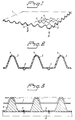
- the surface material illustrated in Figures 1 and 2 is comprised of a plastic sheet 1, for instance a polyethylene sheet, which includes a plurality of conical projections 2 on one side thereof, as illustrated schematically in Figure 1. Perforations 3 are formed in the surface material in the flat regions between adjacent projections 2.
- the surface material is intended for use in absorbent one-time use articles, such as diapers, sanitary napkins, incontinence guards and wound dressings, with the side of the material on which the projections are provided being intended to face towards the wearer's skin and with the flat side of the material facing towards the absorbent body in the article concerned.
- absorbent one-time use articles such as diapers, sanitary napkins, incontinence guards and wound dressings
- the side of the material on which the projections are provided being intended to face towards the wearer's skin and with the flat side of the material facing towards the absorbent body in the article concerned.
- Ambient air is also able to flow freely to the space between the surface material and skin, therewith purging this space of any moisture, such as perspiration, which may be present.
- the absorbent body of the article coacting with the surface material is able to take-up the fluid in a conventional manner, because the fluid will flow into the areas between the projections on the surface material and through the perforations 3 in said areas and be absorbed by the absorbent body.
- the ventilation effect achieved with the inventive surface material will cause an absorbent article provided with such surface material to be felt very comfortable when worn.
- the ventilation effect will facilitate wound healing while the small total contact surface of the material will greatly reduce the tendency of the material to adhere to the wound.
- the fluid permeability of the plastic sheet 1 is determined by the number and the size of the perforations 3, and the chosen ratio between open area per m 2 plastic sheet corresponds to the values of known perforated sheets intended for corresponding use.
- the projections In order for the surface material to function in the intended manner, the projections must be rigid enough to withstand the pressures to which the absorbent article comprising said surface material is normally subjected in use, without collapsing so as to block the air passageways between the projections. On the other hand, the projections must not be so rigid as to press hard against the wearer's skin when subjected to pressure and therewith feel uncomfortable.
- the projections 2 are hollow and the tops 4 of the projections 2 are preferably rounded, and even more preferable spherical in shape.
- the top 4 of a projection may also advantageously have a greater wall thickness than the remainder of the projection, which means that any deformation of the projection will begin away from the top and that deformation load will be distributed over a relatively large part of the projection wall via the top.
- the height of the projection will preferably be chosen to be smaller than the diameter of a free droplet contained by the surface tension of the fluid to be absorbed by the absorbent body with which the surface material coacts, so as to ensure that droplets of discharged fluid will not remain in the projection interstices.
- Figure 3 is a schematic cross-sectional view of part of an apparatus for producing the aforedescribed surface material.
- the apparatus includes a flat mould 5 which has a pattern of outwardly projecting conical bodies 6 whose outer contours are complementary to the shape of the projections 2 to be formed in an initially flat plastic sheet. Holes 7 are provided in the planar parts between the bodies 6 and are connected to a vacuum box 8.
- a plastic sheet 1 which has been heated to a mouldable state is placed on top of the mould 5 so as to rest on the tops of the upstanding bodies 6 of the mould, as indicated in chain lines in Figure 3.
- the underside of the plastic sheet is then subjected to subpressure with the aid of the vacuum box 8.
- the plastic sheet is sucked down towards the bottom of the mould 5 by the subpressure generated by the box 8 while being plastically deformed, until the sheet rests on the mould bottom.
- Plastic material is then drawn through the holes 7 in the mould and ruptures to form the aforesaid perforations 3.
- surface material manufactured in this way can be given a greater wall thickness at the tops of respective projections than in the remainder of the projection walls, because the plastic sheet will begin to solidify at the tops of the mould body 6 immediately it is placed thereon.
- the sheet manufacturing apparatus is preferably constructed to produce continuous webs of surface material, wherein the plastic sheet is applied to a mould according to Figure 3 formed on the periphery of a suction drum directly from an extrusion nozzle.
- the suction drum may be provided with two vacuum boxes arranged sequentially in the movement direction of the plastic sheet, of which boxes the downstream vacuum box will have a greater capacity than the upstream box so that the desired subpressure can be maintained even when sheet material has ruptured after having passes into the holes 7 in the mould.
- FIGS 4 and 5 illustrate schematically another mould 9 which can be used in the inventive apparatus and in which the holes are produced in the surface material either by punching or with the aid of an ultrasonic horn.
- the mould 9 is also formed in the periphery of a suction drum, as illustrated in Figure 4 which illustrates schematically a section of the mould 9. Distinct from the mould 5 illustrated in Figure 3, the mould 9 includes bodies 10 which project in a regular pattern radially inwards from the periphery of a cylindrical surface instead of radially outwards as in the case of the mould 5.
- the bodies 10 have a truncated pyramidal configuration and the walls of said bodies include a plurality of holes 11 which open into the suction box 12 of the suction drum, although this has not been shown in Figure 4 for the sake of clarity.
- the base lines of the pyramids extend in an intersecting, diagonal pattern around the outer cylindrical surface of the mould 9 and the mould 9 has cruciform raised regions 13 between the pyramids at the points of intersection between the pyramid base lines. These raised regions 13 can be easily produced by machining down the outside of the mould 9 externally of the cruciform regions 13.
- a sheet of plastic material in plastic state is placed on the mould and a subpressure is applied to the sheet so that the sheet will be drawn into the pyramidal bodies and therewith assume the shape of said bodies. No perforations are made in this stage of manufacture.
- the mouldable sheet is then caused to harden, optionally by supplying cooling air to the sheet.
- the sheet while still on the mould 9, is caused to pass a counter-roller or an ultrasonic horn, so as to remove the material on the raised cruciform regions 13 of the mould and therewith form cruciform apertures in the hardened plastic sheet.
- the use of the mould 9 and a counter-roller or an ultrasonic horn when manufacturing the inventive surface material has the advantage that the amount of energy consumed and the amount of air that must be sucked away is less than when vacuum-forming the holes.
- the surface material in a manner other than by vacuum-forming, for instance by passing the material between two moulds having mutually complementary projections and pits. It is also possible to begin with a flat plastic sheet and then heat the sheet to a mouldable state, instead of beginning with a newly extruded plastic melt.
- the pattern of projections will preferably extend over the whole area of the surface material, so as to ensure good ventilation, whereas the pattern or patterns of perforations may be disposed solely in those parts of the surface material in which fluid can be expected to be discharged by the wearer.
- the invention is therefore only restricted by the content of the following Claims.
Landscapes
- Health & Medical Sciences (AREA)
- Engineering & Computer Science (AREA)
- Public Health (AREA)
- Veterinary Medicine (AREA)
- Vascular Medicine (AREA)
- Life Sciences & Earth Sciences (AREA)
- Animal Behavior & Ethology (AREA)
- General Health & Medical Sciences (AREA)
- Biomedical Technology (AREA)
- Heart & Thoracic Surgery (AREA)
- Epidemiology (AREA)
- Mechanical Engineering (AREA)
- Manufacturing & Machinery (AREA)
- Absorbent Articles And Supports Therefor (AREA)
- Shaping Of Tube Ends By Bending Or Straightening (AREA)
- Orthopedics, Nursing, And Contraception (AREA)
Abstract
Description
- The present invention relates to surface material for absorbent articles, such as diapers, sanitary napkins, incontinence guards and wound dressings, said surface material being intended to lie proximal to the user's skin when the article is worn.
- This type of surface material is intended to enhance the comfort with which the absorbent articles can be worn and so that the surface of the article that lies against the wearer's skin will be felt to be dry and comfortable. Functionally, this implies that the material shall not irritate the skin, that the surface layer shall coact with an absorbent body that lies outwardly in relation to the skin of the wearer in a manner such that fluid will be quickly transported away from the surface material and into the absorbent body, and that fluid absorbed by the body will be unable to pass back to that side of the surface material which is proximate to the skin. In addition, the surface material will also have a textile-like structure, since it has been found that the users of such articles prefer to have a textile-like material closest to the body.
- In recent times, perforated plastic film has been used more and more as the surface material in absorbent sanitary products and absorbent hygiene products. One such known plastic film or sheet is comprised of a flat sheet in which there is formed a regular pattern of conical pits, each of which has a hole formed in the bottom surface thereof. This material thus has a flat side and a "spiky" side. When an absorbent article which includes such material is worn, the spiky side of the sheet faces towards the absorbent body of the article while the flat side lies against the wearer's skin. Such material can be manufactured cheaply and also provides a dry surface. The pits function as capillaries so that fluid discharged by the wearer will be sucked into the absorbent body, and the conical shape of the pits is considered to provide some sort of check-valve function which prevents fluid from passing back through the surface material when the article is subjected to pressure. One drawback with this surface material, however, is that the flat side of the material lies against the wearer's skin, meaning that moisture, such as perspiration, will be enclosed between the wearer's skin and the surface material, at least on the planar parts of the flat side, i.e. on those parts of the surface material which lie outside the pits.
- The document US.A.3 602 220 discloses an outer covering formed of a sheet of flexible plastic material having therein openings in the form of hollow open-ended tunnellike portions upstanding from one face of the sheet and the document US.A.4 704 112 an apparatus comprising semi-spherical projections in order to form apertures in a web.
- An object of the present invention is to provide an absorbent article surface material which, when the article is worn, will provide good ventilation between the wearer's skin and the surface material and which also has good properties in other respects.
- This object is achieved in accordance with the invention in that surface material of the kind defined in the introduction is characterized in that said material includes a plurality of projections on that side thereof which is intended to lie proximal to the wearer's skin in use, and in that through-penetrating perforations are formed in those parts of the surface material which lie externally of the projections. Because only the tops of the projections lie against the wearer's skin, the major part of the surface material will be distanced from the skin of the wearer and ambient air is able to flow freely between the wearer's skin and the surface material. In addition, the total contact surface area of the surface material with the skin is small, which further enhances the comfort of a person which wears an absorbent article that includes such surface material.
- According to one advantageous embodiment, the projections on the surface material have rounded tops, and the projections and the perforations are disposed in a regular pattern across essentially the total surface area of the surface material. The projections are also hollow, have a greater material thickness at their tops than at the remainder of the projections and have an upwardly narrowing shape. As a result of this configuration, the projections will lie in essentially punctiform contact with the wearer's skin, even when an absorbent article provided with inventive surface material is subjected to pressure, and the deformation forces will be distributed over a relatively large part of the walls of the projections.
- The invention also relates to apparatus for manufacturing surface material for absorbent articles, such as diapers, sanitary napkins, incontinence guards and wound dressings, said surface material being intended to lie proximal to the wearer's skin when the article is worn, characterized by a mould which includes a regular pattern of conical or pyramidal bodies which project up from a smooth surface and which have rounded top surfaces, and in which holes are located in the smooth parts of the mould externally of the bodies, and which further includes means for placing on top of the mould a flat plastic sheet which has been heated to a mouldable state and means for generating a subpressure in the proximity of the holes in the mould.
- The invention will now be described in more detail with reference to the accompanying drawings, in which
- Fig. 1 illustrates part of a surface sheet constructed in accordance with one preferred embodiment of the invention;
- Fig. 2 is a sectional view taken on the line II-II in Fig. 1;
- Fig. 3 illustrates schematically apparatus for producing the surface material illustrated in Fig. 1;
- Fig. 4 is a schematic perspective view of one embodiment of a mould that can be used for the manufacture of inventive surface material; and
- Fig. 5 is a schematic sectional view of two mutually adjacent projections on the mould illustrated in Fig. 4.
-
- The surface material illustrated in Figures 1 and 2 is comprised of a
plastic sheet 1, for instance a polyethylene sheet, which includes a plurality ofconical projections 2 on one side thereof, as illustrated schematically in Figure 1.Perforations 3 are formed in the surface material in the flat regions betweenadjacent projections 2. - As mentioned earlier, the surface material is intended for use in absorbent one-time use articles, such as diapers, sanitary napkins, incontinence guards and wound dressings, with the side of the material on which the projections are provided being intended to face towards the wearer's skin and with the flat side of the material facing towards the absorbent body in the article concerned. When using an article which includes inventive surface material, only the
tops 4 of the projections will lie against the wearer's skin. The surface material will thus abut the skin of the wearer solely in a punctiform fashion, and the skin contacting area of the surface material will therefore be very small, therewith preventing moisture from being enclosed between the skin and the surface material. Ambient air is also able to flow freely to the space between the surface material and skin, therewith purging this space of any moisture, such as perspiration, which may be present. Furthermore, when fluid is discharged in large quantities, such as urine, the absorbent body of the article coacting with the surface material is able to take-up the fluid in a conventional manner, because the fluid will flow into the areas between the projections on the surface material and through theperforations 3 in said areas and be absorbed by the absorbent body. The ventilation effect achieved with the inventive surface material will cause an absorbent article provided with such surface material to be felt very comfortable when worn. - When the inventive surface material is used in wound dressings, the ventilation effect will facilitate wound healing while the small total contact surface of the material will greatly reduce the tendency of the material to adhere to the wound.
- The fluid permeability of the
plastic sheet 1 is determined by the number and the size of theperforations 3, and the chosen ratio between open area per m2 plastic sheet corresponds to the values of known perforated sheets intended for corresponding use. - In order for the surface material to function in the intended manner, the projections must be rigid enough to withstand the pressures to which the absorbent article comprising said surface material is normally subjected in use, without collapsing so as to block the air passageways between the projections. On the other hand, the projections must not be so rigid as to press hard against the wearer's skin when subjected to pressure and therewith feel uncomfortable.
- In view of this, the
projections 2 are hollow and thetops 4 of theprojections 2 are preferably rounded, and even more preferable spherical in shape. In this way, when an absorbent article that is provided with surface material according to Figures 1 and 2 is subjected to pressure the forces acting on the wearer's skin will be distributed over a wider surface area than when the tops are pointed. Thetop 4 of a projection may also advantageously have a greater wall thickness than the remainder of the projection, which means that any deformation of the projection will begin away from the top and that deformation load will be distributed over a relatively large part of the projection wall via the top. - The height of the projection will preferably be chosen to be smaller than the diameter of a free droplet contained by the surface tension of the fluid to be absorbed by the absorbent body with which the surface material coacts, so as to ensure that droplets of discharged fluid will not remain in the projection interstices.
- Figure 3 is a schematic cross-sectional view of part of an apparatus for producing the aforedescribed surface material. The apparatus includes a
flat mould 5 which has a pattern of outwardly projectingconical bodies 6 whose outer contours are complementary to the shape of theprojections 2 to be formed in an initially flat plastic sheet. Holes 7 are provided in the planar parts between thebodies 6 and are connected to avacuum box 8. - When manufacturing inventive surface material, a
plastic sheet 1 which has been heated to a mouldable state is placed on top of themould 5 so as to rest on the tops of theupstanding bodies 6 of the mould, as indicated in chain lines in Figure 3. The underside of the plastic sheet is then subjected to subpressure with the aid of thevacuum box 8. The plastic sheet is sucked down towards the bottom of themould 5 by the subpressure generated by thebox 8 while being plastically deformed, until the sheet rests on the mould bottom. Plastic material is then drawn through the holes 7 in the mould and ruptures to form theaforesaid perforations 3. By appropriate dimensioning of manufacturing parameters, such as plastic sheet temperature and the value of the subpressure, surface material manufactured in this way can be given a greater wall thickness at the tops of respective projections than in the remainder of the projection walls, because the plastic sheet will begin to solidify at the tops of themould body 6 immediately it is placed thereon. - The sheet manufacturing apparatus is preferably constructed to produce continuous webs of surface material, wherein the plastic sheet is applied to a mould according to Figure 3 formed on the periphery of a suction drum directly from an extrusion nozzle. The suction drum may be provided with two vacuum boxes arranged sequentially in the movement direction of the plastic sheet, of which boxes the downstream vacuum box will have a greater capacity than the upstream box so that the desired subpressure can be maintained even when sheet material has ruptured after having passes into the holes 7 in the mould.
- Figures 4 and 5 illustrate schematically another mould 9 which can be used in the inventive apparatus and in which the holes are produced in the surface material either by punching or with the aid of an ultrasonic horn.
- The mould 9 is also formed in the periphery of a suction drum, as illustrated in Figure 4 which illustrates schematically a section of the mould 9. Distinct from the
mould 5 illustrated in Figure 3, the mould 9 includesbodies 10 which project in a regular pattern radially inwards from the periphery of a cylindrical surface instead of radially outwards as in the case of themould 5. Thebodies 10 have a truncated pyramidal configuration and the walls of said bodies include a plurality ofholes 11 which open into thesuction box 12 of the suction drum, although this has not been shown in Figure 4 for the sake of clarity. The base lines of the pyramids extend in an intersecting, diagonal pattern around the outer cylindrical surface of the mould 9 and the mould 9 has cruciform raisedregions 13 between the pyramids at the points of intersection between the pyramid base lines. These raisedregions 13 can be easily produced by machining down the outside of the mould 9 externally of thecruciform regions 13. - When using the mould 9 to produce inventive surface material, a sheet of plastic material in plastic state is placed on the mould and a subpressure is applied to the sheet so that the sheet will be drawn into the pyramidal bodies and therewith assume the shape of said bodies. No perforations are made in this stage of manufacture. The mouldable sheet is then caused to harden, optionally by supplying cooling air to the sheet. When the mouldable sheet has hardened, the sheet, while still on the mould 9, is caused to pass a counter-roller or an ultrasonic horn, so as to remove the material on the raised
cruciform regions 13 of the mould and therewith form cruciform apertures in the hardened plastic sheet. The use of the mould 9 and a counter-roller or an ultrasonic horn when manufacturing the inventive surface material has the advantage that the amount of energy consumed and the amount of air that must be sucked away is less than when vacuum-forming the holes. - It is also conceivable to manufacture the surface material in a manner other than by vacuum-forming, for instance by passing the material between two moulds having mutually complementary projections and pits. It is also possible to begin with a flat plastic sheet and then heat the sheet to a mouldable state, instead of beginning with a newly extruded plastic melt.
- It will be understood that the described and illustrated embodiment of the invention can be modified within the scope of the invention, particularly with respect to the shape of the projections and perforations and with respect to the patterns in which they are arranged. For instance, it is not necessary for that side of the surface material which lies proximal to the absorbent body to be flat, and it is also possible to use materials other than plastic sheet for the surface material. Because of the small contact surface between skin and surface material, not even hydrophilic material will be felt to be wet by a wearer. Plastic sheet is preferred, however, because of its low cost and good shapability. However, the pattern of projections, or possibly a combination of different patterns of projections, will preferably extend over the whole area of the surface material, so as to ensure good ventilation, whereas the pattern or patterns of perforations may be disposed solely in those parts of the surface material in which fluid can be expected to be discharged by the wearer. The invention is therefore only restricted by the content of the following Claims.
Claims (8)
- Surface material (1) for absorbent articles, such as diapers, sanitary napkins, incontinence guards and wound dressings, said surface material being intended to lie nearest the wearer's skin in use, characterized in that the surface material (1) includes a plurality of projections (2) on that side thereof which lies proximal to the wearer's skin in use, and a plurality of through-penetrating perforations (3) in parts that lie outside the projections and in that the projections are rigid enough to withstand the pressures to which the absorbent article comprising said surface material is normally subjected in use, without collapsing, so that the surface material during normal use of the article abut the skin of a wearer essentially in a punctiform fashion.
- Surface material according to Claim 1, characterized in that the projections (2) have rounded tops (4).
- Surface material according to Claim 1 or 2, characterized in that the projections (2) and the perforations (3) are disposed in a regular pattern across essentially the whole area of the surface material.
- Surface material according to any one of the preceding Claims, characterized in that the projections (2) are hollow and have a greater material thickness at the tops (4) thereof than in their remaining portions.
- Surface material according to any one of the preceding Claims, characterized in that the projections (2) have an upwardly narrowing shape.
- Apparatus for manufacturing surface material (1) for absorbent articles, such as diapers, sanitary napkins, incontinence guards and wound dressings, said surface material being intended to lie proximal to the wearer's skin in use, characterized by a mould (5) which includes a regular pattern of conical or pyramidal bodies (6) which project out from a smooth surface and which have rounded top surfaces; holes (7) in the smooth parts of the mould externally of the bodies (6); means for placing a flat plastic film heated to a mouldable state on top of the mould (5); and means (8) for generating a subpressure in the vicinity of the holes (7) in the mould.
- Apparatus according to Claim 5, characterized in that the mould (5) extends around the periphery of a rotary drum with the holes (7) connecting with a vacuum box (8) located inwardly of the periphery of the drum; and in that the apparatus includes an extrusion nozzle which functions to lay plastic sheet in a mouldable state on top of the mould (5).
- Apparatus for producing surface material (1) for absorbent articles such as diapers, sanitary napkins, incontinence guards and wound dressings, said surface material lying proximal to the wearer's skin in use, characterized by a cylindrical mould (9) which includes a regular pattern of conical or pyramidal bodies (10) which project radially inwards from the cylindrical surface of the mould and which have rounded top surfaces which include holes (11), and cruciform promontories (13) which project radially upwards from said cylindrical surface and which have a small radial extension in relation to said bodies and are located in parts of the cylindrical surface that lie outside the bodies (10) and are mutually spaced in peripheral and axial rows, a counter-roller which is intended to lie in a nip against the mould promontories (13); means for placing a flat plastic film heated to a mouldable state on top of the mould (9); and means (12) for generating a subpressure in the vicinity of the holes (11) in the mould.
Applications Claiming Priority (3)
| Application Number | Priority Date | Filing Date | Title |
|---|---|---|---|
| SE9300683 | 1993-03-01 | ||
| SE9300683A SE502661C2 (en) | 1993-03-01 | 1993-03-01 | Surface materials for absorbent articles, including rigid projections and perforations passing through the projections as well as apparatus for manufacturing the surface material |
| PCT/SE1994/000150 WO1994020054A1 (en) | 1993-03-01 | 1994-02-23 | Surface material for absorbent articles |
Publications (2)
| Publication Number | Publication Date |
|---|---|
| EP0687169A1 EP0687169A1 (en) | 1995-12-20 |
| EP0687169B1 true EP0687169B1 (en) | 1999-11-24 |
Family
ID=20389075
Family Applications (1)
| Application Number | Title | Priority Date | Filing Date |
|---|---|---|---|
| EP94909369A Expired - Lifetime EP0687169B1 (en) | 1993-03-01 | 1994-02-23 | Surface material for absorbent articles |
Country Status (5)
| Country | Link |
|---|---|
| EP (1) | EP0687169B1 (en) |
| JP (1) | JPH08507451A (en) |
| DE (1) | DE69421801D1 (en) |
| SE (1) | SE502661C2 (en) |
| WO (1) | WO1994020054A1 (en) |
Cited By (9)
| Publication number | Priority date | Publication date | Assignee | Title |
|---|---|---|---|---|
| CN105434115A (en) * | 2015-12-30 | 2016-03-30 | 泉州市汉威机械制造有限公司 | Stereoscopic pressing point type absorber |
| US9327473B2 (en) | 2012-10-31 | 2016-05-03 | Kimberly-Clark Worldwide, Inc. | Fluid-entangled laminate webs having hollow projections and a process and apparatus for making the same |
| US9474660B2 (en) | 2012-10-31 | 2016-10-25 | Kimberly-Clark Worldwide, Inc. | Absorbent article with a fluid-entangled body facing material including a plurality of hollow projections |
| US9480608B2 (en) | 2012-10-31 | 2016-11-01 | Kimberly-Clark Worldwide, Inc. | Absorbent article with a fluid-entangled body facing material including a plurality of hollow projections |
| US9480609B2 (en) | 2012-10-31 | 2016-11-01 | Kimberly-Clark Worldwide, Inc. | Absorbent article with a fluid-entangled body facing material including a plurality of hollow projections |
| US10070999B2 (en) | 2012-10-31 | 2018-09-11 | Kimberly-Clark Worldwide, Inc. | Absorbent article |
| US11007093B2 (en) | 2017-03-30 | 2021-05-18 | Kimberly-Clark Worldwide, Inc. | Incorporation of apertured area into an absorbent article |
| US11365495B2 (en) | 2017-02-28 | 2022-06-21 | Kimberly-Clark Worldwide, Inc. | Process for making fluid-entangled laminate webs with hollow projections and apertures |
| US12138143B2 (en) | 2018-11-30 | 2024-11-12 | Kimberly-Clark Worldwide, Inc. | Three-dimensional nonwoven materials and methods of manufacturing thereof |
Families Citing this family (24)
| Publication number | Priority date | Publication date | Assignee | Title |
|---|---|---|---|---|
| JPH11508163A (en) * | 1995-06-23 | 1999-07-21 | ザ、プロクター、エンド、ギャンブル、カンパニー | Absorber with improved functional surface |
| DE20000887U1 (en) * | 2000-01-19 | 2001-06-07 | Riesinger, geb. Dahlmann, Birgit, 48346 Ostbevern | Collection bag with suction device |
| JP3638847B2 (en) * | 2000-02-02 | 2005-04-13 | ユニ・チャーム株式会社 | Absorbent article surface sheet and manufacturing method thereof |
| JP3783919B2 (en) * | 2000-09-14 | 2006-06-07 | 大王製紙株式会社 | Plastic sheet exhibiting cloth-like appearance, absorbent article, and manufacturing method thereof |
| JP3877953B2 (en) * | 2000-10-31 | 2007-02-07 | ユニ・チャーム株式会社 | Non-woven surface sheet for disposable wearing articles |
| US20030171730A1 (en) * | 2002-02-14 | 2003-09-11 | Kelly William G. F. | Three-dimensional apertured film |
| US7402723B2 (en) | 2002-12-20 | 2008-07-22 | The Procter & Gamble Company | Polymeric web exhibiting a soft and silky tactile impression |
| US20040121120A1 (en) * | 2002-12-20 | 2004-06-24 | The Procter & Gamble Company | Apparatus for making a polymeric web exhibiting a soft and silky tactile impression |
| US7655176B2 (en) | 2002-12-20 | 2010-02-02 | The Procter & Gamble Company | Method of making a polymeric web exhibiting a soft and silky tactile impression |
| US9545744B2 (en) | 2002-12-20 | 2017-01-17 | The Procter & Gamble Company | Apparatus for making polymeric web exhibiting a soft and silky tactile impression |
| US8287800B2 (en) | 2002-12-20 | 2012-10-16 | The Procter And Gamble Company | Method for making a polymeric web exhibiting a soft and silky tactile impression |
| US7323072B2 (en) | 2005-04-27 | 2008-01-29 | Kimberly-Clark Worldwide, Inc. | Multi-roll bonding and aperturing |
| GB0606661D0 (en) | 2006-04-03 | 2006-05-10 | Brightwake Ltd | Improvements relating to dressings |
| US8057447B2 (en) * | 2007-05-10 | 2011-11-15 | Kci Licensing Inc. | Reduced pressure wound dressing having a wound contact surface with columnar protrusions |
| NZ589797A (en) * | 2008-05-28 | 2012-09-28 | Uni Charm Corp | Absorptive article and sanitary napkin with dual density endothermic pad for cooling |
| GB2493960B (en) | 2011-08-25 | 2013-09-18 | Brightwake Ltd | Non-adherent wound dressing |
| JP2017510397A (en) | 2014-03-06 | 2017-04-13 | ザ プロクター アンド ギャンブル カンパニー | 3D substrate |
| WO2015134375A1 (en) | 2014-03-06 | 2015-09-11 | The Procter & Gamble Company | Multi-component topsheets |
| WO2015134371A1 (en) | 2014-03-06 | 2015-09-11 | The Procter & Gamble Company | Multi-component topsheets |
| JP6391459B2 (en) * | 2014-12-19 | 2018-09-19 | 花王株式会社 | Absorbent articles |
| US10973702B2 (en) | 2015-08-26 | 2021-04-13 | The Procter & Gamble Company | Absorbent articles having three dimensional substrates and indicia |
| EP3478235B1 (en) | 2016-07-01 | 2020-10-14 | The Procter and Gamble Company | Absorbent articles with improved topsheet dryness |
| JP6568182B2 (en) * | 2017-11-24 | 2019-08-28 | 大王製紙株式会社 | Absorbent articles |
| EP3744296A4 (en) * | 2018-01-26 | 2021-10-27 | Zuiko Corporation | SHEET, SHEET MANUFACTURING DEVICE AND SHEET MANUFACTURING METHOD |
Family Cites Families (4)
| Publication number | Priority date | Publication date | Assignee | Title |
|---|---|---|---|---|
| US3602220A (en) * | 1969-08-29 | 1971-08-31 | John Bunyan | Surgical dressings including bandage and the like |
| US4441952A (en) * | 1981-02-02 | 1984-04-10 | The Procter & Gamble Company | Method and apparatus for uniformly debossing and aperturing a resilient plastic web |
| DE3666140D1 (en) * | 1986-01-31 | 1989-11-16 | Uni Charm Corp | Facing for absorptive articles and process for making it |
| GB9001917D0 (en) * | 1990-01-27 | 1990-03-28 | Smith & Nephew | Hygienic absorbent products |
-
1993
- 1993-03-01 SE SE9300683A patent/SE502661C2/en not_active IP Right Cessation
-
1994
- 1994-02-23 WO PCT/SE1994/000150 patent/WO1994020054A1/en not_active Ceased
- 1994-02-23 JP JP6519871A patent/JPH08507451A/en active Pending
- 1994-02-23 EP EP94909369A patent/EP0687169B1/en not_active Expired - Lifetime
- 1994-02-23 DE DE69421801T patent/DE69421801D1/en not_active Expired - Lifetime
Cited By (19)
| Publication number | Priority date | Publication date | Assignee | Title |
|---|---|---|---|---|
| US12029633B2 (en) | 2012-10-31 | 2024-07-09 | Kimberly-Clark Worldwide, Inc. | Absorbent article with a fluid entangled body facing material including a plurality of projections |
| US11491058B2 (en) | 2012-10-31 | 2022-11-08 | Kimberly-Clark Worldwide, Inc. | Absorbent article with a fluid entangled body facing material including a plurality of projections |
| US9474660B2 (en) | 2012-10-31 | 2016-10-25 | Kimberly-Clark Worldwide, Inc. | Absorbent article with a fluid-entangled body facing material including a plurality of hollow projections |
| US9480608B2 (en) | 2012-10-31 | 2016-11-01 | Kimberly-Clark Worldwide, Inc. | Absorbent article with a fluid-entangled body facing material including a plurality of hollow projections |
| US9480609B2 (en) | 2012-10-31 | 2016-11-01 | Kimberly-Clark Worldwide, Inc. | Absorbent article with a fluid-entangled body facing material including a plurality of hollow projections |
| US10070999B2 (en) | 2012-10-31 | 2018-09-11 | Kimberly-Clark Worldwide, Inc. | Absorbent article |
| US10470947B2 (en) | 2012-10-31 | 2019-11-12 | Kimberly-Clark Worldwide, Inc. | Absorbent article with a fluid-entangled body facing material including a plurality of hollow projections |
| US10478354B2 (en) | 2012-10-31 | 2019-11-19 | Kimberly-Clark Worldwide, Inc. | Absorbent article with a fluid-entangled body facing material including a plurality of hollow projections |
| US9327473B2 (en) | 2012-10-31 | 2016-05-03 | Kimberly-Clark Worldwide, Inc. | Fluid-entangled laminate webs having hollow projections and a process and apparatus for making the same |
| CN105434115A (en) * | 2015-12-30 | 2016-03-30 | 泉州市汉威机械制造有限公司 | Stereoscopic pressing point type absorber |
| US11365495B2 (en) | 2017-02-28 | 2022-06-21 | Kimberly-Clark Worldwide, Inc. | Process for making fluid-entangled laminate webs with hollow projections and apertures |
| US11007093B2 (en) | 2017-03-30 | 2021-05-18 | Kimberly-Clark Worldwide, Inc. | Incorporation of apertured area into an absorbent article |
| US11998430B2 (en) | 2017-03-30 | 2024-06-04 | Kimberly-Clark Worldwide, Inc. | Incorporation of apertured area into an absorbent article |
| US12138143B2 (en) | 2018-11-30 | 2024-11-12 | Kimberly-Clark Worldwide, Inc. | Three-dimensional nonwoven materials and methods of manufacturing thereof |
| US12232939B2 (en) | 2018-11-30 | 2025-02-25 | Kimberly-Clark Worldwide, Inc. | Three-dimensional nonwoven materials and methods of manufacturing thereof |
| US12268583B2 (en) | 2018-11-30 | 2025-04-08 | Kimberly-Clark Worldwide, Inc. | Three-dimensional nonwoven materials and methods of manufacturing thereof |
| US12268584B2 (en) | 2018-11-30 | 2025-04-08 | Kimberly-Clark Worldwide, Inc. | Three-dimensional nonwoven materials and methods of manufacturing thereof |
| US12350134B2 (en) | 2018-11-30 | 2025-07-08 | Kimberly-Clark Worldwide, Inc. | Three-dimensional nonwoven materials and methods of manufacturing thereof |
| US12667502B2 (en) | 2018-11-30 | 2026-06-30 | Kimberly-Clark Worldwide, Inc. | Three-dimensional nonwoven materials and methods of manufacturing thereof |
Also Published As
| Publication number | Publication date |
|---|---|
| EP0687169A1 (en) | 1995-12-20 |
| WO1994020054A1 (en) | 1994-09-15 |
| SE9300683D0 (en) | 1993-03-01 |
| SE502661C2 (en) | 1995-12-04 |
| SE9300683L (en) | 1994-09-02 |
| DE69421801D1 (en) | 1999-12-30 |
| JPH08507451A (en) | 1996-08-13 |
Similar Documents
| Publication | Publication Date | Title |
|---|---|---|
| EP0687169A1 (en) | Surface material for absorbent articles | |
| CA2230922C (en) | Absorbent products | |
| JP2541517B2 (en) | Visually enhanced three-dimensional polymer web | |
| KR100426105B1 (en) | Multilayer compression resistant apertured web | |
| US5514105A (en) | Resilient plastic web exhibiting reduced skin contact area and enhanced fluid transfer properties | |
| KR100587861B1 (en) | Bursting webs suitable for fluid-absorbing disposable garments and methods of making the same | |
| CA1290538C (en) | Macroscopically expanded three-dimensional polymeric web for transmitting both dynamically deposited and statically contacted fluids from one surface to the other | |
| JP3701208B2 (en) | An apertured sheet, an absorbent article using the apertured sheet, and a method for producing the apertured sheet. | |
| US6024553A (en) | Apparatus for supporting a starting web during formation of the apertured web | |
| CZ289808B6 (en) | Topsheet for an absorbent article and process for producing thereof | |
| JP2009072622A (en) | Method for producing perforated film and absorbent product incorporating perforated film | |
| US20050228353A1 (en) | Formed film having a cellularly defined base pattern and visible design | |
| CA2153076C (en) | Method for making body fluids absorbent padding | |
| JP3461826B2 (en) | Elastic plastic web with small skin contact area and excellent fluid transfer performance | |
| HK1006139B (en) | Resilient plastic web exhibiting reduced skin contact area and enhanced fluid transfer properties | |
| JP2019513496A (en) | Uneven formation film having microprotrusions | |
| JP2846448B2 (en) | Surface sheet for absorbent articles | |
| EP1430861B1 (en) | Perforated plastically deformable sheet and method for making the same | |
| JP3065756B2 (en) | Surface material of absorbent article and method of manufacturing the same | |
| JPH05200065A (en) | Gas and fluid permeable surface sheet for body fluid disposal article and manufacture thereof | |
| JPS6356541A (en) | Liquid permeable sheet material | |
| JPH09308649A (en) | Disposable body fluid absorbent article | |
| JP2025077475A (en) | Nonwoven fabric for absorbent articles | |
| JPH0670956A (en) | Face material for absorptive article and manufacture thereof | |
| MXPA98001709A (en) | Absorben products |
Legal Events
| Date | Code | Title | Description |
|---|---|---|---|
| PUAI | Public reference made under article 153(3) epc to a published international application that has entered the european phase |
Free format text: ORIGINAL CODE: 0009012 |
|
| 17P | Request for examination filed |
Effective date: 19950828 |
|
| AK | Designated contracting states |
Kind code of ref document: A1 Designated state(s): BE DE ES FR GB IT SE |
|
| GRAG | Despatch of communication of intention to grant |
Free format text: ORIGINAL CODE: EPIDOS AGRA |
|
| 17Q | First examination report despatched |
Effective date: 19981019 |
|
| GRAG | Despatch of communication of intention to grant |
Free format text: ORIGINAL CODE: EPIDOS AGRA |
|
| GRAH | Despatch of communication of intention to grant a patent |
Free format text: ORIGINAL CODE: EPIDOS IGRA |
|
| RAP1 | Party data changed (applicant data changed or rights of an application transferred) |
Owner name: MOELNLYCKE HEALTH CARE AB |
|
| GRAH | Despatch of communication of intention to grant a patent |
Free format text: ORIGINAL CODE: EPIDOS IGRA |
|
| GRAA | (expected) grant |
Free format text: ORIGINAL CODE: 0009210 |
|
| AK | Designated contracting states |
Kind code of ref document: B1 Designated state(s): BE DE ES FR GB IT SE |
|
| PG25 | Lapsed in a contracting state [announced via postgrant information from national office to epo] |
Ref country code: SE Free format text: THE PATENT HAS BEEN ANNULLED BY A DECISION OF A NATIONAL AUTHORITY Effective date: 19991124 Ref country code: IT Free format text: LAPSE BECAUSE OF FAILURE TO SUBMIT A TRANSLATION OF THE DESCRIPTION OR TO PAY THE FEE WITHIN THE PRE;WARNING: LAPSES OF ITALIAN PATENTS WITH EFFECTIVE DATE BEFORE 2007 MAY HAVE OCCURRED AT ANY TIME BEFORE 2007. THE CORRECT EFFECTIVE DATE MAY BE DIFFERENT FROM THE ONE RECORDED.SCRIBED TIME-LIMIT Effective date: 19991124 Ref country code: FR Free format text: LAPSE BECAUSE OF FAILURE TO SUBMIT A TRANSLATION OF THE DESCRIPTION OR TO PAY THE FEE WITHIN THE PRESCRIBED TIME-LIMIT Effective date: 19991124 Ref country code: ES Free format text: THE PATENT HAS BEEN ANNULLED BY A DECISION OF A NATIONAL AUTHORITY Effective date: 19991124 Ref country code: BE Free format text: LAPSE BECAUSE OF FAILURE TO SUBMIT A TRANSLATION OF THE DESCRIPTION OR TO PAY THE FEE WITHIN THE PRESCRIBED TIME-LIMIT Effective date: 19991124 |
|
| REF | Corresponds to: |
Ref document number: 69421801 Country of ref document: DE Date of ref document: 19991230 |
|
| PG25 | Lapsed in a contracting state [announced via postgrant information from national office to epo] |
Ref country code: GB Free format text: LAPSE BECAUSE OF NON-PAYMENT OF DUE FEES Effective date: 20000224 |
|
| PG25 | Lapsed in a contracting state [announced via postgrant information from national office to epo] |
Ref country code: DE Free format text: LAPSE BECAUSE OF FAILURE TO SUBMIT A TRANSLATION OF THE DESCRIPTION OR TO PAY THE FEE WITHIN THE PRESCRIBED TIME-LIMIT Effective date: 20000225 |
|
| EN | Fr: translation not filed | ||
| PLBE | No opposition filed within time limit |
Free format text: ORIGINAL CODE: 0009261 |
|
| STAA | Information on the status of an ep patent application or granted ep patent |
Free format text: STATUS: NO OPPOSITION FILED WITHIN TIME LIMIT |
|
| GBPC | Gb: european patent ceased through non-payment of renewal fee |
Effective date: 20000224 |
|
| 26N | No opposition filed |