EP0686626A1 - Hydrophilic tetramethylxylylenecarbodiimides - Google Patents
Hydrophilic tetramethylxylylenecarbodiimides Download PDFInfo
- Publication number
- EP0686626A1 EP0686626A1 EP95108536A EP95108536A EP0686626A1 EP 0686626 A1 EP0686626 A1 EP 0686626A1 EP 95108536 A EP95108536 A EP 95108536A EP 95108536 A EP95108536 A EP 95108536A EP 0686626 A1 EP0686626 A1 EP 0686626A1
- Authority
- EP
- European Patent Office
- Prior art keywords
- hydrophilic
- group
- tetramethylxylylenecarbodiimide
- carbodiimide
- represented
- Prior art date
- Legal status (The legal status is an assumption and is not a legal conclusion. Google has not performed a legal analysis and makes no representation as to the accuracy of the status listed.)
- Granted
Links
- 238000006116 polymerization reaction Methods 0.000 claims abstract description 34
- 238000006243 chemical reaction Methods 0.000 claims abstract description 13
- 125000000524 functional group Chemical group 0.000 claims abstract description 7
- IQPQWNKOIGAROB-UHFFFAOYSA-N isocyanate group Chemical group [N-]=C=O IQPQWNKOIGAROB-UHFFFAOYSA-N 0.000 claims abstract description 7
- 150000002894 organic compounds Chemical class 0.000 claims abstract description 5
- 125000004432 carbon atom Chemical group C* 0.000 claims description 9
- 125000000217 alkyl group Chemical group 0.000 claims description 6
- 125000002947 alkylene group Chemical group 0.000 claims description 6
- 125000002887 hydroxy group Chemical group [H]O* 0.000 claims description 6
- 229920000233 poly(alkylene oxides) Polymers 0.000 claims description 6
- 150000003839 salts Chemical class 0.000 claims description 6
- 239000002253 acid Substances 0.000 claims description 5
- 125000005702 oxyalkylene group Chemical group 0.000 claims description 4
- 125000003545 alkoxy group Chemical group 0.000 claims description 3
- 229910052783 alkali metal Inorganic materials 0.000 claims description 2
- 150000001340 alkali metals Chemical group 0.000 claims description 2
- 125000004435 hydrogen atom Chemical group [H]* 0.000 claims description 2
- 125000002496 methyl group Chemical group [H]C([H])([H])* 0.000 claims description 2
- 150000003242 quaternary ammonium salts Chemical class 0.000 claims 2
- 150000001718 carbodiimides Chemical class 0.000 abstract description 54
- 239000011347 resin Substances 0.000 abstract description 32
- 229920005989 resin Polymers 0.000 abstract description 32
- 238000003860 storage Methods 0.000 abstract description 6
- 239000003431 cross linking reagent Substances 0.000 abstract description 4
- 239000000243 solution Substances 0.000 description 44
- XLYOFNOQVPJJNP-UHFFFAOYSA-N water Substances O XLYOFNOQVPJJNP-UHFFFAOYSA-N 0.000 description 26
- 239000003054 catalyst Substances 0.000 description 23
- YMKWWHFRGALXLE-UHFFFAOYSA-N 4-methyl-1-phenyl-2,3-dihydro-1$l^{5}-phosphole 1-oxide Chemical compound C1CC(C)=CP1(=O)C1=CC=CC=C1 YMKWWHFRGALXLE-UHFFFAOYSA-N 0.000 description 22
- 239000012153 distilled water Substances 0.000 description 21
- -1 poly(ethylene oxide) Polymers 0.000 description 21
- 238000000926 separation method Methods 0.000 description 20
- 150000001875 compounds Chemical class 0.000 description 14
- 238000001556 precipitation Methods 0.000 description 13
- 230000000052 comparative effect Effects 0.000 description 11
- 239000005058 Isophorone diisocyanate Substances 0.000 description 9
- NIMLQBUJDJZYEJ-UHFFFAOYSA-N isophorone diisocyanate Chemical compound CC1(C)CC(N=C=O)CC(C)(CN=C=O)C1 NIMLQBUJDJZYEJ-UHFFFAOYSA-N 0.000 description 9
- 238000005956 quaternization reaction Methods 0.000 description 9
- VUQUOGPMUUJORT-UHFFFAOYSA-N methyl 4-methylbenzenesulfonate Chemical compound COS(=O)(=O)C1=CC=C(C)C=C1 VUQUOGPMUUJORT-UHFFFAOYSA-N 0.000 description 8
- 238000003756 stirring Methods 0.000 description 8
- FRVOOSTVCDXSRG-UHFFFAOYSA-N methanediimine;3,5,5-trimethylcyclohex-2-en-1-one Chemical compound N=C=N.CC1=CC(=O)CC(C)(C)C1 FRVOOSTVCDXSRG-UHFFFAOYSA-N 0.000 description 7
- 239000003795 chemical substances by application Substances 0.000 description 6
- 239000011248 coating agent Substances 0.000 description 6
- 238000000576 coating method Methods 0.000 description 6
- IUNMPGNGSSIWFP-UHFFFAOYSA-N dimethylaminopropylamine Chemical compound CN(C)CCCN IUNMPGNGSSIWFP-UHFFFAOYSA-N 0.000 description 6
- CURLTUGMZLYLDI-UHFFFAOYSA-N Carbon dioxide Chemical compound O=C=O CURLTUGMZLYLDI-UHFFFAOYSA-N 0.000 description 4
- UEEJHVSXFDXPFK-UHFFFAOYSA-N N-dimethylaminoethanol Chemical compound CN(C)CCO UEEJHVSXFDXPFK-UHFFFAOYSA-N 0.000 description 4
- 125000001931 aliphatic group Chemical group 0.000 description 4
- 238000006482 condensation reaction Methods 0.000 description 4
- VAYGXNSJCAHWJZ-UHFFFAOYSA-N dimethyl sulfate Chemical compound COS(=O)(=O)OC VAYGXNSJCAHWJZ-UHFFFAOYSA-N 0.000 description 4
- 238000004519 manufacturing process Methods 0.000 description 4
- ZSZFXZHKVNYPLL-UHFFFAOYSA-M sodium;1-hydroxypropane-1-sulfonate Chemical compound [Na+].CCC(O)S([O-])(=O)=O ZSZFXZHKVNYPLL-UHFFFAOYSA-M 0.000 description 4
- NNOZGCICXAYKLW-UHFFFAOYSA-N 1,2-bis(2-isocyanatopropan-2-yl)benzene Chemical compound O=C=NC(C)(C)C1=CC=CC=C1C(C)(C)N=C=O NNOZGCICXAYKLW-UHFFFAOYSA-N 0.000 description 3
- LCGLNKUTAGEVQW-UHFFFAOYSA-N Dimethyl ether Chemical compound COC LCGLNKUTAGEVQW-UHFFFAOYSA-N 0.000 description 3
- 229920003171 Poly (ethylene oxide) Polymers 0.000 description 3
- VPKDCDLSJZCGKE-UHFFFAOYSA-N carbodiimide group Chemical group N=C=N VPKDCDLSJZCGKE-UHFFFAOYSA-N 0.000 description 3
- 125000002091 cationic group Chemical group 0.000 description 3
- IJGRMHOSHXDMSA-UHFFFAOYSA-N Atomic nitrogen Chemical compound N#N IJGRMHOSHXDMSA-UHFFFAOYSA-N 0.000 description 2
- RTZKZFJDLAIYFH-UHFFFAOYSA-N Diethyl ether Chemical compound CCOCC RTZKZFJDLAIYFH-UHFFFAOYSA-N 0.000 description 2
- 125000000129 anionic group Chemical group 0.000 description 2
- 229910002092 carbon dioxide Inorganic materials 0.000 description 2
- 239000001569 carbon dioxide Substances 0.000 description 2
- 239000007795 chemical reaction product Substances 0.000 description 2
- 238000009833 condensation Methods 0.000 description 2
- 230000005494 condensation Effects 0.000 description 2
- 238000004132 cross linking Methods 0.000 description 2
- 239000001257 hydrogen Substances 0.000 description 2
- 229910052739 hydrogen Inorganic materials 0.000 description 2
- 238000000034 method Methods 0.000 description 2
- 239000000203 mixture Substances 0.000 description 2
- 239000000047 product Substances 0.000 description 2
- 230000035484 reaction time Effects 0.000 description 2
- 230000009257 reactivity Effects 0.000 description 2
- 238000007086 side reaction Methods 0.000 description 2
- 238000003786 synthesis reaction Methods 0.000 description 2
- AGJCSCSSMFRMFQ-UHFFFAOYSA-N 1,4-bis(2-isocyanatopropan-2-yl)benzene Chemical compound O=C=NC(C)(C)C1=CC=C(C(C)(C)N=C=O)C=C1 AGJCSCSSMFRMFQ-UHFFFAOYSA-N 0.000 description 1
- BHUXAQIVYLDUQV-UHFFFAOYSA-N 1-(diethylamino)propan-2-ol Chemical compound CCN(CC)CC(C)O BHUXAQIVYLDUQV-UHFFFAOYSA-N 0.000 description 1
- IOSIDVPNBKUUFA-UHFFFAOYSA-N 1-ethyl-2,3-dihydro-1$l^{5}-phosphole 1-oxide Chemical compound CCP1(=O)CCC=C1 IOSIDVPNBKUUFA-UHFFFAOYSA-N 0.000 description 1
- WCTWAAFIWRIEKH-UHFFFAOYSA-N 1-ethyl-4-methyl-2,3-dihydro-1$l^{5}-phosphole 1-oxide Chemical compound CCP1(=O)CCC(C)=C1 WCTWAAFIWRIEKH-UHFFFAOYSA-N 0.000 description 1
- YUQUHJGNZFFDAA-UHFFFAOYSA-N 1-phenyl-2,3-dihydro-1$l^{5}-phosphole 1-oxide Chemical compound C=1C=CC=CC=1P1(=O)CCC=C1 YUQUHJGNZFFDAA-UHFFFAOYSA-N 0.000 description 1
- JXGNHEUFHNJWDY-UHFFFAOYSA-N 2,5-dihydro-1h-phosphole Chemical class C1PCC=C1 JXGNHEUFHNJWDY-UHFFFAOYSA-N 0.000 description 1
- IWSZDQRGNFLMJS-UHFFFAOYSA-N 2-(dibutylamino)ethanol Chemical compound CCCCN(CCO)CCCC IWSZDQRGNFLMJS-UHFFFAOYSA-N 0.000 description 1
- BFSVOASYOCHEOV-UHFFFAOYSA-N 2-diethylaminoethanol Chemical compound CCN(CC)CCO BFSVOASYOCHEOV-UHFFFAOYSA-N 0.000 description 1
- 229940013085 2-diethylaminoethanol Drugs 0.000 description 1
- KFZMGEQAYNKOFK-UHFFFAOYSA-N 2-propanol Substances CC(C)O KFZMGEQAYNKOFK-UHFFFAOYSA-N 0.000 description 1
- WKCYFSZDBICRKL-UHFFFAOYSA-N 3-(diethylamino)propan-1-ol Chemical compound CCN(CC)CCCO WKCYFSZDBICRKL-UHFFFAOYSA-N 0.000 description 1
- PYSGFFTXMUWEOT-UHFFFAOYSA-N 3-(dimethylamino)propan-1-ol Chemical compound CN(C)CCCO PYSGFFTXMUWEOT-UHFFFAOYSA-N 0.000 description 1
- 239000004925 Acrylic resin Substances 0.000 description 1
- 229920000178 Acrylic resin Polymers 0.000 description 1
- STUPVELWKGXMQS-UHFFFAOYSA-N CC1=CP(=O)CC1 Chemical compound CC1=CP(=O)CC1 STUPVELWKGXMQS-UHFFFAOYSA-N 0.000 description 1
- LFQSCWFLJHTTHZ-UHFFFAOYSA-N Ethanol Chemical compound CCO LFQSCWFLJHTTHZ-UHFFFAOYSA-N 0.000 description 1
- UFHFLCQGNIYNRP-UHFFFAOYSA-N Hydrogen Chemical compound [H][H] UFHFLCQGNIYNRP-UHFFFAOYSA-N 0.000 description 1
- XSQUKJJJFZCRTK-UHFFFAOYSA-N Urea Chemical compound NC(N)=O XSQUKJJJFZCRTK-UHFFFAOYSA-N 0.000 description 1
- 238000007259 addition reaction Methods 0.000 description 1
- 239000007864 aqueous solution Substances 0.000 description 1
- 125000003118 aryl group Chemical group 0.000 description 1
- 230000015572 biosynthetic process Effects 0.000 description 1
- 239000004202 carbamide Substances 0.000 description 1
- 125000003178 carboxy group Chemical group [H]OC(*)=O 0.000 description 1
- 125000002843 carboxylic acid group Chemical group 0.000 description 1
- 239000006185 dispersion Substances 0.000 description 1
- 238000004945 emulsification Methods 0.000 description 1
- 239000000839 emulsion Substances 0.000 description 1
- 238000010438 heat treatment Methods 0.000 description 1
- 238000007731 hot pressing Methods 0.000 description 1
- 239000011261 inert gas Substances 0.000 description 1
- 239000000463 material Substances 0.000 description 1
- 238000002156 mixing Methods 0.000 description 1
- UDGSVBYJWHOHNN-UHFFFAOYSA-N n',n'-diethylethane-1,2-diamine Chemical compound CCN(CC)CCN UDGSVBYJWHOHNN-UHFFFAOYSA-N 0.000 description 1
- QOHMWDJIBGVPIF-UHFFFAOYSA-N n',n'-diethylpropane-1,3-diamine Chemical compound CCN(CC)CCCN QOHMWDJIBGVPIF-UHFFFAOYSA-N 0.000 description 1
- 229910052757 nitrogen Inorganic materials 0.000 description 1
- 229920000139 polyethylene terephthalate Polymers 0.000 description 1
- 239000005020 polyethylene terephthalate Substances 0.000 description 1
- CZDZQGXAHZVGPL-UHFFFAOYSA-M sodium;1-hydroxyethanesulfonate Chemical compound [Na+].CC(O)S([O-])(=O)=O CZDZQGXAHZVGPL-UHFFFAOYSA-M 0.000 description 1
- 239000002904 solvent Substances 0.000 description 1
- 229920005792 styrene-acrylic resin Polymers 0.000 description 1
- 239000000126 substance Substances 0.000 description 1
- 239000004094 surface-active agent Substances 0.000 description 1
- 229920001187 thermosetting polymer Polymers 0.000 description 1
Classifications
-
- C—CHEMISTRY; METALLURGY
- C08—ORGANIC MACROMOLECULAR COMPOUNDS; THEIR PREPARATION OR CHEMICAL WORKING-UP; COMPOSITIONS BASED THEREON
- C08G—MACROMOLECULAR COMPOUNDS OBTAINED OTHERWISE THAN BY REACTIONS ONLY INVOLVING UNSATURATED CARBON-TO-CARBON BONDS
- C08G18/00—Polymeric products of isocyanates or isothiocyanates
- C08G18/06—Polymeric products of isocyanates or isothiocyanates with compounds having active hydrogen
- C08G18/70—Polymeric products of isocyanates or isothiocyanates with compounds having active hydrogen characterised by the isocyanates or isothiocyanates used
- C08G18/703—Isocyanates or isothiocyanates transformed in a latent form by physical means
- C08G18/705—Dispersions of isocyanates or isothiocyanates in a liquid medium
- C08G18/706—Dispersions of isocyanates or isothiocyanates in a liquid medium the liquid medium being water
-
- C—CHEMISTRY; METALLURGY
- C07—ORGANIC CHEMISTRY
- C07C—ACYCLIC OR CARBOCYCLIC COMPOUNDS
- C07C267/00—Carbodiimides
-
- C—CHEMISTRY; METALLURGY
- C08—ORGANIC MACROMOLECULAR COMPOUNDS; THEIR PREPARATION OR CHEMICAL WORKING-UP; COMPOSITIONS BASED THEREON
- C08G—MACROMOLECULAR COMPOUNDS OBTAINED OTHERWISE THAN BY REACTIONS ONLY INVOLVING UNSATURATED CARBON-TO-CARBON BONDS
- C08G18/00—Polymeric products of isocyanates or isothiocyanates
- C08G18/06—Polymeric products of isocyanates or isothiocyanates with compounds having active hydrogen
- C08G18/08—Processes
- C08G18/10—Prepolymer processes involving reaction of isocyanates or isothiocyanates with compounds having active hydrogen in a first reaction step
- C08G18/12—Prepolymer processes involving reaction of isocyanates or isothiocyanates with compounds having active hydrogen in a first reaction step using two or more compounds having active hydrogen in the first polymerisation step
-
- C—CHEMISTRY; METALLURGY
- C08—ORGANIC MACROMOLECULAR COMPOUNDS; THEIR PREPARATION OR CHEMICAL WORKING-UP; COMPOSITIONS BASED THEREON
- C08G—MACROMOLECULAR COMPOUNDS OBTAINED OTHERWISE THAN BY REACTIONS ONLY INVOLVING UNSATURATED CARBON-TO-CARBON BONDS
- C08G18/00—Polymeric products of isocyanates or isothiocyanates
- C08G18/06—Polymeric products of isocyanates or isothiocyanates with compounds having active hydrogen
- C08G18/28—Polymeric products of isocyanates or isothiocyanates with compounds having active hydrogen characterised by the compounds used containing active hydrogen
- C08G18/40—High-molecular-weight compounds
- C08G18/42—Polycondensates having carboxylic or carbonic ester groups in the main chain
- C08G18/4263—Polycondensates having carboxylic or carbonic ester groups in the main chain containing carboxylic acid groups
-
- C—CHEMISTRY; METALLURGY
- C08—ORGANIC MACROMOLECULAR COMPOUNDS; THEIR PREPARATION OR CHEMICAL WORKING-UP; COMPOSITIONS BASED THEREON
- C08G—MACROMOLECULAR COMPOUNDS OBTAINED OTHERWISE THAN BY REACTIONS ONLY INVOLVING UNSATURATED CARBON-TO-CARBON BONDS
- C08G18/00—Polymeric products of isocyanates or isothiocyanates
- C08G18/06—Polymeric products of isocyanates or isothiocyanates with compounds having active hydrogen
- C08G18/28—Polymeric products of isocyanates or isothiocyanates with compounds having active hydrogen characterised by the compounds used containing active hydrogen
- C08G18/40—High-molecular-weight compounds
- C08G18/62—Polymers of compounds having carbon-to-carbon double bonds
- C08G18/6216—Polymers of alpha-beta ethylenically unsaturated carboxylic acids or of derivatives thereof
- C08G18/625—Polymers of alpha-beta ethylenically unsaturated carboxylic acids; hydrolyzed polymers of esters of these acids
- C08G18/6254—Polymers of alpha-beta ethylenically unsaturated carboxylic acids and of esters of these acids containing hydroxy groups
Definitions
- the present invention relates to a novel hydrophilic carbodiimide. More particularly, the present invention relates to a hydrophilic carbodiimide having good storage stability owing to the reduced reactivity and accordingly usable as an easy-to-handle crosslinking agent for hydrophilic resin.
- Carbodiimides particularly polycarbodiimides are known as a thermosetting resin having high heat resistance and find applications in molded materials, etc. obtained, for example, by hot-pressing a powdery polycarbodiimide.
- polycarbodiimides aromatic polycarbodiimides have hitherto been used mainly. Recently, however, production and application of aliphatic polycarbodiimides were reported.
- Japanese Patent Application Kokai (Laid-Open) No. 187029/1984 and Japanese Patent Publication No. 27450/1993 disclose a polycarbodiimide derived from isophorone diisocyanate and a method for crosslinking a resin for aqueous coating with said polycarbodiimide.
- the above crosslinking of resin for aqueous coating utilizes a reaction between the carbodiimide group of polycarbodiimide and the active hydrogen of active-hydrogen compound.
- the reaction includes, for example, one between carbodiimide group and a carboxylic acid residue present in hydrophilic acrylic resin.
- conventional aliphatic polycarbodiimides when added to a resin for aqueous coating, etc., must be emulsified beforehand together with a surfactant, mechanically by the use of an expensive high-shear mixer, making complicated the emulsification operation.
- conventional aliphatic polycarbodiimides when emulsified, inevitably generate urea owing to the reaction with water, making short the storage stability of the emulsion.
- the present invention aims at providing a hydrophilic carbodiimide which is free from the problems of the prior art and which has good storage stability and accordingly is usable as an easy-to-handle crosslinking agent for hydrophilic resin.
- a hydrophilic tetramethylxylylenecarbodiimide represented by the following general formula (1): (wherein n is an average polymerization degree and is an integer of 1 to 30; R1 is a residue of an organic compound having a hydrophilic segment and at least one functional group reactive with an isocyanate group; and X is a group formed by the reaction of said functional group with said isocyanate group).
- the hydrophilic carbodiimide of the present invention is represented by the above general formula (1) and is synthesized from (a) an isocyanate-terminated tetramethylxylylenecarbodiimide obtained from, for example, m-tetramethylxylylene diisocyanate or p-tetramethylxylylene diisocyanate and (b) an organic compound having a hydrophilic segment and at least one functional group reactive with an isocyanate group (said organic compound is hereinafter abbreviated as hydrophilic segment compound).
- n is an integer of 1-30 and is an average polymerization degree of the hydrophilic carbodiimide of the present invention.
- the present carbodiimide has stereoisomers.
- the present hydrophilic carbodiimide can be produced specifically by subjecting tetramethylxylylene diisocyanate to a condensation reaction (carbon dioxide removal takes place in the reaction) to synthesize an isocyanateterminated tetramethylxylylenecarbodiimide and then reacting it with a hydrophilic segment compound.
- the above condensation reaction of tetramethylxylylene diisocyanate wherein carbon dioxide removal takes place proceeds in the presence of a carbodiimidization catalyst.
- the catalyst includes, for example, 1-phenyl-2-phospholene-1-oxide, 3-methyl-2-phospholene-1-oxide, 1-ethyl-2-phospholene-1-oxide, 1-ethyl-3-methyl-2-phospholene-1-oxide, 3-methyl-1-phenyl-2-phospholene-1-oxide and 3-phospholene isomers thereof. Of these, 3-methyl-1-phenyl-2-phospholene-1-oxide is preferred in view of the reactivity.
- the temperature of the above condensation reaction is preferably about 80-180°C.
- the reaction time is very long.
- the temperature is higher than 180°C, side reactions take place, making it difficult to obtain a carbodiimide of good quality.
- the condensation degree obtained is preferably 30 or less. A condensation degree higher than 30 results in lower water dispersibility.
- the reaction of tetramethylxylylene diisocyanate is conducted in a stream of an inert gas such as nitrogen or the like.
- hydrophilic segment compound there can be used various compounds. They include, for example, a dialkylaminoalcohol represented by the following general formula: (R2)2-N-R3-OH (wherein R2 is a lower alkyl group of, for example, 1-4 carbon atoms; and R3 is an alkylene or oxyalkylene of, for example, 1-10 carbon atoms).
- R2 is a lower alkyl group of, for example, 1-4 carbon atoms
- R3 is an alkylene or oxyalkylene of, for example, 1-10 carbon atoms.
- dialkylaminoalcohol examples include 2-dimethylaminoethanol, 2-diethylaminoethanol, 3-dimethylamino-1-propanol, 3-diethylamino-1-propanol, 1-diethylamino-2-propanol, 5-diethylamino-2-propanol and 2-(di-n-butylamino)ethanol.
- 2-Dimethylaminoethanol is particularly preferred.
- the reaction product between isocyanate-terminated tetramethylxylylenecarbodiimide and dialkylaminoalcohol is quaternized with a known quaternizing agent such as dimethyl sulfate, methyl p-toluenesulfonate or the like, whereby an intended hydrophilic tetramethylxylylenecarbodiimide can be obtained.
- a known quaternizing agent such as dimethyl sulfate, methyl p-toluenesulfonate or the like
- the resulting hydrophilic tetramethylxylylenecarbodiimide of the present invention has the following molecular structure and is a cationic type.
- R' is a group derived from the quaternizing agent used.
- the hydrophilic segment compound also includes a salt of an alkylsulfonic acid having at least one reactive hydroxyl group, said salt being represented by the following general formula: R5-SO3-R4-OH (wherein R4 is an alkylene of 1-10 carbon atoms; and R5 is an alkali metal).
- Specific examples of the alkylsulfonic acid salt are sodium hydroxyethanesulfonate and sodium hydroxypropanesulfonate. Sodium hydroxypropanesulfonate is preferred particularly.
- the resulting hydrophilic tetramethylxylylenecarbodiimide of the present invention has the following molecular structure and is an anionic type.
- the hydrophilic segment compound also includes a poly(alkylene oxide) having at least one reactive hydroxyl group, blocked with an alkoxyl group at one end, said poly(alkylene oxide) being represented by the following general formula: R6-O-(CH2-CHR7-O-) m H (wherein m is an integer of 4-30; R6 is a lower alkyl group of, for example, 1-4 carbon atoms; and R7 is a hydrogen atom or a methyl group).
- Specific examples of the poly(alkylene oxide) are poly(ethylene oxide) monomethyl ether, poly(ethylene oxide) monoethyl ether, poly(ethylene oxide-propylene oxide) monomethyl ether and poly(ethylene oxide-propylene oxide) monoethyl ether. Poly(ethylene oxide) monomethyl ether is preferred particularly.
- the resulting hydrophilic tetramethylxylylenecarbodiimide of the present invention has the following molecular structure and is a nonionic type.
- the hydrophilic segment compound also includes a dialkylaminoalkylamine represented by the following general formula: (R8)2-N-R9-NH2 (wherein R8 is a lower alkyl group of, for example, 1-4 carbon atoms; and R9 is an alkylene or oxyalkylene of, for example, 1-10 carbon atoms).
- dialkylaminoalkylamine 3-dimethylamino-n-propylamine, 3-diethylamino-n-propylamine and 2-diethylamino-ethylamine. 3-Dimethylamino-n-propylamine is preferred particularly.
- the reaction product between isocyanate-terminated tetramethylxylylenecarbodiimide and dialkylaminoalkylamine is quaternized with a known quaternizing agent such as dimethyl sulfate, methyl p-toluenesulfonate or the like, whereby an intended hydrophilic tetramethylxylylenecarbodiimide can be obtained.
- a known quaternizing agent such as dimethyl sulfate, methyl p-toluenesulfonate or the like
- the resulting hydrophilic tetramethylxylylenecarbodiimide of the present invention has the following molecular structure and is a cationic type.
- R'' is a group derived from the quaternizing agent.
- the above addition reaction between isocyanateterminated tetramethylxylylenecarbodiimide and hydrophilic segment compound may use a catalyst but proceeds easily only by heating.
- the reaction temperature can be about 60-140°C, preferably about 80-120°C. When the reaction temperature is lower than about 60°C, the reaction time is very long. When the reaction temperature is higher than about 140°C, side reactions take place, making it impossible to obtain a hydrophilic carbodiimide of good quality.
- the quaternization reaction of the addition product between isocyanate-terminated tetramethylxylylenecarbodiimide and hydrophilic segment compound (dialkylaminoalcohol or dialkylaminoalkylamine), with the quaternizing agent can be conducted by reacting said addition product with an equivalent amount of a quaternizing agent.
- hydrophilic tetramethylxylylenecarbodiimide produced as above can be used in various forms. When it is added to an aqueous coating, etc., it may be added as it is, but it is preferably added in the form of an aqueous solution or dispersion in view of easier mixing.
- the term "hydrophilic" used for tetramethylxylylenecarbodiimide refers to that the tetramethylxylylenecarbodiimide is water-soluble or self-emulsifiable in water and is uniformly compatible with water.
- hydrophilic segment compound allows for production of any of three kinds (cationic type, anionic type and nonionic type) of hydrophilic tetramethylxylylenecarbodiimides. Therefore, it is possible to provide any hydrophilic carbodiimide suited for the ionicity of a hydrophilic resin to which said carbodiimide is to be added.
- each mixture was coated on a polyethylene terephthalate film by the use of an applicator so that the resulting film had a thickness of 100 ⁇ m; the film was dried at 80°C for 5 minutes; and the dried film was cut into a piece of 5 cm x 5 cm and immersed in 300 ml of distilled water for 24 hours to observe the change of the film condition.
- hydrophilic tetramethylxylylenecarbodimides of Examples 7, 10 and 11 according to the present invention are superior to the aqueous isophoronecarbodiimides of Comparative Examples 5, 6 and 7 in stability after addition to hydrophilic resin as well as in potency as crosslinking agent.
Landscapes
- Chemical & Material Sciences (AREA)
- Organic Chemistry (AREA)
- Health & Medical Sciences (AREA)
- Chemical Kinetics & Catalysis (AREA)
- Medicinal Chemistry (AREA)
- Polymers & Plastics (AREA)
- Dispersion Chemistry (AREA)
- Polyurethanes Or Polyureas (AREA)
- Organic Low-Molecular-Weight Compounds And Preparation Thereof (AREA)
Abstract
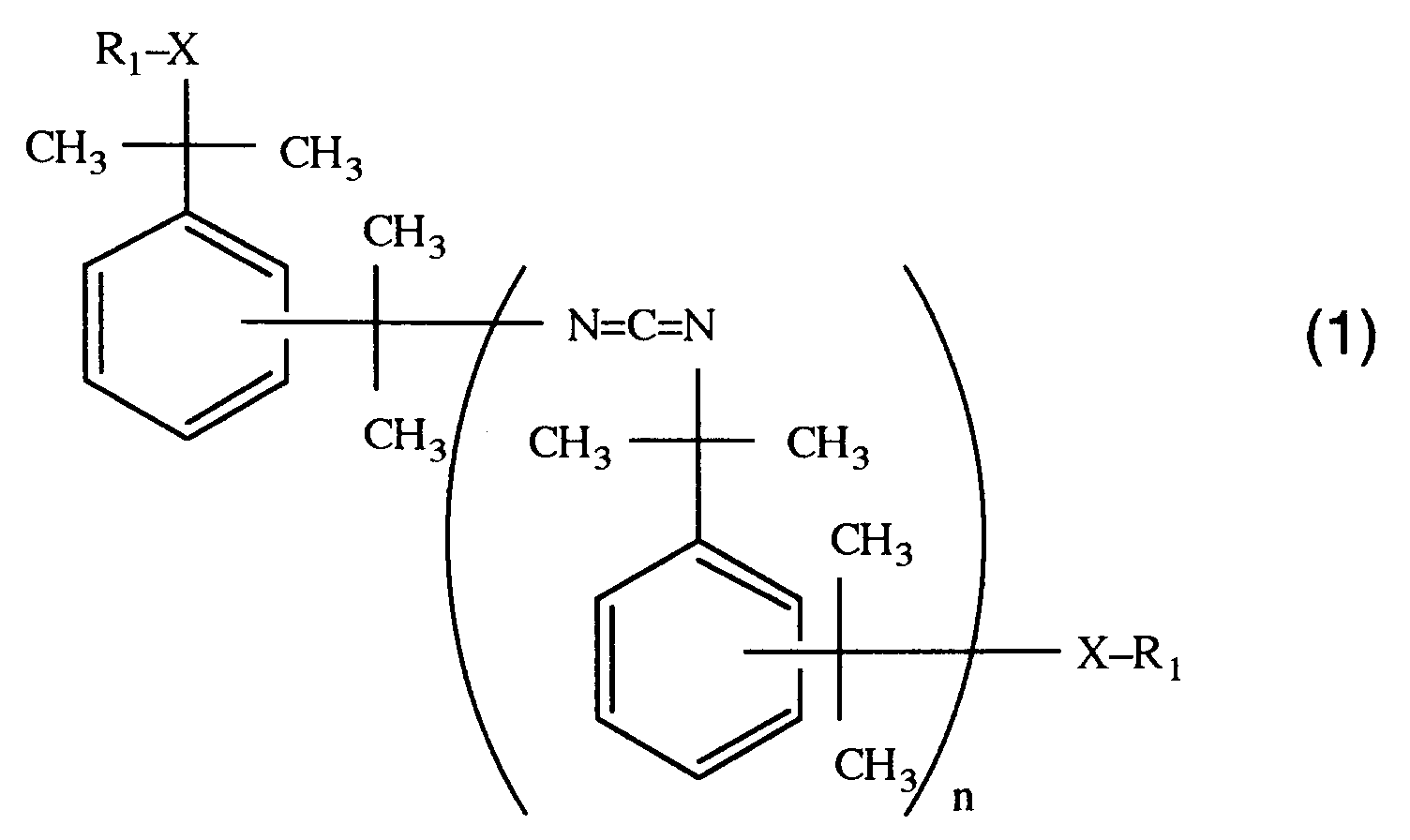
(wherein n is an average polymerization degree and is an integer of 1 to 30; R₁ is a residue of an organic compound having a hydrophilic segment and at least one functional group reactive with an isocyanate group; and X is a group formed by the reaction of said functional group with said isocyanate group).
Description
- The present invention relates to a novel hydrophilic carbodiimide. More particularly, the present invention relates to a hydrophilic carbodiimide having good storage stability owing to the reduced reactivity and accordingly usable as an easy-to-handle crosslinking agent for hydrophilic resin.
- Carbodiimides, particularly polycarbodiimides are known as a thermosetting resin having high heat resistance and find applications in molded materials, etc. obtained, for example, by hot-pressing a powdery polycarbodiimide.
- Of the polycarbodiimides, aromatic polycarbodiimides have hitherto been used mainly. Recently, however, production and application of aliphatic polycarbodiimides were reported. For example, Japanese Patent Application Kokai (Laid-Open) No. 187029/1984 and Japanese Patent Publication No. 27450/1993 disclose a polycarbodiimide derived from isophorone diisocyanate and a method for crosslinking a resin for aqueous coating with said polycarbodiimide.
- The above crosslinking of resin for aqueous coating utilizes a reaction between the carbodiimide group of polycarbodiimide and the active hydrogen of active-hydrogen compound. The reaction includes, for example, one between carbodiimide group and a carboxylic acid residue present in hydrophilic acrylic resin.
- Conventional aliphatic polycarbodiimides (e.g. a polycarbodiimide derived from isophorone diisocyanate), however, are highly reactive. Therefore, they give rise to a reaction even after their addition to a resin for aqueous coating, providing a coating of poor storage stability and short shelf life.
- Further, conventional aliphatic polycarbodiimides, when added to a resin for aqueous coating, etc., must be emulsified beforehand together with a surfactant, mechanically by the use of an expensive high-shear mixer, making complicated the emulsification operation. Moreover, conventional aliphatic polycarbodiimides, when emulsified, inevitably generate urea owing to the reaction with water, making short the storage stability of the emulsion.
- The present invention aims at providing a hydrophilic carbodiimide which is free from the problems of the prior art and which has good storage stability and accordingly is usable as an easy-to-handle crosslinking agent for hydrophilic resin.
- According to the present invention there is provided a hydrophilic tetramethylxylylenecarbodiimide represented by the following general formula (1):
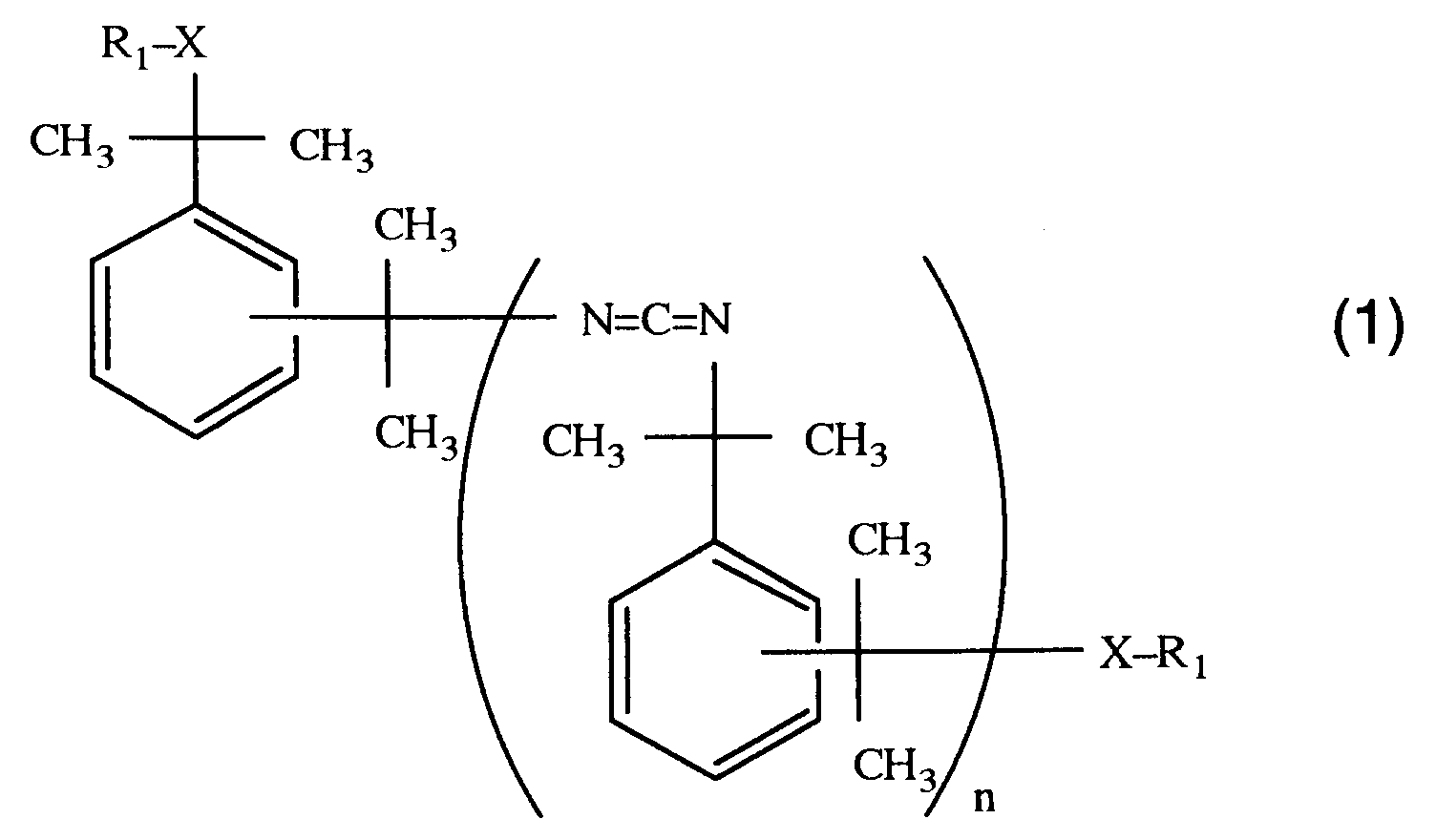
(wherein n is an average polymerization degree and is an integer of 1 to 30; R₁ is a residue of an organic compound having a hydrophilic segment and at least one functional group reactive with an isocyanate group; and X is a group formed by the reaction of said functional group with said isocyanate group). - The present invention is hereinafter described in detail.
- The hydrophilic carbodiimide of the present invention is represented by the above general formula (1) and is synthesized from (a) an isocyanate-terminated tetramethylxylylenecarbodiimide obtained from, for example, m-tetramethylxylylene diisocyanate
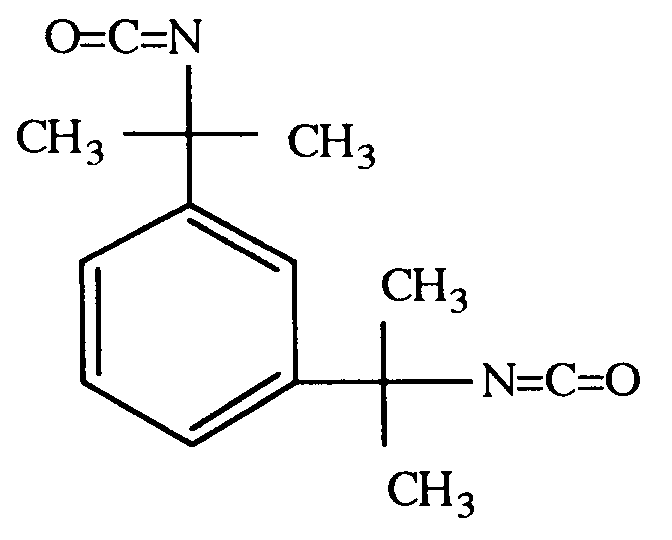
or p-tetramethylxylylene diisocyanate
and (b) an organic compound having a hydrophilic segment and at least one functional group reactive with an isocyanate group (said organic compound is hereinafter abbreviated as hydrophilic segment compound). - In the above general formula (1), n is an integer of 1-30 and is an average polymerization degree of the hydrophilic carbodiimide of the present invention. As easily appreciated from the formula, the present carbodiimide has stereoisomers.
- The present hydrophilic carbodiimide can be produced specifically by subjecting tetramethylxylylene diisocyanate to a condensation reaction (carbon dioxide removal takes place in the reaction) to synthesize an isocyanateterminated tetramethylxylylenecarbodiimide and then reacting it with a hydrophilic segment compound.
- The above production of isocyanate-terminated tetramethylxylylenecarbodiimide can be conducted basically by conventional processes for production of polycarbodiimide [U.S. Patent No. 2,941,956; Japanese Patent Publication No. 33279/1972; J. Org. Chem., 28, 2069-2076 (1963); Chemical Review 1981, Vol. 81, No. 4, pp. 619-621].
- The above condensation reaction of tetramethylxylylene diisocyanate wherein carbon dioxide removal takes place, proceeds in the presence of a carbodiimidization catalyst. The catalyst includes, for example, 1-phenyl-2-phospholene-1-oxide, 3-methyl-2-phospholene-1-oxide, 1-ethyl-2-phospholene-1-oxide, 1-ethyl-3-methyl-2-phospholene-1-oxide, 3-methyl-1-phenyl-2-phospholene-1-oxide and 3-phospholene isomers thereof. Of these, 3-methyl-1-phenyl-2-phospholene-1-oxide is preferred in view of the reactivity.
- The temperature of the above condensation reaction is preferably about 80-180°C. When the temperature is lower than 80°C, the reaction time is very long. When the temperature is higher than 180°C, side reactions take place, making it difficult to obtain a carbodiimide of good quality.
- The condensation degree obtained is preferably 30 or less. A condensation degree higher than 30 results in lower water dispersibility. In order to complete the condensation reaction quickly, the reaction of tetramethylxylylene diisocyanate is conducted in a stream of an inert gas such as nitrogen or the like.
- As the hydrophilic segment compound, there can be used various compounds. They include, for example, a dialkylaminoalcohol represented by the following general formula:
(R₂)₂-N-R₃-OH
(wherein R₂ is a lower alkyl group of, for example, 1-4 carbon atoms; and R₃ is an alkylene or oxyalkylene of, for example, 1-10 carbon atoms). Specific examples of the dialkylaminoalcohol are 2-dimethylaminoethanol, 2-diethylaminoethanol, 3-dimethylamino-1-propanol, 3-diethylamino-1-propanol, 1-diethylamino-2-propanol, 5-diethylamino-2-propanol and 2-(di-n-butylamino)ethanol. 2-Dimethylaminoethanol is particularly preferred. - The reaction product between isocyanate-terminated tetramethylxylylenecarbodiimide and dialkylaminoalcohol is quaternized with a known quaternizing agent such as dimethyl sulfate, methyl p-toluenesulfonate or the like, whereby an intended hydrophilic tetramethylxylylenecarbodiimide can be obtained.
- When the dialkylaminoalcohol is used as the hydrophilic segment compound, the resulting hydrophilic tetramethylxylylenecarbodiimide of the present invention has the following molecular structure and is a cationic type. In the following formula, R' is a group derived from the quaternizing agent used.

The hydrophilic segment compound also includes a salt of an alkylsulfonic acid having at least one reactive hydroxyl group, said salt being represented by the following general formula:
R₅-SO₃-R₄-OH
(wherein R₄ is an alkylene of 1-10 carbon atoms; and R₅ is an alkali metal). Specific examples of the alkylsulfonic acid salt are sodium hydroxyethanesulfonate and sodium hydroxypropanesulfonate. Sodium hydroxypropanesulfonate is preferred particularly. - When the salt of an alkylsulfonic acid having at least one reactive hydroxyl group is used as the hydrophilic segment compound, the resulting hydrophilic tetramethylxylylenecarbodiimide of the present invention has the following molecular structure and is an anionic type.
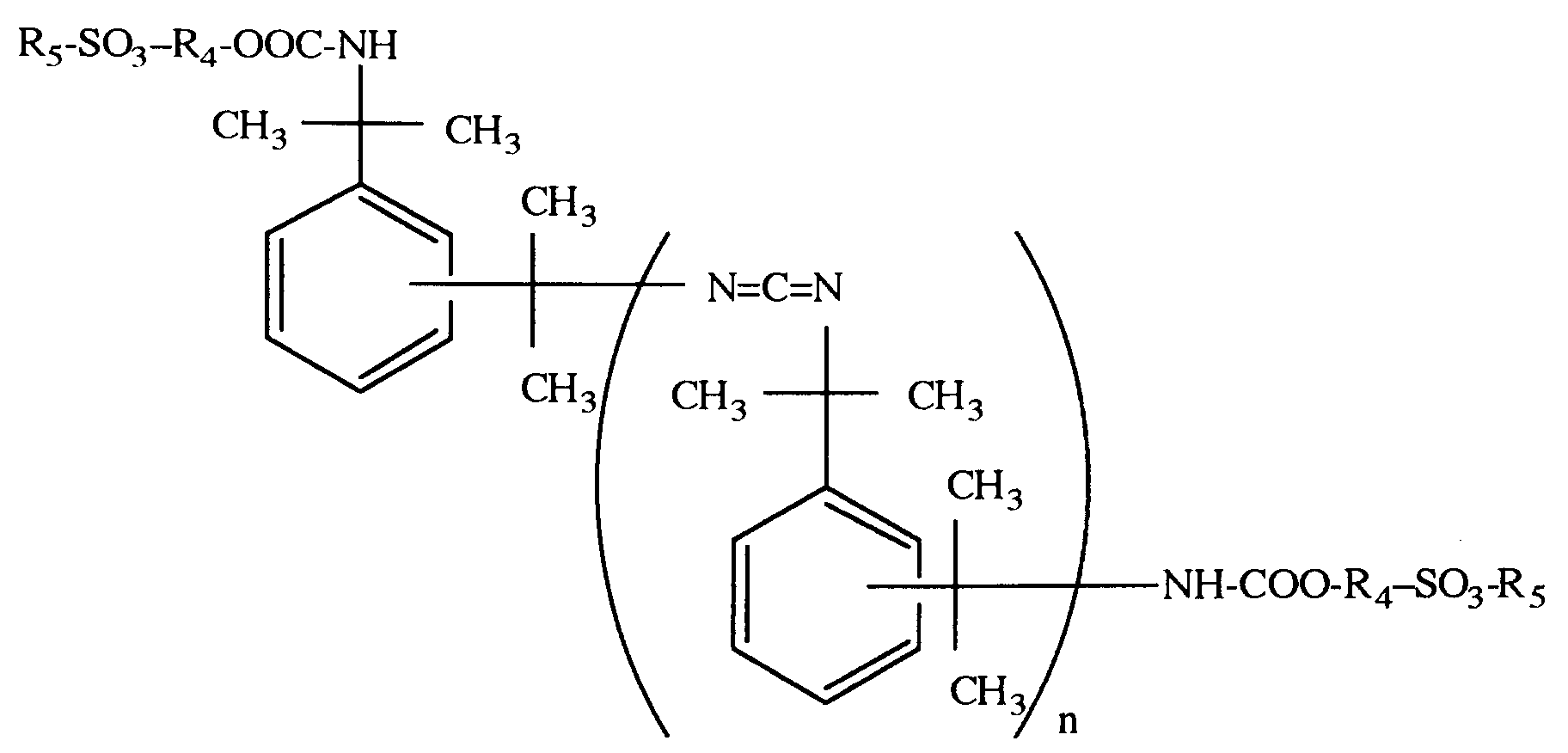
The hydrophilic segment compound also includes a poly(alkylene oxide) having at least one reactive hydroxyl group, blocked with an alkoxyl group at one end, said poly(alkylene oxide) being represented by the following general formula:
R₆-O-(CH₂-CHR₇-O-)mH
(wherein m is an integer of 4-30; R₆ is a lower alkyl group of, for example, 1-4 carbon atoms; and R₇ is a hydrogen atom or a methyl group). Specific examples of the poly(alkylene oxide) are poly(ethylene oxide) monomethyl ether, poly(ethylene oxide) monoethyl ether, poly(ethylene oxide-propylene oxide) monomethyl ether and poly(ethylene oxide-propylene oxide) monoethyl ether. Poly(ethylene oxide) monomethyl ether is preferred particularly. - When the poly(alkylene oxide) having at least one reactive hydroxyl group, blocked with an alkoxyl group at one end is used as the hydrophilic segment compound, the resulting hydrophilic tetramethylxylylenecarbodiimide of the present invention has the following molecular structure and is a nonionic type.

The hydrophilic segment compound also includes a dialkylaminoalkylamine represented by the following general formula:
(R₈)₂-N-R₉-NH₂
(wherein R₈ is a lower alkyl group of, for example, 1-4 carbon atoms; and R₉ is an alkylene or oxyalkylene of, for example, 1-10 carbon atoms). Specific examples of the dialkylaminoalkylamine are 3-dimethylamino-n-propylamine, 3-diethylamino-n-propylamine and 2-diethylamino-ethylamine. 3-Dimethylamino-n-propylamine is preferred particularly. - The reaction product between isocyanate-terminated tetramethylxylylenecarbodiimide and dialkylaminoalkylamine is quaternized with a known quaternizing agent such as dimethyl sulfate, methyl p-toluenesulfonate or the like, whereby an intended hydrophilic tetramethylxylylenecarbodiimide can be obtained.
- When the dialkylaminoalkylamine is used as the hydrophilic segment compound, the resulting hydrophilic tetramethylxylylenecarbodiimide of the present invention has the following molecular structure and is a cationic type. In the following formula, R'' is a group derived from the quaternizing agent.

The above addition reaction between isocyanateterminated tetramethylxylylenecarbodiimide and hydrophilic segment compound may use a catalyst but proceeds easily only by heating. The reaction temperature can be about 60-140°C, preferably about 80-120°C. When the reaction temperature is lower than about 60°C, the reaction time is very long. When the reaction temperature is higher than about 140°C, side reactions take place, making it impossible to obtain a hydrophilic carbodiimide of good quality. - The quaternization reaction of the addition product between isocyanate-terminated tetramethylxylylenecarbodiimide and hydrophilic segment compound (dialkylaminoalcohol or dialkylaminoalkylamine), with the quaternizing agent can be conducted by reacting said addition product with an equivalent amount of a quaternizing agent.
- The hydrophilic tetramethylxylylenecarbodiimide produced as above can be used in various forms. When it is added to an aqueous coating, etc., it may be added as it is, but it is preferably added in the form of an aqueous solution or dispersion in view of easier mixing. In the present invention, the term "hydrophilic" used for tetramethylxylylenecarbodiimide refers to that the tetramethylxylylenecarbodiimide is water-soluble or self-emulsifiable in water and is uniformly compatible with water.
- Appropriate selection of the hydrophilic segment compound allows for production of any of three kinds (cationic type, anionic type and nonionic type) of hydrophilic tetramethylxylylenecarbodiimides. Therefore, it is possible to provide any hydrophilic carbodiimide suited for the ionicity of a hydrophilic resin to which said carbodiimide is to be added.
- The present invention is hereinafter described in more detail with reference to Examples.
- 700 g of m-tetramethylxylylene diisocyanate was reacted with 14 g of a carbodiimidization catalyst (3-methyl-1-phenyl-2-phospholene-1-oxide) at 180°C for 18 hours to obtain an isocyanate-terminated tetramethylxylylenecarbodiimide (polymerization degree = 4). 50.2 g of the carbodiimide was reacted with 8.9 g of 2-dimethylaminoethanol at 80°C for 24 hours. Thereto was added 18.6 g of methyl p-toluenesulfonate, followed by stirring for 1 hour to conduct quaternization. Thereto was slowly added 77.7 g of distilled water so as to give a resin concentration of 50% by weight, to obtain a yellow transparent carbodiimide solution. The solution, when stored in a constant-temperature chamber of 25°C for 12 months, showed neither separation nor precipitation and was very stable.
- 700 g of m-tetramethylxylylene diisocyanate was reacted with 14 g of a carbodiimidization catalyst (3-methyl-1-phenyl-2-phospholene-1-oxide) at 180°C for 18 hours to obtain an isocyanate-terminated tetramethylxylylenecarbodiimide (polymerization degree = 4). 50.2 g of the carbodiimide was reacted with 10.2 g of 3-dimethylamino-n-propyl-amine at 80°C for 1 hour. Thereto was added 18.6 g of methyl-p-toluenesulfonate, followed by stirring for 1 hour to conduct quaternization. Thereto was slowly added 79 g of distilled water so as to give a resin concentration of 50% by weight, to obtain a yellow transparent carbodiimide solution. The solution, when stored in a constant-temperature chamber of 25°C for 12 months, showed neither separation nor precipitation and was very stable.
- 700 g of m-tetramethylxylylene diisocyanate was reacted with 14 g of a carbodiimidization catalyst (3-methyl-1-phenyl-2-phospholene-1-oxide) at 180°C for 32 hours to obtain an isocyanate-terminated tetramethylxylylenecarbodiimide (polymerization degree = 10). 52.7 g of the carbodiimide was reacted with 5.1 g of 3-dimethylamino-n-propylamine at 80°C for 1 hour. Thereto was added 9.3 g of methyl p-toluenesulfonate, followed by stirring for 1 hour to conduct quaternization. Thereto was slowly added 67.1 g of distilled water so as to give a resin concentration of 50% by weight, to obtain an emulsion-like carbodiimide solution. The solution, when stored in a constant-temperature chamber of 25°C for 12 months, showed neither separation nor precipitation
and was very stable. - 700 g of m-tetramethylxylylene diisocyanate was reacted with 14 g of a carbodiimidization catalyst (3-methyl- 1-phenyl-2-phospholene-1-oxide) at 180°C for 18 hours to obtain an isocyanate-terminated tetramethylxylylenecarbodiimide (polymerization degree = 4). 210.5 g of the carbodiimide was reacted with 40.9 g of 3-dimethylamino-n-propylamine at 80°C for 1 hour. Thereto was added 50.5 g of dimethyl sulfate, followed by stirring for 1 hour to conduct quaternization. Thereto was slowly added 301.9 g of distilled water so as to give a resin concentration of 50% by weight, to obtain a yellow transparent carbodiimide solution. The solution, when stored in a constant-temperature chamber of 25°C for 12 months, showed neither separation nor precipitation and was very stable.
- 700 g of m-tetramethylxylylene diisocyanate was reacted with 14 g of a carbodiimidization catalyst (3-methyl-1-phenyl-2-phospholene-1-oxide) at 180°C for 32 hours to obtain an isocyanate-terminated tetramethylxylylenecarbodiimide (polymerization degree = 10). 105.3 g of the carbodiimide was reacted with 10.2 g of 3-dimethylamino-n-propylamine at 80°C for 1 hour. Thereto was added 12.6 g of dimethyl sulfate, followed by stirring for 1 hour to conduct quaternization. Thereto was slowly added 128.1 g of distilled water so as to give a resin concentration of 50% by weight, to obtain an emulsion-like carbodiimide solution. The solution, when stored in a constant-temperature chamber of 25°C for 12 months, showed neither separation nor precipitation and was very stable.
- 700 g of m-tetramethylxylylene diisocyanate was reacted with 14 g of a carbodiimidization catalyst (3-methyl-1-phenyl-2-phospholene-1-oxide) at 180°C for 32 hours to obtain an isocyanate-terminated tetramethylxylylenecarbodiimide (polymerization degree = 10). 224.4 g of the carbodiimide was reacted with 41.2 g of sodium hydroxypropanesulfonate at 100°C for 24 hours. Thereto was slowly added, at 80°C, 619.7 g of distilled water so as to give a resin concentration of 30% by weight, to obtain an emulsion-like carbodiimide solution. The solution, when stored in a constant-temperature chamber of 25°C for 12 months, showed neither separation nor precipitation and was very stable.
- 700 g of m-tetramethylxylylene diisocyanate was reacted with 14 g of a carbodiimidization catalyst (3-methyl- 1-phenyl-2-phospholene-1-oxide) at 180°C for 22 hours to obtain an isocyanate-terminated tetramethylxylylenecarbodiimide (polymerization degree = 5). 124.4 g of the carbodiimide was reacted with 63.6 g of poly(oxyethylene) monomethyl ether having a polymerization degree (m) of about 6 at 100°C for 48 hours. Thereto was slowly added, at 50°C, 282.0 g of distilled water so as to give a resin concentration of 40% by weight, to obtain a yellow transparent carbodiimide solution. The solution, when stored in a constant-temperature chamber of 25°C for 12 months, showed neither separation nor precipitation and was very stable.
- 700 g of m-tetramethylxylylene diisocyanate was reacted with 14 g of a carbodiimidization catalyst (3-methyl-1-phenyl-2-phospholene-1-oxide) at 180°C for 22 hours to obtain an isocyanate-terminated tetramethylxylylenecarbodiimide (polymerization degree = 5). 124.4 g of the carbodiimide was reacted with 115.0 g of poly(oxyethylene) monomethyl ether having a polymerization degree (m) of about 12 at 100°C for 48 hours. Thereto was slowly added, at 50°C, 359.1 g of distilled water so as to give a resin concentration of 40% by weight, to obtain a yellow transparent carbodiimide solution. The solution, when stored in a constanttemperature chamber of 25°C for 12 months, showed neither separation nor precipitation and was very stable.
- 700 g of m-tetramethylxylylene diisocyanate was reacted with 14 g of a carbodiimidization catalyst (3-methyl-1-phenyl-2-phospholene-1-oxide) at 180°C for 32 hours to obtain an isocyanate-terminated tetramethylxylylenecarbodiimide (polymerization degree = 10). 224.4 g of the carbodiimide was reacted with 63.6 g of poly(oxyethylene) monomethyl ether having a polymerization degree (m) of about 6 at 100°C for 48 hours. Thereto was slowly added, at 50°C, 432 g of distilled water so as to give a resin concentration of 40% by weight, to obtain an emulsion-like carbodiimide solution. The solution, when stored in a constant-temperature chamber of 25°C for 12 months, showed neither separation nor precipitation and was very stable.
- 700 g of m-tetramethylxylylene diisocyanate was reacted with 14 g of a carbodiimidization catalyst (3-methyl-1-phenyl-2-phospholene-1-oxide) at 180°C for 32 hours to obtain an isocyanate-terminated tetramethylxylylenecarbodiimide (polymerization degree = 10). 224.4 g of the carbodiimide was reacted with 82.6 g of poly(oxyethylene) monomethylether having a polymerization degree (m) of about 8 at 100°C for 48 hours. Thereto was slowly added, at 50°C, 716.3 g of distilled water so as to give a resin concentration of 30% by weight, to obtain an emulsion-like carbodiimide solution. The solution, when stored in a constant-temperature chamber of 25°C for 12 months, showed neither separation nor precipitation and was very stable.
- 700 g of m-tetramethylxylylene diisocyanate was reacted with 14 g of a carbodiimidization catalyst (3-methyl-1-phenyl-2-phospholene-1-oxide) at 180°C for 32 hours to obtain an isocyanate-terminated tetramethylxylylenecarbodiimide (polymerization degree = 10). 224.4 g of the carbodiimide was reacted with 115.0 g of poly(oxyethylene) monomethyl ether having a polymerization degree (m) of about 12 at 100°C for 48 hours. Thereto was slowly added, at 50°C, 509.1 g of distilled water so as to give a resin concentration of 40% by weight, to obtain a yellow transparent carbodiimide solution. The solution, when stored in a constant-temperature chamber of 25°C for 12 months, showed neither separation nor precipitation and was very stable.
- 700 g of m-tetramethylxylylene diisocyanate was reacted with 14 g of a carbodiimidization catalyst (3-methyl-1-phenyl-2-phospholene-1-oxide) at 180°C for 58 hours to obtain an isocyanate-terminated tetramethylxylylenecarbodiimide (polymerization degree = 15). 324.4 g of the carbodiimide was reacted with 115.0 g of poly(oxyethylene) monomethyl ether having a polymerization degree (m) of about 12 at 100°C for 48 hours. Thereto was slowly added, at 50°C, 659.1 g of distilled water so as to give a resin concentration of 40% by weight, to obtain an emulsion-like carbodiimide solution. The solution, when stored in a constant-temperature chamber of 25°C for 12 months, showed neither separation nor precipitation and was very stable.
- 700 g of m-tetramethylxylylene diisocyanate was reacted with 14 g of a carbodiimidization catalyst (3-methyl-1-phenyl-2-phospholene-1-oxide) at 180°C for 58 hours to obtain an isocyanate-terminated tetramethylxylylenecarbodiimide (polymerization degree = 15). 324.4 g of the carbodiimide was reacted with 160.2 g of poly(oxyethylene) monomethyl ether having a polymerization degree (m) of about 18 at 100°C for 48 hours. Thereto was slowly added, at 50°C, 726.9 g of distilled water so as to give a resin concentration of 40% by weight, to obtain a yellow transparent carbodiimide solution. The solution, when stored in a constant-temperature chamber of 25°C for 12 months, showed neither separation nor precipitation and was very stable.
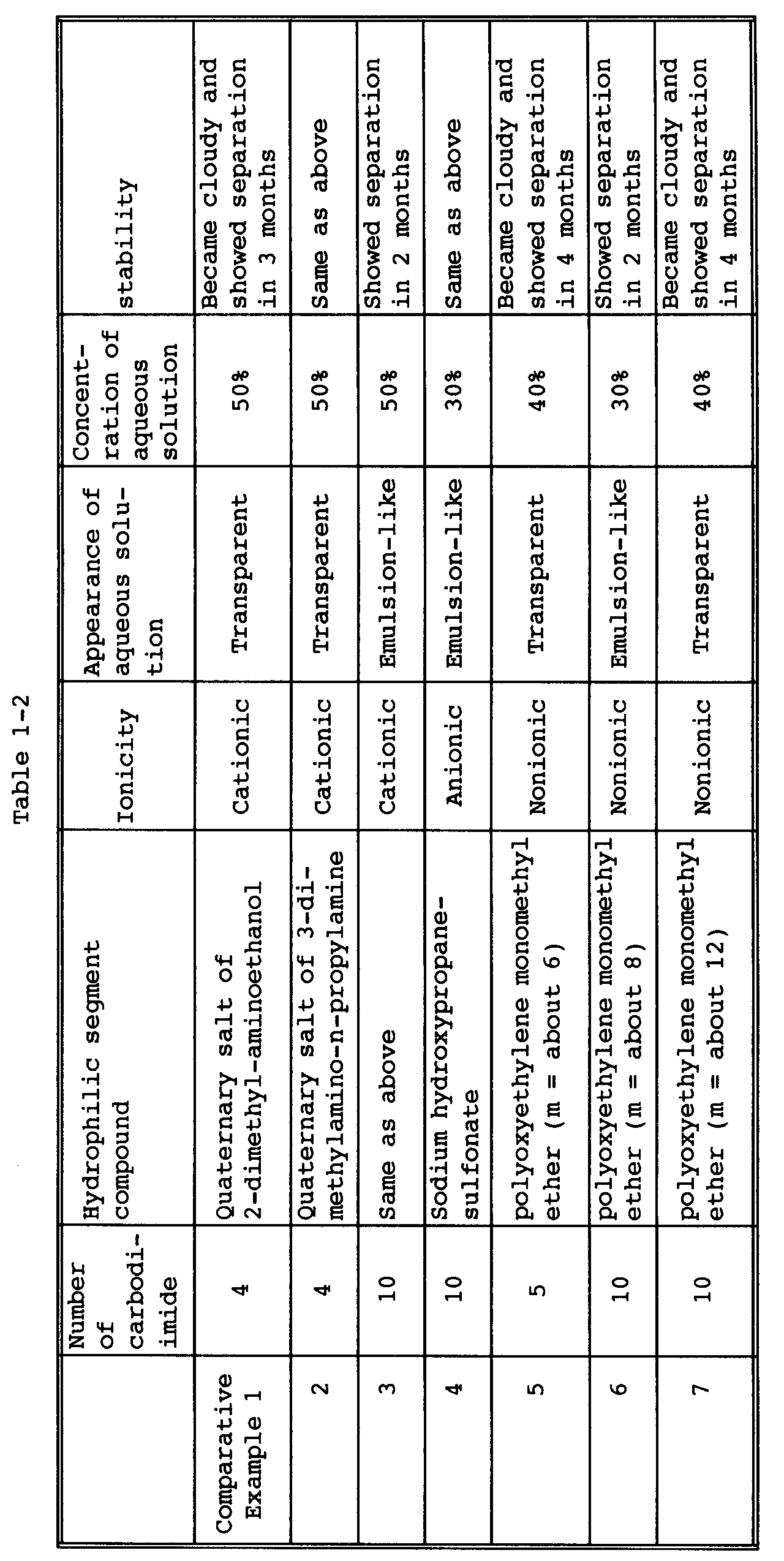
- 700 g of isophorone diisocyanate was reacted with 14 g of a carbodiimidization catalyst (3-methyl-1-phenyl-2-phospholene-1-oxide) at 180°C for 6 hours to obtain an isocyanate-terminated isophoronecarbodiimide (polymerization degree = 4). 93.4 g of the carbodiimide was reacted with 17.8 g of 2-dimethylaminoethanol at 80°C for 24 hours. Thereto was added 37.2 g of methyl p-toluenesulfonate, followed by stirring for 1 hour to conduct quaternization. Thereto was slowly added 148.4 g of distilled water so as to give a resin concentration of 50% by weight, to obtain a yellow transparent carbodiimide solution. The solution, when stored in a constant-temperature chamber of 25°C, became cloudy and showed separation in 3 months.
- 700 g of isophorone diisocyanate was reacted with 14 g of a carbodiimidization catalyst (3-methyl-1-phenyl-2-phospholene-1-oxide) at 180°C for 6 hours to obtain an isocyanate-terminated isophoronecarbodiimide (polymerization degree = 4). 93.4 g of the carbodiimide was reacted with 20.4 g of 3-dimethylamine-n-propylamine at 80°C for 1 hour. Thereto was added 37.2 g of methyl p-toluenesulfonate, followed by stirring for 1 hour to conduct quaternization. Thereto was slowly added 151 g of distilled water so as to give a resin concentration of 50% by weight, to obtain a yellow transparent carbodiimide solution. The solution, when stored in a constant-temperature chamber of 25°C, became cloudy and showed separation in 3 months.
- 700 g of isophorone diisocyanate was reacted with 14 g of a carbodiimidization catalyst (3-methyl-1-phenyl-2-phospholene-1-oxide) at 180°C for 14 hours to obtain an isocyanate-terminated isophoronecarbodiimide (polymerization degree = 10). 200.2 g of the carbodiimide was reacted with 20.4 g of 3-dimethylamine-n-propylamine at 80°C for 1 hour. Thereto was added 37.2 g of methyl p-toluenesulfonate, followed by stirring for 1 hour to conduct quaternization. Thereto was slowly added 257.8 g of distilled water so as to give a resin concentration of 50% by weight, to obtain an emulsion-like carbodiimide solution. The solution, when stored in a constant-temperature chamber of 25°C, showed separation in 2 months.
-
- 700 g of isophorone diisocyanate was reacted with 14 g of a carbodiimidization catalyst (3-methyl-1-phenyl-2-phospholene-1-oxide) at 180°C for 14 hours to obtain an isocyanate-terminated isophoronecarbodiimide (polymerization degree = 10). 200.2 g of the carbodiimide was reacted with 41.2 g of sodium hydroxypropanesulfonate at 100°C for 24 hours. Thereto was slowly added, at 80°C, 563.3 g of distilled water so as to give a resin concentration of 30% by weight, to obtain an emulsion-like carbodiimide solution. The solution, when stored in a constant-temperature chamber of 25°C, showed separation in 2 months.
- 700 g of isophorone diisocyanate was reacted with 14 g of a carbodiimidization catalyst (3-methyl-1-phenyl-2-phospholene-1-oxide) at 180°C for 8 hours to obtain an isocyanate-terminated isophoronecarbodiimide (polymerization degree = 5). 111.2 g of the carbodiimide was reacted with 63.6 g of poly(oxyethylene) monomethyl ether having a polymerization degree (m) of about 6 at 100°C for 24 hours. Thereto was slowly added, at 50°C, 262.2 g of distilled water so as to give a resin concentration of 40% by weight, to obtain a yellow transparent carbodiimide solution. The solution, when stored in a constant-temperature chamber of 25°C, became cloudy and showed separation in 4 months.
-
- 700 g of isophorone diisocyanate was reacted with 14 g of a carbodiimidization catalyst (3-methyl-1-phenyl-2-phospholene-1-oxide) at 180°C for 14 hours to obtain an isocyanate-terminated isophoronecarbodiimide (polymerization degree = 10). 200.2 g of the carbodiimide was reacted with 82.6 g of poly(oxyethylene) monomethyl ether having a polymerization degree (m) of about 8 at 100°C for 48 hours. Thereto was slowly added, at 50°C, 660 g of distilled water so as to give a resin concentration of 30% by weight, to obtain an emulsion-like carbodiimide solution. The solution, when stored in a constant-temperature chamber of 25°C, showed separation in 2 months.
- 700 g of isophorone diisocyanate was reacted with 14 g of a carbodiimidization catalyst (3-methyl-1-phenyl-2-phospholene-1-oxide) at 180°C for 14 hours to obtain an isocyanate-terminated isophoronecarbodiimide (polymerization degree = 10). 200.2 g of the carbodiimide was reacted with 115.0 g of poly(oxyethylene) monomethyl ether having a polymerization degree (m) of about 12 at 100°C for 24 hours. Thereto was slowly added, at 50°C, 472.8 g of distilled water so as to give a resin concentration of 40% by weight, to obtain a yellow transparent carbodiimide solution. The solution, when stored in a constant-temperature chamber of 25°C, became cloudy and showed separation in 4 months.
- The results of syntheses in Examples 1-13 and Comparative Examples 1-7 are shown in Tables 1-1 and 1-2. As is clear from Tables 1-1 and 1-2, the hydrophilic tetramethylxylylenecarbodiimides of Examples 1-13 according to the present invention are superior in storage stability to the hydrophilic isophoronecarbpdiimides of Comparative Examples 1-7.

- Each of the aqueous carbodiimide solutions obtained in Examples 7, 10, and 11 and Comparative Examples 5, 6 and 7 was added to a solution of a styrene-acrylic resin of acid value = 300 (solvent in solution: water/alcohol = 95/5, resin concentration in solution = 30% by weight) so that the carbodiimide group and the carboxyl group became 1:1 in equivalent. Each of the resulting mixtures was meausred for viscosity change at 25°C. Further, each mixture was coated on a polyethylene terephthalate film by the use of an applicator so that the resulting film had a thickness of 100 µm; the film was dried at 80°C for 5 minutes; and the dried film was cut into a piece of 5 cm x 5 cm and immersed in 300 ml of distilled water for 24 hours to observe the change of the film condition.
- The results of the above test are shown in Table 2.
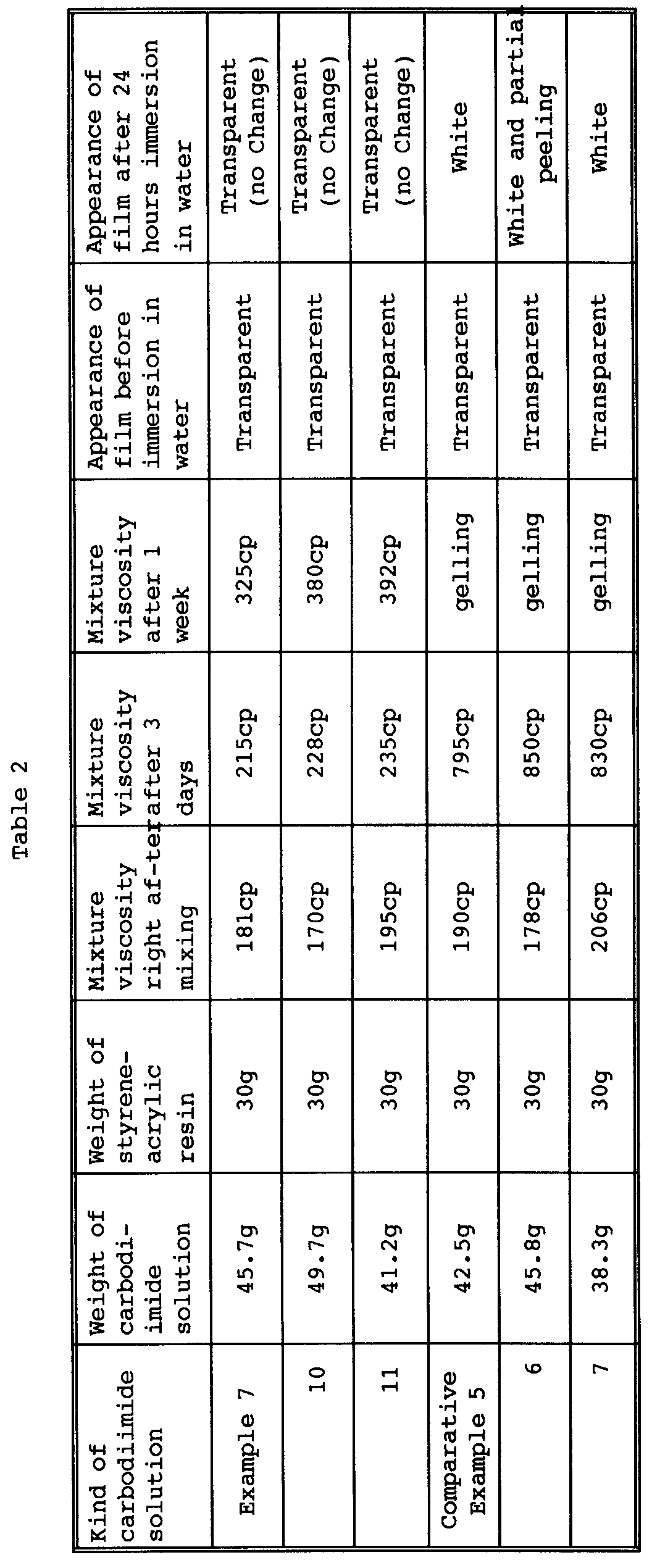
- As is clear from Table 2, the hydrophilic tetramethylxylylenecarbodimides of Examples 7, 10 and 11 according to the present invention are superior to the aqueous isophoronecarbodiimides of Comparative Examples 5, 6 and 7 in stability after addition to hydrophilic resin as well as in potency as crosslinking agent.
Claims (7)
- A hydrophilic tetramethylxylylenecarbodiimide represented by the following general formula (1):

- hydrophilic tetramethylxylylenecarbodiimide according to Claim 1, wherein X is a group represented by the following formula:
-OOC-HN-
- A hydrophilic tetramethylxylylenecarbodiimide according to Claim 2, wherein R₁ is a residue of a quaternary ammonium salt of a dialkylaminoalcohol represented by the following general formula:
(R₂)₂-N-R₃-OH
(wherein R₂ is a lower alkyl group; and R₃ is a alkylene or oxyalkylene of 1-10 carbon atoms). - A hydrophilic tetramethylxylylenecarbodiimide according to Claim 2, wherein R₁ is a residue of a salt of an alkylsulfonic acid having at least one reactive hydroxyl group, said salt being represented by the following general formula:
R₅-SO₃-R₄-OH
(wherein R₄ is an alkylene of 1-10 carbon atoms; and R₅ is an alkali metal). - A hydrophilic tetramethylxylylenecarbodiimide according to Claim 2, wherein R₁ is a residue of a poly(alkylene oxide) having at least one reactive hydroxyl group, blocked with an alkoxyl group at one end, said poly(alkylene oxide) being represented by the following general formula:
R₆-O-(CH₂-CHR₇-O-)mH
(wherein m is an integer of 4-30; R₆ is a lower alkyl group;and R₇ is a hydrogen atom or a methyl group). - A hydrophilic tetramethylxylylenecarbodiimide according to Claim 1, wherein X is a group represented by the following formula:
-NH-OC-HN-
- A hydrophilic tetramethylxylylenecarbodiimide according to Claim 6, wherein R₁ is a residue of a quaternary ammonium salt of a dialkylaminoalkylamine represented by the following general formula:
(R₈)₂-N-R₉-NH₂
(wherein R₈ is a lower alkyl group; and R₉ is an alkylene or oxyalkylene having 1-10 carbon atoms).
Applications Claiming Priority (3)
| Application Number | Priority Date | Filing Date | Title |
|---|---|---|---|
| JP15263294A JP3629041B2 (en) | 1994-06-10 | 1994-06-10 | Aqueous tetramethylxylylene carbodiimide |
| JP15263294 | 1994-06-10 | ||
| JP152632/94 | 1994-06-10 |
Publications (2)
| Publication Number | Publication Date |
|---|---|
| EP0686626A1 true EP0686626A1 (en) | 1995-12-13 |
| EP0686626B1 EP0686626B1 (en) | 1999-09-01 |
Family
ID=15544639
Family Applications (1)
| Application Number | Title | Priority Date | Filing Date |
|---|---|---|---|
| EP95108536A Expired - Lifetime EP0686626B1 (en) | 1994-06-10 | 1995-06-02 | Hydrophilic tetramethylxylylenecarbodiimides |
Country Status (4)
| Country | Link |
|---|---|
| US (1) | US5688875A (en) |
| EP (1) | EP0686626B1 (en) |
| JP (1) | JP3629041B2 (en) |
| DE (1) | DE69511775T2 (en) |
Cited By (17)
| Publication number | Priority date | Publication date | Assignee | Title |
|---|---|---|---|---|
| EP0878496A1 (en) * | 1997-05-16 | 1998-11-18 | Nisshinbo Industries, Inc. | Carbodiimide crosslinking agent, process for preparing the same, and coating material comprising the same |
| EP0878324A1 (en) * | 1997-05-16 | 1998-11-18 | Nisshinbo Industries Inc. | Printing and recording sheet |
| EP0952146A3 (en) * | 1998-04-20 | 2000-11-22 | Nisshinbo Industries, Inc. | Hydrophilic Dicyclohexylmethanecarbodiimide |
| WO2001034559A1 (en) * | 1999-11-11 | 2001-05-17 | Basf Aktiengesellschaft | Carbodiimides with carboxyl or carboxylate groups |
| EP0965582A3 (en) * | 1998-05-14 | 2001-08-16 | Basf Aktiengesellschaft | Carbodiimide based on 1,3-bis-(1-methyl-1-isocyanatoethyl)-benzene |
| WO2001051535A3 (en) * | 2000-01-11 | 2002-01-17 | Basf Ag | Carbodiimides with carboxyl or carboxylate groups |
| EP0792908B2 (en) † | 1996-02-29 | 2004-12-15 | Nisshinbo Industries, Inc. | Precoating of aluminium and stainless steel sheets |
| NL1023817C2 (en) * | 2003-07-03 | 2005-01-04 | Stahl Int Bv | Process for the preparation of stable polycarbodiimide dispersions in water, which do not contain organic solvents and can be used as crosslinking agent. |
| WO2006069703A1 (en) * | 2004-12-23 | 2006-07-06 | Basf Aktiengesellschaft | Method for laminating using special cross-linked carbodiimide groups |
| WO2009106987A1 (en) * | 2008-02-26 | 2009-09-03 | M-I Drilling Fluids Uk Limited | Crosslinking agents for producing gels for oilfield applications |
| US8076445B2 (en) | 2000-01-11 | 2011-12-13 | Robert Shane Porzio | Oligocarbodiimides for the formation of crosslinked latex films |
| DE19821668B4 (en) * | 1998-05-14 | 2012-03-08 | Basf Se | 1,3-Bis- (1-methyl-1-isocyanatoethyl) benzene-based carbodiimide mixtures, process for their preparation, their use, and polyurethane elastomers and their preparation process |
| DE19529631C5 (en) * | 1994-08-11 | 2012-05-03 | Nisshinbo Industries, Inc. | Use of a surfactant for surface treatment of reinforcing material, reinforcing material with a surface treated with said surfactant and use of the reinforcing material |
| WO2013174894A1 (en) | 2012-05-24 | 2013-11-28 | Basf Se | Aqueous binder compositions |
| CN103502294A (en) * | 2011-05-05 | 2014-01-08 | 莱茵化学莱瑙有限公司 | Carbodiimides from trisubstituted aromatic isocyanates, a method for producing same, and the use of same |
| CN104321357A (en) * | 2012-05-03 | 2015-01-28 | 莱茵化学莱瑙有限公司 | Use of carbodiimide-containing compositions for controlling pot life |
| EP3502157A1 (en) | 2017-12-21 | 2019-06-26 | Covestro Deutschland AG | Aqueous polycarbodiimide dispersion with extended storage stability and a method for their preparation |
Families Citing this family (16)
| Publication number | Priority date | Publication date | Assignee | Title |
|---|---|---|---|---|
| JP4278265B2 (en) * | 1999-04-30 | 2009-06-10 | 日本ペイント株式会社 | Thermosetting aqueous coating composition, coating film forming method using the same, and multilayer coating film forming method |
| DE10206112A1 (en) * | 2002-02-13 | 2003-08-21 | Basf Ag | Aqueous dispersions made up of polycarbodiimides |
| NL1031053C2 (en) * | 2006-02-02 | 2007-08-03 | Stahl Int Bv | Process for the preparation of dispersions of crosslinking agents in water. |
| US20080057298A1 (en) * | 2006-08-29 | 2008-03-06 | Surmodics, Inc. | Low friction particulate coatings |
| GB0917134D0 (en) | 2009-09-30 | 2009-11-11 | M I Drilling Fluids Uk Ltd | Crosslinking agents for producing gels and polymer beads for oilfield applications |
| US8900667B2 (en) * | 2009-12-18 | 2014-12-02 | Ppg Industries Ohio, Inc. | One-component, ambient curable waterborne coating compositions, related methods and coated substrates |
| CN102869694B (en) * | 2010-03-02 | 2015-09-02 | Ppg工业俄亥俄公司 | One-component, ambient curable aqueous coating composition, related method and coated substrate |
| EP2423186B1 (en) * | 2010-08-30 | 2017-05-31 | LANXESS Deutschland GmbH | New adhesion promoter bsed on carbodiimides, adhesive, aqueous resorcinol-formaldehyde-latex dispersions, fibers with improved adhesion, process for their preparation and use thereof. |
| EP2423185B1 (en) * | 2010-08-30 | 2017-03-01 | Rhein Chemie Rheinau GmbH | New aqueous resorcinol-formaldehyde-latex dispersions, fibers with improved adhesion, process for their preparation and use thereof. |
| US20130065467A1 (en) * | 2011-09-10 | 2013-03-14 | Sun Chemical Corporation | Substrate Printed with a Water-Based Urethane Printing Ink with Improved Performance Properties |
| TWI598411B (en) * | 2012-05-29 | 2017-09-11 | 巴斯夫歐洲公司 | Water-based polymer compositions for printing inks and coatings |
| MY180554A (en) | 2015-07-08 | 2020-12-02 | Nisshinbo Chemical Inc | Carbodiimide-based aqueous resin crosslinking agent |
| KR102835821B1 (en) * | 2018-03-12 | 2025-07-18 | 닛신보 케미칼 가부시키가이샤 | Method for producing carbodiimide compound |
| KR102827537B1 (en) * | 2018-03-12 | 2025-07-01 | 닛신보 케미칼 가부시키가이샤 | Method for producing carbodiimide compound |
| JPWO2021059835A1 (en) | 2019-09-25 | 2021-04-01 | ||
| WO2024246352A1 (en) | 2023-05-31 | 2024-12-05 | Soudal | Waterborne curable sealant composition |
Citations (5)
| Publication number | Priority date | Publication date | Assignee | Title |
|---|---|---|---|---|
| US2941956A (en) | 1956-08-15 | 1960-06-21 | Socony Mobil Oil Co Inc | Regeneration of contact material |
| JPS4733279B1 (en) | 1968-12-20 | 1972-08-24 | ||
| JPS59187029A (en) | 1983-02-24 | 1984-10-24 | ユニオン,カ−バイド,コ−ポレ−シヨン | Low temperature bridging for water borne resin |
| EP0241805A2 (en) * | 1986-03-31 | 1987-10-21 | Union Carbide Corporation | Surface active polycarbodiimides and their dispersions |
| EP0548815A2 (en) * | 1991-12-26 | 1993-06-30 | Nisshinbo Industries, Inc. | Tetramethylxylylene carbodiimides |
Family Cites Families (3)
| Publication number | Priority date | Publication date | Assignee | Title |
|---|---|---|---|---|
| US5108653A (en) * | 1986-03-31 | 1992-04-28 | Union Carbide Chemicals & Plastics Technology Corporation | Surface active polycarbodiimides and their dispersions |
| JP3188959B2 (en) * | 1992-08-10 | 2001-07-16 | 日清紡績株式会社 | Method for producing polycarbodiimide resin |
| US5498747A (en) * | 1994-05-12 | 1996-03-12 | Basf Aktiengesellschaft | Carbodiimides and/or oligomeric polycarbodiimides based on 1,3-bis (1-methyl-1-isocyanatoethyl)benzene, their preparation, and their use as hydrolysis stabilizers |
-
1994
- 1994-06-10 JP JP15263294A patent/JP3629041B2/en not_active Expired - Lifetime
-
1995
- 1995-05-31 US US08/455,413 patent/US5688875A/en not_active Expired - Fee Related
- 1995-06-02 EP EP95108536A patent/EP0686626B1/en not_active Expired - Lifetime
- 1995-06-02 DE DE69511775T patent/DE69511775T2/en not_active Expired - Lifetime
Patent Citations (6)
| Publication number | Priority date | Publication date | Assignee | Title |
|---|---|---|---|---|
| US2941956A (en) | 1956-08-15 | 1960-06-21 | Socony Mobil Oil Co Inc | Regeneration of contact material |
| JPS4733279B1 (en) | 1968-12-20 | 1972-08-24 | ||
| JPS59187029A (en) | 1983-02-24 | 1984-10-24 | ユニオン,カ−バイド,コ−ポレ−シヨン | Low temperature bridging for water borne resin |
| EP0241805A2 (en) * | 1986-03-31 | 1987-10-21 | Union Carbide Corporation | Surface active polycarbodiimides and their dispersions |
| JPH0527450B2 (en) | 1986-03-31 | 1993-04-21 | Yunion Kaabaido Chem Ando Purasuchitsukusu Co Inc | |
| EP0548815A2 (en) * | 1991-12-26 | 1993-06-30 | Nisshinbo Industries, Inc. | Tetramethylxylylene carbodiimides |
Non-Patent Citations (2)
| Title |
|---|
| CHEMICAL REVIEW, vol. 81, no. 4, 1981, pages 619 - 621 |
| J. ORG. CHEM., vol. 28, 1963, pages 2069 - 2076 |
Cited By (28)
| Publication number | Priority date | Publication date | Assignee | Title |
|---|---|---|---|---|
| DE19529631C5 (en) * | 1994-08-11 | 2012-05-03 | Nisshinbo Industries, Inc. | Use of a surfactant for surface treatment of reinforcing material, reinforcing material with a surface treated with said surfactant and use of the reinforcing material |
| EP0792908B2 (en) † | 1996-02-29 | 2004-12-15 | Nisshinbo Industries, Inc. | Precoating of aluminium and stainless steel sheets |
| EP0878324A1 (en) * | 1997-05-16 | 1998-11-18 | Nisshinbo Industries Inc. | Printing and recording sheet |
| US6124398A (en) * | 1997-05-16 | 2000-09-26 | Nisshinbo Industries, Inc. | Carbodiimide crosslinking agent, process for preparing the same, and coating material comprising the same |
| EP0878496A1 (en) * | 1997-05-16 | 1998-11-18 | Nisshinbo Industries, Inc. | Carbodiimide crosslinking agent, process for preparing the same, and coating material comprising the same |
| US6177197B1 (en) | 1997-05-16 | 2001-01-23 | Nippon Industries, Inc. | Printing and recording sheet |
| EP0952146A3 (en) * | 1998-04-20 | 2000-11-22 | Nisshinbo Industries, Inc. | Hydrophilic Dicyclohexylmethanecarbodiimide |
| EP0965582A3 (en) * | 1998-05-14 | 2001-08-16 | Basf Aktiengesellschaft | Carbodiimide based on 1,3-bis-(1-methyl-1-isocyanatoethyl)-benzene |
| DE19821668B4 (en) * | 1998-05-14 | 2012-03-08 | Basf Se | 1,3-Bis- (1-methyl-1-isocyanatoethyl) benzene-based carbodiimide mixtures, process for their preparation, their use, and polyurethane elastomers and their preparation process |
| WO2001034559A1 (en) * | 1999-11-11 | 2001-05-17 | Basf Aktiengesellschaft | Carbodiimides with carboxyl or carboxylate groups |
| WO2001051535A3 (en) * | 2000-01-11 | 2002-01-17 | Basf Ag | Carbodiimides with carboxyl or carboxylate groups |
| US8076445B2 (en) | 2000-01-11 | 2011-12-13 | Robert Shane Porzio | Oligocarbodiimides for the formation of crosslinked latex films |
| US7049001B2 (en) | 2000-01-11 | 2006-05-23 | Basf Aktiengesellschaft | Carbodiimides with carboxyl or carboxylate groups |
| RU2313541C2 (en) * | 2003-07-03 | 2007-12-27 | Стахл Интернэшнл Б.В. | Method for preparing stable aqueous dispersion of polycarbodiimide that do not contain organic solvents and can be used as cross-linking agents |
| WO2005003204A3 (en) * | 2003-07-03 | 2005-03-10 | Stahl Int Bv | Process for the preparation of stable polycarbodiimide dispersions in water, which are free of organic solvents and may be used as crosslinking agent |
| US7439316B2 (en) | 2003-07-03 | 2008-10-21 | Stahl International B.V. | Process for preparation of stable polycarbodiimide dispersions in water, which are free of organic solvents and may be used as crosslinking agent |
| NL1023817C2 (en) * | 2003-07-03 | 2005-01-04 | Stahl Int Bv | Process for the preparation of stable polycarbodiimide dispersions in water, which do not contain organic solvents and can be used as crosslinking agent. |
| WO2005003204A2 (en) | 2003-07-03 | 2005-01-13 | Stahl International B.V. | Process for the preparation of stable polycarbodiimide dispersions in water, which are free of organic solvents and may be used as crosslinking agent |
| US7816462B2 (en) | 2004-12-23 | 2010-10-19 | Basf Aktiengesellschaft | Method for laminating using special cross-linked carbodiimide groups |
| WO2006069703A1 (en) * | 2004-12-23 | 2006-07-06 | Basf Aktiengesellschaft | Method for laminating using special cross-linked carbodiimide groups |
| KR101306353B1 (en) * | 2004-12-23 | 2013-09-09 | 바스프 에스이 | Method for Laminating Using Special Cross-Linked Carbodiimide Groups |
| WO2009106987A1 (en) * | 2008-02-26 | 2009-09-03 | M-I Drilling Fluids Uk Limited | Crosslinking agents for producing gels for oilfield applications |
| CN103502294A (en) * | 2011-05-05 | 2014-01-08 | 莱茵化学莱瑙有限公司 | Carbodiimides from trisubstituted aromatic isocyanates, a method for producing same, and the use of same |
| CN104321357A (en) * | 2012-05-03 | 2015-01-28 | 莱茵化学莱瑙有限公司 | Use of carbodiimide-containing compositions for controlling pot life |
| WO2013174894A1 (en) | 2012-05-24 | 2013-11-28 | Basf Se | Aqueous binder compositions |
| US9382442B2 (en) | 2012-05-24 | 2016-07-05 | Basf Se | Aqueous binder compositions |
| EP3502157A1 (en) | 2017-12-21 | 2019-06-26 | Covestro Deutschland AG | Aqueous polycarbodiimide dispersion with extended storage stability and a method for their preparation |
| WO2019121238A1 (en) | 2017-12-21 | 2019-06-27 | Covestro Deutschland Ag | Aqueous polycarbodiimide dispersion with improved storage stability, and method for producing same |
Also Published As
| Publication number | Publication date |
|---|---|
| EP0686626B1 (en) | 1999-09-01 |
| JPH07330849A (en) | 1995-12-19 |
| JP3629041B2 (en) | 2005-03-16 |
| DE69511775T2 (en) | 2000-03-02 |
| US5688875A (en) | 1997-11-18 |
| DE69511775D1 (en) | 1999-10-07 |
Similar Documents
| Publication | Publication Date | Title |
|---|---|---|
| EP0686626A1 (en) | Hydrophilic tetramethylxylylenecarbodiimides | |
| EP3321299B1 (en) | Carbodiimide-based aqueous resin crosslinking agent | |
| JP4942262B2 (en) | Method for producing urea urethane solution having wide compatibility and storage stability and useful as thixotropic agent | |
| US7439316B2 (en) | Process for preparation of stable polycarbodiimide dispersions in water, which are free of organic solvents and may be used as crosslinking agent | |
| EP1984106B1 (en) | Universal wetting agents and dispersants based on isocyanate monoadducts | |
| US5258452A (en) | Polyisocyanate mixtures, a process for their production and their use | |
| EP2510034B1 (en) | Polyether modified epoxide-amine adducts as wetting and dispersing agents | |
| JPH0219844B2 (en) | ||
| EP0277361A1 (en) | Surface-active polycarbodiimides | |
| US5859166A (en) | Hydrophilic resin composition | |
| US6121406A (en) | Mixture of hydrophilic dicyclohexylmethanecarbodiimide | |
| US11926694B2 (en) | Method for producing aqueous carbodiimide-containing liquid | |
| US5124400A (en) | Aqueous polyurethane dispersions and adhesives based thereon | |
| EP0411461B1 (en) | Hydrophilic polycarbodiimide polymer,pulp-like material consisting of said hydrophilic polycarbodiimide polymer, and process for producing said polymer or said material | |
| US5866715A (en) | Polycarbodiimides and method for producing the same | |
| US12054576B2 (en) | Adhesives based on carbodimide chemistry | |
| EP4200347A1 (en) | Urea urethane compounds | |
| JP4421490B2 (en) | Aqueous polyurethane resin composition and method for producing the same | |
| TWI893246B (en) | Thixotropic composition based on diurea-diurethane | |
| JPH02132116A (en) | Addition compound | |
| DE60306408T2 (en) | POLYAMINE DERIVATIVES, METHOD OF MANUFACTURING THEREOF AND USE THEREOF | |
| JP2008063442A (en) | Water-based coating composition, crosslinking accelerator and method for producing cured coating film | |
| JP3885216B2 (en) | Water-dispersible polyisocyanate composition and aqueous adhesive | |
| EP3757086A1 (en) | Metal alkoxide, and aqueous resin crosslinking composition and aqueous resin composition which use same | |
| JPH0362823A (en) | Resin composition |
Legal Events
| Date | Code | Title | Description |
|---|---|---|---|
| PUAI | Public reference made under article 153(3) epc to a published international application that has entered the european phase |
Free format text: ORIGINAL CODE: 0009012 |
|
| AK | Designated contracting states |
Kind code of ref document: A1 Designated state(s): DE FR GB |
|
| 17P | Request for examination filed |
Effective date: 19960306 |
|
| 17Q | First examination report despatched |
Effective date: 19970326 |
|
| GRAG | Despatch of communication of intention to grant |
Free format text: ORIGINAL CODE: EPIDOS AGRA |
|
| GRAG | Despatch of communication of intention to grant |
Free format text: ORIGINAL CODE: EPIDOS AGRA |
|
| GRAH | Despatch of communication of intention to grant a patent |
Free format text: ORIGINAL CODE: EPIDOS IGRA |
|
| GRAH | Despatch of communication of intention to grant a patent |
Free format text: ORIGINAL CODE: EPIDOS IGRA |
|
| GRAA | (expected) grant |
Free format text: ORIGINAL CODE: 0009210 |
|
| AK | Designated contracting states |
Kind code of ref document: B1 Designated state(s): DE FR GB |
|
| REF | Corresponds to: |
Ref document number: 69511775 Country of ref document: DE Date of ref document: 19991007 |
|
| ET | Fr: translation filed | ||
| PLBE | No opposition filed within time limit |
Free format text: ORIGINAL CODE: 0009261 |
|
| STAA | Information on the status of an ep patent application or granted ep patent |
Free format text: STATUS: NO OPPOSITION FILED WITHIN TIME LIMIT |
|
| 26N | No opposition filed | ||
| REG | Reference to a national code |
Ref country code: GB Ref legal event code: IF02 |
|
| PGFP | Annual fee paid to national office [announced via postgrant information from national office to epo] |
Ref country code: FR Payment date: 20080617 Year of fee payment: 14 |
|
| REG | Reference to a national code |
Ref country code: FR Ref legal event code: ST Effective date: 20100226 |
|
| PG25 | Lapsed in a contracting state [announced via postgrant information from national office to epo] |
Ref country code: FR Free format text: LAPSE BECAUSE OF NON-PAYMENT OF DUE FEES Effective date: 20090630 |
|
| PGFP | Annual fee paid to national office [announced via postgrant information from national office to epo] |
Ref country code: GB Payment date: 20140528 Year of fee payment: 20 |
|
| PGFP | Annual fee paid to national office [announced via postgrant information from national office to epo] |
Ref country code: DE Payment date: 20140528 Year of fee payment: 20 |
|
| REG | Reference to a national code |
Ref country code: DE Ref legal event code: R071 Ref document number: 69511775 Country of ref document: DE |
|
| REG | Reference to a national code |
Ref country code: GB Ref legal event code: PE20 Expiry date: 20150601 |
|
| PG25 | Lapsed in a contracting state [announced via postgrant information from national office to epo] |
Ref country code: GB Free format text: LAPSE BECAUSE OF EXPIRATION OF PROTECTION Effective date: 20150601 |