EP0685530B1 - Process for producing dioxazine compounds, colored materials therewith and dioxazine compounds having a plate-like crystal form - Google Patents
Process for producing dioxazine compounds, colored materials therewith and dioxazine compounds having a plate-like crystal form Download PDFInfo
- Publication number
- EP0685530B1 EP0685530B1 EP95108101A EP95108101A EP0685530B1 EP 0685530 B1 EP0685530 B1 EP 0685530B1 EP 95108101 A EP95108101 A EP 95108101A EP 95108101 A EP95108101 A EP 95108101A EP 0685530 B1 EP0685530 B1 EP 0685530B1
- Authority
- EP
- European Patent Office
- Prior art keywords
- compound
- formula
- group
- atom
- process according
- Prior art date
- Legal status (The legal status is an assumption and is not a legal conclusion. Google has not performed a legal analysis and makes no representation as to the accuracy of the status listed.)
- Expired - Lifetime
Links
- 239000013078 crystal Substances 0.000 title claims description 42
- 238000000034 method Methods 0.000 title claims description 40
- 239000000463 material Substances 0.000 title claims description 8
- 150000005125 dioxazines Chemical class 0.000 title description 7
- 150000001875 compounds Chemical class 0.000 claims description 172
- -1 dioxazine compound Chemical class 0.000 claims description 95
- 238000006243 chemical reaction Methods 0.000 claims description 48
- 125000004435 hydrogen atom Chemical group [H]* 0.000 claims description 33
- 125000001424 substituent group Chemical group 0.000 claims description 32
- 239000007795 chemical reaction product Substances 0.000 claims description 20
- 150000002500 ions Chemical class 0.000 claims description 19
- 125000005843 halogen group Chemical group 0.000 claims description 18
- 150000003839 salts Chemical class 0.000 claims description 16
- 229910052751 metal Inorganic materials 0.000 claims description 14
- 239000002184 metal Substances 0.000 claims description 14
- 125000000217 alkyl group Chemical group 0.000 claims description 13
- 125000003118 aryl group Chemical group 0.000 claims description 13
- 125000004471 alkyl aminosulfonyl group Chemical group 0.000 claims description 12
- 125000004429 atom Chemical group 0.000 claims description 12
- 150000003458 sulfonic acid derivatives Chemical class 0.000 claims description 12
- 150000001787 chalcogens Chemical group 0.000 claims description 11
- 125000001931 aliphatic group Chemical group 0.000 claims description 10
- 125000004432 carbon atom Chemical group C* 0.000 claims description 10
- 229910052757 nitrogen Inorganic materials 0.000 claims description 10
- 125000004433 nitrogen atom Chemical group N* 0.000 claims description 10
- 229920006395 saturated elastomer Chemical group 0.000 claims description 10
- 238000007363 ring formation reaction Methods 0.000 claims description 9
- HFFXLYHRNRKAPM-UHFFFAOYSA-N 2,4,5-trichloro-n-(5-methyl-1,2-oxazol-3-yl)benzenesulfonamide Chemical compound O1C(C)=CC(NS(=O)(=O)C=2C(=CC(Cl)=C(Cl)C=2)Cl)=N1 HFFXLYHRNRKAPM-UHFFFAOYSA-N 0.000 claims description 8
- 239000003795 chemical substances by application Substances 0.000 claims description 8
- 125000005647 linker group Chemical group 0.000 claims description 8
- 150000005215 alkyl ethers Chemical class 0.000 claims description 6
- 125000005521 carbonamide group Chemical group 0.000 claims description 6
- 125000003545 alkoxy group Chemical group 0.000 claims description 5
- 125000005094 alkyl carbonyl amino alkyl group Chemical group 0.000 claims description 5
- VEXZGXHMUGYJMC-UHFFFAOYSA-M Chloride anion Chemical compound [Cl-] VEXZGXHMUGYJMC-UHFFFAOYSA-M 0.000 claims description 4
- 125000004457 alkyl amino carbonyl group Chemical group 0.000 claims description 4
- 238000010438 heat treatment Methods 0.000 claims description 2
- RFFLAFLAYFXFSW-UHFFFAOYSA-N 1,2-dichlorobenzene Chemical compound ClC1=CC=CC=C1Cl RFFLAFLAYFXFSW-UHFFFAOYSA-N 0.000 description 68
- OKKJLVBELUTLKV-UHFFFAOYSA-N Methanol Chemical compound OC OKKJLVBELUTLKV-UHFFFAOYSA-N 0.000 description 51
- 229910052801 chlorine Inorganic materials 0.000 description 35
- 125000001309 chloro group Chemical group Cl* 0.000 description 34
- 125000001495 ethyl group Chemical group [H]C([H])([H])C([H])([H])* 0.000 description 33
- YYROPELSRYBVMQ-UHFFFAOYSA-N 4-toluenesulfonyl chloride Chemical compound CC1=CC=C(S(Cl)(=O)=O)C=C1 YYROPELSRYBVMQ-UHFFFAOYSA-N 0.000 description 30
- 239000000049 pigment Substances 0.000 description 27
- 239000000203 mixture Substances 0.000 description 26
- CDBYLPFSWZWCQE-UHFFFAOYSA-L Sodium Carbonate Chemical compound [Na+].[Na+].[O-]C([O-])=O CDBYLPFSWZWCQE-UHFFFAOYSA-L 0.000 description 22
- 238000004519 manufacturing process Methods 0.000 description 17
- XLYOFNOQVPJJNP-UHFFFAOYSA-N water Substances O XLYOFNOQVPJJNP-UHFFFAOYSA-N 0.000 description 17
- 235000002639 sodium chloride Nutrition 0.000 description 13
- UGNWTBMOAKPKBL-UHFFFAOYSA-N tetrachloro-1,4-benzoquinone Chemical compound ClC1=C(Cl)C(=O)C(Cl)=C(Cl)C1=O UGNWTBMOAKPKBL-UHFFFAOYSA-N 0.000 description 13
- 238000003756 stirring Methods 0.000 description 12
- 238000006482 condensation reaction Methods 0.000 description 11
- 229910000029 sodium carbonate Inorganic materials 0.000 description 11
- OXEUETBFKVCRNP-UHFFFAOYSA-N 9-ethyl-3-carbazolamine Chemical compound NC1=CC=C2N(CC)C3=CC=CC=C3C2=C1 OXEUETBFKVCRNP-UHFFFAOYSA-N 0.000 description 9
- DGAQECJNVWCQMB-PUAWFVPOSA-M Ilexoside XXIX Chemical compound C[C@@H]1CC[C@@]2(CC[C@@]3(C(=CC[C@H]4[C@]3(CC[C@@H]5[C@@]4(CC[C@@H](C5(C)C)OS(=O)(=O)[O-])C)C)[C@@H]2[C@]1(C)O)C)C(=O)O[C@H]6[C@@H]([C@H]([C@@H]([C@H](O6)CO)O)O)O.[Na+] DGAQECJNVWCQMB-PUAWFVPOSA-M 0.000 description 9
- 239000011734 sodium Substances 0.000 description 9
- 229910052708 sodium Inorganic materials 0.000 description 9
- 238000004040 coloring Methods 0.000 description 8
- DHECGOHCLGQNQD-UHFFFAOYSA-N 2,5-dichloro-3,6-bis[(9-ethylcarbazol-3-yl)amino]cyclohexa-2,5-diene-1,4-dione Chemical compound C1=CC=C2C3=CC(NC=4C(=O)C(Cl)=C(C(C=4Cl)=O)NC=4C=C5C6=CC=CC=C6N(C5=CC=4)CC)=CC=C3N(CC)C2=C1 DHECGOHCLGQNQD-UHFFFAOYSA-N 0.000 description 7
- 230000000052 comparative effect Effects 0.000 description 7
- QTBSBXVTEAMEQO-UHFFFAOYSA-N Acetic acid Chemical compound CC(O)=O QTBSBXVTEAMEQO-UHFFFAOYSA-N 0.000 description 6
- 239000011541 reaction mixture Substances 0.000 description 6
- CSKNSYBAZOQPLR-UHFFFAOYSA-N benzenesulfonyl chloride Chemical compound ClS(=O)(=O)C1=CC=CC=C1 CSKNSYBAZOQPLR-UHFFFAOYSA-N 0.000 description 5
- 239000006185 dispersion Substances 0.000 description 5
- 239000000976 ink Substances 0.000 description 5
- 239000003973 paint Substances 0.000 description 5
- BDHFUVZGWQCTTF-UHFFFAOYSA-M sulfonate Chemical compound [O-]S(=O)=O BDHFUVZGWQCTTF-UHFFFAOYSA-M 0.000 description 5
- ZLMJMSJWJFRBEC-UHFFFAOYSA-N Potassium Chemical group [K] ZLMJMSJWJFRBEC-UHFFFAOYSA-N 0.000 description 4
- 239000002253 acid Substances 0.000 description 4
- 239000007864 aqueous solution Substances 0.000 description 4
- 210000003298 dental enamel Anatomy 0.000 description 4
- PPSZHCXTGRHULJ-UHFFFAOYSA-N dioxazine Chemical compound O1ON=CC=C1 PPSZHCXTGRHULJ-UHFFFAOYSA-N 0.000 description 4
- 238000000635 electron micrograph Methods 0.000 description 4
- 125000002496 methyl group Chemical group [H]C([H])([H])* 0.000 description 4
- 239000000243 solution Substances 0.000 description 4
- 229940124530 sulfonamide Drugs 0.000 description 4
- 150000003456 sulfonamides Chemical class 0.000 description 4
- LYCAIKOWRPUZTN-UHFFFAOYSA-N Ethylene glycol Chemical compound OCCO LYCAIKOWRPUZTN-UHFFFAOYSA-N 0.000 description 3
- UFHFLCQGNIYNRP-UHFFFAOYSA-N Hydrogen Chemical compound [H][H] UFHFLCQGNIYNRP-UHFFFAOYSA-N 0.000 description 3
- WHXSMMKQMYFTQS-UHFFFAOYSA-N Lithium Chemical compound [Li] WHXSMMKQMYFTQS-UHFFFAOYSA-N 0.000 description 3
- 229910006069 SO3H Inorganic materials 0.000 description 3
- YXFVVABEGXRONW-UHFFFAOYSA-N Toluene Chemical compound CC1=CC=CC=C1 YXFVVABEGXRONW-UHFFFAOYSA-N 0.000 description 3
- ZMANZCXQSJIPKH-UHFFFAOYSA-N Triethylamine Chemical compound CCN(CC)CC ZMANZCXQSJIPKH-UHFFFAOYSA-N 0.000 description 3
- 125000003806 alkyl carbonyl amino group Chemical group 0.000 description 3
- SNRUBQQJIBEYMU-UHFFFAOYSA-N dodecane Chemical compound CCCCCCCCCCCC SNRUBQQJIBEYMU-UHFFFAOYSA-N 0.000 description 3
- 239000002320 enamel (paints) Substances 0.000 description 3
- 229910052739 hydrogen Inorganic materials 0.000 description 3
- 239000001257 hydrogen Substances 0.000 description 3
- 125000001449 isopropyl group Chemical group [H]C([H])([H])C([H])(*)C([H])([H])[H] 0.000 description 3
- 229910052744 lithium Inorganic materials 0.000 description 3
- 125000004108 n-butyl group Chemical group [H]C([H])([H])C([H])([H])C([H])([H])C([H])([H])* 0.000 description 3
- 125000004123 n-propyl group Chemical group [H]C([H])([H])C([H])([H])C([H])([H])* 0.000 description 3
- 125000002347 octyl group Chemical group [H]C([*])([H])C([H])([H])C([H])([H])C([H])([H])C([H])([H])C([H])([H])C([H])([H])C([H])([H])[H] 0.000 description 3
- 239000002904 solvent Substances 0.000 description 3
- 125000000020 sulfo group Chemical group O=S(=O)([*])O[H] 0.000 description 3
- 229920003002 synthetic resin Polymers 0.000 description 3
- 239000000057 synthetic resin Substances 0.000 description 3
- KVNYFPKFSJIPBJ-UHFFFAOYSA-N 1,2-diethylbenzene Chemical compound CCC1=CC=CC=C1CC KVNYFPKFSJIPBJ-UHFFFAOYSA-N 0.000 description 2
- QPUYECUOLPXSFR-UHFFFAOYSA-N 1-methylnaphthalene Chemical compound C1=CC=C2C(C)=CC=CC2=C1 QPUYECUOLPXSFR-UHFFFAOYSA-N 0.000 description 2
- KMVZDSQHLDGKGV-UHFFFAOYSA-N 2-chlorobenzenesulfonyl chloride Chemical compound ClC1=CC=CC=C1S(Cl)(=O)=O KMVZDSQHLDGKGV-UHFFFAOYSA-N 0.000 description 2
- WKBOTKDWSSQWDR-UHFFFAOYSA-N Bromine atom Chemical group [Br] WKBOTKDWSSQWDR-UHFFFAOYSA-N 0.000 description 2
- CGLVZFOCZLHKOH-UHFFFAOYSA-N CC[n](c1ccccc1c1c2)c1cc(OC1=C(C3=Nc4c5)Cl)c2N=C1C(Cl)=C3Oc4cc1c5c2ccccc2[n]1CC Chemical compound CC[n](c1ccccc1c1c2)c1cc(OC1=C(C3=Nc4c5)Cl)c2N=C1C(Cl)=C3Oc4cc1c5c2ccccc2[n]1CC CGLVZFOCZLHKOH-UHFFFAOYSA-N 0.000 description 2
- OYPRJOBELJOOCE-UHFFFAOYSA-N Calcium Chemical group [Ca] OYPRJOBELJOOCE-UHFFFAOYSA-N 0.000 description 2
- YNQLUTRBYVCPMQ-UHFFFAOYSA-N Ethylbenzene Chemical compound CCC1=CC=CC=C1 YNQLUTRBYVCPMQ-UHFFFAOYSA-N 0.000 description 2
- FYYHWMGAXLPEAU-UHFFFAOYSA-N Magnesium Chemical compound [Mg] FYYHWMGAXLPEAU-UHFFFAOYSA-N 0.000 description 2
- 239000002202 Polyethylene glycol Substances 0.000 description 2
- QAOWNCQODCNURD-UHFFFAOYSA-N Sulfuric acid Chemical compound OS(O)(=O)=O QAOWNCQODCNURD-UHFFFAOYSA-N 0.000 description 2
- GWEVSGVZZGPLCZ-UHFFFAOYSA-N Titan oxide Chemical compound O=[Ti]=O GWEVSGVZZGPLCZ-UHFFFAOYSA-N 0.000 description 2
- 229920000180 alkyd Polymers 0.000 description 2
- 125000003282 alkyl amino group Chemical group 0.000 description 2
- 239000003849 aromatic solvent Substances 0.000 description 2
- QARVLSVVCXYDNA-UHFFFAOYSA-N bromobenzene Chemical compound BrC1=CC=CC=C1 QARVLSVVCXYDNA-UHFFFAOYSA-N 0.000 description 2
- MVPPADPHJFYWMZ-UHFFFAOYSA-N chlorobenzene Chemical compound ClC1=CC=CC=C1 MVPPADPHJFYWMZ-UHFFFAOYSA-N 0.000 description 2
- 239000007822 coupling agent Substances 0.000 description 2
- 150000004820 halides Chemical class 0.000 description 2
- 125000003187 heptyl group Chemical group [H]C([*])([H])C([H])([H])C([H])([H])C([H])([H])C([H])([H])C([H])([H])C([H])([H])[H] 0.000 description 2
- 125000004051 hexyl group Chemical group [H]C([H])([H])C([H])([H])C([H])([H])C([H])([H])C([H])([H])C([H])([H])* 0.000 description 2
- 239000012442 inert solvent Substances 0.000 description 2
- 125000000959 isobutyl group Chemical group [H]C([H])([H])C([H])(C([H])([H])[H])C([H])([H])* 0.000 description 2
- 239000011777 magnesium Substances 0.000 description 2
- 229910052749 magnesium Inorganic materials 0.000 description 2
- 238000013508 migration Methods 0.000 description 2
- 230000005012 migration Effects 0.000 description 2
- 238000002156 mixing Methods 0.000 description 2
- LQNUZADURLCDLV-UHFFFAOYSA-N nitrobenzene Chemical compound [O-][N+](=O)C1=CC=CC=C1 LQNUZADURLCDLV-UHFFFAOYSA-N 0.000 description 2
- 239000003960 organic solvent Substances 0.000 description 2
- 125000001147 pentyl group Chemical group C(CCCC)* 0.000 description 2
- 229920001223 polyethylene glycol Polymers 0.000 description 2
- 238000002360 preparation method Methods 0.000 description 2
- 229920005989 resin Polymers 0.000 description 2
- 239000011347 resin Substances 0.000 description 2
- 125000000472 sulfonyl group Chemical group *S(*)(=O)=O 0.000 description 2
- 125000000999 tert-butyl group Chemical group [H]C([H])([H])C(*)(C([H])([H])[H])C([H])([H])[H] 0.000 description 2
- GETQZCLCWQTVFV-UHFFFAOYSA-N trimethylamine Chemical compound CN(C)C GETQZCLCWQTVFV-UHFFFAOYSA-N 0.000 description 2
- 239000002966 varnish Substances 0.000 description 2
- NAWXUBYGYWOOIX-SFHVURJKSA-N (2s)-2-[[4-[2-(2,4-diaminoquinazolin-6-yl)ethyl]benzoyl]amino]-4-methylidenepentanedioic acid Chemical compound C1=CC2=NC(N)=NC(N)=C2C=C1CCC1=CC=C(C(=O)N[C@@H](CC(=C)C(O)=O)C(O)=O)C=C1 NAWXUBYGYWOOIX-SFHVURJKSA-N 0.000 description 1
- CRSBERNSMYQZNG-UHFFFAOYSA-N 1 -dodecene Natural products CCCCCCCCCCC=C CRSBERNSMYQZNG-UHFFFAOYSA-N 0.000 description 1
- RELMFMZEBKVZJC-UHFFFAOYSA-N 1,2,3-trichlorobenzene Chemical compound ClC1=CC=CC(Cl)=C1Cl RELMFMZEBKVZJC-UHFFFAOYSA-N 0.000 description 1
- WQONPSCCEXUXTQ-UHFFFAOYSA-N 1,2-dibromobenzene Chemical compound BrC1=CC=CC=C1Br WQONPSCCEXUXTQ-UHFFFAOYSA-N 0.000 description 1
- OCJBOOLMMGQPQU-UHFFFAOYSA-N 1,4-dichlorobenzene Chemical compound ClC1=CC=C(Cl)C=C1 OCJBOOLMMGQPQU-UHFFFAOYSA-N 0.000 description 1
- QSSXJPIWXQTSIX-UHFFFAOYSA-N 1-bromo-2-methylbenzene Chemical compound CC1=CC=CC=C1Br QSSXJPIWXQTSIX-UHFFFAOYSA-N 0.000 description 1
- JTPNRXUCIXHOKM-UHFFFAOYSA-N 1-chloronaphthalene Chemical compound C1=CC=C2C(Cl)=CC=CC2=C1 JTPNRXUCIXHOKM-UHFFFAOYSA-N 0.000 description 1
- SVPKNMBRVBMTLB-UHFFFAOYSA-N 2,3-dichloronaphthalene-1,4-dione Chemical compound C1=CC=C2C(=O)C(Cl)=C(Cl)C(=O)C2=C1 SVPKNMBRVBMTLB-UHFFFAOYSA-N 0.000 description 1
- HDECRAPHCDXMIJ-UHFFFAOYSA-N 2-methylbenzenesulfonyl chloride Chemical compound CC1=CC=CC=C1S(Cl)(=O)=O HDECRAPHCDXMIJ-UHFFFAOYSA-N 0.000 description 1
- WPHUUIODWRNJLO-UHFFFAOYSA-N 2-nitrobenzenesulfonyl chloride Chemical compound [O-][N+](=O)C1=CC=CC=C1S(Cl)(=O)=O WPHUUIODWRNJLO-UHFFFAOYSA-N 0.000 description 1
- MWWNNNAOGWPTQY-UHFFFAOYSA-N 3-nitrobenzenesulfonyl chloride Chemical compound [O-][N+](=O)C1=CC=CC(S(Cl)(=O)=O)=C1 MWWNNNAOGWPTQY-UHFFFAOYSA-N 0.000 description 1
- SQSKJWPPNSGBQA-UHFFFAOYSA-N 9-octylcarbazol-3-amine Chemical compound NC1=CC=C2N(CCCCCCCC)C3=CC=CC=C3C2=C1 SQSKJWPPNSGBQA-UHFFFAOYSA-N 0.000 description 1
- CAHQGWAXKLQREW-UHFFFAOYSA-N Benzal chloride Chemical compound ClC(Cl)C1=CC=CC=C1 CAHQGWAXKLQREW-UHFFFAOYSA-N 0.000 description 1
- LSNNMFCWUKXFEE-UHFFFAOYSA-M Bisulfite Chemical compound OS([O-])=O LSNNMFCWUKXFEE-UHFFFAOYSA-M 0.000 description 1
- CPELXLSAUQHCOX-UHFFFAOYSA-M Bromide Chemical compound [Br-] CPELXLSAUQHCOX-UHFFFAOYSA-M 0.000 description 1
- ZAMOUSCENKQFHK-UHFFFAOYSA-N Chlorine atom Chemical compound [Cl] ZAMOUSCENKQFHK-UHFFFAOYSA-N 0.000 description 1
- LDUXMMSHEQAYMN-UHFFFAOYSA-N Cl[N+]1=CC=CC=C1 Chemical group Cl[N+]1=CC=CC=C1 LDUXMMSHEQAYMN-UHFFFAOYSA-N 0.000 description 1
- MYMOFIZGZYHOMD-UHFFFAOYSA-N Dioxygen Chemical compound O=O MYMOFIZGZYHOMD-UHFFFAOYSA-N 0.000 description 1
- KRHYYFGTRYWZRS-UHFFFAOYSA-M Fluoride anion Chemical compound [F-] KRHYYFGTRYWZRS-UHFFFAOYSA-M 0.000 description 1
- JVTAAEKCZFNVCJ-UHFFFAOYSA-M Lactate Chemical compound CC(O)C([O-])=O JVTAAEKCZFNVCJ-UHFFFAOYSA-M 0.000 description 1
- MNSGOOCAMMSKGI-UHFFFAOYSA-N N-(hydroxymethyl)phthalimide Chemical compound C1=CC=C2C(=O)N(CO)C(=O)C2=C1 MNSGOOCAMMSKGI-UHFFFAOYSA-N 0.000 description 1
- CTQNGGLPUBDAKN-UHFFFAOYSA-N O-Xylene Chemical compound CC1=CC=CC=C1C CTQNGGLPUBDAKN-UHFFFAOYSA-N 0.000 description 1
- JUJWROOIHBZHMG-UHFFFAOYSA-N Pyridine Chemical group C1=CC=NC=C1 JUJWROOIHBZHMG-UHFFFAOYSA-N 0.000 description 1
- VMHLLURERBWHNL-UHFFFAOYSA-M Sodium acetate Chemical compound [Na+].CC([O-])=O VMHLLURERBWHNL-UHFFFAOYSA-M 0.000 description 1
- FAPWRFPIFSIZLT-UHFFFAOYSA-M Sodium chloride Chemical compound [Na+].[Cl-] FAPWRFPIFSIZLT-UHFFFAOYSA-M 0.000 description 1
- 230000002378 acidificating effect Effects 0.000 description 1
- 125000002252 acyl group Chemical group 0.000 description 1
- 150000001335 aliphatic alkanes Chemical class 0.000 description 1
- 229910052783 alkali metal Inorganic materials 0.000 description 1
- 229910052784 alkaline earth metal Inorganic materials 0.000 description 1
- 150000001342 alkaline earth metals Chemical group 0.000 description 1
- 150000001336 alkenes Chemical class 0.000 description 1
- 125000003342 alkenyl group Chemical group 0.000 description 1
- 125000005210 alkyl ammonium group Chemical group 0.000 description 1
- 150000004996 alkyl benzenes Chemical class 0.000 description 1
- 150000001412 amines Chemical class 0.000 description 1
- 125000004397 aminosulfonyl group Chemical group NS(=O)(=O)* 0.000 description 1
- 238000000889 atomisation Methods 0.000 description 1
- PASDCCFISLVPSO-UHFFFAOYSA-N benzoyl chloride Chemical compound ClC(=O)C1=CC=CC=C1 PASDCCFISLVPSO-UHFFFAOYSA-N 0.000 description 1
- KCXMKQUNVWSEMD-UHFFFAOYSA-N benzyl chloride Chemical compound ClCC1=CC=CC=C1 KCXMKQUNVWSEMD-UHFFFAOYSA-N 0.000 description 1
- 229940006460 bromide ion Drugs 0.000 description 1
- 239000011575 calcium Substances 0.000 description 1
- 229910052791 calcium Inorganic materials 0.000 description 1
- 239000000460 chlorine Substances 0.000 description 1
- 125000004803 chlorobenzyl group Chemical group 0.000 description 1
- 238000005345 coagulation Methods 0.000 description 1
- 239000011248 coating agent Substances 0.000 description 1
- 238000000576 coating method Methods 0.000 description 1
- 125000000753 cycloalkyl group Chemical group 0.000 description 1
- DIOQZVSQGTUSAI-NJFSPNSNSA-N decane Chemical compound CCCCCCCCC[14CH3] DIOQZVSQGTUSAI-NJFSPNSNSA-N 0.000 description 1
- 229940117389 dichlorobenzene Drugs 0.000 description 1
- 235000014113 dietary fatty acids Nutrition 0.000 description 1
- 125000006263 dimethyl aminosulfonyl group Chemical group [H]C([H])([H])N(C([H])([H])[H])S(*)(=O)=O 0.000 description 1
- 229940069096 dodecene Drugs 0.000 description 1
- 229920001971 elastomer Polymers 0.000 description 1
- 125000004185 ester group Chemical group 0.000 description 1
- 125000001033 ether group Chemical group 0.000 description 1
- 239000000194 fatty acid Substances 0.000 description 1
- 229930195729 fatty acid Natural products 0.000 description 1
- 239000000835 fiber Substances 0.000 description 1
- 125000002541 furyl group Chemical group 0.000 description 1
- 229910052736 halogen Inorganic materials 0.000 description 1
- XMBWDFGMSWQBCA-UHFFFAOYSA-M iodide Chemical compound [I-] XMBWDFGMSWQBCA-UHFFFAOYSA-M 0.000 description 1
- AUHZEENZYGFFBQ-UHFFFAOYSA-N mesitylene Substances CC1=CC(C)=CC(C)=C1 AUHZEENZYGFFBQ-UHFFFAOYSA-N 0.000 description 1
- 125000001827 mesitylenyl group Chemical group [H]C1=C(C(*)=C(C([H])=C1C([H])([H])[H])C([H])([H])[H])C([H])([H])[H] 0.000 description 1
- 125000004573 morpholin-4-yl group Chemical group N1(CCOCC1)* 0.000 description 1
- DIOQZVSQGTUSAI-UHFFFAOYSA-N n-butylhexane Natural products CCCCCCCCCC DIOQZVSQGTUSAI-UHFFFAOYSA-N 0.000 description 1
- AFFLGGQVNFXPEV-UHFFFAOYSA-N n-decene Natural products CCCCCCCCC=C AFFLGGQVNFXPEV-UHFFFAOYSA-N 0.000 description 1
- 125000006502 nitrobenzyl group Chemical group 0.000 description 1
- 125000005447 octyloxy group Chemical group [H]C([H])([H])C([H])([H])C([H])([H])C([H])([H])C([H])([H])C([H])([H])C([H])([H])C([H])([H])O* 0.000 description 1
- 150000007524 organic acids Chemical class 0.000 description 1
- 125000002971 oxazolyl group Chemical group 0.000 description 1
- 229910052760 oxygen Inorganic materials 0.000 description 1
- 239000001301 oxygen Substances 0.000 description 1
- 125000005544 phthalimido group Chemical group 0.000 description 1
- 125000004928 piperidonyl group Chemical group 0.000 description 1
- 238000006116 polymerization reaction Methods 0.000 description 1
- 229920000137 polyphosphoric acid Polymers 0.000 description 1
- 229910052700 potassium Inorganic materials 0.000 description 1
- 239000011591 potassium Substances 0.000 description 1
- 239000000843 powder Substances 0.000 description 1
- 125000001436 propyl group Chemical group [H]C([*])([H])C([H])([H])C([H])([H])[H] 0.000 description 1
- JUJWROOIHBZHMG-UHFFFAOYSA-O pyridinium Chemical group C1=CC=[NH+]C=C1 JUJWROOIHBZHMG-UHFFFAOYSA-O 0.000 description 1
- 125000005494 pyridonyl group Chemical group 0.000 description 1
- 125000004076 pyridyl group Chemical group 0.000 description 1
- 230000035484 reaction time Effects 0.000 description 1
- 238000006798 ring closing metathesis reaction Methods 0.000 description 1
- 239000005060 rubber Substances 0.000 description 1
- 239000001632 sodium acetate Substances 0.000 description 1
- 235000017281 sodium acetate Nutrition 0.000 description 1
- 239000011780 sodium chloride Substances 0.000 description 1
- 239000007858 starting material Substances 0.000 description 1
- 239000000126 substance Substances 0.000 description 1
- 229910052717 sulfur Inorganic materials 0.000 description 1
- 125000004434 sulfur atom Chemical group 0.000 description 1
- 239000004094 surface-active agent Substances 0.000 description 1
- 125000001544 thienyl group Chemical group 0.000 description 1
- 239000004408 titanium dioxide Substances 0.000 description 1
- 125000005270 trialkylamine group Chemical group 0.000 description 1
- 239000008096 xylene Substances 0.000 description 1
Images

Classifications
-
- C—CHEMISTRY; METALLURGY
- C07—ORGANIC CHEMISTRY
- C07D—HETEROCYCLIC COMPOUNDS
- C07D498/00—Heterocyclic compounds containing in the condensed system at least one hetero ring having nitrogen and oxygen atoms as the only ring hetero atoms
- C07D498/22—Heterocyclic compounds containing in the condensed system at least one hetero ring having nitrogen and oxygen atoms as the only ring hetero atoms in which the condensed system contains four or more hetero rings
-
- C—CHEMISTRY; METALLURGY
- C09—DYES; PAINTS; POLISHES; NATURAL RESINS; ADHESIVES; COMPOSITIONS NOT OTHERWISE PROVIDED FOR; APPLICATIONS OF MATERIALS NOT OTHERWISE PROVIDED FOR
- C09B—ORGANIC DYES OR CLOSELY-RELATED COMPOUNDS FOR PRODUCING DYES, e.g. PIGMENTS; MORDANTS; LAKES
- C09B67/00—Influencing the physical, e.g. the dyeing or printing properties of dyestuffs without chemical reactions, e.g. by treating with solvents grinding or grinding assistants, coating of pigments or dyes; Process features in the making of dyestuff preparations; Dyestuff preparations of a special physical nature, e.g. tablets, films
- C09B67/0033—Blends of pigments; Mixtured crystals; Solid solutions
-
- C—CHEMISTRY; METALLURGY
- C07—ORGANIC CHEMISTRY
- C07D—HETEROCYCLIC COMPOUNDS
- C07D209/00—Heterocyclic compounds containing five-membered rings, condensed with other rings, with one nitrogen atom as the only ring hetero atom
- C07D209/56—Ring systems containing three or more rings
- C07D209/80—[b, c]- or [b, d]-condensed
- C07D209/82—Carbazoles; Hydrogenated carbazoles
- C07D209/88—Carbazoles; Hydrogenated carbazoles with hetero atoms or with carbon atoms having three bonds to hetero atoms with at the most one bond to halogen, e.g. ester or nitrile radicals, directly attached to carbon atoms of the ring system
-
- C—CHEMISTRY; METALLURGY
- C07—ORGANIC CHEMISTRY
- C07D—HETEROCYCLIC COMPOUNDS
- C07D265/00—Heterocyclic compounds containing six-membered rings having one nitrogen atom and one oxygen atom as the only ring hetero atoms
- C07D265/28—1,4-Oxazines; Hydrogenated 1,4-oxazines
- C07D265/34—1,4-Oxazines; Hydrogenated 1,4-oxazines condensed with carbocyclic rings
-
- C—CHEMISTRY; METALLURGY
- C09—DYES; PAINTS; POLISHES; NATURAL RESINS; ADHESIVES; COMPOSITIONS NOT OTHERWISE PROVIDED FOR; APPLICATIONS OF MATERIALS NOT OTHERWISE PROVIDED FOR
- C09B—ORGANIC DYES OR CLOSELY-RELATED COMPOUNDS FOR PRODUCING DYES, e.g. PIGMENTS; MORDANTS; LAKES
- C09B19/00—Oxazine dyes
- C09B19/02—Bisoxazines prepared from aminoquinones
Definitions
- the present invention relates to a process for producing dioxazine compounds useful as pigment, materials colored with said compounds and dioxazine compounds having a plate-like crystal form.
- This pigment crude is poor in dispersibility and requires strong dispersion for preparation of pigment, so that production efficiency is low and it is difficult to obtain a high-quality pigment from this crude. It has been proposed to pulverize the crude with a surfactant or a coloring matter derivative for a dispersion (JP-A-2-102272, JP-A-2-102273, US-A-5,275,654). This method, however, still involves many problems such as low production efficiency, insufficient atomization and poor dispersion stability.
- pigment preparations which constitute a combination of dioxazin compounds with particular derivatives of such compounds, in particular derivatives comprising a sulfonyl group.
- the present invention provides:
- FIG. 1 is an electron micrograph (3,000X magnification) of dioxazine crystals produced according to the process of Example 1.
- FIG. 2 is an electron micrograph (3,000X magnification) of dioxazine crystals produced according to the process of Comparative Example 1.
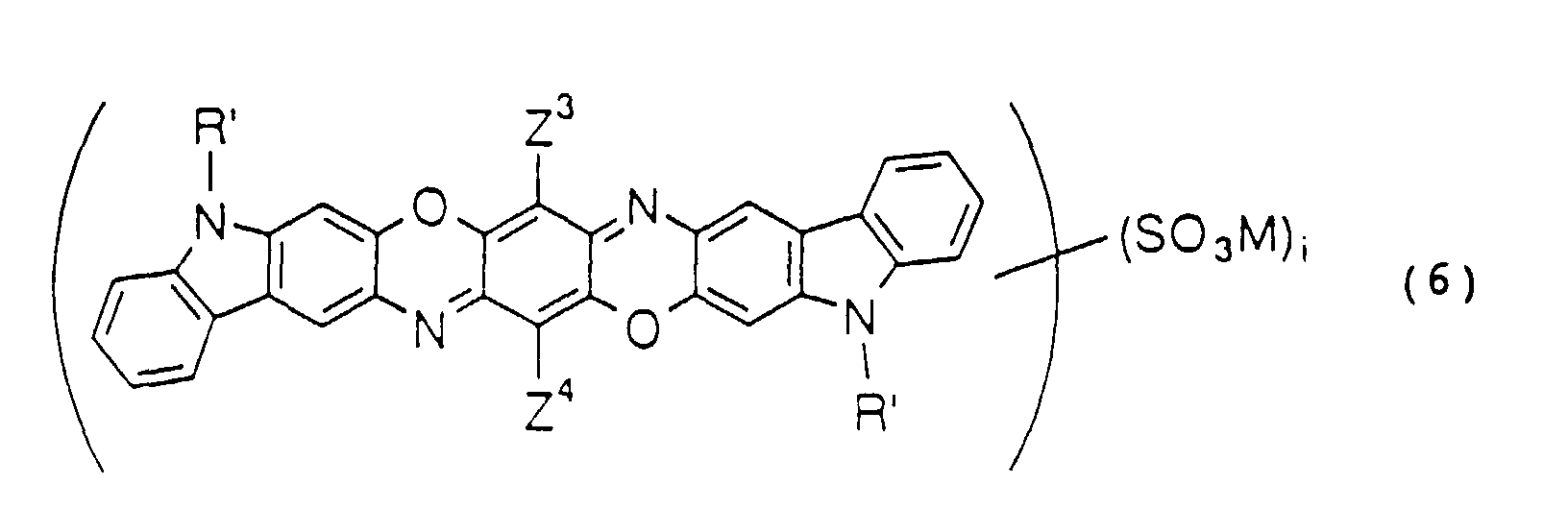
- R' represents a hydrogen atom or an alkyl group having 1 to 8 carbon atoms.
- alkyl groups having 1-8 carbon atoms represented by R' are methyl, ethyl, n-propyl, isopropyl, n-butyl, isobutyl,t-butyl, pentyl, hexyl, heptyl and octyl.
- each of Z 3 and Z 4 independently represents a hydrogen atom or a halogen atom.
- the halogen atom represented by Z 3 and Z 4 includes chlorine atom and bromine atom, the former being preferred.
- X and Y in the formula (3) are substituents.
- a typical example of the substituents represented by X is -A-(CH 2 ) 1 -B
- an example of the substituents represented by Y is -A'-(CH 2 ) n -B' (wherein each of A and A' independently represents a direct bond or a divalent bonding group selected from -SO 2 -, -CO-, -S-, -CH 2 NHCO-, -O-, -CR 1 R 2 -, -CONR 3 -, -SO 2 NR 4 - and -NR 5 -(wherein each of R 1 , R 2 , R 3 , R 4 and R 5 independently represents a hydrogen atom or a saturated or unsaturated aliphatic or aromatic group which may contain a chalcogen atom, a nitrogen atom and/or a halogen atom), and each of B and B' independently represents a hydrogen atom or a bonding group selected
- the metal atom is preferably an alkaline metal atom such as lithium, sodium or potassium atom
- the chalcogen atom is preferably oxygen or sulfur atom.
- Exemplary of the saturated or unsaturated aliphatic or aromatic groups which may contain a chalcogen atom, a nitrogen atom and/or a halogen atom are alkyl group, alkenyl group, cycloalkyl group, ester group, ether group, acyl group, aryl group, pyridinium group, chloropyridinium group, pyridyl group, pyridonyl group, piperidonyl group, morpholino group, furyl group, oxazolyl group, thienyl group, chlorobenzyl group and nitrobenzyl group.
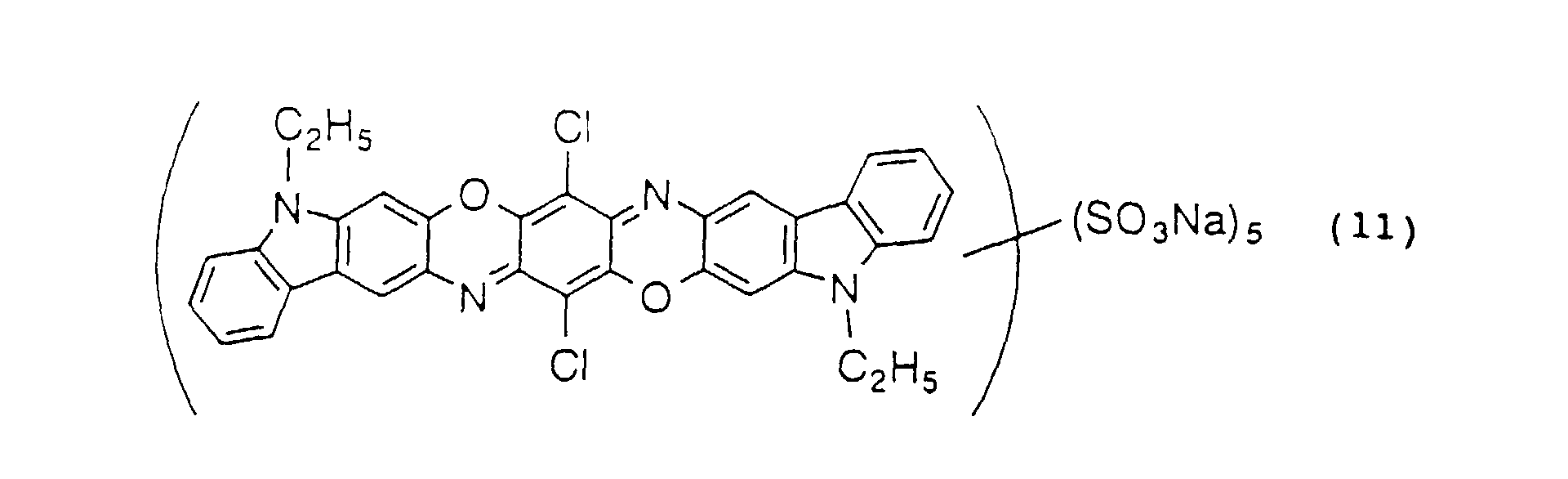
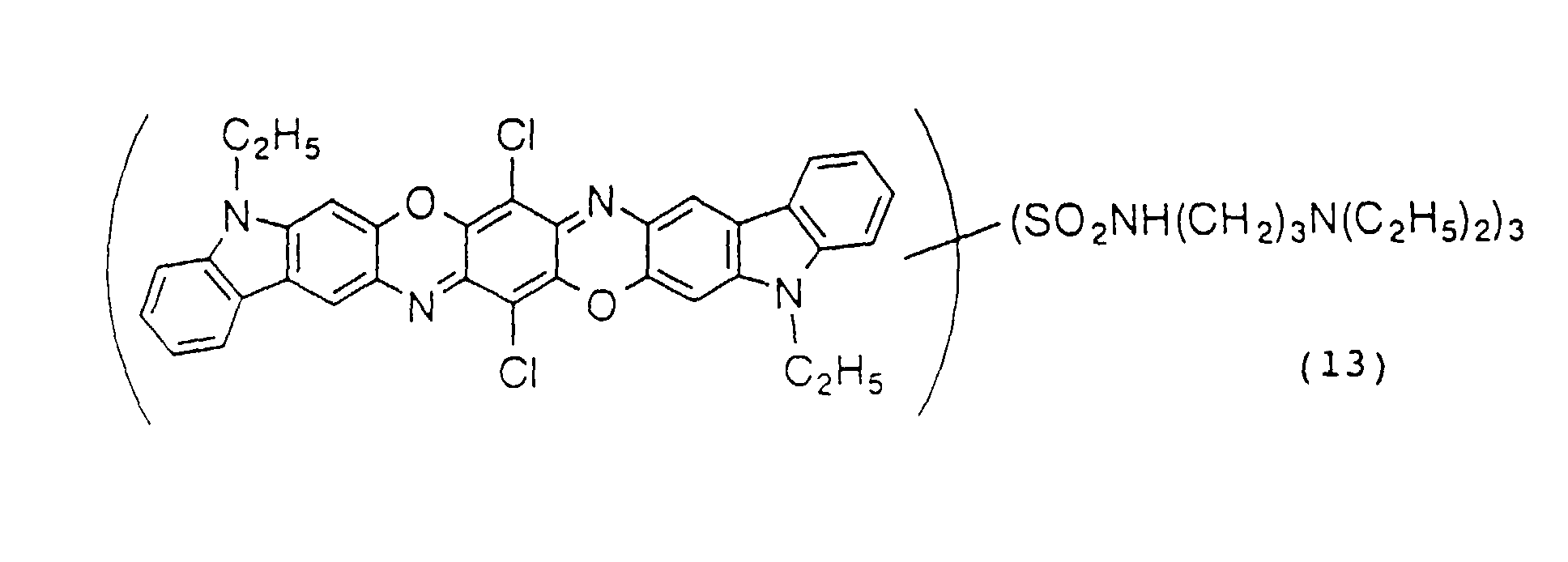
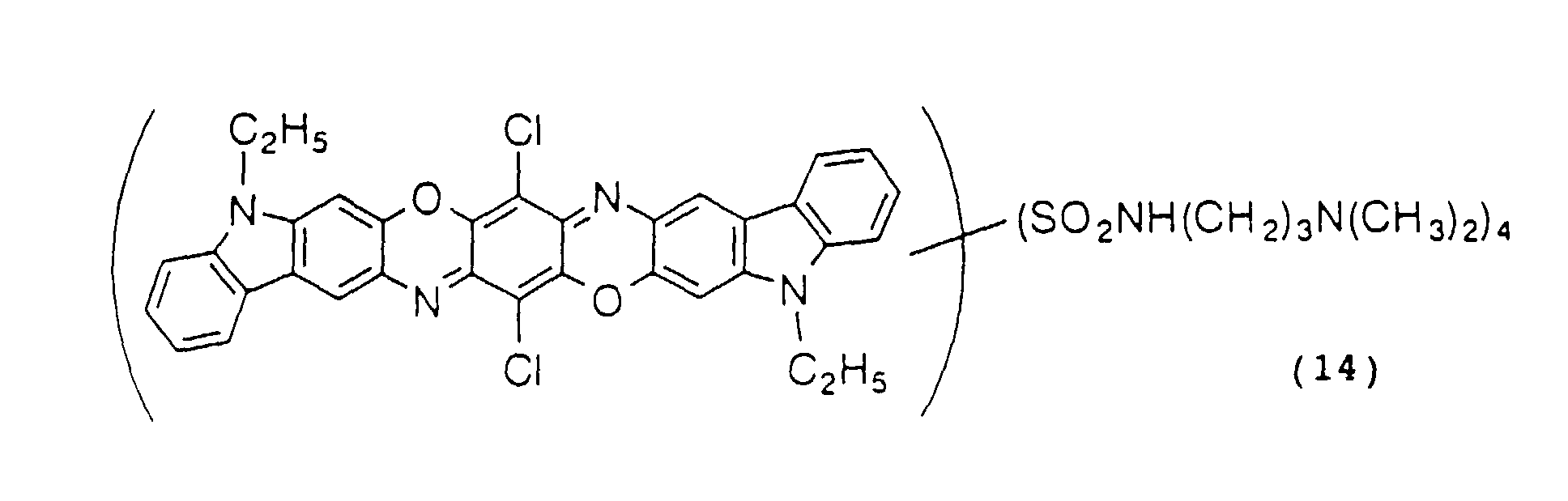
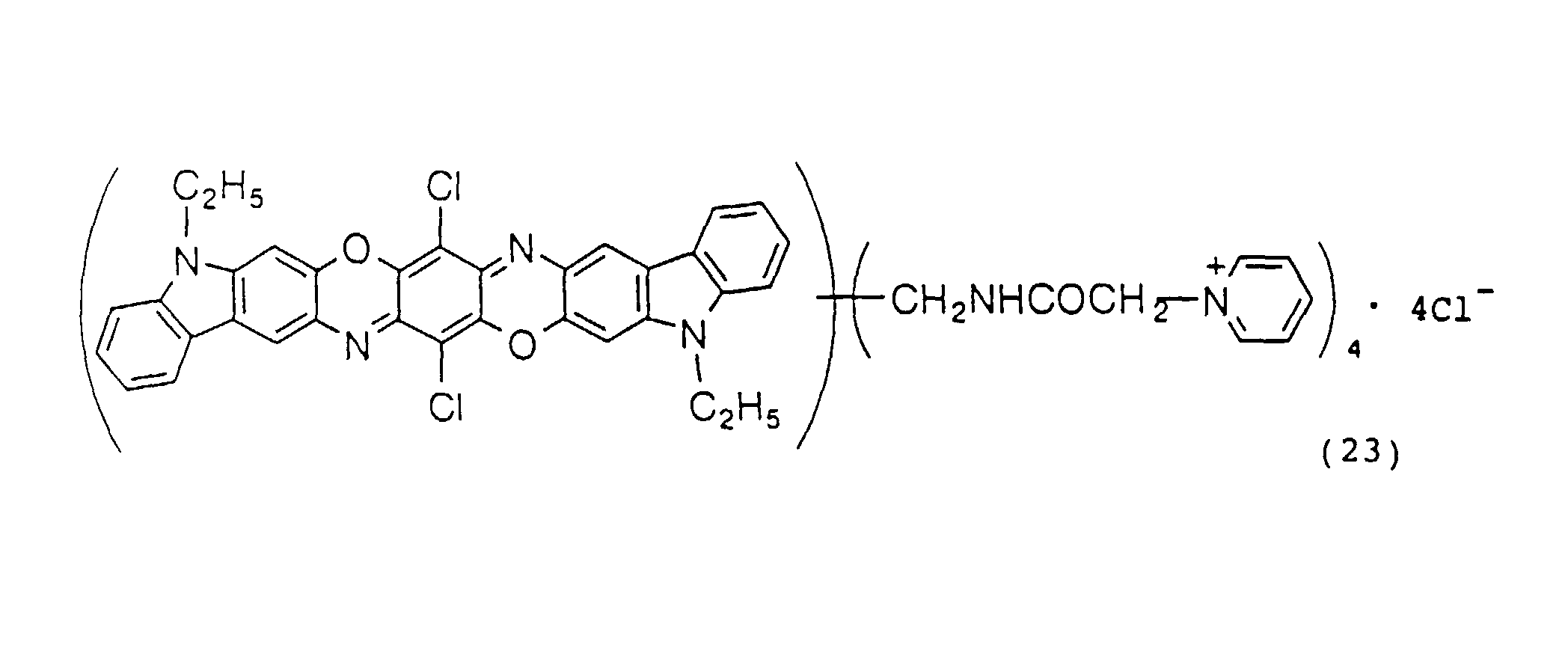
- Examples of the substituents represented by X and Y are -SO 3 M (M being a hydrogen atom or a metal atom), alkylaminosulfonyl group, alkylaminoalkylaminosulfonyl group, C 1-8 alkoxy group, phthalimidoalkyl group, oniumalkylcarbonylaminoalkyl group, alkylcarbonylaminoalkyl group, alkylaminoalkylcarbonylaminoalkyl group, -SO 2 N(R 11 ) 2 (wherein R 11 represents (CH 2 CH 2 O) n H (n being an integer of 1 to 30), alkylaminocarbonyl group and alkylaminoalkylaminocarbonyl group.
- M in -SO 3 M represents a hydrogen atom or a metal atom, for example, an alkaline metal atom such as lithium, sodium or potassium atom, or an alkaline earth metal atom such as magnesium or calcium atom.
- M is preferably a hydrogen atom or an alkaline metal atom, more preferably a hydrogen, sodium or potassium atom.
- Examples of -SO 3 M include sulfonic acid, lithium sulfonate, sodium sulfonate, potassium sulfonate, magnesium sulfonate and calcium sulfonate.
- alkylaminosulfonyl groups examples include (C 0 -C 4 )alkylaminosulfonyl groups such as N-methylaminosulfonyl group and N-ethylaminosulfonyl group, and di(C 0 -C 4 )alkylaminosulfonyl groups such as N-ethyl-N-methylaminosulfonyl group, dimethylaminosulfonyl group and dipropylaminosulfonyl group.
- alkylaminoalkylaminosulfonyl groups are (C 0 -C 4 )alkylamino(C 0 -C 4 )alkylaminosulfonyl groups such as N-methylaminopropylaminosulfonyl and N-ethylaminopropylaminosulfonyl, and di(C 0 -C 4 )alkylamino(C 0 -C 4 )alkylaminosulfonyl groups such as dimethylaminopropylaminosulfonyl, diethylaminopropylaminosulfonyl, dimethylaminomethylaminosulfonyl, diethylaminomethylaminosulfonyl, diethylaminoethylaminosulfonyl, di(n-propyl)aminomethylaminosulfonyl, di(n-propyl)aminomethylaminosulfonyl, di(n
- Examples of C 1 - 8 alkoxy groups are methoxy, ethoxy, n-propoxy, isopropoxy, n-butoxy, sec-butoxy, t-butoxy, pentyloxy, hexyloxy, heptyloxy and octyloxy.
- Examples of phthalimidoalkyl groups are phthalimido(C 0 -C 4 )alkyl groups such as phthalimidomethyl, nitrophthalimidomethyl, monochlorophthalimidomethyl and dichlorophthalimidomethyl.
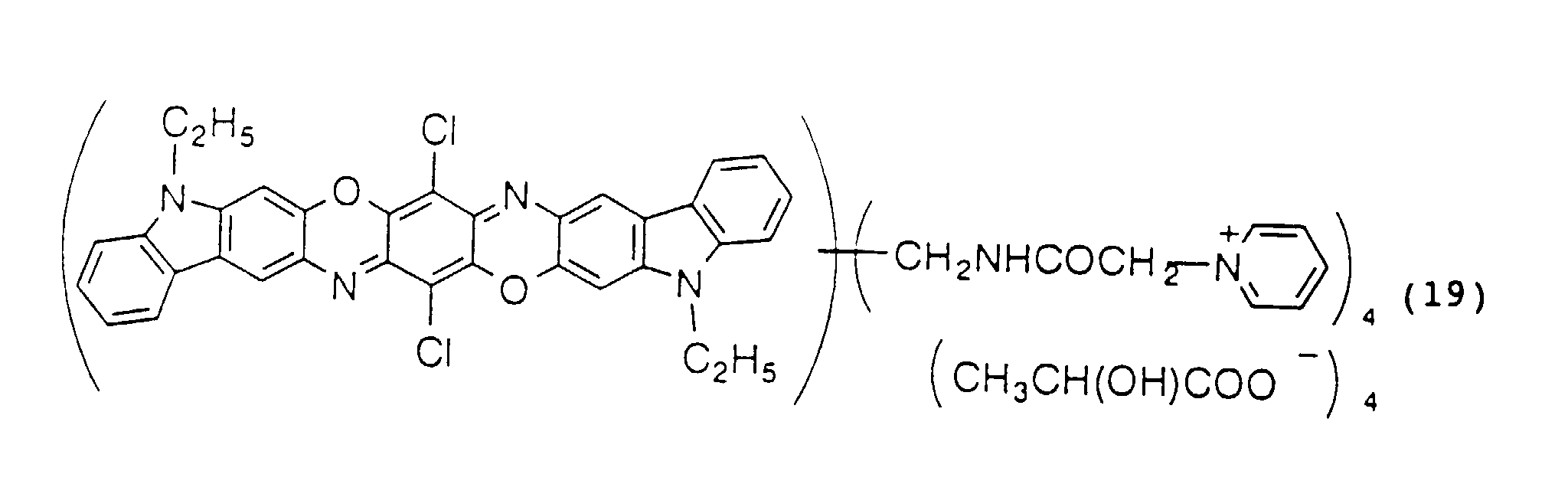
- Examples of oniumalkylcarbonylaminoalkyl groups are pyridiniumalkylcarbonylaminialkyl group and tetraalkylammoniumalkylcarbonylaminoalkyl group.
- Examples of pyridiniumalkylcarbonylaminoalkyl groups are pyridinium(C 0 -C 4 )alkylcarbonylamino(C 0 -C 4 )alkyl groups such as pyridiniummethylcarbonylaminomethyl.
- tetraalkylammoniumalkylcarbonylaminoalkyl groups are tetra(C 0 -C 4 )alkylammonium(C 0 -C 4 )alkylcarbonylamino(C 0 -C 4 )alkyl groups such as tetramethylammoniummethylcarbonylaminomethyl group.
- counter ions of onium are non-color development ions, for example, halogen ions such as a fluorine ion, a chlorine ion, a bromide ion and an iodine ion, sulfonic ions such as a sulfuric ion, methylsulfuric ion, a benzenesulfonic ion and methanesulfonic ion, fatty acid ions such as acetic ion, and lactic ions such as oxy acid ion and benzoic ion.
- -SO 2 N(R 11 ) are diethanolaminosulfonyl and di(polyethyleneglycol)aminosulfonyl groups.
- the polymerization degree of polyethylene glycol is about 1 to 30, preferably about 20 to 30.
- alkylcarbonylaminoalkyl groups are (C 0 -C 4 )alkylcarbonylamino(C 0 -C 4 )alkyl groups such as methylcarbonylaminopropyl and ethylcarbonylaminobutyl.
- alkylaminoalkylcarbonylaminoalkyl groups are (C 0 -C 4 )alkylcarbonylamino(C 0 -C 4 )alkyl groups such as dimethylaminopropylcarbonylaminopropyl and ethylaminomethylcarbonylaminobutyl.
- dialkylaminoalkylaminocarbonyl groups are dimethylaminopropylaminocarbonyl, diethylaminopropylaminocarbonyl, and N-methyl-N-propylaminopropylaminocarbonyl.
- R', Z 3 , Z 4 , X and Y in the formula (3) are the ones in which, for example, R' is a methyl, ethyl or propyl group, Z 3 is a hydrogen or chlorine atom, Z 4 is a hydrogen or chlorine atom, X is a salt of sulfonic group, an alkylaminoalkylaminosulfonyl group or oniumalkylcarbonylaminoalkyl group, and Y is a sulfonic group.
- the compounds of the formula (3) may be defined as the following compounds. That is, the compounds of the formula (3) includes sulfonic acid derivatives, sulfonamide derivatives, alkylether derivatives, alkylamide derivatives or carbonamide derivatives of the compounds of the formula (1).
- sulfonic acid derivatives include a compound in which -SO 3 M (M being a hydrogen atom or a metal atom) are bonded as substituent to the compound of the formula (1).
- Examples of sulfonamide derivatives include compounds in which an alkylaminosulfonyl group, an alkylaminoalkylaminosulfonyl group or a group of the formula -SO 2 N(R 11 ) (wherein R 11 is (CH 2 CH 2 O) n H (n being an integer of 1 to 30)) are bonded as substituent to the compound of the formula (1).
- Examples of alkylether derivatives include a compound in which a C 1-8 alkoxy group is bonded as substituent to the compound of the formula (1).
- alkylamide derivatives include compounds in which a phthalimidoalkyl group, an oniumalkylcarbonylaminoalkyl group, an alkylcarbonylaminoalkyl group or an alkylaminoalkylcarbonylaminoalkyl group are bonded as substituent to the compound of the formula (1).
- carbonamide derivatives include compounds in which an alkylaminocarbonyl group or an alkylaminoalkylaminocarbonyl group are bonded as substituent to the compound of the formula (1).
- alkylamide derivatives, sulfonic acid derivatives and sulfonamide derivatives of the compounds of the formula (1) are preferred.
- the sulfonic acid derivatives include a compound in which 1 to 6 sulfonic groups are bonded as substituent to the compound of the formula (1), a part or whole thereof being reduced to salts.
- Examples of the sulfonamide derivatives include a compound in which 1 to 5 alkylaminosulfonyl groups, alkylaminoalkylaminosulfonyl groups or groups of the formula-SO 2 N(R 11 ) 2 (wherein R 11 is (CH 2 CH 2 O) n H (n being an integer of 1 to 30)), and 0 to 3 sulfonic groups or salts thereof (the total number of substituents being 1 to 6) are bonded as substituent to the compound of the formula (1), preferably a compound in which 1 to 5 alkylaminoalkylaminosulfonyl groups and 0 to 3 sulfonic groups or salts thereof (the total number of the substituents being 1 to 6) are bonded to the compound of the formula (1).
- alkylamide derivatives of compounds of the formula (1) include compounds of the formula (1), to which 1 to 5 oniumalkylcarbonylaminoalkyl groups and 0 to 3 sulfonic groups or salts thereof (total number of substituents are 1 to 6), preferably 1 to 5 pyridiniumalkylcarbonylaminoalkyl groups, and 0 to 3 sulfonic groups or salts thereof (total number of substituents are 1 to 6) are bonded.
- the counter ion includes preferably chlorine ion, methylsulfuric ion, acetic ion and lactic ion.
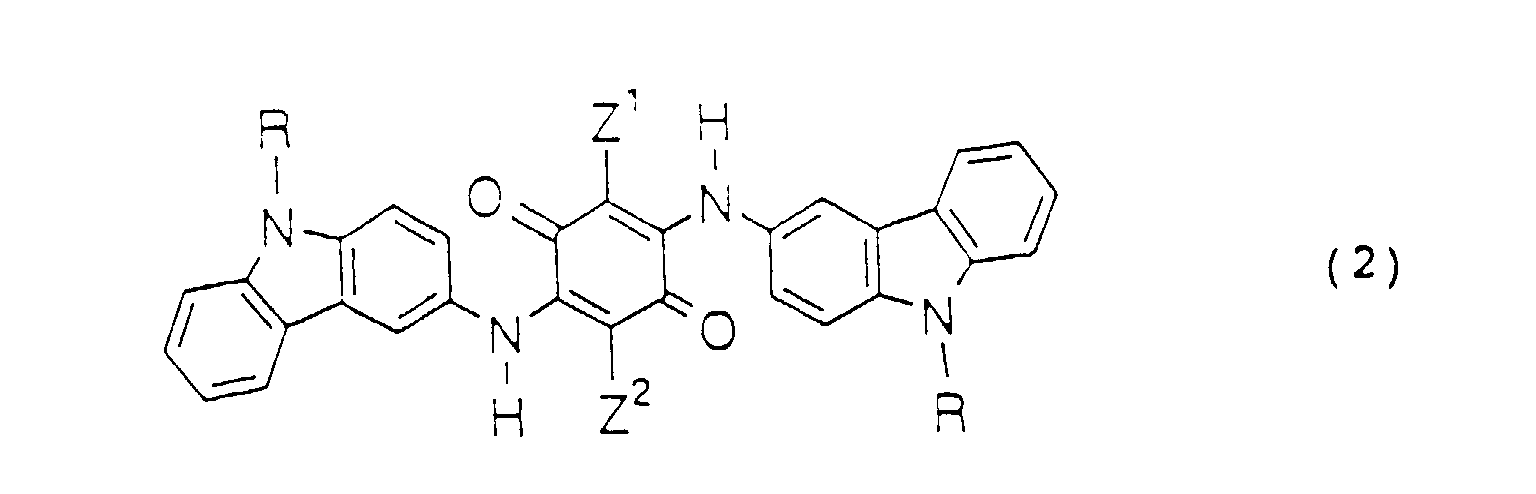
- a compound of the formula (2) is used as starting material for obtaining a compound of the formula (1).
- R is a hydrogen atom or an alkyl group having 1 to 8 carbon atoms. Examples of the alkyl groups having 1 to 8 carbon atoms represented by R are methyl, ethyl, n-propyl, isopropyl, n-butyl, isobutyl, t-butyl, pentyl, hexyl, heptyl and octyl.
- Each of Z 1 and Z 2 independently represents a hydrogen atom or a halogen atom such as chlorine atom or bromine atom, chlorine atom being preferred.
- An easily dispersible dioxazine compound of the formula (1) can be obtained by subjecting the compound of the formula (2) to a ring closure reaction at an elevated temperature in the presence of the compound of the formula (3) and if desired a ring-closing agent in an inert organic solvent.
- the reaction system may be heated under a reduced pressure.
- the amount of the compound of the formula (3) used falls within the range of from preferably about 0.005 to 0.3 part by weight, more preferably about 0.01 to 0.2 part by weight, per 1 part by weight of the compound of the formula (2).
- the compound of the formula (3) used in this invention may be a mixture of the compounds differing in number and type of substituents.
- the compound may be in the form of powder, a solution of aqueous, organic acid or organic solvent etc., or wet cake.
- Ring closure reaction time falls within the range of from preferably 0.5 to 6 hours, more preferably 1 to 5 hours, and reaction temperature falls within the range of from preferably 100 to 200°C, more preferably 150 to 180°C.
- the inert solvent used for the above reaction includes halogenated aromatic solvents such as chlorobenzene, dichlorobenzene, trichlorobenzene, bromobenzene, dibromobenzene, chloronaphthalene, chlorotoluene, dichlorotoluene and bromotoluene; alkylated aromatic solvents such as alkylbenzenes (toluene, xylene, mesitylene, ethylbenzene and diethylbenzene) and methylnaphthalene; nitrobenzene; alkanes and alkenes such as decane, dodecane, decene and dodecene. These solvents may be used either singly or as a mixture. The
- ring-closing agent there can be used sulfonic acid halides such as benzenesulfonyl chloride, toluenesulfonyl chloride, chlorobenzenesulfonyl chloride and nitrobenzenesulfonyl chloride, acid halides such as benzoyl chloride, and halides such as chloranil and dichloronaphthoquinone.
- benzenesulfonyl chloride, p-toluenesulfonyl chloride, m-nitrobenzenesulfonyl chloride, chlorobenzenesulfonyl chloride and the like are preferred.
- a ring-closing agent its amount used falls within the range of from preferably 0.1 to 5 moles, more preferably about 0.5 to 3 moles per 1 mole of the compound of the formula (2).
- the solution containing the dioxazine compound obtained by this invention is filtered to separate the objective substance. If necessary, the produced crystals may be washed with a solvent.
- acid coupling agent there can be used organic or inorganic alkalis, for example, weakly acidic alkali metal salts such as sodium carbonate and sodium acetate, and trialkylamines such as trimethylamine and triethylamine.
- weakly acidic alkali metal salts such as sodium carbonate and sodium acetate
- trialkylamines such as trimethylamine and triethylamine.
- a compound of the formula (3) may be added prior to the condensation reaction of the compound of the formula (5) and chloranil.
- a dioxazine compound having a plate-like crystal form of the present invention has thin plate-like crystal form as seen from the electron micrograph of FIG. 1.
- the plate-like crystal has a horizontal and vertical ratio of about 1:1 to 1:5, preferably 1:1 to 1:4 in the mean value of crystal size.
- the dioxazine crystals obtained according to the conventional processes are needles or prisms as seen in the electron micrograph of FIG. 2 and clearly different from the plate-like crystal from of the present invention.
- These plate-like crystal form can be obtained by subjecting the compound of the formula (2) to a ring closure reaction in the presence of a dioxazine compound derivative of the formula (6) having a sulfonyl group shown below (the compound of the formula (3) in which X is a sulfonic group such as SO 3 H or SO 3 Na, Z 3 and Z 4 are independently a hydrogen atom or a halogen atom, i is a number of 1 to 6, and j is 0).
- a dioxazine compound derivative of the formula (6) having a sulfonyl group shown below the compound of the formula (3) in which X is a sulfonic group such as SO 3 H or SO 3 Na, Z 3 and Z 4 are independently a hydrogen atom or a halogen atom, i is a number of 1 to 6, and j is 0).
- the colored materials of the present invention include, for example, inks, paints, synthetic resin films, synthetic resin plates, masterbatches made of synthetic resins, fibers, rubbers, pigment printing pastes, pigment printing dispersions and the like which have been colored with the compound of the formula (1) obtained according to the process of the present invention.
- the dioxazine compounds obtained according to the process of the present invention are useful as a coloring matter for pigment.
- these dioxazine compounds (pigment crude) are very suited as a coloring pigment for polymeric materials.
- this pigment crude is worked into a pigment in the usual way and used for coloring of ink, paint, resin, etc., or for pigment printing, there can be obtained excellent fastness properties such as light resistance, heat resistance and migration resistance, good fluidity and gloss of pigment, high coloring power, high dispersion stability, and unlikeliness of re-coagulation.
- the compounds of the formula (3) can be produced by the known processes such as mentioned below: a process of sulfonating a dioxazine compound of the formula (1) with sulfuric acid; a process of chlorosulfonating a dioxazine compound of the formula (1) and then reacting with an amine compound; a process of chloromethylating a dioxazine compound of the formula (1) and then reacting with an amine compound (JP-A-1-217078); a process of chloroacetoaminomethylating a dioxazine compound of the formula (1) and then reacting with an amine; a process of reacting a dioxazine compound of the formula (1) with N-methylolphthalimide in polyphosphoric acid (JP-A-4-246469).
- the reaction product was cooled and the produced crystals were filtered, washed with o-dichlorobenzene, methanol and water in that order and dried to give 12.8 parts of a dioxazine compound (a compound of the formula (1) wherein R is ethyl, and Z 1 and Z 2 are chlorine atom) in a plate-like crystal form.
- a dioxazine compound a compound of the formula (1) wherein R is ethyl, and Z 1 and Z 2 are chlorine atom
- reaction mixture On completion of condensation reaction, the reaction mixture was heated to 140-150°C under a reduced pressure, followed by adding 6 parts of p-toluenesulfonylchloride at the same temperature and stirring at 165-175°C for 2 hours for a reaction. On completion of the reaction, the reaction product was cooled and obtained crystals were filtered, washed with o-dichlorobenzene, methanol and water in that order and dried to give 12.6 parts of a dioxazine compound (a compound of the formula (1) wherein R is ethyl, and Z 1 and Z 2 are chlorine atom) in a plate-like crystal form.
- a dioxazine compound a compound of the formula (1) wherein R is ethyl, and Z 1 and Z 2 are chlorine atom
- the resulting mixture was heated to 140-150°C under a reduced pressure, followed by adding 8 parts of p-toluenesulfonyl chloride at the same temperature and stirring at 165-175°C for 5 hours for a reaction.
- the reaction product was cooled and produced crystals were filtered, washed with o-dichlorobenzene, methanol and water in that order and dried to give 17.5 parts of a dioxazine compound (a compound of the formula (1) wherein R is ethyl, and Z 1 and Z 2 are chlorine atom).
- reaction mixture On completion of condensation reaction, the reaction mixture was heated to 140-150°C under a reduced pressure, followed by adding 7 parts of p-toluenesulfonyl chloride at the same temperature and stirring at 165-175°C for 5 hours for a reaction. On completion of the reaction, the reaction product was cooled and produced crystals were filtered, washed with o-dichlorobenzene, methanol and water in that order and dried to give 12.3 parts of a dioxazine compound (a compound of the formula (1) wherein R is ethyl and Z 1 and Z 2 are chlorine atom).
- Example 17 The procedure of Example 17 was repeated except that the dioxazine compounds obtained in Examples 8 and 9 were used in place of the dioxazine compound obtained in Example 1 to prepare dispersed pigments.
- Example 17 The procedure of Example 17 was repeated except that the dioxazine compound obtained in Comparative Example 1 was used in place of the dioxazine compound obtained in Example 1 to prepare a dispersed pigment.
- Example 17 The procedure of Example 17 was repeated except that 21 parts of the dioxazine compound obtained in Comparative Example 1 and 1 part of the compound of the formula (7) were used in place of 22 parts of the dioxazine compound obtained in Example 1 to prepare a dispersed pigment.
- Each of the light-colored enamels was applied on art paper, and hue and density of the enamel coating were visually judged with the sample of Comparative Example 2 as reference.
- the color-strength was judged by comparison of the color-strength of ink containing a pre-determined amount of sample with that of standard samples containing respective content. Gloss was visually judged from deep-colored enamel coating on art paper.
- a high-quality pigment crude can be obtained easily, and the pigment prepared therefrom shows excellent fastness properties such as light resistance, heat resistance, migration resistance, etc., when used for tinting of paints, resins, etc., or for pigment printing.
- Such a pigment also has excellent fluidity and gloss as well as high coloring value.
Landscapes
- Chemical & Material Sciences (AREA)
- Organic Chemistry (AREA)
- Chemical Kinetics & Catalysis (AREA)
- Nitrogen And Oxygen Or Sulfur-Condensed Heterocyclic Ring Systems (AREA)
- Plural Heterocyclic Compounds (AREA)
- Pharmaceuticals Containing Other Organic And Inorganic Compounds (AREA)
- Paper (AREA)
Description








| Dioxazine compound used | Hue | Density | Gloss | |
| Example 17 | Example 1 | Reddish | 110 | Good |
| Example 18 | Example 8 | Reddish | 120 | Good |
| Example 19 | Example 9 | Reddish | 115 | Very good |
| Comp. Example 2 | Comp. Example 1 | Standard | Standard (100) | Standard |
| Comp. Example 3 | Comp. Example 1+ compound 7 | Bluish | 95 | Equal to standard |
Claims (20)
- A process for producing a dioxazine compound represented by the formula (1):wherein R represents a hydrogen atom or an alkyl group having 1 to 8 carbon atoms; and each of Z1 and Z2 independently represents a hydrogen atom or a halogen atom, which comprises subjecting a compound represented by the formula (2):
 wherein R, Z1 and Z2 are as defined above, to ring closure reaction in the presence of a compound represented by the formula (3):
 wherein R' represents a hydrogen atom or an alkyl group having 1 to 8 carbon atoms; each of Z3 and Z4 independently represents a hydrogen atom or a halogen atom; each of X and Y independently represents a substituent; i is a number of 0 to 6; and j is a number of 0 to 6, but i + j = 1 to 6, wherein the substituent represented by X in the formula (3) is -A-(CH2)l-B and the substituent represented by Y is -A'-(CH2)n-B' (wherein each of A and A' independently represents a direct bond or a divalent bonding group selected from -SO2-, -CO-, -S-, -CH2NHCO-, -O-, -CR1R2-, -CONR3-, -SO2NR4- and -NR5 (wherein each of R1, R2, R3, R4 and R5 independently represents a hydrogen atom or a saturated or unsaturated aliphatic or aromatic group which may contain a chalcogen atom, a nitrogen atom and/or a halogen atom); each of B and B' independently represents a hydrogen atom or a bonding group selected from -OR6 (wherein R6 represents a hydrogen atom, a metal atom or a saturated or unsaturated aliphatic or aromatic group which may contain a chalcogen atom, a nitrogen atom and/or a halogen atom), -NR7R8 and -R9 (wherein each of R7, R8 and R9 independently represents a hydrogen atom or a saturated or unsaturated aliphatic or aromatic group which may contain a chalcogen atom, a nitrogen atom and/or a halogen atom); and each of n and l independently represents a number of 0 to 8).
- The process according to Claim 1, wherein A is -SO2- or -SO2NR4-; 1 is a number of 0 to 8; B is -OR6, -NR7R8 or -R9; A' is -SO2-; n is 0; B' is -OR6; i is a number of 1 to 6; and j is a number of 0 to 5.
- The process according to Claim 1, wherein A is -O-, -CR1R2-, -CH2NHCO- or -CONR3 -; 1 is an integer of 0 to 8; B is a hydrogen atom or a bonding group selected from -OR6, -NR7R8 or -R9; i is an integer of 1 to 6; and j is 0.
- The process according to Claim 1, wherein the compound of the formula (3) is a sulfonic acid derivative, a sulfonamide derivative, an alkylether derivative, an alkylamide derivative or a carbonamide derivative of the compound of the formula (1).
- The process according to Claim 4, wherein the sulfonic acid derivative is a compound in which -SO3M (M being a hydrogen atom or a metal atom) is bonded to the compound of the formula (1); the sulfonamide derivative is a compound in which an alkylaminosulfonyl group, an alkylaminoalkylaminosulfonyl group or a group represented by the formula -SO2N(R11)2 (wherein R11 is (CH2CH2O)nH (n being a number of 1 to 30)) are bonded to the compound of the formula (1); the alkylether derivative is a compound in which an alkoxy group having 1-8 carbon atoms is bonded to the compound of the formula (1); the alkylamide derivative is a compound in which a phthalimidoalkyl group, an oniumalkylcarbonylaminoalkyl group, an alkylcarbonylaminoalkyl group or an alkylaminoalkylcarbonylaminoalkyl group are bonded to the compound of the formula (1); and the carbonamide derivative is a compound in which an alkylaminocarbonyl group or an alkylaminoalkylaminocarbonyl group are bonded to the compound of the formula (1).
- The process according to Claim 1, wherein the compound of the formula (3) is a sulfonic acid derivative of the compound of the formula (1).
- The process according to Claim 6, wherein the sulfonic acid derivative is a compound in which 1 to 6 sulfonic groups are bonded as substituents to the compound of the formula (1), a part or whole thereof being in the form of their salts.
- The process according to Claim 1, wherein the compound of the formula (3) is a sulfonamide derivative of the compound of the formula (1).
- The process according to Claim 8, wherein the sulfonamide derivative is a compound in which 1 to 5 alkylaminosulfonyl groups, alkylaminoalkylaminosulfonyl groups or groups of the formula -SO2N(R11)2 (wherein R11 is (CH2CH2O)nH (n being a number of 1 to 30)) and 0 to 3 sulfonic groups or salts thereof (the total number of substituents being 1 to 6) are bonded as substituents to the compound of the formula (1).
- The process according to Claim 1, wherein the compound of the formula (3) is an alkylamide derivative of the compound of the formula (1).
- The process according to Claim 10, wherein the alkylamide derivative is a compound in which 1 to 5 oniumalkylcarbonylaminoalkyl group and 0 to 3 sulfonic groups or salts thereof (the total number of substituents being 1 to 6) are bonded as substituents to the compound of the formula (1).
- The process according to Claim 11, wherein the oniumalkylcarbonylaminoalkyl group is a pyridiniumalkylcarbonylaminoalkyl group and the counter ion is chloride ion, lactic ion or methylsulfuric ion.
- The process according to Claim 7, 9 or 11, wherein the salt is an alkaline metal salt.
- The process according to Claim 1, wherein the amount of the compound of the formula (3) used falls within the range of from 0.005 to 0.3 part by weight per 1 part by weight of the compound of the formula (2).
- The process according to Claim 1, 4, 6, 8 or 10, wherein the ring closure reaction is carried out under heating at a temperature of from 100 to 200°C in the presence of the compound of the formula (3) in an amount of 0.005 to 0.3 part by weight per 1 part by weight of the compound of the formula (2) and a ring-closing agent.
- The process according to Claim 15, wherein the amount of the ring-closing agent used falls within the range of from 0.1 to 5 moles per 1 mole of the compound of the formula (2).
- Colored materials comprising the compound of the formula (1) synthesized according to the process of Claim 1.
- A dioxazine compound represented by the formula (1) set forth in Claim 1 having a plate-like crystal form having a vertical and horizontal ratio of 1:1 to 1:4 in the mean value of crystal size.
- Colored materials comprising a reaction product which is obtained by the reaction set forth in claim 1.
- A reaction product in a plate-like crystal form which is obtained by the reaction set forth in claim 1.
Applications Claiming Priority (3)
| Application Number | Priority Date | Filing Date | Title |
|---|---|---|---|
| JP137882/94 | 1994-05-30 | ||
| JP13788294 | 1994-05-30 | ||
| JP13788294 | 1994-05-30 |
Publications (2)
| Publication Number | Publication Date |
|---|---|
| EP0685530A1 EP0685530A1 (en) | 1995-12-06 |
| EP0685530B1 true EP0685530B1 (en) | 2000-01-12 |
Family
ID=15208897
Family Applications (1)
| Application Number | Title | Priority Date | Filing Date |
|---|---|---|---|
| EP95108101A Expired - Lifetime EP0685530B1 (en) | 1994-05-30 | 1995-05-27 | Process for producing dioxazine compounds, colored materials therewith and dioxazine compounds having a plate-like crystal form |
Country Status (6)
| Country | Link |
|---|---|
| US (2) | US5734050A (en) |
| EP (1) | EP0685530B1 (en) |
| KR (1) | KR950032473A (en) |
| CN (1) | CN1064063C (en) |
| DE (1) | DE69514415T2 (en) |
| TW (1) | TW412536B (en) |
Families Citing this family (6)
| Publication number | Priority date | Publication date | Assignee | Title |
|---|---|---|---|---|
| US6264733B1 (en) | 1999-02-02 | 2001-07-24 | Ciba Specialty Chemicals Corporation | Pigment particle growth and/or crystal phase directors |
| US6225472B1 (en) | 1999-02-02 | 2001-05-01 | Ciba Specialty Chemicals Corporation | 6,13-dihydroquinacridone derivatives |
| JP4689913B2 (en) | 1999-10-01 | 2011-06-01 | キャボット コーポレイション | Modified pigments having steric groups and amphiphilic groups |
| US6476222B2 (en) * | 2001-01-05 | 2002-11-05 | Sun Chemical Corporation | Preparation of heat stable pigment violet 23 |
| GB2468561B (en) * | 2007-07-31 | 2011-11-16 | Dainippon Ink & Chemicals | Colouring powder composition comprising a dioxazine sulfamoyl compound |
| WO2021226941A1 (en) * | 2020-05-14 | 2021-11-18 | Dic株式会社 | Dioxazine pigment composition and method for manufacturing same |
Family Cites Families (17)
| Publication number | Priority date | Publication date | Assignee | Title |
|---|---|---|---|---|
| DE2742575C2 (en) * | 1977-09-22 | 1982-05-19 | Hoechst Ag, 6000 Frankfurt | Process for the fine distribution of pigments of the dioxazine series |
| JPS5632548A (en) * | 1979-08-23 | 1981-04-02 | Sumitomo Chem Co Ltd | Preparation of stable type dioxazine violet pigment |
| JPS6011986B2 (en) | 1980-04-07 | 1985-03-29 | 住友化学工業株式会社 | Method for producing dioxazine compounds |
| FR2515668A1 (en) * | 1981-11-02 | 1983-05-06 | Sandoz Sa | NOVEL DIOXAZINE COMPOUNDS, THEIR PREPARATION AND THEIR USE AS PIGMENTS |
| DE3239321A1 (en) * | 1981-11-02 | 1983-05-11 | Sandoz-Patent-GmbH, 7850 Lörrach | Dioxazine compounds |
| JPS58120673A (en) * | 1982-01-12 | 1983-07-18 | Sumitomo Chem Co Ltd | Production of stabilized type dioxazine violet pigment |
| JPS6011986A (en) * | 1983-06-30 | 1985-01-22 | 株式会社東芝 | Money processor |
| US4751300A (en) * | 1986-02-19 | 1988-06-14 | Sumitomo Chemical Company, Limited | Production of dioxazine compound |
| JPH01217078A (en) | 1988-02-25 | 1989-08-30 | Toyo Ink Mfg Co Ltd | Pigment dispersants and pigment compositions |
| JPH0774313B2 (en) * | 1988-10-07 | 1995-08-09 | 東洋インキ製造株式会社 | Method for producing easily dispersible pigment |
| JPH0774312B2 (en) * | 1988-10-07 | 1995-08-09 | 東洋インキ製造株式会社 | Pigment manufacturing method |
| US5275654A (en) | 1989-02-24 | 1994-01-04 | Shell Oil Corporation | Cement sealing |
| JPH04246469A (en) | 1991-02-01 | 1992-09-02 | Toyo Ink Mfg Co Ltd | Pigment composition |
| JP3337234B2 (en) * | 1991-03-22 | 2002-10-21 | クラリアント・ゲゼルシヤフト・ミト・ベシユレンクテル・ハフツング | New pigment preparations based on dioxazine compounds |
| JP3388591B2 (en) * | 1991-03-22 | 2003-03-24 | クラリアント・ゲゼルシヤフト・ミト・ベシユレンクテル・ハフツング | Method for the production of pigment preparations based on C.I. Pigment Violet 23 |
| JPH0611986A (en) * | 1992-06-26 | 1994-01-21 | Seiko Epson Corp | Fixing device |
| EP0606632A1 (en) * | 1992-12-25 | 1994-07-20 | Sumitomo Chemical Company, Limited | Pigment compounds and application thereof |
-
1995
- 1995-05-25 US US08/450,192 patent/US5734050A/en not_active Expired - Fee Related
- 1995-05-26 TW TW084105354A patent/TW412536B/en not_active IP Right Cessation
- 1995-05-26 KR KR1019950013436A patent/KR950032473A/en not_active Ceased
- 1995-05-27 DE DE69514415T patent/DE69514415T2/en not_active Expired - Fee Related
- 1995-05-27 EP EP95108101A patent/EP0685530B1/en not_active Expired - Lifetime
- 1995-05-29 CN CN95105592A patent/CN1064063C/en not_active Expired - Fee Related
-
1997
- 1997-09-25 US US08/937,903 patent/US5859242A/en not_active Expired - Fee Related
Also Published As
| Publication number | Publication date |
|---|---|
| US5859242A (en) | 1999-01-12 |
| DE69514415D1 (en) | 2000-02-17 |
| DE69514415T2 (en) | 2000-08-24 |
| US5734050A (en) | 1998-03-31 |
| CN1064063C (en) | 2001-04-04 |
| EP0685530A1 (en) | 1995-12-06 |
| KR950032473A (en) | 1995-12-20 |
| TW412536B (en) | 2000-11-21 |
| CN1113505A (en) | 1995-12-20 |
Similar Documents
| Publication | Publication Date | Title |
|---|---|---|
| KR100218024B1 (en) | Inner salts of perylene compounds, process for their preparation and their use | |
| US5780627A (en) | Fluorescent dioxazine pigments | |
| CA2064881C (en) | Perylene compounds containing sulphonic groups, process for preparing them and their use | |
| JP2931087B2 (en) | Novel composition based on diketopyrrolopyrrole | |
| US5368641A (en) | Modified 2,9-dimethylquinacridone pigments, process for their manufacture and a method for pigmenting or lacquer systems with these pigments | |
| JPH01213366A (en) | Novel pigment and use thereof | |
| JPS6317101B2 (en) | ||
| KR19990072803A (en) | Perylene compounds and pigment preparations | |
| KR20000070575A (en) | Thiazine indigo pigments, solid solutions thereof and their preparation | |
| US5734050A (en) | Process for producing dioxazine compounds, colored materials therewith and dioxazine compounds having a plate-like crystal form | |
| JPH0572943B2 (en) | ||
| CA1337143C (en) | Pigment preparations | |
| US4751300A (en) | Production of dioxazine compound | |
| JPH0848687A (en) | Production of dioxazine compound, coloring material and plate-like crystal | |
| US5556456A (en) | Pigment compositions | |
| JPH11310726A (en) | New triphendioxazine pigment | |
| KR20020032324A (en) | Mixed crystals of benzimidazolonedioxazine compounds | |
| US20010031863A1 (en) | New triphendioxazine pigments | |
| JP4536909B2 (en) | Pigment dispersant and pigment composition containing the same | |
| JP4808884B2 (en) | Method for producing pyrimido [5,4-g] pteridine derivative | |
| JP3287437B2 (en) | Method for producing dioxazine compound | |
| JPH0848905A (en) | Production of mixture of dioxadine compounds | |
| JP2012512293A (en) | Dyes for polymer coloring, methods for their preparation and their use | |
| JPH0134271B2 (en) | ||
| JPH0521946B2 (en) |
Legal Events
| Date | Code | Title | Description |
|---|---|---|---|
| PUAI | Public reference made under article 153(3) epc to a published international application that has entered the european phase |
Free format text: ORIGINAL CODE: 0009012 |
|
| AK | Designated contracting states |
Kind code of ref document: A1 Designated state(s): CH DE FR GB IT LI |
|
| 17P | Request for examination filed |
Effective date: 19951208 |
|
| 17Q | First examination report despatched |
Effective date: 19981006 |
|
| GRAG | Despatch of communication of intention to grant |
Free format text: ORIGINAL CODE: EPIDOS AGRA |
|
| GRAG | Despatch of communication of intention to grant |
Free format text: ORIGINAL CODE: EPIDOS AGRA |
|
| GRAH | Despatch of communication of intention to grant a patent |
Free format text: ORIGINAL CODE: EPIDOS IGRA |
|
| GRAH | Despatch of communication of intention to grant a patent |
Free format text: ORIGINAL CODE: EPIDOS IGRA |
|
| GRAA | (expected) grant |
Free format text: ORIGINAL CODE: 0009210 |
|
| AK | Designated contracting states |
Kind code of ref document: B1 Designated state(s): CH DE FR GB IT LI |
|
| PG25 | Lapsed in a contracting state [announced via postgrant information from national office to epo] |
Ref country code: IT Free format text: LAPSE BECAUSE OF FAILURE TO SUBMIT A TRANSLATION OF THE DESCRIPTION OR TO PAY THE FEE WITHIN THE PRE;WARNING: LAPSES OF ITALIAN PATENTS WITH EFFECTIVE DATE BEFORE 2007 MAY HAVE OCCURRED AT ANY TIME BEFORE 2007. THE CORRECT EFFECTIVE DATE MAY BE DIFFERENT FROM THE ONE RECORDED.SCRIBED TIME-LIMIT Effective date: 20000112 Ref country code: FR Free format text: LAPSE BECAUSE OF FAILURE TO SUBMIT A TRANSLATION OF THE DESCRIPTION OR TO PAY THE FEE WITHIN THE PRESCRIBED TIME-LIMIT Effective date: 20000112 |
|
| REG | Reference to a national code |
Ref country code: CH Ref legal event code: EP |
|
| REF | Corresponds to: |
Ref document number: 69514415 Country of ref document: DE Date of ref document: 20000217 |
|
| REG | Reference to a national code |
Ref country code: CH Ref legal event code: NV Representative=s name: AMMANN PATENTANWAELTE AG BERN |
|
| PG25 | Lapsed in a contracting state [announced via postgrant information from national office to epo] |
Ref country code: GB Free format text: LAPSE BECAUSE OF NON-PAYMENT OF DUE FEES Effective date: 20000527 |
|
| EN | Fr: translation not filed | ||
| PLBE | No opposition filed within time limit |
Free format text: ORIGINAL CODE: 0009261 |
|
| STAA | Information on the status of an ep patent application or granted ep patent |
Free format text: STATUS: NO OPPOSITION FILED WITHIN TIME LIMIT |
|
| 26N | No opposition filed | ||
| GBPC | Gb: european patent ceased through non-payment of renewal fee |
Effective date: 20000527 |
|
| PGFP | Annual fee paid to national office [announced via postgrant information from national office to epo] |
Ref country code: CH Payment date: 20010530 Year of fee payment: 7 |
|
| PGFP | Annual fee paid to national office [announced via postgrant information from national office to epo] |
Ref country code: DE Payment date: 20010711 Year of fee payment: 7 |
|
| PG25 | Lapsed in a contracting state [announced via postgrant information from national office to epo] |
Ref country code: LI Free format text: LAPSE BECAUSE OF NON-PAYMENT OF DUE FEES Effective date: 20020531 Ref country code: CH Free format text: LAPSE BECAUSE OF NON-PAYMENT OF DUE FEES Effective date: 20020531 |
|
| PG25 | Lapsed in a contracting state [announced via postgrant information from national office to epo] |
Ref country code: DE Free format text: LAPSE BECAUSE OF NON-PAYMENT OF DUE FEES Effective date: 20021203 |
|
| REG | Reference to a national code |
Ref country code: CH Ref legal event code: PL |