EP0685072B1 - Apparatus and method for monitoring the growth of micro-organisms in culture bottles - Google Patents
Apparatus and method for monitoring the growth of micro-organisms in culture bottles Download PDFInfo
- Publication number
- EP0685072B1 EP0685072B1 EP94906278A EP94906278A EP0685072B1 EP 0685072 B1 EP0685072 B1 EP 0685072B1 EP 94906278 A EP94906278 A EP 94906278A EP 94906278 A EP94906278 A EP 94906278A EP 0685072 B1 EP0685072 B1 EP 0685072B1
- Authority
- EP
- European Patent Office
- Prior art keywords
- bottle
- array
- bottles
- micro
- growth
- Prior art date
- Legal status (The legal status is an assumption and is not a legal conclusion. Google has not performed a legal analysis and makes no representation as to the accuracy of the status listed.)
- Expired - Lifetime
Links
- 238000012544 monitoring process Methods 0.000 title claims abstract description 25
- 244000005700 microbiome Species 0.000 title claims description 32
- 238000000034 method Methods 0.000 title claims description 6
- 230000004913 activation Effects 0.000 claims description 2
- 238000006073 displacement reaction Methods 0.000 claims description 2
- 230000033001 locomotion Effects 0.000 description 5
- 238000009640 blood culture Methods 0.000 description 3
- 238000011835 investigation Methods 0.000 description 3
- 239000008280 blood Substances 0.000 description 2
- 210000004369 blood Anatomy 0.000 description 2
- 230000004044 response Effects 0.000 description 2
- 238000006467 substitution reaction Methods 0.000 description 2
- 230000000007 visual effect Effects 0.000 description 2
- 230000005856 abnormality Effects 0.000 description 1
- XAGFODPZIPBFFR-UHFFFAOYSA-N aluminium Chemical compound [Al] XAGFODPZIPBFFR-UHFFFAOYSA-N 0.000 description 1
- 229910052782 aluminium Inorganic materials 0.000 description 1
- 239000004411 aluminium Substances 0.000 description 1
- 230000009977 dual effect Effects 0.000 description 1
- 239000001963 growth medium Substances 0.000 description 1
- 238000005286 illumination Methods 0.000 description 1
- 238000011534 incubation Methods 0.000 description 1
- 230000003993 interaction Effects 0.000 description 1
- 239000007788 liquid Substances 0.000 description 1
- 238000009630 liquid culture Methods 0.000 description 1
- 239000003550 marker Substances 0.000 description 1
- 230000000737 periodic effect Effects 0.000 description 1
- 229920003023 plastic Polymers 0.000 description 1
- 239000004033 plastic Substances 0.000 description 1
Images


Classifications
-
- C—CHEMISTRY; METALLURGY
- C12—BIOCHEMISTRY; BEER; SPIRITS; WINE; VINEGAR; MICROBIOLOGY; ENZYMOLOGY; MUTATION OR GENETIC ENGINEERING
- C12M—APPARATUS FOR ENZYMOLOGY OR MICROBIOLOGY; APPARATUS FOR CULTURING MICROORGANISMS FOR PRODUCING BIOMASS, FOR GROWING CELLS OR FOR OBTAINING FERMENTATION OR METABOLIC PRODUCTS, i.e. BIOREACTORS OR FERMENTERS
- C12M41/00—Means for regulation, monitoring, measurement or control, e.g. flow regulation
- C12M41/40—Means for regulation, monitoring, measurement or control, e.g. flow regulation of pressure
-
- C—CHEMISTRY; METALLURGY
- C12—BIOCHEMISTRY; BEER; SPIRITS; WINE; VINEGAR; MICROBIOLOGY; ENZYMOLOGY; MUTATION OR GENETIC ENGINEERING
- C12M—APPARATUS FOR ENZYMOLOGY OR MICROBIOLOGY; APPARATUS FOR CULTURING MICROORGANISMS FOR PRODUCING BIOMASS, FOR GROWING CELLS OR FOR OBTAINING FERMENTATION OR METABOLIC PRODUCTS, i.e. BIOREACTORS OR FERMENTERS
- C12M23/00—Constructional details, e.g. recesses, hinges
- C12M23/02—Form or structure of the vessel
- C12M23/08—Flask, bottle or test tube
-
- G—PHYSICS
- G01—MEASURING; TESTING
- G01N—INVESTIGATING OR ANALYSING MATERIALS BY DETERMINING THEIR CHEMICAL OR PHYSICAL PROPERTIES
- G01N35/00—Automatic analysis not limited to methods or materials provided for in any single one of groups G01N1/00 - G01N33/00; Handling materials therefor
- G01N35/00584—Control arrangements for automatic analysers
- G01N35/0092—Scheduling
-
- G—PHYSICS
- G01—MEASURING; TESTING
- G01N—INVESTIGATING OR ANALYSING MATERIALS BY DETERMINING THEIR CHEMICAL OR PHYSICAL PROPERTIES
- G01N35/00—Automatic analysis not limited to methods or materials provided for in any single one of groups G01N1/00 - G01N33/00; Handling materials therefor
- G01N35/02—Automatic analysis not limited to methods or materials provided for in any single one of groups G01N1/00 - G01N33/00; Handling materials therefor using a plurality of sample containers moved by a conveyor system past one or more treatment or analysis stations
- G01N35/026—Automatic analysis not limited to methods or materials provided for in any single one of groups G01N1/00 - G01N33/00; Handling materials therefor using a plurality of sample containers moved by a conveyor system past one or more treatment or analysis stations having blocks or racks of reaction cells or cuvettes
-
- G—PHYSICS
- G01—MEASURING; TESTING
- G01N—INVESTIGATING OR ANALYSING MATERIALS BY DETERMINING THEIR CHEMICAL OR PHYSICAL PROPERTIES
- G01N35/00—Automatic analysis not limited to methods or materials provided for in any single one of groups G01N1/00 - G01N33/00; Handling materials therefor
- G01N35/00584—Control arrangements for automatic analysers
- G01N35/00722—Communications; Identification
- G01N35/00732—Identification of carriers, materials or components in automatic analysers
- G01N2035/00742—Type of codes
- G01N2035/00752—Type of codes bar codes
-
- G—PHYSICS
- G01—MEASURING; TESTING
- G01N—INVESTIGATING OR ANALYSING MATERIALS BY DETERMINING THEIR CHEMICAL OR PHYSICAL PROPERTIES
- G01N35/00—Automatic analysis not limited to methods or materials provided for in any single one of groups G01N1/00 - G01N33/00; Handling materials therefor
- G01N35/02—Automatic analysis not limited to methods or materials provided for in any single one of groups G01N1/00 - G01N33/00; Handling materials therefor using a plurality of sample containers moved by a conveyor system past one or more treatment or analysis stations
- G01N35/04—Details of the conveyor system
- G01N2035/0401—Sample carriers, cuvettes or reaction vessels
- G01N2035/0418—Plate elements with several rows of samples
- G01N2035/042—Plate elements with several rows of samples moved independently, e.g. by fork manipulator
-
- G—PHYSICS
- G01—MEASURING; TESTING
- G01N—INVESTIGATING OR ANALYSING MATERIALS BY DETERMINING THEIR CHEMICAL OR PHYSICAL PROPERTIES
- G01N35/00—Automatic analysis not limited to methods or materials provided for in any single one of groups G01N1/00 - G01N33/00; Handling materials therefor
- G01N35/02—Automatic analysis not limited to methods or materials provided for in any single one of groups G01N1/00 - G01N33/00; Handling materials therefor using a plurality of sample containers moved by a conveyor system past one or more treatment or analysis stations
- G01N35/04—Details of the conveyor system
- G01N2035/046—General conveyor features
- G01N2035/0465—Loading or unloading the conveyor
-
- G—PHYSICS
- G01—MEASURING; TESTING
- G01N—INVESTIGATING OR ANALYSING MATERIALS BY DETERMINING THEIR CHEMICAL OR PHYSICAL PROPERTIES
- G01N35/00—Automatic analysis not limited to methods or materials provided for in any single one of groups G01N1/00 - G01N33/00; Handling materials therefor
- G01N35/02—Automatic analysis not limited to methods or materials provided for in any single one of groups G01N1/00 - G01N33/00; Handling materials therefor using a plurality of sample containers moved by a conveyor system past one or more treatment or analysis stations
- G01N35/04—Details of the conveyor system
- G01N2035/0496—Other details
- G01N2035/0498—Drawers used as storage or dispensing means for vessels or cuvettes
-
- Y—GENERAL TAGGING OF NEW TECHNOLOGICAL DEVELOPMENTS; GENERAL TAGGING OF CROSS-SECTIONAL TECHNOLOGIES SPANNING OVER SEVERAL SECTIONS OF THE IPC; TECHNICAL SUBJECTS COVERED BY FORMER USPC CROSS-REFERENCE ART COLLECTIONS [XRACs] AND DIGESTS
- Y10—TECHNICAL SUBJECTS COVERED BY FORMER USPC
- Y10T—TECHNICAL SUBJECTS COVERED BY FORMER US CLASSIFICATION
- Y10T436/00—Chemistry: analytical and immunological testing
- Y10T436/11—Automated chemical analysis
-
- Y—GENERAL TAGGING OF NEW TECHNOLOGICAL DEVELOPMENTS; GENERAL TAGGING OF CROSS-SECTIONAL TECHNOLOGIES SPANNING OVER SEVERAL SECTIONS OF THE IPC; TECHNICAL SUBJECTS COVERED BY FORMER USPC CROSS-REFERENCE ART COLLECTIONS [XRACs] AND DIGESTS
- Y10—TECHNICAL SUBJECTS COVERED BY FORMER USPC
- Y10T—TECHNICAL SUBJECTS COVERED BY FORMER US CLASSIFICATION
- Y10T436/00—Chemistry: analytical and immunological testing
- Y10T436/11—Automated chemical analysis
- Y10T436/113332—Automated chemical analysis with conveyance of sample along a test line in a container or rack
- Y10T436/114165—Automated chemical analysis with conveyance of sample along a test line in a container or rack with step of insertion or removal from test line
Definitions
- This invention concerns monitoring and relates to apparatus and methods for monitoring the growth of micro-organisms in culture bottles.
- EP-A-252471 discloses a monitoring arrangement in which test pack trays are removably located in test pack drawers in a housing.
- the trays, but not the individual test packs, are referenced with a unique code which is detected by an X/Y scanner at the same time as the individual test packs are monitored. Data from the scanner is fed to a computer.
- the computer is thus able to relate the individual test pack signals to particular trays, but the location of any particular test pack to which particular data relates is unknown.
- This problem is overcome by means of a sorter controller, which maps a computer associated memory with the positions of individual test packs in each tray when the trays are loaded. The map thus requires to be updated if the test packs are re-arranged.
- the present invention provides apparatus for monitoring the growth of micro-organisms in culture bottles, comprising a unit having one or more supports each adapted to receive a plurality of culture bottles in an array in which the bottles are re-locatable, each culture bottle having a unique machine-readable identifying reference associated therewith, sensor means for intermittently and repeatedly monitoring each bottle in the array both to monitor changes in a variable associated with growth of micro-organisms in the bottle and to read the reference associated therewith, and means for supplying data relating to the monitored growth of micro-organisms in the bottles, together with the references associated with the bottles, to computer means, wherein the computer means is programmed to relate the monitored growth of micro-organisms associated with each bottle to the identifying reference of that bottle independently of the location of the bottle in the array.
- the computer By having a unique machine-readable reference associated with each bottle which is read and by having data thereon supplied to the computer means together with data on the monitored variable, the computer is able to monitor data on the variable of a particular bottle regardless of the location of the bottle within the array and regardless of changes of location of bottles in the array. Monitoring is thus linked to the bottle independently of location in the array. This means that bottles can be moved within the array at will, e.g. for "housekeeping" purposes, without affecting monitoring. There is further no need to allocate a particular location in the array to a particular bottle, with the risk of inadvertent substitutions. There is similarly no need to keep a location free for a bottle temporarily removed from the array, e.g. for further investigation.
- the invention finds particular application in monitoring micro-organism growth in liquid culture, e.g. blood samples, in gas-tight containers each incorporating a flexible diaphragm capable of moving in response to pressure changes within the container, by detecting displacement of the diaphragm, wherein the position or conformation of the diaphragm is repeatedly sensed using distance-measuring means such as a laser, eg. as disclosed in WO93/03178, priority date 02.08.1991, publication date 18.02.1993.
- distance-measuring means such as a laser, eg. as disclosed in WO93/03178, priority date 02.08.1991, publication date 18.02.1993.
- micro-organism growth is monitored by measuring the diaphragm position, which is indicative of internal pressure, which in turn is indicative of micro-organism growth.
- Other variables indicative of micro-organism growth such as temperature, colour, electrical properties, etc, could alternatively be monitored.
- the support conveniently comprises a generally stationary holder such as a drawer in a housing, with respect to which the sensor means moves to monitor the bottles in turn.
- the support can be movable for presenting bottles in the array in turn to generally stationary sensor means, eg. with the supports arranged as a carousel.
- the machine-readable reference conveniently comprises a barcode.
- the sensor means comprises a barcode reader.
- the computer means will typically also control and coordinate relative movement of the support means and the sensor means in known manner for monitoring of the bottles.
- the support means conveniently includes a plurality of indicator means each associated with a particular location in the array and each selectively activable, typically under control of the computer means, to provide a visual marker or flag linked to the bottle in the associated location in the array.
- a bottle in a marked location in the array is effectively no longer movable within the array.
- the markers conveniently comprise lights, preferably LEDs.
- the invention thus provides monitoring apparatus comprising a unit for receiving one or more drawers each for receiving a plurality of bottles in an array in which the bottles are re-locatable, sensor means for intermittently and repeatedly monitoring each bottle in the array to monitor changes in micro-organism growth associated therewith, and means for supplying data relating to the monitored micro-organism growth to computer means, characterised in that a plurality of indicator means are provided, each associated with a particular location in the array and each selectively activatable; in that each bottle has a unique machine-readable identifying reference associated therewith, which reference is read by the sensor means and supplied to the computer means together with the data relating to the monitored micro-organism growth; in that the computer means is programmed to relate the monitored micro-organism growth to the reference of each bottle independent of the location of the bottle in the array; and in that the computer means also controls activation of the indicator means.
- a respective indicator means eg. LED, is preferably associated with each location in the array.
- the invention also provides a method of monitoring micro-organism growth in culture bottles, each bottle having a unique machine-readable identifying reference associated therewith, comprising locating the bottles in an array in a withdrawable drawer in a housing, within which array the bottles can be relocated; intermittently and repeatedly monitoring each bottle in the array both to monitor changes in micro-organism growth and to read the associated reference; supplying data relating to the monitored micro-organism growth and machine-readable reference of each bottle to computer means; and programming the computer means to relate the monitored micro-organism growth to the reference of each bottle independent of the location of the bottle in the array.
- the invention provides a method of monitoring micro-organism growth in a plurality of culture bottles, each bottle having a unique machine-readable identifying reference associated therewith, comprising locating the bottles in an array in a support in a housing, within which array the bottles can be re-located; intermittently and repeatedly monitoring each bottle in the array both to monitor changes in micro-organism growth and to read the associated reference; supplying data relating to the monitored micro-organism growth and machine-readable reference of each bottle to computer means; programming the computer means to relate the monitored micro-organism growth to the reference of each bottle independent of the location of the bottle in the array; and changing the location of one or more bottles in the array prior to further monitoring.
- the illustrated apparatus is generally as described in WO93/03178, priority date 02.08.1991, publication date 18.02.1993, and reference can be made to the specification of that application for a more detailed description and explanation.
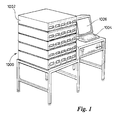
- Figure 1 shows a unit 1000 removable housing 5 similar drawers 1002 for receiving bottles, and also computer control means 1004 with an associated visual display unit 1006.
- each drawer 1002 comprises 5 similar supports 1008, each slidably received therein and independently removable therefrom.
- Each support 1008 comprises two apertured aluminium blocks defining two side by side rows of 10 similar recesses 1010, each for receiving a respective sample bottle ( Figure 3), so that the bottle is fully received within the recess for good temperature regulation.
- a respective LED 1012 is associated with each recess 1010.
- Each drawer 1002 further comprises a laser 1024 (eg. a Matsushita LA40 laser) and barcode reader (not shown separately), possibly combined together in a purpose built unit, mounted for movement in two perpendicular directions (X and Y) on a generally conventional X - Y motion controller.
- the controller comprises a cross-rail 1026 on which laser 1024 and barcode reader are mounted for sliding movement in an X direction under the action of a stepper-motor driven belt drive 1027. the ends of rail 1026 are carried by stepper-motor driven belt drives 1028, for causing movement in a Y direction.
- Figure 3 illustrates a blood culture bottle 602 suitable for use with the apparatus of Figures 1 and 2.
- Bottle 602 incorporates a resilient flexible diaphragm or septum (not visible in Figure 3) that deforms in response to changes in pressure within the bottle.
- the bottle typically contains liquid growth medium and a blood or other sample to be monitored for micro-organism content, as described in WO93/03178, priority date 02.08.1991, publication date 18.02.1993).
- the bottle 602 is Figure 3 is shown fitted with a plastics overcap (or overcover) 600 with a tamper-evident tear-off portion removed.
- the overcap is described in more detail in European Application No. 93301173.6 (published as WO94/19452).
- Overcap 600 has all round a generally square lateral projection 606 which is relatively thin, so that the body of the cap has cylindrical sections 608 and 610 respectively above and below the square projection.
- the lower cylindrical section 610 has internally a lip which snap-fits over the bottle seal (not shown).
- the upper surface of the projection 606 is on one side marked with a barcode 616 for bottle identification purposes, and on the opposite side, adjacent one corner, has a port 618 at which, when the bottle is in use the apparatus of Figures 1 and 2, a respective LED 1012 uniquely associated with each recess 1010 can be viewed.
- bottles 602 containing samples to be monitored are loaded into the apparatus of Figures 1 and 2 by locating the bottles in vacant recesses 1010 and entering information regarding the bottles and their barcodes to computer control means 1004. Additional information regarding the bottles, eg. lab sample register number, lab barcode surname, ward etc may be entered into computer control means if required.
- the location of the bottles in the array is not important, and any vacant location can be used for any bottle.
- the barcode is applied in duplicate to a dual two section label, one section fixed to the overcap and one section left floating and detachable via perforations.
- the floating section can have a peel-off backing so that, after detachment, it can be used to label a record card or the like with the same bar code.
- the unit 1000 is then operated, as described in WO93/013178, priority date 02.08.1991, publication date 18.02.1993, with suitable incubation conditions established therein and the scanner 1024 of each drawer in use being operated intermittently and repeatedly to scan each bottle in that drawer, reading the barcode (thus identifying the bottle, regardless of location) and measuring septum position for each bottle on each scan. Data concerning the barcode and septum position is fed to computer control means 1004.
- the apparatus senses any operator intervention and assumes removal or relocation of bottles: on the first subsequent scan the computer control means 1004 rationalises bottle identification data obtained from barcodes with coordinates. This feature allows periodic "housekeeping" to regroup bottles and reorganise contents of the apparatus. There may be a need to remove, sample and replace a bottle: again location within the array is not important because there is effectively random access. When a bottle is removed the computer control means can recognise and prompt if the bottle is not replaced somewhere within the apparatus within a reasonable time.
- the overcap 660 is linked to an individual LED 1012 by illuminating the particular LED at the location of the bottle, the LED being visible through port 618.
- the operator has clear, local indication of the bottle(s) to be dealt with by virtue of illumination of the associated LED.
- the result of a blood culture test is either positive (indicated as soon as detected) or negative.
- the computer can flag bottles for removal at the end of some predetermined period (eg. 7 days).
- some situations the operator may need to locate specific bottles, in order to intervene with other types of investigation.
- the system can operate a "find-a-bottle" routine to locate and highlight the target samples.
Landscapes
- Chemical & Material Sciences (AREA)
- Health & Medical Sciences (AREA)
- Life Sciences & Earth Sciences (AREA)
- Zoology (AREA)
- Engineering & Computer Science (AREA)
- Bioinformatics & Cheminformatics (AREA)
- Organic Chemistry (AREA)
- General Health & Medical Sciences (AREA)
- Biochemistry (AREA)
- Wood Science & Technology (AREA)
- Analytical Chemistry (AREA)
- Biomedical Technology (AREA)
- Physics & Mathematics (AREA)
- General Engineering & Computer Science (AREA)
- Microbiology (AREA)
- Genetics & Genomics (AREA)
- Biotechnology (AREA)
- Pathology (AREA)
- Sustainable Development (AREA)
- General Physics & Mathematics (AREA)
- Immunology (AREA)
- Clinical Laboratory Science (AREA)
- Chemical Kinetics & Catalysis (AREA)
- Automatic Analysis And Handling Materials Therefor (AREA)
- Apparatus Associated With Microorganisms And Enzymes (AREA)
- Glass Compositions (AREA)
- Transition And Organic Metals Composition Catalysts For Addition Polymerization (AREA)
Abstract
Description
- This invention concerns monitoring and relates to apparatus and methods for monitoring the growth of micro-organisms in culture bottles.
- European Specification No. EP-A-252471 discloses a monitoring arrangement in which test pack trays are removably located in test pack drawers in a housing. The trays, but not the individual test packs, are referenced with a unique code which is detected by an X/Y scanner at the same time as the individual test packs are monitored. Data from the scanner is fed to a computer. The computer is thus able to relate the individual test pack signals to particular trays, but the location of any particular test pack to which particular data relates is unknown. This problem is overcome by means of a sorter controller, which maps a computer associated memory with the positions of individual test packs in each tray when the trays are loaded. The map thus requires to be updated if the test packs are re-arranged.
- In one aspect the present invention provides apparatus for monitoring the growth of micro-organisms in culture bottles, comprising a unit having one or more supports each adapted to receive a plurality of culture bottles in an array in which the bottles are re-locatable, each culture bottle having a unique machine-readable identifying reference associated therewith, sensor means for intermittently and repeatedly monitoring each bottle in the array both to monitor changes in a variable associated with growth of micro-organisms in the bottle and to read the reference associated therewith, and means for supplying data relating to the monitored growth of micro-organisms in the bottles, together with the references associated with the bottles, to computer means, wherein the computer means is programmed to relate the monitored growth of micro-organisms associated with each bottle to the identifying reference of that bottle independently of the location of the bottle in the array.
- By having a unique machine-readable reference associated with each bottle which is read and by having data thereon supplied to the computer means together with data on the monitored variable, the computer is able to monitor data on the variable of a particular bottle regardless of the location of the bottle within the array and regardless of changes of location of bottles in the array. Monitoring is thus linked to the bottle independently of location in the array. This means that bottles can be moved within the array at will, e.g. for "housekeeping" purposes, without affecting monitoring. There is further no need to allocate a particular location in the array to a particular bottle, with the risk of inadvertent substitutions. There is similarly no need to keep a location free for a bottle temporarily removed from the array, e.g. for further investigation.
- The invention finds particular application in monitoring micro-organism growth in liquid culture, e.g. blood samples, in gas-tight containers each incorporating a flexible diaphragm capable of moving in response to pressure changes within the container, by detecting displacement of the diaphragm, wherein the position or conformation of the diaphragm is repeatedly sensed using distance-measuring means such as a laser, eg. as disclosed in WO93/03178, priority date 02.08.1991, publication date 18.02.1993. In this case micro-organism growth is monitored by measuring the diaphragm position, which is indicative of internal pressure, which in turn is indicative of micro-organism growth. Other variables indicative of micro-organism growth, such as temperature, colour, electrical properties, etc, could alternatively be monitored.
- The support conveniently comprises a generally stationary holder such as a drawer in a housing, with respect to which the sensor means moves to monitor the bottles in turn. Alternatively, the support can be movable for presenting bottles in the array in turn to generally stationary sensor means, eg. with the supports arranged as a carousel.
- The machine-readable reference conveniently comprises a barcode. In this case the sensor means comprises a barcode reader.
- The computer means will typically also control and coordinate relative movement of the support means and the sensor means in known manner for monitoring of the bottles.
- There are circumstances in which it may be desirable for particular bottles in the array to be marked, eg. to signal an abnormality in the monitored variable detected by the computer means. In this case, the support means conveniently includes a plurality of indicator means each associated with a particular location in the array and each selectively activable, typically under control of the computer means, to provide a visual marker or flag linked to the bottle in the associated location in the array. In this case a bottle in a marked location in the array is effectively no longer movable within the array. The markers conveniently comprise lights, preferably LEDs.
- In a preferred aspect, the invention thus provides monitoring apparatus comprising a unit for receiving one or more drawers each for receiving a plurality of bottles in an array in which the bottles are re-locatable, sensor means for intermittently and repeatedly monitoring each bottle in the array to monitor changes in micro-organism growth associated therewith, and means for supplying data relating to the monitored micro-organism growth to computer means, characterised in that a plurality of indicator means are provided, each associated with a particular location in the array and each selectively activatable; in that each bottle has a unique machine-readable identifying reference associated therewith, which reference is read by the sensor means and supplied to the computer means together with the data relating to the monitored micro-organism growth; in that the computer means is programmed to relate the monitored micro-organism growth to the reference of each bottle independent of the location of the bottle in the array; and in that the computer means also controls activation of the indicator means.
- A respective indicator means, eg. LED, is preferably associated with each location in the array.
- The invention also provides a method of monitoring micro-organism growth in culture bottles, each bottle having a unique machine-readable identifying reference associated therewith, comprising locating the bottles in an array in a withdrawable drawer in a housing, within which array the bottles can be relocated; intermittently and repeatedly monitoring each bottle in the array both to monitor changes in micro-organism growth and to read the associated reference; supplying data relating to the monitored micro-organism growth and machine-readable reference of each bottle to computer means; and programming the computer means to relate the monitored micro-organism growth to the reference of each bottle independent of the location of the bottle in the array.
- In a further aspect the invention provides a method of monitoring micro-organism growth in a plurality of culture bottles, each bottle having a unique machine-readable identifying reference associated therewith, comprising locating the bottles in an array in a support in a housing, within which array the bottles can be re-located; intermittently and repeatedly monitoring each bottle in the array both to monitor changes in micro-organism growth and to read the associated reference; supplying data relating to the monitored micro-organism growth and machine-readable reference of each bottle to computer means; programming the computer means to relate the monitored micro-organism growth to the reference of each bottle independent of the location of the bottle in the array; and changing the location of one or more bottles in the array prior to further monitoring.
- An embodiment of the invention involving monitoring of micro-organism growth in blood culture bottles will now be described, by way of illustration, with reference to the accompanying drawings, in which:
- Figure 1 is a diagrammatic perspective view of an automated culture unit comprising an embodiment of apparatus in accordance with the invention;
- Figure 2 is a perspective view of part of the unit of Figure 1, shown to an enlarged scale; and
- Figure 3 is a perspective view of a culture bottle with overcap for use in the apparatus of Figures 1 and 2.
-
- The illustrated apparatus is generally as described in WO93/03178, priority date 02.08.1991, publication date 18.02.1993, and reference can be made to the specification of that application for a more detailed description and explanation.
- Figure 1 shows a
unit 1000removable housing 5similar drawers 1002 for receiving bottles, and also computer control means 1004 with an associatedvisual display unit 1006. - As shown in Figure 2 each
drawer 1002 comprises 5similar supports 1008, each slidably received therein and independently removable therefrom. Eachsupport 1008 comprises two apertured aluminium blocks defining two side by side rows of 10similar recesses 1010, each for receiving a respective sample bottle (Figure 3), so that the bottle is fully received within the recess for good temperature regulation. - A
respective LED 1012, only one of which is shown in Figure 2 for clarity, is associated with eachrecess 1010. - Each
drawer 1002 further comprises a laser 1024 (eg. a Matsushita LA40 laser) and barcode reader (not shown separately), possibly combined together in a purpose built unit, mounted for movement in two perpendicular directions (X and Y) on a generally conventional X - Y motion controller. The controller comprises across-rail 1026 on whichlaser 1024 and barcode reader are mounted for sliding movement in an X direction under the action of a stepper-motor drivenbelt drive 1027. the ends ofrail 1026 are carried by stepper-motor drivenbelt drives 1028, for causing movement in a Y direction. - Figure 3 illustrates a
blood culture bottle 602 suitable for use with the apparatus of Figures 1 and 2. Bottle 602 incorporates a resilient flexible diaphragm or septum (not visible in Figure 3) that deforms in response to changes in pressure within the bottle. The bottle typically contains liquid growth medium and a blood or other sample to be monitored for micro-organism content, as described in WO93/03178, priority date 02.08.1991, publication date 18.02.1993). - The
bottle 602 is Figure 3 is shown fitted with a plastics overcap (or overcover) 600 with a tamper-evident tear-off portion removed. The overcap is described in more detail in European Application No. 93301173.6 (published as WO94/19452).Overcap 600 has all round a generally squarelateral projection 606 which is relatively thin, so that the body of the cap hascylindrical sections cylindrical section 610 has internally a lip which snap-fits over the bottle seal (not shown). - The upper surface of the
projection 606 is on one side marked with abarcode 616 for bottle identification purposes, and on the opposite side, adjacent one corner, has aport 618 at which, when the bottle is in use the apparatus of Figures 1 and 2, arespective LED 1012 uniquely associated with eachrecess 1010 can be viewed. - In use,
bottles 602 containing samples to be monitored, each with arespective overcap 600 with a unique barcode 616 (including an individual number, plus batch code and expiry data), are loaded into the apparatus of Figures 1 and 2 by locating the bottles invacant recesses 1010 and entering information regarding the bottles and their barcodes to computer control means 1004. Additional information regarding the bottles, eg. lab sample register number, lab barcode surname, ward etc may be entered into computer control means if required. The location of the bottles in the array is not important, and any vacant location can be used for any bottle. - Preferably, the barcode is applied in duplicate to a dual two section label, one section fixed to the overcap and one section left floating and detachable via perforations. The floating section can have a peel-off backing so that, after detachment, it can be used to label a record card or the like with the same bar code.
- The
unit 1000 is then operated, as described in WO93/013178, priority date 02.08.1991, publication date 18.02.1993, with suitable incubation conditions established therein and thescanner 1024 of each drawer in use being operated intermittently and repeatedly to scan each bottle in that drawer, reading the barcode (thus identifying the bottle, regardless of location) and measuring septum position for each bottle on each scan. Data concerning the barcode and septum position is fed to computer control means 1004. - The apparatus senses any operator intervention and assumes removal or relocation of bottles: on the first subsequent scan the computer control means 1004 rationalises bottle identification data obtained from barcodes with coordinates. This feature allows periodic "housekeeping" to regroup bottles and reorganise contents of the apparatus. There may be a need to remove, sample and replace a bottle: again location within the array is not important because there is effectively random access. When a bottle is removed the computer control means can recognise and prompt if the bottle is not replaced somewhere within the apparatus within a reasonable time.
- In this system, all data collected is linked to the bottle identification (obtained from the barcode), regardless of location in the array or indeed changes of location. There is no need to allocate locations (with the associated risk of inadvertent substitutions). Similarly there is no need to keep a location open for a bottle under temporary investigation. The link between bottle identity and data is totally independent of the operator.
- There are circumstances in which the operator does become involved and it is necessary to "flag" specific bottles. For this purpose the overcap 660 is linked to an
individual LED 1012 by illuminating the particular LED at the location of the bottle, the LED being visible throughport 618. In addition to any screen display on unit 1016 the operator has clear, local indication of the bottle(s) to be dealt with by virtue of illumination of the associated LED. The result of a blood culture test is either positive (indicated as soon as detected) or negative. In the latter case the computer can flag bottles for removal at the end of some predetermined period (eg. 7 days). In some situations the operator may need to locate specific bottles, in order to intervene with other types of investigation. For this type of interaction the system can operate a "find-a-bottle" routine to locate and highlight the target samples. - The three way link between bottle/cap (code and LED), associated data and the operator is simple and robust. Technicians find operation of the system very "natural", flexible and deceptively simple.
Claims (10)
- Apparatus for monitoring the growth of micro-organisms in culture bottles, comprising a unit (1000) having one or more supports (1002) each adapted to receive a plurality of culture bottles in an array in which the bottles are re-locatable, each culture bottle having a unique machine-readable identifying reference associated therewith, sensor means (1024) for intermittently and repeatedly monitoring each bottle in the array both to monitor changes in a variable associated with growth of micro-organisms in the bottle and to read the reference (616) associated therewith, and means for supplying data relating to the monitored growth of micro-organisms in the bottles, together with the references associated with the bottles, to computer means (1004), wherein the computer means is programmed to relate the monitored growth of micro-organisms associated with each bottle to the identifying reference of that bottle independently of the location of the bottle in the array.
- Apparatus according to claim 1, wherein the bottles comprise gas-tight containers each incorporating a flexible diaphragm capable of moving in reponse to pressure changes within the container, and wherein the sensor means (1024) detects displacement of the diaphragms.
- Apparatus according to claim 2, wherein the sensor means comprises a laser (1024).
- Apparatus according to claim 1, 2 or 3, wherein the or each support is a withdrawable drawer (1002) in a housing, and the sensor means (1024) is movable within the housing with respect to the drawer.
- Apparatus according to any one of the preceding claims, wherein the machine-readable reference comprises a barcode (616), and the sensor means (1024) includes a barcode reader.
- Apparatus according to any one of claims 1 to 5, wherein a plurality of indicator means (1012) are provided, each associated with a particular location in the array and each selectively activatable, the computer means (1004) also controlling activation of the indicator means.
- Apparatus according to claim 6, wherein each indicator means comprises an LED (1012).
- Apparatus according to claim 7, wherein a respective indicator means (1012) is associated with each position in the array.
- A method of monitoring a micro-organism growth associated with each of a plurality of culture bottles, each bottle having a unique machine-readable identifying reference associated therewith, comprising locating the bottles in an array in a withdrawable drawer in a housing, within which array the items can be relocated; intermittently and repeatedly monitoring each bottle in the array both to monitor changes in micro-organism growth and to read the associated reference; supplying data relating to the monitored micro-organism growth and machine-readable reference of each bottle to computer means; and programming the computer means to relate the monitored micro-organism growth to the reference of each bottle independently of the location of the bottle in the array.
- A method acording to claim 9, including the step of changing the location of one or more bottles in the array prior to further monitoring.
Priority Applications (1)
| Application Number | Priority Date | Filing Date | Title |
|---|---|---|---|
| EP94906278A EP0685072B1 (en) | 1993-02-17 | 1994-02-09 | Apparatus and method for monitoring the growth of micro-organisms in culture bottles |
Applications Claiming Priority (4)
| Application Number | Priority Date | Filing Date | Title |
|---|---|---|---|
| EP93301166 | 1993-02-17 | ||
| EP93301166 | 1993-02-17 | ||
| PCT/GB1994/000253 WO1994019698A1 (en) | 1993-02-17 | 1994-02-09 | Improvements in or relating to monitoring |
| EP94906278A EP0685072B1 (en) | 1993-02-17 | 1994-02-09 | Apparatus and method for monitoring the growth of micro-organisms in culture bottles |
Publications (2)
| Publication Number | Publication Date |
|---|---|
| EP0685072A1 EP0685072A1 (en) | 1995-12-06 |
| EP0685072B1 true EP0685072B1 (en) | 1999-03-03 |
Family
ID=8214305
Family Applications (1)
| Application Number | Title | Priority Date | Filing Date |
|---|---|---|---|
| EP94906278A Expired - Lifetime EP0685072B1 (en) | 1993-02-17 | 1994-02-09 | Apparatus and method for monitoring the growth of micro-organisms in culture bottles |
Country Status (6)
| Country | Link |
|---|---|
| US (1) | US5888825A (en) |
| EP (1) | EP0685072B1 (en) |
| AU (1) | AU6004094A (en) |
| CA (1) | CA2156281A1 (en) |
| DE (1) | DE69416826T2 (en) |
| WO (1) | WO1994019698A1 (en) |
Families Citing this family (20)
| Publication number | Priority date | Publication date | Assignee | Title |
|---|---|---|---|---|
| US6387651B1 (en) | 1995-04-12 | 2002-05-14 | Biolog, Inc. | Comparative phenotype analysis of two or more microorganisms using a plurality of substrates within a microwell device |
| US5672317A (en) * | 1995-04-19 | 1997-09-30 | Roche Diagnostics Systems, Inc. | Analyzer with fixed position bar code reader |
| US6068753A (en) * | 1996-05-06 | 2000-05-30 | Helena Laboratories Corporation | Automatic electrophoresis apparatus with fluorescent and visible scanning |
| US6271022B1 (en) | 1999-03-12 | 2001-08-07 | Biolog, Inc. | Device for incubating and monitoring multiwell assays |
| WO2000067037A2 (en) * | 1999-04-29 | 2000-11-09 | Dade Microscan Inc. | A combined rapid anti-microbial susceptibility assay and microorganism identification system |
| WO2001014823A1 (en) * | 1999-08-19 | 2001-03-01 | The Regents Of The University Of California | Apparatus and method for visually identifying micro-forces with a palette of cantilever array blocks |
| IT1310317B1 (en) * | 1999-09-15 | 2002-02-11 | Diesse Diagnostica Senese Spa | METHOD AND MEANS FOR DATA MANAGEMENT IN A LABORATORY |
| US6696239B1 (en) | 2000-04-20 | 2004-02-24 | Biolog, Inc. | Comparative phenotype analysis for assessment of biological active compounds such as antimicrobials |
| US7427501B2 (en) * | 2000-09-29 | 2008-09-23 | Becton, Dickinson And Company | System and method for optically monitoring the concentration of a gas, or the pressure, in a sample vial to detect sample growth |
| US6815197B2 (en) * | 2001-02-16 | 2004-11-09 | Multi Channel System Mcs Gmbh | Apparatus for conducting electrophysiological measurements on cells |
| US7704745B2 (en) * | 2001-08-06 | 2010-04-27 | Vanderbilt University | Apparatus and methods for monitoring the status of a metabolically active cell |
| US20030154149A1 (en) * | 2002-02-13 | 2003-08-14 | Dilip Gajendragadkar | System and method of creating and executing a restricted stock sale plan |
| GB0206275D0 (en) * | 2002-03-16 | 2002-05-01 | Bactest Ltd | Method and apparatus for the non-invasive monitoring of gas exchange by biological material |
| US20070111301A1 (en) * | 2003-11-27 | 2007-05-17 | Aisin Seiki Kabushiki Kaisha | Biological information inspection system |
| US20110025503A1 (en) * | 2009-07-28 | 2011-02-03 | Frederick Michael Weaver | Item tracking in storage drawers |
| US9121827B2 (en) * | 2011-06-30 | 2015-09-01 | Mocon, Inc. | Method of contemporaneously monitoring changes in analyte concentration in a plurality of samples on individual schedules |
| WO2014144825A2 (en) | 2013-03-15 | 2014-09-18 | Abbott Laboratories | Automated reagent manager of a diagnostic analyzer system |
| WO2014144870A2 (en) | 2013-03-15 | 2014-09-18 | Abbott Laboratories | Light-blocking system for a diagnostic analyzer |
| US9632103B2 (en) | 2013-03-15 | 2017-04-25 | Abbott Laboraties | Linear track diagnostic analyzer |
| JP6887314B2 (en) * | 2017-06-01 | 2021-06-16 | オリンパス株式会社 | Cell culture monitoring system |
Family Cites Families (13)
| Publication number | Priority date | Publication date | Assignee | Title |
|---|---|---|---|---|
| FI46570C (en) * | 1970-05-15 | 1973-04-10 | Ollituote Oy | Procedure for ensuring identification in a laboratory examination of a patient. |
| US4118280A (en) * | 1976-05-03 | 1978-10-03 | Mcdonnell Douglas Corporation | Automated microbial analyzer |
| DE2945524C2 (en) * | 1979-11-10 | 1985-10-31 | Medizinische Feinwerktechnik E. Harig Ohg, 2000 Hamburg | Device for identifying samples for analysis |
| GB2116711B (en) * | 1982-03-17 | 1985-07-31 | Vickers Plc | Automatic chemical analysis |
| US4678752A (en) * | 1985-11-18 | 1987-07-07 | Becton, Dickinson And Company | Automatic random access analyzer |
| JPS6315164A (en) * | 1986-07-07 | 1988-01-22 | Tosoh Corp | Test pack selective supply apparatus of biochemical analyzer |
| US5009316A (en) * | 1988-03-29 | 1991-04-23 | Klein David C | Test tube cassette system and cassettes for use therein |
| US4952498A (en) * | 1988-05-06 | 1990-08-28 | Waters John R | Method and apparatus for detecting microorganism activity |
| US5281394A (en) * | 1989-07-21 | 1994-01-25 | Icn Biomedicals, Inc. | Data collection and sample handling apparatus |
| JPH07501205A (en) * | 1991-08-02 | 1995-02-09 | ユニリーバー・ナームローゼ・ベンノートシャープ | Microbial growth monitoring method and device |
| US5380493A (en) * | 1992-03-27 | 1995-01-10 | Chavez; Jeffery B. | Cell well plate holder and well marking system |
| DE69422070T2 (en) * | 1993-01-29 | 2000-07-06 | Becton Dickinson And Co., Franklin Lakes | Compact blood culture apparatus |
| US5397709A (en) * | 1993-08-27 | 1995-03-14 | Becton Dickinson And Company | System for detecting bacterial growth in a plurality of culture vials |
-
1994
- 1994-02-09 US US08/917,805 patent/US5888825A/en not_active Expired - Fee Related
- 1994-02-09 AU AU60040/94A patent/AU6004094A/en not_active Abandoned
- 1994-02-09 DE DE69416826T patent/DE69416826T2/en not_active Expired - Fee Related
- 1994-02-09 EP EP94906278A patent/EP0685072B1/en not_active Expired - Lifetime
- 1994-02-09 CA CA002156281A patent/CA2156281A1/en not_active Abandoned
- 1994-02-09 WO PCT/GB1994/000253 patent/WO1994019698A1/en not_active Ceased
Also Published As
| Publication number | Publication date |
|---|---|
| CA2156281A1 (en) | 1994-09-01 |
| DE69416826D1 (en) | 1999-04-08 |
| WO1994019698A1 (en) | 1994-09-01 |
| DE69416826T2 (en) | 1999-10-14 |
| AU6004094A (en) | 1994-09-14 |
| EP0685072A1 (en) | 1995-12-06 |
| US5888825A (en) | 1999-03-30 |
Similar Documents
| Publication | Publication Date | Title |
|---|---|---|
| US5888825A (en) | Method and device for monitoring changes in an array of sensor containing bottles | |
| US5663545A (en) | Labware identification system | |
| AU647666B2 (en) | Microorganism growth | |
| CN103250056B (en) | For following the tracks of the system and method for article during certain | |
| US4681741A (en) | Reagent dispenser for an analyzing system | |
| US5498543A (en) | Sub-compact blood culture apparatus | |
| US4719087A (en) | Tray for analyzing system | |
| EP0227737B1 (en) | Automatic specimen analyzing system | |
| US4643879A (en) | Tower for analyzing system | |
| US5224585A (en) | Carrier for coded containers | |
| CA2650258A1 (en) | Automated continuous and random access analytical system | |
| US11940455B2 (en) | Consumable management system for laboratories | |
| JPH0358668B2 (en) | ||
| EP0228410B1 (en) | Reagent dispenser for analyzing system | |
| US4563096A (en) | Apparatus for assisting the visual assessment of test objects having multivariate visible characteristics, and its use | |
| EP1380842A3 (en) | Test sample container assembly | |
| CA1128338A (en) | Automatic chemical analysis apparatus and method | |
| CN103869089A (en) | Method for holding multiple types of diagnostic test consumables in a random access single container | |
| CN101551401B (en) | Transport system for test sample carrier | |
| US8371051B2 (en) | System to label plates | |
| WO1999030824A1 (en) | Loading station for a robotic system | |
| JP2008122205A (en) | Specimen inspection kit, specimen inspection kit group and transfer support rack | |
| EP0765480A1 (en) | Automated analysis with comb-like support |
Legal Events
| Date | Code | Title | Description |
|---|---|---|---|
| PUAI | Public reference made under article 153(3) epc to a published international application that has entered the european phase |
Free format text: ORIGINAL CODE: 0009012 |
|
| 17P | Request for examination filed |
Effective date: 19950728 |
|
| AK | Designated contracting states |
Kind code of ref document: A1 Designated state(s): DE ES FR GB IT SE |
|
| 17Q | First examination report despatched |
Effective date: 19960529 |
|
| RAP1 | Party data changed (applicant data changed or rights of an application transferred) |
Owner name: UNIPATH LIMITED Owner name: OXOID LIMITED |
|
| GRAG | Despatch of communication of intention to grant |
Free format text: ORIGINAL CODE: EPIDOS AGRA |
|
| GRAG | Despatch of communication of intention to grant |
Free format text: ORIGINAL CODE: EPIDOS AGRA |
|
| GRAH | Despatch of communication of intention to grant a patent |
Free format text: ORIGINAL CODE: EPIDOS IGRA |
|
| GRAH | Despatch of communication of intention to grant a patent |
Free format text: ORIGINAL CODE: EPIDOS IGRA |
|
| GRAA | (expected) grant |
Free format text: ORIGINAL CODE: 0009210 |
|
| AK | Designated contracting states |
Kind code of ref document: B1 Designated state(s): DE ES FR GB IT SE |
|
| PG25 | Lapsed in a contracting state [announced via postgrant information from national office to epo] |
Ref country code: SE Free format text: THE PATENT HAS BEEN ANNULLED BY A DECISION OF A NATIONAL AUTHORITY Effective date: 19990303 Ref country code: ES Free format text: THE PATENT HAS BEEN ANNULLED BY A DECISION OF A NATIONAL AUTHORITY Effective date: 19990303 |
|
| ITF | It: translation for a ep patent filed | ||
| REF | Corresponds to: |
Ref document number: 69416826 Country of ref document: DE Date of ref document: 19990408 |
|
| ET | Fr: translation filed | ||
| PLBE | No opposition filed within time limit |
Free format text: ORIGINAL CODE: 0009261 |
|
| STAA | Information on the status of an ep patent application or granted ep patent |
Free format text: STATUS: NO OPPOSITION FILED WITHIN TIME LIMIT |
|
| 26N | No opposition filed | ||
| REG | Reference to a national code |
Ref country code: GB Ref legal event code: 732E |
|
| PGFP | Annual fee paid to national office [announced via postgrant information from national office to epo] |
Ref country code: GB Payment date: 20001205 Year of fee payment: 8 |
|
| PGFP | Annual fee paid to national office [announced via postgrant information from national office to epo] |
Ref country code: FR Payment date: 20001229 Year of fee payment: 8 |
|
| PGFP | Annual fee paid to national office [announced via postgrant information from national office to epo] |
Ref country code: DE Payment date: 20010430 Year of fee payment: 8 |
|
| REG | Reference to a national code |
Ref country code: GB Ref legal event code: IF02 |
|
| PG25 | Lapsed in a contracting state [announced via postgrant information from national office to epo] |
Ref country code: GB Free format text: LAPSE BECAUSE OF NON-PAYMENT OF DUE FEES Effective date: 20020209 |
|
| PG25 | Lapsed in a contracting state [announced via postgrant information from national office to epo] |
Ref country code: DE Free format text: LAPSE BECAUSE OF NON-PAYMENT OF DUE FEES Effective date: 20020903 |
|
| GBPC | Gb: european patent ceased through non-payment of renewal fee |
Effective date: 20020209 |
|
| PG25 | Lapsed in a contracting state [announced via postgrant information from national office to epo] |
Ref country code: FR Free format text: LAPSE BECAUSE OF NON-PAYMENT OF DUE FEES Effective date: 20021031 |
|
| REG | Reference to a national code |
Ref country code: FR Ref legal event code: ST |
|
| PG25 | Lapsed in a contracting state [announced via postgrant information from national office to epo] |
Ref country code: IT Free format text: LAPSE BECAUSE OF NON-PAYMENT OF DUE FEES Effective date: 20050209 |