EP0684549B1 - Method for parallel processing of fuzzy logic inference rules and corresponding circuit architecture with fuzzy inputs and outputs - Google Patents
Method for parallel processing of fuzzy logic inference rules and corresponding circuit architecture with fuzzy inputs and outputs Download PDFInfo
- Publication number
- EP0684549B1 EP0684549B1 EP94830240A EP94830240A EP0684549B1 EP 0684549 B1 EP0684549 B1 EP 0684549B1 EP 94830240 A EP94830240 A EP 94830240A EP 94830240 A EP94830240 A EP 94830240A EP 0684549 B1 EP0684549 B1 EP 0684549B1
- Authority
- EP
- European Patent Office
- Prior art keywords
- block
- accordance
- fuzzy logic
- membership functions
- fuzzy
- Prior art date
- Legal status (The legal status is an assumption and is not a legal conclusion. Google has not performed a legal analysis and makes no representation as to the accuracy of the status listed.)
- Expired - Lifetime
Links
Images



Classifications
-
- G—PHYSICS
- G06—COMPUTING OR CALCULATING; COUNTING
- G06N—COMPUTING ARRANGEMENTS BASED ON SPECIFIC COMPUTATIONAL MODELS
- G06N7/00—Computing arrangements based on specific mathematical models
- G06N7/02—Computing arrangements based on specific mathematical models using fuzzy logic
- G06N7/04—Physical realisation
-
- Y—GENERAL TAGGING OF NEW TECHNOLOGICAL DEVELOPMENTS; GENERAL TAGGING OF CROSS-SECTIONAL TECHNOLOGIES SPANNING OVER SEVERAL SECTIONS OF THE IPC; TECHNICAL SUBJECTS COVERED BY FORMER USPC CROSS-REFERENCE ART COLLECTIONS [XRACs] AND DIGESTS
- Y10—TECHNICAL SUBJECTS COVERED BY FORMER USPC
- Y10S—TECHNICAL SUBJECTS COVERED BY FORMER USPC CROSS-REFERENCE ART COLLECTIONS [XRACs] AND DIGESTS
- Y10S706/00—Data processing: artificial intelligence
- Y10S706/90—Fuzzy logic
Definitions
- the present invention relates to a method for calculation in parallel of multiple fuzzy logic inference rules.
- the present invention concerns also a circuit architecture for implementation of the above method having fuzzy inputs and outputs.
- the present invention relates to a method for parallel processing of multiple fuzzy logic inference rules organised in fuzzy sets or logical functions of multiple fuzzy sets comprising membership functions defined in a so-called discourse universe and said rules being configured essentially as IF-THEN rules with at least one antecedent preposition and at least one consequent implication and each preposition comprising at least one term of comparison between the membership functions and a plurality of input data and the terms being separated by logical operators.
- Fuzzy logic has now been established as a technique capable of supplying solutions for broad classes of control problems for which conventional techniques, e.g. those based on Boolean logic, have proven unsuited for providing acceptable performance at acceptable cost.
- Fuzzy logic supplies a method of modelling the 'inaccurate' modes of reasoning typical of the human mind and which play however an essential role just in the human ability to make decisions under conditions of uncertainty.
- Fuzzy logic operates on a linguistic description of reality using a particular class of variables termed 'linguistic variables'.
- To each variable can be syntactically joined a set of values dependent upon it which can take on different meanings depending on the context in which they are employed. Said values are found starting from a primary term which represents the variable, from one of its contraries, and from a series of so-called modifiers of the primary term, e.g. as described in European patent application no. 92830095.3.
- Each value assigned to a linguistic variable is represented furthermore by a so-called fuzzy set, i.e. a possibilistic distribution function which links each value of the variable in the corresponding definition domain known also as universe of discourse.
- fuzzy set in the universe of discourse of a variable
- membership function FA The functions which identify a fuzzy set in the universe of discourse of a variable.
- 'term set' The assembly of all the fuzzy sets of a linguistic variable.
- Membership functions are defined by means of a sample representation obtained by dividing the definition domain in m points and the interval [0, 1] in 1 levels.
- the data for a membership function are normally stored in a memory word. In known devices the memory area occupied is thus negatively influenced by the number of data necessary for defining these membership functions.
- logical operations - termed 'inferential' - which allow description of the behaviour of a system with the change in input parameters are performable. These operations are performed by mean of fuzzy rules which have generally a syntax of the following type: IF X IS A, THEN Y IS B where X is the input value, A and B are membership functions FA which represent system knowledge, and Y is the output value.
- the part of the rule preceding the term THEN is called the 'left' or 'antecedent' part while the following part is called 'right' or 'consequent' part of the inference rule.
- the antecedent part can be made up of one or more terms T corresponding to hypotheses of the type (F is F') on the data F and on the membership functions F' its overall degree of truth which we shall indicate by the symbol ⁇ in the following description depends just on the inference operations on these same terms T.
- H. Watanabe et al performs in parallel all the rules for the same output variable.
- the user is however limited in his choice of the variables with which he can work. These can be only four input variables and two output variables out of fifty-one rules, or two input variables and one output out of one hundred two rules.
- a plurality of Watanabe circuits can be connected in cascade under control of a software programme in such a manner as to process more than one hundred two rules. In this case moreover it is possible to introduce a feedback of the output signal on the input of one of the components.
- circuits of this type can be connected to operate with a larger number of input variables.
- a third known solution consists of the Fuzzy Micro Controller of Neural Logix in which are used only symmetrical and linear membership functions (triangles, trapezes, etc.). Since each antecedent part of a rule can contain up to a maximum of sixteen terms, there are sixteen fuzzifiers at the input of this circuit.
- weight ⁇ I of a set of data I for an antecedent part term T represented in the universe of discourse U by means of a membership function I' is meant the greatest value of the intersection between the input data set I and the membership function I' corresponding to said term T.
- the Neural Logix circuit can process up to sixty-four rules. At input there can be applied the variables to be controlled or the fedback output variables.
- a neuronal network performs the smallest of the sixteen terms contained in the antecedent part of the rule.
- ⁇ of all sixty-four antecedent parts is then calculated the maximum value by means of a circuit consisting of a single register which is continually updated on the basis of each evaluation of the weight of each antecedent part.
- a processor known in trade as 'WARP' and manufactured by the same applicant processes sequentially up to two hundred fifty-six rules whose antecedent parts are made up of four terms.
- the architecture of the inferential part was designed to calculate the degree of truth of the premise by means of parallel computation on four ⁇ values. These weights ⁇ are taken simultaneously from the data memory once the input variables are known.
- the architectures which give priority to parallel processing of the inference rules in such a manner as to gain processing time lose necessarily in occupied silicon area.
- N FR mod N PU 0 i.e. N FR is not exactly divisible by the number NPU.
- this document is directed to a fuzzy logic inference engine that processes fuzzy logic rules having an antecedent with only one term. All the rules are accessed in parallel, and each individual rule is accessed in serial fashion.
- the European Patent Application No. 0 594 222 relates to an analog fuzzy architecture that processes both rules and variables in parallel. In this way a plurality of computational units are needed to process a plurality of rules.
- the technical problem underlying the present invention is to identify a new parallel processing method for multiple fuzzy rules which would not depend on the number of terms making up the antecedent part of the rules or the logical operators linking them.
- the solution ideal underlying the present invention is to provide simultaneous processing of several rules which could be configured dynamically in a flexible manner on the basis of the characteristics of the different applications for which the circuit might be designed.
- a membership function I' of a linguistic or logical variable M is represented by means of a vectorial system where along the abscissa axis is defined a so-called universe of discourse U while along the ordinate axis is defined a so-called degree of truth or membership G.
- the input data I are represented by the same reference system.
- FIGS. 1A-1D are shown four membership functions I' which identify in the universe of discourse U as many fuzzy sets which are part of a so-called term set.
- FIGS. 1A-1D are indicated also the weights ⁇ I of each term T of an inference rule R, i.e. the highest value of the intersection between the set of input data I and the membership function I' corresponding to said term T.
- the method in accordance with the present invention calls for the use of a new inferential unit 1 which allows inferential processing of Nr fuzzy logic inference rules each of which can be made up of Na antecedent terms with a single consequent term.
- This unit 1 operates on fuzzy inputs and for each point of the universe of discourse U receives the greatest value of the intersection between the input data I and the corresponding membership functions I'.
- rule R1 formed as follows: IF (A is A') AND (NOT B is B') OR NOT [(C is C') AND (D is D')] THEN
- Tj placed between round parentheses and takes on a value determined by applying thereto the logical operators present AND, OR and NOT.
- fuzzy logic semantics with the operators AND and OR are associated respectively minimum and maximum operations between two or more elements while with the operator NOT is associated a complementary operation for one in the universe U.
- the method in accordance with the present invention provides for simultaneous (pipeline) processing of these calculation stages.
- the time employed for calculation of the overall degree of truth ⁇ of a rule R of a given sequence of rules there is determined the weight ⁇ ' of the terms T' following the antecedent part of the rule R.
- the method provides for composition of a fuzzy logic output Y by supplying a level of truth for each point of the universe of discourse U.
- the computation unit 1 is thus compatible with itself since it operates on fuzzy inputs and produces outputs of the same type which can be used directly as inputs of another inferential unit of the same type or defuzzified.
- FIG. 2 shows schematically an example of circuitry architecture designed for parallel processing of multiple fuzzy logic inference rules.
- the circuitry architecture of FIG. 2 comprises an inferential unit 1 with modular structure and comprising a plurality of same lines 2 for inferential processing connected in parallel in a number equal to the fuzzy logic inference rules Ri to be processed simultaneously.
- Each inferential processing line 2 provides computation of a fuzzy logic inference rule Ri and comprises a first evaluation block 3, a second calculator block 4 and a third processing block 5 for the membership functions of the consequent part based on the value of the output of the calculator block 4.
- the evaluation block 3 has a plurality of inputs 6 and one output 7. Said inputs 6 receive through a plurality of busses 8 the values of the terms T of the antecedent part of the fuzzy logic inference rule R.
- the output 7 is connected through the bus 9 to an input 10 of the calculator block 4 and supplies the weight ⁇ of the terms T of the antecedent part of the fuzzy logic inference rule R.
- the calculator block 4 has an output 11 connected through the bus 12 to a first input 13 of the processing block 5.
- the output 11 supplies the overall truth level ⁇ of the antecedent part of the fuzzy logic inference rule R.
- Said processing block 5 has an input 14 which receives through the bus 15 the membership functions Xi which characterise the consequent part of the fuzzy logic inference rule R.
- processing block 5 has an output 16 connected through bus 17 to an input 18 of another block 19 for union.
- the outputs 16 of the processing blocks 5 supply the value of the membership functions of the consequent part processed starting from the value coming from the calculator block 4.
- the union block 19 has an output 20 which supplies through bus 21 the fuzzy logic value Y of the group of Nr fuzzy logic inference rule Ri for a description variable of the physical universe which is the object of the study developed by the inferential unit 1.
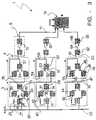
- FIG. 3 shows in greater detail a first embodiment of a circuit of the diagram proposed in FIG. 2.
- the evaluation block 3 comprises a first minimiser block 23 which has two inputs 24 and 25 and one output 26.
- the input 25 of the minimiser block 23 receives through bus 22 the input data A while the input 24 receives through bus 27 the membership functions Ai for the linguistic variable A and in like manner for the linguistic variables B, C, etc.
- the output 26 is connected through the bus 28 to an input 29 of a sliding register 30.
- the sliding register 30 receives on a second input 31 a clock signal CK and has an input 32 connected through the bus 33 to a first input 34 of another maximiser block 35.
- the maximiser block 35 has 3 inputs 34, 36 and 37 and one output 38.
- the second input 36 of the maximiser block 35 receives the clock signal CK while the third input 37 is connected through the bus 41 to an output 39 of another sliding register 40.
- the sliding register 40 has two inputs 42 and 43.
- the first input 42 receives the clock signal CK while the second input 43 is connected through the bus 44 to the output 38 of the maximiser block 35.
- the output 38 of the maximiser block 35 is connected to a first input 45 of a first sliding register 46 included in the calculator block 4.
- the sliding register 46 receives on another input 47 the clock signal CK and has an output 48 connected through the bus 49 to a first input 51 of a maximinimiser block 50.
- the maximinimiser block 50 receives on a second input 52 the clock signal CK and has a third input 53 connected through the bus 54 to an output 56 of another sliding register 55 and an output 57 connected through the bus 58 to a first input 59 of the sliding register 55.
- a second input 60 of the sliding register 55 receives the clock signal CK.
- the output 57 of the maximinimiser block 50 is connected to an input 61 of another sliding register 62 which receives at a second input 63 the clock signal CK and is connected in cascade through the bus 64 to a first input 66 of a minimiser block 65.
- the minimiser block 65 receives on a second input 67 through the bus 15 the membership functions Xi which characterise the consequent part of the fuzzy logic inference rule R.
- the minimiser block 65 is connected in cascade through the bus 17 to the union block 19.
- the bus 22 carries the system input variables (A, B, C). For each point where the universe of discourse is divided said variables are compared in parallel with the respective values of the membership functions for linguistic variables A1, A2, ..., AN.
- This new value is supplied to the second calculator stage 4 which compares it with the weight ⁇ Ai for the previous term of the antecedent part on the basis of the logical operation AND or OR present in the fuzzy logic inference rule Ri.
- each line 12 At the end of the process, on each line 12 are present the overall truth levels ⁇ of every fuzzy logic inference rule R processed while on each inferential processing line 2 is present the processed value of the membership functions of the consequent part.
- this circuitry architecture allows parallel processing of multiple fuzzy rules with a high level of configurability.
- the further structure configuration flexibility can be achieved by sending on the bus 15 the data Xi for the membership functions of the terms of the consequent part of appropriately selected sets of rules.
- the circuitry diagram of FIG. 3 operates on rules in which a level of priority among logical operators has not been instituted.
- FIG. 4 shows an alternative embodiment of the calculator block 4 in which it is possible to define a priority among the logical operators.
- the sliding register 55 is split into an OR register 55A and an AND register 55B.
- registers OR 55A and AND 55B receive at an input, 68 and 69 respectively, the clock signal CK.
- a second input, 70 and 71 respectively, is connected through the busses 72 and 73 to respective outputs 74 and 75 of a path selector 80.
- the outputs 76 and 77 of the registers OR 55A and AND 55B are connected through busses 78 and 79 respectively to inputs 81 and 82 of the maximinimiser block 50.
- the path selector 80 has two inputs 83 and 84 connected through the busses 85 and 86 respectively to two outputs 87 and 88 respectively of the maximinimiser block 50.
- the output 88 of the maximinimiser block 50 is connected to a first input 89 of a sliding register 90 which receives on a second input 91 the clock signal CK.
- the sliding register 90 has an output 92 connected through the bus 58 to the input of processing block 5 for the membership functions of the consequent part.
- the path selector 80 permits separation in the corresponding registers of the partial truth levels w for OR or AND logical operators.
- the input circuit is reduced to a simple block which, given the deterministic input, produces a fuzzy output with a single, substantially crisp, value.
- the output circuit is a defuzzifier circuit which transforms a fuzzy value into a deterministic output. This transformation can be adapted to the accuracy required for the type of application.
- the proposed circuitry diagram is compatible with itself, i.e. it exhibits inputs and outputs of the fuzzy type or, by introduction of appropriate input and output blocks, of the deterministic type.
Landscapes
- Engineering & Computer Science (AREA)
- Software Systems (AREA)
- Theoretical Computer Science (AREA)
- General Physics & Mathematics (AREA)
- Physics & Mathematics (AREA)
- Computational Mathematics (AREA)
- Evolutionary Computation (AREA)
- Molecular Biology (AREA)
- Fuzzy Systems (AREA)
- Biomedical Technology (AREA)
- Algebra (AREA)
- Artificial Intelligence (AREA)
- Health & Medical Sciences (AREA)
- Data Mining & Analysis (AREA)
- General Health & Medical Sciences (AREA)
- Automation & Control Theory (AREA)
- Mathematical Analysis (AREA)
- Mathematical Optimization (AREA)
- Pure & Applied Mathematics (AREA)
- Computing Systems (AREA)
- General Engineering & Computer Science (AREA)
- Mathematical Physics (AREA)
- Life Sciences & Earth Sciences (AREA)
- Feedback Control In General (AREA)
- Logic Circuits (AREA)
Description
- The present invention relates to a method for calculation in parallel of multiple fuzzy logic inference rules.
- The present invention concerns also a circuit architecture for implementation of the above method having fuzzy inputs and outputs.
- Specifically the present invention relates to a method for parallel processing of multiple fuzzy logic inference rules organised in fuzzy sets or logical functions of multiple fuzzy sets comprising membership functions defined in a so-called discourse universe and said rules being configured essentially as IF-THEN rules with at least one antecedent preposition and at least one consequent implication and each preposition comprising at least one term of comparison between the membership functions and a plurality of input data and the terms being separated by logical operators.
- Fuzzy logic has now been established as a technique capable of supplying solutions for broad classes of control problems for which conventional techniques, e.g. those based on Boolean logic, have proven unsuited for providing acceptable performance at acceptable cost.
- Fuzzy logic supplies a method of modelling the 'inaccurate' modes of reasoning typical of the human mind and which play however an essential role just in the human ability to make decisions under conditions of uncertainty.
- Fuzzy logic operates on a linguistic description of reality using a particular class of variables termed 'linguistic variables'. To each variable can be syntactically joined a set of values dependent upon it which can take on different meanings depending on the context in which they are employed. Said values are found starting from a primary term which represents the variable, from one of its contraries, and from a series of so-called modifiers of the primary term, e.g. as described in European patent application no. 92830095.3.
- Each value assigned to a linguistic variable is represented furthermore by a so-called fuzzy set, i.e. a possibilistic distribution function which links each value of the variable in the corresponding definition domain known also as universe of discourse.
- The functions which identify a fuzzy set in the universe of discourse of a variable are called membership function FA. The assembly of all the fuzzy sets of a linguistic variable is called 'term set'.
- Membership functions are defined by means of a sample representation obtained by dividing the definition domain in m points and the interval [0, 1] in 1 levels.
- At present, definition or memorisation in a fuzzy logic based electronic controller of the membership functions which identify the fuzzy sets represents one of the major restraints on development of new fuzzy logic applications and thus limits the theoretical potential of this methodology.
- Indeed, if for implementation on hardware of the membership functions it is desired that said functions reflect the semantics of the fuzzy concept so as to obtain a correct incidence of a term in a rule, one is forced to use a considerable memory space. This makes fuzzy logic advantageous only for those applications where the term set of the linguistic variable consists of a reduced number of membership functions.
- The data for a membership function are normally stored in a memory word. In known devices the memory area occupied is thus negatively influenced by the number of data necessary for defining these membership functions.
- In many cases it has proven sufficient to memorise triangular membership functions generally not symmetrical or at most trapezoid membership functions so as to reduce the number of data necessary for their memorisation.
- With these triangular or trapezoid membership functions type it is not at all necessary to memorize the values of the function at all points of the universe of discourse but it is sufficient to memorize only the points where the curve changes slope and the value of this slope.
- Among the membership functions appropriate logical operations - termed 'inferential' - which allow description of the behaviour of a system with the change in input parameters are performable. These operations are performed by mean of fuzzy rules which have generally a syntax of the following type:
IF X IS A, THEN Y IS B
where X is the input value, A and B are membership functions FA which represent system knowledge, and Y is the output value. - The part of the rule preceding the term THEN is called the 'left' or 'antecedent' part while the following part is called 'right' or 'consequent' part of the inference rule.
- The implication between the antecedent part and the consequent part of a fuzzy rule is governed by two laws:
- modus ponens: in it the truth of the implication (Th), i.e. of the consequent part of the rule, depends on that of the premise (Hp), i.e. the antecedent part of the rule;
- modus tollens: in it occurrence of the implication (Th) which ensures correctness of the premise (Hp).
- Adopting the modus ponens as the rule, the degree of truth of the entire rule cannot be greater than that of the antecedent part.
- Since the antecedent part can be made up of one or more terms T corresponding to hypotheses of the type (F is F') on the data F and on the membership functions F' its overall degree of truth which we shall indicate by the symbol Ω in the following description depends just on the inference operations on these same terms T.
- In addition the overall degree of truth Ω takes on a determinate value by applying to these terms T the logical operators AND, OR and NOT.
- The electronic data processing tools which allow performance of this type of operation must be provided with a particular architecture expressly dedicated to the set of inference operations which constitute the fuzzy logic computational model.
- In a processor operating with fuzzy logic procedures there must be room for a circuit capable of calculating the overall degree of truth Ω regardless of the logical operators present.
- Heretofore multivalue fuzzy logic inferences were calculated in different ways.
- In the project developed at the OMRON by T. Yamakawa et al the inference processing circuit can operate analogically in parallel only on four rules whose antecedent part can have at most three terms.
- In addition to this initial limitation, for design simplicity other constraints were imposed:
- the terms T of the antecedent part of the rules can be separated only by logical operators AND;
- the membership functions I' of the term sets of the input variables I can have only an S, Z, trapezoid or triangular shape;
- the inputs are deterministic, i.e. they correspond to an individual point P in the universe of discourse U.
- The architecture of H. Watanabe et al performs in parallel all the rules for the same output variable. The user is however limited in his choice of the variables with which he can work. These can be only four input variables and two output variables out of fifty-one rules, or two input variables and one output out of one hundred two rules.
- A plurality of Watanabe circuits can be connected in cascade under control of a software programme in such a manner as to process more than one hundred two rules. In this case moreover it is possible to introduce a feedback of the output signal on the input of one of the components.
- In like manner circuits of this type can be connected to operate with a larger number of input variables.
- These architectures however involve a dramatic increase in the silicon area occupied by the memories.
- A third known solution consists of the Fuzzy Micro Controller of Neural Logix in which are used only symmetrical and linear membership functions (triangles, trapezes, etc.). Since each antecedent part of a rule can contain up to a maximum of sixteen terms, there are sixteen fuzzifiers at the input of this circuit.
- With reference to triangular or trapezoid membership functions FA, by weight αI of a set of data I for an antecedent part term T represented in the universe of discourse U by means of a membership function I' is meant the greatest value of the intersection between the input data set I and the membership function I' corresponding to said term T.
- The Neural Logix circuit can process up to sixty-four rules. At input there can be applied the variables to be controlled or the fedback output variables.
- In this processing circuit a neuronal network performs the smallest of the sixteen terms contained in the antecedent part of the rule. Among the overall degrees of truth Ω of all sixty-four antecedent parts is then calculated the maximum value by means of a circuit consisting of a single register which is continually updated on the basis of each evaluation of the weight of each antecedent part.
- Lastly, a processor known in trade as 'WARP' and manufactured by the same applicant processes sequentially up to two hundred fifty-six rules whose antecedent parts are made up of four terms.
- The architecture of the inferential part was designed to calculate the degree of truth of the premise by means of parallel computation on four α values. These weights α are taken simultaneously from the data memory once the input variables are known.
- In the case of rules whose antecedent parts contain more than four terms T separated by logical operators the processing is carried out by dividing said antecedent parts in several antecedent sub-parts each of which contains four terms in the antecedent part allowing for the partial truth level w of each antecedent sub-part obtained by means of a feedback to the inference calculation circuit.
- All the circuits heretofore available to the technicians of the industry cannot be considered absolutely effective because their efficacy depends heavily on the type of application.
- In particular, the architectures which give priority to parallel processing of the inference rules in such a manner as to gain processing time lose necessarily in occupied silicon area.
- On the other hand reduction of the occupied memory area by a decrease in the number of computational units causes efficiency of parallel processing to depend heavily on the number of rules associated with each individual inference operation.
- Actually, if all the inferences to be processed are characterised by the same number NFR of fuzzy rules there can be a less than optimal use of available resources each time the number of processing units NPU present in the architecture is not exactly a submultiple of the number NFR of fuzzy rules.
- In this case the following relationship is not verified:
NFR mod NPU = 0
i.e. NFR is not exactly divisible by the number NPU. - In practice it is not always possible to introduce a number of inferential units equal to the number of the rules describing the process. Typically one is forced to oversize or undersize the calculation structure.
- Known from the article to Togai et al, published on IEEE EXPERT, vol. 1, No. 3, 1986 and entitled: "Expert System on a Chip: an Engine for Real-Time Approximate Reasoning" is a full parallel processor according to the prior art knowledge. It is necessary a plurality of such integrated circuit in order to process a plurality of rules.
- In particular this document is directed to a fuzzy logic inference engine that processes fuzzy logic rules having an antecedent with only one term. All the rules are accessed in parallel, and each individual rule is accessed in serial fashion.
- Another article to Catania et al., published on IEEE TRANSACTION ON FUZZY SYSTEMS, vol. 2, No. 2, May 1994, and entitled: "A VLSI Fuzzy Inference Processor Based on a Discrete Analog Approach" describes a mixed (analog-digital) processor, that computes in parallel antecedent variables and serially rules.
- Finally, the European Patent Application No. 0 594 222 relates to an analog fuzzy architecture that processes both rules and variables in parallel. In this way a plurality of computational units are needed to process a plurality of rules.
- The technical problem underlying the present invention is to identify a new parallel processing method for multiple fuzzy rules which would not depend on the number of terms making up the antecedent part of the rules or the logical operators linking them.
- The solution ideal underlying the present invention is to provide simultaneous processing of several rules which could be configured dynamically in a flexible manner on the basis of the characteristics of the different applications for which the circuit might be designed.
- On the basis of this solution idea the technical problem is solved by means of a parallel processing method as defined in the characterising part of
claims 1 and following. - The technical problem is solved also by equipment described in
claims 7 and following. - The characteristics and advantages of the method in accordance with the present invention are set forth in the description of an embodiment thereof given below by way of non-limiting example with reference to equipment illustrated in the annexed drawings.
- In the drawings:
- FIGS. 1A-1D show membership functions I' of a possible term set and a set of input data I,
- FIG. 2 shows schematically a circuit architecture provided in accordance with the present invention for implementation of the multiple fuzzy rule parallel processing method,
- FIG. 3 shows in greater detail the circuitry architecture of FIG. 2, and
- FIG. 4 shows a variant embodiment of a detail of the architecture of FIG. 3.
-
- With reference to figures 1A-1D a membership function I' of a linguistic or logical variable M is represented by means of a vectorial system where along the abscissa axis is defined a so-called universe of discourse U while along the ordinate axis is defined a so-called degree of truth or membership G.
- The input data I are represented by the same reference system.
- In FIGS. 1A-1D are shown four membership functions I' which identify in the universe of discourse U as many fuzzy sets which are part of a so-called term set. In FIGS. 1A-1D are indicated also the weights αI of each term T of an inference rule R, i.e. the highest value of the intersection between the set of input data I and the membership function I' corresponding to said term T.
- In practice the input variables I can be reduced to a single value P in the universe of discourse U (then termed 'crisp' input). In these cases the truth level αj of each term Tj is nothing but the value of the membership function I' corresponding to that predetermined input value P.
- The method in accordance with the present invention calls for the use of a new
inferential unit 1 which allows inferential processing of Nr fuzzy logic inference rules each of which can be made up of Na antecedent terms with a single consequent term. - This
unit 1 operates on fuzzy inputs and for each point of the universe of discourse U receives the greatest value of the intersection between the input data I and the corresponding membership functions I'. - By way of example let us consider a rule R1 formed as follows:
IF (A is A') AND (NOT B is B') OR NOT [(C is C') AND (D is D')] THEN
The antecedent part of this rule R1 is made up of four terms Tj placed between round parentheses and takes on a value determined by applying thereto the logical operators present AND, OR and NOT. - In the graphs of FIGS. 1A-1D are shown the weights αA, αB, αC and αD for the four terms Tj :
- αA = maxx [ min (A, A')]
- αB = maxx [ min (not B, B')]
- αC = maxx [ min (C, C')]
- αD = maxx [ min (D, D')]
-
- In fuzzy logic semantics, with the operators AND and OR are associated respectively minimum and maximum operations between two or more elements while with the operator NOT is associated a complementary operation for one in the universe U.
- The operations for the two calculation stages in which the method in accordance with the present invention is divided for processing of a fuzzy logic inference rule R are the following:
- the weight α of each term T of the antecedent part of the fuzzy logic inference rule R is estimated,
- the overall degree of truth Ω of the rule R is updated.
- After calculating the overall degree of truth Ω for the antecedent part of the fuzzy rule the method proceeds with computation of the consequent part of said rule.
- The method in accordance with the present invention provides for simultaneous (pipeline) processing of these calculation stages. In the time employed for calculation of the overall degree of truth Ω of a rule R of a given sequence of rules there is determined the weight α' of the terms T' following the antecedent part of the rule R.
- When all the rules for the same inference have been processed the method provides for composition of a fuzzy logic output Y by supplying a level of truth for each point of the universe of discourse U.
- The
computation unit 1 is thus compatible with itself since it operates on fuzzy inputs and produces outputs of the same type which can be used directly as inputs of another inferential unit of the same type or defuzzified. - FIG. 2 shows schematically an example of circuitry architecture designed for parallel processing of multiple fuzzy logic inference rules.
- The circuitry architecture of FIG. 2 comprises an
inferential unit 1 with modular structure and comprising a plurality ofsame lines 2 for inferential processing connected in parallel in a number equal to the fuzzy logic inference rules Ri to be processed simultaneously. - Each
inferential processing line 2 provides computation of a fuzzy logic inference rule Ri and comprises afirst evaluation block 3, asecond calculator block 4 and athird processing block 5 for the membership functions of the consequent part based on the value of the output of thecalculator block 4. - The
evaluation block 3 has a plurality of inputs 6 and oneoutput 7. Said inputs 6 receive through a plurality of busses 8 the values of the terms T of the antecedent part of the fuzzy logic inference rule R. - The
output 7 is connected through thebus 9 to aninput 10 of thecalculator block 4 and supplies the weight α of the terms T of the antecedent part of the fuzzy logic inference rule R. - The
calculator block 4 has anoutput 11 connected through thebus 12 to afirst input 13 of theprocessing block 5. Theoutput 11 supplies the overall truth level Ω of the antecedent part of the fuzzy logic inference rule R. - Said
processing block 5 has aninput 14 which receives through thebus 15 the membership functions Xi which characterise the consequent part of the fuzzy logic inference rule R. - Furthermore the
processing block 5 has anoutput 16 connected throughbus 17 to aninput 18 of anotherblock 19 for union. Theoutputs 16 of the processing blocks 5 supply the value of the membership functions of the consequent part processed starting from the value coming from thecalculator block 4. - The
union block 19 has anoutput 20 which supplies throughbus 21 the fuzzy logic value Y of the group of Nr fuzzy logic inference rule Ri for a description variable of the physical universe which is the object of the study developed by theinferential unit 1. - FIG. 3 shows in greater detail a first embodiment of a circuit of the diagram proposed in FIG. 2.
- In the proposed embodiment reference is made to the defuzzification method denominated 'Max-Min' which operates by cutting off the membership function. The circuitry architecture in accordance with the present invention can still be applied in the presence of other defuzzification methods of known type.
- In the example of FIG. 3 the data which were present on the busses 8 of FIG. 2 are conveyed by means of a
single bus 22 on which travel the system input variables A, B, C.... - The
evaluation block 3 comprises afirst minimiser block 23 which has twoinputs 24 and 25 and one output 26. - The
input 25 of theminimiser block 23 receives throughbus 22 the input data A while the input 24 receives throughbus 27 the membership functions Ai for the linguistic variable A and in like manner for the linguistic variables B, C, etc. - The output 26 is connected through the
bus 28 to an input 29 of a slidingregister 30. The slidingregister 30 receives on a second input 31 a clock signal CK and has an input 32 connected through thebus 33 to afirst input 34 of anothermaximiser block 35. - The
maximiser block 35 has 3inputs output 38. Thesecond input 36 of themaximiser block 35 receives the clock signal CK while thethird input 37 is connected through the bus 41 to anoutput 39 of another slidingregister 40. - The sliding
register 40 has twoinputs 42 and 43. Thefirst input 42 receives the clock signal CK while the second input 43 is connected through thebus 44 to theoutput 38 of themaximiser block 35. - The
output 38 of themaximiser block 35 is connected to afirst input 45 of a first slidingregister 46 included in thecalculator block 4. - The sliding
register 46 receives on anotherinput 47 the clock signal CK and has anoutput 48 connected through thebus 49 to afirst input 51 of amaximinimiser block 50. - The
maximinimiser block 50 receives on asecond input 52 the clock signal CK and has athird input 53 connected through the bus 54 to anoutput 56 of another slidingregister 55 and anoutput 57 connected through thebus 58 to afirst input 59 of the slidingregister 55. - A second input 60 of the sliding
register 55 receives the clock signal CK. - The
output 57 of themaximinimiser block 50 is connected to aninput 61 of another slidingregister 62 which receives at asecond input 63 the clock signal CK and is connected in cascade through the bus 64 to a first input 66 of aminimiser block 65. - The
minimiser block 65 receives on asecond input 67 through thebus 15 the membership functions Xi which characterise the consequent part of the fuzzy logic inference rule R. - The
minimiser block 65 is connected in cascade through thebus 17 to theunion block 19. - We shall now discuss operation of this circuitry architecture.
- The
bus 22 carries the system input variables (A, B, C...). For each point where the universe of discourse is divided said variables are compared in parallel with the respective values of the membership functions for linguistic variables A1, A2, ..., AN. - At the end of this first processing phase which is performed a number of times equal to the number of points of discretisation of the universe of discourse U on the
bus 44 at the output of thefirst evaluation block 3 there is the weight SIMBOLO 97 \f "Symbol"§Ai of the first term Ai of the antecedent part of the fuzzy logic inference rule Ri. - One then proceeds to evaluation of the weight αB for the second antecedent term B of all the rules related to the membership functions B1, B2, ..., BN.
- This new value is supplied to the
second calculator stage 4 which compares it with the weight αAi for the previous term of the antecedent part on the basis of the logical operation AND or OR present in the fuzzy logic inference rule Ri. - Based on this comparison there is calculated the partial truth level Ω and the overall truth level Ω is updated.
- The system proceeds in accordance with this sequence until all the terms Ti present in the antecedent part of the fuzzy logic inference rule Ri have been processed.
- At the end of the process, on each
line 12 are present the overall truth levels Ω of every fuzzy logic inference rule R processed while on eachinferential processing line 2 is present the processed value of the membership functions of the consequent part. - In accordance with the method in accordance with the present invention this circuitry architecture allows parallel processing of multiple fuzzy rules with a high level of configurability.
- Indeed, reconfiguration mechanisms capable of adapting the system to the characteristics of the application can be introduced. Indeed, the number Nr of
inferential processing lines 2 depends essentially on the processing in question and hence, in accordance with the user's choices, it is possible to configure the structure in the desired manner. - It is also possible to group the Nr simultaneously processable rules from each individual computation unit depending on the exigencies of the moment.
- The further structure configuration flexibility can be achieved by sending on the
bus 15 the data Xi for the membership functions of the terms of the consequent part of appropriately selected sets of rules. - The circuitry diagram of FIG. 3 operates on rules in which a level of priority among logical operators has not been instituted.
- It is possible to allow for a priority among these logical operators by means of a circuit in which the sliding
register 55 in thecalculator block 4 is doubled to allow separately for the values deriving from OR or AND logical operations. - FIG. 4 shows an alternative embodiment of the
calculator block 4 in which it is possible to define a priority among the logical operators. - In the circuit of FIG. 4 the sliding
register 55 is split into an ORregister 55A and an AND register 55B. - These registers OR 55A and AND 55B receive at an input, 68 and 69 respectively, the clock signal CK.
- A second input, 70 and 71 respectively, is connected through the
busses respective outputs path selector 80. - The
outputs busses inputs 81 and 82 of themaximinimiser block 50. - The
path selector 80 has twoinputs 83 and 84 connected through thebusses outputs maximinimiser block 50. - The
output 88 of themaximinimiser block 50 is connected to afirst input 89 of a slidingregister 90 which receives on asecond input 91 the clock signal CK. - The sliding
register 90 has anoutput 92 connected through thebus 58 to the input ofprocessing block 5 for the membership functions of the consequent part. - By means of the circuitry structure of FIG. 4 it is possible to calculate the partial truth levels w for the logical operation with higher priority level to compare them only later in accordance with the logical operation with lower priority level.
- The
path selector 80 permits separation in the corresponding registers of the partial truth levels w for OR or AND logical operators. - Lastly it is possible to insert in input and output blocks which allow the structure to operate on deterministic magnitudes.
- The input circuit is reduced to a simple block which, given the deterministic input, produces a fuzzy output with a single, substantially crisp, value.
- In like manner the output circuit is a defuzzifier circuit which transforms a fuzzy value into a deterministic output. This transformation can be adapted to the accuracy required for the type of application.
- The proposed circuitry diagram is compatible with itself, i.e. it exhibits inputs and outputs of the fuzzy type or, by introduction of appropriate input and output blocks, of the deterministic type.
Claims (18)
- Method of parallel processing of multiple fuzzy logic inference rules (R) organised in fuzzy sets or logical functions of multiple fuzzy sets that include corresponding membership functions (I') defined in a universe of discourse (U) and said inference rules (R) being configured as IF-THEN rules with at least one antecedent part and at least one consequent part and each part comprising at least one term (T) of comparison between membership functions (I') and a plurality of input data (I) and the terms (T) being separated by logical operators (OL), and characterised in that the method comprises the steps of:A - In parallel for each fuzzy logic inference rule, serially evaluating the terms (T) of, the antecedent of that rule, by means of the steps of:A1 - calculating a weight (α) of a term (T) of the antecedent part as the greatest value of the intersection between the set of input data (I) and the corresponding membership functions (I'); andA2 - generating a partial truth level according to said calculated weight of the term (T) of said antecedent part and the previous partial truth level, wherein the last partial truth level in the generated series is the overall truth level for that fuzzy logic inference rule (R), andB - providing a fuzzy logic signal based on the overall truth level for each of the fuzzy logic inference rules.
- Processing method in accordance with claim 1 characterised in that the step of calculating includes the step of calculating the intersection at all points (m) of the universe of discourse (U).
- Processing method in accordance with claim 1 characterised in that the step of generating comprises the step of updating a register with the partial truth level.
- Processing method in accordance with claim 3 characterised in that the step of calculating and the step of generating occur simultaneously for at least two fuzzy logic inference rules.
- Processing method in accordance with claim 1 characterised in that the step of generating includes the step of presenting at least one of the overall truth level as a fuzzy value.
- Processing method in accordance with claim 1 characterised in that the logical operators seperating the terms (T), are OR, AND and NOT and are associated with a maximum, minimum and complementary operation, respectively.
- Circuitry architecture for parallel processing of multiple fuzzy logic inference rules (R) organised in fuzzy sets or logical functions of multiple fuzzy sets that include corresponding membership functions (I') defined in a universe of discourse (U) and said inference rules (R) being configured as IF-THEN rules with at least one antecedent part and at least one consequent part and each part comprising at least one term (T) of comparison between membership functions (I') and a plurality of input data (I) and the terms (T) being separated by logical operators (OL), the circuitry comprising:characterised in that:at least one inferential unit (1),at least one data bus (22), andat least one union block (19);A - said inferential unit (1) has a modular structure and comprises a plurality of identical inferential processing lines (2) for processing a respective plurality of fuzzy logic inference rules, connected in parallel between the data bus (22) and the union block (19), and each individual inferential processing line (2) comprisesA1 -- an evaluation block (3) for calculating a weight (α) of a term (T) of the antecedent part as the greatest value of the intersection between the set of input data (I) and the corresponding membership functions (I'); and A2 -- a calculator block (4) for generating a partial truth level according to said calculated weight (α) of the term (T) of said antecedent part and the previous partial truth level, so that the last in the generated series of said partial truth levels is the overall truth level for that inference rule (R), andB - the union block (19) provides a fuzzy logic output based on said overall truth level for each fuzzy logic inference rule.
- Circuitry architecture in accordance with claim 7 characterised in that each of the inferential processing lines (2) further comprises a block for processing of the membership functions of the consequent part (5).
- Circuitry architecture in accordance with claim 8 characterised in that said blocks (3,4,5) are connected together in series.
- Circuitry architecture in accordance with claim 9 characterised in that every processing block for the membership functions of the consequent part (5) of every inferential processing line (2) receives the series of partial truth levels of the fuzzy logic inference rule (R) and membership functions (X), the membership functions defining the consequent part of the fuzzy logic inference rule (R), and supplies an activation level (ΩR) of the processed fuzzy logic inference rule (R).
- Circuitry architecture in accordance with claim 8 characterised in that every evaluation block (3) comprises at least one first minimum calculator block (23), at least one first shift register (30), at least one second maximum calculator block (35) and at least one second shift register (40).
- Circuitry architecture in accordance with claim 11 characterised in that said at least one minimum calculator block (23), at least one first shift register (30) and at least one second maximum calculator block (35) are connected in series together and said at least one second shift register (40) has an output (39) connected to an input (37) of the maximum calculator block (35) and has an input (43) connected to an output (38) of the maximum calculator block (35).
- Circuitry architecture in accordance with claim 8 characterised in that every calculator block (4) comprises at least one first shift register (46), at least one maximum-minimum calculator block (50) and at least one second shift register (55).
- Circuitry architecture in accordance with claim 13 characterised in that said at least one first shift register (46) and at least one maximum-minimum calculator block (50) are connected in series together and said at least one second shift register (55) has an output (56) connected to an input (53) of the maximum-minimum calculator block (50) and has an input (59) connected to an output (57) of the maximum-minimum calculator block (50).
- Circuitry architecture in accordance with claim 8 characterised in that every processing block for the membership functions of the consequent part (5) comprises at least one shift register (62) and at least one minimum calculator block (65).
- Circuitry architecture in accordance with claim 15 characterised in that said at least one shift register (62) and at least one minimum calculator block (65) are connected in series together and said at least one minimum calculator block (65) receives the values of the membership functions (X) which characterise the consequent part of the fuzzy logic inference rule (R).
- Circuitry architecture an accordance with claim 13 characterised in that it comprises two registers (55A,55B) which have an input (70,71) connected to a path selector (80) and an output (76,77) connected to an input (81,82) of the maximum-minimum calculator block (50).
- Circuitry architecture in accordance with claim 17 characterised in that the path selector (80) has at least two inputs (83,84) connected to at least two outputs (87,88) of the maximum-minimum calculator block (50).
Priority Applications (4)
| Application Number | Priority Date | Filing Date | Title |
|---|---|---|---|
| DE69426229T DE69426229T2 (en) | 1994-05-23 | 1994-05-23 | Process for parallel processing of fuzzy logic inference rules and matching circuit architecture with fuzzy input and output |
| EP94830240A EP0684549B1 (en) | 1994-05-23 | 1994-05-23 | Method for parallel processing of fuzzy logic inference rules and corresponding circuit architecture with fuzzy inputs and outputs |
| US08/431,687 US5710867A (en) | 1994-05-23 | 1995-05-02 | Method for parallel processing of fuzzy logic inference rules and corresponding circuit architecture with fuzzy inputs and outputs |
| JP7116001A JPH07319704A (en) | 1994-05-23 | 1995-05-15 | Parallel processing method of many fuzzy logic inference rules and its circuit configuration |
Applications Claiming Priority (1)
| Application Number | Priority Date | Filing Date | Title |
|---|---|---|---|
| EP94830240A EP0684549B1 (en) | 1994-05-23 | 1994-05-23 | Method for parallel processing of fuzzy logic inference rules and corresponding circuit architecture with fuzzy inputs and outputs |
Publications (2)
| Publication Number | Publication Date |
|---|---|
| EP0684549A1 EP0684549A1 (en) | 1995-11-29 |
| EP0684549B1 true EP0684549B1 (en) | 2000-11-02 |
Family
ID=8218448
Family Applications (1)
| Application Number | Title | Priority Date | Filing Date |
|---|---|---|---|
| EP94830240A Expired - Lifetime EP0684549B1 (en) | 1994-05-23 | 1994-05-23 | Method for parallel processing of fuzzy logic inference rules and corresponding circuit architecture with fuzzy inputs and outputs |
Country Status (4)
| Country | Link |
|---|---|
| US (1) | US5710867A (en) |
| EP (1) | EP0684549B1 (en) |
| JP (1) | JPH07319704A (en) |
| DE (1) | DE69426229T2 (en) |
Cited By (1)
| Publication number | Priority date | Publication date | Assignee | Title |
|---|---|---|---|---|
| US6892188B2 (en) | 2000-02-08 | 2005-05-10 | Stmicroelectronics S.R.L. | Method for processing fuzzy inferences and corresponding processing structure |
Families Citing this family (10)
| Publication number | Priority date | Publication date | Assignee | Title |
|---|---|---|---|---|
| DE69432349D1 (en) * | 1994-05-23 | 2003-04-30 | Cons Ric Microelettronica | Process for parallel processing of fuzzy logic inference rules and matching circuit architecture |
| DE19605667C1 (en) * | 1996-02-15 | 1997-07-03 | Siemens Ag | Arrangement for fuzzifying an input signal present at an input, which is present as a sharp input value or as an unsharp set of input values |
| EP0831394A1 (en) * | 1996-02-29 | 1998-03-25 | Co.Ri.M.Me. Consorzio Per La Ricerca Sulla Microelettronica Nel Mezzogiorno | Method for memorizing membership functions and a fuzzy processor implementing the same |
| US20020099672A1 (en) * | 1999-01-20 | 2002-07-25 | Chidambar Ganesh | Fuzzy logic based processing system and method with uncertain input |
| JP3459799B2 (en) * | 1999-10-19 | 2003-10-27 | Necエレクトロニクス株式会社 | Test circuit, test circuit generation device, test circuit generation method, and recording medium therefor |
| IT1310756B1 (en) * | 1999-11-30 | 2002-02-22 | St Microelectronics Srl | CIRCUIT OF THE CALCULATION OF THE LOGICAL OPERATIONS OF UNION AND FUZZY INTERSECTION. |
| EP1524623B1 (en) * | 2003-10-16 | 2008-07-16 | STMicroelectronics S.r.l. | Fuzzy procedures in processing devices |
| RU2565494C2 (en) * | 2012-08-15 | 2015-10-20 | Виктор Васильевич Рыжаков | Method of measurement of fuzzy information |
| US8937054B1 (en) | 2013-12-05 | 2015-01-20 | Fmc Corporation | Liquid-fertilizer ready formulations of bifenthrin |
| CN116542336B (en) * | 2023-07-05 | 2023-09-12 | 中国人民解放军国防科技大学 | Parallel fuzzy reasoning system and method |
Family Cites Families (6)
| Publication number | Priority date | Publication date | Assignee | Title |
|---|---|---|---|---|
| JPH0786893B2 (en) * | 1986-11-13 | 1995-09-20 | オムロン株式会社 | Fuzzy information processing equipment |
| US5167005A (en) * | 1988-08-19 | 1992-11-24 | Research Development Corporation Of Japan | Fuzzy computer |
| EP0626639A1 (en) * | 1988-09-27 | 1994-11-30 | Omron Corporation | Fuzzy inference apparatus |
| DE69132188T2 (en) * | 1990-07-26 | 2001-02-15 | Aptronix Inc., San Jose | Facility for "fuzzy" inference |
| EP0516161A3 (en) * | 1991-05-31 | 1993-10-13 | Kabushiki Kaisha Toshiba | Fuzzy rule-based system formed in a chip |
| US5412752A (en) * | 1991-06-12 | 1995-05-02 | American Neurologix, Inc. | Expandable fuzzy microcontroller core |
-
1994
- 1994-05-23 EP EP94830240A patent/EP0684549B1/en not_active Expired - Lifetime
- 1994-05-23 DE DE69426229T patent/DE69426229T2/en not_active Expired - Fee Related
-
1995
- 1995-05-02 US US08/431,687 patent/US5710867A/en not_active Expired - Lifetime
- 1995-05-15 JP JP7116001A patent/JPH07319704A/en active Pending
Cited By (1)
| Publication number | Priority date | Publication date | Assignee | Title |
|---|---|---|---|---|
| US6892188B2 (en) | 2000-02-08 | 2005-05-10 | Stmicroelectronics S.R.L. | Method for processing fuzzy inferences and corresponding processing structure |
Also Published As
| Publication number | Publication date |
|---|---|
| US5710867A (en) | 1998-01-20 |
| EP0684549A1 (en) | 1995-11-29 |
| DE69426229D1 (en) | 2000-12-07 |
| DE69426229T2 (en) | 2001-05-23 |
| JPH07319704A (en) | 1995-12-08 |
Similar Documents
| Publication | Publication Date | Title |
|---|---|---|
| US5606646A (en) | Recurrent neural network-based fuzzy logic system | |
| Takefuji et al. | Artificial neural networks for four-coloring map problems and K-colorability problems | |
| US5828812A (en) | Recurrent neural network-based fuzzy logic system and method | |
| KR950008396B1 (en) | Forge Logic Microcontroller | |
| Lin et al. | A neural fuzzy system with linguistic teaching signals | |
| US5710867A (en) | Method for parallel processing of fuzzy logic inference rules and corresponding circuit architecture with fuzzy inputs and outputs | |
| US5416888A (en) | Neural network for fuzzy reasoning | |
| EP0684550B1 (en) | Method for parallel processing of fuzzy logic inference rules and corresponding circuit architecture | |
| US5857178A (en) | Neural network apparatus and learning method thereof | |
| US5222194A (en) | Neural network with modification of neuron weights and reaction coefficient | |
| EP0848307B1 (en) | Fuzzy filtering method and associated fuzzy filter | |
| US5724483A (en) | Fuzzy logic electronic controller and associated method for setting up memories thereof | |
| EP0544629B1 (en) | A fuzzy logic electronic controller architecture | |
| US5572629A (en) | High performance fuzzy logic processing method | |
| Galán et al. | VHDL package for description of fuzzy logic controllers | |
| US5355510A (en) | Information process system | |
| Cao | Solvability of fuzzy relational equations employing undefined values | |
| US5506935A (en) | Fuzzy inference apparatus | |
| US5841948A (en) | Defuzzifying method in fuzzy inference system | |
| Tomé et al. | Decision validation and emotional layers on Fuzzy Boolean Networks | |
| Kane et al. | Extraction of semantic rules from trained multilayer neural networks | |
| CA2254763A1 (en) | Multi grade fuzzy logic controller | |
| Kim et al. | An architecture of fuzzy logic controller with parallel defuzzification | |
| Balazinski | GMDH by fuzzy if-then rules with certainty factors | |
| Novak | Logical analysis of Max-Min rule of inference |
Legal Events
| Date | Code | Title | Description |
|---|---|---|---|
| PUAI | Public reference made under article 153(3) epc to a published international application that has entered the european phase |
Free format text: ORIGINAL CODE: 0009012 |
|
| AK | Designated contracting states |
Kind code of ref document: A1 Designated state(s): DE FR GB IT |
|
| 17P | Request for examination filed |
Effective date: 19960521 |
|
| 17Q | First examination report despatched |
Effective date: 19990108 |
|
| RIC1 | Information provided on ipc code assigned before grant |
Free format text: 7G 06F 7/00 A |
|
| GRAG | Despatch of communication of intention to grant |
Free format text: ORIGINAL CODE: EPIDOS AGRA |
|
| GRAG | Despatch of communication of intention to grant |
Free format text: ORIGINAL CODE: EPIDOS AGRA |
|
| GRAH | Despatch of communication of intention to grant a patent |
Free format text: ORIGINAL CODE: EPIDOS IGRA |
|
| RIC1 | Information provided on ipc code assigned before grant |
Free format text: 7G 06F 7/00 A |
|
| GRAH | Despatch of communication of intention to grant a patent |
Free format text: ORIGINAL CODE: EPIDOS IGRA |
|
| GRAA | (expected) grant |
Free format text: ORIGINAL CODE: 0009210 |
|
| ITF | It: translation for a ep patent filed | ||
| AK | Designated contracting states |
Kind code of ref document: B1 Designated state(s): DE FR GB IT |
|
| REF | Corresponds to: |
Ref document number: 69426229 Country of ref document: DE Date of ref document: 20001207 |
|
| ET | Fr: translation filed | ||
| PLBE | No opposition filed within time limit |
Free format text: ORIGINAL CODE: 0009261 |
|
| STAA | Information on the status of an ep patent application or granted ep patent |
Free format text: STATUS: NO OPPOSITION FILED WITHIN TIME LIMIT |
|
| 26N | No opposition filed | ||
| REG | Reference to a national code |
Ref country code: GB Ref legal event code: IF02 |
|
| PGFP | Annual fee paid to national office [announced via postgrant information from national office to epo] |
Ref country code: DE Payment date: 20030512 Year of fee payment: 10 |
|
| PG25 | Lapsed in a contracting state [announced via postgrant information from national office to epo] |
Ref country code: DE Free format text: LAPSE BECAUSE OF NON-PAYMENT OF DUE FEES Effective date: 20041201 |
|
| PGFP | Annual fee paid to national office [announced via postgrant information from national office to epo] |
Ref country code: GB Payment date: 20050427 Year of fee payment: 12 |
|
| PG25 | Lapsed in a contracting state [announced via postgrant information from national office to epo] |
Ref country code: IT Free format text: LAPSE BECAUSE OF NON-PAYMENT OF DUE FEES;WARNING: LAPSES OF ITALIAN PATENTS WITH EFFECTIVE DATE BEFORE 2007 MAY HAVE OCCURRED AT ANY TIME BEFORE 2007. THE CORRECT EFFECTIVE DATE MAY BE DIFFERENT FROM THE ONE RECORDED. Effective date: 20050523 |
|
| PGFP | Annual fee paid to national office [announced via postgrant information from national office to epo] |
Ref country code: FR Payment date: 20050530 Year of fee payment: 12 |
|
| PG25 | Lapsed in a contracting state [announced via postgrant information from national office to epo] |
Ref country code: GB Free format text: LAPSE BECAUSE OF NON-PAYMENT OF DUE FEES Effective date: 20060523 |
|
| GBPC | Gb: european patent ceased through non-payment of renewal fee |
Effective date: 20060523 |
|
| REG | Reference to a national code |
Ref country code: FR Ref legal event code: ST Effective date: 20070131 |
|
| PG25 | Lapsed in a contracting state [announced via postgrant information from national office to epo] |
Ref country code: FR Free format text: LAPSE BECAUSE OF NON-PAYMENT OF DUE FEES Effective date: 20060531 |