EP0684237B1 - Morpholine derivative - Google Patents
Morpholine derivative Download PDFInfo
- Publication number
- EP0684237B1 EP0684237B1 EP94905865A EP94905865A EP0684237B1 EP 0684237 B1 EP0684237 B1 EP 0684237B1 EP 94905865 A EP94905865 A EP 94905865A EP 94905865 A EP94905865 A EP 94905865A EP 0684237 B1 EP0684237 B1 EP 0684237B1
- Authority
- EP
- European Patent Office
- Prior art keywords
- methyl
- compound
- morpholine
- acid
- indanyl
- Prior art date
- Legal status (The legal status is an assumption and is not a legal conclusion. Google has not performed a legal analysis and makes no representation as to the accuracy of the status listed.)
- Expired - Lifetime
Links
Classifications
-
- C—CHEMISTRY; METALLURGY
- C07—ORGANIC CHEMISTRY
- C07D—HETEROCYCLIC COMPOUNDS
- C07D265/00—Heterocyclic compounds containing six-membered rings having one nitrogen atom and one oxygen atom as the only ring hetero atoms
- C07D265/28—1,4-Oxazines; Hydrogenated 1,4-oxazines
- C07D265/30—1,4-Oxazines; Hydrogenated 1,4-oxazines not condensed with other rings
Definitions
- This invention relates to morpholine compounds having antidepressive and antianxiety activity.
- 5-HT serotonin
- Tricyclic compounds such as Amitriptyline are widely used clinically as antidepressants. Although Amitriptyline exhibits a 5-HT reuptake inhibitory activity or a 5-HT 2 receptor antagonistic activity, it additionally has a noradrenaline reuptake inhibitory activity and an anticholine activity and exhibits non-selective action and is therefore considered to cause side effects upon the cardiovascular system (e.g., palpitation), thirst, urinary retention, etc.
- drugs which selectively inhibit 5-HT reuptake or selectively act on 5-HT 2 receptors are expected to have reduced side effects.
- Drugs selectively inhibitory on 5-HT reuptake which have been clinically used include, for example, Fluoxetine. However, it has been reported that Fluoxetine induces anxiety or insomnia during the course of therapy [ Physician's Desk Reference, Medical Economics Company, Oradell, NJ (1990)].
- Drugs which selectively antagonize for 5-HT 2 receptors include, for example, Mianserin which is known as an antidepressive.
- a compound having selective 5-HT reuptake inhibitory activity together with selective 5-HT 2 receptor antagonistic activity is eagerly awaited [ Cell Biology to Pharmacology and Therapeutics, 488-504 (1990), Psychopathology, 22 (suppl. 1), 22-36 (1989), J. Clin. Psychiatry, 52 , 34-38 (1991), Psychopharmacol. Bull., 26 , 168-171 (1990), and Br. J. Pharmacolo., 100, 793-799 (1990)].
- Drugs having both 5-HT re-uptake inhibitory activity and 5-HT 2 receptor antagonistic activity include, for example, Trazodone.
- Trazodone the 5-HT re-uptake inhibitory activity of Trazodone is very weak, and it was reported that the antidepressive activity and antianxiety activity of Trazodone are based on its antagonism for 5-HT 2 receptors [Marek G.J., et al., Psychopharmacology, 109, 2-11 (1992)].
- Trazodone also exhibits affinity to ⁇ 1 receptors and therefore causes sides effects based thereon.
- JP-A-46-7333 discloses 2-[[(4-indanyl)oxy]methyl]morpholine.
- JP-A-52-83773 and JP-A-52-111580 disclose 2-[[(7-indenyl)oxy]methyl]morpholine and related compounds as antidepressants, and their production from indanyl intermediates;
- JP-A-55-1133717 discloses optical isomers of the latter indenyl compounds.
- the present invention relates to morpholine compounds which are structurally characterized by a halogen atom on the benzene ring of an indanyloxy group and which are therefore quite different in chemical structure from the conventional compounds.
- the morpholine compounds of the present invention exhibit selective 5-HT re-uptake inhibitory activity and selective 5-HT 2 receptor antagonistic activity, both activities producing excellent effects.
- the present invention provides a compound which is a morpholine derivative of formula (I) or an optical or geometric isomer thereof or a salt of hydrate or solvate of such derivative or isomer wherein R 1 and R 3 are the same or different and selected from a hydrogen atom and lower alkyl groups and R 2 is a halogen atom.
- lower alkyl group examples are methyl, ethyl, propyl, isopropyl, butyl, isobutyl, sec-butyl, tert-butyl, pentyl, isopentyl, neopentyl, tert-pentyl, 1-methylbutyl, 2-methylbutyl, 1,2-dimethylpropyl, hexyl, isohexyl, 1-methylpentyl, 2-methylpentyl, 3-methylpentyl, 1,1-dimethylbutyl, 1,2-dimethylbutyl, 2,2-dimethylbutyl, 1,3-dimethylbutyl, 2,3-dimethylbutyl, 3,3-dimethylbutyl, 1-ethylbutyl, 2-ethylbutyl, 1,1,2-trimethylpropyl, 1,2,2-trimethylpropyl, l-ethyl-l-methylpropyl, and 1-ethyl-2
- a lower alkyl group having 1 to 3 carbon atoms such as methyl, ethyl, propyl or isopropyl group, is preferred.
- halogen atom includes a fluorine atom, a chlorine atom, a bromine atom, and an iodine atom, with a fluorine atom being preferred.
- the compounds of the present invention include stereoisomers such as optical isomers based on an asymmetric carbon atom and geometrical isomers.
- the present invention includes all these isomers either as a mixture or as isolated. Preferred of the isomers are levorotatory optical isomers.
- the compounds may be salts with acids.
- Such salts includes acid addition salts with inorganic acids, for example, mineral acids such as hydrochloric acid, hydrobromic acid, hydroiodic acid, sulfuric acid, nitric acid, and phosphoric acid; or with organic acids, such as formic acid, acetic acid, propionic acid, oxalic acid, malonic acid, succinic acid, fumaric acid, maleic acid, lactic acid, malic acid, citric acid, tartaric acid, D-dibenzoyltartaric acid, carbonic acid, picric acid, methanesulfonic acid, ethanesulfonic acid, and glutamic acid. Hydrochlorides, oxalates, fumarates, and D-dibenzoyltartrates are preferred.
- the compounds of the present invention can be hydrates or various solvates or show polymorphism.
- the compounds of the present invention may be prepared by the following processes, but the process for preparing the compounds is not limited thereto.
- R 2 is as defined above;
- R 1' represents a hydrogen atom, a lower alkyl group or a ketone group;
- X represents an amino protective group;
- Y represents a halogen atom, a mesyloxy group or a tosyloxy group.
- the amino protective group is a commonly employed protective group and includes a trityl group, a benzhydryl group, a p-methoxybenzyl group, and a tert-butyl group, with a trityl group being preferred.
- the above reaction is carried out by stirring the morpholine compound (III) and the indanol compound (IV) at a reaction corresponding ratio in an inert solvent in the presence of a base at room temperature or under heating, or the indanol compound (IV) is previously converted to its sodium or potassium salt and then reacted with the morpholine compound (III) in an inert solvent at room temperature or under heating (step 1).
- the protective group of the product is released in a usual manner by, for example, reduction (e.g., catalytic reduction, reduction with liquid ammonia, etc.) or treatment with an acid, to obtain the compound (V) of the present invention (step 2).
- the inert solvent to be used in step 1 can be benzene, chloroform, dimethylformamide (hereinafter abbreviated as DMF), dimethyl sulfoxide (hereinafter abbreviated as DMSO), ethyl ether, water, methanol, or ethanol.
- the base to be used in step 1 can be sodium hydroxide, potassium hydroxide, sodium hydride, potassium hydride, lithium hydride, potassium carbonate, sodium carbonate, butyl lithium, or potassium tert-butoxide.
- the acid to be used in step 2 can be acetic acid, trifluoroacetic acid, trichloroacetic acid, hydrochloric acid, sulfuric acid, or hydrobromic acid-acetic acid.
- the reaction for removal of a protective group is usually effected in an inert solvent, such as methanol, ethanol or acetone, or in water at room temperature or under heating (under reflux).
- R 1 , R 2 , and Y are as defined above.
- Step 1 Synthesis of halogeno-4-indanyl glycidyl ether
- the halogeno-4-indanyl glycidyl ether (VIII) can be synthesized by reacting the indanol compound (VI) and the propylene oxide compound (VII) in a solvent, such as water, acetone or acetonitrile, in the presence of a base, such as sodium hydroxide, potassium hydroxide or potassium carbonate, under a condition of from 0°C to heat refluxing.
- a solvent such as water, acetone or acetonitrile
- a base such as sodium hydroxide, potassium hydroxide or potassium carbonate
- the 2-[[(halogeno-4-indanyl) oxy]methyl]morpholine (X) can be synthesized by reacting the halogeno-4-indanyl glycidyl ether (VIII) and the aminoethylsulfuric acid (IX) in a mixed solvent, such as water-methanol or water-ethanol, in the presence of a base, such as sodium hydroxide or potassium hydroxide, under a condition of from 0°C to heat refluxing.
- a mixed solvent such as water-methanol or water-ethanol
- the thus prepared compound (X) of the present invention may be converted to a salt with an acid, such as hydrochloric acid, fumaric acid, succinic acid, oxalic acid, D-dibenzoyltartaric acid, etc.
- an acid such as hydrochloric acid, fumaric acid, succinic acid, oxalic acid, D-dibenzoyltartaric acid, etc.
- the compound obtained by the processes 1 to 5 can be purified to have an increased optical purity by recrystallization using D-dibenzoyltartaric acid, D-ditoluoyltartaric acid, D-tartaric acid, etc. as a resolving agent and acetonitrile-water, methanol, dimethylformamide, etc. as a recrystallizing solvent.
- R 1 , and R 2 are as defined above;
- R 4 represents the lower alkyl group of R 3 ; and
- Z represents a halogen atom, an arylsulfonyloxy group, a lower alkylsulfonyloxy group or an alkyl sulfate group.
- the arylsulfonyloxy group includes a phenylsulfonyloxy group and a p-toluenesulfonyloxy group;
- the lower alkylsulfonyloxy group includes a methylsulfonyloxy group, an ethylsulfonyloxy group, and a propylsulfonyloxy group;
- the alkyl sulfate group includes a methyl sulfate group, an ethyl sulfate group, and a propyl sulfate group.
- the compounds of the present invention may be obtained through N-alkylation in a conventional manner.
- the N-alkylation is carried out by reacting the unsubstituted morpholino compound (X) with a reaction corresponding amount of alkylating agent (XI) in an inert solvent, such as acetone, acetonitrile, tetrahydrofuran (hereinafter abbreviated as THF), ethyl ether or DMF, in the presence of a base, such as potassium carbonate, sodiumhydride or potassium hydride, at room temperature to a heating temperature (or under reflux).
- an inert solvent such as acetone, acetonitrile, tetrahydrofuran (hereinafter abbreviated as THF), ethyl ether or DMF
- N-alkylation can be carried out by stirring the unsubstituted morpholino compound (X) in the presence of a reaction corresponding amount of a lower alkylaldehyde and sodium borohydride, sodium triacetoxyborohydride, sodium cyanoborohydride, etc. in an inert solvent, such as methanol, ethanol, THF or dioxane, at room temperature or a heating temperature.
- This reaction is preferably conducted under an acidic condition by addition of hydrochloric acid, acetic acid, formic acid, etc.
- R 2 , and X are as defined above; and R 5 represents a lower alkyl group.
- the lower alkyl group as R 5 is as mentioned above and is preferably a methyl group or an ethyl group.
- Step 1 is based on the conventional reduction. Typical reaction modes are shown below.
- the ketone compound (XIII) is reacted with a reaction corresponding amount of a reducing agent (e.g., borane, alane, sodium tetrahydroboron, lithium tetrahydroboron, lithium tetrahydroaluminum, sodium triacetoxyborohydride, diisobutyl aluminum hydride or sodium cyanoboron) in an inert solvent, such as a lower alcohol (e.g., methanol, ethanol or propanol), diethyl ether, THF, benzene, toluene, dichloroethane, chloroform or water), while cooling to heating under reflux to obtain the hydroxy compound (XIV).
- a reducing agent e.g., borane, alane, sodium tetrahydroboron, lithium tetrahydroboron, lithium tetrahydroaluminum, sodium triacetoxyborohydride, diisobutyl aluminum hydride or sodium
- the ketone compound (XIII) is stirred with a metallic catalyst (e.g., Raney nickel, nickel or dichlorocopper tetroxide) in an alcohol, such as methanol or ethanol, at room temperature to a heating temperature.
- a metallic catalyst e.g., Raney nickel, nickel or dichlorocopper tetroxide
- an alcohol such as methanol or ethanol
- the ketone compound (XIII) and a reaction corresponding amount of a dithionite are stirred in a mixed solvent, such as DMF-water, THF-water, dioxane-water, methanol-water or ethanol-water, while cooling or at room temperature.
- a dithionite e.g., sodium dithionite
- the reaction is carried out by stirring the hydroxy compound (XIV) in the alcohol (XV), such as methanol or ethanol, under an acidic condition with hydrochloric acid, acetic acid, trifluoroacetic acid, trichloroacetic acid, sulfuric acid or hydrobromic acid-acetic acid, at room temperature or under heating.
- the alcohol (XV) such as methanol or ethanol
- the reaction is carried out by stirring the alkoxy compound (XVI) obtained in the step 2 in an inert solvent, such as toluene, benzene, THF or 1,4-dioxane, in the presence of an acid catalyst (e.g., hydrochloric acid, sulfuric acid, phosphoric acid, p-toluenesulfonic acid or acetic acid) at room temperature or under heating.
- an inert solvent such as toluene, benzene, THF or 1,4-dioxane
- an acid catalyst e.g., hydrochloric acid, sulfuric acid, phosphoric acid, p-toluenesulfonic acid or acetic acid
- the mixture can be separated into isomers by converting the compound to an addition salt through a conventional salt-forming reaction followed by separation by, for example, recrystallization.
- R 2 and X are as defined above.
- This process is to obtain the compound (XIX) of the present invention, in which the 3-position of the indane ring is substituted with a methyl group.
- the reaction is carried out by reacting the ketone compound (XIII) and a reaction corresponding amount of a methylating agent, such as an organometallic reagent (e.g., methyllithium, Grignard reagent, a methyl halide, trimethylaluminum, methylcopper or dimethylcopper) in an anhydrous solvent, such as THF, diethyl ether, benzene, toluene, dichloromethane or 1,4-dioxane, while cooling or at room temperature.
- a methylating agent such as an organometallic reagent (e.g., methyllithium, Grignard reagent, a methyl halide, trimethylaluminum, methylcopper or dimethylcopper)
- an anhydrous solvent such as THF, diethyl ether, benzene, toluene, dichloromethane or 1,4-dioxane
- the ketone compound (XIII) and a reaction corresponding amount of methyllithium or methylmagnesium bromide are stirred in THF or diethyl ether under cooling or at room temperature, e.g., from -78° to 0°C.
- the hydroxymethyl compound (XVIII) obtained in the step 1 is catalytically reduced in a conventional manner.
- the reaction is typically conducted by stirring the compound (XVIII) in an inert solvent, such as a lower alcohol (e.g., methanol, ethanol or propanol), THF, 1,4-dioxane, diethyl ether, ethyl acetate, benzene, toluene or dichloromethane, in the presence of a metallic catalyst (e.g., palladium-on-carbon, dihydroxypalladium or platinum dioxide) in a hydrogen atmosphere while cooling or at room temperature.
- a metallic catalyst e.g., palladium-on-carbon, dihydroxypalladium or platinum dioxide
- the hydroxymethyl compound (XVIII) obtained in the step 1 and a reaction corresponding amount of a trialkylsilane are stirred in an inert solvent, such as methanol, ethanol, THF, dioxane, diethyl ether or acetonitrile, in the presence of an acid, such as acetic acid, trifluoroacetic acid, hydrochloric acid, hydrobromic acid, sulfuric acid or phosphoric acid, while cooling with ice or at room temperature.
- an inert solvent such as methanol, ethanol, THF, dioxane, diethyl ether or acetonitrile
- R 2 and X are as defined above.
- the reaction is performed by subjecting the ketone compound (XIII) to the usual Wittig reaction using a Wittig reagent (e.g., CH 2 PPh 3 ) in a conventional manner [Shin Jikken Kagaku Koza 14(I), 224-238, Maruzen K.K. (1977)] to obtain the exo-methylene compound (XX) (step 1).
- a Wittig reagent e.g., CH 2 PPh 3
- the exo-methylene compound (XX) obtained in the step 1 is then reduced in a conventional manner [Reductions in Organic Chemistry, Ellis Horwood Ltd. (1984)].
- the compounds of the present invention inhibit re-uptakeof 5-HT with high selectivity and also exhibit selective antagonism for 5-HT 2 receptors. Therefore, the compounds are useful as therapeutic agents for depression, anxiety, psychosomatic diseases, autonomic imbalance or anxiety petition with reduced side effects and as therapeutic agents for marginal involvement associated with cerebrovascular disturbances or Alzheimer disease, such as spontaneity reduction, dysthymia, anxiety and impatience, hallucination and illusion, hypochondria, disorder of sleep, and the like. Further, compounds of the present invention have anti-reserpine action, blood viscosity improving action, antihypoxic action, and antioxidation and are useful as agents for cerebral circulation and metabolism improvement or as agents for cerebral function improvement,and are also useful as analgesics. Furthermore, compounds of the present invention can be used for the improvement of cerebral dysfunction or dementia accompanying Alzheimer disease.
- the 5-HT re-uptake inhibitory activity was tested by examining the degree of inhibition of a test compound on binding of [ 3 H]-Citalopram to 5-HT reuptake sites.
- the amount of the ligand nonspecifically bound to the 5-HT reuptake sites which was obtained by adding excess non-labeled Fluoxetine (10 ⁇ M), was subtracted from the total amount of the bound ligand to obtain the amount of the ligand specifically bound to the 5-HT reuptake sites.
- the IC 50 (the concentration which reduces the amount of the specifically bound ligand by 50%) for each compound was calculated and converted to a dissociation constant (Ki value).
- L-5-hydroxytryptophan which is a 5-HT precursor was tested [ Naunyn-Schmiedeberg's Archives of Pharmacology , 311 , 185-192 (1980)].
- a test drug was intraperitoneally administered, and 30 minutes later 90 mg/kg of L-5-hydroxytryptophan was intravenously injected. After 5 minutes from the injection, the animals were observed for 5 minutes in terms of tremor, head shaking behavior, and hind leg abduction. The test drug was evaluated from the ED 50 in manifestation of each action.
- the degree of inhibition of a test compound on binding of [ 3 H]-Ketanserin was tested.
- the method of Leysen JE, et al. described in Mol. Pharmacol. , 21 , 301 (1982) was used.
- a buffer solution (0.5 ml in total) containing about 1.0 nM of [ 3 H]-Ketanserin, a rat cerebral cortex membrane preparation (about 0.2 mg-protein), and a test compound were allowed to react at 25°C for 30 minutes. Thereafter, the bound labeled ligand was separated by suction filtration.
- the amount of the ligand nonspecifically bound to the 5-HT 2 receptors which was obtained by adding excess non-labeled Metergoline (10 ⁇ M), was subtracted from the total amount of the bound ligand to obtain the amount of the ligand specifically bound to 5-HT 2 receptors.
- the IC 50 (the concentration at which the amount of the specifically bound ligand is reduced by 50%) for each compound was calculated and converted to a dissociation constant (Ki value).
- the ED 50 of the compound of, for example, Example 4 in manifestation of tremor, head shaking behavior, and hind leg abduction was 6.3 mg/kg, 7.2 mg/kg and 14.1 mg/kg, respectively, indicating a powerful inhibitory activity on 5-HT reuptake.
- the IC 50 of the compound of, for example, Example 1 in inhibition of [ 3 H]-5-HT uptake, [ 3 H]-noradrenaline uptake and [ 3 H]-dopamine uptake was 227 nM, 6722 nM and 10000 nM or more, respectively.
- the compoundsof the present invention are expected to cause no side effect observed with compounds having nonselective uptake inhibitory activities, such as side effects on the cardiovascular system (e.g., palpitation), and other side effects such as thirst and urinary retention.
- Preparations containing at least one of the compounds of the present invention as an active ingredient may be prepared by using carriers, vehicles and other additives generally employed in pharmaceutical preparations.
- the carriers or vehicles to be used in preparations may be either solid or liquid and include lactose, magnesium stearate, starch, talc, gelatin, agar, pectin, gum arabic, olive oil, sesame oil, cacao butter, ethylene glycol and others for common use.
- the compoundsof the present invention can be administered either orally in the dosage form of tablets, pills, capsules, granules, powders, liquids, etc., or parenterally in the dosage form of injections for, for example, intravenous or intramuscular administration, suppositories or preparations for transdermal administration.
- the dose generally ranges from 1 to 1000 mg, preferably 10 to 300 mg, per day for adults, usually given in a single or several divided doses, while varying depending on the age, body weight and conditions of patients, the therapeutic effect, the administration route, the period of treatment, and the like. As a matter of course, lower doses may be sufficient in some cases since the dose may vary with various conditions as mentioned above.
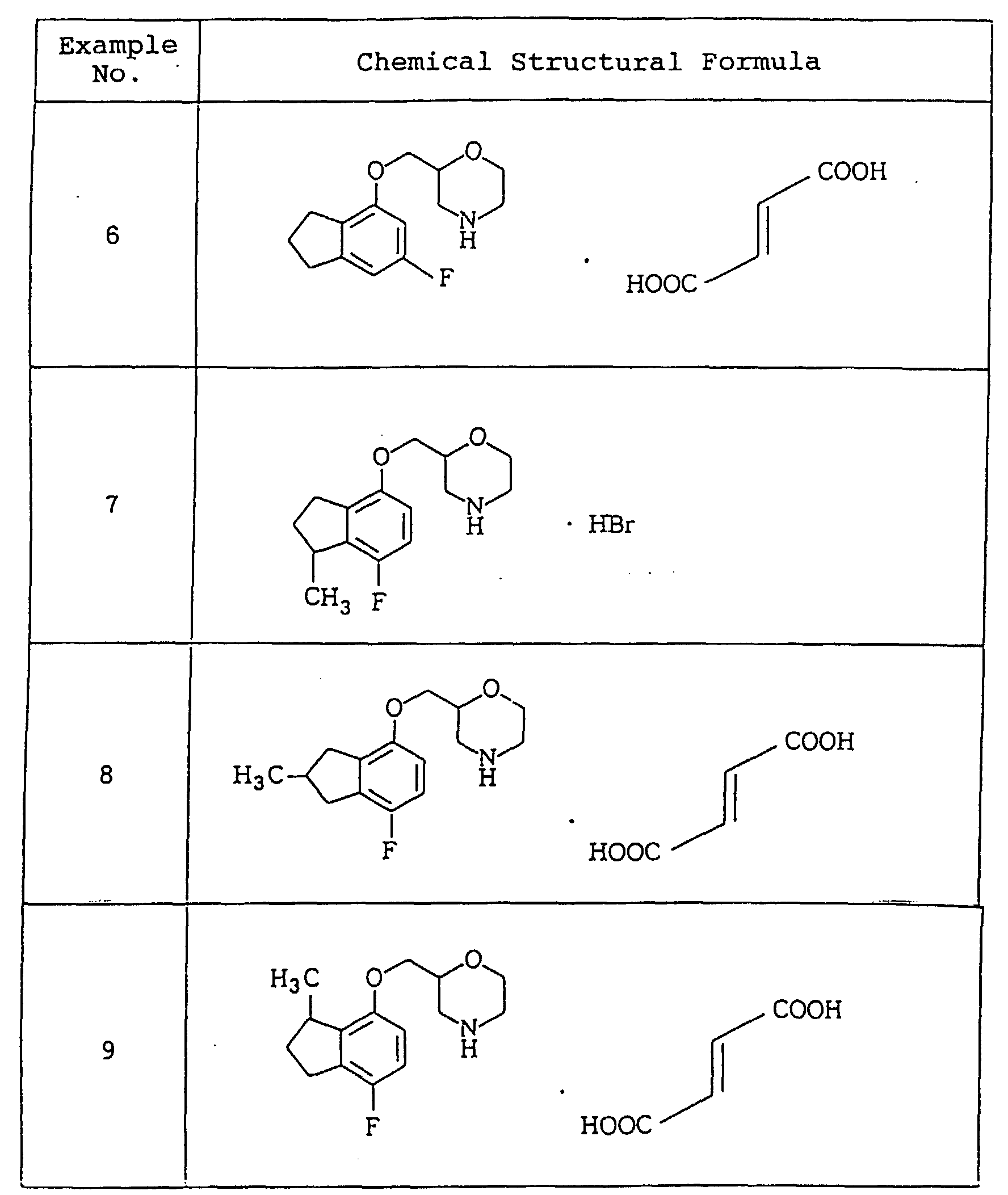
- Example 6 The compound of Example 6 was obtained in the same manner as in Example 1.
- Formulation Examples for the compound of the present invention for use as pharmaceuticals are described below.
- Formulation example of oral preparations of the compound of Example 5 Composition 20 mg Tablet Compound of Example 5 20 Lactose 73.1 Corn starch 18.8 Hydroxypropylcellulose 4 Calcium carboxymethylcellulose 4 Magnesium stearate 0.8 Total 120 mg Tablets each containing 20 mg of the compound of Example 5:
- Example 5 The compound of Example 5 (100 g), lactose (385.5 g), and corn starch (91.5 g) were uniformly mixed by using a fluidized bed granulation coating apparatus (manufactured by Ohkawara Seisakusho), and a 10% aqueous solution of hydroxypropylcellulose (200 g) was sprayed thereon for granulation After drying, the granules were passed through a 20 mesh sieve, combined with calcium carboxymethylcellulose (20 g) and magnesium stearate (3 g), and tabletted by means of a rotary tabletting machine (manufactured by Hata Tekkosho) using a punch (7 mm ⁇ 8.4 R) to obtain tablets each weighing 120 mg.
- a fluidized bed granulation coating apparatus manufactured by Ohkawara Seisakusho
- a 10% aqueous solution of hydroxypropylcellulose (200 g) was sprayed thereon for granulation
- the granules were passed through a 20 mesh sieve
Landscapes
- Chemical & Material Sciences (AREA)
- Organic Chemistry (AREA)
- Heterocyclic Carbon Compounds Containing A Hetero Ring Having Nitrogen And Oxygen As The Only Ring Hetero Atoms (AREA)
- Pharmaceuticals Containing Other Organic And Inorganic Compounds (AREA)
- Plural Heterocyclic Compounds (AREA)
- Steroid Compounds (AREA)
Abstract
Description
- This invention relates to morpholine compounds having antidepressive and antianxiety activity.
- Participation of serotonin (hereinafter referred to as 5-HT) in antidepressive action has been reported [Norio Ogawa (ed.), Shinnonoreseputa, Sekai Hoken Tsushinsha (1991, etc.)], and studies have been directed to 5-HT reuptake inhibition or action on 5-HT receptors.
- Tricyclic compounds such as Amitriptyline are widely used clinically as antidepressants. Although Amitriptyline exhibits a 5-HT reuptake inhibitory activity or a 5-HT2 receptor antagonistic activity, it additionally has a noradrenaline reuptake inhibitory activity and an anticholine activity and exhibits non-selective action and is therefore considered to cause side effects upon the cardiovascular system (e.g., palpitation), thirst, urinary retention, etc.
- Therefore, drugs which selectively inhibit 5-HT reuptake or selectively act on 5-HT2 receptors are expected to have reduced side effects. Drugs selectively inhibitory on 5-HT reuptake which have been clinically used include, for example, Fluoxetine. However, it has been reported that Fluoxetine induces anxiety or insomnia during the course of therapy [Physician's Desk Reference, Medical Economics Company, Oradell, NJ (1990)].
- Drugs which selectively antagonize for 5-HT2 receptors include, for example, Mianserin which is known as an antidepressive.
- A compound having selective 5-HT reuptake inhibitory activity together with selective 5-HT2 receptor antagonistic activity is eagerly awaited [Cell Biology to Pharmacology and Therapeutics, 488-504 (1990), Psychopathology, 22 (suppl. 1), 22-36 (1989), J. Clin. Psychiatry, 52, 34-38 (1991), Psychopharmacol. Bull., 26, 168-171 (1990), and Br. J. Pharmacolo., 100, 793-799 (1990)].
- Drugs having both 5-HT re-uptake inhibitory activity and 5-HT2 receptor antagonistic activity include, for example, Trazodone. However, the 5-HT re-uptake inhibitory activity of Trazodone is very weak, and it was reported that the antidepressive activity and antianxiety activity of Trazodone are based on its antagonism for 5-HT2 receptors [Marek G.J., et al., Psychopharmacology, 109, 2-11 (1992)]. Further, in addition to the above two activities Trazodone also exhibits affinity to α1 receptors and therefore causes sides effects based thereon.
- JP-A-46-7333 (the term "JP-A" means an "unexamined published Japanese patent application") discloses 2-[[(4-indanyl)oxy]methyl]morpholine. JP-A-52-83773 and JP-A-52-111580 disclose 2-[[(7-indenyl)oxy]methyl]morpholine and related compounds as antidepressants, and their production from indanyl intermediates; JP-A-55-1133717 discloses optical isomers of the latter indenyl compounds.
- The present invention relates to morpholine compounds which are structurally characterized by a halogen atom on the benzene ring of an indanyloxy group and which are therefore quite different in chemical structure from the conventional compounds.
- The morpholine compounds of the present invention exhibit selective 5-HT re-uptake inhibitory activity and selective 5-HT2 receptor antagonistic activity, both activities producing excellent effects.
- The present invention provides a compound which is a morpholine derivative of formula (I) or an optical or geometric isomer thereof or a salt of hydrate or solvate of such derivative or isomerwherein R1 and R3 are the same or different and selected from a hydrogen atom and lower alkyl groups and R2 is a halogen atom.
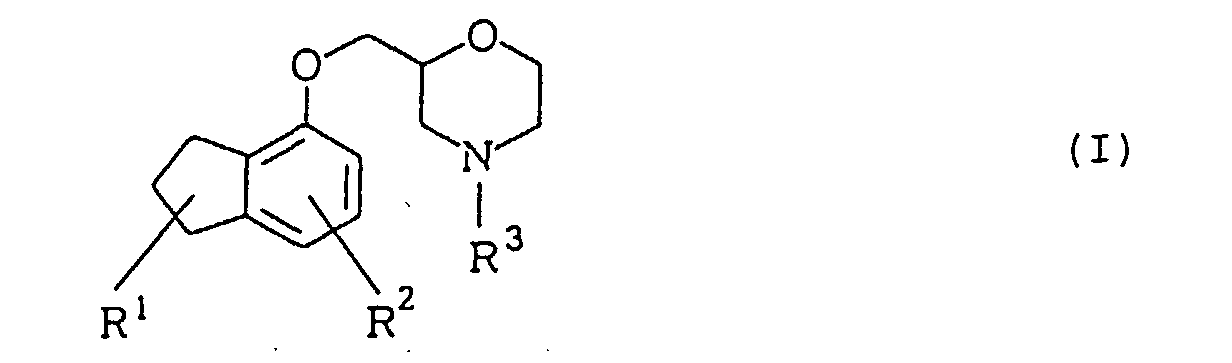
- The compounds of the present invention are described below in more detail. Unless otherwise indicated, the terminology "lower" as used in the definitions for general formulae denotes a straight or branched carbon chain containing 1 to 6 carbon atoms.
- Specific examples of the "lower alkyl group" are methyl, ethyl, propyl, isopropyl, butyl, isobutyl, sec-butyl, tert-butyl, pentyl, isopentyl, neopentyl, tert-pentyl, 1-methylbutyl, 2-methylbutyl, 1,2-dimethylpropyl, hexyl, isohexyl, 1-methylpentyl, 2-methylpentyl, 3-methylpentyl, 1,1-dimethylbutyl, 1,2-dimethylbutyl, 2,2-dimethylbutyl, 1,3-dimethylbutyl, 2,3-dimethylbutyl, 3,3-dimethylbutyl, 1-ethylbutyl, 2-ethylbutyl, 1,1,2-trimethylpropyl, 1,2,2-trimethylpropyl, l-ethyl-l-methylpropyl, and 1-ethyl-2-methylpropyl groups.
- A lower alkyl group having 1 to 3 carbon atoms, such as methyl, ethyl, propyl or isopropyl group, is preferred.
- The "halogen atom" includes a fluorine atom, a chlorine atom, a bromine atom, and an iodine atom, with a fluorine atom being preferred.
- Depending on the 2-position of the morphonyl group or the kind of the substituent, the compounds of the present invention include stereoisomers such as optical isomers based on an asymmetric carbon atom and geometrical isomers. The present invention includes all these isomers either as a mixture or as isolated. Preferred of the isomers are levorotatory optical isomers.
- The compounds may be salts with acids. Such salts includes acid addition salts with inorganic acids, for example, mineral acids such as hydrochloric acid, hydrobromic acid, hydroiodic acid, sulfuric acid, nitric acid, and phosphoric acid; or with organic acids, such as formic acid, acetic acid, propionic acid, oxalic acid, malonic acid, succinic acid, fumaric acid, maleic acid, lactic acid, malic acid, citric acid, tartaric acid, D-dibenzoyltartaric acid, carbonic acid, picric acid, methanesulfonic acid, ethanesulfonic acid, and glutamic acid. Hydrochlorides, oxalates, fumarates, and D-dibenzoyltartrates are preferred.
- The compounds of the present invention can be hydrates or various solvates or show polymorphism.
- The compounds of the present invention may be prepared by the following processes, but the process for preparing the compounds is not limited thereto.
- wherein R2 is as defined above; R1' represents a hydrogen atom, a lower alkyl group or a ketone group; X represents an amino protective group; and Y represents a halogen atom, a mesyloxy group or a tosyloxy group.
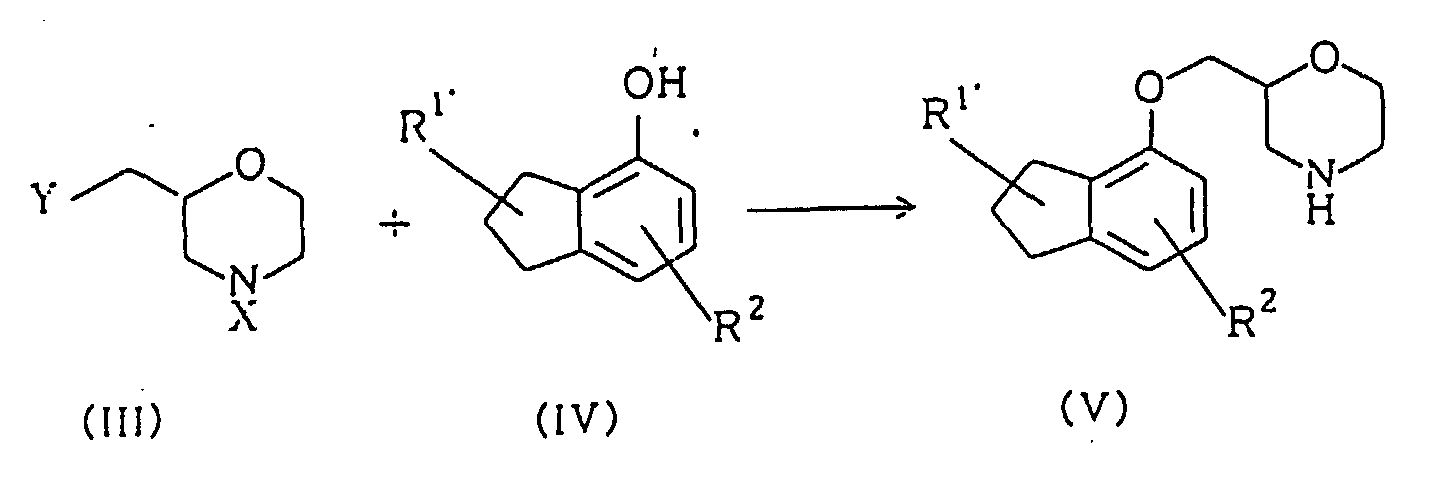
- The amino protective group is a commonly employed protective group and includes a trityl group, a benzhydryl group, a p-methoxybenzyl group, and a tert-butyl group, with a trityl group being preferred.
- The above reaction is carried out by stirring the morpholine compound (III) and the indanol compound (IV) at a reaction corresponding ratio in an inert solvent in the presence of a base at room temperature or under heating, or the indanol compound (IV) is previously converted to its sodium or potassium salt and then reacted with the morpholine compound (III) in an inert solvent at room temperature or under heating (step 1). The protective group of the product is released in a usual manner by, for example, reduction (e.g., catalytic reduction, reduction with liquid ammonia, etc.) or treatment with an acid, to obtain the compound (V) of the present invention (step 2). The inert solvent to be used in step 1 can be benzene, chloroform, dimethylformamide (hereinafter abbreviated as DMF), dimethyl sulfoxide (hereinafter abbreviated as DMSO), ethyl ether, water, methanol, or ethanol. The base to be used in step 1 can be sodium hydroxide, potassium hydroxide, sodium hydride, potassium hydride, lithium hydride, potassium carbonate, sodium carbonate, butyl lithium, or potassium tert-butoxide. The acid to be used in step 2 can be acetic acid, trifluoroacetic acid, trichloroacetic acid, hydrochloric acid, sulfuric acid, or hydrobromic acid-acetic acid. The reaction for removal of a protective group is usually effected in an inert solvent, such as methanol, ethanol or acetone, or in water at room temperature or under heating (under reflux).
- wherein R1, R2, and Y are as defined above.

- The halogeno-4-indanyl glycidyl ether (VIII) can be synthesized by reacting the indanol compound (VI) and the propylene oxide compound (VII) in a solvent, such as water, acetone or acetonitrile, in the presence of a base, such as sodium hydroxide, potassium hydroxide or potassium carbonate, under a condition of from 0°C to heat refluxing.
- The 2-[[(halogeno-4-indanyl) oxy]methyl]morpholine (X) can be synthesized by reacting the halogeno-4-indanyl glycidyl ether (VIII) and the aminoethylsulfuric acid (IX) in a mixed solvent, such as water-methanol or water-ethanol, in the presence of a base, such as sodium hydroxide or potassium hydroxide, under a condition of from 0°C to heat refluxing.
- The thus prepared compound (X) of the present invention may be converted to a salt with an acid, such as hydrochloric acid, fumaric acid, succinic acid, oxalic acid, D-dibenzoyltartaric acid, etc.
- In the processes 1 and 2, where the optically active morpholine compound (III) or the optically active propylene oxide compound (VII) is used, a corresponding optically active 2-[[(halogeno-4-indanyl)oxy]methyl]morpholine can be obtained.
- The compound obtained by the processes 1 to 5 can be purified to have an increased optical purity by recrystallization using D-dibenzoyltartaric acid, D-ditoluoyltartaric acid, D-tartaric acid, etc. as a resolving agent and acetonitrile-water, methanol, dimethylformamide, etc. as a recrystallizing solvent.
- wherein R1, and R2 are as defined above; R4 represents the lower alkyl group of R3; and Z represents a halogen atom, an arylsulfonyloxy group, a lower alkylsulfonyloxy group or an alkyl sulfate group.

- The arylsulfonyloxy group includes a phenylsulfonyloxy group and a p-toluenesulfonyloxy group; the lower alkylsulfonyloxy group includes a methylsulfonyloxy group, an ethylsulfonyloxy group, and a propylsulfonyloxy group; and the alkyl sulfate group includes a methyl sulfate group, an ethyl sulfate group, and a propyl sulfate group.
- The compounds of the present invention may be obtained through N-alkylation in a conventional manner.
- The N-alkylation is carried out by reacting the unsubstituted morpholino compound (X) with a reaction corresponding amount of alkylating agent (XI) in an inert solvent, such as acetone, acetonitrile, tetrahydrofuran (hereinafter abbreviated as THF), ethyl ether or DMF, in the presence of a base, such as potassium carbonate, sodiumhydride or potassium hydride, at room temperature to a heating temperature (or under reflux).
- Alternatively, N-alkylation can be carried out by stirring the unsubstituted morpholino compound (X) in the presence of a reaction corresponding amount of a lower alkylaldehyde and sodium borohydride, sodium triacetoxyborohydride, sodium cyanoborohydride, etc. in an inert solvent, such as methanol, ethanol, THF or dioxane, at room temperature or a heating temperature. This reaction is preferably conducted under an acidic condition by addition of hydrochloric acid, acetic acid, formic acid, etc.
- wherein R2, and X are as defined above; and R5 represents a lower alkyl group.
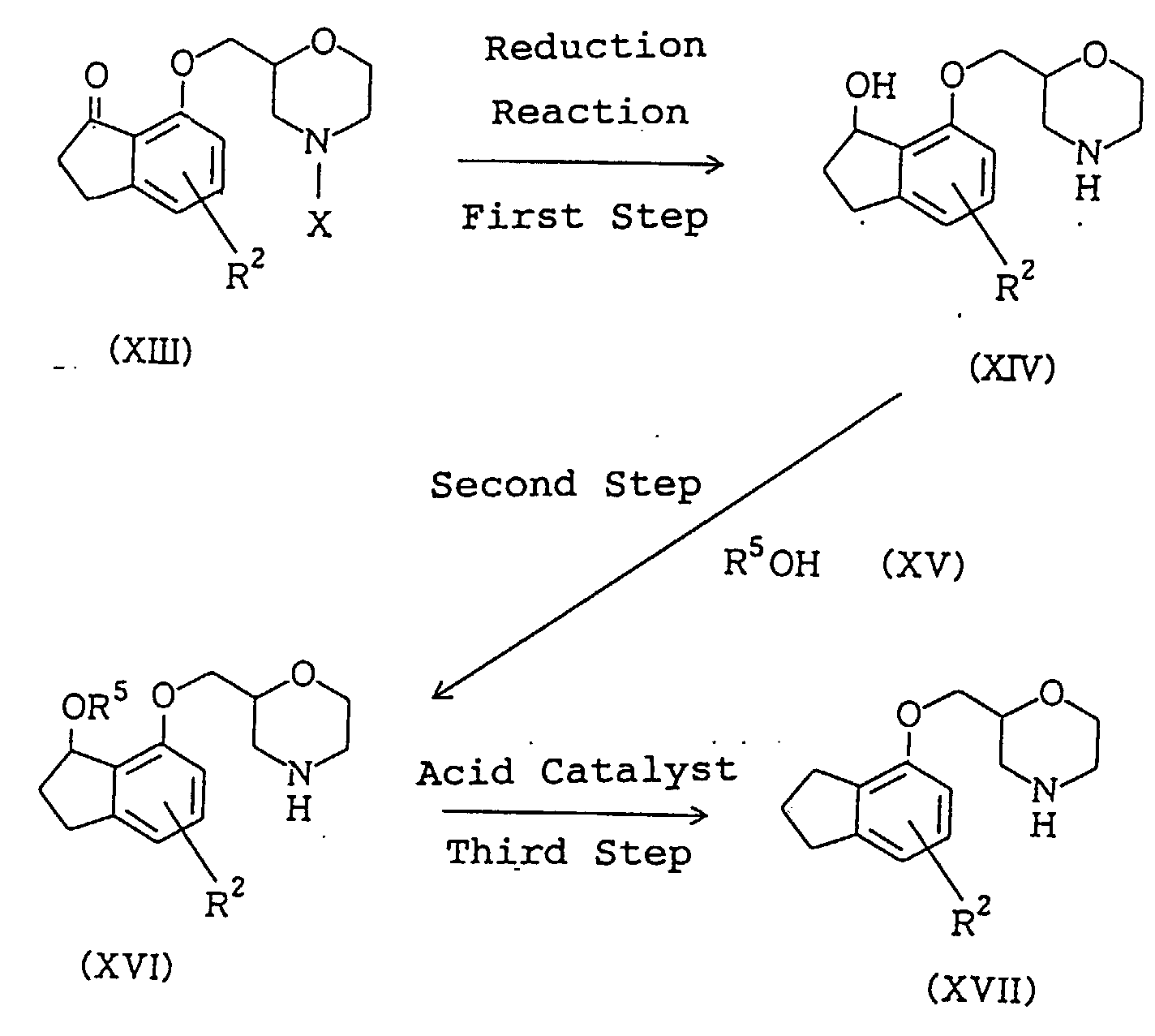
- The lower alkyl group as R5 is as mentioned above and is preferably a methyl group or an ethyl group.
- Step 1 is based on the conventional reduction. Typical reaction modes are shown below.
- The ketone compound (XIII) is reacted with a reaction corresponding amount of a reducing agent (e.g., borane, alane, sodium tetrahydroboron, lithium tetrahydroboron, lithium tetrahydroaluminum, sodium triacetoxyborohydride, diisobutyl aluminum hydride or sodium cyanoboron) in an inert solvent, such as a lower alcohol (e.g., methanol, ethanol or propanol), diethyl ether, THF, benzene, toluene, dichloroethane, chloroform or water), while cooling to heating under reflux to obtain the hydroxy compound (XIV).
- The ketone compound (XIII) is stirred with a metallic catalyst (e.g., Raney nickel, nickel or dichlorocopper tetroxide) in an alcohol, such as methanol or ethanol, at room temperature to a heating temperature.
- The ketone compound (XIII) and a reaction corresponding amount of a dithionite (e.g., sodium dithionite) are stirred in a mixed solvent, such as DMF-water, THF-water, dioxane-water, methanol-water or ethanol-water, while cooling or at room temperature.
- The reaction is carried out by stirring the hydroxy compound (XIV) in the alcohol (XV), such as methanol or ethanol, under an acidic condition with hydrochloric acid, acetic acid, trifluoroacetic acid, trichloroacetic acid, sulfuric acid or hydrobromic acid-acetic acid, at room temperature or under heating.
- The reaction is carried out by stirring the alkoxy compound (XVI) obtained in the step 2 in an inert solvent, such as toluene, benzene, THF or 1,4-dioxane, in the presence of an acid catalyst (e.g., hydrochloric acid, sulfuric acid, phosphoric acid, p-toluenesulfonic acid or acetic acid) at room temperature or under heating.
- The 2-[[(halogeno-4-indanyl)oxy]methyl]morpholine derivative or 2-[[(halogeno-7-indanyl)oxy]methyl]morpholine derivative obtained by the processes 1 to 4 is in some cases partly isomerized with ease at room temperature to give an approximately 1:1 isomeric mixture.
- The mixture can be separated into isomers by converting the compound to an addition salt through a conventional salt-forming reaction followed by separation by, for example, recrystallization.wherein R2 and X are as defined above.
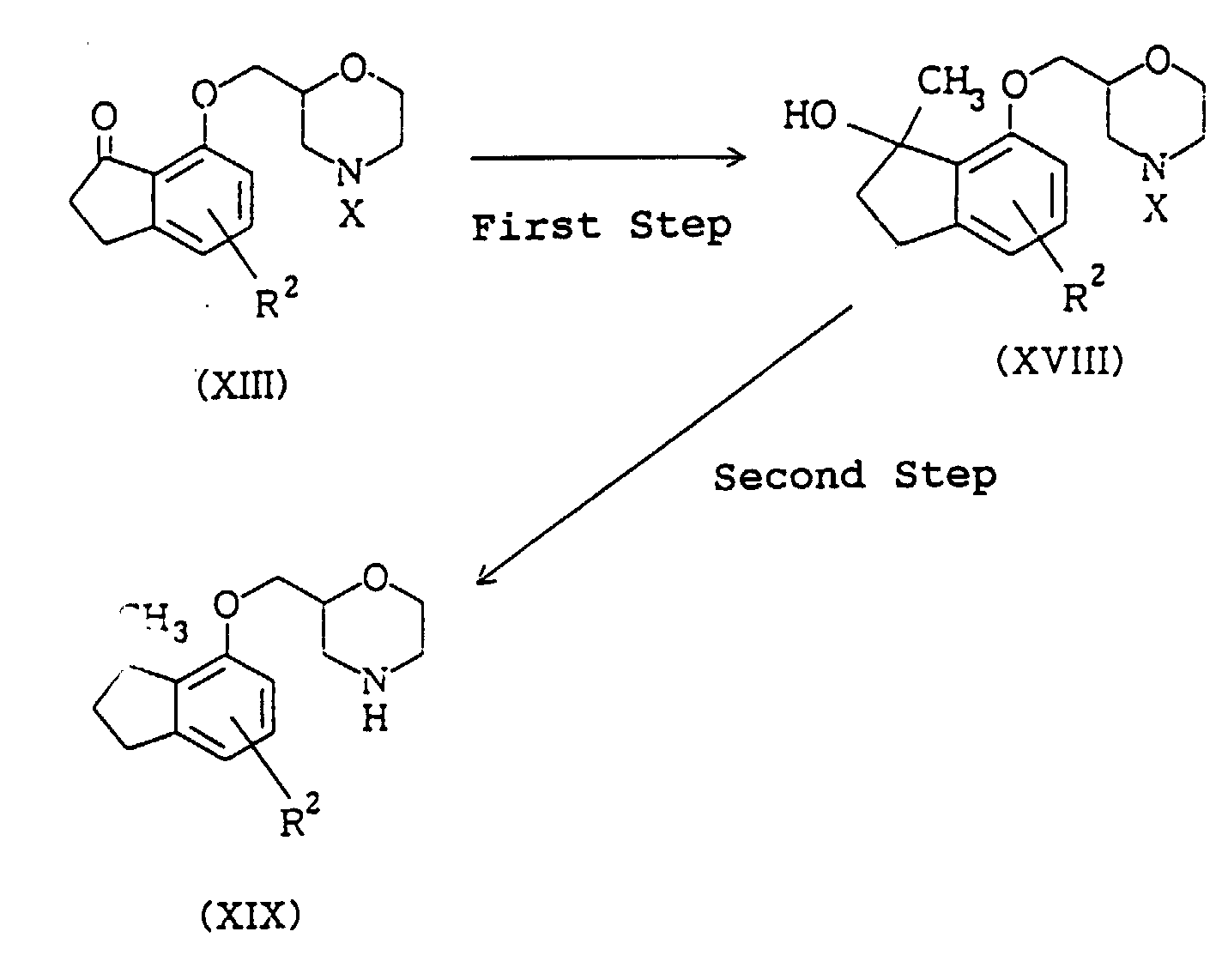
- This process is to obtain the compound (XIX) of the present invention, in which the 3-position of the indane ring is substituted with a methyl group.
- The reaction is carried out by reacting the ketone compound (XIII) and a reaction corresponding amount of a methylating agent, such as an organometallic reagent (e.g., methyllithium, Grignard reagent, a methyl halide, trimethylaluminum, methylcopper or dimethylcopper) in an anhydrous solvent, such as THF, diethyl ether, benzene, toluene, dichloromethane or 1,4-dioxane, while cooling or at room temperature.
- In a preferred reaction mode, the ketone compound (XIII) and a reaction corresponding amount of methyllithium or methylmagnesium bromide are stirred in THF or diethyl ether under cooling or at room temperature, e.g., from -78° to 0°C.
- The hydroxymethyl compound (XVIII) obtained in the step 1 is catalytically reduced in a conventional manner. The reaction is typically conducted by stirring the compound (XVIII) in an inert solvent, such as a lower alcohol (e.g., methanol, ethanol or propanol), THF, 1,4-dioxane, diethyl ether, ethyl acetate, benzene, toluene or dichloromethane, in the presence of a metallic catalyst (e.g., palladium-on-carbon, dihydroxypalladium or platinum dioxide) in a hydrogen atmosphere while cooling or at room temperature.
- The hydroxymethyl compound (XVIII) obtained in the step 1 and a reaction corresponding amount of a trialkylsilane (e.g., trimethylsilane or triethylsilane) are stirred in an inert solvent, such as methanol, ethanol, THF, dioxane, diethyl ether or acetonitrile, in the presence of an acid, such as acetic acid, trifluoroacetic acid, hydrochloric acid, hydrobromic acid, sulfuric acid or phosphoric acid, while cooling with ice or at room temperature.
- wherein R2 and X are as defined above.

- The reaction is performed by subjecting the ketone compound (XIII) to the usual Wittig reaction using a Wittig reagent (e.g., CH2PPh3) in a conventional manner [Shin Jikken Kagaku Koza 14(I), 224-238, Maruzen K.K. (1977)] to obtain the exo-methylene compound (XX) (step 1). The exo-methylene compound (XX) obtained in the step 1 is then reduced in a conventional manner [Reductions in Organic Chemistry, Ellis Horwood Ltd. (1984)].
- The compounds of the present invention inhibit re-uptakeof 5-HT with high selectivity and also exhibit selective antagonism for 5-HT2 receptors. Therefore, the compounds are useful as therapeutic agents for depression, anxiety, psychosomatic diseases, autonomic imbalance or anxiety petition with reduced side effects and as therapeutic agents for marginal involvement associated with cerebrovascular disturbances or Alzheimer disease, such as spontaneity reduction, dysthymia, anxiety and impatience, hallucination and illusion, hypochondria, disorder of sleep, and the like. Further, compounds of the present invention have anti-reserpine action, blood viscosity improving action, antihypoxic action, and antioxidation and are useful as agents for cerebral circulation and metabolism improvement or as agents for cerebral function improvement,and are also useful as analgesics. Furthermore, compounds of the present invention can be used for the improvement of cerebral dysfunction or dementia accompanying Alzheimer disease.
- A test of 5-HT re-uptakeinhibition and a test of 5-HT2 receptor antagonism for demonstrating the effects of compounds of the present invention are described below in detail.
- The 5-HT re-uptake inhibitory activity was tested by examining the degree of inhibition of a test compound on binding of [3H]-Citalopram to 5-HT reuptake sites.
- The method of D'amato RJ, et al. described in J. Pharmacol. Exp. Ther., 242, 364 (1987) was used. A buffer solution (0.5 ml) containing about 1.0 nM of [3H]-Citalopram, a rat cerebral cortex membrane preparation (about 0.4 mg-protein), and a test compoundwere allowed to react at 25°C for 60 minutes. Thereafter, the labeled ligand of bound form was separated form the labeled ligand of free form by suction filtration. The amount of the ligand nonspecifically bound to the 5-HT reuptake sites, which was obtained by adding excess non-labeled Fluoxetine (10 µM), was subtracted from the total amount of the bound ligand to obtain the amount of the ligand specifically bound to the 5-HT reuptake sites. The IC50 (the concentration which reduces the amount of the specifically bound ligand by 50%) for each compound was calculated and converted to a dissociation constant (Ki value).
- Enhancement of the action of L-5-hydroxytryptophan which is a 5-HT precursor was tested [Naunyn-Schmiedeberg's Archives of Pharmacology, 311, 185-192 (1980)]. Male ICR mice weighing from 30 to 40 g were used. A test drug was intraperitoneally administered, and 30 minutes later 90 mg/kg of L-5-hydroxytryptophan was intravenously injected. After 5 minutes from the injection, the animals were observed for 5 minutes in terms of tremor, head shaking behavior, and hind leg abduction. The test drug was evaluated from the ED50 in manifestation of each action.
- The degree or inhibition of a test compound on uptake of [3H]-5-HT, [3H]-noradrenaline and [3H]-dopamine into synaptosomes was examined. The method of Harada and Maeno described in Biochem. Pharmacol., 28, 2645 (1979) was used. A Wistar male rat was decapitated and the cerebral cortex and the corpus striatum were taken out. The synaptosome fraction of the cerebral cortex was prepared for 5-HT and noradrenaline uptake and that of the corpus striatum was prepared for dopamine uptake. Each synaptosome fraction was incubated at 37°C for 3 minutes, and [3H]-5-HT, [3H]-noradrenaline and [3H]-dopamine (10-7 M) was added to the respective fraction. After further incubation for 2 minutes, the system was cooled with ice (0°C) to stop the reaction. Then, the reaction system was filtered through a Whatman CF/B glass filter, and the radioactivity trapped on the filter was measured with a liquid scintillation counter. The nonspecific activity was obtained by using a reaction system containing no test drug and having been incubated at 0°C. The test drug was evaluated from the IC50 (the concentration at which the uptake of each radioactive ligand reduced by 50%).
- The degree of inhibition of a test compound on binding of [3H]-Ketanserin was tested. The method of Leysen JE, et al. described in Mol. Pharmacol., 21, 301 (1982) was used. A buffer solution (0.5 ml in total) containing about 1.0 nM of [3H]-Ketanserin, a rat cerebral cortex membrane preparation (about 0.2 mg-protein), and a test compound were allowed to react at 25°C for 30 minutes. Thereafter, the bound labeled ligand was separated by suction filtration. The amount of the ligand nonspecifically bound to the 5-HT2 receptors, which was obtained by adding excess non-labeled Metergoline (10 µM), was subtracted from the total amount of the bound ligand to obtain the amount of the ligand specifically bound to 5-HT2 receptors. The IC50 (the concentration at which the amount of the specifically bound ligand is reduced by 50%) for each compound was calculated and converted to a dissociation constant (Ki value).
- The above tests proved that compounds of the present invention possess both a 5-HT re-uptake inhibitory activity and a 5-HT2 receptor antagonistic activity in vitro and both the activities produce excellent effects. To the contrary, the comparative compounds used showed very weak 5-HT2 receptor antagonism, while exhibiting a 5-HT re-uptake inhibitory activity (see Table 1 below).
Test Compound Inhibition on 5-HT Reuptake (Ki Value) Antagonism for 5-HT2 Receptor (Ki Value) Example 4 21 nM 100 nM Example 5 21 nM 100 nM Comparative Compound 1 52 nM 1032 nM Comparative Compound 2 22 nM 4675 nM Note: Comparative compound 1:
2-[[(4-Indanyl)oxy]methyl]morpholine (the compound described in JP-A-46-7333)
Comparative compound 2: 2-[[(7-Indenyl)oxy]methyl]morpholine (the compound described in JP-A-52-83773) - Further, in the in vivo test on 5-HT re-uptake inhibition, the ED50 of the compound of, for example, Example 4 in manifestation of tremor, head shaking behavior, and hind leg abduction was 6.3 mg/kg, 7.2 mg/kg and 14.1 mg/kg, respectively, indicating a powerful inhibitory activity on 5-HT reuptake.
- In the test on selective 5-HT re-uptake inhibition, the IC50 of the compound of, for example, Example 1 in inhibition of [3H]-5-HT uptake, [3H]-noradrenaline uptake and [3H]-dopamine uptake was 227 nM, 6722 nM and 10000 nM or more, respectively. These results reveal that the [3H]-5-HT uptake inhibitory activity of the compound of Example 1 is about 30 or more times the [3H]-noradrenaline uptake inhibitory activity and the [3H]-dopamine uptake inhibitory activity and, therefore, shows selectivity to 5-HT uptake.
- Accordingly, the compoundsof the present invention are expected to cause no side effect observed with compounds having nonselective uptake inhibitory activities, such as side effects on the cardiovascular system (e.g., palpitation), and other side effects such as thirst and urinary retention.
- Preparations containing at least one of the compounds of the present invention as an active ingredient may be prepared by using carriers, vehicles and other additives generally employed in pharmaceutical preparations.
- The carriers or vehicles to be used in preparations may be either solid or liquid and include lactose, magnesium stearate, starch, talc, gelatin, agar, pectin, gum arabic, olive oil, sesame oil, cacao butter, ethylene glycol and others for common use.
- The compoundsof the present invention can be administered either orally in the dosage form of tablets, pills, capsules, granules, powders, liquids, etc., or parenterally in the dosage form of injections for, for example, intravenous or intramuscular administration, suppositories or preparations for transdermal administration.
- The dose generally ranges from 1 to 1000 mg, preferably 10 to 300 mg, per day for adults, usually given in a single or several divided doses, while varying depending on the age, body weight and conditions of patients, the therapeutic effect, the administration route, the period of treatment, and the like. As a matter of course, lower doses may be sufficient in some cases since the dose may vary with various conditions as mentioned above.
- The present invention will now be illustrated in greater detail with reference to Examples, but it should be understood that the present invention should not be construed as being limited thereto.
- Preparation of the starting compounds used in Examples is explained by way of Reference Examples.
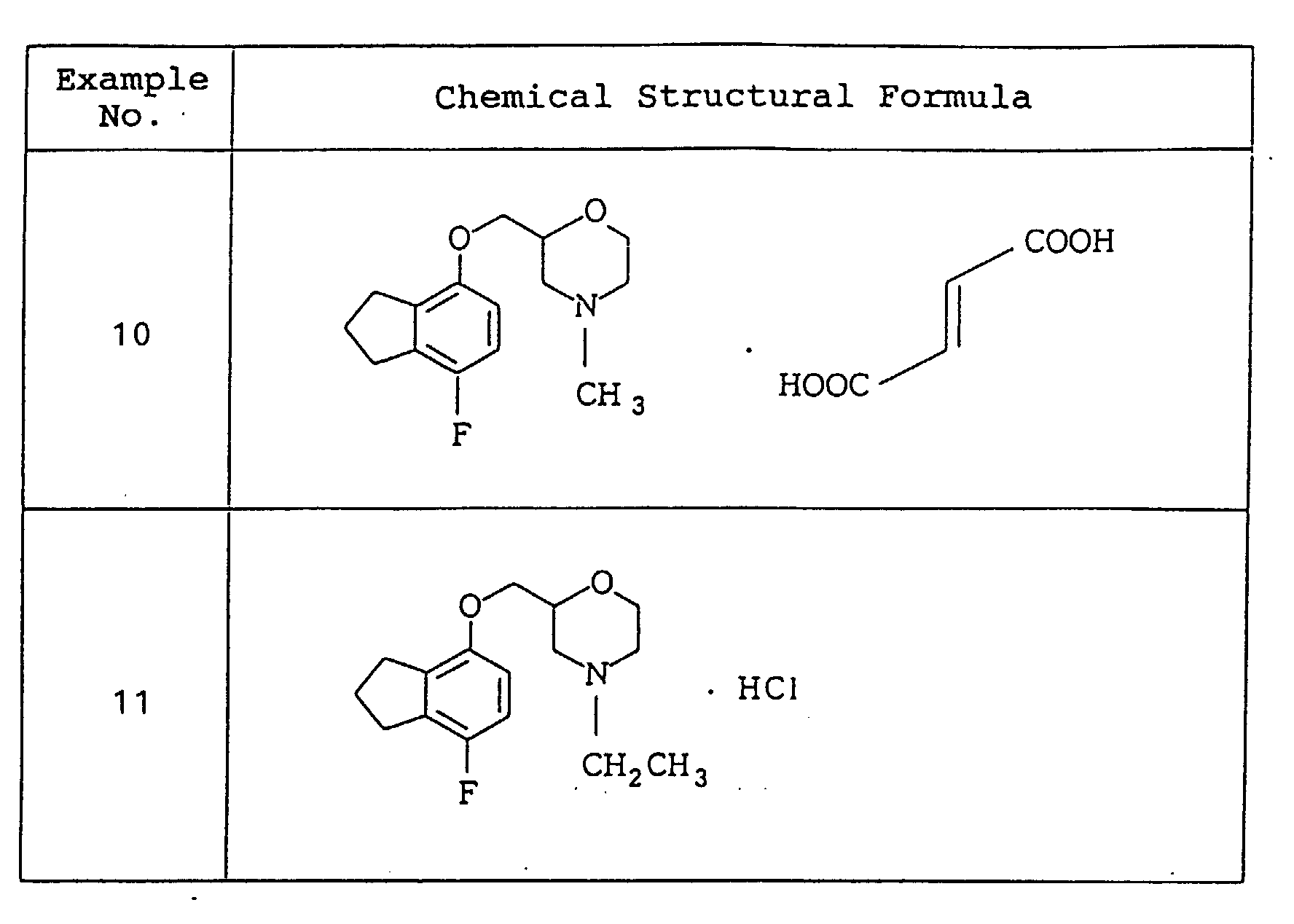
- The chemical structures of the compounds obtained in Examples are shown in Table 2.
-
- (i) Aminoethyl sulfate (423.6 g, 3.00 mol) was dissolved
in a 70% aqueous solution of sodium hydroxide (360 ml), and a
methanol solution (400 ml) of allyl glycidyl ether (68.4 mg,
0.60 mol) was added thereto dropwise at 50°C. After stirring
the mixture at that temperature for 1 hour, a 70% aqueous
solution of sodium hydroxide (600 ml) was added thereto,
followed by stirring at the same temperature for 13 hours.
After completion of the reaction, water was added to
the reaction mixture at room temperature, and the mixture was
extracted with chloroform (6 × 1000 ml). The extract was
washed with a saturated aqueous solution of sodium chloride
(2 × 200 ml) and dried over magnesium sulfate. The solvent
was removed by evaporation, and the residue was subjected to
distillation under reduced pressure to give 2-(allyloxymethyl)morpholine
(75.2 g) as a colorless oily
substance.
Physicochemical Properties:
1H-NMR (CDCl3) δ:
2.65 (dd, J=10.3Hz, J=12.2Hz, 1H), 2.74-2.93(m, 3H), 3.36-3.49 (m, 2H), 3.59-3.70 (m, 2H), 3.90 (dd, J=1.96Hz, J=11.7Hz, 1H), 4.01 (dd, J=0.96Hz, 5.84Hz, 2H, 9-H), 5.17-5.25 (m, 1H, 11-H), 5.28-5.30 (m, 1H, 11-H), 5.86-5.96 (m, 1H, 10-H)
MS (GC/MS): m/z 157 (M+) - (ii) 2-(Allyloxymethyl)morpholine (39.5 g, 0.25 mol) was
dissolved in 1,4-dioxane (500 ml), and potassium tert-butoxide
(28.2 g, 0.25 mol) was added to the solution at room
temperature, followed by heating under reflux for 3 hours.
After completion of the reaction, water was added to the
reaction mixture at room temperature, and the reaction
mixture was extracted with chloroform (3 × 1000 ml). The
extract was washed with a saturated aqueous solution of
sodium chloride (1000 ml) and dried over magnesium sulfate.
The solvent was evaporated to give crude 2-(1-propenyloxymethyl)morpholine
(40.0 g) as a pale yellow oily
substance.
Physicochemical Properties:
1H-NMR (CDCl3) δ:
1.58 (dd, J=1.80Hz, J=6.84Hz, 3H, 10-H), 2.75-2.92 (m, 2H), 3.46-4.10 (m, 7H), 4.42 (dq, J=1.70Hz, J=6.57Hz, 1H), 5.96 (dq, J=1.70Hz, 6.21Hz, 1H)
MS (GC/MS): m/z 157 (M+) - (iii) The crude 2-(1-propenyloxymethyl)morpholine (32.7 g)
was dissolved in an acetone-water (9:1) mixed solvent
containing 2.0N hydrochloric acid, followed by heating under
reflux for 4 hours. After completion of the reaction, the
solvent was evaporated to obtain a crude alcohol compound
(41.8 g) as a pale yellow oily substance. Triethylamine
(145 ml) was added dropwise to a methylene chloride solution
(300 ml) of the crude alcohol compound (41.8 g) under
ice-cooling, and triphenylchloromethane (41.5 g, 0.208 mol)
was added thereto at the same temperature, followed by
stirring for 2 hours. After completion of the reaction, a
saturated aqueous solution of sodium hydrogencarbonate
(150 ml) was added to the reaction mixture, and the mixture
was extracted with chloroform. The extract was dried over
magnesium sulfate, the solvent evaporated, and the residue
recrystallized from methylene chloride-hexane to give
2-hydroxymethyl-4-tritylmorpholine (48.0 g).
Physicochemical Properties:
IR (KBr): 3450 cm-1
1H-NMR (CDCl3) δ:
1.12-1.90 (m, 2H), 2.80-2.98 (m, 2H), 3.28-3.56 (m, 3H), 3.80-4.05 (m, 3H), 7.06-7.58 (m, 15H, C(C6H5)3)
MS (FAB/pos.): m/z 360 [(M+1)+] - (iv) Pyridine (20.3 ml, 0.251 mol) was added dropwise to a
methylene chloride solution (100 ml) of the trityl compound
(15.0 g) under ice-cooling, and a methylene chloride solution
(100 ml) of p-toluenesulfonyl chloride (15.9 g) was added
thereto dropwise at the same temperature, followed by
stirring for 13 hours. After completion of the reaction, a
saturated aqueous solution of sodium hydrogencarbonate was
added under ice-cooling, followed by extraction with
chloroform. The extract was washed with a saturated aqueous
solution of sodium chloride and dried over magnesium sulfate.
The solvent was evaporated, and the residue was
recrystallized from 1,2-dichloroethane to give
2-p-toluenesulfonyloxymethyl-4-tritylmorpholine (14.0 g).
Physicochemical Properties:
IR (KBr): 1730 cm-1
1H-NMR (CDCl3) δ:
1.34-1.70 (m, 2H), 2.43 (s, 3H, PhCH3), 2.75-2.94 (m, 2H), 3.72-4.04 (m, 5H), 7.10-7.40 (m, 17H), 7.70 (d, J=2.10Hz, 2H)
MS (FAB/pos.): m/z 514 [(M+1)+] -
-
- (i) Phenol (8.00 g) was added to a mixed solution of an
aqueous solution (50 ml) of sodium hydroxide (3.43 g) and
methylene chloride (60 ml) at room temperature. Then,
tetrabutylammonium hydrogensulfate (0.48 g) was added, and
acrylic chloride (7.75 g) was added thereto dropwise at 0°C,
followed by stirring at room temperature for 20 minutes.
After completion of the reaction, the organic layer was
washed successively with water and a saturated aqueous
solution of sodium chloride, and dried over magnesium
sulfate. The solvent was removed by evaporation to give
4-fluorophenyl acrylate (13.5 g), which was used in the next
reaction without purification.
Physicochemical Properties:
1H-NMR (CDCl3) δ:
5.99 (dd, J=2.43 and 9.81Hz, 1H), 6.28 (dd, J=9.81 and 16.7Hz, 1H), 6.62 (dd, J=2.43 and 16.7Hz, 1H), 7.08 (d, J=5.94Hz, 4H)
MS (GC/MS): m/z 166 (M+) - (ii) 4-Fluorophenyl acrylate (12.0 g) was added to a
mixture of aluminum chloride (33.7 g) and sodium chloride
(14.8 g), and the mixture was stirred at 80°C for 2 hours and
then at 160°C for 1 hour. After completion of the reaction,
ice-water and concentrated hydrochloric acid were added, and
the reaction mixture was extracted with chloroform. The
extract was washed with a saturated aqueous solution of
sodium chloride and dried over magnesium sulfate. The
solvent was evaporated, and the resulting residue was
purified by silica gel column chromatography. From the
eluate of hexane-ethyl acetate (9:1), 4-fluoro-7-hydroxy-1-indanone
(5.75 g) was obtained as a pale yellow powder.
Physicochemical Properties:
1H-NMR (CDCl3) δ:
2.68-2.82 (m, 2H), 3.08-3.20 (m, 2H), 6.73 (dd, J=3.06 and 8.91Hz, 1H), 7.13 (d, J=8.91Hz, 1H), 8.79 (s, 1H)
MS (GC/MS): m/z 166 (M+) - (iii) 4-Fluoro-7-hydroxy-1-indanone (1.0 g) was dissolved
in acetic acid (15 ml) and the solution was stirred with 10%
palladium-on-carbon (0.5 g) in a hydrogen atmosphere at
atmospheric pressure for 12 hours. The catalyst used was
removed by filtration using Celite, and the filtrate was
concentrated to give 7-fluoro-4-indanol (0.783 g).
Physicochemical Properties:
1H-NMR (CDCl3) δ: 1.95-2.32 (m, 2H), 2.75-3.10 (m, 4H), 4.55 (brs, 1H), 6.54 (dd, J=4.05 and 8.46Hz, 1H), 8.46 (t, J=8.46Hz, 1H)
MS (GC/MS): m/z 152 (M+) -
-
- (i) 7-Fluoro-4-indanol (0.30 g) was dissolved in an
aqueous solution (5 ml) of potassium hydroxide (0.157 g), and
the solution was stirred at room temperature for 1 hour.
After the reaction, the solvent was evaporated.
2-p-Toluenesulfonyloxymethyl-4-tritylmorpholine (1.69 g) was
added to a dimethylformamide solution (20 ml) of the
resulting residue, followed by stirring at 105°C for
12 hours. After completion of the reaction, a saturated
aqueous solution of sodium hydrogencarbonate was added under
ice-cooling, and the reaction mixture was extracted with
chloroform. The extract was washed with a saturated aqueous
sodium chloride solution (100 ml) and dried over magnesium
sulfate. The solvent was removed by evaporation, and the
residue was purified by silica gel column chromatography.
From the hexane-ethyl acetate (9:1) eluate, 2-[[(7-fluoro-4-indanyl)oxy]methyl]-4-tritylmorpholine
(0.54 g) was obtained.
Physicochemical Properties:
1H-NMR (CDCl3) δ:
1.40-2.25 (m, 2H), 2.60-3.20 (m, 6H), 3.75-4.05 (m, 5H), 6.50-7.65 (m, 17H)
MS (FAB/pos.): m/z 494 (M++1) - (ii) To 20 ml of a methanolic solution of 0.54 g of
2-[[(7-fluoro-4-indanyl)oxy]methyl]-4-tritylmorpholine was
added a methanolic solution (5 ml) of concentrated
hydrochloric acid (1.30 g, 12.8 mmol) at room temperature,
followed by stirring for 30 minutes. After completion of the
reaction, the reaction mixture was neutralized with a
saturated aqueous solution of sodium hydrogencarbonate. The
solvent was evaporated, and a saturated aqueous sodium
chloride solution was added to the resulting residue,
followed by extraction with chloroform. The extract was
washed with a saturated aqueous sodium chloride solution and
dried over magnesium sulfate. The solvent was evaporated,
and the resulting residue was purified by silica gel column
chromatography to obtain 2-[[(7-fluoro-4-indanyl)oxy]methyl]morpholine
(0.236 g) as a colorless oily
substance from the chloroform-methanol-concentrated ammonia
(10:1:0.1) eluate.
Physicochemical Properties:
1H-NMR (CDCl3) δ:
1.90-2.28 (m, 2H), 2.55-3.17 (m, 8H), 3.50-4.04 (m, 5H), 6.56 (dd, J=4.23 and 8.55Hz, 1H), 6.76 (t, J=8.55Hz, 1H)
MS (GC/MS): m/z 251 (M+) The above-obtained 2-[[(7-fluoro-4-indanyl)oxy]methyl]morpholine was converted to a hydrochloride, which was recrystallized from methanol-diethyl ether-isopropyl ether to give white crystals.
Physicochemical Properties:
m.p.: 169-171°C
1H-NMR (CDCl3) δ:
2.06 (quint., J=7.6Hz, 2H), 2.78-3.02 (m, 5H), 3.15-3.36 (m, 3H), 3.81 (dt, J=2.0Hz and 10.0Hz, 1H), 3.90-4.25 (m, 4H), 6.76 (dd, J=3.60 and 8.80Hz, 1H), 6.90 (t, J=8.80Hz, 1H)
MS (GC/MS): m/z 251 (M+)Elemental analysis for C14H18NO2F•HCl.0.2H2O: C H N Cl F Calcd. (%) 57.71 6.71 4.81 12.17 6.52 Found (%) 57.77 6.67 4.71 12.44 6.50 -
-
- (i) In the same manner as in Example 1-(i), except for
using 7-chloro-4-indanol (0.300 g), 2-[[(7-chloro-4-indanyl)oxy]methyl]-4-tritylmorpholine
(0.790 g) was obtained
as a pale yellow powder.
Physicochemical Properties of 2-[[(7-Chloro-4-indanyl)oxy]methyl]-4-tritylmorpholine:
1H-NMR (CDCl3) δ:
1.25-2.23 (m, 6H), 2.66-3.18 (m, 4H), 3.72-4.31 (m, 5H), 6.55 (d, J=9.00Hz, 1H), 7.04 (d, J=9.00Hz, 1H), 7.12-7.65 (m, 15H)
MS (FAB/pos.): m/z 522 [(M+1)+] - (ii) In the same manner as in Example 1-(ii), except for
using 2-[[(7-chloro-4-indanyl)oxy]methyl]-4-tritylmorpholine
(0.55 g), 2-[[(7-chloro-4-indanyl)oxy]methyl]morpholine
hydrochloride (0.252 g) was obtained as a pale yellow oily
substance.
Physicochemical Properties:
1H-NMR (CDCl3) δ:
1.95-2.28 (m, 4H), 2.85-3.10 (m, 6H), 3.50-4.15 (m, 5H), 6.59 (d, J=8.64Hz, 1H), 7.06 (d, J=8.64Hz, 1H)
MS (EI): m/z 267 (M+), 269 [(M+2)+] -
- To 72.3 9 of 7-fluoro-4-indanol was added an aqueous solution of potassium hydroxide (potassium hydroxide: 72.3 g; water: 150 ml), followed by stirring until the indanol was dissolved. To the solution was added 40.8 ml of (R)-(-)-epichlorohydrin, followed by stirring for 8 hours. To the reaction mixture was added 1 ℓ of water, and the mixture was extracted with three 1 ℓ portions of ethyl ether. The ethyl ether solution was dried over anhydrous magnesium sulfate and concentrated under reduced pressure to give 97 g of an oily substance.
- To 670.4 g of aminoethylsulfuric acid was added an aqueous solution of potassium hydroxide (potassium hydroxide: 313.5 g; water: 188 ml), and subsequently the above-obtained oily substance dissolved in 600 ml of methanol was added thereto. The mixture was stirred at 50°C for 4 hours, and an aqueous solution of potassium hydroxide (potassium hydroxide: 627 g; water: 380 ml) was added thereto, followed by further stirring at 50°C for 18 hours. To the reaction mixture were added 2 ℓ of water and 2 ℓ of ethyl ether. Any insoluble matter was removed by filtration, and the filtrate was extracted with three 2 ℓ portions of ethyl ether. The ethyl ether solution was dried over anhydrous magnesium sulfate and concentrated under reduced pressure to obtain 114 g of an oily substance.
- D-Dibenzoyltartaric acid was dissolved in a mixed solvent of 1 ℓ of acetonitrile and 1.3 ℓ of water, and the above-obtained oily substance dissolved in 0.5 ℓ of acetonitrile was added thereto while heating under reflux. After heat-refluxing for 1 hour, the reaction mixture was cooled while stirring in an ice bath. The precipitated salt was collected by filtration, washed with acetonitrile, and dried to give 140 g of (-)-2-[[(7-fluoro-4-indanyl)oxy]methyl]morpholine D-dibenzoyltartrate having an optical purity of 99.9% e.e.
Physicochemical Properties:
1H-NMR (DMSO) δ:
2.09 (tt, J=7.2Hz, 2H), 2.76 (t, J=7.6Hz, 2H), 2.81-2.94 (m, 6H), 3.09 (d, J=12.4Hz, 1H), 3.21 (d, J=12.4Hz, 1H), 3.64-3.69 (m, 1H), 3.84-3.95 (m, 4H), 5.65 (s, 2H), 6.69 (dd, J=3.6Hz, J=8.8Hz, 1H), 6.89 (dd, J=8.8Hz, 1H), 7.51 (dd, J=7.2Hz, 4H), 7.64 (dd, J=8Hz, 2H), 7.97 (d, J=7.6Hz, 4H)
MS (FAB/pos.): m/z 252 (M+1)+ - To 10 g of (-)-2-[[(7-fluoro-4-indanyl)oxy]methyl]morpholine D-dibenzoyltartrate was added an aqueous solution of sodium hydroxide (sodium hydroxide: 4 g; water: 200 ml), and the mixture was extracted with three 200 ml portions of methylene chloride. The organic layer was dried over anhydrous magnesium sulfate and concentrated under reduced pressure. To the residue were added 1.91 g of fumaric acid and 110 ml of 2-propanol, and the mixture was heated until complete dissolution. The solution was cooled in an ice bath, and the precipitated salt was collected by filtration, washed with 2-propanol, and dried to give 5.04 g of (-)-2-[[(7-fluoro-4-indanyl)oxy]methyl]morpholine fumarate having an optical purity of 99.9% e.e.
Physicochemical Properties:
m.p.: 141-142°CElemental analysis for C18H22NO6F: C H N F Calcd. (%) 58.85 6.04 3.81 5.17 Found (%) 58.85 6.07 3.84 5.23
2.05 (tt, J=7.6Hz, 2H), 2.75-2.89 (m, 8H), 3.00 (d, J=12.4Hz, 1H), 3.16 (d, J=12.4Hz, 1H), 3.63-3.69 (m, 1H), 3.88-4.01 (m, 4H), 6.51 (s, 2H), 6.76 (dd, J=3.6Hz, J=8.8Hz, 1H), 6.89 (dd, J=8.8Hz, 1H)
MS (GC/MS): m/z 251 (M)+ - To 107 g of (-)-2-[[(7-fluoro-4-indanyl)oxy]methyl]morpholine D-dibenzoyltartrate was added an aqueous solution of sodium hydroxide (sodium hydroxide: 21 g; water: 1 ℓ), and the mixture was extracted with three 500 ml portions of ethyl ether. The organic layer was dried over anhydrous magnesium sulfate, concentrated under reduced pressure, and dissolved in 1.2 ℓ of ethyl ether. To the solution was added 53 ml of 4N hydrochloric acid-ethyl acetate. The precipitated salt was collected by filtration, washed with ethyl ether and dried under reduced pressure to give 47.8 g of (-)-2-[[(7-fluoro-4-indanyl)oxy]methyl]morpholine hydrochloride.
Physicochemical Properties of (-)-2-[[(7-fluoro-4-indanyl)oxy]methyl]morpholine Hydrochloride:
m.p.: 170-171°C
IR (KBr): 1284 cm-1, 1492 cm-1
1H-NMR (DMSO) δ:
2.05 (tt, J=7.6Hz, 2H), 2.80-3.00 (m, 8H), 3.19 (d, J=12.4Hz, 1H), 3.33 (d, J=12.4Hz, 1H), 3.87 (t, J=10.4Hz, 1H), 3.98-4.04 (m, 3H), 4.13-4.15 (m, 1H), 6.77 (dd, J=3.6Hz, J=8.8Hz, 1H), 6.90 (dd, J=8.8Hz, 1H)
MS (GC/MS): m/z 251 (M+)Elemental analysis for C14H19NO2FCl·0.05H2O: C H N Cl F Calcd. (%) 58.25 6.67 4.85 12.28 6.58 Found (%) 58.14 6.72 4.84 12.18 6.36 - The compound of Example 6 was obtained in the same manner as in Example 1.
- 2-[[(6-Fluoro-4-indanyl)oxy]methyl]morpholine fumarate Starting compound: 6-fluoro-4-indanol
Physicochemical Properties:
m.p.: 173-174°CElemental analysis for C18H22NO6F: C H N F Calcd. (%) 58.85 6.04 3.81 5.17 Found (%) 58.70 5.99 3.77 5.06
1H-NMR (DMSO) δ:
2.01 (2H, tt, J=7.32Hz), 2.68-2.73 (3H, m), 2.77-2.85 (3H, m), 2.93 (1H, d, J=12.21Hz), 3.09 (1H, d, J=11.72Hz), 3.61 (1H, dt, J=2.44, 11.72Hz), 3.85-3.88 (2H, m), 3.95-4.03 (2H, m), 6.52 (2H, s), 6.64 (2H, d, J=10.74Hz) - In the same manner as in Example 2, the compounds of Examples 7 and 8 were obtained.
- 2-[[(7-Fluoro-1-methyl-4-indanyl)oxy]methyl]morpholine hydrobromide 2-[[(7-Fluoro-1-methyl-4-indanyl)oxy]methyl]morpholine hydrobromide Physicochemical Properties:
MS (m/z): 265 (M)+
IR (KBr) cm-1: 1496, 1246
1H-NMR (DMSO) δ:
1.23 (d, J=6.8Hz, 3H), 1.62-1.70 (m, 1H), 2.22-2.31 (m, 1H), 2.70-2.78 (m, 1H), 2.83-3.05 (m, 3H), 3.24 (d, J=12.4Hz, lH), 3.33-3.41 (m, 2H), 3.73-3.78 (m, 1H), 4.01-4.03 (m, 4H), 6.77 (dd, J=3.6Hz, J=8.8Hz, 1H), 6.90 (dd, J=8.8Hz, 1H) - 2-[[(7-Fluoro-2-methyl-4-indanyl)oxy]methyl]morpholine fumarate
Physicochemical Properties:
m.p.: 146-148°C
MS (m/z): 265 (M+-C4H4O4)
1H-NMR (DMSO-d6) δ:
1.18 (3H, d, 7.33Hz), 1.64-1.71 (1H, m), 2.20-2.29 (1H, m), 2.60-2.83 (4H, m), 2.89-2.97 (1H, m), 3.00 (1H, d, 12.20Hz), 3.05-3.70 (5H, m), 3.76-3.83 (2H, m), 3.88-3.97 (2H, m), 6.51 (2H, s), 6.73-6.76 (1H, m), 6.87-6.91 (1H, m) - In 10 ml of dried THF was dissolved 320 mg (0.68 mmol) of 2-[[(7-fluoro-3-oxo-4-indanyl)oxy]methyl]-4-tritylmorpholine, and a diethyl ether solution of 1.16M methyllithium (3.27 ml, 3.78 mmol) was added thereto in an alcohol atmosphere at -78°C, followed by stirring for 2 hours. After completion of the reaction, the temperature was raised to room temperature, and a saturated aqueous ammonium chloride solution was added thereto. The mixture was extracted with chloroform, the extract dried over anhydrous sodium sulfate, and the solvent removed by evaporation under reduced pressure. The residue was dissolved in a mixed solvent of ethyl acetate (5 ml) and acetic acid (5 ml), and palladium-on-carbon (500 mg) was added to the solution. The solution was stirred at room temperature for 12 hours in a hydrogen atmosphere.
- After completion of the reaction, the insoluble matter was removed by filtration, and the solvent was removed from the filtrate by evaporation under reduced pressure. A 1N aqueous sodium hydroxide solution was added to the residue, and the solution was extracted with chloroform. The extract was dried over anhydrous sodium sulfate, and the solvent was evaporated under reduced pressure. The residue was purified by silica gel column chromatography (chloroform:methanol:aqueous ammonia=20:1:0.1) to obtain 2-[[(7-fluoro-3-methyl-4-indanyl)oxy]methyl]morpholine (73 mg, 0.28 mmol, 44%) as a pale brown oily substance. The product was dissolved in a mixed solvent of ethyl ether and methanol, and a methanolic solution of fumaric acid (15 mg, 0.129 mmol) was slowly added thereto while stirring. The precipitate was collected by filtration to obtain 2-[[(7-fluoro-3-methyl-4-indanyl)oxy]methyl]morpholine fumarate (66 mg, 33% based on 2-[[(7-fluoro-3-oxo-4-indanyl)oxy]methyl]-4-tritylmorpholine) as colorless crystals.
m.p.: 133-134°C, 143-144°C
MS (m/z): 265 (M+-1/2C4H4O4)
1H-NMR (DMSO-d6) δ:
1.19 (3H, d, 7.33Hz), 1.64-1.72 (1H, m), 2.19-2.29 (1H, m), 2.62-3.04 (6H, m), 3.30 (1H, bs), 3.53-3.59 (1H, m), 3.73-3.88 (2H, m), 3.88-4.00 (2H, m), 6.49 (1H, s), 6.73-6.76 (1H, m), 6.89-6.91 (1H, m)Elemental analysis for C17H22NO4F: C H N F Calcd. (%) 62.99 6.78 4.26 5.63 Found (%) 63.14 6.86 4.33 5.88 - To 180 mg of 2-[[(7-fluoro-4-indanyl)oxy]methyl]morpholine were added 1 ml of a 35% aqueous formaldehyde solution and 1 ml of formic acid, and the mixture was stirred at 80°C for 7 hours, followed by concentration under reduced pressure. The concentrate was neutralized by addition of 20 ml of a saturated aqueous solution of sodium hydrogencarbonate. The mixture was extracted with three 20 ml portions of ethyl ether. The ethyl ether solution was dried over anhydrous magnesium sulfate and concentrated under reduced pressure. The resulting oil was dissolved in 20 ml of ethyl ether, and a solution of 42 mg of fumaric acid in 1 ml of methanol was added thereto while stirring. The precipitated salt was collected by filtration, washed with ethyl ether, and dried to give 123 mg of 4-methyl-2-[[(7-fluoro-4-indanyl)oxy]methyl]morpholine fumarate.
m.p.: 157-159°CElemental analysis for C19H24NO6F: C H N Calcd. (%) 59.63 6.34 3.67 Found (%) 59.63 6.31 3.69 - In 3 ml of acetone was dissolved 220 mg of 2-[[(7-fluoro-4-indanyl)oxy]methyl]morpholine, and 121 mg of potassium carbonate and 70 µl of ethyl iodide were added to the solution, followed by reacting by heating under reflux for 3 hours. To the reaction mixture was added 20 ml of water, and the mixture was extracted with three 20 ml portions of chloroform. The chloroform solution was dried over anhydrous magnesium sulfate and concentrated under reduced pressure. The resulting oil was dissolved in 20 ml of ethyl ether, and 260 µl of an ethyl acetate solution of 4N hydrochloric acid was added thereto while stirring. The precipitated salt was collected by filtration, washed with ethyl ether and dried to give 214 mg of 4-ethyl-2-[[(7-fluoro-4-indanyl)oxy]methyl]morpholine hydrochloride.
m.p.: 199-201°CElemental analysis for C16H23NO2FCl: C H N Cl F Calcd. (%) 60.85 7.34 4.44 11.23 6.02 Found (%) 60.44 7.38 4.38 11.22 5.86 - Formulation Examples for the compound of the present invention for use as pharmaceuticals are described below. Formulation example of oral preparations of the compound of Example 5:
Composition 20 mg Tablet Compound of Example 5 20 Lactose 73.1 Corn starch 18.8 Hydroxypropylcellulose 4 Calcium carboxymethylcellulose 4 Magnesium stearate 0.8 Total 120 mg - The compound of Example 5 (100 g), lactose (385.5 g), and corn starch (91.5 g) were uniformly mixed by using a fluidized bed granulation coating apparatus (manufactured by Ohkawara Seisakusho), and a 10% aqueous solution of hydroxypropylcellulose (200 g) was sprayed thereon for granulation After drying, the granules were passed through a 20 mesh sieve, combined with calcium carboxymethylcellulose (20 g) and magnesium stearate (3 g), and tabletted by means of a rotary tabletting machine (manufactured by Hata Tekkosho) using a punch (7 mm × 8.4 R) to obtain tablets each weighing 120 mg.

Claims (9)
- A compound which is a morpholine derivative of formula (I) or an optical or geometric isomer thereof or a salt or hydrate or solvate of such derivative or isomerwherein R1 and R3, are the same or different and selected from a hydrogen atom and C1 - C6 alkyl groups and R2 is a halogen atom.

- A levorotatory compound according to claim 1.
- A compound according to claim 1 or claim 2 wherein R2 is F.
- 2-[[(7-Fluoro-4-indanyl)oxy]methyl]morpholine or a pharmaceutically acceptable salt thereof according to claim 1.
- (-)-2-[[(7-Fluoro-4-indanyl)oxy]methyl]morpholine or a pharmaceutically acceptable salt thereof according to claim 1.
- (-)-2-[[(7-Fluoro-4-indanyl)oxy]methyl]morpholine fumarate according to claim 1.
- (-)-2-[[(7-F-luoro-4-indanyl)oxy]methyl]morpholine hydrochloride according to claim 1.
- A medicine having antagonism for 5-HT2 receptors and 5-HT reuptake inhibitory activity which comprises as an active ingredient a pharmaceutically acceptable compound according to any of claims 1 to 7.
- A pharmaceutical composition comprising a pharmaceutically acceptable compound according to any of claims 1 to 7 and a pharmaceutically acceptable carrier.
Applications Claiming Priority (7)
| Application Number | Priority Date | Filing Date | Title |
|---|---|---|---|
| JP4569193 | 1993-02-10 | ||
| JP45691/93 | 1993-02-10 | ||
| JP4569193 | 1993-02-10 | ||
| JP24014793 | 1993-09-27 | ||
| JP240147/93 | 1993-09-27 | ||
| JP24014793 | 1993-09-27 | ||
| PCT/JP1994/000186 WO1994018182A1 (en) | 1993-02-10 | 1994-02-08 | Morpholine derivative |
Publications (3)
| Publication Number | Publication Date |
|---|---|
| EP0684237A1 EP0684237A1 (en) | 1995-11-29 |
| EP0684237A4 EP0684237A4 (en) | 1996-02-14 |
| EP0684237B1 true EP0684237B1 (en) | 1999-12-08 |
Family
ID=26385743
Family Applications (1)
| Application Number | Title | Priority Date | Filing Date |
|---|---|---|---|
| EP94905865A Expired - Lifetime EP0684237B1 (en) | 1993-02-10 | 1994-02-08 | Morpholine derivative |
Country Status (18)
| Country | Link |
|---|---|
| US (1) | US5521180A (en) |
| EP (1) | EP0684237B1 (en) |
| KR (1) | KR100302819B1 (en) |
| CN (1) | CN1042028C (en) |
| AT (1) | ATE187448T1 (en) |
| AU (1) | AU670675B2 (en) |
| CA (1) | CA2155183A1 (en) |
| DE (1) | DE69422021T2 (en) |
| DK (1) | DK0684237T3 (en) |
| ES (1) | ES2142397T3 (en) |
| FI (1) | FI953793L (en) |
| GR (1) | GR3032816T3 (en) |
| HU (1) | HU220383B (en) |
| NO (1) | NO305170B1 (en) |
| PT (1) | PT684237E (en) |
| TW (1) | TW397829B (en) |
| UA (1) | UA41350C2 (en) |
| WO (1) | WO1994018182A1 (en) |
Families Citing this family (10)
| Publication number | Priority date | Publication date | Assignee | Title |
|---|---|---|---|---|
| US6337328B1 (en) * | 1999-03-01 | 2002-01-08 | Sepracor, Inc. | Bupropion metabolites and methods of use |
| UA77650C2 (en) * | 1999-12-06 | 2007-01-15 | Lundbeck & Co As H | Use of serotonin reuptake inhibitor in combination with deramcyclane |
| US7294637B2 (en) * | 2000-09-11 | 2007-11-13 | Sepracor, Inc. | Method of treating addiction or dependence using a ligand for a monamine receptor or transporter |
| AU2001290873B2 (en) | 2000-09-11 | 2006-07-27 | Sepracor Inc. | Ligands for monoamine receptors and transporters, and methods of use thereof (neurotransmission) |
| US6871366B2 (en) * | 2002-06-26 | 2005-03-29 | Mu-Hyun Cho | Mattress-integral stone bed |
| ZA200700711B (en) * | 2004-07-14 | 2008-07-30 | Astellas Pharma Inc | Agent for promoting the recovery from dysfunction after the onset of central neurological disease |
| TW200846002A (en) * | 2007-03-15 | 2008-12-01 | Astellas Pharma Inc | Novel prophylactic and/or therapeutic agent for diabetic neuropathy |
| TW200846003A (en) * | 2007-03-15 | 2008-12-01 | Astellas Pharma Inc | Novel prophylactic and/or therapeutic agent for diabetic neuropathy |
| US8461389B2 (en) | 2008-04-18 | 2013-06-11 | University College Dublin, National University Of Ireland, Dublin | Psycho-pharmaceuticals |
| KR101165996B1 (en) | 2010-04-23 | 2012-07-18 | 주식회사 녹십자 | Phthalazinone derivatives, preparation method thereof and pharmaceutical composition comprising same |
Family Cites Families (7)
| Publication number | Priority date | Publication date | Assignee | Title |
|---|---|---|---|---|
| GB1138405A (en) * | 1966-12-28 | 1969-01-01 | Ici Ltd | Morpholine derivatives |
| JPS5283773A (en) * | 1976-01-01 | 1977-07-12 | Yamanouchi Pharmaceut Co Ltd | Novel indene derivative |
| JPS52111580A (en) * | 1976-03-15 | 1977-09-19 | Yamanouchi Pharmaceut Co Ltd | Novel indene derivatives and salts thereof |
| JPS55113717A (en) * | 1979-02-24 | 1980-09-02 | Yamanouchi Pharmaceut Co Ltd | Antidepressive drug |
| JPS61145119A (en) * | 1984-12-19 | 1986-07-02 | Yamanouchi Pharmaceut Co Ltd | Improver and remedy for mental symptoms caused by brain disorder |
| AU5136385A (en) * | 1984-12-20 | 1986-07-17 | Medicament P.F | 2-arylalkyloxymethyl-morpholine derivatives |
| GB2177085A (en) * | 1985-06-18 | 1987-01-14 | Ici Plc | Fungicidal compounds and compositions |
-
1994
- 1994-02-08 AU AU59800/94A patent/AU670675B2/en not_active Ceased
- 1994-02-08 UA UA95083737A patent/UA41350C2/en unknown
- 1994-02-08 KR KR1019950703293A patent/KR100302819B1/en not_active Expired - Fee Related
- 1994-02-08 PT PT94905865T patent/PT684237E/en unknown
- 1994-02-08 DK DK94905865T patent/DK0684237T3/en active
- 1994-02-08 US US08/495,619 patent/US5521180A/en not_active Expired - Lifetime
- 1994-02-08 AT AT94905865T patent/ATE187448T1/en not_active IP Right Cessation
- 1994-02-08 HU HU9502359A patent/HU220383B/en not_active IP Right Cessation
- 1994-02-08 CN CN94191150A patent/CN1042028C/en not_active Expired - Fee Related
- 1994-02-08 CA CA002155183A patent/CA2155183A1/en not_active Abandoned
- 1994-02-08 FI FI953793A patent/FI953793L/en unknown
- 1994-02-08 ES ES94905865T patent/ES2142397T3/en not_active Expired - Lifetime
- 1994-02-08 EP EP94905865A patent/EP0684237B1/en not_active Expired - Lifetime
- 1994-02-08 DE DE69422021T patent/DE69422021T2/en not_active Expired - Lifetime
- 1994-02-08 WO PCT/JP1994/000186 patent/WO1994018182A1/en not_active Ceased
- 1994-02-14 TW TW083101126A patent/TW397829B/en not_active IP Right Cessation
-
1995
- 1995-08-09 NO NO953118A patent/NO305170B1/en not_active IP Right Cessation
-
2000
- 2000-02-29 GR GR20000400523T patent/GR3032816T3/en not_active IP Right Cessation
Also Published As
| Publication number | Publication date |
|---|---|
| NO953118L (en) | 1995-10-10 |
| CN1042028C (en) | 1999-02-10 |
| CN1117729A (en) | 1996-02-28 |
| AU670675B2 (en) | 1996-07-25 |
| EP0684237A1 (en) | 1995-11-29 |
| HU220383B (en) | 2002-01-28 |
| ATE187448T1 (en) | 1999-12-15 |
| DE69422021T2 (en) | 2000-07-13 |
| PT684237E (en) | 2000-04-28 |
| DE69422021D1 (en) | 2000-01-13 |
| NO305170B1 (en) | 1999-04-12 |
| HUT72674A (en) | 1996-05-28 |
| UA41350C2 (en) | 2001-09-17 |
| AU5980094A (en) | 1994-08-29 |
| NO953118D0 (en) | 1995-08-09 |
| GR3032816T3 (en) | 2000-06-30 |
| CA2155183A1 (en) | 1994-08-18 |
| WO1994018182A1 (en) | 1994-08-18 |
| FI953793A0 (en) | 1995-08-10 |
| US5521180A (en) | 1996-05-28 |
| KR100302819B1 (en) | 2001-11-22 |
| TW397829B (en) | 2000-07-11 |
| ES2142397T3 (en) | 2000-04-16 |
| DK0684237T3 (en) | 2000-05-08 |
| FI953793A7 (en) | 1995-08-10 |
| FI953793L (en) | 1995-08-10 |
| EP0684237A4 (en) | 1996-02-14 |
| HU9502359D0 (en) | 1995-10-30 |
Similar Documents
| Publication | Publication Date | Title |
|---|---|---|
| US5521180A (en) | Morpholine derivative | |
| US20080255194A1 (en) | 1,2-Benzisoxazol-3-yl Compounds | |
| EP0080115B1 (en) | Hexahydronaphth(1,2-b)-1,4-oxazines, process for their preparation and pharmaceutical formulation containing them | |
| EP0306827B1 (en) | Amide compounds, process for preparing the same, and composition for activating gastric motor function containing the same | |
| JPH0681745B2 (en) | Condensed benzazepine | |
| JPH06500076A (en) | Piperidine compounds, their synthesis and methods of use | |
| EP0359790A1 (en) | DERIVATIVES OF 1,4-BENZOXAZINE AND 1,4-BENZOTHIAZINE AND PROCESS FOR THEIR PREPARATION. | |
| US5948807A (en) | Spiroindanamines and Spiroindanimides | |
| JPH064604B2 (en) | Morpholine derivatives, process for their production and pharmaceutical compositions containing them | |
| US4028415A (en) | Diphenylpropylamines | |
| JPH0940646A (en) | Condensed benzene ring derivative or its salt | |
| KR101386387B1 (en) | Crystalline base of trans-1-((1r,3s)-6-chloro-3-phenylindan-1-yl)-3,3-dimethylpiperazine | |
| RU2123496C1 (en) | Morpholine derivative or its pharmaceutically acceptable salt and pharmaceutical composition based on thereof | |
| JP2618609B2 (en) | Morpholine derivatives | |
| CZ20012888A3 (en) | (1-Phenacy-3-phenyl-3-piperidylethyl)piperidine derivatives, method for the preparation thereof and pharmaceutical compositions containing the derivatives | |
| WO1995003270A1 (en) | New n,n,n',n'-tetrasubstituted-1,2-ethanediamine derivative compounds | |
| NO310976B1 (en) | 5,11-dihydrobenzo [b, e] [1,4] oxazepine derivatives and pharmaceutical compositions containing the same | |
| US6528504B2 (en) | Oxazepine derivatives and medicine containing the same | |
| JPWO1994018182A1 (en) | Morpholine derivatives | |
| US5109006A (en) | Certain pharmaceutically active 6H-imidazo[1,2-a]pyridine-5-ones | |
| MX2007007893A (en) | 5-ht7 receptor antagonists. | |
| US4101676A (en) | Diphenylpropylamines to treat depression | |
| US4056630A (en) | Diphenylpropylamines for treating depression | |
| US3481941A (en) | Basically etherfied bisphenols | |
| GB2023575A (en) | Cycloyliphatic ketoamines |
Legal Events
| Date | Code | Title | Description |
|---|---|---|---|
| PUAI | Public reference made under article 153(3) epc to a published international application that has entered the european phase |
Free format text: ORIGINAL CODE: 0009012 |
|
| 17P | Request for examination filed |
Effective date: 19950829 |
|
| AK | Designated contracting states |
Kind code of ref document: A1 Designated state(s): AT BE CH DE DK ES FR GB GR IE IT LI LU NL PT SE |
|
| A4 | Supplementary search report drawn up and despatched | ||
| AK | Designated contracting states |
Kind code of ref document: A4 Designated state(s): AT BE CH DE DK ES FR GB GR IE IT LI LU NL PT SE |
|
| 17Q | First examination report despatched |
Effective date: 19980803 |
|
| GRAG | Despatch of communication of intention to grant |
Free format text: ORIGINAL CODE: EPIDOS AGRA |
|
| GRAG | Despatch of communication of intention to grant |
Free format text: ORIGINAL CODE: EPIDOS AGRA |
|
| GRAH | Despatch of communication of intention to grant a patent |
Free format text: ORIGINAL CODE: EPIDOS IGRA |
|
| GRAH | Despatch of communication of intention to grant a patent |
Free format text: ORIGINAL CODE: EPIDOS IGRA |
|
| GRAA | (expected) grant |
Free format text: ORIGINAL CODE: 0009210 |
|
| AK | Designated contracting states |
Kind code of ref document: B1 Designated state(s): AT BE CH DE DK ES FR GB GR IE IT LI LU NL PT SE |
|
| REF | Corresponds to: |
Ref document number: 187448 Country of ref document: AT Date of ref document: 19991215 Kind code of ref document: T |
|
| REG | Reference to a national code |
Ref country code: CH Ref legal event code: EP |
|
| ET | Fr: translation filed | ||
| REG | Reference to a national code |
Ref country code: CH Ref legal event code: NV Representative=s name: TROESCH SCHEIDEGGER WERNER AG |
|
| REF | Corresponds to: |
Ref document number: 69422021 Country of ref document: DE Date of ref document: 20000113 |
|
| ITF | It: translation for a ep patent filed | ||
| REG | Reference to a national code |
Ref country code: IE Ref legal event code: FG4D |
|
| REG | Reference to a national code |
Ref country code: ES Ref legal event code: FG2A Ref document number: 2142397 Country of ref document: ES Kind code of ref document: T3 |
|
| REG | Reference to a national code |
Ref country code: PT Ref legal event code: SC4A Free format text: AVAILABILITY OF NATIONAL TRANSLATION Effective date: 20000128 |
|
| REG | Reference to a national code |
Ref country code: DK Ref legal event code: T3 |
|
| PLBE | No opposition filed within time limit |
Free format text: ORIGINAL CODE: 0009261 |
|
| STAA | Information on the status of an ep patent application or granted ep patent |
Free format text: STATUS: NO OPPOSITION FILED WITHIN TIME LIMIT |
|
| 26N | No opposition filed | ||
| REG | Reference to a national code |
Ref country code: GB Ref legal event code: IF02 |
|
| PGFP | Annual fee paid to national office [announced via postgrant information from national office to epo] |
Ref country code: PT Payment date: 20030123 Year of fee payment: 10 |
|
| PGFP | Annual fee paid to national office [announced via postgrant information from national office to epo] |
Ref country code: SE Payment date: 20030205 Year of fee payment: 10 |
|
| PGFP | Annual fee paid to national office [announced via postgrant information from national office to epo] |
Ref country code: LU Payment date: 20030212 Year of fee payment: 10 Ref country code: AT Payment date: 20030212 Year of fee payment: 10 |
|
| PGFP | Annual fee paid to national office [announced via postgrant information from national office to epo] |
Ref country code: DK Payment date: 20030214 Year of fee payment: 10 Ref country code: CH Payment date: 20030214 Year of fee payment: 10 |
|
| PGFP | Annual fee paid to national office [announced via postgrant information from national office to epo] |
Ref country code: GR Payment date: 20030218 Year of fee payment: 10 |
|
| PGFP | Annual fee paid to national office [announced via postgrant information from national office to epo] |
Ref country code: IE Payment date: 20030227 Year of fee payment: 10 |
|
| PGFP | Annual fee paid to national office [announced via postgrant information from national office to epo] |
Ref country code: BE Payment date: 20030425 Year of fee payment: 10 |
|
| PG25 | Lapsed in a contracting state [announced via postgrant information from national office to epo] |
Ref country code: LU Free format text: LAPSE BECAUSE OF NON-PAYMENT OF DUE FEES Effective date: 20040208 Ref country code: AT Free format text: LAPSE BECAUSE OF NON-PAYMENT OF DUE FEES Effective date: 20040208 |
|
| PG25 | Lapsed in a contracting state [announced via postgrant information from national office to epo] |
Ref country code: SE Free format text: LAPSE BECAUSE OF NON-PAYMENT OF DUE FEES Effective date: 20040209 Ref country code: IE Free format text: LAPSE BECAUSE OF NON-PAYMENT OF DUE FEES Effective date: 20040209 |
|
| PG25 | Lapsed in a contracting state [announced via postgrant information from national office to epo] |
Ref country code: BE Free format text: LAPSE BECAUSE OF NON-PAYMENT OF DUE FEES Effective date: 20040228 |
|
| PG25 | Lapsed in a contracting state [announced via postgrant information from national office to epo] |
Ref country code: LI Free format text: LAPSE BECAUSE OF NON-PAYMENT OF DUE FEES Effective date: 20040229 Ref country code: CH Free format text: LAPSE BECAUSE OF NON-PAYMENT OF DUE FEES Effective date: 20040229 |
|
| PG25 | Lapsed in a contracting state [announced via postgrant information from national office to epo] |
Ref country code: DK Free format text: LAPSE BECAUSE OF NON-PAYMENT OF DUE FEES Effective date: 20040301 |
|
| BERE | Be: lapsed |
Owner name: *YAMANOUCHI PHARMACEUTICAL CO. LTD Effective date: 20040228 |
|
| PG25 | Lapsed in a contracting state [announced via postgrant information from national office to epo] |
Ref country code: PT Free format text: LAPSE BECAUSE OF NON-PAYMENT OF DUE FEES Effective date: 20040831 |
|
| PG25 | Lapsed in a contracting state [announced via postgrant information from national office to epo] |
Ref country code: GR Free format text: LAPSE BECAUSE OF NON-PAYMENT OF DUE FEES Effective date: 20040903 |
|
| REG | Reference to a national code |
Ref country code: DK Ref legal event code: EBP |
|
| EUG | Se: european patent has lapsed | ||
| REG | Reference to a national code |
Ref country code: CH Ref legal event code: PL |
|
| REG | Reference to a national code |
Ref country code: IE Ref legal event code: MM4A |
|
| NLT1 | Nl: modifications of names registered in virtue of documents presented to the patent office pursuant to art. 16 a, paragraph 1 |
Owner name: ASTELLAS PHARMA INC. |
|
| REG | Reference to a national code |
Ref country code: FR Ref legal event code: CD |
|
| PGFP | Annual fee paid to national office [announced via postgrant information from national office to epo] |
Ref country code: ES Payment date: 20100226 Year of fee payment: 17 |
|
| PGFP | Annual fee paid to national office [announced via postgrant information from national office to epo] |
Ref country code: IT Payment date: 20100220 Year of fee payment: 17 Ref country code: FR Payment date: 20100223 Year of fee payment: 17 |
|
| PGFP | Annual fee paid to national office [announced via postgrant information from national office to epo] |
Ref country code: GB Payment date: 20100202 Year of fee payment: 17 Ref country code: DE Payment date: 20100219 Year of fee payment: 17 |
|
| PGFP | Annual fee paid to national office [announced via postgrant information from national office to epo] |
Ref country code: NL Payment date: 20100218 Year of fee payment: 17 |
|
| REG | Reference to a national code |
Ref country code: NL Ref legal event code: V1 Effective date: 20110901 |
|
| GBPC | Gb: european patent ceased through non-payment of renewal fee |
Effective date: 20110208 |
|
| REG | Reference to a national code |
Ref country code: FR Ref legal event code: ST Effective date: 20111102 |
|
| PG25 | Lapsed in a contracting state [announced via postgrant information from national office to epo] |
Ref country code: NL Free format text: LAPSE BECAUSE OF NON-PAYMENT OF DUE FEES Effective date: 20110901 Ref country code: IT Free format text: LAPSE BECAUSE OF NON-PAYMENT OF DUE FEES Effective date: 20110208 |
|
| REG | Reference to a national code |
Ref country code: DE Ref legal event code: R119 Ref document number: 69422021 Country of ref document: DE Effective date: 20110901 |
|
| PG25 | Lapsed in a contracting state [announced via postgrant information from national office to epo] |
Ref country code: FR Free format text: LAPSE BECAUSE OF NON-PAYMENT OF DUE FEES Effective date: 20110228 |
|
| PG25 | Lapsed in a contracting state [announced via postgrant information from national office to epo] |
Ref country code: GB Free format text: LAPSE BECAUSE OF NON-PAYMENT OF DUE FEES Effective date: 20110208 |
|
| REG | Reference to a national code |
Ref country code: ES Ref legal event code: FD2A Effective date: 20120411 |
|
| PG25 | Lapsed in a contracting state [announced via postgrant information from national office to epo] |
Ref country code: ES Free format text: LAPSE BECAUSE OF NON-PAYMENT OF DUE FEES Effective date: 20110209 |
|
| PG25 | Lapsed in a contracting state [announced via postgrant information from national office to epo] |
Ref country code: DE Free format text: LAPSE BECAUSE OF NON-PAYMENT OF DUE FEES Effective date: 20110901 |