EP0682660B1 - Synthesis of taxol, analogs and intermediates with variable a-ring side chains - Google Patents
Synthesis of taxol, analogs and intermediates with variable a-ring side chains Download PDFInfo
- Publication number
- EP0682660B1 EP0682660B1 EP94907973A EP94907973A EP0682660B1 EP 0682660 B1 EP0682660 B1 EP 0682660B1 EP 94907973 A EP94907973 A EP 94907973A EP 94907973 A EP94907973 A EP 94907973A EP 0682660 B1 EP0682660 B1 EP 0682660B1
- Authority
- EP
- European Patent Office
- Prior art keywords
- group
- olefinic
- taxol
- hydrogen
- hydroxyl
- Prior art date
- Legal status (The legal status is an assumption and is not a legal conclusion. Google has not performed a legal analysis and makes no representation as to the accuracy of the status listed.)
- Expired - Lifetime
Links
- RCINICONZNJXQF-MZXODVADSA-N taxol Chemical compound O([C@@H]1[C@@]2(C[C@@H](C(C)=C(C2(C)C)[C@H](C([C@]2(C)[C@@H](O)C[C@H]3OC[C@]3([C@H]21)OC(C)=O)=O)OC(=O)C)OC(=O)[C@H](O)[C@@H](NC(=O)C=1C=CC=CC=1)C=1C=CC=CC=1)O)C(=O)C1=CC=CC=C1 RCINICONZNJXQF-MZXODVADSA-N 0.000 title claims abstract description 63
- 229930012538 Paclitaxel Natural products 0.000 title claims abstract description 46
- 229960001592 paclitaxel Drugs 0.000 title claims abstract description 46
- 239000000543 intermediate Substances 0.000 title claims abstract description 35
- 238000003786 synthesis reaction Methods 0.000 title abstract description 20
- 230000015572 biosynthetic process Effects 0.000 title abstract description 19
- 238000005886 esterification reaction Methods 0.000 claims abstract description 28
- 230000032050 esterification Effects 0.000 claims abstract description 27
- 238000000034 method Methods 0.000 claims abstract description 15
- RZARFIRJROUVLM-UHFFFAOYSA-N 3-azaniumyl-2-hydroxy-3-phenylpropanoate Chemical class OC(=O)C(O)C(N)C1=CC=CC=C1 RZARFIRJROUVLM-UHFFFAOYSA-N 0.000 claims abstract description 12
- 230000008569 process Effects 0.000 claims abstract description 8
- 125000003118 aryl group Chemical group 0.000 claims description 36
- 125000002887 hydroxy group Chemical group [H]O* 0.000 claims description 34
- 239000001257 hydrogen Substances 0.000 claims description 30
- 229910052739 hydrogen Inorganic materials 0.000 claims description 30
- -1 ammonium trifluoroacetate compound Chemical class 0.000 claims description 24
- 125000001797 benzyl group Chemical group [H]C1=C([H])C([H])=C(C([H])=C1[H])C([H])([H])* 0.000 claims description 24
- 125000000217 alkyl group Chemical group 0.000 claims description 19
- IJGRMHOSHXDMSA-UHFFFAOYSA-N Atomic nitrogen Chemical compound N#N IJGRMHOSHXDMSA-UHFFFAOYSA-N 0.000 claims description 18
- UFHFLCQGNIYNRP-UHFFFAOYSA-N Hydrogen Chemical compound [H][H] UFHFLCQGNIYNRP-UHFFFAOYSA-N 0.000 claims description 18
- 238000001311 chemical methods and process Methods 0.000 claims description 18
- 239000003795 chemical substances by application Substances 0.000 claims description 16
- 150000001875 compounds Chemical class 0.000 claims description 16
- YXFVVABEGXRONW-UHFFFAOYSA-N Toluene Chemical compound CC1=CC=CC=C1 YXFVVABEGXRONW-UHFFFAOYSA-N 0.000 claims description 15
- 150000002431 hydrogen Chemical group 0.000 claims description 12
- 238000002360 preparation method Methods 0.000 claims description 11
- DKPFODGZWDEEBT-QFIAKTPHSA-N taxane Chemical class C([C@]1(C)CCC[C@@H](C)[C@H]1C1)C[C@H]2[C@H](C)CC[C@@H]1C2(C)C DKPFODGZWDEEBT-QFIAKTPHSA-N 0.000 claims description 10
- YWLXLRUDGLRYDR-ZHPRIASZSA-N 5beta,20-epoxy-1,7beta,10beta,13alpha-tetrahydroxy-9-oxotax-11-ene-2alpha,4alpha-diyl 4-acetate 2-benzoate Chemical compound O([C@H]1[C@H]2[C@@](C([C@H](O)C3=C(C)[C@@H](O)C[C@]1(O)C3(C)C)=O)(C)[C@@H](O)C[C@H]1OC[C@]12OC(=O)C)C(=O)C1=CC=CC=C1 YWLXLRUDGLRYDR-ZHPRIASZSA-N 0.000 claims description 9
- 229940123237 Taxane Drugs 0.000 claims description 9
- 229910052757 nitrogen Inorganic materials 0.000 claims description 9
- 238000009833 condensation Methods 0.000 claims description 7
- 230000005494 condensation Effects 0.000 claims description 7
- 238000004519 manufacturing process Methods 0.000 claims description 7
- 125000006239 protecting group Chemical group 0.000 claims description 7
- NINIDFKCEFEMDL-UHFFFAOYSA-N Sulfur Chemical compound [S] NINIDFKCEFEMDL-UHFFFAOYSA-N 0.000 claims description 6
- 230000003213 activating effect Effects 0.000 claims description 6
- QVGXLLKOCUKJST-UHFFFAOYSA-N atomic oxygen Chemical compound [O] QVGXLLKOCUKJST-UHFFFAOYSA-N 0.000 claims description 6
- 229910052760 oxygen Inorganic materials 0.000 claims description 6
- 239000001301 oxygen Substances 0.000 claims description 6
- 239000011593 sulfur Substances 0.000 claims description 6
- 229910052717 sulfur Inorganic materials 0.000 claims description 6
- UHOVQNZJYSORNB-UHFFFAOYSA-N monobenzene Natural products C1=CC=CC=C1 UHOVQNZJYSORNB-UHFFFAOYSA-N 0.000 claims description 5
- YNQLUTRBYVCPMQ-UHFFFAOYSA-N Ethylbenzene Chemical compound CCC1=CC=CC=C1 YNQLUTRBYVCPMQ-UHFFFAOYSA-N 0.000 claims description 4
- MVPPADPHJFYWMZ-UHFFFAOYSA-N chlorobenzene Chemical compound ClC1=CC=CC=C1 MVPPADPHJFYWMZ-UHFFFAOYSA-N 0.000 claims description 4
- 125000003668 acetyloxy group Chemical group [H]C([H])([H])C(=O)O[*] 0.000 claims description 3
- 239000003849 aromatic solvent Substances 0.000 claims description 3
- 239000003960 organic solvent Substances 0.000 claims description 2
- 239000008096 xylene Substances 0.000 claims description 2
- RWGFKTVRMDUZSP-UHFFFAOYSA-N cumene Chemical compound CC(C)C1=CC=CC=C1 RWGFKTVRMDUZSP-UHFFFAOYSA-N 0.000 claims 2
- CTQNGGLPUBDAKN-UHFFFAOYSA-N O-Xylene Chemical compound CC1=CC=CC=C1C CTQNGGLPUBDAKN-UHFFFAOYSA-N 0.000 claims 1
- 125000001997 phenyl group Chemical group [H]C1=C([H])C([H])=C(*)C([H])=C1[H] 0.000 claims 1
- OVMSOCFBDVBLFW-VHLOTGQHSA-N 5beta,20-epoxy-1,7beta,13alpha-trihydroxy-9-oxotax-11-ene-2alpha,4alpha,10beta-triyl 4,10-diacetate 2-benzoate Chemical compound O([C@@H]1[C@@]2(C[C@H](O)C(C)=C(C2(C)C)[C@H](C([C@]2(C)[C@@H](O)C[C@H]3OC[C@]3([C@H]21)OC(C)=O)=O)OC(=O)C)O)C(=O)C1=CC=CC=C1 OVMSOCFBDVBLFW-VHLOTGQHSA-N 0.000 abstract description 47
- 229930014667 baccatin III Natural products 0.000 abstract description 25
- BMYNFMYTOJXKLE-UHFFFAOYSA-N DL-isoserine Natural products NCC(O)C(O)=O BMYNFMYTOJXKLE-UHFFFAOYSA-N 0.000 abstract description 18
- 238000005917 acylation reaction Methods 0.000 abstract description 13
- 125000002456 taxol group Chemical group 0.000 abstract description 6
- 238000005222 photoaffinity labeling Methods 0.000 abstract description 4
- OKKJLVBELUTLKV-UHFFFAOYSA-N Methanol Chemical compound OC OKKJLVBELUTLKV-UHFFFAOYSA-N 0.000 description 22
- 239000002253 acid Substances 0.000 description 20
- YMWUJEATGCHHMB-UHFFFAOYSA-N Dichloromethane Chemical compound ClCCl YMWUJEATGCHHMB-UHFFFAOYSA-N 0.000 description 18
- 238000006243 chemical reaction Methods 0.000 description 13
- 238000005160 1H NMR spectroscopy Methods 0.000 description 12
- QOSSAOTZNIDXMA-UHFFFAOYSA-N Dicylcohexylcarbodiimide Chemical compound C1CCCCC1N=C=NC1CCCCC1 QOSSAOTZNIDXMA-UHFFFAOYSA-N 0.000 description 12
- DTQVDTLACAAQTR-UHFFFAOYSA-N Trifluoroacetic acid Chemical compound OC(=O)C(F)(F)F DTQVDTLACAAQTR-UHFFFAOYSA-N 0.000 description 11
- 238000001644 13C nuclear magnetic resonance spectroscopy Methods 0.000 description 10
- HEDRZPFGACZZDS-UHFFFAOYSA-N Chloroform Chemical compound ClC(Cl)Cl HEDRZPFGACZZDS-UHFFFAOYSA-N 0.000 description 10
- 239000000203 mixture Substances 0.000 description 10
- VHYFNPMBLIVWCW-UHFFFAOYSA-N 4-Dimethylaminopyridine Chemical compound CN(C)C1=CC=NC=C1 VHYFNPMBLIVWCW-UHFFFAOYSA-N 0.000 description 8
- RTZKZFJDLAIYFH-UHFFFAOYSA-N Diethyl ether Chemical compound CCOCC RTZKZFJDLAIYFH-UHFFFAOYSA-N 0.000 description 8
- VEXZGXHMUGYJMC-UHFFFAOYSA-N Hydrochloric acid Chemical compound Cl VEXZGXHMUGYJMC-UHFFFAOYSA-N 0.000 description 8
- 238000002000 high resolution fast-atom bombardment mass spectrometry Methods 0.000 description 8
- 239000000047 product Substances 0.000 description 7
- HYJVYOWKYPNSTK-UONOGXRCSA-N (2r,3s)-3-benzamido-2-hydroxy-3-phenylpropanoic acid Chemical compound N([C@H]([C@@H](O)C(O)=O)C=1C=CC=CC=1)C(=O)C1=CC=CC=C1 HYJVYOWKYPNSTK-UONOGXRCSA-N 0.000 description 6
- DBXFAPJCZABTDR-KUEXGRMWSA-N Cephalomannine Natural products O=C(O[C@@H]1C(C)=C2[C@@H](OC(=O)C)C(=O)[C@]3(C)[C@@H](O)C[C@@H]4[C@](OC(=O)C)([C@H]3[C@H](OC(=O)c3ccccc3)[C@@](O)(C2(C)C)C1)CO4)[C@@H](O)[C@H](NC(=O)/C(=C\C)/C)c1ccccc1 DBXFAPJCZABTDR-KUEXGRMWSA-N 0.000 description 6
- KFZMGEQAYNKOFK-UHFFFAOYSA-N Isopropanol Chemical compound CC(C)O KFZMGEQAYNKOFK-UHFFFAOYSA-N 0.000 description 6
- OAYLNYINCPYISS-UHFFFAOYSA-N ethyl acetate;hexane Chemical class CCCCCC.CCOC(C)=O OAYLNYINCPYISS-UHFFFAOYSA-N 0.000 description 6
- 125000006237 oxymethylenoxy group Chemical group [H]C([H])([*:1])[*:2] 0.000 description 6
- 238000000746 purification Methods 0.000 description 6
- 229940063683 taxotere Drugs 0.000 description 6
- XLYOFNOQVPJJNP-UHFFFAOYSA-N water Substances O XLYOFNOQVPJJNP-UHFFFAOYSA-N 0.000 description 6
- 0 C*C(C)C1(C)C(C)C(C(*)I(C)=C)=C(C)CC1 Chemical compound C*C(C)C1(C)C(C)C(C(*)I(C)=C)=C(C)CC1 0.000 description 5
- PMZURENOXWZQFD-UHFFFAOYSA-L Sodium Sulfate Chemical compound [Na+].[Na+].[O-]S([O-])(=O)=O PMZURENOXWZQFD-UHFFFAOYSA-L 0.000 description 5
- 230000010933 acylation Effects 0.000 description 5
- DBXFAPJCZABTDR-WBYYIXQISA-N cephalomannine Chemical compound O([C@@H]1[C@]2(O)C[C@@H](C(=C([C@@H](OC(C)=O)C(=O)[C@]3(C)[C@@H](O)C[C@H]4OC[C@]4([C@H]31)OC(C)=O)C2(C)C)C)OC(=O)[C@H](O)[C@@H](NC(=O)C(/C)=C/C)C=1C=CC=CC=1)C(=O)C1=CC=CC=C1 DBXFAPJCZABTDR-WBYYIXQISA-N 0.000 description 5
- 230000008570 general process Effects 0.000 description 5
- 229910052938 sodium sulfate Inorganic materials 0.000 description 5
- 235000011152 sodium sulphate Nutrition 0.000 description 5
- 239000011701 zinc Substances 0.000 description 5
- BOLMDIXLULGTBD-UHFFFAOYSA-N 3,4-dihydro-2h-oxazine Chemical compound C1CC=CON1 BOLMDIXLULGTBD-UHFFFAOYSA-N 0.000 description 4
- CSNNHWWHGAXBCP-UHFFFAOYSA-L Magnesium sulfate Chemical compound [Mg+2].[O-][S+2]([O-])([O-])[O-] CSNNHWWHGAXBCP-UHFFFAOYSA-L 0.000 description 4
- JUJWROOIHBZHMG-UHFFFAOYSA-N Pyridine Chemical compound C1=CC=NC=C1 JUJWROOIHBZHMG-UHFFFAOYSA-N 0.000 description 4
- HCHKCACWOHOZIP-UHFFFAOYSA-N Zinc Chemical compound [Zn] HCHKCACWOHOZIP-UHFFFAOYSA-N 0.000 description 4
- 239000003153 chemical reaction reagent Substances 0.000 description 4
- 238000004440 column chromatography Methods 0.000 description 4
- 239000000463 material Substances 0.000 description 4
- 239000002904 solvent Substances 0.000 description 4
- 229910052725 zinc Inorganic materials 0.000 description 4
- XEKOWRVHYACXOJ-UHFFFAOYSA-N Ethyl acetate Chemical compound CCOC(C)=O XEKOWRVHYACXOJ-UHFFFAOYSA-N 0.000 description 3
- 150000007513 acids Chemical group 0.000 description 3
- YCNIBOIOWCTRCL-UHFFFAOYSA-N azane;2,2,2-trifluoroacetic acid Chemical compound [NH4+].[O-]C(=O)C(F)(F)F YCNIBOIOWCTRCL-UHFFFAOYSA-N 0.000 description 3
- 125000003178 carboxy group Chemical group [H]OC(*)=O 0.000 description 3
- 238000004587 chromatography analysis Methods 0.000 description 3
- GCSAXWHQFYOIFE-UHFFFAOYSA-N dipyridin-2-yl carbonate Chemical compound C=1C=CC=NC=1OC(=O)OC1=CC=CC=N1 GCSAXWHQFYOIFE-UHFFFAOYSA-N 0.000 description 3
- 229940079593 drug Drugs 0.000 description 3
- 239000003814 drug Substances 0.000 description 3
- XSXLCQLOFRENHC-UHFFFAOYSA-N ethyl n-benzylcarbamate Chemical compound CCOC(=O)NCC1=CC=CC=C1 XSXLCQLOFRENHC-UHFFFAOYSA-N 0.000 description 3
- 238000011065 in-situ storage Methods 0.000 description 3
- GSYSFVSGPABNNL-UHFFFAOYSA-N methyl 2-dimethoxyphosphoryl-2-(phenylmethoxycarbonylamino)acetate Chemical group COC(=O)C(P(=O)(OC)OC)NC(=O)OCC1=CC=CC=C1 GSYSFVSGPABNNL-UHFFFAOYSA-N 0.000 description 3
- VLKZOEOYAKHREP-UHFFFAOYSA-N n-Hexane Chemical compound CCCCCC VLKZOEOYAKHREP-UHFFFAOYSA-N 0.000 description 3
- 239000012044 organic layer Substances 0.000 description 3
- 239000012074 organic phase Substances 0.000 description 3
- 239000011541 reaction mixture Substances 0.000 description 3
- 239000011734 sodium Substances 0.000 description 3
- 238000003756 stirring Methods 0.000 description 3
- 239000000126 substance Substances 0.000 description 3
- 238000006467 substitution reaction Methods 0.000 description 3
- QFLWZFQWSBQYPS-AWRAUJHKSA-N (3S)-3-[[(2S)-2-[[(2S)-2-[5-[(3aS,6aR)-2-oxo-1,3,3a,4,6,6a-hexahydrothieno[3,4-d]imidazol-4-yl]pentanoylamino]-3-methylbutanoyl]amino]-3-(4-hydroxyphenyl)propanoyl]amino]-4-[1-bis(4-chlorophenoxy)phosphorylbutylamino]-4-oxobutanoic acid Chemical compound CCCC(NC(=O)[C@H](CC(O)=O)NC(=O)[C@H](Cc1ccc(O)cc1)NC(=O)[C@@H](NC(=O)CCCCC1SC[C@@H]2NC(=O)N[C@H]12)C(C)C)P(=O)(Oc1ccc(Cl)cc1)Oc1ccc(Cl)cc1 QFLWZFQWSBQYPS-AWRAUJHKSA-N 0.000 description 2
- VOXXWSYKYCBWHO-UHFFFAOYSA-M 3-phenyllactate Chemical compound [O-]C(=O)C(O)CC1=CC=CC=C1 VOXXWSYKYCBWHO-UHFFFAOYSA-M 0.000 description 2
- 125000002999 4-(trifluoromethyl)benzoyl group Chemical group FC(C1=CC=C(C(=O)*)C=C1)(F)F 0.000 description 2
- KXDAEFPNCMNJSK-UHFFFAOYSA-N Benzamide Chemical compound NC(=O)C1=CC=CC=C1 KXDAEFPNCMNJSK-UHFFFAOYSA-N 0.000 description 2
- OJRUSAPKCPIVBY-KQYNXXCUSA-N C1=NC2=C(N=C(N=C2N1[C@H]3[C@@H]([C@@H]([C@H](O3)COP(=O)(CP(=O)(O)O)O)O)O)I)N Chemical compound C1=NC2=C(N=C(N=C2N1[C@H]3[C@@H]([C@@H]([C@H](O3)COP(=O)(CP(=O)(O)O)O)O)O)I)N OJRUSAPKCPIVBY-KQYNXXCUSA-N 0.000 description 2
- XBPCUCUWBYBCDP-UHFFFAOYSA-N Dicyclohexylamine Chemical class C1CCCCC1NC1CCCCC1 XBPCUCUWBYBCDP-UHFFFAOYSA-N 0.000 description 2
- JOYRKODLDBILNP-UHFFFAOYSA-N Ethyl urethane Chemical compound CCOC(N)=O JOYRKODLDBILNP-UHFFFAOYSA-N 0.000 description 2
- JVTAAEKCZFNVCJ-UHFFFAOYSA-M Lactate Chemical compound CC(O)C([O-])=O JVTAAEKCZFNVCJ-UHFFFAOYSA-M 0.000 description 2
- 238000005481 NMR spectroscopy Methods 0.000 description 2
- 230000006179 O-acylation Effects 0.000 description 2
- CDBYLPFSWZWCQE-UHFFFAOYSA-L Sodium Carbonate Chemical compound [Na+].[Na+].[O-]C([O-])=O CDBYLPFSWZWCQE-UHFFFAOYSA-L 0.000 description 2
- PXIPVTKHYLBLMZ-UHFFFAOYSA-N Sodium azide Chemical compound [Na+].[N-]=[N+]=[N-] PXIPVTKHYLBLMZ-UHFFFAOYSA-N 0.000 description 2
- HEDRZPFGACZZDS-MICDWDOJSA-N Trichloro(2H)methane Chemical compound [2H]C(Cl)(Cl)Cl HEDRZPFGACZZDS-MICDWDOJSA-N 0.000 description 2
- LNUFLCYMSVYYNW-ZPJMAFJPSA-N [(2r,3r,4s,5r,6r)-2-[(2r,3r,4s,5r,6r)-6-[(2r,3r,4s,5r,6r)-6-[(2r,3r,4s,5r,6r)-6-[[(3s,5s,8r,9s,10s,13r,14s,17r)-10,13-dimethyl-17-[(2r)-6-methylheptan-2-yl]-2,3,4,5,6,7,8,9,11,12,14,15,16,17-tetradecahydro-1h-cyclopenta[a]phenanthren-3-yl]oxy]-4,5-disulfo Chemical compound O([C@@H]1[C@@H](COS(O)(=O)=O)O[C@@H]([C@@H]([C@H]1OS(O)(=O)=O)OS(O)(=O)=O)O[C@@H]1[C@@H](COS(O)(=O)=O)O[C@@H]([C@@H]([C@H]1OS(O)(=O)=O)OS(O)(=O)=O)O[C@@H]1[C@@H](COS(O)(=O)=O)O[C@H]([C@@H]([C@H]1OS(O)(=O)=O)OS(O)(=O)=O)O[C@@H]1C[C@@H]2CC[C@H]3[C@@H]4CC[C@@H]([C@]4(CC[C@@H]3[C@@]2(C)CC1)C)[C@H](C)CCCC(C)C)[C@H]1O[C@H](COS(O)(=O)=O)[C@@H](OS(O)(=O)=O)[C@H](OS(O)(=O)=O)[C@H]1OS(O)(=O)=O LNUFLCYMSVYYNW-ZPJMAFJPSA-N 0.000 description 2
- 239000007825 activation reagent Substances 0.000 description 2
- 125000003277 amino group Chemical group 0.000 description 2
- GVICBXRQYJAMJC-MZXODVADSA-N azidotaxol Chemical compound O([C@@H]1[C@@]2(C[C@@H](C(C)=C(C2(C)C)[C@H](C([C@]2(C)[C@@H](O)C[C@H]3OC[C@]3([C@H]21)OC(C)=O)=O)OC(=O)C)OC(=O)[C@H](O)[C@@H](NC(=O)C=1C=CC(=CC=1)N=[N+]=[N-])C=1C=CC=CC=1)O)C(=O)C1=CC=CC=C1 GVICBXRQYJAMJC-MZXODVADSA-N 0.000 description 2
- 150000004200 baccatin III derivatives Chemical class 0.000 description 2
- ULRXXOPTBNYPKA-VFTBNVCNSA-N benzoyltaxol Chemical compound O([C@@H]1[C@@]2(C[C@@H](C(C)=C(C2(C)C)[C@H](C([C@]2(C)[C@@H](O)C[C@H]3OC[C@]3([C@H]21)OC(C)=O)=O)OC(=O)C)OC(=O)[C@H](O)[C@@H](NC(=O)C=1C=CC(=CC=1)C(=O)C=1C=CC=CC=1)C=1C=CC=CC=1)O)C(=O)C1=CC=CC=C1 ULRXXOPTBNYPKA-VFTBNVCNSA-N 0.000 description 2
- 238000001460 carbon-13 nuclear magnetic resonance spectrum Methods 0.000 description 2
- 150000001805 chlorine compounds Chemical class 0.000 description 2
- 239000012230 colorless oil Substances 0.000 description 2
- 229940125758 compound 15 Drugs 0.000 description 2
- 230000008878 coupling Effects 0.000 description 2
- 238000010168 coupling process Methods 0.000 description 2
- 238000005859 coupling reaction Methods 0.000 description 2
- 238000010511 deprotection reaction Methods 0.000 description 2
- 230000000694 effects Effects 0.000 description 2
- DQYBDCGIPTYXML-UHFFFAOYSA-N ethoxyethane;hydrate Chemical compound O.CCOCC DQYBDCGIPTYXML-UHFFFAOYSA-N 0.000 description 2
- 125000005448 ethoxyethyl group Chemical group [H]C([H])([H])C([H])([H])OC([H])([H])C([H])([H])* 0.000 description 2
- 125000001495 ethyl group Chemical group [H]C([H])([H])C([H])([H])* 0.000 description 2
- 238000002474 experimental method Methods 0.000 description 2
- 239000000706 filtrate Substances 0.000 description 2
- 238000001914 filtration Methods 0.000 description 2
- 239000010410 layer Substances 0.000 description 2
- 229910052943 magnesium sulfate Inorganic materials 0.000 description 2
- VNWKTOKETHGBQD-UHFFFAOYSA-N methane Chemical compound C VNWKTOKETHGBQD-UHFFFAOYSA-N 0.000 description 2
- TZIHFWKZFHZASV-UHFFFAOYSA-N methyl formate Chemical compound COC=O TZIHFWKZFHZASV-UHFFFAOYSA-N 0.000 description 2
- 150000007524 organic acids Chemical class 0.000 description 2
- UMJSCPRVCHMLSP-UHFFFAOYSA-N pyridine Natural products COC1=CC=CN=C1 UMJSCPRVCHMLSP-UHFFFAOYSA-N 0.000 description 2
- UAOUIVVJBYDFKD-XKCDOFEDSA-N (1R,9R,10S,11R,12R,15S,18S,21R)-10,11,21-trihydroxy-8,8-dimethyl-14-methylidene-4-(prop-2-enylamino)-20-oxa-5-thia-3-azahexacyclo[9.7.2.112,15.01,9.02,6.012,18]henicosa-2(6),3-dien-13-one Chemical compound C([C@@H]1[C@@H](O)[C@@]23C(C1=C)=O)C[C@H]2[C@]12C(N=C(NCC=C)S4)=C4CC(C)(C)[C@H]1[C@H](O)[C@]3(O)OC2 UAOUIVVJBYDFKD-XKCDOFEDSA-N 0.000 description 1
- BBQRSILOIUHMRL-LLVKDONJSA-N (2R)-2-hydroxy-3-[phenylmethoxycarbonyloxy(2,2,2-trichloroethoxymethyl)amino]propanoic acid Chemical compound C(C1=CC=CC=C1)OC(=O)ON(C[C@@H](O)C(=O)O)COCC(Cl)(Cl)Cl BBQRSILOIUHMRL-LLVKDONJSA-N 0.000 description 1
- ATHJEPBWGQYSIA-DLBZAZTESA-N (2R,3S)-2-hydroxy-3-phenyl-3-[phenylmethoxycarbonyloxy(2,2,2-trichloroethoxymethyl)amino]propanoic acid Chemical compound C(C1=CC=CC=C1)OC(=O)ON([C@H]([C@@H](O)C(=O)O)C1=CC=CC=C1)COCC(Cl)(Cl)Cl ATHJEPBWGQYSIA-DLBZAZTESA-N 0.000 description 1
- NWCHELUCVWSRRS-SECBINFHSA-N (2r)-2-hydroxy-2-phenylpropanoic acid Chemical compound OC(=O)[C@@](O)(C)C1=CC=CC=C1 NWCHELUCVWSRRS-SECBINFHSA-N 0.000 description 1
- TUNLYEHIVPWOHK-ONEGZZNKSA-N (e)-2-methylbut-2-enoyl chloride Chemical compound C\C=C(/C)C(Cl)=O TUNLYEHIVPWOHK-ONEGZZNKSA-N 0.000 description 1
- GXHPCVJGAHVTGO-UHFFFAOYSA-N 1,1,1-trichloro-2-(chloromethoxy)ethane Chemical compound ClCOCC(Cl)(Cl)Cl GXHPCVJGAHVTGO-UHFFFAOYSA-N 0.000 description 1
- YQTCQNIPQMJNTI-UHFFFAOYSA-N 2,2-dimethylpropan-1-one Chemical group CC(C)(C)[C]=O YQTCQNIPQMJNTI-UHFFFAOYSA-N 0.000 description 1
- XILIYVSXLSWUAI-UHFFFAOYSA-N 2-(diethylamino)ethyl n'-phenylcarbamimidothioate;dihydrobromide Chemical compound Br.Br.CCN(CC)CCSC(N)=NC1=CC=CC=C1 XILIYVSXLSWUAI-UHFFFAOYSA-N 0.000 description 1
- 125000003821 2-(trimethylsilyl)ethoxymethyl group Chemical group [H]C([H])([H])[Si](C([H])([H])[H])(C([H])([H])[H])C([H])([H])C(OC([H])([H])[*])([H])[H] 0.000 description 1
- UIERETOOQGIECD-ARJAWSKDSA-M 2-Methyl-2-butenoic acid Natural products C\C=C(\C)C([O-])=O UIERETOOQGIECD-ARJAWSKDSA-M 0.000 description 1
- GHLPQJFXWABJQU-UHFFFAOYSA-N 2-hydroxybenzoic acid 1-hydroxypyrrolidine-2,5-dione Chemical compound ON1C(CCC1=O)=O.C(C=1C(O)=CC=CC=1)(=O)O GHLPQJFXWABJQU-UHFFFAOYSA-N 0.000 description 1
- 125000001216 2-naphthoyl group Chemical group C1=C(C=CC2=CC=CC=C12)C(=O)* 0.000 description 1
- HOJZAHQWDXAPDJ-UHFFFAOYSA-N 3-anilino-2-hydroxypropanoic acid Chemical class OC(=O)C(O)CNC1=CC=CC=C1 HOJZAHQWDXAPDJ-UHFFFAOYSA-N 0.000 description 1
- WEVDHOLGKYXQRA-UHFFFAOYSA-N 3-benzamido-2-hydroxypropanoic acid Chemical group OC(=O)C(O)CNC(=O)C1=CC=CC=C1 WEVDHOLGKYXQRA-UHFFFAOYSA-N 0.000 description 1
- OXZYBOLWRXENKT-UHFFFAOYSA-N 4-(trifluoromethyl)benzoyl chloride Chemical compound FC(F)(F)C1=CC=C(C(Cl)=O)C=C1 OXZYBOLWRXENKT-UHFFFAOYSA-N 0.000 description 1
- UZPDKLGPANSZTM-UHFFFAOYSA-N 4-acetylbenzoyl chloride Chemical compound CC(=O)C1=CC=C(C(Cl)=O)C=C1 UZPDKLGPANSZTM-UHFFFAOYSA-N 0.000 description 1
- ROFCEKALFOKSNJ-UHFFFAOYSA-N 4-azidobenzoic acid;1-hydroxypyrrolidine-2,5-dione Chemical compound ON1C(=O)CCC1=O.OC(=O)C1=CC=C(N=[N+]=[N-])C=C1 ROFCEKALFOKSNJ-UHFFFAOYSA-N 0.000 description 1
- XXKYTTAVNYTVFC-UHFFFAOYSA-N 4-azidobenzoyl chloride Chemical compound ClC(=O)C1=CC=C(N=[N+]=[N-])C=C1 XXKYTTAVNYTVFC-UHFFFAOYSA-N 0.000 description 1
- OZCULFZQSHFJNI-UHFFFAOYSA-N 4-benzoylbenzoyl chloride Chemical compound C1=CC(C(=O)Cl)=CC=C1C(=O)C1=CC=CC=C1 OZCULFZQSHFJNI-UHFFFAOYSA-N 0.000 description 1
- DENKGPBHLYFNGK-UHFFFAOYSA-N 4-bromobenzoyl chloride Chemical compound ClC(=O)C1=CC=C(Br)C=C1 DENKGPBHLYFNGK-UHFFFAOYSA-N 0.000 description 1
- 125000002672 4-bromobenzoyl group Chemical group BrC1=CC=C(C(=O)*)C=C1 0.000 description 1
- UIERETOOQGIECD-UHFFFAOYSA-N Angelic acid Natural products CC=C(C)C(O)=O UIERETOOQGIECD-UHFFFAOYSA-N 0.000 description 1
- 229940126639 Compound 33 Drugs 0.000 description 1
- ZDZOTLJHXYCWBA-VCVYQWHSSA-N N-debenzoyl-N-(tert-butoxycarbonyl)-10-deacetyltaxol Chemical compound O([C@H]1[C@H]2[C@@](C([C@H](O)C3=C(C)[C@@H](OC(=O)[C@H](O)[C@@H](NC(=O)OC(C)(C)C)C=4C=CC=CC=4)C[C@]1(O)C3(C)C)=O)(C)[C@@H](O)C[C@H]1OC[C@]12OC(=O)C)C(=O)C1=CC=CC=C1 ZDZOTLJHXYCWBA-VCVYQWHSSA-N 0.000 description 1
- IEDBNTAKVGBZEP-VMPITWQZSA-N N-trans-sinapoyltyramine Chemical compound COC1=C(O)C(OC)=CC(\C=C\C(=O)NCCC=2C=CC(O)=CC=2)=C1 IEDBNTAKVGBZEP-VMPITWQZSA-N 0.000 description 1
- VYPSYNLAJGMNEJ-UHFFFAOYSA-N Silicium dioxide Chemical compound O=[Si]=O VYPSYNLAJGMNEJ-UHFFFAOYSA-N 0.000 description 1
- PNUZDKCDAWUEGK-CYZMBNFOSA-N Sitafloxacin Chemical compound C([C@H]1N)N(C=2C(=C3C(C(C(C(O)=O)=CN3[C@H]3[C@H](C3)F)=O)=CC=2F)Cl)CC11CC1 PNUZDKCDAWUEGK-CYZMBNFOSA-N 0.000 description 1
- 241000015728 Taxus canadensis Species 0.000 description 1
- VGHRAISFRBSOAL-UHFFFAOYSA-N [O].CCOC(N)=O Chemical compound [O].CCOC(N)=O VGHRAISFRBSOAL-UHFFFAOYSA-N 0.000 description 1
- ZCHPKWUIAASXPV-UHFFFAOYSA-N acetic acid;methanol Chemical compound OC.CC(O)=O ZCHPKWUIAASXPV-UHFFFAOYSA-N 0.000 description 1
- 230000004913 activation Effects 0.000 description 1
- 150000001336 alkenes Chemical class 0.000 description 1
- 230000006229 amino acid addition Effects 0.000 description 1
- 150000001414 amino alcohols Chemical class 0.000 description 1
- 150000003863 ammonium salts Chemical class 0.000 description 1
- 229940034982 antineoplastic agent Drugs 0.000 description 1
- 239000002246 antineoplastic agent Substances 0.000 description 1
- 238000013459 approach Methods 0.000 description 1
- IVRMZWNICZWHMI-UHFFFAOYSA-N azide group Chemical group [N-]=[N+]=[N-] IVRMZWNICZWHMI-UHFFFAOYSA-N 0.000 description 1
- 150000001540 azides Chemical class 0.000 description 1
- IKPZNKPLQARGFI-UHFFFAOYSA-N benzamide;carbon dioxide Chemical compound O=C=O.NC(=O)C1=CC=CC=C1 IKPZNKPLQARGFI-UHFFFAOYSA-N 0.000 description 1
- PASDCCFISLVPSO-UHFFFAOYSA-N benzoyl chloride Chemical compound ClC(=O)C1=CC=CC=C1 PASDCCFISLVPSO-UHFFFAOYSA-N 0.000 description 1
- 125000003236 benzoyl group Chemical group [H]C1=C([H])C([H])=C(C([H])=C1[H])C(*)=O 0.000 description 1
- HSDAJNMJOMSNEV-UHFFFAOYSA-N benzyl chloroformate Chemical compound ClC(=O)OCC1=CC=CC=C1 HSDAJNMJOMSNEV-UHFFFAOYSA-N 0.000 description 1
- 125000001584 benzyloxycarbonyl group Chemical group C(=O)(OCC1=CC=CC=C1)* 0.000 description 1
- IVZLQZYKEVCBIU-UHFFFAOYSA-N carbon dioxide;ethyl carbamate Chemical compound O=C=O.CCOC(N)=O IVZLQZYKEVCBIU-UHFFFAOYSA-N 0.000 description 1
- 150000001732 carboxylic acid derivatives Chemical class 0.000 description 1
- 230000015556 catabolic process Effects 0.000 description 1
- 238000006555 catalytic reaction Methods 0.000 description 1
- 125000004122 cyclic group Chemical group 0.000 description 1
- 125000006639 cyclohexyl carbonyl group Chemical group 0.000 description 1
- 238000006731 degradation reaction Methods 0.000 description 1
- 238000011161 development Methods 0.000 description 1
- SPWVRYZQLGQKGK-UHFFFAOYSA-N dichloromethane;hexane Chemical class ClCCl.CCCCCC SPWVRYZQLGQKGK-UHFFFAOYSA-N 0.000 description 1
- PMPYSSMGWFNAAQ-UHFFFAOYSA-N dichloromethane;n,n-diethylethanamine Chemical compound ClCCl.CCN(CC)CC PMPYSSMGWFNAAQ-UHFFFAOYSA-N 0.000 description 1
- 150000004141 diterpene derivatives Chemical class 0.000 description 1
- 239000000428 dust Substances 0.000 description 1
- 238000000921 elemental analysis Methods 0.000 description 1
- IDGUHHHQCWSQLU-UHFFFAOYSA-N ethanol;hydrate Chemical compound O.CCO IDGUHHHQCWSQLU-UHFFFAOYSA-N 0.000 description 1
- PQVSTLUFSYVLTO-UHFFFAOYSA-N ethyl n-ethoxycarbonylcarbamate Chemical compound CCOC(=O)NC(=O)OCC PQVSTLUFSYVLTO-UHFFFAOYSA-N 0.000 description 1
- 230000005284 excitation Effects 0.000 description 1
- 239000007789 gas Substances 0.000 description 1
- 230000036541 health Effects 0.000 description 1
- 125000003104 hexanoyl group Chemical group O=C([*])C([H])([H])C([H])([H])C([H])([H])C([H])([H])C([H])([H])[H] 0.000 description 1
- 238000004128 high performance liquid chromatography Methods 0.000 description 1
- 238000005984 hydrogenation reaction Methods 0.000 description 1
- 238000007327 hydrogenolysis reaction Methods 0.000 description 1
- 230000006872 improvement Effects 0.000 description 1
- 238000010952 in-situ formation Methods 0.000 description 1
- 238000010348 incorporation Methods 0.000 description 1
- 230000003993 interaction Effects 0.000 description 1
- 238000011835 investigation Methods 0.000 description 1
- 150000002500 ions Chemical class 0.000 description 1
- 238000002955 isolation Methods 0.000 description 1
- 238000005304 joining Methods 0.000 description 1
- GLXDVVHUTZTUQK-UHFFFAOYSA-M lithium hydroxide monohydrate Substances [Li+].O.[OH-] GLXDVVHUTZTUQK-UHFFFAOYSA-M 0.000 description 1
- 229940040692 lithium hydroxide monohydrate Drugs 0.000 description 1
- 230000007774 longterm Effects 0.000 description 1
- 230000000873 masking effect Effects 0.000 description 1
- 238000004949 mass spectrometry Methods 0.000 description 1
- UKVIEHSSVKSQBA-UHFFFAOYSA-N methane;palladium Chemical compound C.[Pd] UKVIEHSSVKSQBA-UHFFFAOYSA-N 0.000 description 1
- GBMDVOWEEQVZKZ-UHFFFAOYSA-N methanol;hydrate Chemical compound O.OC GBMDVOWEEQVZKZ-UHFFFAOYSA-N 0.000 description 1
- 125000004184 methoxymethyl group Chemical group [H]C([H])([H])OC([H])([H])* 0.000 description 1
- 230000000269 nucleophilic effect Effects 0.000 description 1
- JRZJOMJEPLMPRA-UHFFFAOYSA-N olefin Natural products CCCCCCCC=C JRZJOMJEPLMPRA-UHFFFAOYSA-N 0.000 description 1
- 235000005985 organic acids Nutrition 0.000 description 1
- UYWQUFXKFGHYNT-UHFFFAOYSA-N phenylmethyl ester of formic acid Natural products O=COCC1=CC=CC=C1 UYWQUFXKFGHYNT-UHFFFAOYSA-N 0.000 description 1
- NMHMNPHRMNGLLB-UHFFFAOYSA-N phloretic acid Chemical compound OC(=O)CCC1=CC=C(O)C=C1 NMHMNPHRMNGLLB-UHFFFAOYSA-N 0.000 description 1
- 125000002924 primary amino group Chemical group [H]N([H])* 0.000 description 1
- 238000000425 proton nuclear magnetic resonance spectrum Methods 0.000 description 1
- 230000009257 reactivity Effects 0.000 description 1
- 230000009467 reduction Effects 0.000 description 1
- 230000002829 reductive effect Effects 0.000 description 1
- JZWFDVDETGFGFC-UHFFFAOYSA-N salacetamide Chemical group CC(=O)NC(=O)C1=CC=CC=C1O JZWFDVDETGFGFC-UHFFFAOYSA-N 0.000 description 1
- 239000000741 silica gel Substances 0.000 description 1
- 229910002027 silica gel Inorganic materials 0.000 description 1
- 229910000029 sodium carbonate Inorganic materials 0.000 description 1
- 239000007787 solid Substances 0.000 description 1
- 238000000527 sonication Methods 0.000 description 1
- 230000003595 spectral effect Effects 0.000 description 1
- 125000001424 substituent group Chemical group 0.000 description 1
- 239000013076 target substance Substances 0.000 description 1
- 229930000698 taxane diterpenoid Natural products 0.000 description 1
- 150000004565 taxane diterpenoid derivatives Chemical class 0.000 description 1
- MRIYLSBNRSGNBM-ARSSDYQWSA-N taxol cephalomannine Chemical compound O([C@@H]1[C@]2(O)C[C@@H](C(=C([C@@H](OC(C)=O)C(=O)[C@]3(C)[C@@H](O)C[C@H]4OC[C@]4([C@H]31)OC(C)=O)C2(C)C)C)OC(=O)[C@H](O)[C@@H](NC(=O)C(/C)=C/C)C=1C=CC=CC=1)C(=O)C1=CC=CC=C1.O([C@@H]1[C@@]2(C[C@@H](C(C)=C(C2(C)C)[C@H](C([C@]2(C)[C@@H](O)C[C@H]3OC[C@]3([C@H]21)OC(C)=O)=O)OC(=O)C)OC(=O)[C@H](O)[C@@H](NC(=O)C=1C=CC=CC=1)C=1C=CC=CC=1)O)C(=O)C1=CC=CC=C1 MRIYLSBNRSGNBM-ARSSDYQWSA-N 0.000 description 1
- DYHSDKLCOJIUFX-UHFFFAOYSA-N tert-butoxycarbonyl anhydride Chemical compound CC(C)(C)OC(=O)OC(=O)OC(C)(C)C DYHSDKLCOJIUFX-UHFFFAOYSA-N 0.000 description 1
- 125000001412 tetrahydropyranyl group Chemical group 0.000 description 1
- CZDYPVPMEAXLPK-UHFFFAOYSA-N tetramethylsilane Chemical compound C[Si](C)(C)C CZDYPVPMEAXLPK-UHFFFAOYSA-N 0.000 description 1
- 238000002560 therapeutic procedure Methods 0.000 description 1
- UIERETOOQGIECD-ONEGZZNKSA-N tiglic acid Chemical compound C\C=C(/C)C(O)=O UIERETOOQGIECD-ONEGZZNKSA-N 0.000 description 1
- UAXOELSVPTZZQG-UHFFFAOYSA-N tiglic acid Natural products CC(C)=C(C)C(O)=O UAXOELSVPTZZQG-UHFFFAOYSA-N 0.000 description 1
- 125000004665 trialkylsilyl group Chemical group 0.000 description 1
- 125000006007 trichloroethoxy group Chemical group 0.000 description 1
- 125000000025 triisopropylsilyl group Chemical group C(C)(C)[Si](C(C)C)(C(C)C)* 0.000 description 1
- 238000000825 ultraviolet detection Methods 0.000 description 1
- 239000003643 water by type Substances 0.000 description 1
- 150000003738 xylenes Chemical class 0.000 description 1
- 150000003751 zinc Chemical class 0.000 description 1
- 150000003952 β-lactams Chemical class 0.000 description 1
Classifications
-
- C—CHEMISTRY; METALLURGY
- C07—ORGANIC CHEMISTRY
- C07D—HETEROCYCLIC COMPOUNDS
- C07D305/00—Heterocyclic compounds containing four-membered rings having one oxygen atom as the only ring hetero atoms
- C07D305/14—Heterocyclic compounds containing four-membered rings having one oxygen atom as the only ring hetero atoms condensed with carbocyclic rings or ring systems
-
- C—CHEMISTRY; METALLURGY
- C07—ORGANIC CHEMISTRY
- C07C—ACYCLIC OR CARBOCYCLIC COMPOUNDS
- C07C271/00—Derivatives of carbamic acids, i.e. compounds containing any of the groups, the nitrogen atom not being part of nitro or nitroso groups
- C07C271/06—Esters of carbamic acids
- C07C271/08—Esters of carbamic acids having oxygen atoms of carbamate groups bound to acyclic carbon atoms
- C07C271/10—Esters of carbamic acids having oxygen atoms of carbamate groups bound to acyclic carbon atoms with the nitrogen atoms of the carbamate groups bound to hydrogen atoms or to acyclic carbon atoms
- C07C271/22—Esters of carbamic acids having oxygen atoms of carbamate groups bound to acyclic carbon atoms with the nitrogen atoms of the carbamate groups bound to hydrogen atoms or to acyclic carbon atoms to carbon atoms of hydrocarbon radicals substituted by carboxyl groups
-
- C—CHEMISTRY; METALLURGY
- C07—ORGANIC CHEMISTRY
- C07F—ACYCLIC, CARBOCYCLIC OR HETEROCYCLIC COMPOUNDS CONTAINING ELEMENTS OTHER THAN CARBON, HYDROGEN, HALOGEN, OXYGEN, NITROGEN, SULFUR, SELENIUM OR TELLURIUM
- C07F7/00—Compounds containing elements of Groups 4 or 14 of the Periodic Table
- C07F7/02—Silicon compounds
- C07F7/08—Compounds having one or more C—Si linkages
- C07F7/18—Compounds having one or more C—Si linkages as well as one or more C—O—Si linkages
- C07F7/1804—Compounds having Si-O-C linkages
-
- C—CHEMISTRY; METALLURGY
- C07—ORGANIC CHEMISTRY
- C07B—GENERAL METHODS OF ORGANIC CHEMISTRY; APPARATUS THEREFOR
- C07B2200/00—Indexing scheme relating to specific properties of organic compounds
- C07B2200/07—Optical isomers
-
- Y—GENERAL TAGGING OF NEW TECHNOLOGICAL DEVELOPMENTS; GENERAL TAGGING OF CROSS-SECTIONAL TECHNOLOGIES SPANNING OVER SEVERAL SECTIONS OF THE IPC; TECHNICAL SUBJECTS COVERED BY FORMER USPC CROSS-REFERENCE ART COLLECTIONS [XRACs] AND DIGESTS
- Y02—TECHNOLOGIES OR APPLICATIONS FOR MITIGATION OR ADAPTATION AGAINST CLIMATE CHANGE
- Y02P—CLIMATE CHANGE MITIGATION TECHNOLOGIES IN THE PRODUCTION OR PROCESSING OF GOODS
- Y02P20/00—Technologies relating to chemical industry
- Y02P20/50—Improvements relating to the production of bulk chemicals
- Y02P20/55—Design of synthesis routes, e.g. reducing the use of auxiliary or protecting groups
Definitions
- the present invention concerns the synthesis production of taxol, taxol analogs and their intermediates.
- Taxol is a naturally occurring taxane diterpenoid that has exhibited significant clinical activity as an antineoplastic agent with considerable potential for further development. The widespread treatment of candidates for taxol therapy is limited by the current scarcity of the drug. The low abundance of taxol in its natural source, the bark of the slow-growing Pacific yew, makes the long term prospects for the availability of taxol through isolation discouraging. Taxol has the general formula and a corresponding numbering system, as shown below:
- taxol A-ring side chain to the taxane skeleton (e.g., baccatin III) and for the synthesis of taxol, taxol analogs and their intermediates with variable A-ring side chain structures.
- taxane skeleton e.g., baccatin III
- Another object of the present invention is the attachment of the taxol A-ring side chain to baccatin III to synthesize taxol, taxol analogs and their intermediates with variable A-ring side chain structures.
- the present invention provides a chemical process useful in the productioon of taxol, taxol analogs and their intermediates.
- This process includes the step of condensing a compound of the general formula: with a taxane of the general structure: to give an intermediate of the general structure: wherein:
- the present invention concerns a chemical process for the efficient production of taxol, taxol analogs and their intermediates. This can be accomplished by the attachment of the taxol A-ring side chain to baccatin III. This allows for the synthesis of taxol, taxol analogs and their intermediates with variable A-ring side chain structures. This invention further concerns the rapid and efficient esterification of O-protected isoserine and 3-phenylisoserine acids having N-benzyloxycarbonyl groups to the C-13 hydroxyl of 7-O-protected baccatin III.
- P 1 is a hydroxy-protecting group, e.g., (trichloro)ethoxymethyl, methoxymethyl, 1-ethyoxymethyl, benzyloxymethyl, 2-(trimethylsilyl)ethoxymethyl, tetrahydropyranyl and allyloxymethyl
- P 2 is a hydroxy-protecting group, e.g. , 3, 3, 3-(trichloro)ethyoxycarbonyl, trialkylsilyl, allyloxycarbonyl and benzyloxycarbonyl).
- DPC introduced by Greene and Gueritte-Voegelein for taxol side chain esterification
- DCC has been the most effective reagent when the side chain nitrogen bears the benzoyl group
- DCC has been the most effective at mediating the rapid esterification of benzyl urethane-containing side chain acids.
- the amino triol encountered after the hydrogenolysis of 33 is particularly prone to O-acylation at the C-2' site.
- O-acylation occurred even when the N-hydroxy-succinimide ester of tiglic acid was employed.
- acid chlorides in triethylamine-methylene chloride solution even at low temperature, was not reliably selective for all the analogs of interest.
- the best conditions for effecting selective amino acylation involved the acid chlorides in pyridine solution with DMAP catalysis at room temperature.
- R 1 is an alkyl, olefinic or aromatic group, R 3 is Ph, R 4 is AcO, R 6 is OP 2 and P 2 is a hydroxyl-protecting groups, and including the step of replacing R 1 O with Ph and P 1 and P 2 with hydrogen to produce taxol;
- R 1 is olefinic or aromatic group, R 3 is hydrogen, alkyl, olefinic or aromatic group, R 4 is AcO, R 6 is OP 2 and P 2 is a hydroxyl-protecting group, and including the step of replacing R 1 O with Ph and P 1 and P 2 with hydrogen to produce a taxol analog; and
- R 1 is PhCH 2 O
- R 3 is Ph
- R 4 is AcO
- R 6 is OP 2
- P 2 is a hydroxyl protecting group and wherein the condensation is a 3-phenylisoserine side chain esterification conducted in the presence of an aromatic solvent and an activating agent.
- P 2 may be CH 2 OCH 2 CCl 3 and P 2 may be CO 2 CH 2 CCl 3 .
- the activating agent is chosen from dialkylaminopyridines, such as 4-(dimethylamino)pyridine.
- the organic solvent is chosen from benzene, toluene, xylenes, ethylbenzene, iospropylbenzene and chlorobenzene. The reaction is best performed at a temperature of between approximately 70-75°C.
- the esterification is performed in the presence of a condensing agent, and this condensing agent may be selected from the group consisting of di-cyclohexyl-carbodiimide and di-2-pyridyl carbonate
- this condensing agent may be selected from the group consisting of di-cyclohexyl-carbodiimide and di-2-pyridyl carbonate
- an activating agent is 4-(dimethylamino)pyridine.
- the invention includes within its scope the following compacts, namely:-
- Baccatin III was prepared, as described by Magri et al, J. Org. Chem. , 1986, 51 , 3239, by degradation of a taxol-cephalomannine mixture provided by Dr. Kenneth Snade, National Cancer Institute, National Institutes of Health. It was converted to baccatin III 7-trichloroethyl carbonate (7) according to this procedure. Reactions requiring anhydrous conditions and inert atmospheres were performed in flame-dried glassware under nitrogen using anhydrous solvents.
- HPLC High Performance Liquid Chromatography
- Baccatin III Ester 30 A mixture of 80 mg (0.105 mmol) 7, 301 mg (9.629 mmol) 28, 36 mhg (0.210 mmol) 4-(dimethylamino) pyridine, and 130 mg (0.629 mmol) dicyclohexylcarbondiimide in 5.25 mL toluene at 75°C was stirred for 1 hour. The reaction mixture was cooled, filtered, and the filtrate washed with 0.5 N hydrochloric acid, water and dried (sodium sulfate).
- Baccatin III Ester 33 A mixture of 120 mg (0.0996 mmol) of 30 and 97 mg (1.49 mmol) Zn dust in 1.2 ML 1:1 acetic acid-methanol was sonicated 30 min. Additional zinc (65 mg; 0.996 mmol) was added and sonication continued for a total of 5h. The solvent was decanted, the zinc and zinc salts rinsed with methanol, the organic phases combined, diluted with water, and extracted with methylene chloride. The methylene chloride layer was washed with water, dried (sodium sulfate), and concentrated.
- the OOCCF 3 - anion is deprotonated trifluoroacetic acid, a deprotonated organic acid.
- organic acids may be substituted for TFA.
- variations of the C7, C10, C2' and C3' substituents may be obtained by substituting the appropriate compound in place of compound 33.
- Taxol Prepared in 90% yield from benzoyl chloride to give material chromatographically and spectroscopically identical to an authentic sample. 29
- Cephalomannine Prepared in 81% yield from tigloyl chloride to give material spectroscopically and chromatographically identical to an authentic sample. 29 HRMS (negative ion CI; methane reagent gas) Calcd. (M) 831.3466, Obsvd. 831.3389.
- Azido Taxol 34 Prepared in 71% yield from 4-azidobenzoyl chloride.
- Trifluoromethyl Taxol 35 Prepared in 86% yield from 4-(trifluoromethyl) benzoyl chloride.
- Bromo Taxol 36 Prepared in 76% yield from 4-bromobenzoyl chloride.
- Acetyl Taxol 37 Prepared in 67% yield from 4-(acetyl) benzoyl chloride.
- Benzoyl Taxol 38 Prepared in 66% yield from 4-(benzoyl)benzoyl chloride.
- Azido Taxol 34 Prepared in 79% yield from 4-azidobenzoic acid N-hydroxysuccinimide ester and excess ammonium salt.
Landscapes
- Chemical & Material Sciences (AREA)
- Organic Chemistry (AREA)
- Epoxy Compounds (AREA)
- Pharmaceuticals Containing Other Organic And Inorganic Compounds (AREA)
- Organic Low-Molecular-Weight Compounds And Preparation Thereof (AREA)
- Preparation Of Compounds By Using Micro-Organisms (AREA)
Abstract
Description
- The present invention concerns the synthesis production of taxol, taxol analogs and their intermediates.
- Taxol is a naturally occurring taxane diterpenoid that has exhibited significant clinical activity as an antineoplastic agent with considerable potential for further development. The widespread treatment of candidates for taxol therapy is limited by the current scarcity of the drug. The low abundance of taxol in its natural source, the bark of the slow-growing Pacific yew, makes the long term prospects for the availability of taxol through isolation discouraging. Taxol has the general formula and a corresponding numbering system, as shown below:

- Among the solutions to the taxol supply problem addressable by organic chemists is the partial synthesis of the drug, or of clinically effective analogs, by the attachment to naturally derived substances like baccatin III of the A-ring side chain that protrudes from the C-13 position. The preparation of taxol and its analogs is known. For example, United States Patent No. 4,924,011, issued May 8, 1990 to Denis et al discloses the process for preparing taxol by the condensation of a (2R, 3S) side chain acid with a taxane derivative, followed by the removal of various groups protecting the hydroxyl groups. United States Patent No. 4/924,012, issued May 8, 1990 to Colin et al discloses a process for preparing derivatives of baccatin III and of 10-deacetyl-baccatin III, by condensation of an acid with a derivative of baccatin III or of 10-deacetylbaccatin III, with the subsequent removal of protecting groups by hydrogen. European Patent No 0 528 729 discloses a procedure for the preparation of biologically active phenylisoserine derivatives while French Patent No 2 687 150 discloses a procedure for the preparation of taxane derivatives by esterification of baccatin III. Several syntheses of TAXOTERE® (Registered to Rhone-Poulenc Sante) and related compounds have been reported in the Journal of Organic Chemistry: 1986, 51, 46; 1990, 55, 1957; 1991, 56, 1681; 1991, 56, 6939; 1992, 57, 4320; 1992, 57, 6387; and 993, 58, 255; also, U.S. Patent No. 5,015,744 issued May 14, 1991 to Holton describes such a synthesis.
- The most straightforward implementation of partial synthesis of taxol requires convenient access to chiral, non-racemic side chain and derivatives, an abundant natural source of baccatin III or closely related diterpenoid substances, and an effective means of joining the two. Of particular interest then is the condensation of Baccatin III and 10-deacetyl Baccatin III of the formulae:with the side chain:
 However, the esterification of these two units is difficult because of the hindered C-13 hydroxyl of baccatin III located within the concave region of the hemispherical taxane skeleton. For example, Greene and Gueritte-Voegelein reported only a 50% conversion after 100 hours in one partial synthesis of taxol. J. Am. Chem. Soc., 1988, 110, 5917. The Holten patent addresses one method of more efficient synthesis.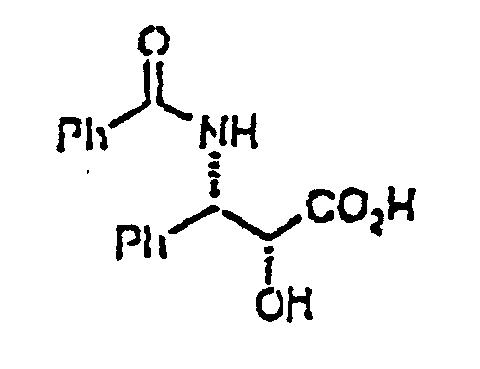
- Still, a need exists for further efficient protocols for the attachment of the taxol A-ring side chain to the taxane skeleton (e.g., baccatin III) and for the synthesis of taxol, taxol analogs and their intermediates with variable A-ring side chain structures.
- Accordingly, it is a general object of this invention to provide a new, useful and efficient protocol for the attachment of the taxol A-ring side chain to the taxane skeleton for the synthesis of taxol, taxol analogs and their intermediates with variable A-ring side chain structures which overcomes the disadvantages of the prior art.
- Another object of the present invention is the attachment of the taxol A-ring side chain to baccatin III to synthesize taxol, taxol analogs and their intermediates with variable A-ring side chain structures.
- It is a further object of this invention to provide a rapid and highly efficient esterification of 0-protected isoserine and 3-phenylisoserine acids having N-benzyloxycarbonyl groups to the C-13 hydroxyl of 7-O-protected baccatin III.
- It is another object of this invention to provide a deprotection-acylation sequence to the foregoing, to provide taxol, cephalomannine, 10-acetyl TAXOTERE® and various analogs, including photoaffinity labeling candidates.
- In its broad form, the present invention provides a chemical process useful in the productioon of taxol, taxol analogs and their intermediates. This process includes the step of condensing a compound of the general formula:with a taxane of the general structure:
 to give an intermediate of the general structure:
 wherein:
- R1 =
- olefinic or aromatic group or PhCH2
- R3 =
- hydrogen, an alkyl group or olefinic group, or Ph or another aromatic group
- R4 =
- hydroxyl, acetoxy or OP3 where P3 is a hydroxyl protecting group
- R6 =
- hydroxyl or OP2 where P2 is a hydroxyl protecting group
- P1 =
- hydroxyl protecting group.
- Various substitutions according to the general process are contemplated, especially those wherein R1 is PhCH2, R3 is Ph, R4 is AcO, R6 is OH. The general process may be continued by the step of replacing R1O and P1 in the intermediate to produce a compound of the general structure:wherein

- R2 =
- Ph or another olefinic group, an aromatic group, hydrogen, PhCH2, or a group containing oxygen, nitrogen or sulfur.
- The present invention concerns a chemical process for the efficient production of taxol, taxol analogs and their intermediates. This can be accomplished by the attachment of the taxol A-ring side chain to baccatin III. This allows for the synthesis of taxol, taxol analogs and their intermediates with variable A-ring side chain structures. This invention further concerns the rapid and efficient esterification of O-protected isoserine and 3-phenylisoserine acids having N-benzyloxycarbonyl groups to the C-13 hydroxyl of 7-O-protected baccatin III.
- Previously we reported partial syntheses of taxol analogs with deleted A-ring side chain substiuents through a variant of the Greene, Gueritte-Voegelein protocol. Swindell et al, J. Med. Chem, 1991, 34, 1176. The Greene, Gueritte-Voegelein protocol may be summarized:
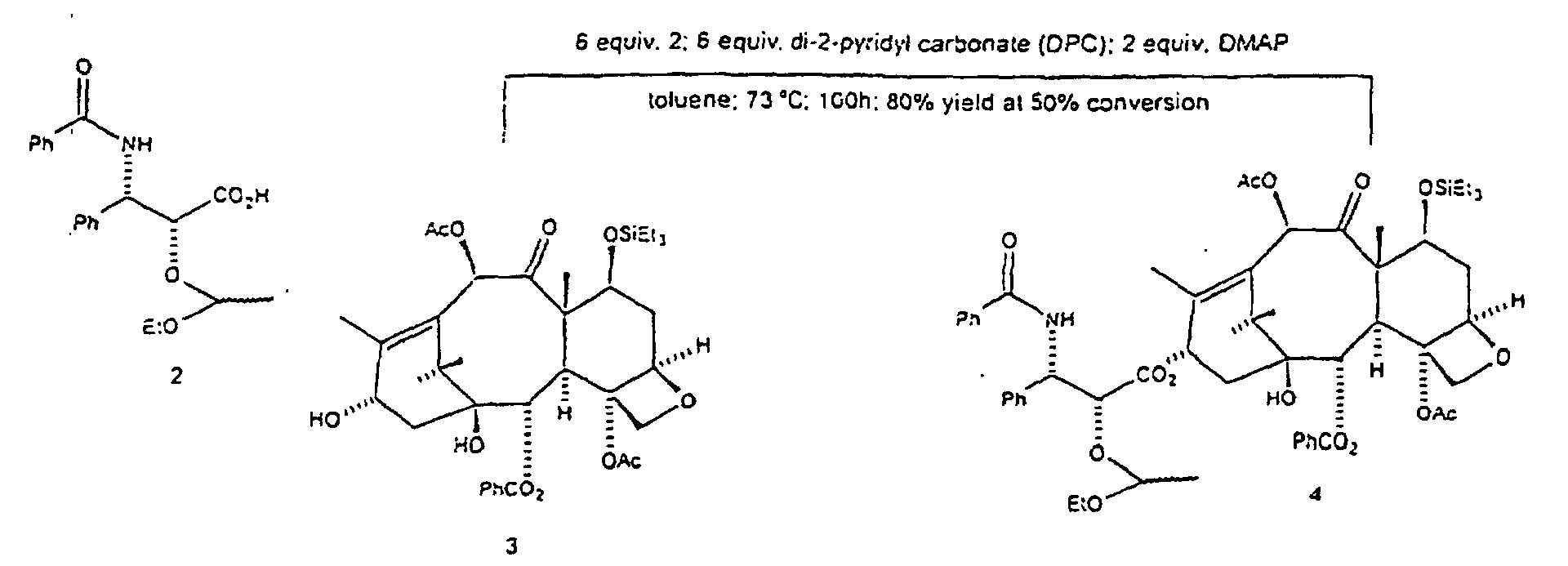
- Our findings, according to the generalized reaction:wherein P1 is a hydroxy-protecting group, e.g., (trichloro)ethoxymethyl, methoxymethyl, 1-ethyoxymethyl, benzyloxymethyl, 2-(trimethylsilyl)ethoxymethyl, tetrahydropyranyl and allyloxymethyl; and P2 is a hydroxy-protecting group, e.g., 3, 3, 3-(trichloro)ethyoxycarbonyl, trialkylsilyl, allyloxycarbonyl and benzyloxycarbonyl).

can be summarized in the following Table 1:(Lactate, Phenyllactate and Isoserine Side Chain Esterifications) R Equivalents Acid Coupling Reagent Time Product Yield(%) H (8) 6 DPC 24 h 12 53 Ph (9) 6 DPC 48 h 13 37 PhCONH (10) 6 DPC 6 h 14 87 PcCH2OCHONH (11) 6 DCC 15 m 15 97 2.2 DCC 30 m 100 - One of our goals in carrying out that work was the discovery of biologically active taxol analogs with structurally simpler side chains that might be attached to baccatin III through conventional esterification chemistry more efficiently than can the taxol side chain. We detected for the lactate and phenyllactate analogs (12 and 13) a straightforward relationship between side chain complexity and side chain attachment rate and efficiency. However, we were surprised to find that N-(benzoyl)isoserine side chain acid 10, arguably as sterically demanding as phenyllactic acid 9, was esterified to 7-O-protected baccatin III 7, Magri et at, J. Org. Chem., 1986, 51, 3239, with a remarkably high rate and efficiency. We proposed the intervention of a dihydrooxazine of the formula:formed from the preliminary intramolecular acylation of the benzamide carbonyl oxygen. We suggested: (i) that cyclic acylating agent 16, because of its limited steric requirement, would be particularly reactive toward the baccatin III C-13 hydroxyl; and (ii) that more complex dihydrooxazine analogs to 16 might offer a general solution to the taxol side chain attachment problem.

- Owing to the central position of the A-ring side chain in taxol's structure activity profile and consequently in its recognition by the microtubular binding site(s), photoaffinity labeling taxol analogs with photo functionality in the side chain would be valuable in the investigation of the chemical details of the taxol-microtubule interaction. Thus we were motivated to pursue the involvement of benzyl urethane-protected side chain acid 11 out of the expectation that an N-deprotection-acylation sequence following side chain attachment would provide access to photolabelling agents with late-stage incorporation of both photolabile functionality and radiolabel.
- When mixtures of 7, 11, dicyclohexylcarbodiimide (DCC), and 4-(dimethylamino)pyridine (DMAP) in toluene were warmed at concentrations that allow the comparison of the esterifications collected in Table 1, side chain attachments more rapid and higher yielding than those with benzamide 10 resulted. On the presumption that dihyrooxazine of the formula:intervenes and that its formation is the rate-limiting event - no intermediate could be detected in this esterification - the higher reactivity of 11 is a consequence of the higher nucleophilicity of its urethane carbonyl oxygen. This feature allows a considerable reduction in the excess in which the side chain acid is employed.

- Zinc-induced removal of the trichloroethoxy-based O-protecting groups led to the taxol analog:Subsequent hydrogenolytic removal of the benzyl urethane in a solution containing trifluoroacetic acid (TFA), and selective acylation of the amino group according to the reaction:
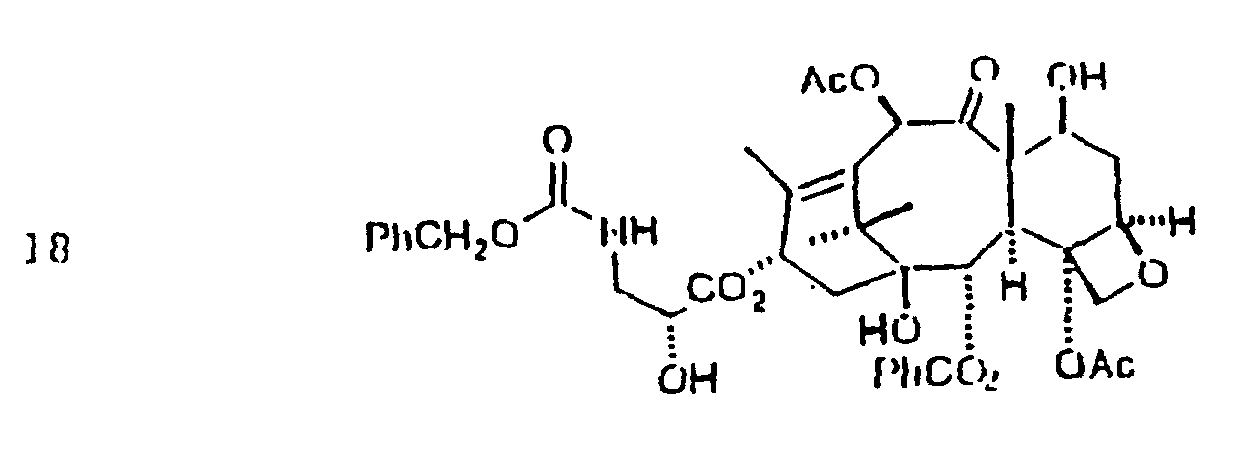 produced the taxol analogs shown in Table 2.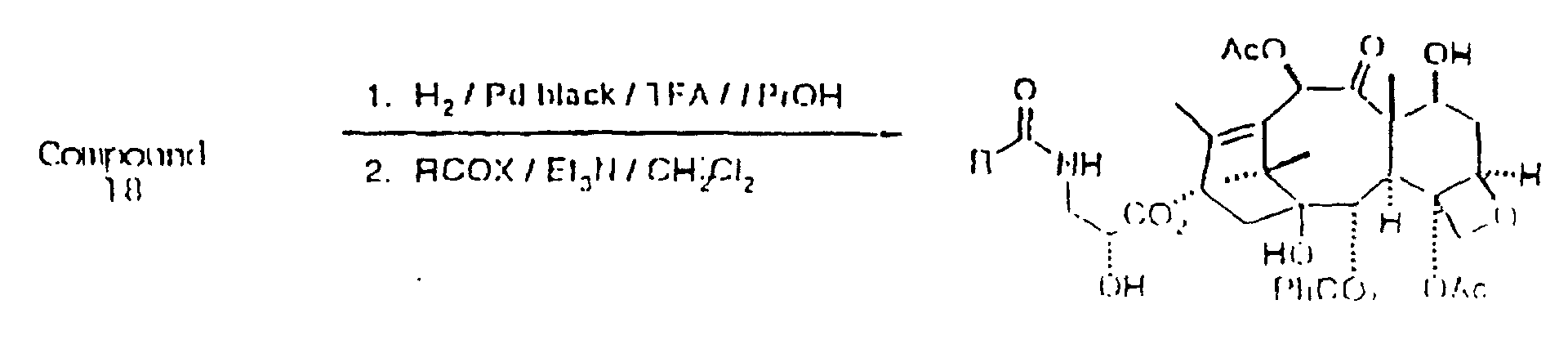
(Deprotection-Acylation of Compound 18) RCO Product Overall Yield (%) 4-azidobenzoyl 19 79 75 4-(trifluoromethyl)benzoyl 20 52 2-naphthoyl 21 64 hexanoyl 22 64 pivaloyl 23 79 cyclohexylcarbonyl 24 50 1-adamantylcarbonyl 25 70 t-butoxycarbonyl 26 89 - While the enhanced rate of attachment of side chain 11 was a convenience in the preparation of the above analogs, a similar improvement in the esterification to the baccatin III C-13 hydroxyl of the more complex N-acyl-3-phenylisoserine side chain characteristic of taxol would have a more dramatic impact. We investigated 3-phenylisoserine side chain esterifications according to the scheme:with the results being summarized in the following Table 3:

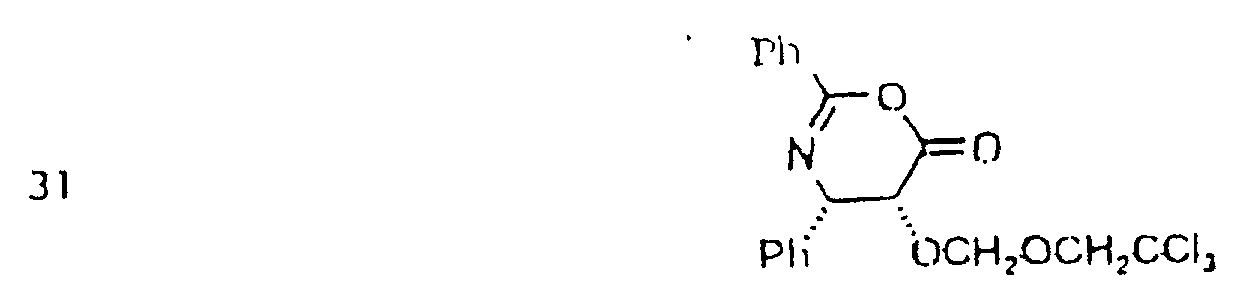
(3-Phenylisoserine Side Chain Esterifications) R Equivalents Acid Coupling Reagent Time Product Yield(%) Ph(27) 10 DPC 36 h 29 50 (96) 6 DPC 48 h 0 PhCH2O (28) 10 DPC 36 h 30 50 (78) 6 DCC 1 h 94 3.9 DCC 2 h 78 (84) - Unfortunately, the low rate of esterification in the Greene, Gueritte-Voegelein taxol partial synthesis and our own similar observation for side chain acid 27 suggested that dihydrooxazines were not accessed rapidly from side chain acids bearing the combination of N-benzoyl and 3-phenyl substituents. Furthermore, no rate enhancement in the esterification of benzyl urethane acid 28 prepared through a combination of the Greene (Denis et al, J. Org. Chem., 1990, 55, 1957) and Jacobsen (Deng et al, J. Org. Chem., 1992, 57, 4320) taxol side chain syntheses was observed when DPC served as the carboxyl activation reagent (again, the esterifications summarized in Table 3 are comparable). However, 28 in combination with DCC led to the same high rates and yields witnessed above. That it is the combination of the more nucleophilic urethane oxygen and DCC as the carboxyl activation reagent that is particularly effective, presumably in causing the in situ formation of:was demonstrated by the failure of DCC to cause the efficient attachment of 27. The formation of 31, if relevant, must be rate limiting since no intermediate could be detected in esterifications with 28. In the side chain attachments we have investigated to date, DPC, introduced by Greene and Gueritte-Voegelein for taxol side chain esterification, has been the most effective reagent when the side chain nitrogen bears the benzoyl group, whereas DCC has been the most effective at mediating the rapid esterification of benzyl urethane-containing side chain acids.
- Zinc treatment of 30 led to 33. A series of hydrogenolysis-acylation experiments gave taxol, cephalomannine, 10-acetyl TAXOTERE® and the remaining analogs listed in Table 4 which reactions are generalized by the scheme:(wherein X is any leaving group, e.g., -Cl, -OCO2(CH3)3, or
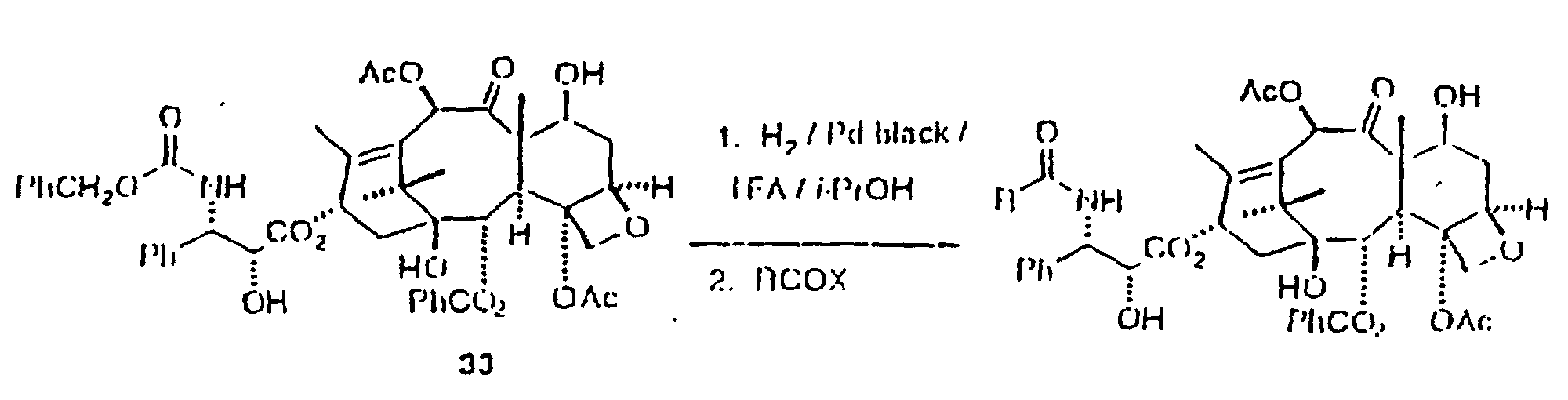 and i-PrOH is isopropyl alcohol)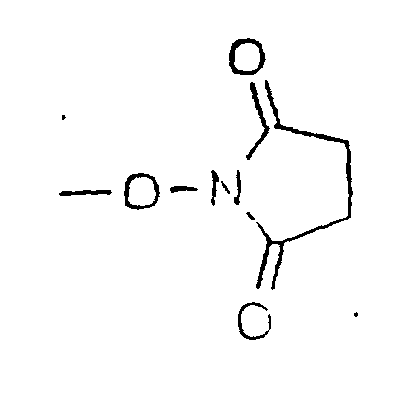
(Deprotection-Acylation of 33) RCO Product Overall Yield (%) benzoyl taxol 90 tigloyl cephalomannine 81 t-butoxycarbonyl 10-acetyl Taxotere® 94 4-azidobenzoyl 34 71 79 4-(trifluoromethyl)benzoyl 35 86 4-bromobenzoyl 36 76 4-(acetyl)benzoyl 37 67 4-(benzoyl)benzoyl 38 66 salicyl 39 51 - The amino triol encountered after the hydrogenolysis of 33 is particularly prone to O-acylation at the C-2' site. For example, in the preparation of cephalomannine, significant O-acylation occurred even when the N-hydroxy-succinimide ester of tiglic acid was employed. Furthermore, the use of acid chlorides in triethylamine-methylene chloride solution, even at low temperature, was not reliably selective for all the analogs of interest. Surprisingly, the best conditions for effecting selective amino acylation involved the acid chlorides in pyridine solution with DMAP catalysis at room temperature.
- While it was gratifying to achieve an efficient partial synthesis of taxol, the preparation of the photoaffinity labeling azide analog 34 underscores the utility of this methodology. In our hands, the application of the Greene, Gueritte-Voegelein esterification to the preparation of 34 from an O-protected side chain acid bearing an N-p-azidobenzoyl group failed owing to the thermal instability of the azide moiety. Through the chemistry described herein, 34 is available in good yield through a sequence amenable to the preparation of radiolabeled material.
- Several hydroxyl protection protocols were investigated during this work. Any in situ carboxyl activation approach to taxol and taxol analog partial synthesis demands that these protecting groups be conveniently acid stable. Among those that failed to meet this standard in our hands were triethylsilyl for the C-2' hydroxyl of the isoserine side chain, and ethoxy-ethyl for this hydroxyl in the 3-phenylisoserine side chain type. Generally, we found that the acid stability of the side chain hydroxyl protecting group in the 3-phenylisoserine side chain acid needed to be greater than that required in the simpler isoserine acid. Likewise, the removal of acid-labile hydroxyl protecting groups after esterification was more difficult for the isoserine taxol analogs. For that reason, ethoxyethyl was unsuitable for the latter side chain category. Among the side chain hydroxyl masking groups that complicated or prevented the esterifications were triisopropylsilyl and trichloroethoxycarbonyl. The benzyloxymethyl group was quite acceptable for the isoserine side chain, but could not be removed from the more encumbered C-2' hydroxyl in the attached 3-phenylisoserine side chain. Out of this experience we established that the known trichloroethoxymethyl protecting group and the known trichloro-ethoxycarbonyl group were good protecting groups for the C-2' and the C-7 hydroxyl. These devices are robust toward the side chain carboxylic acid during esterification reactions, and are both removable in a single reductive operation that is compatible with the functionality of 18, 33, taxol, and related complex taxanes.17
- A simple and effective sequence for the preparation of taxol and analogs has been developed that is based on the rapid and high yielding esterification of O-protected isoserine and 3- phenylisoserine side chain acids incorporating N-benzyloxycarbonyl functionality to the sterically hindered C-13 hydroxyl of 7-0-protected baccatin III. We believe that dihydrooxazines like 17 and the compound:formed in situ, intervene. Deprotection of the esterification products and acylation of the side chain amino group provide the target substances. From baccatin III, five steps are required overall.

- Before this work, the most effective methods for the attachment of the taxol side chain to the baccatin III C-13 hydroxyl required the independent formation of β-lactam and dihydrooxazine acylating agents. With the present methodology for in situ dihydrooxazine generation from suitable protected side chain acids, the several asymmetric syntheses of the taxol side chain that have been reported become especially useful for the partial synthesis of taxol and related drugs.
- The chemical process of the present invention for the production of taxol, taxol analogs and their intermediates may be generalized, then, as the condensation of a compound of the general formula:with a taxane of the general structure:
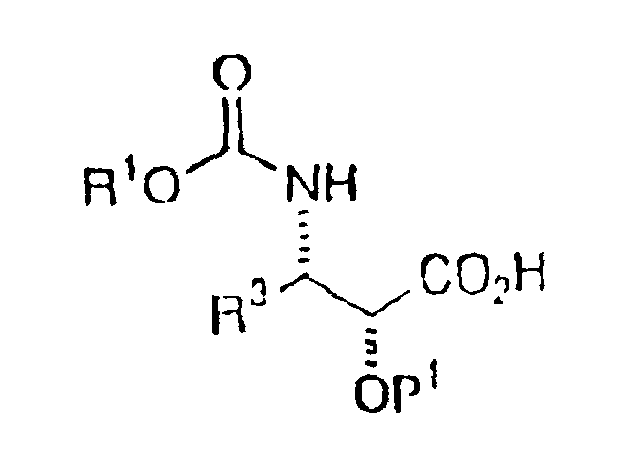 to give an intermediate of the general structure:
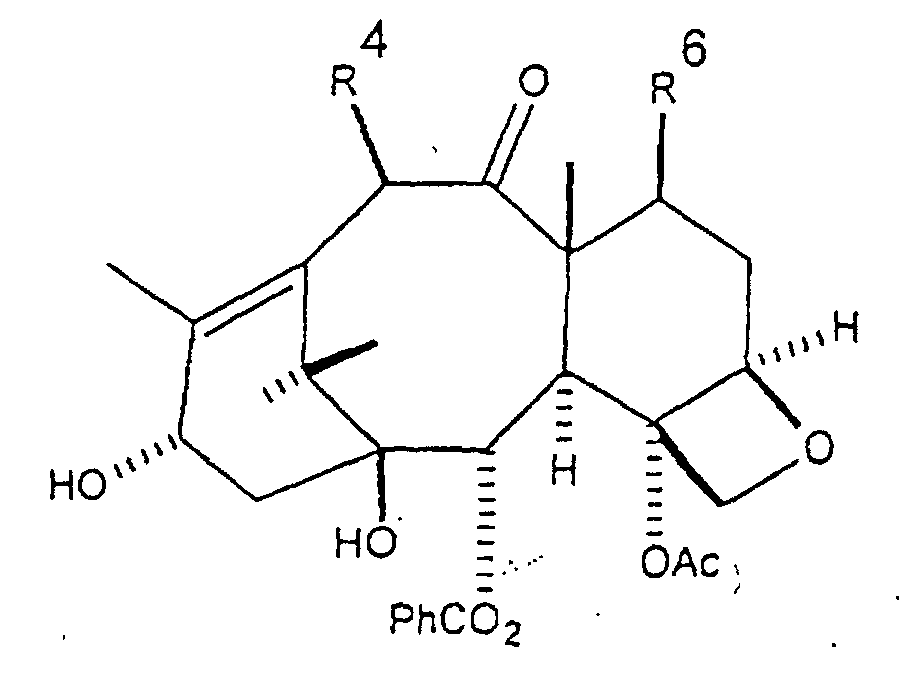 wherein:
- R1 =
- olefinic or aromatic group or PhCH2
- R3 =
- hydrogen, an alkyl or olefinic group or Ph or another aromatic group
- R4 =
- hydroxyl, acetoxy or OP3 where P3 is a hydroxyl protecting group
- R6 =
- hydroxyl or OP2 where P2 is a hydroxyl protecting group
- P1 =
- hydroxyl protecting group.
- In this general process, certain more specific reactions include those where: (i) R1 is PhCH2, R3 is Ph and P1 is CH2OCH2CCl3; (ii) R1 is PhCH2, R3 is Ph, R4 is AcO, R6 is OCO2CH2CCl3 and P1 is CH2OCH2CCl3; (iii) R1 is PhCH2, R3 is Ph, R4 is AcO, R6 is OH and P1 is H; and (iv) R3 is Ph, R4 is AcO, R6 is OP2 and wherein P2 is a hydroxyl-protecting group.
- The general process set forth above can be continued with the further step of replacing R1O and P1 to give a compound of the general structure:wherein

- R2 =
- an olefinic group, Ph or another an aromatic group, hydrogen, PhCH2, or a group containing oxygen, nitrogen or sulfur.
- Alternatively, the general process set forth above can be more specific in the following ways: (i) R1 is an alkyl, olefinic or aromatic group, R3 is Ph, R4 is AcO, R6 is OP2 and P2 is a hydroxyl-protecting groups, and including the step of replacing R1O with Ph and P1 and P2 with hydrogen to produce taxol; (ii) R1 is PhCH2, P1 is CH2OCH2CCl3 and P2 is CO2CH2CCl3 and wherein the step of replacing R1O with Ph is accomplished by exchanging the PhCH2OC=O group for a PhC=O group; (iii) R1 is olefinic or aromatic group, R3 is hydrogen, alkyl, olefinic or aromatic group, R4 is AcO, R6 is OP2 and P2 is a hydroxyl-protecting group, and including the step of replacing R1O with Ph and P1 and P2 with hydrogen to produce a taxol analog; and (iv). R1 is PhCH2O, R3 is Ph, R4 is AcO, R6 is OP2 and P2 is a hydroxyl protecting group and wherein the condensation is a 3-phenylisoserine side chain esterification conducted in the presence of an aromatic solvent and an activating agent.
- In the latter case (iv), P2 may be CH2OCH2CCl3 and P2 may be CO2CH2CCl3. Here, the activating agent is chosen from dialkylaminopyridines, such as 4-(dimethylamino)pyridine. The organic solvent is chosen from benzene, toluene, xylenes, ethylbenzene, iospropylbenzene and chlorobenzene. The reaction is best performed at a temperature of between approximately 70-75°C. The esterification is performed in the presence of a condensing agent, and this condensing agent may be selected from the group consisting of di-cyclohexyl-carbodiimide and di-2-pyridyl carbonate Finally, the reaction of (iv) may be performed in the presence of a condensing agent selected from the group consisting of di-cyclohexyl-carbodiimide and di-2-pyridyl carbonate and an activating agent is 4-(dimethylamino)pyridine.
- In addition, the chemical process for the preparation of taxol analogs may also be generalized by the process comprising the following steps:
- converting 10-deactyl baccatin III to:

- then to:

- by condensation with:
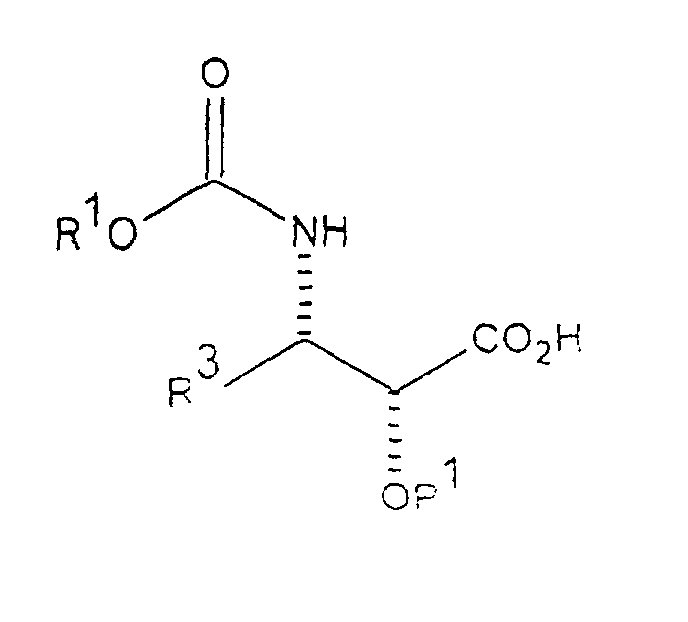
- conversion to:

- followed by conversion to:

- and then ultimately taxol analogs of the following type:
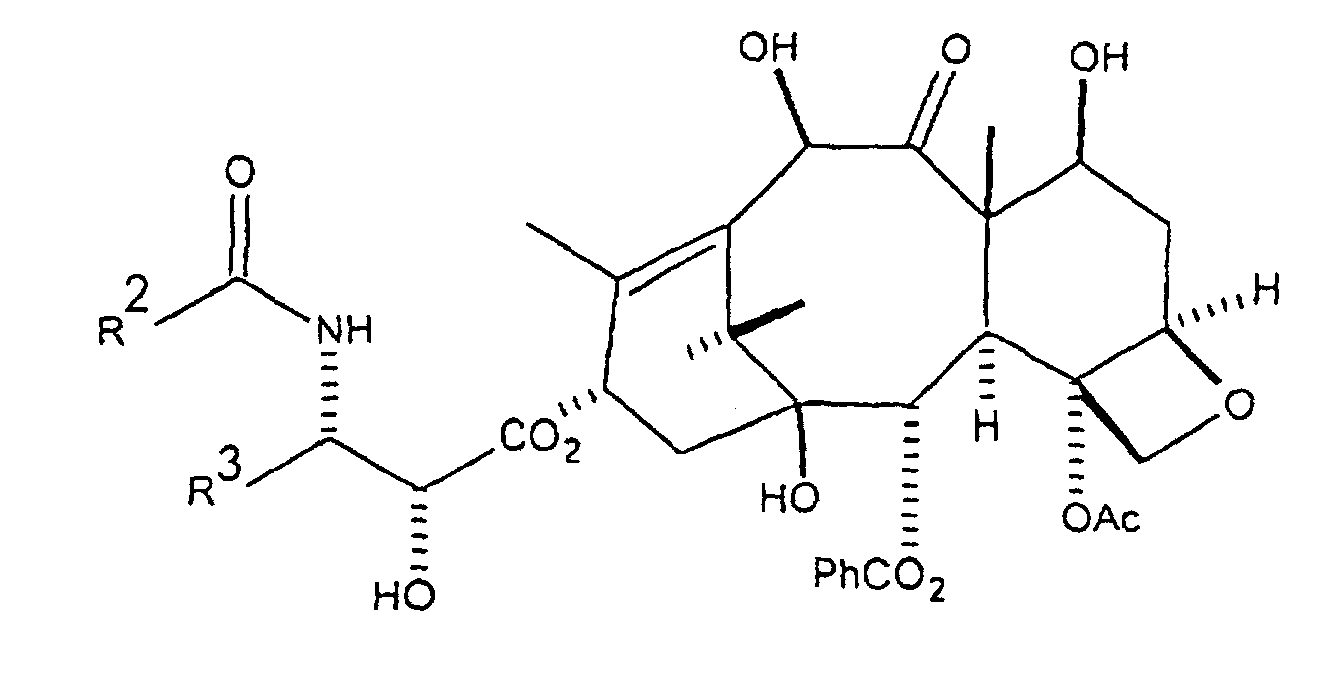 wherein:
-
- R1 =
- olefinic or aromatic group or PhCH2
- R2 =
- an olefinic group, hydrogen, Ph or another aromatic group, PhCH2, or a group containing oxygen, nitrogen or sulfur
- R3 =
- hydrogen, an alkyl or olefinic or group, or Ph or another aromatic group
- P1 =
- CH2OCH2CCl3 or other hydroxyl protecting group
- P2 =
- CO2CH2CCl3 or other hydroxyl protecting group
- P3 =
- CO2CH2CCl3 or other hydroxyl-protecting group
- The invention includes within its scope the following compacts, namely:-
- 1. A chemical compound having a generalized formula:
wherein R3 is an alkyl, olefinic or aromatic group such as Ph, or hydrogen.

- 2. A chemical compound as just defined wherein R3 is Ph.
- 3. A chemical compound having a generalized formula:
wherein R3 is an alkyl, olefinic or aromatic group such as Ph, or hydrogen.

- 4. An ammonium trifluoroacetate compound having the formula:

-
- Baccatin III was prepared, as described by Magri et al, J. Org. Chem., 1986, 51, 3239, by degradation of a taxol-cephalomannine mixture provided by Dr. Kenneth Snade, National Cancer Institute, National Institutes of Health. It was converted to baccatin III 7-trichloroethyl carbonate (7) according to this procedure. Reactions requiring anhydrous conditions and inert atmospheres were performed in flame-dried glassware under nitrogen using anhydrous solvents. 1H and 13C NMR spectra of CDCl3 solutions were recorded at 300 MHz and 75 MHz, respectively, using tetramethylsilane (1H δ=O ppm), residual chloroform (H 6= 7.27 ppm), or CDECl3 (13C δ=77 ppm) as the internal standard. For 13C NMR spectra, degrees of proton substitution were assigned with the aid of IF DEPT experiments. High Performance Liquid Chromatography (HPLC) was carried out with a Waters brand instrument on a 3.9 mm × 15 cm NovaPak brand D16 column, or on a 7.8 × 30 cm NovaPak C13 column, employing UV detection at 254 nanometers (nm) Otherwise, chromatography was performed on silica gel. High resolution mass spectral determinations were performed at the Mass Spectrometry Laboratory, Department of Chemistry, University of Pennsylvania, Philadelphia, PA, USA.
- Simple isoserine side claims were prepared in a standard manner and included: (i) (2R) -N-(Benzyloxycarbonyl)-O-(trichloroethoxymethyl)-isoserine (Compound 11); (ii) Baccatin III Ester 15 (Compound 15 formed from Compound 11); and (iii) Baccatin III Ester 18 (Compound 18 formed from Compound 15).
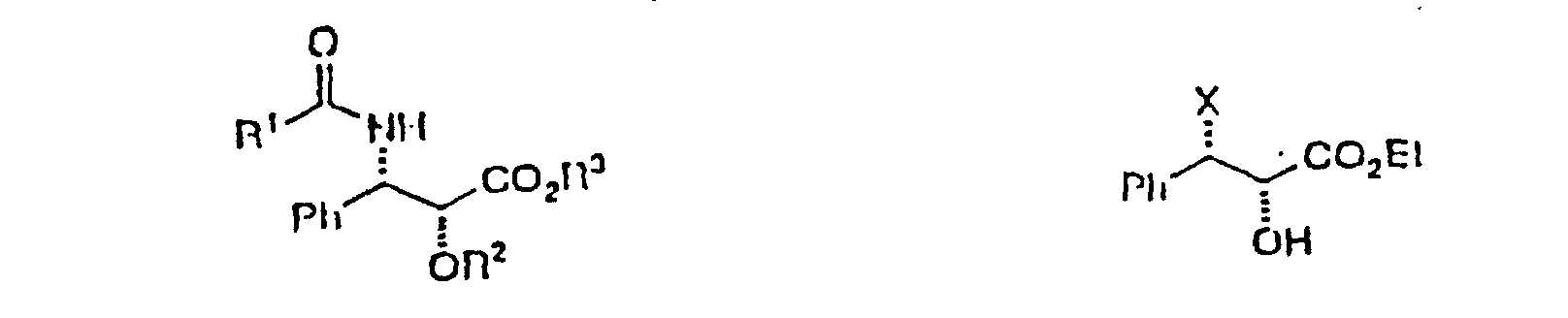
- Compound 28, (2R,3S)-N-Benzyloxycarbonyl-O-(trichloroethoxymethyl)-3-phenylisoserine, was prepared. Here, a solution of 3.12 g (16.3 mmol) (2R,3R)-ethyl 3-phenylglycidate, 13.5 mL methyl formate, and 5.28 g (81.5 mmol) sodium azide in 81 mL 8:1 95% ethanol-water was heated to 50°C for 45 hours. The reaction mixture was partitioned between water and diethyl ether, the aqueous layer was extracted with diethyl ether, and the organic layers were combined, dried (MgSO4), filtered and concentrated. Purification of the residue by column chromatography, eluting with ethyl acetate-hexanes, provided 2.91 g (94%) of 43 as a colorless oil. 1H NMR δ 1.28 (3H, t, J=7.1, CH3), 3.18 (1H, d, J=6.7, OH) 4.27 (2H, q, J=7.1, CH2), 4.37 (1H, dd, J=3.1, 6.7, CHOH), 4.84 (1H, d, J=3.1, PhCH), 7.4-7.5 (5H, m, Ph); 13C NMR 6 171.84, 135.52 (quaternaries), 128.77, 128.71, 127.81, 73.87, 67.14, (CH), 62.37 (CH2), 14.02 (CH3); IR (CHCl3) 3158, 2932, 2100, 1731, 1302, 1110 cm-1.
- Anal. Calcd. for C11H13N3O3; C,56.15; H,5.57; N, 17.87. Found: C,56.33; H,5.79; N,17.65.
- A mixture of 1.88 g 43 (8.00 mmol) and 188 mg 10% Pd-carbon in 80 mL ethyl acetate was shaken under hydrogen (35 psi) for 14 hours. Filtration and concentration provided the crude amino alcohol 44 as a white power mp 69-71°C, which was used without purification. 1H NMR δ 1.25 (3H, t, J=7.2, CH3), 2.24 (3H, bs, OH and NH2), 4.23 (2H, m, CH2) 4.27 (2H, pp d, J=1.2, CH), 7.3-7.4 (m, 5H, Ph).
- To 1.98 g(9.48)mmol of 44 and 2.98 g(10.43 mmol) sodium carbonate suspended in 57 mL 1:1 ether-water at 0°C was added 1.35 mL (9.48 mmol) benzyl chloroformate. The mixture was stirred 30 min., the solvent was evaporated, and the residue partitioned between methylene chloride and water. The organic layer was dried (sodium sulfate) and concentrated to provide urethane 45 (91% yield from 43); mp 103-105°C (methylene chloride-hexanes). 1H NMR δ 1.25 (3H, t, J=6.9, CH3), 3.30 (1H, bs, OH), 4.25 (2H, q, J=6.9, CH2CH3), 4.44 (1H, app s, CHOH), 5.03 (1H, 1/2 AB q, J=11.9, CH2Ph), 5.07 (1H, 1/2 AB q, J=11.9, CH2Ph), 5.28 (1H, app d, J=9.5, PhCH), 5.76 (1H, bd, J=9.5, NH), 7.3-7.4 (10H, m, Ph): 13C NMR δ 172.66, 155.61, 138.90, 136.24 (quaternaries), 128.54 (double signal) 128.42, 128.02, 127.76, 126.70, 73.41, 66.93, (CH), 62.49, 56.42 (CH2), 13.98 (CH3); IR CHCl3) 3520, 3440, 1730, 1260, 1095 cm-1.
- Alan. Calcd. for C19H21NO5; C,66.45; H,6.17; N,4.08. Found: C,66.29; H,6.28; N,3.98.
- To a solution of 6.78 g (19.8 mmol) urethane 45 in 79 mL dry THF at -68°C was added dropwise and with stirring a solution of m-BuLi (1.6 M in hexane; 12.4 mL, 19.8 mmol). After 5 minutes, 3.89 mL (29.7 mmol) trichloroethoxymethyl chloride and 2.65 g (19.8 mmol) LiI were added. Subsequently, the mixture was allowed to warm to ambient temperature over 1 hour. The reaction mixture was then poured into 1N hydrochloric acid, extracted with methylene chloride, and the organic layer dried (MgSO4) and concentrated. Purification of the residue by column chromatography, eluting with ethyl acetate-hexanes, provided 8.22 g (82%) 46 as a colorless oil. H NMR δ 1.23 (3H, t, J=7.2, CH3), 3.16 (1H, 1/2 AB q, J=11.7, CH2CCl3), 3.63 (1H, 1/2 AB q, J=11.7, CH2CCl3), 4.20 (2H, m, CH2CH3), 4.52 (1H, bs, CHCO2Et), 4.70 (1H 1/2 AB q, J=7.3, OCH2O), 4.85 (1H, 1/2 AB q, J=7.3, OCH2O), 5.04 (1H, 1/2 AB q, J=11.9, CH2Ph), 5.08 (1H 1/2 AB q, J=11.9, CH2Ph), 5.41 (1H, app bd, J-9.2, PhCH), 5.80 (1H, d, J=9.2, NH), 7.28-7.34 (10H, m, Ph): 13C NMR 6 168.92, 155.24, 138.38, 135.98 (quaternaries), 128.31, 128.14, 127.77, 127.72, 127.60, 126.12, 95.86, 94.39, 79.02 (CH), 77.00, 66.65, 61.43, 56.05 (CH2), 13.77(CH3); IR (CHCl3) 3440, 2912, 1760, 1290, 1095 cm-1.
- Anal. Calcd. for C22H24Cl3NO6: C,52.48; H,4.81; N,2.78. Found: C,52.33 H, 4.82; N,2.68.
- A mixture of 494 mg (0.98 mmol) of 46 and 205 mg (4.88 mmol) lithium hydroxide monohydrate in 16.3 mL 3:1 methanol-water was stirred at room temperature for 2h. The solvent was evaporated and the residue partitioned between methylene chloride and 1 N hydrochloric acid. The organic phase was dried (sodium sulfate) and concentrated to afford 458 mg (96%) of 28. Acid 28 was converted to its dicyclohexylammonium salt for elemental analysis, mp 133.5-136.0°C (ether). 1H NMR δ 3.17 (1H, 1/2 AB q, J=11.7, OCH2CCl3), 3.65 (1H, 1/2 AB q, J=11.7, OCH2CCl3), 4.60 (1H, m, CHOC2H), 4.73 (1H, 1/2 AB q, J=7.3, OCH2O), 4.89 (1H, 1/2 AB q, J=7.3, OCH2O), 5.08 (1H, 1/2 AB q, J=11.9, PhCH2O), 5.17 (1H, 1/2 AB q, J=11.9, PhCH2O), 5.51 (1H, app bd, J=9.0 PhCH), 5.95 (1H, d, J=9.0, NH), 7.2-7.5 (10H, m, Ph); 13C NMR δ 171.94, 156.21, 138.48, 135.95, 96.14 (quaternaries), 128.75, 128.52, 128.16, 128.09, 126.40, 76.33, 56.28 (CH), 94.88, 79.51, 67.51 (CH2); IR (CHCl3) 3460, 3100, 2990, 2910, 1760, 1720, 1360, 1290, 1140, 1090, 1060, 1010 cm-1.
- Alan. Calcd. for C34H43Cl3N2O6 (28 dicyclohexylamine): C,58.41; H,6.59; N,4.26, Found: C,58.65; H,6.51; N,4.17.
- Baccatin III Ester 30: A mixture of 80 mg (0.105 mmol) 7, 301 mg (9.629 mmol) 28, 36 mhg (0.210 mmol) 4-(dimethylamino) pyridine, and 130 mg (0.629 mmol) dicyclohexylcarbondiimide in 5.25 mL toluene at 75°C was stirred for 1 hour. The reaction mixture was cooled, filtered, and the filtrate washed with 0.5 N hydrochloric acid, water and dried (sodium sulfate). Concentration and purification of the residue by column chromatography, eluting with ethyl acetate-hexanes, provided 120 mg (94%) 30 as a colorless, amorphous solid. 1H NMR δ 1.10 (3H, s, C-17), 1.17 (3H, s, C-16), 1.77 (3H, s, C-19) 1.90 (3H, s, C-18), 1.9-2.4 (3H, m, 1/2 C-6, C-14), 2.10 (3H, s, OAc), 2.39 (3H, s, OAc), 2.5-2.6 (1H, m, 1/2 C-6), 3.23 (1H, 1/2 AB q, J=11.4, OCH2CCl3), 3.63 (1H, 1/2 AB q, J=11.4, OCH2CCl3), 3.87 (1H, d, J=7.1, C-3), 4.13 (1H, 1/2 AB q, J=8.3 C-20), 4.26 (1H, 1/2 AB q, J=8.3, C-20), 4.58 (1H, 1/2 AB q, J=12.0, OCH2CCl3), 4.71 (1H, 1/2 AB q, J=7.3 OCH2O), 4.82 (1H, 1/2 AB q, J=7.3, OCH2O), 4.85-5.0 (4H, m, C-5, PhCH2O, 1/2 OCH2CCl3), 5.42 (1H, br d, J=8.5 C-2'), 5.51 (1H, dd, J=7.1, 10.7, C-7), 5.61 (1H, d, J=7.1, C-2), 5.68 (1H, br d, J=9.1, C-3'), 6.22 (1H, t, J=6.7, C-13), 6.28 (1H, s, C-10), 7.1-7.4 (11H, m, Ph, NH), 7.45 (2H, app t, J=7.4, OBz), 7.55 (1H, app t, J=7.4, OBz), 8.06 (2H, app d, J=7.4, OBz).
- A similar reaction performed with 7, 10 equivalents of 28, 10 equivalents of di-2-pyridyl carbonate, and 3.3 equivalents of 4-(dimethylamino)pyridine in toluene at 75°C for 36 h provided 30 in 50% yield (78% based on recovered 7).
- Baccatin III Ester 33: A mixture of 120 mg (0.0996 mmol) of 30 and 97 mg (1.49 mmol) Zn dust in 1.2 ML 1:1 acetic acid-methanol was sonicated 30 min. Additional zinc (65 mg; 0.996 mmol) was added and sonication continued for a total of 5h. The solvent was decanted, the zinc and zinc salts rinsed with methanol, the organic phases combined, diluted with water, and extracted with methylene chloride. The methylene chloride layer was washed with water, dried (sodium sulfate), and concentrated. Chromatography of the residue, eluting with ethyl acetate-hexanes, provided 57-75 mg (65-85%) of 33, 1H NMR δ 1.17 (3H, s, C-17), 1.27 (3H, s, C-16) 1.71 (3H, s, C-19), 1.83 (3H, s, C-18), 1.9-2.1 (3H, m, 1/2 C-6, C-14), 2.28 (3H, s, OAc), 2.43 (3H, s, OAc), 2.5-2.6 (1H, m, 1/2 C-6), 3.80 (1H, d, J=7.0, C-3), 4.20 (1H, 1/2 AB q, J=7.8, C-20), 4.32 (1H, 1/2 AB q, J=7.8, C-20), 4.4-4.5 (1H, m, C-7), 4.6-4.7 (1H, m, C-2'), 4.96 (1H, d, J=7.6, C-5), 4.98 (1H, 1/2 AB q, J=12.4, PhCH2O), 5.10 (1H, 1/2 AB q, J=12.4, PhCH2O), 5.39 (1H, br d, J=8 2, NH), 5.65-5.7 (2H, m, C-3', C-2), 6.26 (1Hm t, J=7.1, C-13), 6.29 (1H, s, C-10), 7.2-7.4, (10H, m, Ph), 7.53 (2H, t, J=7.4, OBz), 7.64 (1H, t, J=7.4, OBz), 8.15 (2H, d, J=7.4, OBz); 13C NMR δ 203.57, 172.47, 171.20, 170.28, 166.92, 155.81, 141.95, 138.07, 136.27, 133.17, 129.22, 81.17, 79.07, 58.60, 43.16 (quaternaries), 133.68, 130.23, 128.92, 128.68, 128 46, 128.25, 128.11, 127.66, 126.74, 84.40, 77.42, 75.54, 74.96, 73.52, 72.20, 45.58 (CH), 76.48, 66.97, 35.76, 35.59 (CH2), 26.84, 22.61, 21.92, 20.82, 14.79, 9.57 (CH3); UV [MeOH, wavelength max nm (ε)] 230 (22 000); HRFABMS Calcad. (M + Na) 906.3313, Obsvd. 906.3207.
- Deprotection-Acylation of 33 to Give Taxol, Cephalomannine, and 34 - 39: A mixture of 242 mg (0.274 mmol) of 33, 42 µL trifluoroacetic acid (TFA), and 43 mg Pd black in 4 mL isopropanol was shaken under hydrogen (35 psi) for 1.5 h. Filtration and concentration of the filtrate afforded the corresponding ammonium trifluoroacetate, which was used without purification. The ordinarily skilled artisan would recognize that the ammonium trifluoroacetate formed by this step has the formula as follows:where X is OOCCF3
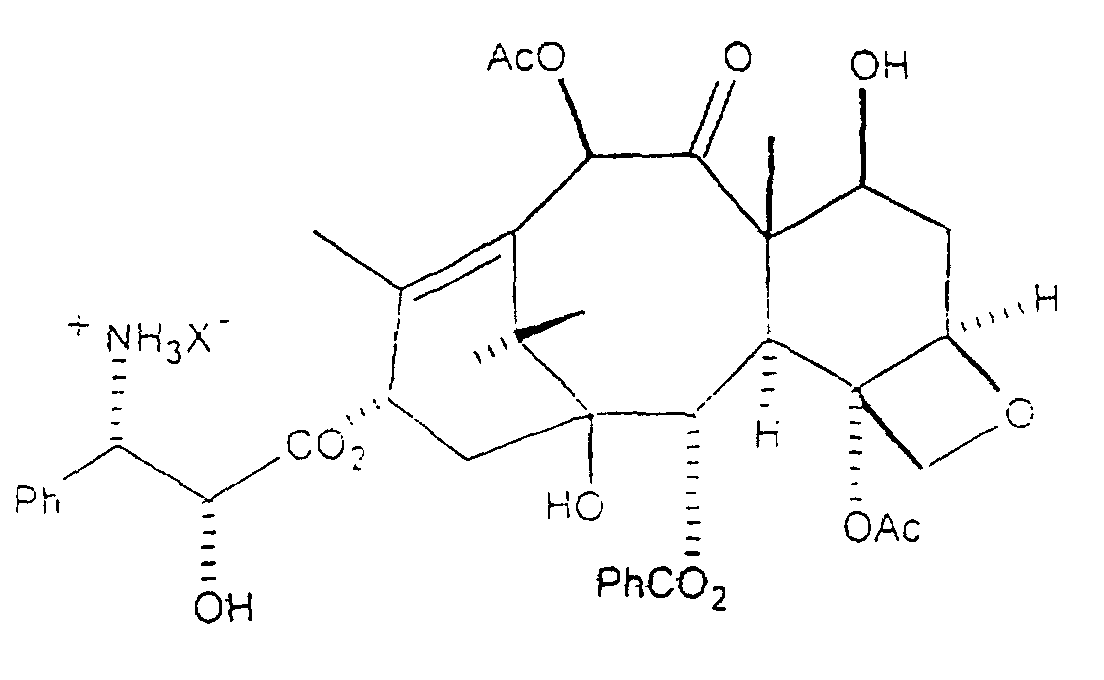
- The OOCCF3 - anion is deprotonated trifluoroacetic acid, a deprotonated organic acid. To the extent appreciated by the ordinarily skilled artisan, other organic acids may be substituted for TFA. Further, variations of the C7, C10, C2' and C3' substituents may be obtained by substituting the appropriate compound in place of compound 33.
- To 20 mg (0.023 mmol) of the ammonium trifluoroacetate and 2 mg 4-(dimethylamino)pyridine in 1.3 mL pyridine at ambient temperature was added dropwise and with stirring 0.028 mmol of the acylating agent. After 30 minutes, an additional 0.0184 mmol of the acylating agent was added, if necessary, and stirring was maintained another 30 min. The mixture was then diluted with methylene chloride, washed with IN hydrochloric acid, water, and the organic phase was dried (sodium sulfate). Concentration and purification of the residue by column chromatography, eluting with ethyl acetate-hexanes, provided a product that was chromatography, eluting with ethyl acetate-hexanes, provided a product that was chromatographically and spectroscopically pure.
- Taxol: Prepared in 90% yield from benzoyl chloride to give material chromatographically and spectroscopically identical to an authentic sample.29
- Cephalomannine: Prepared in 81% yield from tigloyl chloride to give material spectroscopically and chromatographically identical to an authentic sample.29 HRMS (negative ion CI; methane reagent gas) Calcd. (M) 831.3466, Obsvd. 831.3389.
- Azido Taxol 34: Prepared in 71% yield from 4-azidobenzoyl chloride. 1H NMR δ 1.13 (3H, s, C-17), 1.23 (3H, s, C-16), 1.67 (3H, s, C-19), 1.78 (cH, s, C-18), 1.9-2.1 (3H, m, 1/2 C-6, C-14), 2.22 (3H, s, OAc), 2.37 (3H, s, OAc), 2.45-2.55 (1H, m, 1/2 C-16), 3.79 (1H, d, J=6.9, C-3), 4.18 (1H, 1/2 AB q, J=8.2, C-20), 4.28 (1H, 1/2 AB q, J=8.2, C-20), 4.38 (1H, dd, J=6.8, 11.0, C-7), 4.75-4.8 (1H, m, C-2'), 4.92 (1H, d, J=7.6, C-5), 5.66 (1H, d, J=7.0, C-2), 5.76 (1H, dd, J=2.4, 8.8, C-3'), 6.22 (1H, t, J=8.2, C-13), 6.27 (1H, s, C-10), 6.98 (1H, app d, J=8.8, NH), 7.01 (2H, app d, J=8.6, N3Ar), 7.3-7.5 (7H, m, Ph, OBz), 7.61 (1H, app t, J=7.4, OBz), 7.73 (2H, d, J=8.6, N3Ar), 8.12 (2H, app d, J=7.4, OBz); 13CNMR δ 203.55, 172.76, 171.17, 170.36, 167.03, 165.96, 143.83, 141.87, 137.94, 133.20, 130.03, 129.15, 81.15, 79.04, 58.58, 43.16 (quaternaries), 133.70, 130.19, 129.00, 128.88, 128.70, 128.44, 128.35, 127.03, 119.07, 84.38, 75.54, 74.96, 73.18, 72.27, 72.14, 55.08, 45.67 (CH), 76.48, 35.63 (double signal) (CH2), 26.84, 22.58, 21.77, 20.80, 14.79, 9.55 (CH3); UV [MeOH, wavelength max nm (ε)] 230 (23 000), 270 (20 000); HRFABMS Calcd. (M + Na) 917.3221, Obsvd. 917.3236.
- Trifluoromethyl Taxol 35: Prepared in 86% yield from 4-(trifluoromethyl) benzoyl chloride. 1H NMR δ 1.19 (3H, s, C-17), 1.28 3H, s, C-16), 1.71 (3H, s, C-19), 1.81 (3H, s, C-18), 1.8-2.4 (3H, m, 1/2 C-6, C-14), 2.28 (3H, s, OAc), 2.44 (3H, s, OAc), 2.5-2.6 (1H, m, 1/2 C-6), 3.43 (1H, d, J=4.7, OH), 3.79 (1H, d, J=7.5, C-3, 4.19 (1H, 1/2 AB q, J=8.5, C-20), 4.31 (1H, 1/2 AB q, J=8.5, C-20), 4.35-4.45 (1H, m, C-7), 4.79 (1H, dd, J=2.4, 4.7, C-2'), 4.94 (1H, d, J=8.0, C-5), 5.67 (1H, d, J=7.0, C-2), 5.79 (1H, dd, J=2.4, 9.0, C-3'), 6.23 (1H, t, J=7.0, C-13), 6.27 (1H, s, C-10), 7.03 (1H, d, J=9.0, NH), 7.2-7.7 (10H, m, Ar), 7.84 (2H, app d, J=8.2, Ar), 8.13 (2H, app d, J=8.2, Ar); 13C NMR δ 203.51, 172.62, 171.25, 170.34, 167.05, 165.00, 141.77, 137.60, 136.92, 133.37, 129.15, 128.72, 128.46, 81.22, 79.09, 58.62, 43.18 (quaternaries), 133.77, 130.20, 129.11, 128.72, 128.54, 127.52, 127.01, 125.79, 84.37, 75.51, 74.89, 72.92, 72.47, 72.19, 55.02, 45.66, (CH), 77.91, 35.57 (double signal) (CH2), 26.88, 22.63, 21.75, 20.84, 14.84, 9.54 (CH3): UV [MeOh, wavelength max nm (ε)] 230 (29 000); HRFABMS Calcd. (M + Na) 944.3081, Obsvd. 944.3022.
- Bromo Taxol 36: Prepared in 76% yield from 4-bromobenzoyl chloride. 1H NMR δ 1.14 (3H, s, C-17), 1.24 (3H, s, C-16), 1.68 (3H, s, C-19), 1.78 (3H, s, C-18), 1.9-2.4 (3H, m, 1/2 C-6, C-14), 2.24 (3H, s, OAc), 2.38 (3H, s, OAc), 2.5-2.6 (1H, m. 1/2 C-6), 3.79 (1H, d, J=6.9, C-3), 4.19 (1H, 1/2 AB q, J=8.3, C-20), 4.31 (1H, 1/2 AB q, J=8.3, C-20), 4.40 (1H, dd, J=7.0, 11.1, C-7), 4.78 (1H, d, J=2.5, C-2'), 4.94 (1H, d, J=7.9, C-5), 5.67 (1H, d, J=6.9, C-2), 5.77 (1H, dd, J=2.5, 8.7, C-3'), 6.22 (1H, t, J=8.6, C-13), 6.26 (1H, s, C-10), 6.97 (1H, d, J=8.7, NH), 7.3-7.6 (12H, m Ar), 8.13 (2H, d, J=7.3, Ar); 13C NMR δ 203.57, 172.62, 171.28, 170.35, 167.01, 165.98, 141.86, 137.70, 133.19, 132.33, 128.46, 126.74, 81.13, 79.04, 58.59, 43.13 (quaternaries), 133.77, 131.92, 130.19, 129.08, 128.72, 128.62, 126.99, 84.35, 75.51, 74.85, 73.00, 72.39, 72.19, 54.94, 45.57, (CH), 76.58, 35.56, (double signal) (CH2), 26.85, 22.62, 21.75, 20.86, 14.86, 9.53 (CH3); HRFABMS Calcd. (M[75Br] + H) 932.2493, Obsvd. 932.2577.
- Acetyl Taxol 37: Prepared in 67% yield from 4-(acetyl) benzoyl chloride. 1H NMR δ 1.14 (3H, s, C-17), 1.24 (3H, s, C-16), 1.68 (3H, s, C-19), 1.77 (3H, s, C-18), 1.9-2.4 (3H, m, 1/2 C-6, C-14, 2.22 (3H, s, OAc), 2.38 (3H, s, OAc), 2.5-2.6 (1H, m, 1/2 C-6), 2.61 (3H, s, Ac), 3.79 (1H, d, J=7.3, C-3), 4.19 (1H, 1/2 AB q, J=8.6, C-20), 4.31 (1H, 1/2 AB q, J=8.6, C-20), 4.37 (1H, dd, J=6.6, 10.4, C-7), 4.79 (1H, d, J=2.1, C-2'), 4.94 (1H, d, J=7.0, C-5), 5.67 (1H, d, J=7.3, C-2), 5.76 (1H, dd, J=2.1, 7.1, C-3'), 6.23 (1H, t, J=7.9, C-13), 6.26 (1H, s, C-10), 7.05 (1H, d, J=7.1, NH) 7.3-7.65 (8H, m, Ar), 7.82 (2H, app d, J=8.3, Ar), 7.97 (2H, app d, J=8.3, Ar), 8.13 (2H, d, J=7.3, Ar); 13C NMR δ 203.56, 197.33, 172.61, 171.28, 170.36, 167.00, 166.02, 141.80, 139.48, 137.65, 137.41, 133.22, 128.50, 81.14, 79.02, 58.57. 43.13, (quaternaries), 133.77, 130.02, 129.18, 129.08, 128.72, 128.66, 127.37, 127.01, 84.35, 75.51, 74.85, 73.01, 72.39, 72.18, 55.02, 45.60, (CH), 77.20, 35.58, (double signal) (CH2), 26.84, 22.63, 21.74, 20.87, 14.86, 14.18, 9.54, (CH3); UV [MeOH, wavelength max nm (ε)] 236 (37 000); HRFABMS Calcd. (M + H) 896.3493, Obsvd. 896.3536.
- Benzoyl Taxol 38: Prepared in 66% yield from 4-(benzoyl)benzoyl chloride. 1H NMR δ 1.14 (3H, s, C-16), 1.23 (3H, s, C-17), 1.68 (3H, s, C-19), 1.79 (3H, s, C-18), 2.23 (3H, s, OAc), 2.3-2.4 (2H, m, C-14), 2.38 (3H, s, OAc), 2.4-2.6 (2H, m. C-6), 3.67 (1H, d, J=5.2, OH), 3.79 (1H, d, J=7.0, C-3), 4.18 (1H, 1/2 AB q, J=8.4, C-20), 4.30 (1H, 1/2 AB q, J=8.4, C-20), 4.35-4.42 (1H, m, C-7), 4.80 (1H, dd, J=5.2, 2.6, C-2'), 4.94 (1H, d, J=7.8, C-5), 5.66 (1H, d, J=7.0, C-2), 5.80 (1H, dd, J=8.9, 2.6, C-3'), 6.24 (1H, t, J=7.5, C-13), 6.27 (1H, s, C-10), 7.18 (1H, bd, J=8.9, NH), 7.3-7.6 (5H, m, Ph), 7.61 (2H, t, J=7.2, OBz), 7.7-7.9 (5H, m, OBz, Ar), 8.12 (2H, d, J=7.2, OBz); 13C NMR δ 203.56, 195.86, 172.65, 171.25, 170.35, 166.96, 166.20, 141.81, 140.44, 137.70, 136.77, 133.18, 81.12, 78.99, 77.42, 77.00, 58.53, 43.13, (quaternaries), 133.74, 132.99, 130.17, 130.13, 130.07, 129.05, 128.70, 128.44, 127.04, 127.02, 84.34, 77.20, 75.50, 74.85, 73.03, 72.32, 72.14, 55.06, 45.61, (CH), 76.57, 35.57, (double signal) (CH2), 26.83, 22.61, 21.75, 20.85, 14.84, 9.54, (CH3): UV [MeOH, wavelength max nm (ε)] 232 (28 000), 258 (27 000); HRFABMS Calcd. (M + H) 958.3650, Obsvd. 958.3591.
- Hydroxy Taxol 39: Prepared in 51% yield from salicylic acid N-hydroxysuccinimide ester. 1H NMR δ 1.14 (3H, s, C-17), 1.22 (3H, s, C-16), 1.68 (3H, s, C-19), 1.76 (3H, s, C-18) 2.23 (3H, s, OAc), 2.3-2.4 (2H, m, C-14), 2.35 (3H, s, OAc), 2.4-2.6 (2H, m, C-6), 3.78 (1H, d, J=7.0, C-3), 4.19 (1H, 1/2 AB q, J=8.4, C-20), 4.29 (1H, 1/2 AB q, J=8.4, C-20), 4.37 (1H, dd, J=10.4, 6.6, C-7), 4.80 (1H, d, J=2.5, C-2'), 4.93 (1H, d, J=8.2, C-5), 5.65 (1H, d, J=7.0, C-2), 5.79 (1H, dd, J=8.6, 2.5, C-3'), 6.22 (1H, bt, J=9.6, C-13), 6.26 (1H, s, C-10), 6.86 (1H, t, J=7.6, Ar), 6.93 (1H, bd, J=8.6, NH), 7.3-7.5 (10H, m, Ar, OBz), 7.63 (1H, t, J=7.4, OBz), 8.09 (2H, d, J=7.4, OBz); 13 C NMR δ 203.50, 172.27, 171.27, 170.40, 169.49, 166.90, 161.51, 141.57, 137.51, 133.33, 129.02, 113.68, 81.23, 78.85, 58.57, 43.08, (quaternaries), 134.72, 133.83, 130.03, 129.07, 128.71, 128.51, 126.93, 125.62, 118.91, 118.70, 84.30, 75.51, 74.77, 73.01, 72.32, 72.18, 54.32, 45.66, (CH), 76.47, 35.61, (double signal) (CH2), 26.81, 22.61, 21.56, 20.85, 14.90, 9.51 (CH3); UV [MeOH, wavelength max nm (ε)] 232 (28 000), 300 (5 000); Fluorescence MeOH, wavelength max (300 nm excitation) nm] 342, 410; HRFABMS Calcd. (M + H) 870.3337, Obsvd. 870.3354.
- Deprotection-Acylation of 33 to Give 10-Acetyl TAXOTERE® AND 34: A protocol for they hydrogenolytic deprotection (16 h) and acylation of 33 similar to that described above was followed, except that the acylations were conducted at ambient temperature.
- 10-Acetyl TAXOTERE®: Prepared in 94% yield from di-t-butyldicarbonate to give material with spectroscopic parameters identical to those reported.12 HRFABMS Calcd. (M + H) 850.3650, Obsvd. 850.3687.
- Azido Taxol 34: Prepared in 79% yield from 4-azidobenzoic acid N-hydroxysuccinimide ester and excess ammonium salt.
- From the foregoing, this invention therefore contemplates certain intermediates and taxol analogs, of the following structures:
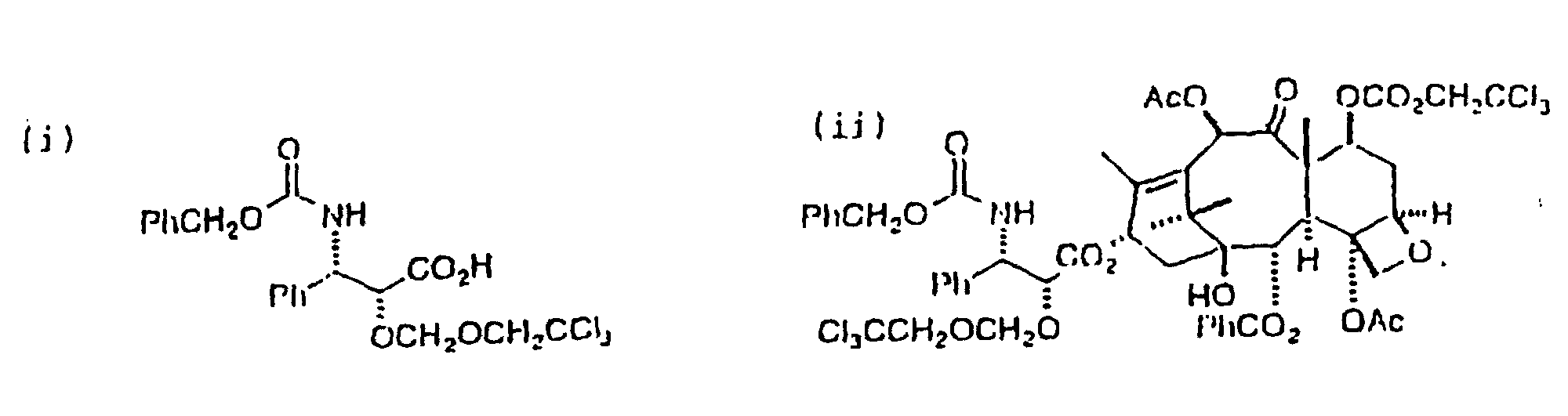

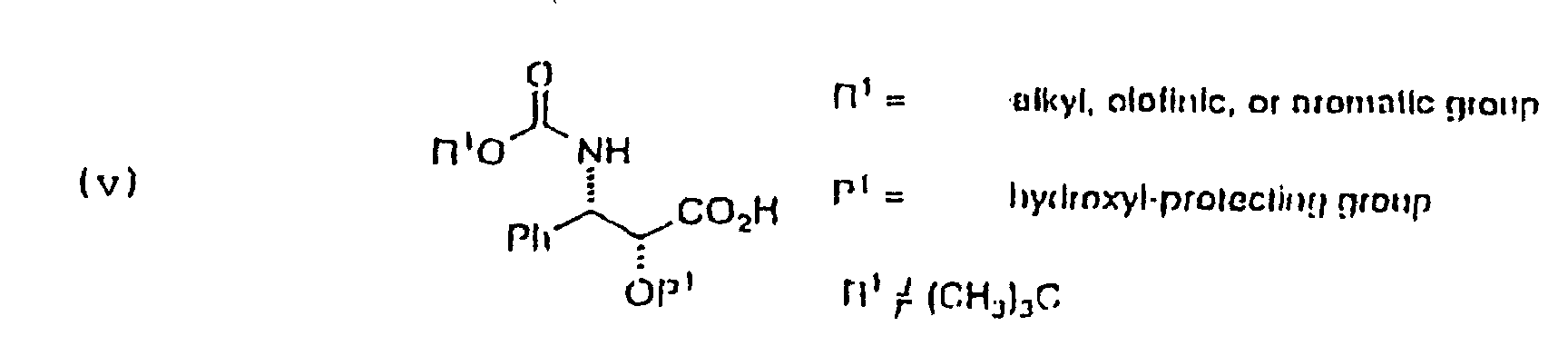

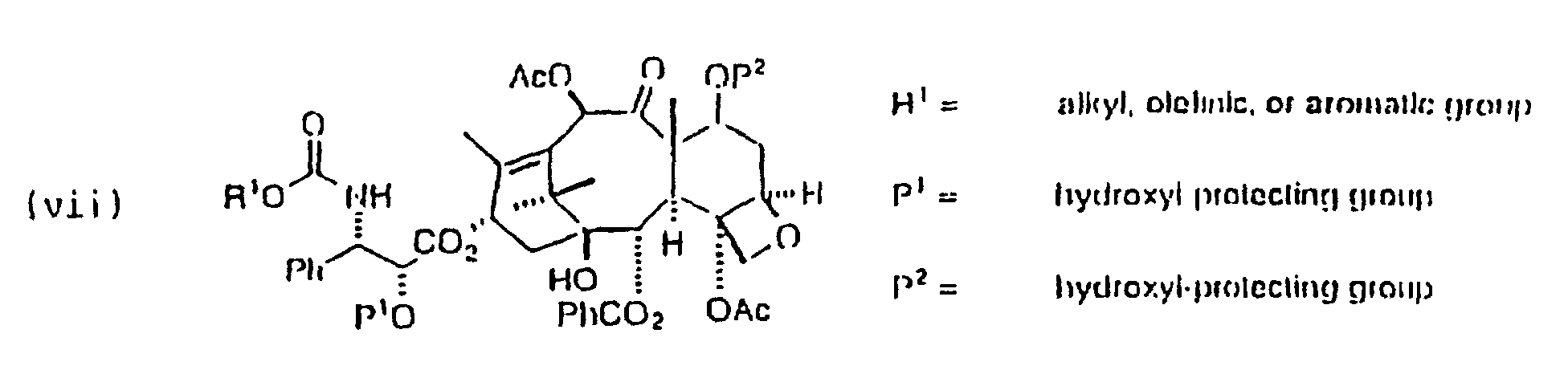

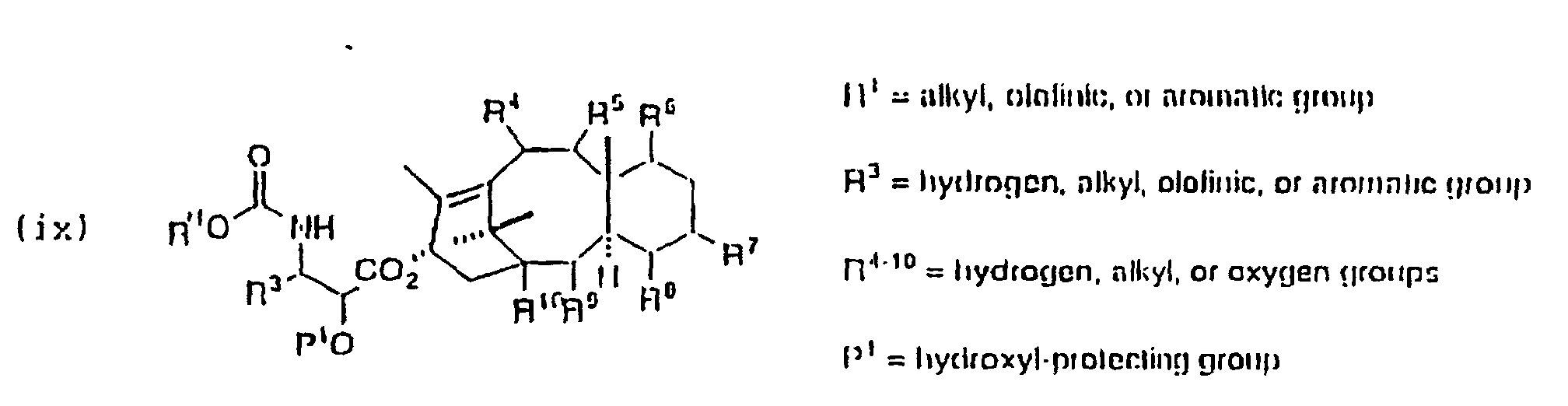
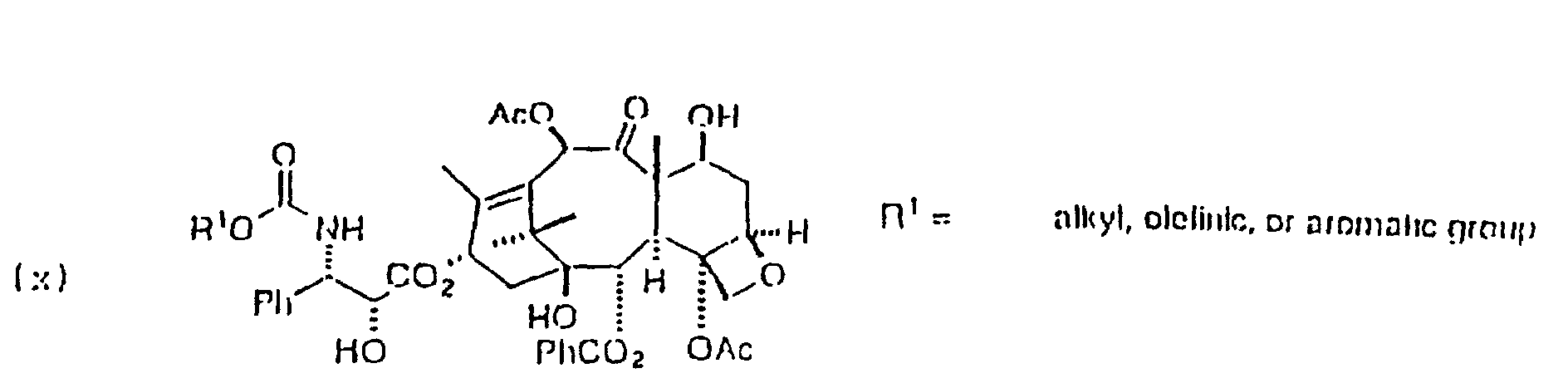

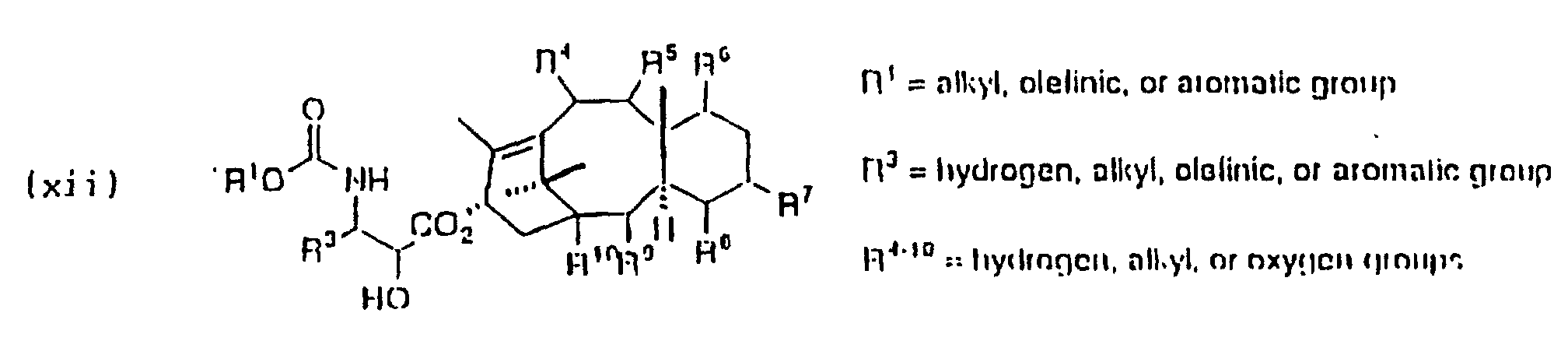
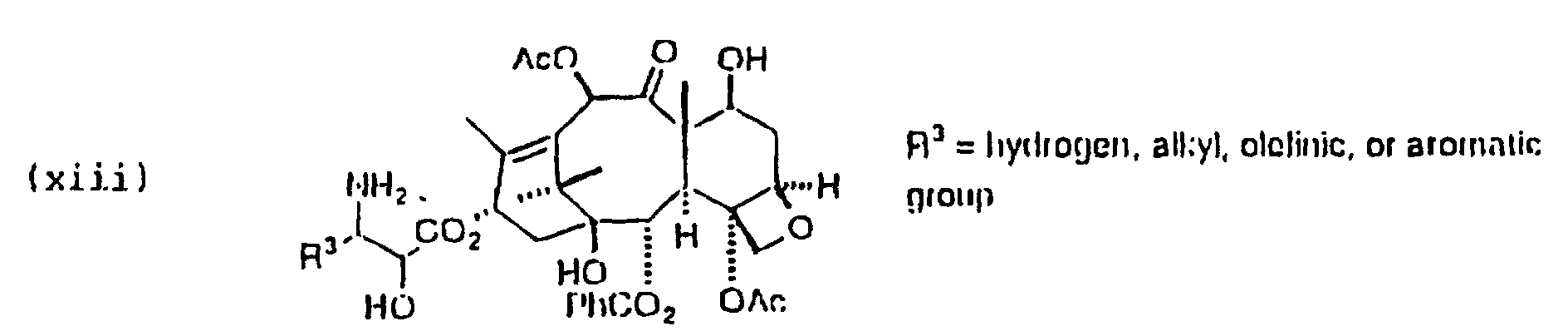

- Without further elaboration the foregoing will so fully illustrate our invention that others may, by applying current or future knowledge, adapt the same for use under various conditions of service.
Claims (23)
- A chemical process useful in production of taxol, taxol analogues and their intermediates comprising the step of condensing a compound of the general formula:with a taxane of the general structure:
 to give an intermediate of the general structure:
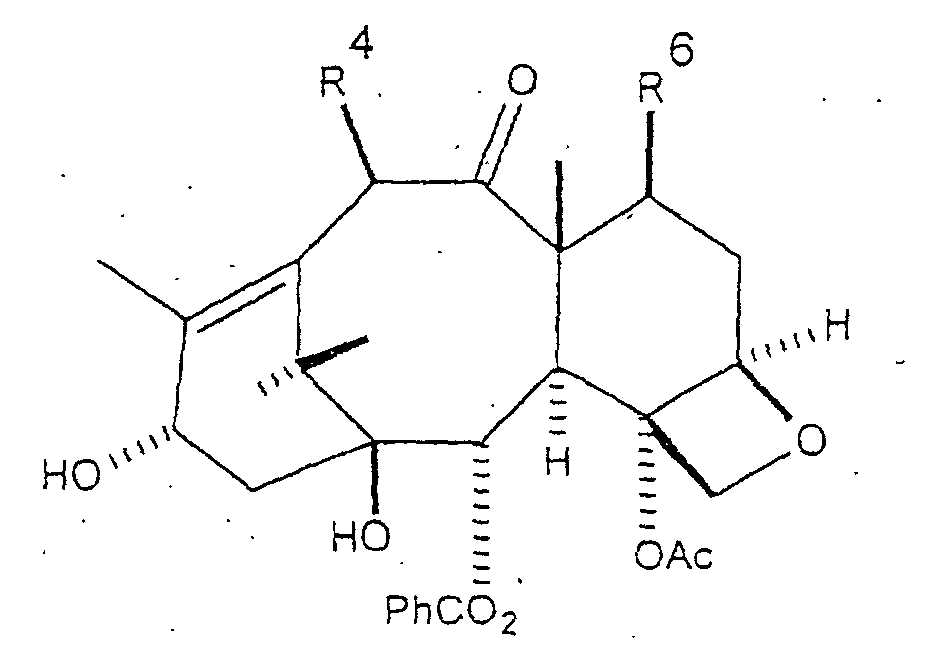 wherein:
- R1
- = an olefinic group, an aromatic group or PhCH,
- R3 =
- hydrogen, an alkyl or olefinic group, or Ph or another aromatic group
- R4 =
- hydroxyl, acetoxy or OP3 where P3 is a hydroxyl protecting group
- R6 =
- hydroxyl or OP2 where P2 is a hydroxyl protecting group
- P1 =
- hydroxyl protecting group.
- A chemical process according to claim 1 wherein R1 is PhCH2, R3 is Ph and P1 is CH2OCH2CCl3.
- A chemical process according to claim 2 wherein R4 is AcO and R6 is OCO2CH2CCl3.
- A chemical process according to claim 1 wherein R1 is PhCH2, R3 is Ph, R4 is AcO and R6 is OH.
- A chemical process according to claim 1 wherein R3 is Ph, R4 is AcO and R6 is OP2 wherein P2 is a hydroxyl-protecting group.
- The chemical process according to claim 1 including the further steps of deprotecting and acylating the intermediate to replace R1O and P1 to give a compound of the general structure:wherein R2 = Ph or another aromatic group, an olefinic group, hydrogen, PhCH2, or a group containing oxygen, nitrogen or sulfur.

- A chemical process according to claim 1 wherein R1 is an olefinic or aromatic group or PhCH2, R3 is H or Ph, R4 is AcO, R6 is OP2 and P2 is a hydroxyl-protecting group, and wherein the intermediate is deprotected and acylated by replacing R1O with Ph and P1 and P2 with hydrogen to produce taxol or a taxol analogue.
- A chemical process according to claim 7 wherein R1 is PhCH2, P1 is CH2OCH2CCl3 and P2 is CO2CH2CCl3 and wherein the intermediate is deprotected and acylated by exchanging the PhCH2OC=O group for a PhC=O group.
- A chemical process according to claim 1 wherein R1 is PhCH2, R3 is Ph, R4 is AcO, R6 is OP2 and P2 is a hydroxyl protecting group and wherein the condensation is a 3-phenylisoserine side chain esterification conducted in the presence of an aromatic solvent and an activating agent.
- A chemical process of claim 9 wherein P1 is CH2OCH2CCl3 and P2 is CO2CH2CCl3.
- A process as claimed in claim 9 or claim 10 wherein the activating agent is a dialkylaminopyridine.
- A process as claimed in any one of claims 9 to 11 wherein the organic solvent is benzene, toluene, a xylene, ethylbenzene, isopropylbenzene or chlorobenzene.
- A process as claimed in any one of claims 9 to 12 wherein the esterification is performed in the presence of a condensing agent.
- A chemical process useful for the production of taxol analogs and their intermediates, comprising:whereincondensing a compound of the general formula:
 with a taxane of the general formula:
 to give a first intermediate of the general formula:
- R1 =
- an olefinic group or an aromatic group
- R3 =
- an alkyl or olefinic group, or Ph or another aromatic group, or hydrogen
- P1 =
- a hydroxyl protecting group
- P2 =
- a hydroxyl protecting group
- P3 =
- a hydroxyl protecting group.
- The chemical process according to claim 14 including the step of deprotecting the first intermediate to give a second intermediate of the general formulawherein

- R1 =
- an olefinic group or an aromatic group
- R3 =
- an alkyl or olefinic group, or Ph or another aromatic group, or hydrogen
- The chemical process according to claim 15 including the step of deprotecting the second intermediate to give a third intermediate of the general formulawherein

- R3 =
- an alkyl or olefinic group, or Ph or another aromatic group, or hydrogen
- The chemical process according to claim 16 including the step of converting the third intermediate to a taxol analog of the general formulawherein

- R2 =
- an olefinic group, or Ph or another aromatic group, or hydrogen or a group containing oxygen, nitrogen or sulfur
- R3 =
- an alkyl or olefinic group, or Ph or another aromatic group, or hydrogen
- A process for the preparation of taxol analogs comprising the following steps:wherein R2 is an olefinic group, or Ph or another an aromatic group, or hydrogen, PhCH2, or a group containing oxygen, nitrogen, or sulfur, and R3 is an alkyl or olefinic group, or Ph or another aromatic group, or hydrogen.(a) substituting protective groups OP2 or OP2 for the hydroxyl groups at C-7 and C-10, respectively, of 10-deacetylbaccatin III to form a first intermediate having the formulawherein P2 and P3 are each COCH2CCl3 or another hydroxyl-protecting group;
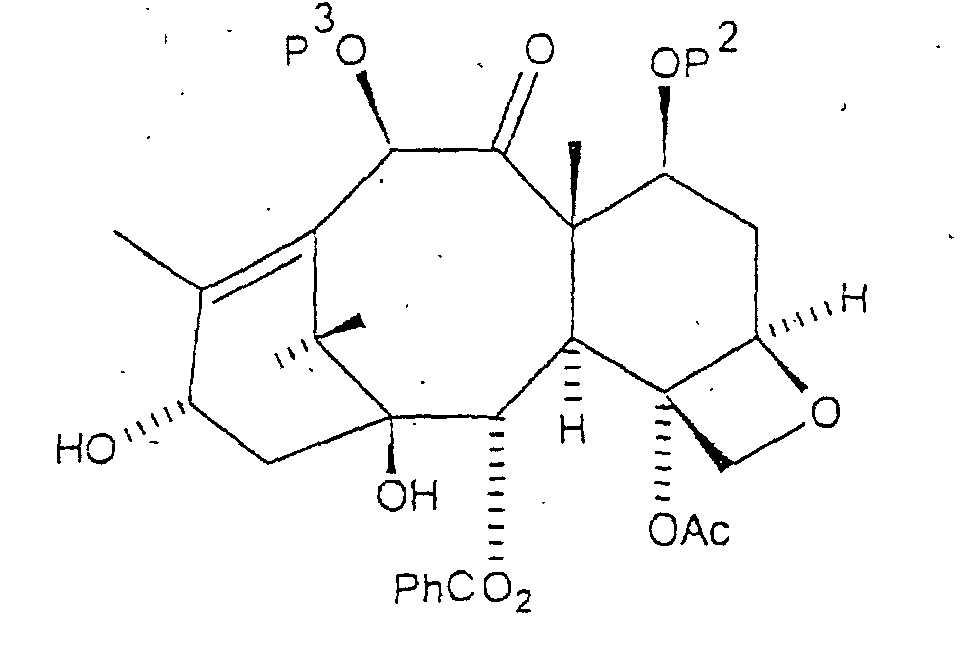 (b) condensing the first intermediate formed in step (a) withwherein R1 is an olefinic or aromatic group, R3 is an alkyl or olefinic group, or Ph or another aromatic group, or hydrogen and P1 is an hydroxyl-protecting group to form a second intermediate having a formula
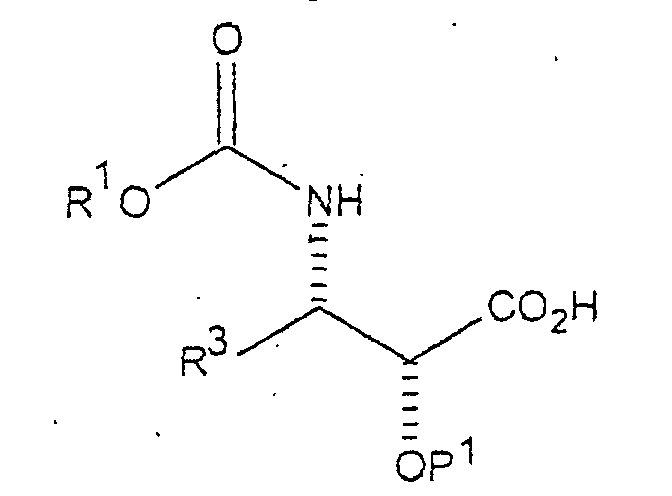 wherein R1 is an olefinic or aromatic group, R3 is an alkyl or olefinic group, or Ph another aromatic group, or hydrogen and P1, P2 and P3 are hydroxyl-protecting groups;
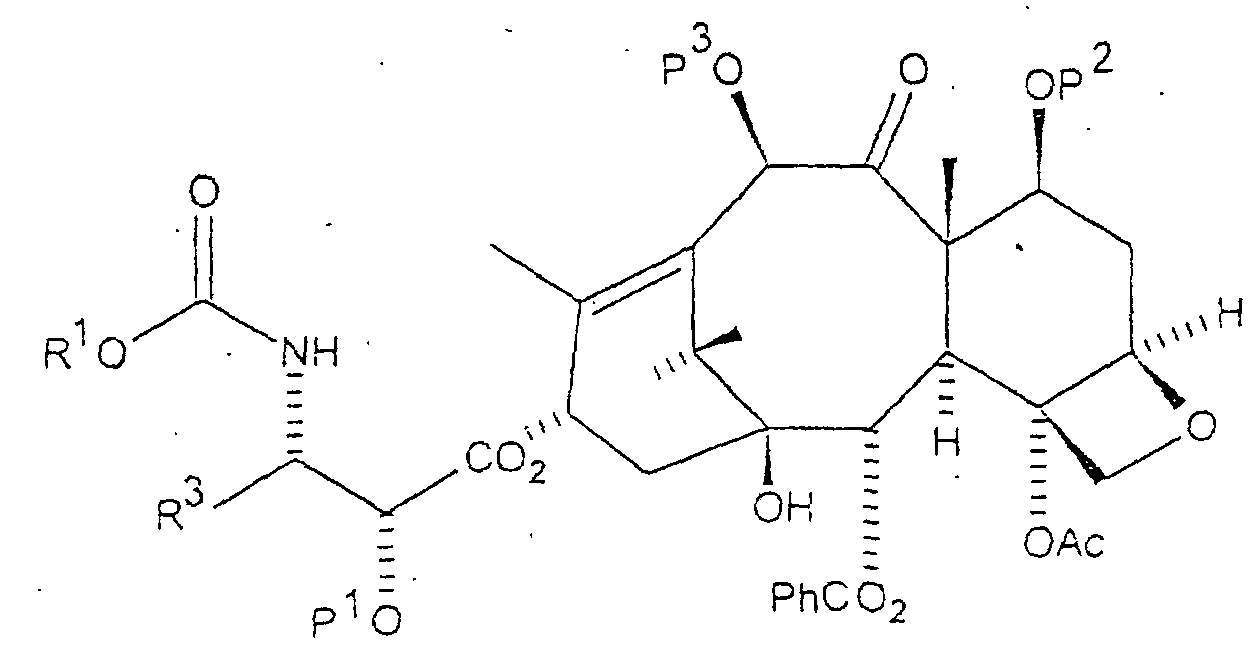 (c) deprotecting the hydroxyl groups for the P1, P2 and P3 protecting groups at C2', C-7 and C-10, respectively, of the second intermediate formed in step(b) to form a product having a formulawherein R1 is an olefinic or aromatic group and R3 is an alkyl or olefinic group, or Ph or another aromatic group or hydrogen;
 (d) deprotecting the product of step (c) at C3' to form a third intermediate of the general formulawherein R3 is an alkyl or olefinic group, or Ph or another aromatic group, or hydrogen ; and
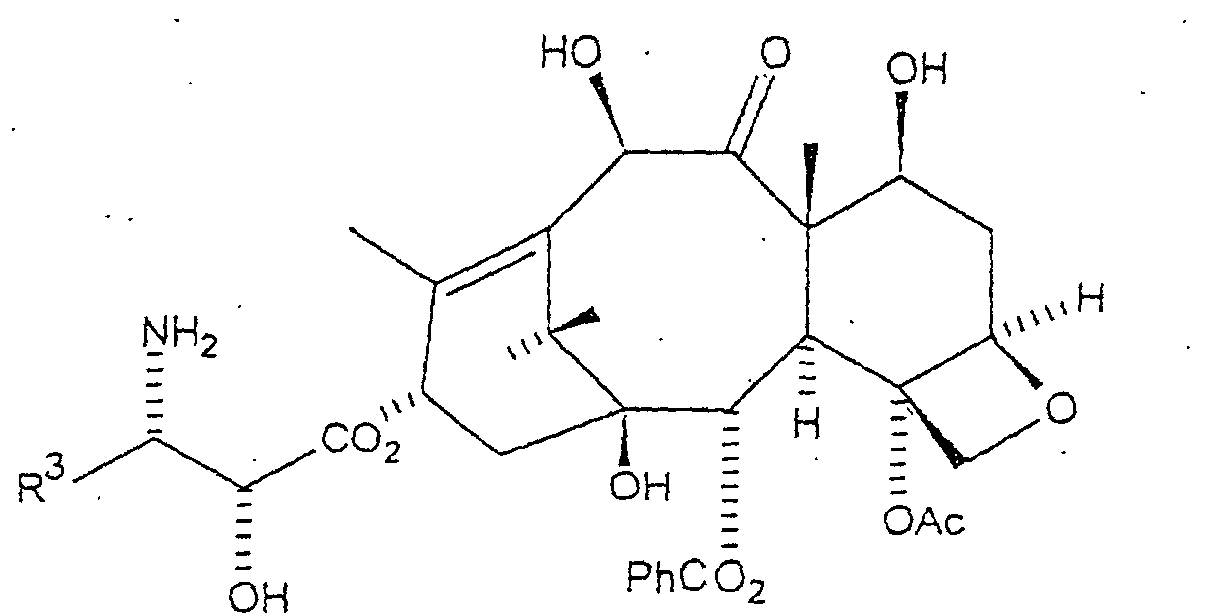 (e) acylating the third intermediate at the C3' nitrogen site to form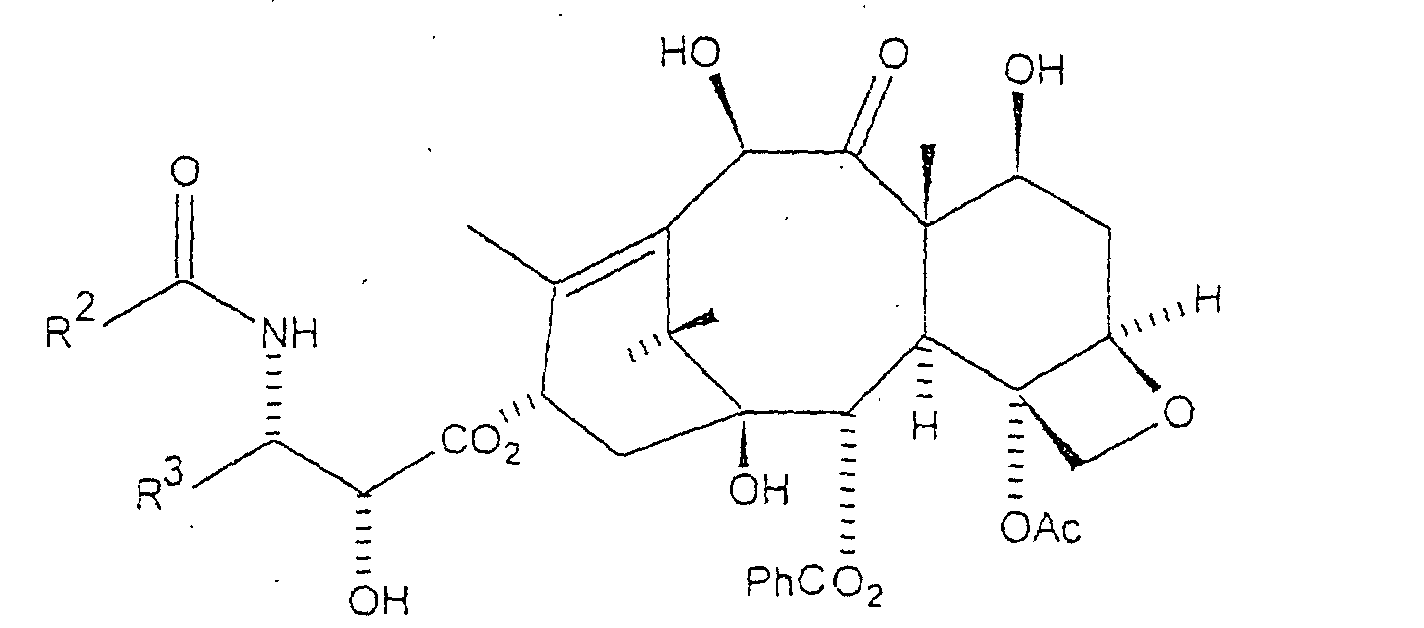
- The process according to claim 18 wherein R3 is Ph.
- A chemical compound having a generalized formula:wherein R3 is an alkyl, olefinic or aromatic group such as Ph, or hydrogen.
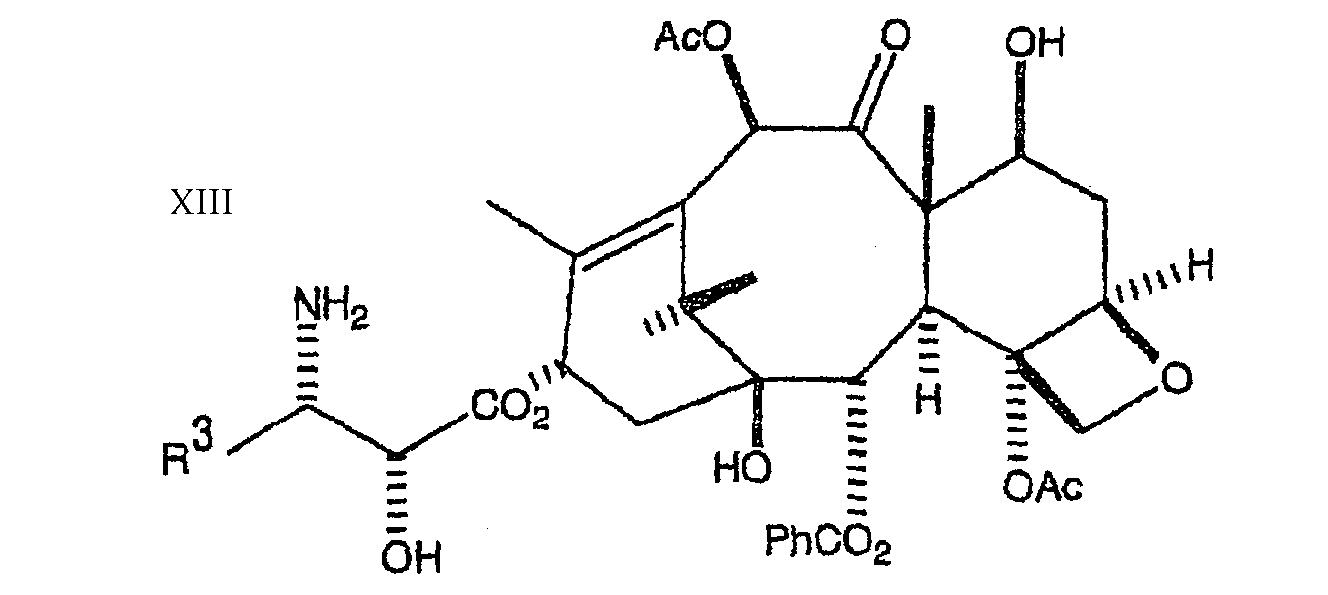
- A chemical compound according to claim 20 wherein R3 is Ph.
- A chemical compound having a generalized formula:wherein R3 is an alkyl, olefinic or aromatic group such as Ph, or hydrogen,
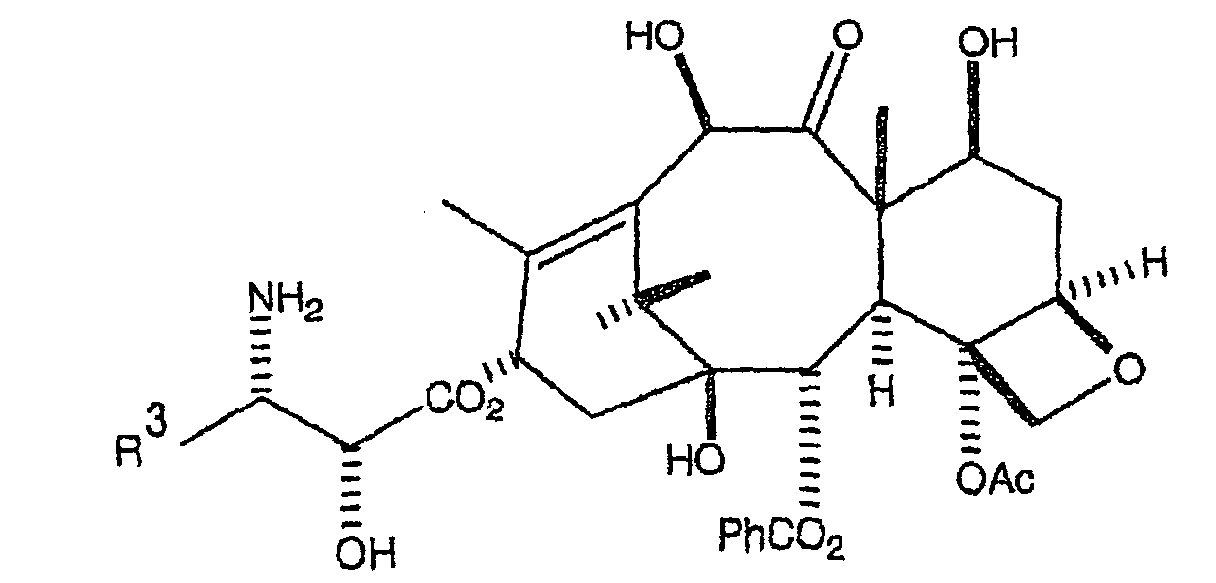
- An ammonium trifluoroacetate compound having the formula:

Priority Applications (1)
| Application Number | Priority Date | Filing Date | Title |
|---|---|---|---|
| EP02014256A EP1260507A1 (en) | 1993-02-05 | 1994-02-04 | Synthesis of taxol, analogs and intermediates with variable A-nng side chains |
Applications Claiming Priority (3)
| Application Number | Priority Date | Filing Date | Title |
|---|---|---|---|
| US1509593A | 1993-02-05 | 1993-02-05 | |
| US15095 | 1993-02-05 | ||
| PCT/US1994/001293 WO1994018186A1 (en) | 1993-02-05 | 1994-02-04 | Synthesis of taxol, analogs and intermediates with variable a-ring side chains |
Related Child Applications (1)
| Application Number | Title | Priority Date | Filing Date |
|---|---|---|---|
| EP02014256A Division EP1260507A1 (en) | 1993-02-05 | 1994-02-04 | Synthesis of taxol, analogs and intermediates with variable A-nng side chains |
Publications (3)
| Publication Number | Publication Date |
|---|---|
| EP0682660A1 EP0682660A1 (en) | 1995-11-22 |
| EP0682660A4 EP0682660A4 (en) | 1995-12-20 |
| EP0682660B1 true EP0682660B1 (en) | 2003-11-05 |
Family
ID=21769500
Family Applications (2)
| Application Number | Title | Priority Date | Filing Date |
|---|---|---|---|
| EP02014256A Withdrawn EP1260507A1 (en) | 1993-02-05 | 1994-02-04 | Synthesis of taxol, analogs and intermediates with variable A-nng side chains |
| EP94907973A Expired - Lifetime EP0682660B1 (en) | 1993-02-05 | 1994-02-04 | Synthesis of taxol, analogs and intermediates with variable a-ring side chains |
Family Applications Before (1)
| Application Number | Title | Priority Date | Filing Date |
|---|---|---|---|
| EP02014256A Withdrawn EP1260507A1 (en) | 1993-02-05 | 1994-02-04 | Synthesis of taxol, analogs and intermediates with variable A-nng side chains |
Country Status (12)
| Country | Link |
|---|---|
| US (6) | US5770745A (en) |
| EP (2) | EP1260507A1 (en) |
| JP (1) | JP3031715B2 (en) |
| CN (2) | CN1102829A (en) |
| AT (1) | ATE253563T1 (en) |
| AU (1) | AU695530B2 (en) |
| BR (1) | BR9405687C1 (en) |
| CA (1) | CA2155304C (en) |
| DE (1) | DE69433297T2 (en) |
| IL (1) | IL108581A0 (en) |
| NZ (1) | NZ262030A (en) |
| WO (1) | WO1994018186A1 (en) |
Families Citing this family (44)
| Publication number | Priority date | Publication date | Assignee | Title |
|---|---|---|---|---|
| US5973160A (en) * | 1992-12-23 | 1999-10-26 | Poss; Michael A. | Methods for the preparation of novel sidechain-bearing taxanes |
| JP3031715B2 (en) | 1993-02-05 | 2000-04-10 | ブリン モーアー カレッジ | Synthesis of taxols, analogs and intermediates with various A-ring side chains |
| US5684175A (en) * | 1993-02-05 | 1997-11-04 | Napro Biotherapeutics, Inc. | C-2' hydroxyl-benzyl protected, N-carbamate protected (2R, 3S)- 3-phenylisoserine and production process therefor |
| US5442065A (en) * | 1993-09-09 | 1995-08-15 | Board Of Regents, The University Of Texas System | Synthesis of tetrahydroquinoline enediyne core analogs of dynemicin |
| US5677470A (en) * | 1994-06-28 | 1997-10-14 | Tanabe Seiyaku Co., Ltd. | Baccatin derivatives and processes for preparing the same |
| CA2162759A1 (en) * | 1994-11-17 | 1996-05-18 | Kenji Tsujihara | Baccatin derivatives and processes for preparing the same |
| EP0868422A1 (en) * | 1996-09-24 | 1998-10-07 | Marigen S.A. | Ultramicroemulsion of spontaneously dispersible concentrates of esters of baccatin-iii compounds with antitumor and antiviral effect |
| US5750737A (en) * | 1996-09-25 | 1998-05-12 | Sisti; Nicholas J. | Method for paclitaxel synthesis |
| CA2188190A1 (en) * | 1996-10-18 | 1998-04-18 | Sarala Balachandran | The semi-synthesis of a protected bacatin iii compound |
| US6150537A (en) * | 1997-12-12 | 2000-11-21 | Emory University | Methods for the esterification of alcohols and compounds useful therefor as potential anticancer agents |
| US6020507A (en) * | 1998-03-02 | 2000-02-01 | Bristol-Myers Squibb Company | Synthesis of paclitaxel from baccatin III by protection of the 7-hydroxyl of baccatin III using a strong base and an electrophile |
| ATE269854T1 (en) | 1998-05-01 | 2004-07-15 | Napro Biotherapeutics Inc | METHOD AND USABLE INTERMEDIATE PRODUCTS FOR PACLITAXEL SYNTHESIS OF C-7,C-10 DI-CBZ BACCATIN III |
| FI981717L (en) | 1998-08-07 | 2000-02-08 | Borealis As | Catalyst component comprising magnesium, titanium, halogen and electron donor, its preparation and use |
| US6025516A (en) * | 1998-10-14 | 2000-02-15 | Chiragene, Inc. | Resolution of 2-hydroxy-3-amino-3-phenylpropionamide and its conversion to C-13 sidechain of taxanes |
| DE60031269T2 (en) | 1999-05-28 | 2007-05-31 | Bristol-Myers Squibb Co. | HALBSYNTHESIS OF PACLITAXEL WITH THE HELP OF DIALKYL DICHLORSILANES |
| US6136999A (en) * | 1999-06-21 | 2000-10-24 | Napro Biotherapeutics, Inc. | C-2 hydroxyl protected-n-acyl (2R,3S)-3-phenylisoserine substituted phenyl activated esters and method for production thereof |
| US6143902A (en) * | 1999-06-21 | 2000-11-07 | Napro Biotherapeutics, Inc. | C-2 hydroxyl protected-N-acyl (2R,3S)-3-phenylisoserine N-imido activated esters and method for production thereof |
| CA2385528C (en) | 1999-10-01 | 2013-12-10 | Immunogen, Inc. | Compositions and methods for treating cancer using immunoconjugates and chemotherapeutic agents |
| KR20010112395A (en) * | 2000-02-02 | 2001-12-20 | 플로리다 스테이트 유니버시티 리서치 파운데이션, 인크 | C7 Carbonate Substituted Taxanes as Antitumor Agents |
| MXPA01009923A (en) * | 2000-02-02 | 2003-08-01 | Univ Florida State Res Found | C7 carbamoyloxy substituted taxanes as antitumor agents. |
| US6452024B1 (en) | 2000-02-22 | 2002-09-17 | Chaichem Pharmaceuticals International | Process for extraction and purification of paclitaxel from natural sources |
| US6362217B2 (en) * | 2000-03-17 | 2002-03-26 | Bristol-Myers Squibb Company | Taxane anticancer agents |
| US6358996B1 (en) | 2000-06-09 | 2002-03-19 | Napro Biotherapeutics, Inc. | Stable isotope labeling of paclitaxel |
| DE60131537T2 (en) | 2000-06-22 | 2008-10-23 | Nitromed, Inc., Lexington | NITROSED AND NITROSYLATED TAXANES, PREPARATIONS AND METHODS OF USE |
| WO2002016993A1 (en) * | 2000-08-18 | 2002-02-28 | Nikon Corporation | Optical element holding device |
| MXPA03002494A (en) * | 2000-09-22 | 2004-05-24 | Bristol Myers Squibb Co | Method for reducing toxicity of combined chemotherapies. |
| DE01924282T1 (en) * | 2001-03-23 | 2007-04-19 | Scinopharm Taiwan, Ltd. | METHOD FOR PRODUCING TAX DERIVATIVES |
| EP1383492A4 (en) * | 2001-03-23 | 2008-12-24 | Napro Biotherapeutics Inc | MOLECULAR CONJUGATES FOR USE IN THE TREATMENT OF CANCER |
| US6452025B1 (en) | 2001-04-25 | 2002-09-17 | Napro Biotherapeutics, Inc. | Three-step conversion of protected taxane ester to paclitaxel |
| US6479679B1 (en) * | 2001-04-25 | 2002-11-12 | Napro Biotherapeutics, Inc. | Two-step conversion of protected taxane ester to paclitaxel |
| US6653501B2 (en) | 2001-06-27 | 2003-11-25 | Napro Biotherapeutics, Inc. | Chiral resolution method for producing compounds useful in the synthesis of taxanes |
| US7173145B2 (en) * | 2001-11-29 | 2007-02-06 | University Of Maryland, College Park | Process for extraction and purification of lutein, zeaxanthin and rare carotenoids from marigold flowers and plants |
| ITMI20020782A1 (en) * | 2002-04-12 | 2003-10-13 | Indena Spa | SEMI-SYNTHETIC PROCESS FOR THE PREPARATION OF N-DEBENZOILPACLITAXEL |
| US7981928B2 (en) | 2002-09-05 | 2011-07-19 | Nanodynamics, Inc. | Chemotherapy method using x-rays |
| AU2003273671A1 (en) * | 2002-10-09 | 2004-05-04 | Phytogen Life Sciences, Inc. | Novel taxanes and methods related to use and preparation thereof |
| US6759539B1 (en) | 2003-02-27 | 2004-07-06 | Chaichem Pharmaceuticals International | Process for isolation and purification of paclitaxel from natural sources |
| US7202370B2 (en) | 2003-10-27 | 2007-04-10 | Conor Medsystems, Inc. | Semi-synthesis of taxane intermediates from 9-dihydro-13-acetylbaccatin III |
| WO2006110842A2 (en) * | 2005-04-12 | 2006-10-19 | X-Rite, Incorporated | Systems and methods for measuring a like-color region of an object |
| CA2634453A1 (en) * | 2005-12-21 | 2007-06-28 | Tapestry Pharmaceuticals, Inc. | Novel compounds and methods for forming taxanes and using the same |
| WO2007126893A2 (en) * | 2006-03-27 | 2007-11-08 | Tapestry Pharmaceuticals, Inc. | A convergent process for the synthesis of taxane derivatives |
| GB0701523D0 (en) * | 2007-01-26 | 2007-03-07 | Chatham Biotec Ltd | Semi-synthetic process for the preparation of taxane derivatives |
| KR101096282B1 (en) * | 2009-04-24 | 2011-12-20 | 주식회사 삼양제넥스 | How to prepare taxane derivatives |
| WO2017055522A1 (en) | 2015-09-29 | 2017-04-06 | Academisch Medisch Centrum | Stabilized env proteins of hiv |
| US11344618B2 (en) | 2017-08-26 | 2022-05-31 | Academisch Medisch Centrum | HIV envelope glycoprotein immunogens |
Family Cites Families (18)
| Publication number | Priority date | Publication date | Assignee | Title |
|---|---|---|---|---|
| FR2601675B1 (en) * | 1986-07-17 | 1988-09-23 | Rhone Poulenc Sante | TAXOL DERIVATIVES, THEIR PREPARATION AND THE PHARMACEUTICAL COMPOSITIONS CONTAINING THEM |
| FR2601676B1 (en) * | 1986-07-17 | 1988-09-23 | Rhone Poulenc Sante | PROCESS FOR THE PREPARATION OF TAXOL AND DESACETYL-10 TAXOL |
| FR2629819B1 (en) * | 1988-04-06 | 1990-11-16 | Rhone Poulenc Sante | PROCESS FOR THE PREPARATION OF BACCATIN III AND DESACETYL-10 BACCATIN III DERIVATIVES |
| FR2629818B1 (en) * | 1988-04-06 | 1990-11-16 | Centre Nat Rech Scient | PROCESS FOR THE PREPARATION OF TAXOL |
| US5175315A (en) * | 1989-05-31 | 1992-12-29 | Florida State University | Method for preparation of taxol using β-lactam |
| US5015744A (en) * | 1989-11-14 | 1991-05-14 | Florida State University | Method for preparation of taxol using an oxazinone |
| US5136060A (en) * | 1989-11-14 | 1992-08-04 | Florida State University | Method for preparation of taxol using an oxazinone |
| FR2658513B1 (en) * | 1990-02-21 | 1994-02-04 | Rhone Poulenc Sante | PROCESS FOR THE PREPARATION OF CIS-BETA-PHENYLGLYCIDIC- (2R, 3R) ACID. |
| FR2680506B1 (en) * | 1991-08-19 | 1994-09-02 | Rhone Poulenc Rorer Sa | PROCESS FOR THE PREPARATION OF BETA-PHENYLISOSERIN DERIVATIVES AND THEIR USE. |
| FR2687151B1 (en) | 1992-02-07 | 1994-03-25 | Rhone Poulenc Rorer Sa | NOVEL DERIVATIVES OF BACCATIN III AND DESACETYL-10 BACCATIN III, THEIR PREPARATION AND THE PHARMACEUTICAL COMPOSITIONS CONTAINING THEM. |
| FR2687150B1 (en) * | 1992-02-07 | 1995-04-28 | Rhone Poulenc Rorer Sa | PROCESS FOR THE PREPARATION OF TAXANE DERIVATIVES. |
| US5470866A (en) * | 1992-08-18 | 1995-11-28 | Virginia Polytechnic Institute And State University | Method for the conversion of cephalomannine to taxol and for the preparation of n-acyl analogs of taxol |
| US5319112A (en) * | 1992-08-18 | 1994-06-07 | Virgnia Tech Intellectual Properties, Inc. | Method for the conversion of cephalomannine to taxol and for the preparation of N-acyl analogs of taxol |
| FR2696460B1 (en) | 1992-10-05 | 1994-11-25 | Rhone Poulenc Rorer Sa | Process for the preparation of taxane derivatives. |
| US5684175A (en) * | 1993-02-05 | 1997-11-04 | Napro Biotherapeutics, Inc. | C-2' hydroxyl-benzyl protected, N-carbamate protected (2R, 3S)- 3-phenylisoserine and production process therefor |
| JP3031715B2 (en) | 1993-02-05 | 2000-04-10 | ブリン モーアー カレッジ | Synthesis of taxols, analogs and intermediates with various A-ring side chains |
| FR2703353B1 (en) * | 1993-03-29 | 1995-05-05 | Rhone Poulenc Rorer Sa | Process for the preparation of beta-phenylisoserine derivatives. |
| US5679807A (en) | 1995-01-30 | 1997-10-21 | Hauser, Inc. | Preparation of taxol and docetaxel through primary amines |
-
1994
- 1994-02-04 JP JP6518249A patent/JP3031715B2/en not_active Expired - Fee Related
- 1994-02-04 DE DE69433297T patent/DE69433297T2/en not_active Expired - Lifetime
- 1994-02-04 CA CA2155304A patent/CA2155304C/en not_active Expired - Lifetime
- 1994-02-04 BR BR9405687-0A patent/BR9405687C1/en not_active Application Discontinuation
- 1994-02-04 NZ NZ262030A patent/NZ262030A/en unknown
- 1994-02-04 EP EP02014256A patent/EP1260507A1/en not_active Withdrawn
- 1994-02-04 WO PCT/US1994/001293 patent/WO1994018186A1/en not_active Ceased
- 1994-02-04 AU AU61336/94A patent/AU695530B2/en not_active Expired
- 1994-02-04 EP EP94907973A patent/EP0682660B1/en not_active Expired - Lifetime
- 1994-02-04 AT AT94907973T patent/ATE253563T1/en not_active IP Right Cessation
- 1994-02-05 CN CN94102253A patent/CN1102829A/en active Pending
- 1994-02-07 IL IL10858194A patent/IL108581A0/en unknown
- 1994-12-15 US US08/357,507 patent/US5770745A/en not_active Expired - Lifetime
-
1995
- 1995-06-07 US US08/483,083 patent/US5939566A/en not_active Expired - Lifetime
-
1998
- 1998-02-09 US US09/020,742 patent/US6262281B1/en not_active Expired - Fee Related
-
1999
- 1999-02-19 US US09/253,325 patent/US6072060A/en not_active Expired - Fee Related
-
2000
- 2000-03-01 CN CN00103725A patent/CN1284501A/en active Pending
- 2000-04-11 US US09/547,327 patent/US6307088B1/en not_active Expired - Fee Related
-
2001
- 2001-05-22 US US09/863,889 patent/US6509484B2/en not_active Expired - Fee Related
Also Published As
| Publication number | Publication date |
|---|---|
| EP0682660A1 (en) | 1995-11-22 |
| US6072060A (en) | 2000-06-06 |
| CA2155304C (en) | 2010-07-20 |
| IL108581A0 (en) | 1994-05-30 |
| AU6133694A (en) | 1994-08-29 |
| BR9405687A (en) | 1995-11-21 |
| CN1284501A (en) | 2001-02-21 |
| US6307088B1 (en) | 2001-10-23 |
| US20020052517A1 (en) | 2002-05-02 |
| DE69433297T2 (en) | 2004-10-21 |
| US6262281B1 (en) | 2001-07-17 |
| DE69433297D1 (en) | 2003-12-11 |
| WO1994018186A1 (en) | 1994-08-18 |
| EP0682660A4 (en) | 1995-12-20 |
| AU695530B2 (en) | 1998-08-13 |
| NZ262030A (en) | 1997-10-24 |
| US6509484B2 (en) | 2003-01-21 |
| BR9405687C1 (en) | 2001-08-07 |
| US5939566A (en) | 1999-08-17 |
| JP3031715B2 (en) | 2000-04-10 |
| CN1102829A (en) | 1995-05-24 |
| EP1260507A1 (en) | 2002-11-27 |
| CA2155304A1 (en) | 1994-08-18 |
| JPH08506587A (en) | 1996-07-16 |
| ATE253563T1 (en) | 2003-11-15 |
| US5770745A (en) | 1998-06-23 |
Similar Documents
| Publication | Publication Date | Title |
|---|---|---|
| US5770745A (en) | Synthesis of taxol, taxol analogs and their intermediates with variable A-ring side chain structures and compositions thereof | |
| CA2118867A1 (en) | 2-debenzoyl-2-acyl taxol derivatives and methods for making same | |
| CA2211799C (en) | Preparation of taxol and docetaxel through primary amines | |
| AU706406B2 (en) | Paclitaxel synthesis from precursor compounds and methods of producing the same | |
| EP0847393B1 (en) | Paclitaxel synthesis from precursor compounds and methods of producing the same | |
| EP0837846B1 (en) | C-2' hydroxyl-benzyl protected, n-carbamate protected (2r,3s)-3-phenylisoserine and production process therefor | |
| US6175023B1 (en) | Synthesis of water soluble 9-dihydro-paclitaxel derivatives from 9-dihydro-13-acetylbaccatin III | |
| US6399783B1 (en) | Methods for the esterification of alcohols and compounds useful therefor as potential anticancer agents | |
| US6448417B1 (en) | Methods and useful intermediates for paclitaxel synthesis from C-7, C-10 di-cbz 10-deacetylbaccatin III | |
| HK1035190A (en) | Compounds used for synthesing of taxol, taxol analogs and their intermediates | |
| WO2009137084A2 (en) | Processes for preparation of taxanes and intermediates thereof | |
| CN107848990A (en) | The manufacture method of the side chain precursor of taxol and Docetaxel |
Legal Events
| Date | Code | Title | Description |
|---|---|---|---|
| PUAI | Public reference made under article 153(3) epc to a published international application that has entered the european phase |
Free format text: ORIGINAL CODE: 0009012 |
|
| 17P | Request for examination filed |
Effective date: 19950828 |
|
| AK | Designated contracting states |
Kind code of ref document: A1 Designated state(s): AT BE CH DE DK ES FR GB GR IE IT LI LU MC NL PT SE |
|
| A4 | Supplementary search report drawn up and despatched |
Effective date: 19951102 |
|
| AK | Designated contracting states |
Kind code of ref document: A4 Designated state(s): AT BE CH DE DK ES FR GB GR IE IT LI LU MC NL PT SE |
|
| 17Q | First examination report despatched |
Effective date: 19981209 |
|
| GRAH | Despatch of communication of intention to grant a patent |
Free format text: ORIGINAL CODE: EPIDOS IGRA |
|
| GRAH | Despatch of communication of intention to grant a patent |
Free format text: ORIGINAL CODE: EPIDOS IGRA |
|
| GRAA | (expected) grant |
Free format text: ORIGINAL CODE: 0009210 |
|
| AK | Designated contracting states |
Kind code of ref document: B1 Designated state(s): AT BE CH DE DK ES FR GB GR IE IT LI LU MC NL PT SE |
|
| PG25 | Lapsed in a contracting state [announced via postgrant information from national office to epo] |
Ref country code: NL Free format text: LAPSE BECAUSE OF FAILURE TO SUBMIT A TRANSLATION OF THE DESCRIPTION OR TO PAY THE FEE WITHIN THE PRESCRIBED TIME-LIMIT Effective date: 20031105 Ref country code: IT Free format text: LAPSE BECAUSE OF FAILURE TO SUBMIT A TRANSLATION OF THE DESCRIPTION OR TO PAY THE FEE WITHIN THE PRESCRIBED TIME-LIMIT;WARNING: LAPSES OF ITALIAN PATENTS WITH EFFECTIVE DATE BEFORE 2007 MAY HAVE OCCURRED AT ANY TIME BEFORE 2007. THE CORRECT EFFECTIVE DATE MAY BE DIFFERENT FROM THE ONE RECORDED. Effective date: 20031105 Ref country code: BE Free format text: LAPSE BECAUSE OF FAILURE TO SUBMIT A TRANSLATION OF THE DESCRIPTION OR TO PAY THE FEE WITHIN THE PRESCRIBED TIME-LIMIT Effective date: 20031105 Ref country code: AT Free format text: LAPSE BECAUSE OF FAILURE TO SUBMIT A TRANSLATION OF THE DESCRIPTION OR TO PAY THE FEE WITHIN THE PRESCRIBED TIME-LIMIT Effective date: 20031105 |
|
| REG | Reference to a national code |
Ref country code: GB Ref legal event code: FG4D |
|
| REG | Reference to a national code |
Ref country code: CH Ref legal event code: EP |
|
| REF | Corresponds to: |
Ref document number: 69433297 Country of ref document: DE Date of ref document: 20031211 Kind code of ref document: P |
|
| REG | Reference to a national code |
Ref country code: IE Ref legal event code: FG4D |
|
| PG25 | Lapsed in a contracting state [announced via postgrant information from national office to epo] |
Ref country code: LU Free format text: LAPSE BECAUSE OF NON-PAYMENT OF DUE FEES Effective date: 20040204 Ref country code: IE Free format text: LAPSE BECAUSE OF NON-PAYMENT OF DUE FEES Effective date: 20040204 |
|
| PG25 | Lapsed in a contracting state [announced via postgrant information from national office to epo] |
Ref country code: GR Free format text: LAPSE BECAUSE OF FAILURE TO SUBMIT A TRANSLATION OF THE DESCRIPTION OR TO PAY THE FEE WITHIN THE PRESCRIBED TIME-LIMIT Effective date: 20040205 Ref country code: DK Free format text: LAPSE BECAUSE OF FAILURE TO SUBMIT A TRANSLATION OF THE DESCRIPTION OR TO PAY THE FEE WITHIN THE PRESCRIBED TIME-LIMIT Effective date: 20040205 |
|
| PG25 | Lapsed in a contracting state [announced via postgrant information from national office to epo] |
Ref country code: ES Free format text: LAPSE BECAUSE OF FAILURE TO SUBMIT A TRANSLATION OF THE DESCRIPTION OR TO PAY THE FEE WITHIN THE PRESCRIBED TIME-LIMIT Effective date: 20040216 |
|
| REG | Reference to a national code |
Ref country code: SE Ref legal event code: TRGR |
|
| PG25 | Lapsed in a contracting state [announced via postgrant information from national office to epo] |
Ref country code: MC Free format text: LAPSE BECAUSE OF NON-PAYMENT OF DUE FEES Effective date: 20040228 |
|
| REG | Reference to a national code |
Ref country code: CH Ref legal event code: NV Representative=s name: E. BLUM & CO. PATENTANWAELTE |
|
| NLV1 | Nl: lapsed or annulled due to failure to fulfill the requirements of art. 29p and 29m of the patents act | ||
| ET | Fr: translation filed | ||
| PLBE | No opposition filed within time limit |
Free format text: ORIGINAL CODE: 0009261 |
|
| STAA | Information on the status of an ep patent application or granted ep patent |
Free format text: STATUS: NO OPPOSITION FILED WITHIN TIME LIMIT |
|
| 26N | No opposition filed |
Effective date: 20040806 |
|
| REG | Reference to a national code |
Ref country code: IE Ref legal event code: MM4A |
|
| REG | Reference to a national code |
Ref country code: CH Ref legal event code: PFA Owner name: BRYN MAWR COLLEGE Free format text: BRYN MAWR COLLEGE#101 NORTH MERION AVENUE#BRYN MAWR, PA 19010-3899 (US) -TRANSFER TO- BRYN MAWR COLLEGE#101 NORTH MERION AVENUE#BRYN MAWR, PA 19010-3899 (US) |
|
| PG25 | Lapsed in a contracting state [announced via postgrant information from national office to epo] |
Ref country code: PT Free format text: LAPSE BECAUSE OF NON-PAYMENT OF DUE FEES Effective date: 20040405 |
|
| PGFP | Annual fee paid to national office [announced via postgrant information from national office to epo] |
Ref country code: GB Payment date: 20121227 Year of fee payment: 20 |
|
| PGFP | Annual fee paid to national office [announced via postgrant information from national office to epo] |
Ref country code: SE Payment date: 20130222 Year of fee payment: 20 Ref country code: DE Payment date: 20130227 Year of fee payment: 20 Ref country code: CH Payment date: 20130108 Year of fee payment: 20 Ref country code: FR Payment date: 20130131 Year of fee payment: 20 |
|
| REG | Reference to a national code |
Ref country code: DE Ref legal event code: R071 Ref document number: 69433297 Country of ref document: DE |
|
| REG | Reference to a national code |
Ref country code: CH Ref legal event code: PL |
|
| REG | Reference to a national code |
Ref country code: GB Ref legal event code: PE20 Expiry date: 20140203 |
|
| REG | Reference to a national code |
Ref country code: SE Ref legal event code: EUG |
|
| PG25 | Lapsed in a contracting state [announced via postgrant information from national office to epo] |
Ref country code: GB Free format text: LAPSE BECAUSE OF EXPIRATION OF PROTECTION Effective date: 20140203 Ref country code: DE Free format text: LAPSE BECAUSE OF EXPIRATION OF PROTECTION Effective date: 20140205 |