EP0682146B1 - Textile product treatment - Google Patents
Textile product treatment Download PDFInfo
- Publication number
- EP0682146B1 EP0682146B1 EP94905221A EP94905221A EP0682146B1 EP 0682146 B1 EP0682146 B1 EP 0682146B1 EP 94905221 A EP94905221 A EP 94905221A EP 94905221 A EP94905221 A EP 94905221A EP 0682146 B1 EP0682146 B1 EP 0682146B1
- Authority
- EP
- European Patent Office
- Prior art keywords
- macromonomer
- group
- graft
- polymerization
- weight
- Prior art date
- Legal status (The legal status is an assumption and is not a legal conclusion. Google has not performed a legal analysis and makes no representation as to the accuracy of the status listed.)
- Expired - Lifetime
Links
- 239000004753 textile Substances 0.000 title claims description 16
- 229920000578 graft copolymer Polymers 0.000 claims description 33
- 239000003795 chemical substances by application Substances 0.000 claims description 19
- 229920000642 polymer Polymers 0.000 claims description 16
- 125000000217 alkyl group Chemical group 0.000 claims description 10
- 125000002496 methyl group Chemical group [H]C([H])([H])* 0.000 claims description 9
- 125000004432 carbon atom Chemical group C* 0.000 claims description 6
- 125000004435 hydrogen atom Chemical group [H]* 0.000 claims description 4
- 125000003903 2-propenyl group Chemical group [H]C([*])([H])C([H])=C([H])[H] 0.000 claims description 2
- 125000004185 ester group Chemical group 0.000 claims description 2
- 230000009477 glass transition Effects 0.000 claims description 2
- 230000008018 melting Effects 0.000 claims description 2
- 238000002844 melting Methods 0.000 claims description 2
- 125000001997 phenyl group Chemical group [H]C1=C([H])C([H])=C(*)C([H])=C1[H] 0.000 claims description 2
- 125000005504 styryl group Chemical group 0.000 claims description 2
- 229920001567 vinyl ester resin Chemical group 0.000 claims description 2
- 239000000178 monomer Substances 0.000 description 33
- NIXOWILDQLNWCW-UHFFFAOYSA-M Acrylate Chemical compound [O-]C(=O)C=C NIXOWILDQLNWCW-UHFFFAOYSA-M 0.000 description 26
- 230000000052 comparative effect Effects 0.000 description 24
- 239000000203 mixture Substances 0.000 description 24
- 238000007720 emulsion polymerization reaction Methods 0.000 description 23
- 239000004744 fabric Substances 0.000 description 22
- XLYOFNOQVPJJNP-UHFFFAOYSA-N water Substances O XLYOFNOQVPJJNP-UHFFFAOYSA-N 0.000 description 21
- 238000006116 polymerization reaction Methods 0.000 description 19
- VVQNEPGJFQJSBK-UHFFFAOYSA-N Methyl methacrylate Chemical group COC(=O)C(C)=C VVQNEPGJFQJSBK-UHFFFAOYSA-N 0.000 description 18
- IJGRMHOSHXDMSA-UHFFFAOYSA-N nitrogen Substances N#N IJGRMHOSHXDMSA-UHFFFAOYSA-N 0.000 description 18
- -1 (meth)acrylic acid halide Chemical class 0.000 description 17
- 238000002360 preparation method Methods 0.000 description 16
- 229920005604 random copolymer Polymers 0.000 description 16
- YXFVVABEGXRONW-UHFFFAOYSA-N Toluene Chemical compound CC1=CC=CC=C1 YXFVVABEGXRONW-UHFFFAOYSA-N 0.000 description 15
- 239000007788 liquid Substances 0.000 description 15
- 238000000034 method Methods 0.000 description 15
- OZAIFHULBGXAKX-UHFFFAOYSA-N 2-(2-cyanopropan-2-yldiazenyl)-2-methylpropanenitrile Chemical compound N#CC(C)(C)N=NC(C)(C)C#N OZAIFHULBGXAKX-UHFFFAOYSA-N 0.000 description 14
- 238000010528 free radical solution polymerization reaction Methods 0.000 description 14
- CSCPPACGZOOCGX-UHFFFAOYSA-N Acetone Chemical compound CC(C)=O CSCPPACGZOOCGX-UHFFFAOYSA-N 0.000 description 13
- XEKOWRVHYACXOJ-UHFFFAOYSA-N Ethyl acetate Chemical compound CCOC(C)=O XEKOWRVHYACXOJ-UHFFFAOYSA-N 0.000 description 12
- PPBRXRYQALVLMV-UHFFFAOYSA-N Styrene Chemical compound C=CC1=CC=CC=C1 PPBRXRYQALVLMV-UHFFFAOYSA-N 0.000 description 11
- 229910052757 nitrogen Inorganic materials 0.000 description 11
- 239000002689 soil Substances 0.000 description 11
- 238000005108 dry cleaning Methods 0.000 description 10
- 238000004458 analytical method Methods 0.000 description 9
- 229920001577 copolymer Polymers 0.000 description 9
- 239000003921 oil Substances 0.000 description 9
- 238000004817 gas chromatography Methods 0.000 description 8
- 229920001519 homopolymer Polymers 0.000 description 8
- 239000003960 organic solvent Substances 0.000 description 8
- 239000012298 atmosphere Substances 0.000 description 7
- HMZGPNHSPWNGEP-UHFFFAOYSA-N octadecyl 2-methylprop-2-enoate Chemical group CCCCCCCCCCCCCCCCCCOC(=O)C(C)=C HMZGPNHSPWNGEP-UHFFFAOYSA-N 0.000 description 7
- 239000007787 solid Substances 0.000 description 7
- 239000000243 solution Substances 0.000 description 7
- 238000003756 stirring Methods 0.000 description 7
- ZWEHNKRNPOVVGH-UHFFFAOYSA-N 2-Butanone Chemical compound CCC(C)=O ZWEHNKRNPOVVGH-UHFFFAOYSA-N 0.000 description 6
- 229920000742 Cotton Polymers 0.000 description 6
- KFZMGEQAYNKOFK-UHFFFAOYSA-N Isopropanol Chemical compound CC(C)O KFZMGEQAYNKOFK-UHFFFAOYSA-N 0.000 description 6
- CQEYYJKEWSMYFG-UHFFFAOYSA-N butyl acrylate Chemical group CCCCOC(=O)C=C CQEYYJKEWSMYFG-UHFFFAOYSA-N 0.000 description 6
- DIOQZVSQGTUSAI-UHFFFAOYSA-N decane Chemical compound CCCCCCCCCC DIOQZVSQGTUSAI-UHFFFAOYSA-N 0.000 description 6
- 239000000835 fiber Substances 0.000 description 6
- 229920000728 polyester Polymers 0.000 description 6
- 239000003505 polymerization initiator Substances 0.000 description 6
- 238000005406 washing Methods 0.000 description 6
- 239000004342 Benzoyl peroxide Substances 0.000 description 5
- OMPJBNCRMGITSC-UHFFFAOYSA-N Benzoylperoxide Chemical compound C=1C=CC=CC=1C(=O)OOC(=O)C1=CC=CC=C1 OMPJBNCRMGITSC-UHFFFAOYSA-N 0.000 description 5
- 239000004215 Carbon black (E152) Substances 0.000 description 5
- IMNFDUFMRHMDMM-UHFFFAOYSA-N N-Heptane Chemical compound CCCCCCC IMNFDUFMRHMDMM-UHFFFAOYSA-N 0.000 description 5
- VBIIFPGSPJYLRR-UHFFFAOYSA-M Stearyltrimethylammonium chloride Chemical compound [Cl-].CCCCCCCCCCCCCCCCCC[N+](C)(C)C VBIIFPGSPJYLRR-UHFFFAOYSA-M 0.000 description 5
- 235000019400 benzoyl peroxide Nutrition 0.000 description 5
- 238000011109 contamination Methods 0.000 description 5
- 239000008367 deionised water Substances 0.000 description 5
- 229910021641 deionized water Inorganic materials 0.000 description 5
- WNAHIZMDSQCWRP-UHFFFAOYSA-N dodecane-1-thiol Chemical compound CCCCCCCCCCCCS WNAHIZMDSQCWRP-UHFFFAOYSA-N 0.000 description 5
- 229930195733 hydrocarbon Natural products 0.000 description 5
- 150000002430 hydrocarbons Chemical class 0.000 description 5
- QJGQUHMNIGDVPM-UHFFFAOYSA-N nitrogen group Chemical group [N] QJGQUHMNIGDVPM-UHFFFAOYSA-N 0.000 description 5
- 229920002114 octoxynol-9 Polymers 0.000 description 5
- 229920003229 poly(methyl methacrylate) Polymers 0.000 description 5
- 239000004926 polymethyl methacrylate Substances 0.000 description 5
- 239000005871 repellent Substances 0.000 description 5
- 239000000126 substance Substances 0.000 description 5
- UOCLXMDMGBRAIB-UHFFFAOYSA-N 1,1,1-trichloroethane Chemical compound CC(Cl)(Cl)Cl UOCLXMDMGBRAIB-UHFFFAOYSA-N 0.000 description 4
- 230000008034 disappearance Effects 0.000 description 4
- 238000010828 elution Methods 0.000 description 4
- DCAYPVUWAIABOU-UHFFFAOYSA-N hexadecane Chemical compound CCCCCCCCCCCCCCCC DCAYPVUWAIABOU-UHFFFAOYSA-N 0.000 description 4
- 239000000463 material Substances 0.000 description 4
- 238000010992 reflux Methods 0.000 description 4
- HGXJDMCMYLEZMJ-UHFFFAOYSA-N (2-methylpropan-2-yl)oxy 2,2-dimethylpropaneperoxoate Chemical compound CC(C)(C)OOOC(=O)C(C)(C)C HGXJDMCMYLEZMJ-UHFFFAOYSA-N 0.000 description 3
- FKTXDTWDCPTPHK-UHFFFAOYSA-N 1,1,1,2,3,3,3-heptafluoropropane Chemical compound FC(F)(F)[C](F)C(F)(F)F FKTXDTWDCPTPHK-UHFFFAOYSA-N 0.000 description 3
- UHOVQNZJYSORNB-UHFFFAOYSA-N Benzene Chemical compound C1=CC=CC=C1 UHOVQNZJYSORNB-UHFFFAOYSA-N 0.000 description 3
- YCKRFDGAMUMZLT-UHFFFAOYSA-N Fluorine atom Chemical compound [F] YCKRFDGAMUMZLT-UHFFFAOYSA-N 0.000 description 3
- 239000004698 Polyethylene Substances 0.000 description 3
- DNIAPMSPPWPWGF-UHFFFAOYSA-N Propylene glycol Chemical compound CC(O)CO DNIAPMSPPWPWGF-UHFFFAOYSA-N 0.000 description 3
- 238000005345 coagulation Methods 0.000 description 3
- 230000015271 coagulation Effects 0.000 description 3
- 238000007334 copolymerization reaction Methods 0.000 description 3
- 239000006185 dispersion Substances 0.000 description 3
- 239000000839 emulsion Substances 0.000 description 3
- RTZKZFJDLAIYFH-UHFFFAOYSA-N ether Substances CCOCC RTZKZFJDLAIYFH-UHFFFAOYSA-N 0.000 description 3
- 229910052731 fluorine Inorganic materials 0.000 description 3
- 239000011737 fluorine Substances 0.000 description 3
- VLKZOEOYAKHREP-UHFFFAOYSA-N n-Hexane Chemical compound CCCCCC VLKZOEOYAKHREP-UHFFFAOYSA-N 0.000 description 3
- TVMXDCGIABBOFY-UHFFFAOYSA-N octane Chemical compound CCCCCCCC TVMXDCGIABBOFY-UHFFFAOYSA-N 0.000 description 3
- 229920001481 poly(stearyl methacrylate) Polymers 0.000 description 3
- 229920000573 polyethylene Polymers 0.000 description 3
- 239000012085 test solution Substances 0.000 description 3
- QPFMBZIOSGYJDE-UHFFFAOYSA-N 1,1,2,2-tetrachloroethane Chemical compound ClC(Cl)C(Cl)Cl QPFMBZIOSGYJDE-UHFFFAOYSA-N 0.000 description 2
- LGJCFVYMIJLQJO-UHFFFAOYSA-N 1-dodecylperoxydodecane Chemical compound CCCCCCCCCCCCOOCCCCCCCCCCCC LGJCFVYMIJLQJO-UHFFFAOYSA-N 0.000 description 2
- FRIBMENBGGCKPD-UHFFFAOYSA-N 3-(2,3-dimethoxyphenyl)prop-2-enal Chemical compound COC1=CC=CC(C=CC=O)=C1OC FRIBMENBGGCKPD-UHFFFAOYSA-N 0.000 description 2
- HRPVXLWXLXDGHG-UHFFFAOYSA-N Acrylamide Chemical compound NC(=O)C=C HRPVXLWXLXDGHG-UHFFFAOYSA-N 0.000 description 2
- KAKZBPTYRLMSJV-UHFFFAOYSA-N Butadiene Chemical compound C=CC=C KAKZBPTYRLMSJV-UHFFFAOYSA-N 0.000 description 2
- 0 CCC(CC)(C(C)C)C(*NC)C(C)C* Chemical compound CCC(CC)(C(C)C)C(*NC)C(C)C* 0.000 description 2
- LFQSCWFLJHTTHZ-UHFFFAOYSA-N Ethanol Chemical compound CCO LFQSCWFLJHTTHZ-UHFFFAOYSA-N 0.000 description 2
- RRHGJUQNOFWUDK-UHFFFAOYSA-N Isoprene Chemical compound CC(=C)C=C RRHGJUQNOFWUDK-UHFFFAOYSA-N 0.000 description 2
- LSDPWZHWYPCBBB-UHFFFAOYSA-N Methanethiol Chemical group SC LSDPWZHWYPCBBB-UHFFFAOYSA-N 0.000 description 2
- 239000004677 Nylon Substances 0.000 description 2
- OFBQJSOFQDEBGM-UHFFFAOYSA-N Pentane Chemical compound CCCCC OFBQJSOFQDEBGM-UHFFFAOYSA-N 0.000 description 2
- 239000004793 Polystyrene Substances 0.000 description 2
- WYURNTSHIVDZCO-UHFFFAOYSA-N Tetrahydrofuran Chemical compound C1CCOC1 WYURNTSHIVDZCO-UHFFFAOYSA-N 0.000 description 2
- ROOXNKNUYICQNP-UHFFFAOYSA-N ammonium persulfate Chemical compound [NH4+].[NH4+].[O-]S(=O)(=O)OOS([O-])(=O)=O ROOXNKNUYICQNP-UHFFFAOYSA-N 0.000 description 2
- 125000003178 carboxy group Chemical group [H]OC(*)=O 0.000 description 2
- 239000012986 chain transfer agent Substances 0.000 description 2
- 238000006243 chemical reaction Methods 0.000 description 2
- 239000011248 coating agent Substances 0.000 description 2
- 238000000576 coating method Methods 0.000 description 2
- 150000001875 compounds Chemical class 0.000 description 2
- 230000007423 decrease Effects 0.000 description 2
- LSXWFXONGKSEMY-UHFFFAOYSA-N di-tert-butyl peroxide Chemical compound CC(C)(C)OOC(C)(C)C LSXWFXONGKSEMY-UHFFFAOYSA-N 0.000 description 2
- ZQMIGQNCOMNODD-UHFFFAOYSA-N diacetyl peroxide Chemical compound CC(=O)OOC(C)=O ZQMIGQNCOMNODD-UHFFFAOYSA-N 0.000 description 2
- 238000003618 dip coating Methods 0.000 description 2
- 230000000694 effects Effects 0.000 description 2
- 239000003995 emulsifying agent Substances 0.000 description 2
- 125000002887 hydroxy group Chemical group [H]O* 0.000 description 2
- CERQOIWHTDAKMF-UHFFFAOYSA-M methacrylate group Chemical group C(C(=C)C)(=O)[O-] CERQOIWHTDAKMF-UHFFFAOYSA-M 0.000 description 2
- 239000012299 nitrogen atmosphere Substances 0.000 description 2
- 229920001778 nylon Polymers 0.000 description 2
- 230000035515 penetration Effects 0.000 description 2
- 229920001485 poly(butyl acrylate) polymer Polymers 0.000 description 2
- 230000000379 polymerizing effect Effects 0.000 description 2
- 229920002223 polystyrene Polymers 0.000 description 2
- BWJUFXUULUEGMA-UHFFFAOYSA-N propan-2-yl propan-2-yloxycarbonyloxy carbonate Chemical compound CC(C)OC(=O)OOC(=O)OC(C)C BWJUFXUULUEGMA-UHFFFAOYSA-N 0.000 description 2
- 239000002994 raw material Substances 0.000 description 2
- 125000003011 styrenyl group Chemical group [H]\C(*)=C(/[H])C1=C([H])C([H])=C([H])C([H])=C1[H] 0.000 description 2
- BGHCVCJVXZWKCC-UHFFFAOYSA-N tetradecane Chemical compound CCCCCCCCCCCCCC BGHCVCJVXZWKCC-UHFFFAOYSA-N 0.000 description 2
- DGVVWUTYPXICAM-UHFFFAOYSA-N β‐Mercaptoethanol Chemical compound OCCS DGVVWUTYPXICAM-UHFFFAOYSA-N 0.000 description 2
- SLGOCMATMKJJCE-UHFFFAOYSA-N 1,1,1,2-tetrachloro-2,2-difluoroethane Chemical compound FC(F)(Cl)C(Cl)(Cl)Cl SLGOCMATMKJJCE-UHFFFAOYSA-N 0.000 description 1
- BOSAWIQFTJIYIS-UHFFFAOYSA-N 1,1,1-trichloro-2,2,2-trifluoroethane Chemical compound FC(F)(F)C(Cl)(Cl)Cl BOSAWIQFTJIYIS-UHFFFAOYSA-N 0.000 description 1
- RYHBNJHYFVUHQT-UHFFFAOYSA-N 1,4-Dioxane Chemical compound C1COCCO1 RYHBNJHYFVUHQT-UHFFFAOYSA-N 0.000 description 1
- KBTYSDMXRXDGGC-UHFFFAOYSA-N 1-hydroperoxycyclohexan-1-ol Chemical compound OOC1(O)CCCCC1 KBTYSDMXRXDGGC-UHFFFAOYSA-N 0.000 description 1
- QTKPMCIBUROOGY-UHFFFAOYSA-N 2,2,2-trifluoroethyl 2-methylprop-2-enoate Chemical compound CC(=C)C(=O)OCC(F)(F)F QTKPMCIBUROOGY-UHFFFAOYSA-N 0.000 description 1
- RNFJDJUURJAICM-UHFFFAOYSA-N 2,2,4,4,6,6-hexaphenoxy-1,3,5-triaza-2$l^{5},4$l^{5},6$l^{5}-triphosphacyclohexa-1,3,5-triene Chemical compound N=1P(OC=2C=CC=CC=2)(OC=2C=CC=CC=2)=NP(OC=2C=CC=CC=2)(OC=2C=CC=CC=2)=NP=1(OC=1C=CC=CC=1)OC1=CC=CC=C1 RNFJDJUURJAICM-UHFFFAOYSA-N 0.000 description 1
- LCZVSXRMYJUNFX-UHFFFAOYSA-N 2-[2-(2-hydroxypropoxy)propoxy]propan-1-ol Chemical compound CC(O)COC(C)COC(C)CO LCZVSXRMYJUNFX-UHFFFAOYSA-N 0.000 description 1
- ONIKNECPXCLUHT-UHFFFAOYSA-N 2-chlorobenzoyl chloride Chemical compound ClC(=O)C1=CC=CC=C1Cl ONIKNECPXCLUHT-UHFFFAOYSA-N 0.000 description 1
- QCAHUFWKIQLBNB-UHFFFAOYSA-N 3-(3-methoxypropoxy)propan-1-ol Chemical compound COCCCOCCCO QCAHUFWKIQLBNB-UHFFFAOYSA-N 0.000 description 1
- AUWAZZUJAGXIDZ-UHFFFAOYSA-M 3-hydroxypropyl(trimethyl)azanium;2-methylprop-2-enoic acid;chloride Chemical compound [Cl-].CC(=C)C(O)=O.C[N+](C)(C)CCCO AUWAZZUJAGXIDZ-UHFFFAOYSA-M 0.000 description 1
- MKTOIPPVFPJEQO-UHFFFAOYSA-N 4-(3-carboxypropanoylperoxy)-4-oxobutanoic acid Chemical compound OC(=O)CCC(=O)OOC(=O)CCC(O)=O MKTOIPPVFPJEQO-UHFFFAOYSA-N 0.000 description 1
- QTBSBXVTEAMEQO-UHFFFAOYSA-M Acetate Chemical compound CC([O-])=O QTBSBXVTEAMEQO-UHFFFAOYSA-M 0.000 description 1
- NLHHRLWOUZZQLW-UHFFFAOYSA-N Acrylonitrile Chemical compound C=CC#N NLHHRLWOUZZQLW-UHFFFAOYSA-N 0.000 description 1
- 239000005995 Aluminium silicate Substances 0.000 description 1
- DKPFZGUDAPQIHT-UHFFFAOYSA-N Butyl acetate Natural products CCCCOC(C)=O DKPFZGUDAPQIHT-UHFFFAOYSA-N 0.000 description 1
- GAWIXWVDTYZWAW-UHFFFAOYSA-N C[CH]O Chemical group C[CH]O GAWIXWVDTYZWAW-UHFFFAOYSA-N 0.000 description 1
- 244000025254 Cannabis sativa Species 0.000 description 1
- 235000012766 Cannabis sativa ssp. sativa var. sativa Nutrition 0.000 description 1
- 235000012765 Cannabis sativa ssp. sativa var. spontanea Nutrition 0.000 description 1
- XDTMQSROBMDMFD-UHFFFAOYSA-N Cyclohexane Chemical compound C1CCCCC1 XDTMQSROBMDMFD-UHFFFAOYSA-N 0.000 description 1
- SJIXRGNQPBQWMK-UHFFFAOYSA-N DEAEMA Natural products CCN(CC)CCOC(=O)C(C)=C SJIXRGNQPBQWMK-UHFFFAOYSA-N 0.000 description 1
- VGGSQFUCUMXWEO-UHFFFAOYSA-N Ethene Chemical compound C=C VGGSQFUCUMXWEO-UHFFFAOYSA-N 0.000 description 1
- 239000005977 Ethylene Substances 0.000 description 1
- WOBHKFSMXKNTIM-UHFFFAOYSA-N Hydroxyethyl methacrylate Chemical compound CC(=C)C(=O)OCCO WOBHKFSMXKNTIM-UHFFFAOYSA-N 0.000 description 1
- 239000005909 Kieselgur Substances 0.000 description 1
- YIVJZNGAASQVEM-UHFFFAOYSA-N Lauroyl peroxide Chemical compound CCCCCCCCCCCC(=O)OOC(=O)CCCCCCCCCCC YIVJZNGAASQVEM-UHFFFAOYSA-N 0.000 description 1
- CERQOIWHTDAKMF-UHFFFAOYSA-N Methacrylic acid Chemical compound CC(=C)C(O)=O CERQOIWHTDAKMF-UHFFFAOYSA-N 0.000 description 1
- NTIZESTWPVYFNL-UHFFFAOYSA-N Methyl isobutyl ketone Chemical compound CC(C)CC(C)=O NTIZESTWPVYFNL-UHFFFAOYSA-N 0.000 description 1
- UIHCLUNTQKBZGK-UHFFFAOYSA-N Methyl isobutyl ketone Natural products CCC(C)C(C)=O UIHCLUNTQKBZGK-UHFFFAOYSA-N 0.000 description 1
- CTQNGGLPUBDAKN-UHFFFAOYSA-N O-Xylene Chemical compound CC1=CC=CC=C1C CTQNGGLPUBDAKN-UHFFFAOYSA-N 0.000 description 1
- CYTYCFOTNPOANT-UHFFFAOYSA-N Perchloroethylene Chemical group ClC(Cl)=C(Cl)Cl CYTYCFOTNPOANT-UHFFFAOYSA-N 0.000 description 1
- 239000004952 Polyamide Substances 0.000 description 1
- 239000002202 Polyethylene glycol Substances 0.000 description 1
- 239000004743 Polypropylene Substances 0.000 description 1
- 239000004372 Polyvinyl alcohol Substances 0.000 description 1
- 239000011398 Portland cement Substances 0.000 description 1
- 229920000297 Rayon Polymers 0.000 description 1
- VYPSYNLAJGMNEJ-UHFFFAOYSA-N Silicium dioxide Chemical compound O=[Si]=O VYPSYNLAJGMNEJ-UHFFFAOYSA-N 0.000 description 1
- XTXRWKRVRITETP-UHFFFAOYSA-N Vinyl acetate Chemical compound CC(=O)OC=C XTXRWKRVRITETP-UHFFFAOYSA-N 0.000 description 1
- BZHJMEDXRYGGRV-UHFFFAOYSA-N Vinyl chloride Chemical compound ClC=C BZHJMEDXRYGGRV-UHFFFAOYSA-N 0.000 description 1
- 238000012644 addition polymerization Methods 0.000 description 1
- 125000003158 alcohol group Chemical group 0.000 description 1
- 125000002947 alkylene group Chemical group 0.000 description 1
- XYLMUPLGERFSHI-UHFFFAOYSA-N alpha-Methylstyrene Chemical compound CC(=C)C1=CC=CC=C1 XYLMUPLGERFSHI-UHFFFAOYSA-N 0.000 description 1
- 235000012211 aluminium silicate Nutrition 0.000 description 1
- 229910001870 ammonium persulfate Inorganic materials 0.000 description 1
- 125000000129 anionic group Chemical group 0.000 description 1
- 239000003242 anti bacterial agent Substances 0.000 description 1
- 230000000844 anti-bacterial effect Effects 0.000 description 1
- 239000002216 antistatic agent Substances 0.000 description 1
- 125000000732 arylene group Chemical group 0.000 description 1
- 125000001797 benzyl group Chemical group [H]C1=C([H])C([H])=C(C([H])=C1[H])C([H])([H])* 0.000 description 1
- 238000012662 bulk polymerization Methods 0.000 description 1
- 235000009120 camo Nutrition 0.000 description 1
- 239000006229 carbon black Substances 0.000 description 1
- 125000002091 cationic group Chemical group 0.000 description 1
- 235000005607 chanvre indien Nutrition 0.000 description 1
- YACLQRRMGMJLJV-UHFFFAOYSA-N chloroprene Chemical compound ClC(=C)C=C YACLQRRMGMJLJV-UHFFFAOYSA-N 0.000 description 1
- 239000004927 clay Substances 0.000 description 1
- 238000004140 cleaning Methods 0.000 description 1
- 239000000470 constituent Substances 0.000 description 1
- 239000003431 cross linking reagent Substances 0.000 description 1
- 239000003599 detergent Substances 0.000 description 1
- 125000005442 diisocyanate group Chemical group 0.000 description 1
- 229910001873 dinitrogen Inorganic materials 0.000 description 1
- SZXQTJUDPRGNJN-UHFFFAOYSA-N dipropylene glycol Chemical compound OCCCOCCCO SZXQTJUDPRGNJN-UHFFFAOYSA-N 0.000 description 1
- 229940113120 dipropylene glycol Drugs 0.000 description 1
- SNRUBQQJIBEYMU-UHFFFAOYSA-N dodecane Chemical compound CCCCCCCCCCCC SNRUBQQJIBEYMU-UHFFFAOYSA-N 0.000 description 1
- 238000001035 drying Methods 0.000 description 1
- 238000004945 emulsification Methods 0.000 description 1
- 230000001804 emulsifying effect Effects 0.000 description 1
- 125000003700 epoxy group Chemical group 0.000 description 1
- 125000005670 ethenylalkyl group Chemical group 0.000 description 1
- VDGDDIPBWKIHGR-UHFFFAOYSA-M ethyl(trimethyl)azanium;2-methylprop-2-enoic acid;chloride Chemical compound [Cl-].CC[N+](C)(C)C.CC(=C)C(O)=O VDGDDIPBWKIHGR-UHFFFAOYSA-M 0.000 description 1
- 238000011156 evaluation Methods 0.000 description 1
- 239000003063 flame retardant Substances 0.000 description 1
- 239000004811 fluoropolymer Substances 0.000 description 1
- 229920002313 fluoropolymer Polymers 0.000 description 1
- 125000003055 glycidyl group Chemical group C(C1CO1)* 0.000 description 1
- VOZRXNHHFUQHIL-UHFFFAOYSA-N glycidyl methacrylate Chemical compound CC(=C)C(=O)OCC1CO1 VOZRXNHHFUQHIL-UHFFFAOYSA-N 0.000 description 1
- 238000010559 graft polymerization reaction Methods 0.000 description 1
- 239000011487 hemp Substances 0.000 description 1
- YCOZIPAWZNQLMR-UHFFFAOYSA-N heptane - octane Natural products CCCCCCCCCCCCCCC YCOZIPAWZNQLMR-UHFFFAOYSA-N 0.000 description 1
- FUZZWVXGSFPDMH-UHFFFAOYSA-N hexanoic acid Chemical compound CCCCCC(O)=O FUZZWVXGSFPDMH-UHFFFAOYSA-N 0.000 description 1
- 125000004029 hydroxymethyl group Chemical group [H]OC([H])([H])* 0.000 description 1
- 239000002917 insecticide Substances 0.000 description 1
- NLYAJNPCOHFWQQ-UHFFFAOYSA-N kaolin Chemical compound O.O.O=[Al]O[Si](=O)O[Si](=O)O[Al]=O NLYAJNPCOHFWQQ-UHFFFAOYSA-N 0.000 description 1
- FPYJFEHAWHCUMM-UHFFFAOYSA-N maleic anhydride Chemical compound O=C1OC(=O)C=C1 FPYJFEHAWHCUMM-UHFFFAOYSA-N 0.000 description 1
- 239000010705 motor oil Substances 0.000 description 1
- 229940094933 n-dodecane Drugs 0.000 description 1
- 239000003415 peat Substances 0.000 description 1
- 239000003208 petroleum Substances 0.000 description 1
- 238000005191 phase separation Methods 0.000 description 1
- 229920002647 polyamide Polymers 0.000 description 1
- 229920001223 polyethylene glycol Polymers 0.000 description 1
- 229920001155 polypropylene Polymers 0.000 description 1
- 229920001451 polypropylene glycol Polymers 0.000 description 1
- 229920002451 polyvinyl alcohol Polymers 0.000 description 1
- 239000004800 polyvinyl chloride Substances 0.000 description 1
- 229920000915 polyvinyl chloride Polymers 0.000 description 1
- USHAGKDGDHPEEY-UHFFFAOYSA-L potassium persulfate Chemical compound [K+].[K+].[O-]S(=O)(=O)OOS([O-])(=O)=O USHAGKDGDHPEEY-UHFFFAOYSA-L 0.000 description 1
- XTUSEBKMEQERQV-UHFFFAOYSA-N propan-2-ol;hydrate Chemical compound O.CC(C)O XTUSEBKMEQERQV-UHFFFAOYSA-N 0.000 description 1
- 239000002964 rayon Substances 0.000 description 1
- 150000003839 salts Chemical class 0.000 description 1
- PFUVRDFDKPNGAV-UHFFFAOYSA-N sodium peroxide Chemical compound [Na+].[Na+].[O-][O-] PFUVRDFDKPNGAV-UHFFFAOYSA-N 0.000 description 1
- 238000007711 solidification Methods 0.000 description 1
- 230000008023 solidification Effects 0.000 description 1
- 239000002904 solvent Substances 0.000 description 1
- 239000007921 spray Substances 0.000 description 1
- 238000005507 spraying Methods 0.000 description 1
- 125000004079 stearyl group Chemical group [H]C([*])([H])C([H])([H])C([H])([H])C([H])([H])C([H])([H])C([H])([H])C([H])([H])C([H])([H])C([H])([H])C([H])([H])C([H])([H])C([H])([H])C([H])([H])C([H])([H])C([H])([H])C([H])([H])C([H])([H])C([H])([H])[H] 0.000 description 1
- 125000001424 substituent group Chemical group 0.000 description 1
- 239000000758 substrate Substances 0.000 description 1
- 238000010557 suspension polymerization reaction Methods 0.000 description 1
- 229920002994 synthetic fiber Polymers 0.000 description 1
- 239000012209 synthetic fiber Substances 0.000 description 1
- GJBRNHKUVLOCEB-UHFFFAOYSA-N tert-butyl benzenecarboperoxoate Chemical compound CC(C)(C)OOC(=O)C1=CC=CC=C1 GJBRNHKUVLOCEB-UHFFFAOYSA-N 0.000 description 1
- 238000010998 test method Methods 0.000 description 1
- YLQBMQCUIZJEEH-UHFFFAOYSA-N tetrahydrofuran Natural products C=1C=COC=1 YLQBMQCUIZJEEH-UHFFFAOYSA-N 0.000 description 1
- 230000007704 transition Effects 0.000 description 1
- 210000002268 wool Anatomy 0.000 description 1
- 239000002759 woven fabric Substances 0.000 description 1
- 239000008096 xylene Substances 0.000 description 1
- 229910000859 α-Fe Inorganic materials 0.000 description 1
Classifications
-
- D—TEXTILES; PAPER
- D06—TREATMENT OF TEXTILES OR THE LIKE; LAUNDERING; FLEXIBLE MATERIALS NOT OTHERWISE PROVIDED FOR
- D06M—TREATMENT, NOT PROVIDED FOR ELSEWHERE IN CLASS D06, OF FIBRES, THREADS, YARNS, FABRICS, FEATHERS OR FIBROUS GOODS MADE FROM SUCH MATERIALS
- D06M15/00—Treating fibres, threads, yarns, fabrics, or fibrous goods made from such materials, with macromolecular compounds; Such treatment combined with mechanical treatment
- D06M15/19—Treating fibres, threads, yarns, fabrics, or fibrous goods made from such materials, with macromolecular compounds; Such treatment combined with mechanical treatment with synthetic macromolecular compounds
- D06M15/21—Macromolecular compounds obtained by reactions only involving carbon-to-carbon unsaturated bonds
- D06M15/263—Macromolecular compounds obtained by reactions only involving carbon-to-carbon unsaturated bonds of unsaturated carboxylic acids; Salts or esters thereof
-
- C—CHEMISTRY; METALLURGY
- C08—ORGANIC MACROMOLECULAR COMPOUNDS; THEIR PREPARATION OR CHEMICAL WORKING-UP; COMPOSITIONS BASED THEREON
- C08F—MACROMOLECULAR COMPOUNDS OBTAINED BY REACTIONS ONLY INVOLVING CARBON-TO-CARBON UNSATURATED BONDS
- C08F290/00—Macromolecular compounds obtained by polymerising monomers on to polymers modified by introduction of aliphatic unsaturated end or side groups
- C08F290/02—Macromolecular compounds obtained by polymerising monomers on to polymers modified by introduction of aliphatic unsaturated end or side groups on to polymers modified by introduction of unsaturated end groups
- C08F290/04—Polymers provided for in subclasses C08C or C08F
- C08F290/046—Polymers of unsaturated carboxylic acids or derivatives thereof
-
- D—TEXTILES; PAPER
- D06—TREATMENT OF TEXTILES OR THE LIKE; LAUNDERING; FLEXIBLE MATERIALS NOT OTHERWISE PROVIDED FOR
- D06M—TREATMENT, NOT PROVIDED FOR ELSEWHERE IN CLASS D06, OF FIBRES, THREADS, YARNS, FABRICS, FEATHERS OR FIBROUS GOODS MADE FROM SUCH MATERIALS
- D06M15/00—Treating fibres, threads, yarns, fabrics, or fibrous goods made from such materials, with macromolecular compounds; Such treatment combined with mechanical treatment
- D06M15/19—Treating fibres, threads, yarns, fabrics, or fibrous goods made from such materials, with macromolecular compounds; Such treatment combined with mechanical treatment with synthetic macromolecular compounds
- D06M15/21—Macromolecular compounds obtained by reactions only involving carbon-to-carbon unsaturated bonds
- D06M15/227—Macromolecular compounds obtained by reactions only involving carbon-to-carbon unsaturated bonds of hydrocarbons, or reaction products thereof, e.g. afterhalogenated or sulfochlorinated
- D06M15/233—Macromolecular compounds obtained by reactions only involving carbon-to-carbon unsaturated bonds of hydrocarbons, or reaction products thereof, e.g. afterhalogenated or sulfochlorinated aromatic, e.g. styrene
-
- D—TEXTILES; PAPER
- D06—TREATMENT OF TEXTILES OR THE LIKE; LAUNDERING; FLEXIBLE MATERIALS NOT OTHERWISE PROVIDED FOR
- D06M—TREATMENT, NOT PROVIDED FOR ELSEWHERE IN CLASS D06, OF FIBRES, THREADS, YARNS, FABRICS, FEATHERS OR FIBROUS GOODS MADE FROM SUCH MATERIALS
- D06M15/00—Treating fibres, threads, yarns, fabrics, or fibrous goods made from such materials, with macromolecular compounds; Such treatment combined with mechanical treatment
- D06M15/19—Treating fibres, threads, yarns, fabrics, or fibrous goods made from such materials, with macromolecular compounds; Such treatment combined with mechanical treatment with synthetic macromolecular compounds
- D06M15/21—Macromolecular compounds obtained by reactions only involving carbon-to-carbon unsaturated bonds
- D06M15/263—Macromolecular compounds obtained by reactions only involving carbon-to-carbon unsaturated bonds of unsaturated carboxylic acids; Salts or esters thereof
- D06M15/277—Macromolecular compounds obtained by reactions only involving carbon-to-carbon unsaturated bonds of unsaturated carboxylic acids; Salts or esters thereof containing fluorine
Definitions
- the present invention relates to an agent for treating a textile, particularly relates to a textile treatment agent comprising a fluorine-containing graft polymer.
- a water- and oil-repellent comprising a random copolymer of a polyfluoroalkyl group-containing monomer and another copolymerizable hydrocarbon monomer.
- a copolymer of the polyfluoroalkyl group-containing monomer and a long chain alkyl group-containing (meth)acrylate such as stearyl (meth)acrylate can have better water- and oil-repellency and better resistance to the washing and dry cleaning than a homopolymer of the polyfluoroalkyl group-containing monomer (cf. Japanese Patent Kokai Publication Nos. 9619/1980 and 29501/1980 and Japanese Patent Kokoku Publication Nos. 8068/1985 and 56912/1988).
- a random copolymer of a polyfluoroalkyl group-containing monomer and a copolymerizable specific monomer is well-known as the agent for giving the stainproof property to a textile typically such as a carpet.
- Japanese Patent Kokai Publication Nos. 642/1971 and 35188/1977 can be referred to.
- the above conventional random copolymer, graft copolymer and mixture still have insufficient water- and oil-repellency and stainproof property, and the treated fiber lacks in softness.
- these copolymers prepared by the solution polymerization are used at a low temperature, the solubility is insufficient so as to give problems such as solidification in solution. Accordingly, there is a problem that the composition of the used copolymer and the kind of solvent are limited.
- the fluorine-containing component and the hydrocarbon component are present only as monomeric units so that the functions thereof are cancelled out.
- the graft copolymer a microscopic phase separation structure is formed and the functions of both of the fluorine-containing component and the hydrocarbon component can be theoretically exhibited.
- the above Patent Publications suffer from the disadvantages that the graft copolymer isation has an insufficient graft efficiency and a homopolymer is present, or the number and length of the branches are not uniform, and that the functions of the graft copolymer are not sufficiently exhibited.
- An object of the present invention is to provide a textile treatment agent having excellent water- and oil-repellency and stainproof property.
- the present inventors intensively studied to solve the above problems. Finally, the present inventors found that the object is achieved by the use of a graft fluorocopolymer having a backbone of a polymer of a fluoromonomer and a branch of a polymer of a macromonomer, the graft fluorocopolymer being prepared by copolymerizing the fluoromonomer with the macromonomer which is a fluorine-free macromonomer having an addition-polymerizable unsaturated group at a molecular end.
- the gist of the present invention resides in a textile treatment agent which comprises the graft fluorocopolymer prepared by the above method as an active component.
- the textile treatment agent of the present invention can act as a water-and oil-repellent and a stainproofing agent.
- the graft fluorocopolymer according to the present invention has an average molecular weight of usually from 5,000 to 1,000,000, preferably from 10,000 to 20,000.
- the macromonomer which is copolymerized with the fluoromonomer is of the formula:
- X is a hydrogen atom or methyl group
- A is COOR (wherein R is a linear or branched alkyl group having 1 to 22 carbon atoms), CN or a phenyl group, n is from 10 to 500,
- macromonomer examples include macromonomers having a (meth)acrylate repeating unit such as
- the use of fluorine-free macromonomers having a glass transition temperature or melting point of at least 35°C gives an improved dry-soil stainproof property.
- Typical methods for preparing the macromonomer having an alkyl (meth)acrylate repeating unit are a method comprising radically polymerizing alkyl (meth)acrylate in the presence of a mercaptan chain transfer agent having a carboxyl group to give a polymer having a carboxyl group at one molecular end and then reacting the polymer with a (meth)acrylate having an epoxy group; or a method comprising radically polymerizing alkyl (meth)acrylate in the presence of a mercaptan chain transfer agent having a hydroxyl group such as 2-mercaptoethanol to give a polymer having a hydroxyl group at one molecular end and then reacting the polymer with (meth)acrylic acid halide or then conducting a reaction with a diisocyanate followed by a reaction with 2-hydroxyethyl methacrylate.
- the fluorine-free alkyl (meth)acrylate macromonomer used in the present invention may be any commercially available one, for example, the macromonomers manufactured by Toagosei Chemical Industry Ltd., Co. having a methyl methacrylate repeating unit, e.g. AA-6 (number average molecular weight Mn: 6,000) and AA-2 (Mn: 2,000), having a butyl acrylate repeating unit, e.g. AB-6 (Mn: 6,000) or having a stearyl methacrylate repeating unit, e.g. MM8-SMA (Mn: 9,000).
- the alcohol moiety of the above alkyl (meth)acrylate polymeric portion preferably has 12 to 22 carbon atoms.
- the number of repeating units in the polymeric portion of the macromonomer is from 10 to 500.
- the graft copolymer used in the present invention contains at least 30 % by weight of the fluoromonomer as a constituent unit. If the amount is smaller than 30 % by weight, the excellent water- and oil-repellency and stainproof property cannot be obtained.
- the amount of the used fluorine-free macromonomer is from 1 to 70 % by weight. If the amount is smaller than 1 % by weight, the water- and oil-repellency, the stainproof property and the softness cannot be improved. If the amount is larger than 70 % by weight, no decreases of water-repellency, stainproof property and softness are observed but the oil-repellency disadvantageously decreases.
- another fluorine-free copolymerizable monomer can be added in an amount of no more than 69 % by weight of the copolymer in addition to the above monomers.
- the other fluorine-free monomer are ethylene, vinyl acetate, vinyl chloride, vinylidene halide, (meth)acrylic acid, (meth)acrylonitrile, styrene, ⁇ -methylstyrene, (meth)acrylamide, N-methylol(meth)acrylamide, alkyl (meth)acrylate, hydroxymethyl (meth)acrylate, hydroxyethyl (meth)acrylate, hydroxypropyl (meth)acrylate, 3-chloro-2-hydroxypropyl (meth)acrylate, polyethyleneglycol (meth)acrylate, polypropyleneglycol (meth)acrylate, methoxypolyethyleneglycol (meth)acrylate, methoxypolypropyleneglycol (meth)acrylate, methoxy
- the copolymerization with these monomers may improve various properties such as water- and oil-repellency, the stainproof properties such as the dry soil stainproof property, dye attachment prohibition and soil releasability, the anti-static property, the antibacterial property, friction resistance, cleaning resistance, feeling, and dispersion stability in a medium such as water.
- the graft copolymer of the present invention can be prepared by any usual polymerization method, such as solution polymerization, suspension polymerization, emulsion polymerization and bulk polymerization.
- the fluoromonomer and the fluorine-free macromonomer are dissolved in an organic solvent in the presence of a polymerization initiator, the atmosphere is replaced with nitrogen, and the mixture is heated at 50-120°C for several hours with stirring.
- a polymerization initiator are azobisisobutyronitrile, benzoyl peroxide, di-tert-butyl peroxide, lauryl peroxide, cumene hydroperoxide, tert-butyl peroxypivalate and diisopropyl peroxydicarbonate.
- the amount of polymerization initiator is preferably from 0.01 to 5 parts by weight per 100 parts by weight of the monomer.
- the organic solvent is inactive to and dissolves the fluoromonomer and the fluorine-free macromonomer.
- specific examples of the organic solvent are pentane, hexane, heptane, octane, cyclohexane, benzene, toluene, xylene, petroleum ether, tetrahydrofuran, 1,4- dioxane, methyl ethyl ketone, methyl isobutyl ketone, ethyl acetate, butyl acetate, 1,1,2,2-tetrachloroethane, 1,1,1-trichloroethane, trichloroethylene, perchloroethylene, tetrachlorodifluoroethane and trichlorotrifluoroethane.
- the amount of organic solvent is preferably from 50 to 1,000 parts by weight per 100 parts by weight of the monomer.
- the fluoromonomer and the fluorine-free macromonomer are emulsified in water, the atmosphere is replaced with nitrogen, and the mixture is heated at 50 to 80°C for several hours with stirring to conduct the copolymerization.
- a polymerization initiator examples include benzoyl peroxide, lauroyl peroxide, tert-butyl perbenzoate, 1-hydroxycyclohexylhydroperoxide, 3-carboxypropionyl peroxide, acetyl peroxide, azobisisobutylamidine-dihydrochloride salt, azobisisobutyronitrile, sodium peroxide, potassium persulfate, ammonium persulfate, di-tert-butyl peroxide, lauryl peroxide, cumene hydroperoxide, tert-butyl peroxypivalate and diisopropyl peroxydicarbonate.
- the amount of polymerization initiator is preferably from 0.01 to 5 parts by weight per 100 parts by weight of the monomer.
- an emulsifying apparatus giving a high shear energy such as a high pressure homogenizer and an ultrasonic homogenizer so as to finely disperse the monomer in water and it is preferable to use an oil-soluble polymerization initiator.
- the emulsifier may be cationic, anionic or nonionic.
- the amount of emulsifier is preferably from 0.5 to 10 parts by weight per 100 parts by weight of the monomer.
- the fluoromonomer is not completely compatible with the fluorine-free macromonomer, it is possible to add a water-soluble organic solvent or low-molecular-weight monomer which is compatible with both monomers so as to improve compatibility between the fluoromonomer and the fluorine-free macromonomer so that emulsification and copolymerization are facilitated.
- a water-soluble organic solvent or low-molecular-weight monomer which is compatible with both monomers so as to improve compatibility between the fluoromonomer and the fluorine-free macromonomer so that emulsification and copolymerization are facilitated.
- the water-soluble organic solvent used for this purpose are acetone, methyl ethyl ketone, ethyl acetate, dipropyleneglycol monomethyl ether, propylene glycol, dipropylene glycol, tripropylene glycol and ethanol.
- the amount of water-soluble organic solvent is preferably from 10 to 40 parts by weight per 100 parts by weight of water.
- Specific examples of the low-molecular-weight monomer are methyl methacrylate, glycidyl methacrylate and 2,2,2-trifluoroethyl methacrylate.
- the amount of low-molecular-weight monomer is preferably from 5 to 95 parts by weight per 100 parts by weight of the total amount of the fluoromonomer and the fluorine-free macromonomer.
- the material to be treated with the textile treatment agent of the present invention is not limited.
- Specific examples of the treated material are natural fibers such as cotton, hemp, wool and silk; semisynthetic fibers such as rayon and acetate; synthetic fibers such as polyamide, polyester, acryl, polypropylene, polyvinyl chloride and polyvinyl alcohol.
- the treated textile may be in any form of a fiber, a yarn or a fabric (for example, woven fabric and knitted fabric).
- the textile treatment agent of the present invention can be applied by any conventional procedure. For example, a solution or dispersion of the textile treatment agent in an organic solvent or water is adhered to the treated material by dip coating, spray coating or bubble coating and then the treated material is dried. If necessary, a suitable crosslinking agent is used together with the textile treatment agent to conduct the curing.
- the concentration of the graft fluorocopolymer is from 0.1 to 10 % by weight.
- another stainproof agent water-repellent or oil-repellent, an antibacterial agent, an antistatic agent, a flame retardant, an insecticide, a feeling controlling agent, a dye fixing agent and the like may be added.
- MMA-MM a macromonomer wherein the repeating unit is methyl methacrylate and the polymerizable end is a methacryloyl group
- MMA-MM a macromonomer wherein the repeating unit is methyl methacrylate and the polymerizable end is a methacryloyl group
- 10 g of CF 3 CF 2 (CF 2 CF 2 ) n (CH 2 ) 2 OCOCH CH 2 (a mixture of compounds in which n is 3, 4 and 5 in a molar ratio of 6:3:1, hereinafter referred to as "FA") and 180 g of 1,1,1-trichloroethane were charged and heated to 60°C. Then, the atmosphere in the flask was replaced with nitrogen for 30 minutes.
- tert-butyl peroxypivalate (trade name: Perbutyl PV, manufactured by Nippon Oil & Fat Co. Ltd.) was added and the polymerization was conducted for 6 hours. Gas chromatography analysis revealed that at least 99 % of the monomer was consumed. Disappearance of the elution peak of the macromonomer in GPC confirmed the complete polymerization of the macromonomer.
- the resultant emulsion was charged in a 300 ml four-necked flask equipped with a reflux condenser, a nitrogen introducing tube, a thermometer and a stirrer and kept at 60°C in the nitrogen atmosphere for one hour with intimate stirring.
- the resultant emulsion was charged in a 300 ml four-necked flask equipped with a reflux condenser, a nitrogen introducing tube, a thermometer, a stirrer and kept at 60°C in nitrogen for one hour with intimate stirring.
- a copolymer was prepared according to the method for preparing a graft copolymer described in Japanese Patent Kokai Publication No. 73712/1986. 10 g of SMA and 180 g of toluene were charged in a 200 ml four-necked flask and heated at 80°C. The atmosphere in the flask was replaced with nitrogen for 30 minutes. Benzoyl peroxide (BPO) was added and the polymerization was conducted for 6 hours. Gas chromatography analysis revealed that at least 99 % of the monomer was consumed in the resultant polymer. 10 g of FA and 0.1 g of BPO were added to the toluene solution containing the polymer and the mixture was heated to 80°C.
- BPO Benzoyl peroxide
- the graft polymerization was conducted under nitrogen atmosphere for 6 hours with stirring. Gas chromatography analysis revealed that at least 99 % of the monomer was consumed to prepare the resultant graft copolymer. Since the undissolved part of the resultant graft copolymer in fluorinated hydrocarbon R-113 was 5 g, the graft efficiency was assumed to be 50 %.
- the same polymerization as in Preparative Example 5 was repeated to prepare the graft copolymer, except that 50 g of FA, 25 g of MMA-MM, 25 g of methyl methacrylate, 250 g of deionized water, 50 g of ethyl acetate, 5 g of polyoxyethyleneoctylphenylether, 5 g of stearyltrimethylammonium chloride and 0.1 g of n-lauryl mercaptan were used as the raw materials.
- BuA-MM a macromonomer in which the repeating unit is butyl acrylate and the polymerizable end is a methacryloyl group
- BuA-MM a macromonomer in which the repeating unit is butyl acrylate and the polymerizable end is a methacryloyl group
- 5 g of butyl acrylate, 300 g of deionized water, 5 g of polyoxyethyleneoctylphenylether, 5 g of stearyltrimethylammonium chloride and 0.1 g of n-lauryl mercaptan were used as the raw materials.
- the copolymer prepared in each of Preparative Examples 1 and 2 and Comparative Preparative Examples 1 and 2 was diluted with n-decane to prepare a resinous liquid having a solid content of 0.5 % by weight.
- a mixed broad fabric of polyester and cotton 65 % of polyester and 35 % of cotton was immersed in the resinous liquid, squeezed with a mangle, dried in air and dried at 100°C for 3 minutes.
- the water- and oil-repellency, the dry cleaning SR property and the softness of the treated fabric and the low-temperature stability of the product were tested (Table 1).
- the graft copolymer prepared in each of Preparative Examples 3 and 4 was diluted with water to prepare a resinous liquid having a solid content of 0.5 % by weight.
- a mixed broad fabric of polyester and cotton 65 % of polyester and 35 % of cotton was immersed in the resinous liquid, squeezed with a mangle, predried at 80°C for 3 minutes and thermally treated at 150°C for 3 minutes.
- the water- and oil-repellency, the dry cleaning SR property and the softness of the treated fabric were tested (Table 1).
- the copolymer prepared in each of Preparative Example 1 and Comparative Preparative Example 3 was diluted with acetone to prepare a treatment liquid having a solid content of 1 % by weight.
- a nylon loop piled carpet cloth (not backing-treated) was immersed in the treatment liquid, squeezed, dried in air and dried at 130°C for 3 minutes.
- the water- and oil-repellency and the dry soil stainproof property of the treated carpet were tested (Table 2).
- the copolymer prepared in each of Preparative Examples 5, 6, 7 and 8 and Comparative Preparative Examples 4, 6 and 7 was diluted with water to prepare a treatment liquid having a solid content of 3 % by weight.
- the treatment liquid was sprayed on a nylon loop piled carpet cloth (not backing-treated) at a coating amount of 100 g/m 2 and the carpet was thermally treated at 130°C for 5 minutes.
- the water- and oil-repellency and the dry soil stainproof property of the treated carpet were tested (Table 2).
- a treatment liquid containing the mixture of homopolymers prepared in Comparative Preparative Example 5 was used to treat the carpet and the test was conducted.
- the water repellency is expressed by the water repellency No. determined by the spray method according to JIS-L-1092. Water repellency No. State 100 No wet on the surface 90 Slight wet on the surface 80 Partial wet on the surface 70 Wet on the surface 50 Wet over the whole surface 0 Complete wet on the front and back surfaces
- Droplets of an isopropyl alcohol/water mixture having the following composition are positioned on the carpet cloth.
- the maximum content of isopropyl alcohol in the liquid keeping the shape of the droplet after 3 minutes is expressed as the water repellency.
- Composition of mixture (% by volume) Isopropyl alcohol Water 50 50 40 60 30 70 20 80 10 90 0 100
- the oil repellency is determined by, according to AATCC-TM-118-1966, dropping several drops (diameter: about 4 mm) of the following test solution on two positions of a surface of a test cloth, observing the penetration state of the drops after 30 seconds, and the maximum value of oil repellency of the test solution having no penetration is expressed as the oil repellency.
- Oil repellency Test solution Surface tension (dyne/cm, 25°C) 8 n-Heptane 20.0 7 n-Octane 21.8 6 n-Decane 23.5 5 n-Dodecane 25.0 4 n-Tetradecane 26.7 3 n-Hexadecane 27.3 2 n-Hexadecane/Nujol (35/65 by weight) 29.6 1 Nujol 31.2 0 Inferior to 1 -
- the wash resistance is determined by conducting three times the steps of washing the fabric for 15 minutes, rinsing the fabric for 10 minutes and drying the fabric under the use of a washing liquid consisting of 40 g of a detergent (tradename: Zab) and 20 L of water and a temperature of 40°C in a household electrical washing machine, and then measuring the water repellency and the oil repellency.
- a washing liquid consisting of 40 g of a detergent (tradename: Zab) and 20 L of water and a temperature of 40°C in a household electrical washing machine, and then measuring the water repellency and the oil repellency.
- the test for determining the soil release property at dry cleaning is conducted as follows.
- a test cloth is spread on a piece of blotting paper horizontally spread and then five drops of a dirty motor oil (SAE20W-40, drained after the feed into an engine of a compact car and running for 4,000 km) are dropped on the test cloth.
- a polyethylene sheet is positioned on the test cloth and a weight of 2 kg is positioned on the polyethylene sheet. After 60 seconds, the weight and the polyethylene sheet are removed. Any excess oil is wiped off and the test cloth is kept standing at room temperature for 24 hours.
- the test cloth and a ballast cloth together having a total weight of 450 g are charged into a dry cleaning tester, dry cleaning is conducted at room temperature for 5 minutes using 3.78 L of perchloroethylene, and the test cloth is air-dried.
- the state of the remaining stain of the dried test cloth is compared with a standard photograph plate so that the state of the remaining stain is expressed by the corresponding determined grade shown below.
- the standard photograph plate is one according to AATCC Test Method 130-1970. Determined grade Criteria 1.0 Stain remarkably remains 2.0 Stain considerably remains 3.0 Stain slightly remains 4.0 Stain is not noticeable 5.0 Stain does not remain
- a carpet is contaminated with a dry soil having the following composition.
- Contamination ratio (%) [(L 0 - L)/L 0 ] x 100 wherein L 0 is the brightness of the sample before contamination, and L is the brightness of the sample after contamination.
- a sensual evaluation is made by technical panelists.
- the copolymer prepared in each of Preparative Examples 1 and 2 and Comparative Preparative Examples 1 and 2 is diluted with n-decane to prepare a resinous liquid having a solid content of 5 % by weight. After the resinous liquid is kept in a constant temperature bath at -5°C for one day, the coagulation state is visually evaluated. No coagulation is expressed by O, and coagulation is expressed by X.
- a graft copolymer having a backbone of fluoromonomer used in the present invention gives better water- and oil-repellency, washing resistance and dry cleaning SR property than a graft copolymer having a branch of fluoromonomer or a random copolymer having the same monomer composition. In addition, stability at low temperature is improved.
- the graft copolymer used in the present invention gives better water- and oil-repellency and stainproof property than a random copolymer and a mixture of homopolymers having the same monomer composition.
- the graft copolymer according to the present invention has excellent effects as a water- and oil-repellent and as a stainproof agent.
Landscapes
- Chemical & Material Sciences (AREA)
- Chemical Kinetics & Catalysis (AREA)
- Engineering & Computer Science (AREA)
- Textile Engineering (AREA)
- Health & Medical Sciences (AREA)
- Medicinal Chemistry (AREA)
- Polymers & Plastics (AREA)
- Organic Chemistry (AREA)
- Macromonomer-Based Addition Polymer (AREA)
- Treatments For Attaching Organic Compounds To Fibrous Goods (AREA)
- Materials Applied To Surfaces To Minimize Adherence Of Mist Or Water (AREA)
Description
- The present invention relates to an agent for treating a textile, particularly relates to a textile treatment agent comprising a fluorine-containing graft polymer.
- Hitherto, known is a water- and oil-repellent comprising a random copolymer of a polyfluoroalkyl group-containing monomer and another copolymerizable hydrocarbon monomer. For example, a copolymer of the polyfluoroalkyl group-containing monomer and a long chain alkyl group-containing (meth)acrylate such as stearyl (meth)acrylate can have better water- and oil-repellency and better resistance to the washing and dry cleaning than a homopolymer of the polyfluoroalkyl group-containing monomer (cf. Japanese Patent Kokai Publication Nos. 9619/1980 and 29501/1980 and Japanese Patent Kokoku Publication Nos. 8068/1985 and 56912/1988).
- Recently filed was a patent application disclosing that a graft copolymer in which a branch segment made of a fluoropolymer is grafted to a backbone segment made of a hydrocarbon polymer can cover more effectively a treated substrate such as a fiber than the above random copolymer and can give the high water- and oil-repellency even in a small amount (cf. Japanese Patent Kokoku Publication Nos. 50082/1986, 21715/1988, 43509/1988 and 67511/1988).
- On the other hand, hitherto, a random copolymer of a polyfluoroalkyl group-containing monomer and a copolymerizable specific monomer is well-known as the agent for giving the stainproof property to a textile typically such as a carpet. For example, Japanese Patent Kokai Publication Nos. 642/1971 and 35188/1977 can be referred to.
- It is reported that a mixture of a polyfluoroalkyl group-containing compound and a water-insoluble addition-polymerization polymer having a specific transition temperature can be used for the stainproof treatment of carpet. Japanese Patent Kokai Publication Nos. 7600/1972 and 128075/1980 can be referred to.
- However, the above conventional random copolymer, graft copolymer and mixture still have insufficient water- and oil-repellency and stainproof property, and the treated fiber lacks in softness. When these copolymers prepared by the solution polymerization are used at a low temperature, the solubility is insufficient so as to give problems such as solidification in solution. Accordingly, there is a problem that the composition of the used copolymer and the kind of solvent are limited.
- Generally, in the case of the random copolymer, the fluorine-containing component and the hydrocarbon component are present only as monomeric units so that the functions thereof are cancelled out. In the case of the graft copolymer, a microscopic phase separation structure is formed and the functions of both of the fluorine-containing component and the hydrocarbon component can be theoretically exhibited. However, the above Patent Publications suffer from the disadvantages that the graft copolymer isation has an insufficient graft efficiency and a homopolymer is present, or the number and length of the branches are not uniform, and that the functions of the graft copolymer are not sufficiently exhibited.
- An object of the present invention is to provide a textile treatment agent having excellent water- and oil-repellency and stainproof property.
- The present inventors intensively studied to solve the above problems. Finally, the present inventors found that the object is achieved by the use of a graft fluorocopolymer having a backbone of a polymer of a fluoromonomer and a branch of a polymer of a macromonomer, the graft fluorocopolymer being prepared by copolymerizing the fluoromonomer with the macromonomer which is a fluorine-free macromonomer having an addition-polymerizable unsaturated group at a molecular end.
- Accordingly, the gist of the present invention resides in a textile treatment agent which comprises the graft fluorocopolymer prepared by the above method as an active component.
- The textile treatment agent of the present invention can act as a water-and oil-repellent and a stainproofing agent.
- The graft fluorocopolymer according to the present invention has an average molecular weight of usually from 5,000 to 1,000,000, preferably from 10,000 to 20,000.
- Specific examples of the fluoromonomer used for the preparation of the graft fluorocopolymer are the following monomers, a typical example of which is a (meth)acrylate containing a polyfluoroalkyl group:

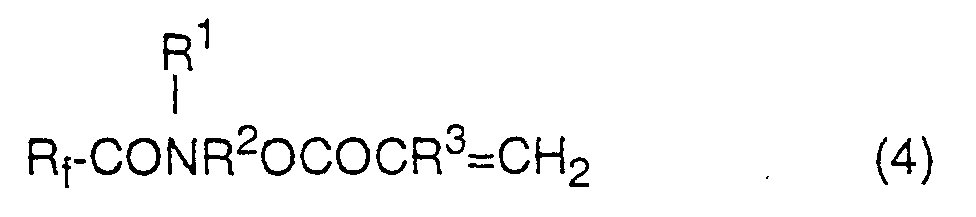


- R1 is a hydrogen atom or an alkyl group having 1 to 10 carbon atoms,
- R2 is an alkylene group having 1 to 10 carbon atoms,
- R3 is a hydrogen atom or a methyl group,
- Ar is an arylene group which may have a substituent group, and
- n is an integer of 1 to 10.
-
- Specific examples of the fluoromonomer are as follows:



- The macromonomer which is copolymerized with the fluoromonomer is of the formula:

- In the formula (I), X is a hydrogen atom or methyl group, A is COOR (wherein R is a linear or branched alkyl group having 1 to 22 carbon atoms), CN or a phenyl group,
n is from 10 to 500, - Z is a (meth)acryloyloxy group, a styryl group, an allyl group, or a vinyl ester group, and
- D is


-
- Specific non-limiting examples of the macromonomer are macromonomers having a (meth)acrylate repeating unit such as

- wherein m is 10 to 500 and n is 1 to 22,
for example,
- wherein m is 10 to 500,
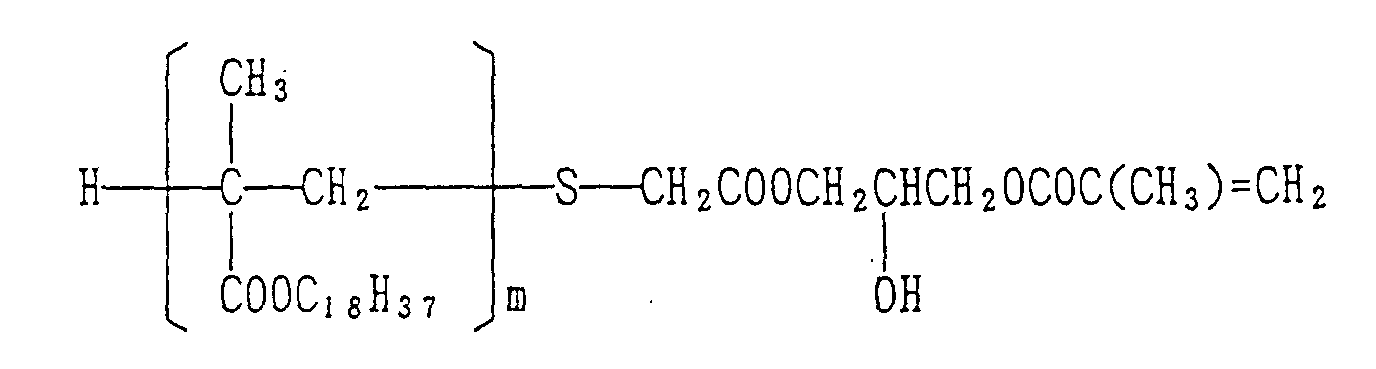
- wherein m is 10 to 500,

- wherein m is 10 to 500; or
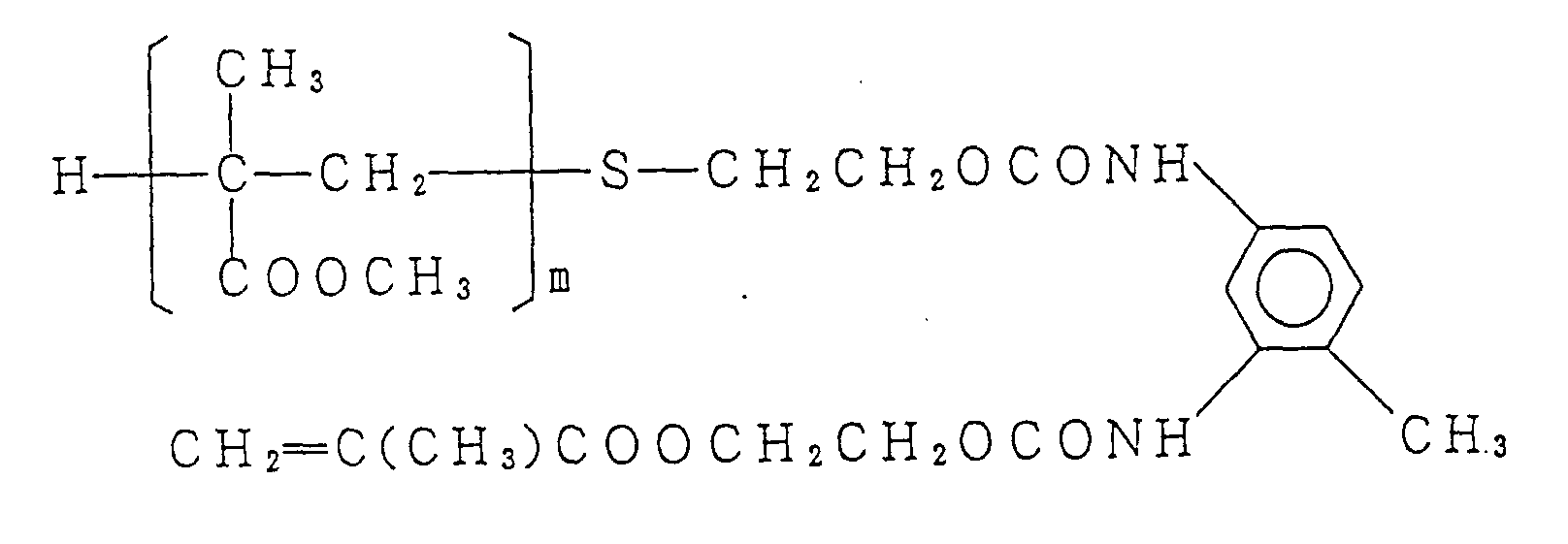
- wherein m is 10 to 500,
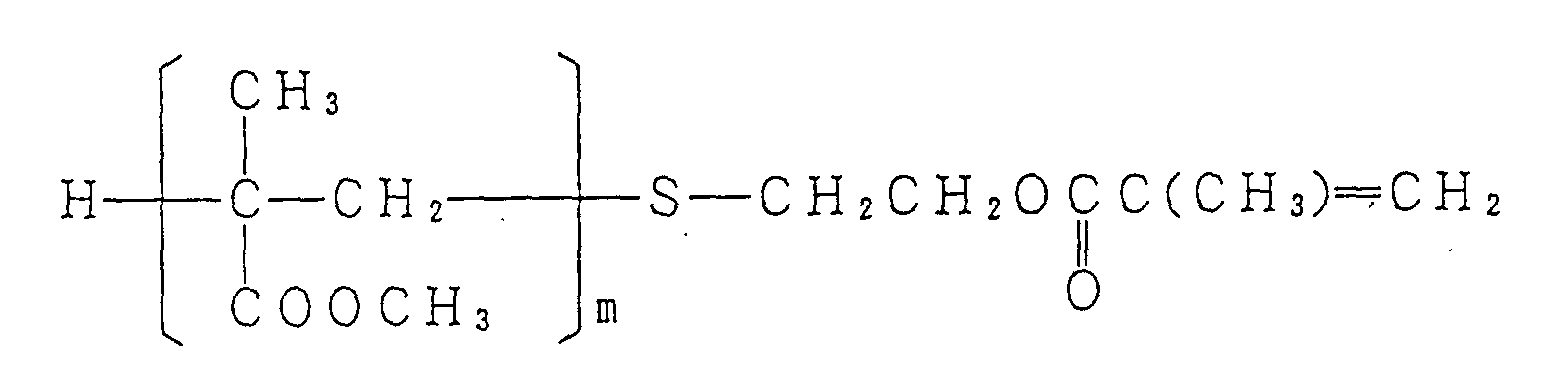
- wherein m is 10 to 500,
and macromonomers having a styrene repeating unit such as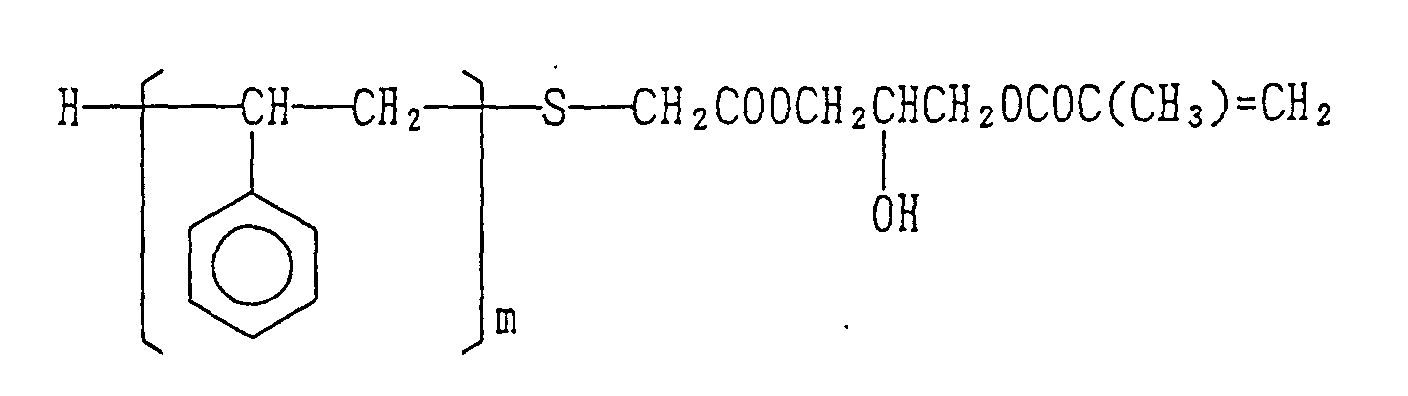
- wherein m is 10 to 500.
-
- When the textile treatment agent is used for carpets, the use of fluorine-free macromonomers having a glass transition temperature or melting point of at least 35°C gives an improved dry-soil stainproof property.
- Typical methods for preparing the macromonomer having an alkyl (meth)acrylate repeating unit are a method comprising radically polymerizing alkyl (meth)acrylate in the presence of a mercaptan chain transfer agent having a carboxyl group to give a polymer having a carboxyl group at one molecular end and then reacting the polymer with a (meth)acrylate having an epoxy group; or a method comprising radically polymerizing alkyl (meth)acrylate in the presence of a mercaptan chain transfer agent having a hydroxyl group such as 2-mercaptoethanol to give a polymer having a hydroxyl group at one molecular end and then reacting the polymer with (meth)acrylic acid halide or then conducting a reaction with a diisocyanate followed by a reaction with 2-hydroxyethyl methacrylate. The fluorine-free alkyl (meth)acrylate macromonomer used in the present invention may be any commercially available one, for example, the macromonomers manufactured by Toagosei Chemical Industry Ltd., Co. having a methyl methacrylate repeating unit, e.g. AA-6 (number average molecular weight Mn: 6,000) and AA-2 (Mn: 2,000), having a butyl acrylate repeating unit, e.g. AB-6 (Mn: 6,000) or having a stearyl methacrylate repeating unit, e.g. MM8-SMA (Mn: 9,000).
- In order to give the fiber softness, the alcohol moiety of the above alkyl (meth)acrylate polymeric portion preferably has 12 to 22 carbon atoms.
- The number of repeating units in the polymeric portion of the macromonomer is from 10 to 500.
- The graft copolymer used in the present invention contains at least 30 % by weight of the fluoromonomer as a constituent unit. If the amount is smaller than 30 % by weight, the excellent water- and oil-repellency and stainproof property cannot be obtained. The amount of the used fluorine-free macromonomer is from 1 to 70 % by weight. If the amount is smaller than 1 % by weight, the water- and oil-repellency, the stainproof property and the softness cannot be improved. If the amount is larger than 70 % by weight, no decreases of water-repellency, stainproof property and softness are observed but the oil-repellency disadvantageously decreases.
- In the present invention, another fluorine-free copolymerizable monomer can be added in an amount of no more than 69 % by weight of the copolymer in addition to the above monomers. Specific examples of the other fluorine-free monomer are ethylene, vinyl acetate, vinyl chloride, vinylidene halide, (meth)acrylic acid, (meth)acrylonitrile, styrene, α-methylstyrene, (meth)acrylamide, N-methylol(meth)acrylamide, alkyl (meth)acrylate, hydroxymethyl (meth)acrylate, hydroxyethyl (meth)acrylate, hydroxypropyl (meth)acrylate, 3-chloro-2-hydroxypropyl (meth)acrylate, polyethyleneglycol (meth)acrylate, polypropyleneglycol (meth)acrylate, methoxypolyethyleneglycol (meth)acrylate, methoxypolypropyleneglycol (meth)acrylate, N,N-dimethylaminoethyl (meth)acrylate, N,N-diethylaminoethyl (meth)acrylate, vinyl alkyl ether, butadiene, isoprene, chloroprene, glycidyl (meth)acrylate, tetrahydrofurfuryl (meth)acrylate, maleic anhydride, benzyl (meth)acrylate, phenoxyethyl (meth)acrylate, dicyclopentenyl (meth)acrylate, methacrylic acid hydroxypropyltrimethylammonium chloride and methacrylic acid ethyltrimethylammonium chloride. The copolymerization with these monomers may improve various properties such as water- and oil-repellency, the stainproof properties such as the dry soil stainproof property, dye attachment prohibition and soil releasability, the anti-static property, the antibacterial property, friction resistance, cleaning resistance, feeling, and dispersion stability in a medium such as water.
- The graft copolymer of the present invention can be prepared by any usual polymerization method, such as solution polymerization, suspension polymerization, emulsion polymerization and bulk polymerization.
- For example, in the solution polymerization, the fluoromonomer and the fluorine-free macromonomer are dissolved in an organic solvent in the presence of a polymerization initiator, the atmosphere is replaced with nitrogen, and the mixture is heated at 50-120°C for several hours with stirring. Specific examples of the polymerization initiator are azobisisobutyronitrile, benzoyl peroxide, di-tert-butyl peroxide, lauryl peroxide, cumene hydroperoxide, tert-butyl peroxypivalate and diisopropyl peroxydicarbonate. The amount of polymerization initiator is preferably from 0.01 to 5 parts by weight per 100 parts by weight of the monomer.
- The organic solvent is inactive to and dissolves the fluoromonomer and the fluorine-free macromonomer. Specific examples of the organic solvent are pentane, hexane, heptane, octane, cyclohexane, benzene, toluene, xylene, petroleum ether, tetrahydrofuran, 1,4- dioxane, methyl ethyl ketone, methyl isobutyl ketone, ethyl acetate, butyl acetate, 1,1,2,2-tetrachloroethane, 1,1,1-trichloroethane, trichloroethylene, perchloroethylene, tetrachlorodifluoroethane and trichlorotrifluoroethane. The amount of organic solvent is preferably from 50 to 1,000 parts by weight per 100 parts by weight of the monomer.
- For example, in the emulsion polymerization, the fluoromonomer and the fluorine-free macromonomer are emulsified in water, the atmosphere is replaced with nitrogen, and the mixture is heated at 50 to 80°C for several hours with stirring to conduct the copolymerization. Specific examples of a polymerization initiator are benzoyl peroxide, lauroyl peroxide, tert-butyl perbenzoate, 1-hydroxycyclohexylhydroperoxide, 3-carboxypropionyl peroxide, acetyl peroxide, azobisisobutylamidine-dihydrochloride salt, azobisisobutyronitrile, sodium peroxide, potassium persulfate, ammonium persulfate, di-tert-butyl peroxide, lauryl peroxide, cumene hydroperoxide, tert-butyl peroxypivalate and diisopropyl peroxydicarbonate. The amount of polymerization initiator is preferably from 0.01 to 5 parts by weight per 100 parts by weight of the monomer.
- In order to achieve a high graft efficiency and excellent shelf stability of an aqueous dispersion of the graft copolymer, it is preferable to use an emulsifying apparatus giving a high shear energy such as a high pressure homogenizer and an ultrasonic homogenizer so as to finely disperse the monomer in water and it is preferable to use an oil-soluble polymerization initiator. The emulsifier may be cationic, anionic or nonionic. The amount of emulsifier is preferably from 0.5 to 10 parts by weight per 100 parts by weight of the monomer.
- When the fluoromonomer is not completely compatible with the fluorine-free macromonomer, it is possible to add a water-soluble organic solvent or low-molecular-weight monomer which is compatible with both monomers so as to improve compatibility between the fluoromonomer and the fluorine-free macromonomer so that emulsification and copolymerization are facilitated. Specific examples of the water-soluble organic solvent used for this purpose are acetone, methyl ethyl ketone, ethyl acetate, dipropyleneglycol monomethyl ether, propylene glycol, dipropylene glycol, tripropylene glycol and ethanol. The amount of water-soluble organic solvent is preferably from 10 to 40 parts by weight per 100 parts by weight of water. Specific examples of the low-molecular-weight monomer are methyl methacrylate, glycidyl methacrylate and 2,2,2-trifluoroethyl methacrylate. The amount of low-molecular-weight monomer is preferably from 5 to 95 parts by weight per 100 parts by weight of the total amount of the fluoromonomer and the fluorine-free macromonomer.
- The material to be treated with the textile treatment agent of the present invention is not limited. Specific examples of the treated material are natural fibers such as cotton, hemp, wool and silk; semisynthetic fibers such as rayon and acetate; synthetic fibers such as polyamide, polyester, acryl, polypropylene, polyvinyl chloride and polyvinyl alcohol. The treated textile may be in any form of a fiber, a yarn or a fabric (for example, woven fabric and knitted fabric).
- The textile treatment agent of the present invention can be applied by any conventional procedure. For example, a solution or dispersion of the textile treatment agent in an organic solvent or water is adhered to the treated material by dip coating, spray coating or bubble coating and then the treated material is dried. If necessary, a suitable crosslinking agent is used together with the textile treatment agent to conduct the curing.
- In the treatment liquid, for example, in the case of dip coating, the concentration of the graft fluorocopolymer is from 0.1 to 10 % by weight.
- In addition to the textile treatment agent of the present invention, another stainproof agent, water-repellent or oil-repellent, an antibacterial agent, an antistatic agent, a flame retardant, an insecticide, a feeling controlling agent, a dye fixing agent and the like may be added.
- The present invention will be illustrated by the following Preparative Examples and Examples which do not limit the present invention.
- In a 200 ml four-necked flask equipped with a reflux condenser, a nitrogen introducing tube, a thermometer and a stirrer, 10 g of a polymethyl methacrylate/methacryloyl group type macromonomer (AA-6 manufactured by Toagosei Chemical Industry Co. Ltd., number average molecular weight: 6,000, a macromonomer wherein the repeating unit is methyl methacrylate and the polymerizable end is a methacryloyl group, hereinafter referred to as "MMA-MM") and 10 g of CF3CF2(CF2CF2)n(CH2)2OCOCH=CH2 (a mixture of compounds in which n is 3, 4 and 5 in a molar ratio of 6:3:1, hereinafter referred to as "FA") and 180 g of 1,1,1-trichloroethane were charged and heated to 60°C. Then, the atmosphere in the flask was replaced with nitrogen for 30 minutes. One gram of tert-butyl peroxypivalate (trade name: Perbutyl PV, manufactured by Nippon Oil & Fat Co. Ltd.) was added and the polymerization was conducted for 6 hours. Gas chromatography analysis revealed that at least 99 % of the monomer was consumed. Disappearance of the elution peak of the macromonomer in GPC confirmed the complete polymerization of the macromonomer.
- In a 200 ml four-necked flask, 10 g of a polystearyl methacrylate/methacryloyl group type macromonomer (MM8-SMA, manufactured by Toagosei Chemical Industry Co. Ltd.; number average molecular weight: 9,000; used after removing toluene from the commercially available 50 wt % solution in toluene; a macromonomer in which the repeating unit is stearyl methacrylate and the polymerizable molecular end is a methacryloyl group; hereinafter referred to as "SMA-MM"), 10 g of FA and 180 g of 1,1,1-trichloroethane were charged and heated to 60°C. Then, the atmosphere in the flask was replaced with a nitrogen gas for 30 minutes. One gram of Perbutyl PV was added and the polymerization was conducted for 6 hours. Gas chromatography analysis revealed that at least 99 % of the monomer was consumed. Disappearance of the elution peak of the macromonomer in GPC confirmed the complete polymerization of the macromonomer.
- A mixture consisting of 50 g of MMA-MM, 50 g of FA, 135 g of deionized water, 40 g of acetone, 0.1 g of n-lauryl mercaptan, 1 g of stearyltrimethylammonium chloride and 2 g of polyoxyethyleneoctylphenylether was heated to 60°C and emulsified by the use of a high pressure homogenizer. The resultant emulsion was charged in a 300 ml four-necked flask equipped with a reflux condenser, a nitrogen introducing tube, a thermometer and a stirrer and kept at 60°C in the nitrogen atmosphere for one hour with intimate stirring. Then, a solution of 1 g of azobisisobutyronitrile (AIBN) in 5 g of acetone was added to initiate polymerization and the mixture was heated at 60°C for 3 hours with stirring. Gas chromatography analysis revealed that at least 99 % of the monomer was consumed to prepare the resultant graft copolymer. Disappearance of the elution peak of the macromonomer in GPC confirmed the complete polymerization of the macromonomer.
- A mixture consisting of 50 g of SMA-MM, 50 g of FA, 135 g of deionized water, 40 g of acetone, 0.1 g of n-lauryl mercaptan, 1 g of stearyltrimethylammonium chloride and 2 g of polyoxyethyleneoctylphenylether was heated to 60°C and emulsified by the use of a high pressure homogenizer. The resultant emulsion was charged in a 300 ml four-necked flask equipped with a reflux condenser, a nitrogen introducing tube, a thermometer, a stirrer and kept at 60°C in nitrogen for one hour with intimate stirring. Then, a solution of 1 g of azobisisobutyronitrile (AIBN) in 5 g of acetone was added to initiate polymerization and the mixture was heated at 60°C for 3 hours with stirring. Gas chromatography analysis revealed that at least 99 % of the monomer was consumed. Disappearance of the elution peak of the macromonomer in GPC confirmed the complete polymerization of the macromonomer.
- In a 200 ml four-necked flask, 10 g of stearyl methacrylate (SMA), 10 g of FA and 180 g of 1,1,1-trichloroethane were charged. The mixture was heated at 60°C, and the atmosphere in the flask was replaced with nitrogen for 30 minutes. One gram of Perbutyl PV was added to initiate polymerization and the polymerization was conducted for 6 hours. Gas chromatography analysis revealed that at least 99 % of the monomer was consumed.
- A copolymer was prepared according to the method for preparing a graft copolymer described in Japanese Patent Kokai Publication No. 73712/1986. 10 g of SMA and 180 g of toluene were charged in a 200 ml four-necked flask and heated at 80°C. The atmosphere in the flask was replaced with nitrogen for 30 minutes. Benzoyl peroxide (BPO) was added and the polymerization was conducted for 6 hours. Gas chromatography analysis revealed that at least 99 % of the monomer was consumed in the resultant polymer. 10 g of FA and 0.1 g of BPO were added to the toluene solution containing the polymer and the mixture was heated to 80°C. The graft polymerization was conducted under nitrogen atmosphere for 6 hours with stirring. Gas chromatography analysis revealed that at least 99 % of the monomer was consumed to prepare the resultant graft copolymer. Since the undissolved part of the resultant graft copolymer in fluorinated hydrocarbon R-113 was 5 g, the graft efficiency was assumed to be 50 %.
- The same procedure as in Preparative Example 1 was repeated to prepare a random copolymer, except that methyl methacrylate was used instead of MMA-MM.
- A mixture consisting of 50 g of FA, 10 g of MMA-MM, 40 g of methyl methacrylate, 300 g of deionized water, 5 g of polyoxyethyleneoctylphenylether, 5 g of stearyltrimethylammonium chloride and 0.1 g of n-lauryl mercaptan was heated to 60°C and emulsified by the use of a high pressure homogenizer. The resultant emulsion was charged in a 500 ml four-necked flask equipped with a reflux condenser, a nitrogen introducing tube, a thermometer and a stirrer and the atmosphere was replaced with nitrogen for 30 minutes. Then, a solution of 0.5 g of azobisisobutyronitrile in 5 g of ethyl acetate was added and the polymerization was conducted at 60°C for 3 hours. Gas chromatography analysis and GPC analysis revealed that at least 99 % of the monomer was consumed and the graft copolymer was obtained.
- The same procedure as in Preparative Example 5 was repeated to prepare the graft copolymer, except that a polystyrene/methacryloyl group type macromonomer (AS-6, manufactured by Toagosei Chemical Industry Co. Ltd.; number average molecular weight: 6,000; a macromonomer in which the repeating unit is styrene and the polymerizable end is a methacryloyl group; hereinafter referred to as "St-MM") and styrene were used instead of MMA-MM and methyl methacrylate, respectively.
- The same polymerization as in Preparative Example 5 was repeated to prepare the graft copolymer, except that 50 g of FA, 25 g of MMA-MM, 25 g of methyl methacrylate, 250 g of deionized water, 50 g of ethyl acetate, 5 g of polyoxyethyleneoctylphenylether, 5 g of stearyltrimethylammonium chloride and 0.1 g of n-lauryl mercaptan were used as the raw materials.
- The same polymerization was conducted as in Preparative Example 5 to prepare the random copolymer, except that MMA-MM was not used and the amount of methyl methacrylate was increased by the amount of MMA-MM.
- As in Preparative Example 5, only FA was used as the monomer to conduct the emulsion polymerization so as to give a fluorohomopolymer and, separately, only methyl methacrylate was used as the monomer to conduct the emulsion polymerization so as to give a methyl methacrylate homopolymer. Both of the resultant homopolymers were mixed in the solid ratio of 50:50 to prepare a treatment liquid having a solid content of 3 % by weight.
- The same polymerization was conducted as in Preparative Example 6 to prepare the random copolymer, except that St-MM was not used and the amount of styrene was increased by the amount of St-MM.
- The same procedure as in Preparative Example 5 was repeated to prepare the graft copolymer, except that 70 g of FA, 25 g of a polybutyl acrylate/methacryloyl group type macromonomer (AB-6, manufactured by Toagosei Chemical Industry Co. Ltd.; number average molecular weight: 6,000; a macromonomer in which the repeating unit is butyl acrylate and the polymerizable end is a methacryloyl group; hereinafter referred to as "BuA-MM"), 5 g of butyl acrylate, 300 g of deionized water, 5 g of polyoxyethyleneoctylphenylether, 5 g of stearyltrimethylammonium chloride and 0.1 g of n-lauryl mercaptan were used as the raw materials.
- The same polymerization was conducted as in Preparative Example 8 to prepare the random copolymer, except that BuA-MM was not used and the amount of butyl acrylate was increased by the same amount of BuA-MM.
- The copolymer prepared in each of Preparative Examples 1 and 2 and Comparative Preparative Examples 1 and 2 was diluted with n-decane to prepare a resinous liquid having a solid content of 0.5 % by weight. A mixed broad fabric of polyester and cotton (65 % of polyester and 35 % of cotton) was immersed in the resinous liquid, squeezed with a mangle, dried in air and dried at 100°C for 3 minutes. The water- and oil-repellency, the dry cleaning SR property and the softness of the treated fabric and the low-temperature stability of the product were tested (Table 1).
- The graft copolymer prepared in each of Preparative Examples 3 and 4 was diluted with water to prepare a resinous liquid having a solid content of 0.5 % by weight. A mixed broad fabric of polyester and cotton (65 % of polyester and 35 % of cotton) was immersed in the resinous liquid, squeezed with a mangle, predried at 80°C for 3 minutes and thermally treated at 150°C for 3 minutes. The water- and oil-repellency, the dry cleaning SR property and the softness of the treated fabric were tested (Table 1).
- The copolymer prepared in each of Preparative Example 1 and Comparative Preparative Example 3 was diluted with acetone to prepare a treatment liquid having a solid content of 1 % by weight. A nylon loop piled carpet cloth (not backing-treated) was immersed in the treatment liquid, squeezed, dried in air and dried at 130°C for 3 minutes. The water- and oil-repellency and the dry soil stainproof property of the treated carpet were tested (Table 2).
- The copolymer prepared in each of Preparative Examples 5, 6, 7 and 8 and Comparative Preparative Examples 4, 6 and 7 was diluted with water to prepare a treatment liquid having a solid content of 3 % by weight. The treatment liquid was sprayed on a nylon loop piled carpet cloth (not backing-treated) at a coating amount of 100 g/m2 and the carpet was thermally treated at 130°C for 5 minutes. The water- and oil-repellency and the dry soil stainproof property of the treated carpet were tested (Table 2).
- A treatment liquid containing the mixture of homopolymers prepared in Comparative Preparative Example 5 was used to treat the carpet and the test was conducted.
- The test was conducted as follows:
- The water repellency is expressed by the water repellency No. determined by the spray method according to JIS-L-1092.
Water repellency No. State 100 No wet on the surface 90 Slight wet on the surface 80 Partial wet on the surface 70 Wet on the surface 50 Wet over the whole surface 0 Complete wet on the front and back surfaces - Droplets of an isopropyl alcohol/water mixture having the following composition are positioned on the carpet cloth. The maximum content of isopropyl alcohol in the liquid keeping the shape of the droplet after 3 minutes is expressed as the water repellency.
Composition of mixture (% by volume) Isopropyl alcohol Water 50 50 40 60 30 70 20 80 10 90 0 100 - The oil repellency is determined by, according to AATCC-TM-118-1966, dropping several drops (diameter: about 4 mm) of the following test solution on two positions of a surface of a test cloth, observing the penetration state of the drops after 30 seconds, and the maximum value of oil repellency of the test solution having no penetration is expressed as the oil repellency.
Oil repellency Test solution Surface tension (dyne/cm, 25°C) 8 n-Heptane 20.0 7 n-Octane 21.8 6 n-Decane 23.5 5 n-Dodecane 25.0 4 n-Tetradecane 26.7 3 n-Hexadecane 27.3 2 n-Hexadecane/Nujol (35/65 by weight) 29.6 1 Nujol 31.2 0 Inferior to 1 - - The wash resistance is determined by conducting three times the steps of washing the fabric for 15 minutes, rinsing the fabric for 10 minutes and drying the fabric under the use of a washing liquid consisting of 40 g of a detergent (tradename: Zab) and 20 L of water and a temperature of 40°C in a household electrical washing machine, and then measuring the water repellency and the oil repellency.
- The test for determining the soil release property at dry cleaning (dry cleaning SR property) is conducted as follows. A test cloth is spread on a piece of blotting paper horizontally spread and then five drops of a dirty motor oil (SAE20W-40, drained after the feed into an engine of a compact car and running for 4,000 km) are dropped on the test cloth. A polyethylene sheet is positioned on the test cloth and a weight of 2 kg is positioned on the polyethylene sheet. After 60 seconds, the weight and the polyethylene sheet are removed. Any excess oil is wiped off and the test cloth is kept standing at room temperature for 24 hours. The test cloth and a ballast cloth together having a total weight of 450 g are charged into a dry cleaning tester, dry cleaning is conducted at room temperature for 5 minutes using 3.78 L of perchloroethylene, and the test cloth is air-dried. The state of the remaining stain of the dried test cloth is compared with a standard photograph plate so that the state of the remaining stain is expressed by the corresponding determined grade shown below. The standard photograph plate is one according to AATCC Test Method 130-1970.
Determined grade Criteria 1.0 Stain remarkably remains 2.0 Stain considerably remains 3.0 Stain slightly remains 4.0 Stain is not noticeable 5.0 Stain does not remain - Firstly, according to JIS L 1023-1992, a carpet is contaminated with a dry soil having the following composition.
Components Weight ratio % Peat moss 40 Portland cement (JIS R 5210) 17 Kaolin clay (JIS K 8746) 17 Diatomaceous earth (JIS K 8330) 17 Carbon black (JIS K 5107) 0.1 Ferric (III) oxide for ferrite (JIS K 1462) 0.15 Nujol 8.75 - After residual soil on the sample is removed by the use of an electrical vacuum cleaner, brightness of the sample surface is measured by a colorimeter and a contamination ratio is calculated according to the following equation to evaluate the stainproof property against dry soil.
- A sensual evaluation is made by technical panelists.
- The copolymer prepared in each of Preparative Examples 1 and 2 and Comparative Preparative Examples 1 and 2 is diluted with n-decane to prepare a resinous liquid having a solid content of 5 % by weight. After the resinous liquid is kept in a constant temperature bath at -5°C for one day, the coagulation state is visually evaluated. No coagulation is expressed by O, and coagulation is expressed by X.
- The test results conducted for the polyester/cotton mixed broad fabric (Examples 1 to 4 and Comparative Examples 1 and 2) are shown in Table 1.
Polymer Type of polymer Polymerization Method Branch of graft copolymer Water-repellency / Oil-repellency Dry cleaning SR property Soft-ness Stability at low temperature Initial Washing three times Ex. 1 Preparative Example 1 Graft Solution polymerization Methyl methacrylate 100+/6 80/3 4 Hard O Ex. 2 Preparative Example 2 Graft Solution Polymerization Stearyl methacrylate 100+/6 80+/3 5 Soft O Ex. 3 Preparative Example 3 Graft Emulsion polymerization Methyl methacrylate 100+/6 80/3 4 Hard - Ex. 4 Preparative Example 4 Graft Emulsion polymerization Stearyl methacrylate 100+/6 80+/3 5 Soft - Com. Ex. 1 Comparative Preparative Example 1 Random Solution polymerization - 90/4 50/1 1 Some what soft X Com. Ex. 2 Comparative Preparative Example 2 Graft Solution polymerization FA 80/4 50/1 1 Hard X - As becomes clear from the results of Table 1, a graft copolymer having a backbone of fluoromonomer used in the present invention gives better water- and oil-repellency, washing resistance and dry cleaning SR property than a graft copolymer having a branch of fluoromonomer or a random copolymer having the same monomer composition. In addition, stability at low temperature is improved.
- The results for carpets (Examples 5 to 9 and Comparative Examples 3 to 7) are shown in Table 2.
Polymer Type of polymer Polymerization Method Repeating unit derived from fluorine-free monomer Water repellency Oil repellency Dry soil stainproof property (Contamination ratio) Ex. 5 Preparative Example 1 Graft Solution polymerization Methyl methacrylate 50 6 20 Com. Ex. 3 Comparative Preparative Example 3 Random Solution polymerization Methyl methacrylate 40 2 28 Ex. 6 Preparative Example 5 Graft Emulsion polymerization Methyl methacrylate 30 4 26 Ex. 7 Preparative Example 6 Graft Emulsion polymerization Styrene 30 4 28 Ex. 8 Preparative Example 7 Graft Emulsion polymerization Methyl methacrylate 40 5 22 Com. Ex. 4 Comparative Preparative Example 4 Random Emulsion polymerization Methyl methacrylate 20 2 35 Com. Ex. 5 Comparative Preparative Example 5 Mixture of homopolymers Emulsion polymerization Methyl methacrylate 10 1 28 Com. Ex. 6 Comparative Preparative Example 6 Random Emulsion polymerization Styrene 20 2 38 Ex. 9 Preparative Example 8 Graft Emulsion polymerization Butyl acrylate 40 5 32 Com. Ex. 7 Comparative Preparative Example 7 Random Emulsion polymerization Butyl acrylate 20 3 40 - As becomes clear from the results of Table 2, the graft copolymer used in the present invention gives better water- and oil-repellency and stainproof property than a random copolymer and a mixture of homopolymers having the same monomer composition.
- As explained above, the graft copolymer according to the present invention has excellent effects as a water- and oil-repellent and as a stainproof agent.
Claims (2)
- A textile treatment agent which comprises, as an active component, a graft fluorocopolymer having a backbone of a polymer of a fluoromonomer and a branch of a polymer of a macromonomer, the graft fluorocopolymer being obtainable by copolymerizing the fluoromonomer with the macromonomer which is a fluorine-free macromonomer having a terminal addition-polymerizable unsaturated group copolymerizable with the fluoromonomer,
wherein the fluorine-free macromonomer is of the formula:wherein X is a hydrogen atom or methyl group,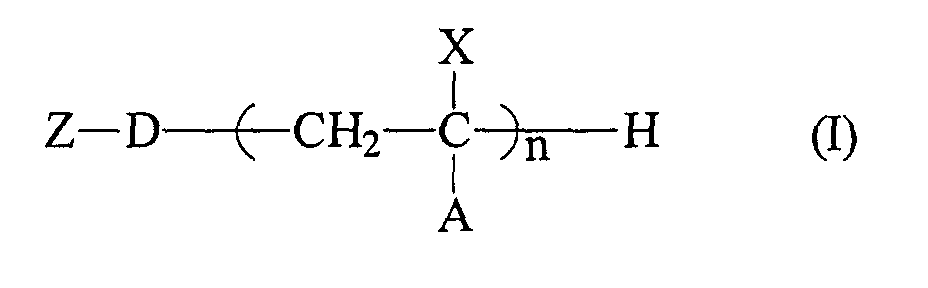 and the amount of units derived from the fluoromonomer in the graft copolymer is at least 30% by weight and the amount of units derived from the fluorine-free macromonomer is from 1 to 70% by weight.A is COOR (wherein R is a linear or branched alkyl group having 1 to 22 carbon atoms), CN or a phenyl group,n is from 10 to 500,Z is a (meth)acryloyloxy group, a styryl group, an allyl group, or a vinyl ester group, and D is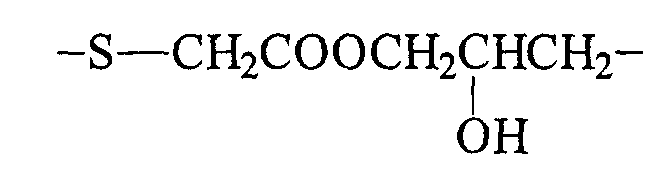

- The textile treatment agent according to claim 1, wherein the fluorine-free macromonomer has a glass transition temperature or melting point of at least 35°C.
Applications Claiming Priority (4)
| Application Number | Priority Date | Filing Date | Title |
|---|---|---|---|
| JP5014620A JPH06228534A (en) | 1993-02-01 | 1993-02-01 | Water and oil repellent and stainproofing agent |
| JP14620/93 | 1993-02-01 | ||
| JP1462093 | 1993-02-01 | ||
| PCT/JP1994/000117 WO1994018377A1 (en) | 1993-02-01 | 1994-01-28 | Textile product treatment |
Publications (3)
| Publication Number | Publication Date |
|---|---|
| EP0682146A1 EP0682146A1 (en) | 1995-11-15 |
| EP0682146A4 EP0682146A4 (en) | 1997-07-23 |
| EP0682146B1 true EP0682146B1 (en) | 2001-11-21 |
Family
ID=11866254
Family Applications (1)
| Application Number | Title | Priority Date | Filing Date |
|---|---|---|---|
| EP94905221A Expired - Lifetime EP0682146B1 (en) | 1993-02-01 | 1994-01-28 | Textile product treatment |
Country Status (5)
| Country | Link |
|---|---|
| US (1) | US5614123A (en) |
| EP (1) | EP0682146B1 (en) |
| JP (1) | JPH06228534A (en) |
| DE (1) | DE69429160T2 (en) |
| WO (1) | WO1994018377A1 (en) |
Cited By (1)
| Publication number | Priority date | Publication date | Assignee | Title |
|---|---|---|---|---|
| EP2692748A1 (en) | 2012-08-03 | 2014-02-05 | Philipps-Universität Marburg | Hydrophobic and oleophobic polymer blends |
Families Citing this family (23)
| Publication number | Priority date | Publication date | Assignee | Title |
|---|---|---|---|---|
| US5542682A (en) * | 1995-03-27 | 1996-08-06 | American Variseal | Slant coil spring and seal |
| WO1997027357A1 (en) * | 1996-01-23 | 1997-07-31 | A.W. Hainsworth & Sons Limited | Improvements in and relating to cloth |
| WO1997047667A1 (en) * | 1996-06-13 | 1997-12-18 | Daikin Industries, Ltd. | Novel copolymer, process for the preparation of the same, and use thereof |
| JPH108041A (en) * | 1996-06-21 | 1998-01-13 | Daikin Ind Ltd | Water-dispersed fluorine-based water / oil repellent |
| JP3624615B2 (en) * | 1997-02-28 | 2005-03-02 | ユニマテック株式会社 | Novel copolymer and water / oil repellent containing the same |
| EP1000602B1 (en) * | 1997-06-04 | 2010-04-07 | Daikin Industries, Limited | Copolymers for cosmetics |
| US6326447B1 (en) | 1998-06-19 | 2001-12-04 | E. I. Du Pont De Nemours And Company | Polymeric compositions for soil release on fabrics |
| JP2000129572A (en) | 1998-08-18 | 2000-05-09 | Daikin Ind Ltd | Novel carpet, antifouling agent and treatment method for carpet |
| DE60018469T2 (en) * | 1999-09-14 | 2006-02-16 | Daikin Industries, Ltd. | POLYMER, METHOD FOR THE PRODUCTION THEREOF, AND SOLUBLE WATER- AND OIL-REPELLING COMPOSITIONS CONTAINING THIS POLYMER |
| US6271289B1 (en) | 1999-11-16 | 2001-08-07 | E. I. Du Pont De Nemours And Company | Stain resistant compositions |
| JP2001158811A (en) | 1999-12-02 | 2001-06-12 | Daikin Ind Ltd | Graft copolymer and solution-type water / oil repellent composition using the same |
| US20030039834A1 (en) * | 2001-08-22 | 2003-02-27 | Gunn Robert T. | Low friction fibers, methods for their preparation and articles made therefrom |
| US7157121B2 (en) * | 2002-04-29 | 2007-01-02 | Shaw Industries Group, Inc. | Method of treating carpet for enhanced liquid repellency |
| US6899923B2 (en) * | 2003-01-10 | 2005-05-31 | Milliken & Company | Methods for imparting reversibly adaptable surface energy properties to target surfaces |
| US7407899B2 (en) * | 2003-01-10 | 2008-08-05 | Milliken & Company | Textile substrates having layered finish structure for improving liquid repellency and stain release |
| US7485588B2 (en) * | 2003-01-10 | 2009-02-03 | Yunzhang Wang | Method for making textile substrates having layered finish structure for improving liquid repellency and stain release |
| US7468333B2 (en) * | 2003-01-10 | 2008-12-23 | Milliken & Company | Wash-durable, liquid repellent, and stain releasing polyester fabric substrates |
| WO2007018276A1 (en) * | 2005-08-05 | 2007-02-15 | Daikin Industries, Ltd. | Repellent composition containing graft copolymer, graft copolymer and method of preparing graft copolymer |
| FR2894602B1 (en) * | 2006-04-19 | 2010-06-11 | Arkema | TEXTILE PROTECTED BY A FLUORINE POLYMER |
| CN101981069B (en) * | 2008-03-28 | 2013-03-27 | 大金工业株式会社 | Vinyl chloride polymer |
| US20110143622A1 (en) * | 2009-12-16 | 2011-06-16 | E.I. Dupont De Nemours And Company | Fluorinated acrylate compositions |
| WO2011122699A1 (en) | 2010-03-30 | 2011-10-06 | Daikin Industries, Ltd. | Graft copolymer and repellent composition |
| JP5652383B2 (en) * | 2011-12-05 | 2015-01-14 | ダイキン工業株式会社 | Graft copolymer and solution-type water / oil repellent composition |
Family Cites Families (19)
| Publication number | Priority date | Publication date | Assignee | Title |
|---|---|---|---|---|
| JPS477600Y1 (en) * | 1966-07-18 | 1972-03-21 | ||
| JPS46642Y1 (en) * | 1967-03-16 | 1971-01-11 | ||
| US3645990A (en) * | 1970-01-29 | 1972-02-29 | Du Pont | Fluorinated oil- and water-repellent and dry soil resistant polymers |
| DK152680C (en) * | 1970-09-30 | 1988-08-22 | Minnesota Mining & Mfg | STICK-RESISTANT AND STICK-REFERENCE TAPE MATERIAL AND PROCEDURE FOR THE MANUFACTURE OF TAPE MATERIAL |
| JPS5235188A (en) * | 1975-09-12 | 1977-03-17 | Asahi Glass Co Ltd | Soil resistant finishing agent with good dry soil and friction resista nce |
| JPS559619A (en) * | 1978-07-04 | 1980-01-23 | Daikin Ind Ltd | Water and oil repellant composition |
| JPS5529501A (en) * | 1978-08-04 | 1980-03-01 | Daikin Ind Ltd | Water- and oil-repellent copolymer and its use |
| JPS608068B2 (en) * | 1978-09-28 | 1985-02-28 | ダイキン工業株式会社 | Water and oil repellent |
| US4264484A (en) * | 1979-01-24 | 1981-04-28 | Minnesota Mining And Manufacturing Company | Carpet treatment |
| ZA80404B (en) * | 1979-01-24 | 1981-08-26 | Minnesota Mining & Mfg | Carpet treatment |
| US4340749A (en) * | 1979-12-21 | 1982-07-20 | Minnesota Mining And Manufacturing Company | Carpet treatment |
| US4468527A (en) * | 1980-12-08 | 1984-08-28 | Minnesota Mining And Manufacturing Company | Fluorinated alcohols |
| JPS608068A (en) * | 1983-06-27 | 1985-01-16 | 富士通株式会社 | Method of piling up laminated board |
| JPS6150082A (en) * | 1984-12-20 | 1986-03-12 | Tokyo Keiki Co Ltd | Information processing system |
| JPS6321715A (en) * | 1986-07-14 | 1988-01-29 | 松下電工株式会社 | Contact switch gear |
| JPS6343509A (en) * | 1986-08-05 | 1988-02-24 | 株式会社名古屋紡機製作所 | Wire stripper |
| JP2709591B2 (en) * | 1986-08-27 | 1998-02-04 | セイコーインスツルメンツ株式会社 | Method for manufacturing recrystallized semiconductor thin film |
| JPS6367511A (en) * | 1986-09-09 | 1988-03-26 | Sumitomo Metal Ind Ltd | Thickness measuring instrument for metallic layer |
| DE3934543A1 (en) * | 1989-10-17 | 1991-04-18 | Bayer Ag | PERFLUORALKYL GROUPS CONTAINING COPOLYMERISATE / II |
-
1993
- 1993-02-01 JP JP5014620A patent/JPH06228534A/en active Pending
-
1994
- 1994-01-28 US US08/500,925 patent/US5614123A/en not_active Expired - Lifetime
- 1994-01-28 WO PCT/JP1994/000117 patent/WO1994018377A1/en not_active Ceased
- 1994-01-28 DE DE69429160T patent/DE69429160T2/en not_active Expired - Fee Related
- 1994-01-28 EP EP94905221A patent/EP0682146B1/en not_active Expired - Lifetime
Cited By (2)
| Publication number | Priority date | Publication date | Assignee | Title |
|---|---|---|---|---|
| EP2692748A1 (en) | 2012-08-03 | 2014-02-05 | Philipps-Universität Marburg | Hydrophobic and oleophobic polymer blends |
| WO2014019867A1 (en) | 2012-08-03 | 2014-02-06 | Philipps-Universität Marburg | Hydrophobic and oleophobic polymer blends |
Also Published As
| Publication number | Publication date |
|---|---|
| EP0682146A1 (en) | 1995-11-15 |
| JPH06228534A (en) | 1994-08-16 |
| US5614123A (en) | 1997-03-25 |
| DE69429160D1 (en) | 2002-01-03 |
| WO1994018377A1 (en) | 1994-08-18 |
| DE69429160T2 (en) | 2002-07-18 |
| EP0682146A4 (en) | 1997-07-23 |
Similar Documents
| Publication | Publication Date | Title |
|---|---|---|
| US5614123A (en) | Agent for treating textile | |
| CN103788288B (en) | Water repellent and refuse fluid composition | |
| EP0781825B1 (en) | Water- and oil-repellent stainproofer composition | |
| US5055538A (en) | Novel copolymer and water- and oil-repellent comprising the same | |
| EP0271027B1 (en) | Fluorine-containing copolymer and oil and water repellent composition containing the same | |
| US5143991A (en) | Copolymer desoiling agent | |
| EP0909802A1 (en) | Aqueous dispersion type fluorinated water- and oil-repellent | |
| US5516578A (en) | Oil and water repellent compositions | |
| EP0609456B1 (en) | Soil remover for dry cleaning | |
| EP2762504A1 (en) | Water-repellent and oil-repellent composition | |
| JP5862745B2 (en) | Fluoropolymer and treatment agent | |
| US6355753B1 (en) | Polymer and antifouling agent composition containing the same | |
| US6130298A (en) | Soil-resistant finish | |
| US6048941A (en) | Stainproofing agent composition | |
| JPWO1997043481A1 (en) | Stain-resistant processing agent | |
| KR20200097782A (en) | Water and oil repellent and textile products | |
| JPH06116340A (en) | New copolymer and antifouling agent | |
| US20030106161A1 (en) | Treatment of textile product for imparting water and oil repellency | |
| US20090256102A1 (en) | Fluoropolymer and soil remover | |
| JP2503657B2 (en) | Water and oil repellent | |
| CA2394673C (en) | Graft polymer, process for preparing the same, and solvent-based water- and oil-repellent composition | |
| JPH09183962A (en) | Antifouling agent |
Legal Events
| Date | Code | Title | Description |
|---|---|---|---|
| PUAI | Public reference made under article 153(3) epc to a published international application that has entered the european phase |
Free format text: ORIGINAL CODE: 0009012 |
|
| 17P | Request for examination filed |
Effective date: 19950731 |
|
| AK | Designated contracting states |
Kind code of ref document: A1 Designated state(s): DE FR GB IT |
|
| A4 | Supplementary search report drawn up and despatched | ||
| AK | Designated contracting states |
Kind code of ref document: A4 Designated state(s): DE FR GB IT |
|
| 17Q | First examination report despatched |
Effective date: 19990617 |
|
| GRAG | Despatch of communication of intention to grant |
Free format text: ORIGINAL CODE: EPIDOS AGRA |
|
| GRAG | Despatch of communication of intention to grant |
Free format text: ORIGINAL CODE: EPIDOS AGRA |
|
| GRAH | Despatch of communication of intention to grant a patent |
Free format text: ORIGINAL CODE: EPIDOS IGRA |
|
| GRAH | Despatch of communication of intention to grant a patent |
Free format text: ORIGINAL CODE: EPIDOS IGRA |
|
| GRAA | (expected) grant |
Free format text: ORIGINAL CODE: 0009210 |
|
| AK | Designated contracting states |
Kind code of ref document: B1 Designated state(s): DE FR GB IT |
|
| REG | Reference to a national code |
Ref country code: GB Ref legal event code: IF02 |
|
| REF | Corresponds to: |
Ref document number: 69429160 Country of ref document: DE Date of ref document: 20020103 |
|
| ET | Fr: translation filed | ||
| PLBE | No opposition filed within time limit |
Free format text: ORIGINAL CODE: 0009261 |
|
| STAA | Information on the status of an ep patent application or granted ep patent |
Free format text: STATUS: NO OPPOSITION FILED WITHIN TIME LIMIT |
|
| 26N | No opposition filed | ||
| PGFP | Annual fee paid to national office [announced via postgrant information from national office to epo] |
Ref country code: IT Payment date: 20080128 Year of fee payment: 15 Ref country code: GB Payment date: 20080123 Year of fee payment: 15 Ref country code: DE Payment date: 20080124 Year of fee payment: 15 |
|
| PGFP | Annual fee paid to national office [announced via postgrant information from national office to epo] |
Ref country code: FR Payment date: 20080108 Year of fee payment: 15 |
|
| GBPC | Gb: european patent ceased through non-payment of renewal fee |
Effective date: 20090128 |
|
| PG25 | Lapsed in a contracting state [announced via postgrant information from national office to epo] |
Ref country code: DE Free format text: LAPSE BECAUSE OF NON-PAYMENT OF DUE FEES Effective date: 20090801 |
|
| REG | Reference to a national code |
Ref country code: FR Ref legal event code: ST Effective date: 20091030 |
|
| PG25 | Lapsed in a contracting state [announced via postgrant information from national office to epo] |
Ref country code: GB Free format text: LAPSE BECAUSE OF NON-PAYMENT OF DUE FEES Effective date: 20090128 |
|
| PG25 | Lapsed in a contracting state [announced via postgrant information from national office to epo] |
Ref country code: FR Free format text: LAPSE BECAUSE OF NON-PAYMENT OF DUE FEES Effective date: 20090202 |
|
| PG25 | Lapsed in a contracting state [announced via postgrant information from national office to epo] |
Ref country code: IT Free format text: LAPSE BECAUSE OF NON-PAYMENT OF DUE FEES Effective date: 20090128 |