EP0678107B1 - Toughened photocurable polymer composition for processible flexographic printing plates - Google Patents
Toughened photocurable polymer composition for processible flexographic printing plates Download PDFInfo
- Publication number
- EP0678107B1 EP0678107B1 EP94905583A EP94905583A EP0678107B1 EP 0678107 B1 EP0678107 B1 EP 0678107B1 EP 94905583 A EP94905583 A EP 94905583A EP 94905583 A EP94905583 A EP 94905583A EP 0678107 B1 EP0678107 B1 EP 0678107B1
- Authority
- EP
- European Patent Office
- Prior art keywords
- molecular weight
- acrylate
- prepolymer
- weight
- polybutadiene
- Prior art date
- Legal status (The legal status is an assumption and is not a legal conclusion. Google has not performed a legal analysis and makes no representation as to the accuracy of the status listed.)
- Expired - Lifetime
Links
- 229920000642 polymer Polymers 0.000 title claims abstract description 44
- 239000000203 mixture Substances 0.000 title claims description 75
- HEMHJVSKTPXQMS-UHFFFAOYSA-M Sodium hydroxide Chemical compound [OH-].[Na+] HEMHJVSKTPXQMS-UHFFFAOYSA-M 0.000 claims abstract description 45
- 229920002857 polybutadiene Polymers 0.000 claims abstract description 41
- 239000005062 Polybutadiene Substances 0.000 claims abstract description 40
- NIXOWILDQLNWCW-UHFFFAOYSA-M Acrylate Chemical compound [O-]C(=O)C=C NIXOWILDQLNWCW-UHFFFAOYSA-M 0.000 claims abstract description 37
- 239000004793 Polystyrene Substances 0.000 claims abstract description 24
- 238000006243 chemical reaction Methods 0.000 claims abstract description 24
- 229920002223 polystyrene Polymers 0.000 claims abstract description 24
- 229920003229 poly(methyl methacrylate) Polymers 0.000 claims abstract description 21
- 239000004926 polymethyl methacrylate Substances 0.000 claims abstract description 20
- 229920000554 ionomer Polymers 0.000 claims abstract description 19
- 229920001577 copolymer Polymers 0.000 claims abstract description 18
- 150000002009 diols Chemical class 0.000 claims abstract description 15
- 125000002768 hydroxyalkyl group Chemical group 0.000 claims abstract description 13
- 229920001610 polycaprolactone Polymers 0.000 claims abstract description 13
- 239000004632 polycaprolactone Substances 0.000 claims abstract description 13
- 239000000178 monomer Substances 0.000 claims abstract description 12
- 229920001195 polyisoprene Polymers 0.000 claims abstract description 9
- 229920001169 thermoplastic Polymers 0.000 claims abstract description 8
- 150000001993 dienes Chemical class 0.000 claims abstract description 4
- 125000002887 hydroxy group Chemical group [H]O* 0.000 claims abstract 4
- YXFVVABEGXRONW-UHFFFAOYSA-N Toluene Chemical compound CC1=CC=CC=C1 YXFVVABEGXRONW-UHFFFAOYSA-N 0.000 claims description 51
- FPYJFEHAWHCUMM-UHFFFAOYSA-N maleic anhydride Chemical group O=C1OC(=O)C=C1 FPYJFEHAWHCUMM-UHFFFAOYSA-N 0.000 claims description 36
- 238000000034 method Methods 0.000 claims description 33
- OKKJLVBELUTLKV-UHFFFAOYSA-N Methanol Chemical compound OC OKKJLVBELUTLKV-UHFFFAOYSA-N 0.000 claims description 30
- 150000008064 anhydrides Chemical group 0.000 claims description 30
- 229920005601 base polymer Polymers 0.000 claims description 30
- -1 poly(methylmethacrylate) Polymers 0.000 claims description 30
- KAKZBPTYRLMSJV-UHFFFAOYSA-N vinyl-ethylene Natural products C=CC=C KAKZBPTYRLMSJV-UHFFFAOYSA-N 0.000 claims description 27
- 229920002818 (Hydroxyethyl)methacrylate Polymers 0.000 claims description 23
- WOBHKFSMXKNTIM-UHFFFAOYSA-N Hydroxyethyl methacrylate Chemical compound CC(=C)C(=O)OCCO WOBHKFSMXKNTIM-UHFFFAOYSA-N 0.000 claims description 22
- 239000007787 solid Substances 0.000 claims description 16
- 125000002843 carboxylic acid group Chemical group 0.000 claims description 7
- 239000004970 Chain extender Substances 0.000 claims description 6
- 229910052739 hydrogen Inorganic materials 0.000 claims description 6
- 150000001875 compounds Chemical class 0.000 claims description 5
- 239000000376 reactant Substances 0.000 claims description 4
- 229910052708 sodium Inorganic materials 0.000 claims description 4
- 239000011734 sodium Substances 0.000 claims description 4
- 229910052744 lithium Inorganic materials 0.000 claims description 3
- 230000003472 neutralizing effect Effects 0.000 claims description 3
- 229920002587 poly(1,3-butadiene) polymer Polymers 0.000 claims description 3
- 125000003011 styrenyl group Chemical group [H]\C(*)=C(/[H])C1=C([H])C([H])=C([H])C([H])=C1[H] 0.000 claims description 3
- 125000004178 (C1-C4) alkyl group Chemical group 0.000 claims description 2
- GAWIXWVDTYZWAW-UHFFFAOYSA-N C[CH]O Chemical group C[CH]O GAWIXWVDTYZWAW-UHFFFAOYSA-N 0.000 claims description 2
- DGAQECJNVWCQMB-PUAWFVPOSA-M Ilexoside XXIX Chemical compound C[C@@H]1CC[C@@]2(CC[C@@]3(C(=CC[C@H]4[C@]3(CC[C@@H]5[C@@]4(CC[C@@H](C5(C)C)OS(=O)(=O)[O-])C)C)[C@@H]2[C@]1(C)O)C)C(=O)O[C@H]6[C@@H]([C@H]([C@@H]([C@H](O6)CO)O)O)O.[Na+] DGAQECJNVWCQMB-PUAWFVPOSA-M 0.000 claims description 2
- CERQOIWHTDAKMF-UHFFFAOYSA-M Methacrylate Chemical compound CC(=C)C([O-])=O CERQOIWHTDAKMF-UHFFFAOYSA-M 0.000 claims description 2
- 125000000217 alkyl group Chemical group 0.000 claims description 2
- 125000004029 hydroxymethyl group Chemical group [H]OC([H])([H])* 0.000 claims description 2
- 150000003077 polyols Chemical group 0.000 claims description 2
- QTBSBXVTEAMEQO-UHFFFAOYSA-M Acetate Chemical compound CC([O-])=O QTBSBXVTEAMEQO-UHFFFAOYSA-M 0.000 claims 1
- 229920002121 Hydroxyl-terminated polybutadiene Polymers 0.000 claims 1
- WHXSMMKQMYFTQS-UHFFFAOYSA-N Lithium Chemical compound [Li] WHXSMMKQMYFTQS-UHFFFAOYSA-N 0.000 claims 1
- ZLMJMSJWJFRBEC-UHFFFAOYSA-N Potassium Chemical compound [K] ZLMJMSJWJFRBEC-UHFFFAOYSA-N 0.000 claims 1
- XLYOFNOQVPJJNP-UHFFFAOYSA-M hydroxide Chemical compound [OH-] XLYOFNOQVPJJNP-UHFFFAOYSA-M 0.000 claims 1
- NBTOZLQBSIZIKS-UHFFFAOYSA-N methoxide Chemical compound [O-]C NBTOZLQBSIZIKS-UHFFFAOYSA-N 0.000 claims 1
- 229910052700 potassium Inorganic materials 0.000 claims 1
- 239000011591 potassium Substances 0.000 claims 1
- 230000007062 hydrolysis Effects 0.000 abstract description 5
- 238000006460 hydrolysis reaction Methods 0.000 abstract description 5
- 238000006386 neutralization reaction Methods 0.000 abstract description 5
- XLYOFNOQVPJJNP-UHFFFAOYSA-N water Substances O XLYOFNOQVPJJNP-UHFFFAOYSA-N 0.000 description 21
- PPBRXRYQALVLMV-UHFFFAOYSA-N Styrene Chemical compound C=CC1=CC=CC=C1 PPBRXRYQALVLMV-UHFFFAOYSA-N 0.000 description 18
- 239000002904 solvent Substances 0.000 description 16
- 239000000976 ink Substances 0.000 description 14
- LFQSCWFLJHTTHZ-UHFFFAOYSA-N Ethanol Chemical compound CCO LFQSCWFLJHTTHZ-UHFFFAOYSA-N 0.000 description 13
- 125000003178 carboxy group Chemical group [H]OC(*)=O 0.000 description 13
- XEKOWRVHYACXOJ-UHFFFAOYSA-N Ethyl acetate Chemical compound CCOC(C)=O XEKOWRVHYACXOJ-UHFFFAOYSA-N 0.000 description 12
- 239000003153 chemical reaction reagent Substances 0.000 description 12
- NLZUEZXRPGMBCV-UHFFFAOYSA-N Butylhydroxytoluene Chemical compound CC1=CC(C(C)(C)C)=C(O)C(C(C)(C)C)=C1 NLZUEZXRPGMBCV-UHFFFAOYSA-N 0.000 description 11
- 230000000704 physical effect Effects 0.000 description 11
- 239000011347 resin Substances 0.000 description 11
- 229920005989 resin Polymers 0.000 description 11
- 238000003756 stirring Methods 0.000 description 10
- KFZMGEQAYNKOFK-UHFFFAOYSA-N Isopropanol Chemical compound CC(C)O KFZMGEQAYNKOFK-UHFFFAOYSA-N 0.000 description 9
- 238000005886 esterification reaction Methods 0.000 description 9
- 239000000243 solution Substances 0.000 description 9
- 125000004356 hydroxy functional group Chemical group O* 0.000 description 8
- 239000000463 material Substances 0.000 description 8
- 239000002585 base Substances 0.000 description 7
- 230000015572 biosynthetic process Effects 0.000 description 7
- 230000005855 radiation Effects 0.000 description 7
- KWVGIHKZDCUPEU-UHFFFAOYSA-N 2,2-dimethoxy-2-phenylacetophenone Chemical compound C=1C=CC=CC=1C(OC)(OC)C(=O)C1=CC=CC=C1 KWVGIHKZDCUPEU-UHFFFAOYSA-N 0.000 description 6
- IJGRMHOSHXDMSA-UHFFFAOYSA-N Atomic nitrogen Chemical compound N#N IJGRMHOSHXDMSA-UHFFFAOYSA-N 0.000 description 6
- 239000003085 diluting agent Substances 0.000 description 6
- 230000032050 esterification Effects 0.000 description 6
- 238000009472 formulation Methods 0.000 description 6
- 239000003960 organic solvent Substances 0.000 description 6
- 229910052698 phosphorus Inorganic materials 0.000 description 6
- 125000001424 substituent group Chemical group 0.000 description 6
- 238000006116 polymerization reaction Methods 0.000 description 5
- 238000003860 storage Methods 0.000 description 5
- RINCXYDBBGOEEQ-UHFFFAOYSA-N succinic anhydride Chemical compound O=C1CCC(=O)O1 RINCXYDBBGOEEQ-UHFFFAOYSA-N 0.000 description 5
- XFCMNSHQOZQILR-UHFFFAOYSA-N 2-[2-(2-methylprop-2-enoyloxy)ethoxy]ethyl 2-methylprop-2-enoate Chemical compound CC(=C)C(=O)OCCOCCOC(=O)C(C)=C XFCMNSHQOZQILR-UHFFFAOYSA-N 0.000 description 4
- SAPGBCWOQLHKKZ-UHFFFAOYSA-N 6-(2-methylprop-2-enoyloxy)hexyl 2-methylprop-2-enoate Chemical compound CC(=C)C(=O)OCCCCCCOC(=O)C(C)=C SAPGBCWOQLHKKZ-UHFFFAOYSA-N 0.000 description 4
- 150000001252 acrylic acid derivatives Chemical class 0.000 description 4
- 239000000654 additive Substances 0.000 description 4
- 239000007864 aqueous solution Substances 0.000 description 4
- 238000004132 cross linking Methods 0.000 description 4
- 229940093499 ethyl acetate Drugs 0.000 description 4
- 235000019439 ethyl acetate Nutrition 0.000 description 4
- 239000000945 filler Substances 0.000 description 4
- 239000001257 hydrogen Substances 0.000 description 4
- 239000003112 inhibitor Substances 0.000 description 4
- GPRLSGONYQIRFK-MNYXATJNSA-N triton Chemical compound [3H+] GPRLSGONYQIRFK-MNYXATJNSA-N 0.000 description 4
- 125000000391 vinyl group Chemical group [H]C([*])=C([H])[H] 0.000 description 4
- UHOVQNZJYSORNB-UHFFFAOYSA-N Benzene Chemical compound C1=CC=CC=C1 UHOVQNZJYSORNB-UHFFFAOYSA-N 0.000 description 3
- RYGMFSIKBFXOCR-UHFFFAOYSA-N Copper Chemical compound [Cu] RYGMFSIKBFXOCR-UHFFFAOYSA-N 0.000 description 3
- 229920013646 Hycar Polymers 0.000 description 3
- WMFOQBRAJBCJND-UHFFFAOYSA-M Lithium hydroxide Chemical compound [Li+].[OH-] WMFOQBRAJBCJND-UHFFFAOYSA-M 0.000 description 3
- KWYUFKZDYYNOTN-UHFFFAOYSA-M Potassium hydroxide Chemical compound [OH-].[K+] KWYUFKZDYYNOTN-UHFFFAOYSA-M 0.000 description 3
- NIXOWILDQLNWCW-UHFFFAOYSA-N acrylic acid group Chemical group C(C=C)(=O)O NIXOWILDQLNWCW-UHFFFAOYSA-N 0.000 description 3
- 125000002915 carbonyl group Chemical group [*:2]C([*:1])=O 0.000 description 3
- 150000001768 cations Chemical class 0.000 description 3
- 229910052802 copper Inorganic materials 0.000 description 3
- 239000010949 copper Substances 0.000 description 3
- 229920001971 elastomer Polymers 0.000 description 3
- 229920000831 ionic polymer Polymers 0.000 description 3
- VZCYOOQTPOCHFL-UPHRSURJSA-N maleic acid Chemical group OC(=O)\C=C/C(O)=O VZCYOOQTPOCHFL-UPHRSURJSA-N 0.000 description 3
- 125000002496 methyl group Chemical group [H]C([H])([H])* 0.000 description 3
- 229910052757 nitrogen Inorganic materials 0.000 description 3
- 229920000728 polyester Polymers 0.000 description 3
- 239000011541 reaction mixture Substances 0.000 description 3
- 239000003381 stabilizer Substances 0.000 description 3
- 238000012360 testing method Methods 0.000 description 3
- XHLHPRDBBAGVEG-UHFFFAOYSA-N 1-tetralone Chemical compound C1=CC=C2C(=O)CCCC2=C1 XHLHPRDBBAGVEG-UHFFFAOYSA-N 0.000 description 2
- LEJBBGNFPAFPKQ-UHFFFAOYSA-N 2-(2-prop-2-enoyloxyethoxy)ethyl prop-2-enoate Chemical compound C=CC(=O)OCCOCCOC(=O)C=C LEJBBGNFPAFPKQ-UHFFFAOYSA-N 0.000 description 2
- INQDDHNZXOAFFD-UHFFFAOYSA-N 2-[2-(2-prop-2-enoyloxyethoxy)ethoxy]ethyl prop-2-enoate Chemical compound C=CC(=O)OCCOCCOCCOC(=O)C=C INQDDHNZXOAFFD-UHFFFAOYSA-N 0.000 description 2
- HCLJOFJIQIJXHS-UHFFFAOYSA-N 2-[2-[2-(2-prop-2-enoyloxyethoxy)ethoxy]ethoxy]ethyl prop-2-enoate Chemical compound C=CC(=O)OCCOCCOCCOCCOC(=O)C=C HCLJOFJIQIJXHS-UHFFFAOYSA-N 0.000 description 2
- OMIGHNLMNHATMP-UHFFFAOYSA-N 2-hydroxyethyl prop-2-enoate Chemical compound OCCOC(=O)C=C OMIGHNLMNHATMP-UHFFFAOYSA-N 0.000 description 2
- VVBLNCFGVYUYGU-UHFFFAOYSA-N 4,4'-Bis(dimethylamino)benzophenone Chemical compound C1=CC(N(C)C)=CC=C1C(=O)C1=CC=C(N(C)C)C=C1 VVBLNCFGVYUYGU-UHFFFAOYSA-N 0.000 description 2
- NTPLXRHDUXRPNE-UHFFFAOYSA-N 4-methoxyacetophenone Chemical compound COC1=CC=C(C(C)=O)C=C1 NTPLXRHDUXRPNE-UHFFFAOYSA-N 0.000 description 2
- KWOLFJPFCHCOCG-UHFFFAOYSA-N Acetophenone Chemical compound CC(=O)C1=CC=CC=C1 KWOLFJPFCHCOCG-UHFFFAOYSA-N 0.000 description 2
- OKTJSMMVPCPJKN-UHFFFAOYSA-N Carbon Chemical group [C] OKTJSMMVPCPJKN-UHFFFAOYSA-N 0.000 description 2
- 239000004215 Carbon black (E152) Substances 0.000 description 2
- QSJXEFYPDANLFS-UHFFFAOYSA-N Diacetyl Chemical compound CC(=O)C(C)=O QSJXEFYPDANLFS-UHFFFAOYSA-N 0.000 description 2
- LRHPLDYGYMQRHN-UHFFFAOYSA-N N-Butanol Chemical compound CCCCO LRHPLDYGYMQRHN-UHFFFAOYSA-N 0.000 description 2
- 229920000459 Nitrile rubber Polymers 0.000 description 2
- ISWSIDIOOBJBQZ-UHFFFAOYSA-N Phenol Chemical compound OC1=CC=CC=C1 ISWSIDIOOBJBQZ-UHFFFAOYSA-N 0.000 description 2
- 229920000604 Polyethylene Glycol 200 Polymers 0.000 description 2
- VYPSYNLAJGMNEJ-UHFFFAOYSA-N Silicium dioxide Chemical compound O=[Si]=O VYPSYNLAJGMNEJ-UHFFFAOYSA-N 0.000 description 2
- CDBYLPFSWZWCQE-UHFFFAOYSA-L Sodium Carbonate Chemical compound [Na+].[Na+].[O-]C([O-])=O CDBYLPFSWZWCQE-UHFFFAOYSA-L 0.000 description 2
- DAKWPKUUDNSNPN-UHFFFAOYSA-N Trimethylolpropane triacrylate Chemical compound C=CC(=O)OCC(CC)(COC(=O)C=C)COC(=O)C=C DAKWPKUUDNSNPN-UHFFFAOYSA-N 0.000 description 2
- 125000003118 aryl group Chemical group 0.000 description 2
- 239000003637 basic solution Substances 0.000 description 2
- HUMNYLRZRPPJDN-UHFFFAOYSA-N benzaldehyde Chemical compound O=CC1=CC=CC=C1 HUMNYLRZRPPJDN-UHFFFAOYSA-N 0.000 description 2
- 229920001400 block copolymer Polymers 0.000 description 2
- NTXGQCSETZTARF-UHFFFAOYSA-N buta-1,3-diene;prop-2-enenitrile Chemical compound C=CC=C.C=CC#N NTXGQCSETZTARF-UHFFFAOYSA-N 0.000 description 2
- 229910052799 carbon Inorganic materials 0.000 description 2
- 125000004432 carbon atom Chemical group C* 0.000 description 2
- 150000001732 carboxylic acid derivatives Chemical class 0.000 description 2
- 239000003054 catalyst Substances 0.000 description 2
- 239000003086 colorant Substances 0.000 description 2
- 230000000052 comparative effect Effects 0.000 description 2
- 125000004386 diacrylate group Chemical group 0.000 description 2
- 239000000975 dye Substances 0.000 description 2
- 150000002148 esters Chemical class 0.000 description 2
- YLQWCDOCJODRMT-UHFFFAOYSA-N fluoren-9-one Chemical compound C1=CC=C2C(=O)C3=CC=CC=C3C2=C1 YLQWCDOCJODRMT-UHFFFAOYSA-N 0.000 description 2
- 239000011521 glass Substances 0.000 description 2
- 239000003365 glass fiber Substances 0.000 description 2
- 229930195733 hydrocarbon Natural products 0.000 description 2
- 125000004435 hydrogen atom Chemical group [H]* 0.000 description 2
- QNXSIUBBGPHDDE-UHFFFAOYSA-N indan-1-one Chemical compound C1=CC=C2C(=O)CCC2=C1 QNXSIUBBGPHDDE-UHFFFAOYSA-N 0.000 description 2
- 125000005395 methacrylic acid group Chemical class 0.000 description 2
- LQNUZADURLCDLV-UHFFFAOYSA-N nitrobenzene Chemical compound [O-][N+](=O)C1=CC=CC=C1 LQNUZADURLCDLV-UHFFFAOYSA-N 0.000 description 2
- GJYCVCVHRSWLNY-UHFFFAOYSA-N ortho-butylphenol Natural products CCCCC1=CC=CC=C1O GJYCVCVHRSWLNY-UHFFFAOYSA-N 0.000 description 2
- 239000000049 pigment Substances 0.000 description 2
- 229920002589 poly(vinylethylene) polymer Polymers 0.000 description 2
- 229940113115 polyethylene glycol 200 Drugs 0.000 description 2
- 238000002360 preparation method Methods 0.000 description 2
- 238000012545 processing Methods 0.000 description 2
- AZIQALWHRUQPHV-UHFFFAOYSA-N prop-2-eneperoxoic acid Chemical compound OOC(=O)C=C AZIQALWHRUQPHV-UHFFFAOYSA-N 0.000 description 2
- 239000005060 rubber Substances 0.000 description 2
- 239000004094 surface-active agent Substances 0.000 description 2
- 238000003786 synthesis reaction Methods 0.000 description 2
- 239000004416 thermosoftening plastic Substances 0.000 description 2
- CNHDIAIOKMXOLK-UHFFFAOYSA-N toluquinol Chemical compound CC1=CC(O)=CC=C1O CNHDIAIOKMXOLK-UHFFFAOYSA-N 0.000 description 2
- 238000012546 transfer Methods 0.000 description 2
- RIOQSEWOXXDEQQ-UHFFFAOYSA-N triphenylphosphine Chemical compound C1=CC=CC=C1P(C=1C=CC=CC=1)C1=CC=CC=C1 RIOQSEWOXXDEQQ-UHFFFAOYSA-N 0.000 description 2
- CSUUDNFYSFENAE-UHFFFAOYSA-N (2-methoxyphenyl)-phenylmethanone Chemical compound COC1=CC=CC=C1C(=O)C1=CC=CC=C1 CSUUDNFYSFENAE-UHFFFAOYSA-N 0.000 description 1
- PSGCQDPCAWOCSH-UHFFFAOYSA-N (4,7,7-trimethyl-3-bicyclo[2.2.1]heptanyl) prop-2-enoate Chemical compound C1CC2(C)C(OC(=O)C=C)CC1C2(C)C PSGCQDPCAWOCSH-UHFFFAOYSA-N 0.000 description 1
- RBKHNGHPZZZJCI-UHFFFAOYSA-N (4-aminophenyl)-phenylmethanone Chemical compound C1=CC(N)=CC=C1C(=O)C1=CC=CC=C1 RBKHNGHPZZZJCI-UHFFFAOYSA-N 0.000 description 1
- CGCQHMFVCNWSOV-UHFFFAOYSA-N (4-morpholin-4-ylphenyl)-phenylmethanone Chemical compound C=1C=C(N2CCOCC2)C=CC=1C(=O)C1=CC=CC=C1 CGCQHMFVCNWSOV-UHFFFAOYSA-N 0.000 description 1
- UOCLXMDMGBRAIB-UHFFFAOYSA-N 1,1,1-trichloroethane Chemical compound CC(Cl)(Cl)Cl UOCLXMDMGBRAIB-UHFFFAOYSA-N 0.000 description 1
- MYWOJODOMFBVCB-UHFFFAOYSA-N 1,2,6-trimethylphenanthrene Chemical compound CC1=CC=C2C3=CC(C)=CC=C3C=CC2=C1C MYWOJODOMFBVCB-UHFFFAOYSA-N 0.000 description 1
- 238000011925 1,2-addition Methods 0.000 description 1
- MSAHTMIQULFMRG-UHFFFAOYSA-N 1,2-diphenyl-2-propan-2-yloxyethanone Chemical compound C=1C=CC=CC=1C(OC(C)C)C(=O)C1=CC=CC=C1 MSAHTMIQULFMRG-UHFFFAOYSA-N 0.000 description 1
- UHKJKVIZTFFFSB-UHFFFAOYSA-N 1,2-diphenylbutan-1-one Chemical compound C=1C=CC=CC=1C(CC)C(=O)C1=CC=CC=C1 UHKJKVIZTFFFSB-UHFFFAOYSA-N 0.000 description 1
- BPXVHIRIPLPOPT-UHFFFAOYSA-N 1,3,5-tris(2-hydroxyethyl)-1,3,5-triazinane-2,4,6-trione Chemical compound OCCN1C(=O)N(CCO)C(=O)N(CCO)C1=O BPXVHIRIPLPOPT-UHFFFAOYSA-N 0.000 description 1
- VDYWHVQKENANGY-UHFFFAOYSA-N 1,3-Butyleneglycol dimethacrylate Chemical compound CC(=C)C(=O)OC(C)CCOC(=O)C(C)=C VDYWHVQKENANGY-UHFFFAOYSA-N 0.000 description 1
- DKEGCUDAFWNSSO-UHFFFAOYSA-N 1,8-dibromooctane Chemical compound BrCCCCCCCCBr DKEGCUDAFWNSSO-UHFFFAOYSA-N 0.000 description 1
- OGBWMWKMTUSNKE-UHFFFAOYSA-N 1-(2-methylprop-2-enoyloxy)hexyl 2-methylprop-2-enoate Chemical compound CCCCCC(OC(=O)C(C)=C)OC(=O)C(C)=C OGBWMWKMTUSNKE-UHFFFAOYSA-N 0.000 description 1
- CWILMKDSVMROHT-UHFFFAOYSA-N 1-(2-phenanthrenyl)ethanone Chemical compound C1=CC=C2C3=CC=C(C(=O)C)C=C3C=CC2=C1 CWILMKDSVMROHT-UHFFFAOYSA-N 0.000 description 1
- HSOAIPRTHLEQFI-UHFFFAOYSA-N 1-(3,5-diacetylphenyl)ethanone Chemical compound CC(=O)C1=CC(C(C)=O)=CC(C(C)=O)=C1 HSOAIPRTHLEQFI-UHFFFAOYSA-N 0.000 description 1
- SKBBQSLSGRSQAJ-UHFFFAOYSA-N 1-(4-acetylphenyl)ethanone Chemical compound CC(=O)C1=CC=C(C(C)=O)C=C1 SKBBQSLSGRSQAJ-UHFFFAOYSA-N 0.000 description 1
- ZEFQETIGOMAQDT-UHFFFAOYSA-N 1-(4-morpholin-4-ylphenyl)propan-1-one Chemical compound C1=CC(C(=O)CC)=CC=C1N1CCOCC1 ZEFQETIGOMAQDT-UHFFFAOYSA-N 0.000 description 1
- ZDQNWDNMNKSMHI-UHFFFAOYSA-N 1-[2-(2-prop-2-enoyloxypropoxy)propoxy]propan-2-yl prop-2-enoate Chemical compound C=CC(=O)OC(C)COC(C)COCC(C)OC(=O)C=C ZDQNWDNMNKSMHI-UHFFFAOYSA-N 0.000 description 1
- SQAINHDHICKHLX-UHFFFAOYSA-N 1-naphthaldehyde Chemical compound C1=CC=C2C(C=O)=CC=CC2=C1 SQAINHDHICKHLX-UHFFFAOYSA-N 0.000 description 1
- QQLIGMASAVJVON-UHFFFAOYSA-N 1-naphthalen-1-ylethanone Chemical compound C1=CC=C2C(C(=O)C)=CC=CC2=C1 QQLIGMASAVJVON-UHFFFAOYSA-N 0.000 description 1
- JKVNPRNAHRHQDD-UHFFFAOYSA-N 1-phenanthren-3-ylethanone Chemical compound C1=CC=C2C3=CC(C(=O)C)=CC=C3C=CC2=C1 JKVNPRNAHRHQDD-UHFFFAOYSA-N 0.000 description 1
- UIFAWZBYTTXSOG-UHFFFAOYSA-N 1-phenanthren-9-ylethanone Chemical compound C1=CC=C2C(C(=O)C)=CC3=CC=CC=C3C2=C1 UIFAWZBYTTXSOG-UHFFFAOYSA-N 0.000 description 1
- MAHPVQDVMLWUAG-UHFFFAOYSA-N 1-phenylhexan-1-one Chemical compound CCCCCC(=O)C1=CC=CC=C1 MAHPVQDVMLWUAG-UHFFFAOYSA-N 0.000 description 1
- VOBUAPTXJKMNCT-UHFFFAOYSA-N 1-prop-2-enoyloxyhexyl prop-2-enoate Chemical compound CCCCCC(OC(=O)C=C)OC(=O)C=C VOBUAPTXJKMNCT-UHFFFAOYSA-N 0.000 description 1
- WJFKNYWRSNBZNX-UHFFFAOYSA-N 10H-phenothiazine Chemical compound C1=CC=C2NC3=CC=CC=C3SC2=C1 WJFKNYWRSNBZNX-UHFFFAOYSA-N 0.000 description 1
- JMIZWXDKTUGEES-UHFFFAOYSA-N 2,2-di(cyclopenten-1-yloxy)ethyl 2-methylprop-2-enoate Chemical compound C=1CCCC=1OC(COC(=O)C(=C)C)OC1=CCCC1 JMIZWXDKTUGEES-UHFFFAOYSA-N 0.000 description 1
- GIMQKKFOOYOQGB-UHFFFAOYSA-N 2,2-diethoxy-1,2-diphenylethanone Chemical compound C=1C=CC=CC=1C(OCC)(OCC)C(=O)C1=CC=CC=C1 GIMQKKFOOYOQGB-UHFFFAOYSA-N 0.000 description 1
- HWSSEYVMGDIFMH-UHFFFAOYSA-N 2-[2-[2-(2-methylprop-2-enoyloxy)ethoxy]ethoxy]ethyl 2-methylprop-2-enoate Chemical compound CC(=C)C(=O)OCCOCCOCCOC(=O)C(C)=C HWSSEYVMGDIFMH-UHFFFAOYSA-N 0.000 description 1
- LTHJXDSHSVNJKG-UHFFFAOYSA-N 2-[2-[2-[2-(2-methylprop-2-enoyloxy)ethoxy]ethoxy]ethoxy]ethyl 2-methylprop-2-enoate Chemical compound CC(=C)C(=O)OCCOCCOCCOCCOC(=O)C(C)=C LTHJXDSHSVNJKG-UHFFFAOYSA-N 0.000 description 1
- TXBCBTDQIULDIA-UHFFFAOYSA-N 2-[[3-hydroxy-2,2-bis(hydroxymethyl)propoxy]methyl]-2-(hydroxymethyl)propane-1,3-diol Chemical compound OCC(CO)(CO)COCC(CO)(CO)CO TXBCBTDQIULDIA-UHFFFAOYSA-N 0.000 description 1
- XSAYZAUNJMRRIR-UHFFFAOYSA-N 2-acetylnaphthalene Chemical compound C1=CC=CC2=CC(C(=O)C)=CC=C21 XSAYZAUNJMRRIR-UHFFFAOYSA-N 0.000 description 1
- POAOYUHQDCAZBD-UHFFFAOYSA-N 2-butoxyethanol Chemical compound CCCCOCCO POAOYUHQDCAZBD-UHFFFAOYSA-N 0.000 description 1
- KMNCBSZOIQAUFX-UHFFFAOYSA-N 2-ethoxy-1,2-diphenylethanone Chemical compound C=1C=CC=CC=1C(OCC)C(=O)C1=CC=CC=C1 KMNCBSZOIQAUFX-UHFFFAOYSA-N 0.000 description 1
- GTELLNMUWNJXMQ-UHFFFAOYSA-N 2-ethyl-2-(hydroxymethyl)propane-1,3-diol;prop-2-enoic acid Chemical class OC(=O)C=C.OC(=O)C=C.OC(=O)C=C.CCC(CO)(CO)CO GTELLNMUWNJXMQ-UHFFFAOYSA-N 0.000 description 1
- BQZJOQXSCSZQPS-UHFFFAOYSA-N 2-methoxy-1,2-diphenylethanone Chemical compound C=1C=CC=CC=1C(OC)C(=O)C1=CC=CC=C1 BQZJOQXSCSZQPS-UHFFFAOYSA-N 0.000 description 1
- UPTHZKIDNHJFKQ-UHFFFAOYSA-N 2-methylprop-2-enoic acid;propane-1,2,3-triol Chemical compound CC(=C)C(O)=O.CC(=C)C(O)=O.OCC(O)CO UPTHZKIDNHJFKQ-UHFFFAOYSA-N 0.000 description 1
- AIXYXZFKOULKBD-UHFFFAOYSA-N 2-pentoxybenzene-1,4-diol Chemical compound CCCCCOC1=CC(O)=CC=C1O AIXYXZFKOULKBD-UHFFFAOYSA-N 0.000 description 1
- FQMIAEWUVYWVNB-UHFFFAOYSA-N 3-prop-2-enoyloxybutyl prop-2-enoate Chemical compound C=CC(=O)OC(C)CCOC(=O)C=C FQMIAEWUVYWVNB-UHFFFAOYSA-N 0.000 description 1
- DBCAQXHNJOFNGC-UHFFFAOYSA-N 4-bromo-1,1,1-trifluorobutane Chemical compound FC(F)(F)CCCBr DBCAQXHNJOFNGC-UHFFFAOYSA-N 0.000 description 1
- JHWGFJBTMHEZME-UHFFFAOYSA-N 4-prop-2-enoyloxybutyl prop-2-enoate Chemical compound C=CC(=O)OCCCCOC(=O)C=C JHWGFJBTMHEZME-UHFFFAOYSA-N 0.000 description 1
- KIIIPQXXLVCCQP-UHFFFAOYSA-N 4-propoxyphenol Chemical compound CCCOC1=CC=C(O)C=C1 KIIIPQXXLVCCQP-UHFFFAOYSA-N 0.000 description 1
- BMVWCPGVLSILMU-UHFFFAOYSA-N 5,6-dihydrodibenzo[2,1-b:2',1'-f][7]annulen-11-one Chemical compound C1CC2=CC=CC=C2C(=O)C2=CC=CC=C21 BMVWCPGVLSILMU-UHFFFAOYSA-N 0.000 description 1
- FIHBHSQYSYVZQE-UHFFFAOYSA-N 6-prop-2-enoyloxyhexyl prop-2-enoate Chemical compound C=CC(=O)OCCCCCCOC(=O)C=C FIHBHSQYSYVZQE-UHFFFAOYSA-N 0.000 description 1
- HUKPVYBUJRAUAG-UHFFFAOYSA-N 7-benzo[a]phenalenone Chemical compound C1=CC(C(=O)C=2C3=CC=CC=2)=C2C3=CC=CC2=C1 HUKPVYBUJRAUAG-UHFFFAOYSA-N 0.000 description 1
- PKICNJBYRWRABI-UHFFFAOYSA-N 9h-thioxanthene 10-oxide Chemical compound C1=CC=C2S(=O)C3=CC=CC=C3CC2=C1 PKICNJBYRWRABI-UHFFFAOYSA-N 0.000 description 1
- NLHHRLWOUZZQLW-UHFFFAOYSA-N Acrylonitrile Chemical compound C=CC#N NLHHRLWOUZZQLW-UHFFFAOYSA-N 0.000 description 1
- XDTMQSROBMDMFD-UHFFFAOYSA-N Cyclohexane Chemical compound C1CCCCC1 XDTMQSROBMDMFD-UHFFFAOYSA-N 0.000 description 1
- 239000004375 Dextrin Substances 0.000 description 1
- 229920001353 Dextrin Polymers 0.000 description 1
- IAYPIBMASNFSPL-UHFFFAOYSA-N Ethylene oxide Chemical compound C1CO1 IAYPIBMASNFSPL-UHFFFAOYSA-N 0.000 description 1
- 239000004606 Fillers/Extenders Substances 0.000 description 1
- VQTUBCCKSQIDNK-UHFFFAOYSA-N Isobutene Chemical group CC(C)=C VQTUBCCKSQIDNK-UHFFFAOYSA-N 0.000 description 1
- 239000004677 Nylon Substances 0.000 description 1
- CTQNGGLPUBDAKN-UHFFFAOYSA-N O-Xylene Chemical compound CC1=CC=CC=C1C CTQNGGLPUBDAKN-UHFFFAOYSA-N 0.000 description 1
- NCXJHEBVPMOSEM-UHFFFAOYSA-N OC(=O)C=C.OC(=O)C=C.OC(=O)C=C.OC(=O)C=C.CC(C)(CO)CO Chemical compound OC(=O)C=C.OC(=O)C=C.OC(=O)C=C.OC(=O)C=C.CC(C)(CO)CO NCXJHEBVPMOSEM-UHFFFAOYSA-N 0.000 description 1
- CYTYCFOTNPOANT-UHFFFAOYSA-N Perchloroethylene Chemical group ClC(Cl)=C(Cl)Cl CYTYCFOTNPOANT-UHFFFAOYSA-N 0.000 description 1
- 229920003171 Poly (ethylene oxide) Polymers 0.000 description 1
- 229920002582 Polyethylene Glycol 600 Polymers 0.000 description 1
- 239000004372 Polyvinyl alcohol Substances 0.000 description 1
- 244000028419 Styrax benzoin Species 0.000 description 1
- 235000000126 Styrax benzoin Nutrition 0.000 description 1
- 235000008411 Sumatra benzointree Nutrition 0.000 description 1
- OKKRPWIIYQTPQF-UHFFFAOYSA-N Trimethylolpropane trimethacrylate Chemical compound CC(=C)C(=O)OCC(CC)(COC(=O)C(C)=C)COC(=O)C(C)=C OKKRPWIIYQTPQF-UHFFFAOYSA-N 0.000 description 1
- GQPVFBDWIUVLHG-UHFFFAOYSA-N [2,2-bis(hydroxymethyl)-3-(2-methylprop-2-enoyloxy)propyl] 2-methylprop-2-enoate Chemical compound CC(=C)C(=O)OCC(CO)(CO)COC(=O)C(C)=C GQPVFBDWIUVLHG-UHFFFAOYSA-N 0.000 description 1
- CQHKDHVZYZUZMJ-UHFFFAOYSA-N [2,2-bis(hydroxymethyl)-3-prop-2-enoyloxypropyl] prop-2-enoate Chemical compound C=CC(=O)OCC(CO)(CO)COC(=O)C=C CQHKDHVZYZUZMJ-UHFFFAOYSA-N 0.000 description 1
- ULQMPOIOSDXIGC-UHFFFAOYSA-N [2,2-dimethyl-3-(2-methylprop-2-enoyloxy)propyl] 2-methylprop-2-enoate Chemical compound CC(=C)C(=O)OCC(C)(C)COC(=O)C(C)=C ULQMPOIOSDXIGC-UHFFFAOYSA-N 0.000 description 1
- GCNKJQRMNYNDBI-UHFFFAOYSA-N [2-(hydroxymethyl)-2-(2-methylprop-2-enoyloxymethyl)butyl] 2-methylprop-2-enoate Chemical compound CC(=C)C(=O)OCC(CO)(CC)COC(=O)C(C)=C GCNKJQRMNYNDBI-UHFFFAOYSA-N 0.000 description 1
- JUDXBRVLWDGRBC-UHFFFAOYSA-N [2-(hydroxymethyl)-3-(2-methylprop-2-enoyloxy)-2-(2-methylprop-2-enoyloxymethyl)propyl] 2-methylprop-2-enoate Chemical compound CC(=C)C(=O)OCC(CO)(COC(=O)C(C)=C)COC(=O)C(C)=C JUDXBRVLWDGRBC-UHFFFAOYSA-N 0.000 description 1
- HVVWZTWDBSEWIH-UHFFFAOYSA-N [2-(hydroxymethyl)-3-prop-2-enoyloxy-2-(prop-2-enoyloxymethyl)propyl] prop-2-enoate Chemical compound C=CC(=O)OCC(CO)(COC(=O)C=C)COC(=O)C=C HVVWZTWDBSEWIH-UHFFFAOYSA-N 0.000 description 1
- FHLPGTXWCFQMIU-UHFFFAOYSA-N [4-[2-(4-prop-2-enoyloxyphenyl)propan-2-yl]phenyl] prop-2-enoate Chemical class C=1C=C(OC(=O)C=C)C=CC=1C(C)(C)C1=CC=C(OC(=O)C=C)C=C1 FHLPGTXWCFQMIU-UHFFFAOYSA-N 0.000 description 1
- AFPRJLBZLPBTPZ-UHFFFAOYSA-N acenaphthoquinone Chemical compound C1=CC(C(C2=O)=O)=C3C2=CC=CC3=C1 AFPRJLBZLPBTPZ-UHFFFAOYSA-N 0.000 description 1
- 150000001242 acetic acid derivatives Chemical class 0.000 description 1
- 150000003926 acrylamides Chemical class 0.000 description 1
- 229920006397 acrylic thermoplastic Polymers 0.000 description 1
- 150000008360 acrylonitriles Chemical class 0.000 description 1
- 230000000996 additive effect Effects 0.000 description 1
- 150000001299 aldehydes Chemical class 0.000 description 1
- 239000012670 alkaline solution Substances 0.000 description 1
- 125000002877 alkyl aryl group Chemical group 0.000 description 1
- 230000009435 amidation Effects 0.000 description 1
- 238000007112 amidation reaction Methods 0.000 description 1
- 150000001450 anions Chemical class 0.000 description 1
- 239000003963 antioxidant agent Substances 0.000 description 1
- 230000003078 antioxidant effect Effects 0.000 description 1
- 150000004945 aromatic hydrocarbons Chemical class 0.000 description 1
- 125000003710 aryl alkyl group Chemical group 0.000 description 1
- QVGXLLKOCUKJST-UHFFFAOYSA-N atomic oxygen Chemical compound [O] QVGXLLKOCUKJST-UHFFFAOYSA-N 0.000 description 1
- 235000012216 bentonite Nutrition 0.000 description 1
- LHMRXAIRPKSGDE-UHFFFAOYSA-N benzo[a]anthracene-7,12-dione Chemical compound C1=CC2=CC=CC=C2C2=C1C(=O)C1=CC=CC=C1C2=O LHMRXAIRPKSGDE-UHFFFAOYSA-N 0.000 description 1
- 229960002130 benzoin Drugs 0.000 description 1
- RWCCWEUUXYIKHB-UHFFFAOYSA-N benzophenone Chemical compound C=1C=CC=CC=1C(=O)C1=CC=CC=C1 RWCCWEUUXYIKHB-UHFFFAOYSA-N 0.000 description 1
- 239000012965 benzophenone Substances 0.000 description 1
- 239000011230 binding agent Substances 0.000 description 1
- QUZSUMLPWDHKCJ-UHFFFAOYSA-N bisphenol A dimethacrylate Chemical class C1=CC(OC(=O)C(=C)C)=CC=C1C(C)(C)C1=CC=C(OC(=O)C(C)=C)C=C1 QUZSUMLPWDHKCJ-UHFFFAOYSA-N 0.000 description 1
- 238000003490 calendering Methods 0.000 description 1
- 239000003093 cationic surfactant Substances 0.000 description 1
- 239000001913 cellulose Substances 0.000 description 1
- 229920002678 cellulose Polymers 0.000 description 1
- 239000013522 chelant Substances 0.000 description 1
- 239000003795 chemical substances by application Substances 0.000 description 1
- YACLQRRMGMJLJV-UHFFFAOYSA-N chloroprene Chemical compound ClC(=C)C=C YACLQRRMGMJLJV-UHFFFAOYSA-N 0.000 description 1
- 239000004020 conductor Substances 0.000 description 1
- 238000011109 contamination Methods 0.000 description 1
- 150000001879 copper Chemical class 0.000 description 1
- 230000008878 coupling Effects 0.000 description 1
- 238000010168 coupling process Methods 0.000 description 1
- 238000005859 coupling reaction Methods 0.000 description 1
- KBLWLMPSVYBVDK-UHFFFAOYSA-N cyclohexyl prop-2-enoate Chemical compound C=CC(=O)OC1CCCCC1 KBLWLMPSVYBVDK-UHFFFAOYSA-N 0.000 description 1
- 230000007812 deficiency Effects 0.000 description 1
- 230000001419 dependent effect Effects 0.000 description 1
- ISAOCJYIOMOJEB-UHFFFAOYSA-N desyl alcohol Natural products C=1C=CC=CC=1C(O)C(=O)C1=CC=CC=C1 ISAOCJYIOMOJEB-UHFFFAOYSA-N 0.000 description 1
- 238000011161 development Methods 0.000 description 1
- 235000019425 dextrin Nutrition 0.000 description 1
- 238000010586 diagram Methods 0.000 description 1
- 239000000428 dust Substances 0.000 description 1
- 239000000806 elastomer Substances 0.000 description 1
- 125000004185 ester group Chemical group 0.000 description 1
- STVZJERGLQHEKB-UHFFFAOYSA-N ethylene glycol dimethacrylate Substances CC(=C)C(=O)OCCOC(=O)C(C)=C STVZJERGLQHEKB-UHFFFAOYSA-N 0.000 description 1
- 238000001125 extrusion Methods 0.000 description 1
- 239000004744 fabric Substances 0.000 description 1
- 125000000524 functional group Chemical group 0.000 description 1
- 235000019382 gum benzoic Nutrition 0.000 description 1
- 229910052736 halogen Inorganic materials 0.000 description 1
- 150000002367 halogens Chemical class 0.000 description 1
- 231100001261 hazardous Toxicity 0.000 description 1
- 238000010438 heat treatment Methods 0.000 description 1
- 229920006158 high molecular weight polymer Polymers 0.000 description 1
- 150000002430 hydrocarbons Chemical class 0.000 description 1
- 150000002431 hydrogen Chemical class 0.000 description 1
- NWVVVBRKAWDGAB-UHFFFAOYSA-N hydroquinone methyl ether Natural products COC1=CC=C(O)C=C1 NWVVVBRKAWDGAB-UHFFFAOYSA-N 0.000 description 1
- 238000002329 infrared spectrum Methods 0.000 description 1
- 239000004615 ingredient Substances 0.000 description 1
- 239000002648 laminated material Substances 0.000 description 1
- 238000003475 lamination Methods 0.000 description 1
- PBOSTUDLECTMNL-UHFFFAOYSA-N lauryl acrylate Chemical compound CCCCCCCCCCCCOC(=O)C=C PBOSTUDLECTMNL-UHFFFAOYSA-N 0.000 description 1
- CDOSHBSSFJOMGT-UHFFFAOYSA-N linalool Chemical compound CC(C)=CCCC(C)(O)C=C CDOSHBSSFJOMGT-UHFFFAOYSA-N 0.000 description 1
- 239000007788 liquid Substances 0.000 description 1
- WGOPGODQLGJZGL-UHFFFAOYSA-N lithium;butane Chemical compound [Li+].CC[CH-]C WGOPGODQLGJZGL-UHFFFAOYSA-N 0.000 description 1
- QSHDDOUJBYECFT-UHFFFAOYSA-N mercury Chemical compound [Hg] QSHDDOUJBYECFT-UHFFFAOYSA-N 0.000 description 1
- 150000002734 metacrylic acid derivatives Chemical class 0.000 description 1
- 150000004704 methoxides Chemical class 0.000 description 1
- YDKNBNOOCSNPNS-UHFFFAOYSA-N methyl 1,3-benzoxazole-2-carboxylate Chemical compound C1=CC=C2OC(C(=O)OC)=NC2=C1 YDKNBNOOCSNPNS-UHFFFAOYSA-N 0.000 description 1
- 238000002156 mixing Methods 0.000 description 1
- VYQNWZOUAUKGHI-UHFFFAOYSA-N monobenzone Chemical compound C1=CC(O)=CC=C1OCC1=CC=CC=C1 VYQNWZOUAUKGHI-UHFFFAOYSA-N 0.000 description 1
- 229960000990 monobenzone Drugs 0.000 description 1
- HQVFKSDWNYVAQD-UHFFFAOYSA-N n-hydroxyprop-2-enamide Chemical compound ONC(=O)C=C HQVFKSDWNYVAQD-UHFFFAOYSA-N 0.000 description 1
- 239000002736 nonionic surfactant Substances 0.000 description 1
- 229920001778 nylon Polymers 0.000 description 1
- 229910052760 oxygen Inorganic materials 0.000 description 1
- 239000001301 oxygen Substances 0.000 description 1
- AZQWKYJCGOJGHM-UHFFFAOYSA-N para-benzoquinone Natural products O=C1C=CC(=O)C=C1 AZQWKYJCGOJGHM-UHFFFAOYSA-N 0.000 description 1
- QNGNSVIICDLXHT-UHFFFAOYSA-N para-ethylbenzaldehyde Natural products CCC1=CC=C(C=O)C=C1 QNGNSVIICDLXHT-UHFFFAOYSA-N 0.000 description 1
- 235000011837 pasties Nutrition 0.000 description 1
- 230000000737 periodic effect Effects 0.000 description 1
- 229950000688 phenothiazine Drugs 0.000 description 1
- 150000003003 phosphines Chemical class 0.000 description 1
- 239000003504 photosensitizing agent Substances 0.000 description 1
- 229920003023 plastic Polymers 0.000 description 1
- 239000004033 plastic Substances 0.000 description 1
- 239000004417 polycarbonate Substances 0.000 description 1
- 229920000515 polycarbonate Polymers 0.000 description 1
- 229940057847 polyethylene glycol 600 Drugs 0.000 description 1
- 229920002689 polyvinyl acetate Polymers 0.000 description 1
- 239000011118 polyvinyl acetate Substances 0.000 description 1
- 229920002451 polyvinyl alcohol Polymers 0.000 description 1
- 230000002028 premature Effects 0.000 description 1
- 230000001681 protective effect Effects 0.000 description 1
- 150000003254 radicals Chemical class 0.000 description 1
- 230000001105 regulatory effect Effects 0.000 description 1
- 150000003839 salts Chemical class 0.000 description 1
- RSVDRWTUCMTKBV-UHFFFAOYSA-N sbb057044 Chemical compound C12CC=CC2C2CC(OCCOC(=O)C=C)C1C2 RSVDRWTUCMTKBV-UHFFFAOYSA-N 0.000 description 1
- 238000007493 shaping process Methods 0.000 description 1
- 238000007086 side reaction Methods 0.000 description 1
- 239000000377 silicon dioxide Substances 0.000 description 1
- 229910000029 sodium carbonate Inorganic materials 0.000 description 1
- 238000000807 solvent casting Methods 0.000 description 1
- 239000011877 solvent mixture Substances 0.000 description 1
- MUTNCGKQJGXKEM-UHFFFAOYSA-N tamibarotene Chemical compound C=1C=C2C(C)(C)CCC(C)(C)C2=CC=1NC(=O)C1=CC=C(C(O)=O)C=C1 MUTNCGKQJGXKEM-UHFFFAOYSA-N 0.000 description 1
- ISXSCDLOGDJUNJ-UHFFFAOYSA-N tert-butyl prop-2-enoate Chemical compound CC(C)(C)OC(=O)C=C ISXSCDLOGDJUNJ-UHFFFAOYSA-N 0.000 description 1
- 229950011008 tetrachloroethylene Drugs 0.000 description 1
- 238000012719 thermal polymerization Methods 0.000 description 1
- YRHRIQCWCFGUEQ-UHFFFAOYSA-N thioxanthen-9-one Chemical compound C1=CC=C2C(=O)C3=CC=CC=C3SC2=C1 YRHRIQCWCFGUEQ-UHFFFAOYSA-N 0.000 description 1
- 230000001988 toxicity Effects 0.000 description 1
- 231100000419 toxicity Toxicity 0.000 description 1
- VZCYOOQTPOCHFL-UHFFFAOYSA-N trans-butenedioic acid Natural products OC(=O)C=CC(O)=O VZCYOOQTPOCHFL-UHFFFAOYSA-N 0.000 description 1
- 229910052723 transition metal Inorganic materials 0.000 description 1
- 150000003624 transition metals Chemical class 0.000 description 1
- 229920000428 triblock copolymer Polymers 0.000 description 1
- COIOYMYWGDAQPM-UHFFFAOYSA-N tris(2-methylphenyl)phosphane Chemical compound CC1=CC=CC=C1P(C=1C(=CC=CC=1)C)C1=CC=CC=C1C COIOYMYWGDAQPM-UHFFFAOYSA-N 0.000 description 1
- 229910052721 tungsten Inorganic materials 0.000 description 1
- 239000010937 tungsten Substances 0.000 description 1
- XKGLSKVNOSHTAD-UHFFFAOYSA-N valerophenone Chemical compound CCCCC(=O)C1=CC=CC=C1 XKGLSKVNOSHTAD-UHFFFAOYSA-N 0.000 description 1
- 229920002554 vinyl polymer Polymers 0.000 description 1
- 239000002759 woven fabric Substances 0.000 description 1
- JNELGWHKGNBSMD-UHFFFAOYSA-N xanthone Chemical compound C1=CC=C2C(=O)C3=CC=CC=C3OC2=C1 JNELGWHKGNBSMD-UHFFFAOYSA-N 0.000 description 1
- 229910052724 xenon Inorganic materials 0.000 description 1
- FHNFHKCVQCLJFQ-UHFFFAOYSA-N xenon atom Chemical compound [Xe] FHNFHKCVQCLJFQ-UHFFFAOYSA-N 0.000 description 1
- 239000008096 xylene Substances 0.000 description 1
- PAPBSGBWRJIAAV-UHFFFAOYSA-N ε-Caprolactone Chemical compound O=C1CCCCCO1 PAPBSGBWRJIAAV-UHFFFAOYSA-N 0.000 description 1
Images
Classifications
-
- C—CHEMISTRY; METALLURGY
- C08—ORGANIC MACROMOLECULAR COMPOUNDS; THEIR PREPARATION OR CHEMICAL WORKING-UP; COMPOSITIONS BASED THEREON
- C08C—TREATMENT OR CHEMICAL MODIFICATION OF RUBBERS
- C08C19/00—Chemical modification of rubber
- C08C19/28—Reaction with compounds containing carbon-to-carbon unsaturated bonds
-
- G—PHYSICS
- G03—PHOTOGRAPHY; CINEMATOGRAPHY; ANALOGOUS TECHNIQUES USING WAVES OTHER THAN OPTICAL WAVES; ELECTROGRAPHY; HOLOGRAPHY
- G03F—PHOTOMECHANICAL PRODUCTION OF TEXTURED OR PATTERNED SURFACES, e.g. FOR PRINTING, FOR PROCESSING OF SEMICONDUCTOR DEVICES; MATERIALS THEREFOR; ORIGINALS THEREFOR; APPARATUS SPECIALLY ADAPTED THEREFOR
- G03F7/00—Photomechanical, e.g. photolithographic, production of textured or patterned surfaces, e.g. printing surfaces; Materials therefor, e.g. comprising photoresists; Apparatus specially adapted therefor
- G03F7/004—Photosensitive materials
- G03F7/027—Non-macromolecular photopolymerisable compounds having carbon-to-carbon double bonds, e.g. ethylenic compounds
- G03F7/032—Non-macromolecular photopolymerisable compounds having carbon-to-carbon double bonds, e.g. ethylenic compounds with binders
- G03F7/033—Non-macromolecular photopolymerisable compounds having carbon-to-carbon double bonds, e.g. ethylenic compounds with binders the binders being polymers obtained by reactions only involving carbon-to-carbon unsaturated bonds, e.g. vinyl polymers
-
- G—PHYSICS
- G03—PHOTOGRAPHY; CINEMATOGRAPHY; ANALOGOUS TECHNIQUES USING WAVES OTHER THAN OPTICAL WAVES; ELECTROGRAPHY; HOLOGRAPHY
- G03F—PHOTOMECHANICAL PRODUCTION OF TEXTURED OR PATTERNED SURFACES, e.g. FOR PRINTING, FOR PROCESSING OF SEMICONDUCTOR DEVICES; MATERIALS THEREFOR; ORIGINALS THEREFOR; APPARATUS SPECIALLY ADAPTED THEREFOR
- G03F7/00—Photomechanical, e.g. photolithographic, production of textured or patterned surfaces, e.g. printing surfaces; Materials therefor, e.g. comprising photoresists; Apparatus specially adapted therefor
- G03F7/004—Photosensitive materials
- G03F7/038—Macromolecular compounds which are rendered insoluble or differentially wettable
Definitions
- This invention relates to radiation curable prepolymers and formulations or compositions containing the same, as well as radiation sensitive articles having solid layers prepared from such prepolymers or formulations.
- the invention also relates to processes for making and using the prepolymer or composition to form the radiation sensitive articles.
- Photocurable prepolymers and compositions are well known in the art for forming printing plates and other radiation sensitive articles.
- the plates typically comprise a support and a photosensitive layer prepared from the photocurable composition. Additional layers on the plate include slip and release films to protect the photosensitive surface. Prior to processing the plate, the additional layers are removed, and the photosensitive layer is exposed to radiation in an imagewise fashion. The unexposed areas of the layer are then removed in developer baths.
- a flexographic printing plate in addition to possessing an aqueous developable photosensitive layer, a flexographic printing plate must have sufficient flexibility to wrap around a printing cylinder, yet be strong enough to withstand the rigors experienced during typical printing processes. Further, the printing plate should be soft enough to facilitate ink transfer during printing.
- aqueous developable compositions have not possessed all the desirable features such as flexibility, softness and solvent resistance to inks typically used in printing.
- water-developable photosensitive compositions which contain as the main component a high molecular weight polymer such as polyvinyl alcohol, cellulose, polyethylene oxide, or the like, are insufficient in flexibility and rubber hardness and hence are unsuitable for use in flexographic printing plates.
- the photosensitive layer of the printing plate be dimensionally stable during storage.
- some compositions used for making plates have shown inferior stability properties when used in solid flexographic printing plates in that the compositions become tacky and pasty during storage. Those inferior properties have been attributed to the low molecular weight of the polymers used to prepare the printing plates. See U. S. Patent No. 4,762,892 to Koch et al. infra and discussion of low molecular weight polymers disclosed in Japanese Kokoku 57-23693.
- the reference is directed to oligomers having a polybutadiene backbone, side radicals prepared by (a) maleating the polybutadiene, (b) esterifying the resultant pendent succinic anhydride ring with hydroxyethylmethacrylate (HEMA), and (c) neutralizing the carboxyl groups generated during the esterification with a cation from Groups I to V of the Periodic Table.
- the polymer is not chain-extended with, e.g., polybutadiene diol, or reacted (toughened) with, e.g., monohydroxy-terminated polystyrene.
- the compositions comprise the maleic anhydride adduct of 1,2 polybutadiene, photosensitizer, and acrylate extenders.
- the adduct may be hydrolized to open the anhydride rings, and the product may be neutralized with a base.
- the adduct is not chain extended, nor is any styrene polymer used.
- U.S. 4,272,608, Stephen Proskow, Photosensitive Compositions Containing Thermoplastic Ionomeric Elastomers Useful in Flexographic Printing Plates (1981) discloses a photosensitive composition useful in flexographic printing plates.
- the composition comprises a maleated butadiene-acrylonitrile copolymer which can be reacted with a (meth)acrylate.
- the plate can be developed in water containing sodium carbonate.
- U.S. 4,478,931 Fickes et al., Precured Flexographic Printing Plate (1984), discloses a photopolymer prepared by mixing a carboxyl-containing butadiene-acrylonitrile block copolymer with an acrylate.
- the carboxyl groups may come from maleic anhydride. Hydroxy-alkyl(meth)acrylates are not disclosed.
- the butadiene may contain styrene groups in the form of a block copolymer, not reacted with maleic groups as in the instant invention.
- the polymer is not chain-extended.
- the photopolymer may be used in a water-developable printing plate.
- U.S. 5,047,313, Nebe et al., Photosensitive Semi-aqueous Developable Copper Conductor Composition (1991) discloses a flexographic printing plate requiring some organic solvent (e.g., butyl cellosolve) for development.
- the plate has a photosensitive component comprising glass frit, acrylate binder, and acrylate monomer.
- the present invention seeks to provide novel photocurable compositions which are suitable for use in an aqueous developable, photosensitive layer on a flexible photosensitive article such as a flexible printing plate.
- the invention also seeks to provide a flexible photosensitive article comprising the novel compositions.
- the invention further seeks to provide a solid, photosensitive layer which is flexible, yet strong and durable.
- the invention yet further seeks to provide a solid photosensitive layer which when cured in an image wise pattern results in a relief pattern layer which easily transfers ink in instances where the layer is that of a flexible printing plate.
- a photocurable composition comprising an ionic prepolymer (ionomer) derived from a chain-extended maleic anhydride adduct of a base polymer of polybutadiene or butadiene copolymer wherein a significant degree of the segments of the base polymer have a 1,4 microstructure, the prepolymer being further toughened by reaction with a monohydroxy-terminated polystyrene and/or monohydroxy-terminated polymethylmethacrylate.
- ionic prepolymer derived from a chain-extended maleic anhydride adduct of a base polymer of polybutadiene or butadiene copolymer wherein a significant degree of the segments of the base polymer have a 1,4 microstructure
- the present invention thus provides a prepolymer comprising segments of the structure where VietnameseC Vietnamese represents the backbone chain of a base polymer, which is a butadiene polymer or copolymer with at least 60% 1,4 microstructure;
- the at least partially neutralized prepolymer (ionomer) can be formulated to prepare a flexible printing plate.
- the invention further provides a flexible photosensitive article comprising a photosensitive layer comprising at least partially neutralised prepolymer of the invention, and optionally photocurable monomer and optionally photoinitiator, on a support.
- the invention also provides a process of making a prepolymer comprising reacting together:
- the invention also provides a process for producing a flexible photosensitive article which process comprises making a prepolymer according to the process hereinbefore defined and applying the prepolymer thus obtained, and optionally photocurable monomer and optionally photoinitiator, as a layer to a support.
- the prepolymer of the invention may thus be prepared by:
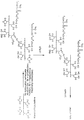
- the figure is a simplified schematic flow diagram showing a preferred embodiment of the invention and indicating structures of certain initial, intermediate, and final products.
- Maleated polybutadiene is reacted simultaneously with (a) hydroxyethylmethacrylate, (b) a polyalkadiene diol, and (c) monohydroxy-terminated polystyrene or monohydroxy-terminated poly(methylmethacrylate).
- the reagents open the maleate rings and form side chains.
- the diol opens maleate rings of different molecules of maleated polybutadiene (chain extension). The result is hydrolyzed in (d) whereby the remaining maleate rings are opened with formation of carboxyl groups.
- the hydrolyzed product is treated with NaOH to form an ionomer, useful in making flexographic relief printing plates.
- Molecular weights are number average, Mn, determined by GPC using polystyrene standards.
- HEMA may be substituted in whole or in part by other hydroxyalkyl(meth)acrylates or by hydroxy(polycaprolactone)acrylate as herein described.
- monohydroxy-terminated polystyrene may be substituted in whole or in part by monohydroxy-terminated polymethylmethacrylate.
- Carboxyl groups on the opened maleic anhydride molecules may be neutralized by a base such as NaOH, whereby the carboxyl hydrogen is replaced by Na + or other base anion.
- a base such as NaOH
- the neutralization is conducted in an alcohol (e.g., ethanol)
- some of the maleic carboxyl may be esterified by the alcohol.
- the backbone chain of the base polymer can be polybutadiene, a butadiene copolymer, (e.g., butadiene/styrene) or blends thereof.
- the base polymer in either case has at least 60%, preferably at least 70%, 1,4 microstructure.
- Placement of substituents on the base polymer molecules is thus a statistical average.
- Some base polymer molecules may have all acrylate esters and no monohydroxy-terminated polystyrene, while others may have all the latter and none of the former, and still others may go through the entire reaction process prior to hydrolysis without opening their anhydride groups. Further, some base polymer molecules may be chain-extended to unusual lengths and others very little or not at all. Also, it is believed that reaction of a substituent with a maleic anhydride group may occur on either "arm" of the opened molecule, i.e., randomly on either of the two carbonyls.
- the HEMA (or alternate hydroxy acrylate) opens the maleic anhydride group, esterifying one of the carbonyls and converting the other to carboxylic acid, -COOH.
- a molecule of the chain-extending diol opens anhydride groups on two or more molecules of the maleated butadiene polymer and forms -C(:O)O-R 4 -OC(:O)- linkages, where R 4 represents the butadiene base polymer and where the carbonyls derive from residual maleic (succinic) anhydride moieties.
- Two or more chain-extending diols may link any two given maleated base polymer molecules; on the other hand it is expected that some maleated base polymers will escape the chain-extending reaction.
- the monohydroxy-terminated thermoplastic polymer HO-R 3 H reacts at random with maleic (succinic) anhydride groups, opening the ring with formation of the corresponding ester. The reaction increases the toughness of the polymer.
- the product of the reaction may be reacted with water. This results in hydrolysis of the remaining succinic (maleic) anhydride groups. At this stage the product comprises copious -COOH groups and little or no anhydride groups.
- the hydrolyzed product can be treated with a base, e.g., NaOH, to neutralize some or all of the -COOH groups and so produce the final ionomer product.
- the ionomer can be formulated with photoinitiators, (optional) photosensitive additives such as acrylates, inert particulate fillers and coloring agents such as pigments and dyes, and may be solvent casted on a support as explained hereinafter.
- the photocurable or photosensitive composition can be a prepolymer derived from a maleic anhydride adduct of polybutadiene having at least about 60 to 80% 1,4 microstructure. As discussed later, the photocurable composition preferably comprises additional photocurable compounds such as unsaturated monomers. "Maleic anhydride” includes substituents as hereinafter discussed.
- 1,4 microstructure refers to a butadiene segment's structure which results from 1,4 addition to a 1,3 butadiene monomer during polymerization.
- the remaining percentage of butadiene segments have a 1,2 microstructure which results from 1,2 addition during polymerization.
- the polybutadiene has pendent vinyl groups on its structure, as illustrated below: wherein p is a positive integer depending on the amount of polymerization and the molecular weight of the polymer.
- p is a positive integer depending on the amount of polymerization and the molecular weight of the polymer.
- the formation of the 1,4 microstructure is dependent upon reaction conditions used during the polymerization reaction and can be regulated by known techniques.
- Polyisoprene may exhibit corresponding 1,4- and 1,2- microstructure.
- a polymer having increased 1,4 content will lead to higher elasticity and an increase in the rubbery nature of the composition. It is believed that those properties can be attributed to less crosslinking between pendent vinyl groups which are present on the polybutadienes which have a higher degree of 1,2 microstructure.
- the adduct can have a maleic anhydride content of from 5-30 percent by weight of the adduct and preferably contains about 8-20% by weight.
- the number of maleic anhydride groups per base polymer molecule varies and depends on the molecular weight of the polymer and the degree of maleation.
- the adduct Lithene (R) LX16-10MA in Example 2 below has about 8 groups for 8800 molecular weight. The groups are grafted on the base polymer chain. Lower amounts of anhydride content decrease the aqueous developability of the photocurable composition, and layers made therefrom, while higher amounts causes the composition and layers therefrom to be hard and less flexible.
- the addition of the maleic anhydride to the polybutadiene can be accomplished by reacting the polybutadiene with a maleic anhydride of the general formula wherein R 7 and R 8 are individually a member of the group consisting of hydrogen, halogen, carboxyl, linear or cyclic alkyl containing 1-20 carbon atoms, aryl, alkaryl and aralkyl containing 6 to 20 carbon atoms.
- the adduct can be formed by heating the polybutadiene and the maleic anhydride to about 220°C, with stirring in a halogenated aromatic hydrocarbon solvent, such as ⁇ -chloronapthalene.
- the reaction can be carried out in the presence of an inhibitor so as to prevent side reactions. Suitable inhibitors include copper, copper salts and copper chelate complexes.
- the maleic anhydride can be added in any proportion from a minimum of 5% by weight up to 30% by weight, with the percentage of bonded maleic anhydride preferably being between 8 and 20% by weight.
- the molecular weight of the adduct can be between 1000 and 20,000 number average and is preferably 4,000 to 20,000. Other known techniques of adding maleic anhydride can be used.
- maleic anhydride adducts of 1,4 polybutadiene include a material designated as LX1610MA from Revertex Ltd. and a material designated as Ricon 131 MA from Ricon Resins Inc.
- the adduct may also comprise a base polymer which is a butadiene copolymer with styrene, acrylonitrile, chloroprene, isobutylene, propylene, ethylene, or acrylic and methacrylic acids and esters.
- a base polymer which is a butadiene copolymer with styrene, acrylonitrile, chloroprene, isobutylene, propylene, ethylene, or acrylic and methacrylic acids and esters.
- a base polymer which is a butadiene copolymer with styrene, acrylonitrile, chloroprene, isobutylene, propylene, ethylene, or acrylic and methacrylic acids and esters.
- at least about 60 to about 80% of the butadiene segments should have 1,4 microstructure.
- a preferred base polymer maleic anhydride adduct is made from polybutadiene having a molecular weight of about 8800 and having about 8 anhydride groups per molecule.
- the maleic anhydride groups are converted to succinic anhydride groups.
- succinic anhydride groups In this context the two terms may be used interchangeably.
- a portion of the adduct's anhydride groups is esterified with a reagent having an olefinically unsaturated group and a functional group which reacts with and opens the anhydride groups to form carboxylic acid and ester groups.
- R 5 is the residue of a compound selected from hydroxyethyl (meth)acrylate, hydroxypropyl (meth)acrylate, hydroxybutyl (meth)acrylate and hydroxymethyl (meth)acrylate.
- a reagent having hydroxy as the anhydride reactive group is hydroxyethyl methacrylate (HEMA).
- HEMA hydroxyethyl methacrylate
- Hydroxy(polycaprolactone)acrylate can be prepared by reacting epsilon-caprolactone with hydroxyethylacrylate in a respective mole ratio of 2-3:1, in the presence of suitable catalysts and inhibitors. See Weber et al., U.S. 4,504,635, Example 1. Alternate methods are described in U.S. Patents 4,791,189 and 4,983,689, both to S.H. Yu.
- the reaction of the four indicated components to form the invention polymer is carried out at temperatures from 50° to 120°C, for example 70-105°C preferably at about 70-95°C, for 1 to 24 hours.
- the reaction is preferably carried out in an organic solvent in which the four indicated reagents are soluble.
- An organic solvent is desirable to facilitate formation of the high molecular weight and viscosity of the chain extended product.
- the vinyl esterification reagent is added in amounts to react with 5 to 40% of the adduct's anhydride groups.
- the pendent groups P and P' provide photocurability to the polybutadiene adduct.
- the vinyl groups in P and P' crosslink, thus curing the composition and imparting tensile strength and modulus to any layer prepared from the composition, as well as imparting improved swell resistance of the polymer in solvents.
- the esterification reaction opens the anhydride groups to form free carboxylic acid groups, thus providing a water dispersible composition which can be developed in aqueous or aqueous-alkaline solutions.
- the adduct is chain extended to improve the physical properties, i.e., increase elongation and provide a stable and durable photosensitive surface.
- the chain extending agent R 4 is a polybutadiene diol or polyisoprene diol or a mixture thereof, preferably having a molecular weight of about 1000-8000, preferably about 3,000-8,000 and preferably at least 60%, more preferably about 70%, 1,4 microstructure. Chain extension of the adduct occurs through a portion of the anhydride groups. Preferably, chain extension occurs through 5 to 30% of the adduct's original anhydride groups.
- anhydride groups are being reacted with monohydroxy-terminated polymer, such as polystyrene, M n about 2,000-50,000, preferably about 5,000-30,000; and/or monohydroxy-terminated polymethyl-methacrylate M n about 2,000-50,000, preferably 2,500 to 50,000, more preferably 4,000 - 30,000 and even more preferably about 5,000-30,000.
- monohydroxy-terminated polymer such as polystyrene, M n about 2,000-50,000, preferably about 5,000-30,000; and/or monohydroxy-terminated polymethyl-methacrylate M n about 2,000-50,000, preferably 2,500 to 50,000, more preferably 4,000 - 30,000 and even more preferably about 5,000-30,000.
- Monohydroxy-terminated polystyrene can be made by the process described by Chien et al, "Efficient Syntheses of the Triblock Copolymer Styrene- b -Tetrahydrofuran- b -Styrene by Coupling of Preformed Blocks," Journal of Applied Polymer Science, vol. 41, 775-782, especially 776-777 (1990).
- styrene is polymerized in cyclohexane under nitrogen in the presence of s -butyllithium. Ethylene oxide is added. After further reaction followed by removal of solvent and water, monohydroxy-terminated polystyrene is recovered.
- Monohydroxy-terminated polymethylmethacrylate can be made by a similar process.
- the carboxyl groups in the maleic anhydride residues are neutralized by bases such as (but not limited to) lithium hydroxide, sodium hydroxide, or potassium hydroxide, or their respective methoxides, acetates, etc.. It has been found that the resulting salts have improved physical properties such as higher resilience, higher elongation and better resistance to swell in organic solvents commonly used in printing inks.
- the relative proportions of ingredients in forming the photosensitive prepolymer require consideration, particularly for making flexographic relief printing plates.
- too much HEMA results in a product too hard to make a printing plate flexible enough for this type of flexographic printing application.
- Too little hydrolysis of the remaining anhydride groups will yield a material which will not become a solid when neutralized with monovalent cations.
- Too little monohydroxy-terminated polystyrene or monohydroxy-terminated polymethylmethacrylate will give a product which "chips", i.e., tears easily, on press.
- too much of either of these latter materials will give a product too hard to make a good flexographic printing plate.
- a flexographic printing plate should meet certain physical requirements, typically:
- the photocurable compositions can also contain components in addition to the above described neutralized prepolymer.
- photocurable monomer diluents are suitably added.
- Operable diluents include reactive acrylic or methacrylic diluents of the formula wherein R 9 is hydrogen or methyl, and R 10 is an organic moiety having the valence of v, and v is 1 or more.
- photoinitiators include, but are not limited to, benzophenone, acetophenone, o-methoxybenzophenone, acenaphthene-quinone, valerophenone, hexanophenone, alpha-phenyl-butyrophenone, p-morpholinopropiophenone, dibenzosuberone, 4-morpholinobenzophenone,4'-morpholinodeoxybenzoin, p-diacetylbenzene, 4-aminobenzophenone, 4'-methoxyacetophenone, benzaldehyde, alpha-tetralone, 9-acetylphenanthrene, 2-acetylphenanthrene, 10-thioxanthenone, 3-acetylphenanthrene, 3-acetylindone, 9-fluorenone, 1-indanone, 1,3,5-triacetylbenzene, thioxanthen-9-one, xanthene-9-one
- Phosphines such as triphenylphosphine and tri-o-tolylphosphine are also operable herein as photoinitiators.
- the photoinitiators or mixtures thereof are usually added in an amount ranging from 0.01 to 5% by weight of the total weight of the photocurable composition.
- the resultant polymer was neutralized to 60% with sodium hydroxide in methanol and formulated with 1% Irgacure 651. Films were prepared and tested as in Example 1. See Table for data.
- the resultant polymer was neutralized to 60% with sodium hydroxide in methanol and formulated with 1% Irgacure 651. Films were prepared and tested as in Example 1. See Table for data.
Landscapes
- Physics & Mathematics (AREA)
- Chemical & Material Sciences (AREA)
- General Physics & Mathematics (AREA)
- Chemical Kinetics & Catalysis (AREA)
- Spectroscopy & Molecular Physics (AREA)
- Medicinal Chemistry (AREA)
- Polymers & Plastics (AREA)
- Organic Chemistry (AREA)
- Health & Medical Sciences (AREA)
- General Chemical & Material Sciences (AREA)
- Macromonomer-Based Addition Polymer (AREA)
- Photosensitive Polymer And Photoresist Processing (AREA)
- Compositions Of Macromolecular Compounds (AREA)
- Polymerisation Methods In General (AREA)
Abstract
Description
- This invention relates to radiation curable prepolymers and formulations or compositions containing the same, as well as radiation sensitive articles having solid layers prepared from such prepolymers or formulations. The invention also relates to processes for making and using the prepolymer or composition to form the radiation sensitive articles.
- Photocurable prepolymers and compositions are well known in the art for forming printing plates and other radiation sensitive articles. In the field of flexographic printing plates, the plates typically comprise a support and a photosensitive layer prepared from the photocurable composition. Additional layers on the plate include slip and release films to protect the photosensitive surface. Prior to processing the plate, the additional layers are removed, and the photosensitive layer is exposed to radiation in an imagewise fashion. The unexposed areas of the layer are then removed in developer baths.
- Removal of unexposed layers comprising photocurable compositions such as those disclosed in U. S. Patent No. 2,760,863 require the use of developer baths comprising environmentally unsafe, organic solvents such as tetrachloroethylene, perchloroethylene, 2-butanone, benzene, toluene, xylene, trichloroethane and solvent mixtures such as tetrachloroethylene/n-butanol. However, due to the toxicity, high volatility and low flash point, their use gives rise to hazardous conditions and creates pollution problems. Thus, recently there has been a strong interest in the field to develop photosensitive layers in non-organic solvent developing solutions, e.g. aqueous or alkaline-aqueous solutions. However, the compositions resulting from recent attempts to achieve aqueous developable plates demonstrate deficiencies in mechanical properties or are unsuitable for use with a wide variety of printing inks, especially alcohol based inks.
- For instance, in addition to possessing an aqueous developable photosensitive layer, a flexographic printing plate must have sufficient flexibility to wrap around a printing cylinder, yet be strong enough to withstand the rigors experienced during typical printing processes. Further, the printing plate should be soft enough to facilitate ink transfer during printing.
- Previous aqueous developable compositions have not possessed all the desirable features such as flexibility, softness and solvent resistance to inks typically used in printing. For example, water-developable photosensitive compositions which contain as the main component a high molecular weight polymer such as polyvinyl alcohol, cellulose, polyethylene oxide, or the like, are insufficient in flexibility and rubber hardness and hence are unsuitable for use in flexographic printing plates.
- Finally, it is also important that the photosensitive layer of the printing plate be dimensionally stable during storage. For example, some compositions used for making plates have shown inferior stability properties when used in solid flexographic printing plates in that the compositions become tacky and pasty during storage. Those inferior properties have been attributed to the low molecular weight of the polymers used to prepare the printing plates. See U. S. Patent No. 4,762,892 to Koch et al. infra and discussion of low molecular weight polymers disclosed in Japanese Kokoku 57-23693.
- One attempt to develop an aqueous developable, flexible printing plate is illustrated in U. S. Patent 4,916,045 to Koch et al. The patent describes a photosensitive recording element consisting primarily of an ionic polymer. The ionic polymer is prepared by the partial esterification or amidation of succinic acid anhydride side groups on an alkadiene polymer. The resultant polymer is then converted into an ionic polymer by reaction with suitable compounds. With reference to the preferred materials, the reference is directed to oligomers having a polybutadiene backbone, side radicals prepared by (a) maleating the polybutadiene, (b) esterifying the resultant pendent succinic anhydride ring with hydroxyethylmethacrylate (HEMA), and (c) neutralizing the carboxyl groups generated during the esterification with a cation from Groups I to V of the Periodic Table. The polymer is not chain-extended with, e.g., polybutadiene diol, or reacted (toughened) with, e.g., monohydroxy-terminated polystyrene.
- U.S. 4,023,973, Imaizumi et al., Photosensitive Composition Using Maleic Anhydride adduct of a 1,2 Polybutadiene (1977), discloses photosensitive compositions for use on flexographic printing plates developable in water. The compositions comprise the maleic anhydride adduct of 1,2 polybutadiene, photosensitizer, and acrylate extenders. The adduct may be hydrolized to open the anhydride rings, and the product may be neutralized with a base. The adduct is not chain extended, nor is any styrene polymer used. The 1,2- content of the material, 70% or more, gives the composition an undesirably high rubber hardness.
- U.S. 4,272,608, Stephen Proskow, Photosensitive Compositions Containing Thermoplastic Ionomeric Elastomers Useful in Flexographic Printing Plates (1981) discloses a photosensitive composition useful in flexographic printing plates. The composition comprises a maleated butadiene-acrylonitrile copolymer which can be reacted with a (meth)acrylate. The plate can be developed in water containing sodium carbonate.
- U.S. 4,478,931, Fickes et al., Precured Flexographic Printing Plate (1984), discloses a photopolymer prepared by mixing a carboxyl-containing butadiene-acrylonitrile block copolymer with an acrylate. The carboxyl groups may come from maleic anhydride. Hydroxy-alkyl(meth)acrylates are not disclosed. The butadiene may contain styrene groups in the form of a block copolymer, not reacted with maleic groups as in the instant invention. The polymer is not chain-extended. The photopolymer may be used in a water-developable printing plate.
- Other attempts to make aqueous developable printing plates include:
- U.S. 4,507,382, Rousseau et al., Water Developable Positive Acting Lithographic Printing Plate (1985) discloses a water developable lithographic printing plate using a photopolymerizable composition comprising an ethylenically unsaturated dextrin oligomer and a hydroxy acrylamide.
- U.S. 4,517,279, J. R. Worns, Photosensitive Elastomeric Polymer Composition for Flexographic Printing Plates Processable in Semi-Aqueous Basic Solution or Solvent Systems (1985), discloses a photosensitive composition comprising a mixture of carboxylated and non-carboxylated butadiene/acrylonitrile copolymers. Plates made with the composition were developed in semi-aqueous, e.g., alkanol/water solutions.
- U.S. 4,621,044, J. Fujikawa, Photosensitive Polymer Composition(1986), discloses a water developable printing Plate using polyvinylacetate as base polymer.
- U.S. 4,857,434, Lori J. Klinger, Radiation Curable Liquid (Meth)Acrylated Polymeric Hydrocarbon Maleate Prepolymer and Formulations Containing Same (1989), discloses methacrylation of a maleated hydrocarbon, e.g., polybutadiene for the preparation of a photopolymer useful in water-developable flexographic printing plates.
- U.S. 5,047,313, Nebe et al., Photosensitive Semi-aqueous Developable Copper Conductor Composition (1991) discloses a flexographic printing plate requiring some organic solvent (e.g., butyl cellosolve) for development. The plate has a photosensitive component comprising glass frit, acrylate binder, and acrylate monomer.
- The present invention seeks to provide novel photocurable compositions which are suitable for use in an aqueous developable, photosensitive layer on a flexible photosensitive article such as a flexible printing plate.
- The invention also seeks to provide a flexible photosensitive article comprising the novel compositions.
- The invention further seeks to provide a solid, photosensitive layer which is flexible, yet strong and durable.
- The invention yet further seeks to provide a solid photosensitive layer which when cured in an image wise pattern results in a relief pattern layer which easily transfers ink in instances where the layer is that of a flexible printing plate.
- A photocurable composition has now been devised comprising an ionic prepolymer (ionomer) derived from a chain-extended maleic anhydride adduct of a base polymer of polybutadiene or butadiene copolymer wherein a significant degree of the segments of the base polymer have a 1,4 microstructure, the prepolymer being further toughened by reaction with a monohydroxy-terminated polystyrene and/or monohydroxy-terminated polymethylmethacrylate.
- The present invention thus provides a prepolymer comprising segments of the structure

.....C..... represents the backbone chain of a base polymer, which is a butadiene polymer or copolymer with at least 60% 1,4 microstructure; - R1
- is a maleic anhydride residue;
- R2
- is H, Na, Li, or K;
- R3
- is the residue of a mono-hydroxy terminated thermoplastic polymer comprising polystyrene or poly(methylmethacrylate) and having a molecular weight Mn from 2,000 to 50,000;
- R4
- is the residue of a polybutadiene having a molecular weight Mn from 800 to 9,000 or a polyisoprene having a molecular weight Mn from 1,000 to 10,000, or a mixture therefore; and
- R5
- is the residue of a hydroxy-alkyl acrylate or methacrylate or a low molecular weight hydroxy polycaprolactone acrylate.
- The at least partially neutralized prepolymer (ionomer) can be formulated to prepare a flexible printing plate.
- The invention further provides a flexible photosensitive article comprising a photosensitive layer comprising at least partially neutralised prepolymer of the invention, and optionally photocurable monomer and optionally photoinitiator, on a support.
- The invention also provides a process of making a prepolymer comprising reacting together:
- (1) maleated polybutadiene and/or maleated butadiene-styrene copolymer;
- (2) hydroxyalkyl(meth)acrylate, where alkyl is C1-4 alkyl, or hydroxy(polycaprolactone)acrylate;
- (3) polymeric alkadiene chain extender which is a polybutadiene having a molecular weight, Mn, from 800 to 9,000 or a polyisoprene having a molecular weight Mn, from 1,000 to 10,000 or a mixture thereof; and
- (4) monohydroxy-terminated polystyrene of molecular weight Mn 2,000 - 50,000 or monohydroxy-terminated poly(methylmethacrylate) of molecular weight Mn 2,000 - 50,000 or a mixture thereof.
- The invention also provides a process for producing a flexible photosensitive article which process comprises making a prepolymer according to the process hereinbefore defined and applying the prepolymer thus obtained, and optionally photocurable monomer and optionally photoinitiator, as a layer to a support.
- The prepolymer of the invention may thus be prepared by:
- (a) reacting anhydride groups, of a maleic anhydride adduct of butadiene base polymer wherein a significant degree of the base polymer's segments have a 1,4 microstructure, with a reagent having an olefinically unsaturated group and an anhydride reactive group; where, upon reaction of the reagent with a portion of the adduct's anhydride groups, the anhydride groups are opened and an olefinically unsaturated side chain attached and a carboxylic acid group is formed;
- (b) chain-extending the adduct by reacting a polymeric alkadiene diol with unreacted anhydride groups from (a) to increase the number average molecular weight (Mn) of the thus chain-extended polymer;
- (c) reacting the polymer with a monohydroxy-terminated polymer;
- (d) reacting the remaining unreacted anhydride groups from (a), (b), and (c) with water to form more carboxylic acid groups;
- (e) neutralizing a portion or all of the carboxylic acid groups in (d) with a base to form an ionomer; and
- (f) applying the product in (e) as a layer on a support to form a flexible photosensitive article. The process can also comprise adding photocurable unsaturated monomers and photoinitiators to the product of (e).
- The figure is a simplified schematic flow diagram showing a preferred embodiment of the invention and indicating structures of certain initial, intermediate, and final products. Maleated polybutadiene is reacted simultaneously with (a) hydroxyethylmethacrylate, (b) a polyalkadiene diol, and (c) monohydroxy-terminated polystyrene or monohydroxy-terminated poly(methylmethacrylate). In (a) and (c) the reagents open the maleate rings and form side chains. In (b) the diol opens maleate rings of different molecules of maleated polybutadiene (chain extension). The result is hydrolyzed in (d) whereby the remaining maleate rings are opened with formation of carboxyl groups. In the final step (e) the hydrolyzed product is treated with NaOH to form an ionomer, useful in making flexographic relief printing plates.
- Various alternate reactants are possible in the several stages of the process, as described in more detail herein.
- Molecular weights are number average, Mn, determined by GPC using polystyrene standards.
- Percentages are weight percentages unless otherwise stated.
- Using four specific reagents within the invention, the reaction of maleated polybutadiene, hydroxyethylmethacrylate (HEMA), polyalkadiene diol, and monohydroxy-terminated thermoplastic polymer, such as mono-hydroxy-terminated polystyrene gives a prepolymer.
- In this reaction HEMA may be substituted in whole or in part by other hydroxyalkyl(meth)acrylates or by hydroxy(polycaprolactone)acrylate as herein described. Further, monohydroxy-terminated polystyrene may be substituted in whole or in part by monohydroxy-terminated polymethylmethacrylate.
- Carboxyl groups on the opened maleic anhydride molecules may be neutralized by a base such as NaOH, whereby the carboxyl hydrogen is replaced by Na+ or other base anion. When the neutralization is conducted in an alcohol (e.g., ethanol), some of the maleic carboxyl may be esterified by the alcohol.
- The backbone chain of the base polymer can be polybutadiene, a butadiene copolymer, (e.g., butadiene/styrene) or blends thereof. The base polymer in either case has at least 60%, preferably at least 70%, 1,4 microstructure.
- In this synthesis positioning of substituents is not critical, and statistically speaking chain-extension and/or cross-linking will be largely random, between the same or different groups.
- In addition to the groups and substituents discussed above, it will be evident that other maleic anhydride groups on the base polymer backbone will be similarly opened and reacted. Again, formation of such substituents along the base polymer chain is random. For example, three adjacent R1, or maleic anhydride groups, may be opened by monohydroxy polystyrene, and the next three left unreacted by anything. Also, the chain extending diol may react with several R1's or maleic anhydrides in two separate base polymer chains, and with none in other base polymer chains.
- Placement of substituents on the base polymer molecules is thus a statistical average. Some base polymer molecules may have all acrylate esters and no monohydroxy-terminated polystyrene, while others may have all the latter and none of the former, and still others may go through the entire reaction process prior to hydrolysis without opening their anhydride groups. Further, some base polymer molecules may be chain-extended to unusual lengths and others very little or not at all. Also, it is believed that reaction of a substituent with a maleic anhydride group may occur on either "arm" of the opened molecule, i.e., randomly on either of the two carbonyls.
- As above indicated, the HEMA (or alternate hydroxy acrylate) opens the maleic anhydride group, esterifying one of the carbonyls and converting the other to carboxylic acid, -COOH. During the same reaction, a molecule of the chain-extending diol opens anhydride groups on two or more molecules of the maleated butadiene polymer and forms -C(:O)O-R4-OC(:O)- linkages, where R4 represents the butadiene base polymer and where the carbonyls derive from residual maleic (succinic) anhydride moieties. Two or more chain-extending diols may link any two given maleated base polymer molecules; on the other hand it is expected that some maleated base polymers will escape the chain-extending reaction. The monohydroxy-terminated thermoplastic polymer HO-R3H reacts at random with maleic (succinic) anhydride groups, opening the ring with formation of the corresponding ester. The reaction increases the toughness of the polymer.
- The product of the reaction may be reacted with water. This results in hydrolysis of the remaining succinic (maleic) anhydride groups. At this stage the product comprises copious -COOH groups and little or no anhydride groups. The hydrolyzed product can be treated with a base, e.g., NaOH, to neutralize some or all of the -COOH groups and so produce the final ionomer product. The ionomer can be formulated with photoinitiators, (optional) photosensitive additives such as acrylates, inert particulate fillers and coloring agents such as pigments and dyes, and may be solvent casted on a support as explained hereinafter.
- The reagents and sub-reactions will be considered below.
- The photocurable or photosensitive composition (the term "photocurable" and "photosensitive" being used interchangeably throughout) can be a prepolymer derived from a maleic anhydride adduct of polybutadiene having at least about 60 to 80% 1,4 microstructure. As discussed later, the photocurable composition preferably comprises additional photocurable compounds such as unsaturated monomers. "Maleic anhydride" includes substituents as hereinafter discussed.
- The
term 1,4 microstructure refers to a butadiene segment's structure which results from 1,4 addition to a 1,3 butadiene monomer during polymerization. The general structure for a 1,4 polybutadiene is illustrated below:
-[CH2 - CH = CH - CH2]s-
wherein s is a integer depending on the amount of polymerization desired and the molecular weight of the polymer. The remaining percentage of butadiene segments have a 1,2 microstructure which results from 1,2 addition during polymerization. In instances where butadiene segments having 1,2 microstructure are present, the polybutadiene has pendent vinyl groups on its structure, as illustrated below: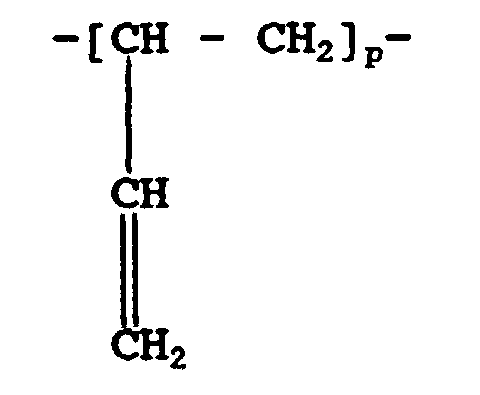
- Polyisoprene may exhibit corresponding 1,4- and 1,2- microstructure.
- For instance, the choice of catalyst or promoter, variation in the polarity of solvents used, variations in the reaction temperatures and the presence of transition metals all influence the 1,4 content of the resulting polymers' microstructure. In general, a polymer having increased 1,4 content will lead to higher elasticity and an increase in the rubbery nature of the composition. It is believed that those properties can be attributed to less crosslinking between pendent vinyl groups which are present on the polybutadienes which have a higher degree of 1,2 microstructure.
- The adduct can have a maleic anhydride content of from 5-30 percent by weight of the adduct and preferably contains about 8-20% by weight. The number of maleic anhydride groups per base polymer molecule varies and depends on the molecular weight of the polymer and the degree of maleation. The adduct Lithene(R) LX16-10MA in Example 2 below has about 8 groups for 8800 molecular weight. The groups are grafted on the base polymer chain. Lower amounts of anhydride content decrease the aqueous developability of the photocurable composition, and layers made therefrom, while higher amounts causes the composition and layers therefrom to be hard and less flexible.
- The addition of the maleic anhydride to the polybutadiene can be accomplished by reacting the polybutadiene with a maleic anhydride of the general formula

- For example, the adduct can be formed by heating the polybutadiene and the maleic anhydride to about 220°C, with stirring in a halogenated aromatic hydrocarbon solvent, such as α-chloronapthalene. The reaction can be carried out in the presence of an inhibitor so as to prevent side reactions. Suitable inhibitors include copper, copper salts and copper chelate complexes. The maleic anhydride can be added in any proportion from a minimum of 5% by weight up to 30% by weight, with the percentage of bonded maleic anhydride preferably being between 8 and 20% by weight. The molecular weight of the adduct can be between 1000 and 20,000 number average and is preferably 4,000 to 20,000. Other known techniques of adding maleic anhydride can be used. See U. S. Patent 3,974,129 and also W. Cloak, Industrial Engineering Chemistry, Vol. 4, p.2095 (1955). Commercially available maleic anhydride adducts of 1,4 polybutadiene include a material designated as LX1610MA from Revertex Ltd. and a material designated as Ricon 131 MA from Ricon Resins Inc.
- The adduct may also comprise a base polymer which is a butadiene copolymer with styrene, acrylonitrile, chloroprene, isobutylene, propylene, ethylene, or acrylic and methacrylic acids and esters. In instances where a copolymer is used, at least about 60 to about 80% of the butadiene segments should have 1,4 microstructure. Commercially available maleic anhydride adducts of a butadiene copolymer with styrene include Ricon 184 MA from Ricon Resins Inc. A maleated butadiene/styrene copolymer containing about 2-25% (preferably 5-25% for example about 10%) maleic anhydride, about 15-40% (preferably about 30%) styrene, and Mn about 2,000-20,000 (preferably 4,000 to 20,000, more preferably about 4,200) is especially useful.
- A preferred base polymer maleic anhydride adduct is made from polybutadiene having a molecular weight of about 8800 and having about 8 anhydride groups per molecule. In preparing the maleic anhydride-base polymer, the maleic anhydride groups are converted to succinic anhydride groups. In this context the two terms may be used interchangeably.
- A portion of the adduct's anhydride groups is esterified with a reagent having an olefinically unsaturated group and a functional group which reacts with and opens the anhydride groups to form carboxylic acid and ester groups. Preferably, the reagent is a hydroxyalkyl(meth)acrylate of the structure [HO]-(CH2)t-O-(C:O)-C(R6)=CH2, wherein R6 is hydrogen or methyl and t = 2 to 4 and [HO] represents the
- anhydride reactive group. Preferably R5 is the residue of a compound selected from hydroxyethyl (meth)acrylate, hydroxypropyl (meth)acrylate, hydroxybutyl (meth)acrylate and hydroxymethyl (meth)acrylate. An example of a reagent having hydroxy as the anhydride reactive group is hydroxyethyl methacrylate (HEMA). An alternate is hydroxypolycaprolactone acrylate, of the structure: HO-[-(CH2)5-C(:O)O-]2CH2CH2-OC(:O)CH=CH2. It is available commercially as Tone®M-100 from Union Carbide Company.
- Hydroxy(polycaprolactone)acrylate can be prepared by reacting epsilon-caprolactone with hydroxyethylacrylate in a respective mole ratio of 2-3:1, in the presence of suitable catalysts and inhibitors. See Weber et al., U.S. 4,504,635, Example 1. Alternate methods are described in U.S. Patents 4,791,189 and 4,983,689, both to S.H. Yu.
- The reaction of the four indicated components to form the invention polymer is carried out at temperatures from 50° to 120°C, for example 70-105°C preferably at about 70-95°C, for 1 to 24 hours. The reaction is preferably carried out in an organic solvent in which the four indicated reagents are soluble. An organic solvent is desirable to facilitate formation of the high molecular weight and viscosity of the chain extended product.
- The vinyl esterification reagent is added in amounts to react with 5 to 40% of the adduct's anhydride groups. In the case of hydroxyalkyl(meth)acrylate the esterification reaction creates pendent groups having the following structure P:

- In the case of hydroxy(polycaprolactone)acrylate the esterification reaction creates pendent groups having the structure P':

- As illustrated above, the pendent groups P and P' provide photocurability to the polybutadiene adduct. When the adduct is exposed to UV radiation, the vinyl groups in P and P' crosslink, thus curing the composition and imparting tensile strength and modulus to any layer prepared from the composition, as well as imparting improved swell resistance of the polymer in solvents. Further, the esterification reaction opens the anhydride groups to form free carboxylic acid groups, thus providing a water dispersible composition which can be developed in aqueous or aqueous-alkaline solutions.
- The adduct is chain extended to improve the physical properties, i.e., increase elongation and provide a stable and durable photosensitive surface. The chain extending agent R4 is a polybutadiene diol or polyisoprene diol or a mixture thereof, preferably having a molecular weight of about 1000-8000, preferably about 3,000-8,000 and preferably at least 60%, more preferably about 70%, 1,4 microstructure. Chain extension of the adduct occurs through a portion of the anhydride groups. Preferably, chain extension occurs through 5 to 30% of the adduct's original anhydride groups.
- Simultaneously with the esterification and chain extension reactions in (b) and (c) above, anhydride groups are being reacted with monohydroxy-terminated polymer, such as polystyrene, Mn about 2,000-50,000, preferably about 5,000-30,000; and/or monohydroxy-terminated polymethyl-methacrylate Mn about 2,000-50,000, preferably 2,500 to 50,000, more preferably 4,000 - 30,000 and even more preferably about 5,000-30,000. The addition of these blocks of thermoplastic polymer leads to an increase in polymer toughness, as measured by tear resistance, ASTM D-624-81.
- Monohydroxy-terminated polystyrene can be made by the process described by Chien et al, "Efficient Syntheses of the Triblock Copolymer Styrene-b-Tetrahydrofuran-b-Styrene by Coupling of Preformed Blocks," Journal of Applied Polymer Science, vol. 41, 775-782, especially 776-777 (1990). In this process, styrene is polymerized in cyclohexane under nitrogen in the presence of s-butyllithium. Ethylene oxide is added. After further reaction followed by removal of solvent and water, monohydroxy-terminated polystyrene is recovered.
- Monohydroxy-terminated polymethylmethacrylate can be made by a similar process.
- To open the remaining anhydride groups the chain-extended product is reacted with water. This reaction produces additional carboxylic acid groups which when neutralized with monovalent cations as herein described, form a solid photopolymer and increases the water dispersibility of the photocurable composition.
- Finally, to provide the ionomer, at least some of the carboxyl groups in the maleic anhydride residues are neutralized by bases such as (but not limited to) lithium hydroxide, sodium hydroxide, or potassium hydroxide, or their respective methoxides, acetates, etc.. It has been found that the resulting salts have improved physical properties such as higher resilience, higher elongation and better resistance to swell in organic solvents commonly used in printing inks.
- Good results are obtained when about 40-80% of the carboxyls are neutralized. Forty to 60% is preferred.
- The relative proportions of ingredients in forming the photosensitive prepolymer require consideration, particularly for making flexographic relief printing plates. For example, too much HEMA results in a product too hard to make a printing plate flexible enough for this type of flexographic printing application. Too little hydrolysis of the remaining anhydride groups will yield a material which will not become a solid when neutralized with monovalent cations. Too little monohydroxy-terminated polystyrene or monohydroxy-terminated polymethylmethacrylate will give a product which "chips", i.e., tears easily, on press. However, too much of either of these latter materials will give a product too hard to make a good flexographic printing plate.
- Based on 100 parts by weight of maleic anhydride adduct of base polymer (polybutadiene homo- or copolymer), of which 5-30, preferably 8-20 parts be weight is maleic anhydride moiety, we use (in parts by weight except as noted):
- Hydroxyalkyl(meth)acrylate side chain additive, (e.g., HEMA), about 0.7-3.2, preferably 2.0-2.6;
- Or, as an alternate to hydroxyalkyl(meth)acrylate, hydroxy(polycaprolactone)acrylate, about 2-15, preferably about 4-8;
- Polyalkadienyl polyol chain extender (e.g., polybutadiene diol) about 10-63, preferably 30-50;
- Monohydroxy-terminated polystyrene or monohydroxy-terminated polymethylmethacrylate, about 4-20, preferably about 5-10;
- Li-, Na-, or K-containing base, sufficient to neutralize at least about 40%, preferably about 40-60%, of the carboxylic acid groups in the prepolymer, with formation of ionomer.
- To succeed commercially a flexographic printing plate should meet certain physical requirements, typically:
- (1) Elongation (ASTM D 412) should exceed about 140.
- (2) Tensile strength (ASTM D 412) should exceed about 300.
- (3) Tear Resistance (ASTM D 624) should exceed 30 lb/in.
- (4) Resilience (ASTM D 2632) should exceed 10%.
- (5) Tensile modulus (1% elongation) (ASTM D 412) should not exceed about 2000.
- Not every permutation of reagents and/or reaction conditions within the scope of the invention (using neutralization) will provide all of the optimum physical properties listed above. However, as noted in the Table, the conditions are met under preferred conditions.
- As mentioned earlier, the photocurable compositions can also contain components in addition to the above described neutralized prepolymer. For instance, photocurable monomer diluents are suitably added. Operable diluents include reactive acrylic or methacrylic diluents of the formula

- Other suitable diluents include polymerizable ethylenically unsaturated addition monomers described in U.S. Patent 4,442,302. Those monomers include monofunctional, difunctional or polyfunctional compounds based on moieties such as (meth)acrylonitriles and acrylamides, as well as the (meth)acrylics described above.
- Suitable photoinitiators for the photocurable composition include benzoin alkyl ethers, such as benzoin methyl ether, benzoin ethyl ether, benzoin isopropyl ether and benzoin isobutyl ether. Another class of photoinitiators are the dialkoxyacetophenones exemplified by 2,2-dimethoxy-2-phenylacetophenone, i.e., Irgacure® 651 (Ciba-Geigy); and 2,2-diethoxy-2-phenylacetophenone. Still another class of photoinitiators are the aldehyde and ketone carbonyl compounds having at least one aromatic nucleus attached directly to the carboxyl group. These photoinitiators include, but are not limited to, benzophenone, acetophenone, o-methoxybenzophenone, acenaphthene-quinone, valerophenone, hexanophenone, alpha-phenyl-butyrophenone, p-morpholinopropiophenone, dibenzosuberone, 4-morpholinobenzophenone,4'-morpholinodeoxybenzoin, p-diacetylbenzene, 4-aminobenzophenone, 4'-methoxyacetophenone, benzaldehyde, alpha-tetralone, 9-acetylphenanthrene, 2-acetylphenanthrene, 10-thioxanthenone, 3-acetylphenanthrene, 3-acetylindone, 9-fluorenone, 1-indanone, 1,3,5-triacetylbenzene, thioxanthen-9-one, xanthene-9-one, 7-H-benz[de]-anthracene-7-one, 1-naphthaldehyde, 4,4'-bis(dimethylamino)-benzophenone, fluorene-9-one, 1'-acetonaphthone, 2'-acetonaphthone, 2,3-butanedione, acetonaphthene, benz[a]anthracene 7.12 dione, etc. Phosphines such as triphenylphosphine and tri-o-tolylphosphine are also operable herein as photoinitiators. The photoinitiators or mixtures thereof are usually added in an amount ranging from 0.01 to 5% by weight of the total weight of the photocurable composition.
- Other additives to the photocurable composition can be included. To inhibit premature crosslinking during storage of the prepolymer containing compositions of this invention, thermal polymerization inhibitors and stabilizers are added. Such stabilizers are well known in the art, and include, but are not limited to, hydroquinone monobenzyl ether, methyl hydroquinone, amyl quinone, amyloxyhydroquinone, n-butylphenol, phenol, hydroquinone monopropyl ether, phenothiazine and nitrobenzene, and mixtures thereof. Such additives are used in an amount within the range of from about 0.01 to about 2% by weight of the prepolymer. These stabilizers are effective in preventing crosslinking of the prepolymer composition during preparation, processing and storage.
- The compositions also may contain up to about 50% by weight of an inert particulate filler which is essentially transparent to actinic light. Such fillers include the organophilic silicas, bentonites, silica, powdered glass and coloring agents such as dyes and pigments. Such fillers can impart desirable properties to the photocurable compositions and reliefs on printing plates containing those compositions.
- The photocurable composition can then be shaped and formed as a solid layer of suitable thickness according to conventional solvent casting, i.e., dissolving the composition in a solvent, shaping the solution into a film or plate and removing the solvent. Conventional extrusion calendaring or hot press techniques can also be used. Solid layers of the photosensitive composition in the form of a film can be adhered to supports such as those comprising polyester, nylon or polycarbonate. Other suitable supports include woven fabrics and mats, e.g. glass fiber fabrics, or laminated materials made of, for example, glass fibers and plastics. It is preferred that the supports are dimensionally stable and resistant to the washout solutions.
- It is necessary to protect photosensitive surfaces from contamination by dirt and dust during storage before being exposed and washed. Such protection is accomplished by lamination or application of a flexible protective cover sheet to the side of the photocurable composition opposite that of the support. As mentioned before the photocurable compositions can sometimes be tacky and it is desirable to apply a release film to the surface of the photosensitive layer before application of the coversheet. This release film may consist of a thin, flexible and aqueous dispersible polymeric film. This film allows for intimate contact between the surface of the photocurable composition opposite to the support and an image bearing negative applied to the surface.
- Photosensitive articles made of a support with a solid layer of a photocurable composition such as solid flexographic printing plates, can then be processed by well known techniques. The photosensitive surface of the plate is exposed to actinic light through a negative. The light cures (hardens) the exposed areas of the surface. The negative is then removed and the uncured, unexposed areas of the surface are washed away. Preferably, the light should have a wavelength of from about 230-450 nm. Suitable sources of light include Type RS sunlamps, carbon arc lamps, xenon arc lamps, mercury vapor lamps, tungsten halide lamps and the like.
- Exposure periods depend upon the intensity of the actinic light, thickness of the plate and the depth of the relief desired on the printing plate. Periods of from 2 to 20 minutes are preferred.
- After exposure and the negative has been removed, the unexposed areas of the photosensitive surface can be developed in aqueous solutions. Suitable solutions include those of nonionic and cationic surfactants, as well as basic and semi-aqueous basic solutions and combinations thereof. Such surfactants are commercially available as Triton® RW-150 from Union Carbide Company and Igepal® C0-730 from GAF Corporation.
- The following are examples illustrating the instant invention and are not intended to restrict the scope of the invention in any manner.
- Certain of the reagents with their abbreviations used passim in the following examples are listed below.
- Maleated polybutadiene, "MPB", Mn 8800, 8 maleic groups per chain; as Revertex® Lithene LX16-10MA from Revertex Ltd;
- Hydroxy ethyl methacrylate, "HEMA";
- Polybutadiene diol, 0.425 meq/g, "HTB", as Hycar® HTB from B. F. Goodrich Company;
- Ionol®, 2,6-di-7-4-methylphenol, antioxidant;
- Triton® RW-150, an ethoxylated (C12-C14) t-alkylamine surfactant, from Union Carbide Company.
- Monohydroxy-terminated polystyrene, "HTPS".
- Monohydroxy-terminated polymethylmethacrylate, "HO-PMMA".
- Monohydroxy-terminated(polycaprolactone)acrylate as Tone® M-100 from Union Carbide Company.
- Dicyclopentenyloxyethylmethacrylate, "DCPOEMA". Hexanedioldimethacrylate, "HDDMA".
- 200 g of MPB, 4.85g HEMA, 89g HTB, 2.0g Ionol®, and 600 ml of toluene were charged into a 2L resin kettle equipped with a condenser, thermocouple and mechanical stirrer. The mixture was heated at 90°C for 6 hours. At this point the temperature was lowered to 70°C, 150g of toluene was added and stirring continued for 16 hours. 20g of water was then added and stirring continued for 8 hours at which time an IR spectrum revealed a large amount of remaining anhydride. An additional 15g water was added and stirring at 70°C continued for 16 hours. Excess water was removed under a stream of nitrogen and the product cooled to room temperature.
- A solution of 7.16g sodium hydroxide in 83g methanol was added with vigorous stirring to form the 60% neutralized ionomer. A solution of 3g Irgacure® 651 photoinitiator in 30g toluene was then added with vigorous stirring. The product contained 31% polymer solids.
- The product was solvent cast onto a polyester support to provide a solid photopolymer plate, which was exposed through a negative and developed in a 4% Triton® RW-150 aqueous solution to yield a printing plate with good reproduction of the negative film image.
- To test the physical properties of the photosensitive layer, a 20 mil film of the photocurable composition was prepared and cured. See the Table for properties. Swells, in water, aqueous ink, solvent based ink, 2-propanol, and 85% ethanol/15% ethylacetate were 7.1, 23.1, 12, 5.6 and 9.4% respectively.
- 200g of MPB, 10.8g of HTPS (11,500 Mw), dissolved in 10Og toluene, 4.85g HEMA, 89g HTB, 2.0g Ionol®, and 500 ml of toluene were charged into a 2L resin kettle and allowed to react as in Example 1.
- A solution of 7.16g sodium hydroxide in 83g methanol was added with vigorous stirring to form the 60% neutralized ionomer. A solution of 3g Irgacure® 651 in 30g toluene was then added with vigorous stirring. The product contained 30% polymer solids.
- A photopolymer plate was prepared and cured as in Example 1. See the Table for test data.
- Swells in water, aqueous ink, solvent based ink, 2-propanol, and 85% ethanol/15% ethylacetate were respectively 7.0, 24.7, 12.4, 6.0, and 9.5%.
- The process of this Example makes a polymer with especially good physical properties for flexographic plate making, as compared with polymers made by the same process but omitting the monohydroxypolystyrene (Example 1).
- 200g of MPB, 4.86g HEMA, 89g HTB, 21.5g HTPS (11,500 MW), 1000 ml toluene, and 1.0g Ionol® were charged into a 2L resin kettle and allowed to react as in Example 1.
- To 99.0g of the resulting polymer, 2.0g sodium hydroxide dissolved in 25.3g methanol, 6.2g of DCPOEMA, 9.lg of HDDMA, and 1.2g Irgacure® 651 photoinitiator were added with stirring. The resultant 60% sodium neutralized material was solvent cast onto a polyester support to provide a solid photopolymer plate which was exposed through a negative and then developed in a 4% Triton RW-150 aqueous solution to yield a printing plate with good reproduction of the negative film image.
- To test the physical properties of the photosensitive layer, a 20 mil file of the photocurable composition was prepared and cured. See the Table for properties. Swells in water, aqueous ink, solvent based ink, 2-proponal, and 85% ethanol/15% ethylacetate were 6.1, 12.4, 19.1, 6.1 and 8.8% respectively.
- Other levels of neutralization and other formulations were prepared. See the Table for data.
- A polymer was prepared and formulated as in Example 2 using 10.8g HTPS (25,000 MW). See the Table for data. Swells in water, aqueous ink, solvent based ink, 2-propanol, and 85% ethanol/15% ethylacetate were 7.7, 22.7, 10.6, 5.0 and 7.6% respectively.
- A polymer was prepared, formulated, and tested as in Example 2 using 21.6g HTPS (25,000 MW). See the Table for data.

- 200g of MPB, 4.33 g of hydroxyethylacrylate, 87.8g HTB, 10.8g HTPS (11,500 MW), 600 ml toluene and 1.0g Ionol were charged into a 2L resin kettle, which was equipped with a condenser, thermocouple, and mechanical stirrer. The reaction mixture was heated 95°C with stirring for 6 hours. At this point the temperature was lowered to 70°C and an excess of water added (20g). The reaction mixture was stirred overnight, i.e., 18 hours to react all the remaining anhydride groups.
- Water was removed under a stream of nitrogen and the reaction mixture cooled to room temperature.
- To 58.5g of polymer solids was added 1.36g sodium hydroxide in 15.6g methanol, 1.24g HDDMA, 1.87g DCPOEMA and 0.6g of Irgacure 651. The resultant 60% neutralized and formulated material was solvent cast, cured, and physical properties measured. See the Table.
- Other formulations were likewise prepared. See the Table. The differences in physical properties resulting from the non-ionomer form of the polymer (Table, 6b) as against the ionomer form of the polymer (6c) are evident: all physical properties measured are significantly higher in the ionomer form.
- 200g MPB (0.932 meq/g), 87.7g HTB, 7.65g HEMA, 9.lg HO-PMMA (6000 MW), 2g Ionol, and 600 ml toluene were charged into a 2L resin kettle and reacted as in Example 6.
- The polymer was neutralized to 60% using sodium hydroxide in methanol and formulated. See the Table. Other formulations were likewise prepared.
- 200g MPB (0.932 meq/g), 87.8 HTB, 4.87g HEMA, 18.2g HO-PMMA (6000 MW), 2g Ionol and 600 ml toluene were charged into a 2L resin kettle and reacted as in Example 1.
- The resultant polymer was neutralized to 60% with sodium hydroxide in methanol and formulated with 1% Irgacure 651. See the Table for data.
- 200g Ricon® 181MA10 maleated polybutadiene/styrene copolymer, having a MW of 4200 and 4 anhydride groups per chain (0.911 meq/g), 85.94g Hycar® HTB (0.425 meq/g), 4.76g HEMA, 2g Ionol and 500 ml toluene were charged into a 2 L resin kettle and reacted as in Example 6.
- The resultant polymer was neutralized to 60% with sodium hydroxide in methanol and formulated with 1% Irgacure 651. Films were prepared and tested as in Example 1. See Table for data.
- 200g Ricon® 181MA10 (0.911 meq/g), 85.94g Hycar® HTB (0.425 meq/g), 4.76g HEMA, 2g Ionol, 10.8 HTPS (11,500 MW) and 500 ml toluene were charged into a 2 L resin kettle and reacted and formulated as in Example 1. Films were prepared and tested as in Example 1. See Table for physical property data.
- 200g MPB (0.932 meq/g), 116.5g HTPI (0.32 meq/g), 4.87g HEMA, 10.8g HTPS (11,500 MW), 2g Ionol and 600 ml toluene were charged into a 2L kettle and reacted as in Example 1.
- The resultant polymer was neutralized to 60% with sodium hydroxide in methanol and formulated with 1% Irgacure 651. Films were prepared and tested as in Example 1. See Table for data.
- 200g MPB (0.932 meq/g), 87.8g HTB, 12.82g Tone M-100 (2.907 meq/g), 10.8 HTPS, 2g Ionol and 600 ml toluene were charged into a 2L resin kettle and reacted as in Example 1.
- The resultant polymer was neutralized to 60% with sodium hydroxide in methanol and formulated with 1% Irgacure 651. Films were prepared and tested as in Example 1. See Table for data.
Claims (25)
- A prepolymer comprising segments of the structure

.....C..... represents the backbone chain of a base polymer, which is a butadiene polymer or copolymer with at least 60% 1,4 microstructure;R1 is a maleic anhydride residue;R2 is H, Na, Li, or K;R3 is the residue of a mono-hydroxy terminated thermoplastic polymer comprising polystyrene or poly(methylmethacrylate) and having a molecular weight Mn from 2,000 to 50,000;R4 is the residue of a polybutadiene having a molecular weight Mn from 800 to 9,000 or a polyisoprene having a molecular weight Mn from 1,000 to 10,000, or a mixture therefore; andR5 is the residue of a hydroxy-alkyl acrylate or methacrylate or a low molecular weight hydroxy polycaprolactone acrylate. - A prepolymer according to claim 1, wherein R3 is polystyrene having a molecular weight Mn from 5,000 to 30,000.
- A prepolymer according to claim 1, when R3 is poly methyl methacrylate) having a molecular weight Mn from 5,000 to 30,000.
- A prepolymer according to any one of claims 1 to 3 where R4 is polybutadiene having a molecular weight Mn from 800 to 9,000.
- A prepolymer according to any one of claims 1 to 3 where R4 is polyisoprene having a molecular weight Mn from 1,000 to 10,000.
- A prepolymer according to any one of the preceding claims where R5 is the residue of a compound selected from hydroxyethyl(meth)acrylate, hydroxypropyl (meth)acrylate, hydroxybutyl (meth)acrylate, hydroxymethyl (meth)acrylate, hydroxy polycaprolactone acrylate and mixtures thereof.
- A prepolymer according to any one of the preceding claims where R4 has at least 60% 1,4 microstructure.
- A prepolymer according to claim 7 where the base polymer is maleated polybutadiene having a molecular weight Mn from 4,000 to 20,000.
- A prepolymer according to claim 8, where the base polymer has about 8 R1 units per chain and the average molecular weight is about 8800.
- A prepolymer according to any one of the preceding claims, where the base polymer is a maleated butadiene-styrene copolymer comprising, by weight, 5-25% maleic anhydride, and 15-40% styrene residues, and having a molecular weight Mn of 4,000 - 20,000.
- A prepolymer according to claim 10 comprising, by weight about 10% maleic anhydride and about 30% styrene residues and having a molecular weight of about 4,200.
- A process of making a prepolymer comprising reacting together:(1) maleated polybutadiene and/or maleated butadiene-styrene copolymer;(2) hydroxyalkyl(meth)acrylate, where alkyl is C1-4 alkyl, or hydroxy(polycaprolactone)acrylate;(3) polymeric alkadiene chain extender which is a polybutadiene having a molecular weight, Mn, from 800 to 9,000 or a polyisoprene having a molecular weight Mn, from 1,000 to 10,000 or a mixture thereof; and(4) monohydroxy-terminated polystyrene of molecular weight Mn 2,000 - 50,000 or monohydroxy-terminated poly(methylmethacrylate) of molecular weight Mn 2,000 - 50,000 or a mixture thereof.
- A process according to claim 12 where in (1) the maleated polymer is maleated polybutadiene with a 1,4 microstructure of at least 70%, a molecular weight Mn of about 8,800, and about 8 anhydride groups per chain.
- A process according to claim 12 or 13 where the reactant in (2) is hydroxy-ethylmethacrylate or hydroxy-terminated (polycaprolactone)acrylate of the structure HO-[-(CH2)5-C(:O)O-]2-CH2CH2-OC(:O)CH=CH2.
- A process according to claim 12, 13 or 14 where in (3) the chain extender is polybutadiene diol with a molecular weight Mn of 3,000 - 8,000 and about 70% 1,4 microstructure.
- A process according to any one of claims 12 to 15 where in (4) the reactant is monohydroxy-terminated polystyrene or poly(methylmethacrylate) of molecular weight Mn 5,000 to 30,000.
- A process according to any one of claims 12 to 16 comprising conducting the reaction in toluene at from 70 to 105°C.
- A process according to any one of claims 12 to 17 where, based on 100 parts by weight of maleic anhydride adduct of polybutadiene or butadiene copolymer, in parts by weight,(1) the anhydride groups of the adduct are 5-30;(2) hydroxyalkyl(meth)acrylate is 0.7-3.2;(3) polyalkadienyl polyol chain extender is 10-63;(4) monohydroxy-terminated polystyrene and/or monohydroxy-terminated polymethylmethacrylate, 4-20.
- A process according to claim 18 where, in (1) the anhydride groups are 8-20; in (2) hydroxyalkyl(meth)acrylate is 2.0-2.6; in (3) chain extender is 30-50; and in (4) the monohydroxy reactant is 5-10.
- A process according to any one of claims 12 to 19 comprising further reacting the product thus obtained with sufficient base to at least partially neutralize said product, thereby forming an ionomer.
- A process according to claim 20 in which 40 to 80% of the carboxylic acid groups in the prepolymer are neutralised.
- A process according to claim 20 or 21 wherein the base is a solution of hydroxide, acetate, or methoxide of sodium, lithium, or potassium.
- A process according to claim 22 comprising reacting together:(1) 200 parts by weight maleated polybutadiene of Mn about 8,800 and about 8 maleic anhydride groups per molecule;(2) 10.8 parts by weight monohydroxy-terminated polystyrene of molecular weight, Mn, about 11,500;(3) 4.85 parts by weight of hydroxyethylmethacrylate; and(4) 89 parts by weight hydroxy-terminated polybutadiene; andat least partially neutralizing the thus formed product with 7.16 parts by weight sodium hydroxide in 83 parts by weight of methanol to form an ionomer; and adding to the ionomer 3 parts by weight photoinitiator in 30 parts by weight toluene, thereby forming a photosensitive ionomer composition of about 30% polymer solids.
- A flexible photosensitive article comprising a photosensitive layer comprising at least partially neutralised prepolymer as defined in any one of claims 1 to 11 and optionally photocurable monomer and optionally photoinitiator on a support.
- A process for producing a flexible photosensitive article which process comprises making a prepolymer by a process according to any one of claims 12 to 23 and applying the prepolymer, thus obtained and optionally photocurable monomer and optionally photoinitiator, as a layer to a support.
Applications Claiming Priority (3)
| Application Number | Priority Date | Filing Date | Title |
|---|---|---|---|
| US08/001,363 US5362806A (en) | 1993-01-07 | 1993-01-07 | Toughened photocurable polymer composition for processible flexographic printing plates |
| PCT/US1994/000084 WO1994015996A1 (en) | 1993-01-07 | 1994-01-03 | Toughened photocurable polymer composition for processible flexographic printing plates |
| US1363 | 1997-12-31 |
Publications (2)
| Publication Number | Publication Date |
|---|---|
| EP0678107A1 EP0678107A1 (en) | 1995-10-25 |
| EP0678107B1 true EP0678107B1 (en) | 1997-06-11 |
Family
ID=21695668
Family Applications (1)
| Application Number | Title | Priority Date | Filing Date |
|---|---|---|---|
| EP94905583A Expired - Lifetime EP0678107B1 (en) | 1993-01-07 | 1994-01-03 | Toughened photocurable polymer composition for processible flexographic printing plates |
Country Status (7)
| Country | Link |
|---|---|
| US (1) | US5362806A (en) |
| EP (1) | EP0678107B1 (en) |
| AT (1) | ATE154372T1 (en) |
| AU (1) | AU680467B2 (en) |
| CA (1) | CA2157268A1 (en) |
| DE (1) | DE69403772D1 (en) |
| WO (1) | WO1994015996A1 (en) |
Families Citing this family (2)
| Publication number | Priority date | Publication date | Assignee | Title |
|---|---|---|---|---|
| JP3356001B2 (en) * | 1997-05-26 | 2002-12-09 | 株式会社豊田中央研究所 | Resin composite material and method for producing the same |
| US11299560B2 (en) * | 2019-02-04 | 2022-04-12 | The Government Of The United States Of America, As Represented By The Secretary Of The Navy | Elastomeric ionomers for additive manufacturing |
Family Cites Families (21)
| Publication number | Priority date | Publication date | Assignee | Title |
|---|---|---|---|---|
| NL87862C (en) * | 1951-08-20 | |||
| AU476446B2 (en) * | 1974-04-18 | 1976-09-23 | Japan Synthetic Rubber Co., Ltd | Photosensitive composition |
| CA1100148A (en) * | 1978-01-04 | 1981-04-28 | Rudolph L. Pohl | Photopolymer compositions for printing plates |
| US4272608A (en) * | 1979-04-05 | 1981-06-09 | E. I. Du Pont De Nemours And Company | Photosensitive compositions containing thermoplastic ionomeric elastomers useful in flexographic printing plates |
| US4360438A (en) * | 1980-06-06 | 1982-11-23 | R. T. Vanderbilt Company, Inc. | Organomolybdenum based additives and lubricating compositions containing same |
| EP0081964B2 (en) * | 1981-12-10 | 1993-08-04 | Toray Industries, Inc. | Photosensitive polymer composition |
| US4517279A (en) * | 1982-08-31 | 1985-05-14 | Uniroyal, Inc. | Photosensitive elastomeric polymer composition for flexographic printing plates - processable in semi-aqueous basic solution or solvent systems |
| US4478931A (en) * | 1982-09-27 | 1984-10-23 | E. I. Du Pont De Nemours And Company | Precurled flexographic printing plate |
| US4504635A (en) * | 1982-11-02 | 1985-03-12 | Union Carbide Corporation | Process for the preparation of polymeric compositions |
| US4507382A (en) * | 1983-03-03 | 1985-03-26 | Minnesota Mining And Manufacturing Company | Water developable positive acting lithographic printing plate |
| ATE38842T1 (en) * | 1984-07-20 | 1988-12-15 | Akzo Nv | DISPERSION OF ADDITION POLYMERS IN ORGANIC LIQUIDS. |
| DE3543646A1 (en) * | 1985-12-11 | 1987-06-19 | Basf Ag | IONIC POLYMERISATE |
| DE3602472A1 (en) * | 1986-01-28 | 1987-07-30 | Basf Ag | POLYMER ANALOG MODIFIED POLYMERISATE |
| US4857434A (en) * | 1986-09-23 | 1989-08-15 | W. R. Grace & Co. | Radiation curable liquid (meth) acrylated polymeric hydrocarbon maleate prepolymers and formulations containing same |
| US4983689A (en) * | 1987-05-07 | 1991-01-08 | Yu Simon H | Process for making macromolecular monomers of polylactones with terminal acryloyl unsaturation and block copolymers thereof |
| US4791189A (en) * | 1987-05-07 | 1988-12-13 | The B. F. Goodrich Company | Terminally unsaturated macromolecular monomers of polylactones and copolymers thereof |
| DE3837324A1 (en) * | 1988-11-03 | 1990-05-10 | Basf Ag | LIGHT-SENSITIVE RECORDING MATERIAL |
| US5047313A (en) * | 1989-08-21 | 1991-09-10 | E. I. Du Pont De Nemours And Company | Photosensitive semi-aqueous developable copper conductor composition |
| NZ237756A (en) * | 1990-04-26 | 1992-12-23 | Grace W R & Co | Butadiene polymer maleic anhydride adduct and photocurable compositions thereof |
| IT1245848B (en) * | 1990-11-13 | 1994-10-25 | Himont Inc | BLOCK COPOLYMERS OBTAINABLE FROM POLYOLEFINS WITH CONDENSABLE FUNCTIONAL GROUPS AND FROM POLYMERS FROM MONOMERS POLYMERIZABLE BY THE ANIONIC WAY |
| US5143819A (en) * | 1991-01-25 | 1992-09-01 | W. R. Grace & Co.-Conn. | Aqueous developing, photocurable composition, photosensitive articles having layers made therefrom and method of improving those articles |
-
1993
- 1993-01-07 US US08/001,363 patent/US5362806A/en not_active Expired - Lifetime
-
1994
- 1994-01-03 DE DE69403772T patent/DE69403772D1/en not_active Expired - Lifetime
- 1994-01-03 AT AT94905583T patent/ATE154372T1/en active
- 1994-01-03 EP EP94905583A patent/EP0678107B1/en not_active Expired - Lifetime
- 1994-01-03 AU AU59639/94A patent/AU680467B2/en not_active Ceased
- 1994-01-03 WO PCT/US1994/000084 patent/WO1994015996A1/en not_active Ceased
- 1994-01-03 CA CA002157268A patent/CA2157268A1/en not_active Abandoned
Also Published As
| Publication number | Publication date |
|---|---|
| WO1994015996A1 (en) | 1994-07-21 |
| AU5963994A (en) | 1994-08-15 |
| EP0678107A1 (en) | 1995-10-25 |
| DE69403772D1 (en) | 1997-07-17 |
| ATE154372T1 (en) | 1997-06-15 |
| US5362806A (en) | 1994-11-08 |
| AU680467B2 (en) | 1997-07-31 |
| CA2157268A1 (en) | 1994-07-21 |
Similar Documents
| Publication | Publication Date | Title |
|---|---|---|
| JP3157295B2 (en) | Photosensitive elastomeric polymer compositions for flexographic printing plates | |
| US4857434A (en) | Radiation curable liquid (meth) acrylated polymeric hydrocarbon maleate prepolymers and formulations containing same | |
| US5462835A (en) | Photocurable composition, flexible, photosensitive articles made therefrom, and methods of improving solvent resistance and flexibility of those articles | |
| JP3446062B2 (en) | Print version | |
| US5407784A (en) | Photocurable composition comprising maleic anhydride adduct of polybutadiene or butadiene copolymers | |
| EP0183552B1 (en) | A photopolymerizable composition | |
| JP3199812B2 (en) | Water-based developable photocurable compositions, photosensitive products having layers made therefrom, and methods of improving those products | |
| AU667387B2 (en) | Multiblock copolymers for flexographic printing plates | |
| AU680467B2 (en) | Toughened photocurable polymer composition for processible flexographic printing plates | |
| EP0456380B1 (en) | Photocurable composition comprising maleic anhydride adduct of polybutadiene or butadiene copolydiene copolymers | |
| US6326126B1 (en) | Photocurable elastomeric mixture and recording material obtained therefrom for the production of relief printing plates | |
| US5268257A (en) | Aqueous developable, photocurable composition, and flexible, photosensitive articles made therefrom | |
| US5750313A (en) | Photosensitive resin composition and process for producing the same | |
| AU663339B2 (en) | Photosensitive elastomer polymer composition for flexographic printing plates processible in aqueous solutions | |
| US5550005A (en) | Photosensitive elastomer polymer compositions for flexographic printing plates | |
| JPH06214389A (en) | Photosensitive elastomer composition | |
| JPH05216225A (en) | Photosensitive composition for flexographic printing plate | |
| JPH0572734A (en) | Photosensitive resin composition | |
| CA2047582A1 (en) | Aqueous, developable photocurable composition, process of making thereof and flexible photosensitive articles made therefrom | |
| JPH0577067B2 (en) | ||
| JPH0895237A (en) | Photosensitive resin composition and its production |
Legal Events
| Date | Code | Title | Description |
|---|---|---|---|
| PUAI | Public reference made under article 153(3) epc to a published international application that has entered the european phase |
Free format text: ORIGINAL CODE: 0009012 |
|
| 17P | Request for examination filed |
Effective date: 19950803 |
|
| AK | Designated contracting states |
Kind code of ref document: A1 Designated state(s): AT BE CH DE DK ES FR GB GR IE IT LI LU MC NL PT SE |
|
| RAP1 | Party data changed (applicant data changed or rights of an application transferred) |
Owner name: PT SUB, INC. |
|
| 17Q | First examination report despatched |
Effective date: 19960516 |
|
| GRAG | Despatch of communication of intention to grant |
Free format text: ORIGINAL CODE: EPIDOS AGRA |
|
| GRAH | Despatch of communication of intention to grant a patent |
Free format text: ORIGINAL CODE: EPIDOS IGRA |
|
| GRAH | Despatch of communication of intention to grant a patent |
Free format text: ORIGINAL CODE: EPIDOS IGRA |
|
| GRAA | (expected) grant |
Free format text: ORIGINAL CODE: 0009210 |
|
| AK | Designated contracting states |
Kind code of ref document: B1 Designated state(s): AT BE CH DE DK ES FR GB GR IE IT LI LU MC NL PT SE |
|
| PG25 | Lapsed in a contracting state [announced via postgrant information from national office to epo] |
Ref country code: NL Free format text: LAPSE BECAUSE OF FAILURE TO SUBMIT A TRANSLATION OF THE DESCRIPTION OR TO PAY THE FEE WITHIN THE PRESCRIBED TIME-LIMIT Effective date: 19970611 Ref country code: LI Effective date: 19970611 Ref country code: IT Free format text: LAPSE BECAUSE OF FAILURE TO SUBMIT A TRANSLATION OF THE DESCRIPTION OR TO PAY THE FEE WITHIN THE PRE;WARNING: LAPSES OF ITALIAN PATENTS WITH EFFECTIVE DATE BEFORE 2007 MAY HAVE OCCURRED AT ANY TIME BEFORE 2007. THE CORRECT EFFECTIVE DATE MAY BE DIFFERENT FROM THE ONE RECORDED.SCRIBED TIME-LIMIT Effective date: 19970611 Ref country code: GR Free format text: LAPSE BECAUSE OF FAILURE TO SUBMIT A TRANSLATION OF THE DESCRIPTION OR TO PAY THE FEE WITHIN THE PRESCRIBED TIME-LIMIT Effective date: 19970611 Ref country code: FR Effective date: 19970611 Ref country code: ES Free format text: THE PATENT HAS BEEN ANNULLED BY A DECISION OF A NATIONAL AUTHORITY Effective date: 19970611 Ref country code: DK Effective date: 19970611 Ref country code: CH Effective date: 19970611 Ref country code: BE Effective date: 19970611 Ref country code: AT Effective date: 19970611 |
|
| REF | Corresponds to: |
Ref document number: 154372 Country of ref document: AT Date of ref document: 19970615 Kind code of ref document: T |
|
| REG | Reference to a national code |
Ref country code: CH Ref legal event code: EP |
|
| REF | Corresponds to: |
Ref document number: 69403772 Country of ref document: DE Date of ref document: 19970717 |
|
| PG25 | Lapsed in a contracting state [announced via postgrant information from national office to epo] |
Ref country code: SE Effective date: 19970911 Ref country code: PT Effective date: 19970911 |
|
| PG25 | Lapsed in a contracting state [announced via postgrant information from national office to epo] |
Ref country code: DE Effective date: 19970912 |
|
| NLV1 | Nl: lapsed or annulled due to failure to fulfill the requirements of art. 29p and 29m of the patents act | ||
| EN | Fr: translation not filed | ||
| REG | Reference to a national code |
Ref country code: CH Ref legal event code: PL |
|
| PG25 | Lapsed in a contracting state [announced via postgrant information from national office to epo] |
Ref country code: LU Free format text: LAPSE BECAUSE OF NON-PAYMENT OF DUE FEES Effective date: 19980103 Ref country code: IE Free format text: LAPSE BECAUSE OF NON-PAYMENT OF DUE FEES Effective date: 19980103 |
|
| PLBE | No opposition filed within time limit |
Free format text: ORIGINAL CODE: 0009261 |
|
| STAA | Information on the status of an ep patent application or granted ep patent |
Free format text: STATUS: NO OPPOSITION FILED WITHIN TIME LIMIT |
|
| 26N | No opposition filed | ||
| PG25 | Lapsed in a contracting state [announced via postgrant information from national office to epo] |
Ref country code: MC Free format text: LAPSE BECAUSE OF NON-PAYMENT OF DUE FEES Effective date: 19980731 |
|
| REG | Reference to a national code |
Ref country code: GB Ref legal event code: IF02 |
|
| PGFP | Annual fee paid to national office [announced via postgrant information from national office to epo] |
Ref country code: GB Payment date: 20120126 Year of fee payment: 19 |
|
| GBPC | Gb: european patent ceased through non-payment of renewal fee |
Effective date: 20130103 |
|
| PG25 | Lapsed in a contracting state [announced via postgrant information from national office to epo] |
Ref country code: GB Free format text: LAPSE BECAUSE OF NON-PAYMENT OF DUE FEES Effective date: 20130103 |