EP0678019B1 - Enhanced solubility pharmaceutical solutions - Google Patents
Enhanced solubility pharmaceutical solutions Download PDFInfo
- Publication number
- EP0678019B1 EP0678019B1 EP94904489A EP94904489A EP0678019B1 EP 0678019 B1 EP0678019 B1 EP 0678019B1 EP 94904489 A EP94904489 A EP 94904489A EP 94904489 A EP94904489 A EP 94904489A EP 0678019 B1 EP0678019 B1 EP 0678019B1
- Authority
- EP
- European Patent Office
- Prior art keywords
- pharmaceutical agent
- solution
- hydroxide
- species
- present
- Prior art date
- Legal status (The legal status is an assumption and is not a legal conclusion. Google has not performed a legal analysis and makes no representation as to the accuracy of the status listed.)
- Expired - Lifetime
Links
- 239000003186 pharmaceutical solution Substances 0.000 title description 3
- 239000008177 pharmaceutical agent Substances 0.000 claims abstract description 83
- 239000002904 solvent Substances 0.000 claims abstract description 39
- 230000002378 acidificating effect Effects 0.000 claims abstract description 37
- 239000007903 gelatin capsule Substances 0.000 claims abstract description 19
- 238000005538 encapsulation Methods 0.000 claims abstract description 9
- XLYOFNOQVPJJNP-UHFFFAOYSA-M hydroxide Chemical compound [OH-] XLYOFNOQVPJJNP-UHFFFAOYSA-M 0.000 claims description 24
- -1 hydroxide ions Chemical class 0.000 claims description 22
- GPRLSGONYQIRFK-UHFFFAOYSA-N hydron Chemical compound [H+] GPRLSGONYQIRFK-UHFFFAOYSA-N 0.000 claims description 19
- KWYUFKZDYYNOTN-UHFFFAOYSA-M Potassium hydroxide Chemical compound [OH-].[K+] KWYUFKZDYYNOTN-UHFFFAOYSA-M 0.000 claims description 18
- 150000002500 ions Chemical class 0.000 claims description 18
- 239000002202 Polyethylene glycol Substances 0.000 claims description 15
- 229920001223 polyethylene glycol Polymers 0.000 claims description 15
- VEXZGXHMUGYJMC-UHFFFAOYSA-N Hydrochloric acid Chemical compound Cl VEXZGXHMUGYJMC-UHFFFAOYSA-N 0.000 claims description 12
- DNIAPMSPPWPWGF-UHFFFAOYSA-N Propylene glycol Chemical compound CC(O)CO DNIAPMSPPWPWGF-UHFFFAOYSA-N 0.000 claims description 12
- GHBFNMLVSPCDGN-UHFFFAOYSA-N caprylic acid monoglyceride Natural products CCCCCCCC(=O)OCC(O)CO GHBFNMLVSPCDGN-UHFFFAOYSA-N 0.000 claims description 12
- 239000000203 mixture Substances 0.000 claims description 12
- PEDCQBHIVMGVHV-UHFFFAOYSA-N Glycerine Chemical compound OCC(O)CO PEDCQBHIVMGVHV-UHFFFAOYSA-N 0.000 claims description 10
- 239000001257 hydrogen Substances 0.000 claims description 9
- 229910052739 hydrogen Inorganic materials 0.000 claims description 9
- XXJWXESWEXIICW-UHFFFAOYSA-N diethylene glycol monoethyl ether Chemical compound CCOCCOCCO XXJWXESWEXIICW-UHFFFAOYSA-N 0.000 claims description 8
- LKUNXBRZDFMZOK-GFCCVEGCSA-N Capric acid monoglyceride Natural products CCCCCCCCCC(=O)OC[C@H](O)CO LKUNXBRZDFMZOK-GFCCVEGCSA-N 0.000 claims description 7
- GHVNFZFCNZKVNT-UHFFFAOYSA-M decanoate Chemical compound CCCCCCCCCC([O-])=O GHVNFZFCNZKVNT-UHFFFAOYSA-M 0.000 claims description 7
- 229940049964 oleate Drugs 0.000 claims description 7
- ZQPPMHVWECSIRJ-KTKRTIGZSA-N oleic acid Chemical compound CCCCCCCC\C=C/CCCCCCCC(O)=O ZQPPMHVWECSIRJ-KTKRTIGZSA-N 0.000 claims description 7
- 229920000223 polyglycerol Polymers 0.000 claims description 7
- 229940075557 diethylene glycol monoethyl ether Drugs 0.000 claims description 6
- 235000011187 glycerol Nutrition 0.000 claims description 5
- 235000013855 polyvinylpyrrolidone Nutrition 0.000 claims description 5
- 229920000036 polyvinylpyrrolidone Polymers 0.000 claims description 5
- XLYOFNOQVPJJNP-UHFFFAOYSA-N water Substances O XLYOFNOQVPJJNP-UHFFFAOYSA-N 0.000 claims description 5
- 239000001267 polyvinylpyrrolidone Substances 0.000 claims description 4
- 150000003839 salts Chemical class 0.000 claims description 4
- 239000002253 acid Substances 0.000 claims description 3
- 125000000129 anionic group Chemical group 0.000 claims description 3
- 125000002091 cationic group Chemical group 0.000 claims description 3
- 150000001768 cations Chemical class 0.000 claims description 3
- 150000001450 anions Chemical class 0.000 claims description 2
- 239000012458 free base Substances 0.000 claims description 2
- DKYWVDODHFEZIM-UHFFFAOYSA-N ketoprofen Chemical group OC(=O)C(C)C1=CC=CC(C(=O)C=2C=CC=CC=2)=C1 DKYWVDODHFEZIM-UHFFFAOYSA-N 0.000 claims description 2
- 229960000991 ketoprofen Drugs 0.000 claims description 2
- 235000013772 propylene glycol Nutrition 0.000 claims description 2
- 239000000243 solution Substances 0.000 description 49
- 241000894007 species Species 0.000 description 33
- IAOZJIPTCAWIRG-QWRGUYRKSA-N aspartame Chemical class OC(=O)C[C@H](N)C(=O)N[C@H](C(=O)OC)CC1=CC=CC=C1 IAOZJIPTCAWIRG-QWRGUYRKSA-N 0.000 description 7
- 108010011485 Aspartame Proteins 0.000 description 5
- 239000000605 aspartame Substances 0.000 description 5
- 235000010357 aspartame Nutrition 0.000 description 5
- 229960003438 aspartame Drugs 0.000 description 5
- 229920001213 Polysorbate 20 Polymers 0.000 description 4
- 238000009472 formulation Methods 0.000 description 4
- 235000010486 polyoxyethylene sorbitan monolaurate Nutrition 0.000 description 4
- 235000010482 polyoxyethylene sorbitan monooleate Nutrition 0.000 description 4
- 229920000136 polysorbate Polymers 0.000 description 4
- HEFNNWSXXWATRW-UHFFFAOYSA-N Ibuprofen Chemical compound CC(C)CC1=CC=C(C(C)C(O)=O)C=C1 HEFNNWSXXWATRW-UHFFFAOYSA-N 0.000 description 3
- CMWTZPSULFXXJA-UHFFFAOYSA-N Naproxen Natural products C1=C(C(C)C(O)=O)C=CC2=CC(OC)=CC=C21 CMWTZPSULFXXJA-UHFFFAOYSA-N 0.000 description 3
- HEMHJVSKTPXQMS-UHFFFAOYSA-M Sodium hydroxide Chemical compound [OH-].[Na+] HEMHJVSKTPXQMS-UHFFFAOYSA-M 0.000 description 3
- 239000002775 capsule Substances 0.000 description 3
- KRKNYBCHXYNGOX-UHFFFAOYSA-N citric acid Chemical compound OC(=O)CC(O)(C(O)=O)CC(O)=O KRKNYBCHXYNGOX-UHFFFAOYSA-N 0.000 description 3
- 229940079593 drug Drugs 0.000 description 3
- 239000003814 drug Substances 0.000 description 3
- 229960002009 naproxen Drugs 0.000 description 3
- CMWTZPSULFXXJA-VIFPVBQESA-N naproxen Chemical compound C1=C([C@H](C)C(O)=O)C=CC2=CC(OC)=CC=C21 CMWTZPSULFXXJA-VIFPVBQESA-N 0.000 description 3
- 239000000256 polyoxyethylene sorbitan monolaurate Substances 0.000 description 3
- KWGRBVOPPLSCSI-WCBMZHEXSA-N pseudoephedrine Chemical compound CN[C@@H](C)[C@@H](O)C1=CC=CC=C1 KWGRBVOPPLSCSI-WCBMZHEXSA-N 0.000 description 3
- RZVAJINKPMORJF-UHFFFAOYSA-N Acetaminophen Chemical compound CC(=O)NC1=CC=C(O)C=C1 RZVAJINKPMORJF-UHFFFAOYSA-N 0.000 description 2
- 150000001298 alcohols Chemical class 0.000 description 2
- KWGRBVOPPLSCSI-UHFFFAOYSA-N d-ephedrine Natural products CNC(C)C(O)C1=CC=CC=C1 KWGRBVOPPLSCSI-UHFFFAOYSA-N 0.000 description 2
- 229960001680 ibuprofen Drugs 0.000 description 2
- CGIGDMFJXJATDK-UHFFFAOYSA-N indomethacin Chemical compound CC1=C(CC(O)=O)C2=CC(OC)=CC=C2N1C(=O)C1=CC=C(Cl)C=C1 CGIGDMFJXJATDK-UHFFFAOYSA-N 0.000 description 2
- 239000004615 ingredient Substances 0.000 description 2
- 229920000053 polysorbate 80 Polymers 0.000 description 2
- 229960003908 pseudoephedrine Drugs 0.000 description 2
- JNYAEWCLZODPBN-JGWLITMVSA-N (2r,3r,4s)-2-[(1r)-1,2-dihydroxyethyl]oxolane-3,4-diol Chemical class OC[C@@H](O)[C@H]1OC[C@H](O)[C@H]1O JNYAEWCLZODPBN-JGWLITMVSA-N 0.000 description 1
- YKFCISHFRZHKHY-NGQGLHOPSA-N (2s)-2-amino-3-(3,4-dihydroxyphenyl)-2-methylpropanoic acid;trihydrate Chemical compound O.O.O.OC(=O)[C@](N)(C)CC1=CC=C(O)C(O)=C1.OC(=O)[C@](N)(C)CC1=CC=C(O)C(O)=C1 YKFCISHFRZHKHY-NGQGLHOPSA-N 0.000 description 1
- 108010061435 Enalapril Proteins 0.000 description 1
- 229920002582 Polyethylene Glycol 600 Polymers 0.000 description 1
- KLBQZWRITKRQQV-UHFFFAOYSA-N Thioridazine Chemical compound C12=CC(SC)=CC=C2SC2=CC=CC=C2N1CCC1CCCCN1C KLBQZWRITKRQQV-UHFFFAOYSA-N 0.000 description 1
- NPTLAYTZMHJJDP-KTKRTIGZSA-N [3-[3-[3-[3-[3-[3-[3-[3-[3-(2,3-dihydroxypropoxy)-2-hydroxypropoxy]-2-hydroxypropoxy]-2-hydroxypropoxy]-2-hydroxypropoxy]-2-hydroxypropoxy]-2-hydroxypropoxy]-2-hydroxypropoxy]-2-hydroxypropoxy]-2-hydroxypropyl] (z)-octadec-9-enoate Chemical compound CCCCCCCC\C=C/CCCCCCCC(=O)OCC(O)COCC(O)COCC(O)COCC(O)COCC(O)COCC(O)COCC(O)COCC(O)COCC(O)COCC(O)CO NPTLAYTZMHJJDP-KTKRTIGZSA-N 0.000 description 1
- 150000007513 acids Chemical class 0.000 description 1
- 239000000654 additive Substances 0.000 description 1
- 230000000996 additive effect Effects 0.000 description 1
- 229910001854 alkali hydroxide Inorganic materials 0.000 description 1
- 150000008044 alkali metal hydroxides Chemical class 0.000 description 1
- 239000007963 capsule composition Substances 0.000 description 1
- 229940083181 centrally acting adntiadrenergic agent methyldopa Drugs 0.000 description 1
- 229960001380 cimetidine Drugs 0.000 description 1
- CCGSUNCLSOWKJO-UHFFFAOYSA-N cimetidine Chemical compound N#CNC(=N/C)\NCCSCC1=NC=N[C]1C CCGSUNCLSOWKJO-UHFFFAOYSA-N 0.000 description 1
- 229920001577 copolymer Polymers 0.000 description 1
- 239000006184 cosolvent Substances 0.000 description 1
- GBXSMTUPTTWBMN-XIRDDKMYSA-N enalapril Chemical compound C([C@@H](C(=O)OCC)N[C@@H](C)C(=O)N1[C@@H](CCC1)C(O)=O)CC1=CC=CC=C1 GBXSMTUPTTWBMN-XIRDDKMYSA-N 0.000 description 1
- 229960000873 enalapril Drugs 0.000 description 1
- 150000002170 ethers Chemical class 0.000 description 1
- 229960000905 indomethacin Drugs 0.000 description 1
- 229910052500 inorganic mineral Inorganic materials 0.000 description 1
- 238000000034 method Methods 0.000 description 1
- 239000011707 mineral Substances 0.000 description 1
- 150000007524 organic acids Chemical class 0.000 description 1
- 235000005985 organic acids Nutrition 0.000 description 1
- 229960005489 paracetamol Drugs 0.000 description 1
- 239000000244 polyoxyethylene sorbitan monooleate Substances 0.000 description 1
- 238000002360 preparation method Methods 0.000 description 1
- VMXUWOKSQNHOCA-LCYFTJDESA-N ranitidine Chemical compound [O-][N+](=O)/C=C(/NC)NCCSCC1=CC=C(CN(C)C)O1 VMXUWOKSQNHOCA-LCYFTJDESA-N 0.000 description 1
- 229960000620 ranitidine Drugs 0.000 description 1
- 239000007787 solid Substances 0.000 description 1
- 239000006104 solid solution Substances 0.000 description 1
- 238000006467 substitution reaction Methods 0.000 description 1
- 229960002784 thioridazine Drugs 0.000 description 1
Classifications
-
- A—HUMAN NECESSITIES
- A61—MEDICAL OR VETERINARY SCIENCE; HYGIENE
- A61K—PREPARATIONS FOR MEDICAL, DENTAL OR TOILETRY PURPOSES
- A61K9/00—Medicinal preparations characterised by special physical form
- A61K9/48—Preparations in capsules, e.g. of gelatin, of chocolate
- A61K9/4841—Filling excipients; Inactive ingredients
- A61K9/485—Inorganic compounds
-
- A—HUMAN NECESSITIES
- A61—MEDICAL OR VETERINARY SCIENCE; HYGIENE
- A61K—PREPARATIONS FOR MEDICAL, DENTAL OR TOILETRY PURPOSES
- A61K9/00—Medicinal preparations characterised by special physical form
- A61K9/48—Preparations in capsules, e.g. of gelatin, of chocolate
- A61K9/4841—Filling excipients; Inactive ingredients
- A61K9/4858—Organic compounds
Definitions
- the present invention relates to solutions containing acidic, basic and/or amphoteric pharmaceutical agents for encapsulation in gelatin capsules.
- Soft gelatin capsules and hard shell gelatin capsules are well known for the oral administration of pharmaceutical agents.
- gelatin capsules can pose problems for the pharmaceutical formulator. For example, if a given pharmaceutical agent has a relatively low solubility, it may need a relatively large volume of solution in order to deliver a unit dose. While it is may be possible to encapsulate such a large volume of solution in a soft gelatin capsule, for example, the resulting capsule may be too large for conventional oral administration to human patients.
- U.S. Patent No. 5,071,643 discloses the use of polyethylene glycol based solutions for acidic, basic and amphoteric pharmaceutical agents.
- These polyethylene glycol based solutions contain either an hydroxide species or a hydrogen ion species that causes the appropriate pharmaceutical agent to partially ionize, i.e., the pharmaceutical agent is present in both the free form and the salt form.
- the partial ionization described in Yu, et al. results in enhanced solubility for the acidic, basic or amphoteric pharmaceutical agent.
- This enhanced solubility may permit the preparation of a solution of pharmaceutical agent that is highly concentrated enough to be encapsulated in a conveniently sized gelatin capsule for oral administration.
- the Yu, et al. patent discloses that enhanced solubility solutions can be prepared using polyethylene glycol and contemplated equivalents of polyethylene glycol, such as polyethylene glycol ethers of various alcohols and copolymers of polyethylene glycol.
- the hydroxide species is capable of dissociating into pharmaceutically acceptable cations and hydroxide ions.
- the hydroxide.species is present in the solution such that hydroxide ions in the range 0.05 to less than 1.5 moles per mole of acidic groups in the acidic pharmaceutical agent are present in the solution.
- the hydroxide species partially ionizes the acidic pharmaceutical agent so that the acidic drug is present in a dissolved state in the solution as both a free acid and as a cationic salt.
- the acidic drug is present in a solubility enhanced amount, i.e., a concentration greater than the maximum solubility of the acidic pharmaceutical agent in the solution in the absence of the hydroxide species.
- a hydrogen ion species is substituted for the hydroxide species used with the acidic pharmaceutical agent.
- the hydrogen ion species is capable of dissociating into pharmaceutically acceptable anions and hydrogen ions.
- the hydrogen ion species is present in an amount so that hydrogen ions in the range 0.05 to less than 1.5 moles per mole of basic groups in the basic pharmaceutical agent are present in the solution.
- the hydrogen ion species partially ionizes the basic pharmaceutical agent so that the basic pharmaceutical agent is present in a dissolved state in the solution as both a free base and an anionic salt.
- the basic pharmaceutical agent is present in a solubility enhanced amount that is greater than the maximum solubility of the basic pharmaceutical agent in the solution in the absence of the hydrogen ion species.
- amphoteric pharmaceutical agents either a hydrogen ion species or a hydroxide species may be used.
- the selected ion species is present in an amount so that 0.05 to less than 1.5 moles of ions per mole of ionizable groups in the amphoteric pharmaceutical agent are present in the solution.
- the ion species then partially ionizes the pharmaceutical agent such that the amphoteric pharmaceutical agent is present in a dissolved state in the solution in both a free form and as a salt.
- the solubility of the amphoteric pharmaceutical agent is enhanced to an amount greater than the maximum solubility of the amphoteric pharmaceutical agent in the solution in the absence of the ion species.
- the solvent system contemplated in the present invention consists primarily of or essentially of a solvent selected from the group consisting of diethylene glycol monoethyl ether glycerol caprylate/caprate, polyglycerol oleate, and mixtures thereof.
- inventive solutions may contain optional, additional ingredients, such as water, glycerin, propylene glycol, alcohols and/or polyvinylpyrrolidone.
- additional ingredients such as water, glycerin, propylene glycol, alcohols and/or polyvinylpyrrolidone.
- solvent systems including polyethylene glycol as an additional cosolvent, as well as solvent systems comprising a blend of polyethylene glycol and polyoxyethylene sorbitan esters, such as polyoxyethylene sorbitan mono-oleate and/or polyoxyethylene sorbitan monolaurate, as well as other equivalent solvent systems.
- U.S. Patent No. 5,071,643 is relevant to the present invention in that the formulations disclosed therein involve partial ionization of acidic, basic and amphoteric drugs.
- the teachings of Yu, et al. cannot be directly applied in all particulars, since the solvent system in the present invention differs from that in Yu, et al. Specifically, Yu, et al. uses polyethylene glycol and contemplated equivalents of polyethylene glycol.
- the present invention is directed to the use of alternative solvent systems.
- the disclosure contained in Yu, et al. and incorporated herein by reference is generally applicable to the present invention with the substitution of the inventive solvents for polyethylene glycol.
- acidic, basic and amphoteric pharmaceutical agents may be used in connection with the present invention.
- acidic pharmaceutical agents that are useful are ibuprofen, naproxen, ketoprofen, indomethacin, and acetaminophen.
- basic pharmaceutical agents are pseudoephedrine, ranitidine, thioridazine and cimetidine.
- amphoteric pharmaceutical agents are methyldopa and enalapril.
- the acidic, basic or amphoteric pharmaceutical agent is present in a partially ionized form.
- the pharmaceutical agent is present in both the free form and the salt form.
- the additive nature of the concentration gradients of these two forms results in enhanced solubility of the pharmaceutical agent in the solution. This enhanced solubility is demonstrated by solubilities that exceed the maximum solubility of the pharmaceutical agent in the solution in the absence of the specified ion species.
- ion species is appropriately matched to the pharmaceutical agent. More specifically, acidic pharmaceutical agents must be partially ionized with hydroxide species. Basic pharmaceutical agents must be solubilized with hydrogen ion species. Amphoteric pharmaceutical agents, on the other hand, can be partially ionized with either a hydroxide species or a hydrogen ion species.
- the hydroxide species should desirably be present in amounts such that between 0.05 and less than 1.5 (more preferably between 0.3 and 1.2) moles of hydroxide ions per mole of acidic groups in the acidic pharmaceutical agent are present in the solution.
- the hydrogen ion species should desirably be present in an amount such that between 0.05 and less than 1.5 (more preferably between 0.3 and 1.2) moles of hydrogen ions per mole of basic groups in the basic pharmaceutical agent are present in the solution.
- the ion species selected should desirably be present in an amount such that between 0.05 and less than 1.5 (more preferably between 0.3 and 1.2) moles of ions selected from the group consisting of hydrogen ions and hydroxide ions per mole of ionizable groups in the amphoteric pharmaceutical agent are present in the solution.
- any pharmaceutically acceptable source of hydroxide ions may be used with acidic and amphoteric pharmaceutical agents.
- the source of hydroxide ions should desirably not interact with the selected pharmaceutical agent except to the extent of causing partial ionization.
- Preferred sources of hydroxide ions are alkali hydroxides such as sodium hydroxide and potassium hydroxide.
- any pharmaceutically acceptable source of hydrogen ions may be used as the hydrogen ion species in connection with basic and amphoteric pharmaceutical agents.
- the selected hydrogen ion species should desirably not interact with the selected pharmaceutical agent except to the extent of causing partial ionization.
- Preferred sources of hydrogen ions include mineral acids such as hydrochloric acid and organic acids such as citric acid.
- the solvent systems useful in the present invention consist primarily of or consist essentially of one of the following solvents or mixtures thereof: diethylene glycol monoethyl ether, glycerol caprylate/caprate, and polyglycerol oleate.
- diethylene glycol monoethyl ether is available under the trade name Plurol Oleique from Gattefosse Establishment, France.
- Glycerol caprylate/caprate is available under the trade name Labrasol from Gattefosse Establishment, France.
- diethylene glycol monoethyl ether is available under the trade name Transcutol from Gattefosse Establishment, France.
- Polyethylene glycol can be present in admixture with one or more of the above identified solvents to form the solvent system of the present invention.
- polyoxyethylene sorbitan esters in combination with polyethylene glycol may be used as the solvent system for the present invention.
- These sorbitan esters are sold under the trade name Tween.
- Particularly useful Tweens are polyoxyethylene (20) sorbitan mono-oleate (Tween 80) and polyoxyethylene (20) sorbitan monolaurate (Tween 20).
- the pharmaceutical agent will typically be present in the solution in amounts from 10% up to 80% by weight of the solution. However, less concentrated pharmaceutical solutions also fall within the scope of the invention as long as they demonstrate enhanced solubility.
- the solvent system will typically be present in amounts ranging from 10% to 80% by weight of the solution.
- the different solvents can be present in any ratio with respect to each other.
- adjuncts may be present.
- Water may be included in the solution up to 20% by weight of the solution. More preferred amounts of water range between 1% up to 10% by weight of the solution.
- Glycerin or propylene glycol are desirably present in amounts from 4% up to 12% by weight of the solution.
- Polyvinylpyrrolidone is desirably present in amounts from 1% up to 20% by weight of the solution.
- the polyvinylpyrrolidones that are most advantageous have average molecular rates between about 10,000 and about 100,000.
- polyethylene glycol desirably has average molecular weights of between about 200 and 100,000.
- the appropriate pharmaceutically acceptable solution can be encapsulated into conventional soft gelatin capsules in accordance with the rotary die process.
- semi-solid or solid solutions can be appropriately encapsulated in hard shell gelatin capsules as well as soft gelatin capsules.
- saturated ibuprofen solutions were prepared containing the indicated weight percent of ibuprofen, the indicated solvent system and the indicated amount of potassium hydroxide. In each case, enhanced solubility is shown at all concentrations of the hydroxide species. The solutions are all suitable for filling into soft gelatin capsules.
- the following saturated aspartame solutions were prepared, using aspartame as a model of an amphoteric pharmaceutical agent. These solutions contain the indicated amount of aspartame, the indicated solvent and the indicated amount of potassium hydroxide. The aspartame showed enhanced solubility in the presence of the hydroxide species. The solutions were suitable for filling into soft gelatin capsules.
- saturated aspartame solutions were made using aspartame for a model for an amphoteric pharmaceutical agent.
- the solutions contain the indicated amount of aspartame, the indicated solvent and the indicated amount of hydrochloric acid. In each instance, enhanced solubility was noted. These solutions are suitable for filling into soft gelatin capsules.
Landscapes
- Health & Medical Sciences (AREA)
- Chemical & Material Sciences (AREA)
- Medicinal Chemistry (AREA)
- Pharmacology & Pharmacy (AREA)
- Epidemiology (AREA)
- Life Sciences & Earth Sciences (AREA)
- Animal Behavior & Ethology (AREA)
- General Health & Medical Sciences (AREA)
- Public Health (AREA)
- Veterinary Medicine (AREA)
- Inorganic Chemistry (AREA)
- Medicinal Preparation (AREA)
- Acyclic And Carbocyclic Compounds In Medicinal Compositions (AREA)
- Pharmaceuticals Containing Other Organic And Inorganic Compounds (AREA)
Abstract
Description
- The present invention relates to solutions containing acidic, basic and/or amphoteric pharmaceutical agents for encapsulation in gelatin capsules.
- Soft gelatin capsules and hard shell gelatin capsules are well known for the oral administration of pharmaceutical agents. For pharmaceutical agents of relatively low solubility and/or relatively high dosage amount, gelatin capsules can pose problems for the pharmaceutical formulator. For example, if a given pharmaceutical agent has a relatively low solubility, it may need a relatively large volume of solution in order to deliver a unit dose. While it is may be possible to encapsulate such a large volume of solution in a soft gelatin capsule, for example, the resulting capsule may be too large for conventional oral administration to human patients.
- In similar fashion, if a pharmaceutical agent requires a relatively high dose, a large volume of solution may be necessary in order to deliver this dose. Encapsulation of this large volume may result in a capsule that is too large for convenient oral administration to human patients.
- As one approach to solving this problem in the capsule formulation art, U.S. Patent No. 5,071,643 discloses the use of polyethylene glycol based solutions for acidic, basic and amphoteric pharmaceutical agents. These polyethylene glycol based solutions contain either an hydroxide species or a hydrogen ion species that causes the appropriate pharmaceutical agent to partially ionize, i.e., the pharmaceutical agent is present in both the free form and the salt form. The partial ionization described in Yu, et al. results in enhanced solubility for the acidic, basic or amphoteric pharmaceutical agent. This enhanced solubility, in turn, may permit the preparation of a solution of pharmaceutical agent that is highly concentrated enough to be encapsulated in a conveniently sized gelatin capsule for oral administration. The Yu, et al. patent discloses that enhanced solubility solutions can be prepared using polyethylene glycol and contemplated equivalents of polyethylene glycol, such as polyethylene glycol ethers of various alcohols and copolymers of polyethylene glycol.
- The present inventors have discovered that other solvents may be used to form pharmaceutically acceptable solutions that exhibit enhanced solubility characteristics. These enhanced solubility pharmaceutical solutions have the advantages contemplated in US Patient No. 5,071,643; i.e., encapsulation of dosages in small capsules.
- It is an object of the present invention to form enhanced solubility pharmaceutically acceptable solutions of acidic, basic and amphoteric pharmaceutical agents suitable for encapsulation in gelatin capsules for subsequent oral administration.
- It is a specific object of the present invention to provide pharmaceutically acceptable solutions containing an acidic pharmaceutical agent, a hydroxide species and a solvent system. The hydroxide species is capable of dissociating into pharmaceutically acceptable cations and hydroxide ions. The hydroxide.species is present in the solution such that hydroxide ions in the range 0.05 to less than 1.5 moles per mole of acidic groups in the acidic pharmaceutical agent are present in the solution. The hydroxide species partially ionizes the acidic pharmaceutical agent so that the acidic drug is present in a dissolved state in the solution as both a free acid and as a cationic salt. Furthermore, the acidic drug is present in a solubility enhanced amount, i.e., a concentration greater than the maximum solubility of the acidic pharmaceutical agent in the solution in the absence of the hydroxide species.
- For use with basic pharmaceutical agents, a hydrogen ion species is substituted for the hydroxide species used with the acidic pharmaceutical agent. The hydrogen ion species is capable of dissociating into pharmaceutically acceptable anions and hydrogen ions. The hydrogen ion species is present in an amount so that hydrogen ions in the range 0.05 to less than 1.5 moles per mole of basic groups in the basic pharmaceutical agent are present in the solution. As with the embodiment of the present invention concerning acidic pharmaceutical agents, the hydrogen ion species partially ionizes the basic pharmaceutical agent so that the basic pharmaceutical agent is present in a dissolved state in the solution as both a free base and an anionic salt. The basic pharmaceutical agent is present in a solubility enhanced amount that is greater than the maximum solubility of the basic pharmaceutical agent in the solution in the absence of the hydrogen ion species.
- In connection with amphoteric pharmaceutical agents, either a hydrogen ion species or a hydroxide species may be used. The selected ion species is present in an amount so that 0.05 to less than 1.5 moles of ions per mole of ionizable groups in the amphoteric pharmaceutical agent are present in the solution. The ion species then partially ionizes the pharmaceutical agent such that the amphoteric pharmaceutical agent is present in a dissolved state in the solution in both a free form and as a salt. The solubility of the amphoteric pharmaceutical agent is enhanced to an amount greater than the maximum solubility of the amphoteric pharmaceutical agent in the solution in the absence of the ion species.
- The solvent system contemplated in the present invention consists primarily of or essentially of a solvent selected from the group consisting of diethylene glycol monoethyl ether glycerol caprylate/caprate, polyglycerol oleate, and mixtures thereof.
- The inventive solutions may contain optional, additional ingredients, such as water, glycerin, propylene glycol, alcohols and/or polyvinylpyrrolidone. The present invention also contemplates the use of solvent systems including polyethylene glycol as an additional cosolvent, as well as solvent systems comprising a blend of polyethylene glycol and polyoxyethylene sorbitan esters, such as polyoxyethylene sorbitan mono-oleate and/or polyoxyethylene sorbitan monolaurate, as well as other equivalent solvent systems.
- Further objects and embodiments of the present invention will be described in the following description of the preferred embodiments.
- U.S. Patent No. 5,071,643 is relevant to the present invention in that the formulations disclosed therein involve partial ionization of acidic, basic and amphoteric drugs. Of course, the teachings of Yu, et al. cannot be directly applied in all particulars, since the solvent system in the present invention differs from that in Yu, et al. Specifically, Yu, et al. uses polyethylene glycol and contemplated equivalents of polyethylene glycol. By contrast, the present invention is directed to the use of alternative solvent systems. With this caveat, the disclosure contained in Yu, et al. and incorporated herein by reference is generally applicable to the present invention with the substitution of the inventive solvents for polyethylene glycol.
- A wide variety of acidic, basic and amphoteric pharmaceutical agents may be used in connection with the present invention. Exemplary of the acidic pharmaceutical agents that are useful are ibuprofen, naproxen, ketoprofen, indomethacin, and acetaminophen. Exemplary of the basic pharmaceutical agents are pseudoephedrine, ranitidine, thioridazine and cimetidine. Exemplary of the amphoteric pharmaceutical agents are methyldopa and enalapril.
- In the present inventive solutions, the acidic, basic or amphoteric pharmaceutical agent is present in a partially ionized form. In other words, the pharmaceutical agent is present in both the free form and the salt form. The additive nature of the concentration gradients of these two forms results in enhanced solubility of the pharmaceutical agent in the solution. This enhanced solubility is demonstrated by solubilities that exceed the maximum solubility of the pharmaceutical agent in the solution in the absence of the specified ion species.
- An important aspect of the present invention is that the ion species is appropriately matched to the pharmaceutical agent. More specifically, acidic pharmaceutical agents must be partially ionized with hydroxide species. Basic pharmaceutical agents must be solubilized with hydrogen ion species. Amphoteric pharmaceutical agents, on the other hand, can be partially ionized with either a hydroxide species or a hydrogen ion species.
- In order to achieve partial ionization, an appropriate balance should be struck between the moles of ionizable groups in the particular pharmaceutical agent and the moles of specified ion species. In acidic pharmaceutical agents, the hydroxide species should desirably be present in amounts such that between 0.05 and less than 1.5 (more preferably between 0.3 and 1.2) moles of hydroxide ions per mole of acidic groups in the acidic pharmaceutical agent are present in the solution. Similarly, for basic pharmaceutical agents, the hydrogen ion species should desirably be present in an amount such that between 0.05 and less than 1.5 (more preferably between 0.3 and 1.2) moles of hydrogen ions per mole of basic groups in the basic pharmaceutical agent are present in the solution. Finally, in the case of amphoteric pharmaceutical agents, the ion species selected should desirably be present in an amount such that between 0.05 and less than 1.5 (more preferably between 0.3 and 1.2) moles of ions selected from the group consisting of hydrogen ions and hydroxide ions per mole of ionizable groups in the amphoteric pharmaceutical agent are present in the solution.
- In general, any pharmaceutically acceptable source of hydroxide ions may be used with acidic and amphoteric pharmaceutical agents. The source of hydroxide ions should desirably not interact with the selected pharmaceutical agent except to the extent of causing partial ionization. Preferred sources of hydroxide ions are alkali hydroxides such as sodium hydroxide and potassium hydroxide.
- In similar fashion, any pharmaceutically acceptable source of hydrogen ions may be used as the hydrogen ion species in connection with basic and amphoteric pharmaceutical agents. The selected hydrogen ion species should desirably not interact with the selected pharmaceutical agent except to the extent of causing partial ionization. Preferred sources of hydrogen ions include mineral acids such as hydrochloric acid and organic acids such as citric acid.
- The solvent systems useful in the present invention consist primarily of or consist essentially of one of the following solvents or mixtures thereof: diethylene glycol monoethyl ether, glycerol caprylate/caprate, and polyglycerol oleate. Polyglycerol oleate is available under the trade name Plurol Oleique from Gattefosse Establishment, France. Glycerol caprylate/caprate is available under the trade name Labrasol from Gattefosse Establishment, France. Finally, diethylene glycol monoethyl ether is available under the trade name Transcutol from Gattefosse Establishment, France.
- Polyethylene glycol can be present in admixture with one or more of the above identified solvents to form the solvent system of the present invention. In addition, polyoxyethylene sorbitan esters in combination with polyethylene glycol may be used as the solvent system for the present invention. These sorbitan esters are sold under the trade name Tween. Particularly useful Tweens are polyoxyethylene (20) sorbitan mono-oleate (Tween 80) and polyoxyethylene (20) sorbitan monolaurate (Tween 20).
- The pharmaceutical agent will typically be present in the solution in amounts from 10% up to 80% by weight of the solution. However, less concentrated pharmaceutical solutions also fall within the scope of the invention as long as they demonstrate enhanced solubility.
- The solvent system will typically be present in amounts ranging from 10% to 80% by weight of the solution. In the case of solvent systems including mixtures of different individual solvents, the different solvents can be present in any ratio with respect to each other.
- In addition to the pharmaceutical agent, the ion species and the solvent system, other adjuncts may be present. Water may be included in the solution up to 20% by weight of the solution. More preferred amounts of water range between 1% up to 10% by weight of the solution.
- Other adjuncts that may enhance the solubility of the particular pharmaceutical agents in the solvent system are glycerin, propylene glycol and polyvinylpyrrolidone. Glycerin or propylene glycol are desirably present in amounts from 4% up to 12% by weight of the solution. Polyvinylpyrrolidone is desirably present in amounts from 1% up to 20% by weight of the solution. The polyvinylpyrrolidones that are most advantageous have average molecular rates between about 10,000 and about 100,000. When used, polyethylene glycol desirably has average molecular weights of between about 200 and 100,000.
- Once the appropriate pharmaceutically acceptable solution is formulated, it can be encapsulated into conventional soft gelatin capsules in accordance with the rotary die process. Alternatively, semi-solid or solid solutions can be appropriately encapsulated in hard shell gelatin capsules as well as soft gelatin capsules.
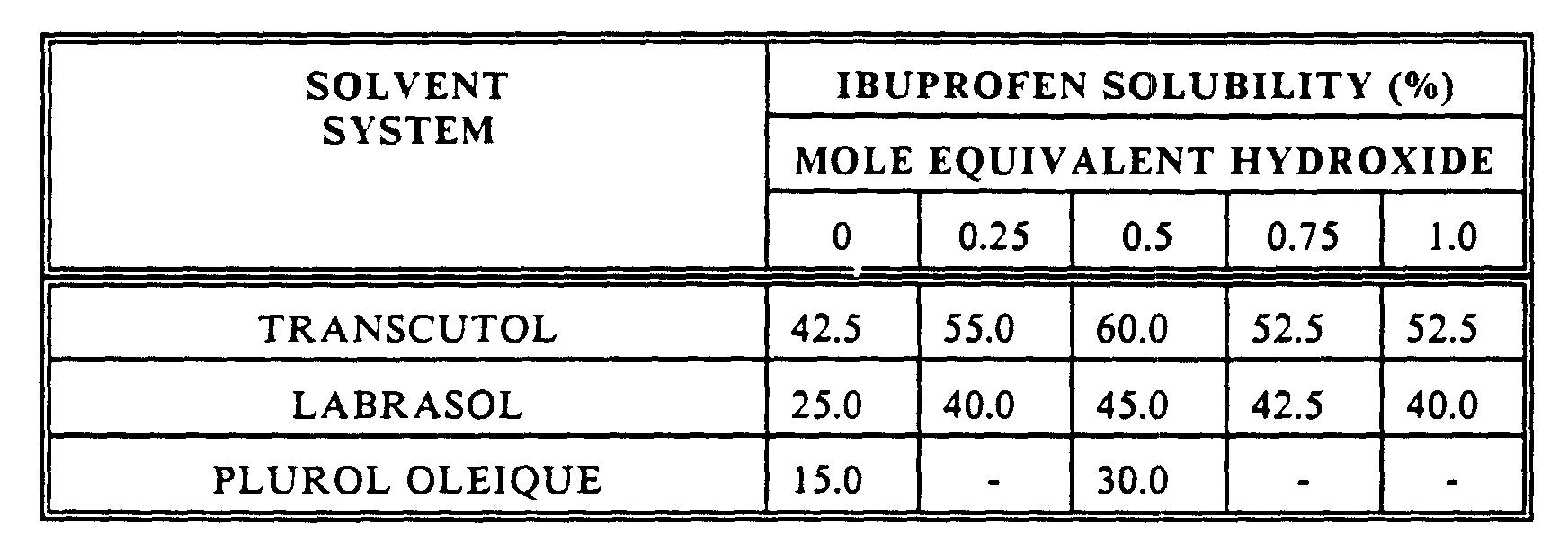
- The following saturated ibuprofen solutions were prepared containing the indicated weight percent of ibuprofen, the indicated solvent system and the indicated amount of potassium hydroxide. In each case, enhanced solubility is shown at all concentrations of the hydroxide species. The solutions are all suitable for filling into soft gelatin capsules.
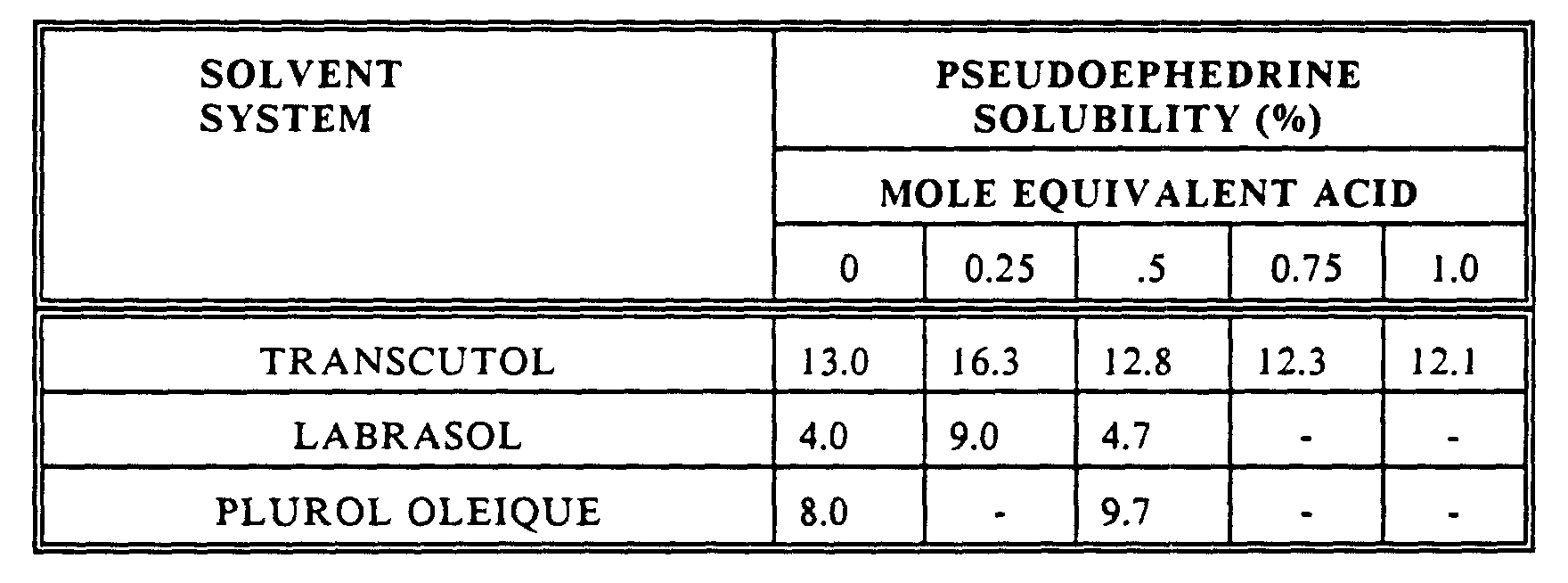
- The following saturated pseudoephedrine solutions were prepared with the indicated of pseudoephedrine in solution, the indicated solvent and the indicated amount of hydrochloric acid. With the exception of the Transcutol formulations containing higher amounts of hydrochloric acid, enhanced solubility was demonstrated for all formulations. These formulations are suitable for filling into soft gelatin capsules.
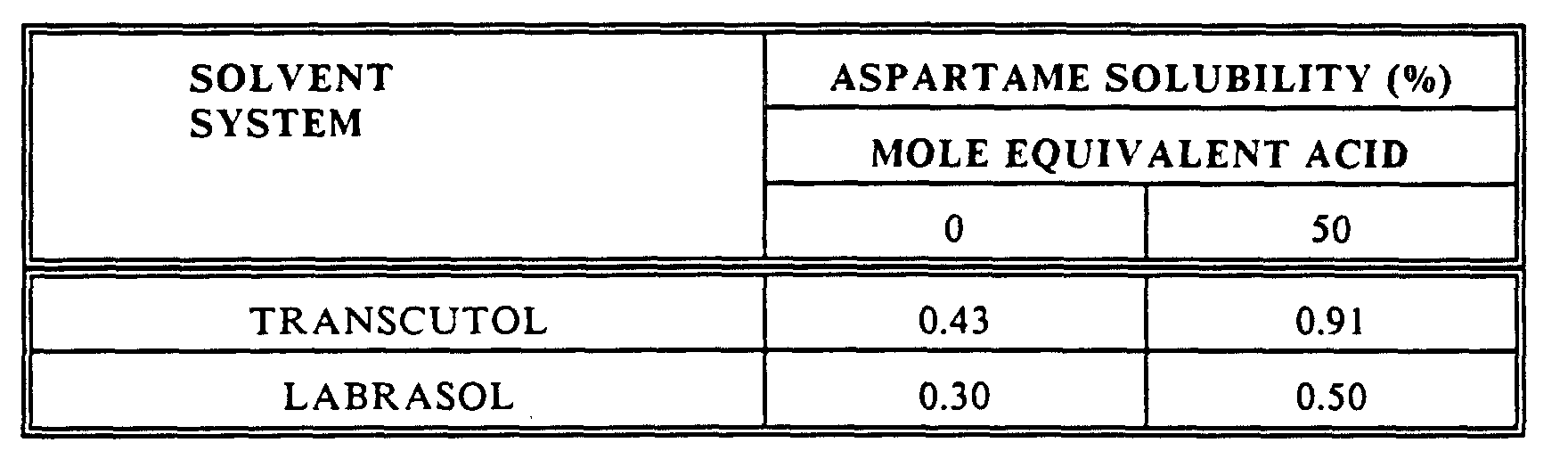
- The following saturated aspartame solutions were prepared, using aspartame as a model of an amphoteric pharmaceutical agent. These solutions contain the indicated amount of aspartame, the indicated solvent and the indicated amount of potassium hydroxide. The aspartame showed enhanced solubility in the presence of the hydroxide species. The solutions were suitable for filling into soft gelatin capsules.

- The following saturated aspartame solutions were made using aspartame for a model for an amphoteric pharmaceutical agent. The solutions contain the indicated amount of aspartame, the indicated solvent and the indicated amount of hydrochloric acid. In each instance, enhanced solubility was noted. These solutions are suitable for filling into soft gelatin capsules.
- The following naproxen solutions were prepared containing the indicated ingredients in mg.
A B Naproxen 250.0 250.0 50% KOH Solution 57.3 57.3 Water 13.4 13.4 Glycerin 54.2 54.2 PEG 600 355.0 355.0 Tween 80 355.0 - Tween 20 - 355.0
Claims (11)
- A pharmaceutically acceptable solution of an acidic pharmaceutical agent suitable for encapsulation in gelatin capsules for subsequent oral administration comprising, the acidic pharmaceutical agent, a hydroxide species and a solvent system, the solvent system consisting essentially of a solvent selected from the group consisting of diethylene glycol monoethyl ether, glycerol caprylate/caprate, polyglycerol oleate, and mixtures thereof, the hydroxide species being capable of dissociating into pharmaceutically acceptable cations and hydroxide ions, the hydroxide species being present in an amount such that hydroxide ions in the range of 0.05 to less than 1.5 moles per mole of acidic groups in the acidic pharmaceutical agent are present in the solution, the hydroxide species partially ionizing the acidic pharmaceutical agent such that the acidic pharmaceutical agent is present in a dissolved state in the solution as both a free acid and a cationic salt in a solubility enhanced amount greater than the maximum solubility of the acidic pharmaceutical agent in the solution in the absence of the hydroxide species.
- A solution according to Claim 1 wherein the hydroxide species is potassium hydroxide.
- A pharmaceutically acceptable solution of a basic pharmaceutical agent suitable for encapsulation in gelatin capsules for subsequent oral administration comprising, the basic pharmaceutical agent, a hydrogen ion species and a solvent system, the solvent system consisting essentially of a solvent selected from the group consisting of diethylene glycol monoethyl ether, glycerol caprylate/caprate, polyglycerol oleate, and mixtures thereof, the hydrogen ion species being capable of dissociating into pharmaceutically acceptable anions and hydrogen ions, the hydrogen ion species being present in an amount such that hydrogen ions in the range 0.05 to less than 1.5 moles per mole of basic groups in the basic pharmaceutical agent are present in the solution, the hydrogen ion species partially ionizing the basic pharmaceutical agent such that the basic pharmaceutical agent is present in a dissolved state in the solution as both a free base and an anionic salt in a solubility enhanced amount greater than the maximum solubility of the basic pharmaceutical agent in the solution in the absence of the hydrogen ion species.
- A solution according to Claim 3 wherein the hydrogen ion species is hydrochloric acid.
- A pharmaceutically acceptable solution of an amphoteric pharmaceutical agent suitable for encapsulation in gelatin capsules for subsequent oral administration comprising, the amphoteric pharmaceutical agent, an ion species selected from the group consisting of cationic hydroxide species and anionic hydrogen ion species, and a solvent system, the solvent system consisting essentially of a solvent selected from the group consisting of diethylene glycol monoethyl ether, glycerol caprylate/caprate, polyglycerol oleate, and mixtures thereof, the ion species being capable of dissociating in the solution into pharmaceutically acceptable ions, the ion species being present in an amount such that 0.05 to less than 1.5 moles of ions selected from the group consisting of hydrogen ions and hydroxide ions per mole of ionizable groups in the amphoteric pharmaceutical agent are present in the solution, the ion species partially ionizing the amphoteric pharmaceutical agent such that the amphoteric pharmaceutical agent is present in a dissolved state in the solution in both free form and as a salt in a solubility enhanced amount greater than the maximum solubility of the amphoteric pharmaceutical agent in the solution in the absence of the ion species.
- A solution according to Claim 5 wherein the ion species is potassium hydroxide or hydrochloric acid.
- A solution according to Claim 1, Claim 3 or Claim 5 wherein the solvent system additionally includes polyethylene glycol.
- A solution according to Claim 1, Claim 3 or Claim 5 additionally comprising from about 1% to about 20% water by weight of the solution.
- A solution according to Claim 1, Claim 3 or Claim 5 additionally comprising glycerin, propylene glycol or polyvinylpyrrolidone.
- A pharmaceutically acceptable solution of an acidic pharmaceutical agent suitable for encapsulation in gelatin capsules for subsequent oral administration comprising, the acidic pharmaceutical agent, a hydroxide species and a solvent system, the solvent system consisting essentially of a solvent selected from the group consisting of diethylene glycol monoethyl ether, glycerol caprylate/caprate, polyglycerol oleate, and mixtures thereof, the hydroxide species being capable of dissociating into pharmaceutically acceptable cations and hydroxide ions, the hydroxide species being present in an amount in the range 0.05 to less than 1.5 moles of hydroxide ions per mole of acidic groups in the acidic pharmaceutical agent in the solution, the hydroxide species ionizing the acidic pharmaceutical agent such that the acidic pharmaceutical agent is present in a dissolved state in the solution.
- A solution according to Claim 10 wherein the acidic pharmaceutical agent is ketoprofen.
Applications Claiming Priority (3)
| Application Number | Priority Date | Filing Date | Title |
|---|---|---|---|
| US993305 | 1992-12-18 | ||
| US07/993,305 US5376688A (en) | 1992-12-18 | 1992-12-18 | Enhanced solubility pharmaceutical solutions |
| PCT/US1993/012346 WO1994014423A1 (en) | 1992-12-18 | 1993-12-15 | Enhanced solubility pharmaceutical solutions |
Publications (2)
| Publication Number | Publication Date |
|---|---|
| EP0678019A1 EP0678019A1 (en) | 1995-10-25 |
| EP0678019B1 true EP0678019B1 (en) | 2001-06-13 |
Family
ID=25539370
Family Applications (1)
| Application Number | Title | Priority Date | Filing Date |
|---|---|---|---|
| EP94904489A Expired - Lifetime EP0678019B1 (en) | 1992-12-18 | 1993-12-15 | Enhanced solubility pharmaceutical solutions |
Country Status (8)
| Country | Link |
|---|---|
| US (1) | US5376688A (en) |
| EP (1) | EP0678019B1 (en) |
| JP (1) | JP3739391B2 (en) |
| AU (1) | AU692431B2 (en) |
| CA (1) | CA2152062C (en) |
| DE (1) | DE69330353T2 (en) |
| ES (1) | ES2157975T3 (en) |
| WO (1) | WO1994014423A1 (en) |
Families Citing this family (58)
| Publication number | Priority date | Publication date | Assignee | Title |
|---|---|---|---|---|
| JP3121080B2 (en) * | 1991-12-19 | 2000-12-25 | アール・ピー・シーラー コーポレイション | Encapsulation solution |
| ES2308955T5 (en) * | 1993-09-28 | 2012-04-03 | R.P. Scherer Gmbh | Manufacture of soft gelatin capsules |
| US6312704B1 (en) * | 1993-09-30 | 2001-11-06 | Gattefosse, S.A. | Orally administrable composition capable of providing enhanced bioavailability when ingested |
| US5468502A (en) * | 1994-12-20 | 1995-11-21 | American Home Products Corporation | Ibuprofen enhancing solvent system |
| US5641512A (en) * | 1995-03-29 | 1997-06-24 | The Procter & Gamble Company | Soft gelatin capsule compositions |
| IT1286778B1 (en) * | 1996-11-20 | 1998-07-17 | Alfa Wassermann Spa | CAPSULES CONTAINING DICLOFENAC OR ITS SALTS IN SOLUTION |
| ES2242273T3 (en) * | 1997-03-03 | 2005-11-01 | Sanofi-Aventis | PHARMACEUTICAL FORMULATIONS CONTAINING DEFICIENTLY SOLUBLE PHARMACEUTICAL SUBSTANCES. |
| NZ502566A (en) | 1997-07-29 | 2002-03-28 | Upjohn Co | Pharmaceutical composition for acidic lipophilic compounds in a form of a self-emulsifying formulation containing a pyranone and a basic amine |
| GB2331458B (en) * | 1997-11-21 | 2002-07-31 | Gursharan Singh Moonga | Solubilising systems for difficult pharmaceutical actives for preparing concentrated stable solutions for encapsulation into soft gelatine |
| US6267985B1 (en) | 1999-06-30 | 2001-07-31 | Lipocine Inc. | Clear oil-containing pharmaceutical compositions |
| US6294192B1 (en) | 1999-02-26 | 2001-09-25 | Lipocine, Inc. | Triglyceride-free compositions and methods for improved delivery of hydrophobic therapeutic agents |
| US6761903B2 (en) | 1999-06-30 | 2004-07-13 | Lipocine, Inc. | Clear oil-containing pharmaceutical compositions containing a therapeutic agent |
| US6383471B1 (en) | 1999-04-06 | 2002-05-07 | Lipocine, Inc. | Compositions and methods for improved delivery of ionizable hydrophobic therapeutic agents |
| US6251426B1 (en) | 1999-09-02 | 2001-06-26 | Banner Pharmacaps, Inc. | Ibuprofen-containing softgels |
| US7732404B2 (en) | 1999-12-30 | 2010-06-08 | Dexcel Ltd | Pro-nanodispersion for the delivery of cyclosporin |
| WO2001078724A1 (en) * | 2000-04-18 | 2001-10-25 | Pharmacia Corporation | Rapid-onset formulation of a selective cyclooxigenase-2 |
| PT1321140E (en) * | 2000-08-25 | 2005-06-30 | Kowa Co | IBUPRHENE SOLUTIONS FOR FILLING CAPSULES AND CAPSULA PREPARATIONS |
| US6387400B1 (en) | 2000-08-29 | 2002-05-14 | R.P. Scherer Technologies, Inc. | Process for preparing pharmaceutical compositions for use with soft gelatin formulations |
| AU2002244865A1 (en) * | 2001-03-02 | 2002-09-19 | Dr. Reddy's Laboratories Ltd. | Pharmaceutical composition of ibuprofen |
| US20030034458A1 (en) * | 2001-03-30 | 2003-02-20 | Fuji Photo Film Co., Ltd. | Radiation image storage panel |
| EP1269994A3 (en) * | 2001-06-22 | 2003-02-12 | Pfizer Products Inc. | Pharmaceutical compositions comprising drug and concentration-enhancing polymers |
| US6828301B2 (en) * | 2002-02-07 | 2004-12-07 | Boehringer Ingelheim International Gmbh | Pharmaceutical compositions for hepatitis C viral protease inhibitors |
| EP1344523A1 (en) | 2002-03-11 | 2003-09-17 | Warner-Lambert Company | Ibuprofen solution for hard gelatin capsules |
| EP1496873B2 (en) | 2002-04-25 | 2011-08-10 | Banner Pharmacaps, Inc. | Chewable soft capsule |
| US20030232097A1 (en) * | 2002-06-17 | 2003-12-18 | Strides Inc. | Oily wax matrix suspension formulation comprising ibuprofen free acid and potassium salt of ibuprofen |
| US20060241175A1 (en) * | 2002-09-27 | 2006-10-26 | Joseph Schwarz | Vehicle for topical delivery of anti-inflammatory compounds |
| US7138394B2 (en) * | 2002-09-27 | 2006-11-21 | Alpharx Inc. | Vehicle for topical delivery of anti-inflammatory compounds |
| US20040146537A1 (en) * | 2003-01-28 | 2004-07-29 | Ramachandran Radhakrishnan | Oily wax matrix suspension formulation comprising pharmacologically active agents |
| JP2006514119A (en) * | 2003-02-12 | 2006-04-27 | アール アンド ピー コリア カンパニー リミテッド | Solvent system of poorly soluble drugs with improved dissolution rate |
| US20090318558A1 (en) * | 2003-02-12 | 2009-12-24 | Jae-Hwan Kim | Solvent system of hardly soluble drug with improved dissolution rate |
| EP1684732A2 (en) * | 2003-11-12 | 2006-08-02 | Ranbaxy Laboratories Limited | Ibuprofen-containing soft gelatin capsules |
| US20050137262A1 (en) * | 2003-12-22 | 2005-06-23 | Hu Patrick C. | Highly concentrated pourable aqueous solutions of potassium ibuprofen, their preparation and their uses |
| WO2005063219A2 (en) * | 2003-12-23 | 2005-07-14 | Ranbaxy Laboratories Limited | Ibuprofen-containing soft gelatin capsules |
| US20050142185A1 (en) * | 2003-12-29 | 2005-06-30 | Beleno Alfredo B. | Softgel formulations of bisphosphonates bone resorption inhibitors |
| US20050152968A1 (en) * | 2004-01-09 | 2005-07-14 | Brophy Kristine M. | Microemulsions for pharmaceutical compositions |
| WO2005123133A1 (en) * | 2004-06-18 | 2005-12-29 | Ranbaxy Laboratories Limited | A process for preparing ibuprofen soft gelatin capsules |
| US20080171687A1 (en) * | 2004-09-16 | 2008-07-17 | Abraxis Bioscience, Inc. | Compositions And Methods For The Preparation And Administration Of Poorly Water Soluble Drugs |
| US8231896B2 (en) * | 2004-11-08 | 2012-07-31 | R.P. Scherer Technologies, Llc | Non-gelatin soft capsule system |
| BRPI0617258A2 (en) * | 2005-09-19 | 2011-07-19 | Albemarle Corparation | highly concentrated aqueous solution of potassium ibuprofen, their preparations and their uses |
| US7582679B2 (en) * | 2006-02-03 | 2009-09-01 | Pharmaceutics International Incorporated | Compositions containing solid ibuprofen concentrates and methods of making solid ibuprofen concentrates |
| US20100041644A1 (en) * | 2006-11-28 | 2010-02-18 | Laboratorios Liconsa, S. A. | Stabilized solid pharmaceutical composition of candesartan cilexetil |
| WO2009069139A1 (en) * | 2007-11-28 | 2009-06-04 | Alkem Laboratories Ltd. | Dosage form providing an ibuprofen-containing liquid fill |
| US9629809B2 (en) | 2008-07-21 | 2017-04-25 | Si Group, Inc. | High content sodium ibuprofen granules, their preparation and their use in preparing non-effervescent solid dosage forms |
| MX337488B (en) | 2008-07-21 | 2016-03-08 | Si Group Inc | GRANULES WITH HIGH CONTENT OF SODIUM IBUPROPHEN, ITS PREPARATION AND ITS USE IN PREPARING NON-EFFECTIVE SOLID DOSAGE FORMS. |
| US11304960B2 (en) | 2009-01-08 | 2022-04-19 | Chandrashekar Giliyar | Steroidal compositions |
| US9358241B2 (en) | 2010-11-30 | 2016-06-07 | Lipocine Inc. | High-strength testosterone undecanoate compositions |
| US9034858B2 (en) | 2010-11-30 | 2015-05-19 | Lipocine Inc. | High-strength testosterone undecanoate compositions |
| US20180153904A1 (en) | 2010-11-30 | 2018-06-07 | Lipocine Inc. | High-strength testosterone undecanoate compositions |
| US20120148675A1 (en) | 2010-12-10 | 2012-06-14 | Basawaraj Chickmath | Testosterone undecanoate compositions |
| US9498485B2 (en) | 2014-08-28 | 2016-11-22 | Lipocine Inc. | Bioavailable solid state (17-β)-hydroxy-4-androsten-3-one esters |
| US20170246187A1 (en) | 2014-08-28 | 2017-08-31 | Lipocine Inc. | (17-ß)-3-OXOANDROST-4-EN-17-YL TRIDECANOATE COMPOSITIONS AND METHODS OF THEIR PREPARATION AND USE |
| US20160361322A1 (en) | 2015-06-15 | 2016-12-15 | Lipocine Inc. | Composition and method for oral delivery of androgen prodrugs |
| US20180147215A1 (en) | 2016-11-28 | 2018-05-31 | Lipocine Inc. | Oral testosterone undecanoate therapy |
| WO2019224832A1 (en) | 2018-05-25 | 2019-11-28 | Strides Shasun Limited | Process for preparing pharmaceutical compositions resulting in reduction in overall fill volume for use with soft gelatin formulations |
| US12150945B2 (en) | 2018-07-20 | 2024-11-26 | Lipocine Inc. | Liver disease |
| GB2595301B (en) | 2020-05-21 | 2025-01-08 | Reckitt Benckiser Health Ltd | Novel Formulation |
| GB2595300B (en) | 2020-05-21 | 2024-03-27 | Reckitt Benckiser Health Ltd | Novel Formulation |
| GB2595453B (en) | 2020-05-21 | 2024-04-03 | Reckitt Benckiser Health Ltd | Novel Formulation |
Family Cites Families (8)
| Publication number | Priority date | Publication date | Assignee | Title |
|---|---|---|---|---|
| US4188373A (en) * | 1976-02-26 | 1980-02-12 | Cooper Laboratories, Inc. | Clear, water-miscible, liquid pharmaceutical vehicles and compositions which gel at body temperature for drug delivery to mucous membranes |
| GB8305693D0 (en) * | 1983-03-02 | 1983-04-07 | Scherer Ltd R P | Pharmaceutical compositions |
| DE3307353C2 (en) * | 1983-03-02 | 1985-01-31 | R.P. Scherer GmbH, 6930 Eberbach | Soft gelatin capsule containing polyethylene glycol and process for their production |
| DE3629386A1 (en) * | 1986-08-29 | 1988-03-03 | Scherer Gmbh R P | GELATINE CAPSULES AND METHOD FOR THEIR PRODUCTION |
| US5071643A (en) * | 1986-10-17 | 1991-12-10 | R. P. Scherer Corporation | Solvent system enhancing the solubility of pharmaceuticals for encapsulation |
| US5141961A (en) * | 1991-06-27 | 1992-08-25 | Richrdson-Vicks Inc. | Process for solubilizing difficulty soluble pharmaceutical actives |
| JPH0525037A (en) * | 1991-07-01 | 1993-02-02 | Upjohn Co:The | Oral administrative enzyme sensitive enteric coating |
| US5200191A (en) * | 1991-09-11 | 1993-04-06 | Banner Gelatin Products Corp. | Softgel manufacturing process |
-
1992
- 1992-12-18 US US07/993,305 patent/US5376688A/en not_active Expired - Lifetime
-
1993
- 1993-12-15 AU AU58518/94A patent/AU692431B2/en not_active Ceased
- 1993-12-15 DE DE69330353T patent/DE69330353T2/en not_active Expired - Lifetime
- 1993-12-15 CA CA002152062A patent/CA2152062C/en not_active Expired - Fee Related
- 1993-12-15 ES ES94904489T patent/ES2157975T3/en not_active Expired - Lifetime
- 1993-12-15 EP EP94904489A patent/EP0678019B1/en not_active Expired - Lifetime
- 1993-12-15 JP JP51533194A patent/JP3739391B2/en not_active Expired - Fee Related
- 1993-12-15 WO PCT/US1993/012346 patent/WO1994014423A1/en not_active Ceased
Also Published As
| Publication number | Publication date |
|---|---|
| DE69330353T2 (en) | 2002-05-02 |
| JP3739391B2 (en) | 2006-01-25 |
| WO1994014423A1 (en) | 1994-07-07 |
| CA2152062A1 (en) | 1994-07-07 |
| EP0678019A1 (en) | 1995-10-25 |
| JPH08507494A (en) | 1996-08-13 |
| ES2157975T3 (en) | 2001-09-01 |
| DE69330353D1 (en) | 2001-07-19 |
| US5376688A (en) | 1994-12-27 |
| CA2152062C (en) | 1999-01-05 |
| AU692431B2 (en) | 1998-06-11 |
| AU5851894A (en) | 1994-07-19 |
Similar Documents
| Publication | Publication Date | Title |
|---|---|---|
| AU692431B2 (en) | Enhanced solubility pharmaceutical solutions | |
| CA2103793C (en) | Solvent system to be enclosed in capsules | |
| JP3678745B2 (en) | Gelatin capsule containing high concentration acetaminophen solution | |
| US5284657A (en) | Compositions and methods for the sublingual or buccal administration of therapeutic agents | |
| JP2564477B2 (en) | Amphoteric drug solution for softgel filling or two-piece encapsulation or tablet manufacturing | |
| WO2009066146A2 (en) | Stable solutions of sparingly soluble actives | |
| EP0184942A2 (en) | Improved pharmaceutical composition containing 13-CIS vitamin a acid as the active ingredient | |
| WO1995031979A1 (en) | Solutions of aryl or heteroaryl substituted alkanoic acids in lipophilic solvents and soft gelatin capsules containing such solutions | |
| KR20030041982A (en) | Process for preparing pharmaceutical compositions for use with soft gelatin formulations | |
| WO2000030619A1 (en) | Self-emulsifying ibuprofen solution and soft gelatin capsule for use therewith | |
| JP2003505419A (en) | Ophthalmic composition containing ketotifen | |
| EP0010437B1 (en) | Stable erythromycin solution and process therefor | |
| US6383515B2 (en) | Solvent system for enhancing solubility | |
| JPH0717498B2 (en) | Antitussive expectorant soft capsule | |
| JPH01102031A (en) | Calsitonin-containing medicinal composition | |
| JP2002205942A (en) | Topical composition | |
| JPS5750914A (en) | Betamethasone external pharmaceutical | |
| Ivey et al. | Effect of carbenoxolone on the gastric mucosal barrier in man after administration of taurocholic acid | |
| KR100425900B1 (en) | Immediate-release soft capsule containing a highly concentrated and transparent solution of ibuprofen | |
| Knudsen et al. | Protection of guinea pigs against local and systemic foot-and-mouth disease after administration of synthetic lipid amine (Avridine) liposomes | |
| JPH10316568A (en) | Pharmaceutical composition | |
| EP0574822A1 (en) | Pharmaceutical soft capsules containing lysin clonixinate and method to produce them | |
| SU1827797A3 (en) | Medicinal preparation for eye anesthesia | |
| WO2019224832A1 (en) | Process for preparing pharmaceutical compositions resulting in reduction in overall fill volume for use with soft gelatin formulations |
Legal Events
| Date | Code | Title | Description |
|---|---|---|---|
| PUAI | Public reference made under article 153(3) epc to a published international application that has entered the european phase |
Free format text: ORIGINAL CODE: 0009012 |
|
| 17P | Request for examination filed |
Effective date: 19950711 |
|
| AK | Designated contracting states |
Kind code of ref document: A1 Designated state(s): CH DE ES FR GB IT LI NL |
|
| 17Q | First examination report despatched |
Effective date: 19980928 |
|
| RAP1 | Party data changed (applicant data changed or rights of an application transferred) |
Owner name: R.P. SCHERER TECHNOLOGIES, INC. |
|
| GRAG | Despatch of communication of intention to grant |
Free format text: ORIGINAL CODE: EPIDOS AGRA |
|
| GRAG | Despatch of communication of intention to grant |
Free format text: ORIGINAL CODE: EPIDOS AGRA |
|
| GRAH | Despatch of communication of intention to grant a patent |
Free format text: ORIGINAL CODE: EPIDOS IGRA |
|
| GRAH | Despatch of communication of intention to grant a patent |
Free format text: ORIGINAL CODE: EPIDOS IGRA |
|
| GRAA | (expected) grant |
Free format text: ORIGINAL CODE: 0009210 |
|
| AK | Designated contracting states |
Kind code of ref document: B1 Designated state(s): CH DE ES FR GB IT LI NL |
|
| PG25 | Lapsed in a contracting state [announced via postgrant information from national office to epo] |
Ref country code: NL Free format text: LAPSE BECAUSE OF FAILURE TO SUBMIT A TRANSLATION OF THE DESCRIPTION OR TO PAY THE FEE WITHIN THE PRESCRIBED TIME-LIMIT Effective date: 20010613 Ref country code: LI Free format text: LAPSE BECAUSE OF FAILURE TO SUBMIT A TRANSLATION OF THE DESCRIPTION OR TO PAY THE FEE WITHIN THE PRESCRIBED TIME-LIMIT Effective date: 20010613 Ref country code: CH Free format text: LAPSE BECAUSE OF FAILURE TO SUBMIT A TRANSLATION OF THE DESCRIPTION OR TO PAY THE FEE WITHIN THE PRESCRIBED TIME-LIMIT Effective date: 20010613 |
|
| REF | Corresponds to: |
Ref document number: 69330353 Country of ref document: DE Date of ref document: 20010719 |
|
| ITF | It: translation for a ep patent filed | ||
| REG | Reference to a national code |
Ref country code: ES Ref legal event code: FG2A Ref document number: 2157975 Country of ref document: ES Kind code of ref document: T3 |
|
| ET | Fr: translation filed | ||
| NLV1 | Nl: lapsed or annulled due to failure to fulfill the requirements of art. 29p and 29m of the patents act | ||
| REG | Reference to a national code |
Ref country code: CH Ref legal event code: PL |
|
| REG | Reference to a national code |
Ref country code: GB Ref legal event code: IF02 |
|
| PLBE | No opposition filed within time limit |
Free format text: ORIGINAL CODE: 0009261 |
|
| STAA | Information on the status of an ep patent application or granted ep patent |
Free format text: STATUS: NO OPPOSITION FILED WITHIN TIME LIMIT |
|
| 26N | No opposition filed | ||
| PGFP | Annual fee paid to national office [announced via postgrant information from national office to epo] |
Ref country code: IT Payment date: 20091218 Year of fee payment: 17 Ref country code: GB Payment date: 20091209 Year of fee payment: 17 Ref country code: FR Payment date: 20091221 Year of fee payment: 17 Ref country code: ES Payment date: 20100113 Year of fee payment: 17 |
|
| PGFP | Annual fee paid to national office [announced via postgrant information from national office to epo] |
Ref country code: DE Payment date: 20091222 Year of fee payment: 17 |
|
| GBPC | Gb: european patent ceased through non-payment of renewal fee |
Effective date: 20101215 |
|
| REG | Reference to a national code |
Ref country code: FR Ref legal event code: ST Effective date: 20110831 |
|
| PG25 | Lapsed in a contracting state [announced via postgrant information from national office to epo] |
Ref country code: FR Free format text: LAPSE BECAUSE OF NON-PAYMENT OF DUE FEES Effective date: 20110103 |
|
| REG | Reference to a national code |
Ref country code: DE Ref legal event code: R119 Ref document number: 69330353 Country of ref document: DE Effective date: 20110701 |
|
| PG25 | Lapsed in a contracting state [announced via postgrant information from national office to epo] |
Ref country code: DE Free format text: LAPSE BECAUSE OF NON-PAYMENT OF DUE FEES Effective date: 20110701 Ref country code: GB Free format text: LAPSE BECAUSE OF NON-PAYMENT OF DUE FEES Effective date: 20101215 |
|
| PG25 | Lapsed in a contracting state [announced via postgrant information from national office to epo] |
Ref country code: IT Free format text: LAPSE BECAUSE OF NON-PAYMENT OF DUE FEES Effective date: 20101215 |
|
| REG | Reference to a national code |
Ref country code: ES Ref legal event code: FD2A Effective date: 20120206 |
|
| PG25 | Lapsed in a contracting state [announced via postgrant information from national office to epo] |
Ref country code: ES Free format text: LAPSE BECAUSE OF NON-PAYMENT OF DUE FEES Effective date: 20101216 |