EP0676382B1 - Curatives for phenolic novolacs - Google Patents
Curatives for phenolic novolacs Download PDFInfo
- Publication number
- EP0676382B1 EP0676382B1 EP94307339A EP94307339A EP0676382B1 EP 0676382 B1 EP0676382 B1 EP 0676382B1 EP 94307339 A EP94307339 A EP 94307339A EP 94307339 A EP94307339 A EP 94307339A EP 0676382 B1 EP0676382 B1 EP 0676382B1
- Authority
- EP
- European Patent Office
- Prior art keywords
- resin
- triazine
- composition
- novolac
- weight
- Prior art date
- Legal status (The legal status is an assumption and is not a legal conclusion. Google has not performed a legal analysis and makes no representation as to the accuracy of the status listed.)
- Expired - Lifetime
Links
- 229920003986 novolac Polymers 0.000 title claims abstract description 122
- ISWSIDIOOBJBQZ-UHFFFAOYSA-N phenol group Chemical group C1(=CC=CC=C1)O ISWSIDIOOBJBQZ-UHFFFAOYSA-N 0.000 title claims abstract description 39
- 239000000203 mixture Substances 0.000 claims abstract description 126
- JYEUMXHLPRZUAT-UHFFFAOYSA-N 1,2,3-triazine Chemical compound C1=CN=NN=C1 JYEUMXHLPRZUAT-UHFFFAOYSA-N 0.000 claims abstract description 69
- XLYOFNOQVPJJNP-UHFFFAOYSA-N water Substances O XLYOFNOQVPJJNP-UHFFFAOYSA-N 0.000 claims abstract description 57
- 229920005989 resin Polymers 0.000 claims abstract description 54
- 239000011347 resin Substances 0.000 claims abstract description 54
- 238000000034 method Methods 0.000 claims abstract description 23
- 125000003545 alkoxy group Chemical group 0.000 claims abstract description 22
- 125000004432 carbon atom Chemical group C* 0.000 claims abstract description 19
- 238000012423 maintenance Methods 0.000 claims abstract description 7
- 230000008439 repair process Effects 0.000 claims abstract description 7
- IMTKRLUCQZWPRY-UHFFFAOYSA-N triazine-4-carbaldehyde Chemical compound O=CC1=CC=NN=N1 IMTKRLUCQZWPRY-UHFFFAOYSA-N 0.000 claims abstract description 6
- 229920000877 Melamine resin Polymers 0.000 claims description 70
- 239000004848 polyfunctional curative Substances 0.000 claims description 46
- JDSHMPZPIAZGSV-UHFFFAOYSA-N melamine Chemical compound NC1=NC(N)=NC(N)=N1 JDSHMPZPIAZGSV-UHFFFAOYSA-N 0.000 claims description 44
- WSFSSNUMVMOOMR-UHFFFAOYSA-N Formaldehyde Chemical compound O=C WSFSSNUMVMOOMR-UHFFFAOYSA-N 0.000 claims description 27
- CPLXHLVBOLITMK-UHFFFAOYSA-N Magnesium oxide Chemical compound [Mg]=O CPLXHLVBOLITMK-UHFFFAOYSA-N 0.000 claims description 19
- LYCAIKOWRPUZTN-UHFFFAOYSA-N Ethylene glycol Chemical compound OCCO LYCAIKOWRPUZTN-UHFFFAOYSA-N 0.000 claims description 18
- -1 benzyl alcohol, glycol ethers Chemical class 0.000 claims description 18
- 239000003463 adsorbent Substances 0.000 claims description 17
- 125000004849 alkoxymethyl group Chemical group 0.000 claims description 17
- 125000004184 methoxymethyl group Chemical group [H]C([H])([H])OC([H])([H])* 0.000 claims description 14
- 238000006116 polymerization reaction Methods 0.000 claims description 13
- 239000000843 powder Substances 0.000 claims description 12
- 238000000113 differential scanning calorimetry Methods 0.000 claims description 11
- MTHSVFCYNBDYFN-UHFFFAOYSA-N diethylene glycol Chemical compound OCCOCCO MTHSVFCYNBDYFN-UHFFFAOYSA-N 0.000 claims description 10
- 239000000395 magnesium oxide Substances 0.000 claims description 10
- 229920003987 resole Polymers 0.000 claims description 10
- VYPSYNLAJGMNEJ-UHFFFAOYSA-N Silicium dioxide Chemical compound O=[Si]=O VYPSYNLAJGMNEJ-UHFFFAOYSA-N 0.000 claims description 9
- 239000007921 spray Substances 0.000 claims description 9
- 239000002245 particle Substances 0.000 claims description 7
- 239000002904 solvent Substances 0.000 claims description 7
- PNEYBMLMFCGWSK-UHFFFAOYSA-N aluminium oxide Inorganic materials [O-2].[O-2].[O-2].[Al+3].[Al+3] PNEYBMLMFCGWSK-UHFFFAOYSA-N 0.000 claims description 6
- 229910052500 inorganic mineral Inorganic materials 0.000 claims description 6
- 239000000463 material Substances 0.000 claims description 6
- 239000011707 mineral Substances 0.000 claims description 6
- MSYLJRIXVZCQHW-UHFFFAOYSA-N formaldehyde;6-phenyl-1,3,5-triazine-2,4-diamine Chemical compound O=C.NC1=NC(N)=NC(C=2C=CC=CC=2)=N1 MSYLJRIXVZCQHW-UHFFFAOYSA-N 0.000 claims description 5
- PEDCQBHIVMGVHV-UHFFFAOYSA-N Glycerine Chemical compound OCC(O)CO PEDCQBHIVMGVHV-UHFFFAOYSA-N 0.000 claims description 4
- MCMNRKCIXSYSNV-UHFFFAOYSA-N Zirconium dioxide Chemical compound O=[Zr]=O MCMNRKCIXSYSNV-UHFFFAOYSA-N 0.000 claims description 4
- WGCNASOHLSPBMP-UHFFFAOYSA-N hydroxyacetaldehyde Natural products OCC=O WGCNASOHLSPBMP-UHFFFAOYSA-N 0.000 claims description 4
- 239000005011 phenolic resin Substances 0.000 claims description 4
- 238000003856 thermoforming Methods 0.000 claims description 4
- 229910001570 bauxite Inorganic materials 0.000 claims description 3
- 239000007788 liquid Substances 0.000 claims description 3
- 229920001568 phenolic resin Polymers 0.000 claims description 3
- 238000002360 preparation method Methods 0.000 claims description 3
- VYZAMTAEIAYCRO-UHFFFAOYSA-N Chromium Chemical compound [Cr] VYZAMTAEIAYCRO-UHFFFAOYSA-N 0.000 claims description 2
- INJRKJPEYSAMPD-UHFFFAOYSA-N aluminum;silicic acid;hydrate Chemical compound O.[Al].[Al].O[Si](O)(O)O INJRKJPEYSAMPD-UHFFFAOYSA-N 0.000 claims description 2
- 229910052849 andalusite Inorganic materials 0.000 claims description 2
- BRPQOXSCLDDYGP-UHFFFAOYSA-N calcium oxide Chemical compound [O-2].[Ca+2] BRPQOXSCLDDYGP-UHFFFAOYSA-N 0.000 claims description 2
- 239000000292 calcium oxide Substances 0.000 claims description 2
- ODINCKMPIJJUCX-UHFFFAOYSA-N calcium oxide Inorganic materials [Ca]=O ODINCKMPIJJUCX-UHFFFAOYSA-N 0.000 claims description 2
- KZHJGOXRZJKJNY-UHFFFAOYSA-N dioxosilane;oxo(oxoalumanyloxy)alumane Chemical compound O=[Si]=O.O=[Si]=O.O=[Al]O[Al]=O.O=[Al]O[Al]=O.O=[Al]O[Al]=O KZHJGOXRZJKJNY-UHFFFAOYSA-N 0.000 claims description 2
- 239000010459 dolomite Substances 0.000 claims description 2
- 229910000514 dolomite Inorganic materials 0.000 claims description 2
- 235000011187 glycerol Nutrition 0.000 claims description 2
- 239000010443 kyanite Substances 0.000 claims description 2
- 229910052850 kyanite Inorganic materials 0.000 claims description 2
- 229910052863 mullite Inorganic materials 0.000 claims description 2
- 239000010450 olivine Substances 0.000 claims description 2
- 229910052609 olivine Inorganic materials 0.000 claims description 2
- 238000010079 rubber tapping Methods 0.000 claims description 2
- HBMJWWWQQXIZIP-UHFFFAOYSA-N silicon carbide Chemical compound [Si+]#[C-] HBMJWWWQQXIZIP-UHFFFAOYSA-N 0.000 claims description 2
- 229910010271 silicon carbide Inorganic materials 0.000 claims description 2
- 239000000377 silicon dioxide Substances 0.000 claims description 2
- 229910052596 spinel Inorganic materials 0.000 claims description 2
- 239000011029 spinel Substances 0.000 claims description 2
- 229910052845 zircon Inorganic materials 0.000 claims description 2
- GFQYVLUOOAAOGM-UHFFFAOYSA-N zirconium(iv) silicate Chemical compound [Zr+4].[O-][Si]([O-])([O-])[O-] GFQYVLUOOAAOGM-UHFFFAOYSA-N 0.000 claims description 2
- DNIAPMSPPWPWGF-UHFFFAOYSA-N Propylene glycol Chemical compound CC(O)CO DNIAPMSPPWPWGF-UHFFFAOYSA-N 0.000 claims 6
- KXGFMDJXCMQABM-UHFFFAOYSA-N 2-methoxy-6-methylphenol Chemical compound [CH]OC1=CC=CC([CH])=C1O KXGFMDJXCMQABM-UHFFFAOYSA-N 0.000 claims 2
- 239000002202 Polyethylene glycol Substances 0.000 claims 1
- 239000003960 organic solvent Substances 0.000 claims 1
- 229920001223 polyethylene glycol Polymers 0.000 claims 1
- 235000013772 propylene glycol Nutrition 0.000 claims 1
- 239000011230 binding agent Substances 0.000 abstract description 19
- 238000005507 spraying Methods 0.000 abstract description 18
- 239000003795 chemical substances by application Substances 0.000 abstract description 12
- 238000004519 manufacturing process Methods 0.000 abstract description 8
- 230000002035 prolonged effect Effects 0.000 abstract description 3
- 229920003270 Cymel® Polymers 0.000 description 33
- 239000004640 Melamine resin Substances 0.000 description 21
- 229920003265 Resimene® Polymers 0.000 description 18
- 238000002474 experimental method Methods 0.000 description 18
- 239000007787 solid Substances 0.000 description 16
- OKKJLVBELUTLKV-UHFFFAOYSA-N Methanol Chemical class OC OKKJLVBELUTLKV-UHFFFAOYSA-N 0.000 description 15
- JCCNYMKQOSZNPW-UHFFFAOYSA-N loratadine Chemical compound C1CN(C(=O)OCC)CCC1=C1C2=NC=CC=C2CCC2=CC(Cl)=CC=C21 JCCNYMKQOSZNPW-UHFFFAOYSA-N 0.000 description 10
- 229910052799 carbon Inorganic materials 0.000 description 8
- OKTJSMMVPCPJKN-UHFFFAOYSA-N Carbon Chemical compound [C] OKTJSMMVPCPJKN-UHFFFAOYSA-N 0.000 description 7
- 239000002253 acid Substances 0.000 description 6
- 230000008018 melting Effects 0.000 description 6
- 238000002844 melting Methods 0.000 description 6
- 238000002156 mixing Methods 0.000 description 6
- 150000001299 aldehydes Chemical class 0.000 description 5
- 238000010438 heat treatment Methods 0.000 description 5
- 238000012360 testing method Methods 0.000 description 5
- 238000002411 thermogravimetry Methods 0.000 description 5
- IJGRMHOSHXDMSA-UHFFFAOYSA-N Atomic nitrogen Chemical compound N#N IJGRMHOSHXDMSA-UHFFFAOYSA-N 0.000 description 4
- XZMCDFZZKTWFGF-UHFFFAOYSA-N Cyanamide Chemical compound NC#N XZMCDFZZKTWFGF-UHFFFAOYSA-N 0.000 description 4
- LRHPLDYGYMQRHN-UHFFFAOYSA-N N-Butanol Chemical compound CCCCO LRHPLDYGYMQRHN-UHFFFAOYSA-N 0.000 description 4
- 230000002378 acidificating effect Effects 0.000 description 4
- 150000007513 acids Chemical class 0.000 description 4
- 229910052782 aluminium Inorganic materials 0.000 description 4
- XAGFODPZIPBFFR-UHFFFAOYSA-N aluminium Chemical compound [Al] XAGFODPZIPBFFR-UHFFFAOYSA-N 0.000 description 4
- 239000011449 brick Substances 0.000 description 4
- 230000000694 effects Effects 0.000 description 4
- 239000012530 fluid Substances 0.000 description 4
- VKYKSIONXSXAKP-UHFFFAOYSA-N hexamethylenetetramine Chemical compound C1N(C2)CN3CN1CN2C3 VKYKSIONXSXAKP-UHFFFAOYSA-N 0.000 description 4
- MUBZPKHOEPUJKR-UHFFFAOYSA-N Oxalic acid Chemical compound OC(=O)C(O)=O MUBZPKHOEPUJKR-UHFFFAOYSA-N 0.000 description 3
- 125000000217 alkyl group Chemical group 0.000 description 3
- 150000001721 carbon Chemical group 0.000 description 3
- 239000000356 contaminant Substances 0.000 description 3
- 238000001816 cooling Methods 0.000 description 3
- 230000007423 decrease Effects 0.000 description 3
- 238000001035 drying Methods 0.000 description 3
- 239000000706 filtrate Substances 0.000 description 3
- 239000011521 glass Substances 0.000 description 3
- 239000001257 hydrogen Substances 0.000 description 3
- 229910052739 hydrogen Inorganic materials 0.000 description 3
- 125000004435 hydrogen atom Chemical class [H]* 0.000 description 3
- 238000005470 impregnation Methods 0.000 description 3
- 239000004615 ingredient Substances 0.000 description 3
- 230000008569 process Effects 0.000 description 3
- 239000011819 refractory material Substances 0.000 description 3
- 238000007665 sagging Methods 0.000 description 3
- 239000003039 volatile agent Substances 0.000 description 3
- FYADHXFMURLYQI-UHFFFAOYSA-N 1,2,4-triazine Chemical compound C1=CN=NC=N1 FYADHXFMURLYQI-UHFFFAOYSA-N 0.000 description 2
- VEXZGXHMUGYJMC-UHFFFAOYSA-N Hydrochloric acid Chemical compound Cl VEXZGXHMUGYJMC-UHFFFAOYSA-N 0.000 description 2
- NBIIXXVUZAFLBC-UHFFFAOYSA-N Phosphoric acid Chemical compound OP(O)(O)=O NBIIXXVUZAFLBC-UHFFFAOYSA-N 0.000 description 2
- QAOWNCQODCNURD-UHFFFAOYSA-N Sulfuric acid Chemical compound OS(O)(=O)=O QAOWNCQODCNURD-UHFFFAOYSA-N 0.000 description 2
- 238000010521 absorption reaction Methods 0.000 description 2
- 239000003377 acid catalyst Substances 0.000 description 2
- 239000000654 additive Substances 0.000 description 2
- 230000000996 additive effect Effects 0.000 description 2
- 238000013019 agitation Methods 0.000 description 2
- 125000003277 amino group Chemical group 0.000 description 2
- HUMNYLRZRPPJDN-UHFFFAOYSA-N benzaldehyde Chemical compound O=CC1=CC=CC=C1 HUMNYLRZRPPJDN-UHFFFAOYSA-N 0.000 description 2
- 230000005587 bubbling Effects 0.000 description 2
- 239000000378 calcium silicate Substances 0.000 description 2
- 229910052918 calcium silicate Inorganic materials 0.000 description 2
- OYACROKNLOSFPA-UHFFFAOYSA-N calcium;dioxido(oxo)silane Chemical compound [Ca+2].[O-][Si]([O-])=O OYACROKNLOSFPA-UHFFFAOYSA-N 0.000 description 2
- 238000006243 chemical reaction Methods 0.000 description 2
- 238000004581 coalescence Methods 0.000 description 2
- 239000000571 coke Substances 0.000 description 2
- 239000002270 dispersing agent Substances 0.000 description 2
- 238000001704 evaporation Methods 0.000 description 2
- 230000008020 evaporation Effects 0.000 description 2
- 239000012065 filter cake Substances 0.000 description 2
- HYBBIBNJHNGZAN-UHFFFAOYSA-N furfural Chemical compound O=CC1=CC=CO1 HYBBIBNJHNGZAN-UHFFFAOYSA-N 0.000 description 2
- 239000010439 graphite Substances 0.000 description 2
- 229910002804 graphite Inorganic materials 0.000 description 2
- 239000004312 hexamethylene tetramine Substances 0.000 description 2
- 235000010299 hexamethylene tetramine Nutrition 0.000 description 2
- 229910052757 nitrogen Inorganic materials 0.000 description 2
- IXQGCWUGDFDQMF-UHFFFAOYSA-N o-Hydroxyethylbenzene Natural products CCC1=CC=CC=C1O IXQGCWUGDFDQMF-UHFFFAOYSA-N 0.000 description 2
- 239000003921 oil Substances 0.000 description 2
- 239000002006 petroleum coke Substances 0.000 description 2
- 239000011148 porous material Substances 0.000 description 2
- 238000012545 processing Methods 0.000 description 2
- 239000002002 slurry Substances 0.000 description 2
- 239000000126 substance Substances 0.000 description 2
- 238000006467 substitution reaction Methods 0.000 description 2
- LKLLNYWECKEQIB-UHFFFAOYSA-N 1,3,5-triazinane Chemical class C1NCNCN1 LKLLNYWECKEQIB-UHFFFAOYSA-N 0.000 description 1
- SQAINHDHICKHLX-UHFFFAOYSA-N 1-naphthaldehyde Chemical class C1=CC=C2C(C=O)=CC=CC2=C1 SQAINHDHICKHLX-UHFFFAOYSA-N 0.000 description 1
- LCHYEKKJCUJAKN-UHFFFAOYSA-N 2-propylphenol Chemical compound CCCC1=CC=CC=C1O LCHYEKKJCUJAKN-UHFFFAOYSA-N 0.000 description 1
- GZVHEAJQGPRDLQ-UHFFFAOYSA-N 6-phenyl-1,3,5-triazine-2,4-diamine Chemical group NC1=NC(N)=NC(C=2C=CC=CC=2)=N1 GZVHEAJQGPRDLQ-UHFFFAOYSA-N 0.000 description 1
- OYPRJOBELJOOCE-UHFFFAOYSA-N Calcium Chemical compound [Ca] OYPRJOBELJOOCE-UHFFFAOYSA-N 0.000 description 1
- DGAQECJNVWCQMB-PUAWFVPOSA-M Ilexoside XXIX Chemical compound C[C@@H]1CC[C@@]2(CC[C@@]3(C(=CC[C@H]4[C@]3(CC[C@@H]5[C@@]4(CC[C@@H](C5(C)C)OS(=O)(=O)[O-])C)C)[C@@H]2[C@]1(C)O)C)C(=O)O[C@H]6[C@@H]([C@H]([C@@H]([C@H](O6)CO)O)O)O.[Na+] DGAQECJNVWCQMB-PUAWFVPOSA-M 0.000 description 1
- WHXSMMKQMYFTQS-UHFFFAOYSA-N Lithium Chemical compound [Li] WHXSMMKQMYFTQS-UHFFFAOYSA-N 0.000 description 1
- VVQNEPGJFQJSBK-UHFFFAOYSA-N Methyl methacrylate Chemical compound COC(=O)C(C)=C VVQNEPGJFQJSBK-UHFFFAOYSA-N 0.000 description 1
- 229920005372 Plexiglas® Polymers 0.000 description 1
- ZLMJMSJWJFRBEC-UHFFFAOYSA-N Potassium Chemical compound [K] ZLMJMSJWJFRBEC-UHFFFAOYSA-N 0.000 description 1
- XUIMIQQOPSSXEZ-UHFFFAOYSA-N Silicon Chemical compound [Si] XUIMIQQOPSSXEZ-UHFFFAOYSA-N 0.000 description 1
- FKNQFGJONOIPTF-UHFFFAOYSA-N Sodium cation Chemical compound [Na+] FKNQFGJONOIPTF-UHFFFAOYSA-N 0.000 description 1
- CSIYEPLOFBQQOZ-MYVZEITOSA-N [(3s,5s,6r,8r,9s,10r,13s,14s)-10-(deuteriomethyl)-6-hydroxy-13-methyl-17-oxo-1,2,3,4,5,6,7,8,9,11,12,14,15,16-tetradecahydrocyclopenta[a]phenanthren-3-yl] acetate Chemical compound C([C@]1(C)C(=O)CC[C@H]1[C@@H]1C[C@H]2O)C[C@@H]1[C@]1(C[2H])[C@@H]2C[C@@H](OC(C)=O)CC1 CSIYEPLOFBQQOZ-MYVZEITOSA-N 0.000 description 1
- YKTSYUJCYHOUJP-UHFFFAOYSA-N [O--].[Al+3].[Al+3].[O-][Si]([O-])([O-])[O-] Chemical compound [O--].[Al+3].[Al+3].[O-][Si]([O-])([O-])[O-] YKTSYUJCYHOUJP-UHFFFAOYSA-N 0.000 description 1
- YGCOKJWKWLYHTG-UHFFFAOYSA-N [[4,6-bis[bis(hydroxymethyl)amino]-1,3,5-triazin-2-yl]-(hydroxymethyl)amino]methanol Chemical compound OCN(CO)C1=NC(N(CO)CO)=NC(N(CO)CO)=N1 YGCOKJWKWLYHTG-UHFFFAOYSA-N 0.000 description 1
- 230000001133 acceleration Effects 0.000 description 1
- IKHGUXGNUITLKF-XPULMUKRSA-N acetaldehyde Chemical compound [14CH]([14CH3])=O IKHGUXGNUITLKF-XPULMUKRSA-N 0.000 description 1
- ZOIORXHNWRGPMV-UHFFFAOYSA-N acetic acid;zinc Chemical compound [Zn].CC(O)=O.CC(O)=O ZOIORXHNWRGPMV-UHFFFAOYSA-N 0.000 description 1
- 230000009471 action Effects 0.000 description 1
- 238000004220 aggregation Methods 0.000 description 1
- 230000002776 aggregation Effects 0.000 description 1
- 230000001476 alcoholic effect Effects 0.000 description 1
- 229910000147 aluminium phosphate Inorganic materials 0.000 description 1
- 229910000323 aluminium silicate Inorganic materials 0.000 description 1
- RHZUVFJBSILHOK-UHFFFAOYSA-N anthracen-1-ylmethanolate Chemical compound C1=CC=C2C=C3C(C[O-])=CC=CC3=CC2=C1 RHZUVFJBSILHOK-UHFFFAOYSA-N 0.000 description 1
- 239000003830 anthracite Substances 0.000 description 1
- QVGXLLKOCUKJST-UHFFFAOYSA-N atomic oxygen Chemical compound [O] QVGXLLKOCUKJST-UHFFFAOYSA-N 0.000 description 1
- 238000009835 boiling Methods 0.000 description 1
- 210000000988 bone and bone Anatomy 0.000 description 1
- 239000011575 calcium Substances 0.000 description 1
- 229910052791 calcium Inorganic materials 0.000 description 1
- 238000010000 carbonizing Methods 0.000 description 1
- 230000008859 change Effects 0.000 description 1
- OEYIOHPDSNJKLS-UHFFFAOYSA-N choline Chemical compound C[N+](C)(C)CCO OEYIOHPDSNJKLS-UHFFFAOYSA-N 0.000 description 1
- 229960001231 choline Drugs 0.000 description 1
- 239000004927 clay Substances 0.000 description 1
- 239000012230 colorless oil Substances 0.000 description 1
- 239000002131 composite material Substances 0.000 description 1
- 150000001875 compounds Chemical class 0.000 description 1
- 230000007797 corrosion Effects 0.000 description 1
- 238000005260 corrosion Methods 0.000 description 1
- 239000006071 cream Substances 0.000 description 1
- 229930003836 cresol Natural products 0.000 description 1
- 125000000853 cresyl group Chemical group C1(=CC=C(C=C1)C)* 0.000 description 1
- 230000007812 deficiency Effects 0.000 description 1
- 239000008367 deionised water Substances 0.000 description 1
- 230000006866 deterioration Effects 0.000 description 1
- 230000003292 diminished effect Effects 0.000 description 1
- 239000000284 extract Substances 0.000 description 1
- 239000012632 extractable Substances 0.000 description 1
- 238000000605 extraction Methods 0.000 description 1
- 238000011049 filling Methods 0.000 description 1
- 239000011888 foil Substances 0.000 description 1
- IVJISJACKSSFGE-UHFFFAOYSA-N formaldehyde;1,3,5-triazine-2,4,6-triamine Chemical compound O=C.NC1=NC(N)=NC(N)=N1 IVJISJACKSSFGE-UHFFFAOYSA-N 0.000 description 1
- 229910021485 fumed silica Inorganic materials 0.000 description 1
- 239000000499 gel Substances 0.000 description 1
- 239000000383 hazardous chemical Substances 0.000 description 1
- 238000006703 hydration reaction Methods 0.000 description 1
- CBOIHMRHGLHBPB-UHFFFAOYSA-N hydroxymethyl Chemical group O[CH2] CBOIHMRHGLHBPB-UHFFFAOYSA-N 0.000 description 1
- 229910052738 indium Inorganic materials 0.000 description 1
- APFVFJFRJDLVQX-UHFFFAOYSA-N indium atom Chemical compound [In] APFVFJFRJDLVQX-UHFFFAOYSA-N 0.000 description 1
- 229910052744 lithium Inorganic materials 0.000 description 1
- 230000007774 longterm Effects 0.000 description 1
- VTHJTEIRLNZDEV-UHFFFAOYSA-L magnesium dihydroxide Chemical compound [OH-].[OH-].[Mg+2] VTHJTEIRLNZDEV-UHFFFAOYSA-L 0.000 description 1
- 239000000347 magnesium hydroxide Substances 0.000 description 1
- 229910001862 magnesium hydroxide Inorganic materials 0.000 description 1
- HCWCAKKEBCNQJP-UHFFFAOYSA-N magnesium orthosilicate Chemical compound [Mg+2].[Mg+2].[O-][Si]([O-])([O-])[O-] HCWCAKKEBCNQJP-UHFFFAOYSA-N 0.000 description 1
- 239000000391 magnesium silicate Substances 0.000 description 1
- 229910052919 magnesium silicate Inorganic materials 0.000 description 1
- 235000019792 magnesium silicate Nutrition 0.000 description 1
- AXZKOIWUVFPNLO-UHFFFAOYSA-N magnesium;oxygen(2-) Chemical compound [O-2].[Mg+2] AXZKOIWUVFPNLO-UHFFFAOYSA-N 0.000 description 1
- 238000003760 magnetic stirring Methods 0.000 description 1
- 239000011159 matrix material Substances 0.000 description 1
- 229910052751 metal Inorganic materials 0.000 description 1
- 239000002184 metal Substances 0.000 description 1
- VNWKTOKETHGBQD-UHFFFAOYSA-N methane Chemical compound C VNWKTOKETHGBQD-UHFFFAOYSA-N 0.000 description 1
- WSFSSNUMVMOOMR-NJFSPNSNSA-N methanone Chemical compound O=[14CH2] WSFSSNUMVMOOMR-NJFSPNSNSA-N 0.000 description 1
- 238000000465 moulding Methods 0.000 description 1
- 150000007524 organic acids Chemical class 0.000 description 1
- 235000006408 oxalic acid Nutrition 0.000 description 1
- 239000001301 oxygen Substances 0.000 description 1
- 229910052760 oxygen Inorganic materials 0.000 description 1
- QNGNSVIICDLXHT-UHFFFAOYSA-N para-ethylbenzaldehyde Natural products CCC1=CC=C(C=O)C=C1 QNGNSVIICDLXHT-UHFFFAOYSA-N 0.000 description 1
- 150000002989 phenols Chemical class 0.000 description 1
- 239000002694 phosphate binding agent Substances 0.000 description 1
- 239000011591 potassium Substances 0.000 description 1
- 229910052700 potassium Inorganic materials 0.000 description 1
- 125000001453 quaternary ammonium group Chemical group 0.000 description 1
- 238000003303 reheating Methods 0.000 description 1
- 150000003839 salts Chemical class 0.000 description 1
- 125000000467 secondary amino group Chemical group [H]N([*:1])[*:2] 0.000 description 1
- 229910002027 silica gel Inorganic materials 0.000 description 1
- 239000000741 silica gel Substances 0.000 description 1
- 229910052710 silicon Inorganic materials 0.000 description 1
- 239000010703 silicon Substances 0.000 description 1
- 239000011734 sodium Substances 0.000 description 1
- 229910052708 sodium Inorganic materials 0.000 description 1
- 229910001415 sodium ion Inorganic materials 0.000 description 1
- 239000008247 solid mixture Substances 0.000 description 1
- 238000007711 solidification Methods 0.000 description 1
- 230000008023 solidification Effects 0.000 description 1
- 238000001179 sorption measurement Methods 0.000 description 1
- 238000003756 stirring Methods 0.000 description 1
- 238000003860 storage Methods 0.000 description 1
- 238000013517 stratification Methods 0.000 description 1
- 239000000375 suspending agent Substances 0.000 description 1
- 239000006188 syrup Substances 0.000 description 1
- 235000020357 syrup Nutrition 0.000 description 1
- QEMXHQIAXOOASZ-UHFFFAOYSA-N tetramethylammonium Chemical compound C[N+](C)(C)C QEMXHQIAXOOASZ-UHFFFAOYSA-N 0.000 description 1
- 229920001187 thermosetting polymer Polymers 0.000 description 1
- JOXIMZWYDAKGHI-UHFFFAOYSA-N toluene-4-sulfonic acid Chemical compound CC1=CC=C(S(O)(=O)=O)C=C1 JOXIMZWYDAKGHI-UHFFFAOYSA-N 0.000 description 1
- ZIBGPFATKBEMQZ-UHFFFAOYSA-N triethylene glycol Chemical compound OCCOCCOCCO ZIBGPFATKBEMQZ-UHFFFAOYSA-N 0.000 description 1
- BIKXLKXABVUSMH-UHFFFAOYSA-N trizinc;diborate Chemical compound [Zn+2].[Zn+2].[Zn+2].[O-]B([O-])[O-].[O-]B([O-])[O-] BIKXLKXABVUSMH-UHFFFAOYSA-N 0.000 description 1
- 238000003809 water extraction Methods 0.000 description 1
- 150000003739 xylenols Chemical group 0.000 description 1
- 239000004246 zinc acetate Substances 0.000 description 1
Images


Classifications
-
- C—CHEMISTRY; METALLURGY
- C04—CEMENTS; CONCRETE; ARTIFICIAL STONE; CERAMICS; REFRACTORIES
- C04B—LIME, MAGNESIA; SLAG; CEMENTS; COMPOSITIONS THEREOF, e.g. MORTARS, CONCRETE OR LIKE BUILDING MATERIALS; ARTIFICIAL STONE; CERAMICS; REFRACTORIES; TREATMENT OF NATURAL STONE
- C04B35/00—Shaped ceramic products characterised by their composition; Ceramics compositions; Processing powders of inorganic compounds preparatory to the manufacturing of ceramic products
- C04B35/622—Forming processes; Processing powders of inorganic compounds preparatory to the manufacturing of ceramic products
- C04B35/626—Preparing or treating the powders individually or as batches ; preparing or treating macroscopic reinforcing agents for ceramic products, e.g. fibres; mechanical aspects section B
- C04B35/63—Preparing or treating the powders individually or as batches ; preparing or treating macroscopic reinforcing agents for ceramic products, e.g. fibres; mechanical aspects section B using additives specially adapted for forming the products, e.g.. binder binders
- C04B35/632—Organic additives
- C04B35/634—Polymers
- C04B35/63448—Polymers obtained otherwise than by reactions only involving carbon-to-carbon unsaturated bonds
- C04B35/63472—Condensation polymers of aldehydes or ketones
- C04B35/63476—Phenol-formaldehyde condensation polymers
-
- C—CHEMISTRY; METALLURGY
- C04—CEMENTS; CONCRETE; ARTIFICIAL STONE; CERAMICS; REFRACTORIES
- C04B—LIME, MAGNESIA; SLAG; CEMENTS; COMPOSITIONS THEREOF, e.g. MORTARS, CONCRETE OR LIKE BUILDING MATERIALS; ARTIFICIAL STONE; CERAMICS; REFRACTORIES; TREATMENT OF NATURAL STONE
- C04B35/00—Shaped ceramic products characterised by their composition; Ceramics compositions; Processing powders of inorganic compounds preparatory to the manufacturing of ceramic products
- C04B35/622—Forming processes; Processing powders of inorganic compounds preparatory to the manufacturing of ceramic products
- C04B35/626—Preparing or treating the powders individually or as batches ; preparing or treating macroscopic reinforcing agents for ceramic products, e.g. fibres; mechanical aspects section B
- C04B35/63—Preparing or treating the powders individually or as batches ; preparing or treating macroscopic reinforcing agents for ceramic products, e.g. fibres; mechanical aspects section B using additives specially adapted for forming the products, e.g.. binder binders
- C04B35/632—Organic additives
- C04B35/634—Polymers
-
- C—CHEMISTRY; METALLURGY
- C04—CEMENTS; CONCRETE; ARTIFICIAL STONE; CERAMICS; REFRACTORIES
- C04B—LIME, MAGNESIA; SLAG; CEMENTS; COMPOSITIONS THEREOF, e.g. MORTARS, CONCRETE OR LIKE BUILDING MATERIALS; ARTIFICIAL STONE; CERAMICS; REFRACTORIES; TREATMENT OF NATURAL STONE
- C04B35/00—Shaped ceramic products characterised by their composition; Ceramics compositions; Processing powders of inorganic compounds preparatory to the manufacturing of ceramic products
- C04B35/622—Forming processes; Processing powders of inorganic compounds preparatory to the manufacturing of ceramic products
- C04B35/626—Preparing or treating the powders individually or as batches ; preparing or treating macroscopic reinforcing agents for ceramic products, e.g. fibres; mechanical aspects section B
- C04B35/63—Preparing or treating the powders individually or as batches ; preparing or treating macroscopic reinforcing agents for ceramic products, e.g. fibres; mechanical aspects section B using additives specially adapted for forming the products, e.g.. binder binders
- C04B35/632—Organic additives
- C04B35/634—Polymers
- C04B35/63448—Polymers obtained otherwise than by reactions only involving carbon-to-carbon unsaturated bonds
- C04B35/63472—Condensation polymers of aldehydes or ketones
- C04B35/6348—Melamine-formaldehyde condensation polymers
-
- C—CHEMISTRY; METALLURGY
- C04—CEMENTS; CONCRETE; ARTIFICIAL STONE; CERAMICS; REFRACTORIES
- C04B—LIME, MAGNESIA; SLAG; CEMENTS; COMPOSITIONS THEREOF, e.g. MORTARS, CONCRETE OR LIKE BUILDING MATERIALS; ARTIFICIAL STONE; CERAMICS; REFRACTORIES; TREATMENT OF NATURAL STONE
- C04B35/00—Shaped ceramic products characterised by their composition; Ceramics compositions; Processing powders of inorganic compounds preparatory to the manufacturing of ceramic products
- C04B35/66—Monolithic refractories or refractory mortars, including those whether or not containing clay
-
- C—CHEMISTRY; METALLURGY
- C08—ORGANIC MACROMOLECULAR COMPOUNDS; THEIR PREPARATION OR CHEMICAL WORKING-UP; COMPOSITIONS BASED THEREON
- C08L—COMPOSITIONS OF MACROMOLECULAR COMPOUNDS
- C08L61/00—Compositions of condensation polymers of aldehydes or ketones; Compositions of derivatives of such polymers
- C08L61/04—Condensation polymers of aldehydes or ketones with phenols only
- C08L61/06—Condensation polymers of aldehydes or ketones with phenols only of aldehydes with phenols
-
- C—CHEMISTRY; METALLURGY
- C08—ORGANIC MACROMOLECULAR COMPOUNDS; THEIR PREPARATION OR CHEMICAL WORKING-UP; COMPOSITIONS BASED THEREON
- C08L—COMPOSITIONS OF MACROMOLECULAR COMPOUNDS
- C08L61/00—Compositions of condensation polymers of aldehydes or ketones; Compositions of derivatives of such polymers
- C08L61/20—Condensation polymers of aldehydes or ketones with only compounds containing hydrogen attached to nitrogen
- C08L61/26—Condensation polymers of aldehydes or ketones with only compounds containing hydrogen attached to nitrogen of aldehydes with heterocyclic compounds
- C08L61/28—Condensation polymers of aldehydes or ketones with only compounds containing hydrogen attached to nitrogen of aldehydes with heterocyclic compounds with melamine
Definitions
- This invention relates to curing of phenolic novolac resins at high temperatures. More particularly, this invention relates to the use of (lower) alkoxylated melamine-formaldehyde resins and (lower) alkoxylated benzoguanamine-formaldehyde resins as curing or hardening agents for novolacs at high temperature.
- the curing agents of this invention are also simply referred to herein as triazine hardeners.
- a binder comprising a phenolic novolac and a curing agent wherein the binder remains uncured until high temperatures are attained.
- the binders of this invention at least 50% of the cure and preferably at least 80% of the cure is accomplished above 392°F (200°C). This minimizes hardening and solidification of the binder in heated equipment and provides improved flow properties and prolonged workability for the binder.
- compositions which can be delivered to hot surfaces under pressure wherein the compositions further contain a particulate refractory and water wherein the hardener is not leached out from intimate contact with the other ingredients of the composition. This prevents or minimizes stratification on drying and curing of the composition.
- Pitch as well as phenolic resins are used as binders for aggregates to prepare compositions for refractory tap hole application for blast furnaces.
- Tap hole mix users need a combination of early green strength and stability at 150°F (65°C) to 250°F (121°C) for up to several hours.
- Novolac with hexamethylenetetramine (hexa) has been used in such compositions.
- hexa has been used as a hardener for novolac in the manufacture of electrodes.
- novolac/hexa binders lead to early cure whereas novolac without hexa or other hardener do not cure.
- Resoles are also unsatisfactory in such compositions because they cure at too low a temperature.
- Melamine resins have also been mentioned as curing agents for novolacs or as thermosetting resins along with resoles, etc. in refractory compositions.
- US 4082718 discloses a tap hole mix containing a melamine resin and a novalac-type phenol resin.
- the melamine resins used in this invention have advantageous properties in their use.
- novolacs containing acids or thermally produced latent acids strongly catalyze the cure of melamine resins.
- the acid lowers the normal curing temperature of the novolac.
- EP-A-0469811 relates to compositions for accelerating the hardening of mixtures of phenolic resole resins having a pH of about 4.5 to 9.5 with lightburned magnesium oxide or magnesium hydroxide. Acceleration is achieved by incorporating into the compositions one of a number of different components, which include 1,3,5-tri (lower alkyl) hexahydro-1,3,5-triazines, and leads to the hardening of the resin at room or ambient temperatures.
- Illustrative of such a system is the TUNCAST Tundish Spray System of Foseco Inc.
- the invention relates to a composition as defined in claim 1, a method for maintenance as defined in claim 18, a method of preparation as defined in claim 23 and a method for improving the mechanical properties of a refractory article as defined in claim 26
- a phenolic novolac resin and a triazine hardener is mixed with a refractory aggregate and water and then delivered to a hot refractory surface such as by spraying for eventual hardening, and binding of the aggregate on to the hot surface in the repair and maintenance of refractory structures.
- composition containing a phenolic novolac, a carbonaceous mineral as the refractory aggregate, and a triazine hardener can be used in anode manufacture for the aluminum industry.
- composition comprising a refractory, a solution of novolac in a solvent, and a triazine hardener, which is suitable for plugging tap-holes.
- composition of a triazine hardener adsorbed on a powdered inorganic adsorbent to provide a stable, free flowing, powdered composition which is subsequently mixed with powdered novolac and water for application to heated refractory surfaces.
- a composition of a phenolic novolac resin in a solvent and a triazine hardener can be used as an impregnating agent for shaped refractories.
- compositions of this invention are provided for use of the compositions of this invention.
- Novolac resins are obtained by the reaction of a phenol and an aldehyde in a strongly acidic pH region.
- Suitable acid catalysts include the strong mineral acids such as sulfuric acid, phosphoric acid and hydrochloric acid as well as organic acid catalysts such as oxalic acid, para toluenesulfonic acid, and inorganic salts such as zinc acetate, or zinc borate.
- the phenol is preferably phenol itself but a portion of the phenol can be substituted with cresol, xylenols, alkyl substituted phenols such as ethylphenol, propylphenol, and mixtures thereof.
- the aldehyde is preferably formaldehyde but other aldehydes such as acetaldehyde, benzaldehyde, and furfural can also be used to partially or totally replace the formaldehyde.
- the reaction of the aldehyde and phenol is carried out at a molar ratio of 1 mol of the phenol to about 0.40 to 0.85 mol of the aldehyde.
- phenolic novolacs do not harden upon heating but remain soluble and fusible unless a hardener (curing agent) is present.
- a curing agent such as formaldehyde, hexa, or a melamine resin to overcome the deficiency of alkylene-bridging groups to convert the resin to an insoluble infusible condition.
- the novolacs used in this invention are generally solids such as in the form of a flake, powder, etc.
- the molecular weight of the novolac will vary from about 500 to 10,000, preferably 1,000 to 5,000 depending on their intended use.
- the molecular weight of the novolacs in this invention are on a weight average molecular weight basis. It can be advantageous to use a blend of high molecular weight (M.W.) novolac, e.g., at least 5,000, and low M.W. novolac, e.g., 500 to 1,000, blend such as a 5:1 to 1:1 ratio of high to low M.W. novolacs.
- M.W. high molecular weight
- the quantity of novolac can vary over a broad range sufficient to bind the refractory on curing of the novolac. Generally such quantity will vary from about 3% to 30% of novolac based on the weight of particulate refractory and preferably about 5% to 20% by weight of the particulate refractory.
- the aggregate is powdered such as with a particle size of from about 6 (3.3 mm) mesh to 325 mesh U.S. Standard Sieve (Screen) series.
- the mixture of particles is graded so as to provide different sized particles to increase density, to provide free flow of the mixture, and to minimize rebound off the surface wall.
- the refractory is preferably granulated, e.g., grains on the order of 2 millimeters, whereas for spraying and gunning, the particle sizes is preferably smaller than 1 millimeter.
- refractory aggregate there can be mentioned: bauxite; alumina; zircon; zirconia; clays; silica; chrome ore; magnesia; andalusite; kyanite; mullite; olivine; spinel; silicon carbide; carbonaceous mineral materials; and mixtures thereof.
- Calcined dolomite and calcium oxide can also be used when water is absent from the composition.
- the carbonaceous minerals consist primarily of carbon.
- a preferred carbonaceous mineral refractory is a sized coke aggregate.
- the carbonaceous aggregate may be formed of particles derived from premium petroleum coke, regular petroleum coke, anthracite coke, crushed scrap carbon electrodes, graphite and mixtures of the foregoing.
- the hardeners of this invention are (lower) alkoxylated melamine-formaldehyde resins or (lower) alkoxylated benzoguanamine-formaldehyde resins which are also simply referred to herein as triazine hardeners.
- Such hardeners have a water solubility of less than 15% by weight and contain from about 1 to 2.5 melamine or benzoguanamine rings per molecule.
- the quantity of triazine hardener used is about 3% to 20% based on the weight of novolac, but is preferably about 7% to 15%.
- the triazine hardeners are prepared from melamine (M) or benzoquanamine (B) and formaldehyde (F) with an F/M or B molar ratio of at least 4 to produce melamine-formaldehyde resins or benzoguanamine-formaldehyde resins, e.g., hexakis(methylol) melamine in the case of a melamine-formaldehyde resin.
- These formaldehyde resins are subsequently alkoxylated with (lower) alkoxy groups, i.e., having from 1 to 6 and preferably 1 to 4 carbon atoms.
- the total number of carbon atoms due the (lower) alkoxy groups affects both water solubility and cure temperature of these resins.
- the total number of carbon atoms will depend on the number of (lower) alkoxy groups as well as the number of carbon atoms in the (lower) alkoxy groups. The greater the number of carbon atoms the less is the water solubility and the greater is the temperature at which the triazine hardener cures the novolac.
- the triazine-formaldehyde resin is alkoxylated with a sufficiently high number of carbons in the total of alkoxy groups so as to attain the water solubility of not greater than about 15% at 24°C and preferably less than 10% solubility.
- Preferred triazine hardeners contain significant amounts of alkoxy groups having at least 2 carbon atoms such as butoxymethyl groups in contrast to methoxymethyl, unalkoxylated methylol, or unsubstituted hydrogen of the amine group.
- the triazine hardeners having less than 15% of water solubility also improve stability of the compositions from the standpoint of minimizing clumping and providing a free flowing composition of the hardener when adsorbed on an adsorbent and provide high curing temperatures as will be more specifically discussed hereafter.
- the triazine hardeners e.g. the (lower) alkoxylated melamine-formaldehyde resins, can have a degree of polymerization of from about 1 to about 2.5 and preferably about 1.3 to 2.2.
- the degree of polymerization (D.P.) is the average number of triazine rings per molecule. It can be seen that in Formula A below, when the subscript n is 0, the degree of polymerization is 1 in that only one triazine ring is present whereas when the subscript n is 1, the degree of polymerization is 2 since there are two triazine rings.
- the triazine hardeners have sealed mode differential scanning calorimetry thermal characteristics as described in Example 1 hereafter wherein a composition of 10% triazine hardener and 90% by weight of novolac produces a cure (exotherm) of at least about 14 calories per gram wherein at least 50% and preferably at least 80% of the cure (exotherm) occurs at 392°F (200°C) and above.
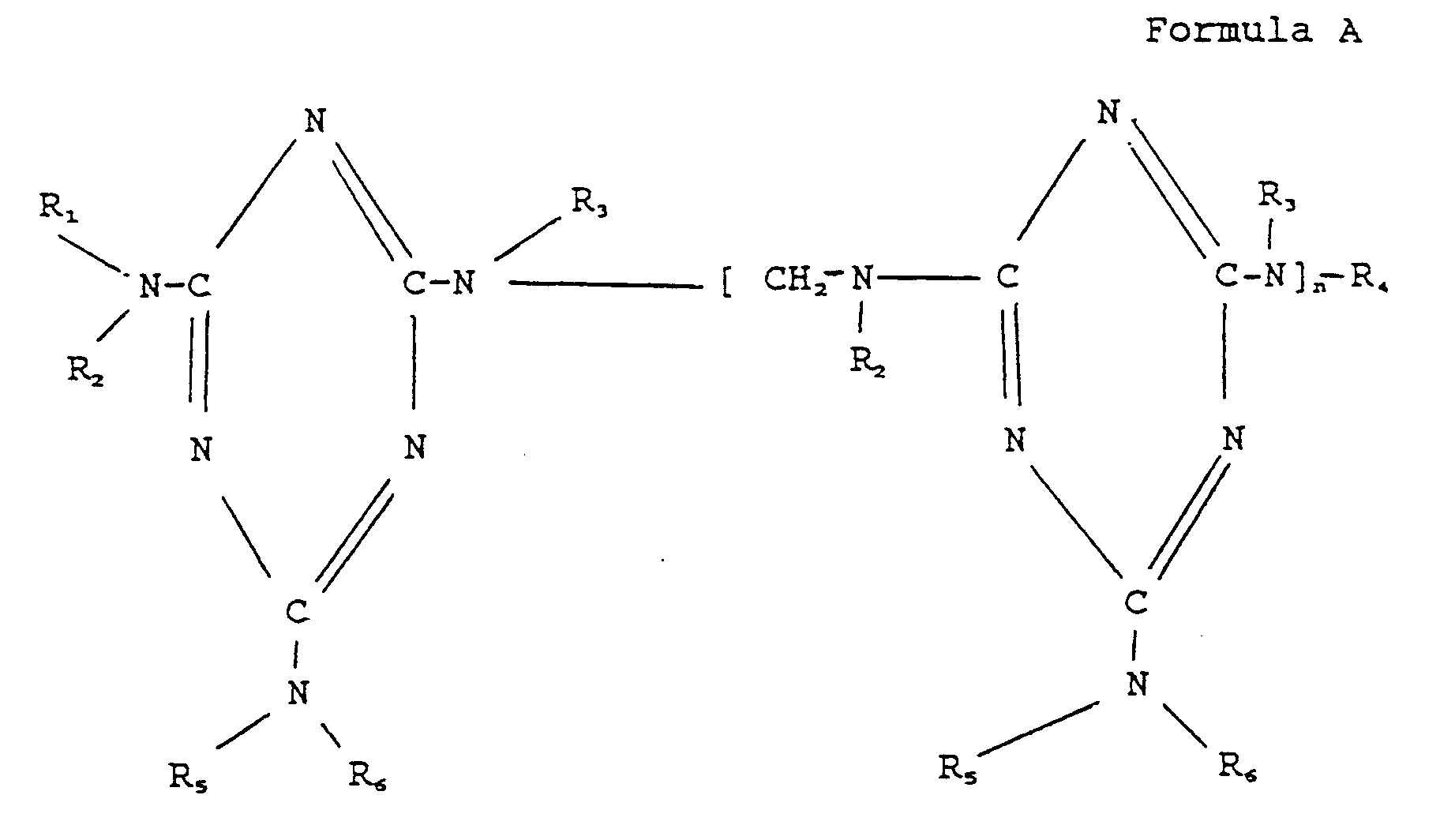
- each of R 1 , R 2 , R 3 , R 4 , R 5 , and R 6 is hydrogen, methylol ( -CH 2 OH) or (lower) alkoxymethyl, i.e., having 1 to 6 carbon atoms in the alkoxy group, and preferably 1 to 4 carbon atoms in such group; n is 0 or 1; and provided that when n is 0 about 75% to 95% of the R groups are (lower) alkoxymethyl (A-O-CH 2 - wherein A is alkyl of 1 to 6 carbon atoms and preferably 1 to 4 carbon atoms with the further proviso that at about the 75% to 89% level of alkoxymethyl groups the average such group has at least 2 carbon atoms in the alkoxy group and at about the 90% to 95% level of alkoxymethyl groups, the average group has at least 1 carbon atom in the alkoxy group.
- n 1, i.e., a D.P. of 2
- about 50% to 95% of the R groups are alkoxymethyl with the further proviso that at about the 50% to 75% level of alkoxymethyl groups the average such group has at least 2 carbon atom in the alkoxy group and at about the 76% to 95% level of alkoxymethyl groups, the average group has at least 1 carbon atom in the alkoxy group.
- a degree of polymerization higher than 2 can tolerate higher levels of smaller chain lengths of the alkoxy groups whereas resins with D.P. of about 1.5 will have intermediate requirements to the above. Higher D.P.'s can also tolerate some or more secondary amino (NH) and methylol (CH 2 OH) functionality.
- Formula B below shows a idealized structure of a preferred class of (lower) alkoxylated benzoguanamine-formaldehyde resin having a D.P. of one.
- resins at least 75% of the R groups are (lower) alkoxymethyl.
- each of R 1 , R 2 R 3 , and R 4 , in Formula B is hydrogen, methylol, or (lower) alkoxymethyl.
- the benzoguanamines also have D.P. values varying from 1 to 2.5 etc. and can all be methoxymethyl with 75% of the R groups being alkoxymethyl. All of the alkoxymethyl groups of the benzoguanamines can be methoxymethyl.
- the above Formulae A and B resins provide the parameters for specific idealized resins having a D.P. or 1 or 2.
- the triazine hardeners are resinous mixtures and generally have D.P.'s intermediate 1 and 2 as well as intermediate values above 2.
- the preferred chemical make-up of the hardeners of this invention when the D.P.'s are not whole numbers can be determined by following the guideline that essentially a straight line relationship exists in the number of and type of alkoxy groups for the resins having a D.P. of 1 to those having a D.P. of 2.5 based on extending a straight line between points of a D.P. of 1 and a D.P. of 2 as discussed above.
- the following idealized Formula C is a (lower) alkoxylated melamine-formaldehyde resin having a D.P. of one wherein 50% of such alkoxymethyl groups are methoxymethyl and the remaining 50% of such alkoxymethyl groups are butoxymethyl.
- the triazine hardeners of this invention are viscous or syrupy materials. By placing the syrupy hardeners of this invention on powdered aggregate or other powdered inorganic adsorbent and then mixing the aggregate with novolac, aggregation and clumping of the composition is avoided or at least greatly minimized. This produces a free flowing composition such as a powder which is subsequently mixed with powdered novolac and refractory aggregate.
- the quantity of the triazine hardener adsorbed on the refractory can be up to about one part or more of hardener per part of adsorbent.
- adsorbents are usually porous granular particles. The interior pores give rise to interior surfaces totaling 10 2 to 10 4 square meters per gram.
- resoles have a molecular weight of about 1,000 to 2,000 and are exemplified by CASCOPHEN W3154M, CASCOPHEN W735B, and CASCOPHEN W735E, all of Borden, Inc.
- Joint use of spray dried resole and triazine hardener can be useful in high temperature processing. Use of higher temperatures allow processing of higher melting (>125°C) novolacs.
- compositions of this invention can be used for spraying or gunning to hot refractory surfaces, in tap hole mixes, in the production of graphite electrodes for the production of aluminum, molding compounds, and impregnating pre-shaped refractory articles such as brick. They can be applied to refractory surfaces which are at room temperature but application of the raw batch composition to heated surfaces is preferred since it minimizes or avoids the down-time required to permit such surfaces to cool and decreases rebound of aggregate from refractory surfaces such as that of tundish vessels.
- compositions of this invention can withstand longer residence periods in the propelling equipment such as a mud gun and other spraying equipment, in tap hole mix extruders, and in forming an anode.
- compositions of this invention are useful in the repair and maintenance of heated refractory surfaces.
- Such compositions are preferably delivered to the surface including that of filling cracks, etc. of the refractory article being repaired or maintained by propelling the composition toward the refractory article such as by air or hydraulic pressure.
- propelling is used herein to describe such propelling of the composition to its destination even though such action may also be termed "gunning".
- the water in such compositions can vary from about 3% to 25% by weight of the composition.
- Spraying can be of two different forms.
- all of the components, of the composition, including water are premixed, such as in a tank.
- the quantity of water in such premixed spray slurry will preferably vary from about 10% to about 25% and preferably about 15% to 22% by weight of the sprayable composition.
- the quantity of water is preferably from about 8% to about 15% and particularly about 10% to 12% and there is mixing of the water with the dry ingredients in the delivery system such as that of in-line mixing.
- Preferred resins for low water extractability are CYMEL 1168 and CYMEL 303.
- the length of the supply line in spraying before exit of the spray through a nozzle can be quite long such up to about 60 feet.
- the composition stays in the system before being applied to the surface it is intended to protect for from a few minutes to a few hours or more.
- Low molecular weight (M.W.), e.g., 500 to 1,500, novolacs are preferred for use in solution for tap hole and impregnation applications.
- M.W. novolacs are generally avoided in gunning/spraying applications because powdered novolac of 1,000 to 1,300 weight average molecular weight rapidly cakes upon mixing with water, whereas lower M.W. novolacs, e.g. those having a M.W. of about 500, are self-congealing.
- low M.W. (1,000 to 1,500) novolac powder can be used with an equal or larger, e.g., 3 to 5 times, amount of high M.W. novolac powder for gunning/spraying applications.
- the average M.W. of the novolac or novolacs be at least 1,300 and preferably at least 1,500.
- the ideal curative for novolac powder should not only be active at the desired temperature, but also should not be solubilized by water as this creates subsequent concentration gradients as the mix is drying and hardening.
- the molecular weight of novolac is also important. It has been found that little or no melamine resin is extracted by water from a powdered mixture of novolac and the adsorbed melamine resin of this invention whereas extraction of such melamine resin is largely increased in the absence of novolac. Therefor, it is advantageous to mix well the powdered novolac with the triazine hardener.
- the triazine hardener will generally be adsorbed on an adsorbent in powdered form.
- suspending agents, anti-hydration agents, and dispersants can also be used so as to use less water and to maintain flowablity.
- tap hole compositions and brick impregnation compositions there is generally less than 5% water and the binder of novolac and triazine hardener is placed in a matrix of a solvent such as an alcoholic solvent, e.g., ethylene glycol, diethylene glycol, triethylene glycol, and glycol ethers thereof with alkoxy groups of 1 to 4 carbon atoms, or glycerine.
- a solvent such as an alcoholic solvent, e.g., ethylene glycol, diethylene glycol, triethylene glycol, and glycol ethers thereof with alkoxy groups of 1 to 4 carbon atoms, or glycerine.
- the viscosity of tap hole mix is generally about 3,000 to 10,000 cps and preferably about 5,000 cps and the solids are about 50% to 75% of the tap hole composition.
- the tap hole composition is generally applied by means of a mud gun and a tapping rod whereby the composition is introduced into the tap hole and permitted to cure.
- One means of increasing corrosion resistance (service life) of pre-shaped refractory articles, such as brick, is to reduce its porosity. This can be accomplished by impregnating the pores via a vacuum technique with hot pitch at elevated temperatures (about 400 to 600°F).
- Environmental hazards associated with pitch and the high temperatures (about 400 to 550°F) required to reduce its viscosity to 100 cps or preferably lower are distinct manufacturing disadvantages. These disadvantages can be circumvented by impregnating the brick or other pre-shaped refractory article with a hot solution ( up to about 125°C) of phenolic novolac containing triazine hardener and, subsequently, curing and carbonizing the novolac resin.
- High concentrations (60 to 80%) of preferably low molecular weight (about 500 to 1,500) novolac in glycol or glycol ether solvent containing alkoxylated triazine hardener are preferred for this purpose.
- compositions of this invention have advantageous properties in the thermoforming of shaped refractory composites including electrodes.
- use of high temperatures while still maintaining good flow of the composition can be used in the thermoforming of shaped electrodes such as that which are disclosed in U.S. Patents 4,775,455 of Oct. 4, 1988 to P. Chandramouli et al. and 4,897,170 of Jan. 30, 1990 to P. Chandramouli, both of which are incorporated herein by reference in their entirety.
- a novolac-triazine hardener binder can be substituted for the binder, e.g., resole resin, novolac and mixtures thereof, together with curing agent such as hexamethylenetetramine in the thermoforming of such shaped articles at elevated temperatures, e.g. above 150°C. This is particularly the case in processes such as the Soderberg process for making a continuous carbon electrode.
- the feedstock composition will have sufficient mobility to move through the Soderberg temperature gradient as a viscous bed of heated composition as it enters a use zone of the Soderberg electrode as a paste, then hardens and attains electrode integrity as disclosed in the above mentioned 4,897,170 patent.
- the binders of triazine hardeners with the novolac resin can also be used for manufacture of other shaped article such as by extruding, tamping, ramming, etc, at elevated temperatures to form various shapes when it is desired to minimize cure of the binder and maintain thermoplasticity at temperatures between about 150°C and 250°C.
- the temperature of the surface to which compositions containing the novolac and triazine hardener is applied can vary over a wide range. Such surface can be at room temperature but preferably, to avoid shut-down time, the temperature will be from about 200°F (93°C) to 1,000°F (538°C) or even higher.
- heated refractory surfaces to which the sprayable compositions of this invention can be applied there can be mentioned heated exposed surfaces, cracks and crevices in need of repair or maintenance, such as that of: the basic oxygen furnace (BOF); rotary kilns; tunnel kilns; tundish vessels; runners for transportation of molten metal; and sleeves and slide gates used in high temperature refractory applications.
- the acidic material reacts with alkaline refractories and causes deterioration.
- acidic material will substantially decrease the cure temperature of the binder composition.
- CYMEL 303 This is a (lower) alkoxylated melamine-formaldehyde resin supplied by American Cyanamid Company having approximately a D.P. of 1.75 and about 5.6 methoxymethyl groups per triazine ring and about 1.5% of methylol content.
- 4. RESIMENE 750 This is a (lower) alkoxylated melamine-formaldehyde resin of Monsanto Company having an approximate D. P.
- RESIMENE 751 This is a (lower) alkoxylated melamine-formaldehyde resin of Monsanto company having a D. P. of about 1.1 with about 2.9 methoxymethyl groups and 2.6 butoxymethyl groups per triazine ring.
- CYMEL 1168 This is a (lower) alkoxylated melamine-formaldehyde resin of American Cyanamid Company. It has an approximate D.P. of 1.7 with about 5.6 alkoxymethyl groups per triazine ring wherein the number of methoxymethyl and isobutoxymethyl groups are about equal. 7.
- RESIMENE CE-4514 This is a (lower) alkoxylated melamine-formaldehyde resin of Monsanto Company having a D.P. of approximately 2.0 with 2.2 methoxymethyl groups and 2.1 butoxymethyl groups per triazine ring.
- RESIMENE CE-6517 This is a (lower) alkoxylated melamine-formaldehyde resin of Monsanto Company with about 15% of n -butanol having a D.P. of 2.2 with 2.1 methoxymethyl groups and 0.9 butoxymethyl groups per triazine ring.
- Curing temperatures were determined by sealed mode differential scanning calorimetry (DSC) on solid blends containing SD-3072 novolac.
- the mixes for the DSC tests were made in a high speed miniblender using 11% curative on novolac, i.e., 2 g of curative and 18 g of the novolac.
- the DSC's were run in hermetically sealed aluminum pans with a heating rate of 10°C per minute up to 572°F (300°C) or up to 662°F (350°C).
- the differential scanning calorimeter used was Differential Scanning Calorimeter model 910S of TA Instruments/Du Pont. Indium was used to standardize the equipment and the software used was General V4 .1C Du Pont 2000.
- Fig. 1 and Fig. 2 show sealed mode differential scanning calorimetry (DSC) curves with heat flow in millicalories per second and temperatures in °C.
- DSC differential scanning calorimetry
- the amount of exotherm on a calorie per gram of sample basis is determined by the area under the curve between the start of the exotherm at 136.33°C and the end of the exotherm at 224.66°C. This exotherm released 13.59 calories per gram of sample. A second smaller exotherm occurred between 224.66°C and about 300°C which released 6.714 calories per gram of sample. In this sample, only about 33% of the exotherm occurred at or above 200°C.
- the sample is composed of the same novolac as in Fig. 1 in a 90 to 10 ratio by weight but with the (lower) alkoxylated melamine-formaldehyde resin CYMEL 1168.
- This sample showed an endotherm at 59.52°C which represents heat absorption due to the melting of the novolac. It also showed a small exotherm of 1.921 calories per gram between about 139.64 °C and 192.01°C. and a large exotherm of 21.69 calories per gram from about 192.07°C to about 340°C. About 98% of the exotherm for this binder occurred at 200°C and above.
- Novolac was used as 50% solution in diethylene glycol. 1.5 g 50% solution used per mix and 0.08 g additive used unless indicated otherwise.
- the procedure for this example was as follows: Materials were charged to a small glass vial (4 ml. capacity) containing a glass capillary melting point tube (to be used as a stirring rod during heating to about 150°C); vials placed in a silicon oil bath contained in a 50 ml beaker fitted with a thermometer, and a magnetic stirring bar and shielded with aluminum foil. The samples were heated on a stirrer/ hot plate to 510°F (265°C) +/- 3°C over 50 minutes except for mix 3 which was heated for 40 minutes. The onset of bubbling, gelling, etc. was observed and reported below.
- Example 2 The mixes of this Example 2 were allowed to gradually cool to room temperature and viscosities compared in a given set of 3 or more samples.
- Vials of mixes 1, 2, 4, 6, 7, 8 and 9 of this Example 2 were placed upright against a plexiglass sheet backing and placed in a 65°C oven for half an hour and then removed.
- Mix 5 had previously gelled.
- the assembly was laid flat on the table top and relative viscosities observed while the vials were still at about 65°C.
- the order of increasing viscosity was 11 and 6> 4> 8 is about the same or greater than 9 which is > (greater than) 7>2>1. Wherein 6 was very slow to move, 4 and 7 were moderately fluid.
- One (1) and 2 were very fluid.
- the objective of this example is to determine water leachability of melamine resins in the presence of powdered novolac.
- Experiment No. 3 was repeated using 10.5 g SD-3072/CYMEL 1168/VERSAL GL in a ratio of 90:10:10 powder blend (contained 1 g of melamine resin). Extractables were 0.02 g of a cream tan solid which was not identified showing partial melting at about 190°C to 260°C. Therefor, essentially no melamine resin is extracted.
- Experiment No. 6 Experiment No. 4 was repeated using 9 g of novolac powder and 1.3 g of ARICEL PC-6N (80% solids). Evaporation of filtrate gave 0.72 g of a light amber gum (72% of the ARICEL solids). It can be seen that a majority of the melamine resin is extracted into water in the presence of novolac powder. This markedly contrasts with preferred resin hardeners.
- the objective of this example was to determine the non-sagging ability of a magnesia/water/novolac-curative mix at high temperature.
- a mixture was prepared of: 0.44 g of 1:1 CYMEL 1168 adsorbed on VERSAL GL; 0.28 g of a water soluble sulfonated naphthalene-formaldehyde condensate dispersant; 2.2 g of phenolic novolac SD-405A; and 50 g magnesia fines having at least 99% MgO. Then 12.5 g of water was added with further mixing. A portion of the mix was thrown by use of a spoon on to a preheated firebrick which was 1 inch thick and which had been in a furnace for 1 hour at a temperature of 600°F. The mixture stuck to the heated surface with no sagging. The experiment was repeated with firebrick heated at 300°F and again there was no sagging.
- Thermogravimetric analysis were run under nitrogen at a heating rate of 10°C per minute to a temperature of 250°C followed by isothermal at about 482°F (250°C) for 30 minutes and then heated to 1832°F (1,000°C) at 68°F (20°C) per minute. TGA's to 1,832°F (1,000°C) under nitrogen showed that cured SD-3072 novolac gave carbon yields of 52% to 57% when the curative was CYMEL 303 with and without the presence of inorganic adsorbent such as VERSAL GL or MICRO-CEL 8020. These levels of carbon yield are equivalent to that provided by hexa as curative. It can be concluded that the presence of adsorbent has little or no effect on carbon yield.
- the TGA's were run on a 951 Thermogravimetric Analyzer of TA Instruments/Du Pont.
- This example shows the difference in coalescence or caking of a melamine resin having insufficient longer chain alkoxy groups.
- a 90:10 SD-3072/CYMEL 303 blend coalesces upon standing 2 weeks at room temperature but redisperses (providing mobility of solids) upon vigorous agitation, On the other hand a 90:10 SD-3072/CYMEL 1168 blend does not coalesce after two weeks.
- Resin Residue g 5 Times Residue Approximate % of non-volatiles solubilized CYMEL 1168 0.042 of a white solid 0.210 2.1 RESIMENE CE-6517 0.012 of an oil 1.060 10.6 RESIMENE 7512 0.004 0.020 0.2 CYMEL 303 1.64 of a clear colorless oil 8.20 8.2%
- the object of this example was to determine dispersibility of low molecular weight powdered phenolic novolac in water which is key to obtaining good dispersibility in gunning/spraying applications.
- Experiment 2 Experiment 1 was repeated but using a mixture of 8.0 g of powdered novolac SD-3072 and 2.0 g powdered novolac SD-1731A. No obvious caking of resin was observed up to at least 3 hours after addition of water.
- Experiment 3 Experiment 1 cannot be performed with even lower molecular weight novolac such as SD-333A of Borden, Inc. which has a molecular weight of about 500 since such low molecular weight novolac can not be obtained as free flowing flake or powder at room temperature because it is self-congealing. In fact, an extremely viscous solution can be obtained by addition of 7 to 9 % water.
- molecular weight novolac such as SD-333A of Borden, Inc. which has a molecular weight of about 500 since such low molecular weight novolac can not be obtained as free flowing flake or powder at room temperature because it is self-congealing.
- an extremely viscous solution can be obtained by addition of 7 to 9 % water.
- results of this example indicate the unsuitability of low molecular weight novolac resin alone for gunning/spraying applications.
- a mixture of low molecular weight novolac can be dispersed in water in the presence of a much larger amount of higher molecular weight novolac.
- a test tube (18X150mm) was charged with 5.0 g of flake novolac SD-1731A, 0.50 g melamine resin Cymel 1168 and a glass rod (5mm diameter). The tube was placed in a boiling water bath (100°C) for 4 hours. During the first 10 minutes the mix was stirred frequently to give a homogeneous melt. Stirred occasionally thereafter. After the 4 hour period 7.5 g ethylene glycol was added to the warm melt to effect solution. A gardner viscosity (25°C) of Q and 3/4 (about 460 centistokes) was obtained.
- Example 11 The procedure of Example 11 was essentially followed with magnesia refractory and about 10% to 15% of water but using 2.5% of a novolac blend based on the weight of the magnesia.
- the novolac blend consisted of 4 parts of SD-405A with 1 part of SD-1731A.
- the gunned composition contained 5% spray dried resole (CASCOPHEN W3154M), 10% of a 1:1 blend of CYMEL 303/VERSAL GL, and 5% of a phosphate binder, wherein the additional ingredients were based on the weight of novolacs.
- the refractory lining applied to the refractory plate did not break off as in the previous example and showed structural integrity upon cooling to room temperature and reheating to about 250°F and later to about 600°F.
Landscapes
- Chemical & Material Sciences (AREA)
- Engineering & Computer Science (AREA)
- Ceramic Engineering (AREA)
- Manufacturing & Machinery (AREA)
- Organic Chemistry (AREA)
- Materials Engineering (AREA)
- Structural Engineering (AREA)
- Chemical Kinetics & Catalysis (AREA)
- Inorganic Chemistry (AREA)
- Health & Medical Sciences (AREA)
- Medicinal Chemistry (AREA)
- Polymers & Plastics (AREA)
- Compositions Of Macromolecular Compounds (AREA)
- Phenolic Resins Or Amino Resins (AREA)
- Organic Low-Molecular-Weight Compounds And Preparation Thereof (AREA)
- Ceramic Products (AREA)
Abstract
Description
- This invention relates to curing of phenolic novolac resins at high temperatures. More particularly, this invention relates to the use of (lower) alkoxylated melamine-formaldehyde resins and (lower) alkoxylated benzoguanamine-formaldehyde resins as curing or hardening agents for novolacs at high temperature. The curing agents of this invention are also simply referred to herein as triazine hardeners.
- In refractory applications, there is a need for a binder comprising a phenolic novolac and a curing agent wherein the binder remains uncured until high temperatures are attained. In the binders of this invention at least 50% of the cure and preferably at least 80% of the cure is accomplished above 392°F (200°C). This minimizes hardening and solidification of the binder in heated equipment and provides improved flow properties and prolonged workability for the binder.
- There is also a need for such binder compositions which can be delivered to hot surfaces under pressure wherein the compositions further contain a particulate refractory and water wherein the hardener is not leached out from intimate contact with the other ingredients of the composition. This prevents or minimizes stratification on drying and curing of the composition.
- Pitch as well as phenolic resins are used as binders for aggregates to prepare compositions for refractory tap hole application for blast furnaces. Tap hole mix users need a combination of early green strength and stability at 150°F (65°C) to 250°F (121°C) for up to several hours. Novolac with hexamethylenetetramine (hexa) has been used in such compositions. Also, hexa has been used as a hardener for novolac in the manufacture of electrodes. However, novolac/hexa binders lead to early cure whereas novolac without hexa or other hardener do not cure. Resoles are also unsatisfactory in such compositions because they cure at too low a temperature.
- Melamine resins have also been mentioned as curing agents for novolacs or as thermosetting resins along with resoles, etc. in refractory compositions. US 4082718 discloses a tap hole mix containing a melamine resin and a novalac-type phenol resin. However, the melamine resins used in this invention have advantageous properties in their use.
- It is known that novolacs containing acids or thermally produced latent acids strongly catalyze the cure of melamine resins. However, the acid lowers the normal curing temperature of the novolac.
- EP-A-0469811 relates to compositions for accelerating the hardening of mixtures of phenolic resole resins having a pH of about 4.5 to 9.5 with lightburned magnesium oxide or magnesium hydroxide. Acceleration is achieved by incorporating into the compositions one of a number of different components, which include 1,3,5-tri (lower alkyl) hexahydro-1,3,5-triazines, and leads to the hardening of the resin at room or ambient temperatures.
- Apparatus and procedures exist for the robotic spraying of refractory material in a slurry of about 20% water for maintenance and repair of heated refractory surfaces. Illustrative of such a system is the TUNCAST Tundish Spray System of Foseco Inc.
- The invention relates to a composition as defined in
claim 1, a method for maintenance as defined in claim 18, a method of preparation as defined in claim 23 and a method for improving the mechanical properties of a refractory article as defined in claim 26 - In one aspect of this invention, a phenolic novolac resin and a triazine hardener is mixed with a refractory aggregate and water and then delivered to a hot refractory surface such as by spraying for eventual hardening, and binding of the aggregate on to the hot surface in the repair and maintenance of refractory structures.
- In another aspect of this invention, a composition containing a phenolic novolac, a carbonaceous mineral as the refractory aggregate, and a triazine hardener can be used in anode manufacture for the aluminum industry.
- In a further aspect of the invention, there is provided a composition comprising a refractory, a solution of novolac in a solvent, and a triazine hardener, which is suitable for plugging tap-holes.
- In still another aspect of this invention, there is provided a composition of a triazine hardener adsorbed on a powdered inorganic adsorbent to provide a stable, free flowing, powdered composition which is subsequently mixed with powdered novolac and water for application to heated refractory surfaces.
- In a still further aspect of this invention, a composition of a phenolic novolac resin in a solvent and a triazine hardener can be used as an impregnating agent for shaped refractories.
- In yet a still further aspect, methods are provided for use of the compositions of this invention.
-
- Fig. 1 is a sealed mode differential scanning calorimetry graph of a 90:10 mixture of phenolic novolac resin SD-3072 and a (lower) alkoxylated melamine-formaldehyde resin, namely, RESIMENE CE-4514 of Monsanto Company.
- Fig. 2 is a sealed mode differential scanning calorimetry (DSC) graph of a 90:10 mixture of phenolic novolac resin SD-3072 of Borden, Inc. and a (lower) alkoxylated melamine-formaldehyde resin, namely, CYMEL 1168 of the American Cyanamid Company.
-
- Novolac resins are obtained by the reaction of a phenol and an aldehyde in a strongly acidic pH region. Suitable acid catalysts include the strong mineral acids such as sulfuric acid, phosphoric acid and hydrochloric acid as well as organic acid catalysts such as oxalic acid, para toluenesulfonic acid, and inorganic salts such as zinc acetate, or zinc borate. The phenol is preferably phenol itself but a portion of the phenol can be substituted with cresol, xylenols, alkyl substituted phenols such as ethylphenol, propylphenol, and mixtures thereof. The aldehyde is preferably formaldehyde but other aldehydes such as acetaldehyde, benzaldehyde, and furfural can also be used to partially or totally replace the formaldehyde.
- The reaction of the aldehyde and phenol is carried out at a molar ratio of 1 mol of the phenol to about 0.40 to 0.85 mol of the aldehyde. For practical purposes, phenolic novolacs do not harden upon heating but remain soluble and fusible unless a hardener (curing agent) is present.
- In curing a novolac resin, a curing agent is used such as formaldehyde, hexa, or a melamine resin to overcome the deficiency of alkylene-bridging groups to convert the resin to an insoluble infusible condition. The novolacs used in this invention are generally solids such as in the form of a flake, powder, etc. The molecular weight of the novolac will vary from about 500 to 10,000, preferably 1,000 to 5,000 depending on their intended use. The molecular weight of the novolacs in this invention are on a weight average molecular weight basis. It can be advantageous to use a blend of high molecular weight (M.W.) novolac, e.g., at least 5,000, and low M.W. novolac, e.g., 500 to 1,000, blend such as a 5:1 to 1:1 ratio of high to low M.W. novolacs.
- When a particulate refractory is used with binders of this invention, i.e., the novolac and a triazine hardener, the quantity of novolac can vary over a broad range sufficient to bind the refractory on curing of the novolac. Generally such quantity will vary from about 3% to 30% of novolac based on the weight of particulate refractory and preferably about 5% to 20% by weight of the particulate refractory.
- Conventional particulate refractory aggregates, such as those used in tap hole mixes, repair of blast furnace linings, as well as in the manufacture of electrodes, can be used in this invention. In the case of spraying and gunning, the aggregate is powdered such as with a particle size of from about 6 (3.3 mm) mesh to 325 mesh U.S. Standard Sieve (Screen) series. Preferably, the mixture of particles is graded so as to provide different sized particles to increase density, to provide free flow of the mixture, and to minimize rebound off the surface wall. For use in tap hole mixes, the refractory is preferably granulated, e.g., grains on the order of 2 millimeters, whereas for spraying and gunning, the particle sizes is preferably smaller than 1 millimeter.
- Illustrative of the refractory aggregate there can be mentioned: bauxite; alumina; zircon; zirconia; clays; silica; chrome ore; magnesia; andalusite; kyanite; mullite; olivine; spinel; silicon carbide; carbonaceous mineral materials; and mixtures thereof. Calcined dolomite and calcium oxide can also be used when water is absent from the composition. The carbonaceous minerals consist primarily of carbon. A preferred carbonaceous mineral refractory is a sized coke aggregate. However, the carbonaceous aggregate may be formed of particles derived from premium petroleum coke, regular petroleum coke, anthracite coke, crushed scrap carbon electrodes, graphite and mixtures of the foregoing.
- The hardeners of this invention are (lower) alkoxylated melamine-formaldehyde resins or (lower) alkoxylated benzoguanamine-formaldehyde resins which are also simply referred to herein as triazine hardeners. Such hardeners have a water solubility of less than 15% by weight and contain from about 1 to 2.5 melamine or benzoguanamine rings per molecule.
- The quantity of triazine hardener used is about 3% to 20% based on the weight of novolac, but is preferably about 7% to 15%.
- The triazine hardeners are prepared from melamine (M) or benzoquanamine (B) and formaldehyde (F) with an F/M or B molar ratio of at least 4 to produce melamine-formaldehyde resins or benzoguanamine-formaldehyde resins, e.g., hexakis(methylol) melamine in the case of a melamine-formaldehyde resin. These formaldehyde resins are subsequently alkoxylated with (lower) alkoxy groups, i.e., having from 1 to 6 and preferably 1 to 4 carbon atoms. The total number of carbon atoms due the (lower) alkoxy groups affects both water solubility and cure temperature of these resins. The total number of carbon atoms will depend on the number of (lower) alkoxy groups as well as the number of carbon atoms in the (lower) alkoxy groups. The greater the number of carbon atoms the less is the water solubility and the greater is the temperature at which the triazine hardener cures the novolac. Thus, in preparing the triazine hardeners, the triazine-formaldehyde resin is alkoxylated with a sufficiently high number of carbons in the total of alkoxy groups so as to attain the water solubility of not greater than about 15% at 24°C and preferably less than 10% solubility. Preferred triazine hardeners contain significant amounts of alkoxy groups having at least 2 carbon atoms such as butoxymethyl groups in contrast to methoxymethyl, unalkoxylated methylol, or unsubstituted hydrogen of the amine group.
- The triazine hardeners having less than 15% of water solubility also improve stability of the compositions from the standpoint of minimizing clumping and providing a free flowing composition of the hardener when adsorbed on an adsorbent and provide high curing temperatures as will be more specifically discussed hereafter.
- The triazine hardeners, e.g. the (lower) alkoxylated melamine-formaldehyde resins, can have a degree of polymerization of from about 1 to about 2.5 and preferably about 1.3 to 2.2. The degree of polymerization (D.P.) is the average number of triazine rings per molecule. It can be seen that in Formula A below, when the subscript n is 0, the degree of polymerization is 1 in that only one triazine ring is present whereas when the subscript n is 1, the degree of polymerization is 2 since there are two triazine rings.
- The triazine hardeners have sealed mode differential scanning calorimetry thermal characteristics as described in Example 1 hereafter wherein a composition of 10% triazine hardener and 90% by weight of novolac produces a cure (exotherm) of at least about 14 calories per gram wherein at least 50% and preferably at least 80% of the cure (exotherm) occurs at 392°F (200°C) and above.
- An idealized formula for a preferred class of (lower) alkoxylated melamine-formaldehyde resins used in this invention wherein the degree of polymerisation is one or two is set forth in Formula A below. Such resins have a water solubility of less than 15% at 24°C and the desirable differential scanning calorimetry properties of triazine hardeners of this invention.wherein each of R1, R2, R3, R4, R5, and R6 is hydrogen, methylol ( -CH2OH) or (lower) alkoxymethyl, i.e., having 1 to 6 carbon atoms in the alkoxy group, and preferably 1 to 4 carbon atoms in such group; n is 0 or 1; and provided that when n is 0 about 75% to 95% of the R groups are (lower) alkoxymethyl (A-O-CH2- wherein A is alkyl of 1 to 6 carbon atoms and preferably 1 to 4 carbon atoms with the further proviso that at about the 75% to 89% level of alkoxymethyl groups the average such group has at least 2 carbon atoms in the alkoxy group and at about the 90% to 95% level of alkoxymethyl groups, the average group has at least 1 carbon atom in the alkoxy group. For the Formula A resins where n is 1, i.e., a D.P. of 2, about 50% to 95% of the R groups are alkoxymethyl with the further proviso that at about the 50% to 75% level of alkoxymethyl groups the average such group has at least 2 carbon atom in the alkoxy group and at about the 76% to 95% level of alkoxymethyl groups, the average group has at least 1 carbon atom in the alkoxy group.
- A degree of polymerization higher than 2 can tolerate higher levels of smaller chain lengths of the alkoxy groups whereas resins with D.P. of about 1.5 will have intermediate requirements to the above. Higher D.P.'s can also tolerate some or more secondary amino (NH) and methylol (CH2OH) functionality.
- Formula B below shows a idealized structure of a preferred class of (lower) alkoxylated benzoguanamine-formaldehyde resin having a D.P. of one. For the Formula B resins at least 75% of the R groups are (lower) alkoxymethyl.wherein each of R1 , R2 R3, and R4, in Formula B is hydrogen, methylol, or (lower) alkoxymethyl. The benzoguanamines also have D.P. values varying from 1 to 2.5 etc. and can all be methoxymethyl with 75% of the R groups being alkoxymethyl. All of the alkoxymethyl groups of the benzoguanamines can be methoxymethyl.

- The above Formulae A and B resins provide the parameters for specific idealized resins having a D.P. or 1 or 2. However, the triazine hardeners are resinous mixtures and generally have D.P.'s intermediate 1 and 2 as well as intermediate values above 2. The preferred chemical make-up of the hardeners of this invention when the D.P.'s are not whole numbers can be determined by following the guideline that essentially a straight line relationship exists in the number of and type of alkoxy groups for the resins having a D.P. of 1 to those having a D.P. of 2.5 based on extending a straight line between points of a D.P. of 1 and a D.P. of 2 as discussed above.
- In illustrating some of the above, the following idealized Formula C is a (lower) alkoxylated melamine-formaldehyde resin having a D.P. of one wherein 50% of such alkoxymethyl groups are methoxymethyl and the remaining 50% of such alkoxymethyl groups are butoxymethyl.

- The triazine hardeners of this invention are viscous or syrupy materials. By placing the syrupy hardeners of this invention on powdered aggregate or other powdered inorganic adsorbent and then mixing the aggregate with novolac, aggregation and clumping of the composition is avoided or at least greatly minimized. This produces a free flowing composition such as a powder which is subsequently mixed with powdered novolac and refractory aggregate.
- The quantity of the triazine hardener adsorbed on the refractory can be up to about one part or more of hardener per part of adsorbent. Such adsorbents are usually porous granular particles. The interior pores give rise to interior surfaces totaling 102 to 104 square meters per gram. Illustrative of adsorbents there can be mentioned: acid treated clay; activated alumina and bauxite; aluminosilicates; fumed silica; magnesium silicate; calcium silicate; bone char; silica gel; fuller's earth; and mixtures thereof.
- At times it may be advantageous to reduce emission of organic volatiles, e.g., methanol, butanol, etc., when curing up to 350°C with a triazine hardener, either with or without the use of an adsorbent. Substitution of about one-third to about two-thirds, preferably about a 50% substitution, of the triazine hardener with a spray dried resole will decrease such volatiles while maintaining many other benefits of high temperature curing. Preferred resoles have a molecular weight of about 1,000 to 2,000 and are exemplified by CASCOPHEN W3154M, CASCOPHEN W735B, and CASCOPHEN W735E, all of Borden, Inc. These resins contain about 90% to 92% non-volatile matter and about 2.5 to 3% of sodium ion. Spray dried resoles containing lithium, calcium, potassium, or quaternary ammonium, e.g. tetramethylammonium, or choline, in place of sodium may also be used either alone or in combination with each other or the aforesaid CASCOPHEN resins.
- Joint use of spray dried resole and triazine hardener can be useful in high temperature processing. Use of higher temperatures allow processing of higher melting (>125°C) novolacs.
- The compositions of this invention can be used for spraying or gunning to hot refractory surfaces, in tap hole mixes, in the production of graphite electrodes for the production of aluminum, molding compounds, and impregnating pre-shaped refractory articles such as brick. They can be applied to refractory surfaces which are at room temperature but application of the raw batch composition to heated surfaces is preferred since it minimizes or avoids the down-time required to permit such surfaces to cool and decreases rebound of aggregate from refractory surfaces such as that of tundish vessels.
- Due to the longer time for hardening, the compositions of this invention can withstand longer residence periods in the propelling equipment such as a mud gun and other spraying equipment, in tap hole mix extruders, and in forming an anode.
- The compositions of this invention, with or without water, are useful in the repair and maintenance of heated refractory surfaces. Such compositions are preferably delivered to the surface including that of filling cracks, etc. of the refractory article being repaired or maintained by propelling the composition toward the refractory article such as by air or hydraulic pressure. The term spraying is used herein to describe such propelling of the composition to its destination even though such action may also be termed "gunning". When used, the water in such compositions can vary from about 3% to 25% by weight of the composition.
- Spraying can be of two different forms. In one form, conventionally called spraying, all of the components, of the composition, including water, are premixed, such as in a tank. The quantity of water in such premixed spray slurry will preferably vary from about 10% to about 25% and preferably about 15% to 22% by weight of the sprayable composition.
- In the form of spraying called "gunning", the quantity of water is preferably from about 8% to about 15% and particularly about 10% to 12% and there is mixing of the water with the dry ingredients in the delivery system such as that of in-line mixing. Preferred resins for low water extractability are CYMEL 1168 and CYMEL 303.
- The length of the supply line in spraying before exit of the spray through a nozzle can be quite long such up to about 60 feet. Thus, the composition stays in the system before being applied to the surface it is intended to protect for from a few minutes to a few hours or more.
- Low molecular weight (M.W.), e.g., 500 to 1,500, novolacs are preferred for use in solution for tap hole and impregnation applications. However, such low M.W. novolacs are generally avoided in gunning/spraying applications because powdered novolac of 1,000 to 1,300 weight average molecular weight rapidly cakes upon mixing with water, whereas lower M.W. novolacs, e.g. those having a M.W. of about 500, are self-congealing. However, low M.W. (1,000 to 1,500) novolac powder can be used with an equal or larger, e.g., 3 to 5 times, amount of high M.W. novolac powder for gunning/spraying applications. For gunning and spraying applications with water, it is preferred that the average M.W. of the novolac or novolacs be at least 1,300 and preferably at least 1,500.
- Contact with water during application of the binder composition can be very brief, e.g., less than one minute as in gunning, or can be up to several hours as in spraying. Therefore, the ideal curative for novolac powder should not only be active at the desired temperature, but also should not be solubilized by water as this creates subsequent concentration gradients as the mix is drying and hardening. As discussed previously, the molecular weight of novolac is also important. It has been found that little or no melamine resin is extracted by water from a powdered mixture of novolac and the adsorbed melamine resin of this invention whereas extraction of such melamine resin is largely increased in the absence of novolac. Therefor, it is advantageous to mix well the powdered novolac with the triazine hardener. The triazine hardener will generally be adsorbed on an adsorbent in powdered form.
- Additionally, suspending agents, anti-hydration agents, and dispersants can also be used so as to use less water and to maintain flowablity.
- In tap hole compositions and brick impregnation compositions, there is generally less than 5% water and the binder of novolac and triazine hardener is placed in a matrix of a solvent such as an alcoholic solvent, e.g., ethylene glycol, diethylene glycol, triethylene glycol, and glycol ethers thereof with alkoxy groups of 1 to 4 carbon atoms, or glycerine. The viscosity of tap hole mix is generally about 3,000 to 10,000 cps and preferably about 5,000 cps and the solids are about 50% to 75% of the tap hole composition. The tap hole composition is generally applied by means of a mud gun and a tapping rod whereby the composition is introduced into the tap hole and permitted to cure.
- One means of increasing corrosion resistance (service life) of pre-shaped refractory articles, such as brick, is to reduce its porosity. This can be accomplished by impregnating the pores via a vacuum technique with hot pitch at elevated temperatures (about 400 to 600°F). Environmental hazards associated with pitch and the high temperatures (about 400 to 550°F) required to reduce its viscosity to 100 cps or preferably lower are distinct manufacturing disadvantages. These disadvantages can be circumvented by impregnating the brick or other pre-shaped refractory article with a hot solution ( up to about 125°C) of phenolic novolac containing triazine hardener and, subsequently, curing and carbonizing the novolac resin. High concentrations (60 to 80%) of preferably low molecular weight (about 500 to 1,500) novolac in glycol or glycol ether solvent containing alkoxylated triazine hardener are preferred for this purpose.
- The compositions of this invention have advantageous properties in the thermoforming of shaped refractory composites including electrodes. Thus, use of high temperatures while still maintaining good flow of the composition can be used in the thermoforming of shaped electrodes such as that which are disclosed in U.S. Patents 4,775,455 of Oct. 4, 1988 to P. Chandramouli et al. and 4,897,170 of Jan. 30, 1990 to P. Chandramouli, both of which are incorporated herein by reference in their entirety. Thus a novolac-triazine hardener binder can be substituted for the binder, e.g., resole resin, novolac and mixtures thereof, together with curing agent such as hexamethylenetetramine in the thermoforming of such shaped articles at elevated temperatures, e.g. above 150°C. This is particularly the case in processes such as the Soderberg process for making a continuous carbon electrode.
- In the Soderberg process, the feedstock composition will have sufficient mobility to move through the Soderberg temperature gradient as a viscous bed of heated composition as it enters a use zone of the Soderberg electrode as a paste, then hardens and attains electrode integrity as disclosed in the above mentioned 4,897,170 patent.
- The binders of triazine hardeners with the novolac resin can also be used for manufacture of other shaped article such as by extruding, tamping, ramming, etc, at elevated temperatures to form various shapes when it is desired to minimize cure of the binder and maintain thermoplasticity at temperatures between about 150°C and 250°C.
- The temperature of the surface to which compositions containing the novolac and triazine hardener is applied can vary over a wide range. Such surface can be at room temperature but preferably, to avoid shut-down time, the temperature will be from about 200°F (93°C) to 1,000°F (538°C) or even higher. Illustrative of heated refractory surfaces to which the sprayable compositions of this invention can be applied, there can be mentioned heated exposed surfaces, cracks and crevices in need of repair or maintenance, such as that of: the basic oxygen furnace (BOF); rotary kilns; tunnel kilns; tundish vessels; runners for transportation of molten metal; and sleeves and slide gates used in high temperature refractory applications.
- Substances which are acidic at normal temperature or those which are latent acids in that they break down in the environment of use, e.g., the high temperatures such as those of above 150°F (66°C), should be avoided in the compositions of this invention. One reason for this is that the acidic material reacts with alkaline refractories and causes deterioration. Another reason is that acidic material will substantially decrease the cure temperature of the binder composition.
- In order that those skilled in the art may more fully understand the invention presented herein, the following procedures and examples are set forth. All parts and percentages in the examples as well as elsewhere in this application are by weight unless the context indicates otherwise. Room temperature means about 75°F (24°C) to 77°F (25°C).
CHARACTERISTICS OF MELAMINE RESINS The melamine resins evaluated in the following examples are characterized in Table A below. 1. CASCOMEL MF-600. This a non-alkoxylated, spray dried solid melamine resin supplied by Borden, Inc. It has an F/M molar ratio of 2 and a molecular weight of about 700. 2. CYMEL 301. This is a (lower) alkoxylated melamine-formaldehyde resin of American Cyanamid Company and which has a D. P. of about 1.5, approximately 5.33 methoxymethyl groups per triazine ring and about 5% of methylol content. 3. CYMEL 303. This is a (lower) alkoxylated melamine-formaldehyde resin supplied by American Cyanamid Company having approximately a D.P. of 1.75 and about 5.6 methoxymethyl groups per triazine ring and about 1.5% of methylol content. 4. RESIMENE 750. This is a (lower) alkoxylated melamine-formaldehyde resin of Monsanto Company having an approximate D. P. of 2.2 with about 40% of the amino groups being alkoxymethyl groups and 2.4 being butoxymethyl groups per triazine ring. 5. RESIMENE 751 This is a (lower) alkoxylated melamine-formaldehyde resin of Monsanto company having a D. P. of about 1.1 with about 2.9 methoxymethyl groups and 2.6 butoxymethyl groups per triazine ring. 6. CYMEL 1168 This is a (lower) alkoxylated melamine-formaldehyde resin of American Cyanamid Company. It has an approximate D.P. of 1.7 with about 5.6 alkoxymethyl groups per triazine ring wherein the number of methoxymethyl and isobutoxymethyl groups are about equal. 7. RESIMENE CE-4514 This is a (lower) alkoxylated melamine-formaldehyde resin of Monsanto Company having a D.P. of approximately 2.0 with 2.2 methoxymethyl groups and 2.1 butoxymethyl groups per triazine ring. 8. RESIMENE CE-6517. This is a (lower) alkoxylated melamine-formaldehyde resin of Monsanto Company with about 15% of n-butanol having a D.P. of 2.2 with 2.1 methoxymethyl groups and 0.9 butoxymethyl groups per triazine ring. 9. RESIMENE 7512. This is a (lower) alkoxylated melamine-formaldehyde resin of Monsanto Company having a D.P. of about 1.8 with 4.8 butoxymethyl groups per triazine ring. 10. ARICEL PC-6N. This is a water soluble melamine resin supplied by Astro Industries having 80% solids, a F/M molar ratio of about 4.3 wherein about one-third of the non-aromatic amino sites have been methoxymethylated PROPERTIES OF NOVOLACS USED IN THE EXAMPLES DURITE Resin Approximate Melting Point Molecular Weight Free Phenol (%) SD-1731A 85-95°C 1,000 -1300 0.1 Maximum SD-405A 114-120°C 4,000 -8,000 1.0 Maximum SD-3072 108-116°C 4,000-8,000 2.0 to 3.5 - All of the novolacs contained about 0.7% of hexa contaminant, except for SD-1731A which did not contain such contaminant. This contaminant did not appear to significantly affect the test results set forth herein, except as may be specifically indicated.
- Curing temperatures were determined by sealed mode differential scanning calorimetry (DSC) on solid blends containing SD-3072 novolac. The mixes for the DSC tests were made in a high speed miniblender using 11% curative on novolac, i.e., 2 g of curative and 18 g of the novolac. The DSC's were run in hermetically sealed aluminum pans with a heating rate of 10°C per minute up to 572°F (300°C) or up to 662°F (350°C). The differential scanning calorimeter used was Differential Scanning Calorimeter model 910S of TA Instruments/Du Pont. Indium was used to standardize the equipment and the software used was General V4 .1C Du Pont 2000.
- Fig. 1 and Fig. 2 show sealed mode differential scanning calorimetry (DSC) curves with heat flow in millicalories per second and temperatures in °C. Referring now specifically to Fig. 1 there is an endotherm at 58.91°C which represents heat absorption due to melting of the novolac. There is a major exotherm indicating curing starting at 136.33°C and extending to 224.66°C which released 13.59 calories per gram of the sample. The sample was composed of 90 parts by weight of DURITE Novolac Resin SD-3072 and 10 parts by weight of RESIMENE CE 4514. The amount of exotherm on a calorie per gram of sample basis is determined by the area under the curve between the start of the exotherm at 136.33°C and the end of the exotherm at 224.66°C. This exotherm released 13.59 calories per gram of sample. A second smaller exotherm occurred between 224.66°C and about 300°C which released 6.714 calories per gram of sample. In this sample, only about 33% of the exotherm occurred at or above 200°C.
- In Fig. 2, the sample is composed of the same novolac as in Fig. 1 in a 90 to 10 ratio by weight but with the (lower) alkoxylated melamine-formaldehyde resin CYMEL 1168. This sample showed an endotherm at 59.52°C which represents heat absorption due to the melting of the novolac. It also showed a small exotherm of 1.921 calories per gram between about 139.64 °C and 192.01°C. and a large exotherm of 21.69 calories per gram from about 192.07°C to about 340°C. About 98% of the exotherm for this binder occurred at 200°C and above.
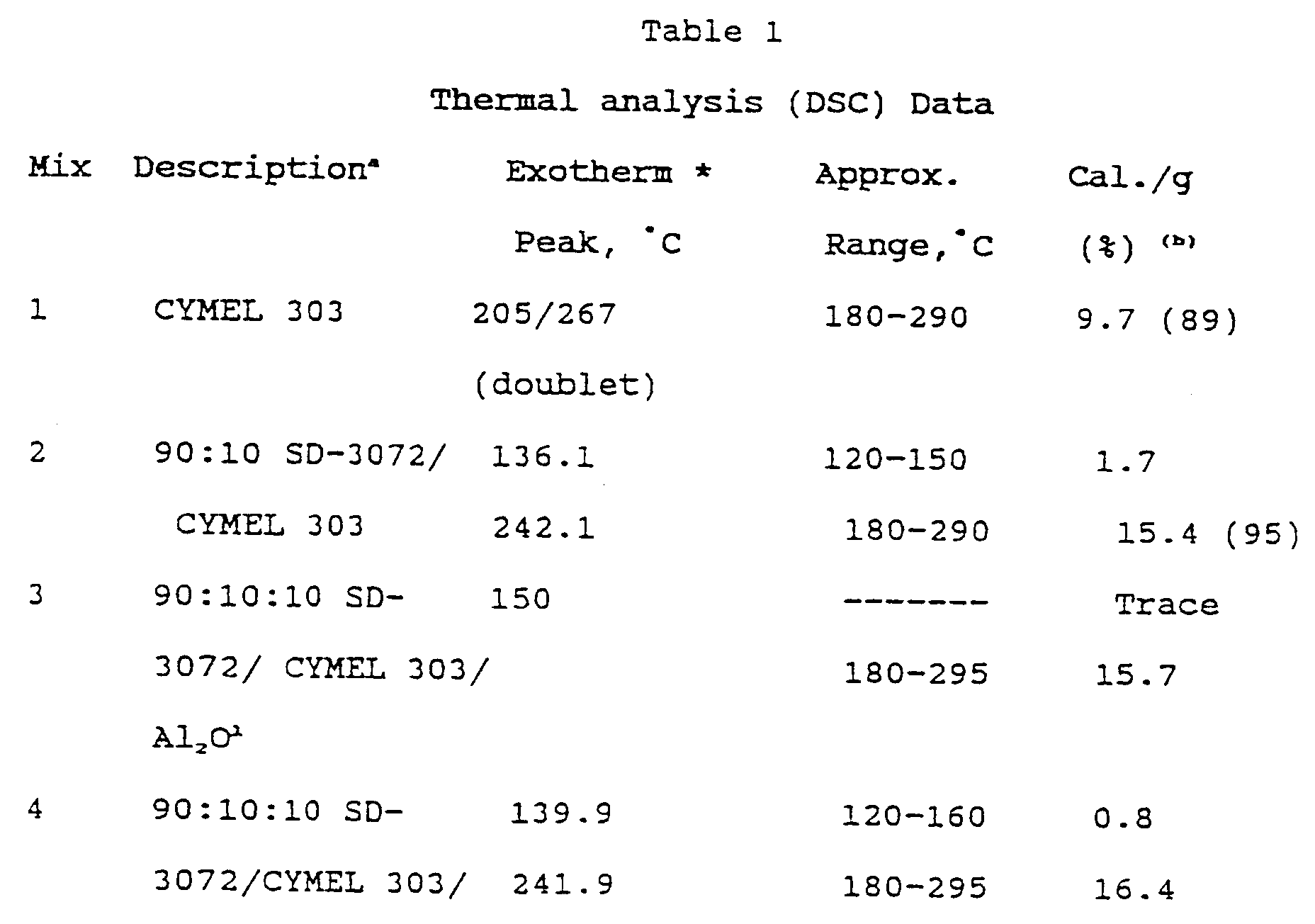
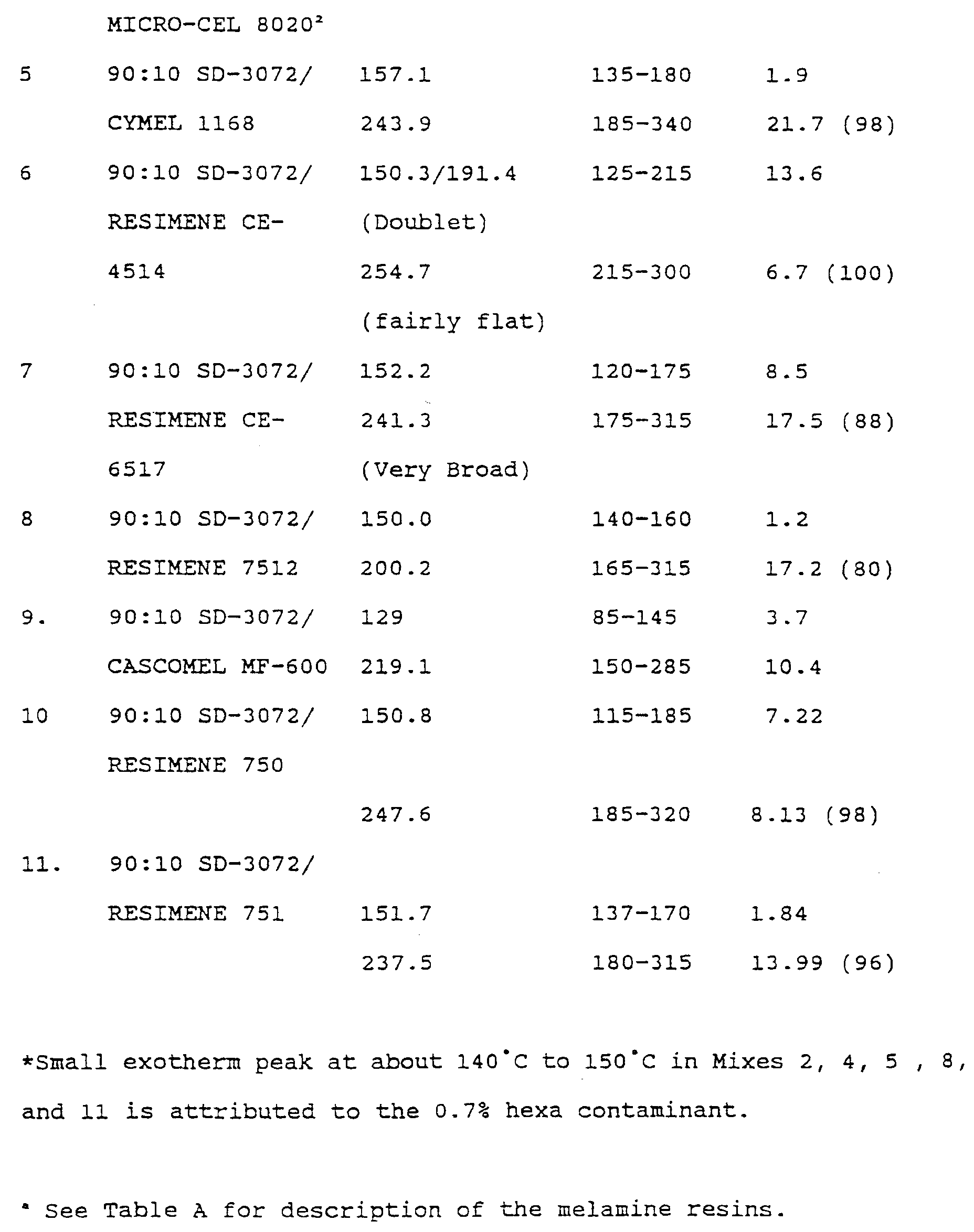

- The results show that with phenolic novolac SD-3072, the melamine resins CYMEL 1168 and CYMEL 303 provide the highest degree of exotherm from 200°C and above. RESIMENE CE-4514 provides about two-thirds of its exotherm below 200°C whereas RESIMENE CE-6517 provides about 1/3 of its exotherm below 200°C.
- Novolac was used as 50% solution in diethylene glycol. 1.5
g 50% solution used per mix and 0.08 g additive used unless indicated otherwise. The procedure for this example was as follows: Materials were charged to a small glass vial (4 ml. capacity) containing a glass capillary melting point tube (to be used as a stirring rod during heating to about 150°C); vials placed in a silicon oil bath contained in a 50 ml beaker fitted with a thermometer, and a magnetic stirring bar and shielded with aluminum foil. The samples were heated on a stirrer/ hot plate to 510°F (265°C) +/- 3°C over 50 minutes except for mix 3 which was heated for 40 minutes. The onset of bubbling, gelling, etc. was observed and reported below.Approximate Bath Temp(°C ) To Mix Additive Start Bubbling Gelling Gelled 1 None None None None 2 Melamine 228 None None 3 Hexa 140 140 150 4 CYMEL 1168 197 None None 5 RESIMENE CE-4514 168 252 260 6 RESIMENE 195 None None CE-6517 7 RESIMENE 205 None None 7512 8 RESIMENE 197 None None 750 9 RESIMENE 180 None None 751 10 ARICEL PC- 6N 150 190 220 11 CASCOMEL 165 None None MF 600 12 CASCOPHEN W3154M and CYMEL 303 160 218 Soft gel at 265 which became rigid on cooling to room temperature - The mixes of this Example 2 were allowed to gradually cool to room temperature and viscosities compared in a given set of 3 or more samples.
- Set of mixes 4, 5, and 6: 5 is hard, 4 and 6 are solutions ; 6 is immobile; 4 is softer and shows very slow flow.
- Set of
Mixes 1, 2, and 7: one (1) is fairly fluid, essentially identical to unheated solution; 2 is fluid but less than 1; and 7 is very viscous but more mobile than 4. No. 3 gelled hard. - Set of Mixes 8, 9, and 10: show essentially no flow and are more viscous than 7. Mix 10 has gelled hard.
- Vials of
mixes 1, 2, 4, 6, 7, 8 and 9 of this Example 2 were placed upright against a plexiglass sheet backing and placed in a 65°C oven for half an hour and then removed. Mix 5 had previously gelled. The assembly was laid flat on the table top and relative viscosities observed while the vials were still at about 65°C. The order of increasing viscosity was 11 and 6> 4> 8 is about the same or greater than 9 which is > (greater than) 7>2>1. Wherein 6 was very slow to move, 4 and 7 were moderately fluid. One (1) and 2 were very fluid. - The vials were allowed to stand upright at room temperature, about 72°F (23°C), for 3 hours and again laid flat on the table top and observed after 2 minutes. Mixes 8, 9, and 11 were not included in this test. The results were as follows:
Mix No. Approximate Flow in Inches 1 1 2 7/8 7 1/4 4 1/8 6 Nil (most viscous) - Dry blends of melamine resin on inorganic adsorbent were easily made by gradually adding, in 4 to 5 portions, melamine syrup to adsorbent, and mixing well after each addition.
Melamine Resin (M) Adsorbent (A) M/A Ratio By Weight CYMEL 303 VERSAL GL (ALUMINA) 1:1 CYMEL 303 MICRO-CEL 8020 (calcium silicate) 7:3 CYMEL 1168 VERSAL GL (ALUMINA) 1:1 CYMEL 1168 SATINTONE 5 HB (aluminum silicate) 1:1 RESIMENE CE-4514 VERSAL GL 1:1 RESIMENE CE-4514 MICRO-CEL 8020 9:5 - All of the above mixes of adsorbed melamine resin were free flowing powders.
- The objective of this example is to determine water leachability of melamine resins in the presence of powdered novolac.
- Experiment No. 1. 3.0 g of 1:1 CYMEL 303 adsorbed on VERSAL GL was stirred for 70 minutes at room temperature with 20.5 g water. The solid was centrifuged and the solution (17.2 g) obtained was evaporated and vacuum dried to give 1.1 g liquid CYMEL. Thus, about 75% of the CYMEL 303 was extracted out of this composition.
- Experiment No. 2. 10 g of a powdered mixture of phenolic novolac SD-3072 with CYMEL 303 adsorbed on VERSAL GL on a weight ratio of 90:10:10 (contains 0.91 g of the melamine resin) was stirred at room temperature for 70 minutes with 30 g. water. The solid which partially caked was suction filtered, the filtrate 27.5 g was evaporated and vacuum dried. The extract gave 0.13 g of a liquid/solid mixture. The solid was dried at 65°C and then in vacuo to give about 10.4 g. Thus, essentially no resin was extracted. It can be seen from
Experiments 1 and 2, that the water extractability of melamine resin is greatly diminished in the presence of novolac. - Experiment No. 3. Experiment No. 2 was repeated using 10.5 g SD-3072/CYMEL 1168/VERSAL GL in a ratio of 90:10:10 powder blend (contained 1 g of melamine resin). Extractables were 0.02 g of a cream tan solid which was not identified showing partial melting at about 190°C to 260°C. Therefor, essentially no melamine resin is extracted.
- Experiment No. 4.(Model). 10.0 g of SD-3072 was stirred with 30 g of water as in Experiment No. 2 above. The filter cake was washed with 10 g of water. Drying of the filter cake yielded 0.03 g of whitish solid.
- Experiment No. 5. Experiment No. 4 was repeated with 10.0 g of 90:10 mixture of phenolic novolac SD-3072 and RESIMENE CE-4514 (1.0 g contained). Evaporation of filtrate gave 0.36 g of solid with a very slight sticky character. Thus about one third of the melamine resin was extracted.
- Experiment No. 6. Experiment No. 4 was repeated using 9 g of novolac powder and 1.3 g of ARICEL PC-6N (80% solids). Evaporation of filtrate gave 0.72 g of a light amber gum (72% of the ARICEL solids). It can be seen that a majority of the melamine resin is extracted into water in the presence of novolac powder. This markedly contrasts with preferred resin hardeners.
- The objective of this example was to determine the non-sagging ability of a magnesia/water/novolac-curative mix at high temperature.
- A mixture was prepared of: 0.44 g of 1:1 CYMEL 1168 adsorbed on VERSAL GL; 0.28 g of a water soluble sulfonated naphthalene-formaldehyde condensate dispersant; 2.2 g of phenolic novolac SD-405A; and 50 g magnesia fines having at least 99% MgO. Then 12.5 g of water was added with further mixing. A portion of the mix was thrown by use of a spoon on to a preheated firebrick which was 1 inch thick and which had been in a furnace for 1 hour at a temperature of 600°F. The mixture stuck to the heated surface with no sagging. The experiment was repeated with firebrick heated at 300°F and again there was no sagging.
- Thermogravimetric analysis (TGA) were run under nitrogen at a heating rate of 10°C per minute to a temperature of 250°C followed by isothermal at about 482°F (250°C) for 30 minutes and then heated to 1832°F (1,000°C) at 68°F (20°C) per minute. TGA's to 1,832°F (1,000°C) under nitrogen showed that cured SD-3072 novolac gave carbon yields of 52% to 57% when the curative was CYMEL 303 with and without the presence of inorganic adsorbent such as VERSAL GL or MICRO-CEL 8020. These levels of carbon yield are equivalent to that provided by hexa as curative. It can be concluded that the presence of adsorbent has little or no effect on carbon yield. The TGA's were run on a 951 Thermogravimetric Analyzer of TA Instruments/Du Pont.
- This example shows the difference in coalescence or caking of a melamine resin having insufficient longer chain alkoxy groups. A 90:10 SD-3072/CYMEL 303 blend coalesces upon standing 2 weeks at room temperature but redisperses (providing mobility of solids) upon vigorous agitation, On the other hand a 90:10 SD-3072/CYMEL 1168 blend does not coalesce after two weeks.
- This examples shows the solubility of various (lower) alkoxylated melamine-formaldehyde resins in water. Ten grams of various melamine resins were stirred well for one hour with 100 g de-ionized water at room temperature (about 24-25°C). An aliquot (1/5 or 20 g) was removed, evaporated at room temperature, and finally dried under high vacuum. Table 8 below shows the results of these tests.
Resin Residue, g 5 Times Residue Approximate % of non-volatiles solubilized CYMEL 1168 0.042 of a white solid 0.210 2.1 RESIMENE CE-6517 0.012 of an oil 1.060 10.6 RESIMENE 7512 0.004 0.020 0.2 CYMEL 303 1.64 of a clear colorless oil 8.20 8.2% - The object of this example was to determine dispersibility of low molecular weight powdered phenolic novolac in water which is key to obtaining good dispersibility in gunning/spraying applications.
-
Experiment 1. To 10.0 g of powdered phenolic novolac SD-1731A was added 30 g water followed by vigorous agitation. The powder largely caked within several seconds. - Experiment 2.
Experiment 1 was repeated but using a mixture of 8.0 g of powdered novolac SD-3072 and 2.0 g powdered novolac SD-1731A. No obvious caking of resin was observed up to at least 3 hours after addition of water. - Experiment 3.
Experiment 1 cannot be performed with even lower molecular weight novolac such as SD-333A of Borden, Inc. which has a molecular weight of about 500 since such low molecular weight novolac can not be obtained as free flowing flake or powder at room temperature because it is self-congealing. In fact, an extremely viscous solution can be obtained by addition of 7 to 9 % water. - The results of this example indicate the unsuitability of low molecular weight novolac resin alone for gunning/spraying applications. However, a mixture of low molecular weight novolac can be dispersed in water in the presence of a much larger amount of higher molecular weight novolac.
- Long term stability at room temperatures and short term stability at about 100°C are particularly desirable for tap hole and impregnation applications. 40% solutions of SD-1731A novolac in ethylene glycol with/ without Cymel 1168 (10% based on novolac solids) were followed with time in Gardner bubble viscosity tube at 25°C. Initial viscosities of both were 1,000 centistokes and after 2 months the viscosities of both were about 970. Both solutions when placed in a 65°C oven for 8 hours showed no viscosity change upon cooling to room temperature.
- A test tube (18X150mm) was charged with 5.0 g of flake novolac SD-1731A, 0.50 g melamine resin Cymel 1168 and a glass rod (5mm diameter). The tube was placed in a boiling water bath (100°C) for 4 hours. During the first 10 minutes the mix was stirred frequently to give a homogeneous melt. Stirred occasionally thereafter. After the 4 hour period 7.5 g ethylene glycol was added to the warm melt to effect solution. A gardner viscosity (25°C) of Q and 3/4 (about 460 centistokes) was obtained. When the Cymel 1168 was added to a solution of SD-1731A (5.0 g) in glycol (7.5 g), without further heating, a viscosity of M and 2/3 (about 335 centistokes) resulted. This experiment shows that only a modest increase in viscosity (or curing) results after several hours at 100°C but essentially none occurs after prolonged storage at room temperature followed by 8 hours at 65°C.
- A composition of: particulate magnesia refractory aggregate; about 10% to 15% of water, based on the weight of the composition; about 2.5% of novolac SD 405A, based on the weight of the magnesia; and 20%, based on the weight of resin (B.O.R.) of CYMEL 1168 adsorbed on VERSAL GL, at a 1:1 ratio by weight, was gunned without difficulty onto a refractory plate (60% to 70% alumina). The plate was withdrawn from an oven at a temperature of about 1,800°F (982°C) to 1,900°F (1038°C). At the time of gunning, the plate was at a temperature of about 1,200°F (649°C) to 1500°F (816°C). The gunning built up a four inch layer of refractory lining. About 10 to 15 minutes later, about three inches of the lining broke off.
- The procedure of Example 11 was essentially followed with magnesia refractory and about 10% to 15% of water but using 2.5% of a novolac blend based on the weight of the magnesia.
The novolac blend consisted of 4 parts of SD-405A with 1 part of SD-1731A. Additionally, the gunned composition contained 5% spray dried resole (CASCOPHEN W3154M), 10% of a 1:1 blend of CYMEL 303/VERSAL GL, and 5% of a phosphate binder, wherein the additional ingredients were based on the weight of novolacs. In this example, the refractory lining applied to the refractory plate did not break off as in the previous example and showed structural integrity upon cooling to room temperature and reheating to about 250°F and later to about 600°F.
Claims (26)
- A refractory composition comprising a particulate refractory aggregate, a phenolic resin and a triazine characterised in that the phenolic resin is a phenolic novolac resin present in an amount of 3 to 30% by weight based on the weight of the refractory, the triazine is a triazine resin present in an amount of 3 to 20% by weight based on the weight of the novolac resin, the triazine resin having a water solubility of less than 15% by weight at 24°C and a degree of polymerisation of about 1 to 2.5 and being a C1-6 alkoxylated melamine-formaldehyde resin or a C1-6 alkoxylated benzoguanamine-formaldehyde resin.
- The composition of claim 1, wherein the triazine resin has a formaldehyde to melamine ratio of at least 4 and 4.3 to 5.6 alkoxymethyl groups per triazine ring.
- The composition of claim 1 or claim 2, wherein the novolac is present in an amount of from 5 to 20% by weight based on the weight of the refractory.
- The composition of any one of claims 1 to 3, wherein the triazine is present in an amount of from 7 to 15% by weight based on the weight of the novolac resin.
- The composition of any one of claims 1 to 4, wherein the triazine is that of melamine.
- The composition of any one of claims 1 to 5, wherein the triazine is a C1-6 alkoxylated melamine-formaldehyde resin which by sealed mode differential scanning calorimetry for a sample essentially composed of 90 parts of the novolac and 10 parts, by weight , of the alkoxylated resin has at least 50% of its caloric exotherm at a temperature of at least 200°C.
- The composition of claim 6, wherein at least 80% of the caloric exotherm is at a temperature of at least 200°C.
- The composition of any one of claims 1 to 7, wherein the refractory is a member selected from the group consisting of: bauxite; alumina; zircon; zirconia; clays; silica; chrome ore; magnesia; andalusite; kyanite; mullite; olivine; spinel; silicon carbide; carbonaceous mineral materials; calcined dolomite; calcium oxide; and mixtures thereof.
- The composition of any one of claims 1 to 8 dispersed in water wherein the water content of the dispersed composition is from 3% to 25%.
- The composition of any one of claims 1 to 9, wherein the novolac is in solution and has a molecular weight of not greater than 1000.
- The composition of claim 10, wherein the solvent is a member selected from the group consisting of ethylene glycol, propylene glycol, diethylene glycol, liquid polyethylene glycol, propylene glycol, glycerine, benzyl alcohol, glycol ethers, and mixtures thereof.
- The composition of any one of claims 1 to 8, wherein the aggregate and the novolac have a particle size in the range of from 6 mesh to 325 mesh U.S. Standard Sieve (Screen) Series.
- The composition of claim 1, wherein the novolac is in particulate form and the triazine resin is prepared by reacting melamine with formaldehyde at a ratio of at least 4 moles of formaldehyde for each mole of melamine to produce a triazine-formaldehyde resin and subsequently C1-6 alkoxylating the triazine-formaldehyde resin to produce a C1-6 alkoxylated triazine-formaldehyde resin, wherein the total number of carbon atoms of the alkoxy groups is sufficient to provide a water solubility of less than about 10% by weight at 24°C for the (lower) alkoxylated triazine-formaldehyde resin.
- The composition of claim 13, wherein the novolac is in powdered form.
- The composition of claim 13, wherein the novolac is dissolved in a solvent.
- The composition of claim 13, wherein the triazine resin has from 1.3 to 2.2 triazine rings per molecule.
- The composition of claim 13, wherein the triazine resin is partially replaced by a spray dried resole.
- A method for maintenance and repair of a refractory surface which comprises delivering a refractory composition comprising phenolic novolac resin and a particulate refractory aggregate to a refractory structure having a surface temperature of at least 121°C (250°F) characterised in that the phenolic novolac resin is present in an amount of 3% to 30% based on the weight of the refractory, and the composition comprises from 3% to 20% based on the weight of the novolac of a triazine resin and from 3% to 25% by weight of water based on the composition, wherein the triazine resin has a degree of polymerization of 1 to 2.5 and is a C1-6 alkoxylated melamine-formaldehyde resin wherein the total number of carbon atoms in such groups is sufficient to provide a water solubility of less than 10% by weight at 24°C of the triazine resin.
- The method of claim 18, wherein sealed mode differential scanning calorimetry for a composition of 10 parts of hardener and 90 parts of novolac produces an exotherm of at least 14 calories per gram and wherein at least 50% of the exotherm occurs at 200°C and above.
- The method of claim 18 wherein:(a) the triazine is prepared by reacting one mole of melamine with at least four moles of formaldehyde to prepare a melamine-formaldehyde resin and subsequently alkoxylating the melamine formaldehyde resin with alkoxy groups having in each group from 1 to 4 carbon atoms to prepare a C1-6 alkoxylated melamine formaldehyde resin wherein the total number of carbon atoms of the alkoxy groups are sufficient to reduce the water solubility of the C1-6 alkoxylated melamine formaldehyde resin to that of less than 10% by weight at 24°C; and(b) the C1-6 alkoxylated melamine-formaldehyde resin is adsorbed on an adsorbent to produce a free flowing powder of said formaldehyde resin and adsorbent.
- The method of claim 19, wherein the molecular weight of the novolac is from 1,500 to 5,000 and the (lower) alkoxylated melamine-formaldehyde resin is a member selected from the group consisting of a C1-6 alkoxylated melamine formaldehyde resin having:(1) a degree of polymerization of about 1.75 and about 5.6 methoxymethyl groups per triazine ring;(2) a degree of polymerization of about 1.7 with about 5.6 alkoxymethyl groups per triazine ring wherein said groups are of about an equal number having methoxymethyl and butoxymethyl groups;(3) a degree of polymerization of about 2.2 with about 2.1 methoxymethyl groups and about 0.9 butoxymethyl groups per triazine ring;(4) a degree of polymerization of about 1.8 with about 4.8 butoxymethyl groups per triazine ring; and(5) a degree of polymerization of about 1.1 with about 2.9 methoxymethyl groups and 2.6 butoxymethyl groups per triazine ring.
- The method of any one of claims 18 to 21, wherein the composition is sprayed onto the refractory surface.
- A method for the preparation of a shaped refractory which comprises thermoforming at a temperature above 150°C a composition comprising a particulate aggregate and a phenolic novolac resin characterised in that the phenolic novolac resin is present in an amount of 3 to 30% by weight based on the weight of the refractory and the composition comprises a triazine resin in an amount of 3 to 20% by weight based on the weight of the novolac resin, the triazine resin having a degree of polymerization of 1 to 2.5 and being a C1-6 alkoxylated melamine-formaldehyde resin wherein the number of carbon atoms in such alkoxy groups are sufficient to provide the triazine resin with a water solubility at 24°C of less than 15% by weight.
- The method of claim 23, wherein the aggregate is a carbonaceous aggregate.
- The method of claim 23 or claim 24, wherein the shaped refractory is a blast furnace tap hole plug and the method comprises introducing a tapping rod and the composition into the tap hole and subsequently thermally curing the novolac resin.
- A method for improving the mechanical properties of a refractory article characterised in that it comprises impregnating such article at an elevated temperature with a solution comprising:A. a phenolic novolac;B. an organic solvent for the novolac; andC. a triazine resin having a degree of polymerization of 1 to 2.5 in an amount of 3 to 20% by weight based on the weight of the novolac resin, said triazine resin being a C1-6 alkoxylated melamine-formaldehyde resin wherein the number of alkoxy groups and the number of carbon atoms in such alkoxy groups are sufficient to provide the triazine resin with a water solubility at 24°C of less than 15% by weight.
Priority Applications (1)
| Application Number | Priority Date | Filing Date | Title |
|---|---|---|---|
| EP99109231A EP0940442A1 (en) | 1994-04-11 | 1994-10-06 | Curatives for phenolic novolacs |
Applications Claiming Priority (2)
| Application Number | Priority Date | Filing Date | Title |
|---|---|---|---|
| US225890 | 1994-04-11 | ||
| US08/225,890 US5648404A (en) | 1994-04-11 | 1994-04-11 | Curatives for phenolic novolacs |
Related Child Applications (1)
| Application Number | Title | Priority Date | Filing Date |
|---|---|---|---|
| EP99109231A Division EP0940442A1 (en) | 1994-04-11 | 1994-10-06 | Curatives for phenolic novolacs |
Publications (2)
| Publication Number | Publication Date |
|---|---|
| EP0676382A1 EP0676382A1 (en) | 1995-10-11 |
| EP0676382B1 true EP0676382B1 (en) | 1999-12-29 |
Family
ID=22846693
Family Applications (2)
| Application Number | Title | Priority Date | Filing Date |
|---|---|---|---|
| EP99109231A Withdrawn EP0940442A1 (en) | 1994-04-11 | 1994-10-06 | Curatives for phenolic novolacs |
| EP94307339A Expired - Lifetime EP0676382B1 (en) | 1994-04-11 | 1994-10-06 | Curatives for phenolic novolacs |
Family Applications Before (1)
| Application Number | Title | Priority Date | Filing Date |
|---|---|---|---|
| EP99109231A Withdrawn EP0940442A1 (en) | 1994-04-11 | 1994-10-06 | Curatives for phenolic novolacs |
Country Status (8)
| Country | Link |
|---|---|
| US (2) | US5648404A (en) |
| EP (2) | EP0940442A1 (en) |
| AT (1) | ATE188200T1 (en) |
| AU (1) | AU663658B1 (en) |
| CA (1) | CA2118078C (en) |
| DE (1) | DE69422385T2 (en) |
| MY (1) | MY130506A (en) |
| NZ (1) | NZ270430A (en) |
Families Citing this family (11)
| Publication number | Priority date | Publication date | Assignee | Title |
|---|---|---|---|---|
| US5686506A (en) * | 1995-04-04 | 1997-11-11 | Borden Chemical, Inc. | Mixtures of phenolic novolaks for use with refractory aggregate and methods for making same |
| US5910521A (en) * | 1998-04-01 | 1999-06-08 | Borden Chemical, Inc. | Benzoxazine polymer composition |
| WO1999060504A1 (en) | 1998-05-15 | 1999-11-25 | Unicast Communications Corporation | A technique for implementing browser-initiated network-distributed advertising and for interstitially displaying an advertisement |
| US6569918B2 (en) | 2000-02-04 | 2003-05-27 | Plastics Engineering Company | Polymer composition for curing novolac resins |
| US7763316B2 (en) * | 2006-05-18 | 2010-07-27 | Fairmount Minerals, Inc. | No hexa shell sand |
| US20070270524A1 (en) * | 2006-05-18 | 2007-11-22 | Kerns Kelley J | Composition of matter and method of application for elimination of odors in shell sand encapsulation |
| US7709092B2 (en) * | 2007-01-19 | 2010-05-04 | 3M Innovative Properties Company | Solar control multilayer film |
| WO2012027394A1 (en) | 2010-08-24 | 2012-03-01 | Allied Mineral Products, Inc. | Monolithic graphitic castable refractory |
| EP2880390B1 (en) | 2012-08-01 | 2023-12-27 | Allied Mineral Products, Inc. | Reinforced refractory containers |
| EP3120094B1 (en) * | 2014-03-21 | 2021-05-19 | Vesuvius U S A Corporation | Blast furnace hearth repair material |
| WO2022124267A1 (en) * | 2020-12-11 | 2022-06-16 | 品川リフラクトリーズ株式会社 | Mud material |
Citations (1)
| Publication number | Priority date | Publication date | Assignee | Title |
|---|---|---|---|---|
| US4082718A (en) * | 1975-05-30 | 1978-04-04 | Nippon Steel Corporation | Tap hole mix |
Family Cites Families (15)
| Publication number | Priority date | Publication date | Assignee | Title |
|---|---|---|---|---|
| US3793033A (en) * | 1972-09-05 | 1974-02-19 | Minnesota Mining & Mfg | Development-free printing plate |
| US4022739A (en) * | 1973-06-06 | 1977-05-10 | Terrac Company Limited | Composition for plugging blast-furnace tap-hole |
| US4072531A (en) * | 1975-03-15 | 1978-02-07 | Sumitomo Durez Company, Ltd. | Plugging compositions for blast furnace tap holes |
| US4256622A (en) * | 1978-04-18 | 1981-03-17 | The Dow Chemical Company | Curable hydroxy resin compositions |
| US4381355A (en) * | 1981-04-16 | 1983-04-26 | General Refractories Company | Resorcinol polymer bonded taphole mix and specialty materials |
| US4379866A (en) * | 1981-09-14 | 1983-04-12 | General Refractories Company | Plugging refractory material having resin binder system |
| JPS58104918A (en) * | 1981-12-18 | 1983-06-22 | Sumitomo Deyurezu Kk | Solid phenolic resin modified with triazine |
| US4897170A (en) * | 1986-04-07 | 1990-01-30 | Borden, Inc. | Manufacture of a Soderberg electrode incorporating a high carbon-contributing phenolic sacrificial binder |
| US4775455A (en) * | 1986-04-07 | 1988-10-04 | Borden, Inc. | Binder system for anodes, cathodes, and electrodes |
| JP2505033B2 (en) * | 1988-11-28 | 1996-06-05 | 東京応化工業株式会社 | Electron beam resist composition and method for forming fine pattern using the same |
| US4963602A (en) * | 1989-11-13 | 1990-10-16 | Hi-Tek Polymers, Inc. | Aqueous epoxy resin-acrylic resin coating compositions containing also phenoxy, novolac and resole resin combination |
| DE69106971T2 (en) * | 1990-08-02 | 1995-07-13 | Borden Inc | Magnesia with a large specific surface area as a hardener for phenolic resins. |
| US5182346A (en) * | 1990-08-02 | 1993-01-26 | Borden, Inc. | Accelerators for curing phenolic resole resins |
| US5281644A (en) * | 1992-11-04 | 1994-01-25 | Borden, Inc. | Ambient temperature hardening binder compositions |
| US5686506A (en) * | 1995-04-04 | 1997-11-11 | Borden Chemical, Inc. | Mixtures of phenolic novolaks for use with refractory aggregate and methods for making same |
-
1994
- 1994-04-11 US US08/225,890 patent/US5648404A/en not_active Expired - Lifetime
- 1994-10-06 EP EP99109231A patent/EP0940442A1/en not_active Withdrawn
- 1994-10-06 DE DE69422385T patent/DE69422385T2/en not_active Expired - Fee Related
- 1994-10-06 AT AT94307339T patent/ATE188200T1/en not_active IP Right Cessation
- 1994-10-06 EP EP94307339A patent/EP0676382B1/en not_active Expired - Lifetime
- 1994-10-13 CA CA002118078A patent/CA2118078C/en not_active Expired - Lifetime
- 1994-10-19 AU AU75920/94A patent/AU663658B1/en not_active Ceased
-
1995
- 1995-01-10 MY MYPI95000060A patent/MY130506A/en unknown
- 1995-02-01 NZ NZ270430A patent/NZ270430A/en unknown
-
1997
- 1997-02-25 US US08/806,148 patent/US6046252A/en not_active Expired - Lifetime
Patent Citations (1)
| Publication number | Priority date | Publication date | Assignee | Title |
|---|---|---|---|---|
| US4082718A (en) * | 1975-05-30 | 1978-04-04 | Nippon Steel Corporation | Tap hole mix |
Also Published As
| Publication number | Publication date |
|---|---|
| EP0676382A1 (en) | 1995-10-11 |
| US5648404A (en) | 1997-07-15 |
| US6046252A (en) | 2000-04-04 |
| CA2118078A1 (en) | 1995-10-12 |
| DE69422385D1 (en) | 2000-02-03 |
| ATE188200T1 (en) | 2000-01-15 |
| EP0940442A1 (en) | 1999-09-08 |
| CA2118078C (en) | 2002-02-26 |
| NZ270430A (en) | 1996-01-26 |
| DE69422385T2 (en) | 2000-07-06 |
| AU663658B1 (en) | 1995-10-12 |
| MY130506A (en) | 2007-06-29 |
Similar Documents
| Publication | Publication Date | Title |
|---|---|---|
| EP0736502B1 (en) | Mixtures of phenolic novolaks for use with refractory aggregate and methods for making same | |
| EP0376432B1 (en) | Lithium-containing resole composition for making a shaped refractory article and other hardened articles | |
| CA1196033A (en) | Use of resorcinol polymer blend as a binder for carbon-containing refractory brick and shape | |
| US6046252A (en) | Curatives for phenolic novolacs | |
| US4627945A (en) | Method of manufacturing an injection molded refractory shape and composition thereof | |
| CN1176757C (en) | Phenolic resin coated refractory aggregate, refractory profile and process for preparing refractory profile | |
| JP5208676B2 (en) | Refractory composition | |
| JPH02182744A (en) | Binder composition containing both low-molecular weight poly(orthomethylol) phenolic compound and novolak resin | |
| KR0142561B1 (en) | Extended mix life magnesia refractory aggregates for bnik and gunning mixes | |
| NO873508L (en) | ELECTRIC CONDUCTIVE CEMENT FOR USE IN ELECTROLYCLE CELLS. | |
| JP3583824B2 (en) | Blast furnace taphole filler | |
| JP4648163B2 (en) | Refractory composition | |
| JP4684464B2 (en) | Refractory composition | |
| JP4319796B2 (en) | Refractory composition | |
| EP0270377B1 (en) | Process for the manufacture of refractory articles | |
| JP4337431B2 (en) | Binder composition for amorphous refractories | |
| JP4703379B2 (en) | Refractory composition and refractory | |
| JPH0925172A (en) | Binder for refractory | |
| JP3151202B2 (en) | Refractory materials | |
| WO1998050321A1 (en) | Seizure repairing material | |
| JP3521060B2 (en) | Binder composition for amorphous refractories | |
| JPH07237976A (en) | Irregular refractories for blast furnace press-fitting | |
| KR20000016688A (en) | Seizure repairing material |
Legal Events
| Date | Code | Title | Description |
|---|---|---|---|
| PUAI | Public reference made under article 153(3) epc to a published international application that has entered the european phase |
Free format text: ORIGINAL CODE: 0009012 |
|
| AK | Designated contracting states |
Kind code of ref document: A1 Designated state(s): AT BE CH DE DK ES FR GB GR IE IT LI LU MC NL PT SE |
|
| 17P | Request for examination filed |
Effective date: 19960402 |
|
| 17Q | First examination report despatched |
Effective date: 19961016 |
|
| RAP1 | Party data changed (applicant data changed or rights of an application transferred) |
Owner name: BORDEN CHEMICAL, INC. |
|
| GRAG | Despatch of communication of intention to grant |
Free format text: ORIGINAL CODE: EPIDOS AGRA |
|
| GRAG | Despatch of communication of intention to grant |
Free format text: ORIGINAL CODE: EPIDOS AGRA |
|
| GRAH | Despatch of communication of intention to grant a patent |
Free format text: ORIGINAL CODE: EPIDOS IGRA |
|
| GRAH | Despatch of communication of intention to grant a patent |
Free format text: ORIGINAL CODE: EPIDOS IGRA |
|
| GRAA | (expected) grant |
Free format text: ORIGINAL CODE: 0009210 |
|
| AK | Designated contracting states |
Kind code of ref document: B1 Designated state(s): AT BE CH DE DK ES FR GB GR IE IT LI LU MC NL PT SE |
|
| PG25 | Lapsed in a contracting state [announced via postgrant information from national office to epo] |
Ref country code: SE Free format text: THE PATENT HAS BEEN ANNULLED BY A DECISION OF A NATIONAL AUTHORITY Effective date: 19991229 Ref country code: NL Free format text: LAPSE BECAUSE OF FAILURE TO SUBMIT A TRANSLATION OF THE DESCRIPTION OR TO PAY THE FEE WITHIN THE PRESCRIBED TIME-LIMIT Effective date: 19991229 Ref country code: LI Free format text: LAPSE BECAUSE OF FAILURE TO SUBMIT A TRANSLATION OF THE DESCRIPTION OR TO PAY THE FEE WITHIN THE PRESCRIBED TIME-LIMIT Effective date: 19991229 Ref country code: IT Free format text: LAPSE BECAUSE OF FAILURE TO SUBMIT A TRANSLATION OF THE DESCRIPTION OR TO PAY THE FEE WITHIN THE PRE;WARNING: LAPSES OF ITALIAN PATENTS WITH EFFECTIVE DATE BEFORE 2007 MAY HAVE OCCURRED AT ANY TIME BEFORE 2007. THE CORRECT EFFECTIVE DATE MAY BE DIFFERENT FROM THE ONE RECORDED.SCRIBED TIME-LIMIT Effective date: 19991229 Ref country code: GR Free format text: LAPSE BECAUSE OF NON-PAYMENT OF DUE FEES Effective date: 19991229 Ref country code: ES Free format text: THE PATENT HAS BEEN ANNULLED BY A DECISION OF A NATIONAL AUTHORITY Effective date: 19991229 Ref country code: CH Free format text: LAPSE BECAUSE OF FAILURE TO SUBMIT A TRANSLATION OF THE DESCRIPTION OR TO PAY THE FEE WITHIN THE PRESCRIBED TIME-LIMIT Effective date: 19991229 Ref country code: BE Free format text: LAPSE BECAUSE OF FAILURE TO SUBMIT A TRANSLATION OF THE DESCRIPTION OR TO PAY THE FEE WITHIN THE PRESCRIBED TIME-LIMIT Effective date: 19991229 Ref country code: AT Free format text: LAPSE BECAUSE OF FAILURE TO SUBMIT A TRANSLATION OF THE DESCRIPTION OR TO PAY THE FEE WITHIN THE PRESCRIBED TIME-LIMIT Effective date: 19991229 |
|
| REF | Corresponds to: |
Ref document number: 188200 Country of ref document: AT Date of ref document: 20000115 Kind code of ref document: T |
|
| REG | Reference to a national code |
Ref country code: CH Ref legal event code: EP |
|
| REF | Corresponds to: |
Ref document number: 69422385 Country of ref document: DE Date of ref document: 20000203 |
|
| REG | Reference to a national code |
Ref country code: IE Ref legal event code: FG4D |
|
| ET | Fr: translation filed | ||
| PG25 | Lapsed in a contracting state [announced via postgrant information from national office to epo] |
Ref country code: PT Free format text: LAPSE BECAUSE OF FAILURE TO SUBMIT A TRANSLATION OF THE DESCRIPTION OR TO PAY THE FEE WITHIN THE PRESCRIBED TIME-LIMIT Effective date: 20000329 Ref country code: DK Free format text: LAPSE BECAUSE OF FAILURE TO SUBMIT A TRANSLATION OF THE DESCRIPTION OR TO PAY THE FEE WITHIN THE PRESCRIBED TIME-LIMIT Effective date: 20000329 |
|
| NLV1 | Nl: lapsed or annulled due to failure to fulfill the requirements of art. 29p and 29m of the patents act | ||
| REG | Reference to a national code |
Ref country code: CH Ref legal event code: PL |
|
| PG25 | Lapsed in a contracting state [announced via postgrant information from national office to epo] |
Ref country code: LU Free format text: LAPSE BECAUSE OF NON-PAYMENT OF DUE FEES Effective date: 20001006 Ref country code: IE Free format text: LAPSE BECAUSE OF NON-PAYMENT OF DUE FEES Effective date: 20001006 |
|
| PLBE | No opposition filed within time limit |
Free format text: ORIGINAL CODE: 0009261 |
|
| STAA | Information on the status of an ep patent application or granted ep patent |
Free format text: STATUS: NO OPPOSITION FILED WITHIN TIME LIMIT |
|
| PG25 | Lapsed in a contracting state [announced via postgrant information from national office to epo] |
Ref country code: MC Free format text: THE PATENT HAS BEEN ANNULLED BY A DECISION OF A NATIONAL AUTHORITY Effective date: 20001031 |
|
| 26N | No opposition filed | ||
| REG | Reference to a national code |
Ref country code: IE Ref legal event code: MM4A |
|
| REG | Reference to a national code |
Ref country code: GB Ref legal event code: IF02 |
|
| PGFP | Annual fee paid to national office [announced via postgrant information from national office to epo] |
Ref country code: GB Payment date: 20020925 Year of fee payment: 9 |
|
| PGFP | Annual fee paid to national office [announced via postgrant information from national office to epo] |
Ref country code: FR Payment date: 20021009 Year of fee payment: 9 |
|
| PGFP | Annual fee paid to national office [announced via postgrant information from national office to epo] |
Ref country code: DE Payment date: 20021017 Year of fee payment: 9 |
|
| PG25 | Lapsed in a contracting state [announced via postgrant information from national office to epo] |
Ref country code: GB Free format text: LAPSE BECAUSE OF NON-PAYMENT OF DUE FEES Effective date: 20031006 |
|
| PG25 | Lapsed in a contracting state [announced via postgrant information from national office to epo] |
Ref country code: DE Free format text: LAPSE BECAUSE OF NON-PAYMENT OF DUE FEES Effective date: 20040501 |
|
| GBPC | Gb: european patent ceased through non-payment of renewal fee |
Effective date: 20031006 |
|
| PG25 | Lapsed in a contracting state [announced via postgrant information from national office to epo] |
Ref country code: FR Free format text: LAPSE BECAUSE OF NON-PAYMENT OF DUE FEES Effective date: 20040630 |
|
| REG | Reference to a national code |
Ref country code: FR Ref legal event code: ST |
|
| REG | Reference to a national code |
Ref country code: FR Ref legal event code: TP Ref country code: FR Ref legal event code: CD |