EP0674934B1 - Filter having chemical resistance, antistatic property and water vapor resistance, and process for producing the same - Google Patents
Filter having chemical resistance, antistatic property and water vapor resistance, and process for producing the same Download PDFInfo
- Publication number
- EP0674934B1 EP0674934B1 EP95104669A EP95104669A EP0674934B1 EP 0674934 B1 EP0674934 B1 EP 0674934B1 EP 95104669 A EP95104669 A EP 95104669A EP 95104669 A EP95104669 A EP 95104669A EP 0674934 B1 EP0674934 B1 EP 0674934B1
- Authority
- EP
- European Patent Office
- Prior art keywords
- felt
- nonwoven fabric
- specimen
- molded material
- filter
- Prior art date
- Legal status (The legal status is an assumption and is not a legal conclusion. Google has not performed a legal analysis and makes no representation as to the accuracy of the status listed.)
- Expired - Lifetime
Links
Images

Classifications
-
- B—PERFORMING OPERATIONS; TRANSPORTING
- B01—PHYSICAL OR CHEMICAL PROCESSES OR APPARATUS IN GENERAL
- B01D—SEPARATION
- B01D39/00—Filtering material for liquid or gaseous fluids
- B01D39/14—Other self-supporting filtering material ; Other filtering material
- B01D39/16—Other self-supporting filtering material ; Other filtering material of organic material, e.g. synthetic fibres
- B01D39/1607—Other self-supporting filtering material ; Other filtering material of organic material, e.g. synthetic fibres the material being fibrous
- B01D39/1623—Other self-supporting filtering material ; Other filtering material of organic material, e.g. synthetic fibres the material being fibrous of synthetic origin
-
- B—PERFORMING OPERATIONS; TRANSPORTING
- B01—PHYSICAL OR CHEMICAL PROCESSES OR APPARATUS IN GENERAL
- B01D—SEPARATION
- B01D71/00—Semi-permeable membranes for separation processes or apparatus characterised by the material; Manufacturing processes specially adapted therefor
- B01D71/06—Organic material
- B01D71/40—Polymers of unsaturated acids or derivatives thereof, e.g. salts, amides, imides, nitriles, anhydrides, esters
-
- D—TEXTILES; PAPER
- D01—NATURAL OR MAN-MADE THREADS OR FIBRES; SPINNING
- D01F—CHEMICAL FEATURES IN THE MANUFACTURE OF ARTIFICIAL FILAMENTS, THREADS, FIBRES, BRISTLES OR RIBBONS; APPARATUS SPECIALLY ADAPTED FOR THE MANUFACTURE OF CARBON FILAMENTS
- D01F6/00—Monocomponent artificial filaments or the like of synthetic polymers; Manufacture thereof
- D01F6/58—Monocomponent artificial filaments or the like of synthetic polymers; Manufacture thereof from homopolycondensation products
- D01F6/74—Monocomponent artificial filaments or the like of synthetic polymers; Manufacture thereof from homopolycondensation products from polycondensates of cyclic compounds, e.g. polyimides, polybenzimidazoles
-
- D—TEXTILES; PAPER
- D04—BRAIDING; LACE-MAKING; KNITTING; TRIMMINGS; NON-WOVEN FABRICS
- D04H—MAKING TEXTILE FABRICS, e.g. FROM FIBRES OR FILAMENTARY MATERIAL; FABRICS MADE BY SUCH PROCESSES OR APPARATUS, e.g. FELTS, NON-WOVEN FABRICS; COTTON-WOOL; WADDING ; NON-WOVEN FABRICS FROM STAPLE FIBRES, FILAMENTS OR YARNS, BONDED WITH AT LEAST ONE WEB-LIKE MATERIAL DURING THEIR CONSOLIDATION
- D04H1/00—Non-woven fabrics formed wholly or mainly of staple fibres or like relatively short fibres
- D04H1/40—Non-woven fabrics formed wholly or mainly of staple fibres or like relatively short fibres from fleeces or layers composed of fibres without existing or potential cohesive properties
- D04H1/44—Non-woven fabrics formed wholly or mainly of staple fibres or like relatively short fibres from fleeces or layers composed of fibres without existing or potential cohesive properties the fleeces or layers being consolidated by mechanical means, e.g. by rolling
- D04H1/46—Non-woven fabrics formed wholly or mainly of staple fibres or like relatively short fibres from fleeces or layers composed of fibres without existing or potential cohesive properties the fleeces or layers being consolidated by mechanical means, e.g. by rolling by needling or like operations to cause entanglement of fibres
-
- D—TEXTILES; PAPER
- D06—TREATMENT OF TEXTILES OR THE LIKE; LAUNDERING; FLEXIBLE MATERIALS NOT OTHERWISE PROVIDED FOR
- D06M—TREATMENT, NOT PROVIDED FOR ELSEWHERE IN CLASS D06, OF FIBRES, THREADS, YARNS, FABRICS, FEATHERS OR FIBROUS GOODS MADE FROM SUCH MATERIALS
- D06M11/00—Treating fibres, threads, yarns, fabrics or fibrous goods made from such materials, with inorganic substances or complexes thereof; Such treatment combined with mechanical treatment, e.g. mercerising
- D06M11/73—Treating fibres, threads, yarns, fabrics or fibrous goods made from such materials, with inorganic substances or complexes thereof; Such treatment combined with mechanical treatment, e.g. mercerising with carbon or compounds thereof
- D06M11/74—Treating fibres, threads, yarns, fabrics or fibrous goods made from such materials, with inorganic substances or complexes thereof; Such treatment combined with mechanical treatment, e.g. mercerising with carbon or compounds thereof with carbon or graphite; with carbides; with graphitic acids or their salts
-
- D—TEXTILES; PAPER
- D06—TREATMENT OF TEXTILES OR THE LIKE; LAUNDERING; FLEXIBLE MATERIALS NOT OTHERWISE PROVIDED FOR
- D06M—TREATMENT, NOT PROVIDED FOR ELSEWHERE IN CLASS D06, OF FIBRES, THREADS, YARNS, FABRICS, FEATHERS OR FIBROUS GOODS MADE FROM SUCH MATERIALS
- D06M11/00—Treating fibres, threads, yarns, fabrics or fibrous goods made from such materials, with inorganic substances or complexes thereof; Such treatment combined with mechanical treatment, e.g. mercerising
- D06M11/83—Treating fibres, threads, yarns, fabrics or fibrous goods made from such materials, with inorganic substances or complexes thereof; Such treatment combined with mechanical treatment, e.g. mercerising with metals; with metal-generating compounds, e.g. metal carbonyls; Reduction of metal compounds on textiles
-
- D—TEXTILES; PAPER
- D06—TREATMENT OF TEXTILES OR THE LIKE; LAUNDERING; FLEXIBLE MATERIALS NOT OTHERWISE PROVIDED FOR
- D06M—TREATMENT, NOT PROVIDED FOR ELSEWHERE IN CLASS D06, OF FIBRES, THREADS, YARNS, FABRICS, FEATHERS OR FIBROUS GOODS MADE FROM SUCH MATERIALS
- D06M15/00—Treating fibres, threads, yarns, fabrics, or fibrous goods made from such materials, with macromolecular compounds; Such treatment combined with mechanical treatment
- D06M15/19—Treating fibres, threads, yarns, fabrics, or fibrous goods made from such materials, with macromolecular compounds; Such treatment combined with mechanical treatment with synthetic macromolecular compounds
- D06M15/21—Macromolecular compounds obtained by reactions only involving carbon-to-carbon unsaturated bonds
- D06M15/227—Macromolecular compounds obtained by reactions only involving carbon-to-carbon unsaturated bonds of hydrocarbons, or reaction products thereof, e.g. afterhalogenated or sulfochlorinated
-
- D—TEXTILES; PAPER
- D06—TREATMENT OF TEXTILES OR THE LIKE; LAUNDERING; FLEXIBLE MATERIALS NOT OTHERWISE PROVIDED FOR
- D06M—TREATMENT, NOT PROVIDED FOR ELSEWHERE IN CLASS D06, OF FIBRES, THREADS, YARNS, FABRICS, FEATHERS OR FIBROUS GOODS MADE FROM SUCH MATERIALS
- D06M15/00—Treating fibres, threads, yarns, fabrics, or fibrous goods made from such materials, with macromolecular compounds; Such treatment combined with mechanical treatment
- D06M15/19—Treating fibres, threads, yarns, fabrics, or fibrous goods made from such materials, with macromolecular compounds; Such treatment combined with mechanical treatment with synthetic macromolecular compounds
- D06M15/21—Macromolecular compounds obtained by reactions only involving carbon-to-carbon unsaturated bonds
- D06M15/227—Macromolecular compounds obtained by reactions only involving carbon-to-carbon unsaturated bonds of hydrocarbons, or reaction products thereof, e.g. afterhalogenated or sulfochlorinated
- D06M15/233—Macromolecular compounds obtained by reactions only involving carbon-to-carbon unsaturated bonds of hydrocarbons, or reaction products thereof, e.g. afterhalogenated or sulfochlorinated aromatic, e.g. styrene
-
- D—TEXTILES; PAPER
- D06—TREATMENT OF TEXTILES OR THE LIKE; LAUNDERING; FLEXIBLE MATERIALS NOT OTHERWISE PROVIDED FOR
- D06M—TREATMENT, NOT PROVIDED FOR ELSEWHERE IN CLASS D06, OF FIBRES, THREADS, YARNS, FABRICS, FEATHERS OR FIBROUS GOODS MADE FROM SUCH MATERIALS
- D06M15/00—Treating fibres, threads, yarns, fabrics, or fibrous goods made from such materials, with macromolecular compounds; Such treatment combined with mechanical treatment
- D06M15/19—Treating fibres, threads, yarns, fabrics, or fibrous goods made from such materials, with macromolecular compounds; Such treatment combined with mechanical treatment with synthetic macromolecular compounds
- D06M15/21—Macromolecular compounds obtained by reactions only involving carbon-to-carbon unsaturated bonds
- D06M15/244—Macromolecular compounds obtained by reactions only involving carbon-to-carbon unsaturated bonds of halogenated hydrocarbons
- D06M15/256—Macromolecular compounds obtained by reactions only involving carbon-to-carbon unsaturated bonds of halogenated hydrocarbons containing fluorine
-
- D—TEXTILES; PAPER
- D06—TREATMENT OF TEXTILES OR THE LIKE; LAUNDERING; FLEXIBLE MATERIALS NOT OTHERWISE PROVIDED FOR
- D06M—TREATMENT, NOT PROVIDED FOR ELSEWHERE IN CLASS D06, OF FIBRES, THREADS, YARNS, FABRICS, FEATHERS OR FIBROUS GOODS MADE FROM SUCH MATERIALS
- D06M15/00—Treating fibres, threads, yarns, fabrics, or fibrous goods made from such materials, with macromolecular compounds; Such treatment combined with mechanical treatment
- D06M15/19—Treating fibres, threads, yarns, fabrics, or fibrous goods made from such materials, with macromolecular compounds; Such treatment combined with mechanical treatment with synthetic macromolecular compounds
- D06M15/21—Macromolecular compounds obtained by reactions only involving carbon-to-carbon unsaturated bonds
- D06M15/347—Macromolecular compounds obtained by reactions only involving carbon-to-carbon unsaturated bonds of unsaturated ethers, acetals, hemiacetals, ketones or aldehydes
- D06M15/353—Macromolecular compounds obtained by reactions only involving carbon-to-carbon unsaturated bonds of unsaturated ethers, acetals, hemiacetals, ketones or aldehydes containing fluorine
-
- D—TEXTILES; PAPER
- D06—TREATMENT OF TEXTILES OR THE LIKE; LAUNDERING; FLEXIBLE MATERIALS NOT OTHERWISE PROVIDED FOR
- D06M—TREATMENT, NOT PROVIDED FOR ELSEWHERE IN CLASS D06, OF FIBRES, THREADS, YARNS, FABRICS, FEATHERS OR FIBROUS GOODS MADE FROM SUCH MATERIALS
- D06M23/00—Treatment of fibres, threads, yarns, fabrics or fibrous goods made from such materials, characterised by the process
- D06M23/08—Processes in which the treating agent is applied in powder or granular form
-
- D—TEXTILES; PAPER
- D06—TREATMENT OF TEXTILES OR THE LIKE; LAUNDERING; FLEXIBLE MATERIALS NOT OTHERWISE PROVIDED FOR
- D06M—TREATMENT, NOT PROVIDED FOR ELSEWHERE IN CLASS D06, OF FIBRES, THREADS, YARNS, FABRICS, FEATHERS OR FIBROUS GOODS MADE FROM SUCH MATERIALS
- D06M23/00—Treatment of fibres, threads, yarns, fabrics or fibrous goods made from such materials, characterised by the process
- D06M23/10—Processes in which the treating agent is dissolved or dispersed in organic solvents; Processes for the recovery of organic solvents thereof
-
- D—TEXTILES; PAPER
- D06—TREATMENT OF TEXTILES OR THE LIKE; LAUNDERING; FLEXIBLE MATERIALS NOT OTHERWISE PROVIDED FOR
- D06N—WALL, FLOOR, OR LIKE COVERING MATERIALS, e.g. LINOLEUM, OILCLOTH, ARTIFICIAL LEATHER, ROOFING FELT, CONSISTING OF A FIBROUS WEB COATED WITH A LAYER OF MACROMOLECULAR MATERIAL; FLEXIBLE SHEET MATERIAL NOT OTHERWISE PROVIDED FOR
- D06N3/00—Artificial leather, oilcloth or other material obtained by covering fibrous webs with macromolecular material, e.g. resins, rubber or derivatives thereof
- D06N3/0056—Artificial leather, oilcloth or other material obtained by covering fibrous webs with macromolecular material, e.g. resins, rubber or derivatives thereof characterised by the compounding ingredients of the macro-molecular coating
-
- D—TEXTILES; PAPER
- D06—TREATMENT OF TEXTILES OR THE LIKE; LAUNDERING; FLEXIBLE MATERIALS NOT OTHERWISE PROVIDED FOR
- D06N—WALL, FLOOR, OR LIKE COVERING MATERIALS, e.g. LINOLEUM, OILCLOTH, ARTIFICIAL LEATHER, ROOFING FELT, CONSISTING OF A FIBROUS WEB COATED WITH A LAYER OF MACROMOLECULAR MATERIAL; FLEXIBLE SHEET MATERIAL NOT OTHERWISE PROVIDED FOR
- D06N3/00—Artificial leather, oilcloth or other material obtained by covering fibrous webs with macromolecular material, e.g. resins, rubber or derivatives thereof
- D06N3/04—Artificial leather, oilcloth or other material obtained by covering fibrous webs with macromolecular material, e.g. resins, rubber or derivatives thereof with macromolecular compounds obtained by reactions only involving carbon-to-carbon unsaturated bonds
- D06N3/045—Artificial leather, oilcloth or other material obtained by covering fibrous webs with macromolecular material, e.g. resins, rubber or derivatives thereof with macromolecular compounds obtained by reactions only involving carbon-to-carbon unsaturated bonds with polyolefin or polystyrene (co-)polymers
-
- D—TEXTILES; PAPER
- D06—TREATMENT OF TEXTILES OR THE LIKE; LAUNDERING; FLEXIBLE MATERIALS NOT OTHERWISE PROVIDED FOR
- D06N—WALL, FLOOR, OR LIKE COVERING MATERIALS, e.g. LINOLEUM, OILCLOTH, ARTIFICIAL LEATHER, ROOFING FELT, CONSISTING OF A FIBROUS WEB COATED WITH A LAYER OF MACROMOLECULAR MATERIAL; FLEXIBLE SHEET MATERIAL NOT OTHERWISE PROVIDED FOR
- D06N3/00—Artificial leather, oilcloth or other material obtained by covering fibrous webs with macromolecular material, e.g. resins, rubber or derivatives thereof
- D06N3/04—Artificial leather, oilcloth or other material obtained by covering fibrous webs with macromolecular material, e.g. resins, rubber or derivatives thereof with macromolecular compounds obtained by reactions only involving carbon-to-carbon unsaturated bonds
- D06N3/047—Artificial leather, oilcloth or other material obtained by covering fibrous webs with macromolecular material, e.g. resins, rubber or derivatives thereof with macromolecular compounds obtained by reactions only involving carbon-to-carbon unsaturated bonds with fluoropolymers
-
- B—PERFORMING OPERATIONS; TRANSPORTING
- B01—PHYSICAL OR CHEMICAL PROCESSES OR APPARATUS IN GENERAL
- B01D—SEPARATION
- B01D2239/00—Aspects relating to filtering material for liquid or gaseous fluids
- B01D2239/02—Types of fibres, filaments or particles, self-supporting or supported materials
- B01D2239/0241—Types of fibres, filaments or particles, self-supporting or supported materials comprising electrically conductive fibres or particles
-
- B—PERFORMING OPERATIONS; TRANSPORTING
- B01—PHYSICAL OR CHEMICAL PROCESSES OR APPARATUS IN GENERAL
- B01D—SEPARATION
- B01D2239/00—Aspects relating to filtering material for liquid or gaseous fluids
- B01D2239/04—Additives and treatments of the filtering material
- B01D2239/0471—Surface coating material
- B01D2239/0478—Surface coating material on a layer of the filter
-
- B—PERFORMING OPERATIONS; TRANSPORTING
- B01—PHYSICAL OR CHEMICAL PROCESSES OR APPARATUS IN GENERAL
- B01D—SEPARATION
- B01D2239/00—Aspects relating to filtering material for liquid or gaseous fluids
- B01D2239/10—Filtering material manufacturing
-
- Y—GENERAL TAGGING OF NEW TECHNOLOGICAL DEVELOPMENTS; GENERAL TAGGING OF CROSS-SECTIONAL TECHNOLOGIES SPANNING OVER SEVERAL SECTIONS OF THE IPC; TECHNICAL SUBJECTS COVERED BY FORMER USPC CROSS-REFERENCE ART COLLECTIONS [XRACs] AND DIGESTS
- Y10—TECHNICAL SUBJECTS COVERED BY FORMER USPC
- Y10S—TECHNICAL SUBJECTS COVERED BY FORMER USPC CROSS-REFERENCE ART COLLECTIONS [XRACs] AND DIGESTS
- Y10S55/00—Gas separation
- Y10S55/05—Methods of making filter
-
- Y—GENERAL TAGGING OF NEW TECHNOLOGICAL DEVELOPMENTS; GENERAL TAGGING OF CROSS-SECTIONAL TECHNOLOGIES SPANNING OVER SEVERAL SECTIONS OF THE IPC; TECHNICAL SUBJECTS COVERED BY FORMER USPC CROSS-REFERENCE ART COLLECTIONS [XRACs] AND DIGESTS
- Y10—TECHNICAL SUBJECTS COVERED BY FORMER USPC
- Y10T—TECHNICAL SUBJECTS COVERED BY FORMER US CLASSIFICATION
- Y10T442/00—Fabric [woven, knitted, or nonwoven textile or cloth, etc.]
- Y10T442/20—Coated or impregnated woven, knit, or nonwoven fabric which is not [a] associated with another preformed layer or fiber layer or, [b] with respect to woven and knit, characterized, respectively, by a particular or differential weave or knit, wherein the coating or impregnation is neither a foamed material nor a free metal or alloy layer
- Y10T442/2213—Coating or impregnation is specified as weather proof, water vapor resistant, or moisture resistant
Definitions
- the present invention relates to a filter having excellent heat resistance and flame resistance, which filter is resistant to clogging and has a long operating life. More particularly, the present invention relates to a filter having excellent chemical resistance, antistatic properties and water vapor resistance, and a process for producing the filter.
- Permeable molded materials comprising a glass filter have been proposed for use as a high heat resistant filter.
- the molded materials are bulky to the extent that it is difficult to make a thin and compact filter therefrom.
- Permeable materials made of sintered glass are commercially available; however, these materials are so weak that thin and large products molded therefrom cannot be practically obtained.
- filters made of glass tend to easily clog.
- high molecular materials which can be used for making high heat resistant molded materials include aromatic polyimides.
- aromatic polyimides because it is difficult to form a filter cloth from aromatic polyimides, a permeable filter based on such high molecular materials cannot be practically obtained.
- molded filters based on aromatic polyimides also have not been practically obtained.
- aromatic polyimides have high heat resistance and are only slightly soluble in solvents, it is difficult to prepare powders having a uniform pore size distribution therefrom.
- the present inventors investigated preparation of a permeable molded material having various pore sizes.
- a filter comprising an aromatic polyimide could be prepared by premolding an aromatic polyimide filter into a nonwoven fabric or felt, and heating the aromatic polyimide nonwoven fabric or felt filter at a temperature higher than its glass transition temperature for an appropriate length of time as described in JP-A-6-257045 (the term "JP-A" as used herein means an "unexamined published Japanese application").
- polyimide has poor hydrochloric acid resistance, its filter properties quickly deteriorate when used to filter gas from the incineration of industrial and municipal wastes containing hydrogen chloride.
- a surface coating method has been proposed wherein a polyimide filter is immersed in a polytetrafluoroethylene dispersion having excellent chemical resistance, and the immersed polyimide filter is dried and heated.
- the melting viscosity of polytetrafluoroethylene is as high as from 10 11 to 10 13 poise at a shear rate of 10 sec -1 and at a temperature of from 340 to 380°C, it is difficult to coat the whole surface of polyimide filter without leaving apertures and many pinholes. Consequently, this surface coating method does not adequately improve the chemical resistance of a polyimide filter.
- a polyimide filter has a high electric insulating property. Consequently, when powders are filtrated using a polyimide filter in a dry atmosphere, charges develop by friction between the filter and the powders. Consequently, there is a possibility of a dust explosion upon discharging.
- an antistatic agent such as glyceride is coated onto the surface of the synthetic fiber surface to inhibit charging of the fiber.
- antistatic agents such as glyceride tend to decompose such that their effects on filtration are of short duration.
- polyimide filters have poor water vapor resistance at high temperatures.
- the filter properties are rapidly deteriorated.
- JP-A-6 327 919 discloses a chemical-resistant filtering material based on a heat-resistant polyimide fiber which is covered with a polycondensed polycyclic polynuclear aromatic resin. Covering the polyimide fiber with the above described resin improves the chemical resistance of the filtering material.
- a water vapor resistant filter comprising a permeable molded material, nonwoven fabric or felt, wherein the permeable molded material, nonwoven fabric or felt comprises a polyimide fiber having a repeating unit represented by the following formula (I): wherein n represents an integer of more than 1;
- the filter is an antistatic filter and the permeable molded material, nonwoven fabric or felt is covered with a fluorine elastomer and an electroconductive material.
- the present invention further provides a process for producing the afore-mentioned water vapor resistant filter which comprises the steps of coating the permeable molded material, nonwoven fabric or felt comprising a polyimide fiber having a repeating unit represented by formula (I) with a dispersion of a melting fluorine resin fine powder dispersed in water or in an organic solvent or with a dispersion of a melting fluorine resin fine powder and a synthetic resin dispersed in water or in an organic solvent, and heating the coated permeable molded material, nonwoven fabric or felt at a temperature of from 260 to 400°C.
- a process for producing the afore-mentioned water vapor resistant filter which comprises the steps of coating the permeable molded material, nonwoven fabric or felt comprising a polyimide fiber having a repeating unit represented by formula (I) with a dispersion of a melting fluorine resin fine powder dispersed in water or in an organic solvent or with a dispersion of a melting fluorine resin
- the present invention also provides a process for preparing, the above-mentioned water resistant filter, which comprises the steps of coating the permeable molded material, nonwoven fabric or felt comprising a polyimide fiber having a repeating unit represented by formula (I) with a latex of a fluorine elastomer and heating the coated permeable molded material, nonwoven fabric or felt.
- the present invention finally provides a process for preparing the afore-mentioned water resistant anti-static filter, a process for producing the water vapor resistant antistatic filter according to claim 2, which comprises the steps of coating the permeable molded material, nonwoven fabric or felt comprising a polyimide fiber having a repeating unit represented by the following formula (I) with an electroconductive material and a fluorine elastomer dispersed in water or in an organic solvent, and drying the coated permeable molded material, nonwoven fabric or felt at room temperature or by heating.
- a process for producing the water vapor resistant antistatic filter according to claim 2 which comprises the steps of coating the permeable molded material, nonwoven fabric or felt comprising a polyimide fiber having a repeating unit represented by the following formula (I) with an electroconductive material and a fluorine elastomer dispersed in water or in an organic solvent, and drying the coated permeable molded material, nonwoven fabric or felt at room temperature or by heating.
- FIG. 1 shows the relationship of the melting viscosity of various melting fluorine resins as a function of temperature.
- the surface of a permeable molded material, nonwoven fabric or felt comprising polyimide resin may be covered with (a) a dispersion of a melting fluorine resin fine powder dispersed in water or in an organic solvent alone or in combination with a synthetic resin, or (b) a latex of a fluorine elastomer.
- Examples of the melting fluorine resin coated as a fine powder dispersed in water or in an organic solvent alone or in combination with a synthetic resin include a copolymer of tetrafluoroethylene and perfluoroalkylvinyl ether, a copolymer of tetraf luoroethylene and hexafluoropropylene, a copolymer of ethylene and tetrafluoroethylene, and a copolymer of ethylene and chlorotrifluoroethylene.
- the melting fluorine resin for use in the present invention has an appropriate melting viscosity so that it can cover the fiber surface without leaving openings by melting and flowing at a temperature range within which the polyimide fiber is not deteriorated by heat. Accordingly, in reference to FIG. 1 which shows the relationship of temperature and melting viscosity, a resin having a melting viscosity range not exceeding line segment AB which connects point A and point B is preferred.
- a resin having a melting viscosity of 10 6 poise or less at 260°C and a melting viscosity of 10 5 poise or less at 400°C at a shear rate of 10 sec -1 is preferred.
- the melting viscosity is larger than the above-described range, the flowablility of the melting fluorine resin is insufficient to cover the fiber surface without leaving opening. Therefore, because pinholes are formed, the resulting filter has poor chemical resistance.
- the melting fluorine resin for use in the present invention include a copolymer of tetrafluoroethylene and perfluoroalkylvinyl ether represented by the following formula (II) (a melting viscosity of from 10 4 to 10 5 poise at a shear rate of 10 sec -1 and at a temperature of 380°C), a copolymer of tetrafluoroethylene and hexafluoropropylene represented by the following formula (III) (a melting viscosity of from 4 ⁇ 10 4 to 4 ⁇ 10 5 poise at a shear rate of 10 sec -1 and at a temperature of 380°C), a copolymer of ethylene and tetrafluoroethylene represented by the following formula (IV) (a melting viscosity of from 10 4 to 10 5 poise at a shear rate of 10 sec -1 and at a temperature of from 300 to 330°C), and a copolymer of ethylene and chlorotrifluoroethylene represented by the following formula (II
- the polyimide fiber molded material, nonwoven fabric or felt is immersed in a dispersion of the above-described fluorine resin fine powder in a dispersion medium at a concentration of from 10 to 60% by weight, the fluorine resin fine powder adheres to the surface of the molded material, nonwoven fabric or felt by drying after removing the molded material, nonwoven fabric or felt from the dispersion, and the adhered powder is heated and melted at a temperature of from 260 to 400°C to flow and fuse the fine powder particles with each other to cover the surface of the fiber without leaving openings.
- the concentration of the melting fluorine resin fine powder in the dispersion is within an appropriate range, the material obtained can exhibit filter properties without losing permeability of the polyimide fiber permeable molded material, nonwoven fabric or felt.
- the dispersion of the melting fluorine fine powder may be a dispersion in which the melting fluorine resin particles are dispersed in water or in an organic solvent alone or a dispersion in which a mixture of a synthetic resin, such as epoxy resin, phenol resin, urethane resin and silicon resin, and the melting fluorine resin powder is dispersed in water or in an organic solvent.
- a synthetic resin such as epoxy resin, phenol resin, urethane resin and silicon resin
- the melting fluorine resin powder is dispersed in water or in an organic solvent.
- the organic solvent include ethyl acetate, propyl acetate and methyl isopropyl ketone.
- the synthetic resin is preferably a precondensed resin.
- examples of the fluorine elastomer coated as a solution or latex on the surface of the permeable molded material, nonwoven fabric or felt comprising polyimide fiber to provide a filter comprising the polyimide fiber having chemical resistance properties include a copolymer of vinylidene fluoride and hexafluoropropylene and a copolymer of tetrafluoroethylene and propylene.
- the fluorine elastomer for use in the present invention is preferably soluble in an organic solvent, such as methyl isobutyl ketone, acetone and methyl ethyl ketone, or forms an emulsion with water. Furthermore, the fluorine elastomer is preferably easily cured in a temperature range which does not deteriorate the polyimide fiber by heating and exhibits chemical resistance and heating resistance properties upon curing.
- the fluorine elastomer means a polymer or copolymer prior to curing.
- the surface of the permeable molded material, nonwoven fabric or felt may be covered with an electroconductive material and a fluorine elastomer dispersed in water or in an organic solvent.
- the electroconductive material examples include a carbon black powder such as acetylene black, furnace black and channel black, and a metal powder such as copper, zinc, tin, gold and silver.
- carbon fiber and graphite are used as an electroconductive material.
- the nonwoven fabric or felt comprising polyimide fiber is preferably heated at a temperature not lower than the secondary transition temperature of the polyimide fiber and pressed to form a permeable molded material, and then the antistatic layer is covered thereon without losing permeability.
- the antistatic filter may be formed by directly covering the nonwoven fabric or felt comprising the polyimide fiber with an antistatic layer.
- fluorine elastomer examples include those described above, respectively. They are covered on the surface of the polyimide fiber in the same manner as the above-described fluorine elastomer except for adding an electroconductive material in an appropriate amount.
- the fluorine elastomer may be used as a latex.
- the ratio of the electroconductive material to the the fluorine elastomer is from 2:98 to 20:80 by weight.
- the electroconductive material particularly the carbon black
- a solution such as the SK Resin
- the present invention provides a filter comprising a permeable molded material, nonwoven fabric or felt having excellent chemical resistance, particularly acid resistance and alkali resistance, and also water vapor resistance, by covering the polyimide molded material, nonwoven fabric or felt with a material as mentioned in the claims.
- the present invention provides a filter comprising polyimide fiber permeable molded material, nonwoven fabric or felt having excellent chemical resistance and water vapor resistance by covering the permeable molded material, nonwoven fabric or felt with a melting fluorine resin, a fluorine elastomer.
- the present invention provides a filter comprising a permeable molded material, nonwoven fabric or felt having excellent chemical resistance and an antistatic property by covering the permeable molded material, nonwoven fabric or felt with (i) an electroconductive material and (ii) a fluorine elastomer.
- a permeable molded material, nonwoven fabric or felt comprising polyimide fiber is covered with a melting fluorine resin, or a fluorine elastomer, the contact portions of the molded material, nonwoven fabric or felt are strongly bound and fixed by the resin or elastomer. As a result, the strength of the filter comprising the molded material, nonwoven fabric or felt is remarkably increased.
- a premolded felt (basis weight: 475 g/m 2 , thickness: 2 mm) was prepared by a needle punch method from polyimide fiber having an elongation ratio of 1:5 and a thickness of 30 ⁇ m.
- the polyimide fiber was made from benzophenon-3,3',4,4'-tetracarbonic acid dianhydride and 4,4'-methylene-bis-(tolyleneisocyanate).
- a sheet having a thickness of 1 mm was molded from the premolded felt by heating at 340°C for 30 minutes, and an examination specimen having a width of 45 mm and a length of 120 mm was cut therefrom.
- the polyimide constituting the above-described polyimide fiber had the following chemical structure:
- the examination specimen was immersed in a 20% solution of the above-described SK Resin diluted with a 50/50 (by weight) mixture solution of methyl ethyl ketone and tetrahydrofuran for 5 minutes. Next, the specimen was dried at room temperature for 24 hours, and then placed in an electric furnace at 150°C for 24 hours to thermoset the SK Resin on the polyimide fiber of the specimen.
- the thickness of the specimen covered with the thermoset SK Resin was measured, and the density thereof was calculated. Also, the tensile strength of the specimen was measured to calculate tensile strength retention. The coated amount was calculated.
- the specimen was inserted into a pipe having a diameter of 20 mm, and the amount of air permeating therethrough was measured at a pressure of 0.1 kg/cm 2 .
- a polytetrafluoroethylene suspension was prepared by adding 40 g of polytetrafluoroethylene having a particle diameter of 3 ⁇ m in small portions with stirring into a vessel containing 60 g of distilled water.
- a specimen prepared in the same manner as in Reference Example 1 was immersed in the above-described polytetrafluoroethylene suspension for 5 minutes. Afterwards, the specimen was dried at room temperature for 24 hours, and then placed in an electric furnace at 340°C for 5 hours to cover the polyimide fiber surface of the specimen with the polytetrafluoroethylene.
- the specimen was evaluated in the same manner as in Reference Example 1.
- a dispersion was prepared by dispersing 30 g of a copolymer of tetrafluoroethylene and perfluoropropylvinyl ether having a mean particle size of 0.4 ⁇ m in small portions with stirring into a vessel containing 70 g of distilled water and 0.8 g of polyethylene glycol fatty acid ester.
- the specimen was immersed in the above-described dispersion for 5 minutes. Then, the specimen was removed from the dispersion and was dried at 70°C for 5 hours. Afterwards, the specimen was placed in an electric furnace at 380°C for 3 minutes to cover the surface of the polyimide fiber with a coating layer of a copolymer of tetrafluoroethylene and perfluoropropylvinyl ether.
- the adhering amount of coating layer was calculated by measuring the weight of the specimen.
- a specimen was prepared, treated and evaluated in the same manner as in Example 2, except that a copolymer of tetrafluoroethylene and hexafluoropropylene having a mean particle diameter of 0.2 ⁇ m was used in place of the copolymer of tetrafluoroethylene and perfluoropropylvinyl ether.
- a dispersion was prepared by dispersing 30 g of a copolymer of ethylene and tetrafluoroethylene having a mean particle diameter of 0.4 ⁇ m into a vessel containing 70 g of ethyl alcohol.
- a specimen prepared in the same manner as in Example 2 was immersed in the above-described dispersion for 5 minutes. Then, the specimen was removed from the dispersion and was dried at 70°C for 5 hours. Next, the dried specimen was placed in an electric furnace at 320°C for 3 minutes to cover the surface of the polyimide fiber with a coating layer of a copolymer of ethylene and tetrafluoroethylene.
- the specimen was evaluated in the same manner as in Example 2.
- a dispersion was prepared by dispersing 30 g of a copolymer of tetrafluoroethylene and perfluoroalkylvinyl ether having a mean particle diameter of 0.4 ⁇ m into a vessel containing 60 g of ethyl alcohol and 5 g of B-staged phenol resin (resitol).
- a specimen prepared in the same manner as in Example 2 was immersed in a 30% solution of the above-described dispersion for 5 minutes. Then, the specimen was removed from the dispersion and was dried at 70°C for one hour. Next, the dried specimen was placed in an electric furnace at 380°C for 3 minutes to cover the surface of the polyimide fiber with a coating layer of the copolymer of tetrafluoroethylene and perfluoroalkylvinyl ether.
- the specimen was evaluated in the same manner as in Example 2.
- a copolymer of fluoroethylene and ethylene ethyl ether (30 g, molecular weight: 80,000) was dissolved in small portions with stirring into a solution containing 68 g of methyl ethyl ketone and 2 g of Coronate EH (isocyanate setting agent, produced by NIPPON POLYURETHANE INDUSTRY, CO., LTD.) in a vessel.
- Coronate EH isocyanate setting agent, produced by NIPPON POLYURETHANE INDUSTRY, CO., LTD.
- a specimen prepared in the same manner as in Examples 2 was immersed in the above-described solution. Then, the specimen was removed from the solution and was stored at 50°C for 5 hours to evaporate the methyl ethyl ketone. Next, the specimen was stored at room temperature for 3 days to form a cured coating layer of a copolymer of fluoroethylene and ethylene ethyl ether on the surface of the polyimide fiber.
- the specimen was evaluated in the same manner as in Example 2.
- a copolymer of vinylidene fluoride and hexafluoropropylene (30 g) was dissolved in small portions with stirring into a solution containing 68 g of ethyl acetate and 2 g of polyamine in a vessel.
- a specimen prepared in the same manner as in Example 2 was immersed in the above-described solution for 5 minutes. Then, the specimen was removed form the solution, excess solution was drained off, and the specimen was stored at 50°C for 24 hours to evaporate the solvent. Next, the specimen was heated at 150°C for 30 minutes to form a vulcanized coating layer of a copolymer of vinylidene fluoride and hexafluoropropylene on the surface of the polyimide fiber.
- the specimen was evaluated in the same manner as in Example 2.
- Polyol vulcanizing agent (5 g) was added to 100 g of a water latex containing a copolymer of vinylidene fluoride and hexafluoropropylene at a concentration of 50%.
- a specimen prepared in the same manner as in Example 2 was immersed in the above-described water latex for 5 minutes. The specimen was removed from the water latex and excess latex was drained off. Then, the specimen was dried at 70°C for one hour.
- the specimen was heated at 150°C for 30 minutes to form a cured layer of a copolymer of vinylidene fluoride and hexafluoropropylene on the surface of the polyimide fiber.
- the specimen was evaluated in the same manner as in Example 2.
- a specimen was prepared, treated and evaluated in the same manner as in Example 2, except that the surface of the polyimide fiber was not covered with a copolymer.
- the specimen was evaluated in the same manner as in Example 2.
- Example 2 A specimen prepared in the same manner as in Example 2 was immersed in a polytetrafluoroethylene dispersion having a mean particle diameter of 0.4 ⁇ m for 5 minutes prepared in the same manner as in Example 2. Then, the specimen was removed from the dispersion and dried at 70°C for 24 hours. Next, the specimen was placed in an electric furnace at 380°C for 3 minutes to cover the surface of the polyimide fiber with polytetrafluoroethylene.
- Example 2 The specimen was evaluated in the same manner as in Example 2.
- Examples 2 to 8 and Comparative Examples 2 and 3 show that the weak chemical resistance of untreated polyimide is improved by covering a nonwoven fabric or felt comprising polyimide fiber with a melting fluorine resin or a fluorine elastomer according to the present invention. Consequently, the field of application of the thus treated polyimide fiber filter is expanded.
- An antistatic solution was prepared by dispersing 80 parts of B-staged SK Resin and 20 parts of acetylene black (mean particle diameter: 40 ⁇ m, N 2 surface area: 70 m 2 /g) into a vessel containing 900 parts of tetrahydrofuran with stirring.
- a sheet having a thickness of 1 mm was prepared in the same manner as in Example 1, and an examination specimen having a width of 100 mm and a length of 120 mm was cut off therefrom.
- the examination specimen was immersed in the above-described antistatic solution for one minute. Then, the specimen was removed from the antistatic solution, dried with a drier and stored at 70°C for 5 hours. Afterwards, the specimen was placed in an electric furnace at 230°C for 2 hours to thermoset the SK Resin.
- the permeability of the specimen was measured using a f radiel type permeability tester (Permeameter, produced by Toyoseiki Seisakusyo Co., Ltd.), and its inherent volume resistance was measured using a Resistivity Chamber R12704 (manufactured by Advantest Corporation) according to JIS K6911 Article 5.13. Furthermore, the inherent volume resistivity was again measured after passing air heated at 250°C through the specimen at a permeable rate of 1 m/min for 1,000 hours.
- An antistatic solution was prepared by dispersing 90 parts of a copolymer of fluoroethylene and ethylene ethyl ether (molecular weight: 80,000), 5 parts of Coronate EH (isocyanate curing agent) and 10 parts of acetylene black into a vessel containing 400 parts of methyl ethyl ketone.
- a specimen prepared in the same manner as in Reference Example 9 was immersed in the above-described antistatic solution for one minute. Then, the specimen was removed from the dispersion, dried with a drier, and stored at 70°C for one hour in a dehydrator to evaporate methyl ethyl ketone. Next, the specimen was stored at room temperature for 3 days to cure the copolymer of fluoroethylene and ethylene ethyl ether.
- the specimen was evaluated in the same manner as in Reference Example 9.
- An antistatic solution was prepared by dispersing 96 parts of a copolymer of fluoroethylene and ethylene ethyl ether (molecular weight: 80,000), 5 parts of Coronate EH (isocyanate curing agent) and 4 parts of Ketjen Black EC (mean particle diameter: 30 ⁇ m, N 2 surface area: 930 m 2 /g, produced by Ketjen Black International Co., Ltd.) which is a type of furnace black into a vessel containing 400 parts of methyl ethyl ketone.
- a specimen prepared in the same manner as in Reference Example 9 was immersed in the above-described antistatic solution for one minute. Then, the specimen was removed from the antistatic solution, dried with a drier, and stored at 70°C for one hour in a dehydrator to evaporate methyl ethyl ketone. Next, the specimen was stored at room temperature for 3 days to cure the copolymer of fluoroethylene and ethylene ethyl ether.
- the specimen was evaluated in the same manner as in Reference Example 9.
- An antistatic solution was prepared by dispersing 94 parts of fluorine elastomer (Dai-el, vinylidenfluoride-hexafluoropropylene copolymer, produced by Daikin Industries, Ltd.) and 6 parts of Ketjen Black EC into 900 parts of ion-exchanged water.
- a specimen prepared in the same manner as in Reference Example 9 was immersed in the above-described antistatic solution for one minute. Then, the specimen was removed from the antistatic solution, dried with a drier, and stored at 70°C for one hour in a dehydrator to evaporate water. Next, the specimen was placed in an electric furnace at 150°C for one hour to cure the fluorine elastomer.
- the specimen was evaluated in the same manner as in Reference Example 9.
- An antistatic solution was prepared by dispersing 96 parts of fluorine elastomer (Dai-el) and 4 parts of Ketjen Black EC into 400 parts of ion-exchanged water.
- a specimen prepared in the same manner as in Reference Example 9 was immersed in the above-described antistatic solution for one minute. Then, the specimen was removed from the antistatic solution, dried with a drier, and stored at 70°C for one hour in a dehydrator to evaporate water. Next, the specimen was placed in an electric furnace at 150°C for one hour to cure the fluorine elastomer.
- the specimen was evaluated in the same manner as in Reference Example 9.
- An antistatic solution was prepared by dispersing 98 parts of fluorine elastomer (Dai-el) and 2 parts of Ketjen Black EC into 200 parts of ion-exchanged water.
- a specimen prepared in the same manner as in Reference Example 9 was immersed in the above-described antistatic solution for one minute. Then, the specimen was removed from the antistatic solution, dried with a drier, and stored at 70°C for one hour in a dehydrator to evaporate water. Next, the specimen was placed in an electric furnace at 150°C for one hour to cure the fluorine elastomer.
- the specimen was evaluated in the same manner as in Reference Example 9.
- An antistatic solution was prepared by dispersing 9.0 parts of B-staged SK Resin and 10 parts of acetylene black into a vessel containing 1,500 parts of tetrahydrofuran.
- a specimen prepared in the same manner as in Reference Example 9 was immersed in the above-described antistatic solution for one minute. Then, the specimen was removed from the antistatic solution, dried with a drier, and stored at 70°C for one hour in a dehydrator to evaporate tetrahydrofuran. Next, the specimen was placed in an electric furnace at 230°C for 2 hours to thermoset the SK Resin.
- the specimen was evaluated in the same manner as in Reference Example 9.
- An antistatic solution was prepared by dispersing 80 parts of B-staged SK Resin and 20 parts of acetylene black into a vessel containing 200 parts of tetrahydrofuran.
- a specimen prepared in the same manner as in Reference Example 9 was immersed in the above-described antistatic solution for one minute. Then, the specimen was removed from the antistatic solution, dried with a drier, and stored at 70°C for one hour in a dehydrator to evaporate tetrahydrofuran. Next, the specimen was placed in an electric furnace at 230°C for 2 hours to thermoset the SK Resin.
- the specimen was evaluated in the same manner as in Reference Example 9.
- An antistatic solution was prepared by dispersing 98 parts of fluorine elastomer (Dai-el) and 2 parts of Ketjen Black EC into 1,500 parts of ion-exchanged water.
- a specimen prepared in the same manner as in Reference Example 9 was immersed in the above-described antistatic solution for one minute. Then, the specimen was removed from the antistatic solution, dried with a drier, and stored at 70°C for one hour in a dehydrator to evaporate water. Next, the specimen was placed in an electric furnace at 150°C for one hour to cure the fluorine elastomer.
- the specimen was evaluated in the same manner as in Reference Example 9.
- An antistatic solution was prepared by dispersing 94 parts of fluorine elastomer (Dai-el) and 6 parts of Ketjen Black EC into 200 parts of ion-exchanged water.
- a specimen prepared in the same manner as in Reference Example 9 was immersed in the above-described antistatic solution for one minute. Then, the specimen was removed from the antistatic solution, dried with a drier, and stored at 70°C for one hour in a dehydrator to evaporate water. Next, the specimen was placed in an electric furnace at 150°C for one hour to cure the fluorine elastomer.
- the specimen was evaluated in the same manner as in Reference Example 9.
- Examples 9 to 14 and Comparative Examples 4 to 7 show that the present invention provides a polyimide fiber having an antistatic property by covering a nonwoven fabric or felt comprising the polyimide fiber with an electroconductive material, in addition to a a fluorine elastomer. Consequently, the field of application of the thus treated filter is expanded.
Landscapes
- Engineering & Computer Science (AREA)
- Textile Engineering (AREA)
- Chemical & Material Sciences (AREA)
- Chemical Kinetics & Catalysis (AREA)
- Mechanical Engineering (AREA)
- General Chemical & Material Sciences (AREA)
- Dispersion Chemistry (AREA)
- Filtering Materials (AREA)
- Laminated Bodies (AREA)
- Nonwoven Fabrics (AREA)
- Macromolecular Compounds Obtained By Forming Nitrogen-Containing Linkages In General (AREA)
- Filtering Of Dispersed Particles In Gases (AREA)
- Paints Or Removers (AREA)
- Polymers With Sulfur, Phosphorus Or Metals In The Main Chain (AREA)
Abstract
Description
- The present invention relates to a filter having excellent heat resistance and flame resistance, which filter is resistant to clogging and has a long operating life. More particularly, the present invention relates to a filter having excellent chemical resistance, antistatic properties and water vapor resistance, and a process for producing the filter.
- Many permeable materials made of plastics such as cellulose, acetylcellulose, teflon, polycarbonate and nylon are commercially available, including those having various pore sizes. However, the heat resistance of these materials is insufficient.
- Permeable molded materials comprising a glass filter have been proposed for use as a high heat resistant filter. However, the molded materials are bulky to the extent that it is difficult to make a thin and compact filter therefrom. Permeable materials made of sintered glass are commercially available; however, these materials are so weak that thin and large products molded therefrom cannot be practically obtained. Furthermore, filters made of glass tend to easily clog.
- Examples of high molecular materials which can be used for making high heat resistant molded materials include aromatic polyimides. However, because it is difficult to form a filter cloth from aromatic polyimides, a permeable filter based on such high molecular materials cannot be practically obtained. Likewise, molded filters based on aromatic polyimides also have not been practically obtained.
- The preparation of molded products using polyimide powder materials is described by B.H. Lee, Modern Plastic Encyclopedia, p.62, (1988). However, this molding method is complicated, for example, because it is often necessary to first make a molded precursor material. Furthermore, when this method is applied, it is difficult to uniformly spread the polyimide powder material in a thin powder layer thickness over a wide area. Thus, it is very difficult to form thin and large permeable molded materials from aromatic polyimides.
- Additionally, because the aromatic polyimides have high heat resistance and are only slightly soluble in solvents, it is difficult to prepare powders having a uniform pore size distribution therefrom.
- The present inventors investigated preparation of a permeable molded material having various pore sizes. As a result, the present inventors found that such a filter comprising an aromatic polyimide could be prepared by premolding an aromatic polyimide filter into a nonwoven fabric or felt, and heating the aromatic polyimide nonwoven fabric or felt filter at a temperature higher than its glass transition temperature for an appropriate length of time as described in JP-A-6-257045 (the term "JP-A" as used herein means an "unexamined published Japanese application").
- However, because polyimide has poor hydrochloric acid resistance, its filter properties quickly deteriorate when used to filter gas from the incineration of industrial and municipal wastes containing hydrogen chloride.
- In order to improve its chemical resistance, a surface coating method has been proposed wherein a polyimide filter is immersed in a polytetrafluoroethylene dispersion having excellent chemical resistance, and the immersed polyimide filter is dried and heated. However, because the melting viscosity of polytetrafluoroethylene is as high as from 1011 to 1013 poise at a shear rate of 10 sec-1 and at a temperature of from 340 to 380°C, it is difficult to coat the whole surface of polyimide filter without leaving apertures and many pinholes. Consequently, this surface coating method does not adequately improve the chemical resistance of a polyimide filter.
- Furthermore, a polyimide filter has a high electric insulating property. Consequently, when powders are filtrated using a polyimide filter in a dry atmosphere, charges develop by friction between the filter and the powders. Consequently, there is a possibility of a dust explosion upon discharging.
- Therefore, in general, an antistatic agent such as glyceride is coated onto the surface of the synthetic fiber surface to inhibit charging of the fiber. However, when waste gas from incineration of industrial and municipal wastes is being filtered, or when filtering is carried out to recover original powders in a high temperature gas in the chemical industries or to collect product powders therein, antistatic agents such as glyceride tend to decompose such that their effects on filtration are of short duration.
- In addition, polyimide filters have poor water vapor resistance at high temperatures. Thus, when original powders are recovered from a high temperature gas at high humidity, or when product powders are collected therefrom, the filter properties are rapidly deteriorated.
- JP-A-6 327 919 discloses a chemical-resistant filtering material based on a heat-resistant polyimide fiber which is covered with a polycondensed polycyclic polynuclear aromatic resin. Covering the polyimide fiber with the above described resin improves the chemical resistance of the filtering material.
- It is the object of the present invention to provide a polyimide fiber filter prepared by processing a permeable molded material, nonwoven fabric or felt comprising polyimide fiber, having excellent chemical resistance (particularly acid resistance and alkali resistance), antistatic properties and water vapor resistance, and to provide a process for producing the above-described polyimide fiber filter.
- This object has been achieved by a water vapor resistant filter comprising a permeable molded material, nonwoven fabric or felt, wherein the permeable molded material, nonwoven fabric or felt comprises a polyimide fiber having a repeating unit represented by the following formula (I):wherein n represents an integer of more than 1;

- X represents a tetravalent aromatic group selected from the group consisting of
and

- R represents at least one divalent aromatic group selected from the group
consisting of
 and the permeable molded material, nonwoven fabric or felt is covered with a melting
fluorine resin or a fluorine elastomer.
and the permeable molded material, nonwoven fabric or felt is covered with a melting
fluorine resin or a fluorine elastomer. -
- Preferably, the filter is an antistatic filter and the permeable molded material, nonwoven fabric or felt is covered with a fluorine elastomer and an electroconductive material.
- The present invention further provides a process for producing the afore-mentioned water vapor resistant filter which comprises the steps of coating the permeable molded material, nonwoven fabric or felt comprising a polyimide fiber having a repeating unit represented by formula (I) with a dispersion of a melting fluorine resin fine powder dispersed in water or in an organic solvent or with a dispersion of a melting fluorine resin fine powder and a synthetic resin dispersed in water or in an organic solvent, and heating the coated permeable molded material, nonwoven fabric or felt at a temperature of from 260 to 400°C.
- The present invention also provides a process for preparing, the above-mentioned water resistant filter, which comprises the steps of coating the permeable molded material, nonwoven fabric or felt comprising a polyimide fiber having a repeating unit represented by formula (I) with a latex of a fluorine elastomer and heating the coated permeable molded material, nonwoven fabric or felt.
- The present invention finally provides a process for preparing the afore-mentioned water resistant anti-static filter, a process for producing the water vapor resistant antistatic filter according to
claim 2, which comprises the steps of coating the permeable molded material, nonwoven fabric or felt comprising a polyimide fiber having a repeating unit represented by the following formula (I) with an electroconductive material and a fluorine elastomer dispersed in water or in an organic solvent, and drying the coated permeable molded material, nonwoven fabric or felt at room temperature or by heating. - FIG. 1 shows the relationship of the melting viscosity of various melting fluorine resins as a function of temperature.
- (1) shows the melting viscosity range of a copolymer of tetrafluoroethylene and perfluoroalkylvinyl ether.
- (2) shows the melting viscosity range of a copolymer of tetrafluoroethylene and hexafluoropropylene.
- (3) shows the melting viscosity range of a copolymer of ethylene and tetrafluoroethylene.
- (4) shown the melting viscosity range of a copolymer of ethylene and chlorotrifluoroethylene.
- (5) shows the melting viscosity range of polytetrafluoroethylene.
-
- In the present invention, in order to provide a filter comprising polyimide fiber having chemical resistance, the surface of a permeable molded material, nonwoven fabric or felt comprising polyimide resin may be covered with (a) a dispersion of a melting fluorine resin fine powder dispersed in water or in an organic solvent alone or in combination with a synthetic resin, or (b) a latex of a fluorine elastomer.
- Examples of the melting fluorine resin coated as a fine powder dispersed in water or in an organic solvent alone or in combination with a synthetic resin include a copolymer of tetrafluoroethylene and perfluoroalkylvinyl ether, a copolymer of tetraf luoroethylene and hexafluoropropylene, a copolymer of ethylene and tetrafluoroethylene, and a copolymer of ethylene and chlorotrifluoroethylene.
- The melting fluorine resin for use in the present invention has an appropriate melting viscosity so that it can cover the fiber surface without leaving openings by melting and flowing at a temperature range within which the polyimide fiber is not deteriorated by heat. Accordingly, in reference to FIG. 1 which shows the relationship of temperature and melting viscosity, a resin having a melting viscosity range not exceeding line segment AB which connects point A and point B is preferred.
- Namely, a resin having a melting viscosity of 106 poise or less at 260°C and a melting viscosity of 105 poise or less at 400°C at a shear rate of 10 sec-1 is preferred.
- If the melting viscosity is larger than the above-described range, the flowablility of the melting fluorine resin is insufficient to cover the fiber surface without leaving opening. Therefore, because pinholes are formed, the resulting filter has poor chemical resistance.
- Specific examples of the melting fluorine resin for use in the present invention include a copolymer of tetrafluoroethylene and perfluoroalkylvinyl ether represented by the following formula (II) (a melting viscosity of from 104 to 105 poise at a shear rate of 10 sec-1 and at a temperature of 380°C), a copolymer of tetrafluoroethylene and hexafluoropropylene represented by the following formula (III) (a melting viscosity of from 4×10⁴ to 4×10⁵ poise at a shear rate of 10 sec-1 and at a temperature of 380°C), a copolymer of ethylene and tetrafluoroethylene represented by the following formula (IV) (a melting viscosity of from 104 to 105 poise at a shear rate of 10 sec-1 and at a temperature of from 300 to 330°C), and a copolymer of ethylene and chlorotrifluoroethylene represented by the following formula (V) (a melting viscosity of from 2×10³ to 2×10⁵ poise at a shear rate of 10 sec-1 and at a temperature of from 260 to 315°C):


- Preferable, the polyimide fiber molded material, nonwoven fabric or felt is immersed in a dispersion of the above-described fluorine resin fine powder in a dispersion medium at a concentration of from 10 to 60% by weight, the fluorine resin fine powder adheres to the surface of the molded material, nonwoven fabric or felt by drying after removing the molded material, nonwoven fabric or felt from the dispersion, and the adhered powder is heated and melted at a temperature of from 260 to 400°C to flow and fuse the fine powder particles with each other to cover the surface of the fiber without leaving openings.
- In this case, if the concentration of the melting fluorine resin fine powder in the dispersion is within an appropriate range, the material obtained can exhibit filter properties without losing permeability of the polyimide fiber permeable molded material, nonwoven fabric or felt.
- The dispersion of the melting fluorine fine powder may be a dispersion in which the melting fluorine resin particles are dispersed in water or in an organic solvent alone or a dispersion in which a mixture of a synthetic resin, such as epoxy resin, phenol resin, urethane resin and silicon resin, and the melting fluorine resin powder is dispersed in water or in an organic solvent. Examples of the organic solvent include ethyl acetate, propyl acetate and methyl isopropyl ketone. The synthetic resin is preferably a precondensed resin.
- Moreover, examples of the fluorine elastomer coated as a solution or latex on the surface of the permeable molded material, nonwoven fabric or felt comprising polyimide fiber to provide a filter comprising the polyimide fiber having chemical resistance properties include a copolymer of vinylidene fluoride and hexafluoropropylene and a copolymer of tetrafluoroethylene and propylene.
- The fluorine elastomer for use in the present invention is preferably soluble in an organic solvent, such as methyl isobutyl ketone, acetone and methyl ethyl ketone, or forms an emulsion with water. Furthermore, the fluorine elastomer is preferably easily cured in a temperature range which does not deteriorate the polyimide fiber by heating and exhibits chemical resistance and heating resistance properties upon curing.
- Specific examples of the fluorine elastomer for use in the present invention include a copolymer of vinylidene fluorine (CH2=CF2) and hexafluoropropylene (CF2=CF-CF3) and a copolymer of tetrafluoroethylene (CF2=CF2) and propylene (CH2=CH-CH3).
- In the present invention, the fluorine elastomer means a polymer or copolymer prior to curing.
- Furthermore, in the present invention, in order to provide a permeable molded material, nonwoven fabric or felt comprising high heat resistant polyimide fiber having chemical resistance and antistatic properties, the surface of the permeable molded material, nonwoven fabric or felt may be covered with an electroconductive material and a fluorine elastomer dispersed in water or in an organic solvent.
- Examples of the electroconductive material include a carbon black powder such as acetylene black, furnace black and channel black, and a metal powder such as copper, zinc, tin, gold and silver. In addition, carbon fiber and graphite are used as an electroconductive material.
- In the present invention, the nonwoven fabric or felt comprising polyimide fiber is preferably heated at a temperature not lower than the secondary transition temperature of the polyimide fiber and pressed to form a permeable molded material, and then the antistatic layer is covered thereon without losing permeability. However, the antistatic filter may be formed by directly covering the nonwoven fabric or felt comprising the polyimide fiber with an antistatic layer.
- Examples of the the fluorine elastomer that can be used for providing a filter comprising polyimide fiber having an antistatic property include those described above, respectively. They are covered on the surface of the polyimide fiber in the same manner as the above-described fluorine elastomer except for adding an electroconductive material in an appropriate amount. The fluorine elastomer may be used as a latex.
- The ratio of the electroconductive material to the the fluorine elastomer is from 2:98 to 20:80 by weight. When the electroconductive material, particularly the carbon black, is dispersed in a solution such as the SK Resin, the viscosity of the solution is increased. As a result, the solution is required to be diluted.
- As is described above, the present invention provides a filter comprising a permeable molded material, nonwoven fabric or felt having excellent chemical resistance, particularly acid resistance and alkali resistance, and also water vapor resistance, by covering the polyimide molded material, nonwoven fabric or felt with a material as mentioned in the claims.
- Thus, the present invention provides a filter comprising polyimide fiber permeable molded material, nonwoven fabric or felt having excellent chemical resistance and water vapor resistance by covering the permeable molded material, nonwoven fabric or felt with a melting fluorine resin, a fluorine elastomer.
- Moreover, the present invention provides a filter comprising a permeable molded material, nonwoven fabric or felt having excellent chemical resistance and an antistatic property by covering the permeable molded material, nonwoven fabric or felt with (i) an electroconductive material and (ii) a fluorine elastomer.
- In addition, in the present invention, because a permeable molded material, nonwoven fabric or felt comprising polyimide fiber is covered with a melting fluorine resin, or a fluorine elastomer, the contact portions of the molded material, nonwoven fabric or felt are strongly bound and fixed by the resin or elastomer. As a result, the strength of the filter comprising the molded material, nonwoven fabric or felt is remarkably increased.
- The present invention is now illustrated in greater . detail by way of the following examples, but it should be understood that the present invention is not to be construed as being limited thereto. All percents, parts and ratios are by weight unless otherwise indicated.
- A premolded felt (basis weight: 475 g/m2, thickness: 2 mm) was prepared by a needle punch method from polyimide fiber having an elongation ratio of 1:5 and a thickness of 30 µm. The polyimide fiber was made from benzophenon-3,3',4,4'-tetracarbonic acid dianhydride and 4,4'-methylene-bis-(tolyleneisocyanate). A sheet having a thickness of 1 mm was molded from the premolded felt by heating at 340°C for 30 minutes, and an examination specimen having a width of 45 mm and a length of 120 mm was cut therefrom.
- The polyimide constituting the above-described polyimide fiber had the following chemical structure:

- The examination specimen was immersed in a 20% solution of the above-described SK Resin diluted with a 50/50 (by weight) mixture solution of methyl ethyl ketone and tetrahydrofuran for 5 minutes. Next, the specimen was dried at room temperature for 24 hours, and then placed in an electric furnace at 150°C for 24 hours to thermoset the SK Resin on the polyimide fiber of the specimen.
- The thickness of the specimen covered with the thermoset SK Resin was measured, and the density thereof was calculated. Also, the tensile strength of the specimen was measured to calculate tensile strength retention. The coated amount was calculated.
- The specimen was inserted into a pipe having a diameter of 20 mm, and the amount of air permeating therethrough was measured at a pressure of 0.1 kg/cm2.
- Furthermore, after the specimen was immersed in a 10% hydrochloric acid at 23°C for 200 hours or a 5% sodium hydroxide solution at 23°C for 120 hours, washed and dried, the tensile strength was measured again to calculate tensile strength retention.
- The results obtained are shown in Table 1 below.
- A polytetrafluoroethylene suspension was prepared by adding 40 g of polytetrafluoroethylene having a particle diameter of 3 µm in small portions with stirring into a vessel containing 60 g of distilled water.
- A specimen prepared in the same manner as in Reference Example 1 was immersed in the above-described polytetrafluoroethylene suspension for 5 minutes. Afterwards, the specimen was dried at room temperature for 24 hours, and then placed in an electric furnace at 340°C for 5 hours to cover the polyimide fiber surface of the specimen with the polytetrafluoroethylene.
- The specimen was evaluated in the same manner as in Reference Example 1.
- The results obtained are shown in Table 1 below.

- A dispersion was prepared by dispersing 30 g of a copolymer of tetrafluoroethylene and perfluoropropylvinyl ether having a mean particle size of 0.4 µm in small portions with stirring into a vessel containing 70 g of distilled water and 0.8 g of polyethylene glycol fatty acid ester.
- An examination specimen was prepared in the same manner as in Reference Example 1.
- The specimen was immersed in the above-described dispersion for 5 minutes. Then, the specimen was removed from the dispersion and was dried at 70°C for 5 hours. Afterwards, the specimen was placed in an electric furnace at 380°C for 3 minutes to cover the surface of the polyimide fiber with a coating layer of a copolymer of tetrafluoroethylene and perfluoropropylvinyl ether.
- The adhering amount of coating layer was calculated by measuring the weight of the specimen.
- Also, the coated amount was calculated.
- The air permeable amount and the tensile strength retention were evaluated in the same manner as in Reference Example 1.
- The results obtained are shown in Table 2 below.
- A specimen was prepared, treated and evaluated in the same manner as in Example 2, except that a copolymer of tetrafluoroethylene and hexafluoropropylene having a mean particle diameter of 0.2 µm was used in place of the copolymer of tetrafluoroethylene and perfluoropropylvinyl ether.
- The results obtained are shown in Table 2 below.
- A dispersion was prepared by dispersing 30 g of a copolymer of ethylene and tetrafluoroethylene having a mean particle diameter of 0.4 µm into a vessel containing 70 g of ethyl alcohol.
- A specimen prepared in the same manner as in Example 2 was immersed in the above-described dispersion for 5 minutes. Then, the specimen was removed from the dispersion and was dried at 70°C for 5 hours. Next, the dried specimen was placed in an electric furnace at 320°C for 3 minutes to cover the surface of the polyimide fiber with a coating layer of a copolymer of ethylene and tetrafluoroethylene.
- The specimen was evaluated in the same manner as in Example 2.
- The results obtained are shown in Table 2 below.
- A dispersion was prepared by dispersing 30 g of a copolymer of tetrafluoroethylene and perfluoroalkylvinyl ether having a mean particle diameter of 0.4 µm into a vessel containing 60 g of ethyl alcohol and 5 g of B-staged phenol resin (resitol).
- A specimen prepared in the same manner as in Example 2 was immersed in a 30% solution of the above-described dispersion for 5 minutes. Then, the specimen was removed from the dispersion and was dried at 70°C for one hour. Next, the dried specimen was placed in an electric furnace at 380°C for 3 minutes to cover the surface of the polyimide fiber with a coating layer of the copolymer of tetrafluoroethylene and perfluoroalkylvinyl ether.
- The specimen was evaluated in the same manner as in Example 2.
- The results obtained are shown in Table 2 below.
- A copolymer of fluoroethylene and ethylene ethyl ether (30 g, molecular weight: 80,000) was dissolved in small portions with stirring into a solution containing 68 g of methyl ethyl ketone and 2 g of Coronate EH (isocyanate setting agent, produced by NIPPON POLYURETHANE INDUSTRY, CO., LTD.) in a vessel.
- A specimen prepared in the same manner as in Examples 2 was immersed in the above-described solution. Then, the specimen was removed from the solution and was stored at 50°C for 5 hours to evaporate the methyl ethyl ketone. Next, the specimen was stored at room temperature for 3 days to form a cured coating layer of a copolymer of fluoroethylene and ethylene ethyl ether on the surface of the polyimide fiber.
- The specimen was evaluated in the same manner as in Example 2.
- The results obtained are shown in Table 2 below.
- A copolymer of vinylidene fluoride and hexafluoropropylene (30 g) was dissolved in small portions with stirring into a solution containing 68 g of ethyl acetate and 2 g of polyamine in a vessel.
- A specimen prepared in the same manner as in Example 2 was immersed in the above-described solution for 5 minutes. Then, the specimen was removed form the solution, excess solution was drained off, and the specimen was stored at 50°C for 24 hours to evaporate the solvent. Next, the specimen was heated at 150°C for 30 minutes to form a vulcanized coating layer of a copolymer of vinylidene fluoride and hexafluoropropylene on the surface of the polyimide fiber.
- The specimen was evaluated in the same manner as in Example 2.
- The results obtained are shown in Table 2 below.
- Polyol vulcanizing agent (5 g) was added to 100 g of a water latex containing a copolymer of vinylidene fluoride and hexafluoropropylene at a concentration of 50%.
- A specimen prepared in the same manner as in Example 2 was immersed in the above-described water latex for 5 minutes. The specimen was removed from the water latex and excess latex was drained off. Then, the specimen was dried at 70°C for one hour.
- Next, the specimen was heated at 150°C for 30 minutes to form a cured layer of a copolymer of vinylidene fluoride and hexafluoropropylene on the surface of the polyimide fiber.
- The specimen was evaluated in the same manner as in Example 2.
- The results obtained are shown in Table 2 below.
- A specimen was prepared, treated and evaluated in the same manner as in Example 2, except that the surface of the polyimide fiber was not covered with a copolymer.
- The specimen was evaluated in the same manner as in Example 2.
- The results obtained are shown in Table 2 below.
- A specimen prepared in the same manner as in Example 2 was immersed in a polytetrafluoroethylene dispersion having a mean particle diameter of 0.4 µm for 5 minutes prepared in the same manner as in Example 2. Then, the specimen was removed from the dispersion and dried at 70°C for 24 hours. Next, the specimen was placed in an electric furnace at 380°C for 3 minutes to cover the surface of the polyimide fiber with polytetrafluoroethylene.
- . The specimen was evaluated in the same manner as in Example 2.
- The results obtained are shown in Table 2 below.

- The results of Examples 2 to 8 and Comparative Examples 2 and 3 show that the weak chemical resistance of untreated polyimide is improved by covering a nonwoven fabric or felt comprising polyimide fiber with a melting fluorine resin or a fluorine elastomer according to the present invention. Consequently, the field of application of the thus treated polyimide fiber filter is expanded.
- An antistatic solution was prepared by dispersing 80 parts of B-staged SK Resin and 20 parts of acetylene black (mean particle diameter: 40 µm, N2 surface area: 70 m2/g) into a vessel containing 900 parts of tetrahydrofuran with stirring.
- A sheet having a thickness of 1 mm was prepared in the same manner as in Example 1, and an examination specimen having a width of 100 mm and a length of 120 mm was cut off therefrom.
- The examination specimen was immersed in the above-described antistatic solution for one minute. Then, the specimen was removed from the antistatic solution, dried with a drier and stored at 70°C for 5 hours. Afterwards, the specimen was placed in an electric furnace at 230°C for 2 hours to thermoset the SK Resin.
- Next, the permeability of the specimen was measured using a f radiel type permeability tester (Permeameter, produced by Toyoseiki Seisakusyo Co., Ltd.), and its inherent volume resistance was measured using a Resistivity Chamber R12704 (manufactured by Advantest Corporation) according to JIS K6911 Article 5.13. Furthermore, the inherent volume resistivity was again measured after passing air heated at 250°C through the specimen at a permeable rate of 1 m/min for 1,000 hours.
- The results obtained are shown in Table 3 below.
- An antistatic solution was prepared by dispersing 90 parts of a copolymer of fluoroethylene and ethylene ethyl ether (molecular weight: 80,000), 5 parts of Coronate EH (isocyanate curing agent) and 10 parts of acetylene black into a vessel containing 400 parts of methyl ethyl ketone.
- A specimen prepared in the same manner as in Reference Example 9 was immersed in the above-described antistatic solution for one minute. Then, the specimen was removed from the dispersion, dried with a drier, and stored at 70°C for one hour in a dehydrator to evaporate methyl ethyl ketone. Next, the specimen was stored at room temperature for 3 days to cure the copolymer of fluoroethylene and ethylene ethyl ether.
- The specimen was evaluated in the same manner as in Reference Example 9.
- The results obtained are shown in Table 3 below.
- An antistatic solution was prepared by dispersing 96 parts of a copolymer of fluoroethylene and ethylene ethyl ether (molecular weight: 80,000), 5 parts of Coronate EH (isocyanate curing agent) and 4 parts of Ketjen Black EC (mean particle diameter: 30 µm, N2 surface area: 930 m2/g, produced by Ketjen Black International Co., Ltd.) which is a type of furnace black into a vessel containing 400 parts of methyl ethyl ketone.
- A specimen prepared in the same manner as in Reference Example 9 was immersed in the above-described antistatic solution for one minute. Then, the specimen was removed from the antistatic solution, dried with a drier, and stored at 70°C for one hour in a dehydrator to evaporate methyl ethyl ketone. Next, the specimen was stored at room temperature for 3 days to cure the copolymer of fluoroethylene and ethylene ethyl ether.
- The specimen was evaluated in the same manner as in Reference Example 9.
- The results obtained are shown in Table 3 below.
- An antistatic solution was prepared by dispersing 94 parts of fluorine elastomer (Dai-el, vinylidenfluoride-hexafluoropropylene copolymer, produced by Daikin Industries, Ltd.) and 6 parts of Ketjen Black EC into 900 parts of ion-exchanged water.
- A specimen prepared in the same manner as in Reference Example 9 was immersed in the above-described antistatic solution for one minute. Then, the specimen was removed from the antistatic solution, dried with a drier, and stored at 70°C for one hour in a dehydrator to evaporate water. Next, the specimen was placed in an electric furnace at 150°C for one hour to cure the fluorine elastomer.
- The specimen was evaluated in the same manner as in Reference Example 9.
- The results obtained are shown in Table 3 below.
- An antistatic solution was prepared by dispersing 96 parts of fluorine elastomer (Dai-el) and 4 parts of Ketjen Black EC into 400 parts of ion-exchanged water.
- A specimen prepared in the same manner as in Reference Example 9 was immersed in the above-described antistatic solution for one minute. Then, the specimen was removed from the antistatic solution, dried with a drier, and stored at 70°C for one hour in a dehydrator to evaporate water. Next, the specimen was placed in an electric furnace at 150°C for one hour to cure the fluorine elastomer.
- The specimen was evaluated in the same manner as in Reference Example 9.
- The results obtained are shown in Table 3 below.
- An antistatic solution was prepared by dispersing 98 parts of fluorine elastomer (Dai-el) and 2 parts of Ketjen Black EC into 200 parts of ion-exchanged water.
- A specimen prepared in the same manner as in Reference Example 9 was immersed in the above-described antistatic solution for one minute. Then, the specimen was removed from the antistatic solution, dried with a drier, and stored at 70°C for one hour in a dehydrator to evaporate water. Next, the specimen was placed in an electric furnace at 150°C for one hour to cure the fluorine elastomer.
- The specimen was evaluated in the same manner as in Reference Example 9.
- The results obtained are shown in Table 3 below.
- An antistatic solution was prepared by dispersing 9.0 parts of B-staged SK Resin and 10 parts of acetylene black into a vessel containing 1,500 parts of tetrahydrofuran.
- A specimen prepared in the same manner as in Reference Example 9 was immersed in the above-described antistatic solution for one minute. Then, the specimen was removed from the antistatic solution, dried with a drier, and stored at 70°C for one hour in a dehydrator to evaporate tetrahydrofuran. Next, the specimen was placed in an electric furnace at 230°C for 2 hours to thermoset the SK Resin.
- The specimen was evaluated in the same manner as in Reference Example 9.
- The results obtained are shown in Table 3 below.
- An antistatic solution was prepared by dispersing 80 parts of B-staged SK Resin and 20 parts of acetylene black into a vessel containing 200 parts of tetrahydrofuran.
- A specimen prepared in the same manner as in Reference Example 9 was immersed in the above-described antistatic solution for one minute. Then, the specimen was removed from the antistatic solution, dried with a drier, and stored at 70°C for one hour in a dehydrator to evaporate tetrahydrofuran. Next, the specimen was placed in an electric furnace at 230°C for 2 hours to thermoset the SK Resin.
- The specimen was evaluated in the same manner as in Reference Example 9.
- The results obtained are shown in Table 3 below.
- An antistatic solution was prepared by dispersing 98 parts of fluorine elastomer (Dai-el) and 2 parts of Ketjen Black EC into 1,500 parts of ion-exchanged water.
- A specimen prepared in the same manner as in Reference Example 9 was immersed in the above-described antistatic solution for one minute. Then, the specimen was removed from the antistatic solution, dried with a drier, and stored at 70°C for one hour in a dehydrator to evaporate water. Next, the specimen was placed in an electric furnace at 150°C for one hour to cure the fluorine elastomer.
- The specimen was evaluated in the same manner as in Reference Example 9.
- The results obtained are shown in Table 3 below.
- An antistatic solution was prepared by dispersing 94 parts of fluorine elastomer (Dai-el) and 6 parts of Ketjen Black EC into 200 parts of ion-exchanged water.
- A specimen prepared in the same manner as in Reference Example 9 was immersed in the above-described antistatic solution for one minute. Then, the specimen was removed from the antistatic solution, dried with a drier, and stored at 70°C for one hour in a dehydrator to evaporate water. Next, the specimen was placed in an electric furnace at 150°C for one hour to cure the fluorine elastomer.
- The specimen was evaluated in the same manner as in Reference Example 9.
- The results obtained are shown in Table 3 below.

- The results of Examples 9 to 14 and Comparative Examples 4 to 7 show that the present invention provides a polyimide fiber having an antistatic property by covering a nonwoven fabric or felt comprising the polyimide fiber with an electroconductive material, in addition to a a fluorine elastomer. Consequently, the field of application of the thus treated filter is expanded.
Claims (6)
- A water vapor resistant filter comprising a permeable molded material, nonwoven fabric or felt,
wherein the permeable molded material, nonwoven fabric or felt comprises a polyimide fiber having a repeating unit represented by the following formula (I):wherein n represents an integer of more than 1; and the permeable molded material, nonwoven fabric or felt is covered with a melting fluorine resin or a fluorine elastomer.X represents a tetravalent aromatic group selected from the group consisting ofand
 R represents at least one divalent aromatic group selected from the group consisting of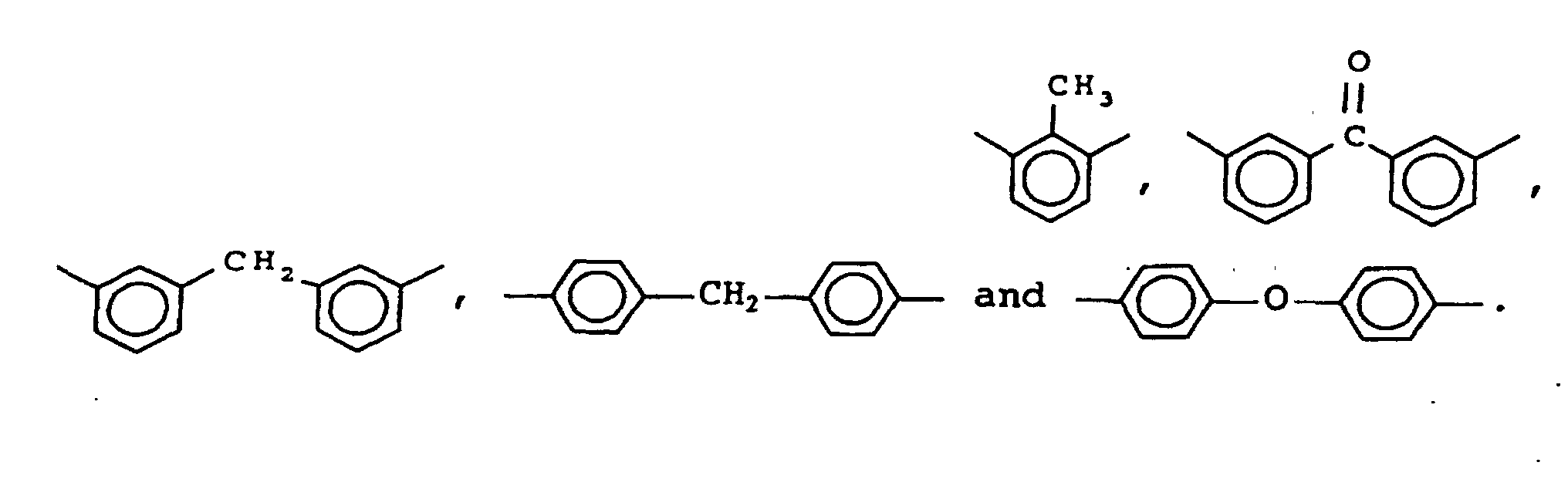
- The water vapor resistant filter according to claim 1, wherein the filter is an antistatic filter and the permeable molded material, nonwoven fabric or felt is covered with a fluorine elastomer and an electroconductive material.
- The water vapor resistant antistatic filter as claimed in claim 2, wherein the electroconductive material is a carbon black powder or a metal powder.
- A process for producing the water vapor resistant filter according to claim 1, which comprises the steps of
coating the permeable molded material, nonwoven fabric or felt comprising a polyimide fiber having a repeating unit represented by formula (I) with a dispersion of a melting fluorine resin fine powder dispersed in water or in an organic solvent or with a dispersion of a melting fluorine resin fine powder and a synthetic resin dispersed in water or in an organic solvent, and
heating the coated permeable molded material, nonwoven fabric or felt at a temperature of from 260 to 400°C. - A process for producing a water vapor resistant filter according to claim 1, which comprises the steps of
coating the permeable molded material, nonwoven fabric or felt comprising a polyimide fiber having a repeating unit represented by formula (I) with a latex of a fluorine elastomer and
heating the coated permeable molded material, nonwoven fabric or felt.
A process for producing the water vapor resistant antistatic filter according to claim 2, which comprises the steps of
coating the permeable molded material, nonwoven fabric or felt comprising a polyimide fiber having a repeating unit represented by the following formula (I) with an electroconductive material and a fluorine elastomer dispersed in water or in an organic solvent, and
drying the coated permeable molded material, nonwoven fabric or felt at room temperature or by heating.
Applications Claiming Priority (3)
| Application Number | Priority Date | Filing Date | Title |
|---|---|---|---|
| JP08360494A JP3300529B2 (en) | 1994-03-31 | 1994-03-31 | Antistatic filtering material and method for producing the same |
| JP83604/94 | 1994-03-31 | ||
| JP8360494 | 1994-03-31 |
Publications (2)
| Publication Number | Publication Date |
|---|---|
| EP0674934A1 EP0674934A1 (en) | 1995-10-04 |
| EP0674934B1 true EP0674934B1 (en) | 2005-03-09 |
Family
ID=13807092
Family Applications (1)
| Application Number | Title | Priority Date | Filing Date |
|---|---|---|---|
| EP95104669A Expired - Lifetime EP0674934B1 (en) | 1994-03-31 | 1995-03-29 | Filter having chemical resistance, antistatic property and water vapor resistance, and process for producing the same |
Country Status (9)
| Country | Link |
|---|---|
| US (1) | US5607490A (en) |
| EP (1) | EP0674934B1 (en) |
| JP (1) | JP3300529B2 (en) |
| KR (1) | KR950031195A (en) |
| CN (2) | CN1061898C (en) |
| AT (1) | ATE290423T1 (en) |
| CA (1) | CA2145252C (en) |
| DE (1) | DE69534053T2 (en) |
| TW (1) | TW342343B (en) |
Families Citing this family (23)
| Publication number | Priority date | Publication date | Assignee | Title |
|---|---|---|---|---|
| US6036735A (en) * | 1998-03-17 | 2000-03-14 | Jps Converter And Industrial Fabrics Corporation | Finish for glass fiber fabric |
| KR20010049815A (en) * | 1999-07-19 | 2001-06-15 | 이충중 | Electro-conductive filter and manufactur ing method of same |
| KR100697602B1 (en) * | 2000-12-27 | 2007-03-22 | 엘지.필립스 엘시디 주식회사 | Multi filter housing |
| WO2005083240A1 (en) * | 2004-02-23 | 2005-09-09 | Donaldson Company, Inc. | Crankcase ventilation filter |
| US20050209498A1 (en) * | 2004-03-17 | 2005-09-22 | Smirnov Vladimir V | Methods for detoxifying polychloro-organic wastes |
| US12172111B2 (en) | 2004-11-05 | 2024-12-24 | Donaldson Company, Inc. | Filter medium and breather filter structure |
| EP2308579B1 (en) | 2004-11-05 | 2016-01-27 | Donaldson Company, Inc. | Aerosol separator |
| US8057567B2 (en) | 2004-11-05 | 2011-11-15 | Donaldson Company, Inc. | Filter medium and breather filter structure |
| KR100769319B1 (en) * | 2004-11-16 | 2007-10-24 | 이중재 | Manufacturing method of high temperature dust cartridge filter |
| BRPI0606842A2 (en) | 2005-02-04 | 2009-07-21 | Donaldson Co Inc | aerosol separator |
| US7717975B2 (en) * | 2005-02-16 | 2010-05-18 | Donaldson Company, Inc. | Reduced solidity web comprising fiber and fiber spacer or separation means |
| DE602006009229D1 (en) | 2005-02-22 | 2009-10-29 | Donaldson Co Inc | aerosol |
| WO2007095335A2 (en) * | 2006-02-13 | 2007-08-23 | Donaldson Company, Inc. | Filter web comprising fine fiber and reactive, adsorptive or absorptive particulate |
| CN100409921C (en) * | 2006-05-30 | 2008-08-13 | 上海华成针刺材料有限公司 | Aromatic polyamide permeable filter felt |
| US7988860B2 (en) | 2007-03-15 | 2011-08-02 | Donaldson Company Inc. | Superabsorbent-containing web that can act as a filter, absorbent, reactive layer or fuel fuse |
| WO2009031610A1 (en) * | 2007-09-05 | 2009-03-12 | Daikin Industries, Ltd. | Composite |
| CN104645716B (en) * | 2015-02-05 | 2016-03-23 | 福建鑫华股份有限公司 | Novel antistatic filtering material of a kind of base cloth plating and preparation method thereof |
| JP6732490B2 (en) * | 2016-03-23 | 2020-07-29 | タイガースポリマー株式会社 | Non-woven filter material |
| CN107050998A (en) * | 2017-02-27 | 2017-08-18 | 辽宁鸿盛环境技术集团有限公司 | A kind of woven filtrate of inorfil and preparation method |
| CN115135822B (en) * | 2020-03-03 | 2024-04-30 | 帝人株式会社 | Pitch-based ultra-fine carbon fibers and pitch-based ultra-fine carbon fiber dispersions |
| TWI798567B (en) * | 2020-07-13 | 2023-04-11 | 財團法人紡織產業綜合研究所 | Functional resin material, fabricating method thereof, and moisture-sensed contracting fabric |
| CN112246020A (en) * | 2020-09-30 | 2021-01-22 | 南京际华三五二一环保科技有限公司 | Preparation method of low-resistance surface filter material |
| CN112933686A (en) * | 2021-01-29 | 2021-06-11 | 云南电网有限责任公司电力科学研究院 | Preparation method of super-hydrophobic filter cloth filter element |
Family Cites Families (19)
| Publication number | Priority date | Publication date | Assignee | Title |
|---|---|---|---|---|
| JPS55119313A (en) * | 1979-03-06 | 1980-09-13 | Hitachi Cable | Noise preventive high voltage resistance wire |
| JPS5811003A (en) * | 1981-07-10 | 1983-01-21 | Ube Ind Ltd | Polyimide type gas separating membrane |
| JPS59129131A (en) * | 1983-01-17 | 1984-07-25 | Bridgestone Corp | Manufacture of fluoro-resin net |
| US4565727A (en) * | 1983-09-12 | 1986-01-21 | American Cyanamid Co. | Non-woven activated carbon fabric |
| US4540625A (en) * | 1984-01-09 | 1985-09-10 | Hughes Aircraft Company | Flexible air permeable non-woven fabric filters |
| JPS61149217A (en) * | 1984-12-25 | 1986-07-07 | Teijin Ltd | Chemical resistant filter material |
| GB8503749D0 (en) * | 1985-02-14 | 1985-03-20 | Craig Med Prod Ltd | Gas filter |
| JPS6257045A (en) * | 1985-09-05 | 1987-03-12 | Nec Corp | Memory protection system |
| JPS6327919A (en) * | 1986-07-22 | 1988-02-05 | Toshiba Corp | Documentation device |
| JPS6366889A (en) * | 1986-09-08 | 1988-03-25 | 東レ株式会社 | Filament heater |
| JPH022856A (en) * | 1987-11-13 | 1990-01-08 | Mitsubishi Rayon Co Ltd | porous membrane |
| AT391710B (en) * | 1988-02-26 | 1990-11-26 | Chemiefaser Lenzing Ag | FIRE-RESISTANT HIGH-TEMPERATURE-RESISTANT POLYIMIDE FIBERS AND SHAPED BODIES THEREOF |
| US4948400A (en) * | 1988-06-30 | 1990-08-14 | Nippon Steel Chemical Co., Ltd. | Separation membranes and process for preparing the same |
| CA2012526A1 (en) * | 1989-03-20 | 1990-09-20 | Amar N. Neogi | Natural fiber product coated with a thermoset binder material |
| EP0496313B1 (en) * | 1991-01-22 | 1996-07-17 | Hoechst Aktiengesellschaft | Non-woven reinforced with a meltbinder |
| JPH057749A (en) * | 1991-04-15 | 1993-01-19 | Nitto Denko Corp | Fluorine-containing polyimide-based composite membrane or asymmetric membrane, their production method and gas separation / concentration method using them |
| US5181945A (en) * | 1991-06-10 | 1993-01-26 | Continental Conveyor & Equipment Co. | High-temperature fabric filter media |
| JP3133856B2 (en) * | 1993-03-01 | 2001-02-13 | 日鉄鉱業株式会社 | Polyimide fiber molding and method for producing the same |
| JP3354988B2 (en) * | 1993-05-19 | 2002-12-09 | 日鉄鉱業株式会社 | Chemical resistant filter medium and method for producing the same |
-
1994
- 1994-03-31 JP JP08360494A patent/JP3300529B2/en not_active Expired - Fee Related
-
1995
- 1995-03-17 TW TW084102568A patent/TW342343B/en active
- 1995-03-22 CA CA002145252A patent/CA2145252C/en not_active Expired - Fee Related
- 1995-03-29 US US08/413,107 patent/US5607490A/en not_active Expired - Fee Related
- 1995-03-29 AT AT95104669T patent/ATE290423T1/en not_active IP Right Cessation
- 1995-03-29 EP EP95104669A patent/EP0674934B1/en not_active Expired - Lifetime
- 1995-03-29 DE DE69534053T patent/DE69534053T2/en not_active Expired - Fee Related
- 1995-03-31 CN CN95103840A patent/CN1061898C/en not_active Expired - Fee Related
- 1995-03-31 KR KR1019950007226A patent/KR950031195A/en not_active Abandoned
-
2000
- 2000-08-04 CN CNB001224999A patent/CN1137749C/en not_active Expired - Fee Related
Also Published As
| Publication number | Publication date |
|---|---|
| CN1137749C (en) | 2004-02-11 |
| TW342343B (en) | 1998-10-11 |
| DE69534053D1 (en) | 2005-04-14 |
| ATE290423T1 (en) | 2005-03-15 |
| US5607490A (en) | 1997-03-04 |
| JP3300529B2 (en) | 2002-07-08 |
| CN1061898C (en) | 2001-02-14 |
| KR950031195A (en) | 1995-12-18 |
| CN1112452A (en) | 1995-11-29 |
| CA2145252A1 (en) | 1995-10-01 |
| CN1310035A (en) | 2001-08-29 |
| JPH07265623A (en) | 1995-10-17 |
| DE69534053T2 (en) | 2005-07-21 |
| CA2145252C (en) | 2004-10-12 |
| EP0674934A1 (en) | 1995-10-04 |
Similar Documents
| Publication | Publication Date | Title |
|---|---|---|
| US5607490A (en) | Filter having chemical resistance, antistatic property and water vapor resistance, and process for producing the same | |
| EP0617745B1 (en) | Static dissipative nonwoven textile material | |
| US5213882A (en) | Static dissipative nonwoven textile material | |
| CN1196818C (en) | Electret fibers and filter webs having low level of extractable hydrocarbons | |
| US5972449A (en) | Porous products manufactured from polytetrafluoroethylene treated with a perfluoroether fluid and methods of manufacturing such products | |
| CA2227422A1 (en) | Fibrous webs having enhanced electret properties | |
| WO2009148747A2 (en) | Charge-enhancing additives for electrets | |
| EP0620044A2 (en) | Electret filters | |
| FI100608B (en) | Coated textile materials | |
| WO1999062993A1 (en) | Fine powder-type porous ptfe material | |
| EP0726348A1 (en) | Gas permeable fabric | |
| JP3354988B2 (en) | Chemical resistant filter medium and method for producing the same | |
| DE69804288T2 (en) | METHOD FOR PRODUCING A GRANULATED POLYTETRAFLUOROETHYLENE POWDER | |
| JP3410787B2 (en) | Chemical resistant filter medium and method for producing the same | |
| WO1996034676A1 (en) | Conductive filter | |
| US20020006757A1 (en) | Gas permeable fabric | |
| KR101477113B1 (en) | Prous fabriclike aramid oil-water separation sheet composition and manufacturing method for prous fabriclike aramid oil-water separation sheet using the same | |
| JPH07278314A (en) | Production of polytetrafluoroethylene granulated powder | |
| JP2952958B2 (en) | Manufacturing method of polytetrafluoroethylene granulated powder containing filler | |
| HU206277B (en) | Filtering medium for electrostatic filtering contaminated air and gases | |
| JPH0957029A (en) | Porous plastic filter for particle separation | |
| JPH05154892A (en) | Extrusion molding method for polyimide | |
| MXPA00012597A (en) | Fluorinated electret |
Legal Events
| Date | Code | Title | Description |
|---|---|---|---|
| PUAI | Public reference made under article 153(3) epc to a published international application that has entered the european phase |
Free format text: ORIGINAL CODE: 0009012 |
|
| AK | Designated contracting states |
Kind code of ref document: A1 Designated state(s): AT DE GB |
|
| 17P | Request for examination filed |
Effective date: 19960314 |
|
| 17Q | First examination report despatched |
Effective date: 20000307 |
|
| GRAP | Despatch of communication of intention to grant a patent |
Free format text: ORIGINAL CODE: EPIDOSNIGR1 |
|
| GRAS | Grant fee paid |
Free format text: ORIGINAL CODE: EPIDOSNIGR3 |
|
| GRAA | (expected) grant |
Free format text: ORIGINAL CODE: 0009210 |
|
| AK | Designated contracting states |
Kind code of ref document: B1 Designated state(s): AT DE GB |
|
| RAP1 | Party data changed (applicant data changed or rights of an application transferred) |
Owner name: NITTETSU MINING CO., LTD. |
|
| REG | Reference to a national code |
Ref country code: GB Ref legal event code: FG4D |
|
| PGFP | Annual fee paid to national office [announced via postgrant information from national office to epo] |
Ref country code: GB Payment date: 20050310 Year of fee payment: 11 |
|
| PGFP | Annual fee paid to national office [announced via postgrant information from national office to epo] |
Ref country code: AT Payment date: 20050318 Year of fee payment: 11 |
|
| REF | Corresponds to: |
Ref document number: 69534053 Country of ref document: DE Date of ref document: 20050414 Kind code of ref document: P |
|
| PGFP | Annual fee paid to national office [announced via postgrant information from national office to epo] |
Ref country code: DE Payment date: 20050429 Year of fee payment: 11 |
|
| PLBE | No opposition filed within time limit |
Free format text: ORIGINAL CODE: 0009261 |
|
| STAA | Information on the status of an ep patent application or granted ep patent |
Free format text: STATUS: NO OPPOSITION FILED WITHIN TIME LIMIT |
|
| 26N | No opposition filed |
Effective date: 20051212 |
|
| PG25 | Lapsed in a contracting state [announced via postgrant information from national office to epo] |
Ref country code: GB Free format text: LAPSE BECAUSE OF NON-PAYMENT OF DUE FEES Effective date: 20060329 Ref country code: AT Free format text: LAPSE BECAUSE OF NON-PAYMENT OF DUE FEES Effective date: 20060329 |
|
| PG25 | Lapsed in a contracting state [announced via postgrant information from national office to epo] |
Ref country code: DE Free format text: LAPSE BECAUSE OF NON-PAYMENT OF DUE FEES Effective date: 20061003 |
|
| GBPC | Gb: european patent ceased through non-payment of renewal fee |
Effective date: 20060329 |