EP0673739B1 - A method of moulding plastics - Google Patents
A method of moulding plastics Download PDFInfo
- Publication number
- EP0673739B1 EP0673739B1 EP19930307471 EP93307471A EP0673739B1 EP 0673739 B1 EP0673739 B1 EP 0673739B1 EP 19930307471 EP19930307471 EP 19930307471 EP 93307471 A EP93307471 A EP 93307471A EP 0673739 B1 EP0673739 B1 EP 0673739B1
- Authority
- EP
- European Patent Office
- Prior art keywords
- plastics
- mould
- layer
- pressure differential
- moulding
- Prior art date
- Legal status (The legal status is an assumption and is not a legal conclusion. Google has not performed a legal analysis and makes no representation as to the accuracy of the status listed.)
- Expired - Lifetime
Links
- 239000004033 plastic Substances 0.000 title claims description 59
- 229920003023 plastic Polymers 0.000 title claims description 59
- 238000000465 moulding Methods 0.000 title claims description 26
- 238000000034 method Methods 0.000 title claims description 16
- 238000010438 heat treatment Methods 0.000 claims description 11
- 230000007704 transition Effects 0.000 claims description 11
- 239000008187 granular material Substances 0.000 claims description 9
- 239000000843 powder Substances 0.000 claims description 9
- 238000001816 cooling Methods 0.000 claims description 5
- 239000007787 solid Substances 0.000 claims description 5
- 239000000463 material Substances 0.000 description 28
- 239000007789 gas Substances 0.000 description 8
- -1 Polyethylene Polymers 0.000 description 7
- 230000015572 biosynthetic process Effects 0.000 description 5
- 238000001175 rotational moulding Methods 0.000 description 5
- 239000004698 Polyethylene Substances 0.000 description 4
- 229920000573 polyethylene Polymers 0.000 description 4
- 229920001169 thermoplastic Polymers 0.000 description 4
- 239000004416 thermosoftening plastic Substances 0.000 description 4
- 239000004743 Polypropylene Substances 0.000 description 3
- 229920001155 polypropylene Polymers 0.000 description 3
- 230000002411 adverse Effects 0.000 description 1
- 238000002425 crystallisation Methods 0.000 description 1
- 230000007423 decrease Effects 0.000 description 1
- 230000001627 detrimental effect Effects 0.000 description 1
- 230000004927 fusion Effects 0.000 description 1
- 239000011261 inert gas Substances 0.000 description 1
- 238000002347 injection Methods 0.000 description 1
- 239000007924 injection Substances 0.000 description 1
- 239000000155 melt Substances 0.000 description 1
- 239000002991 molded plastic Substances 0.000 description 1
- 238000012544 monitoring process Methods 0.000 description 1
Images

Classifications
-
- B—PERFORMING OPERATIONS; TRANSPORTING
- B29—WORKING OF PLASTICS; WORKING OF SUBSTANCES IN A PLASTIC STATE IN GENERAL
- B29C—SHAPING OR JOINING OF PLASTICS; SHAPING OF MATERIAL IN A PLASTIC STATE, NOT OTHERWISE PROVIDED FOR; AFTER-TREATMENT OF THE SHAPED PRODUCTS, e.g. REPAIRING
- B29C41/00—Shaping by coating a mould, core or other substrate, i.e. by depositing material and stripping-off the shaped article; Apparatus therefor
- B29C41/34—Component parts, details or accessories; Auxiliary operations
- B29C41/50—Shaping under special conditions, e.g. vacuum
-
- B—PERFORMING OPERATIONS; TRANSPORTING
- B29—WORKING OF PLASTICS; WORKING OF SUBSTANCES IN A PLASTIC STATE IN GENERAL
- B29C—SHAPING OR JOINING OF PLASTICS; SHAPING OF MATERIAL IN A PLASTIC STATE, NOT OTHERWISE PROVIDED FOR; AFTER-TREATMENT OF THE SHAPED PRODUCTS, e.g. REPAIRING
- B29C41/00—Shaping by coating a mould, core or other substrate, i.e. by depositing material and stripping-off the shaped article; Apparatus therefor
- B29C41/02—Shaping by coating a mould, core or other substrate, i.e. by depositing material and stripping-off the shaped article; Apparatus therefor for making articles of definite length, i.e. discrete articles
- B29C41/04—Rotational or centrifugal casting, i.e. coating the inside of a mould by rotating the mould
-
- B—PERFORMING OPERATIONS; TRANSPORTING
- B29—WORKING OF PLASTICS; WORKING OF SUBSTANCES IN A PLASTIC STATE IN GENERAL
- B29C—SHAPING OR JOINING OF PLASTICS; SHAPING OF MATERIAL IN A PLASTIC STATE, NOT OTHERWISE PROVIDED FOR; AFTER-TREATMENT OF THE SHAPED PRODUCTS, e.g. REPAIRING
- B29C41/00—Shaping by coating a mould, core or other substrate, i.e. by depositing material and stripping-off the shaped article; Apparatus therefor
- B29C41/34—Component parts, details or accessories; Auxiliary operations
- B29C41/52—Measuring, controlling or regulating
Definitions
- the present invention relates to a method of moulding plastics and, more particularly, to rotational moulding in which the plastics material in the moulding tool is subjected to a pressure differential to improve the quality of the moulded product.
- thermoplastics articles by rotational fusion moulding is a well known process.
- Such a process is disclosed in International Patent Publication WO-A-91/05647 where temperature within the mould tool is monitored to determine, relative to moulding time, when all of the plastics material has been melted, when the plastics moulding has achieved its optimum properties and when the moulding can be removed from the tool so that the moulding process can be controlled for a particular plastics material.
- a gaseous medium, at pressure for maintaining the plastics material against the face of the cavity in the tool and alleviating the formation of bubbles or voids in the plastics moulding.
- Patent Specification US-A-3,514,508 (which provides the basis for the preamble to claim 1 hereof) discloses the circulation of an inert gas under pressure through the mould tool, such gas conveniently serving to cool the interior surface of the plastics moulding.
- an inert gas under pressure through the mould tool, such gas conveniently serving to cool the interior surface of the plastics moulding.
- subjecting the plastics material to a pressure differential as aforementioned, indiscriminately or without strict monitoring can cause any bubbles that are formed in the plastics moulded product to be pressurised, which would weaken the moulded structure and provide an unacceptable finish to the product.
- a method of moulding plastics which comprises charging a cavity of a rotary mould with plastics powder or granules; rotating the mould to tumble the powder or granules in the cavity and heating the powder or granules successively through a first heating phase during which the powder or granules is progressively melted and at the end of which all of the plastics has melted to a layer on an internal surface of the rotating mould and a second heating phase during which the molten plastics layer attains a predetermined maximum temperature; cooling the plastics layer from said maximum temperature successively through a first cooling phase to a transition phase at the commencement of which the molten plastics layer commences to solidify and at the termination of which the plastics layer forms a substantially solid plastics moulding, and in which the molten plastics layer is subjected to a pressure differential with pressure on the face of said layer adjacent to the internal surface of the mould being less than pressure on the face of the layer remote from said internal surface, CHARACTERISED
- the pressure differential will be applied at the commencement of the second heating phase and will usually be removed at the termination of the transition phase.
- the solid plastics moulding will usually be further cooled prior to its removal from the mould cavity.
- thermoplastics material is carried out by charging a cavity of a rotary moulding tool with the plastics material, such as polyethylene, in the form of granules or as a powder and heating this plastics material as the mould is rotated. As its temperature rises the plastics material gradually melts and, due to the centrifugal forces to which it is subjected by the rotating tool, the plastics forms a layer on the internal surface of the tool in the mould cavity. The plastics material is then heated to a maximum temperature, ensuring all the material is completely melted, before being allowed to cool and solidify, as the moulding tool continues its rotation, until the moulded plastics product is obtained.
- the plastics material such as polyethylene
- the plastics material is subjected to a pressure differential, preferaby by increasing the internal pressure of the mould cavity during the moulding process; this may be achieved by injection of compressed air, or other gas at high pressure into the mould cavity.
- This pressure differential serves two purposes, it helps hold the molten plastics material against the surface of the moulding tool during the cooling stage and it has been shown to reduce the formation of bubbles or voids within the plastics material, which bubbles could adversely affect the strength of the moulded structure and mar the finish of the exterior surface of the moulded article.
- care must be taken with the use of gas under pressure in the mould cavity.
- the mould is then allowed to cool until region D in the graph where the curve flattens out , the first timed inflexion point D' of region D indicating where the plastics material begins to solidify (which may result from crystallisation of the material releasing latent heat, thus maintaining the temperature of the mould at this time) and the second timed inflexion point D'' of region D indicating that the plastics material has completely solidified, the mould then cools further until the plastics moulded product may be removed at point E.
- the plastics material has to be subjected to the pressure differential, preferably by introducing gas under pressure into the cavity of the moulding tool, no earlier than point B and no later than the first timed inflexion point D' as shown in the Figures.
- the pressure differential is applied at point B.
- the period for which the pressure differential is maintained is variable up to the moment of demoulding (point E) but this period has to extend until plastics material has solidified as indicated at the second timed inflexion point D'' in the Figures.
- the pressure differential will be removed at the termination of the transition phase D (that is at the inflexion point D'').
Landscapes
- Engineering & Computer Science (AREA)
- Mechanical Engineering (AREA)
- Moulding By Coating Moulds (AREA)
Description
- The present invention relates to a method of moulding plastics and, more particularly, to rotational moulding in which the plastics material in the moulding tool is subjected to a pressure differential to improve the quality of the moulded product.
- The formation of thermoplastics articles by rotational fusion moulding is a well known process. Such a process is disclosed in International Patent Publication WO-A-91/05647 where temperature within the mould tool is monitored to determine, relative to moulding time, when all of the plastics material has been melted, when the plastics moulding has achieved its optimum properties and when the moulding can be removed from the tool so that the moulding process can be controlled for a particular plastics material. It is also known to introduce into the mould tool during its rotation, a gaseous medium, at pressure, for maintaining the plastics material against the face of the cavity in the tool and alleviating the formation of bubbles or voids in the plastics moulding. Patent Specification US-A-3,514,508 (which provides the basis for the preamble to claim 1 hereof) discloses the circulation of an inert gas under pressure through the mould tool, such gas conveniently serving to cool the interior surface of the plastics moulding. However subjecting the plastics material to a pressure differential as aforementioned, indiscriminately or without strict monitoring, can cause any bubbles that are formed in the plastics moulded product to be pressurised, which would weaken the moulded structure and provide an unacceptable finish to the product.
- It is an object of the present invention to provide an improved method of moulding plastics by rotational moulding which alleviates the disadvantages of the prior proposals, particularly by alleviating the formation of bubbles or voids in the moulded product, in a simple, economical and efficient manner.
- According to the present invention there is provided a method of moulding plastics which comprises charging a cavity of a rotary mould with plastics powder or granules; rotating the mould to tumble the powder or granules in the cavity and heating the powder or granules successively through a first heating phase during which the powder or granules is progressively melted and at the end of which all of the plastics has melted to a layer on an internal surface of the rotating mould and a second heating phase during which the molten plastics layer attains a predetermined maximum temperature; cooling the plastics layer from said maximum temperature successively through a first cooling phase to a transition phase at the commencement of which the molten plastics layer commences to solidify and at the termination of which the plastics layer forms a substantially solid plastics moulding, and in which the molten plastics layer is subjected to a pressure differential with pressure on the face of said layer adjacent to the internal surface of the mould being less than pressure on the face of the layer remote from said internal surface, CHARACTERISED IN THAT the molten plastics layer is subjected to the pressure differential subsequent to the first heating phase and prior to the commencement of the transition phase and said pressure differential is maintained at least until the termination of the transition phase.
- Preferably, the pressure differential will be applied at the commencement of the second heating phase and will usually be removed at the termination of the transition phase.
- Subsequent to the termination of the transition phase the solid plastics moulding will usually be further cooled prior to its removal from the mould cavity.
- A method of rotation moulding in accordance with the present invention will now be described, by way of example only, with reference to the accompanying Figures, in which:-
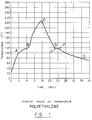
- FIGURE 1 is a graph showing internal mould temperature (°C) against time (Minutes) for rotational moulding of a Polyethylene product; and
- FIGURE 2 is a graph showing internal mould temperature (°C) against time (Minutes) for rotational moulding of a Polypropylene product.
- The rotational moulding of thermoplastics material is carried out by charging a cavity of a rotary moulding tool with the plastics material, such as polyethylene, in the form of granules or as a powder and heating this plastics material as the mould is rotated. As its temperature rises the plastics material gradually melts and, due to the centrifugal forces to which it is subjected by the rotating tool, the plastics forms a layer on the internal surface of the tool in the mould cavity. The plastics material is then heated to a maximum temperature, ensuring all the material is completely melted, before being allowed to cool and solidify, as the moulding tool continues its rotation, until the moulded plastics product is obtained.
- The plastics material is subjected to a pressure differential, preferaby by increasing the internal pressure of the mould cavity during the moulding process; this may be achieved by injection of compressed air, or other gas at high pressure into the mould cavity. This pressure differential serves two purposes, it helps hold the molten plastics material against the surface of the moulding tool during the cooling stage and it has been shown to reduce the formation of bubbles or voids within the plastics material, which bubbles could adversely affect the strength of the moulded structure and mar the finish of the exterior surface of the moulded article. However, care must be taken with the use of gas under pressure in the mould cavity. Such pressure if applied incorrectly may be ineffective and indeed may prove to have a detrimental effect on the final article, especially if it causes pressurized gas bubbles to develop within the plastics material. Our research has indicated that the aforementioned gas pressure differential, especially the introduction of gas under pressure to the tool cavity, should only be applied when the plastics material is completely melted if the aforementioned gas bubbles are to be avoided and a satisfactory external surface finish for the moulded product is to be achieved.
- Our studies of the variation of temperature of thermoplastics during rotary moulding against time during the moulding process (known as a "Rotolog Trace") have revealed that for most thermoplastics materials the temperature follows a standard pattern, as is illustrated in the graphs of Figures 1 and 2 which are typical for polyethylene and polypropylene respectively. In typical cases of polyethylene and polypropylene it can be seen from Figures 1 and 2 that at the start of the moulding process, as the mould is heated uniformly, the temperature of the plastics rises steadily to point A and the plastics material remains in a solid form, tumbling within the rotating mould. At point A the plastics material begins to melt and adhere to the surface of the cavity in the mould, and the rate of temperature increase of the plastics within the mould decreases as extra energy (latent heat) is absorbed by the plastics material to cause it to melt. At point B all of the plastics material has melted and the temperature of the plastics again continues to rise steadily to a maximum, controlled temperature at point C. The mould is then allowed to cool until region D in the graph where the curve flattens out , the first timed inflexion point D' of region D indicating where the plastics material begins to solidify (which may result from crystallisation of the material releasing latent heat, thus maintaining the temperature of the mould at this time) and the second timed inflexion point D'' of region D indicating that the plastics material has completely solidified, the mould then cools further until the plastics moulded product may be removed at point E.
- Thus, from studies of the temperature of the mould (the Rotolog Trace) and the plastics material it is possible to determine closely the time region at which the plastics material has completely melted, (point B in the Figures) and also the time region at which the molten plastics begins to solidify (the first timed inflexion point D' of region D in the Figures). Our research has indicated that to alleviate bubble formation or voids in, and to provide an efficient external surface finish for, the moulded product, and in accordance with the present invention, the plastics material has to be subjected to the pressure differential, preferably by introducing gas under pressure into the cavity of the moulding tool, no earlier than point B and no later than the first timed inflexion point D' as shown in the Figures. Preferably the pressure differential is applied at point B.
- The period for which the pressure differential is maintained is variable up to the moment of demoulding (point E) but this period has to extend until plastics material has solidified as indicated at the second timed inflexion point D'' in the Figures. Usually the pressure differential will be removed at the termination of the transition phase D (that is at the inflexion point D'').
Claims (5)
- A method of moulding plastics which comprises charging a cavity of a rotary mould with plastics powder or granules; rotating the mould to tumble the powder or granules in the cavity and heating the powder or granules successively through a first heating phase during which the powder or granules is progressively melted and at the end of which all of the plastics has melted to a layer on an internal surface of the rotating mould and a second heating phase during which the molten plastics layer attains a predetermined maximum temperature; cooling the plastics layer from said maximum temperature successively through a first cooling phase to a transition phase at the commencement of which the molten plastics layer commences to solidify and at the termination of which the plastics layer forms a substantially solid plastics moulding, and in which the molten plastics layer is subjected to a pressure differential with pressure on the face of said layer adjacent to the internal surface of the mould being less than pressure on the face of the layer remote from said internal surface, CHARACTERISED IN THAT the molten plastics layer is subjected to the pressure differential subsequent to the first heating phase and prior to the commencement of the transition phase and said pressure differential is maintained at least until the termination of the transition phase.
- The method of claim 1 in which the pressure differential is applied at the commencement of the second heating phase.
- The method as claimed in either claim 1 or claim 2 in which the pressure differential is removed at the termination of the transition phase.
- The method as claimed in any one of the preceding claims in which subsequent to termination of the transition phase the solid plastics moulding is further cooled prior to its removal from the mould cavity.
- The method as claimed in any one of the preceding claims in which the pressure differential is applied by introducing air or other gas under pressure into the cavity of the rotating mould.
Priority Applications (2)
| Application Number | Priority Date | Filing Date | Title |
|---|---|---|---|
| EP19930307471 EP0673739B1 (en) | 1993-09-22 | 1993-09-22 | A method of moulding plastics |
| DE69305996T DE69305996D1 (en) | 1993-09-22 | 1993-09-22 | Plastic molding process |
Applications Claiming Priority (1)
| Application Number | Priority Date | Filing Date | Title |
|---|---|---|---|
| EP19930307471 EP0673739B1 (en) | 1993-09-22 | 1993-09-22 | A method of moulding plastics |
Publications (2)
| Publication Number | Publication Date |
|---|---|
| EP0673739A1 EP0673739A1 (en) | 1995-09-27 |
| EP0673739B1 true EP0673739B1 (en) | 1996-11-13 |
Family
ID=8214552
Family Applications (1)
| Application Number | Title | Priority Date | Filing Date |
|---|---|---|---|
| EP19930307471 Expired - Lifetime EP0673739B1 (en) | 1993-09-22 | 1993-09-22 | A method of moulding plastics |
Country Status (2)
| Country | Link |
|---|---|
| EP (1) | EP0673739B1 (en) |
| DE (1) | DE69305996D1 (en) |
Families Citing this family (2)
| Publication number | Priority date | Publication date | Assignee | Title |
|---|---|---|---|---|
| CN104139477B (en) * | 2014-06-16 | 2019-02-01 | 中广核研究院有限公司 | Preparation method of medium and low radioactive nuclear waste packaging container |
| CN113896971B (en) * | 2020-06-22 | 2023-08-11 | 中国石油化工股份有限公司 | Polyethylene composition and method for producing the same |
Family Cites Families (3)
| Publication number | Priority date | Publication date | Assignee | Title |
|---|---|---|---|---|
| NL6706661A (en) * | 1966-05-26 | 1967-11-27 | ||
| US4636338A (en) * | 1985-01-11 | 1987-01-13 | Neefe Charles W | Molding toric contact lenses using a directed stream of gas |
| GB8923207D0 (en) * | 1989-10-14 | 1989-11-29 | Univ Belfast | Rotational moulding apparatus and process |
-
1993
- 1993-09-22 EP EP19930307471 patent/EP0673739B1/en not_active Expired - Lifetime
- 1993-09-22 DE DE69305996T patent/DE69305996D1/en not_active Expired - Fee Related
Also Published As
| Publication number | Publication date |
|---|---|
| DE69305996D1 (en) | 1996-12-19 |
| EP0673739A1 (en) | 1995-09-27 |
Similar Documents
| Publication | Publication Date | Title |
|---|---|---|
| JP3373335B2 (en) | Materials and methods for manufacturing plastic parts | |
| CA2060461C (en) | Method for manufacturing a plastic hollow product using water soluble resin | |
| US3984511A (en) | Method of rotational molding | |
| AU2003276369B2 (en) | Method for rotational moulding of a workpiece comprising a thermoplastic foam layer | |
| EP0725722B1 (en) | Method of forming molecularly oriented preforms | |
| JPS63249616A (en) | Method for molding resin | |
| US6214272B1 (en) | Rotational molding process | |
| EP0673739A1 (en) | A method of moulding plastics | |
| GB2270276A (en) | Application of pressure differential during rotational moulding | |
| GB2139551A (en) | Method of making a hollow article of polypropylene by biaxial stretch blow moulding | |
| Liu et al. | Factors affecting the warpage of rotationally molded parts | |
| JPH0428210B2 (en) | ||
| WO1986002034A1 (en) | Improved method of forming blanks for the solid-phase forming of thermoplastic articles | |
| WO2001066327A2 (en) | Compression moulding semi-crystalline polymers | |
| JPS63280612A (en) | Method of improving quality of injection molded form | |
| Crawford | Causes and cures of problems during rotomoulding | |
| JPH04294132A (en) | Manufacture of hollow product of fiber reinforced thermoplastic plastic | |
| JPH02182413A (en) | Production of thermoplastic resin molding | |
| KR100709452B1 (en) | Forming Method of Skin Material by Powder Slush Molding | |
| JPH09117929A (en) | Injection molding method of thermoplastic material using rotating core | |
| EP0404837B1 (en) | Injection moulding of a preform and/or a container and a container of thermoplastic material | |
| JP2001504405A (en) | Method for producing monolithic plastic object and object obtained by the method | |
| JPH10296812A (en) | Injection compression molding method | |
| AU563700B2 (en) | Improved method of forming blanks for the solid-phase formingof thermoplastic articles | |
| CA1241170A (en) | Method of forming blanks for the solid-phase forming of thermoplastic articles |
Legal Events
| Date | Code | Title | Description |
|---|---|---|---|
| PUAI | Public reference made under article 153(3) epc to a published international application that has entered the european phase |
Free format text: ORIGINAL CODE: 0009012 |
|
| 17P | Request for examination filed |
Effective date: 19940325 |
|
| AK | Designated contracting states |
Kind code of ref document: A1 Designated state(s): BE DE ES FR IE IT NL |
|
| GRAG | Despatch of communication of intention to grant |
Free format text: ORIGINAL CODE: EPIDOS AGRA |
|
| GRAH | Despatch of communication of intention to grant a patent |
Free format text: ORIGINAL CODE: EPIDOS IGRA |
|
| GRAH | Despatch of communication of intention to grant a patent |
Free format text: ORIGINAL CODE: EPIDOS IGRA |
|
| GRAA | (expected) grant |
Free format text: ORIGINAL CODE: 0009210 |
|
| AK | Designated contracting states |
Kind code of ref document: B1 Designated state(s): BE DE ES FR IE IT NL |
|
| PG25 | Lapsed in a contracting state [announced via postgrant information from national office to epo] |
Ref country code: NL Free format text: LAPSE BECAUSE OF FAILURE TO SUBMIT A TRANSLATION OF THE DESCRIPTION OR TO PAY THE FEE WITHIN THE PRESCRIBED TIME-LIMIT Effective date: 19961113 Ref country code: IT Free format text: LAPSE BECAUSE OF FAILURE TO SUBMIT A TRANSLATION OF THE DESCRIPTION OR TO PAY THE FEE WITHIN THE PRE;WARNING: LAPSES OF ITALIAN PATENTS WITH EFFECTIVE DATE BEFORE 2007 MAY HAVE OCCURRED AT ANY TIME BEFORE 2007. THE CORRECT EFFECTIVE DATE MAY BE DIFFERENT FROM THE ONE RECORDED.SCRIBED TIME-LIMIT Effective date: 19961113 Ref country code: FR Effective date: 19961113 Ref country code: ES Free format text: THE PATENT HAS BEEN ANNULLED BY A DECISION OF A NATIONAL AUTHORITY Effective date: 19961113 Ref country code: BE Effective date: 19961113 |
|
| REF | Corresponds to: |
Ref document number: 69305996 Country of ref document: DE Date of ref document: 19961219 |
|
| REG | Reference to a national code |
Ref country code: IE Ref legal event code: FG4D Free format text: 70650 |
|
| NLV1 | Nl: lapsed or annulled due to failure to fulfill the requirements of art. 29p and 29m of the patents act | ||
| EN | Fr: translation not filed | ||
| PLBE | No opposition filed within time limit |
Free format text: ORIGINAL CODE: 0009261 |
|
| STAA | Information on the status of an ep patent application or granted ep patent |
Free format text: STATUS: NO OPPOSITION FILED WITHIN TIME LIMIT |
|
| PG25 | Lapsed in a contracting state [announced via postgrant information from national office to epo] |
Ref country code: IE Free format text: LAPSE BECAUSE OF NON-PAYMENT OF DUE FEES Effective date: 19970922 |
|
| 26N | No opposition filed | ||
| PGFP | Annual fee paid to national office [announced via postgrant information from national office to epo] |
Ref country code: DE Payment date: 19990927 Year of fee payment: 7 |
|
| PG25 | Lapsed in a contracting state [announced via postgrant information from national office to epo] |
Ref country code: DE Free format text: LAPSE BECAUSE OF NON-PAYMENT OF DUE FEES Effective date: 20010601 |