EP0668017B1 - Method for preparing spring roll - Google Patents
Method for preparing spring roll Download PDFInfo
- Publication number
- EP0668017B1 EP0668017B1 EP95101129A EP95101129A EP0668017B1 EP 0668017 B1 EP0668017 B1 EP 0668017B1 EP 95101129 A EP95101129 A EP 95101129A EP 95101129 A EP95101129 A EP 95101129A EP 0668017 B1 EP0668017 B1 EP 0668017B1
- Authority
- EP
- European Patent Office
- Prior art keywords
- dough sheet
- spring roll
- food material
- oil
- attached
- Prior art date
- Legal status (The legal status is an assumption and is not a legal conclusion. Google has not performed a legal analysis and makes no representation as to the accuracy of the status listed.)
- Expired - Lifetime
Links
Images
Classifications
-
- A—HUMAN NECESSITIES
- A21—BAKING; EDIBLE DOUGHS
- A21D—TREATMENT OF FLOUR OR DOUGH FOR BAKING, e.g. BY ADDITION OF MATERIALS; BAKING; BAKERY PRODUCTS
- A21D13/00—Finished or partly finished bakery products
- A21D13/60—Deep-fried products, e.g. doughnuts
-
- A—HUMAN NECESSITIES
- A21—BAKING; EDIBLE DOUGHS
- A21D—TREATMENT OF FLOUR OR DOUGH FOR BAKING, e.g. BY ADDITION OF MATERIALS; BAKING; BAKERY PRODUCTS
- A21D13/00—Finished or partly finished bakery products
- A21D13/30—Filled, to be filled or stuffed products
- A21D13/31—Filled, to be filled or stuffed products filled before baking
Definitions
- This invention relates to a method for producing a spring roll.
- the spring roll belongs to dim sum, a Chinese meal. Its Japanese equivalent is termed "harumaki” which is loved by many people.
- the spring roll is produced by cutting meat of animals, fishes or shells and plants such as vegetables in fine stripes and frying the stripes with oil to obtain an ingredient material, rolling the ingredient material with a dough sheet of wheat flour or the like in an elongated roll and frying the roll with cooking oil maintained at a lower cooking temperature.
- the spring roll In general, it is desired of the spring roll to have both the crispy mouth feel touch proper to its dough sheet and the soft mouth feel touch of the ingredient material wrapped by the dough sheet. Such combined mouth feel touch is present usually in the spring roll immediately after frying.
- the spring roll is sold in larger quantities in, for example, a supermarket, it cannot necessarily be offered in the fresh fried state. Besides, such fresh fried spring roll is not necessarily eaten by the consumers soon after it is bought, such that it takes usually four to six hours since the spring roll is fried until it is eaten by the consumers. If several hours have elapsed since frying, the moisture contained in the ingredient material is absorbed by the fresh fried crispy dough sheet. In addition, if the spring roll is wrapped for sale in the supermarket or the like, such moisture absorption by the dough sheet of the spring roll tends to be promoted, such that the crispy mouth feel touch proper to the dough sheet of the spring roll is lowered.
- Patent Abstracts of Japan, vol. 13, no. 326 (C-620) and JP-A-01 104 149 disclose to attach wheat flour or bread crumb to the outer periphery of a sealed patty.
- Patent Abstracts of Japan, vol. 15, No. 248 (C-0843) and JP-A-03 080 068 disclose to apply a coating agent to a frozen food by spraying thereby to form a film of the coating agent on the surface.
- Patent Abstracts of Japan, vol. 14, no. 544 (C-0784) and JP-A-02 231 062 disclose to cover and seal a sandwich (ingredients sandwiched between bread dough) in a thin patty. So these documents teach to attach the respective material (wheat flour or bread crumb, coating agent, thin patty) only to the outer surface of a spring roll.
- the present invention provides for a method for preparing a spring roll comprising putting an ingredient material on a dough sheet of the spring roll, rolling up the dough sheet to wrap said ingredient material, and frying the rolled spring roll, characterized in that a food material containing an effective component selected from polysaccharides, powders of grains, or mixtures thereof, is attached to 40% or more surface area of the dough sheet based on a total surface area of said dough sheet of the spring roll before said spring roll is fried, wherein said food material is attached at least to a part of the dough sheet that does not constitute the outer surface of the spring roll.
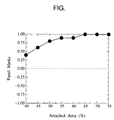
- the sole figure is a graph showing the results of a panel test for mouth feel touch for Example 10.
- a specified food material is attached to not less than 40%, preferably not less than 60% and more preferably not less than 75% of the surface area of the dough sheet based upon its total surface area.
- not less than 40% of the surface area of the dough sheet based upon its total surface area is meant the percentage related to the area of the front and back surfaces of the dough sheet.
- the specified food material becomes elongated or permeated into the dough sheet of the spring roll such that the specified food material becomes effectively affixed prior to frying to not less than 40% of the surface area of the spring roll
- the specified food material is deemed to have been attached to not less than 40% of the total surface area of the dough sheet. If the specified food material is attached to less than 40% of the total surface area, the crispy mouth feel tough proper to the fresh fried dough sheet of the spring roll tends to be markedly lowered. If liquid oil is contained as the specified food material, and if the specified food material is attached to more than 90% of the surface area, there results poor working efficiency in rolling up the dough sheet of the spring roll. It is therefore preferred that the above-mentioned attached area of the specified food material be in a range of 40 to 90%, preferably in a range of 60 to 90% and more preferably in a range of from 75 to 90%.
- the dough sheet of the spring roll it is possible to use a usual baked dough sheet of the spring roll including wheat powders, and a heated and dried dough sheet of the spring roll heated by steam on a drum including starch, such as tapioca starch.
- starch such as tapioca starch.
- ingredient material put on the dough sheet and rolled it is possible to use usual ingredient materials for the spring roll, such as cooked and seasoned meats, vegetables, fishes or shells.
- the food material attached in an amount of 40% or more surface area based on the total surface area of the dough sheet of the spring roll contains polysaccharides and/or powders of grains as essential components.
- the polysaccharides include edible starch, such as potato starch, sweet potato starch, corn starch, wheat starch, or tapioca starch; modified starch prepared from starch, such as pregelatinized starch, acetic modified starch, or phosphoric modified starch; and processed starch, such as heat-moisture treated starch.
- powders of grains include wheat powders, rice powders, semolina powders, corn grits, foxtail millet and Deccan grass. These may be used singly or as a mixture.
- the powders of grains may have a particle size preferably of 10 to 1000 ⁇ m and more preferably of 100 to 300 ⁇ m. If the particle size of the powders of grains is less than 10 ⁇ m, the working efficiency is lowered, whereas if it exceeds 1000 ⁇ m, a problem is raised in connection with the mouth feel touch.
- oil and fats may be contained in the food material containing the polysaccharides and/or the powders of grains.
- the oil and fats may be in the liquid form or solid form, although the liquid form is preferred.
- examples of the oil and fats include vegetable oil and fats, such as safflower oil, sun flower oil, cottonseed oil, rapeseed oil, soybean oil, rice oil, sesame oil, corn oil, kapok oil, peanut oil, olive oil, coconut oil, palm oil, cacao butter or shea butter; and animal oil and fats, such as whale oil, sardine oil, Menhaden oil, herring oil, shark liver oil, cod liver oil, pollack liver oil, beef tallow, lard or butter fat. These may be used singly or in combination.
- the vegetable and animal oil and fats may also be used together. These oil and fats act as media for suspending the essential components of the food material, i.e. polysaccharides and/or powders of grains therein, while providing for facilitated attachment of the food material and improved stability in the quality of the produced spring roll.
- the oil and fats are contained in an amount of 50 to 95 wt% and preferably 70 to 90 wt% based on the total weight of the food material.
- the desirable effect may not be achieved, whereas if the oil and fats are contained in an amount exceeding 95 wt%, the crispy mouth feel touch proper to the dough sheet of the spring roll after lapse of several hours after frying may undesirably be lowered.
- an emulsifier in combination in the food material.
- the emulsifier include alginic acid propylene glycol ester, glycerin fatty acid ester, saccharose fatty acid ester, sorbitan fatty acid ester and propylene glycol fatty acid ester.
- the emulsifier may preferably be contained in an amount of 0.1 to 10 parts by weight and more preferably 0.5 to 3.0 parts by weight to 100 parts by weight of the oil and fats.
- additives such as a viscosity increasing agent
- a viscosity increasing agent examples include sodium alginate, carboxyl methyl cellulose calcium, carboxyl methyl cellulose sodium, starch sodium glycolate, starch sodium phosphate, sodium polyacrylate arid methyl cellulose.
- the viscosity increasing agent is contained preferably in an amount of not more than 10 wt% based on the total weight of the food material containing the polysaccharides and/or powders of grains.
- the food material including the polysaccharides and/or powders of grains may be attached to the dough sheet of the spring roll by spraying, brushing or with the aid of a roll or a sieve.
- a spray, roll, brush or sieve mounted at a desired process position of a currently employed device for preparing the spring roll.
- time point at which the food material is contacted with and attached to the dough sheet provided that at least a fraction of the food material is applied at least to a part of the dough sheet that does not constitute the outer surface of the spring roll, and that such time point precedes frying.
- the food material may be contacted with and attached to the dough sheet before putting the ingredient material on the dough sheet, or when rolling up the dough sheet after putting the ingredient material on the dough sheet, and optionally after rolling up the dough sheet.
- These time points may be suitably combined together so that the food material may be attached in two or more fractions.
- the food material including the polysaccharides and/or powders of grains is preferably attached, such as by sifting, on the dough sheet of the spring roll in an amount of preferably 1.0 to 10.0 g/ 100 cm 2 and more preferably in an amount of 3.0 to 5.0 g/ 100 cm 2 of the surface area of the dough sheet of the spring roll, if the food material is in the solid form, such as in the form of powders. If the amount is less than 1.0 g/ 100 cm 2 , the crispy mouth feel touch proper to the dough sheet of the spring roll after lapse of several hours after frying may undesirably be lowered, whereas if the amount exceeds 10.0 g/ 100 cm 2 , the dough sheet may become undesirably hardened.
- the food material is in the liquid form, such as in the form of a liquid suspension containing the oil and fats or the like, it is preferably attached, such as by coating, on the dough sheet of the spring roll in an amount of preferably 1.0 to 5.0 g/ 100 cm 2 and more preferably in an amount of 2.2 to 3.0 g/ 100 cm 2 of the surface area of the dough sheet of the spring roll.
- the amount is less than 1.0 g/ 100 cm 2 , the crispy mouth feel touch proper to the dough sheet of the spring roll after lapse of several hours after frying may undesirably be lowered, whereas if the amount exceeds 5.0 g/ 100 cm 2 , the dough sheet may become too soft or flaccid by the oil and fats or the like, such that there results a poor working efficiency in rolling up the dough sheet of the spring roll.
- a spring roll product obtained by attaching the food material including the polysaccharides and/or the powders of grains and rolling up the dough sheet of the spring roll can be fried using cooking oil of, for example, 170 to 200°C.
- the spring roll product obtained after attachment of the food material including the polysaccharides and/or the powders of grains and rolling up of the dough sheet of the spring roll can be stored in a refrigerator or frozen before frying.
- the freezing may preferably be carried out at -15°C to -25°C.
- the food material containing the polysaccharides and/or the powders of grains is attached on a specified area portion of the dough sheet of the spring roll before frying, it becomes possible to prevent the crispy mouth feel touch proper to the fresh fried dough sheet from being lowered, so that the preset method is highly useful in the preparation of the spring roll which is offered for sale in a supermarket and which is eaten after lapse of several hours since frying.
- each spring roll thus wrapped was allowed to cool at room temperature and each dough sheet was tested at an interval of one hour until five hours had elapsed.
- the spring rolls were eaten by ten panellers as time elapsed and the crispy mouth feel touch of each dough sheet was evaluated in accordance with the following standards by marks of from -1 to +1.
- the mean marks given by the ten panellers are shown in Table 1.
- the spring rolls were prepared and tested by panel test for mouth feel touch in the same way as in Examples 1 to 7 except that the food materials having the compositions shown in Table 1 were used and sifted on the dough sheets of the spring rolls by a sieve. The results are shown in Table 1.
- the spring rolls were prepared in the same way as in Examples 1 to 7 except using eight different kinds of the dough sheets of the spring rolls in which the attached areas of the food material of the Example 1 to the dough sheets of the spring rolls were increased by steps of 5% from 40% up to 75%.
- the spring rolls were wrapped and allowed to stand for five hours at room temperature and tested as to the mouth feel touch in the same way as in Example 1 to 7.
- the results of the mean marks given by ten panellers are plotted in a graph of the sole figure.
Landscapes
- Life Sciences & Earth Sciences (AREA)
- Engineering & Computer Science (AREA)
- Food Science & Technology (AREA)
- Springs (AREA)
- Wire Processing (AREA)
- General Preparation And Processing Of Foods (AREA)
- Seeds, Soups, And Other Foods (AREA)
- Noodles (AREA)
- Jellies, Jams, And Syrups (AREA)
- Reduction Rolling/Reduction Stand/Operation Of Reduction Machine (AREA)
- Formation And Processing Of Food Products (AREA)
Abstract
Description

Claims (12)
- A method for preparing a spring roll comprising putting an ingredient material on a dough sheet of the spring roll, rolling up the dough sheet to wrap said ingredient material, and frying the rolled spring roll,
characterized in that a food material containing an effective component selected from polysaccharides, powders of grains, or mixtures thereof, is attached to 40% or more surface area of the dough sheet based on a total surface area of said dough sheet of the spring roll before said spring roll is fried, wherein said food material is attached at least to a part of the dough sheet that does not constitute the outer surface of the spring roll. - The method as claimed in claim 1 wherein said food material is attached to not more than 90% of the total surface area of the dough sheet.
- The method as claimed in claim 1 wherein said powders of grains each have a grain size of 10 to 1000 µm.
- The method as claimed in claim 1 wherein said food material further contains oil and fats.
- The method as claimed in claim 4 wherein said oil and fats are contained in an amount of 50 to 95 wt% based on a total weight of the food material.
- The method as claimed in claim 4 wherein said food material further contains an emulsifier in addition to said oil and fats.
- The method as claimed in claim 6 wherein said emulsifier is contained in an amount of 0.1 to 10 parts by weight to 100 parts by weight of the oil and fats.
- The method as claimed in claim 1 wherein said food material further contains a viscosity increasing agent.
- The method as claimed in claim 8 wherein the viscosity increasing agent is contained in an amount of 10 wt% or less based on a total weight of the food material.
- The method as claimed in claim 1 wherein said food material in solid form is attached in an amount of 1.0 to 10.0 g/100 cm2 of a surface area of the dough sheet.
- The method as claimed in claim 1 wherein said food material in liquid form is attached in an amount of 1.0 to 5.0 g/100 cm2 of a surface area of the dough sheet.
- The method as claimed in claim 1 wherein said food material is attached also to a part of the dough sheet that constitute the outer surface of the spring roll.
Applications Claiming Priority (3)
| Application Number | Priority Date | Filing Date | Title |
|---|---|---|---|
| JP8458/94 | 1994-01-28 | ||
| JP845894 | 1994-01-28 | ||
| JP00845894A JP3179955B2 (en) | 1994-01-28 | 1994-01-28 | Spring roll manufacturing method |
Publications (2)
| Publication Number | Publication Date |
|---|---|
| EP0668017A1 EP0668017A1 (en) | 1995-08-23 |
| EP0668017B1 true EP0668017B1 (en) | 2001-04-11 |
Family
ID=11693696
Family Applications (1)
| Application Number | Title | Priority Date | Filing Date |
|---|---|---|---|
| EP95101129A Expired - Lifetime EP0668017B1 (en) | 1994-01-28 | 1995-01-26 | Method for preparing spring roll |
Country Status (12)
| Country | Link |
|---|---|
| US (1) | US5508050A (en) |
| EP (1) | EP0668017B1 (en) |
| JP (1) | JP3179955B2 (en) |
| AT (1) | ATE200386T1 (en) |
| CA (1) | CA2140208C (en) |
| DE (1) | DE69520609T2 (en) |
| DK (1) | DK0668017T3 (en) |
| ES (1) | ES2155483T3 (en) |
| FI (1) | FI950370L (en) |
| GR (1) | GR3036102T3 (en) |
| NO (1) | NO313072B1 (en) |
| PT (1) | PT668017E (en) |
Cited By (1)
| Publication number | Priority date | Publication date | Assignee | Title |
|---|---|---|---|---|
| CN105265517A (en) * | 2015-06-12 | 2016-01-27 | 衢州谷香人家食品有限公司 | Fragrant and crisp beef cake processing technology |
Families Citing this family (9)
| Publication number | Priority date | Publication date | Assignee | Title |
|---|---|---|---|---|
| US6165522A (en) * | 1999-05-13 | 2000-12-26 | Lira; Alfredo S. | Processed food and a method for making a processed food product for mass distribution |
| US6428836B1 (en) | 2000-08-07 | 2002-08-06 | National Starch And Chemical Investment Holding Corporation | Starch phosphate ester composition, process and method of use in food |
| US20050271784A1 (en) * | 2002-07-05 | 2005-12-08 | Nichirel Corporation | Unbaked chinese dumplings, baked chinese dumplings and process for producing the same |
| US10440963B2 (en) | 2011-11-29 | 2019-10-15 | Open Door Foods, Llc | Granulated starch salt substitute |
| US9750270B2 (en) | 2011-11-29 | 2017-09-05 | Open Door Foods, Llc | Processes for manufacture of dough-based food products with a non-soluble granulated salt substitute |
| US9961918B2 (en) | 2011-11-29 | 2018-05-08 | Open Door Foods Llc | Non-soluble, substantially white granulated salt substitute |
| CN103766436A (en) * | 2014-01-02 | 2014-05-07 | 柳培健 | Peanut spring roll and processing method thereof |
| CN104171948A (en) * | 2014-07-23 | 2014-12-03 | 马鞍山市海滨水产品生态养殖专业合作社 | Seafood lotus root spring roll and preparation method thereof |
| CN104171949A (en) * | 2014-07-23 | 2014-12-03 | 马鞍山市海滨水产品生态养殖专业合作社 | Fish egg and grape spring rolls and preparation method thereof |
Family Cites Families (10)
| Publication number | Priority date | Publication date | Assignee | Title |
|---|---|---|---|---|
| US4073953A (en) * | 1974-06-24 | 1978-02-14 | A/S Daloon | Method for the production of rolled foods products |
| US4009288A (en) * | 1976-04-06 | 1977-02-22 | Toyo Suisan Kaisha Ltd. | Method of preparing instant wontons containing a filler |
| JPS5839511B2 (en) * | 1981-09-16 | 1983-08-30 | 株式会社フオ−ク | How to make spring rolls for refrigerated storage |
| JPH01104149A (en) * | 1987-10-19 | 1989-04-21 | Tsuguo Izawa | Boiled rice-containing chinese spring roll |
| JPH02231062A (en) * | 1989-03-06 | 1990-09-13 | Kiyoshi Nomura | Spring roll-like snack food |
| JPH0380068A (en) * | 1989-08-24 | 1991-04-04 | Miyoujiyou Shokuhin Kk | Frozen food and preparation thereof |
| US5196215A (en) * | 1990-09-20 | 1993-03-23 | Myoshi Oil & Fat Co., Ltd. | Cavity forming agent for edible foods |
| JPH06153795A (en) * | 1992-11-17 | 1994-06-03 | Tsukishima Shokuhin Kogyo Kk | Non-aqueous emulsified dispersion for fried food and fried foods |
| US5286504A (en) * | 1993-02-01 | 1994-02-15 | Dca Food Industries, Inc. | Microwavable fry-like cooking process |
| JPH06225733A (en) * | 1993-02-02 | 1994-08-16 | Tsukishima Shokuhin Kogyo Kk | Production of harumaki-like cooked rice |
-
1994
- 1994-01-28 JP JP00845894A patent/JP3179955B2/en not_active Expired - Lifetime
-
1995
- 1995-01-13 CA CA002140208A patent/CA2140208C/en not_active Expired - Fee Related
- 1995-01-23 US US08/377,031 patent/US5508050A/en not_active Expired - Lifetime
- 1995-01-26 AT AT95101129T patent/ATE200386T1/en not_active IP Right Cessation
- 1995-01-26 DK DK95101129T patent/DK0668017T3/en active
- 1995-01-26 ES ES95101129T patent/ES2155483T3/en not_active Expired - Lifetime
- 1995-01-26 PT PT95101129T patent/PT668017E/en unknown
- 1995-01-26 DE DE69520609T patent/DE69520609T2/en not_active Expired - Fee Related
- 1995-01-26 EP EP95101129A patent/EP0668017B1/en not_active Expired - Lifetime
- 1995-01-27 NO NO19950322A patent/NO313072B1/en not_active IP Right Cessation
- 1995-01-27 FI FI950370A patent/FI950370L/en unknown
-
2001
- 2001-06-21 GR GR20010400951T patent/GR3036102T3/en not_active IP Right Cessation
Cited By (1)
| Publication number | Priority date | Publication date | Assignee | Title |
|---|---|---|---|---|
| CN105265517A (en) * | 2015-06-12 | 2016-01-27 | 衢州谷香人家食品有限公司 | Fragrant and crisp beef cake processing technology |
Also Published As
| Publication number | Publication date |
|---|---|
| CA2140208C (en) | 1999-07-06 |
| NO950322L (en) | 1995-07-31 |
| JP3179955B2 (en) | 2001-06-25 |
| GR3036102T3 (en) | 2001-09-28 |
| US5508050A (en) | 1996-04-16 |
| ATE200386T1 (en) | 2001-04-15 |
| EP0668017A1 (en) | 1995-08-23 |
| JPH07203920A (en) | 1995-08-08 |
| DE69520609D1 (en) | 2001-05-17 |
| FI950370A7 (en) | 1995-07-29 |
| NO313072B1 (en) | 2002-08-12 |
| CA2140208A1 (en) | 1995-07-29 |
| NO950322D0 (en) | 1995-01-27 |
| DK0668017T3 (en) | 2001-05-07 |
| DE69520609T2 (en) | 2001-08-09 |
| FI950370A0 (en) | 1995-01-27 |
| ES2155483T3 (en) | 2001-05-16 |
| PT668017E (en) | 2001-08-30 |
| FI950370L (en) | 1995-07-29 |
Similar Documents
| Publication | Publication Date | Title |
|---|---|---|
| EP0285196B1 (en) | Food product | |
| US4356202A (en) | Wrap food coating mix and method of using | |
| JPS6319142B2 (en) | ||
| US5508050A (en) | Method for preparing spring roll | |
| JP2010239884A (en) | Gyoza production method | |
| JPH09206016A (en) | Coating material or coating solution for fried food and fried foods using the same | |
| JP7317501B2 (en) | Deep-fried food coating | |
| JP6615968B1 (en) | Grilled dumplings and method for producing the same | |
| JP4652958B2 (en) | Deep-fried food and method for producing the same | |
| JP3399296B2 (en) | Tempura flour composition and tempura using the same | |
| JP2762116B2 (en) | Food for oil ▲ sofu ▼ | |
| JP3270791B2 (en) | Bread crumb manufacturing method | |
| US20220071245A1 (en) | Dusting flour mix for fried food | |
| JP4657230B2 (en) | Oil composition for noodle skin | |
| JPH09206015A (en) | Batter liquid, frozen fried food for microwave cooking, and manufacturing method thereof | |
| JP3204364B2 (en) | Manufacturing method of fried frozen spring rolls | |
| JP2018191547A (en) | Spring roll skin, method for producing spring roll skin, composition for spring roll skin, and method for producing fried spring roll | |
| JP7175192B2 (en) | Deep-fried food coating | |
| JP2005110599A (en) | Acidic oil-in-water type emulsion composition | |
| JPH06339345A (en) | Production of fries | |
| JP2025104855A (en) | Oil and fat composition for sprinkling mix and sprinkling mix | |
| JPH0475566A (en) | Mixed flour for moating deep fried and frozen food | |
| EP1037536B1 (en) | Baking cheese product and method of preparing same | |
| WO2023277049A1 (en) | Spice/herb-containing bread crumbs | |
| JPH07115941A (en) | Fried food and its manufacturing method |
Legal Events
| Date | Code | Title | Description |
|---|---|---|---|
| PUAI | Public reference made under article 153(3) epc to a published international application that has entered the european phase |
Free format text: ORIGINAL CODE: 0009012 |
|
| AK | Designated contracting states |
Kind code of ref document: A1 Designated state(s): AT BE CH DE DK ES FR GB GR IE IT LI LU NL PT SE |
|
| 17P | Request for examination filed |
Effective date: 19960119 |
|
| 17Q | First examination report despatched |
Effective date: 19981230 |
|
| GRAG | Despatch of communication of intention to grant |
Free format text: ORIGINAL CODE: EPIDOS AGRA |
|
| GRAG | Despatch of communication of intention to grant |
Free format text: ORIGINAL CODE: EPIDOS AGRA |
|
| GRAH | Despatch of communication of intention to grant a patent |
Free format text: ORIGINAL CODE: EPIDOS IGRA |
|
| ITF | It: translation for a ep patent filed | ||
| GRAH | Despatch of communication of intention to grant a patent |
Free format text: ORIGINAL CODE: EPIDOS IGRA |
|
| GRAH | Despatch of communication of intention to grant a patent |
Free format text: ORIGINAL CODE: EPIDOS IGRA |
|
| GRAH | Despatch of communication of intention to grant a patent |
Free format text: ORIGINAL CODE: EPIDOS IGRA |
|
| GRAA | (expected) grant |
Free format text: ORIGINAL CODE: 0009210 |
|
| AK | Designated contracting states |
Kind code of ref document: B1 Designated state(s): AT BE CH DE DK ES FR GB GR IE IT LI LU NL PT SE |
|
| REF | Corresponds to: |
Ref document number: 200386 Country of ref document: AT Date of ref document: 20010415 Kind code of ref document: T |
|
| REG | Reference to a national code |
Ref country code: CH Ref legal event code: NV Representative=s name: KATZAROV S.A. Ref country code: CH Ref legal event code: EP |
|
| REG | Reference to a national code |
Ref country code: DK Ref legal event code: T3 |
|
| REG | Reference to a national code |
Ref country code: IE Ref legal event code: FG4D Ref country code: ES Ref legal event code: FG2A Ref document number: 2155483 Country of ref document: ES Kind code of ref document: T3 |
|
| REF | Corresponds to: |
Ref document number: 69520609 Country of ref document: DE Date of ref document: 20010517 |
|
| ET | Fr: translation filed | ||
| REG | Reference to a national code |
Ref country code: GB Ref legal event code: IF02 |
|
| PLBE | No opposition filed within time limit |
Free format text: ORIGINAL CODE: 0009261 |
|
| STAA | Information on the status of an ep patent application or granted ep patent |
Free format text: STATUS: NO OPPOSITION FILED WITHIN TIME LIMIT |
|
| 26N | No opposition filed | ||
| PGFP | Annual fee paid to national office [announced via postgrant information from national office to epo] |
Ref country code: PT Payment date: 20021119 Year of fee payment: 9 |
|
| PGFP | Annual fee paid to national office [announced via postgrant information from national office to epo] |
Ref country code: AT Payment date: 20021129 Year of fee payment: 9 |
|
| PGFP | Annual fee paid to national office [announced via postgrant information from national office to epo] |
Ref country code: BE Payment date: 20021212 Year of fee payment: 9 |
|
| PGFP | Annual fee paid to national office [announced via postgrant information from national office to epo] |
Ref country code: DK Payment date: 20030102 Year of fee payment: 9 |
|
| PGFP | Annual fee paid to national office [announced via postgrant information from national office to epo] |
Ref country code: ES Payment date: 20030103 Year of fee payment: 9 |
|
| PGFP | Annual fee paid to national office [announced via postgrant information from national office to epo] |
Ref country code: IE Payment date: 20030113 Year of fee payment: 9 |
|
| PGFP | Annual fee paid to national office [announced via postgrant information from national office to epo] |
Ref country code: LU Payment date: 20030116 Year of fee payment: 9 |
|
| PGFP | Annual fee paid to national office [announced via postgrant information from national office to epo] |
Ref country code: GR Payment date: 20030130 Year of fee payment: 9 |
|
| PGFP | Annual fee paid to national office [announced via postgrant information from national office to epo] |
Ref country code: CH Payment date: 20030310 Year of fee payment: 9 |
|
| PG25 | Lapsed in a contracting state [announced via postgrant information from national office to epo] |
Ref country code: LU Free format text: LAPSE BECAUSE OF NON-PAYMENT OF DUE FEES Effective date: 20040126 Ref country code: IE Free format text: LAPSE BECAUSE OF NON-PAYMENT OF DUE FEES Effective date: 20040126 Ref country code: AT Free format text: LAPSE BECAUSE OF NON-PAYMENT OF DUE FEES Effective date: 20040126 |
|
| PG25 | Lapsed in a contracting state [announced via postgrant information from national office to epo] |
Ref country code: ES Free format text: LAPSE BECAUSE OF NON-PAYMENT OF DUE FEES Effective date: 20040127 |
|
| PG25 | Lapsed in a contracting state [announced via postgrant information from national office to epo] |
Ref country code: LI Free format text: LAPSE BECAUSE OF NON-PAYMENT OF DUE FEES Effective date: 20040131 Ref country code: CH Free format text: LAPSE BECAUSE OF NON-PAYMENT OF DUE FEES Effective date: 20040131 Ref country code: BE Free format text: LAPSE BECAUSE OF NON-PAYMENT OF DUE FEES Effective date: 20040131 |
|
| PG25 | Lapsed in a contracting state [announced via postgrant information from national office to epo] |
Ref country code: DK Free format text: LAPSE BECAUSE OF NON-PAYMENT OF DUE FEES Effective date: 20040202 |
|
| BERE | Be: lapsed |
Owner name: *NICHIREI CORP. Effective date: 20040131 |
|
| PG25 | Lapsed in a contracting state [announced via postgrant information from national office to epo] |
Ref country code: PT Free format text: LAPSE BECAUSE OF NON-PAYMENT OF DUE FEES Effective date: 20040731 |
|
| PG25 | Lapsed in a contracting state [announced via postgrant information from national office to epo] |
Ref country code: GR Free format text: LAPSE BECAUSE OF NON-PAYMENT OF DUE FEES Effective date: 20040804 |
|
| REG | Reference to a national code |
Ref country code: DK Ref legal event code: EBP |
|
| REG | Reference to a national code |
Ref country code: CH Ref legal event code: PL |
|
| REG | Reference to a national code |
Ref country code: IE Ref legal event code: MM4A |
|
| PGFP | Annual fee paid to national office [announced via postgrant information from national office to epo] |
Ref country code: FR Payment date: 20041209 Year of fee payment: 11 |
|
| PGFP | Annual fee paid to national office [announced via postgrant information from national office to epo] |
Ref country code: DE Payment date: 20041230 Year of fee payment: 11 |
|
| PGFP | Annual fee paid to national office [announced via postgrant information from national office to epo] |
Ref country code: NL Payment date: 20041231 Year of fee payment: 11 |
|
| PGFP | Annual fee paid to national office [announced via postgrant information from national office to epo] |
Ref country code: SE Payment date: 20050118 Year of fee payment: 11 |
|
| PGFP | Annual fee paid to national office [announced via postgrant information from national office to epo] |
Ref country code: GB Payment date: 20050131 Year of fee payment: 11 |
|
| REG | Reference to a national code |
Ref country code: ES Ref legal event code: FD2A Effective date: 20040127 |
|
| PG25 | Lapsed in a contracting state [announced via postgrant information from national office to epo] |
Ref country code: GB Free format text: LAPSE BECAUSE OF NON-PAYMENT OF DUE FEES Effective date: 20060126 |
|
| PG25 | Lapsed in a contracting state [announced via postgrant information from national office to epo] |
Ref country code: SE Free format text: LAPSE BECAUSE OF NON-PAYMENT OF DUE FEES Effective date: 20060127 |
|
| PG25 | Lapsed in a contracting state [announced via postgrant information from national office to epo] |
Ref country code: FR Free format text: LAPSE BECAUSE OF NON-PAYMENT OF DUE FEES Effective date: 20060131 |
|
| PGFP | Annual fee paid to national office [announced via postgrant information from national office to epo] |
Ref country code: IT Payment date: 20060131 Year of fee payment: 12 |
|
| PG25 | Lapsed in a contracting state [announced via postgrant information from national office to epo] |
Ref country code: NL Free format text: LAPSE BECAUSE OF NON-PAYMENT OF DUE FEES Effective date: 20060801 Ref country code: DE Free format text: LAPSE BECAUSE OF NON-PAYMENT OF DUE FEES Effective date: 20060801 |
|
| EUG | Se: european patent has lapsed | ||
| GBPC | Gb: european patent ceased through non-payment of renewal fee |
Effective date: 20060126 |
|
| NLV4 | Nl: lapsed or anulled due to non-payment of the annual fee |
Effective date: 20060801 |
|
| REG | Reference to a national code |
Ref country code: FR Ref legal event code: ST Effective date: 20060929 |
|
| PG25 | Lapsed in a contracting state [announced via postgrant information from national office to epo] |
Ref country code: IT Free format text: LAPSE BECAUSE OF NON-PAYMENT OF DUE FEES Effective date: 20070126 |