EP0667848B1 - Isophorone process - Google Patents
Isophorone process Download PDFInfo
- Publication number
- EP0667848B1 EP0667848B1 EP94927936A EP94927936A EP0667848B1 EP 0667848 B1 EP0667848 B1 EP 0667848B1 EP 94927936 A EP94927936 A EP 94927936A EP 94927936 A EP94927936 A EP 94927936A EP 0667848 B1 EP0667848 B1 EP 0667848B1
- Authority
- EP
- European Patent Office
- Prior art keywords
- isophorone
- kpa
- mmhg
- acetone
- distillation column
- Prior art date
- Legal status (The legal status is an assumption and is not a legal conclusion. Google has not performed a legal analysis and makes no representation as to the accuracy of the status listed.)
- Expired - Lifetime
Links
- HJOVHMDZYOCNQW-UHFFFAOYSA-N isophorone Chemical compound CC1=CC(=O)CC(C)(C)C1 HJOVHMDZYOCNQW-UHFFFAOYSA-N 0.000 title claims abstract description 77
- 238000000034 method Methods 0.000 title claims description 32
- CSCPPACGZOOCGX-UHFFFAOYSA-N Acetone Chemical compound CC(C)=O CSCPPACGZOOCGX-UHFFFAOYSA-N 0.000 claims abstract description 90
- LKOKKQDYMZUSCG-UHFFFAOYSA-N 3,5,5-Trimethyl-3-cyclohexen-1-one Chemical compound CC1=CC(C)(C)CC(=O)C1 LKOKKQDYMZUSCG-UHFFFAOYSA-N 0.000 claims abstract description 42
- SHOJXDKTYKFBRD-UHFFFAOYSA-N mesityl oxide Natural products CC(C)=CC(C)=O SHOJXDKTYKFBRD-UHFFFAOYSA-N 0.000 claims abstract description 26
- OZXIZRZFGJZWBF-UHFFFAOYSA-N 1,3,5-trimethyl-2-(2,4,6-trimethylphenoxy)benzene Chemical compound CC1=CC(C)=CC(C)=C1OC1=C(C)C=C(C)C=C1C OZXIZRZFGJZWBF-UHFFFAOYSA-N 0.000 claims abstract description 25
- 238000005882 aldol condensation reaction Methods 0.000 claims abstract description 10
- 238000004821 distillation Methods 0.000 claims description 35
- 239000000047 product Substances 0.000 claims description 24
- 239000003054 catalyst Substances 0.000 claims description 18
- 239000007795 chemical reaction product Substances 0.000 claims description 16
- XLYOFNOQVPJJNP-UHFFFAOYSA-N water Substances O XLYOFNOQVPJJNP-UHFFFAOYSA-N 0.000 claims description 15
- 239000012071 phase Substances 0.000 claims description 11
- AUHZEENZYGFFBQ-UHFFFAOYSA-N mesitylene Substances CC1=CC(C)=CC(C)=C1 AUHZEENZYGFFBQ-UHFFFAOYSA-N 0.000 claims description 9
- 125000001827 mesitylenyl group Chemical group [H]C1=C(C(*)=C(C([H])=C1C([H])([H])[H])C([H])([H])[H])C([H])([H])[H] 0.000 claims description 8
- 239000012074 organic phase Substances 0.000 claims description 8
- MTZWHHIREPJPTG-UHFFFAOYSA-N phorone Chemical class CC(C)=CC(=O)C=C(C)C MTZWHHIREPJPTG-UHFFFAOYSA-N 0.000 claims description 7
- 239000012808 vapor phase Substances 0.000 claims description 7
- 239000008346 aqueous phase Substances 0.000 claims description 5
- 239000012535 impurity Substances 0.000 claims description 3
- 238000004519 manufacturing process Methods 0.000 claims description 3
- 238000000746 purification Methods 0.000 claims description 2
- 238000004064 recycling Methods 0.000 abstract description 6
- 238000006243 chemical reaction Methods 0.000 description 13
- 229930193351 phorone Natural products 0.000 description 7
- 238000009833 condensation Methods 0.000 description 5
- 238000004458 analytical method Methods 0.000 description 4
- 238000010586 diagram Methods 0.000 description 3
- 239000000463 material Substances 0.000 description 3
- OGRAOKJKVGDSFR-UHFFFAOYSA-N 2,3,5-trimethylphenol Chemical compound CC1=CC(C)=C(C)C(O)=C1 OGRAOKJKVGDSFR-UHFFFAOYSA-N 0.000 description 2
- TUAMRELNJMMDMT-UHFFFAOYSA-N 3,5-xylenol Chemical compound CC1=CC(C)=CC(O)=C1 TUAMRELNJMMDMT-UHFFFAOYSA-N 0.000 description 2
- 239000002253 acid Substances 0.000 description 2
- 239000006227 byproduct Substances 0.000 description 2
- SWXVUIWOUIDPGS-UHFFFAOYSA-N diacetone alcohol Chemical compound CC(=O)CC(C)(C)O SWXVUIWOUIDPGS-UHFFFAOYSA-N 0.000 description 2
- 238000010438 heat treatment Methods 0.000 description 2
- 239000000203 mixture Substances 0.000 description 2
- 238000010926 purge Methods 0.000 description 2
- QQOMQLYQAXGHSU-UHFFFAOYSA-N 236TMPh Natural products CC1=CC=C(C)C(O)=C1C QQOMQLYQAXGHSU-UHFFFAOYSA-N 0.000 description 1
- 241001550224 Apha Species 0.000 description 1
- 241001442654 Percnon planissimum Species 0.000 description 1
- 238000009825 accumulation Methods 0.000 description 1
- -1 acetone - - mesityloxide - - mesitylene Chemical group 0.000 description 1
- 150000007513 acids Chemical class 0.000 description 1
- 238000013019 agitation Methods 0.000 description 1
- VXAUWWUXCIMFIM-UHFFFAOYSA-M aluminum;oxygen(2-);hydroxide Chemical compound [OH-].[O-2].[Al+3] VXAUWWUXCIMFIM-UHFFFAOYSA-M 0.000 description 1
- 125000000129 anionic group Chemical group 0.000 description 1
- 238000005899 aromatization reaction Methods 0.000 description 1
- 230000009286 beneficial effect Effects 0.000 description 1
- 238000001354 calcination Methods 0.000 description 1
- 230000003197 catalytic effect Effects 0.000 description 1
- 238000006555 catalytic reaction Methods 0.000 description 1
- 239000004927 clay Substances 0.000 description 1
- 230000002860 competitive effect Effects 0.000 description 1
- 239000002131 composite material Substances 0.000 description 1
- 230000005494 condensation Effects 0.000 description 1
- 238000001816 cooling Methods 0.000 description 1
- 230000007423 decrease Effects 0.000 description 1
- 238000011161 development Methods 0.000 description 1
- 230000018109 developmental process Effects 0.000 description 1
- 238000005265 energy consumption Methods 0.000 description 1
- 239000012467 final product Substances 0.000 description 1
- XLYOFNOQVPJJNP-UHFFFAOYSA-M hydroxide Chemical compound [OH-] XLYOFNOQVPJJNP-UHFFFAOYSA-M 0.000 description 1
- 238000006317 isomerization reaction Methods 0.000 description 1
- 150000002576 ketones Chemical class 0.000 description 1
- 239000007788 liquid Substances 0.000 description 1
- 239000011777 magnesium Substances 0.000 description 1
- 239000000347 magnesium hydroxide Substances 0.000 description 1
- 229910001862 magnesium hydroxide Inorganic materials 0.000 description 1
- 239000000395 magnesium oxide Substances 0.000 description 1
- CPLXHLVBOLITMK-UHFFFAOYSA-N magnesium oxide Inorganic materials [Mg]=O CPLXHLVBOLITMK-UHFFFAOYSA-N 0.000 description 1
- AXZKOIWUVFPNLO-UHFFFAOYSA-N magnesium;oxygen(2-) Chemical compound [O-2].[Mg+2] AXZKOIWUVFPNLO-UHFFFAOYSA-N 0.000 description 1
- 150000002891 organic anions Chemical class 0.000 description 1
- 239000012044 organic layer Substances 0.000 description 1
- 239000011368 organic material Substances 0.000 description 1
- 238000012552 review Methods 0.000 description 1
- 239000002351 wastewater Substances 0.000 description 1
Images

Classifications
-
- C—CHEMISTRY; METALLURGY
- C07—ORGANIC CHEMISTRY
- C07C—ACYCLIC OR CARBOCYCLIC COMPOUNDS
- C07C45/00—Preparation of compounds having >C = O groups bound only to carbon or hydrogen atoms; Preparation of chelates of such compounds
- C07C45/61—Preparation of compounds having >C = O groups bound only to carbon or hydrogen atoms; Preparation of chelates of such compounds by reactions not involving the formation of >C = O groups
- C07C45/67—Preparation of compounds having >C = O groups bound only to carbon or hydrogen atoms; Preparation of chelates of such compounds by reactions not involving the formation of >C = O groups by isomerisation; by change of size of the carbon skeleton
- C07C45/68—Preparation of compounds having >C = O groups bound only to carbon or hydrogen atoms; Preparation of chelates of such compounds by reactions not involving the formation of >C = O groups by isomerisation; by change of size of the carbon skeleton by increase in the number of carbon atoms
- C07C45/72—Preparation of compounds having >C = O groups bound only to carbon or hydrogen atoms; Preparation of chelates of such compounds by reactions not involving the formation of >C = O groups by isomerisation; by change of size of the carbon skeleton by increase in the number of carbon atoms by reaction of compounds containing >C = O groups with the same or other compounds containing >C = O groups
- C07C45/74—Preparation of compounds having >C = O groups bound only to carbon or hydrogen atoms; Preparation of chelates of such compounds by reactions not involving the formation of >C = O groups by isomerisation; by change of size of the carbon skeleton by increase in the number of carbon atoms by reaction of compounds containing >C = O groups with the same or other compounds containing >C = O groups combined with dehydration
Definitions
- This invention relates to the manufacture of isophorone from acetone.
- This invention is designed to employ effectively a catalyst of the type described by Schutz in U.S. Patent 4,970,191; preferably the catalyst is enhanced by the process of extruding or otherwise forming it described by Schutz and Cullo in U.S. Patent 5,153,156.
- Methods of making isophorone described by Schutz in U.S. Patent 5,055,620 and by Schutz and Cullo in U.S. Patent 5,202,496 are also especially applicable to the present invention; use of the catalyst to react acetone in the vapor phase is particularly of interest in the present invention.
- the Schutz and Schutz/Cullo patents employ pseudoboehmite reacted with an acid to form a gel, to which is added magnesium oxide or hydroxide in particular ratios, followed by agitation, heating, and calcining. These patents are incorporated herein by reference in their entirety.
- our invention may use also, or in place of the catalysts of the above-recited Schutz and Schutz/Cullo patents, a catalyst of the type disclosed by Reichle in U.S. Patents 4,165,339 and 4,458,026 and/or Papa et al U.S. Patent 4,535,187, to the extent they are practical.
- this invention is a process for the vapor phase aldol condensation of acetone to make isophorone, and is intended to include the use of any catalyst which will catalyze such a reaction, including catalysts described in any of the above-cited patents which are known to do so, to the extent applicable.
- This invention relates to a method of making isophorone, characterized by the steps of:
- fresh acetone is mixed with the various process recycle streams consisting primarily of acetone, mesityloxide, and isophorone.
- the resultant feed is partially vaporized preferably by heat exchange with the reactor outlet, then totally vaporized using steam or another suitable heating medium.
- the thus obtained vapor is superheated preferably by further heat exchange with the reactor outlet, and finally brought to an inlet or feed temperature of 225-325°C in a direct fired heater or other suitable heat source.
- the superheated feed is reacted in the vapor phase to convert about 10 to 35% of the acetone, causing an adiabatic temperature rise of about 7 to 50°C.
- the reactor product is partially condensed, preferably by the aforementioned heat exchange with the reactor feed, thus recovering a large portion of the heat of reaction which, in the preferred version, in turn decreases the need for external energy sources.
- Unreacted acetone is then separated from the reaction products by distillation and recycled to the reactor.
- the bottoms product from the distillation column consists of an organic phase and an aqueous phase.
- the two phases are fed to a decanter or other phase separator after cooling by interchange with the decanter organic outlet.
- the organic phase is fed to another distillation column where the mesityloxide and remaining water are separated from the crude isophorone and then recycled to the reactor.
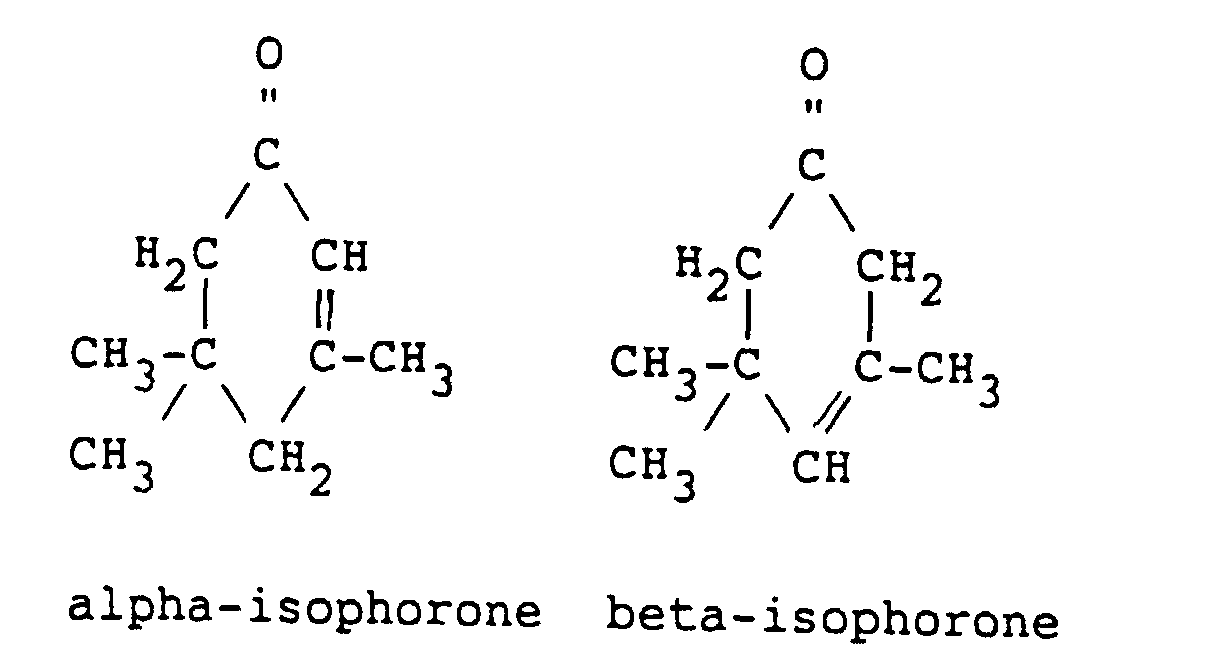
- Beta isophorone is the isomer illustrated in a structural formula as follows:
- beta isomer of isophorone (and phorone isomers) is generally less than about 10% of the alpha, at least under the conditions of our process, consistent removal of it has proven to be very beneficial to the color of the final product.
- the crude isophorone from the bottoms of the beta isophorone/phorone distillation is further purified in a final distillation column to remove heavy components.
- the resultant isophorone product has a purity of greater than 99%. Further improvement in the overall yield of the process can be realized by the optional stripping of the reaction water to recover acetone, mesityloxide, and isophorone to the extent that they are soluble in the reaction water.
- the recovered organics from the overhead of the stripper can be recycled to the acetone column.
- our process is seen to comprise feeding acetone in the vapor phase at a temperature between about 225-325°C to an aldol condensation catalyst to convert about 10% to about 35% of the acetone to a reaction product containing about 4% to about 20% alpha isophorone, removing water and mesityloxide from said reaction product, and, in a separate isomer distillation, removing the beta form of isphorone, and phorone, from said reaction product.
- the isophorone product of >99% purity is recovered by removing the heavies in a final distillation step. Soluble acetone, mesityloxide, and isophorone may be recovered from the reaction water and recycled to the acetone column.
- Figure 1 is a block flow diagram or flow sheet of our process.
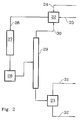
- Figure 2 is a block flow diagram of a pilot plant used to demonstrate the front end of the process.
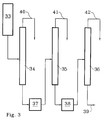
- Figure 3 is a block flow diagram of a pilot plant used to demonstrate the back end of our process.
- feed mixer 1 continuously receives acetone from line 2, and mixes it with recycled materials in lines 3, and 4 to be described.
- the mixture is heated, preferably by interchange 5 with the reactor outlet and directed to reactor 6 which is maintained initially at a temperature between 225-325°C and at a pressure to deploy the mixture in the vapor phase.
- the reactor contains a catalyst of the type described in the previously-cited Schutz/Cullo patents, in an amount to convert about 10-35% of the acetone in the feed, which will tend to increase the temperature in the reactor by about 7-50°C.
- the active portion of the catalyst is preferably a synthetic anionic clay of the type described in lines 33-38 of column 3 of U.S.
- Patent 5,153,156 namely of the formula (Mg 1-x Al x )(OH) 2 .xA where x is a number from 0.1 to 0.5, A is a univalent organic anion of the formula RCOO - , where R is CnH 2n+1 and n is 0 to 4.
- the reaction product (typically about 20% converted) is sent to the acetone distillation column 7 along with fresh acetone in line 8 and recovered organic feeds and products in line 20 to be described.
- Column 7 is operated at a pressure of 300 mmHg to 20 psig, preferably about 650 mmHg to 850 mmHg.
- the resultant stream is two phase and is preferably fed to decanter 10 whereby the isophorone-rich organic layer is separated from the aqueous phase which contains most of the water formed in the reaction.
- the decanter feed is cooled by interchange with the decanter organic outlet in heat exchanger 9.
- the two phases may be fed directly to the subsequent distillation; however, this will result in a large increase in energy requirements, thus reducing the overall energy efficiency of the process.
- the decanted organic phase is then forwarded to the mesityloxide distillation column 12, where mesityloxide is removed for recycling through line 3 to feed mixer 1, and water is removed from the system in line 13.
- Column 12 operates at a pressure of about 100 mmHg to 20 psig, preferably about 400 to 600 mmHg.
- the reaction product continues to a beta distillation column 14, where beta isophorone and phorone isomers are removed for recycling through line 4 to feed mixer 1, and mesitylene and other light impurities are purged in line 15.
- Column 14 operates at a pressure of 20 mmHg to 600 mmHg, preferably 100-300 mmHg (about 5 psig).
- Column 16 operates at a pressure of 10 to 300 mmHg, preferably 50 to 100 mmHg (about 5 psig).
- Water from line 11 and line 13 is sent to a stripping column 19, where organic components dissolved in the water are removed for recycling through line 20 to the acetone distillation column 7; waste water is removed in line 21.
- the pilot plant of Figure 2 was set up so that the feed tank 22 could receive unused acetone from line 25, and distilled acetone from line 30, and/or recycled products such as mesityloxide and isophorone isomers from line 24.
- the material contained in the feed tank 22 was pumped and vaporized through line 26 to the reactor 27 containing the catalyst, at a rate of about 665 g per hour.
- the reactor temperature was maintained at about 270 to 300°C and the reactor pressure was about 15 psig.
- the reactor outlet stream was condensed and stored in tank 28 and subsequently pumped to the continuous column 29, which was an Oldershaw with 20 rectification trays, 8 stripping trays, maintained at 760 mmHg and with a reboiler temperature of 95°C.
- mesitylene tends to build up; after two weeks of recycling, its concentration increased from an initial 0.02 to 0.1 weight percent.
- the process may be designed to purge the mesitylene, as in line 15 of Figure 1. It may be calculated from Table 2 that each 100 parts of acetone was converted to 70.85 parts alpha isophorone, 20.37 parts water, and 8.76 parts heavies.
- the pilot plant of Figure 3 was set up to simulate the "back end" of the plant.
- Column 35 representing the third stage column 16 in Figure 1, was a 1" Oldershaw having 20 stripping trays, 15 rectification trays, and operated at a top pressure of 70mmHg, and a reboiler temperature of 188°C.
- the isophorone product was collected from line 42 and the heavies from line 39.
- Mesityloxide from line 40 and isophorone isomers from line 41 were recycled to the reaction section, i.e. reactor 27 in Figure 2.
Landscapes
- Chemical & Material Sciences (AREA)
- Organic Chemistry (AREA)
- Chemical Kinetics & Catalysis (AREA)
- Organic Low-Molecular-Weight Compounds And Preparation Thereof (AREA)
- Low-Molecular Organic Synthesis Reactions Using Catalysts (AREA)
- Nitrogen And Oxygen Or Sulfur-Condensed Heterocyclic Ring Systems (AREA)
- Saccharide Compounds (AREA)
- Hydrogenated Pyridines (AREA)
Abstract
Description


| wt% analyses of distillation fractions. | ||||
| Decanted Organics | Mesityloxide overheads | Beta overheads | Beta bottoms | |
| acetone | 0.86 | 5.20 | - | - |
| mesityl-oxide | 14.40 | 93.94 | 2.61 | - |
| mesitylene | 0.24 | 0.25 | 2.30 | - |
| beta isophorone | 4.15 | 0.07 | 60.36 | 0.06 |
| phorone | 0.14 | - | 21.8 | 0.02 |
| isophorone | 69.84 | 0.02 | 32.26 | 87.16 |
| c12 | 1.84 | - | 0.27 | 2.71 |
| c15 | 5.99 | - | - | 7.39 |
| tmt | 1.45 | - | - | 1.83 |
| heavies | 0.98 | - | - | 0.83 |
| wt% analyses of product column fractions. | ||
| Isophorone overheads | Column bottoms | |
| acetone | - | - |
| mesityloxide | - | - |
| mesitylene | - | - |
| beta isophorone | 0.12 | - |
| phorone | 0.01 | - |
| isophorone c12 | 99.72 0.15 | 3.78 17.16 |
| c15 | - | 62.36 |
| tmt | - | 10.43 |
| heavies | - | 6.27 |
Claims (12)
- Method of making isophorone, characterized by the steps of:(a) conducting an aldol condensation of acetone in the vapor phase in the presence of an aldol condensation catalyst at a temperature between 225°C and 325°C to obtain a reaction product in which at least 10% of the acetone is converted;(b) removing unreacted acetone from the reaction product in an acetone distillation column, thereby obtaining a two phase system;(c) removing the aqueous phase of the two phase system in a decanter;(d) removing mesityloxide and water from the organic phase of said two phase system in a mesityloxide distillation column;(e) removing beta isophorone, phorone isomers, mesitylene and other light impurities from the reaction product in a beta isophorone distillation column; and(f) purifying the bottoms from the beta isophorone distillation column in a product distillation column to obtain an end product containing at least 99% alpha isophorone.
- The method of claim 1, wherein in step (e) the beta isophorone is removed at an intermediate level of the distillation column, and the mesitylene is purged.
- The method of claim 1, wherein the acetone distillation column in step (b) is operated at a pressure of 40 kPa to 239 kPa (300 mmHg to 20 psig).
- The method of claim 1, wherein the mesityloxide distillation column in step (d) is operated at a pressure of 13 kPa to 239 kPa (100 mmHg to 20 psig).
- The method of claim 1, wherein the beta isophorone distillation column in step (e) is operated at a pressure of 2.7 kPa to 135 kPa (20 mmHg to 5 psig).
- The method of claim 1, wherein the product distillation column in the purification step (f) is operated at a pressure of 1.3 kPa to 135 kPa (10 mmHg to 5 psig).
- The method of claim 1, wherein the mesityloxide removed in step (d) is recycled to the reactor.
- The method of claim 1, wherein the beta isophorone removed in step (e) is recycled to the reactor.
- The method of claim 3, wherein the pressure is 86.6 kPa to 113.3 kPa (650 mmHg to 850 mmHg).
- The method of claim 4, wherein the pressure is 53.3 kPa to 80 kPa (400 mmHg to 600 mmHg).
- The method of claim 5, wherein the pressure is 13.3 kPa to 40 kPa (100 mmHg to 300 mmHg).
- The method of claim 6, wherein the pressure is 6.7 kPa to 13.3 kPa (50 mmHg to 100 mmHg).
Applications Claiming Priority (3)
| Application Number | Priority Date | Filing Date | Title |
|---|---|---|---|
| US118341 | 1993-09-09 | ||
| US08/118,341 US5352839A (en) | 1993-09-09 | 1993-09-09 | Isophorone process |
| PCT/US1994/009440 WO1995007255A1 (en) | 1993-09-09 | 1994-08-22 | Isophorone process |
Publications (3)
| Publication Number | Publication Date |
|---|---|
| EP0667848A1 EP0667848A1 (en) | 1995-08-23 |
| EP0667848A4 EP0667848A4 (en) | 1996-01-10 |
| EP0667848B1 true EP0667848B1 (en) | 1998-12-09 |
Family
ID=22377980
Family Applications (1)
| Application Number | Title | Priority Date | Filing Date |
|---|---|---|---|
| EP94927936A Expired - Lifetime EP0667848B1 (en) | 1993-09-09 | 1994-08-22 | Isophorone process |
Country Status (7)
| Country | Link |
|---|---|
| US (1) | US5352839A (en) |
| EP (1) | EP0667848B1 (en) |
| JP (1) | JPH08503713A (en) |
| AT (1) | ATE174321T1 (en) |
| CA (1) | CA2148348C (en) |
| DE (1) | DE69415138T2 (en) |
| WO (1) | WO1995007255A1 (en) |
Families Citing this family (11)
| Publication number | Priority date | Publication date | Assignee | Title |
|---|---|---|---|---|
| US5877354A (en) * | 1997-12-03 | 1999-03-02 | Aristech Chemical Corporation | Process for making isophorone with improved color and color stability |
| CN101633610B (en) * | 2009-08-13 | 2012-10-17 | 浙江大学 | Method for preparing alpha-isophorone |
| DE102010029272A1 (en) | 2010-05-25 | 2011-12-01 | Evonik Degussa Gmbh | Process for the electrochemical production of isophorone |
| DE102010062587A1 (en) | 2010-12-08 | 2012-06-14 | Evonik Degussa Gmbh | Process for the preparation of isophorone |
| DE102010062603A1 (en) | 2010-12-08 | 2012-06-14 | Evonik Degussa Gmbh | Process for the preparation of 3-aminomethyl-3,5,5-trimethylcyclohexylamine |
| DE102011075777A1 (en) | 2011-05-13 | 2012-11-15 | Evonik Degussa Gmbh | Process for the preparation of isophorone in the presence of at least one defoamer in the wastewater column in the workup part |
| CN103435461B (en) * | 2013-07-24 | 2015-06-03 | 河北工业大学 | Production technology for isophorone |
| CN103467263B (en) * | 2013-09-13 | 2015-06-17 | 江苏焕鑫新材料股份有限公司 | Preparation method of isophorone |
| CN108911956B (en) * | 2018-06-20 | 2021-10-08 | 江苏焕鑫新材料股份有限公司 | A kind of purification process of cracking by-product in condensation reaction |
| CN118846967B (en) * | 2024-06-14 | 2025-10-24 | 中国化学赛鼎宁波工程有限公司 | A system and method for producing isophorone and mesityl oxide by vapor phase condensation |
| CN119746841B (en) * | 2024-12-18 | 2025-11-21 | 中国石油大学(华东) | A method for preparing a catalyst for the directional condensation polymerization of acetone to mesitylene. |
Family Cites Families (13)
| Publication number | Priority date | Publication date | Assignee | Title |
|---|---|---|---|---|
| NL272258A (en) * | 1960-12-23 | |||
| NL272976A (en) * | 1960-12-31 | |||
| US3462348A (en) * | 1968-03-25 | 1969-08-19 | Exxon Research Engineering Co | Purification of isophorone by plural stage distillation |
| GB1265029A (en) * | 1969-06-02 | 1972-03-01 | ||
| GB1498017A (en) * | 1974-05-15 | 1978-01-18 | Bp Chem Int Ltd | Isophorone production using a potassium hydroxide catalys |
| GB1528129A (en) * | 1975-10-20 | 1978-10-11 | Bp Chem Int Ltd | Process for the production of isophorone |
| US4165339A (en) * | 1976-02-12 | 1979-08-21 | Union Carbide Corporation | Catalytic aldol condensations |
| US4458026A (en) * | 1982-06-02 | 1984-07-03 | Union Carbide Corporation | Catalysts for aldol condensations |
| US4434301A (en) * | 1982-08-25 | 1984-02-28 | Union Carbide Corporation | Production of low color refined isophorone |
| US4535187A (en) * | 1983-12-21 | 1985-08-13 | Union Carbide Corporation | Preparation of isophorone and mesityl oxide from acetone |
| US5055620A (en) * | 1989-04-18 | 1991-10-08 | Aristech Chemical Corporation | Process for aldol condensation |
| US5153156A (en) * | 1989-04-18 | 1992-10-06 | Aristech Chemical Corporation | Process for making efficient anionic clay catalyst, catalysts made thereby, and method of making isophorone |
| US4970191A (en) * | 1989-04-18 | 1990-11-13 | Aristech Chemical Corporation | Basic mixed oxide |
-
1993
- 1993-09-09 US US08/118,341 patent/US5352839A/en not_active Expired - Fee Related
-
1994
- 1994-08-22 WO PCT/US1994/009440 patent/WO1995007255A1/en not_active Ceased
- 1994-08-22 JP JP7508680A patent/JPH08503713A/en active Pending
- 1994-08-22 EP EP94927936A patent/EP0667848B1/en not_active Expired - Lifetime
- 1994-08-22 DE DE69415138T patent/DE69415138T2/en not_active Expired - Fee Related
- 1994-08-22 AT AT94927936T patent/ATE174321T1/en not_active IP Right Cessation
- 1994-08-22 CA CA002148348A patent/CA2148348C/en not_active Expired - Fee Related
Also Published As
| Publication number | Publication date |
|---|---|
| WO1995007255A1 (en) | 1995-03-16 |
| ATE174321T1 (en) | 1998-12-15 |
| CA2148348A1 (en) | 1995-03-16 |
| CA2148348C (en) | 2001-01-02 |
| EP0667848A1 (en) | 1995-08-23 |
| DE69415138T2 (en) | 1999-05-06 |
| EP0667848A4 (en) | 1996-01-10 |
| JPH08503713A (en) | 1996-04-23 |
| DE69415138D1 (en) | 1999-01-21 |
| US5352839A (en) | 1994-10-04 |
Similar Documents
| Publication | Publication Date | Title |
|---|---|---|
| EP0042185B1 (en) | A process for the preparation of ethanol | |
| US4684750A (en) | Process for the production of 2-ethyl-hexanol | |
| EP0040985B1 (en) | Process for the recovery of pure acetone from cumene hydroperoxide cleavage reaction product | |
| US5352839A (en) | Isophorone process | |
| EP2300397A2 (en) | Process for production of isobutene by cracking mtbe-containing mixtures | |
| EP0018159B1 (en) | Process for the production of phenol, acetone and alpha methylstyrene | |
| EP2991973B1 (en) | Process for the preparation of 2-substituted 4-hydroxy-4-methyl-tetrahydropyrans with recirculation | |
| JP2003525218A (en) | Method for purifying trimethylolpropane produced by hydrogenation by continuous distillation | |
| US4138588A (en) | Process for the improved manufacture of 2-ethylhexanol | |
| KR20050025357A (en) | Method for increasing yield in the production of polyvalent alcohols by splitting by-products containing acetal | |
| JPS606334B2 (en) | Production method of high purity isobutylene | |
| US7411098B2 (en) | Method for the production of tetrahydrogeranylacetone | |
| EP0599883B1 (en) | Continuous process for the preparation of 2-ethyl-2-(hydroxymethyl)hexanal and 2-butyl-2-ethyl-1,3-propanediol | |
| US3972951A (en) | Process for the formation of 2,6-diphenyl-phenol | |
| US7671239B2 (en) | Method and apparatus for producing purified methyl isobutyl ketone | |
| RU2760548C1 (en) | Method for synthesising cyclohexanone | |
| US5235118A (en) | Continuous process for the preparation of 2-ethyl-2-(hydroxymethyl)hexanal and 2-butyl-2-ethyl-1, 3-propanediol | |
| JP3285439B2 (en) | Method for producing reaction crude liquid and method for producing 1,3-butylene glycol | |
| US5177267A (en) | Continuous process for the recovery of 2 ethylhexanal and a tertiary amine from a mixture comprising 2-ethyl-2-(hydroxymethyl) hexanal, 2-ethylhexanal, tertiary amine and water | |
| RU2063958C1 (en) | Method of crotonic aldehyde isolation | |
| JPH05339256A (en) | Production of reaction crude liquid containing aldoxane and paraldol as main ingredients | |
| CN108911956B (en) | A kind of purification process of cracking by-product in condensation reaction | |
| RU2052448C1 (en) | Method for isolation of 2-ethyl hexenal of side products | |
| KR20230029779A (en) | Acetone recovery and purification | |
| CN117164431A (en) | Method and device for preparing cyclohexanol from hydration of cyclohexene |
Legal Events
| Date | Code | Title | Description |
|---|---|---|---|
| PUAI | Public reference made under article 153(3) epc to a published international application that has entered the european phase |
Free format text: ORIGINAL CODE: 0009012 |
|
| AK | Designated contracting states |
Kind code of ref document: A1 Designated state(s): AT BE CH DE FR GB IT LI LU NL |
|
| 17P | Request for examination filed |
Effective date: 19950828 |
|
| A4 | Supplementary search report drawn up and despatched |
Effective date: 19951123 |
|
| AK | Designated contracting states |
Kind code of ref document: A4 Designated state(s): AT BE CH DE FR GB IT LI LU NL |
|
| 17Q | First examination report despatched |
Effective date: 19970107 |
|
| GRAG | Despatch of communication of intention to grant |
Free format text: ORIGINAL CODE: EPIDOS AGRA |
|
| GRAG | Despatch of communication of intention to grant |
Free format text: ORIGINAL CODE: EPIDOS AGRA |
|
| GRAH | Despatch of communication of intention to grant a patent |
Free format text: ORIGINAL CODE: EPIDOS IGRA |
|
| GRAH | Despatch of communication of intention to grant a patent |
Free format text: ORIGINAL CODE: EPIDOS IGRA |
|
| GRAA | (expected) grant |
Free format text: ORIGINAL CODE: 0009210 |
|
| AK | Designated contracting states |
Kind code of ref document: B1 Designated state(s): AT BE CH DE FR GB IT LI LU NL |
|
| REF | Corresponds to: |
Ref document number: 174321 Country of ref document: AT Date of ref document: 19981215 Kind code of ref document: T |
|
| REG | Reference to a national code |
Ref country code: CH Ref legal event code: NV Representative=s name: PATENTANWALTSBUERO JEAN HUNZIKER Ref country code: CH Ref legal event code: EP |
|
| REF | Corresponds to: |
Ref document number: 69415138 Country of ref document: DE Date of ref document: 19990121 |
|
| ITF | It: translation for a ep patent filed | ||
| ET | Fr: translation filed | ||
| PG25 | Lapsed in a contracting state [announced via postgrant information from national office to epo] |
Ref country code: LU Free format text: LAPSE BECAUSE OF NON-PAYMENT OF DUE FEES Effective date: 19990822 Ref country code: AT Free format text: LAPSE BECAUSE OF NON-PAYMENT OF DUE FEES Effective date: 19990822 |
|
| PG25 | Lapsed in a contracting state [announced via postgrant information from national office to epo] |
Ref country code: LI Free format text: LAPSE BECAUSE OF NON-PAYMENT OF DUE FEES Effective date: 19990831 Ref country code: CH Free format text: LAPSE BECAUSE OF NON-PAYMENT OF DUE FEES Effective date: 19990831 |
|
| PLBE | No opposition filed within time limit |
Free format text: ORIGINAL CODE: 0009261 |
|
| STAA | Information on the status of an ep patent application or granted ep patent |
Free format text: STATUS: NO OPPOSITION FILED WITHIN TIME LIMIT |
|
| 26N | No opposition filed | ||
| PG25 | Lapsed in a contracting state [announced via postgrant information from national office to epo] |
Ref country code: NL Free format text: LAPSE BECAUSE OF NON-PAYMENT OF DUE FEES Effective date: 20000301 |
|
| REG | Reference to a national code |
Ref country code: CH Ref legal event code: PL |
|
| NLV4 | Nl: lapsed or anulled due to non-payment of the annual fee |
Effective date: 20000301 |
|
| PGFP | Annual fee paid to national office [announced via postgrant information from national office to epo] |
Ref country code: GB Payment date: 20010725 Year of fee payment: 8 |
|
| PGFP | Annual fee paid to national office [announced via postgrant information from national office to epo] |
Ref country code: FR Payment date: 20010820 Year of fee payment: 8 |
|
| PGFP | Annual fee paid to national office [announced via postgrant information from national office to epo] |
Ref country code: BE Payment date: 20010822 Year of fee payment: 8 |
|
| PGFP | Annual fee paid to national office [announced via postgrant information from national office to epo] |
Ref country code: DE Payment date: 20010927 Year of fee payment: 8 |
|
| REG | Reference to a national code |
Ref country code: GB Ref legal event code: IF02 |
|
| PG25 | Lapsed in a contracting state [announced via postgrant information from national office to epo] |
Ref country code: GB Free format text: LAPSE BECAUSE OF NON-PAYMENT OF DUE FEES Effective date: 20020822 |
|
| PG25 | Lapsed in a contracting state [announced via postgrant information from national office to epo] |
Ref country code: BE Free format text: LAPSE BECAUSE OF NON-PAYMENT OF DUE FEES Effective date: 20020831 |
|
| BERE | Be: lapsed |
Owner name: *ARISTECH CHEMICAL CORP. Effective date: 20020831 |
|
| PG25 | Lapsed in a contracting state [announced via postgrant information from national office to epo] |
Ref country code: DE Free format text: LAPSE BECAUSE OF NON-PAYMENT OF DUE FEES Effective date: 20030301 |
|
| GBPC | Gb: european patent ceased through non-payment of renewal fee |
Effective date: 20020822 |
|
| PG25 | Lapsed in a contracting state [announced via postgrant information from national office to epo] |
Ref country code: FR Free format text: LAPSE BECAUSE OF NON-PAYMENT OF DUE FEES Effective date: 20030430 |
|
| REG | Reference to a national code |
Ref country code: FR Ref legal event code: ST |
|
| PG25 | Lapsed in a contracting state [announced via postgrant information from national office to epo] |
Ref country code: IT Free format text: LAPSE BECAUSE OF NON-PAYMENT OF DUE FEES Effective date: 20050822 |