EP0665292B1 - Determination of the toxicity of water using an anaerobic bacterial culture - Google Patents
Determination of the toxicity of water using an anaerobic bacterial culture Download PDFInfo
- Publication number
- EP0665292B1 EP0665292B1 EP95200180A EP95200180A EP0665292B1 EP 0665292 B1 EP0665292 B1 EP 0665292B1 EP 95200180 A EP95200180 A EP 95200180A EP 95200180 A EP95200180 A EP 95200180A EP 0665292 B1 EP0665292 B1 EP 0665292B1
- Authority
- EP
- European Patent Office
- Prior art keywords
- water
- reactor
- toxicity
- reactors
- measuring
- Prior art date
- Legal status (The legal status is an assumption and is not a legal conclusion. Google has not performed a legal analysis and makes no representation as to the accuracy of the status listed.)
- Expired - Lifetime
Links
- XLYOFNOQVPJJNP-UHFFFAOYSA-N water Substances O XLYOFNOQVPJJNP-UHFFFAOYSA-N 0.000 title claims abstract description 31
- 230000001580 bacterial effect Effects 0.000 title claims abstract description 13
- 231100000419 toxicity Toxicity 0.000 title claims description 24
- 230000001988 toxicity Effects 0.000 title claims description 24
- 238000000034 method Methods 0.000 claims abstract description 20
- VNWKTOKETHGBQD-UHFFFAOYSA-N methane Chemical compound C VNWKTOKETHGBQD-UHFFFAOYSA-N 0.000 claims abstract description 15
- 238000004519 manufacturing process Methods 0.000 claims abstract description 8
- 239000000758 substrate Substances 0.000 claims description 14
- 239000002699 waste material Substances 0.000 claims description 13
- 230000000696 methanogenic effect Effects 0.000 claims description 8
- 230000003287 optical effect Effects 0.000 claims description 6
- 238000012545 processing Methods 0.000 claims description 6
- 238000000855 fermentation Methods 0.000 claims description 5
- 238000005259 measurement Methods 0.000 claims description 5
- 230000004060 metabolic process Effects 0.000 claims description 5
- 230000009467 reduction Effects 0.000 claims description 4
- 150000001875 compounds Chemical class 0.000 claims description 2
- 238000011081 inoculation Methods 0.000 claims description 2
- 238000002360 preparation method Methods 0.000 claims description 2
- 229910001385 heavy metal Inorganic materials 0.000 claims 1
- 230000001131 transforming effect Effects 0.000 claims 1
- 239000003440 toxic substance Substances 0.000 abstract description 14
- 231100000614 poison Toxicity 0.000 abstract description 10
- 230000005764 inhibitory process Effects 0.000 abstract description 6
- 230000035622 drinking Effects 0.000 abstract description 2
- 238000012360 testing method Methods 0.000 description 12
- 239000002028 Biomass Substances 0.000 description 8
- 230000035945 sensitivity Effects 0.000 description 8
- 239000005862 Whey Substances 0.000 description 4
- 230000001413 cellular effect Effects 0.000 description 4
- 230000004151 fermentation Effects 0.000 description 4
- 230000002503 metabolic effect Effects 0.000 description 4
- 241000894007 species Species 0.000 description 4
- 239000000126 substance Substances 0.000 description 4
- 231100000167 toxic agent Toxicity 0.000 description 4
- CYTYCFOTNPOANT-UHFFFAOYSA-N Perchloroethylene Chemical group ClC(Cl)=C(Cl)Cl CYTYCFOTNPOANT-UHFFFAOYSA-N 0.000 description 3
- 102000007544 Whey Proteins Human genes 0.000 description 3
- 108010046377 Whey Proteins Proteins 0.000 description 3
- 239000012895 dilution Substances 0.000 description 3
- 238000010790 dilution Methods 0.000 description 3
- 230000000694 effects Effects 0.000 description 3
- 150000002500 ions Chemical class 0.000 description 3
- 244000005700 microbiome Species 0.000 description 3
- 239000007787 solid Substances 0.000 description 3
- 241000894006 Bacteria Species 0.000 description 2
- TWRXJAOTZQYOKJ-UHFFFAOYSA-L Magnesium chloride Chemical compound [Mg+2].[Cl-].[Cl-] TWRXJAOTZQYOKJ-UHFFFAOYSA-L 0.000 description 2
- 241001074903 Methanobacteria Species 0.000 description 2
- 239000007789 gas Substances 0.000 description 2
- 239000002440 industrial waste Substances 0.000 description 2
- 238000012544 monitoring process Methods 0.000 description 2
- 239000000843 powder Substances 0.000 description 2
- 238000000746 purification Methods 0.000 description 2
- 238000003756 stirring Methods 0.000 description 2
- 229950011008 tetrachloroethylene Drugs 0.000 description 2
- 230000001228 trophic effect Effects 0.000 description 2
- 229910052725 zinc Inorganic materials 0.000 description 2
- HSQFVBWFPBKHEB-UHFFFAOYSA-N 2,3,4-trichlorophenol Chemical compound OC1=CC=C(Cl)C(Cl)=C1Cl HSQFVBWFPBKHEB-UHFFFAOYSA-N 0.000 description 1
- LINPIYWFGCPVIE-UHFFFAOYSA-N 2,4,6-trichlorophenol Chemical compound OC1=C(Cl)C=C(Cl)C=C1Cl LINPIYWFGCPVIE-UHFFFAOYSA-N 0.000 description 1
- UXVMQQNJUSDDNG-UHFFFAOYSA-L Calcium chloride Chemical compound [Cl-].[Cl-].[Ca+2] UXVMQQNJUSDDNG-UHFFFAOYSA-L 0.000 description 1
- 229910021578 Iron(III) chloride Inorganic materials 0.000 description 1
- 239000007836 KH2PO4 Substances 0.000 description 1
- 241000203067 Methanobacteriales Species 0.000 description 1
- -1 NH4HCO3 Chemical class 0.000 description 1
- 241000605006 Spirillum volutans Species 0.000 description 1
- 230000004913 activation Effects 0.000 description 1
- 230000002776 aggregation Effects 0.000 description 1
- 238000004220 aggregation Methods 0.000 description 1
- BFNBIHQBYMNNAN-UHFFFAOYSA-N ammonium sulfate Chemical compound N.N.OS(O)(=O)=O BFNBIHQBYMNNAN-UHFFFAOYSA-N 0.000 description 1
- 229910052921 ammonium sulfate Inorganic materials 0.000 description 1
- 230000000844 anti-bacterial effect Effects 0.000 description 1
- QVGXLLKOCUKJST-UHFFFAOYSA-N atomic oxygen Chemical compound [O] QVGXLLKOCUKJST-UHFFFAOYSA-N 0.000 description 1
- 239000003899 bactericide agent Substances 0.000 description 1
- 238000011021 bench scale process Methods 0.000 description 1
- 230000029918 bioluminescence Effects 0.000 description 1
- 238000005415 bioluminescence Methods 0.000 description 1
- 239000001110 calcium chloride Substances 0.000 description 1
- 229910001628 calcium chloride Inorganic materials 0.000 description 1
- 150000001768 cations Chemical class 0.000 description 1
- 238000006243 chemical reaction Methods 0.000 description 1
- 231100000045 chemical toxicity Toxicity 0.000 description 1
- 238000004587 chromatography analysis Methods 0.000 description 1
- 230000000295 complement effect Effects 0.000 description 1
- 230000001143 conditioned effect Effects 0.000 description 1
- 230000001276 controlling effect Effects 0.000 description 1
- 230000003247 decreasing effect Effects 0.000 description 1
- 238000011161 development Methods 0.000 description 1
- 230000018109 developmental process Effects 0.000 description 1
- 238000010586 diagram Methods 0.000 description 1
- ZPWVASYFFYYZEW-UHFFFAOYSA-L dipotassium hydrogen phosphate Chemical compound [K+].[K+].OP([O-])([O-])=O ZPWVASYFFYYZEW-UHFFFAOYSA-L 0.000 description 1
- 229910000396 dipotassium phosphate Inorganic materials 0.000 description 1
- 230000006870 function Effects 0.000 description 1
- 239000003673 groundwater Substances 0.000 description 1
- 239000002054 inoculum Substances 0.000 description 1
- RBTARNINKXHZNM-UHFFFAOYSA-K iron trichloride Chemical compound Cl[Fe](Cl)Cl RBTARNINKXHZNM-UHFFFAOYSA-K 0.000 description 1
- 230000002427 irreversible effect Effects 0.000 description 1
- 238000012417 linear regression Methods 0.000 description 1
- 239000007788 liquid Substances 0.000 description 1
- 229910001629 magnesium chloride Inorganic materials 0.000 description 1
- 230000014759 maintenance of location Effects 0.000 description 1
- 239000002207 metabolite Substances 0.000 description 1
- 229910052751 metal Inorganic materials 0.000 description 1
- 239000002184 metal Substances 0.000 description 1
- 150000002739 metals Chemical class 0.000 description 1
- 125000002496 methyl group Chemical group [H]C([H])([H])* 0.000 description 1
- 238000012543 microbiological analysis Methods 0.000 description 1
- 229910000402 monopotassium phosphate Inorganic materials 0.000 description 1
- 230000004899 motility Effects 0.000 description 1
- 239000001301 oxygen Substances 0.000 description 1
- 229910052760 oxygen Inorganic materials 0.000 description 1
- GNSKLFRGEWLPPA-UHFFFAOYSA-M potassium dihydrogen phosphate Chemical compound [K+].OP(O)([O-])=O GNSKLFRGEWLPPA-UHFFFAOYSA-M 0.000 description 1
- 239000002243 precursor Substances 0.000 description 1
- 230000002265 prevention Effects 0.000 description 1
- 239000000700 radioactive tracer Substances 0.000 description 1
- 230000001105 regulatory effect Effects 0.000 description 1
- 238000011160 research Methods 0.000 description 1
- 150000003839 salts Chemical class 0.000 description 1
- 238000004062 sedimentation Methods 0.000 description 1
- 239000000243 solution Substances 0.000 description 1
- 239000002352 surface water Substances 0.000 description 1
- 238000010998 test method Methods 0.000 description 1
- 231100000331 toxic Toxicity 0.000 description 1
- 230000002588 toxic effect Effects 0.000 description 1
- 231100000820 toxicity test Toxicity 0.000 description 1
- 231100000041 toxicology testing Toxicity 0.000 description 1
- 230000009466 transformation Effects 0.000 description 1
- 238000000844 transformation Methods 0.000 description 1
- 241001148471 unidentified anaerobic bacterium Species 0.000 description 1
- 238000009280 upflow anaerobic sludge blanket technology Methods 0.000 description 1
- 238000012795 verification Methods 0.000 description 1
Images

Classifications
-
- C—CHEMISTRY; METALLURGY
- C12—BIOCHEMISTRY; BEER; SPIRITS; WINE; VINEGAR; MICROBIOLOGY; ENZYMOLOGY; MUTATION OR GENETIC ENGINEERING
- C12M—APPARATUS FOR ENZYMOLOGY OR MICROBIOLOGY; APPARATUS FOR CULTURING MICROORGANISMS FOR PRODUCING BIOMASS, FOR GROWING CELLS OR FOR OBTAINING FERMENTATION OR METABOLIC PRODUCTS, i.e. BIOREACTORS OR FERMENTERS
- C12M41/00—Means for regulation, monitoring, measurement or control, e.g. flow regulation
- C12M41/30—Means for regulation, monitoring, measurement or control, e.g. flow regulation of concentration
- C12M41/34—Means for regulation, monitoring, measurement or control, e.g. flow regulation of concentration of gas
-
- C—CHEMISTRY; METALLURGY
- C12—BIOCHEMISTRY; BEER; SPIRITS; WINE; VINEGAR; MICROBIOLOGY; ENZYMOLOGY; MUTATION OR GENETIC ENGINEERING
- C12M—APPARATUS FOR ENZYMOLOGY OR MICROBIOLOGY; APPARATUS FOR CULTURING MICROORGANISMS FOR PRODUCING BIOMASS, FOR GROWING CELLS OR FOR OBTAINING FERMENTATION OR METABOLIC PRODUCTS, i.e. BIOREACTORS OR FERMENTERS
- C12M41/00—Means for regulation, monitoring, measurement or control, e.g. flow regulation
- C12M41/46—Means for regulation, monitoring, measurement or control, e.g. flow regulation of cellular or enzymatic activity or functionality, e.g. cell viability
-
- C—CHEMISTRY; METALLURGY
- C12—BIOCHEMISTRY; BEER; SPIRITS; WINE; VINEGAR; MICROBIOLOGY; ENZYMOLOGY; MUTATION OR GENETIC ENGINEERING
- C12Q—MEASURING OR TESTING PROCESSES INVOLVING ENZYMES, NUCLEIC ACIDS OR MICROORGANISMS; COMPOSITIONS OR TEST PAPERS THEREFOR; PROCESSES OF PREPARING SUCH COMPOSITIONS; CONDITION-RESPONSIVE CONTROL IN MICROBIOLOGICAL OR ENZYMOLOGICAL PROCESSES
- C12Q1/00—Measuring or testing processes involving enzymes, nucleic acids or microorganisms; Compositions therefor; Processes of preparing such compositions
- C12Q1/02—Measuring or testing processes involving enzymes, nucleic acids or microorganisms; Compositions therefor; Processes of preparing such compositions involving viable microorganisms
- C12Q1/025—Measuring or testing processes involving enzymes, nucleic acids or microorganisms; Compositions therefor; Processes of preparing such compositions involving viable microorganisms for testing or evaluating the effect of chemical or biological compounds, e.g. drugs, cosmetics
Definitions
- the present invention relates to a biological procedure, which involves the use of anaerobic bacteria, for measuring the toxicity caused by polluting substances in water or water effluents.
- Bacteria are known as being efficient detectors of chemical toxicity as they quickly react to changes in their environment. It is for this reason that many biological tests have been developed for monitoring and controlling toxic substances in water or effluents. In these tests the inhibition of the metabolism of a species of bacteria in the presence of toxic substances is compared with the metabolism of the same species cultivated on a standard substrate.
- bioluminescence of some microorganisms the motility inversion of Spirillum volutans, the measurement of oxygen consumed and ATP produced, etc., can be mentioned.
- Tests which use single bacterial species are more sensitive, with the same toxicity of molecule, than those which involve mixed flora, operating in a metabolic chain, such as for example aerobic and anaerobic mud.
- Tests carried out with mixed flora distinguished by subsequent metabolic stages can evaluate the toxicity of a substance on different levels. Normally, owing to the syntrophy ratio among microbic populations, the EC 50 of a toxic substance is determined on the final metabolite (for example on methane in the case of anaerobic bacterial aggregates). The production of methane is in fact, in any case reduced, either directly or indirectly by the inhibition of the precursors, by the presence of toxic substances.
- microbic aggregates although having lesser sensitivity in an absolute sense, are particularly versatile for testing the total toxicity such as that produced by several compounds contemporaneously present as is observed for example in industrial waste.
- Tests using a methanogen bacterial biomass were mainly used for the prevention of biodegradability of effluents or mud containing toxic substances. Subsequently tests were developed which were specifically designed for the degree of methanogenic activity of the single trophic groups of the methanobacterial aggregate.
- the main objectives however concerned the microbiological analysis of the quality and conservability of the inocula to be used in the activation of anaerobic reactors.
- a method has now been found, in accordance with the present invention, which involves the use of mixed methanogenic aggregates suitably precultivated, that are useful for evaluating the toxicity produced by a single substance or a wide range of substances in water or water effluents.
- the present invention relates to a biological procedure to determine the toxicity of water and water waste, embodied as follows:
- the mixed bacterial culture is a methanogen anaerobic aggregate similar to those used for the purification of urban wastes in UASB-type reactors, suitably conditioned to enhance the requisites of its sensitivity to toxic substances.
- a mixed biomass which is suitable for producing cellular sensors with characteristics of amplified sensitivity to the toxic substances present in small concentrations, characterized by:
- the method, object of the present invention, for measuring the toxicity involves the use of a series of anaerobic microreactors of 20-100 ml in volume, stirred, wherein supposedly toxic water or waste are tested (possibly with different dilutions).
- the measurement is effected on the basis of the different result which is registered under the same operating conditions of fermentation (pH, temperature, stirring, quantity of anaerobic biomass etc.) compared with one or more standard reference fermentations.
- the parameters on which the result is quantified with respect to the standard fermentation are the production of methane and biogas measured both in quantitative and kinetic terms.
- one reactor is generally sufficient for each sample, but when greater precision is required, it may be convenient to use two or more reactors with different dilutions of water or water waste being tested.
- microbic aggregates are used according to the procedure and equipment illustrated in a block diagram shown in figure 1.
- a suitable substrate and an inoculum of anaerobic aggregate are placed in microreactors 1, which are at least two in number (one for the standard and the other for the water to be examined), in a quantity by weight of between 20 and 60 mg VSS (volatile suspended solids) corresponding to specific concentrations of between 1 and 3 g VSS/l.
- the microreactors are stirred at 200 rpm and thermostat-regulated at 35°C.
- water seal cylinders 4 on which an optical system 3 is inserted which for example can be a photodiode 2, suitably fed.
- the water seals are the same for each reactor both with respect to the dimensions of the cylinder and height of the liquid and to the length and diameter of the capillary from which the biogas (methane) is discharged.
- the optical system counts the bubbles of biogas emitted from each microreactor and sends the relative signals to a memory 5.
- the memory is connected to a personal computer for the mathematical processing of the inhibition kinetics of the metabolic activity on the substrate present in the single reactor.
- the values taken for a given sample are compared to the corresponding values of a reference standard and both the inhibition percentage (bacteriostasis) and total and irreversible inhibition (bactericide effect) are established of a given toxic substance acting in certain concentrations.
- the duration of the test is about 3-6 hours.
- the procedure and equipment described can be "robotized” by automating the test procedure and the samples to be analyzed can be injected into the reactors with an automatic collection system of the commercial samples.
- the method described can be applied not only to water destined for drinking and surface and ground water but also to effluents and industrial waste.
- the sensitivity of the test is in the order of ppm.
- the signals of the optical detecting system are sent by wire or radio to a remote signal processing system.
- the analytical monitoring system described above can function as an alarm signal in the case of accidental toxicity or sudden variations in the standard characteristics of a given waste.
- Methanogenic anaerobic aggregates of the type commonly used for the purification of urban waste were used.
- the fermentations were carried out in bench-scale reactors with UASB configuration inoculated with 2.5 g VSS biomass per litre and maintained at a constant temperature of 35°C.
- the feeding substrate was composed of a solution of whey (5 g of whey in powder form per litre) to which inorganic salts such as NH 4 HCO 3 , (NH 4 ) 2 SO 4 , CaCl 2 , MgCl 2 , FeCl 3 , KH 2 PO 4 , K 2 HPO 4 had been added, with a final COD of 5000 ppm O 2 and a final p H of 6.8-7.2.
- inorganic salts such as NH 4 HCO 3 , (NH 4 ) 2 SO 4 , CaCl 2 , MgCl 2 , FeCl 3 , KH 2 PO 4 , K 2 HPO 4 had been added, with a final COD of 5000 ppm O 2 and a final p H of 6.8-7.2.
- the biomass thus obtained was used to inoculate, in a quantity by weight of 58 g of VSS, four microreactors (each of 35 ml of which 20 ml operating volume) composed of Wheaton bottles for serology with a rubber top and metallic ring to keep in the gases and equipped with magnetic stirrers.
- the organic substrate of the four reactors was whey in powder form in a quantity of 50 mg per reactor.
- Trichlorophenol (2,4,6 trichlorophenol - TClF) was charged into three of the four reactors at a concentration of 50, 5 and 1 ppm respectively.
- the fourth reactor, under the same conditions and with the same substrate but without TClF, was kept as a control.
- the total duration of the test was 3 hours at a temperature of 35°C and a stirring rate of 200 rpm.
- Table 1 (where 0 indicates the standard and 1, 2, 3, the three dilutions of TClF) schematically shows the toxicity test of TClF measured as a reduction of the production kinetics of the biogas generated by the anaerobic metabolism. 0 1 2 3 -biomass mg VSS 58 58 58 58 -TClF ppm / 50 5 1 -whey mg 50 50 50 50 -H 2 O (up to ml) 20 20 20 20 20 20 20 20 20 20 20 20 20 20 20 20 20 20 20 20 20 20 20 20 20 20 20 20 20 20 20 20 20 20 20 20 20 20 20 20 20 20 20 20 20 20 20 20 20 20 20 20 20 20 20 20 20 20 20 20 20 20 20 20 20 20 20 20 20 20 20 20 20 20 20 20 20 20 20 20 20 20 20 20 20 20 20 20 20 20 20 20 20 20 20 20 20 20 20 20 20 20 20 20 20 20 20 20 20 20 20 20 20 20 20 20 20 20 20 20 20 20 20 20 20 20 20 20 20 20 20 20 20 20
- the head spaces of the microreactors were connected with water seals in a special support equipped with an optical sensor, in this specific case a photoelectric cell with a suitably fed photodiode. In this way at each passage of a bubble of biogas in the water seal an electrical signal was activated.
- the events are totalized for each microreactor and suitably processed by connection with a PC.
- the mathematical statistical processing (using the program "Four” Borland Int. nc. Scotts Valley Ca USA) was carried out by linear regression of the approximately straight line of the kinetic curves of the frequency of events.
- the toxicity could be significantly expressed as a percentage of minor inclination of the processed line of the first with respect to the slope assumed by the second.
- the quantitative value was obtained by the complement to 100 of the ratio between the angular coefficients of the standard line and that of the line relating to the measurement reactors.
- the toxicity exerted on the biomass by 20 ppm of Co ion and 10 ppm of Zn ion are 34 % and 9 % respectively.
Landscapes
- Chemical & Material Sciences (AREA)
- Life Sciences & Earth Sciences (AREA)
- Organic Chemistry (AREA)
- Engineering & Computer Science (AREA)
- Health & Medical Sciences (AREA)
- Bioinformatics & Cheminformatics (AREA)
- Zoology (AREA)
- Wood Science & Technology (AREA)
- Genetics & Genomics (AREA)
- Analytical Chemistry (AREA)
- General Health & Medical Sciences (AREA)
- Biotechnology (AREA)
- General Engineering & Computer Science (AREA)
- Microbiology (AREA)
- Biochemistry (AREA)
- Sustainable Development (AREA)
- Proteomics, Peptides & Aminoacids (AREA)
- Biomedical Technology (AREA)
- Cell Biology (AREA)
- Immunology (AREA)
- Molecular Biology (AREA)
- Medicinal Chemistry (AREA)
- Physics & Mathematics (AREA)
- Toxicology (AREA)
- Biophysics (AREA)
- Measuring Or Testing Involving Enzymes Or Micro-Organisms (AREA)
- Purification Treatments By Anaerobic Or Anaerobic And Aerobic Bacteria Or Animals (AREA)
- Processing Of Solid Wastes (AREA)
- Investigating Or Analyzing Non-Biological Materials By The Use Of Chemical Means (AREA)
Abstract
Description
- The present invention relates to a biological procedure, which involves the use of anaerobic bacteria, for measuring the toxicity caused by polluting substances in water or water effluents. Bacteria are known as being efficient detectors of chemical toxicity as they quickly react to changes in their environment. It is for this reason that many biological tests have been developed for monitoring and controlling toxic substances in water or effluents. In these tests the inhibition of the metabolism of a species of bacteria in the presence of toxic substances is compared with the metabolism of the same species cultivated on a standard substrate.
- Different bacterial species are used and various parameters are measured (with respect to this see Toxicity Testing Using
Microorganisms vol - As an example, the bioluminescence of some microorganisms, the motility inversion of Spirillum volutans, the measurement of oxygen consumed and ATP produced, etc., can be mentioned.
- Tests which use single bacterial species are more sensitive, with the same toxicity of molecule, than those which involve mixed flora, operating in a metabolic chain, such as for example aerobic and anaerobic mud.
- This greater sensitivity is made evident by a lesser concentration of a certain toxic substance required for reducing by 50% the standard measurement of the biochemical-biological parameter which is a specific tracer of the method (
EC 50, from "effective concentration involving 50% reduction). - Tests carried out with mixed flora distinguished by subsequent metabolic stages can evaluate the toxicity of a substance on different levels. Normally, owing to the syntrophy ratio among microbic populations, the
EC 50 of a toxic substance is determined on the final metabolite (for example on methane in the case of anaerobic bacterial aggregates). The production of methane is in fact, in any case reduced, either directly or indirectly by the inhibition of the precursors, by the presence of toxic substances. - Methods which use microbic aggregates, although having lesser sensitivity in an absolute sense, are particularly versatile for testing the total toxicity such as that produced by several compounds contemporaneously present as is observed for example in industrial waste. Tests using a methanogen bacterial biomass were mainly used for the prevention of biodegradability of effluents or mud containing toxic substances. Subsequently tests were developed which were specifically designed for the degree of methanogenic activity of the single trophic groups of the methanobacterial aggregate. The main objectives however concerned the microbiological analysis of the quality and conservability of the inocula to be used in the activation of anaerobic reactors. At the same time, elaborations of the technique perfected the ATA procedures (tests of anaerobic toxicity) in order to check the incidence of toxic substances present in waste on the anaerobic conversion into methane of specific substrates on the part of different kinds of methanobacteria. This kind of procedure involves a series of anaerobic centres (normally microreactors) wherein known quantities, both of anaerobic mud and specific substrate, are reacted in the presence of and without supposedly toxic substances. The possibly different results, produced under the same operating conditions after one or more verifications, is assumed to be the variation index of the gas generating activity of the single trophic-bacterial groups.
- All these techniques and their various developments and applications are mainly carried out in research laborain that they cannot be effected other than by the gas-chromatographic analysis of the head spaces of the microreactors. In the case of attempts to obtain analytic systems using pressure transducers on the head of the reactors, complex mechanical-type devices had to be used for connection with the data collecting units.
- A method has now been found, in accordance with the present invention, which involves the use of mixed methanogenic aggregates suitably precultivated, that are useful for evaluating the toxicity produced by a single substance or a wide range of substances in water or water effluents.
- In accordance with this, the present invention relates to a biological procedure to determine the toxicity of water and water waste, embodied as follows:
- preparation of a mixed methanogenic anaerobic bacterial culture;
- inoculation of the bacterial culture into a variety of reactors of which at least one is a reference reactor, containing a substrate with standard water and at least another, a measuring reactor, containing a substrate with water or waste the toxicity of which is to be measured;
- said measuring and reference reactors being connected to a detecting system capable of measuring the volume of biogas produced per unit of time;
- said detecting system being operatively connected to a data processing system capable of determining the decrease in the production kinetics of the biogas generated by the anaerobic metabolism on the substrate and capable of correlating it with the toxicity of the water or waste.
- The mixed bacterial culture is a methanogen anaerobic aggregate similar to those used for the purification of urban wastes in UASB-type reactors, suitably conditioned to enhance the requisites of its sensitivity to toxic substances.
- This greater sensitivity is present in the biomasses with intense cellular reproduction and, in the case of mixed complexes, mainly in the methanobacteria. In fact other populations which catalyze transformations before the reduction of the methyl group have proved to be less sensitive. In addition the sensitivity of a microbic biomass to toxic substances is due, not only to the average age of the complex as a whole, but also to the average specific age of the methanogenic population.
- Consequently, by suitably varying the operating conditions of the anaerobic reactors destined for the production of micro-organisms, a mixed biomass is obtained, which is suitable for producing cellular sensors with characteristics of amplified sensitivity to the toxic substances present in small concentrations, characterized by:
- a certain degree of cellular aggregation
- a high rate of cellular reproduction per single bacterial trophic group (young cells)
- a global metabolic chain not yet balanced in the methanogenic component (methanogens in multiplication).
- The method, object of the present invention, for measuring the toxicity, involves the use of a series of anaerobic microreactors of 20-100 ml in volume, stirred, wherein supposedly toxic water or waste are tested (possibly with different dilutions). The measurement is effected on the basis of the different result which is registered under the same operating conditions of fermentation (pH, temperature, stirring, quantity of anaerobic biomass etc.) compared with one or more standard reference fermentations. The parameters on which the result is quantified with respect to the standard fermentation are the production of methane and biogas measured both in quantitative and kinetic terms.
- As specified above, as a principle, one reactor is generally sufficient for each sample, but when greater precision is required, it may be convenient to use two or more reactors with different dilutions of water or water waste being tested.
- The microbic aggregates are used according to the procedure and equipment illustrated in a block diagram shown in figure 1.
- A suitable substrate and an inoculum of anaerobic aggregate are placed in
microreactors 1, which are at least two in number (one for the standard and the other for the water to be examined), in a quantity by weight of between 20 and 60 mg VSS (volatile suspended solids) corresponding to specific concentrations of between 1 and 3 g VSS/l. The microreactors are stirred at 200 rpm and thermostat-regulated at 35°C. - At the outlet of the microreactors are
water seal cylinders 4 on which anoptical system 3 is inserted, which for example can be aphotodiode 2, suitably fed. The water seals are the same for each reactor both with respect to the dimensions of the cylinder and height of the liquid and to the length and diameter of the capillary from which the biogas (methane) is discharged. - The optical system counts the bubbles of biogas emitted from each microreactor and sends the relative signals to a
memory 5. The memory is connected to a personal computer for the mathematical processing of the inhibition kinetics of the metabolic activity on the substrate present in the single reactor. - The values taken for a given sample are compared to the corresponding values of a reference standard and both the inhibition percentage (bacteriostasis) and total and irreversible inhibition (bactericide effect) are established of a given toxic substance acting in certain concentrations.
- The duration of the test is about 3-6 hours.
- The procedure and equipment described can be "robotized" by automating the test procedure and the samples to be analyzed can be injected into the reactors with an automatic collection system of the commercial samples.
- The method described can be applied not only to water destined for drinking and surface and ground water but also to effluents and industrial waste.
- The sensitivity of the test is in the order of ppm.
- In a further embodiment of the present invention the signals of the optical detecting system are sent by wire or radio to a remote signal processing system. In this way the analytical monitoring system described above can function as an alarm signal in the case of accidental toxicity or sudden variations in the standard characteristics of a given waste.
- The examples which follow provide a better understanding of the present invention but do not limit it in any way.
- Methanogenic anaerobic aggregates of the type commonly used for the purification of urban waste were used.
- The fermentations were carried out in bench-scale reactors with UASB configuration inoculated with 2.5 g VSS biomass per litre and maintained at a constant temperature of 35°C. The feeding substrate was composed of a solution of whey (5 g of whey in powder form per litre) to which inorganic salts such as NH4HCO3, (NH4)2SO4, CaCl2, MgCl2, FeCl3, KH2PO4, K2HPO4 had been added, with a final COD of 5000 ppm O2 and a final pH of 6.8-7.2.
- The characteristics of the mixed anaerobic bacterial aggregate obtained in a total of 25 days, feeding the fermenters in continuous with three cycles of decreasing HRT (Hydraulic Retention Time) (1.2; 1; and 0.85 days) are indicated below:
- pH 6.8
- Tot. suspended solids: 24.1 g/l
- Volatile suspended solids (VSS) 8.8 g/l
- Sedimentation rate: 29 m/h
- COD (soluble) 256 ppm
- Growth rate (µ): 0.05 h-1
- Specific activity : 0.25 g CH4-COD/g VSS/d
equal to 7.72 µmol CH4/g VSS/min -
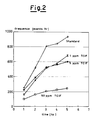
- The biomass thus obtained was used to inoculate, in a quantity by weight of 58 g of VSS, four microreactors (each of 35 ml of which 20 ml operating volume) composed of Wheaton bottles for serology with a rubber top and metallic ring to keep in the gases and equipped with magnetic stirrers. The organic substrate of the four reactors was whey in powder form in a quantity of 50 mg per reactor. Trichlorophenol (2,4,6 trichlorophenol - TClF) was charged into three of the four reactors at a concentration of 50, 5 and 1 ppm respectively. The fourth reactor, under the same conditions and with the same substrate but without TClF, was kept as a control. The total duration of the test was 3 hours at a temperature of 35°C and a stirring rate of 200 rpm.
- Table 1 (where 0 indicates the standard and 1, 2, 3, the three dilutions of TClF) schematically shows the toxicity test of TClF measured as a reduction of the production kinetics of the biogas generated by the anaerobic metabolism.
0 1 2 3 -biomass mg VSS 58 58 58 58 -TClF ppm / 50 5 1 - whey mg 50 50 50 50 -H2O (up to ml) 20 20 20 20 - The head spaces of the microreactors were connected with water seals in a special support equipped with an optical sensor, in this specific case a photoelectric cell with a suitably fed photodiode. In this way at each passage of a bubble of biogas in the water seal an electrical signal was activated.
- The events are totalized for each microreactor and suitably processed by connection with a PC. The mathematical statistical processing (using the program "Four" Borland Int. nc. Scotts Valley Ca USA) was carried out by linear regression of the approximately straight line of the kinetic curves of the frequency of events.
- In the case of differential kinetics between sample and standard, the toxicity could be significantly expressed as a percentage of minor inclination of the processed line of the first with respect to the slope assumed by the second. The quantitative value was obtained by the complement to 100 of the ratio between the angular coefficients of the standard line and that of the line relating to the measurement reactors.
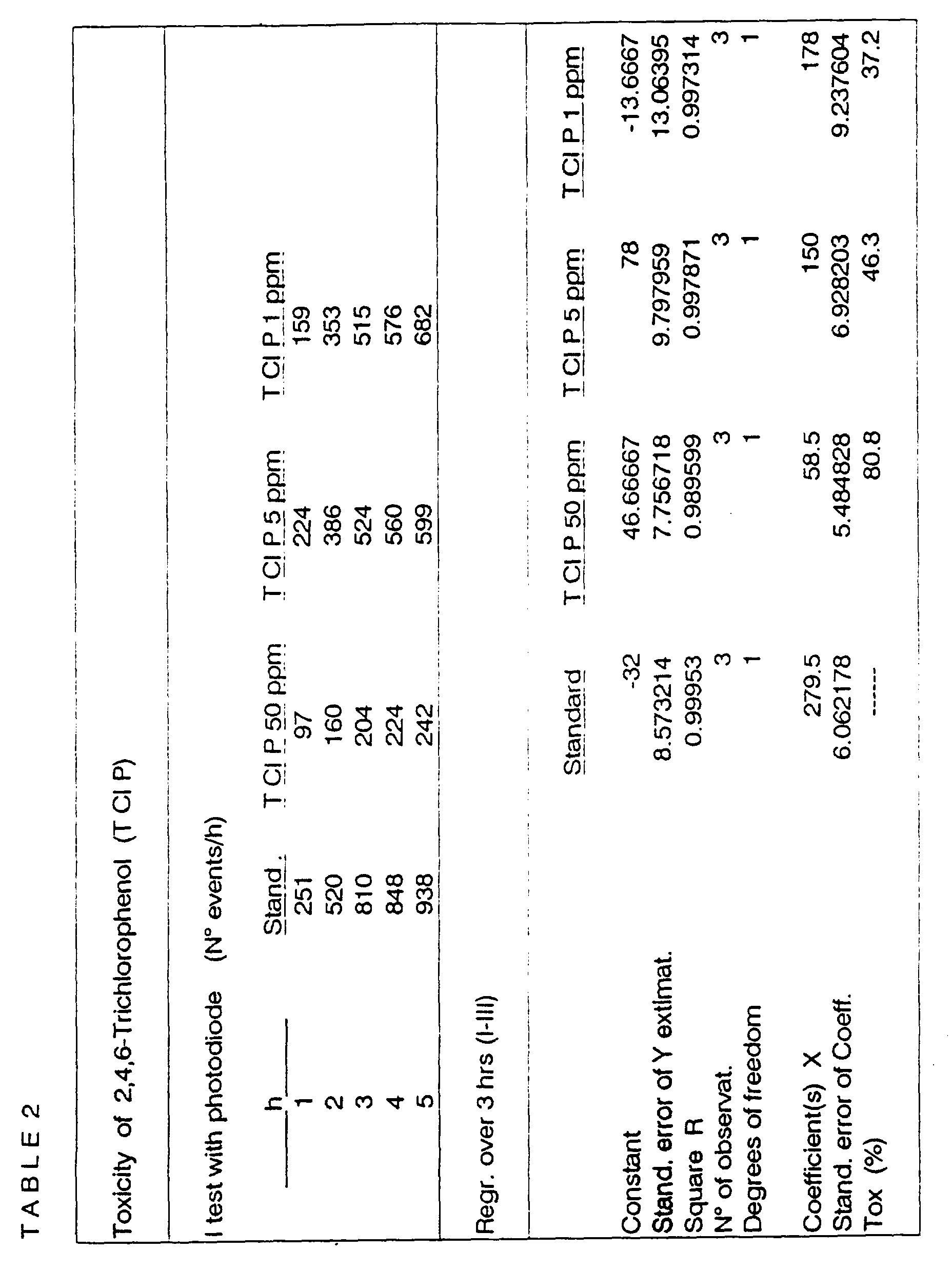
- The results concerning the TClF are graphically shown in fig. 2 and, as elaborated during 3 hours, in table 2.
- It can be noted how the sensitivity to the toxic substance being tested on the part of the anaerobic aggregate can be significantly evaluated down to concentrations of 1 ppm (EC 37) and how with 5 ppm of TClF there is a toxicity of 46% (EC 46) with respect to the standard.
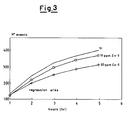
- The same procedure and apparatus described in example 1 were used to evaluate the toxicity exerted by bivalent cations of metals such as Co and Zn.
- The differences were as follows.
- Concentrations of anaerobic aggregates of 43.8 mg per reactor; concentrations of Co and Zn ions of 20 and 10 ppm respectively; duration of the
test 3 hours. - Figure 3 and table 3 show the results obtained.
- The toxicity exerted on the biomass by 20 ppm of Co ion and 10 ppm of Zn ion are 34 % and 9 % respectively.
- The toxicity of 20 mg of tetrachloroethylene (C2Cl4) was tested using the same equipment and conditions as example 1.
- In this
case 20 mg VSS per reactor of anaerobic aggregates were used, characterized by a methanogenic activity of 0.11 gCH4-COD per g VSS per day. - As can be seen from table 4 there is a toxicity of 17.4% (EC 17) per 20 ppm of tetrachloroethylene.


Claims (7)
- Biological procedure for determining the toxicity of water and water discharges, said toxicity consisting of heavy metals and/or chlorinated compounds embodied in the following way:preparation of a mixed methanogenic anaerobic bacterial culture;inoculation of the bacterial culture in a variety of reactors of which at least one is a reference reactor, containing a substrate with standard water and at least another, a measurement reactor, containing a substrate with water or waste the toxicity of which is to be measured;said measuring and reference reactors being connected to a detecting system capable of measuring the volume of biogas produced per unit of time;said detecting system being operatively connected to a data processing system capable of determining the decrease in the production kinetics of the biogas generated by the anaerobic metabolism on the substrate and capable of correlating it with the toxicity of the water or waste.
- Procedure according to claim 1, characterized in that the biogas produced is methane.
- Procedure according to claim 1, characterized in that the detecting system is a photodiode.
- Procedure according to claim 1, characterized in that the reactors are one reference reactor and two measuring reactors with different concentrations of water or waste the toxicity of which is to be measured.
- Equipment for the embodiment of the procedure according to claims 1 to 4 composed of:a variety of reactors for anaerobic fermentation of which at least one is a reference reactor and at least one is a measuring reactor; each of the reactors being equipped witha water seal in the head space of said reactor,an optical sensor capable of transforming the biogas produced in the reactor which passes through said water seal, into electrical signals,a data processing system capable of detecting and comparing the electrical signals emitted from the reference reactor and measuring reactor, determining the reduction in production kinetics of the biogas and correlating it with the toxicity of the water or waste.
- Equipment according to claim 5, characterized in that the optical sensor is a photodiode.
- Equipment according to claim 5, characterized in that the reactors are one reference reactor and one measuring reactor.
Applications Claiming Priority (2)
| Application Number | Priority Date | Filing Date | Title |
|---|---|---|---|
| ITMI940141A IT1269200B (en) | 1994-01-28 | 1994-01-28 | DETERMINATION OF WATER TOXICITY THROUGH THE USE OF ANAEROBIC BACTERIAL CULTURE |
| ITMI940141 | 1994-01-28 |
Publications (2)
| Publication Number | Publication Date |
|---|---|
| EP0665292A1 EP0665292A1 (en) | 1995-08-02 |
| EP0665292B1 true EP0665292B1 (en) | 2000-03-15 |
Family
ID=11367668
Family Applications (1)
| Application Number | Title | Priority Date | Filing Date |
|---|---|---|---|
| EP95200180A Expired - Lifetime EP0665292B1 (en) | 1994-01-28 | 1995-01-26 | Determination of the toxicity of water using an anaerobic bacterial culture |
Country Status (9)
| Country | Link |
|---|---|
| US (1) | US5674702A (en) |
| EP (1) | EP0665292B1 (en) |
| AT (1) | ATE190668T1 (en) |
| DE (1) | DE69515534T2 (en) |
| DK (1) | DK0665292T3 (en) |
| ES (1) | ES2142996T3 (en) |
| GR (1) | GR3033130T3 (en) |
| IT (1) | IT1269200B (en) |
| PT (1) | PT665292E (en) |
Families Citing this family (4)
| Publication number | Priority date | Publication date | Assignee | Title |
|---|---|---|---|---|
| US6416994B1 (en) * | 1997-08-27 | 2002-07-09 | Asahi Breweries, Ltd. | Methanation activity measuring instrument |
| NL1020415C2 (en) * | 2002-04-17 | 2003-10-31 | Tno | Process control based on microbiological activity. |
| WO2004105638A2 (en) * | 2003-05-27 | 2004-12-09 | Spinalmotion, Inc. | Prosthetic disc for intervertebral insertion |
| CN117448415B (en) * | 2023-12-21 | 2024-04-12 | 广东盈峰科技有限公司 | On-line monitoring method, system and application of biotoxicity of groundwater quality |
Family Cites Families (13)
| Publication number | Priority date | Publication date | Assignee | Title |
|---|---|---|---|---|
| AT330687B (en) * | 1973-04-25 | 1976-07-12 | Bbc Brown Boveri & Cie | METHOD OF CONTINUOUS MEASUREMENT OF THE TOXICITY OF AQUATIC LIQUIDS, IN PARTICULAR WASTE WATER, USING MICRO-ORGANISMS AND DEVICE FOR PERFORMING THE METHOD |
| US3907646A (en) * | 1974-07-24 | 1975-09-23 | Nasa | Measurement of gas production of microorganisms |
| JPS55104757A (en) * | 1979-02-07 | 1980-08-11 | Ootake Seisakusho:Kk | Device for automatically measuring extinction of gas |
| DE3043160A1 (en) * | 1979-11-19 | 1981-05-21 | Celanese Corp., 10036 New York, N.Y. | METHOD FOR TREATING ORGANIC WASTEWATER AND ANAEROBIC METHANOGENIC CIRCUIT FILTER USED THEREFORE |
| US4349435A (en) * | 1980-11-24 | 1982-09-14 | Celanese Corporation | Control of anaerobic filter |
| US4513280A (en) * | 1984-10-04 | 1985-04-23 | The United States Of America As Represented By The Secretary Of The Navy | Method and apparatus for the detection of toxicants |
| DE3515753C2 (en) * | 1985-05-02 | 1987-03-05 | Hans 4156 Willich Preisendanz | Method for determining the effect of chemotherapeutic agents on the growth of microorganisms and/or cells and use of a multi-chamber device for carrying out the method |
| DE3715114A1 (en) * | 1987-05-06 | 1988-11-17 | Krause Hans | METHOD AND DEVICE FOR DETECTING TOXICITY IN SURFACE WATERS AND IN DRINKING AND WATER WATER |
| US5175091A (en) * | 1987-09-29 | 1992-12-29 | The United States Of America As Represented By The Secretary Of The Navy | Method for toxin detection |
| KR900006416B1 (en) * | 1988-05-27 | 1990-08-31 | 삼성전자 주식회사 | Kimchi Maker and Kimchi Manufacturing Control System Using Kimchi Ripening Sensor |
| FR2664289B1 (en) * | 1990-07-05 | 1995-09-22 | Commissariat Energie Atomique | MICROBIOLOGICAL METHOD FOR DETECTION OF MINERAL OR ORGANIC TOXIC PRODUCTS USING SACCHAROMYCE YEAST STRAINS. |
| IT1242013B (en) * | 1990-11-15 | 1994-02-02 | Giovanni Antonini | DETECTION OF TOXIC SUBSTANCES PRESENT IN A WATER THROUGH THE MONITORING OF THE METABOLISM OF SELECTED MICROORGANISMS. |
| BE1004426A3 (en) * | 1991-02-01 | 1992-11-17 | Organic Waste Systems Nv | Method and apparatus for an accelerated on way to determine the anaerobic biodegradability of a product. |
-
1994
- 1994-01-28 IT ITMI940141A patent/IT1269200B/en active IP Right Grant
-
1995
- 1995-01-26 ES ES95200180T patent/ES2142996T3/en not_active Expired - Lifetime
- 1995-01-26 PT PT95200180T patent/PT665292E/en unknown
- 1995-01-26 EP EP95200180A patent/EP0665292B1/en not_active Expired - Lifetime
- 1995-01-26 DE DE69515534T patent/DE69515534T2/en not_active Expired - Fee Related
- 1995-01-26 DK DK95200180T patent/DK0665292T3/en active
- 1995-01-26 AT AT95200180T patent/ATE190668T1/en not_active IP Right Cessation
- 1995-01-27 US US08/379,285 patent/US5674702A/en not_active Expired - Fee Related
-
2000
- 2000-03-31 GR GR20000400822T patent/GR3033130T3/en not_active IP Right Cessation
Also Published As
| Publication number | Publication date |
|---|---|
| EP0665292A1 (en) | 1995-08-02 |
| GR3033130T3 (en) | 2000-08-31 |
| DE69515534T2 (en) | 2000-08-03 |
| ATE190668T1 (en) | 2000-04-15 |
| DK0665292T3 (en) | 2000-07-03 |
| US5674702A (en) | 1997-10-07 |
| ITMI940141A0 (en) | 1994-01-28 |
| ITMI940141A1 (en) | 1995-07-28 |
| PT665292E (en) | 2000-06-30 |
| DE69515534D1 (en) | 2000-04-20 |
| IT1269200B (en) | 1997-03-21 |
| ES2142996T3 (en) | 2000-05-01 |
Similar Documents
| Publication | Publication Date | Title |
|---|---|---|
| Liu et al. | Immobilised activated sludge based biosensor for biochemical oxygen demand measurement | |
| EP0461166B1 (en) | A method for controlling and/or monitoring biological processes | |
| La Motta | Kinetics of growth and substrate uptake in a biological film system | |
| Tanaka et al. | BOD biosensor for secondary effluent from wastewater treatment plants | |
| US20240110933A1 (en) | Method for detecting ammonia nitrogen content by using nitrification biological reaction | |
| Chiang et al. | Determination of acetoclastic methanogenic activity in anaerobic systems | |
| Buitrón et al. | Influence of So/Xo ratio and medium composition on anaerobic biodegradability test | |
| Karim et al. | Anaerobic digestion of animal waste: effect of mixing | |
| Knudson et al. | Influence of dissolved oxygen on substrate utilization kinetics of activated sludge | |
| US5674702A (en) | Determination of the toxicity of water using an anaerobic bacterial culture | |
| Vaiopoulou et al. | On-line load monitoring of wastewaters with a respirographic microbial sensor | |
| Prosser | Mathematical modeling of nitrification processes | |
| Droste et al. | Microbial activity in aerobic sludge digestion | |
| CN107315076A (en) | A kind of online oxicity analysis system and its assay method | |
| CN119707088A (en) | Reservoir floccule degradation method based on microbiological technology | |
| Liwarska-Bizukojc et al. | RNA assay as a method of viable biomass determination in the organic fraction of municipal solid waste suspension | |
| Parker | Surrogate parameter analysis for organic priority pollutants | |
| EP0757017A2 (en) | Method to monitor in liquids the concentration of substances which are degraded by acidifying or alkalizing microorganisms and related instrumentation | |
| Stergar et al. | The determination of anaerobic biodegradability of pharmaceutical waste using advanced bioassay technique | |
| Obst et al. | Biochemical testing of groundwater | |
| Boulanger | The effect of varying air supply upon supernatant quality in autoheated thermophilic aerobic digesters treating waste sludge from a biological phosphorus removal process | |
| Chiang | Effects of reactor configuration on the performance of static-bed submerged media anaerobic reactors | |
| Kurniawan et al. | Estimation of biokinetic parameters in the acid fermentation of primary sludge using an anaerobic baffled reactor | |
| WO1995012687A1 (en) | In situ measurement of bacterial growth in wastewater treatment processes | |
| Horn et al. | Assessing microbiologically induced corrosion of waste package materials in the Yucca Mountain repository |
Legal Events
| Date | Code | Title | Description |
|---|---|---|---|
| PUAI | Public reference made under article 153(3) epc to a published international application that has entered the european phase |
Free format text: ORIGINAL CODE: 0009012 |
|
| AK | Designated contracting states |
Kind code of ref document: A1 Designated state(s): AT BE CH DE DK ES FR GB GR LI NL PT SE |
|
| 17P | Request for examination filed |
Effective date: 19951117 |
|
| RAP1 | Party data changed (applicant data changed or rights of an application transferred) |
Owner name: ENITECNOLOGIE S.P.A. |
|
| 17Q | First examination report despatched |
Effective date: 19981230 |
|
| GRAG | Despatch of communication of intention to grant |
Free format text: ORIGINAL CODE: EPIDOS AGRA |
|
| GRAG | Despatch of communication of intention to grant |
Free format text: ORIGINAL CODE: EPIDOS AGRA |
|
| GRAH | Despatch of communication of intention to grant a patent |
Free format text: ORIGINAL CODE: EPIDOS IGRA |
|
| GRAH | Despatch of communication of intention to grant a patent |
Free format text: ORIGINAL CODE: EPIDOS IGRA |
|
| GRAA | (expected) grant |
Free format text: ORIGINAL CODE: 0009210 |
|
| AK | Designated contracting states |
Kind code of ref document: B1 Designated state(s): AT BE CH DE DK ES FR GB GR LI NL PT SE |
|
| REF | Corresponds to: |
Ref document number: 190668 Country of ref document: AT Date of ref document: 20000415 Kind code of ref document: T |
|
| REG | Reference to a national code |
Ref country code: CH Ref legal event code: EP |
|
| REG | Reference to a national code |
Ref country code: CH Ref legal event code: NV Representative=s name: A. BRAUN, BRAUN, HERITIER, ESCHMANN AG PATENTANWAE |
|
| REF | Corresponds to: |
Ref document number: 69515534 Country of ref document: DE Date of ref document: 20000420 |
|
| ET | Fr: translation filed | ||
| REG | Reference to a national code |
Ref country code: ES Ref legal event code: FG2A Ref document number: 2142996 Country of ref document: ES Kind code of ref document: T3 |
|
| REG | Reference to a national code |
Ref country code: PT Ref legal event code: SC4A Free format text: AVAILABILITY OF NATIONAL TRANSLATION Effective date: 20000330 |
|
| REG | Reference to a national code |
Ref country code: DK Ref legal event code: T3 |
|
| PLBE | No opposition filed within time limit |
Free format text: ORIGINAL CODE: 0009261 |
|
| STAA | Information on the status of an ep patent application or granted ep patent |
Free format text: STATUS: NO OPPOSITION FILED WITHIN TIME LIMIT |
|
| 26N | No opposition filed | ||
| REG | Reference to a national code |
Ref country code: GB Ref legal event code: IF02 |
|
| PGFP | Annual fee paid to national office [announced via postgrant information from national office to epo] |
Ref country code: SE Payment date: 20040107 Year of fee payment: 10 |
|
| PGFP | Annual fee paid to national office [announced via postgrant information from national office to epo] |
Ref country code: FR Payment date: 20040108 Year of fee payment: 10 |
|
| PGFP | Annual fee paid to national office [announced via postgrant information from national office to epo] |
Ref country code: AT Payment date: 20040113 Year of fee payment: 10 |
|
| PGFP | Annual fee paid to national office [announced via postgrant information from national office to epo] |
Ref country code: DK Payment date: 20040115 Year of fee payment: 10 |
|
| PGFP | Annual fee paid to national office [announced via postgrant information from national office to epo] |
Ref country code: NL Payment date: 20040121 Year of fee payment: 10 Ref country code: GB Payment date: 20040121 Year of fee payment: 10 |
|
| PGFP | Annual fee paid to national office [announced via postgrant information from national office to epo] |
Ref country code: GR Payment date: 20040123 Year of fee payment: 10 Ref country code: ES Payment date: 20040123 Year of fee payment: 10 |
|
| PGFP | Annual fee paid to national office [announced via postgrant information from national office to epo] |
Ref country code: CH Payment date: 20040129 Year of fee payment: 10 |
|
| PGFP | Annual fee paid to national office [announced via postgrant information from national office to epo] |
Ref country code: PT Payment date: 20040130 Year of fee payment: 10 |
|
| PGFP | Annual fee paid to national office [announced via postgrant information from national office to epo] |
Ref country code: DE Payment date: 20040205 Year of fee payment: 10 |
|
| PGFP | Annual fee paid to national office [announced via postgrant information from national office to epo] |
Ref country code: BE Payment date: 20040409 Year of fee payment: 10 |
|
| PG25 | Lapsed in a contracting state [announced via postgrant information from national office to epo] |
Ref country code: GB Free format text: LAPSE BECAUSE OF NON-PAYMENT OF DUE FEES Effective date: 20050126 Ref country code: AT Free format text: LAPSE BECAUSE OF NON-PAYMENT OF DUE FEES Effective date: 20050126 |
|
| PG25 | Lapsed in a contracting state [announced via postgrant information from national office to epo] |
Ref country code: SE Free format text: LAPSE BECAUSE OF NON-PAYMENT OF DUE FEES Effective date: 20050127 Ref country code: ES Free format text: LAPSE BECAUSE OF NON-PAYMENT OF DUE FEES Effective date: 20050127 |
|
| PG25 | Lapsed in a contracting state [announced via postgrant information from national office to epo] |
Ref country code: LI Free format text: LAPSE BECAUSE OF NON-PAYMENT OF DUE FEES Effective date: 20050131 Ref country code: DK Free format text: LAPSE BECAUSE OF NON-PAYMENT OF DUE FEES Effective date: 20050131 Ref country code: CH Free format text: LAPSE BECAUSE OF NON-PAYMENT OF DUE FEES Effective date: 20050131 Ref country code: BE Free format text: LAPSE BECAUSE OF NON-PAYMENT OF DUE FEES Effective date: 20050131 |
|
| PG25 | Lapsed in a contracting state [announced via postgrant information from national office to epo] |
Ref country code: PT Free format text: LAPSE BECAUSE OF NON-PAYMENT OF DUE FEES Effective date: 20050726 |
|
| BERE | Be: lapsed |
Owner name: *ENITECNOLOGIE S.P.A. Effective date: 20050131 |
|
| PG25 | Lapsed in a contracting state [announced via postgrant information from national office to epo] |
Ref country code: NL Free format text: LAPSE BECAUSE OF NON-PAYMENT OF DUE FEES Effective date: 20050801 |
|
| PG25 | Lapsed in a contracting state [announced via postgrant information from national office to epo] |
Ref country code: GR Free format text: LAPSE BECAUSE OF NON-PAYMENT OF DUE FEES Effective date: 20050802 Ref country code: DE Free format text: LAPSE BECAUSE OF NON-PAYMENT OF DUE FEES Effective date: 20050802 |
|
| EUG | Se: european patent has lapsed | ||
| REG | Reference to a national code |
Ref country code: DK Ref legal event code: EBP |
|
| GBPC | Gb: european patent ceased through non-payment of renewal fee |
Effective date: 20050126 |
|
| REG | Reference to a national code |
Ref country code: CH Ref legal event code: PL |
|
| PG25 | Lapsed in a contracting state [announced via postgrant information from national office to epo] |
Ref country code: FR Free format text: LAPSE BECAUSE OF NON-PAYMENT OF DUE FEES Effective date: 20050930 |
|
| REG | Reference to a national code |
Ref country code: PT Ref legal event code: MM4A Effective date: 20050726 |
|
| NLV4 | Nl: lapsed or anulled due to non-payment of the annual fee |
Effective date: 20050801 |
|
| REG | Reference to a national code |
Ref country code: FR Ref legal event code: ST |
|
| REG | Reference to a national code |
Ref country code: ES Ref legal event code: FD2A Effective date: 20050127 |
|
| BERE | Be: lapsed |
Owner name: *ENITECNOLOGIE S.P.A. Effective date: 20050131 |