EP0664327A1 - Adhesive resin composition - Google Patents
Adhesive resin composition Download PDFInfo
- Publication number
- EP0664327A1 EP0664327A1 EP95100361A EP95100361A EP0664327A1 EP 0664327 A1 EP0664327 A1 EP 0664327A1 EP 95100361 A EP95100361 A EP 95100361A EP 95100361 A EP95100361 A EP 95100361A EP 0664327 A1 EP0664327 A1 EP 0664327A1
- Authority
- EP
- European Patent Office
- Prior art keywords
- resin composition
- adhesive resin
- component
- composition according
- ethylene
- Prior art date
- Legal status (The legal status is an assumption and is not a legal conclusion. Google has not performed a legal analysis and makes no representation as to the accuracy of the status listed.)
- Granted
Links
- 239000000203 mixture Substances 0.000 title claims abstract description 66
- 239000004840 adhesive resin Substances 0.000 title claims abstract description 29
- 229920006223 adhesive resin Polymers 0.000 title claims abstract description 29
- 229920005989 resin Polymers 0.000 claims abstract description 51
- 239000011347 resin Substances 0.000 claims abstract description 51
- -1 vinyl aromatic hydrocarbon Chemical class 0.000 claims abstract description 42
- 229920000573 polyethylene Polymers 0.000 claims abstract description 40
- 229920000642 polymer Polymers 0.000 claims abstract description 34
- 229920001400 block copolymer Polymers 0.000 claims abstract description 24
- 150000001732 carboxylic acid derivatives Chemical class 0.000 claims abstract description 13
- 238000002844 melting Methods 0.000 claims abstract description 12
- 230000008018 melting Effects 0.000 claims abstract description 12
- 150000001993 dienes Chemical class 0.000 claims abstract description 9
- 229920002554 vinyl polymer Polymers 0.000 claims abstract description 9
- 239000000155 melt Substances 0.000 claims abstract 2
- VGGSQFUCUMXWEO-UHFFFAOYSA-N Ethene Chemical compound C=C VGGSQFUCUMXWEO-UHFFFAOYSA-N 0.000 claims description 28
- 239000005977 Ethylene Substances 0.000 claims description 27
- PPBRXRYQALVLMV-UHFFFAOYSA-N Styrene Chemical compound C=CC1=CC=CC=C1 PPBRXRYQALVLMV-UHFFFAOYSA-N 0.000 claims description 24
- 239000004711 α-olefin Substances 0.000 claims description 23
- 229920005604 random copolymer Polymers 0.000 claims description 20
- 229920001577 copolymer Polymers 0.000 claims description 18
- 125000000816 ethylene group Chemical group [H]C([H])([*:1])C([H])([H])[*:2] 0.000 claims description 15
- RRHGJUQNOFWUDK-UHFFFAOYSA-N Isoprene Chemical compound CC(=C)C=C RRHGJUQNOFWUDK-UHFFFAOYSA-N 0.000 claims description 14
- KAKZBPTYRLMSJV-UHFFFAOYSA-N Butadiene Chemical compound C=CC=C KAKZBPTYRLMSJV-UHFFFAOYSA-N 0.000 claims description 13
- 239000003208 petroleum Substances 0.000 claims description 13
- RSWGJHLUYNHPMX-UHFFFAOYSA-N Abietic-Saeure Natural products C12CCC(C(C)C)=CC2=CCC2C1(C)CCCC2(C)C(O)=O RSWGJHLUYNHPMX-UHFFFAOYSA-N 0.000 claims description 7
- KHPCPRHQVVSZAH-HUOMCSJISA-N Rosin Natural products O(C/C=C/c1ccccc1)[C@H]1[C@H](O)[C@@H](O)[C@@H](O)[C@@H](CO)O1 KHPCPRHQVVSZAH-HUOMCSJISA-N 0.000 claims description 7
- KHPCPRHQVVSZAH-UHFFFAOYSA-N trans-cinnamyl beta-D-glucopyranoside Natural products OC1C(O)C(O)C(CO)OC1OCC=CC1=CC=CC=C1 KHPCPRHQVVSZAH-UHFFFAOYSA-N 0.000 claims description 7
- 239000000178 monomer Substances 0.000 claims description 6
- 125000001931 aliphatic group Chemical group 0.000 claims description 5
- 125000003118 aryl group Chemical group 0.000 claims description 5
- 229920001971 elastomer Polymers 0.000 claims description 5
- 239000000806 elastomer Substances 0.000 claims description 5
- 150000008064 anhydrides Chemical class 0.000 claims description 4
- HQQADJVZYDDRJT-UHFFFAOYSA-N ethene;prop-1-ene Chemical group C=C.CC=C HQQADJVZYDDRJT-UHFFFAOYSA-N 0.000 claims description 4
- 238000005984 hydrogenation reaction Methods 0.000 claims description 4
- 150000003505 terpenes Chemical class 0.000 claims description 4
- 235000007586 terpenes Nutrition 0.000 claims description 4
- VZCYOOQTPOCHFL-UHFFFAOYSA-N trans-butenedioic acid Natural products OC(=O)C=CC(O)=O VZCYOOQTPOCHFL-UHFFFAOYSA-N 0.000 claims description 4
- OFOBLEOULBTSOW-UHFFFAOYSA-N Propanedioic acid Natural products OC(=O)CC(O)=O OFOBLEOULBTSOW-UHFFFAOYSA-N 0.000 claims description 3
- 238000002441 X-ray diffraction Methods 0.000 claims description 3
- VZCYOOQTPOCHFL-UPHRSURJSA-N maleic acid Chemical compound OC(=O)\C=C/C(O)=O VZCYOOQTPOCHFL-UPHRSURJSA-N 0.000 claims description 3
- 239000011976 maleic acid Substances 0.000 claims description 3
- FPYJFEHAWHCUMM-UHFFFAOYSA-N maleic anhydride Chemical compound O=C1OC(=O)C=C1 FPYJFEHAWHCUMM-UHFFFAOYSA-N 0.000 claims 2
- 229920002587 poly(1,3-butadiene) polymer Polymers 0.000 claims 1
- 239000000853 adhesive Substances 0.000 abstract description 32
- 230000001070 adhesive effect Effects 0.000 abstract description 32
- 238000000465 moulding Methods 0.000 abstract description 14
- 229920000098 polyolefin Polymers 0.000 abstract description 10
- 239000004952 Polyamide Substances 0.000 abstract description 8
- 229920002647 polyamide Polymers 0.000 abstract description 8
- 229920000728 polyester Polymers 0.000 abstract description 8
- 238000000071 blow moulding Methods 0.000 abstract description 5
- 229920000178 Acrylic resin Polymers 0.000 abstract description 4
- 239000004925 Acrylic resin Substances 0.000 abstract description 4
- 229920001890 Novodur Polymers 0.000 abstract description 3
- 239000011342 resin composition Substances 0.000 description 25
- 238000000034 method Methods 0.000 description 18
- 239000004793 Polystyrene Substances 0.000 description 17
- 229920000219 Ethylene vinyl alcohol Polymers 0.000 description 16
- UFRKOOWSQGXVKV-UHFFFAOYSA-N ethene;ethenol Chemical compound C=C.OC=C UFRKOOWSQGXVKV-UHFFFAOYSA-N 0.000 description 16
- 239000004715 ethylene vinyl alcohol Substances 0.000 description 16
- 150000001875 compounds Chemical class 0.000 description 15
- 239000004698 Polyethylene Substances 0.000 description 13
- 239000004417 polycarbonate Substances 0.000 description 13
- VXNZUUAINFGPBY-UHFFFAOYSA-N 1-Butene Chemical compound CCC=C VXNZUUAINFGPBY-UHFFFAOYSA-N 0.000 description 12
- 230000004888 barrier function Effects 0.000 description 11
- 239000000463 material Substances 0.000 description 11
- 239000007789 gas Substances 0.000 description 10
- 239000000126 substance Substances 0.000 description 10
- 238000003475 lamination Methods 0.000 description 9
- 229920001155 polypropylene Polymers 0.000 description 9
- 229920002223 polystyrene Polymers 0.000 description 9
- WSSSPWUEQFSQQG-UHFFFAOYSA-N 4-methyl-1-pentene Chemical compound CC(C)CC=C WSSSPWUEQFSQQG-UHFFFAOYSA-N 0.000 description 8
- 239000004743 Polypropylene Substances 0.000 description 8
- 238000001125 extrusion Methods 0.000 description 8
- 239000010410 layer Substances 0.000 description 8
- 229920000092 linear low density polyethylene Polymers 0.000 description 7
- 239000004707 linear low-density polyethylene Substances 0.000 description 7
- NLHHRLWOUZZQLW-UHFFFAOYSA-N Acrylonitrile Chemical compound C=CC#N NLHHRLWOUZZQLW-UHFFFAOYSA-N 0.000 description 6
- 230000000052 comparative effect Effects 0.000 description 6
- 229920000515 polycarbonate Polymers 0.000 description 6
- 229920000089 Cyclic olefin copolymer Polymers 0.000 description 5
- 239000003054 catalyst Substances 0.000 description 5
- 230000003247 decreasing effect Effects 0.000 description 5
- 230000005484 gravity Effects 0.000 description 5
- 229920002239 polyacrylonitrile Polymers 0.000 description 5
- 229920000139 polyethylene terephthalate Polymers 0.000 description 5
- 239000005020 polyethylene terephthalate Substances 0.000 description 5
- AFFLGGQVNFXPEV-UHFFFAOYSA-N 1-decene Chemical compound CCCCCCCCC=C AFFLGGQVNFXPEV-UHFFFAOYSA-N 0.000 description 4
- LIKMAJRDDDTEIG-UHFFFAOYSA-N 1-hexene Chemical compound CCCCC=C LIKMAJRDDDTEIG-UHFFFAOYSA-N 0.000 description 4
- KWKAKUADMBZCLK-UHFFFAOYSA-N 1-octene Chemical compound CCCCCCC=C KWKAKUADMBZCLK-UHFFFAOYSA-N 0.000 description 4
- HFDVRLIODXPAHB-UHFFFAOYSA-N 1-tetradecene Chemical compound CCCCCCCCCCCCC=C HFDVRLIODXPAHB-UHFFFAOYSA-N 0.000 description 4
- MTAZNLWOLGHBHU-UHFFFAOYSA-N butadiene-styrene rubber Chemical class C=CC=C.C=CC1=CC=CC=C1 MTAZNLWOLGHBHU-UHFFFAOYSA-N 0.000 description 4
- 229920001903 high density polyethylene Polymers 0.000 description 4
- 239000004700 high-density polyethylene Substances 0.000 description 4
- 239000003999 initiator Substances 0.000 description 4
- 238000004519 manufacturing process Methods 0.000 description 4
- CCCMONHAUSKTEQ-UHFFFAOYSA-N octadec-1-ene Chemical compound CCCCCCCCCCCCCCCCC=C CCCMONHAUSKTEQ-UHFFFAOYSA-N 0.000 description 4
- QQONPFPTGQHPMA-UHFFFAOYSA-N propylene Natural products CC=C QQONPFPTGQHPMA-UHFFFAOYSA-N 0.000 description 4
- 125000004805 propylene group Chemical group [H]C([H])([H])C([H])([*:1])C([H])([H])[*:2] 0.000 description 4
- 239000010936 titanium Substances 0.000 description 4
- XLYOFNOQVPJJNP-UHFFFAOYSA-N water Substances O XLYOFNOQVPJJNP-UHFFFAOYSA-N 0.000 description 4
- 239000004831 Hot glue Substances 0.000 description 3
- 239000004708 Very-low-density polyethylene Substances 0.000 description 3
- 235000013305 food Nutrition 0.000 description 3
- 238000010559 graft polymerization reaction Methods 0.000 description 3
- 230000001771 impaired effect Effects 0.000 description 3
- 229910052751 metal Inorganic materials 0.000 description 3
- 239000002184 metal Substances 0.000 description 3
- 150000002739 metals Chemical class 0.000 description 3
- 238000002156 mixing Methods 0.000 description 3
- 239000003921 oil Substances 0.000 description 3
- 229920001707 polybutylene terephthalate Polymers 0.000 description 3
- 229920001866 very low density polyethylene Polymers 0.000 description 3
- CSCPPACGZOOCGX-UHFFFAOYSA-N Acetone Chemical compound CC(C)=O CSCPPACGZOOCGX-UHFFFAOYSA-N 0.000 description 2
- VZCYOOQTPOCHFL-OWOJBTEDSA-N Fumaric acid Chemical compound OC(=O)\C=C\C(O)=O VZCYOOQTPOCHFL-OWOJBTEDSA-N 0.000 description 2
- 238000004566 IR spectroscopy Methods 0.000 description 2
- XEEYBQQBJWHFJM-UHFFFAOYSA-N Iron Chemical compound [Fe] XEEYBQQBJWHFJM-UHFFFAOYSA-N 0.000 description 2
- BAPJBEWLBFYGME-UHFFFAOYSA-N Methyl acrylate Chemical compound COC(=O)C=C BAPJBEWLBFYGME-UHFFFAOYSA-N 0.000 description 2
- 239000004677 Nylon Substances 0.000 description 2
- 229920006465 Styrenic thermoplastic elastomer Polymers 0.000 description 2
- RTAQQCXQSZGOHL-UHFFFAOYSA-N Titanium Chemical compound [Ti] RTAQQCXQSZGOHL-UHFFFAOYSA-N 0.000 description 2
- 239000012790 adhesive layer Substances 0.000 description 2
- 125000002723 alicyclic group Chemical group 0.000 description 2
- 229910052782 aluminium Inorganic materials 0.000 description 2
- XAGFODPZIPBFFR-UHFFFAOYSA-N aluminium Chemical compound [Al] XAGFODPZIPBFFR-UHFFFAOYSA-N 0.000 description 2
- 238000009835 boiling Methods 0.000 description 2
- 125000004432 carbon atom Chemical group C* 0.000 description 2
- 239000011651 chromium Substances 0.000 description 2
- 238000004132 cross linking Methods 0.000 description 2
- 150000001925 cycloalkenes Chemical class 0.000 description 2
- 230000007547 defect Effects 0.000 description 2
- 230000006866 deterioration Effects 0.000 description 2
- 150000001991 dicarboxylic acids Chemical class 0.000 description 2
- 150000002148 esters Chemical class 0.000 description 2
- 229920001038 ethylene copolymer Polymers 0.000 description 2
- 239000011888 foil Substances 0.000 description 2
- 238000010528 free radical solution polymerization reaction Methods 0.000 description 2
- 229920000578 graft copolymer Polymers 0.000 description 2
- 229920001519 homopolymer Polymers 0.000 description 2
- 238000001746 injection moulding Methods 0.000 description 2
- 239000011229 interlayer Substances 0.000 description 2
- 238000004898 kneading Methods 0.000 description 2
- 239000007791 liquid phase Substances 0.000 description 2
- 239000012968 metallocene catalyst Substances 0.000 description 2
- 239000011259 mixed solution Substances 0.000 description 2
- 238000012986 modification Methods 0.000 description 2
- TVMXDCGIABBOFY-UHFFFAOYSA-N n-Octanol Natural products CCCCCCCC TVMXDCGIABBOFY-UHFFFAOYSA-N 0.000 description 2
- 229920001778 nylon Polymers 0.000 description 2
- 239000008188 pellet Substances 0.000 description 2
- 238000006116 polymerization reaction Methods 0.000 description 2
- 239000010734 process oil Substances 0.000 description 2
- 239000011369 resultant mixture Substances 0.000 description 2
- 239000002002 slurry Substances 0.000 description 2
- 239000002904 solvent Substances 0.000 description 2
- 229920003048 styrene butadiene rubber Polymers 0.000 description 2
- 229920001935 styrene-ethylene-butadiene-styrene Polymers 0.000 description 2
- 150000003440 styrenes Chemical class 0.000 description 2
- 229910052719 titanium Inorganic materials 0.000 description 2
- 238000007666 vacuum forming Methods 0.000 description 2
- KDGNCLDCOVTOCS-UHFFFAOYSA-N (2-methylpropan-2-yl)oxy propan-2-yl carbonate Chemical compound CC(C)OC(=O)OOC(C)(C)C KDGNCLDCOVTOCS-UHFFFAOYSA-N 0.000 description 1
- NLBJAOHLJABDAU-UHFFFAOYSA-N (3-methylbenzoyl) 3-methylbenzenecarboperoxoate Chemical compound CC1=CC=CC(C(=O)OOC(=O)C=2C=C(C)C=CC=2)=C1 NLBJAOHLJABDAU-UHFFFAOYSA-N 0.000 description 1
- PMJHHCWVYXUKFD-SNAWJCMRSA-N (E)-1,3-pentadiene Chemical compound C\C=C\C=C PMJHHCWVYXUKFD-SNAWJCMRSA-N 0.000 description 1
- HBKBEZURJSNABK-MWJPAGEPSA-N 2,3-dihydroxypropyl (1r,4ar,4br,10ar)-1,4a-dimethyl-7-propan-2-yl-2,3,4,4b,5,6,10,10a-octahydrophenanthrene-1-carboxylate Chemical compound C([C@@H]12)CC(C(C)C)=CC1=CC[C@@H]1[C@]2(C)CCC[C@@]1(C)C(=O)OCC(O)CO HBKBEZURJSNABK-MWJPAGEPSA-N 0.000 description 1
- ODBCKCWTWALFKM-UHFFFAOYSA-N 2,5-bis(tert-butylperoxy)-2,5-dimethylhex-3-yne Chemical compound CC(C)(C)OOC(C)(C)C#CC(C)(C)OOC(C)(C)C ODBCKCWTWALFKM-UHFFFAOYSA-N 0.000 description 1
- DMWVYCCGCQPJEA-UHFFFAOYSA-N 2,5-bis(tert-butylperoxy)-2,5-dimethylhexane Chemical compound CC(C)(C)OOC(C)(C)CCC(C)(C)OOC(C)(C)C DMWVYCCGCQPJEA-UHFFFAOYSA-N 0.000 description 1
- JGBAASVQPMTVHO-UHFFFAOYSA-N 2,5-dihydroperoxy-2,5-dimethylhexane Chemical compound OOC(C)(C)CCC(C)(C)OO JGBAASVQPMTVHO-UHFFFAOYSA-N 0.000 description 1
- SMZOUWXMTYCWNB-UHFFFAOYSA-N 2-(2-methoxy-5-methylphenyl)ethanamine Chemical compound COC1=CC=C(C)C=C1CCN SMZOUWXMTYCWNB-UHFFFAOYSA-N 0.000 description 1
- XMNIXWIUMCBBBL-UHFFFAOYSA-N 2-(2-phenylpropan-2-ylperoxy)propan-2-ylbenzene Chemical compound C=1C=CC=CC=1C(C)(C)OOC(C)(C)C1=CC=CC=C1 XMNIXWIUMCBBBL-UHFFFAOYSA-N 0.000 description 1
- JAHNSTQSQJOJLO-UHFFFAOYSA-N 2-(3-fluorophenyl)-1h-imidazole Chemical compound FC1=CC=CC(C=2NC=CN=2)=C1 JAHNSTQSQJOJLO-UHFFFAOYSA-N 0.000 description 1
- BLDFSDCBQJUWFG-UHFFFAOYSA-N 2-(methylamino)-1,2-diphenylethanol Chemical compound C=1C=CC=CC=1C(NC)C(O)C1=CC=CC=C1 BLDFSDCBQJUWFG-UHFFFAOYSA-N 0.000 description 1
- NIXOWILDQLNWCW-UHFFFAOYSA-N 2-Propenoic acid Natural products OC(=O)C=C NIXOWILDQLNWCW-UHFFFAOYSA-N 0.000 description 1
- KRDXTHSSNCTAGY-UHFFFAOYSA-N 2-cyclohexylpyrrolidine Chemical compound C1CCNC1C1CCCCC1 KRDXTHSSNCTAGY-UHFFFAOYSA-N 0.000 description 1
- VNWOJVJCRAHBJJ-UHFFFAOYSA-N 2-pentylcyclopentan-1-one Chemical compound CCCCCC1CCCC1=O VNWOJVJCRAHBJJ-UHFFFAOYSA-N 0.000 description 1
- XYFRHHAYSXIKGH-UHFFFAOYSA-N 3-(5-methoxy-2-methoxycarbonyl-1h-indol-3-yl)prop-2-enoic acid Chemical compound C1=C(OC)C=C2C(C=CC(O)=O)=C(C(=O)OC)NC2=C1 XYFRHHAYSXIKGH-UHFFFAOYSA-N 0.000 description 1
- 229920001824 Barex® Polymers 0.000 description 1
- 239000004342 Benzoyl peroxide Substances 0.000 description 1
- OMPJBNCRMGITSC-UHFFFAOYSA-N Benzoylperoxide Chemical compound C=1C=CC=CC=1C(=O)OOC(=O)C1=CC=CC=C1 OMPJBNCRMGITSC-UHFFFAOYSA-N 0.000 description 1
- VYZAMTAEIAYCRO-UHFFFAOYSA-N Chromium Chemical compound [Cr] VYZAMTAEIAYCRO-UHFFFAOYSA-N 0.000 description 1
- 240000008415 Lactuca sativa Species 0.000 description 1
- JHWNWJKBPDFINM-UHFFFAOYSA-N Laurolactam Chemical compound O=C1CCCCCCCCCCCN1 JHWNWJKBPDFINM-UHFFFAOYSA-N 0.000 description 1
- CERQOIWHTDAKMF-UHFFFAOYSA-N Methacrylic acid Chemical compound CC(=C)C(O)=O CERQOIWHTDAKMF-UHFFFAOYSA-N 0.000 description 1
- 239000006057 Non-nutritive feed additive Substances 0.000 description 1
- 229920000299 Nylon 12 Polymers 0.000 description 1
- 229920002292 Nylon 6 Polymers 0.000 description 1
- 229920002302 Nylon 6,6 Polymers 0.000 description 1
- 229930040373 Paraformaldehyde Natural products 0.000 description 1
- 239000005062 Polybutadiene Substances 0.000 description 1
- 239000004820 Pressure-sensitive adhesive Substances 0.000 description 1
- 229920000297 Rayon Polymers 0.000 description 1
- 229910000831 Steel Inorganic materials 0.000 description 1
- QCWXUUIWCKQGHC-UHFFFAOYSA-N Zirconium Chemical compound [Zr] QCWXUUIWCKQGHC-UHFFFAOYSA-N 0.000 description 1
- FDLQZKYLHJJBHD-UHFFFAOYSA-N [3-(aminomethyl)phenyl]methanamine Chemical compound NCC1=CC=CC(CN)=C1 FDLQZKYLHJJBHD-UHFFFAOYSA-N 0.000 description 1
- 150000008360 acrylonitriles Chemical class 0.000 description 1
- 125000002015 acyclic group Chemical group 0.000 description 1
- 239000000654 additive Substances 0.000 description 1
- XYLMUPLGERFSHI-UHFFFAOYSA-N alpha-Methylstyrene Chemical compound CC(=C)C1=CC=CC=C1 XYLMUPLGERFSHI-UHFFFAOYSA-N 0.000 description 1
- 150000001408 amides Chemical class 0.000 description 1
- 229920006127 amorphous resin Polymers 0.000 description 1
- 239000003963 antioxidant agent Substances 0.000 description 1
- 239000002216 antistatic agent Substances 0.000 description 1
- 238000013459 approach Methods 0.000 description 1
- 229960003328 benzoyl peroxide Drugs 0.000 description 1
- 235000019400 benzoyl peroxide Nutrition 0.000 description 1
- UBAZGMLMVVQSCD-UHFFFAOYSA-N carbon dioxide;molecular oxygen Chemical compound O=O.O=C=O UBAZGMLMVVQSCD-UHFFFAOYSA-N 0.000 description 1
- 150000001735 carboxylic acids Chemical class 0.000 description 1
- 239000003795 chemical substances by application Substances 0.000 description 1
- 229910052804 chromium Inorganic materials 0.000 description 1
- HNEGQIOMVPPMNR-IHWYPQMZSA-N citraconic acid Chemical compound OC(=O)C(/C)=C\C(O)=O HNEGQIOMVPPMNR-IHWYPQMZSA-N 0.000 description 1
- 229940018557 citraconic acid Drugs 0.000 description 1
- 238000004040 coloring Methods 0.000 description 1
- 239000000470 constituent Substances 0.000 description 1
- 238000007796 conventional method Methods 0.000 description 1
- 238000007334 copolymerization reaction Methods 0.000 description 1
- 238000005520 cutting process Methods 0.000 description 1
- 125000004122 cyclic group Chemical group 0.000 description 1
- 238000007872 degassing Methods 0.000 description 1
- LSXWFXONGKSEMY-UHFFFAOYSA-N di-tert-butyl peroxide Chemical compound CC(C)(C)OOC(C)(C)C LSXWFXONGKSEMY-UHFFFAOYSA-N 0.000 description 1
- 239000003814 drug Substances 0.000 description 1
- 229940079593 drug Drugs 0.000 description 1
- 239000000975 dye Substances 0.000 description 1
- UHPJWJRERDJHOJ-UHFFFAOYSA-N ethene;naphthalene-1-carboxylic acid Chemical compound C=C.C1=CC=C2C(C(=O)O)=CC=CC2=C1 UHPJWJRERDJHOJ-UHFFFAOYSA-N 0.000 description 1
- 238000000605 extraction Methods 0.000 description 1
- 239000000945 filler Substances 0.000 description 1
- 239000000796 flavoring agent Substances 0.000 description 1
- 235000019634 flavors Nutrition 0.000 description 1
- 239000005003 food packaging material Substances 0.000 description 1
- 239000001530 fumaric acid Substances 0.000 description 1
- 238000012685 gas phase polymerization Methods 0.000 description 1
- 229910052735 hafnium Inorganic materials 0.000 description 1
- VBJZVLUMGGDVMO-UHFFFAOYSA-N hafnium atom Chemical compound [Hf] VBJZVLUMGGDVMO-UHFFFAOYSA-N 0.000 description 1
- 150000003949 imides Chemical class 0.000 description 1
- 238000002347 injection Methods 0.000 description 1
- 239000007924 injection Substances 0.000 description 1
- 239000011256 inorganic filler Substances 0.000 description 1
- 229910003475 inorganic filler Inorganic materials 0.000 description 1
- 229910052742 iron Inorganic materials 0.000 description 1
- 239000007788 liquid Substances 0.000 description 1
- 229920001684 low density polyethylene Polymers 0.000 description 1
- 239000004702 low-density polyethylene Substances 0.000 description 1
- 239000000314 lubricant Substances 0.000 description 1
- 229920001179 medium density polyethylene Polymers 0.000 description 1
- 239000004701 medium-density polyethylene Substances 0.000 description 1
- 229920003145 methacrylic acid copolymer Polymers 0.000 description 1
- LVHBHZANLOWSRM-UHFFFAOYSA-N methylenebutanedioic acid Natural products OC(=O)CC(=C)C(O)=O LVHBHZANLOWSRM-UHFFFAOYSA-N 0.000 description 1
- 230000004048 modification Effects 0.000 description 1
- 150000002762 monocarboxylic acid derivatives Chemical class 0.000 description 1
- 230000003472 neutralizing effect Effects 0.000 description 1
- 239000012766 organic filler Substances 0.000 description 1
- 150000001451 organic peroxides Chemical class 0.000 description 1
- 229920006280 packaging film Polymers 0.000 description 1
- 239000012785 packaging film Substances 0.000 description 1
- 238000004806 packaging method and process Methods 0.000 description 1
- 239000003973 paint Substances 0.000 description 1
- WXZMFSXDPGVJKK-UHFFFAOYSA-N pentaerythritol Chemical compound OCC(CO)(CO)CO WXZMFSXDPGVJKK-UHFFFAOYSA-N 0.000 description 1
- 230000000704 physical effect Effects 0.000 description 1
- 239000000049 pigment Substances 0.000 description 1
- PMJHHCWVYXUKFD-UHFFFAOYSA-N piperylene Natural products CC=CC=C PMJHHCWVYXUKFD-UHFFFAOYSA-N 0.000 description 1
- 229920003229 poly(methyl methacrylate) Polymers 0.000 description 1
- 229920002857 polybutadiene Polymers 0.000 description 1
- 229920001225 polyester resin Polymers 0.000 description 1
- 239000004645 polyester resin Substances 0.000 description 1
- 230000000379 polymerizing effect Effects 0.000 description 1
- 239000004926 polymethyl methacrylate Substances 0.000 description 1
- 229920006324 polyoxymethylene Polymers 0.000 description 1
- 150000003097 polyterpenes Chemical class 0.000 description 1
- HJWLCRVIBGQPNF-UHFFFAOYSA-N prop-2-enylbenzene Chemical compound C=CCC1=CC=CC=C1 HJWLCRVIBGQPNF-UHFFFAOYSA-N 0.000 description 1
- 238000004080 punching Methods 0.000 description 1
- 238000010791 quenching Methods 0.000 description 1
- 238000010526 radical polymerization reaction Methods 0.000 description 1
- 235000012045 salad Nutrition 0.000 description 1
- 238000007127 saponification reaction Methods 0.000 description 1
- MSFGZHUJTJBYFA-UHFFFAOYSA-M sodium dichloroisocyanurate Chemical compound [Na+].ClN1C(=O)[N-]C(=O)N(Cl)C1=O MSFGZHUJTJBYFA-UHFFFAOYSA-M 0.000 description 1
- 239000007787 solid Substances 0.000 description 1
- 239000003381 stabilizer Substances 0.000 description 1
- 239000010959 steel Substances 0.000 description 1
- 230000001954 sterilising effect Effects 0.000 description 1
- 238000004659 sterilization and disinfection Methods 0.000 description 1
- GJBRNHKUVLOCEB-UHFFFAOYSA-N tert-butyl benzenecarboperoxoate Chemical compound CC(C)(C)OOC(=O)C1=CC=CC=C1 GJBRNHKUVLOCEB-UHFFFAOYSA-N 0.000 description 1
- 238000012360 testing method Methods 0.000 description 1
- 239000004753 textile Substances 0.000 description 1
- 238000003856 thermoforming Methods 0.000 description 1
- 229920001169 thermoplastic Polymers 0.000 description 1
- 150000003682 vanadium compounds Chemical class 0.000 description 1
- 239000000052 vinegar Substances 0.000 description 1
- 235000021419 vinegar Nutrition 0.000 description 1
- 239000001993 wax Substances 0.000 description 1
- 125000006839 xylylene group Chemical group 0.000 description 1
- 229910052726 zirconium Inorganic materials 0.000 description 1
Classifications
-
- C—CHEMISTRY; METALLURGY
- C09—DYES; PAINTS; POLISHES; NATURAL RESINS; ADHESIVES; COMPOSITIONS NOT OTHERWISE PROVIDED FOR; APPLICATIONS OF MATERIALS NOT OTHERWISE PROVIDED FOR
- C09J—ADHESIVES; NON-MECHANICAL ASPECTS OF ADHESIVE PROCESSES IN GENERAL; ADHESIVE PROCESSES NOT PROVIDED FOR ELSEWHERE; USE OF MATERIALS AS ADHESIVES
- C09J123/00—Adhesives based on homopolymers or copolymers of unsaturated aliphatic hydrocarbons having only one carbon-to-carbon double bond; Adhesives based on derivatives of such polymers
- C09J123/26—Adhesives based on homopolymers or copolymers of unsaturated aliphatic hydrocarbons having only one carbon-to-carbon double bond; Adhesives based on derivatives of such polymers modified by chemical after-treatment
-
- C—CHEMISTRY; METALLURGY
- C09—DYES; PAINTS; POLISHES; NATURAL RESINS; ADHESIVES; COMPOSITIONS NOT OTHERWISE PROVIDED FOR; APPLICATIONS OF MATERIALS NOT OTHERWISE PROVIDED FOR
- C09J—ADHESIVES; NON-MECHANICAL ASPECTS OF ADHESIVE PROCESSES IN GENERAL; ADHESIVE PROCESSES NOT PROVIDED FOR ELSEWHERE; USE OF MATERIALS AS ADHESIVES
- C09J123/00—Adhesives based on homopolymers or copolymers of unsaturated aliphatic hydrocarbons having only one carbon-to-carbon double bond; Adhesives based on derivatives of such polymers
- C09J123/02—Adhesives based on homopolymers or copolymers of unsaturated aliphatic hydrocarbons having only one carbon-to-carbon double bond; Adhesives based on derivatives of such polymers not modified by chemical after-treatment
- C09J123/04—Homopolymers or copolymers of ethene
-
- C—CHEMISTRY; METALLURGY
- C09—DYES; PAINTS; POLISHES; NATURAL RESINS; ADHESIVES; COMPOSITIONS NOT OTHERWISE PROVIDED FOR; APPLICATIONS OF MATERIALS NOT OTHERWISE PROVIDED FOR
- C09J—ADHESIVES; NON-MECHANICAL ASPECTS OF ADHESIVE PROCESSES IN GENERAL; ADHESIVE PROCESSES NOT PROVIDED FOR ELSEWHERE; USE OF MATERIALS AS ADHESIVES
- C09J153/00—Adhesives based on block copolymers containing at least one sequence of a polymer obtained by reactions only involving carbon-to-carbon unsaturated bonds; Adhesives based on derivatives of such polymers
- C09J153/02—Vinyl aromatic monomers and conjugated dienes
-
- C—CHEMISTRY; METALLURGY
- C08—ORGANIC MACROMOLECULAR COMPOUNDS; THEIR PREPARATION OR CHEMICAL WORKING-UP; COMPOSITIONS BASED THEREON
- C08L—COMPOSITIONS OF MACROMOLECULAR COMPOUNDS
- C08L2666/00—Composition of polymers characterized by a further compound in the blend, being organic macromolecular compounds, natural resins, waxes or and bituminous materials, non-macromolecular organic substances, inorganic substances or characterized by their function in the composition
- C08L2666/02—Organic macromolecular compounds, natural resins, waxes or and bituminous materials
-
- C—CHEMISTRY; METALLURGY
- C08—ORGANIC MACROMOLECULAR COMPOUNDS; THEIR PREPARATION OR CHEMICAL WORKING-UP; COMPOSITIONS BASED THEREON
- C08L—COMPOSITIONS OF MACROMOLECULAR COMPOUNDS
- C08L2666/00—Composition of polymers characterized by a further compound in the blend, being organic macromolecular compounds, natural resins, waxes or and bituminous materials, non-macromolecular organic substances, inorganic substances or characterized by their function in the composition
- C08L2666/02—Organic macromolecular compounds, natural resins, waxes or and bituminous materials
- C08L2666/24—Graft or block copolymers according to groups C08L51/00, C08L53/00 or C08L55/02; Derivatives thereof
Definitions
- the present invention relates to an adhesive resin composition for a laminate having improved properties such as gas barrier properties (against oxygen, carbon dioxide gas and so on), mechanical strength, barrier properties against contents involved therein (e.g. flavor and odor protection) and appearance (e.g. surface gloss and transparency) which are widely required for various industrial applications such as food packaging materials.
- the present invention relates to adhesive resin compositions which can be widely used in various fields for lamination of materials independently selected from the group consisting of gas barrier resins, metals such as steel plate and aluminum foil, etc, polyolefins (hereinafter, sometimes abbreviated as "PO”) such as polypropylene, polyethylene and 4-methyl-1-pentene resin; styrenic resins (hereinafter, sometimes abbreviated as "PS”) such as general-purpose (GP) polystyrene, high-impact (HI) polystyrene, styrene/methacrylic acid copolymers, acrylonitrile/styrene resins, acrylonitrile/butadiene/styrene resins and modified acrylonitrile/butadiene/styrene resins; polyester resins (hereinafter, sometimes abbreviated as "PS”) such as poly(ethylene terephthalate) (PET), PET copolymer, poly(butylene terty
- polyolefins such as polypropylene and polyethylene and styrene-based resins such as HI polystyrene and GP polystyrene have been widely used.
- Polyolefins have excellent moldability, mechanical strength and chemical resistance, but are not so good in gas barrier properties and barrier properties against contents of the finished articles and may be impaired in appearance (e.g. surface gloss and transparency) depending on the methods for molding or the kinds of resins employed.
- styrene-bases resins have excellent moldability and stiffness, but are not so good in gas barrier properties and oil resistance.
- polystyrenes have no polar group, if they are directly laminated with EVOH or a polyamide, the interfacial adhesion is extremely weak. These polymers also exhibit similar weak inter layer adhesion to other resins. Therefore, these polymers are not practically available as lamination materials.
- a composition of a modified crystalline ethylene/ ⁇ -olefin random copolymer and a tackifier see Japanese Patent Laid-open No. 61-241144
- a composition of a low crystalline (low-density) ethylene/ ⁇ -olefin random copolymer, a tackifier and a modified polyethylene see Japanese Patent Laid-open No. 61-162539
- a hot melt adhesive composition comprising a mixture of a styrenic thermoplastic elastomer, a tackifier, a low molecular weight polypropylene and a process oil (see Japanese Patent Laid-open No.
- a hot melt adhesive composition comprising a SBS, a SEBS, an alicyclic tackifier and a cyclo-olefin random copolymer (see Japanese Patent laid-open No. 3-223381), and so on.
- a composition of an elastomer having a low density (i.e. low crystallinity), a waxy low molecular weight resin or an EVA and a tackifier is used as an adhesives. Therefore, the laminate of a PO resin with a PES, a PC, a PAN or a PS, or the laminate of a PS resin with an EVOH resin, a PA resin, a PES resin or a PC shows insufficient adhesive strength at ordinary temperatures (around 23°C), as well as at medium temperatures (around 60°C) where the postforming of the molded article (e.g. punching of the article after vacuum forming, flash cutting of the article after blow molding, etc.) is carried out and at the high temperatures (around 90°C) required for the boil sterilization of the molded article; which is still remains a problem for practical application at the present time.
- the postforming of the molded article e.g. punching of the article after vacuum forming, flash cutting of the article after blow molding, etc.
- the object of the present invention is to provide an adhesive material having an excellent adhesive strength at a wide temperature range from low temperatures to high temperatures and an excellent processability to extrusion moldings such as film, sheet and blow moldings, suitably used for laminates of PO with PES, PC, PAN and PS and laminates of PS with EVOH, PA, PES and PC.
- composition mainly comprising an ethylene copolymer having excellent thermal resistance and high density and melting point suitable for extrusion molding as an essential component and further incorporated with small amounts of a tackifier and a block copolymer composed of at least one polymer block mainly composed of a vinyl aromatic hydrocarbon and at least one polymer block mainly composed of a conjugated diene or a hydrogenated product thereof (hereinafter, sometimes referred to as "styrenic thermoplastic elastomer”) can show a stable adhesive strength to various materials at a wide temperature range from low temperatures to high temperatures.
- the present invention can provide an adhesive resin composition comprising an ethylene polymer and/or a modified product thereof with an unsaturated carboxylic acid or its derivative (component A), a tackifier (component B) and a block copolymer containing at least one polymer block mainly composed of a vinyl aromatic hydrocarbon and at least one polymer block mainly composed of a conjugated diene or a hydrogenated product thereof (component C), and optionally further comprising an ethylene/ ⁇ -olefin random copolymer and/or a modified product thereof with an unsaturated carboxylic acid or its derivative (component D), which composition has excellent interlayer adhesion to various kinds of materials at a wide temperature range from low temperatures to high temperatures, excellent processability and heat stability.
- component A unsaturated carboxylic acid or its derivative
- component B a tackifier
- component C a block copolymer containing at least one polymer block mainly composed of a vinyl aromatic hydrocarbon and at least one polymer block mainly composed of
- the ethylene polymer (Component A1) to be used in the present invention is a high pressure process polyethylene (generally abbreviated as "LDPE") which can be produced by a radical polymerization method, or a linear ethylene/ ⁇ -olefin copolymer which can be produced by gas phase polymerization, solution polymerization, liquid phase slurry polymerization and the like in the presence of a catalyst such as a Ziegler catalyst comprising a titanium(Ti) compound, a Philips catalyst comprising a chromium(Cr) compound or a recently noted metallocene catalyst comprising a zirconium(Zr)-, titanium(Ti)-or hafnium(Hf) compound, a high density polyethylene (generally abbreviated as "HDPE”), a middle density polyethylene (generally abbreviated as "MDPE”), a linear low density polyethylene (generally abbreviated as "LLDPE”), a very low density polyethylene (generally abbreviated as
- the ⁇ -olefin to be commonly employed is an ⁇ -olefin having 3 to 20 carbon atoms and containing acyclic moiety and no cyclic moiety, such as propylene, 1-butene, 1-hexene, 4-methyl-1-pentene, 1-octene, 1-decene, 1-tetradecene and 1-octadecene, which may be used alone or as a mixture of two or more of them.
- the ethylene polymer (Component A1) to be used in the present invention has a melting point (as determined by DSC) of 70 to 132°C, preferably 80 to 132°C, and a density (as determined according to JIS K7112) of 0.88 to 0.945 g/cm3, preferably 0.89 to 0.94 g/cm3.
- the ethylene polymer preferably has a MFR (as determined according to JIS K7210 under the conditions of No. 4 shown in Table 1 thereof) of 0.05 to 50 g/10 min., more preferably 0.1 to 30 g/10 min.
- the resultant composition exhibits poor adhesive strength at 60°C or higher. On the other hand, if the melting point is over 132°C, the resultant composition shows impaired adhesive strength at ordinary temperatures, as well as at high temperature.
- the resultant resin composition exhibits poor adhesive strength at 60°C where the postforming for a laminate is carried out. On the other hand, if the density is over 0.945 g/cm3, the resultant composition shows impaired adhesive strength at ordinary temperatures and higher temperatures.
- the resultant composition exhibits lower or higher melt viscosity, and therefore possess low processability.
- the ethylene polymer has a crystallinity as determined by X-ray diffractometry of about 13 to 65%, preferably 16 to 65% and more preferably 20 to 65%, from the viewpoint of adhesive strength at ordinary temperatures and higher temperatures and moldability of the resultant resin composition.
- the modified ethylene polymer (Component A2) to be used in the present invention is a graft polymer of the ethylene polymer described above with an unsaturated carboxylic acid or its derivative.
- any conventional method can be used.
- an ethylene polymer including at least one kind of mixture with, for example, a LLDPE, and a VLDPE or an EPR
- a graft monomer is first blended with a graft monomer and the mixture is then melted in an extruder to be graft-copolymerized, or an ethylene polymer (including at least one kind of mixture) is dissolved in a solvent and then a radical initiator and a graft monomer are further added to be graft-copolymerized.
- the graft-modification is preferably carried out at 80 to 300°C.
- the amount of the radical initiator to be generally employed is preferably within the range from 0.001 to 8 parts by weight based on 100 parts by weight of the ethylene polymer (Component A1).
- an organic peroxide is generally used.
- an organic peroxide is generally used.
- unsaturated carboxylic acid and the derivative thereof to be used there are preferably employed, for example, unsaturated monocarboxylic acid such as acrylic acid and methacrylic acid; unsaturated dicarboxylic acids such as maleic acid, fumaric acid, itaconic acid and citraconic acid; and the derivatives thereof such as anhydrides, amides, imides and esters. These compounds may be used alone or as a mixture of two or more of them. Among these, more preferable are unsaturated dicarboxylic acids and anhydrides thereof, and especially preferable are maleic acid and its anhydride.
- the grafting amount of the unsaturated carboxylic acid or the derivative thereof is 0.01 to 10 wt%, preferably 0.05 to 7 wt%, and more preferably 0.1 to 5 wt%.
- the grafting amount of less than 0.01 wt% leads to the decrease in adhesion of the resultant resin composition to EVOH, PA and so on; whereas a grafting amount of over 10 wt% not only causes the partially crosslinking during the graft polymerization process, resulting in decrease in moldability of the resultant resin composition, but also causes the generation of fisheyes and lumps, resulting in deterioration in appearance of the finished article, and further leads to the deterioration in adhesion to other resins.
- the MFR of the modified ethylene polymer is 0.3 to 50 g/10 min. and preferably 0.5 to 30 g/10 min. When the MFR is out of this range, the resultant resin composition exhibits poor moldability.
- the density of the modified ethylene-based polymer is 0.88 to 0.945 g/cm3 and preferably 0.89 to 0.94 g/cm3.
- a density of less than 0.88 g/cm3 leads to poor adhesive strength at 60°C where the postforming for a laminate is carried out; whereas a density of over 0.945 g/cm3 leads to the decrease in adhesive strength at ordinary temperatures and higher temperatures.
- the modified polyethylene-based polymer sometimes may contain unreacted graft monomer residue depending on the modified methods to be employed.
- the residue should be removed as much as possible.
- the modified polyethylene polymer is preferably subjected to post-treatment for removal of any unreacted graft monomer residue, such as extraction with a poor solvent (e.g. acetone) and degassing the residue by thermal dryer.
- a poor solvent e.g. acetone
- the tackifier to be used in the present invention is an amorphous resin showing a solid state at ordinary temperatures, which is conventionally used as a tackifier for pressure-sensitive adhesive tapes, hot melt adhesives, paints and the like.
- a petroleum resin, a rosin, a terpene resin or a hydrogenated compound thereof Preferably employed is a petroleum resin, a rosin, a terpene resin or a hydrogenated compound thereof, and may be suitably selected from commercially available products for practical use.
- the petroleum resin to be used is, for example, an aliphatic petroleum resin, an aromatic petroleum resin, a copolymer thereof or a hydrogenated compound thereof.
- Specific examples of commercially available petroleum resins include TOHO-HIRESIN” (a trade name for a product of Toho Sekiyu Jushi Kabushiki Kaisha), "PICCOPALE” (a trade name for a product of Pico Corporation), "ARKON-P and-M” (trade names for products of Arakawa Chemical Industries, Ltd.), "ADMARV” (a trade name for a product of Idemitsu Petrochemical Co., Ltd.), "SUPER STA-TAC” (a trade name for a product of Richhold Corporation), “ESCOREZ” (a trade name for a product of Esso Chemical, Ltd.), “TOHO PETRORESIN” (a trade name for a product of Tonen Sekiyu Jushi Kabushiki Kaisha), “HI-REZ” (a trade name for a product of Mitsui Petrochemical Industries, Ltd.),
- the rosin to be used is a natural rosin, a polymerized rosin or a derivative thereof, such as pentaerythritol ester rosin, glycerol ester rosin, and a derivative thereof.
- Specific examples of commercially available rosin include "GUMROSIN”, “WOODROSIN”, “ESTERGUM-A”, PENSEL-A” and PENSEL-C” (trade names for products of Arakawa Chemical Industries, Ltd.), “PENTALYN-A”, PENTALYN-C” and “FORAL 105" (trade names for products of Rika Hercules, Ltd.), and so on.
- the terpene resin to be used is a polyterpene resin, a terpenephenol resin or a hydrogenated product thereof.
- Specific examples of commercially available terpene resins include "PICCOLYTE-S and -A” (trade names for products of Pico Corporation), “YS-RESIN” and “CLEARON” (trade names for products of Yasuhara Chemical Industry, Co., Ltd.) and so on.
- the tackifier is suitably selected from the compounds described above depending on the application of the resultant composition.
- the compounds having softening points of 70 to 150°C preferably employed are the compounds having softening points of 70 to 150°C, and more preferably employed are those having softening points of 90 to 150°C.
- the adhesive strength is insufficient and the melt-miscibility with an ethylene resin becomes poor.
- the adhesion at ordinary temperatures tends to be decreased.
- the tackifier is preferably an aliphatic petroleum resin, an aromatic petroleum resin or a copolymer thereof.
- a hydrogenated product of the resin or copolymer described above which preferably has a degree of hydrogenation of at least 80%, more preferably at least 90%.
- the block copolymer containing at least one polymer block mainly composed of a vinyl aromatic hydrocarbon and at least one polymer block mainly composed of a conjugated diene or a hydrogenated product thereof to be used in the present invention is a block copolymer represented by the following general formulas and mixtures thereof: A-B; A-B-A; B-A-B-A; or A-B-A-B-A (wherein A represents a thermoplastic polymer block mainly composed of a vinyl aromatic hydrocarbon; and B represents an elastomeric polymer block mainly composed of a conjugated diene or an olefin polymer block produced by hydrogenating said polymer block; hereinafter, abbreviated as A-B-A type or A-B type of block copolymer).
- the compound mainly composed of a vinyl aromatic hydrocarbon, which is a constituent of the polymer block A, is at least one compound selected from the group consisting of styrene, ⁇ -methyl styrene, vinyltoluene and so on. Among these, styrene is preferably employed.
- the conjugated diene to be used is at least one compound selected from the group consisting of butadiene, isoprene, 1,3-pentadiene and so on. Among these, butadiene, isoprene and the combination thereof are preferably employed.
- the amount of the polymer block mainly composed of a vinyl aromatic hydrocarbon, i.e. the polymer block A, to be contained is 10 to 80 wt%, and preferably 10 to 70 wt%. Too small or too large amount of this polymer block disadvantageously leads to a decrease in adhesive strength of the resultant resin composition.
- the degree of the hydrogenation is generally not less than 90%, and more preferably not less than 95%. The higher the degree of hydrogenation the more improved the heat stability of the resultant resin composition becomes.
- the block copolymer (component C) has a number average molecular weight of about 10,000 to 400,000, and preferably 20,000 to 300,000. Larger or smaller molecular weights outside of this range leads to a decrease in adhesive strength of the resultant resin composition. In addition, when a block copolymer having a number average molecular weight of over 400,000 is used, the resulting composition disadvantageously exhibits poor processability.
- a processing aid selected from the group consisting of process oils, liquid polybutadiene and olefinic waxes having number average molecular weights of not larger than 6,000 may be added thereto in an amount of 1 to 40 wt% based on the amount of the copolymer or the hydrogenated product thereof for effectively preventing a decrease in adhesive strength and processability of the resultant resin composition.
- a block copolymer having the A-B-A structure is preferably employed as the component C.
- Typical examples of the block copolymer and commercially available products thereof include hydrogenated styrene/butadiene block copolymers such as "TUFTEC-H” (a trade name for a product of Asahi Chemical Industry Co., Ltd.) and "KRATON-G1600” series (a trade name for a product of Shell Chemical Ltd.); hydrogenated styrene/isoprene block copolymers such as "SEPTON-2000" series (a trade name for a product of Kuraray Co., Ltd.); styrene/butadiene block copolymers; and styrene/isoprene block copolymers such as "CARIFLEX-TR” (a trade name for a product of Shell Chemical Ltd.) and "VECTOR” (a trade name for a product of DEXCO CORPORATION).
- Hydrogenated styrene/isoprene block copolymers which have the A-B structure, are also useful, such as "SEPTON-1000” series (a trade name for a product of Kuraray Co., Ltd.) and "KRATON-G1700” series (a trade name for a product by Shell Chemical Ltd.).
- an ethylene/ ⁇ -olefin random copolymer and/or a modified ethylene/ ⁇ -olefin random copolymer (component D) may be additionally used, whereby the adhesion of the resultant resin composition can be further improved.
- the ethylene/ ⁇ -olefin random copolymer (Component D1) to be used in the present invention is mainly composed of ethylene copolymerized with ⁇ -olefin.
- This copolymer can be produced by solution polymerization, liquid phase slurry polymerization and the like in the presence of a vanadium compound as a catalyst.
- the ⁇ -olefin to be used for this copolymer is one having 3 to 20 carbon atoms, such as propylene, 1-butene, 1-hexene, 1-octene, 1-decene, 1-tetradecene, 1-octadecene and 4-methyl-1-pentene. These compounds may be used alone or as mixtures of two or more of them. Among these, propylene is especially preferable.
- This copolymer has a melting point of not larger than 60°C, a density of 0.85 to 0.87 g/cm3 and an MFR of 0.1 to 50 g/10m min.
- copolymers include ethylene/propylene elastomers (EPR), ethylene/butene-1 elastomers (EBR), propylene/butene-1 elastomers (PBR) and so on.
- the adhesive strength of the resultant resin composition is not much improved.
- the MFR is smaller or larger than the above-specified range, not only is the adhesive strength of the composition not improved, but also the moldability is decreased.
- the modified ethylene/ ⁇ -olefin random copolymer (component D2) is a graft polymer of the ethylene/ ⁇ -olefin random copolymer described above with an unsaturated carboxylic acid or a derivative thereof.
- the amount of the unsaturated carboxylic acid or the derivative thereof to be grafted is 0.01 to 10 wt%, preferably 0.05 to 7 wt% and especially preferably 0.1 to 5 wt%. If it is less than 0.01 wt%, the adhesion of the resultant resin composition to EVOH and PA becomes poor. On the other hand, if it is over 10 wt%, partially cross linking occurrs during the graft copolymerization process, which leads not only to a decrease in moldability but also to the undesirable generation of fisheyes and lumps in the compound, resulting in poor appearance of the finished article. In this case, the adhesion of the resultant composition is also decreased disadvantageously.
- the modified ethylene/ ⁇ -olefin random copolymer preferably has a density of 0.85 to 0.87 g/cm3, a melting point of not higher than 60°C, and an MFR of 0.3 to 50 g/10 min. and preferably 0.5 to 30 g/10 min.
- the adhesive strength of the resultant resin composition is not much improved.
- the MFR is outside of the above-specified range, the moldability of the resin composition is decreased.
- the resin composition of the present invention essentially comprises: an ethylene polymer and/or a modified product thereof with an unsaturated carboxylic acid or its derivative (component A); a tackifier (component B); a block copolymer containing at least one polymer block mainly composed of a vinyl aromatic hydrocarbon and at least one polymer block mainly composed of a conjugated diene or a hydrogenated product thereof (component C); and, optionally, an ethylene/ ⁇ -olefin random copolymer or a modified product thereof (component D), in a blending ratio as follows:
- the amount of the component A to be blended is 40 to 98 wt%, preferably 40 to 85 wt% and more preferably 40 to 70 wt%;
- the amount of the component B to be blended is 1 to 59 wt%, preferably 5 to 45 wt% and more preferably 5 to 30 wt%;
- the amount of the component C to be blended is 1 to 59 wt%, preferably 3 to 50 wt% and more preferably 5 to 40 wt%;
- the amount of the component D to be blended is 1 to 50 wt%, preferably 5 to 40 wt% and more preferably 5 to 30 wt%, each amount being based on the total amount of the components A, B and C.
- the content of the component A of less than 40 wt% leads to a decrease not only in adhesive strength at higher temperatures but also in moldability of the resultant resin composition; whereas the content of the component A of larger than 98 wt% leads to poor adhesive strength of the resultant resin composition at ordinary temperatures; which are not desirable.
- the contents of less or greater than the above-specified ranges also leads to poor adhesive strength of the resultant resin composition.
- the content of the component B is large enough to be outside of the above range, not only the adhesive strength but also the moldability of the resin composition are decreased disadvantageously.
- the resin composition of the present invention When the resin composition of the present invention is laminated onto an EVOH or a PA, the resin composition should be blended with the component A2 for increasing the adhesion to these resins.
- the resin composition When the resin composition is laminated onto a PO such as polypropylene and polyethylene, a PES, a PC or a PS, the resin composition need not contain the component A2 for imparting sufficient adhesive strength; however, the blend of component A2 into the resin composition offers no problems in adhesive strength.
- the adhesive resin composition of the present invention can be produced by mixing the components described above by a known mixer such as a tumble mixer, a V-shaped blender, a ribbon blender or a Henschel mixer and then melt-kneading the resultant mixture using a single-screw extruder, a twin-screw extruder, a Banbury mixer or a kneader to be pelletized or finely divided.
- a known mixer such as a tumble mixer, a V-shaped blender, a ribbon blender or a Henschel mixer
- Another process may be employed, in which some of the components to be blended are premixed and the resultant premixture is then subjected to the melt-kneading using a twin-screw extruder while introducing the other components, for example, a tackifier (component B) and a block copolymer or a hydrogenated product thereof (component C), through a twin-screw extruder in the middle thereof; whereby all components are melt-kneaded completely.
- a tackifier component B
- component C block copolymer or a hydrogenated product thereof
- composition of the present invention may further contain additives such as antioxidants, weathering stabilizers, lubricants, antistatic agents, neutralizing agents for catalyst residue, pigments, dyes, inorganic fillers and/or organic fillers and so on, in amounts which do not impair the objects of the present invention.
- additives such as antioxidants, weathering stabilizers, lubricants, antistatic agents, neutralizing agents for catalyst residue, pigments, dyes, inorganic fillers and/or organic fillers and so on, in amounts which do not impair the objects of the present invention.
- the adhesive resin composition of the present invention can be used as an adhesive layer for laminates comprising at least two kinds of materials independently selected from the group consisting of polypropylene, polyethylene, 4-methyl-1-pentene resins, styrenic resins, polyester, polycarbonate, acrylic resins, polyamide, saponified ethylene/vinyl acetate copolymers, polyoxymethylene, cyclo-olefin copolymers (COC), aluminum foil, iron plates, etc.
- materials independently selected from the group consisting of polypropylene, polyethylene, 4-methyl-1-pentene resins, styrenic resins, polyester, polycarbonate, acrylic resins, polyamide, saponified ethylene/vinyl acetate copolymers, polyoxymethylene, cyclo-olefin copolymers (COC), aluminum foil, iron plates, etc.
- any known method may be employed. Examples of such methods include co-extrusion methods such as blown film molding, T-die film molding and blow molding for the molding of bottles and vacuum forming and pressure forming from a sheet for the molding of containers such as cups, in which individual resins for the lamination layers previously melted in separate extruders are supplied into a multilayer die to be laminated in the die; co-injection molding in which individual resins for the lamination layers previously melted in separate extruders are injected into a mold one after another at certain time lags; and a stretch molding of the co-injection molded product for the molding of containers such as cups and bottles.
- co-extrusion methods such as blown film molding, T-die film molding and blow molding for the molding of bottles and vacuum forming and pressure forming from a sheet for the molding of containers such as cups, in which individual resins for the lamination layers previously melted in separate extruders are supplied into a multilayer die to be laminated in the die
- co-injection molding in which individual resin
- the thickness of the multi layer structure using the composition of the present invention as an adhesive layer is generally 1 to 500 ⁇ m and preferably 1 to 300 ⁇ m, which may be adjusted depending on the application or the required qualities of the multilayer structure.
- MITSUBISHI-POLYETHY-LL, UF330 a product commercially available from Mitsubishi Petrochemical Co., Ltd.; density: 0.92 g/cm3; MFR: 1.0 g/10 min.
- Peeling width 10 mm Peeling mode: T-peel Peeling speed: 50 mm/min. Peeling temperature: 23°C and 60°C
- the laminate using the composition of the present invention which had been produced by Method A described above was heat-sealed on the LLDPE face thereof and then made into a pauch.
- 100 cc of the following mixed solution was packed.
- the resultant was treated in a hot water of 90°C for 30 minutes, then taken out from the hot water and cooled in 23°C water (for 30 minutes), to give a sample to be examined.
- the ethylene polymer (ethylene homopolymer or ethylene/ ⁇ -olefin copolymer; component A) selected from Nos. 1 to 5 indicated in Table A1, the tackifier (component B) of No. C indicated in Table B, the hydrogenated styrene-butadiene block copolymer having the A-B-A structure (component C) of No. II indicated in Table C and the modified ethylene copolymer (component A2) of No. a or a' indicated in Table A2 were previously mixed in the mixing ratio indicated in the table for Examples and Comparative Examples using a 50-liter V-shaped blender for five minutes.
- PCM 30 twin-screw extruder
- the thus prepared pellets were used for the production of three-layer film using three kinds of materials according to Method A described above using a polyester "DIANITE-PA500" (specific gravity: 1.34 g/cm3; inherent viscosity: 0.76 dl/g; a product by Mitsubishi Rayon Co., Ltd.), an EVOH "EVAL EP-F101” (density: 1.19 g/cc; melt index; 1.3; ethylene content: 32 mol%; a product by Kuraray Co., Ltd.) and a LLDPE, respectively, as the adherend.
- a polyester "DIANITE-PA500” specific gravity: 1.34 g/cm3; inherent viscosity: 0.76 dl/g; a product by Mitsubishi Rayon Co., Ltd.
- an EVOH "EVAL EP-F101” density: 1.19 g/cc; melt index; 1.3; ethylene content: 32 mol%; a product by Kuraray Co., Ltd.
- LLDPE
- the resultant films were evaluated for their adhesive strength, at 23°C and 60°C for the films using polyester and EVOH and at 23°C after the boiling treatment (at 90C for 30 minutes) for the film using polyester.
- the results are shown in Table 1 (Examples 1 to 11) and Table 4 (Comparative Examples 3 and 4).
- Example 7 was repeated except for using the ethylene/propylene random copolymer of No. 2 or 3 in Table D1 in place of the ethylene-based copolymer (ethylene-butene-1 copolymer; No. 5 in Table A1). The results are shown in Table 1.
- Example 1 was repeated except for using an ethylene/butene-1 copolymer having different physical properties (No. 7 in Table A1), a high density polyethylene (HDPE) (No. 6 in Table A,; component A1) or a low density ethylene/propylene random copolymer (No.1 in Table D1 : component D1) in place of the ethylene-butene-1 copolymer (No. 1 in Table A1).
- the results of Example 13 are shown in Table 1 and the results of Comparative Examples 1 and 2 are shown in Table 4.
- Example 1 was repeated except for using the compounds of Nos. b and c indicated in Table A2 and No. d indicated in Table D2 in place of the modified ethylene polymer of No. a indicated in Table A2. The results are shown in Table 1.
- Example 3 was repeated except for using the tackifier of Nos. A, B and D to F in Table B (component B) in place of the tackifier (No. C in Table B) .
- the results are shown in Table 1.
- Example 1 was repeated except for using the compounds of No. I and III to V indicated in Table C (component C) in place of the hydrogenated styrene-butadiene block copolymer (SEBS) of No. II indicated in Table C having the A-B-A structure. The results are shown in Table 1.
- Laminates were prepared using the composition of Example 3 in the same manner as Example 1, except for using the following resins other than a poly(ethylene terephthalate) "PA500” and an EVOH “EPF101” according to Method A or B. The results are shown in Table 2.
- Example 1 was repeated except for using ethylene/butene-1 copolymer (MFR: 2.2 g/10 min.; density: 0.91 g/cm3; comonomer content: 13 wt%; crystallinity (by X-ray diffractometry): 31%; component A1) which was prepared by polymerizing in the presence of a metallocene catalyst.
- MFR ethylene/butene-1 copolymer
- density 0.91 g/cm3
- comonomer content 13 wt%
- crystallinity by X-ray diffractometry
- the adhesive resin composition of the present invention shows excellent adhesion to various materials at a wide temperature range from ordinary temperatures to higher temperatures. Accordingly, this adhesive resin composition is useful for laminates for packaging films, thermo-forming cups, bottles prepared by blow or injection molding which need excellent heat resistance, gas barrier properties, moisture barrier, transparency and stiffness and are useful for packaging or filling food and medicines. This adhesive resin composition can also be used for lamination onto unwoven cloths and metals in the textile and industry fields.
Landscapes
- Chemical & Material Sciences (AREA)
- Organic Chemistry (AREA)
- Chemical Kinetics & Catalysis (AREA)
- General Chemical & Material Sciences (AREA)
- Adhesives Or Adhesive Processes (AREA)
- Laminated Bodies (AREA)
- Compositions Of Macromolecular Compounds (AREA)
Abstract
Description
- The present invention relates to an adhesive resin composition for a laminate having improved properties such as gas barrier properties (against oxygen, carbon dioxide gas and so on), mechanical strength, barrier properties against contents involved therein (e.g. flavor and odor protection) and appearance (e.g. surface gloss and transparency) which are widely required for various industrial applications such as food packaging materials.
- More specifically, the present invention relates to adhesive resin compositions which can be widely used in various fields for lamination of materials independently selected from the group consisting of gas barrier resins, metals such as steel plate and aluminum foil, etc, polyolefins (hereinafter, sometimes abbreviated as "PO") such as polypropylene, polyethylene and 4-methyl-1-pentene resin; styrenic resins (hereinafter, sometimes abbreviated as "PS") such as general-purpose (GP) polystyrene, high-impact (HI) polystyrene, styrene/methacrylic acid copolymers, acrylonitrile/styrene resins, acrylonitrile/butadiene/styrene resins and modified acrylonitrile/butadiene/styrene resins; polyester resins (hereinafter, sometimes abbreviated as "PS") such as poly(ethylene terephthalate) (PET), PET copolymer, poly(butylene terephthalate) (PBT), poly (ethylene naphthalate) (PEN) and poly(cyclohexylene terephthalate) (PCT); polycarbonate (hereinafter, sometimes abbreviated as "PC"); acrylic resins (hereinafter, sometimes abbreviated as "PAN") such as polyacrylonitriles, acrylonitrile/methyl acrylate/butadiene copolymers and poly(methyl methacrylate); saponified ethylene/vinyl acetate copolymers (EVOH) having ethylene content of 15 to 65 mole% and saponification value of not less than 90% or their mixtures with at least one kind selected from polyamide, polyester, polycarbonate and platelet fillers (hereinafter, sometimes abbreviated as "EVOH resins, etc."); polyamide (hereinafter, sometimes abbreviated as "PA") such as nylon 6, nylon 66, nylon 6-66, nylon 12 and polyamide containing xylylene group; and so on.
- In various fields, polyolefins such as polypropylene and polyethylene and styrene-based resins such as HI polystyrene and GP polystyrene have been widely used. Polyolefins have excellent moldability, mechanical strength and chemical resistance, but are not so good in gas barrier properties and barrier properties against contents of the finished articles and may be impaired in appearance (e.g. surface gloss and transparency) depending on the methods for molding or the kinds of resins employed. On the other hand, styrene-bases resins have excellent moldability and stiffness, but are not so good in gas barrier properties and oil resistance.
- For the improvement of these defects, various techniques have been proposed, such as lamination with EVOH or polyamide which have excellent gas barrier properties. In addition, polyolefins are recommended for lamination with polyester or polycarbonate in order to improve barrier properties to contents and appearance. Polystyrene are recommended for lamination with polyolefins having excellent oil resistance, such as polypropylene and polyethylene. Acrylonitrile/styrene resins and acrylonitrile/butadiene/styrene resins are also recommended for lamination with metals or polyolefins.
- However, since polyolefins or polystyrenes have no polar group, if they are directly laminated with EVOH or a polyamide, the interfacial adhesion is extremely weak. These polymers also exhibit similar weak inter layer adhesion to other resins. Therefore, these polymers are not practically available as lamination materials.
- For improving such defect, the use of various adhesives have been proposed. For example, for the bonding of PO with polar resins such as EVOH and PA, polyolefin adhesive resin modified with unsaturated carboxylic acid and its derivative are generally used as the adhesives, which has no problem in practical application.
- On the other hand, as for the laminates of PO with resins other than EVOH and PA, that is, the laminates of PO with PES, PC, PAN, PS and so on, various adhesives have been proposed such as a composition of an olefinic polymer and an alicyclic or aromatic polymer (see Japanese Patent Laid-open No. 50-116536), a composition of an ethylene/vinyl acetate copolymer (hereinafter, abbreviated as "EVA") and a tackifier (see Japanese Patent Laid-open Nos. 53-147733 and 54-10384), a composition of an EVA and an aliphatic petroleum resin as a tackifier (see Japanese Patent Laid-open No. 53-127546), a composition of a modified crystalline ethylene/α -olefin random copolymer and a tackifier (see Japanese Patent Laid-open No. 61-241144), a composition of a low crystalline (low-density) ethylene/α -olefin random copolymer, a tackifier and a modified polyethylene (see Japanese Patent Laid-open No. 61-162539), a hot melt adhesive composition comprising a mixture of a styrenic thermoplastic elastomer, a tackifier, a low molecular weight polypropylene and a process oil (see Japanese Patent Laid-open No. 64-144483), a hot melt adhesive composition comprising a SBS, a SEBS, an alicyclic tackifier and a cyclo-olefin random copolymer (see Japanese Patent laid-open No. 3-223381), and so on.
- In any of the methods described above, however, a composition of an elastomer having a low density (i.e. low crystallinity), a waxy low molecular weight resin or an EVA and a tackifier is used as an adhesives. Therefore, the laminate of a PO resin with a PES, a PC, a PAN or a PS, or the laminate of a PS resin with an EVOH resin, a PA resin, a PES resin or a PC shows insufficient adhesive strength at ordinary temperatures (around 23°C), as well as at medium temperatures (around 60°C) where the postforming of the molded article (e.g. punching of the article after vacuum forming, flash cutting of the article after blow molding, etc.) is carried out and at the high temperatures (around 90°C) required for the boil sterilization of the molded article; which is still remains a problem for practical application at the present time.
- The object of the present invention is to provide an adhesive material having an excellent adhesive strength at a wide temperature range from low temperatures to high temperatures and an excellent processability to extrusion moldings such as film, sheet and blow moldings, suitably used for laminates of PO with PES, PC, PAN and PS and laminates of PS with EVOH, PA, PES and PC.
- The present inventors have carried out extensive studies to accomplish this object. As a result, it was found that a composition mainly comprising an ethylene copolymer having excellent thermal resistance and high density and melting point suitable for extrusion molding as an essential component and further incorporated with small amounts of a tackifier and a block copolymer composed of at least one polymer block mainly composed of a vinyl aromatic hydrocarbon and at least one polymer block mainly composed of a conjugated diene or a hydrogenated product thereof (hereinafter, sometimes referred to as "styrenic thermoplastic elastomer") can show a stable adhesive strength to various materials at a wide temperature range from low temperatures to high temperatures. This discovery led to the present invention.
- That is, the present invention can provide an adhesive resin composition comprising an ethylene polymer and/or a modified product thereof with an unsaturated carboxylic acid or its derivative (component A), a tackifier (component B) and a block copolymer containing at least one polymer block mainly composed of a vinyl aromatic hydrocarbon and at least one polymer block mainly composed of a conjugated diene or a hydrogenated product thereof (component C), and optionally further comprising an ethylene/α -olefin random copolymer and/or a modified product thereof with an unsaturated carboxylic acid or its derivative (component D), which composition has excellent interlayer adhesion to various kinds of materials at a wide temperature range from low temperatures to high temperatures, excellent processability and heat stability.
- The ethylene polymer (Component A₁) to be used in the present invention is a high pressure process polyethylene (generally abbreviated as "LDPE") which can be produced by a radical polymerization method, or a linear ethylene/α -olefin copolymer which can be produced by gas phase polymerization, solution polymerization, liquid phase slurry polymerization and the like in the presence of a catalyst such as a Ziegler catalyst comprising a titanium(Ti) compound, a Philips catalyst comprising a chromium(Cr) compound or a recently noted metallocene catalyst comprising a zirconium(Zr)-, titanium(Ti)-or hafnium(Hf) compound, a high density polyethylene (generally abbreviated as "HDPE"), a middle density polyethylene (generally abbreviated as "MDPE"), a linear low density polyethylene (generally abbreviated as "LLDPE"), a very low density polyethylene (generally abbreviated as "VLDPE"), a low crystalline ethylene/butene-1 random copolymer (generally abbreviated as "EBM") or the like .
- In the ethylene/α -olefin copolymer indicated above, the α -olefin to be commonly employed is an α -olefin having 3 to 20 carbon atoms and containing acyclic moiety and no cyclic moiety, such as propylene, 1-butene, 1-hexene, 4-methyl-1-pentene, 1-octene, 1-decene, 1-tetradecene and 1-octadecene, which may be used alone or as a mixture of two or more of them.
- The ethylene polymer (Component A₁) to be used in the present invention has a melting point (as determined by DSC) of 70 to 132°C, preferably 80 to 132°C, and a density (as determined according to JIS K7112) of 0.88 to 0.945 g/cm³, preferably 0.89 to 0.94 g/cm³. The ethylene polymer preferably has a MFR (as determined according to JIS K7210 under the conditions of No. 4 shown in Table 1 thereof) of 0.05 to 50 g/10 min., more preferably 0.1 to 30 g/10 min.
- If the melting point of the polymer is less than 70°C, the resultant composition exhibits poor adhesive strength at 60°C or higher. On the other hand, if the melting point is over 132°C, the resultant composition shows impaired adhesive strength at ordinary temperatures, as well as at high temperature.
- If the density of the polymer is less than 0.88 g/cm³, the resultant resin composition exhibits poor adhesive strength at 60°C where the postforming for a laminate is carried out. On the other hand, if the density is over 0.945 g/cm³, the resultant composition shows impaired adhesive strength at ordinary temperatures and higher temperatures.
- If the MFR of the polymer is outside of the range specified above, the resultant composition exhibits lower or higher melt viscosity, and therefore possess low processability.
- In addition, it is further preferable that the ethylene polymer has a crystallinity as determined by X-ray diffractometry of about 13 to 65%, preferably 16 to 65% and more preferably 20 to 65%, from the viewpoint of adhesive strength at ordinary temperatures and higher temperatures and moldability of the resultant resin composition.
- The modified ethylene polymer (Component A₂) to be used in the present invention is a graft polymer of the ethylene polymer described above with an unsaturated carboxylic acid or its derivative.
- In the modification of the ethylene polymer by graft polymerization, any conventional method can be used. For example, an ethylene polymer (including at least one kind of mixture with, for example, a LLDPE, and a VLDPE or an EPR) is first blended with a graft monomer and the mixture is then melted in an extruder to be graft-copolymerized, or an ethylene polymer (including at least one kind of mixture) is dissolved in a solvent and then a radical initiator and a graft monomer are further added to be graft-copolymerized.
- In the present invention, the graft-modification is preferably carried out at 80 to 300°C.
- The amount of the radical initiator to be generally employed is preferably within the range from 0.001 to 8 parts by weight based on 100 parts by weight of the ethylene polymer (Component A₁).
- As the radical initiator to be used, an organic peroxide is generally used. Preferably employed are 2,5-dimethylhexane-2,5-dihydroperoxide, 2,5-dimethyl-2,5-di(tert-butylperoxy)hexyne-3, di-tert-butylperoxide, tert-butylcumylperoxide, 2,5-dimethyl-2,5-di(tert-butylperoxy)hexane, di-cumylperoxide, tert-butylperoxybenzoate, tert-butylperoxyacetate, tert-butylperoxyisopropylcarbonate, benzoylperoxide and m-toluoylperoxide.
- As the unsaturated carboxylic acid and the derivative thereof to be used, there are preferably employed, for example, unsaturated monocarboxylic acid such as acrylic acid and methacrylic acid; unsaturated dicarboxylic acids such as maleic acid, fumaric acid, itaconic acid and citraconic acid; and the derivatives thereof such as anhydrides, amides, imides and esters. These compounds may be used alone or as a mixture of two or more of them. Among these, more preferable are unsaturated dicarboxylic acids and anhydrides thereof, and especially preferable are maleic acid and its anhydride.
- The grafting amount of the unsaturated carboxylic acid or the derivative thereof (as determined by an infrared spectrometry) is 0.01 to 10 wt%, preferably 0.05 to 7 wt%, and more preferably 0.1 to 5 wt%. The grafting amount of less than 0.01 wt% leads to the decrease in adhesion of the resultant resin composition to EVOH, PA and so on; whereas a grafting amount of over 10 wt% not only causes the partially crosslinking during the graft polymerization process, resulting in decrease in moldability of the resultant resin composition, but also causes the generation of fisheyes and lumps, resulting in deterioration in appearance of the finished article, and further leads to the deterioration in adhesion to other resins.
- The MFR of the modified ethylene polymer is 0.3 to 50 g/10 min. and preferably 0.5 to 30 g/10 min. When the MFR is out of this range, the resultant resin composition exhibits poor moldability.
- The density of the modified ethylene-based polymer is 0.88 to 0.945 g/cm³ and preferably 0.89 to 0.94 g/cm³. A density of less than 0.88 g/cm³ leads to poor adhesive strength at 60°C where the postforming for a laminate is carried out; whereas a density of over 0.945 g/cm³ leads to the decrease in adhesive strength at ordinary temperatures and higher temperatures.
- The modified polyethylene-based polymer sometimes may contain unreacted graft monomer residue depending on the modified methods to be employed. However, from the viewpoints of adhesion and food sanitation as required when used in adhesive materials for food containers, the residue should be removed as much as possible. For this reason, the modified polyethylene polymer is preferably subjected to post-treatment for removal of any unreacted graft monomer residue, such as extraction with a poor solvent (e.g. acetone) and degassing the residue by thermal dryer.
- The tackifier to be used in the present invention is an amorphous resin showing a solid state at ordinary temperatures, which is conventionally used as a tackifier for pressure-sensitive adhesive tapes, hot melt adhesives, paints and the like. Preferably employed is a petroleum resin, a rosin, a terpene resin or a hydrogenated compound thereof, and may be suitably selected from commercially available products for practical use.
- The petroleum resin to be used is, for example, an aliphatic petroleum resin, an aromatic petroleum resin, a copolymer thereof or a hydrogenated compound thereof. Specific examples of commercially available petroleum resins include TOHO-HIRESIN" (a trade name for a product of Toho Sekiyu Jushi Kabushiki Kaisha), "PICCOPALE" (a trade name for a product of Pico Corporation), "ARKON-P and-M" (trade names for products of Arakawa Chemical Industries, Ltd.), "ADMARV" (a trade name for a product of Idemitsu Petrochemical Co., Ltd.), "SUPER STA-TAC" (a trade name for a product of Richhold Corporation), "ESCOREZ" (a trade name for a product of Esso Chemical, Ltd.), "TOHO PETRORESIN" (a trade name for a product of Tonen Sekiyu Jushi Kabushiki Kaisha), "HI-REZ" (a trade name for a product of Mitsui Petrochemical Industries, Ltd.), "QUINTONE" (a trade name for a product of Nippon Zeon Co., Ltd.) and so on.
- The rosin to be used is a natural rosin, a polymerized rosin or a derivative thereof, such as pentaerythritol ester rosin, glycerol ester rosin, and a derivative thereof. Specific examples of commercially available rosin include "GUMROSIN", "WOODROSIN", "ESTERGUM-A", PENSEL-A" and PENSEL-C" (trade names for products of Arakawa Chemical Industries, Ltd.), "PENTALYN-A", PENTALYN-C" and "FORAL 105" (trade names for products of Rika Hercules, Ltd.), and so on.
- The terpene resin to be used is a polyterpene resin, a terpenephenol resin or a hydrogenated product thereof. Specific examples of commercially available terpene resins include "PICCOLYTE-S and -A" (trade names for products of Pico Corporation), "YS-RESIN" and "CLEARON" (trade names for products of Yasuhara Chemical Industry, Co., Ltd.) and so on.
- In the present invention, the tackifier is suitably selected from the compounds described above depending on the application of the resultant composition. However, among these, preferably employed are the compounds having softening points of 70 to 150°C, and more preferably employed are those having softening points of 90 to 150°C. In case of a tackifier having a softening point of less than 70°C, the adhesive strength is insufficient and the melt-miscibility with an ethylene resin becomes poor. On the other hand, in case of a tackifier having a softening point of over 150°C, which is not commercially available at the present time, the adhesion at ordinary temperatures tends to be decreased. In order to have the color of the adhesive resin composition of the present invention approach a natural color (white or colorless and transparent; preventing yellowish coloring) as much as possible, the tackifier is preferably an aliphatic petroleum resin, an aromatic petroleum resin or a copolymer thereof. Especially preferable is a hydrogenated product of the resin or copolymer described above, which preferably has a degree of hydrogenation of at least 80%, more preferably at least 90%.
- The block copolymer containing at least one polymer block mainly composed of a vinyl aromatic hydrocarbon and at least one polymer block mainly composed of a conjugated diene or a hydrogenated product thereof to be used in the present invention is a block copolymer represented by the following general formulas and mixtures thereof: A-B; A-B-A; B-A-B-A; or A-B-A-B-A (wherein A represents a thermoplastic polymer block mainly composed of a vinyl aromatic hydrocarbon; and B represents an elastomeric polymer block mainly composed of a conjugated diene or an olefin polymer block produced by hydrogenating said polymer block; hereinafter, abbreviated as A-B-A type or A-B type of block copolymer).
- The compound mainly composed of a vinyl aromatic hydrocarbon, which is a constituent of the polymer block A, is at least one compound selected from the group consisting of styrene, α -methyl styrene, vinyltoluene and so on. Among these, styrene is preferably employed.
- The conjugated diene to be used is at least one compound selected from the group consisting of butadiene, isoprene, 1,3-pentadiene and so on. Among these, butadiene, isoprene and the combination thereof are preferably employed.
- The amount of the polymer block mainly composed of a vinyl aromatic hydrocarbon, i.e. the polymer block A, to be contained is 10 to 80 wt%, and preferably 10 to 70 wt%. Too small or too large amount of this polymer block disadvantageously leads to a decrease in adhesive strength of the resultant resin composition.
- When the hydrogenated product of the polymer block mainly composed of a conjugated diene is used, the degree of the hydrogenation is generally not less than 90%, and more preferably not less than 95%. The higher the degree of hydrogenation the more improved the heat stability of the resultant resin composition becomes.
- The block copolymer (component C) has a number average molecular weight of about 10,000 to 400,000, and preferably 20,000 to 300,000. Larger or smaller molecular weights outside of this range leads to a decrease in adhesive strength of the resultant resin composition. In addition, when a block copolymer having a number average molecular weight of over 400,000 is used, the resulting composition disadvantageously exhibits poor processability.
- When the block copolymer (component C) has a relatively higher number average molecular weight, even though within the above-specified range, a processing aid selected from the group consisting of process oils, liquid polybutadiene and olefinic waxes having number average molecular weights of not larger than 6,000 may be added thereto in an amount of 1 to 40 wt% based on the amount of the copolymer or the hydrogenated product thereof for effectively preventing a decrease in adhesive strength and processability of the resultant resin composition.
- In the present invention, a block copolymer having the A-B-A structure is preferably employed as the component C. Typical examples of the block copolymer and commercially available products thereof include hydrogenated styrene/butadiene block copolymers such as "TUFTEC-H" (a trade name for a product of Asahi Chemical Industry Co., Ltd.) and "KRATON-G1600" series (a trade name for a product of Shell Chemical Ltd.); hydrogenated styrene/isoprene block copolymers such as "SEPTON-2000" series (a trade name for a product of Kuraray Co., Ltd.); styrene/butadiene block copolymers; and styrene/isoprene block copolymers such as "CARIFLEX-TR" (a trade name for a product of Shell Chemical Ltd.) and "VECTOR" (a trade name for a product of DEXCO CORPORATION). Hydrogenated styrene/isoprene block copolymers, which have the A-B structure, are also useful, such as "SEPTON-1000" series (a trade name for a product of Kuraray Co., Ltd.) and "KRATON-G1700" series (a trade name for a product by Shell Chemical Ltd.).
- In the adhesive resin composition of the present invention, an ethylene/α -olefin random copolymer and/or a modified ethylene/α -olefin random copolymer (component D) may be additionally used, whereby the adhesion of the resultant resin composition can be further improved.
- The ethylene/α -olefin random copolymer (Component D₁) to be used in the present invention is mainly composed of ethylene copolymerized with α -olefin. This copolymer can be produced by solution polymerization, liquid phase slurry polymerization and the like in the presence of a vanadium compound as a catalyst.
- The α -olefin to be used for this copolymer is one having 3 to 20 carbon atoms, such as propylene, 1-butene, 1-hexene, 1-octene, 1-decene, 1-tetradecene, 1-octadecene and 4-methyl-1-pentene. These compounds may be used alone or as mixtures of two or more of them. Among these, propylene is especially preferable.
- This copolymer has a melting point of not larger than 60°C, a density of 0.85 to 0.87 g/cm³ and an MFR of 0.1 to 50 g/10m min. Examples of such copolymers include ethylene/propylene elastomers (EPR), ethylene/butene-1 elastomers (EBR), propylene/butene-1 elastomers (PBR) and so on.
- When the melting point is over 60°C and the density is over 0.87 g/cm³, the adhesive strength of the resultant resin composition is not much improved. When the MFR is smaller or larger than the above-specified range, not only is the adhesive strength of the composition not improved, but also the moldability is decreased.
- The modified ethylene/α -olefin random copolymer (component D₂) is a graft polymer of the ethylene/α -olefin random copolymer described above with an unsaturated carboxylic acid or a derivative thereof.
- In the production of this modified product by graft polymerization, the same procedures, the same radical initiators and the same unsaturated carboxylic acids or the derivatives thereof can be employed as those described in the above section of "(1) (ii) modified ethylene-based polymer (component A2)"
- The amount of the unsaturated carboxylic acid or the derivative thereof to be grafted, as determined by an infrared spectrometry, is 0.01 to 10 wt%, preferably 0.05 to 7 wt% and especially preferably 0.1 to 5 wt%. If it is less than 0.01 wt%, the adhesion of the resultant resin composition to EVOH and PA becomes poor. On the other hand, if it is over 10 wt%, partially cross linking occurrs during the graft copolymerization process, which leads not only to a decrease in moldability but also to the undesirable generation of fisheyes and lumps in the compound, resulting in poor appearance of the finished article. In this case, the adhesion of the resultant composition is also decreased disadvantageously.
- The modified ethylene/α -olefin random copolymer preferably has a density of 0.85 to 0.87 g/cm³, a melting point of not higher than 60°C, and an MFR of 0.3 to 50 g/10 min. and preferably 0.5 to 30 g/10 min.
- When the melting point is over 60°C and the density is over 0.87 g/cm³, the adhesive strength of the resultant resin composition is not much improved. When the MFR is outside of the above-specified range, the moldability of the resin composition is decreased.
- The resin composition of the present invention essentially comprises: an ethylene polymer and/or a modified product thereof with an unsaturated carboxylic acid or its derivative (component A); a tackifier (component B); a block copolymer containing at least one polymer block mainly composed of a vinyl aromatic hydrocarbon and at least one polymer block mainly composed of a conjugated diene or a hydrogenated product thereof (component C); and, optionally, an ethylene/α -olefin random copolymer or a modified product thereof (component D), in a blending ratio as follows:
- That is, the amount of the component A to be blended is 40 to 98 wt%, preferably 40 to 85 wt% and more preferably 40 to 70 wt%; the amount of the component B to be blended is 1 to 59 wt%, preferably 5 to 45 wt% and more preferably 5 to 30 wt%; the amount of the component C to be blended is 1 to 59 wt%, preferably 3 to 50 wt% and more preferably 5 to 40 wt%; and the amount of the component D to be blended is 1 to 50 wt%, preferably 5 to 40 wt% and more preferably 5 to 30 wt%, each amount being based on the total amount of the components A, B and C.
- The content of the component A of less than 40 wt% leads to a decrease not only in adhesive strength at higher temperatures but also in moldability of the resultant resin composition; whereas the content of the component A of larger than 98 wt% leads to poor adhesive strength of the resultant resin composition at ordinary temperatures; which are not desirable.
- As for the components B and C, the contents of less or greater than the above-specified ranges also leads to poor adhesive strength of the resultant resin composition. In particular, when the content of the component B is large enough to be outside of the above range, not only the adhesive strength but also the moldability of the resin composition are decreased disadvantageously.
- When the resin composition of the present invention is laminated onto an EVOH or a PA, the resin composition should be blended with the component A₂ for increasing the adhesion to these resins. When the resin composition is laminated onto a PO such as polypropylene and polyethylene, a PES, a PC or a PS, the resin composition need not contain the component A₂ for imparting sufficient adhesive strength; however, the blend of component A₂ into the resin composition offers no problems in adhesive strength.
- The adhesive resin composition of the present invention can be produced by mixing the components described above by a known mixer such as a tumble mixer, a V-shaped blender, a ribbon blender or a Henschel mixer and then melt-kneading the resultant mixture using a single-screw extruder, a twin-screw extruder, a Banbury mixer or a kneader to be pelletized or finely divided. Another process may be employed, in which some of the components to be blended are premixed and the resultant premixture is then subjected to the melt-kneading using a twin-screw extruder while introducing the other components, for example, a tackifier (component B) and a block copolymer or a hydrogenated product thereof (component C), through a twin-screw extruder in the middle thereof; whereby all components are melt-kneaded completely.
- The composition of the present invention may further contain additives such as antioxidants, weathering stabilizers, lubricants, antistatic agents, neutralizing agents for catalyst residue, pigments, dyes, inorganic fillers and/or organic fillers and so on, in amounts which do not impair the objects of the present invention.
- The adhesive resin composition of the present invention can be used as an adhesive layer for laminates comprising at least two kinds of materials independently selected from the group consisting of polypropylene, polyethylene, 4-methyl-1-pentene resins, styrenic resins, polyester, polycarbonate, acrylic resins, polyamide, saponified ethylene/vinyl acetate copolymers, polyoxymethylene, cyclo-olefin copolymers (COC), aluminum foil, iron plates, etc.
- For the production of the laminate, any known method may be employed. Examples of such methods include co-extrusion methods such as blown film molding, T-die film molding and blow molding for the molding of bottles and vacuum forming and pressure forming from a sheet for the molding of containers such as cups, in which individual resins for the lamination layers previously melted in separate extruders are supplied into a multilayer die to be laminated in the die; co-injection molding in which individual resins for the lamination layers previously melted in separate extruders are injected into a mold one after another at certain time lags; and a stretch molding of the co-injection molded product for the molding of containers such as cups and bottles.
- The thickness of the multi layer structure using the composition of the present invention as an adhesive layer is generally 1 to 500 µ m and preferably 1 to 300 µ m, which may be adjusted depending on the application or the required qualities of the multilayer structure.
- The present invention will be illustrated in detail by the following examples.
- Further, the examples and comparative examples were evaluated according in the following manners:
-
-
(inside) LLDPE (intermediate) the composition of the invention (outside) adherend 100 µ m 100 µ m 100 µ m Extruders: 40 mm⌀ 40 mm⌀ 40 mm⌀
Molding conditions for each adherend:
Co-extrusion temperature - a. Polyester and polycarbonate: 280°C
- b. Polyamide: 250°C
- c. EVOH: 230°C
- d. Acrylic resin: 200°C
- As the LLDPE, "MITSUBISHI-POLYETHY-LL, UF330" (a product commercially available from Mitsubishi Petrochemical Co., Ltd.; density: 0.92 g/cm³; MFR: 1.0 g/10 min.) was used.
- Layer structure of sheet:
various adherends (450 µ m)/ the composition of the invention (40 µm)/ gas barrier resin (30 µm)/ the composition of the invention (40 µm)/ various adherends (450 µm)
Molding conditions for each adherend:
Co-extrusion temperature - a. Polystyrene: 230°C
- b. Polyethylene and polypropylene: 230°C
- c. EVOH: 230°C
- Peeling width: 10 mm
Peeling mode: T-peel
Peeling speed: 50 mm/min.
Peeling temperature: 23°C and 60°C - The laminate using the composition of the present invention, which had been produced by Method A described above was heat-sealed on the LLDPE face thereof and then made into a pauch. In this pauch laminate, 100 cc of the following mixed solution was packed. The resultant was treated in a hot water of 90°C for 30 minutes, then taken out from the hot water and cooled in 23°C water (for 30 minutes), to give a sample to be examined.
- The mixed solution:
a mixture of water: vinegar: salad oil = 1:1:1 - The ethylene polymer (ethylene homopolymer or ethylene/α -olefin copolymer; component A) selected from Nos. 1 to 5 indicated in Table A₁, the tackifier (component B) of No. C indicated in Table B, the hydrogenated styrene-butadiene block copolymer having the A-B-A structure (component C) of No. II indicated in Table C and the modified ethylene copolymer (component A₂) of No. a or a' indicated in Table A₂ were previously mixed in the mixing ratio indicated in the table for Examples and Comparative Examples using a 50-liter V-shaped blender for five minutes. The resultant mixture was melt-blended using a twin-screw extruder "PCM 30" (D = 30 mm⌀; L/D = 32; produced by Ikegai Tekko Kabushiki Kaisha) at 200°C at a 200 rpm of screw revolutions per minutes at 10 kg/hr of extrusion speed, to be extruded in a strand form. The resultant was cooled and then cut into pellets; thus the test samples of the composition for each example were prepared.
- The thus prepared pellets were used for the production of three-layer film using three kinds of materials according to Method A described above using a polyester "DIANITE-PA500" (specific gravity: 1.34 g/cm³; inherent viscosity: 0.76 dl/g; a product by Mitsubishi Rayon Co., Ltd.), an EVOH "EVAL EP-F101" (density: 1.19 g/cc; melt index; 1.3; ethylene content: 32 mol%; a product by Kuraray Co., Ltd.) and a LLDPE, respectively, as the adherend. The resultant films were evaluated for their adhesive strength, at 23°C and 60°C for the films using polyester and EVOH and at 23°C after the boiling treatment (at 90C for 30 minutes) for the film using polyester. The results are shown in Table 1 (Examples 1 to 11) and Table 4 (Comparative Examples 3 and 4).
- Example 7 was repeated except for using the ethylene/propylene random copolymer of No. ② or ③ in Table D₁ in place of the ethylene-based copolymer (ethylene-butene-1 copolymer; No. 5 in Table A₁). The results are shown in Table 1.
- Example 1 was repeated except for using an ethylene/butene-1 copolymer having different physical properties (No. 7 in Table A₁), a high density polyethylene (HDPE) (No. 6 in Table A,; component A₁) or a low density ethylene/propylene random copolymer (No.① in Table D₁ : component D₁) in place of the ethylene-butene-1 copolymer (No. 1 in Table A₁). The results of Example 13 are shown in Table 1 and the results of Comparative Examples 1 and 2 are shown in Table 4.
- Example 1 was repeated except for using the compounds of Nos. b and c indicated in Table A₂ and No. d indicated in Table D₂ in place of the modified ethylene polymer of No. a indicated in Table A₂. The results are shown in Table 1.
- Example 3 was repeated except for using the tackifier of Nos. A, B and D to F in Table B (component B) in place of the tackifier (No. C in Table B) . The results are shown in Table 1.
- Example 1 was repeated except for using the compounds of No. I and III to V indicated in Table C (component C) in place of the hydrogenated styrene-butadiene block copolymer (SEBS) of No. II indicated in Table C having the A-B-A structure. The results are shown in Table 1.
- Laminates were prepared using the composition of Example 3 in the same manner as Example 1, except for using the following resins other than a poly(ethylene terephthalate) "PA500" and an EVOH "EPF101" according to Method A or B. The results are shown in Table 2.
- 1. Poly(ethylene terephthalate) copolymer:
"Kodar PETG6763" (a product by Eastman Kodak Corporation; density: 1.27 g/cm³; IV value: 0.75) - 2. Poly (butylene terephthalate):
"DURANEX 660LP" (a product by Polyplastics Co., Ltd.; density: 1.31 g/cm³; IV value: 1.0) - 3. Polycarbonate:
"IUPOLON E2000" (a product by Mitsubishi Gas Chemical Co., Ltd.; density: 1.2 g/cm³; limiting viscosity: sp: 0.65) - 4. Acrylonitrile resin:
"BAREX 3000" (a product by Mitsui Toatsu Chemicals, Inc.; density: 1.15 g/cm³; MFR: 30 g/10 min.) - 5. Poly(m-xylylene diamine adipate):
"MX NYLON 6001" (a product by Mitsui Gas Chemical Co., Ltd.; specific gravity: 1.22 g/cm³; relative viscosity: 2.1; MI: 7 g/10 min.) - 6. GP polystyrene:
"DENKASTYROL HRM-5" (a product by Denki Kagaku Kogyo Kabushiki Kaisha; specific gravity: 1.05 g/cc; MFR: 3.5 g/10 min.) - 7. HI polystyrene:
"DENKASTYROL HI-G-2" (a product by Denki Kagaku Kogyo Kabushiki Kaisha; specific gravity: 1.04 g/cc; MFR: 2 g/10 min.) - 8. Polypropylene:
"MITSUBISHI POLYPRO PY220" (a product by Mitsubishi Petrochemical Co., Ltd.; density: 0.90 g/cm³; MFR: 1.4 g/10 min.; homopolymer) - 9. Polyethylene:
"MITSUBISHI POLYETHY-HD BZ50A" (a product by Mitsubishi Petrochemical Co., Ltd.; density: 0.953 g/cm³; MFR: 0.35 g/10 min.) - 10. Polyethylene:
"MITSUBISHI POLYETHY-LD NC82" (a product by Mitsubishi Petrochemical Co., Ltd.; density: 0.928 g/cm³; MFR: 0.3 g/10 min.) - 11. ABS:
"POLYLAC PA747A" (a product by Che Mei Co., Ltd.; specific gravity: 1.03 g/cm³; MFR: 0.6 g/10 min.) - Example 1 was repeated except for using ethylene/butene-1 copolymer (MFR: 2.2 g/10 min.; density: 0.91 g/cm³; comonomer content: 13 wt%; crystallinity (by X-ray diffractometry): 31%; component A₁) which was prepared by polymerizing in the presence of a metallocene catalyst. The results are shown in Table 3.


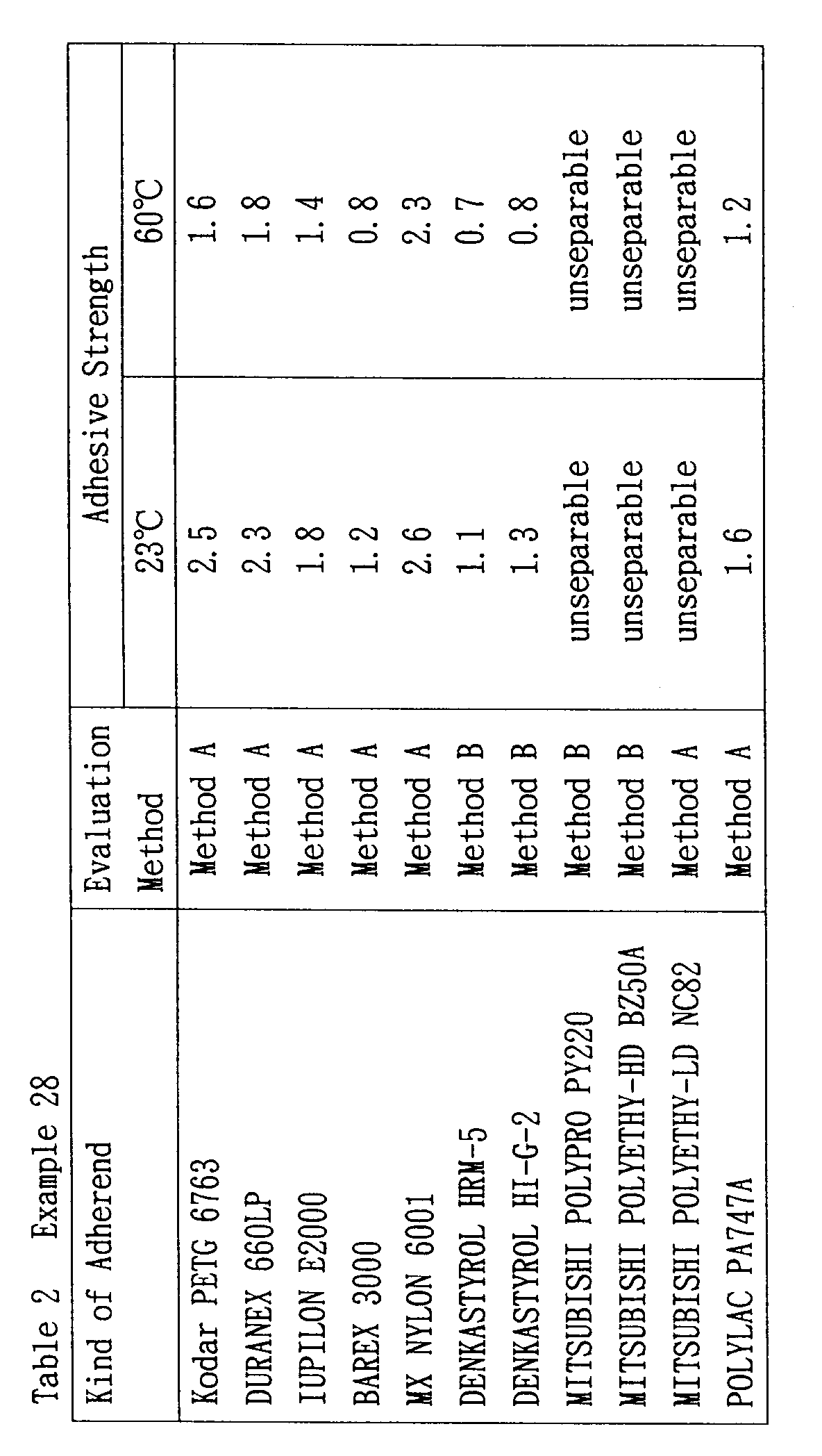


- As described above, the adhesive resin composition of the present invention shows excellent adhesion to various materials at a wide temperature range from ordinary temperatures to higher temperatures. Accordingly, this adhesive resin composition is useful for laminates for packaging films, thermo-forming cups, bottles prepared by blow or injection molding which need excellent heat resistance, gas barrier properties, moisture barrier, transparency and stiffness and are useful for packaging or filling food and medicines. This adhesive resin composition can also be used for lamination onto unwoven cloths and metals in the textile and industry fields.
Claims (16)
- An adhesive resin composition comprising an ethylene polymer having a melting point of 70 to 132°C, a density of 0.88 to 0.945 g/cm³ and a melt flow rate (MFR) of 0.05 to 50 g/10 min. and/or a modified product thereof, in which the modifying monomer is an unsaturated carboxylic acid or its derivative and an amount of the monomer is 0.01 to 10 wt% (component A); a tackifier (component B); and a block copolymer containing at least one polymer block mainly composed of a vinyl aromatic hydrocarbon and at least one polymer block mainly composed of a conjugated diene or a hydrogenated product thereof (component C), wherein the contents of the components A, B and C are 40 to 98 wt%, 1 to 59 wt% and 1 to 59 wt%, respectively, based on the total amount of the components A, B and C.
- The adhesive resin composition according to Claim 1, which further contains an ethylene/α -olefin random copolymer having a melting point of not higher than 60°C, a density of 0.85 to 0.87 g/cm³ and an MFR of 0.1 to 50 g/10 min. and/or a modified product thereof with an unsaturated carboxylic acid or its derivative (component D) in an amount of 1 to 50 wt% based on the total amount of the components A, B and C.
- The adhesive resin composition according to Claim 1, wherein said ethylene polymer has a melting point of 80 to 132°C, a density of 0.89 to 0.94 g/cm³ and an MFR of 0.1 to 30 g/10 min.
- The adhesive resin composition according to Claim 1, wherein said ethylene polymer has a crystallinity, determined by X-ray diffraction, of 13 to 65 %.
- The adhesive resin composition according to Claim 1, wherein said modified ethylene polymer is one produced by modifying said ethylene polymer with maleic acid or its anhydride.
- The adhesive resin composition according to Claim 1, wherein said modified ethylene polymer is one produced by graft-modifying said ethylene polymer with maleic anhydride and contains maleic anhydride grafted thereto in an amount of 0.05 to 7 wt%.
- The adhesive resin composition according to Claim 1, wherein said tackifier has a softening point of 70 to 150°C.
- The adhesive resin composition according to Claim 1, wherein said tackifier is selected from the group consisting of petroleum resins, rosin, terpene resins and hydrogenated products thereof.
- The adhesive resin composition according to Claim 8, wherein said petroleum resin is an aliphatic petroleum resin, an aromatic petroleum resin, or an aliphatic component/aromatic component copolymer type of petroleum resin which has a degree of hydrogenation of at least 80%.
- The adhesive resin composition according to Claim 1, wherein said block copolymer (component C) comprises a styrene polymer block and a butadiene polymer block or an isoprene polymer block.
- The adhesive resin composition according to Claim 10, wherein said block copolymer contains 10 to 80 wt% of a styrene polymer block.
- The adhesive resin composition according to Claim 10, wherein said block copolymer contains a butadiene or isoprene polymer block of which at least 90% is hydrogenated.
- The adhesive resin composition according to Claim 1, wherein said block copolymer has a number average molecular weight of 20,000 to 300,000.
- The adhesive resin composition according to Claim 2, wherein said ethylene/α -olefin random copolymer (component D) is an ethylene/propylene elastomer.
- The adhesive resin composition according to Claim 1, wherein the components A, B and C are contained in amounts of 40 to 85 wt%, 5 to 45 wt% and 3 to 50 wt%, respectively, based on the total amount of the components A, B and C.
- The adhesive resin composition according to Claim 2, wherein the components A, B, C and D are contained in amounts of 40 to 85 wt%, 5 to 45 wt%, 3 to 50 wt% and 5 to 40 wt%, respectively, based on the total amount of the components A, B and C.
Applications Claiming Priority (2)
| Application Number | Priority Date | Filing Date | Title |
|---|---|---|---|
| JP6609/94 | 1994-01-25 | ||
| JP00660994A JP3312984B2 (en) | 1994-01-25 | 1994-01-25 | Adhesive resin composition |
Publications (2)
| Publication Number | Publication Date |
|---|---|
| EP0664327A1 true EP0664327A1 (en) | 1995-07-26 |
| EP0664327B1 EP0664327B1 (en) | 1997-09-17 |
Family
ID=11643102
Family Applications (1)
| Application Number | Title | Priority Date | Filing Date |
|---|---|---|---|
| EP95100361A Expired - Lifetime EP0664327B1 (en) | 1994-01-25 | 1995-01-12 | Adhesive resin composition |
Country Status (4)
| Country | Link |
|---|---|
| US (1) | US5591792A (en) |
| EP (1) | EP0664327B1 (en) |
| JP (1) | JP3312984B2 (en) |
| DE (1) | DE69500703T2 (en) |
Cited By (9)
| Publication number | Priority date | Publication date | Assignee | Title |
|---|---|---|---|---|
| WO1998021279A1 (en) * | 1996-11-14 | 1998-05-22 | Shell Internationale Research Maatschappij B.V. | Modified styrenic block copolymer compounds having improved elastic performance |
| EP0857758A1 (en) * | 1997-02-10 | 1998-08-12 | Mitsubishi Chemical Corporation | Adhesive resin compositions, laminates, production method thereof and oriented films |
| EP0905211A1 (en) * | 1997-09-30 | 1999-03-31 | Elf Atochem S.A. | Pressure sensitive adhesive appliable in warmth |
| WO2007021060A1 (en) * | 2005-08-19 | 2007-02-22 | Cheil Industries Inc. | Polymer composition comprising a rubber modified styrenic polymer resin and an ethylenic rubber polymer |
| WO2007084216A1 (en) | 2006-01-17 | 2007-07-26 | Equistar Chemicals, Lp | Tie-layer adhesive compositions for styrene polymers and articles |
| EP2316900A1 (en) * | 2009-11-03 | 2011-05-04 | tesa SE | Adhesive composed of crosslinkable polyolefin and adhesive bonding resin |
| WO2014176433A1 (en) * | 2013-04-25 | 2014-10-30 | Equistar Chemicals, Lp | Tie-layer adhesives for styrenic multi-layer structures |
| CN111066099A (en) * | 2017-09-06 | 2020-04-24 | 罗门哈斯公司 | Polymeric compositions for fiber optic cable assemblies |
| CN114525093A (en) * | 2021-12-31 | 2022-05-24 | 佛山南宝高盛高新材料有限公司 | Hot melt adhesive for non-woven fabric anti-skid floor mat and preparation method thereof |
Families Citing this family (57)
| Publication number | Priority date | Publication date | Assignee | Title |
|---|---|---|---|---|
| USH1808H (en) * | 1994-11-17 | 1999-10-05 | Shell Oil Company | Extrudable styrenic block copolymer compositions containing a metallocene polyolefin |
| USH1798H (en) * | 1994-12-22 | 1999-07-06 | Shell Oil Company | Soft compounds containing elastomeric metallocene polyolefins and styrenic block copolymers |
| US7078075B1 (en) * | 1995-02-23 | 2006-07-18 | H.B. Fuller Licensing & Financing Inc. | Method for producing a continuous thermoplastic coating and articles constructed therefrom |
| US5741594A (en) * | 1995-08-28 | 1998-04-21 | The Dow Chemical Company | Adhesion promoter for a laminate comprising a substantially linear polyolefin |
| USH1949H1 (en) * | 1996-02-01 | 2001-03-06 | Shell Oil Company | Hydrogenated elastomer primed polyolefin film |
| ID17196A (en) * | 1996-03-14 | 1997-12-11 | Dow Chemical Co | ADHESIVE INGREDIENTS THAT CONTAIN OLEFIN POLYMER |
| JP3876020B2 (en) * | 1996-08-12 | 2007-01-31 | 東洋製罐株式会社 | Fragrance plastic multilayer container |
| US6042906A (en) * | 1996-08-12 | 2000-03-28 | Toyo Seikan Kaisha, Ltd. | Flavor-retaining plastic multi-layer container |
| US5777043A (en) * | 1997-03-05 | 1998-07-07 | Shell Oil Company | Sealant formulations containing high vinyl content hydrogenated styrene-butadiene-styrene block copolymers |
| SG66461A1 (en) * | 1997-05-16 | 1999-07-20 | Mitsui Chemicals Inc | Polyamide resin composition and process for producing the same |
| US6184298B1 (en) | 1998-06-19 | 2001-02-06 | E. I. Du Pont De Nemours And Company | Adhesive compositions based on blends of grafted polyethylenes and non-grafted polyethylenes and styrene container rubber |
| WO2000000565A1 (en) | 1998-06-30 | 2000-01-06 | H.B. Fuller Licensing & Financing, Inc. | Hot melt adhesive composition comprising homogeneous ethylene interpolymer and block copolymer |
| US6657000B1 (en) * | 1999-06-25 | 2003-12-02 | Kraton Polymers U.S. Llc | Hot melt pressure sensitive positioning adhesive (III) |
| CN1400939A (en) * | 2000-02-11 | 2003-03-05 | 丹格乐斯技术有限公司 | Antireflective UV blocking multilayer coatings wherin film has cerium oxide |
| US20020007164A1 (en) * | 2000-05-15 | 2002-01-17 | Boggs Lavada Campbell | Garment having gasket with integrated zone of elastic tension and/or stretch |
| US8182457B2 (en) | 2000-05-15 | 2012-05-22 | Kimberly-Clark Worldwide, Inc. | Garment having an apparent elastic band |
| US20020019616A1 (en) * | 2000-05-15 | 2002-02-14 | Thomas Oomman Painumoottil | Elastomeric laminate with film and strands suitable for a nonwoven garment |
| US20020007148A1 (en) * | 2000-05-15 | 2002-01-17 | May Raymond Jeffrey | Garment having integrated zone of elastic tension aligned with an opening |
| US20050106971A1 (en) * | 2000-05-15 | 2005-05-19 | Thomas Oomman P. | Elastomeric laminate with film and strands suitable for a nonwoven garment |
| US20020009940A1 (en) * | 2000-05-15 | 2002-01-24 | May Raymond Jeffrey | Targeted elastic laminate having zones of different polymer materials |
| UA77951C2 (en) * | 2000-11-29 | 2007-02-15 | Laminate for packaging of food and method for its formation (variants) | |
| JP3757844B2 (en) * | 2001-10-19 | 2006-03-22 | ソニー株式会社 | Semiconductor manufacturing method |
| US6939334B2 (en) | 2001-12-19 | 2005-09-06 | Kimberly-Clark Worldwide, Inc. | Three dimensional profiling of an elastic hot melt pressure sensitive adhesive to provide areas of differential tension |
| US6902796B2 (en) | 2001-12-28 | 2005-06-07 | Kimberly-Clark Worldwide, Inc. | Elastic strand bonded laminate |
| US7015155B2 (en) * | 2002-07-02 | 2006-03-21 | Kimberly-Clark Worldwide, Inc. | Elastomeric adhesive |
| US7335273B2 (en) | 2002-12-26 | 2008-02-26 | Kimberly-Clark Worldwide, Inc. | Method of making strand-reinforced elastomeric composites |
| US7316842B2 (en) | 2002-07-02 | 2008-01-08 | Kimberly-Clark Worldwide, Inc. | High-viscosity elastomeric adhesive composition |
| US6978486B2 (en) | 2002-07-02 | 2005-12-27 | Kimberly-Clark Worldwide, Inc. | Garment including an elastomeric composite laminate |
| US7316840B2 (en) * | 2002-07-02 | 2008-01-08 | Kimberly-Clark Worldwide, Inc. | Strand-reinforced composite material |
| US20040006323A1 (en) * | 2002-07-02 | 2004-01-08 | Hall Gregory K. | Garments using elastic strands to enhance performance of elastic barrier adhessive |
| US6916750B2 (en) | 2003-03-24 | 2005-07-12 | Kimberly-Clark Worldwide, Inc. | High performance elastic laminates made from high molecular weight styrenic tetrablock copolymer |
| US6846876B1 (en) * | 2003-07-16 | 2005-01-25 | Adherent Laboratories, Inc. | Low odor, light color, disposable article construction adhesive |
| US20050031878A1 (en) * | 2003-08-04 | 2005-02-10 | Vasanthakumar Narayanan | Adhesion promoter concentrates |
| US7531601B2 (en) * | 2003-08-19 | 2009-05-12 | Dow Global Technologies, Inc. | Interpolymers suitable for use in hot melt adhesives and processes to prepare same |
| EP1692240A2 (en) * | 2003-12-12 | 2006-08-23 | 3M Innovative Properties Company | Pressure sensitive adhesive composition and article |
| US7601657B2 (en) * | 2003-12-31 | 2009-10-13 | Kimberly-Clark Worldwide, Inc. | Single sided stretch bonded laminates, and methods of making same |
| CN1918221B (en) * | 2004-02-06 | 2012-11-14 | 因维斯塔技术有限公司 | Substrates containing adhesion promoting additives and articles prepared therewith |
| US7211308B2 (en) * | 2004-02-20 | 2007-05-01 | Honeywell International Inc. | Formation of multilayer sheets containing PCTFE and COC for blister packaging applications |
| JP4644661B2 (en) * | 2004-05-11 | 2011-03-02 | 日東電工株式会社 | Polarizing plate and image display device |
| US20070211334A1 (en) * | 2004-05-11 | 2007-09-13 | Nitto Denko Corporation | Polarizer protective film, polarizing plate and image display |
| US20060003656A1 (en) * | 2004-06-30 | 2006-01-05 | Kimberly-Clark Worldwide, Inc. | Efficient necked bonded laminates and methods of making same |
| US7651653B2 (en) * | 2004-12-22 | 2010-01-26 | Kimberly-Clark Worldwide, Inc. | Machine and cross-machine direction elastic materials and methods of making same |
| US20070048497A1 (en) * | 2005-08-31 | 2007-03-01 | Peiguang Zhou | Single-faced neck bonded laminates and methods of making same |
| JP5092288B2 (en) | 2005-09-02 | 2012-12-05 | 三菱化学株式会社 | Adhesive resin composition and laminate |
| US20070141937A1 (en) * | 2005-12-15 | 2007-06-21 | Joerg Hendrix | Filament-meltblown composite materials, and methods of making same |
| US20080039583A1 (en) * | 2006-08-08 | 2008-02-14 | I-Hwa Lee | Adhesive composition |
| US7910794B2 (en) | 2007-03-05 | 2011-03-22 | Adherent Laboratories, Inc. | Disposable diaper construction and adhesive |
| US9321941B2 (en) * | 2008-01-02 | 2016-04-26 | Equistar Chemicals, Lp | Tie-layer adhesives for styrene polymers and articles |
| DK2241340T3 (en) * | 2008-01-10 | 2014-08-25 | Alcare Co Ltd | PRESSURE-SENSITIVE ADHESIVE TO SKIN, PRESSURE-SENSITIVE ADHESIVE TO SKIN AND FRONT COVER OF STOMI DEVICE |
| US20090208685A1 (en) * | 2008-02-20 | 2009-08-20 | Sealed Air Corporation (Us) | Packaging film and method of decreasing scalping of polar cyclic compounds |
| US8377562B2 (en) * | 2009-12-30 | 2013-02-19 | Equistar Chemicals, Lp | Multilayer structures with common tie layer |
| US8378025B2 (en) * | 2010-03-12 | 2013-02-19 | Equistar Chemicals, Lp | Adhesive composition |
| KR20130129190A (en) * | 2010-11-05 | 2013-11-27 | 가부시키가이샤 가네카 | Laminated adhesive film for use in insert molding |
| US20170009110A1 (en) * | 2014-01-22 | 2017-01-12 | Kaneka Corporation | Polyolefin resin composition for hot melt adhesive, hot melt adhesive film, and laminate |
| JP2016107444A (en) * | 2014-12-03 | 2016-06-20 | Mcppイノベーション合同会社 | Laminate, formed body, formed cup, and container for beverage product |
| JP2016107443A (en) * | 2014-12-03 | 2016-06-20 | Mcppイノベーション合同会社 | Laminate, formed body, formed cup, and container for beverage product |
| JP2018171808A (en) * | 2017-03-31 | 2018-11-08 | 三井化学株式会社 | Gas barrier laminate film |
Citations (3)
| Publication number | Priority date | Publication date | Assignee | Title |
|---|---|---|---|---|
| EP0411191A1 (en) * | 1988-04-28 | 1991-02-06 | Baychem International, Inc. | Melt adhesive compositions |
| EP0412503A2 (en) * | 1989-08-07 | 1991-02-13 | Mitsui Petrochemical Industries, Ltd. | Adhesive resin composition, laminate comprising this composition as adhesive layer, and process for preparation thereof |
| EP0501296A2 (en) * | 1991-02-26 | 1992-09-02 | Mitsubishi Chemical Corporation | Laminate film for stretch-wrapping and process for producing the same |
Family Cites Families (4)
| Publication number | Priority date | Publication date | Assignee | Title |
|---|---|---|---|---|
| DE3720882A1 (en) * | 1987-06-24 | 1989-01-05 | Media Control Musik Medien | METHOD AND CIRCUIT ARRANGEMENT FOR THE AUTOMATIC RECOGNITION OF SIGNAL SEQUENCES |
| US5206284A (en) * | 1989-03-17 | 1993-04-27 | Ube Industries Ltd. | Thermoplastic resin composition |
| US5264476A (en) * | 1990-10-18 | 1993-11-23 | Sumitomo Chemical Company, Limited | Olefin resin composition |
| US5286781A (en) * | 1991-04-18 | 1994-02-15 | Sekisui Chemical Co., Ltd. | Pressure sensitive adhesive composition and pressure sensitive adhesive tape or sheet making use of the same |
-
1994
- 1994-01-25 JP JP00660994A patent/JP3312984B2/en not_active Expired - Lifetime
-
1995
- 1995-01-10 US US08/370,871 patent/US5591792A/en not_active Expired - Lifetime
- 1995-01-12 EP EP95100361A patent/EP0664327B1/en not_active Expired - Lifetime
- 1995-01-12 DE DE69500703T patent/DE69500703T2/en not_active Expired - Lifetime
Patent Citations (3)
| Publication number | Priority date | Publication date | Assignee | Title |
|---|---|---|---|---|
| EP0411191A1 (en) * | 1988-04-28 | 1991-02-06 | Baychem International, Inc. | Melt adhesive compositions |
| EP0412503A2 (en) * | 1989-08-07 | 1991-02-13 | Mitsui Petrochemical Industries, Ltd. | Adhesive resin composition, laminate comprising this composition as adhesive layer, and process for preparation thereof |
| EP0501296A2 (en) * | 1991-02-26 | 1992-09-02 | Mitsubishi Chemical Corporation | Laminate film for stretch-wrapping and process for producing the same |
Cited By (14)
| Publication number | Priority date | Publication date | Assignee | Title |
|---|---|---|---|---|
| WO1998021279A1 (en) * | 1996-11-14 | 1998-05-22 | Shell Internationale Research Maatschappij B.V. | Modified styrenic block copolymer compounds having improved elastic performance |
| EP0857758A1 (en) * | 1997-02-10 | 1998-08-12 | Mitsubishi Chemical Corporation | Adhesive resin compositions, laminates, production method thereof and oriented films |
| US6214476B1 (en) | 1997-02-10 | 2001-04-10 | Mitsubishi Chemical Corporation | Adhesive resin compositions, laminates, production method thereof and oriented films |
| EP0905211A1 (en) * | 1997-09-30 | 1999-03-31 | Elf Atochem S.A. | Pressure sensitive adhesive appliable in warmth |
| US6162868A (en) * | 1997-09-30 | 2000-12-19 | Elf Atochem S.A. | Pressure-sensitive adhesive which can be applied while hot |
| WO2007021060A1 (en) * | 2005-08-19 | 2007-02-22 | Cheil Industries Inc. | Polymer composition comprising a rubber modified styrenic polymer resin and an ethylenic rubber polymer |
| WO2007084216A1 (en) | 2006-01-17 | 2007-07-26 | Equistar Chemicals, Lp | Tie-layer adhesive compositions for styrene polymers and articles |
| EP2316900A1 (en) * | 2009-11-03 | 2011-05-04 | tesa SE | Adhesive composed of crosslinkable polyolefin and adhesive bonding resin |
| WO2014176433A1 (en) * | 2013-04-25 | 2014-10-30 | Equistar Chemicals, Lp | Tie-layer adhesives for styrenic multi-layer structures |
| US9662864B2 (en) | 2013-04-25 | 2017-05-30 | Equistar Chemicals, Lp | Tie-layer adhesives for styrenic multi-layer structures |
| CN111066099A (en) * | 2017-09-06 | 2020-04-24 | 罗门哈斯公司 | Polymeric compositions for fiber optic cable assemblies |
| CN111066099B (en) * | 2017-09-06 | 2023-09-15 | 罗门哈斯公司 | Polymeric compositions of fiber optic cable assemblies |
| CN114525093A (en) * | 2021-12-31 | 2022-05-24 | 佛山南宝高盛高新材料有限公司 | Hot melt adhesive for non-woven fabric anti-skid floor mat and preparation method thereof |
| CN114525093B (en) * | 2021-12-31 | 2023-12-08 | 佛山南宝高盛高新材料有限公司 | Hot melt adhesive for non-woven fabric anti-slip floor mat and preparation method thereof |
Also Published As
| Publication number | Publication date |
|---|---|
| JPH07207082A (en) | 1995-08-08 |
| EP0664327B1 (en) | 1997-09-17 |
| JP3312984B2 (en) | 2002-08-12 |
| DE69500703T2 (en) | 1998-02-19 |
| US5591792A (en) | 1997-01-07 |
| DE69500703D1 (en) | 1997-10-23 |
Similar Documents
| Publication | Publication Date | Title |
|---|---|---|
| EP0664327B1 (en) | Adhesive resin composition | |
| EP0857758B1 (en) | Adhesive resin compositions, laminates, production method thereof and oriented films | |
| CA2194820C (en) | Adhesive polyethylene compositions and multi-layer laminated films using the same | |
| EP0359426B1 (en) | Improved coextrudable adhesive and products therefrom | |
| US11292945B2 (en) | Adhesive resin composition and laminate | |
| EP0578056B1 (en) | Thermoplastic resin composition | |
| EP2225340A1 (en) | Improved tie-layer adhesives for styrene polymers and articles | |
| EP0533493A1 (en) | Laminated films | |
| JP2003526697A (en) | Blend of grafted polyethylene and non-grafted polyethylene and adhesive composition based on styrene-containing rubber | |
| AU626923B2 (en) | Laminate | |
| US5597865A (en) | Adhesive blends for polystyrene | |
| JP2020111745A (en) | Adhesive resin composition and laminate | |
| JP2652507B2 (en) | Resin composition and biaxially stretched film, production method thereof, and food packaging material | |
| JPH10265751A (en) | Adhesive resin composition, laminate and multilayer stretch molded article | |
| WO2022209431A1 (en) | Resin composition and laminate having layer comprising said resin composition | |
| US20080039583A1 (en) | Adhesive composition | |
| JP2019156484A (en) | Easily peelable film | |
| US5296554A (en) | Adhesive resin composition | |
| JP6864497B2 (en) | Adhesive resin compositions and master batches, as well as laminated films, stretched films, and multilayer moldings using them. | |
| JP2020111709A (en) | Adhesive resin composition and laminate | |
| JP3669105B2 (en) | Multi-layer stretch molding | |
| JP2000086840A (en) | Adhesive resin composition and laminate formed therefrom | |
| JP2020114889A (en) | Adhesive resin composition and laminate | |
| WO2025206190A1 (en) | Adhesive resin composition, film, and packaging material | |
| JPH03237144A (en) | Polyethylene based resin composition |
Legal Events
| Date | Code | Title | Description |
|---|---|---|---|
| PUAI | Public reference made under article 153(3) epc to a published international application that has entered the european phase |
Free format text: ORIGINAL CODE: 0009012 |
|
| AK | Designated contracting states |
Kind code of ref document: A1 Designated state(s): DE FR GB SE |
|
| 17P | Request for examination filed |
Effective date: 19950831 |
|
| GRAG | Despatch of communication of intention to grant |
Free format text: ORIGINAL CODE: EPIDOS AGRA |
|
| 17Q | First examination report despatched |
Effective date: 19961223 |
|
| GRAH | Despatch of communication of intention to grant a patent |
Free format text: ORIGINAL CODE: EPIDOS IGRA |
|
| GRAH | Despatch of communication of intention to grant a patent |
Free format text: ORIGINAL CODE: EPIDOS IGRA |
|
| GRAA | (expected) grant |
Free format text: ORIGINAL CODE: 0009210 |
|
| AK | Designated contracting states |
Kind code of ref document: B1 Designated state(s): DE FR GB SE |
|
| REF | Corresponds to: |
Ref document number: 69500703 Country of ref document: DE Date of ref document: 19971023 |
|
| ET | Fr: translation filed | ||
| PLBE | No opposition filed within time limit |
Free format text: ORIGINAL CODE: 0009261 |
|
| STAA | Information on the status of an ep patent application or granted ep patent |
Free format text: STATUS: NO OPPOSITION FILED WITHIN TIME LIMIT |
|
| 26N | No opposition filed | ||
| REG | Reference to a national code |
Ref country code: GB Ref legal event code: IF02 |
|
| PGFP | Annual fee paid to national office [announced via postgrant information from national office to epo] |
Ref country code: DE Payment date: 20140108 Year of fee payment: 20 Ref country code: SE Payment date: 20140113 Year of fee payment: 20 |
|
| PGFP | Annual fee paid to national office [announced via postgrant information from national office to epo] |
Ref country code: FR Payment date: 20140108 Year of fee payment: 20 |
|
| PGFP | Annual fee paid to national office [announced via postgrant information from national office to epo] |
Ref country code: GB Payment date: 20140108 Year of fee payment: 20 |
|
| REG | Reference to a national code |
Ref country code: DE Ref legal event code: R071 Ref document number: 69500703 Country of ref document: DE |
|
| REG | Reference to a national code |
Ref country code: GB Ref legal event code: PE20 Expiry date: 20150111 |
|
| REG | Reference to a national code |
Ref country code: SE Ref legal event code: EUG |
|
| PG25 | Lapsed in a contracting state [announced via postgrant information from national office to epo] |
Ref country code: GB Free format text: LAPSE BECAUSE OF EXPIRATION OF PROTECTION Effective date: 20150111 |