EP0664296B1 - Reactive flame retardant additives containing phosphino oxide moieties - Google Patents
Reactive flame retardant additives containing phosphino oxide moieties Download PDFInfo
- Publication number
- EP0664296B1 EP0664296B1 EP95200088A EP95200088A EP0664296B1 EP 0664296 B1 EP0664296 B1 EP 0664296B1 EP 95200088 A EP95200088 A EP 95200088A EP 95200088 A EP95200088 A EP 95200088A EP 0664296 B1 EP0664296 B1 EP 0664296B1
- Authority
- EP
- European Patent Office
- Prior art keywords
- moiety
- represent
- compounds
- general formula
- hydrogen atom
- Prior art date
- Legal status (The legal status is an assumption and is not a legal conclusion. Google has not performed a legal analysis and makes no representation as to the accuracy of the status listed.)
- Expired - Lifetime
Links
- 0 CCC(CCC=C1)=C1P(c1ccccc1*)=* Chemical compound CCC(CCC=C1)=C1P(c1ccccc1*)=* 0.000 description 2
- SJUYTUNECASRPL-SYZQJQIISA-N C/C=C(\CCC=C)/P(C(CC(C1)C2C(O3)=O)C1C2C3=O)(C1=[O]=CC=CC=C1)=O Chemical compound C/C=C(\CCC=C)/P(C(CC(C1)C2C(O3)=O)C1C2C3=O)(C1=[O]=CC=CC=C1)=O SJUYTUNECASRPL-SYZQJQIISA-N 0.000 description 1
- PGGSVANZCDBNMS-UHFFFAOYSA-N OCC(CO)(CC1C2)C2CC1[IH](C(c1ccccc1)c1ccccc1)=O Chemical compound OCC(CO)(CC1C2)C2CC1[IH](C(c1ccccc1)c1ccccc1)=O PGGSVANZCDBNMS-UHFFFAOYSA-N 0.000 description 1
Classifications
-
- C—CHEMISTRY; METALLURGY
- C07—ORGANIC CHEMISTRY
- C07F—ACYCLIC, CARBOCYCLIC OR HETEROCYCLIC COMPOUNDS CONTAINING ELEMENTS OTHER THAN CARBON, HYDROGEN, HALOGEN, OXYGEN, NITROGEN, SULFUR, SELENIUM OR TELLURIUM
- C07F9/00—Compounds containing elements of Groups 5 or 15 of the Periodic Table
- C07F9/02—Phosphorus compounds
- C07F9/547—Heterocyclic compounds, e.g. containing phosphorus as a ring hetero atom
- C07F9/655—Heterocyclic compounds, e.g. containing phosphorus as a ring hetero atom having oxygen atoms, with or without sulfur, selenium, or tellurium atoms, as the only ring hetero atoms
- C07F9/65515—Heterocyclic compounds, e.g. containing phosphorus as a ring hetero atom having oxygen atoms, with or without sulfur, selenium, or tellurium atoms, as the only ring hetero atoms the oxygen atom being part of a five-membered ring
- C07F9/65517—Heterocyclic compounds, e.g. containing phosphorus as a ring hetero atom having oxygen atoms, with or without sulfur, selenium, or tellurium atoms, as the only ring hetero atoms the oxygen atom being part of a five-membered ring condensed with carbocyclic rings or carbocyclic ring systems
-
- C—CHEMISTRY; METALLURGY
- C07—ORGANIC CHEMISTRY
- C07F—ACYCLIC, CARBOCYCLIC OR HETEROCYCLIC COMPOUNDS CONTAINING ELEMENTS OTHER THAN CARBON, HYDROGEN, HALOGEN, OXYGEN, NITROGEN, SULFUR, SELENIUM OR TELLURIUM
- C07F9/00—Compounds containing elements of Groups 5 or 15 of the Periodic Table
- C07F9/02—Phosphorus compounds
- C07F9/28—Phosphorus compounds with one or more P—C bonds
- C07F9/50—Organo-phosphines
- C07F9/53—Organo-phosphine oxides; Organo-phosphine thioxides
- C07F9/532—Cycloaliphatic phosphine oxides or thioxides
-
- C—CHEMISTRY; METALLURGY
- C07—ORGANIC CHEMISTRY
- C07F—ACYCLIC, CARBOCYCLIC OR HETEROCYCLIC COMPOUNDS CONTAINING ELEMENTS OTHER THAN CARBON, HYDROGEN, HALOGEN, OXYGEN, NITROGEN, SULFUR, SELENIUM OR TELLURIUM
- C07F9/00—Compounds containing elements of Groups 5 or 15 of the Periodic Table
- C07F9/02—Phosphorus compounds
- C07F9/547—Heterocyclic compounds, e.g. containing phosphorus as a ring hetero atom
- C07F9/6564—Heterocyclic compounds, e.g. containing phosphorus as a ring hetero atom having phosphorus atoms, with or without nitrogen, oxygen, sulfur, selenium or tellurium atoms, as ring hetero atoms
- C07F9/6581—Heterocyclic compounds, e.g. containing phosphorus as a ring hetero atom having phosphorus atoms, with or without nitrogen, oxygen, sulfur, selenium or tellurium atoms, as ring hetero atoms having phosphorus and nitrogen atoms with or without oxygen or sulfur atoms, as ring hetero atoms
- C07F9/6584—Heterocyclic compounds, e.g. containing phosphorus as a ring hetero atom having phosphorus atoms, with or without nitrogen, oxygen, sulfur, selenium or tellurium atoms, as ring hetero atoms having phosphorus and nitrogen atoms with or without oxygen or sulfur atoms, as ring hetero atoms having one phosphorus atom as ring hetero atom
-
- C—CHEMISTRY; METALLURGY
- C08—ORGANIC MACROMOLECULAR COMPOUNDS; THEIR PREPARATION OR CHEMICAL WORKING-UP; COMPOSITIONS BASED THEREON
- C08K—Use of inorganic or non-macromolecular organic substances as compounding ingredients
- C08K5/00—Use of organic ingredients
- C08K5/0008—Organic ingredients according to more than one of the "one dot" groups of C08K5/01 - C08K5/59
- C08K5/0066—Flame-proofing or flame-retarding additives
-
- C—CHEMISTRY; METALLURGY
- C08—ORGANIC MACROMOLECULAR COMPOUNDS; THEIR PREPARATION OR CHEMICAL WORKING-UP; COMPOSITIONS BASED THEREON
- C08K—Use of inorganic or non-macromolecular organic substances as compounding ingredients
- C08K5/00—Use of organic ingredients
- C08K5/49—Phosphorus-containing compounds
- C08K5/51—Phosphorus bound to oxygen
- C08K5/53—Phosphorus bound to oxygen bound to oxygen and to carbon only
- C08K5/5397—Phosphine oxides
-
- Y—GENERAL TAGGING OF NEW TECHNOLOGICAL DEVELOPMENTS; GENERAL TAGGING OF CROSS-SECTIONAL TECHNOLOGIES SPANNING OVER SEVERAL SECTIONS OF THE IPC; TECHNICAL SUBJECTS COVERED BY FORMER USPC CROSS-REFERENCE ART COLLECTIONS [XRACs] AND DIGESTS
- Y10—TECHNICAL SUBJECTS COVERED BY FORMER USPC
- Y10T—TECHNICAL SUBJECTS COVERED BY FORMER US CLASSIFICATION
- Y10T428/00—Stock material or miscellaneous articles
- Y10T428/29—Coated or structually defined flake, particle, cell, strand, strand portion, rod, filament, macroscopic fiber or mass thereof
- Y10T428/2913—Rod, strand, filament or fiber
Definitions
- the present invention relates to novel compounds containing phosphino oxide groups.
- the present invention relates to compounds containing phosphino oxide groups, to a process for preparing them and to their use as flame retardant additives for organic polymers.
- flame retardant additives which, in general, are organic compounds containing halogens or phosphorus, to be applied by means of surface treatment of the article of manufacture, e.g., in a textile material finishing step.
- Flame retardant additives constituted by organic compounds containing phosphorus and/or halogen, or halogenated compounds, in combination with a metal oxide are described, e.g., by J. W. Lyons in "The Chemistry and Uses of Fire Retardants", Wiley Interscience 1970, pp 286-297.
- organic compounds containing phosphorus and/or halogen used in the production of heat/flame resistant polymers include p-hydroxyarylphosphino oxides and sulphides, as described in DE-A-35 44 064 (Rohm GmbH).
- poly-arylene ethers and esters containing phosphorus in moieties such as those shown below can be incorporated in polymers to increase their heat/flame resistance: and
- the present application has found now novel compounds containing phosphino oxide groups, useful as flame retardant additives, which are capable of being incorporated, as comonomers, with the polymer to be flame retarded.
- Such compounds useful as flame retardant additives for organic polymers such as, e.g., polyesters or polyurethanes, allow the drawbacks which affect the prior art to be overcome, because:
- the subject-matter of the present invention are compounds containing phosphino oxide groups having general formula (I): wherein:
- the compounds having general formula (I) are useful as flame retardant additives.
- Preferred compounds having general formula (I) are those in which:
- the diphenyl phosphino oxide having general formula (XIV) is prepared according to known processes described in the art, such as, e.g., in Haake et al., (1969), Journal of Organic Chemistry, Vol. 34, pp. 788-794.
- reaction is carried out according to known modalities as described, e.g., by Dolidze A.V., Ingorokva K.V. et al., in: "Izvestiya Akademii Nauk Gruzinoskoi SSR, Seriya Khimicheskaya” (1987), Vol. 13(4), pp. 309-311 and Ninfant'ev E.E., Magdeeva R.K. et al. in: "Zhurnal Obshchei Khimii” (1968), Vol. 56(7), pp. 1660-1661.
- the compounds having general formula (I) according to the present invention are useful as flame retardant additives, suitable for endowing organic polymers such as, e.g., linear polyesters with aliphatic and/or aromatic structures (PET, PBT, and so forth), polyurethanes, and so forth, with characteristics of flame resistance.
- organic polymers such as, e.g., linear polyesters with aliphatic and/or aromatic structures (PET, PBT, and so forth), polyurethanes, and so forth, with characteristics of flame resistance.
- the compounds having general formula (I) are mixed and homogenized with the monomers from which the polymer is being produced, at the beginning of the polymerization reaction, because, as already stated hereinabove, they do not form complexes with the reaction catalysts.
- the so obtained end product can be subsequently be transformed into manufactured articles as fibres, films, moulded articles, and so forth.
- the compounds having general formula (I) according to the present invention are capable of reacting with the polymer to which they are added, becoming a part of the same polymer and thus endowing it with flame retardant characteristics. They are furthermore capable of remaining overtime inside the interior of the polymeric material they are incorporated with.
- those hydroxy function containing compounds having formulae (VI), (VII), (XII) and (XIII), can replace an equivalent number of mols of glycol;
- those anhydride function containing compounds (II), (IV), (VIII) and (X) can replace an equivalent number of mols of terephthalic acid and the diester function containing compounds can replace an equivalent number of mols of methyl terephthalate, in the case when the polyester synthesis process will start from this compound, instead than from the free acid.
- the amount of compounds having general formula (I) using to provide flame retardant characteristics is that amount which secures a phosphorus content (calculated as elemental phosphorus) in the organic polymer comprised within the range of from 0.1% to 3% by weight, preferably from 0.4% to 0.7% by weight.
- the compounds having general formula (I) according to the present invention were characterized by 1 H-NMR and 31 P-NMR spectrometry in CDCl 3 , using a BRÜKER-AC-200 spectrometer and by mass spectrometry by the DCI method (chemical ionization with isobutane as the reactant gas), using a FINNIGAN MAT 8004 spectrometer.
- the following experimental examples are reported in order to illustrate the present invention without limiting it.
- reaction temperature is then decreased down to 40°C, 30 ml of ethyl ether is added and the white solid precipitate is filtered and dried.
- the mixture is heated up to 80°C under a nitrogen flow and is kept at that temperature during 2 hours.
- the temperature is then increased up to 90°C and the reaction is continued during a further 4 hours with 0.2 g of benzoyl peroxide being added every hour.
- reaction mixture When reaction is complete, the reaction mixture is cooled and is allowed to stand at 4°C. The white solid precipitate is filtered, washed with toluene and dried.
- the reaction mixture is heated, under nitrogen flow, at 80°C, and this temperature is kept during 2 hours.
- reaction mixture is cooled and is allowed to stand at 4°C.
- the white solid precipitate is filtered, washed with acetone and dried.
- the reaction mixture is heated, under nitrogen flow, up to 80°C, and is kept at that temperature during 2 hours.
- reaction temperature is kept at 80°C-85°C and the reaction is continued for a further 4 hours with 0.1 g of benzoyl peroxide being added every hour.
- reaction mixture is filtered and the precipitate is washed with acetone, with 19 g (yield 89%) being thus obtained of product, which is furthermore purified, in order to remove any traces of diphenyl phosphino oxide, by recrystallization from toluene.
- reaction mixture is purged, air inside the flask is replaced by an inert atmosphere (nitrogen) and the reaction is heated up to 180°C on a sand bath.
- the temperature of the sand bath is kept at 180°C until methanol is nearly totally distilled and the reaction temperature is subsequently gradually increased up to 230°C-240°C.
- the pressure is decreased down to about 40 kPa (300 torr) in order to remove any traces of methanol and ethylene glycol. Approximately 30 minutes later, the pressure is reduced down to 26.7 Pa (0.2 torr) and the temperature is simultaneously increased up to 280°C-285°C.
- the reaction flask is removed from the sand bath it was in, and is dipped into Liquid nitrogen.
- the polymer is finally recovered and pelletized.
- the so obtained polymer displays a LOI (Limited Oxigen Index) of 25, whilst additive-free polyethylene terephthalate displays an LOI of 20.
- LOI determination is carried out according to ASTM D 2863-77.
Landscapes
- Chemical & Material Sciences (AREA)
- Organic Chemistry (AREA)
- Health & Medical Sciences (AREA)
- Biochemistry (AREA)
- Molecular Biology (AREA)
- General Health & Medical Sciences (AREA)
- Life Sciences & Earth Sciences (AREA)
- Polymers & Plastics (AREA)
- Medicinal Chemistry (AREA)
- Chemical Kinetics & Catalysis (AREA)
- Fireproofing Substances (AREA)
- Compositions Of Macromolecular Compounds (AREA)
- Polyesters Or Polycarbonates (AREA)
- Detergent Compositions (AREA)
- Agricultural Chemicals And Associated Chemicals (AREA)
- Organic Low-Molecular-Weight Compounds And Preparation Thereof (AREA)
Abstract
Description
- The present invention relates to novel compounds containing phosphino oxide groups.
- More particularly, the present invention relates to compounds containing phosphino oxide groups, to a process for preparing them and to their use as flame retardant additives for organic polymers.
- In the art of organic polymers, the need exists for having available flame resistant articles of manufacture, in particular in some sectors, e.g., in the textile sector.
- In order to endow organic polymers with flame resistance properties (i.e., to "flame retard" them), several flame retardant additives are used which, in general, are organic compounds containing halogens or phosphorus, to be applied by means of surface treatment of the article of manufacture, e.g., in a textile material finishing step.
- Flame retardant additives constituted by organic compounds containing phosphorus and/or halogen, or halogenated compounds, in combination with a metal oxide are described, e.g., by J. W. Lyons in "The Chemistry and Uses of Fire Retardants", Wiley Interscience 1970, pp 286-297.
- Examples of organic compounds containing phosphorus and/or halogen used in the production of heat/flame resistant polymers include p-hydroxyarylphosphino oxides and sulphides, as described in DE-A-35 44 064 (Rohm GmbH). Similarly poly-arylene ethers and esters containing phosphorus in moieties such as those shown below can be incorporated in polymers to increase their heat/flame resistance:and


- These compounds are described in DE-A-35 21 125 (Rohm GmbH) and EP-A-0 096 799 (Rohm GmbH) respectively.
- The present application has found now novel compounds containing phosphino oxide groups, useful as flame retardant additives, which are capable of being incorporated, as comonomers, with the polymer to be flame retarded.
- Such compounds, useful as flame retardant additives for organic polymers such as, e.g., polyesters or polyurethanes, allow the drawbacks which affect the prior art to be overcome, because:
- no corrosive fumes as, e.g., hydrogen halide acids, are released (on the contrary, such gases are formed during the combustion of halogen containing additives);
- they contain analogous functional groups to those present in the monomers of the polymer to be admixed and therefore they do not considerably alter the polymerization reaction, because they are capable of partially replacing them;
- they do not form complexes with the polymerization catalysts and, therefore, can be added during the initial reaction stage, thus simplifying the process;
- they display a high heat and chemical stability and, consequently, they do not undergo any undesired alterations due to the harsh reaction conditions under which the polymer synthesis step is carried out;
- they do not undergo migrations to the outside of the polymeric matrix, because they make a part of the same polymeric chain, thus securing the absence of contamination of food or other goods put into contact with the end article of manufacture and furthermore securing that their flame retardant action will not decrease in the event of a decrease in their concentration in the polymer.
- Therefore, the subject-matter of the present invention are compounds containing phosphino oxide groups having general formula (I):wherein:

- X and X1 represent a hydrogen atom or, when they are taken jointly, they represent an NR1 moiety in which R1 stands for a hydrogen atom; a linear or branched aliphatic C1-C5 moiety; a linear or branched C2-C6 acyl moiety; a phenyl moiety;
- R represents a cyclic or polycyclic C4-C9 moiety containing two carboxy groups, possibly esterified with univalent alcohols or glycols, or transformed into anhydrides, or two hydroxy groups.
- The compounds having general formula (I) are useful as flame retardant additives.
- Preferred compounds having general formula (I) are those in which:
- X and X1 represent a hydrogen atom or, when they are taken jointly, they represent an -NH- moiety;
- R represents a moiety derived from cyclohexane or norbornane containing two methylol groups or a dianhydride group or two carboxy groups esterified with methanol.
- Specific examples of compounds having general formula (I) are:

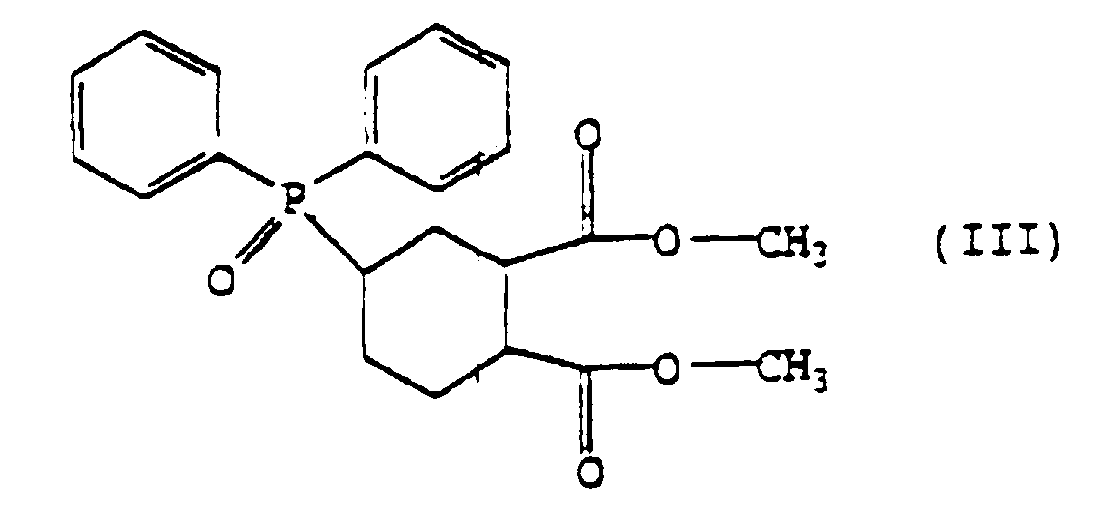


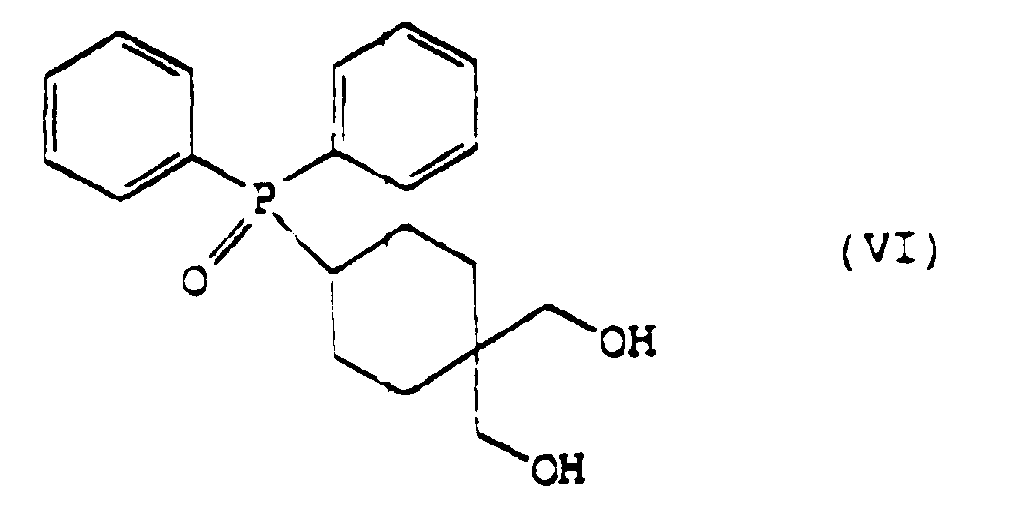
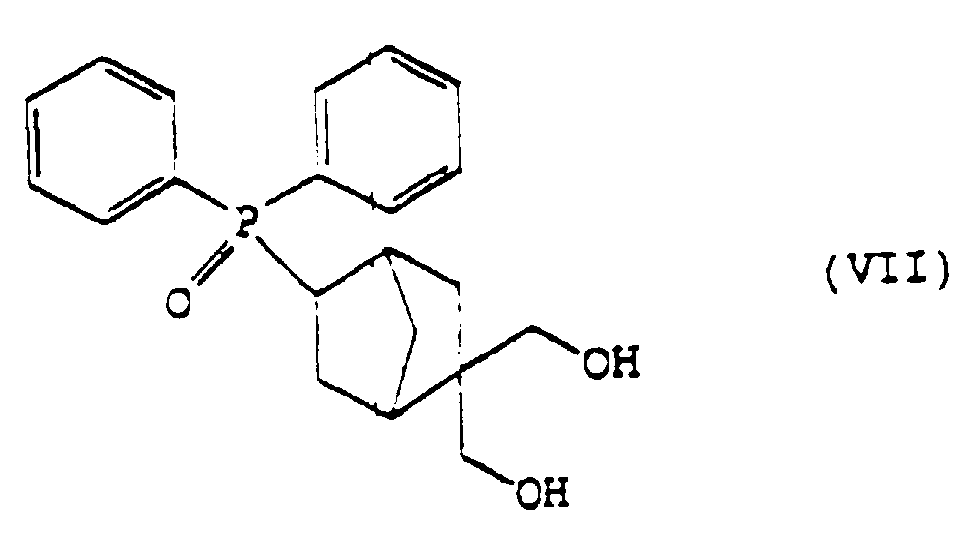
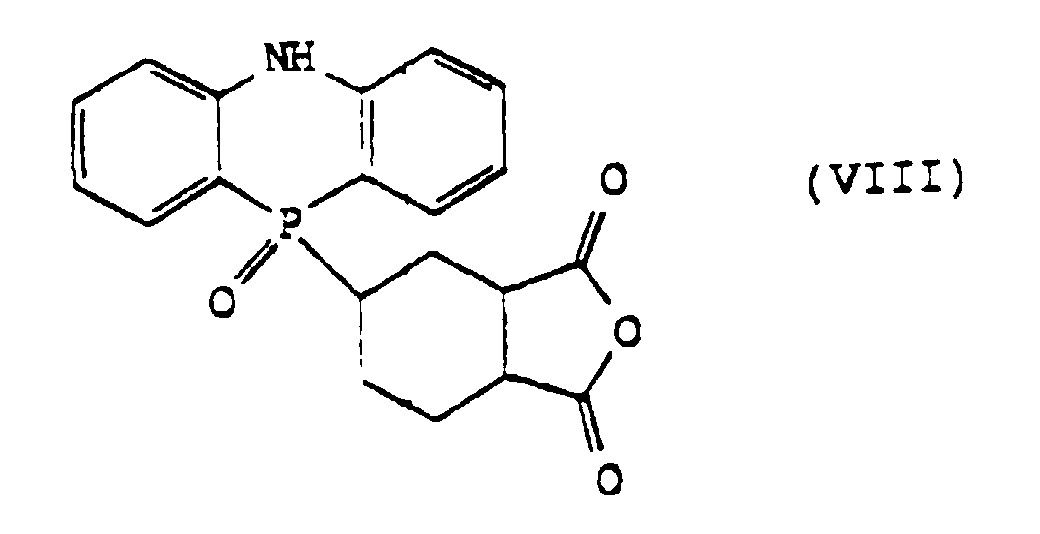
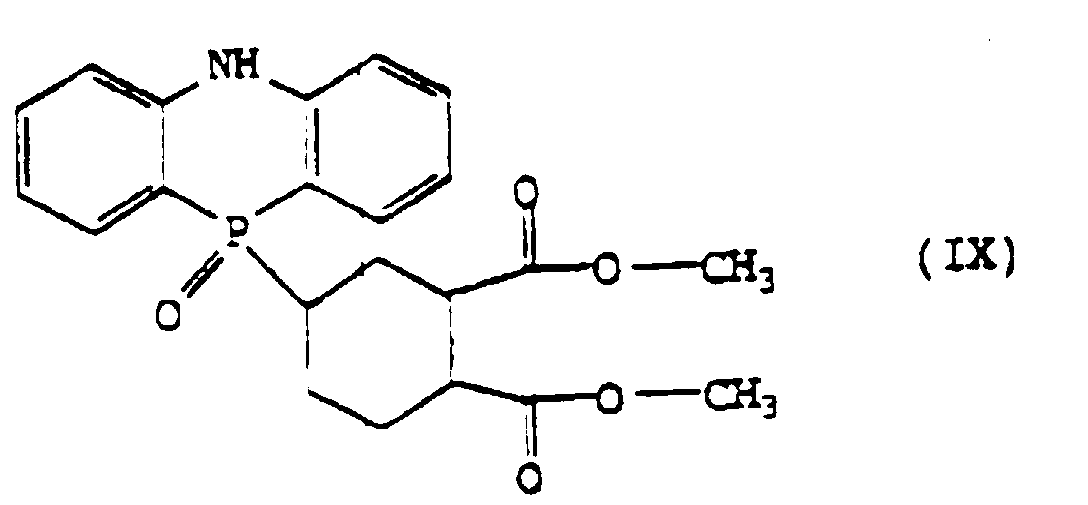


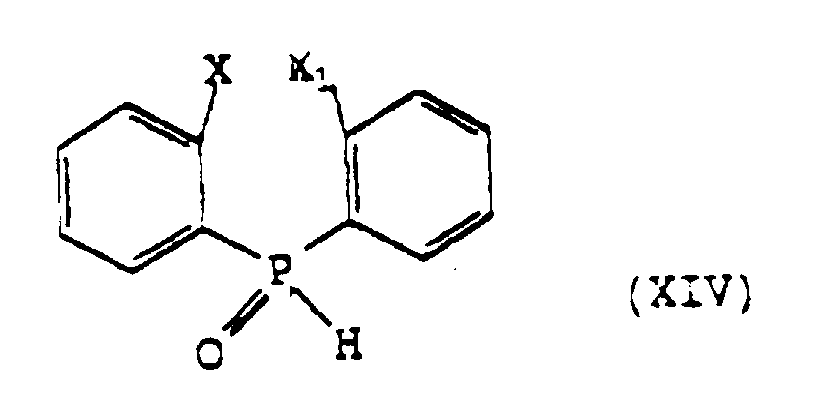
- The compounds having general formula (I) can be obtained by means of a process which comprises the reaction of a diphenyl phosphino oxide having general formula (XIV):in which X and X1 have the same meaning as disclosed above, with a compound containing either a double bond C=C or one from the functions disclosed above (anhydride, ester, and so forth).

- Specific examples of compounds containing either a double bond C=C or one of the functions disclosed above (anhydride, esters, and so forth) are:


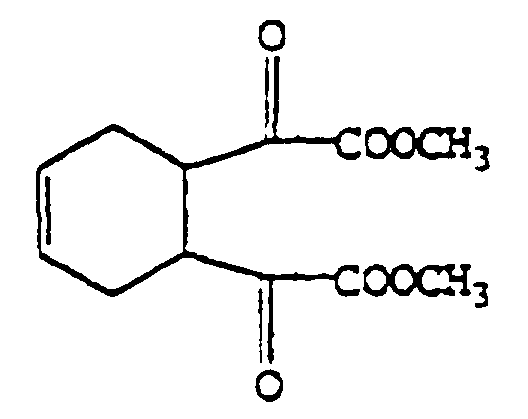


- The diphenyl phosphino oxide having general formula (XIV) is prepared according to known processes described in the art, such as, e.g., in Haake et al., (1969), Journal of Organic Chemistry, Vol. 34, pp. 788-794.
- Those compounds which contain either a double bond C=C or one of the functions disclosed above (anhydride, ester, and so forth), some examples of which are reported above, are commercial products.
- The reaction is carried out according to known modalities as described, e.g., by Dolidze A.V., Ingorokva K.V. et al., in: "Izvestiya Akademii Nauk Gruzinoskoi SSR, Seriya Khimicheskaya" (1987), Vol. 13(4), pp. 309-311 and Ninfant'ev E.E., Magdeeva R.K. et al. in: "Zhurnal Obshchei Khimii" (1968), Vol. 56(7), pp. 1660-1661.
- The compounds having general formula (I) according to the present invention are useful as flame retardant additives, suitable for endowing organic polymers such as, e.g., linear polyesters with aliphatic and/or aromatic structures (PET, PBT, and so forth), polyurethanes, and so forth, with characteristics of flame resistance.
- The compounds having general formula (I) are mixed and homogenized with the monomers from which the polymer is being produced, at the beginning of the polymerization reaction, because, as already stated hereinabove, they do not form complexes with the reaction catalysts.
- The so obtained end product can be subsequently be transformed into manufactured articles as fibres, films, moulded articles, and so forth.
- The compounds having general formula (I) according to the present invention are capable of reacting with the polymer to which they are added, becoming a part of the same polymer and thus endowing it with flame retardant characteristics. They are furthermore capable of remaining overtime inside the interior of the polymeric material they are incorporated with.
- For example, in the case of poly(ethylene terephthalate) (PET) or of poly(butylene terephthalate) (PBT), those hydroxy function containing compounds having formulae (VI), (VII), (XII) and (XIII), can replace an equivalent number of mols of glycol; those anhydride function containing compounds (II), (IV), (VIII) and (X), can replace an equivalent number of mols of terephthalic acid and the diester function containing compounds can replace an equivalent number of mols of methyl terephthalate, in the case when the polyester synthesis process will start from this compound, instead than from the free acid.
- The amount of compounds having general formula (I) using to provide flame retardant characteristics is that amount which secures a phosphorus content (calculated as elemental phosphorus) in the organic polymer comprised within the range of from 0.1% to 3% by weight, preferably from 0.4% to 0.7% by weight.
- The compounds having general formula (I) according to the present invention were characterized by 1H-NMR and 31P-NMR spectrometry in CDCl3, using a BRÜKER-AC-200 spectrometer and by mass spectrometry by the DCI method (chemical ionization with isobutane as the reactant gas), using a FINNIGAN MAT 8004 spectrometer. The following experimental examples are reported in order to illustrate the present invention without limiting it.
- To a 3-necked flask of 500 cm3 of capacity equipped with condenser, thermometer, magnetic stirring means and fitting for inert gas flow, 7.6 g (0.05 mol) of tetrahydrophthalic anhydride; 10.1 g (0.05 mol) of diphenyl phosphino oxide and 0.41 g (0.025 mol) of azoisobutyronitrile (AIBN) are charged.
- After heating the mixture at 80°C during 6 hours under a nitrogen flow, from the 31P-NMR spectrum obtained from the raw reaction mixture, a singlet at 36.5 ppm with an integral value of 90%, is evidenced.
- The reaction temperature is then decreased down to 40°C, 30 ml of ethyl ether is added and the white solid precipitate is filtered and dried.
- An amount of 12.5 g of product is obtained, in a yield of 71%, which is further purified, in order to remove any traces of diphenyl phosphino oxide, by recrystallization from toluene or, preferably, from 1,2-dichloroethane, with, in the latter case, a purity of >99.9% being obtained.
- An end amount of 10 g (yield 57%) is obtained of product displaying the following characteristics:
Melting point: 210°C-215°C.
1H-NMR (200 MHz, CDCl1-TMS) (ppm): 7.6-7.1 (10H, m); 3.3 (2H, m); 2.4 (1H, t); 2.0 (2H, m); 1.5 (2H, m); 1.1 (2H, m).
31P: 36.5 ppm (s).
IR: 3050 cm-1(aromatic CH), 1880 cm-1 (anhydride C=0); 1130 cm-1 (P=0).
Mass (ms): 354 m/z (molecular peak). - To a 3-necked flask of 250 cm3 of capacity equipped with condenser, thermometer, magnetic stirring means and fitting for inert gas flow, 21.93 g (0.1336 mol) of anhydride of cis-5-norbornene-endo-2,3-dicarboxy acid, 27.0 g (0.1336 mol) of diphenyl phosphino oxide, 50 cm3 of toluene and 1.1 g (0.067 mol) of azoisobutyronitrile (AIBN) are charged.
- The mixture is heated up to 80°C under a nitrogen flow and is kept at that temperature during 2 hours. The temperature is then increased up to 90°C and the reaction is continued during a further 4 hours with 0.2 g of benzoyl peroxide being added every hour.
- The progress of the reaction can be monitored by TLC (0.25 mm Kieselgel 60 F254), using, as eluent, 2:8 methanol:ethylether. The results obtained from TLC are reported in following Table 1:
Product r.f.* U.V. Detection KMnO4 Detection Diphenyl phosphino oxide 0.95 YES YES Anhydride 0.80-0.50 (band) NO YES Product (IV) 0.70 YES NO - When reaction is complete, the reaction mixture is cooled and is allowed to stand at 4°C. The white solid precipitate is filtered, washed with toluene and dried.
- An amount of 21 g (yield 43%) is obtained of product with a glassy appearance, which is further purified in order to remove any traces of diphenyl phosphino oxide, by recrystallizing it from toluene or, preferably, from 1,2-dichloroethane, with, in the latter case, a purity of >99.9% being obtained.
- At the end 13.2 g of product, having the following characteristics:
Melting point: 195°C-197°C.
Mass (ms): 366 m/z (molecular peak)
is obtained in a yield of 30%. - 27.93 g (0.1336 mol) of 1,1-dimethylol-cyclohex-3-ene; 27.0 g (0.1336 mol) of diphenyl phosphino oxide; 50 cm3 of toluene and 1.1.g (0.067 mol) of azoisobutyronitrile (AIBN) are charged to a 3-necked flask of 250 cm3 of capacity equipped with condenser, thermometer, magnetic stirring means and fitting for inert gas flow.
- The reaction mixture is heated, under nitrogen flow, at 80°C, and this temperature is kept during 2 hours.
- After 1 hour, a white solid starts to precipitate. The temperature is then increased up to 90°C and the reaction is continued for a further 4 hours with 0.2 g of benzoyl peroxide being added every hour.
- At the end of the reaction, the reaction mixture is cooled and is allowed to stand at 4°C. The white solid precipitate is filtered, washed with acetone and dried.
- An amount of 42 g (yield 76%) is obtained of product which is further purified, in order to remove any traces of diphenyl phosphino oxide, by recrystallization from toluene.
- At the end, 33.5 g of product having the following characteristics:
Melting point: 162°C-166°C.
Mass (ms): 344 m/z (molecular peak)
is obtained in a yield of 61%. - From analysis by HPLC on a Licrospher 100 RP/8 (5 µm diameter) column using, as eluent, a mixture of water: acetonitrile in a variable ratio, the presence of at least two products having the same molecular weight is observed. These are supposed to be the isomers with phosphorus bonded in either 3- or 4-position to the geminal methylol groups.
- 9.22 g (0.06 mol) of 1,1-dimethylolnorbornene; 12.1 g (0.06 mol) of diphenyl phosphino oxide; 50 cm3 of toluene and 0.5 g (0.030 mol) of azoisobutyronitrile (AIBN) are charged to a flask of 100 cm3 of capacity equipped with condenser, thermometer, magnetic stirring means and fitting for inert gas flow.
- The reaction mixture is heated, under nitrogen flow, up to 80°C, and is kept at that temperature during 2 hours.
- After 1 hour, a white solid starts to precipitate. The reaction temperature is kept at 80°C-85°C and the reaction is continued for a further 4 hours with 0.1 g of benzoyl peroxide being added every hour.
- At the end of the reaction, after cooling, 50 cm3 of acetone is added to the flask and the mixture is stirred, still when cold, during approximately 15 minutes.
- The reaction mixture is filtered and the precipitate is washed with acetone, with 19 g (yield 89%) being thus obtained of product, which is furthermore purified, in order to remove any traces of diphenyl phosphino oxide, by recrystallization from toluene.
- At the end, 15.4 g of product having the following characteristics:
Melting point: 173°C-175°C.
Mass (ms): 356 m/z (molecular peak)
is obtained in a yield of 72%. - From analysis by HPLC on a Licrospher 100 RP/8 (5 µm diameter) column using, as eluent, a mixture of water: acetonitrile in a variable ratio, the presence of at least two products having the same molecular weight is observed. These are supposed to be the isomers with phosphorus bonded in either 3- or 4-position to the geminal methylol groups.
- 97.0 g (0.50 mol) of dimethyl terephthalate; 68.0 g (1.10 mol) of ethylene glycol and 100 mg of manganese acetate [Mn(CH3COO2.4H2O] are charged to a glass flask of 500 ml of capacity.
- The reaction mixture is purged, air inside the flask is replaced by an inert atmosphere (nitrogen) and the reaction is heated up to 180°C on a sand bath. The temperature of the sand bath is kept at 180°C until methanol is nearly totally distilled and the reaction temperature is subsequently gradually increased up to 230°C-240°C.
- Now, a suspension of 64 mg of antimony trioxide, 250 mg of triphenyl phosphate and 7.1 g of compound having formula (II) in glycol is added.
- The pressure is decreased down to about 40 kPa (300 torr) in order to remove any traces of methanol and ethylene glycol. Approximately 30 minutes later, the pressure is reduced down to 26.7 Pa (0.2 torr) and the temperature is simultaneously increased up to 280°C-285°C.
- As soon as the polymer reaches such a viscous consistency as to indicate that a high molecular weight is reached, the reaction flask is removed from the sand bath it was in, and is dipped into Liquid nitrogen.
- The polymer is finally recovered and pelletized.
- The so obtained polymer displays a LOI (Limited Oxigen Index) of 25, whilst additive-free polyethylene terephthalate displays an LOI of 20. LOI determination is carried out according to ASTM D 2863-77.
Claims (10)
- Compounds containing phosphino oxide groups having general formula (I):wherein:
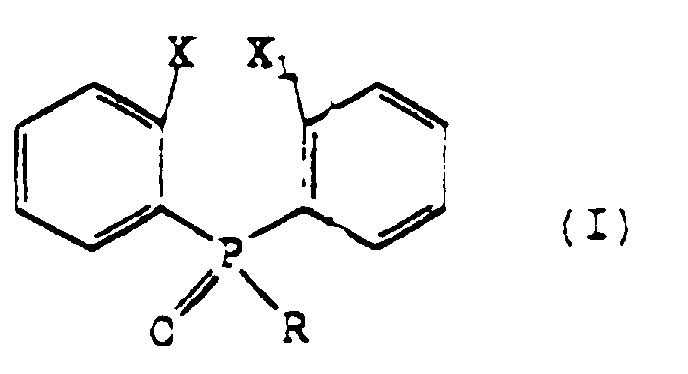 X and X1 represent a hydrogen atom or, when they are taken jointly, they, represent an NR1 moiety in which R1 stands for a hydrogen atom; a linear or branched aliphatic C1-C5 moiety; a linear or branched C2-C6 acyl moiety; a phenyl moiety;R represents a cyclic or polycyclic C4-C9 moiety containing two carboxy groups, possibly esterified with univalent alcohols or glycols, or transformed into anhydrides, or two hydroxy groups.
 - Flame retardant additives constituted by compounds containing phosphino oxide groups having general formula (I):wherein:
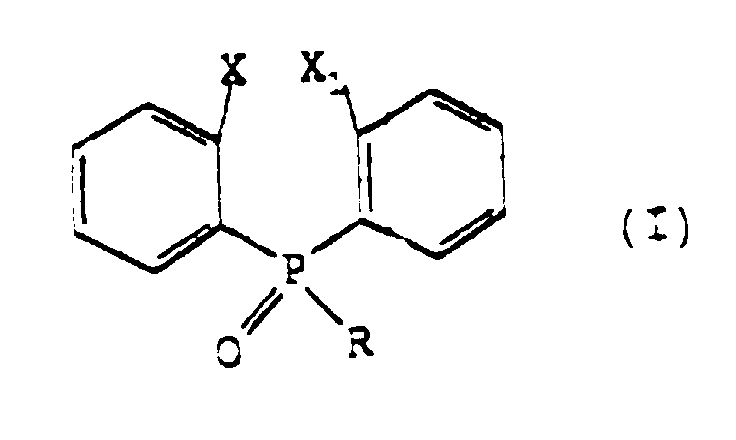 X and X1 represent a hydrogen atom or, when they are taken jointly, they represent an NR1 moiety in which R1 stands for a hydrogen atom; a linear or branched aliphatic C1-C5 moiety; a linear or branched C2-C6 acyl moiety; a phenyl moiety;R represents a cyclic or polycyclic C4-C9 moiety containing two carboxy groups, possibly esterified with univalent alcohols or glycols, or transformed into anhydrides, or two hydroxy groups.
 - Flame retardant additives according to claim 2, in which:X and X1 represent a hydrogen atom or, when they are taken together, they represent an -NH-moiety;R represents a moiety derived from cyclohexane or norbornane containing two methylol groups or a dianhydride group or two carboxy groups esterified with methanol.
- Process for preparing the compounds according to any one of the preceding claims, which comprises the reaction of a diphenyl phosphino oxide having general formula (XIV):in which X and X1 have the same meaning as disclosed above, with a compound containing either a double bond C=C or one from the functions disclosed above (anhydride, ester).
- Organic polymers selected from linear polyesters with aliphatic and/or aromatic structure and polyurethanes, flame retarded by means of the addition of one of the compounds according to any one of the preceding claims.
- Flame retarded organic polymers according to claim 5, in which the polyester is poly(ethylene terephthalate).
- Flame retarded organic polymers according to claim 5, in which the polyester is poly(butylene terephthalate).
- Flame retarded organic polymers according to any of claims from 5 to 7, in which the compounds having general formula (I) are mixed and homogenized with the monomers of the organic polymer at the beginning of the polymerization reaction.
- Flame retarded organic polymers according to any of claims from 5 to 7, in which the amount of compounds having general formula (I) is that amount which secures that a phosphorus level will be reached in the organic polymer, which is comprised within the range of from 0.1% to 3%.
- Fibres, films, moulded articles containing the organic polymers according to any of claims from 5 to 9.
Applications Claiming Priority (2)
| Application Number | Priority Date | Filing Date | Title |
|---|---|---|---|
| ITMI940070 | 1994-01-20 | ||
| ITMI940070A IT1269191B (en) | 1994-01-20 | 1994-01-20 | ANTI-FLAME REACTIVE ADDITIVES CONTAINING PHOSPHYNOXID GROUPS |
Publications (2)
| Publication Number | Publication Date |
|---|---|
| EP0664296A1 EP0664296A1 (en) | 1995-07-26 |
| EP0664296B1 true EP0664296B1 (en) | 2000-04-12 |
Family
ID=11367560
Family Applications (1)
| Application Number | Title | Priority Date | Filing Date |
|---|---|---|---|
| EP95200088A Expired - Lifetime EP0664296B1 (en) | 1994-01-20 | 1995-01-14 | Reactive flame retardant additives containing phosphino oxide moieties |
Country Status (6)
| Country | Link |
|---|---|
| US (1) | US5500285A (en) |
| EP (1) | EP0664296B1 (en) |
| JP (1) | JPH07267969A (en) |
| AT (1) | ATE191718T1 (en) |
| DE (1) | DE69516191T2 (en) |
| IT (1) | IT1269191B (en) |
Families Citing this family (4)
| Publication number | Priority date | Publication date | Assignee | Title |
|---|---|---|---|---|
| US6025422A (en) * | 1998-05-29 | 2000-02-15 | Siecor Operations, Llc | Flame retardant polymer compositions |
| US11479638B2 (en) | 2017-11-09 | 2022-10-25 | Blue Cube Ip Llc | Phosphorated anhydride containing epoxy resin |
| CN111057217B (en) * | 2019-12-26 | 2021-08-27 | 广东生益科技股份有限公司 | Thermosetting epoxy resin composition and prepreg, laminated board and printed circuit board using same |
| TWI886169B (en) * | 2020-07-17 | 2025-06-11 | 美商藍立方知識產權有限責任公司 | A curable thermoset for high speed low loss electrical laminates |
Family Cites Families (8)
| Publication number | Priority date | Publication date | Assignee | Title |
|---|---|---|---|---|
| US4073829A (en) * | 1976-06-14 | 1978-02-14 | Monsanto Company | Phosphorus flame retardant compositions |
| US4181646A (en) * | 1977-07-29 | 1980-01-01 | Monsanto Company | Phosphorus-containing flame retardant compositions |
| US4383049A (en) * | 1981-12-03 | 1983-05-10 | Blount David H | Process for the production of polyester silicate resinous products |
| DE3222571A1 (en) * | 1982-06-16 | 1983-12-22 | Röhm GmbH, 6100 Darmstadt | POLYARYLENESTERS CONTAINING PHOSPHORUS AND METHOD FOR THE PRODUCTION THEREOF |
| DE3521125A1 (en) * | 1985-06-13 | 1986-12-18 | Röhm GmbH, 6100 Darmstadt | Phosphorus-containing polyarylene ethers and processes for their preparation |
| DE3544064A1 (en) * | 1985-12-13 | 1987-06-19 | Roehm Gmbh | Process for the preparation of p-hydroxyarylphosphine oxides or p-hydroxyarylphosphine sulphides |
| US4935304A (en) * | 1989-03-31 | 1990-06-19 | Shell Oil Company | Wire and cable coating of non-blended linear alternating polyketone polymer and blend of the polyketone with polyurethane polymer |
| US5077337A (en) * | 1990-02-22 | 1991-12-31 | Great Lakes Chemical Corporation | Flame retardant graft copolymers of polypropylene |
-
1994
- 1994-01-20 IT ITMI940070A patent/IT1269191B/en active IP Right Grant
-
1995
- 1995-01-14 EP EP95200088A patent/EP0664296B1/en not_active Expired - Lifetime
- 1995-01-14 AT AT95200088T patent/ATE191718T1/en not_active IP Right Cessation
- 1995-01-14 DE DE69516191T patent/DE69516191T2/en not_active Expired - Fee Related
- 1995-01-17 US US08/373,441 patent/US5500285A/en not_active Expired - Fee Related
- 1995-01-20 JP JP7024481A patent/JPH07267969A/en not_active Withdrawn
Also Published As
| Publication number | Publication date |
|---|---|
| US5500285A (en) | 1996-03-19 |
| DE69516191D1 (en) | 2000-05-18 |
| ITMI940070A1 (en) | 1995-07-20 |
| EP0664296A1 (en) | 1995-07-26 |
| IT1269191B (en) | 1997-03-21 |
| ITMI940070A0 (en) | 1994-01-20 |
| ATE191718T1 (en) | 2000-04-15 |
| JPH07267969A (en) | 1995-10-17 |
| DE69516191T2 (en) | 2000-11-09 |
Similar Documents
| Publication | Publication Date | Title |
|---|---|---|
| US4127590A (en) | Phosphorus-containing compounds | |
| US4157436A (en) | Phosphorus-containing polyesters | |
| US3875263A (en) | Diphosphinic acid esters and process for making same | |
| US3326965A (en) | Production of polyesters | |
| US2614120A (en) | beta-hydroxyalkyl diesters of dicarboxydiphenyl sulfones and method of preparing same | |
| EP0516006B1 (en) | 4,4'-Biphenylenediphosphonite compound and use thereof | |
| US3361846A (en) | Phenolic phosphate and phosphite esters as stabilizers for saturated polyester resins | |
| US4087408A (en) | Bromine and phosphorus containing polyester | |
| US5500285A (en) | Reactive flame retardant additives containing phosphino oxide moieties | |
| US2668800A (en) | Plastic composition comprising a vinyl halide polymer and a phosphorus containing compound as a plasticizer therefor | |
| JPH0925337A (en) | High-activity catalyst system for synthesizing polyethylene terephthalate | |
| GB2075519A (en) | Stabilized polyester composition | |
| US4116942A (en) | Process for catalytic production of polyesters | |
| US4940772A (en) | Process for producing flame resistant polyester | |
| US4161577A (en) | Cationic dyeable copolyesters | |
| US4142904A (en) | Flame retardant polycarboxy alkyl and aryl phosphonates | |
| US3951915A (en) | Thermo-oxidative stable copolyesters | |
| JPH04364196A (en) | Reactive flame-retardant comprising phosphinic acid derivative and production of the same derivative | |
| US2973380A (en) | Phosphonates | |
| US3830890A (en) | Method of making esters of 1,4-diphosphonyl butene | |
| WO2005063922A1 (en) | Process for producing phosphorus compound flame retardant, phosphorus compound flame retardant, and flame-retardant polyester | |
| US3997510A (en) | Flame-resistant, thermoplastic polyesters | |
| CA1091838A (en) | Hot-melt adhesive based on a saturated polyester | |
| US3783150A (en) | Monofunctionally-blocked tris (2-hydroxyalkyl) isocyanurates and polyestes thereof | |
| US3639350A (en) | Esterification of terephthalic acid with an alkylene glycol in the presence of guanidine or an alkyl guanidine |
Legal Events
| Date | Code | Title | Description |
|---|---|---|---|
| PUAI | Public reference made under article 153(3) epc to a published international application that has entered the european phase |
Free format text: ORIGINAL CODE: 0009012 |
|
| AK | Designated contracting states |
Kind code of ref document: A1 Designated state(s): AT BE CH DE DK ES FR GB GR IE LI LU MC NL PT SE |
|
| RAX | Requested extension states of the european patent have changed |
Free format text: SI PAYMENT 950114 |
|
| 17P | Request for examination filed |
Effective date: 19951117 |
|
| RIN1 | Information on inventor provided before grant (corrected) |
Inventor name: QUERCI, CECILIA Inventor name: ROMANO, ANNA MARIA Inventor name: PODESTA, ROBERTO Inventor name: PO, RICCARDO Inventor name: LONGHINI, GIANFRANCO Inventor name: CARLETTI, VITTORIO |
|
| 17Q | First examination report despatched |
Effective date: 19990401 |
|
| GRAG | Despatch of communication of intention to grant |
Free format text: ORIGINAL CODE: EPIDOS AGRA |
|
| GRAG | Despatch of communication of intention to grant |
Free format text: ORIGINAL CODE: EPIDOS AGRA |
|
| GRAH | Despatch of communication of intention to grant a patent |
Free format text: ORIGINAL CODE: EPIDOS IGRA |
|
| GRAH | Despatch of communication of intention to grant a patent |
Free format text: ORIGINAL CODE: EPIDOS IGRA |
|
| GRAA | (expected) grant |
Free format text: ORIGINAL CODE: 0009210 |
|
| AK | Designated contracting states |
Kind code of ref document: B1 Designated state(s): AT BE CH DE DK ES FR GB GR IE LI LU MC NL PT SE |
|
| AX | Request for extension of the european patent |
Free format text: SI PAYMENT 19950114 |
|
| PG25 | Lapsed in a contracting state [announced via postgrant information from national office to epo] |
Ref country code: LI Free format text: LAPSE BECAUSE OF FAILURE TO SUBMIT A TRANSLATION OF THE DESCRIPTION OR TO PAY THE FEE WITHIN THE PRESCRIBED TIME-LIMIT Effective date: 20000412 Ref country code: GR Free format text: LAPSE BECAUSE OF NON-PAYMENT OF DUE FEES Effective date: 20000412 Ref country code: ES Free format text: THE PATENT HAS BEEN ANNULLED BY A DECISION OF A NATIONAL AUTHORITY Effective date: 20000412 Ref country code: CH Free format text: LAPSE BECAUSE OF FAILURE TO SUBMIT A TRANSLATION OF THE DESCRIPTION OR TO PAY THE FEE WITHIN THE PRESCRIBED TIME-LIMIT Effective date: 20000412 Ref country code: BE Free format text: LAPSE BECAUSE OF FAILURE TO SUBMIT A TRANSLATION OF THE DESCRIPTION OR TO PAY THE FEE WITHIN THE PRESCRIBED TIME-LIMIT Effective date: 20000412 Ref country code: AT Free format text: LAPSE BECAUSE OF FAILURE TO SUBMIT A TRANSLATION OF THE DESCRIPTION OR TO PAY THE FEE WITHIN THE PRESCRIBED TIME-LIMIT Effective date: 20000412 |
|
| REF | Corresponds to: |
Ref document number: 191718 Country of ref document: AT Date of ref document: 20000415 Kind code of ref document: T |
|
| REG | Reference to a national code |
Ref country code: CH Ref legal event code: EP |
|
| REF | Corresponds to: |
Ref document number: 69516191 Country of ref document: DE Date of ref document: 20000518 |
|
| REG | Reference to a national code |
Ref country code: IE Ref legal event code: FG4D |
|
| PG25 | Lapsed in a contracting state [announced via postgrant information from national office to epo] |
Ref country code: SE Free format text: LAPSE BECAUSE OF FAILURE TO SUBMIT A TRANSLATION OF THE DESCRIPTION OR TO PAY THE FEE WITHIN THE PRESCRIBED TIME-LIMIT Effective date: 20000712 Ref country code: PT Free format text: LAPSE BECAUSE OF FAILURE TO SUBMIT A TRANSLATION OF THE DESCRIPTION OR TO PAY THE FEE WITHIN THE PRESCRIBED TIME-LIMIT Effective date: 20000712 Ref country code: DK Free format text: LAPSE BECAUSE OF FAILURE TO SUBMIT A TRANSLATION OF THE DESCRIPTION OR TO PAY THE FEE WITHIN THE PRESCRIBED TIME-LIMIT Effective date: 20000712 |
|
| ET | Fr: translation filed | ||
| REG | Reference to a national code |
Ref country code: CH Ref legal event code: PL |
|
| PG25 | Lapsed in a contracting state [announced via postgrant information from national office to epo] |
Ref country code: LU Free format text: LAPSE BECAUSE OF NON-PAYMENT OF DUE FEES Effective date: 20010114 Ref country code: GB Free format text: LAPSE BECAUSE OF NON-PAYMENT OF DUE FEES Effective date: 20010114 |
|
| PG25 | Lapsed in a contracting state [announced via postgrant information from national office to epo] |
Ref country code: IE Free format text: LAPSE BECAUSE OF NON-PAYMENT OF DUE FEES Effective date: 20010115 |
|
| PG25 | Lapsed in a contracting state [announced via postgrant information from national office to epo] |
Ref country code: MC Free format text: LAPSE BECAUSE OF NON-PAYMENT OF DUE FEES Effective date: 20010131 |
|
| PLBE | No opposition filed within time limit |
Free format text: ORIGINAL CODE: 0009261 |
|
| STAA | Information on the status of an ep patent application or granted ep patent |
Free format text: STATUS: NO OPPOSITION FILED WITHIN TIME LIMIT |
|
| 26N | No opposition filed | ||
| PG25 | Lapsed in a contracting state [announced via postgrant information from national office to epo] |
Ref country code: NL Free format text: LAPSE BECAUSE OF NON-PAYMENT OF DUE FEES Effective date: 20010801 |
|
| GBPC | Gb: european patent ceased through non-payment of renewal fee |
Effective date: 20010114 |
|
| PG25 | Lapsed in a contracting state [announced via postgrant information from national office to epo] |
Ref country code: FR Free format text: LAPSE BECAUSE OF NON-PAYMENT OF DUE FEES Effective date: 20010928 |
|
| NLV4 | Nl: lapsed or anulled due to non-payment of the annual fee |
Effective date: 20010801 |
|
| PG25 | Lapsed in a contracting state [announced via postgrant information from national office to epo] |
Ref country code: DE Free format text: LAPSE BECAUSE OF NON-PAYMENT OF DUE FEES Effective date: 20011101 |
|
| REG | Reference to a national code |
Ref country code: FR Ref legal event code: ST |
|
| REG | Reference to a national code |
Ref country code: IE Ref legal event code: MM4A |