EP0664288A1 - Fluoroquinoline derivative - Google Patents
Fluoroquinoline derivative Download PDFInfo
- Publication number
- EP0664288A1 EP0664288A1 EP93922063A EP93922063A EP0664288A1 EP 0664288 A1 EP0664288 A1 EP 0664288A1 EP 93922063 A EP93922063 A EP 93922063A EP 93922063 A EP93922063 A EP 93922063A EP 0664288 A1 EP0664288 A1 EP 0664288A1
- Authority
- EP
- European Patent Office
- Prior art keywords
- cyclopropyl
- dihydro
- oxo
- methoxy
- fluoro
- Prior art date
- Legal status (The legal status is an assumption and is not a legal conclusion. Google has not performed a legal analysis and makes no representation as to the accuracy of the status listed.)
- Withdrawn
Links
Classifications
-
- C—CHEMISTRY; METALLURGY
- C07—ORGANIC CHEMISTRY
- C07D—HETEROCYCLIC COMPOUNDS
- C07D215/00—Heterocyclic compounds containing quinoline or hydrogenated quinoline ring systems
- C07D215/02—Heterocyclic compounds containing quinoline or hydrogenated quinoline ring systems having no bond between the ring nitrogen atom and a non-ring member or having only hydrogen atoms or carbon atoms directly attached to the ring nitrogen atom
- C07D215/16—Heterocyclic compounds containing quinoline or hydrogenated quinoline ring systems having no bond between the ring nitrogen atom and a non-ring member or having only hydrogen atoms or carbon atoms directly attached to the ring nitrogen atom with hetero atoms or with carbon atoms having three bonds to hetero atoms with at the most one bond to halogen, e.g. ester or nitrile radicals, directly attached to ring carbon atoms
- C07D215/48—Carbon atoms having three bonds to hetero atoms with at the most one bond to halogen
- C07D215/54—Carbon atoms having three bonds to hetero atoms with at the most one bond to halogen attached in position 3
- C07D215/56—Carbon atoms having three bonds to hetero atoms with at the most one bond to halogen attached in position 3 with oxygen atoms in position 4
-
- C—CHEMISTRY; METALLURGY
- C07—ORGANIC CHEMISTRY
- C07D—HETEROCYCLIC COMPOUNDS
- C07D401/00—Heterocyclic compounds containing two or more hetero rings, having nitrogen atoms as the only ring hetero atoms, at least one ring being a six-membered ring with only one nitrogen atom
- C07D401/02—Heterocyclic compounds containing two or more hetero rings, having nitrogen atoms as the only ring hetero atoms, at least one ring being a six-membered ring with only one nitrogen atom containing two hetero rings
- C07D401/04—Heterocyclic compounds containing two or more hetero rings, having nitrogen atoms as the only ring hetero atoms, at least one ring being a six-membered ring with only one nitrogen atom containing two hetero rings directly linked by a ring-member-to-ring-member bond
-
- C—CHEMISTRY; METALLURGY
- C07—ORGANIC CHEMISTRY
- C07D—HETEROCYCLIC COMPOUNDS
- C07D405/00—Heterocyclic compounds containing both one or more hetero rings having oxygen atoms as the only ring hetero atoms, and one or more rings having nitrogen as the only ring hetero atom
- C07D405/02—Heterocyclic compounds containing both one or more hetero rings having oxygen atoms as the only ring hetero atoms, and one or more rings having nitrogen as the only ring hetero atom containing two hetero rings
- C07D405/04—Heterocyclic compounds containing both one or more hetero rings having oxygen atoms as the only ring hetero atoms, and one or more rings having nitrogen as the only ring hetero atom containing two hetero rings directly linked by a ring-member-to-ring-member bond
Definitions
- This invention relates to a novel fluoroquinoline derivative represented by the general formula (1): wherein
- the compound represented by the general formula (1) shows a well-balanced antibacterial activity on both of gram-positive and gram-negative bacteria. When orally or parenterally administered, it achieves a high concentration in the blood. Also, it is a stable chemical having a low toxicity and a high photostability and showing a low cytotoxicity under light irradiation. Accordingly, this compound is highly useful as a drug such as an antibacterial agent.
- quinoline antimicrobial agents such as norfloxacin, enoxacin, ofloxacin, etc. in the clinical medicine.
- Each of these compounds is a drug for oral administration but unsuitable for parenteral administration because of its poor solubility under physiological conditions.
- a photolytic product of such a compound has a toxicity about 10 times or more as high as that of the original compound and, further, an enhanced cytotoxicity [see Antimicrobial Agents and Chemotherapy, 36 (8), 1715 - 1719 (1992)].
- a novel drug therefore, it is also necessary to be careful about the systemic toxicity of its photolytic product.
- the present inventors have conducted extensive studies in order to develop an excellent antibacterial agent. As a result, they have successfully found out that the above object can be achieved by using a compound represented by the general formula and its salt and thus completed the present invention.
- the protecting groups of the optionally protected amino or optionally protected aminocarbonyl in the definition of R2 or R5 in the general formula (1) are exemplified by those commonly employed in the art. Examples thereof include acyl groups which are liable to leave such as trichloroethoxycarbonyl, tribromoethoxycarbonyl, benzyloxycarbonyl, p-toluenesulfonyl, p-nitrobenzyloxycarbonyl, o-bromobenzyloxycarbonyl, o-nitrophenylsulfenyl, acetyl, (mono-, di-, tri-)chloroacetyl, trifluoroacetyl, formyl, t-amyloxycarbonyl, t-butoxycarbonyl, p-methoxybenzyloxycarbonyl, 3,4-dimethoxybenzyloxycarbonyl, 4-(phenylazo)benzyloxycarbonyl, 4-(4-me
- the optionally protected carboxyl is exemplified by those commonly employed as a protected carboxyl group. Examples thereof include those protected by methyl, ethyl, n-propyl, i-propyl, n-butyl, t-butyl, s-butyl, benzyl, diphenylmethyl, trityl, p-nitrobenzyl, p-methoxybenzyl, benzoylmethyl, acetylmethyl, p-nitrobenzoylmethyl, p-bromobenzoylmethyl, p-methanesulfonylbenzoylmethyl, phthalimidomethyl, trichloroethyl, 1,1-dimethyl-2-propenyl, 1,1-dimethylpropyl, acetoxymethyl, propionyloxymethyl, pivaloyloxymethyl, 3-methyl-3-butynyl, succinimidomethyl, 1-cyclopropylethyl, methyls
- the salt of the compound represented by the general formula (1) is exemplified by those with commonly known basic groups such as amino group or acidic groups such as carboxyl group.
- Examples of the salts with basic groups such as amino group include salts with mineral acids such as hydrochloric acid and sulfuric acid, those with organic carboxylic acids such as oxalic acid, formic acid, trichloroacetic acid and trifluoroacetic acid and those with sulfonic acids such as methanesulfonic acid, p-toluenesulfonic acid and naphthalenesulfonic acid.
- salts with acidic groups such as carboxyl group include salts with alkali metals such as sodium and potassium, salts with alkaline earth metals such as calcium and magnesium, ammonium salts, those with nitrogen-containing organic bases such as dibenzylamine, N-benzyl- ⁇ -phenethylamine, 1-ephenamine and N,N-dibenzylethylenediamine, and triethylamine, trimethylamine, tributylamine, pyridine, dimethylaniline, N-methylpiperidine, N-methylmorpholine, diethylamine and dicyclohexylamine salts.
- alkali metals such as sodium and potassium
- salts with alkaline earth metals such as calcium and magnesium
- ammonium salts those with nitrogen-containing organic bases such as dibenzylamine, N-benzyl- ⁇ -phenethylamine, 1-ephenamine and N,N-dibenzylethylenediamine, and triethylamine, trimethylamine, tribu
- lower alkyl means an alkyl group having 1 to 6 carbon atoms and preferably exemplified by methyl, ethyl, n-propyl, i-propyl, n-butyl, i-butyl, s-butyl and t-butyl groups.
- the step for obtaining the compound of the general formula (5) from the compound of the general formula (2) can be effected in accordance with the method described in U.S. Patent No. 3,590,036. Namely, the compound of the general formula (2) is reacted with the compound of the general formula (3) or its salt to thereby give the compound of the general formula (4) or its salt. After deblocking and decarboxylating the obtained compound in a conventional manner, a carboxy-protecting group is introduced thereinto.
- Examples of the active methylene of the compound of the general formula (3) and the active methylene salt of the compound of the general formula (4) include salts of alkali metals such as sodium and potassium.
- the step for obtaining the compound of the general formula (7) from the compound of the general formula (5) can be effected by reacting the compound of the general formula (5) or its salt with the compound of the general formula (6) or its salt in an appropriate solvent optionally in the presence of a base.
- Examples of the leaving groups X1 and X2 in the general formula (6) include halogen atoms such as chlorine, bromine and iodine atoms, alkanesulfonyloxy groups such as methanesulfonyloxy group, and arenesulfonyloxy groups such as toluenesulfonyloxy group.
- Any solvent may be used herein without restriction, so long as it remains inert during the reaction.
- Preferable examples thereof include alcohols such as methanol, ethanol and 2-propanol, ethers such as diethyl ether, tetrahydrofuran and dioxane, aromatic hydrocarbons such as benzene, toluene and xylene, amides such as N,N-dimethylformamide and N,N-dimethylacetamide, sulfoxides such as dimethylsulfoxide and water. Also, a mixture of two or more of these solvents may be used therefor.
- the base examples include inorganic bases such as alkali hydroxides, alkali hydrogencarbonates and alkali carbonates, metal hydrides such as sodium hydride and potassium hydride, metal alkoxides such as sodium ethoxide and sodium methoxide, and organic bases such as 1,8-diazabicyclo-[5,4,0]undec-7-ene (DBU).
- inorganic bases such as alkali hydroxides, alkali hydrogencarbonates and alkali carbonates
- metal hydrides such as sodium hydride and potassium hydride
- metal alkoxides such as sodium ethoxide and sodium methoxide
- organic bases such as 1,8-diazabicyclo-[5,4,0]undec-7-ene (DBU).
- DBU 1,8-diazabicyclo-[5,4,0]undec-7-ene
- the compound of the general formula (6) or its salt is used at least in an equimolar amount, preferably 1 to 5 times by mol as much, with the compound of the general formula (5) or its salt.
- the reaction temperature ranges from 0°C to the boiling point of the solvent employed, preferably from 20 to 100°C.
- the reaction is carried out usually for 30 minutes to 50 hours, preferably for 3 to 20 hours.
- the deblocked compound may be further subjected to a reaction publicly known per se, for example, decarboxylation, reduction or transfer reaction to thereby give the compound of the general formula (1) or its salt.
- the compounds represented by the general formulae (4), (5) and (7) or salts thereof are novel compounds per se and constitute a part of the present invention.
- the compound represented by the general formula (1) or its salt can be obtained by the following method.
- the step for obtaining the compound of the general formula (8) form the compound of the general formula (5) may be carried out by treating the compound of the general formula (5) by the method described in Chem. Ber., 99 , 2408 (1966).
- the compound of the general formula (8) or its salt is reacted with, for example, trimethylsulfoxonium iodide in the presence of a base.
- the compound of the general formula (9) or its salt can be obtained.
- Examples of the base to be used herein include metal hydrides such as sodium hydride and potassium hydride.
- the compound of the general formula (9) or its salt can be derived into the compound of the general formula (1) or its salt via, for example, deblocking and decarboxylation, reduction or transfer reaction.
- the compound of the general formula (9) can be obtained from the compound of the general formula (8) by the Simmons-Smith reaction or the 1,3-dipole addition reaction.
- solvent to be used herein examples include ethers such as diethyl ether, tetrahydrofuran and dioxane, and aromatic hydrocarbons such as benzene, toluene and xylene.
- the compounds represented by the general formulae (8) and (9) or salts thereof are novel compounds per se and constitute a part of the present invention.
- the compound represented by the general formula (1) or its salt can be obtained by the following method.
- the compound of the general formula (11) or its salt can be derived from the compound of the general formula (10) by a method similar to the one for obtaining the compound (7) from the compound (5).
- the compound of the general formula (11) or its salt can be derived into the compound of the general formula (1) or its salt by, for example, the method in accordance with Angew. Chem. Int. Ed. Engl., 18 , 72 (1979).
- the compound represented by the general formula (1) or its salt thus obtained can be isolated and purified in a conventional manner.
- the compound according to the present invention may be processed into tablets, capsules, dusts, syrups, granules, suppositories, ointments, injections, etc. by a conventional method with the use of carriers commonly employed in the art.
- the dose, route and frequency of the administration may be appropriately selected depending on the conditions of a patient.
- it may be orally or parenterally (for example, injections, eye drops, rectal preparations) administered to an adult in a dose of from 0.1 to 100 mg/kg/day once to several times.
- hydrochloric acid was added thereto under ice-cooling to thereby regulate the pH value of the mixture to 1.
- the organic layer was collected, successively washed with water and a saturated aqueous solution of sodium hydrogencarbonate and dried over anhydrous sodium sulfate.
- diisopropyl ether was added to the obtained residue and the solid thus precipitated was collected by filtration.
- 500 ml of methylene chloride and 500 ml of trifluoroacetic acid were added. Then the mixture was stirred at room temperature for 66 hours.
- the organic layer thus collected was successively washed with water and a saturated aqueous solution of sodium chloride and dried over anhydrous sodium sulfate. After removing the solvent under reduced pressure, the obtained residue was dissolved in 25 ml of methylene chloride. Under ice-cooling, 0.57 g of methanesulfonyl chloride and 1.0 mg of triethylamine were successively dropped thereinto slowly and the resulting mixture was stirred at room temperature for 3 hours. 20 ml of water was added to the reaction mixture and the pH value of the mixture was regulated to 1 with 2N hydrochloric acid.
- Example 4 The procedure of Example 4 was repeated to thereby give ethyl 1-cyclopropyl-7-(1-diphenylmethoxycarbonylcyclo-hexyl)-6-fluoro-8-methoxy-1,4-dihydro-4-oxo-3-quinolinecarboxylate.
- Example 4 The procedure of Example 4 was repeated to thereby give ethyl 1-cyclopropyl-7- ⁇ 4-(diphenylmethoxycarbonyl)-2,3,5,6-tetrahydropyran-4-yl ⁇ -6-fluoro-8-methoxy-1,4-dihydro-4-oxo-3-quinolinecarboxylate.
- Example 7 The procedure of Example 7 was repeated to thereby give ethyl 7-(1-carboxycyclohexyl)-1-cyclopropyl-6-fluoro-8-methoxy-1,4-dihydro-4-oxo-3-quinolinecarboxylate.
- Example 7 The procedure of Example 7 was repeated to thereby give ethyl 7-(4-carboxy-2,3,5,6-tetrahydropyran-4-yl)-1-cyclopropyl-6-fluoro-8-methoxy-1,4-dihydro-4-oxo-3-quinolinecarboxylate.
- Example 10 The procedure of Example 10 was repeated to thereby give ethyl 7-(1-t-butoxycarbonylaminocyclohexyl)-1-cyclopropyl-6-fluoro-8-methoxy-1,4-dihydro-4-oxo-3-quinolinecarboxylate.
- Example 10 The procedure of Example 10 was repeated to thereby give ethyl 7-(4-t-butoxycarbonylamino-2,3,5,6-tetrahydropyran-4-yl)-1-cyclopropyl-6-fluoro-8-methoxy-1,4-dihydro-4-oxo-3-quinolinecarboxylate.
- Example 13 The procedure of Example 13 was repeated to thereby give 7-(1-t-butoxycarbonylaminocyclohexyl)-1-cyclopropyl-6-fluoro-8-methoxy-1,4-dihydro-4-oxo-3-quinolinecarboxylic acid.
- Example 13 The procedure of Example 13 was repeated to thereby give 7-(4-t-butoxycarbonylamino-2,3,5,6-tetrahydropyran-4-yl)-1-cyclopropyl-6-fluoro-8-methoxy-1,4-dihydro-4-oxo-3-quinolinecarboxylic acid.
- Example 16 The procedure of Example 16 was repeated to thereby give 7-(1-aminocyclohexyl)-1-cyclopropyl-6-fluoro-8-methoxy-1,4-dihydro-4-oxo-3-quinolinecarboxylic acid hydrochloride.
- Example 16 The procedure of Example 16 was repeated to thereby give 7-(4-amino-2,3,5,6-tetrahydropyran-4-yl)-1-cyclopropyl-6-fluoro-8-methoxy-1,4-dihydro-4-oxo-3-quinolinecarboxylic acid hydrochloride.
- Example 4 The procedure of Example 4 was repeated to thereby give ethyl 1-cyclopropyl-7-(1-diphenylmethoxycarbonylcyclobutyl)-6-fluoro-8-methoxy-1,4-dihydro-4-oxo-3-quinolinecarboxylate.
- Example 7 The procedure of Example 7 was repeated to thereby give ethyl 7-(1-carboxycyclobutyl)-1-cyclopropyl-6-fluoro-8-methoxy-1,4-dihydro-4-oxo-3-quinolinecarboxylate.
- Example 10 The procedure of Example 10 was repeated to thereby give ethyl 7-(1-t-butoxycarbonylaminocyclobutyl)-1-cyclopropyl-6-fluoro-8-methoxy-1,4-dihydro-4-oxo-3-quinolinecarboxylate.
- Example 13 The procedure of Example 13 was repeated to thereby give 7-(1-t-butoxycarbonylaminocyclobutyl)-1-cyclopropyl-6-fluoro-8-methoxy-1,4-dihydro-4-oxo-3-quinolinecarboxylic acid.
- Example 16 The procedure of Example 16 was repeated to thereby give 7-(1-aminocyclobutyl)-1-cyclopropyl-6-fluoro-8-methoxy-1,4-dihydro-4-oxo-3-quinolinecarboxylic acid hydrochloride.
- the obtained crystals were dissolved in 5 ml of methylene chloride. Under ice-cooling, 292 mg of diphenylphosphoryl azide and 107 mg of triethylamine were added thereto and the resulting mixture was stirred at room temperature for 15 hours. Then the reaction mixture was concentrated under reduced pressure and 10 ml of ethyl acetate and 10 ml of 2 N hydrochloric acid were added to the obtained residue. The organic layer was collected, successively washed with water and a saturated aqueous solution of sodium chloride and dried over anhydrous sodium sulfate. After removing the solvent under reduced pressure, 6 ml of t-butanol was added to the obtained residue and the mixture was refluxed for 6 hours.
- Example 13 The procedure of Example 13 was repeated to thereby give 7-(1-t-butoxycarbonylaminocyclopropyl)-1-cyclopropyl-6-fluoro-8-methoxy-1,4-dihydro-4-oxo-3-quinolinecarboxylic acid.
- Example 16 The procedure of Example 16 was repeated to thereby give 7-(1-aminocyclopropyl)-1-cyclopropyl-6-fluoro-8-methoxy-1,4-dihydro-4-oxo-3-quinolinecarboxylic acid hydrochloride.
- Example 13 The procedure of Example 13 was repeated to thereby give 1-cyclopropyl-6-fluoro-7-(4-hydroxycarbonyl-2,3,5,6-tetrahydropyran-4-yl)-8-methoxy-1,4-dihydro-4-oxo-3-quinolinecarboxylic acid.
- Example 13 The procedure of Example 13 was repeated to thereby give 1-cyclopropyl-6-fluoro-7-(1-hydroxycarbonylcyclohexyl)-8-methoxy-1,4-dihydro-4-oxo-3-quinolinecarboxylic acid.
- Example 13 The procedure of Example 13 was repeated to thereby give 7-(1-aminocarbonylcyclohexyl)-1-cyclopropyl-6-fluoro-8-methoxy-1,4-dihydro-4-oxo-3-quinolinecarboxylic acid.
- Example 16 The procedure of Example 16 was repeated to thereby give 7-(4-aminopiperidin-4-yl)-1-cyclopropyl-6-fluoro-8-methoxy-1,4-dihydro-4-oxo-3-quinolinecarboxylic acid hydrochloride.
- Example 13 The procedure of Example 13 was repeated to thereby give 7-cyclopentyl-1-cyclopropyl-6-fluoro-8-methoxy-1,4-dihydro-4-oxo-3-quinolinecarboxylic acid.
- Example 32 The procedure of Example 32 was repeated to thereby give 1-cyclopropyl-6-fluoro-8-methoxy-7-(piperidin-4-yl)-1,4-dihydro-4-oxo-3-quinolinecarboxylic acid methanesulfonate.
- Example 13 The procedure of Example 13 was repeated and the obtained residue was treated by the method of Example 16 to thereby give 1-cyclopropyl-6-fluoro-7-(3-hydroxy-1-hydroxycarbonylcyclobutyl)-8-methoxy-1,4-dihydro-4-oxo-3-quinolinecarboxylic acid.
- Example 35 The procedure of Example 35 was repeated to thereby give 7-(1-amino-3-hydroxycyclobutyl)-1-cyclopropyl-6-fluoro-8-methoxy-1,4-dihydro-4-oxo-3-quinolinecarboxylic acid.
- the minimum inhibitory concentrations (MIC) of the test compounds were measured by the publicly known agar plate dilution method. Table 1 shows the results. Table 1 MIC Compd. of Ex. 26 Compd. of Ex. 23 Compd. of Ex. 16 S. aureus 209P 0.39 0.78 1.56 JU-5 0.20 0.39 0.39 MRSA RN-10 0.39 0.78 1.56 S. epidermidis IFO 12993 0.78 1.56 3.13 B. subtilis ATCC 6633 0.05 0.10 0.10 B. cereus IFO 13494 0.20 0.78 0.78 E. coli NIHJ JC-2 0.20 0.20 0.39 CSJ 1922 0.10 0.20 0.20 S. typhimurium LT-2 0.20 0.39 0.39 C.
- the 50% inhibitory concentrations (IC50) of the test compounds on a mouse lymphatic leukemia cell line L1210 were determined by the MTT [3-(4,5-dimethylthiazol-2-yl)-2,5-diphenyltetrazolium bromide] method.
- 2 ⁇ 104 L1210 cells were incubated in 200 ⁇ l of a culture medium (RPMI-1640 medium containing 10% of fetal bovine serum) containing a two-fold serial dilution of a test compound at 37°C for a day.
- a culture medium RPMI-1640 medium containing 10% of fetal bovine serum
- 10 ⁇ l of a 5 mg/ml solution of MTT was added.
- the culture medium was eliminated by sucking and the insoluble formazan, which had been reduced by the mitochondrial dehydrogenase of the cells, was extracted with 100 ⁇ l of dimethylsulfoxide. Then the absorbance was measured at 550 nm.
- the phototoxicity was determined by enhancing the cytotoxicity of a test compound on L1210 via UV irradiation. Namely, 5 ⁇ 103 L1210 cells were suspended in 100 ⁇ l of Hanks' solution containing 10 ⁇ g/ml of the test compound, which showed no cytotoxicity per se, followed by the irradiation with long-wavelength ultraviolet rays (UVA) by using a black light fluorescent lamp. After the irradiation, 100 ⁇ l of a culture medium was added and the cells were incubated at 37°C for 2 days. The result was expressed in the ratio of the formazan formation determined by the MTT method of the test lot to that of the control lot wherein UVA irradiation was not performed. Table 3 shows the results. Table 3 Phototoxicity (%; propagation ratio under 0.5 J-irradiation to non-irradiation lot) Compd. of Ex. 26 > 100 Ofloxacin 69 Ciprofloxacin 9
- the fluoroquinoline derivative represented by the general formula (1) or its salt shows an excellent antibacterial activity on both of gram-positive and gram-negative bacteria. When orally or parenterally administered, it achieves a high concentration in the blood. Also, it is a stable chemical having a low toxicity and a high photostability and showing a low cytotoxicity under light irradiation. Accordingly, this compound is highly useful as a drug such as an antibacterial agent.
Landscapes
- Chemical & Material Sciences (AREA)
- Organic Chemistry (AREA)
- Pharmaceuticals Containing Other Organic And Inorganic Compounds (AREA)
- Plural Heterocyclic Compounds (AREA)
Abstract
Description
- This invention relates to a novel fluoroquinoline derivative represented by the general formula (1):

wherein - R₁
- represents a hydrogen or a lower alkyl;
- R₂
- represents hydrogen, optionally protected amino, optionally protected aminocarbonyl or optionally protected carboxyl;
- R₅
- represents halogen, lower alkyl or optionally protected hydroxyl or has the same meaning as that of R₂, each capable of substituting arbitrary carbon;
- R₆
- represents lower alkyl;
- A
- represents CH₂, optionally protected nitrogen or oxygen; and
- n and m
- are each an integer of from 0 to 4, provided that n + m is an integer of from 1 to 4;
- The compound represented by the general formula (1) shows a well-balanced antibacterial activity on both of gram-positive and gram-negative bacteria. When orally or parenterally administered, it achieves a high concentration in the blood. Also, it is a stable chemical having a low toxicity and a high photostability and showing a low cytotoxicity under light irradiation. Accordingly, this compound is highly useful as a drug such as an antibacterial agent.
- There have been widely employed quinoline antimicrobial agents such as norfloxacin, enoxacin, ofloxacin, etc. in the clinical medicine. Each of these compounds is a drug for oral administration but unsuitable for parenteral administration because of its poor solubility under physiological conditions.
- In addition to the above-described ones, there have been known a number of quinolone antibacterial agents [see, for example, Japanese Patent Application Laid-Open (Kokai) Nos. Sho-59-67269, ibid. Sho-59-212474, ibid. Sho-60-214773, ibid. Sho-62-252772 and ibid. Sho-63-198664). However, these compounds are also unsuitable for parenteral administration and there have been known few drugs being satisfactory in both of antibacterial activity and safety. Thus it has been required to develop a novel synthetic antibacterial agent.
- On the other hand, effects of quinolone antibacterial agents on the skin have attracted public attention. In particular, a photolytic product of such a compound has a toxicity about 10 times or more as high as that of the original compound and, further, an enhanced cytotoxicity [see Antimicrobial Agents and Chemotherapy, 36 (8), 1715 - 1719 (1992)]. In the development of a novel drug, therefore, it is also necessary to be careful about the systemic toxicity of its photolytic product.
- Under these circumstances, the present inventors have conducted extensive studies in order to develop an excellent antibacterial agent. As a result, they have successfully found out that the above object can be achieved by using a compound represented by the general formula and its salt and thus completed the present invention.
- The protecting groups of the optionally protected amino or optionally protected aminocarbonyl in the definition of R₂ or R₅ in the general formula (1) are exemplified by those commonly employed in the art. Examples thereof include acyl groups which are liable to leave such as trichloroethoxycarbonyl, tribromoethoxycarbonyl, benzyloxycarbonyl, p-toluenesulfonyl, p-nitrobenzyloxycarbonyl, o-bromobenzyloxycarbonyl, o-nitrophenylsulfenyl, acetyl, (mono-, di-, tri-)chloroacetyl, trifluoroacetyl, formyl, t-amyloxycarbonyl, t-butoxycarbonyl, p-methoxybenzyloxycarbonyl, 3,4-dimethoxybenzyloxycarbonyl, 4-(phenylazo)benzyloxycarbonyl, 4-(4-methoxyphenylazo)benzyloxycarbonyl, pyridin-1-oxide-2-yl-methoxycarbonyl, 2-furyloxycarbonyl, diphenylmethoxycarbonyl, 1,1-dimethylpropoxycarbonyl, isopropoxycarbonyl, 1-cyclopropylethoxycarbonyl, phthaloyl, succinyl, 1-adamantyloxycarbonyl and 8-quinolyloxycarbonyl groups, those which are liable to leave such as triethyl, 2-nitrophenylthio, 2,4-dinitrophenylthio, 2-hydroxybenzylidene, 2-hydroxy-5-chlorobenzylidene, 2-hydroxy-1-naphthylmethylene, 3-hydroxy-4-pyridylmethylene, 1-methoxycarbonyl-2-propylidene, 1-ethoxycarbonyl-2-propylidene, 3-ethoxycarbonyl-2-butylidene, 1-acetyl-2-propylidene, 1-benzoyl-2-propylidene, 1-[N-(2-methoxyphenyl)carbamoyl]-2-propylidene, 1-[N(4-methoxyphenyl)carbamoyl]-2-propylidene, 2-ethoxycarbonylcyclohexylidene, 2-ethoxycarbonylcyclopentylidene, 2-acetylcyclohexylidene and 3,3-dimethyl-5-oxocyclohexylidene groups, (di-, tri- )alkylsilyl groups and lower alkyl groups such as methyl and ethyl groups.
- The optionally protected carboxyl is exemplified by those commonly employed as a protected carboxyl group. Examples thereof include those protected by methyl, ethyl, n-propyl, i-propyl, n-butyl, t-butyl, s-butyl, benzyl, diphenylmethyl, trityl, p-nitrobenzyl, p-methoxybenzyl, benzoylmethyl, acetylmethyl, p-nitrobenzoylmethyl, p-bromobenzoylmethyl, p-methanesulfonylbenzoylmethyl, phthalimidomethyl, trichloroethyl, 1,1-dimethyl-2-propenyl, 1,1-dimethylpropyl, acetoxymethyl, propionyloxymethyl, pivaloyloxymethyl, 3-methyl-3-butynyl, succinimidomethyl, 1-cyclopropylethyl, methylsulfenylmethyl, phenylthiomethyl, dimethylaminomethyl, quinoline-1-oxide-2-methyl, pyridin-1-oxide-2-yl-methyl and bis(p-methoxyphenyl)methyl, and those protected with a nonmetal compound such as titanium tetrachloride.
- The salt of the compound represented by the general formula (1) is exemplified by those with commonly known basic groups such as amino group or acidic groups such as carboxyl group. Examples of the salts with basic groups such as amino group include salts with mineral acids such as hydrochloric acid and sulfuric acid, those with organic carboxylic acids such as oxalic acid, formic acid, trichloroacetic acid and trifluoroacetic acid and those with sulfonic acids such as methanesulfonic acid, p-toluenesulfonic acid and naphthalenesulfonic acid. Examples of the salts with acidic groups such as carboxyl group include salts with alkali metals such as sodium and potassium, salts with alkaline earth metals such as calcium and magnesium, ammonium salts, those with nitrogen-containing organic bases such as dibenzylamine, N-benzyl-β-phenethylamine, 1-ephenamine and N,N-dibenzylethylenediamine, and triethylamine, trimethylamine, tributylamine, pyridine, dimethylaniline, N-methylpiperidine, N-methylmorpholine, diethylamine and dicyclohexylamine salts.
- In the present invention, the term "lower alkyl" means an alkyl group having 1 to 6 carbon atoms and preferably exemplified by methyl, ethyl, n-propyl, i-propyl, n-butyl, i-butyl, s-butyl and t-butyl groups.
- When the compound represented by the general formula (1) and its salt occur in the form of isomers, all of these isomers are involved in the scope of the present invention.
-
- The compound represented by the general formula (1) and its salt, which are novel compounds and have never been described in any literature, can be produced by, for example, the following method.

wherein - R₁, R₂, R₅ and R₆
- are each as defined above;
- R₃ and R₄
- may be either the same or different and each represents a carboxy-protecting group;
- X
- represents halogen;
- X₁ and X₂
- may be either the same or different and each represents a leaving group; and
- B
- represents -(CH₂)p-, -(CH₂)m-O-(CH₂)n- or
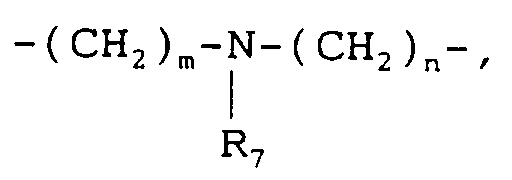
- In the above synthesis method, the step for obtaining the compound of the general formula (5) from the compound of the general formula (2) can be effected in accordance with the method described in U.S. Patent No. 3,590,036. Namely, the compound of the general formula (2) is reacted with the compound of the general formula (3) or its salt to thereby give the compound of the general formula (4) or its salt. After deblocking and decarboxylating the obtained compound in a conventional manner, a carboxy-protecting group is introduced thereinto.
- Examples of the active methylene of the compound of the general formula (3) and the active methylene salt of the compound of the general formula (4) include salts of alkali metals such as sodium and potassium.
- The step for obtaining the compound of the general formula (7) from the compound of the general formula (5) can be effected by reacting the compound of the general formula (5) or its salt with the compound of the general formula (6) or its salt in an appropriate solvent optionally in the presence of a base.
- Examples of the leaving groups X₁ and X₂ in the general formula (6) include halogen atoms such as chlorine, bromine and iodine atoms, alkanesulfonyloxy groups such as methanesulfonyloxy group, and arenesulfonyloxy groups such as toluenesulfonyloxy group.
- Any solvent may be used herein without restriction, so long as it remains inert during the reaction. Preferable examples thereof include alcohols such as methanol, ethanol and 2-propanol, ethers such as diethyl ether, tetrahydrofuran and dioxane, aromatic hydrocarbons such as benzene, toluene and xylene, amides such as N,N-dimethylformamide and N,N-dimethylacetamide, sulfoxides such as dimethylsulfoxide and water. Also, a mixture of two or more of these solvents may be used therefor.
- Examples of the base include inorganic bases such as alkali hydroxides, alkali hydrogencarbonates and alkali carbonates, metal hydrides such as sodium hydride and potassium hydride, metal alkoxides such as sodium ethoxide and sodium methoxide, and organic bases such as 1,8-diazabicyclo-[5,4,0]undec-7-ene (DBU). In general, such a base is used at least in an equimolar amount, preferably 1 to 5 times by mol as much, with the compound of the general formula (5).
- The compound of the general formula (6) or its salt is used at least in an equimolar amount, preferably 1 to 5 times by mol as much, with the compound of the general formula (5) or its salt.
- The reaction temperature ranges from 0°C to the boiling point of the solvent employed, preferably from 20 to 100°C. The reaction is carried out usually for 30 minutes to 50 hours, preferably for 3 to 20 hours.
- After deblocking the compound of the general formula (7) or its salt, the deblocked compound may be further subjected to a reaction publicly known per se, for example, decarboxylation, reduction or transfer reaction to thereby give the compound of the general formula (1) or its salt.
- The compounds represented by the general formulae (4), (5) and (7) or salts thereof are novel compounds per se and constitute a part of the present invention.
- Alternatively, the compound represented by the general formula (1) or its salt can be obtained by the following method.
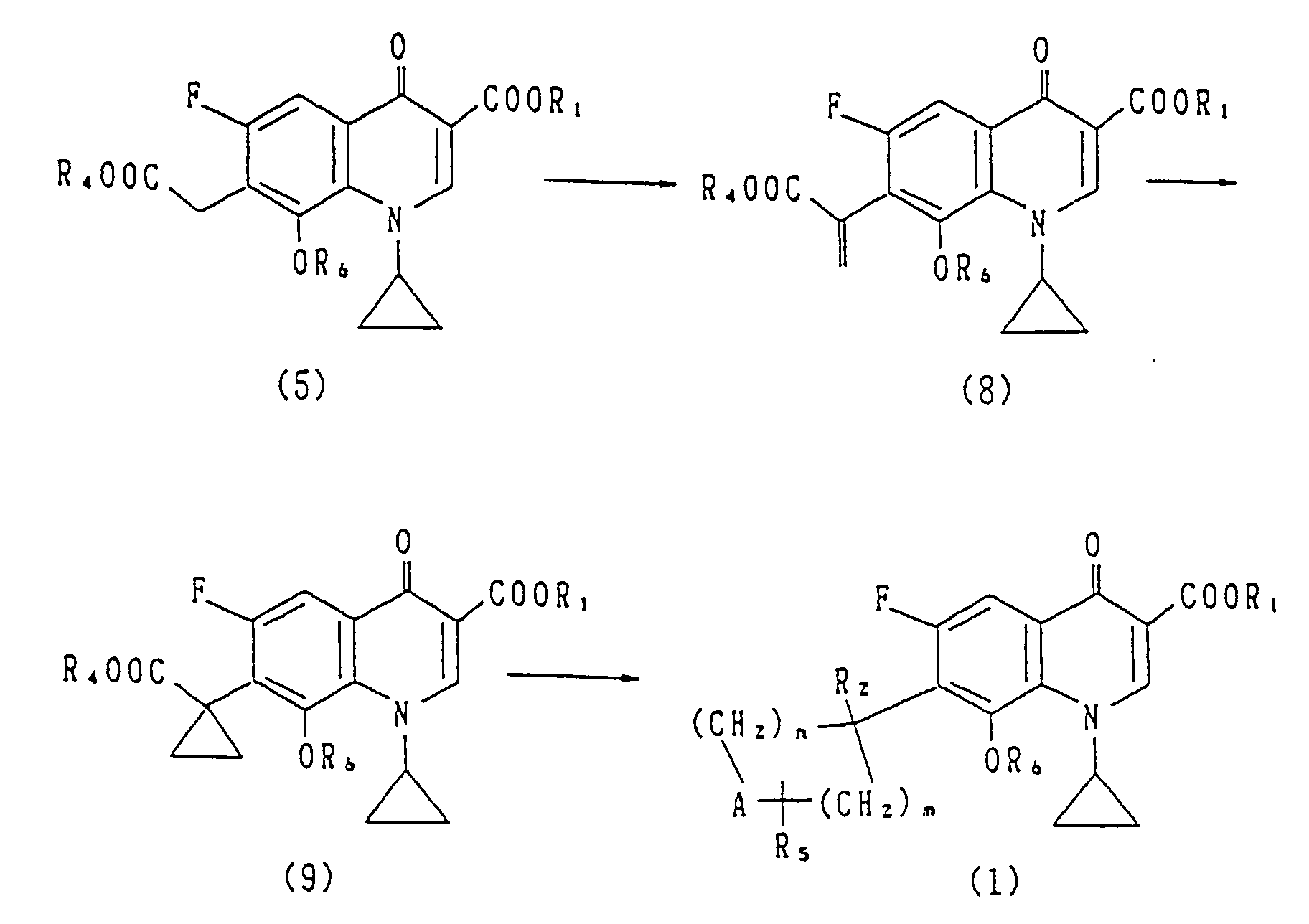
wherein - R₁, R₂, R₄, R₅, R₆, A, m and n
- are each as defined above.
- The step for obtaining the compound of the general formula (8) form the compound of the general formula (5) may be carried out by treating the compound of the general formula (5) by the method described in Chem. Ber., 99, 2408 (1966).
- The compound of the general formula (8) or its salt is reacted with, for example, trimethylsulfoxonium iodide in the presence of a base. Thus the compound of the general formula (9) or its salt can be obtained.
- Examples of the base to be used herein include metal hydrides such as sodium hydride and potassium hydride.
- The compound of the general formula (9) or its salt can be derived into the compound of the general formula (1) or its salt via, for example, deblocking and decarboxylation, reduction or transfer reaction.
- Alternatively, the compound of the general formula (9) can be obtained from the compound of the general formula (8) by the Simmons-Smith reaction or the 1,3-dipole addition reaction.
- Examples of the solvent to be used herein include ethers such as diethyl ether, tetrahydrofuran and dioxane, and aromatic hydrocarbons such as benzene, toluene and xylene.
- The compounds represented by the general formulae (8) and (9) or salts thereof are novel compounds per se and constitute a part of the present invention.
- Alternatively, the compound represented by the general formula (1) or its salt can be obtained by the following method.

wherein - R₁, R₂, R₄, R₅, R₆, A, B, X₁, X₂, m and n
- are each as defined above.
- The compound of the general formula (11) or its salt can be derived from the compound of the general formula (10) by a method similar to the one for obtaining the compound (7) from the compound (5).
- The compound of the general formula (11) or its salt can be derived into the compound of the general formula (1) or its salt by, for example, the method in accordance with Angew. Chem. Int. Ed. Engl., 18, 72 (1979).
- The compound represented by the general formula (1) or its salt thus obtained can be isolated and purified in a conventional manner.
- To use the compound according to the present invention as a medicine, it may be processed into tablets, capsules, dusts, syrups, granules, suppositories, ointments, injections, etc. by a conventional method with the use of carriers commonly employed in the art. The dose, route and frequency of the administration may be appropriately selected depending on the conditions of a patient. Usually, it may be orally or parenterally (for example, injections, eye drops, rectal preparations) administered to an adult in a dose of from 0.1 to 100 mg/kg/day once to several times.
- To further illustrate the present invention in greater detail, and not by way of limitation, the following Examples will be given.
- 30.7 g of sodium hydride was suspended in 1.8 l of N,N-dimethylformamide and 261 g of di-t-butyl malonate was dropped thereinto over 2 hours under ice-cooling. After the completion of the addition, 100 g of ethyl 1-cyclopropyl-6,7-difluoro-8-methoxy-1,4-dihydro-4-oxo-3-quinolonecarboxylate was added thereto. Then the mixture was stirred successively at 50 to 60°C for 3 hours, at room temperature for 12.5 hours, at 50 to 60°C for 11 hours and at room temperature for 14 hours. Next, conc. hydrochloric acid was added thereto under ice-cooling to thereby regulate the pH value of the mixture to 1. After adding ethyl acetate and water, the organic layer was collected, successively washed with water and a saturated aqueous solution of sodium hydrogencarbonate and dried over anhydrous sodium sulfate. After removing the solvent under reduced pressure, diisopropyl ether was added to the obtained residue and the solid thus precipitated was collected by filtration. To the solid thus obtained, 500 ml of methylene chloride and 500 ml of trifluoroacetic acid were added. Then the mixture was stirred at room temperature for 66 hours. After removing the solvent under reduced pressure, diethyl ether was added to the obtained residue and the solid thus precipitated was collected by filtration. The solid thus obtained was suspended in 700 ml of methylene chloride and 300 ml of methanol. Then a diphenyldiazomethane-dichloromethane solution was dropped thereinto until the color of the mixture did not fade any more. Then the excessive diphenyldiazomethane was decomposed with acetic acid and the solvent was removed under reduced pressure. To the obtained residue, diethyl ether was added. The solid thus precipitated was collected by filtration. Thus 96.7 g of ethyl 1-cyclopropyl-7-diphenylmethoxycarbonylmethyl-6-fluoro-8-methoxy-1,4-dihydro-4-oxo-3-quinolinecarboxylate was obtained (yield: 59.0%).
- NMR (CDCl₃) δ:
- 0.77-1.20 (4H,m), 1.35 (3H,t,J=7Hz), 3.54 (3H,s), 3.62-4.06 (3H,m), 4.30 (1H,q,J=7Hz), 6.77 (1H,s), 7.05 (10H,s), 7.80 (1H,d,J=9Hz), 8.55 (1H,s).
- Ms m/e
- 529 (M⁺).
- 2.64 g of ethyl 1-cyclopropyl-7-diphenylmethoxycarbonylmethyl-6-fluoro-8-methoxy-1,4-dihydro-4-oxo-3-quinolinecarboxylate was suspended in 20 ml of dimethylsulfoxide. Then 0.85 g of a 35% aqueous solution of formaldehyde and 21 mg of sodium hydrogencarbonate were added thereto and the mixture was stirred at 50°C for 1.5 hours. To the reaction mixture, 100 ml of ethyl acetate and 50 ml of water were added and then the organic layer was collected. The organic layer thus collected was successively washed with water and a saturated aqueous solution of sodium chloride and dried over anhydrous sodium sulfate. After removing the solvent under reduced pressure, the obtained residue was dissolved in 25 ml of methylene chloride. Under ice-cooling, 0.57 g of methanesulfonyl chloride and 1.0 mg of triethylamine were successively dropped thereinto slowly and the resulting mixture was stirred at room temperature for 3 hours. 20 ml of water was added to the reaction mixture and the pH value of the mixture was regulated to 1 with 2N hydrochloric acid. Then the organic layer was collected, successively washed with water and a saturated aqueous solution of sodium chloride and dried over anhydrous sodium sulfate. After removing the solvent under reduced pressure, the oily product thus obtained was crystallized by adding ethanol and the crystals were collected by filtration. Thus 1.98 g of ethyl 1-cyclopropyl-7-(1-diphenylmethoxycarbonylvinyl)-6-fluoro-8-methoxy-1,4-dihydro-4-oxo-3-quinolinecarboxylate was obtained (yield: 73.1%).
- NMR (CDCl₃) δ:
- 0.78-1.20 (4H,m), 1.37 (3H,t,J=7Hz), 3.55 (3H,s), 3.60-4.00 (1H,m), 4.33 (2H,q,J=7Hz), 6.02 (1H,s), 6.77 (1H,s), 6.92 (1H,s), 7.20 (10H,s), 7.89 (1H,d,J=9Hz), 8.52 (1H,s).
- Ms m/e
- 541 (M⁺).
- 160 mg of 60% sodium hydride was suspended in 18 ml of N,N-dimethylformamide and 877 mg of trimethylsulfoxonium iodide was added thereto under ice-cooling. After stirring at room temperature for 40 minutes, 1.80 g of ethyl 1-cyclopropyl-7-(1-diphenylmethoxycarbonylvinyl)-6-fluoro-8-methoxy-1,4-dihydro-4-oxo-3-quinolinecarboxylate was added thereto and the resulting mixture was stirred at 50°C for 3 hours. To the reaction mixture, 30 ml of ethyl acetate and 15 ml of water were added and the pH value of the mixture was regulated to 1 with 2N hydrochloric acid. Then the organic layer was collected, successively washed with water and a saturated aqueous solution of sodium chloride and dried over anhydrous sodium sulfate. After removing the solvent under reduced pressure, the residue thus obtained was crystallized by adding ethyl acetate/n-hexane and the crystals were collected by filtration. Thus 497 mg of ethyl 1-cyclopropyl-7-(1-diphenylmethoxycarbonylcyclopropyl)-6-fluoro-8-methoxy-1,4-dihydro-4-oxo-3-quinolinecarboxylate was obtained (yield: 26.9%).
- NMR (CDCl₃) δ:
- 0.80-2.00 (8H,m), 1.35 (3H,t,J=7Hz), 3.52 (3H,s), 3.60-4.05 (1H,m), 4.30 (2H,1,J=7Hz), 6.82 (1H,s), 7.10 (10H,s), 7.82 (1H,d,J=10Hz), 8.50 (1H,s).
- Ms m/e
- 555 (M⁺).
- 10 g of ethyl 1-cyclopropyl-7-diphenylmethoxycarbonylmethyl-6-fluoro-8-methoxy-1,4-dihydro-4-oxo-3-quinolinecarboxylate was dissolved in 300 ml of N,N-dimethylformamide and 1.89 g of 60% sodium hydride was added thereto under ice-cooling. After stirring for 45 minutes, 5.43 g of 1,4-dibromobutane was added thereto and the resulting mixture was stirred at room temperature for 20 hours. After regulating the pH value of the mixture to 5 with 2N hydrochloric acid, 100 ml of ethyl acetate, 100 ml of diethyl ether and 100 ml of water were added thereto. Then the organic layer was collected, successively washed with water and a saturated aqueous solution of sodium hydrogencarbonate and dried over anhydrous sodium sulfate. After removing the solvent under reduced pressure, diisopropyl ether was added to the crystalline product thus obtained followed by the collection of the product by filtration. Thus 8.72 g of ethyl 1-cyclopropyl-7-(1-diphenylmethoxycarbonylcyclopentyl)-6-fluoro-8-methoxy-1,4-dihydro-4-oxo-3-quinolinecarboxylate was obtained (yield: 79.1%).
- NMR (CDCl₃) δ:
- 0.35-1.30 (4H,m), 1.35 (3H,t,J=7Hz), 1.55-3.10 (8H,m), 3.32 (3H,s), 3.48-3.82 (1H,m), 4.31 (2H,q,J=7Hz), 6.74 (1H,s), 7.15 (10H,s), 7.78 (1H,d,J=12Hz), 8.45 (1H,s).
- Ms m/e
- 583 (M⁺).
- The procedure of Example 4 was repeated to thereby give ethyl 1-cyclopropyl-7-(1-diphenylmethoxycarbonylcyclo-hexyl)-6-fluoro-8-methoxy-1,4-dihydro-4-oxo-3-quinolinecarboxylate.
- NMR (CDCl₃) δ:
- 0.40-1.00 (4H,m), 1.37 (3H,t,J=7Hz), 1.33-1.73 (6H,m), 2.08-2.53 (4H,m), 3.36 (3H,s), 3.25-3.79 (1H,m), 4.25 (2H,q,J=7Hz), 6.78 (1H,s), 7.21(10H,s), 7.75 (1H,d,J=14Hz), 8.47 (1H,s).
- Fab-Ms m/e
- 598 (M+H)⁺.
- The procedure of Example 4 was repeated to thereby give ethyl 1-cyclopropyl-7-{4-(diphenylmethoxycarbonyl)-2,3,5,6-tetrahydropyran-4-yl}-6-fluoro-8-methoxy-1,4-dihydro-4-oxo-3-quinolinecarboxylate.
- NMR (CDCl₃) δ:
- 0.57-1.20 (4H,m), 1.38 (3H,t,J=7Hz), 2.25-2.70 (4H,m), 3.47 (3H,s), 3.42-3.89 (2H,m), 4.35 (2H,q,J=7Hz), 6.91 (1H,s), 7.27 (10H,s), 7.78 (1H,d,J=13Hz), 8.58 (1H,s).
- Fab-Ms m/e
- 600 (M+H)⁺.
- To 8.72 g of ethyl 1-cyclopropyl-7-(1-diphenylmethoxycarbonylcyclopentyl)-6-fluoro-8-methoxy-1,4-dihydro-4-oxo-3-quinolinecarboxylate, 50 ml of anisole and 50 ml of trifluoroacetic acid were added and the resulting mixture was stirred at room temperature for 63 hours. Then the reaction mixture was concentrated under reduced pressure and the obtained residue was crystallized by adding diethyl ether. Next, the crystals were collected by filtration. Thus 5.2 g of ethyl 7-(1-carboxycyclopentyl)-1-cyclopropyl-6-fluoro-8-methoxy-1,4-dihydro-4-oxo-3-quinolinecarboxylate was obtained (yield: 66.1%).
- NMR (CDCl₃) δ:
- 0.55-1.60 (4H,m), 1.34 (3H,t,J=7Hz), 1.63-2.33 (4H,m), 2.35-3.06 (4H,m), 3.60 (3H,s), 3.40-4.03 (1H,m), 4.33 (2H,q,J=7Hz), 7.75 (1H,d,J=12Hz), 8.00-8.86 (1H,m), 8.53 (1H,s).
- Fab-Ms m/e
- 418 (M+H)⁺.
- The procedure of Example 7 was repeated to thereby give ethyl 7-(1-carboxycyclohexyl)-1-cyclopropyl-6-fluoro-8-methoxy-1,4-dihydro-4-oxo-3-quinolinecarboxylate.
- NMR (DMSO-d₆) δ:
- 0.48-1.06 (4H,m), 1.30 (3H,t,J=6.82Hz), 1.42-1.64 (6H,m), 2.04-2.20 (4H,m), 3.62 (3H,s), 3.92-4.02 (1H,m), 4.23 (2H,q,J=7.3Hz), 7.21 (10H,s), 7.57 (1H,d,J=13.16Hz), 8.56 (1H,s).
- Ms m/e
- 431 (M⁺).
- The procedure of Example 7 was repeated to thereby give ethyl 7-(4-carboxy-2,3,5,6-tetrahydropyran-4-yl)-1-cyclopropyl-6-fluoro-8-methoxy-1,4-dihydro-4-oxo-3-quinolinecarboxylate.
- NMR (DMSO-d₆) δ:
- 0.62-1.23 (4H,m), 1.31 (3H,t,J=6.82Hz), 2.15-2.32 (4H,m), 3.65 (3H,s), 3.58-3.90 (4H,m), 3.90-4.13 (1H,m), 4.24 (2H,q,J=6.82Hz), 7.59 (1H,d,J=13.16Hz), 8.58 (1H,s).
- Fab-Ms m/e
- 434 (M+H)⁺.
- 4.0 g of ethyl 7-(1-carboxycyclopentyl)-1-cyclopropyl-6-fluoro-8-methoxy-1,4-dihydro-4-oxo-3-quinolinecarboxylate was dissolved in 40 ml of methylene chloride. Under ice-cooling, 5.28 g of diphenylphosphoryl azide and 1.94 g of triethylamine were added thereto and the resulting mixture was stirred at room temperature for 14 hours. After regulating the pH value of the mixture to 7 with 2N hydrochloric acid, the organic layer was collected, washed with water and dried over anhydrous sodium sulfate. After removing the solvent under reduced pressure, 50 ml of t-butanol was added to the obtained residue. Then the mixture was refluxed for 3.5 hours and the solvent was removed under reduced pressure. The obtained residue was purified by silica gel column chromatography (eluent:ethyl acetate:n-hexane = 1:1). Thus 2.3 g of ethyl 7-(1-t-butoxycarbonylaminocyclopentyl)-1-cyclopropyl-6-fluoro-8-methoxy-1,4-dihydro-4-oxo-3-quinolinecarboxylate was obtained (yield: 49.0%).
- NMR (CDCl₃+DMSO-d₆) δ:
- 0.55-1.40 (4H,m), 1.34 (9H,s), 1.42 (3H,t,J=7Hz), 1.62-2.45 (8H,m), 3.73-4.12 (1H,m), 3.82 (3H,s), 4.25 (2H,q,J=7Hz), 6.60 (1H,s), 7.67 (1H,d,J=12Hz), 8.60 (1H,s).
- Fab-Ms m/e
- 489 (M+H)⁺.
- The procedure of Example 10 was repeated to thereby give ethyl 7-(1-t-butoxycarbonylaminocyclohexyl)-1-cyclopropyl-6-fluoro-8-methoxy-1,4-dihydro-4-oxo-3-quinolinecarboxylate.
- NMR (CDCl₃) δ:
- 0.62-1.87 (10H,m), 1.30 (9H,s), 2.03-2.85 (4H,m), 3.67 (3H,s), 3.80-3.982 (1H,m), 4.32 (2H,q,J=7Hz), 5.25-5.95 (1H,brs), 7.68 (1H,d,J=13Hz), 8.67 (1H,s).
- MS m/e
- 502 (M⁺).
- The procedure of Example 10 was repeated to thereby give ethyl 7-(4-t-butoxycarbonylamino-2,3,5,6-tetrahydropyran-4-yl)-1-cyclopropyl-6-fluoro-8-methoxy-1,4-dihydro-4-oxo-3-quinolinecarboxylate.
- NMR (DMSO-d₆) δ:
- 0.65-1.67 (8H,m), 1.32 (9H,s), 2.35-2.87 (4H,m), 3.60-4.13 (1H,m), 3.78 (3H,s), 4.34 (2H,q,J=7Hz), 5.67(1H,brs), 7.77 (1H,d,J=14Hz), 8.65 (1H,s).
- MS m/e
- 504 (M⁺).
- 2.3 g of ethyl 7-(1-t-butoxycarbonylaminocyclopentyl)-1-cyclopropyl-6-fluoro-8-methoxy-1,4-dihydro-4-oxo-3-quinolinecarboxylate was suspended 40 ml of ethanol. Then 40 ml of a 1N aqueous solution of sodium hydroxide was added thereto and the resulting mixture was stirred at room temperature for 15 hours. After removing the solvent under reduced pressure, the mixture was acidified by adding methylene chloride and 2N HCl. The organic layer was collected, washed with water and dried over anhydrous sodium sulfate. After removing the solvent under reduced pressure, 2.2 g of 7-(1-t-butoxycarbonylaminocyclopentyl)-1-cyclopropyl-6-fluoro-8-methoxy-1,4-dihydro-4-oxo-3-quinolinecarboxylic acid was obtained (yield: 100%).
- NMR (CDCl₃) δ:
- 0.65-1.45 (4H,m), 1.31 (9H,s), 1.50-2.95 (8H,m), 3.70-4.35 (1H,m), 3.82 (3H,s), 5.70 (1H,s), 7.28 (1H,s), 7.85 (1H,d,J=12Hz), 8.90 (1H,s).
- The procedure of Example 13 was repeated to thereby give 7-(1-t-butoxycarbonylaminocyclohexyl)-1-cyclopropyl-6-fluoro-8-methoxy-1,4-dihydro-4-oxo-3-quinolinecarboxylic acid.
- NMR (CDCl₃) δ:
- 0.62-1.50 (4H,m), 1.35 (9H,s), 1.47-1.92 (6H,m), 2.29-2.86 (4H,m), 3.72 (3H,s), 3.87-4.25 (1H,m), 5.22-5.52 (1H,brs), 7.75 (1H,d,J=13Hz), 8.85 (1H,s), 10.62-11.77 (1H,brs).
- MS m/e
- 474 (M⁺).
- The procedure of Example 13 was repeated to thereby give 7-(4-t-butoxycarbonylamino-2,3,5,6-tetrahydropyran-4-yl)-1-cyclopropyl-6-fluoro-8-methoxy-1,4-dihydro-4-oxo-3-quinolinecarboxylic acid.
- NMR (CDCl₃) δ:
- 0.65-1.52 (4H,m), 1.37 (9H,s), 2.30-2.87 (4H,m), 3.67-4.27 (1H,m), 3.81 (3H,s), 7.87 (1H,d,J=13Hz), 8.89 (1H,s), 14.20-14.67 (1H,brs).
- MS m/e
- 476 (M⁺).
- 50 ml of trifluoroacetic acid was added to 2.2 g of 7-(1-t-butoxycarbonylaminocyclopentyl)-1-cyclopropyl-6-fluoro-8-methoxy-1,4-dihydro-4-oxo-3-quinolinecarboxylic acid and the resulting mixture was stirred at room temperature for 4 hours. Then the reaction mixture was concentrated under reduced pressure and 20 ml of methanol was added thereto. After adding 10 ml of a 4N hydrochloric acid/dioxane solution, the solvent was removed under reduced pressure. The obtained residue was crystallized by adding diethyl ether and the crystals were collected by filtration. Thus 1.7 g of 7-(1-aminocyclopentyl)-1-cyclopropyl-6-fluoro-8-methoxy-1,4-dihydro-4-oxo-3-quinolinecarboxylic acid hydrochloride was obtained (yield: 100%).
- NMR (CDCl₃) δ:
- 0.67-1.50 (4H,m), 1.90-2.12 (4H,m), 2.20-2.90 (4H,m), 3.89 (3H,s), 4.12-4.27 (1H,m), 7.95 (1H,d,J=12.7Hz), 8.98 (1H,s).
- Fab-Ms m/e
- 361 (M+H)⁺.
- The procedure of Example 16 was repeated to thereby give 7-(1-aminocyclohexyl)-1-cyclopropyl-6-fluoro-8-methoxy-1,4-dihydro-4-oxo-3-quinolinecarboxylic acid hydrochloride.
- NMR (DMSO-d₆) δ:
- 0.64-2.12 (10H,m), 2.45-2.84 (4H,m), 3.84 (3H,s), 4.12-4.28 (1H,m), 7.82 (1H,d,J=13.16Hz), 8.84 (1H,s), 8.50-8.92 (3H,brs).
- MS m/e
- 374 (M⁺).
- The procedure of Example 16 was repeated to thereby give 7-(4-amino-2,3,5,6-tetrahydropyran-4-yl)-1-cyclopropyl-6-fluoro-8-methoxy-1,4-dihydro-4-oxo-3-quinolinecarboxylic acid hydrochloride.
- NMR (DMSO-d₆) δ:
- 0.68-1.43 (4H,m), 2.16-2.92 (4H,m), 3.18-4.10 (4H,m), 3.87 (3H,s), 4.10-4.28 (1H,m), 7.88 (1H,d,J=12.67Hz), 8.88 (1H,s), 8.82-9.05 (3H,brs).
- Fab-MS m/e
- 377 (M+H)⁺.
- The procedure of Example 4 was repeated to thereby give ethyl 1-cyclopropyl-7-(1-diphenylmethoxycarbonylcyclobutyl)-6-fluoro-8-methoxy-1,4-dihydro-4-oxo-3-quinolinecarboxylate.
- MS m/e
- 569 (M⁺).
- The procedure of Example 7 was repeated to thereby give ethyl 7-(1-carboxycyclobutyl)-1-cyclopropyl-6-fluoro-8-methoxy-1,4-dihydro-4-oxo-3-quinolinecarboxylate.
- MS m/e
- 403 (M⁺).
- The procedure of Example 10 was repeated to thereby give ethyl 7-(1-t-butoxycarbonylaminocyclobutyl)-1-cyclopropyl-6-fluoro-8-methoxy-1,4-dihydro-4-oxo-3-quinolinecarboxylate.
- NMR (CDCl₃) δ:
- 0.72-2.03 (6H,m), 1.42 (9H,s), 2.34-2.92 (4H,m), 3.73 (3H,s), 3.72-4.06 (3H,m), 7.64 (1H,d,J=11Hz), 8.55 (1H,s), 9.34 (1H,brs).
- MS: m/e
- 474 (M⁺).
- The procedure of Example 13 was repeated to thereby give 7-(1-t-butoxycarbonylaminocyclobutyl)-1-cyclopropyl-6-fluoro-8-methoxy-1,4-dihydro-4-oxo-3-quinolinecarboxylic acid.
- NMR (CDCl₃-DMSO-d₆) δ:
- 0.90-1.23 (4H,m), 1.34 (9H,s), 1.90-1.98 (1H,m), 2.09-2.38 (1H,m), 2.56-2.74 (4H,m), 3.82 (3H,s), 4.10-4.25 (1H,m), 7.72 (1H,d,J=10.72Hz), 8.87 (1H,s).
- MS: m/e
- 446 (M⁺).
- The procedure of Example 16 was repeated to thereby give 7-(1-aminocyclobutyl)-1-cyclopropyl-6-fluoro-8-methoxy-1,4-dihydro-4-oxo-3-quinolinecarboxylic acid hydrochloride.
- NMR (DMSO-d₆) δ:
- 0.96-1.24 (4H,m), 1.90-2.06 (2H,m), 2.60-3.02 (4H,m), 3.87 (3H,s), 4.14-4.30 (1H,m), 7.86 (1H,d,J=10.72Hz), 8.85 (1H,s).
- Fab-MS m/e
- 347 (M+H)⁺.
- To 394 mg of ethyl 1-cyclopropyl-7-(1-diphenylmethoxycarbonylcyclopropyl)-6-fluoro-8-methoxy-1,4-dihydro-4-oxo-3-quinolinecarboxylate obtained in Example 3, 2 ml of anisole and 2 ml of trifluoroacetic acid were added and the resulting mixture was stirred at room temperature for 1 hour. After concentrating the reaction mixture under reduced pressure, the obtained residue was washed with n-hexane. Then diisopropyl ether was added thereto and the crystals thus precipitated were collected by filtration.
- The obtained crystals were dissolved in 5 ml of methylene chloride. Under ice-cooling, 292 mg of diphenylphosphoryl azide and 107 mg of triethylamine were added thereto and the resulting mixture was stirred at room temperature for 15 hours. Then the reaction mixture was concentrated under reduced pressure and 10 ml of ethyl acetate and 10 ml of 2 N hydrochloric acid were added to the obtained residue. The organic layer was collected, successively washed with water and a saturated aqueous solution of sodium chloride and dried over anhydrous sodium sulfate. After removing the solvent under reduced pressure, 6 ml of t-butanol was added to the obtained residue and the mixture was refluxed for 6 hours. After removing the solvent under reduced pressure, the obtained residue was purified by silica gel column chromatography (eluent:methylene chloride:methanol = 100:3). After recrystallizing from ethyl acetate/n-hexane and filtering, 50 mg of ethyl 7-(1-t-butoxycarbonylaminocyclopropyl)-1-cyclopropyl-6-fluoro-8-methoxy-1,4-dihydro-4-oxo-3-quinolinecarboxylate was obtained (yield: 15.3%).
- NMR (CDCl₃) δ:
- 0.72-1.47 (11H,m), 1.32 (9H,s), 3.70-4.10 (1H,m), 3.92 (3H,s), 4.31 (2H,q,J=7Hz), 5.72 (1H,s), 7.77 (1H,d,J=10Hz), 8.51 (1H,s).
- Fab-MS m/e
- 461 (M+H)⁺.
- The procedure of Example 13 was repeated to thereby give 7-(1-t-butoxycarbonylaminocyclopropyl)-1-cyclopropyl-6-fluoro-8-methoxy-1,4-dihydro-4-oxo-3-quinolinecarboxylic acid.
- NMR (CDCl₃) δ
- : 0.85-1.60 (8H,m), 1.39 (9H,s), 3.90-4.20 (1H,m), 4.06 (3H,s), 5.66 (1H,s), 7.87 (1H,d,J=11Hz), 8.88 (1H,s).
- Fab-MS m/e
- 433 (M+H)⁺.
- The procedure of Example 16 was repeated to thereby give 7-(1-aminocyclopropyl)-1-cyclopropyl-6-fluoro-8-methoxy-1,4-dihydro-4-oxo-3-quinolinecarboxylic acid hydrochloride.
- NMR (CD₃OD) δ:
- 0.96-1.34 (4H,m), 1.50-1.72 (4H,m), 4.08 (3H,s), 4.20-4.34 (1H,m), 7.97 (1H,d,J=10Hz), 8.94 (1H,s).
- MS m/e
- 332 (M⁺).
-
- 180 mg of ethyl 1-cyclopropyl-6-fluoro-7-(1-hydroxycarbonylcyclopropyl)-8-methoxy-1,4-dihydro-4-oxo-3-quinolinecarboxylate was suspended in 2 ml of ethanol. After adding 1 ml of 2N NaOH, the mixture was stirred at room temperature for 15 hours. Then 2N HCl was added to the reaction mixture and the organic layer was collected, successively washed with water and a saturated aqueous solution of sodium chloride and dried over anhydrous sodium sulfate. After removing the solvent under reduced pressure, the residue was crystallized from diisopropyl ether and the crystals were collected by filtration. Thus 144 mg of 1-cyclopropyl-6-fluoro-7-(1-hydroxycarbonylcyclopropyl)-8-methoxy-1,4-dihydro-4-oxo-3-quinolinecarboxylic acid was obtained (yield: 86.2%).
- NMR (DMSO-d₆) δ:
- 1.00-1.40 (8H,m), 3.91 (3H,s), 4.14-4.30 (1H,m), 7.79 (1H,d,J=9.3Hz), 8.76 (1H,s).
- Fab-Ms
- 362 (M+H)⁺.
- The procedure of Example 13 was repeated to thereby give 1-cyclopropyl-6-fluoro-7-(4-hydroxycarbonyl-2,3,5,6-tetrahydropyran-4-yl)-8-methoxy-1,4-dihydro-4-oxo-3-quinolinecarboxylic acid.
- NMR (CDCl₃) δ:
- 0.56-1.32 (6H,m), 2.15-2.32 (4H,m), 3.68 (3H,s), 3.62-3.88 (2H,m), 4.08-4.25 (1H,m), 7.55 (1H,d,J=12.67Hz), 8.82 (1H,s).
- MS m/e
- 405 (M⁺).
- The procedure of Example 13 was repeated to thereby give 1-cyclopropyl-6-fluoro-7-(1-hydroxycarbonylcyclohexyl)-8-methoxy-1,4-dihydro-4-oxo-3-quinolinecarboxylic acid.
- NMR (DMSO-d₆) δ:
- 0.58-1.88 (10H,m), 2.04-2.22 (4H,m), 3.65 (3H,s), 4.15 (1H,m), 7.73 (1H,d,J=12.67Hz), 8.81(1H,s).
- Ms m/e
- 403 (M⁺).
- The procedure of Example 13 was repeated to thereby give 7-(1-aminocarbonylcyclohexyl)-1-cyclopropyl-6-fluoro-8-methoxy-1,4-dihydro-4-oxo-3-quinolinecarboxylic acid.
- NMR (DMSO-d₆) δ:
- 0.58-1.60 (10H,m), 1.60-1.88 (2H,m), 1.92-2.13 (2H,m), 3.38-3.54 (1H,m), 3.69 (3H,s), 7.71 (1H,d,J=12.67Hz), 8.83 (1H,s).
- Ms m/e
- 402 (M⁺).
-
- The procedure of Example 16 was repeated to thereby give 7-(4-aminopiperidin-4-yl)-1-cyclopropyl-6-fluoro-8-methoxy-1,4-dihydro-4-oxo-3-quinolinecarboxylic acid hydrochloride.
- NMR (CD₃OD) δ
- : 0.65-1.55 (4H,m), 2.75-3.80 (8H,m), 3.91 (3H,s), 4.15-4.30 (1H,m), 7.98-8.05 (1H,d,J=14Hz), 9.01 (1H,s).
- Fab-Ms m/e
- 376 (M+H)⁺.
- To 400 mg of 7-(N-benzyloxycarbonyl-4-diphenylmethoxycarbonylpiperidin-4-yl)-1-cyclopropyl-6-fluoro-8-methoxy-1,4-dihydro-4-oxo-3-quinolinecarboxylic acid, 10 ml of anisole and 10 ml of trifluoroacetic acid were added. Next, 1.3 ml of methanesulfonic acid was slowly added thereto and the resulting mixture was stirred at room temperature for 62 hours. Diethyl ether was added to the reaction mixture and the crystals thus precipitated were collected by filtration. Thus 130 mg of 1-cyclopropyl-6-fluoro-7-(4-hydroxycarbonylpiperidin-4-yl)-8-methoxy-1,4-dihydro-4-oxo-3-quinolinecarboxylic acid methanesulfonate was obtained (yield: 46%).
- NMR (CD₃OD) δ:
- 0.65-1.50 (4H,m), 2.55-3.60 (9H,m), 3.75 (3H,s), 4.15-4.25 (1H,m), 7.80-7.90 (1H,d,J=13Hz), 8.95 (1H,s).
- Fab-Ms m/e
- 405 (M+H)⁺.
- The procedure of Example 13 was repeated to thereby give 7-cyclopentyl-1-cyclopropyl-6-fluoro-8-methoxy-1,4-dihydro-4-oxo-3-quinolinecarboxylic acid.
- NMR (CD₃OD) δ:
- 0.95-1.37 (4H,m), 1.52(4H,brs), 1.65-2.26 (4H,m), 3.53-3.70 (1H,m), 3.78 (3H,s), 3.97-4.08 (1H,m), 7.90 (1H,d,J=10Hz), 8.88 (1H,s), 14.6 (1H,s).
- Fab-Ms m/e
- 346 (M+H)⁺.
- The procedure of Example 32 was repeated to thereby give 1-cyclopropyl-6-fluoro-8-methoxy-7-(piperidin-4-yl)-1,4-dihydro-4-oxo-3-quinolinecarboxylic acid methanesulfonate.
- NMR (CD₃OD) δ:
- 0.80-1.35 (4H,m), 1.90-3.77 (9H,m), 3.77 (3H,s), 4.12-4.30 (1H,m), 7.89 (1H,brs), 8.88 (1H,s).
- Fab-MS m/e
- 361 (M+H)⁺.
-
- The procedure of Example 13 was repeated and the obtained residue was treated by the method of Example 16 to thereby give 1-cyclopropyl-6-fluoro-7-(3-hydroxy-1-hydroxycarbonylcyclobutyl)-8-methoxy-1,4-dihydro-4-oxo-3-quinolinecarboxylic acid.
- NMR (CD₃OD+CDCl₃) δ:
- 0.83-1.18 (4H,m), 1.18-1.47 (4H,m), 3.35 (3H,s), 4.10-4.22 (1H,m), 7.85-8.03 (1H,m), 8.93 (1H,s).
- Fab-MS m/e
- 392 (M+H)⁺.
- The procedure of Example 35 was repeated to thereby give 7-(1-amino-3-hydroxycyclobutyl)-1-cyclopropyl-6-fluoro-8-methoxy-1,4-dihydro-4-oxo-3-quinolinecarboxylic acid.
- NMR (CD₃OD+CDCl₃) δ:
- 0.80-1.45 (8H,m), 3.55-3.72 (1H,m), 3.35 (3H,brs), 4.10-4.37 (1H,m), 7.90-8.25 (1H,m), 8.97 (1H,s).
- Next, the pharmacological actions of typical examples of the compound of the present invention will be shown.
- The minimum inhibitory concentrations (MIC) of the test compounds were measured by the publicly known agar plate dilution method. Table 1 shows the results.
Table 1 MIC Compd. of Ex. 26 Compd. of Ex. 23 Compd. of Ex. 16 S. aureus 209P 0.39 0.78 1.56 JU-5 0.20 0.39 0.39 MRSA RN-10 0.39 0.78 1.56 S. epidermidis IFO 12993 0.78 1.56 3.13 B. subtilis ATCC 6633 0.05 0.10 0.10 B. cereus IFO 13494 0.20 0.78 0.78 E. coli NIHJ JC-2 0.20 0.20 0.39 CSJ 1922 0.10 0.20 0.20 S. typhimurium LT-2 0.20 0.39 0.39 C. freundii IFO 12681 0.10 0.20 0.20 K. pneumoniae B-54 0.10 0.20 0.20 E. cloacae IFO 3320 0.025 0.10 0.10 E. aeruginosa IFO 13534 0.20 0.39 0.39 S. marcescens IFO 12648 0.20 0.78 0.39 TO-101 0.20 0.39 0.39 P. vulgaris IFO 3851 0.10 0.20 0.20 P. mirabilis IFO 13300 0.05 0.39 0.20 P. rettgeri IFO 13501 0.20 0.39 0.20 M. morganii IFO 3848 0.05 0.10 0.20 P. aeruginosa GNB-139 0.78 3.13 3.13 X. maltophilia IFO 14161 0.78 0.78 0.78 A. faecalis IFO 13111 1.56 1.56 1.56 A. calcoaceticus IFO 12552 0.78 1.56 0.78 - The 50% inhibitory concentrations (IC₅₀) of the test compounds on a mouse lymphatic leukemia cell line L1210 were determined by the MTT [3-(4,5-dimethylthiazol-2-yl)-2,5-diphenyltetrazolium bromide] method.
- Namely, 2 × 10⁴ L1210 cells were incubated in 200 µl of a culture medium (RPMI-1640 medium containing 10% of fetal bovine serum) containing a two-fold serial dilution of a test compound at 37°C for a day. Four hours before the completion of the incubation, 10 µl of a 5 mg/ml solution of MTT was added. When the incubation was completed, the culture medium was eliminated by sucking and the insoluble formazan, which had been reduced by the mitochondrial dehydrogenase of the cells, was extracted with 100 µl of dimethylsulfoxide. Then the absorbance was measured at 550 nm. The cell propagation ratio was expressed in the ratio of the formazan formation of the test lot to that of the control lot wherein cells were incubated in a medium free from any test compound. Then IC₅₀ was determined by the probit method. Table 2 shows the results.
Table 2 Compound IC₅₀ (µg/ml) Compd. of Ex. 16 399 Compd. of Ex. 17 399 Compd. of Ex. 18 > 800 Compd. of Ex. 26 323 Ofloxacin 195 Ciprofloxacin 77 - The phototoxicity was determined by enhancing the cytotoxicity of a test compound on L1210 via UV irradiation. Namely, 5 × 10³ L1210 cells were suspended in 100 µl of Hanks' solution containing 10 µg/ml of the test compound, which showed no cytotoxicity per se, followed by the irradiation with long-wavelength ultraviolet rays (UVA) by using a black light fluorescent lamp. After the irradiation, 100 µl of a culture medium was added and the cells were incubated at 37°C for 2 days. The result was expressed in the ratio of the formazan formation determined by the MTT method of the test lot to that of the control lot wherein UVA irradiation was not performed. Table 3 shows the results.
Table 3 Phototoxicity (%; propagation ratio under 0.5 J-irradiation to non-irradiation lot) Compd. of Ex. 26 > 100 Ofloxacin 69 Ciprofloxacin 9 - The fluoroquinoline derivative represented by the general formula (1) or its salt shows an excellent antibacterial activity on both of gram-positive and gram-negative bacteria. When orally or parenterally administered, it achieves a high concentration in the blood. Also, it is a stable chemical having a low toxicity and a high photostability and showing a low cytotoxicity under light irradiation. Accordingly, this compound is highly useful as a drug such as an antibacterial agent.
Claims (1)
- A fluoroquinoline derivative represented by the general formula (1):
 R₁ represents a hydrogen or a lower alkyl;R₂ represents hydrogen, optionally protected amino, optionally protected aminocarbonyl or optionally protected carboxyl;R₅ represents halogen, lower alkyl or optionally protected hydroxyl or has the same meaning as that of R₂, each capable of substituting arbitrary carbon;R₆ represents lower alkyl;A represents CH₂, optionally protected nitrogen or oxygen; andn and m are each an integer of from 0 to 4, provided that n + m is an integer of from 1 to 4;and its salt.
Applications Claiming Priority (3)
| Application Number | Priority Date | Filing Date | Title |
|---|---|---|---|
| JP312588/92 | 1992-10-09 | ||
| JP31258892 | 1992-10-09 | ||
| PCT/JP1993/001460 WO1994008967A1 (en) | 1992-10-09 | 1993-10-12 | Fluoroquinoline derivative |
Publications (2)
| Publication Number | Publication Date |
|---|---|
| EP0664288A1 true EP0664288A1 (en) | 1995-07-26 |
| EP0664288A4 EP0664288A4 (en) | 1995-08-16 |
Family
ID=18031012
Family Applications (1)
| Application Number | Title | Priority Date | Filing Date |
|---|---|---|---|
| EP93922063A Withdrawn EP0664288A1 (en) | 1992-10-09 | 1993-10-12 | Fluoroquinoline derivative |
Country Status (4)
| Country | Link |
|---|---|
| US (1) | US5776948A (en) |
| EP (1) | EP0664288A1 (en) |
| KR (1) | KR100236852B1 (en) |
| WO (1) | WO1994008967A1 (en) |
Family Cites Families (13)
| Publication number | Priority date | Publication date | Assignee | Title |
|---|---|---|---|---|
| DE3639465A1 (en) * | 1986-11-18 | 1988-05-19 | Hoechst Ag | OPTICALLY ACTIVE GYRASE INHIBITORS, THEIR PRODUCTION AND USE AS ANTIBIOTICS |
| US4929613A (en) * | 1987-08-26 | 1990-05-29 | Warner-Lambert Company | Antibacterial agents |
| JP2598921B2 (en) * | 1987-10-05 | 1997-04-09 | 富山化学工業株式会社 | Novel quinoline derivatives and their salts |
| US4880814A (en) * | 1987-11-13 | 1989-11-14 | Abbott Laboratories | 7-cycloalkyl naphthyridines |
| JPH01254666A (en) * | 1988-04-02 | 1989-10-11 | Bayer Ag | Quinolone carboxylic acid and 1, 8- naphthylidin-4-one carboxylic acid, production thereof |
| US5039682A (en) * | 1988-06-21 | 1991-08-13 | Pfizer Inc. | 6-fluoro-1,4-dihydroquinol-4-one-3-carboxylic acid derivatives and intermediates therefor |
| US4945160A (en) * | 1988-11-22 | 1990-07-31 | Warner-Lambert Company | Preparation of certain 7-substituted quinolones |
| JP2779948B2 (en) * | 1989-04-04 | 1998-07-23 | 富山化学工業株式会社 | Novel quinoline derivatives and their salts |
| US5137892A (en) * | 1990-12-12 | 1992-08-11 | Abbott Laboratories | Quinoline, naphthyridine and pyridobenzoxazine derivatives |
| CA2128601C (en) * | 1992-01-31 | 2003-07-15 | Hiroyuki Nagano | Quinolone carboxylic acid derivatives in crystalline hydrate form |
| WO1994002145A2 (en) * | 1992-07-22 | 1994-02-03 | Genelabs Technologies, Inc. | 2-aryl-4-quinolones as antitumor compounds |
| US5527910A (en) * | 1992-12-30 | 1996-06-18 | Cheil Foods & Chemicals, Inc. | Pyridone carboxylic acid compounds and their uses for treating infectious diseases caused by bacteria |
| DE4339134A1 (en) * | 1993-11-16 | 1995-05-18 | Bayer Ag | 1- (2-fluorocyclopropyl) quinolone and naphthyridonecarboxylic acid derivatives |
-
1993
- 1993-10-12 WO PCT/JP1993/001460 patent/WO1994008967A1/en not_active Ceased
- 1993-10-12 KR KR1019950701357A patent/KR100236852B1/en not_active Expired - Fee Related
- 1993-10-12 EP EP93922063A patent/EP0664288A1/en not_active Withdrawn
-
1996
- 1996-10-09 US US08/728,431 patent/US5776948A/en not_active Expired - Fee Related
Also Published As
| Publication number | Publication date |
|---|---|
| WO1994008967A1 (en) | 1994-04-28 |
| KR100236852B1 (en) | 2000-03-02 |
| EP0664288A4 (en) | 1995-08-16 |
| US5776948A (en) | 1998-07-07 |
| KR950703533A (en) | 1995-09-20 |
Similar Documents
| Publication | Publication Date | Title |
|---|---|---|
| US5935952A (en) | Quinolone- or naphthylidone-carboxylic acid derivates or their salts | |
| AU711914B2 (en) | Quinolonecarboxylic acid derivatives or their salts | |
| US5480879A (en) | Quinolonecarboxylic acids | |
| GB2188317A (en) | 4-oxo-quinoline compounds | |
| IE55898B1 (en) | Antibacterial agents | |
| DK160276B (en) | 7- (3-AMINO-SUBSTITUTED-1-PYRROLIDINYL) -1-CYCLOPROPYL-6-FLUOR-1,4-DIHYDRO-4-OXO-1,8-NAPHTHYRIDINE-3-CARBOXYLIC ACID DERIVATIVES, SALTS OR HYDRATES THEREOF | |
| KR890005199B1 (en) | Trifluoro quinoline-3-carboxylic acid | |
| IL75021A (en) | 1-(2, 4-difluorophenyl)-6-fluoro-7- halo-1,4-dihydro-4-oxo-1,8-naphthydridine-3-carboxylic acid and esters thereof | |
| US5254685A (en) | Tricyclic compound or salts thereof, method for producing the same and antimicrobial agent containing the same | |
| EP0567643A1 (en) | Use of pyridine compound as selective drug and novel pyridine compound | |
| AU2002233706B2 (en) | Pyridopyrimidine or naphthyridine derivative | |
| EP3383858A1 (en) | Inhibitors of metallo-beta-lactamases | |
| EP0474243A1 (en) | 1-Methylcarbapenem derivatives and process for preparation thereof | |
| AU2009267159A1 (en) | Process for the preparation of benzoimidazol-2-yl pyrimidine derivatives | |
| DE3338846A1 (en) | NEW 4-OXO-1,4-DIHYDRONICOTINE ACID DERIVATIVES AND SALTS THEREOF, METHOD FOR THEIR PREPARATION AND ANTIBACTERIAL AGENTS WITH A CONTENT THEREOF | |
| EP0368259B1 (en) | Carbapenem derivatives | |
| EP0424851A1 (en) | Quinolone compounds and a process for their preparation | |
| HU216803B (en) | New quinolone carboxylic acid derivatives | |
| US5776948A (en) | Fluoroquinoline derivative | |
| JP2848538B2 (en) | Pyridonecarboxylic acid derivatives substituted with a bicyclic amino group, esters and salts thereof, and bicyclic amines as intermediates thereof | |
| KR100497942B1 (en) | Optically active quinoline carboxylic acid derivatives having 7-pyrrolidine substituentes causing optical activity and a process for the preparation thereof | |
| JPH02288A (en) | Substituted penem derivative | |
| JPS6233176A (en) | 1,4-dihydro-4-oxonaphthyridine derivative and salt thereof | |
| JPS61189281A (en) | Pyridonecarboxylic acid derivative, and ester and salt thereof | |
| EP0500835B1 (en) | A novel quinolone carboxylic acid derivative |
Legal Events
| Date | Code | Title | Description |
|---|---|---|---|
| PUAI | Public reference made under article 153(3) epc to a published international application that has entered the european phase |
Free format text: ORIGINAL CODE: 0009012 |
|
| 17P | Request for examination filed |
Effective date: 19950421 |
|
| AK | Designated contracting states |
Kind code of ref document: A1 Designated state(s): AT BE CH DE DK ES FR GB GR IE IT LI LU MC NL PT SE |
|
| A4 | Supplementary search report drawn up and despatched | ||
| AK | Designated contracting states |
Kind code of ref document: A4 Designated state(s): AT BE CH DE DK ES FR GB GR IE IT LI LU MC NL PT SE |
|
| 17Q | First examination report despatched |
Effective date: 19980403 |
|
| RTI1 | Title (correction) |
Free format text: FLUOROQUINOLINE DERIVATIVES |
|
| GRAG | Despatch of communication of intention to grant |
Free format text: ORIGINAL CODE: EPIDOS AGRA |
|
| RTI1 | Title (correction) |
Free format text: FLUOROQUINOLINE DERIVATIVES |
|
| GRAG | Despatch of communication of intention to grant |
Free format text: ORIGINAL CODE: EPIDOS AGRA |
|
| GRAG | Despatch of communication of intention to grant |
Free format text: ORIGINAL CODE: EPIDOS AGRA |
|
| GRAH | Despatch of communication of intention to grant a patent |
Free format text: ORIGINAL CODE: EPIDOS IGRA |
|
| STAA | Information on the status of an ep patent application or granted ep patent |
Free format text: STATUS: THE APPLICATION IS DEEMED TO BE WITHDRAWN |
|
| 18D | Application deemed to be withdrawn |
Effective date: 20000418 |