EP0663398B1 - Dihydrate of N-(4-amino-6,7-dimethoxyquinazol-2-yl)-N-methyl-N'-(tetrahydrofuroyl-2)-propylene diamine hydrochloride (= alfuzosin hydrochloride dihydrate) and a process for the preparation - Google Patents
Dihydrate of N-(4-amino-6,7-dimethoxyquinazol-2-yl)-N-methyl-N'-(tetrahydrofuroyl-2)-propylene diamine hydrochloride (= alfuzosin hydrochloride dihydrate) and a process for the preparation Download PDFInfo
- Publication number
- EP0663398B1 EP0663398B1 EP94120539A EP94120539A EP0663398B1 EP 0663398 B1 EP0663398 B1 EP 0663398B1 EP 94120539 A EP94120539 A EP 94120539A EP 94120539 A EP94120539 A EP 94120539A EP 0663398 B1 EP0663398 B1 EP 0663398B1
- Authority
- EP
- European Patent Office
- Prior art keywords
- dihydrate
- alfuzosin hydrochloride
- hydrochloride
- alfuzosin
- preparation
- Prior art date
- Legal status (The legal status is an assumption and is not a legal conclusion. Google has not performed a legal analysis and makes no representation as to the accuracy of the status listed.)
- Expired - Lifetime
Links
- YTNKWDJILNVLGX-UHFFFAOYSA-N alfuzosin hydrochloride Chemical compound [H+].[Cl-].N=1C(N)=C2C=C(OC)C(OC)=CC2=NC=1N(C)CCCNC(=O)C1CCCO1 YTNKWDJILNVLGX-UHFFFAOYSA-N 0.000 title claims abstract description 43
- 229960003103 alfuzosin hydrochloride Drugs 0.000 title claims abstract description 43
- 150000004683 dihydrates Chemical class 0.000 title abstract description 39
- 238000002360 preparation method Methods 0.000 title abstract description 12
- 238000000034 method Methods 0.000 title abstract description 4
- 150000001875 compounds Chemical class 0.000 abstract description 8
- 230000006641 stabilisation Effects 0.000 abstract description 2
- 238000011105 stabilization Methods 0.000 abstract description 2
- 150000004684 trihydrates Chemical class 0.000 description 21
- 150000004685 tetrahydrates Chemical class 0.000 description 18
- 150000004677 hydrates Chemical class 0.000 description 16
- 238000012360 testing method Methods 0.000 description 16
- 239000013078 crystal Substances 0.000 description 15
- 238000000634 powder X-ray diffraction Methods 0.000 description 15
- XLYOFNOQVPJJNP-UHFFFAOYSA-N water Substances O XLYOFNOQVPJJNP-UHFFFAOYSA-N 0.000 description 11
- 238000001035 drying Methods 0.000 description 7
- 239000000203 mixture Substances 0.000 description 7
- CSCPPACGZOOCGX-UHFFFAOYSA-N Acetone Chemical compound CC(C)=O CSCPPACGZOOCGX-UHFFFAOYSA-N 0.000 description 6
- -1 alfuzosin compound Chemical class 0.000 description 6
- FAPWRFPIFSIZLT-UHFFFAOYSA-M Sodium chloride Chemical compound [Na+].[Cl-] FAPWRFPIFSIZLT-UHFFFAOYSA-M 0.000 description 4
- 238000004090 dissolution Methods 0.000 description 4
- 238000004321 preservation Methods 0.000 description 4
- 239000000126 substance Substances 0.000 description 4
- OKKJLVBELUTLKV-UHFFFAOYSA-N Methanol Chemical compound OC OKKJLVBELUTLKV-UHFFFAOYSA-N 0.000 description 3
- 238000010521 absorption reaction Methods 0.000 description 3
- 238000012790 confirmation Methods 0.000 description 3
- 238000004128 high performance liquid chromatography Methods 0.000 description 3
- 239000002244 precipitate Substances 0.000 description 3
- 239000012047 saturated solution Substances 0.000 description 3
- 239000000243 solution Substances 0.000 description 3
- 238000013112 stability test Methods 0.000 description 3
- 0 CN(**C1OCCC1)/C1=*\CCc(cc(*)c(OC)c2)c2/C(/N)=N1 Chemical compound CN(**C1OCCC1)/C1=*\CCc(cc(*)c(OC)c2)c2/C(/N)=N1 0.000 description 2
- TWRXJAOTZQYOKJ-UHFFFAOYSA-L Magnesium chloride Chemical compound [Mg+2].[Cl-].[Cl-] TWRXJAOTZQYOKJ-UHFFFAOYSA-L 0.000 description 2
- 229960004607 alfuzosin Drugs 0.000 description 2
- 229940030600 antihypertensive agent Drugs 0.000 description 2
- 239000002220 antihypertensive agent Substances 0.000 description 2
- 239000003795 chemical substances by application Substances 0.000 description 2
- 230000018044 dehydration Effects 0.000 description 2
- 238000006297 dehydration reaction Methods 0.000 description 2
- 206010013990 dysuria Diseases 0.000 description 2
- 238000010438 heat treatment Methods 0.000 description 2
- 238000011835 investigation Methods 0.000 description 2
- KWGKDLIKAYFUFQ-UHFFFAOYSA-M lithium chloride Chemical compound [Li+].[Cl-] KWGKDLIKAYFUFQ-UHFFFAOYSA-M 0.000 description 2
- 238000005259 measurement Methods 0.000 description 2
- FGIUAXJPYTZDNR-UHFFFAOYSA-N potassium nitrate Chemical compound [K+].[O-][N+]([O-])=O FGIUAXJPYTZDNR-UHFFFAOYSA-N 0.000 description 2
- 238000001953 recrystallisation Methods 0.000 description 2
- 150000003839 salts Chemical class 0.000 description 2
- 239000011780 sodium chloride Substances 0.000 description 2
- 238000003860 storage Methods 0.000 description 2
- QCQCHGYLTSGIGX-GHXANHINSA-N 4-[[(3ar,5ar,5br,7ar,9s,11ar,11br,13as)-5a,5b,8,8,11a-pentamethyl-3a-[(5-methylpyridine-3-carbonyl)amino]-2-oxo-1-propan-2-yl-4,5,6,7,7a,9,10,11,11b,12,13,13a-dodecahydro-3h-cyclopenta[a]chrysen-9-yl]oxy]-2,2-dimethyl-4-oxobutanoic acid Chemical compound N([C@@]12CC[C@@]3(C)[C@]4(C)CC[C@H]5C(C)(C)[C@@H](OC(=O)CC(C)(C)C(O)=O)CC[C@]5(C)[C@H]4CC[C@@H]3C1=C(C(C2)=O)C(C)C)C(=O)C1=CN=CC(C)=C1 QCQCHGYLTSGIGX-GHXANHINSA-N 0.000 description 1
- GGUOCFNAWIODMF-UHFFFAOYSA-N 4-chloroacetanilide Chemical compound CC(=O)NC1=CC=C(Cl)C=C1 GGUOCFNAWIODMF-UHFFFAOYSA-N 0.000 description 1
- 208000019901 Anxiety disease Diseases 0.000 description 1
- 229920001328 Polyvinylidene chloride Polymers 0.000 description 1
- 238000002441 X-ray diffraction Methods 0.000 description 1
- 238000007605 air drying Methods 0.000 description 1
- WNMJYKCGWZFFKR-UHFFFAOYSA-N alfuzosin Chemical compound N=1C(N)=C2C=C(OC)C(OC)=CC2=NC=1N(C)CCCNC(=O)C1CCCO1 WNMJYKCGWZFFKR-UHFFFAOYSA-N 0.000 description 1
- XAGFODPZIPBFFR-UHFFFAOYSA-N aluminium Chemical compound [Al] XAGFODPZIPBFFR-UHFFFAOYSA-N 0.000 description 1
- 229910052782 aluminium Inorganic materials 0.000 description 1
- 238000004458 analytical method Methods 0.000 description 1
- 239000005557 antagonist Substances 0.000 description 1
- 230000036506 anxiety Effects 0.000 description 1
- 238000002144 chemical decomposition reaction Methods 0.000 description 1
- 238000005336 cracking Methods 0.000 description 1
- 238000002425 crystallisation Methods 0.000 description 1
- 230000008025 crystallization Effects 0.000 description 1
- 239000003405 delayed action preparation Substances 0.000 description 1
- 238000001514 detection method Methods 0.000 description 1
- 238000004455 differential thermal analysis Methods 0.000 description 1
- 238000007922 dissolution test Methods 0.000 description 1
- 239000003480 eluent Substances 0.000 description 1
- 238000011156 evaluation Methods 0.000 description 1
- 239000011521 glass Substances 0.000 description 1
- XLYOFNOQVPJJNP-ZSJDYOACSA-N heavy water Substances [2H]O[2H] XLYOFNOQVPJJNP-ZSJDYOACSA-N 0.000 description 1
- 238000002329 infrared spectrum Methods 0.000 description 1
- 230000003993 interaction Effects 0.000 description 1
- 229910001629 magnesium chloride Inorganic materials 0.000 description 1
- YIXJRHPUWRPCBB-UHFFFAOYSA-N magnesium nitrate Inorganic materials [Mg+2].[O-][N+]([O-])=O.[O-][N+]([O-])=O YIXJRHPUWRPCBB-UHFFFAOYSA-N 0.000 description 1
- 238000004519 manufacturing process Methods 0.000 description 1
- 238000002156 mixing Methods 0.000 description 1
- 238000012544 monitoring process Methods 0.000 description 1
- 150000004682 monohydrates Chemical class 0.000 description 1
- 239000012299 nitrogen atmosphere Substances 0.000 description 1
- 239000000546 pharmaceutical excipient Substances 0.000 description 1
- 239000004033 plastic Substances 0.000 description 1
- 239000005033 polyvinylidene chloride Substances 0.000 description 1
- SCVFZCLFOSHCOH-UHFFFAOYSA-M potassium acetate Chemical compound [K+].CC([O-])=O SCVFZCLFOSHCOH-UHFFFAOYSA-M 0.000 description 1
- 230000005855 radiation Effects 0.000 description 1
- 238000010992 reflux Methods 0.000 description 1
- 238000005070 sampling Methods 0.000 description 1
- BAZAXWOYCMUHIX-UHFFFAOYSA-M sodium perchlorate Chemical compound [Na+].[O-]Cl(=O)(=O)=O BAZAXWOYCMUHIX-UHFFFAOYSA-M 0.000 description 1
- 229910001488 sodium perchlorate Inorganic materials 0.000 description 1
- 238000003756 stirring Methods 0.000 description 1
- VCKUSRYTPJJLNI-UHFFFAOYSA-N terazosin Chemical compound N=1C(N)=C2C=C(OC)C(OC)=CC2=NC=1N(CC1)CCN1C(=O)C1CCCO1 VCKUSRYTPJJLNI-UHFFFAOYSA-N 0.000 description 1
- 238000002076 thermal analysis method Methods 0.000 description 1
- 238000002411 thermogravimetry Methods 0.000 description 1
- 230000007704 transition Effects 0.000 description 1
Images



Classifications
-
- C—CHEMISTRY; METALLURGY
- C07—ORGANIC CHEMISTRY
- C07D—HETEROCYCLIC COMPOUNDS
- C07D405/00—Heterocyclic compounds containing both one or more hetero rings having oxygen atoms as the only ring hetero atoms, and one or more rings having nitrogen as the only ring hetero atom
- C07D405/02—Heterocyclic compounds containing both one or more hetero rings having oxygen atoms as the only ring hetero atoms, and one or more rings having nitrogen as the only ring hetero atom containing two hetero rings
- C07D405/12—Heterocyclic compounds containing both one or more hetero rings having oxygen atoms as the only ring hetero atoms, and one or more rings having nitrogen as the only ring hetero atom containing two hetero rings linked by a chain containing hetero atoms as chain links
-
- A—HUMAN NECESSITIES
- A61—MEDICAL OR VETERINARY SCIENCE; HYGIENE
- A61P—SPECIFIC THERAPEUTIC ACTIVITY OF CHEMICAL COMPOUNDS OR MEDICINAL PREPARATIONS
- A61P13/00—Drugs for disorders of the urinary system
- A61P13/02—Drugs for disorders of the urinary system of urine or of the urinary tract, e.g. urine acidifiers
-
- A—HUMAN NECESSITIES
- A61—MEDICAL OR VETERINARY SCIENCE; HYGIENE
- A61P—SPECIFIC THERAPEUTIC ACTIVITY OF CHEMICAL COMPOUNDS OR MEDICINAL PREPARATIONS
- A61P15/00—Drugs for genital or sexual disorders; Contraceptives
-
- A—HUMAN NECESSITIES
- A61—MEDICAL OR VETERINARY SCIENCE; HYGIENE
- A61P—SPECIFIC THERAPEUTIC ACTIVITY OF CHEMICAL COMPOUNDS OR MEDICINAL PREPARATIONS
- A61P43/00—Drugs for specific purposes, not provided for in groups A61P1/00-A61P41/00
-
- A—HUMAN NECESSITIES
- A61—MEDICAL OR VETERINARY SCIENCE; HYGIENE
- A61P—SPECIFIC THERAPEUTIC ACTIVITY OF CHEMICAL COMPOUNDS OR MEDICINAL PREPARATIONS
- A61P9/00—Drugs for disorders of the cardiovascular system
- A61P9/12—Antihypertensives
Definitions
- the present invention belongs to the field of synthetic medicinal chemistry, and it relates to the stabilization of the publicly known compound, alfuzosin hydrochloride. Particularly, the present invention relates to the dihydrate of alfuzosin hydrochloride.
- Alfuzosin hydrochloride is a compound represented by the formula: and is described in Japanese Examined Patent Application Publication SHO No. 60-23114. This compound is known to be an antagonist of ⁇ 1 -adrenergic receptor, and is useful as antihypertensive agent and dysuria curing agent (see also Japanese Examined Patent Application Publication HEI No. 5-64930) and EP-A-0 204 597.
- US-A-4,251,532 relates to the problem of hygroscopicity of an active component.
- This active component is the hydrochloride salt of 1-(4-amino-6,7-dimethoxy-2-quinazolinyl)-4-(2-tetrahydrofuroyl)piperazine of formula (I) :
- alfuzosin hydrochloride can take forms of mono-, di-, tri- and tetrahydrate, with confirmation that the dihydrate is the most stable of them during the usual preparation process and under usual preservation conditions, thus the present invention has been completed.
- Alfuzosin hydrochloride dihydrate is produced by recrystallization of anhydrous alfuzosin hydrochloride from an 80:20 mixture solution of acetone and water at 6°C.
- the tetrahydrate of alfuzosin hydrochloride is produced by recrystallization under room temperature conditions in the same manner as its dihydrate.
- the trihydrate of alfuzosin hydrochloride is produced by keeping anhydrous alfuzosin hydrochloride at 25°C and at a relative humidity of 93% for three days.
- the monohydrate is believed to be obtained by allowing the trihydrate to stand under the conditions of 25°C and at a relative humidity of 0% for two or more days.
- Anhydrous alfuzosin hydrochloride and various hydrates thereof may be distinguished from each other by means of X-ray powder diffraction, IR spectra or thermal analysis.
- the distinguishing was conducted using X-ray powder diffraction capable of characterizing crystal structures, with investigation of moisture content carried out appropriately.
- the moisture content was measured with Karl Fischer Aquameter (Kyoto Electron Industry, MK-AII) for about 100 mg of a sample dissolved in methanol for moisture measurement.
- MK-AII Karl Fischer Aquameter
- the dehydration behavior of the crystal water was measured by thermogravimetry and differential thermal analysis using TG/DTA200 thermogravimetric apparatus and SSC5030 Disc Station (Seiko). Concretely, approximately 5 mg of a sample was weighed into an open aluminum pan, and analyzed at a rate of temperature increase of 10°C/m or 1°C/m. This analysis was carried out in a nitrogen atmosphere (flow rate: 100 ml/m).
- alfuzosin hydrochloride anhydrous form
- acetone/water (4:1) mixture solution 20 ml
- the mixture was heated to reflux at approximately 60°C until the anhydrous form was completely dissolved.
- the mixture was gradually cooled to room temperature, and the resulting precipitate was filtered off on filter paper, followed by air-drying at room temperature for 24 hours.
- the obtained substance was confirmed to be alfuzosin hydrochloride dihydrate by X-ray powder diffraction.
- the anhydrous form was once dissolved, but a precipitate was observed immediately upon stoppage of stirring.
- the resulting precipitate was filtered off on filter paper and air-dried at room temperature for 24 hours.
- the obtained substance was confirmed to be alfuzosin hydrochloride tetrahydrate by X-ray powder diffraction.
- alfuzosin hydrochloride dihydrate of the present invention was evaluated according to the following tests.
- RH relative humidity
- the anhydrous form of alfuzosin hydrochloride was stable at an RH of 75% or less. When preserved under conditions where the RH was over 75%, however, the moisture content increased significantly. This increasing continued until the moisture content attained the equilibrium of 12%, which is equivalent to 3 moles of water.
- Fig. 6 shows that the dehydration process of alfuzosin hydrochloride dihydrate goes very slowly. That is, although the trihydrate and tetrahydrate lost most of the water in 1 day, no significant change in moisture content was observed for the dihydrate according to the present invention even in 3 days. This evidences that the interaction between alfuzosin hydrochloride and water molecules is stronger in the case where the former is a dihydrate than in the case of a trihydrate or tetrahydrate.
- Table 1 includes the moisture contents of the respective crystal forms as well.
- HPLC was carried out under the following conditions:
- the dihydrate was stable all for 2 hours.
- the trihydrate changed into the dihydrate by degrees.
- the dihydrate was stable for 45 minutes.
- the trihydrate changed into a mixture of the anhydrous form, dihydrate and trihydrate.
- the tetrahydrate changed into the dihydrate.
- Fig. 7 proves that the respective hydrates have dissolution profiles which are very similar to those of anhydrous alfuzosin hydrochloride . This is indicative of the fact that all the hydrates, including the dihydrate of the present invention, may be used for the preparation of alfuzosin hydrochloride preparations in the same manner as its anhydrous form.
- the dihydrate according to the present invention may be used for the production of antihypertensive agents or dysuria curing agents.
Landscapes
- Chemical & Material Sciences (AREA)
- Organic Chemistry (AREA)
- Health & Medical Sciences (AREA)
- General Health & Medical Sciences (AREA)
- Veterinary Medicine (AREA)
- General Chemical & Material Sciences (AREA)
- Medicinal Chemistry (AREA)
- Nuclear Medicine, Radiotherapy & Molecular Imaging (AREA)
- Bioinformatics & Cheminformatics (AREA)
- Pharmacology & Pharmacy (AREA)
- Life Sciences & Earth Sciences (AREA)
- Animal Behavior & Ethology (AREA)
- Engineering & Computer Science (AREA)
- Public Health (AREA)
- Chemical Kinetics & Catalysis (AREA)
- Cardiology (AREA)
- Heart & Thoracic Surgery (AREA)
- Endocrinology (AREA)
- Reproductive Health (AREA)
- Urology & Nephrology (AREA)
- Pharmaceuticals Containing Other Organic And Inorganic Compounds (AREA)
- Plural Heterocyclic Compounds (AREA)
- Cephalosporin Compounds (AREA)
- Saccharide Compounds (AREA)
- Organic Low-Molecular-Weight Compounds And Preparation Thereof (AREA)
Abstract
Description
- The present invention belongs to the field of synthetic medicinal chemistry, and it relates to the stabilization of the publicly known compound, alfuzosin hydrochloride. Particularly, the present invention relates to the dihydrate of alfuzosin hydrochloride.
- Alfuzosin hydrochloride is a compound represented by the formula:and is described in Japanese Examined Patent Application Publication SHO No. 60-23114. This compound is known to be an antagonist of α1-adrenergic receptor, and is useful as antihypertensive agent and dysuria curing agent (see also Japanese Examined Patent Application Publication HEI No. 5-64930) and EP-A-0 204 597.

- US-A-4,251,532 relates to the problem of hygroscopicity of an active component. This active component is the hydrochloride salt of 1-(4-amino-6,7-dimethoxy-2-quinazolinyl)-4-(2-tetrahydrofuroyl)piperazine of formula (I) :
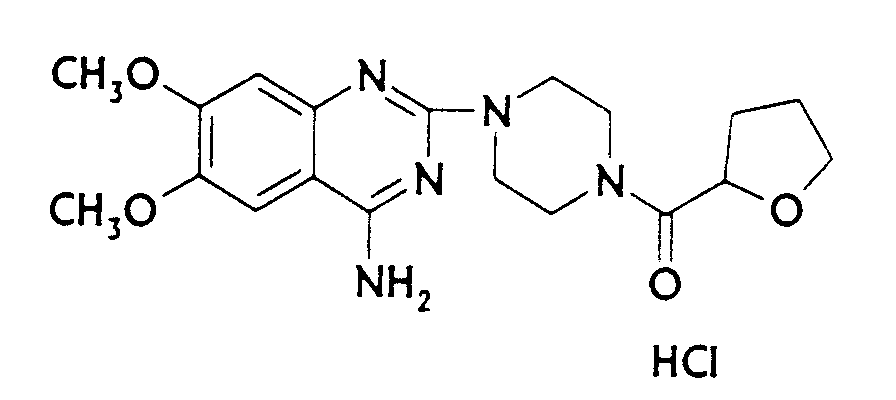
- In this patent only one hydrate of the active component of formula (I) has been identified, which is the dihydrate. This dihydrate is shown as being more stable than the anhydrous form.
- Generally, it is known that active components or excipients undergo crystal transition due to moisture absorption, which results in their volumetric change, leading to a change in hardness or cracking of the tablets. To establish appropriate bioavailability, such changes are extremely troublesome phenomena, particularly in the case of sustained release preparations. When anhydrous alfuzosin hydrochloride is preserved under conditions with the relative humidity exceeding 75%, the crystal structure of the anhydrous form changes, thereby providing a trihydrate, which is accompanied by a change in volume. No reports have been made concerning the change in the preparation properties of tablets comprising crystals of anhydrous alfuzosin which are observed in long period stability tests, etc. To avoid the realization of the above-mentioned anxiety, however, it is useful to have an alfuzosin compound in a crystal state which does not suffer from the change in the crystal form under influence of humidity and temperature during the preparation process and storage of the preparations.
- After repeated zealous investigations, we the present inventors have found that alfuzosin hydrochloride can take forms of mono-, di-, tri- and tetrahydrate, with confirmation that the dihydrate is the most stable of them during the usual preparation process and under usual preservation conditions, thus the present invention has been completed. Alfuzosin hydrochloride dihydrate is produced by recrystallization of anhydrous alfuzosin hydrochloride from an 80:20 mixture solution of acetone and water at 6°C.
- The tetrahydrate of alfuzosin hydrochloride is produced by recrystallization under room temperature conditions in the same manner as its dihydrate.
- The trihydrate of alfuzosin hydrochloride is produced by keeping anhydrous alfuzosin hydrochloride at 25°C and at a relative humidity of 93% for three days. Here the monohydrate is believed to be obtained by allowing the trihydrate to stand under the conditions of 25°C and at a relative humidity of 0% for two or more days.
- Hereunder the present invention will be explained in detail with reference to the Examples.
- Anhydrous alfuzosin hydrochloride and various hydrates thereof may be distinguished from each other by means of X-ray powder diffraction, IR spectra or thermal analysis. In the present examples, the distinguishing was conducted using X-ray powder diffraction capable of characterizing crystal structures, with investigation of moisture content carried out appropriately.
- Here, the X-ray powder diffraction was carried out using Phillips MPD1880 X-ray diffraction apparatus system which uses CuKα radiation. This apparatus was set up as follows:
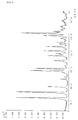
tube voltage 40 kV,tube current 50 mA, scanning rate 0.02°/s, sampling time 0.2 seconds,measurement range 2= 2.5-32.5°. - Patterns of X-ray powder diffraction for the anhydrous form, dihydrate, trihydrate and tetrahydrate of alfuzosin hydrochloride are shown in Fig. 1, Fig. 2, Fig. 3 and Fig. 4, respectively. The respective characteristic diffractometric peaks are as follows:
- Anhydrous form: 2 = 7.56°
- Dihydrate : 2 = 6.36°, 8.07°, 9.78°
- Trihydrate : 2 = 6.12°, 8.96°
- Tetrahydrate : 2 = 6.04°, 8.37°
-
- The moisture content was measured with Karl Fischer Aquameter (Kyoto Electron Industry, MK-AII) for about 100 mg of a sample dissolved in methanol for moisture measurement. In turn, the dehydration behavior of the crystal water was measured by thermogravimetry and differential thermal analysis using TG/DTA200 thermogravimetric apparatus and SSC5030 Disc Station (Seiko). Concretely, approximately 5 mg of a sample was weighed into an open aluminum pan, and analyzed at a rate of temperature increase of 10°C/m or 1°C/m. This analysis was carried out in a nitrogen atmosphere (flow rate: 100 ml/m).
- To 2g of alfuzosin hydrochloride (anhydrous form) produced as described in Japanese Examined Patent Application Publication SHO No. 60-23114, was added 20 ml of an acetone/water (4:1) mixture solution, and the mixture was heated to reflux at approximately 60°C until the anhydrous form was completely dissolved. After confirmation of the complete dissolution of the anhydrous form, the mixture was gradually cooled to room temperature, and the resulting precipitate was filtered off on filter paper, followed by air-drying at room temperature for 24 hours.
- The obtained substance was confirmed to be alfuzosin hydrochloride dihydrate by X-ray powder diffraction.
- To 2 g of alfuzosin hydrochloride (anhydrous form) described in Japanese Examined Patent Application Publication SHO No. 60-23114, was added 20 ml of an acetone/water (4:1) mixture solution, after which the mixture was shaken for mixing at room temperature.
- The anhydrous form was once dissolved, but a precipitate was observed immediately upon stoppage of stirring. The resulting precipitate was filtered off on filter paper and air-dried at room temperature for 24 hours.
- The obtained substance was confirmed to be alfuzosin hydrochloride tetrahydrate by X-ray powder diffraction.
- The stability of alfuzosin hydrochloride dihydrate of the present invention was evaluated according to the following tests.
- A 0.2 g-portion of a sample of each of the anhydrous form and respective hydrates of alfuzosin hydrochloride was placed in a desiccator containing a saturated solution of the salts listed hereunder (at 25°C), and the relationship between the relative humidity at which the hydrated states of the respective compounds become stable physically and the hygroscopicity of polymorphic hydrated forms of those compounds was investigated. The respective samples were brought to the equilibrium by storage for 10 days under the respective conditions. For the setting up of the relative humidity (RH: %) was used a saturated solution of salts listed below:
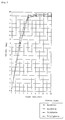
RH 0%, dry P2O5;RH 11%, LiCl; RH 22%, CH3COOK; RH 33%, MgCl2; RH 43%, K2CO3.2H2O; RH 53%, Mg(NO3)2; RH 64%, CoCl2.6H2O; RH 75%, NaCl; RH 84%, KCl; RH 93%, KNO3;RH 100%, water. - The obtained results were graphed and shown in Fig. 5 attached hereto.
- The anhydrous form of alfuzosin hydrochloride was stable at an RH of 75% or less. When preserved under conditions where the RH was over 75%, however, the moisture content increased significantly. This increasing continued until the moisture content attained the equilibrium of 12%, which is equivalent to 3 moles of water.
- Under all the conditions relating to the relative humidity at 25°C, with exception under drying conditions (RH: 0%), all the hydrates did not undergo moisture absorption. With consideration for the fact that the relative humidity usually ranges from about 40% to about 80%, it may be concluded that all the hydrates including the dihydrate of the present invention do not cause moisture absorption at usual relative humidity at normal temperature.
- Different from the hygroscopicity test mentioned above, the various hydrates of alfuzosin hydrochloride were kept under drying conditions for the monitoring of the change in moisture content.
- The obtained results are shown in Fig. 6 attached hereto. Fig. 6 shows that the dehydration process of alfuzosin hydrochloride dihydrate goes very slowly. That is, although the trihydrate and tetrahydrate lost most of the water in 1 day, no significant change in moisture content was observed for the dihydrate according to the present invention even in 3 days. This evidences that the interaction between alfuzosin hydrochloride and water molecules is stronger in the case where the former is a dihydrate than in the case of a trihydrate or tetrahydrate.
- In this connection, simultaneously in the present test, also the crystal state of dried samples after a three-days' drying was investigated for the dihydrate of the present invention by X-ray powder diffraction under drying conditions, for comparison with patterns of X-ray powder diffraction under normal conditions. As a result, it has been revealed that the dihydrate of the present invention retains its original crystal form, with some drop in degree of crystallization (data not shown).
- The stability test was carried out following the procedures described below.
- A 0.3 g-portion of each of the anhydrous form and respective hydrates of alfuzosin hydrochloride in crystal forms was placed in a glass bottle (sealed) and in a desiccator filled with a NaCl saturated solution, and preserved at 70°C with a heater (Toyama Industry), after which the physicochemical stability of each compound was evaluated by X-ray powder diffraction and high performance liquid chromatography (HPLC).
- Separately, 0.3 g of each of the anhydrous form and respective hydrates of alfuzosin hydrochloride in crystal forms was placed in a plastic dish which was then covered with a polyvinylidene chloride film, followed by irradiation with a chemical lamp (dominant wavelength: 365nm) for 24 hours, for the evaluation of the light stability in the same manner as in the above.
- The obtained results are shown in the following table 1. Table 1 includes the moisture contents of the respective crystal forms as well. Here, the HPLC was carried out under the following conditions:
- HPLC apparatus (manufactured by Shimazu)
- Detection with UV (at 254 nm); column (Nucleosil 5C18, 150 mm x 4 mm, M, Nagel; flow rate 1.0 ml/m; room temperature; eluent, NaClO4 (in 1000 ml of water, 7 g, pH 3.5)- acetonitrile-THF (155:55:45): internal standard, p-chloroacetanilide (0.5 mg/ml).
-
- The above table 1 proves that the anhydrous form and dihydrate are extremely stable under all these conditions. On the other hand, both the trihydrate and tetrahydrate changed partially into the dihydrate, so they are considered unstable under the two conditions mentioned above.
- To light neither chemical decomposition nor physical change was found for all the samples.
- A 0.3 g-portion of each of the hydrates of alfuzosin hydrochloride was preserved in heaters (Sanyo) set to 100°C and 120°C, for the confirmation of the stability of the respective hydrates. The physical stability of the respective samples was confirmed by X-ray powder diffraction.
- The obtained results are shown in the following tables 2 and 3.
Accelerated test at 100°C Crystal forms Preservation time 30 min. 60 min. 90 min. 120 min. Dihydrate (DI) DI DI DI DI Trihydrate (TRI) TRI TRI+DI TRI+DI TRI+DI Tetrahydrate (TETRA) TETRA +DI DI DI DI - In this test, the crystal state of the respective hydrates was monitored by X-ray powder diffraction every 30 minutes for 2 hours.
- The dihydrate was stable all for 2 hours.
- The trihydrate changed into the dihydrate by degrees.
- Also the tetrahydrate changed into the dihydrate by degrees.
Accelerated test at 120°C Crystal forms Preservation time 45 min. Dihydrate (DI) DI Trihydrate (TRI) AN+DI+TRI Tetrahydrate (TETRA) DI [wherein AN stands for anhydrous form.] - The dihydrate was stable for 45 minutes.
- The trihydrate changed into a mixture of the anhydrous form, dihydrate and trihydrate.
- The tetrahydrate changed into the dihydrate.
- With the results of the above-mentioned tests 1-4, it may be concluded that the most stable crystal form of alfuzosin hydrochloride under normal preservation conditions for the preparations (e.g., 25°C, relative humidity 40-80%) and under heating (drying) condition (e.g., 50-60°C) to be expected for the preparation process is that of the dihydrate.
- Water at 37°C was used to study the dissolution profiles of the respective hydrates of alfuzosin hydrochloride. The results are shown in Fig. 7. Fig. 7 proves that the respective hydrates have dissolution profiles which are very similar to those of anhydrous alfuzosin hydrochloride . This is indicative of the fact that all the hydrates, including the dihydrate of the present invention, may be used for the preparation of alfuzosin hydrochloride preparations in the same manner as its anhydrous form.
- Accordingly, the dihydrate according to the present invention may be used for the production of antihypertensive agents or dysuria curing agents.
-
- Fig. 1 is a chart showing the X-ray powder diffraction pattern of anhydrous alfuzosin hydrochloride.
- Fig. 2 is a chart showing the X-ray powder diffraction pattern of alfuzosin hydrochloride dihydrate.
- Fig. 3 is a chart showing the X-ray powder diffraction pattern of alfuzosin hydrochloride trihydrate.
- Fig. 4 is a chart showing the X-ray powder diffraction pattern of alfuzosin hydrochloride tetrahydrate.
- Fig. 5 is a graph showing the hygroscopicity of the anhydrous form of alfuzosin hydrochloride and its various hydrates.
- Fig. 6 is a graph showing the change in the moisture contents of the hydrates of alfuzosin hydrochloride under drying conditions.
- Fig. 7 is a graph showing the dissolution profiles of the anhydrous form and respective hydrates of alfuzosin hydrochloride in water at 37°C.
-
| Results of the stability test | |||
| Crystal forms (moisture content: %) | 70° | 70° | Chemical lamp (moisture content: %) |
| Anhydrous (0.1%) | Stable (1.33%) | Stable (0.7%) | Stable (0.66%) |
| Dihydrate(DI) (8.14%) | Stable (8.41%) | Stable (8.48%) | Stable (8.40%) |
| Trihydrate (TRI) (12.75%) | DI=37%+TRI=68% (11.05%) | DI=16%+TRI=84% (12.03%) | Stable (12.87%) |
| Tetrahydrate (TETRA) (14.93%) | DI=26%+TETRA=74% (13.19%) | DI=98%+TETRA=2% (8.25%) | Stable (15.18%) |
Claims (1)
- Alfuzosin hydrochloride dihydrate

Applications Claiming Priority (3)
| Application Number | Priority Date | Filing Date | Title |
|---|---|---|---|
| JP5353828A JPH07206857A (en) | 1993-12-28 | 1993-12-28 | Alfuzosin hydrochloride dihydrate |
| JP35382893 | 1993-12-28 | ||
| JP353828/93 | 1993-12-28 |
Publications (2)
| Publication Number | Publication Date |
|---|---|
| EP0663398A1 EP0663398A1 (en) | 1995-07-19 |
| EP0663398B1 true EP0663398B1 (en) | 2000-03-15 |
Family
ID=18433498
Family Applications (1)
| Application Number | Title | Priority Date | Filing Date |
|---|---|---|---|
| EP94120539A Expired - Lifetime EP0663398B1 (en) | 1993-12-28 | 1994-12-23 | Dihydrate of N-(4-amino-6,7-dimethoxyquinazol-2-yl)-N-methyl-N'-(tetrahydrofuroyl-2)-propylene diamine hydrochloride (= alfuzosin hydrochloride dihydrate) and a process for the preparation |
Country Status (6)
| Country | Link |
|---|---|
| US (1) | US5545738A (en) |
| EP (1) | EP0663398B1 (en) |
| JP (1) | JPH07206857A (en) |
| KR (1) | KR100329156B1 (en) |
| AT (1) | ATE190614T1 (en) |
| DE (1) | DE69423459T2 (en) |
Families Citing this family (15)
| Publication number | Priority date | Publication date | Assignee | Title |
|---|---|---|---|---|
| EP0849265A1 (en) * | 1996-12-20 | 1998-06-24 | HEUMANN PHARMA GmbH | Novel polymorphic form of doxazosin mesylate (form II) |
| GB9708917D0 (en) * | 1997-05-01 | 1997-06-25 | Pfizer Ltd | Compounds useful in therapy |
| DE19951418A1 (en) * | 1999-10-26 | 2001-05-03 | Merck Patent Gmbh | Process for the preparation of N- (4,5-bismethanesulfonyl-2-methyl-benzoyl) guanidine, hydrochloride |
| DE10232113A1 (en) * | 2002-07-16 | 2004-01-29 | Bayer Ag | Medicinal products containing vardenafil hydrochloride trihydrate |
| ES2305848T3 (en) * | 2004-09-16 | 2008-11-01 | Hetero Drugs Limited | ALFUZOSINE CRYSTAL BASE. |
| US20070049756A1 (en) * | 2005-08-30 | 2007-03-01 | Anumula Raghupathi R | Alfuzosin hydrochloride polymorphs |
| EP1968970A2 (en) * | 2005-12-16 | 2008-09-17 | Wockhardt Limited | Processes for the preparation of alfuzosin |
| US20100092556A1 (en) * | 2006-12-11 | 2010-04-15 | Kristin Arnold | Alfuzosin formulations, methods of making, and methods of use |
| US20080160081A1 (en) * | 2006-12-11 | 2008-07-03 | Mutual Pharmaceutical Company, Inc. | Alfuzosin formulations, methods of making, and methods of use |
| WO2008114272A2 (en) * | 2007-03-22 | 2008-09-25 | Cadila Healthcare Limited | Process for preparing alpuzosin and crystalline alfuzosin hydrochloride |
| CN101687859A (en) | 2007-05-04 | 2010-03-31 | 阿克塔维什集团Ptc公司 | Process for the preparation of alfuzosin and salts thereof |
| WO2009016387A2 (en) | 2007-08-02 | 2009-02-05 | Cipla Limited | Process for the preparation of alfuzosin hydrochloride |
| UA102128C2 (en) * | 2008-12-05 | 2013-06-10 | Х. Луннбек А/С | Nalmefene hydrochloride dihydrate |
| WO2010083360A2 (en) * | 2009-01-16 | 2010-07-22 | Mutual Pharmaceutical Company, Inc. | Controlled-release formulations |
| CN114674967B (en) * | 2022-03-25 | 2022-10-04 | 邦恩泰(山东)生物医药科技集团股份有限公司 | Method for detecting related substances of N-methyl-N' -tetrahydrofuran formyl propane diamine oxalate |
Family Cites Families (6)
| Publication number | Priority date | Publication date | Assignee | Title |
|---|---|---|---|---|
| GB1591490A (en) * | 1977-08-04 | 1981-06-24 | Abbott Lab | 1-(4-amino-6,7-dimethoxy-2-quinazolinyl)-4-(2-tetrahydrofuroyl)piperazine hydrochloride dihydrate |
| FR2421888A1 (en) * | 1978-02-06 | 1979-11-02 | Synthelabo | ALKYLENE DIAMINE AMIDES AND THEIR APPLICATION IN THERAPEUTICS |
| FI79107C (en) * | 1984-06-25 | 1989-11-10 | Orion Yhtymae Oy | Process for the preparation of stable form of prazosin hydrochloride. |
| US4925837A (en) * | 1984-09-14 | 1990-05-15 | Synthelabo | Pharmaceutical compositions |
| FR2582513B1 (en) * | 1985-05-28 | 1988-08-05 | Synthelabo | PHARMACEUTICAL COMPOSITIONS CONTAINING ALFUZOSINE |
| US5294615A (en) * | 1993-04-29 | 1994-03-15 | Abbott Laboratories | Terazosin polymorph and pharmaceutical composition |
-
1993
- 1993-12-28 JP JP5353828A patent/JPH07206857A/en active Pending
-
1994
- 1994-12-23 AT AT94120539T patent/ATE190614T1/en not_active IP Right Cessation
- 1994-12-23 DE DE69423459T patent/DE69423459T2/en not_active Expired - Lifetime
- 1994-12-23 EP EP94120539A patent/EP0663398B1/en not_active Expired - Lifetime
- 1994-12-27 US US08/364,180 patent/US5545738A/en not_active Expired - Lifetime
- 1994-12-27 KR KR1019940037437A patent/KR100329156B1/en not_active Expired - Fee Related
Also Published As
| Publication number | Publication date |
|---|---|
| DE69423459T2 (en) | 2000-10-26 |
| US5545738A (en) | 1996-08-13 |
| ATE190614T1 (en) | 2000-04-15 |
| DE69423459D1 (en) | 2000-04-20 |
| KR100329156B1 (en) | 2002-11-22 |
| JPH07206857A (en) | 1995-08-08 |
| EP0663398A1 (en) | 1995-07-19 |
| KR950017992A (en) | 1995-07-22 |
Similar Documents
| Publication | Publication Date | Title |
|---|---|---|
| US5545738A (en) | Alfuzosin hydrochloride dihydrate | |
| US10961250B2 (en) | Short-acting benzodiazepine salts and their polymorphic forms | |
| AU2003254376B2 (en) | 3-Z-[1-(4-(N-((4-methyl-piperazin-1-yl)-methylcarbonyl)-N-methyl-amino)-anilino) -1-phenyl- methylene]-6-methoxycarbonyl-2-indolinone-monoethanesulphonate and the use thereof as a pharmaceutical composition | |
| EP1956014B1 (en) | Polymorphs of 2-(3-cyano-4-isobutyloxyphenyl)-4-methyl-5-thiazolecarboxylic acid and method of producing the same | |
| RU2162468C2 (en) | 1-cyclopropyl-7-([s,s]-2,8-diazabicyclo[4,3,0]none-8-yl)-6- -fluoro-1,4-dihydro-8-methoxy-4-oxo-3-quinoline carboxylic acid hydrochloride monohydrate and pharmaceutical composition with antibacterial activity | |
| KR101446789B1 (en) | Hydrate of 1-((2S)-2-amino-4-(2,4-bis(trifluoromethyl)-5,8-dihydropyrido(3,4-d)pyrimidin-7(6H)-yl)-4-oxobutyl)-5,5-difluoropiperidin-2-one tartrate | |
| Bretnall et al. | Metformin hydrochloride | |
| EP1614686A1 (en) | Bromide and its crystal | |
| Sohn et al. | Polymorphism and pseudopolymorphism of acyclovir | |
| US4515804A (en) | Crystal modifications of (+)-catechin and pharmaceutical preparations containing them | |
| HUE025032T2 (en) | methylparaben cocrystal form "A" of [4-(3-Fluoro-5-trifluoromethyl-pyridin-2-yl)-piperazin-l-yl]-[5-methanesulfonyl-2- ((S) -2,2,2-trifluoro- 1 -methyl-ethoxy) -phenyl] -methanone | |
| UA46723C2 (en) | 5-acetamide-2,3,4,5-TETRADEOKSY-4-guanidine-D-HLITSERO-D-2-HALAKTONON YENOPIRANOZONOVA acid in crystalline form, method of its antiviral pharmaceutical compositions and method of its | |
| BR112021014327A2 (en) | CRYSTALLINE FORM OF 1,2,3-TRIAZOLO[1,5-A]PYRAZINES DERIVATIVES, METHOD OF PREPARATION OF SUCH CRYSTALLINE FORM, PHARMACEUTICAL COMPOSITIONS COMPRISING IT AND ITS USE | |
| RU2047615C1 (en) | 3-[(5- methyl-2- furanyl) methyl] -n- (4-piperidinyl) -3h-imidazo[4-,5-b]pyridine -2-amino-2- hydroxy -1,2,3-propanetricarboxylate showing antiallergic activity, method of its synthesis and antiallergic composition | |
| DE69706562T2 (en) | N- (4-acetyl-1-piperazinyl) -4-FLUOROBENZAMIDHYDRAT | |
| EP4169914A1 (en) | Salt of compound and pharmaceutical composition containing salt | |
| EP3853200B1 (en) | Erbumine salt of treprostinil | |
| AU2004232495B2 (en) | 4-(4-trans-hydroxycyclohexyl)amino-2-phenyl-7h-pyrrolo [2, 3d]pyrimidine hydrogen mesylate and its polymorphic forms | |
| EP4471036A1 (en) | Crystal form of compound and preparation method therefor | |
| EP0189679B1 (en) | Novel crystalline form of 1-benzhydryl-4-allylpiperazine dihydrochloride and method for the production thereof | |
| US20050113309A1 (en) | Crystalline forms(2s)-n-5[amino(imino)methyl]-2-thienylmethyl-1-(2r)-2[(carboxymethyl) amino]-3,3-diphenylpropanoyl-2-pyrrolidinecarboxamide nh2o | |
| PL180776B1 (en) | Novel crystalline forms of 1-[5-methane dulphonamidoindolyl-2-carbonyl]-4-[3-(methyl-ethylamine)-2-pyridinyl] piperazine | |
| McPherson et al. | Physical Characterization of 1, 3-dipropyl-8-cyclopentylxanthine (CPX) | |
| EP0721955A2 (en) | Diadenosine tetraphosphate tetrasodium salt dodecahydrate crystals | |
| EP3293174A1 (en) | Crystalline salts of betrixaban |
Legal Events
| Date | Code | Title | Description |
|---|---|---|---|
| PUAI | Public reference made under article 153(3) epc to a published international application that has entered the european phase |
Free format text: ORIGINAL CODE: 0009012 |
|
| AK | Designated contracting states |
Kind code of ref document: A1 Designated state(s): AT BE CH DE DK ES FR GB GR IE IT LI LU MC NL PT SE |
|
| 17P | Request for examination filed |
Effective date: 19960119 |
|
| 17Q | First examination report despatched |
Effective date: 19980512 |
|
| GRAG | Despatch of communication of intention to grant |
Free format text: ORIGINAL CODE: EPIDOS AGRA |
|
| GRAG | Despatch of communication of intention to grant |
Free format text: ORIGINAL CODE: EPIDOS AGRA |
|
| GRAH | Despatch of communication of intention to grant a patent |
Free format text: ORIGINAL CODE: EPIDOS IGRA |
|
| RAP1 | Party data changed (applicant data changed or rights of an application transferred) |
Owner name: SANOFI-SYNTHELABO |
|
| GRAH | Despatch of communication of intention to grant a patent |
Free format text: ORIGINAL CODE: EPIDOS IGRA |
|
| GRAA | (expected) grant |
Free format text: ORIGINAL CODE: 0009210 |
|
| AK | Designated contracting states |
Kind code of ref document: B1 Designated state(s): AT BE CH DE DK ES FR GB GR IE IT LI LU MC NL PT SE |
|
| PG25 | Lapsed in a contracting state [announced via postgrant information from national office to epo] |
Ref country code: SE Free format text: THE PATENT HAS BEEN ANNULLED BY A DECISION OF A NATIONAL AUTHORITY Effective date: 20000315 Ref country code: NL Free format text: LAPSE BECAUSE OF FAILURE TO SUBMIT A TRANSLATION OF THE DESCRIPTION OR TO PAY THE FEE WITHIN THE PRESCRIBED TIME-LIMIT Effective date: 20000315 Ref country code: LI Free format text: LAPSE BECAUSE OF NON-PAYMENT OF DUE FEES Effective date: 20000315 Ref country code: IT Free format text: LAPSE BECAUSE OF FAILURE TO SUBMIT A TRANSLATION OF THE DESCRIPTION OR TO PAY THE FEE WITHIN THE PRE;WARNING: LAPSES OF ITALIAN PATENTS WITH EFFECTIVE DATE BEFORE 2007 MAY HAVE OCCURRED AT ANY TIME BEFORE 2007. THE CORRECT EFFECTIVE DATE MAY BE DIFFERENT FROM THE ONE RECORDED.SCRIBED TIME-LIMIT Effective date: 20000315 Ref country code: GR Free format text: LAPSE BECAUSE OF NON-PAYMENT OF DUE FEES Effective date: 20000315 Ref country code: ES Free format text: THE PATENT HAS BEEN ANNULLED BY A DECISION OF A NATIONAL AUTHORITY Effective date: 20000315 Ref country code: CH Free format text: LAPSE BECAUSE OF NON-PAYMENT OF DUE FEES Effective date: 20000315 Ref country code: BE Free format text: LAPSE BECAUSE OF FAILURE TO SUBMIT A TRANSLATION OF THE DESCRIPTION OR TO PAY THE FEE WITHIN THE PRESCRIBED TIME-LIMIT Effective date: 20000315 Ref country code: AT Free format text: LAPSE BECAUSE OF FAILURE TO SUBMIT A TRANSLATION OF THE DESCRIPTION OR TO PAY THE FEE WITHIN THE PRESCRIBED TIME-LIMIT Effective date: 20000315 |
|
| REF | Corresponds to: |
Ref document number: 190614 Country of ref document: AT Date of ref document: 20000415 Kind code of ref document: T |
|
| REG | Reference to a national code |
Ref country code: CH Ref legal event code: EP |
|
| REF | Corresponds to: |
Ref document number: 69423459 Country of ref document: DE Date of ref document: 20000420 |
|
| REG | Reference to a national code |
Ref country code: IE Ref legal event code: FG4D |
|
| PG25 | Lapsed in a contracting state [announced via postgrant information from national office to epo] |
Ref country code: PT Free format text: LAPSE BECAUSE OF FAILURE TO SUBMIT A TRANSLATION OF THE DESCRIPTION OR TO PAY THE FEE WITHIN THE PRESCRIBED TIME-LIMIT Effective date: 20000615 Ref country code: DK Free format text: LAPSE BECAUSE OF FAILURE TO SUBMIT A TRANSLATION OF THE DESCRIPTION OR TO PAY THE FEE WITHIN THE PRESCRIBED TIME-LIMIT Effective date: 20000615 |
|
| ET | Fr: translation filed | ||
| NLV1 | Nl: lapsed or annulled due to failure to fulfill the requirements of art. 29p and 29m of the patents act | ||
| REG | Reference to a national code |
Ref country code: CH Ref legal event code: PL |
|
| PG25 | Lapsed in a contracting state [announced via postgrant information from national office to epo] |
Ref country code: LU Free format text: LAPSE BECAUSE OF NON-PAYMENT OF DUE FEES Effective date: 20001223 |
|
| PG25 | Lapsed in a contracting state [announced via postgrant information from national office to epo] |
Ref country code: IE Free format text: LAPSE BECAUSE OF NON-PAYMENT OF DUE FEES Effective date: 20001225 |
|
| PG25 | Lapsed in a contracting state [announced via postgrant information from national office to epo] |
Ref country code: MC Free format text: THE PATENT HAS BEEN ANNULLED BY A DECISION OF A NATIONAL AUTHORITY Effective date: 20001231 |
|
| PLBE | No opposition filed within time limit |
Free format text: ORIGINAL CODE: 0009261 |
|
| STAA | Information on the status of an ep patent application or granted ep patent |
Free format text: STATUS: NO OPPOSITION FILED WITHIN TIME LIMIT |
|
| 26N | No opposition filed | ||
| REG | Reference to a national code |
Ref country code: IE Ref legal event code: MM4A |
|
| REG | Reference to a national code |
Ref country code: GB Ref legal event code: IF02 |
|
| REG | Reference to a national code |
Ref country code: FR Ref legal event code: CD |
|
| PGFP | Annual fee paid to national office [announced via postgrant information from national office to epo] |
Ref country code: GB Payment date: 20101222 Year of fee payment: 17 |
|
| PGFP | Annual fee paid to national office [announced via postgrant information from national office to epo] |
Ref country code: FR Payment date: 20111219 Year of fee payment: 18 |
|
| PGFP | Annual fee paid to national office [announced via postgrant information from national office to epo] |
Ref country code: DE Payment date: 20111221 Year of fee payment: 18 |
|
| REG | Reference to a national code |
Ref country code: DE Ref legal event code: R082 Ref document number: 69423459 Country of ref document: DE Representative=s name: TER MEER STEINMEISTER & PARTNER GBR PATENTANWA, DE |
|
| REG | Reference to a national code |
Ref country code: DE Ref legal event code: R082 Ref document number: 69423459 Country of ref document: DE Representative=s name: TER MEER STEINMEISTER & PARTNER PATENTANWAELTE, DE Effective date: 20130205 Ref country code: DE Ref legal event code: R082 Ref document number: 69423459 Country of ref document: DE Representative=s name: TER MEER STEINMEISTER & PARTNER GBR PATENTANWA, DE Effective date: 20130205 Ref country code: DE Ref legal event code: R081 Ref document number: 69423459 Country of ref document: DE Owner name: SANOFI-AVENTIS, FR Free format text: FORMER OWNER: SANOFI-AVENTIS, PARIS, FR Effective date: 20130205 Ref country code: DE Ref legal event code: R081 Ref document number: 69423459 Country of ref document: DE Owner name: SANOFI, FR Free format text: FORMER OWNER: SANOFI-AVENTIS, PARIS, FR Effective date: 20130205 |
|
| GBPC | Gb: european patent ceased through non-payment of renewal fee |
Effective date: 20121223 |
|
| REG | Reference to a national code |
Ref country code: FR Ref legal event code: ST Effective date: 20130830 |
|
| REG | Reference to a national code |
Ref country code: DE Ref legal event code: R119 Ref document number: 69423459 Country of ref document: DE Effective date: 20130702 |
|
| PG25 | Lapsed in a contracting state [announced via postgrant information from national office to epo] |
Ref country code: DE Free format text: LAPSE BECAUSE OF NON-PAYMENT OF DUE FEES Effective date: 20130702 |
|
| PG25 | Lapsed in a contracting state [announced via postgrant information from national office to epo] |
Ref country code: FR Free format text: LAPSE BECAUSE OF NON-PAYMENT OF DUE FEES Effective date: 20130102 Ref country code: GB Free format text: LAPSE BECAUSE OF NON-PAYMENT OF DUE FEES Effective date: 20121223 |