EP0658255B1 - Method for manufacturing spherical particles - Google Patents
Method for manufacturing spherical particles Download PDFInfo
- Publication number
- EP0658255B1 EP0658255B1 EP93922076A EP93922076A EP0658255B1 EP 0658255 B1 EP0658255 B1 EP 0658255B1 EP 93922076 A EP93922076 A EP 93922076A EP 93922076 A EP93922076 A EP 93922076A EP 0658255 B1 EP0658255 B1 EP 0658255B1
- Authority
- EP
- European Patent Office
- Prior art keywords
- particles
- materials
- previous
- toner
- polymer
- Prior art date
- Legal status (The legal status is an assumption and is not a legal conclusion. Google has not performed a legal analysis and makes no representation as to the accuracy of the status listed.)
- Expired - Lifetime
Links
- 238000004519 manufacturing process Methods 0.000 title claims abstract description 11
- 239000012798 spherical particle Substances 0.000 title claims abstract description 8
- 238000000034 method Methods 0.000 title claims description 39
- 239000000463 material Substances 0.000 claims abstract description 157
- 239000000203 mixture Substances 0.000 claims abstract description 22
- 239000002904 solvent Substances 0.000 claims abstract description 20
- 239000006185 dispersion Substances 0.000 claims abstract description 10
- 238000001816 cooling Methods 0.000 claims abstract description 8
- 239000000839 emulsion Substances 0.000 claims abstract description 5
- 238000002844 melting Methods 0.000 claims abstract description 5
- 230000008018 melting Effects 0.000 claims abstract description 5
- 239000002245 particle Substances 0.000 claims description 78
- 229920000642 polymer Polymers 0.000 claims description 22
- XLYOFNOQVPJJNP-UHFFFAOYSA-N water Substances O XLYOFNOQVPJJNP-UHFFFAOYSA-N 0.000 claims description 14
- 239000000843 powder Substances 0.000 claims description 10
- 239000007787 solid Substances 0.000 claims description 8
- 238000010008 shearing Methods 0.000 claims description 7
- MIDXCONKKJTLDX-UHFFFAOYSA-N 3,5-dimethylcyclopentane-1,2-dione Chemical compound CC1CC(C)C(=O)C1=O MIDXCONKKJTLDX-UHFFFAOYSA-N 0.000 claims description 6
- 235000013736 caramel Nutrition 0.000 claims description 6
- 239000002861 polymer material Substances 0.000 claims description 6
- 239000011343 solid material Substances 0.000 claims description 4
- 239000002198 insoluble material Substances 0.000 claims 1
- 229920001169 thermoplastic Polymers 0.000 claims 1
- 239000007788 liquid Substances 0.000 description 13
- 229920003182 Surlyn® Polymers 0.000 description 6
- YXFVVABEGXRONW-UHFFFAOYSA-N Toluene Chemical compound CC1=CC=CC=C1 YXFVVABEGXRONW-UHFFFAOYSA-N 0.000 description 6
- VLKZOEOYAKHREP-UHFFFAOYSA-N n-Hexane Chemical compound CCCCCC VLKZOEOYAKHREP-UHFFFAOYSA-N 0.000 description 6
- KFZMGEQAYNKOFK-UHFFFAOYSA-N Isopropanol Chemical compound CC(C)O KFZMGEQAYNKOFK-UHFFFAOYSA-N 0.000 description 4
- 239000006229 carbon black Substances 0.000 description 4
- 238000002156 mixing Methods 0.000 description 4
- 239000000126 substance Substances 0.000 description 4
- 238000005406 washing Methods 0.000 description 4
- 239000000654 additive Substances 0.000 description 3
- 230000000996 additive effect Effects 0.000 description 3
- 239000000049 pigment Substances 0.000 description 3
- 235000009854 Cucurbita moschata Nutrition 0.000 description 2
- 240000001980 Cucurbita pepo Species 0.000 description 2
- 235000009852 Cucurbita pepo Nutrition 0.000 description 2
- 125000001931 aliphatic group Chemical group 0.000 description 2
- 230000015572 biosynthetic process Effects 0.000 description 2
- 239000001055 blue pigment Substances 0.000 description 2
- 238000005119 centrifugation Methods 0.000 description 2
- 239000003086 colorant Substances 0.000 description 2
- 239000002131 composite material Substances 0.000 description 2
- 238000009826 distribution Methods 0.000 description 2
- 230000000694 effects Effects 0.000 description 2
- 238000002474 experimental method Methods 0.000 description 2
- 238000001125 extrusion Methods 0.000 description 2
- 239000011874 heated mixture Substances 0.000 description 2
- 229920000554 ionomer Polymers 0.000 description 2
- 239000002184 metal Substances 0.000 description 2
- QLOAVXSYZAJECW-UHFFFAOYSA-N methane;molecular fluorine Chemical compound C.FF QLOAVXSYZAJECW-UHFFFAOYSA-N 0.000 description 2
- 239000000178 monomer Substances 0.000 description 2
- 229920000728 polyester Polymers 0.000 description 2
- 239000011347 resin Substances 0.000 description 2
- 229920005989 resin Polymers 0.000 description 2
- LMCILKQUBHEOPB-UHFFFAOYSA-M sodium;ethene;prop-2-enoate Chemical compound [Na+].C=C.[O-]C(=O)C=C LMCILKQUBHEOPB-UHFFFAOYSA-M 0.000 description 2
- 235000020354 squash Nutrition 0.000 description 2
- 230000003746 surface roughness Effects 0.000 description 2
- 239000004094 surface-active agent Substances 0.000 description 2
- OKTJSMMVPCPJKN-UHFFFAOYSA-N Carbon Chemical compound [C] OKTJSMMVPCPJKN-UHFFFAOYSA-N 0.000 description 1
- 239000004215 Carbon black (E152) Substances 0.000 description 1
- BVKZGUZCCUSVTD-UHFFFAOYSA-L Carbonate Chemical compound [O-]C([O-])=O BVKZGUZCCUSVTD-UHFFFAOYSA-L 0.000 description 1
- 229920001634 Copolyester Polymers 0.000 description 1
- 229920002153 Hydroxypropyl cellulose Polymers 0.000 description 1
- 229920013620 Pliolite Polymers 0.000 description 1
- 229920003171 Poly (ethylene oxide) Polymers 0.000 description 1
- -1 Polyoxyethylene Polymers 0.000 description 1
- 239000004793 Polystyrene Substances 0.000 description 1
- CZMRCDWAGMRECN-UGDNZRGBSA-N Sucrose Chemical compound O[C@H]1[C@H](O)[C@@H](CO)O[C@@]1(CO)O[C@@H]1[C@H](O)[C@@H](O)[C@H](O)[C@@H](CO)O1 CZMRCDWAGMRECN-UGDNZRGBSA-N 0.000 description 1
- 229930006000 Sucrose Natural products 0.000 description 1
- 238000005299 abrasion Methods 0.000 description 1
- 229920006243 acrylic copolymer Polymers 0.000 description 1
- 238000013329 compounding Methods 0.000 description 1
- 229920001577 copolymer Polymers 0.000 description 1
- 238000010908 decantation Methods 0.000 description 1
- 238000004945 emulsification Methods 0.000 description 1
- 238000010438 heat treatment Methods 0.000 description 1
- 229930195733 hydrocarbon Natural products 0.000 description 1
- 150000002430 hydrocarbons Chemical class 0.000 description 1
- 125000002887 hydroxy group Chemical group [H]O* 0.000 description 1
- 239000001863 hydroxypropyl cellulose Substances 0.000 description 1
- 235000010977 hydroxypropyl cellulose Nutrition 0.000 description 1
- 229940071676 hydroxypropylcellulose Drugs 0.000 description 1
- 230000001788 irregular Effects 0.000 description 1
- 238000011068 loading method Methods 0.000 description 1
- 239000011159 matrix material Substances 0.000 description 1
- 239000000155 melt Substances 0.000 description 1
- 238000006116 polymerization reaction Methods 0.000 description 1
- 229920002223 polystyrene Polymers 0.000 description 1
- 229920002635 polyurethane Polymers 0.000 description 1
- 239000004814 polyurethane Substances 0.000 description 1
- 239000002244 precipitate Substances 0.000 description 1
- 239000000047 product Substances 0.000 description 1
- HJWLCRVIBGQPNF-UHFFFAOYSA-N prop-2-enylbenzene Chemical compound C=CCC1=CC=CC=C1 HJWLCRVIBGQPNF-UHFFFAOYSA-N 0.000 description 1
- 238000010298 pulverizing process Methods 0.000 description 1
- 238000000926 separation method Methods 0.000 description 1
- 239000008247 solid mixture Substances 0.000 description 1
- 239000007921 spray Substances 0.000 description 1
- 238000003756 stirring Methods 0.000 description 1
- 239000006228 supernatant Substances 0.000 description 1
- 238000002604 ultrasonography Methods 0.000 description 1
Images
Classifications
-
- G—PHYSICS
- G03—PHOTOGRAPHY; CINEMATOGRAPHY; ANALOGOUS TECHNIQUES USING WAVES OTHER THAN OPTICAL WAVES; ELECTROGRAPHY; HOLOGRAPHY
- G03G—ELECTROGRAPHY; ELECTROPHOTOGRAPHY; MAGNETOGRAPHY
- G03G9/00—Developers
- G03G9/08—Developers with toner particles
- G03G9/0802—Preparation methods
- G03G9/081—Preparation methods by mixing the toner components in a liquefied state; melt kneading; reactive mixing
-
- G—PHYSICS
- G03—PHOTOGRAPHY; CINEMATOGRAPHY; ANALOGOUS TECHNIQUES USING WAVES OTHER THAN OPTICAL WAVES; ELECTROGRAPHY; HOLOGRAPHY
- G03G—ELECTROGRAPHY; ELECTROPHOTOGRAPHY; MAGNETOGRAPHY
- G03G9/00—Developers
- G03G9/08—Developers with toner particles
- G03G9/0827—Developers with toner particles characterised by their shape, e.g. degree of sphericity
-
- G—PHYSICS
- G03—PHOTOGRAPHY; CINEMATOGRAPHY; ANALOGOUS TECHNIQUES USING WAVES OTHER THAN OPTICAL WAVES; ELECTROGRAPHY; HOLOGRAPHY
- G03G—ELECTROGRAPHY; ELECTROPHOTOGRAPHY; MAGNETOGRAPHY
- G03G9/00—Developers
- G03G9/08—Developers with toner particles
- G03G9/12—Developers with toner particles in liquid developer mixtures
-
- B—PERFORMING OPERATIONS; TRANSPORTING
- B29—WORKING OF PLASTICS; WORKING OF SUBSTANCES IN A PLASTIC STATE IN GENERAL
- B29B—PREPARATION OR PRETREATMENT OF THE MATERIAL TO BE SHAPED; MAKING GRANULES OR PREFORMS; RECOVERY OF PLASTICS OR OTHER CONSTITUENTS OF WASTE MATERIAL CONTAINING PLASTICS
- B29B9/00—Making granules
- B29B9/02—Making granules by dividing preformed material
- B29B9/06—Making granules by dividing preformed material in the form of filamentary material, e.g. combined with extrusion
Definitions
- the present invention relates to the production of small particles, especially in the range of 1-10 micrometers in diameter. Such particles are especially useful for use in liquid or powder toners.
- Toner materials whether for liquid or powder toner development, should be tough, abrasion resistant, elastic and have proper electrical properties.
- One type of process produces particles by dissolving a monomer or polymer or a plurality of monomers and/or polymers in a solvent, producing a polymerization reaction to form an insoluble polymer while stirring the solution/dispersion such that the polymer is precipitated as small particles.
- Example of this type of process are described in U.S. Patents 3,779,924, 4,996,265.
- a polymer or other material is dissolved in a solvent.
- the solution is combined with a solvent in which the polymer is insoluble and as a result the polymer precipitates out of the solution as small particles.
- the mixture is stirred during the process to aid in the formation of the particles. Examples of this type of process type are shown in U.S. Patents 3,679,586, 3,718,593, 3,682,825.
- the particles are produced by crushing or otherwise fracturing a polymer material and then classifying the particles according to size.
- polymer particles are wet ground to produce particles. Examples of such processes are found in U.S. Patent 4,794,651.
- the polymer is dissolved in a solvent (water or an other solvent) which is then spray dried to produce particles.
- a solvent water or an other solvent
- U.S. Patent 4,158,634 describes a sixth process a polymer material is dissolved at an elevated temperature in a solvent which is normally solid (at room temperature). The solution is cooled and solidifies. The now solid solvent is then dissolved in a second, liquid (at room temperature) solvent leaving the polymer. The polymer is brushed through a screen to form a polymer powder.
- U.S. Patent 3,586,654 describes a seventh method for producing toner particles in which a polymer is melted in super-heated water (under high pressure) and shear is supplied to form blobs of melted polymer dispersed in the water. The dispersion is cooled to solidify the polymer as round particles and the particles are separated from the water. Since the water and polymer have such disparate viscosities it is difficult to transmit sufficient shear to form the particles.
- U.S. Patents 3,422,049, 3,449,291, 3,472,801 all describe similar methods of toner particle production.
- the present invention provides a process for producing spherical particle comprising:
- the step of removing preferably comprises dissolving the second material in a solvent in which the first material is not soluble.
- both the first and second materials are cooled sufficiently to form solids before removing the second material.
- the first material is a polymer suitable for use in a toner.
- the second material is a polymer material, in accordance with a second preferred embodiment of the material the second material is a non-polymer material.
- the solvent may be water if the second material is water soluble or the solvent may be a hydrocarbon in which the second material is soluble and the first material is insoluble.
- the two materials have viscosities, at the temperature at which the step of shearing is performed, which enable the transfer of sufficient shear to the first material to cause it to form blobs of the required size.
- Suitable toner materials for the process includes polystyrene, Ionomers such as Surlyn 9020 (du Pont) or Iotek 8030 (EXXON) and polyester and co-polyester material such as, for example, Dynapol 1228 marketed by Hulls as well as blends of polymer materials.
- the toner material may have a colorant such as carbon black or pigment dispersed therein before the start of the process of manufacturing the spherical particles.
- Suitable second materials include the polymers WSR 301 Polyoxyethylene (UNION CARBIDE), hydroxy propyl cellulose marketed by AQUALON under the trade name KLUCEL which are water soluble and vinyl toluene acrylic co-polymer, marketed by Goodyear under the trade name PLIOLITE VTAC and PLIOWAY EC-1, which is a substituted styrene acrylate copolymer marketed by Goodyear all of which are soluble in hexane.
- INKOVAR 1150 an aliphatic resin produced by Hercules is also useful as a second material.
- Caramel cross-linked sugar
- the ratio of toner material to other material is between 10:90 and 40:60. More preferably the ratio is between 15:85 and 30:70. For the presently used materials and shearing methods ratios of 15:85 and 20:80 are especially preferred.
- the step of shearing can be carried out using any suitable shearing apparatus, consistent with the viscosities of the two melted materials.
- suitable shearing apparatus may include a simple stirrer for relatively low viscosity materials to an extruder or ball mill for high viscosity materials.
- a household mixer is used to apply the shear.
- the melted material is first extruded through an extruder at a relatively low temperature to form relatively long streamers of the first material distributed in the second material.
- the material which exits the extruder is further heated and passed though a long relatively thin tube.
- the long streamers break up into blobs of first material.
- the blobs of first material become rounded and the first material, which is present in the composite which exits the tube are nearly spherical.
- the composite material is shredded or crushed to speed up the dissolving of the second material.
- particles which are insoluble in the second material but have either a physical or chemical affinity for the molten first material are added to the heated mixture.
- the particles at least partially coat the molten blobs.
- the particles of the first material are not smooth, but are coated with the insoluble particles.
- the insoluble particles are preferably used to modify the characteristics of the particles.
- particles of ACCUFLUOR CFX which is a fluorinated carbon marketed by Allied Chemicals can be added to the molten mixture. This additive adheres to the surface of the molten blobs and enhance the chargeability of the resultant particles and provide a surface roughness which enhances the squash resistance of a liquid toner image developed using the particles.
- Other additive particles could be surfactants to reduce the friction between powder toner particles, pigments which coat the particles or other particles which extend from the surface of the polymer and thereby change the morphology of the particles.
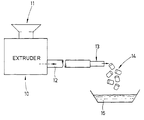
- the Fig. is a schematic illustration of an extrusion apparatus useful for producing particles in accordance with a preferred embodiment of the present invention.
- the present invention comprises the formation of particles of a first material by mixing melted first material with a quantity of a second melted material in which the first material is immiscible.
- the melted mixture is emulsified by subjecting it to shear forces which cause the first material to form globules ("blobs") of substantially spherical shape in the second material.
- the two materials should have roughly comparable viscosities at the temperature at which the shear is applied and the first material should preferably have a higher surface tension than the second material. It is believed that a ratio of 2:1 in surface tension is preferable, but that ratios of 5:1 or more are also useful in the performance of the invention.
- the emulsion is then cooled to solidify the two materials such that small, preferably spherical, particles of the first material are formed in a matrix of the second material.
- the solid second material is removed by dissolving the solid mixture in a solvent in which the second, but not the first, material is soluble. At this point the remaining round particles of first material are optionally washed and dried to remove traces of the second material and its solvent.
- the size of the particles will depend on the amount of shear force which is applied and, generally speaking, the uniformity of the particles size distribution will depend on the length of time during which the shear forces are applied and to some extent on the method of application. It has been further found that some of the preferred embodiments of the method give excellent narrow distributions of particle size.
- the particles are substantially spheroidal, however under certain circumstances ellipsoidal or somewhat irregular particles result from the process.
- the two melted materials are mixed with a wire beater or a single stiff wire which is rotated perpendicular to its axis.
- This system is preferred for materials which have a relatively low viscosity at the mixing temperature.
- a second embodiment of the invention utilizes a two or three roll mill to emulsify the two materials.
- the materials are melted and fed through the mill a number of times to complete the emulsification.
- Such method is especially suitable for materials which have a high viscosity at the mixing temperature.
- the temperature and or the speed of the mill are changed to control the shear rate and hence the particle size.
- the melted mixture is subjected to ultrasound energy which has the effect of breaking up larger globules of the first material into smaller particles suitable for use as toner. Shear forces are believed to cause the breakup of the particles in this embodiment.
- the toner and "host" materials are emulsified in the apparatus illustrated schematically in the Fig.
- an extruder 10 is filled with a mixture of preferably 15-20% toner polymer and 80-85% host material via an entry port 11.
- the materials are preferably heated in the extruder to a temperature preferably very near their melting points such that the extruded material comprises long, relatively thin, streamers of toner material in the host material. This temperature is not very critical.
- This extruded mix is then passed through a tube 12 which is preferably from 0.5 to several meters long at a higher temperature than the extrusion process. In a preferred embodiment of the invention, the mix requires between 15 minutes and 1.5 hours to traverse the tube. During this traverse, the streamers break up into substantially round blobs having a narrow range of sizes.
- the resulting mix of spherical toner particles in host material solidifies as it leaves the tube (shown schematically at 13) and the cool, solid material is broken into small pieces shown schematically at 14.
- a solvent 16 is then used to remove the host material. Generally the particles should be washed several times with the solvent to remove all traces of the host material.
- the size of the particles depends on the amount of shear during the passage of the mix through the tube. This in turn depends on the temperature of the tube, the speed at which the materials traverse the tube and the diameter of the tube. Toner particle in the micrometer range, or even submicrometer range can thus be manufactured using essentially the same process by changing the operating parameters.
- caramel host material is prepared by loading a planetary mixer with 3650 grams of white sugar. The sugar is melted and mixed for a total of 4 hours at a temperature of 176°C to 180°C. The material is discharged when still warm.
- Colored toner particle material is prepared by compounding 120 grams of Dynapol S 1228 with 30 grams of BT 583D (blue pigment produced by Cookson) in a Brabender Two-Roll Mill heated to 100°C by an oil heating unit. The materials are compounded for about 20 minutes at 65 RPM with a torque of about 45 Nm. The material is discharged while still warm and is shredded after cooling.
- Dynapol S 1228 with 30 grams of BT 583D (blue pigment produced by Cookson) in a Brabender Two-Roll Mill heated to 100°C by an oil heating unit.
- the materials are compounded for about 20 minutes at 65 RPM with a torque of about 45 Nm.
- the material is discharged while still warm and is shredded after cooling.
- the toner particles are produced by the following steps:
- the resulting particles as measured in Shimadzu particle size analyzer have an average size of 8.67 micrometers.
- particles which are insoluble in the host material but, preferably, have either a physical or chemical affinity for the molten first material are added to the heated mixture.
- the particles When the mixture is further mixed, the particles at least partially coat the molten blobs.
- the particles of the first material are not smooth, but are coated with the insoluble particles.
- the insoluble particles are preferably used to modify the characteristics of the particles.
- ACCUFLUOR CFX powder which is a fluorinated carbon marketed by Allied Chemicals can be added to the molten mixture.
- the powder adheres to the surface of the molten blobs and enhances the chargeability of the resultant particles and provides surface roughness which enhances the squash resistance of a liquid toner image developed using the particles.
- Other additive particles could be surfactants to reduce the friction between powder toner particles, pigments which coat the particles or other particles which extend from the surface of the polymer and thereby change the morphology of the particles, such as carbon black or carbonate materials.
- colorant is dispersed in the toner material before the toner material is mixed with the first material.
- toner material is prepared by dispersing 56 parts of DYNACOL 8130 and 14 parts of DYNACOL 8150 (copolyesters produced by Hulls) with 10 parts of DESMUCOL 420 (hydroxyl polyurethane produced by Bayer) and 20 parts of BT 5830 (blue pigment produced by Cookson) in a two roll mill heated to 90°C until the material is well dispersed. 200 grams of this toner material is loaded into a metal pot provided with an external metal heater together with 570 grams of INKOVAR 1150 (an aliphatic resin produced by Hercules), 30 grams of Marcol M-80 (EXXON) and Lubrizol-890 (Lubrizol). The Marcol and Lubrizol are added to reduce the viscosity of the mixture and to improve the separation of the toner and INKOVAR.
- DYNACOL 8130 and 14 parts of DYNACOL 8150 copolyesters produced by Hulls
- DESMUCOL 420 hydroxyl polyurethane produced by Bayer
- the material in the pot is heated to a temperature of about 135°C and is mixed in a Kenwood model KM202 electronic mixer.
- the material is mixed at a slow speed for 5 minutes, at speed 3 for 5 minutes and finally for 5 additional minutes at speed 5 (high speed).
- the material is discharged from the pot while still warm and is allowed to cool to room temperature.
- the material is crushed to small particles and the INKOVAR is removed by repeated washing with Isopar-L, using a mechanical mixer and centrifuge to remove the spheres from the solution of INKOVAR in Isopar.
- Carrier liquid as desired and charge director are added to for a liquid toner.
- the particle size as measured by a Shimadzu particle size analyzer is 3.51 micrometers (median).
- a 25% solids dispersion of tentacular particles comprising 80% Surlyn 165L and 20% Mogul-L carbon black in Isopar-L is added to a mixture of PLIOWAY EC-1 (600 grams) and Marcol-82 (100 grams) preheated to 130°C.
- the mixture is mixed in the Kenwood mixer at low speed and the temperature is reduced to about 100°C. Mixing is continued at low speed for 70 minutes.
- the resulting material is discharged warm and allowed to cool.
- the material is crushed and the PLIOWAY is removed by repeated washing with toluene and centrifugation.
- the toner is washed repeatedly with Isopar-L to remove traces of Toluene.
- the particle size as measured by a Shimadzu particle size analyzer is 3.01 micrometers (median).
- the starting toner material is in the form of tentacular toner particles having a size in the 1-2 micrometer range. Methods of producing such toner are well known in the art. Such material was used for convenience only.
- the starting toner material may be prepared by dispersion of the carbon black in the Surlyn material by a two-roll mill or by any convenient method and pulverizing the resultant product.
- the Isopar-L has the added effect of solvating the Surlyn at temperatures above room temperature and thus reducing the temperature of the process, since unsolvated Surlyn melts at very high temperatures.
- a wide variety of materials are useful in the present invention, for example, those materials listed in the summary of invention.
- one material is chosen for its properties as a toner and the other, host, material is chosen based on its incompatibility with the first material, its melting point and viscosity relative to the first material and cost and pollution factors.
Landscapes
- Physics & Mathematics (AREA)
- General Physics & Mathematics (AREA)
- Processes Of Treating Macromolecular Substances (AREA)
- Developing Agents For Electrophotography (AREA)
- Manufacture Of Metal Powder And Suspensions Thereof (AREA)
Abstract
Description
- The present invention relates to the production of small particles, especially in the range of 1-10 micrometers in diameter. Such particles are especially useful for use in liquid or powder toners.
- Toner materials, whether for liquid or powder toner development, should be tough, abrasion resistant, elastic and have proper electrical properties.
- Many methods for the production of micron sized particles for use in liquid and powder toner compositions are known. These methods can be divided into a number of classes.
- One type of process produces particles by dissolving a monomer or polymer or a plurality of monomers and/or polymers in a solvent, producing a polymerization reaction to form an insoluble polymer while stirring the solution/dispersion such that the polymer is precipitated as small particles. Example of this type of process are described in U.S. Patents 3,779,924, 4,996,265.
- In a second type of process, a polymer or other material is dissolved in a solvent. The solution is combined with a solvent in which the polymer is insoluble and as a result the polymer precipitates out of the solution as small particles. The mixture is stirred during the process to aid in the formation of the particles. Examples of this type of process type are shown in U.S. Patents 3,679,586, 3,718,593, 3,682,825.
- In a third production process the particles are produced by crushing or otherwise fracturing a polymer material and then classifying the particles according to size.
- In a fourth production process especially suitable for producing liquid toner, polymer particles are wet ground to produce particles. Examples of such processes are found in U.S. Patent 4,794,651.
- In a fifth process the polymer is dissolved in a solvent (water or an other solvent) which is then spray dried to produce particles. The particle sizes produced by this process are often too large for toner.
- U.S. Patent 4,158,634 describes a sixth process a polymer material is dissolved at an elevated temperature in a solvent which is normally solid (at room temperature). The solution is cooled and solidifies. The now solid solvent is then dissolved in a second, liquid (at room temperature) solvent leaving the polymer. The polymer is brushed through a screen to form a polymer powder.
- U.S. Patent 3,586,654 describes a seventh method for producing toner particles in which a polymer is melted in super-heated water (under high pressure) and shear is supplied to form blobs of melted polymer dispersed in the water. The dispersion is cooled to solidify the polymer as round particles and the particles are separated from the water. Since the water and polymer have such disparate viscosities it is difficult to transmit sufficient shear to form the particles. U.S. Patents 3,422,049, 3,449,291, 3,472,801 all describe similar methods of toner particle production.
- These processes are either incompatible with the toner requirements, hard to control, expensive or are limited in the range of materials which can be produced.
- The present invention provides a process for producing spherical particle comprising:
- melting together a first said material and a second solid material which are immiscible both said materials being solids at room temperature;
- applying shear to the resulting melted mixture of the first and second materials to create an emulsion of the first material and second material whereby finely divided spherical blobs of the first material are dispersed in the second material;
- cooling the dispersion to solidify at least the first material; and
- removing the second material from the cooled dispersion to yield spherical particles of the first material.
-
- The step of removing preferably comprises dissolving the second material in a solvent in which the first material is not soluble.
- Preferably, both the first and second materials are cooled sufficiently to form solids before removing the second material.
- Preferably, the first material is a polymer suitable for use in a toner.
- In accordance with one preferred embodiment of the invention the second material is a polymer material, in accordance with a second preferred embodiment of the material the second material is a non-polymer material.
- The solvent may be water if the second material is water soluble or the solvent may be a hydrocarbon in which the second material is soluble and the first material is insoluble.
- Preferably, the two materials have viscosities, at the temperature at which the step of shearing is performed, which enable the transfer of sufficient shear to the first material to cause it to form blobs of the required size.
- Suitable toner materials for the process includes polystyrene, Ionomers such as Surlyn 9020 (du Pont) or Iotek 8030 (EXXON) and polyester and co-polyester material such as, for example, Dynapol 1228 marketed by Hulls as well as blends of polymer materials.
- The toner material may have a colorant such as carbon black or pigment dispersed therein before the start of the process of manufacturing the spherical particles.
- Suitable second materials include the polymers WSR 301 Polyoxyethylene (UNION CARBIDE), hydroxy propyl cellulose marketed by AQUALON under the trade name KLUCEL which are water soluble and vinyl toluene acrylic co-polymer, marketed by Goodyear under the trade name PLIOLITE VTAC and PLIOWAY EC-1, which is a substituted styrene acrylate copolymer marketed by Goodyear all of which are soluble in hexane. INKOVAR 1150 an aliphatic resin produced by Hercules is also useful as a second material. Caramel (cross-linked sugar) can also be used as the second material, and is inexpensive, non-polluting and water soluble.
- In a preferred embodiment of the invention the ratio of toner material to other material is between 10:90 and 40:60. More preferably the ratio is between 15:85 and 30:70. For the presently used materials and shearing methods ratios of 15:85 and 20:80 are especially preferred.
- The step of shearing can be carried out using any suitable shearing apparatus, consistent with the viscosities of the two melted materials. These may include a simple stirrer for relatively low viscosity materials to an extruder or ball mill for high viscosity materials. In one embodiment of the invention a household mixer is used to apply the shear.
- In a preferred embodiment of the invention the melted material is first extruded through an extruder at a relatively low temperature to form relatively long streamers of the first material distributed in the second material. The material which exits the extruder is further heated and passed though a long relatively thin tube. In this tube the long streamers break up into blobs of first material. During the passage of the material through the tube, which preferably takes between 15 and 45 minutes, the blobs of first material become rounded and the first material, which is present in the composite which exits the tube are nearly spherical.
- Preferably the composite material is shredded or crushed to speed up the dissolving of the second material.
- In a preferred embodiment of the invention, particles which are insoluble in the second material but have either a physical or chemical affinity for the molten first material are added to the heated mixture. When this mixture is further mixed, the particles at least partially coat the molten blobs. On cooling, and removal of the second material the particles of the first material are not smooth, but are coated with the insoluble particles.
- The insoluble particles are preferably used to modify the characteristics of the particles. For example, particles of ACCUFLUOR CFX which is a fluorinated carbon marketed by Allied Chemicals can be added to the molten mixture. This additive adheres to the surface of the molten blobs and enhance the chargeability of the resultant particles and provide a surface roughness which enhances the squash resistance of a liquid toner image developed using the particles. Other additive particles could be surfactants to reduce the friction between powder toner particles, pigments which coat the particles or other particles which extend from the surface of the polymer and thereby change the morphology of the particles.
- The invention will be more clearly understood in conjunction with the following description of preferred embodiments of the invention taken together with the following drawing in which:
- The Fig. is a schematic illustration of an extrusion apparatus useful for producing particles in accordance with a preferred embodiment of the present invention.
- The present invention comprises the formation of particles of a first material by mixing melted first material with a quantity of a second melted material in which the first material is immiscible.
- The melted mixture is emulsified by subjecting it to shear forces which cause the first material to form globules ("blobs") of substantially spherical shape in the second material. In order to provide for good transfer of the shear forces, the two materials should have roughly comparable viscosities at the temperature at which the shear is applied and the first material should preferably have a higher surface tension than the second material. It is believed that a ratio of 2:1 in surface tension is preferable, but that ratios of 5:1 or more are also useful in the performance of the invention.
- The emulsion is then cooled to solidify the two materials such that small, preferably spherical, particles of the first material are formed in a matrix of the second material. The solid second material is removed by dissolving the solid mixture in a solvent in which the second, but not the first, material is soluble. At this point the remaining round particles of first material are optionally washed and dried to remove traces of the second material and its solvent.
- The size of the particles will depend on the amount of shear force which is applied and, generally speaking, the uniformity of the particles size distribution will depend on the length of time during which the shear forces are applied and to some extent on the method of application. It has been further found that some of the preferred embodiments of the method give excellent narrow distributions of particle size.
- Preferably, the particles are substantially spheroidal, however under certain circumstances ellipsoidal or somewhat irregular particles result from the process.
- In one preferred embodiment of the method of the invention, the two melted materials are mixed with a wire beater or a single stiff wire which is rotated perpendicular to its axis. This system is preferred for materials which have a relatively low viscosity at the mixing temperature.
- A second embodiment of the invention utilizes a two or three roll mill to emulsify the two materials. The materials are melted and fed through the mill a number of times to complete the emulsification. Such method is especially suitable for materials which have a high viscosity at the mixing temperature. The temperature and or the speed of the mill are changed to control the shear rate and hence the particle size.
- In a third embodiment of the invention the melted mixture is subjected to ultrasound energy which has the effect of breaking up larger globules of the first material into smaller particles suitable for use as toner. Shear forces are believed to cause the breakup of the particles in this embodiment.
- In a fourth, especially preferred, embodiment of the invention the toner and "host" materials are emulsified in the apparatus illustrated schematically in the Fig. In this apparatus an
extruder 10 is filled with a mixture of preferably 15-20% toner polymer and 80-85% host material via anentry port 11. The materials are preferably heated in the extruder to a temperature preferably very near their melting points such that the extruded material comprises long, relatively thin, streamers of toner material in the host material. This temperature is not very critical. This extruded mix is then passed through atube 12 which is preferably from 0.5 to several meters long at a higher temperature than the extrusion process. In a preferred embodiment of the invention, the mix requires between 15 minutes and 1.5 hours to traverse the tube. During this traverse, the streamers break up into substantially round blobs having a narrow range of sizes. - The resulting mix of spherical toner particles in host material solidifies as it leaves the tube (shown schematically at 13) and the cool, solid material is broken into small pieces shown schematically at 14. A solvent 16 is then used to remove the host material. Generally the particles should be washed several times with the solvent to remove all traces of the host material.
- In a particular set of experiments 15-20% of pigmented Surlyn 9020 or Iotek 8030 ionomer materials were heated together with PLIOWAY EC-1 material and extruded from the extruder. The mix was passed through a 1.94 cm diameter tube having various lengths of 0.5, 1.0 and 2.0 meters heated to a temperature of about 160°C. The transit time of the material through the tube was of the order of magnitude of one-half to 1 hour. When the exiting material was shredded and the host material was dissolved in hexane substantially round particles of toner material remained.
- The size of the particles depends on the amount of shear during the passage of the mix through the tube. This in turn depends on the temperature of the tube, the speed at which the materials traverse the tube and the diameter of the tube. Toner particle in the micrometer range, or even submicrometer range can thus be manufactured using essentially the same process by changing the operating parameters.
- In a further experiment for the production of toner particles suitable for liquid toner and especially for powder toner applications, caramel host material is prepared by loading a planetary mixer with 3650 grams of white sugar. The sugar is melted and mixed for a total of 4 hours at a temperature of 176°C to 180°C. The material is discharged when still warm.
- Colored toner particle material is prepared by compounding 120 grams of Dynapol S 1228 with 30 grams of BT 583D (blue pigment produced by Cookson) in a Brabender Two-Roll Mill heated to 100°C by an oil heating unit. The materials are compounded for about 20 minutes at 65 RPM with a torque of about 45 Nm. The material is discharged while still warm and is shredded after cooling.
- The toner particles are produced by the following steps:
- 1- 60 g of caramel material and 40 grams of colored shredded toner material are loaded into a small wire mixer heated to about 100°C. The material is mixed for about 20 minutes.
- 2- The caramel is dissolved by the addition of warm water to the mixture. The remaining toner particles are washed with additional water to remove all traces of the caramel. The water is removed by washing the toner particles with Isopropanol.
- 3- The Isopropanol is removed by washing the particles with the carrier liquid (Isopar, Peneteck, Marcol, etc.) which is to be used as the carrier liquid in the liquid toner. The solvent replacement is performed by centrifugation and decantation of supernatant followed by redispersion in fresh solvent.
-
- The resulting particles as measured in Shimadzu particle size analyzer have an average size of 8.67 micrometers.
- In a preferred embodiment of the invention, particles which are insoluble in the host material but, preferably, have either a physical or chemical affinity for the molten first material, are added to the heated mixture. When the mixture is further mixed, the particles at least partially coat the molten blobs. On cooling and removal of the second material the particles of the first material are not smooth, but are coated with the insoluble particles.
- The insoluble particles are preferably used to modify the characteristics of the particles. For example, ACCUFLUOR CFX powder which is a fluorinated carbon marketed by Allied Chemicals can be added to the molten mixture. The powder adheres to the surface of the molten blobs and enhances the chargeability of the resultant particles and provides surface roughness which enhances the squash resistance of a liquid toner image developed using the particles. Other additive particles could be surfactants to reduce the friction between powder toner particles, pigments which coat the particles or other particles which extend from the surface of the polymer and thereby change the morphology of the particles, such as carbon black or carbonate materials.
- In a further series of examples, colorant is dispersed in the toner material before the toner material is mixed with the first material.
- In one example toner material is prepared by dispersing 56 parts of
DYNACOL 8130 and 14 parts of DYNACOL 8150 (copolyesters produced by Hulls) with 10 parts of DESMUCOL 420 (hydroxyl polyurethane produced by Bayer) and 20 parts of BT 5830 (blue pigment produced by Cookson) in a two roll mill heated to 90°C until the material is well dispersed. 200 grams of this toner material is loaded into a metal pot provided with an external metal heater together with 570 grams of INKOVAR 1150 (an aliphatic resin produced by Hercules), 30 grams of Marcol M-80 (EXXON) and Lubrizol-890 (Lubrizol). The Marcol and Lubrizol are added to reduce the viscosity of the mixture and to improve the separation of the toner and INKOVAR. - The material in the pot is heated to a temperature of about 135°C and is mixed in a Kenwood model KM202 electronic mixer. The material is mixed at a slow speed for 5 minutes, at speed 3 for 5 minutes and finally for 5 additional minutes at speed 5 (high speed).
- The material is discharged from the pot while still warm and is allowed to cool to room temperature. The material is crushed to small particles and the INKOVAR is removed by repeated washing with Isopar-L, using a mechanical mixer and centrifuge to remove the spheres from the solution of INKOVAR in Isopar. Carrier liquid as desired and charge director are added to for a liquid toner. The particle size as measured by a Shimadzu particle size analyzer is 3.51 micrometers (median).
- In a second example of this type, a 25% solids dispersion of tentacular particles comprising 80% Surlyn 165L and 20% Mogul-L carbon black in Isopar-L is added to a mixture of PLIOWAY EC-1 (600 grams) and Marcol-82 (100 grams) preheated to 130°C. The mixture is mixed in the Kenwood mixer at low speed and the temperature is reduced to about 100°C. Mixing is continued at low speed for 70 minutes. The resulting material is discharged warm and allowed to cool. The material is crushed and the PLIOWAY is removed by repeated washing with toluene and centrifugation. The toner is washed repeatedly with Isopar-L to remove traces of Toluene. The particle size as measured by a Shimadzu particle size analyzer is 3.01 micrometers (median). It should be noted that the starting toner material is in the form of tentacular toner particles having a size in the 1-2 micrometer range. Methods of producing such toner are well known in the art. Such material was used for convenience only. The starting toner material may be prepared by dispersion of the carbon black in the Surlyn material by a two-roll mill or by any convenient method and pulverizing the resultant product. The Isopar-L has the added effect of solvating the Surlyn at temperatures above room temperature and thus reducing the temperature of the process, since unsolvated Surlyn melts at very high temperatures.
- A wide variety of materials are useful in the present invention, for example, those materials listed in the summary of invention. In each case one material is chosen for its properties as a toner and the other, host, material is chosen based on its incompatibility with the first material, its melting point and viscosity relative to the first material and cost and pollution factors.
Claims (12)
- A method for producing spherical particles comprist.melting together a first solid material and a second solid material which are immiscible, both said materials being solids at room temperature;applying shear to the resulting melted mixture of the first material and the second material to create an emulsion of the first material and second material in which finely divided spherical blobs of the first material are dispersed in the second material;cooling the dispersion to solidify at least the first material; andremoving the second material from the cooled dispersion to yield spherical particles of the first material.
- A method according to claim 1 wherein the step of removing comprises the step of dissolving the second material in a solvent in which the first material is not soluble.
- A method according to claim 1 or claim 2 wherein the step of cooling includes cooling both the first and second materials sufficiently to form solids before removing the second material.
- A method according to any of the preceding claims wherein the second material is a polymer material.
- A method according to any of the previous claims wherein the second material is a caramel.
- A method according to any of the previous claims wherein the first material comprises a thermoplastic polymer suitable for use in a toner.
- A method according to any of the previous claims wherein the second material is water soluble and the solvent is water.
- A method according to any of the previous claims wherein the first and second materials have viscosities, at the temperature at which the step of shearing is performed, which enable the transfer of sufficient shear to the first material to cause it to form blobs of the required size.
- A method according to any of the previous claims wherein the two materials have a ratio of viscosities at the temperature of the shearing step which is less than 5:1.
- A method according to claim 9 wherein the ratio is less than 2:1.
- A method according to any of the previous claims and including the step of adding a powdered insoluble material into the melted emulsion before the step of shearing is completed, whereby the powder adheres to the blobs and thereby coats the resulting particles.
- A method according to any of the previous claims wherein the first material is a pigmented polymer.
Applications Claiming Priority (5)
| Application Number | Priority Date | Filing Date | Title |
|---|---|---|---|
| US94036492A | 1992-09-03 | 1992-09-03 | |
| US940364 | 1992-09-03 | ||
| US98511692A | 1992-12-03 | 1992-12-03 | |
| US985116 | 1992-12-03 | ||
| PCT/NL1993/000177 WO1994006059A1 (en) | 1992-09-03 | 1993-09-02 | Method for manufacturing spherical particles |
Publications (2)
| Publication Number | Publication Date |
|---|---|
| EP0658255A1 EP0658255A1 (en) | 1995-06-21 |
| EP0658255B1 true EP0658255B1 (en) | 2001-08-01 |
Family
ID=27130133
Family Applications (1)
| Application Number | Title | Priority Date | Filing Date |
|---|---|---|---|
| EP93922076A Expired - Lifetime EP0658255B1 (en) | 1992-09-03 | 1993-09-02 | Method for manufacturing spherical particles |
Country Status (6)
| Country | Link |
|---|---|
| EP (1) | EP0658255B1 (en) |
| JP (1) | JP3176925B2 (en) |
| CA (1) | CA2143835C (en) |
| DE (1) | DE69330525T2 (en) |
| SG (1) | SG44019A1 (en) |
| WO (1) | WO1994006059A1 (en) |
Families Citing this family (10)
| Publication number | Priority date | Publication date | Assignee | Title |
|---|---|---|---|---|
| GB9506972D0 (en) * | 1995-04-04 | 1995-05-24 | Univ Liverpool | Improvements in and relating to quadrupole mass |
| JP4527487B2 (en) * | 2004-09-30 | 2010-08-18 | ダイセル・エボニック株式会社 | Production method of oval spherical thermoplastic resin fine particles |
| ATE405611T1 (en) * | 2004-10-08 | 2008-09-15 | Rhodia Chimie Sa | METHOD FOR PRODUCING PARTICLES FROM THERMOPLASTIC POLYMERS AND POWDER OBTAINED THEREFROM |
| US7544458B2 (en) | 2005-07-27 | 2009-06-09 | Hewlett-Packard Development Company, L.P. | Composition, method and device for liquid electrophotographic printing |
| FR2899591B1 (en) * | 2006-04-10 | 2008-05-23 | Rhodia Recherches & Tech | PROCESS FOR PREPARING PARTICLES BASED ON THERMOPLASTIC POLYMER AND POWDER THUS OBTAINED |
| JP5558702B2 (en) * | 2008-12-05 | 2014-07-23 | ダイセル・エボニック株式会社 | Spherical composite particles and method for producing the same |
| CN103140540B (en) | 2010-09-28 | 2014-07-23 | 东丽株式会社 | Polymer microparticles and process for production thereof |
| US11866562B2 (en) * | 2019-09-09 | 2024-01-09 | Xerox Corporation | Nanoparticle-coated elastomeric particulates and methods for production and use thereof |
| WO2023211780A1 (en) | 2022-04-25 | 2023-11-02 | Jabil Inc. | Spherical particles for additive manufacturing |
| WO2024226710A1 (en) | 2023-04-26 | 2024-10-31 | Jabil Inc. | Method to form composite particles and articles made therefrom |
Family Cites Families (4)
| Publication number | Priority date | Publication date | Assignee | Title |
|---|---|---|---|---|
| GB1450006A (en) * | 1974-02-26 | 1976-09-22 | Wifo Forschungsinst Ag | Method of manufacturing an electrophotographic toner |
| US4833060A (en) * | 1988-03-21 | 1989-05-23 | Eastman Kodak Company | Polymeric powders having a predetermined and controlled size and size distribution |
| US5017451A (en) * | 1989-11-22 | 1991-05-21 | E. I. Du Pont De Nemours And Company | Continuous process for preparing resin particles in a liquid |
| JPH04247464A (en) * | 1991-02-01 | 1992-09-03 | Mitsui Toatsu Chem Inc | Yellow type color toner composition |
-
1993
- 1993-09-02 JP JP50707094A patent/JP3176925B2/en not_active Expired - Lifetime
- 1993-09-02 EP EP93922076A patent/EP0658255B1/en not_active Expired - Lifetime
- 1993-09-02 WO PCT/NL1993/000177 patent/WO1994006059A1/en not_active Ceased
- 1993-09-02 CA CA002143835A patent/CA2143835C/en not_active Expired - Fee Related
- 1993-09-02 SG SG1996009277A patent/SG44019A1/en unknown
- 1993-09-02 DE DE69330525T patent/DE69330525T2/en not_active Expired - Lifetime
Also Published As
| Publication number | Publication date |
|---|---|
| CA2143835A1 (en) | 1994-03-17 |
| EP0658255A1 (en) | 1995-06-21 |
| DE69330525T2 (en) | 2002-04-25 |
| DE69330525D1 (en) | 2001-09-06 |
| JP3176925B2 (en) | 2001-06-18 |
| WO1994006059A1 (en) | 1994-03-17 |
| JPH10504045A (en) | 1998-04-14 |
| HK1009609A1 (en) | 1999-06-04 |
| CA2143835C (en) | 2005-11-15 |
| SG44019A1 (en) | 1997-11-14 |
Similar Documents
| Publication | Publication Date | Title |
|---|---|---|
| EP0103967B1 (en) | Pressure-fixing toner for electrophotography and process for preparation thereof | |
| CA2143835C (en) | Method for manufacturing spherical particles | |
| JPH02264968A (en) | Control of electric characteristic for toner | |
| CA2078887A1 (en) | Method of forming fine polymer particles and polymer-encapsulated particulates | |
| EP0431375A2 (en) | Continuous process for preparing resin particles in a liquid | |
| GB2112538A (en) | Encapsulated electrophotographic toner | |
| US5120632A (en) | Pigment passivation via polymer encapsulation | |
| US8192909B2 (en) | Chemically prepared porous toner | |
| US5609979A (en) | Spheroidal particles useful for electrostatography | |
| US5358821A (en) | Process for producing electrophotographic toners containing passivated pigments | |
| HK1009609B (en) | Method for manufacturing spherical particles | |
| JPS60173552A (en) | Method for manufacturing toner for electrostatic charge development | |
| US4888264A (en) | Process for preparing toner or capsule toner for use in electrophotography | |
| JP2004144778A (en) | Method for producing colored particles used for toner for electrostatic charge development and toner | |
| JP3127649B2 (en) | Method for producing encapsulated resin particles and method for producing toner | |
| WO2009085141A2 (en) | Ink with solid phase and liquid phase | |
| JPH09157309A (en) | Method for producing resin particles having narrow particle size distribution and powder coating thereof | |
| JP2771403B2 (en) | Method for producing resin particles | |
| JP4187684B2 (en) | Masterbatch manufacturing method for use in electrophotographic toner | |
| US6001528A (en) | Production method of toner for electrophotography | |
| JPH01180241A (en) | Production of minute particle formed to microcapsule | |
| US4193794A (en) | Liquid developers for electrostatic images | |
| JPH01184035A (en) | Production of microencapsulated fine particle | |
| JP2636234B2 (en) | Powder toner for developing an electrostatic image and method for producing the same | |
| JPS6057859A (en) | Magnetic microcapsule toner |
Legal Events
| Date | Code | Title | Description |
|---|---|---|---|
| PUAI | Public reference made under article 153(3) epc to a published international application that has entered the european phase |
Free format text: ORIGINAL CODE: 0009012 |
|
| 17P | Request for examination filed |
Effective date: 19950302 |
|
| AK | Designated contracting states |
Kind code of ref document: A1 Designated state(s): DE FR GB IT |
|
| 17Q | First examination report despatched |
Effective date: 19950705 |
|
| GRAG | Despatch of communication of intention to grant |
Free format text: ORIGINAL CODE: EPIDOS AGRA |
|
| GRAG | Despatch of communication of intention to grant |
Free format text: ORIGINAL CODE: EPIDOS AGRA |
|
| GRAH | Despatch of communication of intention to grant a patent |
Free format text: ORIGINAL CODE: EPIDOS IGRA |
|
| GRAH | Despatch of communication of intention to grant a patent |
Free format text: ORIGINAL CODE: EPIDOS IGRA |
|
| GRAA | (expected) grant |
Free format text: ORIGINAL CODE: 0009210 |
|
| AK | Designated contracting states |
Kind code of ref document: B1 Designated state(s): DE FR GB IT |
|
| ITF | It: translation for a ep patent filed | ||
| REF | Corresponds to: |
Ref document number: 69330525 Country of ref document: DE Date of ref document: 20010906 |
|
| ET | Fr: translation filed | ||
| REG | Reference to a national code |
Ref country code: GB Ref legal event code: IF02 |
|
| PLBE | No opposition filed within time limit |
Free format text: ORIGINAL CODE: 0009261 |
|
| STAA | Information on the status of an ep patent application or granted ep patent |
Free format text: STATUS: NO OPPOSITION FILED WITHIN TIME LIMIT |
|
| 26N | No opposition filed | ||
| PGFP | Annual fee paid to national office [announced via postgrant information from national office to epo] |
Ref country code: IT Payment date: 20070927 Year of fee payment: 15 |
|
| PGFP | Annual fee paid to national office [announced via postgrant information from national office to epo] |
Ref country code: FR Payment date: 20070917 Year of fee payment: 15 |
|
| REG | Reference to a national code |
Ref country code: FR Ref legal event code: ST Effective date: 20090529 |
|
| PG25 | Lapsed in a contracting state [announced via postgrant information from national office to epo] |
Ref country code: IT Free format text: LAPSE BECAUSE OF NON-PAYMENT OF DUE FEES Effective date: 20080902 |
|
| PG25 | Lapsed in a contracting state [announced via postgrant information from national office to epo] |
Ref country code: FR Free format text: LAPSE BECAUSE OF NON-PAYMENT OF DUE FEES Effective date: 20080930 |
|
| REG | Reference to a national code |
Ref country code: DE Ref legal event code: R082 Ref document number: 69330525 Country of ref document: DE Representative=s name: BOEHMERT & BOEHMERT, DE |
|
| REG | Reference to a national code |
Ref country code: DE Ref legal event code: R082 Ref document number: 69330525 Country of ref document: DE Representative=s name: BOEHMERT & BOEHMERT, DE Effective date: 20120215 Ref country code: DE Ref legal event code: R081 Ref document number: 69330525 Country of ref document: DE Owner name: HEWLETT-PACKARD INDIGO B.V., NL Free format text: FORMER OWNER: INDIGO N.V., MAASTRICHT, NL Effective date: 20120215 |
|
| PGFP | Annual fee paid to national office [announced via postgrant information from national office to epo] |
Ref country code: GB Payment date: 20120925 Year of fee payment: 20 |
|
| PGFP | Annual fee paid to national office [announced via postgrant information from national office to epo] |
Ref country code: DE Payment date: 20120927 Year of fee payment: 20 |
|
| REG | Reference to a national code |
Ref country code: DE Ref legal event code: R071 Ref document number: 69330525 Country of ref document: DE |
|
| REG | Reference to a national code |
Ref country code: GB Ref legal event code: PE20 Expiry date: 20130901 |
|
| PG25 | Lapsed in a contracting state [announced via postgrant information from national office to epo] |
Ref country code: DE Free format text: LAPSE BECAUSE OF EXPIRATION OF PROTECTION Effective date: 20130903 |
|
| PG25 | Lapsed in a contracting state [announced via postgrant information from national office to epo] |
Ref country code: GB Free format text: LAPSE BECAUSE OF EXPIRATION OF PROTECTION Effective date: 20130901 |