EP0658213B1 - Multiple antibiotic resistance operon assays - Google Patents
Multiple antibiotic resistance operon assays Download PDFInfo
- Publication number
- EP0658213B1 EP0658213B1 EP93920397A EP93920397A EP0658213B1 EP 0658213 B1 EP0658213 B1 EP 0658213B1 EP 93920397 A EP93920397 A EP 93920397A EP 93920397 A EP93920397 A EP 93920397A EP 0658213 B1 EP0658213 B1 EP 0658213B1
- Authority
- EP
- European Patent Office
- Prior art keywords
- locus
- bacteria
- operon
- bacterial
- antibiotic resistance
- Prior art date
- Legal status (The legal status is an assumption and is not a legal conclusion. Google has not performed a legal analysis and makes no representation as to the accuracy of the status listed.)
- Expired - Lifetime
Links
- 230000003115 biocidal effect Effects 0.000 title claims abstract description 105
- 238000003556 assay Methods 0.000 title claims description 22
- 238000000034 method Methods 0.000 claims abstract description 64
- 239000000203 mixture Substances 0.000 claims abstract description 61
- 230000014509 gene expression Effects 0.000 claims description 96
- 241000894006 Bacteria Species 0.000 claims description 91
- 230000001580 bacterial effect Effects 0.000 claims description 87
- 239000012190 activator Substances 0.000 claims description 79
- 230000001105 regulatory effect Effects 0.000 claims description 71
- 239000003550 marker Substances 0.000 claims description 68
- 210000004027 cell Anatomy 0.000 claims description 66
- 239000013612 plasmid Substances 0.000 claims description 48
- 108091034117 Oligonucleotide Proteins 0.000 claims description 40
- 108020004999 messenger RNA Proteins 0.000 claims description 34
- 230000000694 effects Effects 0.000 claims description 29
- 230000000692 anti-sense effect Effects 0.000 claims description 25
- 108020004414 DNA Proteins 0.000 claims description 23
- 239000003242 anti bacterial agent Substances 0.000 claims description 21
- 210000000349 chromosome Anatomy 0.000 claims description 17
- 238000013518 transcription Methods 0.000 claims description 17
- 230000035897 transcription Effects 0.000 claims description 17
- 238000003780 insertion Methods 0.000 claims description 16
- 230000037431 insertion Effects 0.000 claims description 16
- 230000001965 increasing effect Effects 0.000 claims description 14
- 239000000126 substance Substances 0.000 claims description 11
- 108010005774 beta-Galactosidase Proteins 0.000 claims description 10
- 102000005936 beta-Galactosidase Human genes 0.000 claims description 9
- 239000000411 inducer Substances 0.000 claims description 9
- 230000001419 dependent effect Effects 0.000 claims description 8
- 238000013519 translation Methods 0.000 claims description 7
- 230000002401 inhibitory effect Effects 0.000 claims description 6
- 102000004190 Enzymes Human genes 0.000 claims description 5
- 108090000790 Enzymes Proteins 0.000 claims description 5
- 230000007423 decrease Effects 0.000 claims description 5
- 230000002950 deficient Effects 0.000 claims description 4
- 230000006798 recombination Effects 0.000 claims description 4
- 238000005215 recombination Methods 0.000 claims description 4
- 230000003247 decreasing effect Effects 0.000 claims description 3
- 239000003112 inhibitor Substances 0.000 claims description 3
- 238000000338 in vitro Methods 0.000 claims description 2
- 230000002068 genetic effect Effects 0.000 claims 7
- 230000000844 anti-bacterial effect Effects 0.000 claims 4
- 230000004075 alteration Effects 0.000 claims 3
- 230000010354 integration Effects 0.000 claims 2
- 230000010076 replication Effects 0.000 claims 2
- 102000002260 Alkaline Phosphatase Human genes 0.000 claims 1
- 108020004774 Alkaline Phosphatase Proteins 0.000 claims 1
- 108020000946 Bacterial DNA Proteins 0.000 claims 1
- 102000053602 DNA Human genes 0.000 claims 1
- 206010048723 Multiple-drug resistance Diseases 0.000 claims 1
- 239000012634 fragment Substances 0.000 abstract description 25
- 238000011282 treatment Methods 0.000 abstract description 4
- 210000003578 bacterial chromosome Anatomy 0.000 abstract description 2
- 230000001225 therapeutic effect Effects 0.000 abstract description 2
- 108020004511 Recombinant DNA Proteins 0.000 abstract 1
- 241000588724 Escherichia coli Species 0.000 description 31
- 108090000623 proteins and genes Proteins 0.000 description 25
- 239000013598 vector Substances 0.000 description 23
- 102000004169 proteins and genes Human genes 0.000 description 22
- 239000002773 nucleotide Substances 0.000 description 21
- 125000003729 nucleotide group Chemical group 0.000 description 21
- 239000000523 sample Substances 0.000 description 19
- 241000894007 species Species 0.000 description 19
- 229940088710 antibiotic agent Drugs 0.000 description 18
- 238000012217 deletion Methods 0.000 description 17
- 230000037430 deletion Effects 0.000 description 17
- 230000004927 fusion Effects 0.000 description 13
- 230000002759 chromosomal effect Effects 0.000 description 11
- 239000003623 enhancer Substances 0.000 description 10
- 241000600169 Maro Species 0.000 description 9
- 108091006088 activator proteins Proteins 0.000 description 9
- 238000006467 substitution reaction Methods 0.000 description 9
- 241001646716 Escherichia coli K-12 Species 0.000 description 7
- 108010034634 Repressor Proteins Proteins 0.000 description 7
- 101150066555 lacZ gene Proteins 0.000 description 7
- 101150069102 marB gene Proteins 0.000 description 7
- 102000009661 Repressor Proteins Human genes 0.000 description 6
- 230000000845 anti-microbial effect Effects 0.000 description 6
- 238000002744 homologous recombination Methods 0.000 description 6
- 230000006801 homologous recombination Effects 0.000 description 6
- 229930027917 kanamycin Natural products 0.000 description 6
- 229960000318 kanamycin Drugs 0.000 description 6
- SBUJHOSQTJFQJX-NOAMYHISSA-N kanamycin Chemical compound O[C@@H]1[C@@H](O)[C@H](O)[C@@H](CN)O[C@@H]1O[C@H]1[C@H](O)[C@@H](O[C@@H]2[C@@H]([C@@H](N)[C@H](O)[C@@H](CO)O2)O)[C@H](N)C[C@@H]1N SBUJHOSQTJFQJX-NOAMYHISSA-N 0.000 description 6
- 229930182823 kanamycin A Natural products 0.000 description 6
- 239000013611 chromosomal DNA Substances 0.000 description 5
- 108090000765 processed proteins & peptides Proteins 0.000 description 5
- 108020004705 Codon Proteins 0.000 description 4
- JLCPHMBAVCMARE-UHFFFAOYSA-N [3-[[3-[[3-[[3-[[3-[[3-[[3-[[3-[[3-[[3-[[3-[[5-(2-amino-6-oxo-1H-purin-9-yl)-3-[[3-[[3-[[3-[[3-[[3-[[5-(2-amino-6-oxo-1H-purin-9-yl)-3-[[5-(2-amino-6-oxo-1H-purin-9-yl)-3-hydroxyoxolan-2-yl]methoxy-hydroxyphosphoryl]oxyoxolan-2-yl]methoxy-hydroxyphosphoryl]oxy-5-(5-methyl-2,4-dioxopyrimidin-1-yl)oxolan-2-yl]methoxy-hydroxyphosphoryl]oxy-5-(6-aminopurin-9-yl)oxolan-2-yl]methoxy-hydroxyphosphoryl]oxy-5-(6-aminopurin-9-yl)oxolan-2-yl]methoxy-hydroxyphosphoryl]oxy-5-(6-aminopurin-9-yl)oxolan-2-yl]methoxy-hydroxyphosphoryl]oxy-5-(6-aminopurin-9-yl)oxolan-2-yl]methoxy-hydroxyphosphoryl]oxyoxolan-2-yl]methoxy-hydroxyphosphoryl]oxy-5-(5-methyl-2,4-dioxopyrimidin-1-yl)oxolan-2-yl]methoxy-hydroxyphosphoryl]oxy-5-(4-amino-2-oxopyrimidin-1-yl)oxolan-2-yl]methoxy-hydroxyphosphoryl]oxy-5-(5-methyl-2,4-dioxopyrimidin-1-yl)oxolan-2-yl]methoxy-hydroxyphosphoryl]oxy-5-(5-methyl-2,4-dioxopyrimidin-1-yl)oxolan-2-yl]methoxy-hydroxyphosphoryl]oxy-5-(6-aminopurin-9-yl)oxolan-2-yl]methoxy-hydroxyphosphoryl]oxy-5-(6-aminopurin-9-yl)oxolan-2-yl]methoxy-hydroxyphosphoryl]oxy-5-(4-amino-2-oxopyrimidin-1-yl)oxolan-2-yl]methoxy-hydroxyphosphoryl]oxy-5-(4-amino-2-oxopyrimidin-1-yl)oxolan-2-yl]methoxy-hydroxyphosphoryl]oxy-5-(4-amino-2-oxopyrimidin-1-yl)oxolan-2-yl]methoxy-hydroxyphosphoryl]oxy-5-(6-aminopurin-9-yl)oxolan-2-yl]methoxy-hydroxyphosphoryl]oxy-5-(4-amino-2-oxopyrimidin-1-yl)oxolan-2-yl]methyl [5-(6-aminopurin-9-yl)-2-(hydroxymethyl)oxolan-3-yl] hydrogen phosphate Polymers Cc1cn(C2CC(OP(O)(=O)OCC3OC(CC3OP(O)(=O)OCC3OC(CC3O)n3cnc4c3nc(N)[nH]c4=O)n3cnc4c3nc(N)[nH]c4=O)C(COP(O)(=O)OC3CC(OC3COP(O)(=O)OC3CC(OC3COP(O)(=O)OC3CC(OC3COP(O)(=O)OC3CC(OC3COP(O)(=O)OC3CC(OC3COP(O)(=O)OC3CC(OC3COP(O)(=O)OC3CC(OC3COP(O)(=O)OC3CC(OC3COP(O)(=O)OC3CC(OC3COP(O)(=O)OC3CC(OC3COP(O)(=O)OC3CC(OC3COP(O)(=O)OC3CC(OC3COP(O)(=O)OC3CC(OC3COP(O)(=O)OC3CC(OC3COP(O)(=O)OC3CC(OC3COP(O)(=O)OC3CC(OC3COP(O)(=O)OC3CC(OC3CO)n3cnc4c(N)ncnc34)n3ccc(N)nc3=O)n3cnc4c(N)ncnc34)n3ccc(N)nc3=O)n3ccc(N)nc3=O)n3ccc(N)nc3=O)n3cnc4c(N)ncnc34)n3cnc4c(N)ncnc34)n3cc(C)c(=O)[nH]c3=O)n3cc(C)c(=O)[nH]c3=O)n3ccc(N)nc3=O)n3cc(C)c(=O)[nH]c3=O)n3cnc4c3nc(N)[nH]c4=O)n3cnc4c(N)ncnc34)n3cnc4c(N)ncnc34)n3cnc4c(N)ncnc34)n3cnc4c(N)ncnc34)O2)c(=O)[nH]c1=O JLCPHMBAVCMARE-UHFFFAOYSA-N 0.000 description 4
- 239000004599 antimicrobial Substances 0.000 description 4
- 230000033228 biological regulation Effects 0.000 description 4
- 239000003795 chemical substances by application Substances 0.000 description 4
- 238000010367 cloning Methods 0.000 description 4
- 239000002299 complementary DNA Substances 0.000 description 4
- 238000009396 hybridization Methods 0.000 description 4
- 102000004163 DNA-directed RNA polymerases Human genes 0.000 description 3
- 108090000626 DNA-directed RNA polymerases Proteins 0.000 description 3
- 101710175625 Maltose/maltodextrin-binding periplasmic protein Proteins 0.000 description 3
- 241001465754 Metazoa Species 0.000 description 3
- 108091028043 Nucleic acid sequence Proteins 0.000 description 3
- 230000000295 complement effect Effects 0.000 description 3
- 150000001875 compounds Chemical class 0.000 description 3
- 208000015181 infectious disease Diseases 0.000 description 3
- 108091008146 restriction endonucleases Proteins 0.000 description 3
- 230000035945 sensitivity Effects 0.000 description 3
- 238000012360 testing method Methods 0.000 description 3
- 208000035143 Bacterial infection Diseases 0.000 description 2
- 241000588914 Enterobacter Species 0.000 description 2
- 241000588722 Escherichia Species 0.000 description 2
- 241000588748 Klebsiella Species 0.000 description 2
- 239000006137 Luria-Bertani broth Substances 0.000 description 2
- 108700026244 Open Reading Frames Proteins 0.000 description 2
- 206010034133 Pathogen resistance Diseases 0.000 description 2
- 101100084022 Pseudomonas aeruginosa (strain ATCC 15692 / DSM 22644 / CIP 104116 / JCM 14847 / LMG 12228 / 1C / PRS 101 / PAO1) lapA gene Proteins 0.000 description 2
- 101100421932 Saccharomyces cerevisiae (strain ATCC 204508 / S288c) SPC105 gene Proteins 0.000 description 2
- 238000002105 Southern blotting Methods 0.000 description 2
- 239000004098 Tetracycline Substances 0.000 description 2
- 238000004458 analytical method Methods 0.000 description 2
- 238000011203 antimicrobial therapy Methods 0.000 description 2
- 208000022362 bacterial infectious disease Diseases 0.000 description 2
- 230000001413 cellular effect Effects 0.000 description 2
- -1 e.g. Substances 0.000 description 2
- 108020001507 fusion proteins Proteins 0.000 description 2
- 102000037865 fusion proteins Human genes 0.000 description 2
- 238000010353 genetic engineering Methods 0.000 description 2
- 239000006166 lysate Substances 0.000 description 2
- 239000002609 medium Substances 0.000 description 2
- 101150073640 ompF gene Proteins 0.000 description 2
- 230000036961 partial effect Effects 0.000 description 2
- 101150009573 phoA gene Proteins 0.000 description 2
- 239000013600 plasmid vector Substances 0.000 description 2
- 101150098466 rpsL gene Proteins 0.000 description 2
- 229960001860 salicylate Drugs 0.000 description 2
- YGSDEFSMJLZEOE-UHFFFAOYSA-M salicylate Chemical compound OC1=CC=CC=C1C([O-])=O YGSDEFSMJLZEOE-UHFFFAOYSA-M 0.000 description 2
- 238000012216 screening Methods 0.000 description 2
- 238000010561 standard procedure Methods 0.000 description 2
- 229960002180 tetracycline Drugs 0.000 description 2
- 229930101283 tetracycline Natural products 0.000 description 2
- 235000019364 tetracycline Nutrition 0.000 description 2
- 150000003522 tetracyclines Chemical class 0.000 description 2
- 238000011269 treatment regimen Methods 0.000 description 2
- 238000011144 upstream manufacturing Methods 0.000 description 2
- QRXMUCSWCMTJGU-UHFFFAOYSA-L (5-bromo-4-chloro-1h-indol-3-yl) phosphate Chemical compound C1=C(Br)C(Cl)=C2C(OP([O-])(=O)[O-])=CNC2=C1 QRXMUCSWCMTJGU-UHFFFAOYSA-L 0.000 description 1
- KUWPCJHYPSUOFW-YBXAARCKSA-N 2-nitrophenyl beta-D-galactoside Chemical compound O[C@@H]1[C@@H](O)[C@@H](O)[C@@H](CO)O[C@H]1OC1=CC=CC=C1[N+]([O-])=O KUWPCJHYPSUOFW-YBXAARCKSA-N 0.000 description 1
- OPIFSICVWOWJMJ-AEOCFKNESA-N 5-bromo-4-chloro-3-indolyl beta-D-galactoside Chemical compound O[C@@H]1[C@@H](O)[C@@H](O)[C@@H](CO)O[C@H]1OC1=CNC2=CC=C(Br)C(Cl)=C12 OPIFSICVWOWJMJ-AEOCFKNESA-N 0.000 description 1
- 229920000856 Amylose Polymers 0.000 description 1
- 108020005544 Antisense RNA Proteins 0.000 description 1
- 229930186147 Cephalosporin Natural products 0.000 description 1
- 206010061764 Chromosomal deletion Diseases 0.000 description 1
- 241000588923 Citrobacter Species 0.000 description 1
- 108091026890 Coding region Proteins 0.000 description 1
- 108020004635 Complementary DNA Proteins 0.000 description 1
- 241000233866 Fungi Species 0.000 description 1
- 241000588731 Hafnia Species 0.000 description 1
- 239000006142 Luria-Bertani Agar Substances 0.000 description 1
- 241000588653 Neisseria Species 0.000 description 1
- 238000000636 Northern blotting Methods 0.000 description 1
- 241000588912 Pantoea agglomerans Species 0.000 description 1
- 229930182555 Penicillin Natural products 0.000 description 1
- 108091005804 Peptidases Proteins 0.000 description 1
- 239000004365 Protease Substances 0.000 description 1
- 102100037486 Reverse transcriptase/ribonuclease H Human genes 0.000 description 1
- 241000607142 Salmonella Species 0.000 description 1
- 241000607149 Salmonella sp. Species 0.000 description 1
- 241000607720 Serratia Species 0.000 description 1
- 241000607768 Shigella Species 0.000 description 1
- 108091081024 Start codon Proteins 0.000 description 1
- 230000002411 adverse Effects 0.000 description 1
- 125000000539 amino acid group Chemical group 0.000 description 1
- 150000001413 amino acids Chemical class 0.000 description 1
- 229960000723 ampicillin Drugs 0.000 description 1
- AVKUERGKIZMTKX-NJBDSQKTSA-N ampicillin Chemical compound C1([C@@H](N)C(=O)N[C@H]2[C@H]3SC([C@@H](N3C2=O)C(O)=O)(C)C)=CC=CC=C1 AVKUERGKIZMTKX-NJBDSQKTSA-N 0.000 description 1
- 210000004102 animal cell Anatomy 0.000 description 1
- 230000000843 anti-fungal effect Effects 0.000 description 1
- 230000000840 anti-viral effect Effects 0.000 description 1
- 229940121375 antifungal agent Drugs 0.000 description 1
- 238000013459 approach Methods 0.000 description 1
- 230000032823 cell division Effects 0.000 description 1
- 229940124587 cephalosporin Drugs 0.000 description 1
- 150000001780 cephalosporins Chemical class 0.000 description 1
- 229960005091 chloramphenicol Drugs 0.000 description 1
- WIIZWVCIJKGZOK-RKDXNWHRSA-N chloramphenicol Chemical compound ClC(Cl)C(=O)N[C@H](CO)[C@H](O)C1=CC=C([N+]([O-])=O)C=C1 WIIZWVCIJKGZOK-RKDXNWHRSA-N 0.000 description 1
- 238000004587 chromatography analysis Methods 0.000 description 1
- 239000013599 cloning vector Substances 0.000 description 1
- 238000004440 column chromatography Methods 0.000 description 1
- 238000010586 diagram Methods 0.000 description 1
- 239000003814 drug Substances 0.000 description 1
- 229940079593 drug Drugs 0.000 description 1
- 238000001962 electrophoresis Methods 0.000 description 1
- 230000002708 enhancing effect Effects 0.000 description 1
- 230000001747 exhibiting effect Effects 0.000 description 1
- 238000002474 experimental method Methods 0.000 description 1
- 239000012530 fluid Substances 0.000 description 1
- 229940124307 fluoroquinolone Drugs 0.000 description 1
- 230000037433 frameshift Effects 0.000 description 1
- 239000000499 gel Substances 0.000 description 1
- 238000001502 gel electrophoresis Methods 0.000 description 1
- CJNBYAVZURUTKZ-UHFFFAOYSA-N hafnium(IV) oxide Inorganic materials O=[Hf]=O CJNBYAVZURUTKZ-UHFFFAOYSA-N 0.000 description 1
- 101150085823 hsdR gene Proteins 0.000 description 1
- 229910052739 hydrogen Inorganic materials 0.000 description 1
- 239000001257 hydrogen Substances 0.000 description 1
- 229910052588 hydroxylapatite Inorganic materials 0.000 description 1
- 238000001727 in vivo Methods 0.000 description 1
- 230000002779 inactivation Effects 0.000 description 1
- 230000002452 interceptive effect Effects 0.000 description 1
- 238000011835 investigation Methods 0.000 description 1
- 238000002955 isolation Methods 0.000 description 1
- 238000004519 manufacturing process Methods 0.000 description 1
- 230000013011 mating Effects 0.000 description 1
- 230000000813 microbial effect Effects 0.000 description 1
- 238000002703 mutagenesis Methods 0.000 description 1
- 231100000350 mutagenesis Toxicity 0.000 description 1
- MHWLWQUZZRMNGJ-UHFFFAOYSA-N nalidixic acid Chemical compound C1=C(C)N=C2N(CC)C=C(C(O)=O)C(=O)C2=C1 MHWLWQUZZRMNGJ-UHFFFAOYSA-N 0.000 description 1
- 229960000210 nalidixic acid Drugs 0.000 description 1
- 244000045947 parasite Species 0.000 description 1
- 150000002960 penicillins Chemical class 0.000 description 1
- XYJRXVWERLGGKC-UHFFFAOYSA-D pentacalcium;hydroxide;triphosphate Chemical compound [OH-].[Ca+2].[Ca+2].[Ca+2].[Ca+2].[Ca+2].[O-]P([O-])([O-])=O.[O-]P([O-])([O-])=O.[O-]P([O-])([O-])=O XYJRXVWERLGGKC-UHFFFAOYSA-D 0.000 description 1
- 229920002401 polyacrylamide Polymers 0.000 description 1
- 238000002264 polyacrylamide gel electrophoresis Methods 0.000 description 1
- 238000003752 polymerase chain reaction Methods 0.000 description 1
- 230000037452 priming Effects 0.000 description 1
- 238000001742 protein purification Methods 0.000 description 1
- 238000000734 protein sequencing Methods 0.000 description 1
- 230000012743 protein tagging Effects 0.000 description 1
- 238000000746 purification Methods 0.000 description 1
- 230000002285 radioactive effect Effects 0.000 description 1
- 101150079601 recA gene Proteins 0.000 description 1
- JQXXHWHPUNPDRT-WLSIYKJHSA-N rifampicin Chemical compound O([C@](C1=O)(C)O/C=C/[C@@H]([C@H]([C@@H](OC(C)=O)[C@H](C)[C@H](O)[C@H](C)[C@@H](O)[C@@H](C)\C=C\C=C(C)/C(=O)NC=2C(O)=C3C([O-])=C4C)C)OC)C4=C1C3=C(O)C=2\C=N\N1CC[NH+](C)CC1 JQXXHWHPUNPDRT-WLSIYKJHSA-N 0.000 description 1
- 229960001225 rifampicin Drugs 0.000 description 1
- 239000007787 solid Substances 0.000 description 1
- 230000002269 spontaneous effect Effects 0.000 description 1
- 210000001519 tissue Anatomy 0.000 description 1
- 230000002103 transcriptional effect Effects 0.000 description 1
- 238000010361 transduction Methods 0.000 description 1
- 230000026683 transduction Effects 0.000 description 1
- 238000012546 transfer Methods 0.000 description 1
- 230000035899 viability Effects 0.000 description 1
Images
Classifications
-
- C—CHEMISTRY; METALLURGY
- C12—BIOCHEMISTRY; BEER; SPIRITS; WINE; VINEGAR; MICROBIOLOGY; ENZYMOLOGY; MUTATION OR GENETIC ENGINEERING
- C12N—MICROORGANISMS OR ENZYMES; COMPOSITIONS THEREOF; PROPAGATING, PRESERVING, OR MAINTAINING MICROORGANISMS; MUTATION OR GENETIC ENGINEERING; CULTURE MEDIA
- C12N15/00—Mutation or genetic engineering; DNA or RNA concerning genetic engineering, vectors, e.g. plasmids, or their isolation, preparation or purification; Use of hosts therefor
- C12N15/09—Recombinant DNA-technology
- C12N15/11—DNA or RNA fragments; Modified forms thereof; Non-coding nucleic acids having a biological activity
- C12N15/52—Genes encoding for enzymes or proenzymes
-
- C—CHEMISTRY; METALLURGY
- C12—BIOCHEMISTRY; BEER; SPIRITS; WINE; VINEGAR; MICROBIOLOGY; ENZYMOLOGY; MUTATION OR GENETIC ENGINEERING
- C12Q—MEASURING OR TESTING PROCESSES INVOLVING ENZYMES, NUCLEIC ACIDS OR MICROORGANISMS; COMPOSITIONS OR TEST PAPERS THEREFOR; PROCESSES OF PREPARING SUCH COMPOSITIONS; CONDITION-RESPONSIVE CONTROL IN MICROBIOLOGICAL OR ENZYMOLOGICAL PROCESSES
- C12Q1/00—Measuring or testing processes involving enzymes, nucleic acids or microorganisms; Compositions therefor; Processes of preparing such compositions
- C12Q1/68—Measuring or testing processes involving enzymes, nucleic acids or microorganisms; Compositions therefor; Processes of preparing such compositions involving nucleic acids
- C12Q1/6897—Measuring or testing processes involving enzymes, nucleic acids or microorganisms; Compositions therefor; Processes of preparing such compositions involving nucleic acids involving reporter genes operably linked to promoters
Definitions
- This invention relates generally to the field of antimicrobial therapy.
- the present invention relates to methods and products useful in inhibiting the growth of bacteria or other microbes.
- this invention relates to identifying loci in bacteria or other microbes which affect antibiotic or antimicrobial susceptibility and to the production of bacterial strains useful in the field of antimicrobial therapy.
- Antibiotic or antimicrobial substances have long been used to inhibit the growth of bacteria or other microbes and to treat bacterial or microbial infections in humans, other animals, and in tissue culture.
- the use of antibiotics or antimicrobials in a treatment regimen has the undesireable effect of selecting for bacteria or other microbes which are resistant to those antibiotics or antimicrobials administered or applied.
- treatment regimens can be adversely affected or, in some cases, rendered ineffective. This necessitates a continual search for new antibiotics and antimicrobials.
- Bacteria expressing the multiple antibiotic resistance phenotype can be isolated by selecting bacteria with a single antibiotic and then screening for cross-resistance to structurally unrelated antibiotics.
- George and Levy initially described a chromosomal multiple antibiotic resistance system which existed in Escherichia coli and which could be selected by a single drug, e.g., tetracycline or chloramphenicol (George and Levy 1983a).
- the Mar phenotype included resistance to structurally unrelated agents, including nalidixic acid, rifampin, penicillins, and cephalosporins (George and Levy 1983b); more recently, resistance to the fluoroquinolones has been described (Cohen et al. 1989).
- the present invention relates generally to developing and evaluating antibiotic treatments effective against bacteria possessing a multiple antibiotic resistance operon. Because the expression of such an operon may cause bacteria to become simultaneously resistant to a multiplicity of structurally unrelated antibiotics, it is a general object of the present invention to provide methods and compositions useful in combating bacteria possessing a Mar operon or exhibiting a Mar phenotype. It is one particular object of the present invention to provide tests for compositions which are effective against bacteria expressing a Mar phenotype, which do not induce the expression of a Mar operon, or which inhibit the expression of a Mar operon. To this end, it is also an object of the present invention to provide cloned oligonucleotide sequences, as well as bacterial cells expressing such sequences, which are useful in performing such tests and in investigating bacterial multiple antibiotic resistance operons.
- the present invention provides cloned bacterial Mar operons and cloned portions thereof.
- a cloned repressor locus and a cloned activator locus of a Mar operon, as well as cloned loci encoding anti-sense transcripts to the repressor and activator loci are provided.
- substantially pure repressor protein and substantially pure activator protein are provided.
- substantially pure oligonucleotide sequences either sense or anti-sense to those loci, are provided.
- sequences are useful as probes for substantially homologous loci in other species including bacteria, fungi, parasites, and animal cells and for altering the expression of a Mar phenotype in bacteria, either by encoding repressor or activator proteins or by encoding anti-sense transcripts which inhibit the expression of either a Mar repressor or Mar activator locus.
- the present invention also provides cloned oligonucleotide sequences in which the regulatory region of a Mar operon has been operably joined to a marker locus. Such sequences are useful in assaying the effect of compositions on the transcription of a Mar operon.
- the present invention also provides methods for evaluating the antibiotic effectiveness of compositions by assaying their effects upon the transcription of a Mar operon or upon the activity of proteins encoded by a Mar operon.
- the present invention provides methods for assessing the ability or inability of a composition to inhibit the activity of a Mar repressor, to enhance the activity of a Mar repressor, or to inhibit the activity of a Mar activator.
- Compositions which enhance the activity of a Mar repressor or inhibit the activity of a Mar activator will be useful either alone or in combination with antibiotics to combat bacteria. A method of treatment for bacterial infections using a combination of such compositions along with antibiotics is thus provided.
- the present invention also provides methods for evaluating the antibiotic effectiveness of compositions by assaying their effects on bacteria in which the expression of a Mar operon has been substantially increased and on bacteria in which the expression of a Mar operon has been substantially decreased. To this end, methods of producing such bacteria and such bacteria themselves are provided.
- the present invention also provides tests for identifying loci in bacteria which are subject to regulation, directly or indirectly, by a Mar operon. Because such loci may be involved in the expression of a Mar phenotype, their identification will be useful in developing antibiotic compositions which affect the products or expression of those loci.
- Figure 1 is a schematic diagram of SEQ ID NO. 1.
- locus an oligonucleotide sequence encoding a peptide.
- a locus consists of a start codon, a stop codon and at least one codon encoding an amino acid residue in between.
- a locus is transcribed to produce an mRNA transcript and that transcript is translated to produce a peptide.
- regulatory region an oligonucleotide sequence involved in regulating the transcription of one or more loci. Regulatory regions will include a promoter sequence at which an RNA polymerase may bind and, typically, an operator sequence which may be bound by a repressor protein. Additionally, regulatory regions may include enhancers of transcription.
- operon one or more loci operably joined to a regulatory region such that, under appropriate conditions, RNA polymerase may bind at a promoter sequence in the regulatory region and proceed to transcribe the loci.
- the loci within an operon share a common regulatory region and, therefore, are substantially regulated as a unit.
- the loci in an operon may be a repressor locus which encodes a repressor protein which, under appropriate conditions, binds to the operator of the operon so as to substantially decrease transcription.
- a bacterial multiple antibiotic resistance operon a bacterial operon which, by its expression, affects the expression of one or more different loci, operons or proteins so as to substantially increase resistance to a multiplicity of antibiotics, at least some of which are structurally unrelated.
- the loci in a bacterial multiple antibiotic resistance operon there is at least one locus encoding an activator of a bacterial multiple antibiotic resistance operon.
- the loci in a bacterial multiple antibiotic resistance operon there may also be a locus encoding a repressor of a bacterial multiple antibiotic resistance operon.
- a repressor of a bacterial multiple antibiotic resistance operon is understood a protein which, under appropriate conditions, binds to the operator of the operon so as to substantially inhibit the transcription of the operon.
- Repressor proteins are encoded by repressor loci of bacterial multiple antibiotic resistance operons.
- an activator of a bacterial multiple antibiotic resistance operon is understood a protein encoded by a locus within the operon which, under appropriate conditions, affects the expression of one or more loci in different operons or one or more proteins so as to cause expression of a bacterial multiple antibiotic resistance phenotype.
- an enhancer of a bacterial multiple antibiotic resistance operon is understood a protein encoded by a locus within the operon which, under appropriate conditions, enhances the expression or activity of an activator of a bacterial multiple antibiotic resistance operon so as to increase expression of a bacterial multiple antibiotic resistance phenotype.
- a bacterial multiple antibiotic resistance phenotype is understood simultaneous and coordinated resistance to a multiplicity of antibiotics, at least some of which are structurally unrelated, which is substantially increased relative to typical or wild-type bacteria.
- the antibiotic resistance is coordinated in that the resistance to the multiplicity of antibiotics increases or arises simultaneously and may be decreased or lost simultaneously.
- an inducer of a bacterial multiple antibiotic resistance operon is understood a composition which, under appropriate conditions, directly or indirectly inhibits the binding of a repressor of a bacterial multiple antibiotic resistance operon to the regulatory regions of that operon so as to substantially increase the expression of that operon and the expression of a multiple antibiotic resistance phenotype.
- a marker locus is understood a locus whose expression is easily assayed.
- a marker locus is typically a locus encoding an enzyme and the assay may include a substance which changes color in the presence of a product of the enzyme's activity.
- a marker locus may encode a protein which directly or indirectly affects a visually apparent phenotype of an organism such as color or colony type in bacteria.
- a marker locus may encode a protein which directly or indirectly confers substantial resistance to, sensitivity to, or dependence upon a particular composition.
- locus By the expression of a locus is understood the transcription of the locus to produce mRNA and the translation of the mRNA transcript to produce a peptide.
- a locus or oligonucleotide sequence is operably joined to a regulatory region if, under appropriate conditions, an RNA polymerase may bind to the promoter of the regulatory region and proceed to transcribe the locus or oligonucleotide sequence in an appropriate reading frame.
- a locus or oligonucleotide sequence operably joined to a regulatory region is operable.
- homology of oligonucleotide sequences is understood a correlation in the nucleotide composition and ordering of the sequences. If the composition and ordering of the nucleotides are the same or substantially the same, the sequences are characterized by "sense" homology. If the composition and ordering of the nucleotides of the sequences are substantially complementary such that the sequences may, under appropriate conditions, hydrogen bond in the manner of complementary strands of DNA, the sequences are characterized by "anti-sense" homology. Sequences characterized by sense homology to the mRNA transcript of a locus may, under appropriate conditions, bind to the DNA of that locus so as to inhibit further transcription. Sequences characterized by antisense homology to the mRNA transcript of a locus may, under appropriate conditions, bind to the DNA of that locus so as to inhibit further transcription or bind to the mRNA transcript of that locus so as to inhibit translation.
- an anti-sense locus is understood a locus which encodes an mRNA transcript characterized by substantial anti-sense homology to the mRNA encoded by a specified locus.
- An anti-sense locus to an activator locus of a bacterial multiple antibiotic resistance operon, for example, will encode an mRNA transcript characterized by substantial anti-sense homology to the mRNA transcript encoded by the activator locus.
- the anti-sense mRNA may bind to the DNA of the activator locus so as to inhibit further transcription or it may bind to the mRNA transcript of the activator locus so as to inhibit translation.
- antibiotic is understood a composition which decreases the viability or which inhibits the growth or reproduction of microbes.
- antibiotic is intended to include the term antimicrobial.
- antibiotics are intended to embrace antiviral, antifungal and, generally, antimicrobial compositions.
- the present invention in one aspect provides cloned bacterial multiple antibiotic resistance operons.
- a bacterial Mar operon may be isolated and cloned from any of a number of species according to the following method.
- a strain of bacteria is first subjected to selection on solid or in fluid medium containing an antibiotic.
- the selection may be step-wise, with incrementally increasing concentrations of the antibiotic.
- Amongst the surviving cells will be spontaneous Mar operon mutants which express the Mar phenotype.
- Such Mar mutants may be identified by their cross-resistance to a multiplicity of antibiotics structurally unrelated to the selective agent.
- the approximate map position of the operon may then be determined by mating transfer experiments as are well known in the art.
- the Mar phenotype bacteria may then be mutagenized with a transposon and cells reverting to the wild-type (non-Mar) phenotype can be isolated by selecting for antibiotic susceptibility on replicated plates. A high percentage of the revertants will be the result of inactivation of the Mar operon by insertion of the transposon within the operon.
- a restriction enzyme known to recognize a site within the transposon portions of the transposon joined to segments of chromosomal DNA can be cloned into vectors. These clones may, in turn, be used to probe a genomic library of the cells to identify clones bearing at least a portion of the Mar operon.
- Clones capable of providing Mar operon activity to the deletants will contain an operable Mar operon and may be sequenced by standard techniques. (See Example 1.)
- the present invention provides the cloned wild-type Mar operon of E. coli.
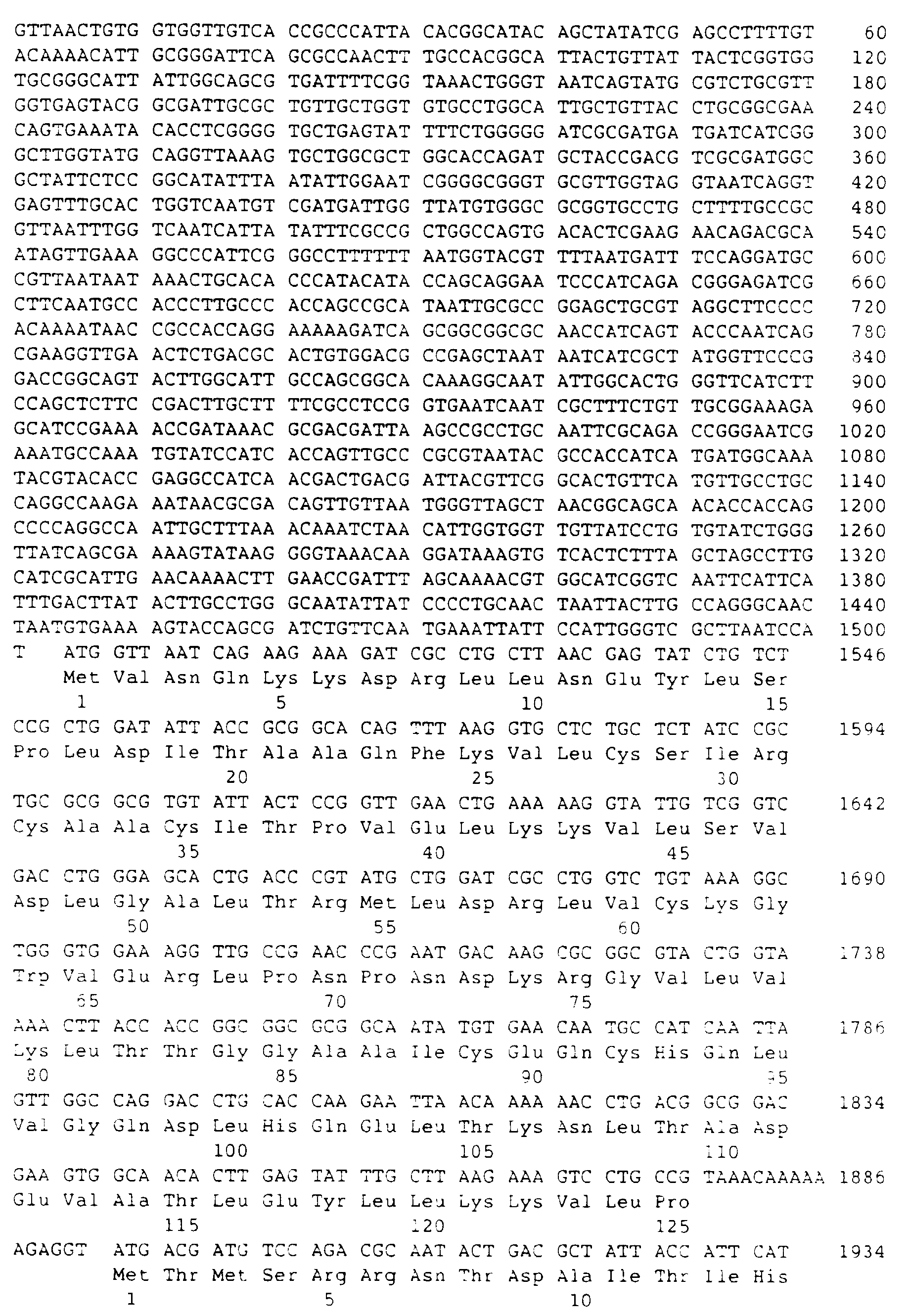
- One sequence containing a wild-type Mar operon is presented as SEQ ID NO. 1. This sequence has been entered into GenBank with Accession #M96235 and corresponds to the 7.8kbp fragment isolated in Example 1. This sequence or any portion of it may, of course, be cloned into any of a number of vectors which are known to those of ordinary skill in the art.
- the sequence of SEQ ID NO. 1 includes three regions. These regions are depicted in Figure 1.
- the E. coli Mar operon is located in Region II. Analysis of the Mar operon sequence reveals a regulatory region with a promoter-operator sequence, designated marO , and three coding regions designated marR , marA, and marB.
- the regulatory region marO extends approximately from nucleotide 1231 of SEQ ID NO. 1 to nucleotide 1502.
- the first locus, marR encodes a protein designated the Mar repressor.
- the marR locus extends from nucleotide 1502 of SEQ ID NO. 1 to nucleotide 1879.
- the second locus, marA encodes a protein designated the Mar activator.
- the marA locus extends from nucleotide 1893 of SEQ ID NO. 1 to nucleotide 2282.
- the third locus, marB encodes a protein of 72 amino acids, designated the Mar enhancer.
- the marB locus extends from nucleotide 2314 of SEQ ID NO. 1 to nucleotide 2532.
- the Mar repressor acts to repress expression of the operon by binding at marO .
- the Mar activator acts directly or indirectly to alter the expression of other operons, loci or proteins which are directly involved with the expression of the Mar phenotype.
- the Mar enhancer augments the expression of the Mar phenotype.
- Region I proceeds from marO and that the Mar repressor also regulates the levels of expression of Region I.
- the functions of the putative proteins of Region I are not yet determined.
- Region III is not under the control of the Mar regulatory region and its expression does not appear to be affected by the Mar repressor.
- the function of the putative protein encoded by Region III is not yet determined, it is clear that Region III is crucial to the expression of the Mar phenotype. This has been shown in deletion mutants which possess Regions I and II but not Region III. Such cells cannot express the Mar phenotype.
- the present invention thus provides cloned portions of these various regions including either regulatory regions, protein coding sequences or both.
- Particular examples include cloned Mar repressor, Mar activator, and Mar enhancer loci of bacterial Mar operons.
- the particular examples provided are the cloned E. coli marR , marA, and marB loci.
- Such loci are cloned preferably so as to be operably joined to a regulatory region so that they may be expressed under conditions wherein the regulatory region is not blocked by a repressor.
- the loci may be operably joined to a Mar regulatory region or to other regulatory regions depending upon the desired manner of regulation and levels of expression.
- the invention provides vectors containing an operably cloned Mar repressor locus without a Mar activator locus and with or without a Mar enhancer locus (see Example 2), an operably cloned Mar activator locus without a Mar repressor locus and with or without a Mar enhancer locus (see Example 3), and an operably cloned Mar enhancer locus without a Mar repressor locus and with or without a Mar activator locus (see Example 3).
- the present invention also provides probes useful in identifying Mar operons in species other than E. coli.
- a cloned Mar operon or cloned fragment of a Mar operon from one species can be used to screen a DNA library of another species to identify potential Mar operons by methods which are known to those of ordinary skill in the art.
- the cloned E. coli Mar operon disclosed as SEQ ID NO. 1 or a fragment thereof is used to produce probes which are radioactively labeled with 32 P (see Example 4).
- the probe is at least a substantial portion of the E. coli marA locus.
- Such probes may be found to hybridize with DNA extracted from a wide variety of bacteria and perhaps species other than bacteria and may reveal an ancient and highly evolutionarily conserved family of loci and operons.
- the present invention in another aspect provides substantially pure Mar repressor protein, substantially pure Mar activator protein and substantially pure Mar enhancer protein.
- the invention provides substantially pure E. coli Mar repressor protein, substantially pure E. coli Mar activator protein and substantially pure E. coli Mar enhancer protein (see Example 5).
- Substantially pure proteins are suitable for protein sequencing and are typically at least 90% pure by weight and preferably at least 95% pure by weight. Given the sequences disclosed herein, as well as the methods provided for identifying substantially homologous Mar operons in other species, such substantially pure proteins can be produced and isolated by one of ordinary skill in the art (Maniatis, et al. 1982).
- the invention further provides a cloned fusion of a Mar regulatory region and a marker locus.
- the Mar regulatory region is the E. coli marO and the marker locus is the ⁇ -galactosidase gene, lacZ (see Example 6).
- Such a fusion on a vector is useful for assaying the ability or inability of compositions to increase or decrease the expression of a Mar phenotype, as disclosed below.
- the present invention also provides for the creation of bacterial strains which exhibit the Mar phenotype.
- the invention provides such strains by genetic manipulation and provides such strains of E. coli.
- anti-sense to the Mar repressor locus is introduced within the cells. This may be accomplished by exposing the cells to single-stranded oligonucleotides or oligonucleotide analogs which enter the cell.
- the oligonucleotides are characterized by substantial anti-sense homology to either the Mar repressor locus or its mRNA transcript and are of sufficient length such that they either inhibit the transcription of the Mar repressor locus by binding to the Mar repressor DNA or they inhibit translation of the Mar repressor by binding to the mRNA transcript of the Mar repressor locus. More preferably, an operable anti-sense locus is introduced within the cells on a vector.
- the anti-sense locus is operably joined to a strong promoter and on a high copy-number plasmid such that the anti-sense transcripts are expressed at high levels.
- a temperature sensitive plasmid may be preferred.
- a strain is created which has a deletion, insertion or substitution in the chromosomal Mar repressor locus such that functional Mar repressor is not produced but the Mar activator locus is expressed.
- a deletion is introduced. This is achieved by cloning the Mar operon into a temperature sensitive plasmid which replicates at lower temperatures but does not replicate at higher temperatures. Using appropriate restriction enzymes, any one of numerous possible deletions is introduced into the Mar repressor locus on the plasmid. The plasmid is then introduced into bacterial cells and the cells are grown at the lower temperature to allow for homologous recombination to introduce the partially deleted Mar repressor locus into the bacterial chromosome. The bacteria are then grown at the higher temperature so that, at cell division, the temperature sensitive plasmid is lost from the daughter cells. Cells in which the deletion was introduced into the chromosome may then be selected with antibiotics.
- a Mar activator locus is introduced within the cells on a vector.
- the Mar activator locus is operably joined to the Mar regulatory region on a plasmid which does not include an operable Mar repressor locus. Homologous recombination is employed, as disclosed above, to inactivate the Mar repressor locus on the chromosome by partial deletion, insertion, or substitution, so that functional Mar repressor is not produced and the plasmid copy of the Mar activator locus is expressed.
- the Mar activator locus is operably joined to a regulatory region other than the Mar regulatory region such that it is expressed irrespective of the presence of the Mar repressor and the chromosomal Mar repressor locus need not be inactivated.
- the regulatory region contains a strong promoter.
- the plasmids be high copy-number plasmids.
- the plasmid be temperature sensitive. Given the sequences disclosed herein, as well as the methods provided for identifying substantially homologous Mar operons in other species, one of ordinary skill in the art is enabled to produce such vectors (see Examples 2 and 3).
- the present invention further provides for the creation of bacterial strains which exhibit increased sensitivity to antibiotics, relative to wild-type cells, because they have at least partially lost the ability to express a Mar activator.
- the invention provides such strains by genetic manipulation and provides such strains of E. coli .
- anti-sense to the chromosomal Mar activator locus may be introduced within the cells. This may be accomplished by exposing the cells to single-stranded oligonucleotides or oligonucleotide analogs which enter the cell.
- the oligonucleotides are characterized by substantial anti-sense homology to either the Mar activator locus or its mRNA transcript and are of sufficient length such that they either inhibit the transcription of the chromosomal Mar activator locus by binding to the Mar activator DNA or they inhibit translation of the Mar activator by binding to the mRNA transcript of the Mar activator locus. More preferably, an operable anti-sense locus is introduced within the cells on a plasmid.
- the anti-sense locus is operably joined to a strong promoter and on a high copy-number plasmid such that the anti-sense transcripts are expressed at high levels.
- a temperature sensitive plasmid may be preferred.
- a chromosomal deletion, insertion or substitution is introduced which is not in the Mar activator locus but which entails a frameshift upstream of the locus such that functional Mar activator protein is not produced.
- a strain is created which has a deletion, insertion or substitution in the chromosomal Mar activator locus such that functional Mar activator cannot be produced.
- the entire Mar operon or a substantial part of it may be deleted (see Example 7). As disclosed above, such deletions, insertions or substitutions may be achieved by homologous recombination between the chromosomal Mar operon and a properly constructed plasmid.
- a Mar repressor locus is introduced within the cells on a vector.
- the Mar repressor locus is operably joined to a regulatory region other than a Mar regulatory region such that it is expressed irrespective of its own presence.
- the regulatory region will contain a strong promoter and the vectors are high copy-number plasmids.
- the plasmid be temperature sensitive. Given the sequences disclosed herein, as well as the methods provided for identifying substantially homologous Mar operons in other species, one of ordinary skill in the art is enabled to produce such vectors (see Examples 2 and 3).
- the present invention also provides an assay for compositions which induce a Mar phenotype by interfering with the activity of a Mar repressor or which increase the sensitivity of cells to antibiotic compositions by enhancing the activity of a Mar repressor.
- cells which are not characterized by the Mar phenotype are exposed to a composition and then the level of expression of a locus under the control of a Mar regulatory region is assayed.
- the locus may be contained within a Mar operon or may be operably joined to a Mar regulatory region and introduced into the cells on a vector.
- the level of a protein product of a locus under the control of a Mar regulatory region is directly measured. This may be accomplished by polyacrylamide gel electrophoresis as well as other means which are known to those of ordinary skill in the art.
- the levels of the mRNA transcript of a locus under the control of a Mar regulatory region are directly measured. This may be accomplished, as is well known in the art, by performing a Northern hybridization with a probe which has been radioactively labeled with 32 P and measuring the level of radioactive probe bound.
- the locus is a Mar operon activator locus (see Example 8). Probes for such a locus are disclosed above.
- the locus is at least one of the open reading frames of the E. coli Region I (see Figure 1) disclosed in SEQ ID NO. 1.
- a fusion of a marker locus to a Mar regulatory region is introduced within the cells.
- One such fusion is disclosed in Example 6.
- the marker fusion of Example 6 is introduced within cells and the cells are then grown in LB broth at 30°C for one hour in the presence of the compound to be tested.
- the level of activity of the ⁇ -D-galactosidase marker can be determined by the O-nitrophenyl- ⁇ -D-galactoside assay described in Maniatis, et al. (1982).
- a vector bearing an operable Mar repressor locus be introduced within the cells. This will cause increased repression of the Mar operon and improve the ability of the assay to detect inducers of the Mar phenotype.
- the Mar repressor locus is preferably introduced into the chromosome by homologous recombination and is operably joined to a regulatory region other than a Mar regulatory region such that it does not repress it own expression. Such vectors are disclosed above.
- the most preferred embodiment is an assay employing cells into which have been introduced both a marker locus fused to a Mar regulatory region and an operable Mar repressor locus which is not controlled by a Mar regulatory region.
- the present invention also provides assays for compositions which act to prevent the expression of a Mar phenotype or which cause cells to become even more sensitive to certain compounds than wild-type cells, by acting as inhibitors of Mar operon expression.
- cells which possess an operable Mar activator locus are exposed to a composition and then the level of expression of a locus, the expression of which is at least in part controlled by Mar operon expression, is assayed.
- the locus may be naturally occurring in the cells or may be operably joined to a regulatory region influenced by Mar operon expression.
- the assay may be a direct assay for a translation product of the locus by, for example, electrophoresis of cellular proteins, for a transcription product of the locus by, for example, a Northern blot of cellular mRNA or, in a preferred embodiment, the locus is a marker locus, the activity of which is easily assayed.
- a marker locus is operably joined to the regulatory region of an opercn which is affected by Mar operon expression. Means of identifying such loci are disclosed below. The fusion of the regulatory region and marker is then introduced into cells. After the cells have been exposed to a composition, changes in the level of expression of the marker locus can be assayed as an indication of the effect of the composition on the expression of the Mar operon.
- the regulatory region is from the micF or ompF loci of E. coli. The expression of the micF locus is affected by Mar operon expression. The micF locus, in turn, affects the expression of the ompF locus.
- loci or their regulatory regions may be operably fused to, for example, lacZ and the activity of the ⁇ -D-galactosidase determined as described above.
- the regulatory region is marO and the marker locus is one of the loci encoded by the E. coli Region I shown in Figure 1 and disclosed in SEQ ID NO. 1.
- the assay is for the transcription products of Region I.
- the present invention also provides assays for identifying loci involved in the expression of a Mar phenotype other than Mar operons. That is, the invention provides assays for loci whose expression is directly or indirectly regulated by a Mar activator protein.
- substantially purified Mar activator protein is mixed with the fragmented genomic DNA of a species under conditions which permit it to bind to appropriate DNA sequences.
- DNA fragments to which the activator has bound may then be isolated on filters, in polyacrylamide gels, or by other methods well known to those of ordinary skill in the art. Those fragments may then be cloned into vectors and used as probes to locate and isolate their corresponding loci or may be sequenced to identify gene products associated with them.
- a cell line is employed into which has been introduced a vector bearing an operable Mar activator locus such that the cells express the Mar phenotype.
- the activator locus is joined to a regulatory region other than the Mar regulatory region such that its level of expression is high.
- the Mar repressor locus may be inactivated by deletion, insertion or substitution, as disclosed above and a plasmid bearing an operable activator locus but not an operable repressor locus, as disclosed above, may be introduced within the cells. The total mRNA from these cells may then be compared to the total mRNA of cells which are not expressing the Mar phenotype.
- this is accomplished by creating a cDNA library of the total mRNA from the Mar strain and the non-Mar strain. This cDNA library is then used to generate probes to screen, by standard Northern technique, the total mRNA from the Mar strain and the non-Mar strain. Any cDNA probes that hybridize to the mRNA of one strain but not to the mRNA of the other will correspond to loci involved in the expression of the Mar phenotype. Those probes may then be used to identify such loci by standard techniques. An alternative approach would employ subtractive screening. The cDNA from a strain expressing a Mar activator locus can be hybridized to excess mRNA from a strain deleted of that locus. Subsequently, those cDNAs which do not hybridize can be isolated by hydroxyapatite chromatography and used to identify Mar related loci.
- a promoterless marker locus is introduced into the cell and allowed to insert randomly into the chromosome.
- the cells are then manipulated so as to change their phenotype either from non-Mar to Mar or from Mar to non-Mar.
- Cells in which the expression of the marker changes along with the change in Mar phenotype contain markers which have operably inserted into loci which are regulated directly or indirectly by a Mar operon.
- the cells do not initially express the Mar phenotype but contain an operable Mar operon which is capable of being induced. It is particularly preferred that a vector bearing an operable Mar repressor locus, as disclosed above, be introduced within the cells such that the expression of the Mar activator locus is initially minimal.
- a promoterless marker locus contained within a transposon and inserted within a phage, for example ⁇ ::Tn phoA or ⁇ ::Tn lacZ is introduced into the cells and allowed to randomly integrate into the genome.
- the transposon also include a locus conferring resistance to kanamycin or another appropriate antibiotic.
- a number of colonies are then isolated on plates containing kanamycin or another appropriate antibiotic. These colonies are then examined for expression of the marker locus. If the marker is phoA or lacZ and the cells are grown on plates with 5-bromo-4-chloro-3-indolyl phosphate (XP plates) or 5-bromo-4-chloro-3-indolyl ⁇ -D-galactoside (XG plates), colonies in which the marker operably inserted into an actively expressed locus will be blue whereas colonies in which the marker failed to insert, inserted inoperably, or inserted operably into a repressed locus will appear white.
- XP plates 5-bromo-4-chloro-3-indolyl phosphate
- XG plates 5-bromo-4-chloro-3-indolyl ⁇ -D-galactoside
- the colonies in which the marker is not expressed are then isolated and the cells are grown in the presence of a known inducer of the Mar operon (e.g. salicylate or tetracycline for E. coli). Subsequent to such treatment, colonies which express the marker (and, in the example, turn blue) are isolated. These colonies contain the marker operably inserted in a locus that is subject to regulation by a Mar operon. The DNA of these colonies may then be fragmented and cloned. Those clones which confer resistance to kanamycin or another appropriate antibiotic will contain the marker in the transposon as well as DNA adjacent to the insertion site.
- a known inducer of the Mar operon e.g. salicylate or tetracycline for E. coli.
- genomic DNA adjacent to the insertion site of the transposon can then be isolated and the locus into which the transposon Inserted can be identified by techniques known to those of ordinary skill in the art. That locus will, by this method, be identified as one which is involved in the expression of the Mar phenotype.
- the cells initially express the Mar phenotype but can easily be caused to express the non-Mar phenotype.
- a promoterless marker in a transposon is introduced within the cells and allowed to randomly integrate into the chromosome. And, as above, the transposon also encodes a locus conferring resistance to kanamycin or another appropriate antibiotic.
- a temperature sensitive plasmid, such as pMAK705 (Hamilton, et al. 1989), bearing an operable Mar activator locus is introduced within the cells.
- the plasmid may bear the activator locus operably joined to a Mar regulatory region but without the Mar repressor locus or, preferably, may contain an activator locus operably joined to a regulatory region other than a Mar regulatory region such that its level of expression is high. If the Mar activator locus is operably joined to a Mar regulatory region, the chromosomal Mar repressor locus must be inactivated by any of the means disclosed above. In addition, the chromosomal Mar activator locus is inactivated by any of the means disclosed above so that the expression of the Mar phenotype is dependent upon the plasmid, and the cells are recombination deficient (e.g.
- the cells are grown at a temperature at which the temperature sensitive plasmid replicates (e.g. 30°C for pMAK705) and in the presence of kanamycin or another appropriate antibiotic.
- a number of colonies preferably at least five thousand and, more preferably, at least ten thousand, are then isolated and examined for expression of the marker locus.
- colonies in which the marker operably inserted into an actively expressed locus will be blue whereas colonies in which the marker failed to insert, inserted inoperably, or inserted operably into a repressed locus will appear white.
- the colonies in which the marker is expressed are then isolated and the cells are grown at an elevated temperature (e.g. 42°C for pMAK705) such that the temperature sensitive plasmid and, consequently, the Mar phenotype are lost. Then, colonies which no longer express the marker are isolated. These colonies contain the marker in the transposon operably inserted in a locus that is subject to regulation by a Mar operon.
- the kanamycin or other resistance locus in the transposon can be used to isolate a fragment containing the transposon and DNA adjacent to the insertion site of the transposon.
- the locus into which the transposon inserted can then be identified by techniques known to those of ordinary skill in the art. That locus will, by this method, be identified as one which is involved in the expression of the Mar phenotype.
- the present invention further provides compositions and a method for their use in treating bacterial infections.
- compositions which inhibit the expression of a bacterial Mar operon. These compositions may be administered to a human or other animal along with known antibiotics. By inhibiting the expression of the Mar operon, these compositions will either enhance the effectiveness of the known antimicrobial or will render an otherwise ineffective antimicrobial effective.
- Such compositions once identified by the means disclosed herein, can be combined in pharmaceutically effective amounts with known antimicrobials by one ordinarily skilled in the art.
- a Mar mutant of E. coli K12 designated AG102 was derived from a wild-type strain designated AG100 by selection with antibiotics (see George and Levy, 1983b). AG102 was then subjected to ⁇ b221 c1857 rex::Tn 5 mutagenesis. A revertant from the Mar phenotype, resulting from Tn 5 insertion within the Mar operon, was isolated and designated AG1025 Exploiting the single Bam HI site in Tn 5 , the AG1025 chromosomal DNA was digested with Bam HI or partially digested with Sau 3A. The resulting fragments were ligated into the single Bam HI site of the high copy-number plasmid vector pUC18.
- pKanl and pKan2 Two clones, designated pKanl and pKan2 (see Hachler, Cohen and Levy, 1991), were isolated which contained the 3.2kbp of Tn 5 upstream of its internal BamHI site.
- Two phasmids identified by the probe were introduced by transduction into a deletion strain HH84 in which the region including the Mar operon had been deleted from the chromosome. These phasmids were capable of restoring Mar operon activity.
- One of the fragments 13.lkbp in length, was used for subcloning into the low copy-number vector pHSG415.
- Mar activity was tested in CH164, a ⁇ marA strain genetically related to the original AG100 Mar mutants.
- the Mar repressor locus, marR was cloned from the wild-type plasmid pHHM183 (see Hachler, Cohen and Levy, 1991) as an 818bp Dra I fragment into the Sma I site of the high copy-number cloning vector pUC18.
- the plasmid was designated p125WT.
- a mutant Mar repressor locus causing expression of the Mar phenotype was cloned on a 850bp Dra I- Hpa I fragment from plasmid pKanl (see Hachler, Cohen and Levy, 1991) into pUC18. This plasmid was designated pl25Mar.
- These plasmids have been introduced into a number of E. coli K12 strains such as the wild-type AG100 and Mar mutant AG102. The full genotypes of these strains may be found in Cohen et al., 1988.
- the entire E. coli Mar operon, marA, and marB have been cloned into various vectors and introduced within various hosts using the disclosed sequences and the polymerase chain reaction to generate the fragments disclosed below.
- the PCR primers at the 5' end were nucleotides 1311-1328 of SEQ ID NO. 1 and nucleotides 2575-2592 at the 3' end.
- PstI linkers were included at both ends.
- the PCR primers were nucleotides 1893-1908 at the 5' end and nucleotides 2265-2282 at the 3' end with EcoRI linkers at both ends.
- the PCR primers were nucleotides 2314-2331 at the 5' end and nucleotides 2515-2532 at the 3' end with Eco RI linkers at both ends.
- the PCR synthesized genes have been cloned into several plasmid vectors at appropriate single restriction enzyme sites: pUC18, a multicopy ColE1 derivative; pMAK705, a temperature-sensitive plasmid described in Hamilton et al., 1989; and pMAL-C2, a plasmid used for expressing the protein fused to MalE (New England BioLabs, Beverly, Mass., product #800).
- the plasmids have been introduced in wild-type E.
- SEQ ID NO. 1 Cloned copies of SEQ ID NO. 1 were digested with Bsp HI. A resulting 1.24kbp fragment, corresponding to nucleotides 1073 to 2314 of SEQ ID NO. 1 was used to produce 32 P labelled probes. DNA extracted from a large number of bacterial species were tested for homology to this probe under stringent DNA::DNA hybridization techniques using dot blots and Southern hybridization methods, as are well known to those of ordinary skill in the art (see, e.g., Maniatis, Fritch and Sambrook, 1982).
- DNA from the following gram-negative genera were found to hybridize with the probe: Citrobacter , Enterobacter, Escherichia , Hafnia , Klebsiella , Salmonella, and Shigella . Two species, Enterobacter agglomerans and Salmonella sp., were further tested. These were found to produce Mar phenotype mutants when selected by the same regime employed with E. coli and to produce a 1.4kb mRNA transcript at heightened levels. The 1.4kb transcripts were the same size as and homologous to the mRNA produced at heightened levels in E. coli expressing the Mar phenotype.
- the E. coli marA fragment described in Example 3 was cloned into pMAL-C2, a vector bearing the maltose binding protein locus, MalE.
- This vector is commercially available as part of a kit for protein purification ("Protein fusion and purification system," New England BioLabs, Beverly, Mass., product #800).
- the fusion protein was made in E. coli TB1 ( ara , ⁇ ( lac pro AB ) rpsL ( ⁇ 80 lacZ ⁇ M15 ) hsdR).
- the fusion protein was then substantially purified by amylose column chromatography.
- the peptide linking the Mar activator protein and the maltose binding protein was cleaved and the substantially purified Mar protein collected.
- a 405bp ThaI fragment containing the E. coli marO region was ligated into the Sma I site of pMLB1109, a lacZ transcriptional fusion plasmid.
- the resulting plasmid construct had lacZ gene expression under the control of the marO promoter.
- the fusion was introduced into the chromosome of a wild type cell and a Mar operon deleted strain. This was accomplished by first introducing the marO - lacZ region of the fusion plasmids, by homologous recombination, into the genome of phage ⁇ RZ5 by infecting an E.
- coli K12 strain designated SPC103 (M4100 ( ⁇ lac U169 araD , rpsL , relA , thi , fibB ) deleted of 39kbp surrounding the Mar operon) bearing one of the fusion plasmids, with ⁇ RZ5.
- the resulting lysate was used to transduce plasmid-less SPC103.
- Amp R , Lac + lysogens were selected on LB agar containing ampicillin (50 ⁇ g/ml) and 5-bromo-4-chloro-3-indolyl ⁇ -D-galactosidase. Lysates from these purified lysogens were then used to infect E.
- Lysogens of MC4100 (SPC104, SPC105) had 2 bands which hybridized with a 9kb fragment representing the naturally occurring marO - marA sequence and a larger fragment (>15kb) representing the insertion of the marO - lacZ fusion phage into the chromosome.
- the lysogens of the Mar deletion strain SPC103 (SPC106, SPC107) contained only chromosomal sequences corresponding to the larger band. DNA manipulations and analyses were performed according to Maniatis et al. (1982).
- Assays for ⁇ -galactosidase activity were performed on cells grown for one hour to mid-logarithmic phase in LB broth in the presence of known and potential inducers of the Mar phenotype at 30° C. The ⁇ -galactosidase activity of these cells was compared to cells grown similarly but in the absence of known inducers of the Mar phenotype.
- a 9kbp Pst I fragment of E. coli K12 chromosomal DNA containing the Mar operon was cloned into temperature-sensitive plasmid pMAK705.
- the plasmid replicates at 30°C but is lost from daughter cells during cells division at 42°C.
- Bsp HI a 1.24kbp deletion corresponding to nucleotide 1073 to nucleotide 2314 of SEQ ID NO. 1 and including all of the marO region, the marR and marA loci, and part of the marB locus was made within the Mar operon on the plasmid.
- the plasmid was then introduced within E. coli K12 AG100 (see George and Levy, 1983b for genotype information).
- the plasmid and chromosome were then allowed to undergo homologous recombination and the cells were cured of the plasmid at 42°C.
- a recombinant strain with the 1.24kbp deletion in the chromosomal Mar operon was isolated and designated AG100 ⁇ 15.
Landscapes
- Health & Medical Sciences (AREA)
- Genetics & Genomics (AREA)
- Life Sciences & Earth Sciences (AREA)
- Engineering & Computer Science (AREA)
- Chemical & Material Sciences (AREA)
- Organic Chemistry (AREA)
- Zoology (AREA)
- Wood Science & Technology (AREA)
- General Engineering & Computer Science (AREA)
- Biotechnology (AREA)
- Biomedical Technology (AREA)
- Bioinformatics & Cheminformatics (AREA)
- Molecular Biology (AREA)
- Proteomics, Peptides & Aminoacids (AREA)
- Biophysics (AREA)
- Biochemistry (AREA)
- Microbiology (AREA)
- Physics & Mathematics (AREA)
- General Health & Medical Sciences (AREA)
- Analytical Chemistry (AREA)
- Immunology (AREA)
- Plant Pathology (AREA)
- Measuring Or Testing Involving Enzymes Or Micro-Organisms (AREA)
- Micro-Organisms Or Cultivation Processes Thereof (AREA)
- Preparation Of Compounds By Using Micro-Organisms (AREA)
Abstract
Description
- Clewell, D.B., 1981. Microbiol. Rev. 45:409-436.
- Cohen, S.P., L.M. McMurry, D.C. Hooper, J.S. Wolfson and S.B. Levy, 1989. Antimicrob. Agents Chemother. 33:1318-1325.
- Cohen, S.P., L.M. McMurry and S.B. Levy, 1988. J. Bacteriol. 170:5416-5422.
- Elledge, S.J. and G.C. Walker, 1985. J. Bacteriol. 162:777-783.
- Foster, T.J., 1983. Microbiol. Rev. 47:361-409.
- George, A.M. and S.B. Levy, 1983a. J. Bacteriol. 155:531-540.
- George, A.M. and S.B. Levy, 1983b. J. Bacteriol. 155:541-548.
- Gutmann, L., R. Williamson, N. Moreau, M. Kitzis, E. Collatz, J.F. Acar, and F.W. Goldstein, 1985. J. Infect. Dis. 151:501-507.
- Hachler, H., S.P. Cohen and S.B. Levy, 1991. J. Bacteriol. 173:5532-5538
- Hamilton, C.M., M. Aldea, B.K. Washburn, P. Babitzke and S.R. Kushner, 1989. J. Bacteriol. 171:4617-4622. 1989
- Johnson, S.R. and S.A. Morse, 1988. Sex. Transm. Dis. 15:217-224.
- Maniatis, T., E.F. Fritsch and J. Sambrook, 1982. Molecular Cloning: a Laboratory Manual. Cold Spring Harbor Laboratory, Cold Spring Harbor, NY.


Claims (52)
- A method for predicting the antibiotic effectiveness of a composition comprisingexposing bacteria to said composition andassaying the effect of said exposure on the expression of a genetic locuswherein said expression is regulated at least in part and at least indirectly by at least a portion of a regulatory region of a bacterial multiple antibiotic resistance operon within said bacteria.
- A method as claimed in claim 1, wherein said assay comprisesa determination of the levels of a transcription product of said genetic locus.
- A method as claimed in claim 1, wherein said assay comprisesa determination of the levels of a translation product of said genetic locus.
- A method as in claimed claims 1, 2 or 3, further comprisingintroducing within said bacteria an oligonucleotide sequence, said sequence includingat least a portion of a regulatory region of a bacterial multiple antibiotic resistance operon operably joined to a marker locus such that the expression of said marker locus is substantially dependent upon said portion of said regulatory region, andwherein said genetic locus is said marker locus and said assay is for the expression of said marker locus.
- A method as claimed in claim 4, wherein said marker locus is a sequence encoding an enzyme.
- A method as claimed in claim 5, wherein said marker locus is a sequence encoding at least a portion of a bacterial beta-galactosidase.
- A method as claimed in any of claims 4-6, further comprisingintroducing within said bacteria an operable oligonucleotide sequence encoding at least a portion of a repressor of said bacterial multiple antibiotic resistance operon,wherein said portion of said repressor is capable of substantially inhibiting the expression of a bacterial multiple antibiotic resistance operon, andwherein said assay is for increased expression of said genetic locus.
- A method as claimed in any of claims 4-6, wherein, prior to said exposure, said bacteria effectively express a multiple antibiotic resistance phenotype andwherein said assay is for decreased expression of said genetic locus.
- A method of predicting the antibiotic effectiveness of a composition comprisingexposing a strain of bacteria to said composition anddetermining the effects of said composition on the growth of said bacteriawherein, prior to said exposure, said strain of bacteria has been treated so as to substantially decrease or increase the expression of a multiple antibiotic resistance operon.
- A method as claimed in claim 9, wherein said operon has been at least partially deleted in said bacteria.
- A method as claimed in claim 9, wherein said strain of bacteria has been genetically altered, said alteration comprisingintroducing within said bacteria an operable oligonucleotide sequence encoding at least a portion of a repressor or an activator of said operonwherein said portion of said repressor or activator is capable of substantially inhibiting or increasing, respectively, the expression of said operon.
- A method as in claim 9, wherein said strain of bacteria has been genetically altered, said alteration comprisingintroducing within said bacteria an operable oligonucleotide sequence encoding an mRNA transcript characterized by substantial homology to a least a portion of an activator or repressor locus of said operon such that said mRNA transcript substantially inhibits or increases, respectively, the expression of said activator or repressor locus.
- A method as in claim 9, wherein said strain of bacteria has been genetically altered so as to decrease expression of a multiple drug resistance operon, said alteration comprising,introducing within said bacteria a transposon such that said transposon inserts within an activator locus of said operon.
- A method as claimed in claims 1, 2 or 3, further comprisingintroducing within said bacteria an oligonucleotide sequence, said sequence includinga marker locus operably joined to at least a portion of a regulatory region of a bacterial operon such that the expression of said marker locus is substantially dependent upon said portion of a regulatory region of said bacterial operon,wherein the expression of said bacterial operon is regulated at least in part by expression of a bacterial multiple antibiotic resistance operon.
- A method as claimed in claim 14, wherein said bacteria express a multiple antibiotic resistance phenotype.
- A method as claimed in claim 14, further comprisingintroducing within said bacteria an operable oligonucleotide sequence encoding at least a portion of an activator of said bacterial multiple antibiotic resistance operonwherein said portion is capable of substantially increasing the expression of a bacterial multiple antibiotic resistance phenotype.
- A method as claimed in claims 15 or 16, wherein at least a portion of a repressor locus of said operon has been deleted such that said bacteria express a multiple antibiotic resistance phenotype.
- A method as claimed in claim 14, further comprisingintroducing within said bacteria an operable oligonucleotide sequence encoding an mRNA transcript characterized by substantial homology to at least a portion of a repressor locus of said operon such that said mRNA transcript substantially inhibits the expression of said repressor locus.
- A method as claimed in claim 17, wherein said marker locus encodes at least a portion of a bacterial beta-galactosidase and said bacterial operon is at least a portion of a bacterial micF operon.
- A method of inhibiting the growth of bacteria comprisingexposing said bacteria to a composition including anamount of an antibiotic composition andan amount of a substance which inhibits the expression of a multiple antibiotic resistance phenotype by said bacteria.
- A method as claimed in claim 20, wherein said substance is an oligonucleotide sequence comprising at least a portion of a repressor locus of a bacterial multiple antibiotic resistance operon operably joined to a portion of a regulatory region such that the expression of said repressor locus is substantially dependent upon said portion of a regulatory region andsaid sequence is free from operable sequences encoding an activator of a bacterial multiple antibiotic resistance operon.
- A method as claimed in claim 20, wherein said substance is an oligonucleotide sequence characterized by substantial homology to at least a portion of an activator locus of a bacterial multiple antibiotic resistance operon.
- A method as claimed in claim 20, wherein said substance is an inhibitor of the activity of an activator of a bacterial multiple antibiotic resistance operon.
- A method of identifying bacterial loci which affect resistance to antibiotic compositions comprisingallowing an activator of a bacterial multiple antibiotic resistance operon to bind to a bacterial DNA molecule andassaying for sites on said DNA to which said activator binds.
- A method as claimed in claim 24, wherein said DNA has been fragmented and said assay is in vitro.
- A method of identifying bacterial loci which affect resistance to antibiotic compositions comprisingintroducing within said bacteria an operable oligonucleotide sequence encoding at least a portion of an activator of a bacterial multiple antibiotic resistance operonwherein said portion of said activator is capable of substantially increasing the expression of a bacterial multiple antibiotic resistance phenotype, and assaying for changes in the levels of expression of genetic loci within said bacteria.
- A method of identifying bacterial loci which affect resistance to antibiotic compositions comprisingsubjecting bacteria to a first set of conditions such that said bacteria express a multiple antibiotic resistance phenotype,introducing within said bacteria an oligonucleotide sequence including a marker locus and free of a regulatory region operably joined to said marker locus,permitting said sequence to integrate at random sites within a chromosome of said bacteria,assaying for expression of said marker locus,subjecting a subset of said bacteria which express said marker locus to a second set of conditions such that said subset of bacteria do not express said phenotype;assaying for bacteria in said subset of bacteria which do not express said marker locus under said second set of conditions, anddetermining said site of integration of said marker locus in said subset of bacteria which express said marker locus under said first set of conditions and which do not express said marker locus under said second set of conditions.
- A method as claimed in claim 27, wherein said first set of conditions comprisesintroducing within said bacteria a temperature sensitive plasmid including an operable oligonucleotide sequence encoding at least a portion of an activator of a bacterial multiple antibiotic resistance operon,wherein said portion of said activator is capable of substantially increasing the expression of a bacterial multiple antibiotic resistance phenotype, wherein said second set of conditions comprises increasing the temperature under which said bacteria are cultured such that the replication of said temperature sensitive plasmid is substantially inhibited, whereinsaid bacteria are free of an operable activator locus of a bacterial multiple antibiotic resistance operon on a chromosome of said bacteria, and whereinsaid bacteria are recombination deficient.
- A method as claimed in claim 27, wherein said first set of conditions comprisesintroducing within said bacteria a temperature sensitive plasmid including an operable oligonucleotide sequence encoding an mRNA transcript characterized by substantial homology to at least a portion of a repressor locus of a bacterial multiple antibiotic resistance operon such that said transcript substantially inhibits the expression of said repressor locus, and wherein said second set of conditions comprises increasing the temperature under which said bacteria are cultured such that the replication of said temperature sensitive plasmid is substantially inhibited, wherein said bacteria possess an operable bacterial multiple antibiotic resistance operon on a chromosome of said bacteria, and wherein said bacteria are recombination deficient.
- A method as claimed in claim 27, wherein said second set of conditions comprisesexposing said bacteria to a transposon such that said transposon enters said bacteria and inactivates an activator locus of a bacterial multiple antibiotic resistance operon by insertion within said locus.
- A method of identifying bacterial loci which affect resistance to antibiotic compositions comprisingsubjecting bacteria to a first set of conditions such that said bacteria do not express a multiple antibiotic resistance phenotype,introducing within said bacteria an oligonucleotide sequence including a marker locus and free of a regulatory region operably joined to said marker locus,permitting said sequence to integrate within a chromosome of said bacteria,assaying for expression of said marker locus,subjecting a subset of said bacteria which do not express said marker locus to a second set of conditions such that said subset of bacteria express said phenotype;assaying for bacteria in said subset of bacteria which express said marker locus under said second set of conditions, anddetermining the site of integration of said marker locus in said subset of bacteria which do not express said marker locus under said first set of conditions and which express said marker locus under said second set of conditions.
- A method as claimed in claim 31, wherein said first set of conditions comprisesgrowing said bacteria in a culture substantially free of inducers of a bacterial multiple antibiotic resistance operon,wherein said second set of conditions comprisesexposing said bacteria to an inducer of a bacterial multiple antibiotic resistance operon such that said inducer enters said bacteria and induces expression of a multiple antibiotic resistance phenotype in said bacteria.
- A method as claimed in claims 28 or 32, wherein said marker locus is a sequence encoding an enzyme.
- A method as claimed in claim 33, wherein said marker locus is a sequence encoding at least a portion of a bacterial beta-galactosidase.
- A method as claimed in claim 33, wherein said marker locus is a sequence encoding at least a portion of a bacterial alkaline phosphatase.
- A composition comprising an isolated oligonucleotide sequence, including at least a portion of a regulatory region of a bacterial multiple antibiotic resistance operon operably joined to a marker locus such that the expression of said marker locus is substantially dependent upon said portion, wherein said marker locus is a locus other than a bacterial multiple antibiotic resistance operon locus.
- A composition as claimed in claim 36, wherein said marker locus is a sequence encoding an enzyme.
- A composition as claimed in claim 37, wherein said marker locus is a sequence-encoding at least a portion of a bacterial beta-galactosidase.
- A composition comprisingan isolated oligonucleotide sequence, wherein said sequence is sufficiently homologous to a bacterial multiple antibiotic resistance operon so as to be capable of binding in a sequence specific manner to said operon, andwherein said sequence is of sufficient length such that said binding distinguishes said operon from loci other than bacterial multiple antibiotic resistance operon loci.
- A composition as claimed in claim 39, wherein said sequence comprisesat least a portion of a repressor or an activator locus of a bacterial multiple antibiotic resistance operon operably joined to at least a portion of a regulatory region such that the expression of said repressor or said activator is substantially dependent upon said portion of a regulatory region, andsaid repressor or said activator sequence is free from operable sequences encoding an activator or repressor, respectively, of a bacterial multiple antibiotic resistance operon.
- A composition as claimed in claim 39, wherein said sequence comprisesan anti-sense locus operably joined to at least a portion of a regulatory region such that the expression of said anti-sense locus is substantially dependent upon said portion of a regulatory region,said anti-sense locus encodes an mRNA transcript characterized by substantial anti-sense homology to at least a portion of a DNA or mRNA of an activator or repressor locus of said bacterial multiple antibiotic resistance operon andsaid sequence is free of operable sequences encoding a repressor or activator locus, respectively, of said bacterial multiple antibiotic resistance operon.
- A composition as claimed in claims 40 or 41, wherein said sequence comprises at least a portion of an activator locus and is included in a temperature sensitive plasmid.
- An antibacterial composition comprising an antibiotic composition and a substance which inhibits the expression of bacterial multiple antibiotic resistance operon.
- An antibacterial composition as claimed in claim 43, wherein the substance is an oligonucleotide sequence, said sequence comprisingat least a portion of a repressor locus of a bacterial multiple antibiotic resistance operon operably joined to at least a portion of a regulatory region such that the expression of said repressor locus is substantially dependent upon said portion of a regulatory region andsaid sequence is free from operable sequences encoding an activator of a bacterial multiple antibiotic resistance operon.
- An antibacterial composition as claimed in claim 43, wherein the substance is an oligonucleotide sequence characterized by substantial homology to at least a portion of an activator locus of a bacterial multiple antibiotic resistance operon such that said composition is capable of substantially inhibiting the expression of said locus.
- An antibacterial composition as claimed in claim 45, wherein the substance is an inhibitor of the activity of an activator of a bacterial multiple antibiotic resistance operon.
- A composition comprising substantially pure repressor or activator of a bacterial multiple antibiotic resistance operon.
- A composition comprisingsubstantially pure oligonucleotide characterized by substantial homology to at least a portion of a repressor or an activator locus of a bacterial multiple antibiotic resistance operonwherein said oligonucleotide has sufficient homology so as to be capable of binding in a sequence specific manner to said portion of said repressor or said activator locus, andwherein said oligonucleotide is of sufficient length such that such binding distinguishes said portion of said repressor or said activator locus from loci other than bacterial multiple antibiotic resistance operon repressor or activator loci.
- A composition as claimed in claims 47 or 48, wherein said oligonucleotide is labeled.
- A bacterial cell into which an oligonucleotide sequence as claimed in any one of claims 36-42 has been introduced.
- A bacterial cell as claimed in claim 50, wherein said bacterium is recombination deficient.
- A bacterial cell as claimed in claim 51, wherein said bacterium is free of an operable multiple antibiotic resistance operon on a chromosome.
Applications Claiming Priority (3)
| Application Number | Priority Date | Filing Date | Title |
|---|---|---|---|
| US938085 | 1986-12-04 | ||
| US93808592A | 1992-08-28 | 1992-08-28 | |
| PCT/US1993/008115 WO1994005810A1 (en) | 1992-08-28 | 1993-08-27 | Multiple antibiotic resistance operon assays |
Publications (2)
| Publication Number | Publication Date |
|---|---|
| EP0658213A1 EP0658213A1 (en) | 1995-06-21 |
| EP0658213B1 true EP0658213B1 (en) | 1998-11-18 |
Family
ID=25470856
Family Applications (1)
| Application Number | Title | Priority Date | Filing Date |
|---|---|---|---|
| EP93920397A Expired - Lifetime EP0658213B1 (en) | 1992-08-28 | 1993-08-27 | Multiple antibiotic resistance operon assays |
Country Status (5)
| Country | Link |
|---|---|
| US (4) | US5817793A (en) |
| EP (1) | EP0658213B1 (en) |
| AT (1) | ATE173510T1 (en) |
| DE (1) | DE69322166T2 (en) |
| WO (1) | WO1994005810A1 (en) |
Families Citing this family (22)
| Publication number | Priority date | Publication date | Assignee | Title |
|---|---|---|---|---|
| US5989832A (en) * | 1995-04-21 | 1999-11-23 | Microcide Pharmaceuticals, Inc. | Method for screening for non-tetracycline efflux pump inhibitors |
| JP2001512324A (en) * | 1997-02-21 | 2001-08-21 | ハイブリドン,インク. | Oligonucleotides specific to the mar ORAB operon |
| US6068972A (en) * | 1997-10-03 | 2000-05-30 | Trustees Of Tufts College | Methods and compositions for reducing bacterial tolerance to antibacterials, disinfectants and organic solvents |
| BR9908096A (en) * | 1998-02-19 | 2000-10-31 | Eastern Virginia Med School | Recombinant, active, human skin zone protein (hzp3) 3 |
| US7037663B2 (en) * | 1998-02-19 | 2006-05-02 | Eastern Virginia Medical School | Human zona pellucida protein 3 and uses thereof |
| CA2321931A1 (en) * | 1998-03-06 | 1999-09-10 | E.I. Du Pont De Nemours And Company | Methods for identifying polycationic, peptide-like compounds with antibacterial activity |
| WO1999061579A2 (en) * | 1998-05-22 | 1999-12-02 | Tufts University | MarA FAMILY HELIX-TURN-HELIX DOMAINS AND THEIR METHODS OF USE |
| US6346391B1 (en) | 1999-07-22 | 2002-02-12 | Trustees Of Tufts College | Methods of reducing microbial resistance to drugs |
| US7405235B2 (en) * | 2001-05-04 | 2008-07-29 | Paratek Pharmaceuticals, Inc. | Transcription factor modulating compounds and methods of use thereof |
| AU2002367953C1 (en) * | 2001-05-04 | 2009-02-19 | Paratek Pharmaceuticals, Inc | Transcription factor modulating compounds and methods of use thereof |
| US7202339B2 (en) * | 2001-07-13 | 2007-04-10 | Trustees Of Tufts College | Crystals of MarR polypeptides, regulators of multiple antibiotic resistance |
| US7075582B2 (en) | 2001-07-13 | 2006-07-11 | Paratek Pharmaceuticals, Inc. | Methods for identifying and using MarR family polypeptide binding compounds |
| US20060084678A1 (en) * | 2001-07-13 | 2006-04-20 | Paratek Pharmaceuticals, Inc. | Methods for identifying and using MarR family polypeptide binding compounds |
| EP1421104A4 (en) * | 2001-08-02 | 2005-08-24 | Trinity Biomedical Technology | HUMAN PELLUCID ZONE PROTEINS AND METHODS OF USE THEREOF FOR THE DIAGNOSIS OF MALE STERILITY |
| GB0123401D0 (en) * | 2001-09-28 | 2001-11-21 | Novartis Forschungsstiftung | Methods of inducing gene expression |
| US20040106553A1 (en) * | 2002-06-24 | 2004-06-03 | Alekshun Michael N. | Methods for preventing and treating microbial infections by modulating transcription factors |
| WO2004000228A2 (en) * | 2002-06-24 | 2003-12-31 | Paratek Pharmaceuticals, Inc. | Methods for preventing and treating microbial infections by modulating transcription factors |
| JP2008504233A (en) | 2004-04-23 | 2008-02-14 | パラテック ファーマシューティカルズ インコーポレイテッド | Transcription factor modulating compounds and methods of use thereof |
| US8021883B2 (en) | 2005-05-11 | 2011-09-20 | Chr. Hansen A/S | Antibiotic-sensitive lactic acid bacteria strains |
| US20090131481A1 (en) * | 2007-03-27 | 2009-05-21 | Paratek Pharmaceuticals, Inc. | Transcription Factor Modulating Compounds and Methods of Use Thereof |
| IL194617A0 (en) * | 2008-10-07 | 2009-11-18 | Opticul Diagnostics Ltd | Device and method for spectrometric identification of antibiotic resistance microbes |
| WO2010124097A2 (en) * | 2009-04-22 | 2010-10-28 | Paratek Pharmaceuticals, Inc. | Transcription factor modulating compounds and methods of use thereof |
Family Cites Families (9)
| Publication number | Priority date | Publication date | Assignee | Title |
|---|---|---|---|---|
| WO1992004458A1 (en) * | 1990-09-11 | 1992-03-19 | The Brookdale Hospital Medical Center | Drug resistance screening method |
| JP3029533B2 (en) * | 1994-04-12 | 2000-04-04 | シャープ株式会社 | Image forming device |
| DE69739787D1 (en) * | 1996-12-19 | 2010-04-08 | Panasonic Corp | Method for recording write-once information on an optical disk. |
| US6070799A (en) * | 1997-01-08 | 2000-06-06 | Eastman Kodak Company | Copy protection for a recordable medium and for controlling a recorder |
| TW408290B (en) * | 1997-12-29 | 2000-10-11 | Samsung Electronics Co Ltd | Method and apparatus for protecting copyright of digital recording medium and copyright protected digital recording medium |
| EP1152402B1 (en) * | 1999-07-15 | 2006-11-15 | Matsushita Electric Industrial Co., Ltd. | Optical recording medium and method for recording optical recording medium |
| JP3292181B2 (en) * | 1999-09-20 | 2002-06-17 | ヤマハ株式会社 | CD-RW disc erasing method and CD-RW recording device |
| JP2001291244A (en) * | 2000-04-04 | 2001-10-19 | Sharp Corp | Optical recording medium, optical recording information reproducing method and reproducing apparatus |
| JP4784036B2 (en) * | 2000-06-27 | 2011-09-28 | ソニー株式会社 | Data recording method, data recording apparatus, and recording medium |
-
1993
- 1993-08-27 EP EP93920397A patent/EP0658213B1/en not_active Expired - Lifetime
- 1993-08-27 DE DE69322166T patent/DE69322166T2/en not_active Expired - Lifetime
- 1993-08-27 AT AT93920397T patent/ATE173510T1/en active
- 1993-08-27 WO PCT/US1993/008115 patent/WO1994005810A1/en not_active Ceased
-
1994
- 1994-04-08 US US08/225,480 patent/US5817793A/en not_active Expired - Lifetime
-
1998
- 1998-07-17 US US09/118,445 patent/US6391545B1/en not_active Expired - Fee Related
-
2002
- 2002-04-22 US US10/131,406 patent/US20030013104A1/en not_active Abandoned
-
2004
- 2004-11-15 US US10/989,992 patent/US20050136460A1/en not_active Abandoned
Also Published As
| Publication number | Publication date |
|---|---|
| EP0658213A1 (en) | 1995-06-21 |
| US20030013104A1 (en) | 2003-01-16 |
| DE69322166T2 (en) | 1999-04-22 |
| DE69322166D1 (en) | 1998-12-24 |
| ATE173510T1 (en) | 1998-12-15 |
| US20050136460A1 (en) | 2005-06-23 |
| WO1994005810A1 (en) | 1994-03-17 |
| US6391545B1 (en) | 2002-05-21 |
| US5817793A (en) | 1998-10-06 |
Similar Documents
| Publication | Publication Date | Title |
|---|---|---|
| US6391545B1 (en) | Multiple antibiotic resistance operon assays | |
| Slater et al. | A two‐component system involving an HD‐GYP domain protein links cell–cell signalling to pathogenicity gene expression in Xanthomonas campestris | |
| Fetherston et al. | YbtA, an AraC‐type regulator of the Yersinia pestis pesticin/yersiniabactin receptor | |
| Steed et al. | Use of the rep technique for allele replacement to construct mutants with deletions of the pstSCAB-phoU operon: evidence of a new role for the PhoU protein in the phosphate regulon | |
| Elias et al. | New antibiotic resistance cassettes suitable for genetic studies in Borrelia burgdorferi | |
| Petit et al. | PcrA is an essential DNA helicase of Bacillus subtilis fulfilling functions both in repair and rolling‐circle replication | |
| Pym et al. | Regulation of catalase–peroxidase (KatG) expression, isoniazid sensitivity and virulence by furA of Mycobacterium tuberculosis | |
| Kiley et al. | Fnr mutants that activate gene expression in the presence of oxygen | |
| Alexeyev et al. | Membrane topology of the Rickettsia prowazekii ATP/ADP translocase revealed by novel dual pho-lac reporters | |
| Hamblin et al. | Evidence for two chemosensory pathways in Rhodobacter sphaeroides | |
| Henriques et al. | Characterization of cotJ, a sigma E-controlled operon affecting the polypeptide composition of the coat of Bacillus subtilis spores | |
| McGowan et al. | Analysis of the carbapenem gene cluster of Erwinia carotovora: definition of the antibiotic biosynthetic genes and evidence for a novel β‐lactam resistance mechanism | |
| Robins-Browne et al. | Evaluation of DNA colony hybridization and other techniques for detection of virulence in Yersinia species | |
| Krueger et al. | Isolation and characterization of Tn5 insertion mutations in the lexA gene of Escherichia coli | |
| Patenge et al. | The gene for a halophilic β‐galactosidase (bgaH) of Haloferax alicantei as a reporter gene for promoter analyses in Halobacterium salinarum | |
| Sage et al. | Molecular characterization of mutants affected in the osmoprotectant‐dependent induction of phospholipase C in Pseudomonas aeruginosa PAO1 | |
| Macinga et al. | The chromosomal 2′-N-acetyltransferase of Providencia stuartii: physiological functions and genetic regulation | |
| Nakahigashi et al. | Isolation and characterization of a light-sensitive mutant of Escherichia coli K-12 with a mutation in a gene that is required for the biosynthesis of ubiquinone | |
| Lovett et al. | Nucleotide sequence of the Escherichia coli recJ chromosomal region and construction of recJ-overexpression plasmids | |
| Barghouthi et al. | Cloning, mutagenesis, and nucleotide sequence of a siderophore biosynthetic gene (amoA) from Aeromonas hydrophila | |
| WO1996040979A1 (en) | Methods for evaluation of antimicrobial targets | |
| Robertson et al. | Vancomycin tolerance induced by erythromycin but not by loss of vncRS, vex3, or pep27 function in Streptococcus pneumoniae | |
| Maurer et al. | Functional interchangeability of DNA replication genes in Salmonella typhimurium and Escherichia coli demonstrated by a general complementation procedure | |
| Guo et al. | Identification and characterization of genes required for early Myxococcus xanthus developmental gene expression | |
| Huynh et al. | Characterization of an HPr kinase mutant of Staphylococcus xylosus |
Legal Events
| Date | Code | Title | Description |
|---|---|---|---|
| PUAI | Public reference made under article 153(3) epc to a published international application that has entered the european phase |
Free format text: ORIGINAL CODE: 0009012 |
|
| 17P | Request for examination filed |
Effective date: 19950313 |
|
| AK | Designated contracting states |
Kind code of ref document: A1 Designated state(s): AT BE CH DE DK ES FR GB GR IE IT LI LU MC NL PT SE |
|
| GRAG | Despatch of communication of intention to grant |
Free format text: ORIGINAL CODE: EPIDOS AGRA |
|
| 17Q | First examination report despatched |
Effective date: 19960304 |
|
| GRAG | Despatch of communication of intention to grant |
Free format text: ORIGINAL CODE: EPIDOS AGRA |
|
| GRAH | Despatch of communication of intention to grant a patent |
Free format text: ORIGINAL CODE: EPIDOS IGRA |
|
| GRAH | Despatch of communication of intention to grant a patent |
Free format text: ORIGINAL CODE: EPIDOS IGRA |
|
| GRAA | (expected) grant |
Free format text: ORIGINAL CODE: 0009210 |
|
| AK | Designated contracting states |
Kind code of ref document: B1 Designated state(s): AT BE CH DE DK ES FR GB GR IE IT LI LU MC NL PT SE |
|
| PG25 | Lapsed in a contracting state [announced via postgrant information from national office to epo] |
Ref country code: GR Free format text: LAPSE BECAUSE OF NON-PAYMENT OF DUE FEES Effective date: 19981118 Ref country code: ES Free format text: THE PATENT HAS BEEN ANNULLED BY A DECISION OF A NATIONAL AUTHORITY Effective date: 19981118 |
|
| REF | Corresponds to: |
Ref document number: 173510 Country of ref document: AT Date of ref document: 19981215 Kind code of ref document: T |
|
| REG | Reference to a national code |
Ref country code: CH Ref legal event code: EP |
|
| REF | Corresponds to: |
Ref document number: 69322166 Country of ref document: DE Date of ref document: 19981224 |
|
| ET | Fr: translation filed | ||
| REG | Reference to a national code |
Ref country code: IE Ref legal event code: FG4D |
|
| REG | Reference to a national code |
Ref country code: CH Ref legal event code: NV Representative=s name: MOINAS SAVOYE & CRONIN |
|
| ITF | It: translation for a ep patent filed | ||
| PG25 | Lapsed in a contracting state [announced via postgrant information from national office to epo] |
Ref country code: PT Free format text: LAPSE BECAUSE OF FAILURE TO SUBMIT A TRANSLATION OF THE DESCRIPTION OR TO PAY THE FEE WITHIN THE PRESCRIBED TIME-LIMIT Effective date: 19990218 Ref country code: DK Free format text: LAPSE BECAUSE OF FAILURE TO SUBMIT A TRANSLATION OF THE DESCRIPTION OR TO PAY THE FEE WITHIN THE PRESCRIBED TIME-LIMIT Effective date: 19990218 |
|
| PLBE | No opposition filed within time limit |
Free format text: ORIGINAL CODE: 0009261 |
|
| STAA | Information on the status of an ep patent application or granted ep patent |
Free format text: STATUS: NO OPPOSITION FILED WITHIN TIME LIMIT |
|
| 26N | No opposition filed | ||
| PG25 | Lapsed in a contracting state [announced via postgrant information from national office to epo] |
Ref country code: MC Free format text: LAPSE BECAUSE OF NON-PAYMENT OF DUE FEES Effective date: 20000229 |
|
| REG | Reference to a national code |
Ref country code: GB Ref legal event code: IF02 |
|
| PGFP | Annual fee paid to national office [announced via postgrant information from national office to epo] |
Ref country code: LU Payment date: 20110901 Year of fee payment: 19 Ref country code: IE Payment date: 20110825 Year of fee payment: 19 Ref country code: CH Payment date: 20110825 Year of fee payment: 19 |
|
| PGFP | Annual fee paid to national office [announced via postgrant information from national office to epo] |
Ref country code: AT Payment date: 20110803 Year of fee payment: 19 Ref country code: GB Payment date: 20110825 Year of fee payment: 19 Ref country code: SE Payment date: 20110829 Year of fee payment: 19 Ref country code: FR Payment date: 20110830 Year of fee payment: 19 Ref country code: DE Payment date: 20110830 Year of fee payment: 19 |
|
| PGFP | Annual fee paid to national office [announced via postgrant information from national office to epo] |
Ref country code: IT Payment date: 20110824 Year of fee payment: 19 Ref country code: BE Payment date: 20110825 Year of fee payment: 19 Ref country code: NL Payment date: 20110901 Year of fee payment: 19 |
|
| BERE | Be: lapsed |
Owner name: *TRUSTEES OF TUFTS COLLEGE Effective date: 20120831 |
|
| REG | Reference to a national code |
Ref country code: NL Ref legal event code: V1 Effective date: 20130301 |
|
| REG | Reference to a national code |
Ref country code: CH Ref legal event code: PL |
|
| REG | Reference to a national code |
Ref country code: SE Ref legal event code: EUG |
|
| REG | Reference to a national code |
Ref country code: AT Ref legal event code: MM01 Ref document number: 173510 Country of ref document: AT Kind code of ref document: T Effective date: 20120827 |
|
| GBPC | Gb: european patent ceased through non-payment of renewal fee |
Effective date: 20120827 |
|
| PG25 | Lapsed in a contracting state [announced via postgrant information from national office to epo] |
Ref country code: NL Free format text: LAPSE BECAUSE OF NON-PAYMENT OF DUE FEES Effective date: 20130301 Ref country code: CH Free format text: LAPSE BECAUSE OF NON-PAYMENT OF DUE FEES Effective date: 20120831 Ref country code: LI Free format text: LAPSE BECAUSE OF NON-PAYMENT OF DUE FEES Effective date: 20120831 Ref country code: SE Free format text: LAPSE BECAUSE OF NON-PAYMENT OF DUE FEES Effective date: 20120828 |
|
| REG | Reference to a national code |
Ref country code: FR Ref legal event code: ST Effective date: 20130430 |
|
| REG | Reference to a national code |
Ref country code: IE Ref legal event code: MM4A |
|
| PG25 | Lapsed in a contracting state [announced via postgrant information from national office to epo] |
Ref country code: IT Free format text: LAPSE BECAUSE OF NON-PAYMENT OF DUE FEES Effective date: 20120827 Ref country code: BE Free format text: LAPSE BECAUSE OF NON-PAYMENT OF DUE FEES Effective date: 20120831 |
|
| PG25 | Lapsed in a contracting state [announced via postgrant information from national office to epo] |
Ref country code: AT Free format text: LAPSE BECAUSE OF NON-PAYMENT OF DUE FEES Effective date: 20120827 |
|
| PG25 | Lapsed in a contracting state [announced via postgrant information from national office to epo] |
Ref country code: DE Free format text: LAPSE BECAUSE OF NON-PAYMENT OF DUE FEES Effective date: 20130301 Ref country code: GB Free format text: LAPSE BECAUSE OF NON-PAYMENT OF DUE FEES Effective date: 20120827 Ref country code: IE Free format text: LAPSE BECAUSE OF NON-PAYMENT OF DUE FEES Effective date: 20120827 |
|
| PG25 | Lapsed in a contracting state [announced via postgrant information from national office to epo] |
Ref country code: FR Free format text: LAPSE BECAUSE OF NON-PAYMENT OF DUE FEES Effective date: 20120831 |
|
| REG | Reference to a national code |
Ref country code: DE Ref legal event code: R119 Ref document number: 69322166 Country of ref document: DE Effective date: 20130301 |
|
| PG25 | Lapsed in a contracting state [announced via postgrant information from national office to epo] |
Ref country code: LU Free format text: LAPSE BECAUSE OF NON-PAYMENT OF DUE FEES Effective date: 20120827 |