EP0657776B1 - Silver halide color photographic light sensitive material - Google Patents
Silver halide color photographic light sensitive material Download PDFInfo
- Publication number
- EP0657776B1 EP0657776B1 EP93119939A EP93119939A EP0657776B1 EP 0657776 B1 EP0657776 B1 EP 0657776B1 EP 93119939 A EP93119939 A EP 93119939A EP 93119939 A EP93119939 A EP 93119939A EP 0657776 B1 EP0657776 B1 EP 0657776B1
- Authority
- EP
- European Patent Office
- Prior art keywords
- group
- silver halide
- coupler
- alkyl group
- sensitive material
- Prior art date
- Legal status (The legal status is an assumption and is not a legal conclusion. Google has not performed a legal analysis and makes no representation as to the accuracy of the status listed.)
- Expired - Lifetime
Links
Classifications
-
- G—PHYSICS
- G03—PHOTOGRAPHY; CINEMATOGRAPHY; ANALOGOUS TECHNIQUES USING WAVES OTHER THAN OPTICAL WAVES; ELECTROGRAPHY; HOLOGRAPHY
- G03C—PHOTOSENSITIVE MATERIALS FOR PHOTOGRAPHIC PURPOSES; PHOTOGRAPHIC PROCESSES, e.g. CINE, X-RAY, COLOUR, STEREO-PHOTOGRAPHIC PROCESSES; AUXILIARY PROCESSES IN PHOTOGRAPHY
- G03C7/00—Multicolour photographic processes or agents therefor; Regeneration of such processing agents; Photosensitive materials for multicolour processes
- G03C7/30—Colour processes using colour-coupling substances; Materials therefor; Preparing or processing such materials
- G03C7/32—Colour coupling substances
- G03C7/3225—Combination of couplers of different kinds, e.g. yellow and magenta couplers in a same layer or in different layers of the photographic material
-
- G—PHYSICS
- G03—PHOTOGRAPHY; CINEMATOGRAPHY; ANALOGOUS TECHNIQUES USING WAVES OTHER THAN OPTICAL WAVES; ELECTROGRAPHY; HOLOGRAPHY
- G03C—PHOTOSENSITIVE MATERIALS FOR PHOTOGRAPHIC PURPOSES; PHOTOGRAPHIC PROCESSES, e.g. CINE, X-RAY, COLOUR, STEREO-PHOTOGRAPHIC PROCESSES; AUXILIARY PROCESSES IN PHOTOGRAPHY
- G03C7/00—Multicolour photographic processes or agents therefor; Regeneration of such processing agents; Photosensitive materials for multicolour processes
- G03C7/30—Colour processes using colour-coupling substances; Materials therefor; Preparing or processing such materials
- G03C7/305—Substances liberating photographically active agents, e.g. development-inhibiting releasing couplers
- G03C7/30511—Substances liberating photographically active agents, e.g. development-inhibiting releasing couplers characterised by the releasing group
- G03C7/30517—2-equivalent couplers, i.e. with a substitution on the coupling site being compulsory with the exception of halogen-substitution
- G03C7/30535—2-equivalent couplers, i.e. with a substitution on the coupling site being compulsory with the exception of halogen-substitution having the coupling site not in rings of cyclic compounds
Definitions
- the present invention relates to a silver halide color photographic light-sensitive material containing a DIR (Development Inhibitor Releasing) coupler and a yellow dye forming coupler.
- DIR Development Inhibitor Releasing
- color photographic light-sensitive materials using the substractive process for color reproduction comprise silver halide emulsion layers selectively sensitive to blue, green and red light and associated with yellow, magenta and cyan dye forming couplers which form (upon reaction with an oxidized primary amine type color developing agent) the complementary color thereof.
- an acylacetanilide or a pivaloylacetanilide type coupler is used to form a yellow color image
- a pyrazolone, pyrazolotriazole, cyanacetophenone or indazolone type coupler is used to form a magenta color image
- a phenol type coupler such as a phenol or naphthol coupler, is used to form a cyan color image.
- yellow color forming couplers have chemical structures in which one hydrogen atom of the active methylene group is substituted with a releasable atom or group.
- releasable atoms or groups are a fluorine atom as described in US Patent No. 3,277,155, a phenoxy group as described in US Patent No. 3,408,194, an acyloxy group as described in US Patent No. 3,447,928, a sulfoxy group as described in US Patent No. 3,415,652, a group having a saccharin structure as described in US Patent No. 3,730,722 and a hydantoinyl group as described in US Patent Nos. 3,973,968; 4,022,620; 4,404,274; 4,777,123.
- DIR Development Inhibitor Releasing
- Typical examples of said compounds are the DIR (Development Inhibitor Releasing) couplers having a group having a development inhibiting property when released from the coupler introduced at the coupling position of the coupler.
- DIR couplers are described by C.R. Barr, J.R. Thirtle and P.W. Wittum, Photographic Science and Eng., vol. 13. pp 74-80(1969) and ibid. pp 214-217 (1969) or in US Pat. Nos. 3,227,554, 3,615,506, 3,617,291, 3,701,783, 3,933,500, and 4,149,886.
- DIR couplers The purpose of DIR couplers is to reduce graininess and improve sharpness of the image due to intralayer or intraimage effects (that is in the same layers or the same dye image) and improve color reproduction due to interlayer or interimage effects (that is in different layers or different dye images).
- DIR couplers those having a benzotriazolyl development inhibitor releasing group are described in US Pat. Nos. 3,617,291, 4,145,219 and 4,477,563, in GB Pat. Appln. 2,010,818, and in EP Pat. Appln. Nos. 115,302, 101,621 and 320,691.
- EP Patent Application No. 356,925 describes a combination of a particular DIR coupler that enables release of the developed inhibitor moiety by means of a timing anchimeric release mechanism (DIAR coupler) with a particular alkoxybenzoylacetanilide yellow dye-forming coupler comprising a phenoxy group or a heterocyclic ring as coupling off group. This combination is described as useful for improving both desired interimage effect and desired matching of reactivity.
- DIIR coupler timing anchimeric release mechanism
- Japanese patent Application No. 02-250,053 describes the combination of a malonodianilide DIR or DIAR coupler and a benzoyl acetanilide yellow coupler.
- the DIR couplers therein described comprise those having a benzotriazolyl group bonded to the coupling active position through the 1-nitrogen atom or through the 2-nitrogen atom of the benzotriazole group. This benzotriazole group does not possess any substituents at positions 4 and 7.
- the combination is described in this Patent Application as giving improved interimage effects.
- EP Patent Application No. 564,867 describes a combination of a diacylaminomethylene development inhibitor releasing coupler having bonded to the coupling active position a 4,7-dihalogen-2-benzotriazolyl group and an alkoxybenzoylacetanilide yellow dye forming coupler having a 3-hydantoinyl leaving group bonded to the coupling active position to improve interimage effects.
- the present invention relates to a silver halide color photographic light-sensitive material which comprises a support having thereon at least one silver halide emulsion layer containing a) an alkoxybenzoylacetamide DIR coupler having bonded to the coupling active position a 4,7-dihalogen-2-benzotriazolyl group and b) an alkoxybenzoylacetanilide yellow dye forming coupler having a 3-hydantoinyl leaving group bonded to the coupling active position.
- Said silver halide color light-sensitive material provides, upon exposure and development, color images of improved image sensitivity.
- the present invention relates to a silver halide color photographic light - sensitive material which comprises a support having coated thereon at least one silver halide emulsion layer containing a) an alkoxybenzoylacetamide DIR coupler having, bonded directly to the coupling active position, a group which provides a compound having a development inhibiting property when the group is released from the coupler active position upon a color development reaction, wherein said group is a 4,7-dihalogen-2-benzotriazolyl group and b) an alkoxybenzoylacetanilide yellow dye forming coupler having a 3-hydantoinyl leaving group bonded to the coupling active position.
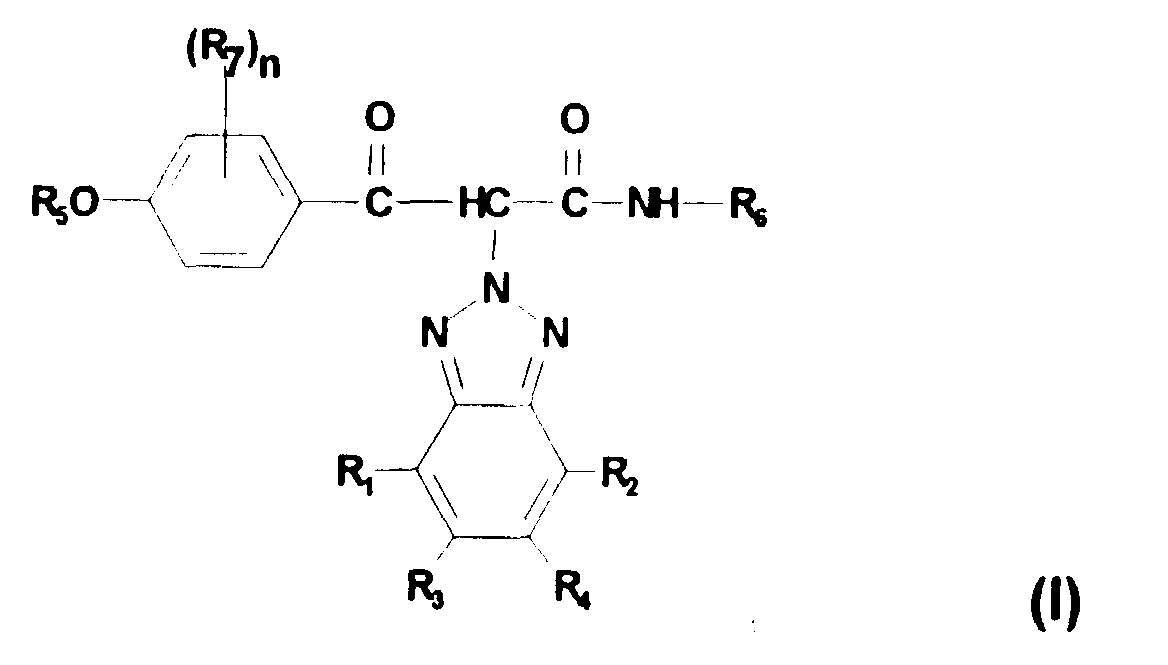
- said alkoxybenzoylacetamide DIR coupler may be represented by the general formula (I): wherein R 1 and R 2 , the same or different, each represents a halogen atom (chlorine, bromine, iodine and fluorine); R3 and R4, the same or different, each represents a hydrogen atom, a halogen atom (chlorine, bromine, iodine and fluorine), an amino group, an alkyl group having 1 to 4 carbon atoms (methyl, ethyl, buthyl, chloromethyl, trifluoromethyl, 2-hydroxyethyl), an alkoxy group having 1 to 4 carbon atoms (methoxy, chloromethoxy, ethoxy, butoxy), a hydroxy group, a cyano group, an aryloxy group (phenoxy, p-methoxyphenoxy), an acyloxy group (acetyloxy, benzoyloxy), an acyl group (acetyl, benzoyl
- the alkyl group represented by R5 and R6 has preferably from 1 to 18 carbon atoms and may be substituted or unsubstituted.
- substituents of the alkyl group include an alkoxy group, an aryloxy group, a cyano, an amino group, an acylamino group, a halogen atom, an hydroxy group, a carboxy group, a sulfo group, an heterocyclic group, etc.
- alkyl groups are an isopropyl group, an isobutyl group, a tert-butyl group, an isoamyl group, a tert-amyl group, a 1,1-dimethylbutyl group, a 1,1--dimethylhexyl group, a 1,1-diethylhexyl group, a 1,1-dimethyl-1-methoxyphenoxymethyl group, a 1,1-dimethyl-1-ethylthiomethyl group, a dodecyl group, a hexadecyl group, an octadecyl group, a cyclohexyl group, a 2-methoxyisopropyl group, a 2-phenoxyisopropyl group, an ⁇ -aminoisopropyl group, an a-succinimidoisopropyl group, etc.
- alkyl group includes not only such alkyl moieties as methyl, ethyl, octyl, stearyl, etc., but also such moieties bearing substituent groups such as halogen, cyano, hydroxyl, nitro, amine, carboxylate, etc.
- alkyl moiety includes only methyl, ethyl, octyl, stearyl, cyclohexyl, etc.
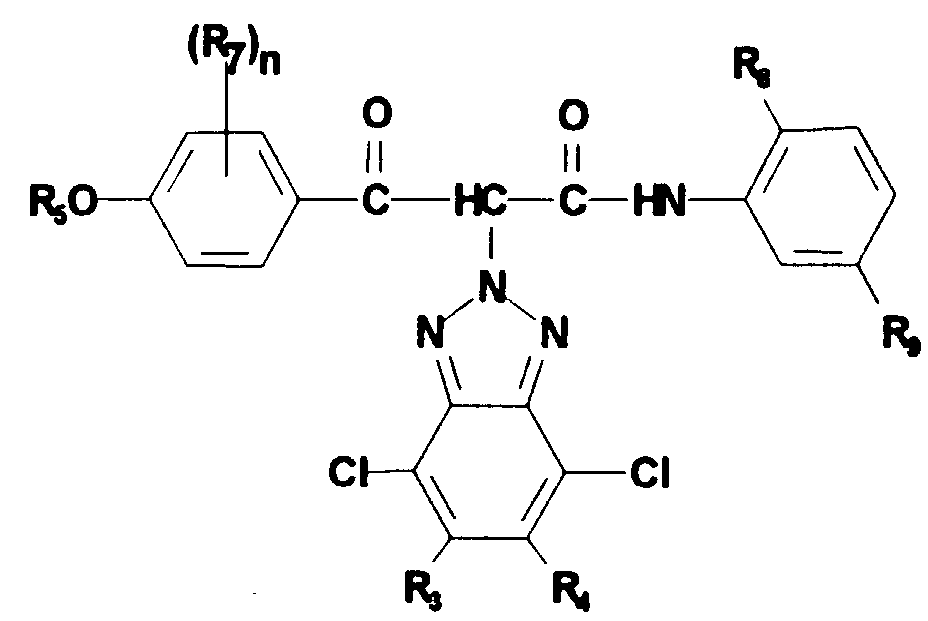
- the alkoxybenzoylacetanilide DIR coupler for use in the present invention is represented by the general formula (II): wherein R 3 , R 4 , R 5 , R 7 and n are the same as in Formula (I); Rs represents a hydrogen atom or a halogen atom (chlorine, bromine, iodine and fluorine); R 9 represents a halogen atom, a nitro group, a cyano group, a thiocyano group, a hydroxy group, an alkoxy group (preferably having 1 to 15 carbon atoms, such as methoxy, isopropoxy, octyloxy), an aryloxy group (preferably having up to 20 carbon atoms, such as phenoxy, nitrophenoxy), an alkyl group (preferably having 1 to 15 carbon atoms, such as methyl, ethyl, dodecyl), an alkenyl group (preferably having 1 to 15 carbon atoms, such as allyl),
- the total number of carbon atoms contributed by R9 is preferably from 6 to 35.
- alkoxybenzoylacetanilide DIR coupler for use in the present invention is represented by the general formula (III): wherein R 5 is the same as in Formula (I); R 10 and R 11 each represents a lower alkyl group, having 1 to 4 carbon atoms (such as methyl, ethyl, butyl, etc.); R 12 represents an alkyl group, having 1 to 20 carbon atoms (such as methyl, ethyl, dodecyl, etc.).
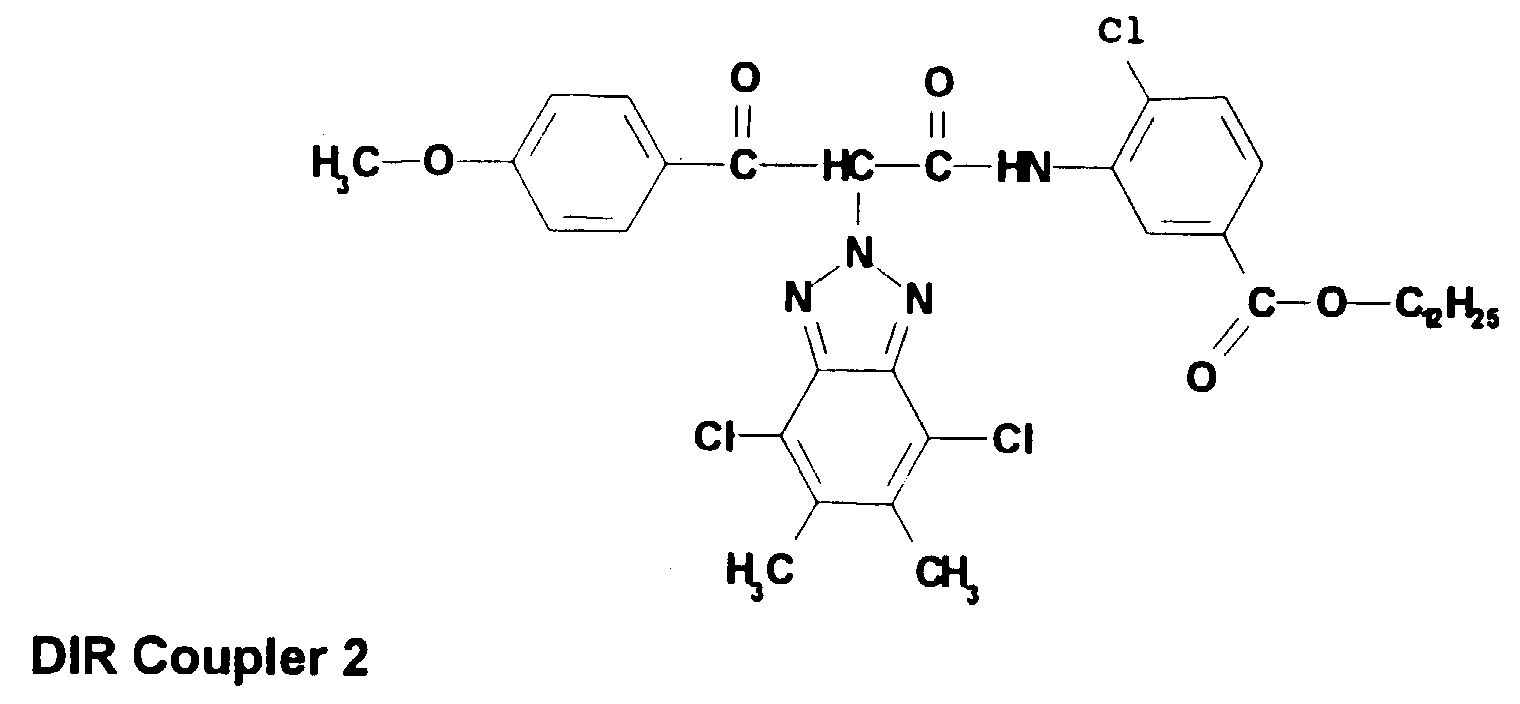
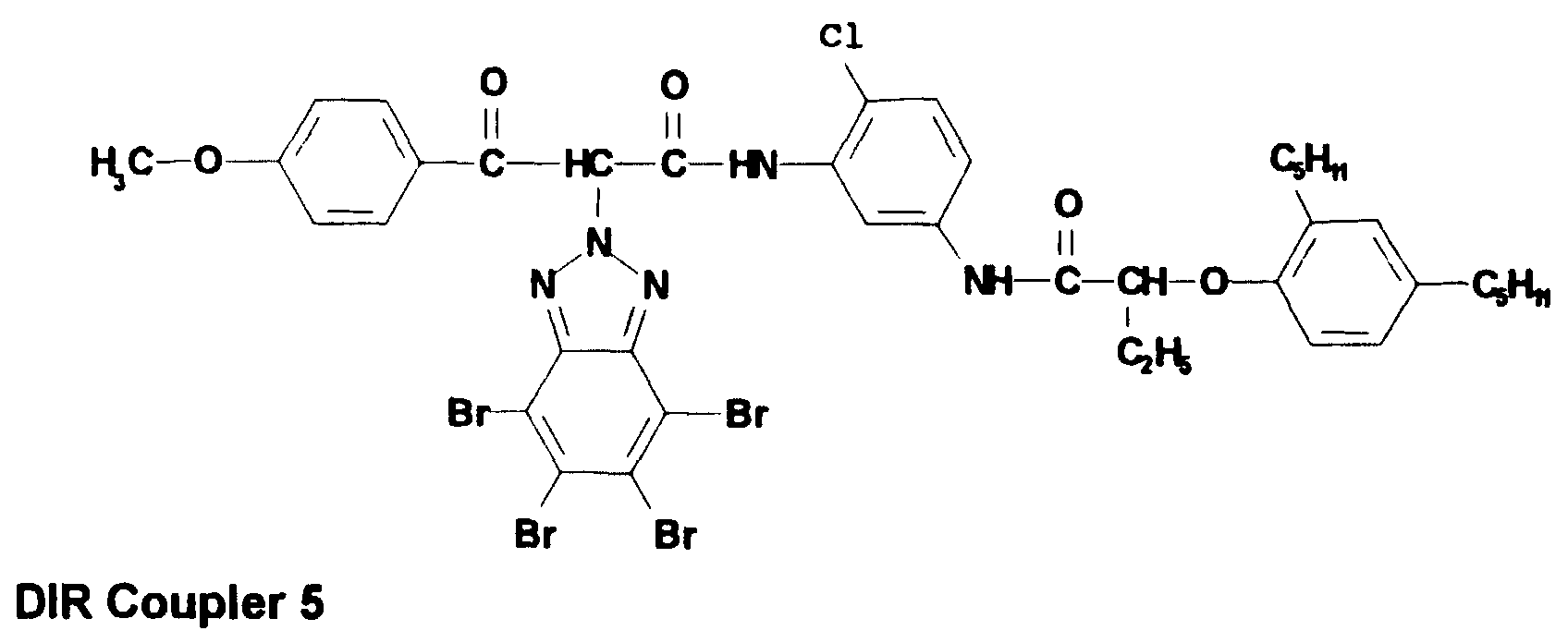
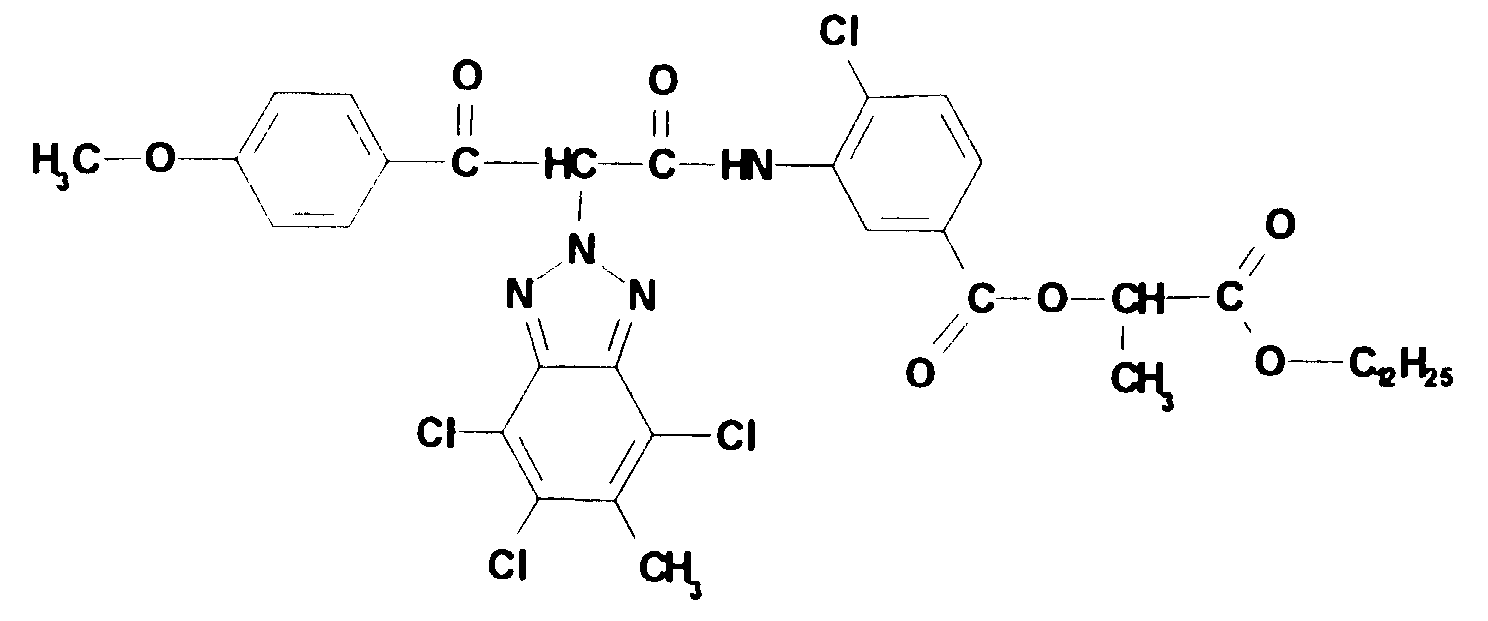
- alkoxybenzoylacetanilide DIR couplers for use in the present invention are given below as illustrative examples.
- the DIR couplers for use in the present invention can be synthesized according to conventional means for synthesizing DIR couplers. A typical example of synthesis of the DIR couplers for use in the present invention is given below.
- the oil obtained was diluted with 50 cc DMF and added to a suspension of 4.2 g 5,6-dimethyl-4,7-dichlorobenzotriazole, 4.3 g of Na 2 CO 3 and 50 cc DMF. After stirring for two hours at room temperature, the solution was poored in a 100 cc of water acidified to pH 1 with HCl. After standing overnight, a yellow crude product was collected. After crystallization from a solution of ethyl acetate, 10 g of pure product were obtained.
- the structure of the above coupler was confirmed by elemental analysis, IR spectra and 1 H and 13 C spectra.
- the 2-nitrogen bond was confirmed also by Thermospray-Mass Spectroscopy analysis.
- the alkoxybenzoylacetamide DIR couplers used in the present invention can be hydrophilic couplers (Fischer type couplers) having a water-solubilizing group, for example a carboxy group, a hydroxy group, a sulfo group, etc., or hydrophobic couplers.
- hydrophilic couplers Fischer type couplers
- hydrophobic couplers As methods for adding the couplers to a hydrophilic colloid solution or to a gelatino-silver halide photographic emulsion or dispersing said couplers thereof, those methods conventionally known in the art can be applied.
- hydrophobic couplers used in the present invention can be dissolved in a high boiling water insoluble solvent and the resulting solution emulsified into an aqueous medium as described for example in US Pat.
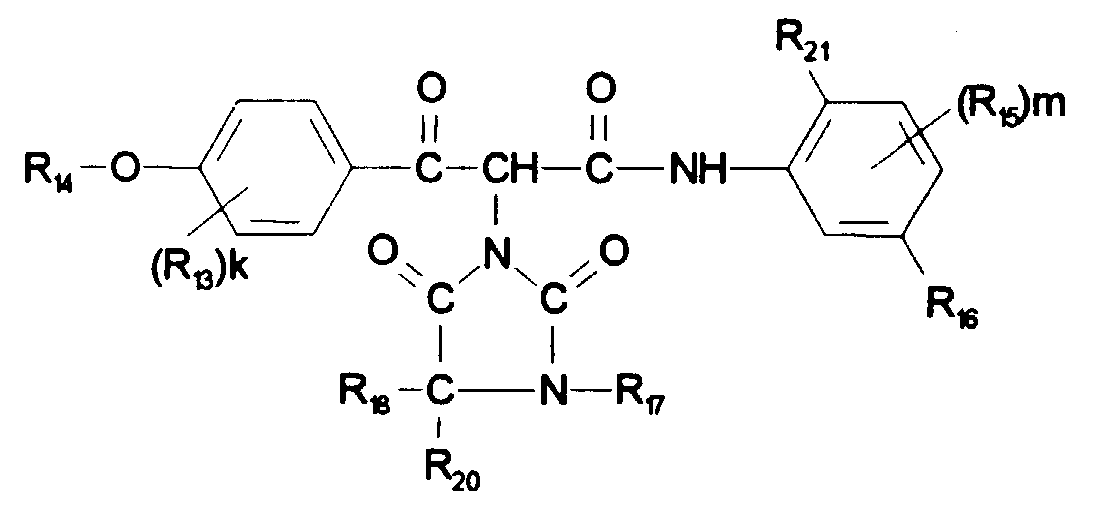
- the alkoxybenzoylacetanilide yellow dye forming coupler for use in the present invention may be represented by the general formula (IV): wherein R 13 and R 15 each represents an alkyl group (substituted or unsubstituted) having 1 to 4 carbon atoms (such as methyl, ethyl, propyl, butyl, chloromethyl, trifluoromethyl), aryl group (substituted or unsubstituted, preferably having 6 to 10 carbon atoms, such as phenyl, tolyl, benzyl), chloro atom, bromo atom or alkoxy group (preferably having 1 to 15 carbon atoms, such as methoxy, isopropoxy, octyloxy); k and m are individually 0, 1 or 2; R 14 is an alkyl group (substituted or unsubstitued) having 1 to 4 carbon atoms (such as methyl, ethyl, propyl, butyl,
- the ballasting group represented by R 16 in Formula (IV) above acts as a "ballast" which can maintain the yellow coupler in a specific layer so as to substantially prevent said coupler from diffusing to any other layer in a multilayer color photographic element.
- the group has a sufficient bulkiness to complete that purpose.
- a group having a hydrophobic group of 8 to 32 carbon atoms is introduced in the coupler molecule as ballasting group.
- Such group can be bonded to the coupler molecule directly or through an amino, ether, carbonamido, sulfonamido, ureido, ester, imido, carbamoyl, sulfamoyl, phenylene, etc., bond.
- Specific examples of ballasting groups are illustrated in US Pat. No.
- ballasting groups comprise alkyl chains, the total carbon atoms of which are no more than 20.
- said alkoxybenzoylacetanilide yellow dye forming coupler is represented by the general formula (V): wherein R 18 is the same as in formula (IV) and R 22 is an alkyl group having 8 to 32 carbon.
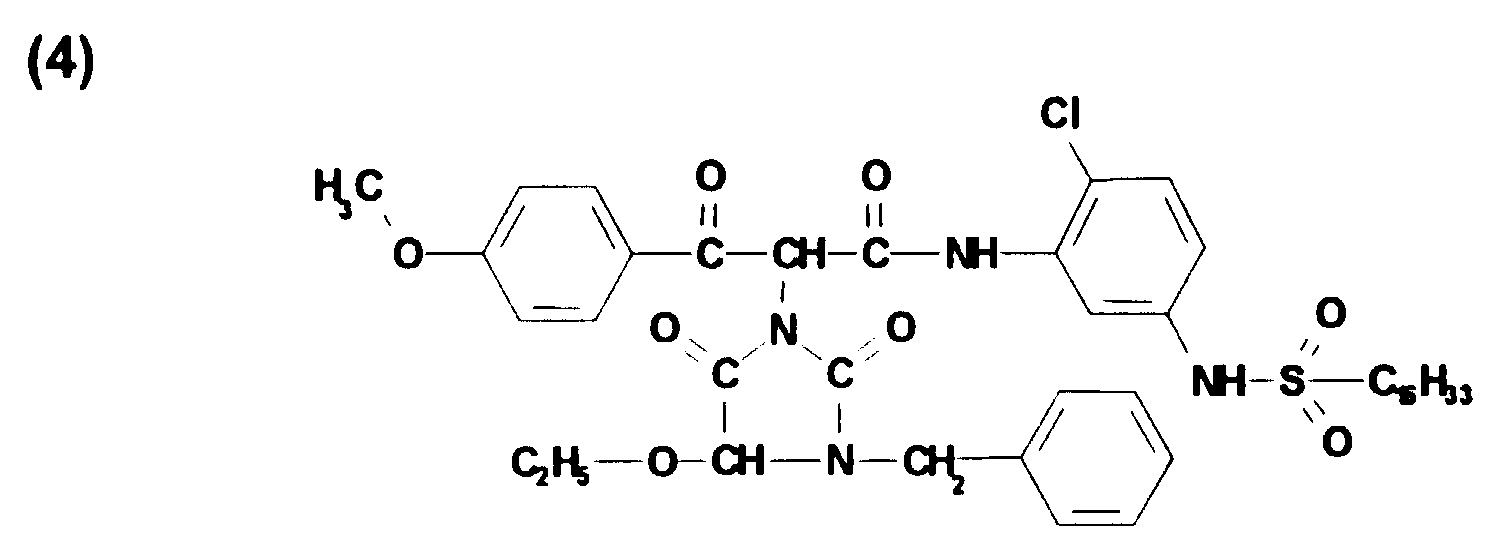
- alkoxybenzoylacetanilide yellow dye forming couplers of the present invention are given below as illustrative examples.
- yellow couplers for use in the present invention can be synthesised according to conventional means for synthesizing yellow couplers.
- yellow coupler 1 can be synthesized as described in Research Disclosure April 1979 No. 18053 p. 198.
- the alkoxybenzoylacetamide DIR coupler and the alkoxybenzoylacetanilide yellow dye forming coupler for use in the present invention are dispersed in the emulsion layer(s) in an amount in the range from 0.5 to 5 moles of the benzoyl yellow dye forming DIR coupler for 100 moles of the alkoxybenzoylacetanilide yellow dye forming coupler, preferably from 1.0 to 2.5 mols per 100 mols.
- the photographic elements of the present invention are preferably multilayer color elements comprising a blue sensitive or sensitized silver halide emulsion layer associated with yellow dye-forming color couplers, a green sensitized silver halide emulsion layer associated with magenta dye-forming color couplers and a red sensitized silver halide emulsion layer associated with cyan dye-forming color couplers.
- Each layer can be comprised of a single emulsion layer or of multiple emulsion sub-layers sensitive to a given region of visible spectrum.
- multilayer materials contain multiple blue, green or red sub-layers, there can be in any case relatively faster and relatively slower sub-layers.
- the silver halide emulsion used in this invention may be a fine dispersion of silver chloride, silver bromide, silver chloro-bromide, silver iodo-bromide and silver chloro-iodo-bromide in a hydrophilic binder.
- hydrophilic binder any hydrophilic polymer of those conventionally used in photography can be advantageously employed including gelatin, a gelatin derivative such as acylated gelatin, graft gelatin, etc., albumin, gum arabic, agar agar, a cellulose derivative, such as hydroxyethyl-cellulose, carboxymethyl-cellulose, etc., a synthetic resin, such as polyvinyl alcohol, polyvinylpyrrolidone, polyacrylamide, etc.
- Preferred silver halides are silver iodo-bromide or silver iodo-bromo-chloride containing 1 to 20 % mole silver iodide.
- the silver halide grains may have any crystal form such as cubic, octahedral, tabular or a mixed crystal form.
- the silver halide can have a uniform grain size or a broad grain size distribution. The size of the silver halide ranges from 0.1 to 5 ⁇ m.
- the silver halide emulsion can be prepared using a single-jet method, a double-jet method, or a combination of these methods and can be matured using, for instance, an ammonia method, a neutralization method, an acid method, etc.
- the emulsions which can be used in the present invention can be chemically and optically sensitized as described in Research Disclosure 17643, III and IV, December 1978; they can contain optical brighteners, antifogging agents and stabilizers, filtering and antihalo dyes, hardeners, coating aids, plasticizers and lubricants and other auxiliary substances, as for instance described in Research Disclosure 17643, V, VI, VIII, X, XI and XII, December 1978.
- the layers of the photographic emulsion and the layers of the photographic element can contain various colloids, alone or in combination, such as binding materials, as for instance described in Research Disclosure 17643, IX, December 1978.
- the above described emulsions can be coated onto several support bases (cellulose triacetate, paper, resin-coated paper, polyester included) by adopting various methods, as described in Research Disclosure 17643, XV and XVII, December 1978.
- the light-sensitive silver halides contained in the photographic elements of the present invention after exposure can be processed to form a visible image by associating the silver halide with an aqueous alkaline medium in the presence of a developing agent contained in the medium or in the element. Processing formulations and techniques are described in Research Disclosure 17643, XIX, XX and XXI, December 1978.
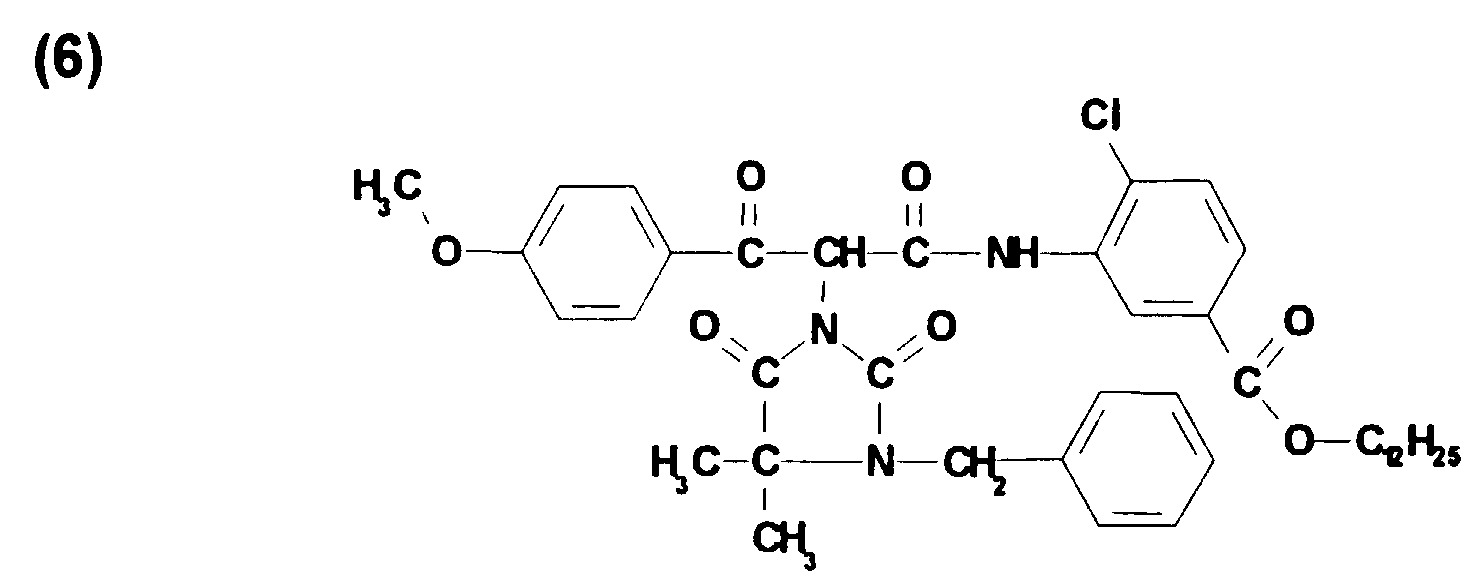
- a multilayer negative color film was made by coating a subbed cellulose triacetate support base with layers in the following order:
- a multilayer negative color film was made by coating a subbed cellulose triacetate support base as in Example 1, but the methoxy benzoyl acetanilide DIR coupler 1 in layers 7 and 8 was replaced by equimolecular amounts of the methoxy benzoyl acetanilide DIR coupler 2.
- a multilayer negative color film was made by coating a subbed cellulose triacetate support base as in Example 1, but the methoxy benzoyl acetanilide DIR coupler 1 in layers 7 and 8 was replaced by equimolecular amounts of the methoxy benzoyl acetanilide DIR coupler 3.
- a control multilayer negative color film was made by coating a subbed cellulose triacetate support base as in Example 1, but the methoxy benzoyl acetanilide DIR coupler 1 in layers 7 and 8 was replaced by equimolecular amounts of the yellow dye forming DIR coupler E.
- a control multilayer negative color film was made by coating a subbed cellulose triacetate support base as in Example 1, but the methoxy benzoyl acetanilide DIR coupler 1 in layers 7 and 8 was replaced by equimolecular amounts of the yellow dye forming DIR coupler F.
- a control multilayer negative color film was made by coating a subbed cellulose triacetate support base as in Example 1, but the methoxy benzoyl acetanilide DIR coupler 1 in layers 7 and 8 was replaced by equimolecular amounts of the yellow dye forming DIR coupler G.
- Samples of each film were exposed for a 1/20 of a second to a light source having a color temperature of 5,500 Kelvin through a WRATTENTM W99 filter and an optical step wedge (selective exposure). Other samples of each film were exposed as above but without using any filter (white light exposure). All the exposed samples were developed in a standard type C41 process as described in British Journal of Photography , July 12, 1974, pp. 597-598. The samples were then sensitometrically examined in both yellow and magenta layers. S1 is the sensitivity value measured in Log E, wherein E is expressed in lux.seconds at a density of 0.2 above Dmin, while S2 has been measured in the same way, but at a density of 1.0 above Dmin.
- the contrasts of the obtained sensitometric curves for selective exposures (gamma s ) and white light exposures (gamma w ) were measured in the low dye-density or toe region (C1) and in the high dye-density or shoulder region (C2) of each sensitometric curve.
- Samples 1-3 comprising the combination of an alkoxybenzoylacetanilide yellow dye forming coupler and an alkoxybenzoylacetanilide DIR coupler, according to the present invention, shows improved sensitivity in both yellow layer and in magenta layer with respect to the comparison samples 4-6, wherein different yellow dye forming DIR couplers have been used, still maintaining good Dmax values and good interimage effects.
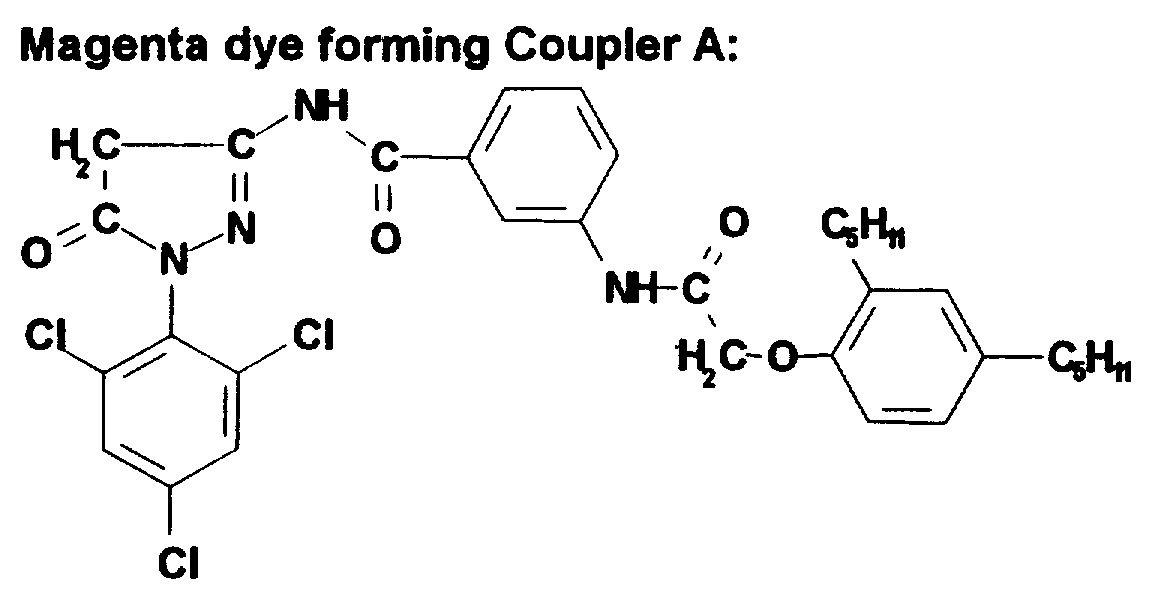
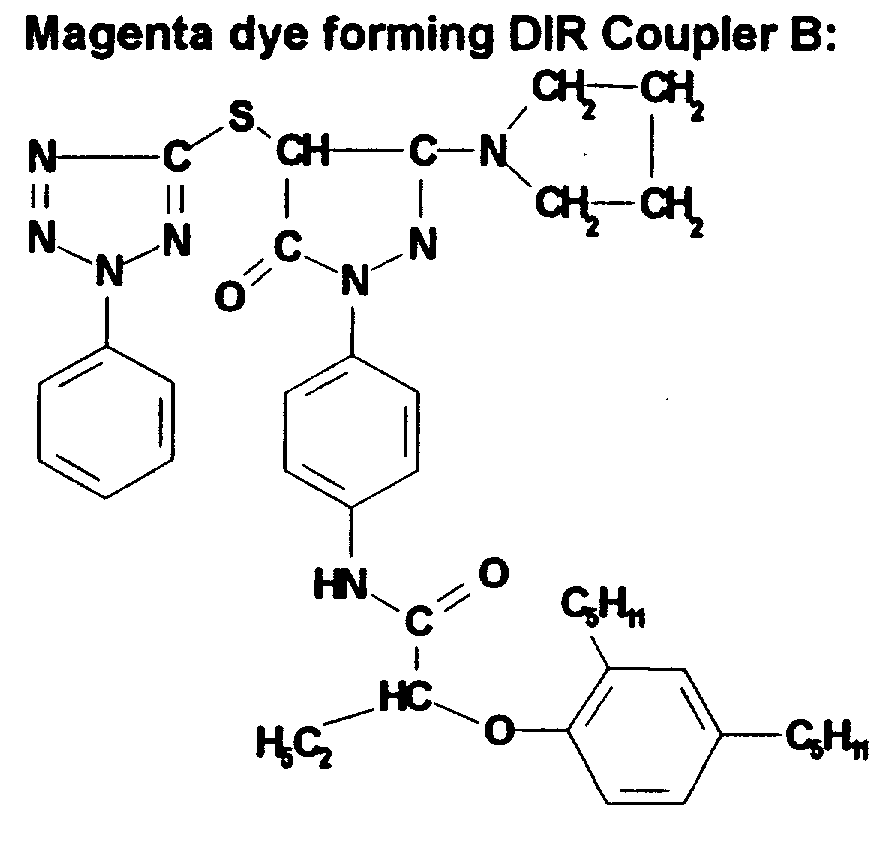
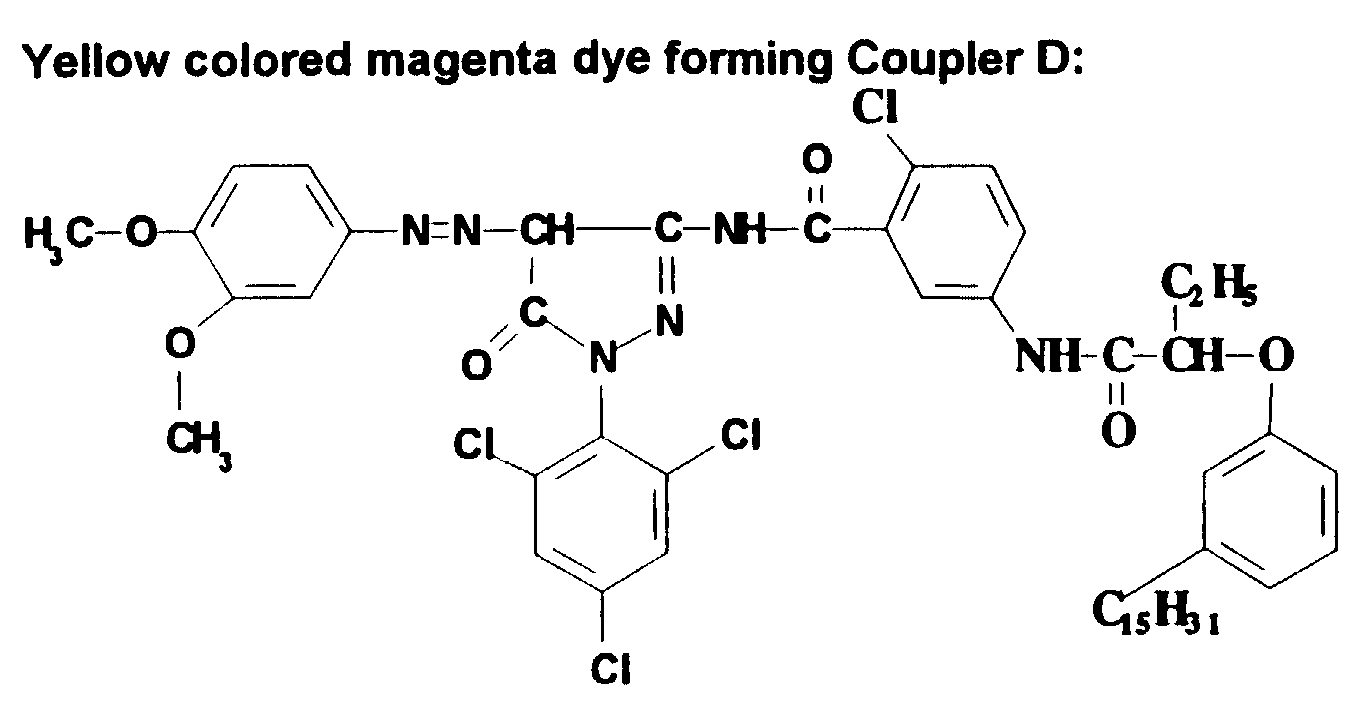
- a multilayer negative color film was prepared by coating a cellulose triacetate support base, subbed with gelatin, with the following layers in the following order:
- a multilayer negative color film was prepared by coating a cellulose triacetate support base, subbed with gelatin, as Sample 7, but the yellow dye forming DIR coupler 1 of layer (k) and layer (I) was replaced by the equimolecular amounts of the yellow dye forming DIR coupler E.
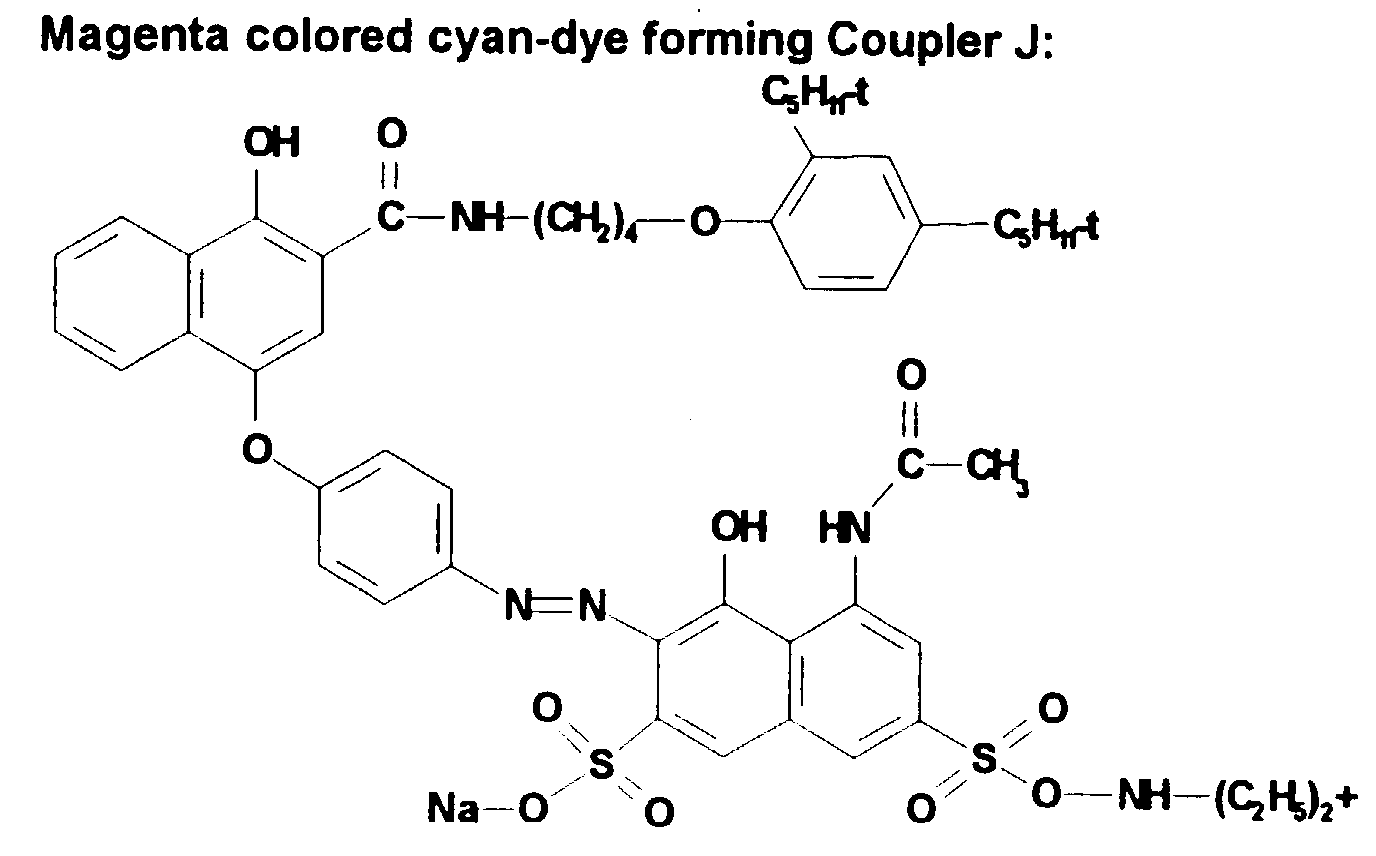
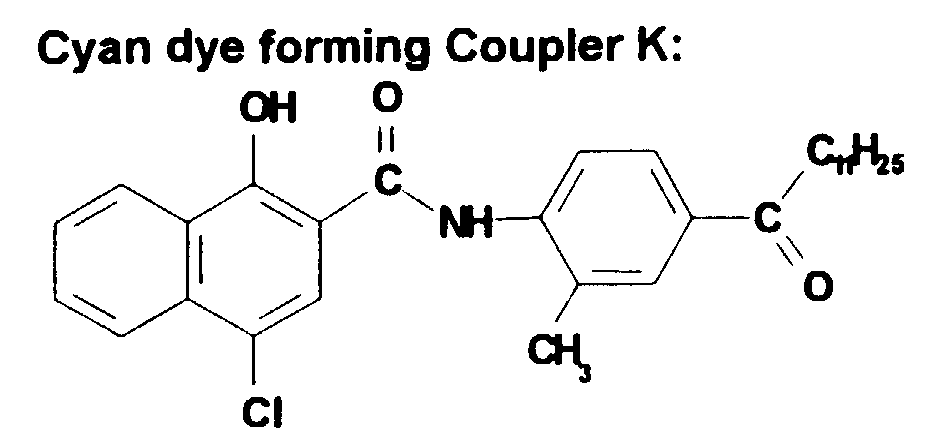
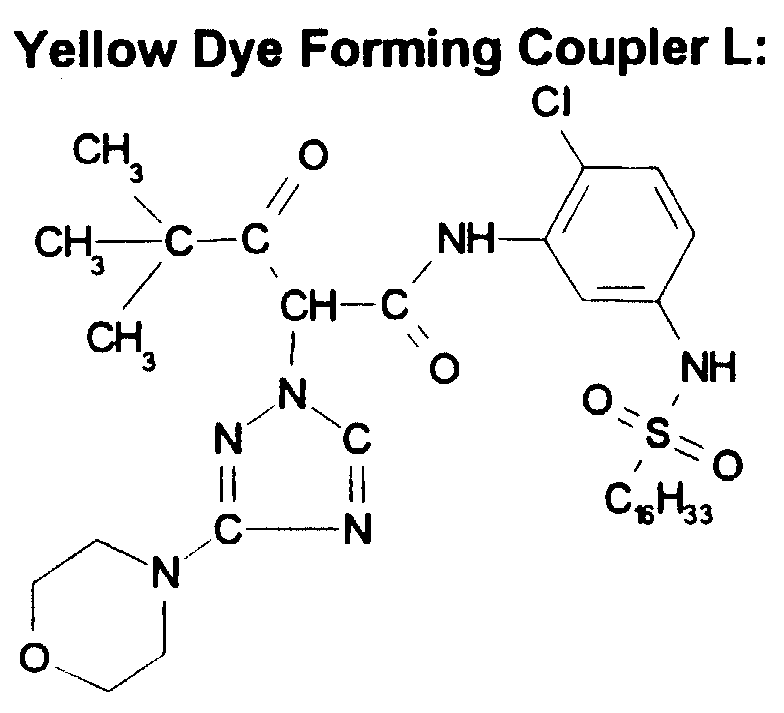
- a multilayer negative color film was prepared by coating a cellulose triacetate support base, subbed with gelatin, as Sample 7, but the yellow dye forming coupler 1 of layer (k) and (I) was replaced by the equimolecular amounts of the yellow dye forming coupler L and the yellow dye forming DIR coupler 1 of layer (k) and (I) was replaced by the equimolecular amounts of the yellow dye forming DIR coupler E.
- Sample 7 comprising the combination of an alkoxybenzoylacetanilide yellow dye forming coupler and an alkoxybenzoylacetanilide DIR coupler, according to the present invention, shows improved sensitivity in all the layers, particularly in yellow layer, with respect to the comparison sample 8, maintaining the interimage effects at acceptable values.
- These photographic properties are very useful in photographic materials having very high sensitivity, where a speed improvement is strongly requested, while interimage effects are not so important (a reduction up to 30% in interimage effects is still acceptable).
- sample 7 of the present invention shows also better interimage effects when compared with sample 9, with a little improvement in sensitivity, giving thus improved qualities to photographic films having medium-high sensitivity.
Landscapes
- Physics & Mathematics (AREA)
- General Physics & Mathematics (AREA)
- Silver Salt Photography Or Processing Solution Therefor (AREA)
Description









| Sample | Yellow Layer | Magenta Layer | R | |||||
| Dmax | S1 | S2 | Dmax | S1 | S2 | C1 | C2 | |
| 1 (inv.) | 3.17 | 2.37 | 1.58 | 2.59 | 2.25 | 0.98 | 51.8 | 37.1 |
| 2 (inv.) | 3.08 | 2.36 | 1.57 | 2.64 | 2.28 | 1.07 | 41.4 | 29.7 |
| 3 (inv.) | 3.03 | 2.35 | 1.54 | 2.65 | 2.29 | 1.09 | 41.4 | 28.4 |
| 4 (comp.) | 3.13 | 2.31 | 1.42 | 2.50 | 2.16 | 0.87 | 51.8 | 32.9 |
| 5 (comp.) | 3.15 | 2.32 | 1.49 | 2.67 | 2.22 | 0.94 | 52.7 | 35.2 |
| 6 (comp.) | 3.24 | 2.30 | 1.48 | 2.67 | 2.22 | 0.97 | 37.9 | 21.1 |



| Sample | Yellow Layer | Magenta Layer | R | ||||
| Dmax | S1 | S2 | Dmax | S1 | S2 | ||
| 7(inv.) | 3.17 | 23.0 | 12.9 | 2.37 | 22.9 | 10.6 | 41.9 |
| 8(comp.) | 3.28 | 21.8 | 11.7 | 2.43 | 22.1 | 9.0 | 50.0 |
| 9(comp) | 3.27 | 23.0 | 12.9 | 2.42 | 22.6 | 10.4 | 35.5 |


Claims (10)
- A silver halide color photographic light sensitive material which comprises a support having coated thereon at least one silver halide emulsion layer containing a) an alkoxybenzoylacetamide DIR coupler having, bonded directly to the coupling active position, a group which provides a compound having a development inhibiting property when the group is released from the coupler active position upon the color development reaction, wherein said group is a 4,7-dihalogen-2--benzotriazolyl group and b) an alkoxybenzoylacetanilide yellow dye forming coupler having a 3-hydantoinyl leaving group bonded to the coupling active position.
- The silver halide color photographic light sensitive material of claim 1, wherein said alkoxybenzoylacetamide DIR coupler is represented by the general formula:wherein R1 and R2 each represents a halogen atom, R3 and R4 each represents a hydrogen atom, a halogen atom, an amino group, an alkyl group, an alkoxy group, an hydroxy group, a cyano group, an aryloxy group, an acyloxy group, an acyl group, an alkoxycarbonyl group, an aryloxycarbonyl group, an acylamino group, an alkylsulfonyl group, an arylsulfonyl group, an alkoxysulfonyl group, an aryloxysulfonyl group or an ureido group; R5 represents an alkyl group; R6 represents an alkyl group or an aryl group and R7 represents an alkyl group, an aryl group, a halogen atom or an alkoxy group; n is 0, 1 or 2.

- The silver halide color photographic light sensitive material of claim 1, wherein said alkoxybenzoylacetamide DIR coupler is represented by the general formula:wherein R3 and R4 each represents a hydrogen atom, a halogen atom, an amino group, an alkyl group, an alkoxy group, an hydroxy group, a cyano group, an aryloxy group, an acyloxy group, an acyl group, an alkoxycarbonyl group, an aryloxycarbonyl group, an acylamino group, an alkylsulfonyl group, an arylsulfonyl group, an alkoxysulfonyl group, an aryloxysulfonyl group or an ureido group; R5 represents an alkyl group; R7 represents an alkyl group, an aryl group, a halogen atom or an alkoxy group; n is 0, 1 or 2; R8 represents a hydrogen atom or a halogen atom; R9 represents a halogen atom, a nitro group, a cyano group, a thiocyano group, a hydroxy group, an alkoxy group, an aryloxy group, an alkyl group, an alkenyl group, an aryl group, an amino group, a carboxy group, an acyl group, an alkoxycarbonyl group, an aryloxycarbonyl group, a carbamoyl group, an acylamino group, a sulfo group, an alkylsulfonyl group, an arylsulfonyl, an alkoxysulfonyl, an aryloxysulfonyl, a sulfamoyl group, a sulfonamino group.
- The silver halide color photographic light sensitive material of claim 1, wherein said alkoxybenzoylacetamide DIR coupler is represented by the general formula:wherein R5 represents an alkyl group; R10 and R11 each represents a lower alkyl group; R12 represents an alkyl group.
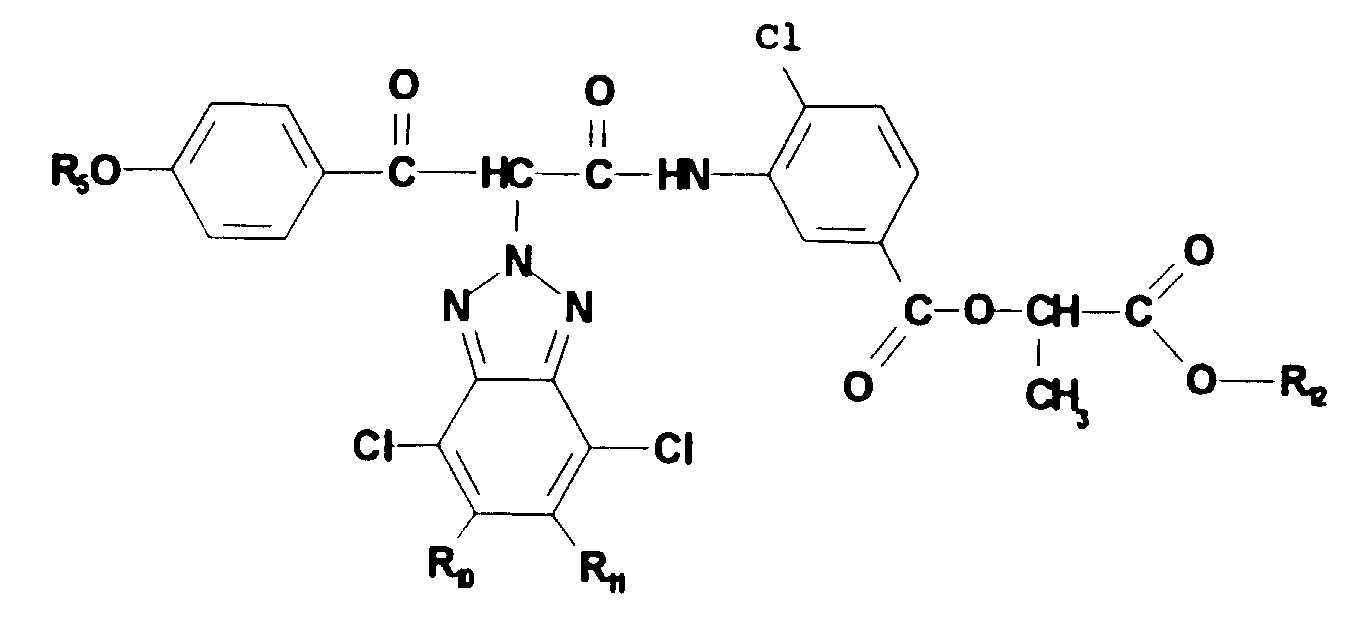
- The silver halide color photographic light sensitive material of claim 1, wherein said alkoxybenzoylacetamide DIR coupler is represented by the formula:
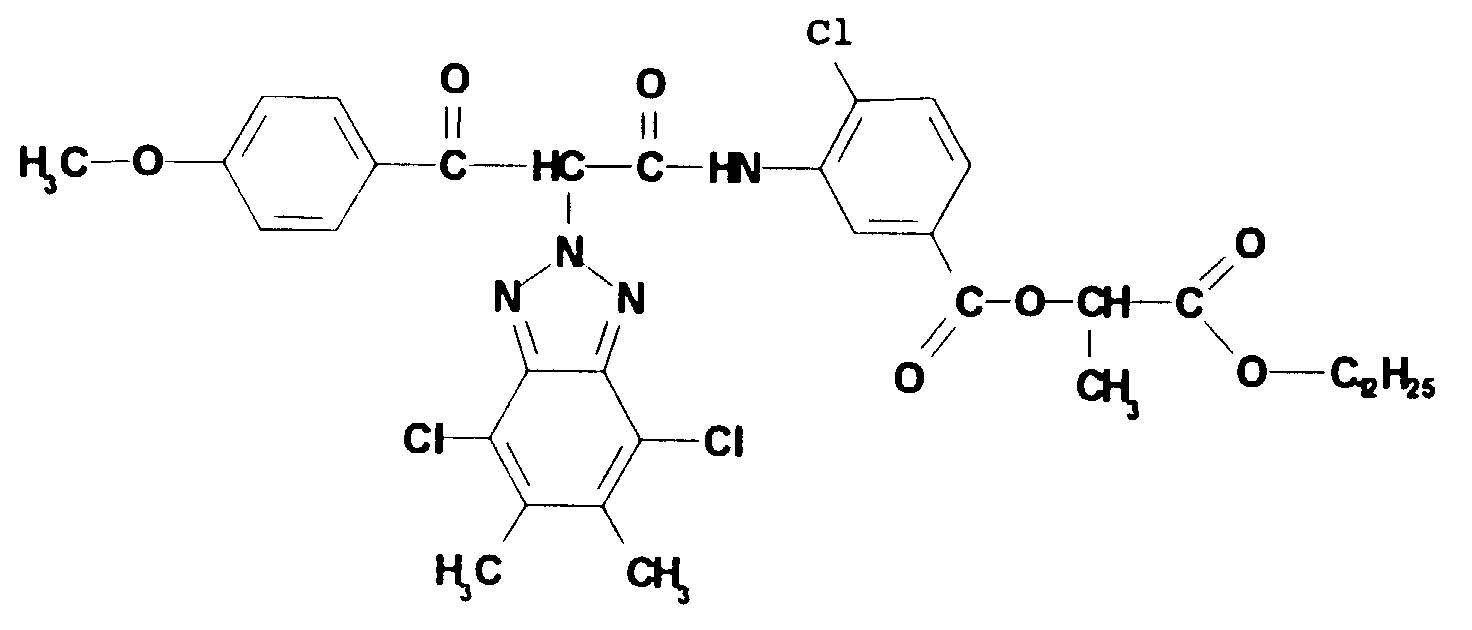
- The silver halide color photographic light sensitive material of claim 1, wherein said alkoxybenzoylacetamide DIR coupler is represented by the formula:
- The silver halide color photographic light sensitive material of claim 1, wherein said alkoxybenzoylacetanilide yellow dye forming coupler is represented by the general formula:wherein R13 and R15 each represents an alkyl group, aryl group, chloro atom, bromo atom or alkoxy group; k and m are individually 0, 1 or 2; R14 is an alkyl group; R16 is a ballast group; R17 represents a hydrogen atom, an alkyl group, an aryl group or an acyl group; R19 is hydrogen atom, an alkyl group or - O-R19 or -S-R19, wherein R19 is hydrogen atom, an alkyl group, an aryl group, a heterocyclic group or an acyl group; R20 is hydrogen atom, an alkyl group or an aryl group; R21 is halogen atom or an alkoxy group.
- The silver halide color photographic light sensitive material of claim 1, wherein said alkoxybenzoylacetanilide yellow dye forming coupler is represented by the general formula:wherein R18 is hydrogen atom, an alkyl group or -O-R19 or -S-R19, wherein R19 is hydrogen atom, an alkyl group, an aryl group, a heterocyclic group or an acyl group and R22 is an alkyl group having 8 to 32 carbon atoms.

- The silver halide color photographic light sensitive material of claim 1, wherein said alkoxybenzoylacetanilide yellow dye forming coupler is represented by the formula:

- The silver halide color photographic light sensitive material of claim 1, wherein said alkoxybenzoylacetamide DIR coupler is represented by the formula:or by the formula:
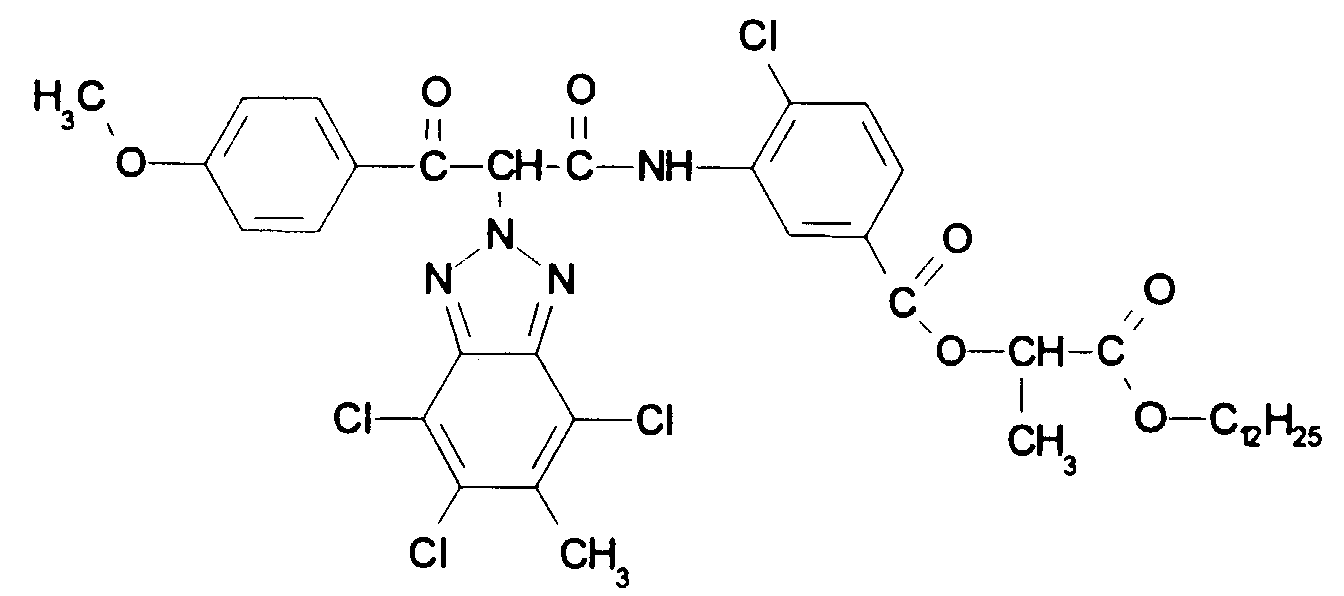 and wherein said alkoxybenzoylacetanilide yellow dye forming coupler is represented by the formula:

Priority Applications (4)
| Application Number | Priority Date | Filing Date | Title |
|---|---|---|---|
| EP93119939A EP0657776B1 (en) | 1993-12-10 | 1993-12-10 | Silver halide color photographic light sensitive material |
| DE69320354T DE69320354T2 (en) | 1993-12-10 | 1993-12-10 | Silver halide color photographic light-sensitive material |
| US08/339,484 US5496692A (en) | 1993-12-10 | 1994-11-14 | Silver halide color photographic light-sensitive material |
| JP6306059A JPH07199426A (en) | 1993-12-10 | 1994-12-09 | Photosensitive material of silver halide color photograph |
Applications Claiming Priority (1)
| Application Number | Priority Date | Filing Date | Title |
|---|---|---|---|
| EP93119939A EP0657776B1 (en) | 1993-12-10 | 1993-12-10 | Silver halide color photographic light sensitive material |
Publications (2)
| Publication Number | Publication Date |
|---|---|
| EP0657776A1 EP0657776A1 (en) | 1995-06-14 |
| EP0657776B1 true EP0657776B1 (en) | 1998-08-12 |
Family
ID=8213477
Family Applications (1)
| Application Number | Title | Priority Date | Filing Date |
|---|---|---|---|
| EP93119939A Expired - Lifetime EP0657776B1 (en) | 1993-12-10 | 1993-12-10 | Silver halide color photographic light sensitive material |
Country Status (4)
| Country | Link |
|---|---|
| US (1) | US5496692A (en) |
| EP (1) | EP0657776B1 (en) |
| JP (1) | JPH07199426A (en) |
| DE (1) | DE69320354T2 (en) |
Families Citing this family (5)
| Publication number | Priority date | Publication date | Assignee | Title |
|---|---|---|---|---|
| DE69705794T2 (en) * | 1996-10-17 | 2002-05-23 | Eastman Kodak Co., Rochester | Silver halide element containing triazole inhibitors |
| EP1055967B1 (en) * | 1999-05-25 | 2004-09-29 | FERRANIA S.p.A. | Silver halide color photographic light-sensitive elements having improved image quality |
| US11455799B2 (en) | 2004-01-30 | 2022-09-27 | Airspace Reality | Image networks for mobile communication |
| US10140514B1 (en) | 2004-01-30 | 2018-11-27 | Ip Holdings, Inc. | Capturing and sharing images with mobile device users including for a limited duration of time |
| US10142496B1 (en) | 2013-01-26 | 2018-11-27 | Ip Holdings, Inc. | Mobile device image capture and image modification including filters, superimposing and geofenced comments in augmented reality |
Family Cites Families (6)
| Publication number | Priority date | Publication date | Assignee | Title |
|---|---|---|---|---|
| JPS5110783B2 (en) * | 1971-04-26 | 1976-04-06 | ||
| JPS51102636A (en) * | 1974-04-03 | 1976-09-10 | Fuji Photo Film Co Ltd | Karaashashingazo no keiseihoho |
| JPS59131933A (en) * | 1983-01-19 | 1984-07-28 | Fuji Photo Film Co Ltd | Silver halide color photosensitive material |
| IT1223507B (en) * | 1987-12-17 | 1990-09-19 | Minnesota Mining & Mfg | COLOR PHOTOSENSITIVE PHOTOGRAPHIC MATERIAL WITH SILVER HALIDES |
| US4980267A (en) * | 1988-08-30 | 1990-12-25 | Eastman Kodak Company | Photographic element and process comprising a development inhibitor releasing coupler and a yellow dye-forming coupler |
| IT1256017B (en) * | 1992-04-07 | 1995-11-20 | Minnesota Mining & Mfg | COLOR PHOTOGRAPHIC MATERIAL WITH SILVER HALIDES SENSITIVE TO LIGHT |
-
1993
- 1993-12-10 DE DE69320354T patent/DE69320354T2/en not_active Expired - Fee Related
- 1993-12-10 EP EP93119939A patent/EP0657776B1/en not_active Expired - Lifetime
-
1994
- 1994-11-14 US US08/339,484 patent/US5496692A/en not_active Expired - Fee Related
- 1994-12-09 JP JP6306059A patent/JPH07199426A/en active Pending
Also Published As
| Publication number | Publication date |
|---|---|
| DE69320354D1 (en) | 1998-09-17 |
| US5496692A (en) | 1996-03-05 |
| EP0657776A1 (en) | 1995-06-14 |
| JPH07199426A (en) | 1995-08-04 |
| DE69320354T2 (en) | 1999-01-07 |
Similar Documents
| Publication | Publication Date | Title |
|---|---|---|
| US4533625A (en) | Silver halide color photographic light-sensitive materials | |
| JPS6327701B2 (en) | ||
| US5006452A (en) | Silver halide color photographic light-sensitive material | |
| EP0096873A2 (en) | Silver halide color photographic light-sensitive materials | |
| EP0356925A2 (en) | Photographic element and process comprising a development inhibitor releasing coupler and a yellow dye-forming coupler | |
| US5332656A (en) | Silver halide color photographic light-sensitive material | |
| US5496692A (en) | Silver halide color photographic light-sensitive material | |
| JPH08240892A (en) | Photographic element containing remover of oxidized developing main ingredient | |
| JPH04278942A (en) | Silver halide color photographic sensitive material | |
| EP0747763B1 (en) | Silver halide color photographic light-sensitive elements having improved image quality | |
| JPH0521219B2 (en) | ||
| JPS59206834A (en) | Color photosensitive silver halide material | |
| US4908302A (en) | Silver halide color photographic light-sensitive material | |
| JPH03228048A (en) | Silver halide photographic sensitive material | |
| EP1055967B1 (en) | Silver halide color photographic light-sensitive elements having improved image quality | |
| EP0887703B1 (en) | Light-sensitive silver halide color photographic material | |
| JPH0640208B2 (en) | Multi-layer color photographic material | |
| JP2000206656A (en) | Photographic element | |
| JP2729678B2 (en) | Silver halide photographic material | |
| JPS63110451A (en) | Silver halide photographic sensitive material containing novel coupler | |
| JPS62217242A (en) | Silver halide photographic sensitive material | |
| JPH0553264A (en) | Silver halide color photographic sensitive material | |
| JPH0651464A (en) | Formation of color photograph element and color picture | |
| JP2001133946A (en) | Photographic element | |
| JPH0651465A (en) | Formation of color photograph element and color picture |
Legal Events
| Date | Code | Title | Description |
|---|---|---|---|
| PUAI | Public reference made under article 153(3) epc to a published international application that has entered the european phase |
Free format text: ORIGINAL CODE: 0009012 |
|
| AK | Designated contracting states |
Kind code of ref document: A1 Designated state(s): DE FR GB IT |
|
| 17P | Request for examination filed |
Effective date: 19951205 |
|
| GRAG | Despatch of communication of intention to grant |
Free format text: ORIGINAL CODE: EPIDOS AGRA |
|
| 17Q | First examination report despatched |
Effective date: 19970814 |
|
| GRAG | Despatch of communication of intention to grant |
Free format text: ORIGINAL CODE: EPIDOS AGRA |
|
| GRAH | Despatch of communication of intention to grant a patent |
Free format text: ORIGINAL CODE: EPIDOS IGRA |
|
| GRAH | Despatch of communication of intention to grant a patent |
Free format text: ORIGINAL CODE: EPIDOS IGRA |
|
| GRAA | (expected) grant |
Free format text: ORIGINAL CODE: 0009210 |
|
| RAP1 | Party data changed (applicant data changed or rights of an application transferred) |
Owner name: IMATION CORP. |
|
| AK | Designated contracting states |
Kind code of ref document: B1 Designated state(s): DE FR GB IT |
|
| REF | Corresponds to: |
Ref document number: 69320354 Country of ref document: DE Date of ref document: 19980917 |
|
| ET | Fr: translation filed | ||
| PGFP | Annual fee paid to national office [announced via postgrant information from national office to epo] |
Ref country code: FR Payment date: 19981203 Year of fee payment: 6 |
|
| PLBE | No opposition filed within time limit |
Free format text: ORIGINAL CODE: 0009261 |
|
| STAA | Information on the status of an ep patent application or granted ep patent |
Free format text: STATUS: NO OPPOSITION FILED WITHIN TIME LIMIT |
|
| 26N | No opposition filed | ||
| REG | Reference to a national code |
Ref country code: GB Ref legal event code: 732E |
|
| PG25 | Lapsed in a contracting state [announced via postgrant information from national office to epo] |
Ref country code: FR Free format text: LAPSE BECAUSE OF NON-PAYMENT OF DUE FEES Effective date: 20000831 |
|
| REG | Reference to a national code |
Ref country code: FR Ref legal event code: ST |
|
| REG | Reference to a national code |
Ref country code: GB Ref legal event code: IF02 |
|
| REG | Reference to a national code |
Ref country code: GB Ref legal event code: 732E |
|
| PGFP | Annual fee paid to national office [announced via postgrant information from national office to epo] |
Ref country code: DE Payment date: 20031230 Year of fee payment: 11 |
|
| PG25 | Lapsed in a contracting state [announced via postgrant information from national office to epo] |
Ref country code: DE Free format text: LAPSE BECAUSE OF NON-PAYMENT OF DUE FEES Effective date: 20050701 |
|
| PG25 | Lapsed in a contracting state [announced via postgrant information from national office to epo] |
Ref country code: IT Free format text: LAPSE BECAUSE OF NON-PAYMENT OF DUE FEES;WARNING: LAPSES OF ITALIAN PATENTS WITH EFFECTIVE DATE BEFORE 2007 MAY HAVE OCCURRED AT ANY TIME BEFORE 2007. THE CORRECT EFFECTIVE DATE MAY BE DIFFERENT FROM THE ONE RECORDED. Effective date: 20051210 |
|
| PGFP | Annual fee paid to national office [announced via postgrant information from national office to epo] |
Ref country code: GB Payment date: 20061106 Year of fee payment: 14 |
|
| GBPC | Gb: european patent ceased through non-payment of renewal fee |
Effective date: 20071210 |
|
| PG25 | Lapsed in a contracting state [announced via postgrant information from national office to epo] |
Ref country code: GB Free format text: LAPSE BECAUSE OF NON-PAYMENT OF DUE FEES Effective date: 20071210 |