EP0657499A1 - Vulcanizable epichlorohydrin polymer composition - Google Patents
Vulcanizable epichlorohydrin polymer composition Download PDFInfo
- Publication number
- EP0657499A1 EP0657499A1 EP94119434A EP94119434A EP0657499A1 EP 0657499 A1 EP0657499 A1 EP 0657499A1 EP 94119434 A EP94119434 A EP 94119434A EP 94119434 A EP94119434 A EP 94119434A EP 0657499 A1 EP0657499 A1 EP 0657499A1
- Authority
- EP
- European Patent Office
- Prior art keywords
- dithiocarbonate
- weight
- parts
- epichlorohydrin
- vulcanization
- Prior art date
- Legal status (The legal status is an assumption and is not a legal conclusion. Google has not performed a legal analysis and makes no representation as to the accuracy of the status listed.)
- Granted
Links
Images


Classifications
-
- C—CHEMISTRY; METALLURGY
- C08—ORGANIC MACROMOLECULAR COMPOUNDS; THEIR PREPARATION OR CHEMICAL WORKING-UP; COMPOSITIONS BASED THEREON
- C08K—Use of inorganic or non-macromolecular organic substances as compounding ingredients
- C08K5/00—Use of organic ingredients
- C08K5/36—Sulfur-, selenium-, or tellurium-containing compounds
- C08K5/45—Heterocyclic compounds having sulfur in the ring
-
- C—CHEMISTRY; METALLURGY
- C08—ORGANIC MACROMOLECULAR COMPOUNDS; THEIR PREPARATION OR CHEMICAL WORKING-UP; COMPOSITIONS BASED THEREON
- C08K—Use of inorganic or non-macromolecular organic substances as compounding ingredients
- C08K13/00—Use of mixtures of ingredients not covered by one single of the preceding main groups, each of these compounds being essential
- C08K13/02—Organic and inorganic ingredients
-
- C—CHEMISTRY; METALLURGY
- C08—ORGANIC MACROMOLECULAR COMPOUNDS; THEIR PREPARATION OR CHEMICAL WORKING-UP; COMPOSITIONS BASED THEREON
- C08K—Use of inorganic or non-macromolecular organic substances as compounding ingredients
- C08K3/00—Use of inorganic substances as compounding ingredients
- C08K3/18—Oxygen-containing compounds, e.g. metal carbonyls
- C08K3/24—Acids; Salts thereof
- C08K3/26—Carbonates; Bicarbonates
-
- C—CHEMISTRY; METALLURGY
- C08—ORGANIC MACROMOLECULAR COMPOUNDS; THEIR PREPARATION OR CHEMICAL WORKING-UP; COMPOSITIONS BASED THEREON
- C08L—COMPOSITIONS OF MACROMOLECULAR COMPOUNDS
- C08L71/00—Compositions of polyethers obtained by reactions forming an ether link in the main chain; Compositions of derivatives of such polymers
- C08L71/02—Polyalkylene oxides
- C08L71/03—Polyepihalohydrins
Definitions
- the present invention relates to a curable composition based on an epichlorohydrin polymer having excellent vulcanization properties and storage stability.
- An object of the present invention is to provide a vulcanizable composition based on an epichlorohydrin polymer, which has a high vulcanization rate and an excellent storage stability for a long time.
- This object has been solved by incorporating a hydrotalcite compound in a composition comprising an epichlorohydrin polymer and a 2,3-dimercaptopyrazine or 2,3-dimercaptoquinoxaline derivative vulcanizing agent.
- the present invention provides a vulcanizable composition
- a vulcanizable composition comprising
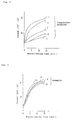
- Fig. 1 shows vulcanization curves of compositions of Examples 3-6 immediately after mixing the ingredients.
- Fig. 2 shows vulcanization curves of compositions of Comparative Examples 1 and 2 immediately after mixing the ingredients.
- Fig. 3 shows vulcanization curves of compositions of Comparative Examples 3-7 immediately after mixing the ingredients.
- Fig. 4 shows vulcanization curves of compositions of Examples 9-12 immediately after mixing the ingredients.
- Fig. 5 shows vulcanization curves of compositions of Comparative Examples 8 and 9 immediately after mixing the ingredients.
- the epichlorohydrin polymer (a) means a homopolymer of epichlorohydrin or a copolymer of epichlorohydrin with another epoxide such as ethylene oxide, propylene oxide or ally glycidyl ether.
- epichlorohydrin copolymer examples include an epichlorohydrin/ethylene oxide copolymer, an epichlorohydrin/propylene oxide copolymer, an epichlorohydrin/allyl glycidyl ether copolymer, an epichlorohydrin/ethylene oxide/allyl glycidyl ether three-component copolymer, an epichlorohydrin/propylene oxide/allyl glycidyl ether three-component copolymer, an epichlorohydrin/ethylene oxide/propylene oxide/allyl glycidyl ether four-component copolymer.
- the copolymer contains at least 10 % by mol of an epichlorohydrin component for the purpose of keeping a practical vulcanization rate.
- the epichlorohydrin polymer preferably has a usually used Mooney viscosity ML1+4 (100°C) of 30 to 150.
- 2,3-dimercaptopyrazine derivative of the formula (I) which is component (b) are pyrazine-2,3-dithiocarbonate, 5-ethylpyrazine-2,3-dithiocarbonate, 5,6-dimethylpyrazine-2,3-dithiocarbonate and 5-n-butylpyrazine-2,3-dithiocarbonate. It is particularly preferable to use pyrazine-2,3-dithiocarbonate and/or 5-ethylpyrazine-2,3-dithiocarbonate.
- 2,3-dimercaptoquinoxaline derivative of the formula (II) which is component (b) are quinoxaline-2,3-dithiocarbonate, 6-methylquinoxaline-2,3-dithiocarbonate, 6-isopropylquinoxaline-2,3-dithiocarbonate and 5,8-dimethylquinoxaline-2,3-dithiocarbonate. It is particularly preferable to use quinoxaline-2,3-dithiocarbonate and/or 6-methylquinoxaline-2,3-dithiocarbonate.
- the amount of the component (b) is from 0.1 to 10 parts by weight, preferably from 0.5 to 5 parts by weight per 100 parts by weight of the epichlorohydrin polymer (a). When the amount is smaller than this range, it is difficult to have the excellent vulcanization rate which is one of effects of the present invention. When the amount is larger than this range, the composition gives so stiff vulcanized material that the properties usually expected in the vulcanized material of the epichlorohydrin polymer cannot be obtained.
- the hydrotalcite compound (c) preferably has the formula: Mg x Al y (OH) 2x+3y-2 CO3 ⁇ wH2O (III) wherein x is from 1 to 10, y is from 1 to 5, and w is a real number.
- the value of w is usually at least 0, for example, from 0 to 20.
- the compound (c) are Mg 4.5 Al2(OH)13CO3 ⁇ 3.5H2O, Mg 4.5 Al2(OH)13CO3, Mg4Al2(OH)12CO3 ⁇ 3.5H2O, Mg6Al2(OH)16CO3 ⁇ 4H2O, Mg5Al2(OH)14CO3 ⁇ 4H2O, Mg3Al2(OH)10CO3 ⁇ 1.7H2O, and the like.
- the amount of the hydrotalcite compound (c) is from 1 to 10 parts by weight, preferably from 2 to 8 parts by weight, per 100 parts by weight of the epichlorohydrin polymer (a).
- the amount is smaller than this range, it is difficult to have both of the high vulcanization rate and the excellent storage stability which are effects of the present invention.
- the amount is larger than this range, the effects cannot be significantly improved.
- the hydrotalcite compound (c) is known as an acid acceptor which gives a halogen-containing elastomer having the good water resistance (cf. Japanese Patent Kokai Publication No. 151652/1982). It is also known that the incorporation of the hydrotalcite compound improves the thermal resistance when a chlorinated polyethylene is vulcanized by an organic peroxide and the like (cf. Japanese Patent Kokai Publication Nos. 7754/1987 and 7755/1987). However, none of these Publications discloses that the combination of hydrotalcite compound with the specified vulcanizing agent of 2,3-dimercaptopyrazine or 2,3-dimercaptoquinoxaline derivative improves the storage stability of the curable epichlorohydrin polymer composition.
- the composition of the present invention may contain a metal compound which is an acid acceptor in view of the adjustment of vulcanization rate and the thermal stability of vulcanized material.
- the metal compound includes an oxide, hydroxide, carbonate salt, carboxylate salt, silicate salt, borate salt and phosphite salt of a metal of Group II of the Periodic Table, preferably Mg, Ba, Ca and Zn; an oxide, basic carbonate salt, basic carboxylate salt, basic phosphite salt, basic sulfite salt, tribasic sulfate salt of a metal of Group IV A of the Periodic Table, preferably Sn and Pb; and the like.
- the metal compound are magnesia, magnesium hydroxide, barium hydroxide, magnesium carbonate, barium carbonate, quick lime, slaked lime, calcium carbonate, calcium silicate, calcium stearate, zinc stearate, calcium phthalate, magnesium phosphite, calcium phosphite, zinc oxide, tin oxide, litharge, red lead, white lead, dibasic lead phthalate, dibasic lead carbonate, tin stearate, basic lead phosphite, basic tin phosphite, basic lead sulfite, tribasic lead sulfate and the like.
- the amount of the metal compound is from 0 to 20 parts by weight, for example, from 0.1 to 10 parts by weight, per 100 parts by weight of the epichlorohydrin polymer (a).
- composition according to the present invention may contains various additive used in the art, for example, an age resistor, a filler, a reinforcing agent, a plasticizer, a processing aid, a pigment, a flame retardant and the like.
- the composition may contain a vulcanization accelerator or a vulcanization retarder for the purpose of adjusting the vulcanization rate.
- a vulcanization accelerator is sulfur, thiuram sulfides, morpholine polysulfides, amines, weak acid salts of amine, basic silica, quaternary ammonium salts, quaternary phosphonium salts and the like.
- Specific examples of the vulcanization retarder are N-cyclohexylthiophthalimide and the like.
- the amount of the vulcanization accelerator or vulcanization retarder is usually from 0 to 10 parts by weight, for example from 0.1 to 5 parts by weight, per 100 parts by weight of the epichlorohydrin polymer (a).
- the preparation of the composition according to the present invention can use usual means used in the polymer processing, for example, a mixing roll, a Banbury mixer, various kneaders and the like.
- the composition according to the present invention can be converted to a vulcanized material usually by heating the composition to 100-200°C.
- the vulcanization time depends on the vulcanization temperature and is usually from 0.5 to 300 minutes.
- the vulcanization can be performed by any desired methods such as press-shaping in a mold, an injection molding, and a thermoforming using a steam can, an air bath, an infrared ray or a microwave.
- the ingredients shown in Table 1 were kneaded in an open roll mill at 60 to 70°C.
- the storage stability of the composition is shown in Table 2.
- a composition sheet was placed in a mold immediately after mixing the ingredients, and then molded under pressure at 170°C and 80 kg/cm2 for 15 minutes.
- the vulcanizate obtained was tested for the various properties. The results are shown in Table 3.
- the vulcanization curves of the compositions obtained in Examples 3-6 and Comparative Examples 1-7 were determined immediately after mixing the ingredients by the use of JSR type III curelastometer at an angle of amplitude of 3° and a temperature of 170°C. The results are shown in Figs. 1-3.
- Table 2 shows that Examples according to the present invention have a remarkably improved storage stability in comparison with Comparative Examples 1 and 2 in which hydrotalcites are not mixed and Comparative Examples 4 and 5 in which hydrotalcites are not mixed and a vulcanizing agent different from that of the present invention is used.
- Comparative Examples 3, 6 and 7 use hydrotalcites and a vulcanizing agent different from that of the present invention, and have the remarkably low vulcanization rate as shown in Figs. 1-3.
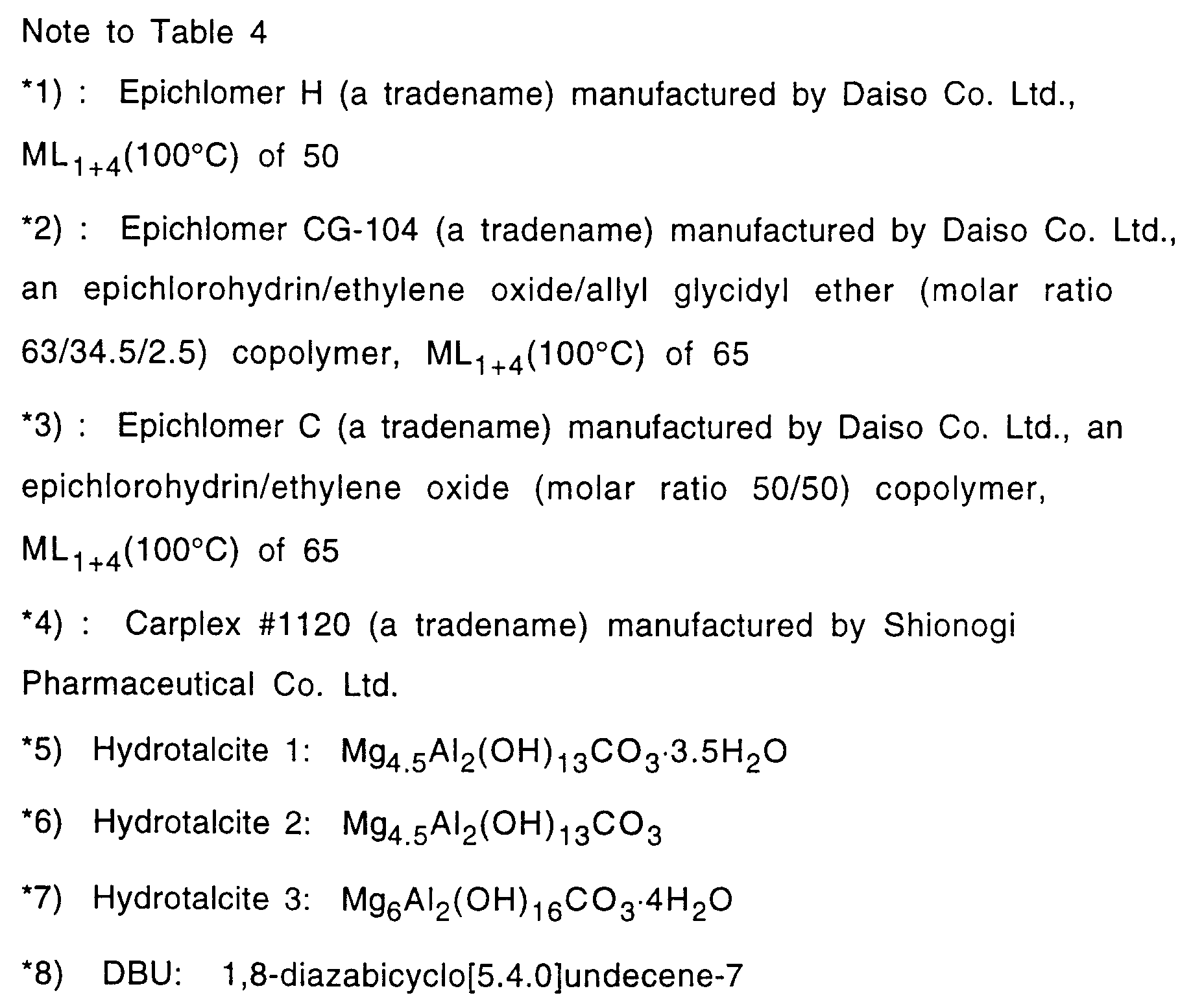
- the ingredients shown in Table 4 were kneaded in an open roll mill at 60 to 70°C.
- the storage stability of the composition is shown in Table 5.
- a composition sheet was placed in a mold immediately after mixing the ingredients, and then molded under pressure at 170°C and 80 kg/cm2 for 15 minutes.
- the vulcanizate obtained was tested for the various properties. The results are shown in Table 6.
- the vulcanization curves of the compositions obtained in Examples 9-12 and Comparative Examples 8 and 9 were determined immediately after mixing the ingredients by the use of JSR type III curelastometer at an angle of amplitude of 3° and a temperature of 170°C. The results are shown in Figs. 4 and 5.
- Table 5 shows that Examples according to the present invention have a remarkably improved storage stability in comparison with Comparative Examples 8 and 9 in which hydrotalcites are not mixed and Comparative Examples 4 and 5 in which hydrotalcites are not mixed and a vulcanizing agent different from that of the present invention is used.
- Comparative Examples 3, 6 and 7 use hydrotalcites and a vulcanizing agent different from that of the present invention, and have the remarkably low vulcanization rate as shown in Figs. 3-5.
- the present invention provides a curable epichlorohydrin polymer composition having a high curing speed and an excellent storage stability for a long time.
Landscapes
- Chemical & Material Sciences (AREA)
- Health & Medical Sciences (AREA)
- Chemical Kinetics & Catalysis (AREA)
- Medicinal Chemistry (AREA)
- Polymers & Plastics (AREA)
- Organic Chemistry (AREA)
- Compositions Of Macromolecular Compounds (AREA)
- Agricultural Chemicals And Associated Chemicals (AREA)
Abstract
- (a) 100 parts by weight of an epichlorohydrin polymer;
- (b) 0.1 to 10 parts by weight of a 2,3-dimercaptopyrazine derivative or a 2,3-dimercaptoquinoxaline derivative; and
- (c) 1 to 10 parts by weight of a hydrotalcite compound, has the high vulcanization rate and the excellent long time storage stability.
Description
- The present invention relates to a curable composition based on an epichlorohydrin polymer having excellent vulcanization properties and storage stability.
- It is already proposed by Daiso Co. Ltd. that a composition comprising an epichlorohydrin polymer can be effectively vulcanized by 2,3-dimercaptopyrazine, 2,3-dimercaptoquinoxaline or derivatives thereof in the presence of a metal compound acting as an acid acceptor [cf. Japanese Patent Kokai Publication Nos. 122865/1981, 122866/1981, 227946/1984 and 227947/1984 (Japanese Patent Kokai Publication Nos. 122865/1981 and 122866/1981 correspond to USP No. 4,357,446)]. However, these vulcanizable compositions have an increase of viscosity because of vulcanization during the storage of the compositions so that it is difficult to shape the compositions. These compositions have poor storage stability, and the improvement of the storage stability is desired.
- An object of the present invention is to provide a vulcanizable composition based on an epichlorohydrin polymer, which has a high vulcanization rate and an excellent storage stability for a long time.
- This object has been solved by incorporating a hydrotalcite compound in a composition comprising an epichlorohydrin polymer and a 2,3-dimercaptopyrazine or 2,3-dimercaptoquinoxaline derivative vulcanizing agent.
- In a preferred embodiment, the present invention provides a vulcanizable composition comprising
- (a) 100 parts by weight of an epichlorohydrin polymer;
- (b) 0.1 to 10 parts by weight of a 2,3-dimercaptopyrazine derivative of the formula:


- (c) 1 to 10 parts by weight of a hydrotalcite compound.
- Fig. 1 shows vulcanization curves of compositions of Examples 3-6 immediately after mixing the ingredients.
- Fig. 2 shows vulcanization curves of compositions of Comparative Examples 1 and 2 immediately after mixing the ingredients.
- Fig. 3 shows vulcanization curves of compositions of Comparative Examples 3-7 immediately after mixing the ingredients.
- Fig. 4 shows vulcanization curves of compositions of Examples 9-12 immediately after mixing the ingredients.
- Fig. 5 shows vulcanization curves of compositions of Comparative Examples 8 and 9 immediately after mixing the ingredients.
- The epichlorohydrin polymer (a) means a homopolymer of epichlorohydrin or a copolymer of epichlorohydrin with another epoxide such as ethylene oxide, propylene oxide or ally glycidyl ether. Specific examples of the epichlorohydrin copolymer are an epichlorohydrin/ethylene oxide copolymer, an epichlorohydrin/propylene oxide copolymer, an epichlorohydrin/allyl glycidyl ether copolymer, an epichlorohydrin/ethylene oxide/allyl glycidyl ether three-component copolymer, an epichlorohydrin/propylene oxide/allyl glycidyl ether three-component copolymer, an epichlorohydrin/ethylene oxide/propylene oxide/allyl glycidyl ether four-component copolymer. Preferably, the copolymer contains at least 10 % by mol of an epichlorohydrin component for the purpose of keeping a practical vulcanization rate. The epichlorohydrin polymer preferably has a usually used Mooney viscosity ML₁₊₄ (100°C) of 30 to 150.
- Specific examples of the 2,3-dimercaptopyrazine derivative of the formula (I) which is component (b) are pyrazine-2,3-dithiocarbonate, 5-ethylpyrazine-2,3-dithiocarbonate, 5,6-dimethylpyrazine-2,3-dithiocarbonate and 5-n-butylpyrazine-2,3-dithiocarbonate. It is particularly preferable to use pyrazine-2,3-dithiocarbonate and/or 5-ethylpyrazine-2,3-dithiocarbonate.
- Specific examples of the 2,3-dimercaptoquinoxaline derivative of the formula (II) which is component (b) are quinoxaline-2,3-dithiocarbonate, 6-methylquinoxaline-2,3-dithiocarbonate, 6-isopropylquinoxaline-2,3-dithiocarbonate and 5,8-dimethylquinoxaline-2,3-dithiocarbonate. It is particularly preferable to use quinoxaline-2,3-dithiocarbonate and/or 6-methylquinoxaline-2,3-dithiocarbonate.
- The amount of the component (b) is from 0.1 to 10 parts by weight, preferably from 0.5 to 5 parts by weight per 100 parts by weight of the epichlorohydrin polymer (a). When the amount is smaller than this range, it is difficult to have the excellent vulcanization rate which is one of effects of the present invention. When the amount is larger than this range, the composition gives so stiff vulcanized material that the properties usually expected in the vulcanized material of the epichlorohydrin polymer cannot be obtained.
- The hydrotalcite compound (c) preferably has the formula:
MgxAly(OH)2x+3y-2CO₃·wH₂O (III)
wherein x is from 1 to 10, y is from 1 to 5, and w is a real number. The value of w is usually at least 0, for example, from 0 to 20. Specific examples of the compound (c) are Mg4.5Al₂(OH)₁₃CO₃·3.5H₂O, Mg4.5Al₂(OH)₁₃CO₃, Mg₄Al₂(OH)₁₂CO₃·3.5H₂O, Mg₆Al₂(OH)₁₆CO₃·4H₂O, Mg₅Al₂(OH)₁₄CO₃·4H₂O, Mg₃Al₂(OH)₁₀CO₃·1.7H₂O, and the like. - The amount of the hydrotalcite compound (c) is from 1 to 10 parts by weight, preferably from 2 to 8 parts by weight, per 100 parts by weight of the epichlorohydrin polymer (a). When the amount is smaller than this range, it is difficult to have both of the high vulcanization rate and the excellent storage stability which are effects of the present invention. When the amount is larger than this range, the effects cannot be significantly improved.
- The hydrotalcite compound (c) is known as an acid acceptor which gives a halogen-containing elastomer having the good water resistance (cf. Japanese Patent Kokai Publication No. 151652/1982). It is also known that the incorporation of the hydrotalcite compound improves the thermal resistance when a chlorinated polyethylene is vulcanized by an organic peroxide and the like (cf. Japanese Patent Kokai Publication Nos. 7754/1987 and 7755/1987). However, none of these Publications discloses that the combination of hydrotalcite compound with the specified vulcanizing agent of 2,3-dimercaptopyrazine or 2,3-dimercaptoquinoxaline derivative improves the storage stability of the curable epichlorohydrin polymer composition.
- The composition of the present invention may contain a metal compound which is an acid acceptor in view of the adjustment of vulcanization rate and the thermal stability of vulcanized material. The metal compound includes an oxide, hydroxide, carbonate salt, carboxylate salt, silicate salt, borate salt and phosphite salt of a metal of Group II of the Periodic Table, preferably Mg, Ba, Ca and Zn; an oxide, basic carbonate salt, basic carboxylate salt, basic phosphite salt, basic sulfite salt, tribasic sulfate salt of a metal of Group IV A of the Periodic Table, preferably Sn and Pb; and the like. Specific examples of the metal compound are magnesia, magnesium hydroxide, barium hydroxide, magnesium carbonate, barium carbonate, quick lime, slaked lime, calcium carbonate, calcium silicate, calcium stearate, zinc stearate, calcium phthalate, magnesium phosphite, calcium phosphite, zinc oxide, tin oxide, litharge, red lead, white lead, dibasic lead phthalate, dibasic lead carbonate, tin stearate, basic lead phosphite, basic tin phosphite, basic lead sulfite, tribasic lead sulfate and the like. The amount of the metal compound is from 0 to 20 parts by weight, for example, from 0.1 to 10 parts by weight, per 100 parts by weight of the epichlorohydrin polymer (a).
- The composition according to the present invention may contains various additive used in the art, for example, an age resistor, a filler, a reinforcing agent, a plasticizer, a processing aid, a pigment, a flame retardant and the like.
- The composition may contain a vulcanization accelerator or a vulcanization retarder for the purpose of adjusting the vulcanization rate. Specific examples of the vulcanization accelerator are sulfur, thiuram sulfides, morpholine polysulfides, amines, weak acid salts of amine, basic silica, quaternary ammonium salts, quaternary phosphonium salts and the like. Specific examples of the vulcanization retarder are N-cyclohexylthiophthalimide and the like. The amount of the vulcanization accelerator or vulcanization retarder is usually from 0 to 10 parts by weight, for example from 0.1 to 5 parts by weight, per 100 parts by weight of the epichlorohydrin polymer (a).
- The preparation of the composition according to the present invention can use usual means used in the polymer processing, for example, a mixing roll, a Banbury mixer, various kneaders and the like. The composition according to the present invention can be converted to a vulcanized material usually by heating the composition to 100-200°C. The vulcanization time depends on the vulcanization temperature and is usually from 0.5 to 300 minutes. The vulcanization can be performed by any desired methods such as press-shaping in a mold, an injection molding, and a thermoforming using a steam can, an air bath, an infrared ray or a microwave.
- The present invention will be illustrated by the following Examples.
- The ingredients shown in Table 1 were kneaded in an open roll mill at 60 to 70°C. The storage stability of the composition is shown in Table 2. A composition sheet was placed in a mold immediately after mixing the ingredients, and then molded under pressure at 170°C and 80 kg/cm² for 15 minutes. The vulcanizate obtained was tested for the various properties. The results are shown in Table 3. The vulcanization curves of the compositions obtained in Examples 3-6 and Comparative Examples 1-7 were determined immediately after mixing the ingredients by the use of JSR type III curelastometer at an angle of amplitude of 3° and a temperature of 170°C. The results are shown in Figs. 1-3.


- The above Table 2 shows that Examples according to the present invention have a remarkably improved storage stability in comparison with Comparative Examples 1 and 2 in which hydrotalcites are not mixed and Comparative Examples 4 and 5 in which hydrotalcites are not mixed and a vulcanizing agent different from that of the present invention is used. Comparative Examples 3, 6 and 7 use hydrotalcites and a vulcanizing agent different from that of the present invention, and have the remarkably low vulcanization rate as shown in Figs. 1-3.
- The ingredients shown in Table 4 were kneaded in an open roll mill at 60 to 70°C. The storage stability of the composition is shown in Table 5. A composition sheet was placed in a mold immediately after mixing the ingredients, and then molded under pressure at 170°C and 80 kg/cm² for 15 minutes. The vulcanizate obtained was tested for the various properties. The results are shown in Table 6. The vulcanization curves of the compositions obtained in Examples 9-12 and Comparative Examples 8 and 9 were determined immediately after mixing the ingredients by the use of JSR type III curelastometer at an angle of amplitude of 3° and a temperature of 170°C. The results are shown in Figs. 4 and 5.




- The above Table 5 shows that Examples according to the present invention have a remarkably improved storage stability in comparison with Comparative Examples 8 and 9 in which hydrotalcites are not mixed and Comparative Examples 4 and 5 in which hydrotalcites are not mixed and a vulcanizing agent different from that of the present invention is used. Comparative Examples 3, 6 and 7 use hydrotalcites and a vulcanizing agent different from that of the present invention, and have the remarkably low vulcanization rate as shown in Figs. 3-5.
- The present invention provides a curable epichlorohydrin polymer composition having a high curing speed and an excellent storage stability for a long time.
Claims (4)
- A vulcanizable composition comprising(a) 100 parts by weight of an epichlorohydrin polymer;(b) 0.1 to 10 parts by weight of a 2,3-dimercaptopyrazine derivative of the formula:

 (c) 1 to 10 parts by weight of a hydrotalcite compound.
 - The vulcanizable composition according to claim 1 wherein the 2,3-dimercaptopyrazine derivative is at least one selected from the group consisting of pyrazine-2,3-dithiocarbonate, 5-ethylpyrazine-2,3-dithiocarbonate, 5,6-dimethylpyrazine-2,3-dithiocarbonate and 5-n-butylpyrazine-2,3-dithiocarbonate.
- The vulcanizable composition according to claim 1, wherein the 2,3-dimercaptoquinoxaline derivative is at least one selected from the group consisting of quinoxaline-2,3-dithiocarbonate, 6-methylquinoxaline-2,3-dithiocarbonate, 6-isopropylquinoxaline-2,3-dithiocarbonate and 5,8-dimethylquinoxaline-2,3-dithiocarbonate.
- The vulcanizable composition according to any of claims 1 to 3 wherein the hydrotalcite compound (c) is of the formula:
MgxAly(OH)2x+3y-2CO₃·wH₂O (III)
wherein x is from 1 to 10, y is from 1 to 5, and w is a real number.
Applications Claiming Priority (4)
| Application Number | Priority Date | Filing Date | Title |
|---|---|---|---|
| JP30883693A JP3170982B2 (en) | 1993-12-09 | 1993-12-09 | Epichlorohydrin polymer vulcanizing composition |
| JP308836/93 | 1993-12-09 | ||
| JP80176/94 | 1994-04-19 | ||
| JP08017694A JP3235335B2 (en) | 1994-04-19 | 1994-04-19 | Epichlorohydrin polymer vulcanizing composition |
Publications (2)
| Publication Number | Publication Date |
|---|---|
| EP0657499A1 true EP0657499A1 (en) | 1995-06-14 |
| EP0657499B1 EP0657499B1 (en) | 1998-07-08 |
Family
ID=26421233
Family Applications (1)
| Application Number | Title | Priority Date | Filing Date |
|---|---|---|---|
| EP94119434A Expired - Lifetime EP0657499B1 (en) | 1993-12-09 | 1994-12-08 | Vulcanizable epichlorohydrin polymer composition |
Country Status (5)
| Country | Link |
|---|---|
| US (1) | US5519079A (en) |
| EP (1) | EP0657499B1 (en) |
| KR (1) | KR100320642B1 (en) |
| DE (1) | DE69411518T2 (en) |
| ES (1) | ES2119055T3 (en) |
Cited By (2)
| Publication number | Priority date | Publication date | Assignee | Title |
|---|---|---|---|---|
| EP1704994A1 (en) * | 2005-03-25 | 2006-09-27 | Daiso Co., Ltd. | Vulcanized rubber laminate |
| EP2316884A4 (en) * | 2008-08-22 | 2014-07-02 | Daiso Co Ltd | VULCANIZABLE RUBBER COMPOSITION FOR AIR SPRING, AND MOLDED RUBBER ARTICLE FOR AIR SPRING |
Families Citing this family (2)
| Publication number | Priority date | Publication date | Assignee | Title |
|---|---|---|---|---|
| US6106914A (en) * | 1997-01-22 | 2000-08-22 | Tokai Rubber Industries, Ltd. | Laminar structure and a hose formed of the laminar structure exhibiting good adhesiveness between adjacent layers |
| KR101200664B1 (en) * | 2004-11-24 | 2012-11-12 | 다이소 가부시키가이샤 | Composition for vulcanized rubber and vulcanization product |
Citations (2)
| Publication number | Priority date | Publication date | Assignee | Title |
|---|---|---|---|---|
| DE3107941A1 (en) * | 1980-03-03 | 1982-01-14 | Osaka Soda Co. Ltd., Osaka | "HARDENABLE COMPOSITION OF A HALOGEN-CONTAINING POLYMER" |
| JPS57151652A (en) * | 1981-03-13 | 1982-09-18 | Showa Gomme Kk | Water-resistant halogen-containing elastomer composition |
Family Cites Families (13)
| Publication number | Priority date | Publication date | Assignee | Title |
|---|---|---|---|---|
| JPS5814469B2 (en) * | 1980-03-03 | 1983-03-19 | 大阪曹達株式会社 | Halogen-containing polymer vulcanization composition |
| JPS5814468B2 (en) * | 1980-03-03 | 1983-03-19 | 大阪曹達株式会社 | Halogen-containing polymer vulcanization composition |
| JPS58111843A (en) * | 1981-12-25 | 1983-07-04 | Osaka Soda Co Ltd | Vulcanizable blended rubber composition |
| JPS58222128A (en) * | 1982-06-18 | 1983-12-23 | Kyowa Chem Ind Co Ltd | Method for improving water resistance of halogen- containing rubber |
| JPS591565A (en) * | 1982-06-28 | 1984-01-06 | Osaka Soda Co Ltd | Vulcanizable rubber blend composition |
| JPS6054976B2 (en) * | 1983-06-09 | 1985-12-03 | 大阪曹達株式会社 | Halogen-containing polymer vulcanization composition |
| JPS6054977B2 (en) * | 1983-06-09 | 1985-12-03 | 大阪曹達株式会社 | Halogen-containing polymer vulcanization composition |
| JPS61174270A (en) * | 1985-01-29 | 1986-08-05 | Kyowa Chem Ind Co Ltd | Rust-inhibiting or discoloration-resistant synthetic resin composition and agent |
| JPS627754A (en) * | 1985-07-04 | 1987-01-14 | Showa Denko Kk | Chlorinated polyethylene composition |
| JPS627755A (en) * | 1985-07-04 | 1987-01-14 | Showa Denko Kk | Chlorinated polyethylene composition |
| US4786665A (en) * | 1988-03-18 | 1988-11-22 | Tosoh Corporation | Chlorosulfonated ethylene. α-olefin copolymer composition containing hydrotalcite |
| JP2817239B2 (en) * | 1989-08-16 | 1998-10-30 | 東ソー株式会社 | Chlorosulfonated polyethylene polymer composition |
| US5250279A (en) * | 1991-12-20 | 1993-10-05 | J. M. Huber Corporation | Method for the manufacture of hydrotalcite |
-
1994
- 1994-12-08 DE DE69411518T patent/DE69411518T2/en not_active Expired - Lifetime
- 1994-12-08 EP EP94119434A patent/EP0657499B1/en not_active Expired - Lifetime
- 1994-12-08 ES ES94119434T patent/ES2119055T3/en not_active Expired - Lifetime
- 1994-12-09 US US08/352,884 patent/US5519079A/en not_active Expired - Lifetime
- 1994-12-09 KR KR1019940033530A patent/KR100320642B1/en not_active Expired - Lifetime
Patent Citations (3)
| Publication number | Priority date | Publication date | Assignee | Title |
|---|---|---|---|---|
| DE3107941A1 (en) * | 1980-03-03 | 1982-01-14 | Osaka Soda Co. Ltd., Osaka | "HARDENABLE COMPOSITION OF A HALOGEN-CONTAINING POLYMER" |
| US4357446A (en) * | 1980-03-03 | 1982-11-02 | Osaka Soda Co. Ltd. | Curable composition of halogen-containing polymer |
| JPS57151652A (en) * | 1981-03-13 | 1982-09-18 | Showa Gomme Kk | Water-resistant halogen-containing elastomer composition |
Non-Patent Citations (1)
| Title |
|---|
| DATABASE WPI Derwent World Patents Index; AN 82-91533E * |
Cited By (3)
| Publication number | Priority date | Publication date | Assignee | Title |
|---|---|---|---|---|
| EP1704994A1 (en) * | 2005-03-25 | 2006-09-27 | Daiso Co., Ltd. | Vulcanized rubber laminate |
| US8283039B2 (en) | 2005-03-25 | 2012-10-09 | Daiso Co., Ltd. | Vulcanized rubber laminate |
| EP2316884A4 (en) * | 2008-08-22 | 2014-07-02 | Daiso Co Ltd | VULCANIZABLE RUBBER COMPOSITION FOR AIR SPRING, AND MOLDED RUBBER ARTICLE FOR AIR SPRING |
Also Published As
| Publication number | Publication date |
|---|---|
| ES2119055T3 (en) | 1998-10-01 |
| KR100320642B1 (en) | 2002-06-24 |
| DE69411518D1 (en) | 1998-08-13 |
| DE69411518T2 (en) | 1998-11-05 |
| KR950018171A (en) | 1995-07-22 |
| EP0657499B1 (en) | 1998-07-08 |
| US5519079A (en) | 1996-05-21 |
Similar Documents
| Publication | Publication Date | Title |
|---|---|---|
| KR101800465B1 (en) | Semi-conductive rubber composition and vulcanizate thereof | |
| US4234705A (en) | Curable composition of halogen-containing polymer and crosslinking agent therefor | |
| US4511698A (en) | Curable composition of epichlorohydrin rubber and acrylic rubber and cured composition therefrom | |
| US4342851A (en) | Curable composition of halogen-containing polymer | |
| EP0657499B1 (en) | Vulcanizable epichlorohydrin polymer composition | |
| JP3170982B2 (en) | Epichlorohydrin polymer vulcanizing composition | |
| US7964110B2 (en) | Cure system for halogenated elastomer compositions, a curable halogenated elastomer composition, and a method for curing halogenated elastomer compositions | |
| JP3225728B2 (en) | Composition for vulcanization of blended rubber | |
| JP3994757B2 (en) | Rubber composition for vulcanization and vulcanized product thereof | |
| JP3235335B2 (en) | Epichlorohydrin polymer vulcanizing composition | |
| JPH07300556A (en) | Composition for vulcanization of rubber blend | |
| US4268640A (en) | Curable composition of halogen-containing polymer | |
| JPS6152181B2 (en) | ||
| JP4224942B2 (en) | Halogen-containing rubber composition and vulcanized product thereof | |
| JP4154781B2 (en) | Semiconductive rubber material | |
| US8252870B2 (en) | Cure system of halogenated elastomer compositions, a curable halogenated elastomer composition, and a method for curing halogenated elastomer compositions | |
| JP2004107540A (en) | Epihalohydrin rubber composition and method for producing cross-linked molded article of epihalohydrin rubber | |
| EP0184212A2 (en) | Process for cross-linking halogenated polymers | |
| JPH0562148B2 (en) | ||
| JPS6129620B2 (en) | ||
| JP2691783B2 (en) | Halogen-containing elastomer vulcanizing composition | |
| JPS6215096B2 (en) | ||
| JPS6081248A (en) | Vulcanizing composition for halogen-containing polymer | |
| JPH0156097B2 (en) | ||
| JP2005154686A (en) | Epihalohydrin rubber composition |
Legal Events
| Date | Code | Title | Description |
|---|---|---|---|
| PUAI | Public reference made under article 153(3) epc to a published international application that has entered the european phase |
Free format text: ORIGINAL CODE: 0009012 |
|
| AK | Designated contracting states |
Kind code of ref document: A1 Designated state(s): DE ES FR GB IT |
|
| 17P | Request for examination filed |
Effective date: 19951013 |
|
| GRAG | Despatch of communication of intention to grant |
Free format text: ORIGINAL CODE: EPIDOS AGRA |
|
| 17Q | First examination report despatched |
Effective date: 19970825 |
|
| GRAG | Despatch of communication of intention to grant |
Free format text: ORIGINAL CODE: EPIDOS AGRA |
|
| GRAH | Despatch of communication of intention to grant a patent |
Free format text: ORIGINAL CODE: EPIDOS IGRA |
|
| GRAH | Despatch of communication of intention to grant a patent |
Free format text: ORIGINAL CODE: EPIDOS IGRA |
|
| GRAA | (expected) grant |
Free format text: ORIGINAL CODE: 0009210 |
|
| AK | Designated contracting states |
Kind code of ref document: B1 Designated state(s): DE ES FR GB IT |
|
| ITF | It: translation for a ep patent filed | ||
| REF | Corresponds to: |
Ref document number: 69411518 Country of ref document: DE Date of ref document: 19980813 |
|
| REG | Reference to a national code |
Ref country code: ES Ref legal event code: FG2A Ref document number: 2119055 Country of ref document: ES Kind code of ref document: T3 |
|
| ET | Fr: translation filed | ||
| PLBE | No opposition filed within time limit |
Free format text: ORIGINAL CODE: 0009261 |
|
| STAA | Information on the status of an ep patent application or granted ep patent |
Free format text: STATUS: NO OPPOSITION FILED WITHIN TIME LIMIT |
|
| 26N | No opposition filed | ||
| REG | Reference to a national code |
Ref country code: GB Ref legal event code: IF02 |
|
| PGFP | Annual fee paid to national office [announced via postgrant information from national office to epo] |
Ref country code: DE Payment date: 20131220 Year of fee payment: 20 Ref country code: GB Payment date: 20131219 Year of fee payment: 20 |
|
| PGFP | Annual fee paid to national office [announced via postgrant information from national office to epo] |
Ref country code: ES Payment date: 20131226 Year of fee payment: 20 Ref country code: IT Payment date: 20131217 Year of fee payment: 20 |
|
| PGFP | Annual fee paid to national office [announced via postgrant information from national office to epo] |
Ref country code: FR Payment date: 20131220 Year of fee payment: 20 |
|
| REG | Reference to a national code |
Ref country code: DE Ref legal event code: R071 Ref document number: 69411518 Country of ref document: DE |
|
| REG | Reference to a national code |
Ref country code: GB Ref legal event code: PE20 Expiry date: 20141207 |
|
| PG25 | Lapsed in a contracting state [announced via postgrant information from national office to epo] |
Ref country code: GB Free format text: LAPSE BECAUSE OF EXPIRATION OF PROTECTION Effective date: 20141207 |
|
| REG | Reference to a national code |
Ref country code: ES Ref legal event code: FD2A Effective date: 20150826 |
|
| PG25 | Lapsed in a contracting state [announced via postgrant information from national office to epo] |
Ref country code: ES Free format text: LAPSE BECAUSE OF EXPIRATION OF PROTECTION Effective date: 20141209 |