EP0657456B1 - Process for preparing epibatidine - Google Patents
Process for preparing epibatidine Download PDFInfo
- Publication number
- EP0657456B1 EP0657456B1 EP94119544A EP94119544A EP0657456B1 EP 0657456 B1 EP0657456 B1 EP 0657456B1 EP 94119544 A EP94119544 A EP 94119544A EP 94119544 A EP94119544 A EP 94119544A EP 0657456 B1 EP0657456 B1 EP 0657456B1
- Authority
- EP
- European Patent Office
- Prior art keywords
- chloro
- pyrid
- optically active
- cyclohexane
- formula
- Prior art date
- Legal status (The legal status is an assumption and is not a legal conclusion. Google has not performed a legal analysis and makes no representation as to the accuracy of the status listed.)
- Expired - Lifetime
Links
- NLPRAJRHRHZCQQ-UHFFFAOYSA-N Epibatidine Natural products C1=NC(Cl)=CC=C1C1C(N2)CCC2C1 NLPRAJRHRHZCQQ-UHFFFAOYSA-N 0.000 title claims abstract description 44
- 238000004519 manufacturing process Methods 0.000 title claims abstract description 7
- NLPRAJRHRHZCQQ-IVZWLZJFSA-N epibatidine Chemical compound C1=NC(Cl)=CC=C1[C@@H]1[C@H](N2)CC[C@H]2C1 NLPRAJRHRHZCQQ-IVZWLZJFSA-N 0.000 title claims abstract 4
- 238000000034 method Methods 0.000 claims abstract description 39
- 230000008569 process Effects 0.000 claims abstract description 32
- 125000000449 nitro group Chemical group [O-][N+](*)=O 0.000 claims description 49
- 239000000203 mixture Substances 0.000 claims description 47
- UHOVQNZJYSORNB-UHFFFAOYSA-N Benzene Chemical compound C1=CC=CC=C1 UHOVQNZJYSORNB-UHFFFAOYSA-N 0.000 claims description 32
- 239000011541 reaction mixture Substances 0.000 claims description 28
- 150000001875 compounds Chemical class 0.000 claims description 23
- 125000002924 primary amino group Chemical group [H]N([H])* 0.000 claims description 18
- 238000006345 epimerization reaction Methods 0.000 claims description 16
- 239000002585 base Substances 0.000 claims description 14
- -1 methanesulfonyloxy, p-toluenesulfonyloxy Chemical group 0.000 claims description 14
- YXFVVABEGXRONW-UHFFFAOYSA-N Toluene Chemical compound CC1=CC=CC=C1 YXFVVABEGXRONW-UHFFFAOYSA-N 0.000 claims description 12
- 239000003513 alkali Substances 0.000 claims description 12
- 239000002904 solvent Substances 0.000 claims description 12
- 238000009835 boiling Methods 0.000 claims description 11
- 239000000010 aprotic solvent Substances 0.000 claims description 10
- 238000002425 crystallisation Methods 0.000 claims description 10
- 230000008025 crystallization Effects 0.000 claims description 10
- 238000007363 ring formation reaction Methods 0.000 claims description 10
- ZLMJMSJWJFRBEC-UHFFFAOYSA-N Potassium Chemical compound [K] ZLMJMSJWJFRBEC-UHFFFAOYSA-N 0.000 claims description 7
- 239000011591 potassium Substances 0.000 claims description 7
- 229910052700 potassium Inorganic materials 0.000 claims description 7
- 150000004945 aromatic hydrocarbons Chemical class 0.000 claims description 6
- RQEUFEKYXDPUSK-UHFFFAOYSA-N 1-phenylethylamine Chemical compound CC(N)C1=CC=CC=C1 RQEUFEKYXDPUSK-UHFFFAOYSA-N 0.000 claims description 5
- 150000008282 halocarbons Chemical class 0.000 claims description 5
- 238000010438 heat treatment Methods 0.000 claims description 5
- BMTAFVWTTFSTOG-UHFFFAOYSA-N Butylate Chemical group CCSC(=O)N(CC(C)C)CC(C)C BMTAFVWTTFSTOG-UHFFFAOYSA-N 0.000 claims description 4
- 125000005279 aryl sulfonyloxy group Chemical group 0.000 claims description 4
- CTQNGGLPUBDAKN-UHFFFAOYSA-N O-Xylene Chemical compound CC1=CC=CC=C1C CTQNGGLPUBDAKN-UHFFFAOYSA-N 0.000 claims description 3
- 239000008096 xylene Substances 0.000 claims description 3
- OVEHNNQXLPJPPL-UHFFFAOYSA-N lithium;n-propan-2-ylpropan-2-amine Chemical group [Li].CC(C)NC(C)C OVEHNNQXLPJPPL-UHFFFAOYSA-N 0.000 claims description 2
- QDRKDTQENPPHOJ-UHFFFAOYSA-N sodium ethoxide Chemical group [Na+].CC[O-] QDRKDTQENPPHOJ-UHFFFAOYSA-N 0.000 claims description 2
- 230000008901 benefit Effects 0.000 abstract description 2
- 125000002252 acyl group Chemical group 0.000 abstract 1
- 239000007858 starting material Substances 0.000 abstract 1
- OKKJLVBELUTLKV-UHFFFAOYSA-N Methanol Chemical compound OC OKKJLVBELUTLKV-UHFFFAOYSA-N 0.000 description 72
- HEDRZPFGACZZDS-UHFFFAOYSA-N Chloroform Chemical compound ClC(Cl)Cl HEDRZPFGACZZDS-UHFFFAOYSA-N 0.000 description 62
- 239000000243 solution Substances 0.000 description 48
- YMWUJEATGCHHMB-UHFFFAOYSA-N Dichloromethane Chemical compound ClCCl YMWUJEATGCHHMB-UHFFFAOYSA-N 0.000 description 45
- XLYOFNOQVPJJNP-UHFFFAOYSA-N water Substances O XLYOFNOQVPJJNP-UHFFFAOYSA-N 0.000 description 36
- NLPRAJRHRHZCQQ-UTLUCORTSA-N (1r,3s,4s)-3-(6-chloropyridin-3-yl)-7-azabicyclo[2.2.1]heptane Chemical compound C1=NC(Cl)=CC=C1[C@H]1[C@@H](N2)CC[C@@H]2C1 NLPRAJRHRHZCQQ-UTLUCORTSA-N 0.000 description 33
- XEKOWRVHYACXOJ-UHFFFAOYSA-N Ethyl acetate Chemical compound CCOC(C)=O XEKOWRVHYACXOJ-UHFFFAOYSA-N 0.000 description 30
- 238000006243 chemical reaction Methods 0.000 description 21
- 150000003839 salts Chemical class 0.000 description 21
- LFQSCWFLJHTTHZ-UHFFFAOYSA-N Ethanol Chemical compound CCO LFQSCWFLJHTTHZ-UHFFFAOYSA-N 0.000 description 20
- HEMHJVSKTPXQMS-UHFFFAOYSA-M sodium hydroxide Inorganic materials [OH-].[Na+] HEMHJVSKTPXQMS-UHFFFAOYSA-M 0.000 description 20
- VYPSYNLAJGMNEJ-UHFFFAOYSA-N Silicium dioxide Chemical compound O=[Si]=O VYPSYNLAJGMNEJ-UHFFFAOYSA-N 0.000 description 17
- CSCPPACGZOOCGX-UHFFFAOYSA-N Acetone Chemical compound CC(C)=O CSCPPACGZOOCGX-UHFFFAOYSA-N 0.000 description 16
- 239000000126 substance Substances 0.000 description 16
- VLKZOEOYAKHREP-UHFFFAOYSA-N n-Hexane Chemical compound CCCCCC VLKZOEOYAKHREP-UHFFFAOYSA-N 0.000 description 14
- 239000000047 product Substances 0.000 description 14
- RTZKZFJDLAIYFH-UHFFFAOYSA-N Diethyl ether Chemical compound CCOCC RTZKZFJDLAIYFH-UHFFFAOYSA-N 0.000 description 13
- 238000006722 reduction reaction Methods 0.000 description 13
- 230000009467 reduction Effects 0.000 description 11
- JUJWROOIHBZHMG-UHFFFAOYSA-N Pyridine Chemical group C1=CC=NC=C1 JUJWROOIHBZHMG-UHFFFAOYSA-N 0.000 description 10
- 238000004440 column chromatography Methods 0.000 description 10
- NROKBHXJSPEDAR-UHFFFAOYSA-M potassium fluoride Chemical compound [F-].[K+] NROKBHXJSPEDAR-UHFFFAOYSA-M 0.000 description 10
- 230000015572 biosynthetic process Effects 0.000 description 9
- FAPWRFPIFSIZLT-UHFFFAOYSA-M Sodium chloride Chemical class [Na+].[Cl-] FAPWRFPIFSIZLT-UHFFFAOYSA-M 0.000 description 8
- WYURNTSHIVDZCO-UHFFFAOYSA-N Tetrahydrofuran Chemical compound C1CCOC1 WYURNTSHIVDZCO-UHFFFAOYSA-N 0.000 description 8
- 238000004587 chromatography analysis Methods 0.000 description 8
- 238000001704 evaporation Methods 0.000 description 8
- 239000010410 layer Substances 0.000 description 8
- 238000002360 preparation method Methods 0.000 description 8
- 238000003786 synthesis reaction Methods 0.000 description 8
- 239000002253 acid Substances 0.000 description 7
- 239000003638 chemical reducing agent Substances 0.000 description 7
- 125000004043 oxo group Chemical group O=* 0.000 description 7
- GHAXSBABNPZELT-UHFFFAOYSA-N 1-bromo-5-nitropentan-2-one Chemical compound [O-][N+](=O)CCCC(=O)CBr GHAXSBABNPZELT-UHFFFAOYSA-N 0.000 description 6
- UXVMQQNJUSDDNG-UHFFFAOYSA-L Calcium chloride Chemical compound [Cl-].[Cl-].[Ca+2] UXVMQQNJUSDDNG-UHFFFAOYSA-L 0.000 description 6
- VEXZGXHMUGYJMC-UHFFFAOYSA-N Hydrochloric acid Chemical compound Cl VEXZGXHMUGYJMC-UHFFFAOYSA-N 0.000 description 6
- JCXJVPUVTGWSNB-UHFFFAOYSA-N Nitrogen dioxide Chemical compound O=[N]=O JCXJVPUVTGWSNB-UHFFFAOYSA-N 0.000 description 6
- 239000001110 calcium chloride Substances 0.000 description 6
- 229910001628 calcium chloride Inorganic materials 0.000 description 6
- 238000001816 cooling Methods 0.000 description 6
- 125000005948 methanesulfonyloxy group Chemical group 0.000 description 6
- BQJCRHHNABKAKU-KBQPJGBKSA-N morphine Chemical compound O([C@H]1[C@H](C=C[C@H]23)O)C4=C5[C@@]12CCN(C)[C@@H]3CC5=CC=C4O BQJCRHHNABKAKU-KBQPJGBKSA-N 0.000 description 6
- 239000000377 silicon dioxide Substances 0.000 description 6
- RIOQSEWOXXDEQQ-UHFFFAOYSA-N triphenylphosphine Chemical compound C1=CC=CC=C1P(C=1C=CC=CC=1)C1=CC=CC=C1 RIOQSEWOXXDEQQ-UHFFFAOYSA-N 0.000 description 6
- BSESWFZTDFVYOD-UHFFFAOYSA-N C1(=CC=CC=C1)[PH2](C1=CC=CC=C1)C1=CC=CC=C1.[N+](=O)([O-])CCCC(C)=O Chemical compound C1(=CC=CC=C1)[PH2](C1=CC=CC=C1)C1=CC=CC=C1.[N+](=O)([O-])CCCC(C)=O BSESWFZTDFVYOD-UHFFFAOYSA-N 0.000 description 5
- 125000003277 amino group Chemical group 0.000 description 5
- 239000008346 aqueous phase Substances 0.000 description 5
- 239000013078 crystal Substances 0.000 description 5
- 229910052757 nitrogen Inorganic materials 0.000 description 5
- 239000012074 organic phase Substances 0.000 description 5
- 239000003960 organic solvent Substances 0.000 description 5
- 239000012071 phase Substances 0.000 description 5
- 239000011698 potassium fluoride Substances 0.000 description 5
- 235000003270 potassium fluoride Nutrition 0.000 description 5
- 125000006239 protecting group Chemical group 0.000 description 5
- 238000005406 washing Methods 0.000 description 5
- MBFOTTCUUAIBDW-UHFFFAOYSA-N 5-nitropentan-2-one Chemical compound CC(=O)CCC[N+]([O-])=O MBFOTTCUUAIBDW-UHFFFAOYSA-N 0.000 description 4
- AFWWKZCPPRPDQK-UHFFFAOYSA-N 6-chloropyridine-3-carbaldehyde Chemical compound ClC1=CC=C(C=O)C=N1 AFWWKZCPPRPDQK-UHFFFAOYSA-N 0.000 description 4
- QTBSBXVTEAMEQO-UHFFFAOYSA-N Acetic acid Chemical compound CC(O)=O QTBSBXVTEAMEQO-UHFFFAOYSA-N 0.000 description 4
- XKRFYHLGVUSROY-UHFFFAOYSA-N Argon Chemical compound [Ar] XKRFYHLGVUSROY-UHFFFAOYSA-N 0.000 description 4
- CPELXLSAUQHCOX-UHFFFAOYSA-M Bromide Chemical compound [Br-] CPELXLSAUQHCOX-UHFFFAOYSA-M 0.000 description 4
- XEEYBQQBJWHFJM-UHFFFAOYSA-N Iron Chemical compound [Fe] XEEYBQQBJWHFJM-UHFFFAOYSA-N 0.000 description 4
- CSNNHWWHGAXBCP-UHFFFAOYSA-L Magnesium sulfate Chemical compound [Mg+2].[O-][S+2]([O-])([O-])[O-] CSNNHWWHGAXBCP-UHFFFAOYSA-L 0.000 description 4
- CDBYLPFSWZWCQE-UHFFFAOYSA-L Sodium Carbonate Chemical compound [Na+].[Na+].[O-]C([O-])=O CDBYLPFSWZWCQE-UHFFFAOYSA-L 0.000 description 4
- PMZURENOXWZQFD-UHFFFAOYSA-L Sodium Sulfate Chemical compound [Na+].[Na+].[O-]S([O-])(=O)=O PMZURENOXWZQFD-UHFFFAOYSA-L 0.000 description 4
- HCHKCACWOHOZIP-UHFFFAOYSA-N Zinc Chemical compound [Zn] HCHKCACWOHOZIP-UHFFFAOYSA-N 0.000 description 4
- 239000012044 organic layer Substances 0.000 description 4
- UMJSCPRVCHMLSP-UHFFFAOYSA-N pyridine Natural products COC1=CC=CN=C1 UMJSCPRVCHMLSP-UHFFFAOYSA-N 0.000 description 4
- 239000000741 silica gel Substances 0.000 description 4
- 229910002027 silica gel Inorganic materials 0.000 description 4
- 229960001866 silicon dioxide Drugs 0.000 description 4
- 239000012279 sodium borohydride Substances 0.000 description 4
- 229910000033 sodium borohydride Inorganic materials 0.000 description 4
- 229910052938 sodium sulfate Inorganic materials 0.000 description 4
- 235000011152 sodium sulphate Nutrition 0.000 description 4
- 229960001367 tartaric acid Drugs 0.000 description 4
- 239000011975 tartaric acid Substances 0.000 description 4
- 229910052725 zinc Inorganic materials 0.000 description 4
- 239000011701 zinc Substances 0.000 description 4
- WKBOTKDWSSQWDR-UHFFFAOYSA-N Bromine atom Chemical compound [Br] WKBOTKDWSSQWDR-UHFFFAOYSA-N 0.000 description 3
- 238000005698 Diels-Alder reaction Methods 0.000 description 3
- DGAQECJNVWCQMB-PUAWFVPOSA-M Ilexoside XXIX Chemical compound C[C@@H]1CC[C@@]2(CC[C@@]3(C(=CC[C@H]4[C@]3(CC[C@@H]5[C@@]4(CC[C@@H](C5(C)C)OS(=O)(=O)[O-])C)C)[C@@H]2[C@]1(C)O)C)C(=O)O[C@H]6[C@@H]([C@H]([C@@H]([C@H](O6)CO)O)O)O.[Na+] DGAQECJNVWCQMB-PUAWFVPOSA-M 0.000 description 3
- GDTBXPJZTBHREO-UHFFFAOYSA-N bromine Substances BrBr GDTBXPJZTBHREO-UHFFFAOYSA-N 0.000 description 3
- 229910052794 bromium Inorganic materials 0.000 description 3
- 125000001309 chloro group Chemical group Cl* 0.000 description 3
- 238000001035 drying Methods 0.000 description 3
- 239000003480 eluent Substances 0.000 description 3
- 150000002148 esters Chemical class 0.000 description 3
- 230000008020 evaporation Effects 0.000 description 3
- 229960005181 morphine Drugs 0.000 description 3
- 230000007935 neutral effect Effects 0.000 description 3
- 125000004433 nitrogen atom Chemical group N* 0.000 description 3
- TWNQGVIAIRXVLR-UHFFFAOYSA-N oxo(oxoalumanyloxy)alumane Chemical compound O=[Al]O[Al]=O TWNQGVIAIRXVLR-UHFFFAOYSA-N 0.000 description 3
- 125000001997 phenyl group Chemical group [H]C1=C([H])C([H])=C(*)C([H])=C1[H] 0.000 description 3
- 125000004044 trifluoroacetyl group Chemical group FC(C(=O)*)(F)F 0.000 description 3
- KMGUEILFFWDGFV-UHFFFAOYSA-N 2-benzoyl-2-benzoyloxy-3-hydroxybutanedioic acid Chemical compound C=1C=CC=CC=1C(=O)C(C(C(O)=O)O)(C(O)=O)OC(=O)C1=CC=CC=C1 KMGUEILFFWDGFV-UHFFFAOYSA-N 0.000 description 2
- DGNNWUINALNROG-UHFFFAOYSA-N 3-(6-chloropyridin-3-yl)-7-azabicyclo[2.2.1]heptane;dihydrochloride Chemical compound Cl.Cl.C1=NC(Cl)=CC=C1C1C(N2)CCC2C1 DGNNWUINALNROG-UHFFFAOYSA-N 0.000 description 2
- UAWMVMPAYRWUFX-UHFFFAOYSA-N 6-Chloronicotinic acid Chemical compound OC(=O)C1=CC=C(Cl)N=C1 UAWMVMPAYRWUFX-UHFFFAOYSA-N 0.000 description 2
- SNZSSCZJMVIOCR-UHFFFAOYSA-N 7-azabicyclo[2.2.1]heptane Chemical group C1CC2CCC1N2 SNZSSCZJMVIOCR-UHFFFAOYSA-N 0.000 description 2
- VHUUQVKOLVNVRT-UHFFFAOYSA-N Ammonium hydroxide Chemical compound [NH4+].[OH-] VHUUQVKOLVNVRT-UHFFFAOYSA-N 0.000 description 2
- FEWJPZIEWOKRBE-JCYAYHJZSA-N Dextrotartaric acid Chemical compound OC(=O)[C@H](O)[C@@H](O)C(O)=O FEWJPZIEWOKRBE-JCYAYHJZSA-N 0.000 description 2
- WHXSMMKQMYFTQS-UHFFFAOYSA-N Lithium Chemical compound [Li] WHXSMMKQMYFTQS-UHFFFAOYSA-N 0.000 description 2
- 239000012359 Methanesulfonyl chloride Substances 0.000 description 2
- MZRVEZGGRBJDDB-UHFFFAOYSA-N N-Butyllithium Chemical compound [Li]CCCC MZRVEZGGRBJDDB-UHFFFAOYSA-N 0.000 description 2
- GRYLNZFGIOXLOG-UHFFFAOYSA-N Nitric acid Chemical compound O[N+]([O-])=O GRYLNZFGIOXLOG-UHFFFAOYSA-N 0.000 description 2
- XYFCBTPGUUZFHI-UHFFFAOYSA-N Phosphine Chemical compound P XYFCBTPGUUZFHI-UHFFFAOYSA-N 0.000 description 2
- UIIMBOGNXHQVGW-UHFFFAOYSA-M Sodium bicarbonate Chemical compound [Na+].OC([O-])=O UIIMBOGNXHQVGW-UHFFFAOYSA-M 0.000 description 2
- WQDUMFSSJAZKTM-UHFFFAOYSA-N Sodium methoxide Chemical compound [Na+].[O-]C WQDUMFSSJAZKTM-UHFFFAOYSA-N 0.000 description 2
- QAOWNCQODCNURD-UHFFFAOYSA-N Sulfuric acid Chemical compound OS(O)(=O)=O QAOWNCQODCNURD-UHFFFAOYSA-N 0.000 description 2
- FEWJPZIEWOKRBE-UHFFFAOYSA-N Tartaric acid Natural products [H+].[H+].[O-]C(=O)C(O)C(O)C([O-])=O FEWJPZIEWOKRBE-UHFFFAOYSA-N 0.000 description 2
- DKGAVHZHDRPRBM-UHFFFAOYSA-N Tert-Butanol Chemical compound CC(C)(C)O DKGAVHZHDRPRBM-UHFFFAOYSA-N 0.000 description 2
- ATJFFYVFTNAWJD-UHFFFAOYSA-N Tin Chemical compound [Sn] ATJFFYVFTNAWJD-UHFFFAOYSA-N 0.000 description 2
- DTQVDTLACAAQTR-UHFFFAOYSA-N Trifluoroacetic acid Chemical compound OC(=O)C(F)(F)F DTQVDTLACAAQTR-UHFFFAOYSA-N 0.000 description 2
- 229960000583 acetic acid Drugs 0.000 description 2
- 150000001338 aliphatic hydrocarbons Chemical class 0.000 description 2
- 229910001854 alkali hydroxide Inorganic materials 0.000 description 2
- 150000008044 alkali metal hydroxides Chemical class 0.000 description 2
- 229930013930 alkaloid Natural products 0.000 description 2
- 150000003797 alkaloid derivatives Chemical class 0.000 description 2
- 239000000908 ammonium hydroxide Substances 0.000 description 2
- 230000000202 analgesic effect Effects 0.000 description 2
- 239000007864 aqueous solution Substances 0.000 description 2
- 229910052786 argon Inorganic materials 0.000 description 2
- 125000003118 aryl group Chemical group 0.000 description 2
- 230000031709 bromination Effects 0.000 description 2
- 238000005893 bromination reaction Methods 0.000 description 2
- 125000001246 bromo group Chemical group Br* 0.000 description 2
- FUSUHKVFWTUUBE-UHFFFAOYSA-N buten-2-one Chemical compound CC(=O)C=C FUSUHKVFWTUUBE-UHFFFAOYSA-N 0.000 description 2
- 238000009903 catalytic hydrogenation reaction Methods 0.000 description 2
- 238000010531 catalytic reduction reaction Methods 0.000 description 2
- 239000013043 chemical agent Substances 0.000 description 2
- 150000008280 chlorinated hydrocarbons Chemical class 0.000 description 2
- MVPPADPHJFYWMZ-UHFFFAOYSA-N chlorobenzene Chemical compound ClC1=CC=CC=C1 MVPPADPHJFYWMZ-UHFFFAOYSA-N 0.000 description 2
- 239000012043 crude product Substances 0.000 description 2
- 239000000284 extract Substances 0.000 description 2
- 239000012362 glacial acetic acid Substances 0.000 description 2
- 125000002887 hydroxy group Chemical group [H]O* 0.000 description 2
- 229910052742 iron Inorganic materials 0.000 description 2
- 229910052744 lithium Inorganic materials 0.000 description 2
- 229910052943 magnesium sulfate Inorganic materials 0.000 description 2
- 235000019341 magnesium sulphate Nutrition 0.000 description 2
- QARBMVPHQWIHKH-UHFFFAOYSA-N methanesulfonyl chloride Chemical compound CS(Cl)(=O)=O QARBMVPHQWIHKH-UHFFFAOYSA-N 0.000 description 2
- 150000004714 phosphonium salts Chemical class 0.000 description 2
- 239000003495 polar organic solvent Substances 0.000 description 2
- 239000002244 precipitate Substances 0.000 description 2
- 239000012429 reaction media Substances 0.000 description 2
- 239000011734 sodium Substances 0.000 description 2
- 229910052708 sodium Inorganic materials 0.000 description 2
- 229910000029 sodium carbonate Inorganic materials 0.000 description 2
- 235000002906 tartaric acid Nutrition 0.000 description 2
- FYSNRJHAOHDILO-UHFFFAOYSA-N thionyl chloride Chemical compound ClS(Cl)=O FYSNRJHAOHDILO-UHFFFAOYSA-N 0.000 description 2
- 239000011135 tin Substances 0.000 description 2
- 229910052718 tin Inorganic materials 0.000 description 2
- CYMRKKUYMLTNPP-UHFFFAOYSA-N (4-aminocyclohexyl) methanesulfonate Chemical compound CS(=O)(=O)OC1CCC(N)CC1 CYMRKKUYMLTNPP-UHFFFAOYSA-N 0.000 description 1
- RYHBNJHYFVUHQT-UHFFFAOYSA-N 1,4-Dioxane Chemical compound C1COCCO1 RYHBNJHYFVUHQT-UHFFFAOYSA-N 0.000 description 1
- NSFIAKFOCAEBER-UHFFFAOYSA-N 2,3-dihydroxy-2,3-bis(4-methylphenyl)butanedioic acid Chemical compound C1=CC(C)=CC=C1C(O)(C(O)=O)C(O)(C(O)=O)C1=CC=C(C)C=C1 NSFIAKFOCAEBER-UHFFFAOYSA-N 0.000 description 1
- JQPFYXFVUKHERX-UHFFFAOYSA-N 2-hydroxy-2-cyclohexen-1-one Natural products OC1=CCCCC1=O JQPFYXFVUKHERX-UHFFFAOYSA-N 0.000 description 1
- QCQCHGYLTSGIGX-GHXANHINSA-N 4-[[(3ar,5ar,5br,7ar,9s,11ar,11br,13as)-5a,5b,8,8,11a-pentamethyl-3a-[(5-methylpyridine-3-carbonyl)amino]-2-oxo-1-propan-2-yl-4,5,6,7,7a,9,10,11,11b,12,13,13a-dodecahydro-3h-cyclopenta[a]chrysen-9-yl]oxy]-2,2-dimethyl-4-oxobutanoic acid Chemical compound N([C@@]12CC[C@@]3(C)[C@]4(C)CC[C@H]5C(C)(C)[C@@H](OC(=O)CC(C)(C)C(O)=O)CC[C@]5(C)[C@H]4CC[C@@H]3C1=C(C(C2)=O)C(C)C)C(=O)C1=CN=CC(C)=C1 QCQCHGYLTSGIGX-GHXANHINSA-N 0.000 description 1
- HNBSRFNIRTUFTB-UHFFFAOYSA-N 5-nitropentan-2-one;triphenylphosphanium;bromide Chemical compound [Br-].CC(=O)CCC[N+]([O-])=O.C1=CC=CC=C1[PH+](C=1C=CC=CC=1)C1=CC=CC=C1 HNBSRFNIRTUFTB-UHFFFAOYSA-N 0.000 description 1
- MZUORDXSHGYTAH-UHFFFAOYSA-N 7-azabicyclo[2.2.1]hepta-1,3-diene Chemical group C1=C(N2)CCC2=C1 MZUORDXSHGYTAH-UHFFFAOYSA-N 0.000 description 1
- 238000005620 Bechamp reaction Methods 0.000 description 1
- MPDSCCJZNMAVHP-YMDHRIDOSA-N C/C=C(\C=C/C(N)=[IH])/N Chemical compound C/C=C(\C=C/C(N)=[IH])/N MPDSCCJZNMAVHP-YMDHRIDOSA-N 0.000 description 1
- KXHUMTKSYSSNPD-UHFFFAOYSA-N C[N](C)(C(CC1)C2)C1C2C(C=C1)=C[I-]=C1Cl Chemical compound C[N](C)(C(CC1)C2)C1C2C(C=C1)=C[I-]=C1Cl KXHUMTKSYSSNPD-UHFFFAOYSA-N 0.000 description 1
- BVKZGUZCCUSVTD-UHFFFAOYSA-L Carbonate Chemical compound [O-]C([O-])=O BVKZGUZCCUSVTD-UHFFFAOYSA-L 0.000 description 1
- 241000157857 Dendrobatidae Species 0.000 description 1
- 241000320517 Epipedobates tricolor Species 0.000 description 1
- 239000004593 Epoxy Substances 0.000 description 1
- KWYUFKZDYYNOTN-UHFFFAOYSA-M Potassium hydroxide Chemical compound [OH-].[K+] KWYUFKZDYYNOTN-UHFFFAOYSA-M 0.000 description 1
- BZPZYHZCVRDFLE-UHFFFAOYSA-N [Li]C1=CC=C(Cl)N=C1 Chemical compound [Li]C1=CC=C(Cl)N=C1 BZPZYHZCVRDFLE-UHFFFAOYSA-N 0.000 description 1
- 150000001414 amino alcohols Chemical class 0.000 description 1
- 239000005557 antagonist Substances 0.000 description 1
- 239000012300 argon atmosphere Substances 0.000 description 1
- 239000012298 atmosphere Substances 0.000 description 1
- 230000004071 biological effect Effects 0.000 description 1
- 239000012267 brine Substances 0.000 description 1
- JOAPBVRQZQYKMS-UHFFFAOYSA-N buta-1,3-dien-2-yloxy(trimethyl)silane Chemical compound C[Si](C)(C)OC(=C)C=C JOAPBVRQZQYKMS-UHFFFAOYSA-N 0.000 description 1
- 125000004744 butyloxycarbonyl group Chemical group 0.000 description 1
- 239000003518 caustics Substances 0.000 description 1
- 239000003610 charcoal Substances 0.000 description 1
- 239000007795 chemical reaction product Substances 0.000 description 1
- 239000003795 chemical substances by application Substances 0.000 description 1
- 238000004296 chiral HPLC Methods 0.000 description 1
- AOGYCOYQMAVAFD-UHFFFAOYSA-N chlorocarbonic acid Chemical compound OC(Cl)=O AOGYCOYQMAVAFD-UHFFFAOYSA-N 0.000 description 1
- HGCIXCUEYOPUTN-UHFFFAOYSA-N cis-cyclohexene Natural products C1CCC=CC1 HGCIXCUEYOPUTN-UHFFFAOYSA-N 0.000 description 1
- 238000005352 clarification Methods 0.000 description 1
- 150000004292 cyclic ethers Chemical class 0.000 description 1
- OILAIQUEIWYQPH-UHFFFAOYSA-N cyclohexane-1,2-dione Chemical compound O=C1CCCCC1=O OILAIQUEIWYQPH-UHFFFAOYSA-N 0.000 description 1
- 229960001270 d- tartaric acid Drugs 0.000 description 1
- QDYBCIWLGJMJGO-UHFFFAOYSA-N dinitromethanone Chemical compound [O-][N+](=O)C(=O)[N+]([O-])=O QDYBCIWLGJMJGO-UHFFFAOYSA-N 0.000 description 1
- 238000010828 elution Methods 0.000 description 1
- 239000000706 filtrate Substances 0.000 description 1
- 238000001640 fractional crystallisation Methods 0.000 description 1
- 230000036541 health Effects 0.000 description 1
- 238000007163 homologation reaction Methods 0.000 description 1
- 230000007062 hydrolysis Effects 0.000 description 1
- 238000006460 hydrolysis reaction Methods 0.000 description 1
- 150000002440 hydroxy compounds Chemical class 0.000 description 1
- 125000004029 hydroxymethyl group Chemical group [H]OC([H])([H])* 0.000 description 1
- 239000011261 inert gas Substances 0.000 description 1
- 150000007529 inorganic bases Chemical class 0.000 description 1
- 239000013067 intermediate product Substances 0.000 description 1
- 239000007788 liquid Substances 0.000 description 1
- 229910003002 lithium salt Inorganic materials 0.000 description 1
- 159000000002 lithium salts Chemical class 0.000 description 1
- 230000007246 mechanism Effects 0.000 description 1
- MJGFBOZCAJSGQW-UHFFFAOYSA-N mercury sodium Chemical compound [Na].[Hg] MJGFBOZCAJSGQW-UHFFFAOYSA-N 0.000 description 1
- 229910052987 metal hydride Inorganic materials 0.000 description 1
- 150000004681 metal hydrides Chemical class 0.000 description 1
- MORALDOSFHZOQS-UHFFFAOYSA-N methyl pyrrole-1-carboxylate Chemical compound COC(=O)N1C=CC=C1 MORALDOSFHZOQS-UHFFFAOYSA-N 0.000 description 1
- 230000004048 modification Effects 0.000 description 1
- 238000012986 modification Methods 0.000 description 1
- UZHSEJADLWPNLE-GRGSLBFTSA-N naloxone Chemical compound O=C([C@@H]1O2)CC[C@@]3(O)[C@H]4CC5=CC=C(O)C2=C5[C@@]13CCN4CC=C UZHSEJADLWPNLE-GRGSLBFTSA-N 0.000 description 1
- 229960004127 naloxone Drugs 0.000 description 1
- 239000005445 natural material Substances 0.000 description 1
- LYGJENNIWJXYER-BJUDXGSMSA-N nitromethane Chemical group [11CH3][N+]([O-])=O LYGJENNIWJXYER-BJUDXGSMSA-N 0.000 description 1
- 150000002894 organic compounds Chemical class 0.000 description 1
- RGSFGYAAUTVSQA-UHFFFAOYSA-N pentamethylene Natural products C1CCCC1 RGSFGYAAUTVSQA-UHFFFAOYSA-N 0.000 description 1
- 229910000073 phosphorus hydride Inorganic materials 0.000 description 1
- 238000006552 photochemical reaction Methods 0.000 description 1
- 238000001556 precipitation Methods 0.000 description 1
- 239000000376 reactant Substances 0.000 description 1
- 238000009877 rendering Methods 0.000 description 1
- 150000003335 secondary amines Chemical class 0.000 description 1
- 238000006884 silylation reaction Methods 0.000 description 1
- 229910001023 sodium amalgam Inorganic materials 0.000 description 1
- 235000017557 sodium bicarbonate Nutrition 0.000 description 1
- 229910000030 sodium bicarbonate Inorganic materials 0.000 description 1
- HPALAKNZSZLMCH-UHFFFAOYSA-M sodium;chloride;hydrate Chemical compound O.[Na+].[Cl-] HPALAKNZSZLMCH-UHFFFAOYSA-M 0.000 description 1
- 239000007787 solid Substances 0.000 description 1
- 239000012265 solid product Substances 0.000 description 1
- 150000003461 sulfonyl halides Chemical class 0.000 description 1
- YLQBMQCUIZJEEH-UHFFFAOYSA-N tetrahydrofuran Natural products C=1C=COC=1 YLQBMQCUIZJEEH-UHFFFAOYSA-N 0.000 description 1
- PIILXFBHQILWPS-UHFFFAOYSA-N tributyltin Chemical compound CCCC[Sn](CCCC)CCCC PIILXFBHQILWPS-UHFFFAOYSA-N 0.000 description 1
Classifications
-
- C—CHEMISTRY; METALLURGY
- C07—ORGANIC CHEMISTRY
- C07D—HETEROCYCLIC COMPOUNDS
- C07D487/00—Heterocyclic compounds containing nitrogen atoms as the only ring hetero atoms in the condensed system, not provided for by groups C07D451/00 - C07D477/00
- C07D487/02—Heterocyclic compounds containing nitrogen atoms as the only ring hetero atoms in the condensed system, not provided for by groups C07D451/00 - C07D477/00 in which the condensed system contains two hetero rings
- C07D487/08—Bridged systems
-
- A—HUMAN NECESSITIES
- A61—MEDICAL OR VETERINARY SCIENCE; HYGIENE
- A61P—SPECIFIC THERAPEUTIC ACTIVITY OF CHEMICAL COMPOUNDS OR MEDICINAL PREPARATIONS
- A61P25/00—Drugs for disorders of the nervous system
- A61P25/04—Centrally acting analgesics, e.g. opioids
Definitions
- the invention is concerned with a process for preparing an organic compound, namely epibatidine, i. e. 2-[6'-(chloro)-pyrid-3'-yl]-7-azabicyclo[2.2.1]heptane, of formula
- Epibatidine is a minor alkaloid isolated from the skin extracts of an Ecuadoran frog, Epipedobates tricolor, of the family Dendrobatidae.
- epibatidine is a minor alkaloid isolated from the skin extracts of an Ecuadoran frog, Epipedobates tricolor, of the family Dendrobatidae.
- epibatidine is a minor alkaloid isolated from the skin extracts of an Ecuadoran frog, Epipedobates tricolor, of the family Dendrobatidae.
- Considering the chemical structure it is the first natural substance containing a 7-azabicyclo[2.2.1]heptane skeleton.
- 2-(chloro)-pyrid-3-yl substituent is attached
- the alkaloid possesses a valuable biological property, namely it has 200 times the analgesic potency of morphine.
- the mechanism of the analgesic effect is different from that of morphine, as it does not subside upon administering morphine antagonists, e.g. 17--(allyl)-4,5 ⁇ -(epoxy)-3,14-di-(hydroxy)-morphinan-6--one [naloxone] (T. F. Spande, H. M. Garraffo, M. W. Edwards, H. J. C. Yeh, L. Pannell, J. W. Daly: J. Am. Chem. Soc., 1992, 114, 3 475 to 3 478).
- a further disadvantage of the known preparation methods resides in the fact that they require the application of difficultly available, expensive and inconvenient substances.
- the problem underlying to the invention is to create a novel process for preparing epibatidine, which is devoid of the drawbacks of the hitherto known processes and can be accomplished by using substances readily available and preparable even on an industrial scale and which is also industrially applicable.
- the subject matter of the invention is a process for preparing racemic or optically active epibatidine of formula characterized by
- a thus obtained racemic epibatidine of formula XIV may be resolved into the optically active isomers and/or the thus obtained optically active isomers may be racemised or, if desired, a racemic intermediate product may be separated in any stage of the synthesis into the optically active isomers and the thus obtained optically active isomers may be converted into optically active epibatidine of formula XIV.
- Analogous is the situation as compared to Journal of Organic Chemistry, Vol. 58, No. 21, 1993, pages 5 600 to 5 602 with the modification that there the protective group on the nitrogen atom of the amino group is a trifluoroacetyl group.
- the epimerization of the epi-epibatidine of formula XIII according to variant a), part ⁇ ) of the process according to the invention is carried out under heating, particularly at the boiling point of the reaction mixture.
- an alkali alcoholate particularly potassium tert.butylate or sodium ethylate, or another organic alkali compound, particularly a lithium salt of a secondary amine, above all lithium diisopropyl amine, is used.
- a further example of another organic alkali compound is butyl lithium.
- the epimerization in the presence of an alkali alcoholate is carried out under heating and the epimerization in the presence of an other organic alkali compound at a temperature of about 0°C. It is preferable to carry out the epimerization in a C 1-4 -alkanol as medium in the presence of an alkali alcoholate corresponding to the alkanol used as solvent.
- the epibatidine of formula XIV has a chiral structure so that it can be present in racemic or optically active form.
- the invention encompasses the preparation of both the racemic and the optically active epibatidine of formula XIV.
- the racemic epibatidine of formula XIV can optionally be resolved.
- the resolution can be carried out by methods known per se.
- an optically active acid such as tartaric acid, di -(0,0'-p-toluyl)-tartaric acid or dibenzoyltartaric acid
- part ⁇ ) of the process according to the invention preferably a 1-[amino]-2-[6'-(chloro)-pyrid-3'-yl]-cyclohexane, 4-substituted by a leaving group, of general formula I, in which the leaving group represented by L is a methanesulfonyloxy, p-toluenesulfonyloxy or p-(bromo)-phenylsulfonyloxy group is cyclized, the methanesulfonyloxy group for L being particularly preferred.
- the cyclization is performed in a preferably anhydrous, aprotic solvent.
- halogenated hydrocarbons most particularly methylene chloride, chloroform or chlorobenzene, or aromatic hydrocarbons, most particularly benzene, toluene or xylene, or a mixture thereof are used.
- the cyclization is carried out in benzene, toluene and/or xylene as aprotic solvent(s).
- the cyclization may be carried out under an inert gas atmosphere, e. g. under argon.
- the epi-epibatidine of formula XIII thus obtained can be isolated from the reaction mixture by cooling the latter to room temperature, shaking it with an aqueous alkali hydroxide solution, separating the phases, extracting the aqueous phase with an appropriate organic solvent, for example, dichloromethane, and washing, drying and evaporating the combined organic phases.
- the thus obtained epi-epibatidine of formula XIII is optionally purified by crystallization or column chromatography.
- optically active forms of epibatidine of formula XIV may be prepared by several methods.
- part ⁇ ) of the process according to the invention the selective reduction of the 1-[nitro]-2-[6'-(chloro)-pyrid-3'-yl]-cyclohexane-4-one of formula IV to the 1-[nitro]-2-[6'-(chloro)-pyrid-3'-yl]-cyclohexane-4-ol of formula III is preferably carried out with complex metal hydrides.
- reducing agent particularly sodium borohydride or lithium, sodium and potassium tri-2-butyl borohydride [L-selectride®] is applied. The reduction with sodium borohydride proved to be most particularly preferable.
- the reduction is preferably performed in a C 1-4 -alcohol, particularly ethanol.
- a C 1-4 -alcohol particularly ethanol.
- the excess of the reducing agent may be decomposed by the addition of a solvent containing an oxo group, e. g. acetone, the solvent removed and the hydroxy compound 1-[nitro]-2-[6'-(chloro)-pyrid-3'-yl]-cyclohexane-4-ol of formula III isolated by dissolving the evaporation residue in a solvent non-miscible with water, e. g.
- halogenated hydrocarbon particularly chloroform, aromatic hydrocarbon, ether, or ethyl acetate, or a mixture of such and washing, drying and evaporating the organic phase.
- the 1-[nitro]-2-[6'-(chloro)-pyrid-3'-yl]-cyclohexane-4-ol of formula III thus obtained is optionally purified by crystallization or chromatography.
- part ⁇ ) of the process according to the invention the introduction of the leaving group into the optically active nitroalcohol 1-[nitro]-2-[6'-(chloro)-pyrid-3'-yl]-cyclohexane-4-ol of formula III thus obtained to yield a 1-[nitro]-2-[6'-(chloro)-pyrid-3'-yl]-cyclohexane, 4-substituted by a leaving group, of general formula II is carried out with the corresponding sulfonyl halide, particularly methanesulfonyl chloride.
- the acylating agent is preferably applied in excess.
- the reaction can be carried out in an apolar aprotic solvent, e. g. halogenated hydrocarbon, such as dichloromethane or chloroform, or a mixture of such in the presence of a base, e. g. pyridine. It is preferable to perform the reaction in a mixture of dichloromethane and pyridine.
- the reaction can be carried out at a temperature of about room temperature.
- the 1-[nitro]-2-[6'-(chloro)-pyrid-3'-yl]-cyclohexane, 4-substituted by a leaving group, of general formula II thus obtained can be isolated from the reaction mixture by removing the solvent, dissolving the residue in an organic solvent non-miscible with water, e.
- part ⁇ ) of the process according to the invention the reduction of the optically active 1-[nitro]-2-[6'-(chloro)-pyrid-3'-yl]-cyclohexane, 4-substituted by a leaving group, of general formula II to the optically active 1-[amino]-2-[6'-(chloro)-pyrid-3'-yl)-cyclohexane, 4-substituted by a leaving group, of formula I is carried out by catalytic hydrogenation or reduction with chemical agent.
- the reduction of the nitro group of the optically active 1-[nitro]-2-[6'-(chloro)-pyrid-3'-yl]-cyclohexane, 4-substituted by a leaving group, of formula II is carried out by Bechamps reduction, or with zinc in glacial acetic acid or with zinc, iron or tin in hydrochloric acid or with stannous(II)-chloride the latter being particularly preferred.
- stannous(II)-chloride in a polar organic solvent, e. g. a C 1-4 -alkanol or tetrahydrofurane, or a mixture of such.
- Chemical reduction may be performed in a neutral medium as well. The reduction having been completed the reaction mixture may be evaporated.
- part ⁇ ) of the process according to the invention advantageously the cyclization of the optically active 1-[amino]-2-[6'-(chloro)-pyrid-3'-yl]-cyclohexane, 4-substituted by a leaving group, of formula I to the optically active epi-epibatidine of formula XIII is carried out according to the preferences for variant a), part ⁇ ) of the process according to the invention.
- Optically active epibatidine of formula XIV can be prepared by separating racemic epibatidine of formula XIV into the optically active isomers or subjecting a racemic intermediate at a suitable stage of the synthesis to resolution and converting the optically active intermediate thus obtained into optically active epibatidine of formula XIV.
- Racemic epi-epibatidine of formula XIII may be subjected to resolution.
- the process may be carried out by reacting racemic epi-epibatidine of formula XIII with an optically active acid, e. g. optically active tartaric acid, dibenzoyl-tartaric acid or di-0,0'-(p-toluyl)-tartaric acid, separating the diastereoisomeric salts thus formed, e. g. by fractionated crystallization, and liberating the optically active epi-epibatidine of formula XIII from the salt thereof. Then one may proceed to epimerisation of the latter according to variant b) ⁇ ) of the process according to the invention.
- an optically active acid e. g. optically active tartaric acid, dibenzoyl-tartaric acid or di-0,0'-(p-toluyl)-tartaric acid
- optically active epibatidine of formula XIV may be prepared by carrying out the variant b), parts ⁇ ) to ⁇ ) of the process according to the invention with the optically active 1-[nitro]-2-[6'-(chloro)-pyrid-3'-yl]-cyclohexane-4-one of formula IV as above described.
- the racemate of 1-[nitro]-2-[6'-(chloro)-pyrid-3'-yl]-cyclohexane-4-ol of formula III is separated into the optically active isomers preferably by acylating the racemic 1-[nitro]-2-[6'-(chloro)-pyrid-3'-yl]-cyclohexane-4-ol of formula III with optically active menthyl-chloro-formiate (chloro-formic acid menthyl ester), separating the diastereomers thus formed by crystallization and thereafter removing the menthyl group to yield the desired optically active 1-[nitro]-2-[6'-(chloro)-pyrid-3'-yl]-cyclohexane-4-ol of formula III.
- the further reactions may be according to variant b), parts ⁇ ), ⁇ ), ⁇ ) and ⁇ ) of the process according to the invention indicated above with the preferences described with regard to these.
- the 1-[amino]-2-[6'-(chloro)-pyrid-3'-yl]-cyclohexanes, 4-substituted by a leaving group, of general formula I used as starting substances in variant a) of the process according to the invention could have been prepared by selectively reducing the nitro group of 1-[nitro]-2-[6'-(chloro)-pyrid-3'-yl]-cyclohexane, 4-substituted by a leaving group, of general formula II.
- this reaction is performed by catalytic hydrogenation or reduction with a chemical agent.
- this selective reduction is carried out by Bechamps-reduction, or with zinc in glacial acetic acid or with zinc, iron or tin in hydrochloric acid or with stannous(II)-chloride the latter being particularly preferred.
- the reduction with stannous(II)-chloride is preferably carried out in a polar organic solvent, e. g. C 1-4 -alcohol, particularly ethanol, or tetrahydrofurane, or a mixture of such.
- the chemical reduction can also be carried out in a neutral reaction medium.
- the reduction reaction with stannous(II)-chloride can be carried out under heating, preferably at the boiling point of the reaction mixture.
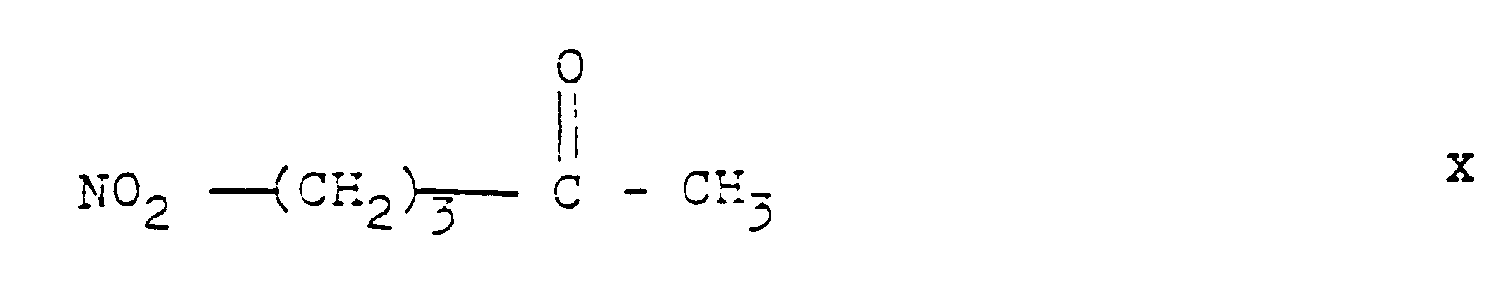
- a particular advantage of the synthesis resides in the fact that 1-(nitro)-pentane-4-one of formula is used as starting substance, which can be obtained by reacting commercially readily available compounds, that is nitromethane of formula H 3 C - NO 2 XII and methylvinylketone of formula
- the 1-(nitro)-pentan-4-one of formula X can be produced according to the method of D. E. Bergbreiter and J. J. Lalonde (J. Org. Chem. 52 [1987], 1 601 to 1 603).
- the 1-(nitro)-pentane-4-one of formula X is brominated.
- the bromination is carried out with elementary bromine in a lower alcohol, particularly methanol.
- the bromination is performed at a temperature of about room temperature taking care of that the temperature of the reaction mixture should not rise above 40°C.
- the acetalic ether bond being formed in the reaction is hydrolyzed.
- the 1-(bromo)-5-(nitro)-pentane-2-one of formula thus obtained may be isolated by extracting the aqueous solution with a solvent non-miscible with water such as chlorinated hydrocarbon, aromatic hydrocarbon, ethyl acetate or preferably ether, washing the extract first acid-free with a caustic solution then neutral with water, dried and evaporated.
- a solvent non-miscible with water such as chlorinated hydrocarbon, aromatic hydrocarbon, ethyl acetate or preferably ether
- the 1-(bromo)-5-(nitro)-pentane-2-one of general formula IX is optionally purified by column chromatography.
- the phosphonioum salt [5-(nitro)-pentane-2-one]-triaryl-phosphonium bromide of general formula VIII is then converted into a [5-(nitro)-pentane-2-one]-triaryl-phosphorane, preferably [5-(nitro)-pentane-2-one]-triphenyl-phosphorane, of general formula wherein
- the [5- (nitro) -pentane-2-one]-triaryl-phosphorane, preferably [5-(nitro)-pentane-2-one]-triphenyl-phosphorane, of general formula VII thus obtained is reacted with 6-(chloro)-pyridine-3-aldehyde [6-(chloro)-nicotinic aldehyde] of formula
- the reaction can be performed in an anhydrous aprotic solvent, preferably a halogenated aliphatic hydrocarbon, such as dichloromethane, or a mixture of such.
- the reaction can be carried out under heating, preferably at the boiling point of the reaction mixture.
- reaction by adding to the solution of the [5-(nitro)-pentane-2-one]-triaryl-phosphorane, preferably [5-(nitro)-pentane-2-one]-triphenyl-phosphorane, of general formula VII in an anhydrous aprotic solvent the solution of the 6-(chloro)-pyridine-3-aldehyde of formula VI in the same solvent.
- the reaction mixture is then preferably worked up by cooling, washing and evaporating.
- the olefine 1-[6'-(chloro)-pyrid-3'-yl]-3-(oxo)-6-(nitro)-hexa-1-ene of formula thus obtained can be purified by crystallization or column chromatography.
- the 6-(chloro)-pyridine-3-aldehyde of formula VI could be prepared readily from the commercially available 6-(chloro)-nicotinic acid by methods known from the literature (F. E. Ziegler, J. G. Sweeny: Tetrahedron Letters, [1969], 1 097 to 1 110).
- the olefine 1-[6'-(chloro)-pyrid-3'-yl]-3-(oxo)-6-(nitro)-hexa-1-ene of formula V obtained as specified above is then subjected to cyclization.
- This reaction may be carried out in an anhydrous aprotic organic solvent.
- reaction medium preferably cyclic ethers, e. g. tetrahydrofuran, or a mixture of such can be applied.
- the cyclization is preferably carried out in the presence of a base, particularly potassium fluoride applied onto a basic aluminum oxide carrier (D. E. Bergbreiter, J. J. Lalonde: J. Org. Chem. 52 [1987], 1 601 to 1 603).
- the cyclization may be carried out at a temperature of about room temperature.
- the thus-obtained nitroketone 1-[nitro]-2-[6'-(chloro)-pyrid-3'-yl]-cyclohexane-4-one of formula IV may be isolated by removing the base and evaporating the solution.
- the 1-[nitro]-2-[6'-(chloro)-pyrid-3'-yl]-cyclohexane-4-one of formula IV thus obtained can be purified by crystallization or column chromatography.
- the free epibatidine of formula XIV can be converted into an acid addition salt, particularly hydrochloride salt, and/or the free epibatidine of formula XIV can be liberated from an acid addition salt of it and/or converted into another acid addition salt thereof.
- aqueous phase is extracted three times with 200 ml of chloroform each.
- the combined organic layers are washed twice with 200 ml of water each and 100 ml of a saturated sodium chloride solution, dried over calcium chloride and evaporated.
- IR (film) 3380, 1580, 1570, 1550, 1100, 1080 cm -1 .
- R f 0.42 (10 : 1 mixture of chloroform and methanol).
- the product is crystallized from ethanol.
- the reaction mixture is allowed to stand overnight and then evaporated to dryness in vacuo.
- the residue is dissolved in a mixture of 60 ml of chloroform and 5 ml of water.
- the pH of the aqueous layer is adjusted to 9 with a 5% by weight sodium hydrogen carbonate solution.
- the layers are separated, the chloroform solution is washed three times with 20 ml of water each, dried over sodium sulfate, filtered and evaporated in vacuo .
- the residue is crystallized from 100 ml of methanol under clarification with charcoal.
- the residue is suspended in 30 ml of chloroform and the pH is adjusted to a value of about 10 by adding a concentrated ammonium hydroxide solution.
- the layers are separated, the chloroform solution is washed with water, dried over sodium sulfate, filtered and evaporated in vacuo .
- step 2 (-)-epibatidine is obtained which is converted into the hydrochloride.
- step 2 (+)-epibatidine is obtained. This could be converted into the (-)-epibatidine hydrochloride.
Landscapes
- Chemical & Material Sciences (AREA)
- Organic Chemistry (AREA)
- Health & Medical Sciences (AREA)
- Nuclear Medicine, Radiotherapy & Molecular Imaging (AREA)
- Life Sciences & Earth Sciences (AREA)
- Bioinformatics & Cheminformatics (AREA)
- Biomedical Technology (AREA)
- Neurology (AREA)
- Neurosurgery (AREA)
- Chemical Kinetics & Catalysis (AREA)
- General Chemical & Material Sciences (AREA)
- Medicinal Chemistry (AREA)
- Pain & Pain Management (AREA)
- Pharmacology & Pharmacy (AREA)
- Engineering & Computer Science (AREA)
- Animal Behavior & Ethology (AREA)
- General Health & Medical Sciences (AREA)
- Public Health (AREA)
- Veterinary Medicine (AREA)
- Pharmaceuticals Containing Other Organic And Inorganic Compounds (AREA)
- Organic Low-Molecular-Weight Compounds And Preparation Thereof (AREA)
- Plural Heterocyclic Compounds (AREA)
- Nitrogen Condensed Heterocyclic Rings (AREA)
- Medicines Containing Material From Animals Or Micro-Organisms (AREA)
- Saccharide Compounds (AREA)
- Hydrogenated Pyridines (AREA)
Abstract
Description
- The invention is concerned with a process for preparing an organic compound, namely epibatidine, i. e. 2-[6'-(chloro)-pyrid-3'-yl]-7-azabicyclo[2.2.1]heptane, of formula

- Several processes have been disclosed in the literature for the synthetic preparation of epibatidine:
- A) Ch. A. Broka: Tetrahedron Letters, 34 [1993], 3 251 to 3 254. In this reaction an adduct was prepared by the Diels-Alder reaction of enal obtained by the homologization of 6-(chloro)-nicotinic aldehyde and 2-(trimethylsilyloxy)-1,3-butadiene, it was then reduced with lithium, sodium and potassium tri-2-butyl borohydride [L--selectride®], the hydroxy group of the product was protected by silylation, while the hydroxymethyl substituent was first converted into the hydroxy group in 6 reaction steps and then benzoylated. By selective removal of the protecting groups the dihydroxy derivative was converted into 4-(mesyloxy)-cyclohexylamine containing a 6-(chloro)-pyridyl substituent, and the boiling of the latter compound in dichloromethane resulted in racemic epibatidine.
- B) J. W. Daly, T.F. Spande, H. M. Garraffo: US Dept. Health and Human Service, WO 93/18037. The key intermediate of this synthesis is 3-(pyridyl)-2-cyclohexa-1,3-diene, which was prepared from cyclohexane-1,2-dione and converted into Diels-Alder adduct with tert.butylnitrosoformiate. The adduct was hydrogenated catalytically, the thus-obtained aminoalcohol derivative the amino group of which is protected by a tert.-butylformate group was treated with thionyl chloride, the product, the corresponding 1-[pyrid-3'-yl]-2-[chloro]-5-[amino]-cyclohexane protected on the nitrogen atom of the amino group by a tert.-butylformate group, was cyclized with base-treatment to give 1-[pyrid-3'-yl]-7-azabicyclo[2.2.1]heptane protected on its aza-nitrogen atom by a tert.-butylformate group and chlorinated by a photochemical reaction to 1-[pyrid-3'-yl]-7-azabicyclo[2.2.1]heptane protected on its aza-nitrogen atom by a tert.-butylformate group. The hydrolysis of the acid amide bond with trifluoroacetic acid resulted in racemic epibatidine.
- C) D. F. Huang, T. Y. Shen: Tetrahedron Letters, 34 [1993], 4 477 to 4 480. An adduct obtained by the Diels-Alder reaction of phenylsulfonyl-6-(chloro)-3-(pyridyl)-acetylene prepared from N-(carbomethoxy)-pyrrole and 6-(chloro)-nicotinic acid was desulfonated with sodium amalgam, concomitantly reducing one of the double bonds of the 7-azanorbornadiene ring, hydrogenated catalytically to a mixture of N-(carbomethoxy)-epi-epibatidine and N-(carbomethoxy)-epibatidine, the protecting group was dehydrolized to obtain racemic epibatidine and racemic epi-epibatidine, which were then separated by column chromatography. The racemic epibatidine was resolved with di- (p-toluyl)-tartaric acid.
- D) S. R. Fletcher, R. Baker, M. S. Chambers, S. C. Hobbs, P. J. Mitchell: J. Chem. Soc. Chem. Comm., 1993, 1 216 to 1 218. The key intermediate of this synthesis route is tert.butyloxycarbonyl-7-azabicyclo[2.2.1]heptan-2-one, which was prepared in 7 reaction steps from cyclohexene amine containing a trifluoroacetyl protecting group and reacted with 5-lithio-2-(chloro)-pyridine. From the thus-obtained adduct water was removed and the thus-formed double bond was hydrogenated catalytically to obtain a mixture of racemic epibatidine and epi-epibatidine isomers containing tert.butyloxycarbonyl protecting group. The undesired epimer epi-epibatidine (endo-isomer) protected on the nitrogen atom of the 7-azabicyclo[2.2.1]heptane ring by a tert.-butoxycarbonyl protective group (BOC protective group) was subjected to epimerization by boiling in tert.butanol in the presence of potassium tert.butylate. The racemic epibatidine (exo-isomer) was resolved by applying a chiral HPLC method and by salt formation with a chiral acid.
- E) E. J. Corey,* Teck-Peng Loh, Sidduri AchyuthaRao, Donnette C. Daley, and Sepehr Sarshar: Journal of Organic Chemistry, Vol. 58, No. 21, 1993, 5 600 to 5 602. From this it has been known to cyclize 1-[trifluoracetylamino]-2-[6'-(chloro)-pyrid-3'-yl]-4,5-di[bromo]-cyclohexane cyclizing with potassium tert.-butyloxyd in tetrahydrofurane to dextro 5-[bromo]-N-[trifluoroacetyl]-epibatidine, to debrominate the latter to dextro N-(trifluoroacetyl)-epibatidine by treatment with tributyltin and aluminumbornitride in benzene and to deacylate the latter with sodium methylate in methanol to yield (-)-epibatidine.
- A serious drawback of the methods known from the literature resides in the cumbersome reaction steps which would make the industrial scale application rather complicated.
- A further disadvantage of the known preparation methods resides in the fact that they require the application of difficultly available, expensive and inconvenient substances.
- The problem underlying to the invention is to create a novel process for preparing epibatidine, which is devoid of the drawbacks of the hitherto known processes and can be accomplished by using substances readily available and preparable even on an industrial scale and which is also industrially applicable.
- The above surprisingly has been attained by the invention.
- The subject matter of the invention is a process for preparing racemic or optically active epibatidine of formula

- a)
- α) cyclising a racemic or optically active 1-[amino]-2-[6'-(chloro)-pyrid-3'-yl]-cyclohexane, 4-substituted by a leaving group, of general formula

- L
- stands for a leaving group, particularly a C1-4-alkylsulfonyloxy or arylsulfonyloxy group, to racemic or optically active epi-epibatidine of formula

- β) subjecting the latter to epimerization in the presence of a base
or
- α) cyclising a racemic or optically active 1-[amino]-2-[6'-(chloro)-pyrid-3'-yl]-cyclohexane, 4-substituted by a leaving group, of general formula
- b) cyclizing 1-[6'-(chloro)-pyrid-3'-yl]-3-[oxo]-6-(nitro]-hexa-1-ene of formula

and thereafter- α) selectively reducing the optically active 1-[nitro]-2-[6'-(chloro)-pyrid-3'-yl]-cyclohexane-4-one of formula IV thus obtained to yield optically active 1-[nitro]-2-[6'-(chloro)-pyrid-3'-yl]-cyclohexane-4-ol of formula

- β) introducing into the latter a leaving group to yield an optically active 1-[nitro]-2-[6'-(chloro)-pyrid-3'-yl]-cyclohexane, 4-substituted by a leaving group, of general formula

- L
- represents a leaving group, particularly a C1-4-alkylsulfonyloxy or arylsulfonyloxy group,
- γ) reducing the latter to an optically active 1-[amino]-2 -[6'-(chloro)-pyrid-3'-yl]-cyclohexane, 4-substituted by a leaving group, of general formula

- δ) cyclising the latter to an optically active epi-epibatidine of formula XIII
and - ε) subjecting the latter to epimerization in the presence of a base.
- α) selectively reducing the optically active 1-[nitro]-2-[6'-(chloro)-pyrid-3'-yl]-cyclohexane-4-one of formula IV thus obtained to yield optically active 1-[nitro]-2-[6'-(chloro)-pyrid-3'-yl]-cyclohexane-4-ol of formula
- If desired in a manner known per se a thus obtained racemic epibatidine of formula XIV may be resolved into the optically active isomers and/or the thus obtained optically active isomers may be racemised or, if desired, a racemic intermediate product may be separated in any stage of the synthesis into the optically active isomers and the thus obtained optically active isomers may be converted into optically active epibatidine of formula XIV.
- As opposed to WO 93/18037 in which for the cyclisation an amino group which is protected by a tert.-butylformate group is present and no chlorine substituent on the pyridine ring in steps a)α) and b)δ) the cyclisation is carried out with a compound in which the amino group is not protected and on the pyridine ring already the chlorine substituent of epibatidine is present.
- Analogous is the situation as compared to Journal of Organic Chemistry, Vol. 58, No. 21, 1993, pages 5 600 to 5 602 with the modification that there the protective group on the nitrogen atom of the amino group is a trifluoroacetyl group.
- Preferably the epimerization of the epi-epibatidine of formula XIII according to variant a), part β) of the process according to the invention is carried out under heating, particularly at the boiling point of the reaction mixture. Preferably using for the epimerization an alkali alcoholate, particularly potassium tert.butylate or sodium ethylate, or another organic alkali compound, particularly a lithium salt of a secondary amine, above all lithium diisopropyl amine, is used. A further example of another organic alkali compound is butyl lithium. Advantageously the epimerization in the presence of an alkali alcoholate is carried out under heating and the epimerization in the presence of an other organic alkali compound at a temperature of about 0°C. It is preferable to carry out the epimerization in a C1-4-alkanol as medium in the presence of an alkali alcoholate corresponding to the alkanol used as solvent.
- The epibatidine of formula XIV has a chiral structure so that it can be present in racemic or optically active form. The invention encompasses the preparation of both the racemic and the optically active epibatidine of formula XIV.
- The racemic epibatidine of formula XIV can optionally be resolved. The resolution can be carried out by methods known per se. One can proceed e. g. by reacting the racemic epibatidine of general formula XIV with an optically active acid, such as tartaric acid, di -(0,0'-p-toluyl)-tartaric acid or dibenzoyltartaric acid, separating the thus-obtained diastereoisomeric salt pair, e. g. by fractional crystallization and liberating the desired optically active epibatidine of formula XIV from the salt thereof.
- In variant a), part α) of the process according to the invention preferably a 1-[amino]-2-[6'-(chloro)-pyrid-3'-yl]-cyclohexane, 4-substituted by a leaving group, of general formula I, in which the leaving group represented by L is a methanesulfonyloxy, p-toluenesulfonyloxy or p-(bromo)-phenylsulfonyloxy group is cyclized, the methanesulfonyloxy group for L being particularly preferred. Furthermore it is preferred to cyclize the 1-[amino]-2-[6'-(chloro)-pyrid-3'-yl]-cyclohexane, 4-substituted by a leaving group, of general formula I at an elevated temperature, particularly at the boiling point of the reaction mixture. Advantageously the cyclization is performed in a preferably anhydrous, aprotic solvent. For this purpose particularly halogenated hydrocarbons, most particularly methylene chloride, chloroform or chlorobenzene, or aromatic hydrocarbons, most particularly benzene, toluene or xylene, or a mixture thereof are used. Above all the cyclization is carried out in benzene, toluene and/or xylene as aprotic solvent(s). The cyclization may be carried out under an inert gas atmosphere, e. g. under argon. The epi-epibatidine of formula XIII thus obtained can be isolated from the reaction mixture by cooling the latter to room temperature, shaking it with an aqueous alkali hydroxide solution, separating the phases, extracting the aqueous phase with an appropriate organic solvent, for example, dichloromethane, and washing, drying and evaporating the combined organic phases. The thus obtained epi-epibatidine of formula XIII is optionally purified by crystallization or column chromatography.
- The optically active forms of epibatidine of formula XIV may be prepared by several methods.
- According to variant b) of the process according to the invention 1-[6'-(chloro)-pyrid-3'-yl)-3-[oxo]-6-[nitro]-hexa-1-ene of formula V is subjected to cyclisation in the presence of an optically active base to yield an optically active 1-[nitro]-2-[6'-(chloro)-pyrid-3'-yl]-cyclohexane-4-one of formula IV. As optically active base preferably (+)-α-(phenyl)-ethyl-amine or (-)-α-(phenyl)-ethyl-amine is used. The reaction may be carried out in the presence of an inert organic solvent, preferably an ether, e. g. tetrahydrofurane or dioxane, or a mixture of such.
- In variant b), part α) of the process according to the invention the selective reduction of the 1-[nitro]-2-[6'-(chloro)-pyrid-3'-yl]-cyclohexane-4-one of formula IV to the 1-[nitro]-2-[6'-(chloro)-pyrid-3'-yl]-cyclohexane-4-ol of formula III is preferably carried out with complex metal hydrides. As reducing agent particularly sodium borohydride or lithium, sodium and potassium tri-2-butyl borohydride [L-selectride®] is applied. The reduction with sodium borohydride proved to be most particularly preferable. When sodium borohydride is applied as reducing agent the reduction is preferably performed in a C1-4-alcohol, particularly ethanol. Advantageously one proceeds under cooling, preferably at a temperature of about 0° C. When the reaction has been accomplished the excess of the reducing agent may be decomposed by the addition of a solvent containing an oxo group, e. g. acetone, the solvent removed and the hydroxy compound 1-[nitro]-2-[6'-(chloro)-pyrid-3'-yl]-cyclohexane-4-ol of formula III isolated by dissolving the evaporation residue in a solvent non-miscible with water, e. g. a halogenated hydrocarbon, particularly chloroform, aromatic hydrocarbon, ether, or ethyl acetate, or a mixture of such and washing, drying and evaporating the organic phase. The 1-[nitro]-2-[6'-(chloro)-pyrid-3'-yl]-cyclohexane-4-ol of formula III thus obtained is optionally purified by crystallization or chromatography.
- Preferably in variant b), part β) of the process according to the invention the introduction of the leaving group into the optically active nitroalcohol 1-[nitro]-2-[6'-(chloro)-pyrid-3'-yl]-cyclohexane-4-ol of formula III thus obtained to yield a 1-[nitro]-2-[6'-(chloro)-pyrid-3'-yl]-cyclohexane, 4-substituted by a leaving group, of general formula II is carried out with the corresponding sulfonyl halide, particularly methanesulfonyl chloride. The acylating agent is preferably applied in excess. The reaction can be carried out in an apolar aprotic solvent, e. g. halogenated hydrocarbon, such as dichloromethane or chloroform, or a mixture of such in the presence of a base, e. g. pyridine. It is preferable to perform the reaction in a mixture of dichloromethane and pyridine. The reaction can be carried out at a temperature of about room temperature. The 1-[nitro]-2-[6'-(chloro)-pyrid-3'-yl]-cyclohexane, 4-substituted by a leaving group, of general formula II thus obtained can be isolated from the reaction mixture by removing the solvent, dissolving the residue in an organic solvent non-miscible with water, e. g. halogenated hydrocarbon, particularly chloroform, aromatic hydrocarbon, ether or ethyl acetate, or a mixture of such, extracting the solution with an inorganic base, e. g. alkali carbonate, extracting the aqueous solution with the organic solvent non-miscible with water which has been previously used and washing, drying and evaporating the combined organic phases. The thus-obtained 1-[nitro]-2-[6'-(chloro)-pyrid-3'-yl]-cyclohexane, 4-substituted by a leaving group, of general formula II can optionally be purified by crystallization or column chromatography.
- Advantageously in variant b), part γ) of the process according to the invention the reduction of the optically active 1-[nitro]-2-[6'-(chloro)-pyrid-3'-yl]-cyclohexane, 4-substituted by a leaving group, of general formula II to the optically active 1-[amino]-2-[6'-(chloro)-pyrid-3'-yl)-cyclohexane, 4-substituted by a leaving group, of formula I is carried out by catalytic hydrogenation or reduction with chemical agent. When a chemical reducing agent is used, preferably the reduction of the nitro group of the optically active 1-[nitro]-2-[6'-(chloro)-pyrid-3'-yl]-cyclohexane, 4-substituted by a leaving group, of formula II is carried out by Bechamps reduction, or with zinc in glacial acetic acid or with zinc, iron or tin in hydrochloric acid or with stannous(II)-chloride the latter being particularly preferred. One may work preferably by using stannous(II)-chloride in a polar organic solvent, e. g. a C1-4-alkanol or tetrahydrofurane, or a mixture of such. Chemical reduction may be performed in a neutral medium as well. The reduction having been completed the reaction mixture may be evaporated.
- In variant b), part δ) of the process according to the invention advantageously the cyclization of the optically active 1-[amino]-2-[6'-(chloro)-pyrid-3'-yl]-cyclohexane, 4-substituted by a leaving group, of formula I to the optically active epi-epibatidine of formula XIII is carried out according to the preferences for variant a), part α) of the process according to the invention.
- Optically active epibatidine of formula XIV can be prepared by separating racemic epibatidine of formula XIV into the optically active isomers or subjecting a racemic intermediate at a suitable stage of the synthesis to resolution and converting the optically active intermediate thus obtained into optically active epibatidine of formula XIV.
- Racemic epi-epibatidine of formula XIII may be subjected to resolution. The process may be carried out by reacting racemic epi-epibatidine of formula XIII with an optically active acid, e. g. optically active tartaric acid, dibenzoyl-tartaric acid or di-0,0'-(p-toluyl)-tartaric acid, separating the diastereoisomeric salts thus formed, e. g. by fractionated crystallization, and liberating the optically active epi-epibatidine of formula XIII from the salt thereof. Then one may proceed to epimerisation of the latter according to variant b)ε) of the process according to the invention.
- According to a further embodiment of the process according to the invention another intermediate of chiral structure is subjected to resolution and the optically active intermediate thus obtained is converted into the desired optically active end-product optically active epibatidine of formula XIV in an analogous manner to the process described above for the preparation of racemic epibatidine of formula XIV.
- Thus according to a preferred embodiment of the invention optically active epibatidine of formula XIV may be prepared by carrying out the variant b), parts α) to ε) of the process according to the invention with the optically active 1-[nitro]-2-[6'-(chloro)-pyrid-3'-yl]-cyclohexane-4-one of formula IV as above described.
- Moreover one may proceed preferably by subjecting the racemic nitro alcohol 1-[nitro]-2-[6'-(chloro)-pyrid-3'-yl]-cyclohexane-4-ol of formula III to resolution and carrying out the further steps of the synthesis by using the optically active 1-[nitro]-2-[6'-(chloro)-pyrid-3'-yl]-cyclohexane-4-ol of formula III thus obtained. The racemate of 1-[nitro]-2-[6'-(chloro)-pyrid-3'-yl]-cyclohexane-4-ol of formula III is separated into the optically active isomers preferably by acylating the racemic 1-[nitro]-2-[6'-(chloro)-pyrid-3'-yl]-cyclohexane-4-ol of formula III with optically active menthyl-chloro-formiate (chloro-formic acid menthyl ester), separating the diastereomers thus formed by crystallization and thereafter removing the menthyl group to yield the desired optically active 1-[nitro]-2-[6'-(chloro)-pyrid-3'-yl]-cyclohexane-4-ol of formula III. The further reactions may be according to variant b), parts β), γ), δ) and ε) of the process according to the invention indicated above with the preferences described with regard to these.
- The 1-[amino]-2-[6'-(chloro)-pyrid-3'-yl]-cyclohexanes, 4-substituted by a leaving group, of general formula I used as starting substances in variant a) of the process according to the invention could have been prepared by selectively reducing the nitro group of 1-[nitro]-2-[6'-(chloro)-pyrid-3'-yl]-cyclohexane, 4-substituted by a leaving group, of general formula II. Advantageously this reaction is performed by catalytic hydrogenation or reduction with a chemical agent. Preferably this selective reduction is carried out by Bechamps-reduction, or with zinc in glacial acetic acid or with zinc, iron or tin in hydrochloric acid or with stannous(II)-chloride the latter being particularly preferred. The reduction with stannous(II)-chloride is preferably carried out in a polar organic solvent, e. g. C1-4-alcohol, particularly ethanol, or tetrahydrofurane, or a mixture of such. The chemical reduction can also be carried out in a neutral reaction medium. The reduction reaction with stannous(II)-chloride can be carried out under heating, preferably at the boiling point of the reaction mixture. The thus obtained 1-[amino]-2-[6'-(chloro)-pyrid-3'-yl]-cyclohexane, 4-substituted by a leaving group, of general formula I can be isolated from the reaction mixture by cooling the mixture to room temperature and adding a solvent non-miscible with water, e. g. a chlorinated hydrocarbon, preferably chloroform, or a mixture of such to it and rendering the solution slightly alkaline. The separated precipitate is filtered off, washed with a solvent non-miscible with water and the organic phases are combined, washed, dried and evaporated. The thus-obtained 1-[amino]-2-[6'-(chloro)-pyrid-3'-yl]-cyclohexane, 4-substituted by a leaving group, of general formula I is optionally purified by crystallization or column chromatography.
- The starting substances of 1-[nitro]-2-[6'-(chloro)-pyrid-3'-yl]-cyclohexanes, 4-substituted by a leaving group, of general formula II for preparing the above starting substances could be prepared as specified below.
- A particular advantage of the synthesis resides in the fact that 1-(nitro)-pentane-4-one of formula
H3C - NO2 XII
and methylvinylketone of formula
- In the next reaction step the 1-(nitro)-pentane-4-one of formula X is brominated. Preferably the bromination is carried out with elementary bromine in a lower alcohol, particularly methanol. Conveniently the bromination is performed at a temperature of about room temperature taking care of that the temperature of the reaction mixture should not rise above 40°C. The acetalic ether bond being formed in the reaction is hydrolyzed. The 1-(bromo)-5-(nitro)-pentane-2-one of formula

- The 1-(bromo)-5-(nitro)-pentane-2-one of formula IX is then reacted with a triaryl phosphine to obtain a phosphonium salt [5- (nitro) -pentane-2-one]-triaryl-phosphonium bromide of general formula

- Ar
- stands for an aryl group, preferably phenyl group.
- The phosphonioum salt [5-(nitro)-pentane-2-one]-triaryl-phosphonium bromide of general formula VIII is then converted into a [5-(nitro)-pentane-2-one]-triaryl-phosphorane, preferably [5-(nitro)-pentane-2-one]-triphenyl-phosphorane, of general formula

- Ar
- stands for an aryl group, preferably phenyl group.
- The [5- (nitro) -pentane-2-one]-triaryl-phosphorane, preferably [5-(nitro)-pentane-2-one]-triphenyl-phosphorane, of general formula VII thus obtained is reacted with 6-(chloro)-pyridine-3-aldehyde [6-(chloro)-nicotinic aldehyde] of formula


- The 6-(chloro)-pyridine-3-aldehyde of formula VI could be prepared readily from the commercially available 6-(chloro)-nicotinic acid by methods known from the literature (F. E. Ziegler, J. G. Sweeny: Tetrahedron Letters, [1969], 1 097 to 1 110).
- The olefine 1-[6'-(chloro)-pyrid-3'-yl]-3-(oxo)-6-(nitro)-hexa-1-ene of formula V obtained as specified above is then subjected to cyclization. This reaction may be carried out in an anhydrous aprotic organic solvent. As reaction medium preferably cyclic ethers, e. g. tetrahydrofuran, or a mixture of such can be applied. The cyclization is preferably carried out in the presence of a base, particularly potassium fluoride applied onto a basic aluminum oxide carrier (D. E. Bergbreiter, J. J. Lalonde: J. Org. Chem. 52 [1987], 1 601 to 1 603). The cyclization may be carried out at a temperature of about room temperature. The thus-obtained nitroketone 1-[nitro]-2-[6'-(chloro)-pyrid-3'-yl]-cyclohexane-4-one of formula IV may be isolated by removing the base and evaporating the solution. Optionally the 1-[nitro]-2-[6'-(chloro)-pyrid-3'-yl]-cyclohexane-4-one of formula IV thus obtained can be purified by crystallization or column chromatography.
- The further reactions are as those of variant b), parts α), β) and γ) of the process according to the invention with the preferences indicated there also including the racemic substances.
- As results therefrom simultaneously part of this synthesis of the starting substances 1-[amino]-2-[6'-(chloro)-pyrid-3'-yl]-cyclohexanes, 4-substituted by a leaving group, of formula I for variant a) of the process according to the invention is for the synthesis of the starting substance 1-[6'-(chloro)-pyrid-3'-yl]-3-[oxo]-6-[nitro]-hexa-1-ene of formula V.
- The invention is illustrated in detail with the aid of the following Examples. In these the ratios of the components of the mixtures for chromatography are always by volume. Moreover in the following Examples unless other indications have been made column chromatography is to be meant as having been carried out on silica gel with the designation "Kieselgel 60" (0.063 to 0.200 mm). Furthermore "brine" is a saturated sodium chloride solution. For the potassium fluoride precipitated on aluminum oxide always the total amount of these 2 substances and the potassium fluoride contents thereof have been indicated.
- In a manner known per se the free epibatidine of formula XIV can be converted into an acid addition salt, particularly hydrochloride salt, and/or the free epibatidine of formula XIV can be liberated from an acid addition salt of it and/or converted into another acid addition salt thereof.
- 1.1 g (0.0036 mole) of (±)-1α-[amino]-2β-[6'-(chloro)-pyrid-3'-yl]-4β-[methanesulfonyloxy]-cyclohexane prepared as indicated below are dissolved in 150 ml of anhydrous toluene and the reaction mixture is heated to boiling under argon overnight. The reaction mixture is then cooled, 25 ml of a 5% by weight sodium hydroxyde solution are added, the phases are thoroughly shaken, the layers are separated. The aqueous phase is extracted ten times with 20 ml of dichloromethane each. The combined organic layers are washed twice with 100 ml of water each and 100 ml of a saturated sodium chloride solution, dried over magnesium sulfate and evaporated. The residue is subjected to chromatography on a silica column and eluted with a 1:1 mixture of chloroform and methanol. Thus 350 mg of the desired compound are obtained, yield 46%, faint yellow oil. Rf = 0.35 (1:1 mixture of chloroform and methanol).
IR(film): 3260, 3220, 1580, 1560, 1760, 1200, 1100 cm-1. - The (±)-1α-[amino]-2β-[6'-(chloro)-pyrid-3'-yl]-4β-[methanesulfonyloxy]-cyclohexane used as starting substance has been prepared as follows.
- 80.0 g (0.61 mole) of 1-(nitro)-pentane-4-one are dissolved in 250 ml of anhydrous methanol, whereupon 31.5 ml (0.61 mole) of bromine are quickly added under cooling with ice. The reaction mixture is stirred for a further 2 hours at a rate that the internal temperature should not exceed 40°C. To the reaction mixture 250 ml of water are added, the reaction mixture is stirred at room temperature overnight. Next morning the solution is extracted three times with 300 ml of ether each, the ethereal solution is washed with a 10% by weight aqueous sodium carbonate solution free of acid, whereupon it is washed three times with 200 ml of water each and 200 ml of a saturated sodium chloride solution, dried over calcium chloride and evaporated. The dry residue is subjected to chromatography on a silica column and eluted with a 3:1 mixture of n-hexane and ethyl acetate. Thus 70.4 g of the desired compound are obtained in the form of a faint yellow liquid, yield 55%. Rf = 0.30.
IR(film): 2950, 1720, 640 cm-1. - 10.25 g (0.048 mole) of the bromine compound 1-(bromo)-5-(nitro)-pentane-2-one prepared according to section a) are dissolved in 30 ml of anhydrous benzene whereupon a solution of 14.09 g (0.0537 mole) of triphenyl phosphine in 50 ml of anhydrous benzene is added dropwise. The reaction mixture is stirred at room temperature for 48 hours whereby the oily precipitate becomes crystalline. The precipitated salt is filtered and washed with n-hexane. Thus 20.5 g of the desired compound are obtained,
yield 89%, mp.: 70-72°C. - 8.1 g (0.0171 mole) of the phosphonium salt [5-(nitro)-pentane-2-one]-triphenyl-phosphonium bromide prepared according to section b) are dissolved in 160 ml of dichloromethane and the solution formed is stirred with 136 ml (0.0542 mole) of a 1% by weight aqueous sodium hydroxide solution for 30 minutes. The two phases are separated, the dichloromethane layer is washed three times with 100 ml of water each and with 100 ml of a saturated sodium chloride solution, dried over calcium chloride and evaporated. The dry residue is thoroughly triturated with n-hexane. Thus 4.8 g of the desired compound are obtained, yield 72%, mp.: 94-97°C.
- To a solution of the 13.5 g (0.0344 mole) of the [5-(nitro)-pentane-2-one]-triphenyl-phosphorane prepared according to section c) in 70 ml of anhydrous dichloromethane a solution of 3.1 g (0.022 mole) of 6-(chloro)-pyridine-3-aldehyde in 70 ml of anhydrous dichloromethane is added. The reaction mixture is heated to boiling for 8 hours in argon atmosphere. The reaction mixture is cooled, the dichloromethane solution is washed subsequently three times with 150 ml of water each and 150 ml of a saturated sodium chloride solution, dried over calcium chloride and evaporated. The dry residue is subjected to chromatography on a silica column and eluted with a 1:1 mixture of n-hexane and ethyl acetate. Thus 4.7 g of the pure desired compound are obtained, yield 84%. Mp.: 97-100°C. Rf = 0.52.
IR(KBr): 1700, 1680, 1620, 1580, 1550, 1100 cm-1. - 1.6 g (0.0063 mole) of 1-[6'-(chloro)-pyrid-3'-yl]-3-[oxo]-6-[nitro]-hexa-1-ene prepared according to section d) are dissolved in 50 ml of anhydrous tetrahydrofurane whereupon 4.0 g (0.089 mole) of potassium fluoride precipitated on aluminum oxide containing 0.0117 mole of potassium fluoride are added. The reaction mixture is stirred at room temperature overnight. The solid product is filtered, washed with 300 ml of ethyl acetate. The combined filtrates are dried over calcium chloride and evaporated. The residue is purified by chromatography on a silica column and elution with a 1:1 mixture of n-hexane and ethyl acetate. Thus 1.1 g of the pure desired product are obtained, yield 59%.
Mp.: 118-121°C.
Rf = 0.38. IR(KBr): 1710, 1585, 1550, 1100 cm-1. - 2.8 g (0.0110 mole) of (±)-1α-[nitro]-2β-[6'-(chloro)-pyrid-3'-yl]-cyclohexane-4-one prepared according to section e) are dissolved in 200 ml of anhydrous ethanol whereupon 1.2 g (0.0317 mole) of sodium borohydride are added within a period of about one hour and a half in small portions. The excess of the reducing agent is decomposed by careful addition of acetone, the reaction mixture is evaporated in vacuo, the solid residue is dissolved in a mixture of 50 ml of water and 200 ml of chloroform, the mixture is thoroughly shaken and the layers are separated. The aqueous phase is extracted three times with 200 ml of chloroform each. The combined organic layers are washed twice with 200 ml of water each and 100 ml of a saturated sodium chloride solution, dried over calcium chloride and evaporated. Thus 1.9 g of the desired compound are obtained, yield 67%, mp.: 149-153°C.
IR(film): 3380, 1580, 1570, 1550, 1100, 1080 cm-1.
Rf = 0.42 (10 : 1 mixture of chloroform and methanol). - 1.0 g (0.003896 mole) of (±)-1α-[nitro]-2β-[6'-(chloro)-pyrid-3'-yl]-cyclohexane-4β-ol prepared according to section f) are dissolved in a mixture of 15 ml of anhydrous dichloromethane and 30 ml of pyridine, whereupon 0.75 ml (0.0097 mole) of methanesulfonyl chloride is added dropwise under cooling with icecold water. The reaction mixture is stirred at room temperature overnight and thereafter the solvent is removed in vacuo. The dry residue is dissolved in a mixture of 50 ml of chloroform and 25 ml of a 10% by weight sodium carbonate solution, the mixture is thoroughly shaken, the phases are separated. The aqueous phase is extracted three times with 50 ml of chloroform each. The combined organic layers are washed three times with 100 ml of water each and 100 ml of a saturated sodium chloride solution, dried over calcium chloride and evaporated. The dry residue is subjected to chromatography on a silica column and eluted with a 1:1 mixture of n-hexane and ethyl acetate. Thus 1.18 g of the desired compound are obtained, yield 91%, mp.: 120-122°C.
Rf = 0.46
IR(KBr): 1590, 1570, 1540, 1530, 1450, 1350, 1180, 1090 cm-1. - 1.5 g (0.0048 mole) of (±)-1α-[nitro]-2β-[6'-(chloro)-pyrid-3'-yl]-4β-[methanesulfonyloxy]-cyclohexane prepared according to section g) are dissolved in 150 ml of ethanol whereupon 10.76 g (0.0477 mole) of stannous(II)-chloride dihydrate are added. The reaction mixture is heated to boiling for 24 hours, whereupon it is cooled, 200 ml of chloroform are added and the pH is adjusted to 9 by adding a concentrated ammonium hydroxide solution. The precipitated product is filtered, washed with 400 ml of chloroform, the organic phase is washed twice with 200 ml of water and once with 200 ml of a saturated sodium chloride solution, dried over magnesium sulfate and evaporated. Thus 1.1 g of the desired compound are obtained in the form of a colourless oil, yield 80%.
Rf = 0.69 (chloroform : methanol = 10 : 1). - 20 mg (0.09 mmole) of epi-epibatidine prepared according to step 1 are boiled in 3 ml of anhydrous tert.butanol in the presence of 100 mg of potassium tert.butylate for 30 hours. After evaporation the product is purified by chromatography on a silica gel column (eluent: 1:1 mixture of benzene and methanol). Yield: 10 mg (50%), Rf = 0.25.
- 5.0 g (0.01963 mole) of 1-[6'-(chloro)-pyrid-3'-yl]-3-[oxo]-6-[nitro]-hexa-1-ene prepared as described in the preparation of the starting substance of Example 1, sections a) to d) are dissolved in 50 ml of anhydrous tetrahydrofurane, whereupon 12.6 ml (0.09815 mole) of (+)-α-(phenyl)-ethyl-amine are added. The reaction mixture is allowed to stand at room temperature for 3 days, whereupon the solution is evaporated. The product is purified by subjecting the crude product to chromatographic on a silica column and eluting first with a 10:1 mixture of benzene and methanol (Rf = 0.38) and thereafter with a 1:1 mixture of n-hexane and ethyl acetate (Rf = 0.42). The product is crystallized from ethanol. Thus 1.45 g of the pure desired compound are obtained, yield 29%, mp.: 149-151°C, (α)

- Further steps according to variant b), parts α) to ε) result in epibatidine.
- 1.536 g (6 millimoles) of racemic (±)-1α-[nitro]-2β-[6'-(chloro)-pyrid-3'-yl]-cyclohexane-4β-ol prepared as described in the preparation of the starting substance of Example 1, sections a) to f) are dissolved in a mixture of 30 ml of anhydrous dichloromethane and 1.4 ml of pyridine at room temperature. To the solution 3.0 ml (14 millimoles) of (-)-menthyl-chloro-formiate (Aldrich 24,530-5) are added dropwise. The reaction mixture is stirred at room temperature for 6 hours, whereupon further 0.2 ml of the reactant is added. The reaction mixture is allowed to stand overnight and then evaporated to dryness in vacuo. The residue is dissolved in a mixture of 60 ml of chloroform and 5 ml of water. The pH of the aqueous layer is adjusted to 9 with a 5% by weight sodium hydrogen carbonate solution. The layers are separated, the chloroform solution is washed three times with 20 ml of water each, dried over sodium sulfate, filtered and evaporated in vacuo. The residue is crystallized from 100 ml of methanol under clarification with charcoal. Thus 1.2 g of the desired compound are obtained in the form of white crystals, yield 45.8%, mp.: 98-100°C, [α]D 25 = -56.0° (c = 0.5, chloroform).
- The product thus obtained is further purified by column chromatography (Merck 9385 silicagel, water pump vacuo; eluent = benzene : ethyl acetate = 19:1). The fractions containing the desired compound are evaporated. Thus 630 mg of an oil are obtained which is crystallized from methanol. Thus 280 mg of the desired compound are obtained, mp.: 183-184°C, [α]D 25 = -36.7° (c = 0.5 chloroform).
- 100 mg of the crystalline substance (-)-1α-[nitro]-2β-[6'-(chloro)-pyrid-3'-yl]-cyclohexane-4β-yl-carbonic acid menthyl ester {[α]D 25 = -36.7 (c = 0.5 chloroform)} prepared according to step 1 are dissolved in a mixture of 20 ml of 10% by weight sulfuric acid and 20 ml of ethanol and the solution is heated to boiling for 24 hours, whereupon the ethanol is removed in vacuo. To the aqueous residue about 30 ml of benzene are added and the mixture is evaporated again to dryness in vacuo. This operation is carried out five or six times. The residue is suspended in 30 ml of chloroform and the pH is adjusted to a value of about 10 by adding a concentrated ammonium hydroxide solution. The layers are separated, the chloroform solution is washed with water, dried over sodium sulfate, filtered and evaporated in vacuo. The residue is purified by column chromatography (Merck 9385 silicagel, water pump vacuo; eluent : chloroform : methanol = 20:1). The fractions containing the desired compound are combined and evaporated. The residue is crystallized from ether. Thus 32 mg of the desired compound are obtained, mp.: 190-194°C, [α]D 25 = +63.9° (c = 0.5, chloroform).
- The (+)-1α-[nitro]-2β-[6'-(chloro)-pyrid-3'-yl]-cyclohexane-4β-ol was converted into the corresponding epibatidine by working analogously to Example 1 starting with reacting the former instead of (±)-1α-[nitro]-2β-[6'-(chloro)-pyrid-3'-yl]-cyclohexane-4β-ol in the description of the preparation of the starting substance of Example 1, section f).
- 1.00 g (5 millimoles) of racemic epi-epibatidine prepared according to Example 1 are dissolved in 20 ml of hot acetone, whereupon a solution of 0.96 g (2.5 millimoles) of (-)-di-0,0'-p-toluoyl-L-tartaric acid in a mixture of 20 ml of acetone and 10 ml of water is added. The solution remains clear for some minutes but later the precipitation of crystals starts from the hot solution. The mixture is allowed to cool to room temperature and allowed to stand overnight in a refrigerator. Next morning the precipitated crystals are filtered, washed with a mixture of 5 ml of acetone and 1 ml of water and dried. Thus 1.053 g of the salt are obtained. Mp.: 188-190°C, [α]D 25 = -56.9° (c = 0.5, methanol).
- 1.00 g of the above salt is dissolved in a hot mixture of 100 ml of ethanol and 5 ml of water and the solution is allowed to stand at room temperature for a week-end. The precipitated crystals are filtered, washed with a mixture of 5 ml of ethanol and 0.5 ml of water and dried. Thus 341 mg of the salt are obtained, mp.: 200-201°C, [α]D 25 = -53.4° (c = 0.5, methanol).
- 300 mg of the above salt are suspended in a mixture of 120 ml of chloroform and 8 ml of water at room temperature and sufficient amount of a 1 molar sodium hydroxide solution (about 0.2-0.3 ml) is added to adjust the pH of the aqueous phase to 9-10. The layers are separated, the chloroform solution is washed twice with 8 ml of water each, dried over sodium sulfate, filtered and evaporated in vacuo. Thus 155 mg of an oily product are obtained, [α]D 25 = +36.1° (c = 0.5, methanol).
- On epimerizating the (+)-epi-epibatidine prepared according to step 1 analogously to Example 1, step 2 (-)-epibatidine is obtained which is converted into the hydrochloride. The rotation of the salt {[α]D 25 = +34.8° (c = 0.36, methanol)} corresponds to the value {[α]D 25 = +34.7° (c = 0.36, methanol)} disclosed in the Prior Art (S.R. Fletscher et al., J. Chem. Soc. Chem. Column. [1993], 1216).
- The first crystallization mother-lye obtained by the preparation of (+)-epi-epibatidine under section A) is evaporated to dryness in vacuo and the crystalline residue is made water-free by evaporation on a rotating evaporator several times. Thus 649 mg of the product are obtained, mp.: 164-176°C, [α]D 25 = -64.8° (c = 0.5, methanol).
- 200 mg of the above salt are suspended in a mixture of 80 ml of chloroform and 6 ml of water. The pH is adjusted to 9-10 by adding a 1 molar sodium hydroxide solution. The layers are separated, the chloroform solution is washed with water (about 10 ml), dried over sodium sulfate, filtered and evaporated to dryness. Thus 96 mg of an oily product are obtained, [α]D 25 = -17.2° (c = 0.5, methanol).
- 400 mg of the above salt {[α]D 25 = -64.8° (c = 0.5, methanol)} are treated with 2 ml of a 1 M sodium hydroxide solution in a mixture of 150 ml of chloroform and 10 ml of water. The reaction mixture is worked up. 160 mg of an oily product are obtained. [α]D 25 = -17.2° (c = 0.5, methanol).
- The oily crude product thus obtained (160 mg, 0.76 millimoles) is dissolved in 3.2 ml of hot acetone, whereupon a solution of 153 mg (0.396 millimole) of (+)-di-0,0'-p-toluoyl-D-tartaric acid, 3.2 ml of acetone and 0.6 ml of water is added. The reaction mixture is allowed to cool to room temperature, allowed to stand for a few hours, the precipitated crystals are filtered, washed with some drops of aqueous acetone and dried. Thus 269 mg of the salt are obtained, mp.: 196-198°C, [α]D 25 = +63.4° (c = 0.5, methanol).
- 200 mg of the above salt are recrystallized from a mixture of 4.5 ml of ethanol and 0.5 ml of water. Thus 124 mg of the pure salt are obtained, mp.: 204-205°C, [α]D 25 = +60.3°, (c = 0.5, methanol).
- 100 mg of the salt thus obtained are treated with 2 ml of a 1 M sodium hydroxide solution in a mixture of 40 ml of chloroform and 4 ml of water. Thus 60 mg of an oily product are obtained, [α]D 25 = -40.3° (c = 0.5, methanol).
- On epimerizating the (-)-epi-epibatidine prepared according to step 1 analogously to Example 1, step 2 (+)-epibatidine is obtained. This could be converted into the (-)-epibatidine hydrochloride.
Claims (13)
- Process for preparing racemic or optically active epibatidine of formula
 a)α) cyclising a racemic or optically active 1-[amino]-2-[6'-(chloro)-pyrid-3'-yl]-cyclohexane, 4-substituted by a leaving group, of general formula
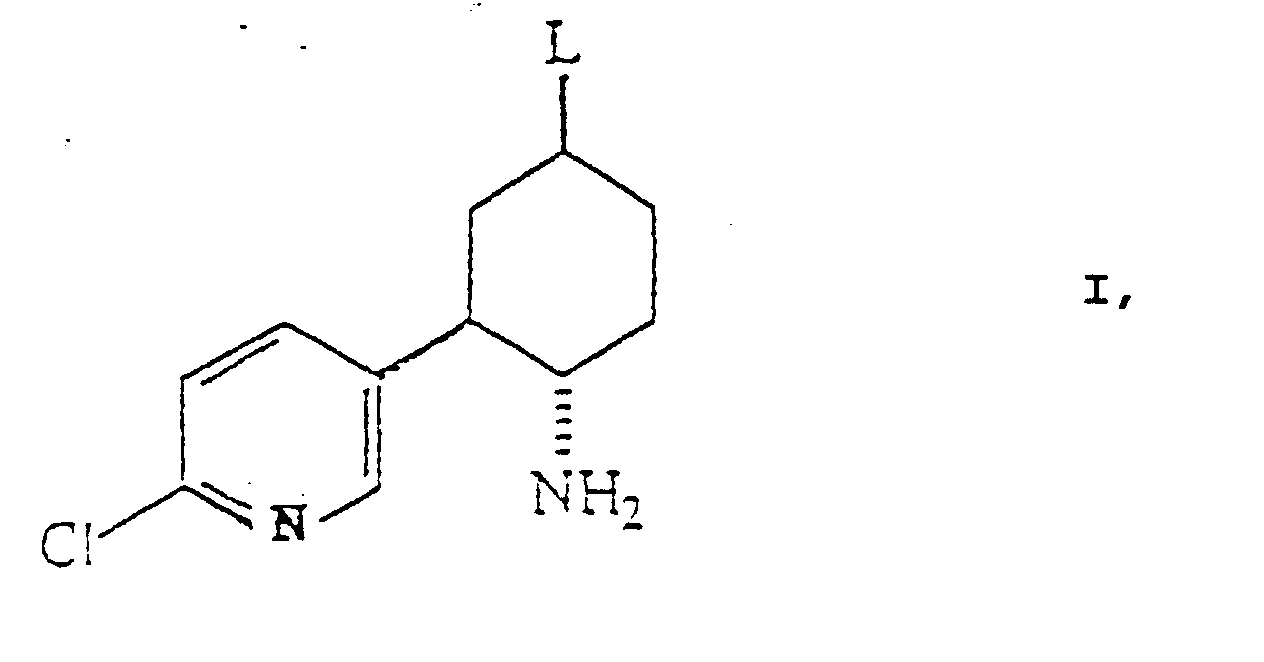 L stands for a leaving group, particularly a C1-4-alkylsulfonyloxy or arylsulfonyloxy groupto racemic or optically active epi-epibatidine of formula
 β) subjecting the latter to epimerization in the presence of a base
orb) cyclizing 1-[6'-(chloro)-pyrid-3'-yl]-3-[oxo]-6-[nitro]-hexa-1-ene of formula
 α) selectively reducing the optically active 1-[nitro]-2-[6'-(chloro)-pyrid-3'-yl]-cyclohexane-4-one of formula IV thus obtained to yield optically active 1-[nitro]-2-[6'-(chloro)-pyrid-3'-yl]-cyclohexane-4-ol of formula
 β) introducing into the latter a leaving group to yield an optically active 1-[nitro]-2-[6'-(chloro)-pyrid-3'-yl]-cyclohexane, 4-substituted by a leaving group, of general formula
 L represents a leaving group, particularly a C1-4-alkylsulfonyloxy or arylsulfonyloxy group,γ) reducing the latter to an optically active 1-[amino]-2-[6'-(chloro)-pyrid-3'-yl]-cyclohexane, 4-substituted by a leaving group, of general formula
 δ) cyclising the latter to an optically active epi-epibatidine of formula XIII
andε) subjecting the latter to epimerization in the presence of a base. - Process according to claim 1a)β), characterized by carrying out epimerization at an elevated temperature.
- Process according to claim 1a)β) or 2, characterized by using for the epimerization an alkali alcoholate or another organic alkali compound.
- Process according to claim 1a)β), 2 or 3, characterized by using for the epimerization as base potassium tertiary butylate, sodium ethylate or lithium diisopropyl amine.
- Process according to claims 1a)β) or 2 to 4, characterized by carrying out the epimerization in the presence of an alkali alcoholate under heating and the epimerization in the presence of another organic alkali compound at a temperature of about 0°C.
- Process according to claims 1a)β) or 2 to 5, characterized by carrying out the epimerization in a C1-4-alkanol as medium in the presence of an alkali alcoholate corresponding to the alkanol used as solvent.
- Process according to claim la), characterized by cyclising a 1-[amino]-2-[6'-(chloro)-pyrid-3'-yl]-cyclohexane, 4-substituted by a leaving group, of general formula I, in which the leaving group represented by L is a methanesulfonyloxy, p-toluenesulfonyloxy or p-(bromo)-phenylsulfonyloxy group.
- Process according to claim 1a) or 7, characterized by cyclising the 1-[amino]-2-[6'-(chloro)-pyrid-3'-yl]-cyclohexane, 4-substituted by a leaving group, of general formula I at an elevated temperature, particularly at the boiling point of the reaction mixture.
- Process according to claim 1a), 7 or 8, characterized by carrying out the cyclization in an aprotic solvent, particularly in a halogenated hydrocarbon or an aromatic hydrocarbon or a mixture thereof.
- Process according to claims 1a) or 7 to 9, characterized by carrying out the cyclization in benzene, toluene and/or xylene as aprotic solvent(s).
- Process according to claim 1b), characterized by using for the cyclization (+)-α-(phenyl)-ethyl-amine or (-)-α-(phenyl)-ethyl-amine as optically active base.
- Process according to claim 1, characterized by resolving the racemic 1-[nitro]-2-[6'-(chloro)-pyrid-3'-yl]-cyclohexane-4-ol of formula III and thereafter converting the optically active 1-[nitro]-2-[6'-(chloro)-pyrid-3'-yl]-cyclohexane-4-ol of formula III into optically active epibatidine of formula XIV.
- Process according to claim 1 or 12, characterized by carrying out the resolving of the racemic 1-[nitro]-2-[6'-(chloro)-pyrid-3'-yl]-cyclohexane-4-ol of formula III by esterifying it with optically active menthyl chloro formiate, separating the diastereomers thus obtained by crystallization and thereafter removing the menthyl group.
Priority Applications (1)
| Application Number | Priority Date | Filing Date | Title |
|---|---|---|---|
| EP96107729A EP0736534A1 (en) | 1993-12-09 | 1994-12-09 | Process for preparing epibatidine |
Applications Claiming Priority (2)
| Application Number | Priority Date | Filing Date | Title |
|---|---|---|---|
| HU9303505A HUT69381A (en) | 1993-12-09 | 1993-12-09 | Process for producing (2-chloro pyridyl)-7-azabicyclo [2.2.1.]heptane |
| HU3500593 | 1994-10-06 |
Related Child Applications (1)
| Application Number | Title | Priority Date | Filing Date |
|---|---|---|---|
| EP96107729.4 Division-Into | 1996-05-15 |
Publications (2)
| Publication Number | Publication Date |
|---|---|
| EP0657456A1 EP0657456A1 (en) | 1995-06-14 |
| EP0657456B1 true EP0657456B1 (en) | 1997-06-04 |
Family
ID=10984231
Family Applications (2)
| Application Number | Title | Priority Date | Filing Date |
|---|---|---|---|
| EP96107729A Withdrawn EP0736534A1 (en) | 1993-12-09 | 1994-12-09 | Process for preparing epibatidine |
| EP94119544A Expired - Lifetime EP0657456B1 (en) | 1993-12-09 | 1994-12-09 | Process for preparing epibatidine |
Family Applications Before (1)
| Application Number | Title | Priority Date | Filing Date |
|---|---|---|---|
| EP96107729A Withdrawn EP0736534A1 (en) | 1993-12-09 | 1994-12-09 | Process for preparing epibatidine |
Country Status (11)
| Country | Link |
|---|---|
| US (1) | US5545741A (en) |
| EP (2) | EP0736534A1 (en) |
| JP (1) | JPH07278151A (en) |
| KR (1) | KR950017995A (en) |
| AT (1) | ATE154022T1 (en) |
| BE (1) | BE1009080A4 (en) |
| CA (1) | CA2137613A1 (en) |
| DE (1) | DE69403615D1 (en) |
| FR (1) | FR2713642A1 (en) |
| HU (1) | HUT69381A (en) |
| IT (1) | ITMI942485A1 (en) |
Families Citing this family (4)
| Publication number | Priority date | Publication date | Assignee | Title |
|---|---|---|---|---|
| HUT69381A (en) * | 1993-12-09 | 1995-09-28 | Egyt Gyogyszervegyeszeti Gyar | Process for producing (2-chloro pyridyl)-7-azabicyclo [2.2.1.]heptane |
| FR2720864B1 (en) * | 1994-06-01 | 1996-07-05 | Itt Composants Instr | Electrical connector for the connection of an electronic memory card comprising an integrated switch for detecting the presence of a card. |
| US7018453B2 (en) * | 2003-12-31 | 2006-03-28 | Sun Chemical Corporation | Low VOC web offset heatset inks |
| CN101863892B (en) * | 2010-06-13 | 2012-05-09 | 华东理工大学 | Preparation method of echinobatine and its analogues |
Family Cites Families (7)
| Publication number | Priority date | Publication date | Assignee | Title |
|---|---|---|---|---|
| FR2446272A1 (en) * | 1978-12-13 | 1980-08-08 | Roussel Uclaf | NOVEL SUBSTITUTED PENTEN-2-YLE DERIVATIVES, THEIR PREPARATION PROCESS AND THEIR APPLICATION IN THE SYNTHESIS OF A CHRYSANTHEMIC ACID PRECURSOR |
| FR2533215A1 (en) * | 1982-09-20 | 1984-03-23 | Roussel Uclaf | NOVEL DERIVATIVES OF C-HOMO 9-OXAERGOLINE, THEIR SALTS, PREPARATION METHOD AND PREPARATION INTERMEDIATES, MEDICAMENT APPLICATION AND COMPOSITIONS COMPRISING THE SAME |
| CA1275108A (en) * | 1985-01-16 | 1990-10-09 | Laszlo Pap | Insecticidal composition comprising more than one active ingredients |
| FR2685325B1 (en) * | 1991-12-20 | 1994-02-04 | Adir Cie | NOVEL PYRROLIDINE DERIVATIVES, THEIR PREPARATION PROCESS AND THE PHARMACEUTICAL COMPOSITIONS CONTAINING THEM. |
| US5314899A (en) * | 1992-03-03 | 1994-05-24 | The United States Of America As Represented By The Secretary Of The Department Of Health And Human Services | Epibatidine and derivatives, compositions and methods of treating pain |
| FR2713641B1 (en) * | 1993-12-09 | 1997-04-11 | Egyt Gyogyszervegyeszeti Gyar | Epi-epibatidine derivatives. |
| HUT69381A (en) * | 1993-12-09 | 1995-09-28 | Egyt Gyogyszervegyeszeti Gyar | Process for producing (2-chloro pyridyl)-7-azabicyclo [2.2.1.]heptane |
-
1993
- 1993-12-09 HU HU9303505A patent/HUT69381A/en unknown
-
1994
- 1994-12-05 US US08/341,221 patent/US5545741A/en not_active Expired - Fee Related
- 1994-12-08 FR FR9414794A patent/FR2713642A1/en active Granted
- 1994-12-08 BE BE9401118A patent/BE1009080A4/en not_active IP Right Cessation
- 1994-12-08 CA CA002137613A patent/CA2137613A1/en not_active Abandoned
- 1994-12-09 JP JP6306739A patent/JPH07278151A/en active Pending
- 1994-12-09 IT IT94MI002485A patent/ITMI942485A1/en unknown
- 1994-12-09 AT AT94119544T patent/ATE154022T1/en not_active IP Right Cessation
- 1994-12-09 DE DE69403615T patent/DE69403615D1/en not_active Expired - Lifetime
- 1994-12-09 EP EP96107729A patent/EP0736534A1/en not_active Withdrawn
- 1994-12-09 EP EP94119544A patent/EP0657456B1/en not_active Expired - Lifetime
- 1994-12-09 KR KR1019940033413A patent/KR950017995A/en not_active Withdrawn
Also Published As
| Publication number | Publication date |
|---|---|
| FR2713642B1 (en) | 1997-03-07 |
| EP0657456A1 (en) | 1995-06-14 |
| HU9303505D0 (en) | 1994-04-28 |
| BE1009080A4 (en) | 1996-11-05 |
| FR2713642A1 (en) | 1995-06-16 |
| JPH07278151A (en) | 1995-10-24 |
| HUT69381A (en) | 1995-09-28 |
| ITMI942485A0 (en) | 1994-12-09 |
| ITMI942485A1 (en) | 1995-06-09 |
| ATE154022T1 (en) | 1997-06-15 |
| CA2137613A1 (en) | 1995-06-10 |
| EP0736534A1 (en) | 1996-10-09 |
| KR950017995A (en) | 1995-07-22 |
| DE69403615D1 (en) | 1997-07-10 |
| US5545741A (en) | 1996-08-13 |
Similar Documents
| Publication | Publication Date | Title |
|---|---|---|
| USRE35593E (en) | Azabicylo oxime compounds | |
| RU2092486C1 (en) | Substituted 3-aminoquinuclidines | |
| AU720358B2 (en) | Tropane-derivatives, their preparation and use | |
| US5998429A (en) | Azabicyclic esters of carbamic acids useful in therapy | |
| RU2105758C1 (en) | Hydrogenated nitrogen-containing heterocyclic compounds, derivatives of pyperidine, pharmaceutical composition and method for suppressing activity of p compound in organism | |
| EP2178880B1 (en) | Process for the synthesis of e1 activating enzyme inhibitors | |
| JP3740050B2 (en) | Chiral catalysts for the reduction of ketones and their preparation | |
| US5278170A (en) | Azabicylo oxime compounds | |
| St-Denis et al. | Synthesis of 1-deoxycastanospermine and stereoisomers | |
| CA1051899A (en) | Vincamine compounds | |
| Barluenga et al. | Diastereoselective synthesis of. gamma.-amino alcohols with three chiral centers by reduction of. beta.-amino ketones and derivatives | |
| Fletcher et al. | The synthesis of (+)-and (–)-epibatidine | |
| JPS63287783A (en) | Synthesis of vinblastine and vincristine | |
| RU2090565C1 (en) | Racemic or optically active perhydro-1h-pyrido-[1,2-a]-pyrazines or their pharmaceutically acceptable salts and method of their synthesis | |
| Magnus et al. | Synthesis of the vinblastine-like antitumor bis-indole alkaloid navelbine analog desethyldihydronavelbine | |
| EP0736534A1 (en) | Process for preparing epibatidine | |
| JPH0322390B2 (en) | ||
| CA2137611A1 (en) | Epi-epibatidine derivatives | |
| Pawłowska et al. | Stereoselective synthesis of (R)-(−)-mianserin | |
| CraigáRoberts et al. | Enantiospecific synthesis of the (4 R)-1-azabicyclo [2.2. 1] heptane ring system | |
| Avenoza et al. | Synthesis of enantiopure (αMe) Dip and other α-methylated β-branched amino acid derivatives | |
| Harada et al. | Stereoselective acetalization of 1, 3-alkanediols controlled by intramolecular van der Waals attractive interactions and its application to an enantiodifferentiating transformation of. sigma.-symmetric 1, 3, 5-pentanetriols | |
| Martı́nez et al. | On the mechanism of the Leuckart reaction. Enantiospecific preparation of (1R, 2R)-and (1S, 2S)-N-(3, 3-dimethyl-2-formylamino-1-norbornyl) acetamide | |
| Pedrosa et al. | A Novel Case of Diastereoselection in 5‐exo Radical Cyclization Promoted by Hydrogen Bonding | |
| JP2719063B2 (en) | Substituted 3-aminoquinuclidine P substance antagonist |
Legal Events
| Date | Code | Title | Description |
|---|---|---|---|
| PUAI | Public reference made under article 153(3) epc to a published international application that has entered the european phase |
Free format text: ORIGINAL CODE: 0009012 |
|
| AK | Designated contracting states |
Kind code of ref document: A1 Designated state(s): AT CH DE DK GB LI NL SE |
|
| 17P | Request for examination filed |
Effective date: 19950823 |
|
| 17Q | First examination report despatched |
Effective date: 19960123 |
|
| GRAG | Despatch of communication of intention to grant |
Free format text: ORIGINAL CODE: EPIDOS AGRA |
|
| GRAH | Despatch of communication of intention to grant a patent |
Free format text: ORIGINAL CODE: EPIDOS IGRA |
|
| GRAH | Despatch of communication of intention to grant a patent |
Free format text: ORIGINAL CODE: EPIDOS IGRA |
|
| GRAA | (expected) grant |
Free format text: ORIGINAL CODE: 0009210 |
|
| AK | Designated contracting states |
Kind code of ref document: B1 Designated state(s): AT CH DE DK GB LI NL SE |
|
| PG25 | Lapsed in a contracting state [announced via postgrant information from national office to epo] |
Ref country code: NL Free format text: LAPSE BECAUSE OF FAILURE TO SUBMIT A TRANSLATION OF THE DESCRIPTION OR TO PAY THE FEE WITHIN THE PRESCRIBED TIME-LIMIT Effective date: 19970604 Ref country code: LI Effective date: 19970604 Ref country code: DK Effective date: 19970604 Ref country code: CH Effective date: 19970604 Ref country code: AT Effective date: 19970604 |
|
| REF | Corresponds to: |
Ref document number: 154022 Country of ref document: AT Date of ref document: 19970615 Kind code of ref document: T |
|
| XX | Miscellaneous (additional remarks) |
Free format text: TEILANMELDUNG 96107729.4 EINGEREICHT AM 15/05/96. |
|
| REG | Reference to a national code |
Ref country code: CH Ref legal event code: EP |
|
| REF | Corresponds to: |
Ref document number: 69403615 Country of ref document: DE Date of ref document: 19970710 |
|
| PG25 | Lapsed in a contracting state [announced via postgrant information from national office to epo] |
Ref country code: DE Effective date: 19970729 |
|
| PG25 | Lapsed in a contracting state [announced via postgrant information from national office to epo] |
Ref country code: SE Effective date: 19970904 |
|
| NLV1 | Nl: lapsed or annulled due to failure to fulfill the requirements of art. 29p and 29m of the patents act | ||
| REG | Reference to a national code |
Ref country code: CH Ref legal event code: PL |
|
| PLBE | No opposition filed within time limit |
Free format text: ORIGINAL CODE: 0009261 |
|
| STAA | Information on the status of an ep patent application or granted ep patent |
Free format text: STATUS: NO OPPOSITION FILED WITHIN TIME LIMIT |
|
| 26N | No opposition filed | ||
| PG25 | Lapsed in a contracting state [announced via postgrant information from national office to epo] |
Ref country code: GB Free format text: LAPSE BECAUSE OF NON-PAYMENT OF DUE FEES Effective date: 19981209 |
|
| GBPC | Gb: european patent ceased through non-payment of renewal fee |
Effective date: 19981209 |