EP0655076B1 - High pressure process for the manufacture of terephthalic acid copolyamides - Google Patents
High pressure process for the manufacture of terephthalic acid copolyamides Download PDFInfo
- Publication number
- EP0655076B1 EP0655076B1 EP94918704A EP94918704A EP0655076B1 EP 0655076 B1 EP0655076 B1 EP 0655076B1 EP 94918704 A EP94918704 A EP 94918704A EP 94918704 A EP94918704 A EP 94918704A EP 0655076 B1 EP0655076 B1 EP 0655076B1
- Authority
- EP
- European Patent Office
- Prior art keywords
- reactor
- copolyamide
- pressure
- polymer
- terephthalic acid
- Prior art date
- Legal status (The legal status is an assumption and is not a legal conclusion. Google has not performed a legal analysis and makes no representation as to the accuracy of the status listed.)
- Expired - Lifetime
Links
- KKEYFWRCBNTPAC-UHFFFAOYSA-N Terephthalic acid Chemical compound OC(=O)C1=CC=C(C(O)=O)C=C1 KKEYFWRCBNTPAC-UHFFFAOYSA-N 0.000 title claims abstract description 42
- 238000000034 method Methods 0.000 title claims abstract description 39
- 238000004519 manufacturing process Methods 0.000 title description 4
- NAQMVNRVTILPCV-UHFFFAOYSA-N hexane-1,6-diamine Chemical compound NCCCCCCN NAQMVNRVTILPCV-UHFFFAOYSA-N 0.000 claims abstract description 34
- 238000002844 melting Methods 0.000 claims abstract description 28
- 230000008018 melting Effects 0.000 claims abstract description 28
- JZUHIOJYCPIVLQ-UHFFFAOYSA-N 2-methylpentane-1,5-diamine Chemical compound NCC(C)CCCN JZUHIOJYCPIVLQ-UHFFFAOYSA-N 0.000 claims abstract description 17
- 239000000203 mixture Substances 0.000 claims abstract description 11
- -1 aliphatic diamine Chemical class 0.000 claims description 16
- XLYOFNOQVPJJNP-UHFFFAOYSA-N water Substances O XLYOFNOQVPJJNP-UHFFFAOYSA-N 0.000 claims description 16
- 239000012266 salt solution Substances 0.000 claims description 10
- 238000013022 venting Methods 0.000 claims description 9
- 238000002360 preparation method Methods 0.000 claims description 5
- 238000007599 discharging Methods 0.000 claims description 4
- 238000005187 foaming Methods 0.000 claims description 4
- 238000010438 heat treatment Methods 0.000 claims description 3
- 238000006116 polymerization reaction Methods 0.000 abstract description 16
- 230000015572 biosynthetic process Effects 0.000 abstract description 5
- QQVIHTHCMHWDBS-UHFFFAOYSA-N isophthalic acid Chemical compound OC(=O)C1=CC=CC(C(O)=O)=C1 QQVIHTHCMHWDBS-UHFFFAOYSA-N 0.000 abstract description 4
- 150000001732 carboxylic acid derivatives Chemical class 0.000 abstract 1
- 238000007334 copolymerization reaction Methods 0.000 abstract 1
- 229920000642 polymer Polymers 0.000 description 53
- 238000006243 chemical reaction Methods 0.000 description 13
- 238000000113 differential scanning calorimetry Methods 0.000 description 10
- 239000000243 solution Substances 0.000 description 10
- 239000000155 melt Substances 0.000 description 9
- 150000004985 diamines Chemical class 0.000 description 8
- RLSSMJSEOOYNOY-UHFFFAOYSA-N m-cresol Chemical compound CC1=CC=CC(O)=C1 RLSSMJSEOOYNOY-UHFFFAOYSA-N 0.000 description 8
- 239000011541 reaction mixture Substances 0.000 description 8
- 239000002253 acid Substances 0.000 description 6
- 150000003839 salts Chemical class 0.000 description 6
- 230000000052 comparative effect Effects 0.000 description 5
- KWSLGOVYXMQPPX-UHFFFAOYSA-N 5-[3-(trifluoromethyl)phenyl]-2h-tetrazole Chemical compound FC(F)(F)C1=CC=CC(C2=NNN=N2)=C1 KWSLGOVYXMQPPX-UHFFFAOYSA-N 0.000 description 4
- VYPSYNLAJGMNEJ-UHFFFAOYSA-N Silicium dioxide Chemical compound O=[Si]=O VYPSYNLAJGMNEJ-UHFFFAOYSA-N 0.000 description 4
- 230000000694 effects Effects 0.000 description 4
- 239000000945 filler Substances 0.000 description 4
- 229920001223 polyethylene glycol Polymers 0.000 description 4
- 229910001379 sodium hypophosphite Inorganic materials 0.000 description 4
- 230000000007 visual effect Effects 0.000 description 4
- 239000003795 chemical substances by application Substances 0.000 description 3
- 239000007789 gas Substances 0.000 description 3
- 230000014759 maintenance of location Effects 0.000 description 3
- 239000000178 monomer Substances 0.000 description 3
- 229920002647 polyamide Polymers 0.000 description 3
- DGAQECJNVWCQMB-PUAWFVPOSA-M Ilexoside XXIX Chemical compound C[C@@H]1CC[C@@]2(CC[C@@]3(C(=CC[C@H]4[C@]3(CC[C@@H]5[C@@]4(CC[C@@H](C5(C)C)OS(=O)(=O)[O-])C)C)[C@@H]2[C@]1(C)O)C)C(=O)O[C@H]6[C@@H]([C@H]([C@@H]([C@H](O6)CO)O)O)O.[Na+] DGAQECJNVWCQMB-PUAWFVPOSA-M 0.000 description 2
- UQSXHKLRYXJYBZ-UHFFFAOYSA-N Iron oxide Chemical compound [Fe]=O UQSXHKLRYXJYBZ-UHFFFAOYSA-N 0.000 description 2
- NBIIXXVUZAFLBC-UHFFFAOYSA-N Phosphoric acid Chemical compound OP(O)(O)=O NBIIXXVUZAFLBC-UHFFFAOYSA-N 0.000 description 2
- 239000004952 Polyamide Substances 0.000 description 2
- 239000002202 Polyethylene glycol Substances 0.000 description 2
- QAOWNCQODCNURD-UHFFFAOYSA-N Sulfuric acid Chemical compound OS(O)(=O)=O QAOWNCQODCNURD-UHFFFAOYSA-N 0.000 description 2
- GWEVSGVZZGPLCZ-UHFFFAOYSA-N Titan oxide Chemical compound O=[Ti]=O GWEVSGVZZGPLCZ-UHFFFAOYSA-N 0.000 description 2
- XLOMVQKBTHCTTD-UHFFFAOYSA-N Zinc monoxide Chemical compound [Zn]=O XLOMVQKBTHCTTD-UHFFFAOYSA-N 0.000 description 2
- 150000007513 acids Chemical class 0.000 description 2
- 230000002411 adverse Effects 0.000 description 2
- 150000001298 alcohols Chemical class 0.000 description 2
- QVGXLLKOCUKJST-UHFFFAOYSA-N atomic oxygen Chemical compound [O] QVGXLLKOCUKJST-UHFFFAOYSA-N 0.000 description 2
- 230000008901 benefit Effects 0.000 description 2
- 229910052796 boron Inorganic materials 0.000 description 2
- 229910052799 carbon Inorganic materials 0.000 description 2
- 239000003054 catalyst Substances 0.000 description 2
- 230000000295 complement effect Effects 0.000 description 2
- 239000000835 fiber Substances 0.000 description 2
- 239000011521 glass Substances 0.000 description 2
- 239000012760 heat stabilizer Substances 0.000 description 2
- 229930195733 hydrocarbon Natural products 0.000 description 2
- 150000002430 hydrocarbons Chemical class 0.000 description 2
- 239000002667 nucleating agent Substances 0.000 description 2
- 229910052760 oxygen Inorganic materials 0.000 description 2
- 239000001301 oxygen Substances 0.000 description 2
- 239000008188 pellet Substances 0.000 description 2
- 150000003003 phosphines Chemical class 0.000 description 2
- ACVYVLVWPXVTIT-UHFFFAOYSA-N phosphinic acid Chemical compound O[PH2]=O ACVYVLVWPXVTIT-UHFFFAOYSA-N 0.000 description 2
- 150000003017 phosphorus Chemical class 0.000 description 2
- 229910052708 sodium Inorganic materials 0.000 description 2
- 239000011734 sodium Substances 0.000 description 2
- HHJJPFYGIRKQOM-UHFFFAOYSA-N sodium;oxido-oxo-phenylphosphanium Chemical compound [Na+].[O-][P+](=O)C1=CC=CC=C1 HHJJPFYGIRKQOM-UHFFFAOYSA-N 0.000 description 2
- 239000001117 sulphuric acid Substances 0.000 description 2
- 235000011149 sulphuric acid Nutrition 0.000 description 2
- 239000000454 talc Substances 0.000 description 2
- 229910052623 talc Inorganic materials 0.000 description 2
- RIOQSEWOXXDEQQ-UHFFFAOYSA-N triphenylphosphine Chemical compound C1=CC=CC=C1P(C=1C=CC=CC=1)C1=CC=CC=C1 RIOQSEWOXXDEQQ-UHFFFAOYSA-N 0.000 description 2
- 239000005995 Aluminium silicate Substances 0.000 description 1
- ZOXJGFHDIHLPTG-UHFFFAOYSA-N Boron Chemical compound [B] ZOXJGFHDIHLPTG-UHFFFAOYSA-N 0.000 description 1
- CPELXLSAUQHCOX-UHFFFAOYSA-M Bromide Chemical compound [Br-] CPELXLSAUQHCOX-UHFFFAOYSA-M 0.000 description 1
- OKTJSMMVPCPJKN-UHFFFAOYSA-N Carbon Chemical compound [C] OKTJSMMVPCPJKN-UHFFFAOYSA-N 0.000 description 1
- 239000005909 Kieselgur Substances 0.000 description 1
- WHXSMMKQMYFTQS-UHFFFAOYSA-N Lithium Chemical compound [Li] WHXSMMKQMYFTQS-UHFFFAOYSA-N 0.000 description 1
- 229910019142 PO4 Inorganic materials 0.000 description 1
- OAICVXFJPJFONN-UHFFFAOYSA-N Phosphorus Chemical compound [P] OAICVXFJPJFONN-UHFFFAOYSA-N 0.000 description 1
- 239000007983 Tris buffer Substances 0.000 description 1
- 239000012963 UV stabilizer Substances 0.000 description 1
- 239000000654 additive Substances 0.000 description 1
- 238000013019 agitation Methods 0.000 description 1
- 239000003513 alkali Substances 0.000 description 1
- 229910052783 alkali metal Inorganic materials 0.000 description 1
- 125000002877 alkyl aryl group Chemical group 0.000 description 1
- PNEYBMLMFCGWSK-UHFFFAOYSA-N aluminium oxide Inorganic materials [O-2].[O-2].[O-2].[Al+3].[Al+3] PNEYBMLMFCGWSK-UHFFFAOYSA-N 0.000 description 1
- 229910000147 aluminium phosphate Inorganic materials 0.000 description 1
- 235000012211 aluminium silicate Nutrition 0.000 description 1
- 150000001412 amines Chemical class 0.000 description 1
- 229920006125 amorphous polymer Polymers 0.000 description 1
- 238000000137 annealing Methods 0.000 description 1
- 230000003466 anti-cipated effect Effects 0.000 description 1
- 239000002518 antifoaming agent Substances 0.000 description 1
- 239000002216 antistatic agent Substances 0.000 description 1
- 125000003118 aryl group Chemical group 0.000 description 1
- 230000004888 barrier function Effects 0.000 description 1
- 238000010923 batch production Methods 0.000 description 1
- WUKWITHWXAAZEY-UHFFFAOYSA-L calcium difluoride Chemical compound [F-].[F-].[Ca+2] WUKWITHWXAAZEY-UHFFFAOYSA-L 0.000 description 1
- 229910001634 calcium fluoride Inorganic materials 0.000 description 1
- 150000001735 carboxylic acids Chemical class 0.000 description 1
- 230000015556 catabolic process Effects 0.000 description 1
- 239000000919 ceramic Substances 0.000 description 1
- 239000004927 clay Substances 0.000 description 1
- 239000006258 conductive agent Substances 0.000 description 1
- 229920001577 copolymer Polymers 0.000 description 1
- 238000002425 crystallisation Methods 0.000 description 1
- 230000008025 crystallization Effects 0.000 description 1
- 238000006731 degradation reaction Methods 0.000 description 1
- 238000001514 detection method Methods 0.000 description 1
- HASCQPSFPAKVEK-UHFFFAOYSA-N dimethyl(phenyl)phosphine Chemical compound CP(C)C1=CC=CC=C1 HASCQPSFPAKVEK-UHFFFAOYSA-N 0.000 description 1
- 239000000975 dye Substances 0.000 description 1
- 238000005516 engineering process Methods 0.000 description 1
- 238000001125 extrusion Methods 0.000 description 1
- 239000003063 flame retardant Substances 0.000 description 1
- 230000004927 fusion Effects 0.000 description 1
- 239000003365 glass fiber Substances 0.000 description 1
- 239000010440 gypsum Substances 0.000 description 1
- 229910052602 gypsum Inorganic materials 0.000 description 1
- 150000004820 halides Chemical class 0.000 description 1
- XMBWDFGMSWQBCA-UHFFFAOYSA-N hydrogen iodide Chemical compound I XMBWDFGMSWQBCA-UHFFFAOYSA-N 0.000 description 1
- 238000001746 injection moulding Methods 0.000 description 1
- 229910052500 inorganic mineral Inorganic materials 0.000 description 1
- 150000004694 iodide salts Chemical class 0.000 description 1
- NLYAJNPCOHFWQQ-UHFFFAOYSA-N kaolin Chemical compound O.O.O=[Al]O[Si](=O)O[Si](=O)O[Al]=O NLYAJNPCOHFWQQ-UHFFFAOYSA-N 0.000 description 1
- 229910052744 lithium Inorganic materials 0.000 description 1
- 239000000314 lubricant Substances 0.000 description 1
- 238000010128 melt processing Methods 0.000 description 1
- 239000006078 metal deactivator Substances 0.000 description 1
- 239000010445 mica Substances 0.000 description 1
- 229910052618 mica group Inorganic materials 0.000 description 1
- 239000011707 mineral Substances 0.000 description 1
- CWQXQMHSOZUFJS-UHFFFAOYSA-N molybdenum disulfide Chemical compound S=[Mo]=S CWQXQMHSOZUFJS-UHFFFAOYSA-N 0.000 description 1
- 238000005453 pelletization Methods 0.000 description 1
- 239000012071 phase Substances 0.000 description 1
- ISWSIDIOOBJBQZ-UHFFFAOYSA-N phenol group Chemical group C1(=CC=CC=C1)O ISWSIDIOOBJBQZ-UHFFFAOYSA-N 0.000 description 1
- 150000002989 phenols Chemical class 0.000 description 1
- 235000021317 phosphate Nutrition 0.000 description 1
- AQSJGOWTSHOLKH-UHFFFAOYSA-N phosphite(3-) Chemical class [O-]P([O-])[O-] AQSJGOWTSHOLKH-UHFFFAOYSA-N 0.000 description 1
- 150000003013 phosphoric acid derivatives Chemical class 0.000 description 1
- 239000011574 phosphorus Substances 0.000 description 1
- 229910052698 phosphorus Inorganic materials 0.000 description 1
- 150000003018 phosphorus compounds Chemical class 0.000 description 1
- 239000000049 pigment Substances 0.000 description 1
- 239000004014 plasticizer Substances 0.000 description 1
- 229920001343 polytetrafluoroethylene Polymers 0.000 description 1
- 239000004810 polytetrafluoroethylene Substances 0.000 description 1
- IOLCXVTUBQKXJR-UHFFFAOYSA-M potassium bromide Chemical class [K+].[Br-] IOLCXVTUBQKXJR-UHFFFAOYSA-M 0.000 description 1
- 159000000001 potassium salts Chemical class 0.000 description 1
- 239000010453 quartz Substances 0.000 description 1
- 230000000630 rising effect Effects 0.000 description 1
- 238000009958 sewing Methods 0.000 description 1
- 238000007086 side reaction Methods 0.000 description 1
- 239000000377 silicon dioxide Substances 0.000 description 1
- 239000000779 smoke Substances 0.000 description 1
- 239000007790 solid phase Substances 0.000 description 1
- 239000003381 stabilizer Substances 0.000 description 1
- 239000004408 titanium dioxide Substances 0.000 description 1
- TUQOTMZNTHZOKS-UHFFFAOYSA-N tributylphosphine Chemical compound CCCCP(CCCC)CCCC TUQOTMZNTHZOKS-UHFFFAOYSA-N 0.000 description 1
- 239000011787 zinc oxide Substances 0.000 description 1
Classifications
-
- C—CHEMISTRY; METALLURGY
- C08—ORGANIC MACROMOLECULAR COMPOUNDS; THEIR PREPARATION OR CHEMICAL WORKING-UP; COMPOSITIONS BASED THEREON
- C08G—MACROMOLECULAR COMPOUNDS OBTAINED OTHERWISE THAN BY REACTIONS ONLY INVOLVING UNSATURATED CARBON-TO-CARBON BONDS
- C08G69/00—Macromolecular compounds obtained by reactions forming a carboxylic amide link in the main chain of the macromolecule
- C08G69/02—Polyamides derived from amino-carboxylic acids or from polyamines and polycarboxylic acids
- C08G69/26—Polyamides derived from amino-carboxylic acids or from polyamines and polycarboxylic acids derived from polyamines and polycarboxylic acids
- C08G69/265—Polyamides derived from amino-carboxylic acids or from polyamines and polycarboxylic acids derived from polyamines and polycarboxylic acids from at least two different diamines or at least two different dicarboxylic acids
-
- C—CHEMISTRY; METALLURGY
- C08—ORGANIC MACROMOLECULAR COMPOUNDS; THEIR PREPARATION OR CHEMICAL WORKING-UP; COMPOSITIONS BASED THEREON
- C08G—MACROMOLECULAR COMPOUNDS OBTAINED OTHERWISE THAN BY REACTIONS ONLY INVOLVING UNSATURATED CARBON-TO-CARBON BONDS
- C08G69/00—Macromolecular compounds obtained by reactions forming a carboxylic amide link in the main chain of the macromolecule
- C08G69/02—Polyamides derived from amino-carboxylic acids or from polyamines and polycarboxylic acids
- C08G69/26—Polyamides derived from amino-carboxylic acids or from polyamines and polycarboxylic acids derived from polyamines and polycarboxylic acids
- C08G69/28—Preparatory processes
Definitions
- the present invention relates to a process for the preparation of multiple consecutive batches of a copolyamide of terephthalic acid and an aliphatic diamine especially to the preparation of such a copolyamide without formation of a high melting fraction by using a high pressure polymerization process.
- a single step polymerization process is a polymerization process in which monomers are subjected to a polymerization cycle in a reactor that concludes with the pressure being returned to substantially atmospheric pressure. It is understood that the copolyamide obtained from such a process may be subjected to further processing, including finishing and extrusion, before or after pelletization.
- Single-step polymerization processes have the advantage that polymer is manufactured in a single step, as opposed to two step or multi-step processes, thereby reducing handling of the partially formed polymer during the intermediate stages of the process.
- copolyamides of terephthalic acid especially copolyamides of terephthalic acid, hexamethylene diamine and 2-methyl pentamethylene diamine
- a single step polymerization process it has been found that a high melting fraction is formed.
- the high melting fraction with a melting point in excess of 320°C and especially approximately 334°C, is usually not noticed in the first batch of polymer produced in an autoclave, but becomes apparent in subsequent batches made in the same autoclave unless steps are taken to carefully clean-out the autoclave between consecutive batches.
- the high melting fraction manifests itself as unmelted or gel-like portions of polymer, which are commercially unacceptable; the gel-like portions are believed to be essentially comprised of a high melting crystalline phase, which is soluble in sulphuric acid, and not gel per se which would not be soluble in sulphuric acid.
- WO-A 92/10525 describes a process for the preparation of a copolyamide from inter alia terephthalic acid and a mixture of hexamethylene diamine and 2-methyl pentamethylene diamine by heating the aqueous salt solution under pressure until the pressure in the reactor reaches at least 1300 kPa, water and other volatile matter being vented from the reactor, reducing the pressure in the reactor to atmospheric pressure over a period of at least 15 minutes when the temperature of the reaction mixture has reached a temperature of at least 250°C, maintaining the reaction mixture at a pressure that is not greater than about atmospheric pressure until the copolyamide has reached a predetermined molecular weight and discharging the copolyamide from the reactor.
- reaction temperature in the examples never reaches 300°C while still being under a high pressure. Only after pressure release are reaction temperatures of above 300°C reached. Copolyamides with a relatively high amount of a high melting fraction are produced under such conditions. Further, all the examples of this reference describe single batch processes.
- copolymers of terephthalic acid and mixtures of hexamethylene diamine and 2-methyl pentamethylene diamine may be manufactured without the formation of a high melting fraction in significant amounts.
- the present invention provides a process for the preparation of multiple consecutive batches of a copolyamide, especially a partially crystalline copolyamide of terephthalic acid and an aliphatic diamine, in a reactor without clean-out of the reactor, said process comprising the stages of
- stage (c) additionally includes maintaining the admixture in the reactor under a vacuum.
- the time in stage (b) is at least 90 minutes.
- the copolyamide obtained from such process contains more than about 2% by weight of a fraction with an annealed melting point of greater than 320°C.
- the stages of the process are controlled so that the copolyamide produced has an inherent viscosity of at least 0.6 dL/g, especially at least 0.8 dL/g.
- cleaning-out of a reactor means steps taken to clean or remove high molecular weight polyamide, degradation or gel products and other matter that is not discharged from the reactor under normal processing conditions.
- the present invention relates to the manufacture of partially crystalline copolyamides formed from terephthalic acid and a mixture of hexamethylene diamine and 2-methyl pentamethylene diamine.
- the amounts of acid and diamines should be substantially complementary on a molar basis, as will be appreciated by persons skilled in the art. An excess of acids or diamines, especially the latter, may be used depending on the desired characteristics of the copolyamide and the nature and extent of side reactions that may produce volatile or other matter; as noted below, diamines tend to be more volatile than acids.
- a broad range of ratios of amounts of terephthalic acid, hexamethylene diamine and 2-methyl pentamethylene diamine may be used in the process. In preferred embodiments, the ratio of hexamethylene diamine to 2-methyl pentamethylene diamine is in the range 40:60 to 60:40, and especially about 50:50, with the acid being terephthalic acid. In other embodiments, the amount of isophthalic acid is selected to be at least 27.5%, molar basis, especially at least 30%, of the total amount of acid and diamine monomers.
- copolyamides produced by the process of the present invention are generally partially crystalline polymers, rather than an amorphous polymer.
- the polymers have a heat of fusion of greater than 17 J/g. Crystallinity may be determined using a differential scanning calorimeter.
- the copolyamide is prepared in a polymerization process in which an aqueous salt solution of the terephthalic acid, hexamethylene diamine and 2-methyl pentamethylene diamine is fed to a reactor.
- the molar amount of terephthalic acid is substantially complementary to the total molar amount of the diamines, as discussed above.
- diamines tend to be more volatile than carboxylic acids and thus it may be desirable to feed an excess of diamine to the reactor. Catalysts may also be used e.g.
- phosphinic acid and/or the sodium or potassium salts thereof phosphorus acid, hypophosphorous acid, sodium hypophosphite, phosphoric acid and the like; typical amounts of catalysts are 0.02-1.00% by weight, especially 0.025-0.20% by weight.
- the aqueous salt solution is heated in a reactor (autoclave) under pressure.
- the process of the present invention requires that the pressure be maintained at at least 2.28 MPa, although the pressure may also be maintained at a lower pressure for a period of time, especially prior to maintaining at the pressure of at least 2.28 MPa.
- the pressure is preferably maintained at such values for at least 60 minutes, especially at least 90 minutes and in particular embodiments for at least 120 minutes.
- Water and other volatile matter, which may include diamine, is vented from the reactor.
- the temperature of the admixture in the reactor is in the range of 300-315°C.
- the pressure in the reactor is then reduced to atmospheric pressure, especially over a period of at least 15 minutes, particularly over a period of 20 to 90 minutes.
- the pressure should be reduced in a manner that minimizes or avoids excessive foaming of the reaction mixture in the reactor.
- Anti-foam agents may be added to reduce the amount of foaming.
- the reaction mixture is then maintained at about atmospheric pressure or under a vacuum until the copolyamide has reached a predetermined molecular weight.
- the copolyamide thus obtained is discharged from the reactor. It should be understood, however, that the copolyamides may be manufactured using continuous polymerization techniques and/or subjected to solid phase polymerization or other further processing stages.
- the use of a polymerization process such as that described above will often result in the formation of a high melting fraction of copolyamide, with a melting point after annealing of greater than about 320°C, and especially in the range of about 335-340°C, unless the pressure and time are maintained within the limits given above. It is to be understood however, that certain ratios of monomer compositions will result in copolyamides that do not contain the high melting fraction, as discussed in the aforementioned application of R.R. Soelch.
- the high melting fraction will normally not be apparent in the first batch of copolyamide formed in an autoclave i.e. the first batch formed after the autoclave has been thoroughly cleaned.
- the high melting fraction will normally appear, if it is going to appear, in the second or third batches of copolyamide formed in the autoclave. It is not practical or economic to clean out an autoclave after each and every batch of copolyamide has been produced.
- the pressure during reaction is maintained at at least 2.28 MPa for at least about 60 minutes, preferably for a period of up to 120 minutes.
- the effects of use of lower pressures or shorter times is illustrated in the examples.
- the copolyamides of the invention may be blended with stabilizers, flame retardants, smoke depressants, plasticizers, conductive and/or anti-static agents, lubricants and mould release agents, nucleating agents, dyes and pigments, fillers including glass fibres, minerals, toughening and other modifying agents, and other additives that may be used in polyamide compositions.
- heat stabilizers include copper(I) halides e.g. bromide and iodide, and alkali halides e.g. lithium, sodium and potassium bromides and iodides, which may be used with or without phosphorus compounds.
- alkali halides e.g. lithium, sodium and potassium bromides and iodides
- Examples of the latter are phosphites, phosphines, phosphates and alkali metal salts of phosphorus acids e.g. sodium phenyl phosphinate, sodium hypophosphite, triaryl- and tris(alkylaryl) phosphines e.g. tri-n-butyl phosphine, phenyl dimethyl phosphine and triphenyl phosphine.
- the organic heat stabilizers include hindered phenols and hindered amines, as well as UV stabilizers and phenolic metal deactivators.
- Nucleating agents include talc, calcium fluoride and salts of phosphorus acids, for example sodium phenyl phosphinate.
- fillers may be used e.g. in amounts of 0.5-200 parts of filler per 100 parts of copolyamide.
- fillers include, but are not limited to, silica, metasilicates, alumina, talc, diatomaceous earth, clay, kaolin, quartz, glass, mica, titanium dioxide, molybdenum disulphide, gypsum, iron oxide, zinc oxide, fibres e.g. glass, carbon, boron, aromatic and ceramic fibres, powdered polytetrafluoroethylene and the like.
- the copolyamides may be used in the manufacture of products using melt processing techniques, especially products intended for use at temperatures that are higher than those typically used with other polyamides.
- the copolyamides may be formed into articles using injection moulding technology e.g. into valves, tanks, containers, washers and the like for automotive end-uses, into articles for electrical end-uses e.g. parts requiring resistance to temperatures of 260°C or above, and articles where retention of mechanical properties under the influence of heat, moisture, hydrocarbons, alcohols including so-called gasohol, and the like are important.
- the polymers may be spun into fibres e.g.
- copolyamides may also be formed into film and sheet. Barrier properties of the copolyamides to water and oxygen may also find uses.
- the copolyamides may be particularly useful for end-uses where retention of properties at elevated temperatures is required, including as retortable containers.
- the copolyamide is in the form of a fibre, or filament.
- the fibre preferably has a tenacity of at least 1.5 g/denier and a modulus of at least 30 g/denier.
- the 12L reaction vessel equipped with a helical ribbon agitator, was charged with 2659g (16.02 moles) of terephthalic acid, 976g (8.41 moles) of 2-methyl pentamethylene diamine, 1268.4g of 74.74% (weight basis) of aqueous hexamethylene diamine solution (8.17 moles), 3.94g of 25% (weight basis) of aqueous sodium hypophosphite solution, 6ml of 10% (weight basis) Carbowax® 3350 polyethylene glycol in water and 1200g of demineralized water.
- the mixture was heated to 130°C, vented to remove entrained oxygen and then heated to 225°C.
- the reaction pressure maintained at 1.70 MPa, volatile matter was released over a period of 88 minutes, during which period of time the temperature of the reaction mixture rose to 300°C.
- the pressure in the reaction mixture was then reduced to atmospheric pressure over a period of 60 minutes, the temperature in the reaction mixture rising to 318°C.
- the rate of agitation was reduced to 5 rpm.
- the reaction mixture was maintained under a vacuum of 40kPa for 15 minutes and then the polymer obtained was discharged from the reactor and quenched in a water bath.
- the polymer obtained had an inherent viscosity (IV) of 0.90 dL/g; inherent viscosity was measured on a 5.0g/L solution in m-cresol.
- the polymer had a single melting point of 302.4°C, as measured by differential scanning calorimetry (DSC).
- DSC differential scanning calorimetry
- the polymer obtained in this example which is a comparative example, exhibited visually the presence of a higher melting fraction, when the polymer was extruded in the form of a strand, but the high melt fraction was less than the detection limit in DSC i.e. it was less than about 0.5% by weight.
- the 12L reaction vessel was charged with 2322g (14.00 moles) of terephthalic acid, 892g (7.69 moles) of 2-methyl pentamethylene diamine, 1162.9g of 72.58% (weight basis) of aqueous hexamethylene diamine solution (7.28 moles), 3.94g of 25% (weight basis) of aqueous sodium hypophosphite solution, 6ml of 10% (weight basis) Carbowax® 3350 polyethylene glycol in water, 1200g of demineralized water and 500g of pellets of a polymer of terephthalic acid and a 50:50 mixture of hexamethylene diamine and 2-methyl pentamethylene diamine which contained about 18% by weight of a high melting fraction; this polymer was added to simulate an annealed polymer residue and it was the only way this could be achieved in the reaction vessel being used due to equipment limitations.
- Copolyamide was produced using the method of Procedure A above, except that the second polymerization cycle, venting at constant pressure, was conducted at a pressure of 2.39 MPa for a period of 66 minutes.
- the copolyamide obtained had an IV of 0.81 dL/g and a melting point of 302.6°C.
- the polymer did not exhibit a high melt fraction when observed visually but it showed a high melt fraction of about 2.8% by weight when tested with DSC.
- Table I reports the results of series of runs made using Procedure A or Procedure B above, depending on whether polymer was added to the reaction vessel. Runs 1A-1E are comparative runs and Runs 2A-5D illustrate the invention.
- the Runs illustrate, in particular, the effect of pressure in stage (b), the effect of time in stage (b) and the effect of added polymer containing high melt fraction.
- stage (b) Increasing the period of time in stage (b) from 60 minutes to 120 minutes had an adverse affect on the amount of high melt fraction as determined by DSC.
- the melting point of the high melt fraction is in excess of the temperatures reached during the polymerization process.
- the high melt fraction added in the form of pellets containing that fraction would not be destroyed during the polymerization process.
- the presence of the crystalline high melt fraction would induce crystallization of additional polymer into the crystalline form of the high melt fraction. Consequently, it would be expected that presence of high melt fraction in the reactor prior to polymerization would result in an increase in that fraction in the polymer obtained.
- aqueous salt solution formed from terephthalic acid, hexamethylene diamine and 2-methyl pentamethylene diamine (1112.32 kg, 44.8% salt with a 5.2% molar excess of hexamethylene diamine and 13% molar excess of 2-methyl pentamethylene diamine) was charged to an autoclave.
- the solution was heated in the autoclave, with venting of water at a constant pressure of 340kPa until the salt in the autoclave reached a temperature of 162°C. Venting was then interrupted.
- a pressure reduction cycle was then initiated, to atmospheric pressure over a period of about 60 minutes. During this stage, the melt reached 318°C. The molten polymer was then subjected to a vacuum of 80 kPa for 17 minutes, the melt temperature increasing to 330°C.
- the polymer thus obtained was discharged from the autoclave through a multiple hole die, quenched in cold water and pelletized.
- the yield of pelletized polymer was 88.2%.
- the polymer obtained had an inherent viscosity (IV) of 0.87 dL/g, as measured on a 5.0g/L solution of polymer in m-cresol.
- the polymer had a single melting point of 302°C (DSC).
- the polymer did not show any visual evidence of high melt fraction, and none ( ⁇ 0.5%) was detected by DSC.
- the amount of cyclic amine (3-MP) was 88 eq/MMg of polymer.
- Example II The procedure of Example II was repeated using lower pressures and temperatures.
- the aqueous salt solution was charged to an autoclave and heated with venting of water at a constant pressure of 240kPa until the salt in the autoclave reached a temperature of 145°C. Venting was then interrupted. The temperature of the autoclave was increased, with gases being vented at a pressure of 1.70 MPa; the autoclave was maintained at this pressure for approximately two hours, until the temperature of the melt had reached 295°C. The pressure reduction cycle was then initiated, to atmospheric pressure over a period of about 60 minutes. During this stage, the melt reached 312°C. The molten polymer was then subjected to a vacuum of 80 kPa for 10 minutes, the melt temperature increasing to 318°C.
- the polymer thus obtained was discharged from the autoclave through a multiple hole die, quenched in cold water and pelletized. However, discharging of the polymer from the autoclave lasted for only a short period of time and the yield of pelletized polymer was only 66.5%.
- the polymer obtained had an inherent viscosity (IV) of 0.81 dL/g, as measured on a 5.0g/L solution of polymer in m-cresol.
- the polymer had a single melting point of 302°C (DSC).
- the polymer showed visual evidence of high melt fraction; the amount detected using DSC was approximately 4.5%.
- the amount of cyclic amine (3-MP) was 74 eq/MMg of polymer.
- aqueous salt solution formed from terephthalic acid, hexamethylene diamine and 2-methyl pentamethylene diamine (2540 kg, 50% salt with a 5.4% molar excess of hexamethylene diamine and 7.4% molar excess of 2-methyl pentamethylene diamine) was charged to an autoclave.
- the solution was heated in the autoclave, with venting of water at a constant pressure of 340kPa until the salt in the autoclave reached a temperature of 162°C. Venting was then interrupted.
- the temperature of the autoclave was increased, with gases being vented at a pressure of 2.15 MPa; the autoclave was maintained at this pressure for approximately two hours, until the temperature of the melt had reached 300°C.
- a pressure reduction cycle was then initiated, to atmospheric pressure over a period of about 40 minutes. During this stage, the melt reached 323°C. The molten polymer was then subjected to a vacuum of 80kPa for 4 minutes, the melt temperature increasing to 325°C.
- the polymer thus obtained was discharged from the autoclave through a multiple hole die, quenched in cold water and pelletized.
- the yield of pelletized polymer was 77%.
- the polymer obtained had an inherent viscosity (IV) of 0.84 dL/g, as measured on a 5.0g/L solution of polymer in m-cresol.
- the polymer had a single melting point of 302°C (DSC).
- the polymer did not show any visual evidence of high melt fraction; the amount detected by DSC was approximately 1.4% by weight.
- the amount of cyclic amine (3-MP) was 86 eq/MMg of polymer.
Landscapes
- Chemical & Material Sciences (AREA)
- Health & Medical Sciences (AREA)
- Chemical Kinetics & Catalysis (AREA)
- Medicinal Chemistry (AREA)
- Polymers & Plastics (AREA)
- Organic Chemistry (AREA)
- Polyamides (AREA)
- Organic Low-Molecular-Weight Compounds And Preparation Thereof (AREA)
Abstract
Description
- The present invention relates to a process for the preparation of multiple consecutive batches of a copolyamide of terephthalic acid and an aliphatic diamine especially to the preparation of such a copolyamide without formation of a high melting fraction by using a high pressure polymerization process.
- As used herein, a "single step" polymerization process is a polymerization process in which monomers are subjected to a polymerization cycle in a reactor that concludes with the pressure being returned to substantially atmospheric pressure. It is understood that the copolyamide obtained from such a process may be subjected to further processing, including finishing and extrusion, before or after pelletization.
- Single-step polymerization processes have the advantage that polymer is manufactured in a single step, as opposed to two step or multi-step processes, thereby reducing handling of the partially formed polymer during the intermediate stages of the process. However, in the manufacture of copolyamides of terephthalic acid, especially copolyamides of terephthalic acid, hexamethylene diamine and 2-methyl pentamethylene diamine, using a single step polymerization process, it has been found that a high melting fraction is formed.
- The high melting fraction, with a melting point in excess of 320°C and especially approximately 334°C, is usually not noticed in the first batch of polymer produced in an autoclave, but becomes apparent in subsequent batches made in the same autoclave unless steps are taken to carefully clean-out the autoclave between consecutive batches. As the polymer would normally be subsequently processed at melt temperatures of less than 320°C, the high melting fraction manifests itself as unmelted or gel-like portions of polymer, which are commercially unacceptable; the gel-like portions are believed to be essentially comprised of a high melting crystalline phase, which is soluble in sulphuric acid, and not gel per se which would not be soluble in sulphuric acid.
- WO-A 92/10525 describes a process for the preparation of a copolyamide from inter alia terephthalic acid and a mixture of hexamethylene diamine and 2-methyl pentamethylene diamine by heating the aqueous salt solution under pressure until the pressure in the reactor reaches at least 1300 kPa, water and other volatile matter being vented from the reactor, reducing the pressure in the reactor to atmospheric pressure over a period of at least 15 minutes when the temperature of the reaction mixture has reached a temperature of at least 250°C, maintaining the reaction mixture at a pressure that is not greater than about atmospheric pressure until the copolyamide has reached a predetermined molecular weight and discharging the copolyamide from the reactor. The reaction temperature in the examples never reaches 300°C while still being under a high pressure. Only after pressure release are reaction temperatures of above 300°C reached. Copolyamides with a relatively high amount of a high melting fraction are produced under such conditions. Further, all the examples of this reference describe single batch processes.
- It has now been found that copolymers of terephthalic acid and mixtures of hexamethylene diamine and 2-methyl pentamethylene diamine may be manufactured without the formation of a high melting fraction in significant amounts.
- Accordingly, the present invention provides a process for the preparation of multiple consecutive batches of a copolyamide, especially a partially crystalline copolyamide of terephthalic acid and an aliphatic diamine, in a reactor without clean-out of the reactor, said process comprising the stages of
- (a) feeding to a reactor an aqueous salt solution of an admixture of terephthalic acid and aliphatic diamine, said aliphatic diamine being a mixture of hexamethylene diamine and 2-methyl pentamethylene diamine;
- (b) heating the aqueous salt solution under a pressure of at least 2.28 MPa and at a temperature in the range of 300-315°C and maintaining that pressure for a time period of from at least 60 minutes, while venting water and other volatile matter from the reactor;
- (c) reducing the pressure in the reactor to atmospheric pressure;
- (d) controlling stages (b) and (c) so as to avoid excessive foaming of the admixture in the reactor; and
- (e) discharging the copolyamide so obtained from the reactor; and
- (f) repeating these stages as required.
-
- In a preferred embodiment of the process of the invention, stage (c) additionally includes maintaining the admixture in the reactor under a vacuum.
- In a further embodiment, the time in stage (b) is at least 90 minutes.
- In another embodiment of the process of the invention, the copolyamide obtained from such process contains more than about 2% by weight of a fraction with an annealed melting point of greater than 320°C.
- In preferred embodiments of the processes of the invention, the stages of the process are controlled so that the copolyamide produced has an inherent viscosity of at least 0.6 dL/g, especially at least 0.8 dL/g.
- As used herein, "clean-out" of a reactor means steps taken to clean or remove high molecular weight polyamide, degradation or gel products and other matter that is not discharged from the reactor under normal processing conditions.
- The present invention relates to the manufacture of partially crystalline copolyamides formed from terephthalic acid and a mixture of hexamethylene diamine and 2-methyl pentamethylene diamine.
- The amounts of acid and diamines should be substantially complementary on a molar basis, as will be appreciated by persons skilled in the art. An excess of acids or diamines, especially the latter, may be used depending on the desired characteristics of the copolyamide and the nature and extent of side reactions that may produce volatile or other matter; as noted below, diamines tend to be more volatile than acids. A broad range of ratios of amounts of terephthalic acid, hexamethylene diamine and 2-methyl pentamethylene diamine may be used in the process. In preferred embodiments, the ratio of hexamethylene diamine to 2-methyl pentamethylene diamine is in the range 40:60 to 60:40, and especially about 50:50, with the acid being terephthalic acid. In other embodiments, the amount of isophthalic acid is selected to be at least 27.5%, molar basis, especially at least 30%, of the total amount of acid and diamine monomers.
- The copolyamides produced by the process of the present invention are generally partially crystalline polymers, rather than an amorphous polymer. In embodiments, the polymers have a heat of fusion of greater than 17 J/g. Crystallinity may be determined using a differential scanning calorimeter.
- The copolyamide is prepared in a polymerization process in which an aqueous salt solution of the terephthalic acid, hexamethylene diamine and 2-methyl pentamethylene diamine is fed to a reactor. The molar amount of terephthalic acid is substantially complementary to the total molar amount of the diamines, as discussed above. As is known, diamines tend to be more volatile than carboxylic acids and thus it may be desirable to feed an excess of diamine to the reactor. Catalysts may also be used e.g. phosphinic acid and/or the sodium or potassium salts thereof, phosphorus acid, hypophosphorous acid, sodium hypophosphite, phosphoric acid and the like; typical amounts of catalysts are 0.02-1.00% by weight, especially 0.025-0.20% by weight.
- In the process, the aqueous salt solution is heated in a reactor (autoclave) under pressure. The process of the present invention requires that the pressure be maintained at at least 2.28 MPa, although the pressure may also be maintained at a lower pressure for a period of time, especially prior to maintaining at the pressure of at least 2.28 MPa.
- In addition, the pressure is preferably maintained at such values for at least 60 minutes, especially at least 90 minutes and in particular embodiments for at least 120 minutes. Water and other volatile matter, which may include diamine, is vented from the reactor. The temperature of the admixture in the reactor is in the range of 300-315°C.
- The pressure in the reactor is then reduced to atmospheric pressure, especially over a period of at least 15 minutes, particularly over a period of 20 to 90 minutes. The pressure should be reduced in a manner that minimizes or avoids excessive foaming of the reaction mixture in the reactor. Anti-foam agents may be added to reduce the amount of foaming. The reaction mixture is then maintained at about atmospheric pressure or under a vacuum until the copolyamide has reached a predetermined molecular weight. The copolyamide thus obtained is discharged from the reactor. It should be understood, however, that the copolyamides may be manufactured using continuous polymerization techniques and/or subjected to solid phase polymerization or other further processing stages.
- As is illustrated herein, the use of a polymerization process such as that described above will often result in the formation of a high melting fraction of copolyamide, with a melting point after annealing of greater than about 320°C, and especially in the range of about 335-340°C, unless the pressure and time are maintained within the limits given above. It is to be understood however, that certain ratios of monomer compositions will result in copolyamides that do not contain the high melting fraction, as discussed in the aforementioned application of R.R. Soelch. The high melting fraction will normally not be apparent in the first batch of copolyamide formed in an autoclave i.e. the first batch formed after the autoclave has been thoroughly cleaned. The high melting fraction will normally appear, if it is going to appear, in the second or third batches of copolyamide formed in the autoclave. It is not practical or economic to clean out an autoclave after each and every batch of copolyamide has been produced.
- In order to prevent formation of the high melting fraction, or to at least reduce the amount of high melting fraction to less than 2% by weight, and especially less than 0.05% by weight, the pressure during reaction is maintained at at least 2.28 MPa for at least about 60 minutes, preferably for a period of up to 120 minutes. The effects of use of lower pressures or shorter times is illustrated in the examples. The copolyamides of the invention may be blended with stabilizers, flame retardants, smoke depressants, plasticizers, conductive and/or anti-static agents, lubricants and mould release agents, nucleating agents, dyes and pigments, fillers including glass fibres, minerals, toughening and other modifying agents, and other additives that may be used in polyamide compositions. Examples of heat stabilizers include copper(I) halides e.g. bromide and iodide, and alkali halides e.g. lithium, sodium and potassium bromides and iodides, which may be used with or without phosphorus compounds. Examples of the latter are phosphites, phosphines, phosphates and alkali metal salts of phosphorus acids e.g. sodium phenyl phosphinate, sodium hypophosphite, triaryl- and tris(alkylaryl) phosphines e.g. tri-n-butyl phosphine, phenyl dimethyl phosphine and triphenyl phosphine. The organic heat stabilizers include hindered phenols and hindered amines, as well as UV stabilizers and phenolic metal deactivators. Nucleating agents include talc, calcium fluoride and salts of phosphorus acids, for example sodium phenyl phosphinate.
- A wide range of fillers may be used e.g. in amounts of 0.5-200 parts of filler per 100 parts of copolyamide. Examples of such fillers include, but are not limited to, silica, metasilicates, alumina, talc, diatomaceous earth, clay, kaolin, quartz, glass, mica, titanium dioxide, molybdenum disulphide, gypsum, iron oxide, zinc oxide, fibres e.g. glass, carbon, boron, aromatic and ceramic fibres, powdered polytetrafluoroethylene and the like.
- The copolyamides may be used in the manufacture of products using melt processing techniques, especially products intended for use at temperatures that are higher than those typically used with other polyamides. For example, the copolyamides may be formed into articles using injection moulding technology e.g. into valves, tanks, containers, washers and the like for automotive end-uses, into articles for electrical end-uses e.g. parts requiring resistance to temperatures of 260°C or above, and articles where retention of mechanical properties under the influence of heat, moisture, hydrocarbons, alcohols including so-called gasohol, and the like are important. Alternatively, the polymers may be spun into fibres e.g. for sewing or industrial threads for end-uses where low shrinkage and elongation are important and/or retention of properties under the influence of moisture, hydrocarbons, alcohols and the like is important. The copolyamides may also be formed into film and sheet. Barrier properties of the copolyamides to water and oxygen may also find uses. The copolyamides may be particularly useful for end-uses where retention of properties at elevated temperatures is required, including as retortable containers.
- In embodiments of the invention, the copolyamide is in the form of a fibre, or filament. The fibre preferably has a tenacity of at least 1.5 g/denier and a modulus of at least 30 g/denier.
- The present invention is illustrated by the following examples.
- A series of runs were carried out in a 12L reaction vessel. The procedures used are illustrated by the following:
- The 12L reaction vessel, equipped with a helical ribbon agitator, was charged with 2659g (16.02 moles) of terephthalic acid, 976g (8.41 moles) of 2-methyl pentamethylene diamine, 1268.4g of 74.74% (weight basis) of aqueous hexamethylene diamine solution (8.17 moles), 3.94g of 25% (weight basis) of aqueous sodium hypophosphite solution, 6ml of 10% (weight basis) Carbowax® 3350 polyethylene glycol in water and 1200g of demineralized water.
- With the agitator rotating at 50 rpm, the mixture was heated to 130°C, vented to remove entrained oxygen and then heated to 225°C. With the reaction pressure maintained at 1.70 MPa, volatile matter was released over a period of 88 minutes, during which period of time the temperature of the reaction mixture rose to 300°C. The pressure in the reaction mixture was then reduced to atmospheric pressure over a period of 60 minutes, the temperature in the reaction mixture rising to 318°C. The rate of agitation was reduced to 5 rpm. The reaction mixture was maintained under a vacuum of 40kPa for 15 minutes and then the polymer obtained was discharged from the reactor and quenched in a water bath.
- The polymer obtained had an inherent viscosity (IV) of 0.90 dL/g; inherent viscosity was measured on a 5.0g/L solution in m-cresol. The polymer had a single melting point of 302.4°C, as measured by differential scanning calorimetry (DSC). The polymer obtained in this example, which is a comparative example, exhibited visually the presence of a higher melting fraction, when the polymer was extruded in the form of a strand, but the high melt fraction was less than the detection limit in DSC i.e. it was less than about 0.5% by weight.
- The 12L reaction vessel was charged with 2322g (14.00 moles) of terephthalic acid, 892g (7.69 moles) of 2-methyl pentamethylene diamine, 1162.9g of 72.58% (weight basis) of aqueous hexamethylene diamine solution (7.28 moles), 3.94g of 25% (weight basis) of aqueous sodium hypophosphite solution, 6ml of 10% (weight basis) Carbowax® 3350 polyethylene glycol in water, 1200g of demineralized water and 500g of pellets of a polymer of terephthalic acid and a 50:50 mixture of hexamethylene diamine and 2-methyl pentamethylene diamine which contained about 18% by weight of a high melting fraction; this polymer was added to simulate an annealed polymer residue and it was the only way this could be achieved in the reaction vessel being used due to equipment limitations.
- Copolyamide was produced using the method of Procedure A above, except that the second polymerization cycle, venting at constant pressure, was conducted at a pressure of 2.39 MPa for a period of 66 minutes.
- The copolyamide obtained had an IV of 0.81 dL/g and a melting point of 302.6°C. The polymer did not exhibit a high melt fraction when observed visually but it showed a high melt fraction of about 2.8% by weight when tested with DSC.
- Table I reports the results of series of runs made using Procedure A or Procedure B above, depending on whether polymer was added to the reaction vessel. Runs 1A-1E are comparative runs and Runs 2A-5D illustrate the invention.
- The Runs illustrate, in particular, the effect of pressure in stage (b), the effect of time in stage (b) and the effect of added polymer containing high melt fraction.

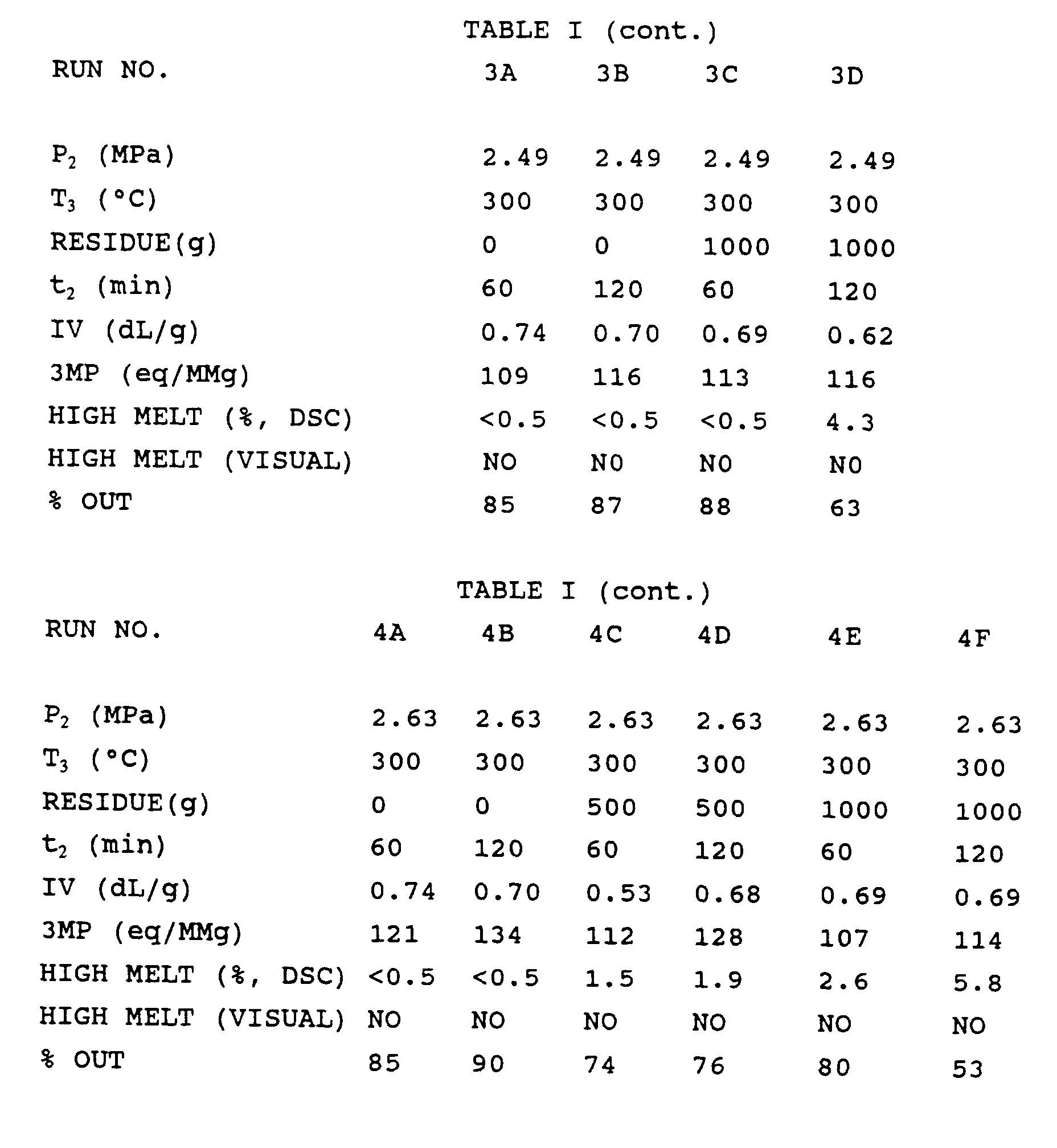
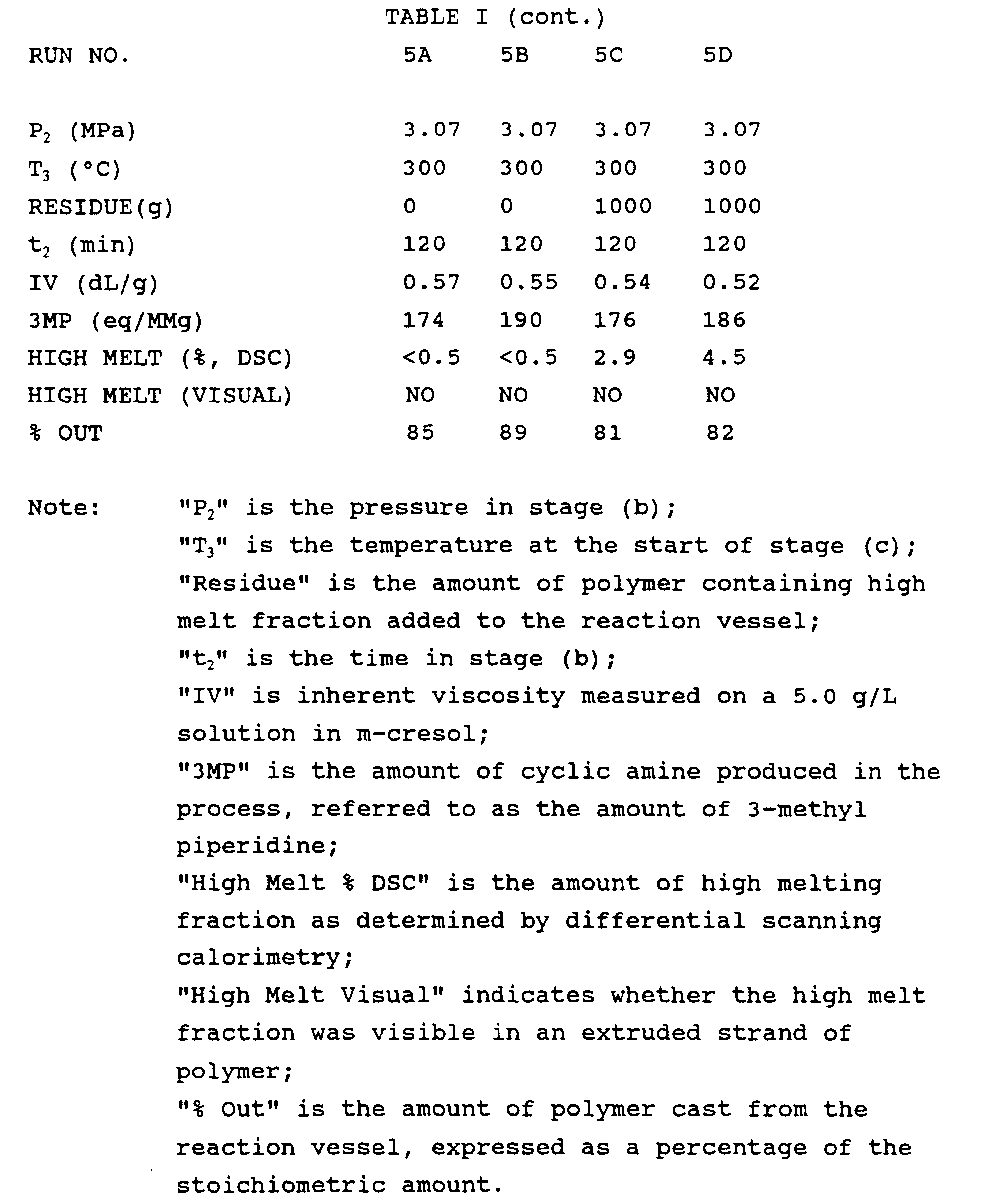
- The results show that the high melt fraction was visible in the polymer when the pressure in stage (b) was low i.e. Runs 1A-1E. The Runs at higher pressure did not exhibit visual high melting fraction even when polymer containing high melt fraction had been added to the reaction vessel. melt fraction had been added to the reaction vessel.
- Increasing the period of time in stage (b) from 60 minutes to 120 minutes had an adverse affect on the amount of high melt fraction as determined by DSC.
- The addition of polymer containing high melt fraction to the reaction vessel, to simulate presence of polymer with high melt fraction remaining in the vessel from a previous run, adversely affected the amount of polymer cast from the reaction vessel, especially with the higher viscosity polymers.
- The melting point of the high melt fraction is in excess of the temperatures reached during the polymerization process. Thus, it is to be expected that the high melt fraction added in the form of pellets containing that fraction would not be destroyed during the polymerization process. Moreover, it might be anticipated that the presence of the crystalline high melt fraction would induce crystallization of additional polymer into the crystalline form of the high melt fraction. Consequently, it would be expected that presence of high melt fraction in the reactor prior to polymerization would result in an increase in that fraction in the polymer obtained.
- This example shows that use of the high pressure resulted in a lower increase in high melt fraction, and in some instances a decrease in the amount, compared with the higher amounts obtained when the lower pressure was used. This has significant benefits in the operation of the polymerization process to produce multiple consecutive batches of polymer of commercially-acceptable quality without cleanout of the reactor or autoclave.
- An aqueous salt solution formed from terephthalic acid, hexamethylene diamine and 2-methyl pentamethylene diamine (1112.32 kg, 44.8% salt with a 5.2% molar excess of hexamethylene diamine and 13% molar excess of 2-methyl pentamethylene diamine) was charged to an autoclave. The solution was heated in the autoclave, with venting of water at a constant pressure of 340kPa until the salt in the autoclave reached a temperature of 162°C. Venting was then interrupted. The temperature of the autoclave was increased, with gases being vented at a pressure of 2.15 MPa; the autoclave was maintained at this pressure for approximately two hours, until the temperature of the melt had reached 300°C. A pressure reduction cycle was then initiated, to atmospheric pressure over a period of about 60 minutes. During this stage, the melt reached 318°C. The molten polymer was then subjected to a vacuum of 80 kPa for 17 minutes, the melt temperature increasing to 330°C.
- The polymer thus obtained was discharged from the autoclave through a multiple hole die, quenched in cold water and pelletized. The yield of pelletized polymer was 88.2%.
- The polymer obtained had an inherent viscosity (IV) of 0.87 dL/g, as measured on a 5.0g/L solution of polymer in m-cresol. The polymer had a single melting point of 302°C (DSC). The polymer did not show any visual evidence of high melt fraction, and none (<0.5%) was detected by DSC. The amount of cyclic amine (3-MP) was 88 eq/MMg of polymer.
- The procedure of Example II was repeated using lower pressures and temperatures.
- The aqueous salt solution was charged to an autoclave and heated with venting of water at a constant pressure of 240kPa until the salt in the autoclave reached a temperature of 145°C. Venting was then interrupted. The temperature of the autoclave was increased, with gases being vented at a pressure of 1.70 MPa; the autoclave was maintained at this pressure for approximately two hours, until the temperature of the melt had reached 295°C. The pressure reduction cycle was then initiated, to atmospheric pressure over a period of about 60 minutes. During this stage, the melt reached 312°C. The molten polymer was then subjected to a vacuum of 80 kPa for 10 minutes, the melt temperature increasing to 318°C.
- The polymer thus obtained was discharged from the autoclave through a multiple hole die, quenched in cold water and pelletized. However, discharging of the polymer from the autoclave lasted for only a short period of time and the yield of pelletized polymer was only 66.5%.
- The polymer obtained had an inherent viscosity (IV) of 0.81 dL/g, as measured on a 5.0g/L solution of polymer in m-cresol. The polymer had a single melting point of 302°C (DSC). The polymer showed visual evidence of high melt fraction; the amount detected using DSC was approximately 4.5%. The amount of cyclic amine (3-MP) was 74 eq/MMg of polymer.
- An aqueous salt solution formed from terephthalic acid, hexamethylene diamine and 2-methyl pentamethylene diamine (2540 kg, 50% salt with a 5.4% molar excess of hexamethylene diamine and 7.4% molar excess of 2-methyl pentamethylene diamine) was charged to an autoclave. The solution was heated in the autoclave, with venting of water at a constant pressure of 340kPa until the salt in the autoclave reached a temperature of 162°C. Venting was then interrupted. The temperature of the autoclave was increased, with gases being vented at a pressure of 2.15 MPa; the autoclave was maintained at this pressure for approximately two hours, until the temperature of the melt had reached 300°C. A pressure reduction cycle was then initiated, to atmospheric pressure over a period of about 40 minutes. During this stage, the melt reached 323°C. The molten polymer was then subjected to a vacuum of 80kPa for 4 minutes, the melt temperature increasing to 325°C.
- The polymer thus obtained was discharged from the autoclave through a multiple hole die, quenched in cold water and pelletized. The yield of pelletized polymer was 77%.
- The polymer obtained had an inherent viscosity (IV) of 0.84 dL/g, as measured on a 5.0g/L solution of polymer in m-cresol. The polymer had a single melting point of 302°C (DSC). The polymer did not show any visual evidence of high melt fraction; the amount detected by DSC was approximately 1.4% by weight. The amount of cyclic amine (3-MP) was 86 eq/MMg of polymer.
Claims (7)
- A process for the preparation of multiple consecutive batches of a copolyamide of terephthalic acid and an aliphatic diamine in a reactor without clean-out of the reactor, said process comprising the stages of(a) feeding to a reactor an aqueous salt solution of an admixture of terephthalic acid and aliphatic diamine, said aliphatic diamine being a mixture of hexamethylene diamine and 2-methyl pentamethylene diamine;(b) heating the aqueous salt solution under a pressure of at least 2.28 MPa and at a temperature in the range of 300-315°C and maintaining that pressure for a time period of from at least 60 minutes, while venting water and other volatile matter from the reactor;(c) reducing the pressure in the reactor to atmospheric pressure;(d) controlling stages (b) and (c) so as to avoid excessive foaming of the admixture in the reactor; and(e) discharging the copolyamide so obtained from the reactor; and(f) repeating these stages as required.
- The process of Claim 1, in which the copolyamide obtained from such process contains not more than about 2% by weight of a fraction with an annealed melting point of greater than 320°C.
- The process of Claims 1 or 2 in which the time period in stage (b) is at least about 90 minutes.
- The process of any one of Claims 1-3 in which stage (c) additionally includes maintaining the admixture in the reactor under a vacuum.
- The process of any one of Claims 1-3 in which the stages of the process are controlled so that the copolyamide produced has an inherent viscosity of at least about 0.6 dL/g.
- The process of any one of Claims 1-3 in which the stages of the process are controlled so that the copolyamide produced has an inherent viscosity of at least about 0.8 dL/g.
- The process of any one of Claims 1-6 in which the copolyamide is a partially crystalline copolyamide.
Applications Claiming Priority (4)
| Application Number | Priority Date | Filing Date | Title |
|---|---|---|---|
| GB9311754 | 1993-06-08 | ||
| GB939311754A GB9311754D0 (en) | 1993-06-08 | 1993-06-08 | High pressure process for the manufacture of terephthalic acid copolyamides |
| PCT/CA1994/000324 WO1994029367A1 (en) | 1993-06-08 | 1994-06-08 | High pressure process for the manufacture of terephthalic acid copolyamides |
| US08/257,509 US5656717A (en) | 1993-06-08 | 1994-06-08 | High pressure process for the manufacture of terephthalic acid copolyamides |
Publications (2)
| Publication Number | Publication Date |
|---|---|
| EP0655076A1 EP0655076A1 (en) | 1995-05-31 |
| EP0655076B1 true EP0655076B1 (en) | 2001-11-28 |
Family
ID=26303020
Family Applications (1)
| Application Number | Title | Priority Date | Filing Date |
|---|---|---|---|
| EP94918704A Expired - Lifetime EP0655076B1 (en) | 1993-06-08 | 1994-06-08 | High pressure process for the manufacture of terephthalic acid copolyamides |
Country Status (9)
| Country | Link |
|---|---|
| US (1) | US5656717A (en) |
| EP (1) | EP0655076B1 (en) |
| JP (1) | JP3488463B2 (en) |
| AT (1) | ATE209665T1 (en) |
| AU (1) | AU6992294A (en) |
| CA (1) | CA2141821C (en) |
| DE (1) | DE69429234T2 (en) |
| GB (1) | GB9311754D0 (en) |
| WO (1) | WO1994029367A1 (en) |
Families Citing this family (18)
| Publication number | Priority date | Publication date | Assignee | Title |
|---|---|---|---|---|
| US5981692A (en) * | 1997-05-15 | 1999-11-09 | Du Pont Canada Inc. | Semi-crystalline, semi-aromatic terpolymers with superior post-molding shrinkage and balance of mechanical performance |
| DE10316873A1 (en) | 2003-04-11 | 2004-11-11 | Ems-Chemie Ag | Flame retardant polyamide molding compounds |
| DE10331889A1 (en) * | 2003-07-14 | 2005-02-17 | Clariant Gmbh | Flame retardant polyamides |
| US8268956B2 (en) | 2006-12-08 | 2012-09-18 | Ems-Chemie Ag | Transparent mold made of a polyamide molding material |
| EP2060607B2 (en) | 2007-11-16 | 2019-11-27 | Ems-Patent Ag | Filled polyamide moulding materials |
| JP5369676B2 (en) * | 2008-12-26 | 2013-12-18 | 東レ株式会社 | Polyamide resin |
| PL2365033T3 (en) | 2010-03-12 | 2013-12-31 | Ems Patent Ag | Impact-resistant modified polyamide moulding material and container made of same |
| EP2412757B1 (en) | 2010-07-30 | 2013-11-13 | Ems-Patent Ag | Polyamide moulding composition for producing moulded articles with a soft touch surface and corresponding articles |
| ES2435667T3 (en) | 2011-06-17 | 2013-12-20 | Ems-Patent Ag | Partially aromatic molding doughs and their uses |
| EP2746315B1 (en) * | 2011-08-17 | 2016-04-13 | Toray Industries, Inc. | Method for manufacturing crystalline polyamide resin |
| EP2666803B1 (en) | 2012-05-23 | 2018-09-05 | Ems-Patent Ag | Scratch-proof, transparent and ductile copolyamide moulding materials, moulded parts produced from same and use of same |
| EP2716716B1 (en) | 2012-10-02 | 2018-04-18 | Ems-Patent Ag | Polyamide moulding compositions and their use in the production of moulded articles |
| PL2746339T3 (en) | 2012-12-18 | 2015-05-29 | Ems Patent Ag | Polyamide form mass and moulded parts produced from same |
| EP2778190B1 (en) | 2013-03-15 | 2015-07-15 | Ems-Patent Ag | Polyamide moulding material and moulded body produced from the same |
| TW201505705A (en) * | 2013-05-01 | 2015-02-16 | Invista Tech Sarl | Reducing foaming in agitated autoclave during polymerization process |
| CN104129010B (en) * | 2013-05-01 | 2018-04-17 | 英威达纺织(英国)有限公司 | The vacuum pre-cast of polyamide polymer |
| CN108884247B (en) * | 2016-02-05 | 2021-04-30 | 巴斯夫欧洲公司 | Polymer films comprising amorphous and partially crystalline polyamides |
| GB202115260D0 (en) | 2021-10-22 | 2021-12-08 | Invista Textiles Uk Ltd | Process for consecutive batch production of polyamide |
Family Cites Families (10)
| Publication number | Priority date | Publication date | Assignee | Title |
|---|---|---|---|---|
| DE2542938A1 (en) * | 1975-09-26 | 1977-04-07 | Dynamit Nobel Ag | TRANSPARENT POLYAMIDE |
| DE2627342A1 (en) * | 1976-06-18 | 1977-12-22 | Dynamit Nobel Ag | PROCESS FOR PRODUCTION OF POSSIBLY MODIFIED POLY- (ALKYLPENTAMETHYLENE TEREPHTHALAMIDE) |
| DE2743515A1 (en) * | 1977-09-28 | 1979-04-05 | Bayer Ag | POLYAMIDE MADE FROM ISOPHTHALIC ACID AND HEXAMETHYLENEDIAMINE |
| FR2643377B1 (en) * | 1989-02-21 | 1992-09-11 | Rhone Poulenc Chimie | PROCESS FOR THE PREPARATION OF SEMI-AROMATIC POLYAMIDES COMPRISING RESIDUES OF AROMATIC DICARBOXYLIC ACID (S) AND ALKYLPENTAMETHYLENEDIAMINE |
| FR2660316B1 (en) * | 1990-03-30 | 1994-03-11 | Rhone Poulenc Chimie | SEMI-AROMATIC SEMI-CRYSTALLINE COPOLYAMIDES OBTAINED FROM TEREPHTHALIC ACID AND MIXTURES COMPRISING ALKYLPENTAMETHYLENEDIAMINE AND HEXAMETHYLENEDIAMINE. |
| US5194578A (en) * | 1990-06-21 | 1993-03-16 | E.I. Du Pont De Nemours And Company | Fiber-forming copolyamide from 2-methyl-pentamethylene diamine |
| US5378800A (en) * | 1990-12-12 | 1995-01-03 | E. I. Du Pont De Nemours And Company | Terephthalic acid copolyamides |
| EP0540890A1 (en) * | 1991-10-10 | 1993-05-12 | Hoechst Celanese Corporation | Copolyamides of terephthalic acid, hexamethylene diamine and 2-methyl pentamethylene diamine |
| US5302691A (en) * | 1992-05-19 | 1994-04-12 | Du Pont Canada Inc. | Manufacture of terephthalic acid/2-methylpentamethylene diamine/hexamethylene diamine copolyamides |
| US5270437A (en) * | 1992-11-13 | 1993-12-14 | E. I. Du Pont De Nemours And Company | Process for making partially aromatic polyamides containing 2-methylpentamethylenediamine units |
-
1993
- 1993-06-08 GB GB939311754A patent/GB9311754D0/en active Pending
-
1994
- 1994-06-08 EP EP94918704A patent/EP0655076B1/en not_active Expired - Lifetime
- 1994-06-08 US US08/257,509 patent/US5656717A/en not_active Expired - Lifetime
- 1994-06-08 JP JP50114695A patent/JP3488463B2/en not_active Expired - Fee Related
- 1994-06-08 WO PCT/CA1994/000324 patent/WO1994029367A1/en not_active Ceased
- 1994-06-08 CA CA002141821A patent/CA2141821C/en not_active Expired - Fee Related
- 1994-06-08 AT AT94918704T patent/ATE209665T1/en not_active IP Right Cessation
- 1994-06-08 AU AU69922/94A patent/AU6992294A/en not_active Abandoned
- 1994-06-08 DE DE69429234T patent/DE69429234T2/en not_active Expired - Lifetime
Also Published As
| Publication number | Publication date |
|---|---|
| DE69429234T2 (en) | 2003-04-30 |
| EP0655076A1 (en) | 1995-05-31 |
| JP3488463B2 (en) | 2004-01-19 |
| US5656717A (en) | 1997-08-12 |
| DE69429234D1 (en) | 2002-01-10 |
| AU6992294A (en) | 1995-01-03 |
| WO1994029367A1 (en) | 1994-12-22 |
| JPH08500150A (en) | 1996-01-09 |
| CA2141821A1 (en) | 1994-12-22 |
| ATE209665T1 (en) | 2001-12-15 |
| CA2141821C (en) | 2006-04-04 |
| GB9311754D0 (en) | 1993-07-28 |
Similar Documents
| Publication | Publication Date | Title |
|---|---|---|
| US5302691A (en) | Manufacture of terephthalic acid/2-methylpentamethylene diamine/hexamethylene diamine copolyamides | |
| US5656717A (en) | High pressure process for the manufacture of terephthalic acid copolyamides | |
| EP0561886B1 (en) | Terephthalic acid copolyamides | |
| EP0684966B1 (en) | Polyamides having improved color and processibility and process for manufacturing | |
| EP3130627B1 (en) | Polyamide resin composition | |
| EP0745106B2 (en) | Process for preparation of polyamides having improved color and processibility | |
| JP4060251B2 (en) | Polyamide resin composition | |
| JPH111555A (en) | Heat-resistant partial aromatic polyamide | |
| KR20010099892A (en) | Method of Producing Branched Polyamides | |
| US5516882A (en) | Manufacture of terephthalic acid copolyamides | |
| US5502155A (en) | Manufacture of partially aromatic polyamides | |
| US4864009A (en) | Molding composition consisting of aliphatic/aromatic copolyamide | |
| EP4419579A1 (en) | Process for consecutive batch production of polyamide | |
| JP2001019845A (en) | Polyamide resin composition and its molding | |
| EP1015510A1 (en) | Manufacture of branched polyamides |
Legal Events
| Date | Code | Title | Description |
|---|---|---|---|
| PUAI | Public reference made under article 153(3) epc to a published international application that has entered the european phase |
Free format text: ORIGINAL CODE: 0009012 |
|
| AK | Designated contracting states |
Kind code of ref document: A1 Designated state(s): AT BE CH DE DK ES FR GB GR IE IT LI LU NL PT SE |
|
| 17P | Request for examination filed |
Effective date: 19950411 |
|
| 17Q | First examination report despatched |
Effective date: 19961021 |
|
| GRAG | Despatch of communication of intention to grant |
Free format text: ORIGINAL CODE: EPIDOS AGRA |
|
| GRAG | Despatch of communication of intention to grant |
Free format text: ORIGINAL CODE: EPIDOS AGRA |
|
| GRAG | Despatch of communication of intention to grant |
Free format text: ORIGINAL CODE: EPIDOS AGRA |
|
| GRAH | Despatch of communication of intention to grant a patent |
Free format text: ORIGINAL CODE: EPIDOS IGRA |
|
| GRAG | Despatch of communication of intention to grant |
Free format text: ORIGINAL CODE: EPIDOS AGRA |
|
| GRAG | Despatch of communication of intention to grant |
Free format text: ORIGINAL CODE: EPIDOS AGRA |
|
| GRAH | Despatch of communication of intention to grant a patent |
Free format text: ORIGINAL CODE: EPIDOS IGRA |
|
| GRAH | Despatch of communication of intention to grant a patent |
Free format text: ORIGINAL CODE: EPIDOS IGRA |
|
| GRAA | (expected) grant |
Free format text: ORIGINAL CODE: 0009210 |
|
| AK | Designated contracting states |
Kind code of ref document: B1 Designated state(s): AT BE CH DE DK ES FR GB GR IE IT LI LU NL PT SE |
|
| PG25 | Lapsed in a contracting state [announced via postgrant information from national office to epo] |
Ref country code: NL Free format text: LAPSE BECAUSE OF FAILURE TO SUBMIT A TRANSLATION OF THE DESCRIPTION OR TO PAY THE FEE WITHIN THE PRESCRIBED TIME-LIMIT Effective date: 20011128 Ref country code: LI Free format text: LAPSE BECAUSE OF FAILURE TO SUBMIT A TRANSLATION OF THE DESCRIPTION OR TO PAY THE FEE WITHIN THE PRESCRIBED TIME-LIMIT Effective date: 20011128 Ref country code: IT Free format text: LAPSE BECAUSE OF FAILURE TO SUBMIT A TRANSLATION OF THE DESCRIPTION OR TO PAY THE FEE WITHIN THE PRE;WARNING: LAPSES OF ITALIAN PATENTS WITH EFFECTIVE DATE BEFORE 2007 MAY HAVE OCCURRED AT ANY TIME BEFORE 2007. THE CORRECT EFFECTIVE DATE MAY BE DIFFERENT FROM THE ONE RECORDED.SCRIBED TIME-LIMIT Effective date: 20011128 Ref country code: GR Free format text: LAPSE BECAUSE OF FAILURE TO SUBMIT A TRANSLATION OF THE DESCRIPTION OR TO PAY THE FEE WITHIN THE PRESCRIBED TIME-LIMIT Effective date: 20011128 Ref country code: FR Free format text: LAPSE BECAUSE OF FAILURE TO SUBMIT A TRANSLATION OF THE DESCRIPTION OR TO PAY THE FEE WITHIN THE PRESCRIBED TIME-LIMIT Effective date: 20011128 Ref country code: CH Free format text: LAPSE BECAUSE OF FAILURE TO SUBMIT A TRANSLATION OF THE DESCRIPTION OR TO PAY THE FEE WITHIN THE PRESCRIBED TIME-LIMIT Effective date: 20011128 Ref country code: BE Free format text: LAPSE BECAUSE OF FAILURE TO SUBMIT A TRANSLATION OF THE DESCRIPTION OR TO PAY THE FEE WITHIN THE PRESCRIBED TIME-LIMIT Effective date: 20011128 Ref country code: AT Free format text: LAPSE BECAUSE OF FAILURE TO SUBMIT A TRANSLATION OF THE DESCRIPTION OR TO PAY THE FEE WITHIN THE PRESCRIBED TIME-LIMIT Effective date: 20011128 |
|
| REF | Corresponds to: |
Ref document number: 209665 Country of ref document: AT Date of ref document: 20011215 Kind code of ref document: T |
|
| REG | Reference to a national code |
Ref country code: CH Ref legal event code: EP |
|
| REG | Reference to a national code |
Ref country code: IE Ref legal event code: FG4D |
|
| REG | Reference to a national code |
Ref country code: GB Ref legal event code: IF02 |
|
| REF | Corresponds to: |
Ref document number: 69429234 Country of ref document: DE Date of ref document: 20020110 |
|
| PG25 | Lapsed in a contracting state [announced via postgrant information from national office to epo] |
Ref country code: SE Free format text: LAPSE BECAUSE OF FAILURE TO SUBMIT A TRANSLATION OF THE DESCRIPTION OR TO PAY THE FEE WITHIN THE PRESCRIBED TIME-LIMIT Effective date: 20020228 Ref country code: PT Free format text: LAPSE BECAUSE OF FAILURE TO SUBMIT A TRANSLATION OF THE DESCRIPTION OR TO PAY THE FEE WITHIN THE PRESCRIBED TIME-LIMIT Effective date: 20020228 Ref country code: DK Free format text: LAPSE BECAUSE OF FAILURE TO SUBMIT A TRANSLATION OF THE DESCRIPTION OR TO PAY THE FEE WITHIN THE PRESCRIBED TIME-LIMIT Effective date: 20020228 |
|
| NLV1 | Nl: lapsed or annulled due to failure to fulfill the requirements of art. 29p and 29m of the patents act | ||
| PG25 | Lapsed in a contracting state [announced via postgrant information from national office to epo] |
Ref country code: ES Free format text: LAPSE BECAUSE OF FAILURE TO SUBMIT A TRANSLATION OF THE DESCRIPTION OR TO PAY THE FEE WITHIN THE PRESCRIBED TIME-LIMIT Effective date: 20020530 |
|
| PG25 | Lapsed in a contracting state [announced via postgrant information from national office to epo] |
Ref country code: LU Free format text: LAPSE BECAUSE OF NON-PAYMENT OF DUE FEES Effective date: 20020608 |
|
| PG25 | Lapsed in a contracting state [announced via postgrant information from national office to epo] |
Ref country code: IE Free format text: LAPSE BECAUSE OF NON-PAYMENT OF DUE FEES Effective date: 20020610 |
|
| PGFP | Annual fee paid to national office [announced via postgrant information from national office to epo] |
Ref country code: FR Payment date: 20020610 Year of fee payment: 9 |
|
| REG | Reference to a national code |
Ref country code: CH Ref legal event code: PL |
|
| EN | Fr: translation not filed | ||
| PLBE | No opposition filed within time limit |
Free format text: ORIGINAL CODE: 0009261 |
|
| STAA | Information on the status of an ep patent application or granted ep patent |
Free format text: STATUS: NO OPPOSITION FILED WITHIN TIME LIMIT |
|
| 26N | No opposition filed | ||
| REG | Reference to a national code |
Ref country code: IE Ref legal event code: MM4A |
|
| PGFP | Annual fee paid to national office [announced via postgrant information from national office to epo] |
Ref country code: DE Payment date: 20130605 Year of fee payment: 20 Ref country code: GB Payment date: 20130605 Year of fee payment: 20 |
|
| REG | Reference to a national code |
Ref country code: DE Ref legal event code: R071 Ref document number: 69429234 Country of ref document: DE |
|
| REG | Reference to a national code |
Ref country code: DE Ref legal event code: R071 Ref document number: 69429234 Country of ref document: DE |
|
| REG | Reference to a national code |
Ref country code: GB Ref legal event code: PE20 Expiry date: 20140607 |
|
| PG25 | Lapsed in a contracting state [announced via postgrant information from national office to epo] |
Ref country code: GB Free format text: LAPSE BECAUSE OF EXPIRATION OF PROTECTION Effective date: 20140607 |
|
| PG25 | Lapsed in a contracting state [announced via postgrant information from national office to epo] |
Ref country code: DE Free format text: LAPSE BECAUSE OF EXPIRATION OF PROTECTION Effective date: 20140611 |