EP0653963B1 - Process for the separation of oligomeric materials from a catalyst mixture - Google Patents
Process for the separation of oligomeric materials from a catalyst mixture Download PDFInfo
- Publication number
- EP0653963B1 EP0653963B1 EP93918547A EP93918547A EP0653963B1 EP 0653963 B1 EP0653963 B1 EP 0653963B1 EP 93918547 A EP93918547 A EP 93918547A EP 93918547 A EP93918547 A EP 93918547A EP 0653963 B1 EP0653963 B1 EP 0653963B1
- Authority
- EP
- European Patent Office
- Prior art keywords
- iodide
- carbon atoms
- mixture
- oligomer
- catalyst
- Prior art date
- Legal status (The legal status is an assumption and is not a legal conclusion. Google has not performed a legal analysis and makes no representation as to the accuracy of the status listed.)
- Expired - Lifetime
Links
- 0 C*C(C)N(C)CCN Chemical compound C*C(C)N(C)CCN 0.000 description 1
Classifications
-
- B—PERFORMING OPERATIONS; TRANSPORTING
- B01—PHYSICAL OR CHEMICAL PROCESSES OR APPARATUS IN GENERAL
- B01J—CHEMICAL OR PHYSICAL PROCESSES, e.g. CATALYSIS OR COLLOID CHEMISTRY; THEIR RELEVANT APPARATUS
- B01J31/00—Catalysts comprising hydrides, coordination complexes or organic compounds
- B01J31/40—Regeneration or reactivation
-
- B—PERFORMING OPERATIONS; TRANSPORTING
- B01—PHYSICAL OR CHEMICAL PROCESSES OR APPARATUS IN GENERAL
- B01J—CHEMICAL OR PHYSICAL PROCESSES, e.g. CATALYSIS OR COLLOID CHEMISTRY; THEIR RELEVANT APPARATUS
- B01J31/00—Catalysts comprising hydrides, coordination complexes or organic compounds
- B01J31/02—Catalysts comprising hydrides, coordination complexes or organic compounds containing organic compounds or metal hydrides
- B01J31/0234—Nitrogen-, phosphorus-, arsenic- or antimony-containing compounds
- B01J31/0255—Phosphorus containing compounds
- B01J31/0267—Phosphines or phosphonium compounds, i.e. phosphorus bonded to at least one carbon atom, including e.g. sp2-hybridised phosphorus compounds such as phosphabenzene, the other atoms bonded to phosphorus being either carbon or hydrogen
- B01J31/0268—Phosphonium compounds, i.e. phosphine with an additional hydrogen or carbon atom bonded to phosphorous so as to result in a formal positive charge on phosphorous
-
- B—PERFORMING OPERATIONS; TRANSPORTING
- B01—PHYSICAL OR CHEMICAL PROCESSES OR APPARATUS IN GENERAL
- B01J—CHEMICAL OR PHYSICAL PROCESSES, e.g. CATALYSIS OR COLLOID CHEMISTRY; THEIR RELEVANT APPARATUS
- B01J31/00—Catalysts comprising hydrides, coordination complexes or organic compounds
- B01J31/02—Catalysts comprising hydrides, coordination complexes or organic compounds containing organic compounds or metal hydrides
- B01J31/0234—Nitrogen-, phosphorus-, arsenic- or antimony-containing compounds
- B01J31/0235—Nitrogen containing compounds
- B01J31/0239—Quaternary ammonium compounds
-
- B—PERFORMING OPERATIONS; TRANSPORTING
- B01—PHYSICAL OR CHEMICAL PROCESSES OR APPARATUS IN GENERAL
- B01J—CHEMICAL OR PHYSICAL PROCESSES, e.g. CATALYSIS OR COLLOID CHEMISTRY; THEIR RELEVANT APPARATUS
- B01J31/00—Catalysts comprising hydrides, coordination complexes or organic compounds
- B01J31/02—Catalysts comprising hydrides, coordination complexes or organic compounds containing organic compounds or metal hydrides
- B01J31/12—Catalysts comprising hydrides, coordination complexes or organic compounds containing organic compounds or metal hydrides containing organo-metallic compounds or metal hydrides
- B01J31/122—Metal aryl or alkyl compounds
-
- B—PERFORMING OPERATIONS; TRANSPORTING
- B01—PHYSICAL OR CHEMICAL PROCESSES OR APPARATUS IN GENERAL
- B01J—CHEMICAL OR PHYSICAL PROCESSES, e.g. CATALYSIS OR COLLOID CHEMISTRY; THEIR RELEVANT APPARATUS
- B01J31/00—Catalysts comprising hydrides, coordination complexes or organic compounds
- B01J31/40—Regeneration or reactivation
- B01J31/4015—Regeneration or reactivation of catalysts containing metals
-
- B—PERFORMING OPERATIONS; TRANSPORTING
- B01—PHYSICAL OR CHEMICAL PROCESSES OR APPARATUS IN GENERAL
- B01J—CHEMICAL OR PHYSICAL PROCESSES, e.g. CATALYSIS OR COLLOID CHEMISTRY; THEIR RELEVANT APPARATUS
- B01J31/00—Catalysts comprising hydrides, coordination complexes or organic compounds
- B01J31/40—Regeneration or reactivation
- B01J31/4015—Regeneration or reactivation of catalysts containing metals
- B01J31/4053—Regeneration or reactivation of catalysts containing metals with recovery of phosphorous catalyst system constituents
-
- C—CHEMISTRY; METALLURGY
- C07—ORGANIC CHEMISTRY
- C07D—HETEROCYCLIC COMPOUNDS
- C07D307/00—Heterocyclic compounds containing five-membered rings having one oxygen atom as the only ring hetero atom
- C07D307/02—Heterocyclic compounds containing five-membered rings having one oxygen atom as the only ring hetero atom not condensed with other rings
- C07D307/26—Heterocyclic compounds containing five-membered rings having one oxygen atom as the only ring hetero atom not condensed with other rings having one double bond between ring members or between a ring member and a non-ring member
- C07D307/28—Heterocyclic compounds containing five-membered rings having one oxygen atom as the only ring hetero atom not condensed with other rings having one double bond between ring members or between a ring member and a non-ring member with only hydrogen atoms, hydrocarbon or substituted hydrocarbon radicals, directly attached to ring carbon atoms
-
- B—PERFORMING OPERATIONS; TRANSPORTING
- B01—PHYSICAL OR CHEMICAL PROCESSES OR APPARATUS IN GENERAL
- B01J—CHEMICAL OR PHYSICAL PROCESSES, e.g. CATALYSIS OR COLLOID CHEMISTRY; THEIR RELEVANT APPARATUS
- B01J2231/00—Catalytic reactions performed with catalysts classified in B01J31/00
- B01J2231/50—Redistribution or isomerisation reactions of C-C, C=C or C-C triple bonds
- B01J2231/52—Isomerisation reactions
-
- Y—GENERAL TAGGING OF NEW TECHNOLOGICAL DEVELOPMENTS; GENERAL TAGGING OF CROSS-SECTIONAL TECHNOLOGIES SPANNING OVER SEVERAL SECTIONS OF THE IPC; TECHNICAL SUBJECTS COVERED BY FORMER USPC CROSS-REFERENCE ART COLLECTIONS [XRACs] AND DIGESTS
- Y02—TECHNOLOGIES OR APPLICATIONS FOR MITIGATION OR ADAPTATION AGAINST CLIMATE CHANGE
- Y02P—CLIMATE CHANGE MITIGATION TECHNOLOGIES IN THE PRODUCTION OR PROCESSING OF GOODS
- Y02P20/00—Technologies relating to chemical industry
- Y02P20/50—Improvements relating to the production of bulk chemicals
- Y02P20/584—Recycling of catalysts
Definitions
- This invention pertains to a process for the recovery of catalyst values from mixtures of catalyst and oligomeric materials. More specifically, this invention pertains to a process for the recovery of the components of a catalyst system utilized in the manufacture of 2,5-dihydrofurans by the isomerization of ⁇ , ⁇ -epoxyalkenes.
- U.S. Patent 5,082,956 discloses processes for the preparation of 2,5-dihydrofurans by isomerizing ⁇ , ⁇ -epoxyalkenes in the presence of catalyst systems comprising certain onium iodide compounds and, optionally, an inorganic Lewis acid and/or certain organometallic halide compounds.
- the disclosed processes include vapor phase processes wherein a vapor of the ⁇ , ⁇ -epoxyalkene reactant is passed through a reaction zone containing the catalyst system which is in the form of a molten salt or a film deposited on a non-acidic support material.
- This gas phase process employs an inert gas diluent such as nitrogen or helium and is conducted at a temperature above the melting point of the catalytically-active catalyst components, typically at a temperature of 130 to 150°C.
- ⁇ , ⁇ -epoxyalkenes are isomerized to dihydrofurans in the liquid phase using a solution of the above-described catalyst system in an extraneous, inert solvent and a temperature of 100 to 150°C.
- This procedure uses a hydrocarbon or halogenated hydrocarbon solvent, such as mesitylene, pseudocumene or dichlorobenzene, having a boiling point higher than the 2,5-dihydrofuran product to facilitate isolation of the product from the catalyst solution by distillation.
- 2,5-Dihydrofuran may be hydrogenated as described in U.S. Patent 4,962,210 to tetrahydrofuran, a valuable compound useful as a chemical process solvent and as an intermediate in the preparation of polymers such as poly(tetramethylene ether)glycol.
- a particularly convenient means for the preparation of dihydrofurans by the isomerization of ⁇ , ⁇ -epoxyalkenes comprises a liquid phase, continuous process wherein a ⁇ , ⁇ -epoxyalkene initially is fed to a melt of the catalyst system and thereafter is continuously fed to a solution of the catalyst in the 2,5-dihydrofuran product.
- the 2,5-dihydrofuran product may be recovered from the mixture by conventional distillation procedures.
- a catalyst system which has been found to be especially effective comprises an onium iodide compound such as an ammonium or phosphonium iodide and an organotin compound such as a trihydrocarbyltin iodide.
- Unavoidable side products of the isomerization of ⁇ , ⁇ -epoxyalkenes to dihydrofurans are ⁇ , ⁇ -unsaturated carbonyl compounds such as crotonaldehyde (0.5-3%) and an oligomer of the ⁇ , ⁇ -epoxyalkene (1-6%).
- ⁇ , ⁇ -unsaturated carbonyl compound by-product is removed from the reaction mixture as a vapor during product recovery.
- the oligomer is non-volatile and accumulates in the catalyst solution, increasing the volume and viscosity of the catalyst solution and decreasing catalyst concentration.
- the catalyst/oligomer separation is accomplished in accordance with the present invention by a liquid-liquid extraction process in which the catalyst compounds are preferentially extracted from the catalyst/oligomer mixture.
- the catalyst/extractant phase is separated from the oligomer phase and the solvent removed to give a catalyst mixture which may be reused in the isomerization reaction.
- the present invention therefore provides a process for the separation of a catalyst system comprising (i) an onium iodide compound, (ii) an organotin iodide compound, or (iii) a mixture thereof from a mixture of the catalyst system and an oligomer of a ⁇ , ⁇ -epoxyalkene by the steps comprising:
- the extraction solvent (extractant) employed may be selected from a variety of hydrocarbons and chlorocarbons depending, for example, upon the particular ⁇ , ⁇ -epoxybutene reactant and catalyst components used in the isomerization process.
- the extractant should satisfy four requirements: (1) it should form a separate liquid phase at equilibrium when contacted with a mixture of the catalyst components and the oligomer, (2) it should have a higher selectivity for dissolving the catalyst components than the oligomer, (3) it should have characteristics that enable it to be separated from the catalyst components by evaporation, distillation, crystallization, or some other separation operation, and (4) it should be inert to the catalyst components, starting material and products.
- an extraction solvent may function both as the solvent for the isomerization reaction and the oligomer removal process if the dihydrofuran product is removed prior to phase separation.
- the extraction solvent should be non-polar to avoid dissolving the oligomer.
- the extraction solvent may comprise a mixture of two or more solvents.
- extraction solvents include cyclic and straight- and branched-chain, acyclic alkanes containing from 5 to 12 carbon atoms.
- acyclic alkane extractants include pentane, hexane, heptane, octane, nonane, decane, mixed hexanes, mixed heptanes, mixed octanes, isooctane, Stoddard solvent, and the like.
- examples of the cycloalkane extractants include cyclopentane, cyclohexane, cycloheptane, cyclooctane, methylcyclohexane, etc.
- Alkenes such as hexenes, heptenes, octenes, nonenes and decenes; aromatic hydrocarbons such as benzene, toluene, xylene, mesitylene; and chlorocarbons such as carbon tetrachloride also may be used as the extractant.
- the preferred extraction solvents are alkanes having 6 to 12 carbon atoms.
- the extractant preferably is a straight-chain alkane of 6 to 12 carbon atoms, especially heptane, octane, nonane, and decane.
- the onium iodide compound involved in the present invention may be selected from a variety of tetra(hydrocarbyl)ammonium iodides and tetra(hydrocarbyl)phosphonium iodides, preferably having a total carbon atom content of 16 to 72 carbon atoms.
- each R 1 substituent independently is selected from alkyl of up to 20 carbon atoms and each R 2 substituent is independently selected from R 1 , benzyl, phenyl or phenyl substituted with up to 3 substituents selected from lower alkyl, e.g., alkyl of up to 4 carbon atoms, lower alkoxy or halogen; or two R 1 substituents collectively may represent alkylene of 4 to 6 carbon atoms including alkylene of 4 to 6 carbon atoms substituted with lower alkyl; provided, as specified above, that the quaternary iodide compounds contain 16 to 72 carbon atoms.
- the preferred onium iodides are tetra-n-alkylphosphonium iodides containing 32 to 72 carbon atoms, especially compounds of formula (II) above wherein each R 2 is straight-chain alkyl of 4 to 18 carbon atoms.
- Tetra-n-odecylphosphonium iodide, tetra-n-hexadecylphosphonium iodide, and tri-n-octyl(n-octadecyl)phosphonium iodide are especially preferred.
- the organotin catalyst component may be selected from organotin (IV) iodides such as hydrocarbyltin triiodides, di(hydrocarbyl)tin diiodides, and tri(hydrocarbyl)tin iodides.
- organotin (IV) iodides such as hydrocarbyltin triiodides, di(hydrocarbyl)tin diiodides, and tri(hydrocarbyl)tin iodides.
- organotin (IV) iodide compounds have the general formula (R 3 ) n ⁇ Sn ⁇ I (4-n) (III) wherein each R 3 independently is selected from alkyl or substituted alkyl moieties having up to 20 carbon atoms, cycloalkyl or substituted cycloalkyl having 5 to 20 carbon atoms, carbocyclic aryl or substituted carbocyclic aryl having 6 to 20 carbon atoms, or heteroaryl or substituted heteroaryl moieties having 4 up to 20 carbon atoms; and n is 1, 2, or 3.
- organotin compounds include di-n-butyltin diiodide, tri-n-butyltin iodide, tri-n-octyltin iodide, triphenyltin iodide, trimethyltin iodide, n-butyltin triiodide, tricyclohexyltin iodide, tris-(2-methyl-2-phenylpropyl)tin iodide, tribenzyltin iodide, dimethyltin diiodide and diphenyltin diiodide.
- organotin halides such as chlorides and bromides may be used in the process wherein they are converted to the iodide compounds.
- the preferred organotin iodide compounds have the general formula: (R 3 ) 3 ⁇ Sn ⁇ I (IV) wherein each R 3 independently is selected from alkyl having 4 to 10 carbon atoms or phenyl. Tri-n-octyltin iodide and triphenyltin iodide are especially preferred.
- the ratio of the onium iodide and organotin iodide components of the catalyst system can vary substantially depending, for example, upon the particular compounds used. Generally, the quaternary onium iodide:organotin iodide mole ratio is within the range of 20:1 to 0.05:1. For the preferred catalyst system comprising a phosphonium iodide and an organotin iodide, a phosphonium iodide:organotin iodide mole ratio of 5:1 to 0.2:1 is especially preferred.
- the catalyst recovery process of this invention may be carried out in a batch, semi-continuous or continuous mode of operation.
- batch operation may comprise removal of the volatile components from the isomerization reaction mixture by distillation followed by addition of the extraction solvent, agitation, settling, and phase separation.
- the volatile components of the catalyst system typically constitute 5 to 30 weight percent of the catalyst/oligomer mixture that is extracted.
- One of the layers or phases comprises the extraction solvent containing the onium iodide and organotin iodide catalyst components.
- the second oligomer layer may be extracted repeatedly as needed to give the desired degree of catalyst recovery.
- the combined solvent layers are concentrated by solvent evaporation or distillation to give a crude catalyst mixture which usually is handled as a molten liquid and is recycled to the isomerization process reactor without further purification. A fraction of the original oligomer content is usually still present in this crude catalyst mixture.
- the oligomer layer may be used as a by-product or sent for disposal. It may be possible to recover one or both of the catalyst components by the crystallization thereof from the extraction solvent.
- the temperature of the extraction/separation process normally is controlled at a slightly elevated temperature to ensure good solubility of catalysts in the solvent and decreased oligomer viscosity.
- the temperature preferably is held below the boiling point of the solvent so that the process may be operated at atmospheric pressure.
- the process normally is carried out at a temperature of 40 to 125°C.
- Our novel extraction process preferably is operated continuously or semi-continuously in a countercurrent manner.
- This technique can give excellent efficiencies of extraction. See, for example, T. C. Lo, M. H. I. Baird, C. Hanson, Handbook of Solvent Extraction, Reprint Edition, Krieger Publishing Company, Malabar, Florida, 1991.
- Typical countercurrent extraction systems include the mixer/settler, baffle-tray column, Kuhni column, rotating disk contactor, and Karr reciprocating plate column.
- a portion of the catalyst/oligomer mixture is removed from the reactor and volatile materials are evaporated off.
- the concentrated mixture is then fed to the continuous multistage extractor in a direction countercurrent to the flaw of the extraction solvent.
- the catalyst solution is concentrated to give the non-volatile catalyst components and recovered solvent. As mentioned above, it may be possible to isolate the catalyst components from the catalyst solution by crystallization.
- the concentration of the onium iodide and organotin iodide compounds in the oligomer material which is extracted in accordance with our invention typically is in the range of 20 to 90 weight percent based on the total weight of the catalyst/oligomer mixture.
- the amount of extraction solvent employed can vary substantially depending, for example, on the particular onium iodide and organotin iodide compounds present in the oligomer material, the extraction solvent being used, and the manner in which the extraction process is operated. However, the weight ratio of the extraction solvent to the catalyst/oligomer mixture to be extracted normally is in the range of 10:1 to 0.1:1.
- the ⁇ , ⁇ -epoxyalkene reactants may contain from 4 to 8 carbon atoms.
- Examples of the epoxyalkene and epoxycycloalkene reactants include compounds having the structural formula: wherein each R 4 is independently selected from hydrogen and methyl or 2 R 4 substituents collectively may represent an alkylene radical which forms a ring having 5 to 8 carbon atoms.
- the preferred epoxyalkene reactants comprise compounds of formula (V) wherein a maximum of four of the R 4 substituents individually may represent methyl.
- Exemplary compounds contemplated for use in the practice of the present invention include 3,4-epoxy-3-methyl-1-butene, 3,4-epoxy-2-methyl-1-butene, 2,3-dimethyl-3,4-epoxy-1-butene, 3,4-epoxy-1-butene, 2,5-dimethyl-2,4-hexadiene monoepoxide, 3,4-epoxycyclooctene and the like.
- the epoxyalkene reactant of primary interest is 3,4-epoxy-1-butene.
- the 2,5-dihydrofuran compounds obtained in accordance with our novel process have the structural formula: wherein the R 4 substituents are defined above. Of the compounds which may be obtained in accordance with our invention, the most important is 2,5-dihydrofuran.
- a particularly preferred embodiment of our invention is represented by the process for the separation of a catalyst system comprising (i) an onium iodide compound and (ii) an organotin iodide compound, from a mixture of the catalyst system and an oligomer of a 3,4-epoxy-1-butene by the steps comprising:
- distillates were analyzed by gas chromatography on a Hewlett-Packard 5890A gas chromatograph with a DB5-30W capillary column; temperature program 35°C (4.5 minutes), 20°C/minute to 260°C (hold 6 minutes).
- Catalyst and oligomer samples were analyzed by 1 H NMR on a Varian Gemini 300 spectrometer (300 MHz) using deuterochloroform as solvent and tetramethylsilane as internal standard. Analyses are reported in weight percent.
- EpB 3,4-epoxy-1-butene
- DHF refers to 2,5-dihydrofuran
- HCr refers to crotonaldehyde.
- the amounts of materials fed and materials recovered in the examples may not balance due to losses resulting from evaporation, material transfers, leaks, etc.
- Triphenyltin iodide (25.0 g), tri-n-octyl(n-octadecyl)phosphonium iodide (39.4 g), and 2,5-dihydrofuran (10.0 g) were placed in a 200-mL, four-neck, round-bottom flask equipped with a thermocouple, magnetic stirrer, distillation head, oil heating bath and reactant feed tube. The mixture was heated to 105°C and feeding of 3,4-epoxy-1-butene addition was begun while maintaining the temperature at approximately 105°C. A total of 2431 g of 3,4-epoxy-1-butene was added over a period of 40 hours.
- the pressure within the flask was gradually lowered to 100 torr (13.30 kPa) to completely distill the volatile components from the catalyst/oligomer residue. A total of 2369 g of distillate was collected (97.4% weight recovery).
- the composition of the distillate was 6.50% 3,4-epoxy-1-butene, 92.5% 2,5-dihydrofuran, and 0.95% crotonaldehyde.
- the conversion of 3,4-epoxy-1-butene was 93.5% and selectivity to 2,5-dihydrofuran was 99.0%.
- the extractions in this and subsequent examples were carried out in a 500-mL, jacketed, glass vessel equipped with a mechanical stirrer, thermocouple, and bottom stopcock. Each extraction mixture was heated to a constant temperature ( ⁇ 1°C) by circulating heated glycol/water from a constant temperature bath to the jacket. The catalyst/oligomer mixture was added to the alkane extraction solvent and heated to the desired temperature while stirring vigorously. The extraction mixture was stirred for at least 5 minutes, stirring was discontinued and the layers were allowed to completely separate.
- heptane 150 mL was added to the stripped catalyst/oligomer residue (approximately 90 g) and the mixture was agitated while being heated to 65-75°C and then allowed to separate into two layers. The layers were separated and the bottom (oligomer) layer was extracted as described above two more times with 150 mL portions of heptane. The heptane layers were combined and the solvent removed by rotary vacuum evaporation [to 70°C and 30 torr (3.99 kPa)].
- the catalyst-containing material (80.3 g) thus recovered had the following approximate composition: 32.9% triphenyltin iodide, 51.8% tri-n-octyl(n-octadecyl)phosphonium iodide, and 15.3% oligomer.
- the amount of oligomer removed by the extraction procedure was 8.7 g.
- Example 1 The catalyst-containing material recovered in Example 1 was returned to the reaction flask and the isomerization procedure was repeated. Over a period of 28 hours, a total of 1728 g of 3,4-epoxy-1-butene was added and 1648 g of distillate was collected (95.4% weight recovery). The conversion of 3,4-epoxy-1-butene was 92.1% and selectivity to 2,5-dihydrofuran was 97.8%.
- the catalyst/oligomer residue remaining from the isomerization process was extracted by the procedure described in Example 1.
- the catalyst-containing material thus recovered had the following approximate composition: 17.1% triphenyltin iodide, 44.6% tri-n-octyl(n-octadecyl)phosphonium iodide, and 38.3% oligomer.
- the amount of oligomer removed by the extraction procedure was 30.7 g.
- Example 2 The catalyst-containing material recovered in Example 2 was returned to the reaction flask and the isomerization procedure was repeated. Over a period of 12 hours, a total of 669 g of 3,4-epoxy-1-butene was added and 623 g of distillate was collected (93.1% weight recovery). The conversion of 3,4-epoxy-1-butene was 88.9% and selectivity to 2,5-dihydrofuran was 98.9%.
- the catalyst/oligomer residue remaining from the isomerization process was extracted by the procedure described in Example 1.
- the catalyst-containing material (112.5 g) thus recovered had the following approximate composition: 19.0% triphenyltin iodide, 47.2% tri-n-octyl(n-octadecyl)phosphonium iodide, and 33.7% oligomer.
- the amount of oligomer removed by the extraction procedure was 33.6 g.
- Example 3 The catalyst-containing material recovered in Example 3 was returned to the reaction flask and the isomerization procedure was repeated. Over a period of 21 hours, a total of 977 g of 3,4-epoxy-1-butene was added and 916 g of distillate was collected (93.8% weight recovery). The conversion of 3,4-epoxy-1-butene was 76.4% and selectivity to 2,5-dihydrofuran was 98.9%.
- Example 1 The extraction apparatus described in Example 1 was used in the determination of the distribution coefficients for triphenyltin iodide, tri-n-octyl(n-octadecyl)phosphonium iodide, and oligomer.
- the catalyst/oligomer residue remaining from the above isomerization process was vigorously mixed with either octane or heptane at a temperature of 40, 60 or 80°C.
- the extraction mixture was allowed to separate into two layers and a small sample of each layer was taken by syringe, weighed, rotary evaporated to 70°C and 30 torr (3.99 kPa), reweighed to determine weight loss (the amount of alkane removed), and analyzed by NMR to determine the amount of triphenyltin iodide, tri-n-octyl(n-octadecyl)phosphonium iodide, and oligomer present. Then additional alkane was added to the mixture and the extraction, sampling and analysis were repeated as described above. Three or four dilutions were performed for each solvent-temperature combination to calculate distribution coefficients and extraction selectivities.
- the catalyst/oligomer residue remaining from the isomerization process of Example 4 was extracted according to the procedure described using the following alkane-temperature combinations:
- Example 1 The procedure of Example 1 was repeated except that the initial charge of materials was triphenyltin iodide (25.0 g), tetra-n-dodecylphosphonium iodide (44.0 g), and 2,5-dihydrofuran (10.0 g). Over a period of 17 hours, a total of 1061 g of 3,4-epoxy-1-butene was added and 1041 g of distillate was collected (99.0% weight recovery). The conversion of 3,4-epoxy-1-butene was 93.6% and selectivity to 2,5-dihydrofuran was 99.0%.
- the catalyst/oligomer residue remaining from the isomerization process was extracted with octane using the procedure described in Example 1.
- the catalyst-containing material (76.8 g) thus recovered had the following approximate composition: 31.2% triphenyltin iodide, 62.3% tetra-n-dodecylphosphonium iodide, and 6.5% oligomer.
- Example 5 The catalyst-containing material recovered in Example 5 was returned to the reaction flask and the isomerization procedure was repeated. Over a period of 21 hours, a total of 1311 g of 3,4-epoxy-1-butene was added and 1267 g of distillate was collected (96.6% weight recovery). The conversion of 3,4-epoxy-1-butene was 91.1% and selectivity to 2,5-dihydrofuran was 99.4%.
- the catalyst/oligomer residue remaining from the isomerization process was extracted with octane by the procedure described in Example 1.
- the catalyst-containing material (92.2 g) thus recovered had the following approximate composition: 23.8% triphenyltin iodide, 53.1% tetra-n-dodecylphosphonium iodide, and 23.1% oligomer.
- the amount of oligomer removed by the extraction procedure was 18.3 g.
- Example 6 The catalyst-containing material recovered in Example 6 was returned to the reaction flask and the isomerization procedure was repeated. Over a period of 18 hours, a total of 795 g of 3,4-epoxy-1-butene was added and 730 g of distillate was collected (91.8% weight recovery). The conversion of 3,4-epoxy-1-butene was 90.7% and selectivity to 2,5-dihydrofuran was 98.6%.
- the catalyst/oligomer residue remaining from the isomerization process was extracted with octane by the procedure described in Example 1.
- the catalyst-containing material (86.3 g) thus recovered had the following approximate composition: 22.3% triphenyltin iodide, 49.9% tetra-n-dodecylphosphonium iodide, and 27.9% oligomer.
- the amount of oligomer removed by the extraction procedure was 20.9 g.
- Example 7 The catalyst-containing material recovered in Example 7 was returned to the reaction flask and the isomerization procedure was repeated. Over a period of 21 hours, a total of 952 g of 3,4-epoxy-1-butene was added and 890 g of distillate was collected (93.5% weight recovery). The conversion of 3,4-epoxy-1-butene was 90.2% and selectivity to 2,5-dihydrofuran was 98.7%.
- the catalyst/oligomer residue remaining from the isomerization process was extracted with octane by the procedure described in Example 1.
- the catalyst-containing material (96.7 g) thus recovered had the following approximate composition: 16.5% triphenyltin iodide, 46.0% tetra-n-dodecylphosphonium iodide, and 37.5% oligomer.
- the amount of oligomer removed by the extraction procedure was 35.8 g.
- triphenyltin iodide Prior to using the catalyst-containing material in Example 9, 8.6 g triphenyltin iodide was added to it.
- the resulting material (105.3 g) contained 21.5% triphenyltin iodide, 44.5% tetra-n-dodecylphosphonium iodide, and 34.0% oligomer.
- Example 8 The catalyst-containing material recovered and supplemented with triphenyltin iodide in Example 8 was returned to the reaction flask and the isomerization procedure was repeated. Over a period of 16 hours, a total of 970 g of 3,4-epoxy-1-butene was added and 918 g of distillate was collected (94.6% weight recovery). The conversion of 3,4-epoxy-1-butene was 90.0% and selectivity to 2,5-dihydrofuran was 98.6%.
- the catalyst/oligomer residue remaining from the isomerization process was extracted with octane by the procedure described in Example 1.
- the catalyst-containing material (103.6 g) thus recovered had the following approximate composition: 19.9% triphenyltin iodide, 42.6% tetra-n-dodecylphosphonium iodide, and 37.5% oligomer.
- the amount of oligomer removed by the extraction procedure was 39.3 g.
- the catalyst-containing material recovered in this example was recombined with the separated oligomer and the distribution coefficients for the triphenyltin iodide, tetra-n-dodecylphosphonium iodide, and oligomer were determined as described in Example 4 using octane and 80°C. The distribution coefficients and extraction selectivities determined are shown in Table I.
- Example 2 The procedure of Example 1 was repeated except that the initial charge of materials was tri-n-octyltin iodide (30.7 g), tri-n-octyl(n-octadecyl)phosphonium iodide (39.7 g), and 2,5-dihydrofuran (9.9 g). Over a period of 83 hours, a total of 2173 g of 3,4-epoxy-1-butene was added and 2082 g of distillate was collected (95.8% weight recovery). The conversion of 3,4-epoxy-1-butene was 91.5% and selectivity to 2,5-dihydrofuran was 99.1%.
- the catalyst/oligomer residue remaining from the isomerization process was extracted with octane using the procedure described in Example 1 to give 99.6 g of catalyst-containing material.
- the amount of oligomer removed by the extraction procedure was 14.8 g.
- Example 10 The catalyst-containing material recovered in Example 10 was returned to the reaction flask and the isomerization procedure was repeated. Over a period of 64 hours, a total of 1669 g of 3,4-epoxy-1-butene was added and 1596 g of distillate was collected (95.6% weight recovery). The conversion of 3,4-epoxy-1-butene was 90.6% and selectivity to 2,5-dihydrofuran was 98.9%.
- the catalyst/oligomer residue remaining from the isomerization process was extracted with octane by the procedure described in Example 1 to give 143.6 g of catalyst-containing material.
- the amount of oligomer removed by the extraction procedure was 36.4 g.
- Example 11 The catalyst-containing material recovered in Example 11 was returned to the reaction flask and the isomerization procedure was repeated. Over a period of 46 hours, a total of 1189 g of 3,4-epoxy-1-butene was added and 1141 g of distillate was collected (96.0% weight recovery). The conversion of 3,4-epoxy-1-butene was 88.9% and selectivity to 2,5-dihydrofuran was 98.7%.
- the catalyst/oligomer residue remaining from the isomerization process was extracted with octane by the procedure described in Example 1.
- the catalyst-containing material (97.4 g) thus recovered had the following approximate composition 34.9% tri-n-octyltin iodide, 41.3% tri-n-octyl(n-octadecylphosphonium iodide, and 23.8% oligomer.
- the amount of oligomer removed by the extraction procedure was 45.5 g.
- the catalyst-containing material recovered in this example was recombined with the separated oligomer and the distribution coefficients for the tri-n-octyltin iodide, tri-n-octyl(n-octadecyl)phosphonium iodide, and oligomer were determined as described in Example 4 using octane and 60°C. The distribution coefficients and extraction selectivities determined are shown in Table I.
Landscapes
- Chemical & Material Sciences (AREA)
- Organic Chemistry (AREA)
- Engineering & Computer Science (AREA)
- Materials Engineering (AREA)
- Chemical Kinetics & Catalysis (AREA)
- Organic Low-Molecular-Weight Compounds And Preparation Thereof (AREA)
- Low-Molecular Organic Synthesis Reactions Using Catalysts (AREA)
- Catalysts (AREA)
Abstract
Description
- This invention pertains to a process for the recovery of catalyst values from mixtures of catalyst and oligomeric materials. More specifically, this invention pertains to a process for the recovery of the components of a catalyst system utilized in the manufacture of 2,5-dihydrofurans by the isomerization of γ,δ-epoxyalkenes.
- The preparation of γ,δ-epoxyalkenes by the selective monoepoxidation of butadiene and analogous dienes is described in U.S. Patents 4,897,498 and 4,950,773. U.S. Patent 5,082,956 discloses processes for the preparation of 2,5-dihydrofurans by isomerizing γ,δ-epoxyalkenes in the presence of catalyst systems comprising certain onium iodide compounds and, optionally, an inorganic Lewis acid and/or certain organometallic halide compounds. The disclosed processes include vapor phase processes wherein a vapor of the γ,δ-epoxyalkene reactant is passed through a reaction zone containing the catalyst system which is in the form of a molten salt or a film deposited on a non-acidic support material. This gas phase process employs an inert gas diluent such as nitrogen or helium and is conducted at a temperature above the melting point of the catalytically-active catalyst components, typically at a temperature of 130 to 150°C.
- In another embodiment of the isomerization process disclosed in U.S. Patent 5,082,956, γ,δ-epoxyalkenes are isomerized to dihydrofurans in the liquid phase using a solution of the above-described catalyst system in an extraneous, inert solvent and a temperature of 100 to 150°C. This procedure uses a hydrocarbon or halogenated hydrocarbon solvent, such as mesitylene, pseudocumene or dichlorobenzene, having a boiling point higher than the 2,5-dihydrofuran product to facilitate isolation of the product from the catalyst solution by distillation. 2,5-Dihydrofuran may be hydrogenated as described in U.S. Patent 4,962,210 to tetrahydrofuran, a valuable compound useful as a chemical process solvent and as an intermediate in the preparation of polymers such as poly(tetramethylene ether)glycol.
- A particularly convenient means for the preparation of dihydrofurans by the isomerization of γ,δ-epoxyalkenes comprises a liquid phase, continuous process wherein a γ,δ-epoxyalkene initially is fed to a melt of the catalyst system and thereafter is continuously fed to a solution of the catalyst in the 2,5-dihydrofuran product. The 2,5-dihydrofuran product may be recovered from the mixture by conventional distillation procedures. A catalyst system which has been found to be especially effective comprises an onium iodide compound such as an ammonium or phosphonium iodide and an organotin compound such as a trihydrocarbyltin iodide.
- Unavoidable side products of the isomerization of γ,δ-epoxyalkenes to dihydrofurans are α,β-unsaturated carbonyl compounds such as crotonaldehyde (0.5-3%) and an oligomer of the γ,δ-epoxyalkene (1-6%). The α,β-unsaturated carbonyl compound by-product is removed from the reaction mixture as a vapor during product recovery. However, the oligomer is non-volatile and accumulates in the catalyst solution, increasing the volume and viscosity of the catalyst solution and decreasing catalyst concentration. It is apparent that operation of a continuous, commercial-scale process for isomerizing γ,δ-epoxyalkenes to dihydrofurans is not feasible unless a means is provided for removing some or all of the oligomer from the isomerization process. For the isomerization process to be economically feasible and environmentally acceptable, the recovery and reuse of the expensive catalyst components is imperative.
- We have discovered an efficient process for the separation of the catalyst components from the above-described oligomer which permits batch, semi-continuous or continuous operation of the isomerization reaction. The catalyst/oligomer separation is accomplished in accordance with the present invention by a liquid-liquid extraction process in which the catalyst compounds are preferentially extracted from the catalyst/oligomer mixture. The catalyst/extractant phase is separated from the oligomer phase and the solvent removed to give a catalyst mixture which may be reused in the isomerization reaction.
- The present invention therefore provides a process for the separation of a catalyst system comprising (i) an onium iodide compound, (ii) an organotin iodide compound, or (iii) a mixture thereof from a mixture of the catalyst system and an oligomer of a γ,δ-epoxyalkene by the steps comprising:
- (1) intimately contacting the mixture with an extraction solvent selected from hydrocarbons having 5 to 12 carbon atoms and chlorocarbons;
- (2) allowing the mixture of step (1) to phase separate; and
- (3) recovering the extraction solvent phase containing iodide compounds (i) and/or (ii).
- The extraction solvent (extractant) employed may be selected from a variety of hydrocarbons and chlorocarbons depending, for example, upon the particular γ,δ-epoxybutene reactant and catalyst components used in the isomerization process. Generally, the extractant should satisfy four requirements: (1) it should form a separate liquid phase at equilibrium when contacted with a mixture of the catalyst components and the oligomer, (2) it should have a higher selectivity for dissolving the catalyst components than the oligomer, (3) it should have characteristics that enable it to be separated from the catalyst components by evaporation, distillation, crystallization, or some other separation operation, and (4) it should be inert to the catalyst components, starting material and products. It is possible that an extraction solvent may function both as the solvent for the isomerization reaction and the oligomer removal process if the dihydrofuran product is removed prior to phase separation. In general, the extraction solvent should be non-polar to avoid dissolving the oligomer. The extraction solvent may comprise a mixture of two or more solvents.
- Examples of extraction solvents include cyclic and straight- and branched-chain, acyclic alkanes containing from 5 to 12 carbon atoms. Specific examples of the acyclic alkane extractants include pentane, hexane, heptane, octane, nonane, decane, mixed hexanes, mixed heptanes, mixed octanes, isooctane, Stoddard solvent, and the like. Examples of the cycloalkane extractants include cyclopentane, cyclohexane, cycloheptane, cyclooctane, methylcyclohexane, etc. Alkenes such as hexenes, heptenes, octenes, nonenes and decenes; aromatic hydrocarbons such as benzene, toluene, xylene, mesitylene; and chlorocarbons such as carbon tetrachloride also may be used as the extractant. The preferred extraction solvents are alkanes having 6 to 12 carbon atoms. When the γ,δ-epoxyalkene reactant is 3,4-epoxy-1-butene, the extractant preferably is a straight-chain alkane of 6 to 12 carbon atoms, especially heptane, octane, nonane, and decane.
- The onium iodide compound involved in the present invention may be selected from a variety of tetra(hydrocarbyl)ammonium iodides and tetra(hydrocarbyl)phosphonium iodides, preferably having a total carbon atom content of 16 to 72 carbon atoms. Such compounds have the formulas

each R1 substituent independently is selected from alkyl of up to 20 carbon atoms and each R2 substituent is independently selected from R1, benzyl, phenyl or phenyl substituted with up to 3 substituents selected from lower alkyl, e.g., alkyl of up to 4 carbon atoms, lower alkoxy or halogen; or
two R1 substituents collectively may represent alkylene of 4 to 6 carbon atoms including alkylene of 4 to 6 carbon atoms substituted with lower alkyl; provided, as specified above, that the quaternary iodide compounds contain 16 to 72 carbon atoms. Specific examples of the onium iodide catalyst component which may be recovered according to the present invention include tetra-n-octylphosphonium iodide, tri-n-octyl(n-dodecyl)phosphonium iodide, tri-n-octyl(n-hexadecyl)phosphonium iodide, tri-n-octyl(n-octadecyl)phosphonium iodide, tetra-n-dodecylphosphonium iodide, tetra-n-hexadecylphosphonium iodide, tetra-n-octadecylphosphonium iodide, tetra-n-dodecylammonium iodide, tetra-n-hexadecylammonium iodide, and tetra-n-octadecylammonium iodide. The preferred onium iodides are tetra-n-alkylphosphonium iodides containing 32 to 72 carbon atoms, especially compounds of formula (II) above wherein each R2 is straight-chain alkyl of 4 to 18 carbon atoms. Tetra-n-odecylphosphonium iodide, tetra-n-hexadecylphosphonium iodide, and tri-n-octyl(n-octadecyl)phosphonium iodide are especially preferred. - The organotin catalyst component may be selected from organotin (IV) iodides such as hydrocarbyltin triiodides, di(hydrocarbyl)tin diiodides, and tri(hydrocarbyl)tin iodides. Examples of such organotin (IV) iodide compounds have the general formula
(R3)n―Sn―I(4-n) (III)
wherein
each R3 independently is selected from alkyl or substituted alkyl moieties having up to 20 carbon atoms, cycloalkyl or substituted cycloalkyl having 5 to 20 carbon atoms, carbocyclic aryl or substituted carbocyclic aryl having 6 to 20 carbon atoms, or heteroaryl or substituted heteroaryl moieties having 4 up to 20 carbon atoms; and
n is 1, 2, or 3.
Specific examples of the organotin compounds include di-n-butyltin diiodide, tri-n-butyltin iodide, tri-n-octyltin iodide, triphenyltin iodide, trimethyltin iodide, n-butyltin triiodide, tricyclohexyltin iodide, tris-(2-methyl-2-phenylpropyl)tin iodide, tribenzyltin iodide, dimethyltin diiodide and diphenyltin diiodide. Other organotin halides such as chlorides and bromides may be used in the process wherein they are converted to the iodide compounds. The preferred organotin iodide compounds have the general formula:
(R3)3―Sn―I (IV)
wherein each R3 independently is selected from alkyl having 4 to 10 carbon atoms or phenyl. Tri-n-octyltin iodide and triphenyltin iodide are especially preferred. - The ratio of the onium iodide and organotin iodide components of the catalyst system can vary substantially depending, for example, upon the particular compounds used. Generally, the quaternary onium iodide:organotin iodide mole ratio is within the range of 20:1 to 0.05:1. For the preferred catalyst system comprising a phosphonium iodide and an organotin iodide, a phosphonium iodide:organotin iodide mole ratio of 5:1 to 0.2:1 is especially preferred.
- The catalyst recovery process of this invention may be carried out in a batch, semi-continuous or continuous mode of operation. For example, batch operation may comprise removal of the volatile components from the isomerization reaction mixture by distillation followed by addition of the extraction solvent, agitation, settling, and phase separation. We prefer to remove all, or substantially all, of the volatile components from the catalyst/oligomer mixture since the volatiles, i.e., the 2,5-dihydrofuran, the γ,δ-epoxyalkene reactant and the α,β-unsaturated carbonyl compound, solubilize some of the oligomer in the extraction solvent. The volatile components of the catalyst system typically constitute 5 to 30 weight percent of the catalyst/oligomer mixture that is extracted. One of the layers or phases comprises the extraction solvent containing the onium iodide and organotin iodide catalyst components. The second oligomer layer may be extracted repeatedly as needed to give the desired degree of catalyst recovery. The combined solvent layers are concentrated by solvent evaporation or distillation to give a crude catalyst mixture which usually is handled as a molten liquid and is recycled to the isomerization process reactor without further purification. A fraction of the original oligomer content is usually still present in this crude catalyst mixture. The oligomer layer may be used as a by-product or sent for disposal. It may be possible to recover one or both of the catalyst components by the crystallization thereof from the extraction solvent.
- The temperature of the extraction/separation process normally is controlled at a slightly elevated temperature to ensure good solubility of catalysts in the solvent and decreased oligomer viscosity. The temperature preferably is held below the boiling point of the solvent so that the process may be operated at atmospheric pressure. The process normally is carried out at a temperature of 40 to 125°C.
- Our novel extraction process preferably is operated continuously or semi-continuously in a countercurrent manner. This technique, as is well known in the art, can give excellent efficiencies of extraction. See, for example, T. C. Lo, M. H. I. Baird, C. Hanson, Handbook of Solvent Extraction, Reprint Edition, Krieger Publishing Company, Malabar, Florida, 1991. Typical countercurrent extraction systems include the mixer/settler, baffle-tray column, Kuhni column, rotating disk contactor, and Karr reciprocating plate column. In the continuous mode of operation, a portion of the catalyst/oligomer mixture is removed from the reactor and volatile materials are evaporated off. The concentrated mixture is then fed to the continuous multistage extractor in a direction countercurrent to the flaw of the extraction solvent. As in the batch operation, the catalyst solution is concentrated to give the non-volatile catalyst components and recovered solvent. As mentioned above, it may be possible to isolate the catalyst components from the catalyst solution by crystallization.
- The concentration of the onium iodide and organotin iodide compounds in the oligomer material which is extracted in accordance with our invention typically is in the range of 20 to 90 weight percent based on the total weight of the catalyst/oligomer mixture. The amount of extraction solvent employed can vary substantially depending, for example, on the particular onium iodide and organotin iodide compounds present in the oligomer material, the extraction solvent being used, and the manner in which the extraction process is operated. However, the weight ratio of the extraction solvent to the catalyst/oligomer mixture to be extracted normally is in the range of 10:1 to 0.1:1.
- The γ,δ-epoxyalkene reactants may contain from 4 to 8 carbon atoms. Examples of the epoxyalkene and epoxycycloalkene reactants include compounds having the structural formula:

- The 2,5-dihydrofuran compounds obtained in accordance with our novel process have the structural formula:

- A particularly preferred embodiment of our invention is represented by the process for the separation of a catalyst system comprising (i) an onium iodide compound and (ii) an organotin iodide compound, from a mixture of the catalyst system and an oligomer of a 3,4-epoxy-1-butene by the steps comprising:
- (1) intimately contacting the mixture with an extraction solvent selected from alkanes having 6 to 12 carbon atoms;
- (2) allowing the mixture of step (1) to phase separate; and
- (3) recovering the extraction solvent phase containing iodide compounds (i) and (ii);
- The process of the present invention is further illustrated by the following examples wherein distillates were analyzed by gas chromatography on a Hewlett-Packard 5890A gas chromatograph with a DB5-30W capillary column; temperature program 35°C (4.5 minutes), 20°C/minute to 260°C (hold 6 minutes). Catalyst and oligomer samples were analyzed by 1H NMR on a Varian Gemini 300 spectrometer (300 MHz) using deuterochloroform as solvent and tetramethylsilane as internal standard. Analyses are reported in weight percent. In the examples, "conversion" and "selectivity" are based on the composition of the distillates and refer, respectively, to: Conversion = 100% - Weight Percent EpB

- Triphenyltin iodide (25.0 g), tri-n-octyl(n-octadecyl)phosphonium iodide (39.4 g), and 2,5-dihydrofuran (10.0 g) were placed in a 200-mL, four-neck, round-bottom flask equipped with a thermocouple, magnetic stirrer, distillation head, oil heating bath and reactant feed tube. The mixture was heated to 105°C and feeding of 3,4-epoxy-1-butene addition was begun while maintaining the temperature at approximately 105°C. A total of 2431 g of 3,4-epoxy-1-butene was added over a period of 40 hours. The pressure within the flask was gradually lowered to 100 torr (13.30 kPa) to completely distill the volatile components from the catalyst/oligomer residue. A total of 2369 g of distillate was collected (97.4% weight recovery). The composition of the distillate was 6.50% 3,4-epoxy-1-butene, 92.5% 2,5-dihydrofuran, and 0.95% crotonaldehyde. The conversion of 3,4-epoxy-1-butene was 93.5% and selectivity to 2,5-dihydrofuran was 99.0%.
- The extractions in this and subsequent examples were carried out in a 500-mL, jacketed, glass vessel equipped with a mechanical stirrer, thermocouple, and bottom stopcock. Each extraction mixture was heated to a constant temperature (± 1°C) by circulating heated glycol/water from a constant temperature bath to the jacket. The catalyst/oligomer mixture was added to the alkane extraction solvent and heated to the desired temperature while stirring vigorously. The extraction mixture was stirred for at least 5 minutes, stirring was discontinued and the layers were allowed to completely separate.
- In this example, heptane (150 mL) was added to the stripped catalyst/oligomer residue (approximately 90 g) and the mixture was agitated while being heated to 65-75°C and then allowed to separate into two layers. The layers were separated and the bottom (oligomer) layer was extracted as described above two more times with 150 mL portions of heptane. The heptane layers were combined and the solvent removed by rotary vacuum evaporation [to 70°C and 30 torr (3.99 kPa)]. The catalyst-containing material (80.3 g) thus recovered had the following approximate composition: 32.9% triphenyltin iodide, 51.8% tri-n-octyl(n-octadecyl)phosphonium iodide, and 15.3% oligomer. The amount of oligomer removed by the extraction procedure was 8.7 g.
- The catalyst-containing material recovered in Example 1 was returned to the reaction flask and the isomerization procedure was repeated. Over a period of 28 hours, a total of 1728 g of 3,4-epoxy-1-butene was added and 1648 g of distillate was collected (95.4% weight recovery). The conversion of 3,4-epoxy-1-butene was 92.1% and selectivity to 2,5-dihydrofuran was 97.8%.
- The catalyst/oligomer residue remaining from the isomerization process was extracted by the procedure described in Example 1. The catalyst-containing material thus recovered had the following approximate composition: 17.1% triphenyltin iodide, 44.6% tri-n-octyl(n-octadecyl)phosphonium iodide, and 38.3% oligomer. The amount of oligomer removed by the extraction procedure was 30.7 g.
- The catalyst-containing material recovered in Example 2 was returned to the reaction flask and the isomerization procedure was repeated. Over a period of 12 hours, a total of 669 g of 3,4-epoxy-1-butene was added and 623 g of distillate was collected (93.1% weight recovery). The conversion of 3,4-epoxy-1-butene was 88.9% and selectivity to 2,5-dihydrofuran was 98.9%.
- The catalyst/oligomer residue remaining from the isomerization process was extracted by the procedure described in Example 1. The catalyst-containing material (112.5 g) thus recovered had the following approximate composition: 19.0% triphenyltin iodide, 47.2% tri-n-octyl(n-octadecyl)phosphonium iodide, and 33.7% oligomer. The amount of oligomer removed by the extraction procedure was 33.6 g.
- The catalyst-containing material recovered in Example 3 was returned to the reaction flask and the isomerization procedure was repeated. Over a period of 21 hours, a total of 977 g of 3,4-epoxy-1-butene was added and 916 g of distillate was collected (93.8% weight recovery). The conversion of 3,4-epoxy-1-butene was 76.4% and selectivity to 2,5-dihydrofuran was 98.9%.
- The extraction apparatus described in Example 1 was used in the determination of the distribution coefficients for triphenyltin iodide, tri-n-octyl(n-octadecyl)phosphonium iodide, and oligomer. The catalyst/oligomer residue remaining from the above isomerization process was vigorously mixed with either octane or heptane at a temperature of 40, 60 or 80°C. The extraction mixture was allowed to separate into two layers and a small sample of each layer was taken by syringe, weighed, rotary evaporated to 70°C and 30 torr (3.99 kPa), reweighed to determine weight loss (the amount of alkane removed), and analyzed by NMR to determine the amount of triphenyltin iodide, tri-n-octyl(n-octadecyl)phosphonium iodide, and oligomer present. Then additional alkane was added to the mixture and the extraction, sampling and analysis were repeated as described above. Three or four dilutions were performed for each solvent-temperature combination to calculate distribution coefficients and extraction selectivities.
- Using the values thus obtained, the distribution coefficients for triphenyltin iodide, tri-n-octyl(n-octadecyl)phosphonium iodide, and oligomer were calculated:

- The catalyst/oligomer residue remaining from the isomerization process of Example 4 was extracted according to the procedure described using the following alkane-temperature combinations:
- Example 4A - Octane, 40°C.
- Example 4B - Octane, 60°C.
- Example 4C - Heptane, 60°C.
- Example 4D - Heptane, 80°C.
- The procedure of Example 1 was repeated except that the initial charge of materials was triphenyltin iodide (25.0 g), tetra-n-dodecylphosphonium iodide (44.0 g), and 2,5-dihydrofuran (10.0 g). Over a period of 17 hours, a total of 1061 g of 3,4-epoxy-1-butene was added and 1041 g of distillate was collected (99.0% weight recovery). The conversion of 3,4-epoxy-1-butene was 93.6% and selectivity to 2,5-dihydrofuran was 99.0%.
- The catalyst/oligomer residue remaining from the isomerization process was extracted with octane using the procedure described in Example 1. The catalyst-containing material (76.8 g) thus recovered had the following approximate composition: 31.2% triphenyltin iodide, 62.3% tetra-n-dodecylphosphonium iodide, and 6.5% oligomer.
- The catalyst-containing material recovered in Example 5 was returned to the reaction flask and the isomerization procedure was repeated. Over a period of 21 hours, a total of 1311 g of 3,4-epoxy-1-butene was added and 1267 g of distillate was collected (96.6% weight recovery). The conversion of 3,4-epoxy-1-butene was 91.1% and selectivity to 2,5-dihydrofuran was 99.4%.
- The catalyst/oligomer residue remaining from the isomerization process was extracted with octane by the procedure described in Example 1. The catalyst-containing material (92.2 g) thus recovered had the following approximate composition: 23.8% triphenyltin iodide, 53.1% tetra-n-dodecylphosphonium iodide, and 23.1% oligomer. The amount of oligomer removed by the extraction procedure was 18.3 g.
- The catalyst-containing material recovered in Example 6 was returned to the reaction flask and the isomerization procedure was repeated. Over a period of 18 hours, a total of 795 g of 3,4-epoxy-1-butene was added and 730 g of distillate was collected (91.8% weight recovery). The conversion of 3,4-epoxy-1-butene was 90.7% and selectivity to 2,5-dihydrofuran was 98.6%.
- The catalyst/oligomer residue remaining from the isomerization process was extracted with octane by the procedure described in Example 1. The catalyst-containing material (86.3 g) thus recovered had the following approximate composition: 22.3% triphenyltin iodide, 49.9% tetra-n-dodecylphosphonium iodide, and 27.9% oligomer. The amount of oligomer removed by the extraction procedure was 20.9 g.
- The catalyst-containing material recovered in Example 7 was returned to the reaction flask and the isomerization procedure was repeated. Over a period of 21 hours, a total of 952 g of 3,4-epoxy-1-butene was added and 890 g of distillate was collected (93.5% weight recovery). The conversion of 3,4-epoxy-1-butene was 90.2% and selectivity to 2,5-dihydrofuran was 98.7%.
- The catalyst/oligomer residue remaining from the isomerization process was extracted with octane by the procedure described in Example 1. The catalyst-containing material (96.7 g) thus recovered had the following approximate composition: 16.5% triphenyltin iodide, 46.0% tetra-n-dodecylphosphonium iodide, and 37.5% oligomer. The amount of oligomer removed by the extraction procedure was 35.8 g.
- Prior to using the catalyst-containing material in Example 9, 8.6 g triphenyltin iodide was added to it. The resulting material (105.3 g) contained 21.5% triphenyltin iodide, 44.5% tetra-n-dodecylphosphonium iodide, and 34.0% oligomer.
- The catalyst-containing material recovered and supplemented with triphenyltin iodide in Example 8 was returned to the reaction flask and the isomerization procedure was repeated. Over a period of 16 hours, a total of 970 g of 3,4-epoxy-1-butene was added and 918 g of distillate was collected (94.6% weight recovery). The conversion of 3,4-epoxy-1-butene was 90.0% and selectivity to 2,5-dihydrofuran was 98.6%.
- The catalyst/oligomer residue remaining from the isomerization process was extracted with octane by the procedure described in Example 1. The catalyst-containing material (103.6 g) thus recovered had the following approximate composition: 19.9% triphenyltin iodide, 42.6% tetra-n-dodecylphosphonium iodide, and 37.5% oligomer. The amount of oligomer removed by the extraction procedure was 39.3 g.
- The catalyst-containing material recovered in this example was recombined with the separated oligomer and the distribution coefficients for the triphenyltin iodide, tetra-n-dodecylphosphonium iodide, and oligomer were determined as described in Example 4 using octane and 80°C. The distribution coefficients and extraction selectivities determined are shown in Table I.
- The procedure of Example 1 was repeated except that the initial charge of materials was tri-n-octyltin iodide (30.7 g), tri-n-octyl(n-octadecyl)phosphonium iodide (39.7 g), and 2,5-dihydrofuran (9.9 g). Over a period of 83 hours, a total of 2173 g of 3,4-epoxy-1-butene was added and 2082 g of distillate was collected (95.8% weight recovery). The conversion of 3,4-epoxy-1-butene was 91.5% and selectivity to 2,5-dihydrofuran was 99.1%.
- The catalyst/oligomer residue remaining from the isomerization process was extracted with octane using the procedure described in Example 1 to give 99.6 g of catalyst-containing material. The amount of oligomer removed by the extraction procedure was 14.8 g.
- The catalyst-containing material recovered in Example 10 was returned to the reaction flask and the isomerization procedure was repeated. Over a period of 64 hours, a total of 1669 g of 3,4-epoxy-1-butene was added and 1596 g of distillate was collected (95.6% weight recovery). The conversion of 3,4-epoxy-1-butene was 90.6% and selectivity to 2,5-dihydrofuran was 98.9%.
- The catalyst/oligomer residue remaining from the isomerization process was extracted with octane by the procedure described in Example 1 to give 143.6 g of catalyst-containing material. The amount of oligomer removed by the extraction procedure was 36.4 g.
- The catalyst-containing material recovered in Example 11 was returned to the reaction flask and the isomerization procedure was repeated. Over a period of 46 hours, a total of 1189 g of 3,4-epoxy-1-butene was added and 1141 g of distillate was collected (96.0% weight recovery). The conversion of 3,4-epoxy-1-butene was 88.9% and selectivity to 2,5-dihydrofuran was 98.7%.
- The catalyst/oligomer residue remaining from the isomerization process was extracted with octane by the procedure described in Example 1. The catalyst-containing material (97.4 g) thus recovered had the following approximate composition 34.9% tri-n-octyltin iodide, 41.3% tri-n-octyl(n-octadecylphosphonium iodide, and 23.8% oligomer. The amount of oligomer removed by the extraction procedure was 45.5 g.
- The catalyst-containing material recovered in this example was recombined with the separated oligomer and the distribution coefficients for the tri-n-octyltin iodide, tri-n-octyl(n-octadecyl)phosphonium iodide, and oligomer were determined as described in Example 4 using octane and 60°C. The distribution coefficients and extraction selectivities determined are shown in Table I.
TABLE I Residue From Example Average Distribution Coefficient Average Extraction Selectivity SNI PHOS OLIG SNI PHOS 4A 0.61 1.67 0.16 4.42 9.73 4B 0.70 1.33 0.27 3.14 6.33 4C 0.71 1.88 0.33 2.24 5.66 4D 0.66 1.04 0.34 1.96 3.06 9 0.75 4.09 0.20 3.83 19.94 12 0.85 0.91 0.18 4.39 4.65 - The values reported in Table 1 establish the effectiveness of the extraction process provided by the present invention since the extraction selectivity only needs to be greater than unity for the extraction to be operable.
- The invention has been described in detail with particular reference to preferred embodiments thereof.
the onium iodide compound is a phosphonium iodide containing 32 to 72 carbon atoms and having the general formula

each R2 substituent is independently selected from straight-chain alkyl of 4 to 18 carbon atoms; and
the organotin iodide compound has the formula
(R3)3―Sn―I
wherein each R3 independently is selected from alkyl having 4 to 10 carbon atoms or phenyl.
Claims (7)
- Process for the separation of a catalyst system comprising (i) an onium iodide compound, (ii) an organotin iodide compound, or (iii) a mixture thereof from a mixture of the catalyst system and an oligomer of a γ,δ-epoxyalkene by the steps comprising:(1) intimately contacting the mixture with an extraction solvent selected from hydrocarbons having 5 to 12 carbon atoms and chlorocarbons;(2) allowing the mixture of step (1) to phase separate; and(3) recovering the extraction solvent phase containing iodide compounds (i) and/or (ii).
- Process according to Claim 1 wherein the γ,δ-epoxyalkene contains 4 to 8 carbon atoms and has the formula:

- Process according to Claim 1 wherein:
the process is carried out at a temperature of 40 to 125°C;
the onium iodide compound is a tetra(hydrocarbyl)ammonium iodide or a tetra(hydrocarbyl)phosphonium iodides having a total carbon atom content of 16 to 72 carbon atoms and formula:
each R1 substituent independently is selected from alkyl of up to 20 carbon atoms and each R2 substituent is independently selected from R1, benzyl, phenyl or phenyl substituted with up to 3 substituents selected from lower alkyl, lower alkoxy or halogen; or two R1 substituents collectively may represent alkylene of 4 to 6 carbon atoms including alkylene of 4 to 6 carbon atoms substituted with lower alkyl;
the organotin iodide compound has the formula:
(R3)n―Sn―I(4-n)
wherein
each R3 independently is selected from alkyl or substituted alkyl moieties having up to 20 carbon atoms, cycloalkyl or substituted cycloalkyl having 5 to 20 carbon atoms, carbocyclic aryl or substituted carbocyclic aryl having 6 to 20 carbon atoms, or heteroaryl or substituted heteroaryl moieties having 4 up to 20 carbon atoms; and
n is 1, 2, or 3; and
the γ,δ-epoxyalkene contains 4 to 8 carbon atoms and has the formula:
- Process according to Claim 3 wherein the γ,δ-epoxyalkene is 3,4-epoxy-1-butene.
- Process for the separation of a catalyst system comprising (i) an onium iodide compound and (ii) an organotin iodide compound from a mixture of the catalyst system and an oligomer of 3,4-epoxy-1-butene by the steps comprising:(1) intimately contacting the mixture with an extraction solvent selected from alkanes having 6 to 12 carbon atoms;(2) allowing the mixture of step (1) to phase separate; and(3) recovering the extraction solvent phase containing iodide compounds (i) and (ii);wherein
the onium iodide compound is a phosphonium iodide containing 32 to 72 carbon atoms and having the general formula: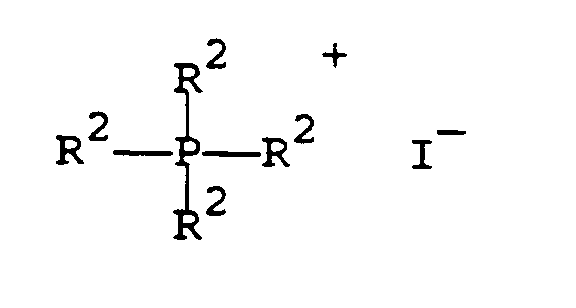
each R2 substituent is independently selected from straight-chain alkyl of 4 to 18 carbon atoms; and
the organotin iodide compound has the formula
(R3)3―Sn―I
wherein each R3 independently is selected from alkyl having 4 to 10 carbon atoms or phenyl. - Process according to Claim 5 wherein the process is carried out at a temperature of 40 to 125°C and the weight ratio of the extraction solvent to the catalyst/oligomer mixture is in the range of 10:1 to 0.1:1.
- Process for the separation of a catalyst system comprising (i) an onium iodide compound and (ii) an organotin iodide compound from a mixture of the catalyst system and an oligomer of 3,4-epoxy-1-butene by the steps comprising:(1) intimately contacting the mixture with an extraction solvent selected from heptane, octane, nonane and decane at a temperature of 40 to 125°C;(2) allowing the mixture of step (1) to phase separate; and(3) recovering the extraction solvent phase containing iodide compounds (i) and (ii);wherein the onium iodide compound is tetra-n-dodecylphosphonium iodide, tetra-n-hexadecylphosphonium iodide or tri-n-octyl(n-octadecyl)phosphonium iodide; and the organotin iodide compound is tri-n-octyltin iodide or triphenyltin iodide.
Applications Claiming Priority (3)
| Application Number | Priority Date | Filing Date | Title |
|---|---|---|---|
| US926421 | 1992-08-10 | ||
| US07/926,421 US5238889A (en) | 1992-08-10 | 1992-08-10 | Process for the separation of oligomeric materials from a catalyst mixture |
| PCT/US1993/007215 WO1994003272A1 (en) | 1992-08-10 | 1993-07-30 | Process for the separation of oligomeric materials from a catalyst mixture |
Publications (2)
| Publication Number | Publication Date |
|---|---|
| EP0653963A1 EP0653963A1 (en) | 1995-05-24 |
| EP0653963B1 true EP0653963B1 (en) | 1996-12-11 |
Family
ID=25453176
Family Applications (1)
| Application Number | Title | Priority Date | Filing Date |
|---|---|---|---|
| EP93918547A Expired - Lifetime EP0653963B1 (en) | 1992-08-10 | 1993-07-30 | Process for the separation of oligomeric materials from a catalyst mixture |
Country Status (16)
| Country | Link |
|---|---|
| US (1) | US5238889A (en) |
| EP (1) | EP0653963B1 (en) |
| JP (1) | JPH08500283A (en) |
| KR (1) | KR100219872B1 (en) |
| CN (1) | CN1039288C (en) |
| AT (1) | ATE146099T1 (en) |
| AU (1) | AU666970B2 (en) |
| BR (1) | BR9306859A (en) |
| CA (1) | CA2141539C (en) |
| DE (1) | DE69306584T2 (en) |
| DK (1) | DK0653963T3 (en) |
| GR (1) | GR3022664T3 (en) |
| MX (1) | MX9303611A (en) |
| MY (1) | MY108764A (en) |
| TW (1) | TW263517B (en) |
| WO (1) | WO1994003272A1 (en) |
Families Citing this family (12)
| Publication number | Priority date | Publication date | Assignee | Title |
|---|---|---|---|---|
| US5483007A (en) * | 1993-04-22 | 1996-01-09 | Minnesota Mining And Manufacturing Company | Cyclic process for activation, use and recovery of phase-transfer catalysts |
| EP0740676B1 (en) * | 1994-01-18 | 1998-08-12 | Eastman Chemical Company | Polyether polymers derived from 3,4-epoxy-1-butene |
| DE4422671A1 (en) | 1994-06-30 | 1996-01-04 | Basf Ag | Process for the preparation of 2,5-dihydrofuran |
| DE4424219A1 (en) * | 1994-07-09 | 1996-01-11 | Basf Ag | Process for the preparation of 2,5-dihydrofuran |
| US5466832A (en) * | 1995-02-13 | 1995-11-14 | Eastman Chemical Company | Process for the manufacture of 2,5-dihydrofurans from γ, δ-epoxybutenes |
| US5591874A (en) * | 1995-09-29 | 1997-01-07 | Eastman Chemical Company | Process for the preparation of 2,5-dihydrofuran compounds |
| DE19539331A1 (en) * | 1995-10-23 | 1997-04-24 | Basf Ag | Process for the separation of oligomeric by-products from an isomerization catalyst |
| US5801293A (en) * | 1996-02-26 | 1998-09-01 | Chevron U.S.A. Inc. | Method of isomerizing olefins |
| US5693833A (en) * | 1996-08-26 | 1997-12-02 | Eastman Chemical Company | Process for the reactivation of iodine-containing catalysts |
| US8404872B2 (en) * | 2006-03-17 | 2013-03-26 | Cornell University | Production of 2,5-dihydrofurans and analogous compounds |
| CA3010106C (en) | 2016-02-23 | 2022-10-11 | Vanderbilt Chemicals, Llc | Imidazolium sulfur-containing binuclear molybdate salts as lubricant additives |
| EP4504405B1 (en) * | 2023-03-08 | 2026-03-04 | SNF Group | Organotin catalysts recovery process |
Family Cites Families (5)
| Publication number | Priority date | Publication date | Assignee | Title |
|---|---|---|---|---|
| US2680109A (en) * | 1947-02-28 | 1954-06-01 | Columbia Southern Chem Corp | Allyl-2, 3-epoxybutyrate |
| US4946817A (en) * | 1984-07-17 | 1990-08-07 | The Dow Chemical Company | Latent catalysts for epoxy-containing compounds |
| US4650649A (en) * | 1986-01-21 | 1987-03-17 | Eastman Kodak Company | Catalyst recovery process |
| DE3926147A1 (en) * | 1989-08-08 | 1991-02-14 | Basf Ag | METHOD FOR PRODUCING 2,5-DIHYDROFURANES |
| US5082956A (en) * | 1990-03-08 | 1992-01-21 | Eastman Kodak Company | Isomerization of epoxyalkenes to 2,5-dihydrofurans |
-
1992
- 1992-08-10 US US07/926,421 patent/US5238889A/en not_active Expired - Lifetime
-
1993
- 1993-05-19 MY MYPI93000922A patent/MY108764A/en unknown
- 1993-05-25 TW TW082104134A patent/TW263517B/zh active
- 1993-06-16 MX MX9303611A patent/MX9303611A/en not_active IP Right Cessation
- 1993-07-30 KR KR1019950700502A patent/KR100219872B1/en not_active Expired - Fee Related
- 1993-07-30 CA CA002141539A patent/CA2141539C/en not_active Expired - Fee Related
- 1993-07-30 JP JP6505474A patent/JPH08500283A/en not_active Ceased
- 1993-07-30 DE DE69306584T patent/DE69306584T2/en not_active Expired - Fee Related
- 1993-07-30 AU AU47961/93A patent/AU666970B2/en not_active Ceased
- 1993-07-30 WO PCT/US1993/007215 patent/WO1994003272A1/en not_active Ceased
- 1993-07-30 BR BR9306859A patent/BR9306859A/en not_active IP Right Cessation
- 1993-07-30 EP EP93918547A patent/EP0653963B1/en not_active Expired - Lifetime
- 1993-07-30 DK DK93918547.6T patent/DK0653963T3/en active
- 1993-07-30 AT AT93918547T patent/ATE146099T1/en not_active IP Right Cessation
- 1993-08-07 CN CN93109340A patent/CN1039288C/en not_active Expired - Fee Related
-
1997
- 1997-02-26 GR GR970400351T patent/GR3022664T3/en unknown
Also Published As
| Publication number | Publication date |
|---|---|
| DE69306584D1 (en) | 1997-01-23 |
| AU666970B2 (en) | 1996-02-29 |
| DE69306584T2 (en) | 1997-04-10 |
| CA2141539A1 (en) | 1994-02-17 |
| US5238889A (en) | 1993-08-24 |
| ATE146099T1 (en) | 1996-12-15 |
| TW263517B (en) | 1995-11-21 |
| GR3022664T3 (en) | 1997-05-31 |
| KR100219872B1 (en) | 1999-09-01 |
| MX9303611A (en) | 1994-02-28 |
| BR9306859A (en) | 1998-12-08 |
| JPH08500283A (en) | 1996-01-16 |
| EP0653963A1 (en) | 1995-05-24 |
| CA2141539C (en) | 1998-07-14 |
| CN1039288C (en) | 1998-07-29 |
| MY108764A (en) | 1996-11-30 |
| DK0653963T3 (en) | 1996-12-30 |
| KR950702873A (en) | 1995-08-23 |
| WO1994003272A1 (en) | 1994-02-17 |
| CN1085542A (en) | 1994-04-20 |
| AU4796193A (en) | 1994-03-03 |
Similar Documents
| Publication | Publication Date | Title |
|---|---|---|
| US5238889A (en) | Process for the separation of oligomeric materials from a catalyst mixture | |
| Wasserscheid et al. | Ionic liquids—new “solutions” for transition metal catalysis | |
| AU655171B2 (en) | Isomerization of epoxyalkenes to 2,5-dihydrofurans and catalysts compositions useful therefor | |
| KR100222119B1 (en) | Continuous process for the manufacture of 2, 5-dihydrofurans from gamma delta-epoxybutenes | |
| US7691180B2 (en) | Mixtures of ionic liquids with lewis acids | |
| DE19639932A1 (en) | 2,5-di:hydro-furan deriv. prepn. | |
| EP0397281B1 (en) | An improved process for the preparation of 3,5,6-trichloropyridin-2-ol | |
| JPS6254781B2 (en) | ||
| EP0241235B1 (en) | Process for the preparation of homoallyl alcohols | |
| US5591874A (en) | Process for the preparation of 2,5-dihydrofuran compounds | |
| US5693833A (en) | Process for the reactivation of iodine-containing catalysts | |
| EP0750000B1 (en) | Depolymerisation of polyethers using heterogeneous catalysts | |
| US6096673A (en) | Catalyst recovery in the production of 2,5-dihydrofuran by isomerization of vinyl oxirane | |
| EP0368536A2 (en) | Preparation of cycloorganotrisilazanes | |
| JP2002371084A (en) | Organotin compounds and catalysts for transesterification | |
| EP0041775B1 (en) | Process for the preparation of alkyl furans | |
| US6462214B1 (en) | Method of preparing silacycloalkanes | |
| US6201138B1 (en) | Isomerization of epoxyalkenes to 2,5-dihydrofurans | |
| EP0876360B1 (en) | Preparation of oxirane compounds with titanasilsesquioxane catalysts | |
| WO1999035137A1 (en) | Process for the production of 2,5-dihydrofuran | |
| Falling et al. | Development of an Industrial Process for the Lewis Acid/Iodide Salt-Catalyzed Rearrangement of 3, 4-Epoxy-1-Butene to 2, 5-Dihydrofuran | |
| CA3162881A1 (en) | Improved process for preparing bromochloromethane | |
| JPH0256475A (en) | Distillation of butene oxide |
Legal Events
| Date | Code | Title | Description |
|---|---|---|---|
| PUAI | Public reference made under article 153(3) epc to a published international application that has entered the european phase |
Free format text: ORIGINAL CODE: 0009012 |
|
| 17P | Request for examination filed |
Effective date: 19950124 |
|
| AK | Designated contracting states |
Kind code of ref document: A1 Designated state(s): AT BE CH DE DK ES FR GB GR IE IT LI LU MC NL PT SE |
|
| GRAG | Despatch of communication of intention to grant |
Free format text: ORIGINAL CODE: EPIDOS AGRA |
|
| 17Q | First examination report despatched |
Effective date: 19960315 |
|
| GRAH | Despatch of communication of intention to grant a patent |
Free format text: ORIGINAL CODE: EPIDOS IGRA |
|
| GRAH | Despatch of communication of intention to grant a patent |
Free format text: ORIGINAL CODE: EPIDOS IGRA |
|
| GRAA | (expected) grant |
Free format text: ORIGINAL CODE: 0009210 |
|
| AK | Designated contracting states |
Kind code of ref document: B1 Designated state(s): AT BE CH DE DK ES FR GB GR IE IT LI LU MC NL PT SE |
|
| PG25 | Lapsed in a contracting state [announced via postgrant information from national office to epo] |
Ref country code: LI Effective date: 19961211 Ref country code: ES Free format text: THE PATENT HAS BEEN ANNULLED BY A DECISION OF A NATIONAL AUTHORITY Effective date: 19961211 Ref country code: CH Effective date: 19961211 |
|
| REF | Corresponds to: |
Ref document number: 146099 Country of ref document: AT Date of ref document: 19961215 Kind code of ref document: T |
|
| REG | Reference to a national code |
Ref country code: DK Ref legal event code: T3 |
|
| ITF | It: translation for a ep patent filed | ||
| REF | Corresponds to: |
Ref document number: 69306584 Country of ref document: DE Date of ref document: 19970123 |
|
| REG | Reference to a national code |
Ref country code: IE Ref legal event code: FG4D Free format text: 70996 |
|
| PG25 | Lapsed in a contracting state [announced via postgrant information from national office to epo] |
Ref country code: PT Effective date: 19970311 |
|
| ET | Fr: translation filed | ||
| ET | Fr: translation filed |
Free format text: CORRECTIONS |
|
| REG | Reference to a national code |
Ref country code: GR Ref legal event code: FG4A Free format text: 3022664 |
|
| REG | Reference to a national code |
Ref country code: CH Ref legal event code: PL |
|
| PG25 | Lapsed in a contracting state [announced via postgrant information from national office to epo] |
Ref country code: IE Free format text: LAPSE BECAUSE OF NON-PAYMENT OF DUE FEES Effective date: 19970730 |
|
| PLBE | No opposition filed within time limit |
Free format text: ORIGINAL CODE: 0009261 |
|
| STAA | Information on the status of an ep patent application or granted ep patent |
Free format text: STATUS: NO OPPOSITION FILED WITHIN TIME LIMIT |
|
| 26N | No opposition filed | ||
| PG25 | Lapsed in a contracting state [announced via postgrant information from national office to epo] |
Ref country code: MC Free format text: LAPSE BECAUSE OF NON-PAYMENT OF DUE FEES Effective date: 19980131 |
|
| PGFP | Annual fee paid to national office [announced via postgrant information from national office to epo] |
Ref country code: DK Payment date: 19980615 Year of fee payment: 6 |
|
| PGFP | Annual fee paid to national office [announced via postgrant information from national office to epo] |
Ref country code: SE Payment date: 19980707 Year of fee payment: 6 |
|
| PGFP | Annual fee paid to national office [announced via postgrant information from national office to epo] |
Ref country code: LU Payment date: 19980724 Year of fee payment: 6 |
|
| PGFP | Annual fee paid to national office [announced via postgrant information from national office to epo] |
Ref country code: GR Payment date: 19980728 Year of fee payment: 6 |
|
| PGFP | Annual fee paid to national office [announced via postgrant information from national office to epo] |
Ref country code: AT Payment date: 19990614 Year of fee payment: 7 |
|
| PG25 | Lapsed in a contracting state [announced via postgrant information from national office to epo] |
Ref country code: SE Free format text: THE PATENT HAS BEEN ANNULLED BY A DECISION OF A NATIONAL AUTHORITY Effective date: 19990730 Ref country code: LU Free format text: LAPSE BECAUSE OF NON-PAYMENT OF DUE FEES Effective date: 19990730 |
|
| PG25 | Lapsed in a contracting state [announced via postgrant information from national office to epo] |
Ref country code: GR Free format text: LAPSE BECAUSE OF NON-PAYMENT OF DUE FEES Effective date: 19990731 |
|
| PG25 | Lapsed in a contracting state [announced via postgrant information from national office to epo] |
Ref country code: DK Free format text: LAPSE BECAUSE OF NON-PAYMENT OF DUE FEES Effective date: 19990802 |
|
| PGFP | Annual fee paid to national office [announced via postgrant information from national office to epo] |
Ref country code: BE Payment date: 19990817 Year of fee payment: 7 |
|
| REG | Reference to a national code |
Ref country code: DK Ref legal event code: EBP |
|
| EUG | Se: european patent has lapsed |
Ref document number: 93918547.6 |
|
| PG25 | Lapsed in a contracting state [announced via postgrant information from national office to epo] |
Ref country code: AT Free format text: LAPSE BECAUSE OF NON-PAYMENT OF DUE FEES Effective date: 20000730 |
|
| PG25 | Lapsed in a contracting state [announced via postgrant information from national office to epo] |
Ref country code: BE Free format text: LAPSE BECAUSE OF NON-PAYMENT OF DUE FEES Effective date: 20000731 |
|
| BERE | Be: lapsed |
Owner name: EASTMAN CHEMICAL CY Effective date: 20000731 |
|
| PGFP | Annual fee paid to national office [announced via postgrant information from national office to epo] |
Ref country code: NL Payment date: 20010618 Year of fee payment: 9 |
|
| REG | Reference to a national code |
Ref country code: GB Ref legal event code: IF02 |
|
| PG25 | Lapsed in a contracting state [announced via postgrant information from national office to epo] |
Ref country code: NL Free format text: LAPSE BECAUSE OF NON-PAYMENT OF DUE FEES Effective date: 20030201 |
|
| NLV4 | Nl: lapsed or anulled due to non-payment of the annual fee |
Effective date: 20030201 |
|
| PGFP | Annual fee paid to national office [announced via postgrant information from national office to epo] |
Ref country code: GB Payment date: 20040615 Year of fee payment: 12 |
|
| PG25 | Lapsed in a contracting state [announced via postgrant information from national office to epo] |
Ref country code: IT Free format text: LAPSE BECAUSE OF NON-PAYMENT OF DUE FEES Effective date: 20050730 Ref country code: GB Free format text: LAPSE BECAUSE OF NON-PAYMENT OF DUE FEES Effective date: 20050730 |
|
| GBPC | Gb: european patent ceased through non-payment of renewal fee |
Effective date: 20050730 |
|
| PGFP | Annual fee paid to national office [announced via postgrant information from national office to epo] |
Ref country code: FR Payment date: 20060705 Year of fee payment: 14 |
|
| PGFP | Annual fee paid to national office [announced via postgrant information from national office to epo] |
Ref country code: DE Payment date: 20060731 Year of fee payment: 14 |
|
| PG25 | Lapsed in a contracting state [announced via postgrant information from national office to epo] |
Ref country code: DE Free format text: LAPSE BECAUSE OF NON-PAYMENT OF DUE FEES Effective date: 20080201 |
|
| REG | Reference to a national code |
Ref country code: FR Ref legal event code: ST Effective date: 20080331 |
|
| PG25 | Lapsed in a contracting state [announced via postgrant information from national office to epo] |
Ref country code: FR Free format text: LAPSE BECAUSE OF NON-PAYMENT OF DUE FEES Effective date: 20070731 |