EP0652701B1 - High amylose starch and resistant starch fractions - Google Patents
High amylose starch and resistant starch fractions Download PDFInfo
- Publication number
- EP0652701B1 EP0652701B1 EP93915566A EP93915566A EP0652701B1 EP 0652701 B1 EP0652701 B1 EP 0652701B1 EP 93915566 A EP93915566 A EP 93915566A EP 93915566 A EP93915566 A EP 93915566A EP 0652701 B1 EP0652701 B1 EP 0652701B1
- Authority
- EP
- European Patent Office
- Prior art keywords
- starch
- amylose
- content
- maize
- fractions
- Prior art date
- Legal status (The legal status is an assumption and is not a legal conclusion. Google has not performed a legal analysis and makes no representation as to the accuracy of the status listed.)
- Expired - Lifetime
Links
- 229920000294 Resistant starch Polymers 0.000 title claims abstract description 29
- 235000021254 resistant starch Nutrition 0.000 title claims abstract description 29
- 229920001685 Amylomaize Polymers 0.000 title abstract description 14
- 229920000856 Amylose Polymers 0.000 claims abstract description 64
- 229920002472 Starch Polymers 0.000 claims abstract description 64
- 235000019698 starch Nutrition 0.000 claims abstract description 64
- 239000008107 starch Substances 0.000 claims abstract description 57
- 239000000203 mixture Substances 0.000 claims abstract description 31
- 235000013325 dietary fiber Nutrition 0.000 claims abstract description 28
- 235000013305 food Nutrition 0.000 claims abstract description 9
- 229920002261 Corn starch Polymers 0.000 claims description 29
- 235000019759 Maize starch Nutrition 0.000 claims description 29
- 239000008187 granular material Substances 0.000 abstract description 22
- 235000002017 Zea mays subsp mays Nutrition 0.000 abstract description 13
- 240000008042 Zea mays Species 0.000 abstract description 12
- 235000016383 Zea mays subsp huehuetenangensis Nutrition 0.000 abstract description 12
- 235000009973 maize Nutrition 0.000 abstract description 12
- 238000002360 preparation method Methods 0.000 abstract description 5
- XLYOFNOQVPJJNP-UHFFFAOYSA-N water Substances O XLYOFNOQVPJJNP-UHFFFAOYSA-N 0.000 description 22
- 238000000034 method Methods 0.000 description 21
- IAZDPXIOMUYVGZ-UHFFFAOYSA-N Dimethylsulphoxide Chemical compound CS(C)=O IAZDPXIOMUYVGZ-UHFFFAOYSA-N 0.000 description 15
- OKKJLVBELUTLKV-UHFFFAOYSA-N Methanol Chemical compound OC OKKJLVBELUTLKV-UHFFFAOYSA-N 0.000 description 12
- 238000012360 testing method Methods 0.000 description 11
- ZMXDDKWLCZADIW-UHFFFAOYSA-N N,N-Dimethylformamide Chemical compound CN(C)C=O ZMXDDKWLCZADIW-UHFFFAOYSA-N 0.000 description 9
- 239000000243 solution Substances 0.000 description 9
- 239000012153 distilled water Substances 0.000 description 8
- 238000004128 high performance liquid chromatography Methods 0.000 description 8
- HEMHJVSKTPXQMS-UHFFFAOYSA-M Sodium hydroxide Chemical compound [OH-].[Na+] HEMHJVSKTPXQMS-UHFFFAOYSA-M 0.000 description 6
- 238000009835 boiling Methods 0.000 description 6
- 235000013339 cereals Nutrition 0.000 description 6
- 238000005194 fractionation Methods 0.000 description 5
- 239000002002 slurry Substances 0.000 description 5
- 238000005227 gel permeation chromatography Methods 0.000 description 4
- 239000000463 material Substances 0.000 description 4
- WQZGKKKJIJFFOK-GASJEMHNSA-N Glucose Natural products OC[C@H]1OC(O)[C@H](O)[C@@H](O)[C@@H]1O WQZGKKKJIJFFOK-GASJEMHNSA-N 0.000 description 3
- 229920001218 Pullulan Polymers 0.000 description 3
- 239000004373 Pullulan Substances 0.000 description 3
- 239000008103 glucose Substances 0.000 description 3
- 229940077844 iodine / potassium iodide Drugs 0.000 description 3
- 239000002245 particle Substances 0.000 description 3
- 229920000642 polymer Polymers 0.000 description 3
- NLKNQRATVPKPDG-UHFFFAOYSA-M potassium iodide Chemical compound [K+].[I-] NLKNQRATVPKPDG-UHFFFAOYSA-M 0.000 description 3
- 108090000623 proteins and genes Proteins 0.000 description 3
- 235000019423 pullulan Nutrition 0.000 description 3
- 229920001059 synthetic polymer Polymers 0.000 description 3
- 238000012546 transfer Methods 0.000 description 3
- 239000003643 water by type Substances 0.000 description 3
- ZCYVEMRRCGMTRW-UHFFFAOYSA-N 7553-56-2 Chemical compound [I] ZCYVEMRRCGMTRW-UHFFFAOYSA-N 0.000 description 2
- 229920000945 Amylopectin Polymers 0.000 description 2
- VYZAMTAEIAYCRO-UHFFFAOYSA-N Chromium Chemical compound [Cr] VYZAMTAEIAYCRO-UHFFFAOYSA-N 0.000 description 2
- 239000004606 Fillers/Extenders Substances 0.000 description 2
- 238000002835 absorbance Methods 0.000 description 2
- 230000004888 barrier function Effects 0.000 description 2
- 239000003153 chemical reaction reagent Substances 0.000 description 2
- 230000003247 decreasing effect Effects 0.000 description 2
- 238000002347 injection Methods 0.000 description 2
- 239000007924 injection Substances 0.000 description 2
- 229910052740 iodine Inorganic materials 0.000 description 2
- 239000011630 iodine Substances 0.000 description 2
- 238000003973 irrigation Methods 0.000 description 2
- 230000002262 irrigation Effects 0.000 description 2
- 238000012986 modification Methods 0.000 description 2
- 230000004048 modification Effects 0.000 description 2
- 229920005615 natural polymer Polymers 0.000 description 2
- 239000004033 plastic Substances 0.000 description 2
- 229920003023 plastic Polymers 0.000 description 2
- 238000004062 sedimentation Methods 0.000 description 2
- 239000007787 solid Substances 0.000 description 2
- 238000003756 stirring Methods 0.000 description 2
- DBTMGCOVALSLOR-UHFFFAOYSA-N 32-alpha-galactosyl-3-alpha-galactosyl-galactose Natural products OC1C(O)C(O)C(CO)OC1OC1C(O)C(OC2C(C(CO)OC(O)C2O)O)OC(CO)C1O DBTMGCOVALSLOR-UHFFFAOYSA-N 0.000 description 1
- RXVWSYJTUUKTEA-UHFFFAOYSA-N D-maltotriose Natural products OC1C(O)C(OC(C(O)CO)C(O)C(O)C=O)OC(CO)C1OC1C(O)C(O)C(O)C(CO)O1 RXVWSYJTUUKTEA-UHFFFAOYSA-N 0.000 description 1
- 229920000219 Ethylene vinyl alcohol Polymers 0.000 description 1
- 235000007340 Hordeum vulgare Nutrition 0.000 description 1
- 240000005979 Hordeum vulgare Species 0.000 description 1
- 238000000944 Soxhlet extraction Methods 0.000 description 1
- 235000021307 Triticum Nutrition 0.000 description 1
- 241000209140 Triticum Species 0.000 description 1
- 241000482268 Zea mays subsp. mays Species 0.000 description 1
- 239000000654 additive Substances 0.000 description 1
- 239000000853 adhesive Substances 0.000 description 1
- 230000001070 adhesive effect Effects 0.000 description 1
- 230000009418 agronomic effect Effects 0.000 description 1
- 238000003556 assay Methods 0.000 description 1
- QVGXLLKOCUKJST-UHFFFAOYSA-N atomic oxygen Chemical compound [O] QVGXLLKOCUKJST-UHFFFAOYSA-N 0.000 description 1
- 230000015572 biosynthetic process Effects 0.000 description 1
- 238000000071 blow moulding Methods 0.000 description 1
- 238000009395 breeding Methods 0.000 description 1
- 230000001488 breeding effect Effects 0.000 description 1
- 230000000052 comparative effect Effects 0.000 description 1
- 235000009508 confectionery Nutrition 0.000 description 1
- 238000013270 controlled release Methods 0.000 description 1
- 238000007796 conventional method Methods 0.000 description 1
- 235000005911 diet Nutrition 0.000 description 1
- 230000000378 dietary effect Effects 0.000 description 1
- 238000001035 drying Methods 0.000 description 1
- 230000000694 effects Effects 0.000 description 1
- 239000004715 ethylene vinyl alcohol Substances 0.000 description 1
- 238000002474 experimental method Methods 0.000 description 1
- 238000001125 extrusion Methods 0.000 description 1
- 239000000706 filtrate Substances 0.000 description 1
- 239000007789 gas Substances 0.000 description 1
- 238000000227 grinding Methods 0.000 description 1
- 239000008241 heterogeneous mixture Substances 0.000 description 1
- RZXDTJIXPSCHCI-UHFFFAOYSA-N hexa-1,5-diene-2,5-diol Chemical compound OC(=C)CCC(O)=C RZXDTJIXPSCHCI-UHFFFAOYSA-N 0.000 description 1
- 238000001746 injection moulding Methods 0.000 description 1
- 239000013067 intermediate product Substances 0.000 description 1
- 235000021374 legumes Nutrition 0.000 description 1
- FYGDTMLNYKFZSV-UHFFFAOYSA-N mannotriose Natural products OC1C(O)C(O)C(CO)OC1OC1C(CO)OC(OC2C(OC(O)C(O)C2O)CO)C(O)C1O FYGDTMLNYKFZSV-UHFFFAOYSA-N 0.000 description 1
- 235000012054 meals Nutrition 0.000 description 1
- 239000001301 oxygen Substances 0.000 description 1
- 229910052760 oxygen Inorganic materials 0.000 description 1
- 239000008188 pellet Substances 0.000 description 1
- 230000000704 physical effect Effects 0.000 description 1
- 239000004014 plasticizer Substances 0.000 description 1
- 239000000843 powder Substances 0.000 description 1
- 239000000047 product Substances 0.000 description 1
- 238000010926 purge Methods 0.000 description 1
- 230000001105 regulatory effect Effects 0.000 description 1
- 230000003252 repetitive effect Effects 0.000 description 1
- 235000013580 sausages Nutrition 0.000 description 1
- 238000000926 separation method Methods 0.000 description 1
- 238000007873 sieving Methods 0.000 description 1
- GRONZTPUWOOUFQ-UHFFFAOYSA-M sodium;methanol;hydroxide Chemical compound [OH-].[Na+].OC GRONZTPUWOOUFQ-UHFFFAOYSA-M 0.000 description 1
- 239000000126 substance Substances 0.000 description 1
- 238000011282 treatment Methods 0.000 description 1
- FYGDTMLNYKFZSV-BYLHFPJWSA-N β-1,4-galactotrioside Chemical compound O[C@@H]1[C@@H](O)[C@H](O)[C@@H](CO)O[C@H]1O[C@@H]1[C@H](CO)O[C@@H](O[C@@H]2[C@@H](O[C@@H](O)[C@H](O)[C@H]2O)CO)[C@H](O)[C@H]1O FYGDTMLNYKFZSV-BYLHFPJWSA-N 0.000 description 1
Images


Classifications
-
- A—HUMAN NECESSITIES
- A01—AGRICULTURE; FORESTRY; ANIMAL HUSBANDRY; HUNTING; TRAPPING; FISHING
- A01H—NEW PLANTS OR NON-TRANSGENIC PROCESSES FOR OBTAINING THEM; PLANT REPRODUCTION BY TISSUE CULTURE TECHNIQUES
- A01H5/00—Angiosperms, i.e. flowering plants, characterised by their plant parts; Angiosperms characterised otherwise than by their botanic taxonomy
- A01H5/10—Seeds
-
- A—HUMAN NECESSITIES
- A01—AGRICULTURE; FORESTRY; ANIMAL HUSBANDRY; HUNTING; TRAPPING; FISHING
- A01H—NEW PLANTS OR NON-TRANSGENIC PROCESSES FOR OBTAINING THEM; PLANT REPRODUCTION BY TISSUE CULTURE TECHNIQUES
- A01H6/00—Angiosperms, i.e. flowering plants, characterised by their botanic taxonomy
- A01H6/46—Gramineae or Poaceae, e.g. ryegrass, rice, wheat or maize
- A01H6/4684—Zea mays [maize]
-
- A—HUMAN NECESSITIES
- A23—FOODS OR FOODSTUFFS; TREATMENT THEREOF, NOT COVERED BY OTHER CLASSES
- A23L—FOODS, FOODSTUFFS OR NON-ALCOHOLIC BEVERAGES, NOT OTHERWISE PROVIDED FOR; PREPARATION OR TREATMENT THEREOF
- A23L29/00—Foods or foodstuffs containing additives; Preparation or treatment thereof
- A23L29/20—Foods or foodstuffs containing additives; Preparation or treatment thereof containing gelling or thickening agents
- A23L29/206—Foods or foodstuffs containing additives; Preparation or treatment thereof containing gelling or thickening agents of vegetable origin
- A23L29/212—Starch; Modified starch; Starch derivatives, e.g. esters or ethers
-
- A—HUMAN NECESSITIES
- A23—FOODS OR FOODSTUFFS; TREATMENT THEREOF, NOT COVERED BY OTHER CLASSES
- A23L—FOODS, FOODSTUFFS OR NON-ALCOHOLIC BEVERAGES, NOT OTHERWISE PROVIDED FOR; PREPARATION OR TREATMENT THEREOF
- A23L33/00—Modifying nutritive qualities of foods; Dietetic products; Preparation or treatment thereof
- A23L33/20—Reducing nutritive value; Dietetic products with reduced nutritive value
- A23L33/21—Addition of substantially indigestible substances, e.g. dietary fibres
-
- C—CHEMISTRY; METALLURGY
- C08—ORGANIC MACROMOLECULAR COMPOUNDS; THEIR PREPARATION OR CHEMICAL WORKING-UP; COMPOSITIONS BASED THEREON
- C08B—POLYSACCHARIDES; DERIVATIVES THEREOF
- C08B30/00—Preparation of starch, degraded or non-chemically modified starch, amylose, or amylopectin
-
- C—CHEMISTRY; METALLURGY
- C08—ORGANIC MACROMOLECULAR COMPOUNDS; THEIR PREPARATION OR CHEMICAL WORKING-UP; COMPOSITIONS BASED THEREON
- C08B—POLYSACCHARIDES; DERIVATIVES THEREOF
- C08B30/00—Preparation of starch, degraded or non-chemically modified starch, amylose, or amylopectin
- C08B30/20—Amylose or amylopectin
-
- C—CHEMISTRY; METALLURGY
- C08—ORGANIC MACROMOLECULAR COMPOUNDS; THEIR PREPARATION OR CHEMICAL WORKING-UP; COMPOSITIONS BASED THEREON
- C08L—COMPOSITIONS OF MACROMOLECULAR COMPOUNDS
- C08L3/00—Compositions of starch, amylose or amylopectin or of their derivatives or degradation products
- C08L3/12—Amylose; Amylopectin; Degradation products thereof
Definitions
- This invention relates to high amylose content starch.
- the invention further relates to fractions of high amylose starch that are enriched in dietary fibre and resistant starch content whilst claiming a high amylose content.
- amylopectin Most common starches contain approximately 25% amylose and 75% amylopectin.
- Amylose is a linear glucose polymer fraction, whilst amylopectin is a branched glucose polymer fraction.
- the present inventors whilst recognizing the utility of the commercially available so-called high amylose starches, have sought to produce a maize having a still higher amylose content.
- this invention consists in a hybrid maize seed capable of producing a starch having an amylose content of more than 80%.
- this invention further consists in a maize starch having an amylose content of more than 90.1%, physically or chemically modified derivatives thereof, and destructurized and non-destructurized forms thereof.
- this invention still further consists in compositions including a maize starch selected from the group consisting of maize starch having an amylose content of more than 90.1%, physically or chemically modified derivatives thereof and destructurized and non-destructurized forms thereof.
- this invention still further consists in a process for the formation of a composition
- a composition comprising including a maize starch selected from the group consisting of maize starch having an amylose content of more than 80%, physically or chemically modified derivatives thereof and destructurized and non-destructurized forms thereof, in said composition.
- the present invention still further consists in a hybrid maize seed resulting from a cross between any of the parental lines selected from the group consisting of G112, G113, G116, G117, G118, G119W, G120, G121, G122, G125W, G126, G128, G129, G135W, G136W, G138W, G139W, G140W and G144, said hybrid maize seed yielding a starch having an amylose content of more than 80%.
- Starch granules from any botanical source are a heterogeneous mixture varying in physiological age and this affects their physical size, structure and properties. If the starch granules are physically separated according to their granule size, it has been noted by a number of authors that the properties of each size fraction are somewhat different. For example, Cluskey et al in Starke, 32 , 105-109(1980) reported on the fractionation of dent corn and amylomaize starch granules. They found that an inverse relationship existed between granule size and iodine binding capacity in the amylomaizes. Thus, the percent apparent amylose found in the fractions of amylose V starch amounted to 40% for the largest size particles and 52% for the smallest particles.
- amylose content and size fraction has been observed by the present inventors in relation to high amylose starches of the type mentioned above and in co-pending patent application PL6537.
- Patent application PL6537 further disclosed the useful nature of such starches in the preparation of food compositions having an enhanced dietary or resistant starch content.
- the present invention still further consists in a starch fraction of enhanced dietary fibre and/or resistant starch content comprising a high amylose starch which has been fractionated according to granule size to yield a fraction which is characterised by a dietary fibre and/or resistant starch content which is greater than said high amylose starch.
- the present invention still further consists in a food composition having an enhanced dietary fibre and/or resistant starch content, including a starch fraction of enhanced dietary fibre and/or resistant starch content derived from a high amylose starch which has been fractionated according to granule size to yield a fraction which is characterised by a dietary fibre and/or resistant starch content which is greater than said high amylose starch.
- high amylose means an amylose content (dsb) of 50% or more, preferably 70% or more, most preferably 80% or more. Particularly preferred amylose contents are 85% or more and 90% or more.
- a range of parental lines of maize seeds were obtained from High Yield Seed Co, Tamworth, Australia.
- Non-limiting examples of these parenting lines included G112, G113, G116, G117, G118, G119W, G120, G121, G122, G125W, G126, G128, G129, G135W, G136W, G138W, G139W, G140W and G144.
- Hybrids were produced by crossing inbred lines carrying the ae amylose extender genes. These inbred lines were selected for combining ability and identified as specific female and male parents to produce the hybrids. Conventional breeding methods and techniques were used in developing inbred lines with repetitive amylose assays to ensure the transfer of recessively inherited ae gene.
- G128 (71.5) G129 (61.8) G128 x G129 (82.8) 8.
- G140 (93.2) G121 (94.7) G140 x G121 (93.0) 9.
- G140 (92.2) G144 (60.4) G140 x G144 (85.3) 10.
- G139W (71.9) G136W (93.4) G139W x G136W (95.7) 11.
- G121 (94.7) G126 (82.2) G121 x G116 (85.0)
- An embodiment of this invention comprises a maize starch having an amylose content of 90.1% or more.
- Viscographs have also been prepared comparing maize starch from Code 008 (designated Gelose 80) with Gelose 50 and Gelose 70.
- Figure 2 shows the viscosity profile under alkaline conditions whilst
- Figure 3 shows the viscosity profile in water.
- the maize starch of the first aspect of this invention having an amylose content of more than 80% may be used in a variety of compositions known in the art.
- the usefulness of the starch is believed to be a result of the higher content of more linear molecules. This seems to impart physical properties which tend towards those of conventionally used synthetic plastics materials. Consequently, films formed from the starch of the invention have higher tensile strengths and are good oxygen barriers.
- the starch is also easier to process on existing synthetic plastics materials equipment such as blow moulding and injection moulding machines.
- this starch may be physically modified or chemically modified to produce a variety of derivatives well known in the art. These starches may also be used in a variety of compositions.
- this starch may also be used in processes and compositions requiring the starch to be destructurized within the meaning of that term defined in EP0118240.
- compositions in which the maize starch of this invention in all of its forms, could be used include:
- the starches of the sixth and seventh aspects of this invention may originate from a number of sources including cereals such as maize, barley, wheat and legumes, providing that the starch content of such sources is high in amylose.
- the fractions having enhanced dietary fibre and/or resistant starch content may be processed to obtain starch having further increased dietary fibre and/or resistant starch content using entirely conventional methods well known in the art. An example of the fractionation will now be described.
- a high amylose maize starch - High Amylose 80(10/91) was fractionated into seven subsamples based on granule size using the aqueous differential sedimentation procedure described by Cluskey et al (1980). This method was chosen since it minimised damage to the starch, did not introduce any residues and it was indicated that exposure of the starch granules to distilled water for long periods of time did not affect their integrity. Each subsample was weighed, measured for average granule size and the apparent amylose content, total dietary fibre and resistant starch determined. Each starch sample (60 grams) was separated into the seven fractions which were freeze-dried and weighed on a Mettler PE 3600 top pan balance. A scanning electron microscope was used to visually check the uniformity of the size distribution of the granules in each fraction.
- Granule size was determined using a Malvern Master Sizer which utilises a He-Ne laser (632.8nm) with a maximum output of 5mW CW.
- a starch slurry was made using approximately 15mL of distilled water in a 50mL beaker. The slurry was sonicated for 4 minutes. The slurry was then introduced into the stirred cell and the obscuration value adjusted using distilled water to 0.20. The slurry was allowed to stir for a further 2 minutes before readings were taken. Four readings were taken for each sample in order to check the stability of the readings being obtained.
- starch fractions of the invention are Fractionation of High Amylose 80 (10/91) Maize Starch by Granule Size Amount in Fraction (%) dsb Average Granule Size (microns) Apparent Amylose Content (%) dsb Total Dietary Fibre (%) dsb Resistant Starch (%) dsb High Amylose 80 - 10/91 100.00 10.0 85 33.4 18.1 Fraction 1 35.6 ⁇ 1.1 12.3 ⁇ 0.5 80 ⁇ 0 31.4 ⁇ 1.5 17.7 Fraction 2 15.0 ⁇ 2.6 10.2 ⁇ 0.1 83 ⁇ 1 38.3 ⁇ 2.0 16.4 Fraction 3 13.0 ⁇ 1.1 9.1 ⁇ 0.2 85.5 ⁇ 0.5 41.3 ⁇ 0.3 22.8 Fraction 4 14.9 ⁇ 1.0 8.3 ⁇ 0.1 85.5 ⁇ 0.5 39.4 ⁇ 4.1 24.6 Fraction 5 10.2 ⁇ 1.6 7.6 ⁇ 0.1 88.5 ⁇ 0.5 37.2 ⁇ 1.3 18.9 Fraction 6 7.0 ⁇ 1.6
- starch fractions of the invention having the enhanced dietary fibre and/or resistant starch content may be used in a variety of food compositions. Such uses are disclosed, for example, in co-pending application No PL6537.
Landscapes
- Chemical & Material Sciences (AREA)
- Life Sciences & Earth Sciences (AREA)
- Health & Medical Sciences (AREA)
- Polymers & Plastics (AREA)
- Engineering & Computer Science (AREA)
- Chemical Kinetics & Catalysis (AREA)
- Organic Chemistry (AREA)
- Medicinal Chemistry (AREA)
- Food Science & Technology (AREA)
- Developmental Biology & Embryology (AREA)
- Biochemistry (AREA)
- Nutrition Science (AREA)
- Materials Engineering (AREA)
- Environmental Sciences (AREA)
- Physiology (AREA)
- Botany (AREA)
- Mycology (AREA)
- Dispersion Chemistry (AREA)
- Natural Medicines & Medicinal Plants (AREA)
- Polysaccharides And Polysaccharide Derivatives (AREA)
- Coloring Foods And Improving Nutritive Qualities (AREA)
- Cereal-Derived Products (AREA)
- Solid-Sorbent Or Filter-Aiding Compositions (AREA)
- Breeding Of Plants And Reproduction By Means Of Culturing (AREA)
Abstract
Description
- This invention relates to high amylose content starch.
- The invention further relates to fractions of high amylose starch that are enriched in dietary fibre and resistant starch content whilst claiming a high amylose content.
- Most common starches contain approximately 25% amylose and 75% amylopectin. Amylose is a linear glucose polymer fraction, whilst amylopectin is a branched glucose polymer fraction.
- In the prior art, it has been recognized that currently available commercial starch having an elevated amylose content would impart certain desirable properties to various compositions including films, foods and industrial products. Accordingly, attempts have been made in the prior art to produce high amylose content maize. This is exemplified in AU-A-45616/89 wherein a maize seed deposited as ATCC No. 40499 is disclosed as capable of yielding a starch having an amylose content of up to 72%.
- Typically, however, a commercial starch having an amylose content of 55-65% would be regarded in the art as having a high amylose content.
- In Cereal Chemistry 52(6) 1975. pp. 753-878, Wolf et al. have disclosed a maize starch containing 81% amylose.
- The present inventors whilst recognizing the utility of the commercially available so-called high amylose starches, have sought to produce a maize having a still higher amylose content.
- In the course of a breeding program, a single cross F1 hybrid maize seed was produced, which carried the ae amylose extender gene. This seed was found to be capable of producing grain, in which the amylose content of the starch derived therefrom was in excess of 80%.
- Accordingly, in a first aspect, this invention consists in a hybrid maize seed capable of producing a starch having an amylose content of more than 80%.
- In a second aspect, this invention further consists in a maize starch having an amylose content of more than 90.1%, physically or chemically modified derivatives thereof, and destructurized and non-destructurized forms thereof.
- In a third aspect, this invention still further consists in compositions including a maize starch selected from the group consisting of maize starch having an amylose content of more than 90.1%, physically or chemically modified derivatives thereof and destructurized and non-destructurized forms thereof.
- These second and third aspects have been made subject of the claims.
- In a fourth aspect, this invention still further consists in a process for the formation of a composition comprising including a maize starch selected from the group consisting of maize starch having an amylose content of more than 80%, physically or chemically modified derivatives thereof and destructurized and non-destructurized forms thereof, in said composition.
- In a fifth aspect, the present invention still further consists in a hybrid maize seed resulting from a cross between any of the parental lines selected from the group consisting of G112, G113, G116, G117, G118, G119W, G120, G121, G122, G125W, G126, G128, G129, G135W, G136W, G138W, G139W, G140W and G144, said hybrid maize seed yielding a starch having an amylose content of more than 80%.
- Starch granules from any botanical source are a heterogeneous mixture varying in physiological age and this affects their physical size, structure and properties. If the starch granules are physically separated according to their granule size, it has been noted by a number of authors that the properties of each size fraction are somewhat different. For example, Cluskey et al in Starke, 32, 105-109(1980) reported on the fractionation of dent corn and amylomaize starch granules. They found that an inverse relationship existed between granule size and iodine binding capacity in the amylomaizes. Thus, the percent apparent amylose found in the fractions of amylose V starch amounted to 40% for the largest size particles and 52% for the smallest particles.
- The correlation between amylose content and size fraction has been observed by the present inventors in relation to high amylose starches of the type mentioned above and in co-pending patent application PL6537.
- In this latter mentioned patent application, PL6537, it was disclosed that high amylose starches have a high dietary fibre or resistant starch content. More specifically, it was found that there was a correlation between amylose content and dietary fibre/resistant starch such that increasing levels of amylose above 55% were associated with increasing levels of dietary fibre/resistant starch.
- Patent application PL6537 further disclosed the useful nature of such starches in the preparation of food compositions having an enhanced dietary or resistant starch content.
- Based on the observations of
- (1) an association of dietary fibre and resistant starch with increasing levels of amylose; and
- (2) increasing amylose content with decreasing starch granule size, it was to be expected that decreasing starch granule size fractions of high amylose starch would be associated with enhanced levels of dietary fibre and resistant starch.
-
- Surprisingly, this was found to be incorrect. In fact it was found that there is an optimum starch granule size fraction which is intermediate in size and not necessarily associated with the highest amylose content fraction.
- Accordingly in a sixth aspect, the present invention still further consists in a starch fraction of enhanced dietary fibre and/or resistant starch content comprising a high amylose starch which has been fractionated according to granule size to yield a fraction which is characterised by a dietary fibre and/or resistant starch content which is greater than said high amylose starch.
- In a seventh aspect, the present invention still further consists in a food composition having an enhanced dietary fibre and/or resistant starch content, including a starch fraction of enhanced dietary fibre and/or resistant starch content derived from a high amylose starch which has been fractionated according to granule size to yield a fraction which is characterised by a dietary fibre and/or resistant starch content which is greater than said high amylose starch.
- For the purpose of the description of this invention, "high amylose" means an amylose content (dsb) of 50% or more, preferably 70% or more, most preferably 80% or more. Particularly preferred amylose contents are 85% or more and 90% or more.
- For the purposes of the description of the invention, the method by which amylose was determined is set out below.
- METHOD: Apparent Amylose (Blue Value)
- SCOPE: High Amylose Maize Starch
- APPARATUS:
Defatting
Soxhlet extraction apparatus
Steam bath
Whatman thimbles, 25 x 80mm
Drying Oven 105°C
Desiccator
Amylose Determination
Stoppered 50ml test tubes
Vortex mixer
Boiling water bath
Spectrophotometer (605mm, slit width 0.2mm) - REAGENTS:
Defatting
Methanol (AR Grade)
Amylose Determination
Dimethylsulfoxide (HPLC Grade)
Iodine/Potassium iodide solution
3.0g iodine and 30g potassium iodide made
up to 1000mls with 0.1N sodium hydroxide
Methanol (AR Grade)
Amylose (Sigma Cat. No AO512)
Dried for 2 hours at 105°C prior to use. - PROCEDURE:
Defatting - (1) Weigh 5 grams of starch into the thimble.
- (2) Place the thimble in the Soxhlet apparatus.
- (3) Extract the sample with methanol (200mls) for 20 hours
- (4) Recover the thimble and dry in an oven at 105°C for 12 hours. Amylose Determination
- (1) Accurately weigh starch (100.0 to 105.0mg) into the text tube.
- (2) Add methanol (1ml) and vortex mix.
- (3) Add DMSO (15mls), invert the test tube, and vortex mix.
- (4) Place the test tubes in a vigorously boiling water bath for 60 minutes.
- (5) Invert and vortex mix each test tube at 15 minute intervals during this period.
- (6) Add distilled water (15mls), invert and vortex mix. Place the test tube in the boiling water bath for a further 30 minutes.
- (7) Quantitatively transfer the contents of the test tube to a 100ml volumetric flask (use a funnel in the flask). Make the solution to volume with distilled water.
- (8) Transfer an aliquot (3mls) of this solution to a 100ml volumetric flask and add 90mls of distilled water.
- (9) Add Iodine/Potassium Iodide solution (1ml) to the diluted solution and immediately shake and mix thoroughly. Make to volume with distilled water.
- (10) Measure the absorbance of this solution at 605 nm compared to a blank consisting of Iodine/ Potassium Iodide solution (lml) diluted to 100mls with distilled water in a volumetric flask.
- CALCULATIONS:
For native starches: -
- The method by which starch was separated from the maize grain was as follows:-
- 1. Prepare 200g meal by grinding through the 2mm then the 1mm screen of the Retsch Mill.
- 2. Wet thoroughly, stirring by hand, with 600ml 0.1N NaOH.
- 3. Add 2,200ml 0.1N NaOH and
blend 5 minutes at 2/3 speed with the Ultra Turrax. - 4. Sieve over 44u screen.
- 5. Return sieve overs with 1L water and blend for another 3 minutes, if necessary.
- 6. Sieve over 44u screen.
- 7. Centrifuge filtrate at 3000 rpm for 15 minutes. Decant. Wipe out the neck of the bottle with a tissue to remove fat.
- 8. Reslurry starch (centrifugate) with 200ml water, i.e. 50ml in each of 4 tubes. Centrifuge.
- 9. Remove starch from centrifuge tubes with about 250ml water.
- 10. Adjust pH of starch slurry to 6.0-6.5 with 0.5N HCl. Filter again over 44u screen, if necessary.
- 11. Buchner filter and air dry.
-
- In order to better understand the nature of this invention, a number of examples will be described.
-
- Fig. 1 is a gel permeation chromatography molecular weight profile of a number of maize starches;
- Fig. 2 is a viscograph of a number of maize starches in water;
- Fig. 3 is a viscograph of a number of maize starches in base; and
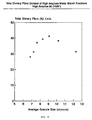
- Fig. 4 is a graph of total dietary fibre versus average starch granule size.
-
- A range of parental lines of maize seeds were obtained from High Yield Seed Co, Tamworth, Australia. Non-limiting examples of these parenting lines included G112, G113, G116, G117, G118, G119W, G120, G121, G122, G125W, G126, G128, G129, G135W, G136W, G138W, G139W, G140W and G144.
- Hybrids were produced by crossing inbred lines carrying the ae amylose extender genes. These inbred lines were selected for combining ability and identified as specific female and male parents to produce the hybrids. Conventional breeding methods and techniques were used in developing inbred lines with repetitive amylose assays to ensure the transfer of recessively inherited ae gene.
- One particular cross between male G116 and female G121 resulted in a F1 hybrid, referred to as Code 008 and deposited with the American Type Culture Collection (ATCC), 12301 Parklawn Drive, Rockville, MD20853, U.S.A., under the designation 75182 on 15 January 1992. This hybrid yielded grain the starch of which was found to have an amylose content in excess of 80%.
- Based on the disclosure of this invention, the person skilled in the art would expect that hybrids resulting from further crosses of the parental lines mentioned above will yield starch having an amylose content in excess of 80%.
- In fact experimental hybrids have yielded starches obtained from crosses between the above mentioned parent lines having high amylose contents. Set out below is a summary of the relevant crosses with amylose content in % bracketed.
FEMALE MALE HYBRID 1. G117 (81.6) G116 (82.2) G117 x G116 (83.3) 2. G116 (82.2) G122 (89.6) G116 x G122 (80.5) 3. G118 (94.3) G122 (89.6) G118 x G122 (85.9) 4. G120 (94.6) G122 (89.6) G120 x G122 (80.4) 5. G122 (89.6) G120 (94.6) G122 x G120 (81.9) 6. G122 (89.6) G140 (92.2) G122 x G140 (85.4) 7. G128 (71.5) G129 (61.8) G128 x G129 (82.8) 8. G140 (93.2) G121 (94.7) G140 x G121 (93.0) 9. G140 (92.2) G144 (60.4) G140 x G144 (85.3) 10. G139W (71.9) G136W (93.4) G139W x G136W (95.7) 11. G121 (94.7) G126 (82.2) G121 x G116 (85.0) - Experiments conducted using Code 008 seed have shown that the climatic and agronomic conditions under which the maize is grown will have a significant effect on the amylose content. Specifically, it has been found that seed cultivated under irrigation near Tamworth, Australia (latitude 31.1°S) in an early crop and a late crop yielded starch having an amylose content respectively of 85.0% and 90.1%. Similarly, a crop cultivated at Finley, Australia (latitude 35.6°S) yielded starch having an amylose content of 94.8%. By contrast, the same seed when cultivated under irrigation at Giru, Australia (latitude 19.5°) yielded a starch having an amylose content of 78.6%.
- An embodiment of this invention comprises a maize starch having an amylose content of 90.1% or more.
- To further characterize the maize starch derived from Code 008 grain, molecular weight profiling by gel permeation chromatography has been performed. The method by which this was done is set out below whilst the results are shown in the accompanying Figure 1. For comparative purposes, two commercially available maize starches, HA Class V and HA Class VII are shown.
- METHOD: Gel Permeation Chromatography of Starch
- SCOPE: Starch
- APPARATUS:
Sample Preparation
Screw capped test tubes (50ml)
Boiling water bath
Microcentrifuge (Eppendorf 5415)
Desiccator
HPLC- Column
- Alltech GPC High MW Polar 5U (Cat. No. 100586)
- Detector
- Waters 410 Refractive Index Detector (X 128 35°C)
- Pump
- Waters 600 E
- Injector
- Waters 712 WISP
- Column Heater
- (Set at 25°C)
- Software
- Maxima 825 (V 3.3)
- REAGENTS:
Dimethyl sulfoxide (Chrom AR HPLC Grade - Mallinckrodt)
Dimethyl formamide (Chrom AR HPLC Grade - Mallinckrodt)
Pullulan Molecular Weight Standards - Showa
Denko (ex Edward Instruments)
HPLC Mobile Phase - DMSO:DMF (20:80) - SAMPLE PREPARATION:
Standards - (1) The pullulan molecular weight standards need to
be weighed into the screw capped test tubes in
the following manner:
- Tube 1 - 5.0mg each of P800, P100, P10 and glucose
- Tube 2 - 7.0mg each of P400, P50 and P5
- Tube 3 - 7.0mg each of P200, P20 and maltotriose.
- (2) Add DMSO (4mls) to each tube and tightly seal it.
- (3) heat the tubes in the boiling water bath for 5 minutes to dissolve the pullulan.
- (4) Remove and cool the test tube to room temperature.
- (5) Add DMF (16mls) and mix well.
- (6) Place 3 x 1.5ml aliquots into microcentrifuge tubes and centrifuge at 14000rpm for 10 minutes.
- (7) Remove the top lml of solution from each centrifuge tube and place in a WISP vial.
- Samples
- (1) Accurately weight the sample (50.0mg) into a screw capped test tube.
- (2) Add DMSO (10mls).
- (3) Heat in a boiling water bath for 60 minutes.
- (4) Remove and cool the test tube to room temperature.
- (5) Add DMF (40mls) and mix well.
- (6) Place 3 x 1.5ml aliquots into microcentrifuge tubes and centrifuge at 14000rpm for 10 minutes.
- (7) Remove the top 1ml of solution from each centrifuge tube and place in a WISP vial.
- HPLC Preparation
- (1) Prior to fitting the column, pump water (100mls) through the HPLC.
- (2) Prepare the mobile phase and pump 50mls through the HPLC. Ensure that the WISP is purged during this stage.
- (3) Adjust the flow rate of 0.2ml/minute and connect the column.
- (4) Allow the column to equilibrate overnight.
- (5) Prior to the injection of samples, purge the WISP and then gradually increase the flow rate to 1.5mls/minute.
- (6) Set the column heater to 25°C.
- (7) Inject the standards and samples - 100µl injection volume.
- (8) After samples have been analysed turn the column heater off and reduce the flow rate of 0.2mls/minute.
- (9) Disconnect the column.
- (10) Wash the system with water overnight at 0.5mls/minute.
- (11) Wash the system with methanol (200mls).
-
- Viscographs have also been prepared comparing maize starch from Code 008 (designated Gelose 80) with
Gelose 50 andGelose 70. Figure 2 shows the viscosity profile under alkaline conditions whilst Figure 3 shows the viscosity profile in water. - The maize starch of the first aspect of this invention having an amylose content of more than 80% may be used in a variety of compositions known in the art. The usefulness of the starch is believed to be a result of the higher content of more linear molecules. This seems to impart physical properties which tend towards those of conventionally used synthetic plastics materials. Consequently, films formed from the starch of the invention have higher tensile strengths and are good oxygen barriers. The starch is also easier to process on existing synthetic plastics materials equipment such as blow moulding and injection moulding machines.
- Furthermore, this starch may be physically modified or chemically modified to produce a variety of derivatives well known in the art. These starches may also be used in a variety of compositions.
- Finally, this starch may also be used in processes and compositions requiring the starch to be destructurized within the meaning of that term defined in EP0118240.
- Some non-limiting examples of compositions in which the maize starch of this invention in all of its forms, could be used include:
- 1. Corrugating adhesives.
- 2. Sausage skins.
- 3. Confectionery.
- 4. Other food compositions where the enhanced gel strength of the starch would be advantageous.
- 5. Films, either alone or laminated with polymers such as ethylenevinylalcohol to achieve both gas and water barrier properties.
- 6. Biodegradable and controlled release matrices and methods for forming and using these matrices as disclosed in PCT/AU90/00422, the contents of which is incorporated herein by way of reference.
- 7. Shaped articles, processes for forming shaped articles and methods for using shaped articles as disclosed in PCT/AU90/00237, the contents of which is incorporated herein by way of reference.
- 8. Coextrusions with synthetic polymers.
- 9. Intermediate products such as pellets and rods, formed for example by extrusion, and including combinations of starch with one or more natural or synthetic polymers, plasticizers, colourants and other additives.
- 10. Other blends of starch with natural or synthetic polymers to obtain enhanced structural properties.
-
- The starches of the sixth and seventh aspects of this invention may originate from a number of sources including cereals such as maize, barley, wheat and legumes, providing that the starch content of such sources is high in amylose.
- To fractionate the starch granules, there are a number of methods known in the art including dry powder sieving, hydrocyclone classification, air classification and differential sedimentation. A person skilled in the art would be readily able to choose an appropriate method depending on the source material and other relevant factors.
- Although the size fraction of enhanced dietary fibre and/or resistant starch may vary, the example that follows describes the work that was done by the present inventors in relation to a maize starch sample. Based on this disclosure, a person skilled in the art could readily repeat this work using other starch sources to identify an appropriate fraction.
- Once the starch has been appropriately fractionated, the fractions having enhanced dietary fibre and/or resistant starch content may be processed to obtain starch having further increased dietary fibre and/or resistant starch content using entirely conventional methods well known in the art. An example of the fractionation will now be described.
- A high amylose maize starch - High Amylose 80(10/91) was fractionated into seven subsamples based on granule size using the aqueous differential sedimentation procedure described by Cluskey et al (1980). This method was chosen since it minimised damage to the starch, did not introduce any residues and it was indicated that exposure of the starch granules to distilled water for long periods of time did not affect their integrity. Each subsample was weighed, measured for average granule size and the apparent amylose content, total dietary fibre and resistant starch determined. Each starch sample (60 grams) was separated into the seven fractions which were freeze-dried and weighed on a Mettler PE 3600 top pan balance. A scanning electron microscope was used to visually check the uniformity of the size distribution of the granules in each fraction.
- Each fractionated starch sample was analysed for granule size according to the method described below. Apparent amylose content was determined using the method described above. Dietary fibre and resistant starch (McCleary et al) were determined using the methods disclosed in co-pending application PL6537.
- Granule size was determined using a Malvern Master Sizer which utilises a He-Ne laser (632.8nm) with a maximum output of 5mW CW. In this method a starch slurry was made using approximately 15mL of distilled water in a 50mL beaker. The slurry was sonicated for 4 minutes. The slurry was then introduced into the stirred cell and the obscuration value adjusted using distilled water to 0.20. The slurry was allowed to stir for a further 2 minutes before readings were taken. Four readings were taken for each sample in order to check the stability of the readings being obtained.
- In Table 1 set out below, there is shown the results (the average of two separate fractionations, together with the range of analytical results) obtained for each of seven particle size fractions. These results are graphically presented in Fig.4, from which it is particularly evident that the level of resistant starch and dietary fibre is significantly increased between the second and fifth fractions, ie, 10.2-7.6 microns. Thus, if those starch fractions were to be segregated from the original starch sample, only 46.9% of the solids would need to be removed to produce a fraction in which the resistant starch was increased by 36% and dietary fibre by 24%.
- Although the starch fractions of the invention are
Fractionation of High Amylose 80 (10/91) Maize Starch by Granule Size Amount in Fraction
(%) dsbAverage Granule Size
(microns)Apparent Amylose Content
(%) dsbTotal Dietary Fibre
(%) dsbResistant Starch
(%) dsbHigh Amylose 80 - 10/91 100.00 10.0 85 33.4 18.1 Fraction 1 35.6 ± 1.1 12.3 ± 0.5 80 ± 0 31.4 ± 1.5 17.7 Fraction 2 15.0 ± 2.6 10.2 ± 0.1 83 ± 1 38.3 ± 2.0 16.4 Fraction 313.0 ± 1.1 9.1 ± 0.2 85.5 ± 0.5 41.3 ± 0.3 22.8 Fraction 4 14.9 ± 1.0 8.3 ± 0.1 85.5 ± 0.5 39.4 ± 4.1 24.6 Fraction 510.2 ± 1.6 7.6 ± 0.1 88.5 ± 0.5 37.2 ± 1.3 18.9 Fraction 67.0 ± 1.6 7.2 ± 0.1 89.5 ± 0.5 31.3 ± 2.4 21.7 Fraction 74.3 ± 2.7 6.8 ± 0.2 89 28.1 10.1 - The person skilled in the art will readily appreciate that the starch fractions of the invention having the enhanced dietary fibre and/or resistant starch content may be used in a variety of food compositions. Such uses are disclosed, for example, in co-pending application No PL6537.
- Whilst it is not as yet known why the fractions of the invention have enhanced dietary fibre and/or resistant starch content, it will be appreciated by persons skilled in the art that numerous variations and/or modifications may be made to the invention as described without departing from the spirit or scope of the invention as broadly described. Accordingly, the Example based on a sample of high amylose maize starch is to be considered in all respects as illustrative and not restrictive.
- The person skilled in the art will readily appreciate that the maize starch of the invention both in its native form, and the other forms mentioned above will have many applications additional to those mentioned.
- It will also be appreciated by those skilled in the art that numerous variations and modifications may be made to this invention without departing from the scope thereof as described in the claims.
Claims (7)
- A maize starch having an amylose content of at least 90.1% or a physically or chemically modified derivative thereof.
- A maize starch according to claim 1 having an amylose content of at least 93.0% w/w, preferably at least 94.8% w/w, and more preferably at least 95.7% w/w.
- A maize starch according to claim 1 or 2 having a dietary fibre and/or resistant starch content.
- A composition including a maize starch selected from the group consisting of maize starch having an amylose content of at least 90.1%, a physically or chemically modified derivative thereof, and optionally a destructurized form thereof.
- The composition according to claim 4 wherein the maize starch has an amylose content of at least 93.0% w/w, preferably at least 94.8% w/w, and more preferably at least 95.7% w/w.
- The composition according to claim 4 or 5 wherein the composition is further having a dietary fibre and/or resistant starch content derived from the starch.
- The composition according to any one of claims 4 to 6 being a food composition.
Priority Applications (1)
| Application Number | Priority Date | Filing Date | Title |
|---|---|---|---|
| EP98202909A EP0885556B1 (en) | 1992-07-31 | 1993-07-30 | High amylose starch and resistant starch fraction |
Applications Claiming Priority (7)
| Application Number | Priority Date | Filing Date | Title |
|---|---|---|---|
| AUPL389492 | 1992-07-31 | ||
| AUPL3894/92 | 1992-07-31 | ||
| AUPL389492 | 1992-07-31 | ||
| AUPL726693 | 1993-02-12 | ||
| AUPL726693 | 1993-02-12 | ||
| AUPL7266/93 | 1993-02-12 | ||
| PCT/AU1993/000389 WO1994003049A1 (en) | 1992-07-31 | 1993-07-30 | High amylose starch and resistant starch fractions |
Related Child Applications (1)
| Application Number | Title | Priority Date | Filing Date |
|---|---|---|---|
| EP98202909A Division EP0885556B1 (en) | 1992-07-31 | 1993-07-30 | High amylose starch and resistant starch fraction |
Publications (3)
| Publication Number | Publication Date |
|---|---|
| EP0652701A1 EP0652701A1 (en) | 1995-05-17 |
| EP0652701A4 EP0652701A4 (en) | 1996-02-07 |
| EP0652701B1 true EP0652701B1 (en) | 2002-01-09 |
Family
ID=25644303
Family Applications (2)
| Application Number | Title | Priority Date | Filing Date |
|---|---|---|---|
| EP93915566A Expired - Lifetime EP0652701B1 (en) | 1992-07-31 | 1993-07-30 | High amylose starch and resistant starch fractions |
| EP98202909A Expired - Lifetime EP0885556B1 (en) | 1992-07-31 | 1993-07-30 | High amylose starch and resistant starch fraction |
Family Applications After (1)
| Application Number | Title | Priority Date | Filing Date |
|---|---|---|---|
| EP98202909A Expired - Lifetime EP0885556B1 (en) | 1992-07-31 | 1993-07-30 | High amylose starch and resistant starch fraction |
Country Status (12)
| Country | Link |
|---|---|
| US (3) | US5714600A (en) |
| EP (2) | EP0652701B1 (en) |
| JP (2) | JP3628690B2 (en) |
| AT (2) | ATE224135T1 (en) |
| AU (1) | AU660560B2 (en) |
| CA (1) | CA2118038C (en) |
| DE (2) | DE69331439T2 (en) |
| DK (2) | DK0652701T3 (en) |
| ES (2) | ES2184197T3 (en) |
| NZ (2) | NZ254014A (en) |
| PT (2) | PT885556E (en) |
| WO (1) | WO1994003049A1 (en) |
Cited By (2)
| Publication number | Priority date | Publication date | Assignee | Title |
|---|---|---|---|---|
| US7605254B2 (en) | 2003-02-20 | 2009-10-20 | Archer-Daniels-Midland Company | Method of producing resistant starch |
| US7744944B2 (en) | 2004-10-06 | 2010-06-29 | Archer-Daniels-Midland Company | Methods of producing resistant starch and products formed therefrom |
Families Citing this family (39)
| Publication number | Priority date | Publication date | Assignee | Title |
|---|---|---|---|---|
| PT885556E (en) * | 1992-07-31 | 2002-12-31 | Penford Holdings Pty Ltd | HIGH STARCH STARCH IN AMYLOSES AND RESISTANT STARCH FRACCOES |
| US5300145B1 (en) * | 1992-08-28 | 1995-11-28 | Nat Starch Chem Invest | Low amylopectin starch |
| CA2147117C (en) * | 1992-12-24 | 2002-08-20 | Kenneth J. Mcnaught | Food compositions including resistant starch |
| US5759581A (en) * | 1994-07-22 | 1998-06-02 | Nestec Sa | Food texture agent comprising particles of high-amylose starch and method of making same |
| DE19512252C2 (en) * | 1995-03-31 | 2000-05-31 | Fraunhofer Ges Forschung | Process for the production of films from starch and films produced by this process |
| AUPN881396A0 (en) * | 1996-03-20 | 1996-04-18 | Arnott's Biscuits Limited | Enhancement of microbial colonization of the gastrointestinal tract |
| CA2249189A1 (en) * | 1996-03-20 | 1997-09-25 | The University Of New South Wales | Alteration of microbial populations in the gastrointestinal tract |
| AUPN880996A0 (en) * | 1996-03-20 | 1996-04-18 | Arnott's Biscuits Limited | Selection and/or enhancement of resident microorganisms in the gastrointestinal tract |
| AUPO763197A0 (en) | 1997-06-30 | 1997-07-24 | Sigma Pharmaceuticals Pty Ltd | Health supplement |
| US6013299A (en) | 1997-11-04 | 2000-01-11 | Nabisco Techology Company | Process for making enzyme-resistant starch for reduced-calorie flour replacer |
| US6897354B1 (en) * | 1999-06-04 | 2005-05-24 | National Institute Of Agrobiological Sciences | High amylose wheat starch and wheat containing the same |
| GB0203421D0 (en) * | 2002-02-13 | 2002-04-03 | Alizyme Therapeutics Ltd | Composition |
| US7244839B2 (en) * | 2002-03-27 | 2007-07-17 | E. I. Du Pont De Nemours And Company | Maize starch containing elevated amounts of actual amylose |
| US7252836B2 (en) * | 2003-01-13 | 2007-08-07 | Penwest, Ltd. | Food and feed compositions including resistant starch |
| ATE517994T1 (en) * | 2003-06-30 | 2011-08-15 | Commw Scient Ind Res Org | WHEAT WITH ALTERED BRANCHING ENZYM ACTIVITY AND STARCH AND PRODUCTS CONTAINING STARCH OBTAINED FROM IT |
| US20060068073A1 (en) * | 2004-09-28 | 2006-03-30 | Catani Steven J | Low calorie, palatable sugar substitute with water insoluble bulking agent |
| US7189288B2 (en) * | 2004-10-08 | 2007-03-13 | Tate & Lyle Ingredients Americas, Inc. | Enzyme-resistant starch and method for its production |
| US7276126B2 (en) * | 2005-06-03 | 2007-10-02 | Tate And Lyle Ingredients Americas, Inc. | Production of enzyme-resistant starch by extrusion |
| US7648723B2 (en) | 2005-10-26 | 2010-01-19 | Kraft Foods Global Brands Llc | Production of low calorie, extruded, expanded foods having a high fiber content |
| US8993039B2 (en) | 2006-01-25 | 2015-03-31 | Tate & Lyle Ingredients Americas Llc | Fiber-containing carbohydrate composition |
| US7608436B2 (en) | 2006-01-25 | 2009-10-27 | Tate & Lyle Ingredients Americas, Inc. | Process for producing saccharide oligomers |
| US8057840B2 (en) * | 2006-01-25 | 2011-11-15 | Tate & Lyle Ingredients Americas Llc | Food products comprising a slowly digestible or digestion resistant carbohydrate composition |
| US7598436B2 (en) * | 2006-05-16 | 2009-10-06 | Brunob Ii B.V. | Hybrid corn plant and seed PP59302 |
| ZA200703824B (en) * | 2006-05-16 | 2009-12-30 | Nat Starch Chem Invest | Transgenic maize plant PP59302 |
| US20080138472A1 (en) * | 2006-12-12 | 2008-06-12 | Delse Alexandre | High fiber rotary molded cookies containing inulin and resistant starch |
| US8642110B2 (en) * | 2006-12-29 | 2014-02-04 | N.V. Nutricia | Process for producing slowly digestible starch |
| EP1980619A1 (en) * | 2007-04-10 | 2008-10-15 | Bayer CropScience Aktiengesellschaft | Method for producing resistant starch |
| WO2008122449A1 (en) * | 2007-02-23 | 2008-10-16 | Bayer Cropscience Ag | Method of producing a resistant starch |
| US20080233260A1 (en) * | 2007-03-22 | 2008-09-25 | Mgp Ingredients, Inc. | Resistant starch-hydrocolloid blends and uses thereof |
| US20100183797A1 (en) | 2007-06-21 | 2010-07-22 | Keiko Yamaku | Method of producing starch having high-less digestible starch content |
| US7888567B2 (en) * | 2008-05-23 | 2011-02-15 | Brunob Ii B.V. | Hybrid corn plant and seed PP79702 |
| US7847166B2 (en) | 2008-06-24 | 2010-12-07 | Brunob Ii Bv | Hybrid corn plant and seed PP59601 |
| US8338673B2 (en) | 2008-07-09 | 2012-12-25 | Corn Products Development, Inc. | Hybrid corn plant and seed PPVO1864 |
| US7834255B2 (en) | 2008-07-09 | 2010-11-16 | Brunob Ii Bv | Hybrid corn plant and seed PP88602 |
| AR087159A1 (en) | 2011-06-20 | 2014-02-26 | Gen Biscuit | GALLETITA FOR BREAKFAST WITH SLOW GLUCOSE AVAILABILITY |
| RU2709667C1 (en) * | 2019-07-11 | 2019-12-19 | Федеральное государственное бюджетное образовательное учреждение высшего образования "Кубанский государственный технологический университет" (ФГБОУ ВО "КубГТУ") | Method of extracting from a starch suspension of native starch, fractionated by size of starch granules |
| RU2710788C1 (en) * | 2019-07-11 | 2020-01-13 | Федеральное государственное бюджетное образовательное учреждение высшего образования "Кубанский государственный технологический университет" (ФГБОУ ВО "КубГТУ") | Dry method of obtaining of native starch fractionated by size |
| US11540549B2 (en) | 2019-11-28 | 2023-01-03 | Tate & Lyle Solutions Usa Llc | High-fiber, low-sugar soluble dietary fibers, products including them and methods for using them |
| CN113045679A (en) * | 2019-12-27 | 2021-06-29 | 丰益(上海)生物技术研发中心有限公司 | Method for enriching amylose |
Family Cites Families (5)
| Publication number | Priority date | Publication date | Assignee | Title |
|---|---|---|---|---|
| BG46154A3 (en) * | 1983-02-18 | 1989-10-16 | Warner-Lambert Company Llc | METHOD OF OBTAINING CAPSULES |
| US4798735A (en) * | 1987-07-02 | 1989-01-17 | American Maize-Products Company | Foodstuffs containing starch of an amylose extender sugary-2 genotype |
| US5004864A (en) * | 1988-11-28 | 1991-04-02 | Iowa State University Research Foundation, Inc. | Dominant amylose-extender mutant of maize |
| PT885556E (en) * | 1992-07-31 | 2002-12-31 | Penford Holdings Pty Ltd | HIGH STARCH STARCH IN AMYLOSES AND RESISTANT STARCH FRACCOES |
| US5300145B1 (en) * | 1992-08-28 | 1995-11-28 | Nat Starch Chem Invest | Low amylopectin starch |
-
1993
- 1993-07-30 PT PT98202909T patent/PT885556E/en unknown
- 1993-07-30 DE DE69331439T patent/DE69331439T2/en not_active Expired - Lifetime
- 1993-07-30 ES ES98202909T patent/ES2184197T3/en not_active Expired - Lifetime
- 1993-07-30 NZ NZ254014A patent/NZ254014A/en not_active IP Right Cessation
- 1993-07-30 CA CA002118038A patent/CA2118038C/en not_active Expired - Fee Related
- 1993-07-30 DK DK93915566T patent/DK0652701T3/en active
- 1993-07-30 PT PT93915566T patent/PT652701E/en unknown
- 1993-07-30 AT AT98202909T patent/ATE224135T1/en not_active IP Right Cessation
- 1993-07-30 JP JP50482594A patent/JP3628690B2/en not_active Expired - Fee Related
- 1993-07-30 ES ES93915566T patent/ES2171413T3/en not_active Expired - Lifetime
- 1993-07-30 NZ NZ328867A patent/NZ328867A/en not_active IP Right Cessation
- 1993-07-30 EP EP93915566A patent/EP0652701B1/en not_active Expired - Lifetime
- 1993-07-30 DE DE69332316T patent/DE69332316T2/en not_active Expired - Lifetime
- 1993-07-30 AU AU45520/93A patent/AU660560B2/en not_active Expired
- 1993-07-30 EP EP98202909A patent/EP0885556B1/en not_active Expired - Lifetime
- 1993-07-30 WO PCT/AU1993/000389 patent/WO1994003049A1/en not_active Ceased
- 1993-07-30 US US08/374,645 patent/US5714600A/en not_active Expired - Lifetime
- 1993-07-30 DK DK98202909T patent/DK0885556T3/en active
- 1993-07-30 AT AT93915566T patent/ATE211610T1/en not_active IP Right Cessation
-
1997
- 1997-03-12 US US08/815,763 patent/US5977454A/en not_active Expired - Lifetime
- 1997-11-12 US US08/967,826 patent/US6409840B1/en not_active Expired - Lifetime
-
2003
- 2003-10-01 JP JP2003377543A patent/JP2004156040A/en active Pending
Cited By (2)
| Publication number | Priority date | Publication date | Assignee | Title |
|---|---|---|---|---|
| US7605254B2 (en) | 2003-02-20 | 2009-10-20 | Archer-Daniels-Midland Company | Method of producing resistant starch |
| US7744944B2 (en) | 2004-10-06 | 2010-06-29 | Archer-Daniels-Midland Company | Methods of producing resistant starch and products formed therefrom |
Also Published As
| Publication number | Publication date |
|---|---|
| US5714600A (en) | 1998-02-03 |
| DE69332316D1 (en) | 2002-10-24 |
| AU660560B2 (en) | 1995-06-29 |
| CA2118038C (en) | 2006-12-19 |
| WO1994003049A1 (en) | 1994-02-17 |
| US6409840B1 (en) | 2002-06-25 |
| PT652701E (en) | 2002-06-28 |
| DK0885556T3 (en) | 2003-01-27 |
| EP0885556A3 (en) | 1999-06-09 |
| ES2184197T3 (en) | 2003-04-01 |
| DK0652701T3 (en) | 2002-04-29 |
| NZ328867A (en) | 1998-01-26 |
| ES2171413T3 (en) | 2002-09-16 |
| AU4552093A (en) | 1994-03-03 |
| NZ254014A (en) | 1997-11-24 |
| EP0885556A2 (en) | 1998-12-23 |
| ATE211610T1 (en) | 2002-01-15 |
| DE69331439D1 (en) | 2002-02-14 |
| JP3628690B2 (en) | 2005-03-16 |
| EP0652701A4 (en) | 1996-02-07 |
| DE69331439T2 (en) | 2002-09-05 |
| CA2118038A1 (en) | 1994-02-17 |
| JPH08503123A (en) | 1996-04-09 |
| PT885556E (en) | 2002-12-31 |
| JP2004156040A (en) | 2004-06-03 |
| US5977454A (en) | 1999-11-02 |
| DE69332316T2 (en) | 2003-06-18 |
| EP0652701A1 (en) | 1995-05-17 |
| ATE224135T1 (en) | 2002-10-15 |
| EP0885556B1 (en) | 2002-09-18 |
Similar Documents
| Publication | Publication Date | Title |
|---|---|---|
| EP0885556B1 (en) | High amylose starch and resistant starch fraction | |
| CA1308709C (en) | Starch and products produced therefrom | |
| US4770710A (en) | Novel starch and products produced therefrom | |
| US4792458A (en) | Food stuffs containing starch of a dull sugary-2 genotype | |
| CA1297476C (en) | Starch and products produced therefrom | |
| US4801470A (en) | Foodstuffs containing starch of a waxy shrunken-2 genotype | |
| CA1312600C (en) | Starch and products produced therefrom | |
| US5009911A (en) | Foodstuff containing aewx starch | |
| US4774328A (en) | Starch of the duh genotype and products produced therefrom | |
| US4789738A (en) | Starch of wxfl1 genotype and products produced therefrom | |
| HU220135B (en) | Grain with a novel genotype, method for producing the same, and method for producing starch from the grain | |
| US4767849A (en) | Starch of the wxsh1 genotype and products produced therefrom | |
| Nwokocha et al. | Structure and properties of Treculia africana,(Decne) seed starch | |
| Wani et al. | Physico-chemical, pasting, antioxidant and sensory properties of custard from Maize (Zea mays L.) and Indian Horse Chesnut (Aesculus indica) starch |
Legal Events
| Date | Code | Title | Description |
|---|---|---|---|
| PUAI | Public reference made under article 153(3) epc to a published international application that has entered the european phase |
Free format text: ORIGINAL CODE: 0009012 |
|
| 17P | Request for examination filed |
Effective date: 19940927 |
|
| AK | Designated contracting states |
Kind code of ref document: A1 Designated state(s): AT BE CH DE DK ES FR GB GR IE IT LI LU MC NL PT SE |
|
| RIN1 | Information on inventor provided before grant (corrected) |
Inventor name: KNIGHT, ADRIAN, TIMOTHY Inventor name: BROWN, IAN, L. Inventor name: MOLONEY, ERIC Inventor name: MCNAUGHT, KENNETH, J. |
|
| A4 | Supplementary search report drawn up and despatched |
Effective date: 19951221 |
|
| AK | Designated contracting states |
Kind code of ref document: A4 Designated state(s): AT BE CH DE DK ES FR GB GR IE IT LI LU MC NL PT SE |
|
| RIN1 | Information on inventor provided before grant (corrected) |
Inventor name: KNIGHT, ADRIAN TIMOTHY Inventor name: BROWN, IAN L. Inventor name: MOLONEY, ERIC Inventor name: MCNAUGHT, KENNETH J. |
|
| 17Q | First examination report despatched |
Effective date: 19980219 |
|
| RIC1 | Information provided on ipc code assigned before grant |
Free format text: 7A 01H 5/10 A, 7C 08B 30/00 B, 7A 23L 1/308 B, 7A 23L 1/0522 B |
|
| RTI1 | Title (correction) |
Free format text: HIGH AMYLOSE STARCH AND RESISTANT STARCH FRACTIONS |
|
| GRAG | Despatch of communication of intention to grant |
Free format text: ORIGINAL CODE: EPIDOS AGRA |
|
| GRAG | Despatch of communication of intention to grant |
Free format text: ORIGINAL CODE: EPIDOS AGRA |
|
| GRAH | Despatch of communication of intention to grant a patent |
Free format text: ORIGINAL CODE: EPIDOS IGRA |
|
| GRAH | Despatch of communication of intention to grant a patent |
Free format text: ORIGINAL CODE: EPIDOS IGRA |
|
| GRAA | (expected) grant |
Free format text: ORIGINAL CODE: 0009210 |
|
| REG | Reference to a national code |
Ref country code: GB Ref legal event code: IF02 |
|
| AK | Designated contracting states |
Kind code of ref document: B1 Designated state(s): AT BE CH DE DK ES FR GB GR IE IT LI LU MC NL PT SE |
|
| REF | Corresponds to: |
Ref document number: 211610 Country of ref document: AT Date of ref document: 20020115 Kind code of ref document: T |
|
| REG | Reference to a national code |
Ref country code: CH Ref legal event code: EP |
|
| REG | Reference to a national code |
Ref country code: IE Ref legal event code: FG4D |
|
| REF | Corresponds to: |
Ref document number: 69331439 Country of ref document: DE Date of ref document: 20020214 |
|
| REG | Reference to a national code |
Ref country code: DK Ref legal event code: T3 |
|
| REG | Reference to a national code |
Ref country code: CH Ref legal event code: NV Representative=s name: RITSCHER & PARTNER AG PATENTANWAELTE |
|
| REG | Reference to a national code |
Ref country code: PT Ref legal event code: SC4A Free format text: AVAILABILITY OF NATIONAL TRANSLATION Effective date: 20020405 |
|
| ET | Fr: translation filed | ||
| RAP2 | Party data changed (patent owner data changed or rights of a patent transferred) |
Owner name: PENFORD HOLDINGS PTY LIMITED |
|
| REG | Reference to a national code |
Ref country code: GR Ref legal event code: EP Ref document number: 20020401355 Country of ref document: GR |
|
| REG | Reference to a national code |
Ref country code: ES Ref legal event code: FG2A Ref document number: 2171413 Country of ref document: ES Kind code of ref document: T3 |
|
| NLT2 | Nl: modifications (of names), taken from the european patent patent bulletin |
Owner name: PENFORD HOLDINGS PTY LIMITED |
|
| PLBE | No opposition filed within time limit |
Free format text: ORIGINAL CODE: 0009261 |
|
| STAA | Information on the status of an ep patent application or granted ep patent |
Free format text: STATUS: NO OPPOSITION FILED WITHIN TIME LIMIT |
|
| 26N | No opposition filed | ||
| REG | Reference to a national code |
Ref country code: CH Ref legal event code: PUE Owner name: PENFORD HOLDINGS PTY LIMITED Free format text: GOODMAN FIELDER LIMITED#LOCKED MAIL BAG 7, GROSVENOR PLACE POST OFFICE#SYDNEY, NSW 2000 (AU) -TRANSFER TO- PENFORD HOLDINGS PTY LIMITED#777 108TH AVENUE NE SUITE 2390#BELLEVUE/WA 98004 (US) |
|
| REG | Reference to a national code |
Ref country code: GB Ref legal event code: 732E |
|
| NLS | Nl: assignments of ep-patents |
Owner name: PENFORD HOLDINGS PTY LIMITED |
|
| REG | Reference to a national code |
Ref country code: ES Ref legal event code: PC2A |
|
| REG | Reference to a national code |
Ref country code: PT Ref legal event code: PC4A Free format text: PENFORD HOLDINGS PTY LIMITED US Effective date: 20030404 |
|
| REG | Reference to a national code |
Ref country code: FR Ref legal event code: TP |
|
| REG | Reference to a national code |
Ref country code: FR Ref legal event code: ST Effective date: 20070330 |
|
| REG | Reference to a national code |
Ref country code: FR Ref legal event code: D3 |
|
| REG | Reference to a national code |
Ref country code: CH Ref legal event code: PCAR Free format text: RITSCHER & PARTNER AG;RESIRAIN 1;8125 ZOLLIKERBERG (CH) |
|
| PGFP | Annual fee paid to national office [announced via postgrant information from national office to epo] |
Ref country code: MC Payment date: 20080627 Year of fee payment: 16 |
|
| PGFP | Annual fee paid to national office [announced via postgrant information from national office to epo] |
Ref country code: DK Payment date: 20080721 Year of fee payment: 16 Ref country code: PT Payment date: 20080703 Year of fee payment: 16 Ref country code: LU Payment date: 20080805 Year of fee payment: 16 Ref country code: CH Payment date: 20080815 Year of fee payment: 16 |
|
| PGFP | Annual fee paid to national office [announced via postgrant information from national office to epo] |
Ref country code: AT Payment date: 20080711 Year of fee payment: 16 Ref country code: IE Payment date: 20080714 Year of fee payment: 16 |
|
| PGFP | Annual fee paid to national office [announced via postgrant information from national office to epo] |
Ref country code: BE Payment date: 20090126 Year of fee payment: 16 |
|
| PGFP | Annual fee paid to national office [announced via postgrant information from national office to epo] |
Ref country code: GR Payment date: 20090619 Year of fee payment: 17 |
|
| BERE | Be: lapsed |
Owner name: *PENFORD HOLDINGS PTY LTD Effective date: 20090731 |
|
| REG | Reference to a national code |
Ref country code: PT Ref legal event code: MM4A Free format text: LAPSE DUE TO NON-PAYMENT OF FEES Effective date: 20100201 |
|
| PG25 | Lapsed in a contracting state [announced via postgrant information from national office to epo] |
Ref country code: MC Free format text: LAPSE BECAUSE OF NON-PAYMENT OF DUE FEES Effective date: 20090731 |
|
| REG | Reference to a national code |
Ref country code: CH Ref legal event code: PL |
|
| REG | Reference to a national code |
Ref country code: DK Ref legal event code: EBP |
|
| REG | Reference to a national code |
Ref country code: IE Ref legal event code: MM4A |
|
| PG25 | Lapsed in a contracting state [announced via postgrant information from national office to epo] |
Ref country code: PT Free format text: LAPSE BECAUSE OF NON-PAYMENT OF DUE FEES Effective date: 20100201 Ref country code: LI Free format text: LAPSE BECAUSE OF NON-PAYMENT OF DUE FEES Effective date: 20090731 Ref country code: CH Free format text: LAPSE BECAUSE OF NON-PAYMENT OF DUE FEES Effective date: 20090731 |
|
| PG25 | Lapsed in a contracting state [announced via postgrant information from national office to epo] |
Ref country code: BE Free format text: LAPSE BECAUSE OF NON-PAYMENT OF DUE FEES Effective date: 20090731 Ref country code: AT Free format text: LAPSE BECAUSE OF NON-PAYMENT OF DUE FEES Effective date: 20090730 |
|
| PG25 | Lapsed in a contracting state [announced via postgrant information from national office to epo] |
Ref country code: IE Free format text: LAPSE BECAUSE OF NON-PAYMENT OF DUE FEES Effective date: 20090730 Ref country code: DK Free format text: LAPSE BECAUSE OF NON-PAYMENT OF DUE FEES Effective date: 20090731 |
|
| PG25 | Lapsed in a contracting state [announced via postgrant information from national office to epo] |
Ref country code: LU Free format text: LAPSE BECAUSE OF NON-PAYMENT OF DUE FEES Effective date: 20090730 |
|
| PG25 | Lapsed in a contracting state [announced via postgrant information from national office to epo] |
Ref country code: GR Free format text: LAPSE BECAUSE OF NON-PAYMENT OF DUE FEES Effective date: 20110202 |
|
| PGFP | Annual fee paid to national office [announced via postgrant information from national office to epo] |
Ref country code: GB Payment date: 20120625 Year of fee payment: 20 |
|
| PGFP | Annual fee paid to national office [announced via postgrant information from national office to epo] |
Ref country code: SE Payment date: 20120710 Year of fee payment: 20 |
|
| PGFP | Annual fee paid to national office [announced via postgrant information from national office to epo] |
Ref country code: ES Payment date: 20120712 Year of fee payment: 20 Ref country code: IT Payment date: 20120720 Year of fee payment: 20 Ref country code: DE Payment date: 20120731 Year of fee payment: 20 Ref country code: FR Payment date: 20120712 Year of fee payment: 20 |
|
| PGFP | Annual fee paid to national office [announced via postgrant information from national office to epo] |
Ref country code: NL Payment date: 20120713 Year of fee payment: 20 |
|
| REG | Reference to a national code |
Ref country code: DE Ref legal event code: R071 Ref document number: 69331439 Country of ref document: DE |
|
| REG | Reference to a national code |
Ref country code: NL Ref legal event code: V4 Effective date: 20130730 |
|
| REG | Reference to a national code |
Ref country code: GB Ref legal event code: PE20 Expiry date: 20130729 |
|
| REG | Reference to a national code |
Ref country code: SE Ref legal event code: EUG |
|
| PG25 | Lapsed in a contracting state [announced via postgrant information from national office to epo] |
Ref country code: DE Free format text: LAPSE BECAUSE OF EXPIRATION OF PROTECTION Effective date: 20130731 |
|
| PG25 | Lapsed in a contracting state [announced via postgrant information from national office to epo] |
Ref country code: GB Free format text: LAPSE BECAUSE OF EXPIRATION OF PROTECTION Effective date: 20130729 |
|
| REG | Reference to a national code |
Ref country code: ES Ref legal event code: PC2A Owner name: CORN PRODUCTS DEVELOPMENT, INC. Effective date: 20140131 |
|
| REG | Reference to a national code |
Ref country code: ES Ref legal event code: FD2A Effective date: 20140925 |
|
| PG25 | Lapsed in a contracting state [announced via postgrant information from national office to epo] |
Ref country code: ES Free format text: LAPSE BECAUSE OF EXPIRATION OF PROTECTION Effective date: 20130731 |
|
| REG | Reference to a national code |
Ref country code: GR Ref legal event code: ML Ref document number: 20020401355 Country of ref document: GR Effective date: 20110202 |