EP0652006A1 - Use of 2-phenyl-3-aryl-dihychobenzopyrans for lowering serum cholesterol - Google Patents
Use of 2-phenyl-3-aryl-dihychobenzopyrans for lowering serum cholesterol Download PDFInfo
- Publication number
- EP0652006A1 EP0652006A1 EP94308054A EP94308054A EP0652006A1 EP 0652006 A1 EP0652006 A1 EP 0652006A1 EP 94308054 A EP94308054 A EP 94308054A EP 94308054 A EP94308054 A EP 94308054A EP 0652006 A1 EP0652006 A1 EP 0652006A1
- Authority
- EP
- European Patent Office
- Prior art keywords
- compound
- formula
- phenyl
- aryl
- serum cholesterol
- Prior art date
- Legal status (The legal status is an assumption and is not a legal conclusion. Google has not performed a legal analysis and makes no representation as to the accuracy of the status listed.)
- Withdrawn
Links
- HVYWMOMLDIMFJA-DPAQBDIFSA-N cholesterol Chemical compound C1C=C2C[C@@H](O)CC[C@]2(C)[C@@H]2[C@@H]1[C@@H]1CC[C@H]([C@H](C)CCCC(C)C)[C@@]1(C)CC2 HVYWMOMLDIMFJA-DPAQBDIFSA-N 0.000 title claims abstract description 33
- 150000001875 compounds Chemical class 0.000 claims abstract description 81
- 150000003839 salts Chemical class 0.000 claims abstract description 16
- 125000000217 alkyl group Chemical group 0.000 claims abstract description 7
- 125000003118 aryl group Chemical group 0.000 claims abstract description 7
- 125000002496 methyl group Chemical group [H]C([H])([H])* 0.000 claims abstract description 6
- 239000012453 solvate Substances 0.000 claims abstract description 6
- 125000000753 cycloalkyl group Chemical group 0.000 claims abstract description 5
- 125000001495 ethyl group Chemical group [H]C([H])([H])C([H])([H])* 0.000 claims abstract description 5
- 125000001436 propyl group Chemical group [H]C([*])([H])C([H])([H])C([H])([H])[H] 0.000 claims abstract description 5
- HSFWRNGVRCDJHI-UHFFFAOYSA-N alpha-acetylene Natural products C#C HSFWRNGVRCDJHI-UHFFFAOYSA-N 0.000 claims abstract description 3
- 125000002534 ethynyl group Chemical group [H]C#C* 0.000 claims abstract description 3
- 125000000740 n-pentyl group Chemical group [H]C([H])([H])C([H])([H])C([H])([H])C([H])([H])C([H])([H])* 0.000 claims abstract description 3
- 125000000391 vinyl group Chemical group [H]C([*])=C([H])[H] 0.000 claims abstract description 3
- 125000001475 halogen functional group Chemical group 0.000 claims abstract 2
- 125000001997 phenyl group Chemical group [H]C1=C([H])C([H])=C(*)C([H])=C1[H] 0.000 claims description 13
- 125000001301 ethoxy group Chemical group [H]C([H])([H])C([H])([H])O* 0.000 claims description 11
- 239000003814 drug Substances 0.000 claims description 5
- 238000002360 preparation method Methods 0.000 claims description 3
- 125000000229 (C1-C4)alkoxy group Chemical group 0.000 claims 1
- 238000000034 method Methods 0.000 abstract description 20
- 241001465754 Metazoa Species 0.000 abstract description 12
- 229940011871 estrogen Drugs 0.000 description 17
- 239000000262 estrogen Substances 0.000 description 17
- 125000002887 hydroxy group Chemical group [H]O* 0.000 description 16
- 239000000203 mixture Substances 0.000 description 16
- 230000000694 effects Effects 0.000 description 15
- 238000006243 chemical reaction Methods 0.000 description 13
- CSCPPACGZOOCGX-UHFFFAOYSA-N Acetone Chemical compound CC(C)=O CSCPPACGZOOCGX-UHFFFAOYSA-N 0.000 description 12
- BFPYWIDHMRZLRN-SLHNCBLASA-N Ethinyl estradiol Chemical compound OC1=CC=C2[C@H]3CC[C@](C)([C@](CC4)(O)C#C)[C@@H]4[C@@H]3CCC2=C1 BFPYWIDHMRZLRN-SLHNCBLASA-N 0.000 description 12
- XEKOWRVHYACXOJ-UHFFFAOYSA-N Ethyl acetate Chemical compound CCOC(C)=O XEKOWRVHYACXOJ-UHFFFAOYSA-N 0.000 description 12
- VLKZOEOYAKHREP-UHFFFAOYSA-N n-Hexane Chemical compound CCCCCC VLKZOEOYAKHREP-UHFFFAOYSA-N 0.000 description 12
- 239000002904 solvent Substances 0.000 description 11
- 229960002568 ethinylestradiol Drugs 0.000 description 10
- 229940125904 compound 1 Drugs 0.000 description 9
- XLYOFNOQVPJJNP-UHFFFAOYSA-N water Substances O XLYOFNOQVPJJNP-UHFFFAOYSA-N 0.000 description 9
- RTZKZFJDLAIYFH-UHFFFAOYSA-N Diethyl ether Chemical compound CCOCC RTZKZFJDLAIYFH-UHFFFAOYSA-N 0.000 description 8
- LFQSCWFLJHTTHZ-UHFFFAOYSA-N Ethanol Chemical compound CCO LFQSCWFLJHTTHZ-UHFFFAOYSA-N 0.000 description 8
- 241000700159 Rattus Species 0.000 description 8
- 239000000243 solution Substances 0.000 description 8
- 239000002253 acid Substances 0.000 description 7
- 239000004480 active ingredient Substances 0.000 description 7
- 238000009472 formulation Methods 0.000 description 7
- RGHHSNMVTDWUBI-UHFFFAOYSA-N 4-hydroxybenzaldehyde Chemical compound OC1=CC=C(C=O)C=C1 RGHHSNMVTDWUBI-UHFFFAOYSA-N 0.000 description 6
- MHAJPDPJQMAIIY-UHFFFAOYSA-N Hydrogen peroxide Chemical compound OO MHAJPDPJQMAIIY-UHFFFAOYSA-N 0.000 description 6
- ISWSIDIOOBJBQZ-UHFFFAOYSA-N Phenol Chemical compound OC1=CC=CC=C1 ISWSIDIOOBJBQZ-UHFFFAOYSA-N 0.000 description 6
- ZMANZCXQSJIPKH-UHFFFAOYSA-N Triethylamine Chemical compound CCN(CC)CC ZMANZCXQSJIPKH-UHFFFAOYSA-N 0.000 description 6
- -1 aliphatic mono Chemical class 0.000 description 6
- 238000004587 chromatography analysis Methods 0.000 description 6
- HQKMJHAJHXVSDF-UHFFFAOYSA-L magnesium stearate Chemical compound [Mg+2].CCCCCCCCCCCCCCCCCC([O-])=O.CCCCCCCCCCCCCCCCCC([O-])=O HQKMJHAJHXVSDF-UHFFFAOYSA-L 0.000 description 6
- BWHMMNNQKKPAPP-UHFFFAOYSA-L potassium carbonate Chemical compound [K+].[K+].[O-]C([O-])=O BWHMMNNQKKPAPP-UHFFFAOYSA-L 0.000 description 6
- UHOVQNZJYSORNB-UHFFFAOYSA-N Benzene Chemical compound C1=CC=CC=C1 UHOVQNZJYSORNB-UHFFFAOYSA-N 0.000 description 5
- 102000007330 LDL Lipoproteins Human genes 0.000 description 5
- 108010007622 LDL Lipoproteins Proteins 0.000 description 5
- VYPSYNLAJGMNEJ-UHFFFAOYSA-N Silicium dioxide Chemical compound O=[Si]=O VYPSYNLAJGMNEJ-UHFFFAOYSA-N 0.000 description 5
- 229920002472 Starch Polymers 0.000 description 5
- 239000002585 base Substances 0.000 description 5
- WPYMKLBDIGXBTP-UHFFFAOYSA-N benzoic acid Chemical compound OC(=O)C1=CC=CC=C1 WPYMKLBDIGXBTP-UHFFFAOYSA-N 0.000 description 5
- 239000001768 carboxy methyl cellulose Substances 0.000 description 5
- 235000012000 cholesterol Nutrition 0.000 description 5
- 150000004820 halides Chemical group 0.000 description 5
- 239000002798 polar solvent Substances 0.000 description 5
- 239000000741 silica gel Substances 0.000 description 5
- 229910002027 silica gel Inorganic materials 0.000 description 5
- 239000008107 starch Substances 0.000 description 5
- 235000019698 starch Nutrition 0.000 description 5
- 238000012360 testing method Methods 0.000 description 5
- 238000002560 therapeutic procedure Methods 0.000 description 5
- 210000004291 uterus Anatomy 0.000 description 5
- 108010092408 Eosinophil Peroxidase Proteins 0.000 description 4
- 102000044708 Eosinophil peroxidases Human genes 0.000 description 4
- VSCWAEJMTAWNJL-UHFFFAOYSA-K aluminium trichloride Chemical compound Cl[Al](Cl)Cl VSCWAEJMTAWNJL-UHFFFAOYSA-K 0.000 description 4
- 239000002775 capsule Substances 0.000 description 4
- 239000000969 carrier Substances 0.000 description 4
- 239000004615 ingredient Substances 0.000 description 4
- 238000000746 purification Methods 0.000 description 4
- 239000007858 starting material Substances 0.000 description 4
- 239000000725 suspension Substances 0.000 description 4
- 0 *c1ccc(C(C(c(cc2)ccc2O)Oc2c3ccc(*)c2)C3=O)cc1 Chemical compound *c1ccc(C(C(c(cc2)ccc2O)Oc2c3ccc(*)c2)C3=O)cc1 0.000 description 3
- QTBSBXVTEAMEQO-UHFFFAOYSA-N Acetic acid Chemical compound CC(O)=O QTBSBXVTEAMEQO-UHFFFAOYSA-N 0.000 description 3
- VHUUQVKOLVNVRT-UHFFFAOYSA-N Ammonium hydroxide Chemical compound [NH4+].[OH-] VHUUQVKOLVNVRT-UHFFFAOYSA-N 0.000 description 3
- PEDCQBHIVMGVHV-UHFFFAOYSA-N Glycerine Chemical compound OCC(O)CO PEDCQBHIVMGVHV-UHFFFAOYSA-N 0.000 description 3
- OKKJLVBELUTLKV-UHFFFAOYSA-N Methanol Chemical compound OC OKKJLVBELUTLKV-UHFFFAOYSA-N 0.000 description 3
- DPXJVFZANSGRMM-UHFFFAOYSA-N acetic acid;2,3,4,5,6-pentahydroxyhexanal;sodium Chemical compound [Na].CC(O)=O.OCC(O)C(O)C(O)C(O)C=O DPXJVFZANSGRMM-UHFFFAOYSA-N 0.000 description 3
- 239000000908 ammonium hydroxide Substances 0.000 description 3
- 239000003054 catalyst Substances 0.000 description 3
- 239000007795 chemical reaction product Substances 0.000 description 3
- 239000003795 chemical substances by application Substances 0.000 description 3
- 239000003085 diluting agent Substances 0.000 description 3
- 210000003979 eosinophil Anatomy 0.000 description 3
- 235000019441 ethanol Nutrition 0.000 description 3
- 125000005843 halogen group Chemical group 0.000 description 3
- 235000019359 magnesium stearate Nutrition 0.000 description 3
- 239000000546 pharmaceutical excipient Substances 0.000 description 3
- 239000001267 polyvinylpyrrolidone Substances 0.000 description 3
- 235000013855 polyvinylpyrrolidone Nutrition 0.000 description 3
- 229920000036 polyvinylpyrrolidone Polymers 0.000 description 3
- 229910000027 potassium carbonate Inorganic materials 0.000 description 3
- 239000000843 powder Substances 0.000 description 3
- 230000008569 process Effects 0.000 description 3
- 239000000047 product Substances 0.000 description 3
- 210000002966 serum Anatomy 0.000 description 3
- 235000019812 sodium carboxymethyl cellulose Nutrition 0.000 description 3
- 229920001027 sodium carboxymethylcellulose Polymers 0.000 description 3
- 239000000454 talc Substances 0.000 description 3
- 229910052623 talc Inorganic materials 0.000 description 3
- 235000012222 talc Nutrition 0.000 description 3
- LMBFAGIMSUYTBN-MPZNNTNKSA-N teixobactin Chemical compound C([C@H](C(=O)N[C@@H]([C@@H](C)CC)C(=O)N[C@@H](CO)C(=O)N[C@H](CCC(N)=O)C(=O)N[C@H]([C@@H](C)CC)C(=O)N[C@@H]([C@@H](C)CC)C(=O)N[C@@H](CO)C(=O)N[C@H]1C(N[C@@H](C)C(=O)N[C@@H](C[C@@H]2NC(=N)NC2)C(=O)N[C@H](C(=O)O[C@H]1C)[C@@H](C)CC)=O)NC)C1=CC=CC=C1 LMBFAGIMSUYTBN-MPZNNTNKSA-N 0.000 description 3
- 238000011282 treatment Methods 0.000 description 3
- DNXHEGUUPJUMQT-UHFFFAOYSA-N (+)-estrone Natural products OC1=CC=C2C3CCC(C)(C(CC4)=O)C4C3CCC2=C1 DNXHEGUUPJUMQT-UHFFFAOYSA-N 0.000 description 2
- VBICKXHEKHSIBG-UHFFFAOYSA-N 1-monostearoylglycerol Chemical compound CCCCCCCCCCCCCCCCCC(=O)OCC(O)CO VBICKXHEKHSIBG-UHFFFAOYSA-N 0.000 description 2
- BFPYWIDHMRZLRN-UHFFFAOYSA-N 17alpha-ethynyl estradiol Natural products OC1=CC=C2C3CCC(C)(C(CC4)(O)C#C)C4C3CCC2=C1 BFPYWIDHMRZLRN-UHFFFAOYSA-N 0.000 description 2
- VOXZDWNPVJITMN-ZBRFXRBCSA-N 17β-estradiol Chemical compound OC1=CC=C2[C@H]3CC[C@](C)([C@H](CC4)O)[C@@H]4[C@@H]3CCC2=C1 VOXZDWNPVJITMN-ZBRFXRBCSA-N 0.000 description 2
- CXJOONIFSVSFAD-UHFFFAOYSA-N 2-(4-methoxyphenyl)acetyl chloride Chemical compound COC1=CC=C(CC(Cl)=O)C=C1 CXJOONIFSVSFAD-UHFFFAOYSA-N 0.000 description 2
- HUHXLHLWASNVDB-UHFFFAOYSA-N 2-(oxan-2-yloxy)oxane Chemical compound O1CCCCC1OC1OCCCC1 HUHXLHLWASNVDB-UHFFFAOYSA-N 0.000 description 2
- HZAXFHJVJLSVMW-UHFFFAOYSA-N 2-Aminoethan-1-ol Chemical compound NCCO HZAXFHJVJLSVMW-UHFFFAOYSA-N 0.000 description 2
- ASHGTJPOSUFTGB-UHFFFAOYSA-N 3-methoxyphenol Chemical compound COC1=CC=CC(O)=C1 ASHGTJPOSUFTGB-UHFFFAOYSA-N 0.000 description 2
- RLFWWDJHLFCNIJ-UHFFFAOYSA-N 4-aminoantipyrine Chemical compound CN1C(C)=C(N)C(=O)N1C1=CC=CC=C1 RLFWWDJHLFCNIJ-UHFFFAOYSA-N 0.000 description 2
- NRPFNQUDKRYCNX-UHFFFAOYSA-N 4-methoxyphenylacetic acid Chemical compound COC1=CC=C(CC(O)=O)C=C1 NRPFNQUDKRYCNX-UHFFFAOYSA-N 0.000 description 2
- CIWBSHSKHKDKBQ-JLAZNSOCSA-N Ascorbic acid Chemical compound OC[C@H](O)[C@H]1OC(=O)C(O)=C1O CIWBSHSKHKDKBQ-JLAZNSOCSA-N 0.000 description 2
- 239000005711 Benzoic acid Substances 0.000 description 2
- OYPRJOBELJOOCE-UHFFFAOYSA-N Calcium Chemical compound [Ca] OYPRJOBELJOOCE-UHFFFAOYSA-N 0.000 description 2
- VTYYLEPIZMXCLO-UHFFFAOYSA-L Calcium carbonate Chemical compound [Ca+2].[O-]C([O-])=O VTYYLEPIZMXCLO-UHFFFAOYSA-L 0.000 description 2
- 229920002134 Carboxymethyl cellulose Polymers 0.000 description 2
- HEDRZPFGACZZDS-UHFFFAOYSA-N Chloroform Chemical compound ClC(Cl)Cl HEDRZPFGACZZDS-UHFFFAOYSA-N 0.000 description 2
- YMWUJEATGCHHMB-UHFFFAOYSA-N Dichloromethane Chemical compound ClCCl YMWUJEATGCHHMB-UHFFFAOYSA-N 0.000 description 2
- 238000005863 Friedel-Crafts acylation reaction Methods 0.000 description 2
- 239000007818 Grignard reagent Substances 0.000 description 2
- 102000015779 HDL Lipoproteins Human genes 0.000 description 2
- 108010010234 HDL Lipoproteins Proteins 0.000 description 2
- VEXZGXHMUGYJMC-UHFFFAOYSA-N Hydrochloric acid Chemical compound Cl VEXZGXHMUGYJMC-UHFFFAOYSA-N 0.000 description 2
- 208000035150 Hypercholesterolemia Diseases 0.000 description 2
- AFVFQIVMOAPDHO-UHFFFAOYSA-N Methanesulfonic acid Chemical compound CS(O)(=O)=O AFVFQIVMOAPDHO-UHFFFAOYSA-N 0.000 description 2
- BAVYZALUXZFZLV-UHFFFAOYSA-N Methylamine Chemical compound NC BAVYZALUXZFZLV-UHFFFAOYSA-N 0.000 description 2
- NQRYJNQNLNOLGT-UHFFFAOYSA-N Piperidine Chemical compound C1CCNCC1 NQRYJNQNLNOLGT-UHFFFAOYSA-N 0.000 description 2
- RJKFOVLPORLFTN-LEKSSAKUSA-N Progesterone Chemical compound C1CC2=CC(=O)CC[C@]2(C)[C@@H]2[C@@H]1[C@@H]1CC[C@H](C(=O)C)[C@@]1(C)CC2 RJKFOVLPORLFTN-LEKSSAKUSA-N 0.000 description 2
- UIIMBOGNXHQVGW-UHFFFAOYSA-M Sodium bicarbonate Chemical compound [Na+].OC([O-])=O UIIMBOGNXHQVGW-UHFFFAOYSA-M 0.000 description 2
- WYURNTSHIVDZCO-UHFFFAOYSA-N Tetrahydrofuran Chemical compound C1CCOC1 WYURNTSHIVDZCO-UHFFFAOYSA-N 0.000 description 2
- 239000007983 Tris buffer Substances 0.000 description 2
- 208000002495 Uterine Neoplasms Diseases 0.000 description 2
- 150000007513 acids Chemical class 0.000 description 2
- 230000002411 adverse Effects 0.000 description 2
- 230000001476 alcoholic effect Effects 0.000 description 2
- 125000001931 aliphatic group Chemical group 0.000 description 2
- 125000003545 alkoxy group Chemical group 0.000 description 2
- 230000002152 alkylating effect Effects 0.000 description 2
- 238000004458 analytical method Methods 0.000 description 2
- 229940046836 anti-estrogen Drugs 0.000 description 2
- 230000001833 anti-estrogenic effect Effects 0.000 description 2
- 235000010233 benzoic acid Nutrition 0.000 description 2
- 210000004369 blood Anatomy 0.000 description 2
- 239000008280 blood Substances 0.000 description 2
- 229910052791 calcium Inorganic materials 0.000 description 2
- 125000004432 carbon atom Chemical group C* 0.000 description 2
- 125000003178 carboxy group Chemical group [H]OC(*)=O 0.000 description 2
- 235000010948 carboxy methyl cellulose Nutrition 0.000 description 2
- 239000008112 carboxymethyl-cellulose Substances 0.000 description 2
- 210000000170 cell membrane Anatomy 0.000 description 2
- 239000001913 cellulose Substances 0.000 description 2
- 229920002678 cellulose Polymers 0.000 description 2
- 238000006210 cyclodehydration reaction Methods 0.000 description 2
- PAFZNILMFXTMIY-UHFFFAOYSA-N cyclohexylamine Chemical compound NC1CCCCC1 PAFZNILMFXTMIY-UHFFFAOYSA-N 0.000 description 2
- 238000011161 development Methods 0.000 description 2
- 230000018109 developmental process Effects 0.000 description 2
- 231100000673 dose–response relationship Toxicity 0.000 description 2
- 239000000328 estrogen antagonist Substances 0.000 description 2
- 230000001076 estrogenic effect Effects 0.000 description 2
- NLFBCYMMUAKCPC-KQQUZDAGSA-N ethyl (e)-3-[3-amino-2-cyano-1-[(e)-3-ethoxy-3-oxoprop-1-enyl]sulfanyl-3-oxoprop-1-enyl]sulfanylprop-2-enoate Chemical compound CCOC(=O)\C=C\SC(=C(C#N)C(N)=O)S\C=C\C(=O)OCC NLFBCYMMUAKCPC-KQQUZDAGSA-N 0.000 description 2
- 239000000796 flavoring agent Substances 0.000 description 2
- 235000019634 flavors Nutrition 0.000 description 2
- 239000007903 gelatin capsule Substances 0.000 description 2
- 239000008187 granular material Substances 0.000 description 2
- 150000004795 grignard reagents Chemical class 0.000 description 2
- 238000010438 heat treatment Methods 0.000 description 2
- 125000005343 heterocyclic alkyl group Chemical group 0.000 description 2
- BXWNKGSJHAJOGX-UHFFFAOYSA-N hexadecan-1-ol Chemical compound CCCCCCCCCCCCCCCCO BXWNKGSJHAJOGX-UHFFFAOYSA-N 0.000 description 2
- 150000004678 hydrides Chemical class 0.000 description 2
- 238000007918 intramuscular administration Methods 0.000 description 2
- 238000001990 intravenous administration Methods 0.000 description 2
- QPJVMBTYPHYUOC-UHFFFAOYSA-N methyl benzoate Chemical compound COC(=O)C1=CC=CC=C1 QPJVMBTYPHYUOC-UHFFFAOYSA-N 0.000 description 2
- 150000007522 mineralic acids Chemical class 0.000 description 2
- 230000004048 modification Effects 0.000 description 2
- 238000012986 modification Methods 0.000 description 2
- 150000007524 organic acids Chemical class 0.000 description 2
- 125000006239 protecting group Chemical group 0.000 description 2
- AOJFQRQNPXYVLM-UHFFFAOYSA-N pyridin-1-ium;chloride Chemical compound [Cl-].C1=CC=[NH+]C=C1 AOJFQRQNPXYVLM-UHFFFAOYSA-N 0.000 description 2
- GHMLBKRAJCXXBS-UHFFFAOYSA-N resorcinol Chemical compound OC1=CC=CC(O)=C1 GHMLBKRAJCXXBS-UHFFFAOYSA-N 0.000 description 2
- YGSDEFSMJLZEOE-UHFFFAOYSA-M salicylate Chemical compound OC1=CC=CC=C1C([O-])=O YGSDEFSMJLZEOE-UHFFFAOYSA-M 0.000 description 2
- 238000003756 stirring Methods 0.000 description 2
- 239000000126 substance Substances 0.000 description 2
- 125000001424 substituent group Chemical group 0.000 description 2
- 239000006188 syrup Substances 0.000 description 2
- 235000020357 syrup Nutrition 0.000 description 2
- JOXIMZWYDAKGHI-UHFFFAOYSA-N toluene-4-sulfonic acid Chemical compound CC1=CC=C(S(O)(=O)=O)C=C1 JOXIMZWYDAKGHI-UHFFFAOYSA-N 0.000 description 2
- VZCYOOQTPOCHFL-UHFFFAOYSA-N trans-butenedioic acid Natural products OC(=O)C=CC(O)=O VZCYOOQTPOCHFL-UHFFFAOYSA-N 0.000 description 2
- 229940086542 triethylamine Drugs 0.000 description 2
- LENZDBCJOHFCAS-UHFFFAOYSA-N tris Chemical compound OCC(N)(CO)CO LENZDBCJOHFCAS-UHFFFAOYSA-N 0.000 description 2
- 206010046766 uterine cancer Diseases 0.000 description 2
- 238000010626 work up procedure Methods 0.000 description 2
- PROQIPRRNZUXQM-UHFFFAOYSA-N (16alpha,17betaOH)-Estra-1,3,5(10)-triene-3,16,17-triol Natural products OC1=CC=C2C3CCC(C)(C(C(O)C4)O)C4C3CCC2=C1 PROQIPRRNZUXQM-UHFFFAOYSA-N 0.000 description 1
- 125000006273 (C1-C3) alkyl group Chemical group 0.000 description 1
- 125000006274 (C1-C3)alkoxy group Chemical group 0.000 description 1
- UWYVPFMHMJIBHE-OWOJBTEDSA-N (e)-2-hydroxybut-2-enedioic acid Chemical compound OC(=O)\C=C(\O)C(O)=O UWYVPFMHMJIBHE-OWOJBTEDSA-N 0.000 description 1
- GEYOCULIXLDCMW-UHFFFAOYSA-N 1,2-phenylenediamine Chemical compound NC1=CC=CC=C1N GEYOCULIXLDCMW-UHFFFAOYSA-N 0.000 description 1
- RYHBNJHYFVUHQT-UHFFFAOYSA-N 1,4-Dioxane Chemical compound C1COCCO1 RYHBNJHYFVUHQT-UHFFFAOYSA-N 0.000 description 1
- AZQWKYJCGOJGHM-UHFFFAOYSA-N 1,4-benzoquinone Chemical compound O=C1C=CC(=O)C=C1 AZQWKYJCGOJGHM-UHFFFAOYSA-N 0.000 description 1
- QPGHJHVIBWGZOS-UHFFFAOYSA-N 2,2-dihydroxy-1-(2-methoxyphenyl)-2-phenylethanone Chemical compound COC1=CC=CC=C1C(=O)C(O)(O)C1=CC=CC=C1 QPGHJHVIBWGZOS-UHFFFAOYSA-N 0.000 description 1
- HCSBTDBGTNZOAB-UHFFFAOYSA-N 2,3-dinitrobenzoic acid Chemical compound OC(=O)C1=CC=CC([N+]([O-])=O)=C1[N+]([O-])=O HCSBTDBGTNZOAB-UHFFFAOYSA-N 0.000 description 1
- HMGCGUWFPZVPEK-UHFFFAOYSA-N 2-naphthalen-2-ylbenzoic acid Chemical compound OC(=O)C1=CC=CC=C1C1=CC=C(C=CC=C2)C2=C1 HMGCGUWFPZVPEK-UHFFFAOYSA-N 0.000 description 1
- YYKGZYGSFFMVEP-UHFFFAOYSA-N 2-phenyl-1-(2,3,4-trihydroxyphenyl)ethanone Chemical compound OC1=C(O)C(O)=CC=C1C(=O)CC1=CC=CC=C1 YYKGZYGSFFMVEP-UHFFFAOYSA-N 0.000 description 1
- VMZCDNSFRSVYKQ-UHFFFAOYSA-N 2-phenylacetyl chloride Chemical class ClC(=O)CC1=CC=CC=C1 VMZCDNSFRSVYKQ-UHFFFAOYSA-N 0.000 description 1
- WHBMMWSBFZVSSR-UHFFFAOYSA-N 3-hydroxybutyric acid Chemical compound CC(O)CC(O)=O WHBMMWSBFZVSSR-UHFFFAOYSA-N 0.000 description 1
- PXACTUVBBMDKRW-UHFFFAOYSA-N 4-bromobenzenesulfonic acid Chemical compound OS(=O)(=O)C1=CC=C(Br)C=C1 PXACTUVBBMDKRW-UHFFFAOYSA-N 0.000 description 1
- OBKXEAXTFZPCHS-UHFFFAOYSA-N 4-phenylbutyric acid Chemical compound OC(=O)CCCC1=CC=CC=C1 OBKXEAXTFZPCHS-UHFFFAOYSA-N 0.000 description 1
- QTBSBXVTEAMEQO-UHFFFAOYSA-M Acetate Chemical compound CC([O-])=O QTBSBXVTEAMEQO-UHFFFAOYSA-M 0.000 description 1
- NIXOWILDQLNWCW-UHFFFAOYSA-M Acrylate Chemical compound [O-]C(=O)C=C NIXOWILDQLNWCW-UHFFFAOYSA-M 0.000 description 1
- 229920001817 Agar Polymers 0.000 description 1
- 239000005995 Aluminium silicate Substances 0.000 description 1
- 206010003497 Asphyxia Diseases 0.000 description 1
- BSYNRYMUTXBXSQ-UHFFFAOYSA-N Aspirin Chemical compound CC(=O)OC1=CC=CC=C1C(O)=O BSYNRYMUTXBXSQ-UHFFFAOYSA-N 0.000 description 1
- 201000001320 Atherosclerosis Diseases 0.000 description 1
- 208000037260 Atherosclerotic Plaque Diseases 0.000 description 1
- BVKZGUZCCUSVTD-UHFFFAOYSA-M Bicarbonate Chemical class OC([O-])=O BVKZGUZCCUSVTD-UHFFFAOYSA-M 0.000 description 1
- LSNNMFCWUKXFEE-UHFFFAOYSA-M Bisulfite Chemical compound OS([O-])=O LSNNMFCWUKXFEE-UHFFFAOYSA-M 0.000 description 1
- 206010006187 Breast cancer Diseases 0.000 description 1
- 208000026310 Breast neoplasm Diseases 0.000 description 1
- CPELXLSAUQHCOX-UHFFFAOYSA-M Bromide Chemical compound [Br-] CPELXLSAUQHCOX-UHFFFAOYSA-M 0.000 description 1
- DRSHXJFUUPIBHX-UHFFFAOYSA-N COc1ccc(cc1)N1N=CC2C=NC(Nc3cc(OC)c(OC)c(OCCCN4CCN(C)CC4)c3)=NC12 Chemical compound COc1ccc(cc1)N1N=CC2C=NC(Nc3cc(OC)c(OC)c(OCCCN4CCN(C)CC4)c3)=NC12 DRSHXJFUUPIBHX-UHFFFAOYSA-N 0.000 description 1
- PTHCMJGKKRQCBF-UHFFFAOYSA-N Cellulose, microcrystalline Chemical compound OC1C(O)C(OC)OC(CO)C1OC1C(O)C(O)C(OC)C(CO)O1 PTHCMJGKKRQCBF-UHFFFAOYSA-N 0.000 description 1
- VEXZGXHMUGYJMC-UHFFFAOYSA-M Chloride anion Chemical compound [Cl-] VEXZGXHMUGYJMC-UHFFFAOYSA-M 0.000 description 1
- 238000008620 Cholesterol Assay Methods 0.000 description 1
- KRKNYBCHXYNGOX-UHFFFAOYSA-K Citrate Chemical compound [O-]C(=O)CC(O)(CC([O-])=O)C([O-])=O KRKNYBCHXYNGOX-UHFFFAOYSA-K 0.000 description 1
- 229920000858 Cyclodextrin Polymers 0.000 description 1
- FBPFZTCFMRRESA-KVTDHHQDSA-N D-Mannitol Chemical compound OC[C@@H](O)[C@@H](O)[C@H](O)[C@H](O)CO FBPFZTCFMRRESA-KVTDHHQDSA-N 0.000 description 1
- FEWJPZIEWOKRBE-JCYAYHJZSA-N Dextrotartaric acid Chemical compound OC(=O)[C@H](O)[C@@H](O)C(O)=O FEWJPZIEWOKRBE-JCYAYHJZSA-N 0.000 description 1
- BUDQDWGNQVEFAC-UHFFFAOYSA-N Dihydropyran Chemical compound C1COC=CC1 BUDQDWGNQVEFAC-UHFFFAOYSA-N 0.000 description 1
- DNXHEGUUPJUMQT-CBZIJGRNSA-N Estrone Chemical compound OC1=CC=C2[C@H]3CC[C@](C)(C(CC4)=O)[C@@H]4[C@@H]3CCC2=C1 DNXHEGUUPJUMQT-CBZIJGRNSA-N 0.000 description 1
- PIICEJLVQHRZGT-UHFFFAOYSA-N Ethylenediamine Chemical compound NCCN PIICEJLVQHRZGT-UHFFFAOYSA-N 0.000 description 1
- 239000004606 Fillers/Extenders Substances 0.000 description 1
- BDAGIHXWWSANSR-UHFFFAOYSA-M Formate Chemical compound [O-]C=O BDAGIHXWWSANSR-UHFFFAOYSA-M 0.000 description 1
- 238000005618 Fries rearrangement reaction Methods 0.000 description 1
- VZCYOOQTPOCHFL-OWOJBTEDSA-N Fumaric acid Chemical compound OC(=O)\C=C\C(O)=O VZCYOOQTPOCHFL-OWOJBTEDSA-N 0.000 description 1
- 108010010803 Gelatin Proteins 0.000 description 1
- 241000206672 Gelidium Species 0.000 description 1
- YQEZLKZALYSWHR-UHFFFAOYSA-N Ketamine Chemical compound C=1C=CC=C(Cl)C=1C1(NC)CCCCC1=O YQEZLKZALYSWHR-UHFFFAOYSA-N 0.000 description 1
- JVTAAEKCZFNVCJ-UHFFFAOYSA-M Lactate Chemical compound CC(O)C([O-])=O JVTAAEKCZFNVCJ-UHFFFAOYSA-M 0.000 description 1
- OFOBLEOULBTSOW-UHFFFAOYSA-L Malonate Chemical compound [O-]C(=O)CC([O-])=O OFOBLEOULBTSOW-UHFFFAOYSA-L 0.000 description 1
- 229930195725 Mannitol Natural products 0.000 description 1
- QIAFMBKCNZACKA-UHFFFAOYSA-N N-benzoylglycine Chemical compound OC(=O)CNC(=O)C1=CC=CC=C1 QIAFMBKCNZACKA-UHFFFAOYSA-N 0.000 description 1
- 229910002651 NO3 Inorganic materials 0.000 description 1
- 239000007832 Na2SO4 Substances 0.000 description 1
- 206010028980 Neoplasm Diseases 0.000 description 1
- PVNIIMVLHYAWGP-UHFFFAOYSA-N Niacin Chemical compound OC(=O)C1=CC=CN=C1 PVNIIMVLHYAWGP-UHFFFAOYSA-N 0.000 description 1
- NHNBFGGVMKEFGY-UHFFFAOYSA-N Nitrate Chemical compound [O-][N+]([O-])=O NHNBFGGVMKEFGY-UHFFFAOYSA-N 0.000 description 1
- MUBZPKHOEPUJKR-UHFFFAOYSA-N Oxalic acid Chemical compound OC(=O)C(O)=O MUBZPKHOEPUJKR-UHFFFAOYSA-N 0.000 description 1
- 229910019142 PO4 Inorganic materials 0.000 description 1
- NBIIXXVUZAFLBC-UHFFFAOYSA-L Phosphate ion(2-) Chemical compound OP([O-])([O-])=O NBIIXXVUZAFLBC-UHFFFAOYSA-L 0.000 description 1
- XBDQKXXYIPTUBI-UHFFFAOYSA-M Propionate Chemical compound CCC([O-])=O XBDQKXXYIPTUBI-UHFFFAOYSA-M 0.000 description 1
- PMZURENOXWZQFD-UHFFFAOYSA-L Sodium Sulfate Chemical compound [Na+].[Na+].[O-]S([O-])(=O)=O PMZURENOXWZQFD-UHFFFAOYSA-L 0.000 description 1
- VMHLLURERBWHNL-UHFFFAOYSA-M Sodium acetate Chemical compound [Na+].CC([O-])=O VMHLLURERBWHNL-UHFFFAOYSA-M 0.000 description 1
- UIIMBOGNXHQVGW-DEQYMQKBSA-M Sodium bicarbonate-14C Chemical compound [Na+].O[14C]([O-])=O UIIMBOGNXHQVGW-DEQYMQKBSA-M 0.000 description 1
- 229930182558 Sterol Natural products 0.000 description 1
- QAOWNCQODCNURD-UHFFFAOYSA-L Sulfate Chemical compound [O-]S([O-])(=O)=O QAOWNCQODCNURD-UHFFFAOYSA-L 0.000 description 1
- LSNNMFCWUKXFEE-UHFFFAOYSA-N Sulfurous acid Chemical compound OS(O)=O LSNNMFCWUKXFEE-UHFFFAOYSA-N 0.000 description 1
- DTQVDTLACAAQTR-UHFFFAOYSA-M Trifluoroacetate Chemical compound [O-]C(=O)C(F)(F)F DTQVDTLACAAQTR-UHFFFAOYSA-M 0.000 description 1
- 239000013504 Triton X-100 Substances 0.000 description 1
- 229920004890 Triton X-100 Polymers 0.000 description 1
- ZZXDRXVIRVJQBT-UHFFFAOYSA-M Xylenesulfonate Chemical compound CC1=CC=CC(S([O-])(=O)=O)=C1C ZZXDRXVIRVJQBT-UHFFFAOYSA-M 0.000 description 1
- 238000002835 absorbance Methods 0.000 description 1
- IPBVNPXQWQGGJP-UHFFFAOYSA-N acetic acid phenyl ester Natural products CC(=O)OC1=CC=CC=C1 IPBVNPXQWQGGJP-UHFFFAOYSA-N 0.000 description 1
- YTIVTFGABIZHHX-UHFFFAOYSA-L acetylenedicarboxylate(2-) Chemical compound [O-]C(=O)C#CC([O-])=O YTIVTFGABIZHHX-UHFFFAOYSA-L 0.000 description 1
- 230000000274 adsorptive effect Effects 0.000 description 1
- 235000010419 agar Nutrition 0.000 description 1
- 230000032683 aging Effects 0.000 description 1
- 239000000556 agonist Substances 0.000 description 1
- 235000010443 alginic acid Nutrition 0.000 description 1
- 229920000615 alginic acid Polymers 0.000 description 1
- 239000003513 alkali Substances 0.000 description 1
- 229910001854 alkali hydroxide Inorganic materials 0.000 description 1
- 229910001860 alkaline earth metal hydroxide Inorganic materials 0.000 description 1
- PNEYBMLMFCGWSK-UHFFFAOYSA-N aluminium oxide Inorganic materials [O-2].[O-2].[O-2].[Al+3].[Al+3] PNEYBMLMFCGWSK-UHFFFAOYSA-N 0.000 description 1
- 235000012211 aluminium silicate Nutrition 0.000 description 1
- 239000005557 antagonist Substances 0.000 description 1
- 159000000032 aromatic acids Chemical class 0.000 description 1
- 150000004982 aromatic amines Chemical class 0.000 description 1
- 150000004945 aromatic hydrocarbons Chemical class 0.000 description 1
- 210000001367 artery Anatomy 0.000 description 1
- 229940072107 ascorbate Drugs 0.000 description 1
- 235000010323 ascorbic acid Nutrition 0.000 description 1
- 239000011668 ascorbic acid Substances 0.000 description 1
- 238000003556 assay Methods 0.000 description 1
- 230000009286 beneficial effect Effects 0.000 description 1
- 230000008901 benefit Effects 0.000 description 1
- 239000000440 bentonite Substances 0.000 description 1
- 229910000278 bentonite Inorganic materials 0.000 description 1
- SVPXDRXYRYOSEX-UHFFFAOYSA-N bentoquatam Chemical compound O.O=[Si]=O.O=[Al]O[Al]=O SVPXDRXYRYOSEX-UHFFFAOYSA-N 0.000 description 1
- 229940077388 benzenesulfonate Drugs 0.000 description 1
- SRSXLGNVWSONIS-UHFFFAOYSA-M benzenesulfonate Chemical compound [O-]S(=O)(=O)C1=CC=CC=C1 SRSXLGNVWSONIS-UHFFFAOYSA-M 0.000 description 1
- 239000011230 binding agent Substances 0.000 description 1
- 230000015572 biosynthetic process Effects 0.000 description 1
- 230000000740 bleeding effect Effects 0.000 description 1
- 230000037396 body weight Effects 0.000 description 1
- 125000001246 bromo group Chemical group Br* 0.000 description 1
- 239000011575 calcium Substances 0.000 description 1
- 229910000019 calcium carbonate Inorganic materials 0.000 description 1
- 235000010216 calcium carbonate Nutrition 0.000 description 1
- AXCZMVOFGPJBDE-UHFFFAOYSA-L calcium dihydroxide Chemical compound [OH-].[OH-].[Ca+2] AXCZMVOFGPJBDE-UHFFFAOYSA-L 0.000 description 1
- 239000000920 calcium hydroxide Substances 0.000 description 1
- 229910001861 calcium hydroxide Inorganic materials 0.000 description 1
- 235000013539 calcium stearate Nutrition 0.000 description 1
- 239000008116 calcium stearate Substances 0.000 description 1
- 201000011510 cancer Diseases 0.000 description 1
- 150000004649 carbonic acid derivatives Chemical class 0.000 description 1
- 238000012754 cardiac puncture Methods 0.000 description 1
- 238000005119 centrifugation Methods 0.000 description 1
- 229960000541 cetyl alcohol Drugs 0.000 description 1
- JOYKCMAPFCSKNO-UHFFFAOYSA-N chloro benzenesulfonate Chemical compound ClOS(=O)(=O)C1=CC=CC=C1 JOYKCMAPFCSKNO-UHFFFAOYSA-N 0.000 description 1
- KVSASDOGYIBWTA-UHFFFAOYSA-N chloro benzoate Chemical compound ClOC(=O)C1=CC=CC=C1 KVSASDOGYIBWTA-UHFFFAOYSA-N 0.000 description 1
- 125000001309 chloro group Chemical group Cl* 0.000 description 1
- NYOXRYYXRWJDKP-GYKMGIIDSA-N cholest-4-en-3-one Chemical compound C1CC2=CC(=O)CC[C@]2(C)[C@@H]2[C@@H]1[C@@H]1CC[C@H]([C@H](C)CCCC(C)C)[C@@]1(C)CC2 NYOXRYYXRWJDKP-GYKMGIIDSA-N 0.000 description 1
- NYOXRYYXRWJDKP-UHFFFAOYSA-N cholestenone Natural products C1CC2=CC(=O)CCC2(C)C2C1C1CCC(C(C)CCCC(C)C)C1(C)CC2 NYOXRYYXRWJDKP-UHFFFAOYSA-N 0.000 description 1
- 229940114081 cinnamate Drugs 0.000 description 1
- 238000000576 coating method Methods 0.000 description 1
- 238000004440 column chromatography Methods 0.000 description 1
- 229940125782 compound 2 Drugs 0.000 description 1
- 229940126214 compound 3 Drugs 0.000 description 1
- 229940125898 compound 5 Drugs 0.000 description 1
- 238000009833 condensation Methods 0.000 description 1
- 230000005494 condensation Effects 0.000 description 1
- 229940035811 conjugated estrogen Drugs 0.000 description 1
- 238000002425 crystallisation Methods 0.000 description 1
- 230000008025 crystallization Effects 0.000 description 1
- 125000004122 cyclic group Chemical group 0.000 description 1
- 125000000113 cyclohexyl group Chemical group [H]C1([H])C([H])([H])C([H])([H])C([H])(*)C([H])([H])C1([H])[H] 0.000 description 1
- 125000001511 cyclopentyl group Chemical group [H]C1([H])C([H])([H])C([H])([H])C([H])(*)C1([H])[H] 0.000 description 1
- 125000001559 cyclopropyl group Chemical group [H]C1([H])C([H])([H])C1([H])* 0.000 description 1
- GHVNFZFCNZKVNT-UHFFFAOYSA-M decanoate Chemical compound CCCCCCCCCC([O-])=O GHVNFZFCNZKVNT-UHFFFAOYSA-M 0.000 description 1
- 150000001991 dicarboxylic acids Chemical class 0.000 description 1
- HPNMFZURTQLUMO-UHFFFAOYSA-N diethylamine Chemical compound CCNCC HPNMFZURTQLUMO-UHFFFAOYSA-N 0.000 description 1
- NBIIXXVUZAFLBC-UHFFFAOYSA-M dihydrogenphosphate Chemical compound OP(O)([O-])=O NBIIXXVUZAFLBC-UHFFFAOYSA-M 0.000 description 1
- XPPKVPWEQAFLFU-UHFFFAOYSA-J diphosphate(4-) Chemical compound [O-]P([O-])(=O)OP([O-])([O-])=O XPPKVPWEQAFLFU-UHFFFAOYSA-J 0.000 description 1
- 235000011180 diphosphates Nutrition 0.000 description 1
- 208000037265 diseases, disorders, signs and symptoms Diseases 0.000 description 1
- 208000035475 disorder Diseases 0.000 description 1
- 238000004090 dissolution Methods 0.000 description 1
- 239000002552 dosage form Substances 0.000 description 1
- 239000000839 emulsion Substances 0.000 description 1
- 230000002255 enzymatic effect Effects 0.000 description 1
- 150000002148 esters Chemical class 0.000 description 1
- 229960005309 estradiol Drugs 0.000 description 1
- 229960001348 estriol Drugs 0.000 description 1
- PROQIPRRNZUXQM-ZXXIGWHRSA-N estriol Chemical compound OC1=CC=C2[C@H]3CC[C@](C)([C@H]([C@H](O)C4)O)[C@@H]4[C@@H]3CCC2=C1 PROQIPRRNZUXQM-ZXXIGWHRSA-N 0.000 description 1
- 102000015694 estrogen receptors Human genes 0.000 description 1
- 108010038795 estrogen receptors Proteins 0.000 description 1
- 229960003399 estrone Drugs 0.000 description 1
- JKKFKPJIXZFSSB-CBZIJGRNSA-N estrone 3-sulfate Chemical compound OS(=O)(=O)OC1=CC=C2[C@H]3CC[C@](C)(C(CC4)=O)[C@@H]4[C@@H]3CCC2=C1 JKKFKPJIXZFSSB-CBZIJGRNSA-N 0.000 description 1
- CCIVGXIOQKPBKL-UHFFFAOYSA-M ethanesulfonate Chemical compound CCS([O-])(=O)=O CCIVGXIOQKPBKL-UHFFFAOYSA-M 0.000 description 1
- 238000000605 extraction Methods 0.000 description 1
- 239000000945 filler Substances 0.000 description 1
- 239000000706 filtrate Substances 0.000 description 1
- 238000001914 filtration Methods 0.000 description 1
- 238000003818 flash chromatography Methods 0.000 description 1
- 230000009969 flowable effect Effects 0.000 description 1
- 239000012530 fluid Substances 0.000 description 1
- 125000001153 fluoro group Chemical group F* 0.000 description 1
- 235000013305 food Nutrition 0.000 description 1
- 125000002541 furyl group Chemical group 0.000 description 1
- 210000001035 gastrointestinal tract Anatomy 0.000 description 1
- 229920000159 gelatin Polymers 0.000 description 1
- 239000008273 gelatin Substances 0.000 description 1
- 235000019322 gelatine Nutrition 0.000 description 1
- 235000011852 gelatine desserts Nutrition 0.000 description 1
- YQEMORVAKMFKLG-UHFFFAOYSA-N glycerine monostearate Natural products CCCCCCCCCCCCCCCCCC(=O)OC(CO)CO YQEMORVAKMFKLG-UHFFFAOYSA-N 0.000 description 1
- SVUQHVRAGMNPLW-UHFFFAOYSA-N glycerol monostearate Natural products CCCCCCCCCCCCCCCCC(=O)OCC(O)CO SVUQHVRAGMNPLW-UHFFFAOYSA-N 0.000 description 1
- 150000002334 glycols Chemical class 0.000 description 1
- MNWFXJYAOYHMED-UHFFFAOYSA-N heptanoic acid Chemical compound CCCCCCC(O)=O MNWFXJYAOYHMED-UHFFFAOYSA-N 0.000 description 1
- 229910052739 hydrogen Inorganic materials 0.000 description 1
- 239000001257 hydrogen Substances 0.000 description 1
- 125000004435 hydrogen atom Chemical group [H]* 0.000 description 1
- QAOWNCQODCNURD-UHFFFAOYSA-M hydrogensulfate Chemical compound OS([O-])(=O)=O QAOWNCQODCNURD-UHFFFAOYSA-M 0.000 description 1
- 125000002346 iodo group Chemical group I* 0.000 description 1
- SUMDYPCJJOFFON-UHFFFAOYSA-N isethionic acid Chemical compound OCCS(O)(=O)=O SUMDYPCJJOFFON-UHFFFAOYSA-N 0.000 description 1
- KQNPFQTWMSNSAP-UHFFFAOYSA-N isobutyric acid Chemical compound CC(C)C(O)=O KQNPFQTWMSNSAP-UHFFFAOYSA-N 0.000 description 1
- TWBYWOBDOCUKOW-UHFFFAOYSA-M isonicotinate Chemical compound [O-]C(=O)C1=CC=NC=C1 TWBYWOBDOCUKOW-UHFFFAOYSA-M 0.000 description 1
- 125000001449 isopropyl group Chemical group [H]C([H])([H])C([H])(*)C([H])([H])[H] 0.000 description 1
- NLYAJNPCOHFWQQ-UHFFFAOYSA-N kaolin Chemical compound O.O.O=[Al]O[Si](=O)O[Si](=O)O[Al]=O NLYAJNPCOHFWQQ-UHFFFAOYSA-N 0.000 description 1
- 229960003299 ketamine Drugs 0.000 description 1
- 239000010410 layer Substances 0.000 description 1
- 231100000518 lethal Toxicity 0.000 description 1
- 230000001665 lethal effect Effects 0.000 description 1
- 239000007788 liquid Substances 0.000 description 1
- 230000007774 longterm Effects 0.000 description 1
- 239000000314 lubricant Substances 0.000 description 1
- NXPHGHWWQRMDIA-UHFFFAOYSA-M magnesium;carbanide;bromide Chemical compound [CH3-].[Mg+2].[Br-] NXPHGHWWQRMDIA-UHFFFAOYSA-M 0.000 description 1
- FRIJBUGBVQZNTB-UHFFFAOYSA-M magnesium;ethane;bromide Chemical compound [Mg+2].[Br-].[CH2-]C FRIJBUGBVQZNTB-UHFFFAOYSA-M 0.000 description 1
- 229940049920 malate Drugs 0.000 description 1
- VZCYOOQTPOCHFL-UPHRSURJSA-N maleic acid Chemical compound OC(=O)\C=C/C(O)=O VZCYOOQTPOCHFL-UPHRSURJSA-N 0.000 description 1
- BJEPYKJPYRNKOW-UHFFFAOYSA-N malic acid Chemical compound OC(=O)C(O)CC(O)=O BJEPYKJPYRNKOW-UHFFFAOYSA-N 0.000 description 1
- 210000004962 mammalian cell Anatomy 0.000 description 1
- IWYDHOAUDWTVEP-UHFFFAOYSA-M mandelate Chemical compound [O-]C(=O)C(O)C1=CC=CC=C1 IWYDHOAUDWTVEP-UHFFFAOYSA-M 0.000 description 1
- 239000000594 mannitol Substances 0.000 description 1
- 235000010355 mannitol Nutrition 0.000 description 1
- 239000000463 material Substances 0.000 description 1
- 238000005259 measurement Methods 0.000 description 1
- 229910052751 metal Inorganic materials 0.000 description 1
- 239000002184 metal Substances 0.000 description 1
- 125000005341 metaphosphate group Chemical group 0.000 description 1
- 125000000956 methoxy group Chemical group [H]C([H])([H])O* 0.000 description 1
- IZYBEMGNIUSSAX-UHFFFAOYSA-N methyl benzenecarboperoxoate Chemical compound COOC(=O)C1=CC=CC=C1 IZYBEMGNIUSSAX-UHFFFAOYSA-N 0.000 description 1
- 229940095102 methyl benzoate Drugs 0.000 description 1
- 238000002156 mixing Methods 0.000 description 1
- 230000003020 moisturizing effect Effects 0.000 description 1
- PSZYNBSKGUBXEH-UHFFFAOYSA-N naphthalene-1-sulfonic acid Chemical compound C1=CC=C2C(S(=O)(=O)O)=CC=CC2=C1 PSZYNBSKGUBXEH-UHFFFAOYSA-N 0.000 description 1
- KVBGVZZKJNLNJU-UHFFFAOYSA-N naphthalene-2-sulfonic acid Chemical compound C1=CC=CC2=CC(S(=O)(=O)O)=CC=C21 KVBGVZZKJNLNJU-UHFFFAOYSA-N 0.000 description 1
- 125000001624 naphthyl group Chemical group 0.000 description 1
- 235000001968 nicotinic acid Nutrition 0.000 description 1
- 239000011664 nicotinic acid Substances 0.000 description 1
- WWZKQHOCKIZLMA-UHFFFAOYSA-M octanoate Chemical compound CCCCCCCC([O-])=O WWZKQHOCKIZLMA-UHFFFAOYSA-M 0.000 description 1
- 238000009806 oophorectomy Methods 0.000 description 1
- 239000006186 oral dosage form Substances 0.000 description 1
- 235000005985 organic acids Nutrition 0.000 description 1
- 239000012044 organic layer Substances 0.000 description 1
- 239000003960 organic solvent Substances 0.000 description 1
- KVNYFPKFSJIPBJ-UHFFFAOYSA-N ortho-diethylbenzene Natural products CCC1=CC=CC=C1CC KVNYFPKFSJIPBJ-UHFFFAOYSA-N 0.000 description 1
- 238000010979 pH adjustment Methods 0.000 description 1
- 239000012188 paraffin wax Substances 0.000 description 1
- 238000007911 parenteral administration Methods 0.000 description 1
- 230000000737 periodic effect Effects 0.000 description 1
- 102000013415 peroxidase activity proteins Human genes 0.000 description 1
- 108040007629 peroxidase activity proteins Proteins 0.000 description 1
- 239000003208 petroleum Substances 0.000 description 1
- 239000008194 pharmaceutical composition Substances 0.000 description 1
- DYUMLJSJISTVPV-UHFFFAOYSA-N phenyl propanoate Chemical compound CCC(=O)OC1=CC=CC=C1 DYUMLJSJISTVPV-UHFFFAOYSA-N 0.000 description 1
- 229940049953 phenylacetate Drugs 0.000 description 1
- WLJVXDMOQOGPHL-UHFFFAOYSA-N phenylacetic acid Chemical compound OC(=O)CC1=CC=CC=C1 WLJVXDMOQOGPHL-UHFFFAOYSA-N 0.000 description 1
- 229950009215 phenylbutanoic acid Drugs 0.000 description 1
- NBIIXXVUZAFLBC-UHFFFAOYSA-K phosphate Chemical compound [O-]P([O-])([O-])=O NBIIXXVUZAFLBC-UHFFFAOYSA-K 0.000 description 1
- 239000010452 phosphate Substances 0.000 description 1
- XNGIFLGASWRNHJ-UHFFFAOYSA-L phthalate(2-) Chemical compound [O-]C(=O)C1=CC=CC=C1C([O-])=O XNGIFLGASWRNHJ-UHFFFAOYSA-L 0.000 description 1
- 125000000587 piperidin-1-yl group Chemical group [H]C1([H])N(*)C([H])([H])C([H])([H])C([H])([H])C1([H])[H] 0.000 description 1
- 230000036470 plasma concentration Effects 0.000 description 1
- 229920001296 polysiloxane Polymers 0.000 description 1
- 239000002244 precipitate Substances 0.000 description 1
- 229940063238 premarin Drugs 0.000 description 1
- 238000012545 processing Methods 0.000 description 1
- 229960003387 progesterone Drugs 0.000 description 1
- 239000000186 progesterone Substances 0.000 description 1
- 239000000583 progesterone congener Substances 0.000 description 1
- 238000011321 prophylaxis Methods 0.000 description 1
- UORVCLMRJXCDCP-UHFFFAOYSA-M propynoate Chemical compound [O-]C(=O)C#C UORVCLMRJXCDCP-UHFFFAOYSA-M 0.000 description 1
- 230000001681 protective effect Effects 0.000 description 1
- 239000008213 purified water Substances 0.000 description 1
- 150000003856 quaternary ammonium compounds Chemical class 0.000 description 1
- 239000001008 quinone-imine dye Substances 0.000 description 1
- 239000000376 reactant Substances 0.000 description 1
- 239000011541 reaction mixture Substances 0.000 description 1
- 230000009467 reduction Effects 0.000 description 1
- 230000000979 retarding effect Effects 0.000 description 1
- 229960001860 salicylate Drugs 0.000 description 1
- HFHDHCJBZVLPGP-UHFFFAOYSA-N schardinger α-dextrin Chemical compound O1C(C(C2O)O)C(CO)OC2OC(C(C2O)O)C(CO)OC2OC(C(C2O)O)C(CO)OC2OC(C(O)C2O)C(CO)OC2OC(C(C2O)O)C(CO)OC2OC2C(O)C(O)C1OC2CO HFHDHCJBZVLPGP-UHFFFAOYSA-N 0.000 description 1
- 229940116351 sebacate Drugs 0.000 description 1
- CXMXRPHRNRROMY-UHFFFAOYSA-L sebacate(2-) Chemical compound [O-]C(=O)CCCCCCCCC([O-])=O CXMXRPHRNRROMY-UHFFFAOYSA-L 0.000 description 1
- 125000000467 secondary amino group Chemical group [H]N([*:1])[*:2] 0.000 description 1
- 239000011734 sodium Substances 0.000 description 1
- 229910052708 sodium Inorganic materials 0.000 description 1
- 239000001632 sodium acetate Substances 0.000 description 1
- 235000017281 sodium acetate Nutrition 0.000 description 1
- 235000017557 sodium bicarbonate Nutrition 0.000 description 1
- 229910000030 sodium bicarbonate Inorganic materials 0.000 description 1
- 229910000033 sodium borohydride Inorganic materials 0.000 description 1
- 239000012279 sodium borohydride Substances 0.000 description 1
- 229910052938 sodium sulfate Inorganic materials 0.000 description 1
- 235000011152 sodium sulphate Nutrition 0.000 description 1
- 239000007787 solid Substances 0.000 description 1
- 230000003595 spectral effect Effects 0.000 description 1
- 238000001228 spectrum Methods 0.000 description 1
- 238000013223 sprague-dawley female rat Methods 0.000 description 1
- 238000001256 steam distillation Methods 0.000 description 1
- 150000003432 sterols Chemical class 0.000 description 1
- 235000003702 sterols Nutrition 0.000 description 1
- 230000004936 stimulating effect Effects 0.000 description 1
- 238000007920 subcutaneous administration Methods 0.000 description 1
- TYFQFVWCELRYAO-UHFFFAOYSA-L suberate(2-) Chemical compound [O-]C(=O)CCCCCCC([O-])=O TYFQFVWCELRYAO-UHFFFAOYSA-L 0.000 description 1
- 229940086735 succinate Drugs 0.000 description 1
- KDYFGRWQOYBRFD-UHFFFAOYSA-L succinate(2-) Chemical compound [O-]C(=O)CCC([O-])=O KDYFGRWQOYBRFD-UHFFFAOYSA-L 0.000 description 1
- 235000000346 sugar Nutrition 0.000 description 1
- 150000008163 sugars Chemical class 0.000 description 1
- BDHFUVZGWQCTTF-UHFFFAOYSA-M sulfonate Chemical compound [O-]S(=O)=O BDHFUVZGWQCTTF-UHFFFAOYSA-M 0.000 description 1
- BDHFUVZGWQCTTF-UHFFFAOYSA-N sulfonic acid Chemical compound OS(=O)=O BDHFUVZGWQCTTF-UHFFFAOYSA-N 0.000 description 1
- 239000004094 surface-active agent Substances 0.000 description 1
- 238000001356 surgical procedure Methods 0.000 description 1
- 238000013268 sustained release Methods 0.000 description 1
- 239000012730 sustained-release form Substances 0.000 description 1
- 239000003826 tablet Substances 0.000 description 1
- 229940095064 tartrate Drugs 0.000 description 1
- KKEYFWRCBNTPAC-UHFFFAOYSA-L terephthalate(2-) Chemical compound [O-]C(=O)C1=CC=C(C([O-])=O)C=C1 KKEYFWRCBNTPAC-UHFFFAOYSA-L 0.000 description 1
- 125000001302 tertiary amino group Chemical group 0.000 description 1
- 238000010998 test method Methods 0.000 description 1
- YLQBMQCUIZJEEH-UHFFFAOYSA-N tetrahydrofuran Natural products C=1C=COC=1 YLQBMQCUIZJEEH-UHFFFAOYSA-N 0.000 description 1
- 229940124597 therapeutic agent Drugs 0.000 description 1
- 230000001225 therapeutic effect Effects 0.000 description 1
- 238000011285 therapeutic regimen Methods 0.000 description 1
- 125000001544 thienyl group Chemical group 0.000 description 1
- WBYWAXJHAXSJNI-VOTSOKGWSA-M trans-cinnamate Chemical compound [O-]C(=O)\C=C\C1=CC=CC=C1 WBYWAXJHAXSJNI-VOTSOKGWSA-M 0.000 description 1
- 230000001836 utereotrophic effect Effects 0.000 description 1
- 239000001993 wax Substances 0.000 description 1
- 230000004584 weight gain Effects 0.000 description 1
- 235000019786 weight gain Nutrition 0.000 description 1
- BPICBUSOMSTKRF-UHFFFAOYSA-N xylazine Chemical compound CC1=CC=CC(C)=C1NC1=NCCCS1 BPICBUSOMSTKRF-UHFFFAOYSA-N 0.000 description 1
- 229960001600 xylazine Drugs 0.000 description 1
- 229940071104 xylenesulfonate Drugs 0.000 description 1
Images


Classifications
-
- A—HUMAN NECESSITIES
- A61—MEDICAL OR VETERINARY SCIENCE; HYGIENE
- A61K—PREPARATIONS FOR MEDICAL, DENTAL OR TOILETRY PURPOSES
- A61K31/00—Medicinal preparations containing organic active ingredients
- A61K31/33—Heterocyclic compounds
- A61K31/395—Heterocyclic compounds having nitrogen as a ring hetero atom, e.g. guanethidine or rifamycins
- A61K31/435—Heterocyclic compounds having nitrogen as a ring hetero atom, e.g. guanethidine or rifamycins having six-membered rings with one nitrogen as the only ring hetero atom
- A61K31/44—Non condensed pyridines; Hydrogenated derivatives thereof
- A61K31/445—Non condensed piperidines, e.g. piperocaine
-
- A—HUMAN NECESSITIES
- A61—MEDICAL OR VETERINARY SCIENCE; HYGIENE
- A61K—PREPARATIONS FOR MEDICAL, DENTAL OR TOILETRY PURPOSES
- A61K31/00—Medicinal preparations containing organic active ingredients
- A61K31/33—Heterocyclic compounds
- A61K31/395—Heterocyclic compounds having nitrogen as a ring hetero atom, e.g. guanethidine or rifamycins
- A61K31/40—Heterocyclic compounds having nitrogen as a ring hetero atom, e.g. guanethidine or rifamycins having five-membered rings with one nitrogen as the only ring hetero atom, e.g. sulpiride, succinimide, tolmetin, buflomedil
-
- A—HUMAN NECESSITIES
- A61—MEDICAL OR VETERINARY SCIENCE; HYGIENE
- A61P—SPECIFIC THERAPEUTIC ACTIVITY OF CHEMICAL COMPOUNDS OR MEDICINAL PREPARATIONS
- A61P3/00—Drugs for disorders of the metabolism
- A61P3/06—Antihyperlipidemics
-
- A—HUMAN NECESSITIES
- A61—MEDICAL OR VETERINARY SCIENCE; HYGIENE
- A61P—SPECIFIC THERAPEUTIC ACTIVITY OF CHEMICAL COMPOUNDS OR MEDICINAL PREPARATIONS
- A61P9/00—Drugs for disorders of the cardiovascular system
- A61P9/10—Drugs for disorders of the cardiovascular system for treating ischaemic or atherosclerotic diseases, e.g. antianginal drugs, coronary vasodilators, drugs for myocardial infarction, retinopathy, cerebrovascula insufficiency, renal arteriosclerosis
Definitions
- the present invention relates to the discovery that a group of 2-phenyl-3-aryl-dihydrobenzopyrans are useful for lowering serum cholesterol.
- LDL'S low density lipoproteins
- Estrogen particularly when taken orally, lowers plasma levels of LDL and raises those of the beneficial high density lipoproteins (HDL's).
- Long-term estrogen therapy has been implicated in a variety of disorders, including an increase in the risk of uterine cancer and possibly breast cancer, causing many women to avoid this treatment.
- Recently suggested therapeutic regimens which seek to lessen the cancer risk, such as administering combinations of progestogen and estrogen, cause the patient to experience unacceptable bleeding.
- progesterone with estrogen seems to blunt the serum cholesterol lowering effects of estrogen.
- the significant undesirable effects associated with estrogen therapy support the need to develop alternative therapies for hypercholesterolemia that have the desirable effect on serum LDL but do not cause undesirable effects.
- AEBS antiestrogen binding site
- the current invention provides methods for lowering serum LDL levels without the associated adverse effects of estrogen therapy, and thus provides an effective and acceptable treatment for hypercholesterolemia.
- This invention provides new methods for lowering serum cholesterol levels, comprising administering a compound of formula (I): wherein: R1 and R2 are, independently, -H, -OH, halo, -OC1-C17 alkyl, -OC3-C6 cycloalkyl, -O(CO)C1-C17 alkyl, -O(CO) aryl, -O(CO)O aryl, or -OSO2-(n-butyl or n-pentyl); R3 is and R4 is -H, methyl, ethyl, propyl, ethenyl or ethynyl or a pharmaceutically acceptable salt or solvate thereof, to an animal in need of lower serum cholesterol levels.
- R1 and R2 are, independently, -H, -OH, halo, -OC1-C17 alkyl, -OC3-C6 cycloalkyl, -O(CO)C1-C17 alky
- Figure 1 is a summary of the effect of 2-[4-[2-(1-piperidino)ethoxy]phenyl]-3-(4-hydroxyphenyl)-7-hydroxy-2H-1-benzopyran (Compound 1 ) on serum cholesterol in rats, using the procedure described in the examples infra .
- Figure 2 compares the effects of Compound 1 on uterine weight in rats, the ovariectomized control animals (OVX) and the EE2 control animals, using the test system described in the examples infra .
- Figure 3 shows the effect of Compound 1 on uterine eosinophil peroxidase levels, again comparing it with OVX and EE2 controls, using the test system described in the examples infra .
- alkyl by itself or as part of another substituent means a straight or branched chain alkyl radical having the stated number of carbon atoms, such as methyl, ethyl, propyl and isopropyl, and higher homologs and isomers where indicated.
- cycloalkyl means a cyclic alkyl radical having the stated number of carbon atoms.
- Examples of cycloalkyl groups are cyclopropyl, cyclopentyl and cyclohexyl.
- aryl includes groups such as phenyl, naphthyl, thienyl or furyl, each of which may be unsubstituted or monosubstituted with a group selected from hydroxyl, halo, C1-C3 alkyl, or C1-C3 alkoxy.
- halo means chloro, fluoro, bromo or iodo.
- the current invention concerns the discovery that the compounds of formula I are useful for lowering serum cholesterol.
- the methods of treatment provided by this invention can be practiced by administering to an animal an amount that lowers serum cholesterol of a compound of formula I, or a pharmaceutically acceptable salt or solvate thereof.
- the methods include both medical therapeutic and/or prophylactic treatment, as appropriate.
- the formula I compound is formulated with common excipients, diluents or carriers, and put into capsules or compressed into tablets, or formulated as elixirs or solutions for convenient oral administration, or administered by the intramuscular or intravenous routes.
- the compounds may also be administered transdermally.
- the methods of this invention also include the administration of a compound of formula I together with estrogen, either independently or in combination.
- estrogen refers to any compound which approximates the spectrum of activities of the naturally acting molecule which is commonly believed to be 17 ⁇ -estradiol. Examples of such compounds include estriol, estrone, ethynyl estradiol, Premarin (a commercial preparation of conjugated estrogens isolated from natural sources - Ayerst), and the like.
- the compounds of formula I in which R4 is H can be manufactured, for example, by reacting a compound of formula II: in which R5 and R6 are R1 and R2, respectively, or a protected hydroxyl group, with 4-hydroxybenzaldehyde to produce a compound of formula III:
- R5 and R6 may be R1 and R2, respectively, or may each be in the form of a protected hydroxy group. If R1 or R2 is a hydroxy group, then R5 or R6, respectively, in the above process is preferably in the form of a protected hydroxy group. If R5 or R6 is a protected group, then preferably the protecting group is 3,4-dihydropyran.
- the 3,4-hydropyran may be reacted with a compound of formula IX: where one of R7 and R8 is a hydroxy group and the other is hydrogen or a hydroxy group or an alkoxy or carboxy group, to form a tetrahydropyranyl ether.
- the reaction is carried out in the presence of a sulphonic acid, such as para -toluene sulphonic acid or the like in an ether solvent, such as dioxan or the like.
- the reaction may be effected for a period of up to 4 hours; and the crude reaction product, after stipulated processing, may be purified, e.g., by crystallization from a petroleum solvent such as hexane or by rapid chromatography over silica gel.
- the reaction of the compound of formula II with the 4-hydroxybenzaldehyde may be effected in the presence of a cyclic or open chain secondary and/or tertiary amino base such as piperidine or triethyl amine, and an aromatic hydrocarbon solvent such as benzene or the like.
- the solvent may be added at periodic intervals to replenish its loss during the reaction. This reaction may be effected for a period of about 30 hours. Thereafter, the reaction mixture may be cooled and washed with water, the organic layer separated, dried over Na2SO4 and concentrated.
- the solidified material may be filtered off, washed with a halogenated solvent such as chloroform, methylene dichloride or the like to give a compound of formula III.
- compound III will be produced as a mixture with a compound of formula VIII:
- the product mixture may contain a ratio of compound VIII to compound III of 1.0:1.5.
- the filtrate containing compounds III and VIII may be concentrated, chromatographed and eluted with an eluate of increasing polarity, such as ethyl acetate in hexane or the like, thereby separating out the compound of formula III.
- the compound of the formula III may be converted to a compound of formula IV by reduction, for example by treating with a hydride such as sodium borohydride or the like in an alcoholic solvent such as ethyl alcohol or the like. Cyclodehydration may also be carried out; typically, work-up of the product, e.g., thermal work-up, may cause cyclodehydration.
- the hydride may be added in different proportions, at intervals of 10 to 15 minutes, at room temperature under stirring. The reaction may be continued for a period of up to 12 to 15 hours.
- the reaction product, after concentration, pH adjustment and extraction with a polar solvent such as ethyl acetate is purified by chromatography, e.g., flash chromatography over silica gel to yield a compound of formula IV.
- the compound of formula IV can be treated with an appropriate heterocyclic alkyl halide, e.g., a piperidino- or pyrrolidinoalkyl halide, preferably in the presence of a basic catalyst such as potassium carbonate and a suitable ketonic solvent such as acetone or the like.
- a basic catalyst such as potassium carbonate
- a suitable ketonic solvent such as acetone or the like.
- This reaction may be followed by purification by chromatography, e.g., on alumina using hexane or a mixture thereof with a polar solvent to yield a compound of formula VI.
- R5 and R6 are not protected hydroxy groups, then the compound produced is a compound of formula I. If R5 or R6 is a protected hydroxy group, then the protecting group(s) may be removed by known methods, e.g., by use of an acid such as hydrochloric acid in an alcoholic solvent such as ethanol. The deprotected hydroxy group(s) may, if desired, be alkylated or acylated by known methods to give other compounds of formula I.
- the compound of formula III can be converted to the compound of formula VIII by heating with sodium acetate in methanol.
- the compound of formula VIII can be treated with an appropriate heterocyclic alkyl halide, e.g., a piperidino- or pyrrolidinoalkyl halide preferably in the presence of a basic catalyst such as potassium carbonate and a suitable ketonic solvent such as acetone or the like.
- a basic catalyst such as potassium carbonate
- a suitable ketonic solvent such as acetone or the like.
- This reaction may be followed by purification by chromatography, e.g., on silica gel using a mixture of hexane and a polar solvent containing a small amount of triethylamine or ammonium hydroxide, to yield a compound of formula X.
- the compound of formula X can be treated with an appropriate Grignard reagent, e.g., methylmagnesium bromide or ethylmagnesium bromide, in diethyl ether or a tetrahydrofuran at 0°C.
- This reaction may be followed by purification by chromatography, e.g., on silica gel using a polar solvent such as ethyl acetate or acetone or a mixture thereof, to yield a compound of formula XI.
- the compound of formula XI can be dehydrated by treating with acetic acid and water at 100°C for 10 min. This reaction may be followed by purification by chromatography, e.g., on silica gel using a polar solvent such as ethyl acetate or acetone or a mixture thereof, to give a compound of formula XII.
- R5 and R6 are not protected hydroxy groups, then the compound produced is a compound of formula I. If R5 and R6 are hydroxy group(s) protected as the tetrahydropyranyl ether(s) they are also deprotected in this reaction to yield a compound of formula I in which R1 and R2 are hydroxy.
- the deprotected hydroxy group(s) may, if desired, by alkylated or acylated by known methods to give other compound of formula I.
- the unprotected starting compound of formula (II)': where R1 and R2 are as defined supra can be prepared by methods known in the art.
- R1 is H and R2 is OH
- it can be prepared by condensation of phenol with 4-methoxy-phenylacetyl chloride (in turn prepared from 4-methoxy-phenylacetic acid) to afford an ester which on typical Fries rearrangement in the presence of anhydrous aluminum chloride yields a mixture which can be resolved chromatographically to afford the desired starting material that can be characterized by its physical and spectral data.
- the starting compound II' may be prepared by Friedel-Crafts acylation of a corresponding phenol, such as 3-methoxyphenol or the like, with a suitable substituted or unsubstituted phenylacetyl chloride, using a catalyst, such as anhydrous aluminum chloride.
- a catalyst such as anhydrous aluminum chloride.
- the resultant product may be purified by steam distillation and/or column chromatography.
- the starting compound when R1 and R2 are both OH, the starting compound can be prepared by Friedel-Crafts acylation of resorcinol with 4-methoxyphenyl acetyl chloride. This reaction affords a mixture of trihydroxydeoxybenzoin and methoxy dihydroxydeoxybenzoin. The latter compound may be converted into the desired trihydroxy compound by heating it with anhydrous pyridine hydrochloride.
- the formula I compounds can form pharmaceutically acceptable acid and base addition salts with a variety of organic and inorganic acids and bases and include the physiologically acceptable salts which are often used in pharmaceutical chemistry. Such salts are also part of this invention.
- Typical inorganic acids used to form such salts include hydrochloric, hydrobromic, hydroiodic, nitric, sulfuric, phosphoric, hypophosphoric and the like.
- Such pharmaceutically acceptable salts thus include acetate, phenylacetate, trifluoroacetate, acrylate, ascorbate, benzoate, chlorobenzoate, dinitrobenzoate, hydroxybenzoate, methoxybenzoate, methylbenzoate, o-acetoxybenzoate, naphthalene-2-benzoate, bromide, isobutyrate, phenylbutyrate, ⁇ -hydroxybutyrate, butyne-1,4-dioate, hexyne-1,4-dioate, caprate, caprylate, chloride, cinnamate, citrate, formate, fumarate, glycollate, heptanoate, hippurate, lactate, malate, maleate, hydroxymaleate, malonate, mandelate, mesylate, nicotinate, isonicotinate, nitrate, oxalate, phthalate, terephthalate, phosphate, monohydrogenphosphat
- the pharmaceutically acceptable acid addition salts are typically formed by reacting a compound of formula I with an equimolar or excess amount of acid.
- the reactants are generally combined in a mutual solvent such as diethyl ether or benzene.
- the salt normally precipitates out of solution within about one hour to 10 days and can be isolated by filtration or the solvent can be stripped off by conventional means.
- Bases commonly used for formation of salts include ammonium hydroxide and alkali and alkaline earth metal hydroxides, carbonates and bicarbonates, as well as aliphatic and aromatic amines, aliphatic diamines and hydroxy alkylamines.
- Bases especially useful in the preparation of addition salts include ammonium hydroxide, potassium carbonate, sodium bicarbonate, calcium hydroxide, methylamine, diethylamine, ethylene diamine, cyclohexylamine and ethanolamine.
- the pharmaceutically acceptable salts generally have enhanced solubility characteristics compared to the compound from which they are derived, and thus are often more amenable to formulation as liquids or emulsions.
- compositions can be prepared by procedures known in the art.
- the formula I compounds either alone or in combination with estrogen, can be formulated with common excipients, diluents, or carriers, and formed into tablets, capsules, suspensions, powders, and the like.
- excipients, diluents, and carriers that are suitable for such formulations include the following: fillers and extenders such as starch, sugars, mannitol, and silicic derivatives; binding agents such as carboxymethyl cellulose and other cellulose derivatives, alginates, gelatin, and polyvinylpyrrolidone; moisturizing agents such as glycerol; disintegrating agents such as agaragar, calcium carbonate, and sodium bicarbonate; agents for retarding dissolution such as paraffin; resorption accelerators such as quaternary ammonium compounds; surface active agents such as cetyl alcohol, glycerol monostearate; adsorptive carriers such as kaolin and bentonite; and lubricants such as talc, calcium and magnesium stearate, and solid polyethyl glycols.
- fillers and extenders such as starch, sugars, mannitol, and silicic derivatives
- binding agents such as carboxymethyl cellulose and other cellulose derivative
- the formula I compounds can also be formulated as elixirs or solutions for convenient oral administration or as solutions appropriate for parenteral administration, for instance by intramuscular, subcutaneous or intravenous routes. Additionally, the compounds, either alone or in combination with estrogen, can be formulated as sustained release dosage forms and the like.
- the formulations can be so constituted that they release the active ingredient only or preferably in a particular part of the intestinal tract, possibly over a period of time.
- the coatings, envelopes, and protective matrices may be made, for example, from polymeric substances or waxes.
- a compound of formula I required to lower serum cholesterol according to this invention will depend upon the severity of the condition, the route of administration, and related factors. In humans, generally accepted and effective daily doses will be from about 0.1 to about 1000 mg, and more typically from about 50 to about 600 mg. Such dosages will be administered to the patient from once to about three times each day, or more often as needed to lower serum cholesterol effectively.
- estrogen is also administered, generally accepted and effective daily doses of estrogen will be from about 0.01 to about 4.0 mg, and more typically from about 0.1 to about 2.0 mg. These doses are also administered to the patient from once to about three times a day, or more often as needed.
- a preferred formula I compound of this invention is the compound wherein R1 is H or OH; R2 is OH; R3 is and R4 is H or methyl.
- a preferred group of animals are human patients, and a particularly important group of patients are aging humans (e.g., post-menopausal females).
- Active ingredient means a compound of formula 1.
- Hard gelatin capsules are prepared using the following: Ingredient Quantity (mg/capsule) Active ingredient 0.1 - 1000 Starch, NF 0 - 650 Starch flowable powder 0 - 650 Silicone fluid 350 centistokes 0 - 15 The ingredients are blended, passed through a No. 45 mesh U.S. sieve, and filled into hard gelatin capsules.
- Formulation I can be blended and compressed to form tablets.
- tablets each containing 0.1 - 1000 mg of active ingredient are made up as follows:
- the active ingredient, starch, and cellulose are passed through a No. 45 mesh U.S. sieve and mixed thoroughly.
- the solution of polyvinylpyrrolidone is mixed with the resultant powders which are then passed through a No. 14 mesh U.S. sieve.
- the granules so produced are dried at 50°-60°C and passed through a No. 18 mesh U.S. sieve.
- the sodium carboxymethyl starch, magnesium stearate, and talc previously passed through a No. 60 U.S. sieve, are then added to the granules which, after mixing, are compressed on a tablet machine to yield tablets.
- a particular advantage of the compounds of formula I when used in lowering serum cholesterol levels is the fact that they evoke only modest uterotrophic activity, as identified by a) only slight gains in uterine weight and b) lack of increase in the number of eosinophils observed in the stromal layer of ovariectomized rats.
- mice Seventy-five day old female Sprague Dawley rats (weight range of 200 to 225 g) were obtained from Charles River Laboratories (Portage, MI). The animals were either bilaterally ovariectomized (OVX) or exposed to a Sham surgical procedure at Charles River Laboratories, and then shipped after one week. Upon arrival, they were housed in metal hanging cages in groups of 3 or 4 per cage and had ad libitum access to food (calcium content approximately 0.5%) and water for one week. Room temperature was maintained at 22.2° ⁇ 1.7° C with a minimum relative humidity of 40%. The photoperiod in the room was 12 hours light and 12 hours dark.
- OVX bilaterally ovariectomized
- Serum cholesterol was determined using a Boehringer Mannheim Diagnostics high performance cholesterol assay. Briefly, the cholesterol was oxidized to cholest-4-en-3-one and hydrogen peroxide. The hydrogen peroxide was then reacted with phenol and 4-aminophenazone in the presence of peroxidase to produce a p-quinone imine dye, which was read spectrophotemetrically at 500 nm. Cholesterol concentration was then calculated against a standard curve.
- EPO Eosinophil Peroxidase
- Uteri were kept at 4° C until time of enzymatic analysis.
- the uteri were then homogenized in 50 volumes of 50 mM Tris buffer (pH - 8.0) containing 0.005% Triton X-100.
- Tris buffer pH - 8.0
- the presence of eosinophils in the uterus is an indication of estrogenic activity of a compound.
- the maximal velocity of a 15 second interval was determined over the initial, linear portion of the reaction curve.
- 17 ⁇ -ethynyl estradiol was obtained from Sigma Chemical Co., St. Louis, MO.
- Compound 1 also caused a serum cholesterol decrease in a dose dependent manner; however, only minimal increase of uterine weight over the ovariectomized controls was present in these animals.
- the serum cholesterol effects of Compound 1 are represented in Figure 1.
- Figure 2 compares the effect on uterine weight gain of Compound 1 and EE2 versus ovariectomized controls. As Figure 2 shows, rats treated with Compound 1 had uterine weights similar to those of ovariectomized controls and much less than those of the EE2-treated rats.
- Increases in uterine eosinophils are a sign of estrogenicity of therapeutic agents and may be associated with increased incidence of uterine cancer.
- Compound 1 was administered as described supra , there was no statistically measurable increase in uterine eosinophil peroxidase activity over the ovariectomized controls. This result was in contrast to the results seen with estrogen (EE2), as shown in Figure 3.
Landscapes
- Health & Medical Sciences (AREA)
- Chemical & Material Sciences (AREA)
- Medicinal Chemistry (AREA)
- Pharmacology & Pharmacy (AREA)
- Life Sciences & Earth Sciences (AREA)
- Animal Behavior & Ethology (AREA)
- General Health & Medical Sciences (AREA)
- Public Health (AREA)
- Veterinary Medicine (AREA)
- Epidemiology (AREA)
- Engineering & Computer Science (AREA)
- Bioinformatics & Cheminformatics (AREA)
- Organic Chemistry (AREA)
- Chemical Kinetics & Catalysis (AREA)
- General Chemical & Material Sciences (AREA)
- Nuclear Medicine, Radiotherapy & Molecular Imaging (AREA)
- Hematology (AREA)
- Obesity (AREA)
- Diabetes (AREA)
- Urology & Nephrology (AREA)
- Vascular Medicine (AREA)
- Cardiology (AREA)
- Heart & Thoracic Surgery (AREA)
- Pharmaceuticals Containing Other Organic And Inorganic Compounds (AREA)
- Pyrane Compounds (AREA)
Abstract
A method of lowering serum cholesterol levels, comprising administering an effective amount of a compound having the formula

wherein:
R¹ and R² are, independently, -H, -OH, halo, -OC₁-C₁₇ alkyl, -OC₃-C₆ cycloalkyl, -O(CO)C₁-C₁₇ alkyl, -O(CO) aryl, -O(CO)O aryl, or -OSO₂-(n-butyl or n-pentyl);
R³ is 
and
R⁴ is -H, methyl, ethyl, propyl, ethenyl or ethynyl; or a pharmaceutically acceptable salt or solvate thereof, to an animal in need of lower cholesterol levels.
wherein:
R¹ and R² are, independently, -H, -OH, halo, -OC₁-C₁₇ alkyl, -OC₃-C₆ cycloalkyl, -O(CO)C₁-C₁₇ alkyl, -O(CO) aryl, -O(CO)O aryl, or -OSO₂-(n-butyl or n-pentyl);
R³ is
and
R⁴ is -H, methyl, ethyl, propyl, ethenyl or ethynyl; or a pharmaceutically acceptable salt or solvate thereof, to an animal in need of lower cholesterol levels.
Description
- The present invention relates to the discovery that a group of 2-phenyl-3-aryl-dihydrobenzopyrans are useful for lowering serum cholesterol.
- All mammalian cells require cholesterol as a structural component of their cell membranes and for non-sterol end products. The very property, however, that makes cholesterol useful in the cell membranes, its insolubility in water, also makes it potentially lethal. When cholesterol accumulates in the wrong place, for example within the wall of an artery, it cannot be readily mobilized and its presence leads to the development of an atherosclerotic plaque. Elevated concentrations of serum cholesterol associated with low density lipoproteins (LDL'S) have been demonstrated to be a major contributing factor in the development and progression of atherosclerosis.
- Estrogen, particularly when taken orally, lowers plasma levels of LDL and raises those of the beneficial high density lipoproteins (HDL's). Long-term estrogen therapy, however, has been implicated in a variety of disorders, including an increase in the risk of uterine cancer and possibly breast cancer, causing many women to avoid this treatment. Recently suggested therapeutic regimens, which seek to lessen the cancer risk, such as administering combinations of progestogen and estrogen, cause the patient to experience unacceptable bleeding. Furthermore, combining progesterone with estrogen seems to blunt the serum cholesterol lowering effects of estrogen. The significant undesirable effects associated with estrogen therapy support the need to develop alternative therapies for hypercholesterolemia that have the desirable effect on serum LDL but do not cause undesirable effects.
- Attempts to fill this need by the use of compounds commonly known as antiestrogens, which interact with the estrogen receptor and/or bind what has been termed the antiestrogen binding site (AEBS), have had limited success, perhaps due to the fact that these compounds generally display a mixed agonist/antagonist effect and are subject to the same adverse effects associated with estrogen therapy.
- The current invention provides methods for lowering serum LDL levels without the associated adverse effects of estrogen therapy, and thus provides an effective and acceptable treatment for hypercholesterolemia.
- This invention provides new methods for lowering serum cholesterol levels, comprising administering a compound of formula (I):

wherein:
R¹ and R² are, independently, -H, -OH, halo, -OC₁-C₁₇ alkyl, -OC₃-C₆ cycloalkyl, -O(CO)C₁-C₁₇ alkyl, -O(CO) aryl, -O(CO)O aryl, or -OSO₂-(n-butyl or n-pentyl);
R³ is
and
R⁴ is -H, methyl, ethyl, propyl, ethenyl or ethynyl or a pharmaceutically acceptable salt or solvate thereof, to an animal in need of lower serum cholesterol levels. - Figure 1 is a summary of the effect of 2-[4-[2-(1-piperidino)ethoxy]phenyl]-3-(4-hydroxyphenyl)-7-hydroxy-2H-1-benzopyran (Compound 1) on serum cholesterol in rats, using the procedure described in the examples infra. The effect of the control, ethynyl estradiol (EE2), is shown for comparison.
- Figure 2 compares the effects of
Compound 1 on uterine weight in rats, the ovariectomized control animals (OVX) and the EE2 control animals, using the test system described in the examples infra. - Figure 3 shows the effect of
Compound 1 on uterine eosinophil peroxidase levels, again comparing it with OVX and EE2 controls, using the test system described in the examples infra. - The general chemical terms used in the description of a compound of formula I have their usual meanings. For example, the term "alkyl" by itself or as part of another substituent means a straight or branched chain alkyl radical having the stated number of carbon atoms, such as methyl, ethyl, propyl and isopropyl, and higher homologs and isomers where indicated.
- The term "cycloalkyl" means a cyclic alkyl radical having the stated number of carbon atoms. Examples of cycloalkyl groups are cyclopropyl, cyclopentyl and cyclohexyl.
- The term "aryl" includes groups such as phenyl, naphthyl, thienyl or furyl, each of which may be unsubstituted or monosubstituted with a group selected from hydroxyl, halo, C₁-C₃ alkyl, or C₁-C₃ alkoxy.
- The term "halo" means chloro, fluoro, bromo or iodo.
- Specific examples of the compounds of formula I include the following:
- Compound 1
2-[4-[2-(1-piperidino)ethoxy]phenyl]-3-(4-hydroxyphenyl)-7-hydroxy-2H-1-benzopyran - Compound 2
2-[4-[2-(1-piperidino)ethoxy]phenyl]-3-(4-hydroxyphenyl)-2H-1-benzopyran - Compound 3
2-[4-[2-(1-piperidino)ethoxy]phenyl]-3-phenyl-7-methoxy-2H-1-benzopyran - Compound 4
2-[4-[2-(1-pyrrolidino)ethoxy]phenyl]-3-(4-hydroxyphenyl)-7-hydroxy-2H-1-benzopyran - Compound 5
2-[4-[2-(1-piperidino)ethoxy]phenyl]-3-(4-hydroxyphenyl)-4-methyl-7-hydroxy-2H-1-benzopyran - The current invention concerns the discovery that the compounds of formula I are useful for lowering serum cholesterol. The methods of treatment provided by this invention can be practiced by administering to an animal an amount that lowers serum cholesterol of a compound of formula I, or a pharmaceutically acceptable salt or solvate thereof. The methods include both medical therapeutic and/or prophylactic treatment, as appropriate. Generally, the formula I compound is formulated with common excipients, diluents or carriers, and put into capsules or compressed into tablets, or formulated as elixirs or solutions for convenient oral administration, or administered by the intramuscular or intravenous routes. The compounds may also be administered transdermally.
- The methods of this invention also include the administration of a compound of formula I together with estrogen, either independently or in combination. The term estrogen as used herein refers to any compound which approximates the spectrum of activities of the naturally acting molecule which is commonly believed to be 17β-estradiol. Examples of such compounds include estriol, estrone, ethynyl estradiol, Premarin (a commercial preparation of conjugated estrogens isolated from natural sources - Ayerst), and the like.
- All of the compounds used in the methods of the current invention can be made according to established or analogous procedures, such as those detailed in European Patent Application No. 0 470 310 Al and PCT Application WO 93/10741. Modifications to these methods may be necessary to accommodate reactive functionalities of particular substituents. Such modifications would be either apparent to, or readily ascertained by, those skilled in the art.
- Thus, the compounds of formula I in which R⁴ is H can be manufactured, for example, by reacting a compound of formula II:

in which R⁵ and R⁶ are R¹ and R², respectively, or a protected hydroxyl group, with 4-hydroxybenzaldehyde to produce a compound of formula III:
- 2) forming a compound of formula IV:

- 3) reacting this compound with a compound of formula V:


- 4) deprotecting and acylating or alkylating R⁵ and R⁶
Alternatively, the compounds of formula I in which R⁴ is not H can be manufactured, for example, by reacting a compound of formula II in which R⁵ and R⁶ are R¹ and R², respectively, or a protected hydroxyl group, with 4-hydroxybenzaldehyde to produce a compound of formula VIII:
- 2) reacting this compound with a compound of formula V in which X is a halide to form a compound of formula X:

- 3) reacting this compound with a Grignard reagent of formula R⁴MgX in which X is a halide to form a compound of formula XI:

- 4) dehydrating compound XI to form a compound of formula XII:

- 5) deprotecting and acylating or alkylating R⁵ and R⁶.
- When producing the formula I compounds wherein R¹ is H, preferably in the above processes R⁵ is H and R⁶ is a protected hydroxy group.
- When the processes are used to produce a formula I compound in which R¹ and R² are each alkoxy or carboxy, then R⁵ and R⁶ may be R¹ and R², respectively, or may each be in the form of a protected hydroxy group. If R¹ or R² is a hydroxy group, then R⁵ or R⁶, respectively, in the above process is preferably in the form of a protected hydroxy group. If R⁵ or R⁶ is a protected group, then preferably the protecting group is 3,4-dihydropyran. The 3,4-hydropyran may be reacted with a compound of formula IX:

where one of R⁷ and R⁸ is a hydroxy group and the other is hydrogen or a hydroxy group or an alkoxy or carboxy group, to form a tetrahydropyranyl ether. Preferably the reaction is carried out in the presence of a sulphonic acid, such as para-toluene sulphonic acid or the like in an ether solvent, such as dioxan or the like. The reaction may be effected for a period of up to 4 hours; and the crude reaction product, after stipulated processing, may be purified, e.g., by crystallization from a petroleum solvent such as hexane or by rapid chromatography over silica gel. - The reaction of the compound of formula II with the 4-hydroxybenzaldehyde may be effected in the presence of a cyclic or open chain secondary and/or tertiary amino base such as piperidine or triethyl amine, and an aromatic hydrocarbon solvent such as benzene or the like. The solvent may be added at periodic intervals to replenish its loss during the reaction. This reaction may be effected for a period of about 30 hours. Thereafter, the reaction mixture may be cooled and washed with water, the organic layer separated, dried over Na₂SO₄ and concentrated. The solidified material may be filtered off, washed with a halogenated solvent such as chloroform, methylene dichloride or the like to give a compound of formula III. Generally, compound III will be produced as a mixture with a compound of formula VIII:
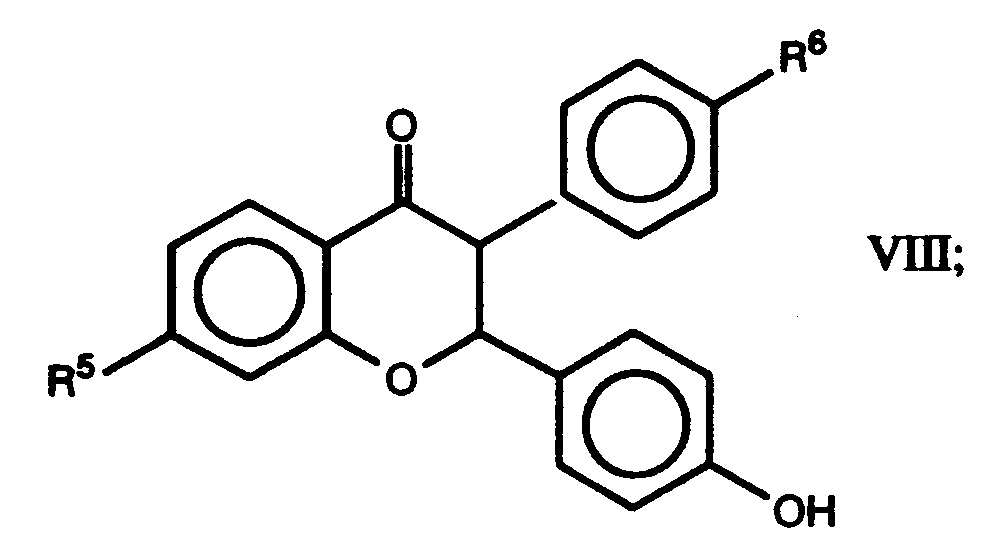
- For example, the product mixture may contain a ratio of compound VIII to compound III of 1.0:1.5. The filtrate containing compounds III and VIII may be concentrated, chromatographed and eluted with an eluate of increasing polarity, such as ethyl acetate in hexane or the like, thereby separating out the compound of formula III.
- The compound of the formula III may be converted to a compound of formula IV by reduction, for example by treating with a hydride such as sodium borohydride or the like in an alcoholic solvent such as ethyl alcohol or the like. Cyclodehydration may also be carried out; typically, work-up of the product, e.g., thermal work-up, may cause cyclodehydration. The hydride may be added in different proportions, at intervals of 10 to 15 minutes, at room temperature under stirring. The reaction may be continued for a period of up to 12 to 15 hours. The reaction product, after concentration, pH adjustment and extraction with a polar solvent such as ethyl acetate, is purified by chromatography, e.g., flash chromatography over silica gel to yield a compound of formula IV.
- The compound of formula IV can be treated with an appropriate heterocyclic alkyl halide, e.g., a piperidino- or pyrrolidinoalkyl halide, preferably in the presence of a basic catalyst such as potassium carbonate and a suitable ketonic solvent such as acetone or the like. This reaction may be followed by purification by chromatography, e.g., on alumina using hexane or a mixture thereof with a polar solvent to yield a compound of formula VI.
- If R⁵ and R⁶ are not protected hydroxy groups, then the compound produced is a compound of formula I. If R⁵ or R⁶ is a protected hydroxy group, then the protecting group(s) may be removed by known methods, e.g., by use of an acid such as hydrochloric acid in an alcoholic solvent such as ethanol. The deprotected hydroxy group(s) may, if desired, be alkylated or acylated by known methods to give other compounds of formula I.
- Alternatively, the compound of formula III can be converted to the compound of formula VIII by heating with sodium acetate in methanol.
- The compound of formula VIII can be treated with an appropriate heterocyclic alkyl halide, e.g., a piperidino- or pyrrolidinoalkyl halide preferably in the presence of a basic catalyst such as potassium carbonate and a suitable ketonic solvent such as acetone or the like. This reaction may be followed by purification by chromatography, e.g., on silica gel using a mixture of hexane and a polar solvent containing a small amount of triethylamine or ammonium hydroxide, to yield a compound of formula X.
- The compound of formula X can be treated with an appropriate Grignard reagent, e.g., methylmagnesium bromide or ethylmagnesium bromide, in diethyl ether or a tetrahydrofuran at 0°C. This reaction may be followed by purification by chromatography, e.g., on silica gel using a polar solvent such as ethyl acetate or acetone or a mixture thereof, to yield a compound of formula XI.
- The compound of formula XI can be dehydrated by treating with acetic acid and water at 100°C for 10 min. This reaction may be followed by purification by chromatography, e.g., on silica gel using a polar solvent such as ethyl acetate or acetone or a mixture thereof, to give a compound of formula XII.
- When R⁵ and R⁶ are not protected hydroxy groups, then the compound produced is a compound of formula I. If R⁵ and R⁶ are hydroxy group(s) protected as the tetrahydropyranyl ether(s) they are also deprotected in this reaction to yield a compound of formula I in which R¹ and R² are hydroxy. The deprotected hydroxy group(s) may, if desired, by alkylated or acylated by known methods to give other compound of formula I.
- The unprotected starting compound of formula (II)':

where R¹ and R² are as defined supra can be prepared by methods known in the art. For example, when R¹ is H and R² is OH, it can be prepared by condensation of phenol with 4-methoxy-phenylacetyl chloride (in turn prepared from 4-methoxy-phenylacetic acid) to afford an ester which on typical Fries rearrangement in the presence of anhydrous aluminum chloride yields a mixture which can be resolved chromatographically to afford the desired starting material that can be characterized by its physical and spectral data. - When R¹ is, e.g., methoxy and R² is as defined supra, the starting compound II' may be prepared by Friedel-Crafts acylation of a corresponding phenol, such as 3-methoxyphenol or the like, with a suitable substituted or unsubstituted phenylacetyl chloride, using a catalyst, such as anhydrous aluminum chloride. The resultant product may be purified by steam distillation and/or column chromatography.
- In turn, when R¹ and R² are both OH, the starting compound can be prepared by Friedel-Crafts acylation of resorcinol with 4-methoxyphenyl acetyl chloride. This reaction affords a mixture of trihydroxydeoxybenzoin and methoxy dihydroxydeoxybenzoin. The latter compound may be converted into the desired trihydroxy compound by heating it with anhydrous pyridine hydrochloride.
- The formula I compounds can form pharmaceutically acceptable acid and base addition salts with a variety of organic and inorganic acids and bases and include the physiologically acceptable salts which are often used in pharmaceutical chemistry. Such salts are also part of this invention. Typical inorganic acids used to form such salts include hydrochloric, hydrobromic, hydroiodic, nitric, sulfuric, phosphoric, hypophosphoric and the like. Salts derived from organic acids, such as aliphatic mono and dicarboxylic acids, phenyl substituted alkanoic acids, hydroxyalkanoic and hydroxyalkandioic acids, aromatic acids, aliphatic and aromatic sulfonic acids, may also be used. Such pharmaceutically acceptable salts thus include acetate, phenylacetate, trifluoroacetate, acrylate, ascorbate, benzoate, chlorobenzoate, dinitrobenzoate, hydroxybenzoate, methoxybenzoate, methylbenzoate, o-acetoxybenzoate, naphthalene-2-benzoate, bromide, isobutyrate, phenylbutyrate, β-hydroxybutyrate, butyne-1,4-dioate, hexyne-1,4-dioate, caprate, caprylate, chloride, cinnamate, citrate, formate, fumarate, glycollate, heptanoate, hippurate, lactate, malate, maleate, hydroxymaleate, malonate, mandelate, mesylate, nicotinate, isonicotinate, nitrate, oxalate, phthalate, terephthalate, phosphate, monohydrogenphosphate, dihydrogenphosphate, metaphosphate, pyrophosphate, propiolate, propionate, phenylpropionate, salicylate, sebacate, succinate, suberate, sulfate, bisulfate, pyrosulfate, sulfite, bisulfite, sulfonate, benzene-sulfonate, p-bromophenylsulfonate, chlorobenzenesulfonate, ethanesulfonate, 2-hydroxyethanesulfonate, methane-sulfonate, naphthalene-1-sulfonate, naphthalene-2-sulfonate, p-toluenesulfonate, xylenesulfonate, tartrate, and the like.
- In addition, some of the formula I compounds may form solvates with water or organic solvents such as ethanol. These solvates are also contemplated for use in the methods of this invention.
- The pharmaceutically acceptable acid addition salts are typically formed by reacting a compound of formula I with an equimolar or excess amount of acid. The reactants are generally combined in a mutual solvent such as diethyl ether or benzene. The salt normally precipitates out of solution within about one hour to 10 days and can be isolated by filtration or the solvent can be stripped off by conventional means.
- Bases commonly used for formation of salts include ammonium hydroxide and alkali and alkaline earth metal hydroxides, carbonates and bicarbonates, as well as aliphatic and aromatic amines, aliphatic diamines and hydroxy alkylamines. Bases especially useful in the preparation of addition salts include ammonium hydroxide, potassium carbonate, sodium bicarbonate, calcium hydroxide, methylamine, diethylamine, ethylene diamine, cyclohexylamine and ethanolamine.
- The pharmaceutically acceptable salts generally have enhanced solubility characteristics compared to the compound from which they are derived, and thus are often more amenable to formulation as liquids or emulsions.
- Pharmaceutical formulations can be prepared by procedures known in the art. For example, the formula I compounds, either alone or in combination with estrogen, can be formulated with common excipients, diluents, or carriers, and formed into tablets, capsules, suspensions, powders, and the like. Examples of excipients, diluents, and carriers that are suitable for such formulations include the following: fillers and extenders such as starch, sugars, mannitol, and silicic derivatives; binding agents such as carboxymethyl cellulose and other cellulose derivatives, alginates, gelatin, and polyvinylpyrrolidone; moisturizing agents such as glycerol; disintegrating agents such as agaragar, calcium carbonate, and sodium bicarbonate; agents for retarding dissolution such as paraffin; resorption accelerators such as quaternary ammonium compounds; surface active agents such as cetyl alcohol, glycerol monostearate; adsorptive carriers such as kaolin and bentonite; and lubricants such as talc, calcium and magnesium stearate, and solid polyethyl glycols.
- The formula I compounds, either alone or in combination with estrogen, can also be formulated as elixirs or solutions for convenient oral administration or as solutions appropriate for parenteral administration, for instance by intramuscular, subcutaneous or intravenous routes. Additionally, the compounds, either alone or in combination with estrogen, can be formulated as sustained release dosage forms and the like. The formulations can be so constituted that they release the active ingredient only or preferably in a particular part of the intestinal tract, possibly over a period of time. The coatings, envelopes, and protective matrices may be made, for example, from polymeric substances or waxes.
- The particular dosage of a compound of formula I required to lower serum cholesterol according to this invention will depend upon the severity of the condition, the route of administration, and related factors. In humans, generally accepted and effective daily doses will be from about 0.1 to about 1000 mg, and more typically from about 50 to about 600 mg. Such dosages will be administered to the patient from once to about three times each day, or more often as needed to lower serum cholesterol effectively.
- If estrogen is also administered, generally accepted and effective daily doses of estrogen will be from about 0.01 to about 4.0 mg, and more typically from about 0.1 to about 2.0 mg. These doses are also administered to the patient from once to about three times a day, or more often as needed.
- A preferred formula I compound of this invention is the compound wherein
R¹ is H or OH;
R² is OH;
R³ is
and
R⁴ is H or methyl. - It is usually preferable to administer the formula I compound in the form of an acid addition salt, as is customary in the administration of pharmaceuticals bearing a basic group, such as the piperidino ring. It is also advantageous to administer the compound orally.
- A preferred group of animals are human patients, and a particularly important group of patients are aging humans (e.g., post-menopausal females).
- For the purposes of this invention, the following are typical oral dosage forms. In these examples, "Active ingredient" means a compound of
formula 1. - Hard gelatin capsules are prepared using the following:
Ingredient Quantity (mg/capsule) Active ingredient 0.1 - 1000 Starch, NF 0 - 650 Starch flowable powder 0 - 650 Silicone fluid 350 centistokes 0 - 15
The ingredients are blended, passed through a No. 45 mesh U.S. sieve, and filled into hard gelatin capsules. - The components in Formulation I can be blended and compressed to form tablets.
- Alternatively, tablets each containing 0.1 - 1000 mg of active ingredient are made up as follows:
-
Ingredient Quantity (mg/tablet) Active ingredient 0.1 - 1000 Starch 45 Cellulose, microcrystalline 35 Polyvinylpyrrolidone (as 10% solution in water) 4 Sodium carboxymethyl cellulose 4.5 Magnesium stearate 0.5 Talc 1 - The active ingredient, starch, and cellulose are passed through a No. 45 mesh U.S. sieve and mixed thoroughly. The solution of polyvinylpyrrolidone is mixed with the resultant powders which are then passed through a No. 14 mesh U.S. sieve. The granules so produced are dried at 50°-60°C and passed through a No. 18 mesh U.S. sieve. The sodium carboxymethyl starch, magnesium stearate, and talc, previously passed through a No. 60 U.S. sieve, are then added to the granules which, after mixing, are compressed on a tablet machine to yield tablets.
- Suspensions each containing 0.1 - 1000 mg of medicament per 5 mL dose are made as follows:
-
Ingredient Quantity (amount/5 mL) Active ingredient 0.1 - 1000 mg Sodium carboxymethyl cellulose 50 mg Syrup 1.25 mg Benzoic acid solution 0.10 mL Flavor q.v. Color q.v. Purified water qs to 5 mL
The medicament is passed through a No. 45 mesh U.S. sieve and mixed with the sodium carboxymethyl cellulose and syrup to form a smooth paste. The benzoic acid solution, flavor, and color are diluted with some of the water and added, with stirring. Sufficient water is then added to produce the required volume. - A particular advantage of the compounds of formula I when used in lowering serum cholesterol levels is the fact that they evoke only modest uterotrophic activity, as identified by a) only slight gains in uterine weight and b) lack of increase in the number of eosinophils observed in the stromal layer of ovariectomized rats.
- The following nonlimiting test examples illustrate the methods of this invention.
- Seventy-five day old female Sprague Dawley rats (weight range of 200 to 225 g) were obtained from Charles River Laboratories (Portage, MI). The animals were either bilaterally ovariectomized (OVX) or exposed to a Sham surgical procedure at Charles River Laboratories, and then shipped after one week. Upon arrival, they were housed in metal hanging cages in groups of 3 or 4 per cage and had ad libitum access to food (calcium content approximately 0.5%) and water for one week. Room temperature was maintained at 22.2° ± 1.7° C with a minimum relative humidity of 40%. The photoperiod in the room was 12 hours light and 12 hours dark.
- After a one week acclimation period (therefore, two weeks post-OVX) daily dosing with test compound was initiated. All compounds were administered orally at 1 ml/kg body weight unless otherwise stated. 17α -ethynyl estradiol and the test compound were given orally as a suspension in 1% carboxymethylcellulose or 20% cyclodextrin. Animals were dosed daily for 4 days. Following the dosing regimen animals were weighed and anesthetized with a ketamine: Xylazine (2:1, V:V) mixture, and a blood sample was collected by cardiac puncture. Each animal was then sacrificed by asphyxiation with CO₂; the uterus was removed through a midline incision and a wet weight was determined.
- Blood samples were allowed to clot at room temperature for 2 hrs, and serum was obtained following centrifugation for 10 min at 3000 rpm. Serum cholesterol was determined using a Boehringer Mannheim Diagnostics high performance cholesterol assay. Briefly, the cholesterol was oxidized to cholest-4-en-3-one and hydrogen peroxide. The hydrogen peroxide was then reacted with phenol and 4-aminophenazone in the presence of peroxidase to produce a p-quinone imine dye, which was read spectrophotemetrically at 500 nm. Cholesterol concentration was then calculated against a standard curve.
- Uteri were kept at 4° C until time of enzymatic analysis. The uteri were then homogenized in 50 volumes of 50 mM Tris buffer (pH - 8.0) containing 0.005% Triton X-100. Upon addition of 0.01% hydrogen peroxide and 10 mM o-phenylenediamine (final concentrations) in Tris buffer, increase in absorbance was monitored for one minute at 450 nm. The presence of eosinophils in the uterus is an indication of estrogenic activity of a compound. The maximal velocity of a 15 second interval was determined over the initial, linear portion of the reaction curve.
- 17α-ethynyl estradiol was obtained from Sigma Chemical Co., St. Louis, MO.
- All experimental groups were comprised of five or six animals.
- The results of the studies are presented in Figures 1-3. In summary, ovariectomy of the rats caused an increase in serum cholesterol as compared to intact vehicle treated controls. Estrogen, administered in the orally active form of ethynyl estradiol (EE₂), causes a decrease in serum cholesterol in a dose dependent manner, but it also exerts a stimulatory action on the uterus, resulting in uterine weights approaching that of an intact rat when administered at 100µg/kg/day. Results are reported as the mean of measurements from 5 to 6 rats ± the standard error of the mean.
- In these studies,
Compound 1 also caused a serum cholesterol decrease in a dose dependent manner; however, only minimal increase of uterine weight over the ovariectomized controls was present in these animals. The serum cholesterol effects ofCompound 1 are represented in Figure 1. - Figure 2 compares the effect on uterine weight gain of
Compound 1 and EE2 versus ovariectomized controls. As Figure 2 shows, rats treated withCompound 1 had uterine weights similar to those of ovariectomized controls and much less than those of the EE2-treated rats. - Increases in uterine eosinophils are a sign of estrogenicity of therapeutic agents and may be associated with increased incidence of uterine cancer. When
Compound 1 was administered as described supra, there was no statistically measurable increase in uterine eosinophil peroxidase activity over the ovariectomized controls. This result was in contrast to the results seen with estrogen (EE2), as shown in Figure 3.
Claims (5)
- The use of a compound of formula (I):

R¹ and R² are, independently, -H, -OH, halo, -OC₁-C₁₇ alkyl, -OC₃-C₆ cycloalkyl, -O(CO)C₁-C₁₇ alkyl, -O(CO) aryl, -O(CO)O aryl, or -OSO₂-(n-butyl or n-pentyl);
R³ is
R⁴ is -H, methyl, ethyl, propyl, ethenyl or ethynyl; or a pharmaceutically acceptable salt or solvate thereof, in the preparation of a medicament useful for lowering cholesterol levels. - A use according to Claim 1 wherein R⁴ is methyl, ethyl or propyl.
- A use of Claim 2 wherein R¹ and R² are each independently H, OH, or C₁₋₄ alkoxy.
- A use of Claim 1 wherein R³ is:

- A use according to Claim 1 wherein said compound is 2-[4-[2-(1-piperidino)ethoxy]phenyl]-3-(4-hydroxyphenyl)-7-hydroxy-2H-1-benzopyran, 2-[4-[2-(1-piperidino)ethoxy]phenyl]-3-(4-hydroxyphenyl)-2H-1-benzopyran, 2-[4-[2-(1-piperidino)ethoxy]phenyl]-3-phenyl-7-methoxy-2H-1-benzopyran, 2-[4-[2-(1-pyrrolidino)ethoxy]phenyl]-3-(4-hydroxyphenyl)-7-methoxy-2H-1-benzopyran or 2-[4-[2-(1-piperidino)ethoxy]phenyl]-3-(4-hydroxyphenyl)-4-methyl-7-hydroxy-2H-1-benzopyran.
Applications Claiming Priority (2)
| Application Number | Priority Date | Filing Date | Title |
|---|---|---|---|
| US08/148,038 US5446061A (en) | 1993-11-05 | 1993-11-05 | Methods for lowering serum cholesterol |
| US148038 | 1998-09-03 |
Publications (1)
| Publication Number | Publication Date |
|---|---|
| EP0652006A1 true EP0652006A1 (en) | 1995-05-10 |
Family
ID=22523965
Family Applications (1)
| Application Number | Title | Priority Date | Filing Date |
|---|---|---|---|
| EP94308054A Withdrawn EP0652006A1 (en) | 1993-11-05 | 1994-11-02 | Use of 2-phenyl-3-aryl-dihychobenzopyrans for lowering serum cholesterol |
Country Status (4)
| Country | Link |
|---|---|
| US (1) | US5446061A (en) |
| EP (1) | EP0652006A1 (en) |
| JP (1) | JPH07215871A (en) |
| CA (1) | CA2134827A1 (en) |
Cited By (9)
| Publication number | Priority date | Publication date | Assignee | Title |
|---|---|---|---|---|
| EP0712627A3 (en) * | 1994-11-18 | 1996-06-26 | Lilly Co Eli | |
| WO1996026201A1 (en) * | 1995-02-21 | 1996-08-29 | Endorecherche, Inc. | Benzopyran-containing compounds and method for their use |
| US5686465A (en) * | 1988-10-31 | 1997-11-11 | Endorecherche Inc. | Sex steroid activity inhibitors |
| US5840735A (en) * | 1988-10-31 | 1998-11-24 | Endorecherche Inc. | Sex steroid activity inhibitors |
| WO2001001969A3 (en) * | 1999-07-06 | 2001-08-02 | Endorech Inc | Methods of treating and/or suppressing weight gain |
| WO2001026651A3 (en) * | 1999-10-14 | 2001-11-08 | Endorech Inc | Selective estrogen receptor modulators in the treatment or reduction of the risk of acquiring hypertension, cardiovascular diseases, and insulin resistance |
| EP1251855A1 (en) * | 2000-01-28 | 2002-10-30 | Endorecherche, Inc. | Selective estrogen receptor modulators in combination with estrogens |
| US8703810B2 (en) | 2010-06-10 | 2014-04-22 | Seragon Pharmaceuticals, Inc. | Estrogen receptor modulators and uses thereof |
| US9187460B2 (en) | 2011-12-14 | 2015-11-17 | Seragon Pharmaceuticals, Inc. | Estrogen receptor modulators and uses thereof |
Families Citing this family (11)
| Publication number | Priority date | Publication date | Assignee | Title |
|---|---|---|---|---|
| US5416098A (en) * | 1993-12-30 | 1995-05-16 | Zymogenetics, Inc. | Method for treating dermatitis and related conditions |
| US5407955A (en) * | 1994-02-18 | 1995-04-18 | Eli Lilly And Company | Methods for lowering serum cholesterol and inhibiting smooth muscle cell proliferation, restenosis, endometriosis, and uterine fibroid disease |
| AU760232B2 (en) * | 1995-02-21 | 2003-05-08 | Endorecherche Inc. | Benzopyran-containing compounds and method for their use |
| US6444688B1 (en) * | 1995-06-07 | 2002-09-03 | Eli Lilly And Company | Compounds and compositions with nitrogen-containing non-basic side chains |
| US5980938A (en) * | 1996-07-15 | 1999-11-09 | Eli Lilly And Company | Effect of compounds that suppress induction of plasminogen activator inhibitor 1 (PAI-1) |
| US6107346A (en) * | 1997-08-11 | 2000-08-22 | Eli Lilly And Company | Methods for treating hyperlipidemia |
| US5908859A (en) * | 1997-08-11 | 1999-06-01 | Eli Lilly And Company | Benzothiophenes for inhibiting hyperlipidemia |
| US7005428B1 (en) * | 1998-06-11 | 2006-02-28 | Endorecherche, Inc. | Medical uses of a selective estrogen receptor modulator in combination with sex steroid precursors |
| US6465445B1 (en) * | 1998-06-11 | 2002-10-15 | Endorecherche, Inc. | Medical uses of a selective estrogen receptor modulator in combination with sex steroid precursors |
| US6262270B1 (en) | 1998-08-14 | 2001-07-17 | Schering Corporation | Enantioselective synthesis |
| EP2791128A4 (en) | 2011-12-16 | 2015-04-22 | Olema Pharmaceuticals Inc | Novel benzopyran compounds, compositions and uses thereof |
Citations (4)
| Publication number | Priority date | Publication date | Assignee | Title |
|---|---|---|---|---|
| GB1087539A (en) * | 1965-10-20 | 1967-10-18 | Merck Ag E | 3,6-disubstituted flavan derivatives and their preparation |
| GB1103094A (en) * | 1966-02-16 | 1968-02-14 | Merck Ag E | 3,4-cis-4-aryl-isoflavans and preparation thereof |
| EP0470310A1 (en) * | 1990-08-09 | 1992-02-12 | Council of Scientific and Industrial Research | Novel benzopyrans and process for their production |
| WO1993010741A2 (en) * | 1991-12-02 | 1993-06-10 | Endorecherche Inc. | Sex steroid activity inhibitors |
Family Cites Families (1)
| Publication number | Priority date | Publication date | Assignee | Title |
|---|---|---|---|---|
| US5254568A (en) * | 1990-08-09 | 1993-10-19 | Council Of Scientific & Industrial Research | Benzopyrans as antiestrogenic agents |
-
1993
- 1993-11-05 US US08/148,038 patent/US5446061A/en not_active Expired - Fee Related
-
1994
- 1994-11-01 CA CA002134827A patent/CA2134827A1/en not_active Abandoned
- 1994-11-02 JP JP6269471A patent/JPH07215871A/en not_active Withdrawn
- 1994-11-02 EP EP94308054A patent/EP0652006A1/en not_active Withdrawn
Patent Citations (4)
| Publication number | Priority date | Publication date | Assignee | Title |
|---|---|---|---|---|
| GB1087539A (en) * | 1965-10-20 | 1967-10-18 | Merck Ag E | 3,6-disubstituted flavan derivatives and their preparation |
| GB1103094A (en) * | 1966-02-16 | 1968-02-14 | Merck Ag E | 3,4-cis-4-aryl-isoflavans and preparation thereof |
| EP0470310A1 (en) * | 1990-08-09 | 1992-02-12 | Council of Scientific and Industrial Research | Novel benzopyrans and process for their production |
| WO1993010741A2 (en) * | 1991-12-02 | 1993-06-10 | Endorecherche Inc. | Sex steroid activity inhibitors |
Non-Patent Citations (5)
| Title |
|---|
| A. SAEED ET AL. AND A.P. SHARMA ET AL., JOURNAL OF MEDICINAL CHEMISTRY, vol. 33, no. 12, 1990, pages 3210 - 3229 * |
| C.C. TEO ET AL.: "SYNTHESIS OF 2-(p-CHLOROBENZYL)-3-ARYL-6-METHOXYBENZOFURANS AS SELECTIVE LIGANDS FOR ANTIESTROGEN-BINDING SITES. EFFECTS ON CELL PROLIFERATION AND CHOLESTEROL SYNTHESIS", JOURNAL OF MEDICINAL CHEMISTRY, vol. 35, no. 8, 1992, pages 1330 - 1339, XP002136807, DOI: doi:10.1021/jm00086a002 * |
| D. INGRAM: "TAMOXIFEN USE, OESTROGEN BINDING AND SERUM LIPIDS IN POSTMENOPAUSAL WOMEN WITH BREAST CANCER", THE AUSTRALIAN AND NEW ZEALAND JOURNAL OF SURGERY, vol. 60, no. 9, 1990, pages 673 - 675 * |
| J.D. DHAR ET AL.: "BIOLOGICAL PROFILE OF 2-(4-(2-N-PIPERIDINOETHOXY)PHENYL)-3-PHENYL (2H) BENZO(B)PYRAN- APOTENT ANTIIMPLANTATION AGENT IN RAT", CONTRACEPTION, vol. 44, no. 4, 1991, pages 461 - 472 * |
| R.R. LOVE ET AL.: "EFFECTS OF TAMOXIFEN THERAPY ON LIPID AND LIPOPROTEIN LEVELS IN POSTMENOPAUSAL PATIENTS WITH NODE-NEGATIVE BREAST CANCER", JOURNAL OF THE NATIONAL CANCER INSTITUTE, vol. 82, no. 16, 1990, pages 1327 - 1332 * |
Cited By (18)
| Publication number | Priority date | Publication date | Assignee | Title |
|---|---|---|---|---|
| US5686465A (en) * | 1988-10-31 | 1997-11-11 | Endorecherche Inc. | Sex steroid activity inhibitors |
| US5840735A (en) * | 1988-10-31 | 1998-11-24 | Endorecherche Inc. | Sex steroid activity inhibitors |
| US6060503A (en) * | 1991-12-02 | 2000-05-09 | Endorecherche, Inc. | Benzopyran-containing compounds and method for their use |
| EP0712627A3 (en) * | 1994-11-18 | 1996-06-26 | Lilly Co Eli | |
| WO1996026201A1 (en) * | 1995-02-21 | 1996-08-29 | Endorecherche, Inc. | Benzopyran-containing compounds and method for their use |
| CN1390126B (en) * | 1999-07-06 | 2012-06-13 | 恩多研究公司 | Use of selective estrogen receptor modulator in preparing medicine for treating obesity or reducing risk of development of obesity |
| US6710059B1 (en) | 1999-07-06 | 2004-03-23 | Endorecherche, Inc. | Methods of treating and/or suppressing weight gain |
| RU2327461C2 (en) * | 1999-07-06 | 2008-06-27 | Андорешерш, Инк. | Method of mass increase treatment and/or inhiition |
| AU2009200258B2 (en) * | 1999-07-06 | 2012-01-12 | Endorecherche, Inc. | Methods of treating and/or suppressing weight gain |
| WO2001001969A3 (en) * | 1999-07-06 | 2001-08-02 | Endorech Inc | Methods of treating and/or suppressing weight gain |
| US8609695B2 (en) | 1999-07-06 | 2013-12-17 | Endorecherche, Inc. | Methods of treating and/or suppressing insulin resistance |
| WO2001026651A3 (en) * | 1999-10-14 | 2001-11-08 | Endorech Inc | Selective estrogen receptor modulators in the treatment or reduction of the risk of acquiring hypertension, cardiovascular diseases, and insulin resistance |
| EP1251855A1 (en) * | 2000-01-28 | 2002-10-30 | Endorecherche, Inc. | Selective estrogen receptor modulators in combination with estrogens |
| JP2003520817A (en) * | 2000-01-28 | 2003-07-08 | エンドルシェルシェ, インコーポレイテッド. | Selective estrogen receptor modulators in combination with estrogen |
| US8703810B2 (en) | 2010-06-10 | 2014-04-22 | Seragon Pharmaceuticals, Inc. | Estrogen receptor modulators and uses thereof |
| US9078871B2 (en) | 2010-06-10 | 2015-07-14 | Seragon Pharmaceuticals, Inc. | Estrogen receptor modulators and uses thereof |
| US9187460B2 (en) | 2011-12-14 | 2015-11-17 | Seragon Pharmaceuticals, Inc. | Estrogen receptor modulators and uses thereof |
| US9193714B2 (en) | 2011-12-14 | 2015-11-24 | Seragon Pharmaceuticals, Inc. | Fluorinated estrogen receptor modulators and uses thereof |
Also Published As
| Publication number | Publication date |
|---|---|
| JPH07215871A (en) | 1995-08-15 |
| CA2134827A1 (en) | 1995-05-06 |
| US5446061A (en) | 1995-08-29 |
Similar Documents
| Publication | Publication Date | Title |
|---|---|---|
| US5446061A (en) | Methods for lowering serum cholesterol | |
| US5464845A (en) | Methods for lowering serum cholesterol | |
| US5472977A (en) | Method for the treatment of uterine fibroid desease | |
| CA2101356C (en) | Improvements in or relating to benzothiophenes | |
| US5407947A (en) | Methods for inhibiting bone loss using pyrolidine and piperidine substituted benzopyrans | |
| US5446071A (en) | Methods for lowering serum cholesterol | |
| JPH07242546A (en) | Pharmaceutical composition suitable for inhibiting myeloperoxidase activity | |
| US5952350A (en) | Naphthyl compounds and compositions, as estrogen receptor binding agents | |
| US6403615B1 (en) | 2-Aryl-3-aroylbenzo {b} thiophenes useful for the treatment of estrogen deprivation syndrome | |
| US5843963A (en) | Benzothiophene compounds, intermediates, processes, compositions, and methods | |
| US5821253A (en) | Tetrahydrobenzo a!fluorene compounds and methods of use | |
| EP0835871B1 (en) | Benzo [b] thiophene compounds, intermediates, formulations, and methods | |
| CA2138506A1 (en) | Methods of inhibiting male infertility | |
| HK1020679A (en) | 2-aryl-3-aroylbenzo(b)thiophenes useful for the treatment of estrogen deprivation syndrome |
Legal Events
| Date | Code | Title | Description |
|---|---|---|---|
| PUAI | Public reference made under article 153(3) epc to a published international application that has entered the european phase |
Free format text: ORIGINAL CODE: 0009012 |
|
| 17P | Request for examination filed |
Effective date: 19941110 |
|
| AK | Designated contracting states |
Kind code of ref document: A1 Designated state(s): AT BE CH DE DK ES FR GB GR IE IT LI LU NL PT SE |
|
| RAX | Requested extension states of the european patent have changed |
Free format text: LT PAYMENT 941110;SI PAYMENT 941110 |
|
| 17Q | First examination report despatched |
Effective date: 20000208 |
|
| STAA | Information on the status of an ep patent application or granted ep patent |
Free format text: STATUS: THE APPLICATION IS DEEMED TO BE WITHDRAWN |
|
| 18D | Application deemed to be withdrawn |
Effective date: 20020122 |