EP0651074B1 - Biodegradable corrosion inhibitors of low toxicity - Google Patents
Biodegradable corrosion inhibitors of low toxicity Download PDFInfo
- Publication number
- EP0651074B1 EP0651074B1 EP94307422A EP94307422A EP0651074B1 EP 0651074 B1 EP0651074 B1 EP 0651074B1 EP 94307422 A EP94307422 A EP 94307422A EP 94307422 A EP94307422 A EP 94307422A EP 0651074 B1 EP0651074 B1 EP 0651074B1
- Authority
- EP
- European Patent Office
- Prior art keywords
- set forth
- water
- inhibitor
- thirty
- corrosion inhibitor
- Prior art date
- Legal status (The legal status is an assumption and is not a legal conclusion. Google has not performed a legal analysis and makes no representation as to the accuracy of the status listed.)
- Expired - Lifetime
Links
- 239000003112 inhibitor Substances 0.000 title claims description 93
- 238000005260 corrosion Methods 0.000 title claims description 47
- 230000007797 corrosion Effects 0.000 title claims description 47
- 231100000053 low toxicity Toxicity 0.000 title description 2
- 239000000203 mixture Substances 0.000 claims description 24
- 229910019142 PO4 Inorganic materials 0.000 claims description 23
- MTNDZQHUAFNZQY-UHFFFAOYSA-N imidazoline Chemical compound C1CN=CN1 MTNDZQHUAFNZQY-UHFFFAOYSA-N 0.000 claims description 23
- 238000000034 method Methods 0.000 claims description 23
- 239000010452 phosphate Substances 0.000 claims description 23
- 239000002609 medium Substances 0.000 claims description 21
- -1 phosphate ester Chemical class 0.000 claims description 21
- LFQSCWFLJHTTHZ-UHFFFAOYSA-N Ethanol Chemical compound CCO LFQSCWFLJHTTHZ-UHFFFAOYSA-N 0.000 claims description 16
- DNIAPMSPPWPWGF-UHFFFAOYSA-N Propylene glycol Chemical compound CC(O)CO DNIAPMSPPWPWGF-UHFFFAOYSA-N 0.000 claims description 15
- LYCAIKOWRPUZTN-UHFFFAOYSA-N Ethylene glycol Chemical compound OCCO LYCAIKOWRPUZTN-UHFFFAOYSA-N 0.000 claims description 14
- XLYOFNOQVPJJNP-UHFFFAOYSA-N water Substances O XLYOFNOQVPJJNP-UHFFFAOYSA-N 0.000 claims description 14
- 239000002904 solvent Substances 0.000 claims description 11
- 235000014113 dietary fatty acids Nutrition 0.000 claims description 10
- 125000001301 ethoxy group Chemical group [H]C([H])([H])C([H])([H])O* 0.000 claims description 10
- 239000000194 fatty acid Substances 0.000 claims description 10
- 229930195729 fatty acid Natural products 0.000 claims description 10
- 150000004665 fatty acids Chemical class 0.000 claims description 10
- 241000206732 Skeletonema costatum Species 0.000 claims description 8
- 235000009508 confectionery Nutrition 0.000 claims description 7
- 150000002462 imidazolines Chemical class 0.000 claims description 7
- VGGSQFUCUMXWEO-UHFFFAOYSA-N Ethene Chemical group C=C VGGSQFUCUMXWEO-UHFFFAOYSA-N 0.000 claims description 6
- 239000005977 Ethylene Substances 0.000 claims description 6
- 239000012736 aqueous medium Substances 0.000 claims description 5
- 241000251468 Actinopterygii Species 0.000 claims description 4
- 241000195493 Cryptophyta Species 0.000 claims description 4
- OYHQOLUKZRVURQ-HZJYTTRNSA-N Linoleic acid Chemical compound CCCCC\C=C/C\C=C/CCCCCCCC(O)=O OYHQOLUKZRVURQ-HZJYTTRNSA-N 0.000 claims description 4
- 235000020778 linoleic acid Nutrition 0.000 claims description 4
- WRIDQFICGBMAFQ-UHFFFAOYSA-N (E)-8-Octadecenoic acid Natural products CCCCCCCCCC=CCCCCCCC(O)=O WRIDQFICGBMAFQ-UHFFFAOYSA-N 0.000 claims description 3
- LQJBNNIYVWPHFW-UHFFFAOYSA-N 20:1omega9c fatty acid Natural products CCCCCCCCCCC=CCCCCCCCC(O)=O LQJBNNIYVWPHFW-UHFFFAOYSA-N 0.000 claims description 3
- QSBYPNXLFMSGKH-UHFFFAOYSA-N 9-Heptadecensaeure Natural products CCCCCCCC=CCCCCCCCC(O)=O QSBYPNXLFMSGKH-UHFFFAOYSA-N 0.000 claims description 3
- ZQPPMHVWECSIRJ-UHFFFAOYSA-N Oleic acid Natural products CCCCCCCCC=CCCCCCCCC(O)=O ZQPPMHVWECSIRJ-UHFFFAOYSA-N 0.000 claims description 3
- 230000002401 inhibitory effect Effects 0.000 claims description 3
- QXJSBBXBKPUZAA-UHFFFAOYSA-N isooleic acid Natural products CCCCCCCC=CCCCCCCCCC(O)=O QXJSBBXBKPUZAA-UHFFFAOYSA-N 0.000 claims description 3
- OYHQOLUKZRVURQ-IXWMQOLASA-N linoleic acid Natural products CCCCC\C=C/C\C=C\CCCCCCCC(O)=O OYHQOLUKZRVURQ-IXWMQOLASA-N 0.000 claims description 3
- ZQPPMHVWECSIRJ-KTKRTIGZSA-N oleic acid Chemical compound CCCCCCCC\C=C/CCCCCCCC(O)=O ZQPPMHVWECSIRJ-KTKRTIGZSA-N 0.000 claims description 3
- 239000002253 acid Substances 0.000 claims description 2
- 125000002947 alkylene group Chemical group 0.000 claims description 2
- 125000000732 arylene group Chemical group 0.000 claims description 2
- 125000004805 propylene group Chemical group [H]C([H])([H])C([H])([*:1])C([H])([H])[*:2] 0.000 claims description 2
- WSFSSNUMVMOOMR-UHFFFAOYSA-N Formaldehyde Chemical compound O=C WSFSSNUMVMOOMR-UHFFFAOYSA-N 0.000 claims 1
- 239000005642 Oleic acid Substances 0.000 claims 1
- 230000007613 environmental effect Effects 0.000 description 12
- 230000005764 inhibitory process Effects 0.000 description 10
- KFZMGEQAYNKOFK-UHFFFAOYSA-N Isopropanol Chemical compound CC(C)O KFZMGEQAYNKOFK-UHFFFAOYSA-N 0.000 description 9
- FAPWRFPIFSIZLT-UHFFFAOYSA-M Sodium chloride Chemical compound [Na+].[Cl-] FAPWRFPIFSIZLT-UHFFFAOYSA-M 0.000 description 8
- DLYUQMMRRRQYAE-UHFFFAOYSA-N tetraphosphorus decaoxide Chemical compound O1P(O2)(=O)OP3(=O)OP1(=O)OP2(=O)O3 DLYUQMMRRRQYAE-UHFFFAOYSA-N 0.000 description 8
- CURLTUGMZLYLDI-UHFFFAOYSA-N Carbon dioxide Chemical compound O=C=O CURLTUGMZLYLDI-UHFFFAOYSA-N 0.000 description 6
- IAYPIBMASNFSPL-UHFFFAOYSA-N Ethylene oxide Chemical compound C1CO1 IAYPIBMASNFSPL-UHFFFAOYSA-N 0.000 description 6
- 150000001298 alcohols Chemical class 0.000 description 6
- 239000000654 additive Substances 0.000 description 5
- 238000007046 ethoxylation reaction Methods 0.000 description 5
- 239000000243 solution Substances 0.000 description 5
- 231100000331 toxic Toxicity 0.000 description 5
- 230000002588 toxic effect Effects 0.000 description 5
- KBPLFHHGFOOTCA-UHFFFAOYSA-N 1-Octanol Chemical compound CCCCCCCCO KBPLFHHGFOOTCA-UHFFFAOYSA-N 0.000 description 4
- PIICEJLVQHRZGT-UHFFFAOYSA-N Ethylenediamine Chemical class NCCN PIICEJLVQHRZGT-UHFFFAOYSA-N 0.000 description 4
- JUJWROOIHBZHMG-UHFFFAOYSA-N Pyridine Chemical compound C1=CC=NC=C1 JUJWROOIHBZHMG-UHFFFAOYSA-N 0.000 description 4
- 230000000996 additive effect Effects 0.000 description 4
- 239000007864 aqueous solution Substances 0.000 description 4
- 239000003350 kerosene Substances 0.000 description 4
- 238000004519 manufacturing process Methods 0.000 description 4
- 229920000137 polyphosphoric acid Polymers 0.000 description 4
- 239000011780 sodium chloride Substances 0.000 description 4
- BHPQYMZQTOCNFJ-UHFFFAOYSA-N Calcium cation Chemical compound [Ca+2] BHPQYMZQTOCNFJ-UHFFFAOYSA-N 0.000 description 3
- LRHPLDYGYMQRHN-UHFFFAOYSA-N N-Butanol Chemical compound CCCCO LRHPLDYGYMQRHN-UHFFFAOYSA-N 0.000 description 3
- 125000000217 alkyl group Chemical group 0.000 description 3
- 229910001424 calcium ion Inorganic materials 0.000 description 3
- 239000001569 carbon dioxide Substances 0.000 description 3
- 229910002092 carbon dioxide Inorganic materials 0.000 description 3
- 230000015556 catabolic process Effects 0.000 description 3
- 238000006243 chemical reaction Methods 0.000 description 3
- 238000006731 degradation reaction Methods 0.000 description 3
- 150000004985 diamines Chemical class 0.000 description 3
- 229910052739 hydrogen Inorganic materials 0.000 description 3
- 239000001257 hydrogen Substances 0.000 description 3
- RAXXELZNTBOGNW-UHFFFAOYSA-N imidazole Natural products C1=CNC=N1 RAXXELZNTBOGNW-UHFFFAOYSA-N 0.000 description 3
- 231100000956 nontoxicity Toxicity 0.000 description 3
- IJGRMHOSHXDMSA-UHFFFAOYSA-N Atomic nitrogen Chemical compound N#N IJGRMHOSHXDMSA-UHFFFAOYSA-N 0.000 description 2
- UXVMQQNJUSDDNG-UHFFFAOYSA-L Calcium chloride Chemical compound [Cl-].[Cl-].[Ca+2] UXVMQQNJUSDDNG-UHFFFAOYSA-L 0.000 description 2
- RTZKZFJDLAIYFH-UHFFFAOYSA-N Diethyl ether Chemical compound CCOCC RTZKZFJDLAIYFH-UHFFFAOYSA-N 0.000 description 2
- 159000000021 acetate salts Chemical class 0.000 description 2
- 125000003277 amino group Chemical group 0.000 description 2
- QVGXLLKOCUKJST-UHFFFAOYSA-N atomic oxygen Chemical compound [O] QVGXLLKOCUKJST-UHFFFAOYSA-N 0.000 description 2
- 239000012267 brine Substances 0.000 description 2
- 239000001110 calcium chloride Substances 0.000 description 2
- 229910001628 calcium chloride Inorganic materials 0.000 description 2
- 229910052799 carbon Inorganic materials 0.000 description 2
- 239000003054 catalyst Substances 0.000 description 2
- 230000002939 deleterious effect Effects 0.000 description 2
- 150000002148 esters Chemical class 0.000 description 2
- 235000019197 fats Nutrition 0.000 description 2
- 125000004435 hydrogen atom Chemical class [H]* 0.000 description 2
- 125000004433 nitrogen atom Chemical group N* 0.000 description 2
- 231100000252 nontoxic Toxicity 0.000 description 2
- 230000003000 nontoxic effect Effects 0.000 description 2
- 150000002888 oleic acid derivatives Chemical class 0.000 description 2
- 229910052760 oxygen Inorganic materials 0.000 description 2
- 239000001301 oxygen Substances 0.000 description 2
- NBIIXXVUZAFLBC-UHFFFAOYSA-K phosphate Chemical compound [O-]P([O-])([O-])=O NBIIXXVUZAFLBC-UHFFFAOYSA-K 0.000 description 2
- 229920000768 polyamine Polymers 0.000 description 2
- UMJSCPRVCHMLSP-UHFFFAOYSA-N pyridine Natural products COC1=CC=CN=C1 UMJSCPRVCHMLSP-UHFFFAOYSA-N 0.000 description 2
- 239000000376 reactant Substances 0.000 description 2
- ADWNFGORSPBALY-UHFFFAOYSA-M sodium;2-[dodecyl(methyl)amino]acetate Chemical compound [Na+].CCCCCCCCCCCCN(C)CC([O-])=O ADWNFGORSPBALY-UHFFFAOYSA-M 0.000 description 2
- HPALAKNZSZLMCH-UHFFFAOYSA-M sodium;chloride;hydrate Chemical compound O.[Na+].[Cl-] HPALAKNZSZLMCH-UHFFFAOYSA-M 0.000 description 2
- 238000000935 solvent evaporation Methods 0.000 description 2
- 238000000638 solvent extraction Methods 0.000 description 2
- 238000003756 stirring Methods 0.000 description 2
- 239000000126 substance Substances 0.000 description 2
- 239000012085 test solution Substances 0.000 description 2
- 231100000419 toxicity Toxicity 0.000 description 2
- 230000001988 toxicity Effects 0.000 description 2
- KWIUHFFTVRNATP-UHFFFAOYSA-N Betaine Natural products C[N+](C)(C)CC([O-])=O KWIUHFFTVRNATP-UHFFFAOYSA-N 0.000 description 1
- OYPRJOBELJOOCE-UHFFFAOYSA-N Calcium Chemical compound [Ca] OYPRJOBELJOOCE-UHFFFAOYSA-N 0.000 description 1
- OKTJSMMVPCPJKN-UHFFFAOYSA-N Carbon Chemical compound [C] OKTJSMMVPCPJKN-UHFFFAOYSA-N 0.000 description 1
- 239000004215 Carbon black (E152) Substances 0.000 description 1
- RWSOTUBLDIXVET-UHFFFAOYSA-N Dihydrogen sulfide Chemical compound S RWSOTUBLDIXVET-UHFFFAOYSA-N 0.000 description 1
- UFHFLCQGNIYNRP-UHFFFAOYSA-N Hydrogen Chemical compound [H][H] UFHFLCQGNIYNRP-UHFFFAOYSA-N 0.000 description 1
- KWIUHFFTVRNATP-UHFFFAOYSA-O N,N,N-trimethylglycinium Chemical compound C[N+](C)(C)CC(O)=O KWIUHFFTVRNATP-UHFFFAOYSA-O 0.000 description 1
- DIOYAVUHUXAUPX-KHPPLWFESA-N Oleoyl sarcosine Chemical compound CCCCCCCC\C=C/CCCCCCCC(=O)N(C)CC(O)=O DIOYAVUHUXAUPX-KHPPLWFESA-N 0.000 description 1
- 239000004721 Polyphenylene oxide Substances 0.000 description 1
- 229910000831 Steel Inorganic materials 0.000 description 1
- NINIDFKCEFEMDL-UHFFFAOYSA-N Sulfur Chemical compound [S] NINIDFKCEFEMDL-UHFFFAOYSA-N 0.000 description 1
- OURRXQUGYQRVML-AREMUKBSSA-N [4-[(2s)-3-amino-1-(isoquinolin-6-ylamino)-1-oxopropan-2-yl]phenyl]methyl 2,4-dimethylbenzoate Chemical compound CC1=CC(C)=CC=C1C(=O)OCC1=CC=C([C@@H](CN)C(=O)NC=2C=C3C=CN=CC3=CC=2)C=C1 OURRXQUGYQRVML-AREMUKBSSA-N 0.000 description 1
- 150000001412 amines Chemical class 0.000 description 1
- 125000003710 aryl alkyl group Chemical group 0.000 description 1
- 125000003118 aryl group Chemical group 0.000 description 1
- 229960003237 betaine Drugs 0.000 description 1
- 231100000693 bioaccumulation Toxicity 0.000 description 1
- 230000015572 biosynthetic process Effects 0.000 description 1
- 239000011575 calcium Substances 0.000 description 1
- 229910052791 calcium Inorganic materials 0.000 description 1
- 125000004432 carbon atom Chemical group C* 0.000 description 1
- 239000004148 curcumin Substances 0.000 description 1
- 150000005690 diesters Chemical class 0.000 description 1
- 238000010790 dilution Methods 0.000 description 1
- 239000012895 dilution Substances 0.000 description 1
- 238000005553 drilling Methods 0.000 description 1
- 230000000694 effects Effects 0.000 description 1
- 238000001704 evaporation Methods 0.000 description 1
- 230000008020 evaporation Effects 0.000 description 1
- 230000002349 favourable effect Effects 0.000 description 1
- 235000013305 food Nutrition 0.000 description 1
- 239000000446 fuel Substances 0.000 description 1
- 125000005842 heteroatom Chemical group 0.000 description 1
- 229930195733 hydrocarbon Natural products 0.000 description 1
- 150000002430 hydrocarbons Chemical class 0.000 description 1
- 229910000037 hydrogen sulfide Inorganic materials 0.000 description 1
- WGCNASOHLSPBMP-UHFFFAOYSA-N hydroxyacetaldehyde Natural products OCC=O WGCNASOHLSPBMP-UHFFFAOYSA-N 0.000 description 1
- 229910052751 metal Inorganic materials 0.000 description 1
- 239000002184 metal Substances 0.000 description 1
- 244000005700 microbiome Species 0.000 description 1
- 125000000896 monocarboxylic acid group Chemical group 0.000 description 1
- 235000021281 monounsaturated fatty acids Nutrition 0.000 description 1
- TVMXDCGIABBOFY-UHFFFAOYSA-N n-Octanol Natural products CCCCCCCC TVMXDCGIABBOFY-UHFFFAOYSA-N 0.000 description 1
- 229910052757 nitrogen Inorganic materials 0.000 description 1
- 235000021313 oleic acid Nutrition 0.000 description 1
- 230000036284 oxygen consumption Effects 0.000 description 1
- 150000003014 phosphoric acid esters Chemical class 0.000 description 1
- 229920000570 polyether Polymers 0.000 description 1
- 235000020777 polyunsaturated fatty acids Nutrition 0.000 description 1
- 238000002360 preparation method Methods 0.000 description 1
- 150000003856 quaternary ammonium compounds Chemical class 0.000 description 1
- 150000003839 salts Chemical class 0.000 description 1
- 229920006395 saturated elastomer Polymers 0.000 description 1
- 239000013535 sea water Substances 0.000 description 1
- LPXPTNMVRIOKMN-UHFFFAOYSA-M sodium nitrite Substances [Na+].[O-]N=O LPXPTNMVRIOKMN-UHFFFAOYSA-M 0.000 description 1
- 229910052979 sodium sulfide Inorganic materials 0.000 description 1
- GRVFOGOEDUUMBP-UHFFFAOYSA-N sodium sulfide (anhydrous) Chemical compound [Na+].[Na+].[S-2] GRVFOGOEDUUMBP-UHFFFAOYSA-N 0.000 description 1
- 238000010561 standard procedure Methods 0.000 description 1
- 239000010959 steel Substances 0.000 description 1
- 229910052717 sulfur Inorganic materials 0.000 description 1
- 239000011593 sulfur Substances 0.000 description 1
- 230000004083 survival effect Effects 0.000 description 1
- 229940066765 systemic antihistamines substituted ethylene diamines Drugs 0.000 description 1
- 230000004580 weight loss Effects 0.000 description 1
Classifications
-
- C—CHEMISTRY; METALLURGY
- C23—COATING METALLIC MATERIAL; COATING MATERIAL WITH METALLIC MATERIAL; CHEMICAL SURFACE TREATMENT; DIFFUSION TREATMENT OF METALLIC MATERIAL; COATING BY VACUUM EVAPORATION, BY SPUTTERING, BY ION IMPLANTATION OR BY CHEMICAL VAPOUR DEPOSITION, IN GENERAL; INHIBITING CORROSION OF METALLIC MATERIAL OR INCRUSTATION IN GENERAL
- C23F—NON-MECHANICAL REMOVAL OF METALLIC MATERIAL FROM SURFACE; INHIBITING CORROSION OF METALLIC MATERIAL OR INCRUSTATION IN GENERAL; MULTI-STEP PROCESSES FOR SURFACE TREATMENT OF METALLIC MATERIAL INVOLVING AT LEAST ONE PROCESS PROVIDED FOR IN CLASS C23 AND AT LEAST ONE PROCESS COVERED BY SUBCLASS C21D OR C22F OR CLASS C25
- C23F11/00—Inhibiting corrosion of metallic material by applying inhibitors to the surface in danger of corrosion or adding them to the corrosive agent
- C23F11/08—Inhibiting corrosion of metallic material by applying inhibitors to the surface in danger of corrosion or adding them to the corrosive agent in other liquids
- C23F11/10—Inhibiting corrosion of metallic material by applying inhibitors to the surface in danger of corrosion or adding them to the corrosive agent in other liquids using organic inhibitors
- C23F11/14—Nitrogen-containing compounds
- C23F11/149—Heterocyclic compounds containing nitrogen as hetero atom
-
- C—CHEMISTRY; METALLURGY
- C09—DYES; PAINTS; POLISHES; NATURAL RESINS; ADHESIVES; COMPOSITIONS NOT OTHERWISE PROVIDED FOR; APPLICATIONS OF MATERIALS NOT OTHERWISE PROVIDED FOR
- C09K—MATERIALS FOR MISCELLANEOUS APPLICATIONS, NOT PROVIDED FOR ELSEWHERE
- C09K8/00—Compositions for drilling of boreholes or wells; Compositions for treating boreholes or wells, e.g. for completion or for remedial operations
- C09K8/54—Compositions for in situ inhibition of corrosion in boreholes or wells
-
- C—CHEMISTRY; METALLURGY
- C23—COATING METALLIC MATERIAL; COATING MATERIAL WITH METALLIC MATERIAL; CHEMICAL SURFACE TREATMENT; DIFFUSION TREATMENT OF METALLIC MATERIAL; COATING BY VACUUM EVAPORATION, BY SPUTTERING, BY ION IMPLANTATION OR BY CHEMICAL VAPOUR DEPOSITION, IN GENERAL; INHIBITING CORROSION OF METALLIC MATERIAL OR INCRUSTATION IN GENERAL
- C23F—NON-MECHANICAL REMOVAL OF METALLIC MATERIAL FROM SURFACE; INHIBITING CORROSION OF METALLIC MATERIAL OR INCRUSTATION IN GENERAL; MULTI-STEP PROCESSES FOR SURFACE TREATMENT OF METALLIC MATERIAL INVOLVING AT LEAST ONE PROCESS PROVIDED FOR IN CLASS C23 AND AT LEAST ONE PROCESS COVERED BY SUBCLASS C21D OR C22F OR CLASS C25
- C23F11/00—Inhibiting corrosion of metallic material by applying inhibitors to the surface in danger of corrosion or adding them to the corrosive agent
- C23F11/08—Inhibiting corrosion of metallic material by applying inhibitors to the surface in danger of corrosion or adding them to the corrosive agent in other liquids
- C23F11/10—Inhibiting corrosion of metallic material by applying inhibitors to the surface in danger of corrosion or adding them to the corrosive agent in other liquids using organic inhibitors
Definitions
- the present invention relates to corrosion inhibition and more particularly to inhibition of corrosion in environmentally sensitive aqueous media.
- Corrosion of metal surfaces in aqueous media has long been an intractable problem. This problem is especially troublesome in deep sea operations such as off-shore oil production, where corrosion inhibitors must satisfy several criteria in order to be effective in the demanding conditions encountered in such operations. A number of corrosion inhibitors have been developed in attempts to satisfy the demands imposed by such activities. However, because it is difficult to meet each of several independent corrosion inhibition criteria, these efforts have met with varying, but not totally satisfactory, success.
- the corrosion inhibitor should be compatible with the sensitive life forms indigenous to the medium into which the inhibitor is incorporated.
- the inhibitor meet several other environmental criteria as well.
- the inhibitor should be sufficiently biodegradable so that within 28 days after treatment, the inhibitor has degraded at least 70% in terms of the theoretical oxygen consumption required for complete degradation (i.e.; the biochemical oxygen demand BOD-28 ⁇ 70%).
- BOD-28 100%.
- the water-solubility of the inhibitor should be sufficient to avoid or to minimize bio-accumulation that otherwise can result with fat soluble inhibitors in lower life forms.
- the fat soluble inhibitors may become more concentrated as they move up the food chain. This may be quantified by measuring the resulting concentration of inhibitor in the octanol phase and in the water phase of an n-octanol/water medium into which the inhibitor has been injected, and dividing the former by the latter. It is desired that the logarithm (base 10) of that quotient be less than three. Stated another way, log K or "partitioning" should be less than three in terms of a log value.
- the solvent evaporation factor (YL) should not be greater than three.
- the flash point should be greater than 56°C.
- Another problem that has been encountered is the tendency of some inhibitors to form a floc with calcium ions that may be present in the medium to be treated, clouding the medium and short-circuiting the effectiveness of the inhibitor. Accordingly, the inhibitor should not tend to form a floc with calcium ions as well as meet the significant efficacy and environmental criteria.
- DE-B-1103713 dissolves the use of salts of imidazoline of the formula as corrosion inhibitors hydrocarbon fuels containing water.
- the present invention is directed to a novel method for inhibiting corrosion in an aqueous medium containing at least one of Skeletonema costatum, fish and algae.
- the method comprises incorporating into the medium an amount of a water-soluble corrosion inhibitor sufficient to inhibit corrosion.
- the corrosion inhibitor comprises a 1,2-substituted imidazoline.
- the 1-substituent has from one to about thirty ethoxy units and the 2-substituent is an unsaturated or polyunsaturated fatty chain of from about six to about thirty carbons.
- the inhibitor further comprises a phosphate ester derived from a water-soluble oxyethylated derivative of a straight chain alcohol of from two to about thirty carbons.
- the present invention is also directed to a corrosion inhibitor containing such imidazoline and phosphate ester in an environmentally acceptable solvent such as water or a glycol or a mixture thereof.
- a corrosion inhibitor that comprises a 1,2-substituted imidazoline, the 1-substituent having from one to about thirty ethoxy units and the 2-substituent being an unsaturated or polyunsaturated fatty chain of from about six to about thirty carbons and, if the medium is sweet, that further comprises a phosphate ester derived from a water-soluble oxyethylated derivative of a straight chain alcohol of from two to about thirty carbons, affords surprisingly superior corrosion inhibition with little or no deleterious environmental effects on the medium. Moreover, no tendency to form a floc with calcium has been observed.
- compositions having little or no deleterious environmental effects on a medium of concern are described herein as "environmentally compatible". This requirement should include such considerations as toxicity, water-solubility, biodegradability, and so forth.
- Non-toxicity is referred to herein. However, it is recognized that nearly any substance may be toxic at some concentration. As used herein, therefore, non-toxicity refers to very low toxicity in the concentrations to be employed. For example, for off-shore drilling and production, it refers to compositions having an EC 50 greater than I ppm by weight for Skeletonema costatum . With respect to biodegradability, a B0D-28 of greater than 70% is desired.
- the 1,2-substituted imidazoline may be prepared by reacting an N-substituted ethylene diamine with a fatty acid to form an imidazoline and ethoxylating the imidazoline if necessary.
- the N-substituted ethylene diamine is of the form H 2 NCH 2 CH 2 NHRMH, wherein R is an organic moiety and -MH represents a terminal group that includes a hetero atom such as oxygen, nitrogen or sulfur and at least one hydrogen, thereby to provide a site for attachment of ethylene oxide.
- the organic moiety may be any of a wide range of possibilities, but a moiety that is environmentally compatible should be selected.
- the organic moiety may include nitrogen atoms that would render the N-substituted ethylene diamine a polyamine of three or more amino groups, for the sake of simplicity and in view of the fact that the two nitrogen atoms identified explicitly in the formula above are those relevant to the functionality of concern, the reactant is referred to herein simply as an N-substituted ethylene diamine. Nevertheless, it should be understood that higher polyamines are contemplated if the presence of further amino groups beyond the noted two is a result of inclusion in the R group.
- R is an alkylene, an arylene, or an aralkylene.
- R is ethylene, isopropylene or -(CH 2 CH 2 O) n (CH 2 CH 2 )- wherein n is an integer from 1 to about 30. Even more preferably, R is ethylene or the group -(CH 2 CH 2 O) n (CH 2 CH 2 )- wherein n is an integer from about one to about seventeen. Most preferably, R is ethylene.
- the group -MH should provide a site for attachment of ethylene oxide for ether or polyether formation.
- -MH represents -OH, -NH 2 or -SH, most preferably -OH.
- preferred N-substituted ethylene diamines include, for example, NH 2 CH 2 CH 2 NH-CH 2 CH 2 OH, NH 2 CH 2 CH 2 NH-CH 2 CH(CH 3 )OH and NH 2 CH 2 CH 2 NH-CH 2 CH 2 NH 2 , most preferably, NH 2 CH 2 CH 2 NH-CH 2 CH 2 OH.
- the fatty acid also should be selected for environmental compatibility.
- a preferred fatty acid is a mono- or poly-unsaturated fatty acid of from six to about thirty, preferably about twelve to about twenty carbons.
- the term polyunsaturated refers to one or more points of unsaturation.
- the fatty acid is of the form R'COOH, wherein R' is an unsaturated or polyunsaturated chain of from about five to about thirty carbons, preferably about eleven to about twenty carbons.
- Particular suitable fatty acids have been found to be oleic, linoleic and elaideic acid.
- the diamine and fatty acid are reacted in about a 1:1 molar ratio under a vacuum with the addition of heat, such as up to about 240°C, until all water is removed.
- the resulting imidazoline is then ethoxylated if necessary to build the N-substituent of the imidazoline to include a total of from one to about thirty ethoxy units as necessary to render the product water-soluble.
- water-soluble means miscible with water at the concentration to be employed for corrosion inhibition.
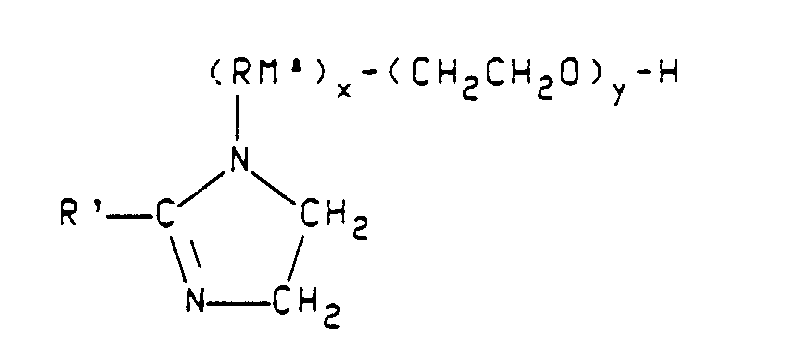
- the resulting product is of the from wherein R and R' (the residue of the fatty acid) are as defined above, M' is the residue from the -MH group after removal of the H where -MH is -OH or -SH or after removal of one of the H's where -MH is -NH 2 , or where the resulting imidazole from reaction of the diamine and fatty acid is ethoxylated, is N(CH 2 CH 2 O) y -H, most preferably -O-, x is O or 1 and y is an integer from zero to about thirty selected such that the total number of ethoxy units in the 1-substituent is from one to about thirty (preferably two to about eighteen), depending on the number necessary to render the imidazoline water-soluble.
- the phosphate ester is such as those described in, for example, U.S. Patent No. 4,339,349 to Martin (a present co-inventor) et al. or U.S. Patent No. 3,846,071 to Redmore.
- the phosphate ester may be prepared by reacting an ethoxylated alcohol with polyphosphoric acid or with phosphoric anhydride.
- the first step may involve ethoxylating an alcohol.
- the alcohol is environmentally compatible and so is one that is non-toxic to aquatic life in the medium to be treated and biodegradable and can be made water-soluble upon ethoxylation.
- a C 2 to C 30 preferably a C 4 to C 20 , and even more preferably, a C 5 to C 15 , alcohol is practical.
- the alcohol should be generally straight chain, meaning little or, preferably, no branching, in order to afford favorable biodegradability.
- each carbon atom of the alcohol should have at least one hydrogen to provide superior biodegradability.
- Alfol 8-10 (a mixture of C 8 to C 10 alcohols) has been found to be especially suitable.
- the alcohol may be ethoxylated by standard techniques.
- the alcohol may be heated with a base or amine catalyst to about 100 to about 150°C, depending on the catalyst, and ethylene oxide added thereto.
- the resulting ethoxylated alcohol is of the form R''O-(CH 2 CH 2 O) z H, wherein R'' is a substituted or unsubstituted alkyl, aryl or aralkyl group of from about two to about thirty, preferably from about four to about twenty, more preferably from about five to about fifteen, carbons.
- R'' is an alkyl group, especially an unsubstituted alkyl group of from about two to about thirty, preferably from about four to about twenty, more preferably from about five to about fifteen, carbons. As noted, it is optimal that each carbon of R'' should have at least one hydrogen bonded thereto.
- the relative proportion of ethylene oxide to alcohol depends on the degree of ethoxylation desired to provide sufficient water-solubility and biodegradability. Generally, the heavier the alcohol, the greater the degree of ethoxylation required. Although any degree of ethoxylation is feasible, economic practicalities suggest that it is not desirable that more than about ten moles of ethylene oxide per mole of alcohol be used. Therefore, z is preferably an integer from one to about ten, more preferably from about two to about five, especially about two to about three.
- a phosphate ester then is prepared from the ethoxylated alcohol.
- Techniques for preparation of phosphate esters are well known. See, for example, U.S. Patent No. 4,722,805 to Martin (a present co-inventor) and U.S. Patent No. 3,846,071 to Redmore, which are incorporated herein by reference.
- the ester may be prepared by reacting the ethoxylated alcohol with polyphosphoric acid at a temperature of from about 75 to about 100°C to form a mono-ester.
- the phosphate ester may be prepared by a reaction of the ethoxylated alcohol with phosphoric anhydride to form a di-ester/mono-ester mixture.
- the imidazoline may be used without the phosphate ester for corrosion inhibition in sour systems, but it has been found that a blend of the imidazoline and phosphate ester yields improved corrosion inhibition in such systems. Sweet systems should be treated with the blend.
- the weight ratio of imidazoline to phosphate ester is preferably about 1:1 to about 4:1, most preferably about 2:1.
- the blend (as well as imidazoline employed without phosphate ester) may also incorporate a solvent, particularly an environmentally compatible solvent such as water, ethylene glycol or propylene glycol.
- a solvent particularly an environmentally compatible solvent such as water, ethylene glycol or propylene glycol.
- the blends have been found generally to be water-soluble, but some compositions, especially those of a low degree of ethoxylation, have been found to be merely water-dispersible. In such cases, inclusion of solvents such as isopropyl alcohol may result in a clear solution, but environmental considerations render use of isopropyl alcohol undesirable.
- the solvent may make up from about a third to about two thirds, preferably about a half, by weight of the additive.
- the weight ratio of actives i.e., combination of imidazoline and phosphate ester if a blend is used; imidazoline if no phosphate ester is present
- solvent is from about 2:1 to about 1:2, preferably about 1:1.
- each component of the additive composition should be selected with consideration for environmental compatibility.
- the imidazoline and the diamine and fatty acid from which it is formed, the phosphate ester and the alcohol from which it is formed, and the solvent should be nontoxic to aquatic life in the environment in which it is to be employed.
- this consideration has dictated preferred aspects of these various components and reactants, with particular concern for not only non-toxicity, but also water-solubility, biodegradability, and so forth.
- the additive composition be free of toxic components (components toxic to the aquatic life in the medium in which it is to be employed) and components that are insoluble in water or are environmentally harmful substances that are not biodegradable.
- the additive composition may be employed by simple addition to the medium to be treated.
- Such media are aqueous and include sea water as, for example, in off-shore oil production.
- the effective concentration of inhibitor actives (that is, the concentration at which corrosion inhibition is provided) is in the range of from about 10 to about 1,000 ppm by weight.
- greater concentrations may be employed, but may be wasteful over-dosage or, at very high dosages, might raise the environmental impact to significant levels. Regardless, rapid dilution takes place quickly in applications in such media as overboard brine from off-shore oil production (as in the North Sea), leading to even less environmentally significant dosages.
- Inhibitor A a blend of a quaternary ammonium compound and an acetate salt of an imidazoline, which is a commercial corrosion inhibitor sold by Petrolite and is identified herein as Inhibitor X.
- the blend of this invention tested was a 1:2:6 by weight blend of (1) a phosphate ester derived from reaction of polyphosphoric acid and Alfol 8-10 ethoxylated with 3 moles of ethylene oxide per mole Alfol 8-10, (2) an imidazoline that corresponds to the formula wherein R' is the residue from oleic or linoleic acid (the imidazoline was derived from a mix of oleic and linoleic acid), and (3) propylene glycol plus water.
- the toxicity (EC 50 ) of Inhibitor X was measured as 0.18 ppm versus 1 to 10 for Inhibitor A.
- the biodegradability (BOD-28) of Inhibitor X was found to be 28% versus 100% for Inhibitor A. In fact, for Inhibitor A 100% degradation was found by thirteen days. Partitioning of Inhibitor X was determined to be about 2 versus about 0 for Inhibitor A.
- the solvent evaporation factor (YL) of Inhibitor X was measured at 2 versus 0 for Inhibitor A.
- the flash point of Inhibitor X was found to be 27°C and over 93°C for Inhibitor A.
- Kettle tests and loop tests were conducted.
- various amounts of inhibitors were added to aqueous solutions of 3% sodium chloride, which were then stirred mildly for 24 hours at room temperature.
- "Sweet” test solutions were sparged continuously with carbon dioxide.
- "Sour” test solutions were sparged with carbon dioxide and then enough Na 2 S•H 2 O was added to give a hydrogen sulfide concentration of 50 ppm and a pH of 5-5. The sour solutions were then sealed.
- AISI-type 1020 steel corrosion coupons (9 cm 2 ) were weighed, added to the solutions before the stirring, removed from the solutions at the completion of the stirring, cleaned and reweighed. Corrosion rates were calculated based on the weight loss.
Landscapes
- Chemical & Material Sciences (AREA)
- Engineering & Computer Science (AREA)
- Materials Engineering (AREA)
- Organic Chemistry (AREA)
- Mechanical Engineering (AREA)
- Metallurgy (AREA)
- Life Sciences & Earth Sciences (AREA)
- General Life Sciences & Earth Sciences (AREA)
- Preventing Corrosion Or Incrustation Of Metals (AREA)
- Biological Depolymerization Polymers (AREA)
Description


| Inhibitor | Dose | Sweet | Sour |
| None | - | 1.016 (40) | 1.143 (45) |
| Inhibitor X | 250 | 0.16 (6.3) | 0.061 (2.4) |
| Inhibitor X | 50 | 0.30 (12) | 0.21 (8.2) |
| Inhibitor A | 250 | 0.15 (6.1) | 0.046 (1.8) |
| Inhibitor A | 50 | 0.23 (9) | 0.074 (2.9) |
| Inhibitor A | 25 | 0.36 (14) | 0.12 (4.8) |
| Inhibitor | Dose | 47 Pa | 79 Pa | 175 Pa |
| None | - | 1,000 | 1,100 | 2,100 |
| Inhibitor X | 250 | 0.41 (16) | 0.53 (21) | 0.36 (14) |
| Inhibitor X | 25 | 1.20 (49) | 1.50 (58) | 1.80 (69) |
| Inhibitor A | 50 | 0.46 (18) | 5.60 (22) | 0.69 (27) |
| Inhibitor A | 25 | 0.48 (19) | 0.79 (31) | 0.61 (24) |

| Inhibitor | Dose | Corrosion Rate | |
| Sweet | Sour | ||
| None | - | 1.00 (40) | 1.1 (45) |
| Oleyl sarcosine | 250 | 0.58 (23) | 0.64 (25) |
| Sodium lauryl sarcosine (30% solution) | 700 | 0.43 (17) | 0.36 (14) |
| Sodium lauryl sarcosine + Betaine | 250 | 0.33 (13) | 0.14 (5.7) |
| Coco-benzo-quat. + pyridine + phosphate ester | 250 | 0.46 (18) | 0.058 (2.3) |
| Coco-benzo-quat. + pyridine + phosphate ester | 60 | 0.28 (11) | 0.08 (3.2) |
| OEX-6673-4 from Westvaco | 250 | 0.21 (8.4) | 0.17 (4.6) |
| Unethoxylated imidazoline | 250 | 0.36 (14) | 0.30 (12) |
| Inhibitor B | 250 | 0.30 (9) | 0.079 (3.1) |
| Inhibitor C | 250 | 0.28 (11) | 0.13 (5) |
| Inhibitor D | 250 | 0.28 (11) | 0.13 (5) |
| Inhibitor E | 250 | 0.24 (9.6) | 0.13 (5) |
| Inhibitor E | 100 | 0.18 (7) | 0.079 (3.1) |
| Inhibitor F | 250 | 0.19 (7.4) | 0.061 (2.4) |
| Inhibitor G | 350 | 0.14 (5.5) | 0.094 (3.7) |
| Inhibitor G | 70 | 0.24 (9.4) | 0.12 (4.8) |
| Inhibitor G | 35 | 0.23 (9) | 0.28 (11) |
| Inhibitor H | 250 | 0.15 (6.1) | 0.046 (1.8) |
| Inhibitor I | 250 | 0.18 (7) | 0.14 (5.5) |
| Inhibitor I | 50 | 0.21 (8.3) | 0.17 (6.6) |
| Inhibitor J | 300 | 0.15 (5.9) | 0.18 (7) |
| Inhibitor J | 1,000 | 0.16 (6.3) | N/A |
| Inhibitor K | 400 | 0.17 (6.6) | 0.49 (4.4) |
| Inhibitor L | 250 | 0.15 (5.8) | 0.066 (2.6) |
| Inhibitor M | 250 | 0.19 (7.4) | 0.066 (2.6) |
| Inhibitor N | 250 | 0.15 (6.1) | 0.046 (1.8) |

Claims (18)
- A method for inhibiting corrosion in an aqueous medium containing at least one of Skeletonema costatum, fish and algae. the method comprising incorporating into the medium an amount of a water-soluble corrosion inhibitor sufficient to inhibit corrosion, the corrosion inhibitor comprising a 1,2-substituted imidazoline, the 1-substituent having from one to about thirty ethoxy units and the 2-substituent being an unsaturated or polyunsaturated fatty chain of from about six to about thirty carbons and, if the medium is sweet, further comprising a phosphate ester derived from a water-soluble oxyethylated, straight chain alcohol of from two to about thirty carbons.
- A method as set forth in claim 1 wherein the medium is sour and the corrosion inhibitor further comprises a phosphate ester derived from a water-soluble oxyethylated, straight chain alcohol of from two to about thirty carbons.
- A method as set forth in claim 1 or 2 wherein the imidazoline and the phosphate ester are present in the corrosion inhibitor in a weight ratio of from about 1:1 to about 4:1.
- A method as set forth in any preceding claim wherein the corrosion inhibitor further comprises a solvent selected from water, ethylene glycol and propylene glycol.
- A method as set forth in any preceding claim wherein the fatty chain is generally straight and has from about twelve to about twenty carbons.
- A method as set forth in claim 5 wherein the fatty chain is the residue from a fatty acid selected from oleic acid, linoleic acid and elaideic acid.
- A method as set forth in any preceding claim wherein the 1-substituent has from two to about eighteen ethoxy units.
- A method as set forth in any preceding claim except claim 2 wherein the medium is sweet.
- A method as set forth in any preceding claim wherein the corrosion inhibitor has an EC50 for Skeletonema costatum greater than 1 ppm by weight.
- A method as set forth in any preceding claim wherein the imidazoline is of the formula:wherein R is a divalent organic moiety, M' is selected from -O-, N(CH2CH2O)y-H, and -S-, x is 0 or 1, y is or each y is independently an integer from 0 to about 30 such that the group - (RM')x-(CH2 CH2O)y-H contains a total of 1 to about 30 ethoxy units and R' is an unsaturated or polyunsaturated fatty chain of from about six to about thirty carbons.

- A method as set forth in claim 10 wherein x is 1 and R is selected from alkylenes, arylenes and aralkylenes.
- A method is set forth in claim 11 wherein R is ethylene, isopropylene or -(CH2CH2O)n (CH2CH2)-, wherein n is an integer from one to about thirty.
- A method as set forth in claim 12 wherein R is ethylene or -(CH2CH2O)n(CH2CH2)-, wherein n is an integer from one to about seventeen.
- A method as set forth is any of claims 10 to 13 wherein the y is or each y is independently from two to about eighteen.
- A water-soluble, biodegradable corrosion inhibitor composition comprising (1) a 1,2-substituted imidazoline, the 1-substituent having from one to about thirty ethoxy units and the 2-substituent being an unsaturated or polyunsaturated fatty chain of from about six to about thirty carbons, (2) a phosphate ester derived from a water-soluble oxyethylated, straight chain alcohol of from two to about thirty carbons, and (3) a solvent selected from water, ethylene glycol and propylene glycol.
- A corrosion inhibitor as set forth in claim 15 wherein the corrosion inhibitor has an EC50 for Skeletonema costatum greater than 1 ppm by weight.
- A composition as set forth in claim 15 or 16 wherein the imidazoline is the formula:wherein R is a divalent organic moiety M' selected from -O-, N(CH2CH2O)y-H, and -S-, x is 0 or 1, y is an integer from 0 to about 30 such that the group - (RM')x-(CH2CH2O)y, -H contains a total of 1 to about 30 ethoxy units and R' is an unsaturated or polyunsaturated fatty chain of from about six to about thirty carbons.
- A composition as set forth in any of claims 15 to 17 wherein R is ethylene or -(CH2CH2O)n(CH2CH2)-, wherein n is an integer from one to about seventeen.
Applications Claiming Priority (2)
| Application Number | Priority Date | Filing Date | Title |
|---|---|---|---|
| US146900 | 1988-01-22 | ||
| US08/146,900 US5393464A (en) | 1993-11-02 | 1993-11-02 | Biodegradable corrosion inhibitors of low toxicity |
Publications (2)
| Publication Number | Publication Date |
|---|---|
| EP0651074A1 EP0651074A1 (en) | 1995-05-03 |
| EP0651074B1 true EP0651074B1 (en) | 1998-07-08 |
Family
ID=22519484
Family Applications (1)
| Application Number | Title | Priority Date | Filing Date |
|---|---|---|---|
| EP94307422A Expired - Lifetime EP0651074B1 (en) | 1993-11-02 | 1994-10-10 | Biodegradable corrosion inhibitors of low toxicity |
Country Status (6)
| Country | Link |
|---|---|
| US (2) | US5393464A (en) |
| EP (1) | EP0651074B1 (en) |
| JP (1) | JP2902563B2 (en) |
| CA (1) | CA2117737C (en) |
| DE (1) | DE69411499T2 (en) |
| NO (1) | NO307614B1 (en) |
Families Citing this family (27)
| Publication number | Priority date | Publication date | Assignee | Title |
|---|---|---|---|---|
| FR2738018B1 (en) * | 1995-08-24 | 1997-09-26 | Ceca Sa | INHIBITION OF CARBON CORROSION OF STEEL BY N-ALCOYL-SARCOSINES |
| US6077460A (en) * | 1996-07-17 | 2000-06-20 | Basf Aktiengesellschaft | Corrosion inhibition |
| DE19649285A1 (en) | 1996-11-28 | 1998-06-04 | Henkel Kgaa | Method of protecting metal surfaces against corrosion in liquid or gaseous media |
| RU2122046C1 (en) * | 1997-12-16 | 1998-11-20 | Общество с ограниченной ответственностью "Наука и новые технологии" | Composition for inhibiting corrosion into hydrogen sulfide in oxygen-containing oil field media |
| US6338819B1 (en) | 1999-02-16 | 2002-01-15 | Baker Hughes Incorporated | Combinations of imidazolines and wetting agents as environmentally acceptable corrosion inhibitors |
| DE19930683B4 (en) * | 1999-07-02 | 2005-02-10 | Clariant Gmbh | Corrosion inhibitors with improved water solubility |
| US6866797B1 (en) * | 2000-08-03 | 2005-03-15 | Bj Services Company | Corrosion inhibitors and methods of use |
| DE10155665A1 (en) * | 2001-11-13 | 2003-05-22 | Cognis Deutschland Gmbh | Process for protecting metal surfaces against corrosion in liquid or gaseous media II |
| ITVA20020009A1 (en) * | 2002-02-01 | 2003-08-01 | Lamberti Spa | CORROSION INHIBITORS FOR THE PETROLEUM INDUSTRY |
| US6800594B2 (en) * | 2003-01-24 | 2004-10-05 | Cortec Corporation | Corrosion inhibitor barrier for ferrous and non-ferrous metals |
| CA2551084C (en) | 2003-12-02 | 2014-07-15 | Alfred Knox Harpole | Rackable collapsible stackable unit |
| EP1580302A1 (en) | 2004-03-23 | 2005-09-28 | JohnsonDiversey Inc. | Composition and process for cleaning and corrosion inhibition of surfaces of aluminum or colored metals and alloys thereof under alkaline conditions |
| EP1888815B1 (en) | 2005-05-13 | 2013-09-18 | Anil Kelkar | Organic compound and process for inhibiting corrosion on metallic surfaces |
| US7857871B2 (en) | 2005-09-06 | 2010-12-28 | Baker Hughes Incorporated | Method of reducing paraffin deposition with imidazolines |
| FR2935972B1 (en) * | 2008-09-18 | 2010-12-03 | Ceca Sa | LOW TOXIC AND BIODEGRADABLE CORROSION INHIBITORS. |
| DE102010010408A1 (en) | 2010-03-05 | 2011-09-08 | Clariant International Limited | Biodegradable, frost-proof heat transfer fluid, its use in near-surface, geothermal plants, and a concentrate for its production |
| MX2010006074A (en) | 2010-06-03 | 2011-12-16 | Mexicano Inst Petrol | Amino and imino propionic acids, process of preparation and use. |
| GB201018916D0 (en) * | 2010-11-09 | 2010-12-22 | Champion Technologies Ltd | Corrosion inhibition |
| US8895482B2 (en) | 2011-08-05 | 2014-11-25 | Smart Chemical Services, Lp | Constraining pyrite activity in shale |
| CN103013484B (en) * | 2012-08-09 | 2014-11-26 | 江苏科技大学 | Corrosion inhibitor for controlling carbon dioxide and hypersalinity corrosion |
| MX338862B (en) | 2012-12-05 | 2016-04-28 | Mexicano Inst Petrol | Foaming composition with wettability modifying and corrosion inhibitory properties for high temperature and ultra-high salinity. |
| CN102965149B (en) * | 2012-12-11 | 2014-06-25 | 江苏汉光实业股份有限公司 | Preparation method of oil soluble corrosion inhibitor |
| EP2992065A1 (en) | 2013-05-02 | 2016-03-09 | Instytut Nafty i Gazu Panstwowy Instytut Badawczy | Corrosion inhibitor for protection of crude oil extraction equipment, crude oil pipelines, and crude oil tanks as well as the method of its production |
| EP3143096B1 (en) * | 2014-05-16 | 2022-10-12 | Halliburton Energy Services, Inc. | Tagged corrosion inhibitors for use in subterranean operations |
| US10611951B2 (en) * | 2014-12-11 | 2020-04-07 | Clariant International Ltd. | Liquid inhibitor composition and a method for its preparation and application as a heavy brine corrosion control |
| US10323327B2 (en) | 2017-05-19 | 2019-06-18 | King Fahd University Of Petroleum And Minerals | Composition and methods for inhibition of metal corrosion for use in the oil and gas industry |
| CN110318056B (en) * | 2019-05-24 | 2021-03-30 | 清华大学天津高端装备研究院 | A kind of water-based metal galvanic corrosion inhibitor and preparation method thereof |
Family Cites Families (31)
| Publication number | Priority date | Publication date | Assignee | Title |
|---|---|---|---|---|
| US3172854A (en) * | 1965-03-09 | Corrosion inhibition process | ||
| US2468163A (en) * | 1948-01-10 | 1949-04-26 | Petrolite Corp | Processes for preventing corrosion and corrosion inhibitors |
| DE1103713B (en) * | 1955-09-27 | 1961-03-30 | Nalco Chemical Co | Anti-corrosive agents |
| US2846405A (en) * | 1956-03-26 | 1958-08-05 | Cities Service Res & Dev Co | Composition for and method of inhibiting corrosion of metals |
| FR1158594A (en) * | 1956-09-19 | 1958-06-17 | Exxon Standard Sa | Process for reducing corrosion in equipment containing crude oil or hydrocarbons and water |
| US2957003A (en) * | 1958-09-02 | 1960-10-18 | Nalco Chemical Co | Imidazolines and imidazolinium salts |
| US3195332A (en) * | 1961-05-08 | 1965-07-20 | Atlas Chem Ind | Aluminum hot rolling processes using aqueous lubricant compositions |
| US3133787A (en) * | 1962-09-04 | 1964-05-19 | Socony Mobil Oil Co Inc | Corrosion inhibition |
| US3628926A (en) * | 1968-12-19 | 1971-12-21 | Texaco Inc | Cyclic imines as biocides in petroleum products |
| US3846071A (en) * | 1969-02-12 | 1974-11-05 | Petrolite Corp | Process of inhibiting corrosion by treatment with phosphate-cyclic amidine salts |
| US3836462A (en) * | 1969-04-02 | 1974-09-17 | Marathon Oil Co | Amine/phosphate composition useful as corrosion and scale inhibitor |
| US3620974A (en) * | 1969-09-11 | 1971-11-16 | Nalco Chemical Co | Scale inhibition |
| US4051029A (en) * | 1972-07-17 | 1977-09-27 | Petrolite Corporation | Process of inhibiting scale formation with mixtures of thio-, oxygen or thio-oxygen phosphates and pyrophosphates |
| US4042323A (en) * | 1972-07-17 | 1977-08-16 | Petrolite Corporation | Process of inhibiting corrosion of metal in an aqueous environment with mixtures of thio-, oxygen and thio- oxygen phosphates and pyrophosphates |
| US3909447A (en) * | 1972-07-17 | 1975-09-30 | Petrolite Corp | Mixtures of thiophosphates, oxygen phosphates and pyrophosphates |
| US4066398A (en) * | 1973-04-13 | 1978-01-03 | Chemed Corporation | Corrosion inhibition |
| US4169800A (en) * | 1977-12-02 | 1979-10-02 | Fmc Corporation | Turbine lubricant |
| US4311662A (en) * | 1978-02-13 | 1982-01-19 | Petrolite Corporation | Corrosion inhibitor for highly oxygenated systems |
| US4339349A (en) * | 1980-02-11 | 1982-07-13 | Petrolite Corporation | Corrosion inhibitors for limited oxygen systems |
| GB2104897B (en) * | 1981-08-18 | 1985-01-30 | Swan And Co Limited Thomas | Corrosion inhibitors |
| US4511480A (en) * | 1983-07-20 | 1985-04-16 | Petrolite Corporation | Corrosion inhibition in deep gas wells by phosphate esters of poly-oxyalkylated thiols |
| AU2584884A (en) * | 1983-09-16 | 1985-03-21 | Bankamerica Corp. | Lubricant for use with alcoholic fuels |
| US4722805A (en) * | 1984-09-11 | 1988-02-02 | Petrolite Corporation | Multifunctional corrosion inhibitors |
| US4584021A (en) * | 1984-12-07 | 1986-04-22 | E. I. Du Pont De Nemours And Company | Aerosol corrosion inhibitors |
| AU5224386A (en) * | 1985-02-01 | 1986-08-07 | Bankamerica Corp. | Lubricant for alcohol fuel engines |
| US4604226A (en) * | 1985-03-22 | 1986-08-05 | E. I. Du Pont De Nemours And Company | Aerosol corrosion inhibitors |
| US4636256A (en) * | 1985-07-02 | 1987-01-13 | Texaco Inc. | Corrosion inhibiting system containing alkoxylated amines |
| US4687590A (en) * | 1985-11-01 | 1987-08-18 | First Brands Corporation | Oil-in-alcohol microemulsion containing oil-soluble corrosion inhibitor in antifreeze |
| DE3775685D1 (en) * | 1986-09-02 | 1992-02-13 | Ciba Geigy Ag | CORROSION PROTECTIVE. |
| US4945992A (en) * | 1986-12-22 | 1990-08-07 | Sacco Frank J | Process for producing or cleaning high pressure water injection wells |
| EP0567212B1 (en) * | 1992-04-21 | 2003-01-08 | Baker Hughes Incorporated | The reaction product of nitrogen bases and phosphate esters as corrosion inhibitors |
-
1993
- 1993-11-02 US US08/146,900 patent/US5393464A/en not_active Expired - Fee Related
-
1994
- 1994-10-07 CA CA002117737A patent/CA2117737C/en not_active Expired - Fee Related
- 1994-10-10 DE DE69411499T patent/DE69411499T2/en not_active Expired - Fee Related
- 1994-10-10 EP EP94307422A patent/EP0651074B1/en not_active Expired - Lifetime
- 1994-11-01 JP JP6290361A patent/JP2902563B2/en not_active Expired - Lifetime
- 1994-11-01 NO NO944152A patent/NO307614B1/en not_active IP Right Cessation
-
1995
- 1995-12-06 US US08/569,372 patent/US5785895A/en not_active Expired - Lifetime
Also Published As
| Publication number | Publication date |
|---|---|
| CA2117737C (en) | 2000-04-18 |
| NO944152D0 (en) | 1994-11-01 |
| US5785895A (en) | 1998-07-28 |
| CA2117737A1 (en) | 1995-05-03 |
| JPH07188952A (en) | 1995-07-25 |
| US5393464A (en) | 1995-02-28 |
| NO307614B1 (en) | 2000-05-02 |
| NO944152L (en) | 1995-05-03 |
| DE69411499T2 (en) | 1999-05-27 |
| JP2902563B2 (en) | 1999-06-07 |
| EP0651074A1 (en) | 1995-05-03 |
| DE69411499D1 (en) | 1998-08-13 |
Similar Documents
| Publication | Publication Date | Title |
|---|---|---|
| US5393464A (en) | Biodegradable corrosion inhibitors of low toxicity | |
| US8833450B2 (en) | Nitrogen containing compounds as corrosion inhibitors | |
| EP2429984B1 (en) | Quaternary ammonium corrosion inhibitor | |
| US5611992A (en) | Corrosion inhibitor blends with phosphate esters | |
| US20060062753A1 (en) | Polymeric quaternary ammonium salts useful as corrosion inhibitors and biocides | |
| US6338819B1 (en) | Combinations of imidazolines and wetting agents as environmentally acceptable corrosion inhibitors | |
| US20110186299A1 (en) | Low-Toxicity Biodegradable Corrosion Inhibitors | |
| CA1203527A (en) | Functional fluid | |
| US6261346B1 (en) | Method for protecting metal surfaces against corrosion in liquid or gaseous media | |
| US4640818A (en) | Corrosion inhibition of metals in water systems using aminophosphonic acid derivatives in combination with manganese | |
| AU3947099A (en) | Biodegradable corrosion inhibitors | |
| EP0567212B1 (en) | The reaction product of nitrogen bases and phosphate esters as corrosion inhibitors | |
| US4499006A (en) | Corrosion inhibitors | |
| US3962122A (en) | Polyamide corrosion inhibitor | |
| EP1069147A2 (en) | Corrosion inhibitor with improved water solubility | |
| US4299725A (en) | Aqueous media of decreased corrosiveness for iron-containing metals | |
| EP0239770A1 (en) | Adducts of propargyl alcohol and their use as corrosion inhibitors in acidizing systems | |
| US4683081A (en) | Aqueous corrosion inhibitor compositions of a half-amide and a dicarboxylic acid amine salt | |
| US4867888A (en) | Corrosion inhibiting system containing alkoxylated alkylphenol amines | |
| EP1333108A2 (en) | Corrosion inhibitors for the petroleum industry | |
| US4722812A (en) | Salts of alkenylsuccinic acid monoamides | |
| KR890701481A (en) | How to treat an aqueous system to suppress corrosion and scale formation | |
| US4540508A (en) | Alkylene phosphonic acid scale inhibitor compositions | |
| US4902443A (en) | Dicarboxylic acid mono-(2-hydroxydodecyl)-esters, their salts and their use as corrosion inhibitors in aqueous systems | |
| KR20060013527A (en) | Esters of phosphorus-oxyacids, esters containing alkoxy groups and use as corrosion inhibitors and flame retardants |
Legal Events
| Date | Code | Title | Description |
|---|---|---|---|
| PUAI | Public reference made under article 153(3) epc to a published international application that has entered the european phase |
Free format text: ORIGINAL CODE: 0009012 |
|
| AK | Designated contracting states |
Kind code of ref document: A1 Designated state(s): DE GB NL |
|
| 17P | Request for examination filed |
Effective date: 19951016 |
|
| 17Q | First examination report despatched |
Effective date: 19951117 |
|
| GRAG | Despatch of communication of intention to grant |
Free format text: ORIGINAL CODE: EPIDOS AGRA |
|
| GRAG | Despatch of communication of intention to grant |
Free format text: ORIGINAL CODE: EPIDOS AGRA |
|
| GRAH | Despatch of communication of intention to grant a patent |
Free format text: ORIGINAL CODE: EPIDOS IGRA |
|
| GRAH | Despatch of communication of intention to grant a patent |
Free format text: ORIGINAL CODE: EPIDOS IGRA |
|
| GRAA | (expected) grant |
Free format text: ORIGINAL CODE: 0009210 |
|
| AK | Designated contracting states |
Kind code of ref document: B1 Designated state(s): DE GB NL |
|
| REF | Corresponds to: |
Ref document number: 69411499 Country of ref document: DE Date of ref document: 19980813 |
|
| RAP2 | Party data changed (patent owner data changed or rights of a patent transferred) |
Owner name: BAKER HUGHES INCORPORATED |
|
| NLT2 | Nl: modifications (of names), taken from the european patent patent bulletin |
Owner name: BAKER HUGHES INCORPORATED |
|
| NLXE | Nl: other communications concerning ep-patents (part 3 heading xe) |
Free format text: PAT. BUL. 12/98 PAGE 1722: CORR.: BAKER HUGHES INCORPORATED |
|
| PLBE | No opposition filed within time limit |
Free format text: ORIGINAL CODE: 0009261 |
|
| STAA | Information on the status of an ep patent application or granted ep patent |
Free format text: STATUS: NO OPPOSITION FILED WITHIN TIME LIMIT |
|
| 26N | No opposition filed | ||
| REG | Reference to a national code |
Ref country code: GB Ref legal event code: IF02 |
|
| PGFP | Annual fee paid to national office [announced via postgrant information from national office to epo] |
Ref country code: NL Payment date: 20081024 Year of fee payment: 15 |
|
| PGFP | Annual fee paid to national office [announced via postgrant information from national office to epo] |
Ref country code: DE Payment date: 20081201 Year of fee payment: 15 |
|
| PGFP | Annual fee paid to national office [announced via postgrant information from national office to epo] |
Ref country code: GB Payment date: 20081029 Year of fee payment: 15 |
|
| REG | Reference to a national code |
Ref country code: NL Ref legal event code: V1 Effective date: 20100501 |
|
| PG25 | Lapsed in a contracting state [announced via postgrant information from national office to epo] |
Ref country code: NL Free format text: LAPSE BECAUSE OF NON-PAYMENT OF DUE FEES Effective date: 20100501 Ref country code: DE Free format text: LAPSE BECAUSE OF NON-PAYMENT OF DUE FEES Effective date: 20100501 |
|
| PG25 | Lapsed in a contracting state [announced via postgrant information from national office to epo] |
Ref country code: GB Free format text: LAPSE BECAUSE OF NON-PAYMENT OF DUE FEES Effective date: 20091010 |