EP0650733B1 - Live attenuated in ovo vaccine - Google Patents
Live attenuated in ovo vaccine Download PDFInfo
- Publication number
- EP0650733B1 EP0650733B1 EP94117270A EP94117270A EP0650733B1 EP 0650733 B1 EP0650733 B1 EP 0650733B1 EP 94117270 A EP94117270 A EP 94117270A EP 94117270 A EP94117270 A EP 94117270A EP 0650733 B1 EP0650733 B1 EP 0650733B1
- Authority
- EP
- European Patent Office
- Prior art keywords
- salmonella
- microorganism
- stm
- vaccine
- attenuated
- Prior art date
- Legal status (The legal status is an assumption and is not a legal conclusion. Google has not performed a legal analysis and makes no representation as to the accuracy of the status listed.)
- Expired - Lifetime
Links
- 229960005486 vaccine Drugs 0.000 title claims abstract description 62
- 230000002238 attenuated effect Effects 0.000 title claims description 46
- 244000005700 microbiome Species 0.000 claims abstract description 116
- 241000271566 Aves Species 0.000 claims abstract description 80
- 230000012447 hatching Effects 0.000 claims abstract description 32
- 230000000890 antigenic effect Effects 0.000 claims abstract description 24
- 230000001939 inductive effect Effects 0.000 claims abstract description 17
- 241000700605 Viruses Species 0.000 claims abstract description 14
- 241000287828 Gallus gallus Species 0.000 claims description 80
- 235000013330 chicken meat Nutrition 0.000 claims description 75
- 241000293869 Salmonella enterica subsp. enterica serovar Typhimurium Species 0.000 claims description 69
- 241000607142 Salmonella Species 0.000 claims description 55
- 210000004712 air sac Anatomy 0.000 claims description 52
- 241001354013 Salmonella enterica subsp. enterica serovar Enteritidis Species 0.000 claims description 30
- 210000001161 mammalian embryo Anatomy 0.000 claims description 28
- 239000000427 antigen Substances 0.000 claims description 22
- 108091007433 antigens Proteins 0.000 claims description 22
- 102000036639 antigens Human genes 0.000 claims description 22
- 208000015181 infectious disease Diseases 0.000 claims description 22
- 230000028993 immune response Effects 0.000 claims description 21
- 239000003102 growth factor Substances 0.000 claims description 16
- 230000001717 pathogenic effect Effects 0.000 claims description 14
- 241000894007 species Species 0.000 claims description 14
- 239000003795 chemical substances by application Substances 0.000 claims description 9
- 201000010099 disease Diseases 0.000 claims description 9
- 208000037265 diseases, disorders, signs and symptoms Diseases 0.000 claims description 9
- 230000002458 infectious effect Effects 0.000 claims description 9
- 229940031348 multivalent vaccine Drugs 0.000 claims description 8
- 231100000676 disease causative agent Toxicity 0.000 claims description 6
- 244000000010 microbial pathogen Species 0.000 claims description 6
- 238000002360 preparation method Methods 0.000 claims description 6
- WTFXTQVDAKGDEY-UHFFFAOYSA-N (-)-chorismic acid Natural products OC1C=CC(C(O)=O)=CC1OC(=C)C(O)=O WTFXTQVDAKGDEY-UHFFFAOYSA-N 0.000 claims description 5
- 241000272517 Anseriformes Species 0.000 claims description 5
- 241000286209 Phasianidae Species 0.000 claims description 5
- WTFXTQVDAKGDEY-HTQZYQBOSA-N chorismic acid Chemical compound O[C@@H]1C=CC(C(O)=O)=C[C@H]1OC(=C)C(O)=O WTFXTQVDAKGDEY-HTQZYQBOSA-N 0.000 claims description 5
- 241000223924 Eimeria Species 0.000 claims description 4
- 240000004808 Saccharomyces cerevisiae Species 0.000 claims description 4
- 241001138501 Salmonella enterica Species 0.000 claims description 4
- 241000607356 Salmonella enterica subsp. arizonae Species 0.000 claims description 4
- 241000607662 Salmonella enterica subsp. enterica serovar Abortusequi Species 0.000 claims description 4
- 241000522522 Salmonella enterica subsp. enterica serovar Abortusovis Species 0.000 claims description 4
- 241000596091 Salmonella enterica subsp. enterica serovar Anatum Species 0.000 claims description 4
- 241000592151 Salmonella enterica subsp. enterica serovar Bovismorbificans Species 0.000 claims description 4
- 241000392514 Salmonella enterica subsp. enterica serovar Dublin Species 0.000 claims description 4
- 241000607132 Salmonella enterica subsp. enterica serovar Gallinarum Species 0.000 claims description 4
- 241001355131 Salmonella enterica subsp. enterica serovar Hadar Species 0.000 claims description 4
- 241000786444 Salmonella enterica subsp. enterica serovar Havana Species 0.000 claims description 4
- 241000210647 Salmonella enterica subsp. enterica serovar Montevideo Species 0.000 claims description 4
- 241001546666 Salmonella enterica subsp. enterica serovar Newport Species 0.000 claims description 4
- 241000531795 Salmonella enterica subsp. enterica serovar Paratyphi A Species 0.000 claims description 4
- 241000577475 Salmonella enterica subsp. enterica serovar Paratyphi C Species 0.000 claims description 4
- 241000607683 Salmonella enterica subsp. enterica serovar Pullorum Species 0.000 claims description 4
- 241000204910 Salmonella enterica subsp. salamae serovar Sofia Species 0.000 claims description 4
- 244000000013 helminth Species 0.000 claims description 4
- 230000003053 immunization Effects 0.000 claims description 4
- 241000589291 Acinetobacter Species 0.000 claims description 3
- 208000027312 Bursal disease Diseases 0.000 claims description 3
- 206010008631 Cholera Diseases 0.000 claims description 3
- 208000008953 Cryptosporidiosis Diseases 0.000 claims description 3
- 206010011502 Cryptosporidiosis infection Diseases 0.000 claims description 3
- 241000588914 Enterobacter Species 0.000 claims description 3
- 241000588724 Escherichia coli Species 0.000 claims description 3
- 241000589565 Flavobacterium Species 0.000 claims description 3
- 208000002979 Influenza in Birds Diseases 0.000 claims description 3
- 241000588621 Moraxella Species 0.000 claims description 3
- 208000010359 Newcastle Disease Diseases 0.000 claims description 3
- 241000606860 Pasteurella Species 0.000 claims description 3
- 241000588769 Proteus <enterobacteria> Species 0.000 claims description 3
- 241000589516 Pseudomonas Species 0.000 claims description 3
- 241000702263 Reovirus sp. Species 0.000 claims description 3
- 241000607720 Serratia Species 0.000 claims description 3
- 241000607768 Shigella Species 0.000 claims description 3
- 206010044302 Tracheitis Diseases 0.000 claims description 3
- 208000037386 Typhoid Diseases 0.000 claims description 3
- 241000607598 Vibrio Species 0.000 claims description 3
- 241000607734 Yersinia <bacteria> Species 0.000 claims description 3
- 206010064097 avian influenza Diseases 0.000 claims description 3
- 206010006451 bronchitis Diseases 0.000 claims description 3
- 201000009837 laryngotracheitis Diseases 0.000 claims description 3
- 206010039083 rhinitis Diseases 0.000 claims description 3
- 201000008297 typhoid fever Diseases 0.000 claims description 3
- 241000701161 unidentified adenovirus Species 0.000 claims description 3
- 241000607534 Aeromonas Species 0.000 claims description 2
- 241000272201 Columbiformes Species 0.000 claims description 2
- 241000588748 Klebsiella Species 0.000 claims description 2
- 241000204031 Mycoplasma Species 0.000 claims description 2
- 230000001747 exhibiting effect Effects 0.000 claims 1
- 230000002194 synthesizing effect Effects 0.000 claims 1
- 244000144977 poultry Species 0.000 abstract description 14
- 230000036039 immunity Effects 0.000 abstract description 6
- 230000002708 enhancing effect Effects 0.000 abstract description 2
- 230000004083 survival effect Effects 0.000 abstract description 2
- 235000013601 eggs Nutrition 0.000 description 95
- 238000000034 method Methods 0.000 description 34
- 238000011081 inoculation Methods 0.000 description 32
- 210000001519 tissue Anatomy 0.000 description 30
- 238000011534 incubation Methods 0.000 description 20
- 230000035772 mutation Effects 0.000 description 20
- 230000012010 growth Effects 0.000 description 19
- 230000004044 response Effects 0.000 description 19
- 238000002255 vaccination Methods 0.000 description 17
- 238000002474 experimental method Methods 0.000 description 15
- 101150037081 aroA gene Proteins 0.000 description 14
- 235000013594 poultry meat Nutrition 0.000 description 13
- 230000010076 replication Effects 0.000 description 13
- 210000000056 organ Anatomy 0.000 description 11
- 241001167018 Aroa Species 0.000 description 10
- 101100491986 Emericella nidulans (strain FGSC A4 / ATCC 38163 / CBS 112.46 / NRRL 194 / M139) aromA gene Proteins 0.000 description 10
- 241000699670 Mus sp. Species 0.000 description 10
- 230000000694 effects Effects 0.000 description 10
- 210000001035 gastrointestinal tract Anatomy 0.000 description 10
- 108090000623 proteins and genes Proteins 0.000 description 10
- 238000012217 deletion Methods 0.000 description 9
- 230000037430 deletion Effects 0.000 description 9
- 230000002550 fecal effect Effects 0.000 description 9
- 210000004185 liver Anatomy 0.000 description 9
- 239000002609 medium Substances 0.000 description 9
- 210000004379 membrane Anatomy 0.000 description 9
- 239000012528 membrane Substances 0.000 description 9
- 238000007920 subcutaneous administration Methods 0.000 description 9
- 239000001974 tryptic soy broth Substances 0.000 description 9
- 108010050327 trypticase-soy broth Proteins 0.000 description 9
- 238000005406 washing Methods 0.000 description 9
- 206010039438 Salmonella Infections Diseases 0.000 description 8
- 239000001963 growth medium Substances 0.000 description 8
- 230000002163 immunogen Effects 0.000 description 8
- 239000002054 inoculum Substances 0.000 description 8
- 238000004519 manufacturing process Methods 0.000 description 8
- 206010039447 salmonellosis Diseases 0.000 description 8
- 230000035899 viability Effects 0.000 description 8
- 210000001325 yolk sac Anatomy 0.000 description 8
- 230000005875 antibody response Effects 0.000 description 7
- 230000006696 biosynthetic metabolic pathway Effects 0.000 description 7
- 230000037396 body weight Effects 0.000 description 7
- 229940041514 candida albicans extract Drugs 0.000 description 7
- 238000004108 freeze drying Methods 0.000 description 7
- 239000000463 material Substances 0.000 description 7
- 235000020183 skimmed milk Nutrition 0.000 description 7
- 210000000952 spleen Anatomy 0.000 description 7
- 230000026683 transduction Effects 0.000 description 7
- 238000010361 transduction Methods 0.000 description 7
- 239000012138 yeast extract Substances 0.000 description 7
- 241000894006 Bacteria Species 0.000 description 6
- PEDCQBHIVMGVHV-UHFFFAOYSA-N Glycerine Chemical compound OCC(O)CO PEDCQBHIVMGVHV-UHFFFAOYSA-N 0.000 description 6
- FAPWRFPIFSIZLT-UHFFFAOYSA-M Sodium chloride Chemical compound [Na+].[Cl-] FAPWRFPIFSIZLT-UHFFFAOYSA-M 0.000 description 6
- 210000004027 cell Anatomy 0.000 description 6
- 230000034994 death Effects 0.000 description 6
- 231100000517 death Toxicity 0.000 description 6
- 239000002158 endotoxin Substances 0.000 description 6
- 238000002347 injection Methods 0.000 description 6
- 239000007924 injection Substances 0.000 description 6
- 229920006008 lipopolysaccharide Polymers 0.000 description 6
- 239000000203 mixture Substances 0.000 description 6
- 244000052769 pathogen Species 0.000 description 6
- 239000013612 plasmid Substances 0.000 description 6
- XLYOFNOQVPJJNP-UHFFFAOYSA-N water Substances O XLYOFNOQVPJJNP-UHFFFAOYSA-N 0.000 description 6
- 241000223932 Eimeria tenella Species 0.000 description 5
- MTCFGRXMJLQNBG-UHFFFAOYSA-N Serine Natural products OCC(N)C(O)=O MTCFGRXMJLQNBG-UHFFFAOYSA-N 0.000 description 5
- 230000002411 adverse Effects 0.000 description 5
- 230000003115 biocidal effect Effects 0.000 description 5
- 235000010633 broth Nutrition 0.000 description 5
- LOKCTEFSRHRXRJ-UHFFFAOYSA-I dipotassium trisodium dihydrogen phosphate hydrogen phosphate dichloride Chemical compound P(=O)(O)(O)[O-].[K+].P(=O)(O)([O-])[O-].[Na+].[Na+].[Cl-].[K+].[Cl-].[Na+] LOKCTEFSRHRXRJ-UHFFFAOYSA-I 0.000 description 5
- 238000003780 insertion Methods 0.000 description 5
- 230000037431 insertion Effects 0.000 description 5
- 238000005259 measurement Methods 0.000 description 5
- 239000002773 nucleotide Substances 0.000 description 5
- 125000003729 nucleotide group Chemical group 0.000 description 5
- 239000002953 phosphate buffered saline Substances 0.000 description 5
- 230000004584 weight gain Effects 0.000 description 5
- 235000019786 weight gain Nutrition 0.000 description 5
- ALYNCZNDIQEVRV-UHFFFAOYSA-N 4-aminobenzoic acid Chemical compound NC1=CC=C(C(O)=O)C=C1 ALYNCZNDIQEVRV-UHFFFAOYSA-N 0.000 description 4
- 229920001817 Agar Polymers 0.000 description 4
- 238000002965 ELISA Methods 0.000 description 4
- DHMQDGOQFOQNFH-UHFFFAOYSA-N Glycine Chemical compound NCC(O)=O DHMQDGOQFOQNFH-UHFFFAOYSA-N 0.000 description 4
- 241001465754 Metazoa Species 0.000 description 4
- 102000017033 Porins Human genes 0.000 description 4
- 108010013381 Porins Proteins 0.000 description 4
- 239000008272 agar Substances 0.000 description 4
- 210000004369 blood Anatomy 0.000 description 4
- 230000001332 colony forming effect Effects 0.000 description 4
- 230000021615 conjugation Effects 0.000 description 4
- 210000003608 fece Anatomy 0.000 description 4
- 210000000936 intestine Anatomy 0.000 description 4
- 230000037361 pathway Effects 0.000 description 4
- 238000012809 post-inoculation Methods 0.000 description 4
- 239000000843 powder Substances 0.000 description 4
- 230000008569 process Effects 0.000 description 4
- 230000001681 protective effect Effects 0.000 description 4
- 101100216993 Bacillus subtilis (strain 168) aroD gene Proteins 0.000 description 3
- 239000002028 Biomass Substances 0.000 description 3
- 108010076119 Caseins Proteins 0.000 description 3
- 208000003495 Coccidiosis Diseases 0.000 description 3
- 108020004414 DNA Proteins 0.000 description 3
- 208000009701 Embryo Loss Diseases 0.000 description 3
- LFQSCWFLJHTTHZ-UHFFFAOYSA-N Ethanol Chemical compound CCO LFQSCWFLJHTTHZ-UHFFFAOYSA-N 0.000 description 3
- 241000282412 Homo Species 0.000 description 3
- 206010023076 Isosporiasis Diseases 0.000 description 3
- COLNVLDHVKWLRT-QMMMGPOBSA-N L-phenylalanine Chemical compound OC(=O)[C@@H](N)CC1=CC=CC=C1 COLNVLDHVKWLRT-QMMMGPOBSA-N 0.000 description 3
- QIVBCDIJIAJPQS-VIFPVBQESA-N L-tryptophane Chemical compound C1=CC=C2C(C[C@H](N)C(O)=O)=CNC2=C1 QIVBCDIJIAJPQS-VIFPVBQESA-N 0.000 description 3
- OUYCCCASQSFEME-QMMMGPOBSA-N L-tyrosine Chemical compound OC(=O)[C@@H](N)CC1=CC=C(O)C=C1 OUYCCCASQSFEME-QMMMGPOBSA-N 0.000 description 3
- DNIAPMSPPWPWGF-UHFFFAOYSA-N Propylene glycol Chemical compound CC(O)CO DNIAPMSPPWPWGF-UHFFFAOYSA-N 0.000 description 3
- 206010041660 Splenomegaly Diseases 0.000 description 3
- 101150090235 aroB gene Proteins 0.000 description 3
- 101150042732 aroC gene Proteins 0.000 description 3
- 101150102858 aroD gene Proteins 0.000 description 3
- 101150040872 aroE gene Proteins 0.000 description 3
- 101150108612 aroQ gene Proteins 0.000 description 3
- 125000003118 aryl group Chemical group 0.000 description 3
- 230000001580 bacterial effect Effects 0.000 description 3
- 239000005018 casein Substances 0.000 description 3
- BECPQYXYKAMYBN-UHFFFAOYSA-N casein, tech. Chemical compound NCCCCC(C(O)=O)N=C(O)C(CC(O)=O)N=C(O)C(CCC(O)=N)N=C(O)C(CC(C)C)N=C(O)C(CCC(O)=O)N=C(O)C(CC(O)=O)N=C(O)C(CCC(O)=O)N=C(O)C(C(C)O)N=C(O)C(CCC(O)=N)N=C(O)C(CCC(O)=N)N=C(O)C(CCC(O)=N)N=C(O)C(CCC(O)=O)N=C(O)C(CCC(O)=O)N=C(O)C(COP(O)(O)=O)N=C(O)C(CCC(O)=N)N=C(O)C(N)CC1=CC=CC=C1 BECPQYXYKAMYBN-UHFFFAOYSA-N 0.000 description 3
- 235000021240 caseins Nutrition 0.000 description 3
- 238000011161 development Methods 0.000 description 3
- 230000018109 developmental process Effects 0.000 description 3
- 210000002257 embryonic structure Anatomy 0.000 description 3
- 244000144992 flock Species 0.000 description 3
- 239000012530 fluid Substances 0.000 description 3
- 238000010438 heat treatment Methods 0.000 description 3
- 230000008348 humoral response Effects 0.000 description 3
- 238000002955 isolation Methods 0.000 description 3
- 235000015097 nutrients Nutrition 0.000 description 3
- 230000003287 optical effect Effects 0.000 description 3
- 229940126578 oral vaccine Drugs 0.000 description 3
- 239000000123 paper Substances 0.000 description 3
- 230000002829 reductive effect Effects 0.000 description 3
- 230000003362 replicative effect Effects 0.000 description 3
- 230000000717 retained effect Effects 0.000 description 3
- 239000000523 sample Substances 0.000 description 3
- 239000011780 sodium chloride Substances 0.000 description 3
- 238000012360 testing method Methods 0.000 description 3
- 230000009466 transformation Effects 0.000 description 3
- IJGRMHOSHXDMSA-UHFFFAOYSA-N Atomic nitrogen Chemical compound N#N IJGRMHOSHXDMSA-UHFFFAOYSA-N 0.000 description 2
- 108010000912 Egg Proteins Proteins 0.000 description 2
- 102000002322 Egg Proteins Human genes 0.000 description 2
- 241000223931 Eimeria acervulina Species 0.000 description 2
- 241000499566 Eimeria brunetti Species 0.000 description 2
- 244000309702 Eimeria hagani Species 0.000 description 2
- 241000223934 Eimeria maxima Species 0.000 description 2
- 241000179199 Eimeria mitis Species 0.000 description 2
- 241000530449 Eimeria mivati Species 0.000 description 2
- 241000499563 Eimeria necatrix Species 0.000 description 2
- 241000499544 Eimeria praecox Species 0.000 description 2
- DGMPVYSXXIOGJY-UHFFFAOYSA-N Fusaric acid Chemical compound CCCCC1=CC=C(C(O)=O)N=C1 DGMPVYSXXIOGJY-UHFFFAOYSA-N 0.000 description 2
- WQZGKKKJIJFFOK-GASJEMHNSA-N Glucose Natural products OC[C@H]1OC(O)[C@H](O)[C@@H](O)[C@@H]1O WQZGKKKJIJFFOK-GASJEMHNSA-N 0.000 description 2
- 239000004471 Glycine Substances 0.000 description 2
- 244000068988 Glycine max Species 0.000 description 2
- 235000010469 Glycine max Nutrition 0.000 description 2
- XEEYBQQBJWHFJM-UHFFFAOYSA-N Iron Chemical compound [Fe] XEEYBQQBJWHFJM-UHFFFAOYSA-N 0.000 description 2
- 208000027954 Poultry disease Diseases 0.000 description 2
- 238000007792 addition Methods 0.000 description 2
- 239000003708 ampul Substances 0.000 description 2
- 238000004458 analytical method Methods 0.000 description 2
- 230000008901 benefit Effects 0.000 description 2
- WQZGKKKJIJFFOK-VFUOTHLCSA-N beta-D-glucose Chemical compound OC[C@H]1O[C@@H](O)[C@H](O)[C@@H](O)[C@@H]1O WQZGKKKJIJFFOK-VFUOTHLCSA-N 0.000 description 2
- 230000005540 biological transmission Effects 0.000 description 2
- 230000001851 biosynthetic effect Effects 0.000 description 2
- 230000015572 biosynthetic process Effects 0.000 description 2
- 239000008280 blood Substances 0.000 description 2
- 210000004534 cecum Anatomy 0.000 description 2
- 210000003837 chick embryo Anatomy 0.000 description 2
- 210000001136 chorion Anatomy 0.000 description 2
- 230000007012 clinical effect Effects 0.000 description 2
- 239000008121 dextrose Substances 0.000 description 2
- 229910001873 dinitrogen Inorganic materials 0.000 description 2
- ZPWVASYFFYYZEW-UHFFFAOYSA-L dipotassium hydrogen phosphate Chemical compound [K+].[K+].OP([O-])([O-])=O ZPWVASYFFYYZEW-UHFFFAOYSA-L 0.000 description 2
- 229910000396 dipotassium phosphate Inorganic materials 0.000 description 2
- 235000019797 dipotassium phosphate Nutrition 0.000 description 2
- 210000003278 egg shell Anatomy 0.000 description 2
- 230000007613 environmental effect Effects 0.000 description 2
- 238000009408 flooring Methods 0.000 description 2
- 210000002216 heart Anatomy 0.000 description 2
- 210000000987 immune system Anatomy 0.000 description 2
- 239000000543 intermediate Substances 0.000 description 2
- 238000007912 intraperitoneal administration Methods 0.000 description 2
- 239000007788 liquid Substances 0.000 description 2
- 239000003550 marker Substances 0.000 description 2
- 235000012054 meals Nutrition 0.000 description 2
- 239000006151 minimal media Substances 0.000 description 2
- 230000007918 pathogenicity Effects 0.000 description 2
- 229960005190 phenylalanine Drugs 0.000 description 2
- LWIHDJKSTIGBAC-UHFFFAOYSA-K potassium phosphate Substances [K+].[K+].[K+].[O-]P([O-])([O-])=O LWIHDJKSTIGBAC-UHFFFAOYSA-K 0.000 description 2
- FPWMCUPFBRFMLH-UHFFFAOYSA-N prephenic acid Chemical compound OC1C=CC(CC(=O)C(O)=O)(C(O)=O)C=C1 FPWMCUPFBRFMLH-UHFFFAOYSA-N 0.000 description 2
- 230000005180 public health Effects 0.000 description 2
- 238000011160 research Methods 0.000 description 2
- 230000000405 serological effect Effects 0.000 description 2
- 230000004936 stimulating effect Effects 0.000 description 2
- 238000003860 storage Methods 0.000 description 2
- UCSJYZPVAKXKNQ-HZYVHMACSA-N streptomycin Chemical compound CN[C@H]1[C@H](O)[C@@H](O)[C@H](CO)O[C@H]1O[C@@H]1[C@](C=O)(O)[C@H](C)O[C@H]1O[C@@H]1[C@@H](NC(N)=N)[C@H](O)[C@@H](NC(N)=N)[C@H](O)[C@H]1O UCSJYZPVAKXKNQ-HZYVHMACSA-N 0.000 description 2
- 238000006467 substitution reaction Methods 0.000 description 2
- 238000012546 transfer Methods 0.000 description 2
- 229960004799 tryptophan Drugs 0.000 description 2
- 229960004441 tyrosine Drugs 0.000 description 2
- 239000013598 vector Substances 0.000 description 2
- 235000013343 vitamin Nutrition 0.000 description 2
- 239000011782 vitamin Substances 0.000 description 2
- 229940088594 vitamin Drugs 0.000 description 2
- 229930003231 vitamin Natural products 0.000 description 2
- MTCFGRXMJLQNBG-REOHCLBHSA-N (2S)-2-Amino-3-hydroxypropansäure Chemical compound OC[C@H](N)C(O)=O MTCFGRXMJLQNBG-REOHCLBHSA-N 0.000 description 1
- YQUVCSBJEUQKSH-UHFFFAOYSA-M 3,4-dihydroxybenzoate Chemical compound OC1=CC=C(C([O-])=O)C=C1O YQUVCSBJEUQKSH-UHFFFAOYSA-M 0.000 description 1
- ALYNCZNDIQEVRV-UHFFFAOYSA-M 4-aminobenzoate Chemical compound NC1=CC=C(C([O-])=O)C=C1 ALYNCZNDIQEVRV-UHFFFAOYSA-M 0.000 description 1
- FJKROLUGYXJWQN-UHFFFAOYSA-M 4-hydroxybenzoate Chemical compound OC1=CC=C(C([O-])=O)C=C1 FJKROLUGYXJWQN-UHFFFAOYSA-M 0.000 description 1
- PJWIPEXIFFQAQZ-PUFIMZNGSA-N 7-phospho-2-dehydro-3-deoxy-D-arabino-heptonic acid Chemical compound OP(=O)(O)OC[C@@H](O)[C@@H](O)[C@H](O)CC(=O)C(O)=O PJWIPEXIFFQAQZ-PUFIMZNGSA-N 0.000 description 1
- 206010063746 Accidental death Diseases 0.000 description 1
- RZVAJINKPMORJF-UHFFFAOYSA-N Acetaminophen Chemical compound CC(=O)NC1=CC=C(O)C=C1 RZVAJINKPMORJF-UHFFFAOYSA-N 0.000 description 1
- 241000272525 Anas platyrhynchos Species 0.000 description 1
- 239000004475 Arginine Substances 0.000 description 1
- DCXYFEDJOCDNAF-UHFFFAOYSA-N Asparagine Natural products OC(=O)C(N)CC(N)=O DCXYFEDJOCDNAF-UHFFFAOYSA-N 0.000 description 1
- 241001260012 Bursa Species 0.000 description 1
- 241000252983 Caecum Species 0.000 description 1
- LEVWYRKDKASIDU-QWWZWVQMSA-N D-cystine Chemical compound OC(=O)[C@H](N)CSSC[C@@H](N)C(O)=O LEVWYRKDKASIDU-QWWZWVQMSA-N 0.000 description 1
- NGHMDNPXVRFFGS-IUYQGCFVSA-N D-erythrose 4-phosphate Chemical compound O=C[C@H](O)[C@H](O)COP(O)(O)=O NGHMDNPXVRFFGS-IUYQGCFVSA-N 0.000 description 1
- 102000053602 DNA Human genes 0.000 description 1
- 206010059866 Drug resistance Diseases 0.000 description 1
- 108090000790 Enzymes Proteins 0.000 description 1
- 102000004190 Enzymes Human genes 0.000 description 1
- 230000005526 G1 to G0 transition Effects 0.000 description 1
- WHUUTDBJXJRKMK-UHFFFAOYSA-N Glutamic acid Natural products OC(=O)C(N)CCC(O)=O WHUUTDBJXJRKMK-UHFFFAOYSA-N 0.000 description 1
- XUJNEKJLAYXESH-REOHCLBHSA-N L-Cysteine Chemical compound SC[C@H](N)C(O)=O XUJNEKJLAYXESH-REOHCLBHSA-N 0.000 description 1
- ONIBWKKTOPOVIA-BYPYZUCNSA-N L-Proline Chemical compound OC(=O)[C@@H]1CCCN1 ONIBWKKTOPOVIA-BYPYZUCNSA-N 0.000 description 1
- QNAYBMKLOCPYGJ-REOHCLBHSA-N L-alanine Chemical compound C[C@H](N)C(O)=O QNAYBMKLOCPYGJ-REOHCLBHSA-N 0.000 description 1
- ODKSFYDXXFIFQN-BYPYZUCNSA-P L-argininium(2+) Chemical compound NC(=[NH2+])NCCC[C@H]([NH3+])C(O)=O ODKSFYDXXFIFQN-BYPYZUCNSA-P 0.000 description 1
- DCXYFEDJOCDNAF-REOHCLBHSA-N L-asparagine Chemical compound OC(=O)[C@@H](N)CC(N)=O DCXYFEDJOCDNAF-REOHCLBHSA-N 0.000 description 1
- CKLJMWTZIZZHCS-REOHCLBHSA-N L-aspartic acid Chemical compound OC(=O)[C@@H](N)CC(O)=O CKLJMWTZIZZHCS-REOHCLBHSA-N 0.000 description 1
- WHUUTDBJXJRKMK-VKHMYHEASA-N L-glutamic acid Chemical compound OC(=O)[C@@H](N)CCC(O)=O WHUUTDBJXJRKMK-VKHMYHEASA-N 0.000 description 1
- ZDXPYRJPNDTMRX-VKHMYHEASA-N L-glutamine Chemical compound OC(=O)[C@@H](N)CCC(N)=O ZDXPYRJPNDTMRX-VKHMYHEASA-N 0.000 description 1
- HNDVDQJCIGZPNO-YFKPBYRVSA-N L-histidine Chemical compound OC(=O)[C@@H](N)CC1=CN=CN1 HNDVDQJCIGZPNO-YFKPBYRVSA-N 0.000 description 1
- AGPKZVBTJJNPAG-WHFBIAKZSA-N L-isoleucine Chemical compound CC[C@H](C)[C@H](N)C(O)=O AGPKZVBTJJNPAG-WHFBIAKZSA-N 0.000 description 1
- ROHFNLRQFUQHCH-YFKPBYRVSA-N L-leucine Chemical compound CC(C)C[C@H](N)C(O)=O ROHFNLRQFUQHCH-YFKPBYRVSA-N 0.000 description 1
- KDXKERNSBIXSRK-YFKPBYRVSA-N L-lysine Chemical compound NCCCC[C@H](N)C(O)=O KDXKERNSBIXSRK-YFKPBYRVSA-N 0.000 description 1
- FFEARJCKVFRZRR-BYPYZUCNSA-N L-methionine Chemical compound CSCC[C@H](N)C(O)=O FFEARJCKVFRZRR-BYPYZUCNSA-N 0.000 description 1
- AYFVYJQAPQTCCC-GBXIJSLDSA-N L-threonine Chemical compound C[C@@H](O)[C@H](N)C(O)=O AYFVYJQAPQTCCC-GBXIJSLDSA-N 0.000 description 1
- KZSNJWFQEVHDMF-BYPYZUCNSA-N L-valine Chemical compound CC(C)[C@H](N)C(O)=O KZSNJWFQEVHDMF-BYPYZUCNSA-N 0.000 description 1
- ROHFNLRQFUQHCH-UHFFFAOYSA-N Leucine Natural products CC(C)CC(N)C(O)=O ROHFNLRQFUQHCH-UHFFFAOYSA-N 0.000 description 1
- KDXKERNSBIXSRK-UHFFFAOYSA-N Lysine Natural products NCCCCC(N)C(O)=O KDXKERNSBIXSRK-UHFFFAOYSA-N 0.000 description 1
- 239000004472 Lysine Substances 0.000 description 1
- 208000006758 Marek Disease Diseases 0.000 description 1
- YJQPYGGHQPGBLI-UHFFFAOYSA-N Novobiocin Natural products O1C(C)(C)C(OC)C(OC(N)=O)C(O)C1OC1=CC=C(C(O)=C(NC(=O)C=2C=C(CC=C(C)C)C(O)=CC=2)C(=O)O2)C2=C1C YJQPYGGHQPGBLI-UHFFFAOYSA-N 0.000 description 1
- 108091028043 Nucleic acid sequence Proteins 0.000 description 1
- 229930182555 Penicillin Natural products 0.000 description 1
- JGSARLDLIJGVTE-MBNYWOFBSA-N Penicillin G Chemical compound N([C@H]1[C@H]2SC([C@@H](N2C1=O)C(O)=O)(C)C)C(=O)CC1=CC=CC=C1 JGSARLDLIJGVTE-MBNYWOFBSA-N 0.000 description 1
- 239000002202 Polyethylene glycol Substances 0.000 description 1
- ONIBWKKTOPOVIA-UHFFFAOYSA-N Proline Natural products OC(=O)C1CCCN1 ONIBWKKTOPOVIA-UHFFFAOYSA-N 0.000 description 1
- 241000405383 Salmonella enterica subsp. enterica serovar Typhimurium str. LT2 Species 0.000 description 1
- 241000701835 Salmonella virus P22 Species 0.000 description 1
- NHUHCSRWZMLRLA-UHFFFAOYSA-N Sulfisoxazole Chemical compound CC1=NOC(NS(=O)(=O)C=2C=CC(N)=CC=2)=C1C NHUHCSRWZMLRLA-UHFFFAOYSA-N 0.000 description 1
- 239000004098 Tetracycline Substances 0.000 description 1
- AYFVYJQAPQTCCC-UHFFFAOYSA-N Threonine Natural products CC(O)C(N)C(O)=O AYFVYJQAPQTCCC-UHFFFAOYSA-N 0.000 description 1
- 239000004473 Threonine Substances 0.000 description 1
- QIVBCDIJIAJPQS-UHFFFAOYSA-N Tryptophan Natural products C1=CC=C2C(CC(N)C(O)=O)=CNC2=C1 QIVBCDIJIAJPQS-UHFFFAOYSA-N 0.000 description 1
- KZSNJWFQEVHDMF-UHFFFAOYSA-N Valine Natural products CC(C)C(N)C(O)=O KZSNJWFQEVHDMF-UHFFFAOYSA-N 0.000 description 1
- 229930003448 Vitamin K Natural products 0.000 description 1
- 239000002253 acid Substances 0.000 description 1
- 235000004279 alanine Nutrition 0.000 description 1
- 239000004411 aluminium Substances 0.000 description 1
- XAGFODPZIPBFFR-UHFFFAOYSA-N aluminium Chemical compound [Al] XAGFODPZIPBFFR-UHFFFAOYSA-N 0.000 description 1
- 229910052782 aluminium Inorganic materials 0.000 description 1
- 229940024606 amino acid Drugs 0.000 description 1
- 235000001014 amino acid Nutrition 0.000 description 1
- 150000001413 amino acids Chemical class 0.000 description 1
- RWZYAGGXGHYGMB-UHFFFAOYSA-N anthranilic acid Chemical compound NC1=CC=CC=C1C(O)=O RWZYAGGXGHYGMB-UHFFFAOYSA-N 0.000 description 1
- 239000003242 anti bacterial agent Substances 0.000 description 1
- 238000013459 approach Methods 0.000 description 1
- ODKSFYDXXFIFQN-UHFFFAOYSA-N arginine Natural products OC(=O)C(N)CCCNC(N)=N ODKSFYDXXFIFQN-UHFFFAOYSA-N 0.000 description 1
- 235000009697 arginine Nutrition 0.000 description 1
- -1 aromatic vitamin Chemical class 0.000 description 1
- 229960001230 asparagine Drugs 0.000 description 1
- 235000009582 asparagine Nutrition 0.000 description 1
- 235000003704 aspartic acid Nutrition 0.000 description 1
- OQFSQFPPLPISGP-UHFFFAOYSA-N beta-carboxyaspartic acid Natural products OC(=O)C(N)C(C(O)=O)C(O)=O OQFSQFPPLPISGP-UHFFFAOYSA-N 0.000 description 1
- 239000006161 blood agar Substances 0.000 description 1
- 239000000969 carrier Substances 0.000 description 1
- 239000007795 chemical reaction product Substances 0.000 description 1
- 238000002512 chemotherapy Methods 0.000 description 1
- 235000017471 coenzyme Q10 Nutrition 0.000 description 1
- 210000001072 colon Anatomy 0.000 description 1
- 230000001010 compromised effect Effects 0.000 description 1
- 239000012141 concentrate Substances 0.000 description 1
- 239000002577 cryoprotective agent Substances 0.000 description 1
- 239000012297 crystallization seed Substances 0.000 description 1
- 238000012258 culturing Methods 0.000 description 1
- XUJNEKJLAYXESH-UHFFFAOYSA-N cysteine Natural products SCC(N)C(O)=O XUJNEKJLAYXESH-UHFFFAOYSA-N 0.000 description 1
- 235000018417 cysteine Nutrition 0.000 description 1
- 229960003067 cystine Drugs 0.000 description 1
- 230000002939 deleterious effect Effects 0.000 description 1
- 230000001419 dependent effect Effects 0.000 description 1
- 239000003085 diluting agent Substances 0.000 description 1
- 238000010790 dilution Methods 0.000 description 1
- 239000012895 dilution Substances 0.000 description 1
- 239000012153 distilled water Substances 0.000 description 1
- 231100000673 dose–response relationship Toxicity 0.000 description 1
- 235000012489 doughnuts Nutrition 0.000 description 1
- 239000003651 drinking water Substances 0.000 description 1
- 235000020188 drinking water Nutrition 0.000 description 1
- 230000008011 embryonic death Effects 0.000 description 1
- 231100000351 embryotoxic Toxicity 0.000 description 1
- 230000001779 embryotoxic effect Effects 0.000 description 1
- 238000005516 engineering process Methods 0.000 description 1
- 244000000021 enteric pathogen Species 0.000 description 1
- 239000000284 extract Substances 0.000 description 1
- 210000002219 extraembryonic membrane Anatomy 0.000 description 1
- 238000000855 fermentation Methods 0.000 description 1
- 230000004151 fermentation Effects 0.000 description 1
- 230000004720 fertilization Effects 0.000 description 1
- 229940014144 folate Drugs 0.000 description 1
- OVBPIULPVIDEAO-LBPRGKRZSA-N folic acid Chemical compound C=1N=C2NC(N)=NC(=O)C2=NC=1CNC1=CC=C(C(=O)N[C@@H](CCC(O)=O)C(O)=O)C=C1 OVBPIULPVIDEAO-LBPRGKRZSA-N 0.000 description 1
- 235000019152 folic acid Nutrition 0.000 description 1
- 239000011724 folic acid Substances 0.000 description 1
- 230000037406 food intake Effects 0.000 description 1
- 230000002068 genetic effect Effects 0.000 description 1
- 235000003869 genetically modified organism Nutrition 0.000 description 1
- 239000011521 glass Substances 0.000 description 1
- 235000013922 glutamic acid Nutrition 0.000 description 1
- 239000004220 glutamic acid Substances 0.000 description 1
- ZDXPYRJPNDTMRX-UHFFFAOYSA-N glutamine Natural products OC(=O)C(N)CCC(N)=O ZDXPYRJPNDTMRX-UHFFFAOYSA-N 0.000 description 1
- 235000004554 glutamine Nutrition 0.000 description 1
- 230000036541 health Effects 0.000 description 1
- HNDVDQJCIGZPNO-UHFFFAOYSA-N histidine Natural products OC(=O)C(N)CC1=CN=CN1 HNDVDQJCIGZPNO-UHFFFAOYSA-N 0.000 description 1
- 238000000265 homogenisation Methods 0.000 description 1
- 230000009215 host defense mechanism Effects 0.000 description 1
- 238000009396 hybridization Methods 0.000 description 1
- 238000001727 in vivo Methods 0.000 description 1
- 238000001990 intravenous administration Methods 0.000 description 1
- 230000009545 invasion Effects 0.000 description 1
- 238000011835 investigation Methods 0.000 description 1
- 229910052742 iron Inorganic materials 0.000 description 1
- 229960000310 isoleucine Drugs 0.000 description 1
- AGPKZVBTJJNPAG-UHFFFAOYSA-N isoleucine Natural products CCC(C)C(N)C(O)=O AGPKZVBTJJNPAG-UHFFFAOYSA-N 0.000 description 1
- 230000000670 limiting effect Effects 0.000 description 1
- 210000004072 lung Anatomy 0.000 description 1
- 230000007246 mechanism Effects 0.000 description 1
- 229930182817 methionine Natural products 0.000 description 1
- 230000000813 microbial effect Effects 0.000 description 1
- 238000012543 microbiological analysis Methods 0.000 description 1
- 230000003278 mimic effect Effects 0.000 description 1
- 238000002156 mixing Methods 0.000 description 1
- 238000010172 mouse model Methods 0.000 description 1
- 231100000989 no adverse effect Toxicity 0.000 description 1
- 229960002950 novobiocin Drugs 0.000 description 1
- YJQPYGGHQPGBLI-KGSXXDOSSA-N novobiocin Chemical compound O1C(C)(C)[C@H](OC)[C@@H](OC(N)=O)[C@@H](O)[C@@H]1OC1=CC=C(C(O)=C(NC(=O)C=2C=C(CC=C(C)C)C(O)=CC=2)C(=O)O2)C2=C1C YJQPYGGHQPGBLI-KGSXXDOSSA-N 0.000 description 1
- 210000003250 oocyst Anatomy 0.000 description 1
- 229940049954 penicillin Drugs 0.000 description 1
- 230000002688 persistence Effects 0.000 description 1
- 230000002085 persistent effect Effects 0.000 description 1
- COLNVLDHVKWLRT-UHFFFAOYSA-N phenylalanine Natural products OC(=O)C(N)CC1=CC=CC=C1 COLNVLDHVKWLRT-UHFFFAOYSA-N 0.000 description 1
- 229930029653 phosphoenolpyruvate Natural products 0.000 description 1
- DTBNBXWJWCWCIK-UHFFFAOYSA-N phosphoenolpyruvic acid Chemical compound OC(=O)C(=C)OP(O)(O)=O DTBNBXWJWCWCIK-UHFFFAOYSA-N 0.000 description 1
- SHUZOJHMOBOZST-UHFFFAOYSA-N phylloquinone Natural products CC(C)CCCCC(C)CCC(C)CCCC(=CCC1=C(C)C(=O)c2ccccc2C1=O)C SHUZOJHMOBOZST-UHFFFAOYSA-N 0.000 description 1
- 238000009428 plumbing Methods 0.000 description 1
- 229920001223 polyethylene glycol Polymers 0.000 description 1
- 229920005862 polyol Polymers 0.000 description 1
- 150000003077 polyols Chemical class 0.000 description 1
- 239000006041 probiotic Substances 0.000 description 1
- 230000000529 probiotic effect Effects 0.000 description 1
- 235000018291 probiotics Nutrition 0.000 description 1
- 230000001737 promoting effect Effects 0.000 description 1
- 239000005297 pyrex Substances 0.000 description 1
- 230000000384 rearing effect Effects 0.000 description 1
- 230000000241 respiratory effect Effects 0.000 description 1
- 210000002345 respiratory system Anatomy 0.000 description 1
- 230000004043 responsiveness Effects 0.000 description 1
- 238000005070 sampling Methods 0.000 description 1
- 238000011218 seed culture Methods 0.000 description 1
- 239000001976 selenite broth Substances 0.000 description 1
- 210000002966 serum Anatomy 0.000 description 1
- JXOHGGNKMLTUBP-HSUXUTPPSA-N shikimic acid Chemical compound O[C@@H]1CC(C(O)=O)=C[C@@H](O)[C@H]1O JXOHGGNKMLTUBP-HSUXUTPPSA-N 0.000 description 1
- JXOHGGNKMLTUBP-JKUQZMGJSA-N shikimic acid Natural products O[C@@H]1CC(C(O)=O)=C[C@H](O)[C@@H]1O JXOHGGNKMLTUBP-JKUQZMGJSA-N 0.000 description 1
- 239000001488 sodium phosphate Substances 0.000 description 1
- 229910000162 sodium phosphate Inorganic materials 0.000 description 1
- 239000007787 solid Substances 0.000 description 1
- 230000007480 spreading Effects 0.000 description 1
- 238000003892 spreading Methods 0.000 description 1
- 229910001220 stainless steel Inorganic materials 0.000 description 1
- 239000010935 stainless steel Substances 0.000 description 1
- 230000001954 sterilising effect Effects 0.000 description 1
- 238000004659 sterilization and disinfection Methods 0.000 description 1
- 238000003756 stirring Methods 0.000 description 1
- 229960005322 streptomycin Drugs 0.000 description 1
- 238000010254 subcutaneous injection Methods 0.000 description 1
- 239000007929 subcutaneous injection Substances 0.000 description 1
- 229960000654 sulfafurazole Drugs 0.000 description 1
- 230000009885 systemic effect Effects 0.000 description 1
- 229930101283 tetracycline Natural products 0.000 description 1
- 229960002180 tetracycline Drugs 0.000 description 1
- 235000019364 tetracycline Nutrition 0.000 description 1
- 150000003522 tetracyclines Chemical class 0.000 description 1
- 230000002463 transducing effect Effects 0.000 description 1
- RYFMWSXOAZQYPI-UHFFFAOYSA-K trisodium phosphate Chemical compound [Na+].[Na+].[Na+].[O-]P([O-])([O-])=O RYFMWSXOAZQYPI-UHFFFAOYSA-K 0.000 description 1
- OUYCCCASQSFEME-UHFFFAOYSA-N tyrosine Natural products OC(=O)C(N)CC1=CC=C(O)C=C1 OUYCCCASQSFEME-UHFFFAOYSA-N 0.000 description 1
- 150000003669 ubiquinones Chemical class 0.000 description 1
- 239000004474 valine Substances 0.000 description 1
- 235000015112 vegetable and seed oil Nutrition 0.000 description 1
- 239000008158 vegetable oil Substances 0.000 description 1
- 229960004854 viral vaccine Drugs 0.000 description 1
- 230000001018 virulence Effects 0.000 description 1
- 235000019168 vitamin K Nutrition 0.000 description 1
- 239000011712 vitamin K Substances 0.000 description 1
- 150000003721 vitamin K derivatives Chemical class 0.000 description 1
- 150000003722 vitamin derivatives Chemical class 0.000 description 1
- 229940046010 vitamin k Drugs 0.000 description 1
Images






Classifications
-
- A—HUMAN NECESSITIES
- A61—MEDICAL OR VETERINARY SCIENCE; HYGIENE
- A61K—PREPARATIONS FOR MEDICAL, DENTAL OR TOILETRY PURPOSES
- A61K39/00—Medicinal preparations containing antigens or antibodies
- A61K39/02—Bacterial antigens
- A61K39/025—Enterobacteriales, e.g. Enterobacter
- A61K39/0275—Salmonella
-
- A—HUMAN NECESSITIES
- A61—MEDICAL OR VETERINARY SCIENCE; HYGIENE
- A61P—SPECIFIC THERAPEUTIC ACTIVITY OF CHEMICAL COMPOUNDS OR MEDICINAL PREPARATIONS
- A61P31/00—Antiinfectives, i.e. antibiotics, antiseptics, chemotherapeutics
-
- A—HUMAN NECESSITIES
- A61—MEDICAL OR VETERINARY SCIENCE; HYGIENE
- A61P—SPECIFIC THERAPEUTIC ACTIVITY OF CHEMICAL COMPOUNDS OR MEDICINAL PREPARATIONS
- A61P31/00—Antiinfectives, i.e. antibiotics, antiseptics, chemotherapeutics
- A61P31/04—Antibacterial agents
-
- A—HUMAN NECESSITIES
- A61—MEDICAL OR VETERINARY SCIENCE; HYGIENE
- A61K—PREPARATIONS FOR MEDICAL, DENTAL OR TOILETRY PURPOSES
- A61K39/00—Medicinal preparations containing antigens or antibodies
- A61K2039/51—Medicinal preparations containing antigens or antibodies comprising whole cells, viruses or DNA/RNA
- A61K2039/52—Bacterial cells; Fungal cells; Protozoal cells
- A61K2039/522—Bacterial cells; Fungal cells; Protozoal cells avirulent or attenuated
-
- A—HUMAN NECESSITIES
- A61—MEDICAL OR VETERINARY SCIENCE; HYGIENE
- A61K—PREPARATIONS FOR MEDICAL, DENTAL OR TOILETRY PURPOSES
- A61K39/00—Medicinal preparations containing antigens or antibodies
- A61K2039/545—Medicinal preparations containing antigens or antibodies characterised by the dose, timing or administration schedule
-
- A—HUMAN NECESSITIES
- A61—MEDICAL OR VETERINARY SCIENCE; HYGIENE
- A61K—PREPARATIONS FOR MEDICAL, DENTAL OR TOILETRY PURPOSES
- A61K39/00—Medicinal preparations containing antigens or antibodies
- A61K2039/55—Medicinal preparations containing antigens or antibodies characterised by the host/recipient, e.g. newborn with maternal antibodies
- A61K2039/552—Veterinary vaccine
-
- Y—GENERAL TAGGING OF NEW TECHNOLOGICAL DEVELOPMENTS; GENERAL TAGGING OF CROSS-SECTIONAL TECHNOLOGIES SPANNING OVER SEVERAL SECTIONS OF THE IPC; TECHNICAL SUBJECTS COVERED BY FORMER USPC CROSS-REFERENCE ART COLLECTIONS [XRACs] AND DIGESTS
- Y02—TECHNOLOGIES OR APPLICATIONS FOR MITIGATION OR ADAPTATION AGAINST CLIMATE CHANGE
- Y02A—TECHNOLOGIES FOR ADAPTATION TO CLIMATE CHANGE
- Y02A50/00—TECHNOLOGIES FOR ADAPTATION TO CLIMATE CHANGE in human health protection, e.g. against extreme weather
- Y02A50/30—Against vector-borne diseases, e.g. mosquito-borne, fly-borne, tick-borne or waterborne diseases whose impact is exacerbated by climate change
-
- Y—GENERAL TAGGING OF NEW TECHNOLOGICAL DEVELOPMENTS; GENERAL TAGGING OF CROSS-SECTIONAL TECHNOLOGIES SPANNING OVER SEVERAL SECTIONS OF THE IPC; TECHNICAL SUBJECTS COVERED BY FORMER USPC CROSS-REFERENCE ART COLLECTIONS [XRACs] AND DIGESTS
- Y10—TECHNICAL SUBJECTS COVERED BY FORMER USPC
- Y10S—TECHNICAL SUBJECTS COVERED BY FORMER USPC CROSS-REFERENCE ART COLLECTIONS [XRACs] AND DIGESTS
- Y10S424/00—Drug, bio-affecting and body treating compositions
- Y10S424/826—Bacterial vaccine for avian species, e.g. poultry or other birds
Definitions
- the present invention relates generally to modified microorganisms suitable for use as live in ovo vaccines for avian species.
- the live in ovo vaccines of the present invention are useful for inducing immunity before or immediately after hatching against a virulent form of the modified microorganism or a microorganism immunologically related to the modified microorganism or a virulent organism or virus carrying an antigenic determinant expressed by the modified microorganism in the live vaccine.
- the subject live in ovo vaccines are particularly efficacious in enhancing the survival rate of newly-hatched poultry birds.
- Infection of avian species by microorganisms, viruses, helminths, yeasts and protozoans can have serious environmental, ecological and commercial implications. Not only are the birds themselves at risk, but there is also the potential of the infecting agent to spread to other animals, including humans.
- Salmonella species generally referred to as salmonellosis
- Salmonella typhimurium and Salmonella enteritidis . Both organisms contribute significantly to the outbreaks of salmonellosis and, in fact, S. enteritidis phage type 4 emerged as a significant threat to public health in England during the mid 1980's.
- Chemotherapy and chemoprophylaxis have been used as forms of protective measures to combat poultry diseases such as salmonellosis.
- measures are not always successful, are quite expensive, may lead to the development of drug resistance amongst infecting agents and are not necessarily acceptable to public health authorities for birds destined for human or animal consumption.
- alternative forms of protection for avian species have been the subject of intense scientific research.
- Salmonella vaccines have been shown to protect chickens (Cooper et al., Microb. Pathog., 9: 255-265, 1990; Hassan and Curtiss III, Res. Microbiol., 141: 839-850, 1990). Furthermore, Salmonella strains with a transposon inserted at or near aroA of the aromatic biosynthetic pathway have been shown to be attenuated, yet still capable of residing in tissue for sufficient time to stimulate an immune response (Stocker, Vaccine, 6: 141-145, 1988; U.S. Patent No. 4,735,801; U.S. Patent No. 5,210,035).
- live oral vaccines comprising Salmonella species in protecting chickens
- newly-hatched birds are particularly susceptible to Salmonella infection and a high mortality rate immediately post-hatching can have serious economic consequences.
- administering live oral vaccines is not always convenient and difficulties may result in ensuring adequate doses are received by the birds.
- Another option, therefore, is to inoculate the birds when in ovo.
- European Patent Application No 0 291 173 proposed the administration of a non-replicating immunogen designed to induce immunity in embryos prior to hatching. The method was said to be especially useful for immunizing birds against avian coccidiosis using a sporulated Eimeria tenella oocyst extract.
- U.S. Patent No. 4,458,630 also teaches that birds can be immunized against Marek's disease by injecting eggs, prior to hatching, with a replicating viral vaccine. However, in both cases, inoculation was intra-embryo, such as into the yolk sac or chorion allantoic fluid. If bacteria were to be inoculated in such a manner, the bacteria would "blow" the egg, causing it to go rotten and causing the embryo to die.
- microorganisms rendered attenuated or avirulent may be inoculated into defined tissues in ovo and that birds upon hatching are protected from challenge with a corresponding wild-type microorganism.
- the method of the present invention also enables the use of the modified microorganisms to carry antigenic epitopes in the form of immunogens for other avian pathogens to induce immunity against those pathogens.
- the present invention represents a major breakthrough in protecting newly-hatched birds and offers significant commercial advantages to poultry management.
- one aspect of the present invention provides a live in ovo vaccine for administering into an air sac of a fertilized egg of avian species comprising an attenuated microorganism Salmonella typhimurium STM-1 deposited at the Australian Government Analytical Laboratories under Accession number N93/43266 which:
- Also disclosed is a method for immunizing an avian species against infection by a pathogenic microorganism comprising administering in ovo into the air sac an attenuated microorganism which:
- Another aspect of the present invention contemplates a fertilized egg from an avion species or a poultry bird having an air sac wherein the air sac is inoculated with a modified microorganism which:
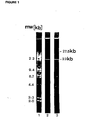
- Figure 1 is a photographic representation of the plasmid profile in S. typhimurium STM-1 and in its wild-type parent. Lane 1: Hin dIII digested Lambda standard; Lane 2: wild-type; Lane 3: STM-1.
- Figure 2 is a graphical representation of splenomegaly induced by S. typhimurium STM-1 and its wild-type parent wild-type; STM-1; control.
- Figure 3 is a graphical representation of viable counts in the spleen of mice infected with wild-type S. typhimurium . wild-type; control.
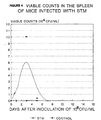
- Figure 4 is a graphical representation of viable counts in the spleen of mice infected with S . typhimurium STM-1. STM-1; control.
- Figure 5 is a graphical representation of viable counts in the spleen of mice infected with S. typhimurium STM-1 and its wild-type. wild-type; STM-1; control.
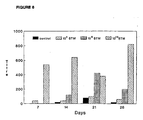
- Figure 6 is a graphical representation of antibody titre (IgG) in chickens inoculated with S. typhimurium STM-1.
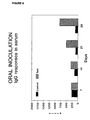
- Figure 7 is a graphical representation of antibody titre in chicken following oral inoculation with S . typhimurium STM-1.
- Figure 8 is a graphical representation of antibody titre in chickens following oral inoculation with S. typhimurium STM-1.
- Figure 9 is a graphical representation of antibody titre in chickens following subcutaneous inoculation with S. typhimurium STM-1.
- Figure 10 is a graphical representation of antibody titre in chickens following subcutaneous inoculation with S. typhimurium STM-1.
- live in ovo vaccine provides modified microorganisms in the form of live in ovo vaccines capable of facilitating protection of avian species from microbial infection or to immunize the avian species against an immunogen expressed in the live vaccine.
- live in ovo vaccine as used in the specification and claims herein, is to be considered in its broadest sense and specifically includes an attenuated or avirulent microorganism incapable of replicating in a minimal medium while retaining its ability to colonize embryonic tissue in ovo prior to hatching.
- the embryonic tissue in this regard is associated with the air sac and is, in particular, the air sac membrane.
- the live in ovo vaccine of the present invention may also provide the additional advantage of competitively excluding pathogenic microorganisms from the newly-hatched bird, and the presence of the vaccine may generally stimulate the immune system in the birds against other potential antigens.
- Avian species contemplated by the present invention include chickens, ducks, turkeys, geese, bantams, quail and pigeons.
- the most preferred avian species are commercially important poultry birds such as chickens; ducks and turkeys.
- Candidates for use in live in ovo vaccines may be selected on the basis of the protection sought. For example, where protection is sought against a particular species of microorganism or genus of microorganism, then an attenuated or avirulent strain of the species or genus is selected. Such a selection requires that the attenuated or avirulent microorganism retain the ability to induce an immune response cross-reactive with a corresponding wild-type strain while not being pathogenic to either the avian species or other animals such as humans.
- the live in ovo vaccine is being used as a carrier for an immunogen, and generally a recombinant immunogen
- the immunogen or antigenic epitope carried by the attenuated or avirulent microorganism be exposed on the cell surface or synthesized and released by the cell to an extent sufficient to induce an immune response to the immunogen or antigenic epitope, it may not be essential.
- Such an immune response then protects the avian species from infection by microorganisms or other pathogenic agents, naturally expressing the immunogen.
- Avian pathogenic agents contemplated by this aspect of the present invention include one or more agents selected from microorganisms, helminths, protozoans, yeasts and viruses.
- Preferred immunogens or antigenic epitopes are those from the causative agents of avian leucosis, reticuloendoetheliosis, infectious bronchitis, infectious bursal disease, Newcastle's disease, adenovirus disease, reovirus disease, pox disease, laryngotracheitis, avian influenza, infectious coryza, fowl typhoid, coccidiosis, cryptosporidiosis and fowl cholera.
- Another preferred immunogen or antigenic epitope is from the species Eimeria such as from Eimeria acervulina, Eimeria mivati, Eimeria mitis, Eimeria praecox, Eimeria hagani, Eimeria necatrix, Eimeria maxima, Eimeria brunetti and Eimeria tenella.
- Eimeria such as from Eimeria acervulina, Eimeria mivati, Eimeria mitis, Eimeria praecox, Eimeria hagani, Eimeria necatrix, Eimeria maxima, Eimeria brunetti and Eimeria tenella.
- the most preferred species is E. tenella .
- the subject microorganism must be processed to render same attenuated or avirulent (where the organism is pathogenic) and/or to induce one or more mutations substantially incapable of reversion.
- a substantially non-revertible mutant is considered herein to have a reversion frequency of ⁇ 10 -8 , more preferably ⁇ 10 -9 and even more preferably ⁇ 10 -10 .
- the present invention contemplates a mutation with, in effect, a zero probability of reversion.
- a suitable mutation involves single or more preferably multiple nucleotide substitutions, deletions and/or additions to a target genetic sequence in the genome of a candidate microorganism.
- a genome includes extrachromosomal elements such as plasmid DNA.
- the mutation is designed to ensure that the organism is incapable of growing on minimal medium due to its inability to synthesise one or more factors essential for growth of the microorganism.
- Such a mutant organism is known as a auxotrophic mutant.
- the mutation to auxotrophy may also result in attenuation or avirulance of the microorganism or the latter may require additional steps such as continual passage through nutrient media.
- the use of an auxotrophic mutant in the live in ovo vaccine assists in reducing spread of the organism by the bird shedding a microorganism substantially incapable of growing in the environment.
- the method of the present invention is predicated in part on the use of an attenuated or avirulent microorganism capable of colonizing air sac tissue, while being substantially non-pathogenic to the embryo.
- the preferred site of inoculation is tissue associated with the air sac, such as the air sac membrane, and the modified organisms of the present invention are considered those capable of colonizing the air sac side of the air sac membrane while being substantially non-pathogenic to the developing embryo, that is, cause no embryo death, or reduced embryo death compared to wild-type organisms.
- Such organisms may show some degree of pathogenicity if inoculated into different parts of the embryonic tissue.
- Preferred organisms useful for practices in the present invention are species of Salmonella, Shigella, Klebsiella, Enterobacter, Serratia, Proteus, Yersinia, Vibrio, Aeromonas, Pasteurella, Pseudomonas, Acinetobacter, Moraxella, Flavobacterium, Mycoplasma and Escherichia coli.
- Such microorganisms after being rendered attenuated or avirulent are useful for inducing immunity to wild-type strains or to antigens such as recombinant antigens expressed therein.
- More preferred microorganisms includes species of Salmonella such as Salmonella typhimurium, Salmonella paratyphi A or C, Salmonella schottmulleri, Salmonella choleraesuis, Salmonella montevideo, Salmonella newport, Salmonella enteritidis, Salmonella gallinarum, Salmonella pullorum, Salmonella abortusovi, Salmonella abortus-equi, Salmonella dublin, Salmonella sofia, Salmonella havana, Salmonella bovismorbificans, Salmonella hadar, Salmonella arizonae and Salmonella anatum, and others which are known to infect avian species and, in particular, poultry birds. It is particularly preferred to select a species of Salmonella which expresses antigens immunologically related to one or more other Salmonella species to facilitate cross species protection.
- Preferred Salmonella species are Group B, C (including C 1 and C 2 ) and D Salmonella based on serological testing of lipopolysaccharide antigens. Even more preferred Salmonella include S. typhimurium and S. enteritidis. The most preferred microorganism is S. typhimurium .
- the microorganisms such as Salmonella species and in particular S. typhimurium are modified by inducing a mutation in a biosynthetic pathway of, for example, an amino acid or vitamin or other essential molecule.
- the mutation may affect biosynthesis of one or more of alanine, arginine, asparagine, aspartic acid, cysteine, glutamic acid, glutamine, glycine, histidine, isoleucine, leucine, lysine, methionine, phenylalanine, proline, serine, threonine, tryptophan, tyrosine and/or valine.
- the preferred site of the mutation is in an aromatic vitamin biosynthetic pathway and, in particular, the aro pathway.
- phosphoenolpyruvate and erythrose-4-phosphate condense to form 3-deoxyarabinoheptulosonic acid-7-phosphate.
- the pathway continues through a series of intermediates such as shikimate, chorismate and anthranilate to produce L-tryptophan. From chorismate is produced molecules such as p-aminobenzoate (leading to folate), p-hydroxybenzoate (leading to ubiquinones), 3,4-dihydroxybenzoate (leading to vitamin K) and prephenate (leading to L-phenylalanine and L-tyrosine).
- the preferred site of the mutation is in a gene before chorismate and is preferably in one or more of aro A, aro B, aro C or aro D.
- the most preferred site of mutation is selected to attenuated or render the organism avirulent while permitting the organism to still invade and colonize tissues. Such a mutation is one in the aro A gene.
- Transposons are segments of double stranded DNA which normally comprise a gene for resistance to an antibiotic or other selectable marker together with the required genes to effect an insertion of a transposon at one or more sites in the genome of the microorganism.
- the location of the transposon inserted into the genome of the subject microorganism may be determined functionally by determining the auxotrophic requirements of the organisms and/or genetically by, for example, hybridization using a suitable probe.
- the modified microorganism may be used with the transposon inserted into the target gene, or loss of the transposon may be selected by, for example, loss of antibiotic resistance or loss of the selectable marker.
- loss of the transposon may be selected by, for example, loss of antibiotic resistance or loss of the selectable marker.
- the excision of a transposon is concomitant with excision of adjacent DNA resulting in a deletion of the target sequence.
- a preferred type of deletion in this regard results in the loss of two or more nucleotides, and preferably results in the loss of two to five nucleotides and more preferably results in the loss of more than five contiguous nucleotides.
- the mutation of a particular microorganism can be facilitated by techniques such as transduction, conjugation and transformation.
- a general transducing phage for example, P1 or P22
- P1 or P22 can be used to transduce a non-functional biosynthetic gene such as when inactivated by the insertion (or excision) of a transposon from its original host to a new target microorganism.
- phages like P1 or P22
- Conjugation may be employed involving conjugational crossing of a virulent strain with a non-virulent strain having a desired non-reverting mutation in a biosynthetic gene.
- Transfer of a mutated gene may occur from Hfr or F + strain by crossing same with a F - virulent strain which would result in recombinational replacement of a wild-type gene by a mutated gene.
- the use of such techniques is particularly useful in inducing two or more independent mutations in two or more biosynthetic pathways. These techniques may also be employed to introduce heterologous antigens from other species or avian pathogens.
- the exemplified and most preferred microorganism is S . typhimurium strain STM-1 for use in poultry birds. It has been surprisingly discovered that this strain of S. typhimurium is capable of colonizing the air sac side of the air sac membrane, while not being particularly pathogenic to the embryo following this colonization. It has also been surprisingly discovered that this strain can invade and colonize tissues in the embryo and newly-hatched birds to permit the establishment of an immune response against virulent forms of the organism or immunologically related microorganisms.
- the exemplification of S. typhimurium STM-1 is in no way intended to limit the present invention to the microorganism and the present invention extends to all modified organisms capable of being used as live in ovo vaccines as herein described.
- a sample of Salmonella typhimurium STM-1 was deposited at the Australian Government Analytical Laboratories (a Budapest Treaty Depositry), 1 Suakin Street, Pymble, New South Wales, 2037, Australia, on October 26, 1993, and has been assigned accession number N93/43266.
- the parent, wild-type strain was originally isolated from a flock of chickens infected with Salmonella. Phage P22 transduction was then used to transduce into S. typhimurium STM-1 a transposon Tn:10 insertion in the aroA gene from S. typhimurium LT2. Transposon delete mutants which were also aro A - were then selected.
- S. typhimurium STM-1 is also auxotrophic for serine.
- microorganism STM-1 of the present invention is used in the preparation of an in ovo vaccine.
- an in ovo vaccine comprising the STM-1 Salmonella microorganism.
- the vaccine composition of the present invention must be suitable for injectable use into the egg.
- the vaccine may comprise a single type of modified microorganism and may also contain two or more types depending on whether a multivalent vaccine is required.
- the composition must further have sufficient fluidity to permit easy syringability and should also not contain contaminating bacteria or other organisms.
- one convenient approach is to use a modified microorganism which is resistant to a particular antibiotic and then to maintain the organism in the presence of the antibiotic in the vaccine composition. The presence of the antibiotic will kill or inhibit the growth of contaminating organisms.
- multivalent vaccine is used in its most general sense and extends to a modified microorganism capable of stimulating an immune response directed to at least two antigenic epitopes expressed on or by the modified microorganism.
- a multivalent vaccine includes, for example, a microorganism capable of inducing an antibody response to two distinct antigenic epitopes on or expressed by the modified microorganism where the two or more epitopes are indigenous to the modified microorganism.
- a multivalent vaccine includes a modified microorganism capable of inducing an immune response to virulent forms of said microorganism as well as to heterologous antigens expressed by said microorganisms (such as recombinant antigens or those introduced by transduction, conjugation or transformation) and which are not indigenous to the microorganism.
- the multivalent vaccine is directed to two or more pathogenic agents.
- the preferred multivalent vaccines are those capable of inducing an immune response to one or more species of Salmonella and to at least one antigenic epitope from one or more avian pathogenic agents selected from microorganisms, helminths, protozoans, yeasts and viruses.
- Salmonella species contemplated by this aspect of the present invention comprise and include one or more of Salmonella typhimurium, Salmonella paratyphi A or C, Salmonella schottmulleri, Salmonella choleraesuis, Salmonella montevideo, Salmonella newport, Salmonella enteritidis, Salmonella gallinarum, Salmonella pullorum, Salmonella abortusovi, Salmonella abortus-equi, Salmonella dublin, Salmonella sofia, Salmonella havana, Salmonella bovismorbificans, Salmonella hadar, Salmonella arizonae and Salmonella anatum ..
- the immune response is in respect of S. typhimurium and/or S. enteritidis .
- Avian pathogenic agents other than Salmonella species contemplated by this aspect of the present invention comprise and include the causative agent of one or more antigenic epitopes from one or more causative agents of avian leucosis, reticuloendoetheliosis, infectious bronchitis, infectious bursal disease, Newcastle disease, adenovirus disease, reovirus disease, pox disease, laryngotracheitis, avian influenza, infectious coryza, fowl typhoid, cryptosporidiosis, coccidiosis and fowl cholera.
- the preferred causative agent is a species of Eimeria such as Eimeria acervulina, Eimeria mivati, Eimeria mitis, Eimeria praecox, Eimeria hagani, Eimeria necatrix, Eimeria maxima, Eimeria brunetti and Eimeria tenella.
- Eimeria acervulina Eimeria mivati, Eimeria mitis, Eimeria praecox
- Eimeria hagani Eimeria necatrix
- Eimeria maxima Eimeria brunetti and Eimeria tenella.
- the most preferred Eimeria species is E. tenella.
- the STM-1 microorganism is maintained in freeze dried form or may be maintained in a frozen condition.
- Such conditions include, for example, storage in glycerol or other suitable medium at -70°C.
- the STM-1 microorganism when stored comprises a minimal viable concentration of 10 6 - 10 12 cells per dose of reconstituted vaccine.
- the stored modified microorganisms are readily reconstituted in a simple growth medium such as nutrient broth or a tryptic soy broth supplemented with a yeast extract. Tryptic soy broth contains digests of casein and soya bean meals together with dextrose, sodium chloride and dipotassium phosphate.
- the method of the present invention is accomplished by the in ovo administration of an amount of one or more attenuated or avirulent modified microorganisms capable of inducing an immune response against the corresponding "wild-type" microorganism, to immunologically cross reactive microorganisms and/or to any heterologous or non-indigenous (e.g., recombinant) antigens expressed in the attenuated or avirulent modified microorganism.
- the modified microorganism may also competitively exclude other organisms in the tissues and/or generally promote the immune responsiveness of the avian host.
- the attenuated or avirulent modified microorganism is capable at the inoculated amount of colonizing tissues in the bird either before or after hatching but without having a substantially adverse effect on hatchability and/or subsequent chick viability.
- a method for inducing immunity in a newly-hatched bird to one or more pathogenic microorganisms comprising administering in ovo an amount of attenuated or avirulent microorganism effective to colonize one or more tissues in said bird wherein said attenuated or avirulent microorganism carries a mutation (e.g., deletion, substitution or addition of nucleotides) in a gene encoding an enzyme required for chorismate biosynthesis in said microorganism.
- the tissues preferably colonized include, but are not limited to, heart, liver, intestine, bursa of fabricus and airsac.
- the effective amount of inoculum is in the range of 10 2 -10 14 colony forming units (cfu) per egg.
- the amount of inoculum determines the extent of colonization and length of immune response after hatching and also varies due to the type of organism used.
- Preferred inocula include approximately 10 1 , 10 2 , 10 3 , 10 4 , 10 5 , 10 6 , 10 7 , 10 8 , 10 9 , 10 10 , 10 11 , 10 12 and 10 13 cfu/egg. Even more preferred inocula include approximately 10 2 -10 10 cfu/egg.
- the most preferred inoculum is in the range 5 x 10 2 - 5 x 10 4 cfu/egg. Best results are obtained when the vaccine is inoculated into the air sac where the microorganism of the vaccine proceeds to colonize the air sac side of the air sac membrane. Prior to hatching, the embryo punctures the air sac membrane and is exposed to the microorganism, which then proceeds to colonize one or more tissues in the embryo before, during and/or after hatching.
- the attenuated or avirulent microorganism is generally inoculated into the egg generally in the last half of the incubation term.
- eggs are generally inoculated from about incubation day 12 to about incubation day 20.
- the inoculation occurs from between day 14 to about day 19.
- the chicken eggs are inoculated at about day 15-18.
- the preferred inoculation times are from about day 16 to about day 27, more preferably, from about day 18 to about day 26 and even more preferably from about day 22 to about day 24.
- the present invention also extends to fertilized eggs inoculated with the vaccine prior to incubation.
- the eggs are conveniently packaged for sale with or without instructions for subsequent incubation.
- Administration of the inoculum is conveniently by injection and generally injection into the air sac.
- the organism colonizes the air sac and the bird is exposed to the organism after breaking through the air sac prior to hatching. The bird may then take in the organism via the respiratory and/or oral tracts.
- other regions such as the yolk sac or chorion allantoic fluid may also be inoculated by injection.
- a lower inoculum is generally favored and/or an attenuated or avirulent organism with a reduced growth rate is used so as to decrease embryonic death.
- the hatchability rate might decrease slightly when the air sac is not the target for the inoculation although not necessarily at commercially unacceptable levels.
- the mechanism of injection is not critical to the practice of the present invention, although it is preferred that the needle does not cause undue damage to the egg or to the tissues and organs of the developing embryo or the extra-embryonic membranes surrounding the embryo.
- hypodermic syringe fitted with an approximately 22 gauge needle is suitable.
- the method of the present invention is particularly well adapted for use with an automated injection system, such as those described in U.S. Patent Numbers 4,903,635, 5,056,464 and 5,136,979.
- the present invention is particularly well suited for the protection of poultry birds such as chickens from infection by Salmonella species.
- a live in ovo vaccine for poultry birds comprising the attenuated Salmonella STM-1 which:
- the vaccine is adopted for inoculation into the air sac such that the embryo is substantially exposed to the vaccine after breaking through the air sac.
- Salmonella species which may be used as attenuated microorganisms are Salmonella typhimurium, Salmonella paratyphi A or C, Salmonella schottmulleri, Salmonella choleraesuis, Salmonella montevideo, Salmonella newport, Salmonella enteritidis, Salmonella gallinarum, Salmonella pullorum, Salmonella abortusovi, Salmonella abortusequi , Salmonella dublin, Salmonella sofia, Salmonella havana, Salmonella bovismorbificans , Salmonella hadar, Salmonella arizonae and Salmonella anatum .
- the attenuated microorganism is S. typhimurium or S. enteritidis.
- the mutation is in the aromatic biosynthetic pathway such as in aro A, aro B, aro C or aro D. Most preferably, it is in aro A.
- Salmonella typhimurium STM-1 Salmonella typhimurium STM-1
- the parent wild-type strain of S. typhimurium was isolated from a chicken flock infected by Salmonella species at the Veterinary Research Institute, Parkville, Victoria, Melbourne, Australia. The isolate was stored as a frozen culture.
- Mutant strain S. typhimurium LTD strain 1545 (aro A Tn:10) was sourced from Dr J Roth, University of Utah, USA.
- the STM-1 mutant was generated by phage transduction using P22 transduction of aro A Tn:10 from strain 1545 to the wild-type S. typhimurium isolated from the chicken flock.
- Transposon Tn:10 insertion mutants were selected and then a transposon deleted aroA deleted mutant isolated. This mutant was designated S. typhimurium STM-1 and a sample was deposited at the Australian Government Analytical Laboratories, 1 Suakin Street, Pymble, New South Wales, 2037, Australia, and has been assigned Accession number N93/43266 on October 26, 1993.
- Tryptic soy broth supplemented with yeast extract (1% w/v) is used both for the preparation of seed cultures and for production of live vaccine.
- TSB contains digests of casein and soyabean meals, together with dextrose, sodium chloride and dipotassium phosphate.
- the medium is sterilized by autoclaving at 121°C prior to use.
- Skim milk is employed as a cryoprotectant for freeze drying.
- the growth medium containing casein is sterilized by autoclaving at 121°C prior to use.
- Australian derived skim milk powder is used in the freeze drying of the vaccine. This material is received in non-sterile condition and dispatched to Ansell-Steritech facility in Sydney, Australia, for gamma irradiation at 2.5 megarads prior to use.
- Powdered growth media are dissolved in distilled water and sterilized at 121°C for at least 15 minutes.
- Skim milk powder is packed into 1 kilogram quantities in cardboard boxes for gamma irradiation at 2.5 megarads.
- "Released Sterile" stickers are applied on return from gamma irradiation after ensuring that the gamma irradiation indicators have changed colour during sterilization.
- Sterilized skim milk is mixed by stirring with the culture after fermentation and concentration prior to lyophilization.
- Salmonella typhimurium STM-1 is aro A - and ser - .
- the organism will not grow on minimal media.
- STM-1 has a growth profile consistent with an aroA deletion organism requiring both paraaminobenzoic acid (PABA) and parahydroxbenzoic acid (PHBA) for growth.
- PABA paraaminobenzoic acid
- PHBA parahydroxbenzoic acid
- the serine deletion does not limit growth of the mutant in vivo .
- STM-1 can be easily distinguished biochemically from its parent strain and related strains by being H 2 S negative. Growth of STM-1 on XLD agar is indicated by the appearance of pink colonies. Growth on MacConkey's agar is seen as clear lac negative colonies of characteristic Salmonella appearance.
- STM-1 strain is, in common with its parent, streptomycin resistant, novobiocin resistant and fusaric acid resistant. It differs from the parent strain in showing greater susceptibility to penicillin and sulfafurazole.
- the STM-1 microorganism has the same detectable plasmid composition as its wild-type parent, with plasmids at 23 Kb, 27.5 Kb (see Figure 1) and two larger plasmids in the 60 to 100 Kb range. Both the wild-type and STM-1 express the 11KDa cryptic plasmid.
- Salmonella typhimurium STM-1 is virtually non-virulent, being over 10,000 times less virulent than its parent.
- Figure 2 A comparison between the invasion capability of the wild-type parent and STM-1 indicated in a mouse model that the mutant strain is capable of invading and even persisting in the spleen for a few days without causing clinical illness.
- Figure 2 Throughout the 10 day period, none of the STM-1 infected mice died and all looked healthy as judged by the texture of their coat.
- all wild-type mice showed signs of hunching and loose unhealthy coat texture.
- day 8 post infection all wild-type infected mice were dead.
- mice vaccinated orally or intraperitoneally with STM-1 and then challenged with the wild-type strain at 10 x LD 50 were protected against salmonellosis.
- Splenomegaly data was recorded for a period of 10 days after inoculation.
- Splenomegaly was marked in wild-type infected mice, whereas it was mild, reaching a peak at day 3 and declining rapidly to its normal size by day 10 in STM-1.
- the control strain showed no increase in spleen size.
- Figures 2 to 5 compare the growth characteristics of both STM-1 and wild-type strain.
- STM-1 has been used in extensive chicken trials administered by oral, subcutaneous (SC) and intraperitoneal (IP) routes. Oral titres up to 1.2 x 10 10 have been applied and found not to cause ill effect. Indeed, vaccinated birds have been shown to be consistently and significantly heavier than corresponding inoculated control chickens.
- Salmonella typhimurium STM-1 cultures are grown as follows. A culture is used to inoculate 100 ml of growth medium containing TSB supplemented with 1% w/v yeast extract. The broth is incubated at 37°C overnight with shaking. The culture is confirmed as pure by Gram stain, growth on blood agar, growth on XLD agar, MacConkey's agar and triple sugar iron (TSI) broth. The culture is lyophilized in the presence of sterile skim milk such that each ampoule contains 10 9 organisms. This is the Master seed.
- An ampoule of Master seed is then used in the same processes to produce a production seed lot. Ampoules of Master and production seed are stored at -20°C.
- Two ampoules of production seed are used to inoculate two aspirator bottles, each containing approximately 500ml of growth medium (TSB plus yeast extract) to initiate the growth process.
- TTB plus yeast extract growth medium
- Each 500ml culture is used to inoculate approximately 10 litres of growth medium in a pyrex carboy.
- the carboys are in turn used to inoculate a production fermenter. All manipulations up to the carboy culture stage are performed aseptically in a biohazard cabinet or laminar flow cabinet. Transfer of the carboy cultures to the fermenter is achieved through steam sterilized tubing/hard plumbing connection.
- the inoculum is transferred provided that it is thickly turbid and microscopically pure by Gram stain and purity plates.
- the cultures are connected to a stainless steel fermenter via a steam sterilized connection and used to inoculate the fermenter contents.
- the optical density is used to monitor culture growth in the fermenter. At peak density, the culture is passed through a continuous flow centrifuge to achieve concentration of the biomass and re-checked for purity.
- the culture is chilled during the process.
- the chilled concentrate is blended with sterile skim milk powder and the mixture is filled into pharmaceutical grade glass bottles ready for freeze drying.
- Sterile dry nitrogen gas is used to back fill the bottles at the end of the lyophilization cycle prior to closing with rubber stoppers and removal from the freeze drier.
- An aluminium donut seal is affixed to each bottle. Bottles are subsequently labelled and packed into cartons for dispatch. Prior to release, the vaccine is tested for potency, safety, moisture, purity and identity.
- Example 1 Data on the lack of virulence of STM-1 are provided in Example 1.
- a series of experiments addressing both oral and subcutaneous injection of STM-1 is set out below demonstrating both the safety and efficacy of the organism.
- a dose response experiment was designed to ascertain the dose range of STM-1 required orally to produce strong antibody (IgG) responses in chicken sera without adversely affecting chickens.
- PBS phosphate-buffered saline
- Sera obtained from these bloods were examined for humoral responses to sonicated STM-1 in an enzyme linked immunosorbent assay (ELISA).
- Low doses (1 x 10 4 ) of the bacterium produced no significant IgG responses
- intermediate doses (1 x 10 6 ) produced significant responses in birds 21 and 28 days post-inoculation
- high doses (1 x 10 10 ) produced significant responses in chickens 7, 14, 21 and 28 days post-inoculation.
- Experiment 1 Information gathered in Experiment 1 was used to examine IgG, IgM and IgA responses in sera and gut washings from chickens inoculated orally and subcutaneously with 10 9 STM-1. This examination of humoral responses in orally and subcutaneously inoculated chickens was to provide information on the level of antibody responses elicited by these routes of inoculation.
- Four groups of chickens were inoculated at 1 day of age. Two groups of 30 chickens were inoculated with STM-1, one orally and the other subcutaneously. Two other groups of 22 chickens received PBS orally or subcutaneously. Blood was taken from 5 chickens in each group at 7, 14, 21 and 28 days post-inoculation.
- Fecal swabs were taken from the orally inoculated chickens on the same days as the bloods before all chickens were killed and intestine removed for preparation of gut washings. The sera and gut washings from these chickens were examined for IgG, IgM and IgA responses to STM-1 antigens by ELISA.
- Table 2 and Figures 6, 7, and 8 summarize these findings.
- Table 2 and Figures 9 and 10 also show humoral responses in chickens immunized subcutaneously with STM-1.
- the first statistically significant IgG, IgM and IgA responses were detected in sera from 14-, 7-and 21-day-old chickens. IgM responses were directed against all three antigens, including STM porins. No antibody responses were detectable in gut washings. High IgG responses to STM-1 porins in gut washings and IgM responses to STM-1 porins in sera were seen in 28-day-old control chickens. However, this elevation in levels of antibody responses was not detectable when STM-1 LPS was used as the antigen in the ELISA.
- the vaccine has been shown to spread to birds when the birds are maintained in high density housing.
- S. typhimurium STM-1 isolation rates expressed as Number of STM-1 Age Culture Number of samples Shed One (Vaccinated) Shed Two (control) 1 Liver 20 0/10 0/10 2 Liver 20 3/10 0/10 Faeces 30 29/29 not tested 3 Liver 20 0/10 0/10 4 Liver 20 1/10 0/10 5 Liver 20 0/10 0/10 6 Liver 20 0/10 0/10 7 Liver 20 0/10 0/10 Faeces 30 7/30 not tested 28 Faeces 60 0/30 0/30 43 Half caeca 60 0/30 0/30 0/30 0/30
- STM-1 was continually passaged in TSB with 1% w/v yeast extract for 10 consecutive passages. An aliquot of 10 ml of culture was added to 500ml of fresh prewarmed culture medium and incubated overnight at 37°C. This process was undertaken daily for 10 consecutive days. At each passage, culture was evaluated for purity, presence of aroA deletion and cell number. The cell density at each passage was approximately 5 x 10 9 /ml. At the completion of 10 passages, the organism was confirmed to be STM-1. Due to the inability of the organism to adequately direct passage in sufficient numbers past the third in contact bird to bird passage, a protocol inclusive of enrichment between passages is utilized for chicken back passaging.
- the STM-1 at a cell density of 5 x 10 9 was inoculated orally into a 24 day old chicken. After 24 hours, faecal swabs were collected, enriched in selenite broth and STM-1 selected. The STM-1 reisolate was then grown overnight at 37°C in TSB plus 1% w/v yeast extract and 5 x 10 9 (approximately 1 ml of overnight culture) inoculated into bird 2 (and so on) for 10 passages. Isolates obtained at each passage and any Salmonella-like isolates were fully characterized (no Salmonella variants were found) and the final isolates confirmed to be STM-1.
- STM-1 can be used as a means of controlling salmonellosis and as a presentation vehicle for antigens from enteric pathogens. Colonization of the gut ensures that the selected antigens remain accessible to the host defense mechanisms for a long period. The lack of adverse effects seen even with high inoculation doses (1.2 x 10 10 ) and the possible growth promoting effect of the bacterium indicates that STM has potential as a probiotic.
- the object of this experiment was to determine the colonization of tissues and fecal shedding of STM-1 at different levels of vaccination at day 18 following in ovo administration.
- the hatched chicks, whether inoculated with 10 4 , 10 6 , or 10 8 cfu shed the vaccine strain for the first three days post-hatching. Between 3 and 12 days, there was significant shedding from the chicks vaccinated with the STM-1 strain.
- the STM-1 mutant was cultured from all organs of all chicks given 10 8 cfu per egg for up to 8 days and the majority of chicks given 10 4 and 10 6 cfu per egg.
- 4 day chicks (five chicks) derived from eggs inoculated with 10 4 cfu STM-1 showed colonization of the following tissues:
- mutant STM-1 can be administered at day 18 to the egg at from 10 4 -10 8 cfu per egg with no adverse effect on hatchability and subsequent chick viability.
- the organism colonized a wide range of organs and tissues in the chicken and there was shedding of the organism for a period of at least 8 days post-hatching.
- the objective of this experiment was to determine if in ovo vaccination with STM-1 protects chicks from the clinical effects of S. typhimurium given subcutaneously at 7 days post-hatching.
- the primary criterion for efficacy is mortality. Secondary measurements include differential fecal shedding and organ colonization.
- Eggs were vaccinated on the eighteenth day of incubation with 10 4 or 10 6 STM-1 and chicks were challenged on the seventh day post-hatch with a dose 1 or 100 times greater than the LD 50 of wild-type S. typhimurium.
- 2 groups of 10 birds were challenged with 10 6 or 10 8 cfu subcutaneously and a third group of 10 birds were left unchallenged.
- Three groups of 10 non-vaccinated birds were used as controls, 2 groups were challenged and 1 group left unchallenged.
- Health was monitored for all birds on a twice daily basis.
- Fecal shedding was monitored by culturing cloacal swabs for all birds on nominated days. Organ colonization was determined on all birds that died, and the surviving birds in each group were sacrificed and nominated organs were cultured on the fourteenth day after challenge.
- the challenge strain was Salmonella typhimurium strain 82/6915.
- the chicks received chemotherapy-free feed treated by gamma irradiation (Barastoc Stock Feeds, St Arnaud, Victoria, Australia) in 10 kg vacuum sealed multiwall paper and PVC containers. Each box was individually tested for the presence of Salmonella.
- Hatched chicks were reared under infra-red heating lamps in accordance with general practice. Feed and water was available ad libitum throughout the trial period.
- the challenge dose of 10 8 cfu per chick administered subcutaneously was estimated at 100 times LD 50 for this Salmonella isolate and it is surprising that the challenge organism did not totally overwhelm the immune system of the in ovo vaccinated chick. In groups where a lower challenge dose of 10 6 cfu per chick of the pathogenic Salmonella was used, there resulted a slower onset of the clinical effects. Based on these results, it is concluded that in ovo vaccination with STM-1 clearly protects chickens from subcutaneous challenge with virulent wild-type Salmonella typhimurium .
- the aim of this experiment is to determine if in ovo vaccination with STM-1 protects chicks from wild-type S. enteritidis challenged by subcutaneous administration.
- the primary criterion for efficacy is mortality.
- the secondary measurements are differential fecal shedding and organ colonization.
- the vaccine was administered in ovo at 10 4 or 10 6 cfu per egg and challenge was given subcutaneously at 5 x 10 7 cfu per chick.
- Chicks received chemotherapy-free feed treated by gamma irradiation (Barastoc Stock Feeds, St Arnaud, Victoria) in 10kg vacuum sealed multiwall paper and PVC containers. Each box was individually tested for the presence of Salmonella .
- Hatched chickens were reared under infra-red heating lamps in accordance with general practices. Feed and water was available ad libitum throughout the trial period.
- the challenge strain was S. enteritidis strain 446302.
- the eggs were vaccinated on the eighteenth day and incubation with 10 4 or 10 6 cfu per egg and chicks were challenged on the seventh day after hatch.
- the percentage hatchability of the eggs in the unvaccinated group, the 10 4 cfu per egg vaccinated group and the 10 6 cfu per egg vaccinated group were 87.2%, 95.6% and 69.6%, respectively.
- the respective body weights were 49.0 g, 48.3 g and 45.0 g. Hatchability was dependent on incubator performance and the low hatchability rate for the 10 6 cfu per egg vaccination was probably due to the incubator rather than the vaccination.
- the challenge dose of 5 x 10 7 cfu per chick administered subcutaneously was estimated at 100 times LD 50 for this Salmonella isolate.
- the purpose of this experiment was to establish whether chicks vaccinated in ovo at 17 days with S. typhimurium STM-1 have less colonization of tissues by S. enteritidis at 7 and 14 days post oral challenge with that organism.
- the primary criteria for efficacy are measurements of differential fecal shedding and organ colonization.
- the vaccine was administered in ovo at 10 2 or 10 4 cfu per egg and the challenge was given orally at 1 x 10 7 cfu per chick or 6 x 10 8 cfu per chick.
- Chicks received chemotherapy-free feed treated by gamma irradiation (Barastoc Stock Feeds, St Arnaud, Victoria) in 10kg vacuum sealed multiwall paper and PVC containers. Each box was individually tested for the presence of Salmonella.
- Hatched chicks were reared under infra red heating lamps in accordance with general practices. Feed and water was available ad libitum throughout the trial period.
- the challenge strain was Salmonella enteritidis 446302.
- the objective of this experiment was to assess the amount of recoverable S. typhimurium STM-1 organism from homogenized in ovo tissue over a 4 day incubation period (days 17-21 of incubation) after the administration of 10 2 cfu per egg or 10 4 cfu per egg of the STM-1 organism via the air sac.
- the STM-1 organism was administered through the shell into the air sac space at day 17 of incubation.
- the primary measurement was estimation of the colony forming units of the STM-1 in egg shell tissue at a series of designated time intervals after incubation.
- Homogenization occurred by a Waring blender. Aliquots of 100 ml of blending liquid comprising 50 ml of nutrient broth with 1% w/v yeast extract and 50 ml of PBS were added. The contents were homogenized for 60 seconds at low speed and retained for culture.
- Results are shown in Table 8: egg count @ 69 hours egg count @ 100 hours Eggs vaccinated @ 10 2 cfu of STM -1 7 x 10 4 1.2 x 10 8 4 x 10 5 3 x 10 7 9 x 10 5 1.5 x 10 8 Eggs vaccinated @ 10 4 cfu of STM-1 6 x 10 5 1.2 x 10 8 9 x 10 5 1.2 x 10 8 1 x 10 5 3 x 10 6
- results show that there is an initial stationary phase for the first at least 45 hours with no evidence of replication of STM-1 organism in ovo. In the period 45 to 100 hours, there is significant replication of STM-1.
- the objective of this experiment was to assess the amount of recoverable STM-1 organisms from the eggs over a 7 day incubation period (14 to 21 days after administration of 10 2 cfu per egg into the air sac).
- the STM-1 organism was administered through the shell into the air sac.
- Primary measurement is an estimation of colony forming units of STM-1 within egg shell tissue at a series of designated time intervals after incubation.
- Bacterial replication was assessed at 24, 72, 96 and 168 hours after inoculation (with dosages indicated) by homogenizing eggs as in Example 11, and thereafter counting the number of organisms present. Two eggs were analyzed at each time point.
- the administered organisms were not embryotoxic. The above results show evidence of significant replication of STM-1 organisms in the eggs in the first 24 hours.
- Embryo tissue as well as the air sac were analysed during the incubation period for bacterial growth.
- the STM-1 organism was not incorporated into organs/tissue whilst in ovo .
- Bacterial replication was shown to take place within the air sac. When chicks pierce the air sac membrane prior to hatching there is rapid replication of STM-1 within the developing chick.
- STM-1 was isolated in all organs tested at days 4 and 8 post-hatch, with the exception, of course, of the controls where no STM-1 was present either in eggs or chicks derived therefrom.
- the object of this experiment was to compare the viability of the developing chick embryo following in ovo inoculation of Salmonella organisms into the air sac, yolk sac and chorioalantoic membrane (CAM).
- Inoculations were made into the air sac, yolk sac and CAM using 1 x 10 6 cfu of either STM-1, or virulent strains of Salmonella typhimurium or Salmonella enteritidis . Seventeen day incubated eggs were used in this experiment. Virulent Salmonella species used were Salmonella typhimurium 82/6915 and Salmonella enteritidis 446382.
- Salmonella typhimurium STM-1 is of lower pathogenicity than the other two known pathogenic strains. While chick viability is compromised following STM-1 inoculation into the yolk sac and CAM, the effect of the inoculation was not as deleterious on the viability of the embryos compared to inoculation of the known pathogenic strains.
- the present invention extends to a vaccine comprising Salmonella species of the type including Salmonella typhimurium STM-1 in order to immunize a chick against a virulent form of the same organism or an immunologically cross-reactive organism.
- the present invention also extends to the use of a Salmonella species carrying a recombinantly expressed antigen such as an antigen from another avian pathogenic species.
- vectors capable of expressing genetic sequences in Salmonella have been published and may be used in accordance with the present invention.
- Such vectors include those described by Schodel et al., Vaccine, 11: 143-148, 1993, and Schodel et al., J. Immunol., 12: 4317-4321, 1990.
- techniques such as transduction, conjugation and/or transformation may be used to generate strains of Salmonella expressing antigens not normally associated with that particular strain.
- modified Salmonella strains are useful as multivalent vaccines.
- a genetically modified Salmonella typhimurium STM-1 strain is produced, it is administered to the air sac according to the methods herein described. Generally, inoculation is made at day 17 or 18 of the incubation period. After hatching, recipient chickens are challenged with the causative agent for which the antigenic determinant is isolated and/or serological analysis is conducted and/or microbiological analysis is conducted. Such vaccinated chickens should exhibit similar protection rates against virulent forms of the source of the antigenic epitopes as occur when STM-1 alone is used to vaccinate eggs.
- Aro deletion mutants are prepared according to the methods as described in U.S. Patent Nos. 4,735,801, 5,210,035 and 4,837,151. Wild-type Salmonella, Shigella, Kiebsiella, Enterobacter, Serratia, Proteus, Yersinia, Vibrio, Aewromanas, Pasteurella, Pseudomonas, Acinetobacter, Moraxella, Flavobacterium and Escherichia coli are subjected to phage transduction using phage carrying a Tn 10 transposon inserted into the aro A, aro B, aro C or aroD. Resultant mutants are selected for tetracycline resistance.
- Genetically modified organisms such as Salmonella strains, are administered to the air sac according to the methods herein described. After hatching, recipient chickens are challenged with wild-type strains. Vaccinated chickens exhibit protection against virulent wild-type strains.
Landscapes
- Health & Medical Sciences (AREA)
- Life Sciences & Earth Sciences (AREA)
- Animal Behavior & Ethology (AREA)
- Chemical & Material Sciences (AREA)
- Veterinary Medicine (AREA)
- Medicinal Chemistry (AREA)
- Public Health (AREA)
- Pharmacology & Pharmacy (AREA)
- General Health & Medical Sciences (AREA)
- Microbiology (AREA)
- Epidemiology (AREA)
- Mycology (AREA)
- Immunology (AREA)
- Communicable Diseases (AREA)
- Oncology (AREA)
- Chemical Kinetics & Catalysis (AREA)
- General Chemical & Material Sciences (AREA)
- Nuclear Medicine, Radiotherapy & Molecular Imaging (AREA)
- Organic Chemistry (AREA)
- Medicines Containing Antibodies Or Antigens For Use As Internal Diagnostic Agents (AREA)
- Micro-Organisms Or Cultivation Processes Thereof (AREA)
- Medicines Containing Material From Animals Or Micro-Organisms (AREA)
Abstract
Description
- The present invention relates generally to modified microorganisms suitable for use as live in ovo vaccines for avian species. The live in ovo vaccines of the present invention are useful for inducing immunity before or immediately after hatching against a virulent form of the modified microorganism or a microorganism immunologically related to the modified microorganism or a virulent organism or virus carrying an antigenic determinant expressed by the modified microorganism in the live vaccine. The subject live in ovo vaccines are particularly efficacious in enhancing the survival rate of newly-hatched poultry birds.
- Infection of avian species by microorganisms, viruses, helminths, yeasts and protozoans can have serious environmental, ecological and commercial implications. Not only are the birds themselves at risk, but there is also the potential of the infecting agent to spread to other animals, including humans.
- The poultry industry is particularly vulnerable to significant economic losses due to the susceptibility of stock birds, and in particular newly-hatched stock birds, to rapidly spreading infections. In poultry birds, infection by Salmonella species, generally referred to as salmonellosis, is the most common form of infection-causing high mortality rates. Many species of Salmonella also cause infection in humans and other animals and, hence, control of salmonellosis in poultry birds is of particular importance. Two of the most common species of Salmonella isolated from poultry birds are Salmonella typhimurium and Salmonella enteritidis. Both organisms contribute significantly to the outbreaks of salmonellosis and, in fact, S.
enteritidis phage type 4 emerged as a significant threat to public health in Britain during the mid 1980's. - Chemotherapy and chemoprophylaxis have been used as forms of protective measures to combat poultry diseases such as salmonellosis. However, such measures are not always successful, are quite expensive, may lead to the development of drug resistance amongst infecting agents and are not necessarily acceptable to public health authorities for birds destined for human or animal consumption. For these and other related reasons, alternative forms of protection for avian species have been the subject of intense scientific research.
- One form of protection proposed is the development of vaccines against poultry diseases. Live attenuated Salmonella vaccines have been shown to protect chickens (Cooper et al., Microb. Pathog., 9: 255-265, 1990; Hassan and Curtiss III, Res. Microbiol., 141: 839-850, 1990). Furthermore, Salmonella strains with a transposon inserted at or near aroA of the aromatic biosynthetic pathway have been shown to be attenuated, yet still capable of residing in tissue for sufficient time to stimulate an immune response (Stocker, Vaccine, 6: 141-145, 1988; U.S. Patent No. 4,735,801; U.S. Patent No. 5,210,035). Cooper, et al., Vaccine 10: 247-254, 1992, made two strains of S.
enteritidis phage type 4 with mutations in the aroA gene. These mutant strains were used as a live oral vaccine against oral and intravenous challenge. The results presented by Cooper et al., supra, showed that the S. enteritidis vaccines were protective in chickens following oral ingestion. - Notwithstanding the purported efficacy of the live oral vaccines comprising Salmonella species in protecting chickens, newly-hatched birds are particularly susceptible to Salmonella infection and a high mortality rate immediately post-hatching can have serious economic consequences. Furthermore, administering live oral vaccines is not always convenient and difficulties may result in ensuring adequate doses are received by the birds. Another option, therefore, is to inoculate the birds when in ovo.
- European
Patent Application No 0 291 173 proposed the administration of a non-replicating immunogen designed to induce immunity in embryos prior to hatching. The method was said to be especially useful for immunizing birds against avian coccidiosis using a sporulated Eimeria tenella oocyst extract. U.S. Patent No. 4,458,630 also teaches that birds can be immunized against Marek's disease by injecting eggs, prior to hatching, with a replicating viral vaccine. However, in both cases, inoculation was intra-embryo, such as into the yolk sac or chorion allantoic fluid. If bacteria were to be inoculated in such a manner, the bacteria would "blow" the egg, causing it to go rotten and causing the embryo to die. - There is a need, therefore, to improve the technology relating to in ovo vaccines so that avian species can be protected against challenge by virulent organisms such as virulent strains of Salmonella. In accordance with the present invention, the inventors have discovered that microorganisms rendered attenuated or avirulent may be inoculated into defined tissues in ovo and that birds upon hatching are protected from challenge with a corresponding wild-type microorganism. The method of the present invention also enables the use of the modified microorganisms to carry antigenic epitopes in the form of immunogens for other avian pathogens to induce immunity against those pathogens. The present invention represents a major breakthrough in protecting newly-hatched birds and offers significant commercial advantages to poultry management.
- Accordingly, one aspect of the present invention provides a live in ovo vaccine for administering into an air sac of a fertilized egg of avian species comprising an attenuated microorganism Salmonella typhimurium STM-1 deposited at the Australian Government Analytical Laboratories under Accession number N93/43266 which:
- (a) exhibits auxotrophy to one or more growth factors, such that it is incapable of growing on a minimal medium in the absence of said one or more growth factors;
- (b) is capable of colonizing one or more tissues in an embryo prior to hatching; and
- (c) is capable of inducing before or immediately after hatching an immune response in the embryo against a virulent form of said microorganism or an immunologically cross-reactive microorganism or a virulent organism or virus carrying an antigenic determinant expressed by said attenuated microorganism.
-
- Also disclosed is a method for immunizing an avian species against infection by a pathogenic microorganism said method comprising administering in ovo into the air sac an attenuated microorganism which:
- (a) exhibits auxotrophy to one or more growth factors such that it is incapable of growing on a minimal medium in the absence of said one or more growth factors; and
- (b) is capable of colonizing one or more tissues in an embryo prior to hatching in an amount and under conditions effective to induce an immune response in the embryo before or immediately after hatching against a virulent form of said attenuated microorganism or an immunologically cross-reactive microorganism or virulent organism or virus carrying an antigenic determinant expressed by said attenuated microorganism.
-
- Another aspect of the present invention contemplates a fertilized egg from an avion species or a poultry bird having an air sac wherein the air sac is inoculated with a modified microorganism which:
- (a) exhibits auxotrophy to one or more growth factors such that it is incapable of growing on a minimal medium in the absence of said one or more growth factors; and
- (b) is capable of colonizing one or more tissues in an embryo prior to hatching after the embryo breaks through the air sac; and
- (c) is capable of inducing an immune response in the embryo before or immediately after hatching against a virulent form of said microorganism or an immunologically cross-reactive microorganism or virulent organism or virus carrying an antigenic determinant expressed by said avirulent microorganism.
-
- Figure 1 is a photographic representation of the plasmid profile in S. typhimurium STM-1 and in its wild-type parent. Lane 1: HindIII digested Lambda standard; Lane 2: wild-type; Lane 3: STM-1.
- Figure 2 is a graphical representation of splenomegaly induced by S. typhimurium STM-1 and its wild-type parentwild-type;
 STM-1;
 control.
- Figure 3 is a graphical representation of viable counts in the spleen of mice infected with wild-type S. typhimurium.wild-type;
 control.
- Figure 4 is a graphical representation of viable counts in the spleen of mice infected with S. typhimurium STM-1.STM-1;
 control.
- Figure 5 is a graphical representation of viable counts in the spleen of mice infected with S. typhimurium STM-1 and its wild-type. wild-type;
 STM-1;
 control.
- Figure 6 is a graphical representation of antibody titre (IgG) in chickens inoculated with S. typhimurium STM-1.
- Figure 7 is a graphical representation of antibody titre in chicken following oral inoculation with S. typhimurium STM-1.
- Figure 8 is a graphical representation of antibody titre in chickens following oral inoculation with S. typhimurium STM-1.
- Figure 9 is a graphical representation of antibody titre in chickens following subcutaneous inoculation with S. typhimurium STM-1.
- Figure 10 is a graphical representation of antibody titre in chickens following subcutaneous inoculation with S. typhimurium STM-1.
- One aspect of the present invention provides modified microorganisms in the form of live in ovo vaccines capable of facilitating protection of avian species from microbial infection or to immunize the avian species against an immunogen expressed in the live vaccine. The term "live in ovo vaccine" as used in the specification and claims herein, is to be considered in its broadest sense and specifically includes an attenuated or avirulent microorganism incapable of replicating in a minimal medium while retaining its ability to colonize embryonic tissue in ovo prior to hatching. The embryonic tissue in this regard is associated with the air sac and is, in particular, the air sac membrane. After hatching or immediately prior to hatching, the attenuated or avirulent microorganism colonizes tissues such as the colon, respiratory tract and lung. The live in ovo vaccine of the present invention may also provide the additional advantage of competitively excluding pathogenic microorganisms from the newly-hatched bird, and the presence of the vaccine may generally stimulate the immune system in the birds against other potential antigens.
- Avian species contemplated by the present invention include chickens, ducks, turkeys, geese, bantams, quail and pigeons. The most preferred avian species are commercially important poultry birds such as chickens; ducks and turkeys.
- Candidates for use in live in ovo vaccines may be selected on the basis of the protection sought. For example, where protection is sought against a particular species of microorganism or genus of microorganism, then an attenuated or avirulent strain of the species or genus is selected. Such a selection requires that the attenuated or avirulent microorganism retain the ability to induce an immune response cross-reactive with a corresponding wild-type strain while not being pathogenic to either the avian species or other animals such as humans. However, where the live in ovo vaccine is being used as a carrier for an immunogen, and generally a recombinant immunogen, then it is not essential that the attenuated or avirulent microorganism induce a cross-reactive immune response to its corresponding wildtype microorganism. Although it may seem advantageous that the immunogen or antigenic epitope carried by the attenuated or avirulent microorganism be exposed on the cell surface or synthesized and released by the cell to an extent sufficient to induce an immune response to the immunogen or antigenic epitope, it may not be essential. Such an immune response then protects the avian species from infection by microorganisms or other pathogenic agents, naturally expressing the immunogen.
- Avian pathogenic agents contemplated by this aspect of the present invention include one or more agents selected from microorganisms, helminths, protozoans, yeasts and viruses. Preferred immunogens or antigenic epitopes are those from the causative agents of avian leucosis, reticuloendoetheliosis, infectious bronchitis, infectious bursal disease, Newcastle's disease, adenovirus disease, reovirus disease, pox disease, laryngotracheitis, avian influenza, infectious coryza, fowl typhoid, coccidiosis, cryptosporidiosis and fowl cholera. Another preferred immunogen or antigenic epitope is from the species Eimeria such as from Eimeria acervulina, Eimeria mivati, Eimeria mitis, Eimeria praecox, Eimeria hagani, Eimeria necatrix, Eimeria maxima, Eimeria brunetti and Eimeria tenella. The most preferred species is E. tenella.
- Regardless of the criteria employed to select the candidate microorganism for use in a live in ovo vaccine, the subject microorganism must be processed to render same attenuated or avirulent (where the organism is pathogenic) and/or to induce one or more mutations substantially incapable of reversion. A substantially non-revertible mutant is considered herein to have a reversion frequency of ≤10-8, more preferably ≤10-9 and even more preferably ≤10-10. In a most preferred embodiment, the present invention contemplates a mutation with, in effect, a zero probability of reversion.
- A suitable mutation involves single or more preferably multiple nucleotide substitutions, deletions and/or additions to a target genetic sequence in the genome of a candidate microorganism. In this context, a genome includes extrachromosomal elements such as plasmid DNA. The mutation is designed to ensure that the organism is incapable of growing on minimal medium due to its inability to synthesise one or more factors essential for growth of the microorganism. Such a mutant organism is known as a auxotrophic mutant. The mutation to auxotrophy may also result in attenuation or avirulance of the microorganism or the latter may require additional steps such as continual passage through nutrient media. The use of an auxotrophic mutant in the live in ovo vaccine assists in reducing spread of the organism by the bird shedding a microorganism substantially incapable of growing in the environment.
- The method of the present invention is predicated in part on the use of an attenuated or avirulent microorganism capable of colonizing air sac tissue, while being substantially non-pathogenic to the embryo. The preferred site of inoculation is tissue associated with the air sac, such as the air sac membrane, and the modified organisms of the present invention are considered those capable of colonizing the air sac side of the air sac membrane while being substantially non-pathogenic to the developing embryo, that is, cause no embryo death, or reduced embryo death compared to wild-type organisms. Such organisms, however, may show some degree of pathogenicity if inoculated into different parts of the embryonic tissue.
- Preferred organisms useful for practices in the present invention are species of Salmonella, Shigella, Klebsiella, Enterobacter, Serratia, Proteus, Yersinia, Vibrio, Aeromonas, Pasteurella, Pseudomonas, Acinetobacter, Moraxella, Flavobacterium, Mycoplasma and Escherichia coli. Such microorganisms after being rendered attenuated or avirulent are useful for inducing immunity to wild-type strains or to antigens such as recombinant antigens expressed therein. More preferred microorganisms includes species of Salmonella such as Salmonella typhimurium, Salmonella paratyphi A or C, Salmonella schottmulleri, Salmonella choleraesuis, Salmonella montevideo, Salmonella newport, Salmonella enteritidis, Salmonella gallinarum, Salmonella pullorum, Salmonella abortusovi, Salmonella abortus-equi, Salmonella dublin, Salmonella sofia, Salmonella havana, Salmonella bovismorbificans, Salmonella hadar, Salmonella arizonae and Salmonella anatum, and others which are known to infect avian species and, in particular, poultry birds. It is particularly preferred to select a species of Salmonella which expresses antigens immunologically related to one or more other Salmonella species to facilitate cross species protection.
- Preferred Salmonella species are Group B, C (including C1 and C2) and D Salmonella based on serological testing of lipopolysaccharide antigens. Even more preferred Salmonella include S. typhimurium and S. enteritidis. The most preferred microorganism is S. typhimurium.
- The microorganisms such as Salmonella species and in particular S. typhimurium are modified by inducing a mutation in a biosynthetic pathway of, for example, an amino acid or vitamin or other essential molecule. The mutation may affect biosynthesis of one or more of alanine, arginine, asparagine, aspartic acid, cysteine, glutamic acid, glutamine, glycine, histidine, isoleucine, leucine, lysine, methionine, phenylalanine, proline, serine, threonine, tryptophan, tyrosine and/or valine. The preferred site of the mutation is in an aromatic vitamin biosynthetic pathway and, in particular, the aro pathway. In this pathway, phosphoenolpyruvate and erythrose-4-phosphate condense to form 3-deoxyarabinoheptulosonic acid-7-phosphate. The pathway continues through a series of intermediates such as shikimate, chorismate and anthranilate to produce L-tryptophan. From chorismate is produced molecules such as p-aminobenzoate (leading to folate), p-hydroxybenzoate (leading to ubiquinones), 3,4-dihydroxybenzoate (leading to vitamin K) and prephenate (leading to L-phenylalanine and L-tyrosine). The preferred site of the mutation is in a gene before chorismate and is preferably in one or more of aroA, aroB, aroC or aroD. The most preferred site of mutation is selected to attenuated or render the organism avirulent while permitting the organism to still invade and colonize tissues. Such a mutation is one in the aroA gene.
- Any number of techniques may be employed to modify the microorganism to induce the mutation in the biosynthetic pathway. One suitable technique involves the use of translocatable elements such as transposons. Transposons are segments of double stranded DNA which normally comprise a gene for resistance to an antibiotic or other selectable marker together with the required genes to effect an insertion of a transposon at one or more sites in the genome of the microorganism. The location of the transposon inserted into the genome of the subject microorganism may be determined functionally by determining the auxotrophic requirements of the organisms and/or genetically by, for example, hybridization using a suitable probe. The modified microorganism may be used with the transposon inserted into the target gene, or loss of the transposon may be selected by, for example, loss of antibiotic resistance or loss of the selectable marker. Frequently, the excision of a transposon is concomitant with excision of adjacent DNA resulting in a deletion of the target sequence. A preferred type of deletion in this regard results in the loss of two or more nucleotides, and preferably results in the loss of two to five nucleotides and more preferably results in the loss of more than five contiguous nucleotides.
- The mutation of a particular microorganism can be facilitated by techniques such as transduction, conjugation and transformation. For example, a general transducing phage (for example, P1 or P22) can be used to transduce a non-functional biosynthetic gene such as when inactivated by the insertion (or excision) of a transposon from its original host to a new target microorganism. Given the broad host range of phages like P1 or P22, the potential is increased of making the same mutation in a range of organisms. Conjugation may be employed involving conjugational crossing of a virulent strain with a non-virulent strain having a desired non-reverting mutation in a biosynthetic gene. Transfer of a mutated gene may occur from Hfr or F+ strain by crossing same with a F- virulent strain which would result in recombinational replacement of a wild-type gene by a mutated gene. The use of such techniques is particularly useful in inducing two or more independent mutations in two or more biosynthetic pathways. These techniques may also be employed to introduce heterologous antigens from other species or avian pathogens.
- The exemplified and most preferred microorganism is S. typhimurium strain STM-1 for use in poultry birds. It has been surprisingly discovered that this strain of S. typhimurium is capable of colonizing the air sac side of the air sac membrane, while not being particularly pathogenic to the embryo following this colonization. It has also been surprisingly discovered that this strain can invade and colonize tissues in the embryo and newly-hatched birds to permit the establishment of an immune response against virulent forms of the organism or immunologically related microorganisms. The exemplification of S. typhimurium STM-1 is in no way intended to limit the present invention to the microorganism and the present invention extends to all modified organisms capable of being used as live in ovo vaccines as herein described.
- A sample of Salmonella typhimurium STM-1 was deposited at the Australian Government Analytical Laboratories (a Budapest Treaty Depositry), 1 Suakin Street, Pymble, New South Wales, 2037, Australia, on October 26, 1993, and has been assigned accession number N93/43266. The parent, wild-type strain was originally isolated from a flock of chickens infected with Salmonella. Phage P22 transduction was then used to transduce into S. typhimurium STM-1 a transposon Tn:10 insertion in the aroA gene from S. typhimurium LT2. Transposon delete mutants which were also aroA- were then selected. S. typhimurium STM-1 is also auxotrophic for serine.
- The microorganism STM-1 of the present invention is used in the preparation of an in ovo vaccine. According to this aspect of the present invention, there is provided an in ovo vaccine comprising the STM-1 Salmonella microorganism.
- The vaccine composition of the present invention must be suitable for injectable use into the egg. The vaccine may comprise a single type of modified microorganism and may also contain two or more types depending on whether a multivalent vaccine is required. The composition must further have sufficient fluidity to permit easy syringability and should also not contain contaminating bacteria or other organisms. In this regard, one convenient approach is to use a modified microorganism which is resistant to a particular antibiotic and then to maintain the organism in the presence of the antibiotic in the vaccine composition. The presence of the antibiotic will kill or inhibit the growth of contaminating organisms.
- The term "multivalent" vaccine is used in its most general sense and extends to a modified microorganism capable of stimulating an immune response directed to at least two antigenic epitopes expressed on or by the modified microorganism. In this regard, a multivalent vaccine includes, for example, a microorganism capable of inducing an antibody response to two distinct antigenic epitopes on or expressed by the modified microorganism where the two or more epitopes are indigenous to the modified microorganism. More commonly, however, a multivalent vaccine includes a modified microorganism capable of inducing an immune response to virulent forms of said microorganism as well as to heterologous antigens expressed by said microorganisms (such as recombinant antigens or those introduced by transduction, conjugation or transformation) and which are not indigenous to the microorganism. In this regard, the multivalent vaccine is directed to two or more pathogenic agents.
- The preferred multivalent vaccines are those capable of inducing an immune response to one or more species of Salmonella and to at least one antigenic epitope from one or more avian pathogenic agents selected from microorganisms, helminths, protozoans, yeasts and viruses. Salmonella species contemplated by this aspect of the present invention comprise and include one or more of Salmonella typhimurium, Salmonella paratyphi A or C, Salmonella schottmulleri, Salmonella choleraesuis, Salmonella montevideo, Salmonella newport, Salmonella enteritidis, Salmonella gallinarum, Salmonella pullorum, Salmonella abortusovi, Salmonella abortus-equi, Salmonella dublin, Salmonella sofia, Salmonella havana, Salmonella bovismorbificans, Salmonella hadar, Salmonella arizonae and Salmonella anatum..
- More preferably, the immune response is in respect of S. typhimurium and/or S. enteritidis. Avian pathogenic agents other than Salmonella species contemplated by this aspect of the present invention comprise and include the causative agent of one or more antigenic epitopes from one or more causative agents of avian leucosis, reticuloendoetheliosis, infectious bronchitis, infectious bursal disease, Newcastle disease, adenovirus disease, reovirus disease, pox disease, laryngotracheitis, avian influenza, infectious coryza, fowl typhoid, cryptosporidiosis, coccidiosis and fowl cholera.
- The preferred causative agent is a species of Eimeria such as Eimeria acervulina, Eimeria mivati, Eimeria mitis, Eimeria praecox, Eimeria hagani, Eimeria necatrix, Eimeria maxima, Eimeria brunetti and Eimeria tenella. The most preferred Eimeria species is E. tenella.
- Conveniently, the STM-1 microorganism is maintained in freeze dried form or may be maintained in a frozen condition. Such conditions include, for example, storage in glycerol or other suitable medium at -70°C. Generally, the STM-1 microorganism when stored comprises a minimal viable concentration of 106 - 1012 cells per dose of reconstituted vaccine. The stored modified microorganisms are readily reconstituted in a simple growth medium such as nutrient broth or a tryptic soy broth supplemented with a yeast extract. Tryptic soy broth contains digests of casein and soya bean meals together with dextrose, sodium chloride and dipotassium phosphate. When growing large volumes of vaccine culture, it is particularly convenient initially to grow 200-700 ml cultures and use these to inoculate 7-15 litres of growth medium. These large volume cultures are then used to inoculate a production fermenter. The growth of the culture in the fermenter is monitored by any convenient means such as by optical density. When optical density is the growth parameter, at peak density the culture biomass is retained, checked for purity and then chilled and concentrated and blended with a suitable carrier prior to freeze-drying. Where the storage technique is lyophilization, sterile nitrogen gas may be used to back fill samples containing the culture biomass. The lyophilized culture can be reconstituted in any suitable diluent and then used for immediate injection into the egg. Any suitable carrier may be used, with the most preferred carrier being skim milk powder. Other carriers which may be used include water, ethanol, a polyol (for example, glycerol, propylene glycol and liquid polyethyleneglycol and the like), vegetable oils and suitable mixtures thereof.
- Also disclosed is a method for immunizing newly-hatched birds against infection by pathogenic microorganisms. The method further or alternatively provides for the development of an immune response to recombinant antigens. The method of the present invention is accomplished by the in ovo administration of an amount of one or more attenuated or avirulent modified microorganisms capable of inducing an immune response against the corresponding "wild-type" microorganism, to immunologically cross reactive microorganisms and/or to any heterologous or non-indigenous (e.g., recombinant) antigens expressed in the attenuated or avirulent modified microorganism. The modified microorganism may also competitively exclude other organisms in the tissues and/or generally promote the immune responsiveness of the avian host.
- In a preferred embodiment, the attenuated or avirulent modified microorganism is capable at the inoculated amount of colonizing tissues in the bird either before or after hatching but without having a substantially adverse effect on hatchability and/or subsequent chick viability. Also disclosed is a method for inducing immunity in a newly-hatched bird to one or more pathogenic microorganisms, said method comprising administering in ovo an amount of attenuated or avirulent microorganism effective to colonize one or more tissues in said bird wherein said attenuated or avirulent microorganism carries a mutation (e.g., deletion, substitution or addition of nucleotides) in a gene encoding an enzyme required for chorismate biosynthesis in said microorganism.
- The tissues preferably colonized include, but are not limited to, heart, liver, intestine, bursa of fabricus and airsac. For best results, the effective amount of inoculum is in the range of 102-1014 colony forming units (cfu) per egg. The amount of inoculum determines the extent of colonization and length of immune response after hatching and also varies due to the type of organism used. Preferred inocula include approximately 101, 102, 103, 104, 105, 106, 107, 108, 109, 1010, 1011, 1012 and 1013 cfu/egg. Even more preferred inocula include approximately 102-1010 cfu/egg. The most preferred inoculum is in the range 5 x 10² - 5
x 104 cfu/egg. Best results are obtained when the vaccine is inoculated into the air sac where the microorganism of the vaccine proceeds to colonize the air sac side of the air sac membrane. Prior to hatching, the embryo punctures the air sac membrane and is exposed to the microorganism, which then proceeds to colonize one or more tissues in the embryo before, during and/or after hatching. - The attenuated or avirulent microorganism is generally inoculated into the egg generally in the last half of the incubation term. For example, in the case of chickens, eggs are generally inoculated from about
incubation day 12 to aboutincubation day 20. Preferably, the inoculation occurs from betweenday 14 to about day 19. More preferably, the chicken eggs are inoculated at about day 15-18. For duck eggs, the preferred inoculation times are from aboutday 16 to about day 27, more preferably, from about day 18 to about day 26 and even more preferably from about day 22 to about day 24. - The present invention also extends to fertilized eggs inoculated with the vaccine prior to incubation. The eggs are conveniently packaged for sale with or without instructions for subsequent incubation.
- According to this aspect of the present invention, there is provided a fertilized egg from a poultry bird having an air sac wherein the air sac is inoculated with a modified microorganism which:
- (a) exhibits auxotrophy to one or more growth factors such that it is incapable of growing on a minimal medium in the absence of said one or more growth factors; and
- (b) is capable of colonizing one or more tissues in an embryo prior to hatching after the embryo breaks through the air sac; and
- (c) is capable of inducing an immune response in the embryo before or immediately after hatching against a virulent form of said microorganism or an immunologically cross-reactive microorganism or virulent organism or virus carrying an antigenic determinant expressed by said avirulent microorganism.
-
- Administration of the inoculum is conveniently by injection and generally injection into the air sac. The organism colonizes the air sac and the bird is exposed to the organism after breaking through the air sac prior to hatching. The bird may then take in the organism via the respiratory and/or oral tracts. Notwithstanding that the air sac is the preferred route of in ovo administration, other regions such as the yolk sac or chorion allantoic fluid may also be inoculated by injection. In the case of inoculation into the yolk sac or other fluids, a lower inoculum is generally favored and/or an attenuated or avirulent organism with a reduced growth rate is used so as to decrease embryonic death. In any event, the hatchability rate might decrease slightly when the air sac is not the target for the inoculation although not necessarily at commercially unacceptable levels. The mechanism of injection is not critical to the practice of the present invention, although it is preferred that the needle does not cause undue damage to the egg or to the tissues and organs of the developing embryo or the extra-embryonic membranes surrounding the embryo.
- Generally, a hypodermic syringe fitted with an approximately 22 gauge needle is suitable. The method of the present invention is particularly well adapted for use with an automated injection system, such as those described in U.S. Patent Numbers 4,903,635, 5,056,464 and 5,136,979.
- The present invention is particularly well suited for the protection of poultry birds such as chickens from infection by Salmonella species. In accordance with the preferred aspect of the present invention there is provided a live in ovo vaccine for poultry birds comprising the attenuated Salmonella STM-1 which:
- (a) exhibits auxotrophy for one or more growth factors such that it is incapable of growing on a minimal medium in the absence of said one or more growth factors;
- (b) is capable of colonizing one or more tissues in an embryo prior to hatching; and
- (c) is capable of inducing before or immediately after hatching an immune response in the embryo against a virulent form of said Salmonella or an immunologically cross-reactive Salmonella or a virulent organism or virus carrying an antigenic determinant expressed by said avirulent Salmonella.
-
- The vaccine is adopted for inoculation into the air sac such that the embryo is substantially exposed to the vaccine after breaking through the air sac. Salmonella species which may be used as attenuated microorganisms are Salmonella typhimurium, Salmonella paratyphi A or C, Salmonella schottmulleri, Salmonella choleraesuis, Salmonella montevideo, Salmonella newport, Salmonella enteritidis, Salmonella gallinarum, Salmonella pullorum, Salmonella abortusovi, Salmonella abortusequi, Salmonella dublin, Salmonella sofia, Salmonella havana, Salmonella bovismorbificans, Salmonella hadar, Salmonella arizonae and Salmonella anatum. More preferably, the attenuated microorganism is S. typhimurium or S. enteritidis. Conveniently, the mutation is in the aromatic biosynthetic pathway such as in aroA, aroB, aroC or aroD. Most preferably, it is in aroA.
- These and other aspects of the present invention are further exemplified by the following non-limiting examples.
- The parent wild-type strain of S. typhimurium was isolated from a chicken flock infected by Salmonella species at the Veterinary Research Institute, Parkville, Victoria, Melbourne, Australia. The isolate was stored as a frozen culture. Mutant strain S. typhimurium LTD strain 1545 (aroA Tn:10) was sourced from Dr J Roth, University of Utah, USA. The STM-1 mutant was generated by phage transduction using P22 transduction of aroA Tn:10 from strain 1545 to the wild-type S. typhimurium isolated from the chicken flock. Transposon Tn:10 insertion mutants were selected and then a transposon deleted aroA deleted mutant isolated. This mutant was designated S. typhimurium STM-1 and a sample was deposited at the Australian Government Analytical Laboratories, 1 Suakin Street, Pymble, New South Wales, 2037, Australia, and has been assigned Accession number N93/43266 on October 26, 1993.
- Tryptic soy broth (TSB) supplemented with yeast extract (1% w/v) is used both for the preparation of seed cultures and for production of live vaccine. TSB contains digests of casein and soyabean meals, together with dextrose, sodium chloride and dipotassium phosphate. The medium is sterilized by autoclaving at 121°C prior to use. Skim milk is employed as a cryoprotectant for freeze drying.
- The growth medium containing casein is sterilized by autoclaving at 121°C prior to use. Australian derived skim milk powder is used in the freeze drying of the vaccine. This material is received in non-sterile condition and dispatched to Ansell-Steritech facility in Sydney, Australia, for gamma irradiation at 2.5 megarads prior to use.
- Powdered growth media are dissolved in distilled water and sterilized at 121°C for at least 15 minutes. Skim milk powder is packed into 1 kilogram quantities in cardboard boxes for gamma irradiation at 2.5 megarads. "Released Sterile" stickers are applied on return from gamma irradiation after ensuring that the gamma irradiation indicators have changed colour during sterilization. Sterilized skim milk is mixed by stirring with the culture after fermentation and concentration prior to lyophilization.
- Salmonella typhimurium STM-1 is aroA- and ser-. The organism will not grow on minimal media. STM-1 has a growth profile consistent with an aroA deletion organism requiring both paraaminobenzoic acid (PABA) and parahydroxbenzoic acid (PHBA) for growth. The insertion of the Tn:10 transposon, and its subsequent deletion near the aroA gene of STM-1, resulted in another mutation along the serine biosynthetic pathway. This is supported by the lack of growth on minimal media supplemented with all the end products of the aromatic pathway with growth occurring only when serine or either glycine and cystine is added to the media. The serine deletion does not limit growth of the mutant in vivo.
- STM-1 can be easily distinguished biochemically from its parent strain and related strains by being H2S negative. Growth of STM-1 on XLD agar is indicated by the appearance of pink colonies. Growth on MacConkey's agar is seen as clear lac negative colonies of characteristic Salmonella appearance.
- STM-1 strain is, in common with its parent, streptomycin resistant, novobiocin resistant and fusaric acid resistant. It differs from the parent strain in showing greater susceptibility to penicillin and sulfafurazole.
- Serologically, STM-1 colonies and broths test positive for poly "O" antigen and Group B salmonella antigens.
- The STM-1 microorganism has the same detectable plasmid composition as its wild-type parent, with plasmids at 23 Kb, 27.5 Kb (see Figure 1) and two larger plasmids in the 60 to 100 Kb range. Both the wild-type and STM-1 express the 11KDa cryptic plasmid.
- Salmonella typhimurium STM-1 is virtually non-virulent, being over 10,000 times less virulent than its parent. A comparison between the invasion capability of the wild-type parent and STM-1 indicated in a mouse model that the mutant strain is capable of invading and even persisting in the spleen for a few days without causing clinical illness (Figure 2). Throughout the 10 day period, none of the STM-1 infected mice died and all looked healthy as judged by the texture of their coat. In contrast, by
day 5 post infection, all wild-type mice showed signs of hunching and loose unhealthy coat texture. Byday 8 post infection, all wild-type infected mice were dead. There was multiplication of wild-type strain in the spleen of wild-type infected mice where viable counts exceeded that of the inoculum dose byday 6, whereas those of STM-1 never reached a count of higher than 105 CFU/ml. Results are shown in Table 1.DAYS AFTER INOCULATION OF BACTERIA Wild-type 08216915 MUTANT STM-1 Day 10.09615 (1.06x) 0.0923 (1.014x) Day 30.17205 (1.89x) 0.13085 (1.44x) Day 50.1944 (2.14x) 0.11555 (1.27x) Day 70.339 (3.74x) 0.0977 (1.07x) Day 10All dead 0.0910 ( ) represents increase in spleen size compared to that of control mice. - Mice vaccinated orally or intraperitoneally with STM-1 and then challenged with the wild-type strain at 10 x LD50 were protected against salmonellosis. Splenomegaly data was recorded for a period of 10 days after inoculation. Splenomegaly was marked in wild-type infected mice, whereas it was mild, reaching a peak at
day 3 and declining rapidly to its normal size byday 10 in STM-1. The control strain showed no increase in spleen size. Figures 2 to 5 compare the growth characteristics of both STM-1 and wild-type strain. - In accordance with this invention, STM-1 has been used in extensive chicken trials administered by oral, subcutaneous (SC) and intraperitoneal (IP) routes. Oral titres up to 1.2 x 10¹⁰ have been applied and found not to cause ill effect. Indeed, vaccinated birds have been shown to be consistently and significantly heavier than corresponding inoculated control chickens.
- Salmonella typhimurium STM-1 cultures are grown as follows. A culture is used to inoculate 100 ml of growth medium containing TSB supplemented with 1% w/v yeast extract. The broth is incubated at 37°C overnight with shaking. The culture is confirmed as pure by Gram stain, growth on blood agar, growth on XLD agar, MacConkey's agar and triple sugar iron (TSI) broth. The culture is lyophilized in the presence of sterile skim milk such that each ampoule contains 109 organisms. This is the Master seed.
- An ampoule of Master seed is then used in the same processes to produce a production seed lot. Ampoules of Master and production seed are stored at -20°C.
- Two ampoules of production seed are used to inoculate two aspirator bottles, each containing approximately 500ml of growth medium (TSB plus yeast extract) to initiate the growth process. Each 500ml culture is used to inoculate approximately 10 litres of growth medium in a pyrex carboy. The carboys are in turn used to inoculate a production fermenter. All manipulations up to the carboy culture stage are performed aseptically in a biohazard cabinet or laminar flow cabinet. Transfer of the carboy cultures to the fermenter is achieved through steam sterilized tubing/hard plumbing connection.
- After 6-8 hours, the inoculum is transferred provided that it is thickly turbid and microscopically pure by Gram stain and purity plates. The cultures are connected to a stainless steel fermenter via a steam sterilized connection and used to inoculate the fermenter contents. The optical density is used to monitor culture growth in the fermenter. At peak density, the culture is passed through a continuous flow centrifuge to achieve concentration of the biomass and re-checked for purity. The culture is chilled during the process. The chilled concentrate is blended with sterile skim milk powder and the mixture is filled into pharmaceutical grade glass bottles ready for freeze drying. Sterile dry nitrogen gas is used to back fill the bottles at the end of the lyophilization cycle prior to closing with rubber stoppers and removal from the freeze drier. An aluminium donut seal is affixed to each bottle. Bottles are subsequently labelled and packed into cartons for dispatch. Prior to release, the vaccine is tested for potency, safety, moisture, purity and identity.
- Data on the lack of virulence of STM-1 are provided in Example 1. A series of experiments addressing both oral and subcutaneous injection of STM-1 is set out below demonstrating both the safety and efficacy of the organism.
- A dose response experiment was designed to ascertain the dose range of STM-1 required orally to produce strong antibody (IgG) responses in chicken sera without adversely affecting chickens. There were four groups of 25 chickens: a control group that received 100 ml of phosphate-buffered saline (PBS) (0.145 M NaCl, 0.01 M sodium phosphate [pH 7.1]) per chicken, and three inoculated groups that received 104, 106, or 1010 STM-1 per chicken. These chickens were inoculated at 1 day of age. Blood was taken from 5 chickens in each group at 7, 14, 21 and 28 days after inoculation. Sera obtained from these bloods were examined for humoral responses to sonicated STM-1 in an enzyme linked immunosorbent assay (ELISA). Low doses (1 x 10⁴) of the bacterium produced no significant IgG responses, intermediate doses (1 x 10⁶) produced significant responses in
birds chickens - Information gathered in
Experiment 1 was used to examine IgG, IgM and IgA responses in sera and gut washings from chickens inoculated orally and subcutaneously with 109 STM-1. This examination of humoral responses in orally and subcutaneously inoculated chickens was to provide information on the level of antibody responses elicited by these routes of inoculation. Four groups of chickens were inoculated at 1 day of age. Two groups of 30 chickens were inoculated with STM-1, one orally and the other subcutaneously. Two other groups of 22 chickens received PBS orally or subcutaneously. Blood was taken from 5 chickens in each group at 7, 14, 21 and 28 days post-inoculation. Fecal swabs were taken from the orally inoculated chickens on the same days as the bloods before all chickens were killed and intestine removed for preparation of gut washings. The sera and gut washings from these chickens were examined for IgG, IgM and IgA responses to STM-1 antigens by ELISA. - No antibody responses were detected in sera or gut washings from 7-day-old chickens. The first statistically significant antibody responses detected were IgG responses to sonicated STM-1 and IgM responses to STM-1 lipopolysaccharide (LPS) in sera from 14-day-old chickens. The first significant IgA responses to STM-1 LPS were detected in sera from 21-day-old chickens. Antibody responses in gut washings from orally inoculated chickens were restricted to IgG and IgA, with the response detected being an IgG response to STM-1 LPS in gut washings from 21-day-old chickens. Interestingly, no significant IgM response was detected to STM-1 porins in sera or to any of the STM antigens in gut washings.
- Table 2 and Figures 6, 7, and 8 summarize these findings. Table 2 and Figures 9 and 10 also show humoral responses in chickens immunized subcutaneously with STM-1.
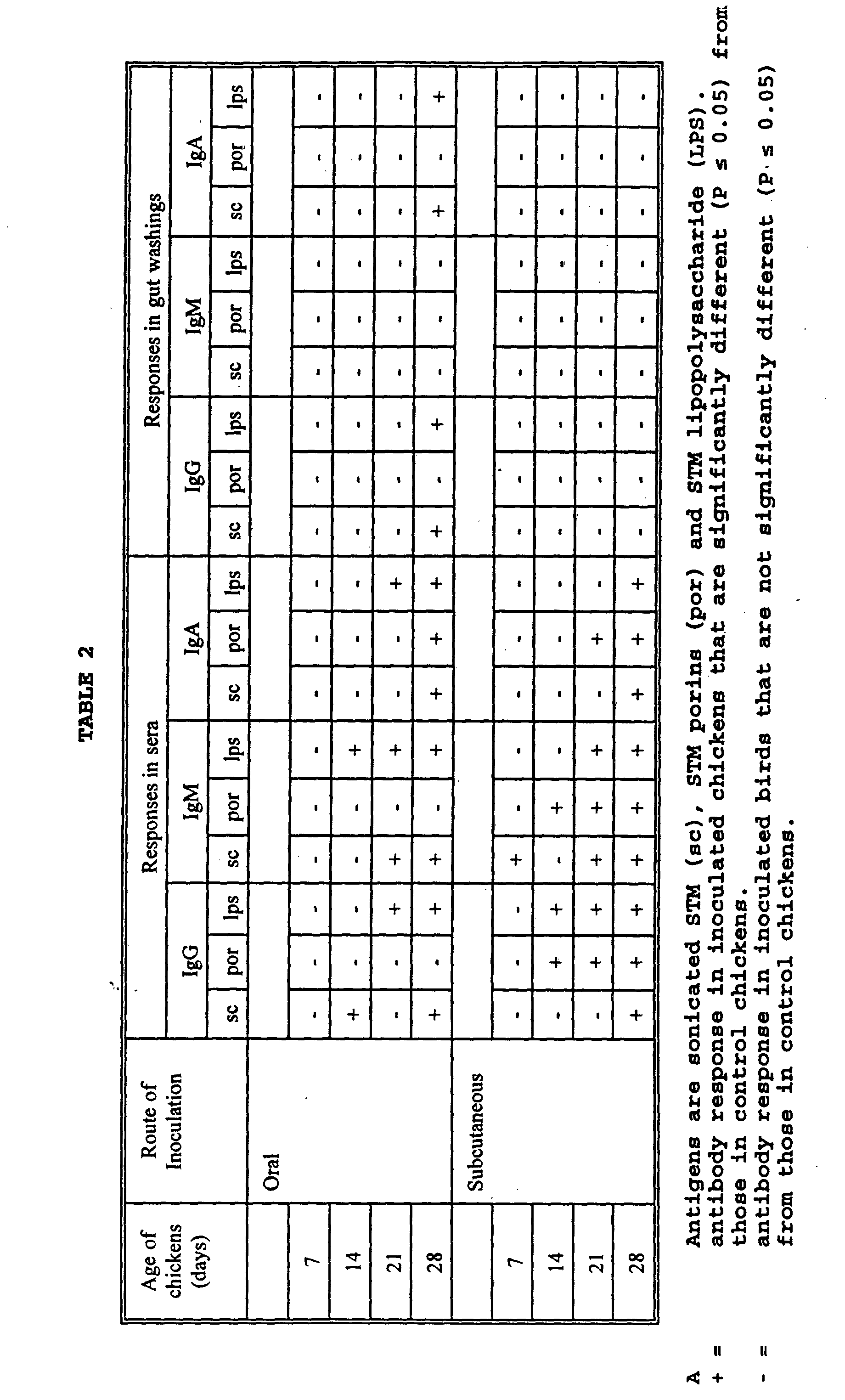
- The first statistically significant IgG, IgM and IgA responses were detected in sera from 14-, 7-and 21-day-old chickens. IgM responses were directed against all three antigens, including STM porins. No antibody responses were detectable in gut washings. High IgG responses to STM-1 porins in gut washings and IgM responses to STM-1 porins in sera were seen in 28-day-old control chickens. However, this elevation in levels of antibody responses was not detectable when STM-1 LPS was used as the antigen in the ELISA.
- Chickens vaccinated with 1 x 10⁸ STM-1 subcutaneously and challenged subcutaneously 7 days later with 1 x 10⁸ virulent S.typhimurium all survived the challenge, whereas a non-vaccinated group also challenged subcutaneously with 1 x 10⁸ virulent S. typhimurium all died. Chickens orally vaccinated with STM-1 prior to oral challenge with a virulent S. typhimurium stopped excreting the organism before non-vaccinated chickens. No chickens died during the experiment, but all excreted the virulent organism post-challenge. However, by 35 days post-challenge, fecal swabs showed that all vaccinated chicken ceased to excrete the virulent organism, but 10 out of 30 non-vaccinated chickens were still excreting the organism.
- To examine the effect of an oral inoculation of STM-1 on the weight gain of chickens, the chickens were orally inoculated and weighed. The results are shown in Table 3.
- Oral inoculation of chickens with 1 x 10⁹ or 5 x 10⁹ STM-1 did not adversely affect the weight gain of the chickens, as the inoculated chickens had significantly greater weights than controls at the same age. The weight gain experienced at the laboratory level and shown in Table 3 was also seen in the field trials.
Body Weight and Mortality of Broiler Chickens Vaccinated with STM-1 via the Drinking Water at Day Old Shed 1 (10,000 birds,vaccinated) Shed 2 (15,000 birds, non-vaccinated Age Bodyweight (g) Mortality (%) Bodyweight (g) Mortality (%) 0 43 43 7 135 1.57 128 2.47 14 352 2.10 348 4.58 21 655 2.42 660 5.00 28 1041 2.89 1067 5.44 35 1410 3.50 1420 5.93 42 1792 4.03 1697 6.11 - The vaccine has been shown to spread to birds when the birds are maintained in high density housing. Investigations into the spread of STM-1 within a group of chickens in the laboratory, of which only 2 were inoculated, revealed the organism spread rapidly when the group was in close proximity and maintained on solid flooring. Examination of fecal swabs revealed that all chickens were excreting the organism within 5 days, but that the organism was eliminated from the chickens by
day 14. - However, under field conditions, where flooring is varied and bird distance greater, there was significantly reduced bird to bird transmission. Indeed, the rate of bird to bird transmission was inadequate for inducement of a protective response. Only 60% of the in-contact birds in pen trials showed STM-1 spread, but not at adequate levels to provide a protective response.
- STM-1, if administered to chickens at 1 day of age, cannot be isolated after
day 28 in the laboratory. Fecal swabs taken ondays - Set out in Table 4 are the STM-1 isolation rates on a 30,000 bird field trial.
S. typhimurium STM-1 isolation rates expressed as Number of STM-1 Age Culture Number of samples Shed One (Vaccinated) Shed Two (control) 1 Liver 20 0/10 0/10 2 Liver 20 3/10 0/10 Faeces 30 29/29 not tested 3 Liver 20 0/10 0/10 4 Liver 20 1/10 0/10 5 Liver 20 0/10 0/10 6 Liver 20 0/10 0/10 7 Liver 20 0/10 0/10 Faeces 30 7/30 not tested 28 Faeces 60 0/30 0/30 43 Half caeca 60 0/30 0/30 - Results of environmental swabbing and STM-1 isolations from one test pen and two commercial broiler shed trials showed STM-1 did not persist in the environment or in the birds beyond 21 days postvaccination.
- STM-1 was continually passaged in TSB with 1% w/v yeast extract for 10 consecutive passages. An aliquot of 10 ml of culture was added to 500ml of fresh prewarmed culture medium and incubated overnight at 37°C. This process was undertaken daily for 10 consecutive days. At each passage, culture was evaluated for purity, presence of aroA deletion and cell number. The cell density at each passage was approximately 5 x 10⁹ /ml. At the completion of 10 passages, the organism was confirmed to be STM-1. Due to the inability of the organism to adequately direct passage in sufficient numbers past the third in contact bird to bird passage, a protocol inclusive of enrichment between passages is utilized for chicken back passaging. The STM-1 at a cell density of 5 x 10⁹ was inoculated orally into a 24 day old chicken. After 24 hours, faecal swabs were collected, enriched in selenite broth and STM-1 selected. The STM-1 reisolate was then grown overnight at 37°C in TSB plus 1% w/v yeast extract and 5 x 10⁹ (approximately 1 ml of overnight culture) inoculated into bird 2 (and so on) for 10 passages. Isolates obtained at each passage and any Salmonella-like isolates were fully characterized (no Salmonella variants were found) and the final isolates confirmed to be STM-1.
- The present studies indicate that STM-1 can be used as a means of controlling salmonellosis and as a presentation vehicle for antigens from enteric pathogens. Colonization of the gut ensures that the selected antigens remain accessible to the host defense mechanisms for a long period. The lack of adverse effects seen even with high inoculation doses (1.2 x 10¹⁰) and the possible growth promoting effect of the bacterium indicates that STM has potential as a probiotic.
- The object of this experiment was to determine the colonization of tissues and fecal shedding of STM-1 at different levels of vaccination at day 18 following in ovo administration.
- Sixteen day incubated eggs were maintained in an incubator with
regular turning 2 times daily. Newly-hatched chickens were reared in individual groups under standard infra-red chicken rearing lamps. Water was available ad libitum and chemotherapy-free feed was used. At incubation day 18, the chicken embryos were vaccinated in ovo with either 108 colony forming units (cfu) or 104 cfu of S. typhimurium STM-1 growing cultures. Administration was by direct inoculation into the air sac of the egg. In another trial, 106 cfu or 104 cfu of the STM-1 mutant were administered to the egg. - The hatched chicks, whether inoculated with 104, 106, or 108 cfu shed the vaccine strain for the first three days post-hatching. Between 3 and 12 days, there was significant shedding from the chicks vaccinated with the STM-1 strain. The STM-1 mutant was cultured from all organs of all chicks given 108 cfu per egg for up to 8 days and the majority of chicks given 104 and 106 cfu per egg. By way of example, 4 day chicks (five chicks) derived from eggs inoculated with 104 cfu STM-1 showed colonization of the following tissues:
- 4/5 heart
- 5/5 liver
- 5/5 intestine
- 5/5 caecum
-
- These results indicate that the mutant STM-1 can be administered at day 18 to the egg at from 104-108 cfu per egg with no adverse effect on hatchability and subsequent chick viability. After in ovo vaccination at day 18, the organism colonized a wide range of organs and tissues in the chicken and there was shedding of the organism for a period of at least 8 days post-hatching.
- The objective of this experiment was to determine if in ovo vaccination with STM-1 protects chicks from the clinical effects of S. typhimurium given subcutaneously at 7 days post-hatching.
- The primary criterion for efficacy is mortality. Secondary measurements include differential fecal shedding and organ colonization.
- Eggs were vaccinated on the eighteenth day of incubation with 104 or 106 STM-1 and chicks were challenged on the seventh day post-hatch with a
dose - The challenge strain was Salmonella typhimurium strain 82/6915.
- The chicks received chemotherapy-free feed treated by gamma irradiation (Barastoc Stock Feeds, St Arnaud, Victoria, Australia) in 10 kg vacuum sealed multiwall paper and PVC containers. Each box was individually tested for the presence of Salmonella.
- Hatched chicks were reared under infra-red heating lamps in accordance with general practice. Feed and water was available ad libitum throughout the trial period.
- Forty eggs each were vaccinated with STM-1 with 104 cfu per egg and 106 cfu per egg, respectively, to ensure a minimum of 30 chicks per dose available for challenge at 7 days post-hatching.
- The rate of hatchability of eggs vaccinated with 106 cfu per egg, 104 cfu per egg and non-vaccinated eggs is shown in Table 5.
Hatchability 106 cfu/ egg 104 cfu/egg non-vaccinated No. of eggs 42 42 42 No. hatched 34 36 33 % hatched 81 86 79 - Non-vaccinated birds challenged with 108 cfu per chick of wild-type S. typhimurium died rapidly in the first 72 hours. Ten out of 11 birds died. In the vaccinated chicks challenged with 106 cfu per chick with S. typhimurium, 2 out of 9 birds died in the first 72 hours. For vaccinated chicks challenged with 108 cfu, 4 out of 8 birds died in the first 72 hours following challenge. There was little difference between vaccination with 104 or 106 STM-1.
- The results for both groups indicate that there is a significant level of protection being offered by the vaccination procedure when compared to the non-vaccinated group.
- The challenge dose of 108 cfu per chick administered subcutaneously was estimated at 100 times LD50 for this Salmonella isolate and it is surprising that the challenge organism did not totally overwhelm the immune system of the in ovo vaccinated chick. In groups where a lower challenge dose of 106 cfu per chick of the pathogenic Salmonella was used, there resulted a slower onset of the clinical effects. Based on these results, it is concluded that in ovo vaccination with STM-1 clearly protects chickens from subcutaneous challenge with virulent wild-type Salmonella typhimurium.
- Microbiology data indicated that there was 100% colonization of STM-1 in chicks at
day 4 post-hatch after vaccination in ovo with 104 and 106 STM-1. This organism was excreted in the faeces of vaccinated birds up today 10, but byday 14, only 1 in 38 vaccinated birds were STM-1-positive in the intestine. Accordingly, STM-1 established systemic colonization of chicks after in ovo vaccinations. - The aim of this experiment is to determine if in ovo vaccination with STM-1 protects chicks from wild-type S. enteritidis challenged by subcutaneous administration.
- The primary criterion for efficacy is mortality. The secondary measurements are differential fecal shedding and organ colonization. The vaccine was administered in ovo at 104 or 106 cfu per egg and challenge was given subcutaneously at 5 x 10⁷ cfu per chick. Chicks received chemotherapy-free feed treated by gamma irradiation (Barastoc Stock Feeds, St Arnaud, Victoria) in 10kg vacuum sealed multiwall paper and PVC containers. Each box was individually tested for the presence of Salmonella.
- Hatched chickens were reared under infra-red heating lamps in accordance with general practices. Feed and water was available ad libitum throughout the trial period. The challenge strain was S. enteritidis strain 446302.
- The eggs were vaccinated on the eighteenth day and incubation with 104 or 106 cfu per egg and chicks were challenged on the seventh day after hatch.
- The percentage hatchability of the eggs in the unvaccinated group, the 104 cfu per egg vaccinated group and the 106 cfu per egg vaccinated group were 87.2%, 95.6% and 69.6%, respectively. The respective body weights were 49.0 g, 48.3 g and 45.0 g. Hatchability was dependent on incubator performance and the low hatchability rate for the 106 cfu per egg vaccination was probably due to the incubator rather than the vaccination.
- In the non-vaccinated chicks challenged at 5 x 10⁷ cfu per chick with wild-type S. enteritidis, there were rapid deaths (11 of 12 chicks by day 5). In the vaccinated chicks challenged with the same amount of S. enteritidis, there was a different pattern of chick deaths over an extended period of time. Eggs vaccinated with 106 cfu per egg and then challenged resulted in 4 out of 8 birds dying in the first 6 days and one death after
day 8. The eggs vaccinated with 104 cfu per egg resulted in 4 deaths out of 11 birds ondays 4 to 6 post-challenge and one death one atday 11 and one death at day 13. These results indicate that there is marked degree of crossprotection being offered by the vaccination procedure when compared to the non-vaccinated group. - The challenge dose of 5 x 10⁷ cfu per chick administered subcutaneously was estimated at 100 times LD50 for this Salmonella isolate.
- Analysis of the serum IgG levels in the hatched chicks showed a higher average IgG level in vaccinated birds compared to non-vaccinated birds. This result shows that any in ovo vaccination is effective in stimulating an IgG response in chicks and the results obtained are at least as good as those seen in chicks that have survived a wild-type Salmonella challenge.
- The study confirmed that inoculation of 18 day chick embryos with either 104 or 106 cfu of STM-1 resulted in effective colonization in 100% of vaccinates by the time of hatch. In ovo vaccination confirmed cross protection against challenge with S. enteritidis challenged with a dose of 5 x 10⁷ cfu subcutaneously administered.
- The purpose of this experiment was to establish whether chicks vaccinated in ovo at 17 days with S. typhimurium STM-1 have less colonization of tissues by S. enteritidis at 7 and 14 days post oral challenge with that organism.
- The primary criteria for efficacy are measurements of differential fecal shedding and organ colonization. The vaccine was administered in ovo at 102 or 104 cfu per egg and the challenge was given orally at 1 x 10⁷ cfu per chick or 6 x 10⁸ cfu per chick.
- Chicks received chemotherapy-free feed treated by gamma irradiation (Barastoc Stock Feeds, St Arnaud, Victoria) in 10kg vacuum sealed multiwall paper and PVC containers. Each box was individually tested for the presence of Salmonella.
- Hatched chicks were reared under infra red heating lamps in accordance with general practices. Feed and water was available ad libitum throughout the trial period. The challenge strain was Salmonella enteritidis 446302.
- The effects of the vaccine on hatchability and average body weight are shown in Table 6. No differences were evident in hatchability or body weight.
Group Incubator Treatment % Hatch of Fertile Eggs Average Body Weight A 1 102 cfu/egg 95 41.6 g B 2 104cfu/egg 93 42.0 g C 3 unvaccinated 90 41.5 g - Following challenge with the virulent organism (Salmonella enteritidis), only 1 chick died in the post-challenge period. This chick hatched from eggs vaccinated with 102 cfu per egg. This is probably an accidental death rather than attributable to Salmonella infection.
- With regard to weight gain, the chickens were uniform throughout the trial period. At
day 4 post-hatch, 49 out of 50 chicks that were vaccinated with STM-1 in ovo shed the vaccine strain. The results are shown in Table 7.Box # Treatment No of Chicks +ve STM-1 Chall. Dose x LD50 +ve Group D (S. enteritidis) 1 Vacc 102 cfu (day 4 post-hatch)13 13/13 1 - 2 " 13 13/13 100 - 3 Vacc 104 cfu13 13/13 1 - 4 " 11 10/11 100 - 5 Non vacc. 12 1/12 1 9/12 6 " 11 - 100 9/11 - stands for non-detectable S. enteriditis. - The results show that the vaccination procedure is safe, does not appear to affect the hatch rate or chick viability and is ideally suited for large numbers of broiler hatchings.
- The objective of this experiment was to assess the amount of recoverable S. typhimurium STM-1 organism from homogenized in ovo tissue over a 4 day incubation period (days 17-21 of incubation) after the administration of 102 cfu per egg or 104 cfu per egg of the STM-1 organism via the air sac.
- The STM-1 organism was administered through the shell into the air sac space at day 17 of incubation. The primary measurement was estimation of the colony forming units of the STM-1 in egg shell tissue at a series of designated time intervals after incubation.
- Seventeen day old incubated eggs were inoculated as follows:
- 18 eggs at 102 cfu per egg;
- 18 eggs at 104 cfu per egg.
-
- Administration into the air sac was via a 26 gauge needle. At 2½, 26, 45, 69 and 100 hours postvaccination, eggs were homogenized and cultured.
- Homogenization occurred by a Waring blender. Aliquots of 100 ml of blending liquid comprising 50 ml of nutrient broth with 1% w/v yeast extract and 50 ml of PBS were added. The contents were homogenized for 60 seconds at low speed and retained for culture.
- No STM-1 colonies were present at any dilution when assayed at 2½ hours. At 26 hours post incubation in one egg (vaccinated at 104 cfu per egg/egg), STM-1 was recorded in 100 µl and 1.0 ml plates (2 and 8 colonies, respectively giving an estimated egg count of 1.2 x 10³ cfu). A dramatic increase in replication of STM-1 occurred after this time in all eggs tested. Results are shown in Table 8:
egg count @ 69 hours egg count @ 100 hours Eggs vaccinated @ 102 cfu of STM -1 7 x 10⁴ 1.2 x 10⁸ 4 x 10⁵ 3 x 10⁷ 9 x 10⁵ 1.5 x 10⁸ Eggs vaccinated @ 104 cfu of STM-1 6 x 10⁵ 1.2 x 10⁸ 9 x 10⁵ 1.2 x 10⁸ 1 x 10⁵ 3 x 10⁶ - The results show that there is an initial stationary phase for the first at least 45 hours with no evidence of replication of STM-1 organism in ovo. In the period 45 to 100 hours, there is significant replication of STM-1.
- The objective of this experiment was to assess the amount of recoverable STM-1 organisms from the eggs over a 7 day incubation period (14 to 21 days after administration of 102 cfu per egg into the air sac).
- The STM-1 organism was administered through the shell into the air sac. Primary measurement is an estimation of colony forming units of STM-1 within egg shell tissue at a series of designated time intervals after incubation.
- Fourteen day incubated eggs were inoculated as follows:
- 1. 36 eggs at 102 cfu per egg
- 2. 9 eggs inoculated with 0.1 ml of PBS
-
- Seventeen day incubated eggs were inoculated as follows:
- 1. 30 eggs at 102 cfu per egg
- 2. 15 eggs at 101 cfu per egg
-
- Ten eggs not treated were retained as controls.
- Bacterial replication was assessed at 24, 72, 96 and 168 hours after inoculation (with dosages indicated) by homogenizing eggs as in Example 11, and thereafter counting the number of organisms present. Two eggs were analyzed at each time point.
-
Replication after 24 hours: 17 days @ 101 9.0 x 10³ cfu 14 days @ 102 4.5 x 10⁵ cfu
negative17 days @ 102 7.7 x 10⁴ cfu 2.1 x 10⁴ cfu Replication after 72 hours: 14 days @ 102 1.8 x 10⁵ cfu 1.6 x 10⁵ cfu 17 days @ 102 1.3 x 10⁵ cfu 0.2 x 10⁵ cfu Replication after 96 hours: 17 days @ 102 < 104 cfu 8.0 x 10⁵ cfu 17 days @ 101 9.0 x 10⁷ cfu 8.0 x 10⁶ cfu Replication after 168 hours: 14 days @ 102 4.0 x 10⁶ cfu 2.0 x 10⁶ - The administered organisms were not embryotoxic. The above results show evidence of significant replication of STM-1 organisms in the eggs in the first 24 hours.
- Eggs inoculated as early as 14 days after fertilization with 101 cfu/egg of STM-1 contain 106 organisms prior to hatching at day 21 (168 hours replication), indicating the STM-1 organism is capable of significant replication within the egg even when present at an initial low inoculum.
- Embryo tissue as well as the air sac were analysed during the incubation period for bacterial growth. The STM-1 organism was not incorporated into organs/tissue whilst in ovo. Bacterial replication was shown to take place within the air sac. When chicks pierce the air sac membrane prior to hatching there is rapid replication of STM-1 within the developing chick. STM-1 was isolated in all organs tested at
days - The object of this experiment was to compare the viability of the developing chick embryo following in ovo inoculation of Salmonella organisms into the air sac, yolk sac and chorioalantoic membrane (CAM).
- Inoculations were made into the air sac, yolk sac and CAM using 1 x 10⁶ cfu of either STM-1, or virulent strains of Salmonella typhimurium or Salmonella enteritidis. Seventeen day incubated eggs were used in this experiment. Virulent Salmonella species used were Salmonella typhimurium 82/6915 and Salmonella enteritidis 446382.
- The results of this experiment were as follows:
Air Sac Inoculation STM-1 7 out of 7 hatched S. typhimurium 2 out of 4 hatched S. enteritidis 6 out of 8 hatched Yolk Sac Inoculation STM-1 1 out of 7 hatched (1 egg was chipped which was viable at 20 days) 5 out of 7 died at 21 days S. typhimurium 7 out of 7 dead in 24 hours S. enteritidis 7 out of 7 dead in 24 hours CAM Inoculation STM-1 2 out of 7 hatched 5 out of 7 dead at 21 days S. typhimurium 7 out of 7 dead in 24 hours S. enteritidis 7 out of 7 dead in 24 hours - The results showed that the administration of the two known Salmonella pathogens, i.e., Salmonella typhimurium 82/6915 and Salmonella enteritidis 446302, via the yolk sac and CAM routes, results in rapid embryo death. These routes of administration mimic the parenteral route such as subcutaneous administration into a hatched chick.
- The results also show that the two known pathogens did not exert an equivalent effect with the same dose of inoculation when administered via the air sac. In the case of S. enteritidis, there appeared to be no adverse affect on chick viability.
- It is postulated that the organism resides and replicates within the air sac and that the chick is not infected until it breaks through the air sac membrane in the 24 hour period prior to hatching.
- The results also show that Salmonella typhimurium STM-1 is of lower pathogenicity than the other two known pathogenic strains. While chick viability is compromised following STM-1 inoculation into the yolk sac and CAM, the effect of the inoculation was not as deleterious on the viability of the embryos compared to inoculation of the known pathogenic strains.
- The present invention extends to a vaccine comprising Salmonella species of the type including Salmonella typhimurium STM-1 in order to immunize a chick against a virulent form of the same organism or an immunologically cross-reactive organism. The present invention also extends to the use of a Salmonella species carrying a recombinantly expressed antigen such as an antigen from another avian pathogenic species.
- A number of vectors capable of expressing genetic sequences in Salmonella have been published and may be used in accordance with the present invention. Such vectors include those described by Schodel et al., Vaccine, 11: 143-148, 1993, and Schodel et al., J. Immunol., 12: 4317-4321, 1990. Alternatively, techniques such as transduction, conjugation and/or transformation may be used to generate strains of Salmonella expressing antigens not normally associated with that particular strain. Such modified Salmonella strains are useful as multivalent vaccines.
- Once a genetically modified Salmonella typhimurium STM-1 strain is produced, it is administered to the air sac according to the methods herein described. Generally, inoculation is made at day 17 or 18 of the incubation period. After hatching, recipient chickens are challenged with the causative agent for which the antigenic determinant is isolated and/or serological analysis is conducted and/or microbiological analysis is conducted. Such vaccinated chickens should exhibit similar protection rates against virulent forms of the source of the antigenic epitopes as occur when STM-1 alone is used to vaccinate eggs.
- Aro deletion mutants are prepared according to the methods as described in U.S. Patent Nos. 4,735,801, 5,210,035 and 4,837,151. Wild-type Salmonella, Shigella, Kiebsiella, Enterobacter, Serratia, Proteus, Yersinia, Vibrio, Aewromanas, Pasteurella, Pseudomonas, Acinetobacter, Moraxella, Flavobacterium and Escherichia coli are subjected to phage transduction using phage carrying a
Tn 10 transposon inserted into the aroA, aroB, aroC or aroD. Resultant mutants are selected for tetracycline resistance. - Genetically modified organisms, such as Salmonella strains, are administered to the air sac according to the methods herein described. After hatching, recipient chickens are challenged with wild-type strains. Vaccinated chickens exhibit protection against virulent wild-type strains.
Claims (17)
- A fertilized egg of an avian species containing in its air sac a live in ovo vaccine comprising an attenuated microorganism, which(a) exhibits auxotrophy to one or more growth factors such that it is incapable of growing on a minimal medium in the absence of said one or more growth factors;(b) is capable of colonizing one or more tissues in an embryo prior to hatching;(c) is capable of inducing an immune response against a virulent form of said microorganism or an immunologically cross-reactive microorganism or a virulent organism or virus carrying an antigenic determinant expressed by said attenuated microorganism.
- The fertilized egg according to claim 1 wherein the vaccine comprises an attenuated microorganism Salmonella typhimurium STM-1 deposited at the Australian Government Analytical Laboratories under Accession number N93/43266.
- The fertilized egg according to claim 1 or claim 2, wherein the avian species is selected from the group consisting of chickens, ducks, turkeys, geese, bantams, quail and pigeons.
- The fertilized egg according to claim 3, wherein the avian species is chickens.
- The fertilized egg according to any of claims 1 to 4, wherein the attenuated microorganism competitively excludes pathogenic microorganisms from the newly-hatched bird.
- The fertilized egg according to one of claims 1 to 5, wherein the attenuated microorganism expresses antigenic epitopes from one or more avian pathogenic agents selected from microorganisms, helminths, protozoans, yeasts and viruses.
- The fertilized egg according to claim 6, wherein the attenuated microorganism expresses one or more antigen epitopes from a species of Eimeria.
- The fertilized egg according to claim 6, wherein the attenuated microorganism expresses one or more antigenic epitopes from one or more causative agents of avian leucosis, reticuloendoetheliosis, infectious bronchitis, infectious bursal disease, Newcastle disease, adenovirus disease, reovirus disease, pox disease, laryngotracheitis, avian influenza, infectious coryza, fowl typhoid, cryptosporidiosis and fowl cholera.
- The fertilized egg according to any one of claims 1 to 8 wherein the vaccine is a multivalent vaccine.
- A use of an attenuated microorganism for the preparation of an in ovo vaccine for immunizing an avian species against infection by a pathogenic microorganism by administration of said attenuated microorganism into the air sac of an egg, said attenuated microorganism:(a) exhibiting auxotrophy to one or more growth factors such that it is incapable of growing on a minimal medium in the absence of said one or more growth factors; and(b) being capable of colonizing one or more tissues in an embryo prior to hatching; and(c) being capable of inducing an immune response against a virulent microorganism or virulent organism or virus carrying an antigenic determinant expressed by said attenuated microorganism.
- The use according to claim 10, wherein the attenuated microorganism is selected from the group consisting of Salmonella, Shigella, Klebsiella, Enterobacter, Serratia, Proteus, Yersinia, Vibrio, Aeromonas, Pasteurella, Pseudomonas, Acinetobacter, Moraxella, Flavobacterium, Mycoplasma and Escherichia coli.
- The use according to claim 10, wherein the attenuated microorganism is a Salmonella selected from the group consisting of Salmonella typhimurium, Salmonella paratyphi A or C, Salmonella schottmulleri, Salmonella choleraesuis, Salmonella montevideo, Salmonella newport, Salmonella enteritidis, Salmonella gallinarum, Salmonella pullorum, Salmonella abortusovi, Salmonella abortus-equi, Salmonella dublin, Salmonella sofia, Salmonella havana, Salmonella bovismorbificans, Salmonella hadar, Salmonella arizonae and Salmonella anatum.
- The use according to claim 10, wherein the attenuated microorganism is substantially incapable of synthesizing chorismate.
- The use according to claim 10, wherein the attenuated microorganism is administered to the air sac of the egg such that the embryo is substantially exposed to the vaccine after breaking through the air sac.
- Salmonella typhimurium STM-1 deposited at the Australian Government Analytical Laboratories under Accession number N93/43266.
- A live in ovo vaccine for administering into an air sac of a fertilized egg of an avian species said vaccine comprising an attenuated microorganism Salmonella typhimurium STM-1 deposited at the Australian Government Analytical Laboratories under Accession number N93/43266, which(a) exhibits auxotrophy to one or more growth factors such that it is incapable of growing on a minimal medium in the absence of said one or more growth factors;(b) is capable of colonizing one or more tissues in an embryo prior to hatching; and(c) is capable of inducing an immune response against a virulent form of said microorganism or an immunologically cross-reactive microorganism or a virulent organism or virus carrying an antigenic determinant expressed by said attenuated microorganism.
- The live in ovo vaccine according to claim 16 which is a multivalent vaccine.
Applications Claiming Priority (3)
| Application Number | Priority Date | Filing Date | Title |
|---|---|---|---|
| US14720793A | 1993-11-03 | 1993-11-03 | |
| US147207 | 1993-11-03 | ||
| CN94117813A CN1106299A (en) | 1993-11-03 | 1994-11-04 | Live in ovo vaccine |
Publications (2)
| Publication Number | Publication Date |
|---|---|
| EP0650733A1 EP0650733A1 (en) | 1995-05-03 |
| EP0650733B1 true EP0650733B1 (en) | 2002-01-16 |
Family
ID=36940636
Family Applications (1)
| Application Number | Title | Priority Date | Filing Date |
|---|---|---|---|
| EP94117270A Expired - Lifetime EP0650733B1 (en) | 1993-11-03 | 1994-11-02 | Live attenuated in ovo vaccine |
Country Status (13)
| Country | Link |
|---|---|
| US (1) | US6231871B1 (en) |
| EP (1) | EP0650733B1 (en) |
| JP (1) | JPH07206705A (en) |
| CN (1) | CN1106299A (en) |
| AT (1) | ATE211922T1 (en) |
| AU (1) | AU7763294A (en) |
| CA (1) | CA2134835C (en) |
| DE (1) | DE69429646T2 (en) |
| DK (1) | DK0650733T3 (en) |
| ES (1) | ES2169061T3 (en) |
| NZ (1) | NZ264845A (en) |
| PT (1) | PT650733E (en) |
| ZA (1) | ZA948643B (en) |
Families Citing this family (24)
| Publication number | Priority date | Publication date | Assignee | Title |
|---|---|---|---|---|
| ATE200029T1 (en) * | 1995-06-07 | 2001-04-15 | Pfizer | IN OVO VACCINATION AGAINST COCCIDIOSIS |
| ATE202484T1 (en) | 1995-06-07 | 2001-07-15 | Pfizer | IN OVO VACCINATION AGAINST COCCIDIOSIS |
| EP0876476A4 (en) * | 1995-12-19 | 2001-04-18 | Univ Iowa State Res Found Inc | HETEROPHILICALLY ADAPTED POULTRY VACCINE |
| US6627205B2 (en) | 1997-12-01 | 2003-09-30 | Pfizer Incorporated | Ovo vaccination against coccidiosis |
| US6410222B1 (en) | 1998-12-14 | 2002-06-25 | Juridical Foundation The Chemosero-Therapeutic Research Institute | In ovo vaccination of marek's disease type I virus |
| US6984378B1 (en) | 1999-02-26 | 2006-01-10 | Pfizer, Inc. | Method for the purification, recovery, and sporulation of cysts and oocysts |
| HUP0301967A3 (en) * | 2000-01-20 | 2004-04-28 | Martek Biosciences Corp Columb | Method for raising rabbits |
| CA2429120C (en) * | 2000-11-16 | 2012-03-13 | Akzo Nobel N.V. | Salmonella vaccine |
| EP1421178B1 (en) | 2001-08-30 | 2010-10-13 | Embrex, Inc. | Improved methods for producing oocysts |
| US7357935B2 (en) | 2003-05-14 | 2008-04-15 | Wyeth | Avian E. coli vaccine for protection against colibacillosis |
| US7297338B2 (en) * | 2003-05-14 | 2007-11-20 | Wyeth | Avian vaccine composition for the protection of poultry against disease and infection caused by E. coli and Salmonella |
| CA2537725A1 (en) * | 2003-09-03 | 2005-03-31 | Intralytix, Inc. | Method for vaccination of poultry by bacteriophage lysate |
| US8092808B2 (en) * | 2003-12-03 | 2012-01-10 | Pfizer, Inc. | Ovo vaccination of Campylobacter in avian species |
| CN1276076C (en) * | 2004-12-14 | 2006-09-20 | 华东理工大学 | No mark gene deletion deoxidated mutant strain of wild Manhu bacteria and its use |
| US20060196428A1 (en) * | 2005-03-03 | 2006-09-07 | Correa Rafael S | Method for improving chick hatchability |
| RU2409385C2 (en) * | 2006-03-30 | 2011-01-20 | Эмбрекс, Инк. | Method of poultry immunisation against clostridium bacteria infection |
| UA100370C2 (en) | 2006-12-11 | 2012-12-25 | Мериал Лимитед | METHOD OF VACCINATION OF BIRDS AGAINST SALMONELL |
| US20080260777A1 (en) * | 2007-04-19 | 2008-10-23 | Sotomayor Konky | Composition and method for controlling intestinal pathogenic organisms |
| US7935355B2 (en) * | 2007-04-19 | 2011-05-03 | Nutritional Health Institute Laboratories, Llc | Composition and method for controlling intestinal pathogenic organisms |
| CN101802173B (en) * | 2007-06-13 | 2014-09-24 | 联邦科学技术研究组织 | Modulating production traits in avians |
| AR072976A1 (en) * | 2008-08-08 | 2010-10-06 | Wyeth Corp | ISOLATED INFECTIOUS BRONCHITIS (IB) VIRUSES, VACCINE COMPOSITION AND METHOD TO PREPARE AN INFECTIOUS BRONCHITIS (IB) VIRUS ATTACHED LIVE |
| US9687540B2 (en) | 2012-10-26 | 2017-06-27 | Intervet Inc. | Cross-protecting Salmonella vaccines |
| US20230279338A1 (en) * | 2020-07-31 | 2023-09-07 | University Of Florida Research Foundation, Incorporated | Self-destructing salmonella as innate immunity activator to improve food safety |
| WO2023170057A1 (en) | 2022-03-08 | 2023-09-14 | Hipra Scientific, S.L.U. | In ovo vaccine compositions against coccidiosis |
Family Cites Families (12)
| Publication number | Priority date | Publication date | Assignee | Title |
|---|---|---|---|---|
| US2851006A (en) | 1955-11-03 | 1958-09-09 | Swift & Co | Hatching of eggs |
| US3120834A (en) | 1961-11-01 | 1964-02-11 | Vineland Poultry Lab | Method of introducing adjusvants into avian egg interiors |
| US3256856A (en) | 1964-08-19 | 1966-06-21 | Francis C Moore | Method of introducing small controlled amounts of treatment materials into avian eggs |
| US5210035A (en) * | 1980-05-19 | 1993-05-11 | Board Of Trustees Of Leland Stanford Jr. University | Non-reventing live vaccines |
| US4735801A (en) * | 1982-09-07 | 1988-04-05 | Board Of Trustees Of Leland Stanford Jr. University | Novel non-reverting salmonella live vaccines |
| US4458630A (en) * | 1982-06-22 | 1984-07-10 | The United States Of America As Represented By The Secretary Of Agriculture | Disease control in avian species by embryonal vaccination |
| JPS61500663A (en) * | 1983-12-13 | 1986-04-10 | コモンウエルス サイエンテイフイツク アンド インダストリアル リサ−チ オ−ガナイゼイシヨン | Infectious bursal disease virus vaccine |
| IL85980A (en) * | 1987-04-16 | 1992-03-29 | Embrex Inc | Disease control in avian species by embryonal vaccination with a nonreplicating immunogen |
| US5206015A (en) | 1989-06-05 | 1993-04-27 | The United States Of America As Represented By The Secretary Of Agriculture | Introduction of bacteria in ovo |
| AU641958B2 (en) * | 1989-10-02 | 1993-10-07 | University Of Arkansas, The | Method of producing active immunity against a viral disease |
| FR2757061B1 (en) * | 1996-12-16 | 1999-03-26 | Rhone Merieux | AVIAN RECOMBINANT LIVING VACCINE USING AVIAN INFECTIOUS LARYNGOTRACHEITIS VIRUS AS A VECTOR |
| US6048535A (en) * | 1997-06-12 | 2000-04-11 | Regents Of The University Of Minnesota | Multivalent in ovo avian vaccine |
-
1994
- 1994-10-31 JP JP6290671A patent/JPH07206705A/en active Pending
- 1994-11-01 CA CA002134835A patent/CA2134835C/en not_active Expired - Lifetime
- 1994-11-02 PT PT94117270T patent/PT650733E/en unknown
- 1994-11-02 EP EP94117270A patent/EP0650733B1/en not_active Expired - Lifetime
- 1994-11-02 DK DK94117270T patent/DK0650733T3/en active
- 1994-11-02 DE DE69429646T patent/DE69429646T2/en not_active Expired - Lifetime
- 1994-11-02 AU AU77632/94A patent/AU7763294A/en not_active Abandoned
- 1994-11-02 ZA ZA948643A patent/ZA948643B/en unknown
- 1994-11-02 NZ NZ264845A patent/NZ264845A/en not_active IP Right Cessation
- 1994-11-02 ES ES94117270T patent/ES2169061T3/en not_active Expired - Lifetime
- 1994-11-02 AT AT94117270T patent/ATE211922T1/en active
- 1994-11-04 CN CN94117813A patent/CN1106299A/en active Pending
-
1996
- 1996-05-06 US US08/643,718 patent/US6231871B1/en not_active Expired - Lifetime
Also Published As
| Publication number | Publication date |
|---|---|
| CA2134835A1 (en) | 1995-05-04 |
| AU7763294A (en) | 1995-05-18 |
| ZA948643B (en) | 1995-07-07 |
| CN1106299A (en) | 1995-08-09 |
| DK0650733T3 (en) | 2002-03-11 |
| EP0650733A1 (en) | 1995-05-03 |
| NZ264845A (en) | 1997-09-22 |
| CA2134835C (en) | 2008-06-03 |
| DE69429646D1 (en) | 2002-02-21 |
| JPH07206705A (en) | 1995-08-08 |
| US6231871B1 (en) | 2001-05-15 |
| ES2169061T3 (en) | 2002-07-01 |
| DE69429646T2 (en) | 2002-11-14 |
| PT650733E (en) | 2002-06-28 |
| ATE211922T1 (en) | 2002-02-15 |
Similar Documents
| Publication | Publication Date | Title |
|---|---|---|
| US6231871B1 (en) | Live in ovo vaccine | |
| US6399074B1 (en) | Live attenuated salmonella vaccines to control avian pathogens | |
| Roland et al. | Construction and evaluation of a Δcya Δcrp Salmonella typhimurium strain expressing avian pathogenic Escherichia coli O78 LPS as a vaccine to prevent airsacculitis in chickens | |
| Yokoyama et al. | Oral passive immunization against experimental salmonellosis in mice using chicken egg yolk antibodies specific for Salmonella enteritidis and S. typhimurium | |
| EP0659086B1 (en) | Novel bacterial vaccines using vaccine strains of pathogenic bacteria | |
| JP2011234721A (en) | Avian e. coli vaccine for protection against colibacillosis | |
| WO2012092226A1 (en) | Veterinary vaccine composition against infections caused by salmonella | |
| JP5745731B2 (en) | Salmonella vaccine | |
| JP2012131796A (en) | Avian combination-vaccine against escherichia coli and salmonella | |
| Roland et al. | Expression of Escherichia coli antigens in Salmonella typhimurium as a vaccine to prevent airsacculitis in chickens | |
| CN102292432B (en) | Mycoplasma gallisepticum formulation | |
| Chaffer et al. | Vaccination of turkey poults against pathogenic Escherichia coli | |
| Maheswaran et al. | Studies on Pasteurella multocida. I. Efficacy of an avirulent mutant as a live vaccine in turkeys | |
| JP3992727B2 (en) | Novel bacteria that cause poultry disease and vaccines derived therefrom | |
| Peighambari et al. | Construction and characterization of avian Escherichia coli cya crp mutants | |
| AU719411B2 (en) | Live in ovo vaccine | |
| HU223274B1 (en) | Non-virulent mycoplasma synoviae and vaccine thereof | |
| KR100358642B1 (en) | Live in ovo vaccine | |
| US4002736A (en) | Porcine bacterin | |
| RU2030916C1 (en) | Vaccine against chicken salmonellosis and a method of prophylaxis of chicken salmonellosis | |
| RU2763991C1 (en) | Vaccine against infectious atrophic rhinitis and pasterellosis in pigs inactivated, method for its preparation | |
| Assefa | Inactivated Vaccine Trial of Mycoplasma gallisepticum in Ethiopia | |
| Roland et al. | Comparison of different attenuation strategies in development of a Salmonella hadar vaccine | |
| Lynne | Iss based control and diagnosis strategies for avian Escherichia coli |
Legal Events
| Date | Code | Title | Description |
|---|---|---|---|
| PUAI | Public reference made under article 153(3) epc to a published international application that has entered the european phase |
Free format text: ORIGINAL CODE: 0009012 |
|
| AK | Designated contracting states |
Kind code of ref document: A1 Designated state(s): AT BE CH DE DK ES FR GB GR IE IT LI LU NL PT SE |
|
| 17P | Request for examination filed |
Effective date: 19951012 |
|
| 17Q | First examination report despatched |
Effective date: 19980827 |
|
| GRAG | Despatch of communication of intention to grant |
Free format text: ORIGINAL CODE: EPIDOS AGRA |
|
| RTI1 | Title (correction) |
Free format text: LIVE ATTENUATED IN OVO VACCINE |
|
| RTI1 | Title (correction) |
Free format text: LIVE ATTENUATED IN OVO VACCINE |
|
| GRAG | Despatch of communication of intention to grant |
Free format text: ORIGINAL CODE: EPIDOS AGRA |
|
| GRAH | Despatch of communication of intention to grant a patent |
Free format text: ORIGINAL CODE: EPIDOS IGRA |
|
| GRAH | Despatch of communication of intention to grant a patent |
Free format text: ORIGINAL CODE: EPIDOS IGRA |
|
| GRAA | (expected) grant |
Free format text: ORIGINAL CODE: 0009210 |
|
| REG | Reference to a national code |
Ref country code: GB Ref legal event code: IF02 |
|
| AK | Designated contracting states |
Kind code of ref document: B1 Designated state(s): AT BE CH DE DK ES FR GB GR IE IT LI LU NL PT SE |
|
| REF | Corresponds to: |
Ref document number: 211922 Country of ref document: AT Date of ref document: 20020215 Kind code of ref document: T |
|
| REG | Reference to a national code |
Ref country code: CH Ref legal event code: EP |
|
| REG | Reference to a national code |
Ref country code: IE Ref legal event code: FG4D |
|
| REF | Corresponds to: |
Ref document number: 69429646 Country of ref document: DE Date of ref document: 20020221 |
|
| REG | Reference to a national code |
Ref country code: DK Ref legal event code: T3 |
|
| ET | Fr: translation filed | ||
| REG | Reference to a national code |
Ref country code: CH Ref legal event code: NV Representative=s name: A. BRAUN, BRAUN, HERITIER, ESCHMANN AG PATENTANWAE |
|
| REG | Reference to a national code |
Ref country code: PT Ref legal event code: SC4A Free format text: AVAILABILITY OF NATIONAL TRANSLATION Effective date: 20020325 |
|
| REG | Reference to a national code |
Ref country code: ES Ref legal event code: FG2A Ref document number: 2169061 Country of ref document: ES Kind code of ref document: T3 |
|
| REG | Reference to a national code |
Ref country code: GR Ref legal event code: EP Ref document number: 20020401296 Country of ref document: GR |
|
| PLBE | No opposition filed within time limit |
Free format text: ORIGINAL CODE: 0009261 |
|
| STAA | Information on the status of an ep patent application or granted ep patent |
Free format text: STATUS: NO OPPOSITION FILED WITHIN TIME LIMIT |
|
| 26N | No opposition filed | ||
| REG | Reference to a national code |
Ref country code: CH Ref legal event code: PFA Owner name: WYETH HOLDINGS CORPORATION Free format text: AMERICAN CYANAMID COMPANY#ONE CYANAMID PLAZA#WAYNE, NJ 07470-8426 (US) -TRANSFER TO- WYETH HOLDINGS CORPORATION#FIVE GIRALDA FARMS#MADISON, NJ 07940 (US) |
|
| NLT1 | Nl: modifications of names registered in virtue of documents presented to the patent office pursuant to art. 16 a, paragraph 1 |
Owner name: WYETH HOLDINGS CORPORATION |
|
| REG | Reference to a national code |
Ref country code: PT Ref legal event code: TE4A Free format text: AMERICAN CYANAMID COMPANY US Effective date: 20031117 Ref country code: PT Ref legal event code: PD4A Free format text: WYETH HOLDINGS CORPORATION US Effective date: 20031117 |
|
| REG | Reference to a national code |
Ref country code: FR Ref legal event code: CD Ref country code: FR Ref legal event code: CA |
|
| REG | Reference to a national code |
Ref country code: CH Ref legal event code: PFA Owner name: WYETH HOLDINGS CORPORATION Free format text: WYETH HOLDINGS CORPORATION#FIVE GIRALDA FARMS#MADISON, NJ 07940 (US) -TRANSFER TO- WYETH HOLDINGS CORPORATION#FIVE GIRALDA FARMS#MADISON, NJ 07940 (US) |
|
| REG | Reference to a national code |
Ref country code: CH Ref legal event code: PUE Owner name: PAH WHC 2 LLC, US Free format text: FORMER OWNER: WYETH HOLDINGS CORPORATION, US Ref country code: CH Ref legal event code: PFA Owner name: ZOETIS WHC 2 LLC, US Free format text: FORMER OWNER: PAH WHC 2 LLC, US |
|
| BECA | Be: change of holder's address |
Owner name: 100 CAMPUS DRIVE,FLORHAM PARK NEW JERSEY 07932 Effective date: 20130419 Owner name: ZOETIS WHC 2 LLC Effective date: 20130419 |
|
| BECN | Be: change of holder's name |
Owner name: ZOETIS WHC 2 LLC Effective date: 20130419 |
|
| REG | Reference to a national code |
Ref country code: PT Ref legal event code: PC4A Owner name: PAH WHC 2 LLC, US Effective date: 20130506 |
|
| REG | Reference to a national code |
Ref country code: NL Ref legal event code: TD Effective date: 20130618 Ref country code: NL Ref legal event code: SD Effective date: 20130618 |
|
| REG | Reference to a national code |
Ref country code: ES Ref legal event code: PC2A Owner name: ZOETIS WHC 2 LLC Effective date: 20130701 |
|
| REG | Reference to a national code |
Ref country code: FR Ref legal event code: TP Owner name: ZOETIS WHC 2 LLC, US Effective date: 20130614 Ref country code: FR Ref legal event code: CD Owner name: ZOETIS WHC 2 LLC, US Effective date: 20130614 Ref country code: FR Ref legal event code: CA Effective date: 20130614 |
|
| REG | Reference to a national code |
Ref country code: DE Ref legal event code: R082 Ref document number: 69429646 Country of ref document: DE Representative=s name: WAECHTERSHAEUSER, GUENTER, DIPL.-CHEM. DR.RER., DE |
|
| REG | Reference to a national code |
Ref country code: AT Ref legal event code: PC Ref document number: 211922 Country of ref document: AT Kind code of ref document: T Owner name: ZOETIS WHC 2 LLC, US Effective date: 20130722 |
|
| REG | Reference to a national code |
Ref country code: GB Ref legal event code: 732E Free format text: REGISTERED BETWEEN 20130829 AND 20130904 |
|
| REG | Reference to a national code |
Ref country code: DE Ref legal event code: R082 Ref document number: 69429646 Country of ref document: DE Representative=s name: WAECHTERSHAEUSER, GUENTER, DIPL.-CHEM. DR.RER., DE Effective date: 20130904 Ref country code: DE Ref legal event code: R081 Ref document number: 69429646 Country of ref document: DE Owner name: ZOETIS WHC 2 LLC, FLORHAM PARK, US Free format text: FORMER OWNER: WYETH HOLDINGS CORP., MADISON, N.J., US Effective date: 20130904 Ref country code: DE Ref legal event code: R081 Ref document number: 69429646 Country of ref document: DE Owner name: ZOETIS WHC 2 LLC, US Free format text: FORMER OWNER: WYETH HOLDINGS CORP., MADISON, US Effective date: 20130904 |
|
| PGFP | Annual fee paid to national office [announced via postgrant information from national office to epo] |
Ref country code: DK Payment date: 20131025 Year of fee payment: 20 |
|
| PGFP | Annual fee paid to national office [announced via postgrant information from national office to epo] |
Ref country code: DE Payment date: 20131129 Year of fee payment: 20 Ref country code: AT Payment date: 20131025 Year of fee payment: 20 Ref country code: IE Payment date: 20131030 Year of fee payment: 20 Ref country code: SE Payment date: 20131107 Year of fee payment: 20 Ref country code: PT Payment date: 20130502 Year of fee payment: 20 Ref country code: CH Payment date: 20131029 Year of fee payment: 20 Ref country code: FR Payment date: 20131025 Year of fee payment: 20 Ref country code: GB Payment date: 20131028 Year of fee payment: 20 |
|
| PGFP | Annual fee paid to national office [announced via postgrant information from national office to epo] |
Ref country code: IT Payment date: 20131121 Year of fee payment: 20 Ref country code: LU Payment date: 20131203 Year of fee payment: 20 Ref country code: ES Payment date: 20131122 Year of fee payment: 20 Ref country code: GR Payment date: 20131029 Year of fee payment: 20 Ref country code: NL Payment date: 20131112 Year of fee payment: 20 |
|
| PGFP | Annual fee paid to national office [announced via postgrant information from national office to epo] |
Ref country code: BE Payment date: 20131202 Year of fee payment: 20 |
|
| REG | Reference to a national code |
Ref country code: DK Ref legal event code: EUP Effective date: 20141102 |
|
| REG | Reference to a national code |
Ref country code: DE Ref legal event code: R071 Ref document number: 69429646 Country of ref document: DE |
|
| REG | Reference to a national code |
Ref country code: PT Ref legal event code: MM4A Free format text: MAXIMUM VALIDITY LIMIT REACHED Effective date: 20141102 |
|
| REG | Reference to a national code |
Ref country code: NL Ref legal event code: V4 Effective date: 20141102 |
|
| REG | Reference to a national code |
Ref country code: CH Ref legal event code: PL |
|
| REG | Reference to a national code |
Ref country code: GB Ref legal event code: PE20 Expiry date: 20141101 |
|
| REG | Reference to a national code |
Ref country code: AT Ref legal event code: MK07 Ref document number: 211922 Country of ref document: AT Kind code of ref document: T Effective date: 20141102 |
|
| REG | Reference to a national code |
Ref country code: IE Ref legal event code: MK9A |
|
| REG | Reference to a national code |
Ref country code: GR Ref legal event code: MA Ref document number: 20020401296 Country of ref document: GR Effective date: 20141103 |
|
| PG25 | Lapsed in a contracting state [announced via postgrant information from national office to epo] |
Ref country code: IE Free format text: LAPSE BECAUSE OF EXPIRATION OF PROTECTION Effective date: 20141102 Ref country code: GB Free format text: LAPSE BECAUSE OF EXPIRATION OF PROTECTION Effective date: 20141101 Ref country code: PT Free format text: LAPSE BECAUSE OF EXPIRATION OF PROTECTION Effective date: 20141111 |
|
| REG | Reference to a national code |
Ref country code: SE Ref legal event code: EUG |
|
| REG | Reference to a national code |
Ref country code: ES Ref legal event code: FD2A Effective date: 20150826 |
|
| PG25 | Lapsed in a contracting state [announced via postgrant information from national office to epo] |
Ref country code: ES Free format text: LAPSE BECAUSE OF EXPIRATION OF PROTECTION Effective date: 20141103 |