EP0647406B1 - Oil derived from Brassica napus - Google Patents
Oil derived from Brassica napus Download PDFInfo
- Publication number
- EP0647406B1 EP0647406B1 EP94307426A EP94307426A EP0647406B1 EP 0647406 B1 EP0647406 B1 EP 0647406B1 EP 94307426 A EP94307426 A EP 94307426A EP 94307426 A EP94307426 A EP 94307426A EP 0647406 B1 EP0647406 B1 EP 0647406B1
- Authority
- EP
- European Patent Office
- Prior art keywords
- oil
- oleic
- linolenic acid
- acid content
- linoleic
- Prior art date
- Legal status (The legal status is an assumption and is not a legal conclusion. Google has not performed a legal analysis and makes no representation as to the accuracy of the status listed.)
- Expired - Lifetime
Links
- 240000002791 Brassica napus Species 0.000 title claims description 26
- 235000011293 Brassica napus Nutrition 0.000 title description 8
- 235000019198 oils Nutrition 0.000 claims description 50
- ZQPPMHVWECSIRJ-KTKRTIGZSA-N oleic acid Chemical compound CCCCCCCC\C=C/CCCCCCCC(O)=O ZQPPMHVWECSIRJ-KTKRTIGZSA-N 0.000 claims description 37
- DTOSIQBPPRVQHS-PDBXOOCHSA-N alpha-linolenic acid Chemical compound CC\C=C/C\C=C/C\C=C/CCCCCCCC(O)=O DTOSIQBPPRVQHS-PDBXOOCHSA-N 0.000 claims description 36
- 235000020661 alpha-linolenic acid Nutrition 0.000 claims description 34
- 229960004488 linolenic acid Drugs 0.000 claims description 33
- KQQKGWQCNNTQJW-UHFFFAOYSA-N linolenic acid Natural products CC=CCCC=CCC=CCCCCCCCC(O)=O KQQKGWQCNNTQJW-UHFFFAOYSA-N 0.000 claims description 30
- WRIDQFICGBMAFQ-UHFFFAOYSA-N (E)-8-Octadecenoic acid Natural products CCCCCCCCCC=CCCCCCCC(O)=O WRIDQFICGBMAFQ-UHFFFAOYSA-N 0.000 claims description 18
- LQJBNNIYVWPHFW-UHFFFAOYSA-N 20:1omega9c fatty acid Natural products CCCCCCCCCCC=CCCCCCCCC(O)=O LQJBNNIYVWPHFW-UHFFFAOYSA-N 0.000 claims description 18
- QSBYPNXLFMSGKH-UHFFFAOYSA-N 9-Heptadecensaeure Natural products CCCCCCCC=CCCCCCCCC(O)=O QSBYPNXLFMSGKH-UHFFFAOYSA-N 0.000 claims description 18
- ZQPPMHVWECSIRJ-UHFFFAOYSA-N Oleic acid Natural products CCCCCCCCC=CCCCCCCCC(O)=O ZQPPMHVWECSIRJ-UHFFFAOYSA-N 0.000 claims description 18
- 239000005642 Oleic acid Substances 0.000 claims description 18
- QXJSBBXBKPUZAA-UHFFFAOYSA-N isooleic acid Natural products CCCCCCCC=CCCCCCCCCC(O)=O QXJSBBXBKPUZAA-UHFFFAOYSA-N 0.000 claims description 18
- 239000003963 antioxidant agent Substances 0.000 claims description 15
- 239000006078 metal deactivator Substances 0.000 claims description 8
- 230000003647 oxidation Effects 0.000 claims description 8
- 238000007254 oxidation reaction Methods 0.000 claims description 8
- 230000003078 antioxidant effect Effects 0.000 claims description 7
- 235000019484 Rapeseed oil Nutrition 0.000 claims description 6
- CMGDVUCDZOBDNL-UHFFFAOYSA-N 4-methyl-2h-benzotriazole Chemical group CC1=CC=CC2=NNN=C12 CMGDVUCDZOBDNL-UHFFFAOYSA-N 0.000 claims description 4
- 150000002989 phenols Chemical class 0.000 claims description 3
- 150000003852 triazoles Chemical class 0.000 claims description 3
- SKDGWNHUETZZCS-UHFFFAOYSA-N 2,3-ditert-butylphenol Chemical compound CC(C)(C)C1=CC=CC(O)=C1C(C)(C)C SKDGWNHUETZZCS-UHFFFAOYSA-N 0.000 claims description 2
- 150000001412 amines Chemical class 0.000 claims description 2
- 239000007795 chemical reaction product Substances 0.000 claims description 2
- 125000002485 formyl group Chemical class [H]C(*)=O 0.000 claims description 2
- 125000001425 triazolyl group Chemical group 0.000 claims 1
- 239000003921 oil Substances 0.000 description 35
- 235000004977 Brassica sinapistrum Nutrition 0.000 description 27
- 235000014113 dietary fatty acids Nutrition 0.000 description 16
- 241000196324 Embryophyta Species 0.000 description 15
- 229930195729 fatty acid Natural products 0.000 description 15
- 239000000194 fatty acid Substances 0.000 description 15
- 150000004665 fatty acids Chemical class 0.000 description 14
- 230000001590 oxidative effect Effects 0.000 description 13
- 235000015112 vegetable and seed oil Nutrition 0.000 description 12
- 235000014698 Brassica juncea var multisecta Nutrition 0.000 description 11
- 235000006008 Brassica napus var napus Nutrition 0.000 description 11
- 235000006618 Brassica rapa subsp oleifera Nutrition 0.000 description 11
- 244000188595 Brassica sinapistrum Species 0.000 description 11
- 239000008158 vegetable oil Substances 0.000 description 8
- OYHQOLUKZRVURQ-HZJYTTRNSA-N Linoleic acid Chemical compound CCCCC\C=C/C\C=C/CCCCCCCC(O)=O OYHQOLUKZRVURQ-HZJYTTRNSA-N 0.000 description 7
- 235000005911 diet Nutrition 0.000 description 6
- 230000000378 dietary effect Effects 0.000 description 6
- IPCSVZSSVZVIGE-UHFFFAOYSA-N hexadecanoic acid Chemical compound CCCCCCCCCCCCCCCC(O)=O IPCSVZSSVZVIGE-UHFFFAOYSA-N 0.000 description 6
- 235000020778 linoleic acid Nutrition 0.000 description 6
- OYHQOLUKZRVURQ-IXWMQOLASA-N linoleic acid Natural products CCCCC\C=C/C\C=C\CCCCCCCC(O)=O OYHQOLUKZRVURQ-IXWMQOLASA-N 0.000 description 6
- 238000000034 method Methods 0.000 description 6
- DPUOLQHDNGRHBS-UHFFFAOYSA-N Brassidinsaeure Natural products CCCCCCCCC=CCCCCCCCCCCCC(O)=O DPUOLQHDNGRHBS-UHFFFAOYSA-N 0.000 description 5
- URXZXNYJPAJJOQ-UHFFFAOYSA-N Erucic acid Natural products CCCCCCC=CCCCCCCCCCCCC(O)=O URXZXNYJPAJJOQ-UHFFFAOYSA-N 0.000 description 5
- 239000000828 canola oil Substances 0.000 description 5
- 235000019519 canola oil Nutrition 0.000 description 5
- 230000000052 comparative effect Effects 0.000 description 5
- DPUOLQHDNGRHBS-KTKRTIGZSA-N erucic acid Chemical compound CCCCCCCC\C=C/CCCCCCCCCCCC(O)=O DPUOLQHDNGRHBS-KTKRTIGZSA-N 0.000 description 5
- 241000219198 Brassica Species 0.000 description 4
- 235000021314 Palmitic acid Nutrition 0.000 description 4
- 235000019892 Stellar Nutrition 0.000 description 4
- 230000008929 regeneration Effects 0.000 description 4
- 238000011069 regeneration method Methods 0.000 description 4
- 230000001186 cumulative effect Effects 0.000 description 3
- 239000000796 flavoring agent Substances 0.000 description 3
- 235000019634 flavors Nutrition 0.000 description 3
- 230000001771 impaired effect Effects 0.000 description 3
- 238000004519 manufacturing process Methods 0.000 description 3
- WQEPLUUGTLDZJY-UHFFFAOYSA-N n-Pentadecanoic acid Natural products CCCCCCCCCCCCCCC(O)=O WQEPLUUGTLDZJY-UHFFFAOYSA-N 0.000 description 3
- QIQXTHQIDYTFRH-UHFFFAOYSA-N octadecanoic acid Chemical compound CCCCCCCCCCCCCCCCCC(O)=O QIQXTHQIDYTFRH-UHFFFAOYSA-N 0.000 description 3
- 241000894007 species Species 0.000 description 3
- 238000011282 treatment Methods 0.000 description 3
- OYHQOLUKZRVURQ-NTGFUMLPSA-N (9Z,12Z)-9,10,12,13-tetratritiooctadeca-9,12-dienoic acid Chemical compound C(CCCCCCC\C(=C(/C\C(=C(/CCCCC)\[3H])\[3H])\[3H])\[3H])(=O)O OYHQOLUKZRVURQ-NTGFUMLPSA-N 0.000 description 2
- 235000011331 Brassica Nutrition 0.000 description 2
- 102000004190 Enzymes Human genes 0.000 description 2
- 108090000790 Enzymes Proteins 0.000 description 2
- ISWSIDIOOBJBQZ-UHFFFAOYSA-N Phenol Chemical compound OC1=CC=CC=C1 ISWSIDIOOBJBQZ-UHFFFAOYSA-N 0.000 description 2
- 235000021355 Stearic acid Nutrition 0.000 description 2
- 238000003556 assay Methods 0.000 description 2
- 230000008901 benefit Effects 0.000 description 2
- 239000008157 edible vegetable oil Substances 0.000 description 2
- 235000013305 food Nutrition 0.000 description 2
- 239000000463 material Substances 0.000 description 2
- 238000002156 mixing Methods 0.000 description 2
- 239000000203 mixture Substances 0.000 description 2
- 238000010525 oxidative degradation reaction Methods 0.000 description 2
- 239000000047 product Substances 0.000 description 2
- 150000004671 saturated fatty acids Chemical class 0.000 description 2
- 239000001195 (9Z,12Z,15Z)-octadeca-9,12,15-trienoic acid Substances 0.000 description 1
- WKBPZYKAUNRMKP-UHFFFAOYSA-N 1-[2-(2,4-dichlorophenyl)pentyl]1,2,4-triazole Chemical compound C=1C=C(Cl)C=C(Cl)C=1C(CCC)CN1C=NC=N1 WKBPZYKAUNRMKP-UHFFFAOYSA-N 0.000 description 1
- 244000068687 Amelanchier alnifolia Species 0.000 description 1
- 235000009027 Amelanchier alnifolia Nutrition 0.000 description 1
- 238000012935 Averaging Methods 0.000 description 1
- 235000003351 Brassica cretica Nutrition 0.000 description 1
- 240000008100 Brassica rapa Species 0.000 description 1
- 235000011292 Brassica rapa Nutrition 0.000 description 1
- 235000003343 Brassica rupestris Nutrition 0.000 description 1
- 102100025877 Complement component C1q receptor Human genes 0.000 description 1
- 244000068988 Glycine max Species 0.000 description 1
- 235000010469 Glycine max Nutrition 0.000 description 1
- 244000020551 Helianthus annuus Species 0.000 description 1
- 235000003222 Helianthus annuus Nutrition 0.000 description 1
- 101000933665 Homo sapiens Complement component C1q receptor Proteins 0.000 description 1
- NINIDFKCEFEMDL-UHFFFAOYSA-N Sulfur Chemical compound [S] NINIDFKCEFEMDL-UHFFFAOYSA-N 0.000 description 1
- 230000009418 agronomic effect Effects 0.000 description 1
- 238000004458 analytical method Methods 0.000 description 1
- QVGXLLKOCUKJST-UHFFFAOYSA-N atomic oxygen Chemical compound [O] QVGXLLKOCUKJST-UHFFFAOYSA-N 0.000 description 1
- 238000006701 autoxidation reaction Methods 0.000 description 1
- QKSKPIVNLNLAAV-UHFFFAOYSA-N bis(2-chloroethyl) sulfide Chemical compound ClCCSCCCl QKSKPIVNLNLAAV-UHFFFAOYSA-N 0.000 description 1
- 239000006227 byproduct Substances 0.000 description 1
- 229910052799 carbon Inorganic materials 0.000 description 1
- 239000011203 carbon fibre reinforced carbon Substances 0.000 description 1
- 230000001413 cellular effect Effects 0.000 description 1
- 239000008162 cooking oil Substances 0.000 description 1
- 230000010154 cross-pollination Effects 0.000 description 1
- 230000007423 decrease Effects 0.000 description 1
- 230000001419 dependent effect Effects 0.000 description 1
- 238000009795 derivation Methods 0.000 description 1
- 230000006866 deterioration Effects 0.000 description 1
- 238000000605 extraction Methods 0.000 description 1
- 230000004136 fatty acid synthesis Effects 0.000 description 1
- 230000004720 fertilization Effects 0.000 description 1
- 125000004383 glucosinolate group Chemical group 0.000 description 1
- 238000003306 harvesting Methods 0.000 description 1
- IPCSVZSSVZVIGE-UHFFFAOYSA-M hexadecanoate Chemical compound CCCCCCCCCCCCCCCC([O-])=O IPCSVZSSVZVIGE-UHFFFAOYSA-M 0.000 description 1
- 238000005984 hydrogenation reaction Methods 0.000 description 1
- 150000002432 hydroperoxides Chemical class 0.000 description 1
- 229910052500 inorganic mineral Inorganic materials 0.000 description 1
- 229940049918 linoleate Drugs 0.000 description 1
- 229940040452 linolenate Drugs 0.000 description 1
- DTOSIQBPPRVQHS-PDBXOOCHSA-M linolenate Chemical compound CC\C=C/C\C=C/C\C=C/CCCCCCCC([O-])=O DTOSIQBPPRVQHS-PDBXOOCHSA-M 0.000 description 1
- 125000005481 linolenic acid group Chemical group 0.000 description 1
- 239000000314 lubricant Substances 0.000 description 1
- 230000007246 mechanism Effects 0.000 description 1
- 239000011707 mineral Substances 0.000 description 1
- 230000000877 morphologic effect Effects 0.000 description 1
- 235000010460 mustard Nutrition 0.000 description 1
- 238000002703 mutagenesis Methods 0.000 description 1
- 231100000350 mutagenesis Toxicity 0.000 description 1
- OQCDKBAXFALNLD-UHFFFAOYSA-N octadecanoic acid Natural products CCCCCCCC(C)CCCCCCCCC(O)=O OQCDKBAXFALNLD-UHFFFAOYSA-N 0.000 description 1
- 229940049964 oleate Drugs 0.000 description 1
- 229910052760 oxygen Inorganic materials 0.000 description 1
- 239000001301 oxygen Substances 0.000 description 1
- 150000002943 palmitic acids Chemical class 0.000 description 1
- 238000003976 plant breeding Methods 0.000 description 1
- 235000020777 polyunsaturated fatty acids Nutrition 0.000 description 1
- 230000003244 pro-oxidative effect Effects 0.000 description 1
- 238000011002 quantification Methods 0.000 description 1
- 230000004044 response Effects 0.000 description 1
- 230000004043 responsiveness Effects 0.000 description 1
- 235000003441 saturated fatty acids Nutrition 0.000 description 1
- 239000003549 soybean oil Substances 0.000 description 1
- 235000012424 soybean oil Nutrition 0.000 description 1
- 239000008117 stearic acid Substances 0.000 description 1
- 239000000126 substance Substances 0.000 description 1
- 229910052717 sulfur Inorganic materials 0.000 description 1
- 239000011593 sulfur Substances 0.000 description 1
- 235000013311 vegetables Nutrition 0.000 description 1
Classifications
-
- C—CHEMISTRY; METALLURGY
- C10—PETROLEUM, GAS OR COKE INDUSTRIES; TECHNICAL GASES CONTAINING CARBON MONOXIDE; FUELS; LUBRICANTS; PEAT
- C10M—LUBRICATING COMPOSITIONS; USE OF CHEMICAL SUBSTANCES EITHER ALONE OR AS LUBRICATING INGREDIENTS IN A LUBRICATING COMPOSITION
- C10M169/00—Lubricating compositions characterised by containing as components a mixture of at least two types of ingredient selected from base-materials, thickeners or additives, covered by the preceding groups, each of these compounds being essential
- C10M169/04—Mixtures of base-materials and additives
-
- A—HUMAN NECESSITIES
- A01—AGRICULTURE; FORESTRY; ANIMAL HUSBANDRY; HUNTING; TRAPPING; FISHING
- A01H—NEW PLANTS OR NON-TRANSGENIC PROCESSES FOR OBTAINING THEM; PLANT REPRODUCTION BY TISSUE CULTURE TECHNIQUES
- A01H5/00—Angiosperms, i.e. flowering plants, characterised by their plant parts; Angiosperms characterised otherwise than by their botanic taxonomy
- A01H5/10—Seeds
-
- A—HUMAN NECESSITIES
- A01—AGRICULTURE; FORESTRY; ANIMAL HUSBANDRY; HUNTING; TRAPPING; FISHING
- A01H—NEW PLANTS OR NON-TRANSGENIC PROCESSES FOR OBTAINING THEM; PLANT REPRODUCTION BY TISSUE CULTURE TECHNIQUES
- A01H6/00—Angiosperms, i.e. flowering plants, characterised by their botanic taxonomy
- A01H6/20—Brassicaceae, e.g. canola, broccoli or rucola
- A01H6/202—Brassica napus [canola]
-
- A—HUMAN NECESSITIES
- A23—FOODS OR FOODSTUFFS; TREATMENT THEREOF, NOT COVERED BY OTHER CLASSES
- A23D—EDIBLE OILS OR FATS, e.g. MARGARINES, SHORTENINGS OR COOKING OILS
- A23D9/00—Other edible oils or fats, e.g. shortenings or cooking oils
-
- C—CHEMISTRY; METALLURGY
- C10—PETROLEUM, GAS OR COKE INDUSTRIES; TECHNICAL GASES CONTAINING CARBON MONOXIDE; FUELS; LUBRICANTS; PEAT
- C10M—LUBRICATING COMPOSITIONS; USE OF CHEMICAL SUBSTANCES EITHER ALONE OR AS LUBRICATING INGREDIENTS IN A LUBRICATING COMPOSITION
- C10M101/00—Lubricating compositions characterised by the base-material being a mineral or fatty oil
- C10M101/04—Fatty oil fractions
-
- C—CHEMISTRY; METALLURGY
- C11—ANIMAL OR VEGETABLE OILS, FATS, FATTY SUBSTANCES OR WAXES; FATTY ACIDS THEREFROM; DETERGENTS; CANDLES
- C11B—PRODUCING, e.g. BY PRESSING RAW MATERIALS OR BY EXTRACTION FROM WASTE MATERIALS, REFINING OR PRESERVING FATS, FATTY SUBSTANCES, e.g. LANOLIN, FATTY OILS OR WAXES; ESSENTIAL OILS; PERFUMES
- C11B5/00—Preserving by using additives, e.g. anti-oxidants
- C11B5/0092—Mixtures
-
- C—CHEMISTRY; METALLURGY
- C10—PETROLEUM, GAS OR COKE INDUSTRIES; TECHNICAL GASES CONTAINING CARBON MONOXIDE; FUELS; LUBRICANTS; PEAT
- C10M—LUBRICATING COMPOSITIONS; USE OF CHEMICAL SUBSTANCES EITHER ALONE OR AS LUBRICATING INGREDIENTS IN A LUBRICATING COMPOSITION
- C10M2207/00—Organic non-macromolecular hydrocarbon compounds containing hydrogen, carbon and oxygen as ingredients in lubricant compositions
- C10M2207/02—Hydroxy compounds
- C10M2207/023—Hydroxy compounds having hydroxy groups bound to carbon atoms of six-membered aromatic rings
- C10M2207/026—Hydroxy compounds having hydroxy groups bound to carbon atoms of six-membered aromatic rings with tertiary alkyl groups
-
- C—CHEMISTRY; METALLURGY
- C10—PETROLEUM, GAS OR COKE INDUSTRIES; TECHNICAL GASES CONTAINING CARBON MONOXIDE; FUELS; LUBRICANTS; PEAT
- C10M—LUBRICATING COMPOSITIONS; USE OF CHEMICAL SUBSTANCES EITHER ALONE OR AS LUBRICATING INGREDIENTS IN A LUBRICATING COMPOSITION
- C10M2207/00—Organic non-macromolecular hydrocarbon compounds containing hydrogen, carbon and oxygen as ingredients in lubricant compositions
- C10M2207/40—Fatty vegetable or animal oils
- C10M2207/401—Fatty vegetable or animal oils used as base material
-
- C—CHEMISTRY; METALLURGY
- C10—PETROLEUM, GAS OR COKE INDUSTRIES; TECHNICAL GASES CONTAINING CARBON MONOXIDE; FUELS; LUBRICANTS; PEAT
- C10M—LUBRICATING COMPOSITIONS; USE OF CHEMICAL SUBSTANCES EITHER ALONE OR AS LUBRICATING INGREDIENTS IN A LUBRICATING COMPOSITION
- C10M2207/00—Organic non-macromolecular hydrocarbon compounds containing hydrogen, carbon and oxygen as ingredients in lubricant compositions
- C10M2207/40—Fatty vegetable or animal oils
- C10M2207/404—Fatty vegetable or animal oils obtained from genetically modified species
- C10M2207/4045—Fatty vegetable or animal oils obtained from genetically modified species used as base material
-
- C—CHEMISTRY; METALLURGY
- C10—PETROLEUM, GAS OR COKE INDUSTRIES; TECHNICAL GASES CONTAINING CARBON MONOXIDE; FUELS; LUBRICANTS; PEAT
- C10M—LUBRICATING COMPOSITIONS; USE OF CHEMICAL SUBSTANCES EITHER ALONE OR AS LUBRICATING INGREDIENTS IN A LUBRICATING COMPOSITION
- C10M2215/00—Organic non-macromolecular compounds containing nitrogen as ingredients in lubricant Compositions
- C10M2215/22—Heterocyclic nitrogen compounds
- C10M2215/223—Five-membered rings containing nitrogen and carbon only
Definitions
- This invention relates to a variety of Brassica napus , and to oil obtained from seed of that variety.
- the present invention is directed to a variety of Brassica napus designated AG019, which produces seed containing about 71-78% oleic acid and no more than about 3 % linolenic acid in the seed oil.
- the oil has improved responsiveness to antioxidants over standard Canola oil, and is useful in food and industrial applications.
- Brassica is the third most important source of edible oil, ranking behind only soybean and palm. Because Brassica is able to germinate and grow at relatively low temperatures, it is also one of the few commercially important edible oilseed crops which can be cultivated in cooler agricultural regions, as well as serving as a winter crop in more temperate zones. Moreover, vegetable oils in general, and rapeseed oil in particular, are gaining increasing consideration for use in industrial applications because they have the potential to provide performance comparable to that of synthetic or mineral/naphthenic-based oils with the very desirable advantage of also being biodegradable.
- the performance characteristics, whether dietary or industrial, of a vegetable oil are substantially determined by its fatty acid profile, that is, by the species of fatty acids present in the oil and the relative and absolute amounts of each species. While several relationships between fatty acid profile and performance characteristics are known, many remain uncertain. Notwithstanding, the type and amount of unsaturation present in a vegetable oil have implications for both dietary and industrial applications.
- Vegetable oils are subject to oxidative degradation, which can detract from the lubricity and viscosity characteristics of the oil as well as cause changes in color and odor perceived as undesirable. Color and odor are obviously of particular concern in food applications, where the autoxidation of vegetable oils, and the accompanying deterioration of flavor, is referred to as rancidity.
- the rate of oxidation is affected by several factors, including the presence of oxygen, exposure to light and heat, and the presence of native or added antioxidants and prooxidants in the oil.
- the degree of unsaturation of the fatty acids in the oil is the degree of unsaturation of the fatty acids in the oil.
- the fatty acids present in vegetable oils are not equally vulnerable to oxidation. Rather, the susceptibility of individual fatty acids to oxidation is dependent on their degree of unsaturation. Thus, the rate of oxidation of linolenic acid, which possesses three carbon-carbon double bonds, is 25 times that of oleic acid, which has only one double bond, and 2 times that of linoleic acid, which has two. Linoleic and linolenic acids also have the most impact on flavor and odor because they readily form hydroperoxides.
- Standard canola oil contains about 8-12% linolenic acid, which places it in a similar category as soybean oil with respect to oxidative, and hence flavor, stability.
- the oxidative stability of canola oil can be improved in a number of ways, such as by hydrogenating to reduce the amount of unsaturation, adding antioxidants, and blending the oil with an oil or oils having better oxidative stability.
- blending canola oil with low linolenic acid oils, such as sunflower reduces the level of 18:3 and thus improves the stability of the oil.
- these treatments necessarily increase the expense of the oil, and can have other complications; for example, hydrogenation tends to increase both the level of saturated fatty acids and the amount of trans unsaturation, both of which are undesirable in dietary applications.
- High oleic oils are available, but, in addition to the possible added expense of such premium oils, vegetable oils from crops which have been bred for very high levels of oleic acid can prove unsatisfactory for industrial uses because they retain fairly high levels of polyunsaturated fatty acids, principally linoleic and/or linolenic. Such oils may still be quite usable for dietary applications, including use as cooking oils, but have inadequate oxidative stability under the more rigorous conditions found in industrial applications. Even the addition of antioxidants may not suffice to bring these oils up to the levels of oxidative stability needed for industrial applications; this is probably due to the levels of linolenic acid, with its extremely high susceptibility to oxidation, found in these oils.
- oxidative stability is important for industrial applications to extend the life of the lubricant under conditions of heat and pressure and in the presence of chemical by-products.
- linolenic acid and to a lesser extent linoleic acid, are again most responsible for poor oxidative stability.
- Brassica napus which is agronomically viable and produces seed oil having a level of oxidative stability sufficient to qualify it for use in dietary applications, and which would additionally be either sufficiently stable alone, or, depending on the precise application, sufficiently responsive to antioxidants, to find use in industrial applications.
- European Patent Application EP 323753, to Allelix Inc. is directed to rapeseed oil having an oleic content of at least 79% and not more than 2% erucic acid.
- a table on page 10 discloses a fatty acid profile of what appears to be a preferred embodiment, constituting a selection designated Topas H6-90-99 with oil having an oleic acid content of 85.84%, a linoleic acid content of 3.54%, and an ⁇ -linolenic acid content of 2.68%.
- Oil produced from the seed of a Brassica napus plant having an oleic acid content of from 72.9% to 77.0%, and a linolenic acid content from 1.4% to 2.1%.
- a variety of Brassica napus designated AG019, as well as to an essentially derived variety of Brassica napus which has been essentially derived from AG019 is useful in the present invention.
- the present invention is employs a plant of AG019; a plant of such an essentially derived variety; any plant of the species Brassica napus having the physiological and morphological characteristics of AG019; and, a tissue culture of regenerable cells of any of these plants, as well as to a rape plant regenerated from such a tissue culture.
- the present invention is employs the seed of AG019, which has been deposited with the American Type Culture Collection (ATCC) under accession number ATCC 75560, and seed of any of the plants as described in the preceding paragraph.
- ATCC American Type Culture Collection
- oil produced from any of these seeds has an oleic acid content from 72.9% to 77.0%, and a linolenic acid content of from 1.4% to 2.1%.
- oleic acid content is from 72.9% to 75.3%.
- the linolenic acid is preferably from 1.7% to 2.0%.
- the oil of the present invention has an oleic:linolenic acid ratio value of from about 34.0 to about 55.3, more preferably from about 36.5 to about 51.3. Moreover, the oil has an (oleic+linoleic)/linolenic acid ratio value of from about 41.2 to about 63.9, and more preferably of from about 44.1 to about 59.6.
- the oil may be treated with an effective amount of at least one antioxidant, resulting in substantially improved oxidative stability relative to similarly treated normal rapeseed oil as measured by the ASTM D2272 Rotary Bomb Oxidation Test (RBOT) value.
- Preferred antioxidants include hindered phenols, such as di-tertiary-butylphenol, and metal deactivators, such as triazole-containing antioxidants, e.g., tolyltriazole or, more generally, the reaction product of tolyltriazole, an aldehyde, and an amine.
- the hindered phenols and metal deactivators may be used in combination.
- AG019 is a spring Canola variety which produces an oil with about 72.9-77.0% oleic acid, averaging about 75-75.3%, and no more than about 2.1% linolenic acid.
- Table 1 summarizes the fatty acid composition of AG019 oil along with that from standard Canola.
- Table 2 includes the total monounsaturate content, cumulative linoleic and linolenic content, ratio value of oleic to linolenic acids, and ratio value of combined (oleic+linoleic)/linolenic acids for each example.
- Ratio value means the value obtained by converting a ratio, such as the 75.1:2.0 ratio of oleic:linolenic acids shown for the "Greenhouse '91" entry at the top of Table 2, and converting it to a numerical value, here, 37.6.
- Table 2 shows the results of the seed assay only, and not of the subsequent crude and RBD (refined, bleached and deodorized) oil analyses.)
- Table 2A provides comparative data among the two parent lines of AG019 (AG013 and BN0010); "Standard Average” canola values, representing the overall fatty acid values for standard canola grown in 28 crop districts in Western Canada (12 in Manitoba, 9 in Saskatchewan, and 7 in Alberta) in 1992, as reported by the Canadian Grain Commission (DeClercq and Daun, Quality of 1992 Western Canadian Canola , Report to Canola Industry Meeting, Saskatoon, December 1, 1992)(hereinafter "1992 Canadian Grain Commission Report”); and two low linolenic lines, Stellar and Apollo, all as compared with the overall averages for the AG019 data presented in Table 2.
- Tables 2 and 2A should be viewed bearing in mind the mechanisms underlying production of fatty acids in vegetable seed oil.
- the major product of fatty acid synthesis is palmitate (16:0), which is elongated to stearate (18:0).
- Stearate is then successively desaturated, apparently by a sequence of different enzymes and/or at different cellular locations, to oleate (18:1), linoleate (18:2), and linolenate (18:3).
- the present invention achieves remarkable success in minimizing linolenic acid levels, without a concomitant sacrifice in the goals of also obtaining high oleic acid levels and low linoleic acid levels.
- Stellar and Apollo achieve linolenic acid values of 2.9% and 1.9%, respectively, they have oleic acid contents of only 58% for Stellar and 66% for Apollo, compared with the standard average of 58.4% and the AG019 average of 75.2%.
- Stellar shows a linoleic acid content of 31% and Apollo of 23.5%, compared with the standard average of 20.9% and the AG019 average of only 14.1%.
- the closest comparative (oleic+linoleic)/linolenic value appears to come from the Apollo line, with a value of 47.1, compared to the AG019 range of 41.2-63.9 and overall average value of 53.8.
- Apollo achieved this value at the expense of an above-standard level of linoleic acid (23.5%) and an oleic acid level (66.0%) that is significantly, but not dramatically, higher than standard (58.4%).
- the contrast between this result and AG019 may be seen by comparing the respective linoleic+linolenic values; 25.4 for Apollo versus 15.8 for AG019, both as compared to 32.0 for standard rapeseed. It is noteworthy that AG019 further contains extremely low levels of erucic acid.
- AG019 also has a very substantially improved response to antioxidants, as shown in Table 4:
- AG019 is best adapted to the spring Canola production area of North Dakota, Minnesota, and western Canada. Yield trials were accordingly conducted in 1992 to compare the agronomic performance of AG019 to that of the elite Canola cultivars Westar, Profit, Delta, and Legend in one location in western Canada. The results of this trial are presented in Table 5.
- AG019 can be used for contract production in countries, such as Canada, where spring Canola is adapted.
- the oil produced from AG019 seed has improved stability compared to standard Canola oil while retaining a desirable dietary fatty acid profile, and thus has applications in both edible and industrial products where these characteristics are required.
- Regeneration techniques may also be used.
- One initially selects cells capable of regeneration (e.g. , seeds, microspores, ovules, pollen, vegetative parts) from a selected plant or variety. These cells may optionally be subjected to mutagenesis, following which a plant is developed from the cells using regeneration, fertilization, and/or growing techniques based on the type of cells mutagenized.
- Applicable regeneration techniques are known to those in the art; see, for example, Armstrong, C.L., and Green, C.E., Planta 164 :207-214 (1985); Duncan, D.R.
Landscapes
- Chemical & Material Sciences (AREA)
- Life Sciences & Earth Sciences (AREA)
- Oil, Petroleum & Natural Gas (AREA)
- Chemical Kinetics & Catalysis (AREA)
- Health & Medical Sciences (AREA)
- Organic Chemistry (AREA)
- General Chemical & Material Sciences (AREA)
- Botany (AREA)
- Physiology (AREA)
- Engineering & Computer Science (AREA)
- Developmental Biology & Embryology (AREA)
- Environmental Sciences (AREA)
- Food Science & Technology (AREA)
- Polymers & Plastics (AREA)
- Natural Medicines & Medicinal Plants (AREA)
- Wood Science & Technology (AREA)
- Fats And Perfumes (AREA)
- Breeding Of Plants And Reproduction By Means Of Culturing (AREA)
Description
- This invention relates to a variety of Brassica napus, and to oil obtained from seed of that variety.
- More particularly, the present invention is directed to a variety of Brassica napus designated AG019, which produces seed containing about 71-78% oleic acid and no more than about 3 % linolenic acid in the seed oil. The oil has improved responsiveness to antioxidants over standard Canola oil, and is useful in food and industrial applications.
- Over 13% of the world's supply of edible oil in 1985 was produced from the oilseed crop species Brassica, commonly known as rapeseed or mustard. Brassica is the third most important source of edible oil, ranking behind only soybean and palm. Because Brassica is able to germinate and grow at relatively low temperatures, it is also one of the few commercially important edible oilseed crops which can be cultivated in cooler agricultural regions, as well as serving as a winter crop in more temperate zones. Moreover, vegetable oils in general, and rapeseed oil in particular, are gaining increasing consideration for use in industrial applications because they have the potential to provide performance comparable to that of synthetic or mineral/naphthenic-based oils with the very desirable advantage of also being biodegradable.
- The performance characteristics, whether dietary or industrial, of a vegetable oil are substantially determined by its fatty acid profile, that is, by the species of fatty acids present in the oil and the relative and absolute amounts of each species. While several relationships between fatty acid profile and performance characteristics are known, many remain uncertain. Notwithstanding, the type and amount of unsaturation present in a vegetable oil have implications for both dietary and industrial applications.
- Vegetable oils are subject to oxidative degradation, which can detract from the lubricity and viscosity characteristics of the oil as well as cause changes in color and odor perceived as undesirable. Color and odor are obviously of particular concern in food applications, where the autoxidation of vegetable oils, and the accompanying deterioration of flavor, is referred to as rancidity. The rate of oxidation is affected by several factors, including the presence of oxygen, exposure to light and heat, and the presence of native or added antioxidants and prooxidants in the oil. However, of most pertinence to the present invention, and perhaps generally, is the degree of unsaturation of the fatty acids in the oil.
- The fatty acids present in vegetable oils are not equally vulnerable to oxidation. Rather, the susceptibility of individual fatty acids to oxidation is dependent on their degree of unsaturation. Thus, the rate of oxidation of linolenic acid, which possesses three carbon-carbon double bonds, is 25 times that of oleic acid, which has only one double bond, and 2 times that of linoleic acid, which has two. Linoleic and linolenic acids also have the most impact on flavor and odor because they readily form hydroperoxides.
- Standard canola oil contains about 8-12% linolenic acid, which places it in a similar category as soybean oil with respect to oxidative, and hence flavor, stability. The oxidative stability of canola oil can be improved in a number of ways, such as by hydrogenating to reduce the amount of unsaturation, adding antioxidants, and blending the oil with an oil or oils having better oxidative stability. For example, blending canola oil with low linolenic acid oils, such as sunflower, reduces the level of 18:3 and thus improves the stability of the oil. However, these treatments necessarily increase the expense of the oil, and can have other complications; for example, hydrogenation tends to increase both the level of saturated fatty acids and the amount of trans unsaturation, both of which are undesirable in dietary applications.
- High oleic oils are available, but, in addition to the possible added expense of such premium oils, vegetable oils from crops which have been bred for very high levels of oleic acid can prove unsatisfactory for industrial uses because they retain fairly high levels of polyunsaturated fatty acids, principally linoleic and/or linolenic. Such oils may still be quite usable for dietary applications, including use as cooking oils, but have inadequate oxidative stability under the more rigorous conditions found in industrial applications. Even the addition of antioxidants may not suffice to bring these oils up to the levels of oxidative stability needed for industrial applications; this is probably due to the levels of linolenic acid, with its extremely high susceptibility to oxidation, found in these oils.
- As previously stated, oxidative stability is important for industrial applications to extend the life of the lubricant under conditions of heat and pressure and in the presence of chemical by-products. In such applications linolenic acid, and to a lesser extent linoleic acid, are again most responsible for poor oxidative stability.
- Therefore, it would be desirable to obtain a variety of Brassica napus which is agronomically viable and produces seed oil having a level of oxidative stability sufficient to qualify it for use in dietary applications, and which would additionally be either sufficiently stable alone, or, depending on the precise application, sufficiently responsive to antioxidants, to find use in industrial applications.
- European Patent Application EP 323753, to Allelix Inc., is directed to rapeseed oil having an oleic content of at least 79% and not more than 2% erucic acid. A table on page 10 discloses a fatty acid profile of what appears to be a preferred embodiment, constituting a selection designated Topas H6-90-99 with oil having an oleic acid content of 85.84%, a linoleic acid content of 3.54%, and an α-linolenic acid content of 2.68%.
- International Application No. PCT/US91/01965, to Pioneer Hi-Bred International, is directed to rapeseed having a saturated fatty acid content of no more than 4% by weight in the form of stearic and palmitic acids, and a post-crushing and extraction erucic acid content of no more than about 2% by weight. As shown by Tables D, G, and H on pages 30, 38, and 39 respectively, the resulting oil also has an oleic acid content of no more than 70.64% by weight, a linoleic acid content of at least 14.24% by weight, and an α-linolenic acid content of at least 8.24% by weight.
- International Application No. PCT/US91/05910, to E.I. du Pont, is directed to rapeseed seeds, plants, and oils having altered fatty acid profiles. Several such profiles are described, all of which contemplate a maximum erucic acid content of about 2%, combined with (a) FDA saturates of from about 4.2% to about 5.9% (page 3, lines 18-29), (b) oleic content of from about 69% to about 80% (page 3, line 30-page 4, line 11), (c) linoleic content of about 8.4% to about 14% (page 4, lines 12-23), (d) palmitic acid content of from about 2.7% to about 3.5% (page 4, lines 24-35), (e) palmitic acid content of from about 6% to about 12% (page 4, line 36-page 5, line 17), (f) stearic acid content of from about 0.8% to about 1.1% (page 5, lines 18-27; the reference to palmitic acid at page 5, line 26 would appear to be in error), and (g) linoleic plus linolenic acid content of no more than about 14%, preferably 12.5% (page 5, line 28-page 6, line 2).
- International Application No. PCT/US92/08140, to E.I. du Pont, is directed to rapeseed having seed with reduced glucosinolates (and thus reduced sulfur), as well as reduced linolenic acid. The result was a rapeseed having an α-linolenic acid content of about 7% or less (see page 5, lines 5-10), more preferably less than or equal to about 4.1% (page 5, lines 19-23). The lowest content actually obtained appears to have been 1.9%, which was accompanied by relatively low levels of oleic acid (64. 1%) and high levels of linoleic acid (25.7%).
- According to the present invention there is provided Oil produced from the seed of a Brassica napus plant, having an oleic acid content of from 72.9% to 77.0%, and a linolenic acid content from 1.4% to 2.1%. A variety of Brassica napus designated AG019, as well as to an essentially derived variety of Brassica napus which has been essentially derived from AG019 is useful in the present invention. In addition, the present invention is employs a plant of AG019; a plant of such an essentially derived variety; any plant of the species Brassica napus having the physiological and morphological characteristics of AG019; and, a tissue culture of regenerable cells of any of these plants, as well as to a rape plant regenerated from such a tissue culture.
- In another embodiment, the present invention is employs the seed of AG019, which has been deposited with the American Type Culture Collection (ATCC) under accession number ATCC 75560, and seed of any of the plants as described in the preceding paragraph.
- Thus provided by the present invention is oil produced from any of these seeds. The oil has an oleic acid content from 72.9% to 77.0%, and a linolenic acid content of from 1.4% to 2.1%. Preferably the oleic acid content is from 72.9% to 75.3%. The linolenic acid is preferably from 1.7% to 2.0%.
- The oil of the present invention has an oleic:linolenic acid ratio value of from about 34.0 to about 55.3, more preferably from about 36.5 to about 51.3. Moreover, the oil has an (oleic+linoleic)/linolenic acid ratio value of from about 41.2 to about 63.9, and more preferably of from about 44.1 to about 59.6.
- The oil may be treated with an effective amount of at least one antioxidant, resulting in substantially improved oxidative stability relative to similarly treated normal rapeseed oil as measured by the ASTM D2272 Rotary Bomb Oxidation Test (RBOT) value. Preferred antioxidants include hindered phenols, such as di-tertiary-butylphenol, and metal deactivators, such as triazole-containing antioxidants, e.g., tolyltriazole or, more generally, the reaction product of tolyltriazole, an aldehyde, and an amine. The hindered phenols and metal deactivators may be used in combination.
- AG019 is a spring Canola variety which produces an oil with about 72.9-77.0% oleic acid, averaging about 75-75.3%, and no more than about 2.1% linolenic acid. The following table (Table 1) summarizes the fatty acid composition of AG019 oil along with that from standard Canola.


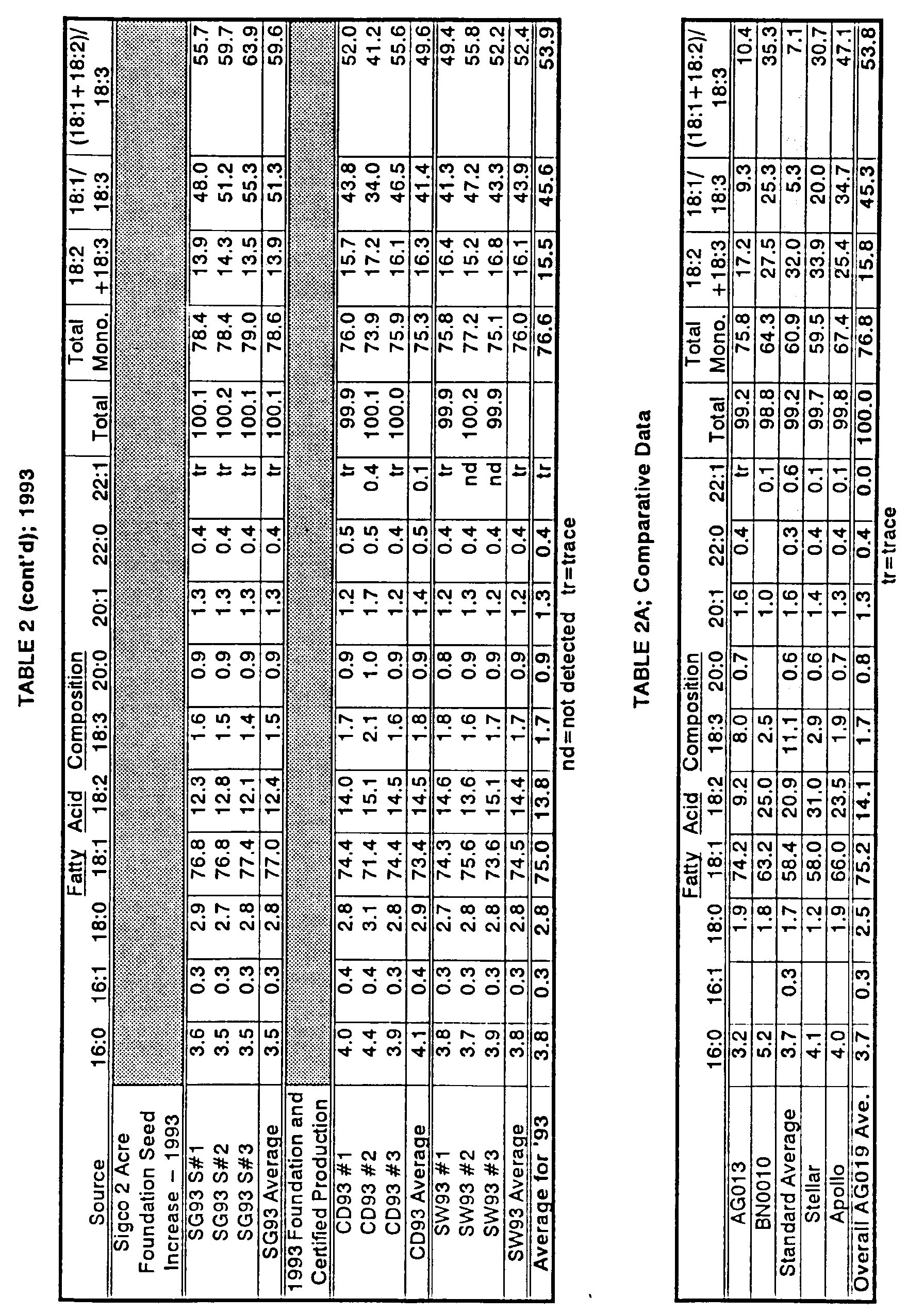
- For ease of comparison, the information from Table 1 is charted in Table 2, which includes the total monounsaturate content, cumulative linoleic and linolenic content, ratio value of oleic to linolenic acids, and ratio value of combined (oleic+linoleic)/linolenic acids for each example. "Ratio value" means the value obtained by converting a ratio, such as the 75.1:2.0 ratio of oleic:linolenic acids shown for the "Greenhouse '91" entry at the top of Table 2, and converting it to a numerical value, here, 37.6. (With regard to the POS test crush from 1992, Table 2 shows the results of the seed assay only, and not of the subsequent crude and RBD (refined, bleached and deodorized) oil analyses.)
- Table 2A provides comparative data among the two parent lines of AG019 (AG013 and BN0010); "Standard Average" canola values, representing the overall fatty acid values for standard canola grown in 28 crop districts in Western Canada (12 in Manitoba, 9 in Saskatchewan, and 7 in Alberta) in 1992, as reported by the Canadian Grain Commission (DeClercq and Daun, Quality of 1992 Western Canadian Canola, Report to Canola Industry Meeting, Saskatoon, December 1, 1992)(hereinafter "1992 Canadian Grain Commission Report"); and two low linolenic lines, Stellar and Apollo, all as compared with the overall averages for the AG019 data presented in Table 2.

- It should be noted that the inclusion of information herein related to other rapeseed lines, including the AG019 parent lines AG013 and BN0010, for comparative purposes is not an admission that such lines constitute prior art. This information is being included simply to facilitate examination of the present application.
- Tables 2 and 2A should be viewed bearing in mind the mechanisms underlying production of fatty acids in vegetable seed oil. The major product of fatty acid synthesis is palmitate (16:0), which is elongated to stearate (18:0). Stearate is then successively desaturated, apparently by a sequence of different enzymes and/or at different cellular locations, to oleate (18:1), linoleate (18:2), and linolenate (18:3).
- A comparison of the cumulative levels of 18:0, 18:1, 18:2, and 18:3 in AG019, its parent lines AG013 and BN0010, standard rapeseed, Stellar, Apollo, and the Allelix line from EP 323753, reveals that the cumulative content of these four species of 18-carbon acids (18:0,18:1, 18:2, and 18:3) varies only within a narrow range, from a low of 92.1% for standard rapeseed to a high of 93.9% for the Allelix variety. From this, it is apparent that the efforts to manipulate oleic, linoleic, and/or linolenic acid content reflected by Allelix EP 323753, Pioneer Hi-Bred PCT/US91/01965, du Pont PCT/US92/08140, and the present invention, represent attempts to alter the normal functioning of desaturase enzymes in rapeseed, i.e., to alter the distribution of 18:0, 18:1, 18:2, and 18:3 within the oil as opposed to significantly affecting the overall amounts of 18-carbon fatty acids present in the oil.
- Therefore, selection for very high oleic acid content vegetable oils, such as the Allelix document, presumably focus on selection of plants in which the second desaturation step, of 18:1 to 18:2, is impaired. However, the step in which 18:2 is then desaturated to 18:3 would appear to be, if not independent, at least not directly tied to the 18:1→18:2 desaturation step. This is shown by the fact that while Allelix appears to have identified plants with a substantially impaired 18:1→18:2 desaturation step, yielding an oleic acid content of slightly over 85 %, this did not prevent linolenic acid from being present at a level of 2.68% (see table, page 10). In contrast, while AG019 has an overall average oleic acid content of about 75%, its average linolenic acid content is only about 1.7%.
- Other distinctions between AG019 and the comparative data are clearly evident, such as in the ratio value of oleic to linolenic acid, shown in the next-to-last column of Table 2A under the heading "18:1/18:3". This ratio is reflective of oxidative stability, which is very responsive to increases in oleic levels and decreases in linolenic levels. The overall average 18:1/18:3 ratio value achieved by AG019 was 45.3, whereas typical ratio values for standard canola range around 5 (see 1992 Canadian Grain Commission Report), and the highest comparative value shown is 34.7, for the low linolenic variety Apollo.
- The success of the present invention in obtaining plants wherein the desaturase step leading to linolenic acid is impaired can be most readily quantified by the ratio value of (oleic+linoleic)/linolenic acids, which also provides an additional indicator of oxidative stability. This ratio value is shown in the last column of Table 2A, under the heading "(18:1+18:2)/18:3". While all unsaturates contribute to oxidative degradation, as previously indicated the rate of oxidation of linolenic acid is 25 times that of oleic, and 2 times that of linoleic. Therefore, linolenic acid, which is moreover the only triunsaturated fatty acid present in rapeseed in measurable amounts, is a key weak spot in attempts to breed high oxidative stability rapeseed oils.
- The present invention achieves remarkable success in minimizing linolenic acid levels, without a concomitant sacrifice in the goals of also obtaining high oleic acid levels and low linoleic acid levels. Thus, while Stellar and Apollo achieve linolenic acid values of 2.9% and 1.9%, respectively, they have oleic acid contents of only 58% for Stellar and 66% for Apollo, compared with the standard average of 58.4% and the AG019 average of 75.2%. Similarly, Stellar shows a linoleic acid content of 31% and Apollo of 23.5%, compared with the standard average of 20.9% and the AG019 average of only 14.1%.
- Thus, the closest comparative (oleic+linoleic)/linolenic value appears to come from the Apollo line, with a value of 47.1, compared to the AG019 range of 41.2-63.9 and overall average value of 53.8. Apollo achieved this value at the expense of an above-standard level of linoleic acid (23.5%) and an oleic acid level (66.0%) that is significantly, but not dramatically, higher than standard (58.4%). The contrast between this result and AG019 may be seen by comparing the respective linoleic+linolenic values; 25.4 for Apollo versus 15.8 for AG019, both as compared to 32.0 for standard rapeseed. It is noteworthy that AG019 further contains extremely low levels of erucic acid. In most assays the erucic acid content was below the level of meaningful quantification, i.e., below around 0.05%. The only real exception, which was the 0.4% level measured for the 1993 CD93 #2 sample, is believed to be due to the presence of wild mustard in the field which was commingled with the AG019 during harvesting.
- As a result of its unique fatty acid profile, AG019 has substantially improved oxidative stability compared to normal rapeseed, and even compared to parent line AG013. This is shown by the Rancimat data in Table 3; the Rancimat is a relatively low-level, dietary applications-oriented rancidity test, which is conducted at 120° C:
Source Rancimat Value (@ 120° C) Normal Canola 1.9 hours AG013 3.9 hours AG019 6.2 hours - Unexpectedly, AG019 also has a very substantially improved response to antioxidants, as shown in Table 4:

- As may be seen, normal rapeseed oil and AG019 show no detectable difference in baseline stability under the rigorous conditions of the RBOT test. However, when a 2% treat level of hindered phenol is added, normal rapeseed improves to an RBOT value of only 55 minutes whereas AG019 improves to 125 minutes. Even more dramatically, with a combined treat of 2% hindered phenol plus 0.05% metal deactivator, the respective RBOT values declined to 43 minutes for normal rapeseed, but increased to 150 minutes for AG019. (Although different metal deactivators were used, the expected difference in results, if any, attributable to the different performances of these two chemically similar deactivators does not explain the opposite results observed between treatment of normal rapeseed versus treatment of AG019.)
- AG019 is best adapted to the spring Canola production area of North Dakota, Minnesota, and western Canada. Yield trials were accordingly conducted in 1992 to compare the agronomic performance of AG019 to that of the elite Canola cultivars Westar, Profit, Delta, and Legend in one location in western Canada. The results of this trial are presented in Table 5.
Entry Yield (1992) kg/ha (% Westar) Maturity (days) Height (cm) Lodging (1-5) Blackleg (0-9) Oil (%) Westar 2002 (100) 101 123 4.0 6.5 37.4 Profit 2182 (109) 102 125 3.0 3.3 38.7 Legend 2162 (108) 102 126 2.3 2.3 36.9 Delta 2342 (117) 104 134 3.5 2.8 36.5 AG019 2302 (115) 106 133 2.8 2.5 36.5 - As may be seen, AG019 outyielded Westar by 15%. It is also later in maturity than Westar, has moderate resistance to lodging and to blackleg, and is comparable to Delta in height and oil content.
- Additional key characteristics and traits of AG019 are presented in Table 6.
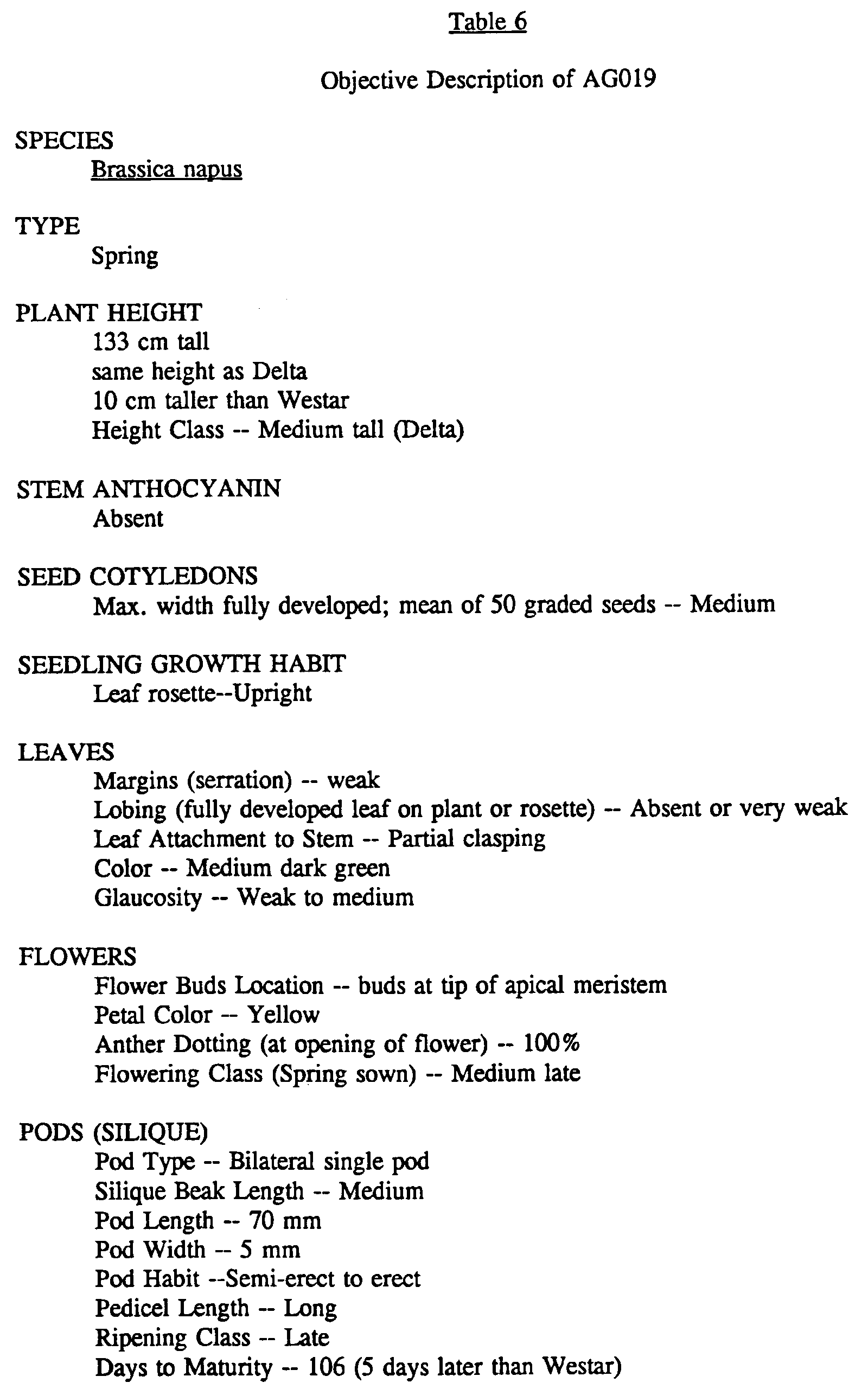

- The characteristics described in Table 6, in combination with the fatty acid composition described in Tables 1 and 2, clearly differentiate AG019 from other Brassica napus varieties and make it a unique variety.
- AG019 can be used for contract production in countries, such as Canada, where spring Canola is adapted. The oil produced from AG019 seed has improved stability compared to standard Canola oil while retaining a desirable dietary fatty acid profile, and thus has applications in both edible and industrial products where these characteristics are required.
- It will be readily apparent that, given AG019 as a starting point, the particular benefits afforded by this variety can be manipulated in a number of ways by the skilled practitioner without departing from the scope of the present invention. For example, the seed oil profile present in AG019 can be transferred into other agronomically desirable Brassica napus varieties by conventional plant breeding techniques involving cross-pollination and selection of the progeny.
- Regeneration techniques may also be used. One initially selects cells capable of regeneration (e.g., seeds, microspores, ovules, pollen, vegetative parts) from a selected plant or variety. These cells may optionally be subjected to mutagenesis, following which a plant is developed from the cells using regeneration, fertilization, and/or growing techniques based on the type of cells mutagenized. Applicable regeneration techniques are known to those in the art; see, for example, Armstrong, C.L., and Green, C.E., Planta 164:207-214 (1985); Duncan, D.R. et al., Planta 165:322-332 (1985); and, Close, K.R., and Ludeman, L.A., Plant Science 52:81-89 (1987), the disclosures of which are hereby incorporated herein in their entireties by reference thereto.
- Such manipulations of plants or seeds of AG019, or parts thereof, may lead to the creation of what may be termed "essentially derived" varieties. The International Union for the Protection of New Varieties of Plants (UPOV) has provided the following guideline for determining if a variety has been essentially derived from a protected variety:
- [A] variety shall be deemed to be essentially derived from another variety ("the
initial variety") when
- (i) it is predominantly derived from the initial variety, or from a variety that is itself predominantly derived from the initial variety, while retaining the expression of the essential characteristics that result from the genotype or combination of genotypes of the initial variety;
- (ii) it is clearly distinguishable from the initial variety; and
- (iii) except for the differences which result from the act of derivation, it conforms to the initial variety in the expression of the essential characteristics that result from the genotype or combination of genotypes of the initial variety. UPOV, Sixth Meeting with International Organizations, Geneva, October 30, 1992; document prepared by the Office of the Union.
-
- The present invention has of necessity been discussed herein by reference to certain specific methods and materials. The enumeration of these methods and materials was merely illustrative, and in no way constitutes any limitation on the scope of the present invention. It is to be expected that those skilled in the art may discern and practice variations of or alternatives to the specific teachings provided herein, without departing from the scope of the present invention.
Claims (12)
- Oil produced from the seed of a Brassica napus plant, having an oleic acid content of from 72.9% to 77.0%, and a linolenic acid content from 1.4% to 2.1%.
- The oil as defined by claim 1, wherein said oleic acid content is from 72.9% to 75.3% and said linolenic acid content is from 1.7% to 2.0%.
- The oil as defined by claim 1, said oil having an oleic:linolenic acid ratio value of from 34.0 to 55.3.
- The oil as defined by claim 3, wherein said oleic:linolenic acid ratio value is from 36.5 to 51.3.
- The oil as defined by claim 1, said oil having an (oleic +linoleic)/linolenic acid ratio value of from 41.2 to 63.9, and a combined linoleic +linolenic acid content of no more than 18.7.
- The oil as defined by claim 5, wherein said (oleic +linoleic)/linolenic acid ratio value is from 44.1 to 59.6.
- The oil as defined in any preceding claim further comprising an effective amount of at least one antioxidant, said oil having a substantially improved ASTM D2272 Rotary Bomb Oxidation Test value relative to normal rapeseed oil also treated with said at least one antioxidant.
- The oil as defined by claim 7, wherein said at least one antioxidant is selected from the group consisting of hindered phenols and metal deactivators.
- The oil as defined by claim 8, wherein said at least one antioxidant is ditertiary-butylphenol.
- The oil as defined by claim 8, wherein said metal deactivator is a triazole-containing metal deactivator.
- The oil as defined by claim 10, wherein said triazole-containing metal deactivator is selected from the group consisting of tolyltriazole and the reaction product of tolyltriazole, an aldehyde, and an amine.
- The oil as defined by claim 8, wherein said at least one antioxidant is a combination of di-tertiary-butylphenol and a triazole-containing antioxidant.
Applications Claiming Priority (2)
| Application Number | Priority Date | Filing Date | Title |
|---|---|---|---|
| US13510593A | 1993-10-12 | 1993-10-12 | |
| US135105 | 1993-10-12 |
Publications (3)
| Publication Number | Publication Date |
|---|---|
| EP0647406A2 EP0647406A2 (en) | 1995-04-12 |
| EP0647406A3 EP0647406A3 (en) | 1996-04-17 |
| EP0647406B1 true EP0647406B1 (en) | 2000-05-24 |
Family
ID=22466575
Family Applications (1)
| Application Number | Title | Priority Date | Filing Date |
|---|---|---|---|
| EP94307426A Expired - Lifetime EP0647406B1 (en) | 1993-10-12 | 1994-10-10 | Oil derived from Brassica napus |
Country Status (5)
| Country | Link |
|---|---|
| US (2) | US5965755A (en) |
| EP (1) | EP0647406B1 (en) |
| AU (1) | AU692791B2 (en) |
| CA (1) | CA2133881C (en) |
| DE (1) | DE69424616T2 (en) |
Families Citing this family (217)
| Publication number | Priority date | Publication date | Assignee | Title |
|---|---|---|---|---|
| US6483008B1 (en) * | 1990-08-15 | 2002-11-19 | Calgene Llc | Methods for producing plants with elevated oleic acid content |
| US6270828B1 (en) * | 1993-11-12 | 2001-08-07 | Cargrill Incorporated | Canola variety producing a seed with reduced glucosinolates and linolenic acid yielding an oil with low sulfur, improved sensory characteristics and increased oxidative stability |
| AU695940B2 (en) | 1993-04-27 | 1998-08-27 | Cargill Incorporated | Non-hydrogenated canola oil for food applications |
| US5625130A (en) * | 1995-03-07 | 1997-04-29 | Pioneer Hi-Bred International, Inc. | Oilseed Brassica bearing an endogenous oil wherein the levels of oleic, alpha-linolenic, and saturated fatty acids are simultaneously provided in an atypical highly beneficial distribution via genetic control |
| US6398986B1 (en) * | 1995-12-21 | 2002-06-04 | Cooper Industries, Inc | Food grade vegetable oil based dielectric fluid and methods of using same |
| US5850026A (en) * | 1996-07-03 | 1998-12-15 | Cargill, Incorporated | Canola oil having increased oleic acid and decreased linolenic acid content |
| EP1007712A4 (en) * | 1997-08-05 | 2004-06-30 | Kimeragen Inc | The use of mixed duplex oligonucleotides to effect localized genetic changes in plants |
| US6521818B1 (en) * | 1998-07-01 | 2003-02-18 | John Hopkins School Of Medicine | Development of novel highly chemoprotectant crucifer germplasm |
| US6303849B1 (en) | 1998-11-12 | 2001-10-16 | Saskatchewan Wheat Pool | Brassica juncea lines bearing endogenous edible oils |
| WO2000037060A2 (en) * | 1998-12-22 | 2000-06-29 | National Research Council Of Canada | Transgenic plants comprising a conditionally lethal gene |
| US6323392B1 (en) * | 1999-03-01 | 2001-11-27 | Pioneer Hi-Bred International, Inc. | Formation of brassica napus F1 hybrid seeds which exhibit a highly elevated oleic acid content and a reduced linolenic acid content in the endogenously formed oil of the seeds |
| US6361812B1 (en) | 1999-11-18 | 2002-03-26 | The Procter & Gamble Co. | Products comprising an isothiocyanate preservative system and methods of their use |
| ES2168046B1 (en) * | 1999-11-19 | 2004-05-16 | Consejo Superior De Investigaciones Cientificas | ETIOPE MOSTAZA SEED OIL WITH LOW CONTENT IN LINOLENIC ACID. |
| US6793959B2 (en) * | 2002-03-18 | 2004-09-21 | Bunge Foods Corporation | Low viscosity structured lipid pan release compositions and methods |
| ES2390765T3 (en) | 2003-02-11 | 2012-11-16 | Dow Agrosciences Llc | FAD2 and FAD3 genes altered in Brassica and their molecular marker assisted detection |
| ATE430802T1 (en) | 2003-08-21 | 2009-05-15 | Monsanto Technology Llc | FATTY ACID DESATURASES FROM PRIMULA |
| US8158184B2 (en) | 2004-03-08 | 2012-04-17 | Bunge Oils, Inc. | Structured lipid containing compositions and methods with health and nutrition promoting characteristics |
| CN1968688A (en) | 2004-04-16 | 2007-05-23 | 孟山都技术有限公司 | Expression of fatty acid desaturases in corn |
| EP1769058B1 (en) * | 2004-07-02 | 2012-06-06 | Monsanto S.A.S. | A new biofuel composition |
| CA2571724A1 (en) | 2004-07-02 | 2006-01-12 | Monsanto S.A.S. | A new biofuel composition |
| HUE034217T2 (en) | 2004-10-08 | 2018-01-29 | Dow Agrosciences Llc | Certain plants with no saturate or reduced saturate levels of fatty acids in seeds, and oil derived from the seeds |
| US20080260933A1 (en) * | 2004-10-08 | 2008-10-23 | Dow Agroscience Llc | Certain Plants with "No Saturate" or Reduced Saturate Levels of Fatty Acids in Seeds, and Oil Derived from the Seeds |
| DE602005021675D1 (en) | 2004-11-04 | 2010-07-15 | Monsanto Technology Llc | METHOD FOR PRODUCING OIL COMPOSITIONS |
| EP1728846A1 (en) * | 2005-05-30 | 2006-12-06 | Monsanto S.A.S. | A new biodiesel composition |
| EP1741770A1 (en) * | 2005-07-04 | 2007-01-10 | Monsanto S.A.S. | Use of rapeseed oil in biolubricants |
| CN101262760A (en) | 2005-08-01 | 2008-09-10 | 加拿大农业和农业食品部 | Low fiber yellow canola seeds comprising high oleic, low linolenic oils |
| EP1806398A1 (en) * | 2006-01-04 | 2007-07-11 | Monsanto S.A.S. | Fad-2 mutants and high oleic plants |
| CN105475116A (en) | 2006-03-10 | 2016-04-13 | 孟山都技术有限公司 | Soybean seed and oil compositions and methods of making same |
| US20070218183A1 (en) * | 2006-03-14 | 2007-09-20 | Bunge Oils, Inc. | Oil composition of conjugated linoleic acid |
| EP1837397A1 (en) * | 2006-03-21 | 2007-09-26 | Monsanto S.A.S. | FAD-2 mutants and high oleic plants |
| CA2669900C (en) | 2006-11-15 | 2016-03-01 | Agrigenetics, Inc. | Generation of plants expressing an imq polypeptide and having altered protein, fiber or oil content |
| CL2007003744A1 (en) * | 2006-12-22 | 2008-07-11 | Bayer Cropscience Ag | COMPOSITION THAT INCLUDES A 2-PYRIDILMETILBENZAMIDE DERIVATIVE AND AN INSECTICIDE COMPOUND; AND METHOD TO CONTROL FITOPATOGENOS CULTURES AND INSECTS FACING OR PREVENTIVELY. |
| CL2007003743A1 (en) | 2006-12-22 | 2008-07-11 | Bayer Cropscience Ag | COMPOSITION THAT INCLUDES FENAMIDONA AND AN INSECTICIDE COMPOUND; AND METHOD TO CONTROL FITOPATOGENOS CULTURES AND INSECTS FACING OR PREVENTIVELY. |
| EP1944375A1 (en) * | 2007-01-11 | 2008-07-16 | Monsanto S.A.S. | FAD2 mutants and high oleic acid plants |
| EP1969930A1 (en) * | 2007-03-12 | 2008-09-17 | Bayer CropScience AG | Phenoxy phenylamidines and their use as fungicides |
| BRPI0808846A2 (en) * | 2007-03-12 | 2019-09-24 | Bayer Cropscience Ag | 3-substituted phenoxyphenylamidines and their use as fungicides |
| EP1969929A1 (en) | 2007-03-12 | 2008-09-17 | Bayer CropScience AG | Substituted phenylamidines and their use as fungicides |
| EP1969934A1 (en) * | 2007-03-12 | 2008-09-17 | Bayer CropScience AG | 4-cycloalkyl or 4-aryl substituted phenoxy phenylamidines and their use as fungicides |
| WO2008110279A1 (en) * | 2007-03-12 | 2008-09-18 | Bayer Cropscience Ag | Dihalophenoxyphenylamidines and use thereof as fungicides |
| BRPI0808798A2 (en) * | 2007-03-12 | 2014-10-07 | Bayer Cropscience Ag | 3,5-DISSUBSTITUTED PHENOXYPHENYLAMIDINS AND THEIR USE AS FUNGICIDES |
| EP1969931A1 (en) | 2007-03-12 | 2008-09-17 | Bayer CropScience Aktiengesellschaft | Fluoroalkyl phenylamidines and their use as fungicides |
| NZ597328A (en) * | 2007-04-04 | 2014-03-28 | Basf Se | Herbicide-resistant brassica plants and methods of use |
| US8168567B2 (en) | 2007-04-19 | 2012-05-01 | Bayer Cropscience Ag | Thiadiazolyl oxyphenyl amidines and the use thereof as a fungicide |
| EP1995301A1 (en) * | 2007-05-17 | 2008-11-26 | Cooper Industries, Inc. | Vegetable oil dielectric fluid composition |
| US8801975B2 (en) * | 2007-05-17 | 2014-08-12 | Cooper Industries, Llc | Vegetable oil dielectric fluid composition |
| CA2786816C (en) * | 2007-05-17 | 2014-12-23 | Cooper Industries, Inc. | Vegetable oil dielectric fluid composition |
| DE102007045953B4 (en) | 2007-09-26 | 2018-07-05 | Bayer Intellectual Property Gmbh | Drug combinations with insecticidal and acaricidal properties |
| DE102007045919B4 (en) | 2007-09-26 | 2018-07-05 | Bayer Intellectual Property Gmbh | Drug combinations with insecticidal and acaricidal properties |
| DE102007045922A1 (en) * | 2007-09-26 | 2009-04-02 | Bayer Cropscience Ag | Drug combinations with insecticidal and acaricidal properties |
| DE102007045920B4 (en) | 2007-09-26 | 2018-07-05 | Bayer Intellectual Property Gmbh | Synergistic drug combinations |
| DE102007045956A1 (en) * | 2007-09-26 | 2009-04-09 | Bayer Cropscience Ag | Combination of active ingredients with insecticidal and acaricidal properties |
| EP2090168A1 (en) | 2008-02-12 | 2009-08-19 | Bayer CropScience AG | Method for improving plant growth |
| BRPI0818691A2 (en) * | 2007-10-02 | 2014-09-30 | Bayer Cropscience Ag | METHODS TO IMPROVE VEGETABLE GROWTH. |
| EP2072506A1 (en) | 2007-12-21 | 2009-06-24 | Bayer CropScience AG | Thiazolyloxyphenylamidine or thiadiazolyloxyphenylamidine und its use as fungicide |
| EP2113172A1 (en) * | 2008-04-28 | 2009-11-04 | Bayer CropScience AG | Method for improved utilisation of the production potential of transgene plants |
| GB0807619D0 (en) | 2008-04-28 | 2008-06-04 | Whitton Peter A | Production of bio fuels from plant tissue culture sources |
| EP2168434A1 (en) | 2008-08-02 | 2010-03-31 | Bayer CropScience AG | Use of azols to increase resistance of plants of parts of plants to abiotic stress |
| US20110190365A1 (en) | 2008-08-14 | 2011-08-04 | Bayer Crop Science Ag | Insecticidal 4-phenyl-1H-pyrazoles |
| DE102008041695A1 (en) * | 2008-08-29 | 2010-03-04 | Bayer Cropscience Ag | Methods for improving plant growth |
| CA2741211A1 (en) * | 2008-11-04 | 2010-05-14 | Dow Agrosciences Llc | Omega-9 quality brassica juncea |
| EP2201838A1 (en) | 2008-12-05 | 2010-06-30 | Bayer CropScience AG | Active ingredient-beneficial organism combinations with insecticide and acaricide properties |
| EP2198709A1 (en) | 2008-12-19 | 2010-06-23 | Bayer CropScience AG | Method for treating resistant animal pests |
| EP2223602A1 (en) | 2009-02-23 | 2010-09-01 | Bayer CropScience AG | Method for improved utilisation of the production potential of genetically modified plants |
| EP2204094A1 (en) | 2008-12-29 | 2010-07-07 | Bayer CropScience AG | Method for improved utilization of the production potential of transgenic plants Introduction |
| AU2009335333B2 (en) | 2008-12-29 | 2015-04-09 | Bayer Intellectual Property Gmbh | Method for improved use of the production potential of genetically modified plants |
| EP2039772A2 (en) | 2009-01-06 | 2009-03-25 | Bayer CropScience AG | Method for improved utilization of the production potential of transgenic plants introduction |
| EP2039771A2 (en) | 2009-01-06 | 2009-03-25 | Bayer CropScience AG | Method for improved utilization of the production potential of transgenic plants |
| EP2039770A2 (en) | 2009-01-06 | 2009-03-25 | Bayer CropScience AG | Method for improved utilization of the production potential of transgenic plants |
| BRPI1006916A8 (en) | 2009-01-19 | 2016-05-03 | Bayer Cropscience Ag | CYCLIC DIONES AND THEIR USE AS INSECTICIDES, ACARICIDES AND/OR FUNGICIDES |
| EP2227951A1 (en) | 2009-01-23 | 2010-09-15 | Bayer CropScience AG | Application of enaminocarbonyl compounds for combating viruses transmitted by insects |
| EP2391608B8 (en) | 2009-01-28 | 2013-04-10 | Bayer Intellectual Property GmbH | Fungicide n-cycloalkyl-n-bicyclicmethylene-carboxamide derivatives |
| AR075126A1 (en) * | 2009-01-29 | 2011-03-09 | Bayer Cropscience Ag | METHOD FOR THE BEST USE OF THE TRANSGENIC PLANTS PRODUCTION POTENTIAL |
| EP2218717A1 (en) | 2009-02-17 | 2010-08-18 | Bayer CropScience AG | Fungicidal N-((HET)Arylethyl)thiocarboxamide derivatives |
| EP2398770B1 (en) | 2009-02-17 | 2016-12-28 | Bayer Intellectual Property GmbH | Fungicidal n-(phenylcycloalkyl)carboxamide, n-(benzylcycloalkyl)carboxamide and thiocarboxamide derivatives |
| TW201031331A (en) | 2009-02-19 | 2010-09-01 | Bayer Cropscience Ag | Pesticide composition comprising a tetrazolyloxime derivative and a fungicide or an insecticide active substance |
| MX2011009372A (en) | 2009-03-25 | 2011-09-27 | Bayer Cropscience Ag | Active ingredient combinations having insecticidal and acaricidal properties. |
| MX2011009916A (en) | 2009-03-25 | 2011-10-06 | Bayer Cropscience Ag | Active ingredient combinations having insecticidal and acaricidal properties. |
| US8846568B2 (en) | 2009-03-25 | 2014-09-30 | Bayer Cropscience Ag | Active compound combinations having insecticidal and acaricidal properties |
| US8828906B2 (en) | 2009-03-25 | 2014-09-09 | Bayer Cropscience Ag | Active compound combinations having insecticidal and acaricidal properties |
| UA104887C2 (en) | 2009-03-25 | 2014-03-25 | Баєр Кропсаєнс Аг | Synergic combinations of active ingredients |
| EP2232995A1 (en) | 2009-03-25 | 2010-09-29 | Bayer CropScience AG | Method for improved utilisation of the production potential of transgenic plants |
| EP2239331A1 (en) | 2009-04-07 | 2010-10-13 | Bayer CropScience AG | Method for improved utilization of the production potential of transgenic plants |
| WO2010127797A2 (en) | 2009-05-06 | 2010-11-11 | Bayer Cropscience Ag | Cyclopentanedione compounds and their use as insecticides, acaricides and/or fungicides |
| EP2251331A1 (en) | 2009-05-15 | 2010-11-17 | Bayer CropScience AG | Fungicide pyrazole carboxamides derivatives |
| AR076839A1 (en) | 2009-05-15 | 2011-07-13 | Bayer Cropscience Ag | FUNGICIDE DERIVATIVES OF PIRAZOL CARBOXAMIDAS |
| EP2255626A1 (en) | 2009-05-27 | 2010-12-01 | Bayer CropScience AG | Use of succinate dehydrogenase inhibitors to increase resistance of plants or parts of plants to abiotic stress |
| PL2437595T3 (en) | 2009-06-02 | 2019-05-31 | Bayer Cropscience Ag | Use of fluopyram for controlling sclerotinia ssp |
| CN104430378A (en) | 2009-07-16 | 2015-03-25 | 拜尔农作物科学股份公司 | Synergistic active substance combinations containing phenyl triazoles |
| WO2011015524A2 (en) | 2009-08-03 | 2011-02-10 | Bayer Cropscience Ag | Fungicide heterocycles derivatives |
| EP2292094A1 (en) | 2009-09-02 | 2011-03-09 | Bayer CropScience AG | Active compound combinations |
| US9480271B2 (en) | 2009-09-15 | 2016-11-01 | Monsanto Technology Llc | Soybean seed and oil compositions and methods of making same |
| EP2343280A1 (en) | 2009-12-10 | 2011-07-13 | Bayer CropScience AG | Fungicide quinoline derivatives |
| CA2782423C (en) | 2009-12-18 | 2019-06-18 | Cargill Incorporated | Brassica plants yielding oils with a low total saturated fatty acid content |
| CN102725282B (en) | 2009-12-28 | 2015-12-16 | 拜尔农科股份公司 | Fungicide hydroximoyl-tetrazole derivatives |
| US9000012B2 (en) | 2009-12-28 | 2015-04-07 | Bayer Cropscience Ag | Fungicide hydroximoyl-heterocycles derivatives |
| TW201138624A (en) | 2009-12-28 | 2011-11-16 | Bayer Cropscience Ag | Fungicide hydroximoyl-tetrazole derivatives |
| EA022553B1 (en) | 2010-01-22 | 2016-01-29 | Байер Интеллектуэль Проперти Гмбх | Use of biologically active ingredient combination, kit and composition comprising biologically active ingredient combination for controlling animal pests and method for improving utilization of production potential of transgenic plant |
| US8372465B2 (en) | 2010-02-17 | 2013-02-12 | Bunge Oils, Inc. | Oil compositions of stearidonic acid |
| JP2013521255A (en) | 2010-03-04 | 2013-06-10 | バイエル・インテレクチュアル・プロパティ・ゲゼルシャフト・ミット・ベシュレンクテル・ハフツング | Fluoroalkyl-substituted 2-amidobenzimidazoles and their use to enhance stress tolerance in plants |
| WO2011124554A2 (en) | 2010-04-06 | 2011-10-13 | Bayer Cropscience Ag | Use of 4-phenylbutyric acid and/or the salts thereof for enhancing the stress tolerance of plants |
| CA2795838A1 (en) | 2010-04-09 | 2011-10-13 | Bayer Intellectual Property Gmbh | Use of derivatives of the(1-cyanocyclopropyl)phenylphosphinic acid, the esters thereof and/or the salts thereof for enhancing the tolerance of plants to abiotic stress |
| WO2011134913A1 (en) | 2010-04-28 | 2011-11-03 | Bayer Cropscience Ag | Fungicide hydroximoyl-heterocycles derivatives |
| WO2011134911A2 (en) | 2010-04-28 | 2011-11-03 | Bayer Cropscience Ag | Fungicide hydroximoyl-tetrazole derivatives |
| JP2013525400A (en) | 2010-04-28 | 2013-06-20 | バイエル・クロップサイエンス・アーゲー | Fungicide hydroxymoyl-heterocyclic derivative |
| US9695434B2 (en) | 2010-05-25 | 2017-07-04 | Cargill, Incorporated | Brassica plants yielding oils with a low alpha linolenic acid content |
| CA2837011C (en) | 2010-05-25 | 2023-01-17 | Cargill Incorporated | Brassica plants yielding oils with a low alpha linolenic acid content |
| WO2011151370A1 (en) | 2010-06-03 | 2011-12-08 | Bayer Cropscience Ag | N-[(het)arylalkyl)] pyrazole (thio)carboxamides and their heterosubstituted analogues |
| UA110703C2 (en) | 2010-06-03 | 2016-02-10 | Байєр Кропсайнс Аг | Fungicidal n-[(trisubstitutedsilyl)methyl]carboxamide |
| ES2533026T3 (en) | 2010-06-03 | 2015-04-07 | Bayer Intellectual Property Gmbh | N - [(het) arylalkyl)] pyrazole (thio) carboxamides and their hetero substituted analogs |
| JP5728170B2 (en) * | 2010-06-04 | 2015-06-03 | 日清オイリオグループ株式会社 | Edible oil and food containing the edible oil |
| AR082286A1 (en) | 2010-07-20 | 2012-11-28 | Bayer Cropscience Ag | BENZOCICLOALQUENOS AS ANTIFUNGIC AGENTS |
| RU2013114710A (en) | 2010-09-03 | 2014-10-10 | Байер Интеллектуэль Проперти Гмбх | Substituted Condensed Pyrimidinones and Dihydropyrimidinones |
| CA2807527C (en) | 2010-09-17 | 2018-06-26 | Dow Global Technologies Inc. | A thermally-stable dielectric fluid |
| CN103298341B (en) | 2010-09-22 | 2016-06-08 | 拜耳知识产权有限责任公司 | Use of active ingredients for controlling nematodes in nematode-resistant crops |
| EP2460406A1 (en) | 2010-12-01 | 2012-06-06 | Bayer CropScience AG | Use of fluopyram for controlling nematodes in nematode resistant crops |
| BR112013008446B1 (en) | 2010-10-07 | 2018-06-12 | Bayer Cropscience Ag | '' COMPOSITION AND METHOD FOR CONTROLING PHYTOPATHOGENIC FUNGALS OR DAMAGING INSECTS OF PLANTS, CROPS OR SEEDS '' |
| BR112013009590B8 (en) | 2010-10-21 | 2019-03-19 | Bayer Ip Gmbh | compound, fungicidal composition and method |
| US9084424B2 (en) | 2010-10-21 | 2015-07-21 | Bayer Intellectual Property Gmbh | N-benzyl heterocyclic carboxamides |
| CA2815117A1 (en) | 2010-11-02 | 2012-05-10 | Bayer Intellectual Property Gmbh | N-hetarylmethyl pyrazolylcarboxamides |
| EP2640706B1 (en) | 2010-11-15 | 2017-03-01 | Bayer Intellectual Property GmbH | N-aryl pyrazole(thio)carboxamides |
| BR112013012081A2 (en) | 2010-11-15 | 2016-07-19 | Bayer Ip Gmbh | 5-halopyrazole (thio) carboxamides |
| MX2013005407A (en) | 2010-11-15 | 2013-07-03 | Bayer Ip Gmbh | 5-halogenopyrazolecarboxamides. |
| EP2460407A1 (en) | 2010-12-01 | 2012-06-06 | Bayer CropScience AG | Agent combinations comprising pyridylethyl benzamides and other agents |
| AP3519A (en) | 2010-12-01 | 2016-01-11 | Bayer Ip Gmbh | Use of fluopyram for controlling nematodes in crops and for increasing yield |
| EP2658853A1 (en) | 2010-12-29 | 2013-11-06 | Bayer Intellectual Property GmbH | Fungicide hydroximoyl-tetrazole derivatives |
| EP2474542A1 (en) | 2010-12-29 | 2012-07-11 | Bayer CropScience AG | Fungicide hydroximoyl-tetrazole derivatives |
| EP2471363A1 (en) | 2010-12-30 | 2012-07-04 | Bayer CropScience AG | Use of aryl-, heteroaryl- and benzylsulfonamide carboxylic acids, -carboxylic acid esters, -carboxylic acid amides and -carbonitriles and/or its salts for increasing stress tolerance in plants |
| EP2494867A1 (en) | 2011-03-01 | 2012-09-05 | Bayer CropScience AG | Halogen-substituted compounds in combination with fungicides |
| WO2012120105A1 (en) | 2011-03-10 | 2012-09-13 | Bayer Cropscience Ag | Use of lipochito-oligosaccharide compounds for safeguarding seed safety of treated seeds |
| BR112013023502A2 (en) | 2011-03-14 | 2016-08-02 | Bayer Ip Gmbh | compound (i), fungicidal composition, method for the control of crop phytopathogenic fungi, use of the compounds of formula (i) and process for producing the compositions |
| JP2014512358A (en) | 2011-04-08 | 2014-05-22 | バイエル・インテレクチユアル・プロパテイー・ゲー・エム・ベー・ハー | Fungicide hydroxymoyl-tetrazole derivative |
| AR085568A1 (en) | 2011-04-15 | 2013-10-09 | Bayer Cropscience Ag | 5- (BICYCLE [4.1.0] HEPT-3-EN-2-IL) -PENTA-2,4-DIENOS AND 5- (BICYCLE [4.1.0] HEPT-3-EN-2-IL) -PENT- 2-IN-4-INOS REPLACED AS ACTIVE PRINCIPLES AGAINST ABIOTIC STRESS OF PLANTS |
| AR090010A1 (en) | 2011-04-15 | 2014-10-15 | Bayer Cropscience Ag | 5- (CICLOHEX-2-EN-1-IL) -PENTA-2,4-DIENOS AND 5- (CICLOHEX-2-EN-1-IL) -PENT-2-EN-4-INOS REPLACED AS ACTIVE PRINCIPLES AGAINST THE ABIOTIC STRESS OF PLANTS, USES AND TREATMENT METHODS |
| EP2511255A1 (en) | 2011-04-15 | 2012-10-17 | Bayer CropScience AG | Substituted prop-2-in-1-ol and prop-2-en-1-ol derivatives |
| AR085585A1 (en) | 2011-04-15 | 2013-10-09 | Bayer Cropscience Ag | VINIL- AND ALQUINILCICLOHEXANOLES SUBSTITUTED AS ACTIVE PRINCIPLES AGAINST STRIPS ABIOTIQUE OF PLANTS |
| EA029682B1 (en) | 2011-04-22 | 2018-04-30 | Байер Интеллекчуал Проперти Гмбх | Active compound combinations comprising a (thio)carboxamide derivative and a fungicidal compound |
| US9173395B2 (en) | 2011-07-04 | 2015-11-03 | Bayer Intellectual Property Gmbh | Use of substituted isoquinolinones, isoquinolindiones, isoquinolintriones and dihydroisoquinolinones or in each case salts thereof as active agents against abiotic stress in plants |
| US9265252B2 (en) | 2011-08-10 | 2016-02-23 | Bayer Intellectual Property Gmbh | Active compound combinations comprising specific tetramic acid derivatives |
| US20140206726A1 (en) | 2011-08-22 | 2014-07-24 | Juergen Benting | Fungicide hydroximoyl-tetrazole derivatives |
| EP2561759A1 (en) | 2011-08-26 | 2013-02-27 | Bayer Cropscience AG | Fluoroalkyl-substituted 2-amidobenzimidazoles and their effect on plant growth |
| EP2753177A1 (en) | 2011-09-09 | 2014-07-16 | Bayer Intellectual Property GmbH | Acyl-homoserine lactone derivatives for improving plant yield |
| JP6002225B2 (en) | 2011-09-12 | 2016-10-05 | バイエル・インテレクチュアル・プロパティ・ゲゼルシャフト・ミット・ベシュレンクテル・ハフツングBayer Intellectual Property GmbH | Bactericidal 4-substituted-3- {phenyl [(heterocyclylmethoxy) imino] methyl} -1,2,4-oxadiazol-5 (4H) -one derivatives |
| EP2755484A1 (en) | 2011-09-16 | 2014-07-23 | Bayer Intellectual Property GmbH | Use of 5-phenyl- or 5-benzyl-2 isoxazoline-3 carboxylates for improving plant yield |
| CN103929956B (en) | 2011-09-16 | 2017-02-22 | 拜耳知识产权有限责任公司 | Use of acylsulfonamides for improving plant yield |
| MX362112B (en) | 2011-09-16 | 2019-01-07 | Bayer Ip Gmbh | Use of phenylpyrazolin-3-carboxylates for improving plant yield. |
| US9226505B2 (en) | 2011-09-23 | 2016-01-05 | Bayer Intellectual Property Gmbh | 4-substituted 1-phenylpyrazole-3-carboxylic acid derivatives as agents against abiotic plant stress |
| WO2013050410A1 (en) | 2011-10-04 | 2013-04-11 | Bayer Intellectual Property Gmbh | RNAi FOR THE CONTROL OF FUNGI AND OOMYCETES BY INHIBITING SACCHAROPINE DEHYDROGENASE GENE |
| WO2013050324A1 (en) | 2011-10-06 | 2013-04-11 | Bayer Intellectual Property Gmbh | Combination, containing 4-phenylbutyric acid (4-pba) or a salt thereof (component (a)) and one or more selected additional agronomically active compounds (component(s) (b)), that reduces abiotic plant stress |
| CN103958531B (en) | 2011-11-21 | 2016-12-28 | 拜耳知识产权有限责任公司 | Antifungal N [(trisubstituted silicyl) methyl] carboxamide derivative |
| CA2857438A1 (en) | 2011-11-30 | 2013-06-06 | Bayer Intellectual Property Gmbh | Fungicidal n-bicycloalkyl and n-tricycloalkyl (thio)carboxamide derivatives |
| IN2014CN04325A (en) | 2011-12-19 | 2015-09-04 | Bayer Cropscience Ag | |
| JP5976837B2 (en) | 2011-12-29 | 2016-08-24 | バイエル・インテレクチュアル・プロパティ・ゲゼルシャフト・ミット・ベシュレンクテル・ハフツングBayer Intellectual Property GmbH | Bactericidal 3-[(1,3-thiazol-4-ylmethoxyimino) (phenyl) methyl] -2-substituted-1,2,4-oxadiazol-5 (2H) -one derivatives |
| US9556158B2 (en) | 2011-12-29 | 2017-01-31 | Bayer Intellectual Property Gmbh | Fungicidal 3-[(pyridin-2-ylmethoxyimino)(phenyl)methyl]-2-substituted-1,2,4-oxadiazol-5(2H)-one derivatives |
| HUE036328T2 (en) | 2012-02-22 | 2018-06-28 | Bayer Cropscience Ag | Use of fluopyram for controlling wood diseases in grape |
| CA2865300C (en) | 2012-02-27 | 2021-02-16 | Bayer Intellectual Property Gmbh | Active compound combinations containing a thiazoylisoxazoline and a fungicide |
| WO2013139949A1 (en) | 2012-03-23 | 2013-09-26 | Bayer Intellectual Property Gmbh | Compositions comprising a strigolactame compound for enhanced plant growth and yield |
| EP2836489B1 (en) | 2012-04-12 | 2016-06-29 | Bayer Cropscience AG | N-acyl-2-(cyclo) alkylpyrrolidines and piperidines useful as fungicides |
| JP2015516396A (en) | 2012-04-20 | 2015-06-11 | バイエル・クロップサイエンス・アーゲーBayer Cropscience Ag | N-cycloalkyl-N-[(trisubstituted silylphenyl) methylene]-(thio) carboxamide derivatives |
| JP6109295B2 (en) | 2012-04-20 | 2017-04-05 | バイエル・クロップサイエンス・アクチェンゲゼルシャフト | N-cycloalkyl-N-[(heterocyclylphenyl) methylene]-(thio) carboxamide derivatives |
| EP2662362A1 (en) | 2012-05-09 | 2013-11-13 | Bayer CropScience AG | Pyrazole indanyl carboxamides |
| EP2662360A1 (en) | 2012-05-09 | 2013-11-13 | Bayer CropScience AG | 5-Halogenopyrazole indanyl carboxamides |
| EP2662364A1 (en) | 2012-05-09 | 2013-11-13 | Bayer CropScience AG | Pyrazole tetrahydronaphthyl carboxamides |
| CN104364236B (en) | 2012-05-09 | 2018-01-16 | 拜尔农作物科学股份公司 | 5 halo-pyrazole dihydro indenyl formamides |
| EP2662363A1 (en) | 2012-05-09 | 2013-11-13 | Bayer CropScience AG | 5-Halogenopyrazole biphenylcarboxamides |
| EP2662370A1 (en) | 2012-05-09 | 2013-11-13 | Bayer CropScience AG | 5-Halogenopyrazole benzofuranyl carboxamides |
| EP2662361A1 (en) | 2012-05-09 | 2013-11-13 | Bayer CropScience AG | Pyrazol indanyl carboxamides |
| JP6262208B2 (en) | 2012-05-09 | 2018-01-17 | バイエル・クロップサイエンス・アクチェンゲゼルシャフト | Pyrazole indanyl carboxamides |
| AR091104A1 (en) | 2012-05-22 | 2015-01-14 | Bayer Cropscience Ag | COMBINATIONS OF ACTIVE COMPOUNDS THAT INCLUDE A LIPO-CHYTOOLIGOSACARIDE DERIVATIVE AND A NEMATICIDE, INSECTICIDE OR FUNGICIDE COMPOUND |
| AU2013289301A1 (en) | 2012-07-11 | 2015-01-22 | Bayer Cropscience Ag | Use of fungicidal combinations for increasing the tolerance of a plant towards abiotic stress |
| CN104780764A (en) | 2012-09-05 | 2015-07-15 | 拜尔农作物科学股份公司 | Use of substituted 2-amidobenzimidazoles, 2-amidobenzoxazoles and 2-amidobenzothiazoles or salts thereof as active substances against abiotic plant stress |
| EP2908642B1 (en) | 2012-10-19 | 2022-02-23 | Bayer Cropscience AG | Method for enhancing tolerance to abiotic stress in plants by using carboxamide or thiocarboxamide derivatives |
| WO2014060518A1 (en) | 2012-10-19 | 2014-04-24 | Bayer Cropscience Ag | Method of plant growth promotion using carboxamide derivatives |
| UA114648C2 (en) | 2012-10-19 | 2017-07-10 | Байєр Кропсайнс Аг | Method for treating plants against fungi resistant to fungicides using carboxamide or thiocarboxamide derivatives |
| EA026839B1 (en) | 2012-10-19 | 2017-05-31 | Байер Кропсайенс Аг | Active compound combinations comprising carboxamide compounds |
| WO2014079957A1 (en) | 2012-11-23 | 2014-05-30 | Bayer Cropscience Ag | Selective inhibition of ethylene signal transduction |
| EP2735231A1 (en) | 2012-11-23 | 2014-05-28 | Bayer CropScience AG | Active compound combinations |
| CA2892712A1 (en) | 2012-11-30 | 2014-06-05 | Bayer Cropscience Ag | Ternary fungicidal and pesticidal mixtures |
| WO2014082950A1 (en) | 2012-11-30 | 2014-06-05 | Bayer Cropscience Ag | Ternary fungicidal mixtures |
| CN104837351A (en) | 2012-11-30 | 2015-08-12 | 拜耳作物科学股份公司 | Binary fungicidal or pesticidal mixture |
| UA117819C2 (en) | 2012-11-30 | 2018-10-10 | Байєр Кропсайєнс Акцієнгезелльшафт | Binary pesticidal and fungicidal mixtures |
| WO2014083088A2 (en) | 2012-11-30 | 2014-06-05 | Bayer Cropscience Ag | Binary fungicidal mixtures |
| WO2014086751A1 (en) | 2012-12-05 | 2014-06-12 | Bayer Cropscience Ag | Use of substituted 1-(aryl ethynyl)-, 1-(heteroaryl ethynyl)-, 1-(heterocyclyl ethynyl)- and 1-(cyloalkenyl ethynyl)-cyclohexanols as active agents against abiotic plant stress |
| EP2740720A1 (en) | 2012-12-05 | 2014-06-11 | Bayer CropScience AG | Substituted bicyclic and tricyclic pent-2-en-4-inic acid derivatives and their use for enhancing the stress tolerance in plants |
| EP2740356A1 (en) | 2012-12-05 | 2014-06-11 | Bayer CropScience AG | Substituted (2Z)-5(1-Hydroxycyclohexyl)pent-2-en-4-inic acid derivatives |
| AR093909A1 (en) | 2012-12-12 | 2015-06-24 | Bayer Cropscience Ag | USE OF ACTIVE INGREDIENTS TO CONTROL NEMATODES IN CULTURES RESISTANT TO NEMATODES |
| CA2836983A1 (en) * | 2012-12-18 | 2014-06-18 | University Of Manitoba | Nutritional compositions comprising high oleic acid canola oil |
| AR093996A1 (en) | 2012-12-18 | 2015-07-01 | Bayer Cropscience Ag | BACTERICIDAL COMBINATIONS AND BINARY FUNGICIDES |
| EP2935218A1 (en) | 2012-12-19 | 2015-10-28 | Bayer CropScience AG | Difluoromethyl-nicotinic- tetrahydronaphtyl carboxamides |
| WO2014135608A1 (en) | 2013-03-07 | 2014-09-12 | Bayer Cropscience Ag | Fungicidal 3-{phenyl[(heterocyclylmethoxy)imino]methyl}-heterocycle derivatives |
| JP2016522800A (en) | 2013-04-12 | 2016-08-04 | バイエル・クロップサイエンス・アクチェンゲゼルシャフト | New triazoline thione derivatives |
| CN105308032B (en) | 2013-04-12 | 2017-05-24 | 拜耳作物科学股份公司 | Novel triazole derivatives |
| WO2014170345A2 (en) | 2013-04-19 | 2014-10-23 | Bayer Cropscience Ag | Method for improved utilization of the production potential of transgenic plants |
| US9554573B2 (en) | 2013-04-19 | 2017-01-31 | Bayer Cropscience Aktiengesellschaft | Binary insecticidal or pesticidal mixture |
| WO2014177514A1 (en) | 2013-04-30 | 2014-11-06 | Bayer Cropscience Ag | Nematicidal n-substituted phenethylcarboxamides |
| TW201507722A (en) | 2013-04-30 | 2015-03-01 | Bayer Cropscience Ag | N-(2-halogen-2-phenethyl)carboxamides as nematicides and endoparasiticides |
| US9770022B2 (en) | 2013-06-26 | 2017-09-26 | Bayer Cropscience Ag | N-cycloalkyl-N-[(bicyclylphenyl)methylene]-(thio)carboxamide derivatives |
| CA2917559A1 (en) | 2013-07-09 | 2015-01-15 | Bayer Cropscience Aktiengesellschaft | Use of selected pyridone carboxamides or salts thereof as active substances against abiotic plant stress |
| EP2837287A1 (en) | 2013-08-15 | 2015-02-18 | Bayer CropScience AG | Use of prothioconazole for increasing root growth of Brassicaceae |
| EP3077377B1 (en) | 2013-12-05 | 2020-01-22 | Bayer CropScience Aktiengesellschaft | N-cycloalkyl-n-{[2-(1-substitutedcycloalkyl)phenyl]methylene}-(thio)carboxamide derivatives |
| RU2685723C1 (en) | 2013-12-05 | 2019-04-23 | Байер Кропсайенс Акциенгезелльшафт | N-cycloalkyl-n-{[2-(1-substituted cycloalkyl)phenyl]methylene}-(thio)carboxamide derivatives |
| AR101214A1 (en) | 2014-07-22 | 2016-11-30 | Bayer Cropscience Ag | CIANO-CICLOALQUILPENTA-2,4-DIENOS, CIANO-CICLOALQUILPENT-2-EN-4-INAS, CIANO-HETEROCICLILPENTA-2,4-DIENOS AND CYANO-HETEROCICLILPENT-2-EN-4-INAS REPLACED AS ACTIVE PRINCIPLES PLANTS ABIOTIC |
| AR103024A1 (en) | 2014-12-18 | 2017-04-12 | Bayer Cropscience Ag | SELECTED PYRIDONCARBOXAMIDS OR ITS SALTS AS ACTIVE SUBSTANCES AGAINST ABIOTIC PLANTS STRESS |
| US10214510B2 (en) | 2015-04-13 | 2019-02-26 | Bayer Cropscience Aktiengesellschaft | N-cycloalkyl-N-(biheterocyclylethylene)-(thio)carboxamide derivatives |
| US20190159451A1 (en) | 2016-07-29 | 2019-05-30 | Bayer Cropscience Aktiengesellschaft | Active compound combinations and methods to protect the propagation material of plants |
| US11517025B2 (en) | 2016-08-12 | 2022-12-06 | Cargill, Incorporated | Speciality low saturates canola oil |
| US10440915B2 (en) | 2016-09-01 | 2019-10-15 | Cargill, Incorporated | Canola cultivar 15RH0611 |
| US10440909B2 (en) | 2016-09-06 | 2019-10-15 | Cargill, Incorporated | Canola cultivar 15RH0613 |
| US10440916B2 (en) | 2016-09-06 | 2019-10-15 | Cargill, Incorporated | Canola cultivar 15RH0612 |
| EP3515907A1 (en) | 2016-09-22 | 2019-07-31 | Bayer CropScience Aktiengesellschaft | Novel triazole derivatives |
| WO2018054829A1 (en) | 2016-09-22 | 2018-03-29 | Bayer Cropscience Aktiengesellschaft | Novel triazole derivatives and their use as fungicides |
| EP3531833A2 (en) | 2016-10-26 | 2019-09-04 | Bayer CropScience Aktiengesellschaft | Use of pyraziflumid for controlling sclerotinia spp in seed treatment applications |
| CA3046145A1 (en) | 2016-12-08 | 2018-06-14 | Bayer Cropscience Aktiengesellschaft | Use of insecticides for controlling wireworms |
| EP3332645A1 (en) | 2016-12-12 | 2018-06-13 | Bayer Cropscience AG | Use of substituted pyrimidine diones or their salts as agents to combat abiotic plant stress |
| WO2018108627A1 (en) | 2016-12-12 | 2018-06-21 | Bayer Cropscience Aktiengesellschaft | Use of substituted indolinylmethyl sulfonamides, or the salts thereof for increasing the stress tolerance of plants |
| WO2019025153A1 (en) | 2017-07-31 | 2019-02-07 | Bayer Cropscience Aktiengesellschaft | USE OF SUBSTITUTED N-SULFONYL-N'-ARYLDIAMINOALKANES AND N-SULFONYL-N'-HETEROARYL DIAMINOALKANES OR THEIR SALTS TO INCREASE STRESSTOLERANCE IN PLANTS |
| JP2021525774A (en) | 2018-06-04 | 2021-09-27 | バイエル アクチェンゲゼルシャフトBayer Aktiengesellschaft | Herbicidal active bicyclic benzoylpyrazole |
| EA202190389A1 (en) | 2018-07-26 | 2021-06-16 | Байер Акциенгезельшафт | APPLICATION OF FLUOPYRAM SUCCINATE DEHYDROGENASE INHIBITOR TO CONTROL ROOT ROT AND / OR FUSARIUM ROT CAUSED BY RHIZOCTONIA SOLANI, BRUSHARIUM SPECIES AND PYTHIUM SPP. SPECIES |
Family Cites Families (10)
| Publication number | Priority date | Publication date | Assignee | Title |
|---|---|---|---|---|
| ATE187303T1 (en) * | 1987-12-31 | 1999-12-15 | Pioneer Hi Bred Int | RAPS WITH HIGH OLEIC ACID CONTENT |
| GB8824402D0 (en) * | 1988-10-18 | 1988-11-23 | Ciba Geigy Ag | Lubricant compositions |
| FR2650274B1 (en) * | 1989-07-27 | 1991-10-18 | Toulouse Inst Nat Polytech | PROCESS FOR FRACTIONATION OF A MIXTURE OF FATTY ACID ESTERS |
| EP0476093B1 (en) * | 1990-04-04 | 1997-05-07 | Pioneer Hi-Bred International, Inc. | Production of improved rapeseed exhibiting a reduced saturated fatty acid content |
| WO1992003919A1 (en) * | 1990-08-30 | 1992-03-19 | E.I. Du Pont De Nemours And Company | Seeds, plants and oils with altered fatty acid profiles |
| DE4031546A1 (en) * | 1990-10-05 | 1992-04-09 | Hell Rudolf Dr Ing Gmbh | METHOD AND DEVICE FOR PRODUCING A TEXTURE ROLL |
| EP1354509A1 (en) * | 1991-09-30 | 2003-10-22 | Cargill, Incorporated | A canola variety producing a seed with reduced glucosinolates and linolenic acid yielding an oil with low sulfur, improved sensory characteristics and increased oxidative stability |
| DE69217647T2 (en) * | 1991-10-21 | 1997-08-07 | Sumitomo Electric Industries | SILICON NITRIDE SINTER BODY |
| WO1993017566A1 (en) * | 1992-03-09 | 1993-09-16 | The Lubrizol Corporation | Vegetable oil compositions |
| AU695940B2 (en) | 1993-04-27 | 1998-08-27 | Cargill Incorporated | Non-hydrogenated canola oil for food applications |
-
1994
- 1994-10-05 AU AU74428/94A patent/AU692791B2/en not_active Expired
- 1994-10-07 CA CA002133881A patent/CA2133881C/en not_active Expired - Lifetime
- 1994-10-10 EP EP94307426A patent/EP0647406B1/en not_active Expired - Lifetime
- 1994-10-10 DE DE69424616T patent/DE69424616T2/en not_active Expired - Lifetime
-
1995
- 1995-01-17 US US08/374,402 patent/US5965755A/en not_active Expired - Lifetime
-
1998
- 1998-07-06 US US09/110,922 patent/US6169190B1/en not_active Expired - Lifetime
Also Published As
| Publication number | Publication date |
|---|---|
| US5965755A (en) | 1999-10-12 |
| EP0647406A2 (en) | 1995-04-12 |
| DE69424616T2 (en) | 2001-02-15 |
| CA2133881A1 (en) | 1995-04-13 |
| AU7442894A (en) | 1995-05-04 |
| DE69424616D1 (en) | 2000-06-29 |
| EP0647406A3 (en) | 1996-04-17 |
| AU692791B2 (en) | 1998-06-18 |
| CA2133881C (en) | 2000-08-01 |
| US6169190B1 (en) | 2001-01-02 |
Similar Documents
| Publication | Publication Date | Title |
|---|---|---|
| US6169190B1 (en) | Oil of Brassica napus | |
| US6680396B2 (en) | Canola oil with reduced linolenic acid | |
| CA2617366C (en) | Low fiber yellow canola seeds comprising high oleic, low linolenic oil | |
| CA2541982C (en) | Method of improving oil quality in brassica | |
| US5750827A (en) | Canola variety producing a seed with reduced glucosinolates and linolenic acid yielding an oil with low sulfur, improved sensory characteristics and increased oxidative stability | |
| McVetty et al. | Breeding for improved oil quality in Brassica oilseed species | |
| DE69938306T2 (en) | PLANTS, SEEDS AND OILS WITH INCREASED TOTAL CONTENT OF SIMPLY OILED FATTY ACIDS | |
| CA2820512A1 (en) | Plants and seeds of canola variety scv816796 | |
| CA3176162C (en) | Canola hybrid 18gm0789n | |
| CA2820513C (en) | Plants and seeds of canola variety scv435009 | |
| CA3176176C (en) | Canola hybrid 18gm0788n | |
| CA3176262C (en) | Canola hybrid 20gu2279n | |
| CA3175813C (en) | Canola hybrid 20gn1632n | |
| HK1059861A (en) | A canola variety producing a seed with reduced glucosinolates and linolenic acid yielding an oil with low sulfur, improved sensory characteristics and increased oxidative stability |
Legal Events
| Date | Code | Title | Description |
|---|---|---|---|
| PUAI | Public reference made under article 153(3) epc to a published international application that has entered the european phase |
Free format text: ORIGINAL CODE: 0009012 |
|
| AK | Designated contracting states |
Kind code of ref document: A2 Designated state(s): BE DE ES FR GB IT NL SE |
|
| PUAL | Search report despatched |
Free format text: ORIGINAL CODE: 0009013 |
|
| AK | Designated contracting states |
Kind code of ref document: A3 Designated state(s): BE DE ES FR GB IT NL SE |
|
| 17P | Request for examination filed |
Effective date: 19961004 |
|
| RAP1 | Party data changed (applicant data changed or rights of an application transferred) |
Owner name: AGRIGENETICS, INC. |
|
| 17Q | First examination report despatched |
Effective date: 19980717 |
|
| GRAG | Despatch of communication of intention to grant |
Free format text: ORIGINAL CODE: EPIDOS AGRA |
|
| GRAG | Despatch of communication of intention to grant |
Free format text: ORIGINAL CODE: EPIDOS AGRA |
|
| GRAG | Despatch of communication of intention to grant |
Free format text: ORIGINAL CODE: EPIDOS AGRA |
|
| GRAH | Despatch of communication of intention to grant a patent |
Free format text: ORIGINAL CODE: EPIDOS IGRA |
|
| GRAH | Despatch of communication of intention to grant a patent |
Free format text: ORIGINAL CODE: EPIDOS IGRA |
|
| GRAA | (expected) grant |
Free format text: ORIGINAL CODE: 0009210 |
|
| AK | Designated contracting states |
Kind code of ref document: B1 Designated state(s): BE DE ES FR GB IT NL SE |
|
| PG25 | Lapsed in a contracting state [announced via postgrant information from national office to epo] |
Ref country code: IT Free format text: LAPSE BECAUSE OF FAILURE TO SUBMIT A TRANSLATION OF THE DESCRIPTION OR TO PAY THE FEE WITHIN THE PRESCRIBED TIME-LIMIT;WARNING: LAPSES OF ITALIAN PATENTS WITH EFFECTIVE DATE BEFORE 2007 MAY HAVE OCCURRED AT ANY TIME BEFORE 2007. THE CORRECT EFFECTIVE DATE MAY BE DIFFERENT FROM THE ONE RECORDED. Effective date: 20000524 Ref country code: ES Free format text: THE PATENT HAS BEEN ANNULLED BY A DECISION OF A NATIONAL AUTHORITY Effective date: 20000524 |
|
| REF | Corresponds to: |
Ref document number: 69424616 Country of ref document: DE Date of ref document: 20000629 |
|
| ET | Fr: translation filed | ||
| PLBE | No opposition filed within time limit |
Free format text: ORIGINAL CODE: 0009261 |
|
| STAA | Information on the status of an ep patent application or granted ep patent |
Free format text: STATUS: NO OPPOSITION FILED WITHIN TIME LIMIT |
|
| 26N | No opposition filed | ||
| REG | Reference to a national code |
Ref country code: GB Ref legal event code: IF02 |
|
| PGFP | Annual fee paid to national office [announced via postgrant information from national office to epo] |
Ref country code: BE Payment date: 20131014 Year of fee payment: 20 Ref country code: DE Payment date: 20131002 Year of fee payment: 20 Ref country code: FR Payment date: 20131009 Year of fee payment: 20 Ref country code: GB Payment date: 20131009 Year of fee payment: 20 Ref country code: SE Payment date: 20131011 Year of fee payment: 20 |
|
| PGFP | Annual fee paid to national office [announced via postgrant information from national office to epo] |
Ref country code: NL Payment date: 20131010 Year of fee payment: 20 |
|
| REG | Reference to a national code |
Ref country code: DE Ref legal event code: R071 Ref document number: 69424616 Country of ref document: DE |
|
| REG | Reference to a national code |
Ref country code: DE Ref legal event code: R071 Ref document number: 69424616 Country of ref document: DE |
|
| REG | Reference to a national code |
Ref country code: NL Ref legal event code: V4 Effective date: 20141010 |
|
| REG | Reference to a national code |
Ref country code: GB Ref legal event code: PE20 Expiry date: 20141009 |
|
| REG | Reference to a national code |
Ref country code: SE Ref legal event code: EUG |
|
| PG25 | Lapsed in a contracting state [announced via postgrant information from national office to epo] |
Ref country code: GB Free format text: LAPSE BECAUSE OF EXPIRATION OF PROTECTION Effective date: 20141009 |