EP0646979B1 - Material for generating electric energy - Google Patents
Material for generating electric energy Download PDFInfo
- Publication number
- EP0646979B1 EP0646979B1 EP94913788A EP94913788A EP0646979B1 EP 0646979 B1 EP0646979 B1 EP 0646979B1 EP 94913788 A EP94913788 A EP 94913788A EP 94913788 A EP94913788 A EP 94913788A EP 0646979 B1 EP0646979 B1 EP 0646979B1
- Authority
- EP
- European Patent Office
- Prior art keywords
- compound
- bond
- group
- compounds
- positive electrode
- Prior art date
- Legal status (The legal status is an assumption and is not a legal conclusion. Google has not performed a legal analysis and makes no representation as to the accuracy of the status listed.)
- Expired - Lifetime
Links
Images


Classifications
-
- H—ELECTRICITY
- H01—ELECTRIC ELEMENTS
- H01M—PROCESSES OR MEANS, e.g. BATTERIES, FOR THE DIRECT CONVERSION OF CHEMICAL ENERGY INTO ELECTRICAL ENERGY
- H01M10/00—Secondary cells; Manufacture thereof
- H01M10/05—Accumulators with non-aqueous electrolyte
-
- H—ELECTRICITY
- H01—ELECTRIC ELEMENTS
- H01M—PROCESSES OR MEANS, e.g. BATTERIES, FOR THE DIRECT CONVERSION OF CHEMICAL ENERGY INTO ELECTRICAL ENERGY
- H01M4/00—Electrodes
- H01M4/02—Electrodes composed of, or comprising, active material
- H01M4/36—Selection of substances as active materials, active masses, active liquids
- H01M4/60—Selection of substances as active materials, active masses, active liquids of organic compounds
-
- H—ELECTRICITY
- H01—ELECTRIC ELEMENTS
- H01M—PROCESSES OR MEANS, e.g. BATTERIES, FOR THE DIRECT CONVERSION OF CHEMICAL ENERGY INTO ELECTRICAL ENERGY
- H01M6/00—Primary cells; Manufacture thereof
- H01M6/14—Cells with non-aqueous electrolyte
- H01M6/16—Cells with non-aqueous electrolyte with organic electrolyte
- H01M6/162—Cells with non-aqueous electrolyte with organic electrolyte characterised by the electrolyte
- H01M6/166—Cells with non-aqueous electrolyte with organic electrolyte characterised by the electrolyte by the solute
-
- H—ELECTRICITY
- H01—ELECTRIC ELEMENTS
- H01M—PROCESSES OR MEANS, e.g. BATTERIES, FOR THE DIRECT CONVERSION OF CHEMICAL ENERGY INTO ELECTRICAL ENERGY
- H01M6/00—Primary cells; Manufacture thereof
- H01M6/14—Cells with non-aqueous electrolyte
- H01M6/18—Cells with non-aqueous electrolyte with solid electrolyte
-
- Y—GENERAL TAGGING OF NEW TECHNOLOGICAL DEVELOPMENTS; GENERAL TAGGING OF CROSS-SECTIONAL TECHNOLOGIES SPANNING OVER SEVERAL SECTIONS OF THE IPC; TECHNICAL SUBJECTS COVERED BY FORMER USPC CROSS-REFERENCE ART COLLECTIONS [XRACs] AND DIGESTS
- Y02—TECHNOLOGIES OR APPLICATIONS FOR MITIGATION OR ADAPTATION AGAINST CLIMATE CHANGE
- Y02E—REDUCTION OF GREENHOUSE GAS [GHG] EMISSIONS, RELATED TO ENERGY GENERATION, TRANSMISSION OR DISTRIBUTION
- Y02E60/00—Enabling technologies; Technologies with a potential or indirect contribution to GHG emissions mitigation
- Y02E60/10—Energy storage using batteries
Definitions
- the present invention relates to a process for generating energy such as electricity, a device therefor and a compound having a N-F bond for generating energy such as electricity and a battery using the compound, and particularly relates to a process for generating energy such as electricity by the use of materials for an active material for a battery, an electrolyte, or the like, which can be handled easily and is superior in environmental acceptability.
- Batteries are prerequisites as electric energy sources easily used for national death or as important energy sources for highly developed apparatus, and various kinds of batteries have been researched and developed depending on the required characteristics.
- Batteries typically comprise active materials for positive electrodes, electrolytes and active materials for negative electrodes, and are usually so manufactured in combination use of various different materials as to comply with the diversified requirements such as compactness, lightness or large size, and furthermore long life time, high output, high electromotive force, long-term low output, wide usable temperature range, safety, and the environmental acceptability.
- primary lithium batteries known as a closed type primary battery are excellent in high energy density, low self-discharge rate, wide usable temperature range, strict sealing, or the like.
- Examples thereof are carbon fluoride/lithium batteries using organic electrolytic solution and carbon fluorides as active materials for positive electrodes, manganese dioxide/lithium batteries using manganese dioxides as active materials for positive electrodes, and copper oxide/lithium batteries using copper oxides as active materials for positive electrodes.
- the features of the respective batteries are high electromotive force and long storage life in the carbon fluoride/lithium batteries, high electromotive force and low price in the manganese dioxide/lithium batteries, and interchangeability with the conventional batteries (1.5 V) in the copper oxide/lithium batteries.
- thionyl chloride/lithium battery having particularly high electromotive force and energy density.
- Thionyl chloride of that battery which is in the form of liquid at room temperature, are used as both the active materials for the positive electrodes and the electrolytes.
- thionyl chloride is poisonous, the use of it for general consumers is limited, and therefore they are inferior from a point of wide applicability.
- iodine/poly(2-vinylpyridine) has a possibility of vaporization of poisonous and corrosive iodine. Therefore, when such a battery is used built in precision mechanical equipment and medical appliances, a strict sealing is required.
- the conventional batteries have problems of leakage and toxicity and corrosivity of the battery materials, and such drawbacks that handling is not easy and, when a heavy metal is contained, it is inferior in the environmental acceptability.
- An object of the present invention is to provide a novel process for generating energy such as electricity, which is featured by easy handling and is superior in the environmental acceptability, a device therefor and the use of a compound having a N-F bond for generating electric energy by electrochemical reaction in order to give a high electromotive force and a desired voltage.
- the process of the present invention for generating energy such as electricity is such that energy such as electricity is generated by an electrochemical reaction between a compound having a N-F bond and a compound giving an electron to the mentioned compound.
- Fig, 1 is a schematic explanatory view of a battery for measuring an oxidation potential, which was used in Example 1.
- Fig. 2 is a schematic explanatory view of a measuring method of a wholly solid battery of the present invention, which was manufactured in Examples 7 to 16.
- Fig. 3 is a graph showing variations with the laps of time in an electromotive force of a wholly solid battery of the present invention, which was manufactured in Example 8.
- Fig. 4 is a perspective view of a battery manufactured in Examples 18 to 170 and 190 to 205.
- Fig. 5 is a perspective view of a battery manufactured in Examples 171 to 188.
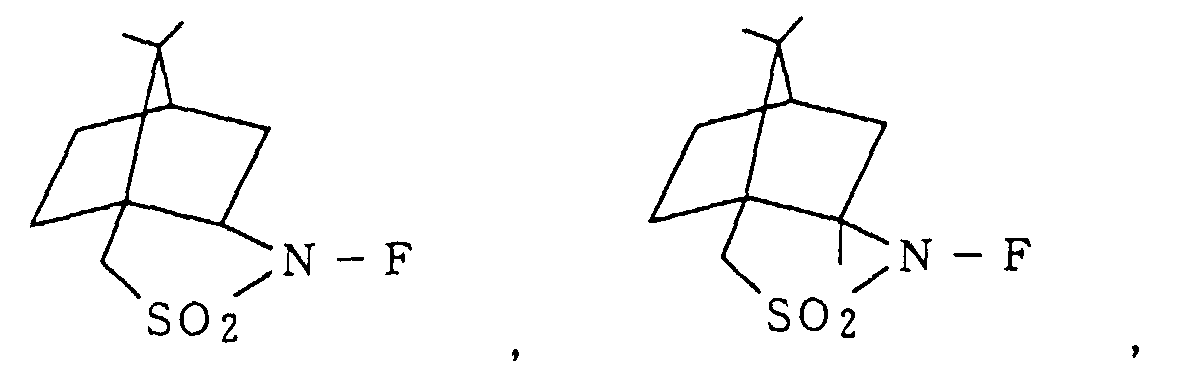
- N-fluoropyridinium compound N-fluorosulfonamide compound, N-fluoroquinuclidinium compound, N-fluoro-1,4-diazoniabicyclo[2.2.2]octane compound, N-fluorodisulfonimide compound, N-fluoroamide compound, N-fluorocarbamate compound and N-fluoropyridone compound.
- the melting point of N-fluoropyridinium trifluoromethanesulfonate is 185° to 187°C
- the decomposition point of N-fluoropyridinium hexafluoroantimonate is 293°C
- the decomposition point of N-fluoropyridinium-2-sulfonate is 232° to 235°C
- the decomposition point of poly(2-vinyl-N-fluoropyridinium tetrafluoroborate) is 240°C
- the melting point of N-fluoropyridinium trichloromethanesulfonate is 205.5° to 207°C
- the melting point of N-fluoropyridinium tetrafluoroborate is 196.8° to 198°C
- the decomposition point of N-fluoropyridinium trifluoromethanesulfonate is 185° to 187°C
- the compound becomes an excellent solid electrolyte, and since it is also an active material for a positive electrode, the compound itself can function as both the active material for the positive electrode and the electrolyte.
- a primary battery having a small size and a simple structure and having a structure free of liquid and gas leakage can be provided only by facing the positive and negative electrodes having active materials each other without providing electrolytic liquid and a separator therebetween.
- the electromotive force can be changed by selecting various compounds having a N-F bond, which makes it possible to manufacture batteries complying with the applications and makes the interchangeability with the conventional batteries easy.
- N-fluoropyridinium compounds which are effective components of the materials for generating electric energy
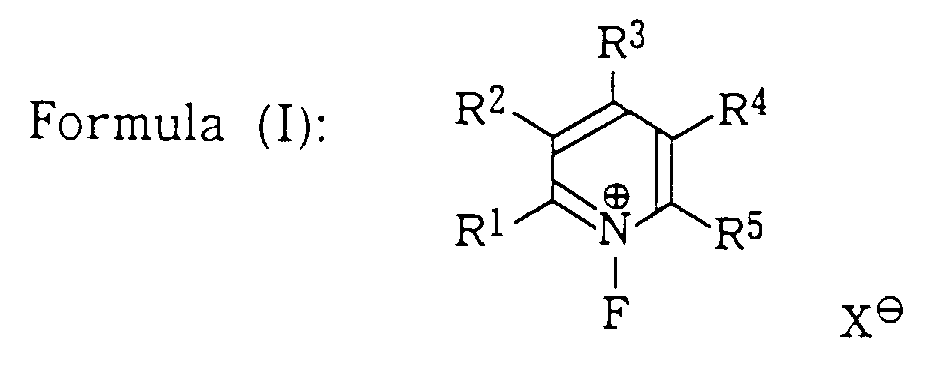
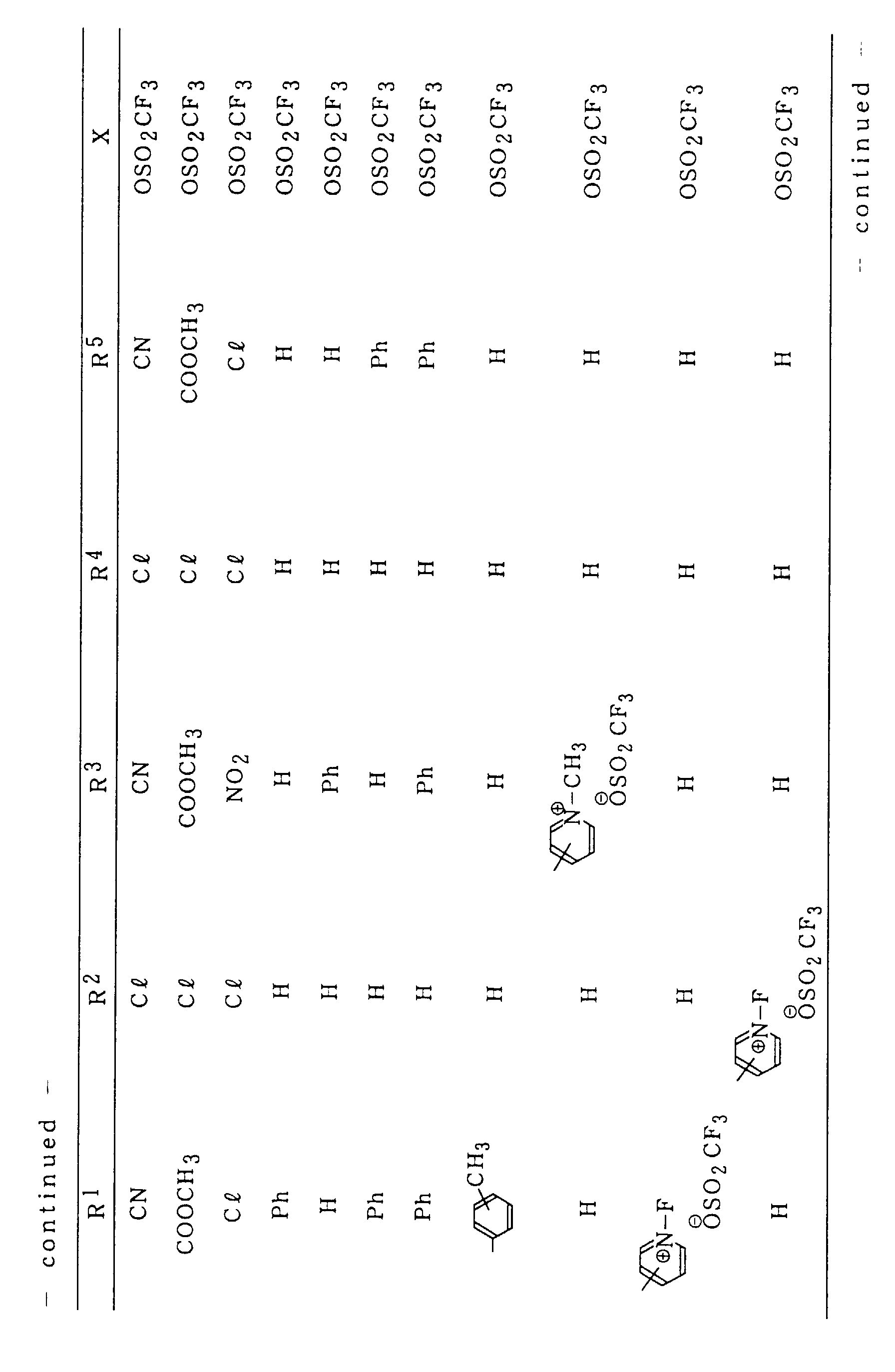
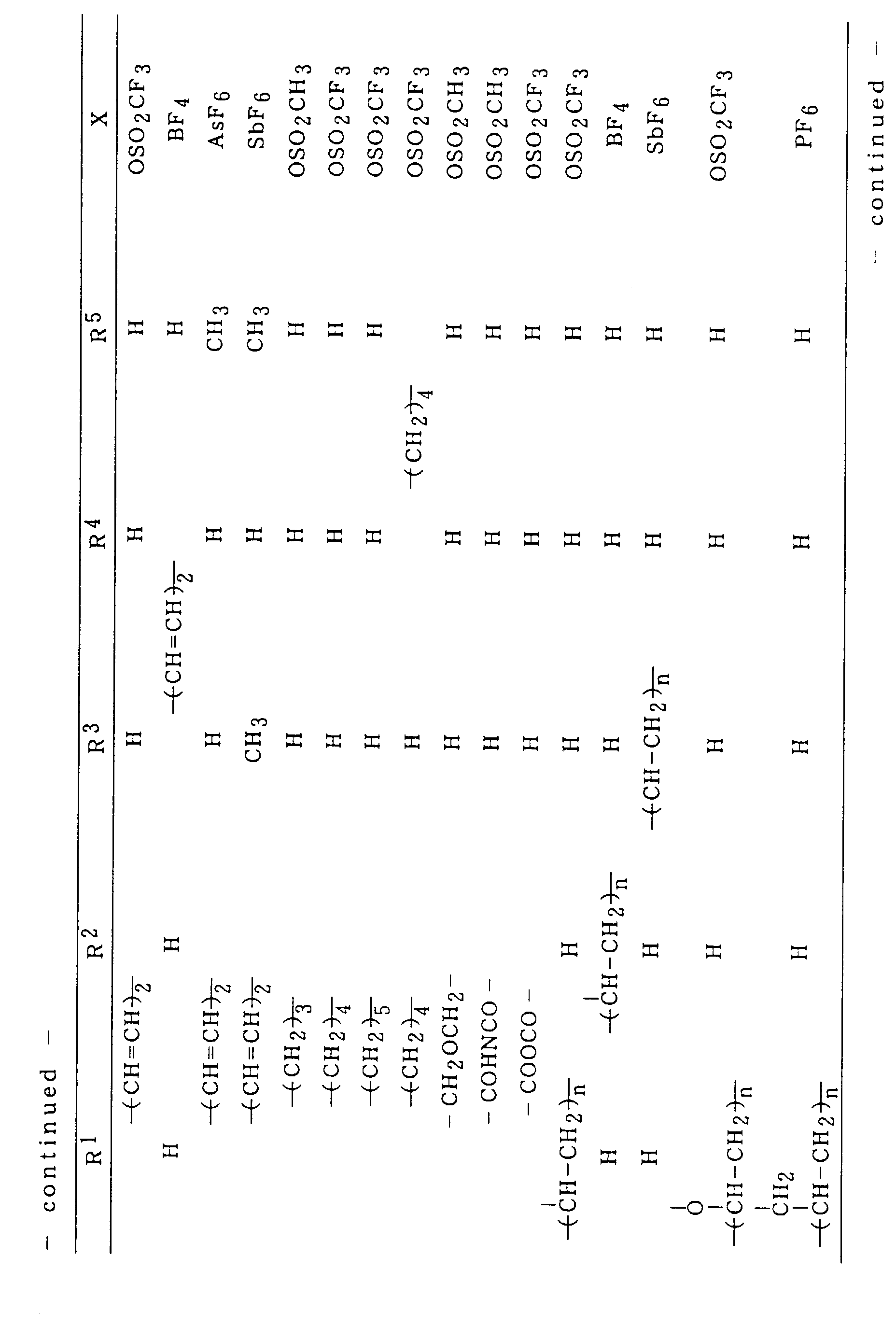
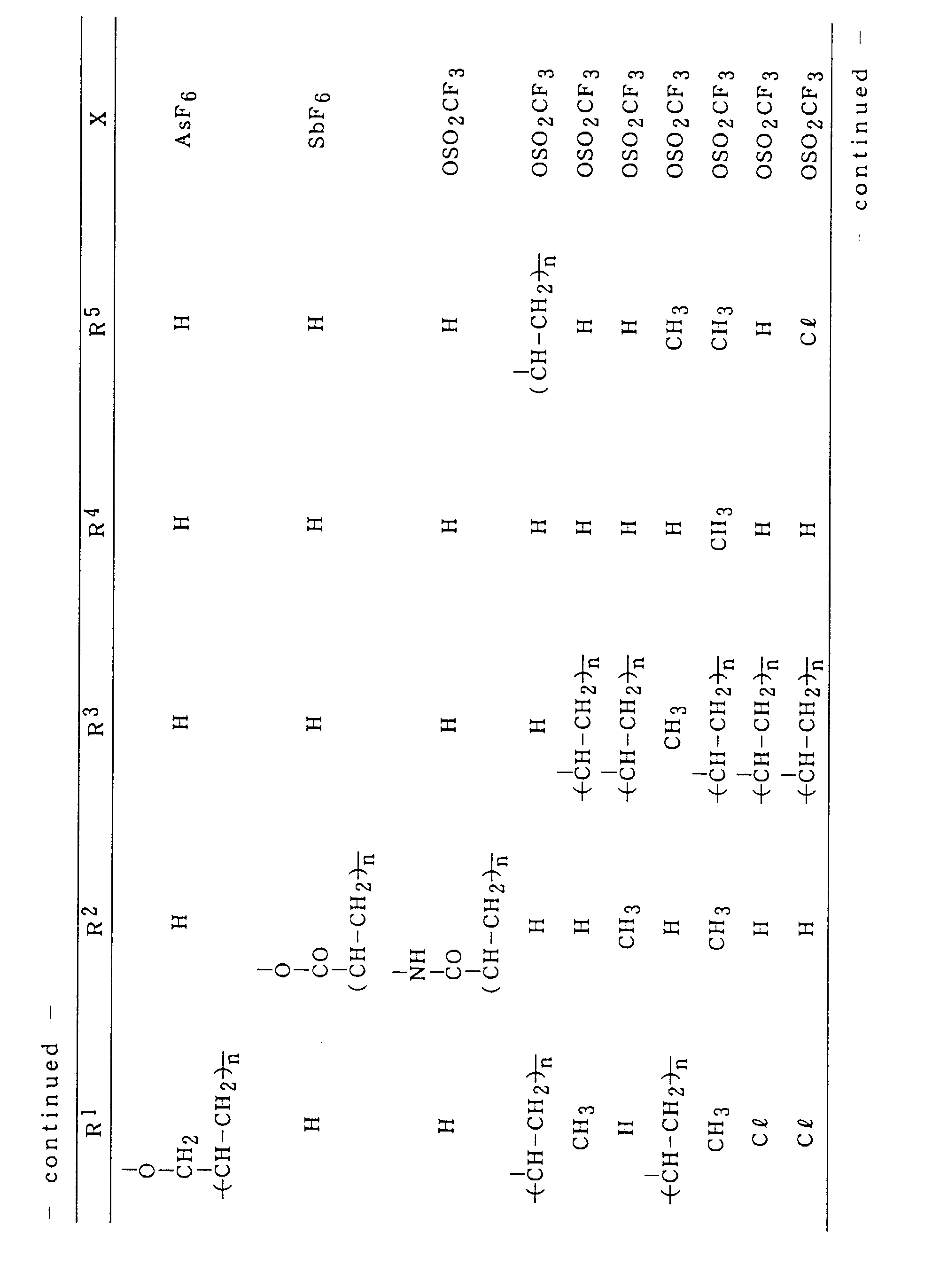
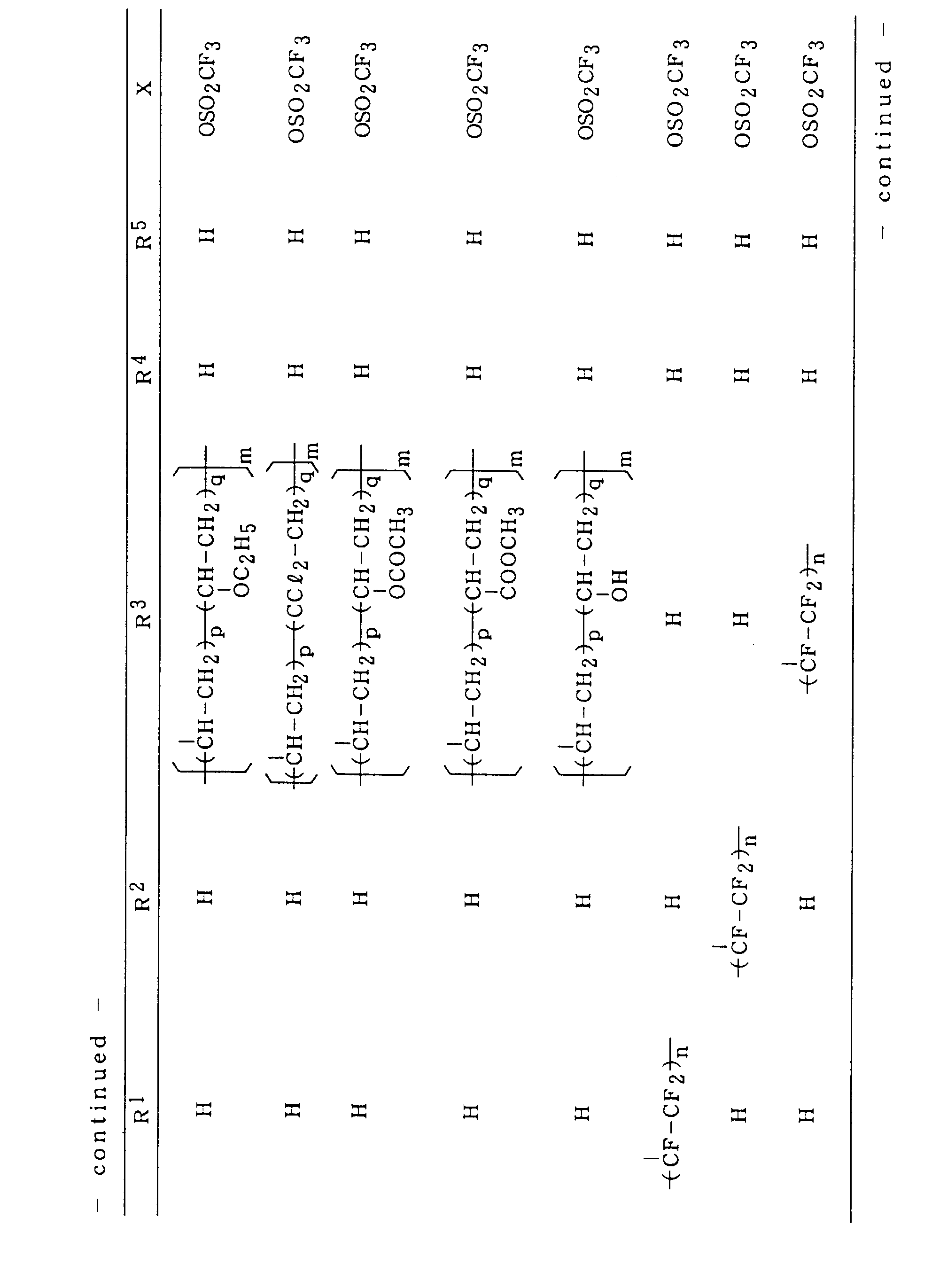
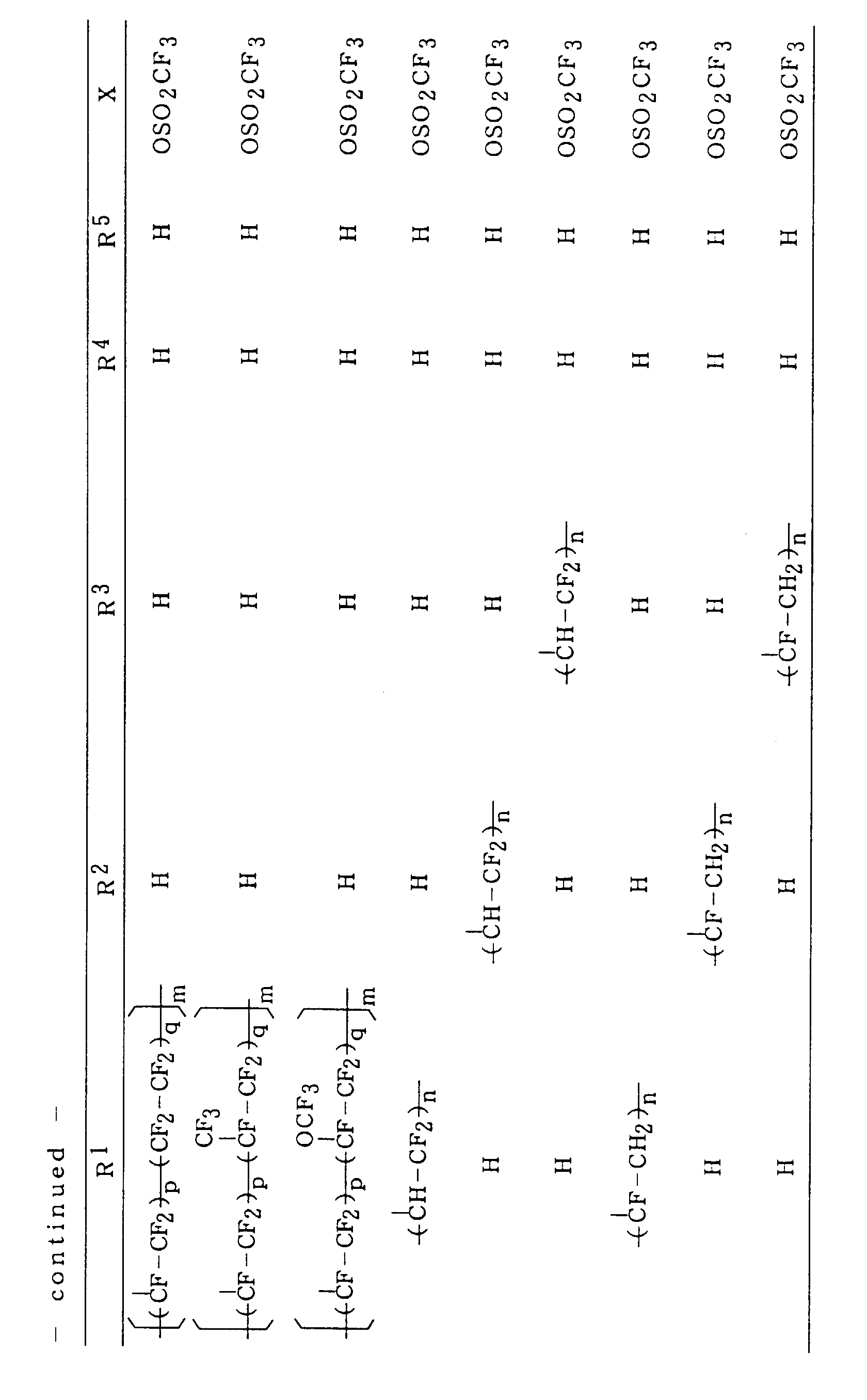
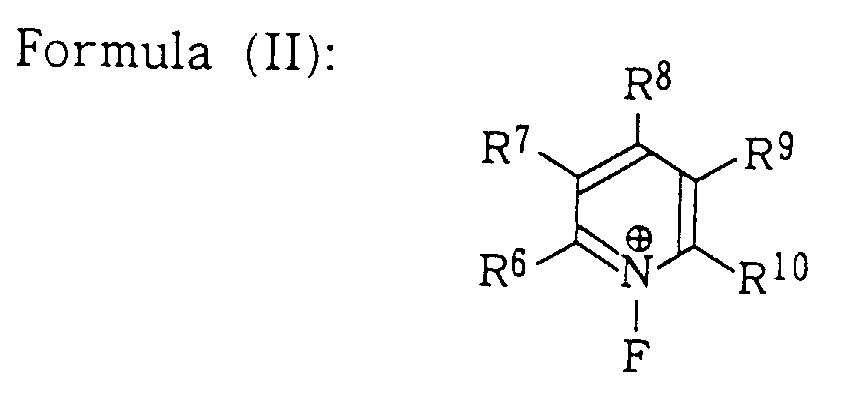
- those particularly preferable as N-fluoropyridinium compounds are shown by the following formulae (I) and (II), wherein R 1 to R 10 are the same or different, and any of them is hydrogen atom, a halogen atom, nitro, hydroxyl, cyano, or carbamoyl group; an alkyl group having 1 to 15 carbon atoms, or a substituted alkyl group of the aforesaid alkyl group by a halogen atom, hydroxyl, an alkoxy group having 1 to 5 carbon atoms, an aryloxy group having 6 to 10 carbon atoms, an acyl group having 1 to 5 carbon atoms, an acyloxy group having 1 to 5 carbon atoms or an aryl group having 6 to 10 carbon atoms;
- Br ⁇ nsted acids for preparing X- there are, for example, sulfonic acids such as methanesulfonic acid, butanesulfonic acid, benzenesulfonic acid, toluenesulfonic acid, nitrobenzenesulfonic acid, dinitrobenzenesulfonic acid, trinitrobenzenesulfonic acid, trifluoromethanesulfonic acid, perfluorobutanesulfonic acid, perfluorooctanesulfonic acid, perfluoro(2-ethoxyethane) sulfonic acid, perfluoro(4-ethylcyclohexane)sulfonic acid, trichloromethanesulfonic acid, difluoromethanesulfonic acid, trifluoroethanesulfonic acid, fluorosulfonic acid, chlorosulfonic acid, camphorsulfonic acid, bromocamphorsulfonic acid, ⁇
- n is an integer of 10 to 100,000
- m is an integer of 10 to 10,000
- p and q each are positive integers of 1 ⁇ p + q ⁇ 1000.
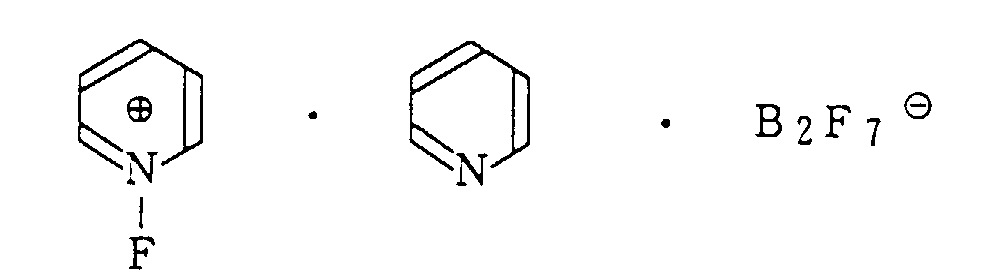
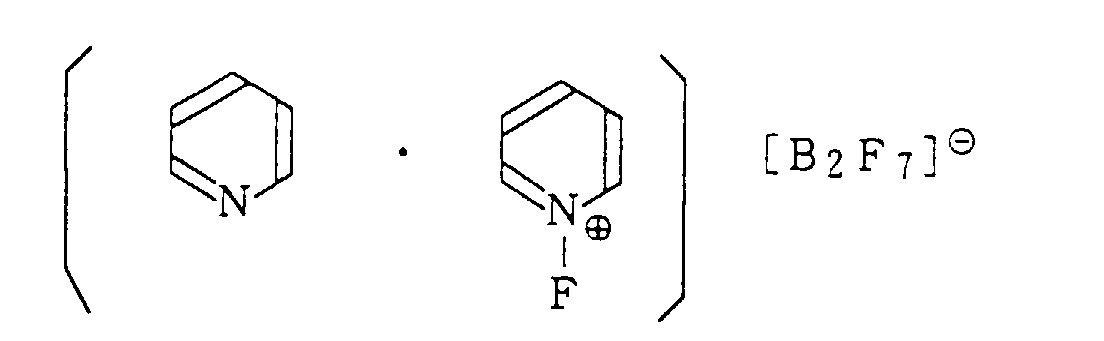
- N-fluoropyridinium compounds also there can be, for example, N-fluoropyridinium pyridine heptafluorodiborate having the following formula. or
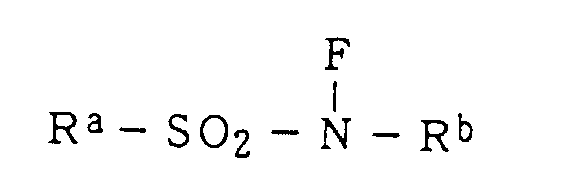
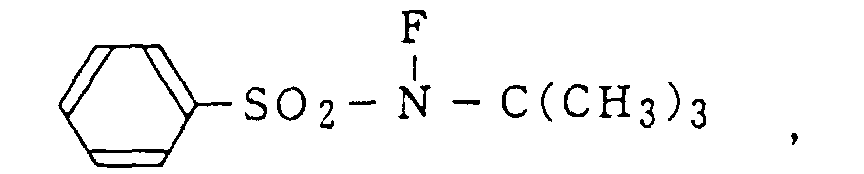
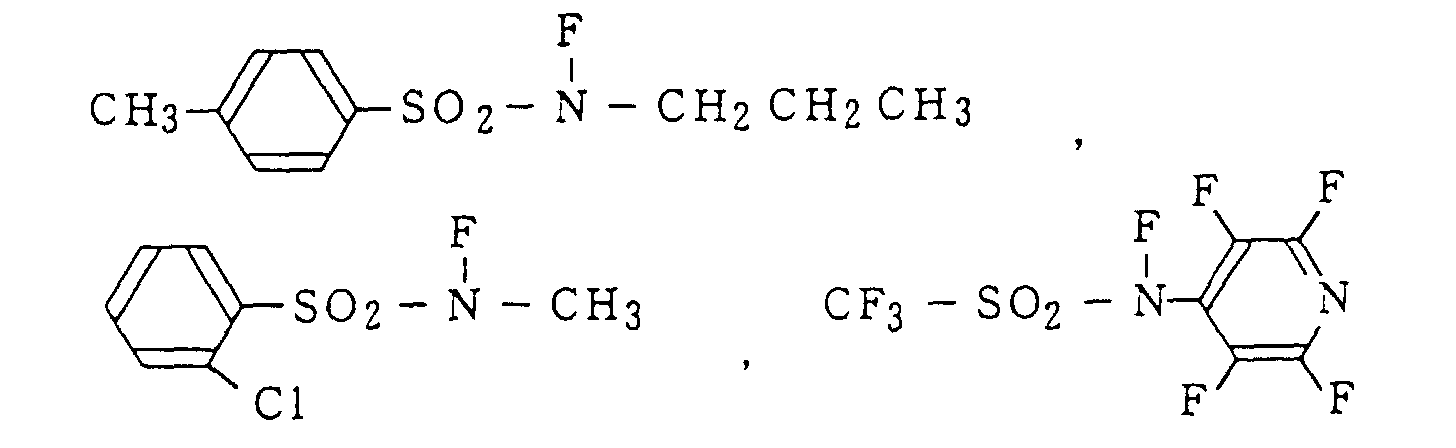
- R a and R b are the same or different, and each is an alkyl group having 1 to 15 carbon atoms or a substituted alkyl group of the aforesaid alkyl group by a halogen atom or an aryl group having 6 to 10 carbon atoms, an aryl group having C 6 to C 15 carbon atoms or a substituted aryl group of the aforesaid aryl group by a halogen atom, nitro, cyano, an acyl group having 1 to 5 carbon atoms or an alkyl group having 1 to 5 carbon atoms, or a pyridyl group or a substituted pyridyl group of the aforesaid pyridyl group by a halogen atom.
- R a and R b may form the ring structure with or
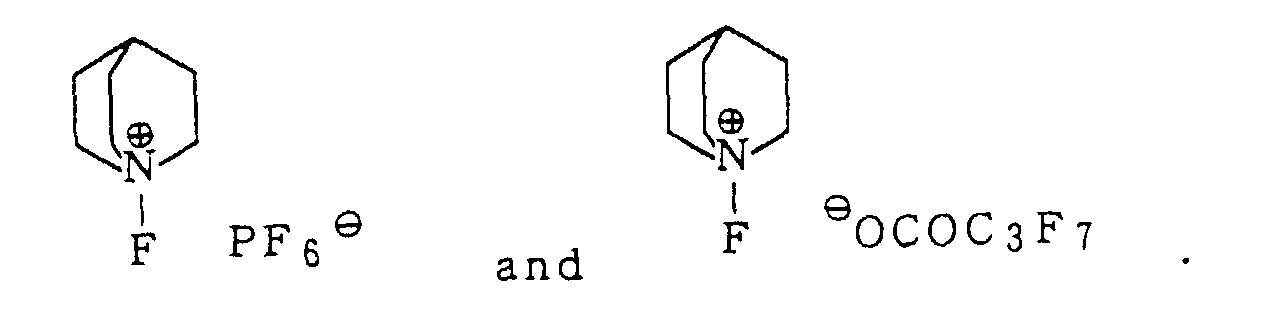
- N-fluoroquinuclidinium compounds are shown by the following formula (IV) (X is a conjugate base of the Br ⁇ nsted acid mentioned hereinabove.)
- X is a conjugate base of the Br ⁇ nsted acid mentioned hereinabove.
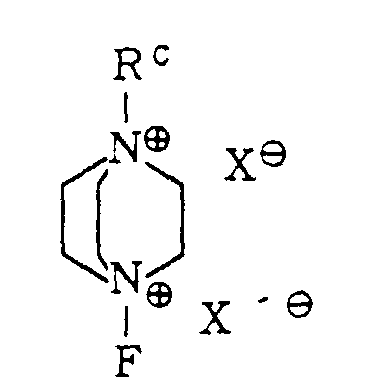
- N-fluoro-1,4-diazoniabicyclo[2.2.2]octane compounds are shown by the following formula (V).
- R c is an alkyl group having 1 to 15 carbon atoms or a substituted alkyl group of the aforesaid alkyl group by a halogen atom, nitro, cyano, an acyl group having 1 to 5 carbon atoms, an alkoxy group having 1 to 5 carbon atoms, an alkoxycarbonyl group having 2 to 5 carbon atoms or an aryl group having 6 to 10 carbon atoms, and X and X' are the same or different, and each is a conjugate base of the Br ⁇ nsted acid mentioned hereinabove. )
- R c is an alkyl group having 1 to 15 carbon atoms or a substituted alkyl group of the aforesaid alkyl group by a halogen atom, nitro, cyano, an acyl group having 1 to 5 carbon
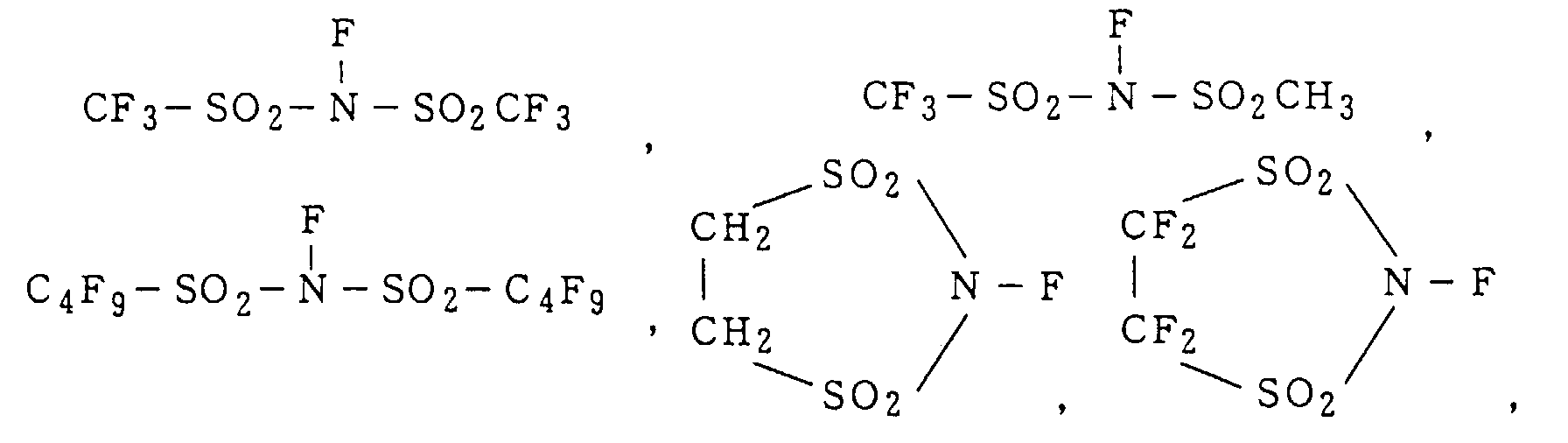
- N-fluorodisulfonimide compounds are shown by the following formula (VI): (wherein, R d and R e are the same or different, and each is an alkyl group having 1 to 15 carbon atoms or a substituted alkyl group of the aforesaid alkyl group by a halogen atom or an aryl group having 6 to 16 carbon atoms, or an aryl group having 6 to 10 carbon atoms or a substituted aryl group of the aforesaid aryl group by a halogen atom, nitro, cyano, an acyl group having 1 to 5 carbon atoms or an alkyl group having 1 to 5 carbon atoms.
- R d and R e are the same or different, and each is an alkyl group having 1 to 15 carbon atoms or a substituted alkyl group of the aforesaid alkyl group by a halogen atom or an aryl group having 6 to 16 carbon atoms, or
- R d and R e may form the ring structure with or without a hetero atom, or are so united as to be an aromatic ring structure having 6 to 10 carbon atoms or so formed that a halogen atom, nitro, cyano, an acyl group having 1 to 5 carbon atoms or an alkyl group having 1 to 5 carbon atoms substitutes the aforesaid aromatic ring structure.
- N-fluoroamide compounds are shown by the following formula (VII): (wherein R f and R g are the same or different, and each is hydrogen atom, a halogen atom, an amino group or a substituted amino group of the aforesaid amino group by an alkyl group having 1 to 5 carbon atoms, an alkyl group having 1 to 15 carbon atoms or a substituted alkyl group of the aforesaid alkyl group by a halogen atom or an aryl group having 6 to 10 carbon atoms, or an aryl group having 6 to 15 carbon atoms or a substituted aryl group of the aforesaid aryl group by a halogen atom, nitro, cyano, an acyl group having 1 to 5 carbon atoms or an alkyl group having 1 to 5 carbon atoms.
- R f and R g are the same or different, and each is hydrogen atom, a halogen atom, an amino group or
- R f and R g may form the ring structure with or without a hetero atom.
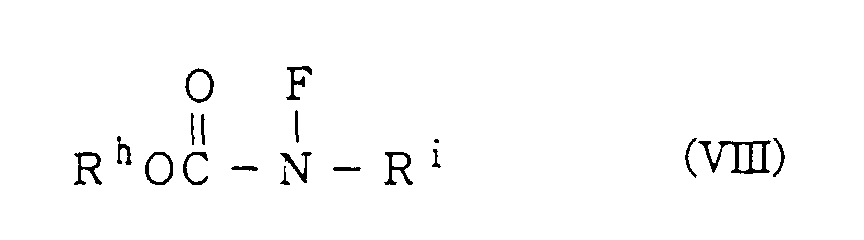
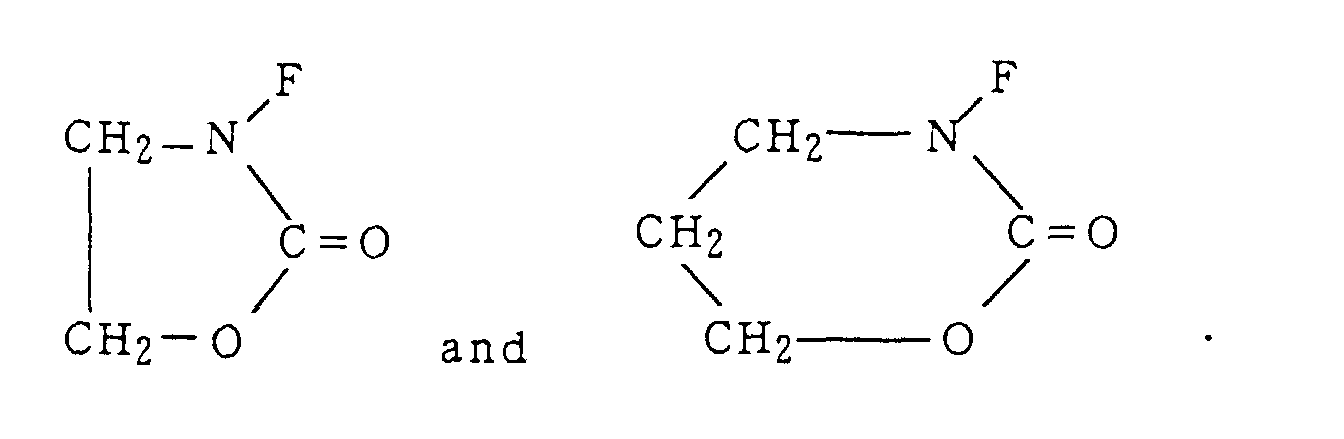
- N-fluorocarbamate compounds are shown by the following formula: (wherein R h and R i are the same or different, and each is an alkyl group having 1 to 15 carbon atoms or a substituted alkyl group of the aforesaid alkyl group by a halogen atom or an aryl group having 6 to 16 carbon atoms, or an aryl group having 6 to 10 carbon atoms or a substituted aryl group of the aforesaid aryl group by a halogen atom, nitro, cyano, an acyl group having 1 to 5 carbon atoms or an alkyl group having 1 to 5 carbon atoms.
- R i may be hydrogen atom, and R h and R i may form the ring structure with or without a hetero atom. Or R h and R i are so united as to be an aromatic ring structure having 6 to 10 carbon atoms, or so formed that a halogen atom, nitro, cyano, an acyl group having 1 to 5 carbon atoms or an alkyl group having 1 to 5 carbon atoms substitutes the aforesaid aromatic ring structure.) For example there are CH 3 OCONFH, C 2 H 5 OCONFH, CH 3 OCONFCH 3 ,
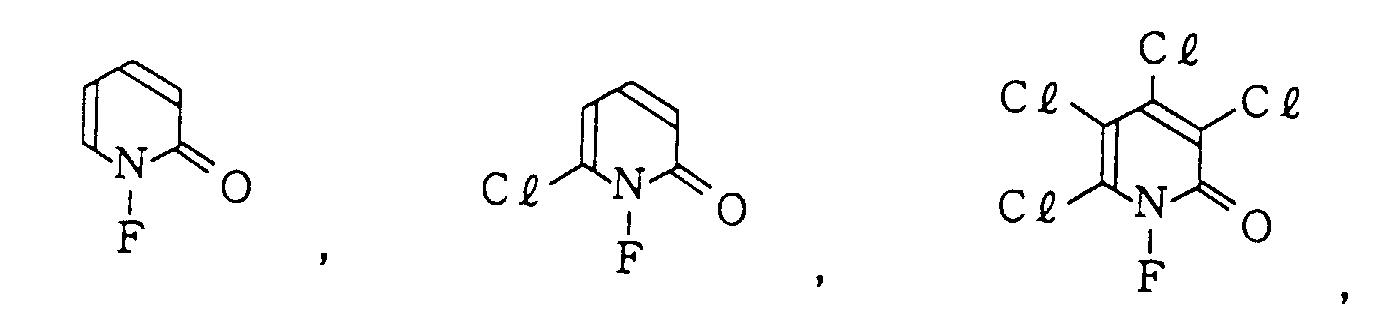
- N-fluoropyridone compounds are shown by the following formula (IX): (wherein R j to m are the same as the group defined as R 1 to R 5 in the formula (I).) For example, there are
- the materials for generating electric energy of the present invention may be in the form of powder or a film.
- the materials for electric energy of the present invention are useful specifically as active materials for positive electrodes of batteries and/or electrolytes as mentioned hereinabove.
- the compounds having the above-mentioned N-F bond have various different electromotive forces because of a variety of molecular weights and structures.
- an electromotive force is related to an electron deficiency of N-F bond, or electrical characteristics of a substituent to be bonded to nitrogen atom of N-F, particularly electron attractive and donative characteristics.
- the compound having N-F bond is the N-fluoropyridinium compound
- the electromotive force depends on electrical characteristics of the substituents on the pyridine ring and the number of substituents.
- a pyridine ring when an electromotive force exceeding 3 V is required, a pyridine ring may have substituents of electron attractive groups.
- electron attractive group there are, for example, a halogen atom such as fluorine atom, chlorine atom or bromine atom, nitro, a trihalomethyl group, cyano, an acyl group and an alkoxycarbonyl group.
- the pyridine ring when an electromotive force for interchangeability with 1.5 V and 2 V batteries is required, the pyridine ring may have substituents of, for example, electron donative groups.
- an alkyl group such as methyl or ethyl
- an alkoxy group such as methoxy or ethoxy
- an aryloxy group such as phenoxy or tolyloxy and the like.
- the compounds having a N-F bond of the present invention have a melting point of not less than about 100°C as mentioned hereinabove, and therefore can be used as the active materials for the positive electrodes and/or solid electrolytes, which can be used at a high temperature.
- the compounds react with lithium, zinc and magnesium of the negative electrodes, and a protective film comprising metal fluorides is formed at an interface therebetween.
- batteries can be stored stably for a long period of time without short-circuit and also with almost no self-discharge.
- a separator is naturally not necessary.
- metal ions diffuse into the compounds of the present invention, thereby forming metal complex having ionic conductivity.
- the ionic conductivity can be maintained.
- the compounds having a low internal resistance are preferable, in other words, as the compounds giving a high ionic conductivity, for the X- portion of the salt structure, particularly preferable are, for example, trifluoromethanesulfonate, tetrafluoroborate, hexafluoroantimonate, hexafluoroarsenate, tetrakis[bis(trifluoromethyl)phenyl]borate, perchlorate and hexafluorophosphate.
- the compounds having a N-F bond of the present invention are in the form of powder, they are made into the desired form by pressing or the like, or, if necessary, are mixed with, for example, a binder and an electroconductive agent and made into the desired form together with a current collector by pressing.
- binder there are preferably used, for example, usual binders such as poly(tetrafluoroethylene) powder, carboxymethylcellulose, and poly(vinyl alcohol);
- electroconductive agent there are preferably used, for example, nickel powder, fine metal fiber, and carbons such as graphite and acetylene black;
- current collector there are preferably used, for example, graphite, a net, a punching metal (foamed metals), a metal fiber net, and the like of platinum, gold, nickel, stainless steel, iron, copper or the like.
- the compounds having a N-F bond are moldable to a film-like material, like the case of comprising the compounds such as a polymer having a high molecular weight, or when the compounds become moldable to a film-like material with a film forming agent, they are made up into the film as they are or, if necessary, are blended with a binder and an electroconductive agent or additives mentioned hereinafter to be a film-like material which is then made up into a positive electrode in combination use with the current collector.
- the film forming agent preferable are, for example, polymeric materials such as poly(ethylene oxide), poly(ethylene), poly(tetrafluoroethylene), poly(vinylacetate), poly(acrylonitrile) and poly(methyl acrylate), or gelatine.
- the compounds may be used in the form of a mixture with other known active materials for the positive electrodes.
- any usual one can be used irrespective of liquid or solid.
- the preferable liquid electrolyte there are, for example, ethylene carbonate, propylene carbonate, sulfolane, r -butyrolactone, 1,3-dioxolane, 2-methyltetrahydrofuran, diethyl ether, tetrahydrofuran, dimethoxyethane, and acetonitrile, in which lithium perchlorate, tetrabutylammonium perchlorate, lithium trifluoromethanesulfonate, lithium tetrafluoroborate, lithium hexafluoroantimonate, lithium hexafluoroarsenate, lithium hexafluorophosphate, lithium tetrachloroaluminium, zinc chloride, zinc fluoride, magnesium chloride, magnesium fluoride, ammonium fluoride, ammonium chloride, sodium perchlorate or the like is dissolved, and as
- the negative electrode there can be used, for example, lithium, aluminium, zinc, lithium alloy, magnesium and copper which have been used conventionally.
- the separator When the separator is used, there can be adopted, for example, a woven fabric, a non-woven fabric, and the like of polyamide, polypropylene, or the like, which have been usually used.
- the above-mentioned elements may be assembled into the battery in the usual manner.
- solid electrolyte can be made in the same manner as in the preparation of the positive electrode in the above (1) except that the electroconductive agent is not blended and the current collector is not used.
- the positive electrodes There can be used usual active materials for the positive electrode. There are, for example, oxides such as MnO 2 , Ag 2 CrO 4 , SO 2 , AgO, PbO 2 , NiOOH, CuO 2 and V 2 O 5 , simple substances such as Cl 2 and Br 2 , and halogenides such as SOCl 2 and SO 2 Cl 2 .
- oxides such as MnO 2 , Ag 2 CrO 4 , SO 2 , AgO, PbO 2 , NiOOH, CuO 2 and V 2 O 5
- simple substances such as Cl 2 and Br 2
- halogenides such as SOCl 2 and SO 2 Cl 2 .
- the positive electrodes are made in the usual manner.
- a separator is principally not necessary.
- the separator referred to in (1) may be used.
- the battery may be assembled in the usual manner by the use of the above-mentioned positive electrode, negative electrode and solid electrolyte, and the separator if necessary.
- the positive electrode When the same compounds having a N-F bond of the present invention are used, the positive electrode may be made in accordance with the manner mentioned in the above (1). In that case, because of the combined use as the active material for the positive electrode and the electrolyte, attention needs to be paid not to cause short circuit in case where the electroconductive agent is used. In case where the different compounds having a N-F bond of the present invention are used, the positive electrodes may be made in the manner of (1) or (2) mentioned above.
- the separator Since the interface between the electrolyte and the negative electrode of the present invention does not become under the short-circuit condition because of the formation of the protective film as mentioned above, the separator is principally not necessary. If necessary, the separator mentioned in (1) may be used.
- the battery may be assembled in the manner as mentioned in (2) when the different kinds of the compounds having a N-F bond of the present invention are used as the electrolyte.
- the battery may be assembled in the usual manner with the positive electrode being brought into contact directly with the negative electrode, and, if necessary, by the use of a separator.
- the battery can be of wholly solid type, there are many cases where it can be used even at a temperature of, for example, not less than 100°C without leakage.
- the battery having a low internal resistance can be also made by mixing 1 to 60 % by weight, preferably, 1 to 50 % by weight, more preferably 2 to 40 % by weight of one or more of polar compounds into the compound having a N-F bond.
- the polar compounds usable as the battery maintaining the characteristics of a wholly solid type battery in the cases where an added amount of the polar compound is small or the melting point thereof is higher than a normal temperature there can be, for example, polar organic compounds such as dimethyl sulfone, dimethyl carbonate, diphenyl sulfone, methyl phenyl sulfone, 1,3-dioxolane, ⁇ -butyrolactone, sulfolane, ethylene carbonate, propylene carbonate, tetraethylene glycol dimethyl ether, triethylene glycol dimethyl ether, diethylene glycol dimethyl ether, dimethoxyethane, ethylene glycol, ethanol, methanol, water, diethyl ether,
- the compounds having a N-F bond of the present invention are useful as materials for primary batteries, and can be expected to be used, for example, as materials for batteries such as those for energy storage, and as electrode materials and film materials for the other electrochemical sensors, chemical sensors, and the like.
- the batteries In case of the use for batteries, it is possible to manufacture the batteries, making the best use of easy handling and the environmental acceptability of the compounds having a N-F bond.
- a high electromotive force, high energy density, wide usable temperature range and long life time can be achieved.
- a higher electromotive force or the desired electromotive force can be obtained, and the batteries complying with the applications can be made. Therefore, wide application can be expected as a series of the batteries only by changing the kind of the compounds having a N-F bond of the present invention without modifying the packages and the like.
- the structure of the batteries becomes simple, and so it is possible to achieve a small size and a light weight. It is also possible to make the batteries thinner by integration.
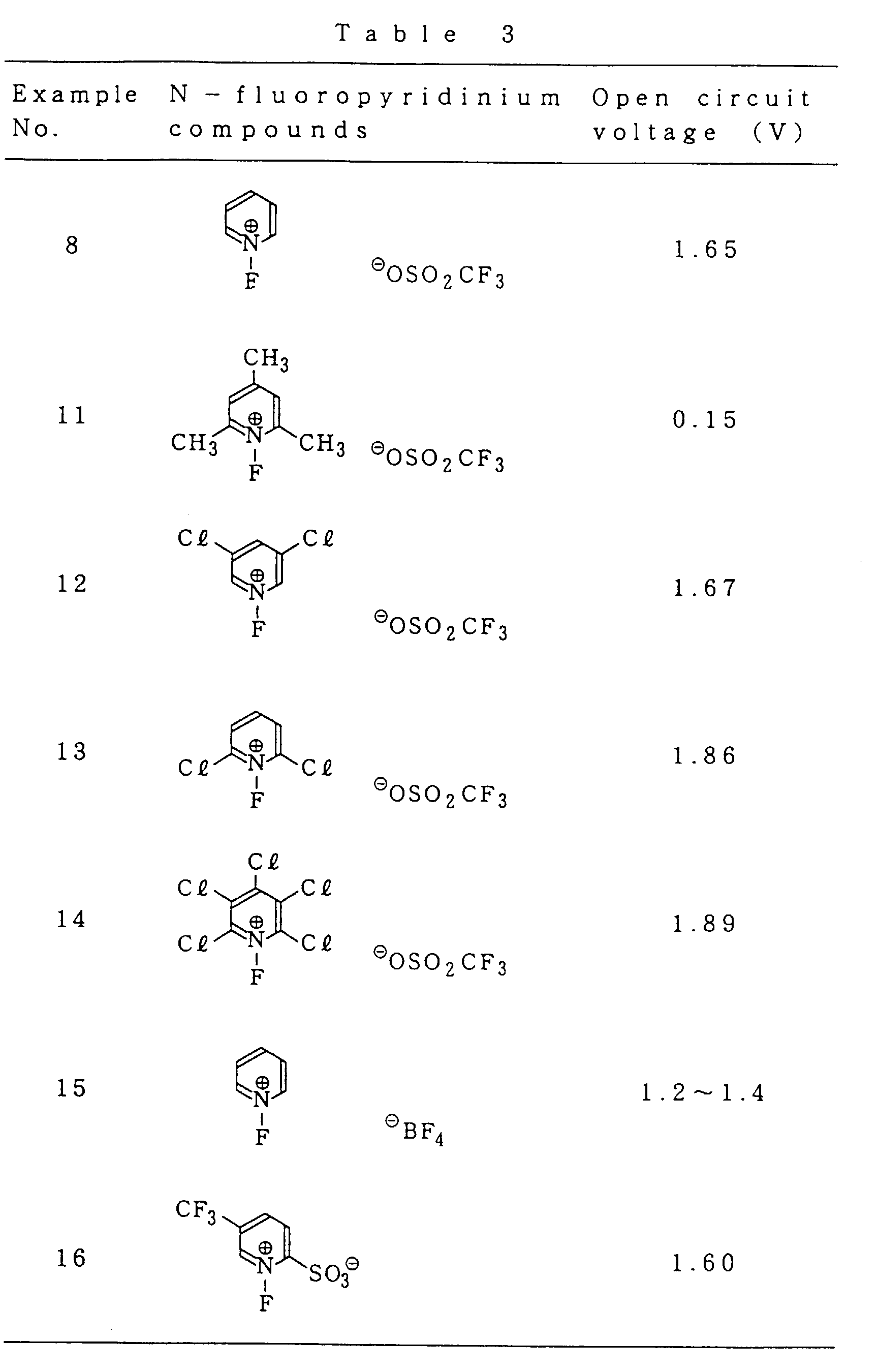
- the oxidation potentials of the N-fluoropyridinium compounds shown in Table 1 were measured with a cyclic voltammetry by using the battery shown in Fig. 1 in the manner mentioned below.
- a working electrode and a counter electrode were platinum, and a reference electrode was silver.
- the battery was charged with a solvent of 20 ml (2 ml for the standard electrode).
- Acetonitrile as the solvent was used after having been mixed with calcium hydroxide for 2 days and then refluxed and distilled.
- a silver nitrate and the N-fluoropyridinium used were subjected to dehydration by exhausting prior to the use.
- the acetonitrile solution was of 0.1 M silver nitrate, the concentration of the N-fluoropyridinium compounds was 10 mM to prevent lowering of a voltage, and a concentration of lithium trifluoromethanesulfonate was 0.1 M.
- Lithium trifluoromethanesulfonate used as a supporting electrolyte was, because of its high hygroscopic property, subjected to deairing under heating after weighing. Furthermore with use of the anhydrous tetrahydrofuran, removal of water was carried out because of possible hydration with lithium trifluoromethanesulfonate. Since an electric potential at the reaction with water is close to the reduction potential of the N-fluoropyridinium compounds, the dehydration was thoroughly carried out. The platinum electrode was polished with a sand paper, washed with aqua regia and then rinsed with water before the use.
- the silver electrode was, after polished with a sand paper, washed with a mixture of methanol and nitric acid (9:1) and rinsed with water. All the batteries were dried with argon gas under heating with a hot air heater. Grease was used for the ground glass parts, and the battery assembling work was done under argon gas atmosphere in a glove box. Also, prior to the measurement, bubbling with argon gas was carried out for not less than 30 minutes inside the battery to be measured. The obtained Ep values (peak potential) are shown in Table 1. The values are shown with respect to those for saturated calomel electrode (SCE).
- SCE saturated calomel electrode
- the N-fluoropyridinium compound which was replaced by an electron donative group like methyl has a low electromotive force
- the N-fluoropyridinium compound which was replaced by an electron attractive group like chlorine atom generates a high electromotive force.
- the electromotive force can be changed to a large extent by changing the position, quantity and kind of those substituents.
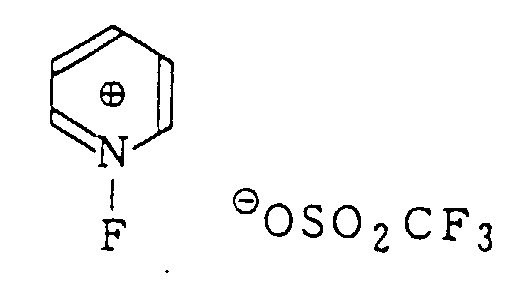
- N-fluoropyridinium trifluoromethanesulfonate shown by the following formula: as the electrode material for both the active material for the positive electrode and the solid electrolyte, a wholly solid battery was made in the following manner. All the experiments were made at room temperature.
- N-fluoropyridinium trifluoromethanesulfonate was solidified by a manual pressing into a disc form of 7 mm diameter by 2 mm thick, and as shown in Fig. 2, was put between the platinum electrode and the negative electrode shown in Table 2.
- the wholly solid battery was made, and an open circuit voltage was measured with a voltmeter. Measurements were made in natural atmosphere in case of Examples 7 to 9, and in an argon gas atmosphere in case of Example 10.
- Fig. 3 shows variations with laps of time of the open circuit voltage in Example 8 using zinc for the negative electrode.
- the solid molded article containing the compounds having a N-F bond could be formed, and the thickness thereof was about 100 ⁇ m.
- the fluoro-resin sheet was removed, and replaced by a metal plate such as zinc, magnesium or lithium, which would become an active material for the negative electrode to measure its open circuit voltage and internal resistance.
- the pressing was all carried out in natural atmosphere. Assembling of the battery and the measurement were carried out in natural atmosphere when the negative electrode was zinc or magnesium, and in an argon gas atmosphere when the negative electrode was lithium.
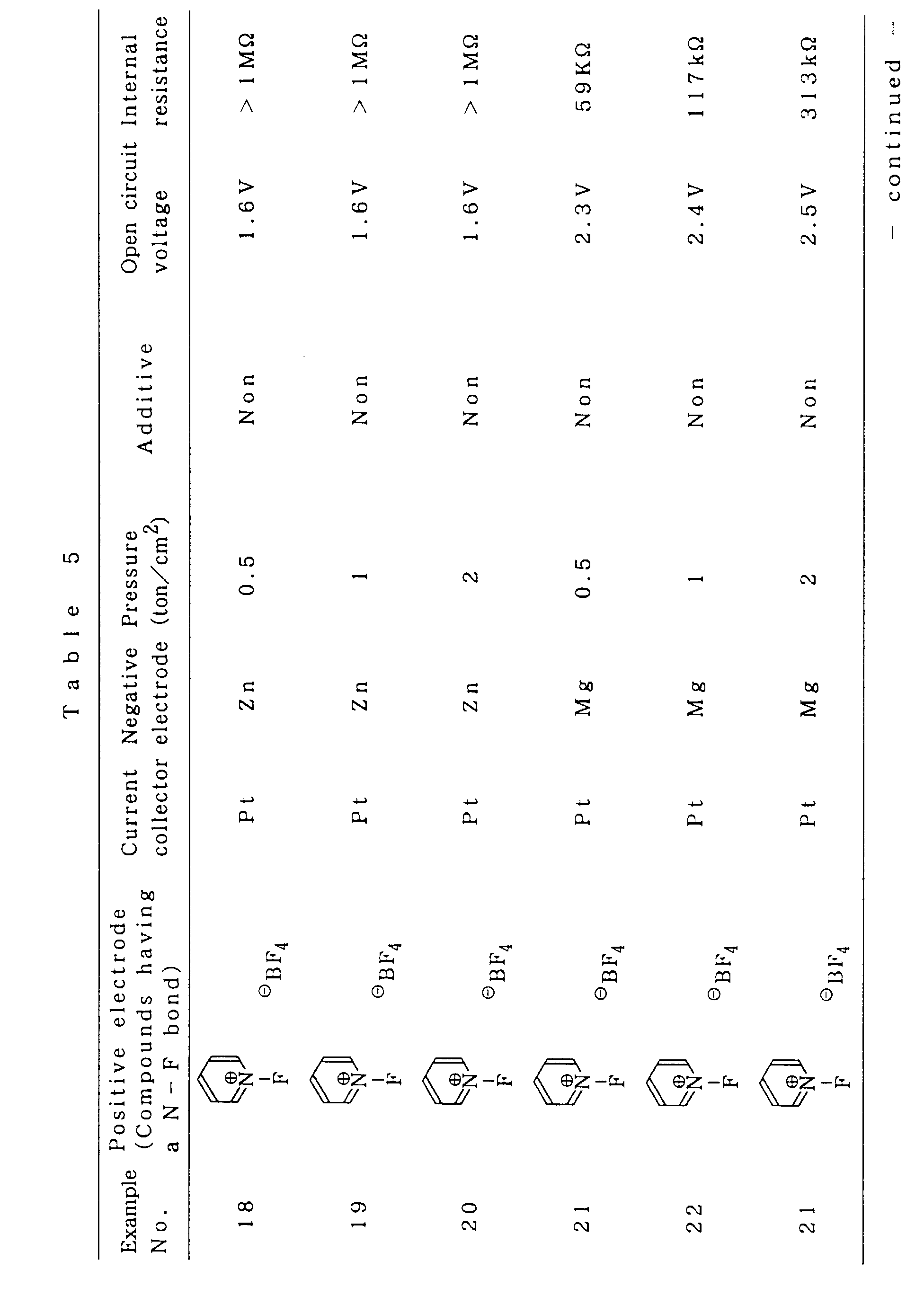
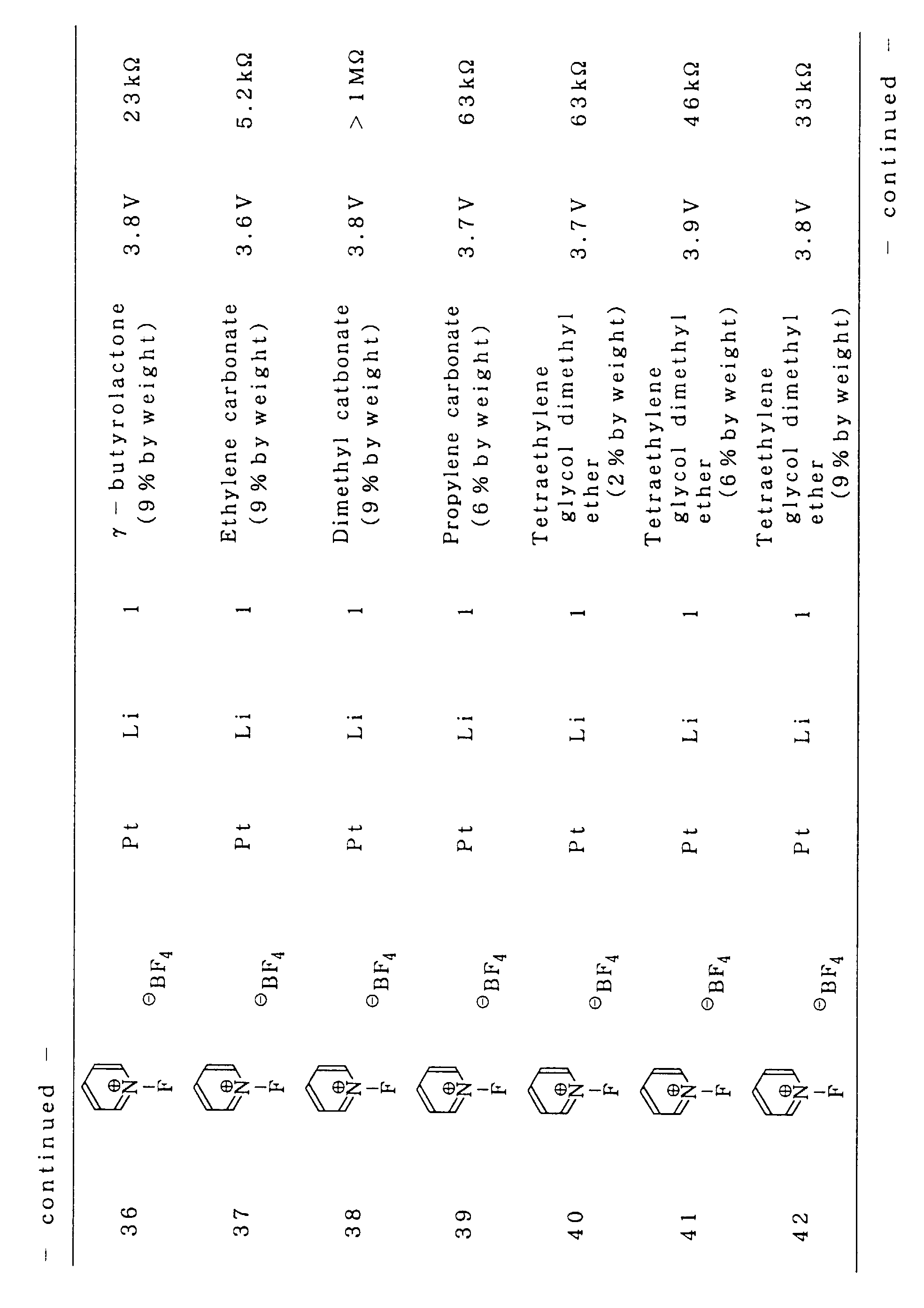
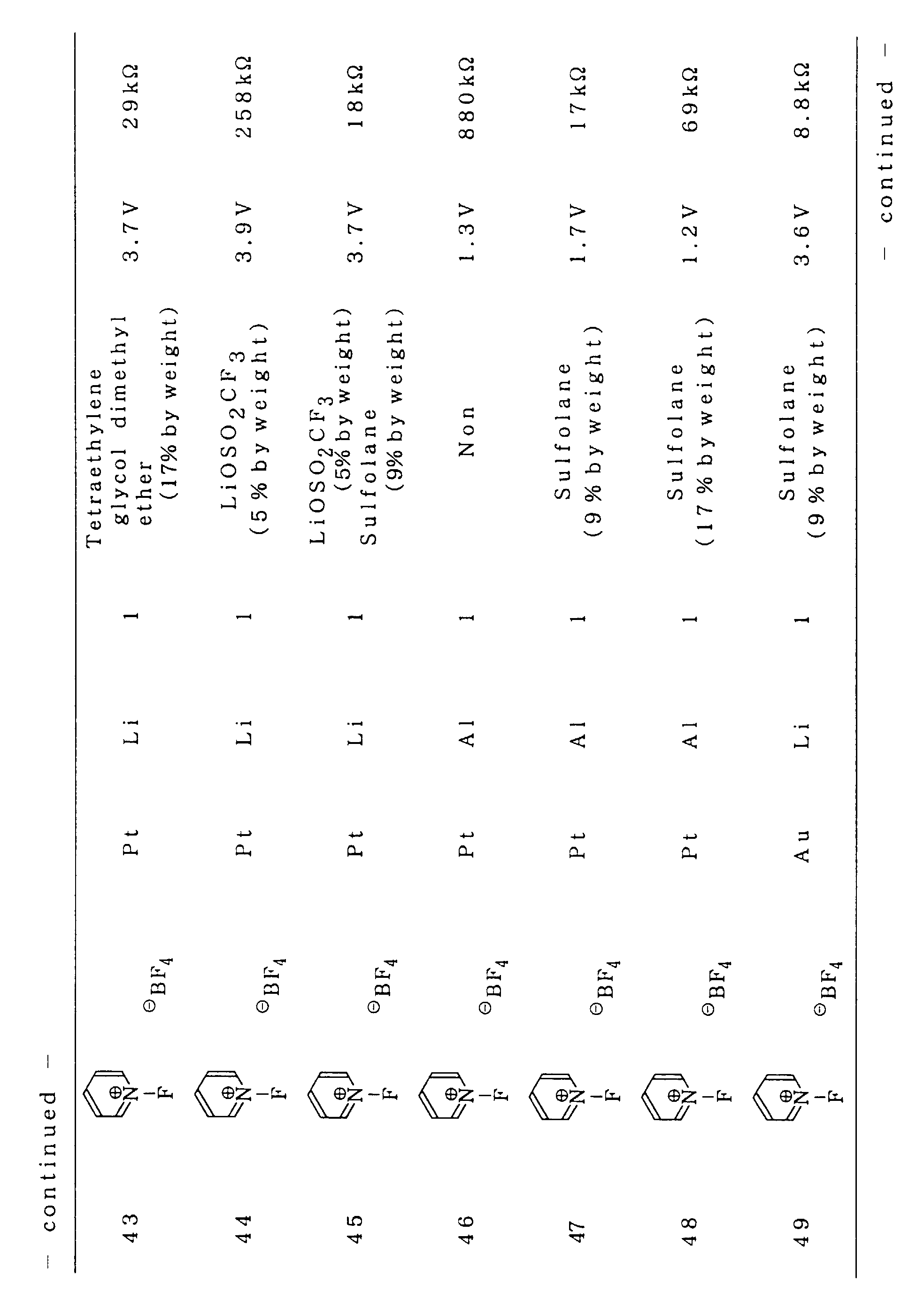
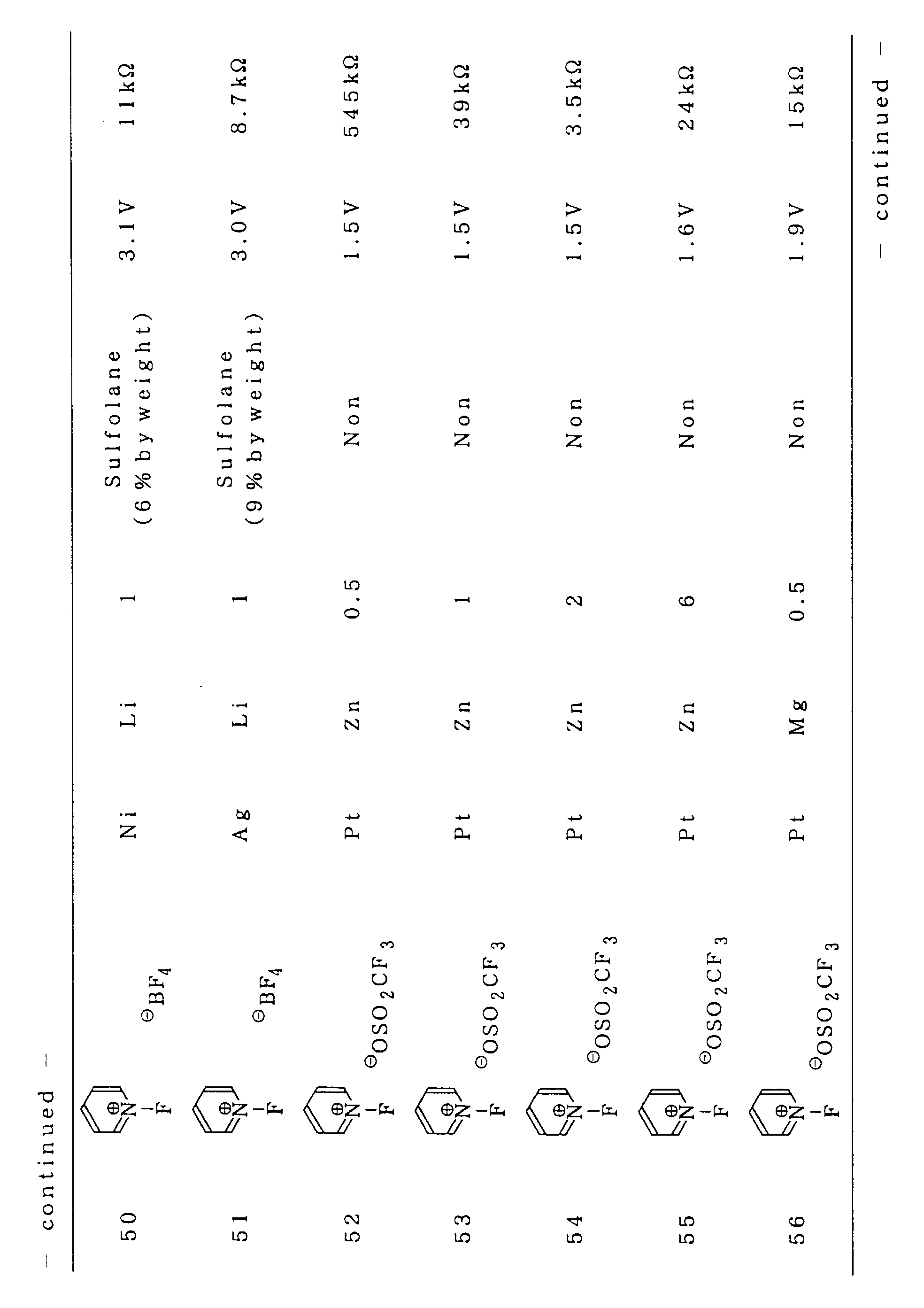
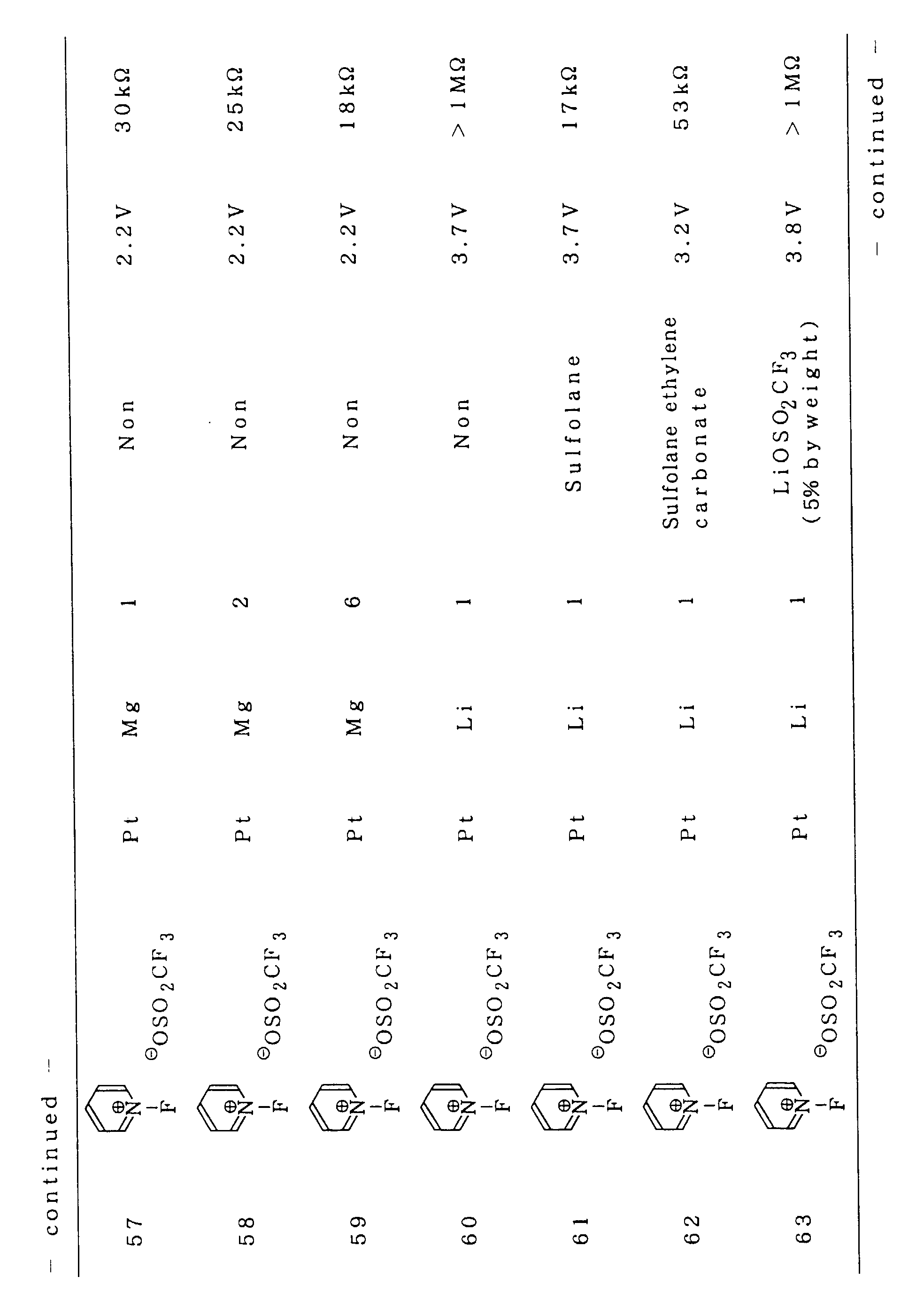
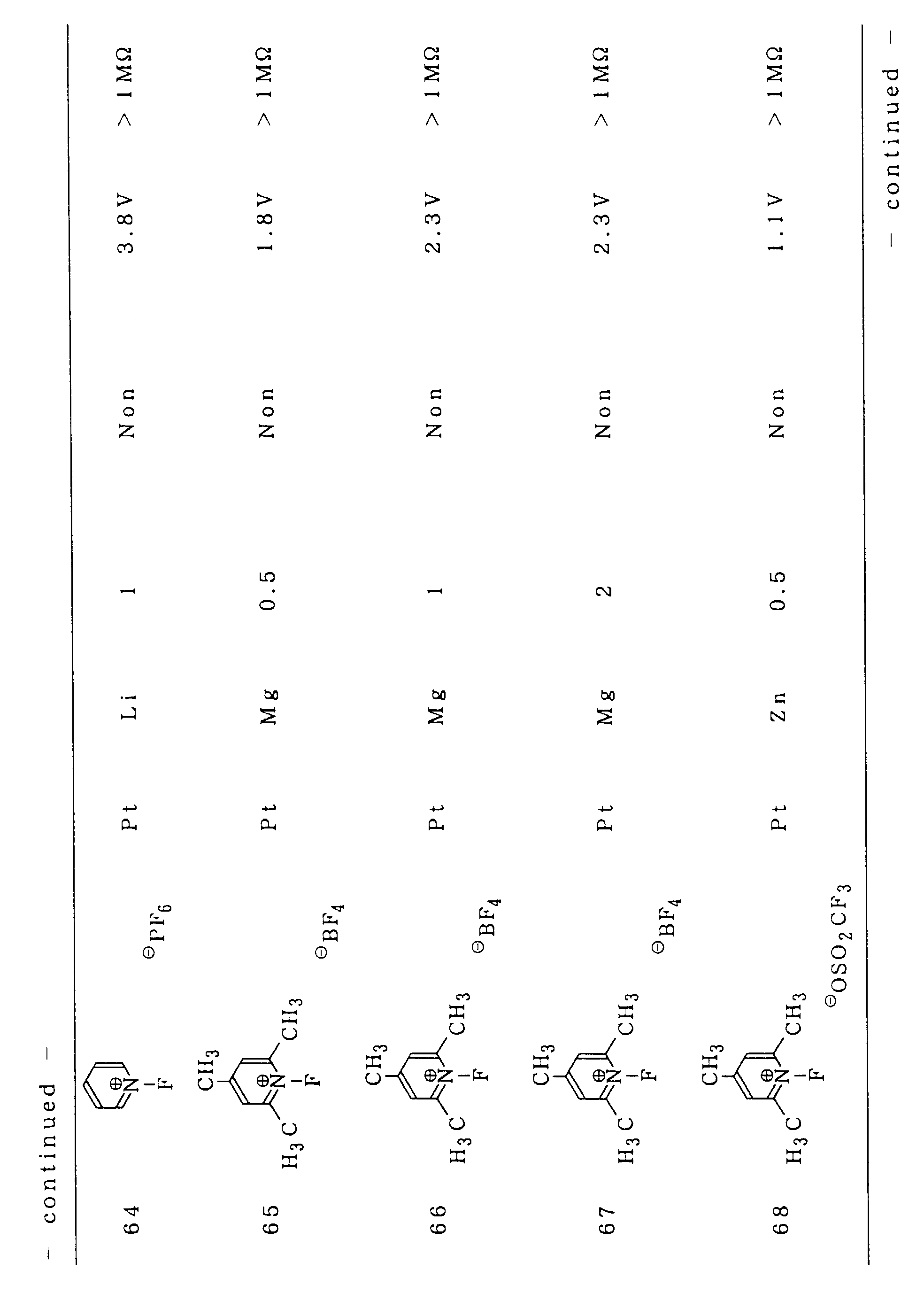
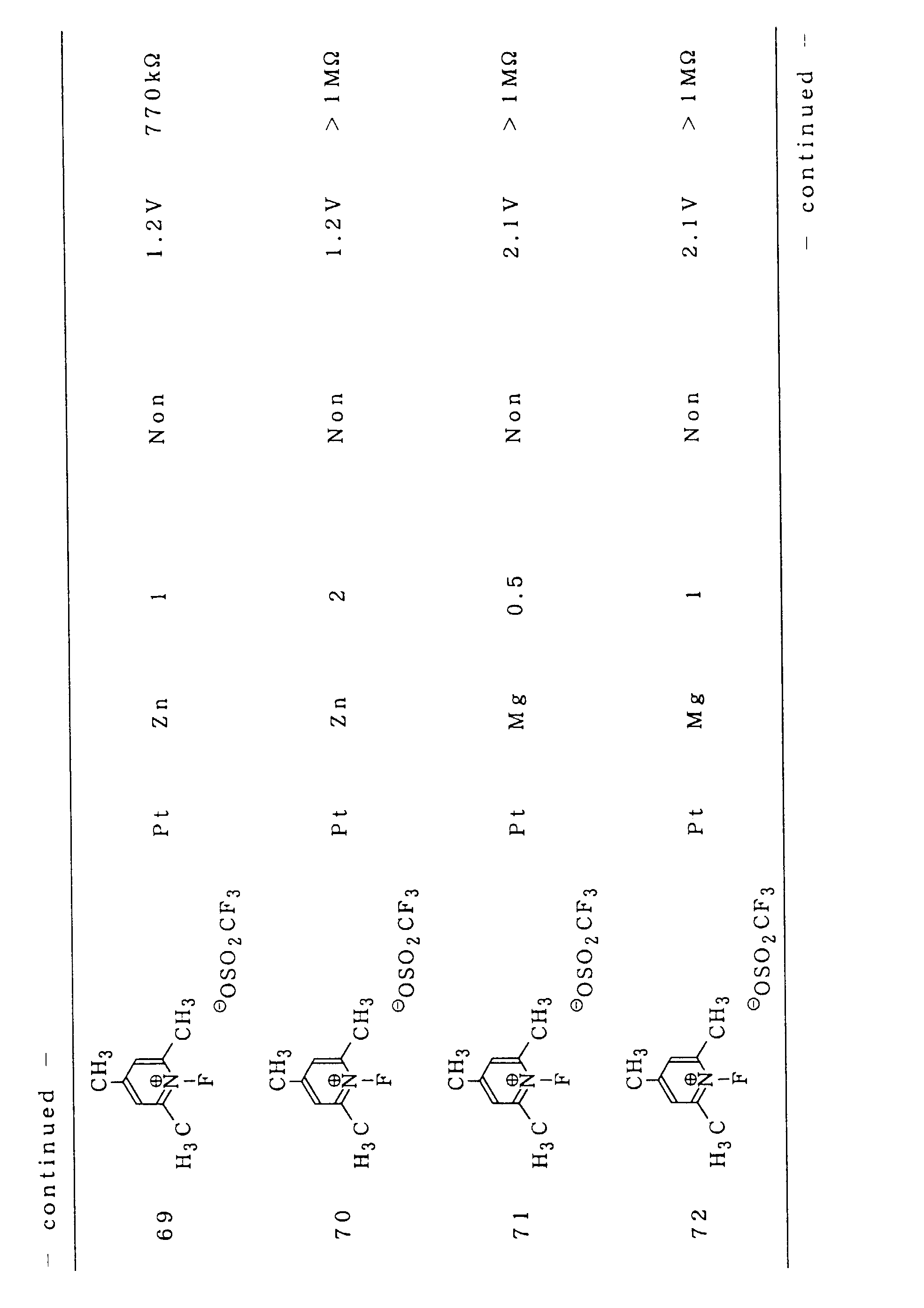
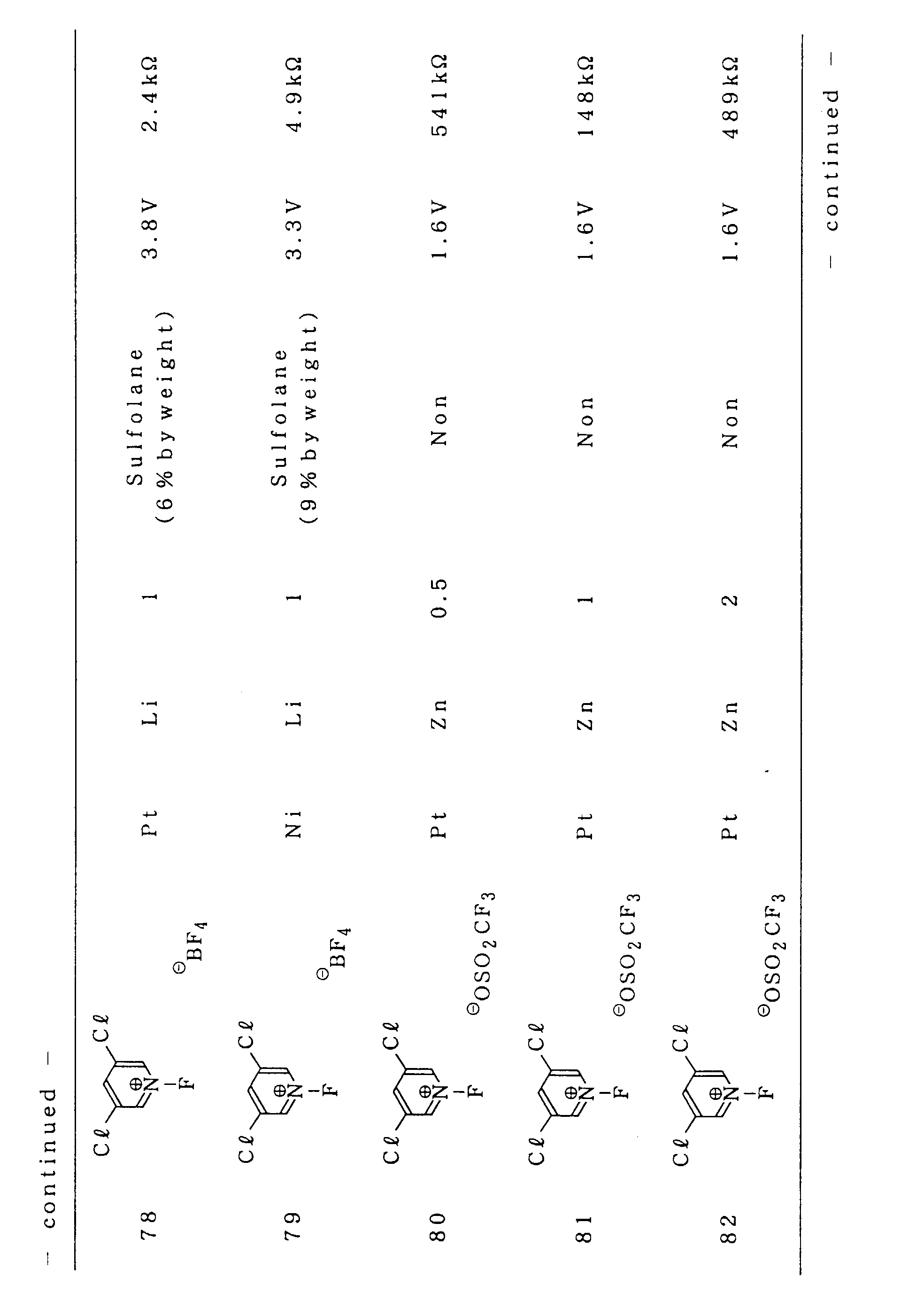
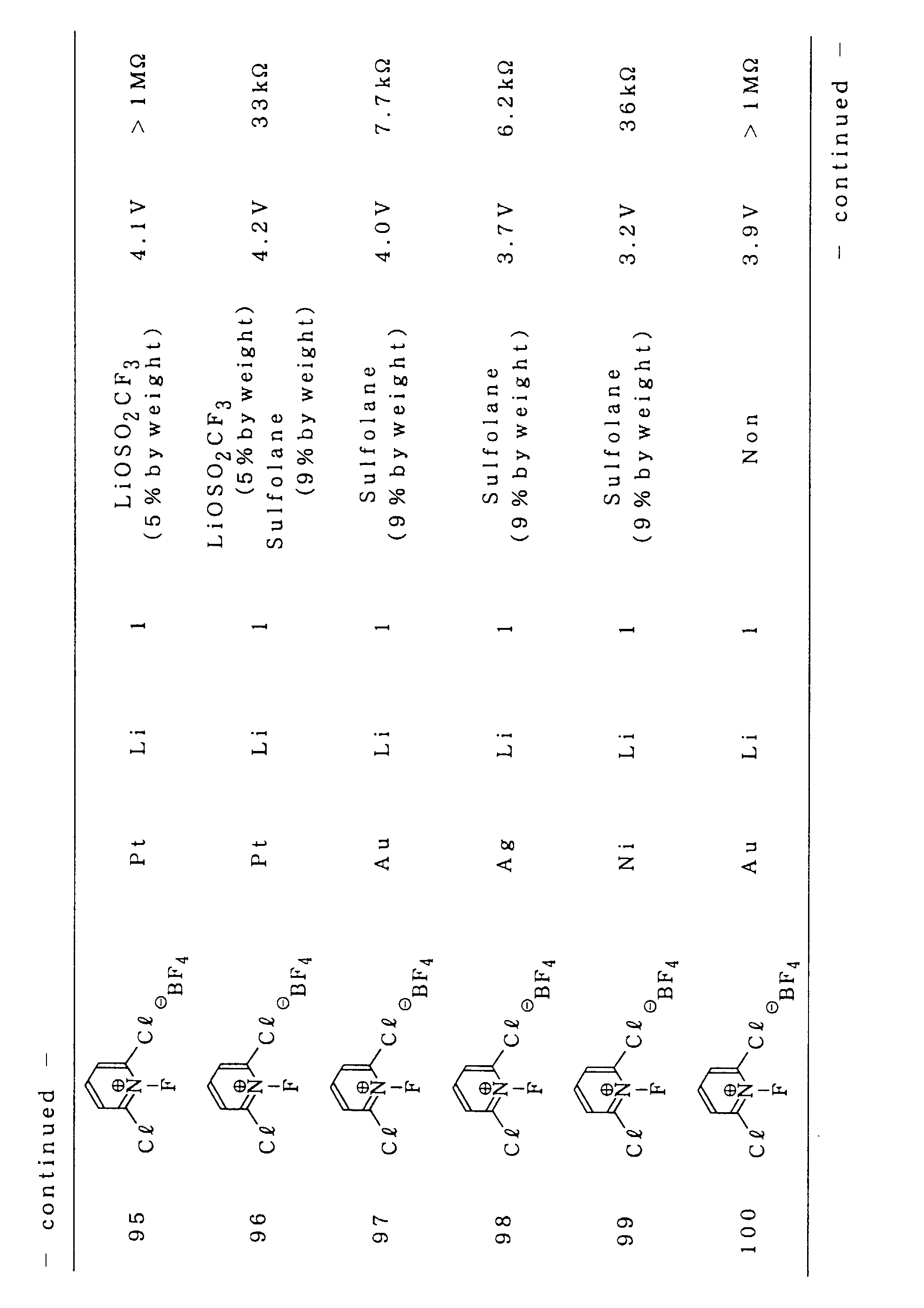
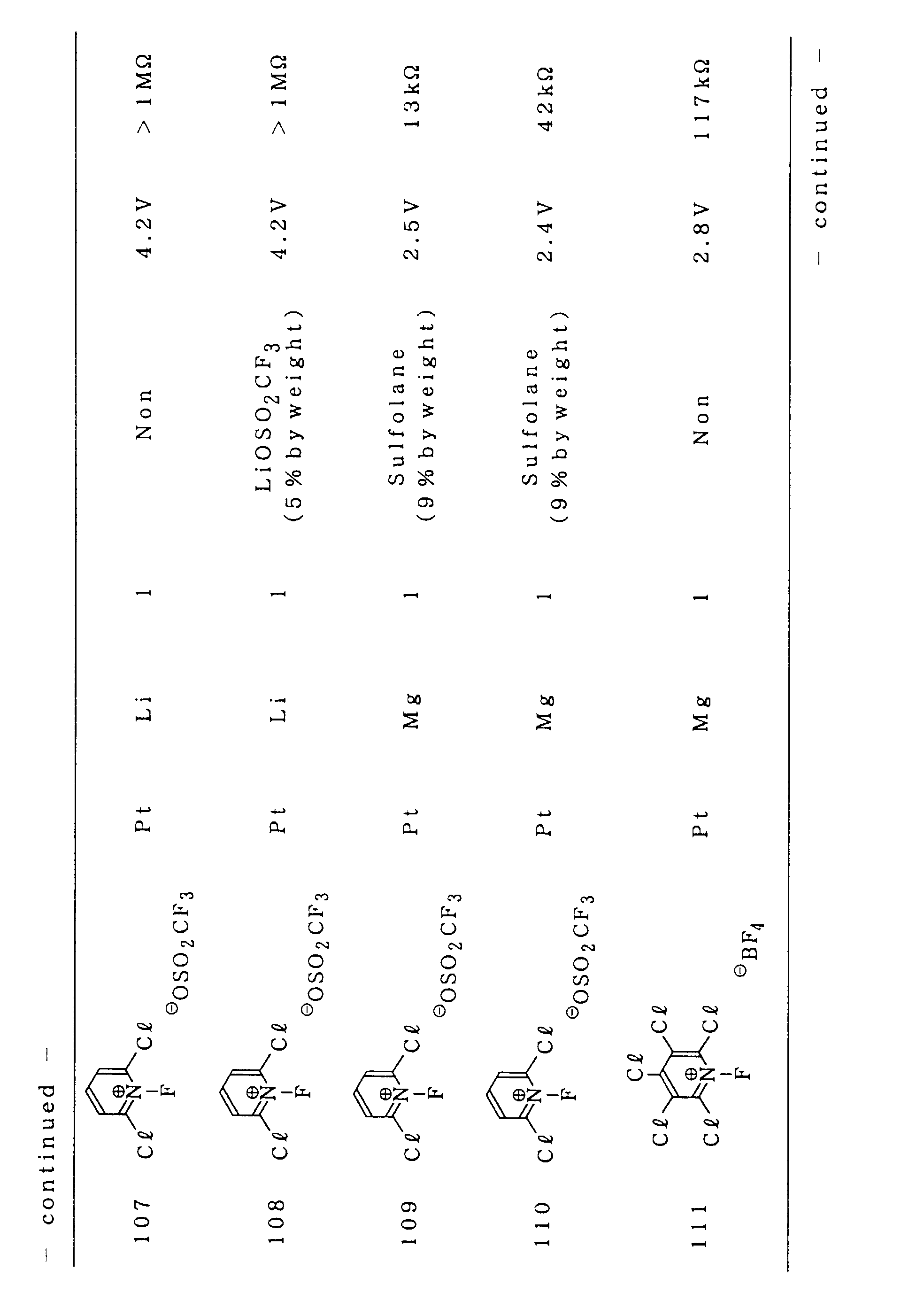
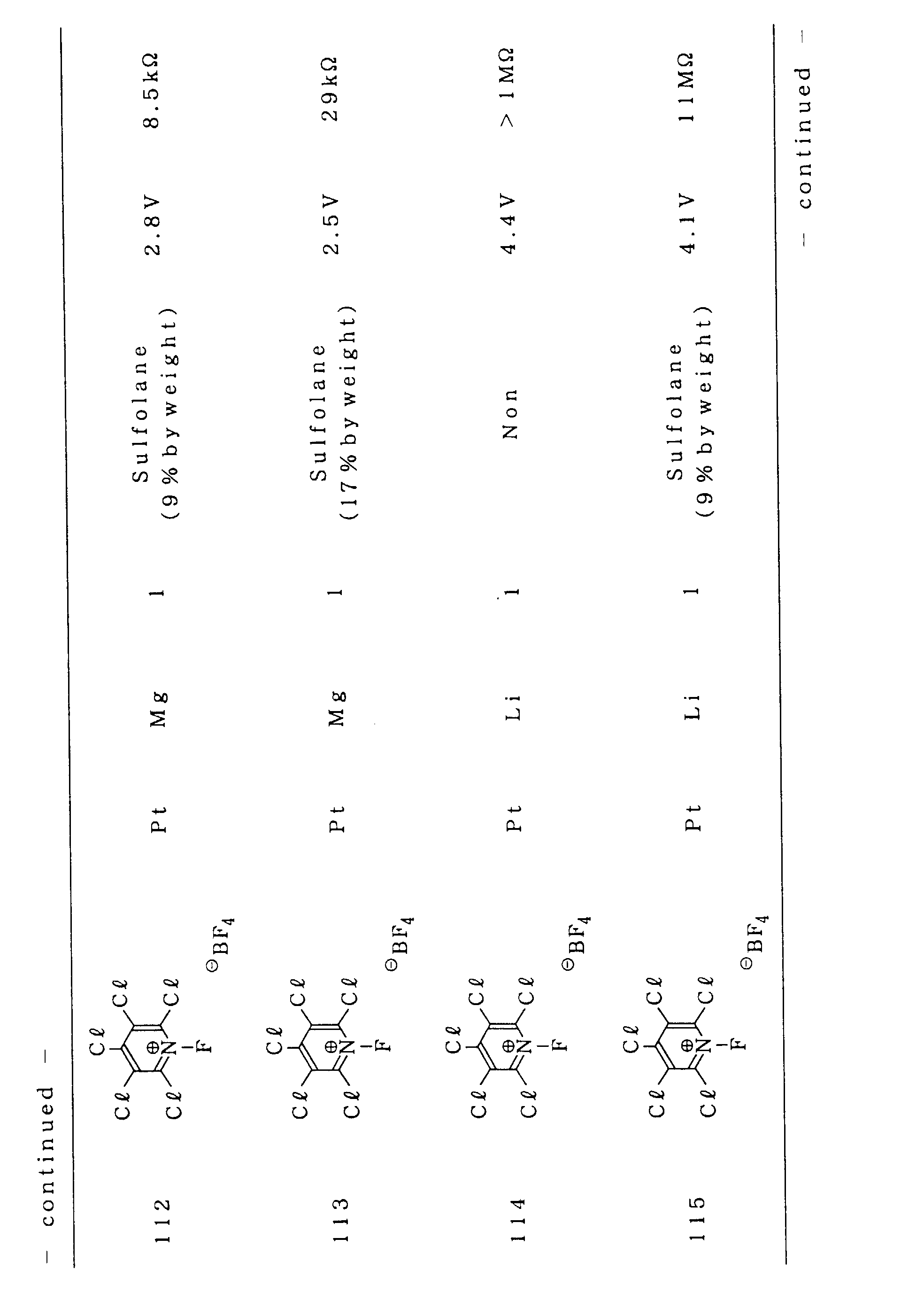
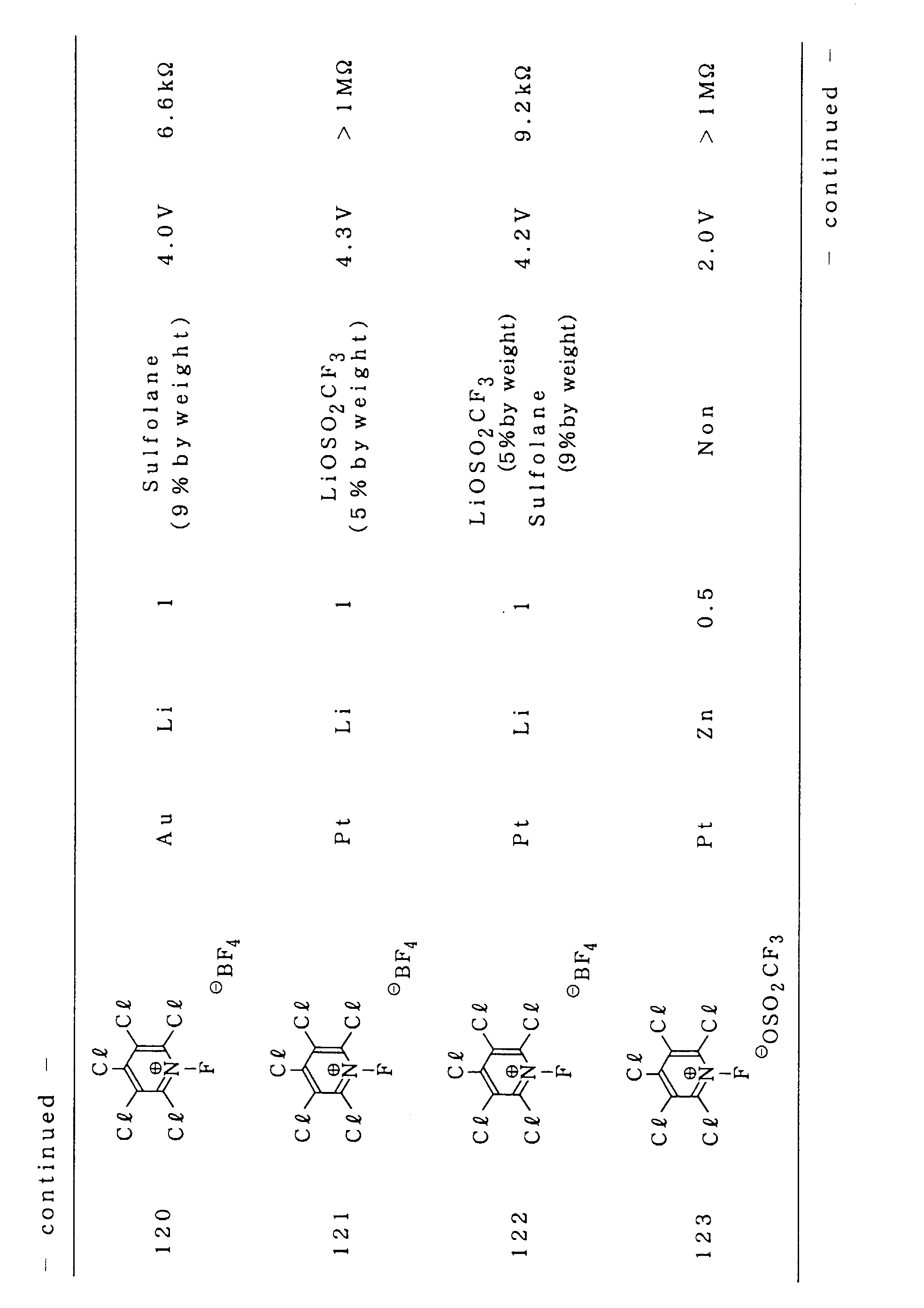
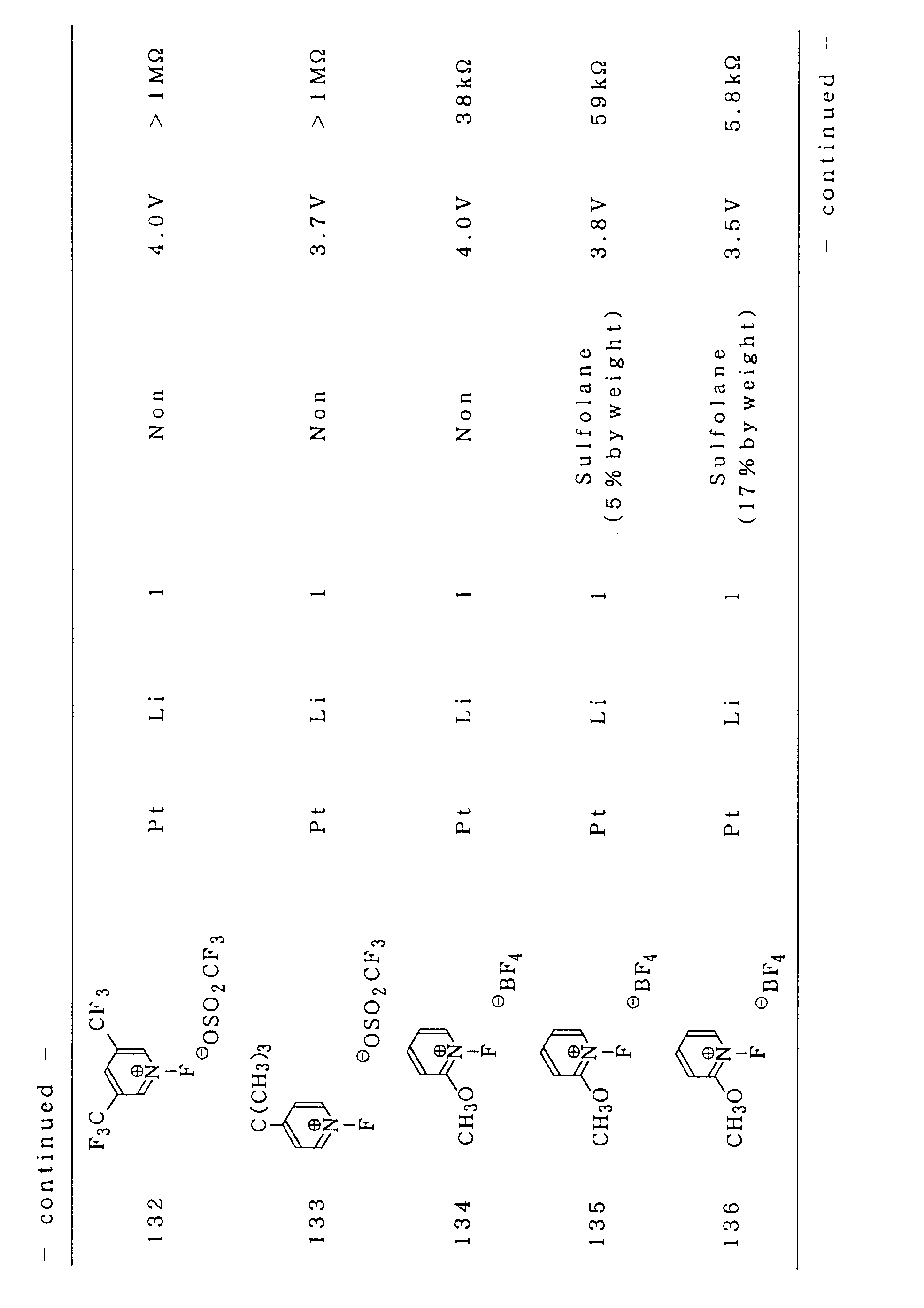
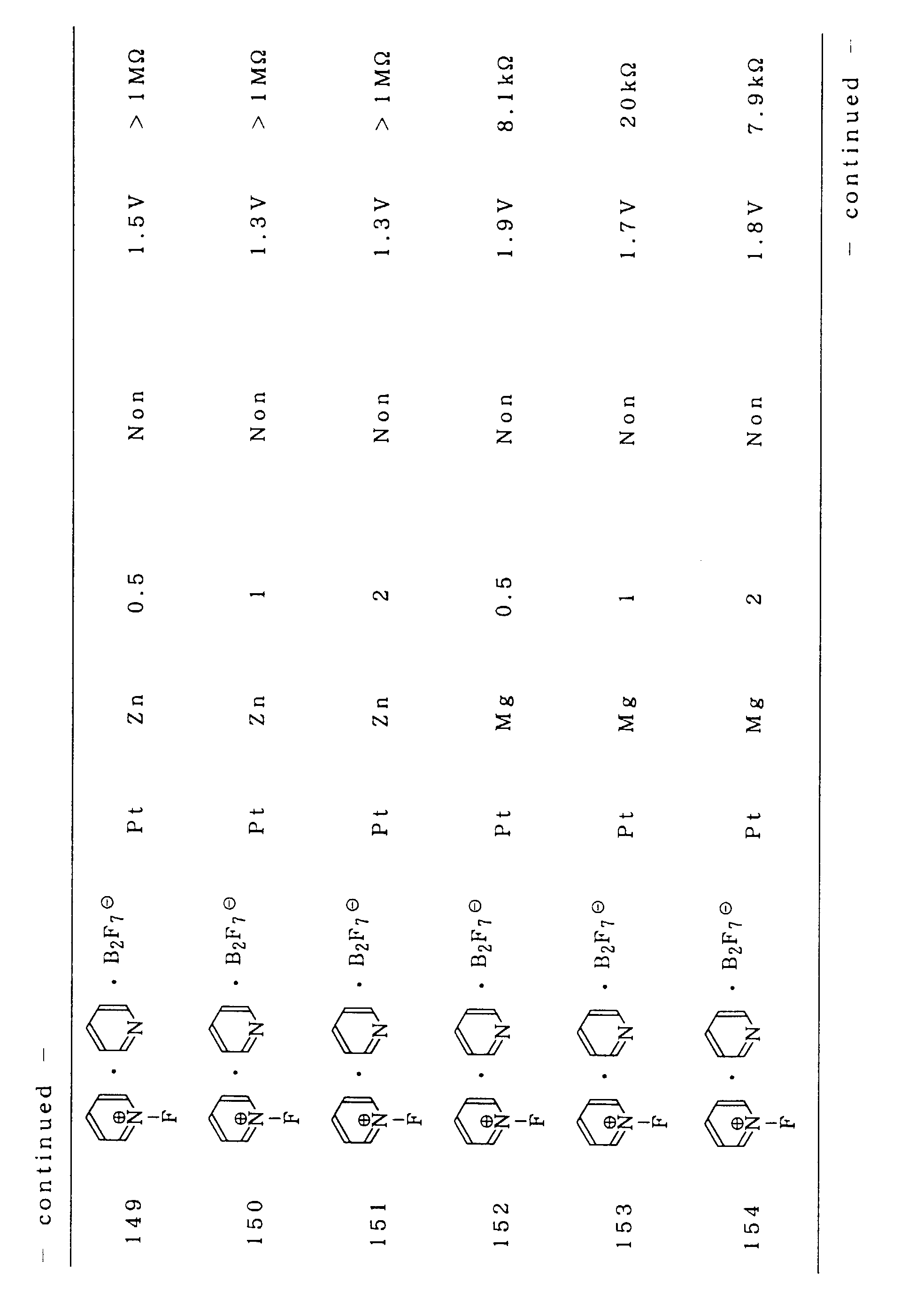
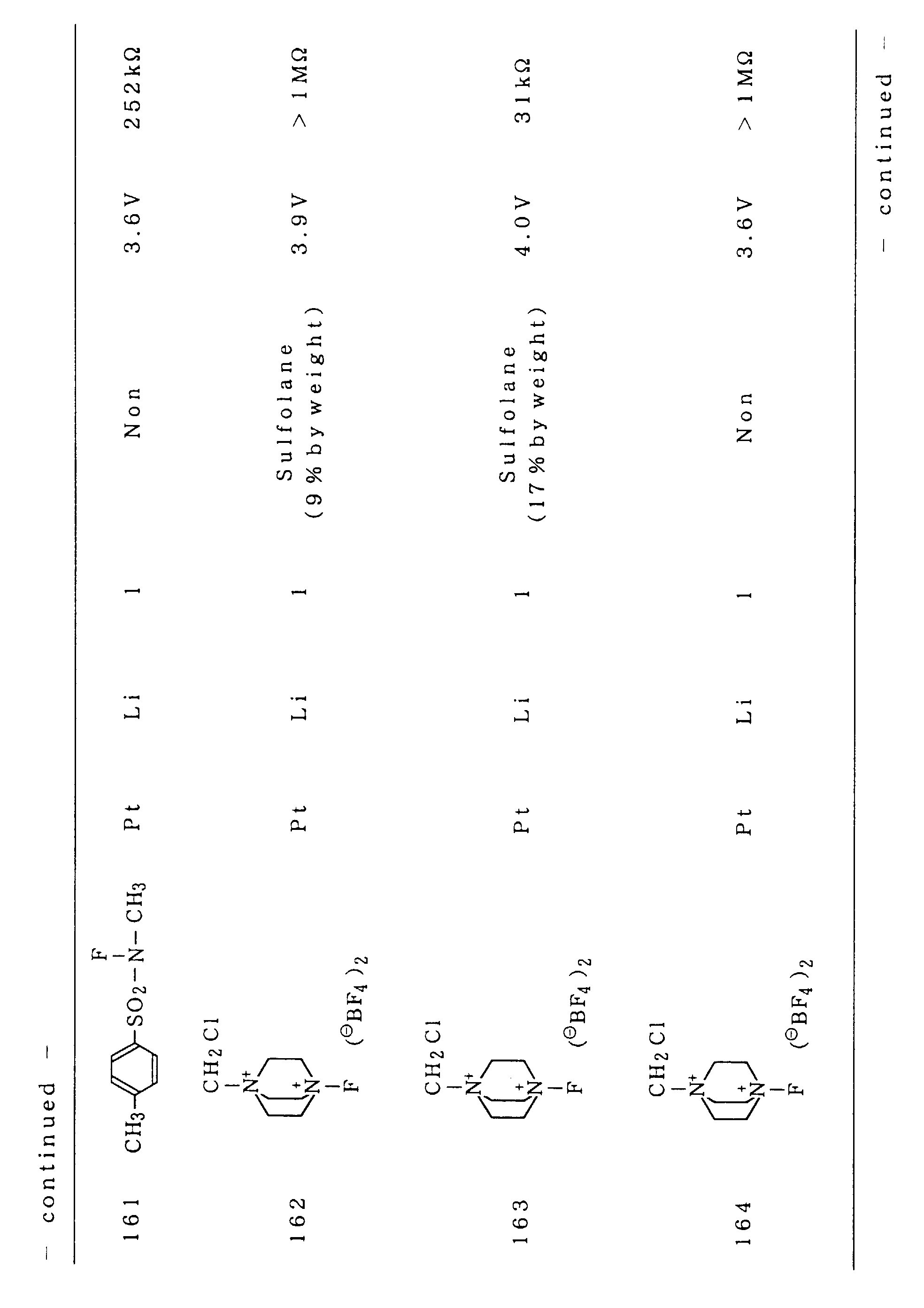
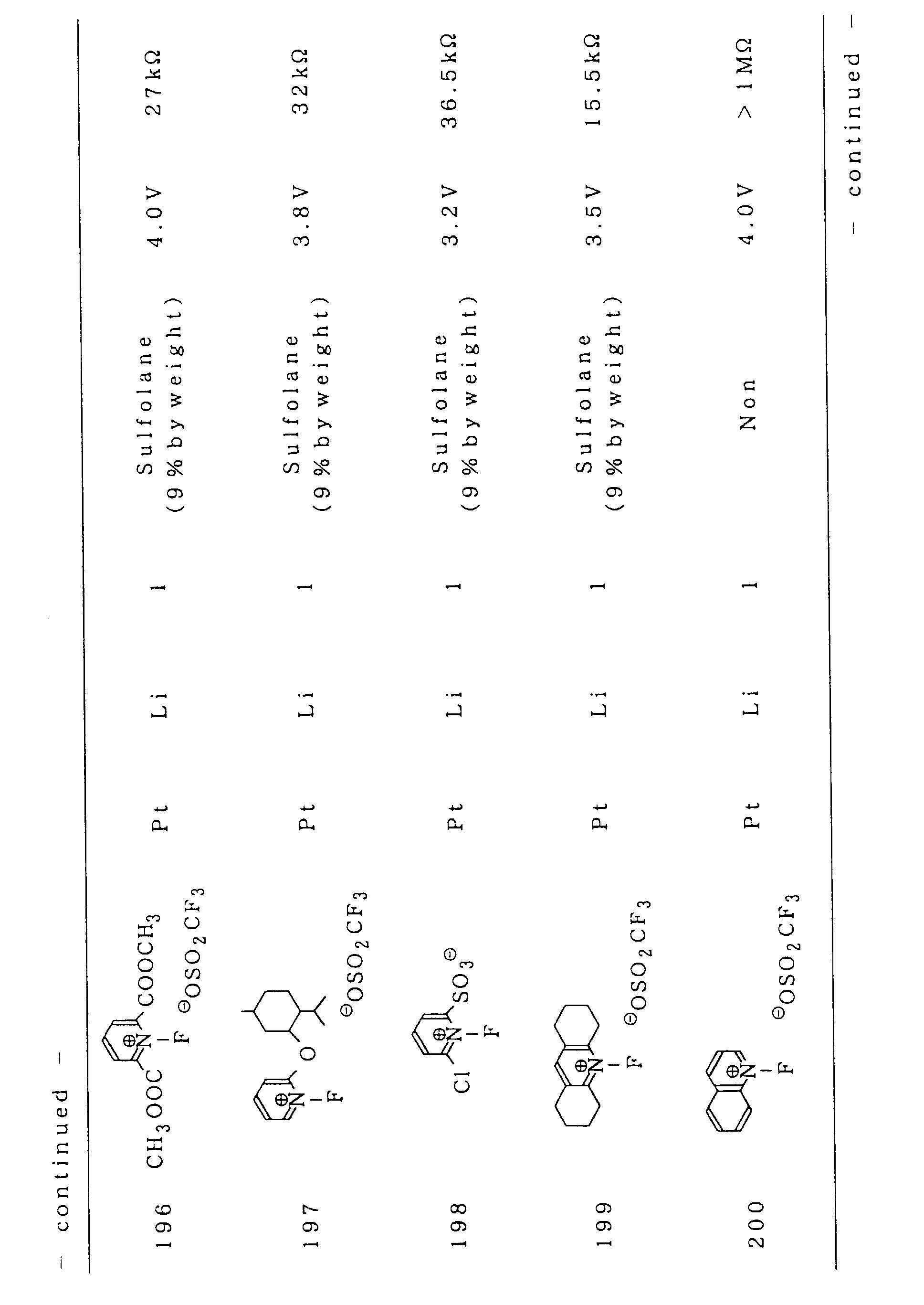
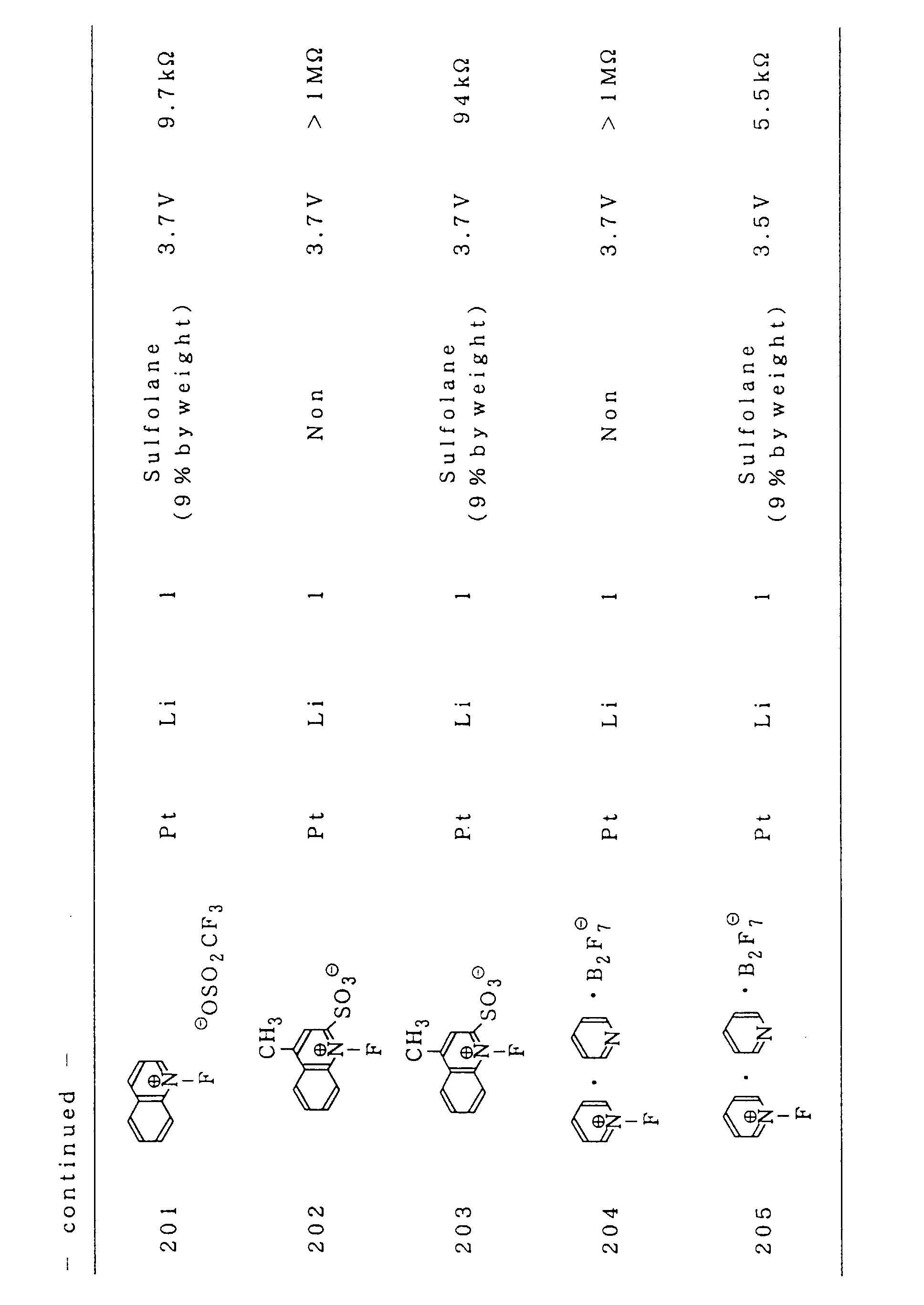
- Fig. 4 shows a perspective view of the batteries manufactured. Also the open circuit voltages of those batteries were measured, and then with the same meter as in Fig. 2, the open circuit voltages and the battery voltages under the external load of from 1 M ⁇ to 10 k ⁇ were measured to calculate the internal resistance. The battery voltage when the external resistance was applied was measured when it became a fixed value or nearly a fixed value (when it became stable at about ⁇ 0.01 V). The results are shown in Table 5.
- N-fluoropyridinium pyridine heptafluorodiborate which was the compound having a N-F bond and was used in Examples 149 to 154, was the one purchased from Allied Signal Inc.
- the compound poly(2-vinyl-N-fluoropyridinium trifluoromethanesulfonate) having a N-F bond which was used in Examples 165 to 170, was the one synthesized by using poly(2-vinylpyridine) having an average molecular weight of 200000.
- the synthetic method used was the one for the N-fluoropyridinium trifluoromethanesulfonate (cf. Bull. Chem. Soc. Jpn., 64 , 1081(1991)).
- the obtained poly(2-vinyl-N-fluoropyridinium trifluoromethanesulfonate) contained about 15 % by weight of 2-vinyl-N-hydropyridinium trifluoromethanesulfonate unit: which was not the desired compound, as a result of an analysis of 19 F- and 1 H-NMR spectra.
- This method is to manufacture film-like batteries using the polymerized compounds having a N-F bond.
- a 1 cm x 1 cm zinc or magnesium plate of the negative electrode was put on the film, and the open circuit voltage and the internal resistance were measured in the same manner as in Examples 18 to 170. Assembling and measuring of the batteries were carried out in natural atmosphere.
- Fig. 5 is a perspective view of the obtained batteries. The results are shown in Table 6.
- This method is to manufacture thick batteries.
- additives were mixed enough in a mortar at the given ratio with 1.5 g of the compounds having a N-F bond.
- the batteries were manufactured in the same manner as in Examples 18 to 170 except that about 200 mg of the compounds having a N-F bond and a 2 cm x 2 cm platinum as the current collector at the positive electrode side were used. Only in case of Example 194, about 100 mg of the compound having a N-F bond was used.
- the compounds having a N-F bond are used, which assures easy handling and excellent environmental acceptability.
- a high electromotive force or the desired electromotive force can be obtained, and furthermore the batteries having a high energy density, wide usable temperature range and long life time can be obtained.
- the above-mentioned compound having a high melting point is used as the materials for the positive electrode of the battery and the positive electrode is so designed as to contact direct to the negative electrode, it is possible to achieve small size and light weight with a simple structure.
- a novel process of the present invention for generating electric energy, a device therefor and a compound having a N-F bond for generating electric energy assures easy handling and excellent environmental acceptability, are capable of giving a high electromotive force and the desired voltage, and can be used for an liquid electrolytic battery and a paper type battery.
Landscapes
- Chemical & Material Sciences (AREA)
- Chemical Kinetics & Catalysis (AREA)
- Electrochemistry (AREA)
- General Chemical & Material Sciences (AREA)
- Engineering & Computer Science (AREA)
- Manufacturing & Machinery (AREA)
- Primary Cells (AREA)
- Secondary Cells (AREA)
- Battery Electrode And Active Subsutance (AREA)
Abstract
Description





















CH3NFCHO , C2H5NFCHO , CH3CONFCH3 , C2H5NHCONF2 , H2NCONF2 ,


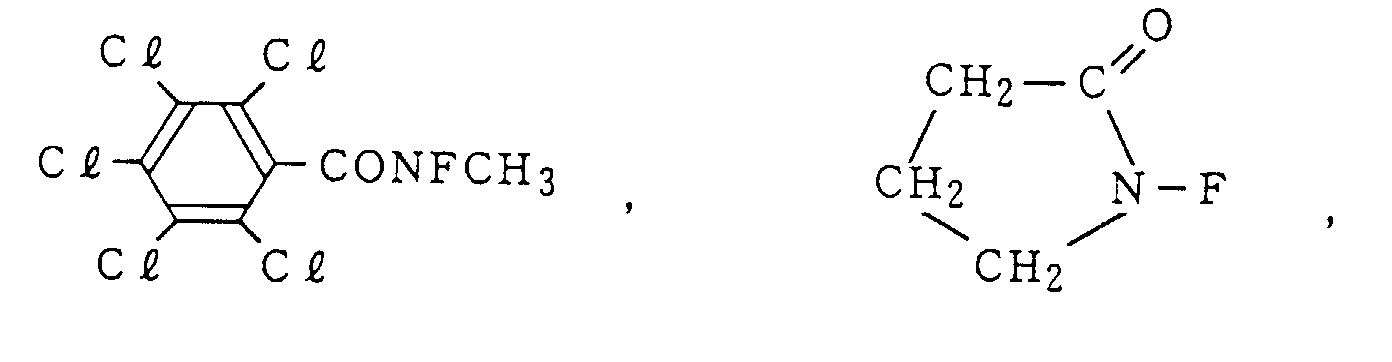
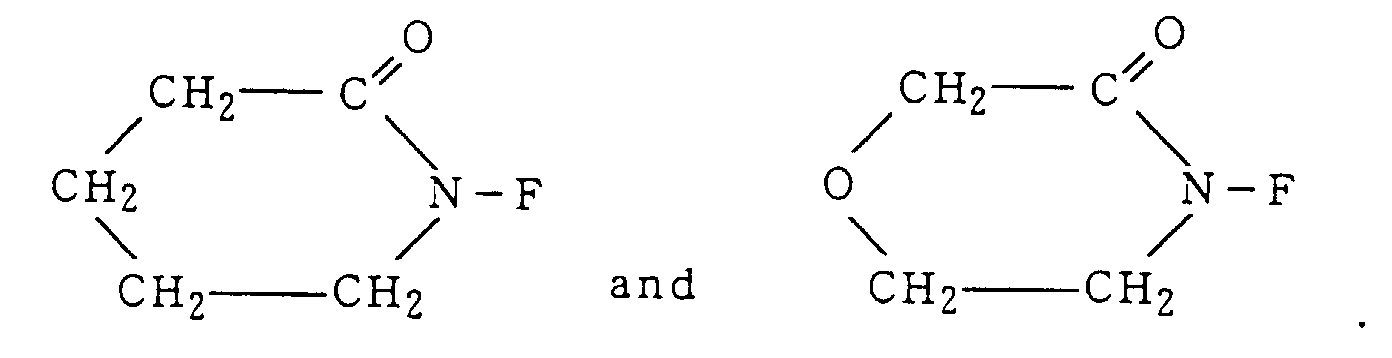
CH3OCONFH, C2H5OCONFH, CH3OCONFCH3,




| Example No. | Negative electrode | Open Circuit Voltage (V) |
| 7 | Copper | 0.6 |
| 8 | Zinc | 1.65 |
| 9 | Magnesium | 2.2 |
| 10 | Lithium | 2.9 |
| Load (kΩ) | Voltage (V) |
| 0 | 1.65 |
| 1000 | 1.32 |
| 110 | 0.97 |
| 50 | 0.77 |
| 10 | 0.30 |















Claims (23)
- A process for generating an electric energy by electrochemical reaction between a compound having a N-F bond and a compound giving electrons to said compound.
- The process for generating an electric energy of Claim 1, wherein the compound having a N-F bond is brought into contact directly with the said compound giving the electron.
- The process for generating an electric energy of Claim 1, wherein a compound having a N-F bond, which generates an electromotive force of not less than 3 V as electric energy by the electrochemical reaction, is selected.
- The process for generating an electric energy of Claim 1, wherein polar compounds are further added into the compound having a N-F bond.
- The process of Claim 1 as a battery for generating an electric energy by the electrochemical reaction between the compound having a N-F bond and the compound giving electrons.
- A device for generating electric energy, wherein the energy is generated by electrochemical reaction between a compound having a N-F bond and a compound giving electrons to said compound.
- The device of Claim 6, wherein the compound having a N-F bond and the compound giving the electrons are brought into contact directly with each other.
- The device of Claim 6 wherein a compound having a N-F bond and generating an electromotive force of not less than 3 V as an electric energy is selected.
- The device of Claim 6, wherein polar compounds are further added into the compound having a N-F bond.
- The device of Claim 6, wherein the energy generating device is a battery.
- Use of a compound having a N-F bond to generate electric energy by electrochemical reaction caused by receiving electrons from a compound giving the electrons as an active material for positive electrode.
- The use of the compound having a N-F bond according to Claim 11, wherein the compound having a N-F bond comprises at least nitrogen atom, carbon atom and fluorine atom
- The use of the compound having a N-F bond according to Claim 11, wherein the compound having a N-F bond comprises at least nitrogen atom, carbon atom and fluorine atom and has an ionic bond.
- The use of the compound having a N-F bond according to Claim 11, wherein the compound having a N-F bond comprises nitrogen atom, carbon atom, fluorine atom and one or more of atoms different therefrom.
- The use of the compound having a N-F bond according to Claim 11, wherein one or more of atoms different from nitrogen atom, carbon atom and fluorine atom are H, B, O, Aℓ, Si, P, S, Cℓ, As, Br, Sb or I.
- The use of the comopund having a N-F bond according to Claim 11, wherein the compound having a N-F bond which generates an electromotive force of not less than 3 V as electric energy by an electrochemical reaction is selected.
- The use of the compound having a N-F bond of according to Claim 11, wherein polar compounds are further added into the said compound having a N-F bond.
- The device of Claim 6, wherein the device is a liquid electrolytic battery comprising a positive electrode, a negative electrode and an electrolytic solution wherein an active material for the positive electrode is a compound having a N-F bond.
- The device of Claim 18, wherein electroconductive materials are further added into the compound having a N-F bond as the active material for the positive electrode.
- The device of Claim 18, wherein polar compounds are further added into the compound having a N-F bond
- The device of Claim 6, wherein the device is a paper type battery comprising a negative electrode with an active material and with a current collector, and a positive electrode with an active material and with a current collector, wherein the active material for the positive electrode is a film-like compound which has a N-F bond and is arranged between the negative electrode and the current collector for the positive electrode.
- The device of Claim 21, comprising a three-layer structure of the current collector for the positive electrode, the film-like active material for the positive electrode, and the negative electrode
- The device of Claim 21, wherein there is used a positive electrode made by coating the said current collector for the positive electrode with the compound having a N-F bond.
Applications Claiming Priority (5)
| Application Number | Priority Date | Filing Date | Title |
|---|---|---|---|
| JP9599793 | 1993-04-22 | ||
| JP95997/93 | 1993-04-22 | ||
| JP351211/93 | 1993-12-29 | ||
| JP35121193A JP3760474B2 (en) | 1993-04-22 | 1993-12-29 | Method and apparatus for generating electric energy, and compound having NF bond used therefor |
| PCT/JP1994/000656 WO1994024712A1 (en) | 1993-04-22 | 1994-04-20 | Material for generating electric energy |
Publications (3)
| Publication Number | Publication Date |
|---|---|
| EP0646979A1 EP0646979A1 (en) | 1995-04-05 |
| EP0646979A4 EP0646979A4 (en) | 1995-12-27 |
| EP0646979B1 true EP0646979B1 (en) | 1998-11-11 |
Family
ID=26437153
Family Applications (1)
| Application Number | Title | Priority Date | Filing Date |
|---|---|---|---|
| EP94913788A Expired - Lifetime EP0646979B1 (en) | 1993-04-22 | 1994-04-20 | Material for generating electric energy |
Country Status (9)
| Country | Link |
|---|---|
| US (1) | US5573868A (en) |
| EP (1) | EP0646979B1 (en) |
| JP (1) | JP3760474B2 (en) |
| KR (1) | KR100286152B1 (en) |
| CN (1) | CN1107646A (en) |
| CA (1) | CA2138766A1 (en) |
| DE (1) | DE69414518T2 (en) |
| RU (1) | RU2125753C1 (en) |
| WO (1) | WO1994024712A1 (en) |
Families Citing this family (38)
| Publication number | Priority date | Publication date | Assignee | Title |
|---|---|---|---|---|
| RU2194721C2 (en) * | 1994-10-22 | 2002-12-20 | Дайкин Индастриз, Лтд. | Dimmer, trimmer, or polymer containing conjugated n-fluoropyridinium salt |
| US5691081A (en) * | 1995-09-21 | 1997-11-25 | Minnesota Mining And Manufacturing Company | Battery containing bis(perfluoroalkylsulfonyl)imide and cyclic perfluoroalkylene disulfonylimide salts |
| JP3496460B2 (en) * | 1997-06-13 | 2004-02-09 | ダイキン工業株式会社 | Electrolytic solution and lithium secondary battery using the same |
| CA2215849A1 (en) * | 1997-09-11 | 1999-03-11 | Christophe Michot | New solvent and electrolytic composition with high conductivity and wide stability range |
| US20050112471A1 (en) * | 1999-02-26 | 2005-05-26 | Muguo Chen | Nickel zinc electrochemical cell incorporating dendrite blocking ionically conductive separator |
| JP4087343B2 (en) | 2004-02-25 | 2008-05-21 | Tdk株式会社 | Lithium ion secondary battery and method for charging lithium ion secondary battery |
| LT2502911T (en) | 2004-06-24 | 2017-09-11 | Vertex Pharmaceuticals Incorporated | Modulators of ATP-binding cassette transporters |
| US8354427B2 (en) * | 2004-06-24 | 2013-01-15 | Vertex Pharmaceutical Incorporated | Modulators of ATP-binding cassette transporters |
| JP5284783B2 (en) * | 2005-06-30 | 2013-09-11 | コーニンクレッカ フィリップス エレクトロニクス エヌ ヴィ | Battery and method for attaching the battery to clothing |
| CA2634113A1 (en) * | 2005-12-24 | 2007-07-05 | Vertex Pharmaceuticals Incorporated | Quinolin- 4 - one derivatives as modulators of abc transporters |
| WO2007079139A2 (en) | 2005-12-28 | 2007-07-12 | Vertex Pharmaceuticals, Inc. | Solid forms of n-[2,4-bis(1,1-dimethylethyl)-5-hydroxyphenyl]-1,4-dihydro-4-oxoquinoline-3-carboxamide |
| EP2071658A1 (en) * | 2007-12-14 | 2009-06-17 | Fortu Intellectual Property AG | Electrolyte for an electrochemical battery cell |
| US20100074949A1 (en) | 2008-08-13 | 2010-03-25 | William Rowe | Pharmaceutical composition and administration thereof |
| US12458635B2 (en) | 2008-08-13 | 2025-11-04 | Vertex Pharmaceuticals Incorporated | Pharmaceutical composition and administrations thereof |
| SI2408750T1 (en) | 2009-03-20 | 2015-11-30 | Vertex Pharmaceuticals Incorporated | Process for making modulators of cystic fibrosis transmembrane conductance regulator |
| US8802700B2 (en) | 2010-12-10 | 2014-08-12 | Vertex Pharmaceuticals Incorporated | Modulators of ATP-Binding Cassette transporters |
| US10326168B2 (en) * | 2011-01-03 | 2019-06-18 | Nanotek Instruments, Inc. | Partially and fully surface-enabled alkali metal ion-exchanging energy storage devices |
| EP2819670A1 (en) | 2012-02-27 | 2015-01-07 | Vertex Pharmaceuticals Incorporated | Pharmaceutical composition and administration thereof |
| US20140017558A1 (en) * | 2012-07-16 | 2014-01-16 | Nthdegree Technologies Worldwide Inc. | Diatomaceous Ionic Gel Separation Layer for Energy Storage Devices and Printable Composition Therefor |
| CN104584160B (en) | 2012-07-18 | 2018-03-23 | 印制能源技术有限公司 | Energy storage device and ink for printing thin films |
| US9548511B2 (en) | 2012-07-18 | 2017-01-17 | Nthdegree Technologies Worldwide Inc. | Diatomaceous energy storage devices |
| RU2508580C1 (en) * | 2012-07-18 | 2014-02-27 | Российская Федерация, от имени которой выступает Государственная корпорация по атомной энергии "Росатом" - Госкорпорация "Росатом" | Thermal chemical current source |
| US9083010B2 (en) | 2012-07-18 | 2015-07-14 | Nthdegree Technologies Worldwide Inc. | Diatomaceous energy storage devices |
| US10396365B2 (en) | 2012-07-18 | 2019-08-27 | Printed Energy Pty Ltd | Diatomaceous energy storage devices |
| US9520598B2 (en) | 2012-10-10 | 2016-12-13 | Nthdegree Technologies Worldwide Inc. | Printed energy storage device |
| US9397341B2 (en) | 2012-10-10 | 2016-07-19 | Nthdegree Technologies Worldwide Inc. | Printed energy storage device |
| CN105379000B (en) | 2013-07-17 | 2019-08-27 | 印制能源技术有限公司 | energy storage device |
| AU2015210833B2 (en) | 2014-02-03 | 2019-01-03 | Vitae Pharmaceuticals, Llc | Dihydropyrrolopyridine inhibitors of ROR-gamma |
| KR20170063954A (en) | 2014-10-07 | 2017-06-08 | 버텍스 파마슈티칼스 인코포레이티드 | Co-crystals of modulators of cystic fibrosis transmembrane conductance regulator |
| JP6564029B2 (en) | 2014-10-14 | 2019-08-21 | ヴァイティー ファーマシューティカルズ,エルエルシー | Dihydropyrrolopyridine inhibitors of ROR-gamma |
| US9663515B2 (en) | 2014-11-05 | 2017-05-30 | Vitae Pharmaceuticals, Inc. | Dihydropyrrolopyridine inhibitors of ROR-gamma |
| US9845308B2 (en) | 2014-11-05 | 2017-12-19 | Vitae Pharmaceuticals, Inc. | Isoindoline inhibitors of ROR-gamma |
| DK3331876T3 (en) | 2015-08-05 | 2021-01-11 | Vitae Pharmaceuticals Llc | MODULATORS OF ROR-GAMMA |
| MA53943A (en) | 2015-11-20 | 2021-08-25 | Vitae Pharmaceuticals Llc | ROR-GAMMA MODULATORS |
| TWI757266B (en) | 2016-01-29 | 2022-03-11 | 美商維它藥物有限責任公司 | Modulators of ror-gamma |
| US9481674B1 (en) | 2016-06-10 | 2016-11-01 | Vitae Pharmaceuticals, Inc. | Dihydropyrrolopyridine inhibitors of ROR-gamma |
| WO2019018975A1 (en) | 2017-07-24 | 2019-01-31 | Vitae Pharmaceuticals, Inc. | Inhibitors of ror gamma |
| CN115650976A (en) | 2017-07-24 | 2023-01-31 | 生命医药有限责任公司 | Inhibitors of ROR gamma |
Family Cites Families (10)
| Publication number | Priority date | Publication date | Assignee | Title |
|---|---|---|---|---|
| SU532919A1 (en) * | 1974-10-22 | 1976-10-25 | Предприятие П/Я А-3570 | Waveguide attenuator with fixed attenuation |
| JPS5468933A (en) * | 1977-11-10 | 1979-06-02 | Matsushita Electric Industrial Co Ltd | Lithiummiodine complex body battery |
| US4198976A (en) * | 1977-10-11 | 1980-04-22 | The Procter & Gamble Company | Vaginal contraceptive |
| JPS5714547A (en) * | 1980-06-11 | 1982-01-25 | Inst Francais Du Petrole | Manufacture of methyl-tert-butyl ether from methanol and isobutene |
| EP0077169B1 (en) * | 1981-10-08 | 1988-12-21 | Matsushita Electric Industrial Co., Ltd. | Solid-state batteries |
| JPS5861573A (en) * | 1981-10-08 | 1983-04-12 | Matsushita Electric Ind Co Ltd | Solid electrolyte cell and its production method |
| FR2545494B1 (en) * | 1983-05-06 | 1985-07-19 | Commissariat Energie Atomique | PROCESS FOR THE PREPARATION OF POLYANILINES, POLYANILINES OBTAINED ACCORDING TO THIS PROCESS AND THEIR APPLICATIONS IN THE PRODUCTION OF ELECTROCHEMICAL GENERATORS |
| JPH0320861A (en) * | 1989-06-16 | 1991-01-29 | Nec Eng Ltd | Document display device |
| JP2940706B2 (en) * | 1990-10-22 | 1999-08-25 | 三洋電機株式会社 | Non-aqueous electrolyte secondary battery |
| JP5714547B2 (en) * | 2012-09-28 | 2015-05-07 | フリュー株式会社 | Image providing apparatus, image providing method, and program |
-
1993
- 1993-12-29 JP JP35121193A patent/JP3760474B2/en not_active Expired - Fee Related
-
1994
- 1994-04-20 RU RU94046451A patent/RU2125753C1/en not_active IP Right Cessation
- 1994-04-20 EP EP94913788A patent/EP0646979B1/en not_active Expired - Lifetime
- 1994-04-20 DE DE69414518T patent/DE69414518T2/en not_active Expired - Fee Related
- 1994-04-20 CN CN94190221A patent/CN1107646A/en active Pending
- 1994-04-20 US US08/356,245 patent/US5573868A/en not_active Expired - Fee Related
- 1994-04-20 CA CA002138766A patent/CA2138766A1/en not_active Abandoned
- 1994-04-20 KR KR1019940704667A patent/KR100286152B1/en not_active Expired - Fee Related
- 1994-04-20 WO PCT/JP1994/000656 patent/WO1994024712A1/en not_active Ceased
Also Published As
| Publication number | Publication date |
|---|---|
| US5573868A (en) | 1996-11-12 |
| EP0646979A4 (en) | 1995-12-27 |
| EP0646979A1 (en) | 1995-04-05 |
| RU2125753C1 (en) | 1999-01-27 |
| JPH076756A (en) | 1995-01-10 |
| DE69414518T2 (en) | 1999-05-06 |
| CA2138766A1 (en) | 1994-10-27 |
| JP3760474B2 (en) | 2006-03-29 |
| WO1994024712A1 (en) | 1994-10-27 |
| KR950702342A (en) | 1995-06-19 |
| DE69414518D1 (en) | 1998-12-17 |
| CN1107646A (en) | 1995-08-30 |
| KR100286152B1 (en) | 2001-04-16 |
| RU94046451A (en) | 1996-10-27 |
Similar Documents
| Publication | Publication Date | Title |
|---|---|---|
| EP0646979B1 (en) | Material for generating electric energy | |
| EP0036118B1 (en) | Secondary batteries based on reversible electrochemical doping of conjugated polymers | |
| EP0208254B1 (en) | Secondary battery | |
| JPH08511274A (en) | Ionic conductive material with good corrosion resistance | |
| EP0282068B1 (en) | Nonaqueous secondary battery | |
| JPH103924A (en) | Positive electrode active material, battery using the positive electrode active material, and method for manufacturing battery | |
| US4728589A (en) | Reversible electrochemical doping of conjugated polymers and secondary batteries based thereon | |
| JPH02223160A (en) | All-solid lithium secondary battery | |
| EP0787719B1 (en) | Conjugated n-fluoropyridinium salt polymer and use thereof | |
| US4801512A (en) | Reversible electrochemical doping of conjugated polymers and secondary batteries based thereon | |
| JPWO1996012702A1 (en) | Conjugated N-fluoropyridinium salt-containing polymer and its use | |
| TW564567B (en) | Secondary battery | |
| JP2581338B2 (en) | Polymer solid electrolyte and battery using the same | |
| Hishinuma et al. | Zinc—iodine secondary cell using 6-nylon or poly (ether) based electrode. Basic research for industrial use of the secondary cell | |
| JP3514080B2 (en) | Positive electrode active material additive, positive electrode active material-containing composition obtained by blending the same, and battery using the same | |
| JPH08171915A (en) | Battery | |
| EP0198484A2 (en) | Secondary battery | |
| JPH08171939A (en) | Secondary battery | |
| JPH07296820A (en) | Method for generating energy such as electricity and apparatus for generating the same | |
| JPS62259350A (en) | Secondary cell | |
| JPS62110257A (en) | secondary battery | |
| JPS62157675A (en) | secondary battery | |
| JPS61263044A (en) | electrode material | |
| JPH0740493B2 (en) | Non-aqueous solvent secondary battery | |
| JPS61285662A (en) | Nonaqueous secondary cell |
Legal Events
| Date | Code | Title | Description |
|---|---|---|---|
| PUAI | Public reference made under article 153(3) epc to a published international application that has entered the european phase |
Free format text: ORIGINAL CODE: 0009012 |
|
| AK | Designated contracting states |
Kind code of ref document: A1 Designated state(s): DE FR GB IT |
|
| 17P | Request for examination filed |
Effective date: 19950404 |
|
| A4 | Supplementary search report drawn up and despatched | ||
| AK | Designated contracting states |
Kind code of ref document: A4 Designated state(s): DE FR GB IT |
|
| 17Q | First examination report despatched |
Effective date: 19960618 |
|
| GRAG | Despatch of communication of intention to grant |
Free format text: ORIGINAL CODE: EPIDOS AGRA |
|
| GRAG | Despatch of communication of intention to grant |
Free format text: ORIGINAL CODE: EPIDOS AGRA |
|
| GRAG | Despatch of communication of intention to grant |
Free format text: ORIGINAL CODE: EPIDOS AGRA |
|
| GRAH | Despatch of communication of intention to grant a patent |
Free format text: ORIGINAL CODE: EPIDOS IGRA |
|
| GRAH | Despatch of communication of intention to grant a patent |
Free format text: ORIGINAL CODE: EPIDOS IGRA |
|
| GRAA | (expected) grant |
Free format text: ORIGINAL CODE: 0009210 |
|
| AK | Designated contracting states |
Kind code of ref document: B1 Designated state(s): DE FR GB IT |
|
| REF | Corresponds to: |
Ref document number: 69414518 Country of ref document: DE Date of ref document: 19981217 |
|
| ITF | It: translation for a ep patent filed | ||
| ET | Fr: translation filed | ||
| PLBE | No opposition filed within time limit |
Free format text: ORIGINAL CODE: 0009261 |
|
| STAA | Information on the status of an ep patent application or granted ep patent |
Free format text: STATUS: NO OPPOSITION FILED WITHIN TIME LIMIT |
|
| 26N | No opposition filed | ||
| REG | Reference to a national code |
Ref country code: GB Ref legal event code: IF02 |
|
| PGFP | Annual fee paid to national office [announced via postgrant information from national office to epo] |
Ref country code: DE Payment date: 20070412 Year of fee payment: 14 |
|
| PGFP | Annual fee paid to national office [announced via postgrant information from national office to epo] |
Ref country code: GB Payment date: 20070418 Year of fee payment: 14 |
|
| PGFP | Annual fee paid to national office [announced via postgrant information from national office to epo] |
Ref country code: IT Payment date: 20070601 Year of fee payment: 14 |
|
| PGFP | Annual fee paid to national office [announced via postgrant information from national office to epo] |
Ref country code: FR Payment date: 20070411 Year of fee payment: 14 |
|
| GBPC | Gb: european patent ceased through non-payment of renewal fee |
Effective date: 20080420 |
|
| PG25 | Lapsed in a contracting state [announced via postgrant information from national office to epo] |
Ref country code: DE Free format text: LAPSE BECAUSE OF NON-PAYMENT OF DUE FEES Effective date: 20081101 |
|
| REG | Reference to a national code |
Ref country code: FR Ref legal event code: ST Effective date: 20081231 |
|
| PG25 | Lapsed in a contracting state [announced via postgrant information from national office to epo] |
Ref country code: FR Free format text: LAPSE BECAUSE OF NON-PAYMENT OF DUE FEES Effective date: 20080430 |
|
| PG25 | Lapsed in a contracting state [announced via postgrant information from national office to epo] |
Ref country code: GB Free format text: LAPSE BECAUSE OF NON-PAYMENT OF DUE FEES Effective date: 20080420 |
|
| PG25 | Lapsed in a contracting state [announced via postgrant information from national office to epo] |
Ref country code: IT Free format text: LAPSE BECAUSE OF NON-PAYMENT OF DUE FEES Effective date: 20080420 |