EP0645694B1 - Palette management for application sharing in collaborative systems - Google Patents
Palette management for application sharing in collaborative systems Download PDFInfo
- Publication number
- EP0645694B1 EP0645694B1 EP94307042A EP94307042A EP0645694B1 EP 0645694 B1 EP0645694 B1 EP 0645694B1 EP 94307042 A EP94307042 A EP 94307042A EP 94307042 A EP94307042 A EP 94307042A EP 0645694 B1 EP0645694 B1 EP 0645694B1
- Authority
- EP
- European Patent Office
- Prior art keywords
- image
- palette
- computer
- host computer
- remote computer
- Prior art date
- Legal status (The legal status is an assumption and is not a legal conclusion. Google has not performed a legal analysis and makes no representation as to the accuracy of the status listed.)
- Expired - Lifetime
Links
Images


Classifications
-
- G—PHYSICS
- G06—COMPUTING OR CALCULATING; COUNTING
- G06F—ELECTRIC DIGITAL DATA PROCESSING
- G06F3/00—Input arrangements for transferring data to be processed into a form capable of being handled by the computer; Output arrangements for transferring data from processing unit to output unit, e.g. interface arrangements
- G06F3/14—Digital output to display device ; Cooperation and interconnection of the display device with other functional units
- G06F3/1454—Digital output to display device ; Cooperation and interconnection of the display device with other functional units involving copying of the display data of a local workstation or window to a remote workstation or window so that an actual copy of the data is displayed simultaneously on two or more displays, e.g. teledisplay
-
- G—PHYSICS
- G09—EDUCATION; CRYPTOGRAPHY; DISPLAY; ADVERTISING; SEALS
- G09G—ARRANGEMENTS OR CIRCUITS FOR CONTROL OF INDICATING DEVICES USING STATIC MEANS TO PRESENT VARIABLE INFORMATION
- G09G5/00—Control arrangements or circuits for visual indicators common to cathode-ray tube indicators and other visual indicators
- G09G5/02—Control arrangements or circuits for visual indicators common to cathode-ray tube indicators and other visual indicators characterised by the way in which colour is displayed
- G09G5/06—Control arrangements or circuits for visual indicators common to cathode-ray tube indicators and other visual indicators characterised by the way in which colour is displayed using colour palettes, e.g. look-up tables
Definitions
- the present invention generally relates to computer networking, and in particular, to a method and apparatus for managing display palettes in collaborative systems.
- a method of sharing images between a host computer and a remote computer in a collaborative system comprising one or more host computers connected to one or more remote computers, wherein an image displayed on the host computer is substantially simultaneously displayed on the remote computer, the method being characterized by managing palettes used in forming the image, comprising the steps of: recognizing when a change is made to a system palette on the host computer; communicating the system palette to the remote computer; creating a logical palette on the remote computer to reflect the system palette on the host computer; and selectively updating a system palette on the remote computer to reflect the logical palette.
- an image - sharing computer system comprising a host computer connected to one or more remote computers and arranged to display an image on the host computer and the remote computer substantially simultaneously; and characterized by palette management means, in the host computer and in the remote computer, comprising means for selectively intercepting the image and functions which alter the image on the host computer; means for selectively communicating the intercepted image and functions to the remote computer; means, for receiving the intercepted image and functions from the host computer; and means, for selectively displaying the intercepted image on the remote computer and for altering the intercepted image according to the intercepted functions.
- the images When sharing images between the host computer and the remote computer, the images must first be translated from their device dependent format using the system palette on the host computer into a device independent image.
- the device independent image like the system palette, is transmitted from the host computer to the remote computer.
- the device independent image is then translated into a device dependent image suitable for display on the remote computer using the logical palette maintained by the collaborative system on the remote computer.
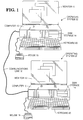
- FIG. 1 is a block diagram illustrating one embodiment of an apparatus in accordance with the present invention.
- the present invention is typically incorporated into a computer network including two or more personal computers 10 coupled together for communication. It is envisioned that attached to each computer 10 will be a monitor 12, disk storage 14, and communications link 16. Also included in the preferred embodiment are input devices, for example, a mouse pointing device 18 and a keyboard 20.
- Each computer 10 operates under the control of a message-driven multi-tasking, graphical user interface (GUI) 22, such as the WINDOWS operating system or environment sold by Microsoft Corporation.
- GUI graphical user interface
- Each of the computers 10 forms part of a collaborative system.
- a user at one computer 10 (termed the host computer 10) interacts with one or more applications occupying one or more windows of the GUI 22.
- the collaborative system simultaneously replicates selected windows displayed on the computer 10, rather than the entire display, at one or more remote computers 10. This selective replication allows users to maintain private areas on their monitors 12 that are not shared. Note that it is possible for both the host and the remote computers 10 to run a plurality of other applications at the same time because of the multi-tasking capabilities of the GUI 22.
- the collaborative system replicates the selected display on the host computer 10 to the remote computers 10, so that all users view similar displays on their respective monitors 12, the displays could be different, because of the following factors:
- the palette management system of the present invention allows information to be displayed on the remote computer 10 in an almost identical state as it is on the host computer 10.
- FIG. 2 is a block diagram illustrating one possible method for controlling the display of information.
- WINDOWS there are three types of "palettes" used to control the display of colors on the monitor 12: hardware palettes 24, system palettes 26 and logical palettes 28.
- Each palette comprises one or more entries, wherein each entry is identified by an index value and contains three color fields corresponding to the Red, Green, and Blue (RGB) color values used to create a desired color represented by that entry.
- the hardware palette 24 stores the entries representing the colors actually displayed on the monitor 12.
- the system palette 26 is used by applications to access and manipulate the hardware palette 24. Each application, in turn, maintains one or more logical palettes 28 that reflect the desired color selections for the application.
- Each computer 10 can have only one system palette 26, but every application can have as many logical palettes 28 as it needs.
- the logical palettes 28 maintain index entries that reference entries in the system palette 26; the system palette 26 maintains index entries that reference entries in the hardware palette 24.
- the index value points to the nearest matching color in the palette which it references.
- the solid lines connecting the logical palettes 28 to the system palette 26 and the system palette 26 to the hardware palette 24 represent an exact mapping where the RGB colors are identical; the dotted lines represent a mapping where the RGB colors provide the closest possible color match. Sometimes it is necessary to resort to closest color matching because the number of colors in the logical palettes 28 exceed the number of possible entries in the system palette 26.
- Logical Palette 1 is marked as the "Active Window,” and thus it adds its colors to the system palette 26 first, so that its colors look the best (i.e., most exact) of any palette-based application in the computer 10.
- this technique must be extended to ensure that the display of information on remote computers 10 is as close as possible to the display on the host computer 10. Further, the overhead in accomplishing this task must be minimized.
- a change is made to the system palette 26 of a host computer in a collaborative system
- these changes are then communicated to a remote computer 10 to recreate the system palette 26 as a logical palette 28 managed by the collaborative system on the remote computer 10.
- the collaborative system is actively executing on the remote computer 10, it is permitted to access and manipulate the system palette 26 on the remote computer 10 so that it is an exact match to its logical palette 28, i.e., the system palette 26 from the host computer 10.
- the collaborative system is idle on the remote system 10, it is permitted to access and manipulate the system palette 26 on the remote computer 10 so as to provide the closest possible color match to its logical palette 28.
- FIG. 3 is a block diagram that illustrates one possible configuration of components that perform the palette management functions in the collaborative system.
- Controlling Applications 30 and 32 perform the overall management of the application sharing and communication functions for the collaborative system.
- the Controlling Application 30 on the host computer 10 intercepts the user's interaction with a Captured Application 34.
- the Captured Application 34 invokes various functions of the WINDOWS TM Application Programming Interface (API) 36, including Graphics Device Interface (GDI) functions, to manipulate the display on the monitor 12.
- API Application Programming Interface
- GDI Graphics Device Interface
- the invocation of the WINDOWS TM API and GDI functions are intercepted by the GDI Capture Engine 38, in the form of a Dynamic Link Library (DLL).
- the captured functions and display images are communicated to the remote computer 10 across the communications link 16 via the Communications Channel 40.
- the GDI Capture Engine 38 transfers control to the GDI routines 42 to perform the requested GDI functions.
- the Communications Channel 44 at the remote computer 10 receives the captured functions and display images, and then communicates this information to the GDI Playback Engine 46, in the form of a Dynamic Link Library (DLL).
- the GDI Playback Engine 46 performs the requested GDI functions and displays the desired images on the monitor by invoking the GDI routines 48 in a manner similar to the Captured Application 34.
- this information is communicated to the remote computers 10, so that the display on their monitors 12 will be altered in a like manner.
- display images are typically GDI objects. While some objects may comprise bitmaps, in general objects merely comprise a graphical element command or description and its parameters. Thus, bitmaps would rarely be transmitted to remote computers 10 and often would only need to be transmitted once. Further, objects may be compressed, thereby further speeding up the transmission of data between the host computer 10 and the remote computers 10.
- DDB device dependent bitmap
- the DDB must first be converted into a device independent bitmap (DIB) using the currently selected logical palette 28 as the color mapping palette. The conversion will replace logical palette 28 index values contained in the DDB with the actual RGB color values to create the resulting DIB.
- DIB is then converted back into a DDB by GDI Playback Engine 46 on the remote computer 10 using the logical palette 28 of the collaborative system to translate from RGB values into palette indices.
- a method and apparatus for managing palettes in collaborative systems comprising one or more host computers connected to one or more remote computers, wherein an image displayed on the host computer is substantially simultaneously displayed on the remote computer.
- the invention recognizes when a change is made to a system palette on the host computer, and communicates those changes to the remote computer.
- a logical palette is created on the remote computer to reflect the system palette on the host computer, and the changes made therein.
- a system palette on the remote computer may be updated to reflect the logical palette, and the changes made therein, depending upon whether the collaborative system is active or idle.
- the images must first be translated from their device dependent format using the system palette on the host computer into a device independent image.
- the device independent image like the system palette, is transmitted from the host computer to the remote computer.
- the device independent image is then translated into a device dependent image suitable for display on the remote computer using the logical palette maintained by the collaborative system on the remote computer.
- GUIs, operating environments and operating systems could be substituted for the WINDOWS TM GUI described herein.
Landscapes
- Engineering & Computer Science (AREA)
- Theoretical Computer Science (AREA)
- Physics & Mathematics (AREA)
- General Physics & Mathematics (AREA)
- Human Computer Interaction (AREA)
- General Engineering & Computer Science (AREA)
- Computer Hardware Design (AREA)
- Information Transfer Between Computers (AREA)
- Digital Computer Display Output (AREA)
- Computer And Data Communications (AREA)
- User Interface Of Digital Computer (AREA)
- Controls And Circuits For Display Device (AREA)
Description


Claims (9)
- A method of sharing images between a host computer and a remote computer in a collaborative system comprising one or more host computers (10) connected to one or more remote computers, wherein an image displayed on the host computer (10) is substantially simultaneously displayed on the remote computer (10), the method being characterized by managing palettes used in forming the image, comprising the steps of:
recognizing when a change is made to a system palette (26) on the host computer (10); communicating the system palette (26) to the remote computer (10); creating a logical palette (28) on the remote computer (10) to reflect the system palette (26) on the host computer (10); and selectively updating a system palette (26) on the remote computer (10) to reflect the logical palette (28). - A method according to claim 1, characterized in that the updating step comprises the step of replacing the system palette (26) on the remote computer (10) with the logical palette (28) from the host computer (10) when the collaborative system is active on the remote computer (10).
- A method according to claim 1 or claim 2, characterized in that the updating step comprises the step of selectively replacing the system palette (26) on the remote computer (10) with the logical palette (28) from the host computer ( 10) when the collaborative system is idle on the remote computer (10).
- A method according to any one of the previous claims, characterized by the steps of: intercepting an image displayed on the host computer (10); intercepting functions that alter the image on the host computer (10); selectively communicating the intercepted image and intercepted functions to the remote computer (10); selectively displaying the intercepted image on the remote computer (10); and altering the intercepted image according to the intercepted functions.
- A method according to any one of the previous claims, characterized by the steps of: translating a first device dependent image suitable for display on the host computer (10) into a device independent image using the system palette (26) on the host computer (10); transmitting the device independent image to the remote computer (10); translating the device independent image into a second device dependent image suitable for display on the remote computer (10) using the logical palette (28) on the remote computer (10); and displaying the second device dependent image.
- An image - sharing computer system, comprising a host computer (10) connected to one or more remote computers (10) and arranged to display an image on the host computer (10) and the remote computer (10) substantially simultaneously characterized by palette management means (16,30-48), in the host computer (10) and in the remote computer, comprising means (34) for selectively intercepting the image and functions which alter the image on the host computer (10); means (16,48) for selectively communicating the intercepted image and functions to the remote computer (10) ; means (44), for receiving the intercepted image and functions from the host computer (10); and means (46), for selectively displaying the intercepted image on the remote computer (10) and for altering the intercepted image according to the intercepted functions.
- An apparatus according to claim 6, characterized by the means for selectively intercepting the image incorporating means (12,38) for displaying the image on the host computer (10).
- An apparatus according to claim 6 or claim 7, characterized by the means (34) for selectively intercepting the image incorporating means (30,36) for performing functions on the host computer to alter the image.
- An apparatus according to any one of claims 6 to 8, characterized by means (38), for translating a first device dependent image suitable for display on the host computer (10) into a device independent image using a first palette stored on the host computer (10); means (16,48) for transmitting the device independent image to the remote computer (10); means (42), for translating the device independent image into a second device dependent image suitable for display on the remote computer (10) using a second palette stored on the remote computer (10); and means (12,46), for displaying the second device dependent image.
Applications Claiming Priority (2)
| Application Number | Priority Date | Filing Date | Title |
|---|---|---|---|
| US08/128,014 US5608426A (en) | 1993-09-28 | 1993-09-28 | Palette management for application sharing in collaborative systems |
| US128014 | 1993-09-28 |
Publications (2)
| Publication Number | Publication Date |
|---|---|
| EP0645694A1 EP0645694A1 (en) | 1995-03-29 |
| EP0645694B1 true EP0645694B1 (en) | 1998-05-06 |
Family
ID=22433172
Family Applications (1)
| Application Number | Title | Priority Date | Filing Date |
|---|---|---|---|
| EP94307042A Expired - Lifetime EP0645694B1 (en) | 1993-09-28 | 1994-09-27 | Palette management for application sharing in collaborative systems |
Country Status (4)
| Country | Link |
|---|---|
| US (1) | US5608426A (en) |
| EP (1) | EP0645694B1 (en) |
| JP (1) | JP3705617B2 (en) |
| DE (1) | DE69410045T2 (en) |
Cited By (1)
| Publication number | Priority date | Publication date | Assignee | Title |
|---|---|---|---|---|
| CN1606309B (en) * | 2003-10-08 | 2011-01-12 | 三星电子株式会社 | Apparatus and method for remote controlling |
Families Citing this family (40)
| Publication number | Priority date | Publication date | Assignee | Title |
|---|---|---|---|---|
| US20020091850A1 (en) * | 1992-10-23 | 2002-07-11 | Cybex Corporation | System and method for remote monitoring and operation of personal computers |
| US5799292A (en) * | 1994-04-29 | 1998-08-25 | International Business Machines Corporation | Adaptive hypermedia presentation method and system |
| FR2730449B1 (en) * | 1995-02-10 | 1997-04-04 | High Tech Design | METHOD FOR COATING ARTICLES AND FILM TRANSFERRED FOR COATING ARTICLES |
| US5721842A (en) * | 1995-08-25 | 1998-02-24 | Apex Pc Solutions, Inc. | Interconnection system for viewing and controlling remotely connected computers with on-screen video overlay for controlling of the interconnection switch |
| GB9604987D0 (en) * | 1996-03-08 | 1996-05-08 | Ibm | Data management system and method for replicated data |
| CA2253867A1 (en) | 1996-05-07 | 1997-11-13 | Webline Communications Corporation | Method and apparatus for coordinating internet multi-media content with telephone and audio communications |
| US6014134A (en) * | 1996-08-23 | 2000-01-11 | U S West, Inc. | Network-based intelligent tutoring system |
| GB2317470A (en) * | 1996-09-24 | 1998-03-25 | Ibm | Screen remote control |
| US5944791A (en) * | 1996-10-04 | 1999-08-31 | Contigo Software Llc | Collaborative web browser |
| US6023729A (en) * | 1997-05-05 | 2000-02-08 | Mpath Interactive, Inc. | Method and apparatus for match making |
| US6507845B1 (en) | 1998-09-14 | 2003-01-14 | International Business Machines Corporation | Method and software for supporting improved awareness of and collaboration among users involved in a task |
| IL142119A0 (en) * | 1998-09-22 | 2002-03-10 | Cybex Computer Prod Corp | System and method for accessing and operating personal computers remotely |
| JP2000235382A (en) * | 1998-12-18 | 2000-08-29 | Sony Corp | Image processing apparatus and image processing method |
| US6535909B1 (en) * | 1999-11-18 | 2003-03-18 | Contigo Software, Inc. | System and method for record and playback of collaborative Web browsing session |
| US6668273B1 (en) * | 1999-11-18 | 2003-12-23 | Raindance Communications, Inc. | System and method for application viewing through collaborative web browsing session |
| US7349944B2 (en) * | 1999-11-18 | 2008-03-25 | Intercall, Inc. | System and method for record and playback of collaborative communications session |
| US7328239B1 (en) | 2000-03-01 | 2008-02-05 | Intercall, Inc. | Method and apparatus for automatically data streaming a multiparty conference session |
| US7091985B1 (en) * | 2000-05-16 | 2006-08-15 | International Business Machines Corporation | System and method for compressing color data using expandable color palette |
| US20020080171A1 (en) * | 2000-12-22 | 2002-06-27 | Laferriere Robert James | Method and apparatus for coordinating screen views in a collaborative computing environment |
| US6980221B2 (en) * | 2001-07-06 | 2005-12-27 | Eastman Kodak Company | Method for representing a digital color image using a set of palette colors |
| US6867189B2 (en) | 2001-07-26 | 2005-03-15 | Genset S.A. | Use of adipsin/complement factor D in the treatment of metabolic related disorders |
| US20030031992A1 (en) * | 2001-08-08 | 2003-02-13 | Laferriere Robert J. | Platform independent telecollaboration medical environments |
| US7038696B2 (en) * | 2002-01-04 | 2006-05-02 | Hewlett-Packard Development Company | Method and apparatus for implementing color graphics on a remote computer |
| US7278107B2 (en) * | 2002-12-10 | 2007-10-02 | International Business Machines Corporation | Method, system and program product for managing windows in a network-based collaborative meeting |
| US8533268B1 (en) | 2003-02-10 | 2013-09-10 | Intercall, Inc. | Methods and apparatus for providing a live history in a multimedia collaboration session |
| WO2004072805A2 (en) * | 2003-02-10 | 2004-08-26 | Raindance Communications Inc. | Methods and apparatus for automatically adding a media component to an established multimedia collaboration session |
| US7701882B2 (en) | 2003-02-10 | 2010-04-20 | Intercall, Inc. | Systems and methods for collaborative communication |
| US20040215742A1 (en) * | 2003-03-04 | 2004-10-28 | Soronti, Inc. | Image perfection for virtual presence architecture (VPA) |
| US7529798B2 (en) | 2003-03-18 | 2009-05-05 | Intercall, Inc. | System and method for record and playback of collaborative web browsing session |
| US7426578B2 (en) * | 2003-12-12 | 2008-09-16 | Intercall, Inc. | Systems and methods for synchronizing data between communication devices in a networked environment |
| US10152190B2 (en) | 2003-12-15 | 2018-12-11 | Open Invention Network, Llc | Systems and methods for improved application sharing in a multimedia collaboration session |
| US7834819B2 (en) * | 2004-04-01 | 2010-11-16 | Polyvision Corporation | Virtual flip chart method and apparatus |
| US20070044028A1 (en) * | 2004-04-01 | 2007-02-22 | Dunn Michael H | Virtual flip chart method and apparatus |
| US7948448B2 (en) | 2004-04-01 | 2011-05-24 | Polyvision Corporation | Portable presentation system and methods for use therewith |
| US7580867B2 (en) * | 2004-05-04 | 2009-08-25 | Paul Nykamp | Methods for interactively displaying product information and for collaborative product design |
| US7403204B2 (en) * | 2004-08-23 | 2008-07-22 | Hewlett-Packard Development Company, L.P. | Method and apparatus for managing changes in a virtual screen buffer |
| US7577749B1 (en) | 2004-12-03 | 2009-08-18 | Ux Ltd. | Emulation of persistent HTTP connections between network devices |
| JP4253026B2 (en) | 2007-08-23 | 2009-04-08 | 日本ピラー工業株式会社 | Resin pipe joint and manufacturing method thereof |
| JP2017076207A (en) * | 2015-10-14 | 2017-04-20 | 株式会社リコー | Image processing apparatus and image processing system |
| US10264213B1 (en) | 2016-12-15 | 2019-04-16 | Steelcase Inc. | Content amplification system and method |
Family Cites Families (8)
| Publication number | Priority date | Publication date | Assignee | Title |
|---|---|---|---|---|
| US4439759A (en) * | 1981-05-19 | 1984-03-27 | Bell Telephone Laboratories, Incorporated | Terminal independent color memory for a digital image display system |
| JPS60114896A (en) * | 1983-11-25 | 1985-06-21 | ソニー株式会社 | Dispaly circuit |
| US5008853A (en) * | 1987-12-02 | 1991-04-16 | Xerox Corporation | Representation of collaborative multi-user activities relative to shared structured data objects in a networked workstation environment |
| US5025249A (en) * | 1988-06-13 | 1991-06-18 | Digital Equipment Corporation | Pixel lookup in multiple variably-sized hardware virtual colormaps in a computer video graphics system |
| US5206934A (en) * | 1989-08-15 | 1993-04-27 | Group Technologies, Inc. | Method and apparatus for interactive computer conferencing |
| US5119319A (en) * | 1989-12-14 | 1992-06-02 | Options Unlimited Research Corp. | Full-duplex video communication system |
| US5502458A (en) * | 1992-11-10 | 1996-03-26 | International Business Machines Corporation | Method and apparatus for creating and displaying faithfull color images on a computer display |
| JP3124648B2 (en) * | 1993-03-19 | 2001-01-15 | 富士通株式会社 | Color data management method and apparatus |
-
1993
- 1993-09-28 US US08/128,014 patent/US5608426A/en not_active Expired - Lifetime
-
1994
- 1994-09-26 JP JP22926494A patent/JP3705617B2/en not_active Expired - Lifetime
- 1994-09-27 EP EP94307042A patent/EP0645694B1/en not_active Expired - Lifetime
- 1994-09-27 DE DE69410045T patent/DE69410045T2/en not_active Expired - Lifetime
Cited By (1)
| Publication number | Priority date | Publication date | Assignee | Title |
|---|---|---|---|---|
| CN1606309B (en) * | 2003-10-08 | 2011-01-12 | 三星电子株式会社 | Apparatus and method for remote controlling |
Also Published As
| Publication number | Publication date |
|---|---|
| DE69410045D1 (en) | 1998-06-10 |
| US5608426A (en) | 1997-03-04 |
| EP0645694A1 (en) | 1995-03-29 |
| JP3705617B2 (en) | 2005-10-12 |
| DE69410045T2 (en) | 1998-12-17 |
| JPH07200471A (en) | 1995-08-04 |
Similar Documents
| Publication | Publication Date | Title |
|---|---|---|
| EP0645694A1 (en) | Palette management for application sharing in collaborative systems | |
| US6917362B2 (en) | System and method for managing context data in a single logical screen graphics environment | |
| US6151020A (en) | Real time bit map capture and sharing for collaborative tools | |
| US5649104A (en) | System for allowing user of any computer to draw image over that generated by the host computer and replicating the drawn image to other computers | |
| US6047314A (en) | Remote collaboration system with multiple host computers using multiple applications | |
| US5835713A (en) | Remote collaboration system for selectively locking the display at remote computers to prevent annotation of the display by users of the remote computers | |
| US5608872A (en) | System for allowing all remote computers to perform annotation on an image and replicating the annotated image on the respective displays of other comuters | |
| US7184057B2 (en) | Systems and methods for providing color management | |
| US6081623A (en) | Method for lossless bandwidth compression of a series of glyphs | |
| AU2007225421B2 (en) | Efficient encoding of alternative graphic sets | |
| US5754242A (en) | Data formatting system for processing multiple independent input data streams for high resolution screen displays | |
| US6691154B1 (en) | Instantaneous remote control of an unattended server | |
| US5915098A (en) | System for compressing bit maps to be shared and displayed in collaborative tool by client and server systems | |
| EP0890898A1 (en) | Screen remote control with periodic bitmap image comparison and transmission | |
| US20060119602A1 (en) | Address based graphics protocol | |
| US20010034770A1 (en) | Method and device for implementing networked terminals in graphical operating environment | |
| US7140024B2 (en) | System and method for managing graphics applications | |
| CN101465115A (en) | Network display method for large screen display system | |
| CN1169067C (en) | Server structure supporting user terminal equipment | |
| Terrett | GKS—Graphical Kernel System | |
| Zhang | Development of Enhanced Interactive Datawalls for Data Fusion and Collaboration | |
| EP0649238A2 (en) | Computer network with distributed resource information | |
| HK1058426A (en) | Systems and methods for providing color management |
Legal Events
| Date | Code | Title | Description |
|---|---|---|---|
| PUAI | Public reference made under article 153(3) epc to a published international application that has entered the european phase |
Free format text: ORIGINAL CODE: 0009012 |
|
| AK | Designated contracting states |
Kind code of ref document: A1 Designated state(s): DE FR GB |
|
| 17P | Request for examination filed |
Effective date: 19950929 |
|
| RAP1 | Party data changed (applicant data changed or rights of an application transferred) |
Owner name: NCR INTERNATIONAL, INC. |
|
| 17Q | First examination report despatched |
Effective date: 19961031 |
|
| GRAG | Despatch of communication of intention to grant |
Free format text: ORIGINAL CODE: EPIDOS AGRA |
|
| GRAG | Despatch of communication of intention to grant |
Free format text: ORIGINAL CODE: EPIDOS AGRA |
|
| GRAH | Despatch of communication of intention to grant a patent |
Free format text: ORIGINAL CODE: EPIDOS IGRA |
|
| GRAH | Despatch of communication of intention to grant a patent |
Free format text: ORIGINAL CODE: EPIDOS IGRA |
|
| GRAA | (expected) grant |
Free format text: ORIGINAL CODE: 0009210 |
|
| AK | Designated contracting states |
Kind code of ref document: B1 Designated state(s): DE FR GB |
|
| REF | Corresponds to: |
Ref document number: 69410045 Country of ref document: DE Date of ref document: 19980610 |
|
| ET | Fr: translation filed | ||
| PLBE | No opposition filed within time limit |
Free format text: ORIGINAL CODE: 0009261 |
|
| STAA | Information on the status of an ep patent application or granted ep patent |
Free format text: STATUS: NO OPPOSITION FILED WITHIN TIME LIMIT |
|
| 26N | No opposition filed | ||
| REG | Reference to a national code |
Ref country code: GB Ref legal event code: IF02 |
|
| REG | Reference to a national code |
Ref country code: GB Ref legal event code: 746 Effective date: 20080919 |
|
| PGFP | Annual fee paid to national office [announced via postgrant information from national office to epo] |
Ref country code: DE Payment date: 20130927 Year of fee payment: 20 |
|
| PGFP | Annual fee paid to national office [announced via postgrant information from national office to epo] |
Ref country code: FR Payment date: 20130919 Year of fee payment: 20 Ref country code: GB Payment date: 20130927 Year of fee payment: 20 |
|
| REG | Reference to a national code |
Ref country code: DE Ref legal event code: R071 Ref document number: 69410045 Country of ref document: DE |
|
| REG | Reference to a national code |
Ref country code: GB Ref legal event code: PE20 Expiry date: 20140926 |
|
| PG25 | Lapsed in a contracting state [announced via postgrant information from national office to epo] |
Ref country code: DE Free format text: LAPSE BECAUSE OF EXPIRATION OF PROTECTION Effective date: 20140930 |
|
| PG25 | Lapsed in a contracting state [announced via postgrant information from national office to epo] |
Ref country code: GB Free format text: LAPSE BECAUSE OF EXPIRATION OF PROTECTION Effective date: 20140926 |