EP0645288A2 - Apparatus for detecting wheel grip on road - Google Patents
Apparatus for detecting wheel grip on road Download PDFInfo
- Publication number
- EP0645288A2 EP0645288A2 EP94306525A EP94306525A EP0645288A2 EP 0645288 A2 EP0645288 A2 EP 0645288A2 EP 94306525 A EP94306525 A EP 94306525A EP 94306525 A EP94306525 A EP 94306525A EP 0645288 A2 EP0645288 A2 EP 0645288A2
- Authority
- EP
- European Patent Office
- Prior art keywords
- wheel
- band
- reference value
- detecting
- road
- Prior art date
- Legal status (The legal status is an assumption and is not a legal conclusion. Google has not performed a legal analysis and makes no representation as to the accuracy of the status listed.)
- Granted
Links
Images

Classifications
-
- B—PERFORMING OPERATIONS; TRANSPORTING
- B60—VEHICLES IN GENERAL
- B60T—VEHICLE BRAKE CONTROL SYSTEMS OR PARTS THEREOF; BRAKE CONTROL SYSTEMS OR PARTS THEREOF, IN GENERAL; ARRANGEMENT OF BRAKING ELEMENTS ON VEHICLES IN GENERAL; PORTABLE DEVICES FOR PREVENTING UNWANTED MOVEMENT OF VEHICLES; VEHICLE MODIFICATIONS TO FACILITATE COOLING OF BRAKES
- B60T8/00—Arrangements for adjusting wheel-braking force to meet varying vehicular or ground-surface conditions, e.g. limiting or varying distribution of braking force
- B60T8/17—Using electrical or electronic regulation means to control braking
- B60T8/172—Determining control parameters used in the regulation, e.g. by calculations involving measured or detected parameters
-
- B—PERFORMING OPERATIONS; TRANSPORTING
- B60—VEHICLES IN GENERAL
- B60T—VEHICLE BRAKE CONTROL SYSTEMS OR PARTS THEREOF; BRAKE CONTROL SYSTEMS OR PARTS THEREOF, IN GENERAL; ARRANGEMENT OF BRAKING ELEMENTS ON VEHICLES IN GENERAL; PORTABLE DEVICES FOR PREVENTING UNWANTED MOVEMENT OF VEHICLES; VEHICLE MODIFICATIONS TO FACILITATE COOLING OF BRAKES
- B60T2210/00—Detection or estimation of road or environment conditions; Detection or estimation of road shapes
- B60T2210/10—Detection or estimation of road conditions
- B60T2210/13—Aquaplaning, hydroplaning
Definitions
- the present invention relates to an apparatus for detecting a wheel grip on road, i.e., a condition of wheel contact with ground, in order to detect so-called hydroplaning or aquaplaning phenomena which occur when a vehicle is running at a high speed on a road surface which is wet with water.
- the hydroplaning phenomena can be classified into a complete hydroplaning in which wheels of the vehicle are completely running on a film of water and a partial hydroplaning in which, though the wheels of the vehicle are lifted or suspended by the film of water, the wheels are still partially maintaining contact with the road surface.
- the wheels come to be subjected to a strong resistance from the film of water. It is known, then, to detect the occurrence of the hydroplaning phenomena based on differential changes in a revolution speed of the wheels of the vehicle.
- the present invention has been made based on this finding and has an object of providing an apparatus that can detect the occurrence of the partial hydroplaning.
- the present invention is an apparatus for detecting a wheel grip on road comprising: a wheel speed sensor for detecting a revolution speed of a wheel of a vehicle; a plurality of band-pass filters for filtering an output of the wheel speed sensor at a plurality of frequency bands; reference value memory means for storing in memory reference values dependent on the revolution speed of the wheel, the reference values being set for each of the frequency bands of the plurality of band-pass filters; and detecting means for detecting the wheel grip on road based on a correlation between that signal output for each of the frequency bands which is obtained through the band-pass filters and that reference value for each of the frequency bands which is stored in memory in the reference value memory means.
- the apparatus for detecting a wheel grip on road comprises: a wheel speed sensor for detecting a revolution speed of a wheel of a vehicle; a band-pass filter for filtering an output of the wheel speed sensor at a predetermined frequency band which varies with a vehicle speed; reference value memory means for storing in memory a reference value dependent on the vehicle speed, the reference value being set for the frequency band of the band-pass filter; and detecting means for detecting the wheel grip on road based on a correlation between a signal output which is obtained through the band-pass filter and the reference value which is stored in memory in the reference value memory means.
- correction means for correcting at least one of the frequency band of the band-pass filter and the reference value based on a running condition on a dry road.
- the wheels of the vehicle give rise to minute rotational vibrations attributable to tread patterns or the like of tires and, consequently, vibration components of higher harmonics appear in the output signal of the wheel speed sensor.
- the spectral density distribution of each frequency component to be contained in the output signal is as shown in a curve "a" in Fig. 1, it deviates by several Hz towards the low-frequency side as shown by a curve "b” in Fig. 1 when the partial hydroplaning has occurred.
- the spectral density distribution varies with the vehicle speed; if the vehicle speed increases, the spectral density distribution deviates towards the high-frequency side.
- the spectral density of each of the frequency bands of the output of the wheel speed sensor at the time of running on the dry road is obtained in advance for respective vehicle speeds and is stored in memory as reference values, it can be judged whether the partial hydroplaning has occurred or not by checking the correlation between that signal output representing the spectral density at each of the frequency bands which can be obtained by filtering the output of the wheel speed sensor by the plurality of the band-pass filters, and that reference value at each of the frequency bands which corresponds to the vehicle speed at the present moment.
- the occurrence of the partial hydroplaning can also be detected by memorizing in advance that predetermined frequency band dependent on the vehicle speed at which the spectrum density distribution becomes a peak at the time of running on the dry road as well as a reference value that is the peak value, and then by checking the correlation between the output signal that can be obtained by filtering the output of the wheel speed sensor at the predetermined frequency band corresponding to the vehicle speed at the present moment and the reference value. According to this arrangement, the number of the frequency bands to be compared can be reduced, thereby enabling a high-speed processing.
- numeral 1 denotes a wheel speed sensor for detecting a revolution speed of a wheel W of a vehicle.
- An output signal of the wheel speed sensor 1 is filtered at a plurality of frequency bands by means of a plurality of band-pass filters 21, 22, ... 2 n .
- the filtered signals of these frequency bands are inputted to a computer 3 which is mounted on the vehicle.
- reference values S1, S2, ... S n (see Fig. 3(A)) which correspond to spectral densities, in running on a dry road, of each of the frequency bands of the output signal of the wheel speed sensor as filtered at the above-described plurality of frequency bands. Since the spectral density distribution varies with the vehicle speed, reference values S1, S2, ... S n for respective vehicle speeds are mapped and stored in memory.
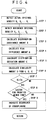
- the computer 3 performs the following operations in sequence according to the program shown in Fig. 4, namely a processing for obtaining spectral densities G1, G2, ... G n (see Fig. 3(B)) of the filtered signal at each of the frequency bands to be inputted from the above-described band-pass filters 21, 22, ... 2 n (step 1), a processing of searching those reference values S1, S2, ... S n corresponding to the vehicle speed at the present moment which are isolated or obtained by the signal of the wheel speed sensor 1 (step 2), and a processing of discriminating or determining the correlation between G1, G2, ... G n and S1, S2, ... S n .
- the occurrence of the partial hydroplaning is detected.
- a total amount of difference A between an actual spectral density distribution and a reference spectral density distribution is obtained by the following formula (step 3) Also, an amount of difference B between a peak value Sm (S7 in Fig. 3(A)) of the reference spectral density distribution and the actual spectral density Gm (G7 in Fig.
- a discrimination value Ds is set with respect to D and, when a condition of D ⁇ Ds has lasted for a predetermined period of time (steps 7, 8), a judgement is made that a partial hydroplaning has occurred, thereby indicating the occurrence of hydroplaning (step 9).
- the spectral density is attenuated even during the grip running (i.e.. running in a condition in which the wheels of the vehicle stay firmly on the road). Since the reference value is set to the spectral density on the dry road, when the running of the vehicle on the wet road has been detected by means of a wiper switch, moisture sensor or the like, the spectral density of that filtered signal of each frequency band which is inputted by each of the band-pass filters is multiplied by a predetermined attenuation correction coefficient dependent on the frequency band.
- G1, G2, ... G n are thus obtained.
- the discrimination of the correlation between the actual spectral densities G1, G2, ... G n and the reference spectral densities S1, S2, ... S n can also be made by the following formula by calculating the sum of products (inner products) of the actual spectral densities and the reference spectral densities In this case, if the vehicle is running on the dry road, the value E will fall within a predetermined range. Therefore, the partial hydroplaning can be judged to have occurred if the value E has fallen out of the above-described range.
- an arrangement has been made such that the correlation between the actual spectral densities and the reference spectral densities at a plurality of frequency bands is discriminated.
- it is also possible to detect the occurrence of the partial hydroplaning by obtaining the actual spectral density Gm at the peak frequency band Fms of the reference spectral density distribution corresponding to the vehicle speed at the present moment, and then by comparing this actual spectral density Gm and the reference spectral density Sm at the peak frequency band Fms.
Landscapes
- Engineering & Computer Science (AREA)
- Transportation (AREA)
- Mechanical Engineering (AREA)
- Regulating Braking Force (AREA)
- Control Of Driving Devices And Active Controlling Of Vehicle (AREA)
- Vehicle Body Suspensions (AREA)
Abstract
Description
- The present invention relates to an apparatus for detecting a wheel grip on road, i.e., a condition of wheel contact with ground, in order to detect so-called hydroplaning or aquaplaning phenomena which occur when a vehicle is running at a high speed on a road surface which is wet with water.
- The hydroplaning phenomena can be classified into a complete hydroplaning in which wheels of the vehicle are completely running on a film of water and a partial hydroplaning in which, though the wheels of the vehicle are lifted or suspended by the film of water, the wheels are still partially maintaining contact with the road surface.
- Once the complete hydroplaning phenomena have occurred, the wheels come to be subjected to a strong resistance from the film of water. It is known, then, to detect the occurrence of the hydroplaning phenomena based on differential changes in a revolution speed of the wheels of the vehicle.
- In the partial hydroplaning, however, the resistance that the wheels receive from the film of water is not very large. Therefore, it is difficult to detect the occurrence of the partial hydroplaning by the conventional method.
- As a result of diligent studies, the inventors of the present invention have found out that, once the partial hydroplaning has occurred, those frequency components of higher harmonics which are contained in an output signal of a wheel speed sensor for detecting a revolution speed of a wheel deviate by several Hz towards the low-frequency side by receiving a viscous resistance due to the film of water.
- The present invention has been made based on this finding and has an object of providing an apparatus that can detect the occurrence of the partial hydroplaning.
- In order to attain the above and other objects, the present invention is an apparatus for detecting a wheel grip on road comprising: a wheel speed sensor for detecting a revolution speed of a wheel of a vehicle; a plurality of band-pass filters for filtering an output of the wheel speed sensor at a plurality of frequency bands; reference value memory means for storing in memory reference values dependent on the revolution speed of the wheel, the reference values being set for each of the frequency bands of the plurality of band-pass filters; and detecting means for detecting the wheel grip on road based on a correlation between that signal output for each of the frequency bands which is obtained through the band-pass filters and that reference value for each of the frequency bands which is stored in memory in the reference value memory means.
- In accordance with another aspect of the invention, the apparatus for detecting a wheel grip on road comprises: a wheel speed sensor for detecting a revolution speed of a wheel of a vehicle; a band-pass filter for filtering an output of the wheel speed sensor at a predetermined frequency band which varies with a vehicle speed; reference value memory means for storing in memory a reference value dependent on the vehicle speed, the reference value being set for the frequency band of the band-pass filter; and detecting means for detecting the wheel grip on road based on a correlation between a signal output which is obtained through the band-pass filter and the reference value which is stored in memory in the reference value memory means.
- In this case, it is preferable to provide correction means for correcting at least one of the frequency band of the band-pass filter and the reference value based on a running condition on a dry road.
- The wheels of the vehicle give rise to minute rotational vibrations attributable to tread patterns or the like of tires and, consequently, vibration components of higher harmonics appear in the output signal of the wheel speed sensor. While the spectral density distribution of each frequency component to be contained in the output signal is as shown in a curve "a" in Fig. 1, it deviates by several Hz towards the low-frequency side as shown by a curve "b" in Fig. 1 when the partial hydroplaning has occurred. In addition, the spectral density distribution varies with the vehicle speed; if the vehicle speed increases, the spectral density distribution deviates towards the high-frequency side.
- In this manner, if the spectral density of each of the frequency bands of the output of the wheel speed sensor at the time of running on the dry road is obtained in advance for respective vehicle speeds and is stored in memory as reference values, it can be judged whether the partial hydroplaning has occurred or not by checking the correlation between that signal output representing the spectral density at each of the frequency bands which can be obtained by filtering the output of the wheel speed sensor by the plurality of the band-pass filters, and that reference value at each of the frequency bands which corresponds to the vehicle speed at the present moment.
- The occurrence of the partial hydroplaning can also be detected by memorizing in advance that predetermined frequency band dependent on the vehicle speed at which the spectrum density distribution becomes a peak at the time of running on the dry road as well as a reference value that is the peak value, and then by checking the correlation between the output signal that can be obtained by filtering the output of the wheel speed sensor at the predetermined frequency band corresponding to the vehicle speed at the present moment and the reference value. According to this arrangement, the number of the frequency bands to be compared can be reduced, thereby enabling a high-speed processing. By the way, there are cases where the frequency band at which the spectral density distribution becomes a peak and its peak value vary due to the wear or changing of the tires or the like, or to the deterioration of bushes for the wheel suspensions or the like. Therefore, if the frequency band to filter the output of the vehicle speed sensor as well as the reference value are arranged to be corrected based on the result of running on the dry road, the above-described changes can advantageously be coped with.
- The above and other objects and the attendant advantages of the present invention will become readily apparent by reference to the following detailed description in conjunction with the accompanying drawings wherein:
- Fig. 1 is a diagram showing the frequency characteristics of vibration components contained in an output signal of a wheel revolution speed sensor;
- Fig. 2 is a system diagram showing an example of the present invention apparatus;
- Figs. 3(A) and 3(B) are diagrams showing spectral density distributions, in which Fig. 3(A) is a diagram representing a reference spectral density of each frequency band and Fig. 3(B) is a diagram representing an actual spectral density of each frequency band; and
- Fig. 4 is a flow chart for discriminating a correlation between an output signal from a band-pass filter and a reference value.
- Referring to Fig. 2,
numeral 1 denotes a wheel speed sensor for detecting a revolution speed of a wheel W of a vehicle. An output signal of thewheel speed sensor 1 is filtered at a plurality of frequency bands by means of a plurality of band-pass filters computer 3 which is mounted on the vehicle. - In the
computer 3 there are stored in memory reference values S₁, S₂, ... Sn (see Fig. 3(A)) which correspond to spectral densities, in running on a dry road, of each of the frequency bands of the output signal of the wheel speed sensor as filtered at the above-described plurality of frequency bands. Since the spectral density distribution varies with the vehicle speed, reference values S₁, S₂, ... Sn for respective vehicle speeds are mapped and stored in memory. - The
computer 3 performs the following operations in sequence according to the program shown in Fig. 4, namely a processing for obtaining spectral densities G₁, G₂, ... Gn (see Fig. 3(B)) of the filtered signal at each of the frequency bands to be inputted from the above-described band-pass filters - In the processing of discriminating the correlation between G₁, G₂, ... Gn and S₁, S₂, ... Sn, a total amount of difference A between an actual spectral density distribution and a reference spectral density distribution is obtained by the following formula (step 3)
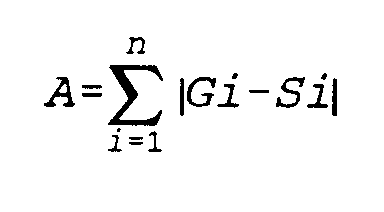
Also, an amount of difference B between a peak value Sm (S₇ in Fig. 3(A)) of the reference spectral density distribution and the actual spectral density Gm (G₇ in Fig. 3(B)) at a frequency band Fms that is the same as that of the peak value Sm is obtained by the following formula (step 4)

Further, an amount of deviation C of the actual spectral density distribution relative to the reference spectral density distribution is obtained from the peak frequency bands Fmg, Fms of the respective spectral density distributions by the following formula (step 5)

An amount of similarity D which represents the correlation between the actual spectral density distribution pattern and the reference spectral density distribution pattern and which can be defined by the following formula is calculated

where Ka, Kb and Kc are constants. - Then, a discrimination value Ds is set with respect to D and, when a condition of D ≧ Ds has lasted for a predetermined period of time (
steps 7, 8), a judgement is made that a partial hydroplaning has occurred, thereby indicating the occurrence of hydroplaning (step 9). - On the wet road there is a tendency that the spectral density is attenuated even during the grip running (i.e.. running in a condition in which the wheels of the vehicle stay firmly on the road). Since the reference value is set to the spectral density on the dry road, when the running of the vehicle on the wet road has been detected by means of a wiper switch, moisture sensor or the like, the spectral density of that filtered signal of each frequency band which is inputted by each of the band-pass filters is multiplied by a predetermined attenuation correction coefficient dependent on the frequency band. The above-described G₁, G₂, ... Gn are thus obtained.
- The discrimination of the correlation between the actual spectral densities G₁, G₂, ... Gn and the reference spectral densities S₁, S₂, ... Sn can also be made by the following formula by calculating the sum of products (inner products) of the actual spectral densities and the reference spectral densities

In this case, if the vehicle is running on the dry road, the value E will fall within a predetermined range. Therefore, the partial hydroplaning can be judged to have occurred if the value E has fallen out of the above-described range. - In the above-described embodiment, an arrangement has been made such that the correlation between the actual spectral densities and the reference spectral densities at a plurality of frequency bands is discriminated. However, it is also possible to detect the occurrence of the partial hydroplaning by obtaining the actual spectral density Gm at the peak frequency band Fms of the reference spectral density distribution corresponding to the vehicle speed at the present moment, and then by comparing this actual spectral density Gm and the reference spectral density Sm at the peak frequency band Fms. In this case, in order to be able to cope with the changes in the values Fms and Sm due to the wear or change in the tires, or to the deterioration of bushes for suspensions, or the like, it is preferable to learn the values Fms and Sm when a judgement of running on the dry road has been made by means of the wiper switch, the moisture sensor, or the like, to thereby correct the values of Fms and Sm stored in memory.
- As can be seen from the above-described explanation, according to the present invention, by carrying out the frequency analysis of the vibrations of higher harmonics contained in the output signal of the vehicle speed sensor, that occurrence of the partial hydroplaning which was conventionally unable to be detected can also be detected.
Claims (3)
- An apparatus for detecting a wheel grip on road comprising:
a wheel speed sensor (1) for detecting a revolution speed of a wheel of a vehicle;
a plurality of band-pass filters (2₁, 2₂, ... 2n) for filtering an output of said wheel speed sensor (1) at a plurality of frequency bands;
reference value memory means (3) for storing in memory reference values dependent on the revolution speed of the wheel, said reference values being set for each of the frequency bands of said plurality of band-pass filters (2₁, 2₂, ... 2n); and
detecting means (3) for detecting the wheel grip on road based on a correlation between that signal output for each of the frequency bands which is obtained through said band-pass filters (2₁, 2₂, ... 2n) and that reference value for each of the frequency bands which is stored in memory in said reference value memory means (3). - An apparatus for detecting a wheel grip on road comprising:
a wheel speed sensor (1) for detecting a revolution speed of a wheel of a vehicle;
a band-pass filter for filtering an output of said wheel speed sensor at a predetermined frequency band which varies with a vehicle speed;
reference value memory means (3) for storing in memory a reference value dependent on the vehicle speed, said reference value being set for the frequency band of said band-pass filter; and
detecting means (3) for detecting the wheel grip on road based on a correlation between a signal output which is obtained through the band-pass filter and the reference value which is stored in memory in said reference value memory means. - An apparatus for detecting a wheel grip on road according to claim 2, further comprising correction means for correcting at least one of the frequency band of said band-pass filter and the reference value based on a result of running on a dry road.
Applications Claiming Priority (2)
| Application Number | Priority Date | Filing Date | Title |
|---|---|---|---|
| JP242863/93 | 1993-09-29 | ||
| JP24286393A JP3232520B2 (en) | 1993-09-29 | 1993-09-29 | Hydroplaning detector |
Publications (3)
| Publication Number | Publication Date |
|---|---|
| EP0645288A2 true EP0645288A2 (en) | 1995-03-29 |
| EP0645288A3 EP0645288A3 (en) | 1996-04-17 |
| EP0645288B1 EP0645288B1 (en) | 1998-04-29 |
Family
ID=17095378
Family Applications (1)
| Application Number | Title | Priority Date | Filing Date |
|---|---|---|---|
| EP94306525A Expired - Lifetime EP0645288B1 (en) | 1993-09-29 | 1994-09-05 | Apparatus for detecting wheel grip on road |
Country Status (4)
| Country | Link |
|---|---|
| US (1) | US5493893A (en) |
| EP (1) | EP0645288B1 (en) |
| JP (1) | JP3232520B2 (en) |
| DE (1) | DE69409898T2 (en) |
Cited By (6)
| Publication number | Priority date | Publication date | Assignee | Title |
|---|---|---|---|---|
| US6434457B2 (en) | 2000-03-21 | 2002-08-13 | Toyota Jidosha Kabushiki Kaisha | Apparatus for detecting abnormality of a vehicle sensor and method |
| US6447076B1 (en) | 1998-10-02 | 2002-09-10 | Toyota Jidosha Kabushiki Kaisha | Device and method for estimating physical quantity and device and method for ABS control |
| US6522968B1 (en) | 1999-11-05 | 2003-02-18 | Toyota Jidosha Kabushiki Kaisha | Device for estimating road friction state |
| WO2003053747A1 (en) | 2001-12-21 | 2003-07-03 | Kabushiki Kaisha Bridgestone | Method and apparatus for estimating road surface state and tire running state, abs and vehicle control using the same |
| WO2005095173A1 (en) * | 2004-04-02 | 2005-10-13 | Daimlerchrysler Ag | Method for determining a coefficient of friction |
| CN103189252A (en) * | 2010-11-05 | 2013-07-03 | 威伯科有限公司 | Control device for a vehicle regulating system and method for determining tyre states of vehicle tyres |
Families Citing this family (7)
| Publication number | Priority date | Publication date | Assignee | Title |
|---|---|---|---|---|
| US6276189B1 (en) * | 1995-03-13 | 2001-08-21 | James Kevin Hurson | Method and apparatus for continuous monitoring of road surface friction |
| DE19543928C2 (en) * | 1995-11-24 | 1997-09-04 | Daimler Benz Ag | Method for early detection of the floating of a vehicle tire on a wet road |
| EP0968892B1 (en) * | 1997-11-28 | 2009-07-15 | Denso Corporation | Vehicle controller |
| JP3236003B1 (en) * | 2000-06-29 | 2001-12-04 | 富士重工業株式会社 | Road surface friction coefficient estimation device for vehicles |
| JP3700975B2 (en) * | 2002-12-17 | 2005-09-28 | 本田技研工業株式会社 | Hydroplaning detector |
| DE102009012128B4 (en) * | 2009-03-06 | 2019-09-05 | Volkswagen Ag | A method of determining roughness of a road surface for a vehicle |
| IT202100017588A1 (en) * | 2021-07-02 | 2023-01-02 | Easy Rain I S P A | PROCEDURE FOR DETERMINING THE INTERFACE CONDITIONS BETWEEN TIRE AND GROUND, PARTICULARLY FOR DETERMINING THE EMERGENCE OF AQUAPLANING PHENOMENA |
Family Cites Families (9)
| Publication number | Priority date | Publication date | Assignee | Title |
|---|---|---|---|---|
| US3993270A (en) * | 1975-07-16 | 1976-11-23 | Southern Pacific Transportation Company | Slippery wheel detector |
| US3992922A (en) * | 1975-10-14 | 1976-11-23 | Westinghouse Air Brake Company | Coefficient of frictional determining apparatus for railway vehicles |
| US4212063A (en) * | 1978-09-06 | 1980-07-08 | Saab-Scania Aktiebolag | Apparatus for measuring the action of forces between wheeled vehicles and substructure |
| JPS5991994A (en) * | 1982-11-18 | 1984-05-26 | 株式会社東芝 | Washer |
| JPS60596A (en) * | 1983-06-16 | 1985-01-05 | 株式会社デンソー | Road surface state identifier |
| DE3728708A1 (en) * | 1987-08-28 | 1989-03-23 | Bosch Gmbh Robert | METHOD FOR DETECTING THE FRICTION VALUE |
| US4882693A (en) * | 1987-12-28 | 1989-11-21 | Ford Motor Company | Automotive system for dynamically determining road adhesion |
| DE4133238C2 (en) * | 1991-10-05 | 2001-09-27 | Bosch Gmbh Robert | System for obtaining a signal representing the road surface |
| GB9209137D0 (en) * | 1992-04-28 | 1992-06-10 | Lucas Ind Plc | Method of and apparatus for estimating surface friction |
-
1993
- 1993-09-29 JP JP24286393A patent/JP3232520B2/en not_active Expired - Fee Related
-
1994
- 1994-08-26 US US08/296,414 patent/US5493893A/en not_active Expired - Lifetime
- 1994-09-05 EP EP94306525A patent/EP0645288B1/en not_active Expired - Lifetime
- 1994-09-05 DE DE69409898T patent/DE69409898T2/en not_active Expired - Fee Related
Cited By (10)
| Publication number | Priority date | Publication date | Assignee | Title |
|---|---|---|---|---|
| US6447076B1 (en) | 1998-10-02 | 2002-09-10 | Toyota Jidosha Kabushiki Kaisha | Device and method for estimating physical quantity and device and method for ABS control |
| DE19947385B4 (en) * | 1998-10-02 | 2006-02-09 | Toyota Jidosha K.K., Toyota | Apparatus and method for estimating a physical quantity and apparatus and method for an ABS controller |
| US6522968B1 (en) | 1999-11-05 | 2003-02-18 | Toyota Jidosha Kabushiki Kaisha | Device for estimating road friction state |
| US6434457B2 (en) | 2000-03-21 | 2002-08-13 | Toyota Jidosha Kabushiki Kaisha | Apparatus for detecting abnormality of a vehicle sensor and method |
| WO2003053747A1 (en) | 2001-12-21 | 2003-07-03 | Kabushiki Kaisha Bridgestone | Method and apparatus for estimating road surface state and tire running state, abs and vehicle control using the same |
| EP1457388A4 (en) * | 2001-12-21 | 2010-04-21 | Bridgestone Corp | Method and apparatus for estimating road surface state and tire running state, abs and vehicle control using the same |
| EP2514640A1 (en) * | 2001-12-21 | 2012-10-24 | Kabushiki Kaisha Bridgestone | Method and apparatus for estimation of road condition and tire running state, and abs and car control making use thereof |
| WO2005095173A1 (en) * | 2004-04-02 | 2005-10-13 | Daimlerchrysler Ag | Method for determining a coefficient of friction |
| CN103189252A (en) * | 2010-11-05 | 2013-07-03 | 威伯科有限公司 | Control device for a vehicle regulating system and method for determining tyre states of vehicle tyres |
| CN103189252B (en) * | 2010-11-05 | 2019-12-06 | 威伯科有限公司 | Control device for a vehicle regulating system and method for determining the tire condition of a vehicle tire |
Also Published As
| Publication number | Publication date |
|---|---|
| EP0645288B1 (en) | 1998-04-29 |
| JP3232520B2 (en) | 2001-11-26 |
| US5493893A (en) | 1996-02-27 |
| EP0645288A3 (en) | 1996-04-17 |
| JPH0798325A (en) | 1995-04-11 |
| DE69409898T2 (en) | 1998-08-27 |
| DE69409898D1 (en) | 1998-06-04 |
Similar Documents
| Publication | Publication Date | Title |
|---|---|---|
| EP0645288B1 (en) | Apparatus for detecting wheel grip on road | |
| EP1678019B1 (en) | A method and a system for determining the roughness of a tyre rolling surface | |
| US5723768A (en) | Process for the early recognition of hydroplaning of a vehicle tire on a wet road | |
| US9513192B2 (en) | Method and device for estimating a profile depth of a tire | |
| US5553491A (en) | Tire air pressure detecting device | |
| US5541859A (en) | Speed detecting apparatus for rotating body | |
| US6385511B1 (en) | Method and device of processing a signal sensed on board a vehicle from one of its wheels, and corresponding learning method | |
| US6644108B2 (en) | Pneumatic tire pressure estimating apparatus | |
| EP2883772A1 (en) | Method and device for determining state of road surface | |
| EP0674179A2 (en) | Hydroplaning detector apparatus | |
| WO2011054363A1 (en) | Surface classification | |
| JP2002172920A (en) | Tire pressure estimation device | |
| JP2002500761A (en) | Method of detecting vehicle tire pressure drop | |
| US20110257902A1 (en) | Method and system for determining the potential friction between a vehicle tyre and a rolling surface | |
| US6222444B1 (en) | Method for detecting a deflated tire on a vehicle | |
| US6584427B2 (en) | Method and apparatus for estimating tire air pressure | |
| JPH11153518A (en) | Road surface condition determination device | |
| US6109099A (en) | Method and apparatus for detecting air pressure in a tire using a basic wavelet function localized in time | |
| CN109835334B (en) | A method and device for evaluating the performance of a lane keeping system | |
| US20040225426A1 (en) | Process and apparatus for detecting damper damage | |
| EP3835090B1 (en) | Tire type distinguishing method and tire type distinguishing device | |
| JP3438599B2 (en) | Tire pressure estimation device | |
| JPH0954020A (en) | Road condition detector | |
| JPH06183231A (en) | Tire pressure detecting device | |
| JP3055293B2 (en) | Tire pressure detector |
Legal Events
| Date | Code | Title | Description |
|---|---|---|---|
| PUAI | Public reference made under article 153(3) epc to a published international application that has entered the european phase |
Free format text: ORIGINAL CODE: 0009012 |
|
| AK | Designated contracting states |
Kind code of ref document: A2 Designated state(s): DE GB IT |
|
| PUAL | Search report despatched |
Free format text: ORIGINAL CODE: 0009013 |
|
| AK | Designated contracting states |
Kind code of ref document: A3 Designated state(s): DE GB IT |
|
| 17P | Request for examination filed |
Effective date: 19960419 |
|
| 17Q | First examination report despatched |
Effective date: 19970429 |
|
| GRAG | Despatch of communication of intention to grant |
Free format text: ORIGINAL CODE: EPIDOS AGRA |
|
| GRAG | Despatch of communication of intention to grant |
Free format text: ORIGINAL CODE: EPIDOS AGRA |
|
| GRAH | Despatch of communication of intention to grant a patent |
Free format text: ORIGINAL CODE: EPIDOS IGRA |
|
| GRAH | Despatch of communication of intention to grant a patent |
Free format text: ORIGINAL CODE: EPIDOS IGRA |
|
| GRAA | (expected) grant |
Free format text: ORIGINAL CODE: 0009210 |
|
| AK | Designated contracting states |
Kind code of ref document: B1 Designated state(s): DE GB IT |
|
| PG25 | Lapsed in a contracting state [announced via postgrant information from national office to epo] |
Ref country code: IT Free format text: LAPSE BECAUSE OF FAILURE TO SUBMIT A TRANSLATION OF THE DESCRIPTION OR TO PAY THE FEE WITHIN THE PRE;WARNING: LAPSES OF ITALIAN PATENTS WITH EFFECTIVE DATE BEFORE 2007 MAY HAVE OCCURRED AT ANY TIME BEFORE 2007. THE CORRECT EFFECTIVE DATE MAY BE DIFFERENT FROM THE ONE RECORDED.SCRIBED TIME-LIMIT Effective date: 19980429 |
|
| REF | Corresponds to: |
Ref document number: 69409898 Country of ref document: DE Date of ref document: 19980604 |
|
| PG25 | Lapsed in a contracting state [announced via postgrant information from national office to epo] |
Ref country code: GB Free format text: LAPSE BECAUSE OF NON-PAYMENT OF DUE FEES Effective date: 19980905 |
|
| PLBE | No opposition filed within time limit |
Free format text: ORIGINAL CODE: 0009261 |
|
| STAA | Information on the status of an ep patent application or granted ep patent |
Free format text: STATUS: NO OPPOSITION FILED WITHIN TIME LIMIT |
|
| 26N | No opposition filed | ||
| GBPC | Gb: european patent ceased through non-payment of renewal fee |
Effective date: 19980905 |
|
| PGFP | Annual fee paid to national office [announced via postgrant information from national office to epo] |
Ref country code: DE Payment date: 20050902 Year of fee payment: 12 |
|
| PG25 | Lapsed in a contracting state [announced via postgrant information from national office to epo] |
Ref country code: DE Free format text: LAPSE BECAUSE OF NON-PAYMENT OF DUE FEES Effective date: 20070403 |