EP0643433A1 - Simplified preparation of LiPF6 based electrolyte for non-aqueous batteries - Google Patents
Simplified preparation of LiPF6 based electrolyte for non-aqueous batteries Download PDFInfo
- Publication number
- EP0643433A1 EP0643433A1 EP94304114A EP94304114A EP0643433A1 EP 0643433 A1 EP0643433 A1 EP 0643433A1 EP 94304114 A EP94304114 A EP 94304114A EP 94304114 A EP94304114 A EP 94304114A EP 0643433 A1 EP0643433 A1 EP 0643433A1
- Authority
- EP
- European Patent Office
- Prior art keywords
- electrolyte
- solution
- lipf6
- battery
- solvents
- Prior art date
- Legal status (The legal status is an assumption and is not a legal conclusion. Google has not performed a legal analysis and makes no representation as to the accuracy of the status listed.)
- Granted
Links
- 239000003792 electrolyte Substances 0.000 title claims abstract description 65
- 229910001290 LiPF6 Inorganic materials 0.000 title claims abstract description 45
- 238000002360 preparation method Methods 0.000 title description 7
- 238000000034 method Methods 0.000 claims abstract description 54
- 239000002904 solvent Substances 0.000 claims abstract description 33
- OIFBSDVPJOWBCH-UHFFFAOYSA-N Diethyl carbonate Chemical compound CCOC(=O)OCC OIFBSDVPJOWBCH-UHFFFAOYSA-N 0.000 claims abstract description 23
- 239000000376 reactant Substances 0.000 claims abstract description 22
- KMTRUDSVKNLOMY-UHFFFAOYSA-N Ethylene carbonate Chemical compound O=C1OCCO1 KMTRUDSVKNLOMY-UHFFFAOYSA-N 0.000 claims abstract description 18
- 239000006227 byproduct Substances 0.000 claims abstract description 16
- 238000006243 chemical reaction Methods 0.000 claims abstract description 16
- WHXSMMKQMYFTQS-UHFFFAOYSA-N Lithium Chemical compound [Li] WHXSMMKQMYFTQS-UHFFFAOYSA-N 0.000 claims abstract description 13
- 229910052744 lithium Inorganic materials 0.000 claims abstract description 13
- RUOJZAUFBMNUDX-UHFFFAOYSA-N propylene carbonate Chemical compound CC1COC(=O)O1 RUOJZAUFBMNUDX-UHFFFAOYSA-N 0.000 claims abstract description 12
- 239000000203 mixture Substances 0.000 claims abstract description 8
- 150000003839 salts Chemical class 0.000 claims description 23
- OKTJSMMVPCPJKN-UHFFFAOYSA-N Carbon Chemical compound [C] OKTJSMMVPCPJKN-UHFFFAOYSA-N 0.000 claims description 13
- 239000007787 solid Substances 0.000 claims description 13
- 239000012535 impurity Substances 0.000 claims description 11
- 229910017673 NH4PF6 Inorganic materials 0.000 claims description 9
- 229910032387 LiCoO2 Inorganic materials 0.000 claims description 8
- 230000005587 bubbling Effects 0.000 claims description 8
- 238000009489 vacuum treatment Methods 0.000 claims description 8
- 238000001914 filtration Methods 0.000 claims description 7
- 229910002804 graphite Inorganic materials 0.000 claims description 7
- 239000010439 graphite Substances 0.000 claims description 7
- 239000002585 base Substances 0.000 claims description 6
- 239000011261 inert gas Substances 0.000 claims description 6
- 229910052799 carbon Inorganic materials 0.000 claims description 5
- 238000005119 centrifugation Methods 0.000 claims description 5
- 229910021437 lithium-transition metal oxide Inorganic materials 0.000 claims description 5
- 239000003575 carbonaceous material Substances 0.000 claims description 4
- 150000002148 esters Chemical class 0.000 claims description 4
- 238000010438 heat treatment Methods 0.000 claims description 4
- 239000002879 Lewis base Substances 0.000 claims description 3
- 150000001768 cations Chemical class 0.000 claims description 3
- 125000004122 cyclic group Chemical group 0.000 claims description 3
- 150000007527 lewis bases Chemical class 0.000 claims description 3
- HBBGRARXTFLTSG-UHFFFAOYSA-N Lithium ion Chemical compound [Li+] HBBGRARXTFLTSG-UHFFFAOYSA-N 0.000 abstract description 17
- 229910001416 lithium ion Inorganic materials 0.000 abstract description 17
- 239000000243 solution Substances 0.000 description 42
- 239000000047 product Substances 0.000 description 14
- 230000000052 comparative effect Effects 0.000 description 11
- RTZKZFJDLAIYFH-UHFFFAOYSA-N Diethyl ether Chemical compound CCOCC RTZKZFJDLAIYFH-UHFFFAOYSA-N 0.000 description 10
- 239000008151 electrolyte solution Substances 0.000 description 10
- 229940021013 electrolyte solution Drugs 0.000 description 10
- 239000007789 gas Substances 0.000 description 10
- 238000007872 degassing Methods 0.000 description 9
- 239000011888 foil Substances 0.000 description 9
- 239000003039 volatile agent Substances 0.000 description 9
- 239000011877 solvent mixture Substances 0.000 description 8
- 239000002002 slurry Substances 0.000 description 7
- WMFOQBRAJBCJND-UHFFFAOYSA-M Lithium hydroxide Chemical compound [Li+].[OH-] WMFOQBRAJBCJND-UHFFFAOYSA-M 0.000 description 6
- 239000001307 helium Substances 0.000 description 6
- 229910052734 helium Inorganic materials 0.000 description 6
- SWQJXJOGLNCZEY-UHFFFAOYSA-N helium atom Chemical compound [He] SWQJXJOGLNCZEY-UHFFFAOYSA-N 0.000 description 6
- 238000004519 manufacturing process Methods 0.000 description 6
- 230000008569 process Effects 0.000 description 6
- WEVYAHXRMPXWCK-UHFFFAOYSA-N Acetonitrile Chemical compound CC#N WEVYAHXRMPXWCK-UHFFFAOYSA-N 0.000 description 5
- 239000002033 PVDF binder Substances 0.000 description 5
- 239000002244 precipitate Substances 0.000 description 5
- 239000010405 anode material Substances 0.000 description 4
- 239000006229 carbon black Substances 0.000 description 4
- 230000001143 conditioned effect Effects 0.000 description 4
- 238000000354 decomposition reaction Methods 0.000 description 4
- 230000005518 electrochemistry Effects 0.000 description 4
- 238000001139 pH measurement Methods 0.000 description 4
- 238000003860 storage Methods 0.000 description 4
- 238000003786 synthesis reaction Methods 0.000 description 4
- 238000004804 winding Methods 0.000 description 4
- 229910052782 aluminium Inorganic materials 0.000 description 3
- XAGFODPZIPBFFR-UHFFFAOYSA-N aluminium Chemical compound [Al] XAGFODPZIPBFFR-UHFFFAOYSA-N 0.000 description 3
- 230000015572 biosynthetic process Effects 0.000 description 3
- 150000001875 compounds Chemical class 0.000 description 3
- 238000011010 flushing procedure Methods 0.000 description 3
- 231100001261 hazardous Toxicity 0.000 description 3
- 238000002955 isolation Methods 0.000 description 3
- 238000001953 recrystallisation Methods 0.000 description 3
- XLYOFNOQVPJJNP-UHFFFAOYSA-N water Substances O XLYOFNOQVPJJNP-UHFFFAOYSA-N 0.000 description 3
- XKRFYHLGVUSROY-UHFFFAOYSA-N Argon Chemical compound [Ar] XKRFYHLGVUSROY-UHFFFAOYSA-N 0.000 description 2
- IJGRMHOSHXDMSA-UHFFFAOYSA-N Atomic nitrogen Chemical compound N#N IJGRMHOSHXDMSA-UHFFFAOYSA-N 0.000 description 2
- 239000007864 aqueous solution Substances 0.000 description 2
- 239000010406 cathode material Substances 0.000 description 2
- 230000003750 conditioning effect Effects 0.000 description 2
- 238000010276 construction Methods 0.000 description 2
- 238000001704 evaporation Methods 0.000 description 2
- 230000008020 evaporation Effects 0.000 description 2
- 239000003365 glass fiber Substances 0.000 description 2
- 239000012212 insulator Substances 0.000 description 2
- 230000007935 neutral effect Effects 0.000 description 2
- 238000013021 overheating Methods 0.000 description 2
- 229920000098 polyolefin Polymers 0.000 description 2
- 229920002981 polyvinylidene fluoride Polymers 0.000 description 2
- 239000000843 powder Substances 0.000 description 2
- 239000002243 precursor Substances 0.000 description 2
- 238000003756 stirring Methods 0.000 description 2
- 239000000126 substance Substances 0.000 description 2
- RYGMFSIKBFXOCR-UHFFFAOYSA-N Copper Chemical compound [Cu] RYGMFSIKBFXOCR-UHFFFAOYSA-N 0.000 description 1
- 238000001157 Fourier transform infrared spectrum Methods 0.000 description 1
- 239000002841 Lewis acid Substances 0.000 description 1
- SECXISVLQFMRJM-UHFFFAOYSA-N N-Methylpyrrolidone Chemical compound CN1CCCC1=O SECXISVLQFMRJM-UHFFFAOYSA-N 0.000 description 1
- 230000002378 acidificating effect Effects 0.000 description 1
- 239000011149 active material Substances 0.000 description 1
- 230000002411 adverse Effects 0.000 description 1
- 230000004075 alteration Effects 0.000 description 1
- 239000003125 aqueous solvent Substances 0.000 description 1
- 229910052786 argon Inorganic materials 0.000 description 1
- 239000011230 binding agent Substances 0.000 description 1
- 239000006182 cathode active material Substances 0.000 description 1
- 239000011248 coating agent Substances 0.000 description 1
- 239000008199 coating composition Substances 0.000 description 1
- 238000000576 coating method Methods 0.000 description 1
- 230000000536 complexating effect Effects 0.000 description 1
- 239000011889 copper foil Substances 0.000 description 1
- -1 cyclic ester Chemical class 0.000 description 1
- 230000006866 deterioration Effects 0.000 description 1
- IEJIGPNLZYLLBP-UHFFFAOYSA-N dimethyl carbonate Chemical compound COC(=O)OC IEJIGPNLZYLLBP-UHFFFAOYSA-N 0.000 description 1
- 238000007599 discharging Methods 0.000 description 1
- 238000001035 drying Methods 0.000 description 1
- 230000000694 effects Effects 0.000 description 1
- 238000003487 electrochemical reaction Methods 0.000 description 1
- 238000005516 engineering process Methods 0.000 description 1
- 239000004210 ether based solvent Substances 0.000 description 1
- 150000002170 ethers Chemical class 0.000 description 1
- 239000000706 filtrate Substances 0.000 description 1
- 239000012467 final product Substances 0.000 description 1
- 239000003517 fume Substances 0.000 description 1
- 230000001771 impaired effect Effects 0.000 description 1
- 230000002427 irreversible effect Effects 0.000 description 1
- 150000007517 lewis acids Chemical class 0.000 description 1
- 239000007788 liquid Substances 0.000 description 1
- 229910003002 lithium salt Inorganic materials 0.000 description 1
- 159000000002 lithium salts Chemical class 0.000 description 1
- 239000000463 material Substances 0.000 description 1
- 229910052751 metal Inorganic materials 0.000 description 1
- 239000002184 metal Substances 0.000 description 1
- 238000012986 modification Methods 0.000 description 1
- 230000004048 modification Effects 0.000 description 1
- 229910052757 nitrogen Inorganic materials 0.000 description 1
- 239000011255 nonaqueous electrolyte Substances 0.000 description 1
- 239000004033 plastic Substances 0.000 description 1
- 238000012545 processing Methods 0.000 description 1
- 238000001228 spectrum Methods 0.000 description 1
- 230000001988 toxicity Effects 0.000 description 1
- 231100000419 toxicity Toxicity 0.000 description 1
Images


Classifications
-
- H—ELECTRICITY
- H01—ELECTRIC ELEMENTS
- H01M—PROCESSES OR MEANS, e.g. BATTERIES, FOR THE DIRECT CONVERSION OF CHEMICAL ENERGY INTO ELECTRICAL ENERGY
- H01M10/00—Secondary cells; Manufacture thereof
- H01M10/05—Accumulators with non-aqueous electrolyte
- H01M10/056—Accumulators with non-aqueous electrolyte characterised by the materials used as electrolytes, e.g. mixed inorganic/organic electrolytes
- H01M10/0564—Accumulators with non-aqueous electrolyte characterised by the materials used as electrolytes, e.g. mixed inorganic/organic electrolytes the electrolyte being constituted of organic materials only
- H01M10/0566—Liquid materials
-
- C—CHEMISTRY; METALLURGY
- C01—INORGANIC CHEMISTRY
- C01D—COMPOUNDS OF ALKALI METALS, i.e. LITHIUM, SODIUM, POTASSIUM, RUBIDIUM, CAESIUM, OR FRANCIUM
- C01D15/00—Lithium compounds
- C01D15/005—Lithium hexafluorophosphate
-
- H—ELECTRICITY
- H01—ELECTRIC ELEMENTS
- H01M—PROCESSES OR MEANS, e.g. BATTERIES, FOR THE DIRECT CONVERSION OF CHEMICAL ENERGY INTO ELECTRICAL ENERGY
- H01M6/00—Primary cells; Manufacture thereof
- H01M6/14—Cells with non-aqueous electrolyte
- H01M6/16—Cells with non-aqueous electrolyte with organic electrolyte
- H01M6/162—Cells with non-aqueous electrolyte with organic electrolyte characterised by the electrolyte
- H01M6/164—Cells with non-aqueous electrolyte with organic electrolyte characterised by the electrolyte by the solvent
-
- H—ELECTRICITY
- H01—ELECTRIC ELEMENTS
- H01M—PROCESSES OR MEANS, e.g. BATTERIES, FOR THE DIRECT CONVERSION OF CHEMICAL ENERGY INTO ELECTRICAL ENERGY
- H01M6/00—Primary cells; Manufacture thereof
- H01M6/14—Cells with non-aqueous electrolyte
- H01M6/16—Cells with non-aqueous electrolyte with organic electrolyte
- H01M6/162—Cells with non-aqueous electrolyte with organic electrolyte characterised by the electrolyte
- H01M6/166—Cells with non-aqueous electrolyte with organic electrolyte characterised by the electrolyte by the solute
-
- Y—GENERAL TAGGING OF NEW TECHNOLOGICAL DEVELOPMENTS; GENERAL TAGGING OF CROSS-SECTIONAL TECHNOLOGIES SPANNING OVER SEVERAL SECTIONS OF THE IPC; TECHNICAL SUBJECTS COVERED BY FORMER USPC CROSS-REFERENCE ART COLLECTIONS [XRACs] AND DIGESTS
- Y02—TECHNOLOGIES OR APPLICATIONS FOR MITIGATION OR ADAPTATION AGAINST CLIMATE CHANGE
- Y02E—REDUCTION OF GREENHOUSE GAS [GHG] EMISSIONS, RELATED TO ENERGY GENERATION, TRANSMISSION OR DISTRIBUTION
- Y02E60/00—Enabling technologies; Technologies with a potential or indirect contribution to GHG emissions mitigation
- Y02E60/10—Energy storage using batteries
Definitions
- This invention pertains to the field of batteries, and in particular to a novel method of preparing a LiPF6 electrolyte solution for non-aqueous lithium batteries.
- LiPF6 based electrolytes are generally prepared by dissolving solid LiPF6, or a complex thereof, in the desired electrolyte solvents.
- LiPF6 itself can be prepared using one of several methods described in the literature. Many of these methods however result in a product with levels of impurities that are unsuitable for use in battery applications. For example, LiPF6 can be made by reacting BF3 with LiF and an excess of P2O5, but the product always contains LiF.
- LiPF6 Adequately pure LiPF6 has recently been produced by reacting PF5 with LiF in liquid HF. Such a method is used to manufacture LiPF6 for commercial purposes. However, this method involves using the hazardous compounds HF and PF5, and requires complex manufacturing equipment. Also, the product contains residual HF at a level of order of 200 to 300 ppm. The product is nonetheless suitable for use in lithium ion batteries but is relatively expensive.
- U.S. Patent No. 3,654,330 discloses an alternate method of preparing pure LiPF6 from a Li(CH3CN)4PF6 precursor. CH3CN is required rather than HF using this method.
- LiPF6 LiPF6, however, even in its pure form is reported to be somewhat unstable, decomposing to PF5 and LiF. Improper storage and handling of the solid accelerates this decomposition. The consequent limited shelf life and more stringent storage and handling requirements are all undesirable features associated with use of said salt.
- These problems are overcome to some extent by preparing solid complexes of LiPF6.
- the Li(CH3CN)4 PF6 precursor is a complex of LiPF6 and CH3CN. Complexing the salt in this way stabilizes the salt against decomposition.
- U.S. Patent No. 4,880,714 discloses the preparation of a complex of LiPF6 and an ether that is stable against decomposition. Said preparation involves reacting a salt of the form (XH)+PF6 ⁇ , wherein (XH)+ is a cation comprising an adduct of a proton (H+) and a Lewis base (X), with a lithium base of the form LiY in an ether based solvent.
- a solid complex of LiPF6 and the ether is obtained by recrystallization and isolation steps.
- a battery electrolyte containing said ether can be prepared thereafter simply by dissolving the complex in additional appropriate solvents.
- said ether is desirable or at least acceptable in the electrolyte, such simple preparation is not possible.
- ethers can be undesirable in many battery applications for a variety of reasons but especially because of possible adverse effects on battery safety.
- CH3CN is rarely considered desirable for use in electrolytes for commercial lithium batteries as it is not adequately stable against lithium.
- LiPF6 based electrolytes in particular electrolytes for lithium ion type batteries
- electrolytes for lithium ion type batteries generally involve recrystallization and isolation steps.
- the use of hazardous compounds is often involved and salt stability is a concern.
- LiPF6 can be produced in a mixture of solvents that are desired in the electrolyte itself.
- impurities that remain after synthesis can be easily removed while the LiPF6 remains in solution.
- Residual reactants and/or by-products of the reaction can be removed by filtration or centrifugation if these exist as undissolved solids, or by bubbling inert gas through the solution, or by vacuum treatment if these exist as volatiles or dissolved gases.
- no recrystallization and isolation steps of a LiPF6 salt or complex are required. As a consequence, stability problems with the pure salt are not encountered since the salt is never taken out of solution.
- the preferred reactants are NH4PF6 and LiH. These compounds are significantly less hazardous than HF or PF5, are readily available, and are relatively easy to handle.
- the main by-products of the reaction are H2 and NH3, both gases, which can be easily removed after synthesis.
- An excess of LiH can be employed in the reaction after which it can be removed by filtration or centrifugation.
- By-product gases in particular NH3, can be removed from the product electrolyte solution by bubbling inert gas through it or by vacuum treatment which can also include mild heating.
- the solvents employed in the electrolyte can be selected from the group consisting of chain esters and cyclic esters.
- electrolytes containing ethylene carbonate (EC) and DEC solvents, with PC optionally included can be prepared in this way with LiPF6 in solution at about the 1 molar level.
- the resulting electrolytes are suitable for use in lithium ion type batteries without additional processing.
- batteries employing electrolytes made according to the invention method exhibit similar performance characteristics to batteries employing conventionally prepared electrolyte. Thus, the electrolytes of the invention method are effectively pure.
- a battery product employing an electrolyte prepared using the invention method can be of a lithium ion type electrochemistry wherein the cathode contains a lithium transition metal oxide and the anode contains a carbonaceous material.
- LiCoO2 is a suitable cathode material and partially graphitized carbon or graphite are suitable anode materials.
- the invention is directed to a method of preparing an electrolyte containing LiPF6 in solution comprising: (a) reacting a salt of a formula (XH)+PF6 ⁇ , wherein (XH)+ denotes a cation comprising an adduct of a proton (H+) and a Lewis base (X), with a lithium base in a mixture of solvents to be employed in the electrolyte to form LiPF6 in solution; (b) removing residual reactants and by-products of the reaction while retaining the LiPF6 in solution; and (c) adding additional required solvents to be employed in the electrolyte.
- Figure 1 depicts a cross-sectional view of a 4/3 A battery employing lithium ion type technology.
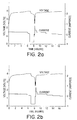
- Figure 2a depicts a plot of the voltage and current versus time curves of the 4/3 A battery of Comparative Example 1.
- Figure 2b depicts a plot of the voltage and current versus time curves of the 4/3 A battery of Inventive Example 1.
- Figure 3a depicts a plot of the voltage versus the product of absolute current and time curve of the laboratory battery of Comparative Example 2.
- Figure 3b depicts a plot of the voltage versus the product of absolute current and time curve of the laboratory battery of Inventive Example 2.
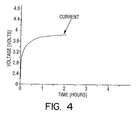
- Figure 4 depicts a plot of the voltage versus time curve of the 4/3 A battery of Illustrative Example 1.
- the key to applying the subject invention method successfully is being able to choose reactants and a synthesis reaction that result in residual impurities that are either easily removed while the LiPF6 is in solution or that essentially do not need to be removed.
- this requires that any substantial amounts of residual reactant and/or by-products of the reaction be insoluble in the solvents used or that they be volatiles or gases.
- these impurities are easily removed by filtration or centrifugation in the case of solids or by bubbling inert gas through the solution or by treatment under vacuum in the case of volatiles or gases.
- the invention method requires that remaining soluble impurities be at a low level such that operation of a battery employing the product electrolyte is not impaired.
- Preferred solvents for use in lithium ion batteries include, but are not limited to, a mixture of at least one cyclic ester and at least one chain ester.
- the group of cyclic esters contains the solvents ethylene carbonate (EC), propylene carbonate (PC), and the like.
- the group of chain esters contain the solvents diethylcarbonate (DEC), dimethylcarbonate (DMC) and the like.
- At least one of the reactants must be soluble for the reaction to proceed at a realistic rate.
- NH4PF6 and LiH are used as the reactants to prepare LiPF6.
- a preferred electrolyte might contain about 1 mole of LiPF6 salt per litre of a DEC and EC solvent mixture.
- EC is generally used in the invention method along with DEC so that substantial amounts of NH4PF6 can be put in solution. LiH is effectively insoluble in a DEC/EC mixture.
- the amounts of the reactants can be chosen in accordance with the ideal stoichiometry of the reaction. However, it can be preferred that there be a slight excess of one reactant such that the presence of other reactants in the final product is minimized.
- the presence of some quantity of NH4PF6 may be considered advantageous in lithium battery electrolytes. However, the presence of some LiH may also be advantageous in that it is very reactive with water and it helps to dry the electrolyte.
- the products of reaction of LiH with H2O include LiOH. Although not usually desirable in principle, LiOH may not significantly affect operation of a battery if it is present in very small quantities. The solubility of LiOH in non-aqueous solvents is low, thus it can be almost completely removed by filtration.
- the reactants can be added to the desired solvents in any order and can be premixed while dry if desired.
- the Lewis acid containing PF6 ⁇ anion is dissolved or partially dissolved in solvents first.
- the lithium base is added slowly to this solution.
- said flushing can be accomplished by bubbling an inert gas such as argon, helium, or nitrogen through the solution.
- a thorough degassing/volatiles removal treatment procedure may be essential.
- the inventors speculate that the presence of small amounts of residual NH3 in solution can result in excessive gassing during operation of lithium ion batteries employing the product electrolyte.
- the most favoured method to accomplish a thorough degassing/ volatiles removal involves vacuum treating the electrolyte while heating mildly. Solids, such as excess insoluble LiH, can be removed after synthesis of the LiPF6 salt in solution by filtration or centrifugation.
- the electrolyte solution at this stage may require addition of other solvents to bring it to the desired final form.
- Some of the initial solvent used in the process can be lost through evaporation, especially during the thorough degassing/volatiles removal process. Solvent loss can be compensated for simply by replacing it at this stage.
- loss of more than one solvent can be involved during the degassing/volatiles removal process.
- the amount of any volatile impurities lost during said process is also small, and thus is negligible compared to that of a relatively high vapour pressure solvent.
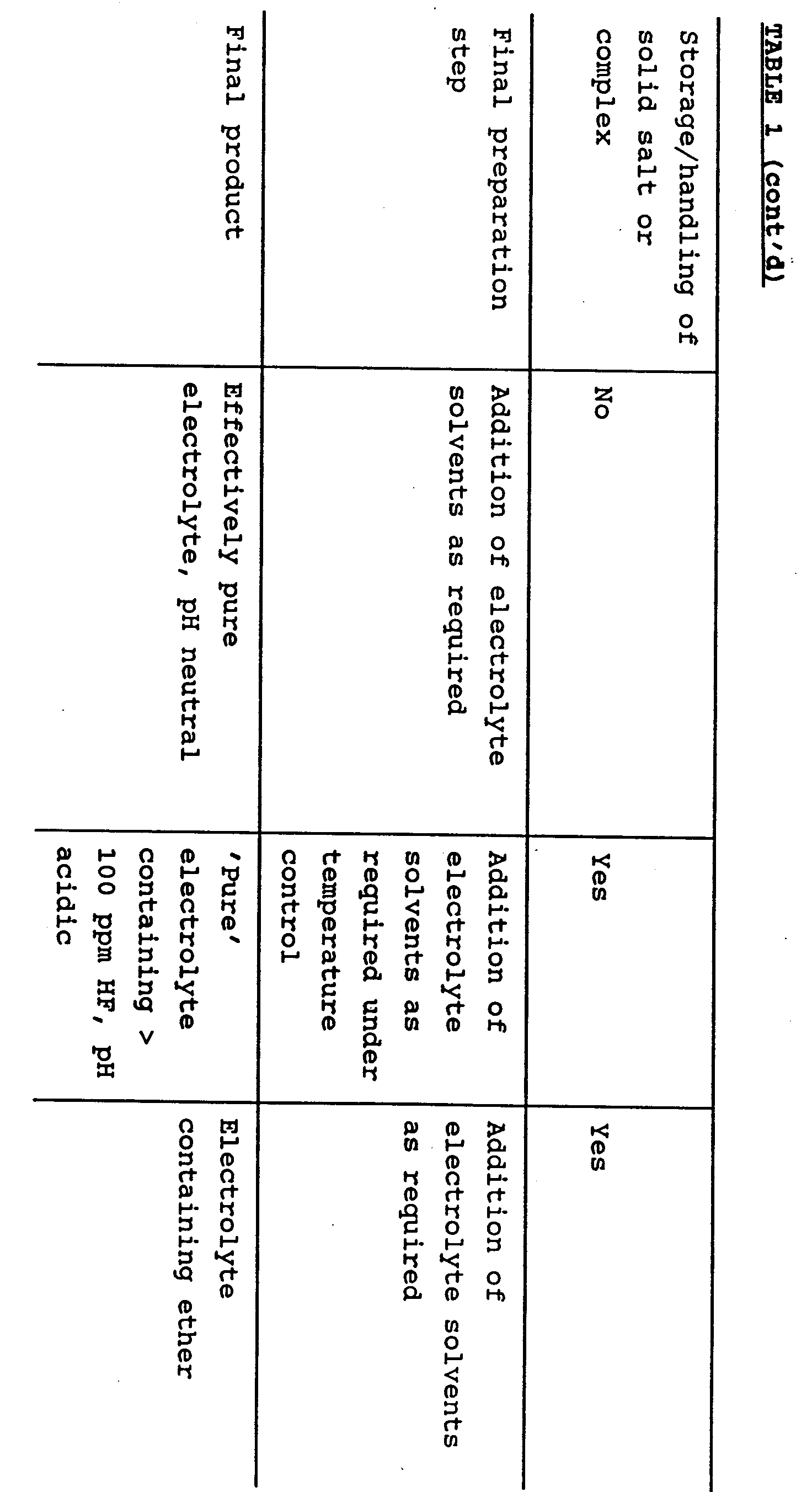
- Table 1 depicts the steps of the invention process for manufacturing LiPF6 based electrolyte. Also depicted, for purposes of comparison, are the steps involved in conventional commercial preparation of LiPF6 solid and steps of a prior art method for preparing a stabilized complex of LiPF6 with ether.
- the invention method can be used to prepare LiPF6 based electrolytes for a variety of purposes, it finds immediate potential commercial application in the production of electrolyte for use in lithium ion type batteries.
- a lithium transition metal oxide is used as an active cathode material.
- a preferred material is LiCoO2 powder.
- a partially graphitized carbon or graphite is used as an active anode material. The latter offers a greater potential specific capacity than the former, but for overall performance, safety, and other reasons, the former is often employed.
- Electrodes are prepared by first making a slurry of the appropriate active material plus an optional conductive dilutant in an appropriate binder-solvent solution. The slurry is used to coat one or both sides of an appropriate current collector foil, after which the carrier solvent of the slurry is evaporated away. To maximize energy density in the final battery product, the electrodes are generally compacted between pressure rollers.
- a preferred embodiment of such a battery is depicted in Figure 1, wherein a 4/3 A size battery of conventional construction is shown in cross-section.
- the spiral winding 4 consisting of a double-side coated cathode and anode with two microporous polyolefin films acting as separators, is contained in a battery can 3.
- the anode foil is wider than the cathode foil to ensure that the former is opposite the latter at all times.
- Figure 1 shows the upper anode edge 12, lower anode edge 15, upper cathode edge 13, and lower cathode edge 14 of such a construction.
- a header assembly 1 at the top of the battery is sealed crimp-wise to the can 3 by way of gasket 10.
- the header assembly 1 contains a safety disconnect device that creates an internal electrical open circuit upon the application of excessive internal pressure. This header assembly 1 is described fully in a pending patent application (U.S. Patent Application No.
- the header assembly 1 consists of an external metal cover 16, an electrically conductive diaphragm 17, an aluminum weld plate 18 and the gasket 10.
- the diaphragm 17 Upon application of internal pressure, the diaphragm 17 is forced away from weld plate 18, thus breaking a critical weld 19 at a specifically set internal pressure.
- Diaphragm 17 flips upwardly to a stable position significantly distant from weld plate 18, thereby ensuring a reliable disconnection.
- a cathode tab 5 is generally welded to the cathode foil and an anode tab 6 is welded to the anode foil prior to making the spiral winding 4.
- the winding 4 and an appropriate lower insulator 7 are inserted into the battery can 3.
- the anode tab 6 is welded to the can 3.
- an upper insulator 2 is inserted and the cathode tab is welded to the aluminum weld plate 18 of the header assembly 1.
- An appropriate amount of electrolyte 8 is then added.
- the cathode tab 5 is folded appropriately and the header assembly 1 is positioned.
- the battery is crimp sealed using conventional closure methods, after which an electrical conditioning step is used to complete the manufacturing process.
- the conditioning step comprises a single recharge under controlled conditions, wherein several irreversible, initial electrochemical reactions take place.
- LiPF6 salt Commercially available high purity LiPF6 salt was obtained from Hashimoto Chemical Corporation. A pH measurement was performed on said salt using pH paper in an aqueous solution containing 0.4 g salt in 5 ml of water. A one molar solution of this salt was prepared in a solvent mixture containing PC, EC and DEC with a volume ratio for PC/EC/DEC of 20/30/50. This operation was performed in a dryroom with a relative humidity around 1% at 21°C to reduce exposure of the electrolyte to moisture. Additionally, the solvent mixture was precooled in a freezer at about -10°C prior to adding the salt as a means of temperature control to prevent overheating due to the heat of solution. There was no precipitate present and the electrolyte solution was clear.
- a 4/3 A lithium ion battery was then fabricated as explained in the foregoing disclosure.
- a slurry of LiCoO2 powder, graphite conductive dilutant, carbon black conductive dilutant and polyvinylidene fluoride (PVDF) plastic binder in amounts of about 91%, 4%, 2% and 3% by weight respectively was prepared in N-methylpyrollidinone carrier solvent.
- a cathode foil was prepared by coating and drying said slurry on a 20 ⁇ m thick aluminum foil.
- anode foil was prepared on 10 ⁇ m thick copper foil using a slurry of spherical carbon powder graphitized at 2650°C, carbon black, and PVDF binder in amounts of about 88%, 2% and 10% by weight respectively.
- the battery as constructed contained approximately 11 g of LiCoO2 cathode material and 3.9 g of graphitized carbon anode material. Celgard® 2400 microporous film was used as a separator, and the solution prepared in this example was used as the electrolyte.
- the battery was charged at 21°C in constant current steps to a fixed voltage cut-off of 4 V.
- the currents used were 200, 100, and 50 mA.
- One discharge was then performed in steps of 800 mA and 80 mA to a 2.5 V cut-off, followed by a simulated taper charge at currents of 800, 400, 200, 100, and 50 mA to cut-off voltages of 3.6, 3.8, 3.9, 3.95, and 4.0 V respectively.
- the voltage and current versus time curves for this battery are shown in Figure 2a and represents the baseline or standard performance expected for such a battery.
- a one molar solution of LiPF6 salt was prepared in a solvent mixture containing EC and DEC as in Comparative Example 1.
- the volume ratio of the solvents EC/DEC was 30/70. Again, there was no precipitate and the solution was clear.
- a laboratory experimental battery was constructed to evaluate the baseline performance of a lithium ion type electrochemistry using the electrolyte of this example.
- small electrodes circular shaped with a diameter of about 1.6 cm
- a small cathode was prepared in a manner effectively similar to that in Comparative Example 1, except that the coating formulation contained LiCoO2, carbon black conductive dilutant, and PVDF binder in a ratio of about 91%, 6%, and 3% by weight respectively.
- a small anode was prepared using commercial graphite, carbon black, and PVDF binder in a ratio of 84%, 2%, and 14% by weight respectively.
- the laboratory battery as constructed contained about 38 mg of LiCoO2 cathode and 18 mg of graphite anode material. Celgard® 2502 microporous film was placed between the electrodes to act as a separator. The solution of this example was used as the electrolyte. The laboratory battery was constructed such that a mechanical pressure of 80 psi was applied over the electrode surface to maintain close proximity of the components. Additionally, the contents are sealed from the atmosphere.
- the cell was then conditioned by charging at a single current level of 0.5 mA to a 4.0 V upper limit at 21°C. One full cycle was then performed by discharging to a 2.0 V lower limit, followed by one additional charge to 4.0 V all at the same current of 0.5 mA.
- the voltage versus the product of absolute current and time curve for this battery is shown in Figure 3a. It represents the baseline or standard performance expected for such a battery. (The currents employed herein differ from those employed for the laboratory battery of the following Inventive Example 2. For purposes of comparison, the data in Figures 3a and 3b is plotted against an x axis normalized by capacity.)
- the solution was stirred constantly using a magnetic stirrer.
- UHP grade helium gas was then bubbled through the solution, and the LiH was added at a constant rate over a period of one hour into the reaction flask.
- the helium and by-product gases were vented into a fume hood. Flushing and stirring of the solution continued for about 1/2 hour after the addition of the LiH was complete.
- the solution was removed and filtered through 0.7 ⁇ m glass fibre filter paper to remove excess LiH.
- the filtrate was then degassed by vacuum treatment of the solution at 65°C at reduced pressure for approximately 30 minutes.
- the pressure level during vacuum treatment was estimated to be about 10 Torr.
- the resulting electrolyte was approximately 1M LiPF6 in a PC/EC/DEC solvent mixture with volume ratio 20/30/50.
- a pH measurement was performed using pH paper in an aqueous solution containing 1 ml of the electrolyte in 5 ml of water. The pH measurement indicated that the electrolyte solution was essentially neutral. There was no precipitate and the solution was clear. Thus, effective removal of the by-product NH3 was accomplished, and there is no acidic impurity.
- a 4/3 A battery was fabricated as described in Comparative Example 1 except that the electrolyte used was that of this invention example.
- the battery was conditioned and cycled as described earlier.
- the voltage and current versus time curves for the invention battery are shown in Figure 2b.
- the performance is similar to that of the battery of Figure 2a, indicating that the invention electrolyte is effectively similar to the baseline electrolyte when using this lithium ion type electrochemistry.
- the resulting electrolyte was pH neutral, clear, and had no precipitate.
- a laboratory experimental battery was made as described in Comparative Example 2 except that the solution of this inventive example was employed as the electrolyte.
- the laboratory battery was conditioned and cycled once as described previously. A current of 0.145 mA was used for both charge and discharge. The voltage versus the product of absolute current and time data for the battery is shown in Figure 3b. The performance is almost identical to that of the Comparative battery in Figure 3a, indicating that the invention electrolyte is effectively the same as the baseline electrolyte using this lithium ion type electrochemistry.
- An electrolyte solution was prepared as described in Inventive Example 1, except that degassing by vacuum treatment was not performed. After overnight storage at 20°C, a white precipitate could be seen in the flask. Additionally, a pH measurement indicated that the electrolyte was quite basic. The solution was filtered again using glass fibre filter paper.
- a 4/3 A battery was fabricated as described previously in Comparative Example 1 except that the solution of this Illustrative Example was used as the electrolyte.
- the battery was to be conditioned as described previously. However, just about 3.8 V during the first charge step, the safety disconnect device was activated, creating an open circuit, due to the presence of excessive internal pressure in the battery.
- the voltage versus time curve for this battery is shown in Figure 4.
- This example illustrates that excessive gassing may occur in a lithium ion battery if adequate degassing/volatile removal treatment is not performed on electrolytes prepared by the invention method.
- a portion of the electrolyte solution prepared in Comparative Example 1 was stored in a sealed vessel for 30 days at 21°C. The solution had discolored and was now brownish-yellow.
- a portion of the electrolyte solution prepared in Inventive Example 1 was stored in a sealed vessel for 72 days at 21°C. The solution was still clear.
- Electrolyte prepared by the invention method does not seem to deteriorate at the same rate or at least in the same manner.
Landscapes
- Chemical & Material Sciences (AREA)
- Engineering & Computer Science (AREA)
- Materials Engineering (AREA)
- Organic Chemistry (AREA)
- Inorganic Chemistry (AREA)
- Manufacturing & Machinery (AREA)
- Physics & Mathematics (AREA)
- Chemical Kinetics & Catalysis (AREA)
- Electrochemistry (AREA)
- General Chemical & Material Sciences (AREA)
- General Physics & Mathematics (AREA)
- Condensed Matter Physics & Semiconductors (AREA)
- Secondary Cells (AREA)
- Primary Cells (AREA)
- Battery Electrode And Active Subsutance (AREA)
Abstract
Description
- This invention pertains to the field of batteries, and in particular to a novel method of preparing a LiPF₆ electrolyte solution for non-aqueous lithium batteries.
- The demand for higher energy density power sources for electronics devices is continually increasing as these devices shrink in size. This demand is being increasingly met using recently developed lithium primary and rechargeable battery systems. The commercial success of such systems, in part, relies on the availability of suitable non-aqueous electrolytes. High voltage (> 3 V) and high rate (of order of 1C rate) lithium battery systems require an electrolyte that is stable over a wide range in potential and has relatively high ionic conductivity. Only a handful of lithium salts currently exist that are suitable candidates for use in such electrolytes. The salt LiPF₆ is one of these, and has received wide attention since it is also low in toxicity and stable in solution. Recently, Sony Energy Tec Inc. has produced the first commercially available lithium ion type battery in which the electrolyte contains LiPF₆ salt dissolved in a mixture of diethylcarbonate (DEC) and propylene carbonate (PC) solvents.
- LiPF₆ based electrolytes are generally prepared by dissolving solid LiPF₆, or a complex thereof, in the desired electrolyte solvents.
- The heat of solution can be significant, and generally some means of temperature control must be used to prevent overheating and subsequent decomposition of the salt. LiPF₆ itself can be prepared using one of several methods described in the literature. Many of these methods however result in a product with levels of impurities that are unsuitable for use in battery applications. For example, LiPF₆ can be made by reacting BF₃ with LiF and an excess of P₂O₅, but the product always contains LiF.
- Adequately pure LiPF₆ has recently been produced by reacting PF₅ with LiF in liquid HF. Such a method is used to manufacture LiPF₆ for commercial purposes. However, this method involves using the hazardous compounds HF and PF₅, and requires complex manufacturing equipment. Also, the product contains residual HF at a level of order of 200 to 300 ppm. The product is nonetheless suitable for use in lithium ion batteries but is relatively expensive.
- U.S. Patent No. 3,654,330 discloses an alternate method of preparing pure LiPF₆ from a Li(CH₃CN)₄PF₆ precursor. CH₃CN is required rather than HF using this method.
- LiPF₆, however, even in its pure form is reported to be somewhat unstable, decomposing to PF₅ and LiF. Improper storage and handling of the solid accelerates this decomposition. The consequent limited shelf life and more stringent storage and handling requirements are all undesirable features associated with use of said salt. These problems are overcome to some extent by preparing solid complexes of LiPF₆. In the aforementioned patent (No. 3,654,330), the Li(CH₃CN)₄ PF₆ precursor is a complex of LiPF₆ and CH₃CN. Complexing the salt in this way stabilizes the salt against decomposition.
- Similarly U.S. Patent No. 4,880,714 discloses the preparation of a complex of LiPF₆ and an ether that is stable against decomposition. Said preparation involves reacting a salt of the form (XH)⁺PF₆⁻, wherein (XH)⁺ is a cation comprising an adduct of a proton (H⁺) and a Lewis base (X), with a lithium base of the form LiY in an ether based solvent. A solid complex of LiPF₆ and the ether is obtained by recrystallization and isolation steps. A battery electrolyte containing said ether can be prepared thereafter simply by dissolving the complex in additional appropriate solvents. However, unless said ether is desirable or at least acceptable in the electrolyte, such simple preparation is not possible. Unfortunately, ethers can be undesirable in many battery applications for a variety of reasons but especially because of possible adverse effects on battery safety. Similarly, CH₃CN is rarely considered desirable for use in electrolytes for commercial lithium batteries as it is not adequately stable against lithium.
- Thus, state-of-the-art methods for preparing LiPF₆ based electrolytes, in particular electrolytes for lithium ion type batteries, generally involve recrystallization and isolation steps. The use of hazardous compounds is often involved and salt stability is a concern.
- The inventors have invented a dramatically simplified method of making effectively pure LiPF₆ based electrolytes for use in lithium ion type batteries. Using suitable reactants, LiPF₆ can be produced in a mixture of solvents that are desired in the electrolyte itself. Additionally, using a suitable reaction, impurities that remain after synthesis can be easily removed while the LiPF₆ remains in solution. Residual reactants and/or by-products of the reaction can be removed by filtration or centrifugation if these exist as undissolved solids, or by bubbling inert gas through the solution, or by vacuum treatment if these exist as volatiles or dissolved gases. Thus, no recrystallization and isolation steps of a LiPF₆ salt or complex are required. As a consequence, stability problems with the pure salt are not encountered since the salt is never taken out of solution.
- The preferred reactants are NH₄PF₆ and LiH. These compounds are significantly less hazardous than HF or PF5, are readily available, and are relatively easy to handle. The main by-products of the reaction are H₂ and NH₃, both gases, which can be easily removed after synthesis.
- An excess of LiH can be employed in the reaction after which it can be removed by filtration or centrifugation. By-product gases, in particular NH₃, can be removed from the product electrolyte solution by bubbling inert gas through it or by vacuum treatment which can also include mild heating.
- The solvents employed in the electrolyte can be selected from the group consisting of chain esters and cyclic esters. Specifically, electrolytes containing ethylene carbonate (EC) and DEC solvents, with PC optionally included, can be prepared in this way with LiPF₆ in solution at about the 1 molar level. The resulting electrolytes are suitable for use in lithium ion type batteries without additional processing. In particular, batteries employing electrolytes made according to the invention method exhibit similar performance characteristics to batteries employing conventionally prepared electrolyte. Thus, the electrolytes of the invention method are effectively pure.
- A battery product employing an electrolyte prepared using the invention method can be of a lithium ion type electrochemistry wherein the cathode contains a lithium transition metal oxide and the anode contains a carbonaceous material. In particular, LiCoO₂ is a suitable cathode material and partially graphitized carbon or graphite are suitable anode materials.
- The invention is directed to a method of preparing an electrolyte containing LiPF₆ in solution comprising: (a) reacting a salt of a formula (XH)⁺PF₆⁻, wherein (XH)⁺ denotes a cation comprising an adduct of a proton (H⁺) and a Lewis base (X), with a lithium base in a mixture of solvents to be employed in the electrolyte to form LiPF₆ in solution; (b) removing residual reactants and by-products of the reaction while retaining the LiPF₆ in solution; and (c) adding additional required solvents to be employed in the electrolyte.
- The following drawings illustrate specific embodiments of the invention but should not be construed as restricting or limiting the scope of the claims or protection in any way:
- Figure 1 depicts a cross-sectional view of a 4/3 A battery employing lithium ion type technology.
- Figure 2a depicts a plot of the voltage and current versus time curves of the 4/3 A battery of Comparative Example 1.
- Figure 2b depicts a plot of the voltage and current versus time curves of the 4/3 A battery of Inventive Example 1.
- Figure 3a depicts a plot of the voltage versus the product of absolute current and time curve of the laboratory battery of Comparative Example 2.
- Figure 3b depicts a plot of the voltage versus the product of absolute current and time curve of the laboratory battery of Inventive Example 2.
- Figure 4 depicts a plot of the voltage versus time curve of the 4/3 A battery of Illustrative Example 1.
- The key to applying the subject invention method successfully is being able to choose reactants and a synthesis reaction that result in residual impurities that are either easily removed while the LiPF₆ is in solution or that essentially do not need to be removed. Generally, this requires that any substantial amounts of residual reactant and/or by-products of the reaction be insoluble in the solvents used or that they be volatiles or gases. Thus, these impurities are easily removed by filtration or centrifugation in the case of solids or by bubbling inert gas through the solution or by treatment under vacuum in the case of volatiles or gases. Also, in general, the invention method requires that remaining soluble impurities be at a low level such that operation of a battery employing the product electrolyte is not impaired.
- Preferred solvents for use in lithium ion batteries include, but are not limited to, a mixture of at least one cyclic ester and at least one chain ester. The group of cyclic esters contains the solvents ethylene carbonate (EC), propylene carbonate (PC), and the like. The group of chain esters contain the solvents diethylcarbonate (DEC), dimethylcarbonate (DMC) and the like.
- At least one of the reactants must be soluble for the reaction to proceed at a realistic rate. In a preferred method of preparation, NH₄PF₆ and LiH are used as the reactants to prepare LiPF₆. A preferred electrolyte might contain about 1 mole of LiPF₆ salt per litre of a DEC and EC solvent mixture. In this case, EC is generally used in the invention method along with DEC so that substantial amounts of NH₄PF₆ can be put in solution. LiH is effectively insoluble in a DEC/EC mixture.
- The amounts of the reactants can be chosen in accordance with the ideal stoichiometry of the reaction. However, it can be preferred that there be a slight excess of one reactant such that the presence of other reactants in the final product is minimized. The presence of some quantity of NH₄PF₆ may be considered advantageous in lithium battery electrolytes. However, the presence of some LiH may also be advantageous in that it is very reactive with water and it helps to dry the electrolyte. The products of reaction of LiH with H₂O include LiOH. Although not usually desirable in principle, LiOH may not significantly affect operation of a battery if it is present in very small quantities. The solubility of LiOH in non-aqueous solvents is low, thus it can be almost completely removed by filtration.
- The reactants can be added to the desired solvents in any order and can be premixed while dry if desired. Preferably, the Lewis acid containing PF₆⁻ anion is dissolved or partially dissolved in solvents first. Then the lithium base is added slowly to this solution. In order to drive the reaction to completion, it is generally necessary to flush gaseous by-products out of solution. In a preferred reaction:

said flushing can be accomplished by bubbling an inert gas such as argon, helium, or nitrogen through the solution. - A thorough degassing/volatiles removal treatment procedure may be essential. The inventors speculate that the presence of small amounts of residual NH₃ in solution can result in excessive gassing during operation of lithium ion batteries employing the product electrolyte. The most favoured method to accomplish a thorough degassing/ volatiles removal involves vacuum treating the electrolyte while heating mildly. Solids, such as excess insoluble LiH, can be removed after synthesis of the LiPF₆ salt in solution by filtration or centrifugation.
- The electrolyte solution at this stage may require addition of other solvents to bring it to the desired final form. Some of the initial solvent used in the process can be lost through evaporation, especially during the thorough degassing/volatiles removal process. Solvent loss can be compensated for simply by replacing it at this stage. In a multi-solvent mixture, loss of more than one solvent can be involved during the degassing/volatiles removal process. However, in a case involving a mixture of DEC and EC wherein the former has a relatively high vapour pressure and the latter has a relatively low vapour pressure, it is usually accurate enough for all practical purposes to assume that the loss is all due to DEC evaporation. Additionally, it is assumed that the amount of any volatile impurities lost during said process is also small, and thus is negligible compared to that of a relatively high vapour pressure solvent.
- Table 1 depicts the steps of the invention process for manufacturing LiPF₆ based electrolyte. Also depicted, for purposes of comparison, are the steps involved in conventional commercial preparation of LiPF6 solid and steps of a prior art method for preparing a stabilized complex of LiPF₆ with ether.

- Although the invention method can be used to prepare LiPF₆ based electrolytes for a variety of purposes, it finds immediate potential commercial application in the production of electrolyte for use in lithium ion type batteries.
- In such batteries, a lithium transition metal oxide is used as an active cathode material. A preferred material is LiCoO₂ powder. A partially graphitized carbon or graphite is used as an active anode material. The latter offers a greater potential specific capacity than the former, but for overall performance, safety, and other reasons, the former is often employed.
- Electrodes are prepared by first making a slurry of the appropriate active material plus an optional conductive dilutant in an appropriate binder-solvent solution. The slurry is used to coat one or both sides of an appropriate current collector foil, after which the carrier solvent of the slurry is evaporated away. To maximize energy density in the final battery product, the electrodes are generally compacted between pressure rollers.
- A spiral winding of a cathode and anode foil, with two microporous polyolefin films used to separate them, is subsequently prepared. A preferred embodiment of such a battery is depicted in Figure 1, wherein a 4/3 A size battery of conventional construction is shown in cross-section.
- The spiral winding 4 consisting of a double-side coated cathode and anode with two microporous polyolefin films acting as separators, is contained in a
battery can 3. Often, the anode foil is wider than the cathode foil to ensure that the former is opposite the latter at all times. Figure 1 shows theupper anode edge 12,lower anode edge 15,upper cathode edge 13, andlower cathode edge 14 of such a construction. Aheader assembly 1 at the top of the battery is sealed crimp-wise to thecan 3 by way ofgasket 10. Theheader assembly 1 contains a safety disconnect device that creates an internal electrical open circuit upon the application of excessive internal pressure. Thisheader assembly 1 is described fully in a pending patent application (U.S. Patent Application No. 07/927,824). In summary, theheader assembly 1 consists of anexternal metal cover 16, an electrically conductive diaphragm 17, an aluminum weld plate 18 and thegasket 10. Upon application of internal pressure, the diaphragm 17 is forced away from weld plate 18, thus breaking acritical weld 19 at a specifically set internal pressure. Diaphragm 17 flips upwardly to a stable position significantly distant from weld plate 18, thereby ensuring a reliable disconnection. - During assembly, a
cathode tab 5 is generally welded to the cathode foil and ananode tab 6 is welded to the anode foil prior to making the spiral winding 4. Next the winding 4 and an appropriatelower insulator 7 are inserted into the battery can 3. Theanode tab 6 is welded to thecan 3. Similarly, anupper insulator 2 is inserted and the cathode tab is welded to the aluminum weld plate 18 of theheader assembly 1. An appropriate amount ofelectrolyte 8 is then added. After this, thecathode tab 5 is folded appropriately and theheader assembly 1 is positioned. The battery is crimp sealed using conventional closure methods, after which an electrical conditioning step is used to complete the manufacturing process. Generally, the conditioning step comprises a single recharge under controlled conditions, wherein several irreversible, initial electrochemical reactions take place. - The following examples are presented as illustrative of the advantages of the invention method and demonstrate how electrolyte for specific lithium ion type battery systems can be successfully prepared.
- Commercially available high purity LiPF₆ salt was obtained from Hashimoto Chemical Corporation. A pH measurement was performed on said salt using pH paper in an aqueous solution containing 0.4 g salt in 5 ml of water. A one molar solution of this salt was prepared in a solvent mixture containing PC, EC and DEC with a volume ratio for PC/EC/DEC of 20/30/50. This operation was performed in a dryroom with a relative humidity around 1% at 21°C to reduce exposure of the electrolyte to moisture. Additionally, the solvent mixture was precooled in a freezer at about -10°C prior to adding the salt as a means of temperature control to prevent overheating due to the heat of solution. There was no precipitate present and the electrolyte solution was clear.
- A 4/3 A lithium ion battery was then fabricated as explained in the foregoing disclosure. A slurry of LiCoO₂ powder, graphite conductive dilutant, carbon black conductive dilutant and polyvinylidene fluoride (PVDF) plastic binder in amounts of about 91%, 4%, 2% and 3% by weight respectively was prepared in N-methylpyrollidinone carrier solvent. A cathode foil was prepared by coating and drying said slurry on a 20 µm thick aluminum foil. Similarly, an anode foil was prepared on 10 µm thick copper foil using a slurry of spherical carbon powder graphitized at 2650°C, carbon black, and PVDF binder in amounts of about 88%, 2% and 10% by weight respectively. The battery as constructed contained approximately 11 g of LiCoO₂ cathode material and 3.9 g of graphitized carbon anode material. Celgard® 2400 microporous film was used as a separator, and the solution prepared in this example was used as the electrolyte.
- The battery was charged at 21°C in constant current steps to a fixed voltage cut-off of 4 V. The currents used were 200, 100, and 50 mA. One discharge was then performed in steps of 800 mA and 80 mA to a 2.5 V cut-off, followed by a simulated taper charge at currents of 800, 400, 200, 100, and 50 mA to cut-off voltages of 3.6, 3.8, 3.9, 3.95, and 4.0 V respectively. The voltage and current versus time curves for this battery are shown in Figure 2a and represents the baseline or standard performance expected for such a battery.
- A one molar solution of LiPF₆ salt was prepared in a solvent mixture containing EC and DEC as in Comparative Example 1. The volume ratio of the solvents EC/DEC was 30/70. Again, there was no precipitate and the solution was clear.
- A laboratory experimental battery was constructed to evaluate the baseline performance of a lithium ion type electrochemistry using the electrolyte of this example. In this laboratory battery, small electrodes (circular shaped with a diameter of about 1.6 cm), coated with slurry on one side only, were employed. A small cathode was prepared in a manner effectively similar to that in Comparative Example 1, except that the coating formulation contained LiCoO₂, carbon black conductive dilutant, and PVDF binder in a ratio of about 91%, 6%, and 3% by weight respectively. In a like manner, a small anode was prepared using commercial graphite, carbon black, and PVDF binder in a ratio of 84%, 2%, and 14% by weight respectively. The laboratory battery as constructed contained about 38 mg of LiCoO₂ cathode and 18 mg of graphite anode material. Celgard® 2502 microporous film was placed between the electrodes to act as a separator. The solution of this example was used as the electrolyte. The laboratory battery was constructed such that a mechanical pressure of 80 psi was applied over the electrode surface to maintain close proximity of the components. Additionally, the contents are sealed from the atmosphere.
- The cell was then conditioned by charging at a single current level of 0.5 mA to a 4.0 V upper limit at 21°C. One full cycle was then performed by discharging to a 2.0 V lower limit, followed by one additional charge to 4.0 V all at the same current of 0.5 mA. The voltage versus the product of absolute current and time curve for this battery is shown in Figure 3a. It represents the baseline or standard performance expected for such a battery. (The currents employed herein differ from those employed for the laboratory battery of the following Inventive Example 2. For purposes of comparison, the data in Figures 3a and 3b is plotted against an x axis normalized by capacity.)
- 81.5 g (0.5 moles) of NH₄PF₆ was dissolved in 0.477 L of a solvent mixture at ambient temperature containing PC/EC/DEC with a volume ratio of 20/30/50. This operation was performed in a 1 litre three-neck round bottom flask in a dryroom. 6.0 g (0.75 moles) of LiH was then placed in an attached solid addition apparatus. Thus, an excess of LiH was to be employed here.
- The solution was stirred constantly using a magnetic stirrer. UHP grade helium gas was then bubbled through the solution, and the LiH was added at a constant rate over a period of one hour into the reaction flask. The helium and by-product gases were vented into a fume hood. Flushing and stirring of the solution continued for about 1/2 hour after the addition of the LiH was complete.
- Next, the solution was removed and filtered through 0.7 µm glass fibre filter paper to remove excess LiH. The filtrate was then degassed by vacuum treatment of the solution at 65°C at reduced pressure for approximately 30 minutes. The pressure level during vacuum treatment was estimated to be about 10 Torr.
- During the degassing/volatiles removal procedure, approximately 150 grams of solvent was lost. For all practical purposes, it was assumed that this was due to loss of the solvent with the relatively high vapour pressure, in this case DEC. A similar weight of DEC was added to the solution to replace that lost during said procedure.
- The resulting electrolyte was approximately 1M LiPF₆ in a PC/EC/DEC solvent mixture with volume ratio 20/30/50. A pH measurement was performed using pH paper in an aqueous solution containing 1 ml of the electrolyte in 5 ml of water. The pH measurement indicated that the electrolyte solution was essentially neutral. There was no precipitate and the solution was clear. Thus, effective removal of the by-product NH₃ was accomplished, and there is no acidic impurity.
- A 4/3 A battery was fabricated as described in Comparative Example 1 except that the electrolyte used was that of this invention example. The battery was conditioned and cycled as described earlier. The voltage and current versus time curves for the invention battery are shown in Figure 2b. The performance is similar to that of the battery of Figure 2a, indicating that the invention electrolyte is effectively similar to the baseline electrolyte when using this lithium ion type electrochemistry.
- Under helium gas protection, 16.3 g (0.1 mole) of NH₄PF₆ solids was mixed with 1.2 g (0.15 mole) LiH solids in a 0.5 L three-neck round bottom flask fitted with tubing for purposes of bubbling helium gas through the solution to be made. Again, an excess of LiH was to be employed. 0.094 L of the solvent mixture EC/DEC, 30/70 ratio by volume at ambient temperature, was added via an addition funnel slowly at first and continuing over a 30 minute period. Throughout this period, the solution was continuously stirred via magnetic stirrer and was flushed via bubbling of helium gas through the solution. Stirring and flushing was continued for an additional 1 1/2 hours. A FTIR spectrum of a sample of solution was then taken. Based on the absence of reactant peaks in the spectrum, the reaction was considered complete. Degassing of the solution was performed next as described previously in Inventive Example 1. Approximately 30 g was lost as a result of the degassing/volatiles removal process, so the same weight of DEC was added to compensate for this loss.
- The resulting electrolyte was pH neutral, clear, and had no precipitate. A laboratory experimental battery was made as described in Comparative Example 2 except that the solution of this inventive example was employed as the electrolyte.
- The laboratory battery was conditioned and cycled once as described previously. A current of 0.145 mA was used for both charge and discharge. The voltage versus the product of absolute current and time data for the battery is shown in Figure 3b. The performance is almost identical to that of the Comparative battery in Figure 3a, indicating that the invention electrolyte is effectively the same as the baseline electrolyte using this lithium ion type electrochemistry.
- An electrolyte solution was prepared as described in Inventive Example 1, except that degassing by vacuum treatment was not performed. After overnight storage at 20°C, a white precipitate could be seen in the flask. Additionally, a pH measurement indicated that the electrolyte was quite basic. The solution was filtered again using glass fibre filter paper.
- A 4/3 A battery was fabricated as described previously in Comparative Example 1 except that the solution of this Illustrative Example was used as the electrolyte. The battery was to be conditioned as described previously. However, just about 3.8 V during the first charge step, the safety disconnect device was activated, creating an open circuit, due to the presence of excessive internal pressure in the battery. The voltage versus time curve for this battery is shown in Figure 4.
- This example illustrates that excessive gassing may occur in a lithium ion battery if adequate degassing/volatile removal treatment is not performed on electrolytes prepared by the invention method.
- A portion of the electrolyte solution prepared in Comparative Example 1 was stored in a sealed vessel for 30 days at 21°C. The solution had discolored and was now brownish-yellow. A portion of the electrolyte solution prepared in Inventive Example 1 was stored in a sealed vessel for 72 days at 21°C. The solution was still clear.
- This example demonstrates that some deterioration of electrolyte prepared from commercially available LiPF6 occurs during storage. Electrolyte prepared by the invention method does not seem to deteriorate at the same rate or at least in the same manner.
- As will be apparent to those skilled in the art in the light of the foregoing disclosure, many alterations and modifications are possible in the practice of this invention without departing from the spirit or scope thereof. While the examples in the foregoing disclosure described the preparation of DEC, EC, and optionally PC based electrolytes, the invention method is expected to apply to a wide variety of other possible solvent combinations. Similarly, a wide range of molarities for such electrolyte solutions is expected to be possible. The presence of limited amounts of impurities that may result from the application of this method can be acceptable, thereby making the electrolyte effectively pure. In addition, while NH₄PF₆ and LiH appear to be the preferred reactants for this invention, the invention method can be applied in principle to other reactant choices. The requirement is that the removal of any post-reaction impurities, that are not acceptable in the final electrolyte solution, is accomplished with the LiPF₆ remaining in solution. Accordingly, the scope of the invention is to be construed in accordance with the substance defined by the following claims.
Claims (19)
- A method of preparing an electrolyte containing LiPF₆ in solution comprising: (a) reacting a salt having a formula (XH)⁺PF₆⁻, wherein (XH)' denotes a cation comprising an adduct of a proton (H') and a Lewis base (X), with a lithium base in a mixture of solvents to be employed in the electrolyte to form LiPF₆ in solution; (b) removing residual reactants and by-products of the reaction while the LiPF₆ remains in solution; and (c) adding additional required solvents employed in the electrolyte.
- A method as in claim 1 wherein solid residual reactants or by-products are removed by filtration.
- A method as in claim 1 wherein solid residual reactants or by-products are removed by centrifugation.
- A method as in claim 1 wherein gaseous residual reactants or by-products are removed by bubbling an inert gas through the solution.
- A method as in claim 1 wherein gaseous residual reactants or by-products are removed by vacuum treatment.
- A method as in claim 5 wherein the vacuum treatment includes mild heating.
- A method as in claim 1 wherein the salt is NH₄PF₆.
- A method as in claim 1 wherein the lithium base is LiH.
- A method as in claim 1 wherein the salt is NH₄PF₆, the lithium base is LiH, residual LiH reactant is removed by filtering, and NH₃ by-product and other volatile impurities are removed by bubbling an inert gas through the solution.
- A method as in claim 9 wherein the NH₃ by-product and other volatile impurities are removed by vacuum treatment which includes mild heating.
- A method as in claim 9 wherein the solvents employed in the electrolyte are selected from the group consisting of chain esters and cyclic esters.
- A method as in claim 11 wherein the solvents employed are ethylene carbonate and diethylcarbonate.
- A method as in claim 12 wherein the solvents include propylene carbonate.
- A method as in claim 12 wherein the electrolyte contains about 1 mole of LiPF₆ per litre of solution.
- A non-aqueous battery comprising a cathode, an anode, and an electrolyte, prepared according to a method as claimed in claim 1.
- A battery as in claim 15 wherein the cathode contains a lithium transition metal oxide and the anode contains carbonaceous material.
- A battery as in claim 16 wherein the lithium transition metal oxide is LiCoO₂ and the carbonaceous material is partially graphitized carbon or graphite.
- A non-aqueous battery comprising a cathode containing a lithium transition metal oxide, an anode containing carbonaceous material, and an electrolyte prepared according to the method as claimed in claim 9, 10, 11, 12 or 14.
- A non-aqueous battery comprising a cathode containing LiCoO₂, an anode containing partially graphitized carbon or graphite, and an electrolyte prepared according to claim 9, 10, 11, 12 or 14.
Applications Claiming Priority (2)
| Application Number | Priority Date | Filing Date | Title |
|---|---|---|---|
| CA002104718A CA2104718C (en) | 1993-08-24 | 1993-08-24 | Simplified preparation of lipf6 based electrolyte for non-aqueous batteries |
| CA2104718 | 1993-08-24 |
Publications (2)
| Publication Number | Publication Date |
|---|---|
| EP0643433A1 true EP0643433A1 (en) | 1995-03-15 |
| EP0643433B1 EP0643433B1 (en) | 1996-10-23 |
Family
ID=4152200
Family Applications (1)
| Application Number | Title | Priority Date | Filing Date |
|---|---|---|---|
| EP94304114A Expired - Lifetime EP0643433B1 (en) | 1993-08-24 | 1994-06-08 | Simplified preparation of LiPF6 based electrolyte for non-aqueous batteries |
Country Status (5)
| Country | Link |
|---|---|
| US (1) | US5496661A (en) |
| EP (1) | EP0643433B1 (en) |
| JP (1) | JPH0785889A (en) |
| CA (1) | CA2104718C (en) |
| DE (1) | DE69400793T2 (en) |
Cited By (9)
| Publication number | Priority date | Publication date | Assignee | Title |
|---|---|---|---|---|
| EP0735983A4 (en) * | 1993-12-23 | 1997-03-26 | Fmc Corp | Preparation of lithium hexafluorophosphate solutions |
| FR2761531A1 (en) * | 1997-03-25 | 1998-10-02 | Ube Industries | ELECTROLYTIC SOLUTION FOR LITHIUM CELL |
| US5866093A (en) * | 1996-06-26 | 1999-02-02 | Solvay Fluor Und Derivate Gmbh | Method of preparing LiPF6 |
| WO1999052823A1 (en) * | 1998-04-15 | 1999-10-21 | Riedel-De Haen Gmbh | METHOD FOR PRODUCING LiPF6 AND ELECTROLYTE SOLUTIONS CONTAINING THE SAME |
| US6645451B1 (en) | 1996-06-26 | 2003-11-11 | Solvay Fluor Und Derivate Gmbh | Method of preparing inorganic pentafluorides |
| WO2012004188A1 (en) | 2010-07-08 | 2012-01-12 | Solvay Sa | Manufacture of lipo2f2 and crystalline lipo2f2 |
| WO2012004187A2 (en) | 2010-07-08 | 2012-01-12 | Solvay Sa | Manufacture of lipo2f2 |
| WO2012016924A1 (en) | 2010-08-04 | 2012-02-09 | Solvay Sa | Manufacture of lipo2f2 from pof3 or pf5 |
| WO2013026777A1 (en) | 2011-08-24 | 2013-02-28 | Solvay Sa | Fluoroalkyl s-(fluoro)alkyl thiocarbonates, a method for the preparation of fluoroalkyl s-(fluoro)alkyl thiocarbonates, and their use |
Families Citing this family (18)
| Publication number | Priority date | Publication date | Assignee | Title |
|---|---|---|---|---|
| US6997925B2 (en) * | 1997-07-08 | 2006-02-14 | Atrionx, Inc. | Tissue ablation device assembly and method for electrically isolating a pulmonary vein ostium from an atrial wall |
| JP4843831B2 (en) * | 1999-06-24 | 2011-12-21 | 三菱化学株式会社 | Positive electrode material for lithium secondary battery, positive electrode for lithium secondary battery, and lithium secondary battery |
| JP2011029199A (en) * | 1999-06-24 | 2011-02-10 | Mitsubishi Chemicals Corp | Positive electrode material for lithium secondary battery, positive electrode for lithium secondary battery, and lithium secondary battery |
| DE10049097B4 (en) * | 2000-09-27 | 2004-08-26 | Chemetall Gmbh | Process for drying organic liquid electrolytes |
| CN100393609C (en) * | 2006-05-30 | 2008-06-11 | 天津化工研究设计院 | Solvent refining method of lithium hexafluorophosphate |
| WO2008054547A2 (en) * | 2006-05-31 | 2008-05-08 | Uchicago Argonne, Llc | Surface stabilized electrodes for lithium batteries |
| US8000084B2 (en) * | 2007-07-25 | 2011-08-16 | Honeywell International, Inc. | High voltage electrolytes |
| JP5609283B2 (en) * | 2010-06-08 | 2014-10-22 | セントラル硝子株式会社 | Method for producing electrolytic solution for lithium ion battery and lithium ion battery using the same |
| US10193184B2 (en) | 2014-09-30 | 2019-01-29 | Nec Energy Devices, Ltd. | Lithium ion secondary battery and method for manufacturing same |
| JP6119817B2 (en) * | 2015-09-18 | 2017-04-26 | 宇部興産株式会社 | Method for producing lithium hexafluorophosphate ether complex, lithium hexafluorophosphate ether complex, and electrolyte for lithium battery |
| TWI620370B (en) * | 2016-10-14 | 2018-04-01 | 行政院原子能委員會核能硏究所 | Lithium battery, solid electrolyte membrane and their manufacturing methods thereof |
| US10875781B2 (en) | 2018-03-28 | 2020-12-29 | Gene Lee Hunsucker | Phosphorus pentafluoride reactions |
| WO2020211081A1 (en) * | 2019-04-19 | 2020-10-22 | 深圳先进技术研究院 | Alkaline earth-metal hexafluoro phosphate electrolyte and electrolytic solution, and preparation methods therefor |
| CN111834673B (en) * | 2019-04-19 | 2022-07-22 | 深圳先进技术研究院 | Alkaline earth metal hexafluorophosphate electrolyte and preparation method of electrolyte |
| CN114267878B (en) * | 2021-12-15 | 2024-04-12 | 深圳先进技术研究院 | Calcium salt electrolyte and electrolyte, and preparation method and application thereof |
| CN115959645B (en) * | 2022-12-30 | 2023-09-08 | 深圳新宙邦科技股份有限公司 | Preparation method of alkali metal hexafluorophosphate, electrolyte and lithium-ion battery |
| WO2024153663A1 (en) | 2023-01-17 | 2024-07-25 | Universität Regensburg | Method for the generation of a phosphorus trifluoride, a hexafluorophosphate, a phosphorus trihalogenide, phosphoric acid or a phosphorus-comprising organic compound |
| CN119191317B (en) * | 2024-07-26 | 2025-10-28 | 江西省东沿药业有限公司 | Preparation method of lithium hexafluorophosphate |
Citations (1)
| Publication number | Priority date | Publication date | Assignee | Title |
|---|---|---|---|---|
| US4880714A (en) * | 1989-02-27 | 1989-11-14 | Duracell Inc. | Method for preparing non-aqueous electrolytes |
Family Cites Families (5)
| Publication number | Priority date | Publication date | Assignee | Title |
|---|---|---|---|---|
| US3654330A (en) * | 1970-05-01 | 1972-04-04 | United States Steel Corp | Tetraacetonitrilolithium hexafluorophosphate tetraacetonitrilolithium hexafluoroarsenate and method for the preparation thereof |
| DE3855938T2 (en) * | 1987-03-13 | 1998-02-05 | Hitachi, Ltd., Tokio/Tokyo | Anhydrous secondary battery |
| CA2052317C (en) * | 1990-09-28 | 1995-09-26 | Norio Takami | Nonaqueous electrolyte secondary battery |
| US5358658A (en) * | 1993-04-19 | 1994-10-25 | Valence Technology, Inc. | Method for mixing LiPF6 electrolytes at elevated temperatures |
| US5378445A (en) * | 1993-12-23 | 1995-01-03 | Fmc Corporation | Preparation of lithium hexafluorophosphate solutions |
-
1993
- 1993-08-24 CA CA002104718A patent/CA2104718C/en not_active Expired - Lifetime
-
1994
- 1994-06-08 EP EP94304114A patent/EP0643433B1/en not_active Expired - Lifetime
- 1994-06-08 DE DE69400793T patent/DE69400793T2/en not_active Expired - Fee Related
- 1994-07-08 US US08/272,249 patent/US5496661A/en not_active Expired - Lifetime
- 1994-08-18 JP JP6194304A patent/JPH0785889A/en active Pending
Patent Citations (2)
| Publication number | Priority date | Publication date | Assignee | Title |
|---|---|---|---|---|
| US4880714A (en) * | 1989-02-27 | 1989-11-14 | Duracell Inc. | Method for preparing non-aqueous electrolytes |
| EP0385724A2 (en) * | 1989-02-27 | 1990-09-05 | Duracell Inc. | Improved method for preparing non-aqueous electrolytes |
Cited By (11)
| Publication number | Priority date | Publication date | Assignee | Title |
|---|---|---|---|---|
| EP0735983A4 (en) * | 1993-12-23 | 1997-03-26 | Fmc Corp | Preparation of lithium hexafluorophosphate solutions |
| US5866093A (en) * | 1996-06-26 | 1999-02-02 | Solvay Fluor Und Derivate Gmbh | Method of preparing LiPF6 |
| US6645451B1 (en) | 1996-06-26 | 2003-11-11 | Solvay Fluor Und Derivate Gmbh | Method of preparing inorganic pentafluorides |
| FR2761531A1 (en) * | 1997-03-25 | 1998-10-02 | Ube Industries | ELECTROLYTIC SOLUTION FOR LITHIUM CELL |
| WO1999052823A1 (en) * | 1998-04-15 | 1999-10-21 | Riedel-De Haen Gmbh | METHOD FOR PRODUCING LiPF6 AND ELECTROLYTE SOLUTIONS CONTAINING THE SAME |
| DE19816691A1 (en) * | 1998-04-15 | 1999-10-21 | Riedel De Haen Gmbh | Process for the production of LiPF¶6¶ and electrolyte solutions containing it |
| WO2012004188A1 (en) | 2010-07-08 | 2012-01-12 | Solvay Sa | Manufacture of lipo2f2 and crystalline lipo2f2 |
| WO2012004187A2 (en) | 2010-07-08 | 2012-01-12 | Solvay Sa | Manufacture of lipo2f2 |
| WO2012016924A1 (en) | 2010-08-04 | 2012-02-09 | Solvay Sa | Manufacture of lipo2f2 from pof3 or pf5 |
| US8889091B2 (en) | 2010-08-04 | 2014-11-18 | Solvay Sa | Manufacture of LiPO2F2 from POF3 or PF5 |
| WO2013026777A1 (en) | 2011-08-24 | 2013-02-28 | Solvay Sa | Fluoroalkyl s-(fluoro)alkyl thiocarbonates, a method for the preparation of fluoroalkyl s-(fluoro)alkyl thiocarbonates, and their use |
Also Published As
| Publication number | Publication date |
|---|---|
| US5496661A (en) | 1996-03-05 |
| DE69400793T2 (en) | 1997-02-20 |
| EP0643433B1 (en) | 1996-10-23 |
| JPH0785889A (en) | 1995-03-31 |
| DE69400793D1 (en) | 1996-11-28 |
| CA2104718A1 (en) | 1995-02-25 |
| CA2104718C (en) | 1999-11-16 |
Similar Documents
| Publication | Publication Date | Title |
|---|---|---|
| EP0643433B1 (en) | Simplified preparation of LiPF6 based electrolyte for non-aqueous batteries | |
| EP2751866B1 (en) | Fluorinated electrolyte compositions | |
| EP0803924B1 (en) | Organic carbonate additives for nonaqueous electrolyte in alkali metal electrochemical cells | |
| EP2751865B1 (en) | Lithium ion battery | |
| US6495285B2 (en) | Phosphonate additives for nonaqueous electrolyte in rechargeable electrochemical cells | |
| CN100452520C (en) | Nonflammable non-aqueous electrolyte solution and lithium ion battery using same | |
| EP0885874B1 (en) | Method of synthesizing asymmetric organic carbonates and preparing nonaqueous organic electrolytes for alkali ion electrochemical cells | |
| EP0903798B1 (en) | Boron trifluoride as an electrolyte additive for improving cycle life of non-aqueous rechargeable lithium batteries | |
| EP1009055A1 (en) | Nonaqueous electrolyte battery and charging method therefor | |
| EP0575191B1 (en) | Non-aqueous electrolyte solvent and battery containing this electrolyte | |
| GB2299988A (en) | Lithium manganese oxide insertion compounds and their use in rechargeable batteries | |
| CA2316438A1 (en) | Sulfate additives for nonaqueous electrolyte rechargeable cells | |
| US11362368B2 (en) | Nonaqueous electrolyte compositions | |
| JPH0945373A (en) | Lithium secondary battery | |
| WO2003058746A1 (en) | Electrolyte system and energy storage device using same | |
| US6905795B2 (en) | Polymer electrolyte and a lithium secondary battery having the same | |
| US20060204848A1 (en) | Method for preparing insertion compounds of an alkali metal, active materials containing same, and device comprising said active materials | |
| CA2150877C (en) | Use of p2o5 in non-aqueous rechargeable lithium batteries | |
| US20140212754A1 (en) | Battery | |
| CA2164385C (en) | Low viscosity electrolyte comprising p2o5 for use in non-aqueous rechargeable lithium batteries | |
| JP4315769B2 (en) | Lithium secondary battery | |
| KR20170084894A (en) | Negative electrode active material for lithium secondary battery, method of preparing the same, and lithium secondary battery comprising the same | |
| JP2002313416A (en) | Non-aqueous electrolyte secondary battery | |
| JP3132671B2 (en) | Method for producing positive electrode active material for non-aqueous electrolyte secondary battery | |
| JPH0896848A (en) | Non-aqueous electrolyte secondary battery |
Legal Events
| Date | Code | Title | Description |
|---|---|---|---|
| PUAI | Public reference made under article 153(3) epc to a published international application that has entered the european phase |
Free format text: ORIGINAL CODE: 0009012 |
|
| AK | Designated contracting states |
Kind code of ref document: A1 Designated state(s): DE FR GB |
|
| 17P | Request for examination filed |
Effective date: 19950520 |
|
| 17Q | First examination report despatched |
Effective date: 19950905 |
|
| GRAG | Despatch of communication of intention to grant |
Free format text: ORIGINAL CODE: EPIDOS AGRA |
|
| GRAH | Despatch of communication of intention to grant a patent |
Free format text: ORIGINAL CODE: EPIDOS IGRA |
|
| GRAH | Despatch of communication of intention to grant a patent |
Free format text: ORIGINAL CODE: EPIDOS IGRA |
|
| GRAA | (expected) grant |
Free format text: ORIGINAL CODE: 0009210 |
|
| AK | Designated contracting states |
Kind code of ref document: B1 Designated state(s): DE FR GB |
|
| ET | Fr: translation filed | ||
| REF | Corresponds to: |
Ref document number: 69400793 Country of ref document: DE Date of ref document: 19961128 |
|
| PLBE | No opposition filed within time limit |
Free format text: ORIGINAL CODE: 0009261 |
|
| STAA | Information on the status of an ep patent application or granted ep patent |
Free format text: STATUS: NO OPPOSITION FILED WITHIN TIME LIMIT |
|
| 26N | No opposition filed | ||
| PGFP | Annual fee paid to national office [announced via postgrant information from national office to epo] |
Ref country code: FR Payment date: 20010517 Year of fee payment: 8 |
|
| PGFP | Annual fee paid to national office [announced via postgrant information from national office to epo] |
Ref country code: GB Payment date: 20010521 Year of fee payment: 8 |
|
| PGFP | Annual fee paid to national office [announced via postgrant information from national office to epo] |
Ref country code: DE Payment date: 20010523 Year of fee payment: 8 |
|
| REG | Reference to a national code |
Ref country code: GB Ref legal event code: IF02 |
|
| PG25 | Lapsed in a contracting state [announced via postgrant information from national office to epo] |
Ref country code: GB Free format text: LAPSE BECAUSE OF NON-PAYMENT OF DUE FEES Effective date: 20020608 |
|
| PG25 | Lapsed in a contracting state [announced via postgrant information from national office to epo] |
Ref country code: DE Free format text: LAPSE BECAUSE OF NON-PAYMENT OF DUE FEES Effective date: 20030101 |
|
| GBPC | Gb: european patent ceased through non-payment of renewal fee |
Effective date: 20020608 |
|
| PG25 | Lapsed in a contracting state [announced via postgrant information from national office to epo] |
Ref country code: FR Free format text: LAPSE BECAUSE OF NON-PAYMENT OF DUE FEES Effective date: 20030228 |
|
| REG | Reference to a national code |
Ref country code: FR Ref legal event code: ST |