EP0643236A1 - Electromagnetic coupling armature assembly adaptable to various types of hubs - Google Patents
Electromagnetic coupling armature assembly adaptable to various types of hubs Download PDFInfo
- Publication number
- EP0643236A1 EP0643236A1 EP94306652A EP94306652A EP0643236A1 EP 0643236 A1 EP0643236 A1 EP 0643236A1 EP 94306652 A EP94306652 A EP 94306652A EP 94306652 A EP94306652 A EP 94306652A EP 0643236 A1 EP0643236 A1 EP 0643236A1
- Authority
- EP
- European Patent Office
- Prior art keywords
- disc
- hub
- armature assembly
- shaft
- hole
- Prior art date
- Legal status (The legal status is an assumption and is not a legal conclusion. Google has not performed a legal analysis and makes no representation as to the accuracy of the status listed.)
- Granted
Links
- 230000008878 coupling Effects 0.000 title claims description 9
- 238000010168 coupling process Methods 0.000 title claims description 9
- 238000005859 coupling reaction Methods 0.000 title claims description 9
- 241000239290 Araneae Species 0.000 claims abstract description 23
- 239000004033 plastic Substances 0.000 claims abstract description 12
- 230000002093 peripheral effect Effects 0.000 claims description 10
- 239000000463 material Substances 0.000 claims description 8
- 210000001331 nose Anatomy 0.000 description 10
- 238000000465 moulding Methods 0.000 description 8
- 230000000712 assembly Effects 0.000 description 6
- 238000000429 assembly Methods 0.000 description 6
- 238000010276 construction Methods 0.000 description 3
- 230000000694 effects Effects 0.000 description 3
- 230000004048 modification Effects 0.000 description 3
- 238000012986 modification Methods 0.000 description 3
- 210000003128 head Anatomy 0.000 description 2
- 239000012255 powdered metal Substances 0.000 description 2
- 229910000831 Steel Inorganic materials 0.000 description 1
- 239000004957 Zytel Substances 0.000 description 1
- 229920006102 Zytel® Polymers 0.000 description 1
- 238000004378 air conditioning Methods 0.000 description 1
- 230000015572 biosynthetic process Effects 0.000 description 1
- 238000006243 chemical reaction Methods 0.000 description 1
- 230000000295 complement effect Effects 0.000 description 1
- 230000004907 flux Effects 0.000 description 1
- 238000002347 injection Methods 0.000 description 1
- 239000007924 injection Substances 0.000 description 1
- 238000004519 manufacturing process Methods 0.000 description 1
- 239000010959 steel Substances 0.000 description 1
- 238000004804 winding Methods 0.000 description 1
Images

Classifications
-
- F—MECHANICAL ENGINEERING; LIGHTING; HEATING; WEAPONS; BLASTING
- F16—ENGINEERING ELEMENTS AND UNITS; GENERAL MEASURES FOR PRODUCING AND MAINTAINING EFFECTIVE FUNCTIONING OF MACHINES OR INSTALLATIONS; THERMAL INSULATION IN GENERAL
- F16D—COUPLINGS FOR TRANSMITTING ROTATION; CLUTCHES; BRAKES
- F16D27/00—Magnetically- or electrically- actuated clutches; Control or electric circuits therefor
- F16D27/14—Details
-
- F—MECHANICAL ENGINEERING; LIGHTING; HEATING; WEAPONS; BLASTING
- F16—ENGINEERING ELEMENTS AND UNITS; GENERAL MEASURES FOR PRODUCING AND MAINTAINING EFFECTIVE FUNCTIONING OF MACHINES OR INSTALLATIONS; THERMAL INSULATION IN GENERAL
- F16D—COUPLINGS FOR TRANSMITTING ROTATION; CLUTCHES; BRAKES
- F16D27/00—Magnetically- or electrically- actuated clutches; Control or electric circuits therefor
- F16D27/10—Magnetically- or electrically- actuated clutches; Control or electric circuits therefor with an electromagnet not rotating with a clutching member, i.e. without collecting rings
- F16D27/108—Magnetically- or electrically- actuated clutches; Control or electric circuits therefor with an electromagnet not rotating with a clutching member, i.e. without collecting rings with axially movable clutching members
- F16D27/112—Magnetically- or electrically- actuated clutches; Control or electric circuits therefor with an electromagnet not rotating with a clutching member, i.e. without collecting rings with axially movable clutching members with flat friction surfaces, e.g. discs
-
- Y—GENERAL TAGGING OF NEW TECHNOLOGICAL DEVELOPMENTS; GENERAL TAGGING OF CROSS-SECTIONAL TECHNOLOGIES SPANNING OVER SEVERAL SECTIONS OF THE IPC; TECHNICAL SUBJECTS COVERED BY FORMER USPC CROSS-REFERENCE ART COLLECTIONS [XRACs] AND DIGESTS
- Y10—TECHNICAL SUBJECTS COVERED BY FORMER USPC
- Y10T—TECHNICAL SUBJECTS COVERED BY FORMER US CLASSIFICATION
- Y10T403/00—Joints and connections
- Y10T403/10—Selectively engageable hub to shaft connection
Definitions
- This invention relates generally to an electromagnetic coupling such as a clutch or brake and, more particularly, to an armature assembly for such a coupling.
- Booth et al United States Patent No. 5,036,964 and Booth United States Patent No. 5,150,779 each disclose an electromagnetic clutch in which an armature is connected to a driven hub on a rotatable shaft and is adapted to be frictionally coupled to a driving rotor when an electromagnet is energized to engage the clutch. When the clutch is engaged, the rotor acts through the armature to rotate the driven hub and the shaft.
- the armature assembly disclosed in each of the aforementioned patents includes a resilient plastic spider with a web which acts to connect a low magnetic reluctance armature plate for rotation with the driven hub.
- the web flexes axially in order to permit the armature plate to move toward and away from the rotor when the clutch is engaged and disengaged.
- the hub is insert molded in place when the spider is molded and thus the plastic of the spider is bonded to and encapsulates part of the hub in order to join the hub to the spider.
- Clutches are used with different types of shafts which require different types of armature hubs. As a result, it has been necessary in the past to customize various armature assemblies having different types of hubs molded in place in the spider. A substantial tooling investment is required to achieve this and, in addition, several different types of customized armature assemblies must be maintained in inventory.
- the general aim of the present invention is to provide a new and improved armature assembly of the fore-going general character which is more universally adaptable to different types of hubs and shafts so as to reduce the cost of both producing and inventorying armature assemblies.
- a more detailed object of the invention is to achieve the foregoing by standardizing the resiliently yieldable spider of the armature assembly and by insert molding a relatively simple mounting disc in the spider, the mounting disc being adapted for assembly with a separately formed hub.
- the external configuration of mounting discs for various types of hubs is identical and thus substantially common tooling may be used to effect insert molding of the mounting discs.
- FIGURE 1 is a side elevational view of a typical electromagnetic coupling equipped with a new and improved armature assembly incorporating the unique features of the present invention, certain parts of the coupling being broken away and shown in section.
- FIG. 2 is an enlarged view of the shaft, hub and armature assembly shown in FIG. 1.
- FIG. 3 is an exploded view of the components shown in FIG. 2.
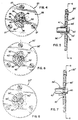
- FIG. 4 is a cross-section, on a reduced scale, taken substantially along the line 4-4 of FIG. 2.
- FIG. 5 is a view generally similar to FIG. 2 but shows a modified hub and armature assembly.
- FIG. 6 is a cross-section, on a reduced scale, taken substantially along the line 6-6 of FIG. 5.
- FIG. 7 is another view generally similar to FIG. 2 but shows still another modified hub and armature assembly.
- FIG. 8 is a cross-section, on a reduced scale, taken substantially along the line 8-8 of FIG. 7.
- an electromagnetic coupling 10 which could be a brake but which herein is in the form of an electromagnetic clutch.
- the clutch 10 is shown as being used in conjunction with a vehicular air conditioning compressor 11 having a rotatable drive shaft 12.
- the clutch 10 includes an electromagnet which is formed in part by a rotor 13 coaxial with the shaft 12 and adapted to be driven by an endless belt 14. Located in opposing relation with a face 15 of the rotor is an armature assembly 20. When a winding 21 is excited, magnetic flux draws part of the armature assembly into frictional engagement with the rotor face 15 so as to couple the armature assembly and the rotor for rotation in unison. Rotation of the armature assembly is transmitted to the shaft 12 in order to drive the compressor 11.
- the armature assembly 20 is similar to that disclosed in Booth United States Patent No. 5,150,779, the disclosure of which is incorporated herein by reference.
- the armature assembly includes a spider 25 which is injection molded of resiliently yieldable material such as plastic.
- a suitable material for the spider is Dupont Zytel ST 801-HS.
- the spider 25 includes a web 26 which is preferably circular and which is comparatively thin in the axial direction so that the web is capable of flexing axially.
- a web 26 Connected by angularly spaced rivets 27 to the outer peripheral portion of the web is an annular disc or plate 29 which forms the actual armature of the armature assembly 20.
- the plate 29 is made of low magnetic reluctance material such as AISI 1010 steel and is normally spaced axially from the rotor face 15 as shown in FIG. 1.
- the web 26 flexes to allow the armature plate to be drawn axially into coupling engagement with the rotor face.
- annular mounting sleeve 30 Molded integrally with the inner peripheral portion of the web 26 is an annular mounting sleeve 30 having a centrally located and axially extending hole 31 (FIG. 3) therein.
- the relatively thin web 26 is capable of flexing axially relative to the sleeve 30.
- a relatively simple mounting disc 35 is joined intimately to the sleeve 30 of the spider 25.
- the mounting disc is adapted to be secured to a tubular hub 36 which, in turn, is coupled to the compressor shaft 12.
- the use of the mounting disc 35 and the separately formed hub 36 allows for more economical manufacture of armature assemblies 20 useable with different types of hubs and shafts and reduces the number of types of armature assemblies which must be made and inventoried in order to accommodate various types of hub and shaft configurations.
- the mounting disc 35 is preferably but not necessarily made of powdered metal.
- the disc is comparatively thin in the axial direction and its outer periphery is formed with a series of angularly spaced and radially projecting lugs 38 (FIG. 4) which are separated by intervening spaces.
- the disc is insert molded in place when the spider 25 is molded and, during the molding operation, plastic of the sleeve 30 flows into and fills the spaces between the lugs. When the plastic cures, it encapsulates and becomes bonded intimately to the outer peripheral portion of the disc 35 and its angularly spaced lugs 36. By virtue of being bonded to the lugs and filling the spaces therebetween, the plastic couples the spider and the disc for rotation in unison.
- the hub 36 is formed separately of the mounting disc 35 and also may be made of powdered metal.
- the hub is in the form of a relatively long sleeve whose forward end portion or nose 43 is externally threaded.
- a comparatively small diameter hole 44 (FIG. 3) is formed in the forward end portion of the hub while a larger counterbore 45 is formed in the rear end portion of the hub and is sized to telescopically receive the shaft 12.
- a key 46 is adapted to fit in keyways formed in the hub and the shaft in order to couple the hub for rotation with the shaft.
- a threaded bore 47 (FIG. 2) is formed in the shaft and opens axially out of the free end thereof.
- the spider 25 with the molded in place mounting disc 35 may be assembled to the hub 36 by screwing the disc tightly onto the externally threaded nose 43 of the hub. Thereafter, the hub may be telescoped onto the shaft 12 and coupled for rotation therewith by the key 46.
- a screw 50 having a threaded shank 51 and a head 52, the shank being sized to slip through a washer 53.
- the shank 51 of the screw is extended through the hole 44 and the counterbore 45 in the hub 36 and is threaded into the bore 47 in the shaft 12.
- its head 52 presses the washer 53 against the end of the nose 43 of the hub in order to clamp the bottom of the counterbore against the end of the shaft and thereby captivate the armature assembly on the shaft.
- the hub 36' is somewhat shorter than the hub 36 and, rather than having an externally threaded nose 43, is formed with a hexagonally-shaped nose 43', there being an annular shoulder 55 (FIG. 5) at the rear end of the nose.
- the disc 35' is formed with a central hole 40' (FIG. 6) which also is shaped as a hex.
- the washer 53' engages the forward face of the disc 35' and clamps the collar 41' of the disc against the shoulder 55 of the hub in order to captivate the disc axially on the hub.
- either the hub 36 or the hub 36' may be formed with an internally tapered bore so as to mate with a tapered compressor shaft.
- the discs 35 and 35' may be used universally with either tapered or non-tapered hubs and also may be used universally with internally splined hubs or smooth bored hubs.
- FIGS. 7 and 8 Still another embodiment of an armature assembly 20'' is shown in FIGS. 7 and 8.
- the hub 36'' is formed with a cylindrical nose 43'' and thus the disc 35'' is formed with a complementary cylindrical hole 40''.
- Rotation of the disc 35'' relative to the hub 36'' is prevented by a circumferentially continuous laser weld 60 (FIG. 8) which joins the outer end of the nose 43'' to the edge of the hole 40''.
Landscapes
- Engineering & Computer Science (AREA)
- General Engineering & Computer Science (AREA)
- Mechanical Engineering (AREA)
- Physics & Mathematics (AREA)
- Electromagnetism (AREA)
- Braking Arrangements (AREA)
- Mechanical Operated Clutches (AREA)
Abstract
Description
- This invention relates generally to an electromagnetic coupling such as a clutch or brake and, more particularly, to an armature assembly for such a coupling.
- Booth et al United States Patent No. 5,036,964 and Booth United States Patent No. 5,150,779 each disclose an electromagnetic clutch in which an armature is connected to a driven hub on a rotatable shaft and is adapted to be frictionally coupled to a driving rotor when an electromagnet is energized to engage the clutch. When the clutch is engaged, the rotor acts through the armature to rotate the driven hub and the shaft.
- The armature assembly disclosed in each of the aforementioned patents includes a resilient plastic spider with a web which acts to connect a low magnetic reluctance armature plate for rotation with the driven hub. The web flexes axially in order to permit the armature plate to move toward and away from the rotor when the clutch is engaged and disengaged. The hub is insert molded in place when the spider is molded and thus the plastic of the spider is bonded to and encapsulates part of the hub in order to join the hub to the spider.
- Clutches are used with different types of shafts which require different types of armature hubs. As a result, it has been necessary in the past to customize various armature assemblies having different types of hubs molded in place in the spider. A substantial tooling investment is required to achieve this and, in addition, several different types of customized armature assemblies must be maintained in inventory.
- The general aim of the present invention is to provide a new and improved armature assembly of the fore-going general character which is more universally adaptable to different types of hubs and shafts so as to reduce the cost of both producing and inventorying armature assemblies.
- A more detailed object of the invention is to achieve the foregoing by standardizing the resiliently yieldable spider of the armature assembly and by insert molding a relatively simple mounting disc in the spider, the mounting disc being adapted for assembly with a separately formed hub. The external configuration of mounting discs for various types of hubs is identical and thus substantially common tooling may be used to effect insert molding of the mounting discs.
- These and other objects and advantages of the invention will become more apparent from the following detailed description when taken in conjunction with the accompanying drawings.
- FIGURE 1 is a side elevational view of a typical electromagnetic coupling equipped with a new and improved armature assembly incorporating the unique features of the present invention, certain parts of the coupling being broken away and shown in section.
- FIG. 2 is an enlarged view of the shaft, hub and armature assembly shown in FIG. 1.
- FIG. 3 is an exploded view of the components shown in FIG. 2.
- FIG. 4 is a cross-section, on a reduced scale, taken substantially along the line 4-4 of FIG. 2.
- FIG. 5 is a view generally similar to FIG. 2 but shows a modified hub and armature assembly.
- FIG. 6 is a cross-section, on a reduced scale, taken substantially along the line 6-6 of FIG. 5.
- FIG. 7 is another view generally similar to FIG. 2 but shows still another modified hub and armature assembly.
- FIG. 8 is a cross-section, on a reduced scale, taken substantially along the line 8-8 of FIG. 7.
- While the invention is susceptible of various modifications and alternative constructions, certain illustrated embodiments hereof have been shown in the drawings and will be described below in detail. It should be understood, however, that there is no intention to limit the invention to the specific forms disclosed, but on the contrary, the intention is to cover all modifications, alternative constructions and equivalents falling within the spirit and scope of the invention.
- For purposes of illustration, the present invention has been shown in the drawings in connection with an
electromagnetic coupling 10 which could be a brake but which herein is in the form of an electromagnetic clutch. Theclutch 10 is shown as being used in conjunction with a vehicular air conditioning compressor 11 having arotatable drive shaft 12. - The
clutch 10 includes an electromagnet which is formed in part by arotor 13 coaxial with theshaft 12 and adapted to be driven by anendless belt 14. Located in opposing relation with aface 15 of the rotor is anarmature assembly 20. When a winding 21 is excited, magnetic flux draws part of the armature assembly into frictional engagement with therotor face 15 so as to couple the armature assembly and the rotor for rotation in unison. Rotation of the armature assembly is transmitted to theshaft 12 in order to drive the compressor 11. - In some respects, the
armature assembly 20 is similar to that disclosed in Booth United States Patent No. 5,150,779, the disclosure of which is incorporated herein by reference. Thus, the armature assembly includes aspider 25 which is injection molded of resiliently yieldable material such as plastic. A suitable material for the spider is Dupont Zytel ST 801-HS. - The
spider 25 includes aweb 26 which is preferably circular and which is comparatively thin in the axial direction so that the web is capable of flexing axially. Connected by angularly spacedrivets 27 to the outer peripheral portion of the web is an annular disc orplate 29 which forms the actual armature of thearmature assembly 20. Theplate 29 is made of low magnetic reluctance material such as AISI 1010 steel and is normally spaced axially from therotor face 15 as shown in FIG. 1. When thecoil 21 is excited, theweb 26 flexes to allow the armature plate to be drawn axially into coupling engagement with the rotor face. - Molded integrally with the inner peripheral portion of the
web 26 is anannular mounting sleeve 30 having a centrally located and axially extending hole 31 (FIG. 3) therein. The relativelythin web 26 is capable of flexing axially relative to thesleeve 30. - In accordance with the present invention, a relatively
simple mounting disc 35 is joined intimately to thesleeve 30 of thespider 25. The mounting disc is adapted to be secured to atubular hub 36 which, in turn, is coupled to thecompressor shaft 12. As will become apparent subsequently, the use of themounting disc 35 and the separately formedhub 36 allows for more economical manufacture ofarmature assemblies 20 useable with different types of hubs and shafts and reduces the number of types of armature assemblies which must be made and inventoried in order to accommodate various types of hub and shaft configurations. - In the embodiment of the invention shown in FIGS. 1-4, the
mounting disc 35 is preferably but not necessarily made of powdered metal. The disc is comparatively thin in the axial direction and its outer periphery is formed with a series of angularly spaced and radially projecting lugs 38 (FIG. 4) which are separated by intervening spaces. The disc is insert molded in place when thespider 25 is molded and, during the molding operation, plastic of thesleeve 30 flows into and fills the spaces between the lugs. When the plastic cures, it encapsulates and becomes bonded intimately to the outer peripheral portion of thedisc 35 and its angularly spacedlugs 36. By virtue of being bonded to the lugs and filling the spaces therebetween, the plastic couples the spider and the disc for rotation in unison. - Formed through the central portion of the
disc 35 is an axially extending hole 40 (FIG. 3), there being an axiallyshort collar 41 formed integrally with the rear side of the disc adjacent the hole. Thehole 40 is internally threaded. - In carrying out the invention, the
hub 36 is formed separately of themounting disc 35 and also may be made of powdered metal. The hub is in the form of a relatively long sleeve whose forward end portion ornose 43 is externally threaded. A comparatively small diameter hole 44 (FIG. 3) is formed in the forward end portion of the hub while alarger counterbore 45 is formed in the rear end portion of the hub and is sized to telescopically receive theshaft 12. Akey 46 is adapted to fit in keyways formed in the hub and the shaft in order to couple the hub for rotation with the shaft. A threaded bore 47 (FIG. 2) is formed in the shaft and opens axially out of the free end thereof. - With the foregoing arrangement, the
spider 25 with the molded inplace mounting disc 35 may be assembled to thehub 36 by screwing the disc tightly onto the externally threadednose 43 of the hub. Thereafter, the hub may be telescoped onto theshaft 12 and coupled for rotation therewith by thekey 46. To captivate the components axially, there is provided ascrew 50 having a threadedshank 51 and ahead 52, the shank being sized to slip through awasher 53. Theshank 51 of the screw is extended through thehole 44 and thecounterbore 45 in thehub 36 and is threaded into thebore 47 in theshaft 12. When the screw is tightened, itshead 52 presses thewasher 53 against the end of thenose 43 of the hub in order to clamp the bottom of the counterbore against the end of the shaft and thereby captivate the armature assembly on the shaft. - The advantages of the invention become more readily apparent from the embodiment of the armature assembly 20' shown in FIGS. 5 and 6 in which parts corresponding to those of the first embodiment have been indicated by the same but primed reference numerals. The
hub 36' is somewhat shorter than thehub 36 and, rather than having an externally threadednose 43, is formed with a hexagonally-shaped nose 43', there being an annular shoulder 55 (FIG. 5) at the rear end of the nose. In order to accommodate the shape of the nose 43', thedisc 35' is formed with a central hole 40' (FIG. 6) which also is shaped as a hex. Thus, the disc is prevented from rotating relative to the hub when the disc is telescoped onto the hub. When the screw 50' is tightened, the washer 53' engages the forward face of thedisc 35' and clamps the collar 41' of the disc against theshoulder 55 of the hub in order to captivate the disc axially on the hub. - The only differences between the spider 25' and the
disc 35' of the second embodiment and thespider 25 anddisc 35 of the first embodiment is that thedisc 35' is formed with a hexagonally-shaped hole 40' rather than a threadedhole 40. As a result, only minor conversions need be made to the molding tooling in order to effect insert molding of either thedisc 35 or thedisc 35'. - In some clutches, either the
hub 36 or thehub 36' may be formed with an internally tapered bore so as to mate with a tapered compressor shaft. Thediscs - Still another embodiment of an armature assembly 20'' is shown in FIGS. 7 and 8. In this instance, the
hub 36'' is formed with a cylindrical nose 43'' and thus thedisc 35'' is formed with a complementary cylindrical hole 40''. Rotation of thedisc 35'' relative to thehub 36'' is prevented by a circumferentially continuous laser weld 60 (FIG. 8) which joins the outer end of the nose 43'' to the edge of the hole 40''. Again, only minor changes to the basic molding tooling need be made to effect insert molding of thedisc 35''. - From the foregoing, it will be apparent that the exterior shapes of the mounting
discs plastic spiders 25, 25' and 25'' are identical. By merely changing the shape and/or construction of the central hole in the disc, armature assemblies may be produced to fit various types of hubs. As a result, common tooling may be used for molding the spider while only minor modifications need be made to the tooling to accommodate the different hole configuration. A common disc may be used with hubs having noses with similar external shapes regardless of whether the internal bore of the hub is straight, tapered, smooth or splined. Thus, separate formation of the disc and the hub enables the exact same armature assembly to be used with hubs of different internal configurations and significantly reduces inventory requirements.
Claims (7)
- An armature assembly for use with an electromagnetic coupling having a rotatable shaft, said armature assembly comprising a generally circular spider having a web made of resiliently yieldable plastic and having a centrally located hole extending axially therethrough, an annular armature plate of low magnetic reluctance material secured to the outer peripheral portion of said web, a mounting disc located in said hole and joined intimately to said spider, said disc having a centrally located hole extending axially therethrough, a tubular hub formed separately of said disc and inserted through said hole in said disc, said hub being sized and shaped to telescope over said shaft, first means for preventing said disc from moving relative to said hub, and second means for preventing said hub from moving relative to said shaft.
- An armature assembly as defined in claim 1 in which said first means comprise an internal thread in the hole of said disc and further comprise an external thread on said hub and threadably engaged with said internal thread.
- An armature assembly as defined in claim 1 in which said first means are defined in part by the edge of said hole in said disc, said edge being non-circular in shape, said first means also being defined in part by a non-circular peripheral surface of said hub and engageable with said edge to prevent rotation of said disc on said hub.
- An armature assembly as defined in claim 1 in which said first means are defined at least in part by weld means between said disc and said hub.
- An armature assembly as defined in claim 1 in which said second means comprise a key located between said hub and said shaft and preventing said hub from rotating on said shaft.
- An armature assembly as defined in claim 5 in which said second means further comprise a screw adapted to be threaded axially into the end of said shaft and having means for captivating said hub axially on said shaft.
- An armature assembly for use with an electromagnetic coupling having a rotatable shaft, said armature assembly comprising a generally circular spider having a web made of resiliently yieldable plastic material, said web having inner and outer peripheral portions, an annular armature plate of low magnetic reluctance material secured to the outer peripheral portion of said web, a sleeve integral with the inner peripheral portion of said web, there being a centrally located hole formed through said sleeve, a mounting disc having an outer peripheral portion defined by a series of angularly spaced lugs and intervening spaces, said disc being disposed in said hole with the outer peripheral portion of said disc being disposed in said sleeve and with said spaces being filled with said plastic material, said plastic material being bonded intimately to said lugs to join said web to said disc, said disc having a centrally located hole extending axially therethrough, a tubular hub formed separately of said disc and inserted through said hole in said disc, said hub being sized and shaped to telescope over said shaft, first means for preventing said disc from moving relative to said hub, and second means for preventing said hub from moving relative to said shaft.
Applications Claiming Priority (2)
| Application Number | Priority Date | Filing Date | Title |
|---|---|---|---|
| US08/119,729 US5370209A (en) | 1993-09-10 | 1993-09-10 | Electromagnetic coupling armature assembly adaptable to various types of hubs |
| US119729 | 1993-09-10 |
Publications (2)
| Publication Number | Publication Date |
|---|---|
| EP0643236A1 true EP0643236A1 (en) | 1995-03-15 |
| EP0643236B1 EP0643236B1 (en) | 1997-01-29 |
Family
ID=22386013
Family Applications (1)
| Application Number | Title | Priority Date | Filing Date |
|---|---|---|---|
| EP94306652A Expired - Lifetime EP0643236B1 (en) | 1993-09-10 | 1994-09-09 | Electromagnetic coupling armature assembly adaptable to various types of hubs |
Country Status (4)
| Country | Link |
|---|---|
| US (1) | US5370209A (en) |
| EP (1) | EP0643236B1 (en) |
| JP (1) | JPH07269601A (en) |
| DE (1) | DE69401628T2 (en) |
Cited By (2)
| Publication number | Priority date | Publication date | Assignee | Title |
|---|---|---|---|---|
| WO2014146969A3 (en) * | 2013-03-18 | 2014-12-04 | Erwin A. Lang Gmbh & Co. Kg | Electromagnetic coupling apparatus |
| DE102014117088A1 (en) * | 2014-11-21 | 2016-05-25 | Kendrion (Markdorf) Gmbh | Clutch and method for adjusting a clutch air gap |
Families Citing this family (4)
| Publication number | Priority date | Publication date | Assignee | Title |
|---|---|---|---|---|
| US5632366A (en) * | 1996-03-13 | 1997-05-27 | General Motors Corporation | Electromagnetic clutch with improved torque cushion |
| US5642798A (en) * | 1996-03-22 | 1997-07-01 | General Motors Corporation | Electromagentic compressor clutch with combined torque cushion and armature cooling |
| US6194803B1 (en) | 1998-02-27 | 2001-02-27 | Warner Electric Technology, Inc. | Sound damping armature assembly for an electromagnetic coupling |
| US6129194A (en) * | 1998-08-13 | 2000-10-10 | Warner Electric Technology, Inc. | Electromagnetic coupling armature assembly with counterweight |
Citations (7)
| Publication number | Priority date | Publication date | Assignee | Title |
|---|---|---|---|---|
| US4493407A (en) * | 1981-12-14 | 1985-01-15 | Warner Electric Brake & Clutch Company | Armature assembly for an electromagnetic clutch |
| US4749073A (en) * | 1987-05-11 | 1988-06-07 | Dana Corporation | Soft-start electromagnetic coupling |
| US4804075A (en) * | 1986-07-10 | 1989-02-14 | Sanden Corporation | Electromagnetic clutch |
| US4860867A (en) * | 1986-07-14 | 1989-08-29 | Sanden Corporation | Electromagnetic clutch |
| US5036964A (en) * | 1990-03-28 | 1991-08-06 | Dana Corporation | Armature assembly for an electromagnetic coupling |
| US5150779A (en) * | 1992-01-14 | 1992-09-29 | Dana Corporation | Armature assembly for an electromagnetic coupling |
| US5184705A (en) * | 1990-07-16 | 1993-02-09 | Ogura Corporation | Electromagnetic clutch |
Family Cites Families (9)
| Publication number | Priority date | Publication date | Assignee | Title |
|---|---|---|---|---|
| US4187939A (en) * | 1977-12-14 | 1980-02-12 | Warner Electric Brake & Clutch Company | Armature assembly for electromagnetic coupling |
| US4445606A (en) * | 1981-12-14 | 1984-05-01 | Warner Electric Brake & Clutch Company | Armature assembly for electromagnetic coupling |
| US4642031A (en) * | 1985-05-20 | 1987-02-10 | Tecumseh Products Company | Alternator-compressor construction |
| JPH0217229A (en) * | 1988-07-04 | 1990-01-22 | Toyota Autom Loom Works Ltd | Control method of electromagnetic clutch |
| JPH0359530U (en) * | 1989-10-13 | 1991-06-12 | ||
| US5080214A (en) * | 1990-06-29 | 1992-01-14 | Inertia Dynamics, Inc. | Electromagnetic clutch |
| US5250921A (en) * | 1990-10-19 | 1993-10-05 | Dana Corporation | Field assembly for an electromagnet |
| US5052534A (en) * | 1990-10-30 | 1991-10-01 | Dana Corporation | Electromagnetic synchronizing and shifting clutch |
| US5195625A (en) * | 1992-05-29 | 1993-03-23 | General Motors Corporation | Torque cushion for electromagnetic clutch |
-
1993
- 1993-09-10 US US08/119,729 patent/US5370209A/en not_active Expired - Lifetime
-
1994
- 1994-09-09 EP EP94306652A patent/EP0643236B1/en not_active Expired - Lifetime
- 1994-09-09 DE DE69401628T patent/DE69401628T2/en not_active Expired - Lifetime
- 1994-09-12 JP JP6254100A patent/JPH07269601A/en active Pending
Patent Citations (7)
| Publication number | Priority date | Publication date | Assignee | Title |
|---|---|---|---|---|
| US4493407A (en) * | 1981-12-14 | 1985-01-15 | Warner Electric Brake & Clutch Company | Armature assembly for an electromagnetic clutch |
| US4804075A (en) * | 1986-07-10 | 1989-02-14 | Sanden Corporation | Electromagnetic clutch |
| US4860867A (en) * | 1986-07-14 | 1989-08-29 | Sanden Corporation | Electromagnetic clutch |
| US4749073A (en) * | 1987-05-11 | 1988-06-07 | Dana Corporation | Soft-start electromagnetic coupling |
| US5036964A (en) * | 1990-03-28 | 1991-08-06 | Dana Corporation | Armature assembly for an electromagnetic coupling |
| US5184705A (en) * | 1990-07-16 | 1993-02-09 | Ogura Corporation | Electromagnetic clutch |
| US5150779A (en) * | 1992-01-14 | 1992-09-29 | Dana Corporation | Armature assembly for an electromagnetic coupling |
Cited By (3)
| Publication number | Priority date | Publication date | Assignee | Title |
|---|---|---|---|---|
| WO2014146969A3 (en) * | 2013-03-18 | 2014-12-04 | Erwin A. Lang Gmbh & Co. Kg | Electromagnetic coupling apparatus |
| US9906115B2 (en) | 2013-03-18 | 2018-02-27 | Erwin A. Lang Gmbh & Co. Kg | Electromagnetic coupling apparatus |
| DE102014117088A1 (en) * | 2014-11-21 | 2016-05-25 | Kendrion (Markdorf) Gmbh | Clutch and method for adjusting a clutch air gap |
Also Published As
| Publication number | Publication date |
|---|---|
| DE69401628D1 (en) | 1997-03-13 |
| JPH07269601A (en) | 1995-10-20 |
| DE69401628T2 (en) | 1997-05-28 |
| EP0643236B1 (en) | 1997-01-29 |
| US5370209A (en) | 1994-12-06 |
Similar Documents
| Publication | Publication Date | Title |
|---|---|---|
| US4828090A (en) | Electromagnetic clutch | |
| US5372228A (en) | Sound-damping armature assembly for an electromagnetic coupling | |
| US7980977B2 (en) | Power transmission apparatus | |
| US5119915A (en) | Electromagnetic coupling armature assembly with flux isolator springs | |
| US5305865A (en) | Rotor for electromagnetic coupling | |
| EP0604190B1 (en) | Clutch with spacer for supporting a bearing | |
| EP0953784B1 (en) | Magnetic clutch and brake unit | |
| US4793455A (en) | Electromagnetic coupling | |
| EP0643236B1 (en) | Electromagnetic coupling armature assembly adaptable to various types of hubs | |
| EP0836026A2 (en) | Electromagnetic clutch | |
| GB2339861A (en) | Sound damping armature assembly for an electromagnetic coupling | |
| EP0713026B1 (en) | Armature assembly for an electromagnetic coupling | |
| US5059842A (en) | Electromagnetic clutch with grooved friction surface | |
| US5601176A (en) | Armature assembly in an electromagnetic coupling device | |
| US5390774A (en) | Electromagnetic clutch with improved guidance and retention | |
| EP1602847B1 (en) | Solenoid clutch coupling | |
| US5310034A (en) | Supporting hub for clutch and pump assembly | |
| KR100898912B1 (en) | Manufacturing method of disk and hub assembly of electronic clutch | |
| EP0947719A2 (en) | Power steering system | |
| KR100813356B1 (en) | Disc / Hub Assembly of Electronic Clutch and Manufacturing Method Thereof | |
| EP4008910B1 (en) | Assembly method, fan-clutch arrangement, motor-drive unit and kitchen machine | |
| KR100531659B1 (en) | Disk & Hub Assembly for Electronic Clutch_ | |
| JPH0625718Y2 (en) | Connection structure of armature and hub in electromagnetic clutch etc. | |
| CA2601176C (en) | Motor shaft assembly and method | |
| JPH07279993A (en) | Electromagnetic coupling device |
Legal Events
| Date | Code | Title | Description |
|---|---|---|---|
| PUAI | Public reference made under article 153(3) epc to a published international application that has entered the european phase |
Free format text: ORIGINAL CODE: 0009012 |
|
| AK | Designated contracting states |
Kind code of ref document: A1 Designated state(s): DE FR GB |
|
| 17P | Request for examination filed |
Effective date: 19950908 |
|
| GRAG | Despatch of communication of intention to grant |
Free format text: ORIGINAL CODE: EPIDOS AGRA |
|
| 17Q | First examination report despatched |
Effective date: 19960402 |
|
| GRAH | Despatch of communication of intention to grant a patent |
Free format text: ORIGINAL CODE: EPIDOS IGRA |
|
| GRAH | Despatch of communication of intention to grant a patent |
Free format text: ORIGINAL CODE: EPIDOS IGRA |
|
| GRAA | (expected) grant |
Free format text: ORIGINAL CODE: 0009210 |
|
| AK | Designated contracting states |
Kind code of ref document: B1 Designated state(s): DE FR GB |
|
| REF | Corresponds to: |
Ref document number: 69401628 Country of ref document: DE Date of ref document: 19970313 |
|
| ET | Fr: translation filed | ||
| PLBE | No opposition filed within time limit |
Free format text: ORIGINAL CODE: 0009261 |
|
| STAA | Information on the status of an ep patent application or granted ep patent |
Free format text: STATUS: NO OPPOSITION FILED WITHIN TIME LIMIT |
|
| 26N | No opposition filed | ||
| REG | Reference to a national code |
Ref country code: GB Ref legal event code: IF02 |
|
| REG | Reference to a national code |
Ref country code: GB Ref legal event code: 732E |
|
| PGFP | Annual fee paid to national office [announced via postgrant information from national office to epo] |
Ref country code: GB Payment date: 20090929 Year of fee payment: 16 |
|
| PGFP | Annual fee paid to national office [announced via postgrant information from national office to epo] |
Ref country code: DE Payment date: 20090929 Year of fee payment: 16 |
|
| GBPC | Gb: european patent ceased through non-payment of renewal fee |
Effective date: 20100909 |
|
| REG | Reference to a national code |
Ref country code: FR Ref legal event code: ST Effective date: 20110531 |
|
| REG | Reference to a national code |
Ref country code: DE Ref legal event code: R119 Ref document number: 69401628 Country of ref document: DE Effective date: 20110401 |
|
| PG25 | Lapsed in a contracting state [announced via postgrant information from national office to epo] |
Ref country code: DE Free format text: LAPSE BECAUSE OF NON-PAYMENT OF DUE FEES Effective date: 20110401 Ref country code: FR Free format text: LAPSE BECAUSE OF NON-PAYMENT OF DUE FEES Effective date: 20100930 |
|
| PG25 | Lapsed in a contracting state [announced via postgrant information from national office to epo] |
Ref country code: GB Free format text: LAPSE BECAUSE OF NON-PAYMENT OF DUE FEES Effective date: 20100909 |
|
| PGFP | Annual fee paid to national office [announced via postgrant information from national office to epo] |
Ref country code: FR Payment date: 20091006 Year of fee payment: 16 |