EP0643043B1 - Novel bis ureido compounds and their use in lithographic films - Google Patents
Novel bis ureido compounds and their use in lithographic films Download PDFInfo
- Publication number
- EP0643043B1 EP0643043B1 EP94114104A EP94114104A EP0643043B1 EP 0643043 B1 EP0643043 B1 EP 0643043B1 EP 94114104 A EP94114104 A EP 94114104A EP 94114104 A EP94114104 A EP 94114104A EP 0643043 B1 EP0643043 B1 EP 0643043B1
- Authority
- EP
- European Patent Office
- Prior art keywords
- compound
- bis
- ureido
- hydrogen
- straight
- Prior art date
- Legal status (The legal status is an assumption and is not a legal conclusion. Google has not performed a legal analysis and makes no representation as to the accuracy of the status listed.)
- Expired - Lifetime
Links
- 125000001951 carbamoylamino group Chemical group C(N)(=O)N* 0.000 title claims description 24
- 125000000217 alkyl group Chemical group 0.000 claims abstract description 24
- 229910052739 hydrogen Inorganic materials 0.000 claims abstract description 19
- 125000003118 aryl group Chemical group 0.000 claims abstract description 5
- 125000004985 dialkyl amino alkyl group Chemical group 0.000 claims abstract description 4
- 239000000839 emulsion Substances 0.000 claims description 36
- -1 ureido compound Chemical class 0.000 claims description 31
- 150000001875 compounds Chemical class 0.000 claims description 20
- 239000001257 hydrogen Substances 0.000 claims description 18
- OAKJQQAXSVQMHS-UHFFFAOYSA-N hydrazine group Chemical group NN OAKJQQAXSVQMHS-UHFFFAOYSA-N 0.000 claims description 16
- 238000000034 method Methods 0.000 claims description 11
- 239000002667 nucleating agent Substances 0.000 claims description 10
- 229910052709 silver Inorganic materials 0.000 claims description 10
- 239000004332 silver Substances 0.000 claims description 10
- UFHFLCQGNIYNRP-UHFFFAOYSA-N Hydrogen Chemical compound [H][H] UFHFLCQGNIYNRP-UHFFFAOYSA-N 0.000 claims description 9
- MZVQCMJNVPIDEA-UHFFFAOYSA-N [CH2]CN(CC)CC Chemical group [CH2]CN(CC)CC MZVQCMJNVPIDEA-UHFFFAOYSA-N 0.000 claims description 6
- 150000002431 hydrogen Chemical group 0.000 claims description 5
- 125000002496 methyl group Chemical group [H]C([H])([H])* 0.000 claims description 5
- 125000001997 phenyl group Chemical group [H]C1=C([H])C([H])=C(*)C([H])=C1[H] 0.000 claims description 5
- 238000001179 sorption measurement Methods 0.000 claims description 5
- 239000000758 substrate Substances 0.000 claims description 5
- 125000001495 ethyl group Chemical group [H]C([H])([H])C([H])([H])* 0.000 claims description 4
- 125000004435 hydrogen atom Chemical group [H]* 0.000 claims description 4
- 125000004051 hexyl group Chemical group [H]C([H])([H])C([H])([H])C([H])([H])C([H])([H])C([H])([H])C([H])([H])* 0.000 claims description 3
- 239000000975 dye Substances 0.000 claims description 2
- 230000001235 sensitizing effect Effects 0.000 claims description 2
- 230000003595 spectral effect Effects 0.000 claims description 2
- DVWRENURUPCSBN-UHFFFAOYSA-N 3-[2-(2-propoxyethoxy)ethoxy]propylurea Chemical compound N(C(=O)N)CCCOCCOCCOCCC DVWRENURUPCSBN-UHFFFAOYSA-N 0.000 abstract 1
- YMWUJEATGCHHMB-UHFFFAOYSA-N Dichloromethane Chemical compound ClCCl YMWUJEATGCHHMB-UHFFFAOYSA-N 0.000 description 24
- 239000000203 mixture Substances 0.000 description 22
- WEVYAHXRMPXWCK-UHFFFAOYSA-N Acetonitrile Chemical compound CC#N WEVYAHXRMPXWCK-UHFFFAOYSA-N 0.000 description 18
- 239000000243 solution Substances 0.000 description 13
- QIGBRXMKCJKVMJ-UHFFFAOYSA-N Hydroquinone Chemical compound OC1=CC=C(O)C=C1 QIGBRXMKCJKVMJ-UHFFFAOYSA-N 0.000 description 11
- HEMHJVSKTPXQMS-UHFFFAOYSA-M Sodium hydroxide Chemical compound [OH-].[Na+] HEMHJVSKTPXQMS-UHFFFAOYSA-M 0.000 description 9
- 125000005420 sulfonamido group Chemical group S(=O)(=O)(N*)* 0.000 description 9
- 238000009472 formulation Methods 0.000 description 8
- ADZWSOLPGZMUMY-UHFFFAOYSA-M silver bromide Chemical compound [Ag]Br ADZWSOLPGZMUMY-UHFFFAOYSA-M 0.000 description 8
- XLYOFNOQVPJJNP-UHFFFAOYSA-N water Chemical compound O XLYOFNOQVPJJNP-UHFFFAOYSA-N 0.000 description 8
- FAPWRFPIFSIZLT-UHFFFAOYSA-M Sodium chloride Chemical compound [Na+].[Cl-] FAPWRFPIFSIZLT-UHFFFAOYSA-M 0.000 description 7
- 238000007792 addition Methods 0.000 description 7
- CSNNHWWHGAXBCP-UHFFFAOYSA-L Magnesium sulfate Chemical compound [Mg+2].[O-][S+2]([O-])([O-])[O-] CSNNHWWHGAXBCP-UHFFFAOYSA-L 0.000 description 6
- JUJWROOIHBZHMG-UHFFFAOYSA-N Pyridine Chemical compound C1=CC=NC=C1 JUJWROOIHBZHMG-UHFFFAOYSA-N 0.000 description 6
- 238000000576 coating method Methods 0.000 description 6
- 230000000694 effects Effects 0.000 description 6
- 239000008273 gelatin Substances 0.000 description 6
- 229920000159 gelatin Polymers 0.000 description 6
- 239000000463 material Substances 0.000 description 6
- IOLCXVTUBQKXJR-UHFFFAOYSA-M potassium bromide Chemical compound [K+].[Br-] IOLCXVTUBQKXJR-UHFFFAOYSA-M 0.000 description 6
- SQGYOTSLMSWVJD-UHFFFAOYSA-N silver(1+) nitrate Chemical compound [Ag+].[O-]N(=O)=O SQGYOTSLMSWVJD-UHFFFAOYSA-N 0.000 description 6
- FKLJPTJMIBLJAV-UHFFFAOYSA-N Compound IV Chemical compound O1N=C(C)C=C1CCCCCCCOC1=CC=C(C=2OCCN=2)C=C1 FKLJPTJMIBLJAV-UHFFFAOYSA-N 0.000 description 5
- 108010010803 Gelatin Proteins 0.000 description 5
- 230000015572 biosynthetic process Effects 0.000 description 5
- NLFBCYMMUAKCPC-KQQUZDAGSA-N ethyl (e)-3-[3-amino-2-cyano-1-[(e)-3-ethoxy-3-oxoprop-1-enyl]sulfanyl-3-oxoprop-1-enyl]sulfanylprop-2-enoate Chemical compound CCOC(=O)\C=C\SC(=C(C#N)C(N)=O)S\C=C\C(=O)OCC NLFBCYMMUAKCPC-KQQUZDAGSA-N 0.000 description 5
- 235000019322 gelatine Nutrition 0.000 description 5
- 235000011852 gelatine desserts Nutrition 0.000 description 5
- 239000010410 layer Substances 0.000 description 5
- 238000003786 synthesis reaction Methods 0.000 description 5
- 235000002566 Capsicum Nutrition 0.000 description 4
- 239000006002 Pepper Substances 0.000 description 4
- 241000722363 Piper Species 0.000 description 4
- 235000016761 Piper aduncum Nutrition 0.000 description 4
- 235000017804 Piper guineense Nutrition 0.000 description 4
- 235000008184 Piper nigrum Nutrition 0.000 description 4
- LSNNMFCWUKXFEE-UHFFFAOYSA-N Sulfurous acid Chemical compound OS(O)=O LSNNMFCWUKXFEE-UHFFFAOYSA-N 0.000 description 4
- 239000003795 chemical substances by application Substances 0.000 description 4
- 239000011248 coating agent Substances 0.000 description 4
- 150000002429 hydrazines Chemical class 0.000 description 4
- 239000011541 reaction mixture Substances 0.000 description 4
- 231100000331 toxic Toxicity 0.000 description 4
- 230000002588 toxic effect Effects 0.000 description 4
- QTBSBXVTEAMEQO-UHFFFAOYSA-N Acetic acid Chemical compound CC(O)=O QTBSBXVTEAMEQO-UHFFFAOYSA-N 0.000 description 3
- VEXZGXHMUGYJMC-UHFFFAOYSA-M Chloride anion Chemical compound [Cl-] VEXZGXHMUGYJMC-UHFFFAOYSA-M 0.000 description 3
- OKKJLVBELUTLKV-UHFFFAOYSA-N Methanol Chemical compound OC OKKJLVBELUTLKV-UHFFFAOYSA-N 0.000 description 3
- 239000013078 crystal Substances 0.000 description 3
- MTHSVFCYNBDYFN-UHFFFAOYSA-N diethylene glycol Chemical compound OCCOCCO MTHSVFCYNBDYFN-UHFFFAOYSA-N 0.000 description 3
- 230000002708 enhancing effect Effects 0.000 description 3
- 238000001704 evaporation Methods 0.000 description 3
- 230000008020 evaporation Effects 0.000 description 3
- 230000008018 melting Effects 0.000 description 3
- 238000002844 melting Methods 0.000 description 3
- AHWALFGBDFAJAI-UHFFFAOYSA-N phenyl carbonochloridate Chemical compound ClC(=O)OC1=CC=CC=C1 AHWALFGBDFAJAI-UHFFFAOYSA-N 0.000 description 3
- UMJSCPRVCHMLSP-UHFFFAOYSA-N pyridine Natural products COC1=CC=CN=C1 UMJSCPRVCHMLSP-UHFFFAOYSA-N 0.000 description 3
- 239000002904 solvent Substances 0.000 description 3
- 239000004094 surface-active agent Substances 0.000 description 3
- RTZKZFJDLAIYFH-UHFFFAOYSA-N Diethyl ether Chemical compound CCOCC RTZKZFJDLAIYFH-UHFFFAOYSA-N 0.000 description 2
- PIICEJLVQHRZGT-UHFFFAOYSA-N Ethylenediamine Chemical compound NCCN PIICEJLVQHRZGT-UHFFFAOYSA-N 0.000 description 2
- QAOWNCQODCNURD-UHFFFAOYSA-N Sulfuric acid Chemical compound OS(O)(=O)=O QAOWNCQODCNURD-UHFFFAOYSA-N 0.000 description 2
- XSQUKJJJFZCRTK-UHFFFAOYSA-N Urea Natural products NC(N)=O XSQUKJJJFZCRTK-UHFFFAOYSA-N 0.000 description 2
- 125000003545 alkoxy group Chemical group 0.000 description 2
- 125000005529 alkyleneoxy group Chemical group 0.000 description 2
- 239000003125 aqueous solvent Substances 0.000 description 2
- 235000019329 dioctyl sodium sulphosuccinate Nutrition 0.000 description 2
- YHAIUSTWZPMYGG-UHFFFAOYSA-L disodium;2,2-dioctyl-3-sulfobutanedioate Chemical compound [Na+].[Na+].CCCCCCCCC(C([O-])=O)(C(C([O-])=O)S(O)(=O)=O)CCCCCCCC YHAIUSTWZPMYGG-UHFFFAOYSA-L 0.000 description 2
- 229910052736 halogen Inorganic materials 0.000 description 2
- 229940042795 hydrazides for tuberculosis treatment Drugs 0.000 description 2
- 239000005457 ice water Substances 0.000 description 2
- UDGSVBYJWHOHNN-UHFFFAOYSA-N n',n'-diethylethane-1,2-diamine Chemical compound CCN(CC)CCN UDGSVBYJWHOHNN-UHFFFAOYSA-N 0.000 description 2
- 230000006911 nucleation Effects 0.000 description 2
- 238000010899 nucleation Methods 0.000 description 2
- 239000012044 organic layer Substances 0.000 description 2
- 230000003647 oxidation Effects 0.000 description 2
- 238000007254 oxidation reaction Methods 0.000 description 2
- 229920000728 polyester Polymers 0.000 description 2
- 229920000120 polyethyl acrylate Polymers 0.000 description 2
- BWHMMNNQKKPAPP-UHFFFAOYSA-L potassium carbonate Chemical compound [K+].[K+].[O-]C([O-])=O BWHMMNNQKKPAPP-UHFFFAOYSA-L 0.000 description 2
- 125000002924 primary amino group Chemical group [H]N([H])* 0.000 description 2
- 239000011780 sodium chloride Substances 0.000 description 2
- AKHNMLFCWUSKQB-UHFFFAOYSA-L sodium thiosulfate Chemical compound [Na+].[Na+].[O-]S([O-])(=O)=S AKHNMLFCWUSKQB-UHFFFAOYSA-L 0.000 description 2
- 235000019345 sodium thiosulphate Nutrition 0.000 description 2
- 239000007787 solid Substances 0.000 description 2
- 238000003756 stirring Methods 0.000 description 2
- UMGDCJDMYOKAJW-UHFFFAOYSA-N thiourea Chemical class NC(N)=S UMGDCJDMYOKAJW-UHFFFAOYSA-N 0.000 description 2
- 229910052721 tungsten Inorganic materials 0.000 description 2
- 239000010937 tungsten Substances 0.000 description 2
- UNILWMWFPHPYOR-KXEYIPSPSA-M 1-[6-[2-[3-[3-[3-[2-[2-[3-[[2-[2-[[(2r)-1-[[2-[[(2r)-1-[3-[2-[2-[3-[[2-(2-amino-2-oxoethoxy)acetyl]amino]propoxy]ethoxy]ethoxy]propylamino]-3-hydroxy-1-oxopropan-2-yl]amino]-2-oxoethyl]amino]-3-[(2r)-2,3-di(hexadecanoyloxy)propyl]sulfanyl-1-oxopropan-2-yl Chemical compound O=C1C(SCCC(=O)NCCCOCCOCCOCCCNC(=O)COCC(=O)N[C@@H](CSC[C@@H](COC(=O)CCCCCCCCCCCCCCC)OC(=O)CCCCCCCCCCCCCCC)C(=O)NCC(=O)N[C@H](CO)C(=O)NCCCOCCOCCOCCCNC(=O)COCC(N)=O)CC(=O)N1CCNC(=O)CCCCCN\1C2=CC=C(S([O-])(=O)=O)C=C2CC/1=C/C=C/C=C/C1=[N+](CC)C2=CC=C(S([O-])(=O)=O)C=C2C1 UNILWMWFPHPYOR-KXEYIPSPSA-M 0.000 description 1
- DSVIHYOAKPVFEH-UHFFFAOYSA-N 4-(hydroxymethyl)-4-methyl-1-phenylpyrazolidin-3-one Chemical compound N1C(=O)C(C)(CO)CN1C1=CC=CC=C1 DSVIHYOAKPVFEH-UHFFFAOYSA-N 0.000 description 1
- GQBONCZDJQXPLV-UHFFFAOYSA-N 4-aminoisoindole-1,3-dione Chemical compound NC1=CC=CC2=C1C(=O)NC2=O GQBONCZDJQXPLV-UHFFFAOYSA-N 0.000 description 1
- NLXLAEXVIDQMFP-UHFFFAOYSA-N Ammonia chloride Chemical compound [NH4+].[Cl-] NLXLAEXVIDQMFP-UHFFFAOYSA-N 0.000 description 1
- KTVNVJJDNWYECU-UHFFFAOYSA-N CC(C=C(N(CCCS([O-])(=O)=O)C1=C2)OC1=CC=C2Cl)=CC1=[N+](CCCS(O)(=O)=O)C2=CC(Cl)=CC=C2O1 Chemical compound CC(C=C(N(CCCS([O-])(=O)=O)C1=C2)OC1=CC=C2Cl)=CC1=[N+](CCCS(O)(=O)=O)C2=CC(Cl)=CC=C2O1 KTVNVJJDNWYECU-UHFFFAOYSA-N 0.000 description 1
- 0 CC(N)NC(N(C)*)=O Chemical compound CC(N)NC(N(C)*)=O 0.000 description 1
- 239000009261 D 400 Substances 0.000 description 1
- ZAFNJMIOTHYJRJ-UHFFFAOYSA-N Diisopropyl ether Chemical compound CC(C)OC(C)C ZAFNJMIOTHYJRJ-UHFFFAOYSA-N 0.000 description 1
- VEXZGXHMUGYJMC-UHFFFAOYSA-N Hydrochloric acid Chemical compound Cl VEXZGXHMUGYJMC-UHFFFAOYSA-N 0.000 description 1
- 201000008645 Joubert syndrome Diseases 0.000 description 1
- QPCDCPDFJACHGM-UHFFFAOYSA-N N,N-bis{2-[bis(carboxymethyl)amino]ethyl}glycine Chemical compound OC(=O)CN(CC(O)=O)CCN(CC(=O)O)CCN(CC(O)=O)CC(O)=O QPCDCPDFJACHGM-UHFFFAOYSA-N 0.000 description 1
- BQCADISMDOOEFD-UHFFFAOYSA-N Silver Chemical compound [Ag] BQCADISMDOOEFD-UHFFFAOYSA-N 0.000 description 1
- ZMANZCXQSJIPKH-UHFFFAOYSA-N Triethylamine Chemical class CCN(CC)CC ZMANZCXQSJIPKH-UHFFFAOYSA-N 0.000 description 1
- 125000004442 acylamino group Chemical group 0.000 description 1
- 239000000654 additive Substances 0.000 description 1
- 230000000996 additive effect Effects 0.000 description 1
- 125000003282 alkyl amino group Chemical group 0.000 description 1
- 125000005037 alkyl phenyl group Chemical group 0.000 description 1
- 125000005281 alkyl ureido group Chemical group 0.000 description 1
- 150000001414 amino alcohols Chemical class 0.000 description 1
- 239000002518 antifoaming agent Substances 0.000 description 1
- 239000003963 antioxidant agent Substances 0.000 description 1
- 230000003078 antioxidant effect Effects 0.000 description 1
- QRUDEWIWKLJBPS-UHFFFAOYSA-N benzotriazole Chemical compound C1=CC=C2N[N][N]C2=C1 QRUDEWIWKLJBPS-UHFFFAOYSA-N 0.000 description 1
- 239000012964 benzotriazole Substances 0.000 description 1
- KGBXLFKZBHKPEV-UHFFFAOYSA-N boric acid Chemical compound OB(O)O KGBXLFKZBHKPEV-UHFFFAOYSA-N 0.000 description 1
- 239000004327 boric acid Substances 0.000 description 1
- 239000012267 brine Substances 0.000 description 1
- 239000004202 carbamide Substances 0.000 description 1
- 230000015556 catabolic process Effects 0.000 description 1
- 239000003153 chemical reaction reagent Substances 0.000 description 1
- 238000001816 cooling Methods 0.000 description 1
- 238000002425 crystallisation Methods 0.000 description 1
- 230000008025 crystallization Effects 0.000 description 1
- 238000006731 degradation reaction Methods 0.000 description 1
- 230000002939 deleterious effect Effects 0.000 description 1
- 150000004985 diamines Chemical class 0.000 description 1
- 238000010790 dilution Methods 0.000 description 1
- 239000012895 dilution Substances 0.000 description 1
- 125000000219 ethylidene group Chemical group [H]C(=[*])C([H])([H])[H] 0.000 description 1
- 238000000605 extraction Methods 0.000 description 1
- 125000000623 heterocyclic group Chemical group 0.000 description 1
- ANJPRQPHZGHVQB-UHFFFAOYSA-N hexyl isocyanate Chemical compound CCCCCCN=C=O ANJPRQPHZGHVQB-UHFFFAOYSA-N 0.000 description 1
- XMBWDFGMSWQBCA-UHFFFAOYSA-N hydrogen iodide Chemical compound I XMBWDFGMSWQBCA-UHFFFAOYSA-N 0.000 description 1
- 238000010348 incorporation Methods 0.000 description 1
- 208000015181 infectious disease Diseases 0.000 description 1
- 230000002458 infectious effect Effects 0.000 description 1
- 238000002329 infrared spectrum Methods 0.000 description 1
- 239000004615 ingredient Substances 0.000 description 1
- 239000004816 latex Substances 0.000 description 1
- 229920000126 latex Polymers 0.000 description 1
- 229910052943 magnesium sulfate Inorganic materials 0.000 description 1
- 235000019341 magnesium sulphate Nutrition 0.000 description 1
- 238000004519 manufacturing process Methods 0.000 description 1
- DZVCFNFOPIZQKX-LTHRDKTGSA-M merocyanine Chemical compound [Na+].O=C1N(CCCC)C(=O)N(CCCC)C(=O)C1=C\C=C\C=C/1N(CCCS([O-])(=O)=O)C2=CC=CC=C2O\1 DZVCFNFOPIZQKX-LTHRDKTGSA-M 0.000 description 1
- 125000001624 naphthyl group Chemical group 0.000 description 1
- 125000000449 nitro group Chemical group [O-][N+](*)=O 0.000 description 1
- IJGRMHOSHXDMSA-UHFFFAOYSA-N nitrogen Substances N#N IJGRMHOSHXDMSA-UHFFFAOYSA-N 0.000 description 1
- 229910052757 nitrogen Inorganic materials 0.000 description 1
- 230000009972 noncorrosive effect Effects 0.000 description 1
- 231100000252 nontoxic Toxicity 0.000 description 1
- 230000003000 nontoxic effect Effects 0.000 description 1
- 238000010979 pH adjustment Methods 0.000 description 1
- 238000005192 partition Methods 0.000 description 1
- 239000003208 petroleum Substances 0.000 description 1
- CMCWWLVWPDLCRM-UHFFFAOYSA-N phenidone Chemical compound N1C(=O)CCN1C1=CC=CC=C1 CMCWWLVWPDLCRM-UHFFFAOYSA-N 0.000 description 1
- 125000000951 phenoxy group Chemical group [H]C1=C([H])C([H])=C(O*)C([H])=C1[H] 0.000 description 1
- 229920001451 polypropylene glycol Polymers 0.000 description 1
- 229910000027 potassium carbonate Inorganic materials 0.000 description 1
- 238000001556 precipitation Methods 0.000 description 1
- 230000001737 promoting effect Effects 0.000 description 1
- 239000000376 reactant Substances 0.000 description 1
- 230000005070 ripening Effects 0.000 description 1
- 125000000467 secondary amino group Chemical group [H]N([*:1])[*:2] 0.000 description 1
- HRZFUMHJMZEROT-UHFFFAOYSA-L sodium disulfite Chemical compound [Na+].[Na+].[O-]S(=O)S([O-])(=O)=O HRZFUMHJMZEROT-UHFFFAOYSA-L 0.000 description 1
- 229940001584 sodium metabisulfite Drugs 0.000 description 1
- 235000010262 sodium metabisulphite Nutrition 0.000 description 1
- 159000000000 sodium salts Chemical class 0.000 description 1
- HPALAKNZSZLMCH-UHFFFAOYSA-M sodium;chloride;hydrate Chemical compound O.[Na+].[Cl-] HPALAKNZSZLMCH-UHFFFAOYSA-M 0.000 description 1
- 239000003381 stabilizer Substances 0.000 description 1
- 125000000446 sulfanediyl group Chemical group *S* 0.000 description 1
- 229940124530 sulfonamide Drugs 0.000 description 1
- 150000003456 sulfonamides Chemical class 0.000 description 1
- 125000001302 tertiary amino group Chemical group 0.000 description 1
- 231100000419 toxicity Toxicity 0.000 description 1
- 230000001988 toxicity Effects 0.000 description 1
- 150000003672 ureas Chemical class 0.000 description 1
- 238000005406 washing Methods 0.000 description 1
Classifications
-
- C—CHEMISTRY; METALLURGY
- C07—ORGANIC CHEMISTRY
- C07C—ACYCLIC OR CARBOCYCLIC COMPOUNDS
- C07C275/00—Derivatives of urea, i.e. compounds containing any of the groups, the nitrogen atoms not being part of nitro or nitroso groups
- C07C275/04—Derivatives of urea, i.e. compounds containing any of the groups, the nitrogen atoms not being part of nitro or nitroso groups having nitrogen atoms of urea groups bound to acyclic carbon atoms
- C07C275/06—Derivatives of urea, i.e. compounds containing any of the groups, the nitrogen atoms not being part of nitro or nitroso groups having nitrogen atoms of urea groups bound to acyclic carbon atoms of an acyclic and saturated carbon skeleton
- C07C275/10—Derivatives of urea, i.e. compounds containing any of the groups, the nitrogen atoms not being part of nitro or nitroso groups having nitrogen atoms of urea groups bound to acyclic carbon atoms of an acyclic and saturated carbon skeleton being further substituted by singly-bound oxygen atoms
-
- G—PHYSICS
- G03—PHOTOGRAPHY; CINEMATOGRAPHY; ANALOGOUS TECHNIQUES USING WAVES OTHER THAN OPTICAL WAVES; ELECTROGRAPHY; HOLOGRAPHY
- G03C—PHOTOSENSITIVE MATERIALS FOR PHOTOGRAPHIC PURPOSES; PHOTOGRAPHIC PROCESSES, e.g. CINE, X-RAY, COLOUR, STEREO-PHOTOGRAPHIC PROCESSES; AUXILIARY PROCESSES IN PHOTOGRAPHY
- G03C1/00—Photosensitive materials
- G03C1/005—Silver halide emulsions; Preparation thereof; Physical treatment thereof; Incorporation of additives therein
- G03C1/06—Silver halide emulsions; Preparation thereof; Physical treatment thereof; Incorporation of additives therein with non-macromolecular additives
- G03C1/061—Hydrazine compounds
-
- G—PHYSICS
- G03—PHOTOGRAPHY; CINEMATOGRAPHY; ANALOGOUS TECHNIQUES USING WAVES OTHER THAN OPTICAL WAVES; ELECTROGRAPHY; HOLOGRAPHY
- G03C—PHOTOSENSITIVE MATERIALS FOR PHOTOGRAPHIC PURPOSES; PHOTOGRAPHIC PROCESSES, e.g. CINE, X-RAY, COLOUR, STEREO-PHOTOGRAPHIC PROCESSES; AUXILIARY PROCESSES IN PHOTOGRAPHY
- G03C1/00—Photosensitive materials
- G03C1/005—Silver halide emulsions; Preparation thereof; Physical treatment thereof; Incorporation of additives therein
- G03C1/06—Silver halide emulsions; Preparation thereof; Physical treatment thereof; Incorporation of additives therein with non-macromolecular additives
- G03C1/08—Sensitivity-increasing substances
- G03C1/10—Organic substances
- G03C2001/108—Nucleation accelerating compound
Definitions
- This invention relates to novel compositions useful as high contrast boosters or accelerators used in combination with hydrazide nucleators in lithographic films.
- the invention specifically relates to novel boosters comprising bis ureido alkyleneoxy compositions used in conjunction with high contrast promoting hydrazide nucleators and to the emulsions and film articles containing the novel boosters.
- the invention also relates to the process for producing the emulsions and film articles containing the novel boosters.
- US-A-4,269,929 discloses an improved hydrazide effect for contrast enhancement by using hydrazines (nucleators) in conjunction with a hydroquinone (H2Q) plus phenidone developer that could contain a high level of sulfite ( SO - / 3 ) to prevent aerial oxidation.
- hydrazines nocleators
- H2Q hydroquinone
- phenidone developer a high level of sulfite
- SO - / 3 sulfite
- JP-A-60-140340(1985) a method to overcome the problems of the amino compound in the developer was described by incorporation of these compounds into the film layer.
- problems with incorporating amino (“boosters”) compounds were identified that related to their propensity to leach into the developer from the film and cause pepper fog.
- a high contrast system using a nucleator which works in concert with a booster should have enhanced speeds and gradients with low/no pepper and excellent dot quality, and developable in a non-toxic, non-corrosive stable developer at as low a pH as is practically feasible.
- Prior art boosters fail many of these goals, are difficult to synthesize, costly and require large concentrations to be effective.
- the high molecular weight of some of the compounds requires a large volume of non-aqueous solvent to be included in the emulsion formulation so that the required concentration of booster is soluble in the emulsion. It is not usually desirable to add high volumes of non-aqueous solvent since it can be toxic and can have a deleterious effect on the sensitometric and other properties of the film.
- US-A-4,988,604 teaches a high contrast photographic element that incorporates an aryl sulfonamidophenyl hydrazide containing both thio and ethyleneoxy groups.
- novel compounds are particularly effective as nucleation accelerators or boosters when employed with hydrazide nucleators in the formulation of silver halide emulsions for lithographic film.
- the images produced on developed film containing these boosters are significantly improved in high contrast quality over films that do not contain the novel boosters.
- the novel compounds are distinct in that they contain bis ureido groups joined by an alkyleneoxy moiety or recurring alkyleneoxy moieties.
- the 2-nitrogen of each ureido group can carry one or two groups comprising hydrogen, substituted or unsubstituted alkyl or dialkyl aminoalkyl.
- the alkyl groups may be alike or different.
- Film elements having high contrast qualities are prepared by coating a suitable substrate with the silver 3halide emulsion containing a nucleator and the booster of the invention.
- the bis ureido composition useful as a contrast enhancing additive in lithographic film emulsions has the structure: wherein R is a C 1 - C 8 straight or branched chain alkyl group or hydrogen and n is at least 3 when R is an alkyl group and n is at least 1, preferably 2-13, most preferably 2-3 when R is hydrogen; and R 1 , R 2 , R 3 , and R 4 are independently selected from hydrogen, C 6 - C 18 aryl groups, C 1 - C 8 straight or branched chain alkyl groups and dialkylaminoalkyl groups having the structure: wherein R 5 and R 6 are the same or different C 1 -C 8 straight or branched chain alkyl groups and m is 2-6.
- aryl specifically includes phenyl, substituted phenyl and naphthyl.
- compositions of the invention include the following: a) composition I wherein R is hydrogen, n is 2, R 1 and R 3 are dialkylaminoethyl, R 2 and R 4 are hydrogen and R 5 and R 6 are ethyl; b) composition I wherein R is methyl, n is 3, R 1 and R 3 are hexyl, R 2 and R 4 are hydrogen and R 5 and R 6 are ethyl; c) composition I wherein R is methyl, n is 3, R 1 and R 3 are dialkylaminoethyl, R 2 and R 4 are hydrogen and R 5 and R 6 are ethyl.
- the invention further comprises a lithographic film article having high contrast qualities and developable in rapid access developers.
- the article comprises a film substrate having coated thereon a silver halide emulsion containing at least one hydrazine nucleating agent and the bis ureido composition I in an amount sufficient to improve the contrast enhancing qualities of the nucleating agent; typically, the molar ratio of nucleating agent to the bis ureido composition will be in the range of 100:1 to 0.1:1.
- the process for forming a high contrast photographic image comprises image-wise exposing a film article comprising a film substrate having coated thereon a silver halide emulsion containing at least one hydrazine nucleating agent and the bis ureido composition I in an amount sufficient to improve the contrast enhancing qualities of the nucleating agent and developing the image-wise exposed film article in a rapid access film developer.
- the boosters of the present invention provide ureido groups for better adsorption to the silver halide (AgX) surface, lower molecular weights in some cases and good solubility for limiting the amount of methanol added to the emulsion. They work efficiently at lower concentrations and are readily synthesized from available surfactants. They provide high contrast and low pepper when incorporated into the AgX emulsion with hydrazide nucleators. Also, these materials work at the lower pH of 10.8 with typical rapid access developer formulations requiring no special ingredients such as toxic amino alcohols.
- the booster may be used in a molar ratio of booster to silver halide of 0.0005:1 to 0.01:1, preferably 0.001:1 to 0.005:1.
- a 100% AgBr emulsion was prepared by controlled double jet (CDJ) precipitation by adding 2N AgNO 3 and 2N KBr to a receiver vessel containing 0.05 ⁇ AgBr seed crystals, an anti-foaming agent and gelatin for 60 minutes at 60°C at pAg of 7.0. This produced a monodispersed cubic emulsion with a grain size of 0.25 ⁇ . Sodium thiosulfate was added to the emulsion at 250 ⁇ m/m AgBr and reacted for 35 minutes at 56°C to chemically sensitize the crystals.
- CDJ controlled double jet
- An overcoat of gelatin with surfactants and hardening agents was applied over the emulsion layer.
- the coatings were exposed through a continuous wedge with a tungsten halogen light source for about 6-12 seconds, then developed in a tray with Developer A or Eastman Kodak RA 2000 (commercially available) developer for 30 seconds at 38°C.
- Example 1 The results for Example 1 are tabulated in Table I. They show the large boost in line gradient when the booster 1,8-[bis N',N''(diethylaminoethyl)ureido]-3,6-dioxaoctane (Compound III) of the invention is added to the formulation.
- Sample sulfonamido nucleator Cpd III Line gradient Relative 0.5 speed B+F 1 5x10 -3 m/m 0 4.8 100 0.04 2 5x10 -3 m/m 5x10 -4 m/m 12.1 108 0.04 3 5x10 -3 m/m 5x10 -3 m/m 24.8 113 0.04
- An 80% chloride AgClBr emulsion was prepared by a simple balanced double jet (BDJ) addition of AgNO 3 and NH 4 Cl with KBr, ethylene diamine, NaCl and RhCl 6 -3 to a water-gelatin ethylene diamine solution for 15 minutes at 35°C. After a 15 minute ripening period, the emulsion was washed and redispersed.
- BDJ simple balanced double jet
- Gelatin was added next followed by sodium dioctylsulfosuccinate and a polyethylacrylate for dimensional stability.
- These emulsions were then coated on a polyester base with a coating weight of 70 to 75 mg AgBr/dm 2 .
- An overcoat of gelatin with surfactants and hardening agents was applied over the emulsion layer. The coatings were exposed through a continuous wedge with a tungsten halogen light source for about 6 seconds, and developed in a tray with Developer A at 38°C for 30 seconds.
- Table II shows that the line gradient of the emulsion with nucleator alone is significantly improved as Compound III is added.
- Sample sulfonamido nucleator Cpd III Line gradient Relative 0.5 speed B+F 4 2.5x10 -3 m/m 0 8.4 100 03 5 2.5x10 -3 m/m 5x10 -4 m/m 9.6 112 03 6 " 1x10 -3 m/m 12.2 115 03 7 " 5x10 -3 m/m 17.3 129 04
- Example 3 An emulsion identical to Example 1 was used to test the booster activity of Compound IV, (2,12-bis(N',N''-dihexyl-ureido)-4, 7,10-trioxatridecane), with the sulfonamido nucleator of Example 1.
- Table III Sample sulfonamido nucleator Cpd IV m/m Dev. Line gradient Relative 0.5 speed B+F 8 2.5x10 -3 m/m 0 A 8.4 100 04 9 " 7.5x10 -4 A 9.8 136 05 10 " 0 RA2000 5.4 100 04 11 " 7.5x10 -4 " 9.4 131 05
- booster Compound IV at a low concentration of only 7.5 x 10 -4 m/m AgBr shows almost a 100% boost in line gradient accompanied by a 30% increase in speed.
- Most commercially used boosters seem to require a minimum concentration of 1.0 x 10 -3 m/m for gradient +/or speed boosting.
- Example 2 An emulsion identical to Example 2 was used to test the booster activity of Compound V, 2,12-[bis N',N'' (diethylaminoethyl)ureido]-4,7,10-trioxatridecane, with the sulfonamido nucleator of Example 1. Developer A was used at a pH of 10.6. The results are summarized in Table IV. Sample sulfonamido nucleator Cpd V m/m Dev. Line gradient Relative 0.5 speed B+F 12 2.5x10 -3 m/m 0 A 9.7 100 09 13 " 5.0x10 -4 A 11.8 105 09
- composition of the invention can be used with the 1-[(alkylbenzenesulfonamido)phenyl]-2-formylhydrazide nucleators described in US-A-5,104,769.
- composition of the invention can also be used with a wide variety of nucleators and is not limited to use with only sulfonamido hydrazide nucleators.
- Many families of hydrazine or hydrazide nucleators are known to those skilled in the art.
- hydrazine compounds used in the emulsions of the invention include those represented by the following general formula, as described by way of example in US-A-4,323,643: R-Ph-NHNH-CHO wherein R is hydrogen, or an alkoxy, alkyl, acylamino, phenyl, alkylphenyl, phenoxy, or alkylphenoxy moiety.
- Amino-phthalimide hydrazide nucleators are also useful in the emulsions as represented by the following general formula described in US-A-4,882,261: wherein R is hydrogen or alkyl, alkoxy, acylamine, amidoamine or alkylamino.
- Phenyl chloroformate (156.5g, 1m) was added dropwise to a stirred solution of triethylene glycol diamine as obtained from Texaco (Jeffamine® EDR 148, 74g, 0.5m) and anhydrous pyridine (79g, 1m) in acetonitrile (600ml) at - 5°C. After stirring at room temperature for 6 hours, the reaction mixture was poured into excess of ice-water and extracted with methylene chloride. The methylene chloride layer was washed with water, saturated sodium chloride solution and dried over anhydrous magnesium sulfate. Evaporation of solvent on a rotary evaporator gave an oil which on addition of petroleum ether, turned to a solid.
- the jelly-like material was dissolved in methylene chloride, washed with dilute hydrochloric acid (1%), water, saturated sodium chloride solution, and dried over anhydrous magnesium sulfate. Evaporation of solvent afforded jelly-like material which was heated to 80-90°C under vacuum (0.01 mm/Hg) to remove volatile materials. It was further dried in vacuo over P 2 O 5 : Yield 16.5g (82%); infrared, (neat) cm -1 , main band 3340, 1630, 1560, 1460, 1370, 1250, 1110, 1030, 930, 770.
- Phenyl chloroformate (9.4g, 0.06m) was added dropwise to a stirred solution of polyoxypropylene diamine (Jeffamine® D-400, 12.66g, 0.0317m) and anhydrous pyridine (4.74g, 0.06m) in acetonitrile (60ml) at -5°C. After stirring at room temperature for 4 hours, the reaction mixture was poured into an excess of ice water and extracted with methylene chloride. The methylene chloride layer was washed with water, saturated sodium chloride solution and dried over magnesium sulfate. Evaporation of solvent on a rotary evaporator gave a dark viscous oil 20g, (95%) which could not be distilled. Infrared (neat) cm -1 main bands at 3320, 1720, 1590, 1475, 1370-1240, 1200, 1105, 1025, 930, 750.;
Landscapes
- Chemical & Material Sciences (AREA)
- Organic Chemistry (AREA)
- Physics & Mathematics (AREA)
- Spectroscopy & Molecular Physics (AREA)
- Chemical Kinetics & Catalysis (AREA)
- Engineering & Computer Science (AREA)
- Materials Engineering (AREA)
- General Physics & Mathematics (AREA)
- Organic Low-Molecular-Weight Compounds And Preparation Thereof (AREA)
- Polyesters Or Polycarbonates (AREA)
- Materials For Photolithography (AREA)
Abstract
Description
- This invention relates to novel compositions useful as high contrast boosters or accelerators used in combination with hydrazide nucleators in lithographic films. The invention specifically relates to novel boosters comprising bis ureido alkyleneoxy compositions used in conjunction with high contrast promoting hydrazide nucleators and to the emulsions and film articles containing the novel boosters. The invention also relates to the process for producing the emulsions and film articles containing the novel boosters.
- It has long been a major challenge to artisans engaged in the formulation of photographic emulsions for lithographic film to find improved emulsion formulations, film articles and/or methods of development that would yield an increasingly sharp reproduction of an image showing superior qualities of contrast. The relatively recent advent of rapid access developers has intensified this challenge to the artisan since some aspects of the chemistry of these newer developers tend to work against the development of high contrast images.
- According to the prior art, to obtain high contrast in lithographic films, it necessary to use a high chloride lith emulsion to prepare a film and process the exposed film in a hydroquinone-only developer containing low sulfite. This type of developer had low capacity and was prone to serious degradation of key properties due to aerial oxidation over as little as 1-3 days. The aldehyde bisulfite used to produce the low sulfite concentration also interfered with the hydroquinone using erratic, even non-reproducible development activity. This high contrast "lith effect" (infectious development) was described as early as 1945 in J. Frank. Inst. 239, 221 (1945).
- Some initial contrast-enhancing improvements in the art were taught in US-A-2,419,975 where an increase is noted in speed and contrast by developing in the presence of hydrazine compounds. However, sulfite necessary as an antioxidant in the developer tended to lessen this "hydrazide" effect. Also, many of their hydrazines were used in large quantities and were highly toxic besides being somewhat nonspecific fogging agents that tended to produce high fog in unexposed areas.
- US-A-4,269,929 discloses an improved hydrazide effect for contrast enhancement by using hydrazines (nucleators) in conjunction with a hydroquinone (H2Q) plus phenidone developer that could contain a high level of sulfite ( SO - / 3 ) to prevent aerial oxidation. By further incorporating an amine compound in the developer, a high capacity, stable, long life developer/film system that gave excellent high contrast and speeds was provided. However, it was found that the amino compound frequently was toxic, volatile, odor producing, azeotrope forming, insoluble in the developer and costly and required a pH of 11.5+. Also, higher pH developers tended to oxidize and deplete more quickly with respect to the H2Q contained within them. This leads to contrast, dot quality, speed and pepper problems and inconsistencies. The toxicity of the hydrazides (nucleators) was of minor concern here since they were incorporated into the emulsion.
- In JP-A-60-140340(1985), a method to overcome the problems of the amino compound in the developer was described by incorporation of these compounds into the film layer. However, in JP-A-62-222241 (1987), problems with incorporating amino ("boosters") compounds were identified that related to their propensity to leach into the developer from the film and cause pepper fog.
- Ideally, a high contrast system using a nucleator which works in concert with a booster should have enhanced speeds and gradients with low/no pepper and excellent dot quality, and developable in a non-toxic, non-corrosive stable developer at as low a pH as is practically feasible. Prior art boosters fail many of these goals, are difficult to synthesize, costly and require large concentrations to be effective.
- Many of these booster problems are overcome in the prior art by incorporating the booster into the film rather than in the developer.
US-A-4,975,354 mentions the use of hydrazide compounds, particularly sulfonamide hydrazides with an amino booster that has at least one secondary or tertiary amino group, contains within its structure at least 3 repeating ethyleneoxy units and has a partition coefficient of at least one. However, even these boosters show speed and gradient as well as dot quality variations from sample to sample. These variations are apparent in the examples where the same element compositions are developed under different development conditions. Also, the high molecular weight of some of the compounds requires a large volume of non-aqueous solvent to be included in the emulsion formulation so that the required concentration of booster is soluble in the emulsion. It is not usually desirable to add high volumes of non-aqueous solvent since it can be toxic and can have a deleterious effect on the sensitometric and other properties of the film. - In US-A-5,139,921 a process is taught for forming super high contrast images using a developer with relatively low pH wherein the film contains a hydrazine and a nucleation accelerator, i.e., booster, that includes alkyl substituted urea and thiourea with a nitro-containing heterocyclic group attached.
- US-A-4,988,604 teaches a high contrast photographic element that incorporates an aryl sulfonamidophenyl hydrazide containing both thio and ethyleneoxy groups.
- It is an object of this invention to provide novel high contrast accelerator or booster compounds for use in conjunction with hydrazide nucleators, which overcome some of the limitations of the nucleator/booster systems described above.
- It is yet a further object to produce improved silver halide (AgX) photographic elements or articles and methods for their manufacture that use these novel boosters incorporated into the film along with hydrazine nucleators.
- These objects have been achieved by the surprising finding that a group of novel compounds is particularly effective as nucleation accelerators or boosters when employed with hydrazide nucleators in the formulation of silver halide emulsions for lithographic film. The images produced on developed film containing these boosters are significantly improved in high contrast quality over films that do not contain the novel boosters. Structurally, the novel compounds are distinct in that they contain bis ureido groups joined by an alkyleneoxy moiety or recurring alkyleneoxy moieties. The 2-nitrogen of each ureido group can carry one or two groups comprising hydrogen, substituted or unsubstituted alkyl or dialkyl aminoalkyl. The alkyl groups may be alike or different.
- Film elements having high contrast qualities are prepared by coating a suitable substrate with the silver 3halide emulsion containing a nucleator and the booster of the invention.
- More particularly, the bis ureido composition useful as a contrast enhancing additive in lithographic film emulsions has the structure:wherein R is a C1 - C8 straight or branched chain alkyl group or hydrogen and n is at least 3 when R is an alkyl group and n is at least 1, preferably 2-13, most preferably 2-3 when R is hydrogen; and R1, R2, R3, and R4 are independently selected from
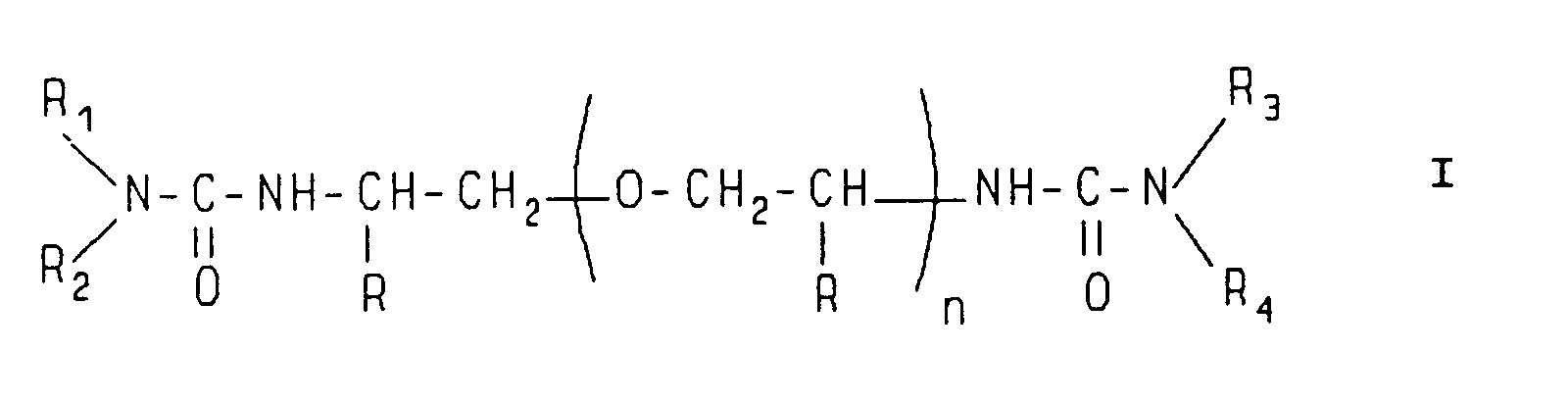
hydrogen, C6 - C18 aryl groups, C1 - C8 straight or branched chain alkyl groups and dialkylaminoalkyl groups having the structure:wherein R5 and R6 are the same or different C1-C8 straight or branched chain alkyl groups and m is 2-6. In the foregoing description, the term "aryl" specifically includes phenyl, substituted phenyl and naphthyl.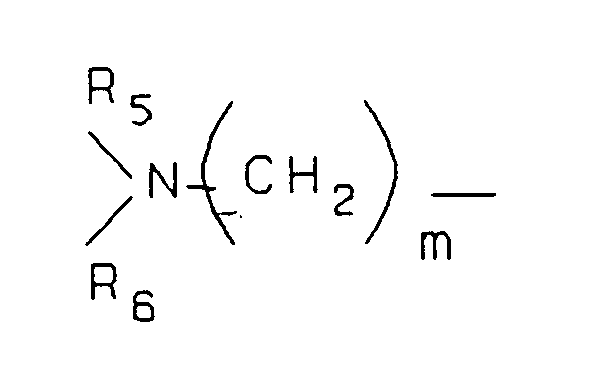
- Particularly preferred compositions of the invention include the following: a) composition I wherein R is hydrogen, n is 2, R1 and R3 are dialkylaminoethyl, R2 and R4 are hydrogen and R5 and R6 are ethyl; b) composition I wherein R is methyl, n is 3, R1 and R3 are hexyl, R2 and R4 are hydrogen and R5 and R6 are ethyl; c) composition I wherein R is methyl, n is 3, R1 and R3 are dialkylaminoethyl, R2 and R4 are hydrogen and R5 and R6 are ethyl.
- The invention further comprises a lithographic film article having high contrast qualities and developable in rapid access developers. The article comprises a film substrate having coated thereon a silver halide emulsion containing at least one hydrazine nucleating agent and the bis ureido composition I in an amount sufficient to improve the contrast enhancing qualities of the nucleating agent; typically, the molar ratio of nucleating agent to the bis ureido composition will be in the range of 100:1 to 0.1:1.
- The process for forming a high contrast photographic image comprises image-wise exposing a film article comprising a film substrate having coated thereon a silver halide emulsion containing at least one hydrazine nucleating agent and the bis ureido composition I in an amount sufficient to improve the contrast enhancing qualities of the nucleating agent and developing the image-wise exposed film article in a rapid access film developer.
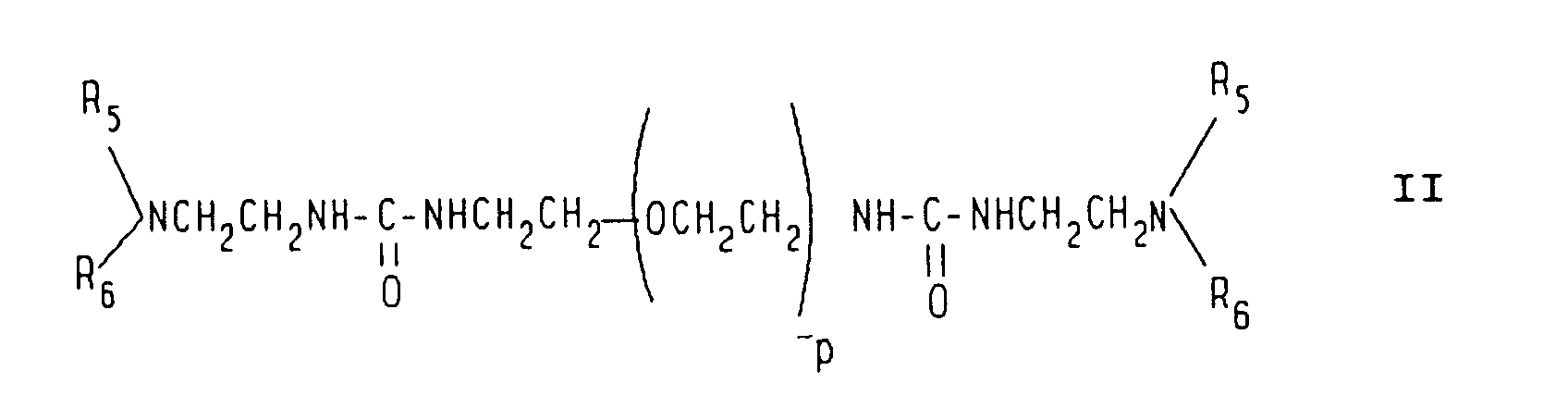
- More specific compounds derived from the general structure I and utilized as boosters in the invention consist of the following:
- a) bis ureido compounds with less than three
repeating ethyleneoxy groups linked to adsorption
enabling ureido groups having the structure:
wherein R5 and R6 are the same or different C1-C8 straight or branched chain alkyl groups, and p is 1-2. A particularly important compound comprises 1,8-[bis N',N''(diethylaminoethyl)ureido]-3,6-dioxaoctane having the structure:
 b) bis N',N''alkyl ureido compounds with z equal to 3 or more repeating propyleneoxy groups linked to adsorption enabling ureido groups; R1 and R3 are hydrogen and R2 and R4 are the same or different C1-C8 straight or branched chain alkyl groups, as shown for compound IV:
 A preferred version of compound IV is that in which z is 3, R is methyl and R2 and R4 are hexyl, i.e. 2,12-bis (N', N''-dihexylureido)-4,7,10-trioxatridecane.
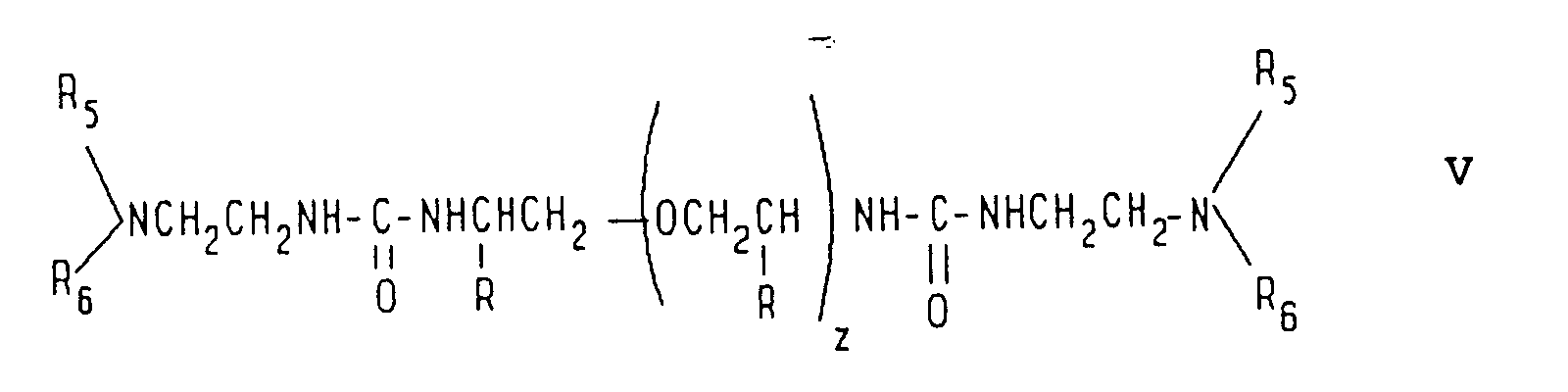
- c) bis ureido compounds having three or more repeating propyleneoxy groups linked to adsorption enabling ureido groups having the structure V:
-
- The boosters of the present invention provide ureido groups for better adsorption to the silver halide (AgX) surface, lower molecular weights in some cases and good solubility for limiting the amount of methanol added to the emulsion. They work efficiently at lower concentrations and are readily synthesized from available surfactants. They provide high contrast and low pepper when incorporated into the AgX emulsion with hydrazide nucleators. Also, these materials work at the lower pH of 10.8 with typical rapid access developer formulations requiring no special ingredients such as toxic amino alcohols. The booster may be used in a molar ratio of booster to silver halide of 0.0005:1 to 0.01:1, preferably 0.001:1 to 0.005:1.
- The following Examples illustrate the application of the novel boosters of the invention:
- A 100% AgBr emulsion was prepared by controlled double jet (CDJ) precipitation by adding 2N AgNO3 and 2N KBr to a receiver vessel containing 0.05µ AgBr seed crystals, an anti-foaming agent and gelatin for 60 minutes at 60°C at pAg of 7.0. This produced a monodispersed cubic emulsion with a grain size of 0.25µ. Sodium thiosulfate was added to the emulsion at 250µm/m AgBr and reacted for 35 minutes at 56°C to chemically sensitize the crystals. To this emulsion next were added gelatin, KI to yield 0.35 mole% I-, spectral sensitizing dyes 3-ethyl-2-(3-(1-ethyl-3-(4-sulfopropyl)-5-(trifluoromethyl)2-benzimidazolinylidene-propenyl)-1-(3-sulfopropyl)-5-trifluoromethyl)benzimidazolium, sodium salt at 63 mg/m AgBr, and 5-chloro-2-(2-((5-chloro-3-(3-sulfopropyl)-2-(3H)-benzoxazolylidene)methyl)-1-propenyl)-3-(3-sulfopropyl)benzoxazolium, triethylamine salt at 92 mg/m, sodium dioctylsulfosuccinate as a coating aid, a polyethylacrylate latex for dimensional stability, a sulfonamido nucleating agent (described in
- US-A-5,104,769, col. 5, compound 13, and prepared according to the process described therein in col 5, line 61 et seq.) at 0.4 to 1.9g/mole AgBr. Also, a booster of the invention, i.e. Compound III, (1,8-[bis N',N'' (diethylaminoethyl)ureido]-3,6-dioxaoctane), was added to the emulsion as described above for this Example and Example 2 in the amounts indicated in Tables I and II. These emulsions were then coated on a polyester base with a coating weight of 70 to 75mg AgBr/dm2. An overcoat of gelatin with surfactants and hardening agents was applied over the emulsion layer. The coatings were exposed through a continuous wedge with a tungsten halogen light source for about 6-12 seconds, then developed in a tray with Developer A or Eastman Kodak RA 2000 (commercially available) developer for 30 seconds at 38°C.
- The composition of Developer A formulation in g/l, pH 10.95, is as follows:
DI water 670 45% KOH 156 DTPA 15 IRGAFORM® 3000 3 Sodium Metabisulfite 124 Potassium Carbonate 64 Potassium Bromide 12 Dimezone-S 2 Hydroquinone 58 PMT 0.05 Benzotriazole 0.64 50% Sodium Hydroxide 46 Boric Acid 6 Diethylene glycol 110 Used at: pH = 10.8, 1 + 2 dilution, 30" - The results for Example 1 are tabulated in Table I. They show the large boost in line gradient when the booster 1,8-[bis N',N''(diethylaminoethyl)ureido]-3,6-dioxaoctane (Compound III) of the invention is added to the formulation.
Sample sulfonamido nucleator Cpd III Line gradient Relative 0.5 speed B+F 1 5x10⁻³m/m 0 4.8 100 0.04 2 5x10⁻³m/m 5x10⁻⁴m/m 12.1 108 0.04 3 5x10⁻³m/m 5x10⁻³m/m 24.8 113 0.04 - A small increase in speed is also seen in Table I as well as no increase in fogging despite the lack of antifogging agent in the emulsion formulation.
- An 80% chloride AgClBr emulsion was prepared by a simple balanced double jet (BDJ) addition of AgNO3 and NH4Cl with KBr, ethylene diamine, NaCl and RhCl6 -3 to a water-gelatin ethylene diamine solution for 15 minutes at 35°C. After a 15 minute ripening period, the emulsion was washed and redispersed. Sodium thiosulfate (hypo) was added at 34µm/m and reacted for 55 minutes at 50°C; two minutes after the hypo addition, merocyanine dye, 5-[(3-ethyl-2-thioazolidinylidene)ethylidene]-4-oxo-2-thioxo-3-thiazolidene acetic acid, was added at 3.9 x 10⁻⁴ m/m. These two additions chemically and spectrally sensitize the crystals. After 55 minutes, there added a tetrazaindene stabilizer, iodide at 0.25 mole %, Hcl for chloride adjustment and sulfuric acid for pH adjustment to 5.2. Gelatin was added next followed by sodium dioctylsulfosuccinate and a polyethylacrylate for dimensional stability. The further additions of sulfonamido nucleator of Example 1 with Compound III, 1,8-[bis N',N''(diethylaminoethyl) ureido]-3,6-dioxaoctane, are listed in Table II. These emulsions were then coated on a polyester base with a coating weight of 70 to 75 mg AgBr/dm2. An overcoat of gelatin with surfactants and hardening agents was applied over the emulsion layer. The coatings were exposed through a continuous wedge with a tungsten halogen light source for about 6 seconds, and developed in a tray with Developer A at 38°C for 30 seconds.
- Table II shows that the line gradient of the emulsion with nucleator alone is significantly improved as Compound III is added.
Sample sulfonamido nucleator Cpd III Line gradient Relative 0.5 speed B+F 4 2.5x10⁻³m/m 0 8.4 100 03 5 2.5x10⁻³m/m 5x10⁻⁴m/m 9.6 112 03 6 " 1x10⁻³m/m 12.2 115 03 7 " 5x10⁻³m/m 17.3 129 04 - An emulsion identical to Example 1 was used to test the booster activity of Compound IV, (2,12-bis(N',N''-dihexyl-ureido)-4, 7,10-trioxatridecane), with the sulfonamido nucleator of Example 1. The results are summarized in Table III.
Sample sulfonamido nucleator Cpd IV m/m Dev. Line gradient Relative 0.5 speed B+F 8 2.5x10⁻³m/m 0 A 8.4 100 04 9 " 7.5x10⁻⁴ A 9.8 136 05 10 " 0 RA2000 5.4 100 04 11 " 7.5x10⁻⁴ " 9.4 131 05 - Here, the addition of booster Compound IV at a low concentration of only 7.5 x 10⁻⁴ m/m AgBr shows almost a 100% boost in line gradient accompanied by a 30% increase in speed. Most commercially used boosters seem to require a minimum concentration of 1.0 x 10⁻³ m/m for gradient +/or speed boosting.
- An emulsion identical to Example 2 was used to test the booster activity of Compound V, 2,12-[bis N',N'' (diethylaminoethyl)ureido]-4,7,10-trioxatridecane, with the sulfonamido nucleator of Example 1. Developer A was used at a pH of 10.6. The results are summarized in Table IV.
Sample sulfonamido nucleator Cpd V m/m Dev. Line gradient Relative 0.5 speed B+F 12 2.5x10⁻³m/m 0 A 9.7 100 09 13 " 5.0x10⁻⁴ A 11.8 105 09 - It can be seen that the addition of the booster Compound V at a low concentration of only 5.0x10⁻⁴ m/m shows a 22% boost in line gradient accompanied by a small 5 % boost in speed. Again, no increase in fog is seen.
- The composition of the invention can be used with the 1-[(alkylbenzenesulfonamido)phenyl]-2-formylhydrazide nucleators described in US-A-5,104,769.
However, the composition of the invention can also be used with a wide variety of nucleators and is not limited to use with only sulfonamido hydrazide nucleators. Many families of hydrazine or hydrazide nucleators are known to those skilled in the art. The hydrazine compounds used in the emulsions of the invention include those represented by the following general formula, as described by way of example in US-A-4,323,643:
R-Ph-NHNH-CHO wherein R is hydrogen, or an alkoxy, alkyl, acylamino, phenyl, alkylphenyl, phenoxy, or alkylphenoxy moiety. - Amino-phthalimide hydrazide nucleators are also useful in the emulsions as represented by the following general formula described in US-A-4,882,261:wherein R is hydrogen or alkyl, alkoxy, acylamine, amidoamine or alkylamino.

- Other families of hydrazide and hydrazine nucleators useful in the present invention are described in US-A-4,912,016, US-A-4,988,604, US-A-4,994,365 and US-A-5,041,355.
- The following Examples present the method by which the specific booster compounds tested in the preceding Examples 1-4 were synthesized. Triethylene glycol diamine, polyoxypropylenediamines, phenyl chloroformate, pyridine and other reagents were obtained from commercial sources. Melting points are uncorrected and were determined on a Unimelt Thomas Hoover melting point apparatus. Infrared spectra were determined on a Beckman Acculab 9 infrared spectrophotometer.
- The synthesis was carried out according to the general procedures found in US-A-4,952,483:
- Phenyl chloroformate (156.5g, 1m) was added dropwise to a stirred solution of triethylene glycol diamine as obtained from Texaco (Jeffamine® EDR 148, 74g, 0.5m) and anhydrous pyridine (79g, 1m) in acetonitrile (600ml) at - 5°C. After stirring at room temperature for 6 hours, the reaction mixture was poured into excess of ice-water and extracted with methylene chloride. The methylene chloride layer was washed with water, saturated sodium chloride solution and dried over anhydrous magnesium sulfate. Evaporation of solvent on a rotary evaporator gave an oil which on addition of petroleum ether, turned to a solid. Crystallization from methylene chloride and isopropyl ether gave white solid 160g (82%) with a melting point of 69-71°C and infrared nujol (cm-1), main bands at 3320, 1700, 1530, 1270, 1205, 1135, 960, 760, 680.
- The above intermediate (58.2g, 0.15m) was dissolved in acetonitrile (250ml) and after adding N,N-diethylethylenediamine (34.8g, 0.30m), the solution was heated at 60-65°C for 2 hours. The reaction mixture was then evaporated to a small volume and poured into an excess of water. After extraction with methylene chloride and washing successively with 3-5% cold sodium hydroxide solution, water and sodium chloride solution, the organic layer was dried over anhydrous magnesium sulfate and evaporated on a rotary evaporator. The viscous oil was then heated to 100°C at 0.01mm/Hg to remove volatile materials and further dried in vacuo over P205. Yield 35.6g (55%) infrared (neat) cm-1, main bands at 3270, 1640, 1560, 1470, 1380, 1265, 1130.
- A solution of polyoxypropylenediamine, mol wt 230, (Jeffamine D-230®, 9.2g, 0.04m) in anhydrous acetonitrile (50ml) was cooled to -5°C. Hexylisocyanate (10.16g, 0.08m) in acetonitrile (20ml) was added dropwise. The reactants were stirred below 0°C for 1 hour and warmed to 40-50°C for 5 hours. After cooling to room temperature, the clear solution was decanted from a small amount of gum and evaporated on a rotary evaporator. The jelly-like material was dissolved in methylene chloride, washed with dilute hydrochloric acid (1%), water, saturated sodium chloride solution, and dried over anhydrous magnesium sulfate. Evaporation of solvent afforded jelly-like material which was heated to 80-90°C under vacuum (0.01 mm/Hg) to remove volatile materials. It was further dried in vacuo over P2O5: Yield 16.5g (82%); infrared, (neat) cm-1, main band 3340, 1630, 1560, 1460, 1370, 1250, 1110, 1030, 930, 770.
- Phenyl chloroformate (9.4g, 0.06m) was added dropwise to a stirred solution of polyoxypropylene diamine (Jeffamine® D-400, 12.66g, 0.0317m) and anhydrous pyridine (4.74g, 0.06m) in acetonitrile (60ml) at -5°C. After stirring at room temperature for 4 hours, the reaction mixture was poured into an excess of ice water and extracted with methylene chloride. The methylene chloride layer was washed with water, saturated sodium chloride solution and dried over magnesium sulfate. Evaporation of solvent on a rotary evaporator gave a dark viscous oil 20g, (95%) which could not be distilled. Infrared (neat) cm-1 main bands at 3320, 1720, 1590, 1475, 1370-1240, 1200, 1105, 1025, 930, 750.;
- The above intermediate (6.62g, 0.01m) was dissolved in 45ml of acetonitrile and after adding N,N-diethylethylene diamine (2.9g, 0.025m), the solution was heated at 60-65°C for 3-4 hours. The reaction mixture was then cooled to room temperature and poured into an excess of cold water and extracted with methylene chloride and washed successively with 3-5% cold sodium hydroxide solution, water and brine. The organic layer was dried over anhydrous magnesium sulfate and evaporated on a rotary evaporator and finally at 0.01mm/Hg to remove volatile materials and provide a dark viscous oil. Yield: 6.4g(90%), infrared (neat) cm-1 main bands 3340, 1630, 1550, 1450, 1375, 1250, 1100, 930.
Claims (14)
- A bis ureido compound having the structure:wherein R is a C1 - C8 straight or branched chain alkyl group or hydrogen and n is at least 3 when R is an alkyl group and at least 1 when R is hydrogen; and R1, R2, R3, and R4 are independently selected from
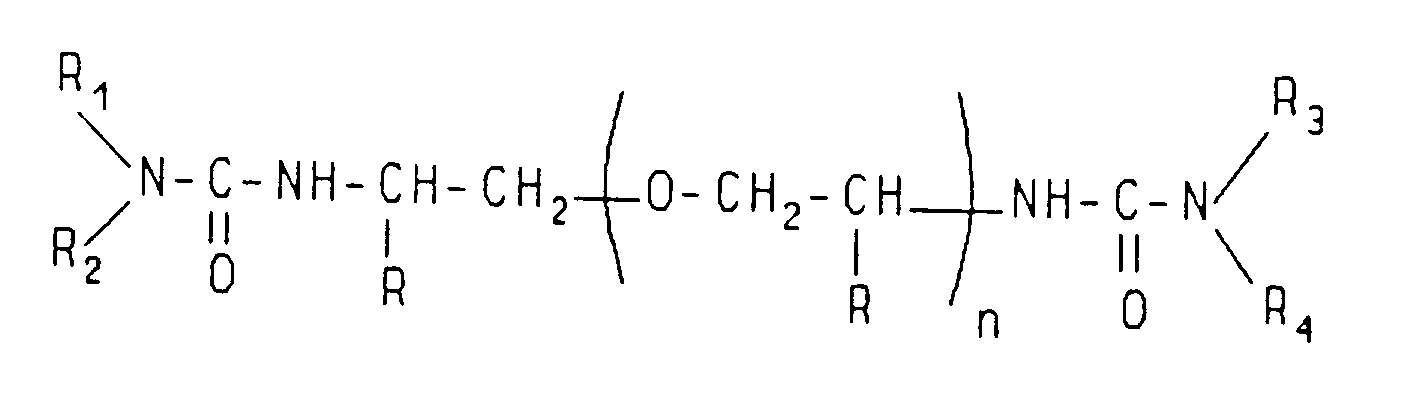
hydrogen, C6 - C18 aryl groups, C1 - C8 straight or branched chain alkyl groups and dialkylaminoalkyl groups having the structure:wherein R5 and R6 are the same or different C1-C8 straight or branched chain alkyl groups and m is 2-6.
- The compound of claim 1 comprising 1,8-[bis N',N''(diethylaminoethyl)ureido]-3,6-dioxaoctane having the structure:

- The compound of claim 1 wherein n is 2 to 13.
- The compound of claim 1 wherein R1 and R3 are hydrogen having the structure:wherein z is equal to 3 or more and the repeating propyleneoxy groups are linked to adsorption enabling ureido groups; R2 and R4 are the same or different C1-C8 straight or branched chain alkyl groups and R is a C1-C8 straight or branched chain alkyl group or hydrogen.

- The compound of claim 4 wherein z is 3, R is methyl and R2 and R4 are hexyl.
- The compound of claim 1 having the structure:wherein R is a C1 - C8 straight or branched chain alkyl group or hydrogen and z is at least 3 when R is an alkyl group and at least 1 when R is hydrogen; and R5 and R6 are the same or different C1-C8 straight or branched chain alkyl groups.

- The compound of claim 6 wherein z is 3, R is methyl and R5 and R6 are each ethyl.
- A lithographic film article comprising a film substrate having coated thereon a silver halide emulsion containing at least one hydrazine nucleating agent and the bis ureido compound of any of claims 1 to 7.
- The film article of claim 8 wherein said nucleating agent comprises a 1-[(alkylbenzenesulfonamido)phenyl]-2-formylhydrazide.
- The film article of claim 8 or 9 wherein said emulsion contains spectral sensitizing dyes.
- The film article of any of claims 8 to 10 wherein the molar ratio of nucleating agent to bis ureido compound is between 100:1 and 0.1:1.
- The film article of any of claims 8 to 11 wherein said emulsion contains between 1 x 10⁻² and 5 x 10⁻⁴ mole of bis ureido compound per mole of silver halide.
- A process for forming a high contrast photographic image comprising image-wise exposing a film article comprising a film substrate having coated thereon a silver halide emulsion containing at least one hydrazine nucleating agent and the bis ureido compound of any of claims 1 to 7 and developing said exposed film article in a rapid access film developer.
- The compounds 1,8-[bis N',N''-(diethylaminoethyl)ureido]-3,6-dioxaoctane, 2,12-bis(N',N''-dihexylureido)-4,7,10-trioxa-6,9-dimethyl tridecane and 2,21-[bis N',N''-(diethylaminoethyl)ureido]-4,7,10,13,16,19-hexaoxa-6,9,12,15,18-pentamethyldocasane.
Applications Claiming Priority (2)
| Application Number | Priority Date | Filing Date | Title |
|---|---|---|---|
| US08/118,556 US5380942A (en) | 1993-09-09 | 1993-09-09 | Bis ureido compositions |
| US118556 | 1993-09-09 |
Publications (2)
| Publication Number | Publication Date |
|---|---|
| EP0643043A1 EP0643043A1 (en) | 1995-03-15 |
| EP0643043B1 true EP0643043B1 (en) | 1999-04-14 |
Family
ID=22379342
Family Applications (1)
| Application Number | Title | Priority Date | Filing Date |
|---|---|---|---|
| EP94114104A Expired - Lifetime EP0643043B1 (en) | 1993-09-09 | 1994-09-08 | Novel bis ureido compounds and their use in lithographic films |
Country Status (5)
| Country | Link |
|---|---|
| US (2) | US5380942A (en) |
| EP (1) | EP0643043B1 (en) |
| AT (1) | ATE178887T1 (en) |
| CA (1) | CA2131613A1 (en) |
| DE (1) | DE69417826T2 (en) |
Families Citing this family (2)
| Publication number | Priority date | Publication date | Assignee | Title |
|---|---|---|---|---|
| US5939233A (en) * | 1997-04-17 | 1999-08-17 | Kodak Polychrome Graphics Llc | Nucleating agents for graphic arts films |
| PT3508620T (en) * | 2018-01-09 | 2021-07-12 | Atotech Deutschland Gmbh | Ureylene additive, its use and a preparation method therefor |
Family Cites Families (13)
| Publication number | Priority date | Publication date | Assignee | Title |
|---|---|---|---|---|
| US2398283A (en) * | 1941-01-13 | 1946-04-09 | Ici Ltd | Bisureas |
| NL299473A (en) * | 1962-10-19 | |||
| CH529100A (en) * | 1968-07-15 | 1972-10-15 | Hoechst Ag | Process for the production of amidomethylglycol or polyglycol formals |
| US4154724A (en) * | 1976-06-28 | 1979-05-15 | Texaco Development Corp. | Polyether polyureides and resinous compositions therefrom |
| US4115446A (en) * | 1976-11-22 | 1978-09-19 | Texaco Development Corp. | Polyether polyureides |
| US4110309A (en) * | 1976-11-22 | 1978-08-29 | Texaco Development Corporation | Polyether diureide epoxy additives |
| US4269929A (en) * | 1980-01-14 | 1981-05-26 | Eastman Kodak Company | High contrast development of photographic elements |
| JPH0736076B2 (en) * | 1986-03-24 | 1995-04-19 | 富士写真フイルム株式会社 | Silver halide photographic light-sensitive material and image forming method using the same |
| US5139921A (en) * | 1988-01-11 | 1992-08-18 | Fuji Photo Film Co., Ltd. | Process for forming super high contrast negative images |
| US5104769A (en) * | 1988-03-14 | 1992-04-14 | Eastman Kodak Company | High contrast photographic element and emulsion and process for their use |
| US4975354A (en) * | 1988-10-11 | 1990-12-04 | Eastman Kodak Company | Photographic element comprising an ethyleneoxy-substituted amino compound and process adapted to provide high constrast development |
| US5115056A (en) * | 1989-06-20 | 1992-05-19 | Ciba-Geigy Corporation | Fluorine and/or silicone containing poly(alkylene-oxide)-block copolymers and contact lenses thereof |
| US4988604A (en) * | 1990-05-24 | 1991-01-29 | Eastman Kodak Company | High contrast photographic element including an aryl sulfonamidophenyl hydrazide containing both thio and ethyleneoxy groups |
-
1993
- 1993-09-09 US US08/118,556 patent/US5380942A/en not_active Expired - Lifetime
-
1994
- 1994-06-23 US US08/264,826 patent/US5391459A/en not_active Expired - Lifetime
- 1994-09-07 CA CA002131613A patent/CA2131613A1/en not_active Abandoned
- 1994-09-08 DE DE69417826T patent/DE69417826T2/en not_active Expired - Fee Related
- 1994-09-08 AT AT94114104T patent/ATE178887T1/en not_active IP Right Cessation
- 1994-09-08 EP EP94114104A patent/EP0643043B1/en not_active Expired - Lifetime
Also Published As
| Publication number | Publication date |
|---|---|
| US5380942A (en) | 1995-01-10 |
| DE69417826T2 (en) | 2000-01-05 |
| DE69417826D1 (en) | 1999-05-20 |
| EP0643043A1 (en) | 1995-03-15 |
| CA2131613A1 (en) | 1995-03-10 |
| ATE178887T1 (en) | 1999-04-15 |
| US5391459A (en) | 1995-02-21 |
Similar Documents
| Publication | Publication Date | Title |
|---|---|---|
| US3241967A (en) | Photographic developer composition containing 2-hydroxymethyl-3-pyrazolidones | |
| US5158856A (en) | Silver halide photographic light-sensitive material capable of providing a high contrast image | |
| JP2903405B2 (en) | Processing method of silver halide photographic material | |
| US5380942A (en) | Bis ureido compositions | |
| JPH0833604B2 (en) | Image forming method of silver halide photographic light-sensitive material capable of obtaining high-contrast image | |
| US5283158A (en) | Silver halide photographic light-sensitive material | |
| US3977881A (en) | Acylurea compounds | |
| EP0596983B1 (en) | Mono- and difluoroacetylphenyl hydrazine compounds as silver halide adjuvants | |
| JPH0690454B2 (en) | Method for high contrast development of image-wise exposed photographic silver halide emulsion layer materials. | |
| US5141843A (en) | Developer liquid for high contrast development | |
| JPH05232618A (en) | Silver halide photographic sensitive material | |
| JP3131660B2 (en) | Processing method for silver halide black and white photographic materials | |
| EP0399847A2 (en) | Silver halide photographic light-sensitive material | |
| JP2835644B2 (en) | Silver halide photographic material | |
| EP0928987A2 (en) | Photographic silver halide material | |
| JP3505228B2 (en) | 2,6-di-tert-alkyl-4-alkylcyclohexanols | |
| JP2995363B2 (en) | Silver halide photographic material | |
| JP2709775B2 (en) | New dicarbamoyl ditelluride compounds | |
| JP3057248B2 (en) | Silver halide photographic material | |
| US6100021A (en) | Sensitization of silver halide | |
| JPH07244351A (en) | Production of silver halide photographic sensitive material | |
| JPH10501269A (en) | N-alkylhydroxylamine derivatives and their use as antioxidants in photographic color developers and photographic processing methods | |
| JPH06289520A (en) | Silver halide photographic sensitive material | |
| JPH0456842A (en) | Silver halide photographic sensitive material | |
| JPS5952819B2 (en) | Image forming method for silver halide photographic material |
Legal Events
| Date | Code | Title | Description |
|---|---|---|---|
| PUAI | Public reference made under article 153(3) epc to a published international application that has entered the european phase |
Free format text: ORIGINAL CODE: 0009012 |
|
| AK | Designated contracting states |
Kind code of ref document: A1 Designated state(s): AT BE CH DE DK ES FR GB IT LI NL PT SE |
|
| 17P | Request for examination filed |
Effective date: 19950904 |
|
| 17Q | First examination report despatched |
Effective date: 19960911 |
|
| GRAG | Despatch of communication of intention to grant |
Free format text: ORIGINAL CODE: EPIDOS AGRA |
|
| RAP1 | Party data changed (applicant data changed or rights of an application transferred) |
Owner name: KODAK POLYCHROME GRAPHICS LLC |
|
| GRAG | Despatch of communication of intention to grant |
Free format text: ORIGINAL CODE: EPIDOS AGRA |
|
| GRAG | Despatch of communication of intention to grant |
Free format text: ORIGINAL CODE: EPIDOS AGRA |
|
| GRAH | Despatch of communication of intention to grant a patent |
Free format text: ORIGINAL CODE: EPIDOS IGRA |
|
| RAP1 | Party data changed (applicant data changed or rights of an application transferred) |
Owner name: KODAK POLYCHROME GRAPHICS LLC |
|
| GRAH | Despatch of communication of intention to grant a patent |
Free format text: ORIGINAL CODE: EPIDOS IGRA |
|
| GRAA | (expected) grant |
Free format text: ORIGINAL CODE: 0009210 |
|
| AK | Designated contracting states |
Kind code of ref document: B1 Designated state(s): AT BE CH DE DK ES FR GB IT LI NL PT SE |
|
| PG25 | Lapsed in a contracting state [announced via postgrant information from national office to epo] |
Ref country code: SE Free format text: THE PATENT HAS BEEN ANNULLED BY A DECISION OF A NATIONAL AUTHORITY Effective date: 19990414 Ref country code: NL Free format text: LAPSE BECAUSE OF FAILURE TO SUBMIT A TRANSLATION OF THE DESCRIPTION OR TO PAY THE FEE WITHIN THE PRESCRIBED TIME-LIMIT Effective date: 19990414 Ref country code: LI Free format text: LAPSE BECAUSE OF FAILURE TO SUBMIT A TRANSLATION OF THE DESCRIPTION OR TO PAY THE FEE WITHIN THE PRESCRIBED TIME-LIMIT Effective date: 19990414 Ref country code: IT Free format text: LAPSE BECAUSE OF FAILURE TO SUBMIT A TRANSLATION OF THE DESCRIPTION OR TO PAY THE FEE WITHIN THE PRESCRIBED TIME-LIMIT;WARNING: LAPSES OF ITALIAN PATENTS WITH EFFECTIVE DATE BEFORE 2007 MAY HAVE OCCURRED AT ANY TIME BEFORE 2007. THE CORRECT EFFECTIVE DATE MAY BE DIFFERENT FROM THE ONE RECORDED. Effective date: 19990414 Ref country code: ES Free format text: THE PATENT HAS BEEN ANNULLED BY A DECISION OF A NATIONAL AUTHORITY Effective date: 19990414 Ref country code: CH Free format text: LAPSE BECAUSE OF FAILURE TO SUBMIT A TRANSLATION OF THE DESCRIPTION OR TO PAY THE FEE WITHIN THE PRESCRIBED TIME-LIMIT Effective date: 19990414 Ref country code: BE Free format text: LAPSE BECAUSE OF FAILURE TO SUBMIT A TRANSLATION OF THE DESCRIPTION OR TO PAY THE FEE WITHIN THE PRESCRIBED TIME-LIMIT Effective date: 19990414 Ref country code: AT Free format text: LAPSE BECAUSE OF FAILURE TO SUBMIT A TRANSLATION OF THE DESCRIPTION OR TO PAY THE FEE WITHIN THE PRESCRIBED TIME-LIMIT Effective date: 19990414 |
|
| REF | Corresponds to: |
Ref document number: 178887 Country of ref document: AT Date of ref document: 19990415 Kind code of ref document: T |
|
| REG | Reference to a national code |
Ref country code: CH Ref legal event code: EP |
|
| REF | Corresponds to: |
Ref document number: 69417826 Country of ref document: DE Date of ref document: 19990520 |
|
| ET | Fr: translation filed | ||
| PG25 | Lapsed in a contracting state [announced via postgrant information from national office to epo] |
Ref country code: PT Free format text: LAPSE BECAUSE OF FAILURE TO SUBMIT A TRANSLATION OF THE DESCRIPTION OR TO PAY THE FEE WITHIN THE PRESCRIBED TIME-LIMIT Effective date: 19990714 Ref country code: DK Free format text: LAPSE BECAUSE OF FAILURE TO SUBMIT A TRANSLATION OF THE DESCRIPTION OR TO PAY THE FEE WITHIN THE PRESCRIBED TIME-LIMIT Effective date: 19990714 |
|
| NLV1 | Nl: lapsed or annulled due to failure to fulfill the requirements of art. 29p and 29m of the patents act | ||
| REG | Reference to a national code |
Ref country code: CH Ref legal event code: PL |
|
| PLBE | No opposition filed within time limit |
Free format text: ORIGINAL CODE: 0009261 |
|
| STAA | Information on the status of an ep patent application or granted ep patent |
Free format text: STATUS: NO OPPOSITION FILED WITHIN TIME LIMIT |
|
| 26N | No opposition filed | ||
| REG | Reference to a national code |
Ref country code: GB Ref legal event code: IF02 |
|
| PGFP | Annual fee paid to national office [announced via postgrant information from national office to epo] |
Ref country code: GB Payment date: 20020904 Year of fee payment: 9 |
|
| PGFP | Annual fee paid to national office [announced via postgrant information from national office to epo] |
Ref country code: FR Payment date: 20020910 Year of fee payment: 9 |
|
| PGFP | Annual fee paid to national office [announced via postgrant information from national office to epo] |
Ref country code: DE Payment date: 20020911 Year of fee payment: 9 |
|
| PG25 | Lapsed in a contracting state [announced via postgrant information from national office to epo] |
Ref country code: GB Free format text: LAPSE BECAUSE OF NON-PAYMENT OF DUE FEES Effective date: 20030908 |
|
| PG25 | Lapsed in a contracting state [announced via postgrant information from national office to epo] |
Ref country code: DE Free format text: LAPSE BECAUSE OF NON-PAYMENT OF DUE FEES Effective date: 20040401 |
|
| GBPC | Gb: european patent ceased through non-payment of renewal fee |
Effective date: 20030908 |
|
| PG25 | Lapsed in a contracting state [announced via postgrant information from national office to epo] |
Ref country code: FR Free format text: LAPSE BECAUSE OF NON-PAYMENT OF DUE FEES Effective date: 20040528 |
|
| REG | Reference to a national code |
Ref country code: FR Ref legal event code: ST |