EP0640076B1 - Triazolinone ring formation in tert-butanol - Google Patents
Triazolinone ring formation in tert-butanol Download PDFInfo
- Publication number
- EP0640076B1 EP0640076B1 EP93910901A EP93910901A EP0640076B1 EP 0640076 B1 EP0640076 B1 EP 0640076B1 EP 93910901 A EP93910901 A EP 93910901A EP 93910901 A EP93910901 A EP 93910901A EP 0640076 B1 EP0640076 B1 EP 0640076B1
- Authority
- EP
- European Patent Office
- Prior art keywords
- tert
- butanol
- formula
- moles
- aryl
- Prior art date
- Legal status (The legal status is an assumption and is not a legal conclusion. Google has not performed a legal analysis and makes no representation as to the accuracy of the status listed.)
- Expired - Lifetime
Links
- DKGAVHZHDRPRBM-UHFFFAOYSA-N Tert-Butanol Chemical compound CC(C)(C)O DKGAVHZHDRPRBM-UHFFFAOYSA-N 0.000 title claims abstract description 172
- IZBNNCFOBMGTQX-UHFFFAOYSA-N etoperidone Chemical group O=C1N(CC)C(CC)=NN1CCCN1CCN(C=2C=C(Cl)C=CC=2)CC1 IZBNNCFOBMGTQX-UHFFFAOYSA-N 0.000 title claims 4
- 238000007363 ring formation reaction Methods 0.000 title 1
- -1 nitro, hydroxy Chemical group 0.000 claims abstract description 43
- 238000000034 method Methods 0.000 claims abstract description 37
- 230000008569 process Effects 0.000 claims abstract description 34
- OAKJQQAXSVQMHS-UHFFFAOYSA-N hydrazine Substances NN OAKJQQAXSVQMHS-UHFFFAOYSA-N 0.000 claims abstract description 19
- 238000004519 manufacturing process Methods 0.000 claims abstract description 19
- 125000000217 alkyl group Chemical group 0.000 claims abstract description 15
- 229910052736 halogen Inorganic materials 0.000 claims abstract description 11
- 150000002367 halogens Chemical class 0.000 claims abstract description 10
- 150000007524 organic acids Chemical class 0.000 claims abstract description 9
- 125000003118 aryl group Chemical group 0.000 claims abstract description 8
- 150000003839 salts Chemical class 0.000 claims abstract description 6
- 125000002485 formyl group Chemical class [H]C(*)=O 0.000 claims abstract 5
- XLYOFNOQVPJJNP-UHFFFAOYSA-N water Substances O XLYOFNOQVPJJNP-UHFFFAOYSA-N 0.000 claims description 74
- QTBSBXVTEAMEQO-UHFFFAOYSA-N Acetic acid Chemical compound CC(O)=O QTBSBXVTEAMEQO-UHFFFAOYSA-N 0.000 claims description 62
- 229960005437 etoperidone Drugs 0.000 claims description 16
- 125000004432 carbon atom Chemical group C* 0.000 claims description 13
- 239000002253 acid Substances 0.000 claims description 8
- 238000010923 batch production Methods 0.000 claims description 6
- 239000012429 reaction media Substances 0.000 claims description 6
- 229910052783 alkali metal Inorganic materials 0.000 claims description 5
- 125000002496 methyl group Chemical group [H]C([H])([H])* 0.000 claims description 5
- 125000004435 hydrogen atom Chemical group [H]* 0.000 claims description 3
- WKBOTKDWSSQWDR-UHFFFAOYSA-N Bromine atom Chemical compound [Br] WKBOTKDWSSQWDR-UHFFFAOYSA-N 0.000 claims description 2
- ZAMOUSCENKQFHK-UHFFFAOYSA-N Chlorine atom Chemical compound [Cl] ZAMOUSCENKQFHK-UHFFFAOYSA-N 0.000 claims description 2
- GDTBXPJZTBHREO-UHFFFAOYSA-N bromine Substances BrBr GDTBXPJZTBHREO-UHFFFAOYSA-N 0.000 claims description 2
- 229910052794 bromium Inorganic materials 0.000 claims description 2
- 229910052801 chlorine Inorganic materials 0.000 claims description 2
- 239000000460 chlorine Substances 0.000 claims description 2
- ZCYVEMRRCGMTRW-UHFFFAOYSA-N 7553-56-2 Chemical compound [I] ZCYVEMRRCGMTRW-UHFFFAOYSA-N 0.000 claims 1
- 229910052739 hydrogen Inorganic materials 0.000 claims 1
- 239000001257 hydrogen Substances 0.000 claims 1
- 229910052740 iodine Inorganic materials 0.000 claims 1
- 239000011630 iodine Substances 0.000 claims 1
- XLJMAIOERFSOGZ-UHFFFAOYSA-M cyanate Chemical compound [O-]C#N XLJMAIOERFSOGZ-UHFFFAOYSA-M 0.000 abstract description 3
- 125000005843 halogen group Chemical group 0.000 abstract description 2
- WQYVRQLZKVEZGA-UHFFFAOYSA-N hypochlorite Chemical compound Cl[O-] WQYVRQLZKVEZGA-UHFFFAOYSA-N 0.000 abstract 2
- 239000011541 reaction mixture Substances 0.000 description 70
- 238000006243 chemical reaction Methods 0.000 description 26
- 229960000583 acetic acid Drugs 0.000 description 20
- 239000000243 solution Substances 0.000 description 20
- ZVCDLGYNFYZZOK-UHFFFAOYSA-M sodium cyanate Chemical compound [Na]OC#N ZVCDLGYNFYZZOK-UHFFFAOYSA-M 0.000 description 18
- IKHGUXGNUITLKF-UHFFFAOYSA-N Acetaldehyde Chemical compound CC=O IKHGUXGNUITLKF-UHFFFAOYSA-N 0.000 description 14
- 239000000047 product Substances 0.000 description 14
- WNWOTMKHOLCHRJ-UHFFFAOYSA-N 1,4-dihydrotriazol-5-one Chemical compound O=C1CN=NN1 WNWOTMKHOLCHRJ-UHFFFAOYSA-N 0.000 description 11
- 239000005708 Sodium hypochlorite Substances 0.000 description 11
- SUKJFIGYRHOWBL-UHFFFAOYSA-N sodium hypochlorite Chemical compound [Na+].Cl[O-] SUKJFIGYRHOWBL-UHFFFAOYSA-N 0.000 description 11
- CDBYLPFSWZWCQE-UHFFFAOYSA-L Sodium Carbonate Chemical compound [Na+].[Na+].[O-]C([O-])=O CDBYLPFSWZWCQE-UHFFFAOYSA-L 0.000 description 10
- 238000002360 preparation method Methods 0.000 description 10
- 239000000376 reactant Substances 0.000 description 9
- 239000002002 slurry Substances 0.000 description 9
- 238000003756 stirring Methods 0.000 description 9
- QPBMZCGEAIGPEY-UHFFFAOYSA-N 5-methyl-2-phenyl-1h-1,2,4-triazol-3-one Chemical compound N1C(C)=NC(=O)N1C1=CC=CC=C1 QPBMZCGEAIGPEY-UHFFFAOYSA-N 0.000 description 8
- 150000001299 aldehydes Chemical class 0.000 description 8
- 238000004821 distillation Methods 0.000 description 8
- 239000007858 starting material Substances 0.000 description 8
- 150000007857 hydrazones Chemical class 0.000 description 7
- FAPWRFPIFSIZLT-UHFFFAOYSA-M Sodium chloride Chemical compound [Na+].[Cl-] FAPWRFPIFSIZLT-UHFFFAOYSA-M 0.000 description 6
- 238000010438 heat treatment Methods 0.000 description 6
- 239000000203 mixture Substances 0.000 description 6
- HKOOXMFOFWEVGF-UHFFFAOYSA-N phenylhydrazine Chemical compound NNC1=CC=CC=C1 HKOOXMFOFWEVGF-UHFFFAOYSA-N 0.000 description 6
- 229940067157 phenylhydrazine Drugs 0.000 description 6
- 239000007787 solid Substances 0.000 description 6
- 239000007864 aqueous solution Substances 0.000 description 5
- 239000012535 impurity Substances 0.000 description 5
- 229910000029 sodium carbonate Inorganic materials 0.000 description 5
- IMNFDUFMRHMDMM-UHFFFAOYSA-N N-Heptane Chemical compound CCCCCCC IMNFDUFMRHMDMM-UHFFFAOYSA-N 0.000 description 4
- 239000008346 aqueous phase Substances 0.000 description 4
- 238000001914 filtration Methods 0.000 description 4
- 238000005755 formation reaction Methods 0.000 description 4
- 150000002432 hydroperoxides Chemical class 0.000 description 4
- 239000000543 intermediate Substances 0.000 description 4
- 125000001997 phenyl group Chemical group [H]C1=C([H])C([H])=C(*)C([H])=C1[H] 0.000 description 4
- 239000002904 solvent Substances 0.000 description 4
- HEMHJVSKTPXQMS-UHFFFAOYSA-M Sodium hydroxide Chemical compound [OH-].[Na+] HEMHJVSKTPXQMS-UHFFFAOYSA-M 0.000 description 3
- 150000001298 alcohols Chemical class 0.000 description 3
- 230000015572 biosynthetic process Effects 0.000 description 3
- 238000011031 large-scale manufacturing process Methods 0.000 description 3
- 239000011780 sodium chloride Substances 0.000 description 3
- DYFVFCJGOSGDKA-UHFFFAOYSA-N 1-phenyltriazolidin-4-one Chemical compound N1NC(=O)CN1C1=CC=CC=C1 DYFVFCJGOSGDKA-UHFFFAOYSA-N 0.000 description 2
- CMCHJOMWXMRIDO-UHFFFAOYSA-N 2-(4-chlorophenyl)-5-methyl-1h-1,2,4-triazol-3-one Chemical compound O=C1NC(C)=NN1C1=CC=C(Cl)C=C1 CMCHJOMWXMRIDO-UHFFFAOYSA-N 0.000 description 2
- GZHGJANWGGNBRJ-UHFFFAOYSA-N 5-methyl-2-phenyl-1,2,4-triazolidin-3-one Chemical compound O=C1NC(C)NN1C1=CC=CC=C1 GZHGJANWGGNBRJ-UHFFFAOYSA-N 0.000 description 2
- IJGRMHOSHXDMSA-UHFFFAOYSA-N Atomic nitrogen Chemical compound N#N IJGRMHOSHXDMSA-UHFFFAOYSA-N 0.000 description 2
- FERIUCNNQQJTOY-UHFFFAOYSA-N Butyric acid Chemical compound CCCC(O)=O FERIUCNNQQJTOY-UHFFFAOYSA-N 0.000 description 2
- 238000011021 bench scale process Methods 0.000 description 2
- 238000005119 centrifugation Methods 0.000 description 2
- XBDQKXXYIPTUBI-UHFFFAOYSA-N dimethylselenoniopropionate Natural products CCC(O)=O XBDQKXXYIPTUBI-UHFFFAOYSA-N 0.000 description 2
- 239000007789 gas Substances 0.000 description 2
- 239000004009 herbicide Substances 0.000 description 2
- 239000013067 intermediate product Substances 0.000 description 2
- 238000002955 isolation Methods 0.000 description 2
- 150000002576 ketones Chemical class 0.000 description 2
- VWONRLCRTWBFHH-UHFFFAOYSA-N n-[2,4-dichloro-5-(5-methyl-3-oxo-1h-1,2,4-triazol-2-yl)phenyl]methanesulfonamide Chemical compound N1C(C)=NC(=O)N1C1=CC(NS(C)(=O)=O)=C(Cl)C=C1Cl VWONRLCRTWBFHH-UHFFFAOYSA-N 0.000 description 2
- 238000007086 side reaction Methods 0.000 description 2
- XPCUCLZMXMWSNS-UHFFFAOYSA-N (4-chloro-2-fluorophenyl)hydrazine Chemical compound NNC1=CC=C(Cl)C=C1F XPCUCLZMXMWSNS-UHFFFAOYSA-N 0.000 description 1
- MUZVVLYZSISWDW-UHFFFAOYSA-N 1-phenyl-4h-triazol-5-one Chemical compound O=C1CN=NN1C1=CC=CC=C1 MUZVVLYZSISWDW-UHFFFAOYSA-N 0.000 description 1
- BTGAATKPDODCIK-UHFFFAOYSA-N 2-(4-chloro-2-fluorophenyl)-5-methyl-1h-1,2,4-triazol-3-one Chemical compound O=C1NC(C)=NN1C1=CC=C(Cl)C=C1F BTGAATKPDODCIK-UHFFFAOYSA-N 0.000 description 1
- XXNOGQJZAOXWAQ-UHFFFAOYSA-N 4-chlorophenylhydrazine Chemical compound NNC1=CC=C(Cl)C=C1 XXNOGQJZAOXWAQ-UHFFFAOYSA-N 0.000 description 1
- KZBUYRJDOAKODT-UHFFFAOYSA-N Chlorine Chemical compound ClCl KZBUYRJDOAKODT-UHFFFAOYSA-N 0.000 description 1
- LFQSCWFLJHTTHZ-UHFFFAOYSA-N Ethanol Chemical compound CCO LFQSCWFLJHTTHZ-UHFFFAOYSA-N 0.000 description 1
- PXGOKWXKJXAPGV-UHFFFAOYSA-N Fluorine Chemical compound FF PXGOKWXKJXAPGV-UHFFFAOYSA-N 0.000 description 1
- DGAQECJNVWCQMB-PUAWFVPOSA-M Ilexoside XXIX Chemical compound C[C@@H]1CC[C@@]2(CC[C@@]3(C(=CC[C@H]4[C@]3(CC[C@@H]5[C@@]4(CC[C@@H](C5(C)C)OS(=O)(=O)[O-])C)C)[C@@H]2[C@]1(C)O)C)C(=O)O[C@H]6[C@@H]([C@H]([C@@H]([C@H](O6)CO)O)O)O.[Na+] DGAQECJNVWCQMB-PUAWFVPOSA-M 0.000 description 1
- ZLMJMSJWJFRBEC-UHFFFAOYSA-N Potassium Chemical compound [K] ZLMJMSJWJFRBEC-UHFFFAOYSA-N 0.000 description 1
- 238000013019 agitation Methods 0.000 description 1
- 125000003545 alkoxy group Chemical group 0.000 description 1
- 230000008901 benefit Effects 0.000 description 1
- 238000009835 boiling Methods 0.000 description 1
- 230000005587 bubbling Effects 0.000 description 1
- RRRRYSBZDXHZQL-UHFFFAOYSA-L calcium;dicyanate Chemical class [Ca+2].[O-]C#N.[O-]C#N RRRRYSBZDXHZQL-UHFFFAOYSA-L 0.000 description 1
- 230000008859 change Effects 0.000 description 1
- 239000007795 chemical reaction product Substances 0.000 description 1
- 239000003153 chemical reaction reagent Substances 0.000 description 1
- 238000005660 chlorination reaction Methods 0.000 description 1
- 238000004587 chromatography analysis Methods 0.000 description 1
- 150000001875 compounds Chemical class 0.000 description 1
- 238000011109 contamination Methods 0.000 description 1
- 150000001913 cyanates Chemical class 0.000 description 1
- 238000000354 decomposition reaction Methods 0.000 description 1
- 230000003467 diminishing effect Effects 0.000 description 1
- 239000002360 explosive Substances 0.000 description 1
- 238000000605 extraction Methods 0.000 description 1
- 229910052731 fluorine Inorganic materials 0.000 description 1
- 239000011737 fluorine Substances 0.000 description 1
- 238000004817 gas chromatography Methods 0.000 description 1
- 239000012362 glacial acetic acid Substances 0.000 description 1
- JLRMRTRHBRVQMS-UHFFFAOYSA-N hydrogen peroxide;2-methylpropan-2-ol Chemical compound OO.CC(C)(C)O JLRMRTRHBRVQMS-UHFFFAOYSA-N 0.000 description 1
- 239000000463 material Substances 0.000 description 1
- 239000013028 medium composition Substances 0.000 description 1
- 238000012986 modification Methods 0.000 description 1
- 230000004048 modification Effects 0.000 description 1
- UCFTXVWTTSEUBZ-UHFFFAOYSA-N n-(2,4-dichloro-5-hydrazinylphenyl)methanesulfonamide Chemical compound CS(=O)(=O)NC1=CC(NN)=C(Cl)C=C1Cl UCFTXVWTTSEUBZ-UHFFFAOYSA-N 0.000 description 1
- KURBTRNHGDQKOS-XNWCZRBMSA-N n-[(e)-ethylideneamino]aniline Chemical compound C\C=N\NC1=CC=CC=C1 KURBTRNHGDQKOS-XNWCZRBMSA-N 0.000 description 1
- 229910052757 nitrogen Inorganic materials 0.000 description 1
- 239000003960 organic solvent Substances 0.000 description 1
- 239000007800 oxidant agent Substances 0.000 description 1
- 230000003647 oxidation Effects 0.000 description 1
- 238000007254 oxidation reaction Methods 0.000 description 1
- 230000001590 oxidative effect Effects 0.000 description 1
- 238000006116 polymerization reaction Methods 0.000 description 1
- 229910052700 potassium Inorganic materials 0.000 description 1
- 239000011591 potassium Substances 0.000 description 1
- 239000002244 precipitate Substances 0.000 description 1
- 238000011112 process operation Methods 0.000 description 1
- 235000019260 propionic acid Nutrition 0.000 description 1
- 238000000746 purification Methods 0.000 description 1
- IUVKMZGDUIUOCP-BTNSXGMBSA-N quinbolone Chemical compound O([C@H]1CC[C@H]2[C@H]3[C@@H]([C@]4(C=CC(=O)C=C4CC3)C)CC[C@@]21C)C1=CCCC1 IUVKMZGDUIUOCP-BTNSXGMBSA-N 0.000 description 1
- 230000035484 reaction time Effects 0.000 description 1
- 230000009467 reduction Effects 0.000 description 1
- 238000000926 separation method Methods 0.000 description 1
- 229910052708 sodium Inorganic materials 0.000 description 1
- 239000011734 sodium Substances 0.000 description 1
- 125000000999 tert-butyl group Chemical group [H]C([H])([H])C(*)(C([H])([H])[H])C([H])([H])[H] 0.000 description 1
- 238000004809 thin layer chromatography Methods 0.000 description 1
- 238000005406 washing Methods 0.000 description 1
- 239000002699 waste material Substances 0.000 description 1
Classifications
-
- C—CHEMISTRY; METALLURGY
- C07—ORGANIC CHEMISTRY
- C07D—HETEROCYCLIC COMPOUNDS
- C07D249/00—Heterocyclic compounds containing five-membered rings having three nitrogen atoms as the only ring hetero atoms
- C07D249/02—Heterocyclic compounds containing five-membered rings having three nitrogen atoms as the only ring hetero atoms not condensed with other rings
- C07D249/08—1,2,4-Triazoles; Hydrogenated 1,2,4-triazoles
- C07D249/10—1,2,4-Triazoles; Hydrogenated 1,2,4-triazoles with hetero atoms or with carbon atoms having three bonds to hetero atoms with at the most one bond to halogen, e.g. ester or nitrile radicals, directly attached to ring carbon atoms
- C07D249/12—Oxygen or sulfur atoms
-
- C—CHEMISTRY; METALLURGY
- C07—ORGANIC CHEMISTRY
- C07C—ACYCLIC OR CARBOCYCLIC COMPOUNDS
- C07C249/00—Preparation of compounds containing nitrogen atoms doubly-bound to a carbon skeleton
- C07C249/16—Preparation of compounds containing nitrogen atoms doubly-bound to a carbon skeleton of hydrazones
Definitions
- This invention relates to the production of 1-aryl-1,2,4-triazolin-5-ones in a medium of tert-butanol.
- United States Patent 4,980,480 discloses a process for producing 1-aryl-1,2,4-triazolin-5-ones by treating an aryl triazolidinone with a hypohalous acid, a salt thereof, or a halogen.
- the triazolidinone may be produced by reacting an appropriate aryl hydrazine with an aldehyde to give the corresponding hydrazone followed by treatment with an alkali metal cyanate to give the triazolidinone.
- a medium is preferred in which the triazolidinone is at least partially soluble.
- Acetic acid is said to be a very suitable medium.
- a 1-aryl-1,2,4-triazolidin-5-one is treated in a medium of tert-butanol with a hypohalous acid, a salt thereof, or a halogen to form the corresponding triazolinone.
- the reaction proceeds rapidly at relatively low temperatures to give high yields in short reaction times.
- the triazolidinone may be produced in high yields in a medium of tert-butanol by reacting an aryl hydrazone with an alkali metal cyanate.
- the aryl hydrazone may in turn be produced by the reaction of an aryl hydrazine with an aldehyde in a tert-butanol medium.
- the tert-butanol medium may be anhydrous tert-butanol or preferably a mixture of tert-butanol and water.
- both high yields and high purity of triazolinone product may be obtained in large scale production (for example with 2 lb-mole (907 moles) of the aryl hydrazine starting material using a 500 gallon (1893 liter) reactor).
- sequential steps of the process may be conducted in a single reactor by sequentially adding the reactants without the need to isolate or purify the intermediate products.
- the large scale as well as bench scale triazolinone product may be isolated and used directly in subsequent reactions such as difluoromethylation of the N-4 nitrogen of the triazolinone ring, or chlorination of the benzene ring.
- the medium of choice was acetic acid/water (U.S. 4,980,480).
- product results were found to be variable. Triazolinone yields and purity were considerably lower than could be obtained at bench scale production, and the formation of increased side reaction products routinely required that the triazolinone be further purified before it could be used in subsequent reactions.
- the isolation of the triazolinone or triazolidinone product may be easily effected by distilling off the 88/12 (wt/wt) tert-butanol/water azeotrope (BP 80°C) which can be recycled for use in subsequent production.
- the product may thereby be recovered without resorting to extraction with organic solvents or energy intensive solvent removal of large amounts of higher boiling solvents such as water (BP 100°C) or acetic acid (BP 118°C).
- the process of this invention therefore may require lower energy use, provide a purer and less costly product, and be suitable for large scale operations.
- alcohols may be oxidized to their hydroperoxides.
- the hydroperoxides of most alcohols which might commonly be used as a reaction medium may then decompose to give aldehydes or ketones. If recycled with the tert-butanol medium such aldehydes or ketones could compete in the formation of the hydrazone, thereby contaminating the reaction system with unwanted products.
- the tert-butanol hydroperoxide, however, having no alpha hydrogens may decompose to regenerate tert-butanol, thereby diminishing potential contamination. Additionally the hydroperoxides of alcohols having alpha hydrogens may exhibit instability, potentially resulting in explosive decompositions. Tert-butanol which forms more stable hydroperoxides diminishes this problem.
- the compounds produced in the present process are intermediates in the production of herbicides such as those shown in United States patent 4,818,275.
- Various starting materials, reaction sequences and intermediates involved for making the herbicides of the 4818275 patent are illustrated in United States Patent 4980480.
- halo or halogen means fluorine, chlorine, or bromine.
- aryl means phenyl or substituted phenyl.
- tert-butanol medium refers to tert-butanol or tert-butanol/water mixtures in which the reactants and products of this process may be dissolved or dispersed.
- 88/12 used with tert-butanol/water, term-butanol medium, tert-butanol azetrope, and the like refer to the weight ratio of the tert-butanol/water mixture.
- the 88/12 azeotrope is 88 parts by weight of tert-butanol and 12 parts by weight of water.
- an aliphatic aldehyde in a tert-butanol medium is reacted with an aryl hydrazine to produce the corresponding aryl hydrazone.
- the reaction may be carried out in a temperature range of -10°C to 60°C. A temperature range of about 5°C to 30°C is preferred.
- the reactants may be used in equimolar concentrations or up to about twenty percent molar excess of the aldehyde. A one percent to ten percent molar excess of the aldehyde is preferred.
- the amount of tert-butanol medium used may be between 50 and 2000 grams of medium per mole of aryl hydrazine.
- tert-butanol medium used in any particular reaction system will vary depending on the particular reactants and the reaction conditions.
- the reactants may be individually dissolved in tert-butanol medium, and the aldehyde added to the aryl hydrazine.
- One preferred mode utilizes about 100 grams of tert-butanol medium/mole of aldehyde, and about 350 grams of tert-butanol medium/mole of phenylhydrazine.
- an aryl hydrazone is reacted in a tert-butanol medium with an alkali metal cyanate and a proton source to form the aryl triazolidinone.
- This reaction may be carried out over a period of between one hour and 24 hours at a temperature of about -10°C to 60°C.
- the reaction is preferably conducted over a period of about two hours to five hours at a temperature of about 0°C to 35°C. Up to a 20% molar excess of cyanate may be used in this reaction. Preferably a 5% to 10% molar excess of cyanate is used.
- Suitable cyanates include sodium, potassium, and calcium cyanates, or a stable cyanate-delivering salt.
- the proton source is preferably any simple, weak organic acid, for example, acetic acid, propionic acid, or butyric acid. Acetic acid is preferred. Up to about a 20% equivalent excess (based on sodium cyanate and its sodium carbonate impurity) of the acid may be used in the reaction. This amount of organic acid may be reduced, if old or poor quality aryl hydrazine was used in production of the aryl hydrazone, or unexpectedly poor yields of triazolinone are obtained. Organic acid in an amount equal to this reduction is instead added to the tert-butanol medium in the production of the aryl hydrazone.
- the amount of organic acid partitioned to hydrazone production may be up to about 50% (mole/mole) of the hydrazine starting material used.
- the organic acid is about 10% to 16% (mole/mole) of the hydrazine starting material. If the acid addition is partitioned, both hydrazone formation and triazolidinone formation reactions should be carried out in a temperature range of about 30°C to 40°C.
- acetic acid Since the presence of acetic acid is believed to increase the amount of side reactions and polymerization, it is preferred that no more than 5% molar excess of acetic acid be used. Enough tert-butanol medium should be present to adequately solubilize the hydrazone. A preferred concentration would use about 400 gm of tert-butanol medium for each mole of hydrazone.
- an aryl triazolidinone is oxidized in a tert-butanol medium to give the desired aryl triazolinone.
- the reaction may be carried out at a temperature of about 0°C to 60°C. Preferably the reaction is carried out over a period of between two hours to four hours at a temperature of about 10°C to 40°C.
- the oxidation may be conducted using a halogen, a hypohalous acid, or a salt of the hypohalous acid.
- Sodium hypochlorite is the oxidant of choice. Aqueous solutions of sodium hypochlorite of about 5% to 25% (wt/wt) concentration may be used. Solutions of about 10% to 15% concentration are preferred. Up to about a 40% molar excess of sodium hypochlorite may be used. Molar excesses of up to about 10% are preferred.
- the tert-butanol/water is distilled from the reaction mixture as an azeotrope.
- This azeotrope may subsequently be reused in subsequent preparations.
- the triazolinone will precipitate from the remaining water, and may then be collected by filtration. If desired, removal of residual water may be effected directly by heating under atmospheric or reduced pressure, or by the addition of heptane and removal of the heptane/water azeotrope by heating under either atmospheric or reduced pressure.
- the tert-butanol medium used in this invention may be anhydrous or may contain water.
- the amount of tert-butanol medium and the tert-butanol/water ratio should be such that the reactants are at least partially solubilized.
- the amounts of tert-butanol medium used and tert-butanol/water ratios may profitably be varied depending on a variety of criteria including product yields, waste disposal considerations, specific reactants, type of production facilities, and material costs.
- the above reactions are carried out in a reaction medium which contains between about 50 and 1000 grams of tert-butanol for each mole of the primary reactant, the hydrazine, hydrazone, or triazolidinone.
- the weight of water initially making up the reaction medium is less than the weight of tert-butanol in the reaction medium.
- the tert-butanol medium introduced into the reaction system is between 95/5 and 70/30 tert-butanol/water.
- an 88/12 tert-butanol medium is introduced into the system, being the azeotrope recycled from a previous production run. It is recognized that at the start of, or during a production run, the recycled tert-butanol/water azeotrope may be supplemented with additional water, tert-butanol or tert-butanol/water medium to replenish the medium, to improve process operation, to better solubilize reagents, or for other purposes.
- the medium composition may thereby change and may contain recycled tert-butyl azeotrope as well as other components.
- the above process is preferably conducted at atmospheric pressure, although this is not critical provided that the reaction temperature is suitably varied with pressure.
- reaction medium is preferably subjected to at least mild agitation, such as stirring.
- the invention may be practiced as a large scale batch process producing up to and greater than 100 pounds-moles (45,359 moles) of product utilizing a similar amount starting material.
- the production of the aryl triazolinone from the aryl hydrazone or aryl hydrazine is conducted in a single reactor with the sequential addition of the individual reactants without the isolation of the intermediate products.
- the phenylhydrazone or triazolidinone may be produced externally and then used as a starting material in the following step of the process.
- the preferred mode is a batch process yielding between about 1 (454 moles) and 20 lb-moles (9072 moles) of a phenyltriazolinone, and utilizing a similar molar amount of phenyl hydrazine starting material.
- Economics favor large scale production if high yields can be obtained.
- Pilot plant triazolinone production in a 500 gallon (1893 liters) reactor using a tert-butanol medium has given yields of 88.6% (Example 6). This compares with large scale (50 (189.3 liters) and 500 gallon (1893 liters) reactors) production using an acetic acid medium in which a maximum yield of 64% was obtained (Example 8).
- the invention may be practiced using commercially available starting materials or those which may be prepared by techniques described in the literature or modifications thereof which are known in the art. The following Examples are given to illustrate this invention further.
- a 12.4% (wt/wt) aqueous solution of sodium hypochlorite was prepared. This preparation was accomplished by bubbling 41.8 grams (0.590 mole) of chlorine gas through tubing connected to the stem of a funnel, which was inverted beneath the surface of a stirred solution of 48.3 grams (1.210 mole) of sodium hydroxide in 261.9 grams of ice/water.
- the reaction mixture Upon completion of the two-hour stirring time, the reaction mixture was cooled to about 10°C, and 321 grams (0.537 mole) of the 12.4% solution of sodium hypochlorite was added dropwise during a 40 minute period. Upon completion of addition, the reaction mixture was stirred for an additional 40 minutes and then was allowed to stand for about 18 hours during which time it warmed to ambient temperature. The tert-butanol medium was then distilled from the reaction mixture by slowly heating the stirred reaction mixture to about 100°C. Upon completion of the distillation, the solidified pot residue was collected by filtration and washed with 500 ml of water.
- a stirring solution of 71.3 grams (0.500 mole) of 4-chlorophenylhydrazine in 175 ml of tert-butanol/water (88/12) is cooled to 0 to 5°C, and a solution of 23.4 grams (0.525 mole) of acetaldehyde in 54 grams of tert-butanol/water (88/12) is added dropwise during a 20 minute period.
- the reaction mixture is stirred for five minutes, and a slurry of 39.8 grams (91.5% pure - 0.560 mole - 12% molar excess) of sodium cyanate in 90 grams of water is added in one portion.
- reaction mixture is cooled to 0 to 5°C, and 39.3 grams (0.655 mole - 5% equivalent excess, based on equivalents of sodium cyanate and its sodium carbonate impurity) of acetic acid is added dropwise during a 15 minute period. Upon completion of addition, the reaction mixture is stirred for about two hours during which time it is allowed to warm to about 20°C. Upon completion of the two hour stirring time, the reaction mixture is cooled to 10°C, and 321 grams (0.537 mole) of a 12.4% aqueous solution of sodium hypochlorite is added dropwise during a 40 minute period.
- reaction mixture Upon completion of addition, the reaction mixture is stirred for an additional 40 minutes.
- the tert-butanol/water medium is then distilled from the reaction mixture by slowly heating the reaction mixture to about 100°C. Upon completion of the distillation, the pot residue is washed with water and dried, yielding 1-(4-chlorophenyl)-4,5-dihydro-3-methyl-1,2,4-triazol-5(1H)-one.
- a stirring solution of 80.3 grams (0.500 mole) of 4-chloro-2-fluorophenylhydrazine in 180 ml of tert-butanol/water (88/12) is cooled to 0 to 5°C, and a solution of 23.4 grams (0.525 mole) of acetaldehyde in 54 grams of tert-butanol/water (88/12) is added dropwise during a 20 minute period.
- the reaction mixture is stirred for five minutes, and a slurry of 39.8 grams (91.5% pure - 0.560 mole - 12% molar excess) of sodium cyanate in 90 grams of water is added in one portion.
- reaction mixture is cooled to 0 to 5°C, and 39.3 grams (0.655 mole - 5% equivalent excess, based on. equivalents of sodium cyanate and its sodium carbonate impurity) of acetic acid is added dropwise during a 15 minute period. Upon completion of addition, the reaction mixture is stirred for about two hours during which time it is allowed to warm to about 20°C. Upon completion of the two hour stirring time, the reaction mixture is cooled to 10°C, and 321 grams (0.537 mole) of a 12.4% aqueous solution of sodium hypochlorite is added dropwise during a 40 minute period.
- reaction mixture Upon completion of addition, the reaction mixture is stirred for an additional 40 minutes.
- the tert-butanol/water medium is then distilled from the reaction mixture by slowly heating the reaction mixture to about 100°C. Upon completion of the distillation, the pot residue is washed with water and dried, yielding 1-(4-chloro-2-fluorophenyl)-4,5-dihydro-3-methyl,-1,2,4-triazol-5(1H)-one.
- reaction mixture Upon completion of addition, the reaction mixture is stirred for five minutes, and a slurry of 39.8 grams (91.5% pure - 0.560 mole - 12% molar excess) of sodium cyanate in 90 grams of water is added in one portion. Additional water is used to wash any of the remaining slurry of sodium cyanate from its container into the reaction mixture.
- the reaction mixture is cooled to 0 to 5°C, and 39.3 grams (0.655 mole - 5% equivalent excess, based on equivalents of sodium cyanate and its sodium carbonate impurity) of acetic acid is added dropwise during a 15 minute period.
- the reaction mixture is stirred for about two hours during which time it is allowed to warm to about 20°C.
- reaction mixture Upon completion of the two hour stirring time, the reaction mixture is cooled to 10°C, and 321 grams (0.537 mole) of a 12.4% aqueous solution of sodium hypochlorite is added dropwise during a 40 minute period. Upon completion of addition, the reaction mixture is stirred for an additional 40 minutes. The tert-butanol/water medium is then distilled from the reaction mixture by slowly heating the reaction mixture to about 100°C. Upon completion of the distillation, the pot residue is washed with water and dried, yielding 1-(2,4-dichloro-5-methylsulfonylaminophenyl)-4,5-dihydro-3-methyl-1,2,4-triazol-5(1H)-one.
- a fifty gallon (189.3 liters) reactor was charged with 61.1 pounds (27.7 kilograms) of tert-butanol/water (88/12) which was stirred and cooled to 5°C. To this was added 22.0 pounds (9.98 kilograms) (0.203 lb-mole) (92.1 moles) of phenylhydrazine. While maintaining the temperature of the reaction mixture at 0 to 5°C, a solution of 9.3 pounds (4.22 kilograms) (0.211 lb-mole) (95.7 moles) of acetaldehyde in 20 pounds (9.07 kilograms) of tert-butanol/water (88/12) was added during a 90 minute period.
- the reaction endpoint and the concentration of the phenyltriazolidinone intermediate was determined by gas chromatography.
- a solution of 12.6 pounds (5.72 kilograms) of sodium chloride in 35.8 pounds (16.2 kilograms) of water was stirred into the reaction mixture.
- the aqueous phase was separated when the temperature of the reaction mixture was about 15°C.
- 120.5 pounds (54.7 kilograms) of aqueous 11.1% (wt/wt) sodium hypochlorite (0.180 lb-mole) (81.6 moles) was added to the reaction mixture during a three-hour period.
- the reaction mixture was stirred for one hour at 20°C.
- a 500 gallon (1,893 liter) reactor was charged with 71.5 pounds (32.4 kilograms) of water and 534 pounds (242.2 kilograms) of (88/12) tert-butanol/water medium which was stirred and cooled to 5°C. To this was added 220 pounds (99.8 kilograms) (2.03 lb-mole) (921 moles) of phenylhydrazine. While maintaining the reaction mixture temperature at about 0°C to 9°C, a solution of 93 pounds (42.2 kilograms) (2.11 lb-moles) (957 moles) of acetaldehyde in 207 pounds (93.9 kilograms) of tert-butanol/water (88/12) was added during a 3 hour 20 minute period.
- the progress of the reaction was monitored by thin layer chromatography. After this time, a solution of 125.8 pounds (57.1 kilograms) of sodium chloride in 358 pounds (162.4 kilograms) of water was stirred into the reaction mixture during a 30 minute period. Upon completion of addition, the reaction mixture was allowed to stand for one hour to allow separation of the aqueous phase. After this time the aqueous phase was removed from the reaction mixture. The reaction mixture was cooled to about 7°C, and 1234.3 pounds (559.9 kilograms) of 11.2% (wt/wt) aqueous sodium hypochlorite (1.86 lb-mole) (843.7 moles) was added to the reaction mixture over about an eight hour period.
- reaction mixture temperature rose to about 13°C.
- reaction mixture was stirred for one hour after which 678 pounds (307.5 kilograms) of water was added. The mixture was heated to about 102°C, and 667 pounds (302.5 kilograms) of tert-butanol/water (88/12) was removed by distillation at an overhead temperature of about 80°C. The residue was stirred with 50 pounds (22.7 kilograms) of water and cooled to about 0°C.
- a 500 gallon (1893 liters) reactor is charged with 61.1 pounds (27.7 kilograms) of tert-butanol (88/12 azeotrope with water) which is stirred and cooled to 5°C.
- To this is added 22.0 pounds (9.98 kilograms) (0.203 lb-mole) (92.1 moles) of acetaldehyde phenylhydrazone.
- 15.6 pounds (7.08 kilograms) (0.240 lb-mole) (109 moles) of 85% pure sodium cyanate in 44.5 pounds (20.2 kilograms) of water is added during a five-minute period.
- the reaction mixture is maintained at 5°C as it is stirred during a 30 minute period.
- reaction mixture was stirred for about one hour, and then about 220 pounds (99.8 kilograms) (approximately 72%) of the acetic acid/water solvent was removed by distillation under vacuum (50 mm Hg). Water, 82 pounds (37.2 kilograms), was added, and the resultant slurry was cooled to 25°C. The product was isolated by centrifugation and washed on the centrifuge with water. The product was dried at 70°C under vacuum, yielding 14.8 pounds (6.71 kilograms) of 84.4% pure 4,5-dihydro-3-methyl-1-phenyl-1,2,4-triazol-5(1H)-one (64.2% yield).
Landscapes
- Chemical & Material Sciences (AREA)
- Organic Chemistry (AREA)
- Organic Low-Molecular-Weight Compounds And Preparation Thereof (AREA)
- Agricultural Chemicals And Associated Chemicals (AREA)
- Heterocyclic Carbon Compounds Containing A Hetero Ring Having Nitrogen And Oxygen As The Only Ring Hetero Atoms (AREA)
- Detergent Compositions (AREA)
Abstract
Description
- This invention relates to the production of 1-aryl-1,2,4-triazolin-5-ones in a medium of tert-butanol.
- United States Patent 4,980,480 discloses a process for producing 1-aryl-1,2,4-triazolin-5-ones by treating an aryl triazolidinone with a hypohalous acid, a salt thereof, or a halogen. The triazolidinone may be produced by reacting an appropriate aryl hydrazine with an aldehyde to give the corresponding hydrazone followed by treatment with an alkali metal cyanate to give the triazolidinone. A medium is preferred in which the triazolidinone is at least partially soluble. Acetic acid is said to be a very suitable medium.
- In accordance with one aspect of applicant's invention, a 1-aryl-1,2,4-triazolidin-5-one is treated in a medium of tert-butanol with a hypohalous acid, a salt thereof, or a halogen to form the corresponding triazolinone. The reaction proceeds rapidly at relatively low temperatures to give high yields in short reaction times.
- In another aspect of the invention, the triazolidinone may be produced in high yields in a medium of tert-butanol by reacting an aryl hydrazone with an alkali metal cyanate. The aryl hydrazone may in turn be produced by the reaction of an aryl hydrazine with an aldehyde in a tert-butanol medium.
- The tert-butanol medium may be anhydrous tert-butanol or preferably a mixture of tert-butanol and water.
- By using a tert-butanol medium, high yields of triazolinone may be obtained. Of particular advantage, both high yields and high purity of triazolinone product may be obtained in large scale production (for example with 2 lb-mole (907 moles) of the aryl hydrazine starting material using a 500 gallon (1893 liter) reactor). Starting with the aryl hydrazine or aryl hydrazone, sequential steps of the process may be conducted in a single reactor by sequentially adding the reactants without the need to isolate or purify the intermediate products. Without further purification, other than water washing, the large scale as well as bench scale triazolinone product may be isolated and used directly in subsequent reactions such as difluoromethylation of the N-4 nitrogen of the triazolinone ring, or chlorination of the benzene ring. Prior to the present process, the medium of choice was acetic acid/water (U.S. 4,980,480). In the development of large scale production procedures using an acetic acid/water medium, product results were found to be variable. Triazolinone yields and purity were considerably lower than could be obtained at bench scale production, and the formation of increased side reaction products routinely required that the triazolinone be further purified before it could be used in subsequent reactions.
- The isolation of the triazolinone or triazolidinone product may be easily effected by distilling off the 88/12 (wt/wt) tert-butanol/water azeotrope (BP 80°C) which can be recycled for use in subsequent production. The product may thereby be recovered without resorting to extraction with organic solvents or energy intensive solvent removal of large amounts of higher boiling solvents such as water (BP 100°C) or acetic acid (BP 118°C). The process of this invention therefore may require lower energy use, provide a purer and less costly product, and be suitable for large scale operations.
- Generally, use of an alcohol-containing medium would not be desirable for the present process. Under conditions such as those used to oxidize the triazolidinone, alcohols may be oxidized to their hydroperoxides. The hydroperoxides of most alcohols which might commonly be used as a reaction medium may then decompose to give aldehydes or ketones. If recycled with the tert-butanol medium such aldehydes or ketones could compete in the formation of the hydrazone, thereby contaminating the reaction system with unwanted products. The tert-butanol hydroperoxide, however, having no alpha hydrogens may decompose to regenerate tert-butanol, thereby diminishing potential contamination. Additionally the hydroperoxides of alcohols having alpha hydrogens may exhibit instability, potentially resulting in explosive decompositions. Tert-butanol which forms more stable hydroperoxides diminishes this problem.
- The compounds produced in the present process are intermediates in the production of herbicides such as those shown in United States patent 4,818,275. Various starting materials, reaction sequences and intermediates involved for making the herbicides of the 4818275 patent are illustrated in United States Patent 4980480.
- One aspect of this invention may be described by the following schema:

- R is a straight or branched chain alkyl group of 1 to 3 carbon atoms.
- X is independently halogen, a branched or straight chain alkyl group of 1 to 3 carbon atoms, a branched or straight chain alkoxy group of 1 to 3 carbon atoms, nitro, hydroxy, -NHSO2R', -N(SO2R')2 or -N(R') SO2R' where R' is a branched or straight chain alkyl group of 1 to 3 carbon atoms, and n is an integer from 0 to 3;
- In the preferred process, the phenyl ring is unsubsituted (i.e. n=0) and R is methyl.
- The term "halo" or "halogen" means fluorine, chlorine, or bromine.
- The term "aryl" means phenyl or substituted phenyl.
- The term "tert-butanol medium" refers to tert-butanol or tert-butanol/water mixtures in which the reactants and products of this process may be dissolved or dispersed. The terms "88/12", "95/5" and "70/30" used with tert-butanol/water, term-butanol medium, tert-butanol azetrope, and the like refer to the weight ratio of the tert-butanol/water mixture. Thus, the 88/12 azeotrope is 88 parts by weight of tert-butanol and 12 parts by weight of water.
- In one aspect of the present invention an aliphatic aldehyde in a tert-butanol medium is reacted with an aryl hydrazine to produce the corresponding aryl hydrazone. The reaction may be carried out in a temperature range of -10°C to 60°C. A temperature range of about 5°C to 30°C is preferred. The reactants may be used in equimolar concentrations or up to about twenty percent molar excess of the aldehyde. A one percent to ten percent molar excess of the aldehyde is preferred. The amount of tert-butanol medium used may be between 50 and 2000 grams of medium per mole of aryl hydrazine. The amount of tert-butanol medium used in any particular reaction system will vary depending on the particular reactants and the reaction conditions. The reactants may be individually dissolved in tert-butanol medium, and the aldehyde added to the aryl hydrazine. One preferred mode utilizes about 100 grams of tert-butanol medium/mole of aldehyde, and about 350 grams of tert-butanol medium/mole of phenylhydrazine.
- In a second aspect of the present invention, an aryl hydrazone is reacted in a tert-butanol medium with an alkali metal cyanate and a proton source to form the aryl triazolidinone. This reaction may be carried out over a period of between one hour and 24 hours at a temperature of about -10°C to 60°C. The reaction is preferably conducted over a period of about two hours to five hours at a temperature of about 0°C to 35°C. Up to a 20% molar excess of cyanate may be used in this reaction. Preferably a 5% to 10% molar excess of cyanate is used. Suitable cyanates include sodium, potassium, and calcium cyanates, or a stable cyanate-delivering salt. Sodium cyanate is preferred. The proton source is preferably any simple, weak organic acid, for example, acetic acid, propionic acid, or butyric acid. Acetic acid is preferred. Up to about a 20% equivalent excess (based on sodium cyanate and its sodium carbonate impurity) of the acid may be used in the reaction. This amount of organic acid may be reduced, if old or poor quality aryl hydrazine was used in production of the aryl hydrazone, or unexpectedly poor yields of triazolinone are obtained. Organic acid in an amount equal to this reduction is instead added to the tert-butanol medium in the production of the aryl hydrazone. The amount of organic acid partitioned to hydrazone production may be up to about 50% (mole/mole) of the hydrazine starting material used. Preferably the organic acid is about 10% to 16% (mole/mole) of the hydrazine starting material. If the acid addition is partitioned, both hydrazone formation and triazolidinone formation reactions should be carried out in a temperature range of about 30°C to 40°C.
- Since the presence of acetic acid is believed to increase the amount of side reactions and polymerization, it is preferred that no more than 5% molar excess of acetic acid be used. Enough tert-butanol medium should be present to adequately solubilize the hydrazone. A preferred concentration would use about 400 gm of tert-butanol medium for each mole of hydrazone.
- In a third aspect of the invention, an aryl triazolidinone is oxidized in a tert-butanol medium to give the desired aryl triazolinone. The reaction may be carried out at a temperature of about 0°C to 60°C. Preferably the reaction is carried out over a period of between two hours to four hours at a temperature of about 10°C to 40°C. The oxidation may be conducted using a halogen, a hypohalous acid, or a salt of the hypohalous acid. Sodium hypochlorite is the oxidant of choice. Aqueous solutions of sodium hypochlorite of about 5% to 25% (wt/wt) concentration may be used. Solutions of about 10% to 15% concentration are preferred. Up to about a 40% molar excess of sodium hypochlorite may be used. Molar excesses of up to about 10% are preferred.
- Upon completion of the reaction, the tert-butanol/water is distilled from the reaction mixture as an azeotrope. This azeotrope may subsequently be reused in subsequent preparations. The triazolinone will precipitate from the remaining water, and may then be collected by filtration. If desired, removal of residual water may be effected directly by heating under atmospheric or reduced pressure, or by the addition of heptane and removal of the heptane/water azeotrope by heating under either atmospheric or reduced pressure.
- The tert-butanol medium used in this invention may be anhydrous or may contain water. The amount of tert-butanol medium and the tert-butanol/water ratio should be such that the reactants are at least partially solubilized. The amounts of tert-butanol medium used and tert-butanol/water ratios may profitably be varied depending on a variety of criteria including product yields, waste disposal considerations, specific reactants, type of production facilities, and material costs. Preferably the above reactions are carried out in a reaction medium which contains between about 50 and 1000 grams of tert-butanol for each mole of the primary reactant, the hydrazine, hydrazone, or triazolidinone. The weight of water initially making up the reaction medium is less than the weight of tert-butanol in the reaction medium. Preferably the tert-butanol medium introduced into the reaction system is between 95/5 and 70/30 tert-butanol/water. In the preferred mode an 88/12 tert-butanol medium is introduced into the system, being the azeotrope recycled from a previous production run. It is recognized that at the start of, or during a production run, the recycled tert-butanol/water azeotrope may be supplemented with additional water, tert-butanol or tert-butanol/water medium to replenish the medium, to improve process operation, to better solubilize reagents, or for other purposes. The medium composition may thereby change and may contain recycled tert-butyl azeotrope as well as other components.
- The above process is preferably conducted at atmospheric pressure, although this is not critical provided that the reaction temperature is suitably varied with pressure.
- In the above process steps, the reaction medium is preferably subjected to at least mild agitation, such as stirring.
- The invention may be practiced as a large scale batch process producing up to and greater than 100 pounds-moles (45,359 moles) of product utilizing a similar amount starting material. In a preferred mode, the production of the aryl triazolinone from the aryl hydrazone or aryl hydrazine is conducted in a single reactor with the sequential addition of the individual reactants without the isolation of the intermediate products. However, the phenylhydrazone or triazolidinone may be produced externally and then used as a starting material in the following step of the process.
- The preferred mode is a batch process yielding between about 1 (454 moles) and 20 lb-moles (9072 moles) of a phenyltriazolinone, and utilizing a similar molar amount of phenyl hydrazine starting material. Economics favor large scale production if high yields can be obtained. Pilot plant triazolinone production in a 500 gallon (1893 liters) reactor using a tert-butanol medium has given yields of 88.6% (Example 6). This compares with large scale (50 (189.3 liters) and 500 gallon (1893 liters) reactors) production using an acetic acid medium in which a maximum yield of 64% was obtained (Example 8).
- The invention may be practiced using commercially available starting materials or those which may be prepared by techniques described in the literature or modifications thereof which are known in the art. The following Examples are given to illustrate this invention further.
- A stirred solution of 54.4 grams (0.500 mole) of phenylhydrazine in 150 grams of tert-butanol/water (88/12) was cooled to 0 to 5°C, and a solution of 54.0 grams (0.525 mole) of acetaldehyde in 54 grams of tert-butanol/water (88/12) was added dropwise during a 20 minute period. The addition caused the reaction mixture temperature to rise to 8°C. Upon completion of addition, the reaction mixture was stirred for five minutes, and a slurry of 39.8 grams (91.5% pure, 0.560 mole) of sodium cyanate in 90 grams of water was added in one portion. The addition caused the reaction mixture temperature to rise to 12°C. Additional water, 27 grams, was used to wash any of the remaining slurry of sodium cyanate from its container into the reaction mixture. Upon completion of addition, the reaction mixture was cooled to 0 to 5°C, and 39.3 grams (0.655 mole - 5% equivalent excess, based on equivalents of sodium cyanate and its sodium carbonate impurity) of acetic acid was added dropwise during a 15 minute period. Upon completion of addition, the reaction mixture was stirred for about two hours during which time it was allowed to warm to about 20°C.
- During the two hour stirring time a 12.4% (wt/wt) aqueous solution of sodium hypochlorite was prepared. This preparation was accomplished by bubbling 41.8 grams (0.590 mole) of chlorine gas through tubing connected to the stem of a funnel, which was inverted beneath the surface of a stirred solution of 48.3 grams (1.210 mole) of sodium hydroxide in 261.9 grams of ice/water.
- Upon completion of the two-hour stirring time, the reaction mixture was cooled to about 10°C, and 321 grams (0.537 mole) of the 12.4% solution of sodium hypochlorite was added dropwise during a 40 minute period. Upon completion of addition, the reaction mixture was stirred for an additional 40 minutes and then was allowed to stand for about 18 hours during which time it warmed to ambient temperature. The tert-butanol medium was then distilled from the reaction mixture by slowly heating the stirred reaction mixture to about 100°C. Upon completion of the distillation, the solidified pot residue was collected by filtration and washed with 500 ml of water. The solid was dried, yielding 82.5 grams of 4,5-dihydro-3-methyl-1-phenyl-1,2,4-triazol-5(1H)-one (93.1% yield). Gas chromatographic analysis of the product indicated it to be 98.9% pure.
- A stirring solution of 71.3 grams (0.500 mole) of 4-chlorophenylhydrazine in 175 ml of tert-butanol/water (88/12) is cooled to 0 to 5°C, and a solution of 23.4 grams (0.525 mole) of acetaldehyde in 54 grams of tert-butanol/water (88/12) is added dropwise during a 20 minute period. Upon completion of addition, the reaction mixture is stirred for five minutes, and a slurry of 39.8 grams (91.5% pure - 0.560 mole - 12% molar excess) of sodium cyanate in 90 grams of water is added in one portion. Additional water is used to wash any of the remaining slurry of sodium cyanate from its container into the reaction mixture. The reaction mixture is cooled to 0 to 5°C, and 39.3 grams (0.655 mole - 5% equivalent excess, based on equivalents of sodium cyanate and its sodium carbonate impurity) of acetic acid is added dropwise during a 15 minute period. Upon completion of addition, the reaction mixture is stirred for about two hours during which time it is allowed to warm to about 20°C. Upon completion of the two hour stirring time, the reaction mixture is cooled to 10°C, and 321 grams (0.537 mole) of a 12.4% aqueous solution of sodium hypochlorite is added dropwise during a 40 minute period. Upon completion of addition, the reaction mixture is stirred for an additional 40 minutes. The tert-butanol/water medium is then distilled from the reaction mixture by slowly heating the reaction mixture to about 100°C. Upon completion of the distillation, the pot residue is washed with water and dried, yielding 1-(4-chlorophenyl)-4,5-dihydro-3-methyl-1,2,4-triazol-5(1H)-one.
- A stirring solution of 80.3 grams (0.500 mole) of 4-chloro-2-fluorophenylhydrazine in 180 ml of tert-butanol/water (88/12) is cooled to 0 to 5°C, and a solution of 23.4 grams (0.525 mole) of acetaldehyde in 54 grams of tert-butanol/water (88/12) is added dropwise during a 20 minute period. Upon completion of addition, the reaction mixture is stirred for five minutes, and a slurry of 39.8 grams (91.5% pure - 0.560 mole - 12% molar excess) of sodium cyanate in 90 grams of water is added in one portion. Additional water is used to wash any of the remaining slurry of sodium cyanate from its container into the reaction mixture. The reaction mixture is cooled to 0 to 5°C, and 39.3 grams (0.655 mole - 5% equivalent excess, based on. equivalents of sodium cyanate and its sodium carbonate impurity) of acetic acid is added dropwise during a 15 minute period. Upon completion of addition, the reaction mixture is stirred for about two hours during which time it is allowed to warm to about 20°C. Upon completion of the two hour stirring time, the reaction mixture is cooled to 10°C, and 321 grams (0.537 mole) of a 12.4% aqueous solution of sodium hypochlorite is added dropwise during a 40 minute period. Upon completion of addition, the reaction mixture is stirred for an additional 40 minutes. The tert-butanol/water medium is then distilled from the reaction mixture by slowly heating the reaction mixture to about 100°C. Upon completion of the distillation, the pot residue is washed with water and dried, yielding 1-(4-chloro-2-fluorophenyl)-4,5-dihydro-3-methyl,-1,2,4-triazol-5(1H)-one.
- A stirring solution of 117.3 grams (0.500 mole) of (2,4-dichloro-5-(methylsulfonylamino)phenylhydrazine in 200 ml of tert-butanol/water (88/12) is cooled to 0 to 5°C, and a solution of 23.4 grams (0.525 mole - 5% excess) of acetaldehyde in 54 grams of tert-butanol/water (88/12) is added dropwise during a 20 minute period. Upon completion of addition, the reaction mixture is stirred for five minutes, and a slurry of 39.8 grams (91.5% pure - 0.560 mole - 12% molar excess) of sodium cyanate in 90 grams of water is added in one portion. Additional water is used to wash any of the remaining slurry of sodium cyanate from its container into the reaction mixture. The reaction mixture is cooled to 0 to 5°C, and 39.3 grams (0.655 mole - 5% equivalent excess, based on equivalents of sodium cyanate and its sodium carbonate impurity) of acetic acid is added dropwise during a 15 minute period. Upon completion of addition, the reaction mixture is stirred for about two hours during which time it is allowed to warm to about 20°C. Upon completion of the two hour stirring time, the reaction mixture is cooled to 10°C, and 321 grams (0.537 mole) of a 12.4% aqueous solution of sodium hypochlorite is added dropwise during a 40 minute period. Upon completion of addition, the reaction mixture is stirred for an additional 40 minutes. The tert-butanol/water medium is then distilled from the reaction mixture by slowly heating the reaction mixture to about 100°C. Upon completion of the distillation, the pot residue is washed with water and dried, yielding 1-(2,4-dichloro-5-methylsulfonylaminophenyl)-4,5-dihydro-3-methyl-1,2,4-triazol-5(1H)-one.
- A fifty gallon (189.3 liters) reactor was charged with 61.1 pounds (27.7 kilograms) of tert-butanol/water (88/12) which was stirred and cooled to 5°C. To this was added 22.0 pounds (9.98 kilograms) (0.203 lb-mole) (92.1 moles) of phenylhydrazine. While maintaining the temperature of the reaction mixture at 0 to 5°C, a solution of 9.3 pounds (4.22 kilograms) (0.211 lb-mole) (95.7 moles) of acetaldehyde in 20 pounds (9.07 kilograms) of tert-butanol/water (88/12) was added during a 90 minute period. After this time a mixture of 15.6 pounds (7.08 kilograms) (0.240 lb-mole) (109 moles) of 85% pure sodium cyanate in 44.5 pounds (20.2 kilograms) of water was added during a five-minute period. The addition caused the temperature of the reaction mixture to rise about 5 to 10°C. The reaction mixture was again cooled to 5°C as it was stirred during a 30 minute period. While maintaining the reaction mixture at about 10°C, 14.8 pounds (6.71 kilograms) (0.247 lb-mole) (112 moles) of acetic acid was added during about a 30-45 minute period. Upon completion of the addition, the reaction mixture was stirred for three hours at about 10°C until the reaction was complete. The reaction endpoint and the concentration of the phenyltriazolidinone intermediate was determined by gas chromatography. Upon completion of the reaction, a solution of 12.6 pounds (5.72 kilograms) of sodium chloride in 35.8 pounds (16.2 kilograms) of water was stirred into the reaction mixture. The aqueous phase was separated when the temperature of the reaction mixture was about 15°C. While maintaining the temperature of the reaction mixture at 20°C, 120.5 pounds (54.7 kilograms) of aqueous 11.1% (wt/wt) sodium hypochlorite (0.180 lb-mole) (81.6 moles) was added to the reaction mixture during a three-hour period. Upon completion of addition, the reaction mixture, was stirred for one hour at 20°C. After this time, 67.8 pounds (30.8 kilograms) of water was added to the reaction mixture and 73.4 pounds (33.3 kilograms) of tert-butanol/water (88/12) was removed by distillation at an overhead temperature of 80°C. The residue was cooled to 0°C, and a solid was collected by filtration. The solid was dried at 80°C/ 5mm Hg for 24 hours, yielding 32.2 pounds (14.6 kilograms) (91% yield) of 4,5-dihydro-3-methyl-l-phenyl-1,2,4-triazol-5(1H)-one.
- A 500 gallon (1,893 liter) reactor was charged with 71.5 pounds (32.4 kilograms) of water and 534 pounds (242.2 kilograms) of (88/12) tert-butanol/water medium which was stirred and cooled to 5°C. To this was added 220 pounds (99.8 kilograms) (2.03 lb-mole) (921 moles) of phenylhydrazine. While maintaining the reaction mixture temperature at about 0°C to 9°C, a solution of 93 pounds (42.2 kilograms) (2.11 lb-moles) (957 moles) of acetaldehyde in 207 pounds (93.9 kilograms) of tert-butanol/water (88/12) was added during a 3 hour 20 minute period. At the end of this time, a mixture of 155 pounds (70.3 kilograms) (2.38 lb-mole) (1080 moles) of 85% pure sodium cyanate in 991 pounds (450 kilograms) of water was added during a ten minute period. The addition caused the temperature of the reaction mixture to rise to about 14°C. The reaction mixture was then cooled to about 8°C as it was stirred over a 50 minute period. While maintaining the reaction mixture temperature at about 6°C to 12°C, 148 pounds (67.1 kilograms) (2.47 lb-mole) (1120 moles) of acetic acid was added during about a 95 minute period. Upon completion of addition, the reaction mixture was stirred for 3 hours at about 10°C until the reaction was complete. The progress of the reaction was monitored by thin layer chromatography. After this time, a solution of 125.8 pounds (57.1 kilograms) of sodium chloride in 358 pounds (162.4 kilograms) of water was stirred into the reaction mixture during a 30 minute period. Upon completion of addition, the reaction mixture was allowed to stand for one hour to allow separation of the aqueous phase. After this time the aqueous phase was removed from the reaction mixture. The reaction mixture was cooled to about 7°C, and 1234.3 pounds (559.9 kilograms) of 11.2% (wt/wt) aqueous sodium hypochlorite (1.86 lb-mole) (843.7 moles) was added to the reaction mixture over about an eight hour period. During this time, the reaction mixture temperature rose to about 13°C. Upon completion of addition, the reaction mixture was stirred for one hour after which 678 pounds (307.5 kilograms) of water was added. The mixture was heated to about 102°C, and 667 pounds (302.5 kilograms) of tert-butanol/water (88/12) was removed by distillation at an overhead temperature of about 80°C. The residue was stirred with 50 pounds (22.7 kilograms) of water and cooled to about 0°C. The solid was collected by centrifugation, yielding 342.0 pounds (155.1 kilograms) of wet product which on the basis of a dried analyzed sample, contained 318.5 pounds (144.5 kilograms) (88.6% yield) of 4,5-dihydro-3-methyl-1-phenyl-1,2,4-triazol-5(1H)-one (98.9% purity).
- A 500 gallon (1893 liters) reactor is charged with 61.1 pounds (27.7 kilograms) of tert-butanol (88/12 azeotrope with water) which is stirred and cooled to 5°C. To this is added 22.0 pounds (9.98 kilograms) (0.203 lb-mole) (92.1 moles) of acetaldehyde phenylhydrazone. While maintaining the temperature of the reaction mixture at 0 to 5°C, 15.6 pounds (7.08 kilograms) (0.240 lb-mole) (109 moles) of 85% pure sodium cyanate in 44.5 pounds (20.2 kilograms) of water is added during a five-minute period. The reaction mixture is maintained at 5°C as it is stirred during a 30 minute period. While maintaining the reaction mixture at about 10°C, 14.8 pounds (6.71 kilograms) (0.247 lb-mole) (112 moles) of acetic acid is added during about a 30-45 minute period. Upon completion of the addition, the reaction mixture is stirred for three hours at about 10°C until the reaction is complete. The reaction endpoint and the concentration of the phenyltriazolidinone intermediate are determined by gas chromatograph. At the end of this time, a solution of 12.6 pounds (5.71 kilograms) of sodium chloride in 35.8 pounds (16.2 kilograms) of water is stirred into the reaction mixture. The aqueous phase is separated when the reaction mixture temperature is about 15°C. After this time, 67.8 pounds (30.8 kilograms) of water is added to the reaction mixture and 73.4 pounds (33.3 kilograms) of tert-butanol/water (88/12) is removed by distillation at an overhead temperature of 80°C. The residue is cooled to 0°C, and a solid is collected by filtration. The solid is dried at 80°C/ 5mm Hg for 24 hours to yield 3-methyl-1-phenyl-1,2,4-triazolidin-5-one.
- In a 50 gallon (189.3 liter) reactor, a stirred solution of 12 pounds (5.44 kilograms) (0.111 lb mole) (50.3 moles) of phenylhydrazine in 115 pounds (52.2 kilograms) of glacial acetic acid was cooled to about 5 to 10°C, and a solution of 5.2 pounds (2.36 kilograms) (0.087 lb mole) (39.5 moles) of acetaldehyde in 6.1 pounds (2.77 kilograms) of acetic acid was added at a rate that maintained the reaction mixture temperature at about 12 to 15°C. The complete addition required about five minutes. Immediately upon completion of addition, a cold solution (about 15°C) of 7.6 pounds (3.45 kilograms) (0.117 lb mole) (53.1 moles) of sodium cyanate in 72 pounds (32.7 kilograms) of water was added at a rate that maintained the reaction mixture temperature at about 8 to 12°C. The complete addition required about 30 minutes. Upon completion of addition, the reaction mixture was stirred for 20 minutes and then was warmed to about 20°C. A solution of 13.3 pounds (6.03 kilograms) (0.179 lb mole) (81.2 moles) of sodium hypochlorite in 119.7 pounds (54.3 kilograms) of water was then added at a rate that maintained the reaction mixture temperature at 25 to 40°C. The complete addition required about one hour. Upon completion of addition, the reaction mixture was stirred for about one hour, and then about 220 pounds (99.8 kilograms) (approximately 72%) of the acetic acid/water solvent was removed by distillation under vacuum (50 mm Hg). Water, 82 pounds (37.2 kilograms), was added, and the resultant slurry was cooled to 25°C. The product was isolated by centrifugation and washed on the centrifuge with water. The product was dried at 70°C under vacuum, yielding 14.8 pounds (6.71 kilograms) of 84.4% pure 4,5-dihydro-3-methyl-1-phenyl-1,2,4-triazol-5(1H)-one (64.2% yield).
Claims (23)
- A process for the production of an aryl triazolinone of the formula
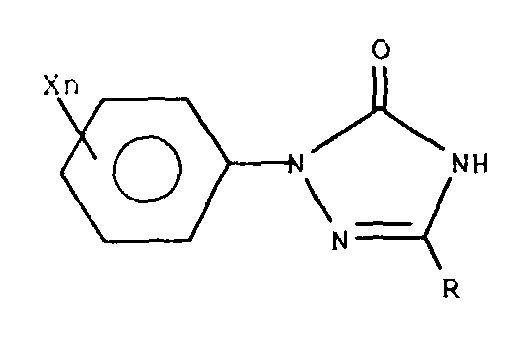 R is a straight or branched chain alkyl group of 1 to 3 carbon atoms.X is independently halogen, straight or branched chain alkyl group of 1 to 3 carbon atoms, nitro,hydroxy, NHSO2R', -N(SO2R')2, -N(R') SO2R' where R' is a straight or branched chain alkyl group of 1 to 3 carbon atoms, and n is an integer from 0 - 3; characterized by treating in a tert-butanol medium, an aryl triazolidinone of the formula
- The process of claim 1 characterized by the preliminary step of reacting an aryl hydrazone of the following formula

- The process of claim 2 characterized by the preliminary step of reacting an aryl hydrazine of the following formula

- The process of claim 2 characterized in that it is conducted without isolating the triazolidinone from the tert-butanol reaction medium.
- The process of claim 3 characterized in that it is conducted without isolating the triazolidinone or the aryl hydrazone from the tert-butanol medium.
- The process of claim 1 characterized in that it is a batch process in which greater than 0.2 1b-moles (90.72 moles) of triazolinone are produced.
- The process of claim 6 characterized in that it is a batch process in which between 0.2 lb-moles (90.72 moles) and 20 lb-moles (9072 moles) of triazolinone are produced.
- The process of claim 7 characterized in that it is a batch process in which greater than 2.0 1b-moles (907.2 moles) of triazolinone are produced.
- The process of claim 3 characterized in that the tert-butanol medium contains 88 per cent by weight tert-butanol and 12 percent by weight water.
- The process of claim 1 characterized in that the tert-butanol medium contains tert-butanol/water azeotrope recycled from a previous production run.
- A process for the production of aryl triazolidinones of the formula
 R is a straight or branched chain alkyl group of 1 to 3 carbon atoms.X is independently halogen, straight or branched chain alkyl group of 1 to 3 carbon atoms, nitro, hydroxy, NHSO2R', -N(SO2R')2, -N(R')SO2R' where R' is a straight or branched chain alkyl group of a 1 to 3 carbon atoms, and n is a n integer from 0 to 3;characterized by treating in a tert-butanol medium, an aryl hydrazone of the formula
- The process of claim 11 characterized by a preliminary step of reacting an aryl hydrazine of the following formula in a tert-butanol medium with an aldehyde of the formula R-C(O)H to produce the phenyl hydrazone of the formula

- The process of claim 12 characterized in that it is conducted without isolating the triazolidinone or the aryl hydrazone from the tert-butanol medium.
- The process of claim 11 characterized in that it is a batch process in which between 0.21b-moles (90.72)moles and 201b-moles (9072 moles) of triazolidinone are produced.
- The process of claim 13 characterized in that the tert-butanol medium contains about 88 percent by weight tert-butanol and 12 percent by weight water.
- The process of claim 11 characterized in that the tert-butanol medium contains tert-butanol/water azeotrope recycled from a previous production run.
- A process for the production of an aryl hydrazone of the formula
 R is a straight or branched chain alkyl group of 1 to 3 carbon atoms.X is independently hydrogen, halogen, straight or branched chain alkyl group of 1 to 3 carbon atoms, nitro, hydroxy, NHSO2R', -N(SO2R')2, -N(R')SO2R' where R' is a straight or branched chain alkyl group of 1 to 3 carbon atoms, and n is an integer from 1 to 3; characterized by treating in a tert-butanol medium, an aryl hydrazine of the formula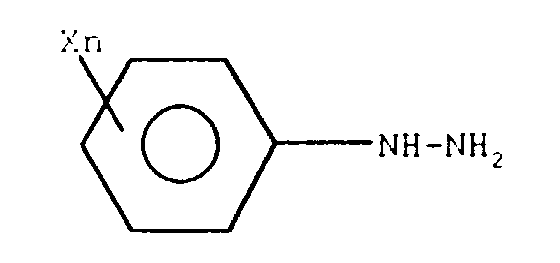
- The process of claim 17 characterized in that the tert-butanol medium contains an organic acid.
- The process of claim 18 characterized in that the acid is acetic acid.
- The process of claim 1 characterized in that R is methyl and n is 0.
- The process of claim 11 characterized in that R is methyl and n is 0.
- The process of claim 1 characterized in that R is methyl, n is 3, and Xn is 2,4-dichloro-5-methylsulfonylamino.
- The process of claim 11 characterized in that R is methyl, n is 3, and Xn is 2,4-dichloro-5-methylsulfonylamino.
Applications Claiming Priority (3)
| Application Number | Priority Date | Filing Date | Title |
|---|---|---|---|
| US882653 | 1992-05-13 | ||
| US07/882,653 US5256793A (en) | 1992-05-13 | 1992-05-13 | Triazolinone ring formation in tert-butanol |
| PCT/US1993/004030 WO1993023382A1 (en) | 1992-05-13 | 1993-04-29 | Triazolinone ring formation in tert-butanol |
Publications (3)
| Publication Number | Publication Date |
|---|---|
| EP0640076A1 EP0640076A1 (en) | 1995-03-01 |
| EP0640076A4 EP0640076A4 (en) | 1995-04-12 |
| EP0640076B1 true EP0640076B1 (en) | 1997-11-26 |
Family
ID=25381058
Family Applications (1)
| Application Number | Title | Priority Date | Filing Date |
|---|---|---|---|
| EP93910901A Expired - Lifetime EP0640076B1 (en) | 1992-05-13 | 1993-04-29 | Triazolinone ring formation in tert-butanol |
Country Status (20)
| Country | Link |
|---|---|
| US (1) | US5256793A (en) |
| EP (1) | EP0640076B1 (en) |
| JP (1) | JP2592774B2 (en) |
| KR (1) | KR0179071B1 (en) |
| CN (1) | CN1035433C (en) |
| AT (1) | ATE160563T1 (en) |
| BR (1) | BR9306342A (en) |
| CA (1) | CA2131183C (en) |
| DE (1) | DE69315431T2 (en) |
| DK (1) | DK0640076T3 (en) |
| ES (1) | ES2111159T3 (en) |
| GR (1) | GR3025893T3 (en) |
| HU (1) | HU213913B (en) |
| IL (1) | IL105624A0 (en) |
| MX (1) | MX9302741A (en) |
| RU (1) | RU2119918C1 (en) |
| TR (1) | TR27745A (en) |
| TW (1) | TW226014B (en) |
| WO (1) | WO1993023382A1 (en) |
| ZA (1) | ZA933088B (en) |
Families Citing this family (13)
| Publication number | Priority date | Publication date | Assignee | Title |
|---|---|---|---|---|
| US5449784A (en) * | 1994-06-22 | 1995-09-12 | Fmc Corporation | Method of preparing aryl triazolinones with trialkyl orthoacetates |
| US5625064A (en) * | 1995-04-19 | 1997-04-29 | Schering Corporation | Process for the preparation of triazolones |
| DE19521162A1 (en) | 1995-06-09 | 1996-12-12 | Bayer Ag | N-aryl-1,2,4-triazolin-5-one |
| HU225546B1 (en) * | 1995-12-29 | 2007-03-28 | Fmc Corp | Selective chlorination of a 1-(2-fluorophenyl)-1,2,4-triazole |
| DE19816882A1 (en) * | 1998-04-17 | 1999-10-21 | Boehringer Ingelheim Pharma | Use of known and new triazolone derivatives as medicaments, especially for treatment of neurodegenerative disorders and cerebral ischemia |
| JP3863736B2 (en) * | 2000-08-08 | 2006-12-27 | 北興化学工業株式会社 | Process for producing aryltriazolinones |
| TWI284886B (en) | 2005-06-20 | 2007-08-01 | Benq Corp | A method for displaying a resized window |
| JP5167283B2 (en) * | 2008-01-10 | 2013-03-21 | 北興化学工業株式会社 | Process for producing phenyltriazolinones |
| CN104672157B (en) * | 2015-02-12 | 2017-06-27 | 山东潍坊润丰化工股份有限公司 | A kind of preparation method of aryltriazolinones |
| CN110950809B (en) * | 2018-09-26 | 2021-07-27 | 北京颖泰嘉和生物科技股份有限公司 | Synthetic post-treatment method of aryl triazolinone compound |
| CN112225705B (en) * | 2020-11-20 | 2022-06-07 | 湖南海利常德农药化工有限公司 | Preparation method of 3-methyl-1-phenyl-1H-1,2, 4-triazole-5 (4H) -ketone |
| CN115819358B (en) * | 2022-12-16 | 2025-02-11 | 湖南化工研究院有限公司 | A method for continuously synthesizing 3-methyl-1-phenyl-1,2,4-triazol-5-one metal salt |
| CN116120248A (en) * | 2023-02-02 | 2023-05-16 | 宁夏格瑞精细化工有限公司 | Preparation method of aryl triazolinone |
Family Cites Families (8)
| Publication number | Priority date | Publication date | Assignee | Title |
|---|---|---|---|---|
| IT1096333B (en) * | 1978-05-25 | 1985-08-26 | Montedison Spa | 1,2,4-TRIAZOLIDIN-3-ONI E-TIONI |
| JPS60136572A (en) * | 1983-12-26 | 1985-07-20 | Nippon Nohyaku Co Ltd | Production of triazolone derivative |
| JPS60136573A (en) * | 1983-12-26 | 1985-07-20 | Nippon Nohyaku Co Ltd | Production of 1,2,4-triazolone derivative |
| CN85106905A (en) * | 1985-08-08 | 1987-02-04 | Fmc公司 | Contain 1-aryl-Δ 2-1,2,4, weedicide of-triazoline-5-ketone and preparation method thereof |
| JPS6393768A (en) * | 1986-10-08 | 1988-04-25 | Nippon Nohyaku Co Ltd | Production of 1,2,4-triazolin-5-one derivative |
| US4980480A (en) * | 1989-09-08 | 1990-12-25 | Fmc Corporation | Production of triazolinones |
| IE72169B1 (en) * | 1989-11-17 | 1997-03-26 | Asahi Glass Co Ltd | Processes for producing 5-fluorobenzoic acids and their intermediates |
| IT1238084B (en) * | 1990-02-07 | 1993-07-05 | Enichem Sintesi | AROMATIC NITRILE PREPARATION PROCEDURE |
-
1992
- 1992-05-13 US US07/882,653 patent/US5256793A/en not_active Expired - Lifetime
-
1993
- 1993-03-30 ZA ZA933088A patent/ZA933088B/en unknown
- 1993-04-29 WO PCT/US1993/004030 patent/WO1993023382A1/en not_active Ceased
- 1993-04-29 ES ES93910901T patent/ES2111159T3/en not_active Expired - Lifetime
- 1993-04-29 KR KR1019940704054A patent/KR0179071B1/en not_active Expired - Fee Related
- 1993-04-29 JP JP5520256A patent/JP2592774B2/en not_active Expired - Fee Related
- 1993-04-29 HU HU9403249A patent/HU213913B/en not_active IP Right Cessation
- 1993-04-29 DE DE69315431T patent/DE69315431T2/en not_active Expired - Fee Related
- 1993-04-29 EP EP93910901A patent/EP0640076B1/en not_active Expired - Lifetime
- 1993-04-29 CA CA002131183A patent/CA2131183C/en not_active Expired - Fee Related
- 1993-04-29 RU RU94045998A patent/RU2119918C1/en active
- 1993-04-29 AT AT93910901T patent/ATE160563T1/en not_active IP Right Cessation
- 1993-04-29 BR BR9306342A patent/BR9306342A/en not_active IP Right Cessation
- 1993-04-29 DK DK93910901.3T patent/DK0640076T3/en active
- 1993-05-06 IL IL105624A patent/IL105624A0/en not_active IP Right Cessation
- 1993-05-10 MX MX9302741A patent/MX9302741A/en not_active IP Right Cessation
- 1993-05-12 CN CN93105387A patent/CN1035433C/en not_active Expired - Fee Related
- 1993-05-13 TR TR00444/93A patent/TR27745A/en unknown
- 1993-05-13 TW TW082103747A patent/TW226014B/zh active
-
1998
- 1998-01-14 GR GR980400066T patent/GR3025893T3/en unknown
Also Published As
| Publication number | Publication date |
|---|---|
| DE69315431T2 (en) | 1998-03-19 |
| WO1993023382A1 (en) | 1993-11-25 |
| HUT68023A (en) | 1995-05-29 |
| RU94045998A (en) | 1996-09-27 |
| ZA933088B (en) | 1993-11-23 |
| CN1079963A (en) | 1993-12-29 |
| ATE160563T1 (en) | 1997-12-15 |
| CA2131183A1 (en) | 1993-11-25 |
| DK0640076T3 (en) | 1998-01-12 |
| EP0640076A4 (en) | 1995-04-12 |
| RU2119918C1 (en) | 1998-10-10 |
| KR0179071B1 (en) | 1999-03-20 |
| JPH07503253A (en) | 1995-04-06 |
| GR3025893T3 (en) | 1998-04-30 |
| TR27745A (en) | 1995-07-07 |
| CA2131183C (en) | 1998-04-07 |
| TW226014B (en) | 1994-07-01 |
| ES2111159T3 (en) | 1998-03-01 |
| CN1035433C (en) | 1997-07-16 |
| EP0640076A1 (en) | 1995-03-01 |
| MX9302741A (en) | 1994-08-31 |
| US5256793A (en) | 1993-10-26 |
| DE69315431D1 (en) | 1998-01-08 |
| IL105624A0 (en) | 1993-09-22 |
| KR950701624A (en) | 1995-04-28 |
| HU9403249D0 (en) | 1995-02-28 |
| JP2592774B2 (en) | 1997-03-19 |
| HU213913B (en) | 1997-11-28 |
| BR9306342A (en) | 1995-08-29 |
Similar Documents
| Publication | Publication Date | Title |
|---|---|---|
| US5256793A (en) | Triazolinone ring formation in tert-butanol | |
| CA2059531C (en) | Production of triazolinones | |
| US4196289A (en) | Process for producing triallyl isocyanurate | |
| JPH0432807B2 (en) | ||
| JP2008500389A (en) | Method for producing 1,3-dibromoacetone, 1,3-dichloroacetone and epichlorohydrin | |
| US5440045A (en) | Triazolinone ring formation in tert-butanol | |
| JPS5928549B2 (en) | Method for producing 1H-1,2,4-triazole | |
| EP0748804B1 (en) | Process for producing carboxylic acid derivative | |
| EP1273232B1 (en) | Process for the preparation of the herbicide ethyl alpha-2-dichloro-5-¬4-(difluoromethyl)-4,5-dihydro-3-methyl-5-oxo-1h-1,2,4-triazol-1-yl|-4-fluorobenzenepropanoate | |
| US5616723A (en) | Process for the preparation of 3-amino-5-methylpyrazole | |
| US5621112A (en) | Process for the preparation of the herbicide ethyl α-2-dichloro-5-[4-(Difluoromethyl)-4,5-dihydro-3-methyl-5-oxo-1H-1,2,4-triazol-1-yl]-4-fluorobenzenepropanoate | |
| US5965742A (en) | Selective chlorination of a 1-(2-fluorophenyl)-1,2,4-triazole | |
| EP1362842B1 (en) | Process for producing 2-fluoro-3-oxoalkylcarboxylic acid ester | |
| JP3518605B2 (en) | Method for producing N- (2,6-dichloro-3-methylphenyl) -5-7-dihalo [1,2,4] triazolo [1,5a] pyrimidine-2-sulfonamide by cyclization and removal of halo-hydroxyl group | |
| CZ5296A3 (en) | Process for preparing n,n-dibenzylbispidine | |
| JPS6221781B2 (en) | ||
| JPH0745476B2 (en) | Pyrazole derivative and method for producing the same | |
| JPH05294942A (en) | Production of 3@(3754/24)2h)-pyridazinone derivative |
Legal Events
| Date | Code | Title | Description |
|---|---|---|---|
| PUAI | Public reference made under article 153(3) epc to a published international application that has entered the european phase |
Free format text: ORIGINAL CODE: 0009012 |
|
| 17P | Request for examination filed |
Effective date: 19940815 |
|
| AK | Designated contracting states |
Kind code of ref document: A1 Designated state(s): AT BE CH DE DK ES FR GB GR IE IT LI LU MC NL PT SE |
|
| A4 | Supplementary search report drawn up and despatched |
Effective date: 19950227 |
|
| AK | Designated contracting states |
Kind code of ref document: A4 Designated state(s): AT BE CH DE DK ES FR GB GR IE IT LI LU MC NL PT SE |
|
| 17Q | First examination report despatched |
Effective date: 19960207 |
|
| GRAG | Despatch of communication of intention to grant |
Free format text: ORIGINAL CODE: EPIDOS AGRA |
|
| GRAH | Despatch of communication of intention to grant a patent |
Free format text: ORIGINAL CODE: EPIDOS IGRA |
|
| GRAH | Despatch of communication of intention to grant a patent |
Free format text: ORIGINAL CODE: EPIDOS IGRA |
|
| GRAA | (expected) grant |
Free format text: ORIGINAL CODE: 0009210 |
|
| AK | Designated contracting states |
Kind code of ref document: B1 Designated state(s): AT BE CH DE DK ES FR GB GR IE IT LI LU MC NL PT SE |
|
| ITF | It: translation for a ep patent filed | ||
| REF | Corresponds to: |
Ref document number: 160563 Country of ref document: AT Date of ref document: 19971215 Kind code of ref document: T |
|
| REG | Reference to a national code |
Ref country code: CH Ref legal event code: NV Representative=s name: ISLER & PEDRAZZINI AG Ref country code: CH Ref legal event code: EP |
|
| PGFP | Annual fee paid to national office [announced via postgrant information from national office to epo] |
Ref country code: LU Payment date: 19971223 Year of fee payment: 6 |
|
| REF | Corresponds to: |
Ref document number: 69315431 Country of ref document: DE Date of ref document: 19980108 |
|
| REG | Reference to a national code |
Ref country code: DK Ref legal event code: T3 |
|
| PGFP | Annual fee paid to national office [announced via postgrant information from national office to epo] |
Ref country code: GR Payment date: 19980202 Year of fee payment: 6 |
|
| ET | Fr: translation filed | ||
| PG25 | Lapsed in a contracting state [announced via postgrant information from national office to epo] |
Ref country code: SE Free format text: LAPSE BECAUSE OF FAILURE TO SUBMIT A TRANSLATION OF THE DESCRIPTION OR TO PAY THE FEE WITHIN THE PRESCRIBED TIME-LIMIT Effective date: 19980226 Ref country code: PT Free format text: LAPSE BECAUSE OF FAILURE TO SUBMIT A TRANSLATION OF THE DESCRIPTION OR TO PAY THE FEE WITHIN THE PRESCRIBED TIME-LIMIT Effective date: 19980226 |
|
| REG | Reference to a national code |
Ref country code: ES Ref legal event code: FG2A Ref document number: 2111159 Country of ref document: ES Kind code of ref document: T3 |
|
| PLBE | No opposition filed within time limit |
Free format text: ORIGINAL CODE: 0009261 |
|
| STAA | Information on the status of an ep patent application or granted ep patent |
Free format text: STATUS: NO OPPOSITION FILED WITHIN TIME LIMIT |
|
| PG25 | Lapsed in a contracting state [announced via postgrant information from national office to epo] |
Ref country code: MC Free format text: LAPSE BECAUSE OF NON-PAYMENT OF DUE FEES Effective date: 19981031 |
|
| 26N | No opposition filed | ||
| PGFP | Annual fee paid to national office [announced via postgrant information from national office to epo] |
Ref country code: AT Payment date: 19990330 Year of fee payment: 7 |
|
| PGFP | Annual fee paid to national office [announced via postgrant information from national office to epo] |
Ref country code: ES Payment date: 19990416 Year of fee payment: 7 |
|
| PGFP | Annual fee paid to national office [announced via postgrant information from national office to epo] |
Ref country code: IE Payment date: 19990421 Year of fee payment: 7 |
|
| PG25 | Lapsed in a contracting state [announced via postgrant information from national office to epo] |
Ref country code: LU Free format text: LAPSE BECAUSE OF NON-PAYMENT OF DUE FEES Effective date: 19990429 |
|
| PG25 | Lapsed in a contracting state [announced via postgrant information from national office to epo] |
Ref country code: GR Free format text: LAPSE BECAUSE OF NON-PAYMENT OF DUE FEES Effective date: 19990430 |
|
| PGFP | Annual fee paid to national office [announced via postgrant information from national office to epo] |
Ref country code: BE Payment date: 19990511 Year of fee payment: 7 |
|
| PG25 | Lapsed in a contracting state [announced via postgrant information from national office to epo] |
Ref country code: IE Free format text: LAPSE BECAUSE OF NON-PAYMENT OF DUE FEES Effective date: 20000429 Ref country code: AT Free format text: LAPSE BECAUSE OF NON-PAYMENT OF DUE FEES Effective date: 20000429 |
|
| PG25 | Lapsed in a contracting state [announced via postgrant information from national office to epo] |
Ref country code: BE Free format text: LAPSE BECAUSE OF NON-PAYMENT OF DUE FEES Effective date: 20000430 |
|
| PG25 | Lapsed in a contracting state [announced via postgrant information from national office to epo] |
Ref country code: ES Free format text: THE PATENT HAS BEEN ANNULLED BY A DECISION OF A NATIONAL AUTHORITY Effective date: 20000503 |
|
| BERE | Be: lapsed |
Owner name: FMC CORP. Effective date: 20000430 |
|
| REG | Reference to a national code |
Ref country code: IE Ref legal event code: MM4A |
|
| REG | Reference to a national code |
Ref country code: GB Ref legal event code: IF02 |
|
| REG | Reference to a national code |
Ref country code: ES Ref legal event code: FD2A Effective date: 20020304 |
|
| PGFP | Annual fee paid to national office [announced via postgrant information from national office to epo] |
Ref country code: GB Payment date: 20060314 Year of fee payment: 14 |
|
| PGFP | Annual fee paid to national office [announced via postgrant information from national office to epo] |
Ref country code: DK Payment date: 20060317 Year of fee payment: 14 |
|
| PGFP | Annual fee paid to national office [announced via postgrant information from national office to epo] |
Ref country code: NL Payment date: 20060324 Year of fee payment: 14 |
|
| PGFP | Annual fee paid to national office [announced via postgrant information from national office to epo] |
Ref country code: FR Payment date: 20060403 Year of fee payment: 14 |
|
| PGFP | Annual fee paid to national office [announced via postgrant information from national office to epo] |
Ref country code: DE Payment date: 20060428 Year of fee payment: 14 |
|
| PGFP | Annual fee paid to national office [announced via postgrant information from national office to epo] |
Ref country code: IT Payment date: 20060430 Year of fee payment: 14 |
|
| PGFP | Annual fee paid to national office [announced via postgrant information from national office to epo] |
Ref country code: CH Payment date: 20060608 Year of fee payment: 14 |
|
| REG | Reference to a national code |
Ref country code: CH Ref legal event code: PCAR Free format text: ISLER & PEDRAZZINI AG;POSTFACH 1772;8027 ZUERICH (CH) |
|
| REG | Reference to a national code |
Ref country code: DK Ref legal event code: EBP |
|
| REG | Reference to a national code |
Ref country code: CH Ref legal event code: PL |
|
| GBPC | Gb: european patent ceased through non-payment of renewal fee |
Effective date: 20070429 |
|
| NLV4 | Nl: lapsed or anulled due to non-payment of the annual fee |
Effective date: 20071101 |
|
| PG25 | Lapsed in a contracting state [announced via postgrant information from national office to epo] |
Ref country code: NL Free format text: LAPSE BECAUSE OF NON-PAYMENT OF DUE FEES Effective date: 20071101 Ref country code: DE Free format text: LAPSE BECAUSE OF NON-PAYMENT OF DUE FEES Effective date: 20071101 |
|
| PG25 | Lapsed in a contracting state [announced via postgrant information from national office to epo] |
Ref country code: LI Free format text: LAPSE BECAUSE OF NON-PAYMENT OF DUE FEES Effective date: 20070430 Ref country code: CH Free format text: LAPSE BECAUSE OF NON-PAYMENT OF DUE FEES Effective date: 20070430 |
|
| PG25 | Lapsed in a contracting state [announced via postgrant information from national office to epo] |
Ref country code: GB Free format text: LAPSE BECAUSE OF NON-PAYMENT OF DUE FEES Effective date: 20070429 Ref country code: DK Free format text: LAPSE BECAUSE OF NON-PAYMENT OF DUE FEES Effective date: 20070430 |
|
| PG25 | Lapsed in a contracting state [announced via postgrant information from national office to epo] |
Ref country code: FR Free format text: LAPSE BECAUSE OF NON-PAYMENT OF DUE FEES Effective date: 20070430 |
|
| PG25 | Lapsed in a contracting state [announced via postgrant information from national office to epo] |
Ref country code: IT Free format text: LAPSE BECAUSE OF NON-PAYMENT OF DUE FEES Effective date: 20070429 |