EP0636372B1 - Antiviral, antitumor, antimetastatic, immune system enhancing 7-thia-guanosine derivatives - Google Patents
Antiviral, antitumor, antimetastatic, immune system enhancing 7-thia-guanosine derivatives Download PDFInfo
- Publication number
- EP0636372B1 EP0636372B1 EP94112331A EP94112331A EP0636372B1 EP 0636372 B1 EP0636372 B1 EP 0636372B1 EP 94112331 A EP94112331 A EP 94112331A EP 94112331 A EP94112331 A EP 94112331A EP 0636372 B1 EP0636372 B1 EP 0636372B1
- Authority
- EP
- European Patent Office
- Prior art keywords
- compound
- virus
- amino
- natural killer
- pyrimidine
- Prior art date
- Legal status (The legal status is an assumption and is not a legal conclusion. Google has not performed a legal analysis and makes no representation as to the accuracy of the status listed.)
- Expired - Lifetime
Links
Classifications
-
- A—HUMAN NECESSITIES
- A61—MEDICAL OR VETERINARY SCIENCE; HYGIENE
- A61K—PREPARATIONS FOR MEDICAL, DENTAL OR TOILETRY PURPOSES
- A61K31/00—Medicinal preparations containing organic active ingredients
- A61K31/70—Carbohydrates; Sugars; Derivatives thereof
-
- A—HUMAN NECESSITIES
- A61—MEDICAL OR VETERINARY SCIENCE; HYGIENE
- A61P—SPECIFIC THERAPEUTIC ACTIVITY OF CHEMICAL COMPOUNDS OR MEDICINAL PREPARATIONS
- A61P31/00—Antiinfectives, i.e. antibiotics, antiseptics, chemotherapeutics
- A61P31/12—Antivirals
-
- A—HUMAN NECESSITIES
- A61—MEDICAL OR VETERINARY SCIENCE; HYGIENE
- A61P—SPECIFIC THERAPEUTIC ACTIVITY OF CHEMICAL COMPOUNDS OR MEDICINAL PREPARATIONS
- A61P35/00—Antineoplastic agents
-
- A—HUMAN NECESSITIES
- A61—MEDICAL OR VETERINARY SCIENCE; HYGIENE
- A61P—SPECIFIC THERAPEUTIC ACTIVITY OF CHEMICAL COMPOUNDS OR MEDICINAL PREPARATIONS
- A61P37/00—Drugs for immunological or allergic disorders
- A61P37/02—Immunomodulators
- A61P37/04—Immunostimulants
-
- C—CHEMISTRY; METALLURGY
- C07—ORGANIC CHEMISTRY
- C07H—SUGARS; DERIVATIVES THEREOF; NUCLEOSIDES; NUCLEOTIDES; NUCLEIC ACIDS
- C07H19/00—Compounds containing a hetero ring sharing one ring hetero atom with a saccharide radical; Nucleosides; Mononucleotides; Anhydro-derivatives thereof
- C07H19/02—Compounds containing a hetero ring sharing one ring hetero atom with a saccharide radical; Nucleosides; Mononucleotides; Anhydro-derivatives thereof sharing nitrogen
- C07H19/04—Heterocyclic radicals containing only nitrogen atoms as ring hetero atom
- C07H19/16—Purine radicals
- C07H19/20—Purine radicals with the saccharide radical esterified by phosphoric or polyphosphoric acids
-
- C—CHEMISTRY; METALLURGY
- C07—ORGANIC CHEMISTRY
- C07H—SUGARS; DERIVATIVES THEREOF; NUCLEOSIDES; NUCLEOTIDES; NUCLEIC ACIDS
- C07H19/00—Compounds containing a hetero ring sharing one ring hetero atom with a saccharide radical; Nucleosides; Mononucleotides; Anhydro-derivatives thereof
- C07H19/02—Compounds containing a hetero ring sharing one ring hetero atom with a saccharide radical; Nucleosides; Mononucleotides; Anhydro-derivatives thereof sharing nitrogen
- C07H19/24—Heterocyclic radicals containing oxygen or sulfur as ring hetero atom
Definitions
- This invention is directed to the use of new and improved antiviral, nucleosides and nucleotides.
- the immune system is an inherently complex system that serves its host by providing natural resistance and recovery against both pathogens of an external source as well as aberrant 'self' cells, i.e. tumor growth. It provides both 'natural', i.e. inborn and unchanging, or 'acquired' , i.e. adaptive immune response.
- the immune system is innocuous to 'self.'
- the immune system is able, in most instances, to recognize 'self,' its host, and differentiate between 'self' and non-self. That is the immune system is 'self tolerant.' In certain instances, however, the immune system does attack its host as if it were foreign resulting in autoimmunity or autoimmune disease or hypersensitivity expressed in the form of allergies, certain forms of kidney disease and the like.
- nucleoside 3-deaza-adenosine has been indicated in U. S. Patent 4,309,419 to Walberg, et al., which issued January 5, 1982, as being an inhibitor of the immune response.
- nucleosides most notably 8-bromoguanosine, 8-mercaptoguanosine and 7-methyl-8-oxoguanosine have been noted as showing stimulation of the immune system.
- lymphocytes Certain components of the immune system are cellular in nature while others are humoral, that is they exist free in serum or other body fluids. Adaptive immunity is based upon special properties of lymphocytes.
- the lymphocyte populations are generally divided between T lymphocytes commonly called T cells and B lymphocytes commonly called B cells.
- T lymphocytes undergo a maturation processing in the thymus whereas the B lymphocytes are continuously generated in the bone marrow and are responsible for the production of antibodies.
- the lymphocytes freely circulate in the blood and from blood gain access to the tissues from which they are collected and recycled back via the lymph systems including the lymph glands and spleen.
- Components of the cellular immune mechanisms include macrophages (hereinafter also referred to as MAC's), polymorphonuclear leukocytes commonly called PMN, mast cells and other cellular or molecular entities such as interferon and the like. Further, complements which are a series of proteins present in the serum can be activated by other immune components or directly by pathogens such as bacteria or the like.
- Natural killer cells hereinafter also identified as NK cells, constitute a group of cells which are concerned with natural immunity. These are lymphoid cells which are generally found in at least the young of all mammalian species and can be readily elicited in older animals. They generally exert a selective cytotoxicity against a range of target cells mostly malignant tumor cells.
- the B cells produce antibody.
- Antibodies are a group of proteins of various classes including IgG, IgM, IgA, IgD, IgE. Not all specific antibody classes are present in different animal species. Generally the higher up on the evolutionary chain of animals the more antibody species present with warn blooded mammals generally having a full contingent of the different antibody species.
- the immune system is capable of modifying certain regions on the antibody proteins allowing the antibody protein to bind with specific antigens of various origins. These include pathogens, parts of pathogens such as cellular wall polysaccharide molecules, large protein or the like, as well as other foreign debris such as pollen and even in autoimmune diseases portions of the host itself. Some antibody production by the B cells is independent of the T cells while other antibody production is T cell dependent.
- T cells There are several groups of T cells including helper T cells which stimulate other T cells and B cells for the production of antibody, suppressor T cells which modulate the immune response to keep it from overwhelming the host, cytotoxic T cells (CTL's) which are very important against pathogens especially viral pathogens and delayed hypersensitive T cells which are important in attracting and activating a variety of other cells, including the macrophages.
- CTL's cytotoxic T cells
- the immune system is important in protecting the host against a variety of pathogens including bacteria, viruses, protozoa, parasitic worms such as flukes, tapeworms and round worms, fungi, and tumor cells of the host which become parasitic on the host.
- the antiviral activity of the immune system is generally associated with the T cells whereas the natural antitumor ability of the host resides with the macrophages, the natural killer cells, certain non-T and non-B myeloid cells and with certain portions of the complement system.
- the immune system is a very complex system which is extremely important to the host for protection of the host against outside pathogens as well as against internal aberrant cells. Catastrophic effects to the host can result when pathogens, tumors or the like overwhelm the immune system of the host. It has even been suggested that tumors may have the ability to depress or subvert the hosts immune system. This is supported by the recognition of clinicians that viral and bacteria infections can be a major contributor to the deaths among tumor patients.
- the present invention relates to the use of a novel class of nucleosides and nucleotides of the thiazolo[4,5- d ] pyrimidine ring, system.
- a presently preferred group of compounds used in the invention are compounds of the formula:
- the compounds used in the invention are useful as immune system enhancers and have certain immune system properties including modulation, mitogenicity, augmentation and/or potentiation or they are intermediates for compounds which have these properties.
- the compounds have been shown to express effects on at least the natural killer, and lymphocyte cells of the immune system of a host. Because of these properties they are useful as antiviral, agents or as intermediates for antiviral, agents. They can be used to treat an affected host by serving as the active ingredients of suitable pharmaceutical compositions.
- compounds are utilized to treat viral diseases in host mammals by administering to the mammal a therapeutically effective amount of the compounds.
- 5-amino-3- ⁇ - D -ribofuranosylthiazolo[4,5- d ]pyrimidine-2,7(6H)-dione is utilized to enhance natural killer immune cells in a host by administering to the host a therapeutically effective amount of 5-amino-3- ⁇ - D -ribofuranosylthiazolo[4,5- d ]pyrimidine-2,7(6H)-dione as the active component in a pharmaceutical composition.
- 5-amino-3- ⁇ - D -ribofuranosylthiazolo[4,5- d ]pyrimidine-2,7(6H)-dione is utilized to enhance lymphocyte cells in a host by administering to the host a therapeutically effective amount of 5-amino-3- ⁇ - D -ribofuranosylthiazolo[4,5- d ] pyrimidine-2,7(6H)-dione as the active component in a pharmaceutical composition.
- a therapeutical pharmaceutical composition which contains as its active ingredient a therapeutically effective amount of 5-amino-3- ⁇ - D -ribofuranosylthiazolo[4,5- d ]pyrimidine-2,7(6H)-dione.
- a prophylactic pharmaceutical composition which contains as its active ingredient a prophylactically effective amount of 5-amino-3- ⁇ - D -ribofuranosylthiazolo[4,5- d ]pyrimidine-2,7(6H)-dione.
- the prophylactic composition can include a further antiviral agent as a further active ingredient.
- the compounds used in the invention are prepared by silylating a derivative of a 2,5,7-substituted thiazolo[4,5- d ]pyrimidine and reacting said silyl derivative with a 1- O -substituted-blocked- D -pentofuranose in the presence of a catalyst to form a blocked nucleoside.
- the blocking groups can further be removed from said nucleoside. Additionally the nucleoside can be phosphorylated.
- the substituted blocked pentofuranosyl sugar is selected as a 1- O -acetyl-2,3,5-tri- O -acyl- D -pentofuranose particularly 1- O -acetyl-2,3,5-tri- O -benzoyl- D -ribofuranose.
- the guanosine analog, 7 was phosphorylated and the 5'-monophosphate ( 11 ) was obtained.
- the 3',5'-cyclic monophosphate derivative, 12 was then prepared from 11 .
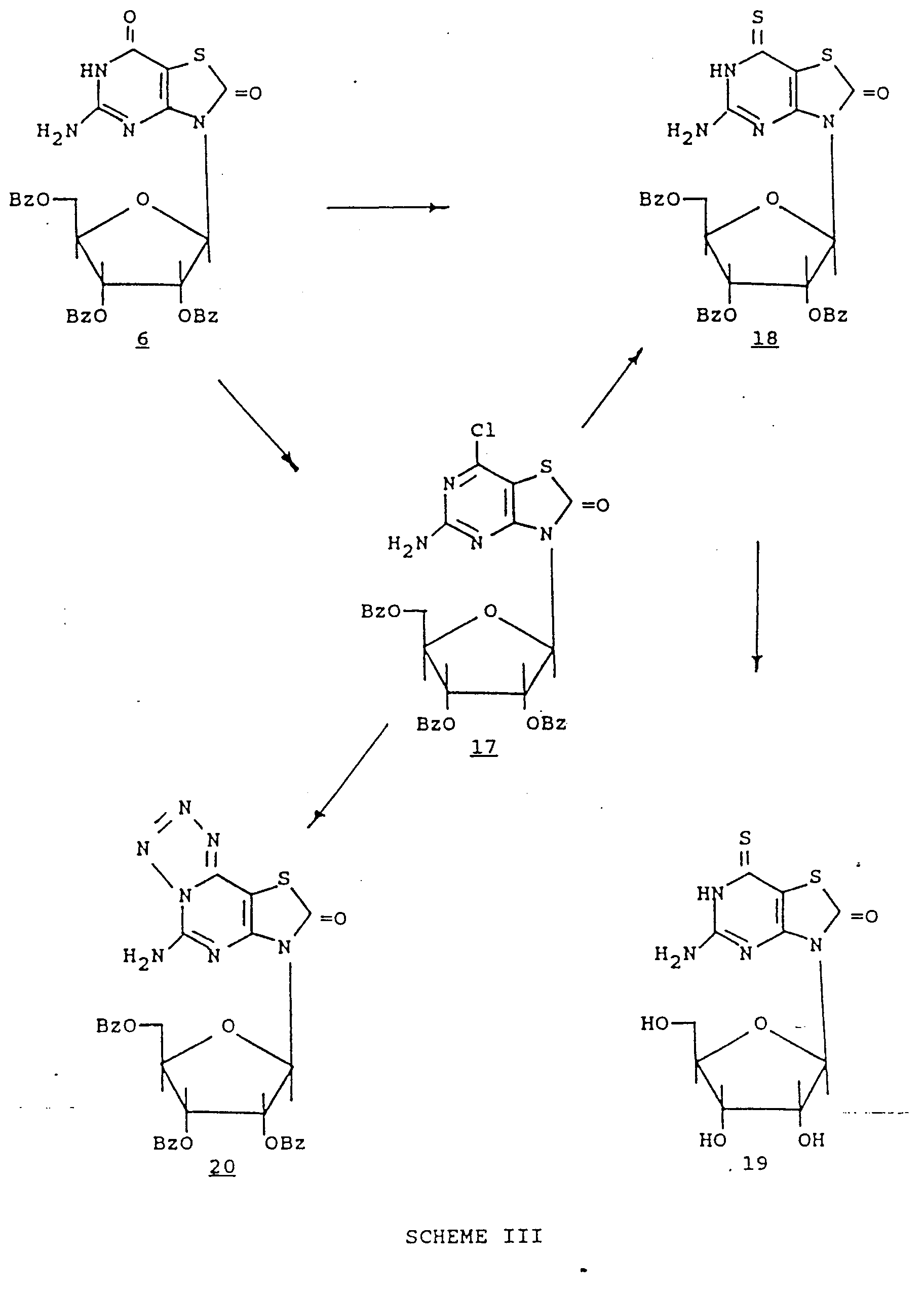
- 6-thioguanosine analog was prepared by two routes starting from 6 (Scheme III). In one approach, 6 was treated with the mild chlorinating agent dimethyl(chloromethylene)ammonium chloride (generated in situ from thionyl chloride and DMF), and provided 5-amino-7-chloro-3-(2,3,5-tri- 0 -benzoyl- ⁇ -D-ribofuranosyl)thiazolo[4,5- d ]pyrimidin-2-one( 17 ).
- 6 was treated with the mild chlorinating agent dimethyl(chloromethylene)ammonium chloride (generated in situ from thionyl chloride and DMF), and provided 5-amino-7-chloro-3-(2,3,5-tri- 0 -benzoyl- ⁇ -D-ribofuranosyl)thiazolo[4,5- d ]pyrimidin-2-one( 17 ).
- the chloro function at position 7 was also nucleophilically substituted by azide using sodium azide in dry DMF which subsequently ring closed onto N-6 to form the new tricyclic ring compound, 5-amino-7-(2,3,5-tri- 0 -benzoyl- ⁇ - D -ribofuranosyl)tetrazolo[1,5- c ]thiazolo[4,5- d ]pyrimidin-2-one ( 20 ).
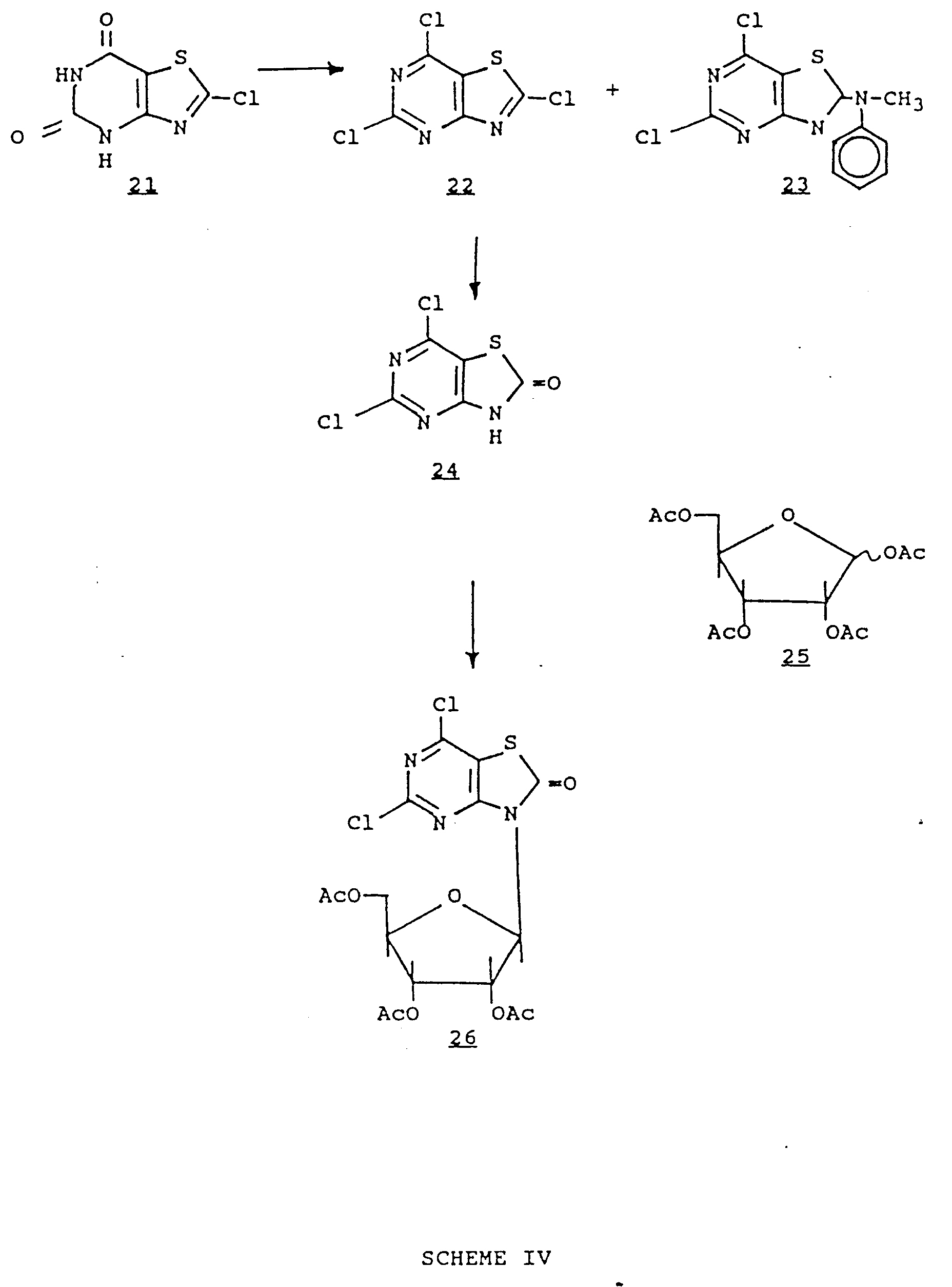
- the desired 2,5,7-trichlorothiazolo[4,5,- d ]pyrimidine ( 22 ) was obtained along with a small amount of 5,7-dichloro-2-(N-methylanilino)thiazolo[4,5- d ]pyrimidine ( 23 ).
- the trichloro compound, 22 was carefully hydrolyzed in 1N NaOH at 60°C in order to obtain the mono-oxo derivative, 5,7-dichlorothiazolo[4,5- d ]pyrimidin-2(3H)-one ( 24 ), the structure of which was verified by single crystal X-ray analysis.
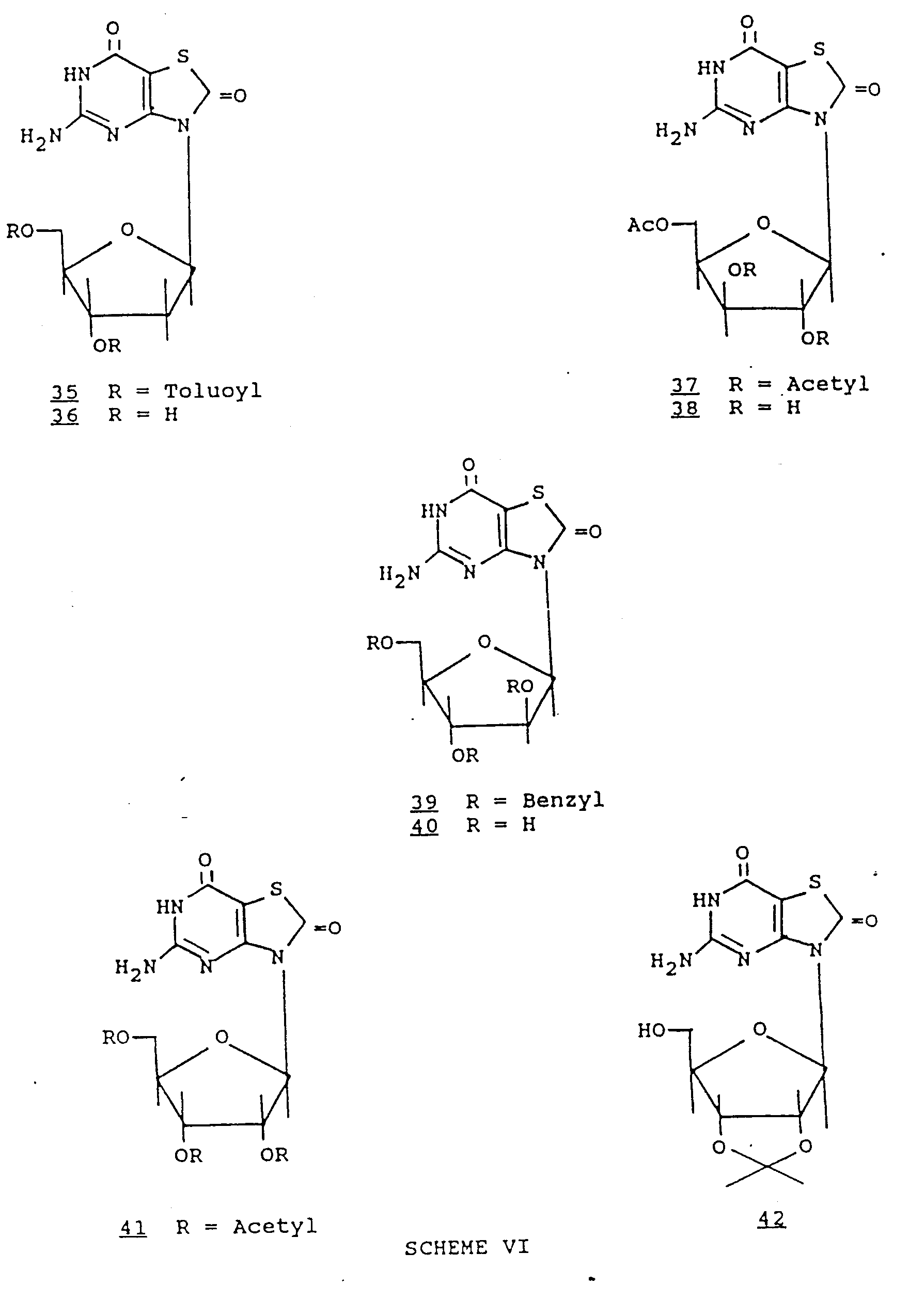
- the tri- O -acetyl ( 40 ) prodrug form of compound 7 is prepared from 4 and 1,2,3,5-tetra- O -acetyl- D -ribofuranose and the 2,3-di- O -isopropylidene derivative ( 42 ) is prepared directly from 7 (scheme VI).
- pharmaceutically acceptable acid addition salts of the basic moiety can be selected from, but not necessarily limited to, the group consisting of hydrochloride, hydrobromide, hydroiodide, citrate, sulfate, substituted sulfate, phosphate, carbonate, bicarbonate and formate.
- Pharmaceutically acceptable salts of the phosphate moiety can be selected from, but not necessarily limited to, the group consisting of alkali and alkaline earths, e.g. sodium, potassium, calcium, magnesium, lithium, ammonium and substituted ammonium, trialkylammonium, dialkylammonium, alkylammonium, e.g. triethylammonium, trimethylammonium, diethylammonium, octylammonium, cetyltrimethylammonium and cetylpyridium.
- the hydroxyl groups on the glycon and heterocycle and the amino groups of the heterocycle can be blocked with groups such as, but not necessarily limited to, acyl, isopropylidene and dimethylaminomethylene.
- the acyl group can be selected from a group consisting of C 1 -C 18 straight chain, branched ,chain, substituted, unsaturated, saturated or aromatic acid such as, but not necessarily limited to acetic, trifluoroacetic, propionic, n-butyric, isobutyric, valeric, caproic, pelargonic, enanthic, caprylic, lactic, acrylic, propargylic, palmitic, benzoic, phthalic, salicylic, cinnamic and naphthoic acids.
- the bis-silyl intermediate was dissolved in dry acetonitrile (300 mL) and 1- 0 -[acetyl-2,3,5-tri- 0 -benzoyl- D -ribofuranose ( 5 : 15.1 g, 30 mmol) was added followed by trimethlsilyl trifluoromethane sufonate (9.3 mL, 42 mmol).
- the clear reaction mixture was stirred at ambient temperature for 16 h.
- the solvent was evaporated to dryness and the residual syrup was dissolved in EtOAc (600 mL). The solution was washed with 5% NaHCO 3 solution (2 x 150 mL), and the dried (Na 2 SO 4 ) organic layer was evaporated.
- the pH of the resulting solution was adjusted to 7.5 with aqueous ammonium bicarbonate and the solution was applied to a DEAE-cellulose column (3.2 x 35 cm), washed with water and eluted with a gradient (0 to 0.25 M, 2 L reservoirs) of aqueous ammonium bicarbonate. During the water wash, unreacted starting material eluted off (0.5 g).
- the mixture was evaporated to dryness and the residue was partitioned between water (150 mL) and ethyl ether (150 mL).
- the aqueous layer was concentrated to about 100 mL and applied, having pH 7.7, to a DEAE-cellulose column (3.2 x 30 cm) and washed with water followed by elution using a gradient of aqueous ammonium bicarbonate (0 to 0.19 M).
- UV ⁇ max (pH 1) 243 nm ( ⁇ 13700), 266 (16500), 351 (17200): UV ⁇ max (pH7) 262 nm ( ⁇ 14800), 345 (12700): UV ⁇ max (pH 11) 250 nm ( ⁇ 19300), 335 (14300): 1 H NMR (DMSO-d 6 ) ⁇ 6.91 (s, 2H, NH 2 ), 11.18 (s, 1H, N 6 H), 13.78 (s, 1H, N 3 H). Anal. Calcd. for C 5 H 4 N 4 OS 2 :
- Dry purified 6 (10 g, 16 mmol) was dissolved in dry methylene chloride (350 mL) and a solution of freshly distilled thionyl chloride (40 mL), dry DMF (20 mL), in dry methylene chloride was added dropwise over a 2 h period and the reaction was kept at 60°C (reflux) for 16 h. The reaction mixture was poured carefully into ice and NaHCO 3 solution and stirred for 30 min. The layers were separated and the aqueous layer extracted (2 x 150 mL) with methylene chloride and the combined layers dried over Na 2 SO 4 and evaporated in vacuo .
- Method 1 A mixture of 17 (3.3 g, 5 mmol), thiourea (0.719 g, 1 mmol) and EtOH (100 mL) was heated under reflux for 6 days. The reaction mixture was evaporated, and the residue was extracted with CHCl 3 (200 mL). The solvent was evaporated to dryness in vacuo , and the residue was purified by silica gel column chromatography with CHCl 3 -acetone (7:1) as the eluant.
- Method 1 A solution of 18 (1 g, 1.6 mmol) in methanol (50 mL) was adjusted to pH 9 with NaOCH 3 and stirred at room temperature for 16 h. The reaction mixture was evaporated to dryness and the residue was triturated with ether (2 x 75 mL). The ether insoluble solid was dissolved in water (15 mL) and acidified with acetic acid whereupon the crude product was precipitated.
- Method 2 A solution of 18 (1.0 g, 1.6 mmol) in methanolic ammonia (saturated at O°C, 60 mL) was stirred at room temperature for 48 h. The solvent was evaporated to dryness and the residue was triturated with boiling benzene (2 x 100 mL) . The benzene insoluble solid was crystallized from EtOH-H 2 O to give 19 (0.36 g, 67%). The compound prepared by this method was identical to compound 19 prepared by Method 1 above, as judged by spectral and physical data.
- the title compound is prepared by glycosylation of 4 exactly as described above for the synthesis of 6 except that 1,2,3,5-tetra-O-acetyl-D-xylofuranose is to be used.
- the crude acetyl-blocked nucleoside (37) is then deprotected using sodium methoxide as described for the preparation of 7 to yield 38 as an amorphous solid.
- the title benzyl-protected nucleoside is prepared in the same manner as that described for 35 except that the sugar to be used, 1-chloro-2,3,5-tri-O-benzyl- ⁇ -D-arabinofuranose, is generated from the corresponding 1-O-(p-nitrobenzoyl) sugar using dry hydrogen chloride gas in dichloromethane at 0°C.
- the mixture of anomers is separated by flash silica gel column chromatography to yield 39 and its ⁇ anomer, both as dry foams.
- Compound 39 is dissolved in dry dichloromethane and deprotected using an excess of boron trichloride (1M in dichloromethane) at -78°C and allowed to warm to -40°C for 2 hours before quenching with methanol. The residue after workup is crystallized from water to yield 40 as a colorless crystalline solid.
- Natural killer cells have been implicated as providing defense against viral infections and malignant cells. Abnormalities in the natural killer cell's activity may thus result in the development of the diseases. Biological immunomodulators may restore or correct certain deficient immune functions. Recently interleukin-2 has been shown to have immunotherapeutic potential in tumor patients. Interleukin-2 and other known immunopotentiators are generally protein in nature and may cause severe side effects upon their administration. Non toxic low molecular synthetic compounds which are not proteins can be suggested for avoiding the side effects of known protein immunotherapeutic potentiators.
- the non protein nucleoside and nucleotide compounds used in the invention have shown increased natural killer cell activity.
- natural killer cell activity is demonstrated in mice.
- Spleen cells from CBA/CaJ or C57BL/6J mice were cultured with 0.05 mM concentrations of compound 7 for 20 to 44 hours at 37°C in a 5% CO 2 humidified atmosphere as described in Djeu, J-Y, Heinbaugh, J. A., Holden, H. T., Herberman R. B.: Journal Immunology 122:175, 1979, and Gonzales, H., Karriger, K., Sharma, B., Vaziri, N.: Federal Procedures 42:1195, 1983. After incubation the cytotoxicity of the treated and untreated cells was determined against YAC-1 cells. In performing this test both a non-drug control and a control using Poly I:C were run concurrently with compound 7 .
- peripheral blood mononuculear cells were isolated on Ficoll-Hypaque gradient, washed three times in Hanks and re-suspended in RPMI-1640 containing 10% human AB serum as described in Rosenberg, S.A.: Journal American Medical Association , 256:3117, 1986 and the above referred to reference to Djeu, et al.
- Peripheral blood mononuclear cells (PBMNC) from eleven different donors were treated with compound 7 as described in Djeu, et al. as well as Sharma, B., Odom, L. F.: Cancer Immunol. Immunother. 7:93, 1979, and Sharma, B., Odom, L. F.: Cancer Research 44:3258, 1984.
- the PBMNC from eleven donors had a mean natural killer cell cytotoxicity activity of 11.7%.
- the PBMNC from the same donors which was pretreated with compound 7 expressed a 32.2% mean natural killer cell cytotoxicity. While there is some variability between the eleven donors, eight of the donors showed over 100% potentiation in natural killer cell cytotoxicity. In the other four cases compound 7 treatment in vitro produced a marked increase in natural killer cell mediated cytotoxicity.
- Compound 7 was further studied for potentiation of natural killer cell activity in vivo in mice.
- CBA/CaJ mice were treated with compound 7 by injecting 1.68 mg per 0.5 ml per mouse of compound 7 .
- the spleens of the mice were harvested and the cytotoxic activity of the spleen cells was determined against YAC-1 tumor target cells in the above referred to 51 Cr release assay as identified in EXAMPLE 32. The results of these tests are shown in Table 3, 4, 5 and 6.
- Table 4 shows a dose response treatment with compound 7 .
- mice were treated with 0.84 mg to 3.36 mg per mouse of compound 7 . Although all doses of compound 7 induced a marked increase in natural killer cell activity the maximum augmentation was displayed by mice that received 3.36 mg of compound 7 .
- compound 7 showed an increase in natural killer cell activity ranging from 4% untreated to 17% treated at a 50:1 effector/target ratio. The magnitude of induction of increase was similar to that displayed by compound 7 in 8 week old mice. This low molecular weight nucleoside compound induced increases in natural killer cell activity which is as high as increases mediated by Poly I:C, LPS, Pyran or interferon as has been reported by Djeu et al above.
- Compound 7 was also able to potentiate markedly the natural killer cell activity in T cell deficient (nude/nude) mice as is shown in Table 6. Natural Killer Cell Activity in Nude/Nude Mice Mice Nude-Nude Treatment With: % Natural Killer Cell Cytotoxicity Effector : Target 50:1 100:1 150:1 Group - 1 Saline 15 ⁇ 5 25 ⁇ 7.7 30 ⁇ 11 Group - 2 Compound 7 (1.67mg) 43 ⁇ 12 56 ⁇ 12 61 ⁇ 14 Group - 3 Compound 7 (3.34mg) 38 ⁇ 6 56 ⁇ 6 61 ⁇ 12
- prophylactic treatment of a Herpes type 2 infection was effective at all levels tested. At 50 and 100 mg per kg this statistically significance in mean survival time was just outside of the range of a statistical significance of p ⁇ 0.1 by the two-tailed Fisher exact test. At 200 mg per kg in the mouse the dose was partially toxic.
- Compound 7 was tested therapeutically against Influenza B Virus Infection in Mice. In addition to a saline control Ribavirin, a known antiviral, was utilized for test purposes. The results of this test are shown in Table 9. Antiviral Activity against Influenza B Virus Infection in Mice Compound Dose (mg/kg/day) Treatment Schedule Survivors/Total (%) Mean Survival Time (days) Saline - a 0/12 (0) 8.7 ⁇ 2.7 Ribavirin 100 a 10/12 (83) 8.0 ⁇ 0.0 Compound 7 100 b 2/12 (17) 6.6 ⁇ 1.1 50 b 2/12 (17) 6.4 ⁇ 1.5 a Half-daily doses were administered twice a day for 7 days starting 2 hours pre-virus inoculation. b Treated once a day at -2 hours and on days 2, 4, and 6 relative to virus inoculation.
- Antiviral activity was also tested against Semliki Forest Virus an Encephalitis type virus.
- compounds 7 and 36 were tested for therapeutic efficacy and additionally compound 7 was tested for prophylactic efficacy. Results of this test are shown in Table 13 for the therapeutic mode and in Table 14 for the prophylactic mode.
- Half-daily doses were administered twice a day because of insolubility c Treated once a day at -2 hours and on days 2, 4, and 6 relative to virus inoculation d
- Half-daily doses were administered at 24 and 16 hours pre-virus inoculation
- Half-daily doses were administered twice a day because of insolubility c Treated once a day at -2 hours and on days 2, 4, and 6 relative to virus inoculation d
- Half-daily doses were administered at 24 and 16 hours pre-virus inoculation e p ⁇ .01 two-tailed Fisher
- mice 14 day old mice were inoculated intracerebrally with human coronavirus. They were treated with compound 7 in a divided intraperitoneal dose at -24 and -18 hours relative to virus inoculation. As shown in the following Table 15, a statistically significant benefit against this viral infection in the brain was provided to the mice at 200 and 100 mg/kg.
- mice receiving the daily dose of 50 mg/kg were protected to a greater degree than the mice which only got the single 200 mg/kg dose.
- the former group had less mortality and extended means survival times.
- examples 48 and 49 the combination activity of compounds of the invention with the known antiviral agent Ribavirin against San Angelo Virus and Banzi Virus were measured utilizing compound 7 in a prophylatic protocol.
- the Ribavirin served as a further antiviral agent for use in combination with the compounds used in the invention.
- the compounds used in the invention can be given to a warm blooded host in need thereof in appropriate formulations wherein the compounds comprise the active ingredient of the formulations.
- the compounds of the invention can be made up into injectables suitable for intravenous or other type injection into the host animal. Further they can be given in an appropriate oral formulation as for instance as an oral syrup preparation, an oral capsule or oral tablet. An additional route of administration might be as a suppository.
- the compounds would be dissolved in a suitable solution as for instance in a sodium bicarbonate or other buffer. Such a solution would be filtered and added to appropriate ampoules or vials and sealed and sterilized.
- the compounds in buffered solution would be mixed with an appropriate syrup with mild stirring.
- the dry compounds would be blended with appropriate fillers, binders or the like as for instance Lactose USP powder or Sterotex powder.
- suitable binders and fillers as for instance corn starch NF, Microcrystalline Cellulose, Sterotex powder and water and dried to a low water content. This would be followed by screening, milling, further screening and pressing into the appropriate tablets.
- the compounds For suppositories, the compounds would be dissolved into appropriate melts of Polyethylene Glycol as for instance Polyethylene Glycol 1540 and 8000 at 60° and formed into the suppositories by molding at 25°.
- the compounds of the invention could also be administered utilizing other delivery technique such as incorporating the compounds of the invention with liposomes and the like.
- prodrug forms of the compounds of the invention could be utilized to facilitate dispensing, uptake, absorption, metabolic control and the like.
- One such prodrug is compound 41 , the tri-acetate ester of compound 7 .
- Further prodrugs might allow for enzymatic conversion in vivo of analogs of the compounds used in the invention into compounds used in the invention.
Landscapes
- Health & Medical Sciences (AREA)
- Chemical & Material Sciences (AREA)
- Life Sciences & Earth Sciences (AREA)
- Organic Chemistry (AREA)
- General Health & Medical Sciences (AREA)
- Veterinary Medicine (AREA)
- Pharmacology & Pharmacy (AREA)
- Medicinal Chemistry (AREA)
- Animal Behavior & Ethology (AREA)
- Molecular Biology (AREA)
- Public Health (AREA)
- Engineering & Computer Science (AREA)
- Immunology (AREA)
- Biochemistry (AREA)
- Epidemiology (AREA)
- General Chemical & Material Sciences (AREA)
- Nuclear Medicine, Radiotherapy & Molecular Imaging (AREA)
- Chemical Kinetics & Catalysis (AREA)
- Genetics & Genomics (AREA)
- Biotechnology (AREA)
- Virology (AREA)
- Bioinformatics & Cheminformatics (AREA)
- Oncology (AREA)
- Communicable Diseases (AREA)
- Pharmaceuticals Containing Other Organic And Inorganic Compounds (AREA)
- Saccharide Compounds (AREA)
- Nitrogen And Oxygen Or Sulfur-Condensed Heterocyclic Ring Systems (AREA)
Description


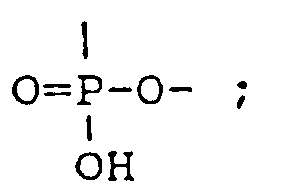
wherein halogen is Cl or Br;

or


wherein halogen is Cl or Br;



| In Vitro Induced Potentiation of Natural Killer Cell Activity | ||||
| Effector Cells | % Natural Killer Cell Cytotoxicity | |||
| From: | Treatment With: | Treatment Time (Hour) | ||
| 0 | 20 | 44 | ||
| CBA/CAJ | None | 13 | 4 | 0.5 |
| Compound 7 | 15 | 34 | 31 | |
| Poly I:C | 14.5 | 18 | 19 | |
| CBA/CAJ | None | 14 | 8 | 1 |
| Compound 7 | 23 | 62 | 44 | |
| Poly I:C | 22 | 31 | 9 | |
| C57BL/6J | None | 16 | 1.5 | 2.5 |
| Compound 7 | 18 | 35 | 34 | |
| Poly I:C | 18 | 13 | 14 | |
| C57BL/6J | None | 30 | 1.6 | 1.3 |
| Compound 7 | 18 | 25 | 22 | |
| Poly I: | 22 | 6 | 13 |
| TABLE 2a In Vitro Augmentation of Human Natural Killer Cell Activity | ||
| Donor | % Natural Killer Cell Cytotoxicity | |
| - Compound 7 | + Compound 7 | |
| 1 | 26 | 91 |
| 2 | 4 | 29 |
| 3 | 22 | 54 |
| 4 | 24 | 47 |
| 5 | 6 | 16 |
| 6 | 1 | 18 |
| 7 | 2 | 10 |
| 8 | 13 | 22 |
| 9 | 6 | 15 |
| 10 | 14 | 20 |
| 11 | 11 | 32 |
| In Vitro Augmentation of Human Natural Killer Cell Activity | ||||
| Exp. # | % Natural Killer Cell Cytotoxicity | |||
| Donor 1 | Donor 2 | |||
| -Compound 7 | +Compound 7 | -Compound 7 | +Compound 7 | |
| 1 | 25 | 47 | 4 | 29 |
| 2 | 26 | 91 | 15 | 37 |
| 3 | 9 | 36 | 19 | 37 |
| 4 | 23 | 55 | 3 | 26 |
| 5 | 32 | 67 | 4 | 13 |
| 6 | 12 | 30 | 2 | 10 |
| 7 | 16 | 50 | ||
| 8 | 31 | 40 |
| Reproducibility of Compound 7 Induced Increase in Natural Killer Cell Activity | ||
| Exp. # | % Increase in Natural Killer Cell Activity | |
| Donor | ||
| 1 | 3 | |
| 1 | 1031 | 220 |
| 2 | 658 | 102 |
| 3 | 413 | 201 |
| 4 | 200 | 66 |
| 5 | 149 | 28 |
| 6 | 460 | 136 |
| 7 | 91 | 102 |
| 8 | 98 | 200 |
| 9 | 200 |
| Effect of Compound 7 on Human Natural Killer Cell Activity | |
| Donor | % Increase in Induced Natural Killer Cell Activity |
| 1 | 1031 |
| 2 | 548 |
| 3 | 220 |
| 4 | 88 |
| 5 | 123 |
| 6 | 141 |
| 7 | 167 |
| 8 | 150 |
| 9 | 0 |
| 10 | 63 |
| 11 | 8 |
| Natural Killer cell Activity in CBA/CaJ Mice | |||||
| Mice CBA/CaJ | Treatment With: | Days After Treatment | % Natural Killer Cytotoxicity Effector: Target | ||
| 50:1 | 100:1 | 150:1 | |||
| Group - 1 | Saline | 1 | 11 ± 3 | 18 ± 2 | 23 ± 0.3 |
| Group - 2 | Compound 7 (1.68mg) | 1 | 53 ± 5 | 64 ± 5 | 71 ± 9 |
| Group - 3 | Compound 7 (1.68mg) | 2 | 46 ± 9 | 64 ± 5 | 65 ± 7 |
| Group - 4 | Compound 7 (1.68mg) | 3 | 38 ± 6.6 | 50 ± 7 | 63 ± 6 |
| Group - 5 | Compound 7 (1.68mg) | 4 | 30 ± 0.1 | 37 ± 1.5 | 48 ± 3 |
| Dosage Effects on Natural Killer Cell Activity in Mice | ||||
| Mice CBA/CaJ | Treatment With: | % Natural Killer Cytoxicity Effector : Target | ||
| 50:1 | 100:1 | 150:1 | ||
| Group - 1 | Saline | 14 ± 4 | 20 ± 4 | 23 ± 3.5 |
| Group - 2 | Compound 7 (0.84mg) | 38 ± 7 | 48 ± 9 | 56 ± 8.5 |
| Group - 3 | Compound 7 (1.68mg) | 44 ± 8 | 56 ± 12 | 61 ± 14 |
| Group - 4 | Compound 7 (2.52mg) | 48 ± 6.6 | 62 ± 7 | 70 ± 5 |
| Group - 5 | Compound 7 (3.36mg) | 48 ± 4.6 | 67 ± 10 | 74 ± 6.4 |
| Natural Killer Cell Activity in Old Mice | ||||
| Mice C57BL/6J | Treatment With: | %Natural Killer Cell Cytotoxicity Effector: Target | ||
| 50:1 | 100:1 | 150:1 | ||
| Group - 1 (8 Mo. Old) | Saline | 4 | 9 | 14 |
| Group - 2 (8 Mo. Old) | Compound 7 (1.67mg) | 14 | 19 | 23 |
| Group - 3 (8 Mo. Old) | Compound 7 (3.34mg) | 17 | 28 | 38 |
| Group - 4 (8 Wk. Old) | Saline | 5 | 7 | 7 |
| Group - 5 (8 Wk. Old) | Compound 7 (1.67mg) | 15 | 20 | 24 |
| Group - 6 (8 Wk. Old) | Compound 7 (3.34mg) | 17 | 27 | 31 |
| Natural Killer Cell Activity in Nude/Nude Mice | ||||
| Mice Nude-Nude | Treatment With: | % Natural Killer Cell Cytotoxicity Effector : Target | ||
| 50:1 | 100:1 | 150:1 | ||
| Group - 1 | Saline | 15 ± 5 | 25 ± 7.7 | 30 ± 11 |
| Group - 2 | Compound 7 (1.67mg) | 43 ± 12 | 56 ± 12 | 61 ± 14 |
| Group - 3 | Compound 7 (3.34mg) | 38 ± 6 | 56 ± 6 | 61 ± 12 |
| Antiviral Activity Against Effects of Herpes Simplex Virus Type 1 Infection | |||
| Compound | Dose (mg/kg/day) | Survivors/Total (%) | Mean Survival Time (days) |
| Placebo | - | 1/12 (0) | 12.5 ± 3.0 |
| Compound 7 | 200 | 6/12 (50) | 11.0 ± 1.7 |
| Compound 7 | 100 | 4/12 (25) | 11.4 ± 1.8 |
| Compound 7 | 50 | 8/12 (75) | 14.8 ± 5.0 |
| Antiviral Activity Against Herpes Simplex Virus Type 2 Infection | |||
| Compound | Dose (mg/kg/day) | Survivors/Total (%) | Mean Survival Time (days) |
| Placebo | - | 0/12 (8) | 9.8 ± 1.0 |
| Compound 7 | 200 | 2/12 (17) | 7.2 ± 3.9 |
| Compound 7 | 100 | 6/12 (50) | 11.2 ± 1.5 |
| Compound 7 | 50 | 6/12 (50) | 11.8 ± 2.3 |
| Antiviral Activity Against Influenza B Virus Infection in Mice | ||||
| Compound | Dose (mg/kg/day) | Treatment Schedule | Survivors/Total (%) | Mean Survival Time (days) |
| Saline | - | a | 0/12 (0) | 8.7 ± 2.7 |
| Ribavirin | 100 | a | 10/12 (83) | 8.0 ± 0.0 |
| Compound 7 | 100 | b | 2/12 (17) | 6.6 ± 1.1 |
| 50 | b | 2/12 (17) | 6.4 ± 1.5 | |
| a Half-daily doses were administered twice a day for 7 days
starting 2 hours pre-virus inoculation. b Treated once a day at -2 hours and on days 2, 4, and 6 relative to virus inoculation. |
| Antiviral Activity Against San Angelo Virus Infection in Mice | ||||
| Compound | Dose (mg/kg/day) | Treatment Schedule | Survivors/Total (%) | Mean Survival Time (21 days) |
| Saline | - | a | 2/12 (17) | 7.5 ± 1.2 |
| Ribavirin | 200 | a | 11/12 (92) | 12.3 ± 2.9 |
| Compound 7 | 200 | b | 12/12 (100) | >21 |
| 100 | c | 12/12 (100) | >21 | |
| 50 | c | 12/12 (100) | >13.0 ± 0.0 | |
| Compound 7 | 200 | d | 12/12 (100) | >21 |
| a Half-daily doses were administered twice a day for 7 days
starting 2 hours pre-virus inoculation. b Treated once a day at -2 hours and on days 2, 4, and 6 relative to virus inoculation. Half daily doses were administered twice a day. c Treated once a day at -2 hours and on days 2, 4, and 6 relative to virus inoculation. d Half-daily doses were administered at 24 and 16 hours pre-virus inoculation. |
| Antiviral Activity Against Mouse Cytomegalovirus Infection in Mice | ||||
| Compound | Dose (mg/kg/day) | Treatment Schedule | Survivors/Total (%) | Mean Survival Time (days) |
| Saline | - | a | 4/12 (33) | 6.1 ± 0.4 |
| Compound 7 | 200 | a | 12/12 (100) | >21 |
| 100 | b | 7/12 (58) | 7.0 ± 1.4 | |
| 50 | b | 6/12 (50) | 6.5 ± 0.8 | |
| a Half-daily doses were administered at 24 and 16 hours
previrus inoculation b Single dose was administered 24 hours pre-virus inoculation |
| Antiviral Activity Against Mouse Cytomegalovirus Infection in Mice | ||||
| Compound | Dose (mg/kg/day) | Treatment Schedule | Survivors/Total (%) | Mean Survival Time (days) |
| Saline | - | a | 3/12 (25) | 6.1 ± 0.9 |
| Compound 7 | 100 | b | 0/12 (0) | 6.0 ± 0.8 |
| 50 | b | 0/12 (0) | 6.3 ± 1.1 | |
| a Treatments were once a day for 6 days starting 2 hours
pre-virus inoculation b Treatments were once a day at -2 hours and on days 2, 4, and 6 relative to virus inoculation |
| Therapeutic Antiviral Activity Against Semliki Forest Virus Infection in Mice | ||||
| Compound | Dose (mg/kg/day) | Treatment Schedule | Survivors/Total (%) | Mean Survival Time (days) |
| Saline | - | a | 0/12 (0) | 6.7 ± 1.9 |
| Compound 7 | 200 | b | 7/12 (58) | 4.2 ± 0.8 |
| 100 | c | 8/12 (67) | 7.3 ± 0.5 | |
| 50 | c | 4/12 (33) | 6.6 ± 0.8 | |
| Compound 36 | 200 | 10/12 (83) | 7.0 ± 0.0 | |
| 100 | 6/12 (50) | 6.8 ± 0.8 | ||
| 50 | 4/12 (33) | 6.1 ± 1.1 | ||
| a Half-daily doses were administered twice a day for 7 days
starting 2 hours pre-virus inoculation b Treated at -2 hours and on days 2, 4, and 6 relative to virus inoculation. Half-daily doses were administered twice a day because of insolubility c Treated once a day at -2 hours and on days 2, 4, and 6 relative to virus inoculation d Half-daily doses were administered at 24 and 16 hours pre-virus inoculation |
| Prophylactic Antiviral Activity Against Semliki Forest Virus Infection in Mice | ||||
| Compound | Dose (mg/kg/day) | Treatment Schedule | Survivors/Total (%) | Mean Survival Time (days) |
| Saline | - | d | 1/8 (12) | 10.4 ± 1.3 |
| Compound 7 | 200 | d | 4/8 (50) | 11.8 ± 2.9 |
| a Half-daily doses were administered twice a day for 7 days
starting 2 hours pre-virus inoculation b Treated at -2 hours and on days 2, 4, and 6 relative to virus inoculation. Half-daily doses were administered twice a day because of insolubility c Treated once a day at -2 hours and on days 2, 4, and 6 relative to virus inoculation d Half-daily doses were administered at 24 and 16 hours pre-virus inoculation e p<.01 two-tailed Fisher |
| Antiviral Activity Against Human Coronavirus Infection In 14 Day Old Mice | ||
| Test Compound (mg/kg) | Survivors/Total (%) | Mean Survival Time (Days) |
| 0 | 0/33 (0) | 6.0 ± 1.6 |
| 200 | 4/32 (13) | 7.0 ± 1.4 |
| 100 | 8/33 (24) | 7.2 ± 2.0 |
| 50 | 0/33 (0) | 6.9 ± 2.2 |
| Antiviral Activity Against Rat Coronavirus Infection In Suckling Rats | ||
| Test Compound (µM) | Survivors/Total (%) | Mean Survival Time (Days) |
| 0 | 7/28 (25) | 7.2 ± 1.8 |
| 200 | 22/27 (81) | 13.0 ± 1.0 |
| 100 | 17/28 (61) | 10.2 ± 1.8 |
| 50 | 21/28 (75) | 10.1 ± 2.3 |
| Effects of single versus multiple treatments on Encephalomyocarditis virus infection in mice | ||||
| Compound | Treatment -24 hrs | Treatment Days 0-6 | Survivors/Total (%) | Mean Survival Time (Days) |
| Placebo | + | + | 1/12 (8) | 4.4 ± 0.5 |
| Test Compound | 200 | - | 5/12 (42) | 6.0 ± 1.3 |
| Test Compound | 200 | 50 | 8/12 (67) | 9.5 ± 2.1 |
| Effect of Guanosine Nucleosides and Nucleotides on Murine Natural Killer Cell Activity In Vitro | |||
| Exp # | Effector Cells Pretreated with: | Concentration (mM) | % Natural Killer Cell Cytotoxicity |
| 1 | None | - | 1.2 |
| Compound 7 | 0.05 | 34.5 | |
| Compound 16 | 0.05 | 10 | |
| Compound 16 | 0.5 | 38 | |
| Compound 9 | 0.05 | 3 | |
| Compound 9 | 0.5 | 13 | |
| 2 | None | - | 1.6 |
| Compound 7 | 0.05 | 25 | |
| Compound 7 | 0.25 | 28 | |
| Compound 16 | 0.05 | 3 | |
| Compound 16 | 0.25 | 17 | |
| Compound 9 | 0.05 | 2 | |
| 3 | None | - | 1.6 |
| Compound 7 | 0.05 | 28 | |
| Compound 16 | 0.05 | 14 | |
| Compound 16 | 0.25 | 24 | |
| Compound 9 | 0.05 | 0.31 | |
| Compound 9 | 0.5 | 6.5 |
| Effect of Guanosine Nucleosides and Nucleotides on Human Natural Killer Cell Activity In Vitro | |||
| Exp # | Effector Cells Pretreated with: | Concentration (mM) | % Natural Killer Cell Cytotoxicity |
| 1 | None | - | 26 |
| Compound 7 | 0.4 | 91 | |
| Compound 16 | 0.4 | 69 | |
| Compound 12 | 0.4 | 39 | |
| Compound 11 | 0.4 | 63 | |
| 2 | None | - | 23 |
| Compound 12 | 0.2 | 43 | |
| 3 | None | - | 17 |
| Compound 12 | 0.4 | 22 | |
| 4 | None | - | 9 |
| Compound 11 | 0.4 | 19 | |
| 5 | None | - | 3 |
| Compound 7 | 0.4 | 37 | |
| Compound 16 | 0.4 | 10 | |
| Compound 9 | 0.05 | 6 | |
| 6 | None | - | 16.53 |
| Compound 7 | 0.4 | 50 | |
| None | - | 40 | |
| Compound 9 | 0.2 | 43 | |
| 7 | None | - | 4.5 |
| Compound 7 | 0.2 | 10 | |
| Compound 8 | 0.2 | 5 | |
| Compound 19 | 0.2 | 7 |
| Combination Chemotherapy Against San Angelo Virus | |||
| Treatment | Survivors/Total(%) | Mean Survival Time (Days) | |
| -24 Hrs | Days 0-6 | ||
| Saline | Saline | 1/16 (6) | 8.3 ± 1.8 |
| Compound 7 (5) | Saline | 7/16 (44) | 9.6 ± 1.6 |
| Saline | Ribavirin (50) | 6/16 (38) | 9.0 ± 1.2 |
| Saline | Ribavirin (25) | 9/16 (56) | 8.1 ± 0.7 |
| Compound 7 (5) | Ribavirin (50) | 8/16 (50) | 8.9 ± 2.2 |
| Compound 7 (5) | Ribavirin (25) | 6/16 (38) | 10.1 ± 3.6 |
| Combination Chemotherapy Against Banzi Virus Infection | |||
| Treatment -24 hours | Treatment days 0-6 | Survivors/Total (%) | Mean Survival Time (days) |
| Placebo | Saline | 0/12 (0) | 7.7 ± 0.5 |
| Placebo | Ribavirin 100 mg/kg | 0/12 (0) | 8.5 ± 1.0 |
| Placebo | Ribavirin 200 mg/kg | 0/12 (0) | 9.1 ± 0.8 |
| Compound 7 100 mg/kg | Saline | 0/12 (0) | 9.3 ± 1.0 |
| Compound 7 100 mg/kg | Ribavirin 100 mg/kg | 0/12 (0) | 10.2 ± 0.9 |
| Compound 7 | Ribavirin | 3/12 (25) | 12.4 ± 3.5 |
Claims (23)
- Use of a compound of the structure:
 wherein R4, R5, R6 and R7 individually are H, OH or C1-C18 O-acyland R3 is H, C1-C18 acyl or
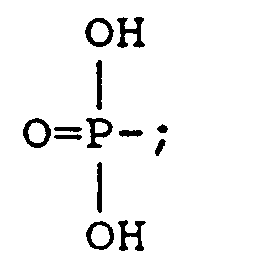 or R5 and R7 are H or OH, R6 is H and together R3 and R4 are
 and X is =O or =S;Y is -OH, -SH, -NH2 or halogen;and Z is H, -NH2, -OH or halogen;
wherein halogen is Cl or Br,or a pharmaceutically acceptable salt thereof, in the manufacture of a medicament for use in treating a virus in a mammal. - Use according to claim 1 wherein said compound is a compound of the structure:
 wherein R1 and R2 individually are H or C1-C18 acyland R3 is H, C1-C18 acyl or
 or R1 is H and together R2 and R3 are
 and X is =O or =S;Y is -OH, -SH, -NH2 or halogen;and Z is H, -NH2, -OH or halogen;
wherein halogen is Cl or Br;or a pharmaceutically acceptable salt thereof. - Use according to claim 1 or 2 wherein:Z is -NH2 and Y is -OH.
- Use according to claim 2 or 3 wherein:R1 and R2 are H, acetyl or benzoyl andR3 is H, acetyl, benzoyl or
 or R1 is H and together R2 and R3 are
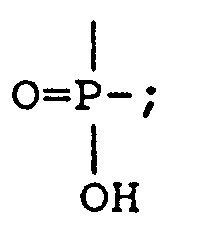 or a pharmaceutically acceptable salt thereof.
 - Use according to claim 4 wherein: Z is -NH2 and Y is -OH.
- Use according to claim 5 wherein: X is =O.
- Use according to any one of clams 4 to 6 wherein R1 and R2 are H.
- Use according to claim 7 wherein R3 is H.
- Use according to any one of claims 1 to 8 wherein the virus is an RNA virus or a DNA virus.
- Use according to claim 9 wherein the virus is Herpes Simplex Type 1 Virus or Herpes Simplex Type 2 Virus.
- An anti viral composition containing a therapeutically effective amount of a compound of the structure:
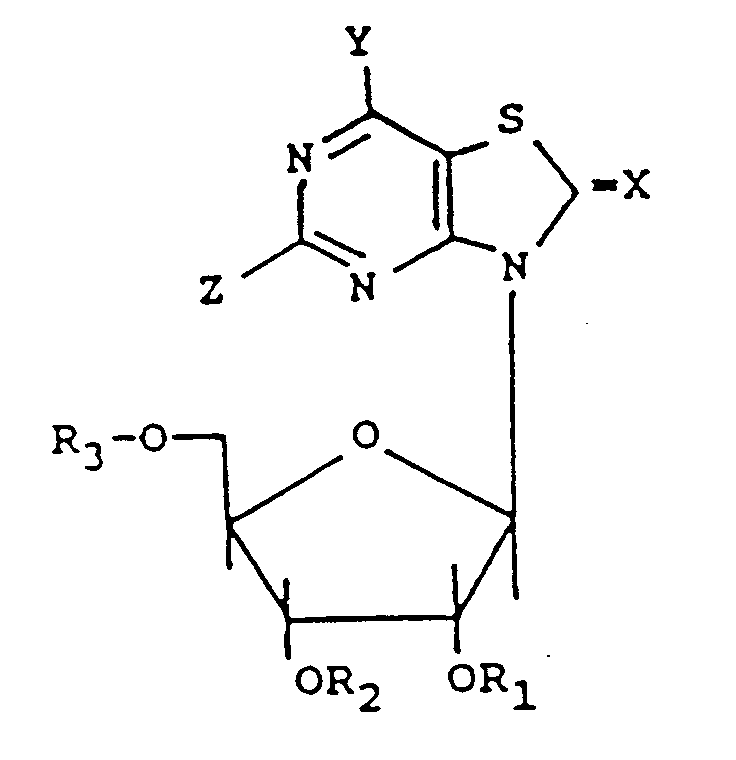 wherein R1 and R2 individually are H or C1-C18 acyl andR1 is H, C1-C18 acyl or
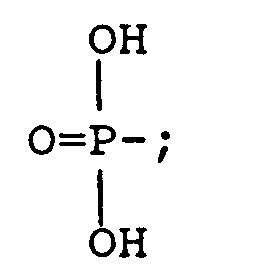 or R1 is H and together R2 and R3 are
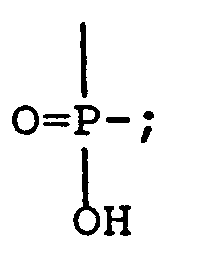 and X is =O or =S;Y is -OH, -SH, -NH2 or halogen;and Z is H, -NH2, -OH or halogen;
wherein halogen is Cl or Br;or a pharmaceutically acceptable salt thereof in combination with a therapeutically acceptable diluent or carrier. - A composition according to claim 11 wherein:Z is -NH2 and Y is -OH.
- A composition according to claim 12 wherein:R1 and R2 are H, acetyl or benzoyl andR3 is H, acetyl, benzoyl or
 or R1 is H and together R2 and R3 are
 or a pharmaceutically acceptable salt thereof.
 - A composition according to claim 13 wherein:Z is -NH2 and Y is -OH.
- A composition according to claim 14 wherein:X is =O.
- A composition according to claims 13, 14 or 15 wherein:R1 and R2 are H.
- A composition according to claim 16 wherein:R3 is H.
- A composition according to claim 11 wherein the compound is 5-amino-3-β-D-ribofuranosylthioazolo[4,5-d] pyrimidine-2,7(6H)-dione or a pharmaceutically acceptable salt thereof.
- A composition according to claim 18 wherein the compound is in the form of the 5'-phosphate.
- A composition according to claim 18 wherein the compound is in the form of the 3'-5' cyclic phosphate.
- An anti-viral composition containing a therapeutically effective amount of 5-amino-2-thioxo-3-β-D-ribofuranosylthioazolo[4,5-d]pyrimidin-7(6H)-one in combination with a therapeutically acceptable diluent or carrier.
- An anti-viral composition containing a therapeutically effective amount of 5-amino-3-β-D-ribofuranosylthiazolo[4,5-d]pyrimidine-2,7(6H)-dione or a pharmaceutically acceptable salt thereof in combination with a therapeutically acceptable diluent or carrier.
- An anti-viral composition according to any one of claims 11 to 22 further comprising a second anti-viral agent.
Applications Claiming Priority (5)
| Application Number | Priority Date | Filing Date | Title |
|---|---|---|---|
| US136020 | 1987-12-21 | ||
| US07/136,020 US4880784A (en) | 1987-12-21 | 1987-12-21 | Antiviral methods utilizing ribofuranosylthiazolo[4,5-d]pyrimdine derivatives |
| US07/236,366 US5041426A (en) | 1987-12-21 | 1988-08-25 | Immune system enhancing 3-β-d-ribofuranosylthiazolo[4,5-d]pyridimine nucleosides and nucleotides |
| EP88908566A EP0348446B1 (en) | 1987-12-21 | 1988-09-02 | Antiviral antitumor antimetastatic immune system enhancing nucleosides and nucleotides |
| US236366 | 1994-04-29 |
Related Parent Applications (1)
| Application Number | Title | Priority Date | Filing Date |
|---|---|---|---|
| EP88908566.8 Division | 1988-09-02 |
Publications (2)
| Publication Number | Publication Date |
|---|---|
| EP0636372A1 EP0636372A1 (en) | 1995-02-01 |
| EP0636372B1 true EP0636372B1 (en) | 1998-12-02 |
Family
ID=26833912
Family Applications (2)
| Application Number | Title | Priority Date | Filing Date |
|---|---|---|---|
| EP88908566A Expired - Lifetime EP0348446B1 (en) | 1987-12-21 | 1988-09-02 | Antiviral antitumor antimetastatic immune system enhancing nucleosides and nucleotides |
| EP94112331A Expired - Lifetime EP0636372B1 (en) | 1987-12-21 | 1988-09-02 | Antiviral, antitumor, antimetastatic, immune system enhancing 7-thia-guanosine derivatives |
Family Applications Before (1)
| Application Number | Title | Priority Date | Filing Date |
|---|---|---|---|
| EP88908566A Expired - Lifetime EP0348446B1 (en) | 1987-12-21 | 1988-09-02 | Antiviral antitumor antimetastatic immune system enhancing nucleosides and nucleotides |
Country Status (11)
| Country | Link |
|---|---|
| US (1) | US5041426A (en) |
| EP (2) | EP0348446B1 (en) |
| JP (1) | JP2590248B2 (en) |
| KR (1) | KR970002611B1 (en) |
| AR (1) | AR246104A1 (en) |
| AT (2) | ATE173929T1 (en) |
| CA (1) | CA1319931C (en) |
| DE (2) | DE3854297T2 (en) |
| DK (1) | DK406389A (en) |
| ES (1) | ES2010786A6 (en) |
| WO (1) | WO1989005649A1 (en) |
Families Citing this family (36)
| Publication number | Priority date | Publication date | Assignee | Title |
|---|---|---|---|---|
| US5166141A (en) * | 1983-11-01 | 1992-11-24 | Scripps Clinic And Research Foundation | Immunostimulating 7-deaza-7-oxa- and 7-deaza-7-oxo-analogs of 8-substituted-guanine-9-(1'-beta-D-aldoglycosidyl) derivatives and methods of treating test animals |
| JPH04501254A (en) * | 1988-05-23 | 1992-03-05 | アメリカ合衆国 | Cyclic AMP derivatives as cancer therapeutic agents |
| DE69729887T2 (en) * | 1996-10-16 | 2005-07-28 | ICN Pharmaceuticals, Inc., Costa Mesa | Purine L nucleosides, analogs and their use |
| AU738170B2 (en) * | 1996-10-16 | 2001-09-13 | Icn Pharmaceuticals, Inc. | Monocyclic L-nucleosides, analogs and uses thereof |
| US6509320B1 (en) * | 1996-10-16 | 2003-01-21 | Icn Pharmaceuticals, Inc. | Purine L-nucleosides, analogs and uses thereof |
| EP1103559A1 (en) * | 1997-01-17 | 2001-05-30 | ICN Pharmaceuticals, Inc. | Autoimmune nucleosides |
| US7638496B2 (en) | 2000-02-15 | 2009-12-29 | Valeant Pharmaceuticals North America | Nucleoside analogs with carboxamidine modified monocyclic base |
| US6645990B2 (en) * | 2000-08-15 | 2003-11-11 | Amgen Inc. | Thiazolyl urea compounds and methods of uses |
| US7321033B2 (en) * | 2001-11-27 | 2008-01-22 | Anadys Pharmaceuticals, Inc. | 3-B-D-ribofuranosylthiazolo [4,5-d] pyrimidine nucleosides and uses thereof |
| CN1300165C (en) * | 2001-11-27 | 2007-02-14 | 安那迪斯药品股份有限公司 | 3-β-ribofuranosylthiazolo[4,5-d]pyrimidine nucleoside and its application |
| CN1845745B (en) * | 2003-09-05 | 2011-11-02 | 安那迪斯药品股份有限公司 | Use of TLR7 ligand and its prodrug in the preparation of medicines for treating hepatitis C virus infection |
| ATE465742T1 (en) * | 2003-09-05 | 2010-05-15 | Anadys Pharmaceuticals Inc | TLR7 LIGANDS FOR TREATING HEPATITIS C |
| GB0500020D0 (en) | 2005-01-04 | 2005-02-09 | Novartis Ag | Organic compounds |
| US20080070852A1 (en) * | 2004-06-07 | 2008-03-20 | Averett Devron R | 3-Beta-D-Ribofuranosylthiazolo[ 4,5-D] Pyridimine Nucleosides and Uses Thereof |
| CN101212968B (en) * | 2004-12-17 | 2011-11-16 | 安那迪斯药品股份有限公司 | 3,5-disubstituted and 3,5,7-trisubstituted-3H-oxazolo and 3H-thiazolo[4,5-d]pyrimidin-2-one compounds and their prodrugs |
| JP5303149B2 (en) * | 2004-12-17 | 2013-10-02 | アナディス ファーマシューティカルズ インク | 3,5-disubstituted and 3,5,7-trisubstituted-3H-oxazolo and 3H-thiazolo [4,5-d] pyrimidin-2-one compounds and prodrugs thereof |
| DE602006015700D1 (en) * | 2005-11-21 | 2010-09-02 | Anadys Pharmaceuticals Inc | A NEW METHOD FOR THE PREPARATION OF 5-AMINO-3H-THIAZOLOÄ4,5-DÜPYRIMIDIN-2-ON |
| CA2643680A1 (en) | 2006-04-11 | 2007-11-22 | Novartis Ag | Hcv/hiv inhibitors and their uses |
| TWI418561B (en) * | 2006-06-22 | 2013-12-11 | Anadys Pharmaceuticals Inc | Prodrugs of 5-amino-3-(3'-deoxy-β-d-ribofuranosyl)-thiazolo[4,5-d]pyrimidin-2,7-dione |
| JP5225991B2 (en) * | 2006-07-18 | 2013-07-03 | アナディス ファーマシューティカルズ インク | Carbonate and carbamate prodrugs of thiazolo [4,5-d] pyrimidine |
| KR100880298B1 (en) | 2006-12-06 | 2009-01-28 | 애나디스 파마슈티칼스, 인코포레이티드 | 3-β-D-ribofuranosylthiazolo [4,5-d] pyrimidinenucleosides and uses thereof |
| AU2009333559B2 (en) | 2008-12-09 | 2015-03-12 | Gilead Sciences, Inc. | Modulators of toll-like receptors |
| US20110182850A1 (en) | 2009-04-10 | 2011-07-28 | Trixi Brandl | Organic compounds and their uses |
| US8512690B2 (en) | 2009-04-10 | 2013-08-20 | Novartis Ag | Derivatised proline containing peptide compounds as protease inhibitors |
| CL2011000716A1 (en) | 2010-03-31 | 2012-04-20 | Gilead Pharmasset Llc | Crystalline forms 1 6 of (s) -isopropyl-2 - (((s) - (((2r.3r.4r.5r) -5- (2,4-dioxo-3,4-dihydropyrimidin-1 (2h) -yl) -4-fluoro-3-hydroxy-4-methyl tetrahydrofuran-2-yl) methoxy) (phenoxy) phosphoryl) amino) propanoate; pharmaceutical composition and combination; and its use to treat a hepatitis c virus infection. |
| EP2624826B1 (en) | 2010-10-08 | 2018-07-18 | Novartis AG | Vitamin e formulations of sulfamide ns3 inhibitors |
| WO2012102366A1 (en) * | 2011-01-28 | 2012-08-02 | 日本たばこ産業株式会社 | Method for producing novel piperazine compound |
| TWI733652B (en) | 2014-07-11 | 2021-07-21 | 美商基利科學股份有限公司 | Modulators of toll-like receptors for the treatment of hiv |
| JP2017526730A (en) | 2014-09-16 | 2017-09-14 | ギリアード サイエンシーズ, インコーポレイテッド | Solid form of Toll-like receptor modulator |
| RS61612B1 (en) * | 2014-12-08 | 2021-04-29 | Hoffmann La Roche | 3-substituted 5-amino-6h-thiazolo[4,5-d]pyrimidine-2,7-dione compounds for the treatment and prophylaxis of virus infection |
| SG11201706835WA (en) | 2015-03-16 | 2017-09-28 | Hoffmann La Roche | Combined treatment with a tlr7 agonist and an hbv capsid assembly inhibitor |
| EP3294745B1 (en) | 2015-05-08 | 2020-01-01 | H. Hoffnabb-La Roche Ag | Novel oxathiolane carboxylic acids and derivatives for the treatment and prophylaxis of virus infection |
| WO2016180743A1 (en) | 2015-05-12 | 2016-11-17 | F. Hoffmann-La Roche Ag | Novel substituted aminothiazolopyrimidinedione for the treatment and prophylaxis of virus infection |
| WO2017001307A1 (en) | 2015-06-30 | 2017-01-05 | F. Hoffmann-La Roche Ag | Novel substituted aminothiazolopyrimidinedione for the treatment and prophylaxis of virus infection |
| AU2018205994B2 (en) | 2017-01-06 | 2021-09-09 | F. Hoffmann-La Roche Ag | Process for the preparation of 3-substituted 5-amino-6H-thiazolo[4,5-d]pyrimidine-2,7-dione compounds |
| KR20220011685A (en) | 2019-05-22 | 2022-01-28 | 길리애드 사이언시즈, 인코포레이티드 | Combination of a TLR7 modulating compound with an HIV vaccine |
Family Cites Families (2)
| Publication number | Priority date | Publication date | Assignee | Title |
|---|---|---|---|---|
| US5166141A (en) * | 1983-11-01 | 1992-11-24 | Scripps Clinic And Research Foundation | Immunostimulating 7-deaza-7-oxa- and 7-deaza-7-oxo-analogs of 8-substituted-guanine-9-(1'-beta-D-aldoglycosidyl) derivatives and methods of treating test animals |
| US4746651A (en) * | 1983-11-01 | 1988-05-24 | Scripps Clinic And Research Foundation | Antimicrobial chemotherapeutic potentiation using substituted nucleoside derivatives |
-
1988
- 1988-08-25 US US07/236,366 patent/US5041426A/en not_active Expired - Lifetime
- 1988-09-02 DE DE3854297T patent/DE3854297T2/en not_active Expired - Lifetime
- 1988-09-02 AR AR88311844A patent/AR246104A1/en active
- 1988-09-02 AT AT94112331T patent/ATE173929T1/en not_active IP Right Cessation
- 1988-09-02 AT AT88908566T patent/ATE126060T1/en not_active IP Right Cessation
- 1988-09-02 CA CA000576416A patent/CA1319931C/en not_active Expired - Lifetime
- 1988-09-02 JP JP63507805A patent/JP2590248B2/en not_active Expired - Lifetime
- 1988-09-02 EP EP88908566A patent/EP0348446B1/en not_active Expired - Lifetime
- 1988-09-02 DE DE3856279T patent/DE3856279T2/en not_active Expired - Lifetime
- 1988-09-02 EP EP94112331A patent/EP0636372B1/en not_active Expired - Lifetime
- 1988-09-02 WO PCT/US1988/002982 patent/WO1989005649A1/en not_active Ceased
- 1988-09-03 ES ES8802722A patent/ES2010786A6/en not_active Expired
-
1989
- 1989-08-18 DK DK406389A patent/DK406389A/en unknown
- 1989-08-21 KR KR89701557A patent/KR970002611B1/en not_active Expired - Fee Related
Also Published As
| Publication number | Publication date |
|---|---|
| EP0348446A1 (en) | 1990-01-03 |
| ATE126060T1 (en) | 1995-08-15 |
| JPH03504122A (en) | 1991-09-12 |
| DE3854297D1 (en) | 1995-09-14 |
| CA1319931C (en) | 1993-07-06 |
| ATE173929T1 (en) | 1998-12-15 |
| ES2010786A6 (en) | 1989-12-01 |
| KR970002611B1 (en) | 1997-03-06 |
| EP0348446B1 (en) | 1995-08-09 |
| DE3856279T2 (en) | 1999-05-20 |
| DK406389A (en) | 1989-10-04 |
| WO1989005649A1 (en) | 1989-06-29 |
| DK406389D0 (en) | 1989-08-18 |
| EP0636372A1 (en) | 1995-02-01 |
| AR246104A1 (en) | 1994-03-30 |
| US5041426A (en) | 1991-08-20 |
| DE3856279D1 (en) | 1999-01-14 |
| JP2590248B2 (en) | 1997-03-12 |
| KR900700106A (en) | 1990-08-11 |
| EP0348446A4 (en) | 1991-09-25 |
| DE3854297T2 (en) | 1996-03-28 |
Similar Documents
| Publication | Publication Date | Title |
|---|---|---|
| EP0348446B1 (en) | Antiviral antitumor antimetastatic immune system enhancing nucleosides and nucleotides | |
| US4880784A (en) | Antiviral methods utilizing ribofuranosylthiazolo[4,5-d]pyrimdine derivatives | |
| CA1333390C (en) | Fluorinated nucleosides and process for treating retrovirus infections therewith | |
| EP1813278B9 (en) | Nucleoside analogs with carboxamidine modified monocyclic base | |
| EP0666749B1 (en) | ENANTIOMERICALLY PURE beta-D-DIOXOLANE NUCLEOSIDES WITH SELECTIVE ANTI-HEPATITIS B VIRUS ACTIVITY | |
| RU2322989C2 (en) | 4'-substituted nucleosides and pharmaceutical composition comprising thereof for preparing drug for treatment of hepatitis c virus (hcv)-mediated diseases | |
| EP1104436B1 (en) | Beta-l-2'-deoxy-nucleosides for the treatment of hepatitis b virus | |
| HU228135B1 (en) | L-nucleosides derivatives and their use in the manufacture of a medicament for the treatment of hepatitis b-virus and epstein-barr virus | |
| CA2102782C (en) | 2-fluoro-2-substituted adeninyl arabinosides as anti-cancer agents | |
| NO316895B1 (en) | Purine L nucleosides, pharmaceutical compositions comprising them and uses thereof | |
| US5459256A (en) | Lipophilic, aminohydrolase-activated prodrugs | |
| US5153180A (en) | Fluorinated nucleosides and process for treating retrovirus infections therewith | |
| HK1010984A (en) | Antiviral, antitumor, antimetastatic, immune system enhancing 7-thia-guanosine derivatives | |
| IE903632A1 (en) | Inosine/guanosine derivatives as immunosuppressive agents | |
| NO893343L (en) | NEW NUCLEOSIDES AND NUCLEOTIDES AND PROCEDURES FOR THE PREPARATION. | |
| JP3031573B2 (en) | 5'-vinylhalo-alisteromycin / adenosine analogs as immunosuppressants | |
| NZ505531A (en) | 7-Propyl-8-oxo-alpha or beta-L-guanine alpha or beta-L-nucleoside | |
| HK1014663B (en) | Enantiomerically pure beta-d-dioxolane nucleosides with selective anti-hepatitis b virus activity | |
| HK1034083B (en) | Beta-l-2'-deoxy-nucleosides for the treatment of hepatitis b virus | |
| HK1065707B (en) | 4--substituted nucleosides | |
| NZ505553A (en) | 8-substituted alpha or beta L-guanosine analogs and uses thereof | |
| JPH01100192A (en) | Novel oxetanocins and use thereof |
Legal Events
| Date | Code | Title | Description |
|---|---|---|---|
| PUAI | Public reference made under article 153(3) epc to a published international application that has entered the european phase |
Free format text: ORIGINAL CODE: 0009012 |
|
| AC | Divisional application: reference to earlier application |
Ref document number: 348446 Country of ref document: EP |
|
| AK | Designated contracting states |
Kind code of ref document: A1 Designated state(s): AT BE CH DE FR GB IT LI LU NL SE |
|
| RIN1 | Information on inventor provided before grant (corrected) |
Inventor name: COTTAM, HOWARD BRINKERHOFF Inventor name: ROBINS, ROLAND KENITH |
|
| 111L | Licence recorded |
Free format text: 0100 ICN PHARMACEUTICALS, INC. |
|
| 17P | Request for examination filed |
Effective date: 19950428 |
|
| 17Q | First examination report despatched |
Effective date: 19970818 |
|
| RAP1 | Party data changed (applicant data changed or rights of an application transferred) |
Owner name: ICN PHARMACEUTICALS, INC. |
|
| GRAG | Despatch of communication of intention to grant |
Free format text: ORIGINAL CODE: EPIDOS AGRA |
|
| GRAG | Despatch of communication of intention to grant |
Free format text: ORIGINAL CODE: EPIDOS AGRA |
|
| GRAH | Despatch of communication of intention to grant a patent |
Free format text: ORIGINAL CODE: EPIDOS IGRA |
|
| GRAH | Despatch of communication of intention to grant a patent |
Free format text: ORIGINAL CODE: EPIDOS IGRA |
|
| GRAA | (expected) grant |
Free format text: ORIGINAL CODE: 0009210 |
|
| AC | Divisional application: reference to earlier application |
Ref document number: 348446 Country of ref document: EP |
|
| AK | Designated contracting states |
Kind code of ref document: B1 Designated state(s): AT BE CH DE FR GB IT LI LU NL SE |
|
| REF | Corresponds to: |
Ref document number: 173929 Country of ref document: AT Date of ref document: 19981215 Kind code of ref document: T |
|
| REG | Reference to a national code |
Ref country code: CH Ref legal event code: EP |
|
| REG | Reference to a national code |
Ref country code: CH Ref legal event code: NV Representative=s name: ISLER & PEDRAZZINI AG |
|
| REF | Corresponds to: |
Ref document number: 3856279 Country of ref document: DE Date of ref document: 19990114 |
|
| ITF | It: translation for a ep patent filed | ||
| ET | Fr: translation filed | ||
| PLBE | No opposition filed within time limit |
Free format text: ORIGINAL CODE: 0009261 |
|
| STAA | Information on the status of an ep patent application or granted ep patent |
Free format text: STATUS: NO OPPOSITION FILED WITHIN TIME LIMIT |
|
| 26N | No opposition filed | ||
| REG | Reference to a national code |
Ref country code: GB Ref legal event code: IF02 |
|
| NLS | Nl: assignments of ep-patents |
Owner name: ANADYS PHARMACEUTICALS,INC. |
|
| REG | Reference to a national code |
Ref country code: FR Ref legal event code: TP |
|
| REG | Reference to a national code |
Ref country code: CH Ref legal event code: PUE Owner name: ANADYS PHARMACEUTICALS, INC. Free format text: ICN PHARMACEUTICALS, INC.#3300 HYLAND AVENUE#COSTA MESA, CA 92626 (US) -TRANSFER TO- ANADYS PHARMACEUTICALS, INC.#9050 CAMINO SANTA FE#SAN DIEGO, CA 92121 (US) Ref country code: CH Ref legal event code: PLI |
|
| REG | Reference to a national code |
Ref country code: GB Ref legal event code: 732E |
|
| REG | Reference to a national code |
Ref country code: HK Ref legal event code: WD Ref document number: 1010984 Country of ref document: HK |
|
| PGFP | Annual fee paid to national office [announced via postgrant information from national office to epo] |
Ref country code: LU Payment date: 20070827 Year of fee payment: 20 |
|
| PGFP | Annual fee paid to national office [announced via postgrant information from national office to epo] |
Ref country code: DE Payment date: 20070830 Year of fee payment: 20 |
|
| REG | Reference to a national code |
Ref country code: CH Ref legal event code: PCAR Free format text: ISLER & PEDRAZZINI AG;POSTFACH 1772;8027 ZUERICH (CH) |
|
| PGFP | Annual fee paid to national office [announced via postgrant information from national office to epo] |
Ref country code: CH Payment date: 20070830 Year of fee payment: 20 Ref country code: AT Payment date: 20070912 Year of fee payment: 20 |
|
| PGFP | Annual fee paid to national office [announced via postgrant information from national office to epo] |
Ref country code: GB Payment date: 20070829 Year of fee payment: 20 |
|
| PGFP | Annual fee paid to national office [announced via postgrant information from national office to epo] |
Ref country code: SE Payment date: 20070905 Year of fee payment: 20 Ref country code: NL Payment date: 20070903 Year of fee payment: 20 Ref country code: IT Payment date: 20070926 Year of fee payment: 20 |
|
| PGFP | Annual fee paid to national office [announced via postgrant information from national office to epo] |
Ref country code: BE Payment date: 20071120 Year of fee payment: 20 |
|
| PGFP | Annual fee paid to national office [announced via postgrant information from national office to epo] |
Ref country code: FR Payment date: 20070914 Year of fee payment: 20 |
|
| REG | Reference to a national code |
Ref country code: CH Ref legal event code: PL |
|
| REG | Reference to a national code |
Ref country code: GB Ref legal event code: PE20 Expiry date: 20080901 |
|
| BE20 | Be: patent expired |
Owner name: *ANADYS PHARMACEUTICALS INC. Effective date: 20080902 |
|
| NLV7 | Nl: ceased due to reaching the maximum lifetime of a patent |
Effective date: 20080902 |
|
| EUG | Se: european patent has lapsed | ||
| PG25 | Lapsed in a contracting state [announced via postgrant information from national office to epo] |
Ref country code: NL Free format text: LAPSE BECAUSE OF EXPIRATION OF PROTECTION Effective date: 20080902 |
|
| PG25 | Lapsed in a contracting state [announced via postgrant information from national office to epo] |
Ref country code: GB Free format text: LAPSE BECAUSE OF EXPIRATION OF PROTECTION Effective date: 20080901 |