EP0632006B1 - Process for the carbonylation of methanol or a reactive derivative thereof - Google Patents
Process for the carbonylation of methanol or a reactive derivative thereof Download PDFInfo
- Publication number
- EP0632006B1 EP0632006B1 EP94304580A EP94304580A EP0632006B1 EP 0632006 B1 EP0632006 B1 EP 0632006B1 EP 94304580 A EP94304580 A EP 94304580A EP 94304580 A EP94304580 A EP 94304580A EP 0632006 B1 EP0632006 B1 EP 0632006B1
- Authority
- EP
- European Patent Office
- Prior art keywords
- group
- ligand
- sulphur
- phosphorus
- alkyl
- Prior art date
- Legal status (The legal status is an assumption and is not a legal conclusion. Google has not performed a legal analysis and makes no representation as to the accuracy of the status listed.)
- Expired - Lifetime
Links
- HDCCDFJQHFNZEL-UHFFFAOYSA-N S=P(CP(c1ccccc1)c1ccccc1)(c1ccccc1)c1ccccc1 Chemical compound S=P(CP(c1ccccc1)c1ccccc1)(c1ccccc1)c1ccccc1 HDCCDFJQHFNZEL-UHFFFAOYSA-N 0.000 description 1
Classifications
-
- C—CHEMISTRY; METALLURGY
- C07—ORGANIC CHEMISTRY
- C07F—ACYCLIC, CARBOCYCLIC OR HETEROCYCLIC COMPOUNDS CONTAINING ELEMENTS OTHER THAN CARBON, HYDROGEN, HALOGEN, OXYGEN, NITROGEN, SULFUR, SELENIUM OR TELLURIUM
- C07F9/00—Compounds containing elements of Groups 5 or 15 of the Periodic Table
- C07F9/02—Phosphorus compounds
- C07F9/28—Phosphorus compounds with one or more P—C bonds
- C07F9/50—Organo-phosphines
- C07F9/53—Organo-phosphine oxides; Organo-phosphine thioxides
- C07F9/5304—Acyclic saturated phosphine oxides or thioxides
- C07F9/5308—Acyclic saturated phosphine oxides or thioxides substituted by B, Si, P or a metal
-
- C—CHEMISTRY; METALLURGY
- C07—ORGANIC CHEMISTRY
- C07C—ACYCLIC OR CARBOCYCLIC COMPOUNDS
- C07C51/00—Preparation of carboxylic acids or their salts, halides or anhydrides
- C07C51/10—Preparation of carboxylic acids or their salts, halides or anhydrides by reaction with carbon monoxide
- C07C51/12—Preparation of carboxylic acids or their salts, halides or anhydrides by reaction with carbon monoxide on an oxygen-containing group in organic compounds, e.g. alcohols
-
- C—CHEMISTRY; METALLURGY
- C07—ORGANIC CHEMISTRY
- C07C—ACYCLIC OR CARBOCYCLIC COMPOUNDS
- C07C67/00—Preparation of carboxylic acid esters
- C07C67/36—Preparation of carboxylic acid esters by reaction with carbon monoxide or formates
-
- C—CHEMISTRY; METALLURGY
- C07—ORGANIC CHEMISTRY
- C07F—ACYCLIC, CARBOCYCLIC OR HETEROCYCLIC COMPOUNDS CONTAINING ELEMENTS OTHER THAN CARBON, HYDROGEN, HALOGEN, OXYGEN, NITROGEN, SULFUR, SELENIUM OR TELLURIUM
- C07F9/00—Compounds containing elements of Groups 5 or 15 of the Periodic Table
- C07F9/02—Phosphorus compounds
- C07F9/28—Phosphorus compounds with one or more P—C bonds
- C07F9/50—Organo-phosphines
- C07F9/5004—Acyclic saturated phosphines
-
- C—CHEMISTRY; METALLURGY
- C07—ORGANIC CHEMISTRY
- C07F—ACYCLIC, CARBOCYCLIC OR HETEROCYCLIC COMPOUNDS CONTAINING ELEMENTS OTHER THAN CARBON, HYDROGEN, HALOGEN, OXYGEN, NITROGEN, SULFUR, SELENIUM OR TELLURIUM
- C07F9/00—Compounds containing elements of Groups 5 or 15 of the Periodic Table
- C07F9/02—Phosphorus compounds
- C07F9/28—Phosphorus compounds with one or more P—C bonds
- C07F9/50—Organo-phosphines
- C07F9/5022—Aromatic phosphines (P-C aromatic linkage)
Definitions
- the present invention relates to a process for the carbonylation of methanol or a reactive derivative thereof in the presence of a halide promoter and a catalyst system comprising a rhodium component and a bidentate phosphorus-sulphur ligand.
- the present invention also relates to novel rhodium complexes.
- US Patent 4,670,570 describes a process for the production of carboxylic acids from alcohols in the presence of a catalyst system consisting essentially of rhodium metal atom, a phosphorus containing ligand and a halogen-containing compound as promoter.
- a catalyst system consisting essentially of rhodium metal atom, a phosphorus containing ligand and a halogen-containing compound as promoter.
- WO 92/04118 describes novel catalyst precursors having a phosphorus-nitrogen chelated ligand attached to a metal, where said metal is most preferably Rh, Ni or Co.
- the chelated ligand comprises a substantially unreactive connecting backbone structure which links two different dative centres or a donor with an anionic site.
- the catalyst precursor has the general formula: wherein
- the catalyst precursors described in WO92/04118 are active as catalysts in the carbonylation reaction of methanol to form acetic acid and its derivatives such as methyl acetate. Whilst according to WO 92/04118 the process is said to be performable at 25°C to 200°C and the pressure is from 1 psig to 5000 psig, the preferred conditions are said to be 50°C to 120°C and 40 to 400 psig and examples are only given at temperatures in the range 80-90°C and at a pressure of 40 psig.
- a process for the liquid phase carbonylation of methanol or a reactive derivative thereof which process comprises contacting carbon monoxide with a liquid reaction composition comprising methanol or a reactive derivative thereof, a halogen promoter and a rhodium catalyst system comprising a rhodium component and a bidentate phosphorus-sulphur ligand, the ligand comprising a phosphorus dative centre linked to a sulphur dative or anionic centre by a substantially unreactive backbone structure comprising two connecting carbon atoms or a connecting carbon and a connecting phosphorus atom.
- the phosphorus and sulphur dative centres or phosphorus dative centre and anionic sulphur centre are linked via two connecting carbon atoms in the backbone structure which backbone structure may comprise an unbranched hydrocarbyl group -CH 2 -CH 2 -, a branched hydrocarbyl group such as (CH 3 )CHCH 2 or an unsaturated hydrocarbyl group such as a benzene ring (optionally substituted with a non-coordinating substituent such as -Si(CH 3 ) 3 or -CH 3 ) connected in the ortho-positions to the phosphorus and sulphur atoms of the ligand.
- the phosphorus and sulphur dative centres or the phosphorus dative centre and the anionic sulphur centre are linked via a connecting carbon and a connecting phosphorus atom in the backbone structure.
- the bidentate phosphorus-sulphur ligand has a general formula I, II, III, IV or V: wherein the R groups are independently selected from C 1 to C 20 alkyl, cycloalkyl, aryl, substituted aryl and optionally substituted aralkyl; the R 5 groups are selected from hydrogen, C 1 to C 20 alkyl, cycloalkyl, aryl, substituted aryl, acyl and optionally substituted aralkyl groups; the R 1 to R 4 groups are independently selected from hydrogen, C 1 to C 20 alkyl and optionally substituted aralkyl; X is a non-coordinating substitutent such as C 1 to C 20 alkyl, cycloalkyl, aryl, substituted aryl, C 1 to C 20 alkoxy, C 1 to C 20 alkylthio, trialkylsilyl or triarylsilyl, preferably, Si(CH 3 ) 3 or methyl and n is 0 to 4
- the R groups are independently selected from C 1 to C 8 alkyl, cyclohexyl, phenyl and optionally substituted aryl and the R 5 groups are selected from C 1 to C 8 alkyl, cyclohexyl, phenyl, acetyl and benzyl.
- the R 1 to R 4 groups are independently selected from hydrogen or C 1 to C 8 alkyl.
- X is -Si(CH 3 ) 3 at the 6- position or X is -CH 3 at the 4- position.
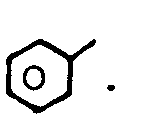
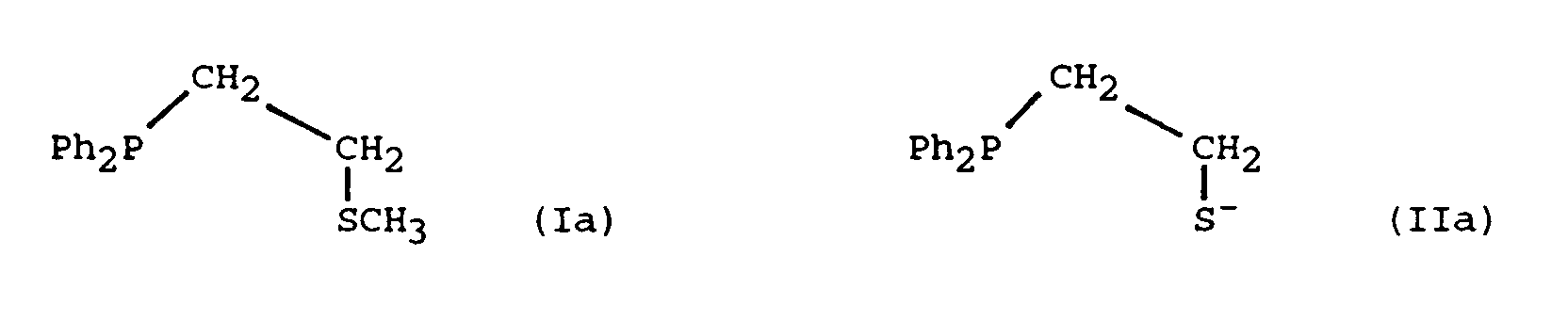
- Examples of preferred ligands are: wherein Ph is
- reactive derivatives of methanol include dimethyl ether, methyl acetate and methyl halide, for example, methyl iodide.
- the products of the process are methyl acetate and/or acetic acid.
- the process according to the present invention is a process for the carbonylation of methanol or a reactive derivative thereof to produce acetic acid.
- the process of the present invention is suitably performed at a temperature in the range 25 to 250°C, preferably 50 to 250°C, more preferably 100 to 250°C, yet more preferably 135 to 250°C, and most preferably 145 to 200°C.
- the process of the present invention is suitably performed at a pressure in the range 10 to 200 barg, preferably 20 to 200 barg, more preferably 30 to 200 barg and most preferably 50 to 100 barg. Whilst the promotional effect is greatest at higher pressures, economic considerations may dictate the pressure to be used industrially.
- Acetic acid may be present as a solvent in the reaction composition in the process of the present invention.
- Water may be present in the liquid reaction composition of the process of the present invention, for example, at a concentration in the range 0.1 to 20%, preferably 0.1 to 14% by weight based on the total weight of the liquid reaction composition.
- the water may be added to the liquid reaction composition and/or may be formed in situ by esterification of methanol with acetic acid solvent and/or acetic acid reaction product present in the liquid reaction composition.
- the rhodium component and bidentate phosphorus-sulphur ligand of the catalyst system may be added to the liquid reaction composition of the present invention in the form of a rhodium complex in which the bidentate phosphorus-sulphur ligand is coordinated to rhodium.
- a rhodium component having displaceable groups is pre-mixed with the bidentate phosphorus-sulphur ligand in a suitable inert solvent, for example methanol, prior to addition to the liquid reaction composition.
- a suitable inert solvent for example methanol
- the rhodium component may be added in any suitable form for example [Rh(CO) 2 Cl] 2 , [Rh(CO) 2 I] 2 , [Rh(Cod)Cl] 2 , rhodium III chloride, rhodium III chloride trihydrate, rhodium III bromide, rhodium III iodide, rhodium III acetate, rhodium dicarbonylacetylacetonate, RhCl(PPh 3 ) 3 and RhCl(CO)(PPh 3 ) 2 .
- the rhodium component of the catalyst system may be present in the liquid reaction composition, for example, at a concentration of 25 - 5000 ppm rhodium and the mole ratio of the rhodium component to the bidentate phosphorus-sulphur ligand is suitably in the range 1:0.5 to 1:4, preferably at a mole ratio of 1:1.
- the halogen promoter is an organic compound containing iodine, most preferably the halogen promoter is an alkyl iodide, preferably methyl iodide.
- the concentration of alkyl iodide in the liquid reaction composition is preferably in the range of 1 to 30% by weight, most preferably 5 to 20% by weight.
- a rhodium complex having a formula [Rh(CO)L] m or [Rh(CO)LY] wherein L is a bidentate phosphorus-sulphur ligand having a general formula, (II), (III), (IV) or (V) as hereinbefore defined, preferably (IIa), (IIIa), (IVa), (Va) or (Vb), Y is a halogen, preferably chlorine, bromine or iodine and m is less than 10, typically at least 2.
- the ligand bis(diphenylphosphino)methane monosulphide Ph 2 PCH 2 P(S)Ph 2 (Va) was prepared as described in Can. J. Chem., 1988, 66, 1272 by D E Berry, J Browning, K R Dixon and R W Hilts.
- the ligand 2-(diphenylphosphino)thiophenol 2-(Ph 2 P)C 6 H 4 (SH) was prepared by the method of E Block, G Ofori-Okai and J Zubieta as described in J Am. Chem.
- Example 3 was repeated at different pressures and the results are shown in Table 4. Reaction Rates at Different Pressures
Landscapes
- Chemical & Material Sciences (AREA)
- Organic Chemistry (AREA)
- Molecular Biology (AREA)
- Health & Medical Sciences (AREA)
- Life Sciences & Earth Sciences (AREA)
- Biochemistry (AREA)
- General Health & Medical Sciences (AREA)
- Chemical Kinetics & Catalysis (AREA)
- Oil, Petroleum & Natural Gas (AREA)
- Engineering & Computer Science (AREA)
- Organic Low-Molecular-Weight Compounds And Preparation Thereof (AREA)
- Catalysts (AREA)
- Low-Molecular Organic Synthesis Reactions Using Catalysts (AREA)
Description


Examples of preferred ligands are:



| REACTION RATES AT 185°C | ||
| Experiment | Ligand | Rate mol/l/h |
| Experiment A | - | 2.3 |
| Experiment B | PPh3 | 2.6 |
| Experiment C | P(=S)Ph3 | 3.5 |
| Experiment D | Ph2PCH2CH2P(=O)Ph2 | 2.7 |
| Experiment E | Ph2PCH2P(=O)Ph2 | 3.0 |
| Example 1 | Ph2PCH2P(=S)Ph2(Va) | 14.2 |
| Reaction Rates at 150°C | ||
| Example | Ligand | Ratemol/l/h |
| Experiment F | Ph2PCH2CH2P(=O)Ph2 | 0.6 |
| Example 2 | Ph2PCH2P(=S)Ph2(Va) | 7.6 |
| Reaction Rates at 185°C | ||||
| Experiment | Complex of Rhodium Component and Ligand | Moles of Complex (x 104) | Ligand, L | Rate mol/1/h |
| Example 3 | [Rh(CO)LC1] | 4.74 | Ph2PCH2P(S)Ph2 (Va) | 19.6 |
| Example 4 | [Rh(CO)2C1]2/2L | 2.37 | Me2PCH2P(S)Me2 (Vb) | 12.7 |
| Example 5 | [Rh(CO)L]m | 4.74/m | 2-(Ph2P)C6H4(S-) (IVa) | 6.2 |
| Example 6 | [Rh(CO)L]m | 4.74/m | Ph2PCH2CH2S- (IIa) | 8.9 |
| Example 7 | [Rh(CO)LC1] | 3.38 | 2-(Ph2P)C6H4(SMe) (IIIa) | 4.2 |
| Example 8 | [Rh(CO)LC1] | 3.17 | Ph2PCH2CH2SMe (Ia) | 4.5 |
| Experiment A | [Rh(CO)2Cl]2 | 2.37 | - | 2.3 |

| Reaction Rates at Different Pressures | ||
| Example | Pressure (barg) | Reaction Rate (mol/l/hr) |
| 9 | 30 | 14.0 |
| 10 | 50 | 21.2 |
| 3 | 70 | 19.6 |
| 11 | 100 | 19.8 |
Claims (16)
- A process for the liquid phase carbonylation of methanol or a reactive derivative thereof which process comprises contacting carbon monoxide with a liquid reaction composition comprising methanol or a reactive derivative thereof, a halogen promoter and a rhodium catalyst system comprising a rhodium component and a bidentate phosphorus-sulphur ligand, the ligand comprising a phosphorus dative centre linked to a sulphur dative or anionic centre by a substantially unreactive backbone structure comprising two connecting carbon atoms or a connecting carbon and a connecting phosphorus atom.
- A process as claimed in claim 1 in which the bidentate phosphorus-sulphur ligand is selected from the group consisting of:-
 wherein the R groups are independently selected from the group consisting of C1 to C20 alkyl, cycloalkyl, aryl, substituted aryl and optionally substituted aralkyl; the R5 groups are selected from the group consisting of hydrogen, C1 to C20 alkyl, cycloalkyl, aryl, substituted aryl, acyl and optionally substituted aralkyl groups; the R1 to R4 groups are independently selected from the group consisting of hydrogen, C1 to C20 alkyl and optionally substituted aralkyl; X is a non-coordinating substituent and n is 0 to 4.
- A process as claimed in claim 2 in which the R groups are independently selected from the group consisting of C1 to C8 alkyl, cyclohexyl, phenyl and optionally substitued aryl.
- A process as claimed in claim 2 or claim 3 in which the R5 groups are selected from the group consisting of hydrogen, C1 to C8 alkyl, cyclohexyl, phenyl, acetyl and benzyl.
- A process as claimed in any one of claims 2 to 4 in which the R1 to R4 groups are independently selected from the group consisting of hydrogen and C1 to C8 alkyl.
- A process as claimed in any one of claims 2 to 5 in which X is Si(CH3)3) or methyl.
- A process as claimed in claim 2 in which the bidentate-sulphur ligand is selected from the group consisting of:-
 wherein Ph is

- A process as claimed in any one of the preceding claims in which the mole ratio of the rhodium component to the bidentate phosphorus-sulphur ligand is in the range 1:0.5 to 1:4.
- A process as claimed in any one of the preceding claims in which the process is performed at a temperature in the range of 25 to 250°C and at a pressure in the range 10 to 200 barg.
- A process as claimed in any one of the preceding claims in which the liquid reaction composition comprises water at a concentration in the range of 0.1 to 20% by weight,an alkyl iodide at a concentration in the range 1 to 30% by weight and a rhodium component at a concentration in the range 25 - 5000 ppm.
- A process as claimed in any one of the preceding claims in which the carbonylation product is acetic acid.
- A catalyst system consisting of a rhodium component and a bidentate phosphorus-sulphur ligand in which the ligand is selected from the group consisting of II, III, IV and V as defined in any one of claims 2 to 6.
- A catalyst system as claimed in claim 12 in which the bidentate phosporus-sulphur ligand is selected from the group consisting of IIa, IIIa, IVa, Va and Vb as defined in claim 7.
- A catalyst system as claimed in claim 12 or claim 13 in which the mole ratio of the rhodium component to the bidentate phosphorus-sulphur ligand is in the range 1:0.5 to 1:4.
- A rhodium complex of formula [Rh(CO)L]m or [Rh(CO)LY] in which L is selected from the group of bidentate phosphorus-sulphur ligands consisting of II, III, IV and V, as defined in claim 2, Y is a halogen and m is a number less than 10.
- A rhodium complex as claimed in claim 15 in which L is selected from the group of bidendate phosphorus-sulphur ligands consisting of IIa, IIIa, IVa, Va and Vb as defined in claim 7 and m is at least 2.
Applications Claiming Priority (4)
| Application Number | Priority Date | Filing Date | Title |
|---|---|---|---|
| GB9313514 | 1993-06-30 | ||
| GB939313514A GB9313514D0 (en) | 1993-06-30 | 1993-06-30 | Process |
| GB9407363 | 1994-04-14 | ||
| GB9407363A GB9407363D0 (en) | 1994-04-14 | 1994-04-14 | Process |
Publications (2)
| Publication Number | Publication Date |
|---|---|
| EP0632006A1 EP0632006A1 (en) | 1995-01-04 |
| EP0632006B1 true EP0632006B1 (en) | 1998-05-13 |
Family
ID=26303147
Family Applications (1)
| Application Number | Title | Priority Date | Filing Date |
|---|---|---|---|
| EP94304580A Expired - Lifetime EP0632006B1 (en) | 1993-06-30 | 1994-06-23 | Process for the carbonylation of methanol or a reactive derivative thereof |
Country Status (12)
| Country | Link |
|---|---|
| US (1) | US5488153A (en) |
| EP (1) | EP0632006B1 (en) |
| JP (1) | JPH0753442A (en) |
| KR (1) | KR950000641A (en) |
| CN (1) | CN1105013A (en) |
| BR (1) | BR9402593A (en) |
| CA (1) | CA2126961A1 (en) |
| DE (1) | DE69410169T2 (en) |
| FI (1) | FI943148L (en) |
| NO (1) | NO942248L (en) |
| RU (1) | RU2129539C1 (en) |
| TW (1) | TW311909B (en) |
Families Citing this family (7)
| Publication number | Priority date | Publication date | Assignee | Title |
|---|---|---|---|---|
| US6215015B1 (en) * | 2000-04-17 | 2001-04-10 | General Electric Company | Catalyst composition and method for producing diaryl carbonates, using bisphosphines |
| US6878830B2 (en) * | 2001-07-13 | 2005-04-12 | Board Of Trustees Of Michigan State University | Catalytic boronate ester synthesis from boron reagents and hydrocarbons |
| TW567183B (en) * | 2001-10-05 | 2003-12-21 | China Petrochemical Dev Corp | Process for producing carboxylic acids |
| US7005541B2 (en) * | 2002-12-23 | 2006-02-28 | Celanese International Corporation | Low water methanol carbonylation process for high acetic acid production and for water balance control |
| TWI473785B (en) * | 2007-06-01 | 2015-02-21 | Bp Chem Int Ltd | Carbonylation process for the production of acetic acid using metal-pincer ligand catalysts |
| CN102580754A (en) * | 2011-12-14 | 2012-07-18 | 中国科学院山西煤炭化学研究所 | Catalyst for synthesizing methyl acetate as well as preparation method and application |
| CN113004139B (en) * | 2019-12-18 | 2022-09-02 | 华东理工大学 | Method for synthesizing propionic acid by ethanol carbonyl under low water content |
Family Cites Families (9)
| Publication number | Priority date | Publication date | Assignee | Title |
|---|---|---|---|---|
| FR1401930A (en) * | 1963-07-24 | 1965-06-04 | Geigy Ag J R | Phosphorus mercaptans and their preparation |
| US4687874A (en) * | 1980-02-12 | 1987-08-18 | Exxon Research And Engineering Company | Selective hydroformylation process using alkyl diaryl phosphine rhodium carbonyl hydride catalysts |
| US4668809A (en) * | 1982-05-03 | 1987-05-26 | Exxon Research And Engineering | Transition metal complex catalysts |
| CA1218999A (en) * | 1983-01-25 | 1987-03-10 | Eit Drent | Process for the preparation of carboxylic acids and/or esters |
| JPS6054334A (en) * | 1983-09-02 | 1985-03-28 | Daicel Chem Ind Ltd | Preparation of carboxylic acid |
| CA1237728A (en) * | 1984-07-20 | 1988-06-07 | Anthony G. Abatjoglou | Production of carboxylic acids from alcohols using rhodium complex catalysts |
| US4855399A (en) * | 1987-02-26 | 1989-08-08 | Shell Oil Company | Carbon monoxide/olefin co-polymerization process with phosphino substituted sulfonic acid catalyst |
| DE69114297T2 (en) * | 1990-08-31 | 1996-05-15 | The Governors Of The University Of Alberta, Edmonton, Alberta | METHANOL CARBONYLATION USING A TRANSITION METAL CATALYST PRECURSOR. |
| DE4121959A1 (en) * | 1991-06-28 | 1993-01-07 | Zentralinstitut Fuer Organisch | Supported catalyst for acetic acid prodn. by carbonylation of methanol - with phosphonic acid deriv. contg. dissimilar chelating gps. as adhesion promoter |
-
1994
- 1994-06-15 NO NO942248A patent/NO942248L/en unknown
- 1994-06-21 US US08/262,955 patent/US5488153A/en not_active Expired - Fee Related
- 1994-06-23 DE DE69410169T patent/DE69410169T2/en not_active Expired - Fee Related
- 1994-06-23 EP EP94304580A patent/EP0632006B1/en not_active Expired - Lifetime
- 1994-06-27 JP JP6143731A patent/JPH0753442A/en active Pending
- 1994-06-28 CA CA002126961A patent/CA2126961A1/en not_active Abandoned
- 1994-06-28 RU RU94022239A patent/RU2129539C1/en active
- 1994-06-29 TW TW083105894A patent/TW311909B/zh active
- 1994-06-29 BR BR9402593A patent/BR9402593A/en not_active Application Discontinuation
- 1994-06-30 FI FI943148A patent/FI943148L/en unknown
- 1994-06-30 CN CN94106576A patent/CN1105013A/en active Pending
- 1994-06-30 KR KR1019940015605A patent/KR950000641A/en not_active Withdrawn
Also Published As
| Publication number | Publication date |
|---|---|
| FI943148A7 (en) | 1994-12-31 |
| CN1105013A (en) | 1995-07-12 |
| NO942248L (en) | 1995-01-02 |
| JPH0753442A (en) | 1995-02-28 |
| CA2126961A1 (en) | 1994-12-31 |
| TW311909B (en) | 1997-08-01 |
| NO942248D0 (en) | 1994-06-15 |
| RU2129539C1 (en) | 1999-04-27 |
| FI943148A0 (en) | 1994-06-30 |
| FI943148L (en) | 1994-12-31 |
| BR9402593A (en) | 1995-05-02 |
| KR950000641A (en) | 1995-01-03 |
| DE69410169T2 (en) | 1998-09-03 |
| US5488153A (en) | 1996-01-30 |
| EP0632006A1 (en) | 1995-01-04 |
| RU94022239A (en) | 1996-04-20 |
| DE69410169D1 (en) | 1998-06-18 |
Similar Documents
| Publication | Publication Date | Title |
|---|---|---|
| Esteruelas et al. | Five-and six-coordinate hydrido (carbonyl)-ruthenium (II) and-osmium (II) complexes containing triisopropylphosphine as ligand | |
| KR100293744B1 (en) | Catalyst composition | |
| CA2688596C (en) | Carbonylation process for the production of acetic acid using metal-pincer ligand catalysts | |
| KR19990022086A (en) | Synthesis of fluoro-substituted bidentate phosphine ligands and hydroformylation using the same | |
| GB2055839A (en) | Ferrocene compounds suitable as ligands for rhodium based catalysts | |
| KR20010022841A (en) | Method of Manufacturing Phosphine Compound | |
| US5488153A (en) | Process for the carbonylation of methanol or a reactive derivative thereof | |
| US5352813A (en) | Carbonylation of methanol using a novel transition metal catalyst | |
| US6018016A (en) | Catalyst composition | |
| EP3438115B1 (en) | Ruthenium based complexes | |
| US4386013A (en) | Hydroformylation process utilizing novel catalyst | |
| WO2000002890A1 (en) | Hydroformylation process | |
| JP2001518905A (en) | Method for producing vinylphosphonic acid compound | |
| EP0794190B1 (en) | Method of producing alkenylphosphine oxide or bis (alkenylphosphine oxide) | |
| McConnell et al. | The synthesis, characterisation and reactivity of 2-phosphanylethylcyclopentadienyl complexes of cobalt, rhodium and iridium | |
| US4370504A (en) | Process for producing perfluorocarbon group-containing aldehydes | |
| US4612390A (en) | Method for producing branched carbonylation products from alpha unsaturated olefins | |
| JP2002518507A (en) | Method for producing vinylphosphonic acid compound | |
| US5830989A (en) | Catalyst composition | |
| JPH0931187A (en) | Catalytic composition | |
| US5298644A (en) | Aryl phosphinites | |
| JP2001521513A (en) | Method for producing 2-alkyne esters | |
| ávan Doorn et al. | Formation and reactions of bis (phosphino) succinic anhydrides | |
| WO2000006299A1 (en) | Catalyst composition |
Legal Events
| Date | Code | Title | Description |
|---|---|---|---|
| PUAI | Public reference made under article 153(3) epc to a published international application that has entered the european phase |
Free format text: ORIGINAL CODE: 0009012 |
|
| AK | Designated contracting states |
Kind code of ref document: A1 Designated state(s): BE DE ES FR GB IT NL SE |
|
| 17P | Request for examination filed |
Effective date: 19950606 |
|
| GRAG | Despatch of communication of intention to grant |
Free format text: ORIGINAL CODE: EPIDOS AGRA |
|
| 17Q | First examination report despatched |
Effective date: 19970417 |
|
| GRAG | Despatch of communication of intention to grant |
Free format text: ORIGINAL CODE: EPIDOS AGRA |
|
| GRAG | Despatch of communication of intention to grant |
Free format text: ORIGINAL CODE: EPIDOS AGRA |
|
| GRAH | Despatch of communication of intention to grant a patent |
Free format text: ORIGINAL CODE: EPIDOS IGRA |
|
| GRAH | Despatch of communication of intention to grant a patent |
Free format text: ORIGINAL CODE: EPIDOS IGRA |
|
| GRAA | (expected) grant |
Free format text: ORIGINAL CODE: 0009210 |
|
| AK | Designated contracting states |
Kind code of ref document: B1 Designated state(s): BE DE ES FR GB IT NL SE |
|
| PG25 | Lapsed in a contracting state [announced via postgrant information from national office to epo] |
Ref country code: NL Free format text: LAPSE BECAUSE OF FAILURE TO SUBMIT A TRANSLATION OF THE DESCRIPTION OR TO PAY THE FEE WITHIN THE PRESCRIBED TIME-LIMIT Effective date: 19980513 Ref country code: IT Free format text: LAPSE BECAUSE OF FAILURE TO SUBMIT A TRANSLATION OF THE DESCRIPTION OR TO PAY THE FEE WITHIN THE PRE;WARNING: LAPSES OF ITALIAN PATENTS WITH EFFECTIVE DATE BEFORE 2007 MAY HAVE OCCURRED AT ANY TIME BEFORE 2007. THE CORRECT EFFECTIVE DATE MAY BE DIFFERENT FROM THE ONE RECORDED.SCRIBED TIME-LIMIT Effective date: 19980513 Ref country code: ES Free format text: THE PATENT HAS BEEN ANNULLED BY A DECISION OF A NATIONAL AUTHORITY Effective date: 19980513 Ref country code: BE Free format text: LAPSE BECAUSE OF FAILURE TO SUBMIT A TRANSLATION OF THE DESCRIPTION OR TO PAY THE FEE WITHIN THE PRESCRIBED TIME-LIMIT Effective date: 19980513 |
|
| PGFP | Annual fee paid to national office [announced via postgrant information from national office to epo] |
Ref country code: GB Payment date: 19980518 Year of fee payment: 5 |
|
| PGFP | Annual fee paid to national office [announced via postgrant information from national office to epo] |
Ref country code: FR Payment date: 19980526 Year of fee payment: 5 |
|
| PGFP | Annual fee paid to national office [announced via postgrant information from national office to epo] |
Ref country code: DE Payment date: 19980527 Year of fee payment: 5 |
|
| REF | Corresponds to: |
Ref document number: 69410169 Country of ref document: DE Date of ref document: 19980618 |
|
| ET | Fr: translation filed | ||
| PG25 | Lapsed in a contracting state [announced via postgrant information from national office to epo] |
Ref country code: SE Free format text: LAPSE BECAUSE OF FAILURE TO SUBMIT A TRANSLATION OF THE DESCRIPTION OR TO PAY THE FEE WITHIN THE PRESCRIBED TIME-LIMIT Effective date: 19980813 |
|
| NLV1 | Nl: lapsed or annulled due to failure to fulfill the requirements of art. 29p and 29m of the patents act | ||
| PLBE | No opposition filed within time limit |
Free format text: ORIGINAL CODE: 0009261 |
|
| STAA | Information on the status of an ep patent application or granted ep patent |
Free format text: STATUS: NO OPPOSITION FILED WITHIN TIME LIMIT |
|
| 26N | No opposition filed | ||
| PG25 | Lapsed in a contracting state [announced via postgrant information from national office to epo] |
Ref country code: GB Free format text: LAPSE BECAUSE OF NON-PAYMENT OF DUE FEES Effective date: 19990623 |
|
| PG25 | Lapsed in a contracting state [announced via postgrant information from national office to epo] |
Ref country code: FR Free format text: THE PATENT HAS BEEN ANNULLED BY A DECISION OF A NATIONAL AUTHORITY Effective date: 19990630 |
|
| GBPC | Gb: european patent ceased through non-payment of renewal fee |
Effective date: 19990623 |
|
| PG25 | Lapsed in a contracting state [announced via postgrant information from national office to epo] |
Ref country code: DE Free format text: LAPSE BECAUSE OF NON-PAYMENT OF DUE FEES Effective date: 20000503 |
|
| REG | Reference to a national code |
Ref country code: FR Ref legal event code: ST |