EP0631594B1 - Wholly aromatic liquid crystalline polymers containing ionic monomer units and laminates thereof - Google Patents
Wholly aromatic liquid crystalline polymers containing ionic monomer units and laminates thereof Download PDFInfo
- Publication number
- EP0631594B1 EP0631594B1 EP19930905965 EP93905965A EP0631594B1 EP 0631594 B1 EP0631594 B1 EP 0631594B1 EP 19930905965 EP19930905965 EP 19930905965 EP 93905965 A EP93905965 A EP 93905965A EP 0631594 B1 EP0631594 B1 EP 0631594B1
- Authority
- EP
- European Patent Office
- Prior art keywords
- mole percent
- wholly aromatic
- mole
- polymer
- liquid crystalline
- Prior art date
- Legal status (The legal status is an assumption and is not a legal conclusion. Google has not performed a legal analysis and makes no representation as to the accuracy of the status listed.)
- Expired - Lifetime
Links
- 125000003118 aryl group Chemical group 0.000 title claims description 35
- 229920000106 Liquid crystal polymer Polymers 0.000 title claims description 25
- 239000000178 monomer Substances 0.000 title description 8
- 229920000642 polymer Polymers 0.000 claims description 71
- 239000000203 mixture Substances 0.000 claims description 36
- QIGBRXMKCJKVMJ-UHFFFAOYSA-N Hydroquinone Chemical compound OC1=CC=C(O)C=C1 QIGBRXMKCJKVMJ-UHFFFAOYSA-N 0.000 claims description 30
- 229920000728 polyester Polymers 0.000 claims description 27
- -1 isophthaloyl Chemical group 0.000 claims description 24
- 239000000463 material Substances 0.000 claims description 12
- 229910052751 metal Inorganic materials 0.000 claims description 11
- 239000002184 metal Substances 0.000 claims description 11
- 150000001768 cations Chemical class 0.000 claims description 7
- 239000011521 glass Substances 0.000 claims description 7
- 239000000853 adhesive Substances 0.000 claims description 6
- 230000001070 adhesive effect Effects 0.000 claims description 6
- 150000002739 metals Chemical group 0.000 claims description 6
- 229910052782 aluminium Inorganic materials 0.000 claims description 5
- XAGFODPZIPBFFR-UHFFFAOYSA-N aluminium Chemical compound [Al] XAGFODPZIPBFFR-UHFFFAOYSA-N 0.000 claims description 5
- 229920003235 aromatic polyamide Polymers 0.000 claims description 5
- 239000000919 ceramic Substances 0.000 claims description 5
- 229920001279 poly(ester amides) Polymers 0.000 claims description 5
- BASFCYQUMIYNBI-UHFFFAOYSA-N platinum Chemical compound [Pt] BASFCYQUMIYNBI-UHFFFAOYSA-N 0.000 claims description 4
- OYPRJOBELJOOCE-UHFFFAOYSA-N Calcium Chemical compound [Ca] OYPRJOBELJOOCE-UHFFFAOYSA-N 0.000 claims description 3
- DGAQECJNVWCQMB-PUAWFVPOSA-M Ilexoside XXIX Chemical compound C[C@@H]1CC[C@@]2(CC[C@@]3(C(=CC[C@H]4[C@]3(CC[C@@H]5[C@@]4(CC[C@@H](C5(C)C)OS(=O)(=O)[O-])C)C)[C@@H]2[C@]1(C)O)C)C(=O)O[C@H]6[C@@H]([C@H]([C@@H]([C@H](O6)CO)O)O)O.[Na+] DGAQECJNVWCQMB-PUAWFVPOSA-M 0.000 claims description 3
- WHXSMMKQMYFTQS-UHFFFAOYSA-N Lithium Chemical compound [Li] WHXSMMKQMYFTQS-UHFFFAOYSA-N 0.000 claims description 3
- FYYHWMGAXLPEAU-UHFFFAOYSA-N Magnesium Chemical compound [Mg] FYYHWMGAXLPEAU-UHFFFAOYSA-N 0.000 claims description 3
- ZLMJMSJWJFRBEC-UHFFFAOYSA-N Potassium Chemical compound [K] ZLMJMSJWJFRBEC-UHFFFAOYSA-N 0.000 claims description 3
- HCHKCACWOHOZIP-UHFFFAOYSA-N Zinc Chemical compound [Zn] HCHKCACWOHOZIP-UHFFFAOYSA-N 0.000 claims description 3
- 229910052788 barium Inorganic materials 0.000 claims description 3
- DSAJWYNOEDNPEQ-UHFFFAOYSA-N barium atom Chemical compound [Ba] DSAJWYNOEDNPEQ-UHFFFAOYSA-N 0.000 claims description 3
- VCCBEIPGXKNHFW-UHFFFAOYSA-N biphenyl-4,4'-diol Chemical group C1=CC(O)=CC=C1C1=CC=C(O)C=C1 VCCBEIPGXKNHFW-UHFFFAOYSA-N 0.000 claims description 3
- 229910052793 cadmium Inorganic materials 0.000 claims description 3
- BDOSMKKIYDKNTQ-UHFFFAOYSA-N cadmium atom Chemical compound [Cd] BDOSMKKIYDKNTQ-UHFFFAOYSA-N 0.000 claims description 3
- 229910052791 calcium Inorganic materials 0.000 claims description 3
- 239000011575 calcium Substances 0.000 claims description 3
- 229910052744 lithium Inorganic materials 0.000 claims description 3
- 239000011777 magnesium Substances 0.000 claims description 3
- 229910052749 magnesium Inorganic materials 0.000 claims description 3
- 229920000139 polyethylene terephthalate Polymers 0.000 claims description 3
- 239000005020 polyethylene terephthalate Substances 0.000 claims description 3
- 229910052700 potassium Inorganic materials 0.000 claims description 3
- 239000011591 potassium Substances 0.000 claims description 3
- 229910052708 sodium Inorganic materials 0.000 claims description 3
- 239000011734 sodium Substances 0.000 claims description 3
- 229910052725 zinc Inorganic materials 0.000 claims description 3
- 239000011701 zinc Substances 0.000 claims description 3
- RYGMFSIKBFXOCR-UHFFFAOYSA-N Copper Chemical compound [Cu] RYGMFSIKBFXOCR-UHFFFAOYSA-N 0.000 claims description 2
- 229920001283 Polyalkylene terephthalate Polymers 0.000 claims description 2
- 239000004952 Polyamide Substances 0.000 claims description 2
- 239000004642 Polyimide Substances 0.000 claims description 2
- BQCADISMDOOEFD-UHFFFAOYSA-N Silver Chemical compound [Ag] BQCADISMDOOEFD-UHFFFAOYSA-N 0.000 claims description 2
- 229910045601 alloy Inorganic materials 0.000 claims description 2
- 239000000956 alloy Substances 0.000 claims description 2
- 229910052802 copper Inorganic materials 0.000 claims description 2
- 239000010949 copper Substances 0.000 claims description 2
- PCHJSUWPFVWCPO-UHFFFAOYSA-N gold Chemical compound [Au] PCHJSUWPFVWCPO-UHFFFAOYSA-N 0.000 claims description 2
- 229910052737 gold Inorganic materials 0.000 claims description 2
- 239000010931 gold Substances 0.000 claims description 2
- 229920001778 nylon Polymers 0.000 claims description 2
- 229910052697 platinum Inorganic materials 0.000 claims description 2
- 229920000058 polyacrylate Polymers 0.000 claims description 2
- 229920002647 polyamide Polymers 0.000 claims description 2
- 229920002480 polybenzimidazole Polymers 0.000 claims description 2
- 229920002577 polybenzoxazole Polymers 0.000 claims description 2
- 229920001721 polyimide Polymers 0.000 claims description 2
- 229920000915 polyvinyl chloride Polymers 0.000 claims description 2
- 229910052709 silver Inorganic materials 0.000 claims description 2
- 239000004332 silver Substances 0.000 claims description 2
- FJKROLUGYXJWQN-UHFFFAOYSA-N 4-hydroxybenzoic acid Chemical compound OC(=O)C1=CC=C(O)C=C1 FJKROLUGYXJWQN-UHFFFAOYSA-N 0.000 description 36
- 238000009472 formulation Methods 0.000 description 28
- KAUQJMHLAFIZDU-UHFFFAOYSA-N 6-Hydroxy-2-naphthoic acid Chemical compound C1=C(O)C=CC2=CC(C(=O)O)=CC=C21 KAUQJMHLAFIZDU-UHFFFAOYSA-N 0.000 description 19
- 229940090248 4-hydroxybenzoic acid Drugs 0.000 description 18
- 239000000835 fiber Substances 0.000 description 14
- 239000011541 reaction mixture Substances 0.000 description 13
- IJGRMHOSHXDMSA-UHFFFAOYSA-N Atomic nitrogen Chemical compound N#N IJGRMHOSHXDMSA-UHFFFAOYSA-N 0.000 description 12
- KKEYFWRCBNTPAC-UHFFFAOYSA-N Terephthalic acid Chemical compound OC(=O)C1=CC=C(C(O)=O)C=C1 KKEYFWRCBNTPAC-UHFFFAOYSA-N 0.000 description 8
- QQVIHTHCMHWDBS-UHFFFAOYSA-N isophthalic acid Chemical compound OC(=O)C1=CC=CC(C(O)=O)=C1 QQVIHTHCMHWDBS-UHFFFAOYSA-N 0.000 description 8
- 238000002844 melting Methods 0.000 description 8
- 230000008018 melting Effects 0.000 description 8
- 238000000034 method Methods 0.000 description 8
- 238000001125 extrusion Methods 0.000 description 6
- 229910052757 nitrogen Inorganic materials 0.000 description 6
- ALYNCZNDIQEVRV-UHFFFAOYSA-N 4-aminobenzoic acid Chemical compound NC1=CC=C(C(O)=O)C=C1 ALYNCZNDIQEVRV-UHFFFAOYSA-N 0.000 description 5
- 239000000155 melt Substances 0.000 description 5
- 125000001273 sulfonato group Chemical group [O-]S(*)(=O)=O 0.000 description 5
- RZVAJINKPMORJF-UHFFFAOYSA-N Acetaminophen Chemical compound CC(=O)NC1=CC=C(O)C=C1 RZVAJINKPMORJF-UHFFFAOYSA-N 0.000 description 4
- LYCAIKOWRPUZTN-UHFFFAOYSA-N Ethylene glycol Chemical compound OCCO LYCAIKOWRPUZTN-UHFFFAOYSA-N 0.000 description 4
- 238000010438 heat treatment Methods 0.000 description 4
- QTBSBXVTEAMEQO-UHFFFAOYSA-N Acetic acid Chemical compound CC(O)=O QTBSBXVTEAMEQO-UHFFFAOYSA-N 0.000 description 3
- WFDIJRYMOXRFFG-UHFFFAOYSA-N Acetic anhydride Chemical compound CC(=O)OC(C)=O WFDIJRYMOXRFFG-UHFFFAOYSA-N 0.000 description 3
- FQORROGUIFBEFC-UHFFFAOYSA-N OC(=O)C1=CC([Na])=CC(C(O)=O)=C1S(O)(=O)=O Chemical compound OC(=O)C1=CC([Na])=CC(C(O)=O)=C1S(O)(=O)=O FQORROGUIFBEFC-UHFFFAOYSA-N 0.000 description 3
- 239000011230 binding agent Substances 0.000 description 3
- 238000007906 compression Methods 0.000 description 3
- 230000006835 compression Effects 0.000 description 3
- 238000000113 differential scanning calorimetry Methods 0.000 description 3
- 239000007788 liquid Substances 0.000 description 3
- 229920003223 poly(pyromellitimide-1,4-diphenyl ether) Polymers 0.000 description 3
- 159000000000 sodium salts Chemical class 0.000 description 3
- 229910000838 Al alloy Inorganic materials 0.000 description 2
- 239000004977 Liquid-crystal polymers (LCPs) Substances 0.000 description 2
- PXHVJJICTQNCMI-UHFFFAOYSA-N Nickel Chemical compound [Ni] PXHVJJICTQNCMI-UHFFFAOYSA-N 0.000 description 2
- 230000015572 biosynthetic process Effects 0.000 description 2
- 239000003054 catalyst Substances 0.000 description 2
- 230000001419 dependent effect Effects 0.000 description 2
- 239000011888 foil Substances 0.000 description 2
- 230000004927 fusion Effects 0.000 description 2
- WGCNASOHLSPBMP-UHFFFAOYSA-N hydroxyacetaldehyde Natural products OCC=O WGCNASOHLSPBMP-UHFFFAOYSA-N 0.000 description 2
- 150000005165 hydroxybenzoic acids Chemical class 0.000 description 2
- 238000010348 incorporation Methods 0.000 description 2
- 238000010128 melt processing Methods 0.000 description 2
- MNZMMCVIXORAQL-UHFFFAOYSA-N naphthalene-2,6-diol Chemical compound C1=C(O)C=CC2=CC(O)=CC=C21 MNZMMCVIXORAQL-UHFFFAOYSA-N 0.000 description 2
- 238000006116 polymerization reaction Methods 0.000 description 2
- 239000000376 reactant Substances 0.000 description 2
- 239000004576 sand Substances 0.000 description 2
- 238000007669 thermal treatment Methods 0.000 description 2
- UPHOPMSGKZNELG-UHFFFAOYSA-N 2-hydroxynaphthalene-1-carboxylic acid Chemical class C1=CC=C2C(C(=O)O)=C(O)C=CC2=C1 UPHOPMSGKZNELG-UHFFFAOYSA-N 0.000 description 1
- 229910000619 316 stainless steel Inorganic materials 0.000 description 1
- LSNNMFCWUKXFEE-UHFFFAOYSA-M Bisulfite Chemical compound OS([O-])=O LSNNMFCWUKXFEE-UHFFFAOYSA-M 0.000 description 1
- 229920001634 Copolyester Polymers 0.000 description 1
- XGSMLZHNQVKRSF-UHFFFAOYSA-N FC(C(C(F)(F)F)O)(F)F.FC1=C(C(=C(C(=C1O)F)F)F)F Chemical compound FC(C(C(F)(F)F)O)(F)F.FC1=C(C(=C(C(=C1O)F)F)F)F XGSMLZHNQVKRSF-UHFFFAOYSA-N 0.000 description 1
- 238000004566 IR spectroscopy Methods 0.000 description 1
- OFOBLEOULBTSOW-UHFFFAOYSA-N Malonic acid Chemical compound OC(=O)CC(O)=O OFOBLEOULBTSOW-UHFFFAOYSA-N 0.000 description 1
- 239000004974 Thermotropic liquid crystal Substances 0.000 description 1
- ATJFFYVFTNAWJD-UHFFFAOYSA-N Tin Chemical compound [Sn] ATJFFYVFTNAWJD-UHFFFAOYSA-N 0.000 description 1
- 238000002441 X-ray diffraction Methods 0.000 description 1
- 230000021736 acetylation Effects 0.000 description 1
- 238000006640 acetylation reaction Methods 0.000 description 1
- 229910052783 alkali metal Inorganic materials 0.000 description 1
- 150000001340 alkali metals Chemical class 0.000 description 1
- 239000012080 ambient air Substances 0.000 description 1
- 238000000149 argon plasma sintering Methods 0.000 description 1
- 239000012298 atmosphere Substances 0.000 description 1
- QVGXLLKOCUKJST-UHFFFAOYSA-N atomic oxygen Chemical compound [O] QVGXLLKOCUKJST-UHFFFAOYSA-N 0.000 description 1
- 239000006227 byproduct Substances 0.000 description 1
- 238000012512 characterization method Methods 0.000 description 1
- 239000007795 chemical reaction product Substances 0.000 description 1
- 230000000052 comparative effect Effects 0.000 description 1
- 239000002131 composite material Substances 0.000 description 1
- 150000001875 compounds Chemical class 0.000 description 1
- 238000009833 condensation Methods 0.000 description 1
- 230000005494 condensation Effects 0.000 description 1
- 239000002178 crystalline material Substances 0.000 description 1
- 238000002425 crystallisation Methods 0.000 description 1
- 230000008025 crystallization Effects 0.000 description 1
- 150000004985 diamines Chemical class 0.000 description 1
- 150000001991 dicarboxylic acids Chemical class 0.000 description 1
- 229920001971 elastomer Polymers 0.000 description 1
- 230000032050 esterification Effects 0.000 description 1
- 238000005886 esterification reaction Methods 0.000 description 1
- 230000001747 exhibiting effect Effects 0.000 description 1
- 238000011049 filling Methods 0.000 description 1
- 238000011010 flushing procedure Methods 0.000 description 1
- 125000000524 functional group Chemical group 0.000 description 1
- 230000009477 glass transition Effects 0.000 description 1
- 239000011261 inert gas Substances 0.000 description 1
- 229920000554 ionomer Polymers 0.000 description 1
- 239000002648 laminated material Substances 0.000 description 1
- 238000002074 melt spinning Methods 0.000 description 1
- 239000012764 mineral filler Substances 0.000 description 1
- 229910052759 nickel Inorganic materials 0.000 description 1
- 238000006384 oligomerization reaction Methods 0.000 description 1
- 239000001301 oxygen Substances 0.000 description 1
- 229910052760 oxygen Inorganic materials 0.000 description 1
- 239000002245 particle Substances 0.000 description 1
- 239000004033 plastic Substances 0.000 description 1
- 229920003023 plastic Polymers 0.000 description 1
- 229920001707 polybutylene terephthalate Polymers 0.000 description 1
- 229920000515 polycarbonate Polymers 0.000 description 1
- 239000004417 polycarbonate Substances 0.000 description 1
- 229920006254 polymer film Polymers 0.000 description 1
- 229920000307 polymer substrate Polymers 0.000 description 1
- 238000010926 purge Methods 0.000 description 1
- 238000010791 quenching Methods 0.000 description 1
- 230000005855 radiation Effects 0.000 description 1
- 230000002787 reinforcement Effects 0.000 description 1
- 239000007787 solid Substances 0.000 description 1
- 238000007711 solidification Methods 0.000 description 1
- 230000008023 solidification Effects 0.000 description 1
- 239000002904 solvent Substances 0.000 description 1
- 229910052718 tin Inorganic materials 0.000 description 1
- 239000011135 tin Substances 0.000 description 1
Classifications
-
- B—PERFORMING OPERATIONS; TRANSPORTING
- B32—LAYERED PRODUCTS
- B32B—LAYERED PRODUCTS, i.e. PRODUCTS BUILT-UP OF STRATA OF FLAT OR NON-FLAT, e.g. CELLULAR OR HONEYCOMB, FORM
- B32B27/00—Layered products comprising a layer of synthetic resin
- B32B27/06—Layered products comprising a layer of synthetic resin as the main or only constituent of a layer, which is next to another layer of the same or of a different material
- B32B27/08—Layered products comprising a layer of synthetic resin as the main or only constituent of a layer, which is next to another layer of the same or of a different material of synthetic resin
-
- B—PERFORMING OPERATIONS; TRANSPORTING
- B32—LAYERED PRODUCTS
- B32B—LAYERED PRODUCTS, i.e. PRODUCTS BUILT-UP OF STRATA OF FLAT OR NON-FLAT, e.g. CELLULAR OR HONEYCOMB, FORM
- B32B27/00—Layered products comprising a layer of synthetic resin
- B32B27/06—Layered products comprising a layer of synthetic resin as the main or only constituent of a layer, which is next to another layer of the same or of a different material
-
- B—PERFORMING OPERATIONS; TRANSPORTING
- B32—LAYERED PRODUCTS
- B32B—LAYERED PRODUCTS, i.e. PRODUCTS BUILT-UP OF STRATA OF FLAT OR NON-FLAT, e.g. CELLULAR OR HONEYCOMB, FORM
- B32B15/00—Layered products comprising a layer of metal
- B32B15/04—Layered products comprising a layer of metal comprising metal as the main or only constituent of a layer, which is next to another layer of the same or of a different material
- B32B15/08—Layered products comprising a layer of metal comprising metal as the main or only constituent of a layer, which is next to another layer of the same or of a different material of synthetic resin
-
- B—PERFORMING OPERATIONS; TRANSPORTING
- B32—LAYERED PRODUCTS
- B32B—LAYERED PRODUCTS, i.e. PRODUCTS BUILT-UP OF STRATA OF FLAT OR NON-FLAT, e.g. CELLULAR OR HONEYCOMB, FORM
- B32B15/00—Layered products comprising a layer of metal
- B32B15/20—Layered products comprising a layer of metal comprising aluminium or copper
-
- B—PERFORMING OPERATIONS; TRANSPORTING
- B32—LAYERED PRODUCTS
- B32B—LAYERED PRODUCTS, i.e. PRODUCTS BUILT-UP OF STRATA OF FLAT OR NON-FLAT, e.g. CELLULAR OR HONEYCOMB, FORM
- B32B27/00—Layered products comprising a layer of synthetic resin
- B32B27/28—Layered products comprising a layer of synthetic resin comprising synthetic resins not wholly covered by any one of the sub-groups B32B27/30 - B32B27/42
- B32B27/281—Layered products comprising a layer of synthetic resin comprising synthetic resins not wholly covered by any one of the sub-groups B32B27/30 - B32B27/42 comprising polyimides
-
- B—PERFORMING OPERATIONS; TRANSPORTING
- B32—LAYERED PRODUCTS
- B32B—LAYERED PRODUCTS, i.e. PRODUCTS BUILT-UP OF STRATA OF FLAT OR NON-FLAT, e.g. CELLULAR OR HONEYCOMB, FORM
- B32B27/00—Layered products comprising a layer of synthetic resin
- B32B27/30—Layered products comprising a layer of synthetic resin comprising vinyl (co)polymers; comprising acrylic (co)polymers
- B32B27/304—Layered products comprising a layer of synthetic resin comprising vinyl (co)polymers; comprising acrylic (co)polymers comprising vinyl halide (co)polymers, e.g. PVC, PVDC, PVF, PVDF
-
- B—PERFORMING OPERATIONS; TRANSPORTING
- B32—LAYERED PRODUCTS
- B32B—LAYERED PRODUCTS, i.e. PRODUCTS BUILT-UP OF STRATA OF FLAT OR NON-FLAT, e.g. CELLULAR OR HONEYCOMB, FORM
- B32B27/00—Layered products comprising a layer of synthetic resin
- B32B27/34—Layered products comprising a layer of synthetic resin comprising polyamides
-
- B—PERFORMING OPERATIONS; TRANSPORTING
- B32—LAYERED PRODUCTS
- B32B—LAYERED PRODUCTS, i.e. PRODUCTS BUILT-UP OF STRATA OF FLAT OR NON-FLAT, e.g. CELLULAR OR HONEYCOMB, FORM
- B32B27/00—Layered products comprising a layer of synthetic resin
- B32B27/36—Layered products comprising a layer of synthetic resin comprising polyesters
-
- B—PERFORMING OPERATIONS; TRANSPORTING
- B32—LAYERED PRODUCTS
- B32B—LAYERED PRODUCTS, i.e. PRODUCTS BUILT-UP OF STRATA OF FLAT OR NON-FLAT, e.g. CELLULAR OR HONEYCOMB, FORM
- B32B27/00—Layered products comprising a layer of synthetic resin
- B32B27/36—Layered products comprising a layer of synthetic resin comprising polyesters
- B32B27/365—Layered products comprising a layer of synthetic resin comprising polyesters comprising polycarbonates
-
- C—CHEMISTRY; METALLURGY
- C08—ORGANIC MACROMOLECULAR COMPOUNDS; THEIR PREPARATION OR CHEMICAL WORKING-UP; COMPOSITIONS BASED THEREON
- C08G—MACROMOLECULAR COMPOUNDS OBTAINED OTHERWISE THAN BY REACTIONS ONLY INVOLVING UNSATURATED CARBON-TO-CARBON BONDS
- C08G63/00—Macromolecular compounds obtained by reactions forming a carboxylic ester link in the main chain of the macromolecule
- C08G63/02—Polyesters derived from hydroxycarboxylic acids or from polycarboxylic acids and polyhydroxy compounds
- C08G63/60—Polyesters derived from hydroxycarboxylic acids or from polycarboxylic acids and polyhydroxy compounds derived from the reaction of a mixture of hydroxy carboxylic acids, polycarboxylic acids and polyhydroxy compounds
- C08G63/605—Polyesters derived from hydroxycarboxylic acids or from polycarboxylic acids and polyhydroxy compounds derived from the reaction of a mixture of hydroxy carboxylic acids, polycarboxylic acids and polyhydroxy compounds the hydroxy and carboxylic groups being bound to aromatic rings
-
- C—CHEMISTRY; METALLURGY
- C08—ORGANIC MACROMOLECULAR COMPOUNDS; THEIR PREPARATION OR CHEMICAL WORKING-UP; COMPOSITIONS BASED THEREON
- C08G—MACROMOLECULAR COMPOUNDS OBTAINED OTHERWISE THAN BY REACTIONS ONLY INVOLVING UNSATURATED CARBON-TO-CARBON BONDS
- C08G63/00—Macromolecular compounds obtained by reactions forming a carboxylic ester link in the main chain of the macromolecule
- C08G63/64—Polyesters containing both carboxylic ester groups and carbonate groups
-
- C—CHEMISTRY; METALLURGY
- C08—ORGANIC MACROMOLECULAR COMPOUNDS; THEIR PREPARATION OR CHEMICAL WORKING-UP; COMPOSITIONS BASED THEREON
- C08G—MACROMOLECULAR COMPOUNDS OBTAINED OTHERWISE THAN BY REACTIONS ONLY INVOLVING UNSATURATED CARBON-TO-CARBON BONDS
- C08G63/00—Macromolecular compounds obtained by reactions forming a carboxylic ester link in the main chain of the macromolecule
- C08G63/68—Polyesters containing atoms other than carbon, hydrogen and oxygen
- C08G63/688—Polyesters containing atoms other than carbon, hydrogen and oxygen containing sulfur
-
- C—CHEMISTRY; METALLURGY
- C08—ORGANIC MACROMOLECULAR COMPOUNDS; THEIR PREPARATION OR CHEMICAL WORKING-UP; COMPOSITIONS BASED THEREON
- C08G—MACROMOLECULAR COMPOUNDS OBTAINED OTHERWISE THAN BY REACTIONS ONLY INVOLVING UNSATURATED CARBON-TO-CARBON BONDS
- C08G64/00—Macromolecular compounds obtained by reactions forming a carbonic ester link in the main chain of the macromolecule
- C08G64/04—Aromatic polycarbonates
- C08G64/06—Aromatic polycarbonates not containing aliphatic unsaturation
- C08G64/08—Aromatic polycarbonates not containing aliphatic unsaturation containing atoms other than carbon, hydrogen or oxygen
- C08G64/081—Aromatic polycarbonates not containing aliphatic unsaturation containing atoms other than carbon, hydrogen or oxygen containing sulfur
-
- C—CHEMISTRY; METALLURGY
- C08—ORGANIC MACROMOLECULAR COMPOUNDS; THEIR PREPARATION OR CHEMICAL WORKING-UP; COMPOSITIONS BASED THEREON
- C08G—MACROMOLECULAR COMPOUNDS OBTAINED OTHERWISE THAN BY REACTIONS ONLY INVOLVING UNSATURATED CARBON-TO-CARBON BONDS
- C08G69/00—Macromolecular compounds obtained by reactions forming a carboxylic amide link in the main chain of the macromolecule
- C08G69/02—Polyamides derived from amino-carboxylic acids or from polyamines and polycarboxylic acids
- C08G69/26—Polyamides derived from amino-carboxylic acids or from polyamines and polycarboxylic acids derived from polyamines and polycarboxylic acids
- C08G69/32—Polyamides derived from amino-carboxylic acids or from polyamines and polycarboxylic acids derived from polyamines and polycarboxylic acids from aromatic diamines and aromatic dicarboxylic acids with both amino and carboxylic groups aromatically bound
-
- C—CHEMISTRY; METALLURGY
- C08—ORGANIC MACROMOLECULAR COMPOUNDS; THEIR PREPARATION OR CHEMICAL WORKING-UP; COMPOSITIONS BASED THEREON
- C08G—MACROMOLECULAR COMPOUNDS OBTAINED OTHERWISE THAN BY REACTIONS ONLY INVOLVING UNSATURATED CARBON-TO-CARBON BONDS
- C08G69/00—Macromolecular compounds obtained by reactions forming a carboxylic amide link in the main chain of the macromolecule
- C08G69/44—Polyester-amides
-
- B—PERFORMING OPERATIONS; TRANSPORTING
- B32—LAYERED PRODUCTS
- B32B—LAYERED PRODUCTS, i.e. PRODUCTS BUILT-UP OF STRATA OF FLAT OR NON-FLAT, e.g. CELLULAR OR HONEYCOMB, FORM
- B32B2311/00—Metals, their alloys or their compounds
- B32B2311/24—Aluminium
-
- B—PERFORMING OPERATIONS; TRANSPORTING
- B32—LAYERED PRODUCTS
- B32B—LAYERED PRODUCTS, i.e. PRODUCTS BUILT-UP OF STRATA OF FLAT OR NON-FLAT, e.g. CELLULAR OR HONEYCOMB, FORM
- B32B2327/00—Polyvinylhalogenides
- B32B2327/06—PVC, i.e. polyvinylchloride
-
- B—PERFORMING OPERATIONS; TRANSPORTING
- B32—LAYERED PRODUCTS
- B32B—LAYERED PRODUCTS, i.e. PRODUCTS BUILT-UP OF STRATA OF FLAT OR NON-FLAT, e.g. CELLULAR OR HONEYCOMB, FORM
- B32B2367/00—Polyesters, e.g. PET, i.e. polyethylene terephthalate
-
- B—PERFORMING OPERATIONS; TRANSPORTING
- B32—LAYERED PRODUCTS
- B32B—LAYERED PRODUCTS, i.e. PRODUCTS BUILT-UP OF STRATA OF FLAT OR NON-FLAT, e.g. CELLULAR OR HONEYCOMB, FORM
- B32B2369/00—Polycarbonates
-
- B—PERFORMING OPERATIONS; TRANSPORTING
- B32—LAYERED PRODUCTS
- B32B—LAYERED PRODUCTS, i.e. PRODUCTS BUILT-UP OF STRATA OF FLAT OR NON-FLAT, e.g. CELLULAR OR HONEYCOMB, FORM
- B32B2377/00—Polyamides
-
- B—PERFORMING OPERATIONS; TRANSPORTING
- B32—LAYERED PRODUCTS
- B32B—LAYERED PRODUCTS, i.e. PRODUCTS BUILT-UP OF STRATA OF FLAT OR NON-FLAT, e.g. CELLULAR OR HONEYCOMB, FORM
- B32B2379/00—Other polymers having nitrogen, with or without oxygen or carbon only, in the main chain
- B32B2379/08—Polyimides
-
- Y—GENERAL TAGGING OF NEW TECHNOLOGICAL DEVELOPMENTS; GENERAL TAGGING OF CROSS-SECTIONAL TECHNOLOGIES SPANNING OVER SEVERAL SECTIONS OF THE IPC; TECHNICAL SUBJECTS COVERED BY FORMER USPC CROSS-REFERENCE ART COLLECTIONS [XRACs] AND DIGESTS
- Y10—TECHNICAL SUBJECTS COVERED BY FORMER USPC
- Y10T—TECHNICAL SUBJECTS COVERED BY FORMER US CLASSIFICATION
- Y10T428/00—Stock material or miscellaneous articles
- Y10T428/31504—Composite [nonstructural laminate]
- Y10T428/31507—Of polycarbonate
-
- Y—GENERAL TAGGING OF NEW TECHNOLOGICAL DEVELOPMENTS; GENERAL TAGGING OF CROSS-SECTIONAL TECHNOLOGIES SPANNING OVER SEVERAL SECTIONS OF THE IPC; TECHNICAL SUBJECTS COVERED BY FORMER USPC CROSS-REFERENCE ART COLLECTIONS [XRACs] AND DIGESTS
- Y10—TECHNICAL SUBJECTS COVERED BY FORMER USPC
- Y10T—TECHNICAL SUBJECTS COVERED BY FORMER US CLASSIFICATION
- Y10T428/00—Stock material or miscellaneous articles
- Y10T428/31504—Composite [nonstructural laminate]
- Y10T428/31551—Of polyamidoester [polyurethane, polyisocyanate, polycarbamate, etc.]
- Y10T428/31558—Next to animal skin or membrane
-
- Y—GENERAL TAGGING OF NEW TECHNOLOGICAL DEVELOPMENTS; GENERAL TAGGING OF CROSS-SECTIONAL TECHNOLOGIES SPANNING OVER SEVERAL SECTIONS OF THE IPC; TECHNICAL SUBJECTS COVERED BY FORMER USPC CROSS-REFERENCE ART COLLECTIONS [XRACs] AND DIGESTS
- Y10—TECHNICAL SUBJECTS COVERED BY FORMER USPC
- Y10T—TECHNICAL SUBJECTS COVERED BY FORMER US CLASSIFICATION
- Y10T428/00—Stock material or miscellaneous articles
- Y10T428/31504—Composite [nonstructural laminate]
- Y10T428/31551—Of polyamidoester [polyurethane, polyisocyanate, polycarbamate, etc.]
- Y10T428/31562—Next to polyamide [nylon, etc.]
-
- Y—GENERAL TAGGING OF NEW TECHNOLOGICAL DEVELOPMENTS; GENERAL TAGGING OF CROSS-SECTIONAL TECHNOLOGIES SPANNING OVER SEVERAL SECTIONS OF THE IPC; TECHNICAL SUBJECTS COVERED BY FORMER USPC CROSS-REFERENCE ART COLLECTIONS [XRACs] AND DIGESTS
- Y10—TECHNICAL SUBJECTS COVERED BY FORMER USPC
- Y10T—TECHNICAL SUBJECTS COVERED BY FORMER US CLASSIFICATION
- Y10T428/00—Stock material or miscellaneous articles
- Y10T428/31504—Composite [nonstructural laminate]
- Y10T428/31551—Of polyamidoester [polyurethane, polyisocyanate, polycarbamate, etc.]
- Y10T428/31565—Next to polyester [polyethylene terephthalate, etc.]
-
- Y—GENERAL TAGGING OF NEW TECHNOLOGICAL DEVELOPMENTS; GENERAL TAGGING OF CROSS-SECTIONAL TECHNOLOGIES SPANNING OVER SEVERAL SECTIONS OF THE IPC; TECHNICAL SUBJECTS COVERED BY FORMER USPC CROSS-REFERENCE ART COLLECTIONS [XRACs] AND DIGESTS
- Y10—TECHNICAL SUBJECTS COVERED BY FORMER USPC
- Y10T—TECHNICAL SUBJECTS COVERED BY FORMER US CLASSIFICATION
- Y10T428/00—Stock material or miscellaneous articles
- Y10T428/31504—Composite [nonstructural laminate]
- Y10T428/31551—Of polyamidoester [polyurethane, polyisocyanate, polycarbamate, etc.]
- Y10T428/31573—Next to addition polymer of ethylenically unsaturated monomer
-
- Y—GENERAL TAGGING OF NEW TECHNOLOGICAL DEVELOPMENTS; GENERAL TAGGING OF CROSS-SECTIONAL TECHNOLOGIES SPANNING OVER SEVERAL SECTIONS OF THE IPC; TECHNICAL SUBJECTS COVERED BY FORMER USPC CROSS-REFERENCE ART COLLECTIONS [XRACs] AND DIGESTS
- Y10—TECHNICAL SUBJECTS COVERED BY FORMER USPC
- Y10T—TECHNICAL SUBJECTS COVERED BY FORMER US CLASSIFICATION
- Y10T428/00—Stock material or miscellaneous articles
- Y10T428/31504—Composite [nonstructural laminate]
- Y10T428/31551—Of polyamidoester [polyurethane, polyisocyanate, polycarbamate, etc.]
- Y10T428/31598—Next to silicon-containing [silicone, cement, etc.] layer
-
- Y—GENERAL TAGGING OF NEW TECHNOLOGICAL DEVELOPMENTS; GENERAL TAGGING OF CROSS-SECTIONAL TECHNOLOGIES SPANNING OVER SEVERAL SECTIONS OF THE IPC; TECHNICAL SUBJECTS COVERED BY FORMER USPC CROSS-REFERENCE ART COLLECTIONS [XRACs] AND DIGESTS
- Y10—TECHNICAL SUBJECTS COVERED BY FORMER USPC
- Y10T—TECHNICAL SUBJECTS COVERED BY FORMER US CLASSIFICATION
- Y10T428/00—Stock material or miscellaneous articles
- Y10T428/31504—Composite [nonstructural laminate]
- Y10T428/31551—Of polyamidoester [polyurethane, polyisocyanate, polycarbamate, etc.]
- Y10T428/31598—Next to silicon-containing [silicone, cement, etc.] layer
- Y10T428/31601—Quartz or glass
-
- Y—GENERAL TAGGING OF NEW TECHNOLOGICAL DEVELOPMENTS; GENERAL TAGGING OF CROSS-SECTIONAL TECHNOLOGIES SPANNING OVER SEVERAL SECTIONS OF THE IPC; TECHNICAL SUBJECTS COVERED BY FORMER USPC CROSS-REFERENCE ART COLLECTIONS [XRACs] AND DIGESTS
- Y10—TECHNICAL SUBJECTS COVERED BY FORMER USPC
- Y10T—TECHNICAL SUBJECTS COVERED BY FORMER US CLASSIFICATION
- Y10T428/00—Stock material or miscellaneous articles
- Y10T428/31504—Composite [nonstructural laminate]
- Y10T428/31551—Of polyamidoester [polyurethane, polyisocyanate, polycarbamate, etc.]
- Y10T428/31605—Next to free metal
-
- Y—GENERAL TAGGING OF NEW TECHNOLOGICAL DEVELOPMENTS; GENERAL TAGGING OF CROSS-SECTIONAL TECHNOLOGIES SPANNING OVER SEVERAL SECTIONS OF THE IPC; TECHNICAL SUBJECTS COVERED BY FORMER USPC CROSS-REFERENCE ART COLLECTIONS [XRACs] AND DIGESTS
- Y10—TECHNICAL SUBJECTS COVERED BY FORMER USPC
- Y10T—TECHNICAL SUBJECTS COVERED BY FORMER US CLASSIFICATION
- Y10T428/00—Stock material or miscellaneous articles
- Y10T428/31504—Composite [nonstructural laminate]
- Y10T428/31786—Of polyester [e.g., alkyd, etc.]
-
- Y—GENERAL TAGGING OF NEW TECHNOLOGICAL DEVELOPMENTS; GENERAL TAGGING OF CROSS-SECTIONAL TECHNOLOGIES SPANNING OVER SEVERAL SECTIONS OF THE IPC; TECHNICAL SUBJECTS COVERED BY FORMER USPC CROSS-REFERENCE ART COLLECTIONS [XRACs] AND DIGESTS
- Y10—TECHNICAL SUBJECTS COVERED BY FORMER USPC
- Y10T—TECHNICAL SUBJECTS COVERED BY FORMER US CLASSIFICATION
- Y10T428/00—Stock material or miscellaneous articles
- Y10T428/31504—Composite [nonstructural laminate]
- Y10T428/31786—Of polyester [e.g., alkyd, etc.]
- Y10T428/31797—Next to addition polymer from unsaturated monomers
Definitions
- the present invention relates to a wholly aromatic liquid crystalline polymer containing the residue of a sulfonated ionic monomer unit in the polymer backbone.
- the polymer exhibits enhanced adhesion properties and is useful for forming laminate materials.
- wholly aromatic liquid crystalline polymers are desirably used in the formation of laminate articles.
- the use of these polymers therefor has been hindered by their poor adhesion properties to other laminate forming materials.
- the adhesion of glass, ceramic, polymeric and metallic layers to wholly aromatic liquid crystalline polymers has required the application of binders, heat and compression to the interfacial surfaces of the layers.
- thermotropic fully-aromatic polyesters which contain sulfonic acid and/or metal sulfonate groups bound to the aromatic rings of the polyester having improved mechanical properties.
- US-A-4,233,196 discloses water-dissipatable polymers which are reaction products of at least one dicarboxylic acid, at least one difunctional sulfomonomer containing at least one metal sulfonate group and a glycol or a glycol/diamine mixture.
- the ionic moiety useful in the present invention is typically the residue of a wholly aromatic monomer having a metallic sulfonate group pendent thereto.
- the ionic moiety may be included in the backbone of wholly aromatic polyesters, aliphatic-aromatic polyesters, polycarbonates, poly(ester-carbonates), poly(ester-amides) and polyaramides to provide polymers exhibiting enhanced adhesion properties.
- melt processable wholly aromatic liquid crystalline polymers capable of forming anisotropic melt phases at temperatures below approximately 400°C having enhanced adhesion properties containing a small amount of recurring moieties of a sulfonated, ionic moiety into the backbone of the polymer.
- the wholly aromatic liquid crystalline polymers of the present invention are useful for forming laminates which may include layers of ceramics, glasses, metals, other polymers and mixtures thereof.
- the invention finds particular use in the formation of laminate structures containing layers of metals and other polymers adhered to layers of the liquid crystalline polymers wherein an intermediate application of an adhesive material is undesirable.
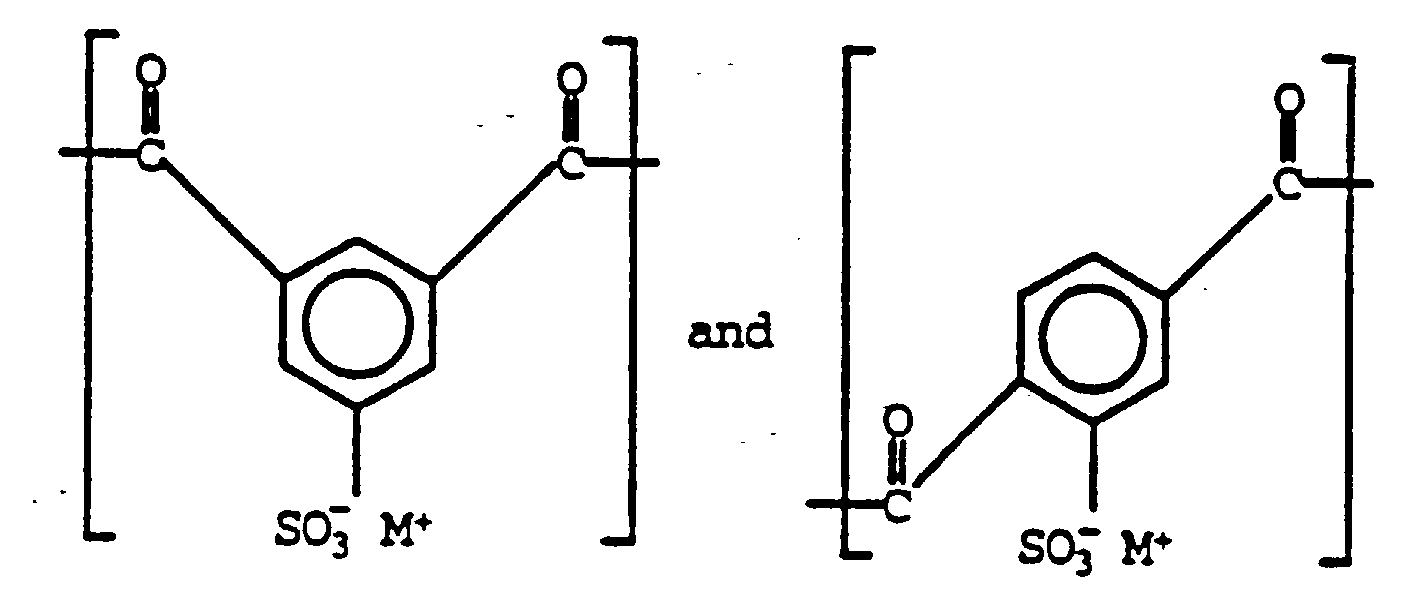
- the present invention relates to an adhesive melt processable wholly aromatic liquid crystalline polymer capable of forming an anisotropic melt phase at a temperature below 400 °C containing from 0.05 to 2.0 mole percent of at least one recurring ionic moiety selected from the formulae: in the polymer backbone, wherein M + is a cation and the polymer is selected from the group consisting of poly(ester-carbonates), poly(ester-amides), polyaramides, and wholly aromatic polyesters selected from the group consisting of (a) wholly aromatic polyesters comprising 10 to 90 mole percent of 4-oxybenzoyl and 90 to 10 mole percent of 6-oxy-2-naphthoyl; (b) wholly aromatic polyesters comprising 3 to 10 mole percent of 6-oxy-2-naphthoyl, 20 to 70 mole percent of 4-oxybenzoyl, 7.5 to 38.5 mole percent of terephthaloyl, and 7.5 to 38.5 mole percent of 4,4'-dioxydiphen
- the cations useful in the ionic moiety are typically metals selected from the group consisting of sodium, potassium, lithium, zinc, calcium, cadmium, magnesium, barium and mixtures thereof.
- the linkage of the ionic moiety in the liquid crystalline polymer backbone may occur at the 1,3-or 1,4- positions bf the ionic moiety unit with respect to the sulfonate group at the 5-position.
- Additional representative ionic moieties of this invention may be produced by substituting the sulfonates described hereinbefore onto ester-forming nuclei derived from hydroquinone, hydroxynaphthoic acids, hydroxybenzoic acids, substituted hydroxybenzoic acids, cycloaliphatic dicarboxylic acids, etc.
- Metals found to adhere particularly well to these polymers are selected from copper, silver, gold, tin, platinum, nickel, aluminum and alloys thereof.
- a variety of liquid crystalline, as well as tractable and intractable polymers, will readily adhere to the novel ionic moiety containing polymers described herein.
- the incorporation of a small amount of recurring moieties of the ionic unit in the backbone of each polymer will provide excellent adhesion properties.
- Useful polymer layers of the present invention may include, but are not limited to, polyalkylene terephthalate, (e.g., polybutylene terephthalate and polyethylene terephthalate), polybenzimidazoles, polybenzimidazolones, polybenzoxazoles, polybenzthiozoles, nylons, polyvinylchlorides, wholly aromatic polyesters, polyacrylates, polyamides, polyaramides, polyimides, poly(amide-imides), poly(ester-carbonates), poly(ester-amides) and the like.
- polyalkylene terephthalate e.g., polybutylene terephthalate and polyethylene terephthalate
- polybenzimidazoles e.g., polybenzimidazolones
- polybenzoxazoles polybenzthiozoles
- nylons e.g., polyvinylchlorides, wholly aromatic polyesters, polyacrylates, polyamides, polyaramides, polyimides, poly(
- the appropriate cation of the ionic moiety is dependent upon the material to be adhered to the liquid crystal polymer. If the desired material is a metal, the cation of the ionic moiety is typically selected from alkali metals, e.g., sodium, potassium and lithium. However, if the material is a polymer, the cation of the ionic moiety is typically selected from zinc, calcium, cadmium, magnesium and barium.
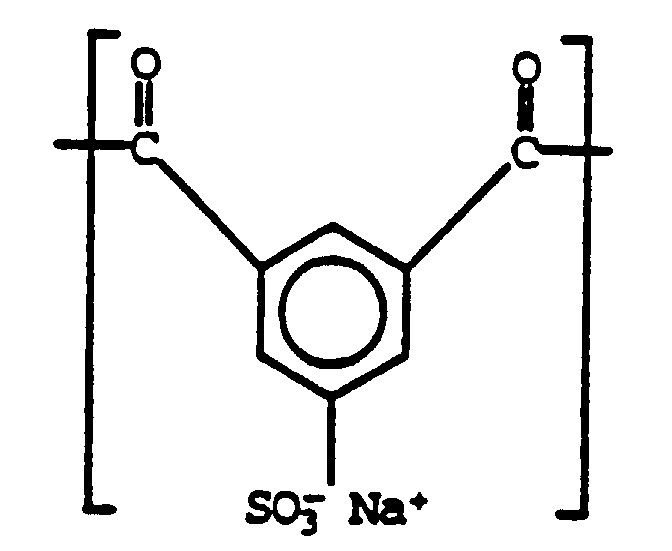
- a preferred ionic moiety is of the formula: also known as 5-sodiosulfoisophthaloyl.
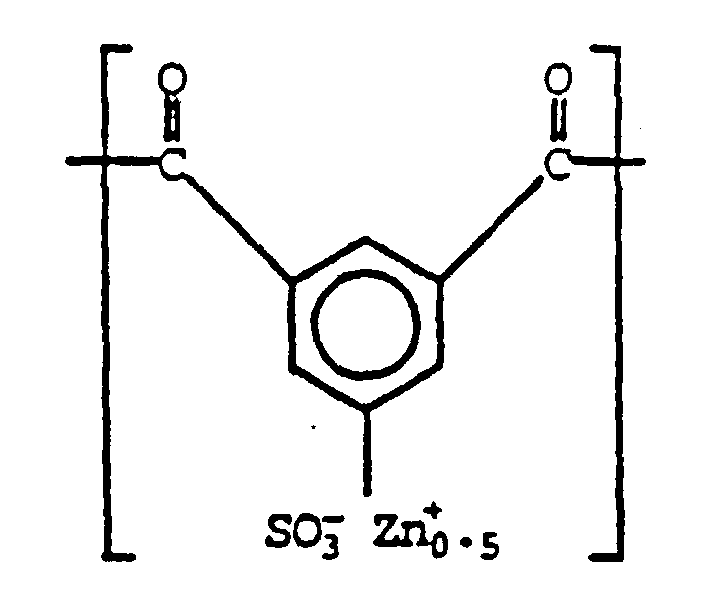
- a preferred ionic monomer is of the formula: also known as 5-zincsulfoisophthaloyl.
- One liquid crystal polymer of the present invention having enhanced adhesion properties and useful for forming laminate structures is a melt processable wholly aromatic liquid crystalline polyester capable of forming an anisotropic melt phase at a temperature of below 375°C, preferably below 350°C containing recurring moieties of from 10 to 90 mole percent of 4-oxybenzoyl, from 90 to 10 mole percent of 6-oxy-2-naphthoyl, (the subject matter of U. S. -A-4,161,470) and from 0.05 to 2.0 mole percent of the sulfonated, ionic moiety, described hereinbefore.
- the polymer will contain recurring moieties of from 65 to 85 mole percent of 4-oxybenzoyl, e.g., 75 mole percent, from 15 to 35 mole percent of 6-oxy-2-naphthoyl, e.g., 25 mole percent, and from 0.10 to 1.75 mole percent of the sulfonated ionic moiety, e.g., 1.0 mole percent, and exhibit an anisotropic melt processing temperature of below 325°C.
- the polymer will contain recurring moieties of 73 mole percent of 4-oxybenzoyl, 27 mole percent of 6-oxy-2-naphthoyl and 1.0 mole percent of the sulfonated ionic moiety, e.g., 5-sodiosulfoisophthaloyl or 5-zincsulfoisophthaloyl and exhibit a melt processing temperature of below 300°C.
- Another polymer of the present invention is a polyester capable of forming an anisotropic melt phase at a temperature below 400°C, containing recurring moieties of from 3 to 10 mole percent of 6-oxy-2-naphthoyl, 20 to 70 mole percent of 4-oxybenzoyl, 7.5 to 38.5 mole percent of terephthaloyl, 7.5 to 38.5 mole percent of 4,4'-dioxydiphenyl moiety (the subject matter of U. S.-A-4,473,682) and 0.05 to 2.0 mole percent of at least one of the sulfonated, ionic moieties described hereinbefore.
- Still another melt processable wholly aromatic polyester of the invention capable of forming an anisotropic melt phase at a temperature below 320°C contains recurring moieties of from 20 to 40 mole percent of 6-oxy-2-naphthoyl, 10 to 50 mole percent of 4-oxybenzoyl, 5 to 30 mole percent of the residue of hydroquinone, 5 to 30 mole percent of terephthaloyl, (the subject matter of U. S. -A-4,219,461) and 0.05 to 2.0 mole percent of the sulfonated, ionic moiety described percent of the sulfonated, ionic moiety described hereinbefore.
- Yet another polymer of the invention is a copolyester capable of forming an anisotropic melt phase at a temperature below 340°C, containing recurring moieties of from 33.3 mole percent of p-hydroxybenzoyl, 33.3 mole percent of residue of hydroquinone, 33.3 mole percent of isophthaloyl, (the subject matter of U. S. -A-3,637,595) and 0.05 to 2.0 mole percent of the sulfonated, ionic moiety described hereinbefore.
- the laminate structures of the present invention are generally constructed of at least first and second layers although a laminate containing multiple layers, i.e., three or more layers, is contemplated by the invention.
- the first layer is generally formed of the novel ionic monomer containing polymer described herein
- the second or third layer is formed of a glass, ceramic, metallic, polymeric component or mixtures thereof.
- the structure can contain alternating layers of the polymers of the present invention when three or more layers are included in the laminate. While the application of a binding agent to the interfacial surfaces of the layers followed by heating and compressing will promote adhesion, the laminate can be formed by compressing the layers at an elevated temperature for sufficient time to promote adhesion without the use of a binding agent.
- wholly aromatic liquid crystalline polymers will commonly exhibit weight average molecular weights of 2,000 to 220,000, and preferably 10,000 to 75,000, e.g. 20,000 to 50,000. Such molecular weights are generally measured by end group determination via infrared spectroscopy on compression molded films. Alternatively, light scattering techniques on polymers dissolved in a one to one volume concentration of hexafluoroisopropanol-pentafluorophenol (HFIP-PFP) solution may be employed to determine the molecular weight.
- HFIP-PFP hexafluoroisopropanol-pentafluorophenol
- the ionic unit containing polymers of the present invention may be formed by a variety of techniques whereby organic monomer compounds possessing functional groups which upon condensation form the requisite recurring moieties are reacted. Typical methods of forming liquid crystalline polymers of the present invention are described U.S. -A-3,316,326; 3,890,256; 4,067,852; 4,219,461; 4,473,682; and 5,015,722.
- the polymers described herein may be considered crystalline in the sense that fibers melt extruded therefrom exhibit X-ray diffraction patterns using Ni-filtered CUK ⁇ radiation and flat plate cameras characteristic of polymeric crystalline materials. In spite of the crystallinity commonly observed, the wholly aromatic polymers of the present invention nevertheless may be easily melt processed in all instances.
- the relative viscosity was measured by dividing the flow time in a capillary viscometer of the polymer solution by the flow time for the pure solvent.
- the polymer was subject to differential scanning calorimetry (DSC) at a 20°C/min heating rate to determine melt point temperature.
- the extrusion orifice may be selected from among those commonly utilized during the melt extrusion of such shaped articles.
- the shaped extrusion orifice may be in the form of a rectangular slit (i.e., a slit die) when forming a polymeric film.
- the spinneret selected may contain one and preferably a plurality of extrusion orifices.
- a standard conical spinneret containing 1 to 2000 holes such as commonly used in the melt spinning of polyethylene terephthalate, having a diameter of 25.4 ⁇ m to 1.78 mm (1 to 70 mils) e.g., 0.127 mm to 1.02 mm (5 to 40 mils) may be utilized.
- Yarns of 20 to 200 continuous filaments are commonly formed.
- the melt-spinnable polyester is supplied to the extrusion orifice at a temperature above its melting point (e.g., at a temperature of 300° to 380°C), and at a temperature of 335° to 375°C. in a preferred embodiment.
- the polyester of the present invention exhibits a highly attractive balance between its melting and heat deflection temperatures (HDT).
- the heat deflection temperature will varying dependent upon the actual composition of the polymer, particularly, 6-hydroxy-2-naphthoic acid content. It also depends on whether the polymer contains glass or other mineral fillers known in the art. Filling with glass will sometimes cause an increase in HDT for some materials, and little if any for others.
- the heat deflection temperature of a molded article may be determined in accordance with the procedure of ASTM D648 wherein the deflection temperature under load at 1.82 Mpa (264 psi) is ascertained.
- the resulting filamentary material or film is passed in the direction of its length through a solidification or quench zone wherein the molten filamentary material or film is transformed to a solid filamentary material or film.
- the resulting fibers commonly have denier per filament of 1 to 50 (1.11 to 55.5 dtex), and preferably a denier per filament of 1 to 20 (1.11 to 22.2 dtex).
- the as-spun fibers of this invention may be subjected to heat treatment in an oven while relaxed or under mild restraint to provided high strength fibers useful for a variety of industrial applications such as plastic, rubber reinforcement, etc.
- fiber samples, as skeins or on bobbins are usually heated in an oven having an inert atmosphere that is continuously purged by flow of inert gas through the oven to remove by-products from the vicinity of the fiber.
- Temperatures approaching the fusion point, but sufficiently below to prevent interfilament fusion are employed.
- maximum temperature is reached in a stepwise fashion.
- Thermal treatment time commonly ranges from a few minutes to several days. As the fiber is thermally treated, its melting temperature is increased.
- Tenacity (breaking tenacity), elongation (breaking elongation), and initial modulus were obtained by breaking a single filament (Data reported are averages of 10 breaks). Single filaments were broken with a gauge length (distance between jaws) of 2.5 cm. (1.0 inch). The results on 3 or more filaments are averaged. All samples were elongated at a constant rate of extension (20% elongation/minute for fibers having an elongation of under 8%) until the samples broke. The tenacity (grams/denier or cN/dtex), elongation (percent) and initial modulus (grams/denier or cN/dtex) as described in ASTM D3822 were obtained from the load-elongation curve and the measured denier.
- the flask was immersed in a sand bath and provided with means to accurately control the temperature, and thoroughly-purged of oxygen by evacuating and flushing with nitrogen three times before the addition of acetic anhydride (2.5% molar excess).
- the flask was then placed in a fluidized sand bath and heated according to a preprogrammed, time-temperature cycle while purging the contents of the flask with nitrogen as follows: to a temperature of 125°C over a period of 50 minutes; to 140°C over 40 minutes; to 150°C over 20 minutes; to 200°c over 45 minutes; to 210°C over 5 minutes; to 220°C over 6 minutes; to 275°C over 50 minutes; to 310°C over 70 minutes; to 335°C over 25 minutes; to 350°C over 15 minutes; and to 355°C over 15 minutes.
- the time-temperature profile was designed to allow adequate time for acetylation of the monomers followed by oligomerization and finally polymerization.
- acetic acid began to distill over and was collected in a graduated cylinder.
- the flask was slowly evacuated (in 100 mbar increments). The reading of the torque indicator was noted at the beginning of this vacuum period. Under vacuum at 355°C the viscosity of the reactants gradually increased indicating polymerization. When the increase in torque reached a predetermined level ( ⁇ torque ⁇ 55 mV), the vacuum was released (nitrogen was purged into the system).
- the Vigreaux column and condenser, nitrogen inlet, thermocouple and stirrer were removed from the flask and the formed polymer was allowed to cool. Finally, the flask was broken and the polymer plug removed. The plug was cut into several pieces and ground into small particles. Upon characterization, the polymer exhibited an inherent viscosity, as measured in one to one concentration of 1:1 V/V HFIP-PFP, of 9.0 dl/g and a melting temperature of 371°C measured by DSC.
- Procedures similar to Example 1 were performed to produce polymers containing 0 mole %, 0.5 mole % and 2.0 mole % of the 5-sodiosulfoisophthaloyl unit.
- the polymer was melt extruded into a continuous filament of about 5.55 dtex (5 denier) per filament. More specifically, the polymer melt while at a temperature of about 320°C was extruded through a spinneret provided with a single hole jet having a diameter of 0.127 mm and a length of 0.178 mm.
- the extruded filament was quenched in ambient air (i.e., at 22°C (72°F) and 65 percent relatively humidity).
- the as-spun filament was taken up at a rate of 800 meters per minute.
- polyester compositions of Formulation #1 and Formulation #2 as follows:
- Films of Formulations #1 (containing no sulfonated, ionic unit) and #2 (containing 1.0 wt% of sulfonated, ionic unit) were individually sandwiched between 1.58 mm (0.0625 inch) aluminum foil and Kapton film sheets, and a 1.58 mm (0.0625 inch) sheet of anodized aluminum alloy was placed onto the Kapton sheet.
- Kapton film was placed between the polymer film and the anodized aluminum alloy sheet to initiate adhesive failure.
- the laminates were compression molded at 295°C and 0.172 MPa (25 psi) for 25 minutes.
- Adhesion strengths i.e., roller peel strengths
- Two samples, 12.7 cm (5 inch) wide specimens were tested from each composite; peel strengths were averaged over a 7.62 cm (3 inch) length. Results of adhesion tests of several of the samples are presented below for comparison: Sample Peel Strength, N/m (lb/in) Formulation #1 657 (3.75) Formulation #1 546 (3.12) Formulation #2 2015 (11.50) Formulation #2 1677 (9.57)
- the polyesters of Formulation #2 containing the 5-sodiosulfoisophthaloyl unit showed significantly enhanced adhesion to aluminum foil over the polyesters of Formulation #1 containing no ionic unit.
- Example 2 additional wholly aromatic liquid crystalline polymers containing 5-sodiosulfoisophthaloyl (SSI) units were produced.
- the formulations contained 4-hydroxybenzoic acid (HBA), 6-hydroxy-2-naphthoic acid (HNA).
- TA terephthalic acid
- IA isophthalic acid
- HQ hydroquinone
- PARA paraaminobenzoic acid
- BP 4,4'-dioxydiphenyl
- AA N-acetyl-p-aminophenol
- DHN 2,6-dihydroxynaphthalene
- SSI 4-hydroxybenzoic acid
- TA 6-hydroxy-2-naphthoic acid
- TA terephthalic acid
- IA isophthalic acid
- HQ hydroquinone
- PARA paraaminobenzoic acid
- BP 4,4'-dioxydiphenyl
- AA N-acetyl-p-aminophenol
- Formulation #3 contained a reaction mixture of:
- the resulting polymer had an inherent viscosity (IV) of 4.67 dl/g, and melt viscosities (MVs) of 1500 dPa ⁇ s (poise) at a shear rate of 10 2 sec -1 and 539 dPa ⁇ s (poise) at a shear rate of 10 3 sec -1 measured at 345°C.
- the polymer exhibited a crystallization temperature (T c ) of 241.4°C.
- Formulation #4 a comparative example of Formulation #3, contained identical quantities of reactants but no SSI monomer.
- Formulation #4 contained a reaction mixture of:
- the resulting polymer has an IV of to 7.5 dl/g, and MVs of 900 dPa ⁇ s (poise) at a shear rate of 10 2 sec -1 and 350 dPa ⁇ s (poise) at a shear rate of 10 3 sec -1 measured at 345°C.
- the polymer exhibited a melt endotherm peak (T m ) of to 347°C, and a T c of 295°C.
- Formulation #5 contained a reaction mixture of:
- the resulting polymer had an (IV) of 1.17 dl/g, and an MVs of 2214 dPa ⁇ s (poise) at a shear rate of 10 2 sec -1 and 841 dPa ⁇ s (poise) at a shear rate of 10 3 sec -1 measured at 300°C.
- the polymer exhibited a glass transition temperature (T g ) of 125.4°C.
- Formulation #6 contained a reaction mixture of:
- the resulting polymer had an IV of 1.45 dl/g, and MVs of 985 dPa ⁇ s (poise) at a shear rate of 10 2 sec -1 and 523 dPa ⁇ s (poise) at a shear rate of 10 3 sec -1 measured at 340°C.
- the polymer exhibited T g of 125.3°C.
- the resulting polymer had an IV of 6.99 dl/g, and MVs of 4005 dPa ⁇ s (poise) at a shear rate of 10 2 sec -1 and 1096 dPa ⁇ s (poise) at a shear rate of 10 3 sec -1 measured at 300°C.
- the polymer exhibited a T m of 267.6°C and a T c of 219.9°C.
- Formulation #8 contained a reaction mixture of:
- the resulting polymer has an IV of 5.80 dl/g, and MVs of 2360 dPa ⁇ s (poise) at a shear rate of 10 2 sec -1 and 710 dPa ⁇ s (poise) at a shear rate of 10 3 sec -1 measured at 300°C.
- the polymer exhibited a T m of 270.9°C and a T c of 221.2°C.
- Formulation #9 contained a reaction mixture of:
- the resulting polymer had an IV of 5.86 dl/g, and MVs of 3147 dPa ⁇ s (poise) at a shear rate of 10 2 sec -1 and 900 dPa ⁇ s (poise) at a shear rate of 10 3 sec -1 measured at 300°C.
- the polymer exhibited a T m of 265.1°C and a T c of 218.5°C.
- Formulation #10 contained a reaction mixture of:
- the resulting polymer has an IV of 5.41 dl/g, and MVs of 2237 dPa ⁇ s (poise) at a shear rate of 10 2 sec -1 and 669 dPa ⁇ s (poise) at a shear rate of 10 3 sec -1 measured at 300°C.
- the polymer exhibited a T m of 270.6°C and a T c of 221.7°C.
- Formulation #11 contained reaction mixture of:
- the resulting polymer had an IV of 5.30 dl/g, and MVs of 2186 dPa ⁇ s (poise) at a shear rate of 10 2 sec -1 and 684 dPa ⁇ s (poise) at a shear rate of 10 3 sec -1 measured at 300°C.
- the polymer exhibited a T m of 267.6°C and a T c of 218.4°C.
- Formulation #12 contained a reaction mixture of:
- the resulting polymer has an IV of 5.05 dl/g, and MVs of 1940 dPa ⁇ s (poise) at a shear rate of 10 2 sec -1 and 625 dPa ⁇ s (poise) at a shear rate of 10 3 sec -1 measured at 300°C.
- the polymer exhibited a T m of 269.7°C and a T c of 221.1°C.
- Formulation #13 contained a reaction mixture of:
- the resulting polymer had an IV of 6.66 dl/g, and MVs of 3194 dPa ⁇ s (poise) at a shear rate of 10 2 sec -1 and 980 dPa ⁇ s (poise) at a shear rate of 10 3 sec -1 measured at 300°C.
- the polymer exhibited a T m of 275.5°C and a T c of 224.9°C.
- Formulation #14 contained a reaction mixture of:
- the resulting polymer has an IV of 4.49 dl/g, and MVs of 948 dPa ⁇ s (poise) at a shear rate of 10 2 sec -1 and 381 dPa ⁇ s (poise) at a shear rate of 10 3 sec -1 measured at 300°C.
- the polymer exhibited a T m of 267.7°C and a T c of 220.1°C.
- Formulation #15 contained a reaction mixture of:
- the resulting polymer had an IV of 4.95 dl/g, and MVs of 1437 dPa ⁇ s (poise) at a shear rate of 10 2 sec -1 and 514 dPa ⁇ s (poise) at a shear rate of 10 3 sec -1 measured at 300°C.
- the polymer exhibited a T m of 267.4°C and a T c of 219.7°C.
Landscapes
- Chemical & Material Sciences (AREA)
- Health & Medical Sciences (AREA)
- Chemical Kinetics & Catalysis (AREA)
- Medicinal Chemistry (AREA)
- Polymers & Plastics (AREA)
- Organic Chemistry (AREA)
- Polyesters Or Polycarbonates (AREA)
- Polyamides (AREA)
- Laminated Bodies (AREA)
- Compositions Of Macromolecular Compounds (AREA)
Description


| Fiber Containing 0 mole percent of 5-Sodiosulfoisophthaloyl Unit | ||
| Melting | Point | 286°C |
| Melt Viscosity | @ 300°C | 526 @ 103 sec-1 |
| Inherent | Viscosity | 7 dl/gm |
| As-Spun | Tenacity | 9.7 cN/dtex (11 gm/d) |
| As-Spun | Elongation | 2.5% |
| As-Spun | Modulus | 459 cN/dtex (520 gm/d) |
| Heat-Treated | Tenacity | 24.7 cN/dtex (28 gm/d) |
| Heat-Treated | Elongation | 5% |
| Heat-Treated | Modulus | 467.8 cN/dtex (530 gm/d) |
| Fiber Containing 0.5 mole percent of 5-Sodiosulfoisophthaloyl Unit | ||
| Melting | Point | 269°C |
| Melt Viscosity | @ 300°C | 801 @ 103 sec-1 |
| Inherent | Viscosity | 6.2 dl/gm |
| As-Spun | Tenacity | 5.38 cN/dtex (6.1 gm/d) |
| As-Spun | Elongation | 1.5% |
| As-Spun | Modulus | 409.6 cN/dtex (464 gm/d) |
| Heat-Treated | Tenacity | 9.7 cN/dtex (11 gm/d) |
| Heat-Treated | Elongation | 2.4% |
| Heat-Treated | Modulus | 521 cN/dtex (590 gm/d) |
| Fiber Containing 1.0 mole percent of 5-Sodiosulfoisophthaloyl Unit | ||
| Melting | Point | 264°C |
| Melt Viscosity | @ 300°C | 778 @ 103 sec-1 |
| Inherent | Viscosity | 6.19 dl/gm |
| As-Spun | Tenacity | 4.85 cN/dtex (5.5 gm/d) |
| As-Spun | Elongation | 1.4% |
| As-Spun | Modulus | 415.7 cN/dtex (471 gm/d) |
| Heat-Treated | Tenacity | 6.27 cN/dtex (7.1 gm/d) |
| Heat-Treated | Elongation | 1.8% |
| Heat-Treated | Modulus | 366.3 cN/dtex (415 gm/d) |
| Fiber Containing 2.0 mole percent of 5-Sodiosulfoisophthaloyl Unit | ||
| Melting | Point | 265°C |
| Melt Viscosity | @ 300°C | 898 @ 103 sec-1 |
| Inherent | Viscosity | * |
| As-Spun | Tenacity | * |
| As-Spun | Elongation | * |
| As-Spun | Modulus | * |
| Heat-Treated | Tenacity | * |
| Heat-Treated | Elongation | * |
| Heat-Treated | Modulus | * |
| * no data, material could not be spun |
- Formulation #1:
- 4-hydroxybenzoic acid (4.38 moles) and 6-hydroxy-2-naphthoic acid (1.62 moles); and
- Formulation #2:
- 4-hydroxybenzoic acid (4.38 moles), 6-hydroxy-2-naphthoic acid (1.62 moles), and 5-sodiosulfoisophthalic acid, sodium salt (0.06 moles or 1.0 wt%).
| Sample | Peel Strength, N/m (lb/in) |
| Formulation #1 | 657 (3.75) |
| Formulation #1 | 546 (3.12) |
| Formulation #2 | 2015 (11.50) |
| Formulation #2 | 1677 (9.57) |
Claims (11)
- An adhesive melt processable wholly aromatic liquid crystalline polymer capable of forming an anisotropic melt phase at a temperature below 400 °C containing from 0.05 to 2.0 mole percent of at least one recurring ionic moiety selected from the formulae:in the polymer backbone, wherein M+ is a cation and the polymer is selected from the group consisting of poly(ester-carbonates), poly(ester-amides), polyaramides, and wholly aromatic polyesters selected from the group consisting of (a) wholly aromatic polyesters comprising 10 to 90 mole percent of 4-oxybenzoyl and 90 to 10 mole percent of 6-oxy-2-naphthoyl; (b) wholly aromatic polyesters comprising 3 to 10 mole percent of 6-oxy-2-naphthoyl, 20 to 70 mole percent of 4-oxybenzoyl, 7.5 to 38.5 mole percent of terephthaloyl, and 7.5 to 38.5 mole percent of 4,4'-dioxydiphenyl; (c) wholly aromatic polyesters comprising 20 to 40 mole percent of 6-oxy-2-naphthoyl, 10 to 50 mole percent of 4-oxybenzoyl, 5 to 30 mole percent of the residue of hydroquinone, and 5 to 30 mole percent of terephthaloyl; and (d) wholly aromatic polyesters comprising 33.3 mole percent of 4-oxybenzoyl, 33.3 mole percent of the residue of hydroquinone, and 33.3 mole percent of isophthaloyl.
- The liquid crystalline polymer according to claim 1 wherein the cation is selected from the group consisting of sodium, lithium, potassium, zinc, calcium, cadmium, magnesium, barium and mixtures thereof.
- The liquid crystalline polymer according to claim 2 wherein the ionic moiety is of the formula:
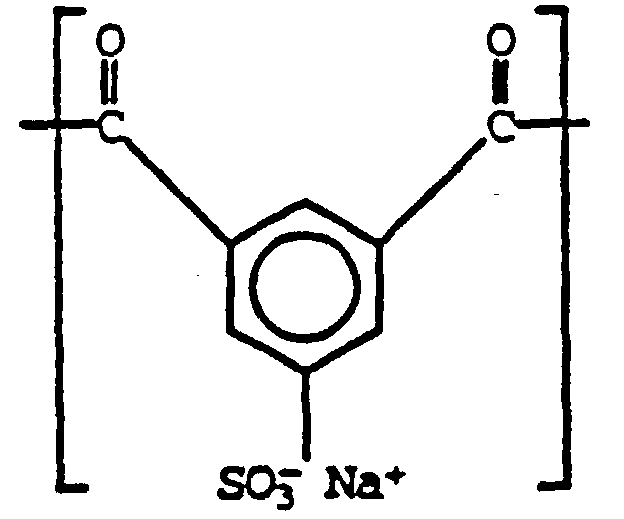
- The liquid crystalline polymer according to claim 3 wherein the concentration of the ionic moiety is 0.5 mole percent.
- The liquid crystalline polymer according to claim 2 wherein the ionic moiety is of the formula:
- The polymer according to claim 1 wherein the polymer exhibits enhanced adhesion to metal, ceramic, glass and polymeric materials.
- A laminate structure comprising at least a first and a second layer, the first layer consisting of the adhesive melt processable wholly aromatic liquid crystalline polymer as defined in anyone of claims 1 to 6, and wherein the second layer is selected from the group consisting of metals, ceramics, glasses, polymers, and mixtures thereof.
- The laminate according to claim 7 wherein the second layer is a metal selected from the group consisting of silver, copper, gold, aluminum, platinum and alloys thereof.
- The laminate according to claim 8 wherein the second layer is aluminum.
- The laminate according to claim 7 wherein the second layer is a polymer selected from the group consisting of polyalkylene terephthalates, polybenzimidazoles, polybenzimidazolones, polybenzoxazoles, polybenzthiozoles, nylons, polyvinylchlorides, wholly aromatic polyesters, polyacrylates, polyamides, polyaramides, polyimides, poly(amide-imides), poly(ester-carbonates) and poly(ester-amides).
- The laminate according to claim 7 wherein the second layer is polyethylene terephthalate.
Applications Claiming Priority (3)
| Application Number | Priority Date | Filing Date | Title |
|---|---|---|---|
| US854148 | 1992-03-20 | ||
| US07/854,148 US5227456A (en) | 1992-03-20 | 1992-03-20 | Wholly aromatic liquid crystalline polymers containing sulfonated ionic monomer units and laminates thereof |
| PCT/US1993/001349 WO1993019112A1 (en) | 1992-03-20 | 1993-02-16 | Wholly aromatic liquid crystalline polymers containing ionic monomer units and laminates thereof |
Publications (3)
| Publication Number | Publication Date |
|---|---|
| EP0631594A1 EP0631594A1 (en) | 1995-01-04 |
| EP0631594A4 EP0631594A4 (en) | 1995-04-12 |
| EP0631594B1 true EP0631594B1 (en) | 1998-04-01 |
Family
ID=25317857
Family Applications (1)
| Application Number | Title | Priority Date | Filing Date |
|---|---|---|---|
| EP19930905965 Expired - Lifetime EP0631594B1 (en) | 1992-03-20 | 1993-02-16 | Wholly aromatic liquid crystalline polymers containing ionic monomer units and laminates thereof |
Country Status (5)
| Country | Link |
|---|---|
| US (2) | US5227456A (en) |
| EP (1) | EP0631594B1 (en) |
| JP (1) | JP3232095B2 (en) |
| DE (1) | DE69317768T2 (en) |
| WO (1) | WO1993019112A1 (en) |
Families Citing this family (30)
| Publication number | Priority date | Publication date | Assignee | Title |
|---|---|---|---|---|
| JP2884362B2 (en) * | 1990-04-20 | 1999-04-19 | 日本石油化学株式会社 | Cooking table for induction cooker |
| US5443783A (en) * | 1993-03-23 | 1995-08-22 | Hoechst Celanese Corp. | Process for blow molding articles from liquid crystal polymers |
| US6239987B1 (en) * | 1993-11-08 | 2001-05-29 | General Semiconductor, Inc. | Case for semiconductor circuit of a surge protector |
| JP3380322B2 (en) | 1994-02-18 | 2003-02-24 | 帝人株式会社 | Aromatic polyester carbonate polymer, method for producing the same, and polymer composition using the same |
| KR0176424B1 (en) * | 1994-08-27 | 1999-04-01 | 손욱 | Polymer alignment material and liquid crystal display device using same |
| US5644017A (en) * | 1995-08-25 | 1997-07-01 | The Dow Chemical Company | Polycarbonate terminated by an ionic sulfonated aromatic moiety and preparation thereof |
| US5674968A (en) * | 1995-08-25 | 1997-10-07 | The Dow Chemical Company | Aromatic sulfonated diester monomer, process to synthesize, polymer derived therefrom and method to prepare said polymer |
| US5814094A (en) | 1996-03-28 | 1998-09-29 | Becker; Robert O. | Iontopheretic system for stimulation of tissue healing and regeneration |
| US7214847B1 (en) * | 1997-09-22 | 2007-05-08 | Argentum Medical, L.L.C. | Multilayer conductive appliance having wound healing and analgesic properties |
| US8801681B2 (en) | 1995-09-05 | 2014-08-12 | Argentum Medical, Llc | Medical device |
| US8455710B2 (en) | 1997-09-22 | 2013-06-04 | Argentum Medical, Llc | Conductive wound dressings and methods of use |
| US6087549A (en) * | 1997-09-22 | 2000-07-11 | Argentum International | Multilayer laminate wound dressing |
| US6861570B1 (en) | 1997-09-22 | 2005-03-01 | A. Bart Flick | Multilayer conductive appliance having wound healing and analgesic properties |
| AU768317B2 (en) * | 1997-09-22 | 2003-12-11 | Argentum International Llc | Multilayer conductive appliance having wound healing and analgesic properties |
| US6312772B1 (en) | 1997-10-20 | 2001-11-06 | Hoechst Celanese Corporation | Multilayer laminate formed from a substantially stretched non-molten wholly aromatic liquid crystalline polymer and non-polyester thermoplastic polymer |
| US6268026B1 (en) | 1997-10-20 | 2001-07-31 | Hoechst Celanese Corporation | Multilayer laminate formed from a substantially stretched non-molten wholly aromatic liquid crystalline polymer and non-liquid crystalline polyester and method for forming same |
| US6015524A (en) * | 1997-10-20 | 2000-01-18 | Hoechst Celanese Corporation | Adhesives for making multilayer films comprising liquid crystalline polymers and polyethylene |
| US6042902A (en) * | 1997-10-20 | 2000-03-28 | Hoechst Celanese Corporation | Adhesives for making multilayer films comprising liquid crystalline polymers and poly(ethylene terephthalate) or polycarbonate |
| US6013373A (en) * | 1997-10-20 | 2000-01-11 | Hoechst Celanese Corporation | Adhesives for making multilayer films comprising liquid crystalline polymer and polypropylene |
| US6426128B1 (en) | 1998-01-06 | 2002-07-30 | Hna Holdings, Inc. | Co-processable multi-layer laminates for forming high strength, haze-free, transparent articles and methods of producing same |
| US6174405B1 (en) * | 1998-09-11 | 2001-01-16 | Northrop Grumman Corporation | Liquid crystal polymer in situ coating for co-cured composite structure |
| JP2004013054A (en) * | 2002-06-11 | 2004-01-15 | Sumitomo Chem Co Ltd | High heat resistant label |
| US6974606B2 (en) * | 2003-05-23 | 2005-12-13 | Northrop Grumman Corporation | Thermoplastic coating for composite structures |
| US20070298271A1 (en) * | 2006-06-23 | 2007-12-27 | 3M Innovative Properties Company | Multilayer optical film, method of making the same, and transaction card having the same |
| JP5230122B2 (en) * | 2007-05-14 | 2013-07-10 | 上野製薬株式会社 | Electronic components for surface mounting |
| US20090269591A1 (en) * | 2008-04-24 | 2009-10-29 | Crysoptix Kk | Organic Compound, Optical Film and Method of Production thereof |
| PH12013501982A1 (en) * | 2011-04-01 | 2015-11-25 | Polyplastics Co | Wholly aromatic polyester and polyester resin composition |
| JP7332285B2 (en) * | 2018-12-19 | 2023-08-23 | ポリプラスチックス株式会社 | Wholly aromatic polyesteramide, polyesteramide resin composition and polyesteramide molded article |
| JP7194586B2 (en) * | 2018-12-27 | 2022-12-22 | Eneos株式会社 | A resin molded article made of a liquid crystal polymer and a resin composition containing the liquid crystal polymer |
| JP7251976B2 (en) * | 2018-12-27 | 2023-04-04 | Eneos株式会社 | A resin molded article made of a liquid crystal polymer and a resin composition containing the liquid crystal polymer |
Family Cites Families (5)
| Publication number | Priority date | Publication date | Assignee | Title |
|---|---|---|---|---|
| US4161470A (en) * | 1977-10-20 | 1979-07-17 | Celanese Corporation | Polyester of 6-hydroxy-2-naphthoic acid and para-hydroxy benzoic acid capable of readily undergoing melt processing |
| US4233196A (en) * | 1979-04-30 | 1980-11-11 | Eastman Kodak Company | Polyester and polyesteramide compositions |
| US4540737A (en) * | 1983-02-07 | 1985-09-10 | Celanese Corporation | Method for the formation of composite articles comprised of thermotropic liquid crystalline polymers and articles produced thereby |
| DE3338623A1 (en) * | 1983-10-25 | 1985-05-02 | Bayer Ag, 5090 Leverkusen | THERMOTROPE AROMATIC POLYESTER OF HIGH STIFFNESS, METHOD FOR THE PRODUCTION THEREOF AND THEIR USE FOR THE PRODUCTION OF MOLDED BODIES, FILAMENTS, FIBERS AND FILMS |
| US4863767A (en) * | 1984-04-13 | 1989-09-05 | Hoechst Celanese Corporation | Method of adhesive bonding by use of thermotropic liquid crystal polymers |
-
1992
- 1992-03-20 US US07/854,148 patent/US5227456A/en not_active Expired - Lifetime
- 1992-10-30 US US07/968,708 patent/US5292589A/en not_active Expired - Fee Related
-
1993
- 1993-02-16 EP EP19930905965 patent/EP0631594B1/en not_active Expired - Lifetime
- 1993-02-16 WO PCT/US1993/001349 patent/WO1993019112A1/en not_active Ceased
- 1993-02-16 DE DE69317768T patent/DE69317768T2/en not_active Expired - Lifetime
- 1993-02-16 JP JP51655693A patent/JP3232095B2/en not_active Expired - Lifetime
Also Published As
| Publication number | Publication date |
|---|---|
| US5292589A (en) | 1994-03-08 |
| JPH07506132A (en) | 1995-07-06 |
| EP0631594A4 (en) | 1995-04-12 |
| US5227456A (en) | 1993-07-13 |
| EP0631594A1 (en) | 1995-01-04 |
| JP3232095B2 (en) | 2001-11-26 |
| DE69317768D1 (en) | 1998-05-07 |
| DE69317768T2 (en) | 1998-10-22 |
| WO1993019112A1 (en) | 1993-09-30 |
Similar Documents
| Publication | Publication Date | Title |
|---|---|---|
| US5292589A (en) | Laminates of wholly aromatic liquid crystalline polymers containing ionic monomer units | |
| US4375530A (en) | Polyester of 2,6-naphthalene dicarboxylic acid, 2,6-dihydroxy naphthalene, terephthalic acid, and hydroquinone capable of forming an anisotropic melt | |
| US4330457A (en) | Poly(ester-amide) capable of forming an anisotropic melt phase derived from 6-hydroxy-2-naphthoic acid, dicarboxylic acid, and aromatic monomer capable of forming an amide linkage | |
| US4351918A (en) | Poly(ester-amide) capable of forming an anisotropic melt phase derived from 6-hydroxy-2-naphthoic acid, other aromatic hydroxyacid, carbocyclic dicarboxylic acid, and aromatic monomer capable of forming an amide linkage | |
| US4351917A (en) | Poly(ester-amide) capable of forming an anisotropic melt phase derived from 6-hydroxy-2-naphthoic acid, aromatic monomer capable of forming an amide linkage, and other aromatic hydroxyacid | |
| US4355132A (en) | Anisotropic melt phase forming poly(ester-amide) derived from p-hydroxybenzoic acid, 2,6-naphthalenedicarboxylic acid, aromatic monomer capable of forming an amide linkage, and, optionally, hydroquinone and additional carbocyclic dicarboxylic acid | |
| US5015722A (en) | Melt-processable polyester capable of forming an anisotropic melt which exhibits a highly attractive balance between its molding and heat deflection temperatures | |
| CA1279147C (en) | Optically anisotropic melt forming aromatic copolyesters based on t-butylhydroquinone | |
| US4339375A (en) | Poly(ester-amide) capable of forming an anisotropic melt phase derived from p-hydroxybenzoic acid, 2,6-dihydroxynaphthalene, carbocyclic dicarboxylic acid, aromatic monomer capable of forming an amide linkage, and, optionally, additional aromatic diol | |
| US4522974A (en) | Melt processable polyester capable of forming an anisotropic melt comprising a relatively low concentration of 6-oxy-2-naphthoyl moiety-4-benzoyl moiety, 1,4-dioxyphenylene moiety, isophthaloyl moiety and terephthaloyl moiety | |
| EP1116739B1 (en) | Composition and process for producing stretchable polymers and shaped articles produced by same | |
| EP0022344A1 (en) | Melt processable anisotropic wholly aromatic polyester comprising 6-oxy-2-naphthoyl moieties, moulding compounds, moulded articles and films and fibres based thereon | |
| CA1267246A (en) | Polyester polymers of 3-hydroxy-4'-(4-hydroxyphenyl) benzophenone or 3,4'-dihydroxybenzophenone and dicarboxylic acids | |
| EP0095938A2 (en) | Aromatic polyesters and high strength filaments thereof | |
| US4801677A (en) | Thermotropic aromatic polyester with high thermal stability | |
| CA1131847A (en) | Thermotropic polyesters of 2,6-dihydroxyanthraquinone | |
| KR100846028B1 (en) | Extendable Liquid Crystal Polymer Composition | |
| US4371660A (en) | Anisotropic melt phase forming poly(ester-carbonate) derived from 6-hydroxy-2-napthoic acid, aromatic diol, organic compound capable of forming a carbonate linkage, and, optionally, other aromatic hydroxy-acid and carbocyclic dicarboxylic acid | |
| US4431770A (en) | Wholly aromatic polyester comprising 4-oxy-4'-carboxybiphenyl moiety which is capable of forming an anisotropic melt phase | |
| EP1116736B1 (en) | Process for producing amorphous anisotropic melt-forming polymers having a high degree of stretchability and polymers produced by same | |
| US6222000B1 (en) | Process for producing amorphous anisotropic melt-forming polymers having a high degree of stretchability | |
| US4341688A (en) | Poly(ester-amide) capable of forming an anisotropic melt phase derived from dihydroxyanthraquinone, hydroxybenzoic acid, dicarboxylic acid, and aromatic monomer capable of forming an amide linkage | |
| US4473681A (en) | Polyester urea capable of forming an anisotropic melt phase | |
| EP1116738A2 (en) | Process for producing amorphous anisotropic melt-forming polymers having a high degree of stretchability and polymers produced by same | |
| Avramova et al. | Liquid crystalline polymer laminates |
Legal Events
| Date | Code | Title | Description |
|---|---|---|---|
| PUAI | Public reference made under article 153(3) epc to a published international application that has entered the european phase |
Free format text: ORIGINAL CODE: 0009012 |
|
| 17P | Request for examination filed |
Effective date: 19940913 |
|
| AK | Designated contracting states |
Kind code of ref document: A1 Designated state(s): DE |
|
| A4 | Supplementary search report drawn up and despatched |
Effective date: 19950223 |
|
| AK | Designated contracting states |
Kind code of ref document: A4 Designated state(s): DE |
|
| 17Q | First examination report despatched |
Effective date: 19951204 |
|
| GRAG | Despatch of communication of intention to grant |
Free format text: ORIGINAL CODE: EPIDOS AGRA |
|
| GRAG | Despatch of communication of intention to grant |
Free format text: ORIGINAL CODE: EPIDOS AGRA |
|
| GRAH | Despatch of communication of intention to grant a patent |
Free format text: ORIGINAL CODE: EPIDOS IGRA |
|
| GRAH | Despatch of communication of intention to grant a patent |
Free format text: ORIGINAL CODE: EPIDOS IGRA |
|
| GRAA | (expected) grant |
Free format text: ORIGINAL CODE: 0009210 |
|
| AK | Designated contracting states |
Kind code of ref document: B1 Designated state(s): DE |
|
| REF | Corresponds to: |
Ref document number: 69317768 Country of ref document: DE Date of ref document: 19980507 |
|
| PLBE | No opposition filed within time limit |
Free format text: ORIGINAL CODE: 0009261 |
|
| STAA | Information on the status of an ep patent application or granted ep patent |
Free format text: STATUS: NO OPPOSITION FILED WITHIN TIME LIMIT |
|
| 26N | No opposition filed | ||
| PGFP | Annual fee paid to national office [announced via postgrant information from national office to epo] |
Ref country code: DE Payment date: 20120208 Year of fee payment: 20 |
|
| REG | Reference to a national code |
Ref country code: DE Ref legal event code: R071 Ref document number: 69317768 Country of ref document: DE |
|
| PG25 | Lapsed in a contracting state [announced via postgrant information from national office to epo] |
Ref country code: DE Free format text: LAPSE BECAUSE OF EXPIRATION OF PROTECTION Effective date: 20130219 |