EP0630380B1 - Process for the purification of a 3-cephem-4-carboxylic acid derivative - Google Patents
Process for the purification of a 3-cephem-4-carboxylic acid derivative Download PDFInfo
- Publication number
- EP0630380B1 EP0630380B1 EP93901714A EP93901714A EP0630380B1 EP 0630380 B1 EP0630380 B1 EP 0630380B1 EP 93901714 A EP93901714 A EP 93901714A EP 93901714 A EP93901714 A EP 93901714A EP 0630380 B1 EP0630380 B1 EP 0630380B1
- Authority
- EP
- European Patent Office
- Prior art keywords
- formula
- carboxylic acid
- cephem
- amino
- propen
- Prior art date
- Legal status (The legal status is an assumption and is not a legal conclusion. Google has not performed a legal analysis and makes no representation as to the accuracy of the status listed.)
- Expired - Lifetime
Links
- 238000000034 method Methods 0.000 title claims abstract description 34
- 238000000746 purification Methods 0.000 title description 4
- IKWLIQXIPRUIDU-ZCFIWIBFSA-N (6r)-8-oxo-5-thia-1-azabicyclo[4.2.0]oct-2-ene-2-carboxylic acid Chemical class OC(=O)C1=CCS[C@@H]2CC(=O)N12 IKWLIQXIPRUIDU-ZCFIWIBFSA-N 0.000 title description 2
- 239000000203 mixture Substances 0.000 claims abstract description 23
- 150000001875 compounds Chemical class 0.000 claims description 35
- VEXZGXHMUGYJMC-UHFFFAOYSA-N Hydrochloric acid Chemical compound Cl VEXZGXHMUGYJMC-UHFFFAOYSA-N 0.000 claims description 33
- 239000002904 solvent Substances 0.000 claims description 24
- QGZKDVFQNNGYKY-UHFFFAOYSA-N Ammonia Chemical compound N QGZKDVFQNNGYKY-UHFFFAOYSA-N 0.000 claims description 21
- DGAQECJNVWCQMB-PUAWFVPOSA-M Ilexoside XXIX Chemical compound C[C@@H]1CC[C@@]2(CC[C@@]3(C(=CC[C@H]4[C@]3(CC[C@@H]5[C@@]4(CC[C@@H](C5(C)C)OS(=O)(=O)[O-])C)C)[C@@H]2[C@]1(C)O)C)C(=O)O[C@H]6[C@@H]([C@H]([C@@H]([C@H](O6)CO)O)O)O.[Na+] DGAQECJNVWCQMB-PUAWFVPOSA-M 0.000 claims description 17
- WHXSMMKQMYFTQS-UHFFFAOYSA-N Lithium Chemical compound [Li] WHXSMMKQMYFTQS-UHFFFAOYSA-N 0.000 claims description 17
- 229910052744 lithium Inorganic materials 0.000 claims description 17
- 229910052708 sodium Inorganic materials 0.000 claims description 17
- 239000011734 sodium Substances 0.000 claims description 15
- ZLMJMSJWJFRBEC-UHFFFAOYSA-N Potassium Chemical compound [K] ZLMJMSJWJFRBEC-UHFFFAOYSA-N 0.000 claims description 12
- 229910052700 potassium Inorganic materials 0.000 claims description 12
- 239000011591 potassium Substances 0.000 claims description 12
- 229910021529 ammonia Inorganic materials 0.000 claims description 10
- LMBFAGIMSUYTBN-MPZNNTNKSA-N teixobactin Chemical compound C([C@H](C(=O)N[C@@H]([C@@H](C)CC)C(=O)N[C@@H](CO)C(=O)N[C@H](CCC(N)=O)C(=O)N[C@H]([C@@H](C)CC)C(=O)N[C@@H]([C@@H](C)CC)C(=O)N[C@@H](CO)C(=O)N[C@H]1C(N[C@@H](C)C(=O)N[C@@H](C[C@@H]2NC(=N)NC2)C(=O)N[C@H](C(=O)O[C@H]1C)[C@@H](C)CC)=O)NC)C1=CC=CC=C1 LMBFAGIMSUYTBN-MPZNNTNKSA-N 0.000 claims description 9
- SCVFZCLFOSHCOH-UHFFFAOYSA-M potassium acetate Chemical compound [K+].CC([O-])=O SCVFZCLFOSHCOH-UHFFFAOYSA-M 0.000 claims description 8
- 239000011877 solvent mixture Substances 0.000 claims description 8
- ZYLDQHILNOZKIF-AATZEOSQSA-N (6r)-7-amino-8-oxo-3-[(z)-prop-1-enyl]-5-thia-1-azabicyclo[4.2.0]oct-2-ene-2-carboxylic acid Chemical compound S1CC(\C=C/C)=C(C(O)=O)N2C(=O)C(N)[C@@H]12 ZYLDQHILNOZKIF-AATZEOSQSA-N 0.000 claims description 6
- 230000001376 precipitating effect Effects 0.000 claims description 6
- ZYLDQHILNOZKIF-CMQWITGRSA-N (6r)-7-amino-8-oxo-3-[(e)-prop-1-enyl]-5-thia-1-azabicyclo[4.2.0]oct-2-ene-2-carboxylic acid Chemical compound S1CC(/C=C/C)=C(C(O)=O)N2C(=O)C(N)[C@@H]12 ZYLDQHILNOZKIF-CMQWITGRSA-N 0.000 claims description 5
- 150000001412 amines Chemical class 0.000 claims description 5
- 125000000623 heterocyclic group Chemical group 0.000 claims description 4
- 239000001257 hydrogen Substances 0.000 claims description 4
- 229910052739 hydrogen Inorganic materials 0.000 claims description 4
- 235000011056 potassium acetate Nutrition 0.000 claims description 4
- QGZKDVFQNNGYKY-UHFFFAOYSA-O Ammonium Chemical compound [NH4+] QGZKDVFQNNGYKY-UHFFFAOYSA-O 0.000 claims description 3
- BVKZGUZCCUSVTD-UHFFFAOYSA-M Bicarbonate Chemical compound OC([O-])=O BVKZGUZCCUSVTD-UHFFFAOYSA-M 0.000 claims description 3
- BVKZGUZCCUSVTD-UHFFFAOYSA-L Carbonate Chemical compound [O-]C([O-])=O BVKZGUZCCUSVTD-UHFFFAOYSA-L 0.000 claims description 3
- 239000002253 acid Substances 0.000 claims description 3
- 150000003863 ammonium salts Chemical class 0.000 claims description 3
- 150000001768 cations Chemical class 0.000 claims description 3
- 125000005842 heteroatom Chemical group 0.000 claims description 3
- XLYOFNOQVPJJNP-UHFFFAOYSA-M hydroxide Chemical compound [OH-] XLYOFNOQVPJJNP-UHFFFAOYSA-M 0.000 claims description 3
- 229910052757 nitrogen Inorganic materials 0.000 claims description 3
- 125000004433 nitrogen atom Chemical group N* 0.000 claims description 3
- XAEFZNCEHLXOMS-UHFFFAOYSA-M potassium benzoate Chemical compound [K+].[O-]C(=O)C1=CC=CC=C1 XAEFZNCEHLXOMS-UHFFFAOYSA-M 0.000 claims description 3
- 125000004368 propenyl group Chemical group C(=CC)* 0.000 claims description 3
- 150000003839 salts Chemical class 0.000 claims description 3
- 125000004209 (C1-C8) alkyl group Chemical group 0.000 claims description 2
- UFHFLCQGNIYNRP-UHFFFAOYSA-N Hydrogen Chemical compound [H][H] UFHFLCQGNIYNRP-UHFFFAOYSA-N 0.000 claims description 2
- 125000001797 benzyl group Chemical group [H]C1=C([H])C([H])=C(C([H])=C1[H])C([H])([H])* 0.000 claims description 2
- 125000000753 cycloalkyl group Chemical group 0.000 claims description 2
- ZJDFVWLMXGVNTI-ZWMMPQCISA-N (6r)-7-amino-8-oxo-3-[(z)-prop-1-enyl]-5-thia-1-azabicyclo[4.2.0]oct-2-ene-2-carboxylic acid;n-cyclohexylcyclohexanamine Chemical compound C1CCCCC1NC1CCCCC1.S1CC(\C=C/C)=C(C(O)=O)N2C(=O)C(N)[C@@H]12 ZJDFVWLMXGVNTI-ZWMMPQCISA-N 0.000 claims 1
- OBETXYAYXDNJHR-UHFFFAOYSA-N 2-Ethylhexanoic acid Chemical compound CCCCC(CC)C(O)=O OBETXYAYXDNJHR-UHFFFAOYSA-N 0.000 claims 1
- SHZIWNPUGXLXDT-UHFFFAOYSA-N caproic acid ethyl ester Natural products CCCCCC(=O)OCC SHZIWNPUGXLXDT-UHFFFAOYSA-N 0.000 claims 1
- 150000001732 carboxylic acid derivatives Chemical class 0.000 claims 1
- 150000002431 hydrogen Chemical group 0.000 claims 1
- 238000004519 manufacturing process Methods 0.000 abstract description 11
- -1 amine salt Chemical class 0.000 abstract description 7
- 229910052751 metal Inorganic materials 0.000 abstract description 2
- 239000002184 metal Substances 0.000 abstract description 2
- 125000001271 cephalosporin group Chemical group 0.000 abstract 1
- 208000035823 Non-specific autoimmune cerebellar ataxia without characteristic antibodies Diseases 0.000 description 50
- XLYOFNOQVPJJNP-UHFFFAOYSA-N water Substances O XLYOFNOQVPJJNP-UHFFFAOYSA-N 0.000 description 47
- 229920000771 poly (alkylcyanoacrylate) Polymers 0.000 description 45
- CSCPPACGZOOCGX-UHFFFAOYSA-N Acetone Chemical compound CC(C)=O CSCPPACGZOOCGX-UHFFFAOYSA-N 0.000 description 42
- WEVYAHXRMPXWCK-UHFFFAOYSA-N Acetonitrile Chemical compound CC#N WEVYAHXRMPXWCK-UHFFFAOYSA-N 0.000 description 42
- HLHSUNWAPXINQU-GQCTYLIASA-N (E)-3-(3,4-dihydroxyphenyl)-N-prop-2-ynylprop-2-enamide Chemical compound OC=1C=C(C=CC=1O)/C=C/C(=O)NCC#C HLHSUNWAPXINQU-GQCTYLIASA-N 0.000 description 32
- 239000000047 product Substances 0.000 description 27
- OKKJLVBELUTLKV-UHFFFAOYSA-N Methanol Chemical compound OC OKKJLVBELUTLKV-UHFFFAOYSA-N 0.000 description 24
- KFZMGEQAYNKOFK-UHFFFAOYSA-N Isopropanol Chemical compound CC(C)O KFZMGEQAYNKOFK-UHFFFAOYSA-N 0.000 description 22
- 239000000243 solution Substances 0.000 description 22
- 239000000725 suspension Substances 0.000 description 22
- LFQSCWFLJHTTHZ-UHFFFAOYSA-N Ethanol Chemical compound CCO LFQSCWFLJHTTHZ-UHFFFAOYSA-N 0.000 description 17
- 238000004128 high performance liquid chromatography Methods 0.000 description 17
- OKTJSMMVPCPJKN-UHFFFAOYSA-N Carbon Chemical compound [C] OKTJSMMVPCPJKN-UHFFFAOYSA-N 0.000 description 12
- 238000001816 cooling Methods 0.000 description 11
- XBPCUCUWBYBCDP-UHFFFAOYSA-N Dicyclohexylamine Chemical compound C1CCCCC1NC1CCCCC1 XBPCUCUWBYBCDP-UHFFFAOYSA-N 0.000 description 10
- 239000002585 base Substances 0.000 description 10
- YMWUJEATGCHHMB-UHFFFAOYSA-N Dichloromethane Chemical compound ClCCl YMWUJEATGCHHMB-UHFFFAOYSA-N 0.000 description 9
- HEMHJVSKTPXQMS-UHFFFAOYSA-M Sodium hydroxide Chemical compound [OH-].[Na+] HEMHJVSKTPXQMS-UHFFFAOYSA-M 0.000 description 9
- NVIAYEIXYQCDAN-CLZZGJSISA-N 7beta-aminodeacetoxycephalosporanic acid Chemical compound S1CC(C)=C(C(O)=O)N2C(=O)[C@@H](N)[C@@H]12 NVIAYEIXYQCDAN-CLZZGJSISA-N 0.000 description 8
- 238000010828 elution Methods 0.000 description 8
- ZYLDQHILNOZKIF-IOJJLOCKSA-N (6R)-7-amino-8-oxo-3-prop-1-enyl-5-thia-1-azabicyclo[4.2.0]oct-2-ene-2-carboxylic acid Chemical compound CC=CC1=C(N2[C@H](SC1)C(N)C2=O)C(O)=O ZYLDQHILNOZKIF-IOJJLOCKSA-N 0.000 description 7
- 239000011347 resin Substances 0.000 description 7
- 229920005989 resin Polymers 0.000 description 7
- HSHGZXNAXBPPDL-HZGVNTEJSA-N 7beta-aminocephalosporanic acid Chemical compound S1CC(COC(=O)C)=C(C([O-])=O)N2C(=O)[C@@H]([NH3+])[C@@H]12 HSHGZXNAXBPPDL-HZGVNTEJSA-N 0.000 description 6
- RTZKZFJDLAIYFH-UHFFFAOYSA-N Diethyl ether Chemical compound CCOCC RTZKZFJDLAIYFH-UHFFFAOYSA-N 0.000 description 6
- 239000003960 organic solvent Substances 0.000 description 6
- WDLWHQDACQUCJR-ZAMMOSSLSA-N (6r,7r)-7-[[(2r)-2-azaniumyl-2-(4-hydroxyphenyl)acetyl]amino]-8-oxo-3-[(e)-prop-1-enyl]-5-thia-1-azabicyclo[4.2.0]oct-2-ene-2-carboxylate Chemical compound C1([C@@H](N)C(=O)N[C@H]2[C@@H]3N(C2=O)C(=C(CS3)/C=C/C)C(O)=O)=CC=C(O)C=C1 WDLWHQDACQUCJR-ZAMMOSSLSA-N 0.000 description 5
- 239000006227 byproduct Substances 0.000 description 5
- 229960002580 cefprozil Drugs 0.000 description 5
- 239000013078 crystal Substances 0.000 description 5
- 238000003756 stirring Methods 0.000 description 5
- WYURNTSHIVDZCO-UHFFFAOYSA-N Tetrahydrofuran Chemical compound C1CCOC1 WYURNTSHIVDZCO-UHFFFAOYSA-N 0.000 description 4
- 238000002425 crystallisation Methods 0.000 description 4
- 238000001179 sorption measurement Methods 0.000 description 4
- ZMXDDKWLCZADIW-UHFFFAOYSA-N N,N-Dimethylformamide Chemical compound CN(C)C=O ZMXDDKWLCZADIW-UHFFFAOYSA-N 0.000 description 3
- SJRJJKPEHAURKC-UHFFFAOYSA-N N-Methylmorpholine Chemical compound CN1CCOCC1 SJRJJKPEHAURKC-UHFFFAOYSA-N 0.000 description 3
- 239000003463 adsorbent Substances 0.000 description 3
- 150000001298 alcohols Chemical class 0.000 description 3
- 238000006243 chemical reaction Methods 0.000 description 3
- 150000002576 ketones Chemical class 0.000 description 3
- 239000002244 precipitate Substances 0.000 description 3
- QIJIUJYANDSEKG-UHFFFAOYSA-N 2,4,4-trimethylpentan-2-amine Chemical compound CC(C)(C)CC(C)(C)N QIJIUJYANDSEKG-UHFFFAOYSA-N 0.000 description 2
- VHUUQVKOLVNVRT-UHFFFAOYSA-N Ammonium hydroxide Chemical compound [NH4+].[OH-] VHUUQVKOLVNVRT-UHFFFAOYSA-N 0.000 description 2
- 0 CCCC(CC(C(CC)C1(C)*(C*)C1)C1C(CCC)CC1)N Chemical compound CCCC(CC(C(CC)C1(C)*(C*)C1)C1C(CCC)CC1)N 0.000 description 2
- 229930186147 Cephalosporin Natural products 0.000 description 2
- IAZDPXIOMUYVGZ-UHFFFAOYSA-N Dimethylsulphoxide Chemical compound CS(C)=O IAZDPXIOMUYVGZ-UHFFFAOYSA-N 0.000 description 2
- BZLVMXJERCGZMT-UHFFFAOYSA-N Methyl tert-butyl ether Chemical compound COC(C)(C)C BZLVMXJERCGZMT-UHFFFAOYSA-N 0.000 description 2
- YNAVUWVOSKDBBP-UHFFFAOYSA-N Morpholine Chemical compound C1COCCN1 YNAVUWVOSKDBBP-UHFFFAOYSA-N 0.000 description 2
- LRHPLDYGYMQRHN-UHFFFAOYSA-N N-Butanol Chemical class CCCCO LRHPLDYGYMQRHN-UHFFFAOYSA-N 0.000 description 2
- NBIIXXVUZAFLBC-UHFFFAOYSA-N Phosphoric acid Chemical compound OP(O)(O)=O NBIIXXVUZAFLBC-UHFFFAOYSA-N 0.000 description 2
- QAOWNCQODCNURD-UHFFFAOYSA-N Sulfuric acid Chemical compound OS(O)(=O)=O QAOWNCQODCNURD-UHFFFAOYSA-N 0.000 description 2
- 238000007239 Wittig reaction Methods 0.000 description 2
- 239000013543 active substance Substances 0.000 description 2
- 238000005377 adsorption chromatography Methods 0.000 description 2
- 235000011114 ammonium hydroxide Nutrition 0.000 description 2
- 239000003242 anti bacterial agent Substances 0.000 description 2
- 229940088710 antibiotic agent Drugs 0.000 description 2
- 239000007864 aqueous solution Substances 0.000 description 2
- WGQKYBSKWIADBV-UHFFFAOYSA-N benzylamine Chemical compound NCC1=CC=CC=C1 WGQKYBSKWIADBV-UHFFFAOYSA-N 0.000 description 2
- 230000015572 biosynthetic process Effects 0.000 description 2
- 229940124587 cephalosporin Drugs 0.000 description 2
- 150000001780 cephalosporins Chemical class 0.000 description 2
- 239000007795 chemical reaction product Substances 0.000 description 2
- 230000008025 crystallization Effects 0.000 description 2
- 229960004132 diethyl ether Drugs 0.000 description 2
- 150000002148 esters Chemical class 0.000 description 2
- 150000002170 ethers Chemical class 0.000 description 2
- 229940052303 ethers for general anesthesia Drugs 0.000 description 2
- 239000000706 filtrate Substances 0.000 description 2
- 239000005457 ice water Substances 0.000 description 2
- 239000013067 intermediate product Substances 0.000 description 2
- 239000012452 mother liquor Substances 0.000 description 2
- 150000002825 nitriles Chemical class 0.000 description 2
- QJGQUHMNIGDVPM-UHFFFAOYSA-N nitrogen group Chemical group [N] QJGQUHMNIGDVPM-UHFFFAOYSA-N 0.000 description 2
- BDERNNFJNOPAEC-UHFFFAOYSA-N propan-1-ol Chemical class CCCO BDERNNFJNOPAEC-UHFFFAOYSA-N 0.000 description 2
- 239000001632 sodium acetate Substances 0.000 description 2
- 235000017281 sodium acetate Nutrition 0.000 description 2
- 239000000126 substance Substances 0.000 description 2
- HXJUTPCZVOIRIF-UHFFFAOYSA-N sulfolane Chemical compound O=S1(=O)CCCC1 HXJUTPCZVOIRIF-UHFFFAOYSA-N 0.000 description 2
- 150000003457 sulfones Chemical class 0.000 description 2
- YLQBMQCUIZJEEH-UHFFFAOYSA-N tetrahydrofuran Natural products C=1C=COC=1 YLQBMQCUIZJEEH-UHFFFAOYSA-N 0.000 description 2
- 238000001291 vacuum drying Methods 0.000 description 2
- CNLODJPVSSHZAF-UYLGBJQQSA-N (6R)-7-amino-8-oxo-3-prop-1-enyl-5-thia-1-azabicyclo[4.2.0]oct-2-ene-2-carboxylic acid hydrochloride Chemical compound Cl.CC=CC1=C(N2[C@H](SC1)C(N)C2=O)C(O)=O CNLODJPVSSHZAF-UYLGBJQQSA-N 0.000 description 1
- CNLODJPVSSHZAF-JRGOFVEFSA-N (6r)-7-amino-8-oxo-3-[(e)-prop-1-enyl]-5-thia-1-azabicyclo[4.2.0]oct-2-ene-2-carboxylic acid;hydrochloride Chemical compound Cl.S1CC(/C=C/C)=C(C(O)=O)N2C(=O)C(N)[C@@H]12 CNLODJPVSSHZAF-JRGOFVEFSA-N 0.000 description 1
- DYLIWHYUXAJDOJ-OWOJBTEDSA-N (e)-4-(6-aminopurin-9-yl)but-2-en-1-ol Chemical compound NC1=NC=NC2=C1N=CN2C\C=C\CO DYLIWHYUXAJDOJ-OWOJBTEDSA-N 0.000 description 1
- OGYGFUAIIOPWQD-UHFFFAOYSA-N 1,3-thiazolidine Chemical compound C1CSCN1 OGYGFUAIIOPWQD-UHFFFAOYSA-N 0.000 description 1
- AZUYLZMQTIKGSC-UHFFFAOYSA-N 1-[6-[4-(5-chloro-6-methyl-1H-indazol-4-yl)-5-methyl-3-(1-methylindazol-5-yl)pyrazol-1-yl]-2-azaspiro[3.3]heptan-2-yl]prop-2-en-1-one Chemical compound ClC=1C(=C2C=NNC2=CC=1C)C=1C(=NN(C=1C)C1CC2(CN(C2)C(C=C)=O)C1)C=1C=C2C=NN(C2=CC=1)C AZUYLZMQTIKGSC-UHFFFAOYSA-N 0.000 description 1
- NLXLAEXVIDQMFP-UHFFFAOYSA-N Ammonium chloride Substances [NH4+].[Cl-] NLXLAEXVIDQMFP-UHFFFAOYSA-N 0.000 description 1
- VEXZGXHMUGYJMC-UHFFFAOYSA-M Chloride anion Chemical compound [Cl-] VEXZGXHMUGYJMC-UHFFFAOYSA-M 0.000 description 1
- BWLUMTFWVZZZND-UHFFFAOYSA-N Dibenzylamine Chemical compound C=1C=CC=CC=1CNCC1=CC=CC=C1 BWLUMTFWVZZZND-UHFFFAOYSA-N 0.000 description 1
- XEKOWRVHYACXOJ-UHFFFAOYSA-N Ethyl acetate Natural products CCOC(C)=O XEKOWRVHYACXOJ-UHFFFAOYSA-N 0.000 description 1
- WYNCHZVNFNFDNH-UHFFFAOYSA-N Oxazolidine Chemical compound C1COCN1 WYNCHZVNFNFDNH-UHFFFAOYSA-N 0.000 description 1
- KEAYESYHFKHZAL-UHFFFAOYSA-N Sodium Chemical compound [Na] KEAYESYHFKHZAL-UHFFFAOYSA-N 0.000 description 1
- NINIDFKCEFEMDL-UHFFFAOYSA-N Sulfur Chemical group [S] NINIDFKCEFEMDL-UHFFFAOYSA-N 0.000 description 1
- IKHGUXGNUITLKF-XPULMUKRSA-N acetaldehyde Chemical compound [14CH]([14CH3])=O IKHGUXGNUITLKF-XPULMUKRSA-N 0.000 description 1
- 239000003513 alkali Substances 0.000 description 1
- 229910000147 aluminium phosphate Inorganic materials 0.000 description 1
- 150000001408 amides Chemical class 0.000 description 1
- 230000000844 anti-bacterial effect Effects 0.000 description 1
- QVGXLLKOCUKJST-UHFFFAOYSA-N atomic oxygen Chemical compound [O] QVGXLLKOCUKJST-UHFFFAOYSA-N 0.000 description 1
- 239000003637 basic solution Substances 0.000 description 1
- UMETZQKTAIBVCJ-JDUXISOBSA-N benzhydryl (6R)-7-[[(2R)-2-(4-hydroxyphenyl)-2-[(2-methylpropan-2-yl)oxycarbonylamino]acetyl]amino]-8-oxo-5-thia-1-azabicyclo[4.2.0]oct-2-ene-2-carboxylate Chemical compound C(C1=CC=CC=C1)(C1=CC=CC=C1)OC(=O)C1=CCS[C@H]2N1C(C2NC([C@@H](C1=CC=C(C=C1)O)NC(=O)OC(C)(C)C)=O)=O UMETZQKTAIBVCJ-JDUXISOBSA-N 0.000 description 1
- KGHADALWBFAJHM-LMNIDFBRSA-N benzhydryl (6R)-7-amino-8-oxo-3-prop-1-enyl-5-thia-1-azabicyclo[4.2.0]oct-2-ene-2-carboxylate Chemical compound NC1[C@@H]2N(C(=C(CS2)C=CC)C(=O)OC(C2=CC=CC=C2)C2=CC=CC=C2)C1=O KGHADALWBFAJHM-LMNIDFBRSA-N 0.000 description 1
- 230000003115 biocidal effect Effects 0.000 description 1
- 229910052799 carbon Inorganic materials 0.000 description 1
- 150000001735 carboxylic acids Chemical class 0.000 description 1
- 238000004587 chromatography analysis Methods 0.000 description 1
- 238000003776 cleavage reaction Methods 0.000 description 1
- 238000007257 deesterification reaction Methods 0.000 description 1
- 230000000779 depleting effect Effects 0.000 description 1
- 238000009795 derivation Methods 0.000 description 1
- 238000007865 diluting Methods 0.000 description 1
- 238000004090 dissolution Methods 0.000 description 1
- 125000001495 ethyl group Chemical group [H]C([H])([H])C([H])([H])* 0.000 description 1
- 238000000605 extraction Methods 0.000 description 1
- 150000008282 halocarbons Chemical class 0.000 description 1
- 125000004435 hydrogen atom Chemical group [H]* 0.000 description 1
- JMMWKPVZQRWMSS-UHFFFAOYSA-N isopropanol acetate Natural products CC(C)OC(C)=O JMMWKPVZQRWMSS-UHFFFAOYSA-N 0.000 description 1
- 229940011051 isopropyl acetate Drugs 0.000 description 1
- GWYFCOCPABKNJV-UHFFFAOYSA-N isovaleric acid Chemical compound CC(C)CC(O)=O GWYFCOCPABKNJV-UHFFFAOYSA-N 0.000 description 1
- 239000000463 material Substances 0.000 description 1
- IOQPZZOEVPZRBK-UHFFFAOYSA-N octan-1-amine Chemical class CCCCCCCCN IOQPZZOEVPZRBK-UHFFFAOYSA-N 0.000 description 1
- IOQPZZOEVPZRBK-UHFFFAOYSA-O octylazanium Chemical compound CCCCCCCC[NH3+] IOQPZZOEVPZRBK-UHFFFAOYSA-O 0.000 description 1
- 239000001301 oxygen Substances 0.000 description 1
- 229910052760 oxygen Inorganic materials 0.000 description 1
- 238000010979 pH adjustment Methods 0.000 description 1
- ZUFQCVZBBNZMKD-UHFFFAOYSA-M potassium 2-ethylhexanoate Chemical compound [K+].CCCCC(CC)C([O-])=O ZUFQCVZBBNZMKD-UHFFFAOYSA-M 0.000 description 1
- 159000000001 potassium salts Chemical class 0.000 description 1
- 238000001556 precipitation Methods 0.000 description 1
- 229920006395 saturated elastomer Polymers 0.000 description 1
- 239000007787 solid Substances 0.000 description 1
- 239000007858 starting material Substances 0.000 description 1
- 150000003462 sulfoxides Chemical class 0.000 description 1
- 238000003786 synthesis reaction Methods 0.000 description 1
- YBRBMKDOPFTVDT-UHFFFAOYSA-N tert-butylamine Chemical compound CC(C)(C)N YBRBMKDOPFTVDT-UHFFFAOYSA-N 0.000 description 1
- 238000005406 washing Methods 0.000 description 1
Classifications
-
- C—CHEMISTRY; METALLURGY
- C07—ORGANIC CHEMISTRY
- C07D—HETEROCYCLIC COMPOUNDS
- C07D501/00—Heterocyclic compounds containing 5-thia-1-azabicyclo [4.2.0] octane ring systems, i.e. compounds containing a ring system of the formula:, e.g. cephalosporins; Such ring systems being further condensed, e.g. 2,3-condensed with an oxygen-, nitrogen- or sulfur-containing hetero ring
- C07D501/14—Compounds having a nitrogen atom directly attached in position 7
- C07D501/16—Compounds having a nitrogen atom directly attached in position 7 with a double bond between positions 2 and 3
- C07D501/20—7-Acylaminocephalosporanic or substituted 7-acylaminocephalosporanic acids in which the acyl radicals are derived from carboxylic acids
- C07D501/22—7-Acylaminocephalosporanic or substituted 7-acylaminocephalosporanic acids in which the acyl radicals are derived from carboxylic acids with radicals containing only hydrogen and carbon atoms, attached in position 3
-
- C—CHEMISTRY; METALLURGY
- C07—ORGANIC CHEMISTRY
- C07D—HETEROCYCLIC COMPOUNDS
- C07D501/00—Heterocyclic compounds containing 5-thia-1-azabicyclo [4.2.0] octane ring systems, i.e. compounds containing a ring system of the formula:, e.g. cephalosporins; Such ring systems being further condensed, e.g. 2,3-condensed with an oxygen-, nitrogen- or sulfur-containing hetero ring
Definitions
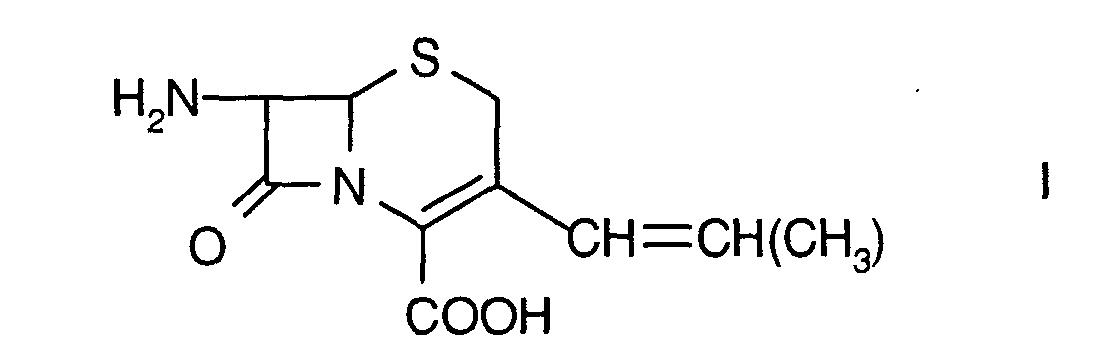
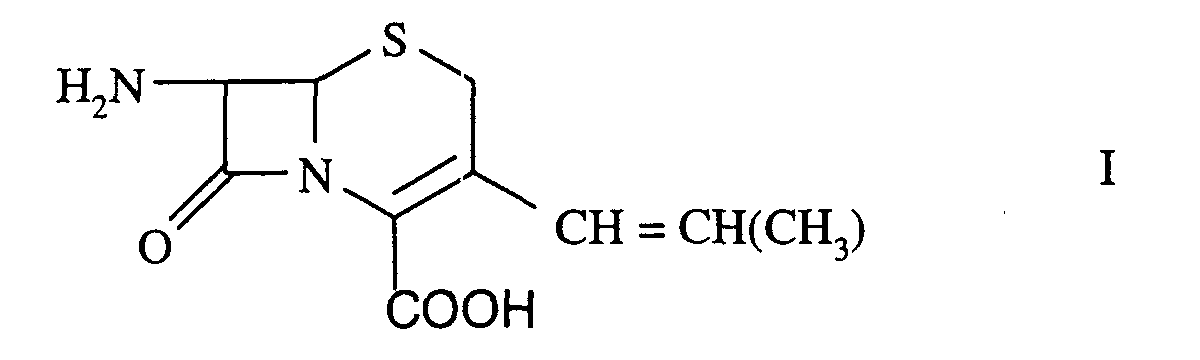
- the invention relates to methods of reducing the E-(trans) isomer amount in the Z/E (cis/trans) 7-amino-3-(1-propen-1-yl)-3-cephem- -4-carboxylic acid of formula I
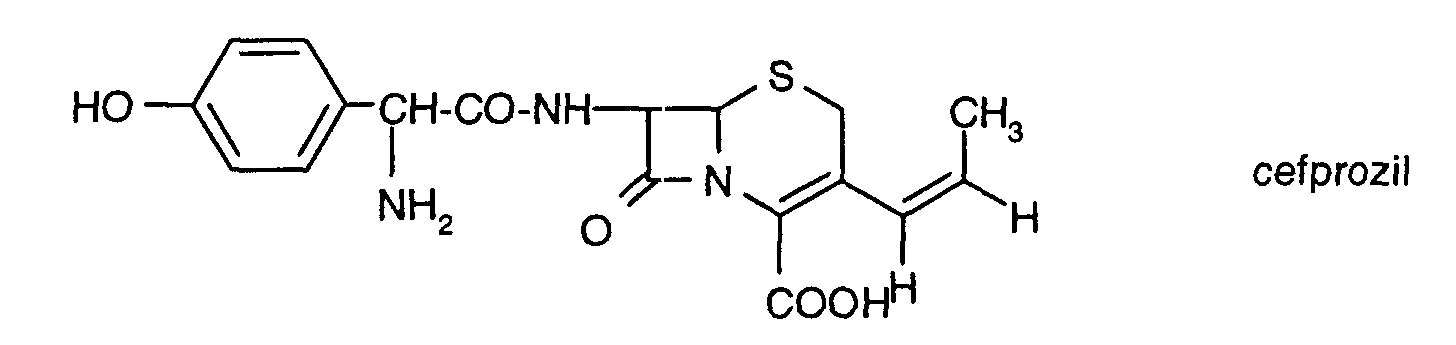
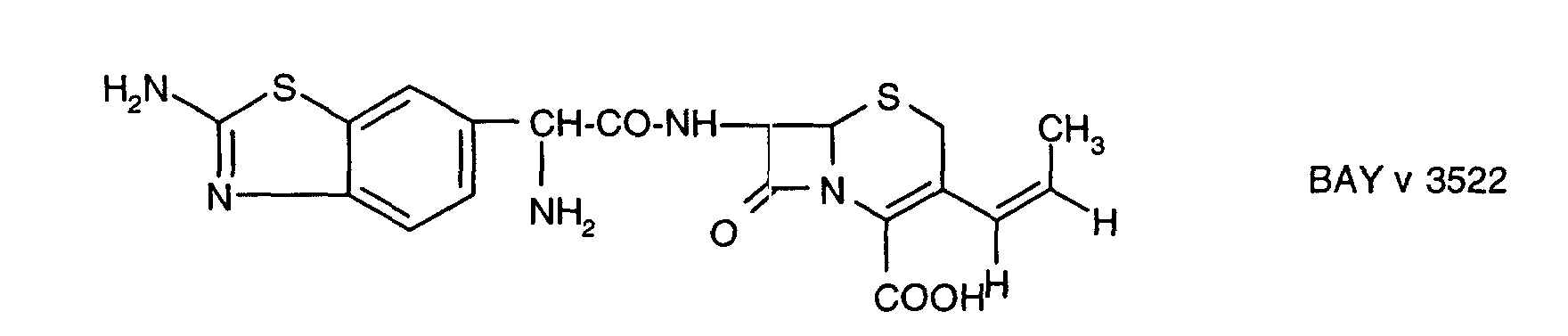
- the Z-isomer, 7-amino-3-[(Z)-1-propen-1-yl]-3-cephem-4-carboxylic acid of formula Ia is a central intermediate for the production of highly effective broad-band antibiotics, for example cefprozil and BAY v 3522 of formulae
- ester cleavage takes place to produce 7-amino-3-[(Z)-1-propen-1-yl)-3-cephem-4-carboxylic acid with a proportion of Z-isomer of 9.7%.
- the ratio of Z/E is 83/17.
- EP-A-O 292 806 7-amino-3-(1-propen-1-yl)-3-cephem-4-carboxylic acid is produced with a maximum Z/E ratio of 91/9. Further purification at the stage of this central intermediate product is not described.
- Z/E 7-amino-3-(1-propen-1-yl)-3-cephem-4-carboxylic acid of formula I with a too high E proportion may be converted into compound of formula I with low E content via the hydrochloride or a metal or amine salt of the compound of formula I or by adsorption chromatography of the compound of formula I.
- the invention comprises a simple and efficient method of depleting 7-amino-3-[(E)-1-propen-1-yl]-3-cephem-4-carboxylic acid in Z/E mixtures of 7-amino-3-[1-propen-1-yl]-3-cephem-4-carboxylic acid by forming a salt of formula II wherein the propenyl group has Z- and E-configuration and X + is Li + , Na + , K + , ammonium or a cation of formula III wherein R 1 , R 2 and R 3 are independently hydrogen, (C 1-8 )alkyl, an optionally substituted benzyl, (C 4-8 )cycloalkyl or R 1 with R 2 and the nitrogen atom signify a 5- or 6-membered heterocycle which optionally contains one or two additional heteroatoms and R 3 is as defined above, whereby one of R 1 , R 2 or R 3 is not hydrogen, by reacting a compound of formula I with a lithium
- the compounds of formula II may be formed in a protic or in an aprotic medium. If operating in an aqueous system, the Z/E mixture of the compound of formula I is dissolved in water or an aqueous organic solvent such as acetone or an alcohol e.g. isopropanol, by adding a base, such as lithium, sodium or potassium base, e.g. hydroxide, carbonate or hydrogencarbonate or a nitrogen containing base such as ammonia. Then an amine of formula IV or a lithium, sodium or potassium source is added and the solution optionally diluted with an organic counter solvent, whereby a compound of formula II precipitates.
- a base such as lithium, sodium or potassium base, e.g. hydroxide, carbonate or hydrogencarbonate or a nitrogen containing base such as ammonia.
- the Z/E mixture of the compound of formula I may be suspended in water, or an aqueous organic solvent such as acetone or an alcohol, e.g. isopropanol, the suspension is treated first with a lithium, sodium or potassium source or ammonia or a compound of formula IV and then with an organic counter solvent and optionally adjusting the pH with lithium, natrium or potassium base, e.g. hydroxide, carbonate or bicarbonate in case a lithium, sodium or potassium source such as lithium, sodium or potassium acetate is used.
- an aqueous organic solvent such as acetone or an alcohol, e.g. isopropanol
- Typical lithium, sodium or potassium sources include lithium, sodium or potassium salts of carboxylic acids, such as sodium or potassium acetate or lithium, sodium or potassium 2-ethylhexanoate.
- the Z/E mixture of formula I is suspended in an organic solvent, adding a base of formula IV and optionally diluting with a counter solvent or a mixture of counter solvents.
- organic solvents are amides, e.g. dimethylformamide; sulfoxide, e.g. dimethylsulfoxide; sulfone, e.g. sulfolane; halogenated hydrocarbons, e.g. dichloromethane; ketones, e.g. acetone; esters; ethers, e.g. tetrahydrofuran; alcohols, e.g.
- methanol ethanol
- ethanol one of the isomeric propanols or butanols
- nitriles e.g. acetonitrile or mixtures of these solvents.
- Further solvents may be added in admixture such as diethyl ether or tert. butyl methyl ether.
- Examples of compounds of formula IV are tert.butylamine, benzylamine, dibenzylamine, dicyclohexylamine or 2,4,4-trimethylpentyl-2-amine.
- R 1 with R 2 and the nitrogen atom signify a 5- or 6-membered heterocycle, containing optionally 1 or 2 additional heteroatoms, these are preferably oxygen or sulphur atoms.
- heterocycle are morpholine, N-methyl-morpholine, oxazolidine or thiazolidine.
- Preferred examples of compounds of formula IV are dicyclohexylamine and 2,4,4-trimethylpentyl-2-amine.
- the compounds of formula II may be easily converted into compounds of formula I with a reduced E content, by dissolving or suspending a compound of formula II in water and by acidifying, whereby the nitrogen containing base may optionally be removed by extraction in a first alkaline step or kept in solution by addition of an organic solvent such as an alcohol or a ketone, when the base is forming a salt, which is poorly soluble in water.
- an organic solvent such as an alcohol or a ketone
- the process of the invention has several advantages. Compounds of formula II are easily precipitated and crystallized.
- the process of the invention is especially advantageous, when applied to Z/E mixtures of formula I with a high E-content and/or containing by-products e.g. those obtained from mother liquors, e.g. from a process a) as described hereinbelow or early eluting fractions from a process c) as described hereinbelow containing by-products, effording products with a low E-content and high purity (see Example 4b).
- the fact that the process of the invention is applicable to products derived from mother liquors has also the advantage of an improved total yield.
- the process of the invention and process a) as described hereinbelow may be optionally repeated or compounds of formula II may be converted into the compound of formula I' (as described hereinbelow) in order to obtain the desired Z/E ratio.
- Process a) as described hereinabove comprises forming the hydrochloride of the compound of formula I' wherein the propenyl group has Z- and E-configuration, from compound of formula I and hydrochloric acid in a solvent or solvent mixture, in which the Z- and E-isomers of formula I' have different solubilities or solubilising at least part of 7-amino-3-[(E)-1-propen-1-yl]-3-cephem- 4-carboxylic acid hydrochloride in Z/E mixtures of the compound of formula I' in a solvent or solvent mixture, in which the Z- and E-isomers have different solubilities, and recovering the enriched Z-isomer of formula I', and optionally converting the obtained compound of formula I' into the free compound of formula I with a reduced E-amount by adjusting the pH.
- Process a may be carried out as follows:
- hydrochloride is carried out in a solvent or solvent mixture, in which the Z- and E-isomers of formula I' have different solubilities.
- the hydrochloride of formula I' may be formed both in protic and in aprotic medium. If operating in an aqueous system, the Z/E mixture of the compound of formula I is dissolved in water or an aqueous organic solvent such as aqueous alcohol, e.g. isopropanol, aqueous acetone or acetonitrile, by adding hydrochloric acid, and precipitating the hydrochloride by addition of an organic counter solvent.
- Suitable organic counter solvents are in particular organic nitriles such as acetonitrile; ketones, e.g. acetone; alcohols, e.g.
- the Z/E mixture of formula I is dissolved in concentrated form in an alcohol, e.g. methanol or isopropanol, with water-free hydrochloric acid, and is then diluted with one of the above mentioned counter solvents, whereby the crystalline Z-enriched product is crystallized out.
- the hydrochloride of formula I' may be suspended or dissolved in a solvent or solvent mixture in which the E-isomer of 7-amino-3-(1-propen-1-yl)-3-cephem-4-carboxylic acid hydrochloride is better soluble than the corresponding Z-isomer.
- Suitable solvents are alcohols, e.g. methanol, ethanol or isopropanol or a sulfone, e.g. sulfolane.
- Precipitation is then induced by e.g. adjustment of the solubility product of the Z- or E-isomer optionally by addition of one of the above mentioned counter solvent, whereby the hydrochloride of compound of formula I' with a reduced E-amount is obtained.
- the hydrochloride which is thereby much improved in its Z/E ratio may subsequently be converted again into the compound of formula I in conventional manner, e.g. by means of pH adjustment in water to the approximate isoelectric point.
- Compounds of formula I' may be prepared as described by the processes herein containing various amounts of Z/E isomers, e.g. in a ratio of at least 91:9, preferably 92:8, conveniently at least 94:6, at least 95:5; at least 97:3; or at least 99:1.
- Process c) as described hereinabove comprises subjecting a solution of the compound of formula I to adsorption chromatography.
- Process c) may be carried out as follows:
- Adsorbents include activated carbon, e.g. Norit CG-1, SX-plus, C-granular or Cecarbon GAC 40; adsorption resins such as HP-20, HP-21 or SP 207 (from e.g. Mitsubishi); XAD-1180, XAD-1600 or XAD 16 (from e.g. Rohm-Haas) or Amberchrome CG 161 (from e.g. Toso-Haas).
- the adsorption resin is XAD-1600 or Amberchrome CG 161. Elution is effected with water.
- the E-isomer has a better adsorption than the Z-isomer and thus is slower eluted as the Z-isomer.
- the first eluted fractions contain therefore mainly the Z-isomer, whereas the latest fractions contain mainly the E-isomer.
- the desired product may then be obtained by adjusting the pH value close to the isoelectric point, i.e. to 2.5-4.5, preferably to 3.0-3.7, whereby crystallization occurs.
- products with a very low amount of E-isomer ( ⁇ 3%) or products with an E-isomer of 7-9% are obtained.
- the amount of the adsorbent depends on the desired dissolution rate and the Z/E ratio of the starting compound of formula I.
- Process c) represents a very simple and economical method.
- the adsorbents may be regenerated.
- the elution is effected with water, no organic eluants are used.
- the apparative equipment is simple. No gradient elution or stepwise elution and no changes of pH are necessary.
- the process of the invention and processes a) and c) are suitable for industrial scale.
- the filtrates are collected in fractions of each about 40 ml.
- the first 2 fractions do not contain the product (HPLC control).
- Fractions 3 to inclusive 7 contain mainly the Z-PACA and only a very small amount of E-PACA and are therefore combined. These 230 ml are adjusted with 2N HCl to pH 3.4, whereby the product crystallises.
- the product is filtered off, washed with water and acetone and dried to yield 2.8 g PACA (content 96.7%) and containing ⁇ 0.1% E isomer. Yield 72.5%
- the resin is regenerated by elution with aqueous isopropanol to which some ammonia is added, rinsed with water and may be again employed.
- the adsorption resin is thereafter regenerated as described in Example 9.
Landscapes
- Chemical & Material Sciences (AREA)
- Organic Chemistry (AREA)
- Cephalosporin Compounds (AREA)
- Organic Low-Molecular-Weight Compounds And Preparation Thereof (AREA)
Abstract
Description
- The invention relates to methods of reducing the E-(trans) isomer amount in the Z/E (cis/trans) 7-amino-3-(1-propen-1-yl)-3-cephem- -4-carboxylic acid of formula I
- The Z-isomer, 7-amino-3-[(Z)-1-propen-1-yl]-3-cephem-4-carboxylic acid of formula Iais a central intermediate for the production of highly effective broad-band antibiotics, for example cefprozil and BAY v 3522 of formulae

- It is known that the Z-(or cis-)configuration represents the characteristic which determines the advantageous antibacterial properties of cephalosporin end products in the Gram negative range. Consequently, an active substance with the smallest possible proportion of E-(or trans-) isomer is desired for optimum efficiency. For example the undesired E-isomer in cefprozil should not exceed 11% according to the US Pharmocopeia.
- Synthetic processes for the production of these antibiotics generally yield Z-isomers in admixture with E-isomers.
- During the synthesis of the double bond from the corresponding cephalosporin nucleus by means of a Wittig reaction with acetaldehyde, the ratio of Z- to E-isomers may only be guided in the desired direction to an unsatisfactory extent: UK Patent Application 2 135 305 describes the production of cefprozil, starting with 7 -[D-2-(t-butoxycarbonylamino)-2-(p-hydroxyphenyl)acetamido]-3-cephem-4-carboxylic acid benzhydrylester. In Procedure 8 of this UK Application, the trans-isomer is separated by high performance liquid chromatography.
- In USP 4 727 070, a Z/E mixture of 7-[D-2-amino-2-(Z-and E)-1-propen-1-yl)ceph-3-em-4-carboxylic acid (cefprozil) is freed from undesired E isomer by means of a reaction with acetone and subsequent re-cleavage to the active substance. Purification of a most advanced intermediate by chromatography is expensive, and purification by chemical derivation of the end product is of course the most expensive variant.
- Less expensive is the production of the relatively isomer-free intermediate product, namely 7-amino-3-[(Z)-1-propen-1-yl]-3-cephem-4-carboxylic acid. However, the necessary olefinization reaction may not progress sufficiently selectively to the desired Z-compound. For example, in UK Patent Application 2 173 798, 7-amino-3-(1-propen-1-yl)-3-cephem-4-carboxylic acid benzhydryl ester.hydrochloride is obtained for example as a maximum 90/10 Z/E mixture in a Wittig reaction as an intermediate stage to the antibiotic cefprozil. From this, ester cleavage takes place to produce 7-amino-3-[(Z)-1-propen-1-yl)-3-cephem-4-carboxylic acid with a proportion of Z-isomer of 9.7%. In Example 4, the ratio of Z/E is 83/17. In EP-A-O 292 806, 7-amino-3-(1-propen-1-yl)-3-cephem-4-carboxylic acid is produced with a maximum Z/E ratio of 91/9. Further purification at the stage of this central intermediate product is not described.
- It has been surprisingly found that Z/E 7-amino-3-(1-propen-1-yl)-3-cephem-4-carboxylic acid of formula I with a too high E proportion may be converted into compound of formula I with low E content via the hydrochloride or a metal or amine salt of the compound of formula I or by adsorption chromatography of the compound of formula I.
- In particular the invention comprises a simple and efficient method of depleting 7-amino-3-[(E)-1-propen-1-yl]-3-cephem-4-carboxylic acid in Z/E mixtures of 7-amino-3-[1-propen-1-yl]-3-cephem-4-carboxylic acid by
forming a salt of formula IIwherein the propenyl group has Z- and E-configuration and X+ is Li+, Na+, K+, ammonium or a cation of formula III wherein R1, R2 and R3 are independently hydrogen, (C1-8)alkyl, an optionally substituted benzyl, (C4-8)cycloalkyl or R1 with R2 and the nitrogen atom signify a 5- or 6-membered heterocycle which optionally contains one or two additional heteroatoms and R3 is as defined above, whereby one of R1, R2 or R3 is not hydrogen, by reacting a compound of formula I with a lithium, sodium or potassium base or ammonia or an amine of formula IV
 wherein R1, R2 and R3 are as defined above, in a solvent or solvent mixture, in which the Z-and E-isomers of formula II have different solubilities and precipitating the obtained compound of formula II optionally by adding a counter solvent, or dissolving a compound of formula I in a solvent or solvent mixture with a lithium, sodium or potassium base or ammonia and precipitating a compound of formula II by adding a lithium, sodium or potassium source or an amine of formula IV and optionally a counter solvent,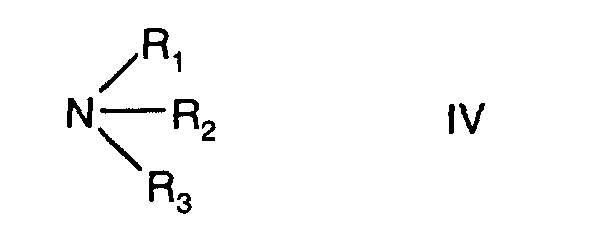
and converting the compound of formula II into compound of formula I with a reduced E-amount or the hydrochloride thereof of formula I' (as described hereinbelow) by adding an acid. - The process of the invention may be effected as follows:
- The compounds of formula II may be formed in a protic or in an aprotic medium. If operating in an aqueous system, the Z/E mixture of the compound of formula I is dissolved in water or an aqueous organic solvent auch as acetone or an alcohol e.g. isopropanol, by adding a base, such as lithium, sodium or potassium base, e.g. hydroxide, carbonate or hydrogencarbonate or a nitrogen containing base such as ammonia. Then an amine of formula IV or a lithium, sodium or potassium source is added and the solution optionally diluted with an organic counter solvent, whereby a compound of formula II precipitates. Alternatively the Z/E mixture of the compound of formula I may be suspended in water, or an aqueous organic solvent such as acetone or an alcohol, e.g. isopropanol, the suspension is treated first with a lithium, sodium or potassium source or ammonia or a compound of formula IV and then with an organic counter solvent and optionally adjusting the pH with lithium, natrium or potassium base, e.g. hydroxide, carbonate or bicarbonate in case a lithium, sodium or potassium source such as lithium, sodium or potassium acetate is used.
- Examples of organic counter solvents are given in process a) as described hereinbelow.
- Typical lithium, sodium or potassium sources include lithium, sodium or potassium salts of carboxylic acids, such as sodium or potassium acetate or lithium, sodium or potassium 2-ethylhexanoate.
- If operating in an aprotic medium, the Z/E mixture of formula I is suspended in an organic solvent, adding a base of formula IV and optionally diluting with a counter solvent or a mixture of counter solvents. Examples of organic solvents are amides, e.g. dimethylformamide; sulfoxide, e.g. dimethylsulfoxide; sulfone, e.g. sulfolane; halogenated hydrocarbons, e.g. dichloromethane; ketones, e.g. acetone; esters; ethers, e.g. tetrahydrofuran; alcohols, e.g. methanol, ethanol, one of the isomeric propanols or butanols, nitriles e.g. acetonitrile or mixtures of these solvents. Further solvents may be added in admixture such as diethyl ether or tert. butyl methyl ether.
- Examples of compounds of formula IV are tert.butylamine, benzylamine, dibenzylamine, dicyclohexylamine or 2,4,4-trimethylpentyl-2-amine.
- If in compounds of formula IV R1 with R2 and the nitrogen atom signify a 5- or 6-membered heterocycle, containing optionally 1 or 2 additional heteroatoms, these are preferably oxygen or sulphur atoms. Examples of the heterocycle are morpholine, N-methyl-morpholine, oxazolidine or thiazolidine.
- Preferred examples of compounds of formula IV are dicyclohexylamine and 2,4,4-trimethylpentyl-2-amine.
- The compounds of formula II may be easily converted into compounds of formula I with a reduced E content, by dissolving or suspending a compound of formula II in water and by acidifying, whereby the nitrogen containing base may optionally be removed by extraction in a first alkaline step or kept in solution by addition of an organic solvent such as an alcohol or a ketone, when the base is forming a salt, which is poorly soluble in water.
- Alternatively compounds of formula II may be converted into compound I' (as described hereinbelow).
- Compounds of formula II, wherein X+ is ammonium or a cation of formula III are new and also form part of the invention. The dicyclohexylammonium salt and the (2,4,4-trimethylpentyl-2) ammonium salt are preferred.
- The process of the invention has several advantages. Compounds of formula II are easily precipitated and crystallized. The process of the invention is especially advantageous, when applied to Z/E mixtures of formula I with a high E-content and/or containing by-products e.g. those obtained from mother liquors, e.g. from a process a) as described hereinbelow or early eluting fractions from a process c) as described hereinbelow containing by-products, effording products with a low E-content and high purity (see Example 4b). The fact that the process of the invention is applicable to products derived from mother liquors has also the advantage of an improved total yield.
The process of the invention and process a) as described hereinbelow may be optionally repeated or compounds of formula II may be converted into the compound of formula I' (as described hereinbelow) in order to obtain the desired Z/E ratio. - Process a) as described hereinabove comprises forming the hydrochloride of the compound of formula I'wherein the propenyl group has Z- and E-configuration, from compound of formula I and hydrochloric acid in a solvent or solvent mixture, in which the Z- and E-isomers of formula I' have different solubilities

or
solubilising at least part of 7-amino-3-[(E)-1-propen-1-yl]-3-cephem- 4-carboxylic acid hydrochloride in Z/E mixtures of the compound of formula I' in a solvent or solvent mixture, in which the Z- and E-isomers have different solubilities, and recovering the enriched Z-isomer of formula I',
and optionally converting the obtained compound of formula I' into the free compound of formula I with a reduced E-amount by adjusting the pH. - Process a) may be carried out as follows:
- The formation of the hydrochloride is carried out in a solvent or solvent mixture, in which the Z- and E-isomers of formula I' have different solubilities.
- The hydrochloride of formula I' may be formed both in protic and in aprotic medium. If operating in an aqueous system, the Z/E mixture of the compound of formula I is dissolved in water or an aqueous organic solvent such as aqueous alcohol, e.g. isopropanol, aqueous acetone or acetonitrile, by adding hydrochloric acid, and precipitating the hydrochloride by addition of an organic counter solvent. Suitable organic counter solvents are in particular organic nitriles such as acetonitrile; ketones, e.g. acetone; alcohols, e.g. methanol, ethanol, one of the isomeric propanols or butanols; ethers, e.g. tert.butyl methyl ether, diethylether or tetrahydrofuran or esters, e.g. ethyl or isopropyl acetate or mixtures thereof. If operating in a practically water-free system, the Z/E mixture of formula I is dissolved in concentrated form in an alcohol, e.g. methanol or isopropanol, with water-free hydrochloric acid, and is then diluted with one of the above mentioned counter solvents, whereby the crystalline Z-enriched product is crystallized out.
- According to another variant, the hydrochloride of formula I' may be suspended or dissolved in a solvent or solvent mixture in which the E-isomer of 7-amino-3-(1-propen-1-yl)-3-cephem-4-carboxylic acid hydrochloride is better soluble than the corresponding Z-isomer. Suitable solvents are alcohols, e.g. methanol, ethanol or isopropanol or a sulfone, e.g. sulfolane. Precipitation is then induced by e.g. adjustment of the solubility product of the Z- or E-isomer optionally by addition of one of the above mentioned counter solvent, whereby the hydrochloride of compound of formula I' with a reduced E-amount is obtained.
- The hydrochloride which is thereby much improved in its Z/E ratio may subsequently be converted again into the compound of formula I in conventional manner, e.g. by means of pH adjustment in water to the approximate isoelectric point.
- If a mixture of Z and E 7-amino-3-(1-propen-1-yl)-3-cephem-4-carboxylic acid of formula I is dissolved in water in an alkali or an acid and is then reprecipitated by setting the pH at the isoelectric point, there is no improvement, but rather a worsening of the Z/E ratio (see comparison tests in Examples 11a and 11b). On the other hand, using the crystalline hydrochloride of 7-amino-3-(1-propen-1-yl)-3-cephem-4-carboxylic acid of formula I', the Z/E ratio is surprisingly considerably improved. The depletion rates of undesired E-compound are up to 7%.
- Compounds of formula I' may be prepared as described by the processes herein containing various amounts of Z/E isomers, e.g. in a ratio of at least 91:9, preferably 92:8, conveniently at least 94:6, at least 95:5; at least 97:3; or at least 99:1.
- Process c) as described hereinabove comprises subjecting a solution of the compound of formula I to adsorption chromatography.
- Process c) may be carried out as follows:
- The compound of formula I is dissolved in water by adding a base e.g. ammonia. Adsorbents include activated carbon, e.g. Norit CG-1, SX-plus, C-granular or Cecarbon GAC 40; adsorption resins such as HP-20, HP-21 or SP 207 (from e.g. Mitsubishi); XAD-1180, XAD-1600 or XAD 16 (from e.g. Rohm-Haas) or Amberchrome CG 161 (from e.g. Toso-Haas). Preferably the adsorption resin is XAD-1600 or Amberchrome CG 161. Elution is effected with water. In this process the E-isomer has a better adsorption than the Z-isomer and thus is slower eluted as the Z-isomer. The first eluted fractions contain therefore mainly the Z-isomer, whereas the latest fractions contain mainly the E-isomer. The desired product may then be obtained by adjusting the pH value close to the isoelectric point, i.e. to 2.5-4.5, preferably to 3.0-3.7, whereby crystallization occurs. Depending on which fractions are combined, products with a very low amount of E-isomer (<3%) or products with an E-isomer of 7-9% are obtained.
- The amount of the adsorbent depends on the desired dissolution rate and the Z/E ratio of the starting compound of formula I.
- Process c) represents a very simple and economical method. The adsorbents may be regenerated. The elution is effected with water, no organic eluants are used. The apparative equipment is simple. No gradient elution or stepwise elution and no changes of pH are necessary.
- The process of the invention and processes a) and c) are suitable for industrial scale.
- In the following Examples, which illustrate the invention more fully, but in no way limit its scope, all temperatures are given in degrees celsius.
- In the Examples the following abbreviations are used:
- PACA = 7-amino-3-[(Z/E)-1-propen-1-yl]-3-cephem-4-carboxylic acid
- 7-ACA = 7-amino-cephalosporanic acid
- 7-ADCA = 7-amino-desacetoxy-cephalosporanic acid
-
- A mixture of 15 ml of 5 N HCl in methanol and 30 ml of acetonitrile is cooled with ice water. 15 g of PACA (Z/E ratio = 85.4/14.6) are introduced into the solution. After stirring for 5 minutes, a solution is obtained. The cooling bath is removed and the solution is slowly diluted over the course of 30 minutes with the dropwise addition of 300 ml of acetonitrile. After adding ca. 70 ml of acetonitrile, the solution is seeded with PACA.hydrochloride. The resultant crystal suspension is stirred for a further one hour whilst cooling with ice. The product is isolated through a suction filter, washed twice, each time with 40 ml of acetonitrile, and dried in a vacuum drying chamber.
Yield 14.1 g Chloride 12.8% Z/E ratio 89.9/10.1 - 10 ml of acetonitrile and 5 ml of aqueous concentrated HCl are cooled with ice water, and 5 g of PACA with a Z/E ratio of 85.4/14.6 are introduced whilst stirring. After ca. 20 minutes, a solution is obtained. The solution is slowly mixed with 100 ml of acetonitrile, whereby after the addition of 30 ml of the acetonitrile, the solution is seeded with the hydrochloride of PACA. After completion of the acetonitrile addition, the resultant crystal suspension is stirred for a further one hour whilst cooling with ice, and subsequently filtered. The hydrochloride is subsequently washed twice, each time with 15 ml of acetonitrile, and dried.
Yield 3.4 g Z/E ratio 92.8/7.2 - 1 g of PACA.hydrochloride with a Z/E ratio of 89.1/10.1 is treated with 2 ml of methanol, whereby a solution is briefly obtained. Crystallization rapidly re-occurs. The suspension is slowly mixed with 20 ml of acetonitrile. The crystal suspension is stirred for a further 1 hour whilst cooling with ice, and subsequently filtered. The product is washed twice, each time with 5 ml of acetonitrile, and dried.
Yield 0.6. g Z/E ratio 95.5/4.5 - 1 g of PACA.hydrochloride with a Z/E ratio of 89.9/10.1 is suspended per 2 ml of methanol, ethanol and isopropanol. After stirring for one hour and cooling with ice, the solid substance is isolated in the usual way, and dried.
Z/E ratio: a) methanol 97.2/2.8 b) ethanol 91.1/8.9 c) isopropanol 92.5/7.5 - 2 g of PACA.hydrochloride with a Z/E ratio of 89.9/10.1 are introduced into 20 ml of water. The pH value of the suspension is 0.9. The suspension is carefully adjusted to pH 3.5 with 2 N NaOH. The suspension is stirred for a further 1 hour whilst cooling with ice, the product is filtered off, washed twice, each time with 5 ml of water, and dried.
Yield 1.7 g Z/E ratio 89.7/10.3 - To a mixture of 20 ml saturated aqueous potassium acetate solution and 20 ml isopropanol are added 10 g of PACA (mother liquor product) (Z/E ratio = 63:37) with a content of 90% (main side product 7-ADCA 1.9%). The pH of the obtained suspension is adjusted with 5N KOH to pH 8.8 and the resulting solution is diluted with 100 ml isopropanol. The resulting suspension is stirred 1 hour at room temperature and then left overnight in the refrigerator. The precipitate is filtered off, washed with isopropanol and dried.
Yield 5.1 g Content PACA (HPLC) 86% = 99.7% as potassium salt; Z/E ratio 70.8/29.2; Content 7-ADCA 0.4% - 10 g of PACA (Z/E ratio 92/8) (HPLC content 99%) are suspended in a mixture of 30 ml water and 30 ml acetone. Aqueous ammonia is added until a solution results. The basic solution (pH ca 8.8) is treated with 9.1 ml dicyclohexylamine and then dropwise with 250 ml acetone, whereby PACA-dicyclohexyl-ammonium salt precipitates. The suspension is stirred for a further 1 hour at room temperature and the product is filtered off, washed with acetone and dried in a vacuum chamber.
Yield 13.5 g Content PACA (HPLC) 53.3% Content Dicyclohexylamine (GC) 39.3% Content water 1.7% Content acetone 1.1% Z/E ratio 96/4 - 200 g of PACA (mother liquor product) with a Z/E ratio of 56.4/43.6 (HPLC content 90.1%, 3.2% 7-ADCA, 1.6% 7-ACA) are suspended in a mixture of 1600 ml acetone and 400 ml water. Under stirring are added 182.4 ml of dicyclohexylamine, whereby a solution results after a few minutes. Seed crystalls of PACA dicyclohexylammonium salt are added and the resulting suspension is stirred 2 hours at room temperature. The suspension is left in a refrigerator overnight, the product is filtered off, washed with acetone and dried in a vacuum chamber at 45°.
Yield 200.2 g Z/E ratio 78.3/21.7 Content PACA (HPLC) 48% Content 7-ADCA 0.22% Content 7-ACA 0.19% - A suspension of 10 g of PACA with a Z/E ratio of 86/14 (HPLC content 93.4%) in 50 ml dichloromethane is treated with 12.4 ml of dicyclohexylamine, whereby a slightly clouded solution results. Crystallisation is starting and the suspension is cooled, the product filtered off, washed with cold dichloromethane and dried in a vacuum chamber.
Yield 11.2 g PACA content (HPLC) 56.2% Z/E ratio 90.2/9.8 - A suspension of 10 g PACA with a Z/E ratio 86.3/13.7 (HPLC content 95%) in a mixture of 80 ml acetone and 40 ml water is treated with 7.6 ml tert.-octylamine. Further 520 ml of acetone are added. The obtained suspension is stirred for 2 hours at room temperature. The tert. octylammonium [(2,4,4-trimethylpentyl-2) ammonium] salt of PACA is filtered off, washed with acetone and dried in a vacuum chamber.
Yield 10.4 g PACA content (HPLC) 59.8% Z/E ratio 92.5/7.5 Content tert. octylamine (GC) 31.6% H2O 1.6% Acetone (GC) 2% - 100 g PACA-dicyclohexylammonium salt [product of Example 4b)] with a Z/E ratio of 78.3/21.7 (HPLC content 48% of PACA) are suspended in 1000 ml water. The pH of the suspension is adjusted to pH 3.5 within 45 minutes with 85% phosphoric acid. The suspension is stirred for a further 30 minutes at room temperature. The title product is filtered off, washed with water and then with acetone and dried in a vacuum chamber.
Yield 45.7 g Content HPLC 100.8% Z/E ratio 77.8/22.2 - 100 g PACA-dicyclohexylammonium salt (E-content 7.6%, PACA-content 53.11%) are added to 4000 ml water of 30°. After about 2 minutes a solution results, to which 5 g activated carbon are added. The mixture is stirred for 10 minutes, the carbon is filtered off and washed with 250 ml water. The pH of the combined filtrate and washing is slowly adjusted to 3.5 with 5 N sulfuric acid. The obtained crystall suspension is cooled in an ice-bath and stirred for 2 hours while cooling. The product is filtered off, washed sequentially with total 200 ml water, 100 ml water/acetone (1:1) and 250 ml acetone. The product is dried in a vacuum chamber at 40°.
Yield 50.3 g Content HPLC 101.5% E-content 7.4 % - 7.8 litres of aqueous solution of 2 kg PACA (content 93.4%, E content 15%), obtained by addition of ammonia up to a pH of 8.0, are loaded on a 75 litre column filled with HP-20-resin with a flow rate of 60 litre/h. The elution is effected with water. 50 litres of eluate (counting from the beginning of the introduction of the PACA-solution) are obtained. This does not contain the product (HPLC control) and is discarded. Then fractions each of 5 1 are taken and analysed by HPLC. The first 2 fractions contain a small amount of Z-PACA, but also early eluting side products such as 7-ACA and 7-ADCA and are combined to Pool I. The subsequent 6 fractions ( = 30 litres) contain mainly the desired Z-PACA (1108 g Z-PACA + 27 g E-PACA).
- The following 7 fractions (=35 litres) contain still Z-PACA, but also increasing amounts of E-PACA (297 g Z and 93 g E). From the HPLC analysis of these 13 fractions the E-content is calculated of 7.9%. These 13 fractions are combined and the pH is adjusted to 3.5 by addition of 5N HCI. The precipitating crystalls are filtered off, washed with water and acetone and dried in vacuum at 45°. There are obtained 1451 g PACA (yield 77.6%).
Content PACA 99.9% E-content 7.8% - From Pool I there are obtained by adjusting the pH to 3.5 137.5 g material, which consists mainly of Z-PACA.
- Out of later eluting fractions (fractions 16-19) 62.4 g of mainly E-PACA are isolated by adjusting the pH to 3.5.
- 20 g activated carbon (Norit CG-1) are suspended in water and then filtered on a suction filter (diameter 4 cm) and rinsed in vacuum with water. 4 g PACA (content 93.4%, E-content 15%) are dissolved in 40 ml water by addition of ammonia up to a pH of 8.0. This solution is slowly sucked (within ca. 15 minutes) through the activated carbon. Afterwards the carbon-cake is eluted in the same manner with 250 ml water.
- The filtrates are collected in fractions of each about 40 ml. The first 2 fractions do not contain the product (HPLC control). Fractions 3 to inclusive 7 contain mainly the Z-PACA and only a very small amount of E-PACA and are therefore combined. These 230 ml are adjusted with 2N HCl to pH 3.4, whereby the product crystallises. The product is filtered off, washed with water and acetone and dried to yield 2.8 g PACA (content 96.7%) and containing <0.1% E isomer.
Yield 72.5% - 100 ml adsorbent-resin "Amberchrome CG 161 md" are loaded as in Example 7 described with a solution of 5 g PACA (content 93.4%, E-content 15%) in 50 ml water. Elution is then effected with water and the eluates containing Z-PACA fractions are collected. Adjustment of the pH to 3.5 leads to crystallisation of the product, which is filtered, washed and dried, to give 3.87 g (yield 82.8%) PACA (content 98%) and containing <5% E isomer.
- The resin is regenerated by elution with aqueous isopropanol to which some ammonia is added, rinsed with water and may be again employed.
- To the regenerated resin "Amberchrome CG 161 md" of Example 9 (100 ml volume) is introduced an aqueous solution of 8 g PACA (content 93.4%, E-content 15%)-prepared by dissolving with ammonia solution at pH 8.1 in 60 ml water. Elution with 240 ml water is then effected. 110 ml of "empty" eluate and further 10 ml eluate, containing mainly early eluting side products such as 7-ACA, 7-ADCA etc. are discarded. Thereafter the eluate is pooled until the E-content in the pool is increased up to 9% E-PACA related to the total amount of PACA in the pool. From this pool (200 ml) the product is crystallised by adjusting the pH to 3.4 with hydrochloric acid. The product is filtered, washed with water and dried in vacuum. 6.4 g PACA (yield 85.6%, content 99%) with an E-content of 8.8% are obtained.
- The adsorption resin is thereafter regenerated as described in Example 9.
- 3 g of PACA with a Z/E ratio of 85.4/14.6 are suspended in 30 ml of water. Ca. 6 ml of concentrated HCl are added whilst cooling with ice, until a solution is obtained. The pH value is subsequently adjusted to pH 3.5 by carefully adding 5 N NaOH without external cooling. The crystal suspension is then stirred for 1 hour whilst cooling with ice, the product is filtered off, washed twice, each time with 10 ml of water, and dried in a vacuum drying chamber.
Yield 2.8 g Z/E ratio 84.5/15.5 - 3 g of PACA with a Z/E ratio of 82.6/17.6 are suspended in 50 ml of water. 5 N NaOH (ca. 2.5 ml) is added whilst stirring until a solution is obtained (pH 8.7). The pH is subsequently adjusted to pH 3.5 by carefully adding concentrated HCl, diluted to 1/1. The crystal suspension is stirred for a further 1 hour whilst cooling with ice, and subsequently isolated and dried as described in Example 3a).
Yield 2.9 g Z/E ratio 81.8/18.2
Claims (6)
- Process for the depletion of 7-amino-3-[(E)-1-propen-1-yl]-3-cephem-4-carboxylic acid in mixtures of 7-amino-3-[(Z)-1-propen-1-yl]-3-cephem-4-carboxylic acid and 7-amino-3-[(E)-1-propen-1-yl]-3-cephem-4-carboxylic acid of formula I which comprisesforming a salt of formula II
 wherein the propenyl group has Z- and E-configuration and X+ is Li+, +, Na+, ammonium or a cation of formula III
 wherein R1, R2 and R3 are independently hydrogen, (C1-8)alkyl, an optionally substituted benzyl, (C4-8)cycloalkyl or R1 with R2 and the nitrogen atom signify a 5-or 6-membered heterocycle which optionally contains one or two additional heteroatoms and R3 is as defined above, whereby one of R1, R2 and R3 is not hydrogen, by reacting a compound of formula I with a lithium, sodium or potassium base or ammonia or an amine of formula IV
 wherein R1, R2 and R3 are as defined above, in a solvent or solvent mixture, in which the Z- and E-isomers of formula II have different solubilities and precipitating the obtained compound of formula II optionally by adding a counter solvent,
or dissolving a compound of formula I in a solvent or solvent mixture with a lithium, sodium or potassium base or ammonia and precipitating a compound of formula II by adding a lithium, sodium or potassium source or an amine of formula IV, and optionally a counter solvent,
and converting the compound of formula II into compound of formula I with a reduced E-amount or the hydrochloride thereof of formula I'by adding an acid.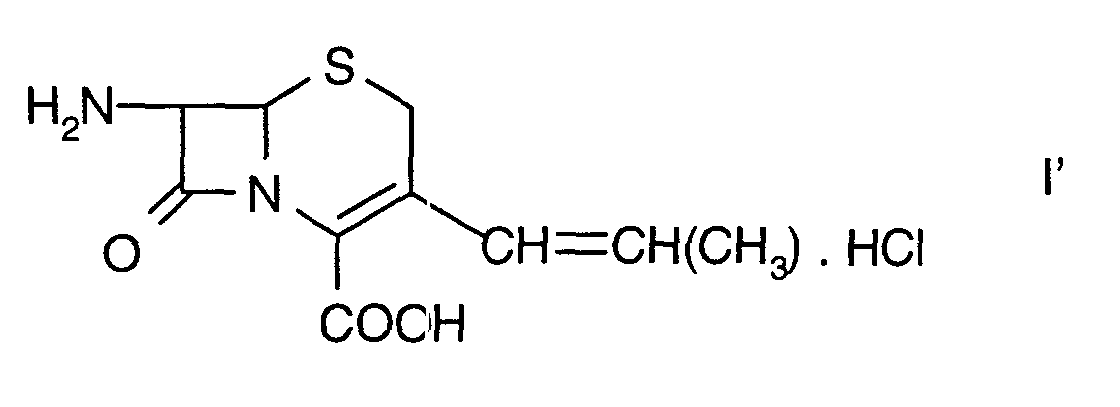
- A process according to claim 1 wherein a lithium, sodium or potassium salt of a carboxylic acid such as lithium, sodium, potassium acetate or 2-ethylhexanoate are employed as Li+, Na+ or K+ source.
- A process according to claim 1 wherein as Li+, Na+ or K+ base, the hydroxide, hydrogencarbonate or carbonate are employed.
- 7-Amino-3-[(Z)-1-propen-1-yl]-3-cephem-4-carboxylic acid dicyclohexylammonium salt.
- 7-Amino-3-[(Z)-1-propen-1-yl]-3-cephem-4-carboxylic acid (2,4,4-trimethylpentyl-2)ammonium salt.
- Use of a compound of formula II in a process for the depletion of 7-amino-3-[(E)-1-propen-1-yl]-3-cephem-4-carboxylic acid in mixtures of 7-amino-3-[(Z)-1-propen-1-yl]-3-cephem-4-carboxylic acid and 7-amino-3-[(E)-1-propen-1-yl]-3-cephem-4-carboxylic acid according to claim 1.
Priority Applications (2)
| Application Number | Priority Date | Filing Date | Title |
|---|---|---|---|
| EP01104309A EP1103555B1 (en) | 1992-02-05 | 1992-12-21 | Process for the production of a 3-cephem-4-carboxylic acid derivative |
| EP00111498A EP1029864B1 (en) | 1992-02-05 | 1992-12-21 | Process for the purification of a 3-cephem-4-carboxylic acid derivative |
Applications Claiming Priority (6)
| Application Number | Priority Date | Filing Date | Title |
|---|---|---|---|
| AT0019192A AT399876B (en) | 1992-02-05 | 1992-02-05 | Purificn. of 7-amino-3-((z)-1-propen-1-yl)-3 -cephem-4-carboxylic acid - useful in prodn. of broadband antibiotics |
| AT191/92 | 1992-02-05 | ||
| AT19192 | 1992-02-05 | ||
| GB9225666 | 1992-12-09 | ||
| GB929225666A GB9225666D0 (en) | 1992-12-09 | 1992-12-09 | Process for the depletion of 7-amino-3-((e)-propen-1-yl)-3-cephem-4-carboxylic acid |
| PCT/EP1992/002965 WO1993016084A1 (en) | 1992-02-05 | 1992-12-21 | Process for the purification of a 3-cephem-4-carboxylic acid derivative |
Related Child Applications (2)
| Application Number | Title | Priority Date | Filing Date |
|---|---|---|---|
| EP01104309A Division EP1103555B1 (en) | 1992-02-05 | 1992-12-21 | Process for the production of a 3-cephem-4-carboxylic acid derivative |
| EP00111498A Division EP1029864B1 (en) | 1992-02-05 | 1992-12-21 | Process for the purification of a 3-cephem-4-carboxylic acid derivative |
Publications (2)
| Publication Number | Publication Date |
|---|---|
| EP0630380A1 EP0630380A1 (en) | 1994-12-28 |
| EP0630380B1 true EP0630380B1 (en) | 2001-09-05 |
Family
ID=25591794
Family Applications (2)
| Application Number | Title | Priority Date | Filing Date |
|---|---|---|---|
| EP93901714A Expired - Lifetime EP0630380B1 (en) | 1992-02-05 | 1992-12-21 | Process for the purification of a 3-cephem-4-carboxylic acid derivative |
| EP01104309A Expired - Lifetime EP1103555B1 (en) | 1992-02-05 | 1992-12-21 | Process for the production of a 3-cephem-4-carboxylic acid derivative |
Family Applications After (1)
| Application Number | Title | Priority Date | Filing Date |
|---|---|---|---|
| EP01104309A Expired - Lifetime EP1103555B1 (en) | 1992-02-05 | 1992-12-21 | Process for the production of a 3-cephem-4-carboxylic acid derivative |
Country Status (14)
| Country | Link |
|---|---|
| US (3) | US5869648A (en) |
| EP (2) | EP0630380B1 (en) |
| JP (1) | JP2825655B2 (en) |
| KR (1) | KR950700311A (en) |
| AT (2) | ATE205214T1 (en) |
| CA (1) | CA2124322C (en) |
| DE (2) | DE69232048T2 (en) |
| DK (1) | DK0630380T3 (en) |
| ES (2) | ES2210047T3 (en) |
| GR (1) | GR3036985T3 (en) |
| PT (1) | PT630380E (en) |
| SG (1) | SG48415A1 (en) |
| TW (1) | TW230775B (en) |
| WO (1) | WO1993016084A1 (en) |
Families Citing this family (15)
| Publication number | Priority date | Publication date | Assignee | Title |
|---|---|---|---|---|
| EP0658558B1 (en) | 1993-11-17 | 2001-01-24 | Biochemie Gesellschaft M.B.H. | Separation of cephalosporin isomers |
| US5648378A (en) * | 1995-06-07 | 1997-07-15 | Research Corporation Technologies, Inc. | 2-iminochromene derivatives as inhibitors of protein tyrosine kinase |
| AT403049B (en) * | 1995-08-14 | 1997-10-27 | Biochemie Gmbh | DEFERRATION OF 7-ADCA IN 3-VINYL-ACA |
| AT405283B (en) * | 1997-04-04 | 1999-06-25 | Biochemie Gmbh | NEW CRYSTALLINE 7- (Z) - (2- (2-AMINOTHIAZOL-4-YL) -2-HYDROXYIMINOACETAMIDO) -3-VINYL-3-CEPHEM-4- CARBONIC ACID DICYCLOHEXYLAMMONIUM SALTS AND METHODS FOR THE PRODUCTION THEREOF |
| AT406773B (en) * | 1998-04-02 | 2000-08-25 | Biochemie Gmbh | NEW SALT OF 7- (2- (AMINOTHIAZOL-4YL) -2- |
| GB0118764D0 (en) * | 2001-08-01 | 2001-09-26 | Biochemie Gmbh | Organic compounds |
| EP1842852A1 (en) * | 2002-08-13 | 2007-10-10 | Sandoz AG | A cefdinir intermediate |
| WO2004033464A1 (en) * | 2002-10-08 | 2004-04-22 | Ranbaxy Laboratories Limited | Process for the preparation of (z)-isomer enriched 7-amino-3-propen-1-yl-3-cephem-4- carboxylic acid |
| US6903211B2 (en) * | 2002-10-30 | 2005-06-07 | Orchid Chemicals & Pharmaceuticals Limited | Process for the preparation of 3-propenyl cephalosporin DMF solvate |
| US20070106073A1 (en) * | 2003-03-24 | 2007-05-10 | Eiji Imai | Novel crystal of 7-[2-[(2-aminothiazol-4-yl)-2-hydroxyiminoacetamide-3-vinyl-3-cephem-4-carboxylic acid (syn isomer) and method for preparation thereof |
| WO2005100369A1 (en) * | 2004-04-13 | 2005-10-27 | Ranbaxy Laboratories Limited | Depletion of e-isomers in preparation of z-enriched 3-(2-substituted vinyl) cephalosporins |
| JP4046708B2 (en) * | 2004-06-04 | 2008-02-13 | 明治製菓株式会社 | Method for producing 3-alkenylcephem compound |
| GB2421024A (en) * | 2004-12-07 | 2006-06-14 | Sandoz Ag | Cefdinir crystalline form C |
| US20070128268A1 (en) * | 2005-12-07 | 2007-06-07 | Herwig Jennewein | Pharmaceutical compositions comprising an antibiotic |
| EP2367118A1 (en) | 2010-03-15 | 2011-09-21 | GMC Software AG | Method and devices for generating two-dimensional visual objects |
Family Cites Families (18)
| Publication number | Priority date | Publication date | Assignee | Title |
|---|---|---|---|---|
| US4110534A (en) * | 1970-01-23 | 1978-08-29 | Glaxo Laboratories Limited | Process for the preparation of 3-vinyl and substituted vinyl cephalosporins |
| US3769277A (en) * | 1970-01-23 | 1973-10-30 | Glaxo Lab Ltd | Preparation of delta3-4 carboxy cephalosporins having a 3-vinyl or substituted 3-vinyl group |
| US4107431A (en) * | 1970-01-23 | 1978-08-15 | Glaxo Laboratories Limited | Δ3 -3-Vinyl or substituted vinyl-4-carboxy cephalosporins |
| US4065620A (en) * | 1971-06-14 | 1977-12-27 | Eli Lilly And Company | 3-(Substituted) vinyl cephalosporins |
| US4520022A (en) * | 1983-01-28 | 1985-05-28 | Bristol-Myers Company | Substituted vinyl cephalosporins |
| ZM884A1 (en) | 1983-01-28 | 1984-10-22 | Bristol Myers Co | Substituted vinyl cephalosporins |
| US4699979A (en) | 1985-04-22 | 1987-10-13 | Bristol-Meyers Company | 7-amino-3-propenylcephalosporanic acid and esters thereof |
| FR2580652B1 (en) * | 1985-04-22 | 1989-01-06 | Bristol Myers Co | 7-AMINO-3-PROPENYLCEPHALOSPORANIC ACID AND ITS ESTERS |
| US4708955A (en) * | 1985-06-24 | 1987-11-24 | Bristol-Myers Company | 3-(substituted)propenyl-7-aminothiazol-ylcephalosporanic acids and esters thereof |
| US4874856A (en) * | 1985-06-24 | 1989-10-17 | Bristol-Myers Company | 3-(substituted)propenyl-7-(aminothiazolylacetamido) ceph-3-em-4-carboxylic acids and esters thereof |
| US4694079A (en) * | 1985-07-29 | 1987-09-15 | Bristol-Myers Company | 3-propenyl cephalosporin solvates |
| US4727070A (en) * | 1985-11-25 | 1988-02-23 | Bristol-Myers Company | 3-Propenzl cephalosporin isomer separation process and derivative |
| US4870168A (en) * | 1987-02-26 | 1989-09-26 | Bristol-Myers Company | 3-Unsaturated alkyl cephems from 3-triflyl cephems |
| DE3734005A1 (en) * | 1987-05-26 | 1988-12-15 | Bayer Ag | SUBSTITUTED VINYLCEPHALOSPORINS, THE METHOD OF MANUFACTURING THEIR PRODUCTS AND THEIR USE AS A MEDICINAL PRODUCT |
| US4935508A (en) * | 1988-08-23 | 1990-06-19 | Bristol-Myers Company | Process for cephem prodrug esters |
| DE3933934A1 (en) * | 1989-10-03 | 1991-04-11 | Bayer Ag | METHOD FOR PRODUCING 7-AMINO-3 - ((Z) -1-PROPEN-1-YL) -3-CEPHEM-4-CARBONIC ACID |
| US5095012A (en) * | 1990-08-23 | 1992-03-10 | Bristol-Myers Squibb Company | Antibiotic c-7 catechol-substituted cephalosporin compounds, compositions, and method of use thereof |
| DE69231815T2 (en) * | 1991-03-08 | 2001-09-27 | Biochemie Ges.M.B.H., Kundl | Process for the preparation of cephalosporins and intermediates in this process |
-
1992
- 1992-12-21 AT AT93901714T patent/ATE205214T1/en not_active IP Right Cessation
- 1992-12-21 PT PT93901714T patent/PT630380E/en unknown
- 1992-12-21 EP EP93901714A patent/EP0630380B1/en not_active Expired - Lifetime
- 1992-12-21 DE DE69232048T patent/DE69232048T2/en not_active Expired - Fee Related
- 1992-12-21 WO PCT/EP1992/002965 patent/WO1993016084A1/en not_active Ceased
- 1992-12-21 KR KR1019940702673A patent/KR950700311A/en not_active Expired - Lifetime
- 1992-12-21 JP JP5513698A patent/JP2825655B2/en not_active Expired - Lifetime
- 1992-12-21 EP EP01104309A patent/EP1103555B1/en not_active Expired - Lifetime
- 1992-12-21 ES ES01104309T patent/ES2210047T3/en not_active Expired - Lifetime
- 1992-12-21 AT AT01104309T patent/ATE253583T1/en not_active IP Right Cessation
- 1992-12-21 DK DK93901714T patent/DK0630380T3/en not_active Application Discontinuation
- 1992-12-21 DE DE69233249T patent/DE69233249T2/en not_active Expired - Fee Related
- 1992-12-21 SG SG1996009496A patent/SG48415A1/en unknown
- 1992-12-21 CA CA002124322A patent/CA2124322C/en not_active Expired - Fee Related
- 1992-12-21 ES ES93901714T patent/ES2162812T3/en not_active Expired - Lifetime
- 1992-12-29 TW TW081110453A patent/TW230775B/zh not_active IP Right Cessation
-
1995
- 1995-06-06 US US08/466,306 patent/US5869648A/en not_active Expired - Fee Related
-
1998
- 1998-11-12 US US09/190,200 patent/US6136967A/en not_active Expired - Lifetime
-
2000
- 2000-05-04 US US09/564,833 patent/US6333409B1/en not_active Expired - Fee Related
-
2001
- 2001-10-23 GR GR20010401855T patent/GR3036985T3/en not_active IP Right Cessation
Non-Patent Citations (2)
| Title |
|---|
| New Comprehensive Biochemistry, vol.8 (General Editors A. Neuberger, L.L.M. van Deenen, Separation Methods., Z. Deyl., Amsterdam, Elsevier, 1984, page 6 * |
| Techniques of Chemistry, Volume XII, Separation and Purification, third.ed. E.S. Perry and A. Weissberger, New york Wiley 1978, page 26 * |
Also Published As
| Publication number | Publication date |
|---|---|
| ES2162812T3 (en) | 2002-01-16 |
| DE69233249D1 (en) | 2003-12-11 |
| DE69232048T2 (en) | 2002-07-04 |
| DE69233249T2 (en) | 2004-08-19 |
| US6333409B1 (en) | 2001-12-25 |
| TW230775B (en) | 1994-09-21 |
| EP1103555B1 (en) | 2003-11-05 |
| GR3036985T3 (en) | 2002-01-31 |
| DE69232048D1 (en) | 2001-10-11 |
| EP0630380A1 (en) | 1994-12-28 |
| ES2210047T3 (en) | 2004-07-01 |
| WO1993016084A1 (en) | 1993-08-19 |
| KR950700311A (en) | 1995-01-16 |
| PT630380E (en) | 2002-02-28 |
| SG48415A1 (en) | 1998-04-17 |
| ATE253583T1 (en) | 2003-11-15 |
| EP1103555A1 (en) | 2001-05-30 |
| CA2124322C (en) | 2007-04-17 |
| ATE205214T1 (en) | 2001-09-15 |
| CA2124322A1 (en) | 1993-08-19 |
| JPH07503474A (en) | 1995-04-13 |
| US5869648A (en) | 1999-02-09 |
| JP2825655B2 (en) | 1998-11-18 |
| US6136967A (en) | 2000-10-24 |
| DK0630380T3 (en) | 2001-12-10 |
Similar Documents
| Publication | Publication Date | Title |
|---|---|---|
| EP1103555B1 (en) | Process for the production of a 3-cephem-4-carboxylic acid derivative | |
| EP0658558B1 (en) | Separation of cephalosporin isomers | |
| EP1016665B1 (en) | Process for the selective preparation of z-isomers of 3-(2-substituted vinyl)cephalosporins | |
| NO147916B (en) | PROCEDURE FOR THE PREPARATION OF 3-METHYLENE-CEPHALOSPORINE COMPOUNDS. | |
| US6835829B2 (en) | Purification process | |
| JPWO1998058932A1 (en) | Selective preparation of Z isomers of 3-(2-substituted-vinyl)-cephalosporins | |
| EP1228074B1 (en) | Method of preparing highly pure cefpodoxime proxetil | |
| EP1029864A1 (en) | Process for the purification of a 3-cephem-4-carboxylic acid derivative | |
| WO2005100369A1 (en) | Depletion of e-isomers in preparation of z-enriched 3-(2-substituted vinyl) cephalosporins | |
| EP0806424A1 (en) | Process for producing cephalosporin antibiotics | |
| US3928333A (en) | Process for the preparation of 3 cephalosporin esters | |
| US7622577B2 (en) | Processes for the preparation of cephalosporin derivatives | |
| EP0109294A2 (en) | Cephalosporin esters | |
| US7544797B2 (en) | Processes for the preparation of cephem derivatives | |
| KR100213444B1 (en) | New Manufacturing Method of Sepem Derivatives | |
| US5026842A (en) | Process for preparing cephalosporin compounds |
Legal Events
| Date | Code | Title | Description |
|---|---|---|---|
| PUAI | Public reference made under article 153(3) epc to a published international application that has entered the european phase |
Free format text: ORIGINAL CODE: 0009012 |
|
| 17P | Request for examination filed |
Effective date: 19940509 |
|
| AK | Designated contracting states |
Kind code of ref document: A1 Designated state(s): AT BE CH DE DK ES FR GB GR IE IT LI LU NL PT SE |
|
| 17Q | First examination report despatched |
Effective date: 19981019 |
|
| GRAG | Despatch of communication of intention to grant |
Free format text: ORIGINAL CODE: EPIDOS AGRA |
|
| GRAG | Despatch of communication of intention to grant |
Free format text: ORIGINAL CODE: EPIDOS AGRA |
|
| GRAH | Despatch of communication of intention to grant a patent |
Free format text: ORIGINAL CODE: EPIDOS IGRA |
|
| GRAH | Despatch of communication of intention to grant a patent |
Free format text: ORIGINAL CODE: EPIDOS IGRA |
|
| GRAH | Despatch of communication of intention to grant a patent |
Free format text: ORIGINAL CODE: EPIDOS IGRA |
|
| GRAA | (expected) grant |
Free format text: ORIGINAL CODE: 0009210 |
|
| AK | Designated contracting states |
Kind code of ref document: B1 Designated state(s): AT BE CH DE DK ES FR GB GR IE IT LI LU NL PT SE |
|
| REF | Corresponds to: |
Ref document number: 205214 Country of ref document: AT Date of ref document: 20010915 Kind code of ref document: T |
|
| REG | Reference to a national code |
Ref country code: CH Ref legal event code: EP |
|
| REF | Corresponds to: |
Ref document number: 69232048 Country of ref document: DE Date of ref document: 20011011 |
|
| REG | Reference to a national code |
Ref country code: IE Ref legal event code: FG4D |
|
| ET | Fr: translation filed | ||
| REG | Reference to a national code |
Ref country code: DK Ref legal event code: T3 |
|
| PG25 | Lapsed in a contracting state [announced via postgrant information from national office to epo] |
Ref country code: LU Free format text: LAPSE BECAUSE OF NON-PAYMENT OF DUE FEES Effective date: 20011221 |
|
| REG | Reference to a national code |
Ref country code: GB Ref legal event code: IF02 |
|
| REG | Reference to a national code |
Ref country code: ES Ref legal event code: FG2A Ref document number: 2162812 Country of ref document: ES Kind code of ref document: T3 |
|
| REG | Reference to a national code |
Ref country code: GR Ref legal event code: EP Ref document number: 20010401855 Country of ref document: GR |
|
| REG | Reference to a national code |
Ref country code: PT Ref legal event code: SC4A Free format text: AVAILABILITY OF NATIONAL TRANSLATION Effective date: 20011114 |
|
| PLBE | No opposition filed within time limit |
Free format text: ORIGINAL CODE: 0009261 |
|
| STAA | Information on the status of an ep patent application or granted ep patent |
Free format text: STATUS: NO OPPOSITION FILED WITHIN TIME LIMIT |
|
| 26N | No opposition filed | ||
| REG | Reference to a national code |
Ref country code: CH Ref legal event code: PFA Owner name: SANDOZ G.M.B.H Free format text: BIOCHEMIE GESELLSCHAFT M.B.H.##6250 KUNDL (AT) -TRANSFER TO- SANDOZ G.M.B.H#BIOCHEMIESTRASSE10#6250 KUNDL (AT) |
|
| REG | Reference to a national code |
Ref country code: CH Ref legal event code: PUE Owner name: SANDOZ AG Free format text: SANDOZ G.M.B.H#BIOCHEMIESTRASSE10#6250 KUNDL (AT) -TRANSFER TO- SANDOZ AG#LICHTSTRASSE 35#4056 BASEL (CH) |
|
| NLS | Nl: assignments of ep-patents |
Owner name: SANDOZ AG |
|
| NLT1 | Nl: modifications of names registered in virtue of documents presented to the patent office pursuant to art. 16 a, paragraph 1 |
Owner name: SANDOZ GMBH |
|
| REG | Reference to a national code |
Ref country code: FR Ref legal event code: TP Ref country code: FR Ref legal event code: CD |
|
| PGFP | Annual fee paid to national office [announced via postgrant information from national office to epo] |
Ref country code: NL Payment date: 20081203 Year of fee payment: 17 Ref country code: IE Payment date: 20081216 Year of fee payment: 17 Ref country code: DK Payment date: 20081212 Year of fee payment: 17 Ref country code: CH Payment date: 20081230 Year of fee payment: 17 |
|
| PGFP | Annual fee paid to national office [announced via postgrant information from national office to epo] |
Ref country code: AT Payment date: 20081211 Year of fee payment: 17 |
|
| PGFP | Annual fee paid to national office [announced via postgrant information from national office to epo] |
Ref country code: SE Payment date: 20081205 Year of fee payment: 17 |
|
| PGFP | Annual fee paid to national office [announced via postgrant information from national office to epo] |
Ref country code: FR Payment date: 20081212 Year of fee payment: 17 |
|
| PGFP | Annual fee paid to national office [announced via postgrant information from national office to epo] |
Ref country code: DE Payment date: 20081219 Year of fee payment: 17 |
|
| PGFP | Annual fee paid to national office [announced via postgrant information from national office to epo] |
Ref country code: GR Payment date: 20081113 Year of fee payment: 17 Ref country code: GB Payment date: 20081217 Year of fee payment: 17 |
|
| PGFP | Annual fee paid to national office [announced via postgrant information from national office to epo] |
Ref country code: BE Payment date: 20090119 Year of fee payment: 17 |
|
| BERE | Be: lapsed |
Owner name: *BIOCHEMIE G.M.B.H. Effective date: 20091231 |
|
| REG | Reference to a national code |
Ref country code: NL Ref legal event code: V1 Effective date: 20100701 |
|
| EUG | Se: european patent has lapsed | ||
| REG | Reference to a national code |
Ref country code: CH Ref legal event code: PL |
|
| REG | Reference to a national code |
Ref country code: DK Ref legal event code: EBP |
|
| GBPC | Gb: european patent ceased through non-payment of renewal fee |
Effective date: 20091221 |
|
| PG25 | Lapsed in a contracting state [announced via postgrant information from national office to epo] |
Ref country code: AT Free format text: LAPSE BECAUSE OF NON-PAYMENT OF DUE FEES Effective date: 20091221 |
|
| REG | Reference to a national code |
Ref country code: FR Ref legal event code: ST Effective date: 20100831 |
|
| REG | Reference to a national code |
Ref country code: IE Ref legal event code: MM4A |
|
| PG25 | Lapsed in a contracting state [announced via postgrant information from national office to epo] |
Ref country code: NL Free format text: LAPSE BECAUSE OF NON-PAYMENT OF DUE FEES Effective date: 20100701 Ref country code: LI Free format text: LAPSE BECAUSE OF NON-PAYMENT OF DUE FEES Effective date: 20091231 Ref country code: IE Free format text: LAPSE BECAUSE OF NON-PAYMENT OF DUE FEES Effective date: 20091221 Ref country code: FR Free format text: LAPSE BECAUSE OF NON-PAYMENT OF DUE FEES Effective date: 20091231 Ref country code: CH Free format text: LAPSE BECAUSE OF NON-PAYMENT OF DUE FEES Effective date: 20091231 Ref country code: BE Free format text: LAPSE BECAUSE OF NON-PAYMENT OF DUE FEES Effective date: 20091231 |
|
| PG25 | Lapsed in a contracting state [announced via postgrant information from national office to epo] |
Ref country code: DE Free format text: LAPSE BECAUSE OF NON-PAYMENT OF DUE FEES Effective date: 20100701 |
|
| PG25 | Lapsed in a contracting state [announced via postgrant information from national office to epo] |
Ref country code: GB Free format text: LAPSE BECAUSE OF NON-PAYMENT OF DUE FEES Effective date: 20091221 |
|
| PG25 | Lapsed in a contracting state [announced via postgrant information from national office to epo] |
Ref country code: DK Free format text: LAPSE BECAUSE OF NON-PAYMENT OF DUE FEES Effective date: 20100104 |
|
| PGFP | Annual fee paid to national office [announced via postgrant information from national office to epo] |
Ref country code: IT Payment date: 20101224 Year of fee payment: 19 |
|
| PG25 | Lapsed in a contracting state [announced via postgrant information from national office to epo] |
Ref country code: SE Free format text: LAPSE BECAUSE OF NON-PAYMENT OF DUE FEES Effective date: 20091222 |
|
| PGFP | Annual fee paid to national office [announced via postgrant information from national office to epo] |
Ref country code: PT Payment date: 20111221 Year of fee payment: 20 |
|
| REG | Reference to a national code |
Ref country code: PT Ref legal event code: MM4A Free format text: MAXIMUM VALIDITY LIMIT REACHED Effective date: 20121221 |
|
| PG25 | Lapsed in a contracting state [announced via postgrant information from national office to epo] |
Ref country code: PT Free format text: LAPSE BECAUSE OF EXPIRATION OF PROTECTION Effective date: 20130102 |
|
| PGFP | Annual fee paid to national office [announced via postgrant information from national office to epo] |
Ref country code: ES Payment date: 20120116 Year of fee payment: 20 |
|
| REG | Reference to a national code |
Ref country code: ES Ref legal event code: FD2A Effective date: 20130718 |
|
| PG25 | Lapsed in a contracting state [announced via postgrant information from national office to epo] |
Ref country code: ES Free format text: LAPSE BECAUSE OF EXPIRATION OF PROTECTION Effective date: 20121222 |