EP0630374B1 - Imidazole, triazole and tetrazole derivatives - Google Patents
Imidazole, triazole and tetrazole derivatives Download PDFInfo
- Publication number
- EP0630374B1 EP0630374B1 EP93905531A EP93905531A EP0630374B1 EP 0630374 B1 EP0630374 B1 EP 0630374B1 EP 93905531 A EP93905531 A EP 93905531A EP 93905531 A EP93905531 A EP 93905531A EP 0630374 B1 EP0630374 B1 EP 0630374B1
- Authority
- EP
- European Patent Office
- Prior art keywords
- formula
- compound
- methyl
- azetidine
- group
- Prior art date
- Legal status (The legal status is an assumption and is not a legal conclusion. Google has not performed a legal analysis and makes no representation as to the accuracy of the status listed.)
- Expired - Lifetime
Links
- 0 CN(C)N=C(*)N=C Chemical compound CN(C)N=C(*)N=C 0.000 description 8
Classifications
-
- C—CHEMISTRY; METALLURGY
- C07—ORGANIC CHEMISTRY
- C07D—HETEROCYCLIC COMPOUNDS
- C07D231/00—Heterocyclic compounds containing 1,2-diazole or hydrogenated 1,2-diazole rings
- C07D231/02—Heterocyclic compounds containing 1,2-diazole or hydrogenated 1,2-diazole rings not condensed with other rings
- C07D231/10—Heterocyclic compounds containing 1,2-diazole or hydrogenated 1,2-diazole rings not condensed with other rings having two or three double bonds between ring members or between ring members and non-ring members
- C07D231/12—Heterocyclic compounds containing 1,2-diazole or hydrogenated 1,2-diazole rings not condensed with other rings having two or three double bonds between ring members or between ring members and non-ring members with only hydrogen atoms, hydrocarbon or substituted hydrocarbon radicals, directly attached to ring carbon atoms
-
- A—HUMAN NECESSITIES
- A61—MEDICAL OR VETERINARY SCIENCE; HYGIENE
- A61P—SPECIFIC THERAPEUTIC ACTIVITY OF CHEMICAL COMPOUNDS OR MEDICINAL PREPARATIONS
- A61P25/00—Drugs for disorders of the nervous system
- A61P25/04—Centrally acting analgesics, e.g. opioids
-
- A—HUMAN NECESSITIES
- A61—MEDICAL OR VETERINARY SCIENCE; HYGIENE
- A61P—SPECIFIC THERAPEUTIC ACTIVITY OF CHEMICAL COMPOUNDS OR MEDICINAL PREPARATIONS
- A61P25/00—Drugs for disorders of the nervous system
- A61P25/06—Antimigraine agents
-
- C—CHEMISTRY; METALLURGY
- C07—ORGANIC CHEMISTRY
- C07D—HETEROCYCLIC COMPOUNDS
- C07D233/00—Heterocyclic compounds containing 1,3-diazole or hydrogenated 1,3-diazole rings, not condensed with other rings
- C07D233/54—Heterocyclic compounds containing 1,3-diazole or hydrogenated 1,3-diazole rings, not condensed with other rings having two double bonds between ring members or between ring members and non-ring members
- C07D233/56—Heterocyclic compounds containing 1,3-diazole or hydrogenated 1,3-diazole rings, not condensed with other rings having two double bonds between ring members or between ring members and non-ring members with only hydrogen atoms or radicals containing only hydrogen and carbon atoms, attached to ring carbon atoms
-
- C—CHEMISTRY; METALLURGY
- C07—ORGANIC CHEMISTRY
- C07D—HETEROCYCLIC COMPOUNDS
- C07D249/00—Heterocyclic compounds containing five-membered rings having three nitrogen atoms as the only ring hetero atoms
- C07D249/02—Heterocyclic compounds containing five-membered rings having three nitrogen atoms as the only ring hetero atoms not condensed with other rings
- C07D249/08—1,2,4-Triazoles; Hydrogenated 1,2,4-triazoles
-
- C—CHEMISTRY; METALLURGY
- C07—ORGANIC CHEMISTRY
- C07D—HETEROCYCLIC COMPOUNDS
- C07D403/00—Heterocyclic compounds containing two or more hetero rings, having nitrogen atoms as the only ring hetero atoms, not provided for by group C07D401/00
- C07D403/14—Heterocyclic compounds containing two or more hetero rings, having nitrogen atoms as the only ring hetero atoms, not provided for by group C07D401/00 containing three or more hetero rings
Definitions
- the present invention relates to a class of substituted imidazole, triazole and tetrazole derivatives which act on 5-hydroxytryptamine (5-HT) receptors, being selective agonists of so-called “5-HT 1 -like" receptors. They are therefore useful in the treatment of clinical conditions for which a selective agonist of these receptors is indicated.
- 5-HT 5-hydroxytryptamine
- 5-HT 1 -like receptor agonists which exhibit selective vasoconstrictor activity have recently been described as being of use in the treatment of migraine (see, for example, A. Doenicke et al ., The Lancet, 1988, Vol. 1, 1309-11).
- the compounds of the present invention, being selective 5-HT 1 -like receptor agonists, are accordingly of particular use in the treatment of migraine and associated conditions, e.g. cluster headache, chronic paroxysmal hemicrania, headache associated with vascular disorders, tension headache and paediatric migraine.
- EP-A-0313397 and WO-A-91/18897 describe separate classes of tryptamine derivatives substituted by various five-membered heteroaliphatic rings, which are stated to be specific to a particular type of "5-HT 1 -like" receptor and thus to be effective therapeutic agents for the treatment of clinical conditions, particularly migraine, requiring this activity.
- EP-A-0313397 nor WO-A-91/18897 discloses or suggests the imidazole, triazole and tetrazole derivatives provided by the present invention.
- EP-A-0497512 published on 5th August 1992, describes a class of substituted imidazole, triazole and tetrazole derivatives which are stated to be selective agonists of 5-HT 1 -like receptors and hence to be of particular use in the treatment of migraine and associated conditions.
- the present invention provides a compound of formula I, or a salt thereof: wherein the broken circle represents two non-adjacent double bonds in any position in the five-membered ring;
- the salts of the compounds of formula I will be non-toxic pharmaceutically acceptable salts.
- Other salts may, however, be useful in the preparation of the compounds according to the invention or of their non-toxic pharmaceutically acceptable salts.
- Suitable pharmaceutically acceptable salts of the compounds of this invention include acid addition salts which may, for example, be formed by mixing a solution of the compound according to the invention with a solution of a pharmaceutically acceptable non-toxic acid such as hydrochloric acid, sulphuric acid, fumaric acid, maleic acid, succinic acid, acetic acid, benzoic acid, oxalic acid, citric acid, tartaric acid, carbonic acid or phosphoric acid.
- a pharmaceutically acceptable non-toxic acid such as hydrochloric acid, sulphuric acid, fumaric acid, maleic acid, succinic acid, acetic acid, benzoic acid, oxalic acid, citric acid, tartaric acid, carbonic acid or phosphoric acid.
- suitable pharmaceutically acceptable salts thereof may include alkali metal salts, e.g. sodium or potassium salts; alkaline earth metal salts, e.g. calcium or magnesium salts; and salts formed with suitable organic ligands, e.g. quaternary ammonium salts.
- Suitable alkyl groups include straight-chained and branched alkyl groups containing from 1 to 6 carbon atoms. Typical examples include methyl and ethyl groups, and straight-chained or branched propyl and butyl groups. Particular alkyl groups are methyl, ethyl and t-butyl.
- the compounds according to the invention may accordingly exist as enantiomers. Where the compounds according to the invention possess two or more asymmetric centres, they may additionally exist as diastereoisomers. It is to be understood that all such isomers and mixtures thereof are encompassed within the scope of the present invention.
- imidazole, triazole and tetrazole rings of formula I can exist in a variety of isomeric forms having differing substitution patterns. These may suitably be represented by formulae IA to IT as follows: wherein A 1 , A 2 , E and F are as defined above.
- Preferred imidazole, triazole and tetrazole rings of formula I include the rings represented by formulae IA, IC, IG, IH, IK, IL, IN and IQ above, especially IH and IK.
- the alkylene chain E may be, for example, methylene, ethylene, 1-methylethylene, propylene or 2-methylpropylene.
- the group E may represent a single bond such that the group F in formula I is attached directly to the five-membered heteroaromatic ring.
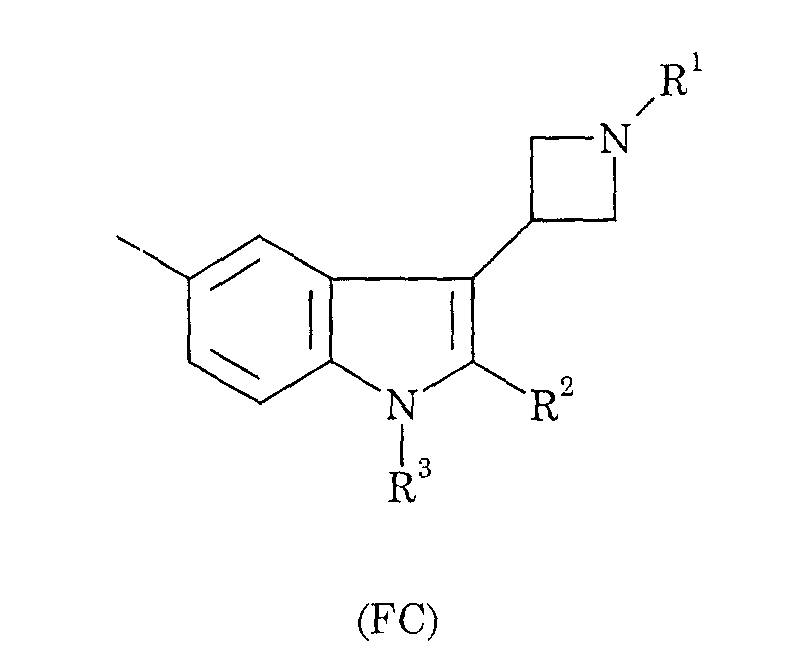
- the group F represents an indole moiety of structure FC: wherein R 1 , R 2 and R 3 are as defined above, in particular wherein R 2 and R 3 are both hydrogen.
- Preferred values for the groups R 1 , R 2 and R 3 include hydrogen and methyl.
- the group A 11 is preferably hydrogen or methyl.
- R 12 and R 13 each represents hydrogen.
- Preferred values of R 11 with respect to formula IIA include hydrogen and methyl.
- R 22 and R 23 each represents hydrogen.
- Preferred values of R 21 with respect to formula IIB include hydrogen and methyl.
- a further sub-class of compounds according to the invention is represented by the compounds of formula IIC, and salts thereof: wherein
- R 32 and R 33 each represents hydrogen.
- Preferred values of R 31 include hydrogen and methyl.
- R 42 and R 43 each represents hydrogen.
- Preferred values of R 41 include hydrogen and methyl.
- compositions comprising one or more compounds of this invention in association with a pharmaceutically acceptable carrier.
- these compositions are in unit dosage forms such as tablets, pills, capsules, powders, granules, sterile parenteral solutions or suspensions, metered aerosol or liquid sprays, drops, ampoules, auto-injector devices or suppositories; for oral, parenteral, intranasal, sublingual or rectal administration, or for administration by inhalation or insufflation.
- a pharmaceutical carrier e.g.
- a solid preformulation composition containing a homogeneous mixture of a compound of the present invention, or a non-toxic pharmaceutically acceptable salt thereof.
- preformulation compositions as homogeneous, it is meant that the active ingredient is dispersed evenly throughout the composition so that the composition may be readily subdivided into equally effective unit dosage forms such as tablets, pills and capsules.
- This solid preformulation composition is then subdivided into unit dosage forms of the type described above containing from 0.1 to about 500 mg of the active ingredient of the present invention.
- the tablets or pills of the novel composition can be coated or otherwise compounded to provide a dosage form affording the advantage of prolonged action.
- the tablet or pill can comprise an inner dosage and an outer dosage component, the latter being in the form of an envelope over the former.
- the two components can be separated by an enteric layer which serves to resist disintegration in the stomach and permits the inner component to pass intact into the duodenum or to be delayed in release.
- enteric layers or coatings such materials including a number of polymeric acids and mixtures of polymeric acids with such materials as shellac, cetyl alcohol and cellulose acetate.
- liquid forms in which the novel compositions of the present invention may be incorporated for administration orally or by injection include aqueous solutions, suitably flavoured syrups, aqueous or oil suspensions, and flavoured emulsions with edible oils such as cottonseed oil, sesame oil, coconut oil or peanut oil, as well as elixirs and similar pharmaceutical vehicles.
- Suitable dispersing or suspending agents for aqueous suspensions include synthetic and natural gums such as tragacanth, acacia, alginate, dextran, sodium carboxymethylcellulose, methylcellulose, polyvinylpyrrolidone or gelatin.
- a suitable dosage level is about 0.01 to 250 mg/kg per day, preferably about 0.05 to 100 mg/kg per day, and especially about 0.05 to 5 mg/kg per day.
- the compounds may be administered on a regimen of 1 to 4 times per day.
- the 1,2,4-triazole compounds of this invention may be prepared by a process which comprises reacting a reactive derivative of a carboxylic acid of formula R a -CO 2 H with a compound either of formula III or of formula IV, or a salt thereof: wherein one of R a , R b and R c is a group of formula A 1 , another is a group of formula A 2 , and the third is a group of formula -E-F, as defined with reference to formula I above.
- Suitable reactive derivatives of the acid R a -CO 2 H include esters, for example C 1-4 alkyl esters; thioesters, for example pyridylthioesters; acid anhydrides, for example (R a -CO) 2 O; acid halides, for example acid chlorides; orthoesters; and primary, secondary and tertiary amides.
- a preferred reactive derivative of the acid R a -CO 2 H is the iminoether derivative of formula V: where R is C 1-4 alkyl.
- the reagent of formula III may be generated in situ in the reaction mixture.
- the reaction may be effected by treating a compound of formula V above with an alkyl hydrazine, e.g. methyl hydrazine, followed by a suitable carboxylic acid such as formic acid.
- the reaction is conveniently carried out by heating the reagents together, optionally in a solvent, for example tetrahydrofuran, dimethylformamide or a lower alkanol such as ethanol, propanol or isopropanol, at about 20°C to 100°C for about 1 to 6 hours.
- a solvent for example tetrahydrofuran, dimethylformamide or a lower alkanol such as ethanol, propanol or isopropanol
- the reactive derivative of a carboxylic acid of formula HO 2 C-E-F may be prepared by reacting a compound of formula VI: wherein Q represents a reactive carboxylate moiety, and E is as defined above; with a compound of formula VII or a carbonyl-protected form thereof: wherein R 2 is as defined above and R p represents an amino-protecting group; followed by removal of the protecting group R p ; and subsequently, where required, N-alkylation by standard methods to introduce the moieties R 1 and/or R 3 .
- Suitable carbonyl-protected forms of the compounds of formula VII include the dimethyl acetal or ketal derivatives.
- amino-protecting groups for the substituent R p include carboxylic acid groups such as chloroacetyl, trifluoroacetyl, formyl, benzoyl, phthaloyl, phenylacetyl or pyridinecarbonyl; acid groups derived from carbonic acid such as ethoxycarbonyl, benzyloxycarbonyl, t-butoxycarbonyl, biphenylisopropoxycarbonyl, p-methylbenzyloxycarbonyl, p-nitrobenzyloxycarbonyl, p-bromobenzyloxycarbonyl, p-phenylazobenzyloxycarbonyl, p-(p'-methoxyphenylazo)benzyloxycarbonyl or t-amyloxycarbonyl; acid groups derived from sulphonic acid, e.g. p-toluenesulphonic acid; and other groups such as benzyl, p-methoxybenzyl,
- Preferred amino-protecting groups include t-butoxycarbonyl, benzyloxycarbonyl and p-methoxybenzyl.
- the removal of the protecting group present in the resultant compound may be effected by an appropriate procedure depending upon the nature of the protecting group.
- Typical procedures include hydrogenation in the presence of a palladium catalyst (e.g. palladium carbon or palladium black) for benzyloxycarbonyl, p-nitrobenzyloxycarbonyl, p-bromobenzyloxycarbonyl, p-phenylazobenzyloxycarbonyl, p-(p'-methoxyphenylazo)benzyloxycarbonyl and trityl groups; treatment with hydrogen bromide in glacial acetic acid or trifluoroacetic acid for benzyloxycarbonyl, p-bromobenzyloxycarbonyl, p-phenylazobenzyloxycarbonyl and t-butoxycarbonyl groups; treatment with acetic acid and/or a mineral acid such as hydrochloric acid or sulphuric acid for trityl, t-butoxycarbon
- reaction of compounds VI and VII may be carried out in a single step (Fischer indole synthesis) or by an initial non-cyclising step at a lower temperature to give a compound of formula VIII: wherein Q, E, R 2 and R p are as defined above; followed by cyclisation using a suitable reagent, such as a polyphosphate ester, to give a compound of formula Q-E-F.
- a suitable reagent such as a polyphosphate ester
- the hydrazines of formula VI may be prepared from the corresponding anilines of formula IX: wherein Q and E are as defined above; by diazotisation followed by reduction. Diazotisation is typically carried out using sodium nitrite/conc. HCl and the resulting diazo product reduced in situ using, for example, tin(II) chloride/conc. HCl, sodium sulphite/conc. HCl, or sodium sulphite/conc. H 2 SO 4 .
- anilines of formula IX may be prepared by reduction of the corresponding nitro compounds of formula X: wherein Q and E are as defined above; typically by transfer hydrogenation using a hydrogenation catalyst such as palladium on charcoal in the presence of a hydrogen donor such as ammonium formate, or alternatively by conventional catalytic hydrogenation or using tin(II) chloride.
- nitro compounds of formula X may be synthesized by standard methods well known to those skilled in the art.
- the triazole compounds according to the invention may be prepared by a method which comprises reacting a compound of formula XIV: wherein A 1 , E and F are as defined above, Hal represents halogen, and two of V a , W a , X a , Y a and Z a , to one of which the group Hal is attached, represent carbon and the remainder represent nitrogen; with a reagent which provides an anion - A 2 , where A 2 is as previously defined.
- an adjacent ester or ketone function may be retained after the process is complete, or may be removed.
- an ester moiety may be hydrolysed and decarboxylated.
- the 1,2,3-triazole compounds according to the present invention may be prepared by a process which comprises the cycloaddition of an alkyne of formula R a -C ⁇ C-R b with an azide of formula R c -N 3 , where R a , R b and R c are as defined above.
- the cycloaddition reaction may be conveniently effected in a suitable solvent such as tetrahydrofuran, ideally by heating in an autoclave for 8 hours.
- the tetrazole compounds in accordance with the invention may be prepared by a process which comprises the cycloaddition of a nitrile of formula N ⁇ C-R d with an azide of formula R e -N 3 , where one of R d and R e represents a group of formula A 1 and the other is a group of formula -E-F, as defined previously.
- the cycloaddition reaction is conveniently effected by heating the reactants together at an elevated temperature, e.g. a temperature in the region of 150°C, in a suitable solvent such as N-methylpyrrolid-2-one, advantageously in the presence of triethylamine hydrochloride.
- Thor product obtained from the cycloaddition reaction will generally be a mixture of isomers substituted by the A 1 group at positions 1 and 2 of the tetrazole ring, corresponding to structures IL and IM respectively as defined above. These isomers may conveniently be separated using conventional techniques such as chromatography.
- the tetrazole compounds of the invention may be prepared by a method which comprises reacting a compound of formula R e -L with a tetrazole derivative of formula XV: wherein one of R d anti R e represents a group of formula A 1 and the other is a group of formula -E-F, as defined above, and L represents a suitable leaving group; in the presence of a base such as triethylamine.
- the leaving group L suitably represents halogen, e.g. bromine or iodine, or a sulphonate derivative such as tosylate or mesylate.
- reaction is conveniently carried out in a suitable organic solvent, e.g. acetonitrile, at room temperature.
- a suitable organic solvent e.g. acetonitrile
- the tetrazole derivatives of formula XV may be prepared by cycloaddition of a nitrile of formula N ⁇ C-R d with sodium azide, advantageously under the conditions described above for the reaction between the nitrile N ⁇ C-R d and the azide R e -N 3 ; followed by acidification with a mineral acid such as hydrochloric acid.
- the compounds according to the invention wherein the group F is an indole moiety of structure FC as defined above may be prepared by a method which comprises reacting a compound of formula XVI: wherein V, W, X, Y, Z, A 1 , A 2 and E are as defined above; with a compound of formula VII as defined above, or a carbonyl-protected form thereof, e.g. the dimethyl acetal or ketal; followed by removal of the protecting group R p ; and subsequently, where required, N-alkylation by standard methods to introduce the moieties R 1 and/or R 3 .
- reaction between compounds XVI and VII may be carried out in a single step (Fischer indole synthesis) or by an initial non-cyclising step at a lower temperature to give a compound of formula XVII: wherein V, W, X, Y, Z, A 1 , A 2 , E, R 2 and R p are as defined above; followed by cyclisation using a suitable reagent, e.g. a polyphosphate ester.
- a suitable reagent e.g. a polyphosphate ester.
- the hydrazines of formula XVI may be prepared from the corresponding anilines of formula XVIII: wherein V, W, X, Y, Z, A 1 , A 2 and E are as defined above; by methods analogous to those described above with reference to the compounds of formula IX.
- anilines of formula XVIII may be prepared from the corresponding nitro compounds of formula XIX: wherein V, W, X, Y, Z, A 1 , A 2 and E are as defined above; by methods analogous to those described above with reference to the compounds of formula X.
- nitro compounds of formula XIX may be prepared by a variety of methods which will be readily apparent to those skilled in the art.
- V represents a nitrogen atom
- the relevant compounds of formula XIX may be prepared by reacting the anion of a compound of formula XX with a compound of formula XXI: wherein W, X, Y, Z, A 1 , A 2 and E are as defined above, and D 3 represents a readily displaceable group.
- compound XX is a triazole or tetrazole derivative
- the anion thereof may be generated by carrying out the reaction in a base such as triethylamine.
- compound XX is an imidazole derivative
- the anion thereof may conveniently be generated if the reaction is carried out in the presence of sodium hydride using N,N-dimethylformamide as solvent.
- salts of the compounds of formula XX are commercially available, e.g. the sodium salt of 1,2,4-triazole, these are advantageously utilised in N,N-dimethylformamide solution in place of the compounds of formula XX themselves, with no requirement in this instance for additional base to be present in the reaction mixture.
- the readily displaceable group D 3 in the compounds of formula XXI is suitably a halogen atom, preferably bromine; except when the moiety D 3 is attached directly to the aromatic ring, i.e. when E represents a bond, in which case D 3 is preferably fluorine.
- the compounds of formula XIX wherein the five-membered heteroaromatic ring is a 1,2,4-triazol-1-yl moiety and A 1 and A 2 are both hydrogen may be prepared by reacting 4-amino-1,2,4-triazole with a compound of formula XXI as defined above, followed by deamination of the resulting 1-substituted 4-amino-4H-1,2,4-triazolium salt by treatment with nitrous acid and subsequent neutralisation.
- This transformation which may be accomplished in two separate steps or advantageously as a "one-pot" procedure with both steps combined, is conveniently effected using reaction conditions analogous to those described in J. Org. Chem. , 1989, 54 , 731.
- nitro compounds of formula XXI above may be prepared by procedures analogous to those described in the accompanying Examples, or by methods well known from the art.
- the nitro compounds of formula XIX may be prepared from those of formula X above by appropriate modification of the moiety Q using, for example, methods analogous to those described above with reference to the compounds of formulae III and IV.
- Q in the compounds of formula X represents a reactive carboxylate moiety
- aniline derivatives of formula XVIII wherein the five-membered heteroaromatic ring is a 1,2,4-triazol-4-yl moiety, E is a bond and A 1 and A 2 are both hydrogen may be prepared by reacting the hydrazine derivative of formula XXII with the acetanilide of formula XXIII: followed by removal of the N-acetyl protecting group.
- reaction between compounds XXII and XXIII is conveniently effected in refluxing toluene, advantageously in the presence of a catalytic quantity of p-toluenesulphonic acid. Subsequent removal of the N-acetyl protecting group is typically effected in hot aqueous 5N hydrochloric acid.
- the hydrazine derivative of formula XXII can be prepared from N,N'-diformylhydrazine by reaction with thionyl chloride/N,N-dimethylformamide, as reported in J. Chem. Soc. (C) , 1967, 1664, and subsequent treatment with sodium methoxide in methanol.
- the acetanilide of formula XXIII may be prepared by reduction of the corresponding nitro compound of formula XXIV: typically by transfer hydrogenation using a hydrogenation catalyst in the presence of a hydrogen donor such as ammonium formate, or alternatively by conventional catalytic hydrogenation or using tin(II) chloride.
- nitro compound of formula XXIV is commercially available from the Aldrich Chemical Company Ltd., Gillingham, United Kingdom.
- Step 1 of the reaction scheme comprises oxidation of the hydroxy group of compound XXXII to a carbonyl group using pyridine. SO 3 in dimethyl sulphoxide (DMSO) and triethylamine; followed by reaction of the resulting azetidinone derivative with the Horner-Emmons reagent MeO 2 C.CH 2 .PO(OEt) 2 in the presence of sodium hydride, using tetrahydrofuran (THF) as the solvent.
- DMSO dimethyl sulphoxide
- THF tetrahydrofuran
- Step 2 the double bond of the azetidine olefin ester is hydrogenated over palladium-charcoal in methanol; the methyl ester group is then reduced to hydroxymethyl by treatment with lithium aluminium hydride in THF; and the diphenylmethyl protecting group is in turn removed by treatment with palladium hydroxide on charcoal, with methanol serving as the solvent.
- Step 3 involves protection of the azetidine nitrogen as the N-t-butoxycarbonyl (N-BOC) carbamate derivative; and, finally, Swern oxidation of the side chain terminal hydroxy group to an aldehyde moiety by treatment with oxalyl chloride in DMSO/triethylamine.
- N-BOC N-t-butoxycarbonyl
- any compound of formula I initially obtained from any of the above processes may, where appropriate, subsequently be elaborated into a further compound of formula I by techniques known from the art.
- the compound of formula XV above in which R d is a group of formula -E-F is itself a compound of formula I in which A 1 is hydrogen and A 2 represents a non-bonded electron pair.
- a compound of formula I wherein R 3 is hydrogen initially obtained may be converted into a compound of formula I wherein R 3 represents C 1-6 alkyl by standard alkylation techniques, for example by treatment with an alkyl iodide, e.g. methyl iodide, typically under basic conditions, e.g.
- a compound of formula I wherein R 1 represents hydrogen initially obtained may be converted into a compound of formula I wherein R 1 is other than hydrogen, for example by conventional N-alkylation techniques, e.g. by treatment with the appropriate aldehyde in the presence of a reducing agent such as sodium cyanoborohydride.
- novel compounds may be prepared in racemic form, or individual enantiomers may be prepared either by enantiospecific synthesis or by resolution.
- the novel compounds may, for example, be resolved into their component enantiomers by standard techniques, such as the formation of diastereomeric pairs by salt formation with an optically active acid, such as (-)-di-p-toluoyl-d-tartaric acid and/or (+)-di-p-toluoyl-l-tartaric acid followed by fractional crystallization and regeneration of the free base.
- the novel compounds may also be resolved by formation of diastereomeric esters or amides, followed by chromatographic separation and removal of the chiral auxiliary.
- any of the above synthetic sequences it may be necessary and/or desirable to protect sensitive or reactive groups on any of the molecules concerned. This may be achieved by means of conventional protecting groups, such as those described in Protective Groups in Organic Chemistry, ed. J.F.W. McOmie, Plenum Press, 1973; and T.W. Greene & P.G.M. Wutts, Protective Groups in Organic Synthesis, John Wiley & Sons, 1991.
- the protecting groups may be removed at a convenient subsequent stage using methods known from the art.
- test compounds to bind to 5-HT 1 -like receptors was measured in membranes prepared from pig caudate using the procedure described in J. Neurosci ., 1987, 7 , 894. Binding was determined using 2 nM 5-hydroxytryptamine creatinine sulphate, 5-[1,2- 3 H(N)] as a radioligand. Cyanopindolol (100 nM) and mesulergine (100 nM) were included in the assay to block out 5-HT 1A and 5-HT 1C binding sites respectively. The concentration of the compounds of the accompanying Examples required to displace 50% of the specific binding (IC 50 ) is below 1 ⁇ M in each case.
- test compounds as agonists of the 5-HT 1 -like receptor was measured in terms of their ability to mediate contraction of the saphenous vein of New Zealand White rabbits, using the procedure described in Arch. Pharm ., 1990, 342 , 111.
- Agonist potencies were calculated as -log 10 EC 50 (pEC 50 ) values, from plots of percentage 5-HT (1 ⁇ m) response against the concentration of the agonist.
- the compounds of the accompanying Examples were found to possess pEC 50 values in this assay of not less than 5.0 in each case.
- Aminodiphenylmethane (100g, 0.54mols) was added to a solution of epichlorohydrin (50g, 0.54mols) in DMSO (135ml) and stirred at 25°C for 3 days. The solution was then heated at 70°C for 3 days before cooling to room temperature, adding 10% NaOH solution, and extracting with Et 2 O (2 x 800ml). The combined extracts were washed with water (2 x 11), dried (Na 2 SO 4 ) and evaporated.
- Triethylamine (112.1g, 1.11mols) was added to a solution of N-diphenylmethylazetidin-3-ol (26.6g, 0.11mol) in DMSO (300ml). The solution was cooled to 10°C and a solution of sulphur trioxide-pyridine complex (112g, 0.7mol) in DMSO (500ml) added, rapidly. Stirring was continued at 10°C for 0.75h and the mixture then warmed to 25°C and stirred for 1h. The solution was poured into ice-water (21) and extracted with EtOAc (3 x 11). The combined extracts were washed with water (500ml) and brine (500ml) and dried (Na 2 SO 4 ).
- Methyl diethylphosphonoacetate (11.0g, 52.0mmol) in THF (10ml) was added dropwise to a stirred suspension of sodium hydride (2.1g, 60% dispersion in oil, 52.5mmol) in THF (40ml), at 10°C. The mixture was stirred for 0.6h and a solution of the preceding azetidinone (11.3g, 48.0mmol) in THF (50ml) then added dropwise at 10°C. The mixture was heated at 50°C for 3h before removing the solvent under vacuum and redissolving the residue in CH 2 Cl 2 (200ml).
- Diisobutylaluminium hydride (119ml of a 1M solution in toluene, 0.119mol) was added dropwise to a stirred solution of the preceding ester (10.0g, 33.9mmol) in toluene (500ml), at -35°C, over a 0.5h period.
- the solution was warmed to 25°C, stirred for 2h, and then cooled to 0°C and quenched by addition of methanol (10ml), 2N NaOH (5ml) and H 2 O (5ml). The mixture was warmed to 25°C, filtered through celite and the solvent removed under vacuum.
- Pd(OH) 2 (0.8g, 20% on C) was added to a solution of the preceding alcohol (4.0g, 15.0mmol) in methanol (200ml) and 1N HCl (10ml), and the mixture hydrogenated on a Parr shake apparatus for 24h, at 55 psi. The mixture was filtered through celite and the solvent removed under vacuum. Diphenyl methane was removed by triturating the residue with ether and decanting.
- Dimethylsulphoxide (1.98g, 25.3mmol) was added dropwise to a solution of oxalyl chloride (1.61g, 12.6mmol) in CH 2 Cl 2 (80ml), at -75°C. The mixture was stirred for 0.25h before adding a solution of the preceding alcohol (2.12g, 10.6mmol) in CH 2 Cl 2 (50ml), at -75°C, and stirring for 1h. Triethylamine (5.38g, 52.7mmol) was added and the reaction mixture warmed to 25°C and stirred for 1h.
- N-tert-Butyloxycarbonyl-3-formylmethylazetidine (0.3g, 1.51mmol) was added to a solution of 4-(2-methylimidazol-1-ylmethyl)phenylhydrazine (0.36g, 1.51mmol) in 4% H 2 SO 4 (25ml) and the resulting solution refluxed for 3h. The mixture was then cooled to room temperature, basified with K 2 CO 3 and extracted with n-butanol (2 x 100ml).
- 1,2,4-Triazole sodium derivative (90%) (17.74g, 0.18mol) and 1-fluoro-4-nitrobenzene (25g, 0.18mol), in DMF, (150ml) was stirred at room temperature for 4 days. Water (300ml) and ethyl acetate (500ml) were added and the mixture extracted.
- N-tert-Butyloxycarbonyl-3-formylmethylazetidine (0.4g, 2.01mmol) was added to a solution of 4-( 1,2,4-triazol-1-yl)phenylhydrazine (0.35g, 2.01mmol) in 4% H 2 SO 4 (50ml) and the mixture refluxed for 16h. The mixture was then cooled to room temperature, basified (K 2 CO 3 ) and extracted with n-butanol (5 x).
- Triethylamine hydrochloride (41.25g, 0.3mol) and sodium azide (39g, 0.6mol) were added to a solution of 4-nitrophenylacetonitrile (32.4g, 0.2mol) in anhydrous N-methylpyrrolidin-2-one (500ml) and the mixture heated at 150°C for 4h. The solution was cooled to room temperature and poured into 2N HCl (21) whereupon a solid crystallised out.
- the title- compound was prepared from 4-nitrophenethyl nitrile as described for Example 4.
- the benzoate salt was prepared, mp 165-167°C; (Found: C, 66.30; H, 6.33; N, 20.15.C 16 H 20 N 6 .C 7 H 6 O 2 requires C, 66.01; H, 6.26; N, 20.08%); ⁇ (250MHz, D 2 O) 3.04 and 3.14 (total 3H, both s, CH 3 ), 3.20-3.38 (4H, m, 2 of CH 2 ), 3.56 and 3.60 (total 3H, both s, CH 3 ), 4.12-4.20, 4.28-4.54 and 4.68-4.84 (total 5H, each m, azetidine-H), 7.08-7.18, 7.43-7.64 and 7.90-7.96 (total 9H, m, Ar-H and benzoic acid).
- 0.8H 2 O requires C, 65.49; H, 5.67; N, 14.55%); m/e 254 (M+1) + ; ⁇ (360MHz, D 2 O) 2.98 and 3.07 (total 3H, each s, N-CH 3 ), 4.16-4.22, 4.35-4.56 and 4.72-4.77 (total 5H, each m, CH and 2 of CH 2 of azetidine), 7.28-7.34, 7.43-7.64 and 7.88-7.90 (total 12H, each m, Ar-H and benzoic acid), 8.78 (2H, s, Ar-H).
- Tablets containing 1.0, 2.0, 25.0, 26.0, 50.0 and 100.0mg, respectively of the following compounds are prepared as illustrated below:
- All of the active compound, cellulose, and a portion of the corn starch are mixed and granulated to 10% corn starch paste.
- the resulting granulation is sieved, dried and blended with the remainder of the corn starch and the magnesium stearate.
- the resulting granulation is then compressed into tablets containing 1.0mg, 2.0mg, 25.0mg, 26.0mg, 50.0mg and 100mg of the active ingredient per tablet.
Landscapes
- Organic Chemistry (AREA)
- Chemical & Material Sciences (AREA)
- Health & Medical Sciences (AREA)
- Neurosurgery (AREA)
- Life Sciences & Earth Sciences (AREA)
- Neurology (AREA)
- Bioinformatics & Cheminformatics (AREA)
- Engineering & Computer Science (AREA)
- Chemical Kinetics & Catalysis (AREA)
- General Chemical & Material Sciences (AREA)
- Medicinal Chemistry (AREA)
- Nuclear Medicine, Radiotherapy & Molecular Imaging (AREA)
- Pain & Pain Management (AREA)
- Pharmacology & Pharmacy (AREA)
- Biomedical Technology (AREA)
- Animal Behavior & Ethology (AREA)
- General Health & Medical Sciences (AREA)
- Public Health (AREA)
- Veterinary Medicine (AREA)
- Pharmaceuticals Containing Other Organic And Inorganic Compounds (AREA)
- Plural Heterocyclic Compounds (AREA)
- Epoxy Resins (AREA)
- Paints Or Removers (AREA)
- Lubricants (AREA)
Abstract
Description
- The present invention relates to a class of substituted imidazole, triazole and tetrazole derivatives which act on 5-hydroxytryptamine (5-HT) receptors, being selective agonists of so-called "5-HT1-like" receptors. They are therefore useful in the treatment of clinical conditions for which a selective agonist of these receptors is indicated.
- 5-HT1-like receptor agonists which exhibit selective vasoconstrictor activity have recently been described as being of use in the treatment of migraine (see, for example, A. Doenicke et al., The Lancet, 1988, Vol. 1, 1309-11). The compounds of the present invention, being selective 5-HT1-like receptor agonists, are accordingly of particular use in the treatment of migraine and associated conditions, e.g. cluster headache, chronic paroxysmal hemicrania, headache associated with vascular disorders, tension headache and paediatric migraine.
- EP-A-0313397 and WO-A-91/18897 describe separate classes of tryptamine derivatives substituted by various five-membered heteroaliphatic rings, which are stated to be specific to a particular type of "5-HT1-like" receptor and thus to be effective therapeutic agents for the treatment of clinical conditions, particularly migraine, requiring this activity. However, neither EP-A-0313397 nor WO-A-91/18897 discloses or suggests the imidazole, triazole and tetrazole derivatives provided by the present invention.
- EP-A-0497512, published on 5th August 1992, describes a class of substituted imidazole, triazole and tetrazole derivatives which are stated to be selective agonists of 5-HT1-like receptors and hence to be of particular use in the treatment of migraine and associated conditions.
- The present invention provides a compound of formula I, or a salt thereof:wherein the broken circle represents two non-adjacent double bonds in any position in the five-membered ring;
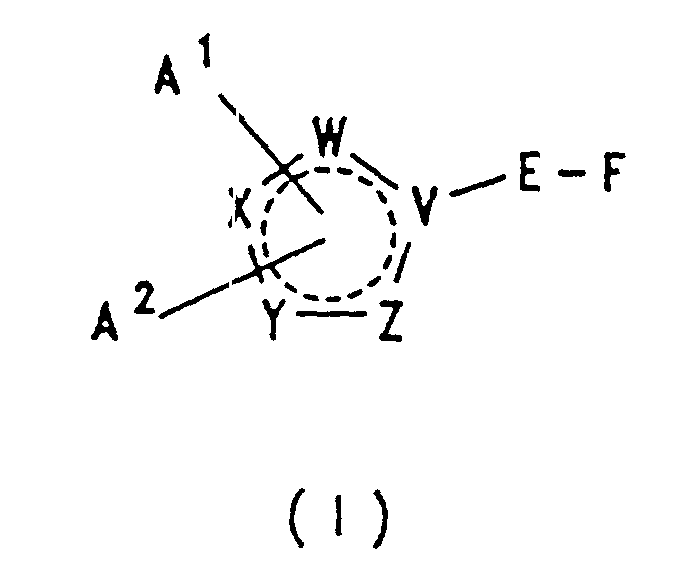
- two, three or four of V, W, X, Y and Z represent nitrogen and the remainder represent carbon provided that, when two of V, W, X, Y and Z represent nitrogen and the remainder represent carbon, then the said nitrogen atoms are in non-adjacent positions within the five-membered ring;
- A1 represents hydrogen, methyl, ethyl or amino;
- A2 represents a non-bonded electron pair when four of V, W, X, Y and Z represent nitrogen and the other represents carbon; or, when two or three of V, W, X, Y and Z represent nitrogen and the remainder represent carbon, A2 represents hydrogen, methyl, ethyl or amino;
- E represents a bond or a straight or branched alkylene chain containing from 1 to 4 carbon atoms; and
- F represents a group of formula FC:
in which R1, R2 and R3 independently represent hydrogen or C1-6 alkyl.

-
- For use in medicine, the salts of the compounds of formula I will be non-toxic pharmaceutically acceptable salts. Other salts may, however, be useful in the preparation of the compounds according to the invention or of their non-toxic pharmaceutically acceptable salts. Suitable pharmaceutically acceptable salts of the compounds of this invention include acid addition salts which may, for example, be formed by mixing a solution of the compound according to the invention with a solution of a pharmaceutically acceptable non-toxic acid such as hydrochloric acid, sulphuric acid, fumaric acid, maleic acid, succinic acid, acetic acid, benzoic acid, oxalic acid, citric acid, tartaric acid, carbonic acid or phosphoric acid. Furthermore, where the compounds of the invention carry an acidic moiety, suitable pharmaceutically acceptable salts thereof may include alkali metal salts, e.g. sodium or potassium salts; alkaline earth metal salts, e.g. calcium or magnesium salts; and salts formed with suitable organic ligands, e.g. quaternary ammonium salts.
- Suitable alkyl groups include straight-chained and branched alkyl groups containing from 1 to 6 carbon atoms. Typical examples include methyl and ethyl groups, and straight-chained or branched propyl and butyl groups. Particular alkyl groups are methyl, ethyl and t-butyl.
- Where the compounds according to the invention have at least one asymmetric centre, they may accordingly exist as enantiomers. Where the compounds according to the invention possess two or more asymmetric centres, they may additionally exist as diastereoisomers. It is to be understood that all such isomers and mixtures thereof are encompassed within the scope of the present invention.
- It will be appreciated that the imidazole, triazole and tetrazole rings of formula I can exist in a variety of isomeric forms having differing substitution patterns. These may suitably be represented by formulae IA to IT as follows:


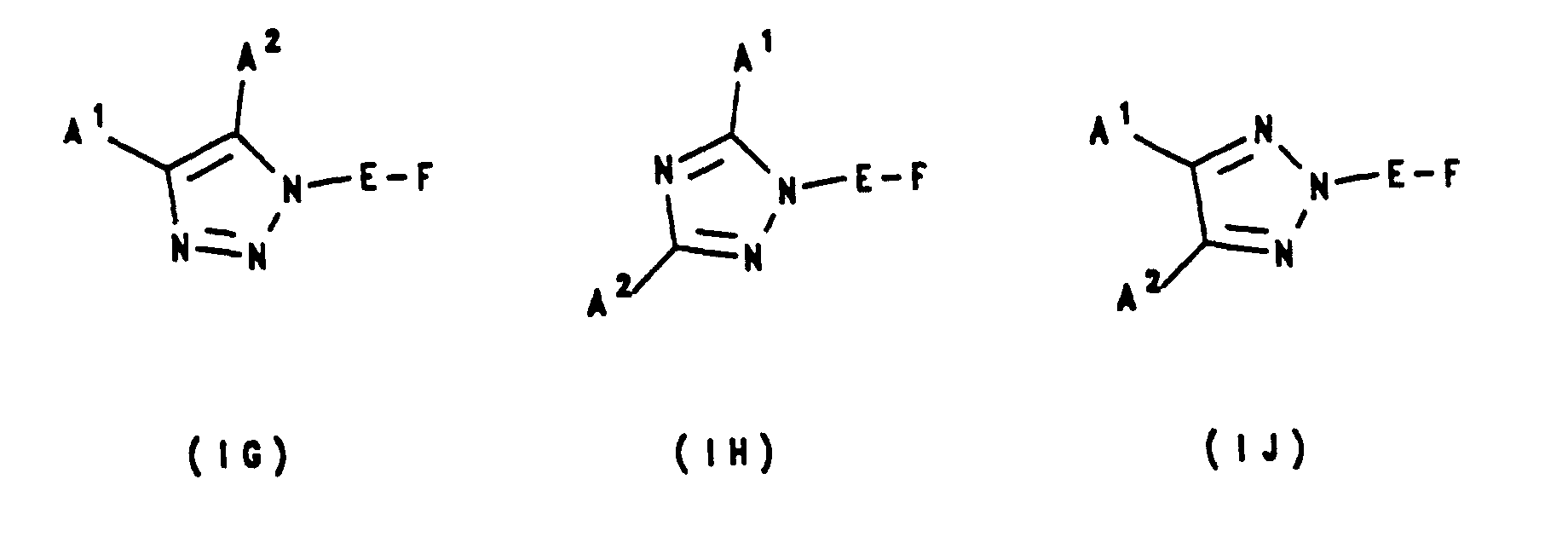

 wherein A1, A2, E and F are as defined above. Preferred imidazole, triazole and tetrazole rings of formula I include the rings represented by formulae IA, IC, IG, IH, IK, IL, IN and IQ above, especially IH and IK.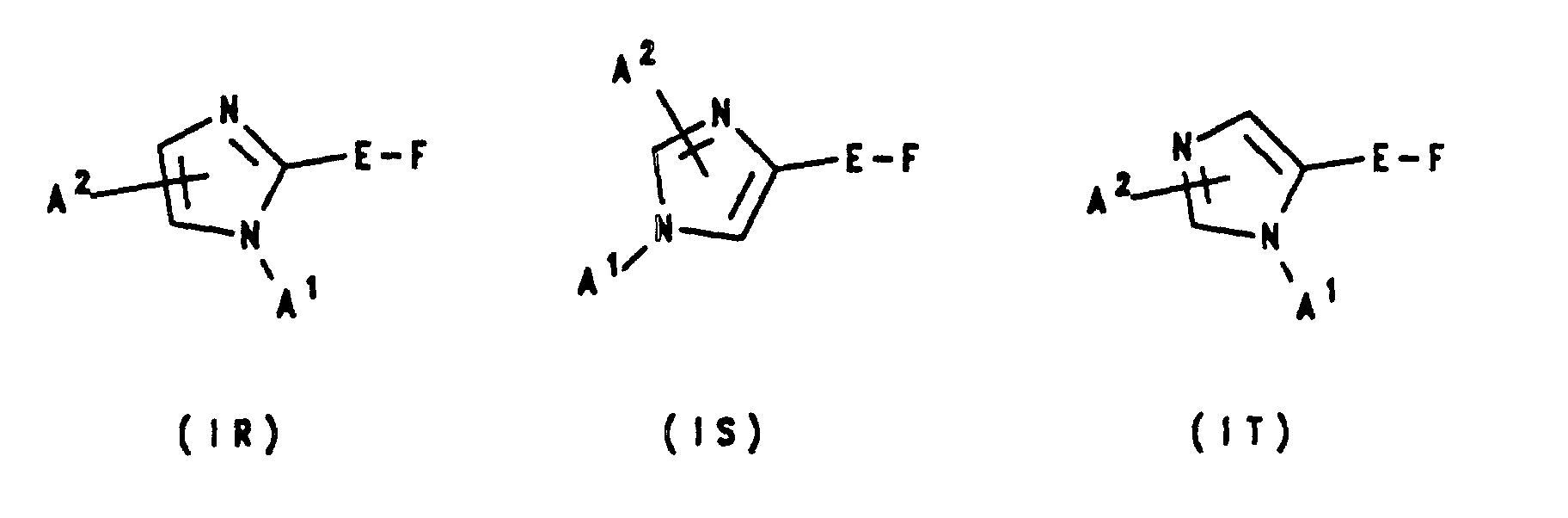
- The alkylene chain E may be, for example, methylene, ethylene, 1-methylethylene, propylene or 2-methylpropylene. Alternatively, the group E may represent a single bond such that the group F in formula I is attached directly to the five-membered heteroaromatic ring.
- The group F represents an indole moiety of structure FC:wherein R1, R2 and R3 are as defined above, in particular wherein R2 and R3 are both hydrogen.
- It will be appreciated that when four of V, W, X, Y and Z represent nitrogen and the other represents carbon, i.e. when the ring of formula I is a tetrazole ring, then the group A2 will be a non-bonded electron pair. Otherwise, A1 and A2 will independently represent hydrogen, methyl, ethyl or amino.
- Preferred values for the groups R1, R2 and R3 include hydrogen and methyl.
- A particular sub-class of compounds according to the invention is represented by the compounds of formula IIA, and salts thereof:wherein

- X1 represents nitrogen or A12-C;
- n is zero, 1, 2 or 3;
- B1 represents N-R13;
- A11 and A12 independently represent hydrogen, methyl, ethyl or amino; and
- R11, R12 and R13 independently represent hydrogen or C1-6 alkyl.
-
- When X1 represents A12-C, the group A11 is preferably hydrogen or methyl.
- Preferably, R12 and R13 each represents hydrogen. Preferred values of R11 with respect to formula IIA include hydrogen and methyl.
- Another sub-class of compounds according to the invention is represented by the compounds of formula IIB, and salts thereof:wherein
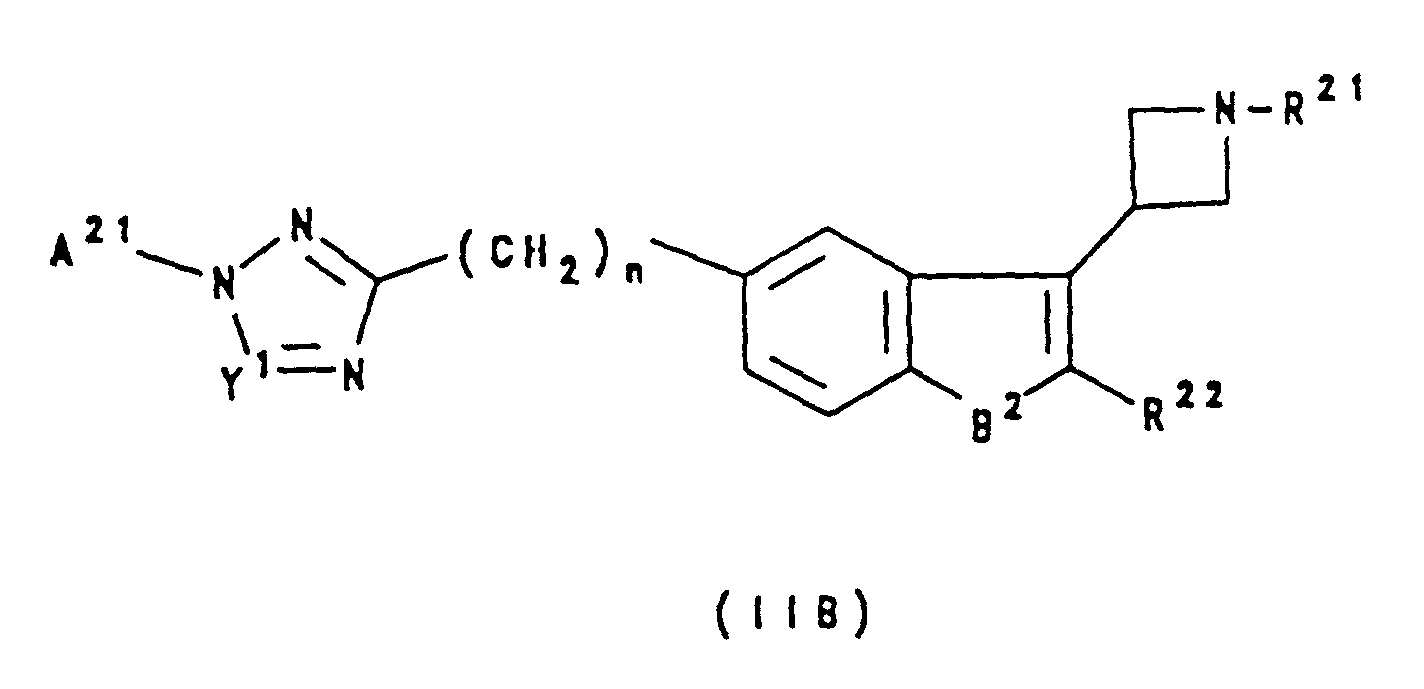
- Y1 represents nitrogen or A22-C;
- n is zero, 1, 2 or 3;
- B2 represents N-R23;
- A21 and A22 independently represent hydrogen, methyl or ethyl; and
- R21, R22 and R23 independently represent hydrogen or C1-6 alkyl.
-
- Preferably, R22 and R23 each represents hydrogen. Preferred values of R21 with respect to formula IIB include hydrogen and methyl.
- A further sub-class of compounds according to the invention is represented by the compounds of formula IIC, and salts thereof:wherein

- Y2 represents nitrogen or A32-C;
- Z1 represents nitrogen or CH;
- n is zero, 1, 2 or 3;
- B3 represents N-R33;
- A31 and A32 independently represent hydrogen, methyl or amino; and
- R31, R32 and R33 independently represent hydrogen or C1-6 alkyl.
-
- Preferably, R32 and R33 each represents hydrogen. Preferred values of R31 include hydrogen and methyl.
- A still further sub-class of compounds according to the invention is represented by the compounds of formula IID, and salts thereof:wherein

- W1 represents nitrogen or C-A42;
- n is zero, 1, 2 or 3;
- B4 represents N-R43;
- A41 and A42 independently represent hydrogen or methyl; and
- R41, R42 and R43 independently represent hydrogen or C1-6 alkyl.
-
- Preferably, R42 and R43 each represents hydrogen. Preferred values of R41 include hydrogen and methyl.
- Specific compounds within the scope of the present invention include:
- N-methyl-3-[5-(2-methylimidazol-1-ylmethyl)-1H-indol-3-yl]azetidine;
- N-methyl-3-[5-(1-methyltetrazol-5-ylmethyl)-1H-indol-3-yl]azetidine;
- N-methyl-3-[5-(1,2,4-triazol-1-yl)-1H-indol-3-yl]azetidine;
- N-methyl-3-[5-(imidazol-1-yl)-1H-indol-3-yl]azetidine;
- N-methyl-3-[5-(2-(1-methyltetrazol-5-yl)ethyl)-1H-indol-3-yl]azetidine;
- N-methyl-3-[5-(1,2,4-triazol-1-ylmethyl)-1H-indol-3-yl]azetidine;
- N-methyl-3-[5-(1,2,4-triazol-4-yl)-1H-indol-3-yl]azetidine;
- N-methyl-3-[5-(imidazol-1-ylmethyl)-1H-indol-3-yl]azetidine; and salts thereof.
-
- The invention also provides pharmaceutical compositions comprising one or more compounds of this invention in association with a pharmaceutically acceptable carrier. Preferably these compositions are in unit dosage forms such as tablets, pills, capsules, powders, granules, sterile parenteral solutions or suspensions, metered aerosol or liquid sprays, drops, ampoules, auto-injector devices or suppositories; for oral, parenteral, intranasal, sublingual or rectal administration, or for administration by inhalation or insufflation. For preparing solid compositions such as tablets, the principal active ingredient is mixed with a pharmaceutical carrier, e.g. conventional tableting ingredients such as corn starch, lactose, sucrose, sorbitol, talc, stearic acid, magnesium stearate, dicalcium phosphate or gums, and other pharmaceutical diluents, e.g. water, to form a solid preformulation composition containing a homogeneous mixture of a compound of the present invention, or a non-toxic pharmaceutically acceptable salt thereof. When referring to these preformulation compositions as homogeneous, it is meant that the active ingredient is dispersed evenly throughout the composition so that the composition may be readily subdivided into equally effective unit dosage forms such as tablets, pills and capsules. This solid preformulation composition is then subdivided into unit dosage forms of the type described above containing from 0.1 to about 500 mg of the active ingredient of the present invention. The tablets or pills of the novel composition can be coated or otherwise compounded to provide a dosage form affording the advantage of prolonged action. For example, the tablet or pill can comprise an inner dosage and an outer dosage component, the latter being in the form of an envelope over the former. The two components can be separated by an enteric layer which serves to resist disintegration in the stomach and permits the inner component to pass intact into the duodenum or to be delayed in release. A variety of materials can be used for such enteric layers or coatings, such materials including a number of polymeric acids and mixtures of polymeric acids with such materials as shellac, cetyl alcohol and cellulose acetate.
- The liquid forms in which the novel compositions of the present invention may be incorporated for administration orally or by injection include aqueous solutions, suitably flavoured syrups, aqueous or oil suspensions, and flavoured emulsions with edible oils such as cottonseed oil, sesame oil, coconut oil or peanut oil, as well as elixirs and similar pharmaceutical vehicles. Suitable dispersing or suspending agents for aqueous suspensions include synthetic and natural gums such as tragacanth, acacia, alginate, dextran, sodium carboxymethylcellulose, methylcellulose, polyvinylpyrrolidone or gelatin.
- In the treatment of migraine, a suitable dosage level is about 0.01 to 250 mg/kg per day, preferably about 0.05 to 100 mg/kg per day, and especially about 0.05 to 5 mg/kg per day. The compounds may be administered on a regimen of 1 to 4 times per day.
- The 1,2,4-triazole compounds of this invention may be prepared by a process which comprises reacting a reactive derivative of a carboxylic acid of formula Ra-CO2H with a compound either of formula III or of formula IV, or a salt thereof:wherein one of Ra, Rb and Rc is a group of formula A1, another is a group of formula A2, and the third is a group of formula -E-F, as defined with reference to formula I above.

- Suitable reactive derivatives of the acid Ra-CO2H include esters, for example C1-4 alkyl esters; thioesters, for example pyridylthioesters; acid anhydrides, for example (Ra-CO)2O; acid halides, for example acid chlorides; orthoesters; and primary, secondary and tertiary amides.
- A preferred reactive derivative of the acid Ra-CO2H is the iminoether derivative of formula V:where R is C1-4 alkyl.
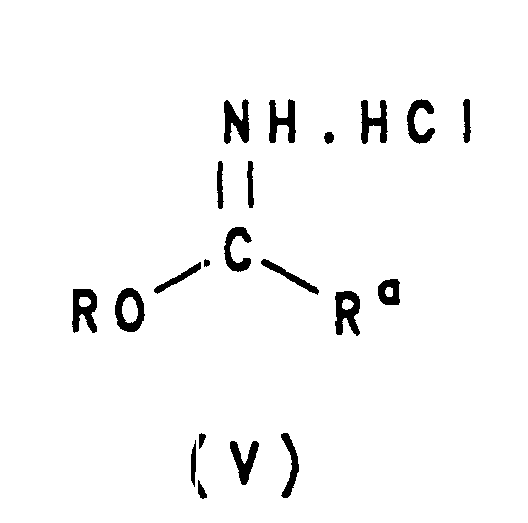
- The reagent of formula III may be generated in situ in the reaction mixture. For example, the reaction may be effected by treating a compound of formula V above with an alkyl hydrazine, e.g. methyl hydrazine, followed by a suitable carboxylic acid such as formic acid.
- The reaction is conveniently carried out by heating the reagents together, optionally in a solvent, for example tetrahydrofuran, dimethylformamide or a lower alkanol such as ethanol, propanol or isopropanol, at about 20°C to 100°C for about 1 to 6 hours.
- Where Ra is a group of formula -E-F and the group F is an indole moiety of structure FC as defined above, the reactive derivative of a carboxylic acid of formula HO2C-E-F may be prepared by reacting a compound of formula VI:wherein Q represents a reactive carboxylate moiety, and E is as defined above; with a compound of formula VII or a carbonyl-protected form thereof:
 wherein R2 is as defined above and Rp represents an amino-protecting group; followed by removal of the protecting group Rp; and subsequently, where required, N-alkylation by standard methods to introduce the moieties R1 and/or R3.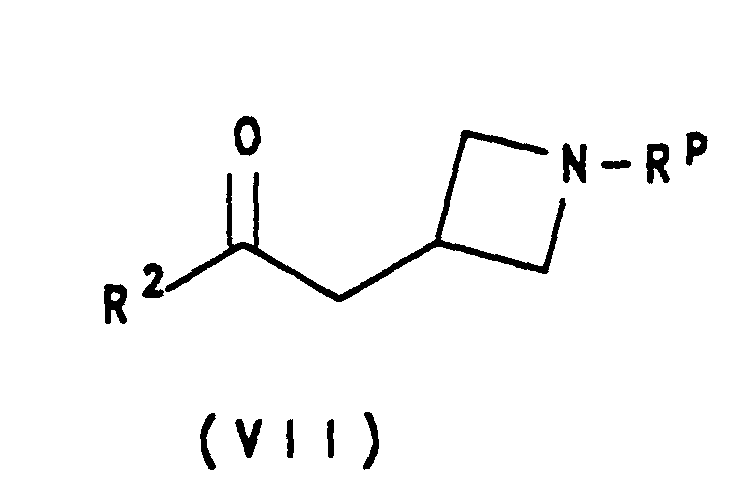
- Suitable carbonyl-protected forms of the compounds of formula VII include the dimethyl acetal or ketal derivatives.
- Suitable examples of amino-protecting groups for the substituent Rp include carboxylic acid groups such as chloroacetyl, trifluoroacetyl, formyl, benzoyl, phthaloyl, phenylacetyl or pyridinecarbonyl; acid groups derived from carbonic acid such as ethoxycarbonyl, benzyloxycarbonyl, t-butoxycarbonyl, biphenylisopropoxycarbonyl, p-methylbenzyloxycarbonyl, p-nitrobenzyloxycarbonyl, p-bromobenzyloxycarbonyl, p-phenylazobenzyloxycarbonyl, p-(p'-methoxyphenylazo)benzyloxycarbonyl or t-amyloxycarbonyl; acid groups derived from sulphonic acid, e.g. p-toluenesulphonic acid; and other groups such as benzyl, p-methoxybenzyl, trityl, o-nitrophenylsulphenyl or benzylidene.
- Preferred amino-protecting groups include t-butoxycarbonyl, benzyloxycarbonyl and p-methoxybenzyl.
- The removal of the protecting group present in the resultant compound may be effected by an appropriate procedure depending upon the nature of the protecting group. Typical procedures include hydrogenation in the presence of a palladium catalyst (e.g. palladium carbon or palladium black) for benzyloxycarbonyl, p-nitrobenzyloxycarbonyl, p-bromobenzyloxycarbonyl, p-phenylazobenzyloxycarbonyl, p-(p'-methoxyphenylazo)benzyloxycarbonyl and trityl groups; treatment with hydrogen bromide in glacial acetic acid or trifluoroacetic acid for benzyloxycarbonyl, p-bromobenzyloxycarbonyl, p-phenylazobenzyloxycarbonyl and t-butoxycarbonyl groups; treatment with acetic acid and/or a mineral acid such as hydrochloric acid or sulphuric acid for trityl, t-butoxycarbonyl, formyl and benzylidene groups; and treatment with 2,3-dichloro-5,6-dicyano-1,4-benzoquinone for p-methoxybenzyl groups.
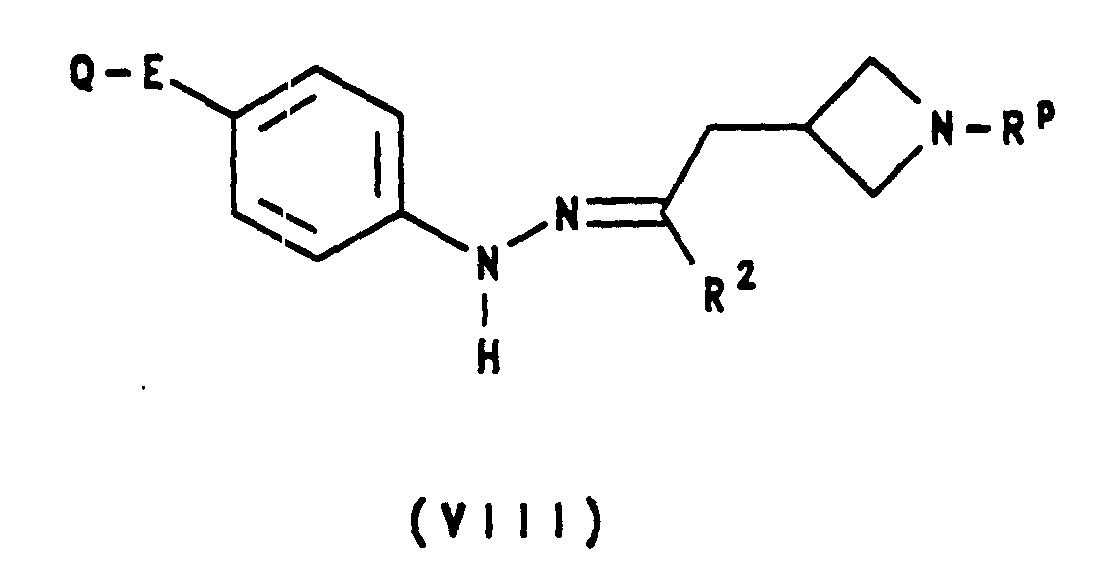
- The reaction of compounds VI and VII may be carried out in a single step (Fischer indole synthesis) or by an initial non-cyclising step at a lower temperature to give a compound of formula VIII:wherein Q, E, R2 and Rp are as defined above; followed by cyclisation using a suitable reagent, such as a polyphosphate ester, to give a compound of formula Q-E-F.
- The hydrazines of formula VI may be prepared from the corresponding anilines of formula IX:wherein Q and E are as defined above; by diazotisation followed by reduction. Diazotisation is typically carried out using sodium nitrite/conc. HCl and the resulting diazo product reduced in situ using, for example, tin(II) chloride/conc. HCl, sodium sulphite/conc. HCl, or sodium sulphite/conc. H2SO4.

- The anilines of formula IX may be prepared by reduction of the corresponding nitro compounds of formula X:wherein Q and E are as defined above; typically by transfer hydrogenation using a hydrogenation catalyst such as palladium on charcoal in the presence of a hydrogen donor such as ammonium formate, or alternatively by conventional catalytic hydrogenation or using tin(II) chloride.

- Where they are not commercially available, the nitro compounds of formula X may be synthesized by standard methods well known to those skilled in the art.
- In an alternative process, the triazole compounds according to the invention may be prepared by a method which comprises reacting a compound of formula XIV:wherein A1, E and F are as defined above, Hal represents halogen, and two of Va, Wa, Xa, Ya and Za, to one of which the group Hal is attached, represent carbon and the remainder represent nitrogen; with a reagent which provides an anion -A2, where A2 is as previously defined.

- Reagents which may provide the anion -A2 include Grignard reagents A2MgHal (where Hal = halogen); organocuprate reagents such as LiA2 2Cu; organolithium reagents A2Li; or compounds which stabilise the anion by means of an adjacent activating group such as an ester or enolisable ketone function. In this case, the adjacent ester or ketone function may be retained after the process is complete, or may be removed. For example, an ester moiety may be hydrolysed and decarboxylated.
- The 1,2,3-triazole compounds according to the present invention may be prepared by a process which comprises the cycloaddition of an alkyne of formula Ra-C≡C-Rb with an azide of formula Rc-N3, where Ra, Rb and Rc are as defined above.
- The cycloaddition reaction may be conveniently effected in a suitable solvent such as tetrahydrofuran, ideally by heating in an autoclave for 8 hours.
- The tetrazole compounds in accordance with the invention may be prepared by a process which comprises the cycloaddition of a nitrile of formula N≡C-Rd with an azide of formula Re-N3, where one of Rd and Re represents a group of formula A1 and the other is a group of formula -E-F, as defined previously.
- The cycloaddition reaction is conveniently effected by heating the reactants together at an elevated temperature, e.g. a temperature in the region of 150°C, in a suitable solvent such as N-methylpyrrolid-2-one, advantageously in the presence of triethylamine hydrochloride. Thor product obtained from the cycloaddition reaction will generally be a mixture of isomers substituted by the A1 group at positions 1 and 2 of the tetrazole ring, corresponding to structures IL and IM respectively as defined above. These isomers may conveniently be separated using conventional techniques such as chromatography.
- In an alternative process, the tetrazole compounds of the invention may be prepared by a method which comprises reacting a compound of formula Re-L with a tetrazole derivative of formula XV:wherein one of Rd anti Re represents a group of formula A1 and the other is a group of formula -E-F, as defined above, and L represents a suitable leaving group; in the presence of a base such as triethylamine.

- The leaving group L suitably represents halogen, e.g. bromine or iodine, or a sulphonate derivative such as tosylate or mesylate.
- The reaction is conveniently carried out in a suitable organic solvent, e.g. acetonitrile, at room temperature.
- The tetrazole derivatives of formula XV may be prepared by cycloaddition of a nitrile of formula N≡C-Rd with sodium azide, advantageously under the conditions described above for the reaction between the nitrile N≡C-Rd and the azide Re-N3; followed by acidification with a mineral acid such as hydrochloric acid.
- In a further process, the compounds according to the invention wherein the group F is an indole moiety of structure FC as defined above may be prepared by a method which comprises reacting a compound of formula XVI:wherein V, W, X, Y, Z, A1, A2 and E are as defined above; with a compound of formula VII as defined above, or a carbonyl-protected form thereof, e.g. the dimethyl acetal or ketal; followed by removal of the protecting group Rp; and subsequently, where required, N-alkylation by standard methods to introduce the moieties R1 and/or R3.

- As with that between compounds VI and VII, the reaction between compounds XVI and VII may be carried out in a single step (Fischer indole synthesis) or by an initial non-cyclising step at a lower temperature to give a compound of formula XVII:wherein V, W, X, Y, Z, A1, A2, E, R2 and Rp are as defined above; followed by cyclisation using a suitable reagent, e.g. a polyphosphate ester.

- The hydrazines of formula XVI may be prepared from the corresponding anilines of formula XVIII:wherein V, W, X, Y, Z, A1, A2 and E are as defined above; by methods analogous to those described above with reference to the compounds of formula IX.

- The anilines of formula XVIII may be prepared from the corresponding nitro compounds of formula XIX:wherein V, W, X, Y, Z, A1, A2 and E are as defined above; by methods analogous to those described above with reference to the compounds of formula X.
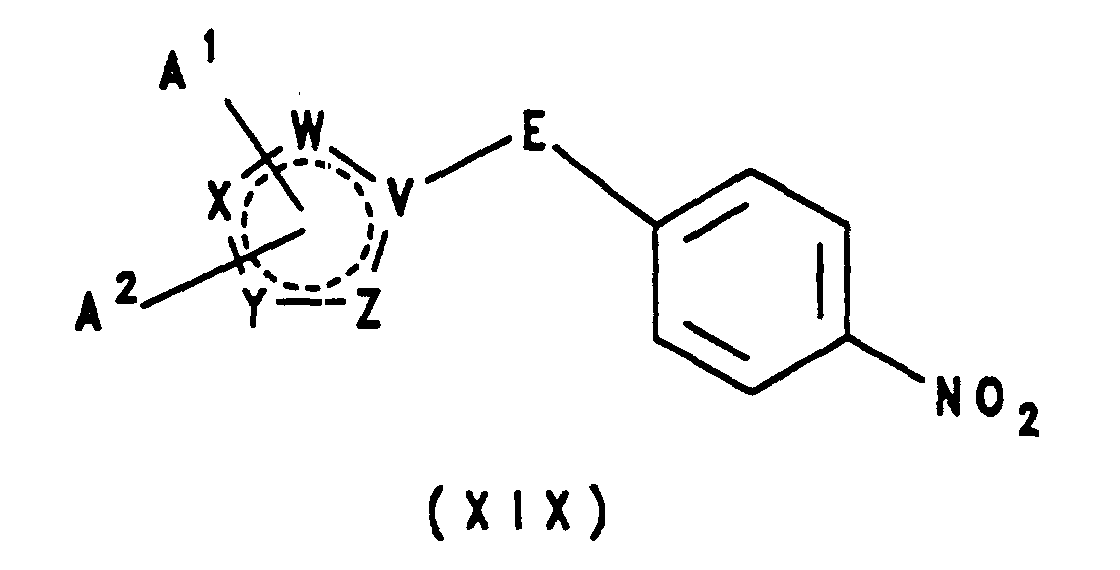
- The nitro compounds of formula XIX may be prepared by a variety of methods which will be readily apparent to those skilled in the art. For example, where V represents a nitrogen atom, the relevant compounds of formula XIX may be prepared by reacting the anion of a compound of formula XX with a compound of formula XXI:wherein W, X, Y, Z, A1, A2 and E are as defined above, and D3 represents a readily displaceable group.

- Where compound XX is a triazole or tetrazole derivative, the anion thereof may be generated by carrying out the reaction in a base such as triethylamine. Where compound XX is an imidazole derivative, the anion thereof may conveniently be generated if the reaction is carried out in the presence of sodium hydride using N,N-dimethylformamide as solvent. Where salts of the compounds of formula XX are commercially available, e.g. the sodium salt of 1,2,4-triazole, these are advantageously utilised in N,N-dimethylformamide solution in place of the compounds of formula XX themselves, with no requirement in this instance for additional base to be present in the reaction mixture.
- The readily displaceable group D3 in the compounds of formula XXI is suitably a halogen atom, preferably bromine; except when the moiety D3 is attached directly to the aromatic ring, i.e. when E represents a bond, in which case D3 is preferably fluorine.
- In an alternative approach, the compounds of formula XIX wherein the five-membered heteroaromatic ring is a 1,2,4-triazol-1-yl moiety and A1 and A2 are both hydrogen may be prepared by reacting 4-amino-1,2,4-triazole with a compound of formula XXI as defined above, followed by deamination of the resulting 1-substituted 4-amino-4H-1,2,4-triazolium salt by treatment with nitrous acid and subsequent neutralisation. This transformation, which may be accomplished in two separate steps or advantageously as a "one-pot" procedure with both steps combined, is conveniently effected using reaction conditions analogous to those described in J. Org. Chem., 1989, 54, 731.
- Where they are not commercially available, the nitro compounds of formula XXI above may be prepared by procedures analogous to those described in the accompanying Examples, or by methods well known from the art.
- In an alternative approach to the 1,2,4-triazole derivatives, the nitro compounds of formula XIX may be prepared from those of formula X above by appropriate modification of the moiety Q using, for example, methods analogous to those described above with reference to the compounds of formulae III and IV. Thus, for example, since Q in the compounds of formula X represents a reactive carboxylate moiety, the compounds of formula XIX may be prepared therefrom by reaction with a compound of formula A2-C(=NNHA1)NH2 or A2-C(=NNH2)NHA1.
- Following a further representative pathway, the aniline derivatives of formula XVIII wherein the five-membered heteroaromatic ring is a 1,2,4-triazol-4-yl moiety, E is a bond and A1 and A2 are both hydrogen may be prepared by reacting the hydrazine derivative of formula XXII with the acetanilide of formula XXIII:followed by removal of the N-acetyl protecting group.
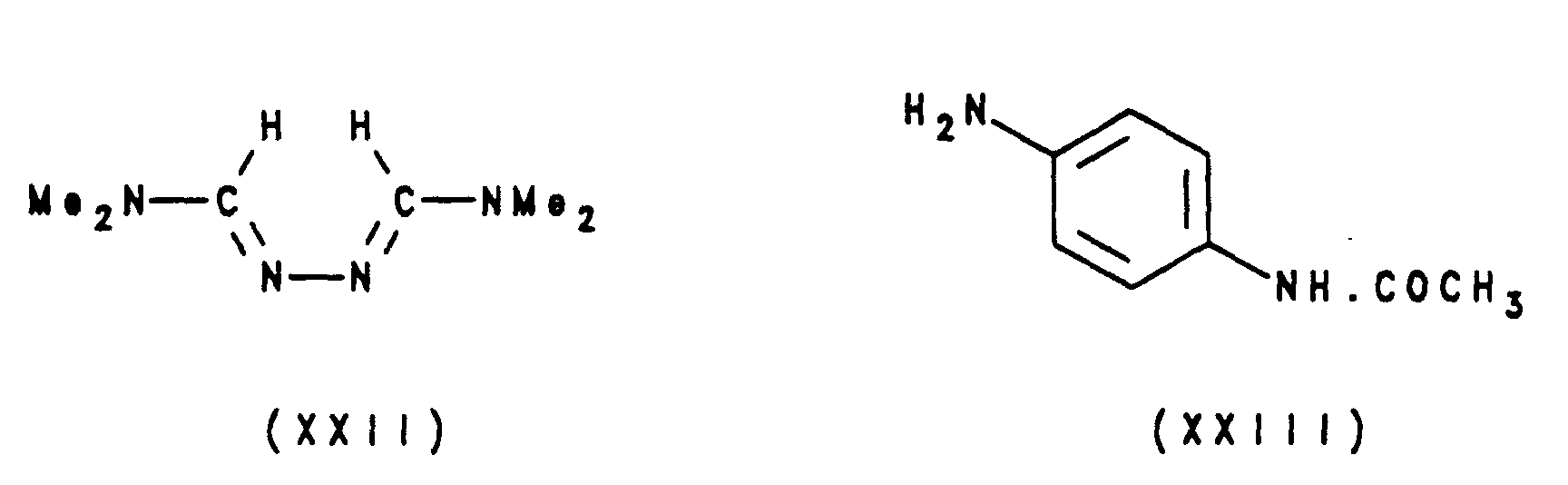
- The reaction between compounds XXII and XXIII is conveniently effected in refluxing toluene, advantageously in the presence of a catalytic quantity of p-toluenesulphonic acid. Subsequent removal of the N-acetyl protecting group is typically effected in hot aqueous 5N hydrochloric acid.
- The hydrazine derivative of formula XXII can be prepared from N,N'-diformylhydrazine by reaction with thionyl chloride/N,N-dimethylformamide, as reported in J. Chem. Soc. (C), 1967, 1664, and subsequent treatment with sodium methoxide in methanol.
- The acetanilide of formula XXIII may be prepared by reduction of the corresponding nitro compound of formula XXIV:typically by transfer hydrogenation using a hydrogenation catalyst in the presence of a hydrogen donor such as ammonium formate, or alternatively by conventional catalytic hydrogenation or using tin(II) chloride.
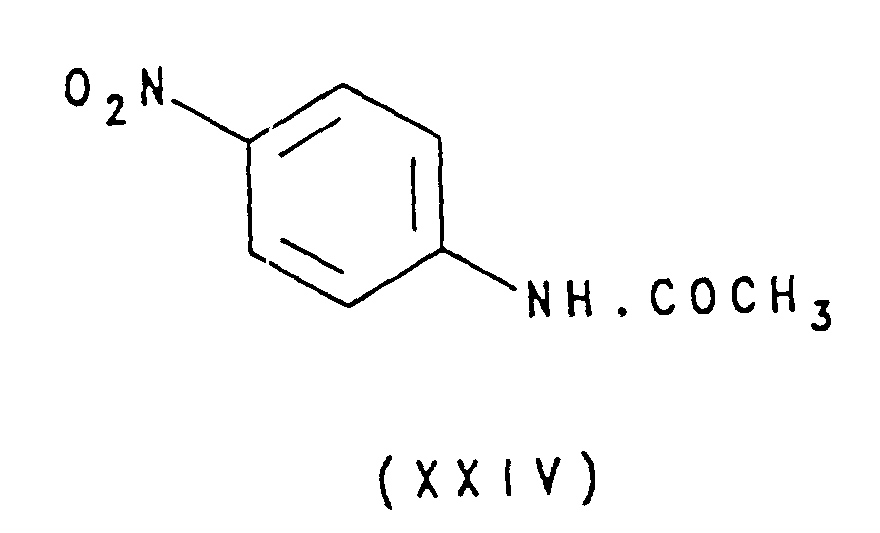
- The nitro compound of formula XXIV is commercially available from the Aldrich Chemical Company Ltd., Gillingham, United Kingdom.
- The preparation of a typical intermediate of formula VII is illustrated by the following reaction scheme:

- The starting compound XXXII is known from J. Chem. Soc., Chem Commun., 1968, 93. Step 1 of the reaction scheme comprises oxidation of the hydroxy group of compound XXXII to a carbonyl group using pyridine. SO3 in dimethyl sulphoxide (DMSO) and triethylamine; followed by reaction of the resulting azetidinone derivative with the Horner-Emmons reagent MeO2C.CH2.PO(OEt)2 in the presence of sodium hydride, using tetrahydrofuran (THF) as the solvent. In Step 2, the double bond of the azetidine olefin ester is hydrogenated over palladium-charcoal in methanol; the methyl ester group is then reduced to hydroxymethyl by treatment with lithium aluminium hydride in THF; and the diphenylmethyl protecting group is in turn removed by treatment with palladium hydroxide on charcoal, with methanol serving as the solvent. Step 3 involves protection of the azetidine nitrogen as the N-t-butoxycarbonyl (N-BOC) carbamate derivative; and, finally, Swern oxidation of the side chain terminal hydroxy group to an aldehyde moiety by treatment with oxalyl chloride in DMSO/triethylamine.
- It will be understood that any compound of formula I initially obtained from any of the above processes may, where appropriate, subsequently be elaborated into a further compound of formula I by techniques known from the art. Indeed, as will be appreciated, the compound of formula XV above in which Rd is a group of formula -E-F is itself a compound of formula I in which A1 is hydrogen and A2 represents a non-bonded electron pair. In particular, a compound of formula I wherein R3 is hydrogen initially obtained may be converted into a compound of formula I wherein R3 represents C1-6 alkyl by standard alkylation techniques, for example by treatment with an alkyl iodide, e.g. methyl iodide, typically under basic conditions, e.g. sodium hydride in dimethylformamide, or triethylamine in acetonitrile. Similarly, a compound of formula I wherein R1 represents hydrogen initially obtained may be converted into a compound of formula I wherein R1 is other than hydrogen, for example by conventional N-alkylation techniques, e.g. by treatment with the appropriate aldehyde in the presence of a reducing agent such as sodium cyanoborohydride.
- Where the above-described processes for the preparation of the compounds according to the invention give rise to mixtures of stereoisomers, these isomers may be separated by conventional techniques such as preparative chromatography.
- The novel compounds may be prepared in racemic form, or individual enantiomers may be prepared either by enantiospecific synthesis or by resolution. The novel compounds may, for example, be resolved into their component enantiomers by standard techniques, such as the formation of diastereomeric pairs by salt formation with an optically active acid, such as (-)-di-p-toluoyl-d-tartaric acid and/or (+)-di-p-toluoyl-l-tartaric acid followed by fractional crystallization and regeneration of the free base. The novel compounds may also be resolved by formation of diastereomeric esters or amides, followed by chromatographic separation and removal of the chiral auxiliary.
- During any of the above synthetic sequences it may be necessary and/or desirable to protect sensitive or reactive groups on any of the molecules concerned. This may be achieved by means of conventional protecting groups, such as those described in Protective Groups in Organic Chemistry, ed. J.F.W. McOmie, Plenum Press, 1973; and T.W. Greene & P.G.M. Wutts, Protective Groups in Organic Synthesis, John Wiley & Sons, 1991. The protecting groups may be removed at a convenient subsequent stage using methods known from the art.
- The following Examples illustrate the preparation of compounds according to the invention.
- The ability of test compounds to bind to 5-HT1-like receptors was measured in membranes prepared from pig caudate using the procedure described in J. Neurosci., 1987, 7, 894. Binding was determined using 2 nM 5-hydroxytryptamine creatinine sulphate, 5-[1,2-3H(N)] as a radioligand. Cyanopindolol (100 nM) and mesulergine (100 nM) were included in the assay to block out 5-HT1A and 5-HT1C binding sites respectively. The concentration of the compounds of the accompanying Examples required to displace 50% of the specific binding (IC50) is below 1 µM in each case.
- The activity of test compounds as agonists of the 5-HT1-like receptor was measured in terms of their ability to mediate contraction of the saphenous vein of New Zealand White rabbits, using the procedure described in Arch. Pharm., 1990, 342, 111. Agonist potencies were calculated as -log10EC50 (pEC50) values, from plots of percentage 5-HT (1 µm) response against the concentration of the agonist. The compounds of the accompanying Examples were found to possess pEC50 values in this assay of not less than 5.0 in each case.
- Aminodiphenylmethane (100g, 0.54mols) was added to a solution of epichlorohydrin (50g, 0.54mols) in DMSO (135ml) and stirred at 25°C for 3 days. The solution was then heated at 70°C for 3 days before cooling to room temperature, adding 10% NaOH solution, and extracting with Et2O (2 x 800ml). The combined extracts were washed with water (2 x 11), dried (Na2SO4) and evaporated. The crude product was chromatographed on silica-gel eluting with CH2Cl2/MeOH (98:2) to give the title-azetidinol (33.5g); δ (360MHz, CDCl3) 2.30 (1H, br s, OH), 2.87-2.91 (2H, m, 2 of CH of CH2), 3.51-3.55 (2H, m, 2 of CH of CH2), 4.34 (1H, s, CH), 4.41-4.48 (1H, m, CH-OH), 7.13-7.39 (10H, m, Ar-H).
- Triethylamine (112.1g, 1.11mols) was added to a solution of N-diphenylmethylazetidin-3-ol (26.6g, 0.11mol) in DMSO (300ml). The solution was cooled to 10°C and a solution of sulphur trioxide-pyridine complex (112g, 0.7mol) in DMSO (500ml) added, rapidly. Stirring was continued at 10°C for 0.75h and the mixture then warmed to 25°C and stirred for 1h. The solution was poured into ice-water (21) and extracted with EtOAc (3 x 11). The combined extracts were washed with water (500ml) and brine (500ml) and dried (Na2SO4). The crude product was purified by chromatography through silica-gel eluting with petroleum ether/EtOAc (2:1) to give the desired ketone (25.8g), mp 74-75°C; δ (360MHz, CDCl3) 4.00 (4H, s, 2 of CH2), 4.59 (1H, s, CH), 7.19-7.49 (10H, m, Ar-H).
- Methyl diethylphosphonoacetate (11.0g, 52.0mmol) in THF (10ml) was added dropwise to a stirred suspension of sodium hydride (2.1g, 60% dispersion in oil, 52.5mmol) in THF (40ml), at 10°C. The mixture was stirred for 0.6h and a solution of the preceding azetidinone (11.3g, 48.0mmol) in THF (50ml) then added dropwise at 10°C. The mixture was heated at 50°C for 3h before removing the solvent under vacuum and redissolving the residue in CH2Cl2 (200ml). The solution was washed with water (50ml) and sodium bisulphite solution (2 x 50ml) and dried (Na2SO4). Chromatography of the residue obtained, after removing the solvent, through silica-gel eluting with CH2Cl2/MeOH (98:2) gave the desired ester (13.1g), mp 83-84°C; δ (360MHz, CDCl3) 3.65 (3H, s, CO2Me), 3.88 (2H, m, 2 of CH of CH2), 4.14-4.17 (2H, m, 2 of CH of CH2), 4.52 (1H, s, CH), 5.65-5.68 (1H, m, vinyl-H), 7.17-7.44 (10H, m, Ar-H).
- A mixture of the compound from step 3 (21.0g, 71.7mmol), Pd(OH)2 (3.0g, 20% on C), methanol (500ml) and 2N HCl (37ml) was hydrogenated on a Parr shake apparatus for 2h. The catalyst was removed by filtration through celite and the solvents removed under vacuum. Saturated K2CO3 solution was added (50ml) and extracted with CH2Cl2 (2 x 250ml). The combined extracts were washed with H2O (250ml) and brine (100ml), dried (Na2SO4) and evaporated to give the title-product as a pale yellow oil (19.3g); δ (360MHz, CDCl3) 2.58 (2H, d, J = 7.3Hz, CH2), 2.75-2.81 (3H, m, 2 of CH of CH2 and CH), 3.35-3.38 (2H, m, 2 of CH of CH2), 3.62 (3H, s, CO2Me), 4.31 (1H, s, CH), 7.14-7.18, 7.23-7.27 and 7.38-7.40 (total 10H, each m, Ar-H).
- Diisobutylaluminium hydride (119ml of a 1M solution in toluene, 0.119mol) was added dropwise to a stirred solution of the preceding ester (10.0g, 33.9mmol) in toluene (500ml), at -35°C, over a 0.5h period. The solution was warmed to 25°C, stirred for 2h, and then cooled to 0°C and quenched by addition of methanol (10ml), 2N NaOH (5ml) and H2O (5ml). The mixture was warmed to 25°C, filtered through celite and the solvent removed under vacuum. The residue was chromatographed on silica-gel eluting with ethyl acetate/hexane (1:1) to give the title-alcohol as a white crystalline solid, (4.1g), mp 98-99°C; (Found: C, 80.73; H, 8.06; N, 5.38. C18H21NO requires C, 80.86; H, 7.92; N, 5.24%); δ (360MHz, CDCl3) 1.64 (1H, br s, OH), 1.82 (2H, m, CH2), 2.51-2.58 (1H, m, CH), 2.87-2.91 and 3.29-3.33 (both 2H, each m, 2 of CH2), 3.70 (2H, t, J = 6.4Hz, CH2), 4.33 (1H, s, CH), 7.15-7.40 (10H, m, Ar-H).
- Pd(OH)2 (0.8g, 20% on C) was added to a solution of the preceding alcohol (4.0g, 15.0mmol) in methanol (200ml) and 1N HCl (10ml), and the mixture hydrogenated on a Parr shake apparatus for 24h, at 55 psi. The mixture was filtered through celite and the solvent removed under vacuum. Diphenyl methane was removed by triturating the residue with ether and decanting. The remaining product was dried under vacuum to give the desired product (2.0g); δ (250MHz, D2O) 1.86-1.94 (2H, m, CH2), 2.98-3.16 (1H, m, CH), 3.60 (2H, t, J = 6.4Hz, CH2), 3.86-3.96 and 4.14-4.22 (both 2H, both m, 2 of CH2).
- A mixture of the product from step 6 (1.44g, 10.5mmol), triethylamine (3.21ml, 22.9mmol) and (BOC)2O (3.43g, 15.7mmol), in THF (90ml) was stirred at 25°C for 2 days. The solvent was removed under vacuum, water (70ml) added and extracted with EtOAc (3 x). The combined extracts were dried (MgSO4), evaporated and the residue chromatographed on silica-gel eluting with CH2Cl2/MeOH (95:5) to give the title-product (2.12g); δ (250MHz, CDCl3) 1.42 (9H, s, 3 of CH3), 1.56 (1H, s, OH), 1.82-1.90 (2H, m, CH2), 2.56-2.76 (1H, m, CH), 3.58-3.67 (4H, m, CH2 and 2 of CH of CH2), 4.00-4.06 (2H, m, 2 of CH of CH2).
- Dimethylsulphoxide (1.98g, 25.3mmol) was added dropwise to a solution of oxalyl chloride (1.61g, 12.6mmol) in CH2Cl2 (80ml), at -75°C. The mixture was stirred for 0.25h before adding a solution of the preceding alcohol (2.12g, 10.6mmol) in CH2Cl2 (50ml), at -75°C, and stirring for 1h. Triethylamine (5.38g, 52.7mmol) was added and the reaction mixture warmed to 25°C and stirred for 1h. Water (50ml) and saturated K2CO3 solution (25ml) were added and the mixture stirred vigorously before separation of the aqueous phase and further extraction with CH2Cl2 (2 x). The combined extracts were dried (MgSO4), the solvent removed under vacuum, and the crude product chromatographed on silica-gel eluting with diethyl ether. The desired product (1.9g) was obtained as a pale yellow solid, mp 52-54°C; (Found: C, 60.05; H, 8.57; N, 7.09. C10H17NO3 requires C, 60.28; H, 8.6; N, 7.03%); δ (360MHz, CDCl3) 1.34 (9H, s, 3 of CH3), 2.76 (2H, d, J = 7.4Hz, CH 2CHO), 2.77-2.96 (1H, s, CH), 3.46-3.52 (2H, m, 2 of CH of CH2), 4.02-4.08 (2H, m, 2 of CH of CH2), 9.70 (1H, s, aldehyde-H).
- Sodium hydride (2.45g, 61.0mmol, 60% dispersion in oil) was added to a solution of 2-methylimidazole (5.0g, 60.9mmol) in DMF (100ml). The mixture was stirred at room temperature for 0.25h before adding 4-nitrobenzyl bromide (13.2g, 61.0mmol) and heating at 110°C for 2h followed by stirring at room temperture for 16h. Water (200ml) and ethyl acetate (500ml) were added, the aqueous separated and extracted with ethyl acetate (2 x 500ml). The combined extracts were washed with water (3 x 250ml), dried (MgSO4) and evaporated. The crude product was chromatographed on silica-gel eluting with CH2Cl2/MeOH (96:4) to give the title-product (1.58g); δ (360MHz, CDCl3) 2.34 (3H, s, CH3), 5.16 (2H, s, CH2), 6.67 (1H, d, J = 1.3Hz, Ar-H), 7.03 (1H, d, J = 1.3Hz, Ar-H), 7.19 (2H, d, J = 9.5Hz, Ar-H), 8.22 (2H, d, J = 9.5Hz, Ar-H).
- Pd-C (1.5g, 10%) was added to a mixture of the preceding nitrobenzene (14.4g, 66.4mmol), water (12ml), 5N HCl (14.6ml), and ethanol (85ml) and the slurry hydrogenated at 40 psi in a Parr flask for 0.5h. The catalyst was removed by filtration through celite, the solvents removed under vacuum, and the resulting solid recrystallised from EtOH/Et2O to give the title-aniline (12.0g); δ (360MHz, D2O) 2.62 (3H, s, CH3), 5.21 (2H, s, CH2), 6.90 (2H, d, J = 8.4Hz, Ar-H), 7.19 (2H, d, J = 8.4Hz, Ar-H), 7.31 (2H, s, Ar-H).
- A solution of NaNO2 (5.21g, 76.5mmol) in H2O (70ml) was added to a stirred solution of the preceding aniline hydrochloride (15.34g, 68.6mmol) in concn. HCl (140ml), cooled to -15°C. After addition (0.25h) the mixture was stirred for 0.5h at -15°C and then filtered through a sinter directly into an addition funnel. The resulting solution was added to a rapidly stirred solution of SnCl2.2H2O (61.9g, 0.275mol) in concn. HCl (100ml) at such a rate as to maintain the temperature below -5°C. The mixture was warmed to room temperature, the precipitate filtered off, and the solid washed several times with Et2O. In order to remove tin salts the free base was generated by dissolving in H2O (120ml), basifying with NH4OH solution and extracting with CH2Cl2 (2 x). The hydrochloride salt was regenerated by addition of ethereal HCl to the CH2Cl2 solution of the free base. The product was filtered and dried under vacuum (11.4g); δ (360MHz, D2O) 2.62 (3H, s, CH3), 5.26 (2H, s, CH2), 7.02 (2H, d, J = 8.4Hz, Ar-H), 7.28 (2H, d, J = 8.4Hz, Ar-H), 7.29 (1H, d, J = 1.5Hz, Ar-H), 7.30 (1H, d, J = 1.5Hz, Ar-H).
- N-tert-Butyloxycarbonyl-3-formylmethylazetidine (0.3g, 1.51mmol) was added to a solution of 4-(2-methylimidazol-1-ylmethyl)phenylhydrazine (0.36g, 1.51mmol) in 4% H2SO4 (25ml) and the resulting solution refluxed for 3h. The mixture was then cooled to room temperature, basified with K2CO3 and extracted with n-butanol (2 x 100ml). The combined extracts were dried (MgSO4), evaporated, and the residue chromatographed through silica-gel eluting with CH2Cl2/MeOH/NH3 (20:8:1) to give the title-indole (0.186g, 46%), mp 88-90°C; δ(250MHz, CD3OD) 2.02 (3H, s, CH3), 3.76-3.86 (4H, m, 2 of CH2), 4.04-4.20 (1H, m, CH of azetidine), 5.06 (2H, s, CH2), 6.70 (1H, d, J = 1.4Hz, Ar-H), 6.82 (1H, dd, J = 1.5 and 8.4Hz, Ar-H), 6.90 (1H, d, J = 1.4Hz, Ar-H), 7.12 (1H, s, Ar-H), 7.23 (1H, d, J = 8.4Hz, Ar-H), 7.26 (1H, d, J = 1.5Hz, Ar-H).
- To a cooled and stirred solution of the preceding 1H-azetidine (0.174g, 0.65mmol), NaCNBH3 (51mg, 0.82mmol), and acetic acid (98mg, 1.64mmol), in methanol (20ml), was added a solution of formaldehyde (65mg, 0.82mmol; 38% w/v) in methanol (10ml), at such a rate as to keep the temperature of the solution at 0°C. The mixture was stirred at 0°C for 0.25h and then warmed to room temperature and stirred for 1h. Saturated K2CO3 solution (15ml) was added and the methanol removed under vacuum. The aqueous was extracted with EtOAc (3 x 100ml), the combined extracts dried (MgSO4) and the solvent removed under vacuum. The residue was chromatographed on silica-gel eluting with CH2Cl2/MeOH/NH3 (70:8:1) and the bisoxalate salt of the resulting product was prepared (91mg), mp 125-126°C; (Found: C, 53.03; H, 5.27; N, 11.17. C17H20N4.2.2 (C2H2O4).0.30H2O.0.1(CH3OH) requires C, 53.02; H, 5.26; N, 11.50%); m/e 281 (M++1); δ (360MHz, D2O) 2.64 (3H, s, CH3), 3.00 and 3.09 (total 3H, both s, N-CH3), 4.17-4.24, 4.38-4.58 and 4.74-4.86 (total 5H, both m, CH and 2 of CH2 of azetidine), 5.41 (2H, s, CH2), 7.18-7.20 (1H, m, Ar-H), 7.31 (2H, s, Ar-H), 7.53 (1H, d, J = 1.0Hz, Ar-H), 7.56-7.59 (2H, m, Ar-H).
- 1,2,4-Triazole sodium derivative (90%) (17.74g, 0.18mol) and 1-fluoro-4-nitrobenzene (25g, 0.18mol), in DMF, (150ml) was stirred at room temperature for 4 days. Water (300ml) and ethyl acetate (500ml) were added and the mixture extracted. The organic layer was separated, washed with water (3 x 300ml), dried (MgSO4) and evaporated to give the desired product (24.8g); δ (360MHz, CDCl3) 7.92 (2H, d, J = 9.1Hz, Ar-H), 8.17 (1H, s, Ar-H), 8.40 (2H, d, J = 9.1Hz, Ar-H), 8.48 (1H, s, Ar-H).
- Prepared from 4-(1,2,4-triazol-1-yl)nitrobenzene using the procedure described for the preparation of Intermediate 2; δ (360MHz, CDCl3) 3.66 (2H, br s, NH2), 5.36 (1H, br s, NH), 6.88-6.96 and 7.44-7.50 (both 2H, both m, Ar-H), 8.06 (1H, s, Ar-H), 8.42 (1H, s, Ar-H).
- N-tert-Butyloxycarbonyl-3-formylmethylazetidine (0.4g, 2.01mmol) was added to a solution of 4-( 1,2,4-triazol-1-yl)phenylhydrazine (0.35g, 2.01mmol) in 4% H2SO4 (50ml) and the mixture refluxed for 16h. The mixture was then cooled to room temperature, basified (K2CO3) and extracted with n-butanol (5 x). The crude product obtained was chromatographed on silica-gel eluting with CH2Cl2/MeOH/NH3 (20:8:1) to give the title-azetidinylindole (0.186g, 39%); δ (360MHz, CD3OD) 3.80-3.88 (4H, m, 2 of CH2 of azetidine), 4.12-4.23 (1H, m, CH), 7.23 (1H, s, Ar-H), 7.39 (2H, s, Ar-H), 7.65 (1H, d, J = 2.5Hz, Ar-H), 8.04 (1H, s, Ar-H), 8.89 (1H, s, Ar-H).
- Prepared from the product of step 3 using the procedure described for Example 1. The oxalate salt was prepared, mp 175-177°C; (Found: C, 54.17; H, 5.15; N, 19.04. C14H15N5.1.2(C2H2O4).0.125H2O requires C, 54.17; H, 4.89, N, 19.26%); δ (360MHz, D2O) 2.99 and 3.07 (total 3H, s, CH3), 4.17-4.22, 4.35-4.57 and 4.72-4.79 (total 5H, m, azetidine-H), 7.42-7.47 (1H, m, Ar-H), 7.53 (1H, s, Ar-H), 7.58-7.62 (1H, m, Ar-H), 7.74-7.76 (1H, m, Ar-H), 8.22 (1H, s, Ar-H), 9.82 (1H, s, Ar-H).
- Prepared from imidazole and 1-fluoro-4-nitrobenzene as described for Example 2, step 1 and Intermediate 2; δ (360MHz, D2O) 7.36-7.46 (2H, m, Ar-H), 7.80-7.88 (3H, m, Ar-H), 8.04-8.06 (1H, m, Ar-H), 9.30 (1H, s, Ar-H).
- The title-compound was prepared from 4-imidazollylphenylhydrazine dihydrochloride using the procedure described for Example 2, step 3; δ (360MHz, CD3OD) 4.05-4.16 and 4.26-4.34 (total 5H, each m, azetidine-H), 7.04 (1H, s, Ar-H), 7.20 (1H, dd, J = 2.0 and 8.6Hz, Ar-H), 7.33 (1H, s, Ar-H), 7.42 (1H, d, J = 8.6Hz, Ar-H), 7.43 (1H, s, Ar-H), 7.64 (1H, d, J = 2.0Hz, Ar-H), 7.95 (1H, s, Ar-H).
- Prepared from the preceding 1H-azetidine using the procedure described for Example 1. The hemioxalate monhydrate salt was prepared, mp 215-218°C; (Found: C, 61.24; H, 6.14; N, 17.01. C15H16N4.0.5(C2H2O4).0.9H2O requires C, 61.29; H, 6.04; N, 17.87%); m/e 253 (M++1); δ (360MHz, D2O) 3.04 and 3.12 (total 3H, each s, CH3), 4.22-4.27, 4.43-4.62 and 4.78-4.86 (total 5H, each m, azetidine-H), 7.39 (1H, s, Ar-H), 7.40 (1H, d, J = 8.6Hz, Ar-H), 7.61 (1H, s, Ar-H), 7.65-7.71 (3H, m, Ar-H), 8.45 (1H, s, Ar-H).
- Triethylamine hydrochloride (41.25g, 0.3mol) and sodium azide (39g, 0.6mol) were added to a solution of 4-nitrophenylacetonitrile (32.4g, 0.2mol) in anhydrous N-methylpyrrolidin-2-one (500ml) and the mixture heated at 150°C for 4h. The solution was cooled to room temperature and poured into 2N HCl (21) whereupon a solid crystallised out. The product was filtered, washed with water (500ml) and hexane and dried in vacuo (37.4g); δ (250MHz, CDCl3) 4.34 (2H, s, CH2), 7.42 (2H, d, J = 8.7Hz, Ar-H), 8.12 (2H, d, J = 8.7Hz, Ar-H).
- A solution of methyl iodide (34.1ml, 0.5mol) in acetonitrile (100ml) was added dropwise, over 1h, to a solution of 4-(1H-tetrazol-5-ylmethyl)nitrobenzene (20.5g, 0.1mol), and triethylamine (18.7ml, 0.25mol), in acetonitrile (500ml), at room temperature. The mixture was stirred for 3h, the solvent removed under vacuum and residue dissolved in EtOAc (500ml). The solution was washed with water (2 x) and brine (1 x) and the solvent evaporated. The crude product was chromatographed through silica-gel eluting with EtOAc/hexane (1:1) → EtOAc (100%) to give 2 components. The more polar product (7.9g) was identified as the desired 1-methyl substituted tetrazole. The less polar product (7.0g) was identified as being the 2-substitution product; δ (360MHz, CDCl3, more polar isomer) 3.94 (3H, s, CH3), 4.40 (2H, s, CH2), 7.42 (2H, d, J = 8.7Hz, Ar-H), 8.21 (2H, d, J = 8.7Hz, Ar-H).
- The title-hydrazine was prepared from the preceding nitrobenzene using the procedures described for Intermediate 2; δ (360MHz, D2O) 4.02 (3H, s, CH3), 4.32 (2H, s, CH2), 7.05 (2H, d, J = 8.5Hz, Ar-H), 7.31 (2H, d, J = 8.5Hz, Ar-H).
- The title-compound was prepared from the preceding hydrazine and N-tert-butyloxycarbonyl-3-formylmethyl azetidine according to the procedure described for Example 1, mp 85-87°C; (Found: C, 62.89; H, 6.25; N, 30.14. C14H16N6.0.15(C2H2OH) requires C, 62.40; H, 6.19; N, 30.53%); δ (360MHz, CD3OD) 3.68-3.90 (4H, m, 2 of CH2), 3.80 (3H, s, CH3), 4.03-4.20 (1H, m, CH of azetidine), 4.32 (2H, s, CH2), 6.85 (1H, dd, J = 1.5 and 8.4Hz, Ar-H), 7.12 (1H, s, Ar-H), 7.22 (1H, d, J = 8.4Hz, Ar-H), 7.38 (1H, d, J = 1.5Hz, Ar-H).
- Prepared from the preceding 1H-azetidine using the general N-methylation procedure. The succinate monohydrate salt was prepared, mp 65-67°C; (Found: C, 57.25; H, 6.59; N, 22.17. C15H18N6.0.7(C4H6O4).0.5H2O requires C, 57.16; H, 6.25; N, 22.45%); δ (360MHz, D2O) 2.41 (2H, s, succinic acid), 2.97 and 3.06 (total 3H, both s, CH3), 3.97 (3H, s, CH3), 4.13-4.19, 4.27-4.51 and 4.69-4.74 (total 5H, each m, azetidine H), 4.40 (2H, s, CH2), 7.11 (1H, d, J = 8.4Hz, Ar-H), 7.44 (2H, s, Ar-H), 7.49 (1H, d, J = 8.4Hz, Ar-H).
- The title-compound was prepared from 4-nitrophenethyl nitrile as described for Example 4. The benzoate salt was prepared, mp 165-167°C; (Found: C, 66.30; H, 6.33; N, 20.15.C16H20N6.C7H6O2 requires C, 66.01; H, 6.26; N, 20.08%); δ (250MHz, D2O) 3.04 and 3.14 (total 3H, both s, CH3), 3.20-3.38 (4H, m, 2 of CH2), 3.56 and 3.60 (total 3H, both s, CH3), 4.12-4.20, 4.28-4.54 and 4.68-4.84 (total 5H, each m, azetidine-H), 7.08-7.18, 7.43-7.64 and 7.90-7.96 (total 9H, m, Ar-H and benzoic acid).
- Prepared from N-tert-butyloxycarbonyl-3-formylazetidine and 4-(1,2,4-triazol-1-ylmethyl)nitrobenzene using the procedures described for Example 1. The hemioxalate salt was prepared, mp 100-102°C; (Found: C, 60.26; H, 6.09; N, 20.03. C15H17N5.0.65(C2H2O4).0.2 (Et2O).0.1H2O requires C, 59.97; H, 6.03; N, 20.45%); δ (360MHz, D2O) 3.00 and 3.09 (total 3H, both s, N-CH3), 4.16-4.22, 4.33-4.56 and 4.71-4.77 (total 5H, each m, CH and 2 of CH2 of azetidine), 5.50 (2H, s, CH2), 7.22-7.24, 7.47-7.56 and 7.90-7.92 (total 4H, each m, Ar-H), 8.05 and 8.54 (total 2H, each s, Ar-H).
- A solution of 4'-nitroacetanilide (5.0g, 27.8mmol) in EtOH/EtOAc (160ml, 1:1), H2O (15ml) and 5N HCl (5.6ml, 28.0mmol) was hydrogenated over 10% Pd-C (0.50g) at 50 psi for 0.25h. The catalyst was removed by filtration through celite and the solvents removed under vacuum. The free base was generated by dissolving the product in H2O, basifying with 2N NaOH and extracting into EtOAc. The combined extracts were dried (MgSO4) and evaporated to give the title-aniline (3.75g, 90%); δ (250MHz, CDCl3/D4-MeOH) 2.10 (3H, s, CH3), 6.68 (2H, d, J = 8.8Hz, Ar-H), 7.27 (2H, d, J = 8.8Hz, Ar-H).
- A mixture of the preceding aniline (3.52g, 23.4mmol), N,N-dimethylformamide azine (3.33g, 23.4mmol; J. Chem. Soc. C. 1967, 1664) and p-toluenesulphonic acid monohydrate (0.223g, 1.17mmol), in anhydrous toluene (100ml), was heated at reflux for 17h. The beige coloured precipitate was filtered off and washed with toluene and CH2Cl2 and dried under vacuum to give the desired triazole (4.29g, 91%); δ (250MHz, D4-MeOH, D6-DMSO) 2.14 (3H, s, CH3), 7.60 (2H, d, J = 8.8Hz, Ar-H), 7.78 (2H, d, J = 8.8Hz, Ar-H), 8.96 (2H, s, Ar-H).
- A solution of the preceding acetanilide (4.91g, 24.3mmol) in 5N HCl (100ml) was heated at 125°C for 1.5h. The mixture was cooled to 0°C, basified with conc. aqueous NaOH solution and extracted with CH2Cl2 (x 5). The combined extracts were dried (MgSO4) and evaporated and the residue chromatographed on silica-gel eluting with CH2Cl2/MeOH/NH3 (80:8:1) to give the title-aniline (2.94g; 76%); δ (250MHz, CDCl3) 3.80 (2H, s, NH2), 6.71 (2H, d, J = 8.8Hz, Ar-H), 7.08 (2H, d, J = 8.8Hz, Ar-H), 8.36 (2H, s, Ar-H).
- Prepared from the preceding aniline using the procedure described for Example 1, Intermediate 2; δ (250MHz, CDCl3) 3.51 (3H, br s, NHNH2), 6.96 (2H, d, J = 8.8Hz, Ar-H), 7.23 (2H, d, J = 8.8Hz, Ar-H), 8.44 (2H, s, Ar-H).
- Prepared from the preceding hydrazine and N-tert-butyloxycarbonyl-3-formylazetidine using the procedures described for Examples 1 and 2. The 1.75 benzoate 0.8 hydrate salt was prepared, mp ≈ 30°C (hygroscopic); (Found: C, 65.66; H, 5.97; N, 14.53. C14H15N5.1.75 C6H5CO2H. 0.8H2O requires C, 65.49; H, 5.67; N, 14.55%); m/e 254 (M+1)+; δ (360MHz, D2O) 2.98 and 3.07 (total 3H, each s, N-CH3), 4.16-4.22, 4.35-4.56 and 4.72-4.77 (total 5H, each m, CH and 2 of CH2 of azetidine), 7.28-7.34, 7.43-7.64 and 7.88-7.90 (total 12H, each m, Ar-H and benzoic acid), 8.78 (2H, s, Ar-H).
- Prepared from N-tert-butyloxycarbonyl-3-formyl azetidine and 4-(imidazol-1-ylmethyl)nitrobenzene using the procedures described for Example 1. The 1.5 benzoate 0.7 hydrate salt was prepared, mp ≈ 45°C (hygroscopic); (Found: C, 69.07; H, 6.64; N, 11.97. C16H18N4.1.5C6H5CO2H.0.7H2O requires C, 68.87; H, 6.19; N, 12.12%); m/e 267 (M+1)+; δ (360MHz, D6-DMSO) 2.39 (3H, s, N-CH3), 3.28-3.82 (5H, m, CH and 2 of CH2 of azetidine), 5.20 (2H, s, CH2), 6.86 (1H, s, Ar-H), 7.01 (1H, dd, J = 1.5 and 8.4Hz, Ar-H), 7.16 (1H, s, Ar-H), 7.29 (1H, s, Ar-H), 7.31 (1H, d, J = 8.4Hz, Ar-H), 7.45-7.60 (6H, m, Ar-H), 7.73 (1H, s, Ar-H), 7.92-7.95 (3H, m, Ar-H), 10.96 (1H, s, NH).
- Tablets containing 1.0, 2.0, 25.0, 26.0, 50.0 and 100.0mg, respectively of the following compounds are prepared as illustrated below:
- N-Methyl-3-[5-(2-methylimidazol-1-ylmethyl)-1H-indol-3-yl]azetidine. Bisoxalate
- N-Methyl-3-[5-(1,2,4-triazol-1-yl)-1H-indol-3-yl]azetidine. Oxalate
- N-Methyl-3-[5-imidazol-1-yl-1H-indol-3-yl]azetidine. Hemioxalate. Monohydrate
- N-Methyl-3-[5-(1-methyltetrazol-5-ylmethyl)-1H-indol-3-yl]azetidine. Succinate. Monohydrate
- N-Methyl-3-[5-(2-(1-methyltetrazol-5-yl)ethyl)-1H-indol-3-yl]azetidine. Benzoate
- N-Methyl-3-[5-(1,2,4-triazol-1-ylmethyl)-1H-indol-3-yl]azetidine. Hemioxalate
- N-Methyl-3-[5-(1,2,4-triazol-4-yl)-1H-indol-3-yl]azetidine. 1.75 Benzoate. 0.8 Hydrate
- N-Methyl-3-[5-(imidazol-1-ylmethyl)-1H-indol-3-yl]azetidine. 1.5 Benzoate. 0.7 Hydrate
-
- All of the active compound, cellulose, and a portion of the corn starch are mixed and granulated to 10% corn starch paste. The resulting granulation is sieved, dried and blended with the remainder of the corn starch and the magnesium stearate. The resulting granulation is then compressed into tablets containing 1.0mg, 2.0mg, 25.0mg, 26.0mg, 50.0mg and 100mg of the active ingredient per tablet.
| TABLE FOR DOSES CONTAINING FROM 1-25MG OF THE ACTIVE COMPOUND | |||
| Amount-mg | |||
| Active Compound | 1.0 | 2.0 | 25.0 |
| Microcrystalline cellulose | 49.25 | 48.75 | 37.25 |
| Modified food corn starch | 49.25 | 48.75 | 37.25 |
| Magnesium stearate | 0.50 | 0.50 | 0.50 |
| TABLE FOR DOSES CONTAINING FROM 26-100MG OF THE ACTIVE COMPOUND | |||
| Amount-mg | |||
| Active Compound | 26.0 | 50.0 | 100.0 |
| Microcrystalline cellulose | 52.0 | 100.0 | 200.0 |
| Modified food corn starch | 2.21 | 4.25 | 8.5 |
| Magnesium stearate | 0.39 | 0.75 | 1.5 |
Claims (10)
- A compound of formula I, or a salt thereof:
 wherein the broken circle represents two non-adjacent double bonds in any position in the five-membered ring;two, three or four of V, W, X, Y and Z represent nitrogen and the remainder represent carbon provided that, when two of V, W, X, Y and Z represent nitrogen and the remainder represent carbon, then the said nitrogen atoms are in non-adjacent positions within the five-membered ring;A1 represents hydrogen, methyl, ethyl or amino;A2 represents a non-bonded electron pair when four of V, W, X, Y and Z represent nitrogen and the other represents carbon; or, when two or three of V, W, X, Y and Z represent nitrogen and the remainder represent carbon, A2 represents hydrogen, methyl, ethyl or amino;E represents a bond or a straight or branched alkylene chain containing from 1 to 4 carbon atoms; andF represents a group of formula FC:in which R1, R2 and R3 independently represent hydrogen or C1-6 alkyl.
- A compound as claimed in claim 1 represented by formula IIA, and salts thereof:wherein
 X1 represents nitrogen or A12-C;n is zero, 1, 2 or 3;B1 represents N-R13;A11 and A12 independently represent hydrogen, methyl, ethyl or amino; andR11, R12 and R13 independently represent hydrogen or C1-6 alkyl.
 - A compound as claimed in claim 1 represented by formula IIB, and salts thereof:wherein
 Y1 represents nitrogen or A22-C;n is zero, 1, 2 or 3;B2 represents N-R23;A21 and A22 independently represent hydrogen, methyl or ethyl; andR21, R22 and R23 independently represent hydrogen or C1-6 alkyl.
 - A compound as claimed in claim 1 represented by formula IIC, and salts thereof:wherein
 Y2 represents nitrogen or A32-C;Z1 represents nitrogen or CH;n is zero, 1, 2 or 3;B3 represents N-R33;A31 and A32 independently represent hydrogen, methyl or amino; andR31, R32 and R33 independently represent hydrogen or C1-6 alkyl.
 - A compound as claimed in claim 1 represented by formula IID, and salts thereof:wherein
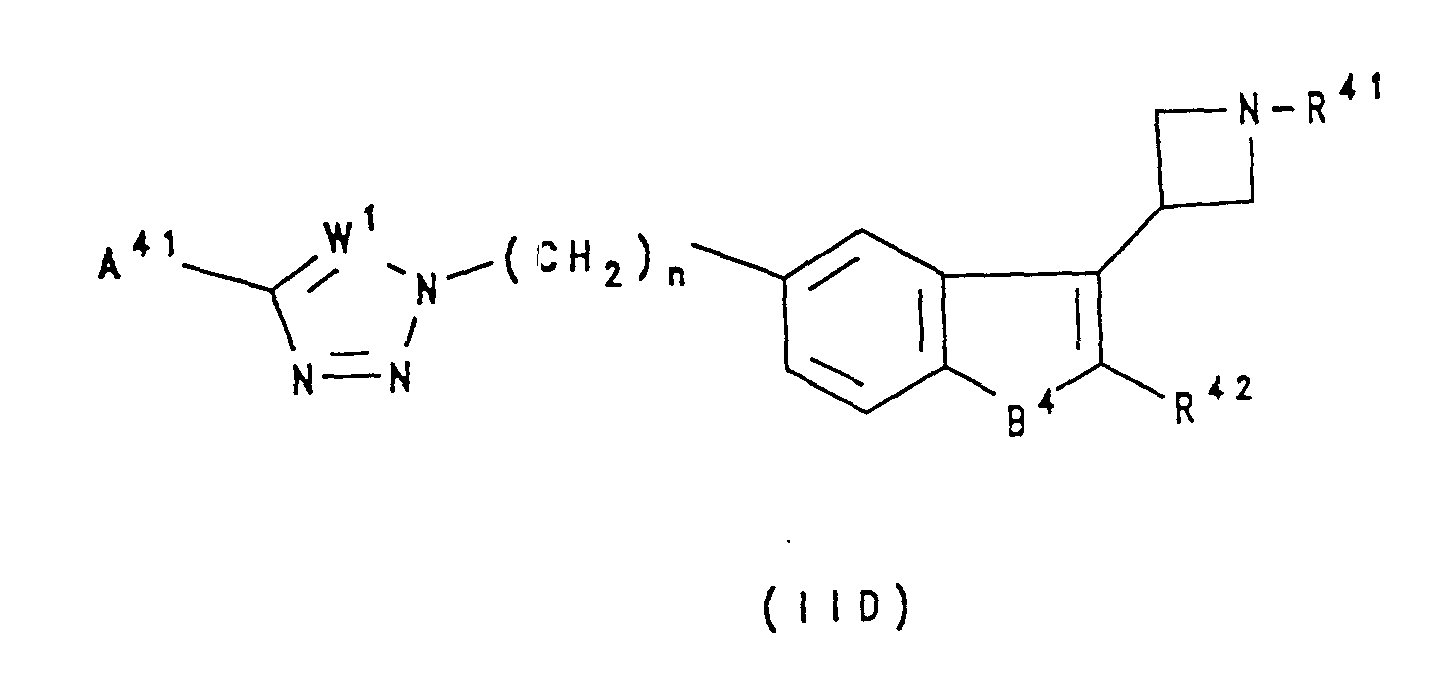 W1 represents nitrogen or C-A42;n is zero, 1, 2 or 3;B4 represents N-R43;A41 and A42 independently represent hydrogen or methyl; andR41, R42 and R43 independently represent hydrogen or C1-6 alkyl.
 - A compound as claimed in claim 1 selected from:and salts thereof.N-methyl-3-[5-(2-methylimidazol-1-ylmethyl)-1H-indol-3-yl]azetidine;N-methyl-3-[5-(1-methyltetrazol-5-ylmethyl)-lH-indol-3-yl]azetidine;N-methyl-3-[5-(1,2,4-triazol-1-yl)-1H-indol-3-yl]azetidine;N-methyl-3-[5-(imidazol-1-yl)-lH-indol-3-yl]azetidine;N-methyl-3-[5-(2-(1-methyltetrazol-5-yl)ethyl)-1H-indol-3-yl] azetidine;N-methyl-3-[5(1,2,4-triazol-1-ylmethyl)-1H-indol-3-yl]azetidine;N-methyl-3-[5-(1,2,4-triazol-4-yl)-1H-indol-3-yl]azetidine;N-methyl-3-[5-(imidazol-1-ylmethyl)-lH-indol-3-yl]azetidine;
- A pharmaceutical composition comprising a compound as claimed in any one of the preceding claims in association with a pharmaceutically acceptable carrier or excipient.
- A compound as claimed in any one of claims 1 to 6 for use in therapy.
- The use of a compound as claimed in any one of claims 1 to 6 for the manufacture of a medicament for the treatment and/or prevention of clinical conditions for which a selective agonist of 5-HT1-like receptors is indicated.
- A process for the preparation of a compound as claimed in any one of claims 1 to 6 which comprises:(A) reacting a reactive derivative of a carboxylic acid of formula Ra-CO2H with a compound either of formula III or of formula IV, or a salt thereof:wherein one of Ra, Rb and Rc is a group of formula A1, another is a group of formula A2, and the third is a group of formula -E-F, as defined in claim 1; or
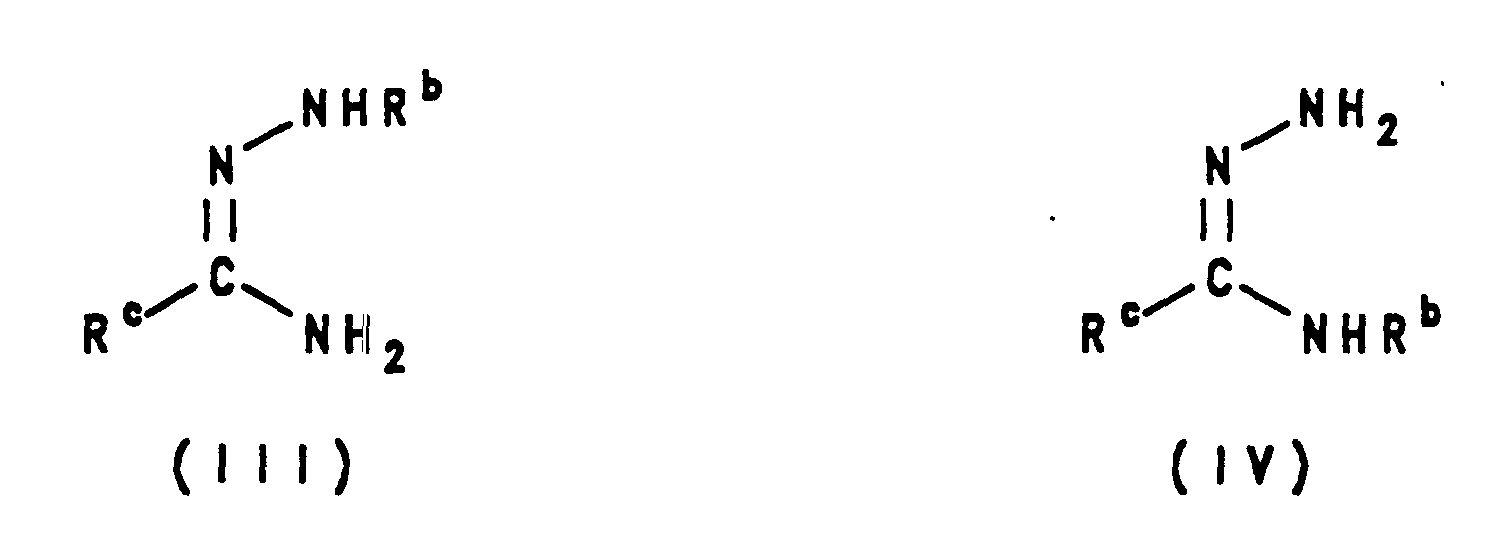 (B) reacting a compound of formula XIV:wherein A1, E and F are as defined in claim 1, Hal represents halogen, and two of Va, Wa, Xa, Ya and Za, to one of which the group Hal is attached, represent carbon and the remainder represent nitrogen; with a reagent which provides an anion -A2, where A2 is as defined in claim 1; or
 (C) the cycloaddition of an alkyne of formula Ra-C≡C-Rb with an azide of formula Rc-N3, where Ra, Rb and Rc are as defined above; or(D) the cycloaddition of a nitrile of formula N≡C-Rd with an azide of formula Re-N3, where one of Rd and Re represents a group of formula A1 and the other is a group of formula -E-F, as defined in claim 1; or(E) reacting a compound of formula Re-L with a tetrazole derivative of formula XV:wherein one of Rd and Re represents a group of formula A1 and the other is a group of formula -E-F, as defined in claim 1, and L represents a leaving group; in the presence of a base; or
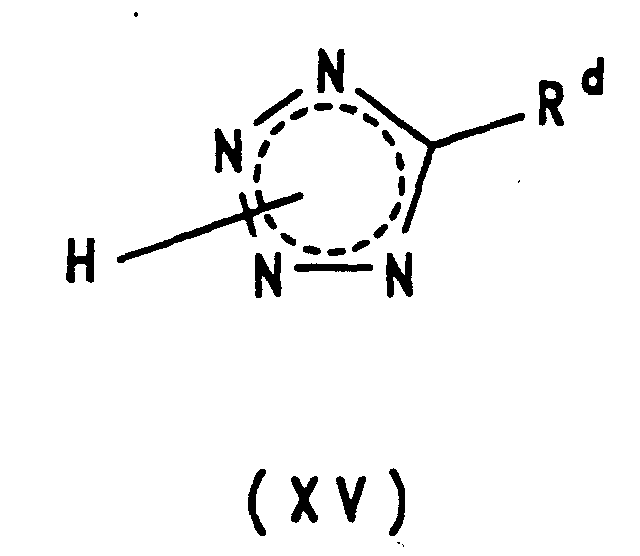 (F) the cycloaddition of a nitrile of formula N≡C-E-F, in which E and F are as defined in claim 1, with sodium azide, followed by acidification with a mineral acid; or(G) reacting a compound of formula XVI:wherein V, W, X, Y, Z, A1, A2 and E are as defined in claim 1; with a compound of formula VII or a carbonyl-protected form thereof:
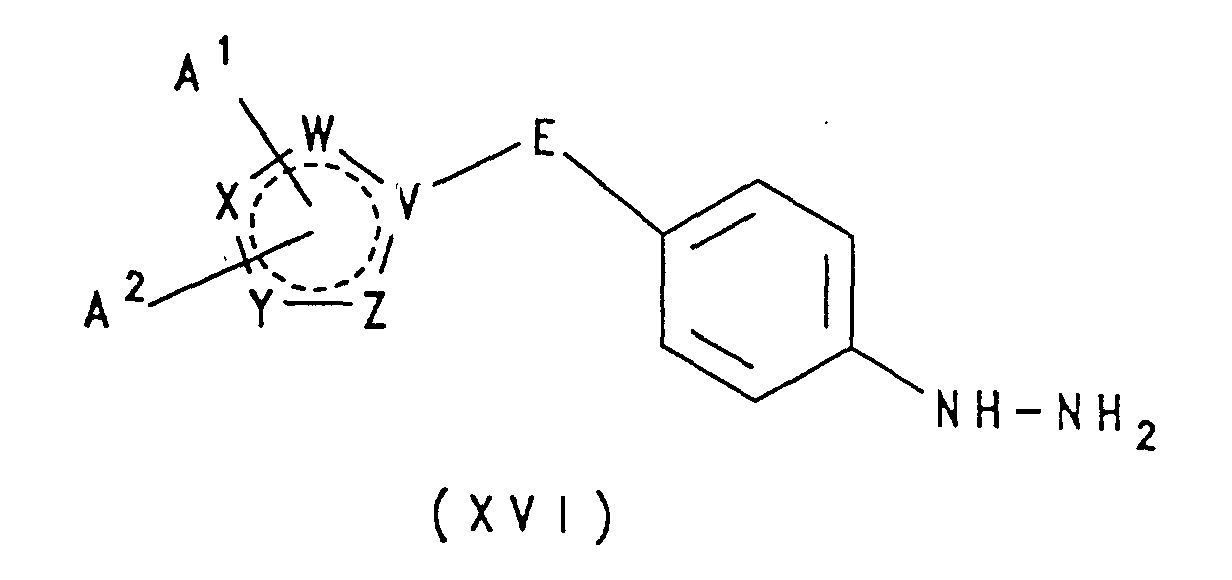 wherein R2 is as defined claim 1 and Rp represents an amino-protecting group; followed by removal of the protecting group Rp; and subsequently, where required, N-alkylation by standard methods to introduce the moieties R1 and/or R3; and
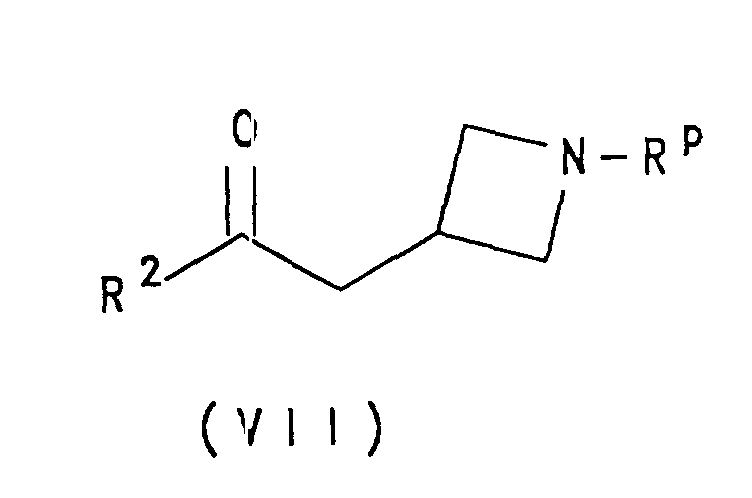 (H) subsequently, where required, converting a compound of formula I initially obtained into a further compound of formula I by conventional methods.
Applications Claiming Priority (5)
| Application Number | Priority Date | Filing Date | Title |
|---|---|---|---|
| GB929205482A GB9205482D0 (en) | 1992-03-13 | 1992-03-13 | Therapeutic agents |
| GB9205482 | 1992-03-13 | ||
| GB929215731A GB9215731D0 (en) | 1992-07-24 | 1992-07-24 | Therapeutic agents |
| GB9215731 | 1992-07-24 | ||
| PCT/GB1993/000474 WO1993018029A1 (en) | 1992-03-13 | 1993-03-05 | Imidazole, triazole and tetrazole derivatives |
Publications (2)
| Publication Number | Publication Date |
|---|---|
| EP0630374A1 EP0630374A1 (en) | 1994-12-28 |
| EP0630374B1 true EP0630374B1 (en) | 2001-09-05 |
Family
ID=26300519
Family Applications (1)
| Application Number | Title | Priority Date | Filing Date |
|---|---|---|---|
| EP93905531A Expired - Lifetime EP0630374B1 (en) | 1992-03-13 | 1993-03-05 | Imidazole, triazole and tetrazole derivatives |
Country Status (8)
| Country | Link |
|---|---|
| US (1) | US5510362A (en) |
| EP (1) | EP0630374B1 (en) |
| JP (1) | JP3309982B2 (en) |
| AT (1) | ATE205202T1 (en) |
| AU (1) | AU669160B2 (en) |
| CA (1) | CA2129146A1 (en) |
| DE (1) | DE69330713T2 (en) |
| WO (1) | WO1993018029A1 (en) |
Families Citing this family (35)
| Publication number | Priority date | Publication date | Assignee | Title |
|---|---|---|---|---|
| GB9402016D0 (en) * | 1994-02-02 | 1994-03-30 | Merck Sharp & Dohme | Therapeutic agents |
| EP0759918A1 (en) * | 1994-05-19 | 1997-03-05 | MERCK SHARP & DOHME LTD. | Piperazine, piperidine and tetrahydropyridine derivatives of indol-3-ylalkyl as 5-ht1d-alpha agonists |
| US5552402A (en) * | 1994-05-19 | 1996-09-03 | Merck, Sharp & Dohme Ltd. | Five-membered heteroaromatic compounds as 5-HT receptor agonists |
| GB9410031D0 (en) * | 1994-05-19 | 1994-07-06 | Merck Sharp & Dohme | Therapeutic agents |
| JPH10503768A (en) * | 1994-08-02 | 1998-04-07 | メルク シヤープ エンド ドーム リミテツド | Azetidine, pyrrolidine and piperidine derivatives |
| GB9423460D0 (en) * | 1994-11-21 | 1995-01-11 | Merck Sharp & Dohme | Therapeutic agents |
| GB9501865D0 (en) * | 1995-01-31 | 1995-03-22 | Merck Sharp & Dohme | Therapeutic agents |
| US5770742A (en) * | 1996-05-16 | 1998-06-23 | Allelix Biopharmaceuticals Inc. | Thiophene-tryptamine derivatives |
| JP2006518738A (en) * | 2003-02-12 | 2006-08-17 | トランス テック ファーマ,インコーポレイテッド | Substituted azole derivatives as therapeutic agents |
| US20050187277A1 (en) * | 2004-02-12 | 2005-08-25 | Mjalli Adnan M. | Substituted azole derivatives, compositions, and methods of use |
| EP2298748B1 (en) * | 2004-11-18 | 2016-07-20 | Synta Pharmaceuticals Corp. | Triazole compounds that modulate HSP90 activity |
| EP1928846B1 (en) * | 2005-08-18 | 2014-06-04 | Synta Pharmaceuticals Corp. | Triazole compounds that modulate hsp90 activity |
| AU2007211319B9 (en) | 2006-01-30 | 2012-05-31 | Vtv Therapeutics Llc | Substituted imidazole derivatives and their use as PTPase inhibitors |
| US20080027047A1 (en) * | 2006-05-25 | 2008-01-31 | Weiwen Ying | Compounds that modulate HSP90 activity and methods for identifying same |
| TWI490212B (en) | 2006-05-25 | 2015-07-01 | Synta Pharmaceuticals Corp | Triazole compounds that modulate hsp90 activity |
| CA2653329C (en) | 2006-05-25 | 2018-01-16 | Synta Pharmaceuticals Corp. | Triazole compounds that modulate hsp90 activity |
| TW200804313A (en) * | 2006-05-25 | 2008-01-16 | Synta Pharmaceuticals Corp | Triazole compounds that modulate HSP90 activity |
| WO2009102761A1 (en) * | 2008-02-12 | 2009-08-20 | Bristol-Myers Squibb Company | 1,2,3-triazoles as 11-beta hydroxysteroid dehydrogenase type i inhibitors |
| EP2560640A1 (en) | 2010-04-19 | 2013-02-27 | Synta Pharmaceuticals Corp. | Cancer therapy using a combination of a hsp90 inhibitory compounds and a egfr inhibitor |
| WO2013067162A1 (en) | 2011-11-02 | 2013-05-10 | Synta Pharmaceuticals Corp. | Cancer therapy using a combination of hsp90 inhibitors with topoisomerase i inhibitors |
| JP2014534228A (en) | 2011-11-02 | 2014-12-18 | シンタ ファーマシューティカルズ コーポレーション | Combination therapy of platinum-containing agents and HSP90 inhibitors |
| EP2780010A1 (en) | 2011-11-14 | 2014-09-24 | Synta Pharmaceuticals Corp. | Combination therapy of hsp90 inhibitors with braf inhibitors |
| AU2016263564B2 (en) | 2015-05-20 | 2019-12-05 | Amgen Inc. | Triazole agonists of the APJ receptor |
| US9988369B2 (en) | 2016-05-03 | 2018-06-05 | Amgen Inc. | Heterocyclic triazole compounds as agonists of the APJ receptor |
| WO2018097944A1 (en) | 2016-11-16 | 2018-05-31 | Amgen Inc. | Triazole furan compounds as agonists of the apj receptor |
| US10689367B2 (en) | 2016-11-16 | 2020-06-23 | Amgen Inc. | Triazole pyridyl compounds as agonists of the APJ receptor |
| WO2018093577A1 (en) | 2016-11-16 | 2018-05-24 | Amgen Inc. | Cycloalkyl substituted triazole compounds as agonists of the apj receptor |
| US10906890B2 (en) | 2016-11-16 | 2021-02-02 | Amgen Inc. | Triazole phenyl compounds as agonists of the APJ receptor |
| US11191762B2 (en) | 2016-11-16 | 2021-12-07 | Amgen Inc. | Alkyl substituted triazole compounds as agonists of the APJ Receptor |
| US11046680B1 (en) | 2016-11-16 | 2021-06-29 | Amgen Inc. | Heteroaryl-substituted triazoles as APJ receptor agonists |
| WO2018213377A1 (en) | 2017-05-17 | 2018-11-22 | Arcus Biosciences, Inc. | Quinazoline-pyrazole derivatives for the treatment of cancer-related disorders |
| MA50509A (en) | 2017-11-03 | 2021-06-02 | Amgen Inc | APJ RECEPTOR FUSED TRIAZOLE AGONISTS |
| MA52487A (en) | 2018-05-01 | 2021-03-10 | Amgen Inc | PYRIMIDINONES SUBSTITUTED AS APJ RECEPTOR AGONISTS |
| KR20230153387A (en) | 2021-02-02 | 2023-11-06 | 리미널 바이오사이언시스 리미티드 | GPR84 antagonists and their uses |
| JP2024506858A (en) | 2021-02-02 | 2024-02-15 | リミナル・バイオサイエンシーズ・リミテッド | GPR84 antagonists and their uses |
Family Cites Families (3)
| Publication number | Priority date | Publication date | Assignee | Title |
|---|---|---|---|---|
| GB8724912D0 (en) * | 1987-10-23 | 1987-11-25 | Wellcome Found | Indole derivatives |
| KR100215627B1 (en) * | 1990-06-07 | 1999-08-16 | 레슬리 제인 에드워즈 | Therapeutic Heterocycle Compounds |
| SK278998B6 (en) * | 1991-02-01 | 1998-05-06 | Merck Sharp & Dohme Limited | Imidazole, triazole and tetrazole derivatives, method of producing same, their use and pharmaceutical compositons on their base |
-
1993
- 1993-03-05 DE DE69330713T patent/DE69330713T2/en not_active Expired - Fee Related
- 1993-03-05 WO PCT/GB1993/000474 patent/WO1993018029A1/en not_active Ceased
- 1993-03-05 JP JP51546793A patent/JP3309982B2/en not_active Expired - Fee Related
- 1993-03-05 AU AU36428/93A patent/AU669160B2/en not_active Ceased
- 1993-03-05 EP EP93905531A patent/EP0630374B1/en not_active Expired - Lifetime
- 1993-03-05 US US08/295,884 patent/US5510362A/en not_active Expired - Fee Related
- 1993-03-05 CA CA002129146A patent/CA2129146A1/en not_active Abandoned
- 1993-03-05 AT AT93905531T patent/ATE205202T1/en not_active IP Right Cessation
Also Published As
| Publication number | Publication date |
|---|---|
| JPH07504431A (en) | 1995-05-18 |
| DE69330713T2 (en) | 2002-07-04 |
| EP0630374A1 (en) | 1994-12-28 |
| US5510362A (en) | 1996-04-23 |
| CA2129146A1 (en) | 1993-09-16 |
| AU669160B2 (en) | 1996-05-30 |
| WO1993018029A1 (en) | 1993-09-16 |
| DE69330713D1 (en) | 2001-10-11 |
| AU3642893A (en) | 1993-10-05 |
| JP3309982B2 (en) | 2002-07-29 |
| ATE205202T1 (en) | 2001-09-15 |
Similar Documents
| Publication | Publication Date | Title |
|---|---|---|
| US5510362A (en) | Imidazole, triazole and tetrazole derivatives | |
| EP0497512B1 (en) | Imidazole, triazole and tetrazole derivatives | |
| US5567726A (en) | Imidazole, Triazole and tetrazole derivatives | |
| US5514682A (en) | Fused imidazole and triazole derivatives as 5-HT1 receptor agonists | |
| US5554629A (en) | 4-substituted 1,2,4-triazole derivatives | |
| US5246957A (en) | N-imidazolyl derivatives of substituted indole | |
| US5981529A (en) | Substituted indolylpropyl-piperazine derivatives as 5-HT1D α agonists | |
| US5607957A (en) | Imidazole, triazole and tetrazole derivatives | |
| US5902819A (en) | Triazole derivatives | |
| HK1001258B (en) | Imidazole, triazole and tetrazole derivatives | |
| HK1001258A (en) | Imidazole, triazole and tetrazole derivatives | |
| LT3594B (en) | Imidazole,triazole and tetrazole derivatives |
Legal Events
| Date | Code | Title | Description |
|---|---|---|---|
| PUAI | Public reference made under article 153(3) epc to a published international application that has entered the european phase |
Free format text: ORIGINAL CODE: 0009012 |
|
| 17P | Request for examination filed |
Effective date: 19941013 |
|
| AK | Designated contracting states |
Kind code of ref document: A1 Designated state(s): AT BE CH DE DK ES FR GB GR IE IT LI LU NL PT SE |
|
| 17Q | First examination report despatched |
Effective date: 19970915 |
|
| GRAG | Despatch of communication of intention to grant |
Free format text: ORIGINAL CODE: EPIDOS AGRA |
|
| GRAG | Despatch of communication of intention to grant |
Free format text: ORIGINAL CODE: EPIDOS AGRA |
|
| GRAH | Despatch of communication of intention to grant a patent |
Free format text: ORIGINAL CODE: EPIDOS IGRA |
|
| GRAH | Despatch of communication of intention to grant a patent |
Free format text: ORIGINAL CODE: EPIDOS IGRA |
|
| GRAA | (expected) grant |
Free format text: ORIGINAL CODE: 0009210 |
|
| AK | Designated contracting states |
Kind code of ref document: B1 Designated state(s): AT BE CH DE DK ES FR GB GR IE IT LI LU NL PT SE |
|
| PG25 | Lapsed in a contracting state [announced via postgrant information from national office to epo] |
Ref country code: NL Free format text: LAPSE BECAUSE OF FAILURE TO SUBMIT A TRANSLATION OF THE DESCRIPTION OR TO PAY THE FEE WITHIN THE PRESCRIBED TIME-LIMIT Effective date: 20010905 Ref country code: LI Free format text: LAPSE BECAUSE OF FAILURE TO SUBMIT A TRANSLATION OF THE DESCRIPTION OR TO PAY THE FEE WITHIN THE PRESCRIBED TIME-LIMIT Effective date: 20010905 Ref country code: IT Free format text: LAPSE BECAUSE OF FAILURE TO SUBMIT A TRANSLATION OF THE DESCRIPTION OR TO PAY THE FEE WITHIN THE PRE;WARNING: LAPSES OF ITALIAN PATENTS WITH EFFECTIVE DATE BEFORE 2007 MAY HAVE OCCURRED AT ANY TIME BEFORE 2007. THE CORRECT EFFECTIVE DATE MAY BE DIFFERENT FROM THE ONE RECORDED.SCRIBED TIME-LIMIT Effective date: 20010905 Ref country code: CH Free format text: LAPSE BECAUSE OF FAILURE TO SUBMIT A TRANSLATION OF THE DESCRIPTION OR TO PAY THE FEE WITHIN THE PRESCRIBED TIME-LIMIT Effective date: 20010905 Ref country code: BE Free format text: LAPSE BECAUSE OF FAILURE TO SUBMIT A TRANSLATION OF THE DESCRIPTION OR TO PAY THE FEE WITHIN THE PRESCRIBED TIME-LIMIT Effective date: 20010905 Ref country code: AT Free format text: LAPSE BECAUSE OF FAILURE TO SUBMIT A TRANSLATION OF THE DESCRIPTION OR TO PAY THE FEE WITHIN THE PRESCRIBED TIME-LIMIT Effective date: 20010905 |
|
| REF | Corresponds to: |
Ref document number: 205202 Country of ref document: AT Date of ref document: 20010915 Kind code of ref document: T |
|
| REG | Reference to a national code |
Ref country code: CH Ref legal event code: EP |
|
| REF | Corresponds to: |
Ref document number: 69330713 Country of ref document: DE Date of ref document: 20011011 |
|
| REG | Reference to a national code |
Ref country code: IE Ref legal event code: FG4D |
|
| PG25 | Lapsed in a contracting state [announced via postgrant information from national office to epo] |
Ref country code: SE Free format text: LAPSE BECAUSE OF FAILURE TO SUBMIT A TRANSLATION OF THE DESCRIPTION OR TO PAY THE FEE WITHIN THE PRESCRIBED TIME-LIMIT Effective date: 20011205 Ref country code: PT Free format text: LAPSE BECAUSE OF FAILURE TO SUBMIT A TRANSLATION OF THE DESCRIPTION OR TO PAY THE FEE WITHIN THE PRESCRIBED TIME-LIMIT Effective date: 20011205 Ref country code: DK Free format text: LAPSE BECAUSE OF FAILURE TO SUBMIT A TRANSLATION OF THE DESCRIPTION OR TO PAY THE FEE WITHIN THE PRESCRIBED TIME-LIMIT Effective date: 20011205 |
|
| ET | Fr: translation filed | ||
| PG25 | Lapsed in a contracting state [announced via postgrant information from national office to epo] |
Ref country code: GR Free format text: LAPSE BECAUSE OF FAILURE TO SUBMIT A TRANSLATION OF THE DESCRIPTION OR TO PAY THE FEE WITHIN THE PRESCRIBED TIME-LIMIT Effective date: 20011207 |
|
| PGFP | Annual fee paid to national office [announced via postgrant information from national office to epo] |
Ref country code: GB Payment date: 20011213 Year of fee payment: 10 |
|
| REG | Reference to a national code |
Ref country code: GB Ref legal event code: IF02 |
|
| NLV1 | Nl: lapsed or annulled due to failure to fulfill the requirements of art. 29p and 29m of the patents act | ||
| PGFP | Annual fee paid to national office [announced via postgrant information from national office to epo] |
Ref country code: FR Payment date: 20020221 Year of fee payment: 10 |
|
| PG25 | Lapsed in a contracting state [announced via postgrant information from national office to epo] |
Ref country code: LU Free format text: LAPSE BECAUSE OF NON-PAYMENT OF DUE FEES Effective date: 20020305 Ref country code: IE Free format text: LAPSE BECAUSE OF NON-PAYMENT OF DUE FEES Effective date: 20020305 |
|
| REG | Reference to a national code |
Ref country code: CH Ref legal event code: PL |
|
| PGFP | Annual fee paid to national office [announced via postgrant information from national office to epo] |
Ref country code: DE Payment date: 20020320 Year of fee payment: 10 |
|
| PG25 | Lapsed in a contracting state [announced via postgrant information from national office to epo] |
Ref country code: ES Free format text: LAPSE BECAUSE OF FAILURE TO SUBMIT A TRANSLATION OF THE DESCRIPTION OR TO PAY THE FEE WITHIN THE PRESCRIBED TIME-LIMIT Effective date: 20020326 |
|
| PLBE | No opposition filed within time limit |
Free format text: ORIGINAL CODE: 0009261 |
|
| STAA | Information on the status of an ep patent application or granted ep patent |
Free format text: STATUS: NO OPPOSITION FILED WITHIN TIME LIMIT |
|
| 26N | No opposition filed | ||
| REG | Reference to a national code |
Ref country code: IE Ref legal event code: MM4A |
|
| PG25 | Lapsed in a contracting state [announced via postgrant information from national office to epo] |
Ref country code: GB Free format text: LAPSE BECAUSE OF NON-PAYMENT OF DUE FEES Effective date: 20030305 |
|
| PG25 | Lapsed in a contracting state [announced via postgrant information from national office to epo] |
Ref country code: DE Free format text: LAPSE BECAUSE OF NON-PAYMENT OF DUE FEES Effective date: 20031001 |
|
| GBPC | Gb: european patent ceased through non-payment of renewal fee |
Effective date: 20030305 |
|
| PG25 | Lapsed in a contracting state [announced via postgrant information from national office to epo] |
Ref country code: FR Free format text: LAPSE BECAUSE OF NON-PAYMENT OF DUE FEES Effective date: 20031127 |
|
| REG | Reference to a national code |
Ref country code: FR Ref legal event code: ST |