EP0629625B1 - Loracarbef hydrochloride C1-C3 alcohol solvates and uses thereof - Google Patents
Loracarbef hydrochloride C1-C3 alcohol solvates and uses thereof Download PDFInfo
- Publication number
- EP0629625B1 EP0629625B1 EP94304230A EP94304230A EP0629625B1 EP 0629625 B1 EP0629625 B1 EP 0629625B1 EP 94304230 A EP94304230 A EP 94304230A EP 94304230 A EP94304230 A EP 94304230A EP 0629625 B1 EP0629625 B1 EP 0629625B1
- Authority
- EP
- European Patent Office
- Prior art keywords
- loracarbef
- compound
- hydrochloride
- alcohol
- ethanol
- Prior art date
- Legal status (The legal status is an assumption and is not a legal conclusion. Google has not performed a legal analysis and makes no representation as to the accuracy of the status listed.)
- Expired - Lifetime
Links
- JAPHQRWPEGVNBT-UTUOFQBUSA-N N[C@@H](C(N[C@@H]([C@@H](CC1)N2C(C(O)=O)=C1Cl)C2=O)=O)c1ccccc1 Chemical compound N[C@@H](C(N[C@@H]([C@@H](CC1)N2C(C(O)=O)=C1Cl)C2=O)=O)c1ccccc1 JAPHQRWPEGVNBT-UTUOFQBUSA-N 0.000 description 2
- 0 OC(C(N(C1OC11)[C@@](CC2)[C@@]1NC1=*[C@@]1c1ccccc1)=C2Cl)=O Chemical compound OC(C(N(C1OC11)[C@@](CC2)[C@@]1NC1=*[C@@]1c1ccccc1)=C2Cl)=O 0.000 description 2
Classifications
-
- C—CHEMISTRY; METALLURGY
- C07—ORGANIC CHEMISTRY
- C07D—HETEROCYCLIC COMPOUNDS
- C07D487/00—Heterocyclic compounds containing nitrogen atoms as the only ring hetero atoms in the condensed system, not provided for by groups C07D451/00 - C07D477/00
- C07D487/02—Heterocyclic compounds containing nitrogen atoms as the only ring hetero atoms in the condensed system, not provided for by groups C07D451/00 - C07D477/00 in which the condensed system contains two hetero rings
- C07D487/04—Ortho-condensed systems
-
- C—CHEMISTRY; METALLURGY
- C07—ORGANIC CHEMISTRY
- C07D—HETEROCYCLIC COMPOUNDS
- C07D463/00—Heterocyclic compounds containing 1-azabicyclo [4.2.0] octane ring systems, i.e. compounds containing a ring system of the formula:, e.g. carbacephalosporins; Such ring systems being further condensed, e.g. 2,3-condensed with an oxygen-, nitrogen- or sulfur-containing hetero ring
- C07D463/10—Heterocyclic compounds containing 1-azabicyclo [4.2.0] octane ring systems, i.e. compounds containing a ring system of the formula:, e.g. carbacephalosporins; Such ring systems being further condensed, e.g. 2,3-condensed with an oxygen-, nitrogen- or sulfur-containing hetero ring with a carbon atom having three bonds to hetero atoms with at the most one bond to halogen, e.g. an ester or nitrile radical, directly attached in position 2
- C07D463/14—Heterocyclic compounds containing 1-azabicyclo [4.2.0] octane ring systems, i.e. compounds containing a ring system of the formula:, e.g. carbacephalosporins; Such ring systems being further condensed, e.g. 2,3-condensed with an oxygen-, nitrogen- or sulfur-containing hetero ring with a carbon atom having three bonds to hetero atoms with at the most one bond to halogen, e.g. an ester or nitrile radical, directly attached in position 2 with hetero atoms directly attached in position 7
- C07D463/16—Nitrogen atoms
- C07D463/18—Nitrogen atoms further acylated by radicals derived from carboxylic acids or by nitrogen or sulfur analogues thereof
- C07D463/20—Nitrogen atoms further acylated by radicals derived from carboxylic acids or by nitrogen or sulfur analogues thereof with the acylating radicals further substituted by hetero atoms or by carbon atoms having three bonds to hetero atoms with at the most one bond to halogen
- C07D463/22—Nitrogen atoms further acylated by radicals derived from carboxylic acids or by nitrogen or sulfur analogues thereof with the acylating radicals further substituted by hetero atoms or by carbon atoms having three bonds to hetero atoms with at the most one bond to halogen further substituted by nitrogen atoms
-
- A—HUMAN NECESSITIES
- A61—MEDICAL OR VETERINARY SCIENCE; HYGIENE
- A61P—SPECIFIC THERAPEUTIC ACTIVITY OF CHEMICAL COMPOUNDS OR MEDICINAL PREPARATIONS
- A61P31/00—Antiinfectives, i.e. antibiotics, antiseptics, chemotherapeutics
- A61P31/04—Antibacterial agents
Definitions
- This invention relates to crystalline loracarbef hydrochloride C 1 -C 3 alcohol solvates and uses thereof.
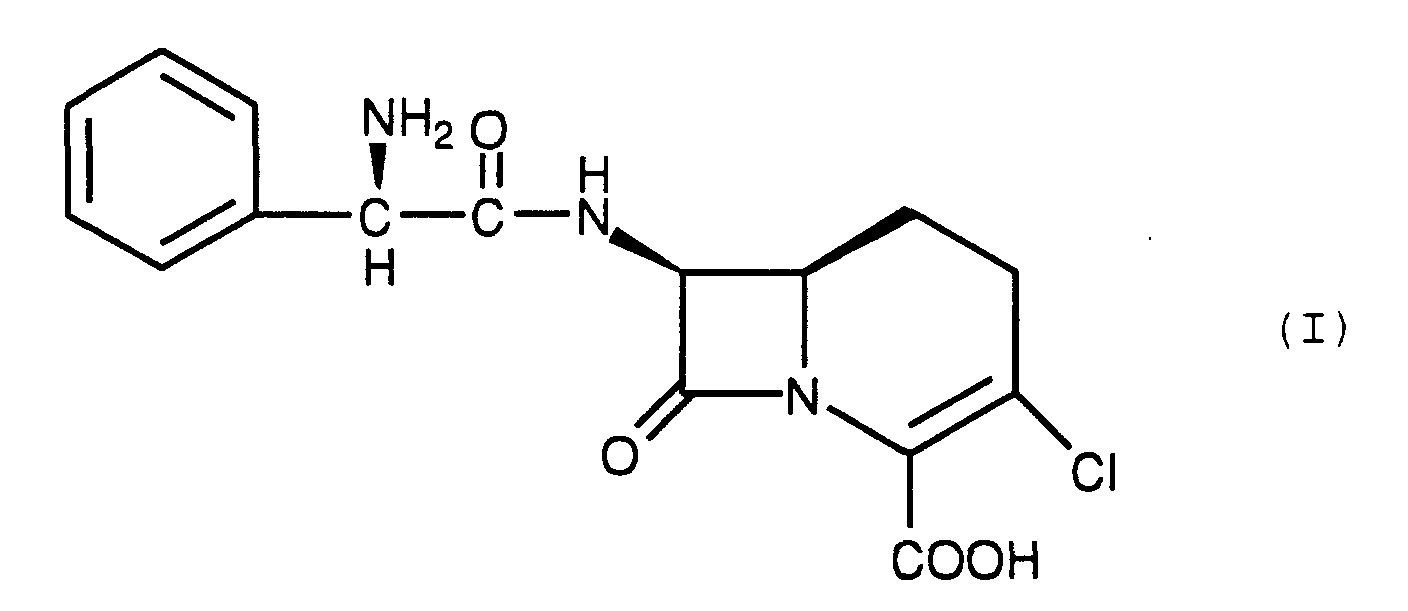
- the ⁇ -lactam antibiotic of the formula (I) is the potent orally active antibiotic known as loracarbef. This antibiotic is described, for example, by Hashimoto et al , in U.S. patent 4,335,211, issued June 15, 1982.
- the above compounds come in various forms, including the crystalline monohydrate form, which is disclosed in European Patent Publication 0,311,366 having a publication date of April 12, 1989.
- the crystalline dihydrate form of loracarbef is disclosed in European Patent Publication 0,369,686, having a publication date of May 23, 1990.
- Other known solvate forms of the compound are disclosed in Eckrich et al . U.S. Patent No. 4,977,257 issued December 11, 1990 and Pfeiffer et al ., European Patent Publication No. 0,439,353, having a publication date of July 31, 1991.
- the Pfeiffer et al . reference discloses the crystalline hydrochloride form of loracarbef.
- This invention provides for crystalline hydrochloride C 1 -C 3 alcohol solvate forms of the compound of formula (I):
- crystalline hydrochloride ethanol, methanol, and propanol solvates are disclosed. Also disclosed are processes for preparing and using the above compounds.
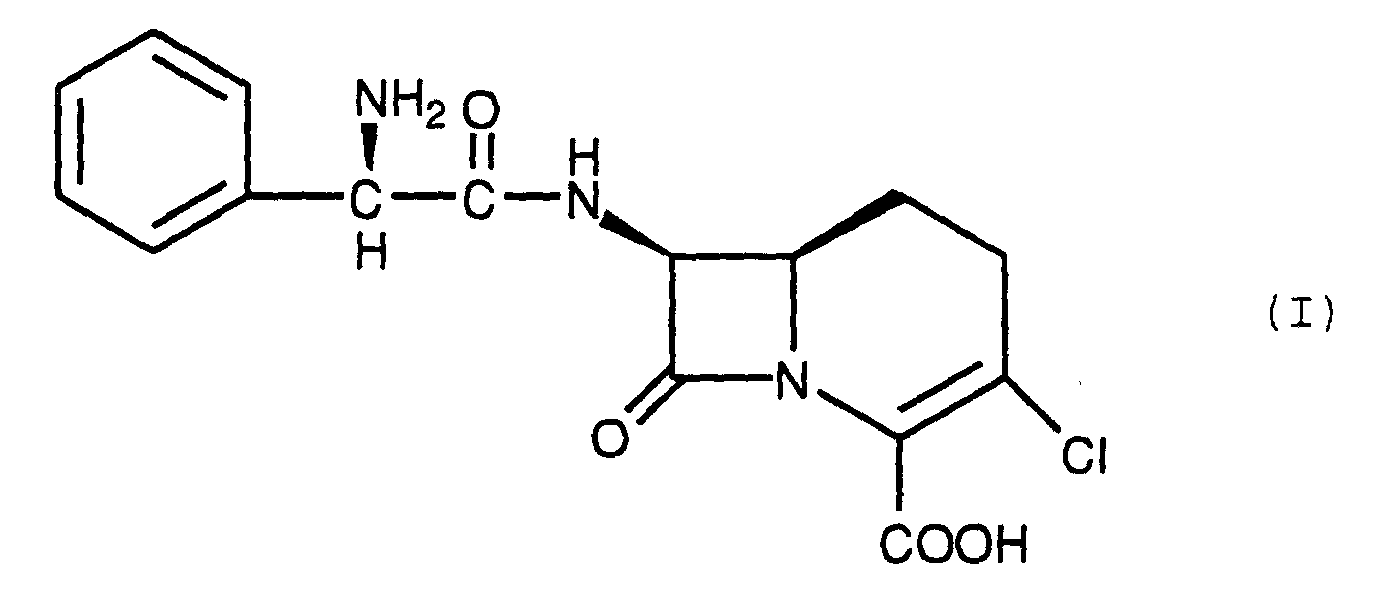
- the present invention is directed to crystalline hydrochloride C 1 -C 3 alcohol solvates of the compound of formula (I):
- the C-2' asymmetric center has the R absolute configuration.
- the solvates may encompass the Zwitterionic form of the compound of formula (I).
- a preferred embodiment of the invention is the crystalline hydrochloride ethanol solvate of the compound of formula (I) exhibiting the X-ray powder diffraction pattern of Table 1: d I/I 1 19.92 -2.0 9.77 100.0 7.39 58.8 6.17 16.3 5.65 40.9 5.05 58.9 4.85 21.2 4.65 0.7 4.49 66.4 4.37 1.5 4.27 13.2 4.00 10.2 3.89 3.1 3.83 0.8 3.69 38.4 3.62 0.7 3.52 91.0 3.39 7.5 3.35 7.9 3.27 26.0 3.20 -0.6 3.14 13.9 3.09 12.7 2.97 6.4 2.87 5.6 2.82 6.1 2.74 6.2 2.70 6.4 2.64 10.1 2.60 2.3
- the interplanar spacings are in the column marked "d” and are in Angstroms and the relative intensities are in the column marked "I/
- Another embodiment of the instant invention is the crystalline hydrochloride methanol solvate of the compound of formula (I) exhibiting the X-ray powder diffraction pattern set forth below in Table 2.
- d I/I 1 17.9471 21.60 13.5209 100.00 9.4758 6.22 9.0915 6.69 9.0915 6.69 7.3142 3.87 7.1382 5.75 6.8539 18.54 6.6895 6.22 5.9775 5.63 5.7694 4.46 5.6608 5.40 5.5616 13.97 5.3491 7.16 5.1413 3.29 5.0208 6.10 4.7465 5.87 4.5602 4.46 4.4469 4.58 4.3384 5.05 4.3384 5.05 4.1200 10.80 3.8563 5.87 3.7084 7.98 3.6379 12.44 3.5872 13.38 3.5273 8.10 3.4491 12.91 3.3684 7.51 3.1719 7.98 3.1132 5.63 2.9748 5.16 The X-ray data in Table 2 was collected employing the same instrument parameters as used in collecting the data in Table 1.
- Another embodiment of the invention is the crystalline loracarbef hydrochloride 1-propanol solvate exhibiting the X-ray powder diffraction pattern set forth below in Table 3.
- d I/I 1 10.0767 100.00 9.7099 7.75 8.1380 3.96 7.5370 42.41 6.2587 5.54 5.8976 7.91 5.7412 17.72 5.6398 11.23 5.4127 3.80 5.2174 5.54 5.1075 45.41 4.9370 7.59 4.8905 9.49 4.5360 37.03 4.3921 12.34 4.2845 7.75 4.0913 11.55 3.7735 11.08 3.7132 16.46 3.6574 18.04 3.5853 21.36 3.5444 27.22 3.4696 7.59 3.3750 12.97 3.2862 14.72 3.2369 6.96 3.1533 10.76 3.0222 5.22 2.9859 6.01 2.9624 6.65 2.8638 6.49 2.8268 5.22 2.7363 6.96 2.6960 6.33 2.6186 6.01
- the loracarbef hydrochloride C 1 -C 3 alcohol solvates can be prepared by suspending any form of the compound, for example, the bis(DMF) solvate form, in ethanol and concentrated or anhydrous hydrochloric acid. After the addition of the solvent and acid, the mixture is maintained at a temperature of about 0 to about 25°C to facilitate precipitation. The precipitate can then be filtered, washed with the particular alcohol, and dried to yield the loracarbef hydrochloride alcohol solvate.
- the amount of alcohol used should be an amount of 7 to about 14 ml per gram of loracarbef.
- the amount of hydrochloric acid used should be in a slight molar excess, or in the amount of 1 to about 1.2 equivalents.
- the loracarbef hydrochloride alcohol solvates are useful as intermediates to the loracarbef monohydrate and especially as purification tools.
- the monohydrate may be prepared by first suspending any of the alcohol solvates in either the particular alcohol solvent contained in the compound, dimethylformamide and/or water. The pH of the mixture is lowered, if needed, to induce dissolution using a suitable acid such as hydrochloric, sulfuric, or hydrobromic acids. The pH of the mixture is then raised by the addition of a base such as sodium hydroxide, ammonium hydroxide or triethylamine. The product is filtered, washed with the particular alcohol or DMF, and dried or taken directly into the monohydrate conversion.
- the hydrochloride alcohol solvate may be slurried in ethanol, followed by addition of a base to include dissolution to result in the ethanolate form of loracarbef. Thereafter, the ethanolate may be slurried in water at a temperature of about 50°C to result in formation of the monohydrate.
- the pH of the aqueous layer is lowered to 4.6-4.9 with concentrated HCl.
- An equal volume of ethyl alcohol is added dropwise over 1.5 hr. Precipitation occurs after 10 minutes and is thick.
- the mixture is stirred for several hours at room temperature and then for several hours at 0-5°C.
- the product is filtered and washed with ethyl alcohol and dried overnight at 45°C.
- the product contains approximately 62-68% loracarbef as the monohydrate and 30-35% D-phenylglycine.
- the potency is obtained by running triplicate samples on the HPLC.
- the K.F. is 5-8%.
- the % yield from starting nucleus is 73-79%.
- the HCl salt of loracarbef is obtained from the loracarbef isolated from the enzymatic acylation.
- the loracarbef crystal (60-75% potency as the monohydrate, containing 22-40% D-phenyl glycine) is slurried in 10 volumes of ethanol.
- An equivalent of concentrated HCl, based on the potency of loracarbef and D-phenyl glycine, is added for complete dissolution. Additional HCl (0.6 eq.) is added.
- the pH is 0.60-0.80.
- the clear solution is seeded with loracarbef hydrochloride ethanolate to initiate crystallization.
- the HCl crystallizes slowly over several hours at room temperature.
- Loracarbef hydrochloride ethanolate (5.10 g) was slurried in 75 ml ethanol at room temperature. Triethylamine (1.54 ml, 1.0 eq.) was added dropwise to obtain a pH of 4.6-4.8. The slurry became thick within 30 minutes to indicate that the hydrochloride ethanolate salt was being converted to loracarbef ethanolate. The slurry was stirred for 2 hours at room temperature, filtered, washed with ethanol, and dried under vacuum at 40°C. Actual Yield - 4.10 g. Theoretical Yield - 4.06 g. % Yield - 98.1%
- Loracarbef ethanolate (4.0 g, 97.1% potency), was slurried in 56 ml of water (containing .004 eq sodium, -0.02 g editate) at 50'C for 2 hours. Within 30 minutes the slurry became very thick, indicating conversion to monohydrate. The product was vacuum filtered, washed with a minimum amount of water, and dried in a 40'C vacuum oven. X-ray-confirmed as monohydrate. Actual Yield - 2.78 g, Theoretical Yield - 3.88 g % Yield - 72.4%
- Loracarbef DMF disolvate (4.5 g, 68.7% potency) was suspended in 45 ml EtOH. Added 0.80 ml concentrated HCl to obtain a clear solution. Cooled to 10°C. Product began to precipitate within 50 minutes. Maintained a 10°C temperature and stirred for 2 hours. Filtered and washed with EtOH. Dried product under vacuum at 40°C. Actual yield - 2.82 g Theoretical yield - 3.41 g % yield - 82.7%
- Loracarbef methanolate (5 g) is added to 50 ml of 1-propanol and 1.34 ml of concentrated hydrochloride acid. The solution is stirred at room temperature for approximately 45 minutes and is stripped to solids and placed in the freezer, with large rhomboid crystals formed. The mixture is dried overnight at room temperature in a vacuum oven and the crystals yellowed.
- the weight yield is 5.16 grams and the X-ray diffraction pattern of the titled product above is as follows: d I/I 1 10.0767 100.00 9.7099 7.75 8.1380 3.96 7.5370 42.41 6.2587 5.54 5.8976 7.91 5.7412 17.72 5.6398 11.23 5.4127 3.80 5.2174 5.54 5.1075 45.41 4.9370 7.59 4.8905 9.49 4.5360 37.03 4.3921 12.34 4.2845 7.75 4.0913 11.55 3.7735 11.08 3.7132 16.46 3.6574 18.04 3.5853 21.36 3.5444 27.22 3.4696 7.59 3.3750 12.97 3.2862 14.72 3.2369 6.96 3.1533 10.76 3.0222 5.22 2.9859 6.01 2.9624 6.65 2.8638 6.49 2.8268 5.22 2.7363 6.96 2.6960 6.33 2.6186 6.01
- a 1 L 4 NK RB flask was set up with a pH probe, gas addition subsurface tube, thermometer, N 2 purge, and gas vent.
- Loracarbef containing 26.4% D-PGOH product from an enzymatic acylation, 150g (0.30 eq of loracarbef, 0.26 eq D-PGOH) was added to the flask.
- 2B-3 alcohol 750 ml was added. The contents were stirred at 20° to 25°C for 10 to 15 minutes. The initial pH was 5.3. The pH was lowered to 0.6 to 0.8 over 20 to 30 minutes using anhydrous HCl gas. At pH 0.95 there was a slurry to slurry conversion to HCl salt.
Landscapes
- Chemical & Material Sciences (AREA)
- Organic Chemistry (AREA)
- Health & Medical Sciences (AREA)
- Nuclear Medicine, Radiotherapy & Molecular Imaging (AREA)
- Life Sciences & Earth Sciences (AREA)
- Chemical Kinetics & Catalysis (AREA)
- General Chemical & Material Sciences (AREA)
- Medicinal Chemistry (AREA)
- Communicable Diseases (AREA)
- Pharmacology & Pharmacy (AREA)
- Oncology (AREA)
- Animal Behavior & Ethology (AREA)
- General Health & Medical Sciences (AREA)
- Public Health (AREA)
- Veterinary Medicine (AREA)
- Pharmaceuticals Containing Other Organic And Inorganic Compounds (AREA)
- Nitrogen Condensed Heterocyclic Rings (AREA)
- Organic Low-Molecular-Weight Compounds And Preparation Thereof (AREA)
- Steroid Compounds (AREA)
Abstract
Description
- This invention relates to crystalline loracarbef hydrochloride C1-C3 alcohol solvates and uses thereof. The β-lactam antibiotic of the formula (I)is the potent orally active antibiotic known as loracarbef. This antibiotic is described, for example, by Hashimoto et al, in U.S. patent 4,335,211, issued June 15, 1982.
- The above compounds come in various forms, including the crystalline monohydrate form, which is disclosed in European Patent Publication 0,311,366 having a publication date of April 12, 1989. The crystalline dihydrate form of loracarbef is disclosed in European Patent Publication 0,369,686, having a publication date of May 23, 1990. Other known solvate forms of the compound are disclosed in Eckrich et al. U.S. Patent No. 4,977,257 issued December 11, 1990 and Pfeiffer et al., European Patent Publication No. 0,439,353, having a publication date of July 31, 1991. The Pfeiffer et al. reference discloses the crystalline hydrochloride form of loracarbef.
- Continuous efforts are being made for alternative methods for isolation, purification and recovery of loracarbef to increase the possible total yield.
- This invention provides for crystalline hydrochloride C1-C3 alcohol solvate forms of the compound of formula (I):In particular, crystalline hydrochloride ethanol, methanol, and propanol solvates are disclosed. Also disclosed are processes for preparing and using the above compounds.

- The present invention is directed to crystalline hydrochloride C1-C3 alcohol solvates of the compound of formula (I):In the present solvates of formula (I) the C-2' asymmetric center has the R absolute configuration. Furthermore, the solvates may encompass the Zwitterionic form of the compound of formula (I).
- A preferred embodiment of the invention is the crystalline hydrochloride ethanol solvate of the compound of formula (I) exhibiting the X-ray powder diffraction pattern of Table 1:
d I/I1 19.92 -2.0 9.77 100.0 7.39 58.8 6.17 16.3 5.65 40.9 5.05 58.9 4.85 21.2 4.65 0.7 4.49 66.4 4.37 1.5 4.27 13.2 4.00 10.2 3.89 3.1 3.83 0.8 3.69 38.4 3.62 0.7 3.52 91.0 3.39 7.5 3.35 7.9 3.27 26.0 3.20 -0.6 3.14 13.9 3.09 12.7 2.97 6.4 2.87 5.6 2.82 6.1 2.74 6.2 2.70 6.4 2.64 10.1 2.60 2.3 - Another embodiment of the instant invention is the crystalline hydrochloride methanol solvate of the compound of formula (I) exhibiting the X-ray powder diffraction pattern set forth below in Table 2.
d I/I1 17.9471 21.60 13.5209 100.00 9.4758 6.22 9.0915 6.69 9.0915 6.69 7.3142 3.87 7.1382 5.75 6.8539 18.54 6.6895 6.22 5.9775 5.63 5.7694 4.46 5.6608 5.40 5.5616 13.97 5.3491 7.16 5.1413 3.29 5.0208 6.10 4.7465 5.87 4.5602 4.46 4.4469 4.58 4.3384 5.05 4.3384 5.05 4.1200 10.80 3.8563 5.87 3.7084 7.98 3.6379 12.44 3.5872 13.38 3.5273 8.10 3.4491 12.91 3.3684 7.51 3.1719 7.98 3.1132 5.63 2.9748 5.16 - Another embodiment of the invention is the crystalline loracarbef hydrochloride 1-propanol solvate exhibiting the X-ray powder diffraction pattern set forth below in Table 3.
d I/I1 10.0767 100.00 9.7099 7.75 8.1380 3.96 7.5370 42.41 6.2587 5.54 5.8976 7.91 5.7412 17.72 5.6398 11.23 5.4127 3.80 5.2174 5.54 5.1075 45.41 4.9370 7.59 4.8905 9.49 4.5360 37.03 4.3921 12.34 4.2845 7.75 4.0913 11.55 3.7735 11.08 3.7132 16.46 3.6574 18.04 3.5853 21.36 3.5444 27.22 3.4696 7.59 3.3750 12.97 3.2862 14.72 3.2369 6.96 3.1533 10.76 3.0222 5.22 2.9859 6.01 2.9624 6.65 2.8638 6.49 2.8268 5.22 2.7363 6.96 2.6960 6.33 2.6186 6.01 - The X-ray data in Table 3 was collected employing the same instrument parameters used to collect the data in Table 1.
- The loracarbef hydrochloride C1-C3 alcohol solvates can be prepared by suspending any form of the compound, for example, the bis(DMF) solvate form, in ethanol and concentrated or anhydrous hydrochloric acid. After the addition of the solvent and acid, the mixture is maintained at a temperature of about 0 to about 25°C to facilitate precipitation. The precipitate can then be filtered, washed with the particular alcohol, and dried to yield the loracarbef hydrochloride alcohol solvate. The amount of alcohol used should be an amount of 7 to about 14 ml per gram of loracarbef. The amount of hydrochloric acid used should be in a slight molar excess, or in the amount of 1 to about 1.2 equivalents.
- As noted above, the loracarbef hydrochloride alcohol solvates are useful as intermediates to the loracarbef monohydrate and especially as purification tools. The monohydrate may be prepared by first suspending any of the alcohol solvates in either the particular alcohol solvent contained in the compound, dimethylformamide and/or water. The pH of the mixture is lowered, if needed, to induce dissolution using a suitable acid such as hydrochloric, sulfuric, or hydrobromic acids. The pH of the mixture is then raised by the addition of a base such as sodium hydroxide, ammonium hydroxide or triethylamine. The product is filtered, washed with the particular alcohol or DMF, and dried or taken directly into the monohydrate conversion. For example, the hydrochloride alcohol solvate may be slurried in ethanol, followed by addition of a base to include dissolution to result in the ethanolate form of loracarbef. Thereafter, the ethanolate may be slurried in water at a temperature of about 50°C to result in formation of the monohydrate.
- An important use for the solvates is in purifying enzymatic reaction mixtures. When enzymatic acylation reactions are run according to those described in U.S. patents 4,316,958, 4,332,896, or 4,335,211, there remains as much as 30-35% D-phenylglycine. By precipitating the hydrochloride C1-C3 alcohol solvate, that level can be markedly reduced, and in the case of the hydrochloride ethanol solvate, the D-phenylglycine can be removed completely.
- A slurry of crystalline bis(N,N'-dimethylformamide)solvate of 7β-[2'-(R)-2'-phenyl-2'-aminoacetamido]-3-chloro-3-(1-carba(dethia)cephem)-4-carboxylic acid (27.74 g, 18.84 bg(mw= 349.8),53.9 mmole;potency=67.9%, diazotozable amine=263 ppm)) in 120 ml of ethanol was treated with a 2.63 M solution of HCl(g) in EtOH (21.7 ml,57.1 mmole,1.06 eq). The resulting clear yellow solution was cooled to ice bath temperature for two hours and seeded with the titled product. Crystallization began immediately and after thirty minutes, the titled product was collected by filtration, washed with ethanol and dried overnight in an air oven at 45°C; yield=23.46g (93%) based on a HPLC potency of 74.7%; KF=0.85% and diazotizable amine=140 ppm.
mp 177°C decomp.;
Combustion Analysis: Theory C16H17N3O4Cl2-1.3 C2H5OH:C,50.08;H,5.60;N,9.42; Found:C, 49.18;H,5.67;N,9.39;
UV(EtOH) 264nm(10,000);
IR(KBr)3440(b),3200(b),2600,1780,1700,1540,1370,1320,1240 cm-1;
[a]D(25ºC,H2O,c=1.0)=+32.92º;FAB(DMSO)M+=350,352;X-Ray Crystal Diffraction Pattern: d I/I1 19.92 -2.0 9.77 100.0 7.39 58.8 6.17 16.3 5.65 40.9 5.05 58.9 4.85 21.2 4.65 0.7 4.49 66.4 4.37 1.5 4.27 13.2 4.00 10.2 3.89 3.1 3.83 0.8 3.69 38.4 3.62 0.7 3.52 91.0 3.39 7.5 3.35 7.9 3.27 26.0 3.20 -0.6 3.14 13.9 3.09 12.7 2.97 6.4 2.87 5.6 2.82 6.1 2.74 6.2 2.70 6.4 2.64 10.1 2.60 2.3 - To a solution of Na4EDTA (350 mg) in 85 ml of water was added material obtained from Example 1 (13.4g,10.0 bg (MW=349.8),28.6 mmole). After fifteen minutes of stirring, 1.0 ml of concentrated HCl was added to complete dissolution (pH=1.37). To this was added Darco-G50 (350 mg), and after stirring fifteen minutes, the reaction mixture was filtered through a Hyflo pad and the pad rinsed with 15 ml of water. The combined filtrate and washing were heated to 50'C with stirring and triethylamine (1.2 ml) was added at rate of 3.9 ml/hr to give a pH=1.7. The solution was seeded with Loracarbef monohydrate crystal and after stirring a further thirty minutes at 50°C, the addition of triethylamine was resumed at a rate of approx 3.9 ml/hr until the reaction mixture reached a pH=4.7 (3.6 ml of triethylamine were added). After stirring thirty minutes further at pH=4.7 and 50'C, the reaction mixture was filtered on a buchner funnel and the titled product washed with 17 ml of water. The wet cake was reslurried in 100 ml of water at room temperature, collected on a filter and dried overnight in an air oven at 45°C to give 7.02 g (70.2%) of the titled product;
potency =100%; KF= 4.09%;triethylamine=0.01%, diazotizable amine= 38;x-ray diffraction pattern confirmed monohydrate. - An acylation reaction proceeding substantially according to U.S. Patents 4,316,958, 4,332,896, and 4,335,211 is run and thereafter the acylation solution is removed from the flask by vacuum through a glass sparger. The enzyme beads are washed with MilliQ water. These washes are combined with the acylation solution and extracted 2X with CH2Cl2. The aqueous phase is HyFlo filtered. The HyFlo filter pad is washed twice with minimal volumes of phosphate buffer. Combined volume of extracted acylation solution and washes are sampled in triplicate for HPLC analysis.
- The pH of the aqueous layer is lowered to 4.6-4.9 with concentrated HCl. An equal volume of ethyl alcohol is added dropwise over 1.5 hr. Precipitation occurs after 10 minutes and is thick. After the addition is complete, the mixture is stirred for several hours at room temperature and then for several hours at 0-5°C. The product is filtered and washed with ethyl alcohol and dried overnight at 45°C. The product contains approximately 62-68% loracarbef as the monohydrate and 30-35% D-phenylglycine. The potency is obtained by running triplicate samples on the HPLC. The K.F. is 5-8%. The % yield from starting nucleus is 73-79%.
- The HCl salt of loracarbef is obtained from the loracarbef isolated from the enzymatic acylation. The loracarbef crystal (60-75% potency as the monohydrate, containing 22-40% D-phenyl glycine) is slurried in 10 volumes of ethanol. An equivalent of concentrated HCl, based on the potency of loracarbef and D-phenyl glycine, is added for complete dissolution. Additional HCl (0.6 eq.) is added. The pH is 0.60-0.80. The clear solution is seeded with loracarbef hydrochloride ethanolate to initiate crystallization. The HCl crystallizes slowly over several hours at room temperature. After stirring for 2 hours at room temperature, the crystallization mixture is cooled to 0-5'C and stirred for one hour. The mixture is filtered, washed with ethanol, and dried under vacuum at 40'C overnight to yield a white, crystalline solid with a potency of 90-99% as loracarbef hydrochloride ethanolate. No D-phenyl glycine is detected by HPLC. The yields using the above procedure range from 80-95%.
- Loracarbef hydrochloride ethanolate (5.10 g) was slurried in 75 ml ethanol at room temperature. Triethylamine (1.54 ml, 1.0 eq.) was added dropwise to obtain a pH of 4.6-4.8. The slurry became thick within 30 minutes to indicate that the hydrochloride ethanolate salt was being converted to loracarbef ethanolate. The slurry was stirred for 2 hours at room temperature, filtered, washed with ethanol, and dried under vacuum at 40°C.
Actual Yield - 4.10 g.
Theoretical Yield - 4.06 g.
% Yield - 98.1% - Loracarbef ethanolate, (4.0 g, 97.1% potency), was slurried in 56 ml of water (containing .004 eq sodium, -0.02 g editate) at 50'C for 2 hours. Within 30 minutes the slurry became very thick, indicating conversion to monohydrate. The product was vacuum filtered, washed with a minimum amount of water, and dried in a 40'C vacuum oven. X-ray-confirmed as monohydrate.
Actual Yield - 2.78 g,
Theoretical Yield - 3.88 g
% Yield - 72.4% - Loracarbef DMF disolvate (4.5 g, 68.7% potency) was suspended in 45 ml EtOH. Added 0.80 ml concentrated HCl to obtain a clear solution. Cooled to 10°C. Product began to precipitate within 50 minutes. Maintained a 10°C temperature and stirred for 2 hours. Filtered and washed with EtOH. Dried product under vacuum at 40°C.
Actual yield - 2.82 g
Theoretical yield - 3.41 g
% yield - 82.7% - Loracarbef DMF disolvate (1.0 g) was suspended in 10 ml EtOH. Added 0.33 ml conc. HCl. A clear solution was obtained. Within 30 minutes no crystallization had begun. Seeded with the titled product and within 5 minutes crystallization began. Stirred at room temperature (20°-28°C) for 2 hours. Filtered (very granular) easily. Washed with ethanol. Dried in a 40°C vacuum oven.
Actual yield - 0.52 g
Theoretical yield - 0.75g
% yield - 69.3% - Loracarbef dihydrate (5g) was added to 20 ml of methanol and 1.34 ml of concentrate hydrochloride acid at room temperature. The solution was stirred for approximately 15 minutes and a nitrogen purge was used to evaporate the solvent overnight. The titled product had the following X-ray diffraction pattern:
d I/I1 17.9471 21.60 13.5209 100.00 9.4758 6.22 9.0915 6.69 9.0915 6.69 7.3142 3.87 7.1382 5.75 6.8539 18.54 6.6895 6.22 5.9775 5.63 5.7694 4.46 5.6608 5.40 5.5616 13.97 5.3491 7.16 5.1413 3.29 5.0208 6.10 4.7465 5.87 4.5602 4.46 4.4469 4.58 4.3384 5.05 4.3384 5.05 4.1200 10.80 3.8563 5.87 3.7084 7.98 3.6379 12.44 3.5872 13.38 3.5273 8.10 3.4491 12.91 3.3684 7.51 3.1719 7.98 3.1132 5.63 2.9748 5.16 - Loracarbef methanolate (5 g) is added to 50 ml of 1-propanol and 1.34 ml of concentrated hydrochloride acid. The solution is stirred at room temperature for approximately 45 minutes and is stripped to solids and placed in the freezer, with large rhomboid crystals formed. The mixture is dried overnight at room temperature in a vacuum oven and the crystals yellowed. The weight yield is 5.16 grams and the X-ray diffraction pattern of the titled product above is as follows:
d I/I1 10.0767 100.00 9.7099 7.75 8.1380 3.96 7.5370 42.41 6.2587 5.54 5.8976 7.91 5.7412 17.72 5.6398 11.23 5.4127 3.80 5.2174 5.54 5.1075 45.41 4.9370 7.59 4.8905 9.49 4.5360 37.03 4.3921 12.34 4.2845 7.75 4.0913 11.55 3.7735 11.08 3.7132 16.46 3.6574 18.04 3.5853 21.36 3.5444 27.22 3.4696 7.59 3.3750 12.97 3.2862 14.72 3.2369 6.96 3.1533 10.76 3.0222 5.22 2.9859 6.01 2.9624 6.65 2.8638 6.49 2.8268 5.22 2.7363 6.96 2.6960 6.33 2.6186 6.01 - A 1 L 4 NK RB flask was set up with a pH probe, gas addition subsurface tube, thermometer, N2 purge, and gas vent. Loracarbef (containing 26.4% D-PGOH) product from an enzymatic acylation, 150g (0.30 eq of loracarbef, 0.26 eq D-PGOH) was added to the flask. Next, 2B-3 alcohol (750 ml) was added. The contents were stirred at 20° to 25°C for 10 to 15 minutes. The initial pH was 5.3. The pH was lowered to 0.6 to 0.8 over 20 to 30 minutes using anhydrous HCl gas. At pH 0.95 there was a slurry to slurry conversion to HCl salt. The mixture exothermed to 44°C during the HCl addition. The pH was adjusted slighty during this time by careful addition of HCl gas. The final pH was 0.80. The total amount of HCl used was 19.9 G. The slurry was then cooled to -10° to -5°C and stirred for 2 hours. The product was filtered and washed with 2B-3 alcohol. The product was dried in a 40°C vacuum oven for 18 hours.
Actual Yield- 137.96 G, potency as loracarbef monohydrate - 79.6%
theoretical Yield- 111.6 g as loracarbef monohydrate
% yield- 98.4%
No D-PGOH was detected by HPLC - Loracarbef Hydrochloride Ethanolate (20 g, 0.044 moles) was dissolved in H2O (25 ml) with stirring at room temperature. Concentrated HCl was added (with stirring) to obtain a clear solution. The pale yellow solution was stirred for 10 minutes at room temperature, filtered through hyflo, and washed with H2O (25 ml). Ethanol, 2B-3 (240 ml) was added dropwise at room temperature over 1 hour. A white precipitate formed within 10 minutes. Triethylamine (1.0 equivalent, 6.18 ml) was dissolved in 2B-3 ethanol (60 ml) and added dropwise to the loracarbef hydrochloride ethanolate slurry at room temperature over 1.5 hour. The pH was adjusted to 4.6 to 4.8 with either triethylamine or concentrated HCl, as needed. The slurry was stirred at room temperature for 2 hours, filtered, . and washed with 2B-3 ethanol (50 to 60 ml) The product was dried under vacuum at 40°C. The yield was 98.2%.
Actual yield- 16.84 G, 95.2% potency as loracarbef monohydrate, 16.03 BG as loracarbef monohydrate
Theoretical yield-16.32 G (as loracarbef monohydrate)
% yield- 98.2
Claims (10)
- A process for the isolation of a compound of formula I:as its monohydrate, which process comprises the step of adding a sufficient amount of base to a hydrochloride C1-C3 alcohol solvate form of compound of formula (I) suspended in a suitable solvent and/or water to precipitate the compound of formula (I).

- The process as recited in Claim 1 wherein the alcohol is ethanol and the crystalline hydrochloride ethanol solvate form has the following X-ray diffraction pattern:
d I/I1 19.92 -2.0 9.77 100.0 7.39 58.8 6.17 16.3 5.65 40.9 5.05 58.9 4.85 21.2 4.65 0.7 4.49 66.4 4.37 1.5 4.27 13.2 4.00 10.2 3.89 3.1 3.83 0.8 3.69 38.4 3.62 0.7 3.52 91.0 3.39 7.5 3.35 7.9 3.27 26.0 3.20 -0.6 3.14 13.9 3.09 12.7 2.97 6.4 2.87 5.6 2.82 6.1 2.74 6.2 2.70 6.4 2.64 10.1 2.60 2.3 - A process for the purification of a mixture comprising loracarbef and D-phenylglycine which comprises the step of adding hydrochloric acid and a C1-C3 alcohol to said mixture to precipitate the hydrochloride C1-C3 alcohol solvate form of loracarbef from the mixture.
- The process as recited in claim 3 wherein said alcohol is ethanol.
- A crystalline hydrochloride ethanol solvate form of the compound of formula I:

- A compound of Claim 5 which has the following x-ray diffraction pattern obtained with a nickel-filtered copper radiation of λ= 1.5406 Å wherein d represents the interplanar spacing and I/I1 the relative intensity:
d I/I1 19.92 -2.0 9.77 100.0 7.39 58.8 6.17 16.3 5.65 40.9 5.05 58.9 4.85 21.2 4.65 0.7 4.49 66.4 4.37 1.5 4.27 13.2 4.00 10.2 3.89 3.1 3.83 0.8 3.69 38.4 3.62 0.7 3.52 91.0 3.39 7.5 3.35 7.9 3.27 26.0 3.20 -0.6 3.14 13.9 3.09 12.7 2.97 6.4 2.87 5.6 2.82 6.1 2.74 6.2 2.70 6.4 2.64 10.1 2.60 2.3 - A crystalline hydrochloride methanol solvate form of the compound of formula I:

- A compound of Claim 7 which has the following x-ray diffraction pattern obtained with a nickel-filtered copper radiation of λ= 1.5406 A wherein d represents the interplanar spacing and I/I1 the relative intensity:
d I/I1 17.9471 21.60 13.5209 100.00 9.4758 6.22 9.0915 6.69 9.0915 6.69 7.3142 3.87 7.1382 5.75 6.8539 18.54 6.6895 6.22 5.9775 5.63 5.7694 4.46 5.6608 5.40 5.5616 13.97 5.3491 7.16 5.1413 3.29 5.0208 6.10 4.7465 5.87 4.5602 4.46 4.4469 4.58 4.3384 5.05 4.3384 5.05 4.1200 10.80 3.8563 5.87 3.7084 7.98 3.6379 12.44 3.5872 13.38 3.5273 8.10 3.4491 12.91 3.3684 7.51 3.1719 7.98 3.1132 5.63 2.9748 5.16 - A crystalline hydrochloride propanol solvate form of the compound of formula I:

- A compound of Claim 9 which has the following x-ray diffraction pattern obtained with a nickel-filtered copper radiation of λ= 1.5406 Å wherein d represents the interplanar spacing and I/I1 the relative intensity:
d I/I1 10.0767 100.00 9.7099 7.75 8.1380 3.96 7.5370 42.41 6.2587 5.54 5.8976 7.91 5.7412 17.72 5.6398 11.23 5.4127 3.80 5.2174 5.54 5.1075 45.41 4.9370 7.59 4.8905 9.49 4.5360 37.03 4.3921 12.34 4.2845 7.75 4.0913 11.55 3.7735 11.08 3.7132 16.46 3.6574 18.04 3.5853 21.36 3.5444 27.22 3.4696 7.59 3.3750 12.97 3.2862 14.72 3.2369 6.96 3.1533 10.76 3.0222 5.22 2.9859 6.01 2.9624 6.65 2.8638 6.49 2.8268 5.22 2.7363 6.96 2.6960 6.33 2.6186 6.01
Applications Claiming Priority (2)
| Application Number | Priority Date | Filing Date | Title |
|---|---|---|---|
| US08/077,305 US5550231A (en) | 1993-06-15 | 1993-06-15 | Loracarbef hydrochloride C1-C3 alcohol solvates and uses thereof |
| US77305 | 1993-06-15 |
Publications (2)
| Publication Number | Publication Date |
|---|---|
| EP0629625A1 EP0629625A1 (en) | 1994-12-21 |
| EP0629625B1 true EP0629625B1 (en) | 2002-10-09 |
Family
ID=22137301
Family Applications (1)
| Application Number | Title | Priority Date | Filing Date |
|---|---|---|---|
| EP94304230A Expired - Lifetime EP0629625B1 (en) | 1993-06-15 | 1994-06-13 | Loracarbef hydrochloride C1-C3 alcohol solvates and uses thereof |
Country Status (13)
| Country | Link |
|---|---|
| US (2) | US5550231A (en) |
| EP (1) | EP0629625B1 (en) |
| JP (1) | JP3474635B2 (en) |
| KR (1) | KR100310947B1 (en) |
| AT (1) | ATE225789T1 (en) |
| BR (1) | BR9402406A (en) |
| CA (1) | CA2125762A1 (en) |
| DE (1) | DE69431498T2 (en) |
| ES (1) | ES2184751T3 (en) |
| FI (1) | FI108134B (en) |
| HU (1) | HUT67489A (en) |
| IL (1) | IL109989A (en) |
| TW (1) | TW380139B (en) |
Families Citing this family (3)
| Publication number | Priority date | Publication date | Assignee | Title |
|---|---|---|---|---|
| ZA978515B (en) * | 1996-09-23 | 1999-03-23 | Lilly Co Eli | Intermediates and process for preparing olanzapine |
| EP1565462A1 (en) * | 2002-11-21 | 2005-08-24 | Ranbaxy Laboratories, Ltd. | Monohydrate solvates of loracarbef |
| WO2004080187A1 (en) * | 2003-03-12 | 2004-09-23 | Lesaffre Et Cie | A sour dough, the use thereof and bakery products produced from the same |
Family Cites Families (15)
| Publication number | Priority date | Publication date | Assignee | Title |
|---|---|---|---|---|
| US4168376A (en) * | 1978-06-05 | 1979-09-18 | Eli Lilly And Company | Process for crystalline sodium cefamandole |
| JPS5672698A (en) * | 1979-11-14 | 1981-06-16 | Kyowa Hakko Kogyo Co Ltd | Preparation of optically active cephalosporin analogue |
| US4316958A (en) * | 1979-02-10 | 1982-02-23 | Kyowa Hakko Kogyo Co., Ltd. | Process for producing optically active cephalosporin analogs |
| US4332896A (en) * | 1979-04-14 | 1982-06-01 | Kyowa Hakko Kogyo Co., Ltd. | Process for producing cephalosporin analogs |
| US4775751A (en) * | 1985-06-03 | 1988-10-04 | Eli Lilly & Company | Process for cephalexin hydrochloride alcoholates |
| CA1334970C (en) * | 1987-10-06 | 1995-03-28 | Carol Elaine Pasini | Crystalline .beta.-lactam hydrate |
| CA2002596A1 (en) * | 1988-11-14 | 1990-05-14 | Thomas M. Eckrich | Hydrates of b-lactam antibiotic |
| US4977257A (en) * | 1988-11-14 | 1990-12-11 | Eli Lilly And Company | DMF solvates of a β-lactam antibiotic |
| CA2002597C (en) * | 1988-11-14 | 1999-03-23 | Thomas M. Eckrich | Solvates of b-lactam antibiotic |
| CA2034592C (en) * | 1990-01-26 | 2001-06-05 | Ralph R. Pfeiffer | Crystalline hydrochloride of new beta-lactam antibiotic and process therefor |
| US5057607A (en) * | 1990-06-08 | 1991-10-15 | Eli Lilly And Company | Enantiomerically selective biocatalyzed acylation |
| US5374719A (en) * | 1993-06-04 | 1994-12-20 | Eli Lilly And Company | Process for converting loracarbef dihydrate to loracarbef monohydrate |
| US5352782A (en) * | 1993-06-04 | 1994-10-04 | Eli Lilly And Company | Process for preparing crystalline β-lactam monohydrate |
| US5399686A (en) * | 1993-06-04 | 1995-03-21 | Eli Lilly And Company | Loracarbef isopropanolate and a process for converting loracarbef isopropanolate to loracarbef monohydrate |
| US5412094A (en) * | 1993-06-28 | 1995-05-02 | Eli Lilly And Company | Bicyclic beta-lactam/paraben complexes |
-
1993
- 1993-06-15 US US08/077,305 patent/US5550231A/en not_active Expired - Lifetime
-
1994
- 1994-06-11 TW TW083105321A patent/TW380139B/en not_active IP Right Cessation
- 1994-06-13 AT AT94304230T patent/ATE225789T1/en not_active IP Right Cessation
- 1994-06-13 JP JP13023494A patent/JP3474635B2/en not_active Expired - Fee Related
- 1994-06-13 HU HU9401765A patent/HUT67489A/en unknown
- 1994-06-13 IL IL109989A patent/IL109989A/en not_active IP Right Cessation
- 1994-06-13 CA CA002125762A patent/CA2125762A1/en not_active Abandoned
- 1994-06-13 DE DE69431498T patent/DE69431498T2/en not_active Expired - Fee Related
- 1994-06-13 KR KR1019940013210A patent/KR100310947B1/en not_active Expired - Fee Related
- 1994-06-13 FI FI942798A patent/FI108134B/en not_active IP Right Cessation
- 1994-06-13 EP EP94304230A patent/EP0629625B1/en not_active Expired - Lifetime
- 1994-06-13 ES ES94304230T patent/ES2184751T3/en not_active Expired - Lifetime
- 1994-06-14 BR BR9402406A patent/BR9402406A/en not_active Application Discontinuation
-
1995
- 1995-05-18 US US08/444,124 patent/US5578720A/en not_active Expired - Lifetime
Also Published As
| Publication number | Publication date |
|---|---|
| TW380139B (en) | 2000-01-21 |
| DE69431498D1 (en) | 2002-11-14 |
| JP3474635B2 (en) | 2003-12-08 |
| FI942798L (en) | 1994-12-16 |
| BR9402406A (en) | 1995-01-17 |
| FI942798A0 (en) | 1994-06-13 |
| HU9401765D0 (en) | 1994-09-28 |
| JPH0770122A (en) | 1995-03-14 |
| KR950000704A (en) | 1995-01-03 |
| KR100310947B1 (en) | 2001-12-28 |
| CA2125762A1 (en) | 1994-12-16 |
| FI108134B (en) | 2001-11-30 |
| US5550231A (en) | 1996-08-27 |
| ATE225789T1 (en) | 2002-10-15 |
| ES2184751T3 (en) | 2003-04-16 |
| US5578720A (en) | 1996-11-26 |
| IL109989A (en) | 1998-06-15 |
| DE69431498T2 (en) | 2003-06-26 |
| HUT67489A (en) | 1995-04-28 |
| EP0629625A1 (en) | 1994-12-21 |
| IL109989A0 (en) | 1994-10-07 |
Similar Documents
| Publication | Publication Date | Title |
|---|---|---|
| US6350869B1 (en) | Crystalline amine salt of cefdinir | |
| EP0874853B1 (en) | Process for preparation of cefdinir | |
| EP1554289B1 (en) | A cefdinir intermediate | |
| US6458949B1 (en) | Ceftiofur, its intermediate and a process for the preparation of the same | |
| EP0637587B1 (en) | Bicyclic beta-lactam/paraben complexes | |
| EP0175814B1 (en) | Process for preparing cephem derivatives | |
| US20030208065A1 (en) | Process for purification of a cephalosporin derivative | |
| US5550231A (en) | Loracarbef hydrochloride C1-C3 alcohol solvates and uses thereof | |
| US4977257A (en) | DMF solvates of a β-lactam antibiotic | |
| AU614440B2 (en) | Solvates of beta-lactam antibiotic | |
| JPH069648A (en) | New production of ceftriaxone | |
| CA2466964A1 (en) | Loracarbef hydrochloride c1-c3 alcohol solvates and uses thereof | |
| JP2809711B2 (en) | Intermediate of 1-carba (dethia) cephalosporin | |
| KR800001554B1 (en) | Manufacturing Method of Cemfe derivatives | |
| KR0174432B1 (en) | Novel crystalline Cefdinir intermediate and preparation method thereof | |
| EP0222577A2 (en) | Crystalline cephalosporin monohydrate | |
| WO2004026882A1 (en) | Process for the preparation of cephems |
Legal Events
| Date | Code | Title | Description |
|---|---|---|---|
| PUAI | Public reference made under article 153(3) epc to a published international application that has entered the european phase |
Free format text: ORIGINAL CODE: 0009012 |
|
| 17P | Request for examination filed |
Effective date: 19940620 |
|
| AK | Designated contracting states |
Kind code of ref document: A1 Designated state(s): AT BE CH DE DK ES FR GB GR IE IT LI LU NL PT SE |
|
| RAX | Requested extension states of the european patent have changed |
Free format text: SI PAYMENT 940620 |
|
| 17Q | First examination report despatched |
Effective date: 19980318 |
|
| GRAG | Despatch of communication of intention to grant |
Free format text: ORIGINAL CODE: EPIDOS AGRA |
|
| GRAG | Despatch of communication of intention to grant |
Free format text: ORIGINAL CODE: EPIDOS AGRA |
|
| GRAH | Despatch of communication of intention to grant a patent |
Free format text: ORIGINAL CODE: EPIDOS IGRA |
|
| GRAH | Despatch of communication of intention to grant a patent |
Free format text: ORIGINAL CODE: EPIDOS IGRA |
|
| GRAA | (expected) grant |
Free format text: ORIGINAL CODE: 0009210 |
|
| AK | Designated contracting states |
Kind code of ref document: B1 Designated state(s): AT BE CH DE DK ES FR GB GR IE IT LI LU NL PT SE |
|
| AX | Request for extension of the european patent |
Free format text: SI PAYMENT 19940620 |
|
| PG25 | Lapsed in a contracting state [announced via postgrant information from national office to epo] |
Ref country code: NL Free format text: LAPSE BECAUSE OF FAILURE TO SUBMIT A TRANSLATION OF THE DESCRIPTION OR TO PAY THE FEE WITHIN THE PRESCRIBED TIME-LIMIT Effective date: 20021009 Ref country code: LI Free format text: LAPSE BECAUSE OF FAILURE TO SUBMIT A TRANSLATION OF THE DESCRIPTION OR TO PAY THE FEE WITHIN THE PRESCRIBED TIME-LIMIT Effective date: 20021009 Ref country code: GR Free format text: LAPSE BECAUSE OF FAILURE TO SUBMIT A TRANSLATION OF THE DESCRIPTION OR TO PAY THE FEE WITHIN THE PRESCRIBED TIME-LIMIT Effective date: 20021009 Ref country code: CH Free format text: LAPSE BECAUSE OF FAILURE TO SUBMIT A TRANSLATION OF THE DESCRIPTION OR TO PAY THE FEE WITHIN THE PRESCRIBED TIME-LIMIT Effective date: 20021009 Ref country code: BE Free format text: LAPSE BECAUSE OF FAILURE TO SUBMIT A TRANSLATION OF THE DESCRIPTION OR TO PAY THE FEE WITHIN THE PRESCRIBED TIME-LIMIT Effective date: 20021009 Ref country code: AT Free format text: LAPSE BECAUSE OF FAILURE TO SUBMIT A TRANSLATION OF THE DESCRIPTION OR TO PAY THE FEE WITHIN THE PRESCRIBED TIME-LIMIT Effective date: 20021009 |
|
| REF | Corresponds to: |
Ref document number: 225789 Country of ref document: AT Date of ref document: 20021015 Kind code of ref document: T |
|
| REG | Reference to a national code |
Ref country code: GB Ref legal event code: FG4D |
|
| REG | Reference to a national code |
Ref country code: CH Ref legal event code: EP |
|
| REG | Reference to a national code |
Ref country code: IE Ref legal event code: FG4D |
|
| REF | Corresponds to: |
Ref document number: 69431498 Country of ref document: DE Date of ref document: 20021114 |
|
| PG25 | Lapsed in a contracting state [announced via postgrant information from national office to epo] |
Ref country code: SE Free format text: LAPSE BECAUSE OF FAILURE TO SUBMIT A TRANSLATION OF THE DESCRIPTION OR TO PAY THE FEE WITHIN THE PRESCRIBED TIME-LIMIT Effective date: 20030109 Ref country code: PT Free format text: LAPSE BECAUSE OF FAILURE TO SUBMIT A TRANSLATION OF THE DESCRIPTION OR TO PAY THE FEE WITHIN THE PRESCRIBED TIME-LIMIT Effective date: 20030109 Ref country code: DK Free format text: LAPSE BECAUSE OF FAILURE TO SUBMIT A TRANSLATION OF THE DESCRIPTION OR TO PAY THE FEE WITHIN THE PRESCRIBED TIME-LIMIT Effective date: 20030109 |
|
| ET | Fr: translation filed | ||
| NLV1 | Nl: lapsed or annulled due to failure to fulfill the requirements of art. 29p and 29m of the patents act | ||
| REG | Reference to a national code |
Ref country code: CH Ref legal event code: PL |
|
| REG | Reference to a national code |
Ref country code: ES Ref legal event code: FG2A Ref document number: 2184751 Country of ref document: ES Kind code of ref document: T3 |
|
| PG25 | Lapsed in a contracting state [announced via postgrant information from national office to epo] |
Ref country code: LU Free format text: LAPSE BECAUSE OF NON-PAYMENT OF DUE FEES Effective date: 20030613 Ref country code: IE Free format text: LAPSE BECAUSE OF NON-PAYMENT OF DUE FEES Effective date: 20030613 |
|
| PLBE | No opposition filed within time limit |
Free format text: ORIGINAL CODE: 0009261 |
|
| STAA | Information on the status of an ep patent application or granted ep patent |
Free format text: STATUS: NO OPPOSITION FILED WITHIN TIME LIMIT |
|
| 26N | No opposition filed |
Effective date: 20030710 |
|
| REG | Reference to a national code |
Ref country code: IE Ref legal event code: MM4A |
|
| PGFP | Annual fee paid to national office [announced via postgrant information from national office to epo] |
Ref country code: GB Payment date: 20040505 Year of fee payment: 11 |
|
| PGFP | Annual fee paid to national office [announced via postgrant information from national office to epo] |
Ref country code: FR Payment date: 20040602 Year of fee payment: 11 |
|
| PGFP | Annual fee paid to national office [announced via postgrant information from national office to epo] |
Ref country code: ES Payment date: 20040611 Year of fee payment: 11 |
|
| PG25 | Lapsed in a contracting state [announced via postgrant information from national office to epo] |
Ref country code: IT Free format text: LAPSE BECAUSE OF NON-PAYMENT OF DUE FEES Effective date: 20050613 Ref country code: GB Free format text: LAPSE BECAUSE OF NON-PAYMENT OF DUE FEES Effective date: 20050613 |
|
| PG25 | Lapsed in a contracting state [announced via postgrant information from national office to epo] |
Ref country code: ES Free format text: LAPSE BECAUSE OF NON-PAYMENT OF DUE FEES Effective date: 20050614 |
|
| PGFP | Annual fee paid to national office [announced via postgrant information from national office to epo] |
Ref country code: DE Payment date: 20050630 Year of fee payment: 12 |
|
| PG25 | Lapsed in a contracting state [announced via postgrant information from national office to epo] |
Ref country code: FR Free format text: LAPSE BECAUSE OF NON-PAYMENT OF DUE FEES Effective date: 20060228 |
|
| GBPC | Gb: european patent ceased through non-payment of renewal fee |
Effective date: 20050613 |
|
| REG | Reference to a national code |
Ref country code: FR Ref legal event code: ST Effective date: 20060228 |
|
| REG | Reference to a national code |
Ref country code: ES Ref legal event code: FD2A Effective date: 20050614 |
|
| PG25 | Lapsed in a contracting state [announced via postgrant information from national office to epo] |
Ref country code: DE Free format text: LAPSE BECAUSE OF NON-PAYMENT OF DUE FEES Effective date: 20070103 |