EP0628903B1 - Memory organization method for a fuzzy logic controller, and corresponding device - Google Patents
Memory organization method for a fuzzy logic controller, and corresponding device Download PDFInfo
- Publication number
- EP0628903B1 EP0628903B1 EP93830252A EP93830252A EP0628903B1 EP 0628903 B1 EP0628903 B1 EP 0628903B1 EP 93830252 A EP93830252 A EP 93830252A EP 93830252 A EP93830252 A EP 93830252A EP 0628903 B1 EP0628903 B1 EP 0628903B1
- Authority
- EP
- European Patent Office
- Prior art keywords
- membership
- word
- values
- membership functions
- memory
- Prior art date
- Legal status (The legal status is an assumption and is not a legal conclusion. Google has not performed a legal analysis and makes no representation as to the accuracy of the status listed.)
- Expired - Lifetime
Links
Images


Classifications
-
- G—PHYSICS
- G06—COMPUTING OR CALCULATING; COUNTING
- G06N—COMPUTING ARRANGEMENTS BASED ON SPECIFIC COMPUTATIONAL MODELS
- G06N7/00—Computing arrangements based on specific mathematical models
- G06N7/02—Computing arrangements based on specific mathematical models using fuzzy logic
- G06N7/04—Physical realisation
-
- G—PHYSICS
- G05—CONTROLLING; REGULATING
- G05B—CONTROL OR REGULATING SYSTEMS IN GENERAL; FUNCTIONAL ELEMENTS OF SUCH SYSTEMS; MONITORING OR TESTING ARRANGEMENTS FOR SUCH SYSTEMS OR ELEMENTS
- G05B13/00—Adaptive control systems, i.e. systems automatically adjusting themselves to have a performance which is optimum according to some preassigned criterion
- G05B13/02—Adaptive control systems, i.e. systems automatically adjusting themselves to have a performance which is optimum according to some preassigned criterion electric
- G05B13/0265—Adaptive control systems, i.e. systems automatically adjusting themselves to have a performance which is optimum according to some preassigned criterion electric the criterion being a learning criterion
- G05B13/0275—Adaptive control systems, i.e. systems automatically adjusting themselves to have a performance which is optimum according to some preassigned criterion electric the criterion being a learning criterion using fuzzy logic only
-
- G—PHYSICS
- G06—COMPUTING OR CALCULATING; COUNTING
- G06F—ELECTRIC DIGITAL DATA PROCESSING
- G06F1/00—Details not covered by groups G06F3/00 - G06F13/00 and G06F21/00
- G06F1/02—Digital function generators
- G06F1/03—Digital function generators working, at least partly, by table look-up
- G06F1/035—Reduction of table size
-
- Y—GENERAL TAGGING OF NEW TECHNOLOGICAL DEVELOPMENTS; GENERAL TAGGING OF CROSS-SECTIONAL TECHNOLOGIES SPANNING OVER SEVERAL SECTIONS OF THE IPC; TECHNICAL SUBJECTS COVERED BY FORMER USPC CROSS-REFERENCE ART COLLECTIONS [XRACs] AND DIGESTS
- Y10—TECHNICAL SUBJECTS COVERED BY FORMER USPC
- Y10S—TECHNICAL SUBJECTS COVERED BY FORMER USPC CROSS-REFERENCE ART COLLECTIONS [XRACs] AND DIGESTS
- Y10S706/00—Data processing: artificial intelligence
- Y10S706/90—Fuzzy logic
Definitions
- the Fuzzy logic provides a method of modelling the "indefinite" reasoning that is typical of human mind, a reasoning which plays, however, an essential role in human ability to make decisions under conditions of uncertainty.
- the term set of a language or logic variable M is represented by a vectorial system wherein the so-called universe of discourse U is plotted along the abscissa axis, and the degree of truth or membership G along the ordinate axis.
- the architecture of the controller 1 is completed by a converting device (defuzzyfier) effective to provide an appropriate interface between the controller 1 and the outside world.
- Figure 3 there is shown diagrammatically, besides the IF memory 5, a term set similar to that shown in Figure 1, which comprises eight membership functions f(m) i and a degree of truth G sampled in sixteen levels.
- the information is stored (in binary code) by sequentially writing, into each line q of the memory 5, the value l of the degree G of truth of the eight membership functions f(m) at each given point m of the universe of discourse U.
- Each of these binary-coded lines constitutes a memory word.
- a novel method for setting up the memory of the electronic control device enables the size of the memory to be drastically cut down for the same computational rate and degree of resolution.
- This restoring step comprises a comparison of the bits of a reference word coming from a program memory wherein all the required Fuzzy rules for the inference operations are stored, called w(f rif ) for simplicity, with the bits of a word containing the informations about a membership function f(m) i having non-null value, called w(f(m) i ) for simplicity.
- the word from the memory section 5, as schematically shown at 16, is in turn presented to the input of the comparator 10, wherein the above restoring step is carried out.
- the extracted value or weight outgoing from the comparator 10 is then conveyed to the calculating section 6.
- the interconnection of the memory section 5 and the comparator 10 is provided by an eighteen wires bus 14, and the interconnection of the comparator 10 and the calculating section 6 is provided by the five wires bus 15.
- the interconnection of the memory section 5 and the comparator 10 is provided by a sixteen wires bus 14, since the size of the memory word is of sixteen bits only.
- the further reduction in length of the word is made possible by that the Fuzzy logic informations are stored into the memory section 5 in a slightly different manner compared to that of the first embodiment described above.
- the word outgoing from the memory section 5 is regenerated in a so-called restoring step of the effective values of the membership functions f(m), to extract the weights involved in the inference rules which control the Fuzzy logic computation.
- the size of the memory 5 is not modified, but the meaning of the data encoded therein is changed.
- the optimum size of the memory 5 will have a word length of eighteen bits.
Landscapes
- Engineering & Computer Science (AREA)
- Physics & Mathematics (AREA)
- Artificial Intelligence (AREA)
- Software Systems (AREA)
- Theoretical Computer Science (AREA)
- General Physics & Mathematics (AREA)
- Fuzzy Systems (AREA)
- Mathematical Physics (AREA)
- Health & Medical Sciences (AREA)
- Evolutionary Computation (AREA)
- General Engineering & Computer Science (AREA)
- Automation & Control Theory (AREA)
- Life Sciences & Earth Sciences (AREA)
- Mathematical Analysis (AREA)
- General Health & Medical Sciences (AREA)
- Molecular Biology (AREA)
- Algebra (AREA)
- Computational Mathematics (AREA)
- Data Mining & Analysis (AREA)
- Biomedical Technology (AREA)
- Mathematical Optimization (AREA)
- Pure & Applied Mathematics (AREA)
- Computing Systems (AREA)
- Medical Informatics (AREA)
- Computer Vision & Pattern Recognition (AREA)
- Feedback Control In General (AREA)
Description
- This invention relates to a method for setting up the memory of an electronic controller operating in Fuzzy logic, and to an electronic controller operating in accordance with the method.
- More particular, the invention relates to a method of setting up the memory of an electronic controller operating in Fuzzy logic, whereby predetermined membership functions f(m) of logic variables M -- defined within a so-called universe of discourse U sampled in a finite number of points m -- are subjected to inference operations basically configured by IF/THEN rules with at least one front preposition and at least one rear implication, said controller further comprising a central control unit provided with a memory section for storing
predetermined values 1 of the membership functions f(m) which appear in the front or IF part of the Fuzzy rules and have a predetermined degree of truth or membership G. - The field of application of this invention is related to developments of artificial intelligence in connection with electronic data processing instruments based on a logic of the so-called Fuzzy type.
- Fuzzy logic is winning acceptance as a technique which can provide solutions to a wide class of control problems, in relation to which such traditional techniques as those based on Boolean logic have failed to yield acceptable performance levels at a reasonable cost.
- A clearer understanding of the invention calls for a brief discussion of the two principal methods of representing and modelling reality, i.e. of the types of mathematic models which can be used to define the terms of a given problem to solve. We refer in particular to those methods which are commonly used to solve problems with the aid of electronic computing instruments.
- The first method provides a numerical/analytical description of reality, and is widely employed in engineering and scientific branches for all those applications where all the terms of a problem to be solved can be effectively identified.
- This method has had considerable influence on the architectures of current data processing instruments, but hardly suits those situations where the aspects of the problem tend to be "fuzzy" or difficult to identify, as may be the case with artificial intelligence applications.
- In such situations, a modelling technique yielding a quantitative and qualitative description of the problem to solve has proved to be the most effective, and it is there that the Fuzzy logic can provide a body of rules for dealing with problems which present themselves in uncertain and imprecise frames as is typical of most human activities.
- In other words, the Fuzzy logic provides a method of modelling the "indefinite" reasoning that is typical of human mind, a reasoning which plays, however, an essential role in human ability to make decisions under conditions of uncertainty.
- The Fuzzy logic operates on a linguistic description of reality using a particular class of variables called language variables. The value of such variables may consist, for example, of words or phrases of any natural or artificial language. Basically, each variable is assigned a corresponding semantic meaning of the words or phrases which are used at the modelling stage of a given problem.
- In addition, a set of values may be associated syntactically to each variable, which are dependent on it and can take different meanings according to the context in which they are used. Such values are obtained from a primary term which represents the variable, an antonym thereof, and a series of so-called modifiers of the primary term.
- By way of example, assume that the name or notion "temperature" is taken to define the language variable M, and that the word "cold" is selected as a primary term for the variable M and the word "warm" as its antonym. To the primary term there may also be appended a series of so-called modifiers such as "not", "very", "more", "less", etc. (whence: not cold, very cold, colder, etc.) to complete the set of values of the variable, in an uncertain or non-univocal manner, but adequate for the peculiarities of the Fuzzy logic.
- Each value assigned to a language variable is further represented by a so-called Fuzzy set, namely a stochastic distribution function which ties each value of the variable within its corresponding domain of definition, also referred to as universe of discourse, to a point in the range [0, 1] indicating the degree of truth or membership of the value considered. The functions which identify a Fuzzy set in the universe of discourse are called membership functions f(m). For instance, a value of f(m)=0 would indicate that the point m is not a member of the Fuzzy set identified by the function f, whereas a value of f(m)=1 would indicate that m is definitely a member of the Fuzzy set.
- The aggregate of all the Fuzzy sets of a language variable is called term set.
- Membership functions admit two different types of representations: an analytical representation and a vectorial representation. The former is tied to the universe of discourse and allows said domain to be mapped within a 0 to 1 range of values.
- The second type consists, on the other hand, of a vectorial sample representation of the membership function as obtained by splitting the universe of discourse into m points and the range [0, 1] into 1 levels.
- Appropriate logic operations, called inference operations, may be carried out among the membership functions which enable to describe the performance of a system as the input parameters vary. These operations are carried out using Fuzzy rules which, in general, obey to a syntax of the following type:
IF X IS A, THEN Y IS B
where, X is the input value, A and B are membership functions f(m) which represent the system perception, and B is the output value. - The part of the rules before the term THEN is called the "IF part" or front part, and that after the term THEN is called the "THEN part" or rear part of the inference rule.
- Among the inference rules which can be applied to the membership functions of the language variables, a so-called weight function P can be defined which provides an indication of how well the input preposition X of the IF part of a rule matches the membership function A. That is, the degree of membership of X to A can be said to be the weight of the IF part of the rule, and that weight will affect the assignment of B to Y, which forms the THEN part of the rule.
- The various rules affecting all the Fuzzy sets which characterize a language variable to be controlled will, therefore, be activated each with a weight of its own, and will proportionally affect the THEN parts, and therefore the output value from the electronic controller operating in Fuzzy logic.
- The electronic instruments for data processing which perform such operations must incorporate a specific architecture, specially dedicated for the set of inference operations which constitute the Fuzzy logic computational model.
- By virtue of these computing devices operating according to a method of representing and modelling reality which is based on the Fuzzy logic, it has become possible to process purely abstract concepts analytically in a manner that closely resembles human reasoning, such as the term "room temperature", for example.
- However, an essential prerequisite to a satisfactory result is that the membership functions of the Fuzzy set be sufficiently and correctly defined within the control device. In fact, the better does that definition reflects the semantics of the Fuzzy concept, the more correct will be the rate of occurrence of a term in a rule, whereby the output value from the electronic controller operating in Fuzzy logic can track reality more closely.
- The definition or setting up of membership functions which identify the Fuzzy sets within a Fuzzy logic-based electronic controller has represented, heretofore, a major factor to hinder the development of new Fuzzy logic applications and check the theoretical potential of the method.
- In fact, when the membership functions should reflect, upon their hardware implementation, the semantics of the Fuzzy concept, in order to obtain the proper rate of occurrence of a term in a rule, considerable storage space must be implemented, which only makes the Fuzzy logic advantageous for those applications where the term set of the language variable includes a relatively small number of membership functions.
- A first remedy to the above shortcoming is that of storing just some outstanding points of a membership function, specifically those were the function changes its gradient, thereby to accomplish a drastic reduction in the memory size. However, since the Fuzzy device has to effect the joining of such points in order to proceed to the Fuzzy computation proper, the computation of intermediate points is bound to draw substantially on the computation capacity. Furthermore, devices based on said method have a low level of flexibility because they operate on a limited number of predetermined membership function forms.
- Examples of such a device are a machine FP-3000 from Omron Corporation or NLX-230 from Neural Logix Corporation. These devices operate on a digital technology presenting the membership function in analytical form.
- The digital technology additionally allows the membership functions to be represented in vectorial form, to split the universe of discourse into a finite number of points and store the respective degrees of membership of the membership functions at those points.
- Outstanding advantages of this technology are a good definition of the membership functions within the control device and the extreme computational simplicity it affords in the performance of the computation operations, that is the inferences of the Fuzzy type.
- However, this high computation rate occupies a substantial amount of memory space due to the fact that each membership function requires that its values at all points of the universe of discourse has to be stored.
- Digital methods operating on a vectorial representation of the membership functions are known as Warp or Fulcrum methods.
- Document PATENT ABSTRACTS OF JAPAN, vol. 016, no. 337 (p-1390), 22 July 1992 2 JP-A-04 100 153 (YASKAWA ELECTRIC CORP) 2 April 1992, discloses speeding up of fuzzy control by providing the upper-limit and lower-limit values of a part where a membership member is not 0 in a table and performing arithmetic for MAX-MIN composition for only parts between the lower-limit value and the upper-limit value.
- The underlying technical problem of this invention is to provide a setting up method for the memory of an electronic controller operating in Fuzzy logic, as well as a device for implementing said method, which have such functional and structural features as to afford optimum definition of the membership functions of the Fuzzy sets, and concurrently therewith, minimize the memory size required for the hardware implementation of said functions.
- In this way, a high computation rate would be maintained and the storing of the membership functions would be optimized, thereby overcoming the drawbacks which still beset prior art approaches.
- The idea on which this invention stands is one of limiting the storage of the membership functions in correspondence of those points in the universe of discourse where the value of the degree of membership of the function is other than zero (not null).
- Based on this 1 idea, the above-mentioned technical problem is solved by a method for setting up the memory of an electronic controller operating in Fuzzy logic as previously described and as defined in the characterizing part of
Claims - The technical problem is also solved by an electronic controller operating in Fuzzy logic as defined in
Claims - Specially advantageous embodiments of the method and the device according to this invention are described in the claims dependent on Claims 1-2 and 12-13, respectively.
- The features and advantages of the controller according to the invention will become apparent, moreover, from the following description of an embodiment thereof given by way of illustration and not of limitation with reference to the accompanying drawings.
- In the drawings:
- Figure 1 shows diagrammatically a term set with a sampled universe of discourse and wherein the membership functions are represented in vectorial form;
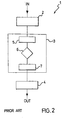
- Figure 2 shows a control device operating in Fuzzy logic, according to the prior art;
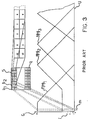
- Figure 3 illustrates diagrammatically the setting up of data in a term set, of the kind shown in Figure 1, within the memory of a Fuzzy controller as shown in Figure 2;
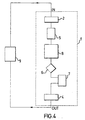
- Figure 4 is a general diagrammatic view of a looped circuit incorporating a Fuzzy controller according to the invention;
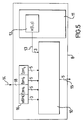
- Figure 5 is a diagrammatic view of a detail of the controller in Figure 4; and
- Figure 6 is a diagrammatic of a modified embodiment of the detail shown in Figure 5.
- With reference to Figure 1, the term set of a language or logic variable M is represented by a vectorial system wherein the so-called universe of discourse U is plotted along the abscissa axis, and the degree of truth or membership G along the ordinate axis.
- In such a case, the universe of discourse U and the degree of membership G are respectively sampled in one hundred and twenty eight points m and thirty two levels or values 1. The term set is made up of eight membership functions f(m)i which identify, within the universe of discourse U, an equal number of Fuzzy sets (i being the index of each membership function).
- In Figure 1, the membership functions f(m) have been numbered using indices i from zero to seven in increasing order from left to right. Taking, for instance, the point m=32 in the universe of discourse U, we get for the membership functions f(32)0,3-7 a
value 1 of the degree G of truth of zero, whilst for the membership function f(32)1 we get a value of thirty one and for the function f(32)2 a value of fifteen. - Coming back to the previously described example where the concept "temperature" is defined as the logic variable M, we can state that the term set shown in Figure 1 is a visualization of the "temperature" variable in vectorial form.
- A language variable of this type is ideally suited to mathematic modelling based on the Fuzzy logic.
- An electronic control device designed for operation in Fuzzy logic allows language variables of the type represented by the term set in Figure 1 to be modelled accordingly.
- With reference to Figure 2, at 1 is generally and schematically shown an electronic control device according to the prior art. The
controller 1 is basically an apparatus receiving as input signals corresponding to control physical variables, such as analog or digital signals from sensors, and performs predetermined Fuzzy logic inference operations to output selected control signals. - To this aim, the
controller 1 has an input, or a plurality of inputs, IN and an output, or plurality of outputs, OUT. In the embodiment shown in Figure 2, a single input and a single output have been preferred. - Each input IN is led to a corresponding converting device (fuzzyfier) 2 operative to convert an input signal to a logic information of the Fuzzy type, that is to a so-called membership function f(m).
- The
controller 1 further includes acentral control unit 3 wherein the Fuzzy logic membership functions f(m) are stored and the Fuzzy logic computation is also performed. - In particular, said
central unit 3 has a memory section 5 (IF memory) for storing only those values related to the membership functions f(m) which appear in the left-hand portion of the Fuzzy rules, and a memory section 7 (THEN memory) which only contains data related to the membership functions which appear in the right-hand portion of said Fuzzy rules. - The memories may be of the PROM, or EPROM, or even of the RAM type. Provided between the two
memory sections - The architecture of the
controller 1 is completed by a converting device (defuzzyfier) effective to provide an appropriate interface between thecontroller 1 and the outside world. - The loading procedure into the
memory section 5 of the prior-art controller 1, specifically in accordance with the aforesaid Warp method, will now be described with reference to Figure 3. - In Figure 3 there is shown diagrammatically, besides the
IF memory 5, a term set similar to that shown in Figure 1, which comprises eight membership functions f(m)i and a degree of truth G sampled in sixteen levels. - The
memory 5 is loaded with all the information required for the Fuzzy logic computation which follows in the calculating section 6. Each line q of thememory 5 represents a well-defined point m in the universe of discourse U. The depth of thememory 5 depends on the sampling of the universe of discourse U; accordingly, when U is sampled in one hundred and twenty eight points m (like in the example of Figure 1), the memory depth will be of one hundred and twenty eight lines. - The information is stored (in binary code) by sequentially writing, into each line q of the
memory 5, the value l of the degree G of truth of the eight membership functions f(m) at each given point m of the universe of discourse U. Thus, at the point m=1, we get thevalues 15/5/0/0/0/0/0/0, at the point m=2 thevalues 15/5/0/0/0/0/0/0, and so on. Each of these binary-coded lines constitutes a memory word. - The size of a memory word is determined by its length, namely the number of bits required to contain all the word information. In this specific case, with the degree of truth sampled in sixteen levels, four memory bits are needed for each membership function, for a total of thirty two bits.
- In Figure 3, the first four bits b1 of the memory word represent the degree of truth of the membership function f(m)1, the next four bits b2 the degree of truth of the membership function f(m)2, etc..
- The size of the
IF memory 5 is determined by its depth and by the length of the memory word. In the example of Figure 3, this size will be of 128*32 bits, while in the example of Figure 1 (where a degree of truth sampled in thirty two levels corresponds to five bits), it will be of 128*40 bits. - The prior-art storing method just described allows the electronic control device to operate at high computational rates and a good degree of resolution. However, a major drawback of that method resides, as we have seen, in the high memory space required for its implementation.
- On the other hand, according to this invention, a novel method for setting up the memory of the electronic control device, to be described, enables the size of the memory to be drastically cut down for the same computational rate and degree of resolution.
- This result is obtained, contrary to the teachings of the prior art, by storing into each line q of the
IF memory section 5 the only values l of those membership functions f(m) which have, at the points m of the universe of discourse U, a non-null (other-than-zero) value l of the degree of membership G. - In particular, the amount of values l of the membership functions f(m) stored in said
memory section 5 is determined according to the number of non-null values l of the membership functions f(m) at a predetermined point m of the universe of discourse U including the largest number of non-zero values. - Coming back to the term set of the example in Figure 1, the largest number of non-null values l is three and locates, for example, at the points m=64 and m=96. For this term set, the amount of values l of the membership functions f(m) that will be stored into each line of the memory is at most three, instead of eight of the prior art method.
- Advantageously, the length of the memory word, i.e. its dimension, is arranged to be dependent on said maximum number of non-null values.
- In a first preferred embodiment, the length of a word of the
IF memory section 5 is defined as follows:
- nf(m) is the number of non-null values at the point of the universe of discourse where this number is at a maximum;
- dim(G) is the size of the word required to represent the aggregate of the values l of the degree of truth G; and
- dim(f(m)) is the size of the word required to represent the aggregate of the indices i of the membership functions f(m).
- In the example of Figure 1, the coefficient nf(m) is, as previously mentioned, three, the coefficient dim(G) is equal to five bits (G is sampled in thirty two levels), and the coefficient dim(f(m)) is equal to three bits (there are eight membership functions f(m)).
- Substituting these values in the above cited definition, a word length of(3*5)+3)=18 bits is obtained, instead of forty bits of the prior art. The memory size will, therefore, be of 128*18 bits.
- Thus, for a given sampling of the universe of discourse U, the size of the
IF memory section 5, as optimized by the method just described, is much more compact than a memory size obtained by the prior art method. - The information which is written sequentially into each line of the
storage section 5 comprises the membership function f(m)i° which has, among the membership functions with non-null value, the lowest index i (i°), together with the values l of the degree of membership G of the membership functions f(m)i with non-null value, which in this specific example are at most three. For instance, at the point m=64 of the universe of discourse U, the word of the IF memory would contain the following binary coded information: f(64)3 / 9, 23, 7. - Compared with the prior art method of the previous example, all data concerning the membership functions with 1=0 are advantageously removed from each memory line, and between the membership functions f(m)i having a non-null value l, only the membership function with the lowest index i is stored.
- It can be appreciated that by this memory setting up method, part of the informations about the term set -- such as the part concerning data about the membership functions with values l equal to zero -- would not be coded and thus would go lost. In order to effect an appropriate extraction of the weights involved in the computation operations using Fuzzy rules, an effective-value restoring step of all the membership functions of the Term set is advantageously provided. In other words, the information issued from the
IF memory section 5 is regenerated during said restoring step before moving to the calculation step. - This restoring step comprises a comparison of the bits of a reference word coming from a program memory wherein all the required Fuzzy rules for the inference operations are stored, called w(frif) for simplicity, with the bits of a word containing the informations about a membership function f(m)i having non-null value, called w(f(m)i) for simplicity.
- For a clearer explanation of the mechanism which underlies said restoring step, attention is directed to the example just discussed, wherein the word of the
IF memory 5 at the point m=64 of the universe of discourse U was defined. - At said point, there are three membership functions with non-null values, and the function f(64)3 has the lowest i index (i°=3). The other two membership functions with non-null value have the index i equal to four and five, respectively. As can be seen, the membership functions with a non-zero value at the point m=64 are adjacent to one another. The same phenomenon also occurs at the other points m of the universe of discourse U (see, for example, points m=32 or m=96). Characteristically, in most of the Term sets employed in Fuzzy logic, the membership functions with non-null value are adjacent to one another.
- This feature, which allows to make up for the non-storing of all the membership functions f(m)i with non null values l into the
IF memory section 5, has been kept in mind when defining the control rules of the comparison procedure in said restoring step, and to obtain the bits of the words w(f(m)i. - In fact, based on the principle of adjacency of the membership functions having non-null value l, a comparison can be carried out not only between the bits of the word selected by the micro-encoder w(frif) and the bits of the stored word part coming from the IF memory 5 (w(f(m)i°), where i° is the lowest of the indices i of the membership functions with other-than-zero value, but also between the bits of w(frif) and the bits of the words which represent the unstored membership functions. The latter are adjacent to the membership function f(m)i°, i.e. they are the functions with the index i equal to i°+1, i°+2, etc. up to i°+(nf(m)-1) , where nf(m) is the number of non-null values l at the point of the universe of discourse whereat this number is at a maximum.
- In the example considered, with nf(m) equal to three, the above comparison may be described as follows: if the bit of w(frif) corresponds to the bit of w(f(64)3), then the weight that will be entered to the calculation step should correspond to the
value 1=9 associated with said membership function; if the bit of w(frif) corresponds to the bit of w(f(m)3+1), then the weight to be entered should correspond to thevalue 1=23 associated with said membership function, and so on. - On the contrary, if the bit of w(frif) does not correspond to any of the bits of w(f(64)3,3+1,3+2), then the weight outgoing from the restoring step should have a value of zero.
- Generalizing, it can be concluded that when the bits of w(frif) correspond to the bits of one of the words w(f(m)i°,...,i°+(nf(m)-1)), the selected weight outgoing from said restoring step will be the value l which corresponds to the i-th membership function f(m)i with w(frif) equal to w(f(m)i). Otherwise, said extracted weight will be zero.
- Stated in logic/mathematic language, this rule controlling the restoring step may be written as follows:


- where weight means the value selected during the restoring step, and
- lf(m)i°,...,i°+(nf(m)-1) is the value l of the degree of truth G of the i°,...,i°+(nf(m)-1)-th membership function f(m) with non-null value.
- Thus, by means of this restoring procedure, one is enabled to regenerate all the required informations for an appropriate Fuzzy logic computation without affecting the calculation rate of the electronic controller and the modelling degree of resolution.
- An electronic control device operating in accordance with the inventive method is shown in Figure 4. On comparing it with Figure 2, the same reference symbols denote parts of the device in common with the prior-art device.
- In the loop circuit shown in Figure 4, diagrammatically indicated at 9 is a system to be controlled. Said system sends signals concerning the physical control variables, to the input IN of the electronic controller generally and schematically indicated at 1. Once the signals reach the
controller 1, they are converted to Fuzzy logic informations by thefuzzyfier 2, and passed to theIF memory section 5, where the specific storing of only a part of the information is carried out. - The informations stored into the
IF memory 5 pass through abuffer section 8, to be described, where the restoring of that Fuzzy logic informations, which serve, in the calculating section 6, for the appropriate inference operations, is carried out. - Finally, the values obtained at 6 are stored into the
THEN memory section 7, reconverted to analog or digital signals by the defuzzyfier 4, and conveyed back to thesystem 9 from the output OUT of theelectronic controller 1. - The
IF memory section 5 is sized according to the number of non-zero values of the membership functions f(m) at a predetermined point m of the universe of discourse U having the largest number of non-null values. - It has been found that in nearly all of the Fuzzy applications, said largest number of non-null values varies between one and five, and is three in most cases. Thus, according to this first embodiment of the inventive method, the optimum size of the
memory 5 will preferably have a word length of eighteen bits. - The fact that, using a word length of eighteen bits, no more than a certain number of non-null values at the various points m of the universe of discourse U can be stored, is to be regarded as a merely apparent (and hence negligible) drawback of the device, since an electronic controller according to the invention can provide a good degree of resolution even when operating with a word length of the IF memory limited to just eighteen bits.
- As previously mentioned, the
electronic controller 1 of this invention advantageously includes abuffer section 8 interfacing theIF memory section 5 and the calculating section 6, to regenerate all the informations required for proper computation in Fuzzy logic. - This interfacing
buffer section 8 is shown more in detail in Figure 5, and mainly comprises acomparator 10 structured with a combinatory network, and aprogram memory section 11, also called "regenerative" for its function of regenerating or restoring of the effective values of the membership functions f(m). Thismemory 11 contains all the Fuzzy rules required for the inference operations. - The
program memory 11 contains a micro-encoder 12 which selects, within thememory 11, the previously described reference words w(frif). Theoutput bus 13 of the micro-encoder 12 is connected to thecomparator 10 input. - The word from the
memory section 5, as schematically shown at 16, is in turn presented to the input of thecomparator 10, wherein the above restoring step is carried out. The extracted value or weight outgoing from thecomparator 10 is then conveyed to the calculating section 6. The interconnection of thememory section 5 and thecomparator 10 is provided by an eighteenwires bus 14, and the interconnection of thecomparator 10 and the calculating section 6 is provided by the fivewires bus 15. - Shown in Figure 6 is an alternative embodiment of the interfacing
buffer section 8 illustrated in Figure 5, which only differs from the latter by thememory word 16 coming from thesection 5. - In this second embodiment of the invention, the interconnection of the
memory section 5 and thecomparator 10 is provided by a sixteenwires bus 14, since the size of the memory word is of sixteen bits only. The further reduction in length of the word is made possible by that the Fuzzy logic informations are stored into thememory section 5 in a slightly different manner compared to that of the first embodiment described above. - In fact, the information which is written sequentially into each line of the
memory section 5 advantageously comprises the membership functions f(m)i with non-null value l, except one, together with their corresponding values l of the degree of truth G. - As a result, at the point m=64 of the universe of discourse U in Figure 1, for example, the word of the IF memory 6 will contain the following binary coded information: f(64)3, 9 / f(54)4, 23.
- The length of the IF memory word is arranged to depend on the number of the non-zero values at the point in the universe of discourse where this number is largest, except one. Advantageously, the length of an
IF memory section 5 word is defined as follows:
- where nf(m)-1 is the number of non-null values at the point in the universe of discourse where this number is largest, except one.
- In the example of Figure 1, the coefficient nf(m)-1 is two, whereby a memory word length of 2*(5+3)=16 bits is obtained, instead of the forty bits of the prior art and the eighteen bits of the first embodiment of the invention. The memory size will, therefore, be of 128*16 bits.
- In a similar way as the previously described embodiment, the word outgoing from the
memory section 5 is regenerated in a so-called restoring step of the effective values of the membership functions f(m), to extract the weights involved in the inference rules which control the Fuzzy logic computation. - In accordance with this embodiment, the weights extraction is carried out during said restoring step by a comparison of the bits of a reference word w(frif) contained in the
program memory 11 -- wherein all the Fuzzy rules required for the inference operations are stored -- with the bits of a part w(f(m)i of the word outgoing from saidmemory section 5 concerning the membership functions f(m)i. - Stated in a logic/mathematic language, the rule which controls the restoring step may be written as follows:


- where: weight means the value which has been selected during the restoring step, and
- lf(m)i is the value (l) of the degree of truth (G) of the i-th membership function (f(m)).
- A possible disadvantage of this second embodiment compared to the first resides in that the extraction of the weights involved in the computation operations using inference rules is slightly less accurate.
- In fact, the information concerning the membership function with a value l other than zero which is not coded, can no longer be recovered during the next restoring step, and is definitively lost.
- Obviously, this particular embodiment of the method for setting up the memory according to the invention cannot be applied to the (very few) cases of Term sets having a coefficient nf(m) of 1.
- A further, and more preferred, embodiment of the method for setting up the memory according to the present invention, will now be described with reference to Figures 4, 5 and 6.
- A command accessible by the user is connected inside the
electronic control device 1 shown in Figure 4, also called configuration flag, not shown because conventional, which enables the user to operate the first or second of the embodiments described above. - In this way, and without having to act on the structure of the
IF memory section 5, the operation flexibility of the control device can be improved, optimizing the use of the memory space. - According to this embodiment, the size of the
memory 5 is not modified, but the meaning of the data encoded therein is changed. - In other words, if on examining the Term set to be controlled, it appears more suitable to memorize a single membership function f(m)i° together with the values l of the membership functions with non-null value, the information which will be written into each line of the
memory 5 will be that defined according to the first embodiment. - If, on the other hand, it is preferable to code for each non-null value l, except one, the corresponding membership function f(m)i, then the information which will be written into each line of the
memory 5 will be that defined according the second embodiment. - As previously outlined, the
IF memory section 5 is advantageously sized according to the number of non-null values at the point in the universe of discourse where this number is the largest (nf(m)). - To realize this embodiment, the size of the
IF memory section 5 must have a word length capable of containing the information concerning the membership function, as described in connection with the two previous embodiments. - Therefore, if nf(m) is three or less, the word length of the
memory 5 will be the word length defined in the first embodiment. On the contrary, if nf(m) is greater than three, the word length of thememory 5 will correspond to the definition given in the second embodiment. - Since in most cases the coefficient nf(m) is three, the optimum size of the
memory 5 will have a word length of eighteen bits. - Moreover, It was found that this memory setting up method does meet the requirements of very many Fuzzy logic applications.
- In this respect, it is important to note that the word length of the
memory section 5, as defined in the first two embodiments above cited, is only slightly affected by the number of the membership variables, which is a parameter that usually varies between Term sets, but is heavily dependent on the coefficient nf(m), the latter being a constant parameter for most Term sets, as pointed out above. - Thus, a memory sized to suit said maximum number of non-null values (nf(m)) will be most likely suitable in a wide range of Fuzzy logic applications.
- Of the principal advantages afforded by the present method and its implementing device, it may matter to observe that it becomes for the first time possible to drastically cut down the required memory capacity for hardware implementing the membership functions, while operating at a high computation rate and a high degree of resolution, and without imposing restrictions on the forms of said membership functions.
Claims (18)
- A method for setting up the memory of an electronic controller operating in Fuzzy logic whereby predetermined membership functions (f(m)) of logic variables (M), defined within a so-called universe of discourse (U) sampled in a finite number of points (m), are subjected to inference operations basically configured by IF/THEN rules with at least one front preposition or IF-part of the fuzzy rules and at least one rear implication or THEN-part of the fuzzy rules, said controller further comprising a central control unit (3) provided with a memory section (5) for storing predetermined values (l) of the membership functions (f(m)) appearing in the front or IF part of the Fuzzy rules and having a predetermined degree of truth or membership (G), characterized in that the only values (l) of those membership functions (f(m)) which have a value (l) of the degree of membership (G) other than zero at the points (m) of the universe of discourse (U), are stored in said memory section (5); in that the length of a word of said memory section (5) is dependent on said number of non-zero values (l); in that the length of said memory word is defined by the following formula:
 - where, nf(m) is the number of the non-zero values (l) at the point (m) of the universe of discourse (U) where this number is the largest;- dim(G) is the required word size to represent the aggregate of the values (l) of the degree of membership (G), and- dim(f(m)) is the required word size to represent the number of the membership functions (f(m));and in that the information contained in the word outgoing from said memory section (5) comprises, sequentially for each point (m) of the universe of discourse (U), a i-th membership function (f(m)i°)) having, among the membership functions with a non-zero value (l), the lowest index (i°), together with the values (l) of the degree of truth (G) of the membership functions (f(m)i) with non-zero value (l).
 - A method for setting up the memory of an electronic controller operating in Fuzzy logic whereby predetermined membership functions (f(m)) of logic variables (M), defined within a so-called universe of discourse (U) sampled in a finite number of points (m), are subjected to inference operations basically configured by IF/THEN rules with at least one front preposition or IF-part of the fuzzy rules and at least one rear implication or THEN-part of the fuzzy rules, or said controller further comprising a central control unit (3) provided with a memory section (5) for storing predetermined values (l) of the membership functions (f(m)) appearing in the front or IF part of the Fuzzy rules and having a predetermined degree of truth or membership (G), characterized in that the only values (l) of those membership functions (f(m)) which have a value (l) of the degree of membership (G) other than zero at the points (m) of the universe of discourse (U), are stored in said memory section (5); in that the length of a word of said memory section (5) is dependent on said number of non-zero values (l); and in that the length of said memory word is defined by the following formula:
 - where nf(m)-1 is the number of non-null values (l) at the point (m) of the universe of discourse (U) where this number is largest, except one,- dim(G) is the required word size to represent the aggregate of the values (l) of the degree of membership (G), and- dim(f(m)) is the required word size to represent the number of the membership functions (f(m)).
 - A method according to Claims 1 and 2, characterized in that the amount of values (l) of the membership functions (f(m)) stored into said memory section (5) is determined according to the number of the non-zero values (l) of those membership functions (f(m)) which have at a predetermined point (m) of the universe of discourse (U) the largest number of non-zero values (l).
- A method according to Claim 3, characterized in that said amount of non-null values (l) is three.
- A method according to Claim 1, characterized in that the information contained in the word outgoing from said memory section (5) comprises, sequentially for each point (m) in the universe of discourse (U), the membership functions (f(m)) with non-zero value (l), except one, associated with the corresponding value (l) of the degree of membership (G).
- A method according to Claim 2, characterized in that said word outgoing from the memory section (5) is regenerated by a restoring step of the effective values of the membership functions (f(m)), to extract predetermined weights involved in the inference rules which control the Fuzzy logic computation, and that the extraction of the weights in said restoring step is carried out by comparing the bits of a reference word (w(frif)) contained in a program memory (11), wherein all the required Fuzzy rules for the inference operations are stored, with the bits of a word (w(f(m)i)) comprising the informations concerning a membership function (f(m)i) with non-null value.
- A method according to Claim 6, characterized in that said word (w(f(m)i)) comprising the information about a membership function (f(m)i) with non-null value, corresponds to that part of the word outgoing from said memory section (5) concerning the i-th membership function (f(m)i°) which has, of the membership functions with a non-zero value (l), the lowest index (i°), or corresponds to a word concerning a membership function (f(m)i) with non-zero value (l) having an index (i) adjacent to said lowest index (i°).
- A method according to Claim 7, characterized in that said comparison of the bits of said word (w(f(m)i)), comprising the information concerning a membership function (f(m)i) with non-null value, with the bits of said reference word (w(frif)) coming from said program memory (11) obeys the following logic relationship:

 - where: weight means the value selected during the restoring step,- lf(m)i°,...,i°+(nf(m)-1) is the value (l) of the degree of truth (G) of the i°,...,i°+(nf(m)-1)-th membership function (f(m)), and- nf(m)-1 is the number of non-null values (l) at the point (m) of the universe of discourse (U) where this number is the largest, less one.
 - A method according to Claim 5, characterized in that said word outgoing from the memory section (5) is regenerated during a restoring step of the effective values of the membership functions (f(m)), to extract predetermined weights involved in the inference rules which control the Fuzzy logic computation, and that the weights extraction in said restoring step is carried out by comparing the bits of a reference word (w(frif)) contained in a program memory (11), wherein all the required Fuzzy rules for the inference operations are stored, with the bits of a part (w(f(m)i) of the word outgoing from said memory section (5) concerning the membership functions (f(m)i).
- A method according to Claim 9, characterized in that said comparison of the bits of said part (w(f(m)i)) of word outgoing from the memory section with the bits of said reference word (w(frif)) coming from said program memory (11) obeys the following logic relationship:

 - where: weight means the value selected during the restoring step, and- lf(m)i is the value (l) of the degree of truth (G) of the i-th membership function (f(m)).
 - A method according to Claims 2, 5 to 10, characterized in that the information which is encoded within said IF memory section (5) may be of the type as defined in Claim 2 or 5, depending on the language variables to be controlled.
- An electronic control device operating in Fuzzy logic whereby predetermined membership functions (f(m)) of logic variables (M), defined within a so-called universe of discourse (U) sampled in a finite number of points (m), are subjected to inference operations basially configured by IF/THEN rules with at least one front preposition or IF-part of the fuzzy rules and at least one rear implication or THEN-part of the fuzzy rules, said controller further including a central control unit (3) provided with a memory section (5) for storing predetermined values (l) of the membership functions (f(m)) appearing in the front or IF part of the Fuzzy rules and having a predetermined degree of truth or membership (G), characterized in that the capacity of said memory section (5) is sized according to the number (nf(m)) of non-zero values (l) of the membership functions (f(m)) at the point (m) of the universe of discourse (U) with the largest number of non-zero values (l) a defined by the following formula:
 - where, nf(m) is the number of the non-zero values (l) at the point (m) of the universe of discourse (U) where this number is the largest;- dim(G) is the required word size to represent the aggregate of the values (l) of the degree of membership (G), and- dim(f(m)) is the required word size to represent the number of the membership functions (f(m));and in that the word length of said memory section (5) is such as to sequentially contain the information concerning a i-th membership function (f(m)i°)) having, between the membership functions with non-zero value (l), the lowest index (i°), together with the values (l) of the degree of truth (G) of the membership functions (f(m)i) with non-zero value (l).
 - An electronic control device operating in Fuzzy logic whereby predetermined membership functions (f(m)) of logic variables (M), defined within a so-called universe of discourse (U) sampled in a finite number of points (m), are subjected to inference operations basically configured by IF/THEN rules with at least one front preposition or IF-part of the fuzzy rules and at least one rear implication or THEN-part of the fuzzy rules, said controller further including a central control unit (3) provided with a memory section (5) for storing predetermined values (l) of the membership functions (f(m)) appearing in the front or IF part of the Fuzzy rules and having a predetermined degree of truth or membership (G), characterized in that the capacity of said memory section (5) is sized according to the number of non-zero values (l) of the membership functions (f(m)) at the point (m) of the universe of discourse (U) with the largest number of non-zero values (l) a defined by the following formula:
 - where nf(m)-1 is the number of non-null values (l) at the point (m) of the universe of discourse (U) where this number is largest, except one,- dim(G) is the required word size to represent the aggregate of the values (l) of the degree of membership (G), and- dim(f(m)) is the required word size to represent the number of the membership functions (f(m));and characterized in that the word length of said memory section (5) is such as to sequentially contain the information concerning said membership functions (f(m)) with non-zero value (l), but one, together with the corresponding values (l) of the degree of membership (G) .
 - A device according to Claims 12 and 13, characterized in that it further comprises a calculating section (6) for the Fuzzy logic inference operations, and between said memory section (5) and said calculating section (6), a buffer section (8) , regenerating the effective values of the membership functions (f(m)) to extract predetermined weights involved in the inference rules of the Fuzzy logic computation.
- An electronic control device according to Claim 14, characterized in that said buffer section (8) comprises a program memory (11), wherein all the Fuzzy rules required for the inference operations are stored, connected to the output of a comparator (10) for comparison of the bits of a word (w(f(m)i)) (5) comprising the informations about a membership function (f(m)i) having a non-null value, with the bits of a reference word (w(frif)) contained in said program memory (11).
- An electronic control device according to Claim 15, characterized in that said comparator (10) is connected to the program memory (11) through a micro-encoder (12) which selects said reference words (w(frif)) within the program memory (11).
- An electronic control device according to Claims 15 and 16, characterized in that said comparator (10) has inputs connected to respective outputs of the IF memory section (5) and of the program memory (11), and is connected to the output of the calculating section (6).
- An electronic control device according to Claims 12 and 13, characterized in that it further comprises a command, accessible by the user, to enable encoding within said IF memory section (5) of the information concerning the language variables as defined in Claim 12 or 13, depending on the language variables to be controlled.
Priority Applications (4)
| Application Number | Priority Date | Filing Date | Title |
|---|---|---|---|
| DE69313622T DE69313622T2 (en) | 1993-06-09 | 1993-06-09 | Storage organization method for a control with fuzzy logic and device for it |
| EP93830252A EP0628903B1 (en) | 1993-06-09 | 1993-06-09 | Memory organization method for a fuzzy logic controller, and corresponding device |
| JP6125397A JPH07141183A (en) | 1993-06-09 | 1994-06-07 | Method and electronic control device for loading memory of an operating electronic controller using fuzzy logic |
| US08/257,775 US5621860A (en) | 1993-06-09 | 1994-06-09 | Memory organization method for a fuzzy logic controller and corresponding device |
Applications Claiming Priority (1)
| Application Number | Priority Date | Filing Date | Title |
|---|---|---|---|
| EP93830252A EP0628903B1 (en) | 1993-06-09 | 1993-06-09 | Memory organization method for a fuzzy logic controller, and corresponding device |
Publications (2)
| Publication Number | Publication Date |
|---|---|
| EP0628903A1 EP0628903A1 (en) | 1994-12-14 |
| EP0628903B1 true EP0628903B1 (en) | 1997-09-03 |
Family
ID=8215177
Family Applications (1)
| Application Number | Title | Priority Date | Filing Date |
|---|---|---|---|
| EP93830252A Expired - Lifetime EP0628903B1 (en) | 1993-06-09 | 1993-06-09 | Memory organization method for a fuzzy logic controller, and corresponding device |
Country Status (4)
| Country | Link |
|---|---|
| US (1) | US5621860A (en) |
| EP (1) | EP0628903B1 (en) |
| JP (1) | JPH07141183A (en) |
| DE (1) | DE69313622T2 (en) |
Families Citing this family (6)
| Publication number | Priority date | Publication date | Assignee | Title |
|---|---|---|---|---|
| DE59607523D1 (en) * | 1995-07-28 | 2001-09-27 | Infineon Technologies Ag | Method for multiple use of a rule base in a fuzzy logic coprocessor |
| IT1283672B1 (en) * | 1996-08-02 | 1998-04-23 | Sgs Thomson Microelectronics | ELECTRONIC PROCESSOR OPERATING IN FUZZY LOGIC |
| US6430544B1 (en) | 1998-08-11 | 2002-08-06 | Ronald Childress | Single variable priority constraint fuzzy control system |
| DE60037423D1 (en) | 2000-10-02 | 2008-01-24 | St Microelectronics Srl | Method and circuit for calculating and storing the degree of membership of a fuzzy set |
| CN103605286B (en) * | 2013-11-13 | 2016-04-20 | 沈阳大学 | Fuzzy control method for regulating transmitting power of wireless equipment |
| CN112465337B (en) * | 2020-11-25 | 2024-10-15 | 重庆邮电大学 | Sewage treatment plant site selection method based on hesitant fuzzy language term set |
Family Cites Families (2)
| Publication number | Priority date | Publication date | Assignee | Title |
|---|---|---|---|---|
| US5287432A (en) * | 1989-09-16 | 1994-02-15 | Sony Corporation | Method and apparatus for effecting fuzzy control |
| JPH04100153A (en) * | 1990-06-28 | 1992-04-02 | Yaskawa Electric Corp | Fuzzy control calculation method |
-
1993
- 1993-06-09 EP EP93830252A patent/EP0628903B1/en not_active Expired - Lifetime
- 1993-06-09 DE DE69313622T patent/DE69313622T2/en not_active Expired - Fee Related
-
1994
- 1994-06-07 JP JP6125397A patent/JPH07141183A/en active Pending
- 1994-06-09 US US08/257,775 patent/US5621860A/en not_active Expired - Lifetime
Also Published As
| Publication number | Publication date |
|---|---|
| EP0628903A1 (en) | 1994-12-14 |
| JPH07141183A (en) | 1995-06-02 |
| DE69313622D1 (en) | 1997-10-09 |
| DE69313622T2 (en) | 1998-01-22 |
| US5621860A (en) | 1997-04-15 |
Similar Documents
| Publication | Publication Date | Title |
|---|---|---|
| Laughery | Computer simulation of short-term memory: A component-decay model | |
| US5243687A (en) | Fuzzy computer system having a fuzzy inference processing circuit for controlling and adapting output signal to the set membership signal | |
| EP0628902B1 (en) | Memory organization method for a fuzzy logic controller, and corresponding device | |
| US6424958B1 (en) | Coding and storing method for fuzzy logic rules and circuit architecture for processing such rules | |
| US4413326A (en) | Floating point division control | |
| US5621860A (en) | Memory organization method for a fuzzy logic controller and corresponding device | |
| US6158043A (en) | Signal processing apparatus and method | |
| US4817027A (en) | Method and apparatus for evaluating partial derivatives | |
| US5724483A (en) | Fuzzy logic electronic controller and associated method for setting up memories thereof | |
| CA1109968A (en) | Queue structure for a data processing system | |
| CA2046653C (en) | Signal processing apparatus and method | |
| KR970004526B1 (en) | Fuzzy reasoning processor and method and rule setting apparatus and method | |
| US5615303A (en) | Circuit for computing membership function values in a fuzzy logic controller | |
| US5790755A (en) | Fuzzy logic electronic controller architecture having two section membership function memory | |
| EP0660228B1 (en) | An adaptation degree operation method and apparatus of membership function data | |
| HK1001106B (en) | Signal processing apparatus and method | |
| CA2331477A1 (en) | Method and apparatus for training a state machine | |
| EP0333148A2 (en) | A decoding type select logic generating system | |
| Gasós et al. | Adapting query representation to improve retrieval in a fuzzy database | |
| DE3852343T2 (en) | Integrated processing unit, in particular for spoken word sequence recognition systems. | |
| JPH03144701A (en) | Fuzzy controller and its operating method | |
| KR910009099B1 (en) | Speedup Method of Computer Oriental Diagnosis | |
| Head | Adherence equivalence is decidable for DOL languages | |
| Gammerman et al. | SYSEX: An expert system for biological identification | |
| JPH03225427A (en) | Fuzzy reasoning system |
Legal Events
| Date | Code | Title | Description |
|---|---|---|---|
| PUAI | Public reference made under article 153(3) epc to a published international application that has entered the european phase |
Free format text: ORIGINAL CODE: 0009012 |
|
| AK | Designated contracting states |
Kind code of ref document: A1 Designated state(s): DE FR GB IT |
|
| 17P | Request for examination filed |
Effective date: 19950607 |
|
| 17Q | First examination report despatched |
Effective date: 19950828 |
|
| GRAG | Despatch of communication of intention to grant |
Free format text: ORIGINAL CODE: EPIDOS AGRA |
|
| GRAH | Despatch of communication of intention to grant a patent |
Free format text: ORIGINAL CODE: EPIDOS IGRA |
|
| GRAH | Despatch of communication of intention to grant a patent |
Free format text: ORIGINAL CODE: EPIDOS IGRA |
|
| GRAA | (expected) grant |
Free format text: ORIGINAL CODE: 0009210 |
|
| AK | Designated contracting states |
Kind code of ref document: B1 Designated state(s): DE FR GB IT |
|
| ITF | It: translation for a ep patent filed | ||
| REF | Corresponds to: |
Ref document number: 69313622 Country of ref document: DE Date of ref document: 19971009 |
|
| ET | Fr: translation filed | ||
| PLBE | No opposition filed within time limit |
Free format text: ORIGINAL CODE: 0009261 |
|
| STAA | Information on the status of an ep patent application or granted ep patent |
Free format text: STATUS: NO OPPOSITION FILED WITHIN TIME LIMIT |
|
| 26N | No opposition filed | ||
| REG | Reference to a national code |
Ref country code: GB Ref legal event code: IF02 |
|
| PGFP | Annual fee paid to national office [announced via postgrant information from national office to epo] |
Ref country code: DE Payment date: 20020612 Year of fee payment: 10 |
|
| PG25 | Lapsed in a contracting state [announced via postgrant information from national office to epo] |
Ref country code: DE Free format text: LAPSE BECAUSE OF NON-PAYMENT OF DUE FEES Effective date: 20040101 |
|
| PGFP | Annual fee paid to national office [announced via postgrant information from national office to epo] |
Ref country code: FR Payment date: 20040608 Year of fee payment: 12 |
|
| PGFP | Annual fee paid to national office [announced via postgrant information from national office to epo] |
Ref country code: GB Payment date: 20040609 Year of fee payment: 12 |
|
| PG25 | Lapsed in a contracting state [announced via postgrant information from national office to epo] |
Ref country code: IT Free format text: LAPSE BECAUSE OF NON-PAYMENT OF DUE FEES;WARNING: LAPSES OF ITALIAN PATENTS WITH EFFECTIVE DATE BEFORE 2007 MAY HAVE OCCURRED AT ANY TIME BEFORE 2007. THE CORRECT EFFECTIVE DATE MAY BE DIFFERENT FROM THE ONE RECORDED. Effective date: 20050609 Ref country code: GB Free format text: LAPSE BECAUSE OF NON-PAYMENT OF DUE FEES Effective date: 20050609 |
|
| PG25 | Lapsed in a contracting state [announced via postgrant information from national office to epo] |
Ref country code: FR Free format text: LAPSE BECAUSE OF NON-PAYMENT OF DUE FEES Effective date: 20060228 |
|
| GBPC | Gb: european patent ceased through non-payment of renewal fee |
Effective date: 20050609 |
|
| REG | Reference to a national code |
Ref country code: FR Ref legal event code: ST Effective date: 20060228 |