EP0625985B1 - Method and ring-opened purine compounds for labeling polynucleotides - Google Patents
Method and ring-opened purine compounds for labeling polynucleotides Download PDFInfo
- Publication number
- EP0625985B1 EP0625985B1 EP93900665A EP93900665A EP0625985B1 EP 0625985 B1 EP0625985 B1 EP 0625985B1 EP 93900665 A EP93900665 A EP 93900665A EP 93900665 A EP93900665 A EP 93900665A EP 0625985 B1 EP0625985 B1 EP 0625985B1
- Authority
- EP
- European Patent Office
- Prior art keywords
- polynucleotide
- formyl
- group
- nucleotide
- purine
- Prior art date
- Legal status (The legal status is an assumption and is not a legal conclusion. Google has not performed a legal analysis and makes no representation as to the accuracy of the status listed.)
- Expired - Lifetime
Links
- 108091033319 polynucleotide Proteins 0.000 title claims abstract description 139
- 102000040430 polynucleotide Human genes 0.000 title claims abstract description 139
- 239000002157 polynucleotide Substances 0.000 title claims abstract description 139
- 238000000034 method Methods 0.000 title claims abstract description 102
- 238000002372 labelling Methods 0.000 title claims abstract description 40
- 125000000561 purinyl group Chemical class N1=C(N=C2N=CNC2=C1)* 0.000 title claims 3
- 125000005647 linker group Chemical group 0.000 claims abstract description 34
- RAXXELZNTBOGNW-UHFFFAOYSA-N imidazole Natural products C1=CNC=N1 RAXXELZNTBOGNW-UHFFFAOYSA-N 0.000 claims abstract description 27
- 230000000903 blocking effect Effects 0.000 claims abstract description 26
- 150000003212 purines Chemical class 0.000 claims abstract description 24
- 239000000126 substance Substances 0.000 claims abstract description 24
- 230000015572 biosynthetic process Effects 0.000 claims abstract description 21
- 238000003786 synthesis reaction Methods 0.000 claims abstract description 19
- 239000003153 chemical reaction reagent Substances 0.000 claims abstract description 17
- 230000002255 enzymatic effect Effects 0.000 claims abstract description 11
- 229940083251 peripheral vasodilators purine derivative Drugs 0.000 claims abstract description 8
- YBJHBAHKTGYVGT-ZKWXMUAHSA-N (+)-Biotin Chemical compound N1C(=O)N[C@@H]2[C@H](CCCCC(=O)O)SC[C@@H]21 YBJHBAHKTGYVGT-ZKWXMUAHSA-N 0.000 claims description 56
- 239000000523 sample Substances 0.000 claims description 53
- 150000001875 compounds Chemical class 0.000 claims description 39
- 238000006243 chemical reaction Methods 0.000 claims description 36
- 108091034117 Oligonucleotide Proteins 0.000 claims description 31
- KDCGOANMDULRCW-UHFFFAOYSA-N 7H-purine Chemical group N1=CNC2=NC=NC2=C1 KDCGOANMDULRCW-UHFFFAOYSA-N 0.000 claims description 30
- 229960002685 biotin Drugs 0.000 claims description 29
- 235000020958 biotin Nutrition 0.000 claims description 29
- 239000011616 biotin Substances 0.000 claims description 29
- UYTPUPDQBNUYGX-UHFFFAOYSA-N guanine Chemical class O=C1NC(N)=NC2=C1N=CN2 UYTPUPDQBNUYGX-UHFFFAOYSA-N 0.000 claims description 27
- VAYGXNSJCAHWJZ-UHFFFAOYSA-N dimethyl sulfate Chemical group COS(=O)(=O)OC VAYGXNSJCAHWJZ-UHFFFAOYSA-N 0.000 claims description 22
- 102000004190 Enzymes Human genes 0.000 claims description 21
- 108090000790 Enzymes Proteins 0.000 claims description 21
- 125000002485 formyl group Chemical group [H]C(*)=O 0.000 claims description 21
- 239000002585 base Substances 0.000 claims description 19
- -1 imidazole ring N7-alkylated purine nucleotide Chemical class 0.000 claims description 19
- 125000003729 nucleotide group Chemical group 0.000 claims description 19
- 239000002773 nucleotide Substances 0.000 claims description 18
- 239000001226 triphosphate Substances 0.000 claims description 18
- 235000011178 triphosphate Nutrition 0.000 claims description 18
- 239000000758 substrate Substances 0.000 claims description 16
- UNXRWKVEANCORM-UHFFFAOYSA-N triphosphoric acid Chemical compound OP(O)(=O)OP(O)(=O)OP(O)(O)=O UNXRWKVEANCORM-UHFFFAOYSA-N 0.000 claims description 14
- 125000000217 alkyl group Chemical group 0.000 claims description 13
- 230000027455 binding Effects 0.000 claims description 13
- SHIBSTMRCDJXLN-UHFFFAOYSA-N Digoxigenin Natural products C1CC(C2C(C3(C)CCC(O)CC3CC2)CC2O)(O)C2(C)C1C1=CC(=O)OC1 SHIBSTMRCDJXLN-UHFFFAOYSA-N 0.000 claims description 11
- QONQRTHLHBTMGP-UHFFFAOYSA-N digitoxigenin Natural products CC12CCC(C3(CCC(O)CC3CC3)C)C3C11OC1CC2C1=CC(=O)OC1 QONQRTHLHBTMGP-UHFFFAOYSA-N 0.000 claims description 11
- SHIBSTMRCDJXLN-KCZCNTNESA-N digoxigenin Chemical group C1([C@@H]2[C@@]3([C@@](CC2)(O)[C@H]2[C@@H]([C@@]4(C)CC[C@H](O)C[C@H]4CC2)C[C@H]3O)C)=CC(=O)OC1 SHIBSTMRCDJXLN-KCZCNTNESA-N 0.000 claims description 11
- 108090001008 Avidin Proteins 0.000 claims description 10
- 239000002213 purine nucleotide Substances 0.000 claims description 10
- 238000005804 alkylation reaction Methods 0.000 claims description 9
- 239000000872 buffer Substances 0.000 claims description 9
- 230000000295 complement effect Effects 0.000 claims description 8
- 125000006239 protecting group Chemical group 0.000 claims description 8
- 238000002965 ELISA Methods 0.000 claims description 7
- IJGRMHOSHXDMSA-UHFFFAOYSA-N Atomic nitrogen Chemical compound N#N IJGRMHOSHXDMSA-UHFFFAOYSA-N 0.000 claims description 6
- 108010090804 Streptavidin Proteins 0.000 claims description 6
- 239000002168 alkylating agent Substances 0.000 claims description 6
- 229940100198 alkylating agent Drugs 0.000 claims description 6
- 230000008569 process Effects 0.000 claims description 6
- 229910052757 nitrogen Inorganic materials 0.000 claims description 5
- 230000008878 coupling Effects 0.000 claims description 4
- 238000010168 coupling process Methods 0.000 claims description 4
- 238000005859 coupling reaction Methods 0.000 claims description 4
- 125000002883 imidazolyl group Chemical group 0.000 claims description 4
- 230000007935 neutral effect Effects 0.000 claims description 4
- 150000004753 Schiff bases Chemical group 0.000 claims description 3
- 125000003277 amino group Chemical group 0.000 claims description 3
- 125000002496 methyl group Chemical group [H]C([H])([H])* 0.000 claims description 3
- 238000002156 mixing Methods 0.000 claims description 3
- 239000007787 solid Substances 0.000 claims description 3
- 230000002152 alkylating effect Effects 0.000 claims description 2
- 125000001797 benzyl group Chemical group [H]C1=C([H])C([H])=C(C([H])=C1[H])C([H])([H])* 0.000 claims description 2
- DENRZWYUOJLTMF-UHFFFAOYSA-N diethyl sulfate Chemical compound CCOS(=O)(=O)OCC DENRZWYUOJLTMF-UHFFFAOYSA-N 0.000 claims description 2
- 229940008406 diethyl sulfate Drugs 0.000 claims description 2
- 125000001495 ethyl group Chemical group [H]C([H])([H])C([H])([H])* 0.000 claims description 2
- 239000012491 analyte Substances 0.000 claims 10
- VVTJOJFGINNAEB-UHFFFAOYSA-N purine-7-carbaldehyde Chemical compound C1=NC=C2N(C=O)C=NC2=N1 VVTJOJFGINNAEB-UHFFFAOYSA-N 0.000 claims 2
- 238000007126 N-alkylation reaction Methods 0.000 claims 1
- 239000003513 alkali Substances 0.000 claims 1
- 230000009137 competitive binding Effects 0.000 claims 1
- 230000003100 immobilizing effect Effects 0.000 claims 1
- 239000012434 nucleophilic reagent Substances 0.000 claims 1
- 150000008300 phosphoramidites Chemical group 0.000 claims 1
- 238000011002 quantification Methods 0.000 claims 1
- 125000002221 trityl group Chemical group [H]C1=C([H])C([H])=C([H])C([H])=C1C([*])(C1=C(C(=C(C(=C1[H])[H])[H])[H])[H])C1=C([H])C([H])=C([H])C([H])=C1[H] 0.000 claims 1
- 238000001212 derivatisation Methods 0.000 abstract description 6
- 108020004414 DNA Proteins 0.000 description 114
- 125000001424 substituent group Chemical group 0.000 description 28
- 238000009396 hybridization Methods 0.000 description 26
- 108091032973 (ribonucleotides)n+m Proteins 0.000 description 22
- 150000007523 nucleic acids Chemical group 0.000 description 20
- HEMHJVSKTPXQMS-UHFFFAOYSA-M Sodium hydroxide Chemical compound [OH-].[Na+] HEMHJVSKTPXQMS-UHFFFAOYSA-M 0.000 description 18
- 239000002777 nucleoside Substances 0.000 description 18
- 102000039446 nucleic acids Human genes 0.000 description 16
- 108020004707 nucleic acids Proteins 0.000 description 16
- 150000003833 nucleoside derivatives Chemical class 0.000 description 13
- 108090000623 proteins and genes Proteins 0.000 description 12
- 238000007142 ring opening reaction Methods 0.000 description 12
- 102000004169 proteins and genes Human genes 0.000 description 11
- IJJWOSAXNHWBPR-HUBLWGQQSA-N 5-[(3as,4s,6ar)-2-oxo-1,3,3a,4,6,6a-hexahydrothieno[3,4-d]imidazol-4-yl]-n-(6-hydrazinyl-6-oxohexyl)pentanamide Chemical compound N1C(=O)N[C@@H]2[C@H](CCCCC(=O)NCCCCCC(=O)NN)SC[C@@H]21 IJJWOSAXNHWBPR-HUBLWGQQSA-N 0.000 description 10
- JLCPHMBAVCMARE-UHFFFAOYSA-N [3-[[3-[[3-[[3-[[3-[[3-[[3-[[3-[[3-[[3-[[3-[[5-(2-amino-6-oxo-1H-purin-9-yl)-3-[[3-[[3-[[3-[[3-[[3-[[5-(2-amino-6-oxo-1H-purin-9-yl)-3-[[5-(2-amino-6-oxo-1H-purin-9-yl)-3-hydroxyoxolan-2-yl]methoxy-hydroxyphosphoryl]oxyoxolan-2-yl]methoxy-hydroxyphosphoryl]oxy-5-(5-methyl-2,4-dioxopyrimidin-1-yl)oxolan-2-yl]methoxy-hydroxyphosphoryl]oxy-5-(6-aminopurin-9-yl)oxolan-2-yl]methoxy-hydroxyphosphoryl]oxy-5-(6-aminopurin-9-yl)oxolan-2-yl]methoxy-hydroxyphosphoryl]oxy-5-(6-aminopurin-9-yl)oxolan-2-yl]methoxy-hydroxyphosphoryl]oxy-5-(6-aminopurin-9-yl)oxolan-2-yl]methoxy-hydroxyphosphoryl]oxyoxolan-2-yl]methoxy-hydroxyphosphoryl]oxy-5-(5-methyl-2,4-dioxopyrimidin-1-yl)oxolan-2-yl]methoxy-hydroxyphosphoryl]oxy-5-(4-amino-2-oxopyrimidin-1-yl)oxolan-2-yl]methoxy-hydroxyphosphoryl]oxy-5-(5-methyl-2,4-dioxopyrimidin-1-yl)oxolan-2-yl]methoxy-hydroxyphosphoryl]oxy-5-(5-methyl-2,4-dioxopyrimidin-1-yl)oxolan-2-yl]methoxy-hydroxyphosphoryl]oxy-5-(6-aminopurin-9-yl)oxolan-2-yl]methoxy-hydroxyphosphoryl]oxy-5-(6-aminopurin-9-yl)oxolan-2-yl]methoxy-hydroxyphosphoryl]oxy-5-(4-amino-2-oxopyrimidin-1-yl)oxolan-2-yl]methoxy-hydroxyphosphoryl]oxy-5-(4-amino-2-oxopyrimidin-1-yl)oxolan-2-yl]methoxy-hydroxyphosphoryl]oxy-5-(4-amino-2-oxopyrimidin-1-yl)oxolan-2-yl]methoxy-hydroxyphosphoryl]oxy-5-(6-aminopurin-9-yl)oxolan-2-yl]methoxy-hydroxyphosphoryl]oxy-5-(4-amino-2-oxopyrimidin-1-yl)oxolan-2-yl]methyl [5-(6-aminopurin-9-yl)-2-(hydroxymethyl)oxolan-3-yl] hydrogen phosphate Polymers Cc1cn(C2CC(OP(O)(=O)OCC3OC(CC3OP(O)(=O)OCC3OC(CC3O)n3cnc4c3nc(N)[nH]c4=O)n3cnc4c3nc(N)[nH]c4=O)C(COP(O)(=O)OC3CC(OC3COP(O)(=O)OC3CC(OC3COP(O)(=O)OC3CC(OC3COP(O)(=O)OC3CC(OC3COP(O)(=O)OC3CC(OC3COP(O)(=O)OC3CC(OC3COP(O)(=O)OC3CC(OC3COP(O)(=O)OC3CC(OC3COP(O)(=O)OC3CC(OC3COP(O)(=O)OC3CC(OC3COP(O)(=O)OC3CC(OC3COP(O)(=O)OC3CC(OC3COP(O)(=O)OC3CC(OC3COP(O)(=O)OC3CC(OC3COP(O)(=O)OC3CC(OC3COP(O)(=O)OC3CC(OC3COP(O)(=O)OC3CC(OC3CO)n3cnc4c(N)ncnc34)n3ccc(N)nc3=O)n3cnc4c(N)ncnc34)n3ccc(N)nc3=O)n3ccc(N)nc3=O)n3ccc(N)nc3=O)n3cnc4c(N)ncnc34)n3cnc4c(N)ncnc34)n3cc(C)c(=O)[nH]c3=O)n3cc(C)c(=O)[nH]c3=O)n3ccc(N)nc3=O)n3cc(C)c(=O)[nH]c3=O)n3cnc4c3nc(N)[nH]c4=O)n3cnc4c(N)ncnc34)n3cnc4c(N)ncnc34)n3cnc4c(N)ncnc34)n3cnc4c(N)ncnc34)O2)c(=O)[nH]c1=O JLCPHMBAVCMARE-UHFFFAOYSA-N 0.000 description 10
- 238000001514 detection method Methods 0.000 description 10
- 238000011534 incubation Methods 0.000 description 10
- 125000003835 nucleoside group Chemical group 0.000 description 10
- 241000588724 Escherichia coli Species 0.000 description 9
- NYHBQMYGNKIUIF-UUOKFMHZSA-N Guanosine Chemical compound C1=NC=2C(=O)NC(N)=NC=2N1[C@@H]1O[C@H](CO)[C@@H](O)[C@H]1O NYHBQMYGNKIUIF-UUOKFMHZSA-N 0.000 description 9
- 239000012528 membrane Substances 0.000 description 9
- 238000007069 methylation reaction Methods 0.000 description 9
- 239000000203 mixture Substances 0.000 description 9
- 239000000047 product Substances 0.000 description 9
- 108020004566 Transfer RNA Proteins 0.000 description 8
- 230000029936 alkylation Effects 0.000 description 8
- 238000003556 assay Methods 0.000 description 8
- 238000010586 diagram Methods 0.000 description 8
- 239000000243 solution Substances 0.000 description 8
- WEVYAHXRMPXWCK-UHFFFAOYSA-N Acetonitrile Chemical compound CC#N WEVYAHXRMPXWCK-UHFFFAOYSA-N 0.000 description 7
- 238000002105 Southern blotting Methods 0.000 description 7
- 150000001412 amines Chemical class 0.000 description 7
- 238000007413 biotinylation Methods 0.000 description 7
- 230000006287 biotinylation Effects 0.000 description 7
- 238000010790 dilution Methods 0.000 description 7
- 239000012895 dilution Substances 0.000 description 7
- 239000012634 fragment Substances 0.000 description 7
- 238000002515 oligonucleotide synthesis Methods 0.000 description 7
- 238000002360 preparation method Methods 0.000 description 7
- 102000002260 Alkaline Phosphatase Human genes 0.000 description 6
- 108020004774 Alkaline Phosphatase Proteins 0.000 description 6
- 102000053602 DNA Human genes 0.000 description 6
- 108010005774 beta-Galactosidase Proteins 0.000 description 6
- 230000011987 methylation Effects 0.000 description 6
- XLYOFNOQVPJJNP-UHFFFAOYSA-N water Substances O XLYOFNOQVPJJNP-UHFFFAOYSA-N 0.000 description 6
- FZWGECJQACGGTI-UHFFFAOYSA-N 2-amino-7-methyl-1,7-dihydro-6H-purin-6-one Chemical class NC1=NC(O)=C2N(C)C=NC2=N1 FZWGECJQACGGTI-UHFFFAOYSA-N 0.000 description 5
- 108010008286 DNA nucleotidylexotransferase Proteins 0.000 description 5
- 102100033215 DNA nucleotidylexotransferase Human genes 0.000 description 5
- KCXVZYZYPLLWCC-UHFFFAOYSA-N EDTA Chemical compound OC(=O)CN(CC(O)=O)CCN(CC(O)=O)CC(O)=O KCXVZYZYPLLWCC-UHFFFAOYSA-N 0.000 description 5
- 102000004160 Phosphoric Monoester Hydrolases Human genes 0.000 description 5
- 108090000608 Phosphoric Monoester Hydrolases Proteins 0.000 description 5
- 239000012472 biological sample Substances 0.000 description 5
- 150000007857 hydrazones Chemical class 0.000 description 5
- 230000001404 mediated effect Effects 0.000 description 5
- 150000004713 phosphodiesters Chemical group 0.000 description 5
- 239000013615 primer Substances 0.000 description 5
- 230000002285 radioactive effect Effects 0.000 description 5
- 230000007017 scission Effects 0.000 description 5
- MIKUYHXYGGJMLM-GIMIYPNGSA-N Crotonoside Natural products C1=NC2=C(N)NC(=O)N=C2N1[C@H]1O[C@@H](CO)[C@H](O)[C@@H]1O MIKUYHXYGGJMLM-GIMIYPNGSA-N 0.000 description 4
- NYHBQMYGNKIUIF-UHFFFAOYSA-N D-guanosine Natural products C1=2NC(N)=NC(=O)C=2N=CN1C1OC(CO)C(O)C1O NYHBQMYGNKIUIF-UHFFFAOYSA-N 0.000 description 4
- 241000282414 Homo sapiens Species 0.000 description 4
- TWRXJAOTZQYOKJ-UHFFFAOYSA-L Magnesium chloride Chemical compound [Mg+2].[Cl-].[Cl-] TWRXJAOTZQYOKJ-UHFFFAOYSA-L 0.000 description 4
- 108091028043 Nucleic acid sequence Proteins 0.000 description 4
- 239000002262 Schiff base Substances 0.000 description 4
- FAPWRFPIFSIZLT-UHFFFAOYSA-M Sodium chloride Chemical compound [Na+].[Cl-] FAPWRFPIFSIZLT-UHFFFAOYSA-M 0.000 description 4
- 241000193987 Streptococcus sobrinus Species 0.000 description 4
- DRTQHJPVMGBUCF-XVFCMESISA-N Uridine Chemical compound O[C@@H]1[C@H](O)[C@@H](CO)O[C@H]1N1C(=O)NC(=O)C=C1 DRTQHJPVMGBUCF-XVFCMESISA-N 0.000 description 4
- VHRGRCVQAFMJIZ-UHFFFAOYSA-N cadaverine Chemical compound NCCCCCN VHRGRCVQAFMJIZ-UHFFFAOYSA-N 0.000 description 4
- 229910052799 carbon Inorganic materials 0.000 description 4
- 238000003776 cleavage reaction Methods 0.000 description 4
- OPTASPLRGRRNAP-UHFFFAOYSA-N cytosine Chemical compound NC=1C=CNC(=O)N=1 OPTASPLRGRRNAP-UHFFFAOYSA-N 0.000 description 4
- HAAZLUGHYHWQIW-KVQBGUIXSA-N dGTP Chemical compound C1=NC=2C(=O)NC(N)=NC=2N1[C@H]1C[C@H](O)[C@@H](COP(O)(=O)OP(O)(=O)OP(O)(O)=O)O1 HAAZLUGHYHWQIW-KVQBGUIXSA-N 0.000 description 4
- 239000003814 drug Substances 0.000 description 4
- 238000001962 electrophoresis Methods 0.000 description 4
- 238000002474 experimental method Methods 0.000 description 4
- 229940029575 guanosine Drugs 0.000 description 4
- 229940042795 hydrazides for tuberculosis treatment Drugs 0.000 description 4
- 239000003446 ligand Substances 0.000 description 4
- 230000004048 modification Effects 0.000 description 4
- 238000012986 modification Methods 0.000 description 4
- 230000037361 pathway Effects 0.000 description 4
- 238000003752 polymerase chain reaction Methods 0.000 description 4
- KIDHWZJUCRJVML-UHFFFAOYSA-N putrescine Chemical compound NCCCCN KIDHWZJUCRJVML-UHFFFAOYSA-N 0.000 description 4
- 239000011541 reaction mixture Substances 0.000 description 4
- 150000003349 semicarbazides Chemical class 0.000 description 4
- 238000012163 sequencing technique Methods 0.000 description 4
- 239000007974 sodium acetate buffer Substances 0.000 description 4
- 239000012279 sodium borohydride Substances 0.000 description 4
- 229910000033 sodium borohydride Inorganic materials 0.000 description 4
- 230000002194 synthesizing effect Effects 0.000 description 4
- 125000002264 triphosphate group Chemical class [H]OP(=O)(O[H])OP(=O)(O[H])OP(=O)(O[H])O* 0.000 description 4
- CPYGZUADTKUNTJ-UHFFFAOYSA-N 4-(methoxyamino)-2-oxo-5,6-dihydro-1h-pyrimidine-6-sulfonic acid Chemical compound CONC1=NC(=O)NC(S(O)(=O)=O)C1 CPYGZUADTKUNTJ-UHFFFAOYSA-N 0.000 description 3
- OKTJSMMVPCPJKN-UHFFFAOYSA-N Carbon Chemical group [C] OKTJSMMVPCPJKN-UHFFFAOYSA-N 0.000 description 3
- 108020004635 Complementary DNA Proteins 0.000 description 3
- 241000701959 Escherichia virus Lambda Species 0.000 description 3
- 108020004682 Single-Stranded DNA Proteins 0.000 description 3
- YZCKVEUIGOORGS-NJFSPNSNSA-N Tritium Chemical compound [3H] YZCKVEUIGOORGS-NJFSPNSNSA-N 0.000 description 3
- 239000000427 antigen Substances 0.000 description 3
- 102000036639 antigens Human genes 0.000 description 3
- 108091007433 antigens Proteins 0.000 description 3
- 238000010804 cDNA synthesis Methods 0.000 description 3
- 125000003636 chemical group Chemical group 0.000 description 3
- 238000012875 competitive assay Methods 0.000 description 3
- 230000002860 competitive effect Effects 0.000 description 3
- 239000002299 complementary DNA Substances 0.000 description 3
- 239000000356 contaminant Substances 0.000 description 3
- 239000008367 deionised water Substances 0.000 description 3
- 229910021641 deionized water Inorganic materials 0.000 description 3
- 238000006911 enzymatic reaction Methods 0.000 description 3
- 125000000524 functional group Chemical group 0.000 description 3
- 239000000499 gel Substances 0.000 description 3
- 238000007899 nucleic acid hybridization Methods 0.000 description 3
- 229940046166 oligodeoxynucleotide Drugs 0.000 description 3
- 230000009467 reduction Effects 0.000 description 3
- 238000011160 research Methods 0.000 description 3
- 230000035945 sensitivity Effects 0.000 description 3
- 229910052722 tritium Inorganic materials 0.000 description 3
- 102000040650 (ribonucleotides)n+m Human genes 0.000 description 2
- VUUQKPQPCTVBFR-UHFFFAOYSA-N 1h-imidazole;7h-purine Chemical group C1=CNC=N1.C1=NC=C2NC=NC2=N1 VUUQKPQPCTVBFR-UHFFFAOYSA-N 0.000 description 2
- HKAVADYDPYUPRD-UHFFFAOYSA-N 1h-pyrazine-2-thione Chemical compound SC1=CN=CC=N1 HKAVADYDPYUPRD-UHFFFAOYSA-N 0.000 description 2
- QRXMUCSWCMTJGU-UHFFFAOYSA-N 5-bromo-4-chloro-3-indolyl phosphate Chemical compound C1=C(Br)C(Cl)=C2C(OP(O)(=O)O)=CNC2=C1 QRXMUCSWCMTJGU-UHFFFAOYSA-N 0.000 description 2
- SLXKOJJOQWFEFD-UHFFFAOYSA-N 6-aminohexanoic acid Chemical compound NCCCCCC(O)=O SLXKOJJOQWFEFD-UHFFFAOYSA-N 0.000 description 2
- QTBSBXVTEAMEQO-UHFFFAOYSA-N Acetic acid Chemical compound CC(O)=O QTBSBXVTEAMEQO-UHFFFAOYSA-N 0.000 description 2
- 229910021580 Cobalt(II) chloride Inorganic materials 0.000 description 2
- 108020003215 DNA Probes Proteins 0.000 description 2
- 239000003298 DNA probe Substances 0.000 description 2
- 238000001712 DNA sequencing Methods 0.000 description 2
- AHCYMLUZIRLXAA-SHYZEUOFSA-N Deoxyuridine 5'-triphosphate Chemical compound O1[C@H](COP(O)(=O)OP(O)(=O)OP(O)(O)=O)[C@@H](O)C[C@@H]1N1C(=O)NC(=O)C=C1 AHCYMLUZIRLXAA-SHYZEUOFSA-N 0.000 description 2
- 241000196324 Embryophyta Species 0.000 description 2
- 108090001090 Lectins Proteins 0.000 description 2
- 102000004856 Lectins Human genes 0.000 description 2
- GRPARJGUYMNDED-HUBLWGQQSA-N N'-[5-[(3aS,4S,6aR)-2-oxo-1,3,3a,4,6,6a-hexahydrothieno[3,4-d]imidazol-4-yl]pentanoyl]-6-aminohexanehydrazide Chemical compound NCCCCCC(=O)NN=C(O)CCCC[C@@H]1SC[C@@H]2NC(=O)N[C@H]12 GRPARJGUYMNDED-HUBLWGQQSA-N 0.000 description 2
- 229910020889 NaBH3 Inorganic materials 0.000 description 2
- ISWSIDIOOBJBQZ-UHFFFAOYSA-N Phenol Chemical compound OC1=CC=CC=C1 ISWSIDIOOBJBQZ-UHFFFAOYSA-N 0.000 description 2
- NQRYJNQNLNOLGT-UHFFFAOYSA-N Piperidine Chemical compound C1CCNCC1 NQRYJNQNLNOLGT-UHFFFAOYSA-N 0.000 description 2
- 239000005700 Putrescine Substances 0.000 description 2
- 239000007983 Tris buffer Substances 0.000 description 2
- 238000007239 Wittig reaction Methods 0.000 description 2
- OIRDTQYFTABQOQ-KQYNXXCUSA-N adenosine Chemical compound C1=NC=2C(N)=NC=NC=2N1[C@@H]1O[C@H](CO)[C@@H](O)[C@H]1O OIRDTQYFTABQOQ-KQYNXXCUSA-N 0.000 description 2
- 239000011543 agarose gel Substances 0.000 description 2
- 125000003172 aldehyde group Chemical group 0.000 description 2
- 150000001299 aldehydes Chemical class 0.000 description 2
- 238000005882 aldol condensation reaction Methods 0.000 description 2
- 229960002684 aminocaproic acid Drugs 0.000 description 2
- 238000004458 analytical method Methods 0.000 description 2
- 238000013459 approach Methods 0.000 description 2
- 239000012062 aqueous buffer Substances 0.000 description 2
- 125000004429 atom Chemical group 0.000 description 2
- 230000001580 bacterial effect Effects 0.000 description 2
- DRTQHJPVMGBUCF-PSQAKQOGSA-N beta-L-uridine Natural products O[C@H]1[C@@H](O)[C@H](CO)O[C@@H]1N1C(=O)NC(=O)C=C1 DRTQHJPVMGBUCF-PSQAKQOGSA-N 0.000 description 2
- 150000001615 biotins Chemical class 0.000 description 2
- 238000006664 bond formation reaction Methods 0.000 description 2
- 150000001721 carbon Chemical group 0.000 description 2
- 125000003178 carboxy group Chemical group [H]OC(*)=O 0.000 description 2
- 210000004027 cell Anatomy 0.000 description 2
- 238000005119 centrifugation Methods 0.000 description 2
- 229940104302 cytosine Drugs 0.000 description 2
- 230000002939 deleterious effect Effects 0.000 description 2
- 238000011161 development Methods 0.000 description 2
- 238000003745 diagnosis Methods 0.000 description 2
- 239000000539 dimer Substances 0.000 description 2
- 239000001177 diphosphate Substances 0.000 description 2
- XPPKVPWEQAFLFU-UHFFFAOYSA-J diphosphate(4-) Chemical class [O-]P([O-])(=O)OP([O-])([O-])=O XPPKVPWEQAFLFU-UHFFFAOYSA-J 0.000 description 2
- 235000011180 diphosphates Nutrition 0.000 description 2
- 238000001952 enzyme assay Methods 0.000 description 2
- 239000000284 extract Substances 0.000 description 2
- 239000012530 fluid Substances 0.000 description 2
- 235000013305 food Nutrition 0.000 description 2
- 230000002538 fungal effect Effects 0.000 description 2
- NAQMVNRVTILPCV-UHFFFAOYSA-N hexane-1,6-diamine Chemical compound NCCCCCCN NAQMVNRVTILPCV-UHFFFAOYSA-N 0.000 description 2
- OAKJQQAXSVQMHS-UHFFFAOYSA-N hydrazine group Chemical group NN OAKJQQAXSVQMHS-UHFFFAOYSA-N 0.000 description 2
- 150000002429 hydrazines Chemical class 0.000 description 2
- 229910052739 hydrogen Inorganic materials 0.000 description 2
- 239000001257 hydrogen Substances 0.000 description 2
- 238000003018 immunoassay Methods 0.000 description 2
- 238000010348 incorporation Methods 0.000 description 2
- 239000002523 lectin Substances 0.000 description 2
- 229910001629 magnesium chloride Inorganic materials 0.000 description 2
- 108020004999 messenger RNA Proteins 0.000 description 2
- 238000010369 molecular cloning Methods 0.000 description 2
- 239000003068 molecular probe Substances 0.000 description 2
- 239000000178 monomer Substances 0.000 description 2
- 150000004712 monophosphates Chemical class 0.000 description 2
- 229930027945 nicotinamide-adenine dinucleotide Natural products 0.000 description 2
- 239000002243 precursor Substances 0.000 description 2
- 150000003141 primary amines Chemical class 0.000 description 2
- PYWVYCXTNDRMGF-UHFFFAOYSA-N rhodamine B Chemical compound [Cl-].C=12C=CC(=[N+](CC)CC)C=C2OC2=CC(N(CC)CC)=CC=C2C=1C1=CC=CC=C1C(O)=O PYWVYCXTNDRMGF-UHFFFAOYSA-N 0.000 description 2
- 108020004418 ribosomal RNA Proteins 0.000 description 2
- 150000003335 secondary amines Chemical class 0.000 description 2
- 239000011780 sodium chloride Substances 0.000 description 2
- IHQKEDIOMGYHEB-UHFFFAOYSA-M sodium dimethylarsinate Chemical compound [Na+].C[As](C)([O-])=O IHQKEDIOMGYHEB-UHFFFAOYSA-M 0.000 description 2
- 230000006641 stabilisation Effects 0.000 description 2
- 238000011105 stabilization Methods 0.000 description 2
- 230000007019 strand scission Effects 0.000 description 2
- 238000006467 substitution reaction Methods 0.000 description 2
- 238000006277 sulfonation reaction Methods 0.000 description 2
- 229910052717 sulfur Inorganic materials 0.000 description 2
- 239000013638 trimer Substances 0.000 description 2
- LENZDBCJOHFCAS-UHFFFAOYSA-N tris Chemical compound OCC(N)(CO)CO LENZDBCJOHFCAS-UHFFFAOYSA-N 0.000 description 2
- DRTQHJPVMGBUCF-UHFFFAOYSA-N uracil arabinoside Natural products OC1C(O)C(CO)OC1N1C(=O)NC(=O)C=C1 DRTQHJPVMGBUCF-UHFFFAOYSA-N 0.000 description 2
- 229940045145 uridine Drugs 0.000 description 2
- 230000003612 virological effect Effects 0.000 description 2
- QRXMUCSWCMTJGU-UHFFFAOYSA-L (5-bromo-4-chloro-1h-indol-3-yl) phosphate Chemical compound C1=C(Br)C(Cl)=C2C(OP([O-])(=O)[O-])=CNC2=C1 QRXMUCSWCMTJGU-UHFFFAOYSA-L 0.000 description 1
- UHDGCWIWMRVCDJ-UHFFFAOYSA-N 1-beta-D-Xylofuranosyl-NH-Cytosine Natural products O=C1N=C(N)C=CN1C1C(O)C(O)C(CO)O1 UHDGCWIWMRVCDJ-UHFFFAOYSA-N 0.000 description 1
- LOTKRQAVGJMPNV-UHFFFAOYSA-N 1-fluoro-2,4-dinitrobenzene Chemical compound [O-][N+](=O)C1=CC=C(F)C([N+]([O-])=O)=C1 LOTKRQAVGJMPNV-UHFFFAOYSA-N 0.000 description 1
- AEWPMDXWAOMDST-UHFFFAOYSA-N 1-isothiocyanato-2,3-dinitrobenzene Chemical class [O-][N+](=O)C1=CC=CC(N=C=S)=C1[N+]([O-])=O AEWPMDXWAOMDST-UHFFFAOYSA-N 0.000 description 1
- YKBGVTZYEHREMT-KVQBGUIXSA-N 2'-deoxyguanosine Chemical compound C1=NC=2C(=O)NC(N)=NC=2N1[C@H]1C[C@H](O)[C@@H](CO)O1 YKBGVTZYEHREMT-KVQBGUIXSA-N 0.000 description 1
- HCSBTDBGTNZOAB-UHFFFAOYSA-N 2,3-dinitrobenzoic acid Chemical compound OC(=O)C1=CC=CC([N+]([O-])=O)=C1[N+]([O-])=O HCSBTDBGTNZOAB-UHFFFAOYSA-N 0.000 description 1
- QKNYBSVHEMOAJP-UHFFFAOYSA-N 2-amino-2-(hydroxymethyl)propane-1,3-diol;hydron;chloride Chemical compound Cl.OCC(N)(CO)CO QKNYBSVHEMOAJP-UHFFFAOYSA-N 0.000 description 1
- IBXABWATHZSXOT-RRKCRQDMSA-O 2-amino-9-[(2R,4S,5R)-4-hydroxy-5-(hydroxymethyl)oxolan-2-yl]-6-oxo-1H-purin-9-ium-7-carbaldehyde Chemical compound C(=O)[N+]1=CN([C@H]2C[C@H](O)[C@@H](CO)O2)C=2N=C(NC(C1=2)=O)N IBXABWATHZSXOT-RRKCRQDMSA-O 0.000 description 1
- OMQUVUUQUJTKDH-RRKCRQDMSA-O 2-amino-9-[(2r,4s,5r)-4-hydroxy-5-(hydroxymethyl)oxolan-2-yl]-7-methyl-3h-purin-9-ium-6-one Chemical compound C1=2NC(N)=NC(=O)C=2N(C)C=[N+]1[C@H]1C[C@H](O)[C@@H](CO)O1 OMQUVUUQUJTKDH-RRKCRQDMSA-O 0.000 description 1
- XOGYQVITULCUGU-UHFFFAOYSA-N 3,4,5-trichloroaniline Chemical compound NC1=CC(Cl)=C(Cl)C(Cl)=C1 XOGYQVITULCUGU-UHFFFAOYSA-N 0.000 description 1
- XZKIHKMTEMTJQX-UHFFFAOYSA-N 4-Nitrophenyl Phosphate Chemical compound OP(O)(=O)OC1=CC=C([N+]([O-])=O)C=C1 XZKIHKMTEMTJQX-UHFFFAOYSA-N 0.000 description 1
- LETWCULDWQWUBO-IZVNQIMMSA-N 5-[(3aR,6S,6aS)-3-hydroxy-2-oxo-3a,4,6,6a-tetrahydro-1H-thieno[3,4-d]imidazol-6-yl]-2-(2,5-dioxopyrrolidin-1-yl)pentanoic acid Chemical compound ON1[C@H]2CS[C@@H](CCCC(C(O)=O)N3C(CCC3=O)=O)[C@H]2NC1=O LETWCULDWQWUBO-IZVNQIMMSA-N 0.000 description 1
- BZTDTCNHAFUJOG-UHFFFAOYSA-N 6-carboxyfluorescein Chemical compound C12=CC=C(O)C=C2OC2=CC(O)=CC=C2C11OC(=O)C2=CC=C(C(=O)O)C=C21 BZTDTCNHAFUJOG-UHFFFAOYSA-N 0.000 description 1
- OGHAROSJZRTIOK-KQYNXXCUSA-O 7-methylguanosine Chemical group C1=2N=C(N)NC(=O)C=2[N+](C)=CN1[C@@H]1O[C@H](CO)[C@@H](O)[C@H]1O OGHAROSJZRTIOK-KQYNXXCUSA-O 0.000 description 1
- GUBGYTABKSRVRQ-XLOQQCSPSA-N Alpha-Lactose Chemical compound O[C@@H]1[C@@H](O)[C@@H](O)[C@@H](CO)O[C@H]1O[C@@H]1[C@@H](CO)O[C@H](O)[C@H](O)[C@H]1O GUBGYTABKSRVRQ-XLOQQCSPSA-N 0.000 description 1
- NLXLAEXVIDQMFP-UHFFFAOYSA-N Ammonia chloride Chemical compound [NH4+].[Cl-] NLXLAEXVIDQMFP-UHFFFAOYSA-N 0.000 description 1
- 206010003445 Ascites Diseases 0.000 description 1
- 0 BC(C1*)C(C*)OC1*(C(C(C)N=C(NI)NC1=O)C1N(B)PO)=C Chemical compound BC(C1*)C(C*)OC1*(C(C(C)N=C(NI)NC1=O)C1N(B)PO)=C 0.000 description 1
- LSNNMFCWUKXFEE-UHFFFAOYSA-M Bisulfite Chemical compound OS([O-])=O LSNNMFCWUKXFEE-UHFFFAOYSA-M 0.000 description 1
- 108091003079 Bovine Serum Albumin Proteins 0.000 description 1
- 239000002126 C01EB10 - Adenosine Substances 0.000 description 1
- UHDGCWIWMRVCDJ-PSQAKQOGSA-N Cytidine Natural products O=C1N=C(N)C=CN1[C@@H]1[C@@H](O)[C@@H](O)[C@H](CO)O1 UHDGCWIWMRVCDJ-PSQAKQOGSA-N 0.000 description 1
- WQZGKKKJIJFFOK-QTVWNMPRSA-N D-mannopyranose Chemical compound OC[C@H]1OC(O)[C@@H](O)[C@@H](O)[C@@H]1O WQZGKKKJIJFFOK-QTVWNMPRSA-N 0.000 description 1
- 239000003155 DNA primer Substances 0.000 description 1
- BVTJGGGYKAMDBN-UHFFFAOYSA-N Dioxetane Chemical class C1COO1 BVTJGGGYKAMDBN-UHFFFAOYSA-N 0.000 description 1
- LFQSCWFLJHTTHZ-UHFFFAOYSA-N Ethanol Chemical compound CCO LFQSCWFLJHTTHZ-UHFFFAOYSA-N 0.000 description 1
- 206010073306 Exposure to radiation Diseases 0.000 description 1
- SXRSQZLOMIGNAQ-UHFFFAOYSA-N Glutaraldehyde Chemical compound O=CCCCC=O SXRSQZLOMIGNAQ-UHFFFAOYSA-N 0.000 description 1
- 108010001336 Horseradish Peroxidase Proteins 0.000 description 1
- 208000026350 Inborn Genetic disease Diseases 0.000 description 1
- GUBGYTABKSRVRQ-QKKXKWKRSA-N Lactose Natural products OC[C@H]1O[C@@H](O[C@H]2[C@H](O)[C@@H](O)C(O)O[C@@H]2CO)[C@H](O)[C@@H](O)[C@H]1O GUBGYTABKSRVRQ-QKKXKWKRSA-N 0.000 description 1
- 241001465754 Metazoa Species 0.000 description 1
- GMPKIPWJBDOURN-UHFFFAOYSA-N Methoxyamine Chemical compound CON GMPKIPWJBDOURN-UHFFFAOYSA-N 0.000 description 1
- 101100067996 Mus musculus Gbp1 gene Proteins 0.000 description 1
- OVRNDRQMDRJTHS-CBQIKETKSA-N N-Acetyl-D-Galactosamine Chemical compound CC(=O)N[C@H]1[C@@H](O)O[C@H](CO)[C@H](O)[C@@H]1O OVRNDRQMDRJTHS-CBQIKETKSA-N 0.000 description 1
- OVRNDRQMDRJTHS-UHFFFAOYSA-N N-acelyl-D-glucosamine Natural products CC(=O)NC1C(O)OC(CO)C(O)C1O OVRNDRQMDRJTHS-UHFFFAOYSA-N 0.000 description 1
- MBLBDJOUHNCFQT-UHFFFAOYSA-N N-acetyl-D-galactosamine Natural products CC(=O)NC(C=O)C(O)C(O)C(O)CO MBLBDJOUHNCFQT-UHFFFAOYSA-N 0.000 description 1
- OVRNDRQMDRJTHS-FMDGEEDCSA-N N-acetyl-beta-D-glucosamine Chemical compound CC(=O)N[C@H]1[C@H](O)O[C@H](CO)[C@@H](O)[C@@H]1O OVRNDRQMDRJTHS-FMDGEEDCSA-N 0.000 description 1
- MBLBDJOUHNCFQT-LXGUWJNJSA-N N-acetylglucosamine Natural products CC(=O)N[C@@H](C=O)[C@@H](O)[C@H](O)[C@H](O)CO MBLBDJOUHNCFQT-LXGUWJNJSA-N 0.000 description 1
- ACFIXJIJDZMPPO-NNYOXOHSSA-N NADPH Chemical compound C1=CCC(C(=O)N)=CN1[C@H]1[C@H](O)[C@H](O)[C@@H](COP(O)(=O)OP(O)(=O)OC[C@@H]2[C@H]([C@@H](OP(O)(O)=O)[C@@H](O2)N2C3=NC=NC(N)=C3N=C2)O)O1 ACFIXJIJDZMPPO-NNYOXOHSSA-N 0.000 description 1
- 239000004677 Nylon Substances 0.000 description 1
- 108020005187 Oligonucleotide Probes Proteins 0.000 description 1
- 238000003559 RNA-seq method Methods 0.000 description 1
- 108020004511 Recombinant DNA Proteins 0.000 description 1
- 102000006382 Ribonucleases Human genes 0.000 description 1
- 108010083644 Ribonucleases Proteins 0.000 description 1
- 108091028664 Ribonucleotide Proteins 0.000 description 1
- VMHLLURERBWHNL-UHFFFAOYSA-M Sodium acetate Chemical compound [Na+].CC([O-])=O VMHLLURERBWHNL-UHFFFAOYSA-M 0.000 description 1
- 239000008049 TAE buffer Substances 0.000 description 1
- PGAVKCOVUIYSFO-XVFCMESISA-N UTP Chemical compound O[C@@H]1[C@H](O)[C@@H](COP(O)(=O)OP(O)(=O)OP(O)(O)=O)O[C@H]1N1C(=O)NC(=O)C=C1 PGAVKCOVUIYSFO-XVFCMESISA-N 0.000 description 1
- AZRNEVJSOSKAOC-VPHBQDTQSA-N [[(2r,3s,5r)-5-[5-[(e)-3-[6-[5-[(3as,4s,6ar)-2-oxo-1,3,3a,4,6,6a-hexahydrothieno[3,4-d]imidazol-4-yl]pentanoylamino]hexanoylamino]prop-1-enyl]-2,4-dioxopyrimidin-1-yl]-3-hydroxyoxolan-2-yl]methoxy-hydroxyphosphoryl] phosphono hydrogen phosphate Chemical compound O1[C@H](COP(O)(=O)OP(O)(=O)OP(O)(O)=O)[C@@H](O)C[C@@H]1N1C(=O)NC(=O)C(\C=C\CNC(=O)CCCCCNC(=O)CCCC[C@H]2[C@H]3NC(=O)N[C@H]3CS2)=C1 AZRNEVJSOSKAOC-VPHBQDTQSA-N 0.000 description 1
- 238000002835 absorbance Methods 0.000 description 1
- 229960000583 acetic acid Drugs 0.000 description 1
- HGEVZDLYZYVYHD-UHFFFAOYSA-N acetic acid;2-amino-2-(hydroxymethyl)propane-1,3-diol;2-[2-[bis(carboxymethyl)amino]ethyl-(carboxymethyl)amino]acetic acid Chemical compound CC(O)=O.OCC(N)(CO)CO.OC(=O)CN(CC(O)=O)CCN(CC(O)=O)CC(O)=O HGEVZDLYZYVYHD-UHFFFAOYSA-N 0.000 description 1
- 239000002253 acid Substances 0.000 description 1
- 150000007513 acids Chemical class 0.000 description 1
- OOGYVVYCCYJADG-UHFFFAOYSA-N acridine-1-carboxylic acid Chemical class C1=CC=C2C=C3C(C(=O)O)=CC=CC3=NC2=C1 OOGYVVYCCYJADG-UHFFFAOYSA-N 0.000 description 1
- 229960005305 adenosine Drugs 0.000 description 1
- 238000001042 affinity chromatography Methods 0.000 description 1
- 150000001413 amino acids Chemical class 0.000 description 1
- 239000008346 aqueous phase Substances 0.000 description 1
- 230000004888 barrier function Effects 0.000 description 1
- 239000011324 bead Substances 0.000 description 1
- 102000005936 beta-Galactosidase Human genes 0.000 description 1
- 108010053098 biotin receptor Proteins 0.000 description 1
- 239000002981 blocking agent Substances 0.000 description 1
- 210000004369 blood Anatomy 0.000 description 1
- 239000008280 blood Substances 0.000 description 1
- 238000010504 bond cleavage reaction Methods 0.000 description 1
- 229940098773 bovine serum albumin Drugs 0.000 description 1
- 239000007978 cacodylate buffer Substances 0.000 description 1
- 150000001720 carbohydrates Chemical class 0.000 description 1
- 235000014633 carbohydrates Nutrition 0.000 description 1
- 150000005829 chemical entities Chemical class 0.000 description 1
- 238000001311 chemical methods and process Methods 0.000 description 1
- 239000007795 chemical reaction product Substances 0.000 description 1
- 239000003593 chromogenic compound Substances 0.000 description 1
- 238000004737 colorimetric analysis Methods 0.000 description 1
- 238000004440 column chromatography Methods 0.000 description 1
- 230000000052 comparative effect Effects 0.000 description 1
- 125000006165 cyclic alkyl group Chemical group 0.000 description 1
- UHDGCWIWMRVCDJ-ZAKLUEHWSA-N cytidine Chemical compound O=C1N=C(N)C=CN1[C@H]1[C@H](O)[C@@H](O)[C@H](CO)O1 UHDGCWIWMRVCDJ-ZAKLUEHWSA-N 0.000 description 1
- 230000009089 cytolysis Effects 0.000 description 1
- 239000005549 deoxyribonucleoside Substances 0.000 description 1
- 239000005547 deoxyribonucleotide Substances 0.000 description 1
- 125000002637 deoxyribonucleotide group Chemical group 0.000 description 1
- 230000001419 dependent effect Effects 0.000 description 1
- ZBCBWPMODOFKDW-UHFFFAOYSA-N diethanolamine Chemical compound OCCNCCO ZBCBWPMODOFKDW-UHFFFAOYSA-N 0.000 description 1
- FFYPMLJYZAEMQB-UHFFFAOYSA-N diethyl pyrocarbonate Chemical compound CCOC(=O)OC(=O)OCC FFYPMLJYZAEMQB-UHFFFAOYSA-N 0.000 description 1
- OGGXGZAMXPVRFZ-UHFFFAOYSA-M dimethylarsinate Chemical compound C[As](C)([O-])=O OGGXGZAMXPVRFZ-UHFFFAOYSA-M 0.000 description 1
- 201000010099 disease Diseases 0.000 description 1
- 208000037265 diseases, disorders, signs and symptoms Diseases 0.000 description 1
- ZWIBGKZDAWNIFC-UHFFFAOYSA-N disuccinimidyl suberate Chemical compound O=C1CCC(=O)N1OC(=O)CCCCCCC(=O)ON1C(=O)CCC1=O ZWIBGKZDAWNIFC-UHFFFAOYSA-N 0.000 description 1
- VHJLVAABSRFDPM-QWWZWVQMSA-N dithiothreitol Chemical compound SC[C@@H](O)[C@H](O)CS VHJLVAABSRFDPM-QWWZWVQMSA-N 0.000 description 1
- 238000003379 elimination reaction Methods 0.000 description 1
- 238000005516 engineering process Methods 0.000 description 1
- 230000002708 enhancing effect Effects 0.000 description 1
- 150000002148 esters Chemical class 0.000 description 1
- ZMMJGEGLRURXTF-UHFFFAOYSA-N ethidium bromide Chemical compound [Br-].C12=CC(N)=CC=C2C2=CC=C(N)C=C2[N+](CC)=C1C1=CC=CC=C1 ZMMJGEGLRURXTF-UHFFFAOYSA-N 0.000 description 1
- 229960005542 ethidium bromide Drugs 0.000 description 1
- 238000000605 extraction Methods 0.000 description 1
- 210000003608 fece Anatomy 0.000 description 1
- GNBHRKFJIUUOQI-UHFFFAOYSA-N fluorescein Chemical compound O1C(=O)C2=CC=CC=C2C21C1=CC=C(O)C=C1OC1=CC(O)=CC=C21 GNBHRKFJIUUOQI-UHFFFAOYSA-N 0.000 description 1
- 208000016361 genetic disease Diseases 0.000 description 1
- 239000012362 glacial acetic acid Substances 0.000 description 1
- 108090001082 glucan-binding proteins Proteins 0.000 description 1
- 231100001261 hazardous Toxicity 0.000 description 1
- XLYOFNOQVPJJNP-UHFFFAOYSA-M hydroxide Chemical compound [OH-] XLYOFNOQVPJJNP-UHFFFAOYSA-M 0.000 description 1
- 230000005764 inhibitory process Effects 0.000 description 1
- 230000000977 initiatory effect Effects 0.000 description 1
- 238000011835 investigation Methods 0.000 description 1
- 239000008101 lactose Substances 0.000 description 1
- 230000004807 localization Effects 0.000 description 1
- 238000004020 luminiscence type Methods 0.000 description 1
- 210000002751 lymph Anatomy 0.000 description 1
- 238000004519 manufacturing process Methods 0.000 description 1
- 238000005259 measurement Methods 0.000 description 1
- 238000002844 melting Methods 0.000 description 1
- 230000008018 melting Effects 0.000 description 1
- 230000002503 metabolic effect Effects 0.000 description 1
- 244000005700 microbiome Species 0.000 description 1
- 230000002438 mitochondrial effect Effects 0.000 description 1
- 229950006780 n-acetylglucosamine Drugs 0.000 description 1
- MRWXACSTFXYYMV-FDDDBJFASA-N nebularine Chemical compound O[C@@H]1[C@H](O)[C@@H](CO)O[C@H]1N1C2=NC=NC=C2N=C1 MRWXACSTFXYYMV-FDDDBJFASA-N 0.000 description 1
- BOPGDPNILDQYTO-NNYOXOHSSA-N nicotinamide-adenine dinucleotide Chemical compound C1=CCC(C(=O)N)=CN1[C@H]1[C@H](O)[C@H](O)[C@@H](COP(O)(=O)OP(O)(=O)OC[C@@H]2[C@H]([C@@H](O)[C@@H](O2)N2C3=NC=NC(N)=C3N=C2)O)O1 BOPGDPNILDQYTO-NNYOXOHSSA-N 0.000 description 1
- JPXMTWWFLBLUCD-UHFFFAOYSA-N nitro blue tetrazolium(2+) Chemical compound COC1=CC(C=2C=C(OC)C(=CC=2)[N+]=2N(N=C(N=2)C=2C=CC=CC=2)C=2C=CC(=CC=2)[N+]([O-])=O)=CC=C1[N+]1=NC(C=2C=CC=CC=2)=NN1C1=CC=C([N+]([O-])=O)C=C1 JPXMTWWFLBLUCD-UHFFFAOYSA-N 0.000 description 1
- 238000001668 nucleic acid synthesis Methods 0.000 description 1
- 229920001778 nylon Polymers 0.000 description 1
- 239000002751 oligonucleotide probe Substances 0.000 description 1
- 230000003287 optical effect Effects 0.000 description 1
- 239000005416 organic matter Substances 0.000 description 1
- 230000003071 parasitic effect Effects 0.000 description 1
- 238000010647 peptide synthesis reaction Methods 0.000 description 1
- 229910052698 phosphorus Inorganic materials 0.000 description 1
- 238000006552 photochemical reaction Methods 0.000 description 1
- 238000003976 plant breeding Methods 0.000 description 1
- 239000013612 plasmid Substances 0.000 description 1
- 229920002401 polyacrylamide Polymers 0.000 description 1
- 125000002924 primary amino group Chemical group [H]N([H])* 0.000 description 1
- 238000012545 processing Methods 0.000 description 1
- 239000002212 purine nucleoside Substances 0.000 description 1
- FREJAOSUHFGDBW-UHFFFAOYSA-N pyrimidine-5-carbaldehyde Chemical class O=CC1=CN=CN=C1 FREJAOSUHFGDBW-UHFFFAOYSA-N 0.000 description 1
- 238000003908 quality control method Methods 0.000 description 1
- 230000005855 radiation Effects 0.000 description 1
- 230000009257 reactivity Effects 0.000 description 1
- 238000011084 recovery Methods 0.000 description 1
- 125000006853 reporter group Chemical group 0.000 description 1
- 238000004366 reverse phase liquid chromatography Methods 0.000 description 1
- 238000010839 reverse transcription Methods 0.000 description 1
- 239000002342 ribonucleoside Substances 0.000 description 1
- 239000002336 ribonucleotide Substances 0.000 description 1
- 125000002652 ribonucleotide group Chemical group 0.000 description 1
- 238000000926 separation method Methods 0.000 description 1
- 238000013207 serial dilution Methods 0.000 description 1
- 210000002966 serum Anatomy 0.000 description 1
- 239000001632 sodium acetate Substances 0.000 description 1
- 235000017281 sodium acetate Nutrition 0.000 description 1
- 239000001509 sodium citrate Substances 0.000 description 1
- NLJMYIDDQXHKNR-UHFFFAOYSA-K sodium citrate Chemical compound O.O.[Na+].[Na+].[Na+].[O-]C(=O)CC(O)(CC([O-])=O)C([O-])=O NLJMYIDDQXHKNR-UHFFFAOYSA-K 0.000 description 1
- 125000006850 spacer group Chemical group 0.000 description 1
- 241000894007 species Species 0.000 description 1
- 238000002798 spectrophotometry method Methods 0.000 description 1
- 239000011550 stock solution Substances 0.000 description 1
- BDHFUVZGWQCTTF-UHFFFAOYSA-M sulfonate Chemical compound [O-]S(=O)=O BDHFUVZGWQCTTF-UHFFFAOYSA-M 0.000 description 1
- 238000012360 testing method Methods 0.000 description 1
- 229940124597 therapeutic agent Drugs 0.000 description 1
- 210000001519 tissue Anatomy 0.000 description 1
- 239000003104 tissue culture media Substances 0.000 description 1
- 238000004448 titration Methods 0.000 description 1
- 238000013518 transcription Methods 0.000 description 1
- 230000035897 transcription Effects 0.000 description 1
- 238000013519 translation Methods 0.000 description 1
- 210000002700 urine Anatomy 0.000 description 1
- 238000012800 visualization Methods 0.000 description 1
- 101150069452 z gene Proteins 0.000 description 1
Images




Classifications
-
- C—CHEMISTRY; METALLURGY
- C07—ORGANIC CHEMISTRY
- C07H—SUGARS; DERIVATIVES THEREOF; NUCLEOSIDES; NUCLEOTIDES; NUCLEIC ACIDS
- C07H15/00—Compounds containing hydrocarbon or substituted hydrocarbon radicals directly attached to hetero atoms of saccharide radicals
- C07H15/02—Acyclic radicals, not substituted by cyclic structures
- C07H15/12—Acyclic radicals, not substituted by cyclic structures attached to a nitrogen atom of the saccharide radical
-
- C—CHEMISTRY; METALLURGY
- C07—ORGANIC CHEMISTRY
- C07H—SUGARS; DERIVATIVES THEREOF; NUCLEOSIDES; NUCLEOTIDES; NUCLEIC ACIDS
- C07H19/00—Compounds containing a hetero ring sharing one ring hetero atom with a saccharide radical; Nucleosides; Mononucleotides; Anhydro-derivatives thereof
- C07H19/02—Compounds containing a hetero ring sharing one ring hetero atom with a saccharide radical; Nucleosides; Mononucleotides; Anhydro-derivatives thereof sharing nitrogen
- C07H19/04—Heterocyclic radicals containing only nitrogen atoms as ring hetero atom
-
- C—CHEMISTRY; METALLURGY
- C07—ORGANIC CHEMISTRY
- C07H—SUGARS; DERIVATIVES THEREOF; NUCLEOSIDES; NUCLEOTIDES; NUCLEIC ACIDS
- C07H19/00—Compounds containing a hetero ring sharing one ring hetero atom with a saccharide radical; Nucleosides; Mononucleotides; Anhydro-derivatives thereof
- C07H19/02—Compounds containing a hetero ring sharing one ring hetero atom with a saccharide radical; Nucleosides; Mononucleotides; Anhydro-derivatives thereof sharing nitrogen
- C07H19/04—Heterocyclic radicals containing only nitrogen atoms as ring hetero atom
- C07H19/06—Pyrimidine radicals
-
- C—CHEMISTRY; METALLURGY
- C07—ORGANIC CHEMISTRY
- C07H—SUGARS; DERIVATIVES THEREOF; NUCLEOSIDES; NUCLEOTIDES; NUCLEIC ACIDS
- C07H19/00—Compounds containing a hetero ring sharing one ring hetero atom with a saccharide radical; Nucleosides; Mononucleotides; Anhydro-derivatives thereof
- C07H19/02—Compounds containing a hetero ring sharing one ring hetero atom with a saccharide radical; Nucleosides; Mononucleotides; Anhydro-derivatives thereof sharing nitrogen
- C07H19/04—Heterocyclic radicals containing only nitrogen atoms as ring hetero atom
- C07H19/16—Purine radicals
-
- C—CHEMISTRY; METALLURGY
- C07—ORGANIC CHEMISTRY
- C07H—SUGARS; DERIVATIVES THEREOF; NUCLEOSIDES; NUCLEOTIDES; NUCLEIC ACIDS
- C07H21/00—Compounds containing two or more mononucleotide units having separate phosphate or polyphosphate groups linked by saccharide radicals of nucleoside groups, e.g. nucleic acids
-
- C—CHEMISTRY; METALLURGY
- C12—BIOCHEMISTRY; BEER; SPIRITS; WINE; VINEGAR; MICROBIOLOGY; ENZYMOLOGY; MUTATION OR GENETIC ENGINEERING
- C12Q—MEASURING OR TESTING PROCESSES INVOLVING ENZYMES, NUCLEIC ACIDS OR MICROORGANISMS; COMPOSITIONS OR TEST PAPERS THEREFOR; PROCESSES OF PREPARING SUCH COMPOSITIONS; CONDITION-RESPONSIVE CONTROL IN MICROBIOLOGICAL OR ENZYMOLOGICAL PROCESSES
- C12Q1/00—Measuring or testing processes involving enzymes, nucleic acids or microorganisms; Compositions therefor; Processes of preparing such compositions
- C12Q1/68—Measuring or testing processes involving enzymes, nucleic acids or microorganisms; Compositions therefor; Processes of preparing such compositions involving nucleic acids
- C12Q1/6813—Hybridisation assays
- C12Q1/6816—Hybridisation assays characterised by the detection means
-
- Y—GENERAL TAGGING OF NEW TECHNOLOGICAL DEVELOPMENTS; GENERAL TAGGING OF CROSS-SECTIONAL TECHNOLOGIES SPANNING OVER SEVERAL SECTIONS OF THE IPC; TECHNICAL SUBJECTS COVERED BY FORMER USPC CROSS-REFERENCE ART COLLECTIONS [XRACs] AND DIGESTS
- Y10—TECHNICAL SUBJECTS COVERED BY FORMER USPC
- Y10S—TECHNICAL SUBJECTS COVERED BY FORMER USPC CROSS-REFERENCE ART COLLECTIONS [XRACs] AND DIGESTS
- Y10S435/00—Chemistry: molecular biology and microbiology
- Y10S435/975—Kit
Definitions
- the present invention relates to methods for labeling nucleosides and polynucleotides by purine ring-opening reactions, to labeled nucleosides and polynucleotides obtained by the ring-opening reactions, and to the use of the labeling reactions and labeled products to detect polynucleotides in a sample.
- polynucleotides The detection of polynucleotides is important in many areas of molecular biology, biochemistry, biology, pharmacology and clinical medicine, inter alia. Sometimes it is important to detect the presence per se of any polynucleotide in a sample, as is the case particularly for producing protein-based therapeutic agents intended for human use, for instance. Other times it is desired to detect a specific polynucleotide sequence present in a multitude of sequences. For instance, the diagnosis of genetic disorders depends on sequence-specific polynucleotide detection and sequence-specific nucleic acid hybridization probes play a central role in molecular biology research where they are used for the detection of specific, complementary nucleic acid sequences present in minute amounts in a background of large quantities of other polynucleotides. Assays involving nucleic acid hybridization in the future will be ubiquitous in the clinical lab, and will find widespread application in other areas, including, for instance, veterinary medicine, forensic medicine, plant breeding and other areas of agriculture.
- a key step is labeling the polynucleotide or polynucleotide probe with a detectable label.
- the specificity and sensitivity of a detection method will be at least partly determined by the properties of the detectable label and the efficiency of the labeling method used to introduce the label into the polynucleotide.
- radioisotopes such as 3 H, 14 C, 32 P, 35 S and 125 I have been incorporated into polynucleotides by metabolic, enzymatic and chemical means to serve as detectable reporter groups to indicate the presence of polynucleotides in a sample.
- 32 P and 35 S have proven particularly useful in molecular biology studies in such techniques as RNA and DNA sequencing, and the panoply of blot-hybridization methods used to detect, identify, measure, quantitate and localize specific polynucleotide sequences.
- Radioactive labels suffer from several drawbacks, however.
- risk associated with human exposure to radiation there is a need when working with radiation for elaborate and expensive safety precautions.
- radioisotopes most suitable for use in nucleic acid research have relatively short half-lives. For instance, 32 P has a half-life of only 14 days, and 35 S has a half-life of only 87 days.
- Radioactively labeled probes therefore have limited shelf-lives and cannot be prepared and standardized in large batches, well before actual use. The necessity to prepare probes in small batches close to the time of actual use incurs economic disadvantages of scale.
- the inability to prepare and characterize large batches of radioactively labeled probes is a barrier to developing polynucleotide based diagnostic reagents.
- radioactive labels has led to the development of alternative techniques for introducing stable non-radioactive, detectable labels into polynucleotides.
- methods have been developed to label polynucleotides with, inter alia, biotin, digoxigenin and sulfonate.
- Biotin binds with exceptional specificity and avidity to the proteins avidin and streptavidin. Thus, these proteins will bind with exceptional efficiency to biotinylated DNA. Both proteins can be cross-linked to an enzyme to form an enzymatically active conjugate, in which the avidin or streptavidin portion specifically detects the biotin in biotinylated DNA and the enzymatic portion catalyses the formation of a detectable product, such as a colored or luminescent product, which can be determined quantitatively and indicates the presence and the amount of biotinylated DNA in the sample.
- Avidin-alkaline phosphatase conjugates which are compatible with standard EIA colorimetric reagents have been widely employed in this type of biotin-based procedure.
- digoxigenin may be incorporated into the DNA analogously to biotin and the digoxigenin-DNA adduct detected by ELISA or other EIA techniques using an enzyme conjugated to an anti-digoxigenin polyclonal or monoclonal antibody.
- biotinylated polynucleotides are produced using biotinylated nucleoside derivatives which must be chemically synthesized and then incorporated into a polynucleotide by enzymatic or chemical reactions.
- substrates for the preparation of biotinylated and digoxigeninylated polynucleotides are analogues of the native nucleoside and deoxynucleoside triphosphates, with chemical groups covalently coupled to the base.
- Examples of such analogues are uridine and deoxyuridine triphosphate (UTP and dUTP) coupled via a spacer arm to biotin (biotin-11-dUTP and biotin-11-UTP), or to digoxigenin (digoxigenin-11-dUTP and digoxigenin-11-UTP), in which the detectable group is attached at C5 of the uridine base.
- UTP and dUTP uridine and deoxyuridine triphosphate
- biotin-11-dUTP and biotin-11-UTP biotin-11-dUTP
- digoxigenin-11-dUTP and digoxigenin-11-UTP digoxigenin-11-dUTP
- Photoreactive derivatives of biotin and digoxigenin provide a non-enzymatic means of incorporating biotin or digoxigenin into polynucleotides, including double-stranded DNA (dsDNA), single-stranded DNA (ssDNA) and RNA.
- the photoreactive derivatives must be chemically synthesized, however, a technically demanding and expensive process.
- the polynucleotides being labeled must be pure since the photochemical reactions are not specific and contaminating compounds such as proteins are readily labeled. The density of labeling is low with this procedure, being on the order of one label per 200 base residues.
- polynucleotides labeled using the photoreactive derivatives often bear biotin or digoxigenin on sites involved in Watson-Crick hydrogen bonding, which can deleteriously affect the ability of a probe to bind to its target sequence in a sample.
- Biotin ligands in polynucleotides labeled according to these procedures serve as biotin receptor (e.g., avidin and streptavidin) binding sites, allowing detection of biotinylated DNA by ELISA and other EIA methods, inter alia, as described above.
- polynucleotides labeled by N 4 -methoxy-5,6-dihydrocytosine-6-sulfonate bind a monoclonal antibody against N 4 -methoxy-5,6-dihydro-cytosine-6-sulfonate and are detected in much the same way as biotin by ELISA and other EIA methods.
- Photochemical and chemical (sulfonation) procedures have a wider range of applicability but require cumbersome chemical procedures and also require purified nucleic acid substrates. Although many of the prior art procedures can be completed within a few hours, they may require extensive preliminary preparations and the entire process is usually very time consuming. Furthermore, excepting photochemical labeling and the automated synthesis of labeled oligonucleotides, labeling procedures yield very small amounts (microgram quantities) of labeled product.
- Yet another object of the present invention is to provide a simple, efficient and highly sensitive method to quantitatively detect polynucleotides in a sample.
- nucleoside derivatives which comprise detectable labels or functional groups suitable for bonding to detectable labels.
- the invention thus provides a variety of means to derivatize nucleosidic compounds, including nucleosides, nucleoside derivatives, oligonucleotides and polynucleotides, to introduce therein by means of a purine ring-opening reaction, a reactive moiety suitable for attaching thereto a protecting or blocking group, a linking group, or another intermediate group, and, ultimately a substituent comprising a detectable label.
- the invention provides novel compounds, including but not limited to ring-opened substituted purine derivatives, and oligo and polynucleotides comprising the ring-opened substituted purine derivatives.
- the invention provides ring-opened purine derivatives suitable for use as precursors in synthetic oligonucleotide synthesizers.
- the invention provides derivatized polynucleotides, either detectably labeled, or derivatized so as to facilitate the introduction of a detectable label, which are suitable for use, inter alia, as hybridization probes.
- the invention also provides reagents, procedures and kits for labeling polynucleotides by means of ring-opened purine derivatives, to detect, identify, measure, quantitate or localize polynucleotides in a sample, in either a sequence-specific or a sequence independent manner, or both.
- the invention relates to methods for labeling nucleosides and polynucleotides by means of purine ring-opening reactions to produce a formyl group which group is then further derivatized to comprise, ultimately, a detectable label, to the products produced by the methods, and to the uses of the methods and the products in detecting polynucleotides.
- a method for labeling a polynucleotide comprising at least one purine nucleotide comprising the steps of (a) alkylating a purine ring nitrogen in a nucleotide in a polynucleotide to form an N-alkylated purine nucleotide; (b) cleaving a bond in the N-alkylated purine nucleotide to form a ring-opened N-alkyl-N-formyl nucleotide; and, (c) chemically bonding a detectable label to the N-formyl group, either directly or through a linking group.
- a method for labeling a polynucleotide that comprises at least one guanine nucleotide comprising the steps of (a) N 7 -alkylating a guanine nucleotide in the polynucleotide to form an N 7 -alkylguanine nucleotide; (b) cleaving the C8-N 9 bond in the N 7 -alkylguanine nucleotide to form a ring-opened N 7 -formyl-N 7 -alkylguanine nucleotide; and, (c)chemically bonding a detectable label to the N 7 -formyl group, either directly or through a linking group.
- a method for labeling polynucleotides comprising at least one guanine nucleotide comprising steps of (a) mixing dimethylsulfate (DMS) in a neutral buffer with the polynucleotide; (b) incubating the DMS and polynucleotide-containing solution under conditions suitable for N 7 -methylation of the guanine nucleotide in the polynucleotide to form an N 7 -methylguanine nucleotide; (c) adding a base to the solution of step (b) in an amount sufficient to cleave the bond between C8 and N 9 in the N 7 -methyl guanine nucleotide to form a ring-opened N 7 -formyl-N 7 -methylguanine nucleotide in a polynucleotide in the sample; and, chemically bonding a detectable label to the N 7 -formyl group of the N 7
- a method for detecting a polynucleotide comprising at least one purine nucleotide in a sample comprising the step of detecting the polynucleotide in the sample by determining a detectable label chemically bonded to an N-formyl group formed in the purine nucleotide.
- A is -H or -OH
- B is -H, -OH, mono-, di- or triphosphate or a derivative thereof, or a protecting group for chemical polynucleotide synthesis
- D is -H,-OH, mono-, di- or triphosphate or a derivative thereof, or a protecting group for chemical polynucleotide synthesis
- E is an alkyl group
- F is a bond or linking moiety
- G is a detectable label or a blocking group.
- polynucleotides comprising a compound according to the following formula: wherein: A is -H or -OH; B is -H, -OH, or mono-, di- or triphosphate or a derivative thereof, or a phosphodiester bond or a derivative thereof; D is -H, -OH or mono-, di-or triphosphate or a derivative thereof, or a phosphodiester bond or a derivative thereof; E is an alkyl group; F is a bond or linking moiety, and; G is a detectable label.
- N 7 -formyl-N 7 -alkylpurine is used herein to designate certain ring-opened compounds of the invention which may also be called alkylformamidopyrimidine or 2,4,5-triamino-6-hydroxy-N 5 -methyl-N 5 -formylpyrimidine compounds, inter alia , but herein are referred to as N 7 -formyl-N 7 -alkylpurine or ring-opened N 7 -formyl-N 7 -alkylpurine, and, in the case of guanine and guanosine, N 7 -formyl-N 7 -alkylguanine and N 7 -formyl-N 7 -alkylguanosine, or ring-opened N 7 -formyl-N 7 -alkylguanine and ring-opened N 7 -formyl-N 7 -alkylguanosine.
- alkylguanine deoxynucleoside derivatives 2-amino-5-(formyl-alkylamino)-6-(2'-deoxyribosylamino)-pyrimidin-4-one, which for N 7 -formyl-N 7 -methylguanosine is 2-amino-5-(formyl-methylamino)-6-(2'-deoxyribosylamino)-pyrimidin-4-one.
- FIGURE 1 is a diagram showing the formation of N 7 -methyl-N 7 -formyldeoxyguanosine by treating deoxyguanosine with dimethylsulfate (DMS) to form N 7 -methyldeoxyguanosine, and then with base (OH - ) to open the alkylated purine ring to form ring-opened N 7 -formyl-N 7 -methyldeoxyguanosine.
- DMS dimethylsulfate
- OH - base
- FIGURE 2 is a diagram showing two reaction schemes for chemically bonding a detectable label ("detectable label", R') to a formyl substituent (aldehyde) in, inter alia , ring-opened N 7 -formyl-N 7 -methyldeoxyguanosine.
- a detectable label ("detectable label", R')
- R' detectable label
- aldehyde formyl substituent
- a hydrazide of a detectable label is employed to form a hydrazone upon reacting with the formyl substituent.
- an amine of a detectable label is employed to form a Schiff base with the formyl group, which is then reduced with cyanoborohydride or BH 4 - .
- FIGURE 3 is a diagram showing two reaction schemes for biotinylating the N 7 -formyl substituent in ring-opened N 7 -formyl-N 7 -methyldeoxyguanosine.
- the hydrazide of aminocaproyl biotin is employed to form biotin aminocaproyl hydrazone upon reacting with the formyl substituent.
- diaminocaproyl biotin is employed to form a Schiff base upon reacting with the formyl group, which is then reduced with cyanoborohydride or BH 4 - .
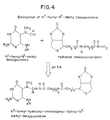
- FIGURE 4 is a more detailed diagram showing the formation of a biotin aminocaproyl hydrazone derivative of ring-opened N 7 -formyl-N 7 -methyldeoxyguanosine by reacting biotin aminocaproyl hydrazide with the formyl substituent of ring-opened N 7 -formyl-N 7 -methyldeoxyguanosine.
- FIGURE 5 is a graph showing that untreated DNA remains unlabeled in the presence of tritiated borohydride, but DNA treated in accordance with the invention incorporates tritium from the tritiating reagent in direct proportion to the extent of reaction with DMS.
- FIGURE 6A is a graph showing that a competitive enzyme assay according to the invention provides a linear and sensitive measure of DNA in a sample containing 1 to 25 nanograms of DNA.
- the assay was carried out by measuring the ability of DNA biotinylated in accordance with the invention to inhibit binding of a biotin enzyme conjugate to immobilized avidin.
- FIGURE 6B is a graph showing competitive assays of the type set out in Figure 6A for samples containing 1 to 100 nanograms of DNA using three different concentrations of reporter enzyme.
- FIGURE 7A is a graph showing that a competitive enzyme assay of the invention provides a linear and sensitive measure of DNA in a sample in a range of 1 to 100 picograms of DNA. The assay was carried out as described in Figure 6A.
- FIGURE 7B is a graph showing competitive assays of the type set out in Figure 7A for samples containing 1 to 100 picograms of DNA using three different concentrations of reporter enzyme.
- the present invention overcomes many of the problems of labeling polynucleotides found in the prior art. Particularly, in some aspects, it eliminates the need for complex chemical or enzymatic reactions. It does not require the use of highly pure nucleic acids and is universally applicable to any polynucleotide containing one or more purine, preferably guanine residues. Moreover, because the label targets portions of a probe molecule which are not involved with hydrogen bonding to the target nucleic acid, probes labeled according to the method of the invention are likely to be unimpaired in the recognition and binding of target nucleic acids. This feature allows higher density of labeling, thus enhancing the sensitivity of the invention, and the simplicity of the reaction and lack of a requirement for enzymes renders the method of the present invention less prone to error.
- the present invention relates to methods for labeling and detecting polynucleotides by means of a purine ring-opening reaction. More specifically, the present invention relates to an alkylation and ring-opening reaction that cleaves the imidazole ring of a purine and introduces a formyl group into the opened imidazole ring, and, in particular, to the derivatization of the formyl group to introduce detectable substituents into the ring-opened purine derivatives.
- the ring-opening and derivatization reaction may be carried out on a purine nucleoside or a polynucleotide containing a purine nucleotide, particularly guanine nucleoside and nucleoside derivatives and guanine nucleotide-containing polynucleotides, including ribo- and deoxyribopolynucleotides, which may be single stranded, double stranded, or triple stranded polynucleotides, inter alia.
- the invention provides for detecting, identifying, measuring, quantitating, or localizing, inter alia, polynucleotides in a biological sample.
- This aspect of the invention is equally useful to detect polynucleotides in a sequence-independent manner and to detect specific polynucleotide sequences.
- the invention provides a highly sensitive method to detect, in a sequence-independent manner any RNA or DNA in a biological sample, such as a protein preparation or any other composition prepared from or exposed to a biological source of RNA or DNA, or in which such RNA or DNA might desirably be detected.
- this aspect of the invention provides for the introduction into each polynucleotide in a sample of a multiplicity of detectable labels by the derivatization of multiple purine, preferably guanine, nucleotides in each polynucleotide.
- the introduction of multiple detectable moieties into each polynucleotide molecule provides an extremely sensitive means of detecting such polynucleotides.
- the invention also provides means for labeling polynucleotides which may be used for sequence-dependent detection, identification, measurement, quantitation or localization of polynucleotides.
- this aspect of the invention provides for labeling a polynucleotide for use as a hybridization probe.
- individual RNA and DNA sequences are most useful for this purpose, but any polynucleotide preparation capable of identifying by base-pairing a polynucleotide of interest can be employed as a hybridization probe.
- the invention may be employed to label any polynucleotide as a hybridization probe, including, for instance, synthetic oligonucleotides, restriction fragments, plasmids, cosmids, phage, etc., individual RNAs or DNAs, crude preparations of RNA or DNA, including transfer RNA (tRNA), ribosomal RNA (rRNA), messenger RNA (mRNA) or mitochondrial, epigenomic or genomic DNA, or fragments thereof or mixtures thereof.
- tRNA transfer RNA
- rRNA ribosomal RNA
- mRNA messenger RNA
- mitochondrial epigenomic or genomic DNA, or fragments thereof or mixtures thereof.
- polynucleotides to be used as hybridization probes (or, indeed, for other purposes) in accordance with the invention may be labeled by chemical synthesis by incorporating a residue previously derivatized in accordance with the invention; by enzymatic means, such as nick translation, "fill-in", transcription, reverse transcription, and the like, to incorporate a residue previously derivatized according to the invention into a polynucleotide; and by derivatizing, in accordance with the invention, a nucleotide within or at one or the other end of a polynucleotide.
- the invention combines a series of reliable reactions into a new technique for specifically coupling a detectable label to purine, preferably guanine residues in nucleosides, nucleoside derivatives, polynucleotides and polynucleotide derivatives, inter alia.
- the initial reaction involves the selective alkylation of a purine ring nitrogen by an alkylating agent.
- guanine N 7 is alkylated, selectively.
- Suitable alkylating agents of the invention include but are not limited to dimethylsulfate (DMS) and diethylsulfate, for instance.
- alkylation is carried out using DMS.
- DMS is used in the invention to alkylate DNA
- the reaction is preferably carried out at neutral pH. This reaction is similar to the first step of the guanosine-specific cleavage in the Maxam-Gilbert sequencing technique, which is described in Maxam et al., Methods in Enzymology 65: 449 (1980), inter alia.
- the degree of methylation obtained by this reaction can be controlled by varying the incubation time, the concentration of DMS, and the temperature of the reaction, among others.
- the degree of alkylation determines the number of imidazole ring-opened guanosine nucleotides and thus, the number of detectable labels that will be chemically bonded to a polynucleotide in accordance with the invention. This provides a means to tailor the degree of labeling to particular applications.
- the degree of methylation can be stringently controlled to provide methylation of only one G residue in 10, one in 100 or one in 1,000, inter alia, and the same holds true in the present invention.
- N 7 -alkylguanosine derivatives have a positive charge on N 7 .
- the N 7 substituent strongly affects the lability of the C8-N 9 bond. The more electron-accepting the substituents the more labile the bond.
- alkylating agents of the invention can be selected to provide a rate of imidazole ring-opening suitable to a wide variety of reaction conditions, if desired. See, for instance, Kochetkov et al., ORGANIC CHEMISTRY OF NUCLEIC ACIDS, PART B, Chapter 7, Plenum Press 1972.
- hydroxide is employed to cleave the N 7 -alkylated purine and results in an imidazole ring-opening reaction.
- Base mediated cleavage of N 7 -alkylated guanine according to the invention normally cleaves the C8-N 9 bond, opening the purine imidazole ring, providing a ring-opened N 7 -formyl-N 7 -alkyl-substituted compound, and this cleavage will be used herein to illustrate the process.
- the N-formyl substituent is coupled to a detectable label, a functionalized linker, or a blocking or protecting group.
- these reagents may serve three functions, providing (1) a reactive group for bonding to the formyl group of an N 7 -formyl-N 7 -alkylpurine, (2) a linking moiety, and (3) a second substituent which may be another reactive substituent, a blocking group which will generally later be removed to generate a reactive group for further derivatization, or a detectable label. It will be appreciated, however, that one, two or all three of these functions may be served by a single chemical entity.
- Reactive substituents for forming a chemical bond with the N 7 -formyl substituent of an N 7 -formyl-N 7 -alkylpurine include any substituents capable of forming a bond with the N 7 -formyl group.
- the substituents will be those that do not deleteriously modify the alkylpurine as a result of the process of bond formation.
- a deleterious modification in this context will be understood to mean a modification that interferes with the particular application for which the modified alkylpurine is being prepared.
- reagents useful for bonding to the N 7 -formyl group include those useful in the Wittig reaction, those useful in the aldol condensation, amines, hydrazides, semicarbazides, inter alia.
- Particularly useful reactive substituents for bonding to the N 7 -formyl group are amines, hydrazides, semicarbazides.
- Preferred groups will be those bearing primary amine or hydrazine functions.
- Amines form Schiff bases with the formyl group, which can be stabilized by reduction to secondary amines, e.g. with NaBH 3 CN.
- Hydrazines condense with formyl groups to form relatively stable hydrazones, which normally do not require further stabilization.
- the amine or hydrazone functions can be part of linkers that are previously or subsequently reacted with other moieties, eventually including the desired detectable label.
- the linking group when it is present in the reagent usually will be a linear or branched carbon chain which may also comprise N or S or both, and generally will comprise at least four atoms. It will be appreciated that the exact chemical composition of a linking group will be dictated by the particular application. Thus, the linking group will be stable to the reactions required for bonding to the N 7 -formyl group, and also to other reactions that may be necessary to a given application, such as removing a blocking group, attaching a detectable label or the like.
- Preferred linking groups include, but are not limited to the monomer, dimer or trimer of ⁇ -amino caproic acid (H 2 N-(CH 2 ) 5 -COOH), and alkane diamines including 1,4-diaminobutane, 1,5-diaminopentane and 1,6-diaminohexane, inter alia.
- Particularly preferred among the ⁇ -amino caproic acids and similar chains are those which are soluble in aqueous buffers.
- reaction conditions are adjusted to accommodate the formation of a bond between the N-formyl group and the reactive moiety of the substituent. Generally, the conditions will be such as not to unfavorably modify the nucleotide substrate in any way. Additional blocking groups, detectable labels and the like that can be used in accordance with the invention are set forth below.
- the present invention also relates to compounds of the following formula, which may be conveniently produced by the methods of the present invention.
- Compounds of the invention therefore include but are not limited to ribo and deoxyribonucleosides and their derivatives, including DNA and RNA, wherein A is -H or -OH, respectively. Also within the scope of the invention are compounds of the above formula which comprise derivatives of -OH compatible with methods for synthesizing RNA.
- Compounds of the invention include those wherein B is -H or -OH, or a mono-, di- or triphosphate or a derivative thereof. Included, among others, are RNA and DNA polynucleotides, wherein B will be a phosphodiester or a derivative of a phosphodiester; nucleosides and derivatives thereof, including nucleoside 3' monophosphates, nucleoside 3' diphosphates, and nucleoside 3' triphosphates; dideoxynucleosides and derivatives thereof.
- blocking group and protecting group are used interchangeably herein to refer to chemical groups that render a reactive substituent in a compound inert to a chemical process and allow the substituent or a derivative thereof subsequently to be regenerated. Such groups are well known in the art and are crucial to chemical methods of oligonucleotide and peptide synthesis, for instance.
- 3' blocking groups for oligonucleotide synthesis are known to the art, as, for instance, described in Gait, M.J., OLIGONUCLEOTIDE SYNTHESIS, A PRACTICAL APPROACH, (IRL Press, 1984) which is herein incorporated by reference.
- One preferred blocking group of this type is the ⁇ -cyanoethyl N,N-diisopropyl phosphoramidite blocking group, which is extensively employed in substrates for automated oligonucleotide synthesis.
- Compounds of the invention include those wherein D is -H or -OH, or a mono-, di- or triphosphate or a derivative thereof, or a phosphodiester bond. Included are RNA and DNA polynucleotides, wherein B will be a phosphodiester or a derivative of a phosphodiester; nucleosides and derivatives thereof, including nucleoside 5' monophosphates, nucleoside 5' diphosphates, and nucleoside 5' triphosphates; dideoxynucleosides and derivatives thereof, including especially dideoxynucleoside triphosphates, among others.
- D is a blocking group suitable for chemically synthesizing DNA or RNA.
- D is a blocking group suitable for chemically synthesizing DNA or RNA.
- 5' blocking groups for oligonucleotide synthesis are described in Gait, M.J., OLIGONUCLEOTIDE SYNTHESIS, A PRACTICAL APPROACH, (IRL Press, 1984).
- a preferred blocking group of this type is the dimethoxytrityl blocking group extensively employed in substrates for automated oligonucleotide synthesis.
- E is an alkyl group, which may be a straight-chain, branched-chain, or cyclic alkyl, including alkyl substituted straight-chain, branched-chain, or cyclic alkyl groups.
- E will be a primary alkyl, especially a lower alkyl group.
- Highly preferred alkyl groups include methyl, ethyl, or benzyl alkyl groups, of which the methyl group is very highly preferred.
- F may be a direct bond formed by an N 7 -formyl group and a substituent of a detectable label or it may be one or more linking groups for attaching at some distance a detectable label to the N 7 -formyl group, or it may be an intermediate group, such as blocking group, capable of further derivatization to chemically bond a detectable label.
- F may be a single substituent or it may be a more complex substituent.
- F may be any C-, N- or S- containing group that can serve as a linker group.
- F is a linking group, it will be a linear or branched carbon chain which may also comprise N or S or both, comprising at least four atoms.
- F comprises a linking group
- a divalent compound that is a compound that contained two reactive groups, one that coupled to the N 7 -formyl group and the other to couple to a second linking group, a blocking group or to a detectable label.
- a variety of homobifunctional and heterobifunctional linking reagents known in the art are useful in the present invention. These reagents provide a reactive substituent for forming a bond with the formyl group of a ring-opened N 7 -formyl-N 7 -alkylpurine of the invention and a reactive substituent for forming a bond to a detectable label, or to another linking group or to a blocking agent.
- Preferred linkers include the monomer, dimer or trimer of ⁇ -amino caproic acid (H 2 N-(CH 2 ) 5 -COOH), and alkane diamines including 1,4-diaminobutane, 1,5-diaminopentane and 1,6-diaminohexane, inter alia.
- Particularly preferred among the ⁇ -amino caproic acids and similar compounds are those which are soluble in aqueous buffers.
- Reactive substituents comprised by F for forming a chemical bond with the N 7 -formyl substituent of an N 7 -formyl-N 7 -alkylpurine include any substituents capable of forming a bond with the N 7 -formyl group.
- the substituents will be those that do not deleteriously modify the alkylpurine as a result of the process of bond formation.
- a deleterious modification in this context will be understood to mean a modification that interferes with the particular application for which the modified alkylpurine is being prepared.
- reagents useful for bonding to the N 7 -formyl group include those useful in the Wittig reaction, those useful in the aldol condensation, amines, hydrazides, semicarbazides, inter alia .
- Particularly useful reactive substituents for bonding to the N 7 -formyl group are amines, hydrazides, semicarbazides.
- Preferred groups will be those bearing primary amine or hydrazine functions.
- Amines form Schiff bases with the formyl group, which can be stabilized by reduction to secondary amines, e.g. with NaBH 3 CN.
- Hydrazines condense with formyl groups to form relatively stable hydrazones, which normally do not require further stabilization.
- the amine or hydrazone functions can be part of linkers that are previously or subsequently reacted with other moieties, eventually including the desired detectable label.
- G may be any chemical group which has a physical or chemical characteristic which can be detected, and any label that can be detected by a physical or chemical method may be used in the invention.
- Detectable labels of the invention may be determined by colorimetry, spectrophotometry, fluorimetry, methods for detecting radioactivity, and other methods well-known to the art.
- Detectable labels of the invention include labels characterized by color, luminescence, fluorescence, radioactivity, ligand recognition, affinity binding, chemical reactivity and enzymatic activity, among others.
- affinity binding labels include ligands of all types, lectin binding moieties, substrates and substrate analogs, co-factors, antigens, immunologically reactive substances and substituents such as epitopes, determinants and haptens and the like, and substances that comprise epitopes, determinants and haptens and the like, that bind antibodies, antibody derivatives, single chain antibodies and the like.
- fluorescent compounds 7-amino-4-methylcoumarin-3-acetyl hydrazide, fluorescein, rhodamine; among the lectin ligands are lactose, N-acetylglucosamine, N-acetylgalactosamine or mannose; among the antigen or antigen epitopes is dinitrophenyl; among the enzyme substrates are NADH and NADPH; and among the enzymes are horseradish peroxidase and alkaline phosphatase.
- detectable labels useful in the invention include fluorescein isothiocyanates, dinitrophenylisothiocyanates, fluorodinitrobenzene, N-hydroxysuccinimidylbiotin, N-hydroxysuccinimidyl, dinitrobenzoate, aminobutyl ethyl isoluminol isothiocyanate, active esters of carboxyfluorescein, rhodamine, biotin adducts, dioxetanes, dioxamides, carboxyacridines, and carbohydrates.
- Preferred detectable labels of the invention include biotin and digoxigenin.
- Preferred methods of detecting biotin and digoxigenin include enzyme immunoassays [EIAs] that employ alkaline phosphatase conjugated to avidin or to streptavidin, or to an antibody specific for digoxigenin.
- Applications of the invention include all of the uses for bases, nucleosides, nucleotides, oligonucleotides and polynucleotides, particularly those containing labels.
- the present invention is a useful tool in recombinant DNA and other protocols involving nucleic acid hybridization techniques.
- oligonucleotides and nucleic acids containing a compound of the invention can be used as hybridization probes, capable of recognizing and specifically binding to complementary nucleic acid sequences, providing thereby a means of detecting, identifying, locating and measuring complementary nucleic acid sequences in a biological sample.
- Bio samples include, among a great many others, blood or blood serum, lymph, ascites fluid, urine, microorganism or tissue culture medium, cell extracts, or the like, derived from a biological source, or a solution containing chemically synthesized protein, or an extract or solution prepared from such fluid from a biological source. It is further intended to include cells, tissue and other organic matter such as feces, food and plants.
- Molecular probes containing a compound of the invention have a variety of applications. They can be used to detect and identify viral, fungal, bacterial and parasitic nucleic acid sequences, serving thereby to aid the diagnosis of various related human, animal and plant diseases. They can be similarly used for both diagnostic and quality control purposes to detect and identify viral, fungal and bacterial contaminants in foods and for DNA typing in forensic and paternity investigations.
- probes containing the invention also can be used to identify nucleotide sequences to which proteins bind specifically.
- probes immobilized on solid supports can isolate and purify proteins which bind to sequences within the probes.
- Probes labeled with biotin for example, can be bound to affinity chromatography supports, or magnetic beads bearing covalently coupled streptavidin. Proteins which bind to such biotin-labeled probes can be separated from a biological sample containing a variety of other proteins. Other methods for purifying proteins using a solid support are well known to the skilled artisan.
- An oligonucleotide containing a modified nucleotide of the invention can be used as a primer to initiate nucleic acid synthesis at locations in a DNA or RNA molecule comprising the sequence complementary to the oligonucleotide sequence.
- the synthesized nucleic acid strand would have incorporated, at its 5' terminus, the oligonucleotide primer bearing the invention and would, therefore, be detectable by exploitation of the characteristics of the detectable label.
- Two such primers, specific for different nucleotide sequences on complementary strands of dsDNA, can be used in the polymerase chain reaction (PCR) to synthesize and amplify the amount of a nucleotide sequence.
- PCR polymerase chain reaction
- PCR combined with techniques for preparing complementary DNA (cDNA) can be used to amplify various RNAs, with oligonucleotide primers again serving both to provide points for initiation of synthesis in the cDNA duplex flanking the desired sequence and to identify the desired product.
- Primers labeled with the invention may also be utilized for enzymatic nucleic acid sequencing by the dideoxy chain-termination technique.
- the invention is derived by chemical incorporation of detectable labels into guanine or N 7 -alkylguanine residues in a nucleic acid
- the invention can be applied as a guanine-specific or 7-alkylguanine-specific adduct to measure or quantitate the amount of DNA present in a sample.
- the concentration of nucleic acid can be measured by comparing detectable labels incorporated into the unknown nucleic acid with the concentration of detectable labels incorporated into known amounts of nucleic acid.
- Such a comparative assessment can be done using biotin where the respective concentrations are determined by an enzyme-linked assay utilizing the streptavidin-alkaline phosphatase conjugate and a substrate yielding a soluble chromogenic or chemiluminescent signal.
- EXAMPLE 1 Reduction using sodium borohydride of substituents in DNA formed by ring-methylation followed by base treatment.
- DNA was methylated by treatment with DMS in a neutral buffer for 10, 20 or 30 minutes, resulting in the formation in the DNA of successively increasing amounts of N 7 -methylguanine.
- the methylated DNA was then treated with either sodium hydroxide or with sodium hydroxide and sodium borohydride, breaking the C8-N 9 bond in the methylated guanine nucleotides and generating either ring-opened N 7 -formyl-N 7 -methylguanine nucleotides or reduced ring-opened N 7 -formyl-N 7 -methylguanine nucleotides.
- EXAMPLE 2 Biotinylation of bacteriophage ⁇ DNA, and use of the biotinylated ⁇ DNA to probe a Southern blot.
- the methylation reaction was started by mixing 200 microliters of buffered DMS with 20 micrograms (50 microliters) of ⁇ DNA and transferring the mixture to a 25°C water bath. The mixture was incubated overnight (16 hours). 50 microliters of 0.4 N NaOH were added and the mixture was incubated at 37°C for 2 hours to generate aldehyde groups.
- biotinylated ⁇ DNA probe As a test for the presence of biotin in the ⁇ DNA probe, 300 ng of biotinylated ⁇ DNA per milliliter was hybridized to a Southern blot of Hind III fragments of ⁇ DNA (Example 5). The biotinylated ⁇ DNA probe detected the 6.6 Kb Hind III fragment of ⁇ DNA at an apparent concentration of 0.9 pg against a moderate background. Hybridization to slot-blots of serially diluted Hind III fragments of ⁇ DNA detected 100 fg of target DNA, while biotinylated ⁇ DNA captured by immobilized avidin in microtiter plates was detected at 0.6 pg per well.
- EXAMPLE 3 Biotinylation of a synthetic oligodeoxynucleotide.
- the present invention is further illustrated by the biotinylation of a synthetic oligodeoxynucleotide.
- 10 ⁇ g of a 48-mer oligodeoxynucleotide corresponding to the degenerate nucleotide sequence encoding the first 16 amino acids of the amino terminus of Streptococcus sobrinus glucan-binding protein (gbp1) is diluted in 50 ⁇ l of deionized water. All subsequent reactions are carried out as described above in EXAMPLE 2, using the synthetic oligonucleotide in place of ⁇ DNA.
- EXAMPLE 4 Biotinylation of transfer RNA.
- RNA can be biotinylated using methods of the invention set forth hereinabove, and detailed procedures similar to those set forth in EXAMPLE 2.
- RNA For labeling RNA, deionized water for use in preparing buffers and other solutions is autoclaved and treated with 200 ⁇ l diethylpyrocarbonate per liter of water to inhibit the enzyme RNase. Where possible, buffers also are autoclaved. RNase-free, sterile plasticware is used in all labeling procedures.
- reaction mixture Following the 25°C incubation, sufficient 0.4 N NaOH is added to the reaction mixture to achieve a pH of 10.0. The reaction mixture is then incubated at 25°C for 1 hour to open the imidazole rings of N 7 -methylguanosine residues formed in the tRNA as a result of the incubation with DMS.
- the reaction is stopped by addition of 50 ⁇ l of 4.0 M sodium acetate buffer to adjust the reaction mixture to pH 5.6.
- Biotinylation of the ring-opened N 7 -formyl-N 7 -methylguanosine residues in the tRNA is carried out using biotin aminocaproyl hydrazide in the same manner as described in EXAMPLE 2 for ⁇ DNA. Separation of the biotin-labeled tRNA from excess biotin aminocaproyl hydrazide also is accomplished as described for biotinylation of ⁇ DNA in Example 2, using a gel permeation spin column. Biotin-RNA prepared in this manner may be used immediately or stored frozen at -20°C.
- RNA The presence of biotin in tRNA (and in other RNA's prepared in this way) is detected and quantitated by EIA analysis of dot or slot blots of serial dilutions of the biotinylated RNA diluted in 10 mM Tris-HCl, 1 mM EDTA, pH 8.0.
- the total amount of RNA is estimated by ethidium bromide fluorescence, while the amount of biotin incorporation is estimated in the colorimetric ELISA by comparison with a standard preparation of biotinylated RNA.
- EXAMPLE 5 DNA titration using biotinylated ⁇ DNA as a hybridization probe.
- Bacteriophage ⁇ DNA was biotinylated as described in EXAMPLE 2. Unlabeled ⁇ DNA digested with Hind III was resolved into its fragments by electrophoresis in a 1% agarose gel. The Hind III digested ⁇ DNA was applied to the gel lanes in amounts of 150 ng (lane 1), 10 ng (lane 2), 1 ng (lane 3), 500 pg (lane 5), 50 pg (lane 7), 10 pg (lane 9) and 1 pg (lane 11).
- the membranes were prehybridized at 42°C for 6 hours.
- Denatured biotinylated ⁇ DNA was diluted to 300 ng/ml in hybridization buffer and incubated with the membranes until hybridization was complete.
- the hybridized membranes were then washed and blocked by 30 minutes incubation in 3% BSA in PBS at room temperature.
- Blocked membranes were incubated 30 minutes at room temperature in streptavidin-alkaline phosphatase (SAAP) conjugate diluted 1:12,000 in PBS and then washed 4 times (10 minutes per wash) in PBS.
- SAAP streptavidin-alkaline phosphatase
- Bound SAAP was detected by incubation of membranes in 0.165 mg/ml 5-bromo-4-chloro-3-indolyl phosphate ("BCIP”) and 0.33 mg/ml nitro blue tetrazolium ("NBT”) in 0.1 M Tris pH 9.6, 50 mM MgCl 2 , 100 mM NaCl.
- BCIP 5-bromo-4-chloro-3-indolyl phosphate
- NBT nitro blue tetrazolium
- EXAMPLE 6 Detection of the E. coli lac z gene by hybridization with biotinylated phage M13mp19 DNA.
- Single-stranded M13mp19 DNA which contains one copy of the alpha fragment of the lac Z gene, was biotinylated as described for whole ⁇ DNA in EXAMPLE 2, and used to probe E. coli genomic DNA in a slot-blot for the presence of the endogenous E. coli lac Z gene.
- genomic DNA of E. coli strain Y1090 (“Y1090 DNA”) was serial-diluted, in 10-fold steps, in 1X SSC, providing concentrations of genomic DNA ranging from 100 ng/100 ⁇ l to 1 pg/100 ⁇ l.
- the dilutions of Y1090 DNA were applied to Nytran membranes, 100 ⁇ l per slot, using a slot-blot apparatus (Life Technologies Inc., Bethesda Research Laboratories).
- EXAMPLE 7 Use of biotinylated oligonucleotide as a hybridization probe for Southern blots of restricted genomic DNA.
- the gbpl oligonucleotide biotinylated in EXAMPLE 3 serves as a hybridization probe to detect the gbpl gene in a Southern blot of Eco RI restricted Streptococcus sobrinus 6715-49 genomic DNA. Streptococcal genomic DNA is digested to completion with Eco RI, then 10 ⁇ g aliquots are resolved in multiple lanes by electrophoresis overnight in a 1% agarose gel in 1 X Tris-Acetate-EDTA buffer ("TAE,” 20 X TAE buffer contains 242g Tris base, 57.1 ml glacial acetic acid, 37.2g EDTA at pH 8.5). A control lane contains 10 ⁇ g of E. coli Y1090 genomic DNA digested to completion with Eco RI.
- the Southern blot is prepared, prehybridized and hybridized by the procedures described in EXAMPLE 5.
- the biotinylated gbpl oligonucleotide hybridization probe is diluted to a final concentration of 300 ng/ml in hybridization buffer. After hybridization overnight at 42°C in 5 ml per filter of hybridization solution, excess probe is washed away and the annealed biotinylated gbpl oligonucleotide probe is visualized as described in EXAMPLE 5.
- a single band of target DNA of approximately 8 kbp, is detected in all lanes containing S. sobrinus DNA but not in the E. coli Y1090 DNA control lane. This result replicates a similar experiment utilizing this oligonucleotide, 5'-end labeled with 32 P, as a hybridization probe.
- EXAMPLE 8 T m of biotinylated ⁇ DNA.
- ⁇ DNA was biotinylated in the manner described in EXAMPLE 2. Melting temperatures (T m ) were determined for biotinylated ⁇ DNA and unmodified ⁇ DNA. Each DNA was dissolved at 15 ⁇ l/ml in 1X SSC buffer (150 mM NaCl, 15 mM sodium citrate, pH 7.0). DNA absorbance was monitored at 260 nm while increasing the temperature in increments of 5°C, from room temperature to 100°C. The T m of biotinylated ⁇ DNA was 84°C, while that of unmodified ⁇ DNA was 89°C.
- Bio-dGTP Deoxyguanosine triphosphate
- dGTP Deoxyguanosine triphosphate
- cacodylate buffer is biotinylated as described in EXAMPLE 2, with the omission of spin-column chromatography.
- the biotin-labeled dGTP (“Bio-dGTP”) is separated from unbound biotin aminocaproyl hydrazide by reverse-phase chromatography on a C18 column, with a 0 to 80% gradient of acetonitrile (CH 3 CN).
- Bio-dGTP is freed from acetonitrile in a rotary evaporator under vacuum at 37°C, then redissolved in deionized water.
- the reaction mixture contains: 100 mM sodium cacodylate, pH 7.0 1 mM CoCl 2 0.1 mM dithiothreitol 4 pmoles oligonucleotide (as 3' termini) 20 ⁇ m Bio-dGTP 2.5 ⁇ g bovine serum albumin 10 International Units terminal deoxynucleotidyl transferase
- the reaction is incubated at 37°C for 30 minutes and terminated by adding 2 ⁇ l of 0.5M EDTA.
- End-labeled oligonucleotide is separated from unincorporated Bio-dGTP by centrifugation through a BioGel P2 spin column. If desired, TdT is removed by phenol extraction and the oligonucleotide is precipitated from the aqueous phase by the addition of two volumes of absolute ethanol and incubation at -70°C for at least 1 hour.
- the use of CoCl 2 allows end-labeling of ribonucleotides as well as deoxyribonucleotides.
- EXAMPLE 10 A competitive enzyme immunoassay for DNA.
- Microtiter plate wells (“IMMULON 2" microtiter plates from Dynatech Laboratories, Inc.) were coated by overnight incubation at room temperature with 300 ⁇ l/well of 5 ⁇ g/ml avidin in PBS (Pierce Chemical Company), and then blocked 30 minutes with 300 ⁇ l/well of 0.1M NH 4 Cl.
- the reporter enzyme for the assay was biotinylated alkaline phosphatase ("BAP"; Pierce Chemical Company) diluted from a lmg/ml PBS stock solution.
- Useful dilutions of BAP for the detection of nanogram quantities of DNA ranged from 1/40,000 through 1/100,000, while detection of picogram levels of DNA was optimum at BAP dilutions of 1/100,000 through 1/140,000 (see Figures 6 and 7).
- E. coli Y1090 genomic DNA was biotinylated by the procedure of EXAMPLE 2.
- Biotinylated DNA was diluted in PBS to provide two dilution series: 1 to 100ng of biotinylated DNA per 200 ⁇ l and 1 to 100pg of biotinylated DNA per 200 ⁇ l.
- 200 ⁇ l aliquots of each biotinylated DNA dilution series, or of PBS only, were incubated in avidin-coated wells for two hours at room temperature on a rotary shaker. Following three washes with PBS, the wells received 200 ⁇ l aliquots of BAP at appropriate dilutions and incubation was continued, as above, for two more hours.
- Plates were washed six times with PBS and then 200 ⁇ l aliquots of p-nitrophenylphosphate (4mg/ml 10% diethanolamine, 0.5mM MgCl 2 , pH 9.8) were added to each well. Rates of the ensuing enzyme reactions were determined in a kinetic platereader (Easy Reader EA 400 AT; SLT Labinstruments) at 405nm. End-point optical density values at 405nm were determined after 1 hour incubation at room temperature.
- p-nitrophenylphosphate 4mg/ml 10% diethanolamine, 0.5mM MgCl 2 , pH 9.8
- Figures 6 and 7 show values of percent inhibition for the nanogram and picogram ranges, respectively.
- Figures 6B and 7B compare responses at various reporter enzyme dilutions. These competitive assays are capable of measuring DNA over concentration ranges of 1 to 25ng/200 ⁇ l ( Figure 6) and 1 to l00pg/200 ⁇ l ( Figure 7).
Landscapes
- Chemical & Material Sciences (AREA)
- Organic Chemistry (AREA)
- Life Sciences & Earth Sciences (AREA)
- Health & Medical Sciences (AREA)
- Biochemistry (AREA)
- Engineering & Computer Science (AREA)
- Molecular Biology (AREA)
- Biotechnology (AREA)
- General Health & Medical Sciences (AREA)
- Genetics & Genomics (AREA)
- Zoology (AREA)
- Wood Science & Technology (AREA)
- Proteomics, Peptides & Aminoacids (AREA)
- Biophysics (AREA)
- Immunology (AREA)
- Microbiology (AREA)
- Analytical Chemistry (AREA)
- Physics & Mathematics (AREA)
- Bioinformatics & Cheminformatics (AREA)
- General Engineering & Computer Science (AREA)
- Crystallography & Structural Chemistry (AREA)
- Measuring Or Testing Involving Enzymes Or Micro-Organisms (AREA)
- Saccharide Compounds (AREA)
- Investigating Or Analysing Biological Materials (AREA)
Abstract
Description
- The present invention relates to methods for labeling nucleosides and polynucleotides by purine ring-opening reactions, to labeled nucleosides and polynucleotides obtained by the ring-opening reactions, and to the use of the labeling reactions and labeled products to detect polynucleotides in a sample.
- The detection of polynucleotides is important in many areas of molecular biology, biochemistry, biology, pharmacology and clinical medicine, inter alia. Sometimes it is important to detect the presence per se of any polynucleotide in a sample, as is the case particularly for producing protein-based therapeutic agents intended for human use, for instance. Other times it is desired to detect a specific polynucleotide sequence present in a multitude of sequences. For instance, the diagnosis of genetic disorders depends on sequence-specific polynucleotide detection and sequence-specific nucleic acid hybridization probes play a central role in molecular biology research where they are used for the detection of specific, complementary nucleic acid sequences present in minute amounts in a background of large quantities of other polynucleotides. Assays involving nucleic acid hybridization in the future will be ubiquitous in the clinical lab, and will find widespread application in other areas, including, for instance, veterinary medicine, forensic medicine, plant breeding and other areas of agriculture.
- Whether it is desired to detect the presence, per se, of polynucleotides in sample, or to detect a particular polynucleotide sequence, a key step is labeling the polynucleotide or polynucleotide probe with a detectable label. Generally, the specificity and sensitivity of a detection method will be at least partly determined by the properties of the detectable label and the efficiency of the labeling method used to introduce the label into the polynucleotide.
- Various labeling techniques have been developed that provide the selectivity and efficiency necessary to detect DNA present at fairly low levels in a sample, and to label hybridization probes sufficiently to detect specific sequences of DNA present in a high background of other sequences. For instance, radioisotopes such as 3H, 14C, 32P, 35S and 125I have been incorporated into polynucleotides by metabolic, enzymatic and chemical means to serve as detectable reporter groups to indicate the presence of polynucleotides in a sample. 32P and 35S, have proven particularly useful in molecular biology studies in such techniques as RNA and DNA sequencing, and the panoply of blot-hybridization methods used to detect, identify, measure, quantitate and localize specific polynucleotide sequences.
- Radioactive labels suffer from several drawbacks, however. First, there is the risk of human exposure to hazardous levels of radioactivity during the preparation, use and disposal of reagents containing a radioactive tag. In consequence of the risk associated with human exposure to radiation there is a need when working with radiation for elaborate and expensive safety precautions.
- In addition, the radioisotopes most suitable for use in nucleic acid research have relatively short half-lives. For instance, 32P has a half-life of only 14 days, and 35S has a half-life of only 87 days. Radioactively labeled probes therefore have limited shelf-lives and cannot be prepared and standardized in large batches, well before actual use. The necessity to prepare probes in small batches close to the time of actual use incurs economic disadvantages of scale. Furthermore, the inability to prepare and characterize large batches of radioactively labeled probes is a barrier to developing polynucleotide based diagnostic reagents.
- The disadvantages of radioactive labels has led to the development of alternative techniques for introducing stable non-radioactive, detectable labels into polynucleotides. Thus, methods have been developed to label polynucleotides with, inter alia, biotin, digoxigenin and sulfonate.
- Perhaps the most widely used non-radioactive polynucleotide label is biotin. Biotin binds with exceptional specificity and avidity to the proteins avidin and streptavidin. Thus, these proteins will bind with exceptional efficiency to biotinylated DNA. Both proteins can be cross-linked to an enzyme to form an enzymatically active conjugate, in which the avidin or streptavidin portion specifically detects the biotin in biotinylated DNA and the enzymatic portion catalyses the formation of a detectable product, such as a colored or luminescent product, which can be determined quantitatively and indicates the presence and the amount of biotinylated DNA in the sample. Avidin-alkaline phosphatase conjugates which are compatible with standard EIA colorimetric reagents have been widely employed in this type of biotin-based procedure.
- Other labels, such as digoxigenin, can be used in analogous fashion. Thus, digoxigenin may be incorporated into the DNA analogously to biotin and the digoxigenin-DNA adduct detected by ELISA or other EIA techniques using an enzyme conjugated to an anti-digoxigenin polyclonal or monoclonal antibody.
- In view of the widespread utility of labeled polynucleotides, simple, efficient and reliable methods for labeling polynucleotides are needed. The methods presently available, however, suffer from a number of disadvantages. For instance, biotinylated polynucleotides are produced using biotinylated nucleoside derivatives which must be chemically synthesized and then incorporated into a polynucleotide by enzymatic or chemical reactions. Thus, substrates for the preparation of biotinylated and digoxigeninylated polynucleotides are analogues of the native nucleoside and deoxynucleoside triphosphates, with chemical groups covalently coupled to the base. Examples of such analogues are uridine and deoxyuridine triphosphate (UTP and dUTP) coupled via a spacer arm to biotin (biotin-11-dUTP and biotin-11-UTP), or to digoxigenin (digoxigenin-11-dUTP and digoxigenin-11-UTP), in which the detectable group is attached at C5 of the uridine base. See Langer et al., Proc. Nat'l. Acad. Sci., U.S.A. 78: 6633-6637 (1981) and Brigati et al., Virology 126: 36-50 (1983).
- Methods for synthesizing biotinylated or digoxigeninylated precursors, however, are time-consuming and require considerable expertise in synthetic chemistry. Moreover, labeling polynucleotides with these substrates generally requires expensive enzymes and exacting reaction conditions. Thus, such substrates cannot be used in many situations and are not suitable for the synthesis of large amounts of labeled polynucleotide.
- Photoreactive derivatives of biotin and digoxigenin, such as those described by Forster et al., Nucl. Acids Res. 13: 745 (1985), provide a non-enzymatic means of incorporating biotin or digoxigenin into polynucleotides, including double-stranded DNA (dsDNA), single-stranded DNA (ssDNA) and RNA. The photoreactive derivatives must be chemically synthesized, however, a technically demanding and expensive process. In addition, the polynucleotides being labeled must be pure since the photochemical reactions are not specific and contaminating compounds such as proteins are readily labeled. The density of labeling is low with this procedure, being on the order of one label per 200 base residues. Furthermore, polynucleotides labeled using the photoreactive derivatives often bear biotin or digoxigenin on sites involved in Watson-Crick hydrogen bonding, which can deleteriously affect the ability of a probe to bind to its target sequence in a sample.
- Several chemical procedures for incorporating detectable groups into polynucleotides have been described. For instance, Stavrianopoulos in U.S. Patent No. 4,843,122 described a method for biotinylating DNA wherein guanine C8 is activated with 3,4,5-trichloroaniline and then bonded to biotin-SH. Reisfeld et al., Biochem. Biophys. Res. Comm. 142: 519 (1987), described the bisulfite catalyzed bonding of biotin hydrazide to cytidine N4 in DNA. Takahashi et al., Nucleic Acids Res. 17: 4899 (1989), described the coupling of biotin aminocaproylhydrazide to single-stranded DNA by reaction with glutaraldehyde, possibly resulting in substitution at N6 of adenosine, N2 of guanosine and N4 of cytosine. Sverdlov et al., Biochim. Biophys. Acta. 340: 153 (1974), described the sulfonation of cytosine C6, accompanied by substitution of the exocyclic N4 amino group with methoxyamine, forming N4-methoxy-5,6-dihydro-cytosine-6-sulfonate.
- Biotin ligands in polynucleotides labeled according to these procedures serve as biotin receptor (e.g., avidin and streptavidin) binding sites, allowing detection of biotinylated DNA by ELISA and other EIA methods, inter alia, as described above. Similarly, polynucleotides labeled by N4-methoxy-5,6-dihydrocytosine-6-sulfonate bind a monoclonal antibody against N4-methoxy-5,6-dihydro-cytosine-6-sulfonate and are detected in much the same way as biotin by ELISA and other EIA methods.
- All of these methods suffer from a variety of disadvantages. Some methods require cumbersome procedures. Some methods can introduce only a single molecule of detectable label into each polynucleotide molecule. None of the methods can be used to label polynucleotides in a complex mixture of many different contaminants.
- Methods have also been described for incorporating a label into a polynucleotide made by chemical synthesis techniques. For instance, Ruth, DNA 3: 123 (1984), described a method for incorporating detectable labels into purified polynucleotides of defined sequence by chemical synthesis. Ruth described nucleosides bearing functionalized linkers suitable for use in oligonucleotide synthesizers. Synthetic single-stranded oligonucleotides of defined sequence were produced bearing the functionalized linkers on pre-selected bases in the sequence. The functional group could be a detectable label or could be joined to a detectable label following synthesis. Production of the derivatized nucleosides of Ruth's method requires considerable technical skill, however, and their utility is limited to labeling synthetic oligonucleotides.
- Jablonski et al., Nucleic Acids Res. 14: 6115 (1986), showed that the homobifunctional reagent disuccinimidyl suberate can be used to directly cross-link an oligonucleotide with the enzyme alkaline phosphatase, through a single amine-modified base in the oligonucleotide. This method, however, is limited to oligonucleotides containing the amine-modified base. Furthermore, the alkaline phosphatase may interfere with base pairing by the oligonucleotide in a hybridization assay.
- In sum, despite the importance of labeled polynucleotides in molecular biology, biochemistry and clinical diagnostic applications, inter alia, a simple, reliable, efficient and widely applicable procedure for introducing detectable labels into polynucleotides has not been developed. All of the procedures discussed hereinabove are of limited applicability. Few methods provide for introducing many labels into each polynucleotide. Conventional enzymatic labeling methods require expensive enzymes, highly purified nucleic acid templates and substrates, and reaction conditions must be stringently controlled. Furthermore, the efficiency of labeling by these methods is difficult to determine, making it hard to assess usefulness of a labeled product before use.
- Photochemical and chemical (sulfonation) procedures have a wider range of applicability but require cumbersome chemical procedures and also require purified nucleic acid substrates. Although many of the prior art procedures can be completed within a few hours, they may require extensive preliminary preparations and the entire process is usually very time consuming. Furthermore, excepting photochemical labeling and the automated synthesis of labeled oligonucleotides, labeling procedures yield very small amounts (microgram quantities) of labeled product.
- It is therefore an object of the present invention to provide a method for labeling polynucleotides which is simple, reliable, efficient and sensitive, and can be applied to labeling pure polynucleotides or polynucleotides in the presence of contaminants.
- It is a further aspect of the invention to provide a simple and efficient method to label polynucleotides for use as probes in hybridization assays, inter alia.
- Yet another object of the present invention is to provide a simple, efficient and highly sensitive method to quantitatively detect polynucleotides in a sample.
- It is also an object-of the present invention to provide a means for introducing a detectable label into a nucleoside derivative suitable for labeling a polynucleotide via chemical synthesis or enzymatic-labeling techniques.
- It is a further object of the present invention to provide nucleoside derivatives which comprise detectable labels or functional groups suitable for bonding to detectable labels.
- It is yet another object of the present invention to provide polynucleotides which comprise detectable labels or functional groups suitable for bonding to detectable labels.
- The invention thus provides a variety of means to derivatize nucleosidic compounds, including nucleosides, nucleoside derivatives, oligonucleotides and polynucleotides, to introduce therein by means of a purine ring-opening reaction, a reactive moiety suitable for attaching thereto a protecting or blocking group, a linking group, or another intermediate group, and, ultimately a substituent comprising a detectable label.
- In another aspect, the invention provides novel compounds, including but not limited to ring-opened substituted purine derivatives, and oligo and polynucleotides comprising the ring-opened substituted purine derivatives. Thus, for instance, the invention provides ring-opened purine derivatives suitable for use as precursors in synthetic oligonucleotide synthesizers. And, as another example, the invention provides derivatized polynucleotides, either detectably labeled, or derivatized so as to facilitate the introduction of a detectable label, which are suitable for use, inter alia, as hybridization probes.
- The invention also provides reagents, procedures and kits for labeling polynucleotides by means of ring-opened purine derivatives, to detect, identify, measure, quantitate or localize polynucleotides in a sample, in either a sequence-specific or a sequence independent manner, or both.
- Thus, the invention relates to methods for labeling nucleosides and polynucleotides by means of purine ring-opening reactions to produce a formyl group which group is then further derivatized to comprise, ultimately, a detectable label, to the products produced by the methods, and to the uses of the methods and the products in detecting polynucleotides.
- In accomplishing the foregoing objects, there has been provided, in accordance with another aspect of the present invention a method for labeling a polynucleotide comprising at least one purine nucleotide, comprising the steps of (a) alkylating a purine ring nitrogen in a nucleotide in a polynucleotide to form an N-alkylated purine nucleotide; (b) cleaving a bond in the N-alkylated purine nucleotide to form a ring-opened N-alkyl-N-formyl nucleotide; and, (c) chemically bonding a detectable label to the N-formyl group, either directly or through a linking group.
- In a preferred embodiment of this aspect of the invention there has been provided a method for labeling a polynucleotide that comprises at least one guanine nucleotide, comprising the steps of (a) N7-alkylating a guanine nucleotide in the polynucleotide to form an N7-alkylguanine nucleotide; (b) cleaving the C8-N9 bond in the N7-alkylguanine nucleotide to form a ring-opened N7-formyl-N7-alkylguanine nucleotide; and, (c)chemically bonding a detectable label to the N7-formyl group, either directly or through a linking group.
- In a particularly preferred embodiment of the invention there is provided a method for labeling polynucleotides comprising at least one guanine nucleotide comprising steps of (a) mixing dimethylsulfate (DMS) in a neutral buffer with the polynucleotide; (b) incubating the DMS and polynucleotide-containing solution under conditions suitable for N7-methylation of the guanine nucleotide in the polynucleotide to form an N7-methylguanine nucleotide; (c) adding a base to the solution of step (b) in an amount sufficient to cleave the bond between C8 and N9 in the N7-methyl guanine nucleotide to form a ring-opened N7-formyl-N7-methylguanine nucleotide in a polynucleotide in the sample; and, chemically bonding a detectable label to the N7-formyl group of the N7-formyl-N7-methylguanine nucleotide, either directly or through a linking group.
- In another aspect of the invention, using the foregoing methods, there has been provided a method for detecting a polynucleotide comprising at least one purine nucleotide in a sample, comprising the step of detecting the polynucleotide in the sample by determining a detectable label chemically bonded to an N-formyl group formed in the purine nucleotide.
- In accordance with another aspect of the invention there have been provided compounds according to the following formula:

- In accordance with another aspect of the invention there have been provided polynucleotides comprising a compound according to the following formula:
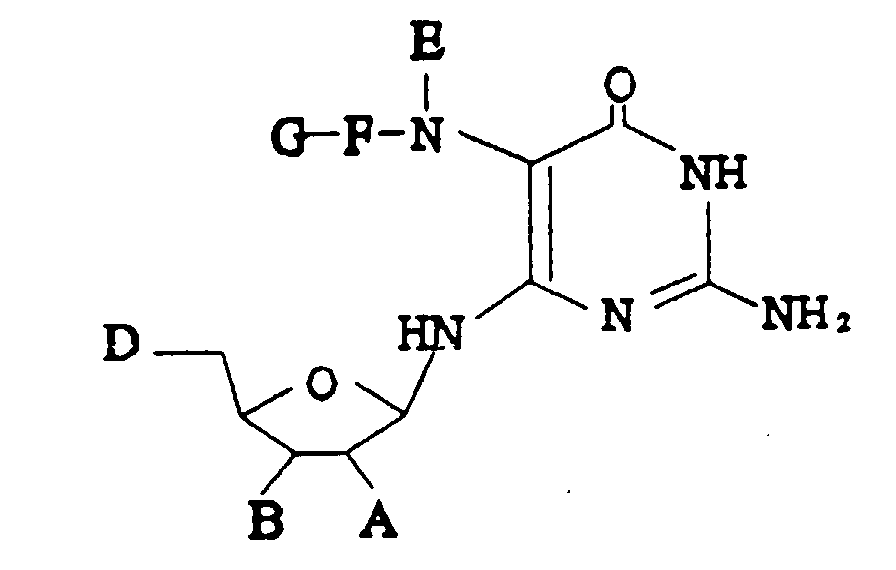
- The term N7-formyl-N7-alkylpurine is used herein to designate certain ring-opened compounds of the invention which may also be called alkylformamidopyrimidine or 2,4,5-triamino-6-hydroxy-N5-methyl-N5-formylpyrimidine compounds, inter alia, but herein are referred to as N7-formyl-N7-alkylpurine or ring-opened N7-formyl-N7-alkylpurine, and, in the case of guanine and guanosine, N7-formyl-N7-alkylguanine and N7-formyl-N7-alkylguanosine, or ring-opened N7-formyl-N7-alkylguanine and ring-opened N7-formyl-N7-alkylguanosine. Another name for these alkylguanine deoxynucleoside derivatives is 2-amino-5-(formyl-alkylamino)-6-(2'-deoxyribosylamino)-pyrimidin-4-one, which for N7-formyl-N7-methylguanosine is 2-amino-5-(formyl-methylamino)-6-(2'-deoxyribosylamino)-pyrimidin-4-one.
- FIGURE 1 is a diagram showing the formation of N7-methyl-N7-formyldeoxyguanosine by treating deoxyguanosine with dimethylsulfate (DMS) to form N7-methyldeoxyguanosine, and then with base (OH-) to open the alkylated purine ring to form ring-opened N7-formyl-N7-methyldeoxyguanosine.
- FIGURE 2 is a diagram showing two reaction schemes for chemically bonding a detectable label ("detectable label", R') to a formyl substituent (aldehyde) in, inter alia, ring-opened N7-formyl-N7-methyldeoxyguanosine. In the reaction pathway on the left side of the diagram, a hydrazide of a detectable label is employed to form a hydrazone upon reacting with the formyl substituent. In the reaction pathway on the right side of the diagram, an amine of a detectable label is employed to form a Schiff base with the formyl group, which is then reduced with cyanoborohydride or BH4 -.
- FIGURE 3 is a diagram showing two reaction schemes for biotinylating the N7-formyl substituent in ring-opened N7-formyl-N7-methyldeoxyguanosine. In the reaction pathway on the left side of the diagram, the hydrazide of aminocaproyl biotin is employed to form biotin aminocaproyl hydrazone upon reacting with the formyl substituent. In the reaction pathway on the right side of the diagram, diaminocaproyl biotin is employed to form a Schiff base upon reacting with the formyl group, which is then reduced with cyanoborohydride or BH4 -.
- FIGURE 4 is a more detailed diagram showing the formation of a biotin aminocaproyl hydrazone derivative of ring-opened N7-formyl-N7-methyldeoxyguanosine by reacting biotin aminocaproyl hydrazide with the formyl substituent of ring-opened N7-formyl-N7-methyldeoxyguanosine.
- FIGURE 5 is a graph showing that untreated DNA remains unlabeled in the presence of tritiated borohydride, but DNA treated in accordance with the invention incorporates tritium from the tritiating reagent in direct proportion to the extent of reaction with DMS.
- FIGURE 6A is a graph showing that a competitive enzyme assay according to the invention provides a linear and sensitive measure of DNA in a sample containing 1 to 25 nanograms of DNA. The assay was carried out by measuring the ability of DNA biotinylated in accordance with the invention to inhibit binding of a biotin enzyme conjugate to immobilized avidin.
- FIGURE 6B is a graph showing competitive assays of the type set out in Figure 6A for samples containing 1 to 100 nanograms of DNA using three different concentrations of reporter enzyme.
- FIGURE 7A is a graph showing that a competitive enzyme assay of the invention provides a linear and sensitive measure of DNA in a sample in a range of 1 to 100 picograms of DNA. The assay was carried out as described in Figure 6A.
- FIGURE 7B is a graph showing competitive assays of the type set out in Figure 7A for samples containing 1 to 100 picograms of DNA using three different concentrations of reporter enzyme.
- The present invention overcomes many of the problems of labeling polynucleotides found in the prior art. Particularly, in some aspects, it eliminates the need for complex chemical or enzymatic reactions. It does not require the use of highly pure nucleic acids and is universally applicable to any polynucleotide containing one or more purine, preferably guanine residues. Moreover, because the label targets portions of a probe molecule which are not involved with hydrogen bonding to the target nucleic acid, probes labeled according to the method of the invention are likely to be unimpaired in the recognition and binding of target nucleic acids. This feature allows higher density of labeling, thus enhancing the sensitivity of the invention, and the simplicity of the reaction and lack of a requirement for enzymes renders the method of the present invention less prone to error.
- Accordingly, the present invention relates to methods for labeling and detecting polynucleotides by means of a purine ring-opening reaction. More specifically, the present invention relates to an alkylation and ring-opening reaction that cleaves the imidazole ring of a purine and introduces a formyl group into the opened imidazole ring, and, in particular, to the derivatization of the formyl group to introduce detectable substituents into the ring-opened purine derivatives.
- In accordance with the invention the ring-opening and derivatization reaction may be carried out on a purine nucleoside or a polynucleotide containing a purine nucleotide, particularly guanine nucleoside and nucleoside derivatives and guanine nucleotide-containing polynucleotides, including ribo- and deoxyribopolynucleotides, which may be single stranded, double stranded, or triple stranded polynucleotides, inter alia.
- In one aspect the invention provides for detecting, identifying, measuring, quantitating, or localizing, inter alia, polynucleotides in a biological sample. This aspect of the invention is equally useful to detect polynucleotides in a sequence-independent manner and to detect specific polynucleotide sequences.
- Thus, the invention provides a highly sensitive method to detect, in a sequence-independent manner any RNA or DNA in a biological sample, such as a protein preparation or any other composition prepared from or exposed to a biological source of RNA or DNA, or in which such RNA or DNA might desirably be detected.
- Notably, this aspect of the invention provides for the introduction into each polynucleotide in a sample of a multiplicity of detectable labels by the derivatization of multiple purine, preferably guanine, nucleotides in each polynucleotide. The introduction of multiple detectable moieties into each polynucleotide molecule provides an extremely sensitive means of detecting such polynucleotides.
- The invention also provides means for labeling polynucleotides which may be used for sequence-dependent detection, identification, measurement, quantitation or localization of polynucleotides. For instance, this aspect of the invention provides for labeling a polynucleotide for use as a hybridization probe. In general, individual RNA and DNA sequences are most useful for this purpose, but any polynucleotide preparation capable of identifying by base-pairing a polynucleotide of interest can be employed as a hybridization probe.
- Thus, the invention may be employed to label any polynucleotide as a hybridization probe, including, for instance, synthetic oligonucleotides, restriction fragments, plasmids, cosmids, phage, etc., individual RNAs or DNAs, crude preparations of RNA or DNA, including transfer RNA (tRNA), ribosomal RNA (rRNA), messenger RNA (mRNA) or mitochondrial, epigenomic or genomic DNA, or fragments thereof or mixtures thereof.
- In general, polynucleotides to be used as hybridization probes (or, indeed, for other purposes) in accordance with the invention may be labeled by chemical synthesis by incorporating a residue previously derivatized in accordance with the invention; by enzymatic means, such as nick translation, "fill-in", transcription, reverse transcription, and the like, to incorporate a residue previously derivatized according to the invention into a polynucleotide; and by derivatizing, in accordance with the invention, a nucleotide within or at one or the other end of a polynucleotide. A variety of such reactions are known, as described, for instance, in Maniatis, et al., MOLECULAR CLONING, A LABORATORY MANUAL (Cold Spring Harbor Laboratory, 1982) and Sambrook, et al., MOLECULAR CLONING, A LABORATORY MANUAL, Second Edition, Vol. 1-3 (Cold Spring Harbor Laboratory, 1989).
- The invention combines a series of reliable reactions into a new technique for specifically coupling a detectable label to purine, preferably guanine residues in nucleosides, nucleoside derivatives, polynucleotides and polynucleotide derivatives, inter alia.
- The initial reaction involves the selective alkylation of a purine ring nitrogen by an alkylating agent. In a preferred embodiment, guanine N7 is alkylated, selectively. Suitable alkylating agents of the invention include but are not limited to dimethylsulfate (DMS) and diethylsulfate, for instance.
- In a highly preferred embodiment of the invention, alkylation is carried out using DMS. When DMS is used in the invention to alkylate DNA, the reaction is preferably carried out at neutral pH. This reaction is similar to the first step of the guanosine-specific cleavage in the Maxam-Gilbert sequencing technique, which is described in Maxam et al., Methods in Enzymology 65: 449 (1980), inter alia.
- The degree of methylation obtained by this reaction can be controlled by varying the incubation time, the concentration of DMS, and the temperature of the reaction, among others. The degree of alkylation determines the number of imidazole ring-opened guanosine nucleotides and thus, the number of detectable labels that will be chemically bonded to a polynucleotide in accordance with the invention. This provides a means to tailor the degree of labeling to particular applications. Notably, in the case of DMS-mediated guanosine methylation in the G-specific reaction in the Maxam-Gilbert DNA sequencing procedure, the degree of methylation can be stringently controlled to provide methylation of only one G residue in 10, one in 100 or one in 1,000, inter alia, and the same holds true in the present invention.
- N7 purine alkylation generally, and N7 guanine alkylation in particular, produces a positively charged intermediate. For instance, N7-alkylguanosine derivatives have a positive charge on N7. Moreover, the N7 substituent strongly affects the lability of the C8-N9 bond. The more electron-accepting the substituents the more labile the bond. Thus, alkylating agents of the invention can be selected to provide a rate of imidazole ring-opening suitable to a wide variety of reaction conditions, if desired. See, for instance, Kochetkov et al., ORGANIC CHEMISTRY OF NUCLEIC ACIDS, PART B, Chapter 7, Plenum Press 1972.
- Preferably, hydroxide is employed to cleave the N7-alkylated purine and results in an imidazole ring-opening reaction. Base mediated cleavage of N7-alkylated guanine according to the invention normally cleaves the C8-N9 bond, opening the purine imidazole ring, providing a ring-opened N7-formyl-N7-alkyl-substituted compound, and this cleavage will be used herein to illustrate the process.
- An alkylation and base-mediated ring-opening reaction are described in Maxam et al., supra, inter alia. The invention in the present application, however, provides for chemically bonding detectable labels, inter alia, to N-formyl groups of the ring-opened compounds and differs greatly from the subsequent steps of the procedure employed in the Maxam-Gilbert sequencing technique. The object in the sequencing technique is controlled lysis of the phosphodiester backbone of DNA, whereas in the present invention the backbone remains intact. Accordingly, in the Maxam-Gilbert procedure, base-mediated cleavage of the purine imidazole ring and strand scission by an elimination reaction that severs a phosphodiester bond are catalyzed with piperidine. In the present invention, conditions that would lead to strand scission are avoided. Instead, following base-mediated imidazole ring-opening, the N-formyl substituent is coupled to a detectable label, a functionalized linker, or a blocking or protecting group.
- A wide variety of reactions by means of which a covalent bond is formed between a formyl group and another substituent are useful in the present invention for forming a covalent bond between the N-formyl group of a ring-opened purine and a desired addition substituent.
- In a general sense, these reagents may serve three functions, providing (1) a reactive group for bonding to the formyl group of an N7-formyl-N7-alkylpurine, (2) a linking moiety, and (3) a second substituent which may be another reactive substituent, a blocking group which will generally later be removed to generate a reactive group for further derivatization, or a detectable label. It will be appreciated, however, that one, two or all three of these functions may be served by a single chemical entity.
- Reactive substituents for forming a chemical bond with the N7-formyl substituent of an N7-formyl-N7-alkylpurine include any substituents capable of forming a bond with the N7-formyl group. Generally, the substituents will be those that do not deleteriously modify the alkylpurine as a result of the process of bond formation. A deleterious modification in this context will be understood to mean a modification that interferes with the particular application for which the modified alkylpurine is being prepared. Thus, reagents useful for bonding to the N7-formyl group include those useful in the Wittig reaction, those useful in the aldol condensation, amines, hydrazides, semicarbazides, inter alia. Particularly useful reactive substituents for bonding to the N7-formyl group are amines, hydrazides, semicarbazides.
- Reactive groups useful in the invention include but are not limited to any that form the following linkages with the carbon atom of the N-formyl group, =NNHCH2R, =NNHCOR, =NHCH2R, -NHR, =CHCOR, =CRR', -OCH(R)R', wherein R and R' simply indicate other portions of the compounds which may ultimately be chemically bonded to the formyl group through the indicated linkages. It will be understood that R and R' in this context include the full range of substituents useful as linking and blocking group, as well as those useful as detectable labels, as set forth elsewhere herein in greater detail.
- Preferred groups will be those bearing primary amine or hydrazine functions. Amines form Schiff bases with the formyl group, which can be stabilized by reduction to secondary amines, e.g. with NaBH3CN. Hydrazines condense with formyl groups to form relatively stable hydrazones, which normally do not require further stabilization. The amine or hydrazone functions can be part of linkers that are previously or subsequently reacted with other moieties, eventually including the desired detectable label.
- The linking group, when it is present in the reagent usually will be a linear or branched carbon chain which may also comprise N or S or both, and generally will comprise at least four atoms. It will be appreciated that the exact chemical composition of a linking group will be dictated by the particular application. Thus, the linking group will be stable to the reactions required for bonding to the N7-formyl group, and also to other reactions that may be necessary to a given application, such as removing a blocking group, attaching a detectable label or the like.
- Preferred linking groups include, but are not limited to the monomer, dimer or trimer of ε-amino caproic acid (H2N-(CH2)5-COOH), and alkane diamines including 1,4-diaminobutane, 1,5-diaminopentane and 1,6-diaminohexane, inter alia. Particularly preferred among the ε-amino caproic acids and similar chains are those which are soluble in aqueous buffers.
- Following formation of the ring-opened purine, the reaction conditions are adjusted to accommodate the formation of a bond between the N-formyl group and the reactive moiety of the substituent. Generally, the conditions will be such as not to unfavorably modify the nucleotide substrate in any way. Additional blocking groups, detectable labels and the like that can be used in accordance with the invention are set forth below.
- The present invention also relates to compounds of the following formula, which may be conveniently produced by the methods of the present invention.

- A is -H or -OH;
- B is -H, -OH, mono-, di- or triphosphate or a derivative thereof, or a blocking group for chemical polynucleotide synthesis, or it is a phosphodiester bond or a derivative thereof;
- D is -H, -OH, mono-, di- or triphosphate or a derivative thereof, or a blocking group for chemical polynucleotide synthesis, or it is a phosphodiester bond or a derivative thereof;
- E is an alkyl group;
- F is a bond or linking moiety, and;
- G is a detectable label or a blocking group.
- Compounds of the invention therefore include but are not limited to ribo and deoxyribonucleosides and their derivatives, including DNA and RNA, wherein A is -H or -OH, respectively. Also within the scope of the invention are compounds of the above formula which comprise derivatives of -OH compatible with methods for synthesizing RNA.
- Compounds of the invention include those wherein B is -H or -OH, or a mono-, di- or triphosphate or a derivative thereof. Included, among others, are RNA and DNA polynucleotides, wherein B will be a phosphodiester or a derivative of a phosphodiester; nucleosides and derivatives thereof, including nucleoside 3' monophosphates, nucleoside 3' diphosphates, and nucleoside 3' triphosphates; dideoxynucleosides and derivatives thereof.
- Also included are compounds wherein B is a blocking (or protecting) group suitable for chemically synthesizing DNA or RNA. (The terms blocking group and protecting group are used interchangeably herein to refer to chemical groups that render a reactive substituent in a compound inert to a chemical process and allow the substituent or a derivative thereof subsequently to be regenerated. Such groups are well known in the art and are crucial to chemical methods of oligonucleotide and peptide synthesis, for instance.)
- A variety of such 3' blocking groups for oligonucleotide synthesis are known to the art, as, for instance, described in Gait, M.J., OLIGONUCLEOTIDE SYNTHESIS, A PRACTICAL APPROACH, (IRL Press, 1984) which is herein incorporated by reference. One preferred blocking group of this type is the β-cyanoethyl N,N-diisopropyl phosphoramidite blocking group, which is extensively employed in substrates for automated oligonucleotide synthesis.
- Compounds of the invention include those wherein D is -H or -OH, or a mono-, di- or triphosphate or a derivative thereof, or a phosphodiester bond. Included are RNA and DNA polynucleotides, wherein B will be a phosphodiester or a derivative of a phosphodiester; nucleosides and derivatives thereof, including nucleoside 5' monophosphates, nucleoside 5' diphosphates, and nucleoside 5' triphosphates; dideoxynucleosides and derivatives thereof, including especially dideoxynucleoside triphosphates, among others.
- Also included are compounds wherein D is a blocking group suitable for chemically synthesizing DNA or RNA. A variety of 5' blocking groups for oligonucleotide synthesis are described in Gait, M.J., OLIGONUCLEOTIDE SYNTHESIS, A PRACTICAL APPROACH, (IRL Press, 1984). A preferred blocking group of this type is the dimethoxytrityl blocking group extensively employed in substrates for automated oligonucleotide synthesis.
- In compounds of the invention illustrated by the above formula, E is an alkyl group, which may be a straight-chain, branched-chain, or cyclic alkyl, including alkyl substituted straight-chain, branched-chain, or cyclic alkyl groups. Preferably E will be a primary alkyl, especially a lower alkyl group. Highly preferred alkyl groups include methyl, ethyl, or benzyl alkyl groups, of which the methyl group is very highly preferred.
- F is a covalent bonding function formed between the N7-formyl group of N7-formyl-N7-alkylpurine and G. Most preferably, F comprises either -CH=N- or -CH2N-.
- F may be a direct bond formed by an N7-formyl group and a substituent of a detectable label or it may be one or more linking groups for attaching at some distance a detectable label to the N7-formyl group, or it may be an intermediate group, such as blocking group, capable of further derivatization to chemically bond a detectable label.
- Accordingly, F may be a single substituent or it may be a more complex substituent. For instance, F may be any C-, N- or S- containing group that can serve as a linker group. Preferably, if F is a linking group, it will be a linear or branched carbon chain which may also comprise N or S or both, comprising at least four atoms.
- When F comprises a linking group, it will usually have been derived from a divalent compound, that is a compound that contained two reactive groups, one that coupled to the N7-formyl group and the other to couple to a second linking group, a blocking group or to a detectable label.
- A variety of homobifunctional and heterobifunctional linking reagents known in the art are useful in the present invention. These reagents provide a reactive substituent for forming a bond with the formyl group of a ring-opened N7-formyl-N7-alkylpurine of the invention and a reactive substituent for forming a bond to a detectable label, or to another linking group or to a blocking agent.
- Preferred linkers include the monomer, dimer or trimer of ε-amino caproic acid (H2N-(CH2)5-COOH), and alkane diamines including 1,4-diaminobutane, 1,5-diaminopentane and 1,6-diaminohexane, inter alia. Particularly preferred among the ε-amino caproic acids and similar compounds are those which are soluble in aqueous buffers.
- Reactive substituents comprised by F for forming a chemical bond with the N7-formyl substituent of an N7-formyl-N7-alkylpurine include any substituents capable of forming a bond with the N7-formyl group. Generally, the substituents will be those that do not deleteriously modify the alkylpurine as a result of the process of bond formation. A deleterious modification in this context will be understood to mean a modification that interferes with the particular application for which the modified alkylpurine is being prepared. Thus, reagents useful for bonding to the N7-formyl group include those useful in the Wittig reaction, those useful in the aldol condensation, amines, hydrazides, semicarbazides, inter alia. Particularly useful reactive substituents for bonding to the N7-formyl group are amines, hydrazides, semicarbazides.
- Reactive groups useful in the invention include but are not limited to any that form the following linkages with the carbon atom of the N-formyl group, =NNHCH2R, =NNHCOR, =NHCH2R, -NHR, =CHCOR, =CRR', -OCH(R)R', wherein R and R' simply indicate other portions of the compounds which may ultimately be chemically bonded to the formyl group through the indicated linkages. It will be understood that R and R' in this context include the full range of substituents useful as linking and blocking group, as well as those useful as detectable labels, as set forth elsewhere herein in greater detail.
- Preferred groups will be those bearing primary amine or hydrazine functions. Amines form Schiff bases with the formyl group, which can be stabilized by reduction to secondary amines, e.g. with NaBH3CN. Hydrazines condense with formyl groups to form relatively stable hydrazones, which normally do not require further stabilization. The amine or hydrazone functions can be part of linkers that are previously or subsequently reacted with other moieties, eventually including the desired detectable label.
- Compounds according to the invention may include a detectable label, G. G may be any chemical group which has a physical or chemical characteristic which can be detected, and any label that can be detected by a physical or chemical method may be used in the invention.
- Detectable labels of the invention may be determined by colorimetry, spectrophotometry, fluorimetry, methods for detecting radioactivity, and other methods well-known to the art.
- Detectable labels of the invention include labels characterized by color, luminescence, fluorescence, radioactivity, ligand recognition, affinity binding, chemical reactivity and enzymatic activity, among others.
- Included among the affinity binding labels are ligands of all types, lectin binding moieties, substrates and substrate analogs, co-factors, antigens, immunologically reactive substances and substituents such as epitopes, determinants and haptens and the like, and substances that comprise epitopes, determinants and haptens and the like, that bind antibodies, antibody derivatives, single chain antibodies and the like.
- Included among the fluorescent compounds are 7-amino-4-methylcoumarin-3-acetyl hydrazide, fluorescein, rhodamine; among the lectin ligands are lactose, N-acetylglucosamine, N-acetylgalactosamine or mannose; among the antigen or antigen epitopes is dinitrophenyl; among the enzyme substrates are NADH and NADPH; and among the enzymes are horseradish peroxidase and alkaline phosphatase.
- Other detectable labels useful in the invention, to mention just a few, include fluorescein isothiocyanates, dinitrophenylisothiocyanates, fluorodinitrobenzene, N-hydroxysuccinimidylbiotin, N-hydroxysuccinimidyl, dinitrobenzoate, aminobutyl ethyl isoluminol isothiocyanate, active esters of carboxyfluorescein, rhodamine, biotin adducts, dioxetanes, dioxamides, carboxyacridines, and carbohydrates.
- Preferred detectable labels of the invention include biotin and digoxigenin. Preferred methods of detecting biotin and digoxigenin include enzyme immunoassays [EIAs] that employ alkaline phosphatase conjugated to avidin or to streptavidin, or to an antibody specific for digoxigenin.
- Applications of the invention include all of the uses for bases, nucleosides, nucleotides, oligonucleotides and polynucleotides, particularly those containing labels. For instance, the present invention is a useful tool in recombinant DNA and other protocols involving nucleic acid hybridization techniques.
- More specifically, oligonucleotides and nucleic acids containing a compound of the invention can be used as hybridization probes, capable of recognizing and specifically binding to complementary nucleic acid sequences, providing thereby a means of detecting, identifying, locating and measuring complementary nucleic acid sequences in a biological sample.
- Biological samples include, among a great many others, blood or blood serum, lymph, ascites fluid, urine, microorganism or tissue culture medium, cell extracts, or the like, derived from a biological source, or a solution containing chemically synthesized protein, or an extract or solution prepared from such fluid from a biological source. It is further intended to include cells, tissue and other organic matter such as feces, food and plants.
- Molecular probes containing a compound of the invention have a variety of applications. They can be used to detect and identify viral, fungal, bacterial and parasitic nucleic acid sequences, serving thereby to aid the diagnosis of various related human, animal and plant diseases. They can be similarly used for both diagnostic and quality control purposes to detect and identify viral, fungal and bacterial contaminants in foods and for DNA typing in forensic and paternity investigations.
- Molecular probes containing the invention also can be used to identify nucleotide sequences to which proteins bind specifically. For instance, probes immobilized on solid supports can isolate and purify proteins which bind to sequences within the probes. Probes labeled with biotin, for example, can be bound to affinity chromatography supports, or magnetic beads bearing covalently coupled streptavidin. Proteins which bind to such biotin-labeled probes can be separated from a biological sample containing a variety of other proteins. Other methods for purifying proteins using a solid support are well known to the skilled artisan.
- An oligonucleotide containing a modified nucleotide of the invention can be used as a primer to initiate nucleic acid synthesis at locations in a DNA or RNA molecule comprising the sequence complementary to the oligonucleotide sequence. The synthesized nucleic acid strand would have incorporated, at its 5' terminus, the oligonucleotide primer bearing the invention and would, therefore, be detectable by exploitation of the characteristics of the detectable label. Two such primers, specific for different nucleotide sequences on complementary strands of dsDNA, can be used in the polymerase chain reaction (PCR) to synthesize and amplify the amount of a nucleotide sequence. The detectable label present on the primers will facilitate the identification of desired PCR products. PCR, combined with techniques for preparing complementary DNA (cDNA) can be used to amplify various RNAs, with oligonucleotide primers again serving both to provide points for initiation of synthesis in the cDNA duplex flanking the desired sequence and to identify the desired product. Primers labeled with the invention may also be utilized for enzymatic nucleic acid sequencing by the dideoxy chain-termination technique.
- Because the invention is derived by chemical incorporation of detectable labels into guanine or N7-alkylguanine residues in a nucleic acid, the invention can be applied as a guanine-specific or 7-alkylguanine-specific adduct to measure or quantitate the amount of DNA present in a sample. For instance, the concentration of nucleic acid can be measured by comparing detectable labels incorporated into the unknown nucleic acid with the concentration of detectable labels incorporated into known amounts of nucleic acid.
- Such a comparative assessment can be done using biotin where the respective concentrations are determined by an enzyme-linked assay utilizing the streptavidin-alkaline phosphatase conjugate and a substrate yielding a soluble chromogenic or chemiluminescent signal.
- The present invention is further described by reference to the following illustrative examples.
- These experiments show that the aldehyde group generated by scission of the C8-N9 bond in 7-methyl guanine is reducible and could be used for incorporating a detectable label into DNA.
- DNA was methylated by treatment with DMS in a neutral buffer for 10, 20 or 30 minutes, resulting in the formation in the DNA of successively increasing amounts of N7-methylguanine. The methylated DNA was then treated with either sodium hydroxide or with sodium hydroxide and sodium borohydride, breaking the C8-N9 bond in the methylated guanine nucleotides and generating either ring-opened N7-formyl-N7-methylguanine nucleotides or reduced ring-opened N7-formyl-N7-methylguanine nucleotides.
- The DNAs thus treated were then exposed to tritiumlabeled sodium borohydride. As shown in Figure 5, DNA which had not been reduced with unlabeled sodium borohydride took up tritium label and the extent of tritium uptake was directly proportional to the extent of methylation.
- These experiments show clearly the generation of the reducible [formyl] group by alkylation and base treatment.
- By means of the procedure set forth below, ring-opened N7-formyl-N7-methyl guanine residues were formed in λ DNA by treatment with DMS and sodium hydroxide. Biotin was attached to the carbon 8 aldehyde of the N7-formyl-N7-methyl guanine residues in the λ DNA by reaction with biotin-aminocaproyl hydrazide. The biotinylated λ DNA was hybridized to a Southern blot of λ DNA digested with HindIII, and detected by EIA using a streptavidin-alkaline phosphatase conjugate. Similar experiments were carried out using the biotinylated λ DNA to probe slot-blots of λ DNA. In addition, a sandwich assay was carried out in which biotinylated λ DNA was captured by avidin immobilized in microtiter plate wells and then measured by ELISA.
-
- 1. Bacteriophage Lambda DNA (λ DNA) (20 micrograms/50 microliters; Gibco-BRL; #5250SA) Chilled to 0°C.
- 2. Buffered dimethylsulfate (DMS), consisting of 5 microliters of dimethylsulfate (Eastman Kodak) per milliliter 0.5M Sodium cacodylate, pH 8.0 containing 0.0001 M EDTA. Chilled to 0°C.
- 3. 0.4 N NaOH.
- 4. Sodium Acetate Buffer (4.0M Sodium Acetate, pH 5.6)
- 5. Buffered biotin aminocaproyl hydrazide, consisting of 1 mg of biotin aminocaproyl hydrazide per milliliter of sodium acetate buffer.
- 6. Spin columns containing a 0.9 X 4 cm bed of BioGel P2 (400 mesh).
- The methylation reaction was started by mixing 200 microliters of buffered DMS with 20 micrograms (50 microliters) of λ DNA and transferring the mixture to a 25°C water bath. The mixture was incubated overnight (16 hours). 50 microliters of 0.4 N NaOH were added and the mixture was incubated at 37°C for 2 hours to generate aldehyde groups.
- 50 microliters of 4M sodium acetate buffer were mixed with the methylated λ DNA to give a pH of 5.6 and 200 microliters of buffered biotin-aminocaproyl-hydrazide were added. The mixture was incubated overnight at 37°C. Biotinylated λ DNA was separated from unreacted biotin-aminocaproyl-hydrazide by centrifugation through a BioGel P2 spin column. Recovery of DNA was 85% (17 micrograms) in the column effluent.
- As a test for the presence of biotin in the λ DNA probe, 300 ng of biotinylated λ DNA per milliliter was hybridized to a Southern blot of HindIII fragments of λ DNA (Example 5). The biotinylated λ DNA probe detected the 6.6 Kb HindIII fragment of λ DNA at an apparent concentration of 0.9 pg against a moderate background. Hybridization to slot-blots of serially diluted HindIII fragments of λ DNA detected 100 fg of target DNA, while biotinylated λ DNA captured by immobilized avidin in microtiter plates was detected at 0.6 pg per well.
- The present invention is further illustrated by the biotinylation of a synthetic oligodeoxynucleotide. 10 µg of a 48-mer oligodeoxynucleotide corresponding to the degenerate nucleotide sequence encoding the first 16 amino acids of the amino terminus of Streptococcus sobrinus glucan-binding protein (gbp1) is diluted in 50 µl of deionized water. All subsequent reactions are carried out as described above in EXAMPLE 2, using the synthetic oligonucleotide in place of λ DNA. Assaying the reaction products by electrophoresis in 20% polyacrylamide gels, Southern blotting the oligonucleotides onto a membrane, and detecting biotinylated species in the blot with streptavidin-alkaline phosphatase conjugate showed the presence of biotin in the oligonucleotides.
- RNA can be biotinylated using methods of the invention set forth hereinabove, and detailed procedures similar to those set forth in EXAMPLE 2.
- For labeling RNA, deionized water for use in preparing buffers and other solutions is autoclaved and treated with 200 µl diethylpyrocarbonate per liter of water to inhibit the enzyme RNase. Where possible, buffers also are autoclaved. RNase-free, sterile plasticware is used in all labeling procedures.
- 5 µl of buffered DMS are thoroughly mixed with 195 µl of 0.5 M cacodylate, 0.01 M EDTA, pH 8.0 and 50 µl (500 ng) of tRNA in a 1.5 ml microcentrifuge tube. The mixture is incubated at 25°C, in a water bath, overnight.
- Following the 25°C incubation, sufficient 0.4 N NaOH is added to the reaction mixture to achieve a pH of 10.0. The reaction mixture is then incubated at 25°C for 1 hour to open the imidazole rings of N7-methylguanosine residues formed in the tRNA as a result of the incubation with DMS.
- The reaction is stopped by addition of 50 µl of 4.0 M sodium acetate buffer to adjust the reaction mixture to pH 5.6.
- Biotinylation of the ring-opened N7-formyl-N7-methylguanosine residues in the tRNA is carried out using biotin aminocaproyl hydrazide in the same manner as described in EXAMPLE 2 for λ DNA. Separation of the biotin-labeled tRNA from excess biotin aminocaproyl hydrazide also is accomplished as described for biotinylation of λ DNA in Example 2, using a gel permeation spin column. Biotin-RNA prepared in this manner may be used immediately or stored frozen at -20°C.
- The presence of biotin in tRNA (and in other RNA's prepared in this way) is detected and quantitated by EIA analysis of dot or slot blots of serial dilutions of the biotinylated RNA diluted in 10 mM Tris-HCl, 1 mM EDTA, pH 8.0. The total amount of RNA is estimated by ethidium bromide fluorescence, while the amount of biotin incorporation is estimated in the colorimetric ELISA by comparison with a standard preparation of biotinylated RNA.
- Bacteriophage λ DNA was biotinylated as described in EXAMPLE 2. Unlabeled λ DNA digested with HindIII was resolved into its fragments by electrophoresis in a 1% agarose gel. The HindIII digested λ DNA was applied to the gel lanes in amounts of 150 ng (lane 1), 10 ng (lane 2), 1 ng (lane 3), 500 pg (lane 5), 50 pg (lane 7), 10 pg (lane 9) and 1 pg (lane 11).
- After electrophoresis the DNA was Southern blotted onto Nytran nylon membranes and hybridized to biotinylated λ DNA following procedures described in Selden, "Analysis of DNA Sequences by Blotting and Hybridization," Unit 2.9, pages 2.9.1 - 2.9.10 in Ausubel et al., CURRENT PROTOCOLS IN MOLECULAR BIOLOGY (John Wiley & Sons 1991).
- After blotting and before hybridization the membranes were prehybridized at 42°C for 6 hours. Denatured biotinylated λ DNA was diluted to 300 ng/ml in hybridization buffer and incubated with the membranes until hybridization was complete. The hybridized membranes were then washed and blocked by 30 minutes incubation in 3% BSA in PBS at room temperature. Blocked membranes were incubated 30 minutes at room temperature in streptavidin-alkaline phosphatase (SAAP) conjugate diluted 1:12,000 in PBS and then washed 4 times (10 minutes per wash) in PBS.
- Bound SAAP was detected by incubation of membranes in 0.165 mg/ml 5-bromo-4-chloro-3-indolyl phosphate ("BCIP") and 0.33 mg/ml nitro blue tetrazolium ("NBT") in 0.1 M Tris pH 9.6, 50 mM MgCl2, 100 mM NaCl. The smallest amount of HindIII λ DNA detected by this chromogenic stain was 0.9 pg, in band 4 (6.6 Kbp) of lane 9.
- Additional sensitivity was obtained using a chemiluminescent substrate. Blots containing 100 fg in
lane 11 were treated as above, except that they were developed using a chemiluminescent substrate for alkaline phosphatase, in this case "LUMIPHOS 530" (Lumigen, Inc.). By these means 49 fg (band 1 in lane 11) of λ DNA was detected, against a heavy background, approximately 20-fold better than with the chromogenic substrates. - Single-stranded M13mp19 DNA, which contains one copy of the alpha fragment of the lac Z gene, was biotinylated as described for whole λ DNA in EXAMPLE 2, and used to probe E. coli genomic DNA in a slot-blot for the presence of the endogenous E. coli lac Z gene.
- Thus, genomic DNA of E. coli strain Y1090 ("Y1090 DNA") was serial-diluted, in 10-fold steps, in 1X SSC, providing concentrations of genomic DNA ranging from 100 ng/100 µl to 1 pg/100 µl. The dilutions of Y1090 DNA were applied to Nytran membranes, 100 µl per slot, using a slot-blot apparatus (Life Technologies Inc., Bethesda Research Laboratories).
- Slot-blot membranes were then baked 1 hour at 80°C, prehybridized and hybridized as described in EXAMPLE 5. Biotinylated M13mp19 was diluted to 300 ng/ml in the hybridization solution. The slot-blot was incubated in 5 ml of hybridization solution at 42°C overnight. Processing of the probe slot-blots, through incubation with SAAP and development with the NBT/BCIP substrate were as described in EXAMPLE 5.
- The lac Z gene was detected in slots containing 100 pg to 1 µg of E. coli Y1090 genomic DNA. Detection of lac Z in 100 pg genomic DNA represents visualization of about 75 fg of lac Z gene, since a single copy of the 3.51 x 10³ bp lac Z gene is present in the E. coli genome, which contains 4.7 x 10⁶ bp, i.e., (3.5 X 10³ / 4.7 x 10⁶)(100 X 10-12) = 7.45 X 10⁻¹⁴.
- The gbpl oligonucleotide biotinylated in EXAMPLE 3 serves as a hybridization probe to detect the gbpl gene in a Southern blot of EcoRI restricted Streptococcus sobrinus 6715-49 genomic DNA. Streptococcal genomic DNA is digested to completion with EcoRI, then 10 µg aliquots are resolved in multiple lanes by electrophoresis overnight in a 1% agarose gel in 1 X Tris-Acetate-EDTA buffer ("TAE," 20 X TAE buffer contains 242g Tris base, 57.1 ml glacial acetic acid, 37.2g EDTA at pH 8.5). A control lane contains 10 µg of E. coli Y1090 genomic DNA digested to completion with EcoRI.
- The Southern blot is prepared, prehybridized and hybridized by the procedures described in EXAMPLE 5. The biotinylated gbpl oligonucleotide hybridization probe is diluted to a final concentration of 300 ng/ml in hybridization buffer. After hybridization overnight at 42°C in 5 ml per filter of hybridization solution, excess probe is washed away and the annealed biotinylated gbpl oligonucleotide probe is visualized as described in EXAMPLE 5. A single band of target DNA, of approximately 8 kbp, is detected in all lanes containing S. sobrinus DNA but not in the E. coli Y1090 DNA control lane. This result replicates a similar experiment utilizing this oligonucleotide, 5'-end labeled with 32P, as a hybridization probe.
- λDNA was biotinylated in the manner described in EXAMPLE 2. Melting temperatures (Tm) were determined for biotinylated λ DNA and unmodified λ DNA. Each DNA was dissolved at 15 µl/ml in 1X SSC buffer (150 mM NaCl, 15 mM sodium citrate, pH 7.0). DNA absorbance was monitored at 260 nm while increasing the temperature in increments of 5°C, from room temperature to 100°C. The Tm of biotinylated λDNA was 84°C, while that of unmodified λDNA was 89°C.
- Deoxyguanosine triphosphate (dGTP), dissolved at 1 mg/ml in cacodylate buffer is biotinylated as described in EXAMPLE 2, with the omission of spin-column chromatography. The biotin-labeled dGTP ("Bio-dGTP") is separated from unbound biotin aminocaproyl hydrazide by reverse-phase chromatography on a C18 column, with a 0 to 80% gradient of acetonitrile (CH3CN). Bio-dGTP is freed from acetonitrile in a rotary evaporator under vacuum at 37°C, then redissolved in deionized water.
- To biotinylate the S. sobrinus gbpl 48-mer oligonucleotide using terminal deoxynucleotidyl transferase (TdT), the reaction mixture contains:
100 mM sodium cacodylate, pH 7.0 1 mM CoCl2 0.1 mM dithiothreitol 4 pmoles oligonucleotide (as 3' termini) 20 µm Bio-dGTP 2.5 µg bovine serum albumin 10 International Units terminal deoxynucleotidyl transferase - The reaction is incubated at 37°C for 30 minutes and terminated by adding 2µl of 0.5M EDTA. End-labeled oligonucleotide is separated from unincorporated Bio-dGTP by centrifugation through a BioGel P2 spin column. If desired, TdT is removed by phenol extraction and the oligonucleotide is precipitated from the aqueous phase by the addition of two volumes of absolute ethanol and incubation at -70°C for at least 1 hour. The use of CoCl2 allows end-labeling of ribonucleotides as well as deoxyribonucleotides.
- Microtiter plate wells ("
IMMULON 2" microtiter plates from Dynatech Laboratories, Inc.) were coated by overnight incubation at room temperature with 300µl/well of 5µg/ml avidin in PBS (Pierce Chemical Company), and then blocked 30 minutes with 300µl/well of 0.1M NH4Cl. The reporter enzyme for the assay was biotinylated alkaline phosphatase ("BAP"; Pierce Chemical Company) diluted from a lmg/ml PBS stock solution. Useful dilutions of BAP for the detection of nanogram quantities of DNA ranged from 1/40,000 through 1/100,000, while detection of picogram levels of DNA was optimum at BAP dilutions of 1/100,000 through 1/140,000 (see Figures 6 and 7). - E. coli Y1090 genomic DNA was biotinylated by the procedure of EXAMPLE 2. Biotinylated DNA was diluted in PBS to provide two dilution series: 1 to 100ng of biotinylated DNA per 200µl and 1 to 100pg of biotinylated DNA per 200µl. 200µl aliquots of each biotinylated DNA dilution series, or of PBS only, were incubated in avidin-coated wells for two hours at room temperature on a rotary shaker. Following three washes with PBS, the wells received 200µl aliquots of BAP at appropriate dilutions and incubation was continued, as above, for two more hours.
- Plates were washed six times with PBS and then 200µl aliquots of p-nitrophenylphosphate (4mg/
ml 10% diethanolamine, 0.5mM MgCl2, pH 9.8) were added to each well. Rates of the ensuing enzyme reactions were determined in a kinetic platereader (Easy Reader EA 400 AT; SLT Labinstruments) at 405nm. End-point optical density values at 405nm were determined after 1 hour incubation at room temperature. - Figures 6 and 7 show values of percent inhibition for the nanogram and picogram ranges, respectively. Figures 6B and 7B compare responses at various reporter enzyme dilutions. These competitive assays are capable of measuring DNA over concentration ranges of 1 to 25ng/200µl (Figure 6) and 1 to l00pg/200µl (Figure 7).
Claims (24)
- A method for labelling a polynucleotide comprising at least one purine nucleotide, comprising the steps of:(a) alkylating a purine ring nitrogen in a nucleotide in a polynucleotide to form an N-alkylated purine nucleotide;(b) cleaving the C8-N9 bond in said N-alkylated purine nucleotide to form a ring-opened N-alkyl-N-formyl nucleotide; and,(c) chemically bonding a detectable label to said N-formyl group, either directly or through a linking group.
- The method of claim 1, wherein said polynucleotide comprises at least one guanine nucleotide, comprising the steps of:(a) N7-alkylating a guanine nucleotide in said polynucleotide to form an N7-alkylguanine nucleotide;(b) cleaving the C8-N9 bond in said N7-alkylguanine nucleotide to form a ring-opened N7-formyl-N7-alkylguanine nucleotide; and,(c) chemically bonding a detectable label to said N7-formyl group, either directly or through a linking group.
- The method of claim 1 or claim 2, comprising the steps of:(a) mixing an alkylating agent in a neutral buffer with said polynucleotide;(b) incubating said alkylating agent and polynucleotide-containing solution under conditions suitable for N-alkylation of said purine nucleotide or N7-alkylation of said guanine nucleotide in said polynucleotide to form an N-alkylpurine or N7-alkylguanine nucleotide;(c) adding a base to said solution of step (b) in an amount sufficient to cleave the bond between C8 and N9 in said N-alkylpurine or N7-alkylguanine nucleotide to form a ring-opened N-formyl-N-alkylpurine or N7-formyl-N7-alkylguanine nucleotide in said sample; and,(d) chemically bonding a detectable label to the N-formyl or N7-formyl group of said N-formyl-N-alkylpurine or N7-formyl-N7-alkylguanine nucleotide, either directly or through a linking group.
- The method of claim 3, wherein said alkylating agent is dimethylsulfate (DMS) or diethylsulfate.
- The method of claim 3 or claim 4, wherein said base is an alkali base.
- The method of any one of claims 1 to 5, wherein said detectable label is attached to said formyl group by a process comprising the step of reacting an amino group-containing reagent with said N-formyl or N7-formyl group under conditions such that a Schiff base forms between an amino group of said reagent and said N-formyl or N7-formyl group, wherein said Schiff base-forming reagent comprises a detectable label or a moiety for covalently bonding a detectable label to said N-formyl or N7-formyl group, either directly or through a linking group.
- The method of any one of claims 1 to 6, wherein said detectable label is selected from the group consisting of radionuclides, colorimetric compounds, fluorescent compounds, photoluminescent compounds, phosphorescent compounds, compounds comprising an affinity moiety, compounds comprising an immunoreactive moiety, and enzymes.
- The method of claim 7, wherein said compound comprising an affinity moiety is biotin and said compound comprising an immunoreactive moiety is digoxigenin.
- A method for detecting a polynucleotide comprising at least one purine nucleotide in a sample, comprising the step of detecting said polynucleotide in said sample by determining a detectable label chemically bonded to an N-formyl group in a ring-opened N-alkyl-N-formyl purine nucleotide in said polynucleotide.
- The method of claim 9, wherein said polynucleotide is detectably labelled according to the method of any one of claims 1 to 8.
- A method for detecting in a sample a purine base-containing polynucleotide analyte, comprising the steps of:(a) hybridizing to said polynucleotide analyte a detectably-labelled, imidazole ring-opened N7-alkyl-N7-formyl purine contained within a polynucleotide probe capable of hybridizing to said polynucleotide analyte to form a complex; and,(b) detecting said polynucleotide analyte by detecting said label in said complex.
- A competitive binding method for quantifying a polynucleotide analyte containing at least one purine nucleotide, comprising the steps of:(a) immobilizing on a solid support a first member of an affinity binding pair;(b) preparing a reporter enzyme by covalently coupling to said enzyme a second member of said affinity binding pair;(c) converting said purine of said polynucleotide analyte to an imidazole ring-opened N7-alkyl-N7-formyl derivative attached via said formyl group to a second member of said affinity pair either directly or through a linking moiety;(d) consecutively contacting said first member of said affinity binding pair with the products of steps (b) and (c), in any order, so that said polynucleotide and said reporter enzyme compete for binding to said first member of said affinity pair;(e) contacting bound or unbound reporter enzyme with a signal-producing substrate for said reporter enzyme;(f) quantifying said signal; and,(g) relating the amount of said signal to the amount of said polynucleotide in said sample.
- The method of claim 12, wherein said first member of said affinity binding pair is avidin or streptavidin and said second member of said affinity binding pair is biotin.
- An enzyme-linked immunoassay method for the quantification of a polynucleotide analyte containing at least one purine nucleotide, comprising the steps of:(a) producing an imidazole ring N7-alkylated purine nucleotide in said polynucleotide;(b) cleaving the C8-N9-bond in said imidazole ring of said N7-alkylated purine with a nucleophilic reagent to produce an imidazole ring-opened N7-alkyl-N7-formyl purine derivative of said analyte polynucleotide;(c) adding to the product of step (b) an anti-purine derivative antibody and a reporter DNA, wherein said reporter DNA comprises a standard DNA containing an imidazole ring-opened-N7-alkyl purine linked to biotin through the N7 (C8)-formyl group so as to form an antibody-analyte polynucleotide-DNA complex;(d) measuring said polynucleotide analyte by an enzyme-linked immunoassay.
- A compound according to the following formula:
 A is -H or -OH;B is -H, -OH, mono-, di- or triphosphate or a derivative thereof, or a protecting group for chemical polynucleotide synthesis;D is -H, -OH, mono-, di- or triphosphate or a derivative thereof, or a protecting group for chemical polynucleotide synthesis;E is an alkyl group;F is a bond or linking moiety; andG is a detectable label or a blocking group.
 - A compound according to claim 15, wherein E is methyl, ethyl or benzyl, and G is an affinity moiety or a hapten.
- A compound according to claim 15, wherein:A is -H or -OH;B is -H, -OH, or mono-, di- or triphosphate or a derivative thereof;D is -H, -OH, or mono-, di- or triphosphate or a derivative thereof;E is an alkyl group;F is a bond or linking moiety; andG is a detectable label stable to an enzymatic polynucleotide labelling reaction or a blocking group for an enzymatic labelling reaction.
- A compound according to claim 15, wherein:A is -H or -OH;B is a phosphoramidite or other protecting group for polynucleotide synthesis;D is a trityl or other protecting group for polynucleotide synthesis;E is an alkyl group;F is a bond or linking moiety; and,G is a detectable label stable to polynucleotide synthesis or a blocking group for polynucleotide synthesis.
- A polynucleotide comprising a compound according to the following formula:
 A is -H or -OH;B is -H, -OH, or mono-, di- or triphosphate or a derivative thereof, or a phosphodiester bond or a derivative thereof;D is -H, -OH, or mono-, di- or triphosphate or a derivative thereof, or a phosphodiester bond or a derivative thereof;E is an alkyl group;F is a bond or linking moiety; andG is a detectable label.
 - A polynucleotide according to claim 19 which is an oligonucleotide primer for elongation.
- An oligonucleotide according to claim 20, comprising a first sequence that hybridizes to a target DNA and a sequence 5' to said first sequence that encodes one or more cis-acting or trans-acting functions.
- A method of detectably labelling a polynucleotide, comprising the step of selectively hybridizing a polynucleotide according to claim 19 to a complementary or partially complementary target sequence under conditions to form a duplex polynucleotide molecule.
- A method for detectably labelling a polynucleotide, comprising the step of selectively hybridizing a polynucleotide according to claim 19 to a complementary target sequence to form a duplex molecule for elongation.
- A kit for detecting in a sample a polynucleotide containing a purine nucleotide, comprising the reagents and procedures for labelling polynucleotides by means of ring-opened purine derivatives as specified in claim 1.
Applications Claiming Priority (3)
| Application Number | Priority Date | Filing Date | Title |
|---|---|---|---|
| US80281591A | 1991-12-06 | 1991-12-06 | |
| US802815 | 1991-12-06 | ||
| PCT/US1992/010190 WO1993011146A1 (en) | 1991-12-06 | 1992-12-03 | Method and ring-opened purine compounds for labeling polynucleotides |
Publications (2)
| Publication Number | Publication Date |
|---|---|
| EP0625985A1 EP0625985A1 (en) | 1994-11-30 |
| EP0625985B1 true EP0625985B1 (en) | 1997-06-11 |
Family
ID=25184785
Family Applications (1)
| Application Number | Title | Priority Date | Filing Date |
|---|---|---|---|
| EP93900665A Expired - Lifetime EP0625985B1 (en) | 1991-12-06 | 1992-12-03 | Method and ring-opened purine compounds for labeling polynucleotides |
Country Status (10)
| Country | Link |
|---|---|
| US (2) | US5593829A (en) |
| EP (1) | EP0625985B1 (en) |
| AT (1) | ATE154360T1 (en) |
| AU (1) | AU671970B2 (en) |
| DE (1) | DE69220383T2 (en) |
| DK (1) | DK0625985T3 (en) |
| ES (1) | ES2106317T3 (en) |
| GR (1) | GR3024649T3 (en) |
| NZ (1) | NZ246228A (en) |
| WO (1) | WO1993011146A1 (en) |
Families Citing this family (9)
| Publication number | Priority date | Publication date | Assignee | Title |
|---|---|---|---|---|
| ES2106317T3 (en) * | 1991-12-06 | 1997-11-01 | Univ Miami | OPEN CYCLE PURINE PROCEDURE AND COMPOUND FOR MARKING POLYNUCLEOTIDES. |
| US5989873A (en) * | 1996-09-24 | 1999-11-23 | Vinayagamoorthy; Thuraiayah | Method of detecting gene expression and/or of preventing such expression in cells |
| US20050070005A1 (en) * | 1997-06-16 | 2005-03-31 | Martin Keller | High throughput or capillary-based screening for a bioactivity or biomolecule |
| US6210885B1 (en) * | 1997-10-09 | 2001-04-03 | Transgenomic, Inc. | Modifying double stranded DNA to enhance separations by matched ion polynucleotide chromatography |
| US6566059B1 (en) * | 1998-10-01 | 2003-05-20 | Variagenics, Inc. | Method for analyzing polynucleotides |
| US6506567B2 (en) * | 2000-01-31 | 2003-01-14 | Fuji Photo Film Co., Ltd. | Water-soluble flourescent intercalator compound |
| WO2006010930A2 (en) * | 2004-07-28 | 2006-02-02 | Danisco A/S | Enzymes |
| CN106982161B (en) | 2012-11-22 | 2020-07-24 | 华为技术有限公司 | Method and equipment for keeping and deleting label in ring network protection |
| WO2024044232A1 (en) * | 2022-08-23 | 2024-02-29 | Emory University | Compositions and methods for selective labeling of n-alkylated imidazole containing compounds and peptides |
Family Cites Families (6)
| Publication number | Priority date | Publication date | Assignee | Title |
|---|---|---|---|---|
| CA1219824A (en) * | 1981-04-17 | 1987-03-31 | David C. Ward | Modified nucleotides and methods of preparing and using same |
| WO1984003285A1 (en) * | 1983-02-22 | 1984-08-30 | Molecular Biosystems Inc | Defined sequence single strand oligonucleotides incorporating reporter groups, process for the chemical synthesis thereof, and nucleosides useful in such synthesis |
| US4692404A (en) * | 1983-11-18 | 1987-09-08 | Fujirebio Kabushiki Kaisha | Method of measuring biological ligand by the use of enzymes |
| US4849505A (en) * | 1984-01-30 | 1989-07-18 | Enzo Biochem, Inc. | Detectable molecules, method of preparation and use |
| US4705886A (en) * | 1984-03-21 | 1987-11-10 | Cetus Corporation | Precursor to nucleic acid probe |
| ES2106317T3 (en) * | 1991-12-06 | 1997-11-01 | Univ Miami | OPEN CYCLE PURINE PROCEDURE AND COMPOUND FOR MARKING POLYNUCLEOTIDES. |
-
1992
- 1992-12-03 ES ES93900665T patent/ES2106317T3/en not_active Expired - Lifetime
- 1992-12-03 WO PCT/US1992/010190 patent/WO1993011146A1/en not_active Ceased
- 1992-12-03 DE DE69220383T patent/DE69220383T2/en not_active Expired - Fee Related
- 1992-12-03 EP EP93900665A patent/EP0625985B1/en not_active Expired - Lifetime
- 1992-12-03 AU AU32257/93A patent/AU671970B2/en not_active Ceased
- 1992-12-03 DK DK93900665.6T patent/DK0625985T3/en active
- 1992-12-03 AT AT93900665T patent/ATE154360T1/en not_active IP Right Cessation
- 1992-12-03 NZ NZ246228A patent/NZ246228A/en unknown
-
1994
- 1994-05-03 US US08/241,385 patent/US5593829A/en not_active Expired - Fee Related
-
1995
- 1995-06-06 US US08/469,925 patent/US5656742A/en not_active Expired - Fee Related
-
1997
- 1997-09-09 GR GR970402287T patent/GR3024649T3/en unknown
Also Published As
| Publication number | Publication date |
|---|---|
| US5593829A (en) | 1997-01-14 |
| ES2106317T3 (en) | 1997-11-01 |
| AU3225793A (en) | 1993-06-28 |
| DE69220383D1 (en) | 1997-07-17 |
| DE69220383T2 (en) | 1998-01-29 |
| NZ246228A (en) | 1995-12-21 |
| GR3024649T3 (en) | 1997-12-31 |
| DK0625985T3 (en) | 1997-12-29 |
| AU671970B2 (en) | 1996-09-19 |
| ATE154360T1 (en) | 1997-06-15 |
| US5656742A (en) | 1997-08-12 |
| WO1993011146A1 (en) | 1993-06-10 |
| EP0625985A1 (en) | 1994-11-30 |
Similar Documents
| Publication | Publication Date | Title |
|---|---|---|
| Diamandis et al. | The biotin-(strept) avidin system: principles and applications in biotechnology | |
| EP0266399B1 (en) | Replicative rna reporter systems | |
| CN1330662C (en) | Method for labeling ribonucleic acid and labeled RNA fragments obtained therefrom | |
| US5763167A (en) | Applications of fluorescent N-nucleosides and fluorescent structural analogs of N-nucleosides | |
| US6268132B1 (en) | Fluorescent N-nucleosides and fluorescent structural analogs of N-nucleosides | |
| EP0117440B1 (en) | Methods and structures employing non-radioactive chemically-labeled polynucleotide probes | |
| US5102784A (en) | Restriction amplification assay | |
| US5688643A (en) | Method of nucleic acid-differentiation and assay kit for nucleic acid differentiation | |
| EP0373956B1 (en) | Nucleotide probes | |
| JPH06145192A (en) | Synthesis of amino-derivatized oligonucleotides | |
| EP0063879A2 (en) | Modified nucleotides and methods of preparing and using same | |
| AU671970B2 (en) | Method and ring-opened purine compounds for labeling polynucleotides | |
| EP0146039A2 (en) | Hybridization assay with immobilization of hybrids by antihybrid binding | |
| US4307189A (en) | Method for the quantitative determination of terminal deoxynucleotidyl transferase in biological samples | |
| JP2540482B2 (en) | In vivo labeling of polynucleotide sequences | |
| WO1995005391A1 (en) | Applications of fluorescent n-nucleosides and fluorescent structural analogs of n-nucleosides | |
| EP0527433B1 (en) | Novel fluorescent label | |
| EP0164586B1 (en) | Nucleic acid probe coupled to radioactive label | |
| EP0212546B1 (en) | Method for labeling polynucleotide sequences | |
| AU2231392A (en) | Nucleic acids assay | |
| JPH01500353A (en) | Nucleic acid detection probe containing 2'-deoxyadenosine derivative | |
| Gillam | Non-radioactive probes for specific DNA sequences | |
| EP0610215A1 (en) | Polynucleotide determination with selectable cleavage sites | |
| WO1989002475A1 (en) | Polyaldehydic polynucleotides in use as probes, their preparation and use |
Legal Events
| Date | Code | Title | Description |
|---|---|---|---|
| PUAI | Public reference made under article 153(3) epc to a published international application that has entered the european phase |
Free format text: ORIGINAL CODE: 0009012 |
|
| 17P | Request for examination filed |
Effective date: 19940705 |
|
| AK | Designated contracting states |
Kind code of ref document: A1 Designated state(s): AT BE CH DE DK ES FR GB GR IE IT LI LU MC NL PT SE |
|
| 17Q | First examination report despatched |
Effective date: 19951130 |
|
| GRAH | Despatch of communication of intention to grant a patent |
Free format text: ORIGINAL CODE: EPIDOS IGRA |
|
| GRAH | Despatch of communication of intention to grant a patent |
Free format text: ORIGINAL CODE: EPIDOS IGRA |
|
| GRAA | (expected) grant |
Free format text: ORIGINAL CODE: 0009210 |
|
| AK | Designated contracting states |
Kind code of ref document: B1 Designated state(s): AT BE CH DE DK ES FR GB GR IE IT LI LU MC NL PT SE |
|
| REF | Corresponds to: |
Ref document number: 154360 Country of ref document: AT Date of ref document: 19970615 Kind code of ref document: T |
|
| REG | Reference to a national code |
Ref country code: CH Ref legal event code: EP |
|
| REF | Corresponds to: |
Ref document number: 69220383 Country of ref document: DE Date of ref document: 19970717 |
|
| ITF | It: translation for a ep patent filed | ||
| REG | Reference to a national code |
Ref country code: CH Ref legal event code: NV Representative=s name: PATENTANWAELTE SCHAAD, BALASS, MENZL & PARTNER AG |
|
| ET | Fr: translation filed | ||
| REG | Reference to a national code |
Ref country code: ES Ref legal event code: FG2A Ref document number: 2106317 Country of ref document: ES Kind code of ref document: T3 |
|
| REG | Reference to a national code |
Ref country code: PT Ref legal event code: SC4A Free format text: AVAILABILITY OF NATIONAL TRANSLATION Effective date: 19970905 Ref country code: GR Ref legal event code: FG4A Free format text: 3024649 |
|
| REG | Reference to a national code |
Ref country code: DK Ref legal event code: T3 |
|
| PLBE | No opposition filed within time limit |
Free format text: ORIGINAL CODE: 0009261 |
|
| STAA | Information on the status of an ep patent application or granted ep patent |
Free format text: STATUS: NO OPPOSITION FILED WITHIN TIME LIMIT |
|
| 26N | No opposition filed | ||
| PGFP | Annual fee paid to national office [announced via postgrant information from national office to epo] |
Ref country code: PT Payment date: 20001003 Year of fee payment: 9 |
|
| PGFP | Annual fee paid to national office [announced via postgrant information from national office to epo] |
Ref country code: GR Payment date: 20001027 Year of fee payment: 9 |
|
| PGFP | Annual fee paid to national office [announced via postgrant information from national office to epo] |
Ref country code: AT Payment date: 20001103 Year of fee payment: 9 |
|
| PGFP | Annual fee paid to national office [announced via postgrant information from national office to epo] |
Ref country code: GB Payment date: 20001107 Year of fee payment: 9 |
|
| PGFP | Annual fee paid to national office [announced via postgrant information from national office to epo] |
Ref country code: SE Payment date: 20001201 Year of fee payment: 9 |
|
| PGFP | Annual fee paid to national office [announced via postgrant information from national office to epo] |
Ref country code: FR Payment date: 20001204 Year of fee payment: 9 |
|
| PGFP | Annual fee paid to national office [announced via postgrant information from national office to epo] |
Ref country code: ES Payment date: 20001219 Year of fee payment: 9 |
|
| PGFP | Annual fee paid to national office [announced via postgrant information from national office to epo] |
Ref country code: DE Payment date: 20001222 Year of fee payment: 9 |
|
| PGFP | Annual fee paid to national office [announced via postgrant information from national office to epo] |
Ref country code: CH Payment date: 20010103 Year of fee payment: 9 |
|
| PGFP | Annual fee paid to national office [announced via postgrant information from national office to epo] |
Ref country code: BE Payment date: 20010118 Year of fee payment: 9 |
|
| PGFP | Annual fee paid to national office [announced via postgrant information from national office to epo] |
Ref country code: DK Payment date: 20010919 Year of fee payment: 10 |
|
| PGFP | Annual fee paid to national office [announced via postgrant information from national office to epo] |
Ref country code: NL Payment date: 20010921 Year of fee payment: 10 |
|
| PGFP | Annual fee paid to national office [announced via postgrant information from national office to epo] |
Ref country code: LU Payment date: 20011011 Year of fee payment: 10 |
|
| PGFP | Annual fee paid to national office [announced via postgrant information from national office to epo] |
Ref country code: IE Payment date: 20011019 Year of fee payment: 10 |
|
| PGFP | Annual fee paid to national office [announced via postgrant information from national office to epo] |
Ref country code: MC Payment date: 20011106 Year of fee payment: 10 |
|
| PG25 | Lapsed in a contracting state [announced via postgrant information from national office to epo] |
Ref country code: GB Free format text: LAPSE BECAUSE OF NON-PAYMENT OF DUE FEES Effective date: 20011203 Ref country code: AT Free format text: LAPSE BECAUSE OF NON-PAYMENT OF DUE FEES Effective date: 20011203 |
|
| PG25 | Lapsed in a contracting state [announced via postgrant information from national office to epo] |
Ref country code: SE Free format text: LAPSE BECAUSE OF NON-PAYMENT OF DUE FEES Effective date: 20011204 |
|
| PG25 | Lapsed in a contracting state [announced via postgrant information from national office to epo] |
Ref country code: LI Free format text: LAPSE BECAUSE OF NON-PAYMENT OF DUE FEES Effective date: 20011231 Ref country code: GR Free format text: LAPSE BECAUSE OF NON-PAYMENT OF DUE FEES Effective date: 20011231 Ref country code: CH Free format text: LAPSE BECAUSE OF NON-PAYMENT OF DUE FEES Effective date: 20011231 Ref country code: BE Free format text: LAPSE BECAUSE OF NON-PAYMENT OF DUE FEES Effective date: 20011231 |
|
| REG | Reference to a national code |
Ref country code: GB Ref legal event code: IF02 |
|
| BERE | Be: lapsed |
Owner name: UNIVERSITY OF MIAMI Effective date: 20011231 |
|
| PG25 | Lapsed in a contracting state [announced via postgrant information from national office to epo] |
Ref country code: PT Free format text: LAPSE BECAUSE OF NON-PAYMENT OF DUE FEES Effective date: 20020630 |
|
| PG25 | Lapsed in a contracting state [announced via postgrant information from national office to epo] |
Ref country code: DE Free format text: LAPSE BECAUSE OF NON-PAYMENT OF DUE FEES Effective date: 20020702 |
|
| GBPC | Gb: european patent ceased through non-payment of renewal fee |
Effective date: 20011203 |
|
| EUG | Se: european patent has lapsed |
Ref document number: 93900665.6 |
|
| REG | Reference to a national code |
Ref country code: CH Ref legal event code: PL |
|
| PG25 | Lapsed in a contracting state [announced via postgrant information from national office to epo] |
Ref country code: FR Free format text: LAPSE BECAUSE OF NON-PAYMENT OF DUE FEES Effective date: 20020830 |
|
| REG | Reference to a national code |
Ref country code: FR Ref legal event code: ST |
|
| REG | Reference to a national code |
Ref country code: PT Ref legal event code: MM4A Free format text: LAPSE DUE TO NON-PAYMENT OF FEES Effective date: 20020630 |
|
| PG25 | Lapsed in a contracting state [announced via postgrant information from national office to epo] |
Ref country code: LU Free format text: LAPSE BECAUSE OF NON-PAYMENT OF DUE FEES Effective date: 20021203 Ref country code: IE Free format text: LAPSE BECAUSE OF NON-PAYMENT OF DUE FEES Effective date: 20021203 |
|
| PG25 | Lapsed in a contracting state [announced via postgrant information from national office to epo] |
Ref country code: ES Free format text: LAPSE BECAUSE OF NON-PAYMENT OF DUE FEES Effective date: 20021204 |
|
| PG25 | Lapsed in a contracting state [announced via postgrant information from national office to epo] |
Ref country code: DK Free format text: LAPSE BECAUSE OF NON-PAYMENT OF DUE FEES Effective date: 20030131 |
|
| PG25 | Lapsed in a contracting state [announced via postgrant information from national office to epo] |
Ref country code: NL Free format text: LAPSE BECAUSE OF NON-PAYMENT OF DUE FEES Effective date: 20030701 Ref country code: MC Free format text: LAPSE BECAUSE OF NON-PAYMENT OF DUE FEES Effective date: 20030701 |
|
| REG | Reference to a national code |
Ref country code: DK Ref legal event code: EBP |
|
| NLV4 | Nl: lapsed or anulled due to non-payment of the annual fee |
Effective date: 20030701 |
|
| REG | Reference to a national code |
Ref country code: IE Ref legal event code: MM4A |
|
| REG | Reference to a national code |
Ref country code: ES Ref legal event code: FD2A Effective date: 20030113 |
|
| PG25 | Lapsed in a contracting state [announced via postgrant information from national office to epo] |
Ref country code: IT Free format text: LAPSE BECAUSE OF NON-PAYMENT OF DUE FEES;WARNING: LAPSES OF ITALIAN PATENTS WITH EFFECTIVE DATE BEFORE 2007 MAY HAVE OCCURRED AT ANY TIME BEFORE 2007. THE CORRECT EFFECTIVE DATE MAY BE DIFFERENT FROM THE ONE RECORDED. Effective date: 20051203 |